The Corne¬ Daily Sun


Graduate students are responding to three Cornell professors’ decisions to sign a letter supporting a New York University professor suspended of sexual harassment — and they are coming to different conclusions.
Profs. Cathy Caruth, Cynthia Chase and Jonathan Culler, all English and comparative literature, were among 51 scholars that signed a letter of support for NYU Prof. Avital Ronell, German studies and comparative literature, in May after she was found guilty of sexually harassing a graduate student by NYU.
felt that the letter was improper and that we certainly did not (and do not) wish to appear to condone any attempts to silence or defame accusers or to condone abuses of power by those who have it,” Caruth continued.
Despite Caruth’s clarification, the decision to sign a
In a letter to the editor published in The Sun on Sept. 17, Caruth explained that the group of scholars only wished to prod NYU to conduct a fair investigation rather than rule to protect their “bottom line,” adding that she never viewed the final version of the letter, which she disproved of.
“Upon reading the letter that appeared, many of us
By YUICHIRO
After months of lobbying by international students, the economics major has been reclassified as a STEM program, giving international students studying economics up to three years of U.S. work authorization post graduation.
Prof. Wendy Wolford, vice provost for international affairs, confirmed to The Sun that the economics major was successfully re-classified without any changes to the curriculum on Sept. 18. Michael F. Lovenheim, chair of the economics department, added that the major was reclassified in early September. There are 17 current students who have officially declared economics as a major and are international students with F1 visas. This does not include under-classmen who are pursuing the major but have yet to declare. Christopher Schott ’18, former S.A. international students liaison, previously claimed that roughly 50 international students study economics.
“Recertification of the economics [major] ... will truly benefit a lot of international students.”
Akanksha Jain ’20
According to Dr.Uttiyo Raychaudhuri, executive director of the Office of Global Learning, any economics student who graduated in December 2017 or later is eligible for the work authorization extension, including the 17 currently enrolled international students who have declared the economics major.
“The recertification of the economics [major] is something that will truly benefit a lot of international
of Nimrod Reitman, the graduate student involved in the case, pushed him to remove the course from his schedule.
“Her decision to sign the letter definitely influenced my decision to an extent,” Shipman told The Sun.
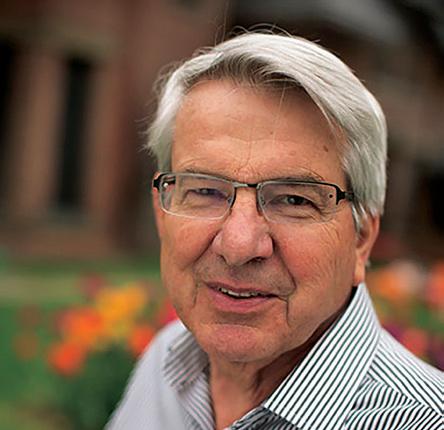
letter of support disturbed some graduate students. Take for example Peter Shipman grad, who dropped a class he had with Caruth in part because she signed the letter.
Although he said there were additional reasons that he dropped the class, including scheduling and the curriculum, Caruth’s apparent support of Ronell over the claims
His biggest frustration comes with the amount of power that advisors hold over graduate students. He advocates for unionization and increased parity in education.
“Tenured professors hold an immense power over grad students careers,” Shipman said. “Professors have the ability to use their power to basically shape, manipulate, and ruin grad students however they please because as grad students we have no check.”
One of the checks that Shipman believes should be implemented is a union for graduate students. Last semester after the vote for graduate assistant union recognition election were certified, the final decision was to not unionize, as previously reported in The Sun. CGSU will not be able to file another unionization election petition for almost
See GRAD STUDENTS page 14
By BREANNE FLEER
President Martha E. Pollack presented an overview of the University’s recent diversity and inclusion initiatives and efforts to address mental health concerns at Monday’s Graduate and Professional Student Assembly meeting.
Cornell recently released a report outlining these initiatives, which have included the hiring of three new therapists, the implementation of an Intergroup Dialogue Project session during orientation for new students and a plan to spend $60 million over five years to increase hiring and retention of a diverse faculty, as The Sun previously reported.
In regard to mental health, Pollack spoke about several substantive changes, including an increase of over
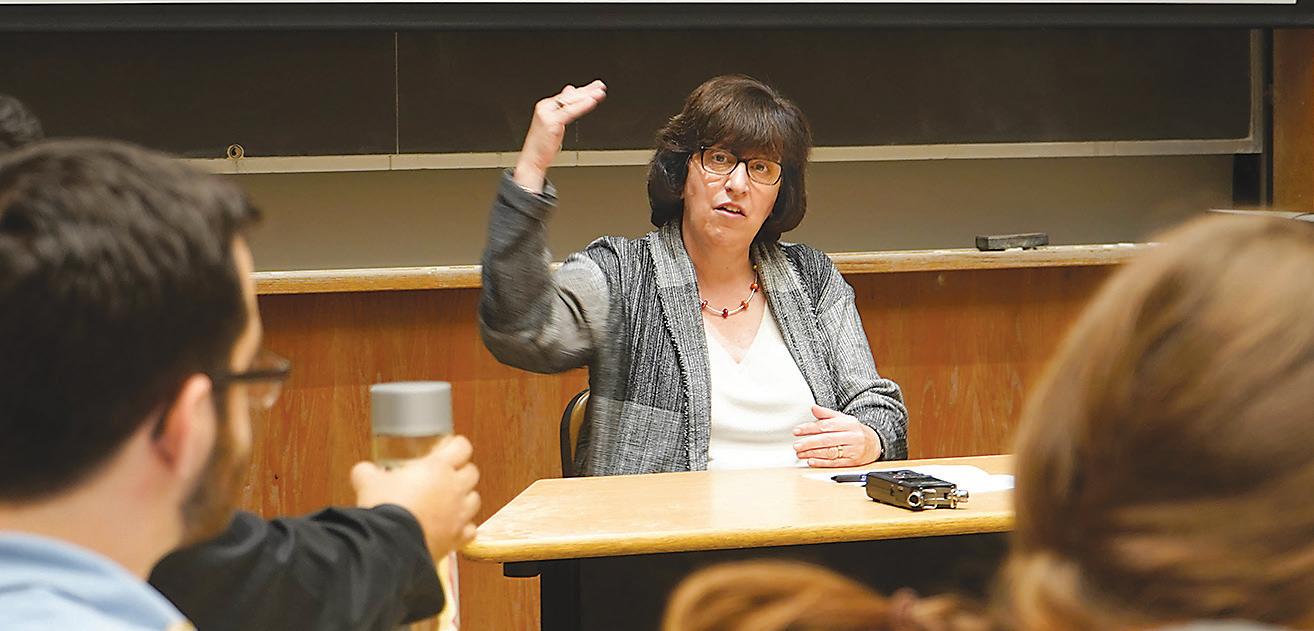
two and a half years from 32 to 43 counselors and Cornell’s decision to contract with ProtoCall, a 24-hour by-phone mental health counseling service that Pollack said was “very carefully vetted” in the hope that it would be helpful.
In response to an audience question about calls for an external review of Cornell’s mental health services, Ryan Lombardi, vice president for student and campus life, said the
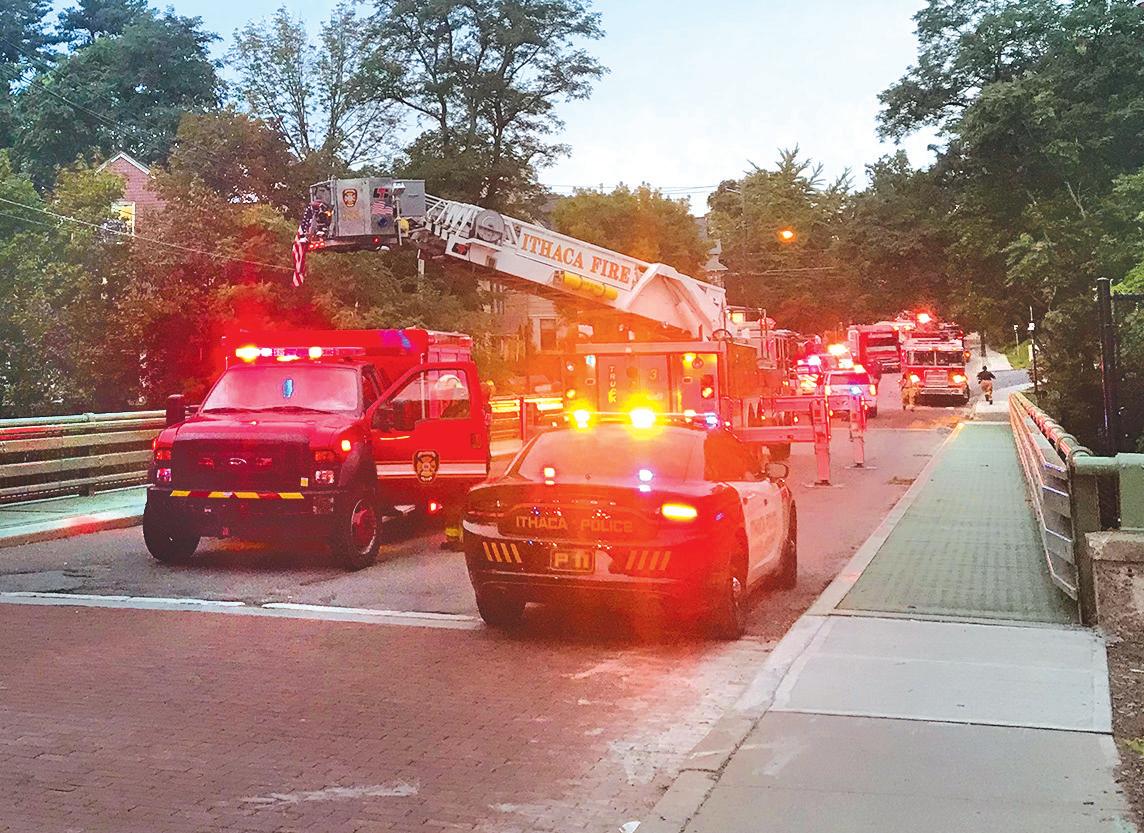
Ithaca firefighters rescued a man from a net below the Stewart Avenue bridge next to Cornell’s campus on Monday evening, rappelling down and bringing the man to safety.
The man, whose identity was not released, was taken to a local hospital with non-life-threatening injuries and is expected to fully recover, Cornell spokesperson John Carberry said.
Emergency personnel arrived
at the bridge over Cascadilla Creek about 6:30 p.m. They connected a firefighter to a truck’s ladder and he rappelled off of the west end of the bridge as other firefighters peered over its metal edge. Police diverted vehicles and curious students away from the bridge as the sun set.
The firefighter was pulled back up at about 7:24 p.m. and the man was placed into an ambulance.
Walter Hartman said he
Tuesday, September 25, 2018
Behavioral Economics Workshop: Stephanie Wang
11:40 a.m. - 1:10 p.m., 141 Sage Hall
Baker Seminar Series
Noon - 1 p.m., Cornell Cooperative Extension of Tompkins County, Room A
CFS: James Xia (Cornell)
“Experimental Measurement of Contact- Line Mobility and Dissipation Using Drop Resonance” Noon, 106 Upson Hall
Diversity Week: Lunch & Learn: Unconscious Bias Noon - 1p.m., 401 Warren Hall
International Student Group 4 :30 - 5:30 p.m., 276 Caldwell Hall
What is a (Black) Faggot? Cinema, Exorbitance, And Moonlight’s Metaphysical Question 4:30 - 6 p.m., 122 Rockefeller Hall
An Introduction to Bloomberg 5 - 6 p.m., Stone Classroom, Mann Library
Association of Veterans Happy Hour 5 - 6 p.m., Big Red Barn
Have a Nice Day - Free Screening 7:15 - 8:32 p.m., Willard Straight Theatre
Finger Knit for a Cause 8 - 9 p.m., William T. Keeton House Wednesday Today
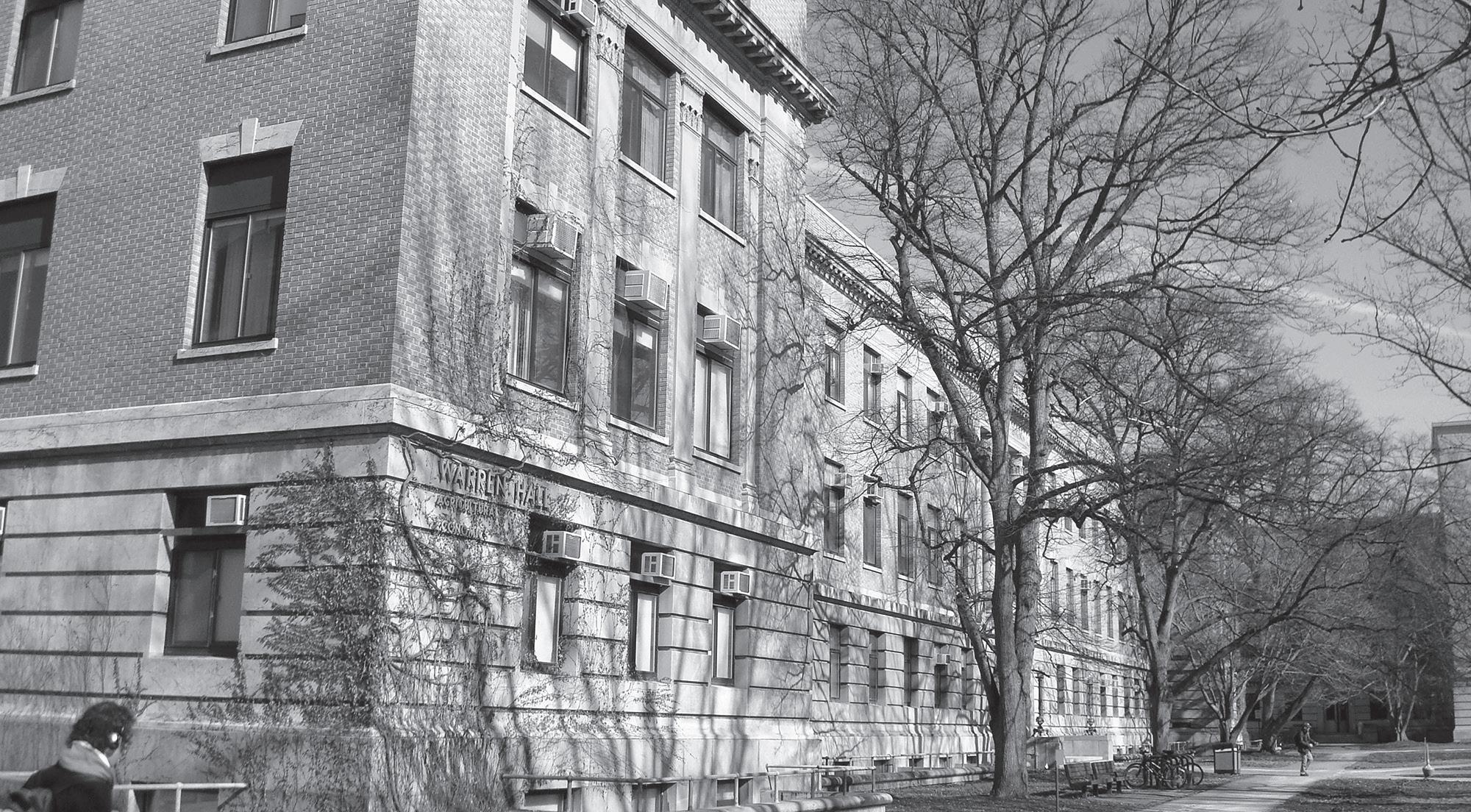
FGSS Graduate Professional Development Workshop Noon - 1 p.m., 190 Rockefeller Hall Gap Inc. Innovation 12:20 - 1:10 p.m., T01 Human Ecology Building
Investing in Southern Africa’s Future 12:20 - 1:10 p.m., 135 Emerson Hall
Engaged Cornell Funding Opportunities Info Session 3 - 4 p.m., 102 Mann Library
Seminar
Earth and Atmospheric Sciences 3:30 - 4:30 p.m., 2146 Snee Hall
Biophysics Colloquium With Chris Xu 4 p.m., 700 Clark Hall
China and Asia-Pacific Studies Program Information Session 4:30 - 5:30 p.m., B14 White Hall


Volunteers are needed in order to keep the homeless Friendship Center open until October 31 according to the Ithaca Times. The effort to recruit more volunteers is spearheaded by the Ithaca’s Homeless Crisis group. Ithaca’s Rescue Mission, which runs the Friendship Center, will be closing soon which is why volunteers will be needed to work in the center. Hourly shifts are available on Tuesdays from 9 a.m. to 4 p.m.; Wednesday from 12 p.m. to 4 p.m. and Thursday from 9 a.m. to 4 p.m. for those interested. The Ithaca Times reported that the Friendship Center has been a crucial place for homeless citizens struggling to obtain food, clothing, showers or shelter. The center also provides services like jobs and community information, medical assistance and counseling.
A fake photo of President Donald Trump rescuing flood victims went viral according to Huffington Post. New York Times reporter Kevin Roose noted that the photo, was originally from a 2015 flood in Central Texas, before Trump was even elected to office. The photo has since been shared more than 275,000 times since it was uploaded Sept. 16. The original photo depicts firefighters rescuing a man. Despite the fact that the photo is clearly photoshopped, it is still being shared.
Parents of Chinese college students are staying with their children in tents after they drop them off to college according to The New York Times. Tianjin University, about two hours from Beijing, has offered these tents, deemed “tents of love” free to parents since 2012. Many parents come from hundreds of miles away and want to ensure that their children have a smooth transition into college. This has allowed low income parents to afford staying with their children. However, the increase in popularity of the tents has sparked debate about parents coddling their children.

Reduce, reuse, recycle | Cornell composts around 850 tons
Services. Following a six to nine month compost process,
By MATTHEW McGOWEN Sun Senior Editor
Despite Cornell’s elaborate composting operations in recent years to ensure that as little organic material as possible goes to the landfill, the no-waste campus dream seems far from fruition.
“The
One of the challenges standing in the way of better waste management, according to Elena Petkova ’20, student coordinator with R5 Operations — a division of the Cornell facilities and campus services intended to promote sustainable practices — is cross-contamination in the bins used by students at cafes and eateries.
the piles at the composting facility do not reach a high enough temperature to decompose the utensils, leaving behind hard residue that compromises the quality of the finished product, according to Petkova.
program operates thanks to dedicated student volunteers who are willing to take care of a compost bin they keep in a kitchen of their residence hall.”
Elena Petkova
’20
“In addition, there was confusion in the past about which utensils are compostable and which are not so to simplify the system, only food scraps and napkins are accepted,” Petkova said. To further enhance Cornell’s composting capacity, on Sept. 4, the Campus Sustainability Office and Cornell Farm Service partnered up to launch Compost Managers, a program intended to target food waste in their kitchens and dorms.
In addition to formal University efforts, living centers like the Ecology Co-op and Hasbrouck apartments have taken up composting, according to Petkova. Tompkins County Recycling Materials and Management will also accept up to ten gallons per person per day at drop locations all around Ithaca, including East Hill Plaza and Cayuga Heights.
According to the Sustainable Campus website, Cornell currently composts about 850 tons of food scraps and other materials annually from 22 dining units and food vendors on campus.
— Compiled by Amina Kilpatrick ’21
Food leftovers and napkins are the only compostable waste on campus, and any other items disposed of in compost bins contaminate the remainder of the compost. This poses a threat to the sustainable waste management mission because Cornell Farm Services then rejects the contaminated compost and sends it to a landfill, Petkova explained in an email to The Sun.
This rule applies even to the utensils used by some of the cafes on campus that are advertised as compostable, because
According to Petlova, “the program operates thanks to dedicated student volunteers who are willing to take care of a compost bin they keep in a kitchen of their residence hall.”
Targeting dorms and on-campus student living seeks to fill in the gaps of a system that already includes back end disposal used by kitchen staff at all dining halls, and front end disposal used by students at all dining halls and at cafes including Mandibles, Trillium, Mattins, Atrium, Bus Stop Bagels, Macs and Terrace.
“Only food scraps and napkins are accepted [compost]” Elena Petkova ’20
The food waste materials from Cornell Dining are combined with animal bedding and plant material from various research facilities and taken to the compost facility operated by the Cornell Farm Services. The waste material delivered to the facility is destined for a six to nine month transformation into fully composted material that is sold to the public or sent to campus or agricultural facilities.
Matthew McGowen can be reached at mmcgowen@cornellsun.com.
U.S. and Mexico dual citizen to discuss immigration reform and human rights
By HUNTER SEITZ and PARIS GHAZI Sun Staff Writer and Sun Assistant News Editor
Enrique Morones, founder of Border Angels — a San Diego-based non-profit organization active in immigration and human rights issues pertaining to the U.S.-Mexico border — will be giving a lecture on Tuesday. Border Angels, founded in 1986 by Morones, focuses on issues that affect the Latino/a community, and has recently gained attention for the “water drops” initiative, for which volunteers travel along popular routes used by people crossing the border illegally to leave jugs of water behind in an effort to
prevent unnecessary deaths due to dehydration.
“We assist immigrants on the road to citizenship by providing free and low-cost legal assistance, as well as encouraging English language education and a comprehensive understanding of American culture, society, and legal system,” according to the Border Angels website.
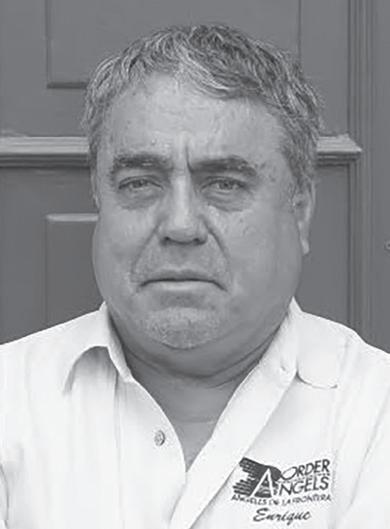
Morones’s two-day visit, sponsored by the Latino/a studies program, American studies program, the Cornell Farmworkers program, among other departments, will include classroom visits and meetings with students.
“He is passionate about [immigration] and has converted that passion into concrete actions that have a deep impact on people’s lives,” Prof.
Mary Jo Dudley, developmental psychology, and director of the Cornell Farmworker Program, said in a press release for the College of Arts & Sciences.
“He is passionate about [immigration] and has converted that passion into concrete actions that have a deep impact on people’s lives.”
Prof. Mary Jo Dudley
Dudley helped organize the visit for COML 4575: Migration in the Americas: Engaged Research Methods and Practice, in which students work closely with immigrant farmworkers. Outside of his work with Border Angels, Morones continues to champion human rights in both the public and
private sector. He was the first individual to be granted dual citizenship with both Mexico and the United States in 1998, according to the organization’s website, and was the recipient of the 2009 National Human Rights Award, an honor granted by the former president of Mexico Felipe Calderon.
Morones has been active in human rights issues for decades, and in 2006 he led thousands of activists and American citizens across the U.S. on a “Marcha Migrante,” a demonstration that has since evolved to an annual event to demand immigration reform.
The lecture will take place at the First Unitarian Church in Ithaca at 6 p.m. and is open to the public.
Hunter Seitz can be reached at hseitz@cornellsun.com. Paris Ghazi can be reached at pghazi@cornellsun.com.
BRIDGE Continued from page 1
was sitting on a rock wall just south of the bridge when he saw a man hop onto the bridge’s metal railing and jump over, landing in a net that sits below. Hartman and other bystanders ran over and saw the man scoot toward the edge of the net, letting his legs hang over the net’s edge, he said.
“He dangled his feet, then just lay back” on the net, said Hartman, a Cornell Building Care employee. “I know the first thing he asked was, ‘Can you get me a ladder?’”
As the man lay on the net, Hartman and another bystander began speaking with him from the bridge, telling him “don’t do it” and trying to keep him talking. The man appeared calm as he answered their questions about what kind of music he listens to and what he studies in school, Hartman said.
The man told them he was a senior at Cornell, Hartman said. Carberry said that Cornell could not provide more information about the incident “due to privacy restrictions.”
Carberry said Cornell is “grateful to our local first responders, and thankful that the safety systems put in place by Cornell several years ago have proven their life-saving value.”
Cornell installed nets near and under seven campus and city bridges in 2012 after nearly two years of controversy about how to curb suicides. The nets replaced chain link fences that Cornell had erected on the bridges in response to several suicides in 2010.
Nicholas Bogel-Burroughs can be reached at nbogelburroughs@cornellsun.com.

POLLACK
Continued from page 1
University has not “gotten to the point of deciding who will conduct” an upcoming comprehensive review.
Though Lombardi said he “can’t speak … to exactly who” will be conducting the review, he said he does “envision it being external audiences.”
“I think part of the first step is to understand what we want to look at, and then I think that will really inform that broader question about who’s best to come in,” he said. “Obviously I think we’re going to want people to have expertise in mental health. I don’t want that just to be Cornell folks.”
On the theme of diversity, Pollack also highlighted several educational initiatives and moves to make the Campus Code of Conduct more readable. She also expressed the possibility of Cornell creating a value statement.
The president said that since she has arrived at Cornell, she has heard feedback urging that the campus code be changed. She called the current code “legalistic” with a “punitive tone instead of an educational, aspirational tone.”
Matthew Battaglia ’16 grad, chair of the University Assembly and a member of the Working Group on Hate Speech and Harassment, told The Sun that the U.A.’s work with Pollack on the Code of Conduct is going well.
“We’ve worked really great with the President so far,” he said. “We’re really looking forward to partnering with her and her administration to really try and make the code more readable to your average student while not losing its robust series of protections.”
Noting that the University does not have “one, single place where we talk about our core values,” Pollack said the University will be working on a value statement for Cornell this semester in addition to other initiatives.
“We need one statement, that we as a community say, ‘These are our values,’” Pollack said. “We can hand it to every new member of the community, every existing member of the community. When we
make difficult decisions, we can point to that.”
Looking to the results of the IDP session, which Pollack said is normally offered as a semester-long course, Pollack noted that there has already been a 40 percent increase in “students who have expressed interest in registering for the longer program.”
Pollack also touched on the role of student and faculty feedback in the Center for Teaching Innovation’s new online class, Teaching and Learning in the Diverse Classroom.
“We need one statement, that we as a community say, ‘These are our values.”
President Martha E. Pollack
“One of the main things we heard from students, undergraduate and graduate, was that sometimes the faculty members needed a little more help in teaching effectively in a multicultural classroom and in handling difficult discussions,” Pollack said. “And we heard from graduate students, T.A.s and from faculty that they wanted this kind of training.”
Initiatives like these that are mentioned in the report come mainly from the recommendations of the Presidential Task Force on Campus Climate and the Provost’s Task Force to Enhance Faculty Diversity, The Sun previously reported.
Pollack emphasized that “we’re committed to” the University’s diversity and inclusion initiatives but that everyone needs to be involved to make such efforts possible.
“We could be fully committed and work on this 24-7, but if the community isn’t also practicing these principles, we won’t make progress,” she said.
Also at Monday’s meeting, GPSA voted 13-0-5 to pass its 2018-2019 internal budget and 13-05 to pass a resolution approving updates to the Assembly’s bylaws for the academic year.
BreAnne Fleer can be reached at bfeer@cornellsun.com.
Continued from page 1
students and their future,” said Akanksha Jain ’20, current S.A. international students liaison.
Non-STEM students studying in the United States on F1 student visas typically only have one year of work authorization, which means they must leave the country after the authorization expires. STEM majors however are allowed to work in the United States for two years, according to regulations governed by the Department of Homeland Security.
“We are happy to assist with our part in supporting the international students as this resonates with our mission of developing and supporting the next generation of global citizens by fostering mobility, exploration, and international and cultural exchange,” Raychaudhuri said in a statement to The Sun.
Lovenheim said that he was “not formally planning to announce [the reclassification,] per say.” However, Raychaudhuri told The Sun that the International Services in the Office of Global Learning is currently working to “confirm all of the international students who are affected by this change, update each of their immigration records, print new I-20 forms, and notify all of the affected students.”
“It takes some time to change
all of the university systems to fully implement to the point where we can change the immigration records,” Raychaudhuri added.
The recertification of the economics major is the culmination of months of activism by international students.
Last semester, the Student Assembly and the University Assembly both petitioned the University to request the New York state government to change the classification of the economics major as a STEM study in resolutions sponsored by Schott.
University administrators responded positively to the S.A. resolution, with Prof. Lawrence Blume, then-chair of the economics department, confirming to The Sun previously that the department “will pursue certification” absent any significant barriers. Prof. Charlie Van Loan, dean of faculty, also signaled that recertification would be a “nice idea” in an email included in the S.A. resolution’s appendix.
But, despite the support of the University, the outcome of the push to recertify the major remained uncertain and out of Cornell’s control. Reclassification of a major is a lengthy bureaucratic process where the N.Y. state government evaluates if a particular major fulfills federal guidelines that lists what a STEM major should have, Schott previously told The Sun.
Raychaudhuri said that this
process has now concluded, changing the federal classification of the economics major from Economics — a non-STEM program — to econometrics, which is a STEM major.
Schott previously told The Sun that some University administrators were concerned that changing the certification of the major could make the federal government more inclined to change guidelines to make it harder to change the classifications of majors in the future.
When asked by The Sun if he shares concern for federal reaction to the reclassification, Raychaudhuri said that it is “not an area of concern” as the reclassification is a purely academic decision based on the curriculum.
“The change in code reflects the process of alignment of the major and the program of study. These changes are made on an academic basis and approved so it is not an area of concern,” he said.
The U.A. resolution called academic departments other than the economics department to consider reclassifying their majors as well. The Sun reached out to the applied economics and management department, which was raised as a potential candidate for reclassification by the resolution. The department did not respond.
Yuichiro Kakutani can be reached at ykakutani@cornellsun.com.
JOHN McKIM MILLER ’20
Business Manager
KATIE SIMS ’20
Associate Editor
VARUN IYENGAR ’21
Web Editor
136th Editorial Board
JACOB S. KARASIK RUBASHKIN ’19 Editor in Chief
GIRISHA ARORA ’20
Managing Editor
HEIDI MYUNG ’19
Advertising Manager
ALISHA GUPTA ’20
Assistant Managing Editor
Working on Today’s Sun
Ad Layout Krystal Yang ’21
Design Deskers Megan Roche ’19
Lei Lei Wu ’21
News Deskers Yuichiro Kakutani ’19
Paris Ghazi ’21
Raphy Gendler ’21
Sports Desker
Arts Desker Lev Akabas ’19
Science Desker Amol Rajesh ’20
Photography Desker Boris Tsang ’21
Letter to the Editor
Production Deskers Krystal Yang ’21
Katie Reis ’20
To the Editor:
The article by Dylan McDevitt in September 13’s Sun is, in my opinion, unbalanced, gleefully disparaging and extremely disrespectful of Cornell’s winningest coach and his many successes.
The fact that the article has nothing to say about the “misconduct investigation” suggests that the Athletics Department is thankfully handling its investigation following proper privacy protocols. With nothing new to say, the author of the article instead dredges up some truck driving issue from 10 years ago of which Coach Eldredge was cleared and an instance, also from ten years ago, for which Coach Eldredge apologized, where he was simply teaching sportsmanship and players how to be respectful of umpires no matter how inflammatory those umpires might be on a given day. There is a reason the law has a principle called double jeopardy. Don’t conduct a trial by media for something the coach was cleared of ten years ago!
As to the present, the article seems to assume that Coach Eldredge is guilty unless proven innocent. Why the trial by media? How can the Sun slur anyone like that, never mind a stunningly successful coach and athlete who has done so much for Cornell? Why is the coach’s phenomenal success of winning 988 games and 15 national championships buried in the penultimate paragraph?! Why is there no mention of the great things Coach Eldredge has done? To that end I offer some balance:
I have been coached by David Eldredge and Tony Condo for the last two winters (with my 13 year old daughter) and played in the Wednesday night games as well. I can say firsthand that Coach Eldredge demystifies an extremely complex game and successfully introduces even nine-year-olds to the sport of kings. He has trained his horses with great precision, making the fast paced game as safe as it can be with his zero-tolerance policy towards bad behavior. That is essential in a team where large animals are galloping in a confined space and players are hitting a ball with long mallets. Coach Eldredge stresses over and over again during training that the golden rule is to ensure the safety of the animals. That is why you have to observe the line of play rule. The horses he has trained are so wicked smart and skilled that even if a novice tries to do something against the rules, the horse oftentimes won’t do it. Off the field, if a novice player forgets to put on front leg protection, the horse lifts its hoof as a reminder. Some of them even know how to take off their own bridles!
I have witnessed Coach Eldredge demonstrating great care for his horses. As he should, he yells at me if I don’t warm up my horse sufficiently before a chukker. He talks sternly to anyone, even opposing teams, if they do not walk their horses in between chukkers which is necessary to stop them stiffening up as they cool down. He knows every hair on all of the horses. You are supposed to inform people at the barn if your horse has an injury or there is something unusual. But if there is, David always already knows. He has a sixth sense for anything to do with horses and nothing escapes his observant eyes.
On the rare occasions I have played on Coach Eldredge’s team on Wednesday nights, you have to change your game strategy because he never misses. You have to anticipate that he will be five moves ahead because he can see into the polo game future. Many plays flash through his mind for any one situation. Yet he is generous with his ability and encouragingly suggests plays I could have done to improve my game. This has also been true of his kind and well mannered daughter on the few occasions when I have had the pleasure to play with her. Watching Coach Eldredge play polo is a joy to behold as he is such an athlete and his polo mallet is a perfect extension of his arm, so he can do incredible trick shots that leave one’s mouth gaping open.
Coach Eldredge makes a sport, which is reputedly elitist, accessible and in addition to being the best college polo coach in the country, helps bridge the town and gown gap. 60-year-old strong men can ride with fourteen year old girls and children of local farmers and compete fairly with each other while at the same time, money is brought to the program and horses are kept at peak fitness. He invites the polo players to his home each year for a holiday party which is not only a laugh a minute but builds camaraderie. People of all different political persuasions get together and have a truly great time. One player shared with me an act of extraordinary generosity Coach Eldredge showed her when she had some domestic issues. When he returns from away competitions you can hear the audible sigh of relief at the barn because he manages so much — leading a polo team and running a polo herd are herculean and unrelenting tasks. There is simply nothing in the world more fun and exciting than the adrenaline rush of playing polo. You forget you are a human and you think with the horse. The horse listens for instructions on where you want to go and do, and the three horses I have had the pleasure to ride (Alfalfa, Juanita and Maestra) love the game as much as I do. They are better at anticipating plays than I am and sometimes it is all I can do to stay aboard when they turn on the proverbial sixpence. There is a reason the higher ups in the military played polo and it was the training ground for military leaders — polo rewards and improves strategic yet lightning quick thinking, agility, courage, being bomb-proof and team spirit. Polo is something that is very, very special about Cornell and living in Ithaca and, I think, flows from the fact that historically, cavalry horses were stabled here. Let our students and children escape computer games and the cottonwoolification of growing up and play something (sur)real like polo. Please be more careful with what you write about a Cornell sporting superstar.
Deirdre L. Hay
Tracy
My name is Tracy Mitrano. I am the Democratic challenger running for Congress in New York’s 23rd District against Rep. Tom Reed (R-N.Y.). I write to urge every Cornellian to take the midterm elections seriously. If and how you vote on November 6 could well determine the kind of society and political culture that will shape your lives for decades to come. Running for political office takes grit, determination, clear vision and, most of all, strong personal values. It’s a set of traits Cornellians have in spades. One of my core values — which my opponent does not seem to share — is a commitment to education. My parents ran a small restaurant in downtown Rochester and sacrificed so that I could be the first person in my family to attend college. Thanks to them, and to generous financial aid, I graduated from the University of Rochester and went on to earn a Ph.D. in history from Binghamton University and a law degree from Cornell. That education prepared me to pursue a career in cybersecurity policy. Until my retirement from Cornell, I served as its Director of Information Technology Policy.
through the special 1.4 percent tax on college endowment investment income. Money from Cornell’s endowment that might have funded financial aid is now diverted to support tax cuts for the wealthiest Americans and corporations. Meanwhile, Reed remains silent about ruinous student-loan interest rates and publicly rails against “luxurious” and “resort type” amenities at universities. I do not understand why our sitting Congressman chooses to use Cornell, one of the major economic engines in his district, as well as its students and staff, as political punching bags.
The years I spent in higher education inform my campaign.
The years I spent in higher education inform my campaign. Cornell’s commitment to need-blind admissions and generous financial aid packages allows the university to open its doors to middle- and working-class students. Still, an estimated 45 percent of undergraduates leave Cornell with some debt, and the situation for many graduate students remains much more onerous.
2016 graduates of the Vet School, for example, graduated with a median debt load of $152,000.
Many Cornell seniors applying to medical or law school can expect to take on average debt loads around $200,000 financial burdens they will carry for decades. That is why I believe that every student loan should be interest-free and that profit-obsessed banks should no longer influence how Congress sets interest rates.
Reed acts and votes in other ways that many Cornellians will find disturbing. He wants to defund Planned Parenthood, even though it is a major health provider to thousands of his constituents. Reed also remains mostly silent when President Trump sows discord and division. Recently, the Congressman called for an end to the Mueller investigation, a call that, given the recent guilty plea and conviction of two of Trump’s advisors, now seems even more absurd. While presenting himself as a centrist conciliator back here at home, Reed votes in Washington as a right-wing extremist, siding with President Trump 97 percent of the time.
Even if you are already registered to vote where you are from, you are entitled to register in this district.
My opponent, Reed, argues differently. According to a recent Pew Research Center study, 58 percent of Republicans and Republican-leaning independents report that they believe colleges and universities have a negative effect in the United States. Our Congressman seems to share this opinion. Last January, he targeted Cornell, as well as 30 other colleges and universities, for special treatment in the Tax Bill he helped shepherd through Congress. Reed was a leader in pushing
The 23rd district trends red, but Democratic candidates with democratic values win when students vote. Even if you are already registered to vote where you are from, you are entitled to register in this district — you are a resident of Ithaca now, and our leadership will affect your lives. If you haven’t registered before, make it a priority. The registration deadline is October 12. Stay true to our Cornell values: stand up, speak out and let your voice be heard. Vote. You must be a registered voter in order to vote in the general or primary elections. To register in New York State you must be a United States citizen, be 18 years old by the date of the election you want to vote, live at your present address for at least 30 days before an election, and not claim the right to vote elsewhere. A dormitory address is considered a legitimate residence. For registration forms and more information go to the Tompkins County Board of Elections website, The deadline for registering to vote in the November 6th General Election is October 23, 2018 (in person or postmarked by then if mailed).
Tracy Mitrano is running for Congress from New York’s 23rd District, which includes Ithaca. Guest Room runs periodically. Comments may be sent to opinion@cornellsun.com.
en years ago, before many of us had the requisite adult teeth to pronounce “synthetic collateralized debt obligation,” capitalism failed.
Or at least it seemed that way. On September 15, 2008, Lehman Brothers, once an investment bank holding assets worth thrice the GDP of Greece, filed for bankruptcy. It was, and remains, the largest bankruptcy in American history. Markets tumbled across the globe in a housing-fueled financial crisis that wiped out over $30 trillion in wealth by March 2009.
Commentators disagree about the root cause of the crisis. Some point to overly loose monetary policy, others to reckless deregulation. Still others blame Wall Street greed, though, as Mark Blyth of Brown University notes, “You can’t explain a variable with a constant.”
Probably the best — and least satisfying — explanation of the crisis is that it is overdetermined. That is, not unlike the election of Donald Trump, it was caused by a confluence of factors all converging to spell disaster.
The trouble for finance-inclined Cornellians is what to make of the post-crisis financial sector. If the industry really is greedy and morally (if not financially) bankrupt, then what bright young person would want to waste her talents trading stocks?
Zoom out for a moment.
products that usually gain value over time. Similarly, derivatives let people bet for or against specified outcomes, which helps mitigate downside risk.
Yet all is not well in modern finance. New business formation has not bounced back from the financial crisis, partly because banks appear less willing to lend money to small businesses. George W. Bush’s bank bailouts, that Barack Obama continued, showed the government’s willingness to prop up risk-happy financial behemoths with taxpayer money.
For students mulling possible career paths, the unavoidable question becomes: “Will this job pay?”
Finance plays an essential role in society. Financiers move capital, in the form of credit, from those who have it now to those who need it now. Inventors with an idea are paired with investors chasing profits. In theory, both win.
The financial sector also helps people and firms manage risk, chiefly by creating diversified financial
Some academics have found a relationship between financial-sector expansion and economic growth resembling an upside-down parabola. At first, the economy benefits from the extra efficiency that a burgeoning financial system brings. But later, as the industry grows ever larger, finance begins to suck away resources from the real economy. Productivity falls and so does growth. This last point is worth dwelling upon. Talk of “sucking away resources from the real economy” is abstract. In concrete terms, that means campus-recruiting divisions at finance firms nudging promising young people into a 20-year career pipeline. That means seducing an aspiring astrophysicist with a six-figure job working on arcane financial models. That means cultivating among students the sense that a profession in finance is prestigious and enviable.
from the productive economy and into finance — is complicated by another legacy of the financial crisis: inequality. The share of national income that goes to laborers has fallen to historic lows. Median wages have recently ticked up, but were for years stubbornly flat. Economic growth increasingly accrues to the top quintile of earners. These trends began before the financial crisis, but they were exacerbated by it.
The trouble for finance-inclined Cornellians is what to make of the post-crisis financial sector.
And they mold how we think about our careers. For students mulling possible career paths, the unavoidable question becomes: “Will this job pay?” Generation Z, loosely defined as the cohort born between 1995 and 2005, cares more about financial security than any other generation. The Wall Street Journal’s Janet Adamy characterizes this trend well. Gen Z, Adamy writes, is “sober, industrious and driven by money.” Adamy’s lede tells the tale of Sean McKeon, whose family was pinched by the crisis. McKeon, a senior at Miami University, wanted a “career that’s recession-proof.” He went for a job at EY, a financial auditing firm.
It’s hard to fault McKeon. In a stratified economy, if you’re not on the top, you’re on the bottom — thus the appeal of finance’s juicy salaries. It makes sense for individuals to go into finance. But if too many do so, America has a problem. We need more smart, ambitious people to build rockets, write timeless novels and code the next Tinder-killer. We need fewer smart, ambitious people to dream up the next synthetic collateralized debt obligation.
TThe simple story of human capital outflow — away
Ethan Wu is a sophomore in the College of Arts and Sciences. Discourse and Discord runs every other Tuesday this semester. He can be reached at ewu@cornellsun.com.
he #MeToo movement has dominated news cycle after news cycle since last October, as men, and some women, from all walks of life have been accused of sexual misconduct. This has most famously been through allegations against figures such as Harvey Weinstein, almost-Senator Judge Roy Moore, actual-Senator Al Franken, New York Attorney General Eric Schneiderman, and now, Supreme Court nominee Judge Brett Kavanaugh. They are accused of a wide range of acts that have forced us to consider not just how we deal with the abuse of power dynamics with sex, but what that abuse should be constituted as. This more complicated, more nuanced question forces us to deal with a topic that is present not just in gender issues, but in all of society’s most contentious and most controversial topics: discomfort.
suit for a year to demonstrate the sexist way that we perceive women’s clothing choices, and you consider the fact that you’ve never had to give a second thought to what you wear. Discomfort is when studies reveal the effects of gender bias in hiring practices, and you’re forced to think about how the company you work for recruits far more men than women.
The more pragmatic of these is that this discomfort ends with more people being able to contribute to society.
Discomfort is not as often in the headlines. Discomfort is #TimesUp to disgust’s #MeToo. It is far more pervasive, though, because it is what happens at the societal tipping point, when a practice has been challenged or proposed, and communities are then, as a whole, forced to make a judgement on it. Discomfort is when the introduction of a company policy against sexual harassment makes you wonder whether or not it is okay to make lewd jokes or statements about a female coworker. Discomfort is when a system-wide ban on manspreading makes you question if the way that you’ve been sitting on the train, bus or plane for your entire life is still acceptable. Discomfort is when an anchorman wears the same
Discomfort is when somebody shows you that these things were all in the headlines, but that you just didn’t notice them. And discomfort isn’t just what men feel when women point out the structural inequalities perpetuated by gender norms. Discomfort is when a woman is decried as racist for calling the cops on black people holding a barbeque, when airport security as an entity is labeled racist for always stopping the Muslim family, when a presidential candidate is denounced as racist for saying that Mexicans are dangerous, and you realize that you are more nervous when you’re in neighborhoods with black people, that it makes you uneasy when somebody who fits your stereotypical image of Muslim gets on a plane or that hearing Spanish spoken nearby makes you uncomfortable. Discomfort is when requirements to receive welfare are portrayed as an unfair burden, and you reflect on how you just want to make sure that people aren’t abusing the system. Discomfort is when anybody who questions gay marriage is called homophobic, and you think about how just seeing a man kiss another man makes you uncomfortable. Discomfort is when somebody tells you that transgender issues are just gender issues, and you realize that
you had always thought of it as its own separate issue because it’s just “different” for some reason.
It can be appealing to avoid discomfort, if for no other reason that there are justifications which offer not just a way to be inactive, but also a way to absolve oneself of responsibility for the disadvantages of others. And yet, in juxtaposition to these justifications are even more compelling reasons for why societal discomfort is not only worth it, but is something that should be sought after.
The more pragmatic of these is that this discomfort ends with more people being able to contribute to society. When society isn’t discriminating against you, this is easier for some reason, and it is impossible to know not only how much creation was lost, but also how much could be created if societal inequalities became societal equalities. And if discomfort is the price to pay, it is worth it.
Momentary marginalization is nothing compared to the historical kind.
you. It is saying that not questioning somebody’s right to love who they love is trivial compared to actually having your right to love someone be up for debate in the first place. It is saying that not voicing your concern about somebody using a certain restroom is trivial compared to having your bathroom usage be a concern at all. It is saying that being criticized for having certain viewpoints that you were raised to have is trivial compared to having had those viewpoints be about you. Furthermore, it is saying that although ignorance on these issues may be bliss, it is not absolution; whether or not you realize that a group is historically disenfranchised, whether or not you were raised to think that was okay, standing idly by keeps them disenfranchised.
More importantly, though, momentary marginalization is nothing compared to the historical kind. This is not to say that the discomfort from any marginalization is illegitimate. Instead it is to say that being told not to treat people as socially or morally deviant anymore is trivial compared to the psychological burden of having society cast you as morally or socially deviant simply for being who you are. It is saying that not expressing your fears of black people, Muslims or Latinos is trivial compared to actually having those fears be about
The point of discomfort is where we decide who we are as a society.
Discomfort is not an easy feeling to deal with; it requires opening oneself up to criticism from groups of people who will be more than ready to criticize you for not being willing to be criticized sooner. And yet the point of discomfort is where we decide who we are as a society, and how we deal with our past digressions. For too long we have deferred on those decisions and demurred on corrections to those digressions. For our own sake, it’s time to act, because the discomfort has always been worth it.
Giancarlo Valdetaro is a sophomore in the College of Arts and Sciences. Setting the Temperature runs every other Tuesday this semester. He can be reached at gvaldetaro@cornellsun.com
William Wang | Willpower
“Mr. President, are you a racist?” It took six years and a group of the world’s most brilliant scientists to develop a nuke that would bring the world to a halt. As it is, it only took April Ryan five words to have the same effect.
Let’s set it up. The day of April Ryan’s question had been rather tumultuous for the president. The day before, he had been reported as calling Haiti and El Salvador “shithole countries,” which was rather unfortunate for his now exhausted public relations team, outrageous to just about anyone else outside the GOP and rather hilarious to the rapidly growing sadist population in the country. ‘How could he say that?’ said one contingent of the nation. ‘How could he not?’ responded the other. Donald Trump was right. He could shoot someone on Fifth Avenue right now, and his base would still support him. He is, by any means, the walking Teflon Don — whatever he says, just rolls right off him. News networks were harsh, and rushed in; Don Lemon even so much as denounced his words as racist. But it seemed like with any incident with this President, it would just roll right under the rug.
the West Wing version of a cliffhanger.
She is who she is, just like the President is who he is.
So Ryan didn’t get her answer, but the answer never mattered; it was the sheer directness of the question that stole the moment. And for some reporters in a different, happier time, it would have ended their career just like that. But instead, it’s pretty much reinvigorated her in the past few months, and launched her as one of the leading faces of the resistance in the White House. She is, by my admittedly uncultured viewpoint, now one of the most famous African American women in the country, and her star is such that, as she settled in for a talk last Thursday at Klarman Hall at Cornell, the crowd was packed full to the back, with a majority holding copies of her book Under Fire waiting to be signed. I was one of them, and we waited eagerly for her talk. We cheered as she was called up to speak, and clapped when she got on stage.
And then she unleashed.
So I doubt even Trump was prepared for the query that was waiting for him the next day. After signing a proclamation that honored Martin Luther King Jr., he got up to leave the room, hopefully without any more controversy. Instead, Ryan, the White House correspondent for Urban Radio Networks and a CNN contributor, led with her infamous question. The room might as well have imploded.
Was it rather rude? Perhaps. As considerate people in society, there are certain terms we hesitate to lob around. Racist is one of them. Being called one is a death sentence during a time when diversity is celebrated. Most people don’t deserve that kind of treatment. Then again, Donald Trump isn’t most people.
Unsurprisingly, the President simply walked out of the press room, and pretended not to hear, even as the entire room paused for a gasp to give him the chance to respond. The question was left unanswered, hanging in the balance, waiting to be answered never. It was
Not angrily, though. She spent the evening in a tongue in cheek mode. She cracked jokes, told tales from her childhood, all the while pretty much declaring total war on the administration, criticizing it for the lack of transparency and increasingly rare press briefings. In career spanning four administrations, from Clinton to Trump, she reiterated she had never experienced such a dry spell in exposure to the administration. But she said it with a smile and a tense look in eyes, as if she was pretty much resigned to her fate. During most of the talk, she was level headed, reasonable and dominating all at once. She preached centeredness, and bashed partisanship, even if she was easily the most aggressive centrist I have ever encountered.
press, which I find a bit much. The press, through its roundabout breathless coverage of Trump in order to chase ratings, gave him the platform that launched him to be a front runner in the election.
In that sense, times have changed. There’s a sad tinge of nostalgia that reverberated around her talk. The Press Room has become more docile as her persona has become more inflamed, and stalwarts in the White House Press corps such as Helen Thomas, the famous antagonist and bane of many press secretaries, have faded away. Ryan, funnily enough, admiringly mentioned Thomas as an almost sort of predecessor in her speech, touting her brashness, directness and ability to get her questions across no matter how unpleasant or brute. It’s at this point my eyebrows went up as far as they went, because I was pretty sure this was the same Helen Thomas who more or less said Israelis should “get out of Palestine” and “go home” to Germany, Poland and the USA. There’s brashness, and then there’s recklessness, and in that instant, Ryan made the leap to the latter.
So it doesn’t surprise me when even her colleagues who very much agree with her call her brash, and her style is a little much even for them. They respect her, and admire her, but there is a certain amount of tension there.
She is neither leader nor sycophant, neither infallible hero nor irredeemable villain.
But she did get too far ahead at some points. At one moment, she insinuated the President has lost his mental capacity, which is a far more controversial claim than of him being a racist, and backed up with far less evidence. At the next, she vigorously pushed the unblemished virtues and level-headedness of the
On Monday I did not go to any one of my classes. I was exhausted from a weekend-long trip in the woods for a Biology class, but the exhaustion was more mental than physical.
Tonight I ate a pint of ice cream, a bag of chips and fruit snacks for dinner — and no I do not have a gym membership.
On most days after class, I like to come back and take those loooong naps, where you wake up and feel even more stressed because you know you lost a lot of time.
So who is April Ryan? By the end of her speech, she’s laid it out. She is who she is, just like the President is who he is. She seeks the lean truth, for us, the country, and for her, the reporter.
I think a picture best captures her current predicament. Flip to the cover of her new book, which is remarkably stark and grim. She’s sitting in the White House Press room, wearing a drab blazer and a rather fed up expression, holding up her hand, and waiting to be called upon. Then look around; the chairs are empty, left vacant. And I think that sums up the current state of April Ryan. She is neither leader nor sycophant, neither infallible hero nor irredeemable villain.
She’s simply alone.
William Wang is a junior in the College of Agriculture and Life Sciences. Willpower runs every other Monday this semester. He can be reached at wwang@cornellsun.com.
fact that these behaviors could be indicative of something a lot deeper. Students often mistakenly ignore the fact that these feelings of stress, social or generalized anxiety, depression and more should be addressed with less destructive activities then what we label “self-care.” We are so quick
How do I justify these destructive behaviors? I call it self-care.
How do I justify these destructive behaviors? I call it self-care.
At a school like Cornell, self-care is essential for a student to succeed. It doesn’t matter if you are super smart, have a perfect resume or have great time management skills. You could lose it all if you are not concerned with YOU first. But if mental health is something as serious as this, why is it in our campus culture to take it so lightly?
I had to take a step back and reevaluate my own use of the term self-care. We justify actions as selfcare like we justify billing things to our bursar, or adding drinks to a bar tab. I neglect to acknowledge the
to respond with “I’m fine,” that we delude ourselves and our friends into thinking it is true. In contrast, we are so quick to say “I’m depressed!” that we desensitize ourselves to the reality of depression on college campuses. When are we going to realize that it is not okay for you or your friends to say “lol I have too much homework, I’m going to kill myself.”
Many students are reluctant to find help or are even unaware of the wellness resources Cornell has on campus. It is important that we encourage our friends to seek help from our college’s programs as well. The wait time or lack of diversity — despite the universities best efforts — at Cornell Health are oftentimes discouraging for students. But alternatives like EARS,
Let’s TALK and group therapy are here for a reason. A Cornell’s 2017 PULSE survey revealed that nearly 43 percent of undergraduate students felt like they were “unable to function academically for at least a week due to depression, stress or anxiety” (this was 58.9 percent for Black students and 48.9 percent for Hispanic students). This shows that mental health challenges are not problems we should ignore on this campus. There are so many things that could affect how we feel, from academic burnout to social media, to simply the fear of failure. Even last year’s incidents on campus left students feeling mentally fatigued.
Recognizing when we are not feel-
cumventing mental health challenges, which means we have to take it more seriously. It is not an end all be all, some students may need additional assistance. But you may find that taking time to self-reflect on our own wellbeing and catering to ourselves correctly, could help lift our spirits. Self-care should look like things that make you happy from working out, hanging with friends or having some me-time. As long as those actions will not negatively impact you in the short or long term.
Let’s stop justifying unhealthy healthy conduct by labeling it as self-care.
ing as best as we should, or if a friend is displaying unusual behavior, is the first step in creating a more healthy campus.
I am not saying here that we should not indulge in self-care — I am saying the exact opposite. Self-care and mental health days are crucial in cir-
This new year we have so much to look forward to, so let’s stop justifying unhealthy healthy conduct by labeling it as self-care. We go to college to become better versions of ourselves, and being at a school like this is to do so is a privilege, even though it can feel like a burden sometimes. But alas, I am still a college student; if I want to pull an all-nighter watching the next season of Game of Thrones, I’ll just put it on my mental health tab.
Aminah Taariq is a sophomore in the College of Agriculture and Life Sciences. I Spy runs every other Wednesday this semester. She can be reached at ataariq@cornellsun.com.
Assistant Arts and Entertainment Editor
Whenever someone asks me if homecoming weekend is fun, I say, “It’s overrated. If you have work to do, just do that instead. It happens every year and you won’t miss much.” While I skipped all other homecoming activities this weekend, the only one I thought was worth getting out of bed for was the concert — and not just because I had a free ticket.
Back when the lineup was announced for the homecoming concert, I could not believe that Cornell students chose CupcakKe to headline such an important event. CupcakKe is a female rapper from Chicago and her sexual, vulgar lyrics are unlike anything else (perhaps her most popular song is called “Deepthroat”). Often, when one of my peers listens to anything by CupcakKe, they say, “Oh my God I feel like I need to go to church,” which is why I never thought she would come to Cornell. DNCE, on the other hand, is a different
story.
I’ll just say it now: DNCE does not make good music. It’s generic, nothing new and does not send any meaningful messages or convey emotions strongly or beautifully. Combine DNCE with drunk Cornell kids and you get a very obnoxious concert. Right away, I was crushed into a crowd of drunk boys: one making rape jokes, another messaging his Snapchat group called “Homeo-phobes” and the other jumping up and down trying to see and elbowing me every time. I defeatedly moved further back and was determined to still try to have a good time with this low-quality music, but it wasn’t happening.
The people towards the front all seemed to be having fun, but at the same time, most of them were pretty drunk. DNCE played their most popular songs “Toothbrush” and “Cake by the Ocean,” as well as an embarrassing early 2000s medley of covers which included “Wannabe” by the Spice Girls and “Oops I Did It Again.” Overall, the energy was high throughout the concert, but the atmosphere was bizarre. Either people were

having a really good time, or they were aware the music was bad. After DNCE left the stage, people dispersed and sat on the floor to take a water break. But once everyone heard CupcakKe say “Hey y’all, it’s me” into the mic, everyone immediately got up and ran back to the stage screaming. Compared to DNCE, CupcakKe brought an extremely different kind of energy. This wasn’t generic music that you could listen to and think it’s The Chainsmokers. This wasn’t Joe Jonas, who looks like the “sensitive” frat boy that ghosts you. This was CupcakKe, an unsigned, independent female rapper who uses her platform to advocate for LGBT rights and female empowerment. Did I still get body slammed by a drunk girl dancing very aggressively? Yeah, but at least I was enjoying the song “LGBT” instead of “Cake By the Ocean.”
The first song CupcakKe performed was “Vagina,” which provided any new listeners with a concise, accurate taste of what CupcakKe is all about. I was able to instantly pick out people in the crowd who had never listened to her music before: the ones screaming “Oh my God!” covering their mouths in shock or laughing in surprise. In addition to shocking lyrics, I knew that anyone unfamiliar with CupcakKe was in for another surprise. CupcakKe is notorious for flashing her breasts on stage. I was well aware of this. Most people were not. I didn’t have to look up at the stage to know what happened when everyone started screaming and recording, but I did, and I’m glad I got the whole CupcakKe experience live.
Something else that stuck out to me during CupcakKe’s performance was a small group of people with a sign that read “LGBT rides with CupcakKe,” a reference to the lyrics of the song “LGBT,” when she

sings “I’m rolling with the LGBT.” This was a completely transformed space from the one that DNCE created, yet it was still physically the same place at the same concert. If anything, the homecoming concert reminded me that the way artists use their platform affects the type of space they create when performing live. If artists make generic pop songs that don’t really speak on any pressing issues or reveal that they care about something, their live performance will be bland and even obnoxious, as I learned with DNCE. However, artists who create a space and empower more oppressed, overlooked or underrepresented people can craft a unique, fun atmosphere the way CupcakKe did.
Viri Garcia is a junior in the College of Agriculture and Life Sciences. She can be reached at arts@cornellsun.com.
The Cayuga Chamber Orchestra’s (CCO) performance at Ithaca College’s Ford Hall on Friday, September 21st, was aptly titled “A Heroic Beginning.”
The orchestra began its 42nd concert season with a delightful evening featuring the overture to Christoph Willibald Gluck’s “Orfeo ed Euridice,” Robert Schumann’s Piano Concerto in A Minor and Ludwig van Beethoven’s classic Symphony No. 3 with guest pianist Prof. Miri Yampolsky, music. A staple in the city of Ithaca, the CCO has been a premier institution of classical music performance since 1976.
Opening the evening’s concert was the energetic overture of the renowned opera “Orfeo ed Euridice,” which first premiered in 1762 in Vienna. The piece is based on a Greek myth in which Orpheus makes a deal with the
god of the underworld to resurrect his dead wife, but only if he can walk in front of her out of hell without looking back. Remarkably clean and enthusiastic, the performers came alive under the baton of conductor Cornelia Laemmli Orth and delivered an unforgettable opener.
Following the overture was Schumann’s Piano Concerto with soloist Miri Yampolsky. The concerto was written with a central motif modeled around the name of Schumann’s wife, Clara, an accomplished pianist and composer herself. Yampolsky, a faculty member at Cornell, performed the piece with incredible sensitivity and expressiveness. The first movement’s fiery piano riff dissolved into a touching, goosebump-inducing melody that positively captivated the audience. The orchestra provided a very balanced accompaniment to Yampolsky, whose command of the piano showed in every phrase. The clarinet
and oboe solos were also notably well done. The climactic end of the first movement gave way to a demure second movement, featuring soaring melodic lines by the cellos and dramatic arpeggiation on the piano. The main theme was again referenced by the winds in the transition to the third movement, which dramatically brought the concerto to a close. Simultaneously solemn, furious and delicate, Yampolsky’s performance was a nuanced and enjoyable take on the classical staple. A standing ovation immediately followed the final chord with a chorus of whoops and cheers.
The stunning finale of the evening was Beethoven’s Symphony No. 3 “Eroica,” consisting of four diverse movements. The familiar tune of first movement was a welcome opener to this iconic symphony, and Orth began it at a brisk and lively tempo. Undaunted, the orchestra delivered a technically-sound rendition despite
a challenging first violin line. Expertly weaving between major and minor, they gracefully interpreted the turbulence written by Beethoven to rivet the audience to their seats. A lively round of sixteenth notes and a flourish brought the movement to a breathtaking halt. The funeral march of the ensuing second movement expertly conveyed a profound feeling of despair and hopelessness — a fantastic contrast to the drama of the opening movement. Led by a sorrowful outpouring of emotion from the violins, the winds overtook the melody and drove the orchestra into a stormy developmental passage. A crescendo into a furious rage continued into a quiet and understated return to the original key, capping off the movement with precision and style. After a quick and dynamically broad third movement, the final movement began with a dizzying explosion of sound that dropped off into a quiet pizzicato section, giving way to the expression of
the dominant melody. With fast passages of notes and unexpected twists and turns, the orchestra managed to perform the finale with such exuberance that their energy was physically manifested through their movements onstage. Personifying the spirit of the “Heroic Beginning,” the symphony was performed with dramatic flair and electricity throughout. A second standing ovation greeted the musicians at the conclusion of the concert, a testament to their fantastic performance.
Upcoming concerts in the Cayuga Chamber Orchestra’s 2018-2019 season include “Music Without Borders” as part of their Chamber Music Series and “Magic, Movies and Music” as part of their Orchestra Series. More information is available at ccoithaca.org.
Maggie Gaus is a freshman in the College of Agriculture and Life Sciences. She can be reached at mbg227@cornell.edu.
ZACHARY LEE Sun Staff Writer
In an early sequence of The Predator, government agent Will Traeger (Sterling K. Brown) and Dr. Casey Brackett (Olivia Munn) facetiously debate about the titular creature’s Earth-given name. Dr. Casey believes the beast should be christened to the more appropriate moniker of “sports hunter,” given the fact that the creature likes to toy with its prey before finally killing it. To this, Traeger quips “we took a vote… and predator’s cooler right?” His surrounding entourage immediately erupts in unanimous affirmation and Casey sighs, accepting this shallow verdict for the sake of quiet.
For such a chaotically and sloppily arranged film, this sole moment of introspection took me by surprise. I imagine a permutation of this very conversation played out between director Shane Black and execs of 20th Century Fox while the former pitched his story. Going merely for what “sounds good” rather than what is truly substantive for the most part accurately summarizes the core issues of this choppily edited and tonally inconsistent sci-fi flick, but such a statement only camouflages its more egregious sins. The Predator is tragically another victim of Hollywood’s addiction to franchise-expansion and is more concerned with getting audiences to pay for the sequel rather than invest in the film in front of them presently. Even signature staples of histrionic violence and quippy one liners cannot cover over its thinly written characters, uninspired storytelling and husk of a plot.
The story involves an “intergalactic game of cops and robbers” between two pred-
ators, which eventually leads to conflict with authorities on Earth. Whereas the first Predator film drew much of its thrills from the enigma shrouding the entity that was hunting Arnold Schwarzenegger and his crew of bulging bicep-ted soldiers, Black offers no such subtlety here. From its titular shot, the beast is showcased in all its CGI glory, and rather than rely on its signature stealth tactics (it is a hyper-intelligent, extraterrestrial hunter after all) the predator is reduced to its most feral instincts and leaves a bloody and dismembered-body-parts ridden path in its wake.
Such a choice is an example where Black’s personal and stylistic preferences take preference over the franchise’s mythology. While some of these work in the film’s favor, such as a gruesome scene where a soldier’s entrails fall on a cloaked predator, revealing its hideous face, many others fail to sink in. Black attempts to scarf his signature humor at every point the paper-thin plot is given room to breathe, yet because it is tangential rather than integral, it derails the story further rather than amplifies the experience.
Black, likewise, is usually a pro at crafting likeable, rebel-type characters who color outside society’s lines, and yet with The Predator, he swaps the former adjective for “uninspired.” Quinn McKenna (Boyd Holbrook) plays a variation of the trigger-happy, patriotic soldier whom audiences have seen present in countless films, while Olivia Munn’s Dr. Casey wavers between expositional device and sub-par action heroine. Keegan-Michael Key acts like he is in a Key and Peele skit in every scene, which makes the whole movie feel like a long comedy sketch on several occasions. They are not all bad apples, though. Trevante Rhodes’s Nebraska Williams thankfully strikes the perfect balance between crazy

Noname Room 25
Self-Released



Hailing from the same Chicago music scene as other prominent artists such as Chance the Rapper, Vic Mensa and Saba, Noname shines with an album that may be the best of all. Initially known for her verses on Chance the Rapper’s Acid Rap and her own mixtape Telefone, which has gained a cult following, Room 25 shows Noname cementing her name among some of the best lyricists in rap music today.
“Y’all really thought a bitch couldn’t rap, huh?” Noname spits on “Self,” the opening track for the album, before reminding us that she’s at the top of her game. Tracks like “Montego Bae” hammer this point home as she flows with a cadence that seems to duel the drum beat
of her track. Even more unique than her flow throughout the album is her ability to craft narratives. In her debut mixtape Telefone, Noname used this strength to tell stories of everyone around her in Chicago, often at the expense of the listener actually getting to know Noname. This all changes in Room 25; Noname’s storytelling is as good as ever, only now she’s using it with a newfound confidence to tell us all about herself.
This new self confidence doesn’t come out of nowhere — in an interview with The Fader, Noname explains that in the two years since Telefone, she has gone on her first headlining tour, moved to Los Angeles and had sex for the first time at the age of 25. This shows up throughout the album, as Noname gets personal for the first time, often rapping about sex through lyrics such as “The sacrifice for my hoes, I’m gonna rob the church for the steeple / I bought you Game 5 tickets, made my pussy the sequel,” or her own struggles with alcoholism that delayed the release of her first mixtape by almost two years.
Noname’s lyricism shines most on tracks such as “Blaxploitation,” a song that sees Noname get political for the first time in the album. Lyrics like “Put a think piece in a rap song, the new age covenant / If you really think I’m cooking crack, then pass me the oven mitts” showcase a powerful self-awareness combined with a unique storytelling ability, a hallmark of any Noname song. The fact that she manages to succeed at rapping through political lense without coming off as though she’s lecturing her audience is an achievement in its own right.
While Room 25 is packed full of personal lyrics and worldly observations, it’s also full of witty moments that will have you laughing on your first listen. Part of

convict and tender mentor while Sterling K. Brown delivers his most menacing lines with such suave that make you want to both punch and fist bump him at the same time.
To the film’s credit, while it recycles character tropes and arcs from other flicks, it is interesting to see how these personalities interact outside of their “natural habitat.” There is something comical yet darkly satisfying that much of the action and drama takes place in the suburbs, which are places to which people usually flee in order to avoid the problems of the city. Black’s deliberate choice to stage the action here can be seen as a way to warn people against complacency and the temptation to flee from problems rather than confront them. Likewise, it is touching to see that, although the world has given up on McKenna and his band of “loonies,” they remain the few
this is her personality; in an interview with The Fader, Noname admits that she’d much rather hang out with comedians and get “drunk in the back of a shitty comedy club” than hang around rap pers. This sense of humor is most apparent on the open ing track, “Self,” in which she raps “Maybe this the album you listen to in your car when you driving home late at night / Really ques tioning every god, religion, Kanye, bitches.”
who are still willing to serve and sacrifice themselves as they fight the predators, even if they risk being forgotten.
It is a shame that Shane Black did not choose to embody the very nature of the monster that his film is named after. Rather than going “directly for the kill” (i.e. telling a straightforward story about one of cinema’s most revered monsters) he deliberately baits his audience and chooses to set up a sequel and draw out the plot, in hopes that viewers will come back for seconds. For a monster as iconic as the predator, why does a film that revisits it feel pressured to do more to hook audiences? This once bold and innovative franchise has ultimately become prey to its own greed.
Zachary Lee is a junior in the College of Arts and Sciences. He can be reached at zjl4@cornell.edu
RACHAEL STERNLICHT / SUN GRAPHIC DESIGNER

The standout track of this project is “Ace,” a soulful song about Noname’s move to Los Angeles and her decision to stay musically independent. R&B singer Smino lays down a perfect chorus before Noname raps harder than on any song on the album. Saba complements this with one of the best guest verses of the year, fresh off the heels of his own album Care For Me with a show-stealing double time flow. All three combine to create a song that should be the highlight of any end of summer playlist.
For every bar that Noname impresses us with lyrically, the production takes it one step further. With a style that producer Phoelix describes as “moving like water,” Room 25 is recorded with live instrumentation, creating a lush, human atmosphere that compliments Noname’s rumination and storytelling. At times it’s hard to tell
Noname’s rapping or the production behind her, but the two manage to seamlessly weave together and create a nearly flawless product. Most impressive is the work of drummer Luke Titus, whose drum tracks throughout the album are among the best and most unique of any hip hop project this year. It’s also important to note that this album was released independent of a record label, meaning that Noname had to foot the bill entirely for the live orchestras and instrumentation throughout.
Two years after her debut mixtape Telefone, Room 25 has Noname at an introspective peak, sailing over jazz melodies to create another cult classic that should be in the discussion for album of the year, reminding us that a bitch can, in fact, rap.
Daniel Moran is a sophomore in the College of Human Ecology. He can be reached at dhm96@ cornell.edu.
By SOPHIE REYNOLDS Sun Staff Writer
There are few things that can put a damper on an end of summer evening in upstate New York, but allergies are one of them. The classic watery eyes, incessant sneezing, and insatiable back of throat itch one feels while relaxing on Libe Slope or hiking to Second Dam can be attributed to little molecules called allergens, and
our bodies defense against them. Yet pollen isn’t the only thing that can send one running for a tissue or bathroom. Many compounds in the environment including plants, food and bacteria can cause full scale immunological responses and Melissa Page ’20 has set out to better understand why.
Researching alongside Simon Freuh Ph.D. in the Elia Tait Wonjo Lab of Immunology, Page has focused on explain-

ing in detail the mechanisms behind the severe immune response caused by atopic dermatitis—a chronic inflammatory, skin disease that is the second most common skin-related allergy in dogs.
While this may seem like a very specific malady, the mechanism that causes this response is uniform across all species and involves cells and has receptors analogous to allergen pathways in the human body.
in mice. After agitating the ear tissue of mice with and without the gene that codes for the CRTH2 receptor, with a model antigen that mimics the antigen responsible for atopic dermatitis, Page harvested and processed the outer-skin and lymph tissues from each sample. She then compared the presence of cytokines and other immune cells through specific cell screening techniques.
“After doing nutrition research one summer ... I wanted to expand my work in the field of immunology.”
Through the study of a prostaglandin receptor called CRTH2, a lipid receptor found in T-cell lymphocytes, Page hopes to solve the vexing issues of allergic reactions in humans.
Melissa Page ’20
Page explained that her motivation for conducting allergy-related research came from her experience working with allergy development in children previously.
“After doing nutrition research, one summer, at University of Rochester, where I looked at microbiomes and allergy development in kids, I wanted to expand my work in the field of immunology,” she said.
Page started last year in Tait Wonjo lab and is now in the process of wrapping up a research thesis on the role of prostaglandin receptors in allergic reactions.
CRTH2 is found on the membrane of CD4+ helper T-cells, the gate-keepers of the immune system that initiate the body’s inflammatory response. When activated by allergens, CRTH2 signals macrophages, B-cells, cytotoxic T-cells, among others by secreting cytokines such as interleukin 4 and interleukin 5.
Page has also investigated this process
While Page is still in the process of analyzing her data she believes her project will have similar implications and contribute some explanation to a previous discovery made by Tait Wonjo lab earlier this year. Through a study of helminth worm infection in dogs, Page’s fellow researchers found that by eliminating the CRTH2 gene, there was a decreased immune response but an increased clearance of the worm.
This suggests that a full immune response is not necessarily required for efficient remedying of certain diseases and that a specific balance of inflammation is optimal.
“My project may not give direct answers or save lives but a big part of immunology research is just gaining knowledge that helps to add to other aspects of the field,” Page said.
Through her research thesis, Page hopes to better understand the specific behavior of CRTH2 to unpack the intricacies of general allergen responses. Ultimately, this knowledge can be utilized for clinical application in a veterinary setting or even regarding human health.
Sophie Reynolds can be reached at sreynolds@cornellsun.com.
By SNEHA SHARMA Sun Contributor
It’s a Sunday morning and you’re hiking by Taughannock when suddenly you’re confronted by an eight foot grizzly bear. Before you can form a coherent thought, you find yourself fleeing back towards campus. This instinctual response, aptly named the fight-or-flight response, is triggered by a hormone released in situations of stress or danger: norepinephrine.
A lesser known function of norepinephrine is currently being explored by Prof. Christiane Linster, neurobiology and behavior. Linster used behavior, electrophysiology, and computational modeling to research how modulation of norepinephrine affects the olfactory system, the sensory system used for smelling.
Linster elaborated on her lab’s work in an interview with The Sun last week.
“In other sensory systems, researchers have suggested that [norepinephrine] improves signal-to-noise ratio, which means that the hormone makes sensory signals clearer while suppressing irrelevant signal,” she said.
Linster conducted an experiment with the rat olfactory system to help determine the effects of norepinephrine.
“We started with behavioral research and found that if we increased norepinephrine in the rat olfactory system, rats could detect much lower odor concentrations than if we hadn’t. And if we decreased the hormone concentrations, the rats didn’t do so well,” she said.
Linster has also additionally developed a computational model of the olfactory system. In doing so, the Linster Lab found that the principal neuron firing would indeed be suppressed in the absence of odors but stimulated in the presence of odors.
The applications of this research extend far beyond the hormone’s correlation to sense of smell. Linster suggested that her work could potentially shed light on post-traumatic stress disorder, otherwise known as PTSD.
PTSD is a mental health condition which is a result of a person witnessing or experiencing a traumatic event. Symptoms include intense flashbacks, severe anxiety, and uncontrollable thoughts about the occurrence. Often times, a PTSD episode can be triggered by a seemingly innocuous sound or sight.
“People with PTSD have learned to focus on certain stimuli which seem to take on a greater importance in their lives, which is intriguing because norepinephrine plays a role in learning and plasticity,” Linster said.
Linster discussed a study trying to compare the effect of stress on rats on their ability to remember odors.
“We found that stressing them led to the rats remembering the odor for longer periods of time,” she said.
The power of coupling computational modeling and behavioral studies to elucidate the mysteries of noradrenergic modulation has far reaching applications. When asked what she sees as the future of this research, Linster emphasized that her lab will aim to push past the olfactory system to look into other sensory systems and
to possibly take a look at norepinephrine’s influence on short-term and long-term memory.
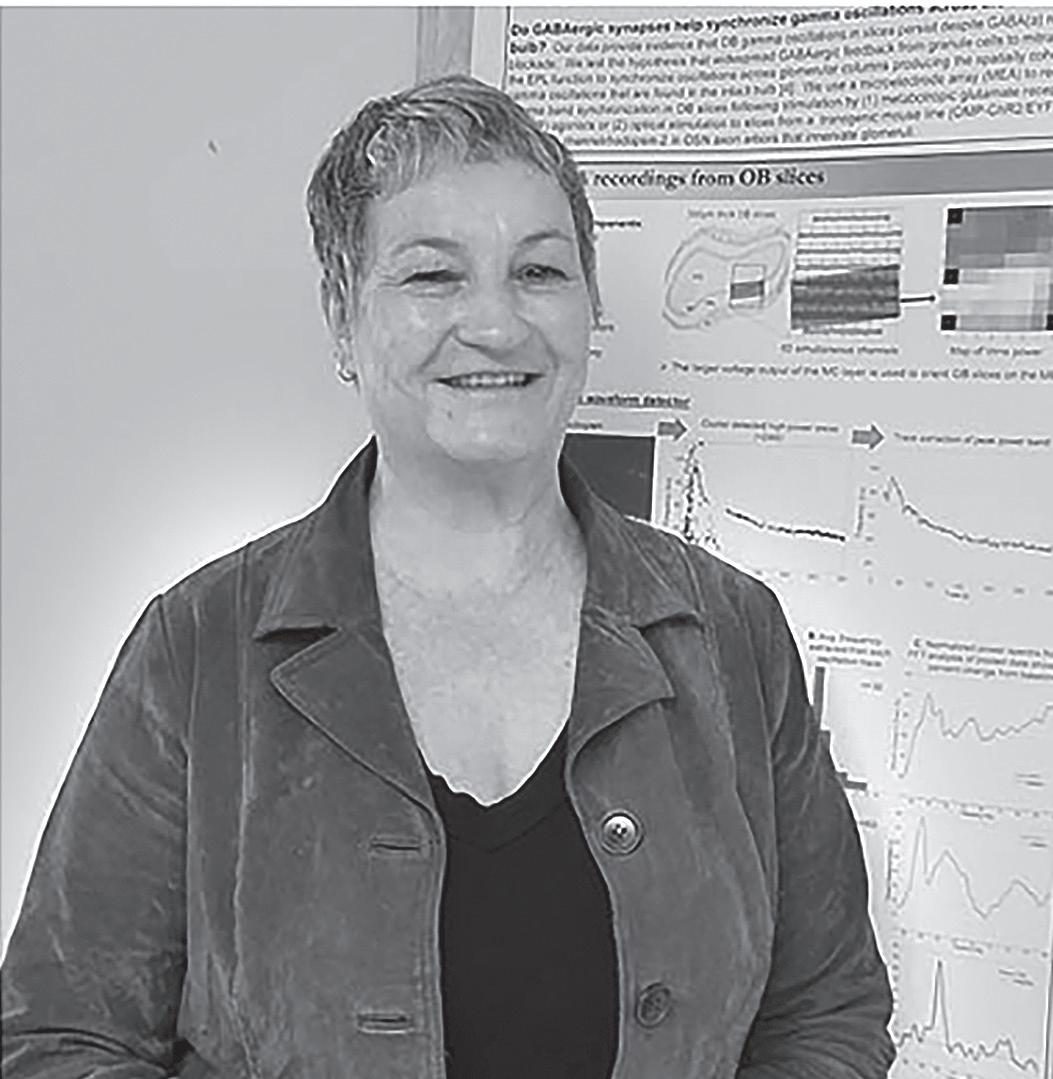

Fill in the empty cells, one number in each, so that each column, row, and region contains the numbers 1-9 exactly once. Each number in the solution therefore occurs only once in each of the three “directions,” hence the “single numbers” implied by the puzzle’s name. (Rules from wikipedia.org/wiki/ Sudoku)
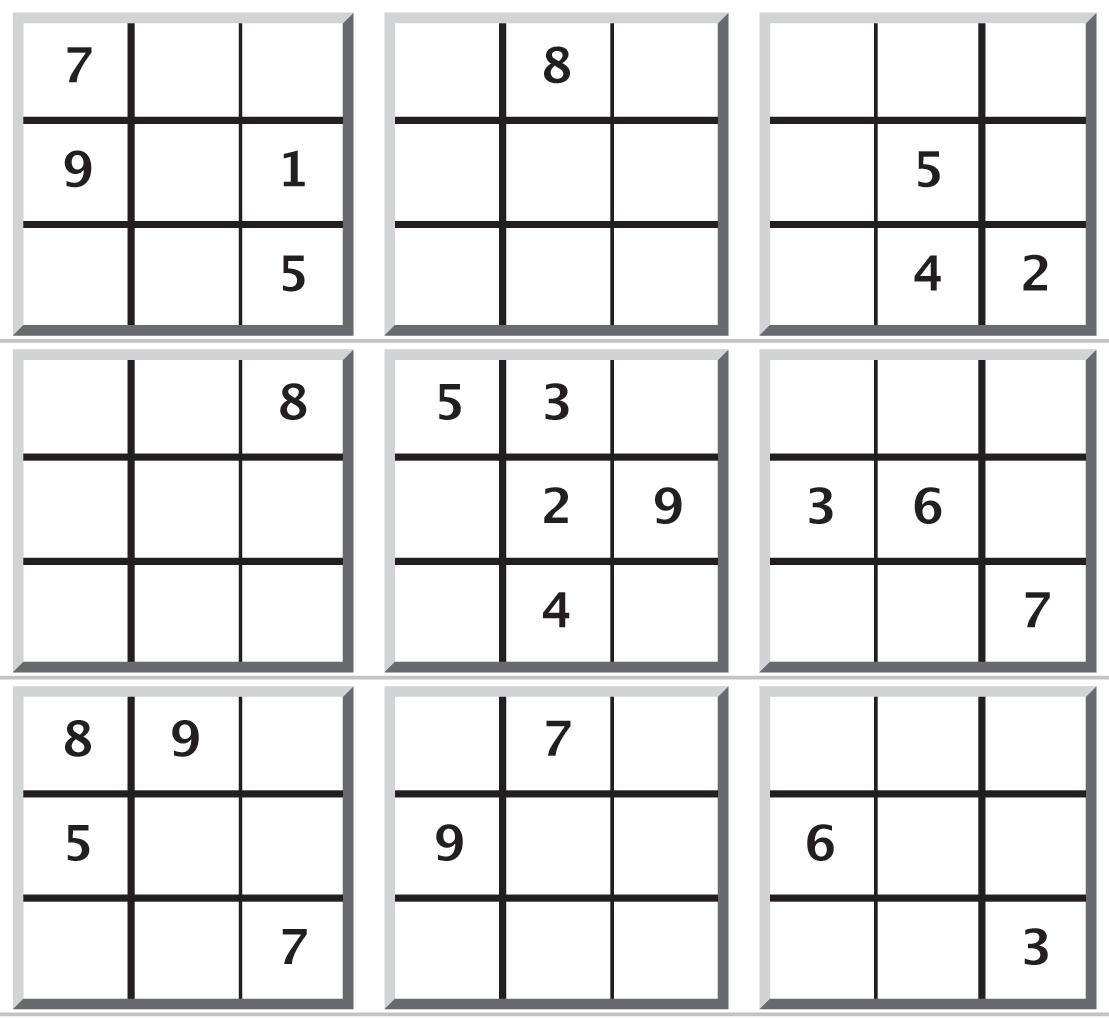
by Jeffrey Sondike ’19


Continued from page 1
a year — until May 25, 2019.
After reading Caruth’s letter to the editor, Shipman is still disturbed by her actions and believes that it is a reflection of her misunderstanding the system of power in the University.
COLLEGE AVE. 1 Bedroom available In a 2 BR apartment For Male, Undergrad student. Available NOW
4 Bedroom Apartment Available NOW Novarr-Mackesey Property Management office@ithacastudentapartments.com 607-277-1234
WALK TO CAMPUS!
Spacious 1 Bdrm. with off-street parking, on-site laundry available for immediate move in. Professionally managed with 24-hr Maintenance. 607-257-5444 www.BrooklaneCornell.com
LUXURY AT REASONABLE PRICES
5 & 6 BEDROOM ON LINDEN AVE 8 BEDROOM ON CATHERINE ST. AVRAMISREALESTATE.COM 607-272-3389
“I am troubled that despite
“The
1, 3, 4, 5 BRs
Collegetown Locations:
and Houses Dryden Road, Eddy Street, Buffalo Street 2, 3, 4, 6, 8, 10, 14 BRs Parking
Rent Smart. Live Well. 607-272-3000 Visit our office at: 119 Dryden Road www.ithacarenting.com
5 Bedroom House 214 Linden Ave. Furnished. Parking available. 607-342-1024 avramispola@yahoo.com
2 Bedroom Apt. Downtown Available Dec. 1 or Jan. 1 Ideal for grad(s) or working person(s). Recently renovated second floor apartment. Carpeted with tiled eat-in kitchen and full bath. By intersection of N. Albany and Cascadilla Sts., near Gimme! on Cayuga St. Large yard. $990 plus low utilities. Plentiful onstreet parking. References needed. No undergrads, no smokers. Email gm27@cornell.edu
that she and, in her opinion, some of the other folks that signed the letter moved very rashly without information.”
“She basically assuaged my fears because it was really disappointing [to see she signed the letter],” Thompson continued.
case of Avita Ronell is yet another contemporary case highlighting a culture of harassment and abuses of power in academia.”
Becca Harrison grad
her claims about not approving of the final letter, which openly attacks Nimrod Reitman’s character, Prof. Caruth has still made no attempt to retract her name from it, either now or earlier this summer,” Shipman wrote in an email to The Sun. “I appreciate her willingness to speak on the subject, but both her and Prof. Culler’s comments about the case in my view reflect a gross misunderstanding of the way power operates in the university, and I am deeply disturbed by that.”
On the other hand, Brianna Thompson grad met with Caruth privately. She said she was initially disturbed to see that Caruth had signed the letter. Caruth is a part of her special committee — a group of faculty that help develop the research and academic program for graduate students.
Once Thompson met with Caruth, she was relieved to hear Caruth’s reasoning behind initially signing the letter.
“I went and met with her and she actually said she didn’t stand by the contents of the letter,” Thompson said. “She was very apologetic and also she realized
Graduate and Professional Assembly representatives for the arts and humanities Becca Harrison grad and Kristen Angierski grad viewed the situation as an example of power dynamics within graduate education.
Angierski believed that language used in the letter signed by the professors mirrors that used by those defending sexual assault.
“I have to assume these professors are not pro-sexual harassment but rather pro-due process,” Angierski wrote in an email to The Sun. “Nonetheless, some of the language in that letter is reminiscent of sexual assault defense claims that center the assaulter’s ‘potential’ rather than the victim’s experience of abuse.”
read what she says.
“The case of Avital Ronell is yet another contemporary case highlighting a culture of harassment and abuses of power in academia,” Harrison said. “As I hope you can appreciate, it is this culture itself that makes it professionally tricky for graduate students like myself to speak out on these power dynamics in academia, which I certainly find to be inappropriate.”
She believes the University has room to be more supportive of graduate students in contrast to the student centered groups on campus that have been advocating for graduate students, such as the Graduate and Professional Students Association.
“In all seriousness, though, I would like to see much more critical, engaged conversation about this very power dynamic within our individual departments, universities, and academia,” Harrison said.
Prof. Joanie Mackowski, an English department faculty senate representative, declined to be interviewed by The Sun.
“I would like to see much more critical, engaged conversation about this very power dynamic.”
Becca Harrison grad
This case is indicative of a culture of harassment within academia, according to Harrison, that hinges on the power dynamics between graduate students and professors. However, it is still hard for students to speak out against the power that advisors have over graduate students. Harrison referenced her difficulty in speaking out on the matter knowing those in power may
“I understand the interest in this complex and difficult matter,” Mackowski told The Sun in an email. “I’m not [in] a position to offer any input, though. I have no more information than what’s publically available.”
Prof. Neil Saccamano, the other faculty senate representative from the English department, also declined The Sun’s request for an interview.
Amina Kilpatrick can be reached at akilpatrick@cornellsun.com.
By BENNETT GROSS Sun Staff Writer
Despite winning just one game during the non-conference portion of its schedule, the Cornell field hockey team was able to push Penn, one of the top teams in the Ivy League, to the brink in both teams’ first Ivy League game of the season.
Ultimately, though, the Quakers were able to stave off the upset and departed Ithaca with a 1-0 victory over the Red (1-6, 0-1 Ivy).
Penn, who defeated the Red, 2-0, last year in Philadelphia, came into this season’s matchup with the Red with a 3-3 record, including a top-25 win over Wake Forest.
The Quakers opened the scoring early with a goal just eight minutes into the game from junior Alexa Schneck, her first of the season, which proved to be enough. Despite numerous second-half chances, Cornell was unable to even the score.
The Red, which has had trouble getting shots on net so far this year, outshot the Quakers during the second half.
Junior goaltender Maddie Henry, who has started six of the seven games the Red has played, made seven saves in the game, and upped her save percentage to just below 70. Henry took home second-team all-Ivy honors last year, allowing just 1.49 goals per game.
Another issue for Cornell this year has been allowing opponents far too many penalty corner opportunities. This proved problematic again against the Quakers.
“When we go into the circle, to a fault, our team tries to get shots on goal, while other teams that we play just look to get penalty corners when they go in our circle,” head coach Steve Simpson said. “So, we don’t get as many penalty corners as maybe we could, but we obviously still highly value the opportunities that we do get.”
In the Ivy League opener, the Red allowed Penn to attempt 10 corners, five in each half, while Cornell was only able to secure six chances in the game, all but one of which
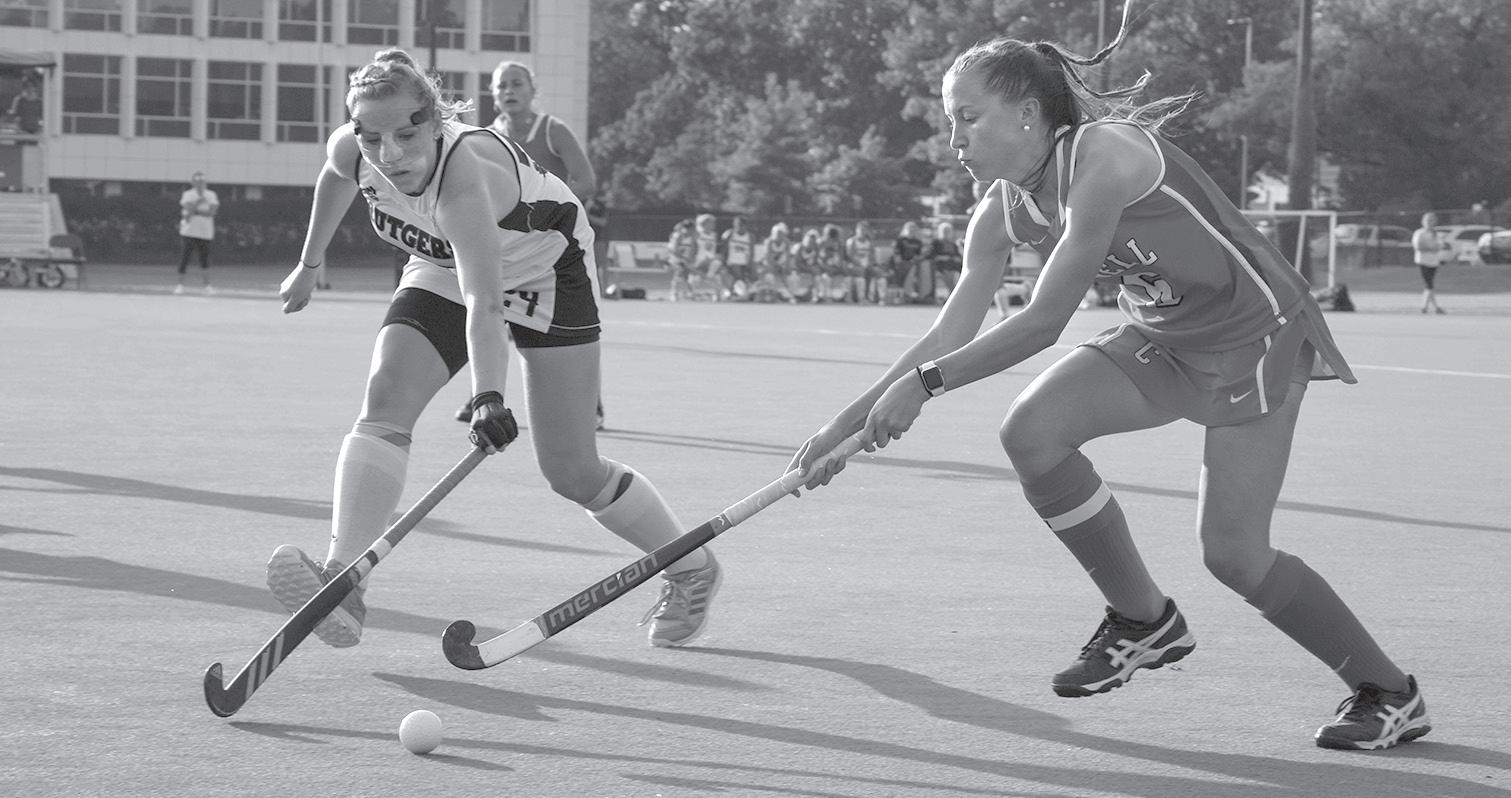
came in the second half, but Simpson was happy with how his team used its opportunities.
“In this game, we actually executed both our offensive and defensive penalty corners very well,” Simpson said. “On all five of our second-half offensive penalty corners, we either scored and the call was overturned, or we were very close to scoring — so I think that this has been the biggest positive aspect of our team this season.”
Cornell, which came into the season tabbed as the fifthbest team in the Ivy League in the preseason poll, is currently last in the conference in goals, scoring margin, shots and penalty corners.
By ZORA HAHN Sun Staff Writer
While Cornell fought hard and controlled much of its match against Columbia on Saturday, the Lions scored their first goal at the end of the second half and made the winning goal during the second overtime to snatch a win from the Red.
Cornell (1-6-1, 0-1 Ivy) secured a 1-0 lead in the 23rd minute with a goal from junior defender Kaili Gregory, with an assist by senior midfielder Jessica Ritchie.
However, Columbia (4-4-1, 1-0 Ivy) tied the game in the 86th minute. After a scoreless first overtime, it took the Lions just 28 seconds to net the winner in the second extra period.
“I think we could have taken care of the ball better in possession,” Gregory said. “We worked really hard as a team on defense, but as a whole we have to possess more so we’re not chasing the other team.”
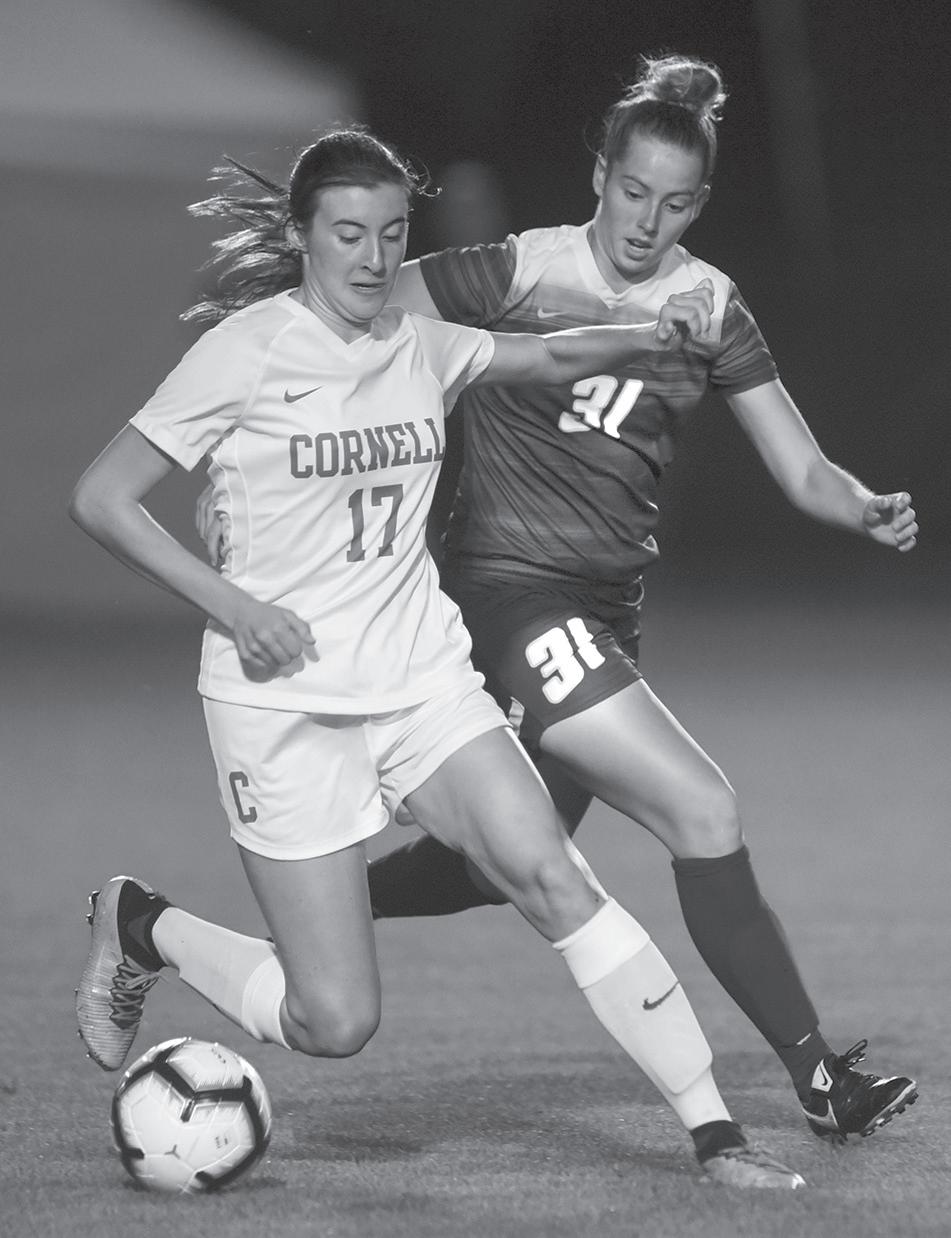
Co-captain and goalkeeper Meghan Kennedy made 15 saves to keep the Red in the game.
“[Kennedy] had an especially phenomenal performance,” said junior defender Abby Adams. “She had so many incredible saves that kept us in the game.”
“[Columbia’s] speed and ability to hold the ball in our half created numerous scoring opportunities for them.”
Junior Abby Adams
Along with Kennedy, the defenders for the Red were particularly successful last Saturday.
“Naomi Jaffe and Nicole Long, the starting outside backs, both had great games,” Gregory said. “They matched up against numerous speedy attacking players, and they defended with grit and skill.”
Columbia was a tough opponent to open league play, which made it an incredibly competitive game for the Red.
“Columbia was very sharp technically and also very athletic,” Adams said. “Their speed and ability to hold the ball in our half created numerous scoring opportunities for them.”
This made Kennedy’s 15-save performance even more impressive — the Lions had 17 shots on goal, while the Red had just one.
With the Ivy-opener loss in the rearview mirror, Cornell looks ahead to a conference-heavy schedule — through early November, the Red has just one non-league game.
“The intensity of Ivy League games is far above that of non-conference play,” Gregory said. “Since we don’t have an end-of-season tournament, we treat every game as a playoff. For the rest of our Ivy play we plan to remain positive and determined to win.”
The Red hosts Penn at 4 p.m. Saturday in its first home Ivy League contest of 2018.
“Going forward, ultimately, we just need to convert on our opportunities,” Simpson said. “Everything is really there for us to be successful, but at the end of the day, we can’t get the outcomes we want unless we score goals.”
The Red will try to pick up its second win of the season when it hosts Colgate Tuesday in a rare mid-week battle. Last season, the Raiders defeated Cornell, 1-0, in Hamilton. On Saturday, the Red continues Ivy League play, visiting Columbia.
Bennett Gross can be reached at bgross@cornellsun.com.
In his rookie season, Darmstadt went an impressive 34-4 including a perfect 14-0 in dual meet contests. He led the Red with 26 bonus-point victories and 18 wins by fall, the latter a school record for a freshman. The Ohio native also enjoyed a first-place finish at the EIWA championships in Hempstead, New York.
“What was so great about Ben was that not only would he win, you know, 95 or 99 percent of the time, but he would pin everybody,” Koll said. “He was one of the more exciting wrestlers not just on Cornell’s team but in the country.”
Koll added that Honis, who wrestled at 197 two seasons ago but spent much of last season at heavyweight after being displaced by Darmstadt, will return to his previous slot while Darmstadt is out.
“Not only do we have a good backup, we have what I consider a great one,” Koll said. “[197] is one of the very few weights that we could have someone get injured and put someone else in who I expect to be an All-American. That doesn’t happen very often at a place like Cornell, let alone at any place.”
Cornell’s 2017-18 season saw its streak of 11 consecutive EIWA team championships come to an end at the hands of Lehigh before showing strong at the national tournament with a seventh-place team finish and four All-Americans, including Darmstadt and national champion Yianni Diakomihalis at 141 pounds, who was also wrestling at nationals with a serious injury.
The Red’s 2018-19 season begins Nov. 16 with a dual meet at Binghamton.

By DYLAN McDEVITT Sun Sports Editor
Sophomore Ben Darmstadt, a breakout freshman All-American for Cornell wrestling last year, has suffered a pars fracture on his spine and will be out of commission for the 2018-19 season, according to Darmstadt and head coach Rob Koll.
“I wrestled with [the injury]. I didn’t know I had the fracture until after nationals ... I’ve just got to let it heal.”
Sophomore Ben Darmstadt
Darmstadt told The Sun he fractured his L5 vertebrae during the course of the season last year and the recovery has not been fast enough to get him ready for the upcoming season.
“I wrestled with it. I didn’t know I had the fracture until after nationals,” said Darmstadt, who, finished sixth in his first go-around at NCAAs last season at 197.
“I tried to take off some time this summer but I’m not ready to compete yet, for sure. So I’ve just got to let it heal.”
In the interim, senior Ben Honis will return to his old role as the starter at 197 and try to fill the large hole left by the impressive newcomer.
Koll and the program prefer to have Darmstadt take the season off rather than have him wrestle through what could prove to be a debilitating injury.
“We don’t want to rush him back too soon,” Koll said. “We want to make sure he’s 100 percent … We could rush him back this year and he could wrestle, albeit injured. And he would never be his full power, not as effective as he would be if we just give him a full year off and let it completely heal.”
Darmstadt said that he will seek a fifth year of eligibility down the road.
At the NCAA tournament in Cleveland last year, Darmstadt finished in sixth place at 197 after rolling to the semifinal match against then-No. 3 Jared Haught of Virginia Tech. The Hokie defeated Darmstadt, ranked No. 2 entering the tournament by fall, and the Cornell wrestler went on to lose the consolation semifinal and the fifth place match.
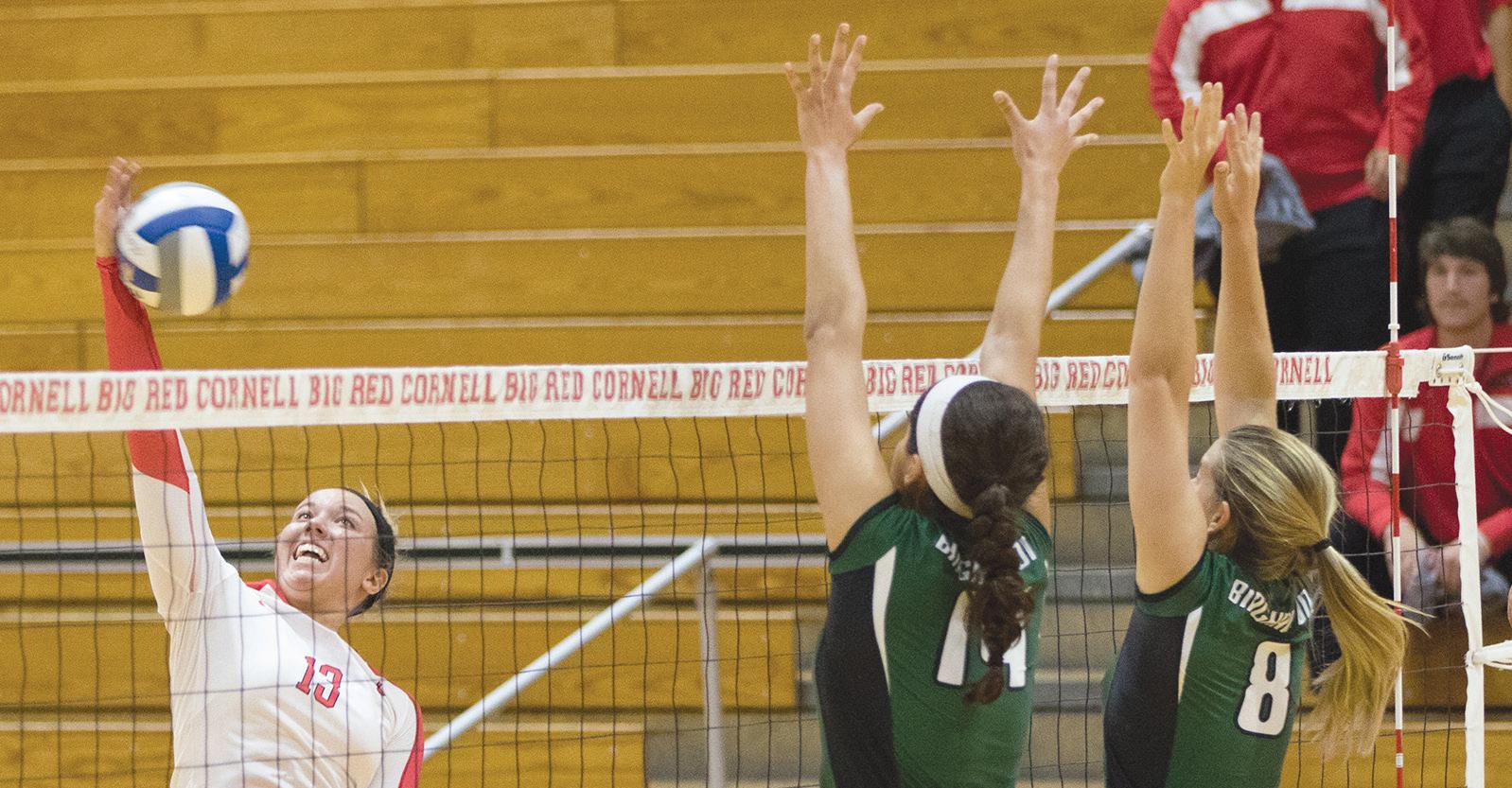
By SMITA NALLURI Sun Staff Writer
The 2017 rendition of Cornell volleyball had an abysmal record away from Ithaca. But this season the Red got off to a strong start on the road, besting Columbia in four sets.
The Red (6-5, 1-0 Ivy) rallied together after trailing the Lions (6-5, 0-1 Ivy) 19-16 in the first set to come back to win the set, 25-23. Cornell then cruised to take the next set, 25-18.
But the hosts refused to go down without a fight and won the next set, 25-22. Maintaining its composure under pressure, the Red then battled to victory, defeating Columbia, 27-25, in a tight fourth set.
“I loved that although we had our ups and downs, we didn’t let it get into our heads,” said head coach Trudy Vande Berg. “Columbia made a few big plays at the end of set four and we kept calm and aggressive. We hadn’t done that the last few weekends.”
Showcasing its deep roster, Cornell had a variety of players that were crucial to its conference win. Senior captain Carla Sganderlla had a monster game for the Red, tallying 20 kills and 12 digs. Freshmen Jill Bennett and Avery Hanan joined Sganderlla with double-digit kills, recording 12 and 10, respectively.
Sophomore Zoe Chamness and junior Lily Barber also posted double-digit digs. Chamness also had a whopping 35
assists, while junior Katie Randolph had 13.
Junior powerhouse blockers Jada Stackhouse and Jenna Phelps also came up big for the Red, with Stackhouse tallying eight blocks and Phelps adding three of her own along with eight kills.
“The main takeaways from that match were finding our rhythm as a team and staying composed in pressure situations,” Sganderlla said. “Even when we were down a couple points, I always felt like we were in control, which came from us playing together the whole time.”
The road win marks a stark contrast from the Red’s away record last year when it dropped every Ivy game on the road.
“It was super important to start off with a win in the Ivy League, especially a win on the road,” Sganderlla said. “We struggled on the road last year, so I think it was important to prove to ourselves as well as the other Ivy teams that we’ve improved since last year.”
The Red will take a break from the road this weekend, however, as they head back to Newman Arena to face Harvard at 7 p.m. Friday and Dartmouth at 5 p.m. Saturday.
“We will continue to work on playing under pressure and executing in tight situations,” Vande Berg said. “Both matches are going to be battles this weekend and we have to stay aggressive until the last ball drops.”
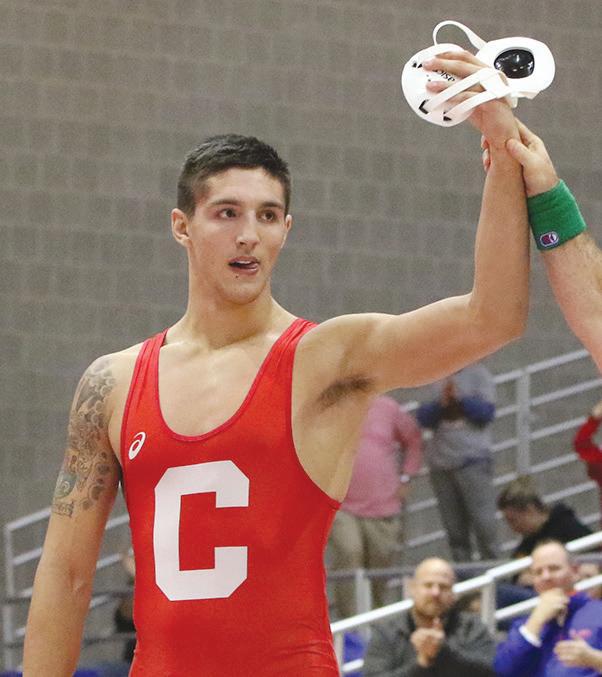
last year and will miss the 2018-19 season.
“I felt it pretty much every day in the practice room, I just thought it was back pain,” Darmstadt said. “There were definitely moments at nationals and just throughout the season where I had the fracture and it affected me.”
Cornell men’s hockey earned a No. 7 overall ranking in the USCHO.com preseason poll released Monday. It’s the third-highest all-time preseason ranking for Cornell in the poll, which began in 1997. The Red was ranked fourth in 2005 and sixth in 2012.
Reigning champion Minnesota-Duluth leads the preseason poll with 44 first-place votes. Notre Dame, Ohio State, Michigan and Providence round out the top five, while Princeton at No. 14 and Clarkson at No. 17 are the only other ECAC teams represented in the top 20.
USCHO Preseason Poll: Team (first-place votes) Points 1. Minnesota-Duluth (44) 982
2. Notre Dame (2) 857 3. Ohio State (2) 835 4. Michigan (2) 790 5. Providence 698 6. St. Cloud State 697
Cornell 676 8. Boston University 597
Denver 552
Minnesota State 488
North Dakota 437
Boston College 398
Minnesota 387
Princeton 357
Northeastern 345
Penn State 302
Clarkson 299 18. Michigan Tech 115
Western Michigan 109
Northern Michigan 98
Others receiving votes: Air Force 94, Union 90, Bowling Green 62, Harvard 58, Massachusetts 35, Wisconsin 27, Colorado College 23, Mass.-Lowell 20, Maine 18, Omaha 17, Canisius 14, Mercyhurst 11, Quinnipiac 8, Miami 2, Brown 1, Connecticut 1.
— Compiled by Zachary Silver