The Corne¬ Daily Sun
By ROCHELLE LI Sun Contributor
From The Wizard of Oz to Harry Potter, “My Old Cornell” to John Lennon, the Cornell Chimes celebrated its birthday with music spanning across its 150-year history.
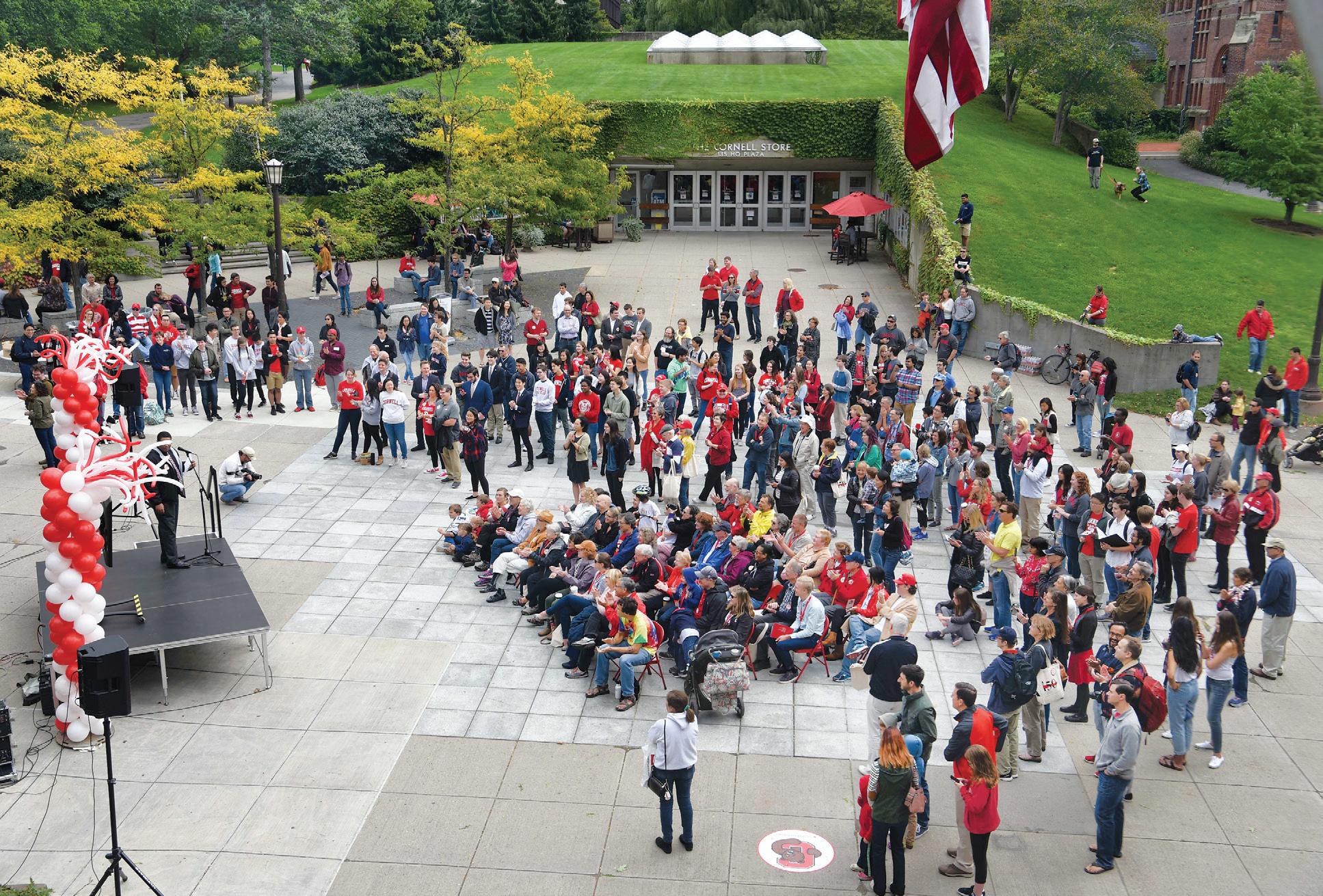
On Saturday of the Homecoming weekend, over 100 Cornellians — from those who graduated 60 years ago to members of the newest Class of 2022 — gathered on Ho Plaza to sing along to classic tunes and to watch the chimesmasters perform live — something that audience members normally have to climb up McGraw Tower’s 161 steps to witness.
“The
Chimes is one of those ubiquitous experiences that every student and alumni has.”
Michelle Vaeth ’98
Unlike many other musical instruments, playing the chimes requires three limbs. From a screen set up in front of Willard Straight Hall, audience members watched as the chimesmasters carefully balanced on one leg as they pressed a row of handles and pedals.
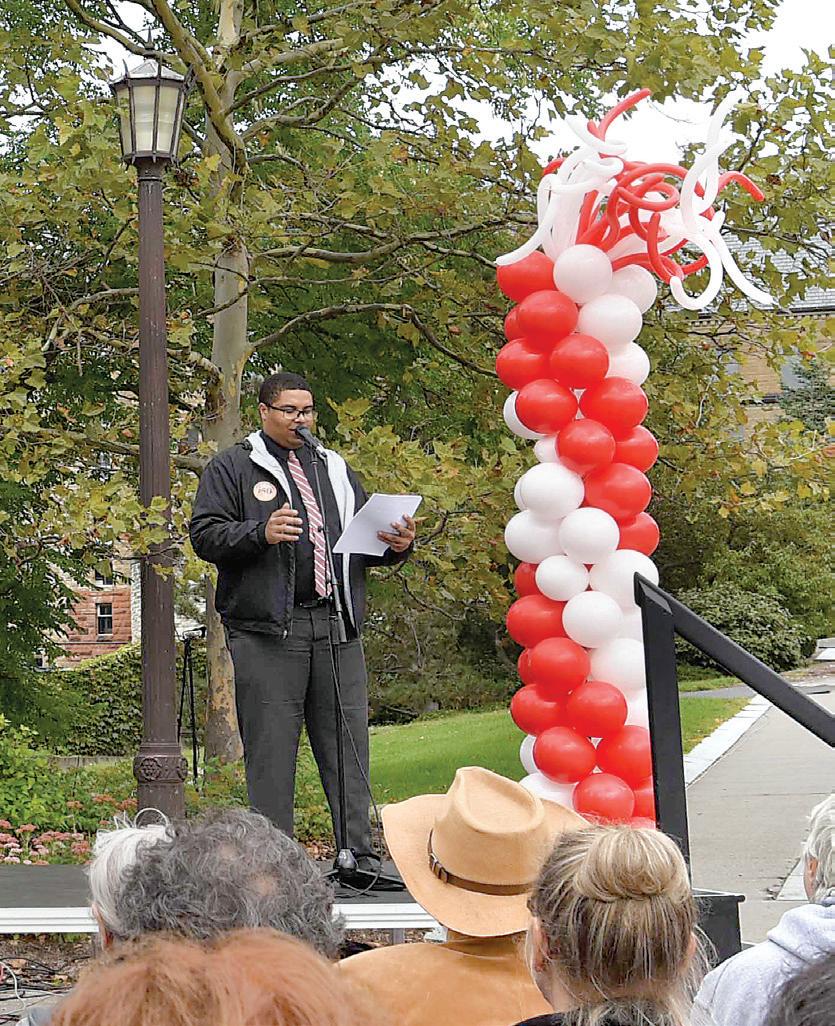
“Pure athleticism,” said master of ceremony Devan Carrington, assistant director of residential programs, after watching the chimesmasters first piece.
The celebration also served to bring together both past chimesmasters and the general public, according to Marisa LaFalce ’97, chimes program coordinator. Chimesmasters typically have a reunion at the turn of every decade, she said, but this decade the reunion was moved up by two years to meet the sesquicentennial celebration.
Connie Haggard ’58 told The Sun about how she still remembered when her husband Dick Haggard ’58 competed to be a chimesmaster. The couple, who have been married for exactly 60 years, met freshman year and married on the day of graduation.
introduction of the
history,
ment
through
By SHAWN HIKOSAKA and CHANTAL RANGUIN Sun Staff Writer and Sun Contributor
Amidst the Homecoming festivities that took place on Saturday, a 100 year memorial service was held for Corporal Morgan Smiley Baldwin 1915, an offi-
cer who served in France during World War I and who was mortally wounded during the 1918 offensive on the Hindenburg Line.
The ROTC color guard, along with dozens of current members and alumni of the Delta Phi fraternity, gathered at a service held at the Baldwin Memorial
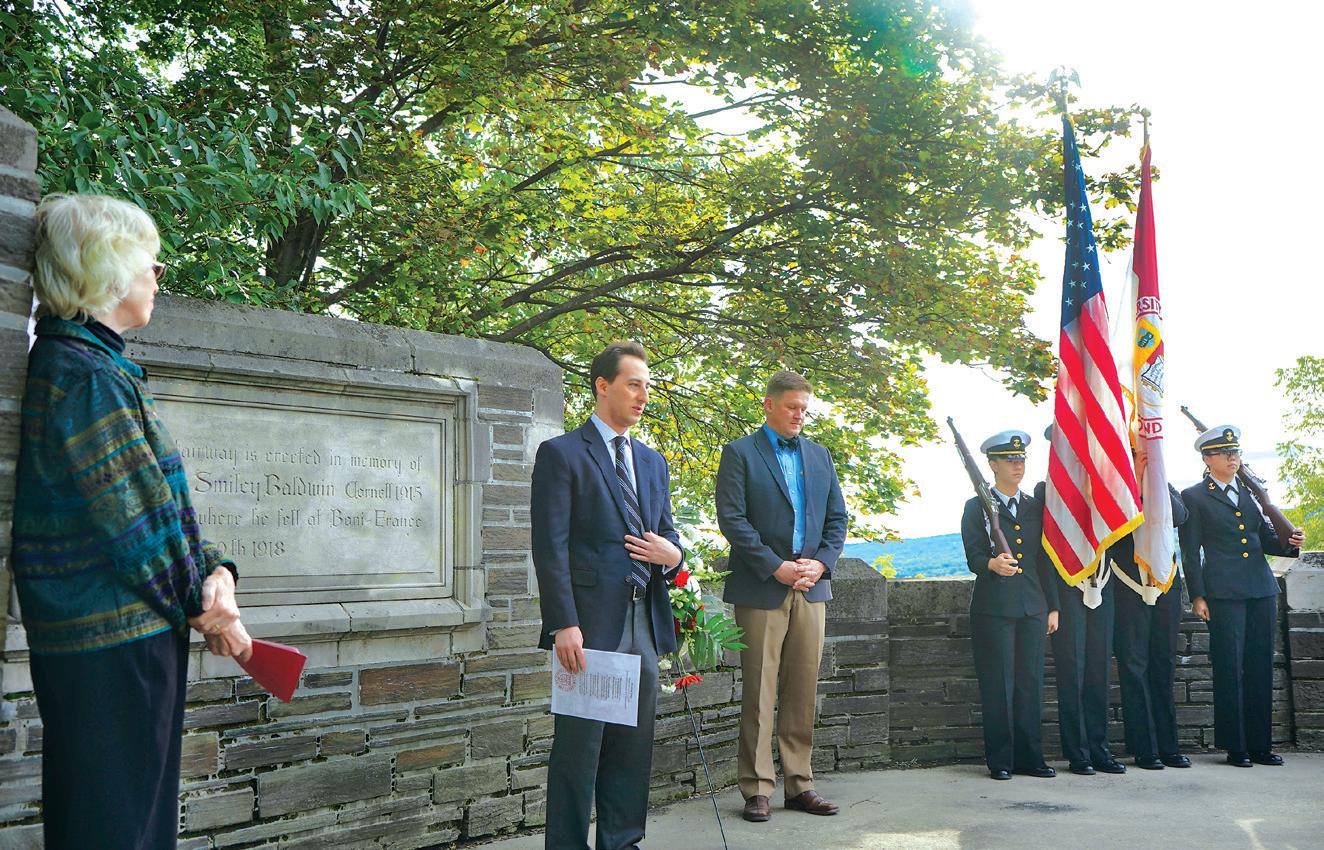
Stairway above University Avenue, which was named after the corporal and dedicated in 1925 to Ithaca and the University as a gift by the fraternity, The Sun reported then.
Baldwin, who was at the time practicing law in New York City, enlisted in the national guard on April 16, 1917, upon hearing the news that the U.S. had declared war on Germany, according to Columbia University.
He was sent to France in May 1918 and was severely wounded on September 29. He died on October 9 in the same year and was buried in Somme American Cemetery and Memorial in Bony, Aisne, France, according to the Cornell Rare Manuscript Collection.
“Smiley Baldwin came from an obviously very successful family, had completed law school, had passed the bar and enlisted himself to serve his country,” said Derek Edinger ’95, an alumnus of Delta Phi, which was founded by Baldwin’s father.
After Edinger’s remarks, Elaine Engst M.A. ’72, Cornell archivist emerita, noted that 8,851 Cornellians
to the tragedy of September 11th, the Chimes have
On Thursday, the Student Assembly approved a resolution to grant the Chinese Students Association $4,000 from the special projects fund for their annual Mid-Autumn Festival in light of the CUTonight Commission being inactive.
Dale Barbaria ’19, S.A. vice president for finance, sponsored S.A Resolution No.8 that granted the funding to the CSA. The main reason the CSA applied for funding was because
Labor Economics Workshop: “Male Incarceration and Female Public Assistance Participation” 11:40 a.m. - 1:10 p.m., 115 Ives Hall
Indigenous Education in Brazil and Government Policies 12:15 - 1:10 p.m., 153 Uris Hall
SAP Seminar Series: “Inner City Kitchens in Karachi: A Microcosm of the Crowded City” 12:15 - 1:30 p.m., G08 Uris Hall
Growing the Lost Crops of Eastern North America: Developmental Plasticity in Plant Domestication 12:20 p.m., 404 Plant Science Building
Perspectives: The Productive Sleeper 12:30 - 1:30 p.m., 701 Clark Hall
Let’s Meditate 4 - 4:30 p.m., Big Red Barn
Physics Colloquium: “Topological Insulators and Superconductors”
4 - 5 p.m., Schwartz Auditorium, Rockefeller Hall
CIES Migration Series: “Exiles in the 21st Century: The New ‘Population Law’ of Absolute Capitalism” 4:45 - 7:15 p.m., Auditorium, Klarman Hall
Monday, September 24, 2018
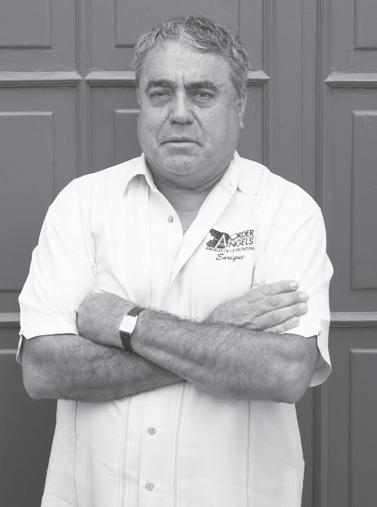
Border angels | Enrique Morones, president and founder of the Border Angels non-profit, will speak at the First Unitarian Church in Ithaca at 6 p.m. on Tuesday.
Using Your Personality Strengths for College and Career Success 5 - 6:30 p.m., Tatkon Center
World Theatre Voices: A Conversation with Frédéric Sonntag 5 - 6 p.m., Guerlac Room, A.D. White House
Manager John McKim Miller ’20
www.cornellsun.com
sunmailbox@cornellsun.com
Tomorrow
Behavioral Economics Workshop: “The Biases of Others: Projection Equilibrium in an Agency Setting” 11:40 a.m. - 1:10 p.m., 141 Sage Hall
Diversity Week Lunch and Learn: Unconscious Bias Noon - 1 p.m., 401 Warren Hall
Cornell Health “Let’s Talk” Walk-In Consultations 2:30 p.m., 146 E. Sibley Hall
International Student Group 4:30 - 5:30 p.m., 276 Caldwell Hall
Diversity Week: “My Story, Our Story” Reception 4:30 - 6 p.m., 401 Warren Hall
Using Excel with Research Data: Pivot Tables 4:30 - 6 p.m., Uris Classroom, Uris Library
What is a (Black) Faggot? Cinema, Exorbitance and Moonlight’s Metaphysical Question 4:30 - 6 p.m., 122 Rockefeller Hall
Border Angels, Border Realities and Immigration Today 6 p.m., First Unitarian Society of Ithaca
Cornell Tech / Law Colloquium: “Must Privacy Give Way to Use Regulations?” 7 p.m., 182 Myron Taylor Hall
By MIGUEL SOTO Sun Staff Writer
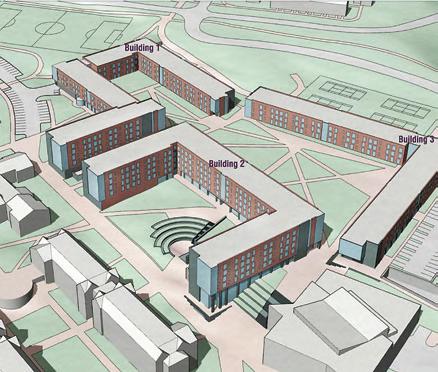
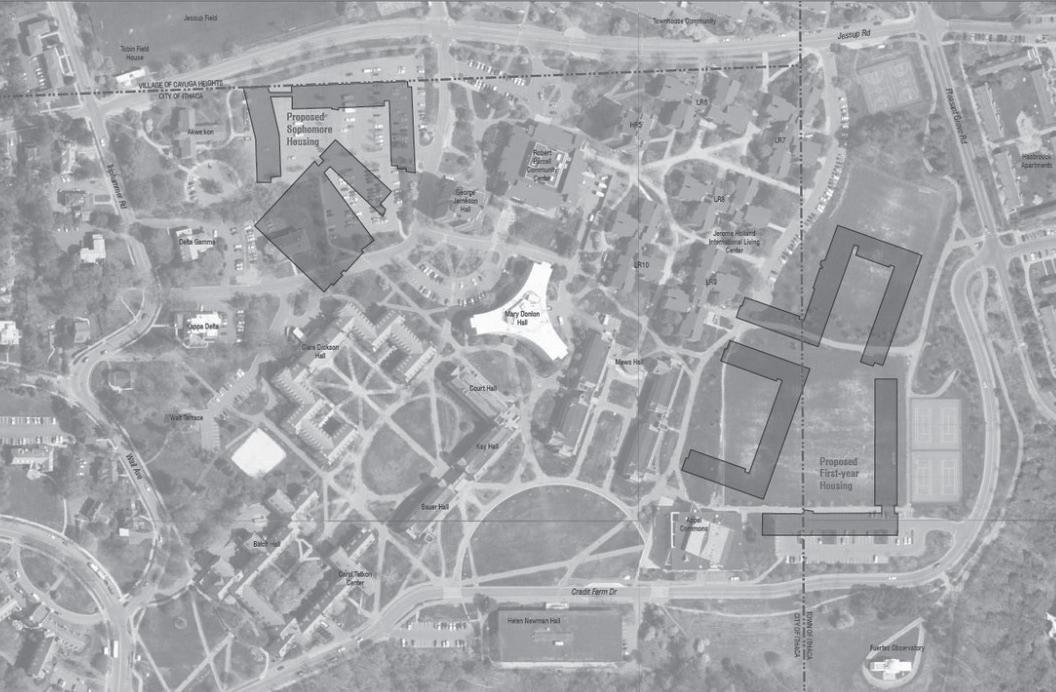
In response to the University’s plan to power the future North Campus dorms with natural gas, Climate Justice Cornell started a petition that urges the University to release a more comprehensive report on the potential environmental impact that the North Campus expansion will have.
The petition demands that the University release an Environmental Impact Statement on the new dorms on North Campus, whose construction is slated to begin in 2019. The EIS should present “all of the negative consequences a project could potentially have on the environment,” according to Julie Kapuvari ’19, CJC general body organizer.
The “negative consequences” may include “carbon dioxide-equivalent emissions” and design choices that reduce energy efficiency, Kapuvari added.
olution to go to all assemblies, it created the petition first because of the short timeline regarding the North Campus expansion project.
“Since ... things are happening really fast, a petition would be more efficient and would get our point across to the public and get the community engaged in what’s happening here,” Kapuvari said.
CJC plans to attend a public hearing at the Ithaca Town Hall on Tuesday and submit the comments from the petition to the board ahead of time before the public hearing, according to Kapuvari.
The petition also focuses on addressing the design and efficiency of the buildings. Although Kapuvari said that the plans for the dorms “coincide with the [University’s] plans of carbon neutrality [by 2035], CJC doesn’t agree that the LEED Silver certification is “really the best standard.”
“They need to make legitimate effort to reach out to students beyond just an email from the housing office.”
Jenny Xie ’20
The City of Ithaca’s planning board, one of the main bodies that has to approve construction projects for Cornell, has not stated whether or not the University has to release an EIS for the North Campus expansion project.
Cornell has provided environmental assessment forms on the project, which covered general information about the environmental impact the project would have. However, these forms are not as comprehensive as an EIS, according to Jenny Xie ’20, CJC co-campaign coordinator.
“Cornell’s argument is that, ‘well, we’ve conducted these forms to an EIS standard, so it’s as if we’ve issued an EIS,’” Xie said.
“It would probably delay the project if they were to do that more comprehensive EIS, and they want those dorms to be done as soon as possible,” Kapuvari said.
Although the CJC still wants a res-
“LEED Silver is significantly too low for what we should be going for to reach carbon neutrality,” Kapuvari added. Xie also said the administration “hasn’t done a really good job” in communicating information about the construction to students.
Although she appreciates the University’s effort in solving housing issues, “they need to make legitimate effort to reach out to students beyond just an email from the housing office,” Xie said.
“The way I see it, Cornell has the money, has the capability, has the engineers, has all the resources to do this project right and it seems to me they’re trying to accelerate it through without trying to innovate those new solutions of sustainability,” Ezra Stein ’20, CJC treasurer, told The Sun.
Miguel Soto can be reached at msoto@cornellsun.com.
by National
C.U.’s
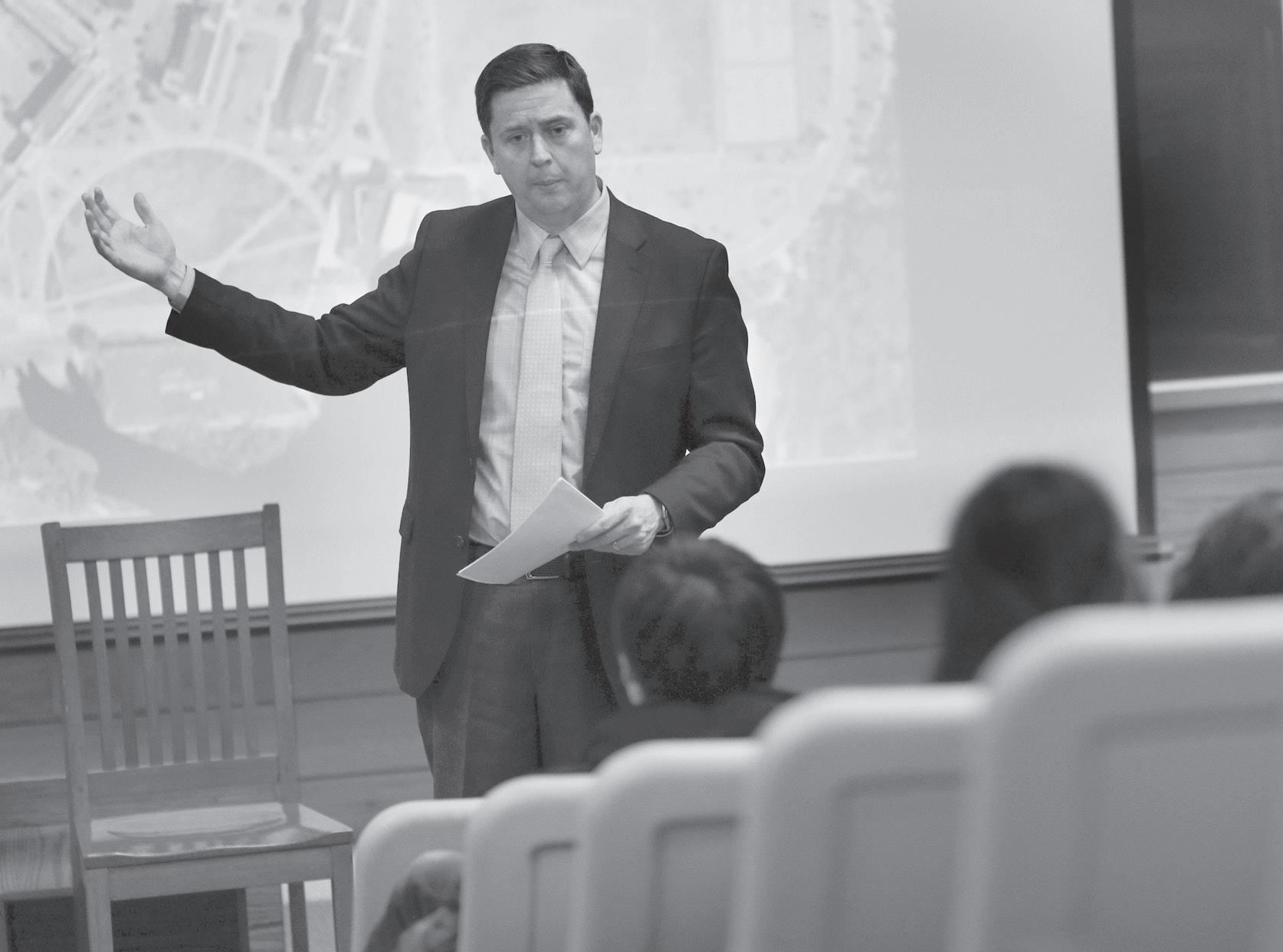
Cornell’s Center for Advanced Computing has been chosen to provide training and documentation materials for Frontera, which will become one of the most powerful supercomputers in the world when it is deployed.
Frontera, which is currently being built and is expected to be deployed in 2019, will be made up of large systems that allow scientists to perform their analyses on “complex simulations,” according to Richard Knepper, deputy director of the CAC.
The Frontera project, which has a $60-million budget from the National Science Foundation, involves participation from universities from across the country, such as California Institute of Technology, Princeton University and Texas A&M University, where the supercomputer will be deployed.
most powerful system in the world, the third fastest in the U.S. and the largest at any university, according to a report published by Texas A&M University.
The supercomputer is expected to be used for used for “physics, molecular dynamics and genomic analyses — things that require a lot of computational power and that cannot be explored in the lab or field,” according to Knepper.
Cornell’s research team, which will receive $1 million from the NSF, includes consultants from the physics, astronomy, genetics and information technology departments who will research “different systems and applications of the Frontera supercomputer.”
courses that allow students and staff members to “asynchronously learn the supercomputer’s different systems.”
“[The staff] is our greatest resource,” Keppner said. “We couldn’t just buy a bunch of machines and have it work out — we need to have the expertise.”
“We couldn’t just buy a bunch of machines and have it work out — we need to have the expertise.”
In order to use Frontera, staff members from any university can write and submit a proposal for a research project. Once the proposal is approved, students who are working with the staff member can use the supercomputer hands on.
Richard Knepper
“The NSF wants to give researchers more power,” Knepper said. “Our part of it as Cornell and the CAC is to be the entryway. It furthers our role as Cornell within this broader supercomputing community so that we can take on more projects and work with more folks who are getting started.”
If completed today, Frontera would be the fifth
In particular, Cornell’s CAC is responsible for providing training and documentation materials to help users start the system — something that “requires special training,” according to Knepper. The money will go to Virtual Training Workshops,
Shivani Sanghani can be reached at ssanghani@cornellsun.com. Tomas Engquist can be reached at te68@cornell.edu.
CUTONIGHT
Continued from page 1
CUTonight, a funding commission, has not been active this entire semester according to Barbaria. CSA usually receives $5,000 annually from CUTonight to host this event successfully.
Barbaria said that he was not aware that the commission was inactive until this week. He reached out to CUTonight after the CSA went in front of the S.A. Appropriations Committee on Monday and learned of its status through his inquiries.
“This was a very rare circumstance where we gave this much money to an organization,” Barbaria told The Sun. “Again, that was because of the time crunch and the failure to fund the event was the failure of a byline funded organization.”
Other reasons for granting the funding included the large student population the CSA event usually serves and the fact that the event was held on Friday.
John Dominguez ’20, S.A. industrial and labor relations representative, highlighted his concern about setting a precedent with the funding of a student organization that has received CUTonight funding in the past. He is worried that other organizations may try for the same outcome.
“My biggest problem is I don’t want the Appropriations Committee to be overworked. I have already seen the schedule for this semester and it is very packed,” Dominguez told The Sun. “We have a limited budget for special projects and I would [like] to see the CUTonight situation fixed as soon as possible.”
Barbaria, however, assured that this was a special circumstance and said he is not worried about “setting a precedent.”
“I think we can all say right now that this is not setting a precedent for the S.A. taking over the role of distributing all of CUTonight’s funds through the special projects fund,” Barbaria said. “This is in part because the event is at the end of this week.”
Last semester the operations of CUTonight were paused by members of the Cornell administration because of issues surrounding the function of the organization and its practices according to Barbaria. Recently in March, in addition to not adhering to their procedure, funding decisions made by CUTonight were deemed discriminatory by the S.A., The Sun previously reported.
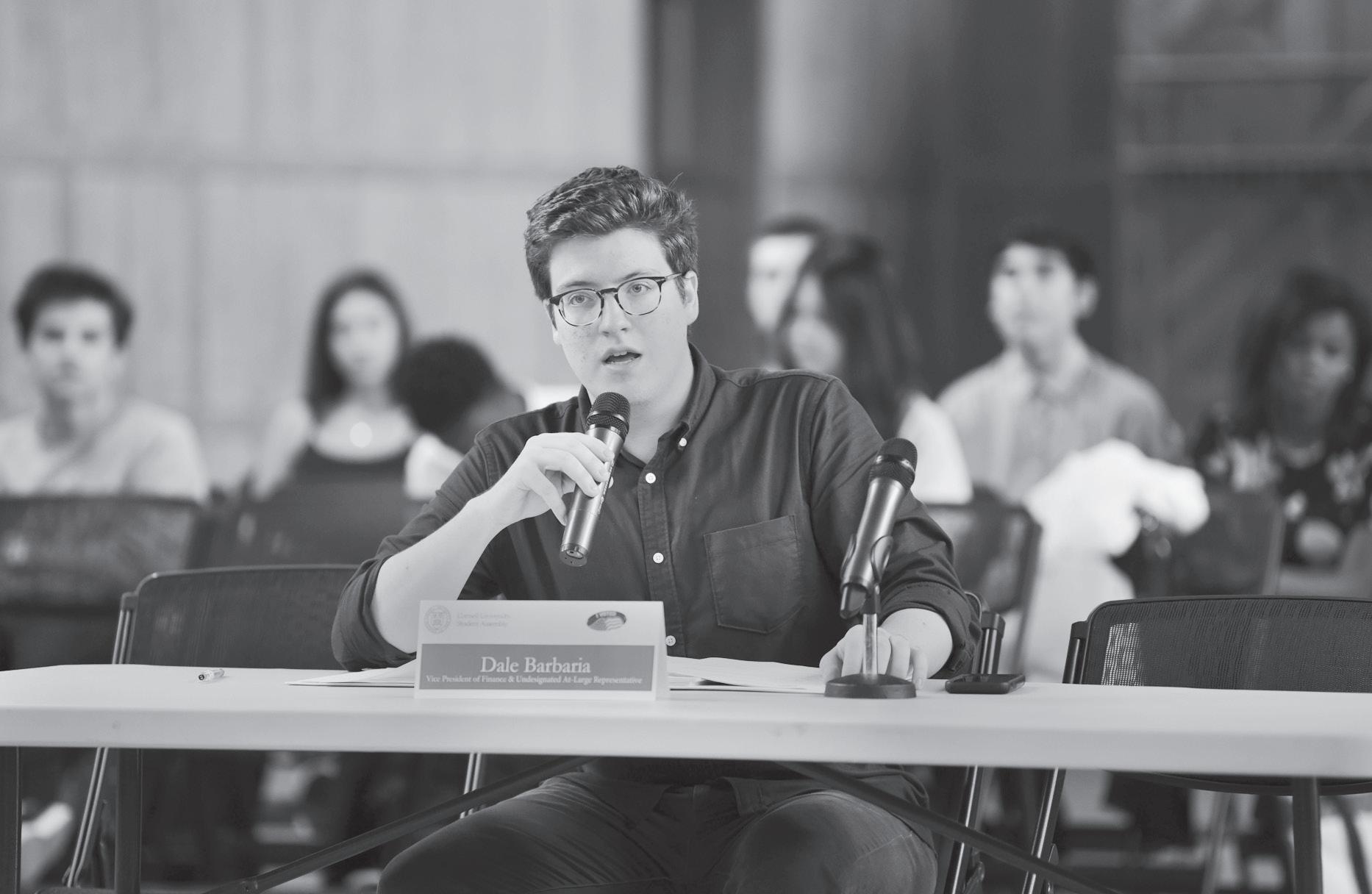
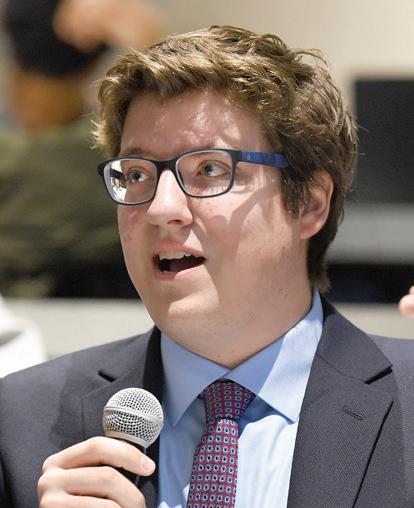
Funding fiasco | At Thursday’s S.A. meeting, Dale Barbaria ’19 (above), sponsored a resolution to provide last-minute money for the Mid-Autumn Festival because CSA could not receive its funding from the inactive CUTonight commission.
The S.A. was under the impression that CUTonight would continue normal operations this semester and that individuals responsible for the failures last semester would no longer be on the commission, according to Barbaria.
“Just like the Chinese Students Association, we on the Student Assembly did not realize the organization was actually 100 percent on hold, not reviewing applications, not accepting applications, not funding events,” he said. “Now we are trying to figure out how to fix that.”
Barbaria hopes that the commission will be able to begin accepting applications this semester. He said he would be meeting with the director of campus activities, Joe Scaffido, on Friday and Dean of Students Vijay Pendakur in the next week to discuss the future of the committee.
“From my understanding, the people who made this decision to put the organization on hold seem to have no understanding on [the] negative effect this would have on student life on campus, the negative effect it would have on students who attend these events and the students who organize these events,” Barbaria said.
“It seems like decision was made in a vacuum, where they said, ‘This organization isn’t working properly — let’s put it on hold and figure out a way to fix it,’” he continued.
Members of the Assembly raised their concerns over the future of the commission since the commission is a byline-funded organization of the S.A. They currently have been allocated $7.82 of the Student Activity Fee for the
2018-2019 year.
According to Barbaria, if CUTonight does not operate, the S.A. has the ability to claim the organization is in violation of their mission and strip them of their funding. The purpose of CUTonight is “to provide and increase the number of alcohol-free and diverse late night social/recreational events available on Thursdays, Fridays and Saturday nights between 8 p.m. and 2 a.m.,” according to their website.
“The Student Assembly can vote to take the funding out of the essentially dormant CUTonight account and move it to the special projects line item of the Student Assembly budget,” Barbaria said. “The Student Assembly could then have a number of a avenues to help distribute those funds. We can create an ad hoc committee that would review applications, then fund applications that were normally funded by CUTonight.”
This however, would result in the S.A. being responsible for allocating the money, a situation that Barbaria said is not ideal.
“I don’t think it’s in the S.A.’s place to provide that funding. I don’t think the S.A. has the capacity to do that job well,” he said.
Amina Kilpatrick can be reached at akilpatrick@cornellsun.com.
CHIMES
Continued from page 1
often been around to let the people of Cornell and Ithaca know that they are not alone in their anger, their fear, or their sorrow,” Carrington said.
Alumni and current students alike
have fond memories of listening to the daily ringing. In a speech, Michelle Vaeth ’98, associate vice president of alumni affairs, shared testimonies from alumni, in which one alumnus recalled listening to the Chimes during the Vietnam War while another remembered feeling energetic when

walking up Libe Slope after hearing “In The Mood.”
“The Chimes is one of those ubiquitous experiences that every student and alumni has,” Vaeth said.
“You would hear the chimes and people would just smile,” Penny Haikins ’65 told The Sun.
The festivities concluded with a birthday song to the Chimes by the Cornell Chorus and the Cornell Glee Club — also celebrating their sesquicentennial this year.
Rochelle Li can be reached at rl696@cornell.edu.
MEMORIAL Continued from page 1
were in uniform, among which 4,598 served as commissioned officers.
“That’s more than any other institution including West Point,” she said, adding that even Willard Straight 1901, the namesake of the hall on Ho Plaza, also served in World War I.
Engst said that the Baldwin Memorial Stairway specifically was a “really interesting memorial because it has the added remembrance of a cornerstone box,” a time capsule that contains among other documents, a list of a Delta Phi members who died in World
War I.
“Ordinarily you don’t get to see what’s in a cornerstone — there’s a building on top of it,” she said. Engst closed her remarks with a final tribute to the veterans.
“It’s an honor and a privilege today to commemorate Morgan Smiley Baldwin, Frederick Lewis Drake and the many Cornellians and other young men whose lives were cut short serving their country a century ago,” she said.
Shawn Hikosaka can be reached at shikosaka@cornellsun.com.
Chantal Raguin can be reached at cer94@cornell.edu.
JACOB S. KARASIK RUBASHKIN ’19 Editor in Chief
JOHN McKIM MILLER ’20 Business Manager
KATIE SIMS ’20
VARUN IYENGAR ’21
Web Editor
GIRISHA ARORA ’20
HEIDI MYUNG ’19
ALISHA GUPTA ’20 Assistant Managing Editor
Working on Today’s Sun
Ad Layout Emma Williams ’19
Design Deskers Jamie Lai ’20
Greta Reis ’21
News Deskers Shruti Juneja ’20
Meredith Liu ’20
Sports Desker Raphy Gendler ’21
Arts Desker Lev Akabas ’19
Science Desker Chenab Khakh ’20
Photography Desker Edem Dzodzomenyo ’20
Production Deskers Jamie Lai ’20 Megan Roche ’19
As election season is starting to heat up, the political conversations I have are fading into a haze. The same talking points are repeated with a slightly different explanation. We Cornellians are fed the exhausting narrative of pessimism that we are never doing enough. The intersection of this mostly academic and social lens with our political lens contributes to a campus political culture that can be described simultaneously as “mindless” and “radical.”
Don’t get me wrong. I love to discuss politics. I just wish we could divest from our “shutdown politics” that characterize the obnoxious tribalist partisanship of Cornell.
Let’s start from a national political perspective before delving into our campus politics. Midterm elections, like the one in November 2018, are typically referendums on the current presidential administration. For this reason, the president’s party usually loses a significant amount of seats. Before the 2010 midterm election, Democrats controlled both houses of Congress. After the “Red Wave,” both the House of Representatives and the Senate flipped to the Republicans.
The 2018 midterm election is shaping up to be a lot like the 2010 election. Both Sabato’s Crystal Ball and FiveThirtyEight predict a large Democratic gain, at least in the House. The Democrats have a sizable 12 point lead in the generic ballot, which polls whether someone would vote for the Democratic or Republican Congressional candidate in their district without tying the question to a name. President Trump’s approval rating is fluctuating around the 40 point mark. Every liberal I know is clinging onto hopes for surefire Democratic gains that will flip the 23 seats in the House necessary to return Democratic control.
Yet, the election could still be close. We’re seeing diverse confounding elements in the modelling calculus, from black swan surprises that change voters’ perception of the Republicans and Trump, Special Counsel Mueller’s Russia investigation and Judge Brett Kavanaugh’s confirmation hearings. Each of these could play an outsize influence in the Nov. 6 election. Besides, the GOP will likely win the Senate election because ten Democrats are up for re-election in states President Trump carried in 2016. At best, the Senate is a toss-up.
Now that we have all this data, we can poke at voters’ reasons for their defection to the Democrats. Many independents, moderates and Never Trump Republicans seem to regret their decision in 2016 to vote for President Trump. A June NBCWall Street Journal poll shows voters are more likely to support a Congressional candidate who checks Trump by a margin
of 48 to 23 percentage points. There’s an extremely tribal vibe in this midterm that I keenly felt this summer while working on a Congressional campaign in my home state of Indiana. Voters want to vote either “against Trump” or “for Trump,” even in down-ballot elections for city and county positions. And it seems those who want to vote against the president are winning out, if the polls are to be trusted.
Nowhere is this trend clearer than on the Ithaca campus. If only Cornellians voted on Congress, we’d probably have exactly two Representatives who were GOP-affiliated, and we would know exactly who voted for them. I’m convinced (by this revolutionary study) that campus politics are a liberal circle-jerk. The elite (those who have strong and well-reasoned political stances) control the politics of the few (those who simply don’t care as much). The elite are overwhelmingly liberal progressives that overshadow the very small but very outspoken contingent of conservatives.
The shaping of campus political rhetoric happens primarily through exclusion and drowning out different voices. Students who bring positions that don’t fit with the primary narrative of liberal progressivism are shouted down and insulted, as if their background and political orientation should be rejected prima facie. We can’t yell that open borders, single-payer healthcare and universal basic income are wonderful before considering the flip-side.
The campus conversations focalize around the loudest students (liberals) who control the political beliefs of most students, who are drawn to groupthink and inclusion rather than interrogating their own politics. The impact, unsurprisingly, is apathy and low voting rates especially in down-ballot and midterm elections. Foreclosing personally-developed perspectives decreases political attachment or allegiance. Shutting down dialogue only replicates the same strategies that excluded marginalized people from the political conversation in the first place. Our campus politics reduces the spectrum of acceptable political conversation to a small left-leaning subset.
This isn’t a call to have more rightist politics. It’s much more about opening up a space for political thought and deliberation. Instead of allowing students to barely stay afloat in a tiny lake of tightly tethered to the Democratic dock, we should be willing to encourage our friends and classmates to throw themselves to the sharks and find their own favorite political talking points. We may just open up a more educated public.
Darren Chang is a sophomore in the College of Arts and Sciences. Swamp Snorkeling runs every other Monday this semester. He can be reached at dchang@cornellsun.com.
Jacqueline Groskaufmanis | Te Dissent
Two years ago, while sitting on a roof in Collegetown, I saw a girl run barefoot down Catherine Street holding an open handle of Absolut while zig-zagging away from a cop who, from my vantage point, was palpably frustrated but remarkably patient. I couldn’t see what happened when they reached the bottom of the hill, or if the girl — probably drunk and potentially underaged — got into any kind of trouble. But if she did, it was probably a muted version of the kind of punishment one might receive outside this unusual land of second chances.
The irony of a bunch of 19-year-olds using fake IDs while discussing “crime and punishment” over a round of illegally purchased beers is both obvious and unsurprising.
Relative to other places, there seems to be little consequence for “bad behavior” at Cornell. Sure, on any given weekend in Collegetown you may see an officer lecturing a freshman about an open container or someone being written up for peeing in public, but for the most part, illegal behavior here — in this uniquely privileged, unusually wealthy bubble we live in — seems to happen with near impunity.
A friend of mine told me last week that she overheard a group of guys, who she knew to be sophomores, having a heated debate on the merits of “tough on crime” policing in a Collegetown bar. The irony of a bunch of 19-year-olds using fake IDs while discussing “crime and punishment” over a round of illegally purchased beers is both obvious and unsurprising. And still, in the minds of many, the laws that students break in college are separated from the laws that others break elsewhere, even when they include the exact same actions. When other people do it, it’s “crime.” When we do it, we’re “having a good time” or “growing up.”
On the Judicial Administrator’s website, an overview of Cornell’s Disciplinary System notes that “Cornell’s governance of community conduct is distinguishable from society’s regulation of conduct through criminal and civil laws, regulations and ordinances.” That same website has a library of short stories and songs statedly intended to encourage introspection in students who have made “questionable choices.” One prompt, accompanying the song “Roar” by Katy Perry, asks students to “discuss personal growth, development of voice and values, especially in light of feeling repressed.” I don’t want to be dismissive of the rehabilitative potential of music, but I do think it’s notably unusual for legal adults to have the opportunity to write about a Katy Perry song as part of any disciplinary moment.
We have blind spots because a safetynet exists in spaces of privilege while tightropes exist elsewhere.
Different words for the same behavior, an unfair double standard. As a consequence, many of us wrongly build our conceptions of crime within a framework that doesn’t include ourselves, because the framework of punishment so often doesn’t either. This becomes problematic when, 10, 20 years down the line those sophomores from the bar become our lawyers, legislators and decision-makers.
Cornell Crime statistics from 2017 show that, for Liquor Law Violations, there were 170 referrals but only 13 arrests on campus (including residential facilities). In 2015 and 2016, referrals similarly outnumbered arrests. When I first sifted through these stats, I encountered my first question: what is a referral? The answer being that it’s something that exists for college students. And yet despite its prevalence in the crime statistics, the word referral only appears in the 46-page campus Code of Conduct twice.
Meanwhile, in an increasing number of cities throughout the United States, simple behaviors — often associated with homelessness — like sleeping on the street or in one’s car have been criminalized. 53 percent of U.S. cities now outlaw the sitting or laying in particular public places and in thirty-three percent of cities it’s illegal to loiter — a word which takes on different definitions in different places — throughout the entire city. I think that we, as students, citizens, and potential future policymakers, should recognize the fact that this double standard is unfair, that we have blind spots because of it and that a safetynet exists in spaces of privilege while tightropes exist elsewhere. It should be noted that even within spaces like Cornell, there’s varied risk and concern from student to student. While talking to one of my friends about this column, she mentioned that, as an immigrant and first generation student, she learned early on that her peers didn’t share the same apprehensions about getting in trouble that she did. “When everyone was ordering fake IDs freshman year, besides the fact that they’re, like, super expensive, all I could think of was how much work I had to do to get to Cornell and how dumb it would be to get in trouble over a piece of plastic that gets you into bars.” She said, noting that she felt especially vulnerable to punishment.
The double standard in punishment is one that I admittedly have no absolute prescription for besides, for now, realizing and caring that it exists. The problem here isn’t second chances themselves, it’s the fact that not everyone appears to be viewed as equal candidates for them.
Jacqueline Groskaufmanis is a senior in the College of Arts and Sciences. The Dissent runs every other Monday this semester. She can be reached at jgroskaufmanis@cornellsun.com
Christian Baran | Honestly
“Yeah, I’m a bioengineering major,” he says, his eyes shifting upwards as he does so. He knows what they’re thinking. The flash of admiration in their eyes and the almost-almost-imperceptible deference in conversation tell all.
My friend Rollin is the smartest person I’ve met, and he deserves this treatment. But not for the simple reason that he is a majoring in biological engineering. For better or for worse (I’d bet on the latter), the college world fosters a community where our majors define our intellect, at least on first impression.
In most U.S. college communities, STEM majors are awarded a certain prestige denied to humanities majors. A physics or engineering student is considered to be partaking in a more rigorous and intellectually demanding curriculum than a government or English student. Thus, many make the large leap in logic to the assumption of higher intelligence in those STEM majors. This may be more prevalent at Cornell than other schools, considering our engineering school is among the best in the world (well, Cornell as a whole is among the best, but the engineering school outstrips even its host in terms of rankings.) Students sometimes try to deny this assumption, or give the ’ol “they’re apples and oranges; they can’t be compared,” but most still, implicitly or explicitly, identify STEM majors as harder.
I talked to a junior, who asked not to be named, and they couldn’t give a reason for their prejudice, saying, “Yeah, I don’t know. I just feel like math is harder than writing.” Others, like Ushbah Asio ’19, gave more concrete reasons, citing “more logic-based classes” in STEM subjects as the reason for their heightened rigor. According to Asio, an English major is a bit easier because of its “opinion-based curriculum.”
shocked to find some extremely condescending material. Thinking of this article, I whipped out my phone right there and then, in full uniform, to snap a picture of the form and the incriminating sentence contained within it. In the form, a member of the AROTC cadre instructed us cadets to “strive for optimum performance academically.” Understandable. But he goes on: “If that is a 3.0 GPA in a tough STEM major or a 4.0 in a humanities major, make a plan to get there.” He prob ably didn’t mean to put down humanities majors. The implicit biases I mentioned earlier about STEM majors being more diffi cult than humanities majors were simply manifesting themselves in his writing. Regardless, I am amazed that someone supposed to be instructing us and fostering our growth could so summarily dismiss a whole group of majors (at Cornell!) as to be relatively easy. The disrespect was palpable.
Since when did difficulty and pleasure become mutually exclusive?
Another anonymous source said that although they personally find “writing a paper [to be] harder than… studying for a math test,” they ceded that “people perceive English or history to not be as employable, or as a joke major.”
Even faculty can, knowingly or not, bolster this toxic mindset in their students. For example, in reading a form I had to sign for my military science class, I was
In elementary school, I would stare at the ceiling intently, connecting specks to find that one word ingrained in the spongy surface. I would murmur the word “gullible” as slow as I could, and I could almost hear the syllables transform into the round sounds of “orange,” just like what they told me. I believed everything I heard, putting faith in my naive sense of trust. But I’ve learned that trust isn’t and shouldn’t be such an easy concept to adapt.
I believed the person on the other end of the suspicious phone call I never should’ve picked up in the first place. Last week, I was in the midst of enjoying my fresh oatmeal in the calm morning, and I could’ve finished my untouched plate of warm scrambled eggs and ripe strawberries. But instead, I picked up the phone, and I believed this mysterious man, as he perfectly sculpted the details of my proposed arrest.
The confusing, governmental jargon flooded in through one ear and out the other, and I felt numb. I was emotionally distraught, and I couldn’t roll my head around the idea that someone was using my identity to sell drugs and abandon a cocaine-filled Toyota Corolla in the Southern border of Texas.
(my brain actually shut down after trying to read Middle English for an extended period of time last week.) We just tend to enjoy our work. Since when did difficulty and pleasure become mutually exclusive?

The college world fosters a community where our majors define our intellect.
Comments like these can be frustrating to those majoring in the humanities. A woman in my English class, overhearing me speaking about this column, jumped into the conversation to vent. Callie recounted times she had, upon telling people she was an English major, received comments along the lines of, “Oh, so do you want to teach?” and “Nice, you can pretty much bullshit everything.” Hearing that on the regular can be exasperating, partly because they’re simply untethered to reality. Callie wants to go into journalism, and bullshitting essays is all fun and games until you get the paper returned. Especially in upper-level humanities courses, where outstanding writing skills are expected, there is no “pretty much bullshitting everything.”
But how did these perceptions about the rigor of these two disparate fields develop? Prof. Rayna Kalas, English, attributes them in part to the “perception that if something is pleasurable, then it is not difficult.” While many STEM majors seem to begrudgingly toil over endless problem sets, humanities majors often attack their readings with relish. That is not to say our work isn’t difficult
Alexia Kim | Who, What, Where, Why? Phish Bait
ed me to search the phone number online, and after seeing indeed that the number belonged to the police station in Bath, NY, the alarms in my head blared, and I could no longer think. While the man on the phone continued to elaborate and explain, a heated warfare was taking place in my mind: who do I trust? Is this real or is this all just an act?
About an hour and a half later, I found myself holding five Google Play gift cards in my hand at a Seven Eleven. It was at this moment when I practically realized that saying “gullible” slowly would never sound like “orange.” I saved myself from financial disaster, but my personal information, on the other hand, was ultimately out of my control.
I believed the person on the other end of the suspicious phone call I never should’ve picked up in the first place.
Having activated a security freeze and fraud alert on my credit account, I felt confident that I was safe for now. But I was vexed with the realization that they had known my Cornell email address, as well as my father’s name. Did this mean they had access to the personal information of students at Cornell? Can we be sure that our information and even ourselves are in the hands of dependable security?
I had my suspicions, but the calm voice on the other end assured me that he was calling from the Bath, New York Police Department. After having instruct-
I never really questioned the security of my personal information, especially not the security regarding the information registered with the university, but now I have my doubts. As hackers get smarter and phishers become dangerously clev-
Prof. Dan Luo, biological and environmental engineering, has an alternative take on the issue. According to him, the “major difference (pun intended) in difficulty between STEM and humanities has developed partially due to the need of supplying more focused, rigid and quantitative solutions in STEM exams than those in humanities.” I would agree with that. On STEM exams, the questions often have one correct answer. If you arrive at that answer more frequently than others, you’re smart. Thus, it is very easy to quantify intelligence in STEM. On the other hand, the most common form of assessment in the humanities is simply writing. And grading written work is inevitably nebulous. Nobody can put a check mark next to each sentence. Rather, success in the humanities relies on the felicity and cogency of the writer. If someone gets a bad grade on a paper, they can attribute their poor performance to the professor ‘not liking their style’ or ‘wanting something specific,’ which is difficult to do vis-à-vis STEM assignments.
I dismissed the “apples and oranges” adage earlier in the article. That might have been a bit hypocritical, as I’m going to use it now. I’m prospectively a history major with an English minor, and I do not find math enjoyable, nor do I particularly excel at it. I enjoy reading and writing. Hence my choice of study. Similarly, I assume that students in highly quantitative fields probably feel the opposite. We recently got our first paper back in my FWS, and one of the architecture students in the class bombed it. He’s in one of the most rigorous programs at Cornell, and I could never do the kind of work he does. But I did pretty well on the paper. Apples and oranges, I guess.
Christian Baran is a freshman in the College of Arts and Sciences. Honestly runs every other Friday this semester. He can be reached at cbaran@cornellsun.com.
er, phone numbers can be cloned, your deepest darkest secrets and personal information can be accessed with delicate ease, details can be so elaborately and perfectly formulated and manipulation has never been easier. But the question is, can we catch up?
The whole situation itself was alarming and daunting, but one statement by a Cornell Police officer especially struck me with dismay and bewilderment. With nonchalance, he informed me that students are a common target for scammers. We’re in our most vulnerable and desperate state, always standing on the edge. It’s definitely not a difficult task for scammers to gently nudge us off that edge and watch us plummet and tumble. Scammers know our weaknesses as college students, executing their manipulative acts through fake job offers, notifications of student debt complications and false arrests.
We’ve learned to ignore them, but desperate times may call for desperate measures, and scammers may find the perfect bait.
be done by the police was to fix the wreckage and wait. There was no way of tracking the scammers nor was there a way to prevent it. There is a certain level of prevention that is being implemented, from Gmail’s bright yellow box warning you of an outside email address to FBI and Police scam warnings. However, the increasing fraud rates seem to reflect a lack of an effect of these methods. It disturbs me to see many of my friends and even my parents receive strange phone calls and fraudulent emails on a nearly daily basis. We’ve learned to ignore them, but desperate times may call for desperate measures, and scammers may find the perfect bait to lure you in. They’ll worm into your brain, find your weakest point and control you like a floppy puppet.
Incidences of fraud have been drastically increasing, with fraud revenues increasing from 1.32 to 1.47 percent in 2016, according to research done by LexisNexis Risk Solutions. There just simply doesn’t seem to be a sign of improvement in obviating this steadily accelerating issue, seeing that fraud rates are even increasing exponentially within universities.
Now my question is: what is being done about it? The only thing that could
I’m still frustrated because my beautiful breakfast had gone to waste and I had missed my lecture that day, but by the end of it, I definitely know that there’s nothing spelled out on the ceiling, arrest warrants are never given by phone and saying the word “gullible” real slow really just makes you an artistic exhibition of ridiculous irony.
Alexia Kim is a sophomore in the College of Human Ecology. Who, What, Where, Why? runs every other Friday this semester. She can be reached at alexiakim@cornellsun.com.
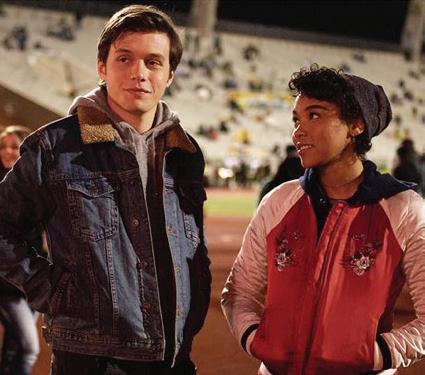
I’m not the type of person who watches one movie after another on long-haul flights, and usually spend the better part of the sixteen hours sleeping. The trip back from Hong Kong before the beginning of this semester ended up being one rare exception, however, because there was a crying baby in the seat next to me. I had no choice but to cycle through all the MCU movies they had (thank God), and afterwards, set my eye on a movie I had deliberately avoided seeing in the spring — Love, Simon

Despite putting the movie’s soundtrack on repeat the moment it came out, and despite promising every one of my friends who went to opening weekend and raved about it afterwards that I would go see it, I never did after watching the trailer. You would think that as someone who loves romcoms and never shuts up about representation, the premise itself is enough to make me want to go. Well, I thought so too, but the trailer didn’t sit well with me, and that feeling of vague discomfort persisted even after finally succumbing to my curiosity (and the tantrum-throwing infant) and watching the movie. Don’t get me wrong, Love, Simon did everything a good rom-com is supposed to — it made me laugh, made my heart melt at the happy ending, and even made me miss being a teenager — but for some reason I couldn’t name at the time, it wasn’t the movie I wanted.
That is, until I saw To All the Boys I Loved Before at a movie night on campus, only a few days later. Plenty of reviews about this Netflix summer hit, including the one by my fellow Arts writer Olivia Bono ’20, applauded the movie for having an Asian-American lead actress and sticking with the way Lara Jean
is actually written in the original novel. What people haven’t talked about enough, though, is how even more remarkable it is to have an Asian-American lead in a movie not about being Asian-American. Throughout the movie, I kept expecting Lara Jean to be bullied for being mixed-race, to be criticized for having Asian physical features, or even just described to be good at math and science. None of these things happened, however, and the only Asian-specific or “relatable” little detail that comes up is her love for a yogurt drink which I also adore. Despite the lack of stereotypical racial identifiers or discussion of racial identity, however, she’s not any less Asian-American than, say, Rachel from Crazy Rich Asians. It was such a breath of fresh air to have a protagonist who doesn’t exist for the sole purpose of representing whatever group or issue the film seeks to represent, who carries her identity without being reduced to it. To All the Boys I’ve Loved Before is a young love story at its core, just that the heroine happens to be Asian. What’s the big deal?
That’s when I realized what really bothered me about quite a few pieces of theater and film with PoC or LGBTQ+ protagonists I’ve seen lately. It is incredibly important that we have art engaging political and social conversations, such as those about race and sexuality, as that is one of the most crucial responsibilities of the arts. However, artists and creatives shouldn’t forget to make sure that their creations can exist as free-standing, independent pieces of work, rather than as puzzle pieces that are only meaningful when considered in the context of the “bigger picture.” Characters should not be relegated to representing an identity, and stories should not be reduced to supporting a viewpoint. Real people and real-life stories are full of complexity and contradictions, so creating characters and stories that serve a message or a cause, or worse, that pander to the public’s need for diversity and representation, betrays a fundamental purpose of creating art — to reflect life.
On top of that, representation comes in many flavors. One of those is for books, movies and plays to have characters of marginalized groups without focusing on the marginalization itself. Even though we know America today is still far from being post-racial or really, post-anything, being stuck in a place where we repeat the same ideas over and over again in arts and liberal media is not the way to real progress. That is not to say
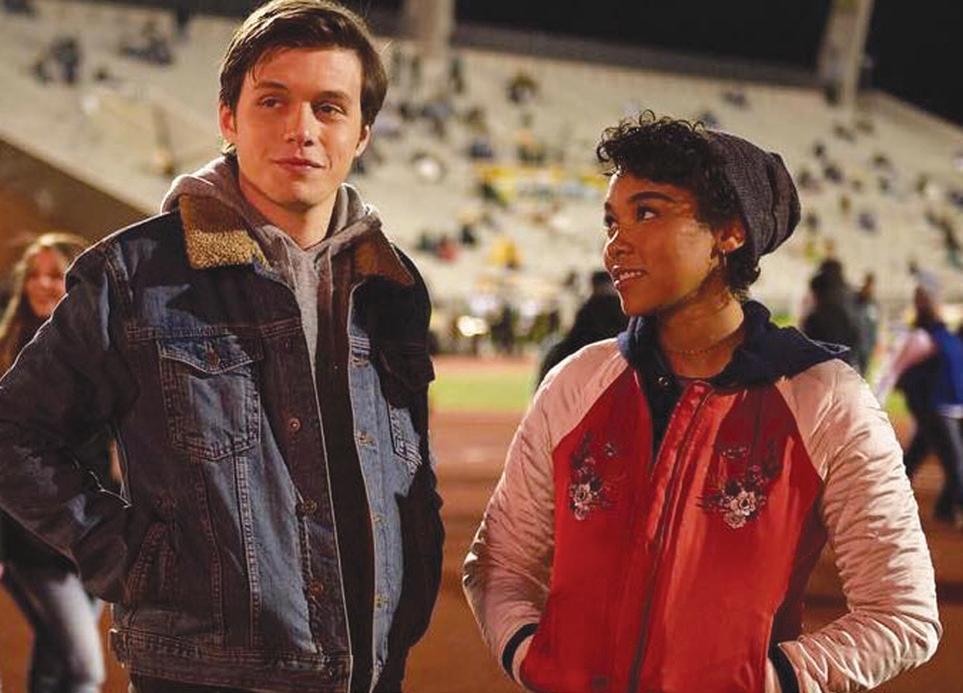
there shouldn’t be films that discuss racial discrimination, gender inequality, and LGBTQ+ rights. Make movies about the terrifying truth behind conversion therapy. Write songs about hate crimes and racial profiling. Put on theater about sexual assault and rape culture. Do all of that, but also make a teenage movie in which a boy falls in love with a boy and no one bats an eyelash. Make art that’s not just about what the world is or has been, but rather what we’d like it to be, because the “progressive” can only become the norm when we make it so. I wish Love, Simon wasn’t about coming out. I wish Simon and Bram fell in love over shared love for music, books, or, I don’t know, pizza, rather than over both having something to hide from the world. I wish the younger kids who watched what’s arguably the first gay rom-com could’ve seen a love story that just happens to be about two boys. And above all, I wish one day I would put on a rom-com on Netflix and, no matter the gender, race or sexuality of the protagonist, not even a flicker of surprise can be found in the back of my mind.
Andrea Yang is a junior in the College of Arts & Sciences. She can be reached at ayang@cornellsun.com. Five Minutes ‘Til Places runs alternate Mondays this semester.
You may have first seen Cel Shading in 2013 with the premiere of RWBY, an “American Anime” aimed at both American and Japanese anime fans. Characters are 3-D models, like a lot of modern animation, but they look a little different from their Disney-Pixar cousins. In stills, they could fool you into thinking they’re two-dimensional drawings or frames from some traditionally-drawn anime. The character’s skin looks flat and their eyes are large and cartoony. Cel Shading is a technique long used by video games, from the classic Katamari Damacy to the more recent The Legend of Zelda: Breath of the Wild, but in recent years, animation studios have used it to bring the anime style into the modern era. Netflix Originals in particular use the technique a lot, as seen in shows such as the surreal space drama Knights of Sidonia and Godzilla: Planet of the Monsters. Most recently, Netflix worked with the writers of the beloved (traditionally animated) show Avatar: The Last Airbender to create a cel-shaded fantasy adventure, The Dragon Prince When Netflix released the first trailer back in July, fans were skeptical about the animation style. Perhaps instinctively making the connection between the show and 3D video games, viewers complained about “lag” and “frame rate.” The Dragon Prince does look a lot like a video game that’s slowing down and “dropping frames,” meaning the charac-
ters appear to jump around the screen like a stop-motion animation. Unlike video games, where this phenomenon is a bug, The Dragon Prince‘s animation studio Wonderstorm drops frames intentionally. The idea is that by only showing the once-fluid 3-D animation at something close to 12 fps, The Dragon Prince will look more like a 2-D, hand-drawn animation, despite being rendered in computer graphics. 2-D animation tends to have a lower frame rate than 3-D, because the animators have to draw every frame individually instead of relying on software to map out the movements between key poses. Without the chore of redrawing characters over and over, the animation process becomes faster, which is why a lot of studios (especially small ones that partner with Netflix) choose this route. Then why try to work backwards, imitating a less efficient animation method? There must be a reason almost all of the blockbuster animated films today — from Despicable Me to Wreckit-Ralph — are 3-D, right? 2-D animation was the standard for decades, and with it comes a lot of nostalgia.

The Dragon Prince had to follow in the impossibly large footsteps of The Last Airbender and The Legend of Korra, some of the most acclaimed animated series of our generation. (Okay, The Last Airbender is one of the most acclaimed, people generally have mixed feelings about the sequel series Korra, but I personally loved it.) The Avatar series has gorgeous art direction and fluid animation, and the Dragon Prince animators wanted to capture this feeling. So they experimented. Everything worked out great: the character designs, background, elves, magic and dragons are all beautiful. The only problem is the choppiness, the distracting dropped frames that don’t succeed in emulating the magic of 2-D animation. Maybe it’s the lack of smears and in-betweens, abstract drawings that connect traditionally drawn frames and help simulate realistic motion. Maybe we’ve been spoiled by painstakingly fluid stop-motion animation like Kubo and the Two Strings, or more successful experiments in blending 2-D and 3-D like Disney’s 2013 animated short
Guest Room
Paperman. Using software Disney developed called Meander, Paperman blends cel shading with hand-drawn frames and auto-generates in-between frames based directly on the animators’ drawings. Disney has used the program many times since its creation, like in animated short Feast and smaller elements in feature film Moana, but other studios haven’t yet caught up.
Not every studio has the seemingly endless budget and resources that Disney has, and so they have to experiment in other ways. The pseudo-anime style seen in The Dragon Prince has come a long way since animators first started using it. RWBY’s visual improvement over the last five seasons spans better lighting, more fluid movement and more detailed crowd scenes, transforming from a small studio’s passion project to a serious contender with its own spin-offs, video games and merchandise. Most likely, these experimenting independent studios will continue to experiment, finding new ways to capture the magic of traditional animation while retaining the versatility that comes with 3-D models. I look forward to seeing what they’ll try next; hopefully, they’ll learn from both The Dragon Prince’s shortcomings and its successes.
Olivia Bono is a junior in the College of Arts and Sciences. She can be reached at ojb26@ cornell.edu. Guest Room appears periodically throughout the semester
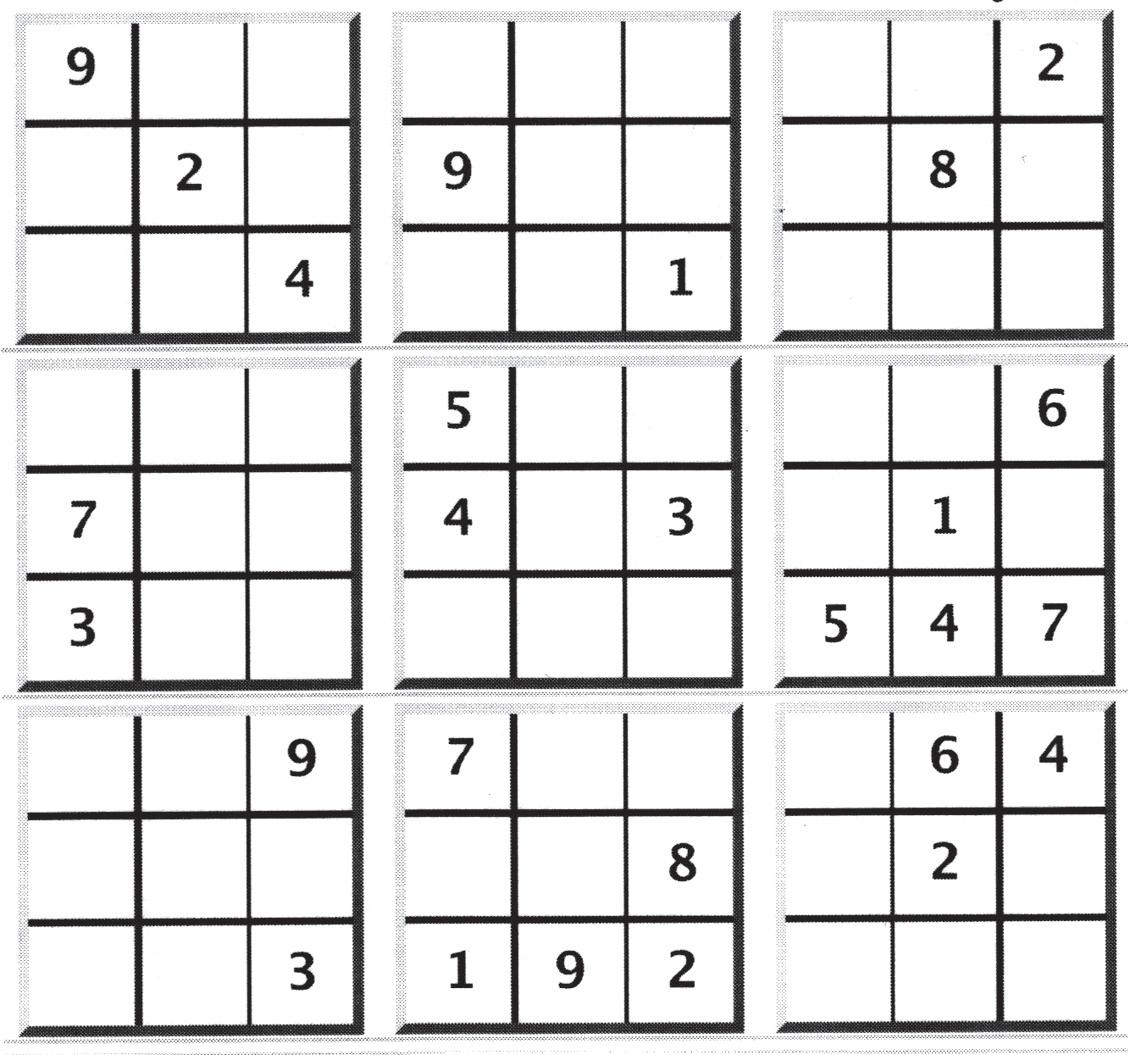
Fill in the empty cells, one number in each, so that each column, row, and region contains the numbers 1-9 exactly once. Each number in the solution therefore occurs only once in each of the three “directions,” hence the “single numbers” implied by the puzzle’s name. (Rules from wikipedia.org/wiki/ Sudoku)

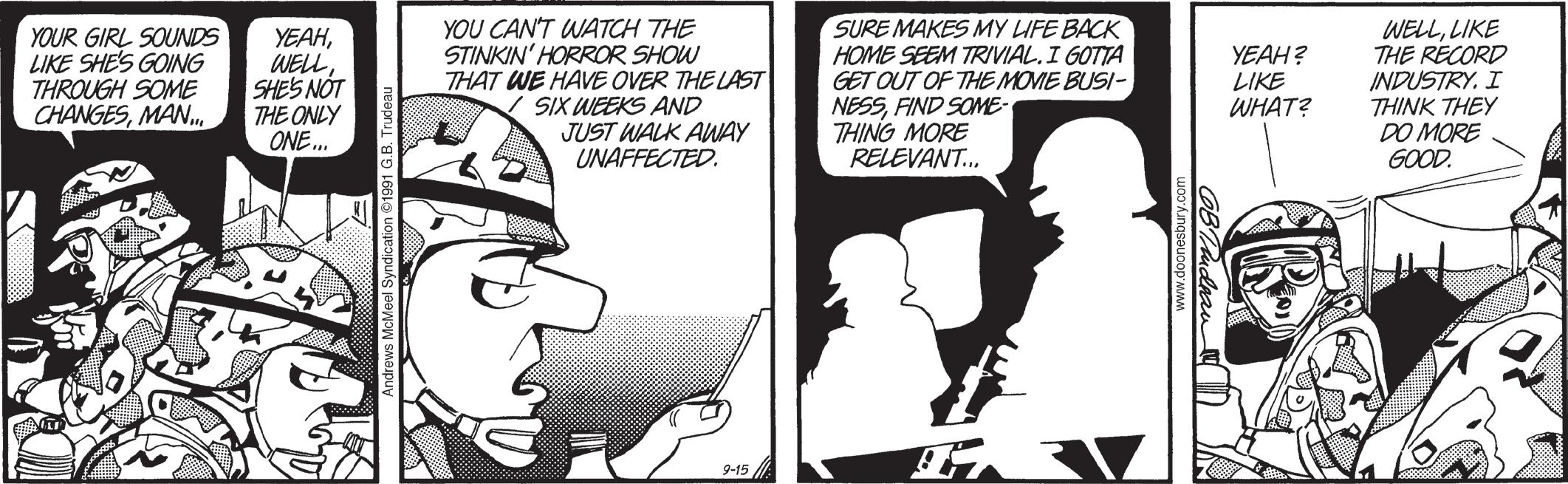
Do you see what he sees? Submit a caption to our website by Friday, September 28, and if you win, your name could appear in The Sun!
To submit your caption for this week’s contest, visit sunspots.cornellsun.com.




2
1


5 Bedroom House 214 Linden Ave. Furnished. Parking available. 607-342-1024 avramispola@yahoo.com WALK TO CAMPUS! Spacious 1 Bdrm. with off-street parking, on-site laundry available for immediate move in. Professionally managed with 24-hr Maintenance. 607-257-5444 www.BrooklaneCornell.com LUXURY AT REASONABLE PRICES 5 & 6 BEDROOM ON LINDEN AVE 8 BEDROOM ON CATHERINE ST. AVRAMISREALESTATE.COM 607-272-3389

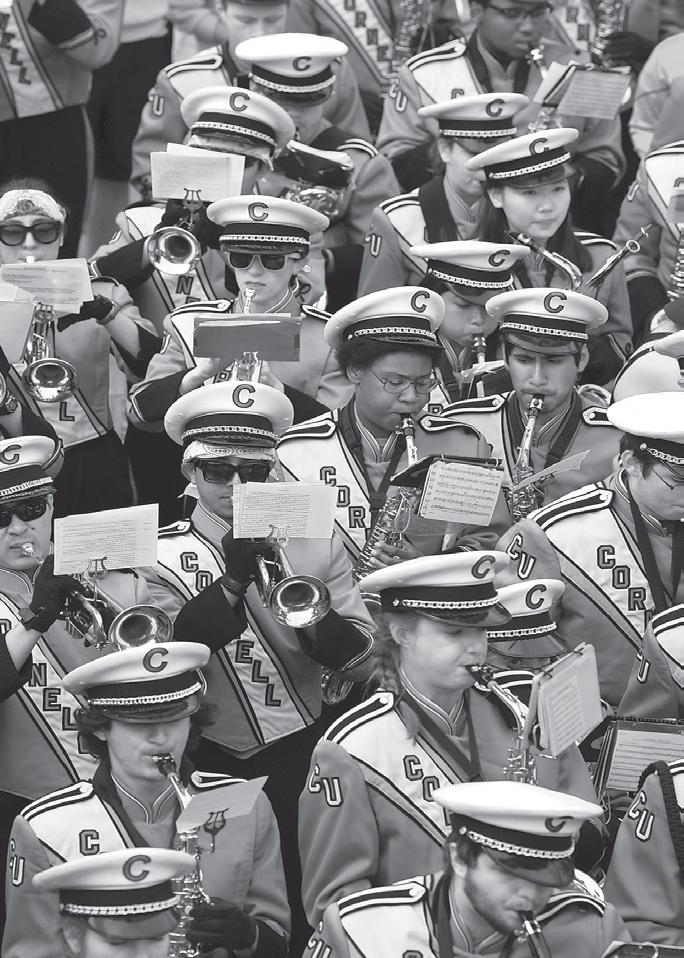
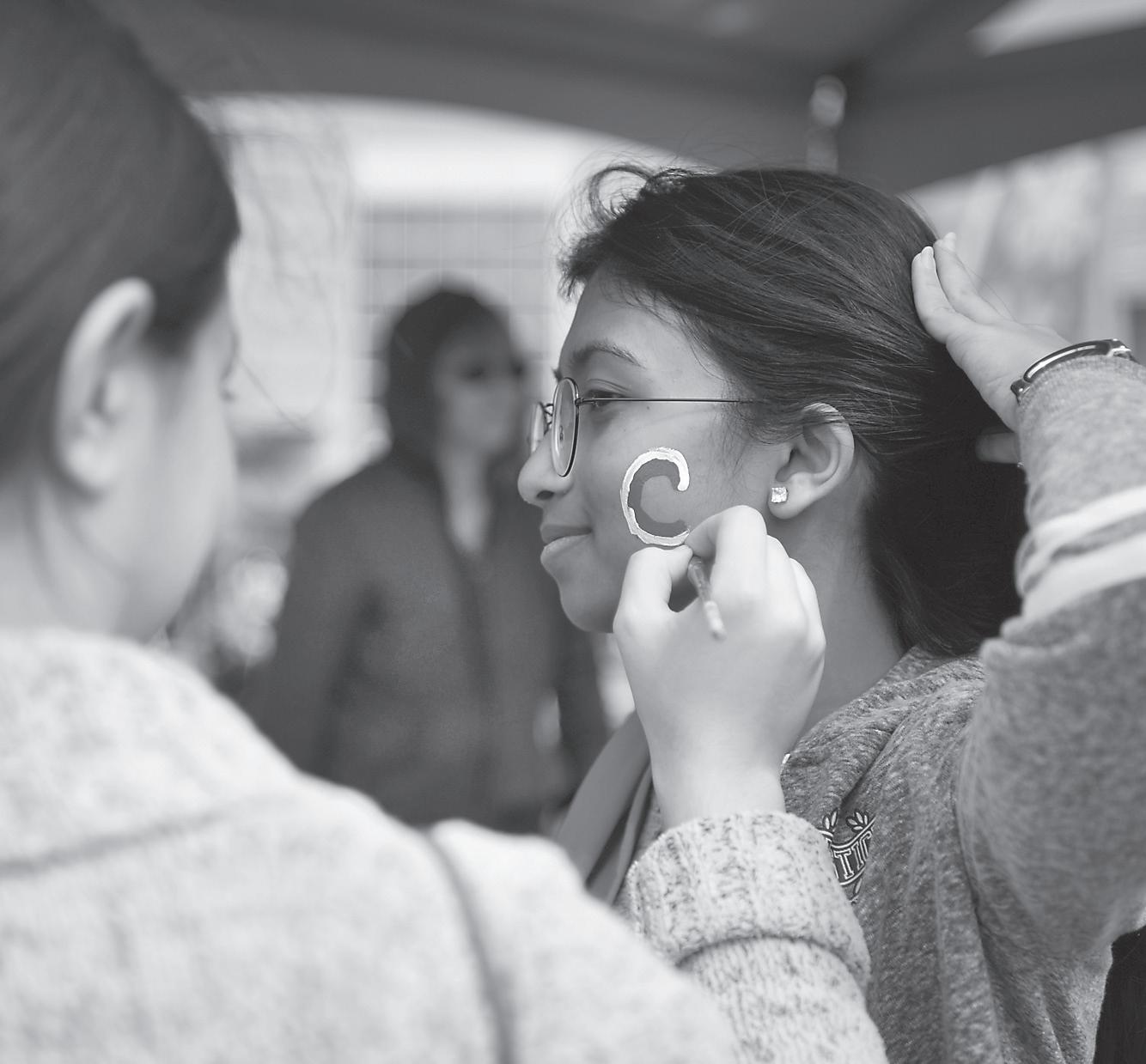
Homecoming | Students and alumni celebraed Homecoming on Saturday, enjoying a ferris wheel, giveaways and performances by the
Band before the Red’s football game against Yale.
By GRACIE TODD Sun Staff Writer
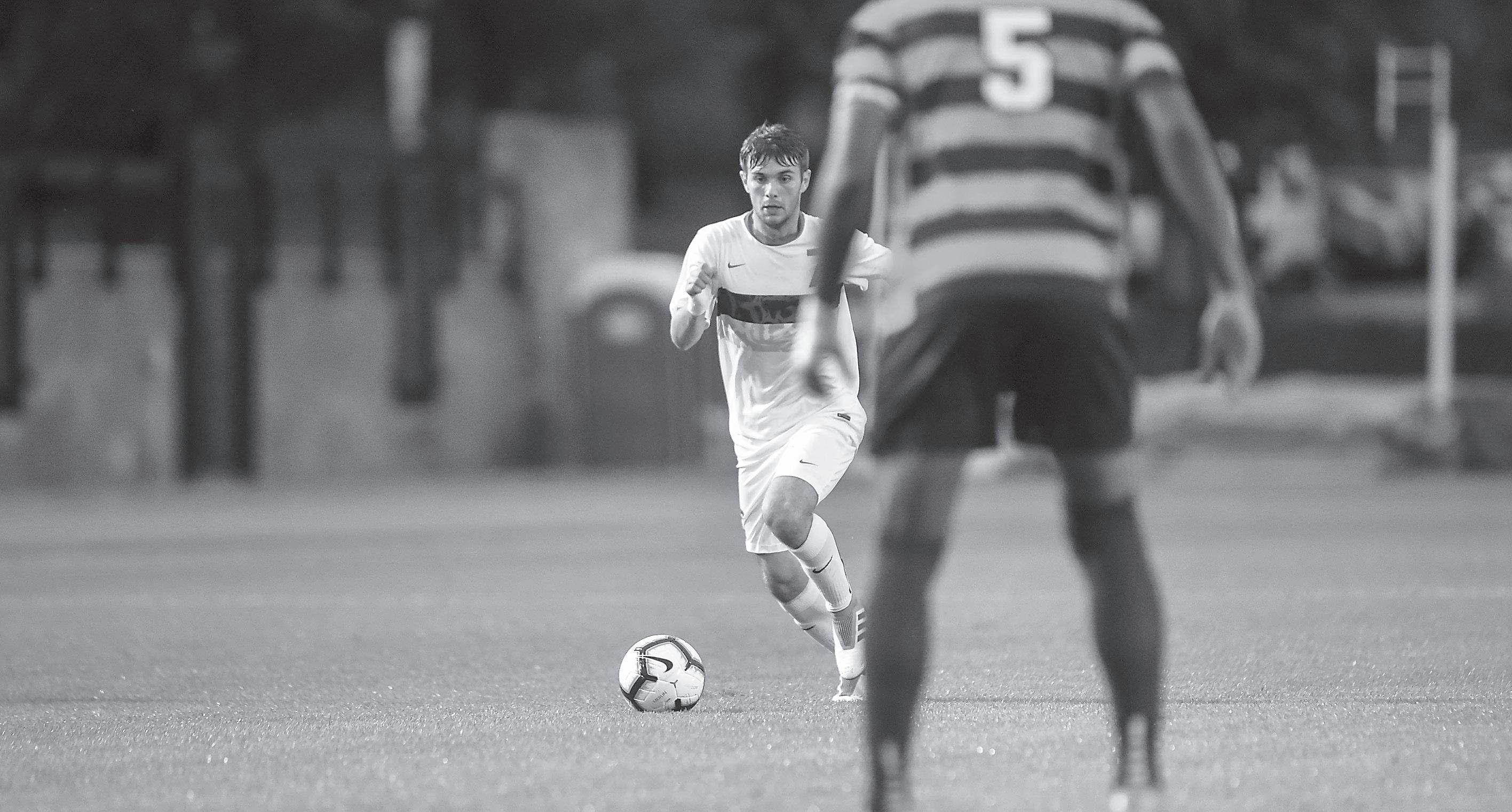
On Friday at Berman Field, Cornell men’s soccer beat out Niagara 3-1. Junior midfielder George Pedlow secured the team’s victory late in the second half with back-to-back goals.
A header goal by the Purple Eagles (2-6) in the 13th minute earned Niagara an early lead. In four of its five wins now, the Red has overcome a deficit.
“Although I don’t want to get in the habit of going behind in games, it does show a great level of mental toughness and belief,” said head coach John Smith.
The Red’s first goal of the game highlighted the talent of its freshman class. Freshman Emeka Eneli, the Red’s leading scorer so far this season, tied up the score near the end of the first half with an assist by classmate Szabolcs Wiksell.
“Almost all the goals we have scored this year have been assisted, which says something about the way we play and the trust we have in each other,” Eneli said.
Later, Pedlow broke the game open, scoring two goals within the final 10 minutes of gameplay. After a shot by Wiksell hit a couple Niagara defenders, Pedlow seized the opportunity and took his own shot.
Pedlow wasn’t finished, though. He scored his second goal just under five minutes later, with an assist by sophomore midfielder Harry Fuller.
“Although we strive to play to the best of our ability and express ourselves on the pitch at all times, nothing is more important than securing the three points” Pedlow said. “It felt great to lift my team over our opponents.”
Despite these imperative offensive plays, Smith said it was his defense that impressed him the most. About halfway into the second half, with the score still tied at one, a foul on Cornell earned the Purple Eagles a penalty kick. Junior goalkeeper Ryan Shellow saved it, despite a switch-up by Niagara.
“When we scouted Niagara, the penalty taker had always gone to his right with his shot … and so this is where [Shellow] would have been thinking of going, ” Smith said.
“The fact that he had the wherewithal to read the penalty taker’s body language on approach [and go to the left] to make such a key save was phenomenal.”
Shellow finished the game with five saves.
Along with the victory, the Red gained experience it says will be valuable in the remainder of the season.
“It was a physical game with many similarities to the upcoming Ivy League games, which will be really useful going forward,” Pedlow said.
Cornell takes on Lehigh on the road in another nonconference matchup at 7 p.m. Tuesday.
gtodd@cornellsun.com.
FOOTBALL
Continued from page 12
total 141 yards on the day with a gut-punching touchdown in the waning minutes of the game.
“Take away Dudek and you’re probably going to win the football game, and we didn’t [win],” Archer said. “It kind of drives me even more crazy.”
“We just wanted to hit him,” Nolan said of Dudek, who rushed for 173 yards against Cornell last year. “We weren’t ready for him last year. He came out of nowhere last year and this year we were ready for him.”
Cornell countered with a speedy back of its own early in the game. Junior running back Harold Coles was one of a few Cornell offensive spark plugs on the day, amassing 130 yards, 98 of which came on his two long first-quarter touchdowns — a 40-yard run and a 58-yard catch and run.
Banks, who was 16-for-23 with 152 passing yards in the starter role, and Catanese, who attempted only one pass but had five rushes for 50 yards and a touchdown.
Other than two quick Yale touchdown drives in the first quarter, the Cornell defense did what it needed to do to keep the offense within striking distance for the second consecutive week. But Nolan and the defense behind him were not satisfied with one key statistic: Yale was a perfect six-for-six in the red zone on three touchdowns and three field goals.
“[Dudek] came out of nowhere last year and this year we were ready for him.”
Senior Cyrus Nolan
But the rest of the Cornell offense continued to lag, aside from a 24-yard rushing touchdown from junior quarterback Mike Catanese in the fourth quarter that briefly cut the deficit to two before the dagger from Alston.
Compared to Yale quarterback Kurt Rawlings’ 283 passing yards, Cornell had just 164 yards in the air of its own, 58 of which came on Coles’ second touchdown.
It was a deviation from last week’s gameplan against Delaware in which three quarterbacks — Catanese, senior Dalton Banks and sophomore Richie Kenney — all saw action. Saturday was just
“There’s a lot of stuff where we weren’t aligned right,” Nolan said. “I know everyone says this after they lose, but in the first quarter when they scored on those first two drives we weren’t aligned right on a bunch of pays. There’s definitely a lot of good but we just couldn’t finish the game.”
While the progress would be better supported by wins, Cornell feels that it has been able to showcase the improvements from last year to this. In losses to both Delaware and Yale in the first two games last year, the average margin of defeat was 26 points. This year, that number has shrunk to 10.
“I’m taking the growth approach, but it’s disappointing when you know you can win,” Archer said. “I know this team can [win], and we’re a better football team that we were last year.”
“If the ball bounces the other way on a play it could be the difference of a game,” Coles said. “I feel like if we just execute a few more plays, we’re there and we’re not talking about a loss right now.”
Zachary Silver can be reached
HOMECOMING Continued from page 12
one of the league’s best.
“If we just executed a few more plays then we’re there, and we’re not talking about a loss right now,” Coles said.
But after so many years of losing, just competing cannot be good enough anymore. This team has eight games left and six more Ivy foes to match up with. So now is the time to start executing those plays and to stop taking those killer penalties. It’s time to win before this season gets away from them.
Enough with the growth approach, enough with the moral victories.
Charles Cotton can be reached at ccotton@cornellsun.com.
By ZACHARY SILVER Sun Senior Editor
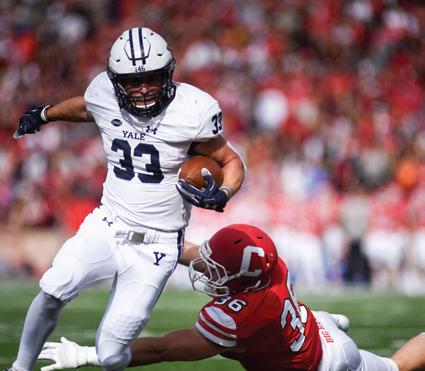
As soon as final whistle against Yale last year, Cornell football couldn’t wait to learn when the rematch would be. What the Red was handed was the Homecoming game in front of its largest crowd of the season for the Ivy opener against the defending champs. Sign head coach David Archer ’05 up for that perfect storm any day of the week.
With the chance to make a statement to the rest of the league in front of 11,400 students, faculty and alumni, Cornell kept it close in an emotional game but could not put together the key plays in key moments in
“I thought we had these guys. I didn’t think we were going to lose, so it’s more of a feeling of disappointment than anything else.”
Head Coach David Archer ’05
what was ultimately a 30-24 victory for the Bulldogs.
“I’m with you,” a visibly distraught Archer responded with a deep sigh when asked if this was the perfect opportunity to send a message to the league. “That’s how it felt.”
What exactly could that statement have been? “I am tired of us getting ranked in the bottom half of the league every single preseason poll,” junior running back Harold Coles said.
“I thought we had these guys,” Archer added. “I didn’t think we were going to lose, so it’s more of a feeling of disappointment than anything else. Not just disappointed for me, but for our kids. To get a win on Homecoming is a great thing and to come up short on that really stings.”
While still a loss, Cornell felt it played a flip-flop of a game from last year’s 49-24 thrashing at the hands of Yale. Until Yale began to pull away at the end of the
but can’t keep up with 2017 Ivy champs

third quarter, Cornell had an answer for nearly every punch Yale threw.
Down by two with 12 minutes to play in the game, Cornell needed just one more punch. A roughing the passer call on a play that would have stunted a Yale drive ended that hope. The Bulldogs took the gift and cashed in for a game-winning touchdown three plays later.
“It was like a heavyweight fight,” Archer said. “There are going to be a couple of key punches that are landed, and you just don’t want to punch yourself, whether it’s penalties offensively or defensively.”
What makes it sting more is that Cornell felt it did what it needed to do for the win. The Red’s defense limited reigning Ivy League Rookie of the Year in Zane Dudek to just 33 yards, despite surrendering a pair of short first-quarter rushing touchdowns. But Dudek only got the ball four times in the second half and may not have been 100 percent healthy, Archer observed.
But the running back Cornell didn’t account for was freshman Spencer Alston, who came out of nowhere to
By CHARLES COTTON Sun Senior Writer
In front of the biggest crowd that Schoellkopf Field will see all season, the Cornell football team had a chance to do something special on Saturday — to knock off the defending Ivy League champs with 11,400 pairs of eyes looking on.
The Red trailed by just three points after an eventful first half and hung around until the end, needing a big
defensive stop before handing the ball over to its two-minute offense to try and send the fans home happy.
But it didn’t get that stop. And the fans didn’t go home happy.
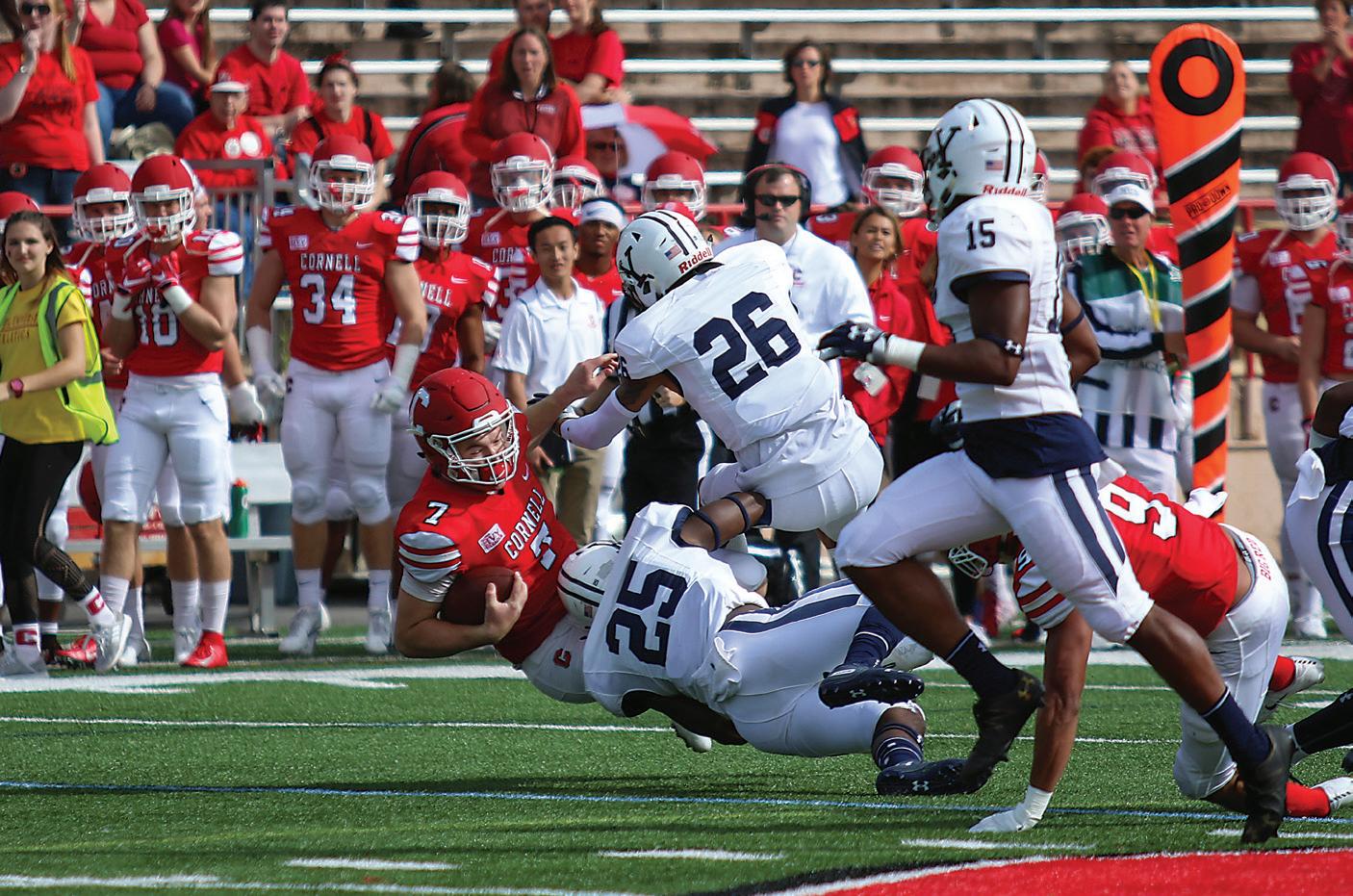
A costly — and perhaps controversial — roughing the passer penalty extended Yale’s penultimate drive which resulted in a touchdown to seal the deal. The final score was 30-24 as the Red slipped to 0-2 on the season.
A loss is a loss, but Cornell continues to feel that it is playing a much better
brand of football than in previous years.
“I feel like we know every single game now that we can play with people. We have a different culture, we have a different team. Everybody has a chip on their shoulder, and we’re ready to show people we can play,” said junior running back Harold Coles, who was the team’s best player Saturday with 130 yards of offense and two scores. “Every team in the league is starting to notice.”
“We’re better this year, but we didn’t get it done in the end of the day,” added senior defensive lineman Cyrus Nolan.
They’re right: this team is better than last year’s team, and that team was arguably better than the year before. But the 2018 edition of Cornell football is still winless, and moral victories only go so far.
Through the first two games of last season, Cornell had been beaten badly by both Delaware and Yale. This season, it has been beaten by Delaware and Yale — but not as badly. The offense remains one dimensional, but some big plays Saturday should provide fans with a certain degree of hope going forward. Coles is coming into his own in the backfield, and if senior quarterback Dalton Banks can find a way to maintain his rhythm despite sharing time with run-first junior quarterback Mike Catanese, this offense could be pretty good. The defense was mediocre against Yale but could start to come into its
own if it can just stay disciplined.
But let’s put all of that aside for a moment. Cornell football has not had a winning season since 2005. The team is picked at or near the bottom of the Ivy League in the preseason poll every year and ends up finishing there quite often, too. They are just 6-16 in the league over the last three seasons.
“Everybody has a chip on their shoulder, and we’re ready to show people we can play.”
Junior Harold Coles
How long much longer will football fans here on East Hill have to wait to see a winning product?
“I’m taking the growth approach, but it’s disappointing when you know you can win,” said head coach David Archer ’05. “We’re a better football team than we were last year.”
As the Homecoming crowd emptied out of the stadium early Saturday evening and the Yale sideline boastfully waved goodbye, the fans had no reason to be embarrassed — the Red gave it their best shot and went toe-to-toe with