The Corne¬ Daily Sun


By JONATHAN WU Sun Contributor
The Cornell Council for the Arts is hosting its fifth Cornell Biennial with a rotating series of exhibitions, installations, performances and artist panels through December. Exhibited across the University campus, Ithaca and surrounding upstate regions, as well as the Cornell Tech campus in New York City, this year’s show centers around the theme: “Futurities, Uncertain.”
The featured creators includes invitational artists, affiliates of the Mellon Public Curatorial Expression Program, as well as Cornell faculty and students who participated in the CCA’s open call competition for artwork submissions this past winter.
According to Prof. Timothy Murray, comparative literature, curator of the past three biennials and director of the CCA, the arts show aims to reorient traditional thinking about the future that is oftentimes based on preconceived notions.
“We asked artists to think about how our relationship with presentness gets impacted by the precarity of the future now as we’ve come to understand it through COVID, global warming, the Black Lives Matter movement, continual pressure put
on Indigenous communities, as well as intensive pressure put on the health of women and people of different sexualities,” Murray said.
The biennial features artwork aimed at both educating students and the general public on pressing societal issues, while highlighting and introducing these themes in a new light.
For instance, the Circulating Matters outdoor installation touches base on the future of the construction industry in the face of climate change. It was composed of reused materials from the deconstruction of a 1910 residential structure in Collegetown that was originally slated for demolition.
Circulating Matters, designed by Prof. Felix Heisel, architecture, in conjunction with the Circular Construction Lab, of which he serves as director, is part of an overarching research project on promoting the circular construction economy and scaling reuse throughout Ithaca and communities across the world.
To continue reading this story, please visit www.cornellsun. com.


By SOFIA CHIERCHIO Sun Staff Writer
Hazing is a national issue that has plagued many college campuses, including Cornell. To grapple with the realities of hazing, Monday kicked off National Hazing Prevention Week, an opportunity for universities, specifically Greek Life communities, to come together to stand up against hazing.
This year, Cornell hosted Michelle Guobadia, director of Fraternity and Sorority Life at the University of North Carolina at Charlotte, to share her experiences with hazing
and educate others on the dangerous effects of hazing in Greek Life, sports teams and other organizations.
Guobadia, a member of Zeta Phi Beta Sorority, Inc. at the University of Delaware, explained how, during her time as an undergraduate at the University of Delaware, she had not only experienced hazing during her pledging period, but she also became a perpetrator.
“No one joined my chapter for two years because people were literally afraid of my organization,” Guobadia said.
By RACHEL KODYSH Sun Staff Writer
Ithaca officially became an abortion sanctuary city as a result of a Common Council amendment to the city’s municipal code on July 6. The council passed the amendment following the overturning of Roe v. Wade in June.
The amendment prevents city employees from disclosing the health information of those who seek abortions in Ithaca with out-of-state law enforcement. If private information is revealed, the amendment explicitly grants citizens the right to sue the city.
Robert Cantelmo grad, alderperson of Ithaca’s 5th Ward and chair of Ithaca’s
City Administration Committee, spearheaded the legislation.
“I tried to think of ways that we could step up as a community given the failings of the federal government,” Cantelmo said.
Cantelmo got the idea for the abortion sanctuary city from an existing article in the municipal code, that similarly prevents city employees from cooperating with immigration control organizations such as U.S. Immigration and Customs Enforcement.
“With its unanimous passage, we are signaling that we have a very strong commitment to making sure this is upheld,” Cantelmo said about the unanimous vote from the Common Council.

The policy received support from local reproductive health organizations such
as End Abortion Stigma and Planned Parenthood, according to Cantelmo.
“We need to provide these protections and signal to the community that we are a place that supports their values and their rights to bodily autonomy,” Cantelmo said.
Muna Mohammed ’24 believes that there shouldn’t be laws regulating reproductive rights and is in support of Ithaca’s new policy.
To continue reading this story, please visit www.cornellsun.com.
Thursday, September 22, 2022

Bureaucratic tests | University of Singapore Professor Nicolas Kuipers will give a lecture on Thursday about his research on civil service examinations in Indonesia, in which he investigated how the outcomes of these tests prompt attitudinal shifts on the part of winners and losers.
Gatty Lecture: Meritocracy Reconsidered: Bureaucratic Selection and Nation-Building in Indonesia 12:30 p.m., Kahin Center
Midday Music: Original Cornell Syncopators 12:30 p.m. - 1:10 p.m., Lincoln Hall B20
Institute for African Development Seminar Series: Role of Digital Technologies in Transforming Agri-Food Systems in Africa 2:40 p.m. - 4:35 p.m., Uris Hall G08
Cornell Department of Astronomy and Space Sciences Fall 2022 Colloquium Series 3:30 p.m. - 4:30 p.m., Space Sciences Building 105
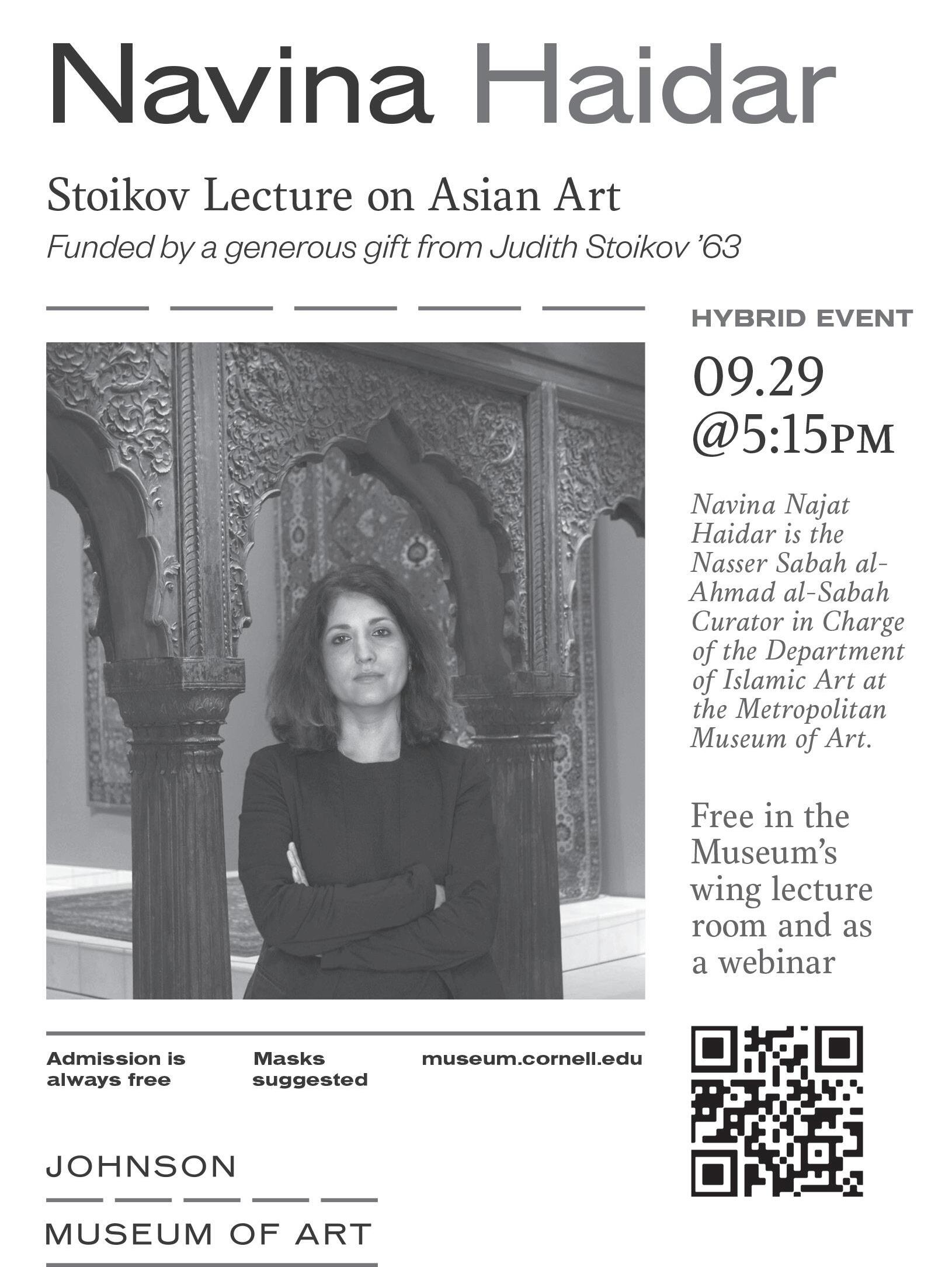
Autism Social Group 4 p.m., Virtual Event
Building Soils for Better Crops: Ecological Management for Healthy Soils 4 p.m., Mann Library 160
Michler Lecture Series 4 p.m., Malott Hall 532
Introduction to Market Research 4:30 p.m., Mann Library 103
How to Apply to Graduate School 6 p.m., Virtual Event
Apparel Futures: E-Textiles and Informatics 10:30 a.m., Virtual Event
Dissidence: Exiled Writers on Resistance and Risk Noon, Goldwin Smith Hall G64
Introduction to Zotero Noon, Virtual Event
Gender and Planning Panel 12:25 p.m., Abby and Howard Milstein Auditorium
A Century of Student Movement: The Making of Taiwan’s Democracy 3:30 p.m. - 5 p.m., Ives Hall 219

By ANANTHI JAYASUNDERA Sun Staff Writer
Although the COVID-19 pandemic drew special attention to the importance of biomedical engineering, universities like Cornell have been investing in the subject for decades. That investment will substantially increase with the creation of new biomedical engineering facilities in Thurston Hall on Cornell’s Ithaca campus.
Cornell University is ranked as the ninth best engineering school in the country and has a 45-year long history of biomedical engineering research. Despite this history, the Department of Biomedical Engineering was only formally established in 2004, and in 2015 the Meinig School of Biomedical Engineering was created, making Biomedical Engineering a relatively new major in the College of Engineering.
Now nearly two decades old, the Biomedical Engineering Department still does not have its own building on campus. This is set to change in 2024 with the $40 million expansion and renovation of Thurston Hall which, ten years after the establishment of the Department of Biomedical
Engineering, will become the new home of the Meinig School and other departments such as Material Sciences and Engineering.
Professor Chris Schaffer, Meinig School of Biomedical Engineering, said that a key reason for the expansion was the department’s current lack of teaching space.
“When we first started out, we were shoving lab-based educational activities into small spaces in the basement of Weill Hall, which is where much of our research infrastructure is located,” Schaffer said. “But as the major has grown, we have completely outgrown these spaces, and now a lot of our lab-based teaching is scattered all over the place.”
The major’s growth has been continuous: The Class of 2024 is the largest class in the department’s history.
“The research spaces in Weill Hall worked fine for teaching lab activity when the major was 20 or 30 people, but now my [biomedical circuits signals and systems] class has 60 people alone,” Schaffer said. “With this kind of dramatic growth, having space that is purpose-built and architecturally designed for the purpose of lab-based teaching will make it easier for us to teach and it will make it a better environment for students to learn in.”
Continued from page 1
“By day, we are the model students, by nights and weekends, we do things we wouldn’t show our parents or peers from home.”
Guobadia also discussed ten myths about hazing, aiming to disprove common misconceptions many in the Greek community have regarding hazing.
“Hazing doesn’t eliminate the bad apples, it actually keeps the bad apples in,” Guobadia said. “When you pit one class against another, you aren’t unifying them, but you’re creating cliques and cracks in your organization.”
Kappa Alpha Theta President Euna Carpenter ’23, is using Hazing Prevention Week to not only educate her members, but as a way to reflect on their recruitment process and new member policies.
“Our chapter prides itself on core values of supporting and empowering each other, intellectual curiosity and growth, and pushing each other to become the best people we can be,” Carpenter said. “This week, we are having conversations around what Theta means to each of us individually and how we want to make others in our chapter and community feel.”
This year’s National Hazing Prevention Week at Cornell was in honor of Antonio Tsialas, who died during an unofficial rush event for Phi Kappa Psi in 2019. Tsialas was found at the bottom of Fall Creek Gorge with a frac-
tured skull, broken ribs and an alarmingly high blood-alcohol level.
Only a freshman when he passed away, his death shook the Cornell community. In October 2020, Phi Kappa Psi was banned from Cornell’s campus, however, there were no criminal charges filed.
Delta Delta Delta President Maddie Sand ’23, believes that National Hazing Prevention Week is a powerful reaction to the losses experienced in the Greek communities nationally, and with Tsialas at Cornell.
“Each fall I am forced to grapple with the reality that hazing in the Cornell community killed Antonio Tsialas. This loss is profound and should call Greeks to enact change in our member intake and recruitment processes,” Sand said. “Hazing is never okay. I want women to feel welcomed at Tri Delta from the moment they step in on Bid Day.”
At the end of her talk, Guobadia aimed to shock Cornell students by explaining the legal implications of hazing.
“Someone has died from hazing every year for 50 years except for 2020, during the global pandemic,” Guobadia said. “97 million dollars is the largest asking price on record for a hazing lawsuit. No one rises to low standards. If you want them to appreciate your organization, then treat your organization like it should be appreciated.”
Sofa Chierchio can be reached at schierchio@cornellsun.com.
BME students appear to concur that the current shared teaching and research space was insufficient.
“There are only so many labs that can be used in Weill Hall for teaching undergrads as well as the research itself,” said Parker Dean ’22 M.S. ’23. “Weill Hall itself is a building shared with other departments, and the new undergraduate BME program seems to have put everything under stress.”
Prof. Marjolein van der Meulen, the James M. and Marsha McCormick Director of Biomedical Engineering and Swanson Professor of Biomedical Engineering, has used her administrative position to promote the department’s need for new teaching space, which would allow the laboratories in the basement of Weill Hall to be used exclusively for research.
Ananthi Jayasundera can be reached at ajayasundera@cornellsun.com.
By MARISA CEFOLA Sun Contributor
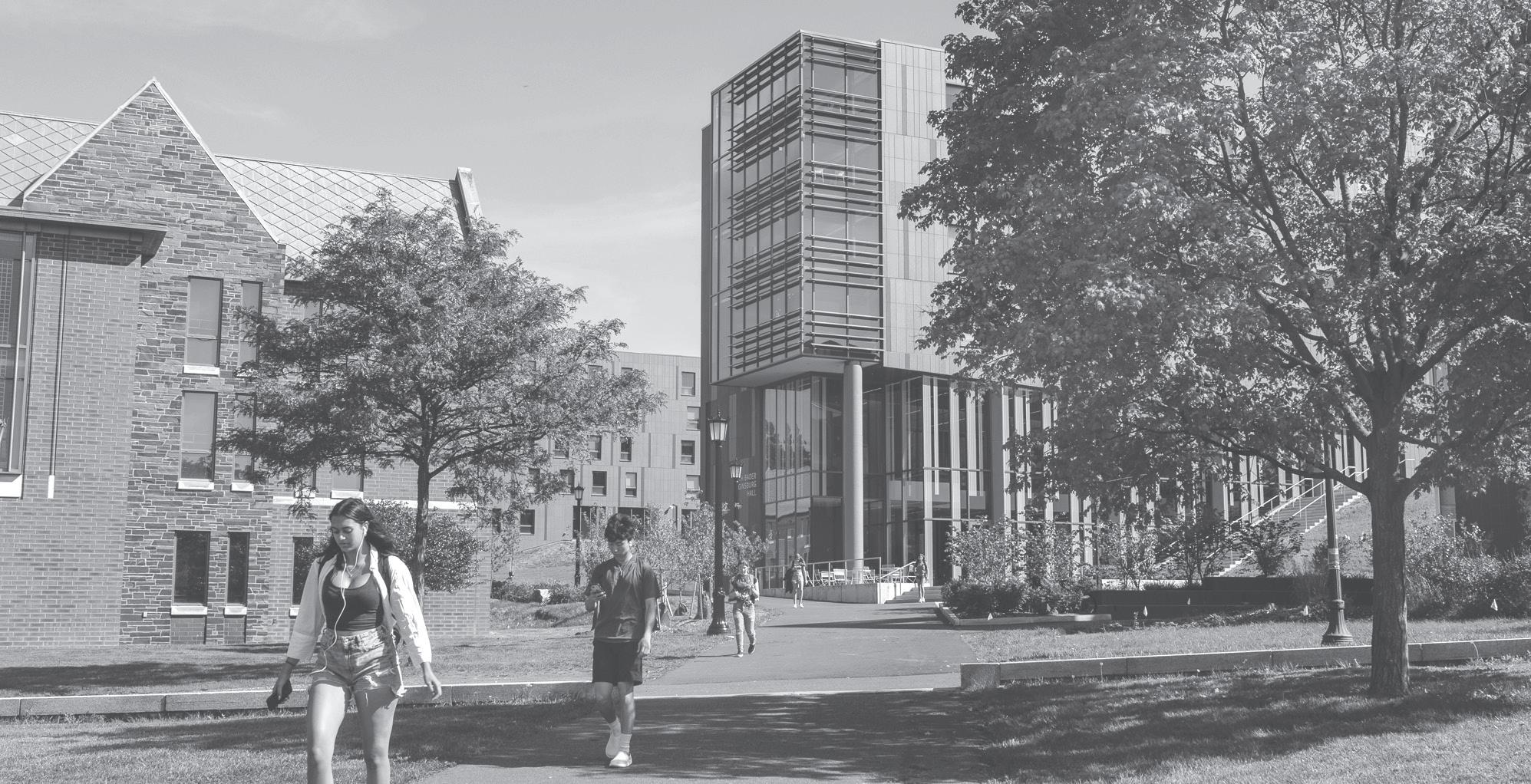
Three new dorms tower over the low rises after the additions to the North Campus Residential Expansion project this year. Residents of Hu Shih Hall, Ruth Bader Ginsburg Hall and Barbara McClintock Hall voiced how their new homes remind them of grand hotels, but bring social drawbacks with living in an isolated environment — a trend for new University housing.
The NCRE project aimed to provide not only 2000 additional beds for first-years and sophomores, but also comfortable spaces to study and socialize with friends and other residents. Last year, the University added two new dorms with similarly modern amenities, but residents reported feeling lonely and isolated as well.
Lounges in the new dormitories include brand new televisions and other amenities, including a mini-kitchen. The actual rooms are no exception to the modern innovations of the new halls, paved with hardwood floors and lined with ample strips of adjustable overhead lighting. Students have settled into what feels like a five-star hotel room with ease.
“It made the transition into college a lot easier to move into somewhere a little bit more comfortable in comparison to other Cornell dorms,” said Hu Shih Hall resident Alexandra Zwiebel ’26.
However, one resident of Hu Shih Hall explains the downsides of having everything at his disposal within his floor.
“They made it kind of a home where you don’t have to leave the actual dorm itself,” AJ Nambiar ’26 said. “It’s to your own discretion whether you want to be social or not, while in [other dorms like] Donlon you’re kind of forced [to socialize].”
Most residents agree and add that the sterilized, hotel-like feel of the hallways separating the small lounges does not facilitate socialization.
“[It’s] very much, ‘you go to your room and then you leave’ — there’s less meeting people even within your pod,” Anna Cerosaletti ’26 said who lives in Ruth Bader Ginsburg Hall.
In older dorms, like the low rises,
suite-style rooms allow residents to meet each other. In these buildings, the main lounge areas, while not modernized with appliances, are larger and contain activities such as board games and ping-pong for residents to play.
Because of how new the halls are, their bare-boned walls and lack of character have left residents doubtful that social traditions will be created by the end of the year.
“There’s just not as much engagement and I think it comes back to how the dorm is set up,’’ Cerosaletti said. “The whole floor isn’t really close, so I don’t think people would go to [social] events.”

By KATHERINE YAO Opinion Editor

hile everyone has likely heard the mantra, “Breakfast is the most important meal of the day,” a thousand times, college students know the struggle of finding enough time to eat in the morning. If you’re like me, you’ll likely prioritize the extra 10 minutes of sleep before
I guarantee that the first sipofyour smoothie on the walk to class will be well worth it.
your 8 a.m. lecture over getting some morning nutrients in your body.
But, over my three-plus years in college, I’ve found a few simple recipes that work for me when I’m in a rush and have to take breakfast on the go. Here are a few of my favorites, partially because they require no actual cooking, partially because they’re all super customizable, but most importantly, because they’re just so delicious.
Toast
To my apartment-mates reading this who know all too much about my bread obsession, yes, of course I had to start off this article with toast. Toast is my favorite breakfast food — I mean, it’s so versatile. I’m a sweet over savory gal, so I like to put on as much peanut butter (crunchy, always) as I can possibly consume at once, cut up half a banana to go on top and finish it off with dark chocolate chips. If it’s the rare day that I am craving something savory, I’ll spread hummus on my toast, chop up a tomato or bell peppers to go on top, and sprinkle on some Everything but the Bagel seasoning. You can change up your toast toppings however you want — I advise experimenting to find your favorites!
Yogurt
You can’t ever go wrong with a twist on yogurt! Parfait bowls are another one of my favorites. I buy the bulk containers of Chobani Plain Greek Yogurt and use that; though, of course, any kind of yogurt
works. My favorite parfait toppings are similar to my most used toast toppings — peanut butter, banana and chocolate chips. Most days, I also like to throw some granola and almonds in for that added crunch. Other days, I’ll sub in tahini in place of the peanut butter and add some dried cranberries and dates. You do you! The world of yogurt toppings is your oyster.
Smoothies
Smoothies are another fun and healthy breakfast food. I like to use orange juice or almond milk as my base, but I’m also partial to coconut water and oat milk. Next, I’ll add in my fruit. Though fresh fruit works, I prefer frozen fruit because they’re more convenient — I’ll usually buy a bulk bag from Wegmans and save myself the time it takes to wash and cut all the fruit. I also add in a healthy dose of spinach. You might think this step ruins a perfectly nice sweet smoothie, but trust me when I say that you can’t taste the vegetable. Plus, you will have the added bonus of getting your greens in. Finally, I’ll finish with some peanut butter (can you sense a pattern here?) for those healthy fats before blending everything together. Your roommates might get mad about the ruckus from the blender, but I can guarantee that the first sip of your smoothie on the walk to class will be well worth it.
Overnight Oats
Okay, this final option might

need some night-before meal prep — sorry! But I promise, there’s no stove-work necessary. Overnight oats are well worth the 15 minutes you’ll spend on meal prep. As a bonus, you can prepare multiple servings in one fell swoop and have readymade breakfast for multiple days. The recipe I like to use per serving container is ½ cup oats to ½ cup milk. I also like to add in a little bit of honey and a whole lot of cinnamon. Then, I put my overnight oats containers in the fridge overnight and wait to enjoy the next morning. If I have a little extra time in the morning, I’ll

toss in some nuts, frozen berries or chocolate chips, but it’s good enough to eat as is, in my opinion!
Hopefully these ideas have inspired you to make breakfast a more common staple in your life. Breakfast doesn’t have to be a complicated affair. Sometimes it’s as easy as making peanut butter toast or grabbing an overnight oats cup to eat on your way to class.
Katherine Yao is a senior in the College of Arts and Sciences. She currently serves as the opinion editor and can be reached at kyao@cornellsun.com.

VEE CIPPERMAN ’23 Editor in Chief
SERENA HUANG ’24
Business Manager
EMMA LEYNSE ’23
Associate Editor
SURITA BASU ’23
Assistant Managing Editor
NAOMI KOH ’23
Assistant Web Editor
ELI PALLRAND ’24
News Editor
ESTEE YI ’24
News Editor
KAYLA RIGGS ’24
JULA NAGEL ’24
Editor
MEHER BHATIA ’23
KATRIEN DE WAARD ’24
PAREESAY AFZAL ’24 Assistant News Editor
JIWOOK JUNG ’25
ADITI HUKERIKAR ’23
DANIELA WISE-ROJAS ’25
JASON WU ’24
GRAYSON RUHL ’24
KEVIN CHENG ’25
HANNAH ROSENBERG ’23
JYOTHSNA BOLLEDDULA ’24
ANGELA BUNAY ’24
Editor TRACY ZENG ’24
Manager DEVAN FLORES ’24

Adam Senzon is a freshman at the School of Industrial and Labor Relations. He can be reached at ars424@cornell.edu. My Two Sen-ts runs every other Tuesday this semester.
With prelim exams right around the corner, the average Cornell student will let you know of their stress.
LI ’24
GABRIELLA PACITTO ’24
ABRAHAM ’24
BERNSTEIN ’23
ROSENBERG ’23
I’m no stranger to the feeling of stress and anxiety, but I like to remind myself that at times giving in to these feelings will only inhibit my progress. These past few weeks have been challenging to say the least — but I’ve been helping myself understand that I must nurture myself first before pursuing anything greater. As my workload progressively gets larger I find myself revisiting this feeling of stress and it can become burdening at times.
Before I get into some ways you can try to remove or lessen stress as a dominating factor in your life, I’m going to preface that not all stress is bad stress. There is
experience that good music never goes wrong when I’m stressed!
Another thing you can do to remove unhealthy stress from your life goes handin-hand with listening to music. Get on your feet and exercise. Something I’ve learned this past year is to never underestimate the power of a workout to remove negative thoughts and mindsets from my life. To maximize a workout, listen to upbeat music that will help you get that adrenaline rush and keep you energized. You may even want to work out with a friend — this is one of the many ways to strengthen those foundational relationships within your life. Going on a run with a friend may just be the antidote to your stress-dominated life. Healthy relationships can act as a support system in your life, keeping you afloat when those unexpected detours present themselves.
Ad Layout Jacqueline Wu ’24 Managing Desker Angela Bunay ’24
Desker Katherine Yao ’23 Dining Desker Katherine Yao ’23 News Deskers Sofa Rubinson ’24 Gabriella Pacitto ’24 Science Desker Tenzin Kunsang ‘25 Photography Desker Jason Wu ’24 Production Desker Katrien de Waard ’24
Want to give your take on a campus issue?
The Sun thrives on your feedback. Continue the conversation by sending a letter to the editor or guest column to associate-editor@cornellsun.com.
Letters should be no longer than 250 words in length. Columns are 700-900 words
Please include graduating year if applicable.
All voices welcome.
I know from personal experience that good music never goes wrong when I’m stressed!
such a thing as healthy stress. Healthy stress keeps you aware of responsibilities and tasks that you must get done, or you’ll face negative consequences. Though this type of stress is beneficial to productivity, it can easily evolve into unhealthy stress that dominates your life. It’s your job to make sure this doesn’t happen.
Though I haven’t mastered the art of sublimating unhealthy stress and replacing it with a tangible list of actionables to take initiative and get things done, I’d like to share some knowledge on things you can do to find yourself back in a calm state of mind.
The first way to mitigate unhealthy stress would be to implement passion into your daily life. Something I’ve been feeling the absence of recently is the ability to pursue passions that aren’t built around academics. To offer more insight, I’ve spent most of my life creating art. When this passion first surfaced in my life, things started to feel like they were making sense. The process of observing, choosing a color palette, layering and creating a piece with intricate details offered me a sense of fulfillment beyond academics. Since college started, I’ve felt the absence of this within my life. I urge you to make room in your life to find a passion, or maybe revisit one that you might’ve lost sight of.
This next one may sound obvious — listen to music. I know this is a given for most people, especially when stressed. But take this as a reminder to listen to your favorite song, or create a playlist of relaxing music to get you out of a negative mental space. I know from personal
This next stress reliever would be to focus on those people that are always there for you. These are the people that are going to give the best advice on how to overcome a shortcoming. Having a foundation of good relationships in your life will help reduce stress tremendously — it’s nice to know that you’re supported. Make time for the friends that have always been there to help guide you through struggle, and for your family who has shown you the rope. My last piece of advice would be to make time for walks. You’d be surprised how therapeutic the simple act of going on a walk can be for the mind. While going on walks you may even be able to practice journaling and reflecting on your
Make time for the friends that have always been there to help guide you through struggle, and for your family who has shown you the rope.
mental state. Be honest with yourself. Sometimes the things that stress us out the most are things we don’t like to admit — being honest with yourself can be a driving force in releasing that pressure off your shoulders. I’d like to bring these pieces of advice to mitigate unhealthy stress in your life back to building a routine. Routine introduces familiarity, something that can be preventative in unhealthy stress. Just remember, keeping focused on your goals and academics doesn’t always mean having to sacrifice peace of mind.
Fill in the empty cells, one number in each, so that each column, row, and region contains the numbers 1-9 exactly once. Each number in the solution therefore occurs only once in each of the three “directions,” hence the “single numbers” implied by the puzzle’s name. (Rules from wikipedia.org/wiki/ Sudoku)


By CRISTINA TORRES Sun Staff Writer
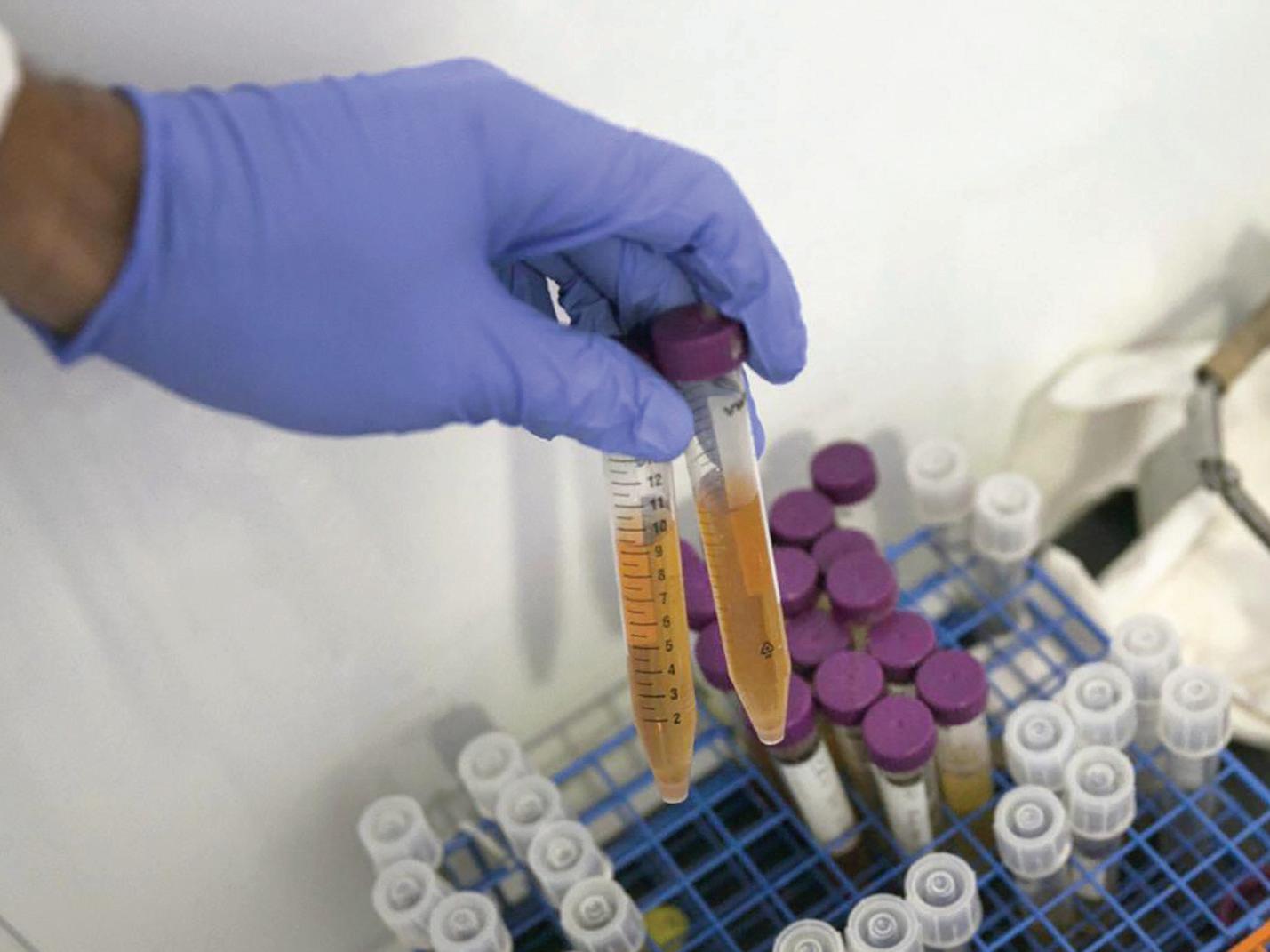
Prof. Ailong Ke, molecular biology and genetics, along with the Brouns Lab at Felt University of Technology in the Netherlands, recently discovered a relationship between a family of proteases and CRISPR that could change the way we understand gene editing technology.
CRISPR is a genetic engineering tool that identifies and alters a specific segment of DNA. The most common type of CRISPR system is RNA guided nucleases, which is when a ‘guide RNA’ guides the associated nucleus to the desired segment of the genome to edit the genome through
base-pair interactions.
Today, CRISPR is widely used in agriculture and even in genome editing of mosquitos to decrease the spread of malaria. Although CRISPR is more commonly used in non-human organisms, there are clinical trials to test if CRISPR can fix genetic defects and mutations that cause diseases and illnesses, such as cancer.
One of the most dangerous aspects of CRISPR is that it edits directly onto the gene sequence, making permanent edits to the organism’s genome. For example, mistakes in gene editing can cause chromosome deletions, which typically leads to severe intellectual and physical disabilities.
These genetic edits could also cause
unwanted mutation in heritable genes that can then be passed onto future generations.
Although there is a lot of potential for RNA guided nuclease CRISPR systems the small percentage of error is still substantial enough for researchers to caution its application on human subjects. However, Ke and Brouns’ recent discovery of the ‘Craspase,’ a CRISPR guided caspase mediator between protease caspase and CRISPR, is less risky.
Caspases are able to trigger cells to go through programmed cell death, safely removing them. Craspase is a system which utilizes CRISPR RNA guided RNA activated protease to edit proteins instead of using RNA guide nucleases to edit the genome bases directly.
These proteases were once thought to be eukaryotic specific but this has since been debunked by Ke and his collaborators as they found that bacteria — a type of prokaryote — also have these caspase proteases that mediate cell programmed death, indicating its primitive nature.
Ke explained that there is a lot of anticipation for Craspase because it will not edit and cleave base pairs directly on the genome but rather cleave the proteins that are generated by the nucleotides.
Ke said that mistakes made during protein cleaving with ‘Craspase’ have minimal effects on the organism. He also added that CRISPR is inherently more dangerous because it uses enzymes, which cleave the building blocks of RNA and DNA, permanently changing genetic information.
“That’s why people are really excited when they see RNA guided proteases because we’re cleaving proteins,” Ke said. “If we make a mistake, then it’s not a big deal. So we can, in many cases, achieve the same therapeutic outcome without worrying about passing mistakes to the next generation.”
The ability to cleave proteins instead of editing the genome directly has many implications for the future of gene therapy. This is a safer alternative that allows for a more varied application of the tool.
This tool can also be programmed to trigger the cell death pathway, slow down growth of a signaling pathway or turn on a signaling pathway. Ke and his team were able to analyze macromolecules with atomic resolution, allowing for precise analysis and a deeper understanding of how these proteases function.
Although CRISPR is still in the clinical trial stage and craspase hasn’t been used in health care yet, Ke is hopeful about the direction that gene editing technology is taking. He is hopeful that one day ‘craspase’ can be used for medical procedures.
“I think that biology is entering a new era,” Ke said. “So with those powerful tools, I think we’ll be able to come up with therapeutics and new strategies against disease, aging and other outstanding problems. We can get there faster, with more powerful solutions.”
Cristina