The Corne¬ Daily Sun

Fight for the things that you care about, but do it in a way that will lead others to join you “ “

Fight for the things that you care about, but do it in a way that will lead others to join you “ “
By KATHRYN STAMM Sun News Editor
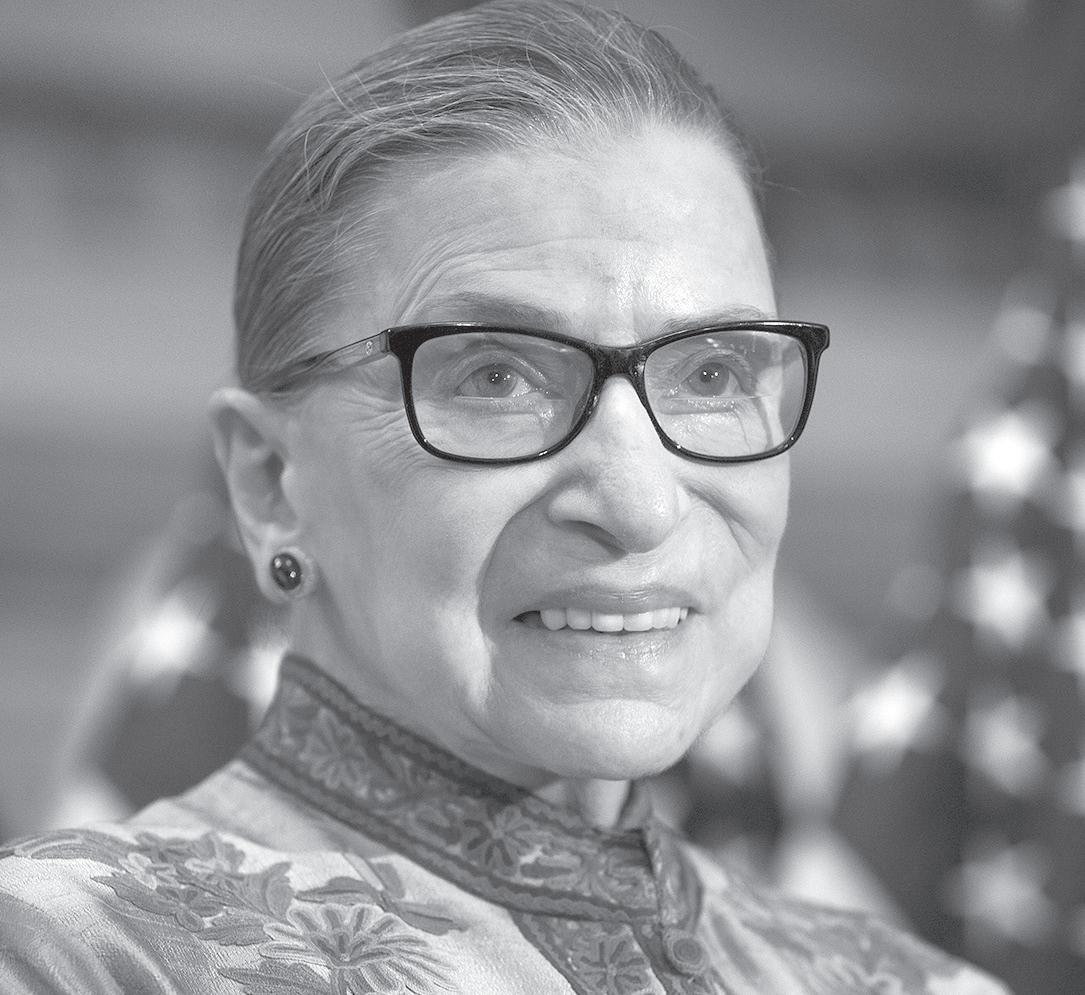
Ruth Bader Ginsburg ’54, the second ever woman to serve on the Supreme Court, one of the most notable Cornell alumnae and fixture in the fight for equal rights, died Friday in her Washington home of complications with metastatic pancreatic cancer. She was 87.
In her 27 years on the bench, Ginsburg transformed American society through the interpretation of the Fourteenth Amendment’s equal protection clause, expanding women’s rights and later LGBTQ+ rights. A quiet and brilliant jurist, Ginsburg was devoted to the law, always doing justice to the views on the other side
of the issue while articulating her argument — especially in her pointed dissenting opinions.
Before her tenure as a justice, Ginsburg was a passionate advocate as a Cornell undergraduate, a law school professor and later the architect of the legal fight for women’s rights in the 1970s. She is remembered as a pop culture heroine, someone who stood up against injustice and a raging patriarchy.
An Advocate From the Start: Ginsburg’s Time on the Hill
“In her unwavering pursuit of equity, driven by a vision in which any person is able to deploy their talents, putting them to use to help repair the world, I see Justice
Ginsburg as the embodiment of our Cornell ideals,” President Martha E. Pollack wrote on Sunday. “Most obvious is her commitment to our ‘any person’ ethos.”
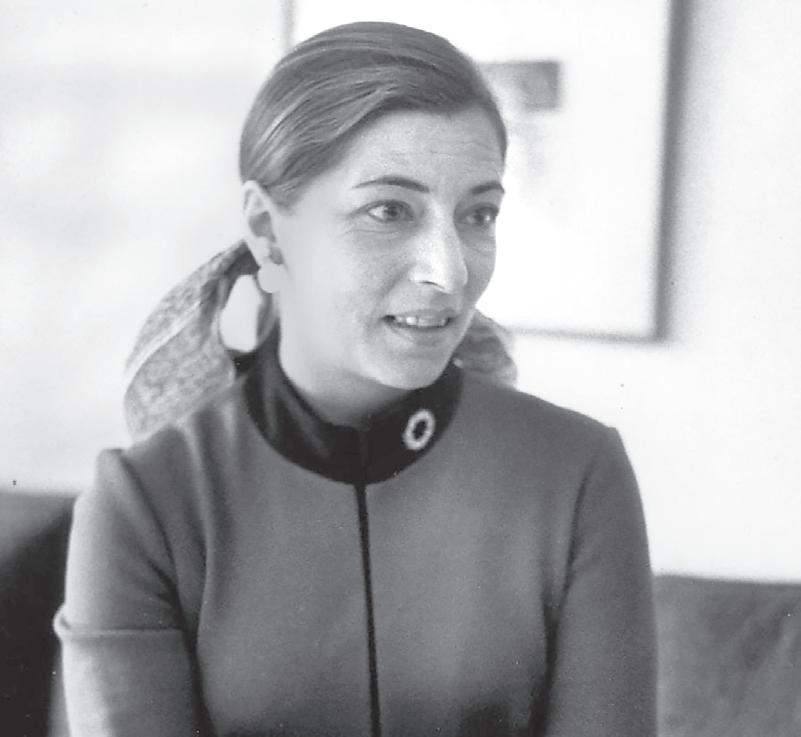
Then Ruth Bader went to Cornell on a full scholarship, where she majored in government in the College of Arts and Sciences. While at Cornell, Ginsburg was a passionate advocate and active leader for women.
In her first year at Cornell, Ginsburg joined the Women’s Self Government Association, and after losing the vice presidency, she found her calling as the chair of the Women’s Vocational Information Committee. The committee focused on supporting career development
CBE Seminar Series: Radha Boya, University of Manchester, U.K.
9 a.m. - 10 a.m., Virtual Event
Nilgiris Field Learning Center During a Pandemic 11:15 a.m., Virtual Event
Labor Economics Workshop: Kevin McKinney 11:30 a.m. - 1 p.m., Virtual Event
Tatkon Center Zoom Room - Ask Us Anything! Noon - 10 p.m., Virtual Event
Ecology & Evolutionary Biology Weekly Seminar Featuring Tory Hendry 12:20 - 1:30 p.m., Virtual Event
“Wild Urban Plants of the Northeast” Peter Del Tredici 12:40 p.m., Virtual Event
BRC Bioinformatics Facility Workshops Fall 2020 3:30 p.m., Virtual Event
“Photophysics and Electronic Structure Of Metal-Organic Frameworks” Chemistry Seminars 4 p.m., Virtual Event
Samuel Coons: It’s Always for Our City: Stories of Art And Identity in Detroit, Michigan 5 p.m., Virtual Event
International Day of Peace 7 - 9 p.m., Virtual Event
Bridging the IPM Implementation Gap Between Land Grant Universities and Private Industry 11:30 a.m., Virtual Event
Criminal Record Education and Legal Employment Training - Session 1 1:30 - 4:30 p.m., Virtual Event
Cornell 101: Settling In and Maximizing Your 1st Year 5 - 6 p.m., Virtual Event
2020 National Voter Registration Day 5:30 - 6:30 p.m., Virtual Event
Exploring the Small Farm Dream: Is Farming Right for You? 4:30 - 5:30 p.m., Virtual Event
for women.
She was “fearless” in standing up for what was right from the start, her friends recounted.
In a 2018 interview, Ginsburg remembered the dominant “boys will be boys” attitude toward sexual harassment while at Cornell. A chemistry instructor once gave her a practice exam that was the same as the actual exam; she knew “exactly what he wanted in return.”
But she did not let this incident go: Ginsburg said she deliberately made two mistakes on the exam and went to confront the professor.
“I went to his office and I said, ‘How dare you? How dare you do this?’” she said in the interview. “And that was the end of that.”
Later in her career, the champion of gender equality declared her support for the #MeToo movement, recounting this experience, and said it was “about time” for women to be able to stand up against sexual harassment.

the law, filing lawsuits against her university employers for pay discrimination and discrimination on the basis of sex.
An active alumna, she returned to Cornell for lectures and special events periodically over the course of six decades. In 2003, she spoke at Jeffrey S. Lehman’s inauguration as the University’s 11th president.
She ended that speech by quoting an 1867 letter from Ezra Cornell to his granddaughter Eunice: “I want to have girls educated in the University, as well as boys so that they have the same opportunity to become wise and useful to society that the boys have.”
“I didn’t know of that letter when I attended Cornell,” Ginsburg said. “I would have treasured it then; I treasure it now.”
“For so long, women were silent, thinking there was nothing you could do about it,” she said in 2018. “But now the law is on the side of women, or men, who encounter harassment, and that’s a good thing.” Ginsburg was instrumental in changing
‘The Notorious R.B.G.’: A Legal, Cultural and Feminist Icon at Cornell
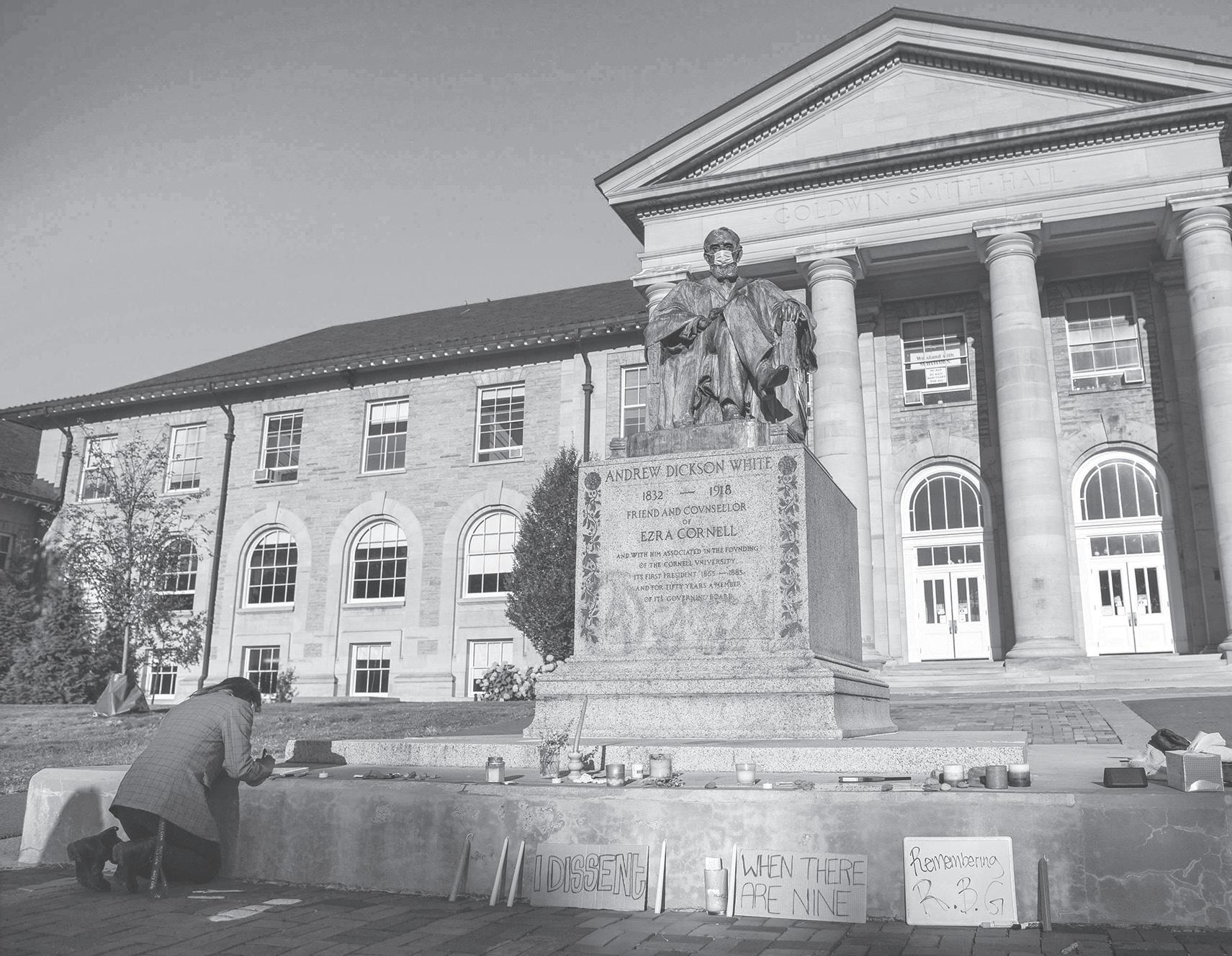
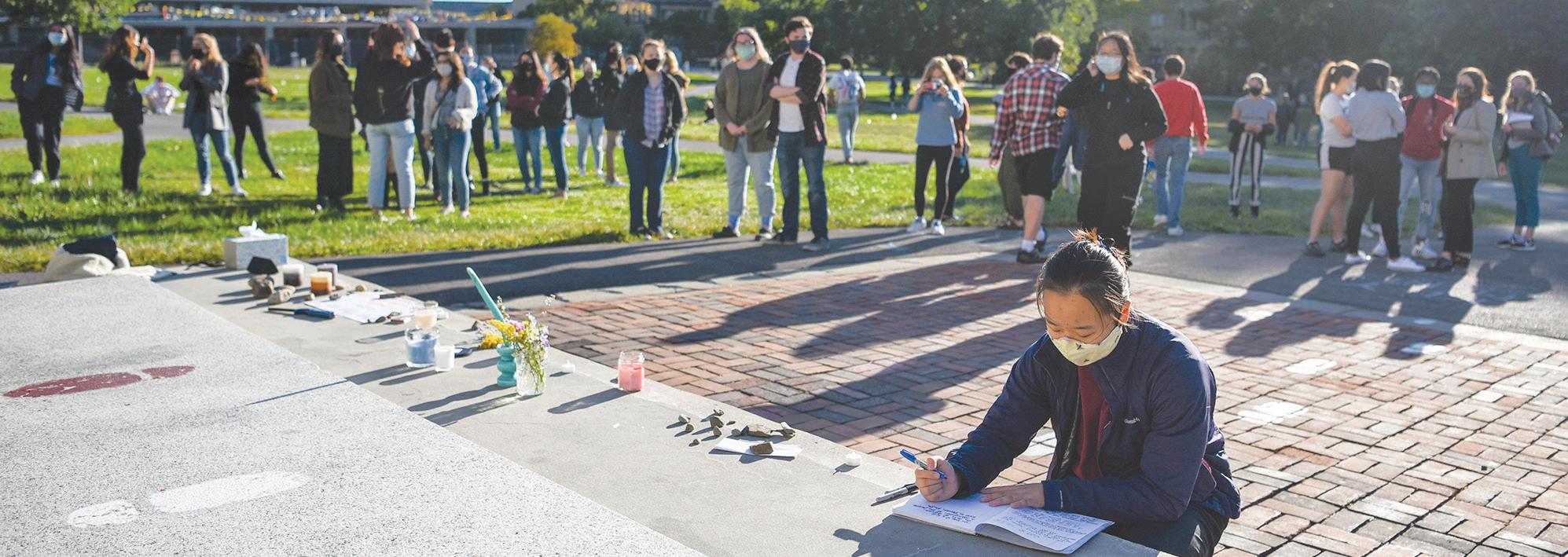
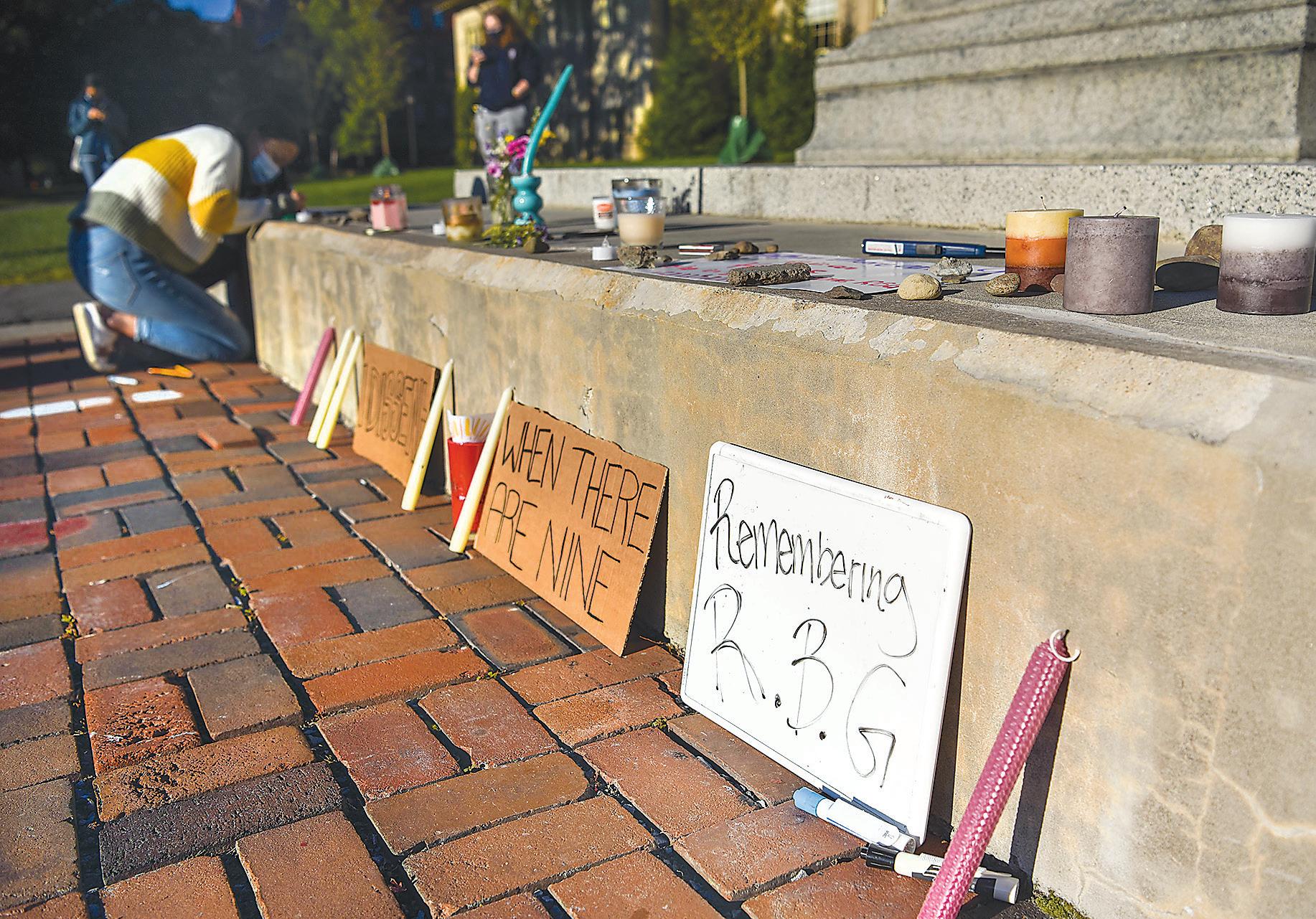
As news spread of Ginsburg’s death Friday night, a shrine of memorabilia emerged outside a Collegetown apartment. And the next afternoon, a crowd of masked students gathered on the Arts Quad for a vigil.
“We can’t help but look to someone like RBG and say, ‘This is an icon. This is a role model,’” Cosimo Fabrizio ’23 said. “She is someone I aspire to be, if not in a career path, in her commitment to making this country a more equitable, just society.”
The octogenarian became a kind of rock star, known for her powerful dissenting opinions and transformative influence. Two movies came out about the justice in 2018, young girls dressed in R.B.G. costumes for Halloween and the image of a severe Ginsburg with oversized glasses and her frilly lace “dissenting” collar appeared as stickers, t-shirts and even tattoos.
But on Friday night, the image adored the porch of Dylan Brenner’s ’21 house — a shrine to the late justice. Flowers,
candles and even liquor joined Brenner’s memorabilia over the weekend as other mourners added to the makeshift display.
“I love her so much, and I always have,” Brenner said. “I want to go into politics and I want to go to law school, and she’s just paved the way for so many young women.”
The “larger than life” justice touched the lives and careers of so many Cornellians, inspired by her fervent activism, radical change and knowing she walked the same hallways.
“Being in the presence of someone so inspirational … has been largely influential in my political life,” said Steve José Poveda ’13, who met Ginsburg while an undergraduate at the Cornell in Washington program. “I took a stab at politics, and I’m still in the political game, largely because of her.”
ation of young activists around the world who will forever carry that torch onward.”
‘May Her Memory Be A Blessing’ The timing of Ginsburg’s death came at the start of Rosh Hashanah, the Jewish New Year — marking this joyous period with a stark grief. For many Jewish students on campus, they heard the news in the middle of celebrating with their family or friends.
“She stayed true to this core belief that the law could be a mechanism for positive change.”
Cosimo Fabrizio ’23
“She stayed true to this core belief that the law could be a mechanism for positive change,” Fabrizio said. “It’s so sad that she’s not here anymore, but she has successfully inspired a gener-
“Assigning a grieving process in the beginning of the Jewish New Year is really bizarre,” Ella Yitzhaki ’24 said. “I think any sort of grieving process on any sort of special occasion is really difficult. [The holiday] means joy and being around others; to know that her family is no longer around her is really, really hard for me to know just because I know how we all loved her.”
At Saturday’s 5 p.m. vigil, a solemn crowd gathered on the Arts Quad to share memories
When I first started listening to hyperpop, I couldn’t figure out what to make of the genre. At the time, I was deep into my second High Fidelity rewatch — TV show, not the movie — and my Spotify was subsequently dominated by Minnie Riperton and Frank Zappa. So you can understand how the sheer mania of 100 gecs’ ska-infused “stupid horse” threw me for a bit of a loop. When I first started listening to more hyperpop, my thought process was something along the lines of “this sucks, but I kinda love it.” But as time went on and I dove deeper into this absurd rabbithole of internet culture, I found myself appreciating the genre in an increasingly nuanced way. There was something about the exuberant chipmunk vocals, open embrace of internet culture and pointedly cursed album art that just drew me in. Yeah, it was all a bit ridiculous, but it legitimately seemed as though the artists were enjoying themselves.
One of my favorite moments of this deep dive was when I was watching a Genius Verified interview with Laura Les and Dylan Brady of 100 gecs. When asked about the iconic opening to their single, “money machine,” Les responded: “I thought that piss baby was like a phrase that people said online, like, I don’t know, shit-lord or something? Like, just an innocuous insult, I guess, which I guess was not the case.” In summary, one of their most well known lyrics came out of an intended reference of internet culture which didn’t even exist, which both 100 gecs and I find pretty funny.

There’s something to be said for hyperpop’s open embrace of cringe culture. After Dorian Electra released their two most recent singles, “Gentleman” and “M’Lady,” they created their own version of an incel meme and posted it on their Instagram. The accompanying music videos are similarly referential — Electra first poses in

a fedora and cargo shorts as they guzzle Mountain Dew and Doritos (Gentleman), and later as an elfen anime girl complete with knee high socks and elf ears (M’Lady). Like much of Dorian Electra’s other work, both songs offer an apt commentary on gender politics in an internet age. However, it’s still clear that Dorian is having a good time. The video and lyrics are playful nods to the weirder corners of the internet, revelling in a culture that’s still mostly confined to subreddits and Tumblr blogs.
Dorian Electra’s music provides a convenient segue into what I find to be one of the other more interesting aspects of the hyperpop genre, in that hyperpop is a space dominated by LGBTQ+ artists, specifically trans women. In an article for
Ringtone, Nic Johnson writes:
“It’s (hyperpop’s) one of the only genres that doesn’t shut trans musicians out, other them, and turn them into novelties. Instead, it welcomes queer and trans people with open arms. Trans artists figure prominently among hyperpop’s elite, defining its sound and acting as the faces of the genre.”
Johnson goes on to point out that one of the reasons that queer artists are able to carve out their own space within the genre is because, just as hyperpop is built on pushing standard pop to their logical extreme, hyperpop artists can also push the boundaries of gender expression in the aesthetics of their music and artistic personas.
Consider one of the hallmarks of hyperpop: insanely distorted vocals. As a 2018 Pitchfork article explores, vocal modulation allows for trans artists to free themselves from the dysphoria inducing nature of their singing voice. Laura Les addressed a similar idea when asked about her penchant for nightcore-style vocals in an arti-
cle for them, saying “It’s the only way that I can record, I can’t listen to my regular voice, usually … From the first time I tried it, it sounded amazing to me. I was like, ‘I’m never doing anything else.”
So, while it may seem as though hyperpop is some sort of fleeting, ridiculous musical genre, closer examination reveals that what may be perceived as an internet superficiality is actually a window into the ever changing landscape of gender politics. Certainly, meme culture references and bold aesthetic choices are, at their core, meant to be entertaining, but the reality that hyperpop presents is, in fact, these artists’ reality. SOPHIE points at this most directly in her song “Faceshopping:” “I’m real when I shop my face.” Hyperpop, rather than going for shock value, is simply presenting a different way of being.
Mira Kudva Driskell is a sophomore in the College of Agriculture and Life Sciences. She can be reached at mdriskell@cornellsun.com. Portrait of a Gen Z on Fire runs alternate Mondays this semester.
When it comes to finding new music, I’ve never had to go much further than the latest skateboarding part debuting on Thrasher or Transworld. The music varies from Top-40 hits to underground cult classics, from jazz and house music to hip hop and metal, sometimes in the same video. Whether its showcasing the personality of some of skateboarding’s biggest characters or building a cohesive brand image, the music of skateboarding is like nothing else.
The range in some of skateboarding’s most classic parts is something that’s defined my music taste as I’ve grown older. On one hand, you have Mark Gonzales’ part in Spike Jonez’s
iconic Video Days, set to John Coltrane’s “Traneing In.” Then in the same video, you also have Guy Mariano skating to the Jackson 5’s “I Want You Back” and Jordan Richter skating to Black Flag’s “My War.” If you were to put those three songs in a row on a playlist, it would make no sense, but somehow it works in this context.
Skateboarding is an industry full of characters, and more than anything, these soundtracks serve to bring out that character and personality that makes us fans of this sport in the first place. Ben Kadow is a skater who looks like a cross between Cailou and Billy Corgan and skates with all the energy of a child forced to play tee ball by their parents. He’s also really good, so it makes sense that he skated to the Smashing Pumpkins’ “Mayonaise” in
Supreme’s Blessed. Nyjah Huston’s brand of machinized corporate skateboarding matched perfectly with the radio cut of Meek Mill’s “Dreams and Nightmares” in his ’Til Death part, even if the second half of the song sounds shockingly sparse without expletives. Mark Suciu looks like he would be the most popular man at Temple of Zeus based on his knowledge of literature and his style of dressing, so skating to Elliot Smith’s “Junk Bond Trader” just makes sense. In the same way that we wait in anticipation of new music from our favorite artists, I also wait in anticipation for new video parts from my favorite skaters because I know they’re going to expose me to something new. In a sense, they almost serve as A&R’s or DJs for a specific subculture. That’s why I always tune in to Palace
videos; who else is going to expose me to 90s rave culture and acid house tracks? I tune in to every Sean Pablo part religiously, not just because he is a beautiful man with an even more beautiful style of skating, but because I know I’m getting exposed to some deeply cool shit that echoes the 70s punk scene of New York’s Lower East Side. And no Apple Music or Spotify algorithm could expose me to the same mix of taste as a Dylan Rieder part could.
Things do start to get a bit odd though when diving in to some more well known tracks. Clive Dixon made a whole part titled Creep, set to the Radiohead song of the same name. Radiohead is the official band of male manipulation, and putting their biggest song next to some of the heaviest skateboarding in recent memory is
a mixture that’s about as refreshing as orange juice and toothpaste. This soundtrack gets even better when you realize that Clive Dixon skates for Tony Hawk’s brand (Birdhouse), and it probably involved Tony himself making a personal call to get the rights to that song. That said, sometimes the skater can completely take over the original song. I’d heard Rick Ross’s “BMF” so many times in my life before Tyshawn Jones set his 2018 Skater-of-theYear part to it, but now every time I hear Rozay say “I think I’m Big Meech,” I picture Tyshawn Jones’s switch kickflip into the fountain at Washington Square Park.
serving on the faculty at Cornell Law and later becoming Dean of NYU Law.
not be filled until we have a new president.”
of the late justice and reflect on her impact. Avi Kupperman ’21, president of Cornell Hillel, reflected on the timing, offering a message of admiration for Ginsburg: “A person who dies on Rosh Hashanah is a person of the utmost righteousness.”
“Her death at the end of the year is significant because it means that, in the year of her passing, she was given as much to live it as possible,” Kupperman said.
The Brooklyn-born daughter of Russian Jews — and devoted jurist turned cultural icon — has left a large legacy and a changed country behind her as the nation turns to an uncertain future.
“I heard of Ruth’s death while I was reciting the Mourner’s Kaddish at the Rosh Hashanah service,” Justice Stephen Breyer said in a statement. “I thought: a great Justice; a woman of valour; a rock of righteousness; and my good, good friend.”
“The world is a better place for her having lived in it. And so is her family; her friends; the legal community; and the nation.”

After graduating from Cornell near the top of her class, Ginsburg attended Harvard Law School — one of nine women in a class of 500. She finished her final year of law school at the top of her class at Columbia University in 1959, following her husband Martin “Marty” Ginsburg ’53 to New York City.
In 1960, when Ginsburg wanted to be a clerk for the Supreme Court, she was denied the position because of her gender. Over thirty years later, after President Bill Clinton chose her to succeed Justice Byron R. White, the Senate confirmed the soft-spoken 60-year-old judge by a vote of 96 to 3.
“Our nation has lost a jurist of historic stature,” Chief Justice John G. Roberts Jr. said in a statement.
But before her time on the courts, Ginsburg worked tirelessly for the protection of equality and the advancement of the rights of all people, particularly women. She worked at the American Civil Liberties Union and argued six sex discrimination cases before the Supreme court — winning five.
“No member of the Supreme Court has ever done more for issues of women’s rights, and gender equality than the justice,” said Prof. Trevor Morrison, law, New York University. Morrison clerked for Ginsburg in 2002 before
Morrison specifically pointed to Ginsburg’s 1996 majority opinion for the landmark United States v. Virginia case, “a culmination of her career around issues of gender equality.”
In the case, the Supreme Court found Virginia Military Institute’s male-only admissions policy unconstitutional, violating the Fourteenth Amendment’s equal protection clause.
“In this case, the violation is the categorical exclusion of women from an extraordinary educational leadership development opportunity afforded men,” Ginsburg said in the opinion announcement. “To cure that violation and to afford genuinely equal protection, women seeking and set forth a VMI quality education cannot be offered anything less.”
Just days before her death, as her strength waned, Ginsburg dictated a statement to her granddaughter Clara Spera: “My most fervent wish is that I will not be replaced until a new president is installed.”
Her ‘Just Spectacularly Special’ Humanity
Beyond her clear political legacy, Ginsburg touched the lives of many — including of people who never met her. But to those who took a class with her or worked with her on the court, she is remembered as someone who deeply cared for the people around her.
In 1960, when Ginsberg wanted to be a clerk for the Supreme Court, she was denied the position because of her gender.
Over thirty years later, the Senate confirmed the soft-spoken 60-year-old judge by a vote of 96 to 3.
From her time arguing to an all-male court to her decades-long tenure, Ginsburg was a fixture on the court: Her legacy remains that the Fourteenth Amendment’s guarantee of equal protection includes equality of the sexes.
According to the Chicago Sun Times, when asked when there would be enough female justices on the Supreme Court, Ginsburg — the second female supreme court justice and pioneering feminist — replied: “when there are nine.”
The ‘Tough as Nails’ Fight to the End
Before her death, Ginsburg repeatedly vowed to stay on the court as long as her health held and she stayed mentally sharp; she did so through five separate battles with cancer.
“I have often said I would remain a member of the court as long as I can do the job full steam,” she said in July, announcing a recurrence of cancer. “I remain fully able to do that.”
The discovery of lesions on her liver in May was only her most recent medical setback. She had surgery for lung cancer and radiation treatment for pancreatic cancer in recent years. In 2012, she fractured two of her ribs. She also had surgery for early-stage pancreatic cancer in 2009 and treatment for colon cancer in 1999.
Now, just 46 days before the Nov. 3 election, there is now an open seat on the bench — setting off a battle over whether President Donald Trump and the GOP-led Senate should push through her replacement, or if the seat should remain vacant until the White House race is decided.
But Trump and Senate Majority Leader Mitch McConnell (R-Ky.) have vowed to hold a vote on a Supreme Court nominee before November. When Justice Antonin Scalia died on Feb. 13, 2016, the GOP-led Senate held up President Barack Obama’s nomination of Judge Merrick Garland for 269 days.
“The American people should have a voice in the selection of their next Supreme Court justice,” McConnell said when Scalia died. “Therefore, this vacancy should
NYU Law Dean Morrison clerked for Ginsburg when his daughter was a year old and said that the justice took an interest in them — asking after her as she grew up and eventually enrolled at Cornell.
“She really cared deeply for her clerks, not just as employees of hers but as people,” Morrison said. “Every one of our clerks and their families, we all became a kind of extended family, which is a sort of cliche, but in the case of Justice Ginsburg, it’s really true.”
In all her roles, Ginsburg was a staunch supporter of young women lawyers, helping to open opportunities and advance their careers.
“She placed me in my first internship, which she just did,” retired federal judge Shira Scheindlin J.D. ’75 recalled, describing how Ginsburg was sympathetic to her story because it mirrored her own: Scheindlin moved to the city with her two children to follow her husband.
“She was just spectacularly special and different — she was very good to me,” Scheindlin recalled. She took a class from Ginsburg in her third year of law school at Columbia after she transferred from Cornell.
Morrison recalled her sharp memory and ability to remember people she only briefly met, and the connections between them. Scheindlin said that years later, when she would run into Ginsburg at conferences, the justice always remembered her and would say hello.
“She always went out of her way to be kind,” Scheindlin said.
JOYBEER DATTA GUPTA ’21
Business Manager
PETER BUONANNO ’21
Associate Editor
MEGHNA MAHARISHI ’22
Assistant Managing Editor
CHRISTINA BULKELEY ’21
Sports Editor
BORIS TSANG ’21
Photography Editor
CAROLINE JOHNSON ’22
News Editor
ALEX HALE ’21
News Editor
ARI DUBOW ’21 City Editor
EMMA ROSENBAUM ’22
Science Editor
BENJAMIN VELANI ’22
Dining Editor
JOHN MONKOVIC ’22
Multimedia Editor
MIKE FANG ’21 App Editor
OLIVIA WEINBERG ’22
Assistant News Editor
MADELINE ROSENBERG ’23
Assistant News Editor
LUKE PICHINI ’22
Assistant Sports Editor
HANNAH ROSENBERG ’23
Assistant Photography Editor
BRIAN LU ’23
Assistant Arts & Entertainment Editor
ANNABEL LI ’21
Assistant Money & Business Editor
LEI ANNE RABEJE ’22
Layout Editor
JOHN COLIE ’23
Blogs Editor
JOHN MONKOVIC ’22
Multimedia Editor
MARYAM ZAFAR ’21 Editor in Chief
JOHNATHAN STIMPSON ’21 Managing Editor
KRYSTAL YANG ’21 Advertising Manager
JASON HUANG ’21 Web Editor
NIKO NGUYEN ’22
Editor PALLAVI KENKARE ’21
Editor
SEAN O’CONNELL ’21
STAMM ’22
OZA ’22
’23
LEE ’21
’21
’22
MEGHANA SRIVASTAVA ’23
DAWSON ’21
’22
MORAN ’21
FANG ’21
’22
’21
’22
’21
Working on Today’s Sun
Ad Layout Jenny Huang ’22
Production Desker Dana Chan ’21 Sarah Skinner ’21
News Deskers Kathryn Stamm ’22 Catalina Peñeñory ’22
Opinion Desker Peter Buonanno ’21
Design Desker Lei Anne Rabeje ’22
Photo Desker Boris Tsang ’21
Arts Desker Daniel Moran ’21
Sports Desker Christina Bulkeley ’21
IN TODAY’S SUN, YOU WILL READ TWO PIECES — one from our University president, and the other from the dean of Cornell’s law school — honouring the late Supreme Court Justice Ruth Bader Ginsburg ’54. As students, we, too, hope to add to this conversation.
One of the Justice’s greatest qualities was not just her ability to open doors for herself, but to leave them open for those after her. There are many spaces of government, of society, of Cornell and of our own lives where doors remain shut. The one choice we all have is to pry those doors open, and honor her by holding them for others to pass through.
There is little new that can be said about her legacy. Instead, what is important is to remind campus of the immense opportunity that Ginsburg afforded every Cornellian. Many of us, when we were accepted to Cornell, were greeted by none other than Ginsburg herself, in the first welcome video. She has opened the door for every student on this campus to follow in her legacy – charging as an activist of her time, so that future Cornellians could build upon the change she catalyzed. Those who will continue her legacy are normal students. In RBG’s time at Cornell, although she excelled as an academic, she was a real person. She worked in student governance, met her husband and experienced life on The Hill in a way that all of us do every day — she even wrote a letter to the editor in her time as an undergraduate. Ginsburg was irreplaceable as a human being. But it is entirely possible to attempt to walk proudly in her footsteps.
So in the words of Ginsburg herself, “Fight for the things that you care about, but do it in a way that will lead others to join you.” For this is what it means to be a true Cornellian. Lead by example, and make RBG proud.
Te above editorial refects the opinions of Te Cornell Daily Sun. Editorials are penned collaboratively between the Editor-in-Chief, Associate Editor and Opinion Editor, in consultation with additional Sun editors and stafers. Te Sun’s editorials are independent of its news coverage, other columnists and advertisers.

President Martha E. Pollack Guest Room
Martha E. Pollack is the president of Cornell University. Comments can be sent to opinion@cornellsun.com. Guest Room runs periodically this semester.
On my office desk sits a small laminated box adorned with a picture of Justice Ruth Bader Ginsburg ’54 in her distinctive lace collar, and one of her many memorable quotes: “Women belong in all places where decisions are being made.”
In her unwavering pursuit of equity, I see Justice Ginsburg as the embodiment of our Cornell ideals.
It’s a quote that is particularly meaningful to me, as someone who is fortunate enough to often be in the room where it happens — where decisions are made. While this quote is well known, what many people forget is the second sentence in the quote, that “[i]t shouldn’t be that women are the exception.” That’s what I remind myself each day: that women shouldn’t be the exception in leadership positions, nor should people of color, nor people from any group who has historically been excluded.
That’s what Justice Ginsburg fought for, throughout her entire adult life.
To quote from her again, “We should not be held back from pursuing our full talents, from contributing what we could contribute to the society … because we belong to a group that historically has been the object of discrimination.”
In her unwavering pursuit of equity, driven by a vision in which any person is able to deploy their talents, putting them to use to help repair the world, I see Justice Ginsburg as the embodiment of our Cornell ideals. Most obvious is her commitment to our “any person” ethos. Then there is her unflagging dedication to public service — her own, of course, but also her vision of what others can do: She fought for the right of everyone to “contribute to the society.” And there is her sheer relentlessness, her tenacity — something I see in so many Cornell students especially as they rise to our current challenging circumstances.
Meaningful change, Justice Ginsburg knew, requires very hard work, done over a very long period of time. It requires a willingness to listen to, and even appreciate those with whom you disagree. I always found the close friendship between Justices Ginsburg and Antonin Scalia, who held dramatically opposing positions even on the fundamentals of judicial interpretation, to be not only touching, but telling, showing their ability to respect and hear across differences. At the same time, meaningful change requires a willingness both to disagree with others and to cogently explain your disagreement, something Justice Ginsburg did so frequently in her Supreme Court dissents, dissents that had impact and will continue to do so into the future. And meaningful change requires a certain level of optimism. It’s hard to imagine that Justice Ginsburg was not frustrated by the slow pace of change, and by how often she had to write those dissents. Yet, to quote her one more time, she counseled that we shouldn’t “be distracted by emotions like anger, envy, resentment. These just zap energy and waste time.”
I will always remember that meeting, with a powerful woman who personified what it means to be a Cornellian.
I had the immense honor to meet Justice Ginsburg in her chambers in February. We were planning an event that was to be held later in the spring, in which I would interview her in front of an audience of Cornell alumni. Sadly, the coronavirus began to sweep through the US a few weeks later, and the event had to be postponed — now forever. But I will always remember that meeting, with a tiny, quiet, yet incredibly powerful woman who was a hero to so many, and who, to my mind, personified what it means to be a Cornellian.
Rest in peace, RBG.
‘Justice,

Eduardo M. Peñalver ’94
Eduardo M. Peñalver is the dean of Cornell Law School. Comments can be sent to opinion@cornellsun.com. Guest Room runs periodically this semester.
The frst time I met Justice Ruth Bader Ginsburg ’54 was during my clerkship for the late Justice John Paul Stevens in 2000. Although each of the chambers at the Supreme Court operates like a little independent law frm, there is a tradition of Justices inviting clerks from the other chambers for an informal get-together at least once during the term. Justice Ginsburg invited the Stevens clerks to tea in her chambers. Prominently displayed on a wall just outside her ofce was a framed poster with words from the Parashat Shofetim: “Justice, justice shall you pursue.” Te repetition of the word “Justice” has always been so powerful to me. Te passage is taken from a longer description in Deuteronomy of the kinds of judges God wanted the Israelites to appoint — honest judges who would not pervert justice in favor of the wealthy or well-connected, but who would pursue equal justice fearlessly, with particular concern for the marginalized, the poor, the widow, the orphan, the foreigner. Justice Ginsburg’s life and career embodied this rich ideal of justice, frst as an advocate for equal rights for women and later as a Justice at the Supreme Court.
Some changes are so profound and rapid that it becomes almost impossible to imagine what life was like before they occurred. Justice Ginsburg began her career in a legal profession that made no room for women. As a law student at Harvard University in the late 1950s, she was one of only nine women in a class of over 500. As the co-founder of the Women’s Rights Project at the
American Civil Liberties Union, she helped to usher in the world in which we live, a world where women outnumber men among those graduating from American law schools, and in which women can aspire to anything — including serving on the highest court in the land. Echoing what President Martha Pollack says in her own memorial essay in today’s Daily Sun, I, too, perceive the infuence of Cornell’s commitment to “any person” in Justice Ginsburg’s fearless decision to enter a legal profession that she then went about transforming.
In the 1970s, as an ACLU lawyer, Justice Ginsburg litigated a series of cases arguing that, as she wrote in her brief in the landmark 1971 case of Reed v. Reed, “[w] hatever diferences may exist between the sexes, legislative judgments have frequently been based on inaccurate stereotypes of the capacities and sensibilities of women ... [A]ny continuing distinctions should, like race, bear a heavy burden of proof.” Tat argument — calling for searching and skeptical judicial review of sex classifcations — became the law of the land by way of her opinion for the Supreme Court in the 1996 case of United States v. Virginia, the so-called “VMI case.” In that landmark opinion, Justice Ginsburg conceded that — as she put
Let’s take a moment simply to remember this inspiring Cornellian. Let’s pause to honor this incredible woman who dedicated herself so fiercely to the values spelled out on that poster I saw framed outside her chambers. Justice, justice.
it — “inherent” biological diferences between men and women might occasionally justify legal classifcations on the basis of sex. But the thrust of her entire career as an advocate — and subsequently as a Justice — was that the universe of such justifed cases is far smaller than many had previously assumed. Te scope of her impact on how the law regards women — and sex in general — evokes justifed comparisons to another transformative advocate who went on to serve as a Supreme Court Justice: Turgood Marshall.
’54
Justice Ginsburg’s time on the Court also coincided with another seismic shift in our legal culture that we will see play out in the weeks ahead; the polarization that characterizes contemporary political discourse is inseparable from the work of the Supreme Court. Tat polarization is itself closely connected to the social changes that Justice Ginsburg helped to bring about as an advocate and as a Justice. In the 2016 presidential election, one in fve voters identifed the Supreme Court as the single most important issue driving their voting decisions. And for most of those voters, issues relating to sex — reproductive rights, LGBTQ rights and the meaning of sex-equality — lie at the heart of their interest in the Court.
Supreme Court nominations used to be boring afairs. At the 1939 confrmation hearing for Justice William O. Douglas, he waited patiently outside the hearing room in case Senate committee members had any questions for him. None did. Tese days, Supreme Court Justices are — for better and for worse — celebrities. Of course, even among that rarefed group, Justice Ginsburg stands alone. No one else on the Court is known by their initials. No one else has a Saturday Night Live persona. Children don’t dress up for Halloween as Stephen Breyer.
And yet Justice Ginsburg’s 1993 nomination and confrmation also bore traces of the earlier, less partisan era. Her closest friend on the Court was the late Justice Antonin Scalia. She was the last Supreme Court nominee to receive more than 90 Senate votes in her favor. (It is almost impossible to imagine a world in which a nominee ever will again.) So it is sad — but not surprising — that the fght over her replacement has already begun. In his very statement noting her passing, just an hour after her death, Sen. Mitch McConnell (R-Ky.) launched that fght by promising that “President Trump’s nominee will receive a vote on the foor of the United States Senate.” Much of the commentary over the weekend — across the political spectrum — focused on her possible replacement.
One does not need to be a Democrat — or to agree with Justice Ginsburg’s views on every issue — to be inspired by her pioneering example or to lament our apparent inability to celebrate her remarkable life before returning to our toxic judicial politics. Perhaps, here at Cornell, where she excelled as a student and met the love of her life, we can get it right. Today, let’s take a moment simply to remember this inspiring Cornellian. Let’s pause to honor this incredible woman who dedicated herself so fercely to the values spelled out on that poster I saw framed outside her chambers.
Justice, justice.
“ FIGHT FOR THE THINGS THAT YOU CARE ABOUT, BUT DO IT IN A WAY THAT WILL LEAD OTHERS TO J OIN YOU. ”
Fill in the empty cells, one number in each, so that each column, row, and region contains the numbers 1-9 exactly once. Each number in the solution therefore occurs only once in each of the three “directions,” hence the “single numbers” implied by the puzzle’s name. (Rules from wikipedia.org/wiki/ Sudoku)







By
A second-period comeback by Cornell wrestler Yianni Diakomihalis brought the annual Beat the Streets showdown down to the wire. But his opponent, 2016 Olympic champion Vladimer Khinchegashvili, eked out the win on criteria against the two-time NCAA champion in New York City on September 17.
Beat the Streets is an organization that aims to nurture the social and personal development of New York City’s urban youth through wrestling. Each year, the organization holds a fundraiser to support the wrestling community in the city, last year attracting a crowd of over 5,000 and raising $1.3 million for urban youth. The Red junior’s 65kg event has been the fundraiser’s headliner for two years in a row now, last time defeating India’s Bajrang Punia — the world’s top-ranked wrestler at the time.
Wrestling fans were eager to virtually watch the Cornell standout spar against another high-caliber competitor in this year’s match. Diakomihalis’ loss to Khinchegashvili was his first career loss to a non-American.
Heeding public health concerns and government restrictions amid the pandemic, Beat the Streets held the event as a virtual telethon this year. The organization prioritized the safety of all participants, and all matches were held outdoors without the physical presence of fans.
Despite the eight-year age difference, both Diakomihalis and his opponent boast impressive credentials. In addition
to securing a spot at the U.S. Olympic trials, the 21 yearold Diakomihalis took home gold at the 2019 U.S. Open, the 2019 Grand Prix Yasar Dogu, and most recently at the 2020 Pan American Championships in March.
Khinchegashvili, Diakomihalis’ 29-year-old opponent on Thursday, earned a silver medal at the 2012 Olympics and a gold medal in 2016. Since then, the Georgian has found bronze-medal success at the 2018 European Championships and earned silver at the 2019 European Games.
The discrepancy in age and experience didn’t faze Diakomihalis, who entered the match especially eager to get back on the mat.
“You expect to win every time you wrestle,” said Diakomihalis. “You don’t want to put any extra pressure on yourself. I just wanted to wrestle hard, let it fly.”
With an early takedown, Khinchegashvili took a 2-1 lead in the 65kg contest. After a scoreless standoff, the Georgian won a scramble to clinch another takedown, extending his lead by two points. With a quick double leg attack, the Red wrestler lessened his deficit to 4-3, and soon after scored a pushout to bring the bout to a draw.
“He’s tricky and he’s tough to score on, so I knew if I kept attacking, kept putting pressure on him, the points would start to come,” Diakomihalis said. “I just had to keep staying on the offense.”
Despite the comeback, Khinchegashvili earned the match on criteria, having scored two takedowns. Diakomihalis, who expressed disappointment with his
performance, intends on using that frustration as fuel to improve his craft.
“I know I can wrestle better than that,” Diakomihalis said. “I just know the more work I put in, the better those results are going to get, so I just have to keep doing what I need to do to get better.”
The pandemic has brought unforeseen challenges to training for Diakohimalis and his opponents alike. With the cancellation of the Olympic trials and a knee injury earlier this summer, the Cornell junior faced a 6-month drought in competition. However, he refuses to use this time off as an excuse, recognizing that many of his opponents have confronted similar situations.
“You can be in really good shape and be really sharp, but it can take one or two matches to get used to competing again,” Diakomihalis said. “I think that’s the boat everyone is in these first matches back … so I’m not really in a position to complain about it.”
For the Red wrestler, the Beat the Streets fundraiser was a warmly-welcomed event as both a reintroduction to elite wrestling competition and a contribution to the youth wrestling community in New York City.
“I am thankful for the event and that I was able to wrestle in it. It’s for a really good cause, so I’m happy to be a part of it. Credit to Vladimer for wrestling a tough match.”
Faith Fisher can be reached at fsher@cornellsun.com.