The Corne¬ Daily Sun


By ANGELA BUNAY Sun Managing Editor
After sightings of the Star of David drawn alongside a swastika on the ground next to Beebe Lake and a banner reading “Burn prisons, free them all, Attica to Palestine” on the side of the Cornell Law School building facing the Cornell Hillel offices, the campus Jewish community responded with a Thursday evening rally on Ho Plaza.
The rally garnered around 50 participants. After holding a prayer in the beginning, there were an array of speakers including Cornell Hillel leaders and the co-president of the Center for Jewish Living Gidon Amsellem ’23.
Rabbi Ari Weiss, executive director of Cornell Hillel, said that while it is saddening that the Jewish community has to hold rallies standing against antisemitism on campus, it was a powerful display of unity.
“One thing I'm saddened by is the fact that every couple of years, we have to put together this type of vigil — it's something that happened in 2017, 2018 and probably will continue to hap-
pen,” Rabbi Weiss said. “But it's important for us as a Jewish community to stand up to say: We belong at Cornell [and] if there are hateful symbols, we will fight them, we will stand together, [and] we will invite our allies to stand with us, as we will stand with others.”

Rabbi Weiss is referring to two incidents of antisemitism on campus. In Oct. 2017, anti-semitic posters with swastikas appeared on several buildings and the Ezra Cornell statue. A year later, when three swastika signs were found on North Campus in Nov. 2018.
The University released a statement on Thursday afternoon, before the rally, addressing the recent sightings.
In the statement from President Martha Pollack to the Ithaca campus community, Pollack focused on the University’s core value of creating a community of belonging, denouncing the actions.
“As I have said before, and will repeat as often as necessary: Cornell denounces in the strongest possible terms all forms of hatred and bigotry,” Pollack wrote in her statement. “We cannot allow acts of hatred, and the attention they bring, to keep us from striving to be a community of belonging.”
By CAMDEN WERHLE Sun Staff Writer
With the recent completion of the North Campus Residential Expansion project, Cornell now has the capacity to house around 2,000 more students. The expansion coupled with the new requirement that all sophomores live on campus, North Campus is busier than ever. This influx of students has posed new challenges to Cornell employees, from understaffed dining halls to a flood of packages in mailrooms.
In an email sent to students on Sept. 6, Pat Wynn, Assistant Vice President of Student and Campus Life, noted that the student service centers are currently “overwhelmed” with incoming packag-
es. She stated that North Campus has received 3,000 more packages than it had at the same time last year, leading to lengthy waits of over an hour.
Wynn also encouraged students to be mindful of the packages they order, citing environmental concerns about shipping and packaging waste raised from the fact that the service center has already processed 28,000 packages this semester.
These delays have also extended to North Campus Dining halls that now have relatively longer wait times. Jackson Jacques, an employee at Morrison Dining Hall, said that the dining hall’s staff work hard to ensure students are not waiting for long amounts of time for food to be
replaced adding that employees are generally successful at handling the volume of people that pass through. However, he also said that Morrison could benefit from hiring more employees.
“We’re constantly cooking, we make sure that we always have food available,” Jacques said. “The one thing we’re lacking is staff, we’re understaffed.”
Katie Beard ’26 works at North Star Dining, keeping food stocked and at a consumption-safe temperature. Beard is from North Carolina where the minimum wage is $7.25 an hour. She said she took the Cornell dining job because the $14.20 hourly wage was attractive to her in helping


By SURITA BASU Sun Assistant Managing Editor
With the removal of PCR testing sites and the classroom mask requirement, University policies have allowed for the most “normal” semester since the start of the pandemic in March 2020. As the University rolled back COVID-19 restrictions for the fall, there are still active cases on campus.
However, cases have come down since the beginning of the new semester. The COVID-19 Dashboard reported 122 active cases as of Sept. 18 compared with 164 cases last week and 434 cases the week of Aug. 28.
Cases among students compared to faculty and staff members have leveled out as there are currently 65 active student cases and 57 active faculty and staff cases. At the peak of the semester, 350 cases were students while faculty and staff comprised only 84.
Cases in Tompkins County
have steadily declined for the past several months with 8 new positive cases and a 9 percent new case rate as of Sept. 19. The seven-day rolling average of new daily cases is at 24.
Although PCR testing sites have been closed as of Aug. 31 and testing requirements have been lifted, the University continues to recommend that students take advantage of antigen test kits that can be picked up from specific locations on campus.
Cornell’s COVID-19 dashboard reports that 97 percent of students and 94 percent of faculty and staff are vaccinated. 92 percent of students and 88 percent of faculty and staff have received a booster. While the University has encouraged members of the Cornell community to everyone to receive every additional COVID-19 booster that becomes available to them.

The future of money | On Tuesday, Prof. Eswar Prasad, economics, who was the former chief of the Financial Studies Division in the IMF’s Research Department will speak about how the digital revolution is upending the structure and meaning of money worldwide, changing everything from cash to crypto to central banking.
“Shared Space: Seasonal Color Shift of Species Succession”: By Jenifer Wightman
8 a.m. - 5 p.m., Mann Library, 1st and 2nd floors
LASSP & AEP Seminar by Manu Prakash (Stanford University)
12:20 p.m., Clark Hall 700
1 p.m. - 5 p.m., Statler Hotel
Structural Transformation of African (and Asian)
Agriculture and Rural Spaces Seminar
2 p.m. - 4 p.m., Mann Library 102
Truman Scholarship Info Session 4:45 p.m. - 5:45 p.m., Barnes Hall 100
Constituting Afghanistan: Rediscovering Afghan Legal History Between the Ottoman and British Empires 4:30 p.m., Morrill Hall 404
The Future of Money with Former MF Chief of Financial Studies Division Prof. Eswar Prasad
5 p.m. - 6 p.m., Ives Hall 105
Radical Desire: Making On Our Backs Magazine
9 a.m. - 5 p.m., Kroch Library Hirshland Gallery
10 a.m. to 3 p.m., Statler Hotel
Ben Handel - Cornell Health Economics Seminar (Joint with IO and Public Economics) 11:15 a.m. - 12:45 p.m., ILRCC 423
LEPP Theory Seminar: Ven Chandrasekaran (IAS) 2 p.m., Physical Sciences Building 401
Queer and Feminist Histories of Martial Law
3 p.m. - 5 p.m., Virtual Event
Law School Admissions Panel
6 p.m. - 7:30 p.m., Virtual Event
Info Session: Africa Undergraduate Research Internships 4:45 p.m. - 5:45 p.m., Uris Hall G08


By CAROLINE MICHAILOFF Sun Contributor
The Faculty Senate, as of Spring 2022, has changed the rules regarding the University’s posthumous awards. Students who pass away before completing graduation requirements may now posthumously earn a degree or certificate, whereas they previously were not able to earn a certificate if they didn’t meet the requirements to earn a degree.
The new policy also established University-wide criteria for obtaining such awards. To achieve a posthumous degree, a student must have completed at least 75 percent of their degree requirements; a student who fulfilled less than 75 percent of their graduation requirements would be eligible for a certificate. It is possible to posthumously earn a Bachelor’s, Master’s, Professional or Doctoral Degree at Cornell.
According to the new Posthumous Academic Awards policy, the University made the change in order to provide better forms of recognition to the deceased.
“Conferring of a posthumous degree is… a means to recognize and commemorate the deceased student’s engagement in our campus community and to provide grieving family and friends some small solace through this recognition,” the policy read.
Granting posthumous awards is common among most American colleges and universities, including all other Ivy League institutions.
For instance, according to Brown University Chief of Staff to the Provost James Rowan, Brown students are eligible for posthumous degrees based on multiple factors such as time spent enrolled at Brown, disciplinary status, administrator support, department support and votes by relevant Brown committees.
The new policy will provide greater guidance on how to deal with posthumous awards and, according to University Registrar Rhonda Kitch, an approach more sensitive to the
needs of grieving families.
“Establishing a posthumous academic awards policy provides parameters for our institution to offer a significant memento to families in the form of a diploma or certificate of enrollment,” Kitch wrote in a statement to
The Sun. “The policy supports a compassionate approach to recognize the academic contributions of a family’s loved one.”

denouncing the actions.
“As I have said before, and will repeat as often as necessary: Cornell denounces in the strongest possible terms all forms of hatred and bigotry,” Pollack wrote in her statement. “We cannot allow acts of hatred, and the attention they bring, to keep us from striving to be a community of belonging.”
Pollack also mentioned how incidents involving racial targeting and antisemitism have occurred over the course of the last few months. She said that the University will continue to investigate the “wrong and detestable” actions.
Rabbi Weiss said he appreciated that President Pollack and the University released a statement on the matter, as it was a step to counteract the hateful messages. Some students shared his sentiment, but felt more should have been done.
“I was impressed with how quickly the university released a statement. I was glad to see President Pollack did include antisemitism,” said Sarah Austin ’23, president of Cornell Hillel. “However, I do wish there was more emphasis put on what actually happened.”
Amsellem, co-president of CJL, said he would have wished that the statement was more specific, so that people knew exactly what was going on.
“We’re not going to change anything if people are uneducated, to the reality of the situation,” Amsellem said. “Additionally, while I believe that racism is a very important topic to address, I would argue that putting racist examples of things that would happen and bunching it into the same emails, antisemitism actually detracts attention from both.”
Rabbi Weiss spoke to how there has been a resurgence of antisemitism over the last few years not only across the country but interna-
tionally. He added that antisemitism is seen on college campuses across the United States, and said that sometimes that is seen in the form of swastikas.
“This swastika, in general, is something that’s this deeply, deeply upsetting,” said Rabbi Weiss. “It’s a hateful symbol, to show up just like that on campus. [The] same thing happened when it showed up on campus buildings, in the snow and in dorms a few years ago.”
With the seventh largest Jewish population among private universities, Cornell has a vibrant Jewish community of over 3,000 students. On Wednesday, Sept. 13, the student organization Cornellians for Israel called on the University to condemn the incident.
On Thursday morning, Cornell Hillel also issued a statement saying they were saddened, angered and dismayed to learn of the actions.
“Antisemitism has no place on campus and goes against Cornell University’s core values of creating a culture of belonging,” Cornell Hillel wrote in their statement.
In both statements, the organizations also mentioned the placement of an anti-Israel banner on the side of Myron Taylor Hall facing the Cornell Hillel offices, the campus center for Jewish student life.
“Antisemitism has no place at Cornell or in our society,” the Cornellians for Israel statement read. “We call on the University and the Student Assembly to swiftly condemn this incident.”
Rory Confino-Pinzon ’24 contributed reporting.
To continue reading this article, please visit cornellsun.com.
By JIWON ESTEE YI Sun News Editor
As the Russia-Ukraine War ensues, both nations have experienced enormous changes, which have extended to the global political sphere.
On Wednesday, Sept. 22, from 5:30 pm to 7 p.m. at the Schwartz Center for the Performing Arts, the College of Arts & Sciences will host the event, “Aftershocks: Geopolitics Since the Ukraine Invasion” to discuss this war’s impact on Eurasia and beyond.
Speakers covering Russia, Europe, China and the broader global political landscape will discuss changes in international relations, security, trade and economics, which are shifting in ways unseen since World War II.
Among the leading journalists and scholars in this panel is Wall Street Journal Moscow Bureau Chief Ann Simmons. At the Wall Street Journal, Simmons covers Russia’s domestic and foreign policy, its relationship with Washington, life under
President Vladimir Putin and also covers events in ex-Soviet republics, including Ukraine. Simmons is also this fall’s Zubrow Distinguished Visiting Journalist fellow in the College of Arts and Sciences and she will remain on campus until Sept. 29 as a Zubrow fellow.
The discussion will also feature Mark Landler, New York Times London Bureau Chief, Walter S. Carpenter, Jr. Prof. Peter Katzenstein, government, Prof. Jessica Chen Weiss, government and Dean Ray Jayawardhana of the College of Arts and Sciences who will moderate the discussion of the war’s effects.
This event kicks off the College of Arts and Sciences’, Arts Unplugged Series, which works to bring research and creative works from experts in all disciplines, backgrounds and time periods to spark discussion and inspiration for a broad audience.

SENATE
Continued from page 3
Current students, such as Morium Begum ’26, expressed support for the new system.
“I think [the awards] are a good thing — it’s important to honor the hard work done by students,” Begum said. “I think it’s also important to their families, because they might not have seen their child a lot when they were away in college, so it signifies that their kid was doing something important.”
Recognizing the importance of degrees and certificates for people grieving the deceased, Lizzie Emmet ’26 said she thinks the new award system demonstrates Cornell’s empathy.
“It is for the people that were left behind. Having something to show that the person accomplished something during their time at Cornell would have
value to the grieving family,” Emmet said. “[This shows how] Cornell is conscious and empathetic towards the feelings of the people who supported and encouraged their students during the course of their time at the university.”
Milla Douer ’26 also supports the new system, and said she thinks that the degrees and certificates are necessary to properly acknowledge the hard work of the students who didn’t get the chance to finish their degree.
“The awards acknowledge the hard work the students put into their education and their families support and commitment,” Douer said. “Their hard work will be commemorated and made permanent in a certificate.”
Caroline Michailofcan be reached at cm49@cornell.edu.
NORTH CAMPUS
Continued from page 1
meet tuition costs.
“It’s pretty low stress and an easy way to make money,” Beard said. “I think it’s definitely nice for freshmen.”
However, Beard commented on the lack of staff at North Star, noting that very few students work there.
“I think that we’re really understaffed. I feel like it’s pretty evident because they’re hiring people on the spot right now,” Beard said. “The biggest issue is it’s not necessarily the most fun job and the pay is
lower than other places on campus.” Beard also said the dining hall sometimes struggles to find enough dishwashers, leading to paper plates and plastic utensils being set out.
Originally from Haiti, Jacques said he appreciates the opportunity to work for dining and live up to the professional standards he sets for himself.
“I have other goals, I have my dreams. But now I’m focusing on working in dining and giving it my best,” Jacques said.
Although workers have extended sympathy to stu -
dents that have to wait in long lines, they also noted that some students can be rude to the staff.
Similarly, Jacques also stated that he appreciates when students cooperate in keeping the dining hall clean, as that can help the employees manage busier days at Morrison.
“We’re very busy on a daily basis, a lot of students come in and out,” Jacques said. “I know the students aren’t perfect, but they can contribute by not creating a mess.”
Camden Wehrle can be reached at cwehrle@cornellsun.com.


Few filmmakers have directed a cult classic and a Best Picture nominee within their first two films. Fewer still have created a hit television series, followed by a Palme D’Or nominated prequel film and a well-received belated sequel series.
Add to that a stick figure web series, a Wizard of Oz homage starring Nick Cage and a daily Youtube weather report, and David Lynch has just about the most interesting career of anyone in Hollywood. This makes him a hero for cinephiles, TV lovers and weirdos. As someone who is all three of those, the announcement of a David Lynch series at the Cornell Cinema was enough to make me giddy.
But who is David Lynch, why is he so beloved and where can the less weird among us get started with his work?
A Montana native, Lynch brings his folksy midwestern accent and demeanor to interviews, bit roles and YouTube clips. Yet, this happy-go-lucky folksiness doesn’t stretch so far as his filmography.
Instead, his career delves into genre-bending fare that features elements of horror, thriller and pessimistic drama, evoking bizarro anxieties that seem far from the easygoing nature of the artist.
Thus lies the inherent contradiction in Lynch and his work; simultaneous with the fearful imagery is a nearly funny uncanny valley quality of dialogue and

events.
Starting as a visual artist, Lynch’s feature debut was Eraserhead , in which stark blackand-white cinematography is juxtaposed with absurd imagery and downright torturous sound design.
Lynch reflects on fatherhood, with the crazy-haired protagonist forced to care for a child after he’s left by his girlfriend, then being confronted by such spectyrs as The Woman in the Radiator and The Man in the Planet.
The child in question? A

deformed creation whose special effects have to this day remained under wraps by Lynch, with rumors ranging from prosthetics to a dead lamb fetus.
Ultimately Eraserhead has airs of accessibility —its 90 minute runtime first and foremost — but it’s a challenging film, and watchers should be warned that trying to dissect its bizzarities will prove impossible.
It’s absolutely a fun horror movie to see with a crowd, but no one should go expecting a conventional plot, or characters, or scares, even by Lynch’s standards. Following Eraserhead’s moderate cult success, Lynch was commissioned for an Academy recognized turn in The Elephant Man before working on the commiserate failure of the original Dune film (not to be confused with the 2021 remake).
After declining another franchise offer from George Lucas to direct Return of the Jedi (what a bizarre experience that would have been), Lynch reenlisted Dune star Kyle McLaughlin and actress Laura Dern to produce Blue Velvet
Here lies a gem — and the best entry point to Lynch’s filmography. In Blue Velvet , a college student returning to a small town discovers a severed ear, prompting an investigation, adventure and coming-of-age for its characters, and the town at large. It’s hard to endorse this strongly enough: the film is fantastic.
With beautiful surrealist imagery, Lynch renders this dark picture of suburbia that hinges horror on humor and rings as true now as it did in the nostal-
gic 50s suburbia where it was set and Reagan-era America where it was made.
It has, rest assured, a straightforward plot, and its dreamlike elements work more to serve the brilliant tone than they do to confuse audiences.
Blue Velvet is at least partially fun and legitimately thrilling and scary in a different way from a traditional slasher or creature feature.
The film is absolutely mind-blowing, and a worthwhile watch in a theater, though it can also be enjoyed on streaming.
That said, I do have to qualify my recommendation with the warning that the filmcontains graphic content, including sexual assault and violence; viewers should be warned that this is both horrifyingly depicted and controversial, having produced scholarly defenders and prosecutors alike.
Lynch’s next major project was the Twin Peaks TV Series and prequel film, both excellent in their own right, and absent from the Cornell Cinema’s series, though worth a watch on streaming.
The Cinema catches up with Lynch in 1997, with Lost Highway , a jazz and heavy metal soaked neo-noir dreamscape that both refuses easy answers and embraces confused fright.
In many ways, it is the purest of Lynch’s visions, both for better and worse.
It really does feel like a dream in a way I’ve never seen captured on screen, but that also lends to logical inconsistencies that may prove difficult to an unwitting viewer.
It can be a rewarding watch for anyone, but it might be best to prepare yourself for a film that switches the protagonist’s actor halfway through, all while recasting its female lead as a new character entirely.
Inland Empire , the last in the series, is easily the wildest yet, and would provide perhaps the greatest challenge for any nonLynch fan in attempting to delve into the filmography.
Running three hours long and shot on digital video (remember that ugly camcorder footage that dominates all your childhood home movies), Empire has virtually no digestible plot, and by Lynch’s own admission was constructed of scenes made by playing with the camcorder with little planning or scripting.
There’s something incredible to be had here, as there is with everything Lynch, but if he’s not for everyone, then Inland Empire is for microscopically fewer people.
David Lynch is one of my favorite filmmakers, and though he can certainly be bizarre and contradictory, his films are also brilliant meshes of tone.
If you come to them with no expectations or as an eager recipient, there’s no limit to the enjoyment and revelation you can get out of them.
I can’t blame anyone for sticking with less unabashedly strange fare, but if you’re looking for something different, then you need look no further than the excellent Cornell Cinema this month.

Isabelle
Isabelle Pappas (she/her) is a junior in the College of Arts and Sciences. She can be reached at icp6@cornell.edu. Like It Iz runs every other Monday this semester.
As an English major and pre-med student who, in less than 24 hours of writing this column, pulled herself off the pre-med track, I want to dedicate this week’s column to my pre-med experience at Cornell, in all its horror and glory — but mostly horror.
I often write these columns for myself, for refection and closure and all the cathartic release that comes with writing about my own experiences. But today, I write for my current pre-meds, my prospective pre-meds and my fellow ex-pre-meds, too. I hope that reading my brutally honest review of the pre-med path can ofer you a smile or maybe even a small laugh as you take your frst set of prelims this week.
Tough you will most defnitely recognize parts of my pre-med journey in your own, I hope that my criticisms of these classes don’t resonate too closely with you. I know they will — and you, secretly, do too — but I hope that your desire to go to med school is strong enough to make it all worth it because I know mine wasn’t.
1) First up, CHEM 2070: General Chemistry I :
Te professor often has “outbursts” in lecture — small fts of frustration — which seem to me to be a pathetic attempt to scare the freshmen out of their frst pre-med class. We’ve all been yelled at before, by parents, coaches, teachers, you name it. We might’ve tolerated that in high school, but certainly not in college. Students don’t respond well to abrasive lecturing like this, and pretty much no one did. Chem 2070 feels like a 10 credit course, with the not-so-optional “peer-led” group sessions to compensate for the material the professor didn’t think to cover in lecture.
Stuffing a bunch of pre-meds in a room to solve problems alone is absolutely ineffective and absurd — most of us are just as confused as the next, and those who aren’t won’t help their neighbors anyway because the class is graded on a curve. The fact that Chem 2070 introduced me to the fabulous Carol Turse (professional lab TA) and some of my closest friends here at Cornell is the sole reason this class even got a rating. 1/10
2) CHEM 2080: General Chemistry II : Ten times better than CHEM 2070. Te content didn’t get easier, but the course structure got much more straightforward. Te course follows the textbook practically to the page, making the material much less frustrating. Tat said, the lab component was pretty brutal, as you’re expected to perform experiments that are hardly intuitive with only a simple lab sheet for explanation.
If your experience in the lab is anything like mine, you’ll stand there for three hours watching a reaction that doesn’t run, collect data that can’t be used for your calculations, and redo the lab the next week. Again, I only got through the lab component of this course with the generous help of the completely competent Carol Turse. 6/10
3) BIOMG 1350: Introductory Biology: Cell and Developmental Biology : Tis class was pretty uneventful as I took it online. My experience was probably diferent from that of the pre-meds now, who can no longer struggle with the material from the comfort of their bed. Te support class run by Beth Ogata was a lifesaver; do yourself a favor and enroll in the Canvas course page ASAP. No one tells you that the practice questions from the support class resemble the actual exam questions quite closely, so I’m telling you now
(at least this was the case when I took the class in fall 2020). 5/10
4) BIOG 1440: Introductory Biology: Comparative Physiology : Believe them when they say that this course is uncurved. I didn’t think that uncurved bio classes at Cornell were a thing… evidently they are. Tis class is taught by three professors who can’t seem to agree on a single method of lecturing. Teir attempt at explaining muscle and non-muscle movement with an elaborate dance scene motif certainly did not do it for me. Te vision was there, but the product — or performance, if you will — fell short.
Don’t listen to the professors when they tell you that the in-person lectures are mandatory, that they’ll cover material you won’t fnd in the recorded lectures but that will, indeed, show up on the prelims later. As someone who actually attended every single in-person lecture, I can tell you that they were not at all worth going to. Not a single question was given on the choreography of fagella or the lead roles of tubulin and dynein in Act I (the eukaryotic cell). 3/10
Reading these reviews, most of you probably think I failed every single one of these general STEM courses. I didn’t. You don’t have to believe me, but some of you might when you consider what kind of student would write a column like this… not one who didn’t care about her work or her academic performance, that’s for sure.
And yet, academic success doesn’t necessarily correlate with every other kind of success. Just because I did well enough in these classes doesn’t mean I didn’t hate every minute of them.
Tis column isn’t meant to discourage you from the pre-med track, though it may seem that way. If you really want to be a doctor, you won’t mind sitting through too many ofce hours to get the wrong answer from a TA who actually doesn’t know the material as well as they think they do.
You won’t mind building molecules from red, white and blue balls, pretending that they’re carbons, hydrogens and nitrogens. Actually, you’ll mind it all quite a bit. But you won’t mind it as much as I did.
To all my ladies and gents still on the pre-med path, stay on it until your story starts to sound too much like mine — if it ever does.

Patrick J. Mehler
Te Mehl-Man Delivers
Patrick J. Mehler is a senior in the School of Industrial and Labor Relations. He can be reached at pmehler@cornellsun.com. Te Mehl-Man Delivers runs every other Monday this semester.
As job and internship applications start to open, the annual updating of our résumés arises as the next priority in our daily lives. With so much time focused on upcoming prelim exams, papers and other homework, everyone may not have had the time nor opportunity to take jobs and internships that perfectly ft their experiences to their next prospective employer.
While I have been fortunate to have had such experiences over time, I know from being a peer mentor that frst-years struggle most to market their activities for the job they want next. Luckily for all Cornellians, I present the solution with this guide for how to market any activity when crafting your résumé.
First, listen to your career services people before you even consider this advice.
Whether that means your college’s specific career services center or the university-wide ofce, those professionals hold far more knowledge and expertise in creating résumés than I do. From formatting to content, career services’ entire job is to help you get a job. So, listen to them frst then come back here.
Alright, now that you’re back here, I am going to use my favorite pastime as our example for today: Cuphead speedrunning. Cuphead is a run-and-gun video game which almost exclusively consists of boss fghts. Beautifully designed, Cuphead’s entirely hand-drawn art mirrors that of 1930s cartoons and its jazz remains some of the best compositions in decades.
Additionally, Cuphead is widely regarded as one of the most difcult video games from the past twenty years, frustrating millions of players in its fveyear run and angering over a million more with its most recent expansion, the Delicious Last Course.
With a game as difcult as Cuphead, it is no surprise that the average time to beat the game (just beat it, nothing else) is around 11 hours; the DLC alone takes over another 3 hours. So what could be more satisfying than beating the game in the frst place? Beating the game as fast as possible.
How does speedrunning Cuphead tie into résumé building? Te point of all experiences for creating your résumé is not the prestige or name-recognition of your most recent internship. Rather, the goal is to show transferable skills from your past involvements to your prospective ones. Using Cuphead speedrunning as our example, we need to fnd transferable skills that an employer would be interested in.
Cutting down your speedrunning time takes months and weeks of dedication; it might take an entire day just to shave of 30 seconds in a run. Tenacity and dedication are the skills here. You might make your way hours into a run only to have a major blunder on the fnal boss. Yet, you see what mistake you made and try again. Commitment and perseverance are the skills here.
I encourage you all to take the time to think about what fun activities can be converted into meaningful job descriptions and take the job market by storm.
Ultimately, your speedruns compete against thousands of other players who have tried to beat their times as well. Pushing the limits and competitive drive are the skills here. With these transferable skills in mind, we have a strong grounding of our activities that we can share with employers.
Next, we need a strong job name, job title and job description. For Cuphead
speedrunning, our job will be speedrunning, our title will be our ranking and our description will be our transferable skills. With these all articulated with the magic of action verbs, we have a sample experience for the top of our résumé:
Cuphead Speedrunning #1 Global Xbox One Version 1.3 Speedrunner
• Bested thousands of players & dedicated 200+ hours into the hardest video game in decades
• Competed against all platforms with a top ten global speedrun & persevered to #1 on Xbox
• Pushed the limits of human performance on an Xbox with a speedrun of 55:42.67
Now should you really put this at the top of your résumé? I would maybe run it by career services frst. But doing this exercise for building a marketable experience from things you already do can make you that much more attractive to employers.
At the end of the day, I love Cuphead and I need to officially sit down, record my time and get my name at the global top of Xbox Cuphead speedrunners. Until then, I encourage you all to take the time to think about what fun activities can be converted into meaningful job descriptions and take the job market by storm.
For the quick version of this how-to, please consider the following:
1. Find a pastime or hobby you are passionate about and can talk for hours about
2. Figure out which transferable skills are in that activity
3. Combine your transferable skills with some action verbs
4. Revel in your glorious résumé
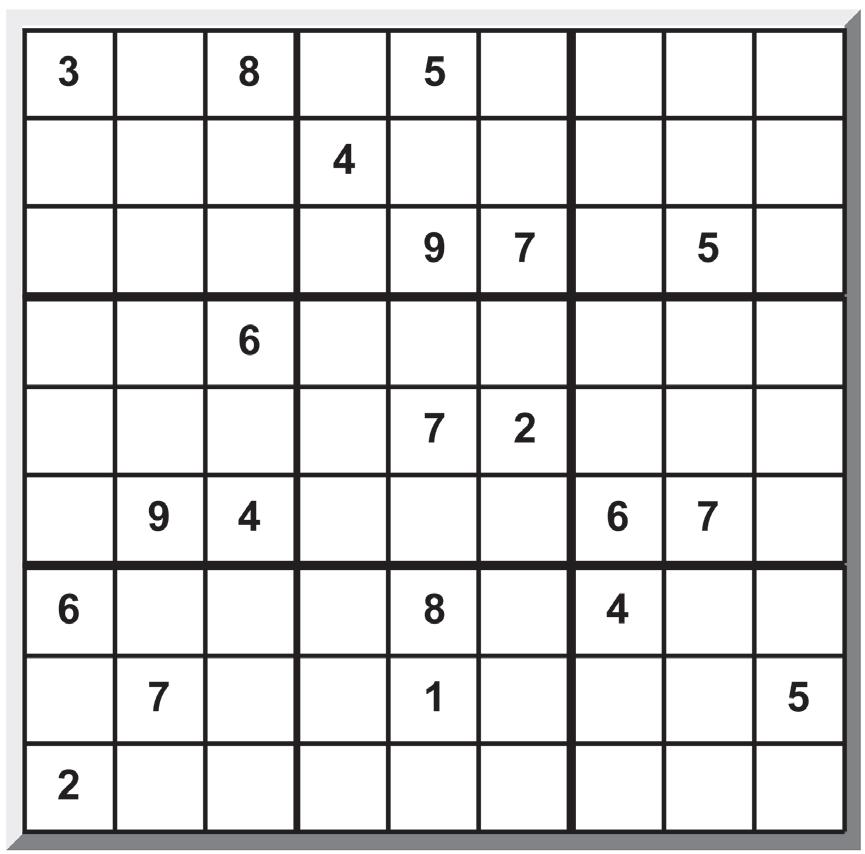
Fill in the empty cells, one number in each, so that each column, row, and region contains the numbers 1-9 exactly once. Each number in the solution therefore occurs only once in each of the three “directions,” hence the “single numbers” implied by the puzzle’s name. (Rules from wikipedia.org/wiki/ Sudoku)


By
Football opened its season with a dominant, 28-22, win on the road over the Virginia Military Institute, avenging last season’s opener.
In its first trip to the state of Virginia in the program’s 134-year history, Cornell (1-0) was outstanding on defense, forcing three turnovers, racking up nearly half a dozen sacks and shutting out the VMI offense for the first 54 minutes of the game. Cornell had a comfortable 28-2 lead with six minutes to go, but a series of quick drives by the Keydets over the game’s final few minutes closed the gap on the scoreboard. Ultimately, the Keydets’ comeback effort fell short and Cornell hung on for the win.
“We really played well for the first 55 minutes of the game, and then we kind of let it go in the last five minutes and gave them some scores,” said head coach David Archer ’05. “I told the team it’s a great type of win, because a) it’s a win, and b) there’s a lot of things we can get better at.”
Cornell was firing out of the gate. After forcing a three-and-out on VMI (1-2)’s opening drive, sophomore quarterback Jameson Wang, who won the starting job after a promising performance in the second half of last season, took the helm.
Wang led the Red right down the field, converting four third downs during a 13 play, 66-yard drive. The Cornell signal caller showed off his arm throughout the drive, completing a 17-yard pass to senior wide receiver Thomas Glover, a 14-yard gain to junior wide receiver Nicholas Laboy and a three yard touchdown toss to senior tight end William Enneking on a rollout. Putting the pressure on early, the Red took the lead, 7-0.
After a pair of three-and-outs from both teams, VMI appeared to be putting together its first extended drive. The Keydets worked the ball deep inside the redzone, but were stuffed repeatedly on the goal line. After failing to convert on 4th and goal from the Cornell 1-yard line,
the Red took over on downs.
Backed up deep in its own territory, the Red could not find any room to run, giving up a safety on the second play of its drive. VMI was on the board, but still trailed, 7-2.
Archer decided to give junior quarterback Luke Duby a look in the second quarter. Duby put together a promising drive, but on his first play in the red-zone, he threw a pick that VMI ran back to its own 40.
The Cornell defense excelled in the first half, forcing three sacks and two turnovers. The first turnover came immediately after Duby’s interception. On the first play of the ensuing Keydets drive, fifth year defensive lineman Max Lundeen forced a fumble, recovered by senior linebacker Jake Stebbins deep in VMI’s territory.
Wang returned to the game to lead the offense with a short field and showed off his mobility with an eight yard scramble on third down to move the chains. Freshman running back Gannon Carothers quickly followed with a two-yard rushing touchdown, his first at Cornell, giving the Red a 14-2 lead.
After a holding call forced the Keydets deep into their own territory, Cornell’s defense stepped up once again. Junior safety Holt Fletcher jumped an out route, picking off VMI and walked in for the easy score to put Cornell ahead 21-2.
The Red took its 19 point lead to the half, and its defense did its job protecting the lead in the third quarter. The defense came up with two key sacks in the third quarter, and senior safety and captain Demetrius Harris pulled down an interception at the end of the quarter that set Cornell up in its red-zone.
After missing a drive following a hard hit, Wang returned to the game and found Enneking in the end-zone for the second time of the afternoon to give Cornell a commanding 28-2 lead heading into the fourth quarter.
On the ensuing drive, the defense stepped up once again, backing the Keydets up before forcing a turnover on downs.
Duby and the offense methodically worked down the field and burned clock, but a blocked punt with six minutes left set the Keydets up with an opportunity to spoil Cornell’s defensive shutout.
Over the final few minutes of the game, VMI put together a series of quick scoring drives to cut into Cornell’s lead.
“The game looked one way for 55 minutes,” Archer said. “Clear as day, it looked one way. We’ve just got to finish it out.”
Playing with urgency, the Keydets finally moved the ball down the field, completing a 41-yard pass down to the Cornell one yard line. On the next play, VMI rushed it up the gut for six. The two play drive yielded the first offensive points of the day for the Keydets, cutting the Red’s lead to 28-9.
VMI’s first offensive success of the day came with many of Cornell’s defensive starters out of the game.
“We rotated some other guys in, but it doesn’t matter. We expect anybody that we put in the game to execute what we need to do,” Archer said. “There’s certainly a lot of good teaching [moments] that came out of the end of the game.”
The Red forced VMI to burn all its timeouts before punting it away. The Keydets once again came up with a quick score, using a big play to drive all the way down field and score in just over 30 seconds.
Despite cutting into the Red’s lead, VMI could not recover its onside kick attempt with three and a half minutes left, allowing Cornell to dwindle the clock down to 1:30.
VMI possessed the ball one more time, moving quickly down field with some more big passing plays. They Keydets scored with five seconds remaining in the game, but once again could not recover the onside kick, and Cornell closed out the win.
Cornell opens Ivy play next Saturday against Yale at Schoellkopf Field.