The Corne¬ Daily Sun


By MEGHNA MAHARISHI Sun Assistant Managing Editor
The lawsuit against Cornell over the death of Antonio Tsialas ’23 will proceed, a Tompkins County judge ruled Sept. 4.
Tsialas’ family presented a valid case of a “cause of action for negligence and premises liability against the defendant,” Judge Gerald Keene wrote in the ruling.
On Oct. 24, 2019, Tsialas attended a “dirty rush” event at Phi Kappa Psi. Shortly after, Tsialas’ family reported him missing and two days later, emergency personnel found his body at the base of Fall Creek gorge. The first-year’s death spurred a University-led investigation, a wave of Greek life reforms and a private investigation into his death.
tained that the investigation into Tsialas’ death was ongoing. It is now unclear whether the CUPD investigation is still active.
Cornell has remained tight-lipped about the investigation; the most information the University gave on its Tsialas investigation was on Nov. 19, 2019, when Pollack said CUPD received over 170 leads on Tsialas’ case.
“[The] next goal is to change the culture of hazing at Cornell... Set up something in their son’s memory.”
David Bianchi
“The significance of this ruling cannot be overstated,” Michael Levine, one of the lawyers representing Tsialas’ family, wrote in a press release. “If schools do not take meaningful steps to ensure that hazing is eradicated, they will be held accountable. The Court’s decision puts universities on notice that they can no longer simply sit back and blame hazing on their students.”
As the case continues against Cornell, David Bianchi, one of the lawyers representing the Tsialas’ family, told The Sun that they expect to be taking depositions from President Martha E. Pollack and other administrators “very soon.”
In the almost 11 months since the tragedy, the University has shared few updates on the circumstances surrounding the first-year’s death or the investigations launched immediately after.
Cornell’s Silence
During the last academic year, the Cornell University Police Department repeatedly main-
One month later, Pollack released another statement, writing that CUPD, state and local law enforcement still could not identify what happened between the time Tsialas was last seen at the fraternity party and when his body was discovered at Fall Creek gorge. In the same statement, Pollack outlined a series of Greek life reforms, which required chapters to have third-party monitors at events and implement a University-run roving security team to conduct spot-checks at events.
But since December 2019, Cornell administrators have not released any updates from their police force’s investigation or statements on Tsialas’ death.
Cornell declined a request for comment on Sept. 16 on the CUPD investigation into Tsialas and Phi Kappa Psi. Bianchi told The Sun that Cornell has not shared any of the findings from its CUPD investigation with him or Tsialas’ parents.
“Number one goal was always to get information,” Bianchi said. “We’ve been unsuccessful.”
The Lawsuit and Trial In January, Tsialas’ parents filed a lawsuit against Cornell, the Phi Kappa Psi fraternity and seven Cornell students, seeking compen-

By JOHNATHAN STIMPSON Sun Managing Editor
The University announced plans to continue its CARES Act grants this semester, revealing Wednesday afternoon that it will deliver an additional $8.5 million to students in need.
As a part of the sprawling $2.2 trillion stimulus package passed late last March, Cornell netted $12.8 million in relief funding from the federal government. While the legislation said that up to $6.4 million could go to offset University expenses, President Martha E. Pollack promised instead that all federal money would be distributed to students directly in the form of additional aid.
Having already sent $5 million in emergency funding to nearly 4,000 Cornellians in the spring, over $7 million still remains to be allocated.
“We’ve been thinking and planning all summer for how we are going to redistribute the second half,” said Jonathan Burdick, vice provost for enrollment, in an interview with The Sun. “We’ve now come up with the answer.”
The remaining CARES Act money — in addition to a further $2 million supplement contributed
by Cornell — will be delivered in the form of two separate programs.
According to Burdick, $1 million will be available through an emergency fund, intended to assist students who face unanticipated expenses — such as travel or technology — not currently addressed by their financial aid.
Another $7.5 million will be spent to fund COVID Summer
“It’s not that easy … to turn around and distribute $6 million.”
Jonathan Burdick
Savings Expectation Grants, a program intended to account for the fact that many Cornellians, amid unprecedented economic distress, were not able to find adequate employment. Typically, financial aid packages are structured under the assumption that students are able to earn money in the summer, and therefore, contribute to tuition.
While the program will not address new needs “comprehensively,” Burdick said, it will essentially act as an “accelerator” on normal
Continued from page 1
financial aid, providing about a 5 percent bump. Notably, eligibility for the grants is not tied to whether or not a student was able to find a job over the summer.
“We’re making an assumption that, if your economic circumstances are really tough, [and] even if you were able to earn your normal amount this summer … you still had all kinds of things around you and your family that became new and unexpected expenses,” Burdick said.
Over 4,000 students are expected to be able to take advantage of the new program, with the average size of the awards ranging from $500 to $2,000, depending on a student’s financial aid status.
While distribution of CARES Act funding had been previously overseen by Student and Campus Life, it will now be administered by the Office of Financial Aid. Grants will
be credited to students’ Bursar accounts, and, like typical financial aid, will be split between the fall and spring semesters.
Although the financial aid process has been beset by “very serious” delays for months — there are still at least 300 applications that remain outstanding — Burdick expected that students will begin receiving grants in October. Those applying for emergency funding can expect an even faster turnaround time.
According to Burdick, the reaction among students to Cornell’s CARES Act program has been largely positive.
“All the feedback we’ve had is that, [to] students, it really mattered. It was the neediest students that tended to get the most, and we’ve had absolutely no bad feedback about that,”
Burdick said. “It’s not that easy … to turn around and distribute $6 million, and try to make sure you’re being fair. So that went pretty smoothly.”
Johnathan Stimpson can be reached at jstimpson@cornellsun.com


Thursday, September 17, 2020
Office of Sponsored Programs Roundtable 9 - 11 a.m., Virtual Event
The H.R. Operating Model: COVID-19 Style 10 - 11:30 a.m., Virtual Event
Guided Progressive Relaxation With Cornell Wellness 11 - 11:30 a.m., Virtual Event
Development Economics Workshop: Kaushik Basu 11:30 a.m. - 12:20 p.m., Virtual Event
Cornell Caregiver Support And Educational Network Noon - 1 p.m., Virtual Event
Strategic Civil War Aims And the Resource Curse 12:30 - 1:45 p.m., Virtual Event
Lights Out to Protect Migratory Birds Webinar 1 - 1:30 p.m., Virtual Event
Cornell Department of Astronomy and Space Sciences Colloquium 4 - 5 p.m., Virtual Event
Composers Forum: Karen Power 9 a.m., Virtual Event
Emerging Markets Theme Launch 10 - 11:30 a.m., Virtual Event
Paige Glotzer: Racial Capitalism, Residential Segregation, and Unequal Access to Housing in The United States 10:10 a.m., Virtual Event
Resisting the Anthropocene: Linda Hogan’s Dwellings: A Spiritual History of the Living World 11:30 a.m. - 1:25 p.m., Virtual Event
Venezuela: A Conversation Series Noon - 5:30 p.m., Virtual Event
Seminars in Infection and Immunity 12:15 - 1:15 p.m., Virtual Event
Destroying or Deploying the “Deep State” 8 p.m., Virtual Event
Excavating the Past: History’s Promise and Perils 8 p.m., Virtual Event

tion for “the injuries and mental and physical pain, suffering and anguish suffered by their son Antonio Tsialas,” among other things.
The students named in the Feb. 10 amended version of the complaint were fraternity executive board members Andrew Scherr ’20, Daniel Sacher ’21 and Benjamin Schwartz ’22. The updated lawsuit also named Shane Rohe ’21, who allegedly escorted Tsialas to the event, Pietro Palazzolo Russo ’21, the Phi Kappa Psi house manager at the time, and Felipe Hanuch ’22, who the lawsuit said invited Tsialas to the event.
Jack Stettner ’22 was supposedly the fraternity’s risk manager, making him in charge of Phi Kappa Psi’s policies on alcohol use, hazing and hosting unauthorized events, according to the lawsuit. Rush chairman Nolan Berkenfeld ’20 and acting chapter adviser John Jacobs ’90 were the other named defendants in the lawsuit. Scherr, Sacher, Schwartz, Rohe, Russo, Hanuch, Stettner, Berkenfeld and Jacobs did not respond to a request for comment by the time of publication.
So far, claims with individual defendants have been resolved, but the lawsuit against Cornell will still continue, according to Bianchi.
The Feb. 10 lawsuit alleged that once Tsialas arrived at Robert Purcell Community Center after having dinner with his mother, “a parade of vehicles” from the fraternity arrived to pick up Tsialas and other first-years.
The lawsuit further alleges that the “dirty rush” event was called “Christmas in October,” and was meant to identify first-years who could become potential new members of the fraternity. According to the lawsuit, Phi Kappa Psi fraternity members only invited “suitable candidates” to the event. Tsialas was seen as a “good pledge prospect” for the fraternity, the lawsuit read.
The “Christmas in October” event described in the suit consisted of activities where first-years had to drink ample amounts of alcohol. At the party, there were seven themed rooms where the fraternity conducted these activities, according to the lawsuit.
Through the lawsuit and its proceedings, Tsialas’ autopsy report has also been made public, offering more exact details on the cause of Tsialas’ death. The Tompkins County Health Department declared that he died on Oct. 24 at 10 p.m. primarily from “blunt force trauma injuries including multiple cranial fractures as well as multiple other lethal injuries,” which was attributed to a fall of approximately 100 feet. Additionally, the autopsy report found that Tsialas had “acute alcohol intoxication.”
Cornell’s Motion to Dismiss the Complaint
The University filed a motion to dismiss the lawsuit on May 4, arguing that it was not legally obligated to prevent — nor could it be liable for — the “prohibited conduct of private parties.” In the complaint, Cornell described the conduct that happened at the Phi Kappa Psi party as “reprehensible” and “in stark violation” of Cornell’s Code of Conduct, the University’s recognition policy for fraternities and sororities, its anti-hazing policy and New York State law. Cornell’s motion to dismiss the complaint did not include any findings from its CUPD investigation, but it did submit the findings from a prior investigation into Phi Kappa Psi.
Right before the Oct. 24 party, the fraternity faced a Greek Judicial Board hearing for hosting an unregistered social event on Sept. 26, after the Office of Sorority and Fraternity Life previously prohibited it from doing so because the chapter house had numerous fire code violations.
The Oct. 23 judicial hearing found that there was no unregistered social event, but rather the event was a private birthday party for upperclassmen in the same pledge class. While all members in the fraternity were over the age of 21, one of the members’ siblings — a first-year — visited the chapter house with another first-year.
In an affidavit, OSFL director Kara Miller said that the office did not know beforehand that Phi Kappa Psi planned to host any event on Oct. 24 and the office never received an event registration request. Miller’s affidavit stated that the two first-years had been drinking in Collegetown before they visited the chapter house. The Phi Kappa Psi president and vice president kicked the first-years out after learning that they were present in the house and intoxicated, Miller wrote.
Disciplinary Proceedings Against Phi Kappa Psi And Individual Members
Beyond the lawsuit, individual members of Phi Kappa Psi and the fraternity itself underwent code of conduct hearings during the last academic year.
While the Office of the Judicial Administrator charged Phi Kappa Psi members in the fall with code of conduct violations, CUPD delayed the campus code of conduct referrals until the spring because the Cornell investigation was still ongoing and the Tompkins County District Attorney had not decided on potential criminal prosecutions, according to a June 18 statement from University spokesperson John Carberry.
“The Cornell Police investigation continues, but it was clearly important to address individual student responsibilities before the end of the spring semester so a number of referrals to appropriate campus disciplinary processes were made,” Carberry wrote.
The J.A. had worked on potential code of conduct violations involving Phi Kappa Psi members in the spring and through the summer, aiming to finish the individual cases as quickly as possible, according to Carberry.
Carberry added that the Office of Sorority and Fraternity Life initiated conduct charges against the fraternity. That disciplinary process is still pending, but is expected to be completed soon. Cornell placed Phi Kappa Psi on an interim suspension in November 2019 — Pollack told The Sun then that there was “significant misbehavior” at the dirty rush event.
On Sept. 16, the University also declined a request for comment on the campus code of conduct violations, disciplinary proceedings for Phi Kappa Psi and the individual cases. The status of Phi Kappa Psi and the outcomes of the J.A. and OSFL hearings remain unclear.
Ultimately, Bianchi said he hopes that this lawsuit will tangibly impact hazing culture at Cornell.
“[The] next goal is to change the culture of hazing at Cornell,” Bianchi said, “set up something in their son’s memory.”
Sarah Skinner ’21 contributed reporting.
Meghna Maharishi can be reached at mmaharishi@cornellsun.com.
By ALEC GIUFURTA and ANIL OZA Sun Senior Editor and Sun Science Editor
After 13 days at the yellow alert level, Cornell has returned to its “new normal.” The University reported zero new cases for two days straight and only three confirmed on-campus positives since Sept. 12.
In a Wednesday email to the Cornell community, Provost Michael Kotlikoff and Vice President for Student and Campus Life Ryan Lombardi lauded the efforts of students, faculty and staff in containing the spread when announcing the shift to green.
“Our positivity rate remains low, and our program for surveillance testing has succeeded in providing early identification of cases — the majority of which have been asymptomatic,” the two wrote.
The change is indicative of low prevalence and controlled transmission among the campus community. After the move to the yellow alert level, the frequency of testing for some groups –– such as student athletes –– was increased, and the capacity of on-campus spaces was reduced.
“Our positivity rate remains low, and our program for surveillance testing has succeeded.”
Provost Michael Kotlikoff
Student gatherings, however, will remain capped at 10 people, a change instituted based on “what we have learned over the past two weeks,” the two wrote. Previously, gatherings were limited to 30 individuals while the University is at its new normal.
On Sept. 3, the University moved to yellow alert level, partly due to a cluster that started with nine students but quickly grew to 39. The cluster was linked to small social gatherings and 36 of the 39 cases were among student athletes. Under the yellow alert, gatherings larger than 10 students were prohibited, but in-person and hybrid classes could still continue.
Following the first cluster, President Martha E. Pollack warned students in an email that maintaining plans for a hydribd semester was “extremely difficult” given Gov. Andrew Cuomo’s (D-N.Y.) mandate that colleges must pause in-person instruction for two weeks if they see 100 cases in a 14-day period.
Tompkins County has witnessed a decline in the number of active COVID-19 cases, with single digit increases in new cases since Sept. 10. The county currently has 39 active cases, the Tompkins County Health Department reported Tuesday.
Alec Giufurta and Anil Oza can be reached at agiufurta@cornellsun.com and aoza@cornellsun.com.
By ALEC GIUFURTA Sun Senior Editor
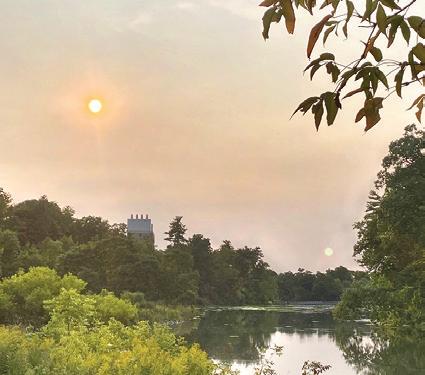
Up on East Hill, the consequences of the escalating climate crisis manifested this week as a gray haze filled the sky — it’s smoke from the West Coast.
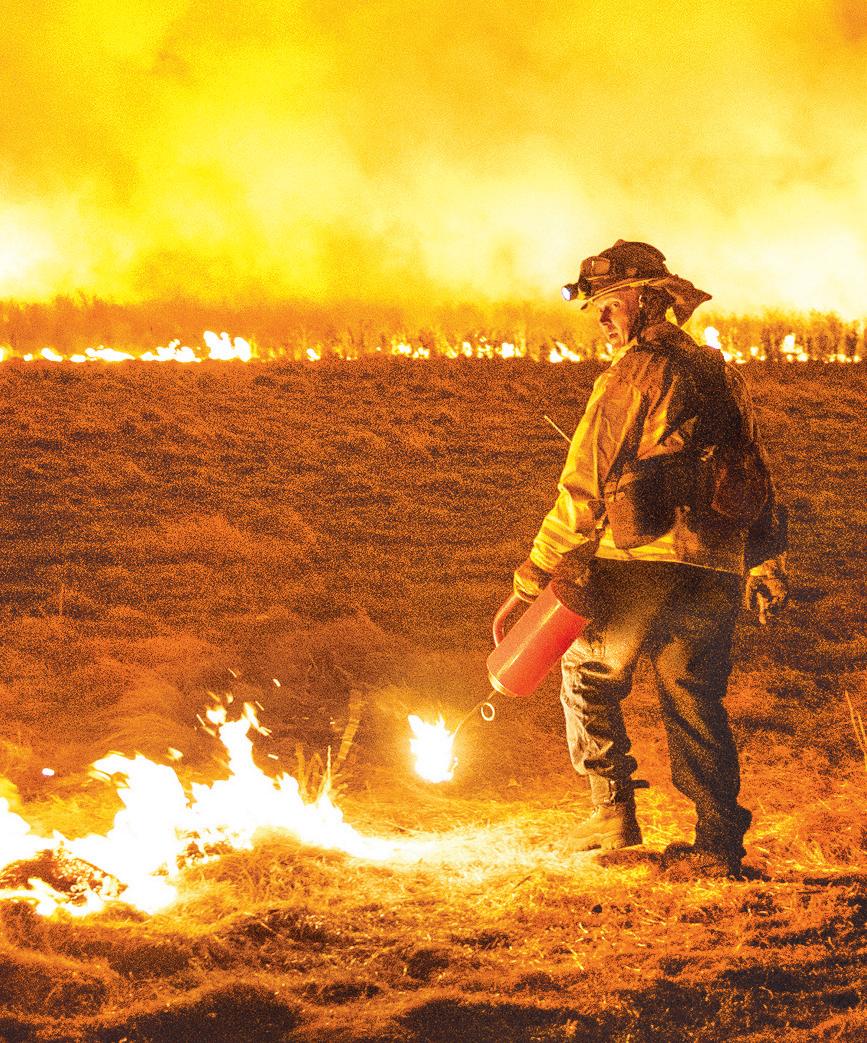
Yes: Smoke from the West Coast’s devastating fires stretched across the nation, from sea to shining sea, to reach Ithaca this week. The fires that have burned over 5 million acres in California, Oregon and Washington, are the worst the region has seen in decades.
Throughout Monday, Tuesday and Wednesday, a thin haze filled the sky, filtering sunlight and giving way to a sea of gray. A spokesperson from the National Weather Service forecast office in Binghamton confirmed in a message to The Sun that the haze above Ithaca was indeed smoke from the fires.
Experts in climatology, including Prof. Arthur DeGaetano, earth and atmospheric sciences, lamented the circumstances for the fires.
“Yesterday I could look at the sun and not hurt my eyes,” DeGaetano said
Wednesday, adding that climate change is one of several causes of the fires. “This year, it’s probably one of the bigger ones. The west has been dry, the west has been hot.”
The Weather Service spokesperson said there was likely no health threat in central New York from the smoke, but students spending time outdoors during the week drew connections between the slightly dimmer sunlight and the larger crisis.

While studying with a friend outside Goldwin Smith Hall on Wednesday, Claire Stein ’24 from New York City said she was stunned when she learned the sun was obscured not by clouds, but by smoke.
“I wouldn’t have even thought,” Stein said. “It brings out the gravity of the situation: Climate change is very real and affects everyone.”
Outside the College Avenue location of Collegetown Bagels, Marissa Young ’22
from Connecticut said the situation in the sky above made her more inclined to help advocate for solutions to the climate crisis.
“I think a lot of people maybe don’t know exactly what they can do,” Young said. In 2020, the reality of the climate crisis has continued to rear its head. DeGaetano highlighted the Northeast’s record-breaking summer temperatures and “hyperactive” Atlantic hurricane season — forecasters at the National Hurricane Center are about to run off the 21 name-list they have for tropical storms and hurricanes.
And while this is not the first time smoke has filled the atmosphere above East Hill — fires in Canada have infrequently had the same effect — DeGaetano said this is the longest he has seen the smoke linger, let alone the fact that the smoke is traveling from California, not Canada.
The shrouded sunsets on the slope, faint-
ed daytime sunrays and eerie afterglow of haze are expected to subside in Ithaca by Thursday, according to the Weather Service. But conditions on the West Coast continue to deteriorate.
Sabrina Martin ’23, who is from Palo Alto, California, described how over the past six years, the prevalence of destructive wildfires back home has escalated. Her high school sometimes canceled classes or outdoor activities because of poor air quality from the fires.
Fires are now as close as 30 miles from Martin’s home in California. The cars in her driveway are often coated with a layer of ash, and the park she frequented while growing up was destroyed in this season’s fires.
On Tuesday, Martin realized the smoke had reached Ithaca. And while it’s nowhere as close to the orange glow of fire back home, a problem once exclusive to her West-coast home now haunts her across the country.
“This entire thing has given me a gut-wrenching feeling,” Martin said.
Alec Giufurta can be reached at agiufurta@cornellsun.com.
By AMELIA CLUTE Sun Staff Writer
Recipes From the Farmers:
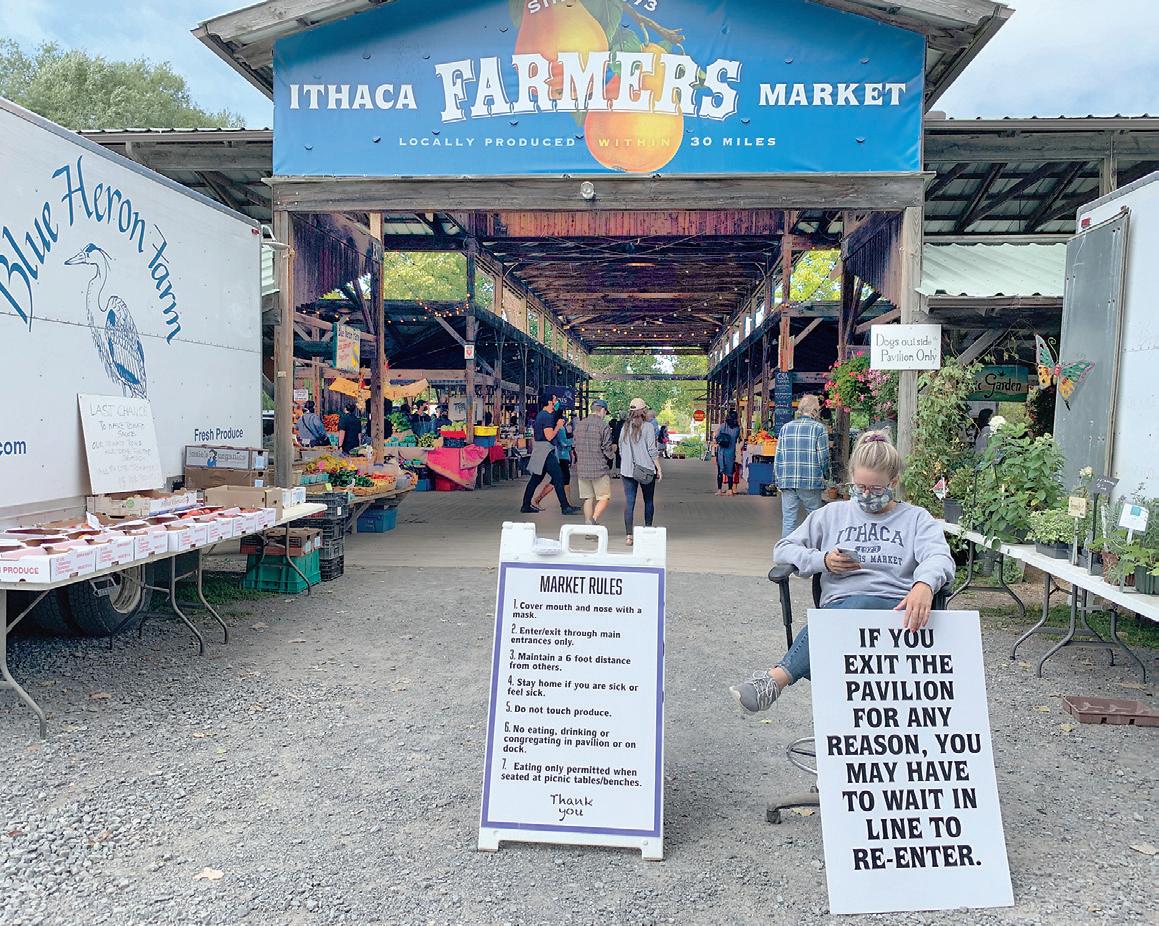
There’s nothing quite as intimidating as walking into the Ithaca Farmers Market and making eye contact with a vendor selling 15 types of vegetables that you’ve never seen in your life. Like many other students, I follow one of two paths when this
happens: I give an awkward smile to the vendor and move along quickly, or I peruse the vegetables sagely with completely falsified discernment, frowning every once in a while and smiling at other times as I pretend to know what I’m doing. It is, in short, a mess.
Knowing that this is a fairly common experience for those of us that don’t come to the farmers market every week, I learned how to use


local ingredients from those most qualified to teach us: The farmers themselves. All recipes mentioned in this article will be listed below.
First: Crosswinds Farm and Creamery. You may have seen Crosswinds at the end of the farmers market where they boast a selection of delicious hard and soft cheeses. When asked for some creative ways to use their products, the vendor explained that their Morning Glory Chive soft cheese can be used as an impromptu alfredo sauce; it melts down nicely to create the quickest and most delicious cream sauce you’ve ever had. The Crosswinds website also gives a recipe for a crustless quiche which you may wish to explore.
Second: Blue Oyster Cultivation
Despite its name, Blue Oyster Cultivation isn’t a seafood company. Instead, it offers a wide range of mushrooms. Especially relevant to any vegan or vegetarian readers who may have loved seafood prior to changing their diets, I learned that Lion’s Mane mushrooms are common replacements for crab meat. With a slightly fishy flavor and a texture remarkably similar to crab, Blue Oyster Cultivation recommends making vegan crab cakes with their Lion’s Mane mushrooms.
Third: Food and Ferments. Food and Ferments describes their products as “edible alchemy” — the result of local vegetables paired with long fermentation times to produce sour, tangy condiments ready to excite your taste buds. The more I talked with the Food and Ferments representative at the farmers market, the more amazed I grew by the many ways I would have never thought to use their products. Though we’re all familiar with the painful trend of taking shots of apple cider vinegar in the morning, the vendor stressed that
this is just one use of his “Fireside Tonic” and beet kvass. The tonic, an “apple cider vinegar infused with an array of potent natural cold and flu fighters,” works brilliantly mixed with oil, salt and pepper as a salad dressing. You can also use a splash to deglaze a pan when cooking vegetables to give the meal an extra kick of flavor.
In addition to the Fireside Tonic, Food and Ferments produces a plethora of different sauerkraut variations. Their classic sauerkraut flavor goes well tossed with a salad or thrown into soup, while the “Sea King” flavor pairs nicely with pork dishes. Add their “Hearts on Fire” sauerkraut to steak or a baconand-eggs breakfast and discover the smoky paprika flavor shine.
Though vegetables are not inherently difficult to cook, the task can be extremely daunting. I highly urge you to speak with the vendors about any ingredients which you may not be familiar with. I was deeply surprised by how easy it can be to incorporate these new, diverse ingredients into my diet. This is just the smallest
peek into what is possible in the world of vegetarian cooking, and it is much more welcoming than many of us know.
By MELANI METZ Sun Staff Writer
Melanie’s “Must-Gets”:
The 30 minute (or more) wait to get into the Ithaca Farmers Market is made worthwhile by a few stands. I’ve decided that I should reward myself for standing patiently in line with multiple purchases, whether fresh vegetables or a tall drink. My favorite vendors are Macro Mamas, Wide Awake Bakery and Forty Weight Coffee. Macro Mamas is a plant-based catering company that sells their food on Saturdays at the farmers market, as well as in Green Star Co-op and select stores around Ithaca. They sell delicious salad and lunch bowls, pastries and their well-known peanut noodles (previously featured at Temple of Zeus). On my most recent visit to the booth, I bought a salad with mixed greens, quinoa pilaf, roasted beets, cabbage slaw, seasoned chickpeas and a lemon poppyseed dressing, along with a tapioca pudding and a slice of their chocolate tart for later. The salad was delicious, with the perfect combination of ingredients, the tapioca pudding made a simple and filling breakfast and the tart was dense, not too sweet and had a slightly spiced kick. I highly recommend Macro Mamas for vegans and non-vegans alike, and cannot wait to try more of their creations.

Wide Awake Bakery makes delicious sourdough breads which are hearty, chewy and have a great shelf life. My housemates and I have grown accustomed to buying one per week. Their booth is only open on Sundays, but they also sell their breads at Green Star Co-op.
Forty Weight Coffee was instrumental in getting me back to drinking coffee on the weekends. Their nitro cold brew is amazing, with a rich and creamy taste that is well complemented by a splash of oat milk. Their coffee is also used in various cafes around Ithaca. Luckily, their booth is open both Saturdays and Sundays.
My quotidian has evolved to include watching the West Coast burn from afar and checking the air quality index in my hometown periodically throughout the day. I receive daily updates from my family in California: descriptions of the latest expeditions to the grocery store where eyes come back bloodshot from the pollution, tales of evacuation orders in neighboring counties and photos captured of a scarlet haze painted across the West Coast sky.
Wildfires have blazed through more than five million acres: Imagine the entire state of Connecticut and Delaware being charred completely to the ground.

Shriya Perati
Thought Experiments
With the smog choking out the oxygen in the air, many are left trapped inside their homes with clogged air filters and the impending dark cloud of evacuation orders looming overhead. There are few places left to go. Homes and neighborhoods have been battered and destroyed, leaving hundreds of thousands of people with nothing but a visceral feeling of displacement.
With two ongoing crises, it has become unsafe to come together inside because of the virus and with the fires still blazing, it’s no longer feasible to convene outdoors.
There is a phrase that comes to mind, when thinking about the fires back home, by Oscar Wilde who writes in his 1889 essay, The Decay of Lying: “Life imitates Art far more than Art imitates Life.” At face value, the argument seems absurd: How are these fires, a manifestation of climate change, forest mismanagement and the consequences of colonization, an imitation of art?
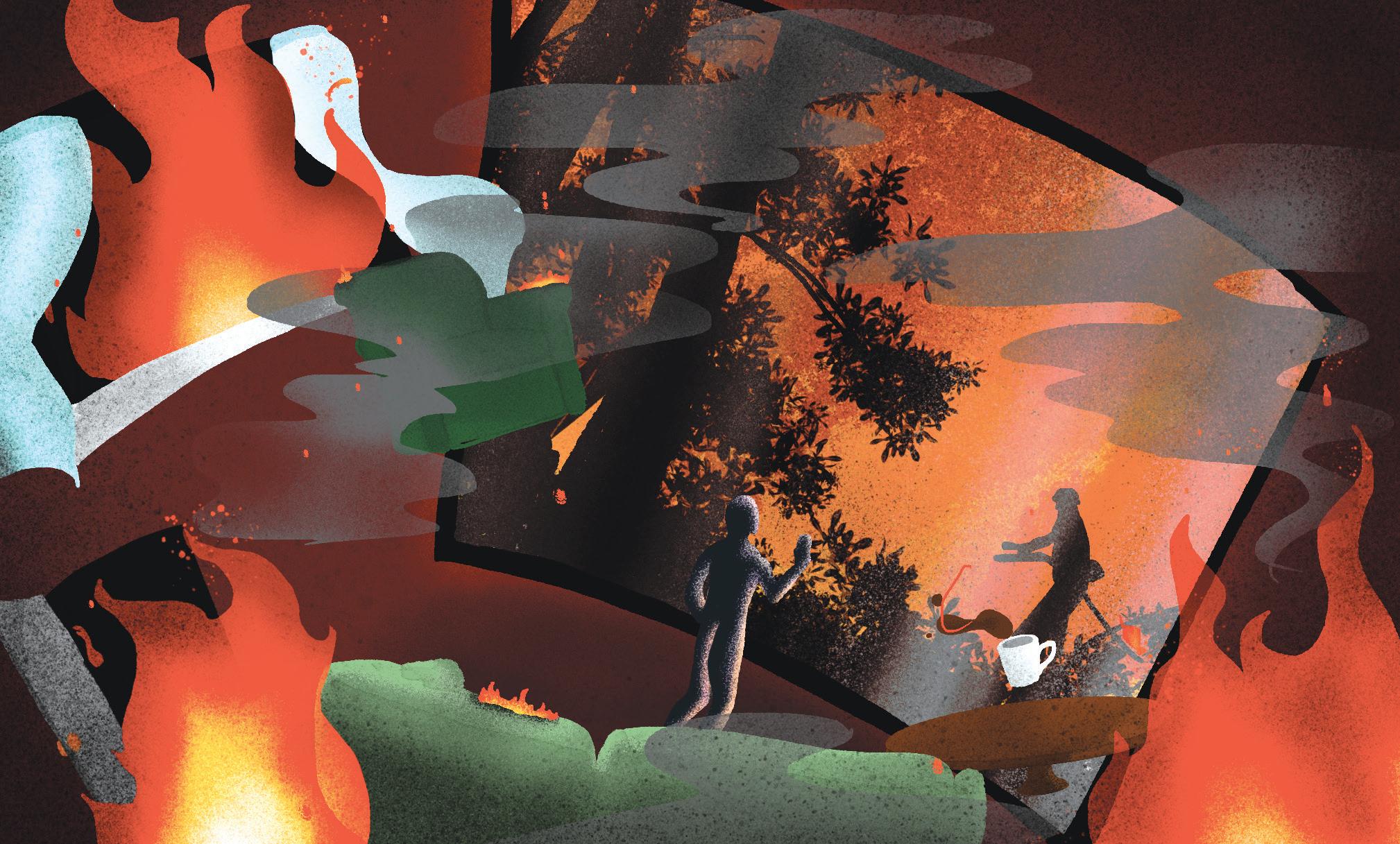
But paste pictures of the red-stricken sky alongside a scene from Blade Runner or Stranger Things, then tear out a page from Margaret Atwood’s MaddAddam Trilogy, and doesn’t this all feel like a scene from a post-apocalyptic world you’ve seen on screen or read before?
Without the existence of art, a scarlet painted sky would be nothing more than a color. But post-apocalyptic films and speculative fiction all work together to help to contextualize its meaning. Red is no longer just red; it has now become an ominous symbol of our changing now.
Atwood’s MaddAddam Trilogy for example, presents an alternative future in which a pandemic wipes out much of the human race and the survivors are left to deal with the last-
ing consequences of climate change. Octavia E. Butler’s Parable of the Sower, written in 1993, takes place in a speculative 2024 in which society has largely collapsed due to climate change and fires burn indiscriminately.
We see photos of the wreckages, the people displaced from their homes and the smog suffocating the blue from the sky, and there is a scary sense of recognition that sets in. What we’ve been watching on screen and reading in books is no longer an alternative future or speculative fiction. It is the ongoing present.
The question now is what will we do? What happens when our reality becomes indistinguishable from fiction? Art has always served as a warning of what the future might look like if we remain complicit in our changing landscape. Will we continue to watch the
red-stricken skies and high air quality scores, thinking this is an issue that only pertains to the West Coast? Or that California has always been on fire? The reality is that yes, fire season has been a perennial challenge in California, but the destruction in the recent years has pervaded more of the landscape than ever before. The crisis that is affecting California and the west now, will affect the rest of the nation in some way or another. Will we remain passive consumers, taking in fiction and film and attributing it to a far-fetched alternative future? Or will we use art to inspire action?
Shriya Perati is a senior in the College of Arts and Sciences. She can be reached at sperati@cornellsun. com. Thought Experiments runs alternate Tuesdays this semester.
138th Editorial Board
MARYAM ZAFAR ’21
JOYBEER DATTA GUPTA ’21
Business Manager
PETER BUONANNO ’21
Associate Editor
MEGHNA MAHARISHI ’22
Assistant Managing Editor
CHRISTINA BULKELEY ’21
Sports Editor
BORIS TSANG ’21
CAROLINE JOHNSON ’22
ALEX HALE ’21
ARI DUBOW ’21
EMMA ROSENBAUM ’22
BENJAMIN VELANI ’22
JOHN MONKOVIC ’22
MIKE FANG ’21
OLIVIA WEINBERG ’22 Assistant
MADELINE ROSENBERG ’23 Assistant
LUKE PICHINI ’22
HANNAH ROSENBERG ’23 Assistant
BRIAN LU ’23
ANNABEL LI ’21
LEI ANNE RABEJE ’22
COLIE ’23
MONKOVIC ’22
JOHNATHAN STIMPSON ’21
KRYSTAL YANG ’21 Advertising Manager
JASON HUANG ’21 Web Editor
NIKO NGUYEN ’22 Design Editor
PALLAVI KENKARE ’21
SEAN O’CONNELL ’21
STAMM ’22
OZA ’22
PLOWE ’23
LEE ’21
’21
’22
MEGHANA SRIVASTAVA ’23
DAWSON ’21
Sports Editor
PARKER ’22
’21
’21
’21
’21
Working on Today’s Sun
Ad Layout Dana Chan ’21
Production Desker Ben Mayer ’21
Sabrina Xie ’21
News Deskers Sean O’Connell ’21 Madeline Rosenberg ’21
Opinion Desker Peter Buonanno ’21
Design Desker Lei Anne Rabeje ’22
Photo Desker Boris Tsang ’21
Dining Desker Benjamin Velani ’22
Arts Desker Daniel Moran ’21
Sports Desker Luke Pichini ’22


Dear Cornelia,
It’s my senior year, and I am finally feeling confident about my sexuality. I always imagined I’d spend my last year in Ithaca going on dates and hooking-up with lots of people. Obviously that’s not happening. Is there any way to hook-up safely?
— Pandemic Petrified
Hi Pandemic Petrified,
I hear you! Firstly, I want to say thank you for being socially conscious. There is no perfect solution to your problem, and that’s what makes 2020 so hard. The Cornell Behavioral Compact does not allow hookups. Together as Cornellians, we promised to “to maintain six feet of physical distance between us, and to wear a face-covering at all times.” But I’m afraid hookups will continue happening, and we can only hope that the rest of the Cornell community is as committed to health and safety as you.
Our lives are a balancing act right now.
On one hand, many of us are enjoying privileges rewarded to very few: safe in-person classes and a vast testing apparatus. Most Americans are unfamiliar with this degree of pandemic-level sacrifice. If you feel as though the pandemic hasn’t affected you beyond cock-blocking, perhaps you ought to evaluate your privilege.
On the other hand, we all possess the normal needs and impulses of college-aged adults. To compound that, we are grieving losses both profound and minute — whether that be the suffering of our communities or loss of our long-awaited senior year. I am feeling a mix of rage, terror, stress and loneliness. Perhaps you are too.
Now that I have stepped off my ped estal, here’s how to have a safer pandemic hook-up. There is no such thing as 100% safe sex right now, only safer.
Iconically, the CDC made some suggestions. For one, they encourage *ahem* masturbating: “You are your saf est sex partner.” If that’s not enough to satisfy your needs, “Video dates, phone chats, sexting, online chat rooms and group cam rooms are ways to engage in sexual activity with no chance of spread ing COVID-19.” My favorite suggestion on the official CDC website reads, “use barriers, like walls.”
Yes, glory holes. You read that right.
Before you decide to have a sexual relationship with another person, first explore your sexuality alone. Get creative, get kinky. Buy a sex toy. Read fanfic. Try a glory hole? Take pride in the fact that you can expe-
rience pleasure in a 100% safe way.
If you do decide to pursue an in-person romance, consider a hook-up pact. A hook-up pact is when two people commit to breaking social distancing to hook-up with each other. Just each other. Before embarking on this tryst, have a conversation — not just with your potential fling, but also your roommates. Both intimate and roommate relationships require open communication and trust. Make sure to set clear guidelines and boundaries. Be honest about your concerns.
Do you want to date online or in-person (now or in the future)? How many people are in your “bubble?” What are their habits and expectations of those in your “bubble”? Do you have in-person classes? Do you plan to travel?What types of interactions make you comfortable/uncomfortable?Do you want to meet inside or outdoors? Masked or unmasked? Are you comfortable with (potential) physical touch? What kind? What sort of isolation/quarantine is expected before/after a hook-up? What sort of sanitation protocols are expected before/after a hook-up? Would we have to break university/dorm/roommate rules and agreements for this to occur? What do I do if I am no longer comfortable with the situation? What do we do if Cornell moves into yellow/orange/ red zones?
No matter how you slice it, hooking up in a pandemic is risky. I implore all Cornellians to channel discipline, empathy, and patience. If it makes you feel better, until I am fully vaccinated, I’ll be abstinent. I hope you’ll join me.

Cornelia
Fill in the empty cells, one number in each, so that each column, row, and region contains the numbers 1-9 exactly once. Each number in the solution therefore occurs only once in each of the three “directions,” hence the “single numbers” implied by the puzzle’s name. (Rules from wikipedia.org/wiki/ Sudoku)






Dubbed the “Route 13 Rivalry,” Cornell and Colgate’s football rivalry spans over a century and has resulted in 101 meetings between the two teams. While Cornell was the initial powerhouse in the matchup, Colgate has heated up in recent decades, and the alltime series record stands at an even 49-49-3.
The rivalry stems from the fact that both schools are located within 100 miles of each other, and they are also a part of rival conferences in the Ivy League and Patriot League. Both squads competed against each other for the first time in 1896, and for the first 14 iterations of the matchup, the Red went 13-0-1 as it outscored the Raiders by a margin of 195-16.
While Colgate successfully rattled off some victories over the next several decades, Cornell still displayed a clear edge. It wasn’t until 1952 that the Raiders gained some footing in the series. Over the next 13 years, Colgate notched nine wins as the Red began to struggle under head coaches George K. James and Tom Harp.
Once legendary running back Ed Marinaro joined the team, the Red restored its winning ways. During the late 1960s and early 1970s, Cornell won eight out of nine contests. During the 1971 season, the Red knocked off the Raiders, 38-20, in the season opener and wound up ending the year with an 8-1 record and an Ivy League title in hand.
Ever since 1975, though, Cornell has struggled

immensely in the Route 13 Rivalry. The Red has only earned eight wins over the course of 40 matchups. The struggles coincide with Cornell’s effort to regain relevance as a football program.
While the Red has fared poorly against Colgate, it has notched a few marquee triumphs over the Raiders. In Cornell’s most recent win — which came in 2016 — it accomplished an improbable comeback victory. After an abysmal first half, the Red entered the locker room staring at a 31-12 deficit.
At the intermission, then-senior offensive lineman Jake Waltman ignited the team with a speech during the halftime intermission, which ultimately inspired the improbable comeback.
Red outscored Colgate, 27-7, in the final 30 minutes and bookended the victory with a 19-yard touchdown pass from then-sophomore quarterback Dalton Banks to Shaw.
“We said, ‘Hey, no matter what happens, we’re going to win the game,’” said head coach David Archer ’05 after the game. “We stuck to it and they just kept making plays and it was just a day I’ll never forget.”
“We stuck to it and they just kept making plays and it was just a day I’ll never forget.”
David Archer ’05
“[At halftime] Jake Waltman brought us up and said, ‘This is the moment you’re going to be looking at 10 or 15 years down the road and say we had the biggest comeback we’ve ever had and we’re going to prove it today,’” said then-senior wide receiver Collin Shaw postgame. “Everyone rallied around that before the half and it gave us so much momentum going into the second half.”
With that momentum, Cornell chipped away at the Raiders’ lead as the offense moved out of the mud. The
The Raiders have won the last three matchups, which included a 21-20 win over the Red in the 2019 season. In that Oct. 19 clash, Cornell fell to a Colgate team that had dropped its first seven games of the season. After that loss, though, the Red churned three wins against Ivy competition during the back half of the year to secure a tie for fourth place in the conference.
Because of Cornell’s early dominance in the series, Colgate’s recent efforts have only rendered the rivalry even over 101 meetings. It remains to be seen if the Red can buck this latest trend and reassert control in the Route 13 Rivalry.