The Corne¬ Daily Sun

‘this

‘this
By SARAH SKINNER and MARYAM ZAFAR Sun Managing Editor and Sun City Editor
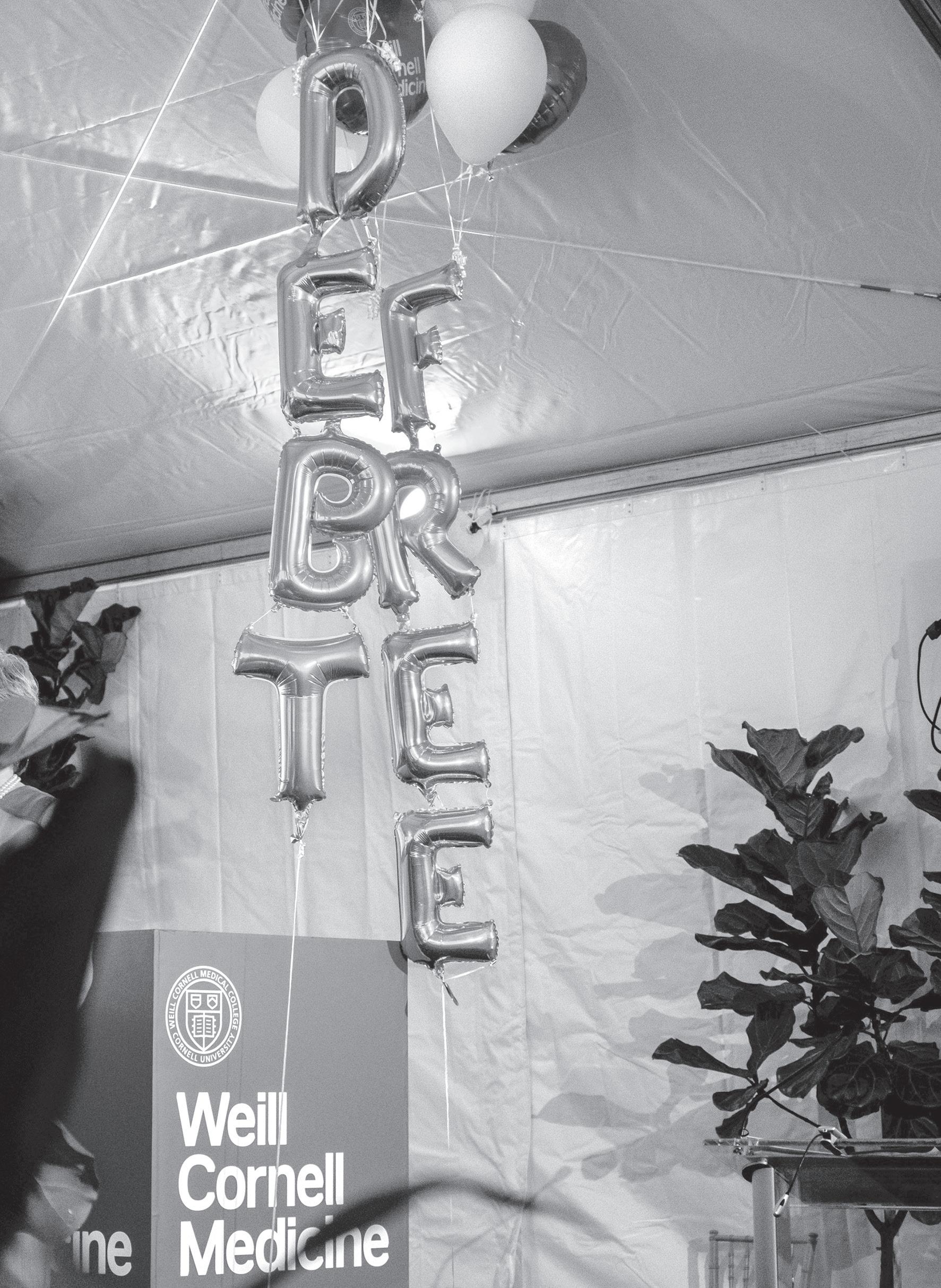
On Monday morning, Cornell announced that Weill Cornell would provide debt-free schooling for students qualifying for financial aid.
The program will go into effect as of the 2019-2020 year, Weill Cornell said. Students in Weill’s Class of 2023 — and all classes onward — will have their loans replaced by scholarships.
Sticker price for Cornell medical school tuition is currently $58,760, and Weill
See TUITION page 4
against
By MARYAM ZAFAR Sun City Editor
After Weill Cornell Medicine’s historic announcement that it would eliminate loans for students, premedical undergraduate students in Ithaca and medical students in New York City expressed skepticism, shock and excitement. Loans — the ones students are shackled with while in Ithaca, and the prospect of getting roped into more — loom over students as they think
See REACTIONS page 4


Mobile project spends day addressing ‘blind spots’
By MEGHNA MAHARISHI Sun Contributor
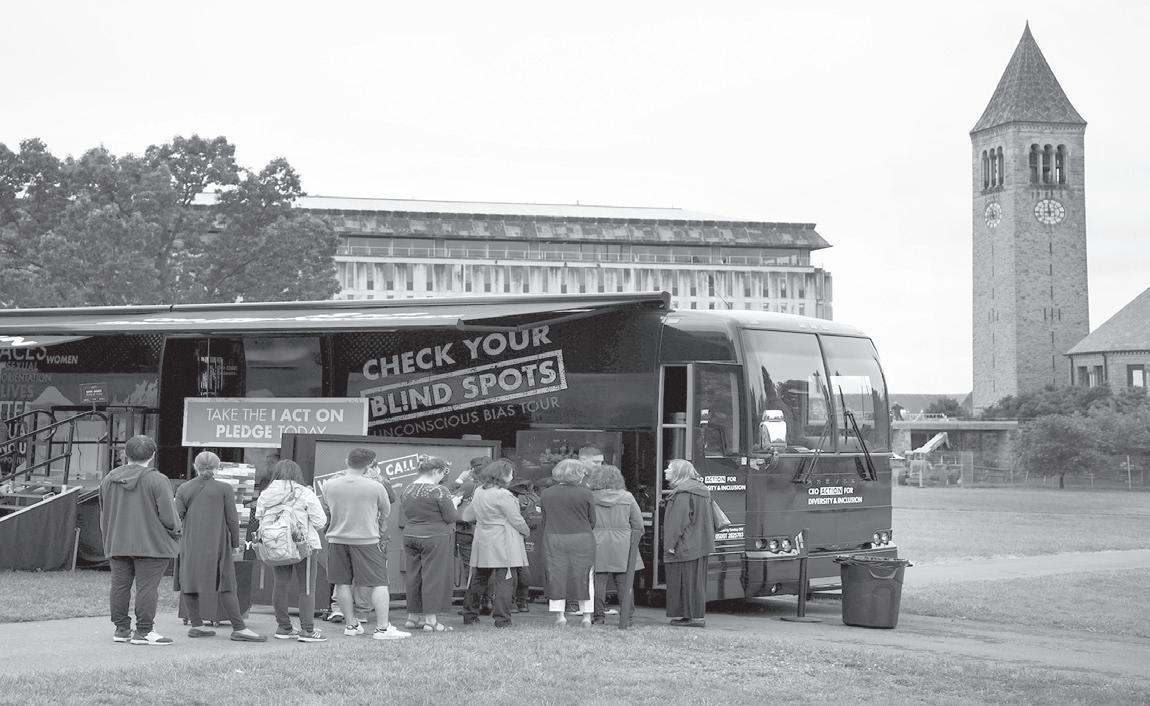
A black bus with phrases like “Race,” “Diversity” and “Equity” emblazoned on it was parked in the Arts Quad on Monday, offering members of the Cornell community an opportunity to immersively experience the subtleties of discrimination.
The bus was part of a mobile tour called “Check Your Blind Spots,” a project that aims to make people aware of their unconscious biases when interacting with others of different ethnicities, genders, sexual orientations and religions.
Sylvana Storey, a business psychologist according to her Huffington Post profile, defines unconscious bias as “a bias that happens automatically, is outside of our control and is triggered by our brain making quick judgments and assessments of people and situations, influenced by our background, cultural environment and personal experiences.”
and interactive surveys to further highlight these unconscious biases. In one such simulation, a sales clerk in a clothing store is portrayed as believing a woman is unable to pay for a handbag because she was speaking to her friend in Spanish earlier.
“The main goal is to really educate people on unconscious bias, the way all we make snap judgments on the way people look and sound,” tour coordinator Anthony Petrowski told The Sun. “We’re just trying to educate them so they can be more aware of their own unconscious bias and then they can change the world one person at
“The main goal is to really educate people on unconscious bias, the way we all make snap judgments.”
Anthony Petrowski
a time ... so they can be more diverse and inclusive in their own lives.”
Positioned outside the bus was a wall of telephones where people could listen to a phone call of a landlord forcing a woman to pay three months of her lease upfront because she is covered in tattoos and piercings, whereas a man mentioned in the call only had to pay for one month upfront — just one example of the manifestation of unconscious biases.
Inside the bus, there were a number of other virtual reality simulations
The event was hosted by CEO Action for Diversity and Inclusion, a consortium of chief executive officers dedicated to promoting diversity and inclusion in the workplace. The organization launched in 2017 and was spearheaded by Tim Ryan, U.S. chairman and senior partner of PricewaterhouseCoopers — one of the world’s largest accounting and consultancy firms.
On its website, there are two pledges: one for
See BUS page 5
Tuesday, September 17,
CIFS-IPP Food Systems Career Fair
10 a.m. - 4 p.m., Stocking Hall Gallery, 1st Level
ILR Career Fair
10 a.m. - 3 p.m., Statler Hotel, Carrier Ballroom
Banes of Boxwood, Beech and Blossoms 11a.m. - Noon, A134 Barton Lab
Opportunities for Immunomodulation In Peripheral Nerve Injury
Noon - 1p.m., Baker Institute, Thaw Lecture Hall
Novel Genomic Approaches for Polyploids, And Their Application to Miscanthus Breeding 12:20 p.m., 135 Emerson Hall
The Power of Imperfection: Embracing the Quantum Limit in Semiconductor Devices 12:20 p.m., 700 Clark Hall
Reflections on Twenty Years Working With Privately Protected Natural Areas Worldwide 3:30 - 4:30 p.m., G24 Fernow Hall
Homecoming and Homemaking In the Ancient Mediterranean 4:30 p.m., 165 McGraw Hall
Cine Con Cultural Film Festival 2019 6 p.m., Cornell Cinema
AIISP Soup Lunch Series Noon - 1p.m., 400 Caldwell Hall
How Is CLO Shaping the Fashion Industry? 12:20 - 1:10 p.m., T01 Human Ecology Building
The Future of Water: Closer and Better Than You Think? 12:20 - 1:10 p.m., 135 Emerson Hall

Veterinary Senior Seminars 4:30 - 5:45 p.m., LH2 College of Veterinary Medicine
AAPicnic: Dinosaur BBQ on Sibley Beach 5 p.m., Arts Quad
Slumbering Legacies: W.E.B. Du Bois And Romantic Consciousness 5 - 6:30 p.m., A.D. White House, Guerlac Room
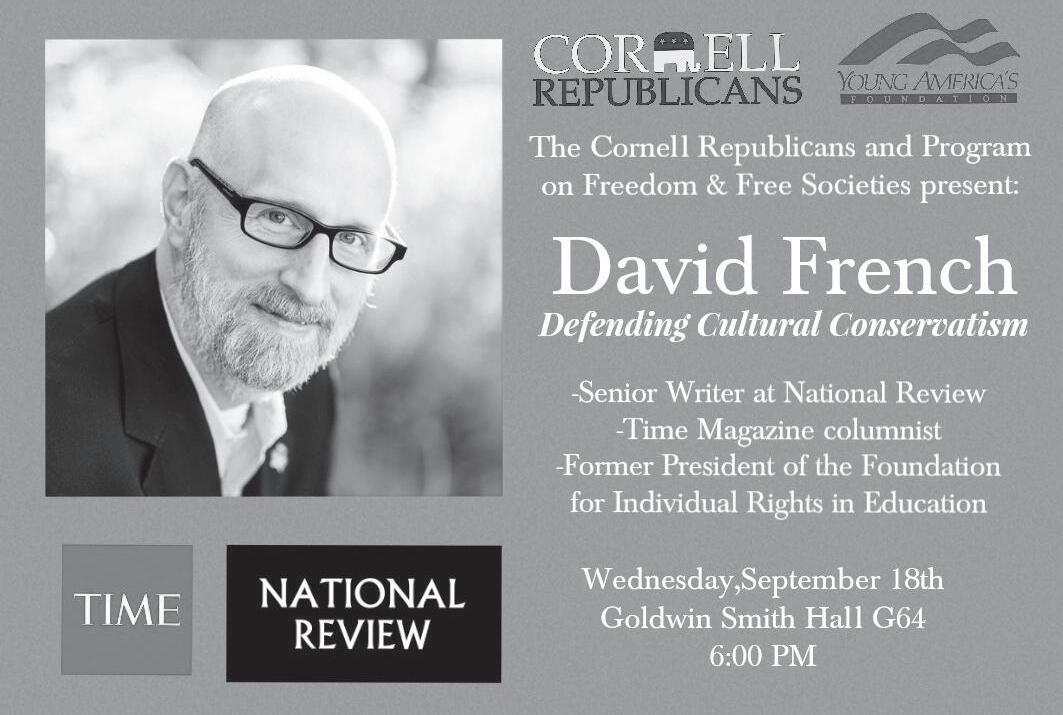
Defending Cultural Conservatism 6 - 7:30 p.m. G64 Goldwin Smith Hall

By
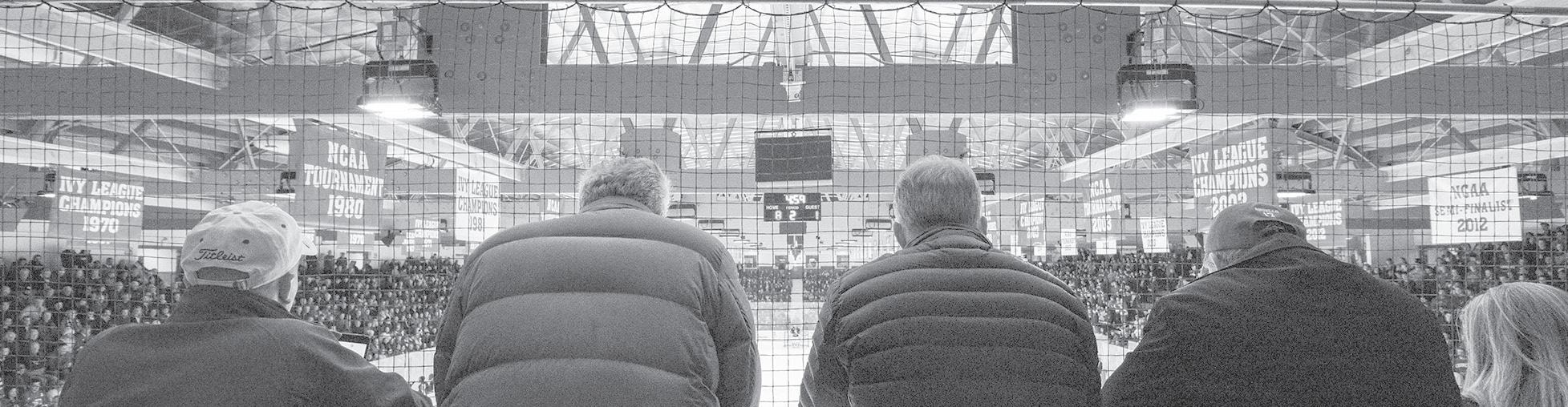
Big Red Hockey’s beloved Lynah Rink was evacuated due to elevated carbon monoxide levels Saturday afternoon.
“The elevated CO was due to a malfunction of the propane-powered ice resurfacing equipment,” Tim Fitzpatrick, director of Environmental Health and Safety, wrote in a statement to The Sun, noting that a factory representative made repairs to the Zamboni on Monday.
Carbon monoxide is an odorless, colorless and poisonous
gas that is found in fumes when fuel is burned. Carbon monoxide poisoning symptoms are described as “flu-like,” according to the Center for Disease Control and Prevention. Electronic detectors are the most reliable way to detect elevated and unsafe carbon monoxide levels.
“The building is equipped with Carbon Monoxide detection devices that are tied to the building alarm notification system,” Fitzpatrick wrote. “The on duty Emergency Response member responded to the alarm and verified elevated CO using a portable hand-held instrument.”
The building was evacuated and shut down for the rest
By KATHRYN STAMM Sun Staff Writer
Now with a year under his belt as the Harold Tanner Dean of the College of Arts and Sciences, Ray Jayawardhana has a list of accomplish
what might be next for Arts and Sciences.
Housing over 4,000 undergraduate students and offering nearly 2,000 courses, the arts college faces a great challenge: its sheer complexity and diversity, according to Jayawardhana. As a result, when he first arrived in Ithaca to replace outgoing dean Gretchen Ritter ’83 last September, Jayawardhana’s first move was to quickly meet with as faculty members as possible, who offered him key insight into the school’s vast landscape and their priorities.
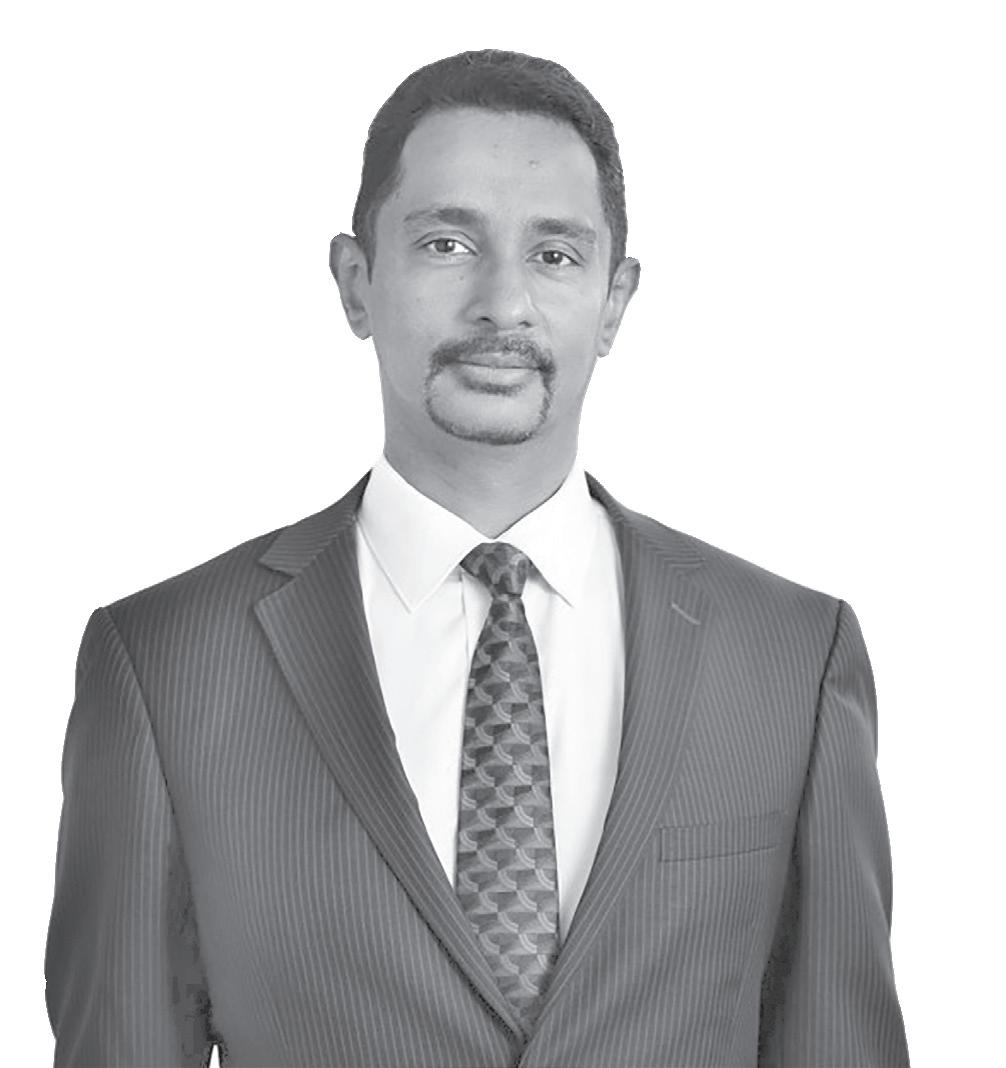
“I call Cornell the non-stuffy Ivy League institution,” Jayawardhana joked. “People are very open, supportive, collegial, and incredibly collaborative … It’s been really fun to partner with colleagues to generate ideas and identify priorities, but then also to actually work together to advance them.”
Most of Jayawardhana’s work over the past year has centered on addressing and implementing priorities identified by the faculty, including, most notably, the curriculum review. The two-yearlong review, which began before Jayawardhana started, initially
of the weekend, according to Fitzpatrick, and after the Zamboni was serviced, its exhaust’s carbon monoxide levels were “within specification.”
The building is back in service as of Monday and the figure skating classes scheduled for Monday morning were not affected. The reopening of the ice rink also comes with new paint on the ice surface depicting Cornell Athletics’ logo and some of the sponsors of Cornell Athletics.
Meredith Liu ’20 contributed reporting to this story.
Maryam Zafar can be reached at mzafar@cornellsun.com.
Marc Lacey ’87, former Sun editor in chief, will represent Te New York Times in October’s debate
By MARYAM ZAFAR
As 11 — and possibly more — Democratic candidates for President of the United States jostle and jibe on a national stage in Ohio next month, a hint of Big Red will be seen amidst a stage of blue: Marc Lacey ’87 will moderate the debate.
Currently the New York Times’ national editor, Lacey will represent the paper, moderating the October debate alongside CNN’s Anderson Cooper and Erin Burnett.
Since 2016, Lacey has overseen the Times’ national desk, a section that, through its 13 domestic bureaus, covers news and human interest stories spanning from Key West,
Florida to Nome, Alaska.
The former Washington D.C. correspondent began
write for The Washington Post, Los Angeles Times, before eventually landing at the Gray Lady almost
The New York Times hasn’t hosted a debate in more than a

By JOHNATHON STIMPSON Sun News Editor
Cornell University has been ranked the 17th best university in the country, according to the U.S. News and World Report’s 2020 rankings, falling one slot below the University’s ranking last year.
Each year, U.S. News ranks at least 399 higher education institutions (exclusively liberal arts programs are tallied separately) across the United States, judging the national universities on a wide
bevy of metrics — including graduation rate, class size, student-faculty ratio, standardized test scores of admitted students and the “expert opinion” of high school counselors and college administrators.
According to the most recent report, Cornell logged a student-faculty ratio of nine-to-one, median starting salary of over $65,000, an 88 percent of four-year graduation rate and 75th-percentile ACT score of 34 — scores that placed the school within the top echelon of the county, but were
not enough to avoid being eclipsed by Notre Dame and Vanderbilt.
Despite the slight slide, Cornell’s spot at 17 is well within its recent historical performance: Since 2012, the highest position the University has reached was 14th, when it tied with Brown University in 2018. In the past eight years of rankings, it has ranked at the bottom of the Ivy League each year save for 2015, when Cornell narrowly edged out its Rhode Island rival.
Princeton and Harvard retained their longtime
perch atop the rankings.
Though memes and prominent popular culture, such as The Office, have sometimes lampooned Cornell’s status in the rankings compared to its peers, the University’s drop was met with disinterest from most students — many of whom questioned the utility or accuracy of U.S. News’ report.
“To me, when you’re at the top 10-20 schools, the smallest details separate number 7 from number 8, and so on,” Kara Guse ’19 told The Sun. “So I really don’t care, Cornell has a
well-known brand and it will always be like that.”
In addition to student apathy, the report has also drawn the ire of academics and education experts, who have long questioned the magazine’s criteria, and whether it fairly assess education quality — or simply exclusivity and historical perceptions of prestige.
Despite retooling their ranking system last year to de-emphasize measures of selectivity, such as acceptance rates and SAT scores, The Washington Post’s education reporter Valerie Strauss still criticized the
revamped U.S. News as suffering from “junk in, junk out.”
“That’s pretty much what you get with most rankings of schools,” Strauss wrote. “The folks doing the ranking decide what is important to them or their audience, and, for some reason, consumers and schools themselves put a great deal of stock in the outcome of ever-changing, questionable methodology.”
Johnathan Stimpson can be reached at jstimpson@cornellsun.com.
the many who lauded Cornell's move
Continued from page 1
about graduate school, many students told The Sun.
“We’ve been working on it for a long time,” Andrew Griswold said. Griswold is a fifth-year student in the M.D./Ph.D. program at Weill who sits as the student overseer on the Board of Overseers at Weill. Last fall, Griswold said, he presented to the Board on student debt.
Presidential candidate and Sen. Bernie Sanders (D-Vt.) — a staunch advocate for cutting tuition costs — congratulated the University in a Facebook post for “doing what once seemed like an impossible dream.”
The staggering cost of higher education has become a hot-button issue across the country, as presidential candidates advocate for forgiving student debt. Many undergraduate students described the fatigue from already accruing hefty loans, even before graduate school.
In a tweet Monday night, Weill Cornell Dean Augustine Choi called Monday a “euphoric day and one of the proudest moments of my career.”
His announcement was met with glee from medical students.
“[Students are] just celebrating how it's just a huge load off of your shoulders, whether it's first year students who are going to benefit for four years, [or] second years, third years, even the fourth-year students who are getting one year benefit from the program are super excited,” Griswold said. “It was super exciting for the entire student body to know that debt will no longer be an issue for students.”
Given the notorious cost of living in New York City, the scope of the philanthropy-funded debt-elimination program — which will apply to a demonstrated need for housing — is an asset, too.
“There’s a sort of pride that comes with knowing my college is actually doing something about such a huge fear and obstacle for future doctors.”
Michael Cirelli '20
Many pre-med students told The Sun that they are wary of applications to Weill skyrocketing, like they did at the neighboring New York University after the school took the even more aggressive step of nixing tuition altogether for medical students. Applications to NYU’s medical increased by 12 percent increase, the school announced in January.
Shifts in tuition practices are especially relevant to medical school students, who, compared to professional peers, are typically burdened with the largest debt — and due to years of additional schooling and training, take the longest to begin earning income. Average medical school debt amounted to $190,000 last year, with 25 percent of those students carrying over $200,000 in loans, according to the Association of American Medical Colleges.
“It's still expensive to live in New York or to buy food in New York, which is something that's terrific about the program, the financial aid program that was rolled out. It takes into account not just tuition, but also living, learning, all things that are associated with expenses of attending medical school,” Griswold said.
“There’s a sort of pride that comes with knowing my college is actually doing something about such a huge fear and obstacle for future doctors,” Michael Cirelli ’20 told The Sun.
Cirelli, who plans to attend medical school after graduating, also posited that applications to the school may increase as a result of the move, but hopes that other medical schools follow Weill’s lead.
“This is a big step,” Cirelli said, “And I’m crossing my fingers.”
Maryam Zafar can be reached at mzafar@cornellsun.com.
TUITION
Continued from page 1
Cornell’s website states that the program currently has 1,390 students enrolled across its programs.
The announcement follows New York University’s well-received move last August to have a tuition-free medical school.
“[The] program includes all costs, which I don’t think anyone has done,” said Sanford A. Weill. Costs apart from tuition, including books
and expenses, will be included in the calculation. It will allow the school to “reach out to people not based on what they can afford, but what they can do to make the world a better place,” he said. Organization StudentDebtRelief.com says that the average medical school graduate carries $170,000 in debt, with a quarter of recent graduates owing more that $200,000.
“Why do I pretend I don’t have over 100 thousand dollars in debt right now?” asked Sarita Ballakur, a student speaker from the medical class of 2021, at the ceremony. “Because it’s overwhelming.”
“When I heard this announcement, I was shocked, I was overjoyed,” Ballakur said. “Even standing here, I can’t believe that the loans I took out a month ago won’t stay with me.”
Weill Cornell only offers financial aid to students who are born or natural-
“By investing in our medical students, we impart a lasting, positive effect on the healthcare landscape”
ized U.S. citizens, permanent residents or eligible non-citizens.
“By investing in our medical students, we impart a lasting, positive effect on the healthcare landscape across the country,” said Cornell President Martha E. Pollack in a Weill Cornell press release.
Dean Augustine M. Choi, who made the announcement, recently penned an op-ed on the issue of medical school burnout among students.
Today, he celebrated what he called “an exciting new era in medical education.”
Sarah Skinner can be reached at sskinner@cornellsun.com.
Maryam Zafar can be reached at mzafar@cornellsun.com.
decade, but in a letter sent to staff, the paper’s executive editor Dean Baquet and politics editor Patrick Healey wrote that it was time “to take a leading role in planning and hosting a debate.”
The two editors lauded Lacey’s work, praising his coverage of issues that have been pivotal at the previous democratic debates.
“[Lacey] has been working with the Politics desk to plan coverage around how voters’ lives have been reshaped by the job market and the economy, by immigration and inequality, by gun violence and the impact of climate change,” Baquet and Healey wrote.
Having served at the helm of The Sun, Lacey said in 1987 that
his time at the Ithaca-based student paper was the “most exciting, educational and memorable of my life.”
Thirty years later, Lacey has “done it all,” in the words of Baquet and Healey: His time at The Times encompassed work across the country, as well as Nairobi, Kenya and Mexico City, Mexico. And soon, he’ll be able to add moderator of a nationally-televised debate to his resume.
The candidates will vie for voters at Otterbein University in Westerville, Ohio on Oct. 15, and perhaps Oct. 16, depending on the number of Democrats who qualify for the debate.
aimed to propose “substantial restructuring” of Cornell’s liberal arts program, The Sun previously reported.
Under Jayawardhana’s stewardship, a number of reforms stemming from that review have or will soon be put into place.
For instance, students now have the option to take American Sign Language to fulfill their language requirement, and all incoming students will now participate in a college-wide advising seminar — a class fully rolled out this fall in order to give freshmen more comprehensive faculty advising and mentoring.
Another more “modest” achievement was increasing the Summer Experience Grants, “which allow students to take on unpaid or low-paid opportunities or internships that they might not be otherwise able to afford to take,” according to Jayawardhana.
“We’ve been able to double the funding given out this last summer,” he said. “It makes a difference because it helps level the playing field for our students. It really allows our students to combine a curiosity-driven liberal arts education … with developing skills that may be relevant for work after college.”
In the next year, Jayawardhana
hopes to expand opportunities for undergraduate research and to evaluate and alleviate gaps of access. Having previously served as Dean of Science for one of Canada’s largest universities, one of the most exciting parts of his job is being able to see student-faculty relationships and a shared passion for their work.
“I find it really satisfying when I visit faculty labs, [and get] the sense of how passionate our faculty members are about their work and their research and working with their students,” Jayawardhana said. “This is not just something we talk about and boast about, but it’s actually a reality that’s experienced by the students.”
In addition to student opportunities, Jayawardhana is excited to continue the process of hiring faculty to “build on excellence which already exists.” In the last cycle, the arts college has made 31 faculty appointments, adding to the school’s existing roster of over 600.
But faculty expansion is only one component of Jayawardhana’s broader strategy for evaluating room for growth and new initiatives.
“It’s not so much of growth in numbers,” he explained. “It’s both quantitative, but also qualitative. It’s raising the bar, raising the impact.”
As Jayawardhana asks his faculty to reach out into the community, he said they’ve taken this to heart and organized meaningful interactions.
One memory that stood out most from the past year was the 12-hour public reading of The Odyssey’s latest translation. Seventy people — Jayawardhana included — read throughout the day in Klarman Hall’s atrium. In the afternoon, the dean brought his five-year-old to the event.
“I thought, ‘This is going to seem unusual’ — but there were three other children playing around,” he recalled. “This is what it meant to be there … It was an intellectual event, but it was also a community event.”
That kind of collaboration and community are what have inspired Jayawardhana most in the past year, as he worked with associate deans, faculty and students to improve the College.
Reflecting on some of the most memorable moments of his past year, Jayawardhana shared a common experience of stepping back from his busy schedule.
“[I’ll] look down at a red sunset behind the clock tower,” he said. “It’s just a beautiful view of campus, and I walk across, thinking, ‘Wow, I get to work here.”
Kathryn Stamm can be reached at kstamm@cornellsun.com.
CEOs and another personal pledge entitled “I Act On.” Cornell President Martha Pollack signed the “I Act On” pledge, which prompted the “Check Your Blind Spots” tour to visit Cornell, according to the event description. The pledge encourages signatories to be aware of their own biases and to foster an inclusive environment in their communities.
Increasing diversity and inclusion has been one of Pollack’s priorities since she became president in April 2017. A presidential task force was formed for the 2017 to 2018 academic year to examine “bigotry and intolerance” on campus amid a number of incidents of racial discrimination at Cornell.
Some institutional initiatives proposed by the task force included reforming the campus Code of Conduct to give it a more aspirational rather than punitive tone, creating awards for faculty and students committed to increasing diversity on campus and requiring the deans at each of Cornell’s schools give an annual diversity and inclusion report.
Christina Woods B.S. ’08 MHA ’09, who is a senior manager and representative of PwC at the event, saw the interactive tour as a way to put different instances of discrimination into a more tangible perspective.
“It’s both an audio and visual
intensive walk-through of different blindspot scenarios,” Woods said. “You get to hear things that are maybe similar to other scenarios you’ve been through, but hearing other folks talk through it, it’s really designed to have you check and say, ‘Is that something strange? Is that a potential bias?’”
While Elizabeth Ederer ’21 enjoyed the tour, she believed that the people who visited the bus were already the ones most likely interested in issues of discrimination.
“I left it wishing it was more geared to college campus audiences,” Ederer said. “A lot of it was more for workplaces and work figures, but I wish it was geared more towards college students. I think the issue with it is that ... people who are not aware of their unconscious biases are really not likely to go in.”
Henna Hussain ’21, on the other hand, saw the event as a way to make members of the Cornell community more cognizant of their own biases.
“I think it’s always good to have on your mind,” Hussain said. “If you’re experiencing [unconscious bias] everyday, even if you know it happens, you don’t always realize or remember, and especially at Cornell, sometimes you get in your own bubble. I think it’s a good reminder that this kind of [discrimination] is going on all around us.”

Smash Ultimate has been in the news a lot lately. During the Sept. 4th Nintendo Direct, a pre-recorded show the company streams a few times a year to advertise its future projects, Masahiro Sakurai made a lot of announcements concerning the latest Smash entry. The long-running franchise’s creator confirmed that Fatal Fury character Terry Bogard would be the next fighter added to the roster, added several new Mii costumes to the game for immediate release and announced that more characters would be added to the game through paid DLC (DownLoadable Content) past what was previously assumed.
There’s a lot to unpack there. It’s very fitting for a game whose main slogan is “Everyone is here!,” meaning that every character from previous games (and a growing selection of new additions) would be included as playable fighters. For the uninitiated, Smash is a game where characters from a myriad of Nintendo and Nintendo-adjacent properties fight each other in a bigger crossover event than the Infinity War saga. The original Super Smash game came out on the Nintendo 64 with 12 characters and has been growing its roster ever since.
I watched the Terry Bogard reveal live on YouTube as thousands of public chat messages flew across my screen. I’ve never played Fatal Fury, so I was scouring the chat to try and figure out who this new fighter was. It didn’t seem like a lot of other people knew much about him either. And it turns out the 90s game was more popular outside of the US, but one message in particular caught my eye. “Aw, no new girls *insert frowny face emoji*.”
The commenter was right — it does seem like it’s been a while since Smash introduced a new female character. Back when Smash 4 came out in 2014, it felt like female characters were
being added left and right. Technically, that game only saw four new women — Palutena, Lucina, Rosalina and Bayonetta — but that was also the generation that gave us eight new fighters that allowed players to pick their gender through different outfit options. For reference, that generation also included eight new male-only fighters and two animals. I’m counting Pokémon, Duck Hunt and Piranha Plant as “plants/animals” and free of the constraints of gender for the purpose of this column. Ultimate has technically introduced three new female fighters, although Daisy and Dark Samus were previously alternate skins for Peach and Samus, respectively, making the only actual new female-only character Isabelle from Animal Crossing. Ultimate has also added nine new male-only characters, five of which can be described as “strong men with their arms out,” and only one gender-choice character. I’m not sure where to sort Banjo and Kazooie — I just learned while researching this that Banjo is a boy and Kazooie is a girl, so I guess they’re in their own category with the Ice Climbers. When Ultimate was first released, Nintendo stemmed the inevitable roar of fans demanding their favorite characters by assuring them that five characters would be rolled out post-release through DLC. After that, there would be no more new fighters, at least until the next game. In the months since, I’ve been holding my breath every time Nintendo makes an announcement, hoping I’d recognize . . .
To continue reading this column, please visit www.cornellsun.com.
Olivia Bono is a Senior in the College of Arts and Sciences. She can be reached at ojb26@cornell.edu. On the Level runs alternating Tuesdays this semester.

DANIEL MORAN SUN ASSISTANT ARTS EDITOR
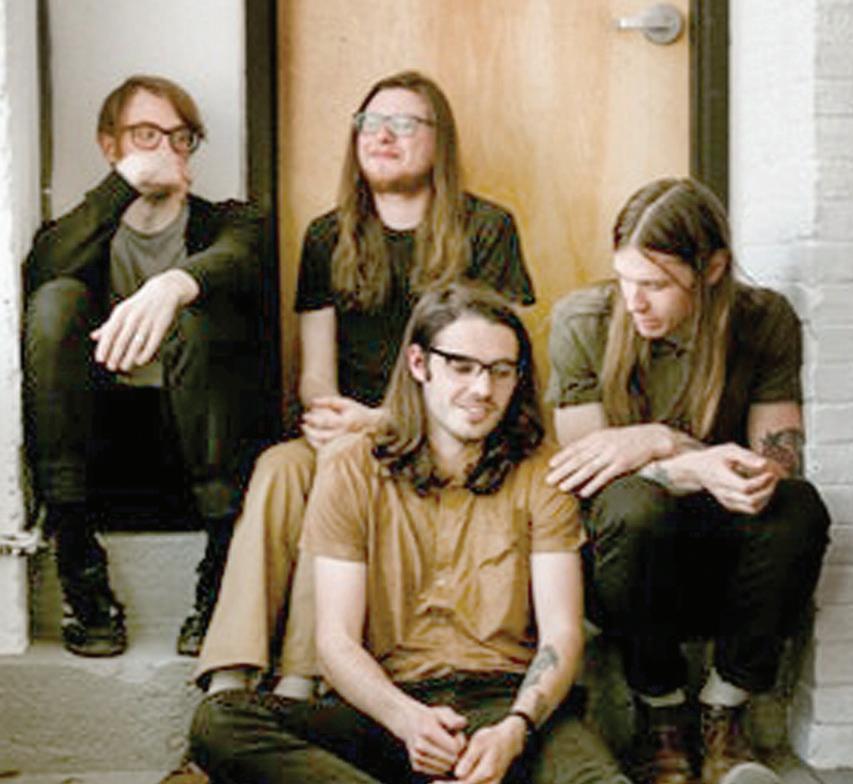
Slaughter Beach, Dog is bringing their eclectic folk rock to the Haunt this Wednesday, Sept. 18, accompanied by opener Cave People.
Slaughter Beach, Dog’s newest album Safe and Also No Fear is the first full project that incorporates a full band rather than just being a songwriting side project by lead singer Jake Ewald. This album also marks a monumental shift in sound from Slaughter Beach, Dog’s former indie-emo-pop soundscape.
Lead singer Jake Ewald and bassist Ian Farmer have collaborated in the past through their former band, Modern Baseball. Although this band launched their careers, Slaughter Beach, Dog is stylistically miles away, incorporating darker, existential concepts rather than the collegiate musings that dominated Modern Baseball’s discography. If you miss Modern Baseball, Slaughter Beach, Dog may not be a perfect substitute, but it’s absolutely the next best alternative.
If you’re looking for a band with beautiful, clever lyrics, look no further than Slaughter Beach, Dog. Tracks such as “Your Cat” and “Acolyte” are witty yet durable enough to both make you laugh and get chills from the emotions they solicit.
Slaughter Beach, Dog is sure to be in for a good live performance, as songs such as “Black Oak” and “One Day” are intricate, well crafted grooves seemingly built for concerts. Additionally, Ewald is known for his lovable personality, which will be on display in an intimate venue like the Haunt. The show starts at 8 p.m. with doors opening at 7. Tickets are available online through Ticketfly, and people under 18 must be accompanied by a parent or legal guardian.
Built to Spill is playing to sold out crowd at The Haunt tonight. If you can still find some tickets, you would be stupid not to go. This late ’90s band has a chemistry unlike any other, expect for an extremely lively crowd down by the water tonight.
Lettuce will be performing at The State Theatre of Ithaca on Wednesday Sept. 18 with special guest Butcher Brown. Lettuce is a self described art-rock band that takes on a spectrum of genres including hip hop, funk, jazz, soul and avante-garde. The band is a six person effort and was originally formed by alumni from the Berklee College of Music. Be sure to grab your tickets now at the DSP Shows website.
Last but not least, Upstate will be taking the stage at The Haunt on Sept. 21st. DSP describes the band on their website: It’s an identity that’s undergone a radical evolution in the last few years ... Those changes have culminated in the band’s dazzling new album, a collection that showcases ... [an] adventurous blend of folk, R&B, jazz, gospel and rock and roll.
Daniel Moran is a junior in the College of Human Ecology. He can be reached at arts@cornellsun.com.
By DEANA GONZALES Sun Staff Writer
When it comes to communicating climate risks, Jamie Herring Ph.D.’07, president of Habitat Seven, thinks that climate data can be used to make people feel closer to the impact of climate change and thus to urge them to act.
According to Herring, a current problem is that climate change has always been perceived as a distant problem by the public. As scientists cannot attribute an extreme weather event to climate change, people don’t feel like individual action matters or that climate change is an urgent issue, Herring said.
At the same time, vast amounts of research conducted in climate communication show that “people act on urgency and perceived risk ... the more proximate the risk, the more likely you are to act on that risk.” Therefore, to bridge this information gap, it is important that people internalize the negative effects of climate change so that the risks to feel closer in proximity, he said.
Herring, who studied under Prof. Jim Lassoie in the Department of Natural Resources, teamed up with his advisor to come up with the idea of developing shared learning experiences between researchers, practitioners, and students. He made documentary videos with practitioners in the conservation field where
they developed case studies to bring back to the classroom. This model was eventually called Conservation Bridge.
Taking his passion one step further, Herring founded Habitat Seven, a data infrastructure firm that “helps organizations develop web-based data applications for a more secure, sustainable future,” according to its website.
To change people’s complacency towards climate change, Herring believes that using digital tools such as climatedata.us, which was launched in support of the White House’s Climate Action Plan under former President Barack Obama, will help emphasize climate change as a present problem instead of a distant one.
Along with trying to understand people’s risk perception about climate change, Herring partnered up with the University of Texas to conduct a study where the researchers showed people their own city and far away cities across the United States.
“If you’re looking at something closer to you, you’re going to be more motivated to understand climate change and feel that there is a bigger risk [...] What we found is that it didn’t really matter,” Herring said.
Herring thinks that the science community needs to make climate data more meaningful.
“Now more than ever, climate data
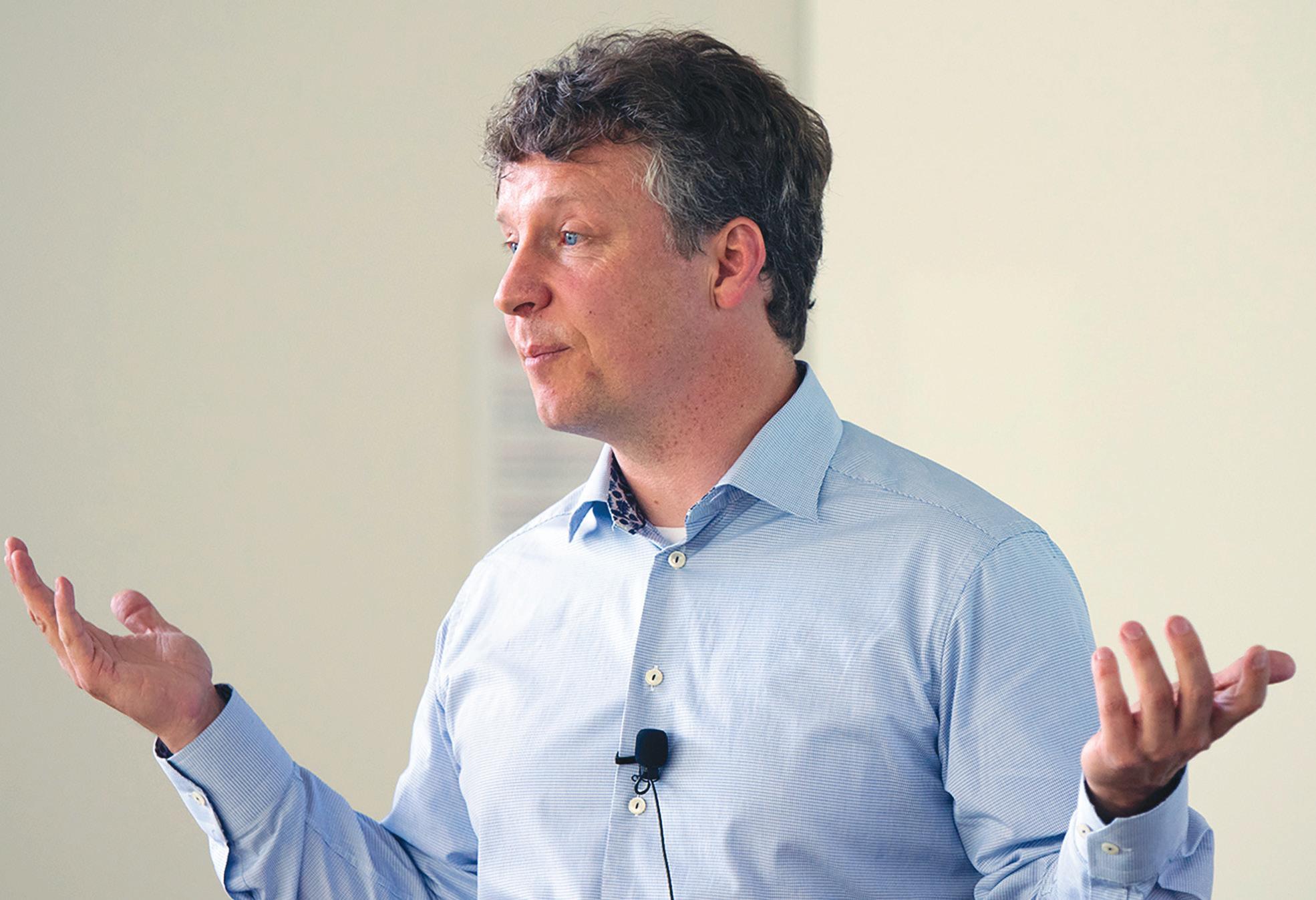
needs to be proximate both in space and time. If we’re not acting on risks 10, 12, 30 years down the road … we’re not going anywhere close to the speed we need to mitigate the worst effects of climate change,” Herring said. Ultimately, there is a lot of work that still needs to be done. As a start, Herring has created the James P. Lassoie Global Conservation Travel Fund that will be
launched by 2020. This will be an ongoing fund that will provide $5,000 a year in travel funds to students in the College of Agriculture and Life Sciences who are doing global conservation work.
By CATHERINE CAI Sun Staff Writer
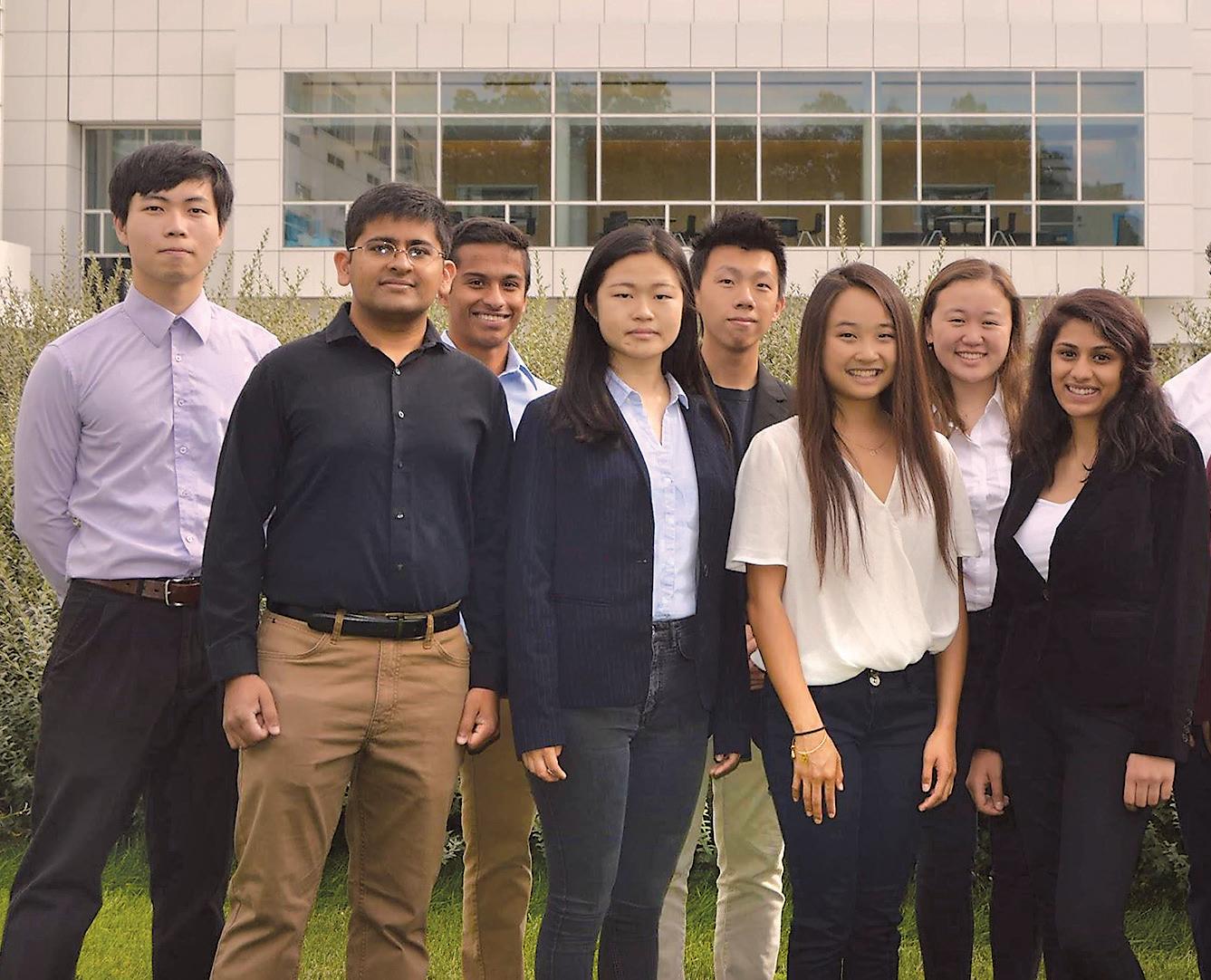
At the intersection of medical research and engineering, Cornell University Biomedical Devices Team works on various projects that can be applied in real-world medical settings. Founded in 2018 by a group of biology students eager for more hands-on work, the team has now grown to three subteams, Product Development, Policy and Practices and Business, consisting of members from many dif-
ferent colleges.
“The founding members and I were from Cornell Surgical Society. It was a group of us with a passion for medicine interested in designing surgical devices for possible competitions,” CUBMD project team lead Oscar Liu
’21 said.
CUBMD’s goal is to design effective biomedical devices that can conceivably be used in reallife healthcare settings. Designing such devices involves planning and product development as well as research on health policy and market value.
According to Liu, the team addresses two main components of product design: reducing the extravagant prices associated with contemporary medical products and identifying real clinical needs and deficiencies in healthcare.
CUBMD submits its projects to competitions such as the Create the Future Design Contest, which is sponsored by science and tech companies such as Siemens, Intel and HP.
CUBMD’s 2018 Project, FastenPro, is a device that secures the screws used in orthopedic surgery. It would eliminate “back out,” in which the screws in the bone loosen, and thus contribute to faster operation and
healing times. In addition to the design thought process, their entry includes cost analyses and comparisons to current options.
Lead of the business team Varun Rohatgi ’21 works with members to determine the clinical need for products and how to realistically implement their project within typical healthcare settings.
“Over the summer, I sat in on meetings at my local clinic,” Rohatgi explained. His team evaluates items like costs of production, market opportunities, and other restraints that would apply should the product actually go to the market.
Jonah Schieber ’21 is a member of the Policy and Practices subteam, which collaborates closely with the Business subteam. He and other members of the subteam research product patenting and how their products could be covered by insurance.
The team also reaches out to professors and healthcare practitioners and studies past examples of innovations in
the healthcare field to improve their own production and marketing techniques.
Rachel Lee ’22, also on the Product Development Team, described how CUBMD first caught her eye as a special opportunity to bring her background as a chemical engineering major to medical questions. Lee has enjoyed getting to know people of different backgrounds through one project.
For her, working with people of different backgrounds but the same mentality was another unique opportunity presented by the team.
“You might pitch a new idea, and someone on the team could show you how to see it in a new perspective,” Lee said.
CUBMD is currently recruiting members for the fall and is set to become a registered project team by the spring, according to Sanghvi.
at ccai@cornellsun.com.
137th Editorial Board The Corne¬ Daily Sun Independent Since 1880
ANU SUBRAMANIAM ’20 Editor in Chief
JOYBEER DATTA GUPTA ’21
Business Manager
PARIS GHAZI ’21
Associate Editor
NATALIE FUNG ’20
Web Editor
SABRINA XIE ’21
Design Editor
NOAH HARRELSON ’21
Blogs Editor
SHRIYA PERATI ’21
Science Editor
KATIE ZHANG ’21
Dining Editor
AMINA KILPATRICK ’21 News Editor
MARYAM ZAFAR ’21
Editor
ETHAN WU ’21
Editor
SHIVANI SANGHANI ’20
Assistant News Editor
NICOLE ZHU ’21
Assistant News Editor
MILES HENSHAW ’20
Assistant Sports Editor
JING JIANG ’21
Assistant Photography Editor
JEREMY MARKUS ’22
Assistant Arts & Entertainment Editor
DANA CHAN ’21
Production Editor
RYAN RICHARDSON ’21
Snapchat Editor
ALISHA GUPTA ’20
SHRUTI JUNEJA ’20 Senior Editor
AMOL RAJESH ’20
Editor
Working on Today’s Sun
Ad Layout Krystal Yang ’21
Production Deskers Ben Mayer ’21
Mei Ou ’22
SARAH SKINNER ’21
Managing Editor
KRYSTAL YANG ’21
Advertising Manager
MEREDITH LIU ’20
Assistant Managing Editor
RAPHY GENDLER ’21
Sports Editor
BORIS TSANG ’21 Photography Editor
AMBER KRISCH ’21 Blogs Editor
KATIE ZHANG ’21
Editor
SOPHIE REYNOLDS ’20 Science Editor
AMINA KILPATRICK ’21 News Editor
MARYAM ZAFAR ’21
ETHAN WU ’21
Editor
SEITZ ’20
ZHU ’21
JIANG ’21
Photography Editor
MARKUS ’22
WU ’21
Editor
WANG ’20
Editor
McDOWALL ’21
ARORA ’20
Editor BREANNE FLEER ’20
News Deskers Maryam Zafar ’21 Johnathan Stimpson ’21
Design Desker Lei Lei Wu ’21
Lei Anne Rabeje ’22
Photography Desker Boris Tsang ’21
Sports Desker Christina Bulkeley ’21
Arts Desker Peter Buonanno ’21
Cornell’s College of Engineering has more than a few crowning jewels to stake its pride and reputation on — like its extensive set of project teams, its cutting-edge research with world-renowned professors and, of course, the fact that 53 percent of its incoming class is now female. In fact, the college’s website lists the latter number first, even before the fact that the college hosts one of the top 10 undergraduate engineering programs in the country.
But why care so much? Why even bother working so hard to get that even male-female ratio in a male-dominated field? The reason — as anyone in engineering admissions can recite by heart — is to make it so that anyone, regardless of who they are, feels welcome, as though who they are and what they look like isn’t an obstacle to be overcome in their success there. To achieve this, you need both diversity, where the College of Engineering excels, and inclusion, where it doesn’t.
As a third-year Electrical and Computer Engineering major, I’ve never had a single female professor or graduate TA in any of my major classes. Student-run clubs like the Society of Women Engineers and Women in Computing at Cornell offer
To encourage women to thrive in the College of Engineering, allowing women to exist in the same environment as men isn’t enough.
invaluable support to female engineers, I’ve yet to see any efforts made by the college itself or individual majors. Past enrollment, it’s up to female engineers to support each other.
I’ll admit I’m already pretty spoiled. When my internship supervisor told me that a roughly 75/25 male-female ratio in a workplace was considered remarkably good, I was a little horrified. Just the existence of an equal gender ratio is something the female engineers of our parents’ generation would consider an unimaginable luxury. But when you dig a little deeper into
You need both diversity, where the College of Engineering excels, and inclusion, where it doesn’t.
Cornell’s Engineering program, the ratios don’t stay even. In 2018, only two out of the 25 Engineering Physics Bachelor’s degrees were awarded to women, a meager eight percent, although that engineering graduating class overall was 40 percent female. Few majors were evenly similarly by gender; most leaned heavily in one direction. 28 percent of Computer Science degrees went to women — yet so did 74 percent of Biomedical Engineering degrees.
Certainly, the autonomy of the students to choose their own majors causes a certain degree of self-segregation. But for a school that has already succeeded in defying the odds to create an even gender ratio, why are there so many internal disparities? And why is nothing being done about it? It seems that while some majors succeed in creating an inclusive environment for women, others don’t, can’t or won’t. And perhaps this is because the College of Engineering doesn’t care about its female engineers once they’ve enrolled, adding to the statistics that demonstrate its diversity.
There isn’t much being done to actively make female engineers feel welcome in the majors where it’s needed most. Although I understand that the ratio of older female engineers makes it difficult to find qualified female professors, a complete lack of older women in your career path feels pretty daunting. Without anyone who looks like you, has a similar background to you or can empathize with your path to becoming an engineer in your major, forging your own path to a future there seems daunting.
To encourage women to thrive in the College of Engineering, allowing women to exist in the same environment as men isn’t enough. In a male-dominated field, passivity is equivalent to exclusion. Once women have enrolled in the engineering school, the engineering school as a whole and the individual major heads need to, if nothing else, convey to women that they belong there to counter the outside messages that they don’t. Women are constantly sent the message that they don’t deserve to be where they are. My high school physics professor, upon hearing that I had gotten into Cornell’s engineering program over the boys on his robotics team, remarked, “It’s really just about checking the boxes nowadays.” Whenever the newest statistics on the gender ratio of the incoming engineering class comes out, I inevitably overhear some conversation between two men expressing the sentiment that it’s just easier for women to get in, and therefore they’re not as deserving to be here as they are.
One place we can look for ideas on how to make the majors more inclusive is by examining the reasons that women choose to leave the STEM fields altogether. A recent study by MIT found that the primary reasons for this include a predominantly masculine culture, patronization and exclusion in group projects and sexism during internship experiences. Majors need to direct efforts toward reducing this however they can, by both educating their existing male professors and working to hire women on every level, from undergraduate and graduate TAs to professors and lecturers. From my many conversations with other female engineers, it’s clear we’re all plagued by selfdoubt and imposter syndrome which the even gender ratio does little to eliminate. Honestly, I would appreciate any acknowledgment from my major that they are aware that female engineers exist and that they’re making an effort to make us feel included in a field known for its overwhelming male presence.
What I’m afraid of is complacency in the College of Engineering. While the college continues to tout its even gender ratio, a lack of gender inclusion festers in the college itself. While they pour their money into recruiting young women to enroll in the college, its former recruits are left to fend for themselves. While it’s prudent to pour resources into the college’s future, these efforts are useless if the present students are neglected.
As I casually scrolled through my Facebook newsfeed last month, a particular ad caught my eye. It seemed like one of those SAT test prep ads with a 20-something year-old Asian female holding books and gazing at the camera with a look of promise. It wasn’t until I read the name of the agency and the cheerful caption, “Make up to $10,000 and help out a family!”, that I realized it was an egg donation advertisement. I quickly scrolled back down my newsfeed, brushing off the thought that this had anything to do with me.
But then again, a similar ad appeared on my Instagram feed just a couple days ago, once again encouraging me to monetize my eggs. That’s when it really struck me — how disturbing it is to see targeted ads that
Egg donation advertisements target students like myself who would be eager to make a relatively effortless $10,000 (who wouldn’t?).
pus newspapers.
Egg donation advertisements are especially problematic in how they are delivered. They target college students like myself who would be eager to make a relatively effortless $10,000 (who wouldn’t?) to minimize the costs of the sky-high tuition at this University and the additional costs of living. Donation seekers often search for Asian women in their early to mid-20s who match their ethnicity and are supposedly smart, sometimes specifying that they attend Ivy League institutions. Some agencies even request transcripts or SAT scores to be mailed along with the egg donation application. Helping an infertile couple achieve their desire to raise a child in a supportive family environment should be something to be celebrated. But when the recipient requests a particular set of physical and ethnic traits, the process becomes a much greater problem. As wealthy recipients provide unlimited monetary compensation to find the perfect match, they are seeking very specific qualities, which is nothing short of promoting eugenics. Those from higher socioeconomic statuses who choose “beautiful and intelligent premier Asian egg donors” not only reinforce racial stereotypes but also essentially create a child processed and refined to their exact standards and based on their coveted characteristics.

deal with an entity as personal as our reproductive systems. I now expect social media platforms to share my information to advertisers. Yet, I couldn’t help but think how creepy it was to be presented with an egg donation ad as someone who has never attempted nor even considered giving away their eggs. The idea of advertising to sell one’s reproductive cells had never occurred to me until I realized that it was more commonplace than I thought, with egg donor ads running across other cam-
In addition to the issue of artificial selection, the way in which the egg donation operation is advertised is also rather bothersome. The emphasis on monetary rewards is especially appealing to those in their 20s who are often most in need of fast cash to pay off student loans as they get by in post-grad life or to support their family. The compensation is also extremely high, with payments usually ranging from $5,000 to $20,000. The social acceptance of egg donation is remarkably baffling since prostitution is condemned and illegal — when both prostitution and egg
Pallavi Kenkare | Jabberwocky
Idonation involve the commodification of women’s bodies in one way or another. Not only are egg donations largely bet-
I don’t need advertisements assessing my anatomy’s monetary worth based on the mere fact that I’m a fertile Asian woman.
ter-paying, but it can be completed anonymously, providing a strong incentive to partake in the procedure without giving too much thought.
The philanthropic nature of phrases like “help a family” captivate altruistic audiences with little context on the real risks associated with the procedure. At a quick glance, many of the egg donation agency websites highlight the process, costs and potential resources with little information on probable future risks. While short-term side effects are rare among egg donors, long-term complications involved with the procedure are widely unknown as there have been no major systematized studies on the long-term effects of egg donation.
Next time I run across another one of these ads, I hope the agencies make their services seem like more than just a transaction for helping out a (most likely rich) family seeking to win the lottery by producing a child with their desired ethnic traits and level of intelligence. I don’t need advertisements assessing my anatomy’s monetary worth based on the mere fact that I’m a fertile Asian woman.
DongYeon (Margaret) Lee is a senior in the School of Industrial and Labor Relations. She can be reached at margaretlee@cornellsun.com. Here, There, Everywhere appears alternate Tuesdays this semester.
t’s 1 a.m. in the Alice Cook Gothics and my contact-lensed eyes are burning as I stare into my laptop screen. My roommate is snoring gently and all I have to do is fire off a few quick notes before I can hit the twin bed. I assume my signature slump against my pillows and start typing.
“Dear Professor, would you be so kind as to …?” No, it’s not the 1800s. “I was wondering if I could ask you to …” Why am I wondering instead of just asking? No one wants to be that kid who starts essays with “I think” instead of cutting to the opinion. “Would you mind …?” Something feels off, but I continue. I agonize over the conclusion: “Sincerely” is too formal, I’ve said “Thank you” no less than 22 times in the email and though “Love” is probably the most accurate (the Professor is a PILF), I settle on “Best Regards” and send my paragraph into the void. My inner masochist urges me to reread it once sent
could successfully ask for your correspondent’s hand in marriage … all to stay in the good graces of a professor who once called you ‘Miss Purple Jacket’ in Bailey Hall. You reread your piece of art for the seventh time, click send and heave a sigh of relief. Three days later, the professor replies, “Sure, whatever — Sent from my iPhone.” You begin the process of concocting an even more grateful follow up.
You reread your art for the seventh time, click send and heave a sigh. The professor replies, “Sure, whatever — Sent from my iPhone.”
— I’ve spelled my first name wrong.
Writing emails is the soul-sucking WORST. Why it takes me an hour to formulate two sentences asking a professor to change my grade from the four percent he entered into Blackboard to the 40 percent I actually earned (at this point, does it even matter?) is a point of constant amazement to my family. Cornellians, unite. Admit it. You’ve definitely meticulously crafted an email that is unnecessarily apologetic, ingratiatingly brimming with gratitude and
adored spawn, and offer help before you raise your own request.
Now onto the body:
Email writing is a pain, a punishment from God sent in the name of ‘networking.’
And this is the best-case scenario. Don’t even get me started on the angst of asking a professional contact if she could go over your resume “real quick when she has a chance,” or reaching out to someone you’ve never met on the advice of a casual acquaintance (“Just mention that you know my husband’s dog’s uncle! They went to college together!”) or following up after your dream job when the interview lasted 10 minutes and no one’s gotten back to you for … 10 months. Cornell, can we please, please have a class on this? A flowchart?
A detailed set of rules? For example, a how-to guide on an email to a distant family member, as you wonder innocuously about any summer jobs she might have at her law office:
Dear Aunt (who I threw up on when I was three and never saw again),
How are you? How is your daughter?
I hope her college applications are going well. If she wants to talk (about how I made the horrible mistake of getting stuck on an Ivy-League glacier), I’d love to help out!
Remember to include questions about
My mother mentioned that you worked at Snooty & Snootier law firm. I am a history major (hopefully — I forgot to submit my application to the college) at Cornell and am looking for internships in the legal field (as I frantically attempt to begin a career that will leave me financially stable). If your firm hires any undergraduates over the summer, I would love to be considered (I will fetch coffee, make copies, do any soul-numbing, menial task). Thank you so much for your time! I would love to see you at the family reunion in (god-forsaken, who-chose-thisstate) Alaska this summer.
Get straight to the point, throw in the Ivy League clout. Make sure to thank the relative, and once again, emphasize the family connection even though you know she and your mother have been feuding for the past decade. Cross your fingers, pray, hope for the best. Conclusion: Love, Pallavi I miss the third grade days where the biggest worry about emails was whether to change your signature from a breezy and cosmopolitan “chiao” (this was my actual fourth-grade signature — che bello!) to “Live, Laugh, Love.” Or whether the email you forwarded to your 50 best friends that guaranteed your crush would kiss you tomorrow was actually a virus. Or whether the nasty rant you sent Mimi over the club she and Emily secretly made to exclude you from the friend group counted as cyber-bullying.
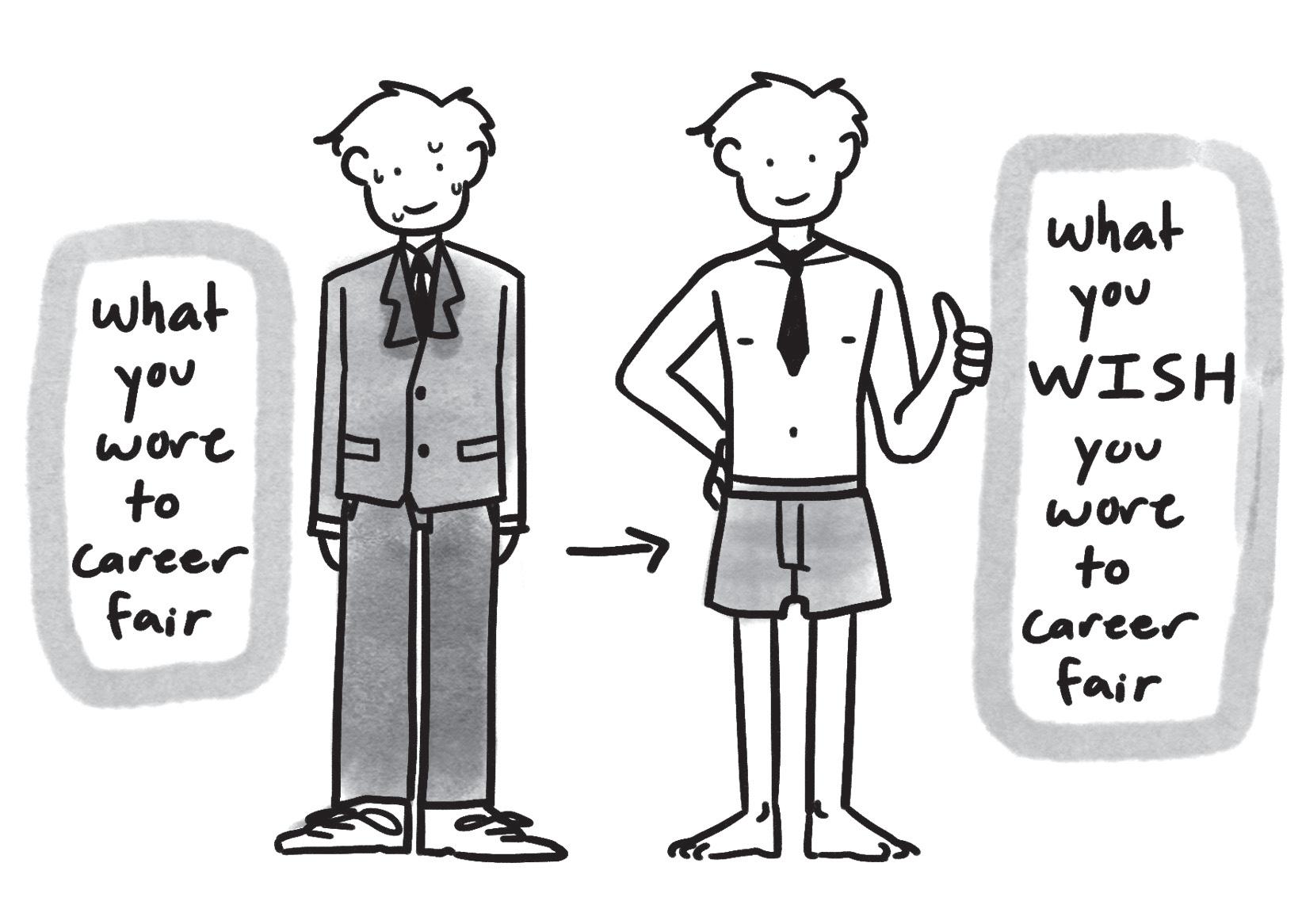
But enough reminiscing. Email writing is a pain, a punishment from God sent in the name of ‘networking.’ Words can come across badly enough in person, and that’s with the weapons of vocal tone and facial expression in your arsenal. But sending digital communications splayed blandly on a white screen is playing with fire. Cornell, universities nationwide, the Gods Above — please, create a class, an acceptable template — a support group! From Archies, to engineers, to Klarmanites, the woe and discomfort of email writing unites students campus-wide, as anxious 20-somethings striving for professionalism in a shark tank incubator of finance bros. And kids, this doesn’t get easier; I’m a junior facing my third career fair, comfortable in the knowledge that no matter how charmingly and consistently I email Goldman, they’ll never email back. So please, end my anguish over which phrases would be acceptable
From Archies, to engineers, to Klarmanites, the woe and discomfort of email writing unites students campus-wide.
to address my mentor’s favorite professor’s grad student, who’d “probably, maybe, love to speak with you — shoot them an email.”
Pallavi Kenkare is a junior in the College of Arts and Sciences. She can be reached at pkenkare@ cornellsun.com. Jabberwocky runs every other Wednesday this semester.

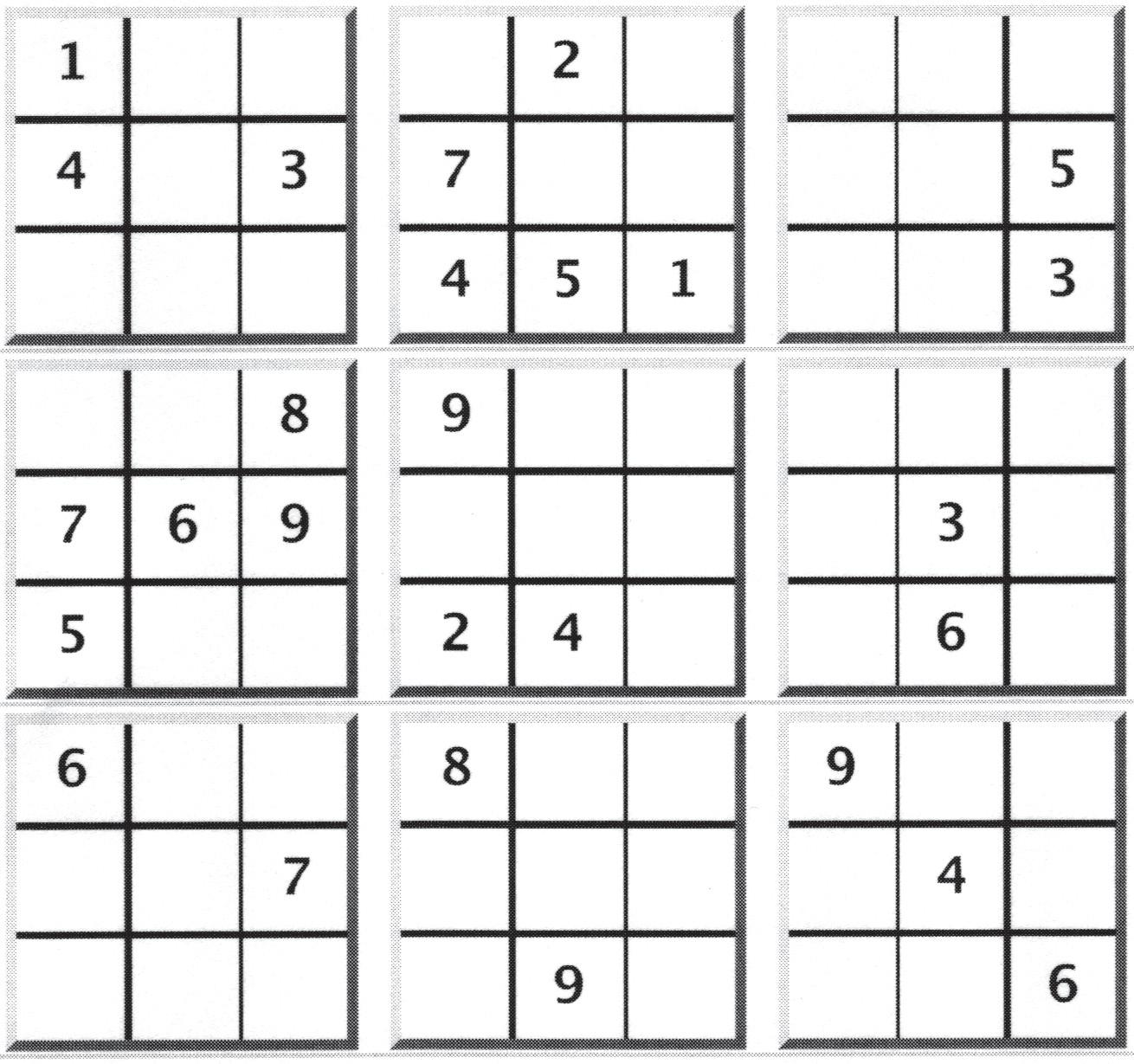
Fill in the empty cells, one number in each, so that each column, row, and region contains the numbers 1-9 exactly once. Each number in the solution therefore occurs only once in each of the three “directions,” hence the “single numbers” implied by the puzzle’s name. (Rules from wikipedia.org/wiki/ Sudoku)
Houses, Apts, Parking
1 to 9 Bedroom
Collegetown - College Ave, Linden Ave, Dryden Rd, Bryant Ave, Cook St. 607-330-2442 info@urbanithaca.com www.urbanithaca.com
We have availability for the 2020-2021 school year beginning June 1st at Hudson heights apartments. The studios include electric, heat, water, garbage and parking. There is coin-operated laundry facilities on site. Prices start at $750 / month for a 12 month lease. If you have any questions or would like to schedule a tour contact us by phone 607-280-7660 or email: renting@ithacaLS.com
COLLEGETOWN TERRACE APARTMENTS
Spring 2020 Semester Leases Available Heat, hot water and Wi Fi included Free State of Art Fitness Center Free Shuttle Bus Service to campus Washer & Dryer in Apartments collegetownterraceithaca.com office@ithacastudentapartments.com (607) 277-1234
Now Renting
2-10 Bedroom Houses/ Apartments for 20-21. All Locations. Call today or visit our website: Certified Properties of TC Inc certifiedpropertiesinc.com 607-273-1669
2020-2021
Studio 1, 3, 8 & 11 BR Apts. Great Locations in Collegetown. 607-227-2535
1, 2 & 5 Person Apts. Overlooking Cascadilla Gorge Architecturally designed. Decks, patio, fireplaces, Jacuzzis. Furnished, parking, internet. Utilities included. 607-592-7564
27 H OUSE FOR R ENT
20-21 College Ave. 5 BR House Furnished. Laundry. Parking. Call 607-273-8576
20-21 Upper Eddy St. 7 BR house Furnished. Laundry. Call 607-273-8576

Continued from page 12
season, this isn’t a question that will generate any other answer. The Cornell offense isn’t going anywhere without Coles. Who is going to be a key player on defense?
R.G.: David Jones
A senior cornerback, Jones is one of Cornell’s best playmakers on both defense and special teams. The Sugar Land, Texas native had three interceptions and was named an All-Ivy second team corner. If Jones can put together a few games like his one at home against Sacred Heart last season — a pick-six, another interception and a big punt return to set up a score — he’ll be a difference-maker in two of the game’s three phases. He’ll also be expected to match up with and try to slow down some of the Ivy League’s best skill players.
also on pulling off the moves necessary to score those extra couple points — with Archer’s talks of new, advanced strategy this season, maybe that will be the marginal difference. The team will take points wherever it can get them to put it over the top.
What is something you’re paying extra close attention to this season?
C.B.: Archer’s updated approach to the game Archer said that in the past, his style was simply to be better than the other team. He counted on his players simply outplaying their opponents. This approach, suffice to say, has not been successful. I’m going to be watching how Cornell puts in the extra effort to run tricky plays and outsmart its opponents. The Red needs to do more than play better — it needs to start playing smarter.
Senior running back Harold Coles will need to hit double-digit touchdowns and 1,000-plus yards again for Cornell to sport an effective offense.
L.P.: Jelani Taylor
Following captain Reis Seggebruch’s ’19 graduation, Jelani Taylor assumes the role as the main leader of the defense. The senior is more than capable of handling this task as he boasts impressive on-field production. In 2018, Taylor totalled 72 tackles and nine pass breakups, both of which led the team. Ever since his emergence in the back-half of 2017, Taylor has been a core piece for the Red defense, and the team will need him more than ever this season to step up in the face of lost production.
C.B.: David Jones
Archer has a lot of faith in Jones, going so far as saying he’s at the top of the Ivy League when it comes to players at his position. He’s going to need to be someone that the Red can rely on and match the level of play we saw last year in order for the team to achieve success.
What will be an X-factor this season?
L.P.: The offensive line
Cornell’s line can easily break or make its season. If the unit fails to hold up after the graduation of four seniors, it will be a long and painful year for the Red offense. Coles will find himself consistently running into a swarm of defenders, and the quarterback combination of Kenney and Catanese will have little time to distribute the ball. The line does feature senior captain George Holm III at left tackle and Nick Busher, who started at left guard for the last eight games. But besides those two, the rest of the unit is quite inexperienced. The remaining positions will be filled by Jack Burns, Hunter Nourzad, Zach Rode, Robert Fatovic — all of whom are sophomores.
R.G.: Health
Whether the team’s offensive playmakers can stay on the field will determine whether we see success or a total mess this season when Cornell has the ball. Junior tight end John Fitzgerald was the team’s leading receiver through two games last year before suffering a season-ending injury. Catanese added a spark and a couple bigtime touchdowns before missing the second half. Junior receiver Eric Gallman missed almost his entire freshman year with an injury before having an up-and-down sophomore campaign. If these three pieces can stay on the field and produce consistently, Cornell’s offense will be good enough to compete in the Ivy League.
C.B.: Pulling off close games
Last year, Cornell lost two games by deficits in the single digits; tough breaks seemed abundant for the Red. The team needs to work on not only staying in its games but
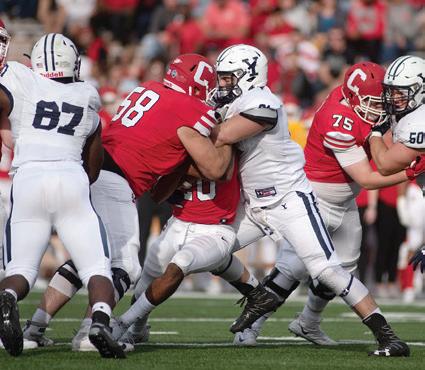
R.G.: The Sept. 28 game at Yale Cornell has been so close against the Bulldogs in their meetings each of the last two seasons, and gets a crack at the preseason favorite in its first Ivy game of 2019. If Cornell can pull off the upset road victory by slowing down quarterback Kurt Rawlings and Yale’s high-powered offense, it will set the Red up for a momentum-creating winning streak with a winnable Homecoming game against Georgetown in Ithaca the following weekend.
L.P.: How Cornell performs in the latter stages of the season
As I mentioned before, Cornell has gone winless over its final few games each of the past two seasons. Obviously, these marks are influenced by the fact that these later games pit Cornell against Ivy League foes who present a far greater challenge than non-conference opponents. But still, Cornell has notched a number of Ivy wins in the earlier stages of the season while failing to replicate those in October or November. The schedule remains tough as the Red faces the likes of Princeton, Penn, Dartmouth, and Columbia to close out the season. All of those aforementioned opponents defeated Cornell last year.
Complete the sentence: Cornell will achieve its first winning season since 2004 if…
R.G.: it can be a second-half team.
Cornell has struggled down the stretch of close games and — more importantly — in the final weeks of recent seasons.
The Red finished 2018 with four straight losses and ended and 2017 with 0-3 in its final three contests. If the Red has any hope of achieving a winning mark, it needs to improve as the season goes on and play its best football in November. Past seasons have seen Cornell inspire a bit of hope in September and October before crashing back down to earth and limping through the finish line. On paper, Cornell doesn’t have a great chance against Yale, Princeton and other tough Ivy opponents. The Red’s only chance is improving as the season goes on and being able to compete once opponents have film of what works.
C.B.: it sticks to its new plans. Archer is promising innovation going into this season, and without it, the team isn’t going to finish above .500. The Red will need to stand by its improved tactics and learn to make them work for the team. Archer knows that his old ways didn’t work, and he is determined to make some changes. In addition to just the on-the-field plans, he’s making himself as accessible as possible to his players by establishing a player leadership cabinet, exemplifying his dedication to figuring out what works for his team and the individuals on it. If the team can go all-in on its promises to really switch things up, a winning season could be in the cards.
L.P.: Archer’s new schemes allow the team to effectively employ a ground-and-pound attack.
The offense will run through Coles, but his success is not only dependent on Archer’s new schemes, but the quarterbacks and offensive line that play in front of him. If any of them struggle, the Red’s offense will be stuck in the mud. Meanwhile, the defense needs to make a marked improve-
The Red will need to stand by its improved tactics and learn to make them work for the team. Archer knows that his old ways didn’t work.
ment. While the secondary has played fairly well over the past couple years, the defensive line and linebackers need to step up to generate more pressure and halt opposing ground games. In order to reach the six-win mark, the Red would likely need to notch at least two non-conference victories along with four Ivy wins — a tall task for a team that has only reached three Ivy victories once in Archer’s six-year tenure.
Te Sun sports department can be reached at sports-editor@cornellsun.com.
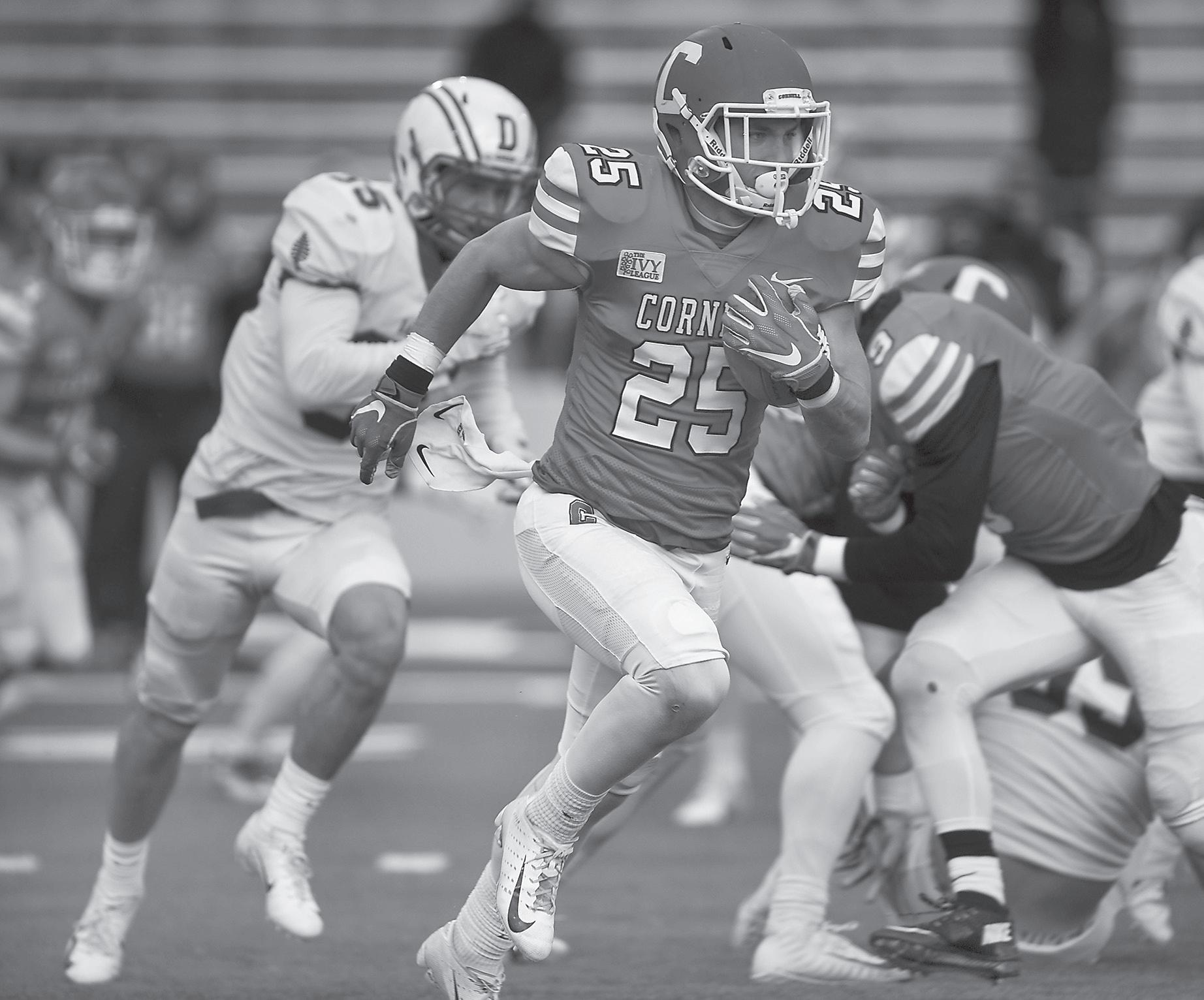
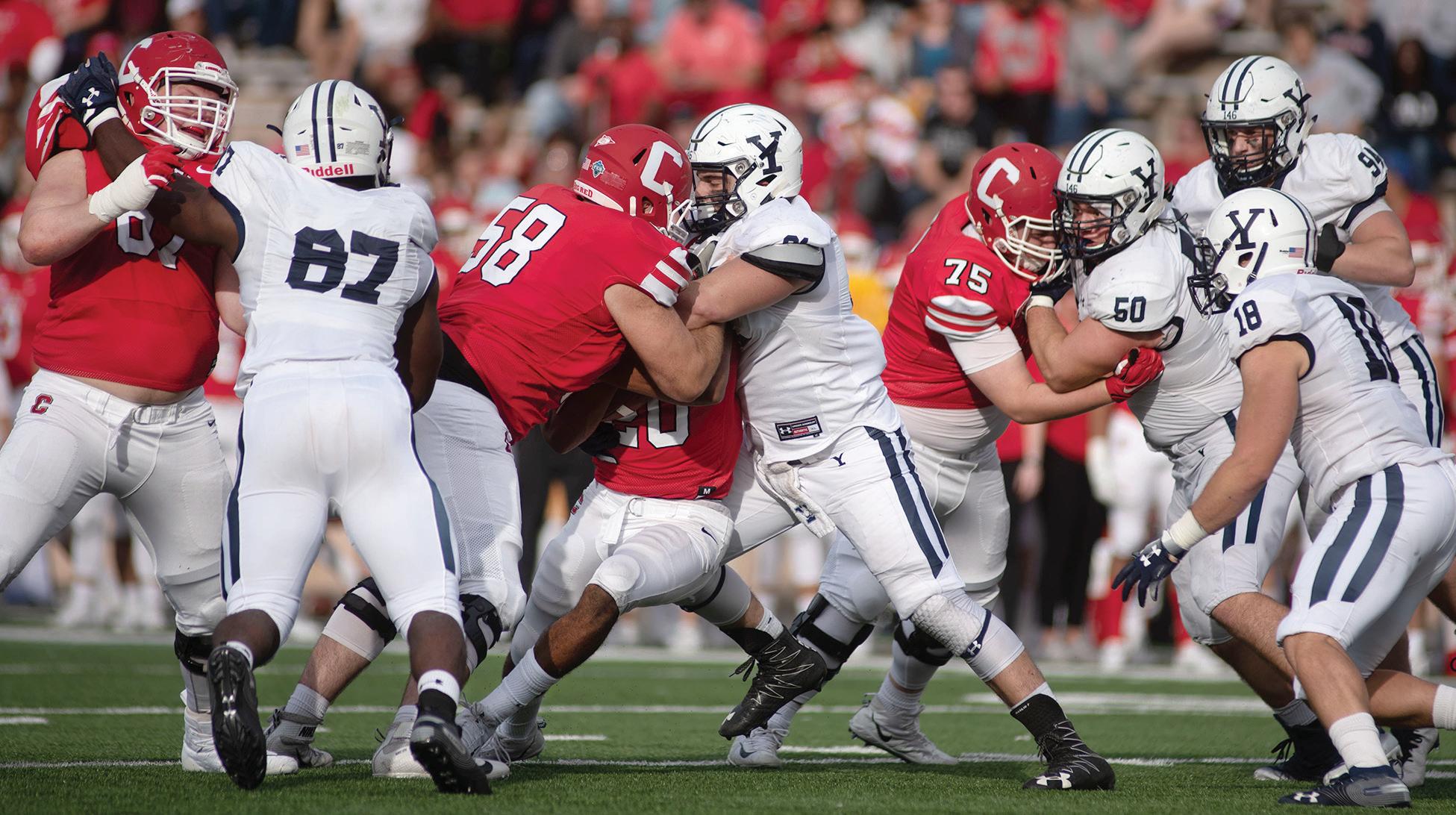
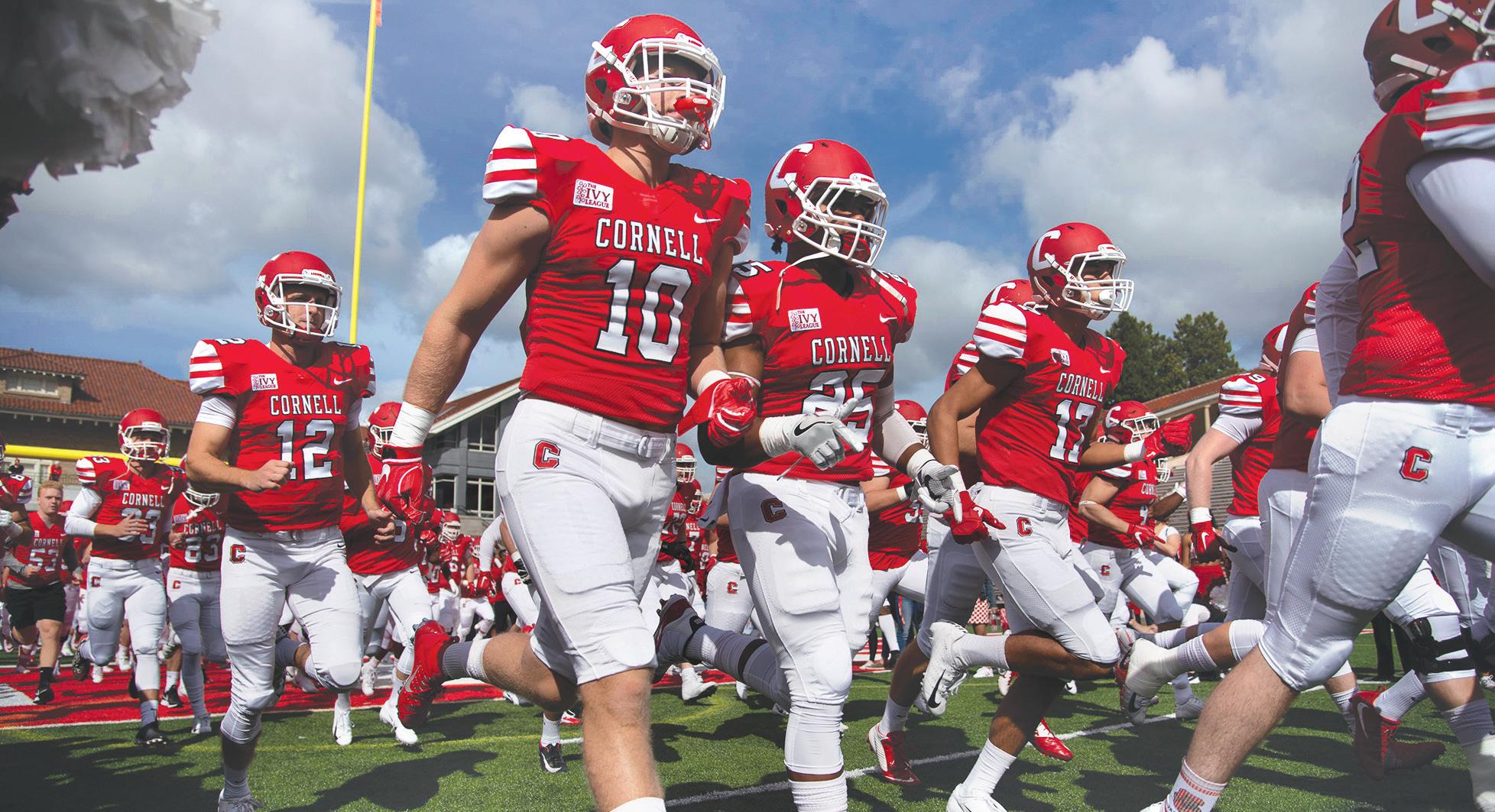
Season’s greetings | Cornell football is back September 21. The season will open in Poughkeepsie as the Red takes on
By RAPHY GENDLER, CHRISTINA BULKELEY and LUKE PICHINI Sun Sports Editor, Sun Assistant Sports Editor and Sun Staff Writer
With the 2019 football season set to kick off Sept. 21, The Sun’s football writers took a look at what to expect as the Red takes the field for its 132nd season. Cornell finished 3-7 last year in a season that included a pair of single-digit Ivy League losses and wins over Brown and Harvard.
What Will Cornell’s Record Be?
Raphy Gendler, Sun Sports Editor: 4-6
David Archer ’05 is taking a restructured schematic approach into 2019 to better set up his players for success down the stretch against tough Ivy League opponents. The team has a lot to prove in order to convince
One must keep in mind that Archer’s squads have struggled massively down the stretch, posting 0-3 and 0-4 marks to close the season in 2017 and 2018.
us it’s better than last year’s 3-7 squad. Do junior Richie Kenney and senior Mike Catanese have what it takes to lead the offense? Can the linebacking corps hold its own without Reis Seggebruch ’19 and other graduates? Last year’s 3-7 was a few seconds or a couple breaks from being 4-6 or 5-5. The Red’s capability — or inability — to win close games will be the difference in 2019.
Christina Bulkeley, Sun Assistant Sports Editor: 3-7
Even with Archer’s increased focus on strategy going into this season, uncertainties with the team — such as that at quarterback — make me skeptical that the squad will make significant improvements over last season. Archer seems to have changed his approach to how his team will play the game, which is promising, but is it going to be enough to help the Red improve its record? Maybe. But I wouldn’t bank on it.
Luke Pichini, Sun Staff Writer: 4-6
Indeed, Archer’s new schemes will likely fuel some
early-season success against new non-conference opponents such as Marist and Georgetown, but will it yield the same results later in the season against the steeper competition that the Ivy League presents? Should that come to fruition, the Red could experience a breakthrough season. More likely than not, though, Cornell will only improve upon last year’s three-win season by a single game. One must keep in mind that Archer’s squads have struggled massively down the stretch, posting 0-3 and 0-4 marks to close the season in 2017 and 2018, respectively.
Who Do You Anticipate Being a Key Player On Offense?
R.G.: Harold Coles
Too easy: Coles is Cornell’s best player, and the Red’s offense will have to run through him, for better or for worse. The senior running back and reigning All-Ivy second-team selection had 10 touchdowns and over 1,000 total yards last season. Cornell’s schemes on offense will need to get Coles 15 or 20 touches a game
and figure out ways to get the dynamic runner the ball in space. Coles will need to hit double-digit touchdowns and 1,000-plus yards again for Cornell to sport an effective offense.
L.P.: Harold Coles
With three-year starter Dalton Banks no longer on the roster, the quarterback position will not be as stable as it has been in the past couple years. Enter Coles as the centerpiece of the Cornell offense. Last year, the Erie, Pennsylvania native accounted for nearly half of the team’s 1,561 rushing yards by carving up opponents for 710 yards on the ground. Plus, Coles cemented his versatility by establishing himself as a pass-catching threat, totalling 293 yards on 28 receptions. Expect Coles to soak up touches as the Red’s primary offensive weapon.
C.B.: Harold Coles
You’ve heard it all already — going into the 2019
See PREDICTIONS page 11