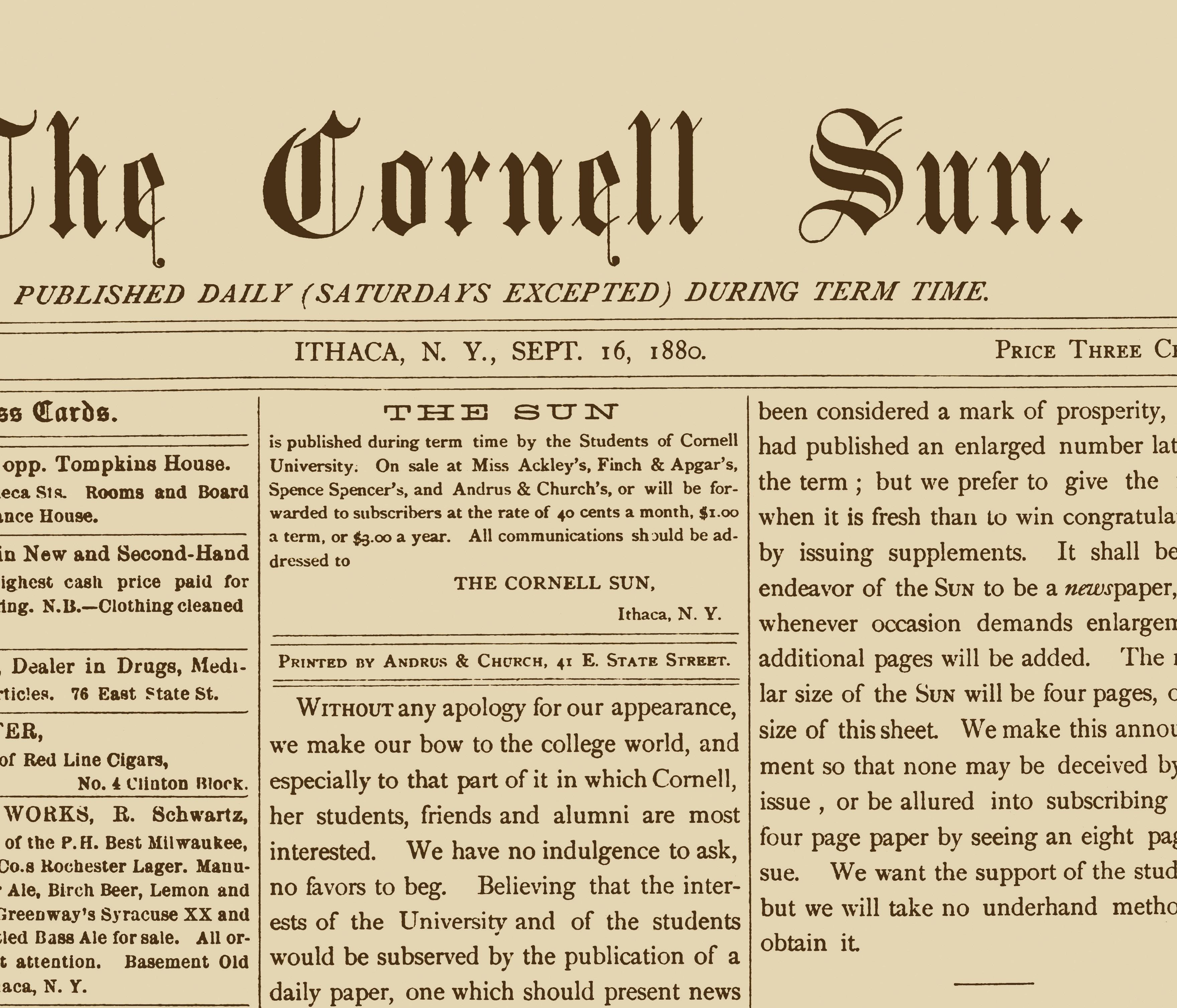
This declaration by the founding staff appeared in The Sun’s inaugural issue, published on September 16, 1880.
Without any apology for our appearance, we make our bow to the college world, and especially to that part of it in which Cornell, her students, friends and alumni are most interested. We have no indulgence to ask, no favors to beg. Believing that the interests of the University and of the students would be subserved by the publication
of a daily paper, one which should present news not only from the various colleges, but whatever was of especial interest to students where it occurred, we determined to publish the Cornell Sun. Its financial success is already assured; and we can announce unhesitatingly that it will make its appearance every day during the term time of the coming year. Our principles are those of the institution which we shall endeavor to represent, — liberty of thought, liberty of speech and liberty of action; but we shall strive earnestly not to
Mars Rover Prof Leaves Cornell
By SARAH SKINNER Sun Managing Editor
allow this liberty to degenerate into license. That there are many obstacles in the path of a college daily we fully realize. The labor required to edit such a publication will be no small addition to our college work; and though we undertake it willingly, it is not without some misgivings as to our ability to perform the extra duties in a suitable manner. We expect to receive severe criticism at the hands of many, but we ask that it be deferred until a fair trial shall have shown that we deserve it.
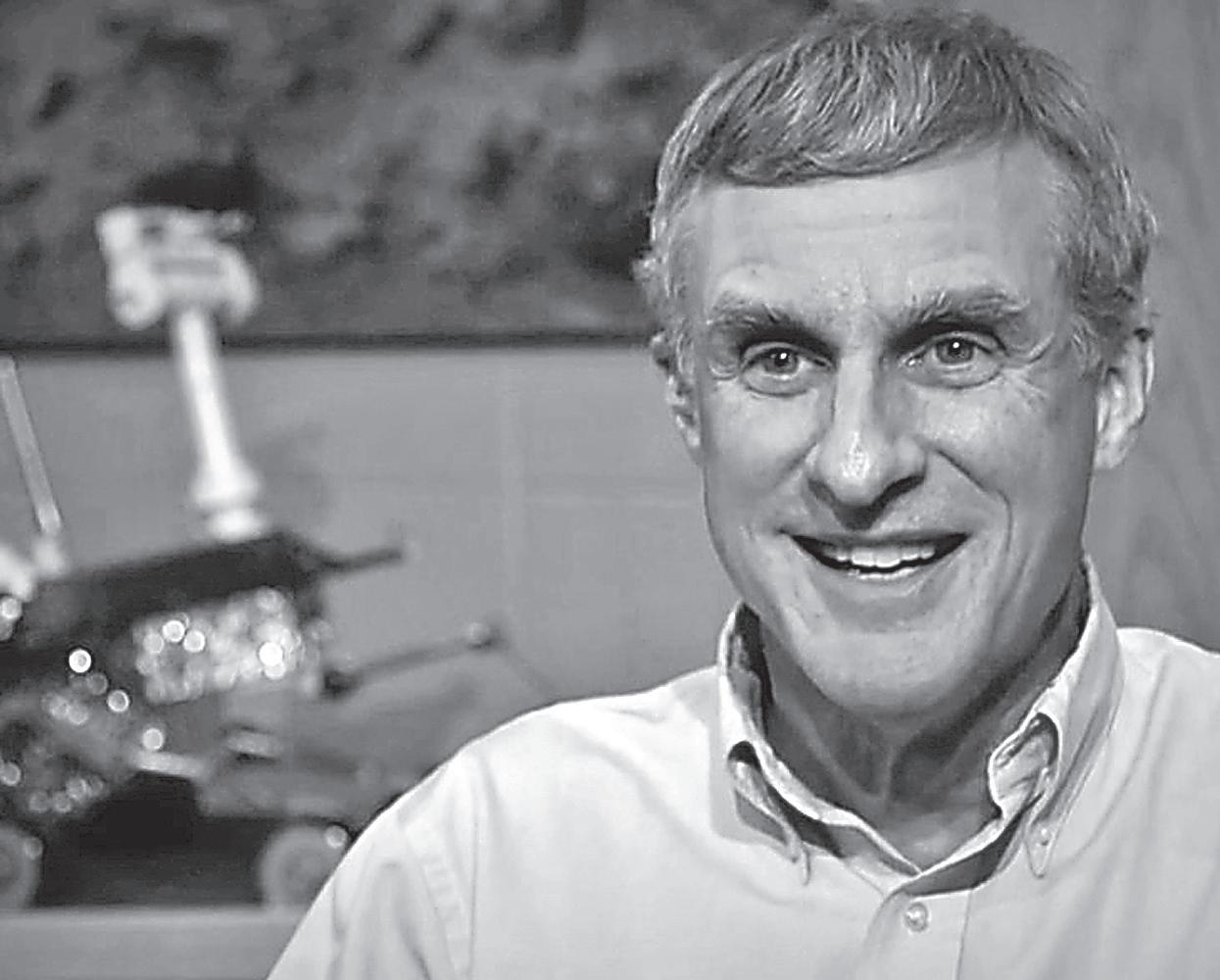
Famed astronomy and planetary scientist Steve Squyres ’78, Ph.D. ’81, James A. Weeks Professor of Physical Sciences, announced that in just nine days — enough to travel 24 miles on the surface of Mars — he’ll retire from Cornell to take a post as chief scientist at Amazon’s private space venture, Blue Origin. As principal investigator of the Opportunity and Spirit rover missions, Squyres led NASA’s exploration efforts on the surface of the red planet, directing the search for life and knowledge from
See ROVER page 4
Vapes, Juuls Losing Their Cool
Collegetown sales start to slide; NYS bans favored e-cigs
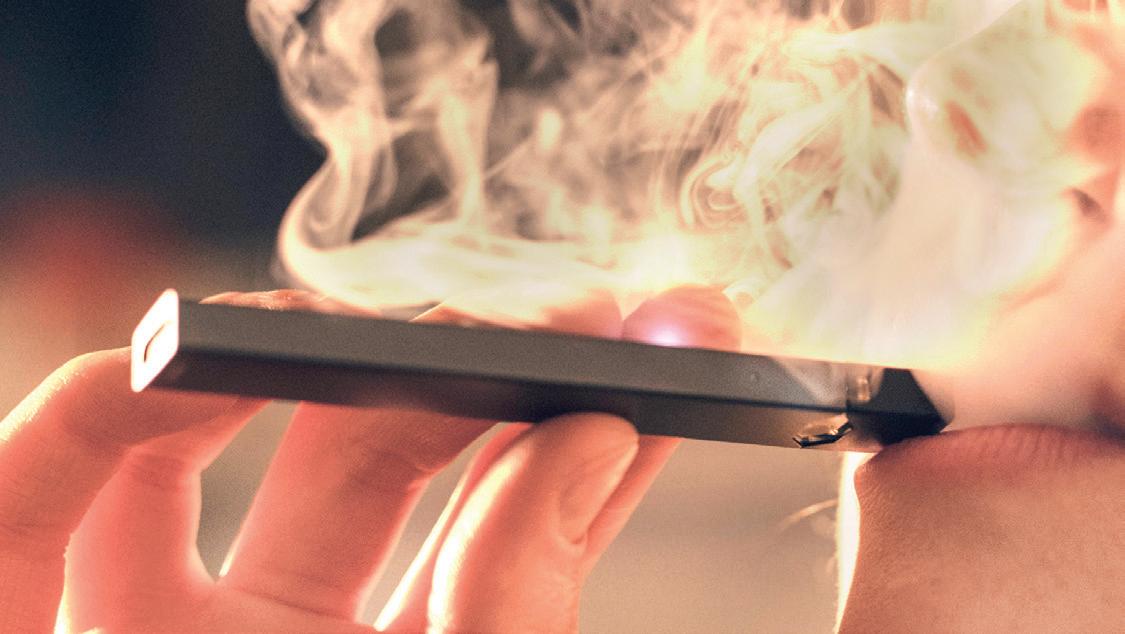
E-vape-eration | The health risks of vaping have risen to national attention with new calls for regulation from multiple levels government.
By ALEC GIUFURTA Sun Staff Writer
Governor Andrew Cuomo announced an emergency executive action to ban all flavored e-cigarettes Sunday –– the latest development in the retaliation against vaping over a surge of reports linking it to pulmonary illnesses. A national ‘hysteria’ around e-cigarettes has student-activists and Cornell health professionals pushing their message: It’s not cool to Juul.
In tandem with the release of new research, local shops told The Sun that sales of e-cigarettes near campus have declined after
the boom of recent years. The Food and Drug Administration, on Monday, sent a warning letter accusing Juul Labs of illegally advertising
their products as a safer alternative to tobacco products. Over the past few weeks, the CDC reported an outbreak of severe lung diseases which, as of Sept. 11, included 380 cases of illness and six deaths. The report also specified that in all of the cases, the patient reported a history of e-cigarette use or vaping.
“There’s a lot of hysteria,” Dr. Jonathan Avery, director of addiction psychiatry at Weill Cornell Medicine, told The Sun. But, he said, “your average Juuler is not going to die tomorrow from lung disease.”
Avery said that doctors are still trying to “get a sense” for the harm and health effects poten-
See JUUL page 3
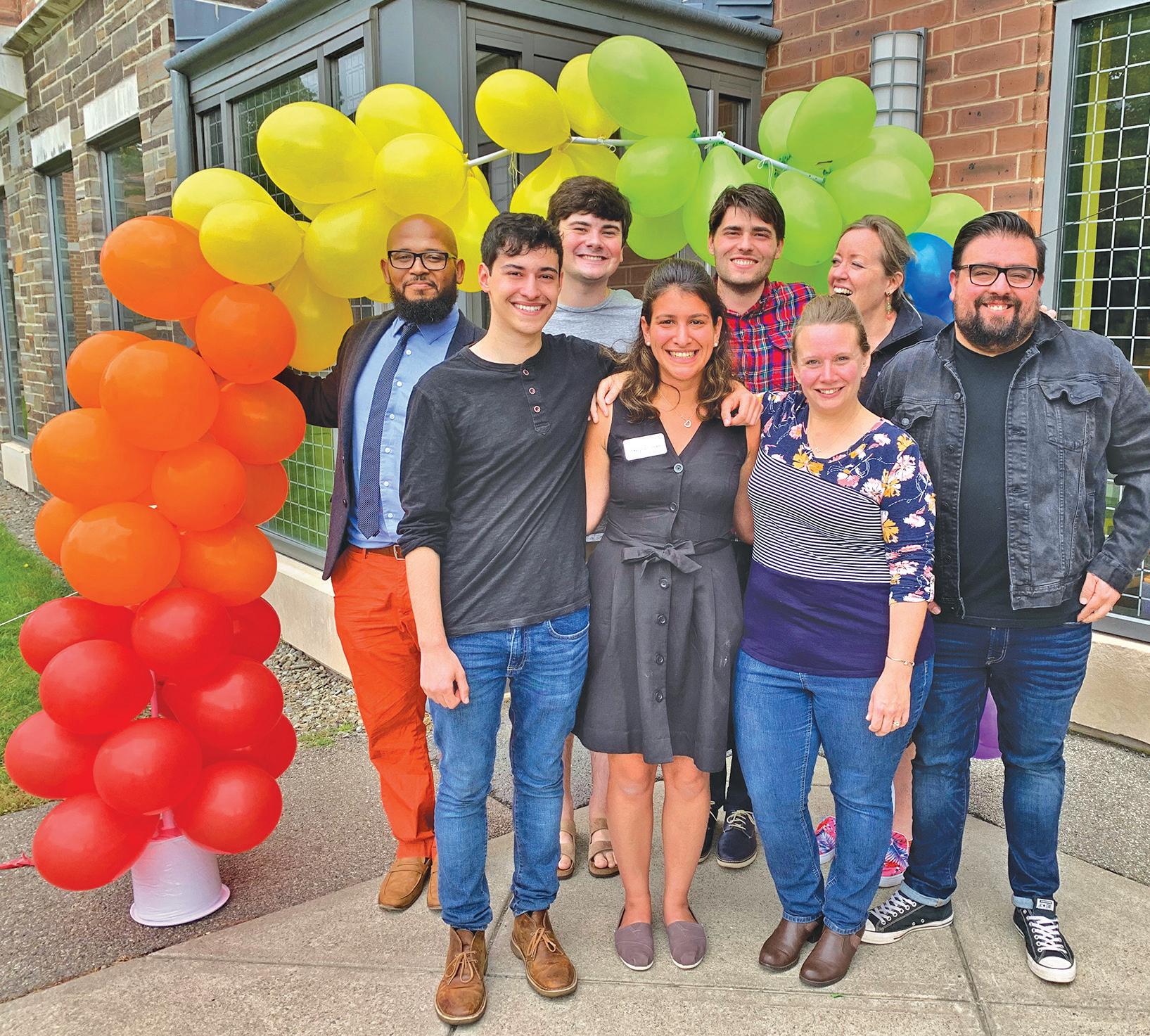
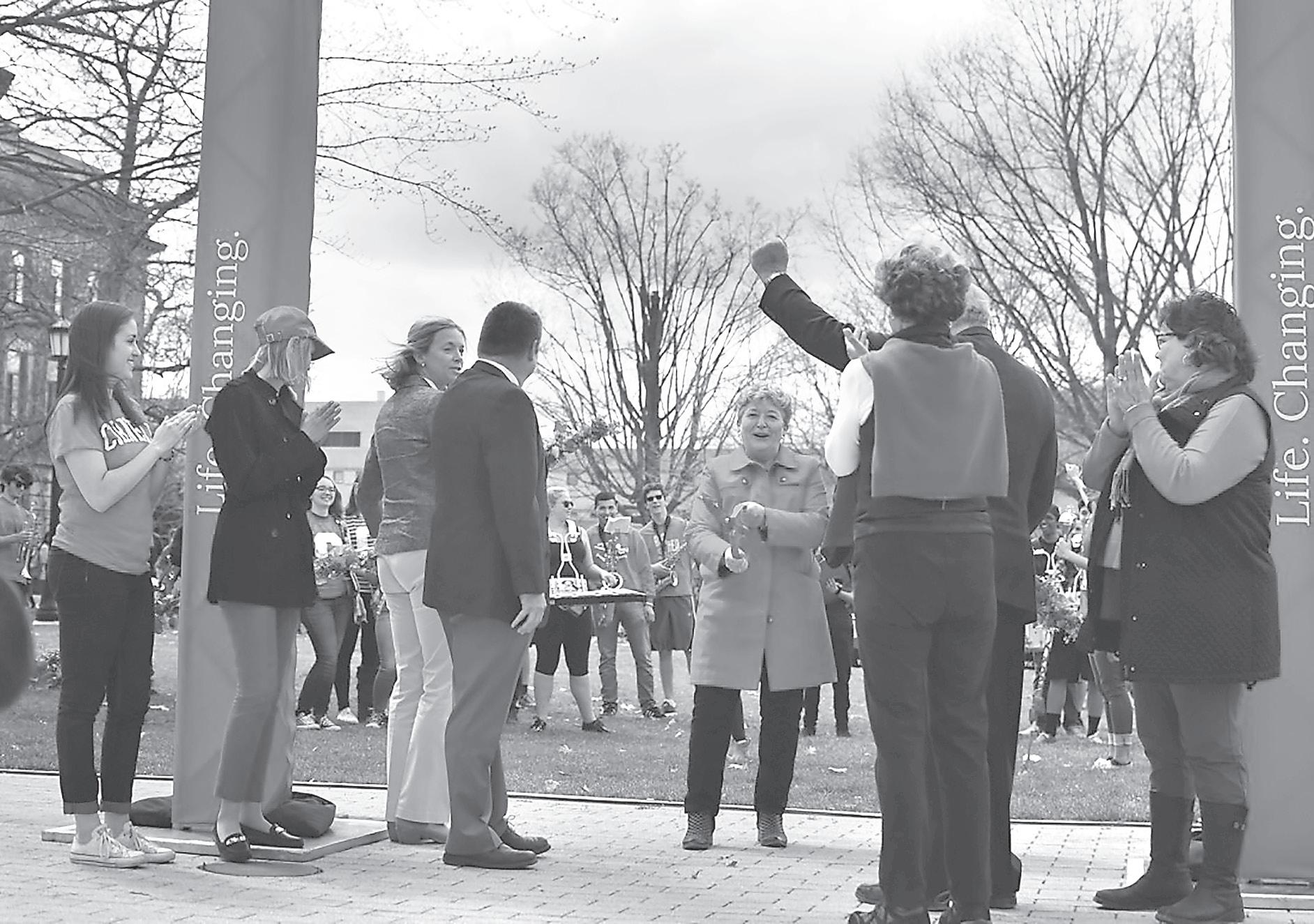
Love and joy was in the air at the grand opening of the LGBTQ+ program house “Loving House” on Sept. 14 in the Mews Hall first floor lounge. In attendance were residents of Loving House, Mews Hall residential staff and members of campus administration involved with housing and student life. Refreshments for attendees included a festive spread of fresh fruits, vegetables and different kinds of cake. Adorning the entrance to the lounge was a bright rainbow-colored balloon arch.
The original location of
Loving House was supposed to be 112 Edgemoor Lane, a university-owned co-op on South Campus. However, those blueprints fell apart when the student-staffed development committee decided to establish the program house in Mews, citing several reasons for the switch.
First, the building at 112 Edgemoor Lane is inaccessible for those living with disabilities, said Ian Wallace ’20, former LGBTQ+ Liaison At-Large for Student Assembly. With inclusion central to Loving House’s mission, Americans with Disabilities Act accessibility was a requirement.
This masthead design appeared atop The Sun’s front page from September 1882 to June 1887
CAROLINE TOMPKINS / THE NEW YORK TIMES
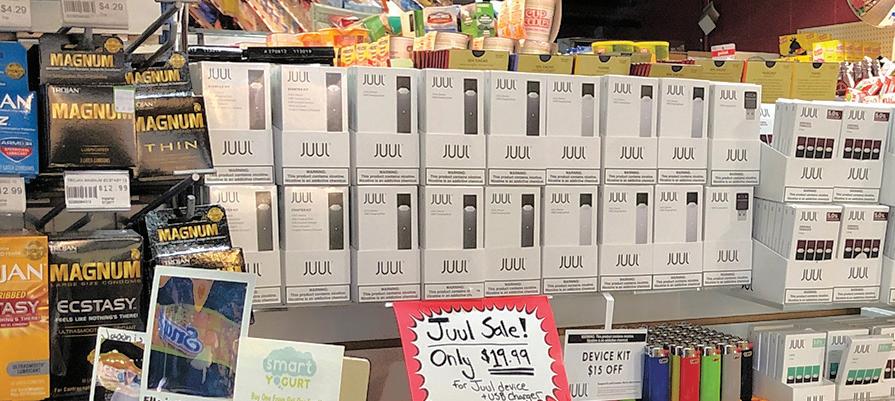
Sliding sales | Collegetown
Rainbow residential hall | Members of the student committee celebrate the grand opening of the new program house on Saturday. ANGELA
By ANGELA LI Sun Staff Writer
A LISTING OF FREE CAMPUS EVENTS
Today
Chemical and Biomolecular Engineering Fall Seminar Series 9 - 11 a.m., 255 Olin Hall
Check Your Blind Spots Mobile Tour 10:30 a.m. - 3:30 p.m., Arts Quad
In Search of the Missing Mothers: the Women Members of the Constituent Assembly of India 12:15 p.m., G08 Uris Hall
LASP Weekly Seminar Series: Worker Controlled Companies in Latin America by Dario Azzellini 12:15 - 1:10 p.m., G01 Stimson Hall
Information Session: Student Multidisciplinary Applied Research Teams (SMART) 12:30 - 1:30 p.m., 102 Mann Library
Standardized Tests Don’t Select the Best STEM Thinkers: Here’s What May! 12:30 - 2 p.m., T01 Human Ecology Building
Be a Better Researcher: Grant Writing 4:45 - 5:45 p.m., 106 Morrill Hall
Israel and Palestine Conversations Series: From Zero-Sum to Peace 5:30 - 7 p.m., 231 Rockefeller Hall
Tomorrow
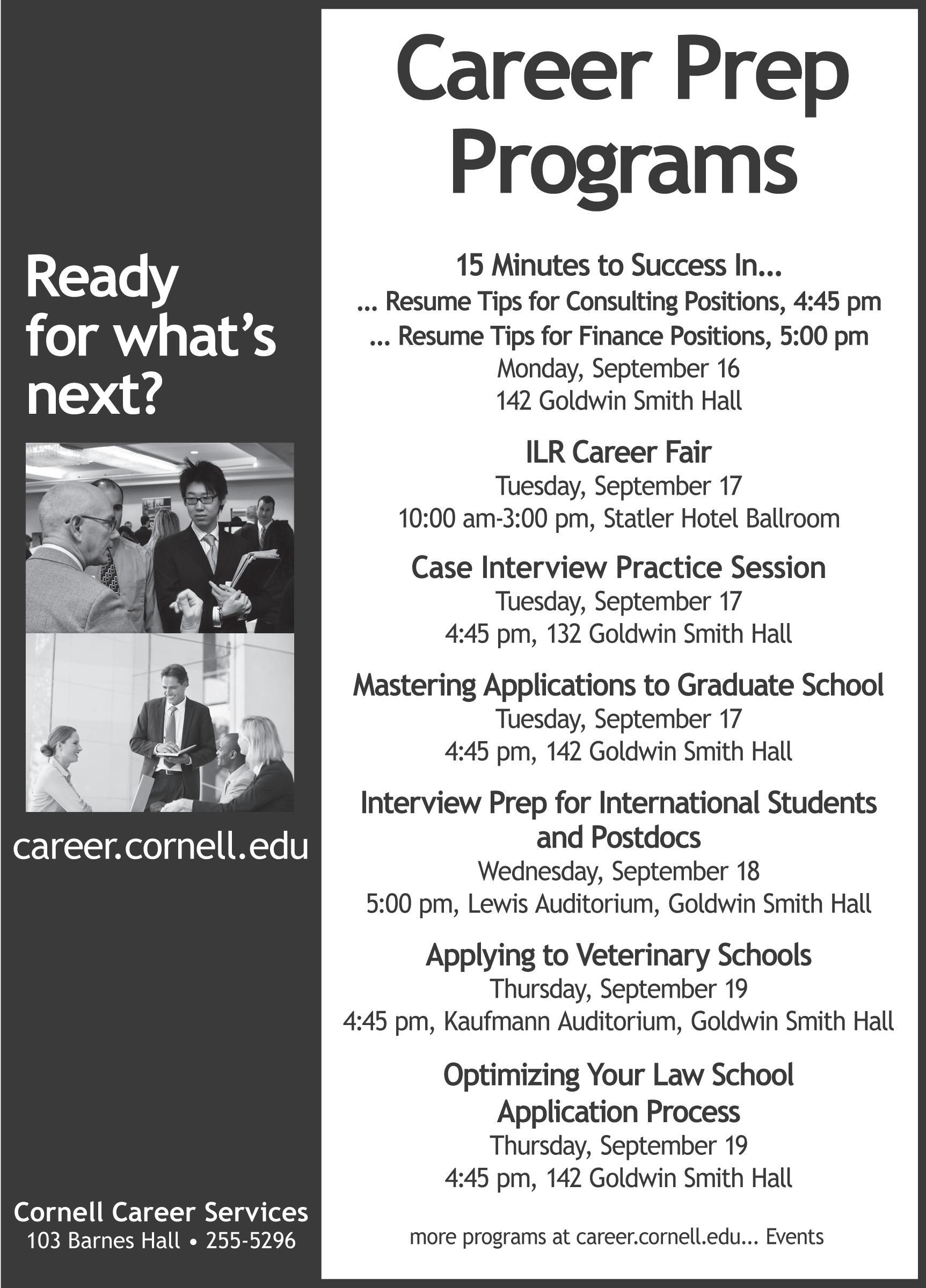
ILR Career Fair
10 a.m. - 3 p.m., Carrier Ballroom, Statler Hall
Work Talks: Work Authorization for International Students 10 - 11 a.m., 276 Caldwell Hall
Party Time in the Promised Land: Israeli Politics of Happiness and the 2019 Election 1:30 - 3:30 p.m., 104 Rockefeller Hall
Data Organization for Spreadsheets 4:00 - 5:30 p.m., 103 Mann Library
Chats in the Stacks: Jamila Michener on Fragmented Democracy: Medicaid, Federalism, and Unequal Politics 4:30 - 5:30 p.m., 107 Olin Library
Townsend Lecture: Giving Up on Ithaca, With Ugo Foscolo 4:30 p.m., 165 McGraw Hall
Ballroom for the annual School of Industrial and Labor Relation’s career fair. Cornell students from all disciplines are welcome.
C-Town E-Cig Sales Drop, But Concerns About Vaping Remain
tially caused by Juul products. He paralleled the situation to the medical field 50 years ago, when smoking was perceived as ‘fun’ and ‘harmless’ –– until proven otherwise.
In Fall 2018, 25 percent of Cornell undergraduates reported using e-cigarettes in their lifetime, up from 14 percent in the Fall 2015, according to Cornell Health. Additionally, 10 percent of all first year students in Fall 2018 reported using an e-cigarette in the two weeks leading up to move-in.
Avery attributes such a sudden rise in use mostly social factors.
“The advertisements looked cool and sexy,” he said. The “games and culture around going out” also supported the rise of Juul and other e-cigarettes, he added.
He also said how the recent reports surrounding vaping-related illnesses should curb drug usage: “We know that as perceived harm of a substance goes up, the use goes down, and visa versa.”
Data from Collegetown vendors seems to support this idea: Juul sales are down this semester –– significantly.
At the Collegetown 7/11, owner Ravi Meel provided The Sun with data on the 24/7 store’s sales of e-cigarettes. In April 2019, total e-cigarette sales per day averaged $659; climbing to $802 in May 2019. This same figure in September 2019 fell to $557. In May 2019, there were 46 average unit sales per day at the location, falling to 29 units in September 2019.
Out of all brands that Meel sells, “Juul is number one,” he said. He’s seen the brand’s sales dip for the beginning of the school year.
“The bloom is off the rose,” said Jason Burnham, owner of Jason’s Grocery & Deli in Collegetown. “We got [Juul products] in January of 2018. The excitement was really there,” he said.
But while sales remained high, the excitement around
Where
Do
Juul products slowly faded starting in spring 2019. This fall, Burnham said that sales started dipping and the excitement students had for buying the products “died.”
For example, Jason’s ran a contest in late Spring 2019 to win a special limited-edition Juul product, the Onyx Juul. Customers could write on slips of paper the reasons why they thought they deserved the product. Burnham doubted that type of contest would work now.
“I’m seeing more people trying to quit,” he said. “You never saw that before.”
Regardless of the decline in sales, Cornell Health is concerned about student usage of Juuls on campus.
“There’s no doubt these products are highly addictive … the amount of nicotine in the devices is no joke. Dependency is not uncommon,” said Laura Santacrose, assistant director of the Cornell Health’s Skorton Center for Health Initiatives.
Graduating Cornell Seniors
Go? And How Much Do Tey Make?
By AMOL RAJESH Sun Senior Editor
• Top companies for graduating students entering career fields, including investment banking, nonprofits, tech and more.
• Top employers by major.
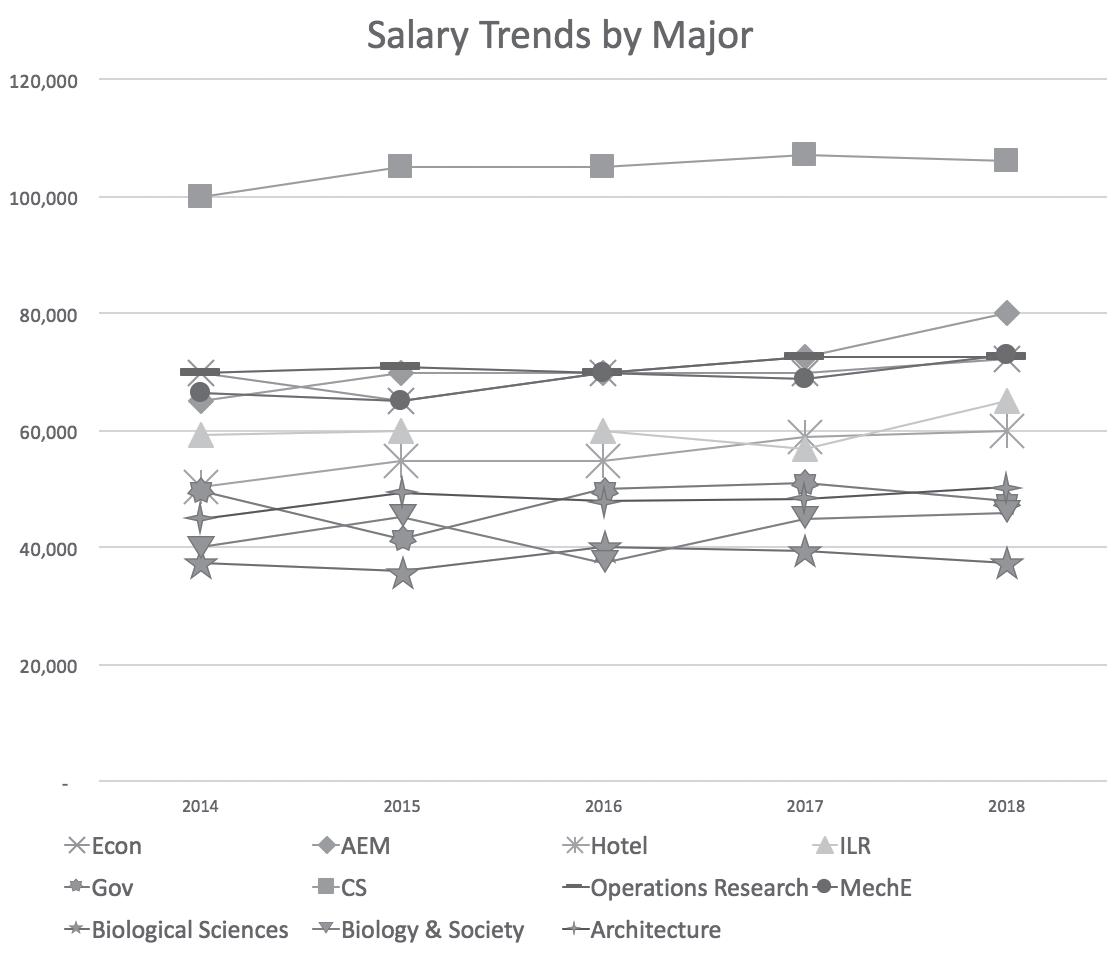
• Salary trends by major.
To view the rest of this series of graphics, please visit www.cornellsun.com.
Salary Trends by Major
First year students who are 21 or older looking to buy a Juul don’t need to travel far. Louie’s Lunch, the popular late-night food truck, sells Juul products right on North Campus — a practice that Santacrose questioned.
“Louie’s Lunch is privately owned and located in place where the majority of residents are unable to legally purchase these products, so the presence of these items in their inventory raises concern,” she said.
Owner Evin Munson said that while the truck does sell Juuls, it cards every customer looking to purchase e-cigarettes.
“I just follow the rules and regulations that are in place at the time,” Munson, who took over Louie’s in January, told The Sun. The truck no longer sells fruit-flavored pods; the only varieties available are mint, menthol and tobacco.
Even that selection may change soon, thanks to the new regulations.
On Wednesday the Trump Administration announced its intent to ban flavored e-cigarettes through the FDA. In response, Governor Cuomo stated on Sunday that he is pursuing a similar ban in New York State — effective as early as October 4 — through emergency order.
The New York ban will affect all flavors besides tobacco and menthol, the Wall Street Journal reports. On the federal level, the potential ban would include menthol — not considered a flavor by the New York State ban — and mint, the New York Times reports. If both are enacted, tobacco would likely be the only flavor for sale.
This closes what Jack Waxman ’22, founder of Cornell’s Students Against Nicotine called the “flavor loophole” –– flavored cigarettes have been banned nationwide since 2009, while flavored e-cigarettes were not.
“The flavors are drawing the kids in, the nicotine is forcing them to stay,” Waxman said.
Waxman told the Sun how he watched his closest friends at his New York high school become hooked on nicotine from Juuling, a problem that he said followed them to college.
Closing the flavor loophole may not end the problem of Juul use amongst young adults, however. Avery, the Weill addiction specialist, said that though it is part of the problem, a multitude of circumstances draw teens into using Juuls and other e-cigarettes.
“What’s happening is you’re having middle school and high school kids that are addicted to the Juul coming to college, and, you know, they’re bringing their addiction with them — it doesn’t just magically disappear when you go to college,” Waxman said.
Cornell Health officials have also taken action against Juuling on campus, partly through a poster campaign.
The posters are intended to be comical; depicting a sketched graphic of a Juul talking to other common electronics. “Humor helps us retain information,” said Jenifer Austin, director of communications at Cornell Health.
Milo Gringlas ’22, the former legislative advocate for Students Against Nicotine, spent last Tuesday on Capitol Hill as part of the American Cancer Society’s annual leadership summit, where Secretary of Health and Human Services Alex M. Azar “engaged with us.” Gringlas would like to think that SAN’s efforts partially translated into this week’s proposed regulation.
As a relatively new phenomenon, there is little research on long term health effects of vaping. But Avery bets that “odds are it’s going to be more harmful than good.”
Santacrose said that students who use tobacco or e-cigarettes and are interested in quitting can make an appointment with Cornell Health’s behavioral health department. The department offers students a free “quit kit,” and Cornell Health sells nicotine replacement products as well.
The data below was collected by Cornell Career Services for graduating seniors from 2014-2018 and analyzed by The Sun.
Downward trend | In the fall 2018 semester, 25 percent of Cornell undergraduates had used e-cigarettes. Furthermore, 10 percent of first year students had used an e-cigarette in the two weeks before moving into Cornell.
MICHAEL WENYE LI / SUN SENIOR PHOTOGRAPHER
Loving House Opens for 30 New Residents in Mews Hall
Continued from page 1
The location of Mews on North Campus also allowed for “a good mix” of class years and opportunities for “mentoring” from upperclassmen. “Edgemoor is also nowhere near first-year dorms and so the program house wouldn’t have been open to first-year students,” Wallace told The Sun.
Additionally, co-ops have their own unique selection process for prospective residents, which can sometimes exclude future residents based on their social connections. The student committee sought to forego the co-op for a “formalized process through the RHD of a program house,” said Wallace.
After the committee determined that 112 Edgemoor was not a viable option, Kristen Loparco, Director of Housing and Dining Contracts, offered Mews as a possibility, and it “just fit so many checkmarks,” said Wallace.
The same committee also determined the program house fee, which stands at $30 per year for residents and $15 per year for out-of-house members.
“We didn’t want to create divisions within the community in any way and we didn’t want the program fee to be a barrier, so it’s set lower than most other program houses,” said Wallace.
Most other program houses vary in fee costs, with most ranging from $40 to $100 each year. The Latino Living Center, which houses students with “a common interest” in Latino culture, history, and current events, costs $65 per year.
As The Sun previously reported, two resolutions that passed through S.A. for a queer-inclusive living-learning unit were vetoed in 1993 by then-president Frank H. T. Rhodes out of concerns for campus unity.
Jamie Sorrentino ’94, present at the grand opening, was one of the activists who signed the original proposal that was sent to the Student Assembly. Other signatories who Sorrentino said were much more “front and center” in the movement included Reverend Carla Roland Guzmán ’94 — a prominent figure in the LGBTQ community in Manhattan — and Joseph Barrios ’93.
While Sorrentino felt that “Cornell was an oasis where [he] could come out and be [him-
self],” he acknowledged that perhaps many others, especially trans students back then, likely did not feel the same level of comfort.
“I’m hoping they will have a better and more supportive experience at Cornell,” Sorrentino said of current LGBTQ+ students and Loving House members.
For the 2019-20 academic year, Loving House received 85 applications for a 30-bed space, but worked to accommodate as many interested students as possible. After students went through a housing selection process with many different living options, “in the end there was no one left on the waiting list,” said Taylor Bouraad, the residential head director of Mews.
Future plans for expansion will be determined “as student interest continues to grow,” said Robert King, director of residential life.
Other administrators present included Julie Paige, the keynote speaker and director of off-campus and cooperative living, vice president for student and campus life Ryan Lombardi and assistant vice president Pat Wynn. Speeches at the start of the event touched on the creation and development of Loving House.
Recently returned from the funeral of Gregory Eells, the former head of Cornell’s Counseling and Psychological Services Department who passed away last Monday, Lombardi and Wynn emphasized the role of Loving House as a space for support and love, as well as a “barrier against the negative forces out there,” according to Wallace.
“It’s a bit of a bittersweet day,” said Sorrentino, now a Clinical Social Worker at CAPS who worked under Eells.
“But this feels like a victory of sorts,” Sorrentino added, referring to the establishment of the program house. “It’s certainly not the end of the story.”
Students may consult with counselors from Counseling & Psychological Services (CAPS) by calling 607-255-5155. Employees may call the Faculty Staff Assistance Program (FSAP) at 607255-2673. An Ithaca-based Crisisline is available at 607-272-1616. For additional resources, visit caringcommunity. cornell.edu.
Longtime Prof Makes Jump to Private Sector
‘Always a proud Cornellian,’ his next venture will be at Amazon founder’s space company
ROVER
Continued from page 1
millions of miles away. The Opportunity rover was declared dead last year after a nasty dust storm knocked out communications and power after over 16 years of transmission; its twin Spirit went dark in 2010.
“With the Mars rover missions behind us, it’s time for me to find a new challenge, but I will always be a proud Cornellian,” Squyres said in a press release. Squyres will depart the University on Sept. 22 after over thirty years of teaching for a new voyage.
Jeff Bezos’s brainchild Blue Origin is an aerospace manufacturer working to pave the way to space for private citizens. It has run a number of suborbital and orbital test flights, and in May,
Bezos announced the intention to reach the moon by 2024. The company is headquartered in Kent, Washington.
Squyres, who’s currently co-teaching a course on the history of exploration — his “favorite class to teach,” he told The Sun last year — will Skype in from the West Coast for the rest of his course sessions this semester.
“It was very generous of him to agree to do this, even after he will have left,” said Prof. Tagliacozzo, history, who co-teaches the course with Squyres, in an email to The Sun. Squyres’ departure, he said, was a big loss for the University.
Tagliacozzo’s course, History 1700 History of Exploration: Land, Sea, and Space, was co-created nearly a decade ago by Squyres and Prof. Mary Beth Norton, history, and traces the history of exploration from ships to the stars.
It’s a favorite of many undergraduates, including Greg Livingstone ’21. Livingstone is a mechanical engineering student who picked the class to fill a course requirement last fall, but said that taking a class with the NASA titan had been an “honor.”
“What stuck with me the most was the emotion our professor exhibited when talking about the historical significance of the Apollo 8 mission,” Livingstone told The Sun.
Squyres showed, Livingstone said, how the 1968 mission to orbit the moon “represented a small piece of hope and unity in a world that was seemingly falling apart.”
Squyres popped into lecture on Wednesday to tell his course’s current students about his departure, before it was officially announced. And students in spring’s Astronomy 1102: Our Solar System knew about the end of the Opportunity program a week early, but were also sworn to secrecy.
To read the rest of the story, please visit www.cornellsun.com.
Exploring new frontiers | Squyres will continue to teach a course on the history of exploration via Skype for the rest of the semester.
LOVING
Angela Li can be reached at ali @cornellsun.com.
CALS Dean Search Starts, 6th New C.U. Dean in 2 Years
By SHRUTI JUNEJA Sun Senior Editor
The College of Agriculture and Life Sciences is on the search for a new Ronald P. Lynch Dean to lead over 3,800 undergraduate students, 1,000 graduate students, 23 majors, 42 minors and 1,500 courses of study.
The current dean, Kathryn Boor ’80, has held the position for the past 10 years and will end her second term in June 2020. Lisa Yager, staff to the CALS Dean Search Committee, told The Sun that academic deans are appointed for a five year term and typically get renewed for a second term, but it is Cornell’s practice that a ten year term for deans be the maximum.
The
“Her tenure as the dean of one of the world’s foremost agricultural universities has produced landmark achievements.”
Tom O’Mara
search has been posted under the Provost’s site since June and a job posting was created on Sept. 11 on Chronicle Vitae. The new dean will officially assume the role on July 1, 2020.
“The Dean will be expected to expand the intellectual, financial, and human assets of CALS while serving as a critical member of the senior leadership team of Cornell University,” according to the job posting. “Candidates for the role should have a record of successful leadership in an academic enterprise and experience guiding the interaction of people and systems to create the highest levels of
institutional academic accomplishment.
In the last two years, Cornell hired new Arts, Architecture, and Planning, Industrial and Labor Relations, Cornell Tech, Arts and Sciences and Business School deans.
Previous heads have returned to teaching, in the case of Soumitra Dutta, former dean of the business school, or Gretchen Ritter ’83, former dean of Arts and Sciences. Others, like Cornell Tech’s founding dean Daniel Huttenlocher, departed for similar institutions; Huttenlocher left to be the founding dean at the Massachusetts Institute of Technology’s Schwarzman College of Computing, and Ritter ultimately took a post as executive dean at Ohio State University.
Boor joined Cornell in 1994 as the first female faculty member in the food science department. She started her term as dean in July 2010, under what was originally a five-year contract.
She holds a bachelor’s degree in food science from Cornell, a master’s in food science from the University of Wisconsin and a Ph.D. in microbiology from the University of California-Davis, according to the University.
“The faculty, staff and students in the college are passionate; they make me want to strive to be a better person,” Boor recently told The Sun about Cornell being the highest-ranked agriculture program by the Wall Street Journal. “I am an optimist, and that world-view has been supported and shaped by my time in CALS and at Cornell.”
In 2018, the New York State Senate honored Boor as a “Woman of Distinction.”
“Her tenure as the dean of one of the world’s foremost agricultural universities has produced landmark achievements in
education, food safety, public awareness and cutting-edge research,” State Senator Tom O’Mara said about Boor at the ceremony.
A committee of 16 relevant stakeholders is leading the search process, including CALS professors from a range of departments. Avery August Ph.D. ’94, vice provost for academic affairs, and John Siliciano ’75, deputy provost, are co-chairing the committee. Other notable members of the committee include Ray Jayawardhana, dean of the College of Arts and Sciences, and Stephen Ashley ’62 MBA ’64, a member of the Cornell Board of Trustees.
In an email to the CALS community on Friday, August and Siliciano invited students to attend a forum on
Wednesday, Sept. 25 from 4:30 to 5:45 p.m. in Call Auditorium to assist in the search process.
“We are interested in hearing your views on the qualities you would like to see in the next dean,” August and Siliciano wrote. “This information will be helpful as we develop the position specification that will guide the search process.”
According to Yager, these forums will be a place to explain the search process, provide feedback on the characteristics for the next dean, and give input on “opportunities and challenges those in the College feel are important over the next few years.”
Shruti Juneja can be reached at sjuneja@cornellsun.com.
New beginnings | Current CALS Dean Kathryn J. Boor ’80 kicked off CALS Day in 2018. Boor started her term as dean in July of 2010.
ARTS & ENTERTAINMENT
I Cancelled My Netfix Subscription . . .
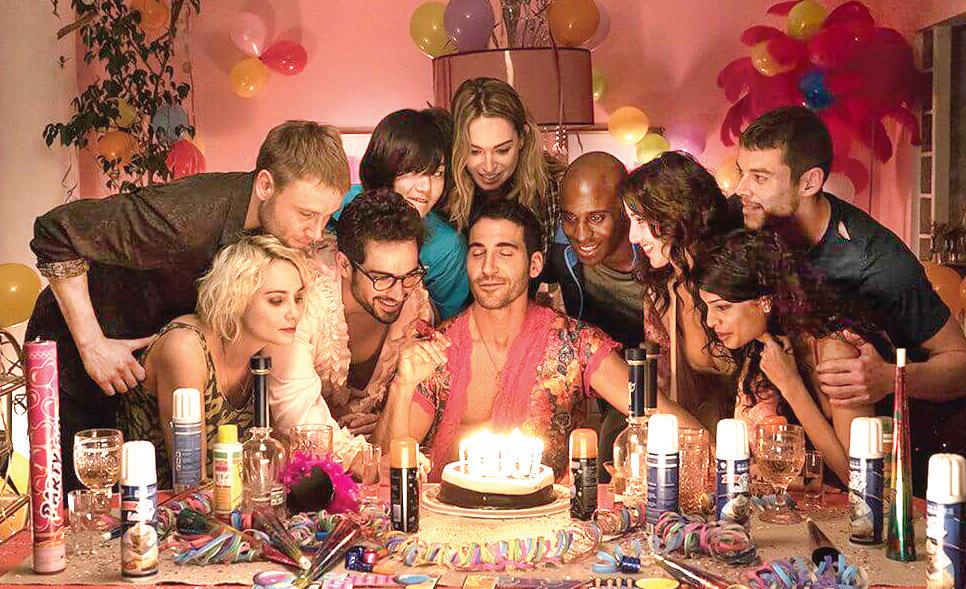
At the beginning of each semester, I always go through a set of back-toschool rituals as a way to mentally set myself up for a new chapter of life. This time, the ritual went digital –– I cancelled my Netflix subscription. No, I’m not quitting TV. These rituals tend to be merely symbolic and experimental. In fact, many of my favorite films and TV shows are still Netflix-exclusive, and I will most likely resubscribe to Netflix once my craving for quality media content resurges. I probably sound like a crybaby hipster here, but I can’t wait to see a post-Netflix digital media landscape.
What I did is a mere act of resistance against Netflix’s replication of the Hollywood mode of neoliberal bureaucratic production disguised in Silicon Valley’s techno-modernity that echoes freedom and openness. As Netflix rapidly grows into a media conglomerate, the streaming giant has begun to operate just like any other major Hollywood studio.
Netflix has lost its digital roots that once fostered its audacity. The cord-cutting movement has developed into an unstoppable trend to tear down the monopoly
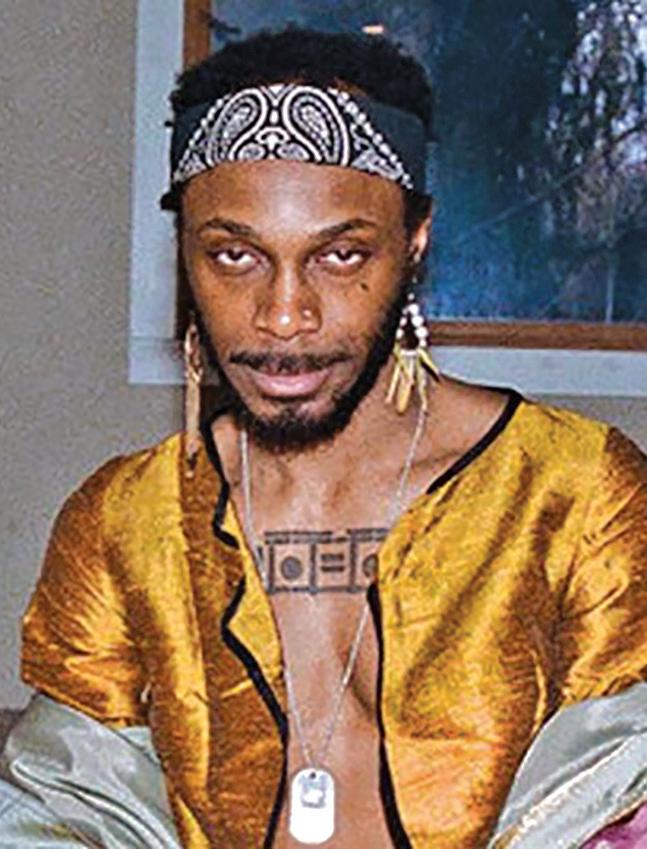
In March of this year, JPEGMAFIA, informally known as Peggy or Buttermilk Jesus, performed in support of Vince Staples at The State Theatre here in Ithaca. He stumbled onto the stage, squinting, with a huge smile on his face. “I just took a bunch of edibles,” he announced, laughing. Within a few seconds, he dropped the first track (something off of his sophomore album Veteran, I was too busy moshing to take note of which one) and sent the venue into utter chaos.
For those unfamiliar with Peggy, born Barrington Hendricks, he first began performing during his military stay in Japan. He was a part of a group called Ghostpop, which had a local following in Tokyo. When he was honorably discharged — after serving in Iraq and spending years in Kuwait, Germany and North Africa — Peggy moved to Baltimore. He quickly emerged as one
of cable TV, and ironically, Netflix is the next on the chopping block despite once being a major part of this potent force for change. And it seems to be on the chopping block already. Netflix’s quarterly report says it all –– Netflix is losing talents, shows, subscribers, copyrights, originality and bold ideas. The only area of growth Netflix is seeing is its global subscribers, which also turned out to be a disappointment according to the previous forecast. Just like empires in the past, as they see no room for growth at home, Netflix clings onto cultural colonialism overseas, where they see no competition as all local companies are rendered vulnerable under the media giant’s global dominance.
Before Netflix got into its identity crisis, Netflix Originals are what consolidated its monopoly in the early stage. When Netflix first launched its original series, it was perceived as an epoch-defining endeavor that would fundamentally reshape the media industry.
of the most exciting new artists in hip hop with the release of his debut Black Ben Carson. But it wasn’t until Veteran that Peggy would receive critical acclaim and be hailed as one of the most original acts in music.
His latest release, All My Heroes Are Cornballs, is as relentless, hard-hitting and loud as his prior two releases. The collaborations with Kenny Beats, Injury Reserve and other noisebeat producers are evident; the instrumentals are scattered, but there is a method to the madness.
Peggy seems to have grown quite a bit from his past release, strategically trading screams for harmonies. And, although there was certainly an effort made to create a more listenable album with All My Heroes Are Cornballs, JPEGMAFIA’s latest release is more original than ever. It’s just as political and chaotic as his previous work, but we see a more
It signified a digital force of resistance within the overarching trend of media conglomeration, in which Netflix was not only a streaming media provider, but a movie studio, a TV production company and a global distributor. During its phase of rapid expansion, Netflix was touted for splurging on big-budget films and TV series, setting fire to the creative industry’s deal-making practices. Producers, screenwriters, actors and technicians alike were well-paid; talents are from the bureaucratic exploitation of labor. Everything seemed promising in this new golden age
of media, and Netflix was the one to make that promise.
Looking back, the clout of big money and big ideas was merely a meticulously curated image to equivocate from the company’s true intent of conglomeration. While its public relations campaign depicts a creative environment that fosters boundless innovation, it is merely an illusional promise to lure talents into helping the company consolidate its dominance. Now, Netflix acts just like any other media conglomerate. After it accumulated
See NETFLIX page 7
RACHAEL STERNLICHT/
sultry side to the Baltimore rapper. Most notably, Peggy seamlessly blends tears down gender roles in his rhymes and switches narratives with ease.
“Jesus Forgive Me, I Am A Thot,” which was released over a month ago, opens the album and will clearly become the breakthrough track. While it certainly isn’t the best song, it is the most accessible — it can easily send crowds across the world into a frenzy, but it also has a vibe perfect for lo-fi house parties.
The middle section of the album flows seamlessly, and before you know it, you’ve headbanged your way through a good half-hour. There are even a few instrumental tracks that go as hard as anything off Veteran.
The standout of the first half is clearly “Grimy Waifu,” which Peggy describes as a song about a gun. While this track, and its transition into “PTSD,” is impressive, the real peak of the album comes near the end. “Thot Tactics” could be a contender for song of the year, if it hadn’t been one-upped one track later. “Free
The Frail” alone makes All My Heroes Are Cornballs deserving of a Grammy nod. Its chord changes are beautiful and Helena Deland’s voice shines through Peggy’s crooning falsetto. Finally, the album closes with “Papi I Missed U,” which ironically enough feels like the song Peggy will choose to open the shows on his tour with. It’s the track which resembles Veteran the closest and will be sure to incite riot-level mosh pits at his shows. However, I hope that this song’s meaning doesn’t get lost in performance. On this track, Peggy opens up about his experi-
type stance on the topic. In an interview with Apple Music, Peggy speaks on “Papi I Missed U” and how the song is about giving “all this shit these racist types give to people of color” right back and how he is “watching them [these racist types] scatter because they can’t fucking take it.”
Peggy cautioned his fans to beware of disappointment from All My Heroes Are Cornballs After a few listens, it’s safe to say his warning was unnecessary. This is what the peak of a music career looks like, and it’s hard to imagine this album not being immortalized.
Peter Buonanno is a Junior in the College of Arts and Sciences. He currently serves as the arts editor on The Sun’s editorial board. He can be reached at arts@cornellsun.com.
Stephen Yang
. . . And You Should,Too
a hefty debt in its effort to produce more original content, the media giant ceased investing in hits like Orange Is the New Black and House of Cards . Instead, it started strategically cancelling its original shows on a frequent basis, replicating the market-driven business model that it once so vehemently criticized. These decisions aren’t even transparent to the content creators. Netflix rarely releases ratings of its original shows to the public, not even to the creators, as if the streaming platform’s esteemed openness is merely a fog of freedom. If this is the case, this new Netflix and its Hollywood mindset should not disguise itself with the original Netflix’s Silicon Valley mentality.
What exactly is killing Netflix now? At the core of Netflix’s current dilemma is its use of the new digital strategies to replicate the successes of the past analog era. Netflix’s own algorithms are killing its original series. It caught people’s attention when Netflix’s recommendation algorithms didn’t recommend Tuca & Bertie to its own creator, Lisa Hanawalt. Netflix may not be recommending the stuff you want to see, but Netflix is not exactly recommending the stuff they want you to see, either — Netflix is recommending the stuff its algorithms think you might like. The problem is, the algorithms are based on the data collected from the current user’s past viewing history, which oftentimes is not valuable for reinventing the viewing experience in the new streaming age.
The most vulnerable under this algorithm of oppression is its sci-fi series. Sense8 and The OA , two big-budget orig -
On the first listen, Close It Quietly, the fourth studio album from indie soft-pop band Frankie Cosmos, definitely sounds like a typical Frankie Cosmos album. That eerie familiarity is welcome because it is balanced by the delightful peculiarities in frontwoman Greta Kline’s lyrics. It can be easy to forget to closely listen to the lyrics because Kline’s voice is so tender and soothing, but Close It Quietly contains dozens of little life mantras you’ll uncover if you mine through the tunes with a careful ear.
Tracks like “Moonsea” and “Windows” show the band’s musical progression past simple and catchy tunes to lengthy, more complicated odes about what it means to navigate your mid-twenties amid everyday chaos. The album begins with “Moonsea,” a pretty spoton assessment of 2019, which Kline sings alone: “The world is crumbling / and I don’t have
inal shows, were cancelled after two seasons following minimal promotion. As a response to the unforeseen cancellations, fan campaigns to bring back the cancelled shows have gone viral on Twitter. Yet instead of directly responding to the plea of the company’s most loyal fanbase, Netflix released an overstuffed movie as the ending to the Sense8 series with storylines that are meant to span over three more seasons, and the chance for The OA to be renewed remains slim to none. These sci-fi series about disenfranchisement with the advent of new technologies are just for a niche audience, but they depict the relatable postmodernist reality we’re currently experiencing. It is just that Netflix’s algorithms don’t understand this, so they don’t recommend these shows.
A solution to the Netflix crisis may be coming soon –– or maybe not. A few weeks ago, Netflix started testing a new feature called Collections. Collections is a human-led curation by experts on the company’s creative team that aims to emphasize the human factors in its recommendations. This is a pioneering move away from Netflix’s current algorithm-based recommendation system. Efforts have been made to make everything more open and human-centered. Maybe this will save Netflix, or maybe this is yet another illusional campaign to cover up the boiling pressure from its stockholders. Before you see the changes become apparent, cancel your subscription to Netflix. Pressure the media giant into action, and we might just see the result of our collective action.
Stephen Yang is a sophomore in the College of Agriculture and Life Sciences. He can be reached at sy364@cornell.edu. Rewriting Technoculture runs alternate Mondays this semester.
Guerilla Toss Rocks the Haunt
along to their music.
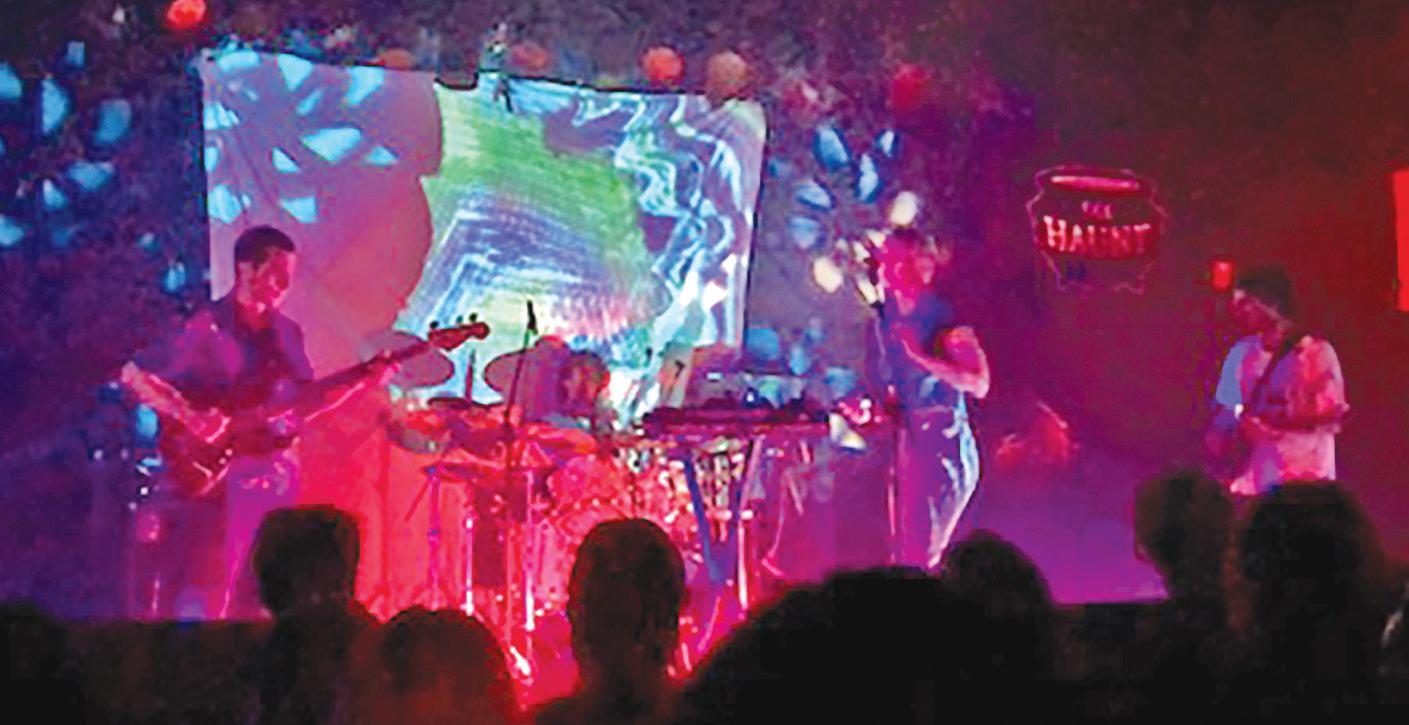
Psychedelic, intimate, electric, authentic, interstellar. These five words are the best way to describe the experience of seeing Brian!, Empath and Guerilla Toss at The Haunt.
The show started with local Ithaca Underground band, Brian!, taking the stage. The band was comprised of artists playing the bassoon, guitar, drums and string bass. The majority of the vocals were performed by the bassist: They were a mix of spoken word, singing and vocal sounds that created an eerie, other-worldly feeling. The bassist read from a book and spoke the lyrics, which transformed the song into a piece of performance art.
The next band to perform was Empath. Based in Philadelphia, the artists brought a grunge, alternative style. Empath used a synthesizer and bird noises to create music that was a blend of punk rock and alternative singing that got the audience jumping. The band changed the pace at the right times to keep the audience engaged and having fun. It was thrilling to watch the band members in their flow of performance as I was swaying
much to say.” The tracks go on to poignantly address topics like problematic friends and lovers, depression and just being straight-up confused about what is going on with your body and your sense of self. Close It Quietly feels sad and shrinking at times but also searing, clever and confident at others.
You know when you just wish things in your life had happened differently, or somehow more dramatically, just for the story?
On semi-breakup song, “Never Would,” Kline seems to address an ex-lover: “It’d make a good song to miss you / But I really don’t at all / If you were any good I’d sing / ‘Oh babyyyy why’d you have to goooo?’” These are the things you think to yourself when you’re falling asleep and wish you had said in real life.
“Never Would” is a perfect example of the way Kline’s lyrics give her musical persona a supernaturally satisfying sense
of control. The song concludes: “But it’s not a song / And I never would.” Kline has the last word and somehow sounds sen sitive while essentially telling the song’s subject to go away.
When Guerilla Toss came on, the lights went down and the crowd went wild. The six members put on a great show and the electricity was palpable. The band used a synthesizer for intense and purposeful sound effects. The audience was singing along to Guerilla Toss’s popular songs, especially “Betty Dreams of Green Men,” which gave off significant Joan Jett vibes. When I thought that people couldn’t get more excited and energetic, the lead singer started playing an electric violin, almost as if out of nowhere, which showcased the band’s talent and unpredictability. The performance was complemented with psychedelic visuals, colorful lights and a fog machine.
Overall, the combination of Brian!, Empath and Guerilla Toss, transitioned nicely to create a cohesive, unique experience. The night was one big intimate performance and all audience members were engaged and excited. I would recommend checking out these bands for a mix of alternative, electric and rock music.
Rachel Mattessich is a senior in the College of Arts and Sciences. She can be reached at rjm463@ cornell.edu.
“Marbles” and “Selfdestruct,” two songs which Kline sings solo, are arguably the most moving of the album; pure, simple and shattering. They recall Kline’s early work, comprised of songs self-released on Bandcamp when she was a teenager. On “Self-destruct,” the saddest and shortest song on the album, Kline sings: “Way up high and fucked / Not violent enough to self-destruct / But I wanna stop being in this life / Late at night we dive into the light / Your eyes swing shut like an orange peel but / It’s just gravity making me tired, weighing me.”
Kline told Atwood Magazine, “[‘Self-destruct’] was about being suicidal but not violent
enough to actually do it. Those feelings are just stuck in your head, in your brain and you don’t know where to put it … And I feel that is what music is to me; a place to put it.” I, for one, am glad that Kline puts her feelings into music, because the product definitely grants listeners the same level of necessary catharsis she feels when writing lyrics.
Fittingly, the final song on Close It Quietly is an ode to crying called “This Swirling” which is incredibly self-aware and funny, as are many of the songs on this album. Kline’s lyrics and voice sound so earnest, yet the lyrics are often full of jokes and irony. On “This Swirling,” Kline seems to make fun of herself while also genuinely meditating on her particular state of
standing here seems like a good start for me to cry.” If you’ve ever had one of those days where you just feel especially fragile and kind of ridiculous, this song is for you. On Close It Quietly, Frankie Cosmos’s songs unfold like rollercoasters, with stomach butterflies repeatedly stirred by word pairings that feel perfectly tailored to the miniscule moments in your life that you might’ve thought were unworthy of music. Kline’s words remind us that all the moments in our tiny lives are worthy of being noticed and of being felt. Close It Quietly is a gift I didn’t know I needed.
agl63@cornell.edu.
Frankie Cosmos Close It Quietly Sub Pop Records
Anna Grace Lee
RACHEL MATTESSICH SUN STAFF WRITER
RACHAEL STERNLICHT/ SUN GRAPHIC DESIGNER
COURTESY OF RACHEL MATTESSICH
The Corne¬ Daily Sun
137th Editorial Board
ANU SUBRAMANIAM ’20 Editor in Chief
JOYBEER DATTA GUPTA ’21
Business Manager
PARIS GHAZI ’21
Associate Editor
NATALIE FUNG ’20
Web Editor
SABRINA XIE ’21
Design Editor
NOAH HARRELSON ’21
Blogs Editor
SHRIYA PERATI ’21
Science Editor
AMANDA H. CRONIN ’21
News Editor
JOHNATHAN STIMPSON ’21
News Editor
PETER BUONANNO ’21
Arts & Entertainment Editor
SARAH SKINNER ’21
Managing Editor
KRYSTAL YANG ’21
Advertising Manager
MEREDITH LIU ’20
Assistant Managing Editor
RAPHY GENDLER ’21
Sports Editor
BORIS TSANG ’21
Photography Editor
AMBER KRISCH ’21
Blogs Editor
KATIE ZHANG ’21
Dining Editor
SOPHIE REYNOLDS ’20
Science Editor
AMINA KILPATRICK ’21
News Editor
Working on Today’s Sun
Ad Layout Jamie Lai ’20
Production Deskers Jenny Huang ’22
News Deskers Nicole Zhu ’21 Amanda Cronin ’21
Design Deskers Jamie Lai ’20 Xiangyi Zhao ’22
Photography Desker Jing Jiang ’21
Sports Desker Christina Bulkeley ’21
Arts Desker Daniel Moran ’21
From the Editor
Te Sun Did IDP And so Should You
Each Cornellian brings nearly two decades worth of life experiences to the Hill before we begin to change and be changed by Cornell. In those formative years — spent oceans, state-lines or maybe just a TCAT ride away from our collective home on campus — our communities decided for us whether we wear tennis shoes or sneakers, whether you see actual culinary value in a CTB bagel and whether we deem it acceptable to wear anything thicker than a windbreaker in September.
But the places we call home before we arrived on campus, equipped with red lanyards and the identities we brought from those homes, also shaped how we react to meeting our often wealthy, artistically talented peers. They affect how absurd we find “a portrait of Jesus with condoms taped to his nipples” in our living space. They determine how desirable we feel in the dating-verse of Cornell. In our discourse in dorms and classrooms and dining halls, those past lives shape our current one, dictating how we react to seemingly innocent statements thrown over the dinner table that are charged with racist assumptions.
The people we were before we got to campus often decide for us which path of self-development we’re placed in when we get here. Our identities are manifold and they are complicated. This weekend at The Sun, we were reminded of the indispensable value of treading into the complex.
On Saturday, The Sun’s editorial board underwent a three-hour session of the Intergroup Dialogue Project, a peer-facilitated initiative catered toward Cornell groups, students, faculty and staff. Through workshops or semester-long course offerings, IDP teaches how to have open, intra-organizational conversations on the vocabulary and components of social identity to promote communication, listening and inclusivity in relationships we build in every space.
We heard the editors we often stay up with until night becomes morning talk about how the people they are outside of The Sun’s office impacts the roles they assume inside of it. It’s humbling and refreshing and weird and altogether vital to the longevity and quality of any organization to be reminded that collectively shedding blood, sweat and tears as we caffeinate in college is not a qualifier for really knowing the people you work with all of the time. We can and should be better about learning through listening — all of the time. IDP allowed The Sun to begin that process.
Listening to our fellow editors whom we work with daily to create the content that lands in your Facebook feed — and if you’re a particularly dedicated Sun reader, rolled up in print in the side pocket of your backpack — be open about our blind spots as an organization will improve how we function as a hub for campus discourse. But effective communication with our campus begins with effective communication with each other as writers and editors. We also know that The Sun is just one of hundreds of organizations that are led by and serve Cornellians. So as you enter another year of diligent work in your organization, we leave you with this request: Do your organization a service and complete an IDP workshop.
Three hours is not nearly enough to begin to grapple with the intricacy of identities like ability, sexuality, gender, race, ethnicity, religion and socioeconomic status. A three-hour workshop is not the antidote to institutional barriers that breathe inequality, stereotyping and prejudice into every pocket of campus. Three hours is not even enough to let us know about all that we don’t know. But it is enough to let us know that we can be better — better listeners, better at admitting our shortcomings and better at communicating to work toward a better Cornell that grows as we do. Three hours of IDP is The Sun’s first step toward progress, toward a more inclusive vision of who we aspire to be. Three hours of IDP can give us a vision of who we want to be a semester, a year or four years after that progress.
— P.G.
Odeya Rosenband | Guest Room
Cornell’s Silence Was Heard on 9/11
The most impactful event that has happened in my lifetime is one I don’t even remember. On Sept. 11, 2001, I was nearly one year old.
Any adult can tell you where they were and who they were with when the largest terrorist attack on American soil occurred. Sept. 11, 2001, is a turning point in global history, and while I was too young to remember what America was like before, I am certain that I was raised differently because of it — raised differently by my parents, raised differently by my country.
Living in Long Island, an hour outside of Manhattan, everyone around me knows somebody — or is that somebody — who was directly impacted by the World Trade Center disaster. The violence and intent on 9/11 personally assaulted every American: It attacked everything we are and everything we stand for. And for New Yorkers, and those living in the surrounding areas of Washington, D.C. and Shanksville,
I have spent on this campus, I have felt incredibly lonely. I felt stuck and confused by the outward ease of everyone around me. I wanted to talk about it, but I didn’t know how there could be a right moment to bring up something so deeply painful. I craved a break from procedure, a sense of relatability, a sense of gratitude. Luckily, though, I did share these sentiments with my best friend, and we decided to pay our respects by visiting the 9/11 memorial in Annabel Taylor Hall. 21 Cornell alumni lost their lives. We are no different than the alumni who died, and those names could have been any single one of ours.
While I was too young to remember what America was like before, I am certain that I was raised differently because of it — raised differently by my parents, by my country.
Pennsylvania, this notion of intimate hatred is only exacerbated by the specific location of the assaults. It was a terrorist attack in the backyard of everyone, and on the home of some.
For me, as a freshman on campus last year, 9/11 went on like any other day. Had I not paid particular attention to the date, there would have been nothing to remind me, nothing to teach me if I had not known and nothing to comfort me. For the first time since I had matriculated to Cornell, I felt completely disconnected from where I came from and, to be honest, the lack of attention was unhinging. I cannot expect everyone — or anyone at all — to have the same relationship to 9/11 that I do. And that’s okay. Humanity needs to move on. However, it is not okay to lack awareness. As an incubator of activists, future leaders and determined citizens, Cornell has the power and the obligation to promote awareness.
On a positive note, the ceremony on behalf of Cornell Democrats and Cornell Republicans shouldn’t go unmentioned. It was touching to see a bipartisan collaboration, one of the first of its kind following the attacks. In that sense, Cornell does have something to be proud of. While it’s true that America has always been divided, our wounds have only deepened in the past 18 years. We have somehow managed to let the good things disappear. The ideals that bonded Americans — our patriotism, our resilience and our devotion to freedom — are now the ideals that political parties attempt to exploit. With urgency, we, Americans, must reflect on these foundational conventions which serve to link us, and that starts with bipartisanship.
The new freshmen on campus comprise the first class of students with birthdates post-Sept. 11, 2001. This is a crucial moment where if we do not demonstrate our respect to those who sacrificed, if we do not grieve with those
It’s about what the world was and what it could have been, what we could have been. It is about hatred and intolerance. It is about innocent lives lost and sacrifices made.
grieving, if we do not educate those who do not know and if we do not work to improve the lives of those who need our help now, then we will be responsible for cultivating generations where little is remembered. Students of Cornell cannot afford to forget. This is the burden of our generation.
Now, as a sophomore, I was revisited by the distress of regularity I felt walking through campus this past 9/11. No matter how much Cornell would have done, or any institution for that matter, it would have never been enough. But surely, Cornell could have done more.
In a university that is partially state-affiliated, Cornell has a high concentration of students from the New York area — specifically, New York City and its surrounding counties — so I imagine that others may have felt a similar discomfort to the one I had experienced. Many of us grew up with in-school events to mark this anniversary: assemblies, marching-band performances, flag ceremonies and tributes by our peers, teachers and principals. More recently, extra measures are being taken as Governor Andrew Cuomo signed a law that requires public schools across New York State to have a moment of silence every 9/11. It is commemorations such as these that encourage students to uphold dialogue: None of us are alone.
And on the past two Sept. 11’s that
Because this isn’t just about one day. It’s about what the world was and what it could have been, what we could have been. It is about hatred and intolerance. It is about innocent lives lost and the sacrifice of our first responders, our heroes. It is about our duty to take care of those still physically impaired and mentally traumatized. It is about our responsibility to be at the forefront of tolerance and understanding. And most of all, it is about the collapse of a united America that we need to search for again.
Next Sept. 11, let’s have more dialogue, a university-wide moment of silence and more assistance for those struggling. You are not required to participate, but the option is there. This day should not be able to go unnoticed by anyone. Members of Cornell have a responsibility not to let the good things disappear just because bad things are happening.
Odeya Rosenband is a sophomore in the College of Arts and Sciences. Guest Room appears periodically this semester. Comments may be sent to opinion@ cornellsun.com.
Giancarlo Valdetaro | Far Above
For the Criminal Justice System, Just Another Dirty Band-Aid
On Friday, September 13, actress Felicity Huffman was sentenced to 14 days in prison for paying $15,000 to have her daughter’s SAT altered as part of a wide-ranging college admissions scandal. Across Twitter and on shows such as The View, many reacted with indignation at a sentence they viewed to be too lenient, especially when contrasted to two black women — Kelley Williams-Bolar and Tonya McDowell — who also gamed the education system, but were sentenced to 10 days and five years in jail, respectively, for sending their children to school districts they didn’t reside in. In fact, both the prosecutor and judge in Felicity Huffman’s case argued that not sentencing Huffman to any jail time would be an injustice to Williams-Bolar.
Injustice can only be fixed by questioning why we turn to the criminal justice system to solve so many of our problems in the first place.
Although the prosecutor’s and judge’s diagnosis of potential injustice is correct, their assessment of the cause and the solution is not. Huffman walking free wouldn’t have been an injustice to Williams-Bolar and McDowell, nor is the injustice done to the two women corrected by sentencing Huffman to a two-week stint. Injustice was done to both of these women when they were prosecuted in the first place. Injustice can only be fixed by questioning why we turn to the criminal justice system to solve so many of our problems in the first place. Without a doubt, there is a disparity between the sentence that Huffman received and the sentences that Williams-Bolar and McDowell did. Huffman is a wealthy and famous actress who, as the judge pointed out in sentencing, was trying to take further tilt a playing field that was already near-vertical in her favor. Williams-Bolar moved her children to a different school district because her home had been burglarized and she was worried about their safety during the day before she got home from work. Her five-year sentence was suspended to 10 days,
of which she served nine. McDowell sent her son to a different school district in order to get him a better public education. Her 12-year sentence was suspended to five. This disparity is emblematic of a criminal justice system with bias against black and poor people at its core. Modern police forces evolved from patrols and constables meant to keep slaves and Native Americans in line. It took the federal government until 1833 to outlaw debtors’ prisons (an institution effectively returning today). After the Civil War, Jim Crow laws in the South criminalized not having a job and attempting to move without an employer’s permission, intending to return freedmen to bondage. These inequalities persist today, as black people are imprisoned at five times the rate of white people, nearly half of people serving life prison sentences are black, and prosecutors are more likely to seek harsher penalties for black defendants than they are for whites.
What the prosecutor and judge crucially missed, though, is that inequality in the criminal justice system starts before a Kelley Williams-Bolar or a Tonya McDowell arrive in a courtroom.
When McDowell’s case was starting, multiple members of the local school board stated there were other students from out of district, but they were normally just unenrolled. Why prosecute her, especially when — as a homeless individual — she likely wouldn’t be able to pay the restitution the school district sought? Given that Williams-Bolar had unenrolled her children from the school district her father lived nearly a year-and-a-half before, why prosecute her?
Per the mayor of the town where McDowell sent her son and the judge who presided over Williams-Bolar’s case, the answer to both of these questions was deterrence. And yet, research shows that deterrence comes not from the severity of a punishment, but from the expectation it will be handed out. Due to the arbitrary nature of these punishments, that makes deterrence seem less likely.
More important than the fact that other parents aren’t that likely to be deterred, though, is the fact that prosecution was the mechanism for deterrence at all. In both of these cases, incarceration was a dirty Band-Aid used to cover up the gaping wounds of social inequality. Instead of recognizing that Williams-Bolar did what she did because of safety fears and
Colton Poore | Help Me, I’m Poore
Ipoor schools, and addressing those concerns, resources were used to incarcerate her. Instead of recognizing that McDowell was trying to get a better education, resources were used to incarcerate her.
There are more systematic examples of this instinct for
Every single one of these cases matters because being behind bars for even one night is traumatic.
incarceration. In schools across the country, police officers are increasingly called about disciplinary issues that were once solved by staff, leading to the arrest and prosecution of students. In a staggering proportion of cities, homelessness is criminalized through bans on sleeping in public, asking for money and more, with the punishment of jail time. Nationwide, over 400,000 people behind bars have a mental illness, with Chicago’s Cook County Jail operating what is effectively the largest mental health hospital in the nation.
Every single one of these cases matters because being behind bars for even one night is a traumatic and life-altering event. Not only were nine nights in jail horrifying to Williams-Bolar, but the presence of a felony conviction on her record prevented her from returning to be a teaching assistant until Ohio’s governor reduced her sentence to a misdemeanor. More generally, research suggests that spending any amount of time behind bars for one offense actually increases the chances of spending more time for a different offense.
Felicity Huffman wasn’t the only perpetrator in this case. But as one of the few who plead guilty, it’s likely that others — including fellow actress Lori Loughlin — will receive harsher sentences. If they do, we shouldn’t treat it as justice for Kelley Williams-Bolar or Tonya McDowell. It’ll be just another dirty Band-Aid.
Giancarlo Valdetaro is a junior in the College of Arts and Sciences. He can be reached at gvaldetaro@cornellsun.com. Far Above runs every other Monday this semester.
Cornell Hath Made a Pauper of Me
must disclose that I have always considered myself to be privileged. I was raised by a family that loves and supports me. Growing up, I never had to worry about where I would sleep at night or how I would get my next meal. To me, that is privilege. Why, then, does Cornell make me feel so poor?
I remember a conversation from sophomore year regarding where my friends and I wanted to go for Spring Break. The first suggestion in the group chat was Costa Rica. I gingerly remarked that not everyone might be able to afford that. Understanding my plight, the destination became Puerto Rico. Again, I praised the virtues of frugality and thriftiness. Then, the pin dropped in Miami. Even then, I was unsure — it wasn’t just the flight but the meals and the hotel and the museums and the nightclubs. Perhaps growing impatient, someone replied: “Why not just ask your parents?”
That’s simply a question and a conversation that does not exist within my familial lexicon, at least in that specific context.
tasting something bitter.
I ended up on a road trip to Chincoteague Island in Virginia with other friends to see its wild horses stroll along a much more affordable mid-Atlantic beach. I enjoyed it thoroughly, I might add.
An incident like this might be easily ignored if it were to crop up only every now and then, but similar situations around wealth seem to occur almost every day at Cornell. And the constant reminder they provide — the subtle suggestion that some of us can’t afford to fit in — eventually becomes hard not to take personally.
Growing up, I never had to worry about where I would sleep at night or how I would get my next meal. To me, that is privilege. Why, then, does Cornell make me feel so poor?
Money for books? Sure. Desperate need for groceries? That could be arranged. But merely a trip with my friends to Miami? The thought made me recoil, as though
Please, don’t say you’re too poor to do something when the truth is that you just don’t want to do it. And when I ask you to do something you don’t want to do, don’t use the money excuse only to order a new outfit or send Snapchats of your sushi dinner the next day. Because if your idea of poverty — even as a joke — is above the level at which I exist, how am I supposed to feel anything other than alienation? In the moment, I laugh along. But the insecurity is mounting. Cornell is often an uncomfortable experience for many students who simply aren’t as affluent as the cohort of students that seem to dominate campus life. In a world in which Canada Goose jackets, AirPods and hotelies dressed in full business attire abound, it’s easy for a student to feel unworthy. It’s a strange feeling to have thought you were well-off, only to come to
Cornell and find out that you are, in fact, poor. (And no, I will not be ordering a new outfit or heading out for sushi tomorrow.)
And it’s a hard feeling to have because it’s one that you shouldn’t be having. These accessories and eyesores are supposed to be basic facts of life (though they’re not). Casual references to a poverty level still within the top 10 percent of society are agreed upon to be humorous and unassuming. You are meant to be laughing, not recoiling.
I find myself routinely exposed to what I don’t have and when I interact with people with whom I don’t share many life experiences. And it hurts more to be on the losing end of that feeling, to feel that I don’t have these life experiences because, frankly, I couldn’t afford them.
None of this is to say that one should relinquish their AirPods or renounce their Canada Goose; affluence exists at Cornell in abundance.
During the first few weeks of freshman year, while sitting in a group of strangers outfitted in Vineyard Vines and boat shoes, awkwardly attempting to make acquaintance, someone said that I looked like I came from a public school. It’s hard to feel comfortable in that type of conversation, when a wealth disparity is not only implied but vocalized. And it’s hard to feel comfortable at a college where that conversation even occurs in the first place.
The unremarkable nature of these casually dropped status symbols — of international voyages, of steakhouse dinners — serve to remind everyone that this is normal. This is expected. We should learn to expect it. Or at least to pretend to. However, it quickly becomes tiring to feign interest in a social display in which you can’t take part. It’s a strain to pretend that you aren’t alienated from your peers when you really are.
It makes it more difficult for me to convince myself that I am worthy for Cornell, that I belong here and that I fit in when
None of this is to say that one should relinquish their AirPods or renounce their Canada Goose; affluence exists at Cornell in abundance. It is only meant to suggest that one act with mindfulness. To speak about material possessions and life experiences not as things that are taken for granted but are very much privileges, and to acknowledge them as such. To be aware that though we might be too proud to admit it, it can be painful to find out you’re sitting in a room of 20 in which only three people didn’t come from the wealthiest zip codes in the U.S.
We are laughing along with you, but maybe only because we don’t want you to know how much like imposters we feel to be studying alongside you.
Colton Poore is a senior in the
Sundoku Puzzle #216
Fill in the empty cells, one number in each, so that each column, row, and region contains the numbers 1-9 exactly once. Each number in the solution therefore occurs only once in each of the three “directions,” hence the “single numbers” implied by the puzzle’s name. (Rules from wikipedia.org/wiki/ Sudoku)
Art by Alicia Wang
—Maia Bhaumik, San Mateo, CA Johnny Woodruff by Travis Dandro
26 A PA R TMENT FOR R ENT
Position Preview: C.U. Linebackers
607-273-1669
2020-2021
Studio 1, 3, 8 & 11 BR Apts. Great Locations in Collegetown.
607-227-2535
read the game. They’re wiry kids, but they strike. I think they’re two guys who will probably come on the bus with us to Marist.”
the Red’s defense, which resulted in the team giving up nearly 30 points per game.
“[Freshmen]
27 H OUSE FOR R
ENT
20-21 College Ave. 5 BR House Furnished. Laundry. Parking. Call 607-273-8576
20-21 Upper Eddy St. 7 BR house Furnished. Laundry. Call 607-273-8576
Despite the accomplishments of the aforementioned upperclassmen, the Red struggled to generate pressure on its opponents in 2018.
Through the 10-game season, Cornell only generated 16 sacks, the second-worst mark in the Ivy League. Opposing quarterbacks regularly had time to carve up
Jake Stebbins and Hunter Delor ... [are] two guys who will probably come on the bus ... to Marist.”
David Archer
To make matters worse, Cornell bled yards on the ground as well.While the
Red can boast about its aerial defense, it cannot say the same about its efforts against the run. A year after giving up 166.1 rushing yards per game, Cornell regressed even further, allowing rushers to gain a staggering 192.2 yards per contest.
Cornell’s defensive unit gets a chance to take a necessary step forward as the team visits Marist for its season opener on Sept. 21.
Luke Pichini can be reached at lpichini@cornellsun.com.
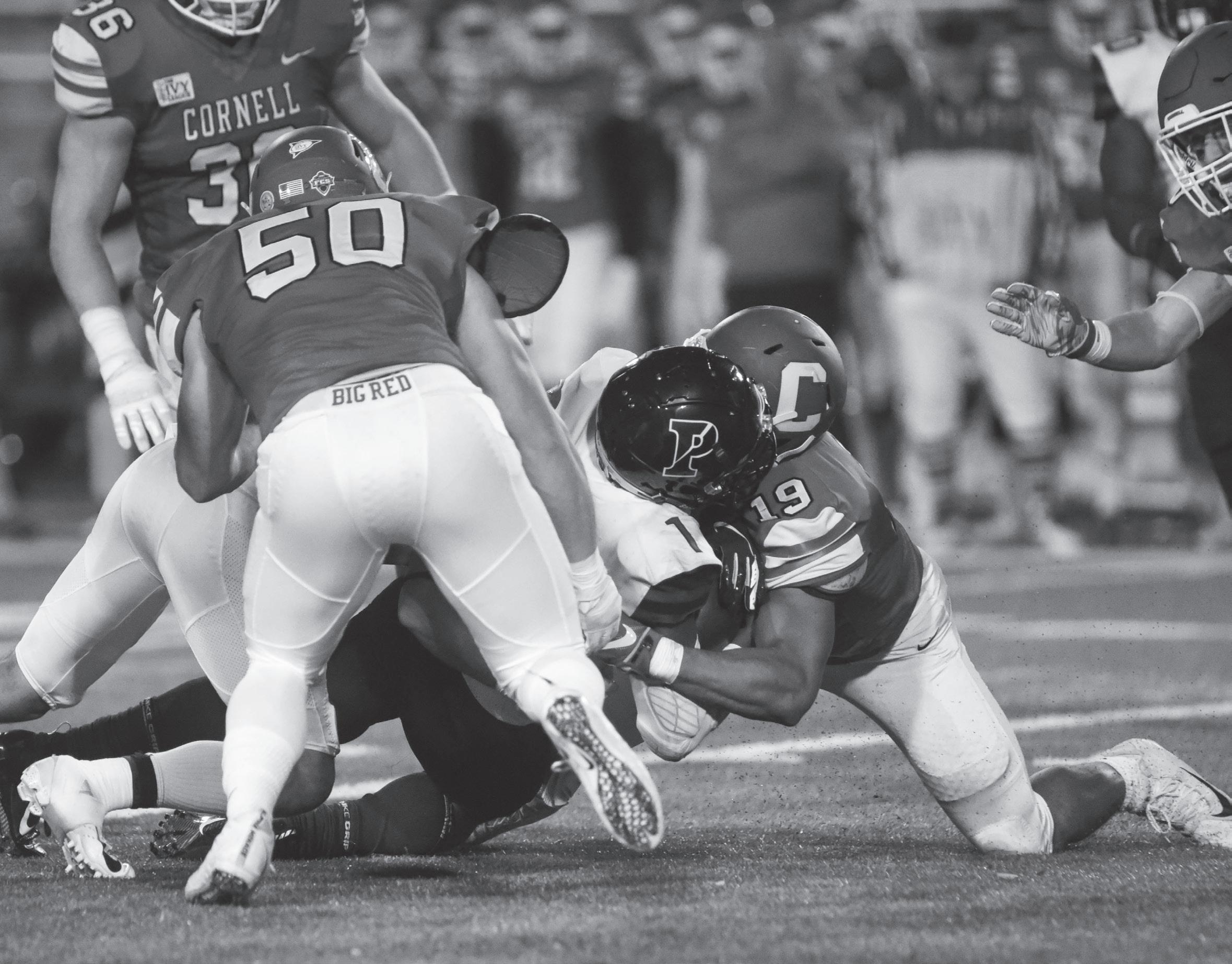
Stuffed | Senior Mo Bradford is one of several upperclassmen to return to Cornell’s linebacking corps.
BORIS TSANG / SUN PHOTOGRAPHY EDITOR
With First Game Under One Week Away, Starting Quarterback Situation Uncertain
By RAPHY GENDLER
Sun Sports Editor
While the primary job of Cornell football’s quarterbacks is likely to be feeding senior running back Harold Coles, the Red’s inexperienced signal-callers will be in charge of taking the helm of head coach David Archer’s ’05 playbook.
Junior Richie Kenney and senior Mike Catanese will be the team’s quarterbacks in 2019, according to Archer. The two both saw playing time sprinkled in last
season. However, after Archer said he planned to use all three quarterbacks and didn’t commit to a starter in the preseason, Dalton Banks ’19 quickly emerged as the Red’s QB1.
Kenney completed 14 of 29 passing attempts in limited action last season. Catanese, meanwhile, added a spark — mostly with his legs — as a run-first, change of pace quarterback. Catanese seemed to be developing as a key offensive weapon before suffering an injury and missing the final six games of the season.
Archer said Kenney and Catanese are his quarterbacks — they’re the two that have “played the best” — but isn’t sure if the two will work as a platoon or with one taking the bulk of the snaps.
“I don’t know if it’s going to be this guy for 60 percent, this guy for 40 percent or ‘hey, this guy’s a starter and he has a package,’” Archer said. With 10 [days] still to go [until the start of the season] I’m still kind of feeling that one out.”
In 2018, Catanese was sprinkled in for mostly run-first and Wildcat-style packages, at times igniting the offense with big gains on the ground. The then-junior had a 24-yard touchdown run against Yale in front of a Homecoming crowd, and his 32-yard score against Harvard proved key to the Red’s victory over the Crimson.
His injury midway through the season derailed an offense whose passing game already lagged behind its strong rushing attack. With Catanese out for the final six games, Cornell went 1-5 behind a passing game that was shut out twice and held to single digits once.
“[Catanese] is more of a good moxie gamer, can make a lot of throws can beat you with his legs,” Archer said. “Both [Kenney and Catanese] have good command of the offense, good command of the huddle. But Mike has that added element of just if it breaks down, man, he can create a big play with his feet and extend drives.”
Kenney, meanwhile, was a more traditional throw-first quarterback, but he didn’t see much meaningful playing time. As a sophomore in 2018, he saw action in
Defensive Units Hope to Take a Step Forward Following Several Departures
After giving up 29.7 points per game during the 2018 season, Cornell football is hoping to shore up defensive cracks both on the back end and in the middle of the field.
When examining the Red’s secondary, head coach David Archer ’05 is confident in his unit going into the season.
“I really like the secondary — I think they’re disguising their coverage really well,” Archer said. “The leader of that is Jelani Taylor, without question.”
compiling 32 tackles and seven pass breakups. Should Taylor take another step forward in his final season, the Red’s secondary could once again become a leading unit in the Ivy League.
In 2017, Cornell’s pass defense topped the Ancient Eight. The secondary allowed a league-low 189 passing yards per game. Unfortunately for the Red, it regressed in that regard last season as it dropped to fourth by giving up an average of 202.6 yards per game.
senior David Jones. Last year, Jones did it all for Cornell, as he tabbed 21 tackles, three interceptions, nine pass defends, and a blocked field goal. Not only that, but the Sugar Land, Texas native further displayed his versatility in leading the Ivy League with 498 return yards.
“I think he’s one of the best return men in the Ivy League,” Archer said of Jones. “I think he is one of the best corners in the Ivy League.”
“I think [senior David Jones] is one of the best return men in the Ivy League ... One of the best corners in the Ivy League.”
Taylor, the senior safety who was recently named a captain alongside offensive lineman George Holm III, comes off a breakout junior year in which he led the team with 72 total tackles and nine pass breakups. The season prior, he emerged in the back half of the year, ultimately
David Archer
With D.J. Woullard ’19 and Austin Holmes ’19 having departed through graduation, Cornell will have several holes to fill in the defensive backfield. Luckily for the Red, it returns
Rounding out the secondary are fifth-year senior Jake Watkins, junior Logan Thut and sophomore Michael Irons. Watkins and Thut will see increased usage as safeties while Irons — coming off limited snaps last season — figures to start at cornerback opposite Jones.
“So, I really like their zone coverage and their man coverage,” Archer said. “The key is, I tell them, ‘They gotta win
five contests and attempted just 29 passes. Most of those came in garbage time of losses at Delaware, Colgate and Princeton. Archer said Kenney looks like a “totally much improved player” heading into the season.
“Significant growth in terms of the throws he makes, command of the offense, comfortable in the pocket, command in the huddle, really good movement in the pocket,” Archer said of Kenney.
“I don’t know if it’s going to be this guy for 60 percent, this guy for 40 percent ... I’m still kind of feeling that one out.”
David Archer
Whoever’s under center Sept. 21 at Marist — and as the intense stretch of Ivy League games starts soon thereafter — will have the keys to an offense that, like the rest of the team’s schemes, Archer said has a reinvented approach.
Kenney and Catanese — two inexperienced upperclassmen who have spent the better part of two and three seasons, respectively, waiting in the wings and watching Banks — will be the first to test out Archer’s new offensive schemes and “hybrid warfare approach.”
Raphy Gendler can be reached at rgendler@cornellsun.com.
the Halloween costume contest, man, you have got to have a great disguise. You got to show [the opponent] what it’s not.”
Meanwhile, the linebacker corps will have to regroup following the departure of 2018 captain Reis Seggebruch ’19 and fellow senior Maxwell McCormick ’19. The two combined for 95 tackles over the course of the year.
While the starting lineup will be filled out by those upperclassmen, Archer took the time to praise a couple of first-year linebackers who will likely provide valuable depth.
“There are two linebackers that have really impressed,” Archer said. “Jake Stebbins and Hunter Delor have really had a good camp. They feel it, they
Though the Red has lost two starters, it still returns a nice batch of veteran talent. Archer cited seniors Mo Bradford, Justin Bedard, Billy Baker and Malik Leary and junior Lance Blass as players that will anchor the heart of the defense. Of that group, Blass and Bradford have seen plenty of time on the field, coming in third and fourth, respectively, in total tackles by the end of last season.
Two man job? | Following the departure of three-year quarterback Dalton Banks ’19, head coach David Archer ’05 remains undecided on the future of the position.
BORIS TSANG / SUN PHOTOGRAPHY EDITOR
By LUKE PICHINI Sun Staff Writer
Fresh faced | The Red will look to replace four starters in the secondary and linebacking corps after graduating some top players.