INDEPENDENT SINCE 1880
The Corne¬ Daily Sun
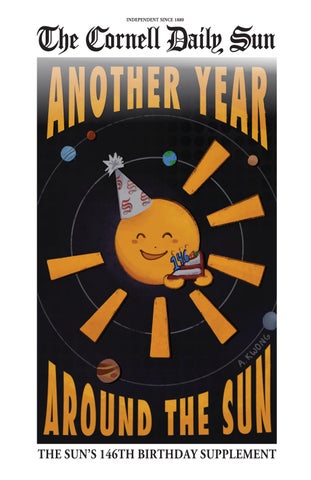
THE SUN’S 146TH BIRTHDAY SUPPLEMENT
2 The Cornell Daily Sun | Wednesday, September 16, 2026
The Sun's 146th Birthday Issue
INDEPENDENT SINCE 1880
The Corne¬ Daily Sun WEDNESDAY, SEPTEMBER 16, 2026 n ITHACA, NEW YORK
Vol. 143, No. 5 Arts
News
Sports
Thorne teaches
Riley responds
Pro-Prospect
Actress Dominique Thorne ’19 speaks about adversity, bravery and being a student at the Schwartz center.
Ryder Kurtz ‘27 is the kind of player “who only comes to Ithaca every so often,” Sports Editor Matthew Leonard ‘28 writes. | Page 16
Rep. Josh Riley spoke at an on-campus Q&A hosted by ACS at the Law School.
| Page 12
16 Pages – Free
| Page 3
Revised Student Code and Procedures Go Into Effect
By CORAL PLATT Sun News Editor
Sept. 13 — The Student Code of Conduct and Procedures have been updated for the first time since August 2021, per a July 30 statement by Ryan Lombardi, vice president for student and campus life. The changes went into effect on Aug. 1. The most sizable changes were made to Section VIII of the Procedures, which discusses interim measures gency suspenand emersions. Other changes include matical and gram-
language clarifications, the addition of a paragraph related to freedom of expression, changes to policy related to notations on student records and revisions to conduct prohibited for students and student organizations. “The annual review of the Code and Procedures provides an opportunity for the university to ensure that its policies remain responsive to evolving student behavior, is consistent with applicable state and federal laws and university policies, and is as clear and effective as possible,” a University spokesperson wrote in a statement to The Sun. Prior to the adoption of the revised Code, the Code and Procedures Review Committee, chaired by Marla Love, Robert W. and Elizabeth C. Staley Dean of Students, held listening sessions, reviewed resolutions
VARSHA BHARGAVA / MANAGING EDITOR
passed by the Assemblies related to the Code and conducted a public comment period in Spring 2026. The Student Assembly, University Assembly, Graduate and Professional Student Assembly and Faculty Senate all passed resolutions during the 20252026 academic year related to Code of Conduct revisions. The Student Assembly passed Resolution 10 in October 2025, the UA passed Resolution 1 in April 2026, the GPSA passed Resolution 5 in November 2025 and the Faculty Senate passed Resolution 209 in November 2025. “The Committee took public comment feedback seriously and developed recommendations based on what it heard from the broad campus community,” the University spokesperson wrote. “While not every public comment results in a revision, feedback received will continue to be considered as part of each annual review.” Emergency Suspensions While most revisions involved phrasing changes, Article VIII of the Procedures, which discusses actions that the University may take towards a party involved in an ongoing conduct investigation, was
rewritten. This section, previously titled “Temporary Suspensions,” was renamed to “Interim Measures and Emergency Suspensions,” and expanded to over four times its previous length. “The term ‘temporary suspension’ was changed to ‘emergency suspension’ to more clearly describe the circumstances in which the measure may be used and its purpose,” the University spokesperson wrote. In November 2025, the Faculty Senate claimed that temporary suspensions had been “overused.” There were 21 temporary suspensions issued to students in the 2024-2025 school year, up from nine from 2023-2024 and none from 2022-2023, according to data published by the Office of Student Conduct and Community Standards in its 2023-2024 annual report and in a presentation to the Faculty Senate in October 2025. To continue reading this story, please visit www.cornellsun.com. Coral Platt can be reached at cplatt@cornellsun.com.
ROTC Honors 25th Anniversary of 9/11 Attacks
Cornell ROTC hosted a stair climb and workouts event to pay tribute to the first responders and lives lost on Sept. 11, 2001. By MARY CAITLIN CRONIN Sun News Editor
Sept. 11 — Over 200 cadets, first-responders, veterans, faculty and students gathered at 5:45 a.m. Friday on Schoellkopf Field for the University’s 9/11 memorial stair climb and workouts event. Hosted by Cornell Reserve Officers Training Corps, the event honored the first responders who were present for the Sept. 11, 2001 attacks and commemorated the lives that were lost. Annually, 9/11 memorial stair climbs are hosted nationwide to pay tribute to the New York City Fire Department firefighters who climbed the North and South towers of the World Trade Center. During Cornell’s event, participants completed a 40-minute intensive workout to honor the first responders’ physical hardship while responding to the attacks. The workout was split into three sections – running up and down the full length of the stadium rows, buddy carrying a partner from sideline to sideline
and completing a circuit of 10 push-ups, 20 squats and 30 crunches. Nathan Li ’27, Cornell ROTC tri-service brigade commander, gave the opening remarks. “Though most, if not all, of the ROTC brigade were not around on [Sept. 11, 2001], I know we share that resolve to realize what it means to never forget,” Li said. “We are gathered here to honor those 2,977 Americans … whose lives were cut short that day by an unspeakable act of terror.” He then took a moment to remember the 21 Cornell alumni who died in the Sept. 11, 2001 terrorist attacks. After the remarks, the crowd divided into three stations to start the workout. For the next 40 minutes, participants cheered each other on while breaking a sweat as the sun rose over Schoellkopf Field. At the end of those 40 minutes, the crowd reconvened at the center of the field for closing remarks. “We should reflect, we should
SOPHIA ROMANOV IMBER / ASSOCIATE EDITOR
remember, we should never forget, we should stay mad,” said Captain Michael Mosbruger, commanding officer of Cornell Naval Reserve Officers Training Corps. He spoke about the reason behind showing up, climbing the stairs and completing the workouts, telling the crowd that they were there to “commemorate the people who had courage to do something heroic.” “The first responders and military, we have one great thing in common: when bad stuff happens, we run towards it — we don’t run away from it,” Mosbruger said. Li told The Sun that the memorial made him reflect on his responsibilities as a future commissioned naval officer. “We have big shoes to fill,” Li said. “If anything similar to [the 9/11 attacks] would happen, the same things would be expected of me. I think it’s important to honor the legacy of those who’ve gone before us and given their lives in service.”
SOPHIA ROMANOV IMBER / ASSOCIATE EDITOR
Nate Harris ’28, a volunteer for the Cayuga Heights Fire Department, told The Sun that the event left him feeling “motivated” and “inspired.” Matthew Morris, a second-year MBA student and marine veteran, echoed Harris’ sentiments. “I’m the salty vet, and so getting to come and see the next generation, I am extremely confident at what’s coming,” Morris said To close the memorial, every person in the crowd placed one hand into the center of the group and shouted “Never forget” in unison, followed by a wave of applause. Several other memorial events took place on campus Friday – including Cornell Democrats and Cornell Republicans planting 2,977 American flags on the Arts Quad and Cornell Chimesmasters’ tolling the bells to remember each attack on Sept. 11, 2001. Mary Caitlin Cronin can be reached at mcronin@cornellsun,com.
SOPHIA ROMANOV IMBER / ASSOCIATE EDITOR
2 The Cornell Daily Sun | Wednesday, September 16, 2026
Daybook
Daybook
Wednesday, September 16, 2026
A LISTING OF FREE EVENTS ON CAMPUS AND IN ITHACA
The Corne¬ Daily Sun INDEPENDENT SINCE 1880 Editor in Chief
Sophia Dasser ’28
ALL DEPARTMENTS
(607) 273-3606
Business: For questions regarding advertising, classifieds, subscriptions or delivery problems, please call from 9 a.m. to 5 p.m., Monday-Friday. News: To report breaking news or story ideas, please call after 5 p.m., Sunday-Thursday.
SEND A FAX VISIT THE OFFICE THE SUN ONLINE E-MAIL
The Corne¬ Daily Sun
FRESHMAN SURVEY
(607) 273-0746 139 W. State Street, Ithaca, N.Y. www.cornellsun.com sunmailbox@cornellsun.com
Postal Information: The Cornell Daily Sun (USPS 132680 ISSN 1095-8169) is published by the Cornell Daily Sun, a New York corporation, 139 W. State St., Ithaca, N.Y. 14850. The Sun is published Wednesdays during the academic year and every weekday online. Three special issues — one for seniors in May, one for reunion alumni in June and one for incoming first-year students in July — make for a total of 33 issues this academic year. Subscriptions are: $35.00 for fall term, $37.50 for spring term and $72.50 for both terms if paid in advance. Standard postage paid at Ithaca, New York. Postmaster: Send address changes to The Cornell Daily Sun, 139 W. State St., Ithaca, N.Y. 14850.
Wednesday
Thursday
West Campus Wellness Fair 4:30 - 6 p.m., West Campus, between Becker and Keeton
Midday Music: Cory Smythe 12:30 - 1:30 p.m., Lincoln Hall B20
Bombshell Film Viewing 5:30 - 8 p.m., Cornell Cinema
DDLS Roundtable with Meli James 4:30 - 5:30 p.m., Statler Hall 191
Trivia Night 7 - 9 p.m., Ithaca Beer Company Becker Café: “The Good of the Hive” 7:15 - 8:15 p.m., Carl Becker Seminar Room Verano de Jazz 9 p.m. - midnight, Tres Leches
Free Zumba 6 - 6:45 p.m., Noyes Community Recreation Center Trivia Night 6 - 8 p.m., Ithaca Bakery Karaoke on Thursday’s 10 p.m. - 1 a.m., 130 East Seneca St.
Friday
Saturday
Tea & Tarot 10:30 a.m. - noon, Anabel Taylor Hall 114
Ithaca Farmers Market 9 a.m. - 3 p.m., Ithaca Farmers Market
Dilmun Hill 30th Anniversary Open Farm Day 3 - 6 p.m., Dilmun Hill Student Farm
Kendo Club: Beginner Practice 9:30 -11:30 a.m., Willard Straight Hall 519
Councils Carnival 4 - 6 p.m., Arts Quad De-Stress with Dogs! 5 - 6 p.m., Anabel Taylor 230 September Contra Dance 6:30 - 10 p.m., Biotechnology Building G10
Saturday Botanic Gardens Highlights Tour 10 - 11 a.m., Cornell Botanic Gardens Dragon Boat Practice 10:30 a.m. - 1 p.m., Cass Park Docks
Kitestring Live 6 - 8 p.m., Breweres Kitchen and Taproom
Sunday
Monday
Sunday Meditations 9 - 10 a.m., The Foundation of Light, 391 Turkey Hill Rd.
Sprachcafé 5 - 6 p.m., Big Red Barn
Souls of Sithis: Tabletop & Live Action Roleplaying 1 - 2 p.m., 415 N Tioga St. Ithaca Sunday Squares 7 - 9 p.m., State of the Art Gallery
As you embark on your journey at Cornell, we invite you to take some time and reflect on who you are at this point in your lives. Last year, The Sun launched its inaugural Senior Sunset Survey. To continue this effort to connect with students, we now are creating our first annual Freshman Survey. You can fill it out at the QR code above.
- The Sun’s Data Team
We have merch!
Freedom Party 1 - 4 p.m., 301 W. Court St.
Open House at the Fuertes Observatory 8 p.m. - midnight, Fuertes Observatory
Porchfest Noon - 6 p.m., Fall Creek Area, locations vary
Welcome Class of 2030!
Grad Student Improv Club Open Jam Session 6 - 7:30 p.m., Big Red Barn Tango Lesson & Práctica 7 - 9 p.m., Willard Straight Garden Room 215
Stickers, shirts, sweatshirts, mugs
Swing Syndicate at Cornell: Weekly Social Dance 8 - 10 p.m., Big Red Barn
& more at
shop.cornellsun.com
The Cornell Daily Sun | Wednesday, September 16, 2026 3
News
Student Assembly Passes Resolutions on International Student Employment, Outreach, Assembly Funding By EMMA SPINDLER Sun Senior Writer
Sept. 13 — The Student Assembly passed four resolutions Thursday addressing international students’ work authorization, member outreach, its 2026-27 operating budget and Student Activity Fee allocations. It also advanced resolutions on disability representation, anti-bias training and syllabus publication, to be voted on in future meetings. Resolution 2: Clarifying Practical Training Options for International Students The Assembly unanimously passed Resolution 2, authored by Jinzhou Wu ’28, Darin Lee ’28 and Jana Orief ’29, which asks the University to provide guidance to international students about off-campus
employment options after federal announcements narrowed eligibility for temporary work authorization. The resolution calls on Cornell International Services to clarify recent changes affecting Curricular Practical Training and provide international students with more information about alternative ways to pursue internships and other employment, including Optional Practical Training. CPT allows eligible international students to receive authorization for off-campus work connected to their academic programs. Wu, Lee and Orief wrote in a joint statement to The Sun that two August memoranda from the Student and Exchange Visitor Program restricted CPT pathways that many international students had previously relied on for internships.
CAMILLE ECKERT / SUN PHOTOGRAPHER
Assembly actions | Student Assembly passed four resolutions related to CPT changes for international students and internal outreach and budgeting at its Thursday meeting.
Rep. Josh Riley Speaks at On-Campus Q&A By MAYA JOHANSEN and FRANCESCA WESLEY Sun News Contributors
Israel Public Affairs Committee, according to OpenSecrets, using data from the Federal Election Commission. One student questioned why Riley criticised President Donald Trump for cutting funds to universities to research and science, but finds threatening federal funding acceptable in this case. “There’s a narrative, I think, out there that [the bill] dealt with First Amendment activities and First Amendment expressive activities — it didn’t,” Riley said. “Peaceful protest is a cornerstone of our democracy for generations. … What that bill was, actually, was an anti-discrimination bill.” He expanded on his answer, noting that he imagined how the bill would affect his district before he made his vote. “At Cornell, for example, there are some really great exchange programs that are strengthening communities around the world, whether it’s Palestinian faculty coming here to teach [or] whether it’s students from Upstate New York having a chance to go to Tel Aviv,” Riley said. “I think I want to protect those from discrimination.”
Sept. 13 — The American Constitution Society at Cornell Law School hosted Rep. Josh Riley (D-N.Y.) for a Q&A on Thursday evening at Morrill Hall. The event, open to all members of the Cornell community, allowed students to speak directly with Riley ahead of his bid for re-election in New York’s 19th congressional district, which includes Tompkins County. Thursday’s discussion centered around denouncing corporate political action committee funding, giving advice to law students in attendance, and addressing rising utility prices in the 19th congressional district. Federal aid for universities Riley discussed a bill he voted for on Sept. 3, that would withhold federal aid for universities that engage in boycotts against Israel. The Protect Economic and Academic Freedom Act, which passed the U.S. House, 237-169, with mostly Republican votes, would make universities who engage in “nonexpressive commercial boycotts” of countries desigTo continue reading this story, nated as “major strategic partners” — Israel is the only state labelled please visit www.cornellsun.com. as such — ineligible for student aid funding. As of July, Riley has received Maya Johansen and Francesca $244,570 of funding from individ- Wesley can be reached at mhj49@ uals associated with the American cornell.edu and fjw48@cornell.edu.
To be approved, the work must now be “embedded” in a university’s curriculum and required for a student’s degree completion, according to Cornell International Services. “With internship recruitment already underway, students need to understand how this affects their plans and what options remain available,” Wu, Lee and Orief wrote to The Sun. “Even though it’s early in the semester, waiting could leave students without enough time to make informed decisions or obtain the necessary authorization.” They added that Cornell had already taken steps to address the changes by holding an Aug. 31 webinar and directly communicating with students who had submitted CPT applications. “Those conversations can still be valuable, but a resolution brings public attention to the issue, communicates students’ concerns, and establishes a clear request for timely action and ongoing communication,” they wrote. Resolution 2 passed unanimously and without debate. Resolution 3: Introducing a Mechanism for Ensured Engagement and Outreach by Members of the Student Assembly The Assembly passed Resolution 3, authored by Alexander Walters ’28, vice president for communications and writer for The Sun’s art department, and Assembly President Eeshaan Chaudhuri ’27, which creates a points-based requirement for representatives to participate in outreach outside of weekly Assembly meetings. Voting members will be required to earn five outreach points before the final meeting of each semester. Members can earn points through activities including tabling, appearing in the Assembly’s “This Week in the Assembly” communications, organizing or collaborating on events, contributing to the
Assembly Roundup or distributing flyers. Walters said the measure was intended to address what he described as a longstanding problem of representatives doing little Assembly work beyond the body’s weekly meeting. “Historically, people have had a really hard time doing anything for the Student Assembly outside of this 4:45 to 6:30 block,” Walters said. The points will likely be recorded in a publicly viewable spreadsheet, Walters said, allowing representatives and students to see whether members are completing their outreach responsibilities. “We want consistent, sustained, spreadout engagement,” Walters said. The resolution passed 27-0-1, with one abstention. Resolution 4: Approving the 2026-2027 Student Assembly Operating Budget The Assembly unanimously approved Resolution 4, establishing a $33,039.36 operating budget for the 2026-27 academic year. The budget distributes funding among the Assembly’s executive cabinet, committees and other programs. The largest allocations go towards administrative expenses, initiatives and special projects. The budget followed discussion at the Assembly’s previous meeting over how much money should be placed in the Special Projects Fund, which student organizations can apply to to receive money from the Assembly, and a broader Initiatives Fund, a flexible pool for Assembly-led student and community programming. To continue reading this story, please visit www.cornellsun.com. Emma Spindler can be reached at espindler@cornellsun.com.
Photo
4 The Cornell Daily Sun | Wednesday, September 16, 2026
SUNBURSTS: 146 Years Of Shining Sun Photography editors dug through the archives, looking back at a few moments The Sun has captured over the past 146 years.
By SUN PHOTOGRAPHY DEPARTMENT
STORMING THROUGH | Students parade through the snowy ground of the Arts Quad for Dragon Day (1992).
THE END AND START | The Class of 1989 celebrates graduation (1989).
CONNECTED BY TUBES | Cornell’s Sigma Chi and Kappa Kappa Gamma chapters race in pairs of tubes (1987).
POSH DINNER | Cornellians enjoy an outdoor meal in front of their beloved food truck, Louie’s Lunch (Undated).
OOPS, SPLASH! | Students soak up the sun on the Arts Quad and take part in water activities (Undated).
STANDING MAESTRO | The Big Red Band performs in front of Willard Straight Hall (1995).
YOU’RE A WIZARD | A gentleman enjoys his day in the A.D White Library (1993).
CLASSIC TACKLE | Cornell takes on Yale in a classic Ivy League battle (1986).
To see more photos, please visit cornellsun.com.
The Cornell Daily Sun | Wednesday, September 16, 2026 5
News
Accepting Responsibility Program Initiated Accepting Responsibility was entered into the revised Code of Academic Integrity in August following a Faculty Senate vote.
By HARLAN FLAMM Sun News Contributor
Sept. 11 — The Accepting Responsibility program, a restorative alternative to Academic Integrity hearings for first-time offenders, was entered into the revised Code of Academic Integrity in August. It was previously a pilot program used in individual courses, but not adopted as official University policy. The program was incorporated into the Code of Academic Integrity on Aug. 24 after the Faculty Senate voted to expand the program from its pilot stage at its May 4 meeting. Before the Faculty Senate vote, the AR program was available exclusively to instructors of roughly 60 courses beginning in Spring 2024, program co-founder Prof. Michael Clarkson, computer science, told The Sun.
“We were looking for ways to make it focus on educational outcomes and an opportunity to learn from mistakes, rather than it being focused on grade penalties.” Prof. Michael Clarkson The Faculty Senate voted 97-4 in favor of making it a Universitywide option. The AR program is voluntary for both the faculty and students involved, and it allows faculty members aware of an academic integri-
ty violation to opt between a formal hearing and investigation or the AR program, according to Article I, Section C. Prior to the creation of the program, students accused of academic dishonesty attended a hearing to determine if a violation took place, and consequences often involved a note on the offender’s academic record calling out the violation. Academic records and the notes inside are visible to employers and graduate schools. The AR program, created by Clarkson and Elizabeth Karns, a senior lecturer for statistics and data science, does not affect the offender’s academic record in this way. “We were looking for ways to make it focus on educational outcomes and an opportunity to learn from mistakes, rather than it being focused on grade penalties and long-term consequences in terms of academic records,” Clarkson told The Sun. If a faculty member decides to offer the AR program to a student, the student receives a violation notification outlining the issue, evidence of the violation and a proposed grade penalty, according to the revised Code of Academic Integrity. The student then has three business days to decide whether to accept responsibility or request an Academic Integrity hearing. If the student accepts responsibility, they admit the violation, accept the penalty and agree to complete an AR workshop within two weeks, according to Clarkson. “AR is a forward-looking educa-
National Republicans Pull Back Support for Riley’s GOP Challenger By ATTICUS JOHNSON Sun News Editor
Sept. 9 — MAGA Majority, an initiative run by the National Republican Congressional Committee devoted to electing non-incumbent Republicans, has removed State Senator Peter Oberacker (R-N.Y.) from its program, according to a review of MAGA Majority’s most recent candidate list published by Punchbowl News. The initiative provides financial backing, campaign advice and national visibility for non-incumbent Republicans. The NRCC added Oberacker to the MAGA Majority program’s candidate roster in March.living standards state. Oberacker is hoping to dislodge incumbent Rep. Josh Riley (D-N.Y.) from the 19th Congressional District, which covers much of the Southern Tier, including Tompkins County, but has faced setbacks after Politico reported Oberacker had saluted his grandfather’s military service in Nazi Germany in a 2015 Veterans Day Facebook post. “I debated on whether to post this picture, my Grandfather Ludwig
Oberacker who gave his life for his country, I salute all who served,” Oberacker wrote in the post, though he has since told Politico that he “would look at it a little bit differently now.” While Riley defeated former Rep. Marc Molinaro (R-N.Y.) by roughly 2% in 2024, Cook Political Report has written that Riley is “in a much stronger position this cycle,” especially since his fundraising has dwarfed Oberacker’s. The nonpartisan outlet has rated the race “Likely Democratic” as of July. And, the Congressional Leadership Fund, the super PAC devoted to winning a Republican majority in Congress, also pulled $4.8 million from television ad spending for Oberacker in the district across three media markets — Syracuse, Binghamton and AlbanyTroy — that make up the majority of the 19th district on Friday, according to Axios. A spokesperson for the Oberacker campaign did not immediately respond to The Sun’s request for comment. Atticus Johnson can be reached at ajohnson@cornellsun.com.
tional intervention,” Karns wrote to The Sun. “In this unique moment, where a student is held accountable for their actions, they have a chance to improve their future actions.” The workshop includes preparatory and follow-up work, plus a small group session led by trained facilitators. It focuses on reflecting on personal values, understanding the impact of the violation and developing strategies to avoid future misconduct, Karns wrote in a statement to The Sun.
“AR is a forward-looking educational intervention. In this unique moment, where a student is held accountabel for their actions, they have a chance to improve their future actions.” Elizabeth Karns
whether it is their time management, study skills or personal issues,” Karns wrote. “The workshop gives them a chance to identify their values that matter to them — not to me or the facilitators — and to figure out ways to support their own situation. I am always impressed with the awareness they demonstrate and their compassion for others in the workshop.” Karns explained that she has seen many benefits from the workshops, which started in the Spring 2024 semester. “Occasionally after a workshop, a student will stay and ask for more resources to deal with their particular situation,” Karns wrote. “This is a really good result — most students who cheat do it because of some kind of pressure. Sometimes we encourage them to talk to an advisor about dropping a class or to go to use the tutoring services. We know about many resources on campus and urge them to seek help.” The 60 courses that used the AR program during the pilot program saw low rates of confirmed repeat academic dishonesty, Clarkson said. “When we look at recidivism rates from the Accepting Responsibility program, we’ve seen this through about 60 courses since Spring 2024 and around 300 students, and what we’ve seen is that during that time, there have only been two true cases of recidivism among students,” Clarkson said.
In the small groups, students do not disclose what they did or why they are attending the program, Karns wrote, adding that the meetings are “focused on the [students’] future.” Karns drew further inspiration for the workshop from her experience teaching STSCI 3600: “Integrated Ethics in Data Science” and observing academic dishonesty workshops utilized by other schools such as University of California Santa Cruz and University of California San Harlan Flamm can be reached at hpf7@ Diego, she wrote. “Most students want to do better, cornell.edu.
6 The Cornell Daily Sun | Wednesday, September 16, 2026
Opinion
The Corne¬ Daily Sun The Editorial Board Independent Since 1880
The Cornell Daily Sun’s Editorial Board is a collaborative team composed of Editor-in-Chief Sophia Dasser ’28, Associate Editor Sophia Romanov Imber ’28 and Opinion Editors Zara Cheek ’28 and Rayen Zhou '29. The Editorial Board’s opinions are informed by expertise, research and debate to represent The Sun’s long-standing values. The Sun’s editorials are independent of its news coverage, other columnists and advertisers.
SOPHIA DASSER ’28
Josh Riley Betrays the First Amendment
144th Editorial Board Editor in Chief
SOPHIA ROMANOV IMBER ’28 Associate Editor
VARSHA BHARGAVA ’27 Managing Editor
RAYEN ZHOU ’29 Opinion Editor
KATE TURK ’27 Assistant Managing Editor
ZARA CHEEK ’28 Opinion Editor
CORAL PLATT ’29 News Editor ATTICUS JOHNSON ’28 News Editor MARY CAITLIN CRONIN ’28 News Editor EVERETT CHAMBALA ’27 Assistant News Editor
JADE DUBUCHE ’27 Multimedia Editor KENDALL MURPHY ’28 Business Manager CHARLIE CLARK ’29 Director of Revenue & Partnerships VICTORIA WROBLEWSKI ’28 Human Resources Manager MELISSA MOON ’28 Arts & Culture Editor JAMES PALM ’27 Assistant Arts & Culture Editor MATTHEW RENTEZELAS ’28 Assistant Arts & Culture Editor HAZEL TJADEN ’28 Assistant Arts & Culture Editor MARC STAIANO ’27 Assistant Arts & Culture Editor KATELYN HALVERSON ’28 Lifestyle Editor AVA BETNAR ’29 Assistant Lifestyle Editor SANIKA SARAF ’28 Assistant Lifestyle Editor KATHERINE ISTOMIN ’29 Marketing Manager ASHLIN KWONG ’28 Graphics Editor TAVAN BHATIA ’27 Games Editor RENA GEULA ’28 Layout Editor
SHUBHA GAUTAM ’28 Assistant News Editor GISELLE REDMOND ’28 Assistant News Editor ANGELINA TANG ’28 Science & Technology Editor TANIA HAO ’28 Science & Technology Editor SIMRAN LABORE ’27 Weather & Climate Editor MATTHEW LEONARD ’28 Sports Editor GRACE REUBEN ’28 Sports Editor JANE HAVILAND ’28 Features Editor NATHAN ELLISON ’28 Photography Editor NATHAN BO ’28 Assistant Photography Editor ADELAIDE CHOW ’29 Assistant Photography Editor MIA SOFIA ORENGO ’28 Video Editor OAKLEY DECRISTOFARO ’29 Video Editor AMELIA GARCIA ’27 Data Editor HUNTER PETMECKY ’28 Layout Editor
WORKING ON TODAY'S SUN
MANAGING Sophia Dasser '28 Varsha Bhargava '27 Kate Turk '27 Sophia Romanov Imber '28 NEWS DESKERS Everett Chambala '27 Atticus Johnson '28 Shubha Gautam '28 Coral Platt '29 Mary Caitlin Cronin '28 SPORTS DESKER Matthew Leonard '28 OPINION DESKERS Rayen Zhou '29 Zara Cheek '28 LIFESTYLE DESKERS Katelyn Halverson '28 Ava Betnar '29 SCIENCE DESKER Tania Hao '28 ARTS DESKER Marc Staiano '27 PHOTO DESKERS Nathan Ellison '28 Nathan Bo '28 Adelaide Chow '29 LAYOUT DESKER Hunter Petmecky '28
Students for Justice in Palestine at Cornell Students for Justice in Palestine is a registered undergraduate student organization of Cornell University and is a Student Organization Columnist for The Opinion Department. The organization can be reached at sjpcornell@gmail.com.
W
ith each passing roll call of Congress, more bills are proposed and voted on that appear to be “litmus tests” on Israel. On Sept. 3, Representative Josh Riley (D-N.Y.) voted in favor of one such piece of legislation: the misleadingly named “Protect Economic and Academic Freedom Act,” which requires universities that receive federal funding to certify that they “will not engage in a nonexpressive commercial boycott of a major strategic partner of the United States.” At a recent Q&A event at the Cornell Law School, Riley called this act a “non-discrimination bill at a time when antisemitism is rising on a lot of our campuses,” and asserted that “if you look at the definition of ‘strategic partners’ in [the bill], it’s a pretty long list.” The latter is patently false. The law is crystal clear. It defines a “major strategic ally” of the United States as “a country described in section 4 of Public Law 113–296.” Section 4 is a single sentence: “It is the sense of Congress that Israel is a major strategic partner of the United States.” The final vote tally was bipartisan, though not entirely: 237–169. Nevertheless, this bill should not be seen as a referendum on the U.S.-Israel relationship and certainly not protecting freedom. It fundamentally curbs the rights of people and institutions in America to express themselves freely. With his yea vote, Riley voted to curtail that hallowed freedom. To be clear, the official boycotts and prohibitions on student involvement in Israeli-linked programs that the bill seeks to prohibit do not exist and have been rebuked by University administrators. The “boycott-divest-sanction” movement is popular among the progressive flank of Cornell students, but highly unlikely to secure administrative or trustee endorsement. Riley himself stated that he knew none of the schools in his district were in violation of the bill and that factored into his vote in favor of it. Thus, in voting for the bill, Riley legitimizes and engages in the same witch hunt the Trump administration has been undertaking in its search for rampant antisemitism on college campuses. Riley represents New York’s 19th District, which encompasses not just Cornell University, but also Ithaca
College, SUNY Binghamton and other universities within and outside of the SUNY system. It is true that many of these universities’ students are expats to Riley’s district and not a part of his constituency. However, the universities themselves are. These universities are some of the finest institutions of higher education in the State of New York, yet he chose to cast a vote that is the antithesis of the academic freedom and integrity that universities ought to stand for. During Riley’s 2022 campaign for Congress, he emphasized the importance of the preservation of democracy and of students’ civic engagement. Paramount to both is the right of individuals and organizations to spend — and withhold their spending — as they wish. Riley has succumbed to the tempting siren’s call of expression repression masquerading as protection against antisemitism and voted for a law that is in every respect retrograde to the constitutional right to boycott. In Buckley v. Valeo, the Supreme Court ruled that spending money is a form of constitutionally protected speech. This reasoning implies the reverse is also protected; the withholding of financial resources in an act of dissent is the exercise of free speech too. The passage of this bill reveals a striking duplicity in both parties. Republicans have long defended the personhood of corporations and their right to spend money as they like for political causes. Democrats have positioned themselves as the defenders of the Constitution in the battle against the Trump administration’s alleged censorship campaign. In passing this law, both have engaged in mental gymnastics to justify their votes to no avail, as the hypocrisy behind their thin veil is plain to see. While this bill must still pass muster in the Senate, receive the President’s signature and beat the civil litigation sure to come its way before becoming law, the bipartisan support in the House is cause for concern. Riley is running for re-election in New York and faces a test of his electoral mandate in the November midterm elections. The Sun calls upon him to explain his vote, as many of his colleagues have, and prove to his constituents that he still defends the most fundamental and inviolable right in a democracy: freedom of expression.
Students Not Bombs: Open Letter to Cornell Trustees Editor’s note: The following is an edited version of an open letter delivered by We realize that the Board of Trustees is not a monolith and hope some of Students Not Bombs to members of Cornell University’s Board of Trustees. you align with our goals of divesting from violence and investing in Cornell's student body. As members of the Board, we encourage you to uplift student Dear Members of the Cornell University Board of Trustees, voices seeking to be heard by our institution. If that is the case, please reach out We are Students Not Bombs. We fundamentally believe in Cornell's found- to us for further conversation or to support us in our efforts. ing mission of “... any person … any study,” and we write to you today because Cornell has failed to uphold this central moral principle. Cornell is complicit Sincerely, in the genocide in Palestine through its endowment investments, research and Students Not Bombs recruitment and financial ties with the weapons industry. Cornell maintains a parasitic relationship to Ithaca by refusing to pay property taxes and failing to give proportional institutional support to the city and its residents. Cornell has capitulated to the Trump administration, which threatens the well-being of some of our most vulnerable students and opens the door to further fascist incursions and oversight. We have tried every possible avenue to work with the University administration to address these harms. We have been met with silence, contempt, repression and police harassment. We have been arrested, tried and sentenced because we choose to uphold Cornell's own principles. We will not be silenced. We understand that refusing capitulation is our greatest strength. Our demands, which you can find published in the Cornell Daily Sun, are simple, clear and have been reiterated by the student body time and time again. As a starting point, we seek to begin negotiations with the University administration and you, the Trustees, on these demands. Once an agreement for negotiations is reached, STEPHAN MENASCHE / SUN SENIOR STAFF PHOTOGRAPHER we can collectively outline the negotiation process.
The Cornell Daily Sun | Wednesday, September 16, 2026 7
COLUMNS
No Justice, No Peace: Abolish Cornell Police Mina Petrova North Star
Mina Petrova '29 is a sophomore in the College of Arts & Sciences studying English, History and Government. Her fortnightly column North Star studies the past and critiques the present, focusing on politics, protests and activism that strive toward a more equitable future. She can be reached at mpetrova@cornellsun.com.
U
nder any capitalist or fascist regime, the enforcers of that system are the police. In the United States, policing departments regularly administer and protect the state’s monopoly on violence to maintain class and racial hierarchies while assaulting any efforts to disrupt this oppression. Thus, police and prison abolition has always been a fundamental struggle for the American left, especially in Black liberation movements. While many other organizing demands such as free health care should be imposed immediately, a hallmark of police abolition is incremental policy change, shifting resources from law enforcement institutions to community services. Abolishing private university police, however, need not require much preparation. These groups are explicitly extraneous, elitist and unaccountable to the public. University police have nearly all the powers of municipal officers, including the authority to make stops, searches, investigate crimes, conduct arrests, enforce local laws and issue traffic citations. While state laws authorize their existence, private campus police departments are not bound to the same contractual and democratic limitations as public departments. For example, The University of Chicago Police Department, whose jurisdiction extends to include thousands of non-university residents, is not subject to Illinois’s Freedom of Information Act. This makes it nearly impossible for citizens to access arrest or other records that are typically public. Nearly everywhere they exist, university police forces are not restricted to on-campus activity. In Baltimore, the Johns Hopkins Police Department exercises police powers over communities outside the university. This fundamentally erodes the Fourth Amendment, which includes the right to due process, shared liability structures with police and the freedom from forced subjection to private authority.
Neighborhoods that never consented to the authority of an elitist private institution are now subject to policing by officers that they cannot easily hold accountable. Since its creation in 2019, student and community opposition movements have protested the JHPD’s abusive structure. They argued that the police sustain the university’s role as a colonial power which enables systemic racism through land dispossession and gentrification, collaborating with the federally documented racism of the Baltimore Police Department, union busting and suppressing protest. This abuse extends to Cornell’s own private police force. The Cornell University Police Department assists with stops, searches and traffic control in Ithaca. Officers maintain extensive ties with the Ithaca Police Department, which has a history of brutality against residents. In October 2020, Cornell Student Assembly approved a resolution demanding CUPD cut ties with Ithaca Police after Cornell deployed its officers to violently arrest protesters at a demonstration outside police headquarters. At the end of last semester, on May 28, CUPD officer Bill Carpenter illegally entered an alumnus and student’s off-campus home without a warrant. Carpenter did not identify himself and barged into the apartment, blatantly violating the Fourth Amendment rights of an individual outside the university. In addition to off-campus residents, University students would also be safer without private cops patrolling their quads. For mental health and alcohol or drug related offences, the safety of the student should be a university’s top priority. The presence of police officers, however, dangerously escalates such situations, leading to unnecessary shootings instead of safely administered aid. Rather, non-armed trained medical professionals, such as the Cornell University Emergency Medical Service — should be the ones who respond to such crises. Although good samaritan laws exist, Cornellians have still suffered injury or death because people are still too afraid to call for medical help. Getting rid of on-campus police would alleviate some of that fear and bolster the preeminence of CUEMS. The fear of disproportionate police escalation is not theoretical. In 2018, a University of Chicago Police Department officer shot a student who was smashing building windows as a result of a severe mental health episode. According to UChicago student Alex Peltz, a friend of the victim, this incident fits into a larger pattern of discrimination against nonwhite Chicago residents, “This happens to people across Chicago — it might have been a student this time, but the UCPD has always been racist. They’ve always been a part of segregation on the South Side, they’ve always been here to do things like fucking shoot people with mental illnesses, and people of color.” One student whose window had been broken, reported that she was more incensed at the shooting of a fellow peer than some minimal property damage. What this incident proved: private police are not equipped to handle mental health crises. Regardless of the student’s state, no one would have been shot if a medical professional was first on the scene.
When armed officers are more dominant than health care workers, it's extremely hard to believe that the University cares about the wellbeing of its students over protecting its property and control. Inhumane priorities are a common trend amongst private police. The focus of Cornell University Police Department’s enforcement is blatantly obvious when analyzing their responses to sexual assault and hazing versus activism. When a student was sexually assaulted by several members of the Chi Phi fraternity at their house, Cornell did not automatically suspend any of the individual male perpetrators and only temporarily suspended the fraternity. Hazing violations over the past few academic years have continued despite Cornell’s attempts to increase education and accountability. The most severe repercussions have included simply the temporary or year-long suspension of several fraternities. Remarkably, there have been no individual suspensions. While these crimes are deplorable, the presence of private cops on campus is not the solution. Until Cornell stops privileging fraternities and the classism and misogyny that most represent, more police will not equate to a safer culture. On the flip side, CUPD has acted without hesitation when dealing with student protest activity, mainly nonviolent conduct or speech regarding Israel’s genocide in Palestine. In fact, after Cornell police began arresting protestors who participated in a walkout on the Cornell Pathways to Peace panel hosting Tzipi Livni, the former Israeli Foreign Minister and accused war criminal, Michael Kotlikoff’s chief administrator commented that he had hoped for a greater number of arrests. Cornell’s priorities are clear: Sexual assault? No big deal. Speaking out against genocide? A grave offense. Activism on campus has attempted to weaken CUPD’s power. In 2020, the Student Assembly passed Resolution 30, “Calling For the Disarmament of the Cornell University Police Department” and resolved that “supporting data and trends overwhelmingly show that police on college campuses should not have access to lethal weapons as it is unnecessary and proves to increase the likelihood of danger/use of lethal force rather than decrease.” While disarmament is a vital step towards a more accountable and less problematic police system, only abolition can eliminate the abuses of private police. Law enforcement in general does more harm than good, harassing low-income areas, violently abusing their power and keeping prisons full. Free health care, trained mental health responders and fulfilling the human rights to housing, food and work are all more efficient ways of reducing crime. At Cornell, the oppressive police state that exists nationally is mimicked with a private police that has violated the rights of Ithaca residents, suspended activists so that Cornell can continue its investments in genocide and failed to prevent sexual assault or drug abuse. The road to police abolition is a long one, with many vital reforms that need to occur first. Abolishing private university police can be done today.
The Usual Suspects of the Death Penalty Elise Clifford
State of Confusion Elise Clifford '29 is an Opinion Columnist and a Philosophy and Russian student in the College of Arts & Sciences. Her fortnightly column, State of Confusion, approaches the liberties and anxieties honed by disagreement, and the responsibility that comes with forming identity. She involves aspects of symbolism and skepticism that accompany the weight of glorification. She can be reached at eclifford@cornellsun.com.
“Was sentence of death ever pronounced except at midnight, by the light of torches, in a dark, gloomy hall, and on a cold, stormy winter's night? Why, in the month of August, at eight o'clock of such a lovely morning and with such kind-hearted jurors, it’s impossible!”
T
hese are the thoughts of Victor Hugo’s capital defendant in The Last Day of a Condemned Man, as he sits awaiting his sentencing, which will return to him a verdict of death. Although this reads as absurd — because of course one may receive a sentence of death even on the most beach-worthy day of the year (just ask California, who holds the record for the nation’s largest death row despite boasting Malibu) — it might have some larger implications about how we, still today, visualize and expect the death penalty to be carried out. It must be imposed under the ‘right’ circumstances, right? Just as a sunny day seems wrong, a prosecutor in a particularly bad mood when deciding to seek the death penalty should be wrong. For neither the weather nor the mood have any relation with a defendant’s culpability. For one, we expect such an “awesome punishment” to carry out the principle objectives of our judicial system: retribution and deterrence. In order to accomplish this, we have historically acknowledged retribution’s law of retaliation — biblically “lex talionis,” or an “eye
for an eye” — therefore legitimizing that to kill is to forfeit one’s right to live. However, social and judicial limits have been imposed on this right to retaliation. Much to my dismay, it is not considered acceptable for me to shove people out of my way in the Collegetown Bagels line just because they did it first. Even more abysmal, it is not legal for me to shoot someone in the foot because they once shot me in the foot. If we consider these reactions to be excessive, despite the lighter degree of severity, why do we make an exception when it comes to murder? The sentence of death is qualitatively different in its immensity and irreversibility. The Eighth Amendment provides that “excessive bail shall not be required, nor excessive fines imposed, nor cruel and unusual punishments inflicted.” If we grant that the death penalty is not cruel in itself we may wonder how it then becomes cruel when procedural safeguards are disregarded (meaning bifurcated proceedings, narrowed pool of eligibility and so forth), or when discretionary decisions are made by the prosecution about whether to seek the death penalty. It is my opinion that a punishment so grandiose is cruel when it is geographically imposed unevenly on the whims of each prosecutor’s office, regardless of its justifiability in a particular case. The risk of arbitrariness has been addressed in many respects, including by constitutionalizing provisions preventing racial discrimination against a defendant, ensuring a fair trial by an impartial jury, securing the defendant’s right to avoid self-incrimination through bifurcated proceedings and more. However, the geographic disparities of the death penalty’s application, which rely on the deference granted to prosecutors, do not seem to contribute to the fear of its arbitrary application. I believe they should. In ignoring these discrepancies, we implicitly condemn the same set of defendants to confront an enhanced risk of facing the death penalty. These are our usual suspects, who are not only geographically unlucky, but whose exposure to death is shaped by the socioeconomic and institutional circumstances surrounding their prosecution. So why do we ignore this? Keri Blakinger ’14, a Pulitzer Prize finalist who has worked closely with inmates on death row in the course of her journalistic work, sat down with The Sun to discuss this very question. As she put it: “There’s also some very common misconceptions that a lot of people still seem to have. There is a surprisingly common belief that this is just standard, that if you murder someone, you get killed. A lot of people aren’t aware of how incredibly rare it is to actually be sentenced to death if you’ve committed a murder.”
Indeed, the death penalty is justified by exceptionalism, supposedly reserved for the ‘worst of the worst,’ which makes its rarity seem responsible. However, because of financial, political and largely discretionary reasons, it is administered through contingencies which silently cherry-pick just what the ‘worst of the worst’ entails, creating an arbitrary imposition of the death penalty. Blakinger added: “Even if you happen to do it in a state that has the death penalty, it has to be a capital murder. It has to have specific extenuating circumstances that would even make it eligible, and some of those can feel a little bit random in some ways.” She continued, “aside from that, it has to have been committed in a county that is even interested in seeking the death penalty; which many are not. Either because they don’t have the money, or the resources, or it is not politically aligned with what that county’s prosecutors’ office is doing.” We tell ourselves our system reprimands the ‘worst of the worst,’ when maybe we should see these exceptional cases as the exceptionally circumstantial intersection between capital eligibility, prosecutorial enthusiasm, geographic luck or lack thereof and available resources. Blakinger noted, “I think many people don’t appreciate the randomness to the way in which the death penalty is applied,” “It’s not complete randomness, but it’s a very specific kind of geographic randomness.” Moreover, as Cornell Law School Professors John Blume and Theodore Eisenberg concluded in one study: “politicization of the death penalty issue has affected state court behavior.” This means that the political environment in which judicial professionals operate may influence how death-penalty cases are adjudicated, introducing yet another variable that has little to do with a defendant’s culpability. Yet, as we have established, for retribution to be warranted, culpability must first be demonstrated in a credible manner, and a punishment inflicted consistent with our evolving standards of decency and precedents. How can this be possible when geographic, economic and political circumstances produce results foreign to each other in what appear to be similar cases? As Blakinger said, “Part of the idea of what justice is, is evenness.” Therefore luck is not invited. What may be invited, however, is responsibility, for “at the end of the day, it’s a system created by, and run by, humans. There’s always going to be elements of arbitrariness. … We, as citizens and voters, have to think about what level of randomness and unevenness is acceptable for our notion of justice.” Although arbitrariness may be indelible in a system created and governed by people, we can refuse to accept it when the stakes are most radical: when the punishment is death.
8 The Cornell Daily Sun | Wednesday, September 16, 2026 INDEPENDENT SINCE 1880
The Corne¬ Daily Sun
Reflections on Kurt Vonnegut ’44 and Student Protest Movements
By ALEXANDER WALTERS Arts & Culture Writer
Kurt Vonnegut ’44, author of such novels as Cat’s Cradle (1963), Slaughterhouse-Five (1969) and Breakfast of Champions (1973), studied chemistry at Cornell and served as associate editor of The Cornell Daily Sun. He never graduated, having been drafted to serve in World War II (more on that later), but nevertheless remains a revered Cornellian and Sun legend. In the Sun office downtown on 139 W State St., above the fireplace hangs one of his quotes: “The Cornell Sun, thank goodness, showed me what to do with my life, and I did it.” This pride in our collective connection to Vonnegut looms so large that, in Cornell’s Division of Rare and Manuscript Collections, we keep thousands of pages of his correspondence across a dozen boxes. Being a longtime Vonnegut fan (not to brag, but I wrote my Common App essay about Cat’s Cradle), I’ve made a couple trips to the archives to poke my nose in his 50-plus year old business. In anticipation of The Sun’s 146th birthday on Sept. 16, I took another peek last week. While sifting through the archives, I came across a letter addressed to Vonnegut from the Student Mobilization Committee to End the War in Vietnam chapter at the University of Texas, Austin. In it, they invited him to speak at a rally on their campus: “Your lecture, on the University of Texas campus, would attract many students … it would help to build the movement here.” In the 1960s and ’70s, Vonnegut was a cultural symbol for the student anti-war movement across the United States, and it’s especially poignant that a relic of this phenomenon exists in Cornell’s archives today. Along with this letter, the SMC attached several flyers they had created. One, printed en masse on light blue paper, was headed with a graphic of Uncle Sam with a skull face. Aligned with SkeletorUncle Sam’s top hat are the words “Hiroshima,” and then directly under it, “Nagasaki.” With an inch-or-so’s vertical space, the words “VIETNAM,” and “CAMBODIA” are aligned with SkeletorUncle Sam’s fist. The heading under reads: “U.S. Out of Vietnam, Cambodia, Laos!” The connection the student group was making isn’t tough to draw; in appealing to the hindsight-gifted ethical detestability in Former President Harry Truman’s
decision to drop atomic bombs on Hiroshima and Nagasaki, largely civilian targets, the SMC compared the atrocities committed by the U.S. in World War II to the contemporaneous atrocities it was committing in Vietnam, Cambodia and Laos. In the paragraph beneath the eye-grabbing headers, the activists wrote: “Just as the United States utilized the lie of using war to achieve peace in 1945, it is again trying to fool the American people. Now, in 1970 ‘Tricky Dick’ Nixon invaded Cambodia — causing the death of Cambodians, Vietnamese and American GIs — using the ploy of ‘peace.’” In another flyer the SMC shared with Vonnegut, they referred to the U.S. invasion of Cambodia as “the April-June ‘blitzkrieg’”; in World War II, the Nazi Wehrmacht’s strategy of rapid, brutalizing attack formations was called ‘blitzkrieg,’ which literally translates from German to English as ‘lightning war.’ The theme of protesting U.S. involvement in Vietnam by drawing comparisons to the Second World War was effective — and also not new to Vonnegut. Vonnegut’s call to arms as an anti-war figure came about from his 1969 American classic Slaughterhouse-Five, or, The Children’s Crusade. The novel is semi-autobiographical with science fiction elements and centers on Vonnegut’s experience as a prisoner of war during the firebombing of Dresden in 1945. It focuses on the youth of soldiers sent to the front, the senseless loss of life there and the shattering of the image of heroism through battle and death. Hitting bookshelves at the height of the Vietnam war draft and opposition movement, activists latched onto the book as an anti-war magnum opus. Vonnegut did nothing to dilute that conception, by not only making appearances at but leading anti-war rallies throughout the period. His most fondly remembered work stands as an emblem of the anti-war movement and culture of the 1960s and ’70s. On The Sun’s 146th birthday, it’s relevant to think about the legacy of its past writers and editors, and its resonance in the world of Cornellians today. Vonnegut’s legacy is tied to the organization of student resistance movements over 50 years ago. That legacy is still visible today, if taking
a different shape — or approach. In the Kroch Library Reading Room, it was hard not to think of the Students Not Bombs movement while paging through leaflets and letters from anti-Vietnam War groups. Organizing demonstrations in places as central to campus life as Ho Plaza, student mobilization is alive and well. Students Not Bombs is protesting Cornell’s investments in weapons manufacturers, including Lockheed Martin, Boeing and L3 Harris. Their demands, including an institutional ethical review board and a redirection of investments to local affordability and academic opportunity, are more localized than those of the student movements against the Vietnam War. Centering their objectives around what Cornell in particular should be doing, Students Not Bombs takes a step forward in specificity and rallies institutional responsibility to the cause of campus mobilization. In reflecting on the legacy of Kurt Vonnegut and on the heritage of student protest movements, it’s fascinating to see how they’ve evolved over time. The Sun has a long history ALISIA WUCETICH / SUN GRAPHICS STAFFER of covering student movements; during the 1969 takeover of Willard Straight Hall, Sun reporters were on the scene documenting and crystallizing it. In the early 2000s, during the early days of the War on Terror, The Sun reported on a demonstration of students and faculty at McGraw Hall opposing preemptive military action in Iraq. While it would be inappropriate to draw direct equivalences between this protest and that, in celebrating the 146th anniversary of The Sun, we too should celebrate its history of voicing the diverse concerns and perspectives of Cornellians, and celebrate its continued mission of doing just that. Alexander Walters can be reached at apw65@ cornell.edu
Remembering E.B. White: Beloved Author, Legend and Human By LESLIE MONTER-CASIO Arts & Culture Writer
Elwyn Brooks White was the dog lover to outdo all dog lovers; when his childhood dog, Daisy, died after being hit by a taxi, he asked The New Yorker to run an obituary for her, and in it he wrote, “She died sniffing life, and enjoying it.” Beyond his love for animals, he was, like me, a horrid procrastinator when it came to writing; he admitted he would often walk around his house searching for things to clean to avoid sitting down and writing (proof that procrastination has always been a trait definitive of writers). I would argue that he was the best writer to exist because he preferred himself and his words above all else, a fact that is especially evident in his social avoidance. Whenever an unexpected visitor showed up to his door to talk with him, White would attempt to escape his office through the fire escape. His tendencies to procrastinate and flee are perhaps indicative of just how human, how normal he was, despite the attempts from the media to sensationalize him. I know by ALISIA WUCETICH / SUN GRAPHICS STAFFER
now that you have been asking yourself, “Who the hell is Elwyn Brooks White?” My apologies, for I should have led with this: Elwyn Brooks White, or more famously Cornell’s E.B. White, is the author of beloved children's books Stuart Little and Charlotte's Web. In a way, it can be argued that White’s destiny was always to be a writer. During his time at Cornell University, White served as editor-in-chief of our very own student-run newspaper, The Cornell Daily Sun. And even when White chose to take a year-long sabbatical from his studies to serve in World War I, he would arguably return with an even stronger passion for his work, spending a year following his graduation in 1921 writing for The Seattle Times as a cub reporter. From there, White became an editor at The New Yorker, where he often wrote about his childhood in rural Maine alongside his new life in the city. It was at The New Yorker where he met his wife, Katharine Angell, a fellow editor. White was coming off years as a columnist for Harper's Magazine in 1945 when he wrote and published the famous children's book, Stuart Little, which follows a young mouse born into a human family. With this, White perhaps found his calling, shortly after publishing an equally famous children's book, Charlotte's Web, in 1952, which tells the story of a livestock pig, Wilbur, and his unlikely friendship with a spider named Charlotte. White was arguably one of the best-known authors
and essayists at the time; he was awarded the National Medal of Literature in 1971, the American Academy of Arts and Letters in 1973, a Special Pulitzer Prize citation in 1978, and the Laura Ingalls Wilder Medal (the greatest acclaim in the field of children's literature) in 1970 for Charlotte's Web and then again for Stuart Little. His work is a cornerstone of childhood for generations of children; since its publication, Charlotte's Web has sold more than 45 million copies since its publication over 70 years ago. The book is also the New York Public Library's 6th most borrowed book in its history; Stuart Little has seen 4 video game adaptations, two television show adaptations and a movie trilogy. E.B. White's name will live on for another 100 years as a generational writer. He is a legend. But he was also a father, a brother, a husband and a son. In his rise to fame, E.B. White — like so many authors and writers — has come to be known as only a writer. The public tends to alienate artists from their humanity; from painters to singers to writers like White, their lives’ worth is reduced to the work they produced. To continue reading, please visit www.cornellsun. com. Leslie Monter-Casio can be reached at lmontercasio@cornellsun.com.
The Cornell Daily Sun | Wednesday, September 16, 2026 9
The Sun’s 146th Birthday Alumni Reflect ‘My Mind May Drift Back to Those Late Nights of Copy Editing’
I
worked as a full-time journalist for only my first three years after college, but I’ve never stopped drawing on the skills and mindset I developed at The Sun. Indeed, even now when editing a document, my mind may drift back to those late nights of copy editing (although none of it was digital then. Candidates running for managing editor used to promise to buy new typewriter ribbons.) The Sun reporter in me has also meant that I’ve been the skeptic in each organization where I’ve worked, raising concerns from an outsider’s perspective when colleagues could otherwise tend toward group think. One of the first things I did when I stepped down from MIT earlier this year was reach out to journalists covering higher ed at major newspapers so we could have a fuller discussion about the impact of Trump on universities. The Sun could also pop up in unlikely ways. In the late 1990s, I was staffing an ad hoc Congressional committee that was trying to find common ground on environmental issues between the most conservative and most moderate Republicans. (There were still truly moderate, pro-environment Republicans then, and they determined the outcome of House votes.) A reporter asked me what the volatile meetings of the committee were like. I said, thinking back to contentious Sun elections, “It’s like a college newspaper.” The reporter understood and laughed. He came back the next day and said that his editor was one of my former Sun colleagues (with whom I’d fallen out of touch). The reporter said, “My editor said to tell you she knows who you’re thinking of.” I said, “Then she knows it’s not her.”
‘A Body Had Been Found In a Gorge’
T
he Cornell Daily Sun was my classroom, my fraternity, my dining hall -- my home. I surely spent more hours in teh cramped second-floor offices on S. Cayuga Street than in any other place at college, including my bedroom. I’d wanted to be a journalist before I ever set foot in Ithaca -- I chose Cornell in part because of the warm welcome and scrappy newsroom I experienced at The Daily Sun as a visiting pre-frosh. The Sun took my vision of my future and made it a reality. So in that way it was a dream come true. And it didn’t disappoint. My first night as a compet, a message came across the police scanner that a body had been found in a gorge on campus. The newsroom sprang into action: Reporters and a photographer were dispatched to the scene while others jumped on phones and started hammering at keyboards. All the age-old journalistic challenges reverberated: how to confirm elusive facts, how to meet impossible deadlines, how to cover a shattering tragedy, how to serve a grieving community. The Sun also had a wonderful rigidity to its rules, necessitated by the yearly turnover of graduation, that made it adhere to a purer ethics and journalistic soundness than I’ve witnessed at any of the dozen professional media organizations I’ve worked for: Three sources for a story! No involvement with politics! No anonymous sources that haven’t received an editor’s approval! The Cornell Daily Sun has shaped everything about the reporter and editor I am today. Perhaps most importantly, it has provided a continual well of inspiration that journalism itself is worth fighting for, that the old-school standards have enduring value, and that a newsroom is more than a workplace.
‘The Sun Pulled Out All the Stops’
I
was a newly-minted freshman member of the Sun news board when black students seized the Straight on the eve of Parents Weekend, throwing the campus into turmoil. As rumors swirled and tensions flared, Sun staffers rushed to cover the story from all angles. Then of course there was no online edition and the print paper appeared only five days a week. But The Sun pulled out all the stops to publish a special weekend edition, and continued with extensive coverage as the crisis unfolded in the following days and weeks. Five decades later, I happened to be in Ithaca on March 13, 2020, when the administration, with no warning, cancelled classes and told students to go home because of COVID-19. Chaos and confusion reigned. With everyone looking for answers, The Sun scrambled to provide them. Editor-in-Chief Maryam Zafar ‘21, who had assumed the job just a week before, rallied her troops, who were soon spread across eight time zones, to keep working the phones and provide regular online updates on the University’s ever-fluctuating plans and COVID protocols. The Sun’s online traffic soared to unprecedented levels as parents, staff, students and incoming students struggled to learn what was happening with classes, exams, graduation, admission, dorm assignments, employment, room and board payments, and all the rest. Again, the Sun proved to be a key resource for Cornellians. I mention this history not to brag on The Sun (or, not just to brag on The Sun), but to highlight the importance of the traditional media in providing reliable, fact-checked reporting about major events. As the late New York Sen. Daniel Patrick Moynihan famously said, “Everyone is entitled to his own opinion, but not his own facts.”
-- Hilary Krieger ’98
-- David Goldston ’71
-- Peter Coy ’79
Editor-in-Chief
Associate Editor
Editor-in-Chief
To continue reading these stories, please visit www.cornellsun.com.
What Sun Alumni Are Up To Blakinger ’14: A Death Row Doc Nominated for an Oscar By SOPHIA ROMANOV IMBER Sun Associate Editor
This piece has been edited for clarity and brevity for the print edition, and was originally published on Feb. 20, 2025. The short documentary I Am Ready, Warden produced by former Sun staff writer and magazine editor Keri Blakinger ’14, has been nominated for an Oscar. The documentary follows the Texas death row prisoner John Henry Ramirez through the days leading up to his execution. The film provides the perspective of Ramirez, his son and the victim’s son as they grapple with the reality of capital punishment. Sophia Romanov Imber: What was it like to bring this story you wrote and the interviews you had with John Ramirez, to the screen as a documentary? Keri Blakinger: Oh man, there are so many ways to answer that. With a lot of reporting, I would go into it typically having some sense of what the story looks like. You have an outline or you have a better sense of where the reporting ends in a lot of cases, but when you’re doing the sort of reporting for a documentary, you’re intending to watch things unfold in front of you. The story changes as you’re telling it. That means you have a different sort of thinking and structuring process. But also there are all these things, moments, that I’m not accustomed to thinking about needing to capture. Whether it’s B-roll or even anticipating the amount of time that we need to spend with someone to get a given moment on camera. It’s just not the same with words. Like, if somebody is going to tell me something amazing and central to a story, it might be that I’ve spent three hours with them and I go home and they call me at three in the morning, and that’s when I get that moment. But you can’t do that in film, you need to just stay and be there. The whole flow of how the reporting and filming work is very different. But it was very fulfilling to be able to report this deeply because even with a lot of longer-form written stories that I’ve done, you still don’t spend as much time with as many characters as you do on film. Despite the fact that [the documentary] is 36 minutes, we have hours and hours and hours of footage. We had multiple trips to Corpus Christi for several days. We have characters that we spent an entire two or three days with who never ended up being in the film. We spent a lot of time with people and got to be on the
front lines of this whole process from all sides, which is something that I can’t do as a single reporter. It was pretty amazing to be able to dig this deeply into personal narratives and people’s stories without it being in the scope of a yearlong investigative project. Romanov Imber: And you wrote the story about the prison radio channel and the legality of John’s pastor being with him during the execution. Did you still want those parts to make it into the film or was the main focus of the documentary to spend more time with the people and their narratives? Blakinger: I started paying attention to John because I had been interviewing another guy on death row, and the prison spokesman pulled me aside and said, “Hey, John Ramirez has asked if you can be the reporter who witnesses his execution.” That was a very unusual request. I’d witnessed executions, but never because someone requested that I do so. And I was intrigued by that, even though I didn’t qualify under the prison rules at that time to be the person to witness that particular execution. So, I put in an immediate request to interview him. I think I interviewed him the next week, and that was the week before he had a scheduled execution date. From that interview, I wrote a first story about what last choices death row prisoners can make, last words and last rights. And I also wrote the death row radio story. Those were based on one-hour in-person interviews with John. Then after that Smriti [Mundhra] read the death row radio story and was interested in doing something off of that, and we ended up focusing on John. Initially, the interest had been in John as a redemption story, or as a story about our capacity for forgiveness and redemption, because unlike a lot of the stories that people tell about death row, this was not a case of innocence. This was someone who admitted that he was guilty, and when you accept that the person is guilty, that opens up the door to talk about other things like forgiveness and redemption. And we initially were focused on him and his family, his pastor and his religious community. We’d also reached out to the victim’s family, but since they hadn’t spoken much publicly, we didn’t have any sense of what they would say or whether they would participate. To continue reading, please visit www.cornellsun.com.
Other Illustrious Alums
Marc Lacey ’87 Jeff Stein ’13 Nicholas Bogel-Borroughs ’19 Tom Allon ’84 Ed Zuckerman ’70 Jim Axelrod ’85 David Folkenflik ’91
Editor-in-Chief Managing Editor City Editor Sports Editor Editor-in-Chief Sports Writer Editor-in-Chief
Managing Editor, The New York Times Founder, Ithaca Voice; Writer, NOTUS Investigative Reporter, The New York Times Founder, City & State Television Writer, Producer Chief Investigative Correspondent, CBS Media Correspondent, NPR
Debuting a Short Story Collection: Greenberg ’13 By SOPHIA ROMANOV IMBER Sun Associate Editor
This piece has been edited for clarity and brevity for the print edition, and was originally published on Feb. 26, 2025. In 2017, White House Press Secretary Sean Spicer gave inaccurate information on the crowd size for President Donald Trump’s inauguration. When Kellyanne Conway, Senior Counselor to President Trump in his first term, defended Spicer’s claim, she called it an “alternative fact.” This phrase picked up in popularity and Conway was criticized for calling blatant falsehoods “alternative facts.” This is where Emily Greenberg ’13 got the title for her debut short story collection, Alternative Facts. Greenberg explained, “Fiction is also a form of lying in a way. It’s interesting to think about these Trump administration figures who are … telling fictions. What does that mean for me as a fiction writer? … they’re telling these fictions to manipulate us and to divide us. I want to turn the tables and use fiction on them. But I have a different purpose. I want people to be able to reflect more and connect with the idea of another human being on the page.” Greenberg wrote for The Cornell Daily Sun in an arts column titled “Greener on the Other Side.” In January 2025, Kallisto Gaia Press published her debut short story collection Alternative Facts. Greenberg reflected on the collection’s purpose: “Reclaiming fiction is a useful and meaningful thing. During the first Trump administration, in reaction to lies being told and fake news, people were saying ‘We must defend facts [and truth]’ … But there were also people that said maybe it’s irresponsible to do satire, given this administration is basically peddling
satire … is it responsible right now to write stuff that toys with the idea of truth? I think this book is an attempt to say, yes, actually we do still need … to embrace works that have this complicated understanding of truth and reality, but at the same time condemn the outright lies and the fake news.” Alternative Facts consists of seven short stories that contemplate reality and perception. In my interview with Emily, we discussed her intentions and why she wrote the collection. The first short story, “Alternative Facts,” takes Kellyanne Conway’s perspective at Trump’s first inauguration ball. It’s quick and all in one breath, only one sentence but 12 pages long. A major theme throughout the collection is introduced in “Alternative Facts”: what does and does not exist. Conway repeats that if something wasn’t observed, then it didn’t happen. This fits with the story’s ending, whether or not Conway punched someone in the face at the ball, as reported by an eyewitness. It sets the scene for the rest of the collection; Alternative Facts is whimsical with its voice, writing and format yet haunting with questions about reality and whether truth is only found in observation. Greenberg makes use of pop culture references to participate in fact-based fiction and political criticism. “There’s something about historical specificity that has become more ascendant with postmodernism, which is a rejection of abstractions, universalisms and grand narratives. The modernist school of thought is that we do want the work to have universal appeal, which is why you might be encouraged not to have pop culture references...” To continue reading, please visit www.cornellsun.com.
10 The Cornell Daily Sun | Wednesday, September 16, 2026
Features
Remembering the 21 Cornellians Lost During 9/11 Cornell Alumni Deaths in the 9/11 Attacks
By MATTHEW LEONARD Sun Sports Editor
Sept. 11 — On Sept. 11, 2001, the United States was forever changed. 2,977 people were killed at the World Trade Center, the Pentagon and in Somerset County, Pennsylvania. Of the nearly 3,000 people who died, 21 of them were Cornellians. 19 Cornellians were at the World Trade Center when the towers were struck. Two Cornellians were killed while aboard Flight 93. The 21 alumni came from six undergraduate colleges and one graduate school. Some graduated decades before the attacks; others graduated only years prior. The names of the 21 Cornellian victims were memorialized in the Anabel Taylor Hall rotunda in October 2016, making the memorial’s 10th anniversary just over a month away. The 9/11 memorial sits alongside memorials dedicated to Cornellians lost during World War II, the Korean War, the Vietnam War, the Iraq War and other conflicts. Alongside the unveiling of the Anabel Taylor Hall memorial, a September 11 Memorial Scholarship was established for undergraduate students. Throughout the years since 9/11, events such as the annual stair climb in Schoellkopf Field and the planting of American flags on the Arts Quad memorialize all those who died during the attacks. 25 years after the attacks, nearly 10 years after the memorial was erected, the Cornell community still feels the effect of Sept. 11, 2001. These names are not merely enshrined in the walls of Anabel Taylor Hall, but in the hearts of all those connected to Cornell University.
Kristin White Gould ’57 College of Arts and Sciences
M. Blake Wallens ’92 College of Arts and Sciences
Donald G. Havlish Jr. ’70 College of Engineering
Fredric N. Gabler ’93 College of Agriculture and Life Sciences
Arlene J. Fried ’74 College of Human Ecology
Stuart Soo-Jin Lee ’93 College of Engineering
Juan M. Lafuente, Ph.D. ’77 College of Engineering
Joshua T. Aron ’94 College of Human Ecology
Eamon J. McEneaney ’77 College of Agriculture and Life Sciences
Kaleen E. Pezzuti ’95 College of Agriculture and Life Sciences
Michael A. Tanner ’79 College of Human Ecology
Albert Balewa Blackman Jr. ’96 College of Agriculture and Life Sciences
Virginia A. Ormiston, M.Eng. ’82 College of Engineering
Jennifer L. Tzemis ’96 College of Agriculture and Life Sciences
Edward P. Felt, M.S. ’83 College of Engineering
Janice M. Ashley ’98 College of Arts and Sciences
Joni V. Cesta ’85 College of Agriculture and Life Sciences
Swede J. Chevalier ’98 College of Agriculture and Life Sciences
Sean P. Lynch ’87 School of Industrial and Labor Relations
Christopher Ciafardini, MBA ’99 Samuel Curtis Johnson Graduate School of Management
Elvin Romero ’88 College of Human Ecology Matthew Leonard can be reached at mleonard@cornellsun.com.
Cultivating Community: Undergraduates Spend the Summer Running Dilmun Hill Student Farm
By SOPHIA ROMERO Sun Contributor
While some students spent their summer in offices, the student managers at Dilmun Hill Student Farm worked fulltime growing produce for the Ithaca community. The farm’s philosophy is to “learn by doing,” and that’s exactly what the students did. The students — four full-time managers responsible for the farm as a whole and one part-time agroforestry manager — were involved in every step of running the farm. Before beginning full-time work in the summer, they spent the spring deciding which crops to grow, mapping where to plant each crop and ordering seeds. By May, it was time to prepare the fields: tilling and harrowing the soil, making beds and laying drip tape and landscape fabric. “These were all just dirt and tarp,” said this summer’s student manager, Masha Avrutsky ’29, gesturing to fields and raised beds that were filled with fruits and vegetables. “Some of our crops were transplanted, meaning we started them out in a greenhouse and then we put the plants in the ground, versus some other crops were
direct[ly seeded] in the ground.” The students learned which crops to transplant and which to seed directly as they worked on the farm, rather than through a formal classroom setting. Students of any major can be managers, and at Dilmun Hill, most farming skills are learned on the job.
“So it’s like putting yourself in the position of those people that go through those challenges … and facing those challenges in real life that you learn [about] in your classes.” Shabana Mahdis ’29 According to the student managers, Dilmun Hill harvested over 3,700 pounds of produce and grew 32 types of crops spanning 150 varieties as the students participated in the learning-by-doing practice this summer. The produce was distributed at market stands around Ithaca and through Community Supported Agriculture, a pro-
gram through which individuals buy shares of the farm and receive weekly portions of the farm’s harvest. In addition to markets and CSA, Dilmun Hill also donates produce to the Friendship Donations Network and sells it through Anabel’s Grocery, the on-campus nonprofit grocery store aimed at addressing food insecurity at Cornell. From Classwork to Farmwork For students in the College of Agriculture and Life Sciences, working at Dilmun Hill is a way to experience firsthand what they learn in the classroom. Avrutsky, who studies global development in CALS, was able to explore an interest in companion planting — or growing specific crops side-by-side — by growing basil throughout the farm to prevent pests. Bryn Terwilliger ’27, a 2026 student manager and an agricultural sciences student, applied classroom knowledge of soil science to understand how the soil at Dilmun Hill holds water or dries out. “We have three different types of soils on the farm, so that’s a very important thing to know how to manage,” Terwilliger said. “It was really important that I learned all of these things in my class, and it was really fun, too, because what I do at the
farm … helps me to have more of an understanding.” Working at Dilmun Hill also allows students to better understand challenges faced by farmers, which might feel distant or abstract in a lecture hall. “Just working, being a farmer, I think about, ‘Oh, my crop is not growing so well … how is this going to affect me?’” said Shabana Mahdis ’29, a 2026 student manager and global development student. “So it’s like putting yourself in the position of those people that go through those challenges … and facing those challenges in real life that you learn [about] in your classes.” Dilmun Hill’s part-time agroforestry manager position especially calls for synergy between coursework and farmwork. This summer’s agroforestry manager, plant science student Jane Gugerty ’27, was responsible for specialty and perennial crops, including shiitake mushrooms and pawpaws. To continue reading this story, please visit www.cornellsun.com. Sofia Romero can be reached at src226@cornell.edu.
PHOTO COURTESY OF BRYN TERWILLIGER
PHOTO COURTESY OF RYAN MAHER
‘Learn by doing’ | Four full-time student managers and one part-time agroforestry manager were responsible for the farm, growing produce for the Ithaca community.
Variety of production | This summer, Dilmun Hill harvested over 3,700 pounds of produce and grew 32 types of crops spanning 150 varieties.
Comics
The Cornell Daily Sun | Wednesday, September 16, 2026 11
CLASSIFIEDS CLASSIFIED AD RATES
Ads are accepted at The Sun’s office at 139 W. State Street downtown, by phone or e-mail. Deadline: Noon at The Sun’s office two days preceding publication.
Standard Rate: $3.95 per day for first 15 words, 39 cents per day per word thereafter. Five or more consecutive insertions, $3.70 per day for first 15 words, 37 cents per day per word thereafter. Commercial Rate: $5.95 per day for first 15 words, 40 cents per day per word thereafter. Five or more consecutive insertions, $5.75 per day for first 15 words, 38 cents per day per word thereafter. The Sun is responsible for only one day makegood on ads.
607-273-3606 classifieds@cornellsun.com
By Joyce Wang ’27
Last week’s mini solution:
By Claire Fang ’29
12 | Wednesday, September 16, 2026 | The Corne¬ Daily Sun
ARTS & CULTURE
A & C
Lessons from Dominique Thorne ’19 By EMILY FEDEROVITCH Arts & Culture Writer
On the big screen, Dominique Thorne ’19 is a hero: Riri Williams, a young, Black and incredibly intelligent female inventor in the Marvel Cinematic Universe. (Check out Black Panther: Wakanda Forever and Riri’s spin-off, Ironheart.) Behind the scenes, too, Thorne remains a hero: the picture of poise, elegance and grace as she spoke at her Alma mater, Cornell, on the night of Sept. 10. Seated across from Performing and Media Arts Director Samantha N. Sheppard, Thorne reflected on her journey as a young Black woman navigating both Cornell student life and, later, her blossoming career as an actress. “I will never forget sitting in an audience, feeling invited to grow and change,” Thorne told us, her conviction palpable as she spoke. Her audience, myself included, hung on to her every word. Though she was referring to theatre performances, her wisdom did just that — invited us to grow. Now, as I offer some of my favorite tidbits of her story, I invite you to grow too. “I will forever be a student.” Thorne attended a performing arts high school, and she loved it. However, she chose Cornell because she wanted to put her focus into a global education. When she enrolled in the College of Human Ecology, Thorne reports that she learned to “honor herself holistically,” putting energy into both her academic career and the relationships around her. Thus, Thorne put her head down and learned to study policy and human development. Here, she also learned the power of community. She holds a particular love for her sisters at Wari Cooperative, Cornell’s all-Black, female residential co-op. She recalls meeting the Wari upperclassmen at a first-generation college student meeting, describing them as a “blast of culture and sound” which opened her door to the Black community at Cornell. She eventually
went on to join Wari’s executive board, serving as their president in her junior and senior years. Thorne repeatedly emphasized the power of community, adding that a large part of Cornell that she missed after graduation was the critical conversations and attitude of curiosity that she found both with her Wari sisters and among the Cornell community at large. “I’ve done all I can do.” Thorne also talked about the audition process for Marvel, starting with her audition for the role of Shuri in Black Panther. She recalls countless audition tapes, flights to L.A. and chemistry reads with Chadwick Boseman. She even called on her international friends to help her nail an accent that she felt was appropriate to Wakanda; though the nation was fictional, its language is based in various real African dialects. By the end, she just had to accept that she had done her best and hope for a win. And then? Rejection. “It was devastating,” she said. Yet as she was leaving the hotel to fly back to Cornell, she heard a voice in her head: “You’ll never get the things you want if you don’t tend to the things inside of you.” Thorne believes the voice she heard that day was God speaking to her, giving her a sign to reconnect with herself. Arriving back to Cornell, where she had remarkably never before missed a class, she looked within. What needed to change? She subsequently switched majors, made time to call her parents and threw herself into what was in front of her. Looking back, Thorne says she is glad that she had the space to complete her education and build a life marked by joy and mental security. When Marvel called her back a year later, offering her the role of Riri Williams, she felt much more prepared to accept. To connect with her character, she did everything from listening to Chicago street music to researching every little detail of Riri’s background. She even suggested the addition of a scene which explored
Riri’s trauma-induced fear of water. “A gift and not a burden.” When asked about the pressure of playing a character who represented the epitome of young Black female power, Thorne replied that she saw it as a gift and not a burden. The gift was trying to represent her community. The real burden was the way cinema typically “pigeonholed Black women,” reducing them to a stereotype or a caricature. Riri Williams, on the other hand, breaks precedent, a character who is both vulnerable and real as well as powerful and intelligent. Sometimes, Thorne adds, she just wanted to be viewed as an actress and not a Black actress, measured by her talent rather than her skin. “Live up to your own expectations.” Above all, the real emphasis in Thorne’s words fell on staying true to yourself. As she explained to us, after Cornell, she had to seek out things that “fed [her] soul,” such as volunteer work or visits to a nearby library of free books by Black authors. Even as she became Riri Williams on the screen, she stayed utterly true to herself and her passions in real life. Thorne mentioned multiple times the importance of knowing and understanding yourself and caring for your basic needs in order to find balance and fulfillment in anything you do. Plus, with the discipline she found at Cornell, Thorne is always working hard to live up to her own expectations. Her strong sense of self was evident in every aspect of her presence; from her strong posture to her words, you could feel a settled spirit in her soul. I cannot pretend to capture her magnetism in text. I do, however, hope we can all find the same purpose, passion and power that Thorne embodies, whether as Riri Williams or as a Cornell alumna and incredible human. Emily Federovitch is a member of the Class of 2029 in the College of Arts and Sciences. She is a staff writer for the Arts & Culture department and can be reached at eaf258@cornell.edu.
How 9/11 Changed Movies Forever By BRAYDEN ROGERS Arts & Culture Columnist
On this day, 25 years ago, the World Trade Center buildings in New York City were the targets of a terrorist attack that shocked the nation. Tragically, 2,977 victims lost their lives in these attacks in New York City, the Pentagon and Pennsylvania. In the years that followed, President George W. Bush founded the Department of Homeland Security, the United States invaded Afghanistan and 20 years of military conflict in the Middle East began. The American people needed a beacon of hope, so they turned to movie theaters. Hollywood is a reflection of the current state of affairs in the United States, American culture and what the American people need. Most importantly, Hollywood can shift public opinion towards support or distaste for a given topic. The post-9/11 age of movies can be segmented into two lines of thinking: the American hero taking on the adversarial terrorist and the skeptical American hero fighting the establishment. The War on Terror in the Middle East saw United States forces enter Iraq, Afghanistan and other countries that were deemed terrorist states. Public support of such action was widespread immediately after 9/11, offering a spark for this war to go on. However, kindling was still needed to ensure that Americans would continue supporting the war effort; America needed a villain on the silver screen that it could recognize from the news and an American to come save the day. The American public was equally as vengeful as it was
ARTS
&
CULTURE
frightened by this foreign force, presenting yet another reason to shift antagonists in Hollywood towards terrorist organizations. In 2008, seven years after the tragedy, we witnessed the dawn of the Marvel Cinematic Universe with Iron Man. In the film, genius, billionaire, playboy, philanthropist Tony Stark uses his American ingenuity to create the Iron Man suit of armor from a box of scraps while captured by a Middle Eastern terrorist force. While the film displays some nuance in the perils of weapons manufacturing, it appropriated a traditionally Chinese-based villain group, the Ten Rings, to serve as a familiar adversary to the American public: a Middle Eastern terrorist organization. Subsequent years displayed the heroics of American forces in the Middle East fighting terror, in films like Zero Dark Thirty and American Sniper. The former serves as a gritty retelling of the Osama Bin Laden raid, allowing Americans to feel justice by watching his capture on the big screen. American Sniper glorifies the violence in the Middle East and demonizes the Iraqi people. While initially Hollywood was working to display the heroics of the hardworking American battling foreign foes, a shift was happening to highlight the heroics of the hardworking American questioning their place in a morally gray state. The Marve Cinematic Universe also touched on the opposite end of the spectrum from Iron Man, showing the American flag clad supersoldier fighting against corruption in his own government in Captain America: The Winter Soldier.
The main security agency of the film is revealed to have been taken over by villains, with Captain America having to question his role in the security agency, his trust in the government as a whole and the ethics of eliminating threats around the world before they become unstoppable. The final plot point is a message all too familiar now, with “preventative measures” being taken to stop foreign powers from obtaining nuclear weapons, or hiding behind the guise of eliminating dangers before they become one, without considering that they may be wrong. Films such as Green Zone and Vice also touch on the doubt of the American people in the government and involvement in the Middle East. Green Zone shows a soldier sent to destroy weapons in Iraq only to find that the intelligence supporting the mission was completely fabricated. Vice, a biopic of Dick Cheney, posits that the former Vice President pressured the United States into entering into Iraq on faulty evidence. Hollywood has chosen its side, painting Americans as the protagonist whether it be fighting Middle Eastern terrorists or government corruption. The difference lies in which actor Hollywood gives control and power. In the now famous line, “I am Iron Man,” Tony Stark is claiming all the power and control in his technology for himself. Similar to Stark, the protagonists of Zero Dark Thirty and American Sniper are the ones in control. When fighting adversarial forces in the Middle East, the movie found it important to frame the individual as the actor in charge, not the government.
By placing the individual character in the driver’s seat, it paints them as heroic and encourages the audience to believe that the actions taken by the individual are all for the good of the world. Rooting for an individual in a fight against terrorism is a lot easier than rooting for a superpowered military force. This concept is flipped with Captain America: The Winter Soldier, Green Zone and Vice. Rather than paint the heroic American as the sole actor in charge, they are revealed to be a pawn in a scheme conducted by the superpower. Once more, the film finds that it is easier for an audience to root for an individual than a massive force. Each of these heroes’ actions work to fight against a government which controls them, yet the government remains the ones in charge. When that next event unfolds, Hollywood will be ready to shift again to show Americans who holds the power and who to trust. Post-9/11 was a time of great trust in the government and as polarization has only increased since that time of great unity, so has distrust in the government as displayed by films. An American may always be the protagonist in these films, yet the institutions they face have clearly shifted from foreign terrorists to the enemy within.
Brayden Rogers is a member of the Class of 2028 in the College of Arts and Sciences. He is a columnist for the Arts & Culture department and can be reached at brogers@cornellsun.com.
The Cornell Daily Sun | Wednesday, September 16, 2026 13
Lifestyle
The Corne¬ Daily Sun
Coffee Not Found: The Coffee Chat Guide By JULIA CHOI Lifestyle Writer
W
ith Cornell’s club recruitment season upon us, most, if not all, tables are taken for coffee chats. It’s what everyone is talking about right now, whether you’re sending the requests or receiving them. If you’re a first-year or a sophomore, club applications may have become your number one priority, and everyone knows that if you truly want to be a competitive applicant for any club, a good coffee chat is a must. To survive this short period of time (although it may feel perpetual and grueling), I have prepared a guide that will hopefully make your club coffee chats less daunting and more successful. 1. If you are responsible for reaching out, send a polite email requesting a coffee chat. Usually, you will be asked to reach out independently to the person you want to coffee chat with. These emails are what create first impressions, meaning that you need to be professional and polite to the person you are requesting to meet. This includes specifying the name of the club, introducing yourself in the first one to two sentences and listing specific times that you are available to meet. Do not ask for their availability, send yours. Also, be sure to send these emails during business hours (8 a.m. to 5 p.m.) and send a thank you email after your chat. Similarly, provide availability during reasonable days and hours. Think about it: Who wants to coffee chat on the weekend at 6 p.m. when you can be walking down Eddy St.? 2. Just because it’s called a coffee
chat doesn’t mean you have to grab a coffee. As I was preparing for my first ever coffee chat, I didn’t understand how I was expected to know what type of drink my coffee chatter wanted. The name, “coffee chat,” gave me the impression that I had to buy refreshments for both of us and figure out what the other person ordered. Thankfully, my resident advisor at the time told me that there was no coffee involved, meaning that I didn’t have to pay for a drink to impress the ‘interviewer.’ Notice how I placed quotation marks around the word, ‘interviewer,’ because coffee chats aren’t formal interviews. So, on that note … 3. Dress and speak like how you usually do. Of course, you should always maintain a level of professionalism, but don’t wear a suit or bring a resume. Coffee chats are just a way for clubs to see who is interested and for students to explore their interests. In contrast to rigid, formal job interviews, these are just 15 to 30-minute conversations where you can learn more about the club member’s experience in the club and the projects, socials and resources the club offers. Don’t feel nervous and instead treat the coffee chat like any other conversation. Remember that the person you are coffee chatting is a Cornell student, not a job recruiter. 4. Be prepared to ask questions. That being said, I highly recommend preparing three to five questions to ask during your coffee chat. Usually, you are the one responsible for asking questions to the club member you are chatting with. While some conversations may flow more easily than oth-
ers, there could be a few chats where you don’t know how to add onto an answer that was given. During those moments, having a list of questions will be helpful. For example, if the club has different subgroups, you could ask, “What makes this subgroup different from the rest, and why did you choose this one specifically?” In addition to creating small talk, clubs are known to flag your application if you don’t ask any questions. This is because the common assumption is that if you were truly passionate or interested in joining the organization, you would be curious about the students in the club and the work they have been part of. This means that if you are having your first coffee chat, you may just want to practice and prepare a little before the chat to make sure you have your questions and information down for your conversation. 5. Do background research on the club and person you’re speaking to. It’s easy to send an email, but it’s also important to know a substantial
amount of information before coffee chatting for a club. A lot of clubs on campus sound similar, but they all offer different things. If you don’t know why you are coffee chatting for a club or have little interest, the person you’re speaking with will realize and the conversation will probably go south. It’s also good to have similar interests or experience as the person you’re coffee chatting with for conversation ideas. Ultimately, there is no right or wrong way to do a coffee chat. You have to keep in mind that just like yourself, the people you will be interacting with are also other Cornell students. Just be respectful and considerate of everyone’s time. While it is definitely easier said than done, don’t feel anxious or nervous and walk into that coffee chat with confidence, and you’ll do great. Julia Choi is a member of the Class of 2029 in the Brooks School of Public Policy. She can be reached at jc3767@cornell.edu.
DANICA LEE / SUN STAFF PHOTOGRAPHER
3 Budget-Friendly Meals to Prep For Your Week By NATALIE CHAMBERLAIN Lifestyle Writer
P
ersonally, the most daunting idea of living alone was always the idea of having to cook. Dorms and the convenience of the dining halls provide a safe buffer for new college students between the comfort of living with your parents and becoming more independent. When the time comes for most sophomores to start looking for off-campus housing for junior year, the focus is finding a place close to campus and getting to live with friends. The kitchen is an afterthought. Now it’s time to prepare dinner, but your fridge and your pockets are empty. You search for easy recipes for college students, but the only results either involve ramen or require 15 different ingredients. While learning to cook, I also learned how to stick to a budget, and my grocery bills are consistently under $40 per week. These are just some of the staples that have kept both my stomach and bank account happy, the ingredients purchased exclusively from Trader Joe’s. Chicken Gyoza The easiest meal in my rotation is chicken gyoza with whatever is in the fridge. The upfront cost is $1.99 for a bag of frozen broccoli, $3.99 for rice and $3.99 for the gyoza; totaling $9.97. The bag of rice will last you for the entire semester, and you can get at least four to five additional servings out of the broccoli and gyoza, so the cost per meal is $3 if you can stretch it far enough. To prepare, heat up your oil in a sauce pan and crisp the bottom of the gyoza until golden, then lower the temp to a simmer and add frozen broccoli to the pan with some soy sauce. Cover the pan with a lid and cook until the broccoli isn’t hard as a
rock. In the meantime, wash about a half cup of rice, add it to a pot with one cup of water, bring to a boil and then cover with a lid and lower the heat to a simmer for 15 minutes. With this meal, corners can easily be cut: The gyoza and broccoli can be tossed in the microwave for a few minutes, and the rice can be substituted with any instant noodle. This is how I end up throwing everything together when I don’t have the time or energy to do anything more. Beef ‘Tacos’ The next meal I make at least twice a week. I don’t want to call them taco’s, but they’re not exactly quesadilla’s either, so I’ll just stick with tacos for now. The cost for these ‘tacos’ are $6.49 for one pound of 80% lean ground beef, $1.69 for corn tortillas and the cost of whatever cheese you want. I prefer Trader Joe’s Light Sliced Cheddar Cheese which is $4.79, totaling $12.97. I use about one-third of a pack of ground beef, three slices of cheese and two small corn tortillas, which is around $3.40 for two tacos. First, add your ground beef to a pan on medium heat (getting 80% lean beef means there’s no need to add any oil) and throw on as much seasoning as you desire. While your beef is cooking, you can make an optional guacamole. Once your beef is browned, set it aside on a cutting board, and fry two tortillas on the same pan with the beef fat. Once one side has browned, flip the tortillas and add the cheese on top, wait for the other side to crisp and then flip the tortillas cheese side down. This allows the cheese to get perfectly ooey gooey. Once the cheese is fully melted, flip back over, add half of the ground beef to each tortilla and fold to create a ‘taco.’ Continue heating until the tortillas have reached your desired crispiness. Top with your optional guacamole, and you COURTESY OF PATSY’S PIZZERIA ITHACA
NATALIE CHAMBERLAIN / SUN STAFF WRITER
have just made delicious beef ‘tacos.’ beaten cutlet into your egg, then the flour, Chicken Cutlet and Alfredo Pasta back into the egg and lastly into the panko. I often reserve this last entree for a week- Once all your chicken has been breaded, end treat because the cleaning process tends add it to a pan of oil that has been cooking to be slightly more time-consuming than on medium heat and fry until golden brown the other options. The ingredients for this and 165 degrees Fahrenheit. include $4.99 per pound of chicken, $3.49 While your chicken is cooking, bring a for alfredo sauce, eggs for $2.29 per dozen, pot of water to a boil, add your pasta and panko bread crumbs for $2.19, spaghetti cook for eight minutes. pasta for 99 cents and flour for $2.99. In Set aside your chicken, and to the same total, this comes out to $16.94. pan, melt butter and add your alfredo sauce. As with the other dinners, each ingre- Once your pasta has cooked, drain the wadient goes a long way. The flour and pan- ter, set aside about a tablespoon of pasta wako will last the entire year: You only need ter to add to your alfredo sauce along with about one egg, the jar of alfredo can yield at the noodles. Finally, plate and enjoy. least four servings and the cutlets from one I certainly am not a chef, but overtime chicken breast can last about two dinners I have realized that dinner really is not as depending on how hungry you are. Individ- daunting as it seems. Hopefully, these ually, the total is around $3.40 per plate. meals will help you grasp of the basics To start off, cut your chicken breast into of cooking and creating a cheap shophorizontal strips — I normally get around ping list. three strips. Pound the strips thin with a pan. Then, get out three bowls: in the first, add a raw scrambled egg; in the second, eye- Natalie Chamberlain is a member of the Class ball a cup of flour and seasonings; and in the of 2028 in the College of Arts and Sciences. She last, eyeball a cup of panko. First dip your can be reached at ngc32@cornell.edu.
14 The Cornell Daily Sun | Wednesday, September 16, 2026
Science
SCIENCE & TECHNOLOGY Racing Their Way Around the U.S. and the Globe: Summer Adventures of Cornell Project Teams By BROOKE ANACLETO Sun Contributor
Despite a break from classes, Cornell engineering students did not slow down this summer. Cornell’s Formula SAE Racing, Baja SAE Racing and Engineers in Action shared their summer project team experiences that have broken boundaries, brought them across the globe and set them up for the year ahead. Breaking Down Walls of Competition Requirements For FSAE Racing at Cornell, the summer was spent in Brooklyn, Michigan, competing in FSAE Racing 2026 at the Michigan International Speedway for five days. The team competed with the car it had spent the previous academic year designing, placing 9th overall.
“You cannot bring a 2025 car to the 2026 competition ... you really do need to understand the fundamentals of the design of the car. Sujan Munver ’27 FSAE Racing designs and builds a race car, which they use to compete against other teams internationally in static and dynamic events. These events focus on everything from design choices in static events to car performance and driver ability in dynamic events. “The first couple of days are pretty hectic,” said team lead Caroline Moskal ’27. “You go through a ton of inspections.”
The real action happens on the last two or three days of the competition, when the car competes in static and dynamic events. This year’s competition was especially monumental for the team, as it accomplished important achievements. “A big milestone for us this year was that we finished endurance,” Moskal said. “We got some great photos and a memory from that.” Endurance consisted of completing 22 laps around a 1-kilometer track. The team also participated in conversation rounds with professional engineers, in which the members defended their decisions on their project. These rounds were also significant for the team, Moskal said. This was the team’s second consecutive year participating in that aspect of competition. The competition’s scope has also changed COURTESY OF REX POPICK over the years, said project manager Sujan Racetrack adventures | Cornell engineering project teams spent the summer designing Munver ’27. “The competition started off as one of racecars and building bridges across the country and the world. “Our Goal is Always to Win” “For the Ohio competition specifically, those competitions where if you drive, you Another racing project team, Cornell Baja we want to finish every dynamic event, get will succeed,” Munver said. “It very quickly Racing, took its cars to competitions in May through endurance with no major failures became: if you drive fast, you will win.” Although being the fastest car is the goal, and June, one of which was at the Washougal and give our new driver, Sava Iliev, a compe“you cannot bring a 2025 car to the 2026 MX Park in Washougal, Oregon, where they tition driving experience,” Popick said. Although this remains the team’s goal, competition and expect to win,” Munver placed 8th overall. Similar to FSAE racing, said. “You really do need to understand the Baja Racing aims to design and build a car Popick said that there is much more below that can compete in both static and dynamic the project team’s surface, especially in terms fundamentals of the design of the car.” of impact on the younger members during Looking ahead to this fall, FSAE Racing is events. “Our goal is always to win,” said Rex the competitions. already planning improvements to its vehicle that transcend competition requirements: it Popick ’28, a member of the business subTo continue reading this story, please visit is looking to make its car fully autonomous, team. Baja Racing was able to accomplish this in 2025, taking first place in all three www.cornellsun.com. without a human driver. “It is not fully implemented into compe- competitions it participated in. The team has another upcoming competitition requirements yet, but in about 2028, it Brooke Anacleto can be reached at ba454@ tion in Ohio in late September. is going to be a requirement,” Moskal said. cornell.edu.
20th Annual Migration Celebration Showcases Bird Research By JIHAN BHUIYAN Sun Contributor
The Cornell Lab of Ornithology welcomed an estimated 2,000 members of the Ithaca community on Saturday for its annual Migration Celebration, a free event celebrating the fall bird migration and an opportunity for the public to glimpse some of the research being done at the lab. “It’s a really great chance for people around the lab who are doing all this incredible work behind the scenes ... to bring it out and connect with the public and our community,” said Peter Leipzig, public programs coordinator at the lab. “[It’s designed] to have something for all sorts of levels of expertise and interest.”
The first Migration Celebration was held in 2007. The first event included activities such as bird banding, where live birds are harmlessly trapped and fitted with uniquely identifying numbered bands, and sound recording, where dishes are used to record and identify bird songs, which have since become mainstays. “The details of how you do that have changed, but the broad themes have really stayed the same,” Leipzig observed of the event’s evolution over the last 20 years. This year, the event featured poster presentations, live demonstrations and interactive workshops, including a participatory art project led by Holly
JAEIN KU / SUN STAFF PHOTOGRAPHER
Bird bash | The Cornell Lab of Ornithology’s annual Migration Celebration brought bird research and programs to the community.
Greenberg, an artist and printmaking professor at Syracuse University. Greenberg, with the help of the public, is handcrafting 10,836 bird sculptures at workshops like this throughout the country to memorialize the number of birds killed in window strikes in Chicago in 2023. “It creates a different connection with these birds versus just seeing statistics,” Leipzig noted. Many exhibits and tables were set up under tents outside of the Lab of Ornithology’s visitor center. In one of the event’s most popular attractions, the Cornell Raptor Program showcased non-releasable ambassador raptors to educate the public about the importance of birds of prey and raise awareness about their conservation. “The birds are so amazing to see, and the undergraduate members are really knowledgeable,” said Harry Samuels ’24 DVM ’30, an attendee at this year’s Migration Celebration and former member of the Cornell Raptor Program. “I feel like I learned something new from them even though I also have learned all of it before.” Bird banding was almost equally popular. Scientists at the lab demonstrated the process of harmlessly trapping birds, measuring their overall health and fitting them with numbered bands before releasing them. “We’re trying to showcase all kinds of bird research to the public here in Ithaca,” said Aimee Van Tatenhove ’14, postdoctoral fellow at the Lab of Ornithology, referring to both the bird banding demonstration and Migration
Celebration as a whole. At one of the tables, visitors were given a QR code to try out the Merlin Bird ID app, which listens and identifies birds based on their songs. “It’s a fun and easy way to just jump in and get started learning about birds in your neighborhood,” said Alli Smith, project coordinator for Merlin at the lab.
“It’s a really great chance for people around the lab who are doing all this incredible work ... to bring it out and connect with the public and our community.” Peter Leipzig Inside the visitor center, BirdCast and the Vitousek Lab were among those tabling to illustrate the multidisciplinary nature of the research being done at the lab. The BirdCast project uses data from weather radars to forecast and estimate bird migration on every night during the migration periods in the spring and the fall, and the Vitousek Lab is currently studying the effects of cold snaps and climate change on the developmental physiology of tree swallow nestlings. Before the start of the event at 10 a.m., members of the Cayuga Bird Club led a bird walk in Sapsucker Woods. To continue reading this story, please visit www.cornellsun.com. Jihan Bhuiyan can be reached at jsb469@ cornell.edu.
Features
FWS 101: Exploring FirstYear Writing Seminars By CAROLINE MCHUGH Sun Staff Writer
Sept. 10 — To any incoming student, enrolling in a first-year writing seminar is a quintessential Cornell experience. An FWS prepares incoming students for collegiate-level writing while delving into niche subjects in a small classroom environment. With over 100 available courses in 30+ departments, incoming students have a wide variety of topics to choose from — including birds, fashion, history, robots, feminism and more. Students Fly High in “Ways of Looking at a Bird” In one course, NTRES 1200: “FWS: Ways of Looking at a Bird,” taught by Trifosa Simamora, a Ph.D. candidate in natural resources and environment, students look at birds through artistic, cultural and conservation-focused lenses. “It’s a very gentle introduction for people who don’t know birds, or people who already love birding, to be able to think about what [we can do] more than just observing the birds, [how] can we actually help with the conservation,” Simamora said. Oftentimes Simamora takes class outdoors to write in nature, and she encourages students to incorporate birding into their everyday lives. “I say to them, you can even start from a bird that you can see in everyday life, around Cornell,” Simamora said. “The sense [that] these birds are sharing the same space as us is good for [the students], and even for me, to be a reminder that we share the same ecosystem.” The readings for Simamora’s class center around bird conservation. Students discuss readings with their classmates and form their own stances on the topics covered. “This is a good chance for them to have exposure to these issues that they can carry forward into their future,” she said. Discovering History Through Fashion While FWS classes have the goal of providing students with skills for the future, some achieve this goal by looking at the past. In ASRC 1835: “FWS: Fashioning the Caribbean: Dress, Textile and History,” taught by Isabelle Duval, a Ph.D. candidate in Africana studies, students learn about Caribbean history through clothing. One time period the class learns about through fashion is the colonial era, during which European powers
took over the Caribbean. “We focused on slave dresswear and seamstresses and how they negotiate power,” Duval said. “[Students were] thinking about ways that seamstresses can resist certain colonial domination through their labor practice, but also, with dress, how enslaved people are also resisting that extremely dehumanizing practice by asserting their own personhood through their dress.” As an FWS, Fashioning the Caribbean emphasizes developing writing skills, but Duval also hopes students develop a “critical eye,” and apply it to their understanding of the modern world. “I hope they leave this class understanding some part of history and then use that to critically think about the Caribbean now,” Duval said. Downloading Intelligence Moving from fashion to fiction, COML 1106: “FWS: Robots,” has students think critically about technology while exploring science fiction texts. Song Han, a Ph.D. candidate in comparative literature, teaches a section of the course. One type of robot discussed in this course is artificial intelligence. “We’re always having this debate on whether AI has intelligence or not,” Han said. “Several writers and critical theorists have already thought about this question, so we should focus on their contributions.” Many of the students study engineering or information science and can apply these discussions to how they approach their academic fields, Han said. Choosing the Right FWS Han, Simamora and Duval gave the same advice for students choosing an FWS: follow your interests. Zoe Lamb ’29, who took GOVT 1101 “Power and Politics: Is Feminism for Everybody?” and PHIL 1112: “Philosophical Conversations: Dreaming, Hallucinations, and Imagination,” corroborated this advice. “Always go for something that’s interesting, not something that you think might be easy,” Lamb said. As a student majoring in government, Lamb said that Power and Politics directly aligned with her interests. To continue reading this story, please visit www.cornellsun.com. Caroline McHugh can be reached at cmchugh@cornellsun.com.
HANNAH ROSENBERG / SUN FILE PHOTO
Developing skills | Through their small class settings and emphasis on developing writing skills, students delve into a variety of topics in their FWS classes.
The Cornell Daily Sun | Wednesday, September 16, 2026 15
PHOTO COURTESY OF THE TOMPKINS COUNTY BOARD OF ELECTIONS
Beavers, Cupcakes and Civic Pride | 169 “I Voted” sticker designs were submitted this year, almost 100 more than 2025.
Tompkins County Names ‘I Voted’ Sticker Winners By VALENCIA MASSARO Sun Senior Writer
Sept. 9 — When Tompkins County voters leave the polls on election day this year, they will bear stickers featuring lakeside views, beavers in patriotic suits and cupcakes for the United States’ 250th birthday. These sticker designs won the Tompkins County Board of Elections’ annual sticker design contest, an initiative started in 2023 to encourage young people to express creativity while learning about elections and civic participation in Tompkins County. The 2026 winners were announced on Aug. 27. Out of the record-breaking 169 submissions, almost 100 more than in 2025, the selected winners were ninth grader Leo Walsh and fifth graders Fiona Beary and Addie Miller. Walsh’s “I Voted” sticker will be distributed to voters while Beary and Miller’s “Future Voter” stickers will be given to minors who accompany family members to the polls. This is the first year where there has been a tie for the “Future Voter” stickers. Walsh’s “I Voted” design features a scenic lake view with an American flag backdrop. Miller’s is a patriotic cupcake decorated for the United States’ 250th birthday. Beary’s depicts a beaver in a festive suit, holding a cupcake and a flag with fireworks in the background. The winners will be honored at the Sept. 15 Tompkins County Legislature meeting. “The record number of submissions shows how this contest can bring young people and the broader community into the democratic process,” Democratic Elections Commissioner Stephen DeWitt said in a Tompkins County press release. “Each of these designs brings creativity and personality to an important civic tradition,” Republican Elections Commissioner Alanna Congdon said in the press release. For Beary, a student at Lansing Middle School, winning this contest was a complete surprise. She entered on a whim, after her teacher encouraged her whole class to
design something for a homework assignment. “I was so happy, I was dancing all around the room,” she told The Sun. “It was just a shock.” She was even happier to have shared the win with her close friend and classmate, Miller. Miller and Beary have been close friends for years and share a love for art. This isn’t the first time both girls have been recognized for their designs. The two are both winners of the Lansing Community Libary’s Logo Design Contest — Beary having won in 2026, and Miller in 2025. For Miller, who wants to be an engineer or a doctor when she grows up, art is a way to connect with people. “I’ve been artistic my whole life,” she told The Sun. “My grandma was an artist and I always drew with her.” Miller chose her cupcake design to honor the nation’s birthday and wanted to “do something different” than the typical voting stickers. Beary, who loves all things nature-related, wanted to feature a design involving an animal that represents the state. After deliberating over many species, she chose the state’s official animal, the beaver. She dressed the beaver in a top hat, gave him a cupcake and put him in patriotic clothes because “as it’s America’s birthday, [the beaver] might as well dress up a bit.” There are a host of things that Beary wants voters and their families to feel when they see her sticker. The beaver represents hard work and community as well as a celebration of the nation’s semisesquicentennial. But most importantly, Beary wants voters “to feel happy and that they really could do anything, because if a beaver can be in a patriotic suit and win a sticker contest, people really can do anything they want.” To continue reading this story, please visit www.cornellsun.com. Valencia Massaro can be reached at vmassaro@cornellsun.com.
16
WEDNESDAY SEPTEMBER 16, 2026
Sports
The Corne¬ Daily Sun
Meet Ryder Kurtz ’27, Cornell’s All-American Pro-Prospect By MATTHEW LEONARD Sun Sports Editor
Most touchdowns by a tight end in program history, most receiving yards by a tight end in program history and numerous All-America honors represent just a few of senior tight end Ryder Kurtz’s many accomplishments with the Red. With another 10 games on the schedule, Kurtz has a chance to solidify himself as one of the greatest players to step onto Schoellkopf Field. Football has been a major part of Kurtz’s life since he was about six years old, when his late father first introduced him to the sport. “This has always been my dream,” Kurtz said. “Me [and] my dad always talked about it when he was still with us. We lost him about four years ago. He first got me into football, and I really wanted to do it for him from the start.” Kurtz explained that he realized his desire to play at the Division I level halfway through his sophomore year of high school. This led him to transfer into St. Paul’s School, a New Hampshire boarding school known for its strong football program. It soon became clear that Kurtz made the right decision, as his name began to circulate among Division I coaches. Despite offers from the Massachusetts Minutemen and Georgetown Hoyas, Kurtz decided to take his talents to Ithaca, choosing the Red. “Cornell was my first offer. That was probably halfway through my junior year, and I think that’s the happiest I’ve probably ever been in my entire life,” Kurtz said about his recruitment process. “I called my mom right away. Just a blessing to be in that position and thank God for just being able to play the game that I love for this long.” Like many collegiate football players, Kurtz did not see any action during his freshman season. He spent his first year developing his play and carving out his place within the Red’s roster. It was during the electric 2024 Homecoming matchup against the Yale Bulldogs that Kurtz had his breakout performance. While he only had two receptions, one was a 68-yard touchdown. From that game on, the floodgates were open as Kurtz secured 36 total receptions for 441 yards and four total touchdowns in nine games for the Red. His strong play earned him his first postseason honors, AP All-America Honorable Mention and an
All-Ivy Honorable Mention. “After my sophomore year, it gave me the confidence that I could play. I could do this,” Kurtz said about playing for a Division I program. “It’s not easy, I’ll tell you that. But if you have the right work ethic and the right mindset, I think anybody can do it.” Since that breakout season, Kurtz has continued to impress. During his junior season, he not only proved he was one of the best tight ends in the Ivy League, but one of the best tight ends in the entire FCS. He once again scored four touchdowns and firmly established himself as one of the Red’s main offensive weapons. Once the season was said and done, Kurtz caught 44 passes for 523 total yards, averaging 11.9 yards per reception. In total, he averaged an impressive 52.3 all-purpose yards per game. Unsurprisingly, Kurtz was awarded multiple postseason honors for his high level of play during the season. These honors included another AP All-America Honorable Mention, as well as being named to the FCS Football Central All-America Third Team and Stats Perform FCS All-America Third Team. In just over a week, Kurtz will enter his senior season with the Red, where he will have the opportunity to concretely demonstrate that he is ready to make the jump to the professional level. While Kurtz’s time with the Red may be coming to a close, he will not soon forget the time he has spent with the program. He specifically highlighted his time spent developing under head coach Dan Swanstrom and tight ends coach Andrew Dees, explaining how they taught him to watch film and transformed him athletically. “When I came here, [coach Swanstrom and coach Dees] developed me into what I am today, and I can’t be more grateful for them,” Kurtz said about the two coaches. “They’ve put me into this position. I’m super grateful for both of them.” After being asked about his favorite memory with the Red, Kurtz highlighted a game Cornell fans will remember vividly: the Red’s double-overtime victory against the Brown Bears. “That was probably the best memory I’ve ever had playing football,” Kurtz said about the game. “It was just such an electrifying feeling, playing a double overtime game in college at the Division I level … that’s what you dream of doing as a little kid.”
The highlight of the game was Kurtz’s crucial 26-yard reception in overtime that put the Red in scoring position, which the Red immediately capitalized on. Kurtz finished the game with an impressive 90 receiving yards. Heading into his final season with the Red, Kurtz is ready to make an impact on the field and off the field. “Coming into my senior year, I think it’s something that I’ve taken on as a responsibility,” Kurtz said about being a team leader. “It’s my responsibility to lead these guys to perform, but also to know that they can come to me with whatever they need.” It is not surprising that Kurtz’s name has begun to circulate in conversations regarding the 2027 NFL draft. If Kurtz’s play takes another leap, as it did during his sophomore and junior years, it will be difficult for NFL coaches to overlook him when putting together tight end shortlists. Kurtz’s draft prospects have not gone unnoticed by the media. He was recently included in a Sports Illustrated article listing the top FCS wide receiver and tight end draft prospects. The strengths attributed to Kurtz included his remarkable catching ability and proficiency as an efficient blocker. Reaching the professional level has been a goal fueling Kurtz’s motivation, pushing him to face and conquer adversity head-on. “It’s the dream, the dream to play in the NFL,” Kurtz responded quickly when asked about what drives him. “I do it for my family, my dad. I am very family-driven. That’s how I operate. They’re my support system through it all.” Between Kurtz’s strong hands and solid frame that allow him to play through heavy contact, alongside his impressive agility, Kurtz emphasized that a coach would not only gain a tight end, but a player capable of filling roles all over the field. “I could catch the ball. I could block a defensive end. I could come across the line. I feel like I could do it all,” Kurtz said. “I think for me, I’ve been honing in on making every aspect of my game the best and trying to be the best there is.” Kurtz is a special player, the kind who only comes to Ithaca every so often. He has one more season with the Red. It’s time to sit back and watch one of the program’s greatest offensive players get to work. Matthew Leonard can be reached at mleonard@cornellsun. com
Romania Mania Among Men’s Tennis Newest Recruits By Austin Curtis Sun Staff Writer
After losing two key seniors, Petar Teodorovic ’26 and team captain Aman Sharma ’26, from last season’s Ivy League championship team, men’s tennis is reloading. Coming off its first Ivy League title since 2017 and an automatic NCAA Tournament bid, Cornell now turns its attention to a new season. Head coach Silviu Tanasoiu, now in his 15th season at the helm, has brought in three talented freshmen — including two recruits from Romania, a country quietly becoming a pipeline for the Red’s tennis talent. Meet three new faces: Greg Bernadsky, Cezar Papoe and David Carteputreda. Greg Bernadsky — Mason, Ohio Bernadsky arrives in Ithaca as one of the most decorated prep recruits in recent Cornell tennis history. A five-star recruit ranked among the top 50 nationally and No. 1 in Ohio by tennisrecruiting. net, the William Mason High School product was a two-time singles state champion and helped lead his team to a state title. He also claimed a doubles gold ball and singles silver ball, the United States Tennis Association’s highest honors for junior tournaments. For Bernadsky, the choice came down to what Cornell offered both on and off the court. “Cornell is a top tier school in the country and the world, and I wanted to continue my education here, along with playing,” Bernadsky said. “They finished
[in the] top 25 in the country, and I’m excited to continue my tennis career along with my academic career.” The adjustment to college life has been smooth, and Bernadsky said the team environment has been a big reason why. “I love the whole team, we’re really close,” he said. “We hang out a lot, and I’ve bonded with a lot of the guys. I really am excited for the team aspect of tennis. Our coaches are the best and they care about our development, not only on the court, but off the court, as a person.” Cezar Papoe — Târgovi te, Romania For Cezar Papoe, Cornell isn’t unfamiliar territory — it’s a family legacy. His older brother Radu Papoe ’25 graduated as one of the most accomplished players in program history, finishing with a four-year singles record of 75-22 while anchoring the No. 1 spot. Radu became the first player in nearly 25 years to earn Ivy League Player of the Year honors and secured the tennis program’s first-ever All-American honor. Now, the younger Papoe arrives carrying his own resume. A two-time Romanian national singles champion and one-time doubles champion, Cezar also secured three International Tennis Federation Junior titles. The Târgovi te native has a career-high singles ranking of 987 and now looks to continue that success in Ithaca. For Cezar, following in his older brother’s foot-
steps is exciting, but so is creating a path of his own. “It’s really special,” Cezar said. “He gave me a lot of insight into Cornell and the team, but I’m also excited to create my own experience and make my own path here.” Cezar grew up playing primarily on clay, while college tennis is largely played on hard courts. The transition has required some adjustment, he said, but he is embracing it. “It’s definitely different because I grew up playing a lot on clay,” he said. “The hard courts here are faster and require some adjustments, but I’m enjoying the challenge and adapting to it.” Beyond the challenge of adjusting to a new style of tennis, Cezar was also drawn to Cornell’s balance of athletics and academics. “I chose Cornell because it offered a great combination of high-level tennis and strong academics,” Cezar said. “I also already had a connection to Cornell through my brother, which made the decision even more special.” David Carteputreda — Galati, Romania Cezar may represent family legacy. Newcomer David Carteputreda, meanwhile, brings his own international resume. To continue reading this story, please visit www. cornellsun.com Austin Curtis can be reached at acurtis@cornellsun.com.
The Cornell Daily Sun | Wednesday, September 16, 2026 3
The Sun’s 146th Birthday issue
THIS WEEK IN CORNELL HISTORY AS REPORTED BY
The Corne¬ Daily Sun
1926
1966 1886 1996 1976
1956
2006
The Cornell Daily Sun | Wednesday, September 16, 2026
The Sun’s 146th Birthday Issue
The Corne¬ Daily Sun
THROUGH ITS 146 YEARS