The Corne¬ Daily Sun



By KATHRYN STAMM Sun News Editor
Aurora McKenzie ’21 is getting a Caribbean studies minor — even though it doesn’t exist at Cornell yet.
Instead, she’s piecing together a curriculum by drawing on classes from Africana, Latin American and Latina/o studies, trying to prove that the program is intellectually cohesive and possible at Cornell.
McKenzie — who is the president and co-founder of the Caribbean Students Association — lamented the work she’s had to put in to study her culture and history.
Caribbean students founded CSA, determined to forge their own community and promote education and Caribbean voices.
“The Caribbean community is important to us: It’s a big deal for our heritage and our culture and not seeing that at Cornell did upset every single one of us,” McKenzie said. “So we decided to make it our job to educate on, embrace and share the Caribbean culture with the Cornell community as a whole, especially connecting the Caribbean community together.”
This semester, there are just five courses that relate to Caribbean studies; only three of those reference the Caribbean in their course titles. This doesn’t just harm the students looking for those classes, but it also means that non-Caribbean students have fewer opportunities to learn about the region and its culture, according to CSA Director of External Affairs Matthew Arthur ’21.
“This is just such a clear problem because we’re Caribbean students and we’re actively searching for [those classes],” Arthur said. “There are also going to be students that aren’t of Caribbean descent who don’t necessarily have this in their minds — that are not gonna look for the classes and they don’t pop up when they’re searching.”
Representing 40 countries and a dynamic culture, Caribbean students on campus are demanding better for their community, even though the University’s lack of demographic data about Caribbean students challenges their ability to organize.
In February 2019, McKenzie and four other
This semester, the group is expanding their efforts with a petition to compel the University to uphold its commitment to “any study.”
The petition opens with demands about this academic oversight — a creation of a Caribbean studies minor, the hiring of academic and advising staff members who are Caribbeanists in their primary research, increased funding opportunities for Caribbean studies research and a curriculum review.
Someday, CSA hopes to have a fully-fledged Caribbean studies program and a space of their own, but right now, they are asking for academic support and incorporation of Caribbean history into the new Anti-Racism Center.
But CSA’s demands are two-fold: Beyond academic inclusion, the students are asking for recognition and inclusion of their full identities.
The first step is recognizing June as National Caribbean-American Heritage Month and adding it to the official University calendar.
“That would be support from the University as a whole,” McKenzie said. “That would be great, especially for alumni, like looking back and going, ‘Wow, now Cornell is actually seeing that this is
By OLIVIA CIPPERMAN Sun Staff Writer
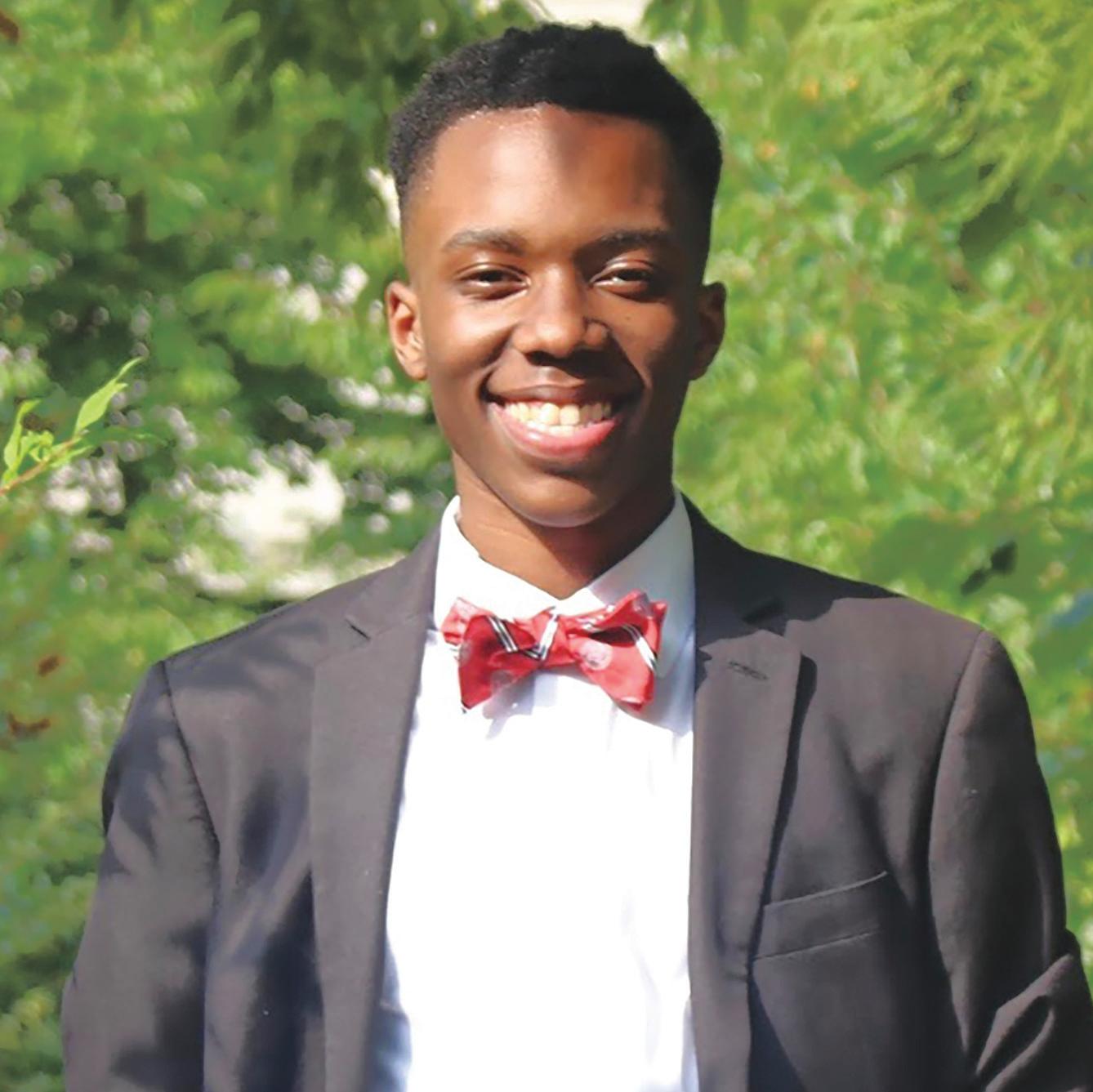
In his first foray into podcasting, Daniel James, II ’22 explored student activism following this summer’s antiBlack violence in an episode called “Policing, Protesting, and Paying Up 4 Black Lives.”
His WVBR show, “Black Voices on the Hill,” hopes to take on discussions of student leadership, activism and experiences within the Black
community at Cornell.
James has been active in student government life since his first semester as a freshman, winning a seat as freshman representative on the School of Industrial and Labor Relations’ student government.
Citing a “passion for public service,” James also works as a mentor for incarcerated youth in the Students for Students organization, serves as vice
See PODCAST page 2
Monday, September 14, 2020
A Model for Dramatically Increasing Diversity At the Ph.D. Level in Science and Engingeering
9 -10 a.m., Virtual Event
Discussion of Cornell University As a Land-Grab University 9:55 - 11:10 a.m., Virtual Event
Land and Livelihoods in Kalimpong, West Bengal 11:15 a.m., Virtual Event
Environmental Health and Wild Horses: A Design for the Future Noon, Virtual Event
Pathogens Found in Ticks Collected On School Grounds and Public Parks 1 p.m., Virtual Event
Flipping the Switch on Organic Synthesis Using Electrochemistry
4 p.m., Virtual Event
Border Environments: Toward a Political Ecology Of the Edges of the World 5 p.m., Virtual Event
Dearest Lenny: Letters from Japan and The Making of the World Maestro 4:30 - 6 p.m., Virtual Event

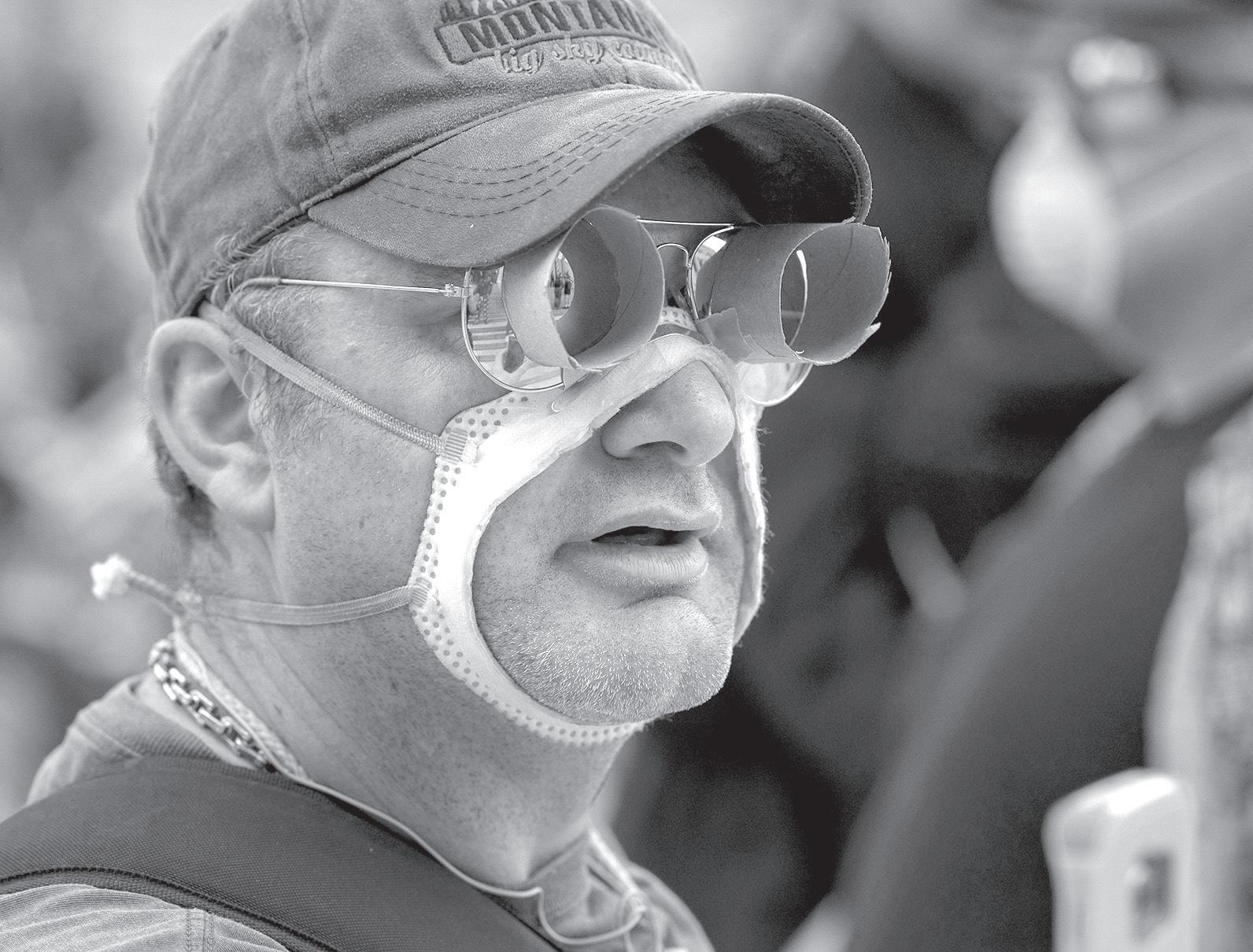
Distanced desks | Two masked Cornellians sit in the lobby of an empty Physical Sciences Building. With two-thirds of classes and all events held virtually, campus is quieter than usual.
Purposeful Interdisciplinarity: An Individual Career Path in Plant Pathology 11 a.m. - noon, Virtual Event
Incentivizing Behavioral Change: The Role of Time Preferences 11:30 a.m. - 1 p.m., Virtual Event
Recovery by the Numbers: What to Expect in the Lodging Industry 11:30 a.m., Virtual Event
Regulation of MHC Expression In Equine Mesenchymal Stem Cells for Improved Clincal Use Noon - 1p.m., Virtual Event
Perspectives on Prediction in Plant Breeding 12:40 p.m., Virtual Event
Key Considerations for Agricultural and Food Systems Research in the Pandemic 4 - 5p.m., Virtual Event
Noncoding RNA Networks 4 - 5 p.m., Virtual Event
Exploring the Small Farm Dream: Is Farming Right for You? 6 - 7:30 p.m., Virtual Event
PODCAST
president of public relations for the Minority ILR Student Organization and is a member of pre-law fraternity Kappa Alpha Phi.
But in his latest endeavor, James wanted to highlight the voices of other activists on campus.
“I know that whether exacting justice on the Supreme Court or being a change agent in city politics, my purpose in this world is to make it a more equitable and just place for everybody,” he said in the introductory trailer
of his podcast. “That is why we are bringing you ‘Black Voices on the Hill.’”
The podcast team has already recorded its first five episodes, two of which will feature Cornell in Color founder Lotoya Francis ’22 and Davidson Fellowship Scholar Cosimo Fabrizio ’22.
“My purpose in this world is to make it a more equitable and just place for everybody.”
function in political progress — without it, public leaders can’t access their audiences: “During the time of the pandemic, that’s the only place you do see them: in the media,” James said.
Daniel James, II ’22
James discusses the media in Fabrizio’s episode. He believes that the media serves a vital
With the podcast, he wants to reach a wider audience — his mission is to amplify the stories and experiences of Black people at Cornell and the greater Ithaca area. James teamed up with WVBR, Cornell’s student-run radio station, after they approached him about a podcast opportunity this past mid-summer.
“We talk about racism, police brutality, colorism, sexism, Greek life, leadership, and white elitism in the Ivy League,” James said.
Phoning in from Brooklyn, New York, the first episode featured Sherrell Farmer ’22, fellow ILR student and co-organizer of Cornell Students 4 Black Lives — a coalition that raised $118,636 for Black Lives Matter in June and continues to educate the Cornell community on race and equity.
James and Farmer discussed the frustrating pervasiveness of police brutality across time, institutionalized state violence, protests and the difficulties of COVID-19 for students.
“If the pandemic isn’t killing
us, our community, the police are,” James said. “It really is a somber topic. Our generation has been through a lot.”
“How many times can you tell the story, and how many times can you tell it from different angles, and have the same end result? We’re literally still being killed,” Farmer said in the podcast, recounting the repeated traumatic experiences of Black death in the media. “It’s literally heart wrenching.”
Discussing club culture at Cornell, Farmer noted how campus political organizations often silence or tokenize Black members, and she called for them to challenge this culture by holding more conversations with non-Black peers instead of always relying on their Black members’ labor. In order to drive change, she said, equity at the organizational level must be achieved.
sive action of students, going further than just recommending Ibram X. Kendi’s book, “How to be an Antiracist.”
“We’re trying to make Cornell do more than start a book club,” she said in the podcast. “They need to do more, and they will do more. If you’re going to truly make your model ‘any person, any study,’ your practices need to reflect that, and you need to get to work.”
In future episodes, James hopes to feature more student government leaders, entrepreneurs, athletes and artists. Overall, he wants to investigate stopping police brutality, breaking down white elitist systems and organizing effectively
“We need a way to highlight, amplify, the good and the excellence that is happening even in the midst of a pandemic and police mayhem.”
Daniel James, II ’22
for change.
James agreed that tokenization is a problem, noting that if students don’t create Blackdesignated spaces on committees and boards, “We won’t be represented at all.”
James and Farmer dove into defunding the police and divesting prisons. They pushed Cornell to require more progres-
“We need a way to highlight, amplify, the good and the excellence that is happening even in the midst of a pandemic and police mayhem,” James said.
The show can be found on any podcast platform, on Instagram and on WVBR.
Olivia Cipperman can be reached at ocipperman@cornellsun.com.
By LOUIS CHUANG Sun Staff Writer
Religious organizations at Cornell are working to provide faith-based community support for students’ health and wellbeing, even as the pandemic has forced changes to some long-held traditions.
Facing disruptions to their normal religious programming, these groups have moved online for outreach and service — recognizing that many students need community now more than ever.
“I think a lot of people are thankful to be
ally hosts an annual dinner — a threehour event that usually features Indian cuisine and performances — to celebrate the Diwali Festival of Lights.
However, in place of the dinner this year, the organization is “considering handing out gift bags with things that can help people celebrate at home,” HSC President Aashna Brahmbhatt wrote in an email to The Sun. Like other groups, HSC is also hosting all their meetings and events virtually.
Cornell Hillel has also found similar difficulties accommodating students as a result of the pandemic.
“There is so much in Judaism that is about finding community.”
Rabbi Ari Weiss
back at Cornell, but also there’s a lot of anxiety and students are concerned about their health,” Cornell Hillel Rabbi Ari Weiss said. “For me, that is a place where there’s room for a spiritual dimension. There is so much in Judaism that is about finding community and supporting one another in response to an uncertainty, which is especially important this year.”
Even though Cornell’s religious groups have mostly turned to Zoom to replace in-person events, weekly services each week are still a critical opportunity for the communities to meet and worship with each other.
“One of the most important services that we have always had was celebrating Mass on Sundays at Sage Chapel,” Joanna Sowa ’21, president of Cornell Catholic Community wrote in an email to The Sun. “However, this semester, instead of in-person Masses, our community continues to celebrate through weekly events.”
Public health precautions have also disrupted campus religious groups’ ability to host ceremonies and meals, events that are often semester mainstays. The Hindu Students Council, for example, tradition-
“Usually the first Friday night of the year, we have between 250 and 300 Cornellians join us for Friday night dinner, for Shabbat dinner,” Weiss said.
Now, the kosher dining hall 104 West! is limited to only 30 students at a time, and most get their meals to-go — losing out on some of the community the Shabbat dinners used to provide. But Hillel is still hosting virtual Shabbat services and social events to replicate some of what has been lost.
Despite transitioning to all virtual events, religious groups on campus have not shied away from their spiritual missions. For the Cornell Catholic Community, that means still “focusing on growing in our faith, building our relationship with God, and fostering community,” according to Sowa.
For Cornell Hillel, Rabbi Hayley Goldstein pointed to Jewish history for a message of hope.
“Something is really powerful about this, especially in COVID, thinking about [the ancient Israelites] in the desert,” Goldstein said. “They have no idea what’s going to happen, there’s a time of uncertainty, just like for many of our students. I find that hopeful and just something to hold on to as we navigate this desert time.”
Louis Chuang can be reached at lchuang@cornellsun.com.
CARIBBEAN
Continued from page 1
my people. It is important to them, too, because they don’t just put anything on their calendar.’”
They also want to include “Caribbean” and more country-specific options for ethnicity self-identification during applications to Cornell — to both represent their cultural heritage and as a practical solution.
Because Caribbean students are of all races, there is no way for CSA to get an accurate count on the number of students with Caribbean heritage at Cornell.
“We would like to know how many students on this campus are actually identifying with being Caribbean, because it’s important to us,” McKenzie said. “When [Caribbean] students come on this campus … the hardest thing is that you have to find each other.”
They find that this lack of a concrete number also hurts their efforts to enact change because it’s hard to gauge interest and representation. But they know there are Caribbean students, because the CSA’s numbers are increasing, including alumni who never had a Caribbean community while at Cornell and found the group after graduating.
Finally, CSA wants to see an agreement between Cornell and the Caribbean Examination Council — a body that administers standardized testing across the region — that will allow students to submit those exams for credit.
“We’re asking basically for them to recognize it’s equivalent to the IB and the AP, because it’s on the same level as those examinations, and they were based off of the GSCEs [General Certificate of Secondary Education] that are accepted by many different schools from Europe,” said CSA Treasurer Leone Farquharson ’22, who grew up and went to high school in
Jamaica. “I had to do those examinations plus the SAT, plus the SAT subject [test], so it’s like I have to double up on what my education system required plus what the U.S. required.”
Some peer institutions, like New York University, already accept the Caribbean Advanced Proficiency Examination, according to Farquharson.
Since launching their petition, CSA focused on meeting with as many department heads and Cornell administration as possible to get their voices heard widely.
According to Arthur, Cornell’s CSA has already received support from various Caribbean interest groups across the country and various faculty members at Cornell, who have acknowledged their demands as “fully legit.”
CSA has big dreams of more courses, visibility, a major, a dedicated building and long-term change, but “the likelihood of this happening is much stronger with students behind it,” Arthur explained.
“The Caribbean is very decentralized on campus,” McKenzie said. “We’re trying to centralize it again, have a space for it, instead of just being away from each other.”
This is the first story from The Sun’s new BIPOC/Related section.
As a newspaper that serves as a fountain of information for the Cornell community ––which champions “any person, any study”––it is our responsibility to honor the stories of all Cornellians and their communities. The Sun’s BIPOC/Related section is an initiative to improve the consistency of our coverage of the BIPOC community in all of its forms. Publishing at least three times a week, this section is a space to amplify student experiences and dig deeper into the nuances of identity at Cornell.
Kathryn Stamm can be reached at kstamm@cornellsun.com.
By ALESSANDRO
Sun Contributor
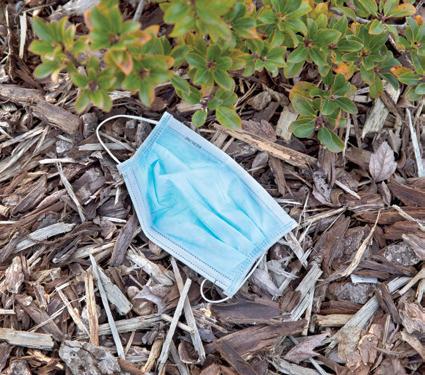
Why are some Cornell students — and a group of Americans in general — refusing to wear masks despite evidence that the practice is effective at curbing the spread of COVID19?
Scientific studies found that wearing masks would save 66,000 American lives by December, yet only 80 percent of Americans say they frequently wear masks when expected to be within six feet of other people.
The Sun spoke with Prof. William Schulze, applied economics and management and co-director of the Cornell Center of Behavioral Economics and Decision Research, to discuss how behavioral economics can explain why people are refusing to wear masks during the pandemic.
behavior.
The first theory suggests that humans lack the ability to accurately assess low-probability risks. The idea is that when faced with the possibility of contracting COVID-19, individuals tend to either under or overreact, either by dismissing it altogether or becoming overly fearful.
“Natural selection has not given us the ability to deal with low probability events.”
Prof. William Schulze
“Natural selection has not given us the ability to deal with low probability events — those less than two-tenths of a percent — like contracting COVID-19 and thus we tend to ignore or dismiss the risks,” Schulze said. Humans cannot accurately evaluate risk, specifically when it involves statistics and probabilities. Research shows that in times of uncertainty, people lean on their social circles or local leaders for guidance.
by a leader who is well-respected and trusted in the community,” Schulze said.
Schulze outlined two economic theories explaining the refusal to wear masks in human
“In order to educate the public about mask-wearing and nudge people towards the best combination of behaviors, there needs to be a clear, effective and unambiguous message delivered
He pointed to Gov. Andrew Cuomo (D-N.Y.), who in his daily briefings, promoted mask wearing by warning that not wearing a mask would endanger others and, in turn, helped educate New Yorkers about public safety guidelines. Schulze then went on to explain a second theory, which focuses on how framing can
affect whether a decision is viewed as a gain or a loss.
“Mask-wearing can be framed by some people as a means to protect themselves, their loved ones and their communities from this disease, while other people frame mask-wearing as an infringement on their rights and an unnecessary response to the risk,” Schulze said. In addition, research has shown that people are risk-seeking in losses, more likely to
choose a riskier gamble when faced with two losses; and riskaverse in gains, less likely to choose a riskier gamble when faced with two gains.
“The framing of mask-wearing as a loss of freedom by President Trump and other Republican leaders have made their followers both irrationally risk-seeking, and unwilling to recognize the value of wearing a mask, for fear of not fitting-in,” Schulze said.
At the center of the conflict between those who wear masks and those who refuse to are two mentalities: YOYO’s — You’re On Your Own — and WITT’s — We’re In This Together. Schulze explained that YOYO’s are people who act in their own self-interest, while WITT’s are people who act in the collective interest of others.
“Wearing masks can help save lives and ensure the public health and safety of a community, but it is only effective if everyone acts with the WITT mentality and does their part,” Schulze said.
That Fernando Pessoa’s surname means “person” in Portuguese might seriously challenge a proponent of nominative determinism: In his writing, Pessoa was anything but a singular, static “person.” Born in Lisbon in 1888, Pessoa created the first of his approximately 75 alter egos at the age of six. These so-called “heteronyms” were far more than pen names — each had a distinct biography, style of writing, physical appearance and even horoscope, which was used to determine its personality.
Though Pessoa is best known for The Book of Disquiet, ascribed to the semi-heteronym Bernardo Soares, he (and his major invented characters) considered their “Master” to be Alberto Caeiro. Born in 1889, the heteronym Caeiro was envisioned as an uneducated, humble man who spent most of his life in the countryside, writing poetry spontaneously and with no apparent effort. But as the editors of The Complete Works of Alberto Caeiro’s new English translation, Jerónimo Pizarro and Patricio Ferrari, point out, Caeiro also embodies art’s artifice, not just nature’s artlessness. Despite the simple, straightforward and unadorned nature of his verse, we can only take Caeiro seriously by suspending the knowledge that he is a fabricated persona rather than a real person.
On the surface, Caeiro’s seems to be poetry without poetics. His verses denounce the artificiality of rhyme and meter and self-consciously posit him in opposition to the literary tradition. In the poem that begins The Keeper of Sheep, he writes, “Being a poet is not my ambition. / It’s my way of being alone.” In another, he elaborates, “I keep writing my verses almost without thinking, / As if writing were not something made of gestures, / As if writing were a thing that happened to me / As if it were my own inner sun.”
One wonders, if Caeiro were writing today, whether the accessibility of his verse might have gotten him some traction on Instagram. But the simplicity of these poems works only because they are not simpleminded; that is, they are backed by great intellectual and emotional complexity. Although the language is plain, the philosophy that emerges from the poems is fresh, bold and surprising. Caeiro does not feed us the worn-out commonplaces and hackneyed clichés that may be expected of truly simple poetry but constantly keeps us on our toes. In doing so, he compels us to challenge not only our own notions about poetry but also how we see and pay attention to the world.
Indeed, attention — really seeing the world as opposed to just thinking or knowing about it — is the chief subject here. “Thinking is a sickness of the eyes,” Caeiro writes. Thinking clouds our vision, unnecessarily forces us to make complicated what is in reality simple. Moreover, thinking (and projecting our thoughts onto what lies external to us) makes us solipsistic and narrow-minded. Caeiro makes an important caveat to Decartes’ cogito: “I look, and things exist. / I think, and only I exist.” He further expounds on the importance of not thinking:
“The essential thing is knowing how to see, / Knowing how to see without thinking, / Knowing how to see when you see.” Seeing, then, is not merely an act of looking, of turning your gaze towards something, but a process of undoing the anxious mental habits of overthinking and overanalyzing. “But this (alas for those of us whose soul wears clothes!), / This requires long study.”
Like all great writers, Caeiro deftly fits form to function, craft to content. His philosophy of writing (“Let’s abandon analogies, metaphors, similes. / Comparing one thing with another means forgetting the first thing”) embodies his philosophy of life. He abandons the advice that many writing teachers give to students — to be specific in one’s nouns and verbs. For him, trees are always “trees,” never holm oaks or common alders or Mediterranean cypresses. There are no marigolds, morning glories or blinking black-eyed Susans, just “flowers.” Nothing about the natural world evoked in these poems is Romantic; indeed, Caeiro would probably agree with Holden Caulfield that “poets are always taking the weather so personally … sticking their emotions in things that have no emotions.”
However, inasmuch as he attempts to see the world without the rose-colored lenses of sentimentality or overdetermined comparison, Caeiro finds himself falling reflexively into figurative language, as if recourse to simile and metaphor is almost necessary in order to capture the world “as it really is.” Describing a winter scene, he writes, “The snow has thrown a crumpled cloth over the table of all things.” In The Shepherd in Love, similes, metaphors and religious references (“I love Nature / The way a serene monk loves the Virgin Mary”; “The whole of reality stares at me like a sunflower with her face in the center.”) are used to reproduce the strong emotions of an unrequited love and suggest the abstract, shifting nature of love in contrast to the stability of a stone or tree. In one especially beautiful poem, Caeiro first personifies spring as a woman, then reconsiders: “But spring isn’t even a thing: / It’s a manner of speaking.”
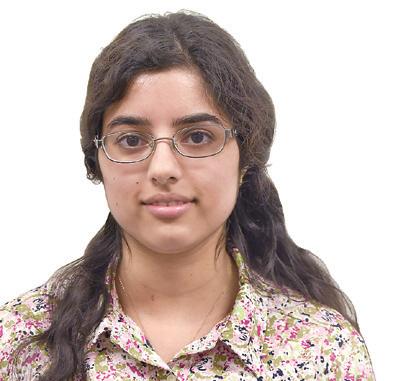
Ramya Yandava
Ramya’s Rambles
Still, Caeiro’s materialist philosophy (though he rejects the label “materialist,” since he rejects philosophy altogether) has its pitfalls. In one of the last poems of the collection, he recounts an incident in which a man spoke to him “of the injustice of some having money / And of others going hungry.” The poem’s speaker comments, “How stupid not to know that the unhappiness of others is theirs alone, / Unhappiness can’t be cured from the outside.” At a time when so many are suffering under a system that allows some to hoard vast amounts of wealth while others go hungry, when Black, Latino, indigenous and low-income members of the community are being disproportionately affected by COVID-19, it’s difficult not to disagree.
The poems’ apparent contradictions and shortcomings are qualified by the prose section that follows. This includes a selection of interviews with Caeiro, as well unpublished reviews of his work written by Pessoa and some of Pessoa’s heteronyms.

Pessoa and the heteronyms disagree with Caeiro’s views, debate over them and defend their own diverging perspectives. Reading these prose works, it’s easy to forget that what we’re actually seeing is Pessoa in conversation with himself, or rather, his selves. Able to put on different hats at will and see the world through points of view often at odds with one another, he, like Caeiro, illustrates the importance of constantly challenging and redefining how we see things. For Pessoa, writing through these various fabricated identities was neither deceptive nor false. Rather, it was his way of actualizing what Keats called negative capability, what he himself called “depersonalization.”
Both Caeiro and Pessoa, despite the attempts of one of the heteronyms to preclude comparisons of Caeiro with Walt Whitman, would likely agree with Whitman’s famous lines, “Do I contradict myself? / Very well then I contradict myself, / (I am large, I contain multitudes.)” Writing in voices that at times “troubled and repelled” him, Pessoa demonstrates the power of the imagination and its ability to extend us past limitations it reveals to be, in the end, artificial. How much more empathy, how much more understanding might we have, Caeiro and Pessoa suggest, if we could — through diligent attention, a willingness to change and challenge how we see the world — escape the ego.
Ramya Yandava is a senior in the College of Arts and Sciences. She can be reached at ryandava@cornellsun.com. Ramya’s Rambles runs alternate Mondays this semester.

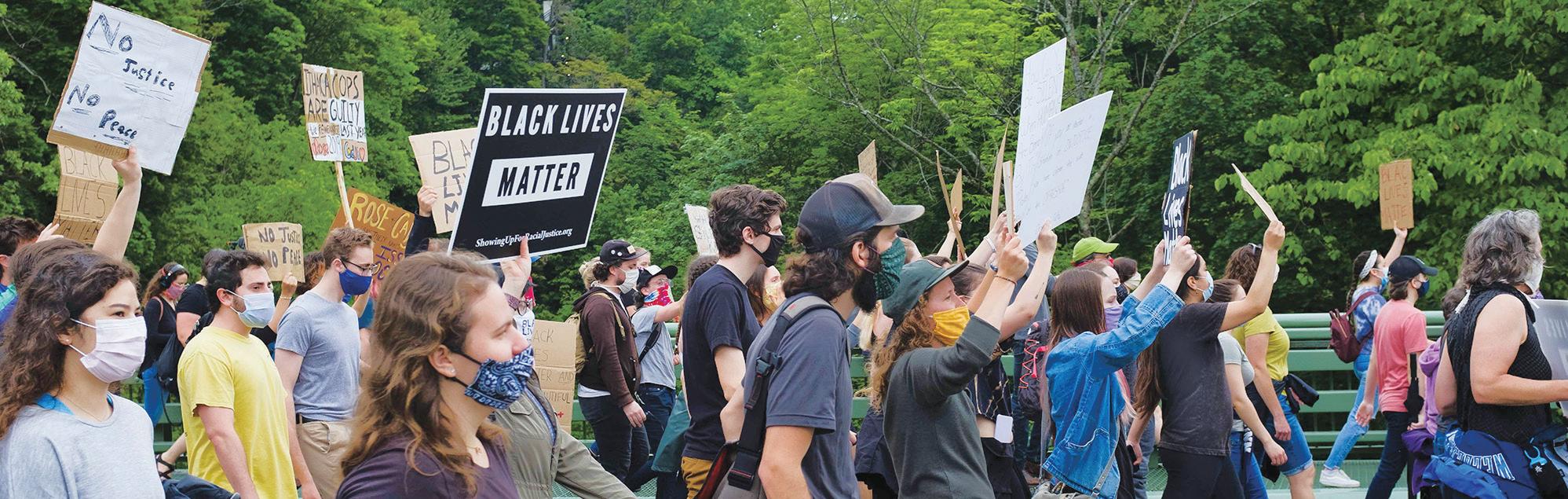
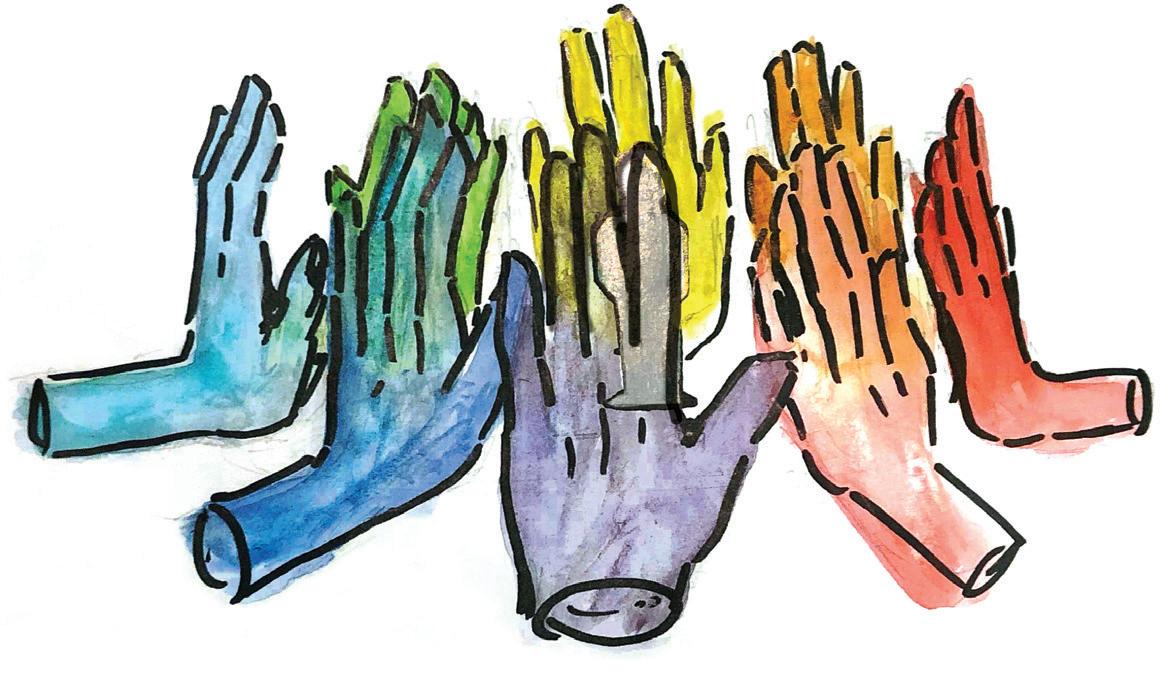
“blk voices” is a space to pay homage to Black creatives. From critical work to imaginative pieces, this weekly column will highlight and record the perspective of Black students during their time at Cornell. Basirat Owe ’21 curated this collection.
The Preamble (as of 06/10) by
Clementina Ojie
We the Blacks of the United States, in Partnership with earnest Allies worldwide, in order to form a more Equitable Union, establish Unbiased Justice, insure Acceptance of each individual by their neighbor, provide for the common defense— not just against International Enemies, but against Homegrown Racists— promote our general Welfare without Hegemony, and secure the Blessings of Liberty and Safety to Ourselves, our Children, and our Posterity, do ordain and establish the Peaceful but Fervent Protests of 2020 until a new Social Constitution is constructed that demolishes the Monuments of Enslavement, Bigotry and Prejudice past and present.
New School Patriotism (as of 06/10) by Toni’s
Daughter
“Oh, say, can you see? By the dawn’s early light, what so proudly we hailed, at the twilight’s last gleaming?
Whose broad stripes and bright stars, through the perilous fight, over the ramparts we watched, were so gallantly streaming?
And the rockets’ red glare, the bombs bursting in air, gave proof through the night that our flag was still there.”
“O say, does that star-spangled banner yet wave
Over the land of the free and the home of the brave?
I have never heard such beautiful hypocrisy.
The notion of tyranny, justified.
Oh, say, can you see?
Well, I can try.
I can try to look beyond
The tunnel of the american dream
To focus on the scheme at work.
The puppeteer at hand.
The glorified Man. The Myth. The Legend. The mastermind, perfectly enshrined lie of our country.
To the “Land of the free and home of the brave” I ask, oh say can you hear?
Can you hear our cries?
Our children’s cries.
Our women’s cries.
Our country’s cries. Silenced cries.
The cries we kill, the lives we steal.
Can you hear our newfound apathy?
To the “Land of the free and home of the brave” I ask, can you still feel?
Because, lately, I can’t tell.
You go to War on ‘Terror’
But not true terror
Because that battle is at home
In my brothers’ and sisters’ hearts.
The terror that threatens: Livelihoods, mentalities, and families, The terror that your true issue is us.
So, I refuse to pledge allegiance to a flag of hypocrisy.
To the Republic,
Which used to stand for asylum and welcome.
To an indivisible nation, Strengthened by racism and only reassured by
Tear gas and rubber bullets.
While knowing that our version of liberty and justice Is only available to the few that can afford it, Or as a dream to the many who fight towards it.
To “the land of the free and home of the brave”, I hope you realize that “the rockets’ red glare, [and] the bombs bursting in air” Aren’t a glorified history, but our disgusting present. The bombs are our own.
The violence is our doing.
And in the dawn’s early light, We aren’t “the land of the free and home of the brave” anymore.

In the twilight’s last gleaming,
Our fear becomes our suffering. Our loss of talent in the streets. Our reality of disparate freedoms And opportunities.
There will be proof through this night, that beauty is found in tearing down walls. It’s in our protests.
It’s in our unified voices.
When we show that these are our streets.
When we show that Black Lives Matter.
There is beauty in our unity.
There is beauty in our compassion.
And there will be beauty in our outrage.
Sometimes being black feels like a bad dream
A piece of obscene fiction
Written with the wrong diction and tone
A tone blown way out of proportion
Melanin distorted. A distortion of beauty.
We always have this duty to protect and preserve. I’m tired of those with the nerve to attack us
Like being us ain’t enough.
Like being tough ain’t a bluff.
Like being black ain’t rough
Like … this s*it kinda sucks.
I mean, sometimes I feel like being black feels like a bad dream
And let’s not take it to extremes.
No one reigns supreme.
But if we had to compare cultural influence on modern society,
We’d see black bodies defiantly and silently leading the wave.
To no credit of our own.
We show everyone what it means to be on a throne.
To go off the dome
To comb through adversity after adversity
Like celebrating anniversaries that don’t even apply to us
But we swallow it down with a million other tough pills
Including the state’s right to kill.
Through water or bullets, our wallets or lack of insu ance
I mean, sometimes being black feels like a bad dream. I can’t seem to shake it. Or wake up and break out.
All the time, I want to shout:
“To be black and relatively conscious in this country is to be in a rage almost all the time.”
Mr. Baldwin, you read my mind.
I don’t want to be the kind of girl that recounts her blackness.
To renounce my blackness. I would never. But, I just wish it were better.
A Black Girl Catch 22 by Toni’s Daughter
They say you realize your strength when being strong is your only option but, what if being strong ain’t a option no more? what if I can’t take no more? what if my store is empty? will this end me?
I feel enmity everyone is an enemy.
Even she. flesh of my flesh. bone of my bone. her words stone, crushing me. and I’m no soft thing either.
Soft is a luxury I was never afforded. I could never afford it. always a few cents short, so I kind of contorted myself into a shell. a shield.
to protect and defend. to amend the ills of this world. to pick up the pieces. to pull it together. to weather the storm.
But, what if being strong ain’t an option no more?
Dear Black Girl by Sherell Farmer ’22
Does your soul hurt?
No, no, no actually, what I mean is: Does your body hurt?
From holding up the bodies of dead and living black men?
black men who won’t even say your name?
Black girl, it is okay to admit your pain I know they don’t love you like they should I know they don’t love you like you love them
It is hard to be a black girl
Even though our bodies have birthed entire nations
Even though every single thing that is beautiful in this world in some way, has been touched, has molded by a black women
I, who have nourished white women and white men and black men and other black women
I, who have never been nourished myself
I, who cries at night time – if I am lucky enough to live to night time /
After all, black girls go missing and are almost never given the honor of being looked of
We are killed with justice seldom attached, names never remembered and rarely said
When will we be mourned?
138th Editorial Board
MARYAM ZAFAR ’21 Editor in Chief
JOYBEER DATTA GUPTA ’21
Business Manager
PETER BUONANNO ’21
Associate Editor
MEGHNA MAHARISHI ’22
Assistant Managing Editor
CHRISTINA BULKELEY ’21
Sports Editor
BORIS TSANG ’21
Photography Editor
CAROLINE JOHNSON ’22
News Editor
ALEX HALE ’21
News Editor
ARI DUBOW ’21
City Editor
EMMA ROSENBAUM ’22
Science Editor
BENJAMIN VELANI ’22
Dining Editor
JOHN MONKOVIC ’22
Multimedia Editor
MIKE FANG ’21
App Editor
OLIVIA WEINBERG ’22
Assistant News Editor
MADELINE ROSENBERG ’23
Assistant News Editor
LUKE PICHINI ’22
Assistant Sports Editor
HANNAH ROSENBERG ’23
Assistant Photography Editor
BRIAN LU ’23
Assistant Arts & Entertainment Editor
ANNABEL LI ’21
Assistant Money & Business Editor
LEI ANNE RABEJE ’22
Layout Editor
JOHN COLIE ’23
Blogs Editor
JOHN MONKOVIC ’22
Multimedia Editor
WINNY SUN ’20
Newsletter Editor
AMANDA H. CRONIN ’21
Senior Editor
RAPHY GENDLER ’21
Senior Editor
ALEC GIUFURTA ’21
Senior Editor
JOHNATHAN STIMPSON ’21
Managing Editor
KRYSTAL YANG ’21
Advertising Manager
JASON HUANG ’21
Web Editor
NIKO NGUYEN ’22
Design Editor
PALLAVI KENKARE ’21
Opinion Editor
SEAN O’CONNELL ’21
News Editor
KATHRYN STAMM ’22
ANIL OZA ’22
EMMA PLOWE ’23
Arts & Entertainment Editor MAIA LEE ’21
Money & Business Editor
ANYI CHENG ’21 Compet Manager
CATALINA PEÑEÑORY ’22
Assistant News Editor
MEGHANA SRIVASTAVA ’23 Assistant News
DAWSON ’21
PARKER ’22
MORAN ’21
& Entertainment Editor MIKE FANG ’21 App Editor
DOMINIC LAW ’22
ALICIA WANG ’21
OU ’22
’21
Editor SARAH SKINNER ’21
Editor
GHAZI ’21
Editor NICOLE ZHU ’21
Senior Editor
JEREMY MARKUS ’21
Senior Editor
Working on Today’s Sun
Ad Layout Mei Ou ’22
Production Desker Dana Chan ’21
News Deskers Meghana Srivastava ’23 Kathryn Stamm ’22
Design Deskers Lei Anne Rabeje ’22
Money & business Desker Annabel Li ’21
Arts Desker Dan Moran ’21
Sports Desker Christina Bulkeley ’21
Continue the conversation by sending a letter to the editor or a guest column to opinion@cornellsun.com.
Letters should be in response to any recent Sun news article, column, review or editorial. They should be no longer than 250 words in length. HAVE
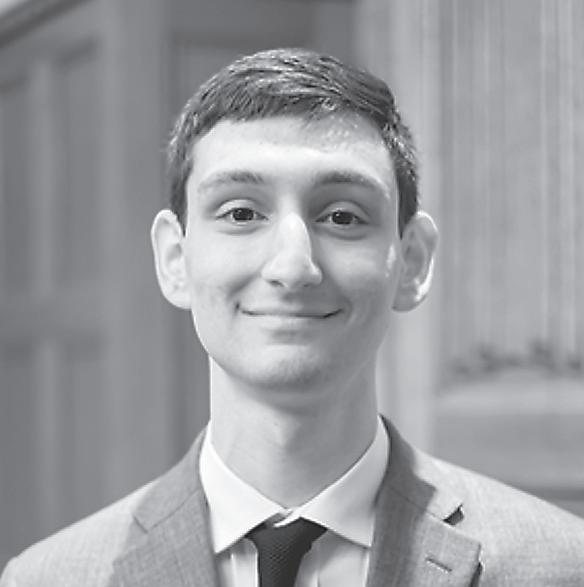
Matthew Samilow is a junior in the School of Industrial and Labor Relations. He can be reached at msamilow@cornellsun.com. On Malott’s Front Steps runs every other Friday this semester.
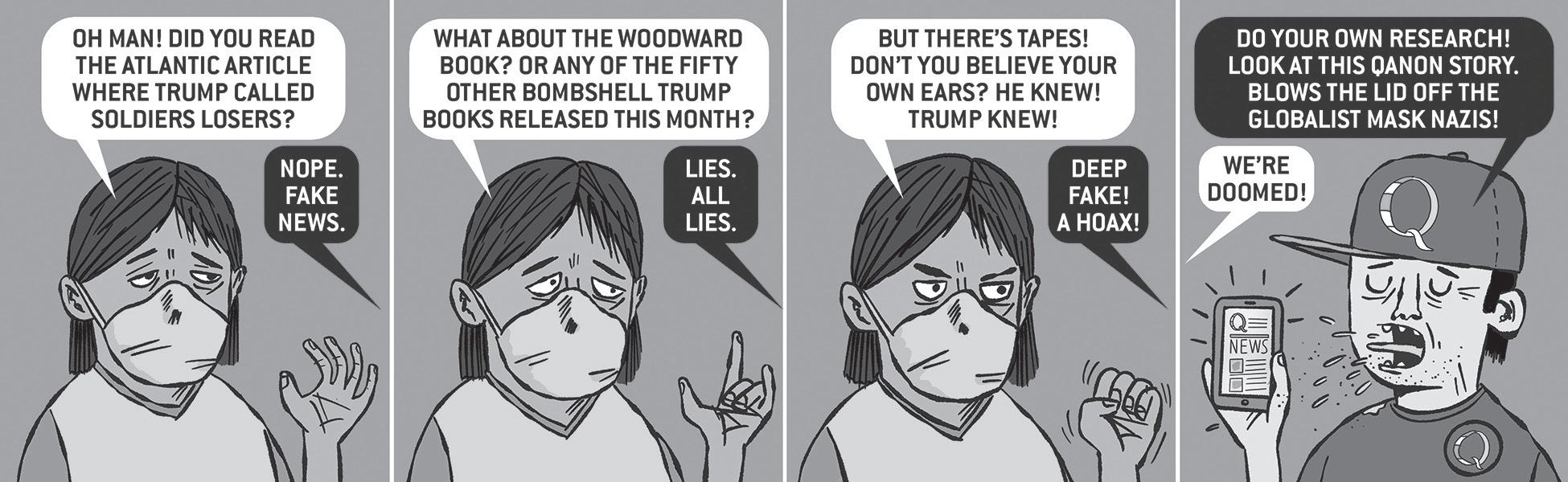
Cornell University is the only Ivy League school that is allowing all students to return to campus this fall. As part of its efforts to minimize the spread of the coronavirus, the University has mandated that every returning student abide by a behavioral compact and has invited students to report classmates who violate it. The University is surely well-meaning and simply trying to ensure compliance, but after only a few weeks it’s become apparent that asking students to inform on each other has fed into unhealthy social impulses and may even encourage students to socially organize themselves according to how seriously they take the compact’s restrictions.
In late August, a group of students calling themselves the Concerned Cornell Students Coalition started a petition demanding Cornell “[d]e-densify Cornell’s Ithaca Campus” by “rescinding the admission” of Jessica Zhang ’24. Zhang, a minor TikTok celebrity, flaunted that she was attending forbidden social gatherings and mocked those concerned with safety. She has since apologized and explained that she wrongly believed the gathering was safe because everyone present had tested negative. Her actions were against the compact and could have spread the coronavirus. There should be, and surely were, consequences.
But expulsion for this offense — committed by someone in her first week of college — is so overly punitive it is shocking that students themselves would call for it. Does anyone really believe that nothing short of expulsion could get Zhang to change her behavior? Suspension? Being banished from campus? What about being banned from school events when life returns to normal? In all probability just the threat of any of these things would be enough to ensure that she’d never do it again. Appearing at a disciplinary hearing within the first month of school is not on most freshmen’s bucket list. Demanding the harshest punishment may make some students feel virtuous, but there is certainly no virtue in trying to ruin an 18-year old’s life for one reckless act. (It makes one wonder whether the cruelty is the point, after all?) All of us remember our first weeks at Cornell and should feel sympathy for freshmen who are being deprived of that experience. They are going through a life transition under abnormal circumstances, and any disciplinary action should be tailored to encourage compliance — not make examples out of people.
I wish this were an isolated incident, but it seems more than a few students have taken it upon themselves to police their fellow students. There is now an Instagram account called “cornellaccountability.” The account describes itself as a “community-based accountability system” and solicits photos and
videos of compact violations. One of its posts even encourages students to call the police on students who host illicit gatherings. Apparently, Tuesdays are for calling for the CUPD to be defunded and Wednesdays are for calling them on your classmates.
The account claims that it is not intended to “harm persons/groups/orgs,” but it is difficult to see what else its posts accomplish. It intends to shame, embarrass and sic the proverbial online mob on those who it believes are acting improperly. In deputizing the entire student body to enforce these restrictions, efforts like these create a culture of mistrust and suspicion. Far from encouraging compliance, these actions encourage students to go to increasingly extreme lengths to keep their gatherings secret.
Most unfortunately, even well-intentioned students are finding themselves stuck between a rock and a hard place. As The Sun reported last week, a student anonymously reported that her housemates were violating the compact. The University, however, said it would not pursue the case unless she identified herself. Caught between enforcing the compact or causing a rift with her roommates, she chose to remain anonymous. This system inevitably puts students in a no win situation. They face three bad options: Report their friends, not hang out with their friends or remain silent in the face of behavior they know is dangerous. The University has no right to place such a burden on its students.
When Cornell decided to open, surely its “epidemiological modeling” contemplated that some students would break the rules. There are over 14,000 undergraduates and it runs against the nature of 20-year-olds to let things get in the way of having fun. If the actions of a few rule-breakers are enough to unravel Cornell’s reopening, perhaps it should have remained closed. It is irresponsible and unfair to reopen, knowing that some students will break the rules, and then place the responsibility for remaining open –– or the blame for having to shut down –– on the entire student body. Students should be appreciative of the work Cornell put in to reopen, given that most schools took the easy way out of a remote semester. But adherence to the behavioral compact must result from a genuine desire to follow it, not constant fear that your friends will report you.
Over the past few days, the number of new cases has been relatively low and there’s reason to think Cornell’s bold experiment might succeed. But in the event it doesn’t, resist the temptation to blame your classmates or even the University. Everyone went above and beyond to make this semester possible. Sometimes, that is simply not good enough.
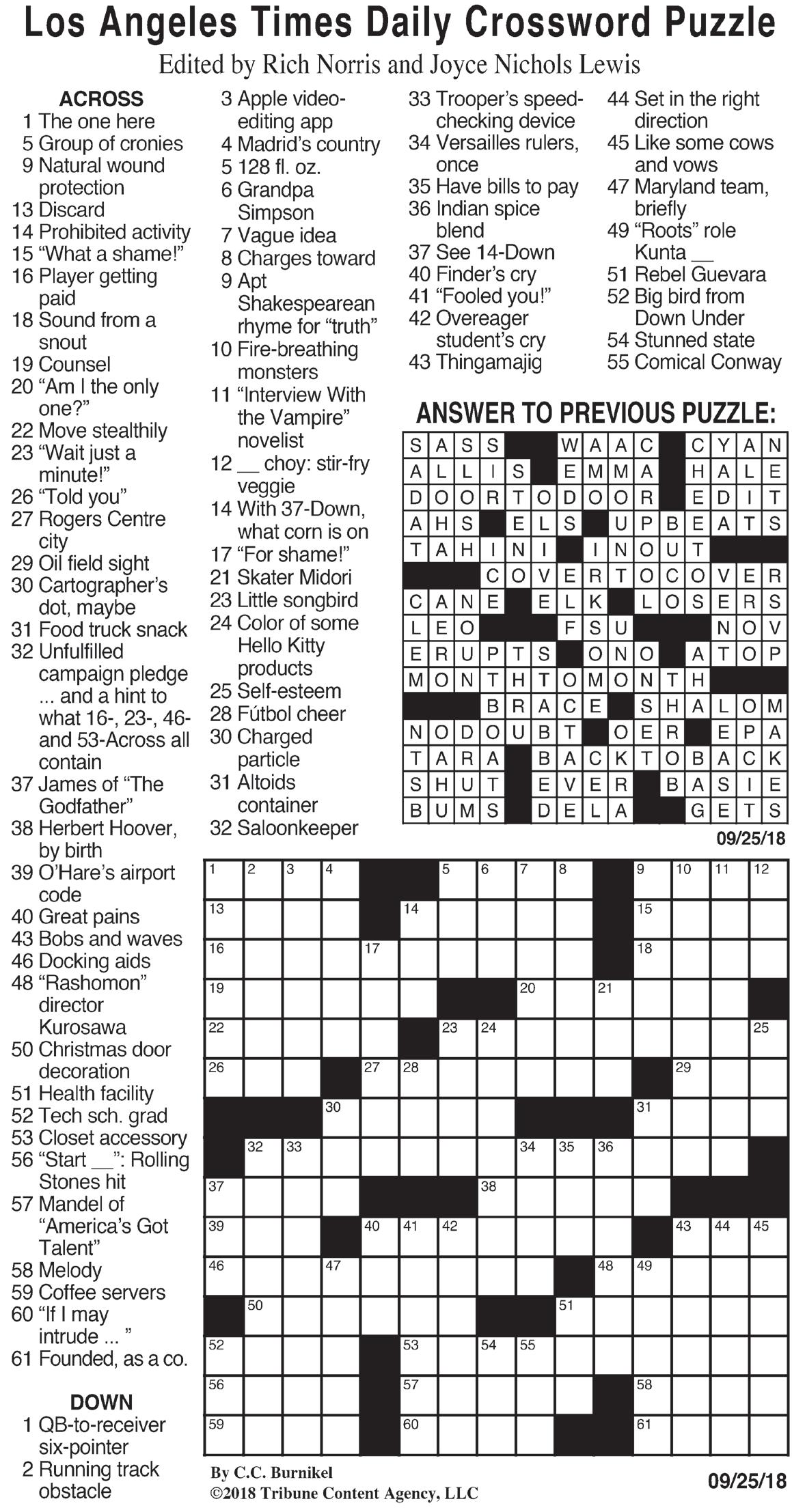
Fill in the empty cells, one number in each, so that each column, row, and region contains the numbers 1-9 exactly once. Each number in the solution therefore occurs only once in each of the three “directions,” hence the “single numbers” implied by the puzzle’s name. (Rules from wikipedia.org/wiki/ Sudoku)

Art by Alicia Wang ’21
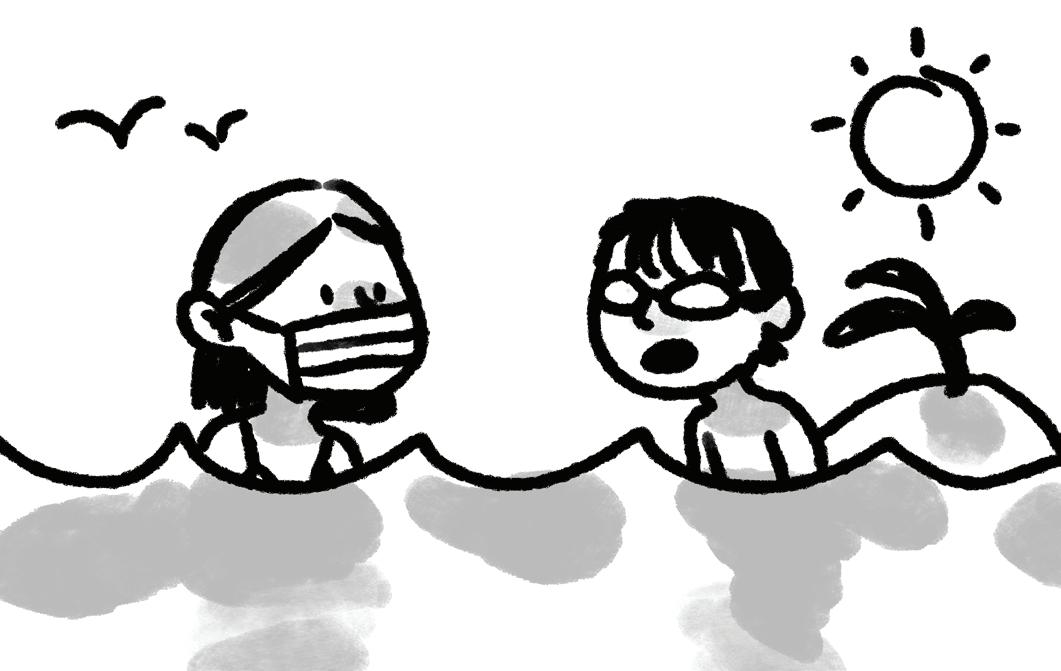
“What are these swimmers talking about? Submit a caption online and yours might be featured in the paper next week!”
To submit your caption for this week’s contest, visit sunspots.cornellsun.com.


By CHRISTINA BULKELEY Sun Sports Editor
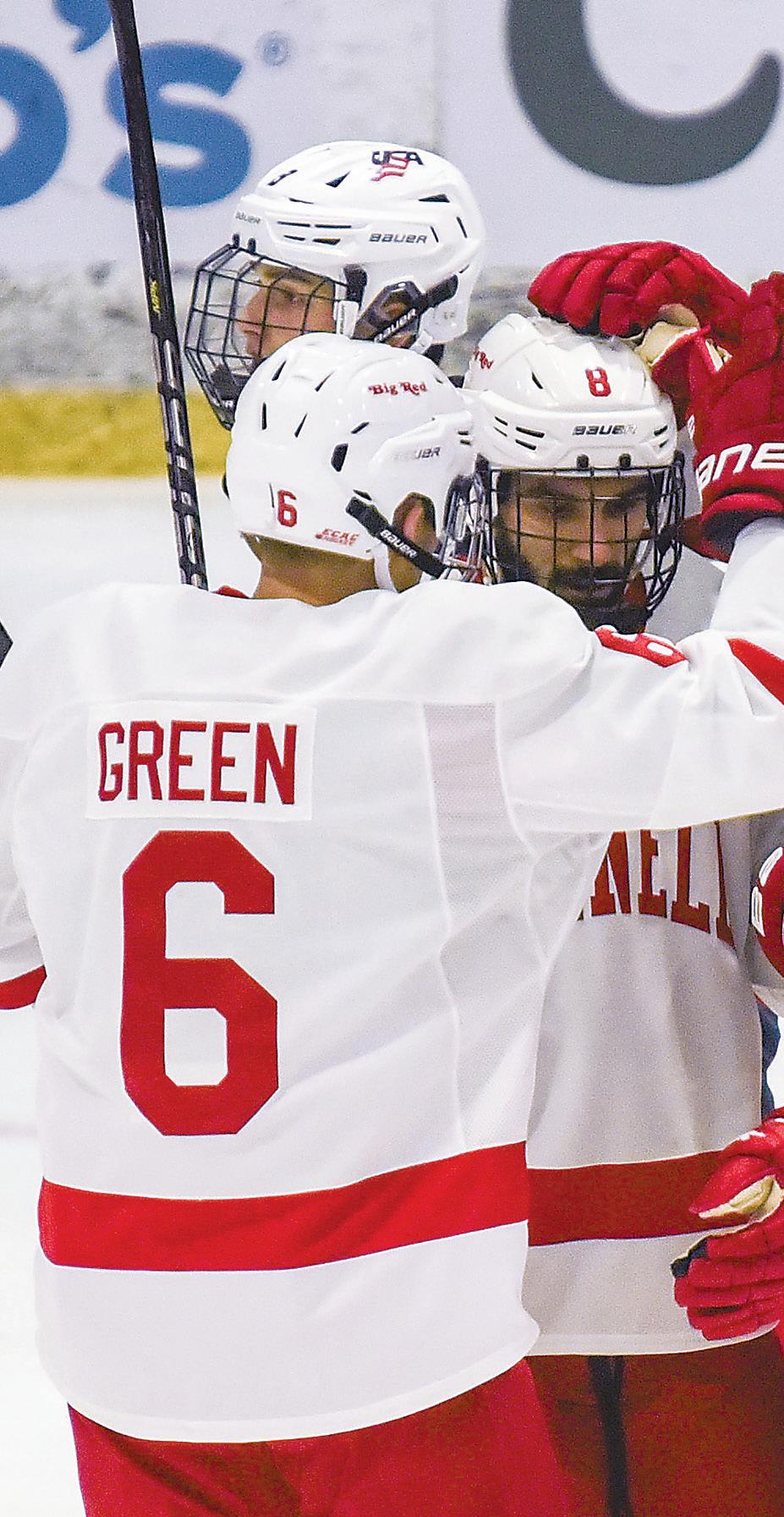
The National Hockey League’s Tampa Bay Lightning announced Tuesday afternoon that they signed Cornell senior defenseman Alex Green to a two-year, entry-level contract. The Lightning selected Green in the 2018 NHL Entry Draft, with the 121st pick in the fourth round.
Green, who played in all 29 games with the Red last season, was honored as the ECAC’s Best Defensive Defenseman in March. Over three years, the blueliner accumulated playing time in 78 contests.
Green’s 2019-20 season marked a comeback following a sophomore campaign in which he missed 16 games due to a concussion sustained in the third game of the year.
The Lightning selected Green in his third year of draft eligibility, following an impressive freshman campaign in which he posted a plus-nine rating — his junior season saw him playing an even larger role, posting a plus-20 rating that was tied for best on the Red.
Green’s seven goals last season were the most of any defenseman on last season’s No. 1 Cornell squad.
“This is definitely an exciting moment for me and my family,” Green told the Sun after getting drafted. “Tampa was one of the teams I had talked to during the course of the season, so I thought there was maybe a chance of going to them.”
His seven goals were also the most of any defenseman on last season’s nationally-ranked No. 1 squad.
“Congratulations to Alex,” head coach Mike Schafer ’86 told Cornell Athletics on Tuesday. “This is great for
Green’s departure is the second from the Class of 2021, after forward Morgan Barron signed with the New York Rangers last month.
“I think that what sets [Green] apart from a lot of other people is his ability to get around the ice,” Schafer told the Sun after Green was drafted in 2018.
Though the Ivy League announced over the summer that there would be no varsity competition for the
“[Getting drafted was] definitely an exciting moment for me and my family.
Tampa was one of the teams I had talked to during [my freshman] season.”
Alex Green
duration of the fall semester, the door was left open for sports to resume after the conclusion of final exams for the semester. While the possibility of Cornell hockey this season remains, neither Green nor Barron will play another game with the Red.
The Lightning are currently in playoff contention in the NHL bubble in Toronto. After eliminating the Boston Bruins on Aug. 31, the No. 2-seeded Lightning advanced to the conference finals. The team is now up 3-1 in a series against the New York Islanders, after a 4-1 win Sunday evening.
Other NHL draftees currently playing with Cornell are freshmen forwards Jack Malone (Vancouver Canucks) and Matt Stienburg (Colorado Avalanche), junior defenseman Misha Song (New York Islanders) and senior defenseman Matt Cairns (Edmonton Oilers). They all remain slated to join the Red for the 2020-21 season, should it come to fruition.
Christina Bulkeley can be reached at cbulkeley@cornellsun.com.