The Corne¬ Daily Sun
Join the Sun


By SOFIA CHIERCHIO
With the 2022-2023 academic year in full swing, prelims have yet to begin for Cornell students, but the hunt for rental housing has.
A 2014 New York Times article listed the top 20 least affordable cities to rent in the United States relative to median gross income, placing Ithaca as number 11, right behind New York City. In addition to increasing rental prices, students are being forced to look for housing much earlier than in previous years.
“I signed a lease for my current house last year on

September 19 — which was early then,” Megan Vincek ’24 said. “This year, my friends and I started looking shortly after arriving here in August. It became a vicious cycle of looking at a place, liking it, eventually deciding to sign and then it being taken off the market.”
Vincek said the fast paced housing search was overwhelming at times, especially on top of her normal workload.
“It got to the point where I felt desperate and ended up crying on the side of College Avenue after weeks of trying to find somewhere to live for next year,” Vincek said.
Similar to Vincek, Rebecca Parish ’25 explained the anxiety the housing process has brought on, especially as it is her first time looking for off-campus housing.
“This is my first time looking to rent an apartment in Ithaca. The experience has been very overwhelming and difficult,” Parish said. She mentioned that she has had to worry about plans for the next year before having the chance to settle into her current housing.
“I feel like there is pressure to make decisions about my junior year when I still feel like a first-year,” Parish said.
Increased rental prices can be attributed to the high demand for housing in Ithaca, especially Collegetown.
To continue reading this article, please visit cornellsun.com.
Sofa Chierchio can be reached at schierchio@cornellsun.com.
As of July 27, Cornell University eased its masking requirements. In a statement made by the University on its COVID-19 webpage, it was announced that masks will be strongly encouraged, although not required, in classrooms for the 2022-2023 academic year.
“It is well established that wearing a mask while indoors reduces the risk of contracting or spreading
COVID-19,” the statement said. “Individuals who are concerned about the risk of infection are encouraged to continue to wear a mask, and we ask that all members of our community support and respect one another’s masking choices.”
Moreover, the University announced that it will be discontinuing its PCR testing sites, with antigen testing still available to those of the Cornell community who meet clinical testing criteria. Those who
have tested positive for the virus are no longer required to isolate themselves, although they must remain masked in public, according to CDC recommendations. Students must also wear masks upon the request of their professors or other students.
Many students are happy that the mask mandate has been lifted, as it represents a major milestone in the University’s reopening after the
See MASKS page 3


Daniela Lee ’22, a Cornell senior known for her inquisitivity and passion for knowledge, died on Apr. 19, 2022 at the age of 20. Family and friends mourned the loss of a faithful friend, loving daughter and devoted Christian.
Lee’s love for flowers was not only a reflection of her love for nature but the nature of her heart.
“She would send me the pictures of the tiniest flowers that no one noticed,” Lee’s mother, Claudia Lee ’97 said. “She once called me saying, ‘Mom, look at this tiny purple one. It’s probably a weed, but it's so beautiful

Upon seeing Lee, people first noticed her flowers: Worn in her hair and on long flowery dresses almost every day around campus.
Daffodils were her favorite, and a significant part of who she was, as her close friend, Mannayah Louis ’24 and Lee’s younger sister, Maria Lee ’24 remembered.
“Someone who just realized that Dani was my sister told me, ‘I remember seeing her and seeing her crown of flowers and her long flower dress, and I thought, wow she’s so happy. She must be a very happy person.’ And that’s so true because she was,” Maria Lee said.
and it’s under a bench. Nobody except me will probably ever admire it.’ That was her heart.”
To those close to her and strangers alike, Lee was known for radiating positive energy towards everyone she met. Friends and family remembered her care for others and selflessness.
Many friends found her to be especially comforting when they needed support. For María Raskulinec ’22, a close friend and fellow member of Cru, an
Tuesday, September 13, 2022

Land-grab universities | The A.D. White statue on March 8, 2021 following protests for indigenous women. On Tuesday, Tristan Ahtone, member of the Kiowa Tribe and University of Cambridge Prof. Robert Lee will discuss how the groundbreaking “land-grab universities” investigation sent shockwaves through the U.S. education system.
French Conversation Hour 11 a.m., Stimson Hall G25
Intercampus Immunology Work-In-Progress Meeting Noon, Virtual Event
The Macroeconomy and Veterinary Medicine Noon, Virtual Event
Inequality, Income Growth and Preferences for Redistribution in Contemporary Europe 12:30 p.m. - 2 p.m., Rockefeller Hall 112
Neurodivergent Employee Community 3 p.m., Virtual Event
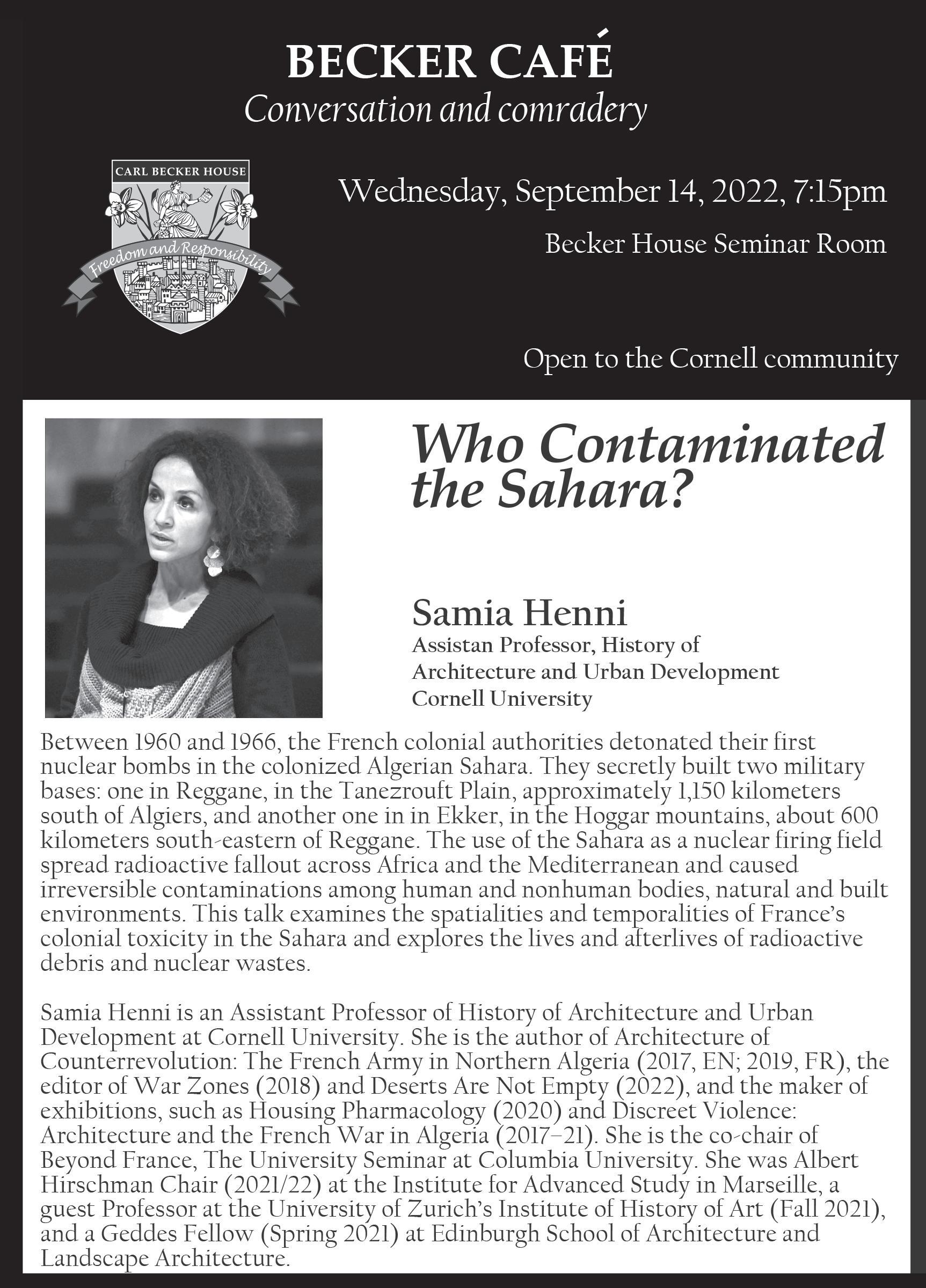
Internship and Research Assistant Opportunities At the Federal Reserve Board of Governors 4:30 p.m. - 6 p.m., Uris Hall 498
Info Session: Laidlaw Leadership and Research Program 4:45 p.m. - 5:45 p.m., Virtual Event
Four Season Food Production 5 p.m., Virtual Event
2022 Kops Freedom of the Press Lecture: Land-Grab Universities 5:15 p.m., Johnson Museum of Art Wing Lecture Hall
Career Fair Question and Answer Drop-Ins Noon, Virtual Event
Fighting Malnutrition and Poor Residue Management With the Use of a Wonderful Insect: Hermetia illucens (L.) 12:25 p.m. - 1:15 p.m., Warren Hall 151
Midday Music for Organ 12:30 p.m., Sage Chapel
Bosnian, Croatian, Serbian Conversation Hour 4 p.m., Stimson Hall G25
Exhibition Open House: “Seeds of Survival and Celebration: Plants and the Black Experience” 4:30 p.m. - 6:30 p.m., Brian C. Nevin Welcome Center Lobby
By JIWOOK JUNG Sun Assistant News Editor
Cornell has been named the best university in all of New York state, according to the 2023 Best National Universities rankings published by U.S. News and World Report.
While still remaining the 17th best university in the nation, Cornell has now surpassed Columbia University, which saw a significant drop this year, falling from No. 2 to No. 18.
Columbia’s downfall came after Columbia University Prof. Michael Thaddeus, mathematics, started questioning the program’s soaring ranking, which in 2021 tied in second along Harvard and MIT.
In February, Thaddeus published a detailed, analytical report, exploring explanations for Columbia’s abnormally soaring ranking.
“A few other top-tier universities have also improved their standings, but none has matched Columbia’s extraordinary rise,” Thaddeus wrote. “It is natural to wonder what the reason might be.”
Thaddeus’ findings suggested clear signs of number manipulation by Columbia to produce favorable but misleading data sets.
“Key figures supporting Columbia’s high ranking are inaccurate, dubious, or highly misleading,” Thaddeus wrote. “[We found] discrepancies, sometimes quite large, and always in Columbia’s favor.”
On Sept. 9, upon a thorough internal review and investigation, Columbia released a statement, admitting that the data it provided had signs of inaccuracy. In the statement, Columbia followed up with detailed plans to improve its data accuracy.
“We determined we had previously relied on outdated and/or incorrect methodologies,” the statement said. “We have changed those methodologies for current and future data submissions, as reflected in the newly posted Common Data Sets.”
According to the U.S. News and World Report, the Best Colleges ranking provides an assessment of 1,500 national bachelor’s degree programs on 17 measures of academic quality.
To continue reading this article, please visit cornellsun.com.
Jiwook Jung can be reached at jjung@cornellsun.com.

way about me.”
Continued from page 1
pandemic. However, in many classrooms across campus, some students and professors are still choosing to mask up.
“I feel relieved that the masking requirements were lifted and that a return to normalcy was much needed,” Zach Tyson ’25 said.
Dylan Keusch ’24 agrees, adding that he believes Cornell’s current guidelines are appropriate given the status of the pandemic.
“Unfortunately, I believe we’re at a point where we need to learn to live with the virus, and while certainly a useful protection for those infected with the virus or those who are immunocompromised, I feel as though we must move past a requirement for the general population,” he said.
Prof. Michael Toglia, psychology, is a part of the Cornell community who continues to mask up, despite the end of the mandate.
Toglia said that it is important for him to continue wearing masks because the pandemic is not technically over and the United States has not yet reached herd immunity.
“While students, faculty and staff have been vaccinated and boosted, breakout cases continue to occur and thus pose some level of threat to the Cornell campus and the Ithaca community as well,” Toglia said.
But for some students, the end of the mask mandate reminds them of the simple pleasures that many have not enjoyed since early 2020.
“Personally, I’m really happy the masking requirement has been lifted,” Kasey Harvey ’24 said. “It’s so nice to see everyone’s faces in a classroom setting again, and it makes it feel like everything is back to normal.”
Kaity Molito ’23 added that she finally feels like Cornell students are having a more traditional college experience. She added that the reduced presence of masks allows for interpersonal connections and
friendships to be made more naturally.
“It’s nice to go to class in person and actually see the faces of the people around you,” she said. “For me personally, it’s been easier not only to connect with other students in class but to also then recognize them and organically connect outside of class, like around campus or Collegetown.”
To continue reading this article, please visit cornellsun.com.
Mary Sotiryadis can be reached at msotiryadis@cornellsun.com.
interdenominational Christian organization on campus, this was through conversations over coffee.
Raskulinec described Lee as being empathetic and encouraging during these conversations, even when those long conversations needed to be cut short.
“We shared a lot in our experiences at Cornell and the things that we struggled with,” Raskulinec said. “There was one time we met up for coffee and I was so rushed that I could only meet for a few minutes. But she was so understanding. Even that [short] conversation was what I needed at that moment. I hope she feels the same
Valerie Hu ’24, another friend from Cru, met Lee during her first year at Cornell. Hu said that Lee was kind to everyone, regardless of how well she knew them.
“Sometimes when I walk past people on campus I’ll nod or wave, but the fact that she always had a huge smile and every time I ran into her or saw her made such an impact,” Hu said. “She had this way of making people feel seen and important.”
Lee was also very close with her family. She deeply loved her parents and siblings. Every morning she sent a “good morning” text to her parents, and video chatted with her family in Arizona every night
before she went to bed to tell them about her day.
“My love for Dani is immeasurable. She was my heart and she was a Daddy’s girl since birth. I truly looked forward to talking to her everyday and her happiness meant the world to me. I was always so proud of her. She brought unsurpassed honor to our family — something supernatural and Godly and beyond our earthly understanding,” Lee’s father, Anthony Lee ’94, j.d. ’97 said.
To continue reading this article, please visit cornellsun.com.
Jiwon Estee Yi can be reached at jyi@cornellsun.com.



I always have to take it out and get searched.”
The fascinating thing about any university is the diversity of people, places and ideas that create an environment unlike any other. Between the broad variety of majors and minors and the seemingly countless selection of clubs, Cornell is an institution where even an engineer can host a photography exhibit, as Veronica Gluza M.Sc. ’23 did this Wednesday, Sept. 7.
A native of Toronto, Canada, Veronica first visited campus in the months immediately preceding the pandemic, doing undergrad research in choice modeling for transportation with applied machine learning. In addition to that widely studied field, she also found herself enamored by the natural beauty that surrounds Cornell’s campus. Namely, she became fascinated by birds. When I interviewed her, Veronica jokingly said that most of the reason why she made the trip to Ithaca every weekend between January and March 2020 was just so that she could see the birds on campus and in the greater Ithaca area.
Veronica has been interested in photography from a young age, even running her high school yearbook a while back. Throughout her time at Cornell, Veronica has steadily amassed an impressive portfolio of avian photography, inspired by what she first saw here. In the intervening two and a half years since she first made her way to Ithaca, she has always had her camera in hand, ready to document any wildlife that she might come across. This has even extended to her travels around the globe, whether they be for school, work or just visiting family. “I always take my camera. I always travel with my camera,” she told me. “TSA agents hate me because
Despite having no formal connection to the Cornell Lab of Ornithology, Veronica was able to work closely with Elliot Rass ’23, a member of the lab, who she referred to as her campus field guide. This passion for photography combined with a newfound appreciation and interest in birds culminated in Veronica’s very first photo exhibition in the Big Red Barn on Central Campus.
I had the privilege of being invited by Veronica to attend this opening, and the pride with which she discussed her work was clearly evident as she held her audience with rapt attention. The audience was a mix of friends and casual onlookers, with an incredibly relaxed and social atmosphere where no one felt out of place, even those of us who have never been
to an exhibition before. Beyond the atmosphere was a sense of true craft mastery, as at any given moment, Veronica could be heard presenting onlookers with various facts about the birds that she had captured, whether they be camouflage techniques, levels of endangerment or size discrepancies between larger female and smaller male birds.
Using a Canon R6 camera, Veronica managed to capture birds from Ithaca to Helsinki and back. She explained the significance of the camera that she used. According to her, what makes her camera optimal is the way that it focuses on the eye of the bird, which creates the most well-focused picture that can be created for the human eye to perceive. This is a world that I am more than comfortable in admitting that I know nothing about, and

yet I never felt out of depth during the entire two hour exhibit opening. Veronica truly knows her stuff and she was quick to give credit to her friend Elliot for teaching her. “Being able to make a great friend who is not only interested in birding but also far more knowledgeable than myself has made it so much more fun to partake in.”
I had the chance to sit down with Veronica after the exhibit was over. Throughout our conversation,the main idea which we kept coming back to was the importance of having hobbies outside of school. As a master’s student studying Systems Engineering, there is no denying that Veronica works incredibly hard as a student, but she also stresses the value of turning off the computer from time to time.
“Making sure that you can mentally detach from your work and the everyday kind of stress,” she
emphasized. “Especially as a grad student there is a lot of stress to produce high quality research… my two favorite ways to disengage are through birding and lifting with the Cornell Barbell Club.”
When asked about her future plans regarding birding and the practice of photographing birds, Veronica said that she doesn’t really have any grand ambitions. She said to me, “These pictures are for my own enjoyment. I took them because I liked them. I’m just happy that other people liked them too.” I believe that she has the right idea when it comes to her photography and how she fits it into her life. Sometimes you just need to go outside and touch grass.
Veronica can be found on Instagram at the account @cornell_birding.
Tom Sandford is a junior in the College of Arts and Sciences. He can be reached at tjs266@cornell.edu.

Jour nalist at The Washington Post and author of The Up Side of Down: Why Failing Well is the Key to
Co-sponsor

It’s an unfortunate reality that not everyone can get along. Sometimes, certain people just seem to get on our nerves for whatever unexplainable reason. Whether it’s the way they subtly jab at your embarrassing ID photo before the social distance has adequately closed, their poker-faced reactions to your profoundly clever jokes or just the general way they carry themselves, there are times we feel unjustly irked by someone without any real wrongdoing to plead our case with.
Although I am using the word “we,” I can’t help but wonder if I am alone in my irrational disdain of certain unsuspecting, kinda-strangers. I’m not a particularly negative person, but I still fnd myself taking note of these small orange fags quite often. I do my best not to let them manifest into action, but still my mind still clings onto whatever weird look or mildly of-setting comment is able to set of my ick alarm.
What probably started as an evolutionary instinct to beware of potential threats to our safety has now developed into a full-on judicial branch running inside our heads. We’re put into awkward positions where we feel

Hugo Amador (he/him) is a junior in the College of Agriculture and Life Sciences. He can be reached at haa45@cornell.edu.
ICaged Birds Always Sing runs every other Monday this semester.
t has been 10 years since I had a machine gun pointed to my head. In a moment like this, your life spirals in countless diferent directions; the meaningless consistencies of your daily life hurtle around you and eventually coalesce into a single feeling: longing.
Te morning cofees that cleanse your minty breath, the rooster’s sunrise song, the way your mother holds the space between your fngers, ever so loosely, as she walks you to school. Almost as if to say, in touch, I want you to be free from me. To live. To learn. To grow. But I am afraid.
Faceless men surround you from a space laden in stillness, in peace. You revel in the deep blacks and beautifully carved edges of these guns that could only admire one thing in return: your life. At that moment, the space between my mother and I was no more. Fear, as it seemed, had won. An unspoken wave-
that someone is unpleasant to be around, despite the fact that we haven’t been wronged by them, nor do we have any reason to believe we ever would be.
I’m sure many of you reading are already thinking of some people that you harbor a one-sided dislike for. At least, I hope you all are, otherwise this column may have just exposed me as a full-time narcissist. Regardless, I can think of a few examples of encounters with strangers that have left me with a bitter taste in my mouth.
Te other night, when I was preparing my nightly instant calorie bomb in the dorm kitchenette, I overheard a group of students having an unsavory conversation at the table just outside the kitchen door. Tey had seen me walk into the kitchen, which made me all the more surprised about how uncensored they were, knowing a stranger could hear every word of it. I won’t go into details, but let’s just say their deliberations were gonadal in nature.
After the initial surprise, I walked away from my spontaneous eavesdropping feeling more than a little judgmental toward my loose-lipped cohabitants. My mind was racing with criticisms of the lifestyle they must be living and the sorts of reputations they wished to project onto the world.
I would hardly call myself bilingual, but one advantage of my broken Korean is the ability to insult people under my breath without them knowing, merely for the entertainment of my harshly critical inner voice. At a school like Cornell, though, it’s a habit that’s bound to get me in trouble one of these days.
I could have easily mentally tuned out their voices or just turned up my music to drown out their irksome conversation, but I kept listening, almost searching for more reasons to dislike this group of people whom I didn’t know. Tere was no purpose behind my grumbling, nor did I have any reason to think I’d ever knowingly cross paths with any of them again; it simply felt good to dwell on those thoughts of animus.
Tis is where our search for red fags usually ends up taking us. It’s not like I had any intention of doing anything productive with my negative thoughts. Perhaps a nobler version of me would have joined in on their conversation, hoping to turn it in a direction that I saw
more ftting. My condemnation started and ended in my own head, allowing me all of the satisfying harshness of being mean without any of the motivation to do something positive to change it.
Negativity in its most self-serving form is also at its least productive. Lingering on what we dislike about someone solves nothing, even if it feels good. We’ve seen this dead-end animosity come to defne much of
Treating someone with love and seeing their flaws shouldn’t be mutually exclusive, but that combination is difficult for our emotionally immature minds to handle sometimes.
social media, where an emphasis on consumption without meaningful response trains us to examine problems with no intent on fnding solutions. It feels great to think about why you dislike someone, but it’s a lot less fun to consider that your emotions toward that person can, and should, evolve past disdain.
We don’t all need to be relentlessly positive, but we need to train ourselves not to idle in our negative thoughts. Treating someone with love and seeing their faws shouldn’t be mutually exclusive, but that combination is difcult for our emotionally immature minds to handle sometimes.
Besides, if we held ourselves to the same standard that we hold random, probably intoxicated strangers to, then none of us would feel all that worthy of anything. Let’s do ourselves a favor and try to make love our default.
length traverses between me and the men, something about the macabre nature of their sunken eyes or their quivering hands as it teases the gun cuts into you deeper than a mother’s fngernails in the palm of your hands.
Shoulder to shoulder. Hand in hand. You promise to never let go.
You move on. You try to forget; not just the memory, but the message. One that tells you that at any moment, all the dreams or relationships or ideas that grow within you could be written out of existence.
I knew I had to forget. Yet, in doing so, I would abandon the promise to my mother of never letting go. Eight years later, I packed the few belongings I owned, flled my gas tank half way, and prayed to a god I didn’t believe in that it would be enough to carry me northward to Ithaca. It ate away at me that I had broken my promise. But in keeping it, I knew I would be sacrifcing a chance to really live.
Being at a place like Cornell can sometimes mean leaving many behind. Tose who wish to care for you can also be those who do not understand that we come to Cornell to become someone new, and in doing so, sacrifce people and promises. Do not let anyone foster guilt within you about why you left home, or who you chose to become on the hilltop.
At Cornell, I became a man separate from such promises. A man thrilled by writing, by learning about my people and the institutions that shaped them and equally broke them down. I came to understand my guilt of my broken promise through taking classes with Professor Sergio Garcia-Rios. I learned how to properly speak through Cicero and Philostratus. Read the works of Professor Tomas Hirschl on the very dream I was living as a new American.
I learned how to catch and cherish the beauty of butterflies with the man I fell in love with my sophomore year. Since then, I have spent my free time on the outskirts of Ithaca where Nabokov and others likely stood, patiently sitting with my net in desperation to catch the very creatures that move mountains and destroy civilizations. I’ll carry them back to the top floor of my collegetown house where I set them free in my room and watch them gracefully swarm around me.
Those who wish to care for you can also be those who do not understand that we come to Cornell to become someone new, and in doing so, sacrifice people and promises.
Oh how I wish you could see it, Má. Te browns and yellows. Te symmetry. Te elegance. Te way they land on my toes and futter away. But you only see my distance from you. With every book I read, every word I type, every butterfy I pin, I walk farther from my promise and my mother’s hatred grows deeper. I was gone — I was living. I was learn-
ing. I was growing. I was free. Albeit, all the freedom I had selfshly nestled myself into at Cornell was faced with guilt of a broken promise. I was forced to remember that Cornell is a space and time to turn inwards rather than to seek approval for the person you become, or more-so the person you left behind. Learn, be free; grow as forcefully or as tenderly as you want. Let yourself be swayed by new feelings, new experiences. Allow those to change you, whether they are feeting or not.
Some of the most important individuals in our lives may never understand what it means to be a Cornelllian. Perhaps a mother who dreams of holding your hand until the end, and was never taught the freedom of an education. Leaving to grow as an intellectual, as a person, was the saddest yet most freeing decision of my life. Our experiences get lost in translation. We take aim, hoping they understand, we misfre and attempt once more, with a fear growing toward them with each attempt at redemption.
However, fear, so I have heard, is nothing but the distance between a hunter and its prey; perhaps the distance between a mother and his wretched son. I write and wail in hope that something grows from this fear, anything but distance.
I no longer wish to be afraid of you Má. So be it. Let me be your prey. Hunt me, and wreck me and tear me down. Hopefully in doing so, you will learn about the man I have become here.
Of the people I have come across who make me think I am so proud of how you changed me. Of the things I have accomplished, of the beauties of the world that I have learned of as I let go of your hand.
Hunt me, so that the distance between us is no more.
Fill in the empty cells, one number in each, so that each column, row, and region contains the numbers 1-9 exactly once. Each number in the solution therefore occurs only once in each of the three “directions,” hence the “single numbers” implied by the puzzle’s name. (Rules from wikipedia.org/wiki/ Sudoku)




it comes
By ALYSON WONG Sun Staff Writer
Cornell volleyball hosted its annual invitational at Newman Arena this past weekend, facing off against Colgate University, University at Albany and Temple University. The Red lost all three matches despite two very close, five-set thrillers.
On Friday night, the team dropped the season home opener against Colgate (7-3) to a score of 1-3 (21-25, 25-20, 26-28, 16-25).
“Colgate is a good team and you can learn a lot when you play them,” said Head Coach Trudy Vande Berg. “They don’t make errors and wait for their chance. We did so many good things, but made some errors that you can’t make when playing a team like that.”
Looking to bounce back on Saturday, the Red competed hard to the very last point in both matches.
“With an 0-3 record, it’s easy to take it at face value and look back and just remember losses, but I think that we did a lot of positive things that we can really use to move us forward into Ivy League play.”
Nicole Mallus ’26
Against Albany (2-7) in game two, Cornell fought back in the fourth set to force a game-deciding fifth set, but ultimately couldn’t come away with the win. Game three against Temple (4-4) featured intense back and forth match wins between the two teams, but once again the Red failed to win the fifth set.
“With an 0-3 record, it’s easy to take it at face value and look back and just remember losses, but I think that we did a lot of positive things that we can really use to move us forward into Ivy League play,” said freshman outside hitter Nicole Mallus. “There were a lot of good things that we did. and I think it’s important that we take those positive things and run with those instead of focusing on the overall outcome of the weekend.”
Focusing on the positives, the team displayed resilience in forcing a fifth set in both Saturday matches, and showcased improvements in their game.
“I think that even just from last weekend to this weekend there’s been so many improvements, so continuing on that trajectory is going to be huge,” Mallus said. “As the weekend progressed, [we] cut down on those unforced errors. We had a lot of service errors on day one that we tightened up on day two.”
In game one, the team had an astonishing 20 service errors in four sets, compared to only nine by Colgate. But in games two and three, the Red committed only 11 and 12 service errors in five sets, respectively.
Aside from their skills and talent, the team already has a crucial intangible asset: natural chemistry.
“We kind of have this chemistry that you feel on and off the court, and that is hard to improve if you don’t have it, and we definitely have something that is really special,” Mallus said. “You feel this certain energy with everybody working together and that feels great.”
Freshman outside hitter Eliza Konvicka echoed her teammates’ comments.
“The team chemistry is awesome…we just have to work together a little bit better on some crucial points, [but] we have the potential to do great things and turn those tight matches around.”
Many players put up strong numbers over the three games, including Mallus and Konvicka. Across the weekend, both freshmen continued their strong starts to their debut season, as Konvicka recorded 39 kills and 27 digs,
while Mallus notched 36 kills and 9 digs. Sophomore Camryn Carlo also tallied 26 kills, while senior Emma Worthington recorded 121 assists.
Next weekend the Red will hit the road to face University of South Florida (4-5), University of South Dakota (8-1) and Stetson University (8-1) at the South Florida Invitational. This will be the final tuneup for Cornell before they begin Ivy competition on September 24.
“Getting more and more experience on the court together is going to be huge for us,” Mallus said. “Of course we’re going to get after it in practice this week on the little technical things, but I think the biggest thing for us is that we have a lot of talent on this team, so just
Across the weekend, both freshmen continued their strong starts to their debut season, as Konvicka recorded 39 kills and 27 digs, while Mallus notched 36 kills and 9 digs.
honing in on working together and getting used to being together on the court.
“As a team I think we’re gonna work on some ball control,” Konvicka said. “But I think we’re in a good place going into this weekend.”
Cornell’s first match in the South Florida Invitational will be against the University of South Florida. It is scheduled for Friday at 12:30 pm.
Alyson Wong can be reached at awong@cornellsun.com.