The Corne¬ Daily Sun

By SHRUTI JUNEJA Sun News Editor
The University on June 25 notified Prof. Monroe Weber-Shirk Ph.D. ’92, civil and environmental engineering, that a curriculum committee rejected his syllabus, barring him from teaching a course he has instructed for over a decade. In response, a group of students and alumni from his course and AguaClara project team have created a petition calling for a more “transparent and inclusive review of future modifications to the course.”
After the course was initially cancelled, Dr. YuJung Chang, vice president of water treatment technologies for Fortune 500 company AECOM, was selected to teach the course via Skype, according to Ethan Keller ’16, one of Weber-Shirk’s former students.
Keller was also a part of the AguaClara project

team which Weber-Shirk founded in 2005 with the aim of providing safe drinking water to communities in Honduras and India. Keller spent the last year in Honduras on a Fulbright scholarship working as a hydraulic engineer designing AguaClara plants.
“I was told ‘if you would like to teach CEE 4540 in the fall of 2019 a revised version of the course will need to be accepted.’”
Prof. Monroe Weber-Shirk
Weber-Shirk, who founded the AguaClara project team with a group of students in the fall of 2005, saw a need to have “a strong fundamental basis in science” to be able to “effectively innovate,” and Civil and Environmental Engineering 4540 was created to provide that strong base. He also hoped that the course and the proj-
ect team would exhibit an overlap “between members of the team to support peer-to-peer teaching and learning.”
Students enrolled in the CEE 4540: Sustainable Municipal Drinking Water Treatment class “work in teams to design water supply and treatment systems,” according to the class description on a Fall 2015 course roster, when the class was taught by Weber-Shirk. “Monroe’s CEE 4540 class was instrumental to my
By AMINA KILPATRICK Sun Staff Writer
Lamda Law Association, an LGBT student organization at Cornell Law School, is planning to protest military recruitment at the law school due to the uncertainty of the status of transgender individuals serving and enlisting in the military.
The protest against military recruit ment will take place on Sept. 21 at the law school while a mili tary recruiter is on campus. According to Lambda president David Eichert law ’20, the ban further marginalizes transgender people who are already marginalised in society.
In July 2017, President Donald Trump tweeted that “the United States Government will not accept or allow ... trans-
gender individuals to serve in any capacity in the U.S. Military.” Since then, the ban has gone in front of several courts and was lifted; however, transgender people still struggle to enlist in the military as they stay stuck in a legal limbo, The New York Times reported.
ginalized and discriminated against in society,” Eichert told The Sun. “They are stuck in this limbo of not knowing what’s happening. It’s fundamentally unfair that some students are able to apply for these jobs and not others.”
The anti-discrimina-
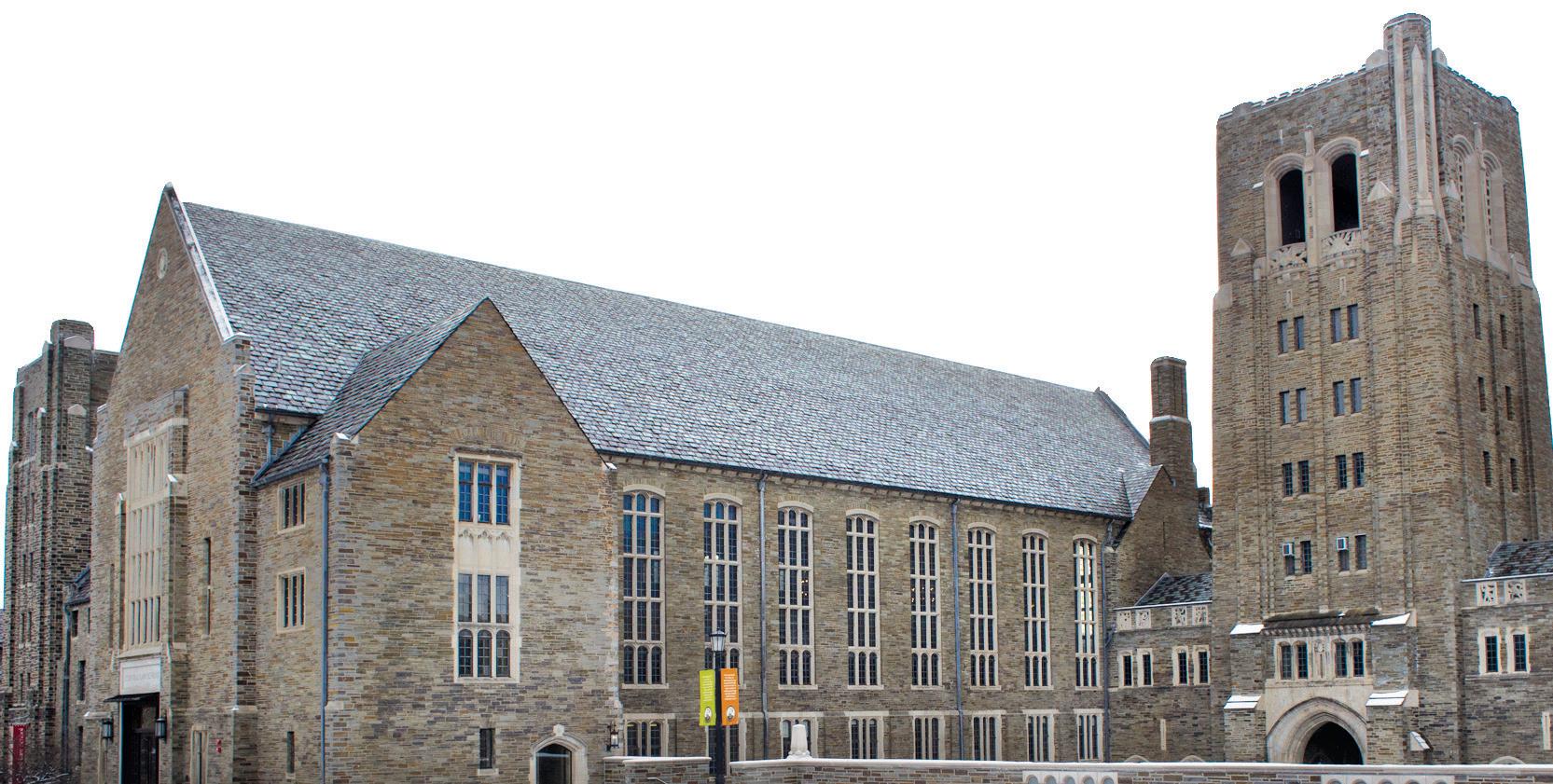
Legal limbo | Student organizers plan to protest discrimination against transgenders in the U.S. armed forces when a military recruiter visits the law school on Sept. 21.
By BREANNE FLEER Sun News Editor
The Graduate and Professional Student Assembly is planning a revision of the Graduate and Professional Community Initiative, a five-year plan to tackle graduate and professional issues, taking a step toward that end at Monday’s meeting by reinstating an ad hoc committee tasked with
brainstorming the priorities of the new initiative.
The GPCI is “a vision and a strategic plan presented to the University and the broader Ithaca community … as a way to identify and address critical issues in graduate and professional student life at Cornell University,” according to the most recent GPCI document, produced in 2013. Several recent improvements
and initiatives, including the $1.2 million renovation of the Big Red Barn, the Maplewood housing project and the creation of the English Language Support Office to provide language support to international graduate and professional students, have been undertaken with the GPCI as a basis, according to webpage on the initiative.
Ekarina Winarto grad, GPSA
president, told The Sun at the last GPSA meeting on Aug. 27 that while the GPCI is “really hard work” where “the payoff is not immediate,” it has had an impact in the long term.
“It’s really one of the most impactful ways that we have actually made a difference in, you know, University policies,” Winarto said, calling the document a “top priority.”
The newly-reinstated GPCI Ad Hoc Committee “will review the current GPCI and plan for the upcoming re-do of the GPCI,” according to the committee’s webpage.
A similar committee, the Ad Hoc Committee to Assess the Progress On and Update the Recommendations of the
See GPSA page 4
Tuesday, September 11, 2018

Travelling Abroad: Preparations and Advice
11:00 a.m - 12:30 p.m., G08 Uris Hall
Soft interface Mechanics: Katharine Jensen, Ph.D. 4 p.m., 203 Thurston Hall
Beyond Books: Using the Library Most Effectively to Support Coursework and Research
4:30 p.m., 4th Floor Rockefeller Hall conference room
A&S Networking: How to Work a Room 4:35 - 6:00 p.m., 206 Stimson Hall
Cornell Tech/Law Colloquium: “Danger Ahead: Risk Assessment and the Future of Bail Reform” 7 p.m., 182 Myron Taylor Hall
War Horse - Free Screening 7 - 9:30 p.m., Willard Straight Theatre
Cornell Aikido Club Demo and Beginners Class 7:45 - 8:15 p.m., Teagle Hall, Gymnastics Room
Behavioral Economics Workshop: Ricardo Perez-Truglia 11:40 a.m. - 1:10 p.m., 141Sage Hall
Econometrics Workshop: Arthur Lewbel 11:40 a.m. - 1:00 p.m., 498 Uris Hall
Biomedical Science Seminar Series: Pengyi Yang, Ph.D. 4 - 5 p.m., T1003 Vet Research Tower
Rose House: Let’s Meditate 8 p.m., Becker TV Lounge
Drop-In Breakfast at the Engaged Cornell Hub 8:30- 10 a.m., 3rd Floor Kennedy Hall
Joint Industrial Organization and Public Economics Workshop: Eugenio Miravete 11:40 a.m - 1:10 p.m., 4980 Uris Hall

Data Mangement Information Session Noon. - 1 p.m., 340 Duffield Hall
Safety Fest 2018 4:30 - 6:30 p.m., Court Kay Bauer Quad
Re/En/Visioning Black Portrayals: A Meditation on Remix Perogatives
4:30 p.m., Schwartz Center for Performing Arts, Film Forum
Wolfgang Lorch: Building Communities 5:15 p.m., Milstein Auditorium
By SHAWN HIKOSAKA Sun Staff Writer
A nearly-forgotten yet significant artifact of Ithaca’s history — one of the last remaining Thomas-Morse S-4 Scout biplanes from World War I — will make a return to its hometown when it flies in the city on Sept. 29.
Dubbed the “Tommy”, the biplane served as a training aircraft for the United States Army and United States Navy towards the end of World War I. The aircraft was produced in Ithaca by the Thomas-Morse Aircraft Corporation from 1917 to 1918.
Fifteen years ago, members of the Ithaca Aviation Heritage Foundation proposed to bring the S-4 Scout back to its birthplace. The journey that ensued was a long but rewarding one; Don Funke, a leader and major contributor to the project, has overseen the process from the very beginning.
“We had people saying that it was probably a million in one shot,” Funke said. “There was a string of miracles that happened along the way”.
“We went to all corners of the United States … we had no money, neither did we have anything to trade,” he said.
After scouring every possible lead, foundation members discovered a promising find: an S-4 Scout under the private ownership of Dr. William Thibault, a prominent doctor in Orange, California. Members of the Ithaca Aviation Heritage Foundation reached out to the doctor in hopes of obtaining the aircraft.
Coincidentally, the doctor had relatives who reside in Ithaca and they were able to have the doctor come to the facilities of the Ithaca Aviation Heritage Foundation. After some deliberation and negotiation, the doctor made his decision.
“We sit down and we’re having coffee and I start my spiel,” Funke recalled. “I got about three minutes into it and he kind of poked me in the shoulder and said ‘Don, the airplane is yours.’”
The restoration process, however, was a tedious one. Not many schematics remained of the B-variant of the S-4 Scout, which was the aircraft the Foundation now possessed.

“It was in need of a lot of help,” Funke said. “Every stick, every wire, every turn buckle, every bolt, every nut, came off of that airplane … we stayed as true as we could to the original materials and restoration processes”.
The foundation also used the same exact facilities the original Thomas-Morse Aircraft Corporation used one hundred years ago. “We were in there using the same tools building the same thing — that cannot happen anywhere else in the world,” Funke noted.
To aid the restoration process, Ithacans contributed hours of labor and thousands of dollars worth of materials. “The community got behind it; all I had to do was continue recruiting volunteers,” he said.
Volunteers spanned over three generations. “We’ve had young kids working on the airplane — it has been a continuous involvement of three generations,” Funke said.
Jessie White, the event coordinator for the Ithaca Aviation Heritage Foundation, has worked with the restoration team to share this piece of history with the Ithaca community.
A talk and a bus tour have been organized to celebrate the
centennial flight of the “Tommy” scout biplane. The former is on Sept. 18 at 7 p.m. at The History Center and the latter is on Sept. 28 at 2 p.m., meeting at the hangar theatre.
The centennial flight itself will take place on Sept. 29 at 2 p.m. at the Ithaca Tompkins Regional Airport.
“I am really hoping that this is a great successful event for the public and community members … it’s a lot about enriching the community but also having a fun event,” she said.
After the flight, the Ithaca Aviation Heritage Foundation will “put it in our permanent display in Ithaca as a symbol of what happened a hundred years ago in the aviation industry in the hometown of Ithaca, New York,” Funke said.
“This airplane belongs to those [volunteering] kids and Ithaca. We want them to know what a World War One airplane sounds like, what it smells like, what it looks like,” he said.
Shawn Hikosaka can be reached at shikosaka@cornellsun.com.
By YUICHIRO KAKUTANI Sun News Editor
At the tail end of a Monday roundtable, Prof. Magnus Fiskesjö, anthropology, asked the audience a question:
“If our business school dean goes to China, should they just be able to schmooze around with all the companies and officials without ever mentioning that there are a million [Chinese] people in camps?”
“No,” Fiskesjö answered. “I think as Cornellians, if we are going to have those relations [with China,] business school or whatever, we should not be silent on these things.”
When the average Cornellian is asked to name the victims of an ongoing genocide, they might think of the Rohingya in Myanmar. Or maybe the Yazidis in Iraq. Not many will name the Muslim Uyghurs in Xinjiang, a north-west Chinese territory bordering Kazakhstan.
But three Cornell professors are intent
ing out perhaps not only human lives, but also the very culture of the Uyghurs.
The lecture focused on the mass “re-education” camps in Xinjiang, where more than one million Uyghurs are held against their will to undergo political indoctrination, according to the Human Rights Watch. The detainees are forbidden from using Islamic greetings and are forced to learn Mandarin Chinese and sing propaganda songs. If they refuse to abide by camp rules, they are forced into solitary confinement or denied food.
The Chinese government argues that these sorts of measures are necessary to starve off increasing religious extremist violence in the area, a claim contested by Uyghur groups and human rights advocates, according to The New York Times.
However, Prof. Jeremy Wallace, government, suspects ulterior motives drive the Chinese government’s Uyghurs policy, situating it as part of a larger crackdown on “independent civil society” as China’s government struggles to adapt a new era of
attempt to create a new political story justifying the regime. And this regime is about control, and about enemies, about purities. ... There is a major push, I think, of creating enemies of those who do not get on board with this vision.”
Prof. John Weiss, history, argued that these sorts of acts of repression by the Chinese state classify as a cultural “genocide” — even if the death tolls are comparatively low, there still exists a drive to destroy a cultural identity, he argued.
“The discussions of genocide has been putting an emphasis upon killing — it’s the physical destruction that matters,” Weiss argued. “I think we can go beyond that in our notion of what genocide is and we can perhaps use a different term. ... You can lose your identity, you can lose your dignity — and is that not much superior to dying?”
The 1948 Genocide Convention says that “genocide means any of the following acts committed with intent to destroy, in whole or in part, a national, ethnical,
of Prof. Rian Thum, history, Loyola University, to predict a bleak future for Xinjiang, where undisputable acts of genocide is taking place.
“[Thum has] clearly written about how there’s no clear end in sight ... There’s officials talking about these people in terms that begin to approach a genocidal attitude,” citing opinions such as “Let’s get rid of them if we can’t change them, transform them, break their identity and force them to change, maybe we should get rid of them.”
But some Chinese people are speaking up against their government’s Uyghur policies, and we should as well, Fiskesjö said.
“They are also trying to silence journalists, and anyone, like us here, who are trying to talk about this. We would all be shut down if this was in China ... Let’s not be silent,” Fiskesjö said.
Yuichiro Kakutani can be reached at ykakutani@cornellsun.com.

CURRICULUM
Continued from page 1
education and career … In my career I often come across non-ideal situations and through the thought process that Monroe taught I have been able to come up with innovative, out of the box ideas to help our clients,” wrote Tiffany Neier B.S. ’08 M.Eng ’09, according to a copy of the petition shared with The Sun.
“Monroe’s CEE 4540 class was instrumental to my education and career.”
Tiffany Neier B.S. ’08 M.Eng ’09
According to Linda Nozick, director of the school of civil and environmental engineering and Prof. Bill Philpot, civil and environmental engineering, director of undergraduate studies, who led the curriculum committee, the main issue with the CEE 4540 curriculum was that it did not sufficiently cover “standard drinking water treatment methods” in first world countries as it focused instead on water treatment in developing countries.
“CEE 4540 came before the Curriculum Committee because of a concern that standard drinking water treatment methods – which are viewed as essential knowledge for a student graduating with a focus in environmental
engineering – were not sufficiently covered in the curriculum,” they wrote. “In the overall curriculum design, CEE 4540 is the course intended to cover this material.”
Nozick and Philpot said that Weber-Shirk was given the offer to develop and teach a new course that would cover the AguaClara-focused material, which would have to go through the standard course review process.
“I was told ‘If you would like to teach CEE 4540 in the Fall of 2019, a revised version of the course will need to be accepted by the curriculum committee by March 2019.’ I was told that the course needs to be like the courses taught at other universities,” Weber-Shirk said.
The petition created by students and alumni addresses this concern, saying that while CEE 4540 differs from traditional engineering courses, learning about treatment plants in third world countries also provides a thorough and complete overview of “standard drinking water treatment methods” in first world countries because the foundations of water treatment in both the developed and developing world are similar.
In particular, the petition was critical of the University’s decision to modify the course without input from students, alumni and “other stakeholders” and expressed frustration with the lack of transparency throughout the process.
However, Nozick and Philpot said that this petition will not “substantively impact” any future changes to the course.
“The petition will not substantively impact this course
of $20,000 for up to four years, according to the resolution.
Graduate Community Initiative, was created in August 2012, according to the 2013 GPCI. This committee helped create the document in 2013 and then was subsequently disbanded, as its sole purpose was to draft the 2013 GPCI. The Assembly’s decision today to move forward in the planning process for a new GPCI prompted the revival of the committee.
Also at the Monday meeting, Cassandra Stambuk grad, chair of the GPSA Appropriations Committee, introduced a resolution approving the assembly’s 2018-19 internal budget.
The resolution details GPSA funding for Anabel’s Grocery, noting that the Appropriations Committee plans to meet with leaders of the store and decide by the end of the semester whether to continue monetary contributions to the store.
The assembly has so far provided Anabel’s with a total of $40,000 as part of a decision made in 2015 by GPSA that the assembly would “financially support” the store by giving an annual contribution
Stambuk told The Sun that in relation to any changes between this year’s internal budget and last year’s, “nothing is … major.” The projected 201819 budget would see the assembly spend a total of $37,150, with the largest expense of $20,000 going to Anabel’s if GPSA continues to support the store.
The budgeting process, however, was not without its surprises.
According to Stambuk, Gina Giambattista, director of the Office of the Assemblies, discovered an additional assembly account, the GPSA Reserve Account, which contained $3,000.
“It was made in 2012 and then never touched,” Stambuk told The Sun. “So, yeah, we kind of like just found money.”
Stambuk noted that the assembly’s rollover funds, totaling over $27,000, have be placed in the Reserve Account along with the extra $3,000.
because the faculty feels strongly that this content is necessary,” they wrote. “We do see the petition as further evidence of the importance of AguaClara (though that was never in doubt). The faculty are very supportive of Dr. Weber-Shirk in this endeavor.”
Weber-Shirk said that he had no input in selecting Chang as his successor. Chang was chosen because he has “28 years of experience in water and wastewater treatment facility design, process optimization, and advanced technology evaluation and verification,” according to Nozick and Philpot.
Chang did not respond to The Sun’s request for a comment.
Nozick and Philpot explained that Weber-Shirk was replaced with Chang because “after a several month process of reviewing the prior course and revisions to that course with the Curriculum Committee and the area faculty, it became clear that we needed to consider other options for delivery of the course this fall.”
Several AguaClara members — many of whom previously took CEE 4540 — have also signed onto the petition.
“While a project team can do a wonderful job supporting the aims of a curriculum, it is not appropriate for a project team to dictate the curriculum,” Nozick and Philpot said. “It is the purview of the faculty to ensure that students are properly prepared in many aspects of a field.”
Shruti Juneja can be reached at sjuneja@cornellsun.com.
crimination in employment based on race, color, religion, national origin, ancestry, sex, sexual orientation, marital status, age, or handicap,” according to the school’s website. The law school requires all employers to adhere to this policy, and faculty and administrators who fail to uphold the policy may be denied facilities of the Career Services Office.
Although the dean of the law school Dean Eduardo Peñalver recognized that a transgender ban does violate their anti-discrimination poli-
cy in September 2017, the law school will continue to allow military recruitment because of a federal law, Solomon Amendment, that will deny federal funding to institutions that do not give military recruiters the same access as other employers on campus.
“We continue to support and respect those talented and capable Cornell Law Students who choose careers in the United States military,” Peñalver wrote in the September 2017 statement. “We nonetheless deplore this unprecedented step backwards in the progress towards greater tolerance and inclusion in our nation’s military.”
Lambda will also be presenting a letter about the transgender ban and military recruitment at their protest. Two other student organizations, National Lawyers Guild and American Constitution Society have expressed their support.
Eichert hopes that Cornell will take a stronger stance on the issue if the ban were to be implemented.
“If the transgender ban were fully enforced, I would expect Cornell to have a much [stronger] showing,” Eichert said.
“But I think right now given the current legal complexities of the situation, I think Cornell, at least Cornell Law School is doing a pretty good job.”
Currently, the implementation of the ban is on hold.
In March, Trump announced a revised policy which would allow some transgender people to serve. According to the Human Rights Council, U.S. Court of Appeals for the Ninth Circuit was the latest court to deny the implementation of the ban this July, referencing its discriminatory nature.
Since 1880
136th Editorial Board
JACOB
S.
KARASIK RUBASHKIN
’19
Editor in Chief
JOHN McKIM MILLER ’20
Business Manager
KATIE SIMS ’20
Associate Editor
VARUN IYENGAR ’21
Web Editor
MEGAN ROCHE ’19
Projects Editor
EMMA WILLIAMS ’19
Design Editor
JEREMIAH KIM ’19
Blogs Editor
AMOL RAJESH ’20
Science Editor
BREANNE FLEER ’20
News Editor
YUICHIRO KAKUTANI ’19
News Editor
NICHOLAS BOGEL-BURROUGHS ’19
City Editor
LEV AKABAS ’19
Arts & Entertainment Editor
SARAH SKINNER ’21
Assistant News Editor
ANNE SNABES ’19
Assistant News Editor
JOHNATHAN STIMPSON ’21
Assistant Sports Editor
EDEM DZODZOMENYO ’20
Assistant Photography Editor
GIRISHA ARORA ’20 Managing Editor
HEIDI MYUNG ’19
Advertising Manager
ALISHA GUPTA ’20
Assistant Managing Editor
DYLAN McDEVITT ’19
Sports Editor
MICHAEL LI ’20
Photography Editor
GRIFFIN SMITH-NICHOLS ’19
Blogs Editor
JACQUELINE QUACH ’19
Dining Editor
SHRUTI JUNEJA ’20 News Editor
ANU SUBRAMANIAM ’20 News Editor
JUSTIN J. PARK ’19
Multimedia Editor
PARIS GHAZI ’21
Assistant News Editor
MEREDITH LIU ’20
Assistant News Editor
JACK KANTOR ’19
Assistant Sports Editor
RAPHY GENDLER ’21
Assistant Sports Editor
BORIS TSANG ’21
Assistant Photography Editor
Working on Today’s Sun
Ad Layout Krystal Yang ’21
Design Desker Lei Lei Wu ’21
News Deskers Yuichiro Kakutani ’19
Paris Ghazi ’21
Night Desker Amina Kilpatrik ’21
Sports Desker Johnathan Stimpson ’21
Arts Desker Peter Buonanno ’21
Science Desker Amol Rajesh ’20
Photography Desker Edem Dzodzomenyo ’20
Production Deskers Krystal Yang ’21 Sarah Skinner ’21
Editorial
It’s Dumb Tat New York Is Holding Its Primary on a Tursday
In September, But Tat Doesn’t Mean You Shouldn’t Vote
YOU KNOW, SOMETIMES IT FEELS LIKE NEW YORK’S ELECTION LAWS are written to decrease, rather than increase, the number of people who actually vote. Perhaps it has something to do with the state inexplicably holding two primary days: one in June for federal races, and one in September for state races (it’s not inexplicable, it’s so the good folks in Albany have more time to schmooze in the capital before they have to hit the campaign trail). Or maybe it’s the total lack of mail-in and no-excuse absentee voting and same-day registration. Or how dang difficult it is to change your party once you’ve registered.
Oh, yes. There’s a primary this Thursday, and — assuming you’re registered in New York, you should vote in it. If you don’t know your polling place, or your elected officials, you can look them up here: https://voterlookup.elections.ny.gov/votersearch.aspx.
Because whomever you’re voting for, you need to vote. It’s the most powerful tool in your political arsenal. As college students — and more generally, as young people — we and our ideas are often looked down upon. But the beauty of democracy is our votes count just as much as our parents, our professors, our employers and everyone else. But again, that is only if we use them.
Does your vote “really count”? Ask Alexandria Ocasio-Cortez, who toppled one of the most powerful politicians in America, Queens congressman Joe Crowley, by a mere 4,000 votes in June. A group of voters one-fourth the size of Cornell’s undergraduate population caused a seismic shift in the Democratic Party, so don’t think it can’t happen here.
The two biggest races are the Democratic gubernatorial primary, featuring incumbent Andrew Cuomo and insurgent challenger Cynthia Nixon, and the Democratic primary for attorney general, in which four candidates are running. If you’re happy with the way in which New York has been run for the past eight years (the passage of marriage equality, gun control, paid family leave), or if you value governing experience or bagel choice, Cuomo is probably the candidate for you. If you favor a bold, progressive agenda focused on criminal justice reform, finally legalizing marijuana, and fixing the decaying New York City subway, and you aren’t so worried about previous governing experience, consider Nixon.
For attorney general, you should vote for Zeyphr Teachout. Over the next several years, the NYAG will be tasked with investigating corruption in Albany, corruption in New York City and corruption in the Trump Foundation and organization (especially if the president shuts down the federal investigations). Teachout, a Fordham law professor, literally wrote the book on corruption, and would be an independent-minded force in the swampy state capital.
But regardless of who you support, please do vote. It’s important.
I’m no expert when it comes to insurance. Even the word “insurance” draws a heavy question mark in my mind. But recently, it has certainly come to my attention that Cornell’s Student Health Plan has been the source of much difficulty and stress for some students.
Freshmen and transfer students are left with extra expenses and more worries to handle on top of their transition into an entirely new environment. Current students are betrayed with a denied waiver after years of an easy opt-out process, leaving them confused, enraged and in disbelief.
Even the word “insurance” draws a heavy question mark in my mind.
Lucky to have my SHP requirement waived, at least for this time, I was all ears for my friends who had a lot to say about the frustration they were experiencing.
We’re still young and studious, investing all our attention on diversifying and strengthening our education. Our minds are already preoccupied with not only our studies but also the unfathomable digits of student debt – now insurance?
In the end, we become reliant on whatever resources we have on campus, and we take what we can get. We only have so many options nearby.
The only hospital, emergency room and diagnostic center in the vicinity is the Cayuga Medical Center, with other hospitals located at a 40-minute-plus driving distance.
And with limited medical access comes seemingly unlimited expenses. College in itself is already riddled with tremendous price tags, ranging from the tuition to textbooks and simple groceries, but to pay an enormous fee, over $2,000, from an unfortunate result of what seemed like a simple, innocent little waiver form online is unbelievable. And I thought paying $370 for waiving my insurance plan was outrageous. In the end, there’s no way out, and this is just the beginning. The unbelievably high cost for healthcare is inevitable. In the United States, we become trapped in a whirlpool, drowning from the horrendous, heart-attack-inducing numbers printed on the hospital bills and insurance payments. If the numbers continuously keep increasing, is there anyone left to serve? Is the value of the healthcare itself even consistent with its extreme monetary value? If the quality of medical attention satisfied its economic worth, the state of healthcare economically and medically wouldn’t have been as atrocious as it is now. And this issue isn’t just present on campus or in the United States. It’s a global issue.
Cornell’s Student Health Plan has been the source of much difficulty and stress for some students.
This limitation is the primary source for the difficulties in providing insurance waivers and for the high cost of the Student Health Plan itself. With a limited resource for quality medical attention, waiving insurance becomes a nit-picky process, the enforcement of which has become drastically more strict this academic year.
This also shines light on another issue: limited student access to a hospital. While students are provided with an on-campus health facility that offers services such as counseling, physical checkups and vaccinations, the range of available services are certainly limited. With difficult access to a hospital located five miles away, we can only cross our fingers for a safe and healthy student experience.
Maybe that’s slightly exaggerated, but that’s how I feel right now as a college student with a sense of uncertainty in the fate of my health. The bottom line: medical care is difficult to access, and we’re charged more for the resource we have low accessibility to. Ultimately, college expenses continuously pile onto our backs, and we’re always looking up towards our hopeful aspirations without looking down at the financial shackles that lock us into place. And while a good portion of the student population depends on parental contributions, the financial burden is still the same. But even past the financial hardship associated with denied insurance waivers, the quality of student health remains questionable.
Alexia Kim is a sophomore in the College of Human Ecology. Who, What, Where, Why? runs every other Friday this semester. She can be reached at alexiakim@cornellsun.com.
S
. C
Ethan Wu | Discourse and Discord
Watchful pedestrians may have caught a glimpse of the stout black truck trundling across campus last month. Its exterior, a carnelian-red LED screen, bore the unmistakable words
“Does Cornell Care?” Does it? Should it? Its screen flashed another image, this one depicting Touchdown holding a “Displaced” sign alongside the text “Over 100 Students Without Housing.” If Cornell cared, it was certainly doing a poor job of showing it.
Those responsible for the truck, the Tompkins-Cortland Building and Construction Trades Council, a local labor union, sought to right a wrong. The gripe of the union with the long-winded name was over a graduate housing project, called Maplewood, that Cornell contracted out to EdR, a Tennessee construction firm. Cornell hired EdR to cut costs on Maplewood, which the University deemed a “low-end construction” project.
For upcoming construction projects, like the 2,000bed North Campus expansion, Cornell will either use local labor or it won’t. If it opts not to, the University risks getting burned by another out-of-state contractor. The resulting outrage would, one hopes, convince Cornell administrators to be leery of contracted labor. If not, that makes the administration incompetent, but not uncaring.
Choosing who will build an apartment complex should be an economic decision, not a moral one.
But the Maplewood project went awry, causing holdups and raising safety concerns. Some 106 graduate students were dislocated, though EdR compensated them. EdR, which supposedly specializes in collegiate construction, should be embarrassed.
Should Cornell? The unionists think so. Cornell has a collective-bargaining agreement requiring it to hire union workers. The unionists contend the University “circumvented” the agreement by contracting EdR; since Cornell did not itself build Maplewood, the agreement has no legal force. EdR claims it fell behind schedule because of labor shortages. But the unionists plausibly claim they were ready, willing and able to work. Cornell comes off looking short-sighted and perhaps two-faced.
And yet none of this has any bearing on whether Cornell “cares.” The University chose to hire a contractor to save money. The project was a flub. A minor scandal ensued.
My point is that the unionists are distorting what matters. Choosing who will build an apartment complex should be an economic decision, not a moral one. Asking whether the University is “friendly to labor,” or whether its choices are fair to union workers, misses the point.
The moralizing language of “Does Cornell Care” is misguided for two reasons. First, it undermines the unionists’ own cause. And second, it obscures the best case for hiring local labor.
Start by considering what the unionists want: to be hired for future projects. By questioning whether Cornell cares, they hope to shame the University into doing so. Yet a hulking institution like Cornell will have a fickle capacity for caring. Put another way, even if Cornell cares now, it may not forever. The University will always have, however, oodles of institutional interests. Appealing to those interests is the unionists’ best shot at getting hired.
then hire local. An economically vibrant Ithaca is in Cornell’s self-interest. Its students and faculty benefit from enhanced amenities, and a well-funded local government will likely take it easy on the University’s tax ledger.
Conversely, an Ithaca wracked with unemployed workers is against Cornell’s self-interest. Crime would tick up. So too would opioid abuse. Cornell would tumble down the all-important college tier lists — many of which assess the local environment in rankings. As such, the University has a clear medium-term interest in employing as many Ithacans as feasible.
In fairness, the unionists do attempt to make their own economic case. On the merits, it is convincing. They point out EdR’s myriad failures, including some alarming safety violations. They highlight the spillover costs of Maplewood. They allude to several previous scandals with local contractors. Union labor looks impressive by comparison.
The University should fulfill its commitment to employ local labor for the North Campus expansion.
Next, the case for local labor. The University should hire whomever can build the best housing for the lowest cost. If that means out-of-state non-union labor, so be it. But if Cornell values the local economic boon brought by employing Ithaca labor — as it should —
Christian
“How did you get into Cornell?” Outwardly I laugh and shrug, but inside I die a little. After I received my acceptance letter in November, the pressure was on to avoid doing anything appearing mildly stupid. The thing is, that’s who I am. Unless I’m cracking the books, I am an eccentric conglomer ation of Moe, Larry and Curly. And the inces sant clamoring of “Big Cornell” or “Ivy Guy” when I spoke up in class or even passed a friend in the hallway seemed to preclude me from acting in that manner. When I inevitably did, the Question came up, and my heart dropped.
The unionists have legitimate complaints worth redressing. Cornell has no business doing business with EdR after its botched Maplewood project. The University should fulfill its commitment to employ local labor for the North Campus expansion — because it is the superior option, no matter whether it is the “caring” one. It’s a shame, then, that the unionists’ compelling case is eclipsed by their moral framing of the issue. Claims about Cornell’s insufficient friendliness to labor are overblown. But if the bestequipped electricians, steamfitters, plumbers, welders and carpenters are in the University’s backyard, that is something about which Cornell should care.
Ethan Wu is a sophomore in the College of Arts and Sciences. Discourse and Discord runs every other Tuesday this semester. He can be reached at ewu@cornellsun.com.
held a sneaking suspicion that if I did mention it to anybody, the blindfold would come off their eyes and they would realize that I was, in fact, a fraud.
So I turned to my rock: Google. One night I turned on private browsing and typed, “I feel like I got into college by

Learning this, it was easy to diagnose myself with imposter syndrome.
across as learned and articulate, but each time I do, I feel as though my composure is a facade that will come crashing down when the people with whom I’m interacting get to truly know me.
know that faking it is synonymous with practice, and practice is not a habit of a fraud.
I began to question my intelligence. How did I get into Cornell? If someone understood a concept in class quicker than I did or performed better on a test, I beat myself up. The Cornell admissions committee didn’t understand me — maybe my exhaustive participation in clubs prevented them from considering if I could actually hack it in a competitive academic environment. Maybe my first ACT score, much lower than the 34 I achieved on my third attempt, was the true indicator of my academic abilities. Maybe my abysmal grades in freshman year were more indicative of my base intelligence than the straight A’s of junior and senior year, which I felt were eked out by hard work rather than undiluted smarts.
It was too personal a dilemma to talk about with my parents or friends. I also
mistake” and then “everyone thinks I’m smart but I’m not.” I scrolled through the results and came across an explanation of a phenomenon known as imposter syndrome.
Apparently, almost 70 percent of all people believe themselves at some point to be fraudulent, or not worthy of their position. They feel, as the name suggests, as though they are a phony or a sham. Predictably, imposter syndrome is most common among high-achieving people, and more specifically, high-achieving college students. According to the highly reputable source of College Xpress, even persons of great repute who have attained demonstrable success, like acclaimed writer Mary Angelou and Emma Watson, fear they will be “found out” each time they publish a new book or act in a movie.
Learning this, it was easy to diagnose myself with imposter syndrome, but difficult to rid myself completely of the vestiges of self-doubt. I try to come
Even with friends, I’m impelled to “not try” in situations that could be telling of my true intelligence. I went to an escape house over the summer with my friends and girlfriend. The whole experience, although enjoyable, was vitiated by a constant worry that I couldn’t figure out the puzzles quicker than my friends. So, I hung back and let my buddies take the lead. We ended up getting nowhere close to escaping the room, and I was left with a nagging idea that had I devoted my full mental faculties to the riddles, we might — might — have been able to escape.
I don’t like being in this position. Maybe I’m overthinking my dilemma, and maybe I’m one of but a few who think this way. But I don’t think so. It’s easy to label yourself as just book-smart, not street-smart, or pass off your achievements as due to luck. It’s hard to accept that you deserve your seat, whether it is at a prestigious college or a position of import in a company.
I’m not going to end by writing about my resounding victory over my imposter syndrome. I have made little progress in vanquishing it beyond my diagnosis. But I’m taking a leap towards beating it. I took eight of the hardest courses available in my senior year of high school, just to show that I could do it. I carried the same attitude into college, where I am currently a biology major, despite my true proclivity toward ILR. From all reports Cornelians view ILR as the “easy” major, and I didn’t want people nodding knowingly at my course of study when they inevitably discover my fraudulence.
If you think you have to fake it, fake it, but know that faking it is synonymous with practice, and practice is not a habit of a fraud.
Still, I’m planning on transferring after my first semester.
So let’s cut the crap, people. According to the statistics, a majority of people at Cornell walk around boasting bluechip accolades and believing they don’t deserve them. You didn’t get to where you are now by luck. You don’t have to wave off your accomplishments; humility and insecurity are distinct. If you think you have to fake it, fake it, but
Don’t look at discovery with fear, but with relish. You did it, whatever the accomplishment, so Mr. Accomplished, tear down that wall, and revel in genuineness.
Christian Baran is a freshman in the College of Arts and Sciences. Honestly runs every other Friday this semester. He can be reached at cbaran@cornellsun. com.
At this year’s Met Gala it wasn’t Rihanna’s extravagant pope ensemble or a Kardashian’s ethereal interpretation of sainthood that grabbed the internet’s short attention span, but rather the debut of an unlikely couple: Tesla and SpaceX CEO Elon Musk and experimental pop artist Claire Boucher, who goes by Grimes. The juxtaposition of Musk’s white jacket and priest’s notched collar with Grimes’ goth gown and silver Tesla choker underscored the sense of surreality surrounding their coupling. Musk, one of a new generation of tech titans, an elite group consisting of household names like Bezos and Zuckerberg, embodies a greater neoliberal push toward innovation at any cost, often accompanied by hazy ethical grounding. Grimes, on the other hand, is a counter-cultural synth icon who has gained a cult following by working with the

avant-garde.
The unlikely union is at once shocking for what seems like a bizarre mismatch in fundamental ideology, and completely logical. Musk has become an object of fixation in pop culture for his electric cars and spaceships, with artists like Tyler the Creator immortalizing him in rap lyrics and Kanye West citing him as a source of inspiration. This cultural phenomenon has elevated Elon Musk from Silicon Valley CEO to cultural icon worthy of dating Grimes. Beyond internet-meme fodder, this relationship and its roots in social-media (the couple
met on Twitter) hints at the larger ubiquitousness of technology in our culture and the media we consume.
From the exponential number of Soundcloud rappers with tech words in their names (ex. Wifigawd and Wifisfuneral), it is clear the music industry has embraced technology as both a cultural phenomenon and as a means of survival. Overall, this has its benefits; streaming has increased revenues in the recording music industry and smaller artists are able to gain traction independently through social media platforms. However, on a deeper level, there lies a question as to whether artists and musicians, hold a responsibility to examine and question systems and societal norms as cultural cultivators. In the frenzy for cultural clout and earnings, it is easy to ignore the problematic moral underpinnings of large tech corporations. This year alone, we have passively watched Mark Zuckerberg testify before senate on Facebook’s data privacy scandal, Tesla called out for poor labor practices and anti-union activity, and Amazon escape paying taxes that would go to affordable housing in its home city of Seattle. While some artists critique the pervasiveness and extent to which our society trusts technology, for the most part, in mainstream culture, these large looming problems are swept away, reduced to adlibs and rhymes while tech companies and their leaders are put on pedestals.
In an interview with The Independent, author of Radical Technologies, Adam Greenfield, talks about a learned helplessnessthe acceptance and agreement to whatever technology appears

on the scene simply because the general public doesn’t feel that they have the power or technical knowledge to question or change the overwhelming tide in which technology is moving. This sense of apathy has created an environment where Apple feels confident rolling out a device with no headphone jack (I want to listen to music AND charge my phone at the same time!) and, on a more sinister level, we ignore the implementation of surveillance technologies like location-tracking and communications eavesdropping systems that betray the day-to-day activities of our private life.
As an avid user of technology I am well-versed in this learned helplessness. I love to talk about how technology shapes my everyday experience, about how social media has changed how we interact with each other, about how much I care about internet ethics. But what I mean when I say that internet ethics is important to me is that sometimes I delete the Uber app when incriminating
evidence about their data hacking, sexism, or bad labor practices are publicized (and redownload it when I need to get a ride), or sometimes I’ll provide fake information when prompted with subscription pop-ups and wifi log-in screens. These small coping mechanisms, in-the-moment rebellious anomalies, provide a balm of false complacency that allow me to forget that I actively use and sometimes even rely on Find Your Friends and Amazon Prime. We are all to some extent implicated in this learned helplessness, continuing to place trust in the hands of companies who we believe must know better than us.
Since Elon Musk and Grimes have started dating, their relationship has been mired by mishaps that range from an Azealia Banks Instagram rant to a move to take Tesla private. During this time, Grimes has come under fire and has had to deal with the consequences of something incredibly intimate, a private, romantic re-
lationship, in a public way. This includes tweets defending Musk of union-busting accusations and donations to Republican campaigns. However, as someone who has gained a following partially because of her identity as a leftist, Grimes has had to confront her learned helplessness and make a choice. Often we look to artists, musicians, and creators as pioneers, pushing the boundaries of perception and what is accepted. In reality, they are more like a litmus test, trading in stories and the distinctly human, making things that reflect our own values and hopes. As Musk and Grimes continue to play out their relationship in the public eye amongst memes and controversy, perhaps it is time we take a second look at our own relationships with technology.
Isabel Ling is a senior in the College of Art, Architecture and Planning. She can be reached at igl3@cornell. edu. Linguistics will run on alternate Mondays this semester.
By SOPHIE REYNOLDS Sun Staff Writer
While many Cornell students were off enjoying summer vacation away from Ithaca, Ben Engbers ’20 remained on campus to defend and improve the vitality of New York’s berry industry.
As a research assistant and project manager at Elson Shields Laboratory of Entomology, Engbers has dedicated the majority of his undergraduate career to demonstrating the efficacy of nematodes as a sustainable biocontrol for berry farms.
“Nematodes are a native, sustainable, and organic solution to a food security
problem that is affecting New York state and the world,” Engbers said.
While Shields laboratory has studied the behavior and application of nematodes as pest control for over two decades, this summer, Engbers facilitated a specific project concerning the control of black vine weevil at Rulfs Orchard located five hours away in Peru, N.Y.
“My work this summer resulted in promising data that I am excited to see published and ultimately applied in the real world,” he said.
Black vine weevil is a formidable obstacle to crop growers worldwide and has been a significant detriment to the berry industry. Due to the parasitic weevil larva,

commercial farms suffer plant death and decreased yield in strains of strawberries, nursery plants, alfalfa, and corn, resulting in notable economic loss.
In pursuit of a natural and sustainable solution to this local agricultural crisis, Engbers and peers in Shields lab have been studying the adequacy of nematodes as a multi-year biological control. These microscopic worms, native to the upstate New York area, effectively kill black vine weevil larva by infecting the host body and subsequently reproducing in the host body.
ing. With every increase in weevil population there is a mirrored increase in nematodes, resulting in an ecologically sustainable system. This means that a farmer can introduce a population of nematodes once and reap multiple years of pest protection.
“Nematodes are a native, sustainable, and organic solution to a food security problem that is affecting New York state and the world.”
Ben Engbers
Engbers and team discovered that, when applied in tandem, two specific strains of nematode provide for optimal weevil annihilation. One species, Steinernema carpocapsae, persists in the top 7 cm of soil while Heterorhabditis bacteriophora, the second, occupies 8-20 cm underground. Each group functions in complement niches to diminish weevil populations. However, what makes the nematode a truly intriguing and effective pest control model, is its sustainability, affordability, and ecological impact. A viable alternative to costly and toxic pesticides, nematodes are native, climate adaptive, and long last-
’20
Engbers’ project is a continuation of a study started in 2013 when a single application of nematodes was introduced at Rulfs Orchard in Peru. Five years since, the persistence levels of the nematodes are above 25 percent, a significant indication of durability. Additionally, there are no foreseeable environmental drawbacks. As a native organism, nematodes pose no invasive threat and require little to no maintenance by the farmers.
Engbers also performed research for Shields Lab at farm sites in Michigan and Texas to test the geographic adaptability of these specific nematodes. According to him, nematodes are a feasible solution to common agricultural pests and a future tool for farmers in upstate New York and across the globe.
Sophie Reynolds can be reached at sreynolds@cornellsun.com.
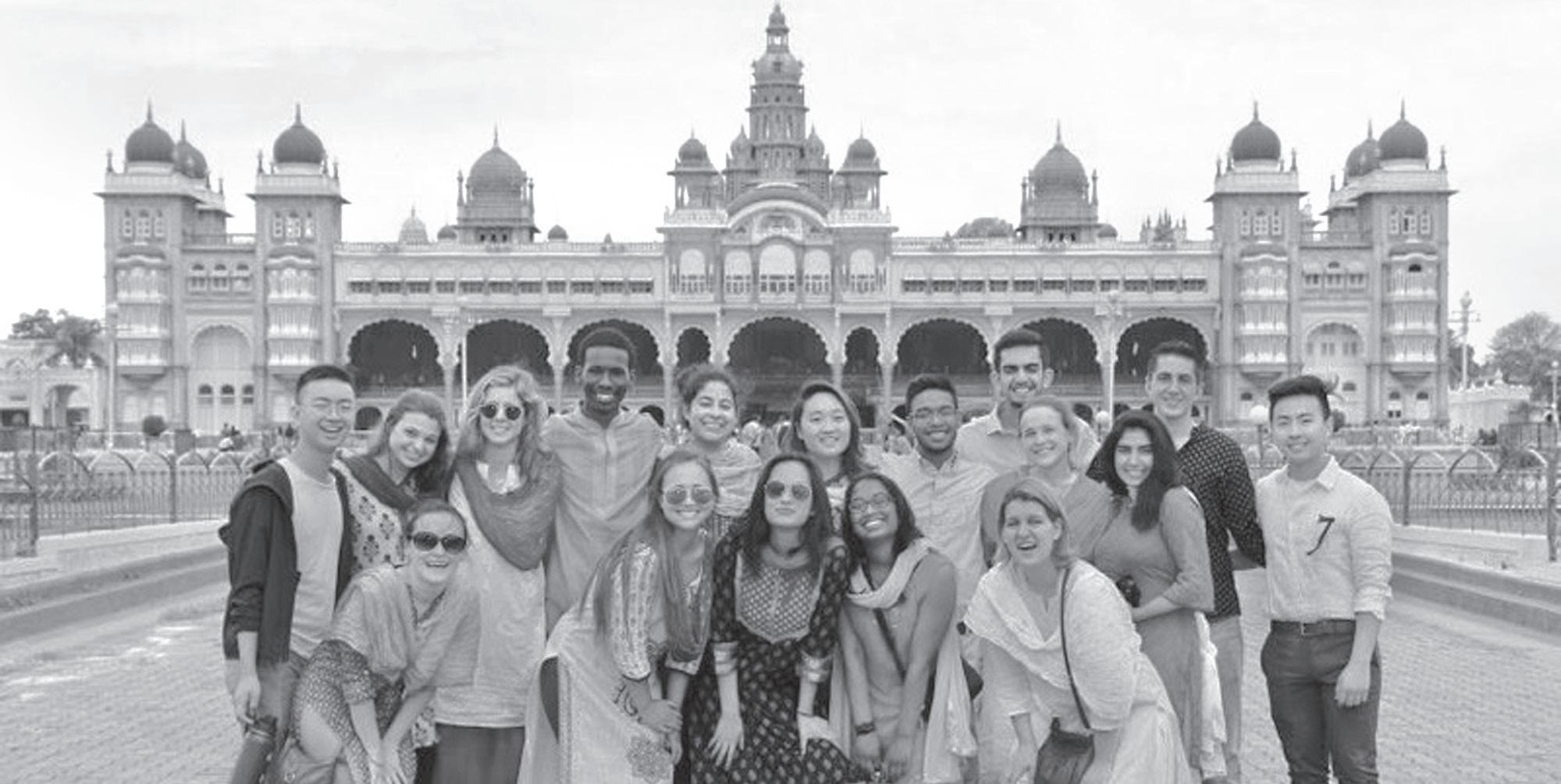
This summer, 15 Cornell students embarked on a journey that reshaped their awareness of global health systems. In partnership with the non-governmental organization Swami Vivekananda Youth Movement and the ILR School, students in the Global Health program worked on four to six week projects at SVYM sites that related to students’ career and service interests.
In addition to projects, the students took classes at the Vivekananda Institute of Indian Studies in Mysore, India, where they learned about Indian culture, gender, labor relations and economics, language and yoga.
Global Health student Simran Malhotra ’20 saw her project on digitizing patient history have a tangible impact despite organizational complications.
“Because I was not working to publish something, I could work immediately with the NGO and actually saw them using my work,” Malhotra said.
According to Malhotra, since the doctors in India see up to 50 patients in a day — such a high volume of visits means that doctors do not have time to go over treatment procedures with patients. Instead counselors are called on to talk to patients after their visits with the doctors. Unfortunately, the patients’ records are traditionally stored in doctors’ offices, giving the counselors little to no information when describing treatment policies to the patients.
“Having a counselor talk to patients about treatment while the counselor has no access to the patients’ information is really ineffective,” Malhotra said.
Malhotra’s process of digitizing patient records was able to help counselors do their jobs more effectively.
“I made a tangible product they can use, and because I still have contact with SVYM, if they want to use what I made for other projects, I can help them via email,” she said.
Malhotra is not the only student that saw her work impact SVYM and the patients she worked with. ILR student Vanessa Lobo ’20 worked on creating standard
operating procedures in tribal and non-tribal schools, which was a project under the social economic empowerment program run by SVYM. Specifically, Lobo worked to develop electric and agricultural education at the schools, and worked with women who ran the schools.
“We were able to talk so much to the women at the schools, but many of them said everything was fine because they were not trained to spot out problems,” Lobo said.
Besides structural problems, Lobo also discussed the initial difficulties of communication.
“I was frustrated because the translator would omit information the women said, so in addition to doing the project, we were also overcoming a lot of communication challenges,” she said.
The challenges, however presented themselves as learning opportunities for Lobo.
“At first, the program was marketed as changing the students internally. I thought I would have an impact instantly, but it took some time,” she said. “You really learn how to get passed the language barrier.”
Lobo also talked about her new understanding of privilege. Lobo added that she hopes to return not only to campus, but to her life in general with more of an appreciation for what she takes for granted.
In the long-run, Malhotra sees herself returning to India.
“I hope to go back as a medical student. I made something they can use and I want to continue the relationship I have with them,” Malhotra said.

Fill in the empty cells, one number in each, so that each column, row, and region contains the numbers 1-9 exactly once. Each number in the solution therefore occurs only once in each of the three “directions,” hence the “single numbers” implied by the puzzle’s name. (Rules from wikipedia.org/wiki/ Sudoku)

by Jeffrey Sondike ’19







By TIM MORALES Sun Staff Writer
Powered by a near perfect performance in the tournament’s last 18 holes, Cornell came from behind to just barely notch its third straight top three finish at the Alex Lagowitz Memorial Invitational.
Led by junior Jack Casler, who tied for second place in the individual champonship, the Red answered the daunting task of replacing the dominant duo of Mike Graboyes ’18 and Christopher Troy ’18, and continued its history of success at Hamilton, New York’s Seven Oaks Golf Course.
Red shot the second lowest team score of the day (289), pushing the Red into sole possession of third place. The one over par 289 came at the perfect time too, as Sunday proved to be the statistically toughest day for the field.
In what can only be described as a near magical performance, a pair of two 50-plus yard, hole-out eagles carried Casler to the pivotal three under 69 on Sunday.
“The two eagles were pretty crazy. I’ve never done anything like that in a round of golf.”
Junior Jack Casler
Of the 17 teams that took part in the invitational, the Red finished one stroke ahead of Seton Hall with a team score of 878, enough to squeeze onto the podium along with second place Drexel (877) and the first place Lafayette squad (867).
Nerves played a factor in the inexperienced group, as the Red came out slow Friday and Saturday, posting relatively meager team scores of 294 and 295, respectively. Finding themselves tied for seventh after 36 holes, the team knew it would have to perform near flawlessly on Sunday if it was to have a chance at breaking the top three.
And that was a tall order the team was able to answer.
Led by a 69 from junior Jack Casler, the
“The two eagles were pretty crazy. I’ve never done anything like that in a round of golf,” Casler said. “The first eagle was pretty lucky, I hopped the ball in from 54 yards on the 17th hole. The second eagle was on the 4th hole from 96 yards, and that one was probably even more exciting.”
Even with the two hole outs on Sunday, Casler attributed most of his success to his consistency with the putter.
“The best part of my game this weekend was definitely my putting,” Casler said. “I didn’t hit my driver or irons that well either day, but only had one three putt through 54 holes.”
Casler’s opening tournament success comes after an impressive summer, where the junior hit four straight rounds under 75 to finish fourth at August’s New York State Ammateur competition.
“This summer was really big for me,” Casler said. “It has been a culmination of a lot of work with my swing coach over the last couple years. I’ve also been a lot

FORE-get it | Two 50-plus yard, hole-out eagles carried junior Jason Casler to a three under 69 on Sunday — and along with it, second place in the individual championship.
more relaxed on the golf course, which has probably been the biggest improvement for me.”
This improved mindset and the ability to remain calm will prove to be the major factor for Casler this season.
“If I can stay relaxed, it helps me calm my nerves and stay focused on the right things during a round of golf,” he explained. Casler and the Red hope to continue this momentum when they host the Cornell Invitational at the Robert Trent Jones Golf Course this Saturday.
Tim Morales can be reached at tmorales@cornellsun.com.
By SMITA NALLURI Sun Staff Writer
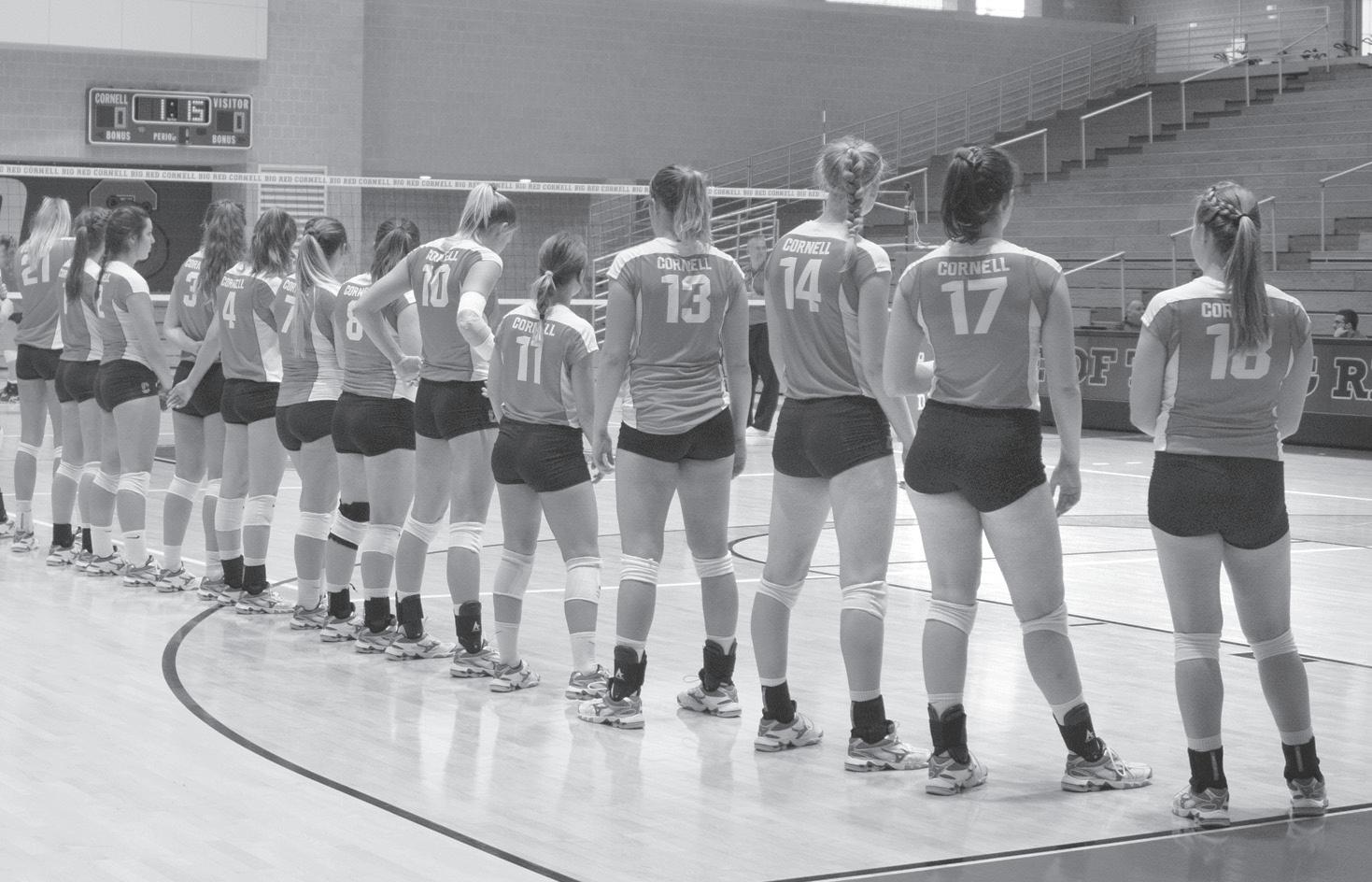
The Red headed to Houston to compete in the Flo Hyman Invitational, where it went to 2-2 on the weekend and improved its overall record to 4-3.
Cornell kicked off the tournament on a strong note Friday morning, sweeping Lamar University (2-6) in three sets (19-25, 12-25, 22-25).
Eight kills from freshman Madison Baptiste, seven from junior Samanta Arenas and senior co-captain Kara Rogers, and six from senior co-captain Carla Sganderlla propelled the Red to a suffocating .359 hit rate. Supporting their blistering effort, junior setter Katie Randolph recorded a career high 24 assists, while senior Natalie Danenhauer tallied four service aces en route to Cornell’s sweep.
The Red took to the court again Friday evening to take on Texas powerhouse University of Houston (11-1), but failed to replicate its previous dominating performance. Cornell won the first set 35-33, but Houston was unphased as it claimed the next three straight sets on the way to besting the Red, 3-1 (35-33, 25-18, 25-18, 25-23).
Though Cornell was unable to ultimately notch a victory, Sganderlla put on a show in front of her hometown Houston crowd to score a whopping 16 kills, while Arenas added 11 of her own.
On Saturday morning the Red faced the University of Texas, San Antonio (7-2), where it quickly put the previous night’s loss in the rear view mirror. Powered by junior Jenna Phelps’ 12 kills and five block assists, along with fresh-
man Jillienne Bennet’s 11 kills, Cornell trounced San Antonio to put an end to the Roadrunners four match winning streak.
Sganderlla once again continued to impress as she tallied 10 kills and matched a career high 20 digs. Junior Lily Barber also had 11 digs, while junior setter Katie Randolph and sophomore setter Zoe Chamness contributed 27 and 24 assists, respectively, to the winning effort.
Cornell squared off against Houston Baptist (5-4) Saturday evening in the tournament’s fourth and final match. Bennett posted an outstanding game, recording a career high 17 kills, while Phelps and Sganderlla each added 11 kills of their own. Despite their performance, the Red could only win the first set, as the Huskies rallied back to take the next three and defeat Cornell 3-1 (25-22, 14-25, 22-25, 24-26).
“It was a great tournament with teams that are very similar to what we will see in the Ivies. We learned a lot about our team and what works,” said head coach Trudy Vande Berg. “We need to execute better in tight situations and to trust our teammates in those situations. It will come, we have only been practicing for three weeks and it is coming together nicely.”
The Red will hit the road again this weekend as it heads to Valparaiso, Indiana to compete in the Crusader Classic.
Continued from page 12
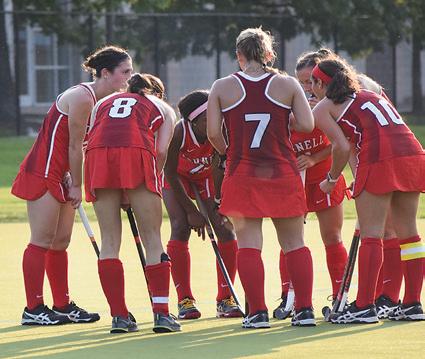
would not go down without a fight, as midfielder Tess Coorens cut the Cornell lead in half with a goal 54 minutes into the game — the fourth consecutive game in which Coorens has scored a goal.
However, Cornell freshman forward Claire Jones scored the first goal of her career just minutes after Coorens’ goal to help secure the Red’s home opening victory.
Although the Red improved in the penalty corner and shot differential, the Broncs still garnered eight corners to Cornell’s seven and outshot the home team nine to eight. In all four games so far this season, the Red has not taken more shots or penalty corners than its opponent.
“In the first two games of the season, we gave up penalty corners way too easily,”
Simpson said. “But this weekend, our individual defending around the circle was really good, and the quality of our opponents caused us to give up some corners. So, it wasn’t the quality of our defense, but rather the excellent
season is really important, so I’m really thankful for that.”
The Red looks to extend its winning streak next weekend when Cornell travels to Burlington to take on Maine and Vermont in the
“There are things that we did well on Sunday and there are still many areas that we need to work on.”
Interim Head Coach Steve Simpson
play of our opponents.”
Despite the Red’s inability to dominate the box score, they were still able to come away with a win, marking the third consecutive year in which the Red has opened its home slate with a victory.
“There are things that we did well on Sunday and there are still many areas that we need to work on,” Simpson said.
“But for our team, a largely young group, to have a win early in our
Catamount Classic. Last season, the Red managed to comfortably dispatch both teams in the series.
But despite Cornell’s prior success in New England, Maine will notably enter Friday’s matchup having gone 5-0 with two wins over top 25 teams, potentially complicating the Red’s hopes for a rebound campaign.
Bennett Gross can be reached at bgross@cornellsun. com.
By ZORA HAHN Sun Staff Writer
Cornell faced off against neighboring Binghamton this past Sunday looking to snap a three-game losing streak, but instead extended it to four in a disappointing 0-2 loss.
The Red began the game looking strong, posting a number of shots on the goal in the first 15 minutes. But Binghamton’s 19th minute goal seemed to shut down the Red’s momentum, which shot five times in the first half, but only two in the second.
“The team can definitely improve when it comes to finishing our chances near the goal,” said freshman midfielder Aidan Reineman.
The midfielder was responsible for two of the Red’s shots on goal, but acknowledged that the team’s inability to capitalize on offensive opportunities gave Binghamton an insurmountable advantage.
“Binghamton was a very fast and technical team that had strong finishers up top,” Reineman said.
While Cornell’s offense struggled to convert shots into goals, the loss would have been far worse had it not been for senior goalkeeper and captain Meghan Kennedy’s 11 saves, far outpacing Binghamton’s one.
“Our goalie and captain, Meghan Kennedy, had a great performance yesterday,” Reineman said.
“She consistently made lots of amazing saves throughout the game.”
Kennedy’s impressive number of saves was a career high for her, tied with a game last October against Princeton.
As Cornell has proven highly adept at protecting the net, its efforts will mostly focus on uplifting what has proven to be a largely plodding offense, with the hopes of keeping afloat conference ambitions.
“Some of our goals for the rest of the season are to have a positive goal differential and to finish in the top half,” Reineman said.
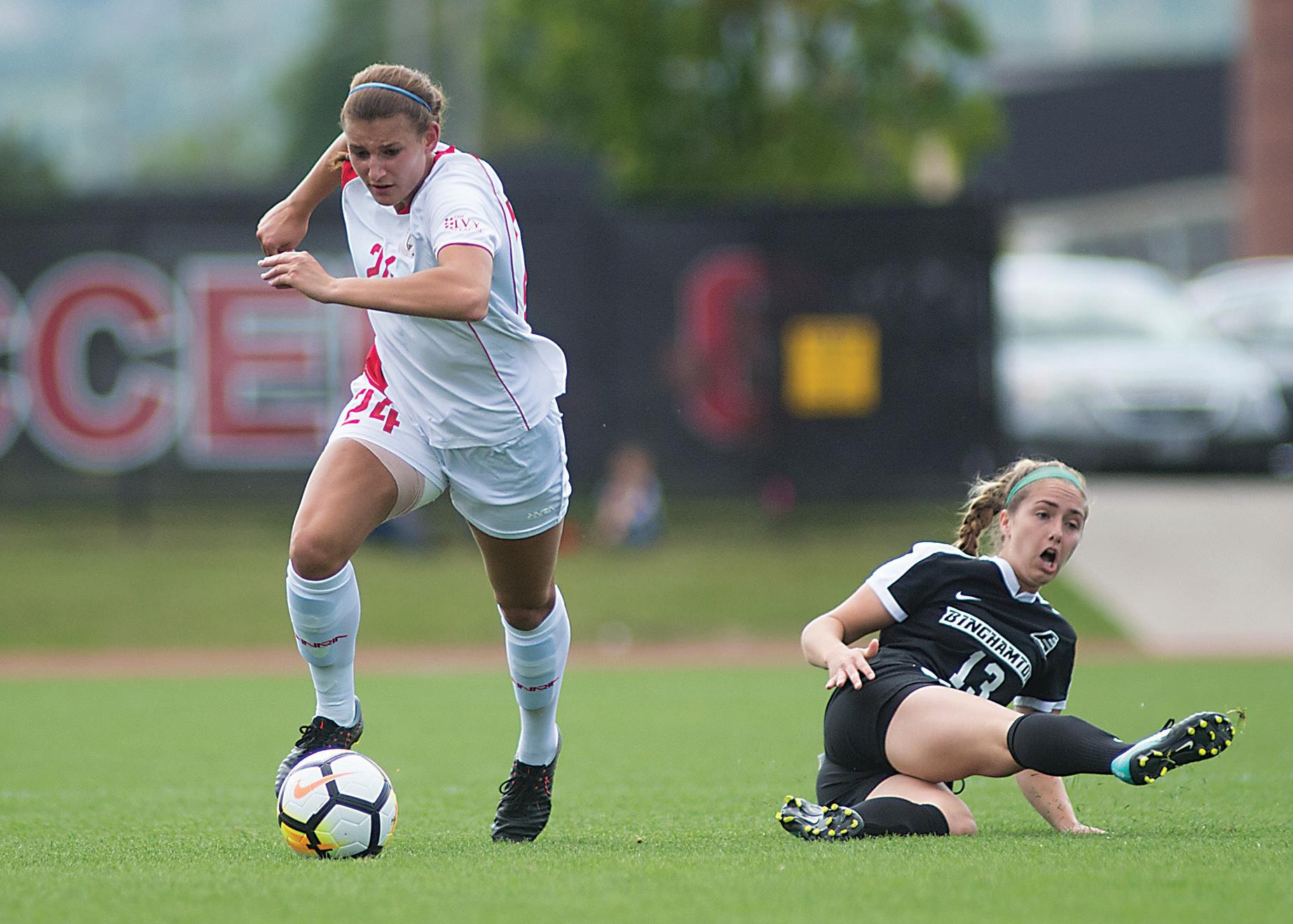
Last year, the team placed eighth in the Ivy League, making its goal this year to finish at least fourth highly ambitious — especially as the squad has won only one of its first five games. But Cornell is confident that a combination of new freshmen talent and hardwork will be enough to right the ship in time to make that vision
a reality.
Women’s soccer will next travel to Philadelphia this Sunday to take on St. Joseph’s.
Zora Hahn can be reached at zhahn@cornellsun.com.
Cornell narrowly loses to powerhouse Rutgers, but triumphs 3-1 against Rider
By BENNETT GROSS Sun Staff Writer
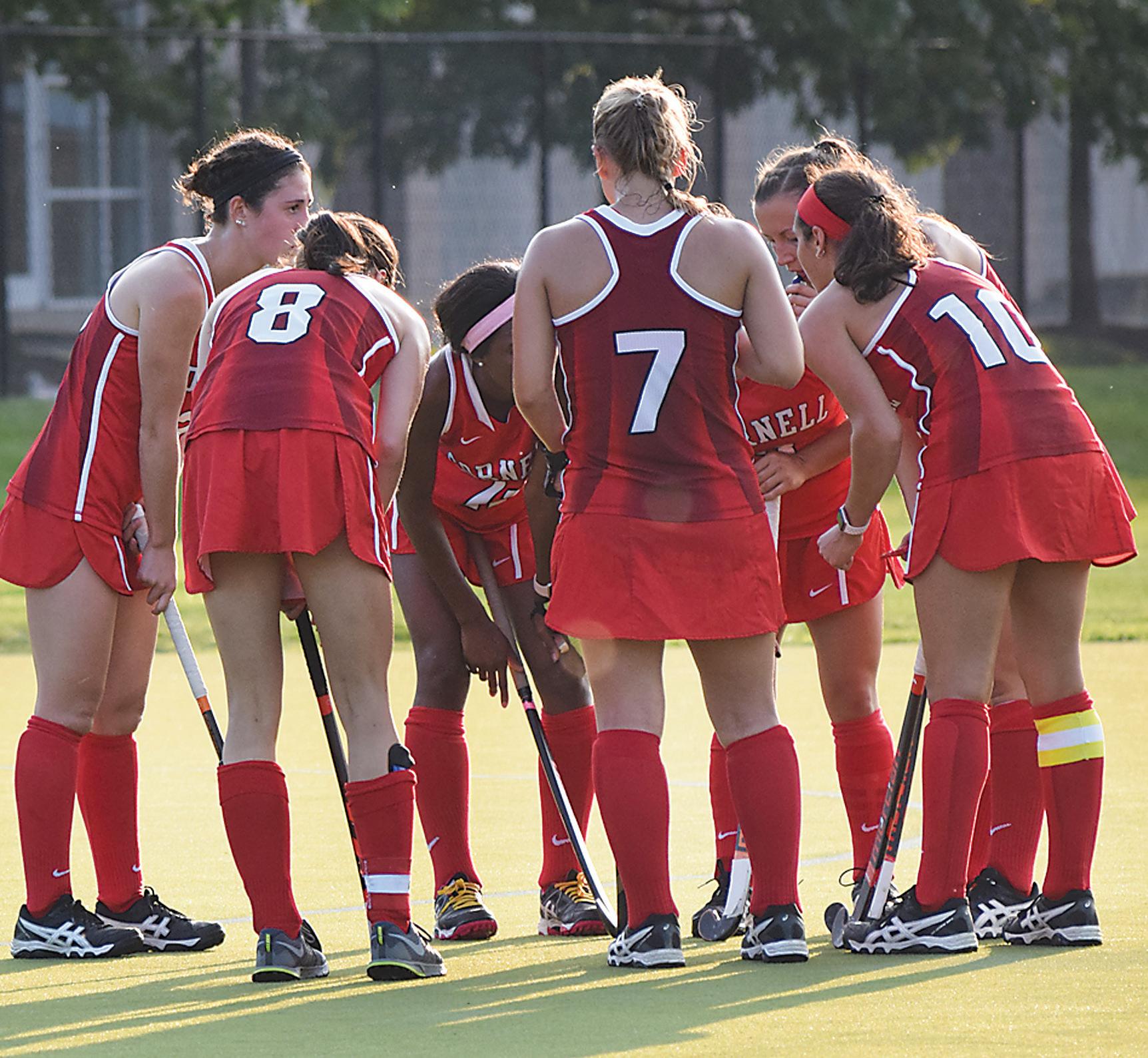
After dropping its first three games of the season, field hockey was able to secure its first victory of the season Sunday in its home opener against Rider.
The Red began the weekend by losing 1-0 on the road to a heavily favored Rutgers squad.
The Scarlet Knights entered the game with a 3-0 record, which included a win over nationally ranked St. Joseph’s.
at bay, giving the Red an opportunity to complete the upset. Henry stopped 12 shots on the afternoon, but it was still not enough for Cornell.
“I thought that, for us, this game was really an important step forward.”
Interim Head Coach Steve Simpson
Cornell did not do itself any favors by allowing 14 penalty corners and 24 shots, while not managing to earn any penalty corners and taking just three shots. Despite the large disparity in the box score, Cornell was able to keep the game close with one of the top teams in the Big Ten until Rutgers was finally able to get on the scoreboard with five minutes left.
Junior goalkeeper Maddie Henry, who had allowed eight goals in the first two games, was able to keep the Rutgers offense
“Statistically, we didn’t show very much, but actually throughout the course of the game, we did have some good scoring chances, and the attacks that we did have were combinations of players moving the ball with confidence and purpose,” said interim head coach Steve Simpson. “So, I really was not too displeased with the game as a whole for us. I thought that for us, this game was a really important step forward.”
However, two days later, Cornell was able to right the ship in the form of a 3-1 win over Rider University at Dodson Field.
Junior midfielders Kirsten Pienaar and Maddy Conklin combined to give the Red an early 2-0 lead. But the Broncs