The Corne¬ Daily Sun

After just two days of fully in-person classes, Cornell moved to alert level yellow Friday afternoon as cases increase among students.
Cornell is reporting 60 cases as of the last COVID19 tracking dashboard update, with 25 new cases reported on Thursday, the first day of classes. There are currently 253 active cases in Tompkins County, with 30 new cases reported Sunday.
The University predicts more cases to follow as direct and likely contacts continue to be tested — although positive cases currently make up less than 1 percent of the campus population.
The yellow alert level means indicators show rates of infection are increasing and that the virus prevalence has increased “above baseline modeling,” according to a Friday email to the Cornell community.
Infections are overwhelmingly linked to informal social events and activities, unsponsored by the University, Provost Michael Kotlikoff, Vice President for Student and Campus Life Ryan Lombardi and Vice President and Chief Human Resources Officer Mary Opperman wrote in a second Friday email. “Informal social gatherings — both on or off
campus — of more than a small number of attendees should be postponed until our case count moderates,” they advised.
Administrators said the University did not have any virus transmission in classrooms during the previous academic year — but added that if numbers don’t fall, Cornell “may consider moving to virtual instruction for a period of time.” It is yet unclear what transitions online will look like, as the University has previously held that the semester will remain in person.
Classroom and lab capacity may be reduced or seating may be reconfigured under the yellow alert. The capacity of some campus facilities may also be reduced to allow for physical distancing, and Cornell-sponsored events may be limited, canceled or moved online.
“While the number of cases is concerning, we want to emphasize that our system is working,” the second email read. “Virtually all of our students are fully vaccinated; as such, it is the case that those who are infected will almost all be vaccinated.”
As of Sunday, 95 percent of the on-campus population is vaccinated.
All faculty, staff and students must mask up both indoors and outdoors, regardless of vaccination status — a change from previous guidance with masks only required indoors.
Kotlikoff, Lombardi and Opperman also encouraged students living in off-campus communal housing — such as Greek life — to similarly mask indoors, but wrote that exemptions will remain in place for athletics teams during practice and competition.
Under the yellow alert, Cornell may also increase surveillance testing for vaccinated students, faculty and staff — with updates for individuals found on Daily Check pages.
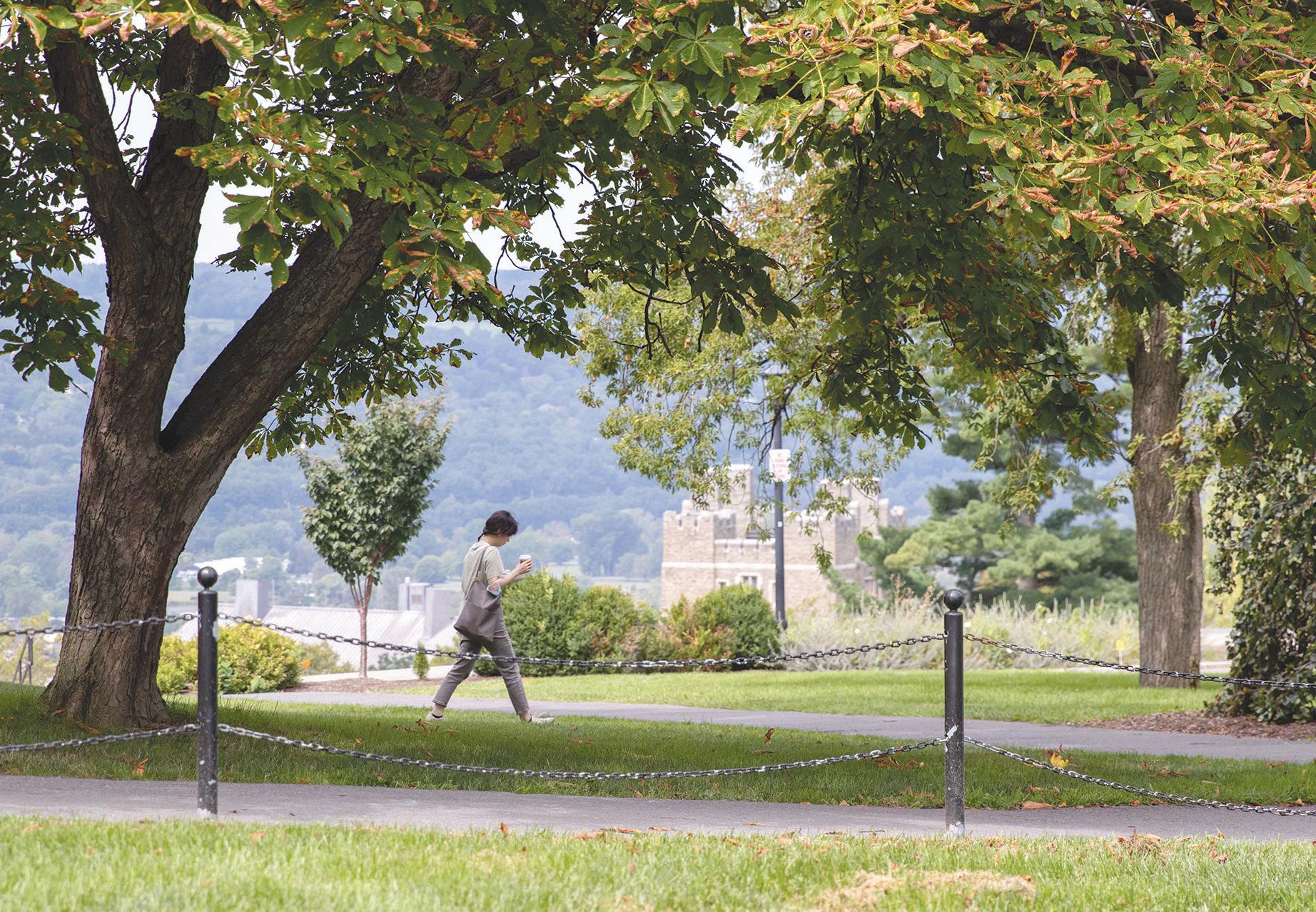
On Thursday, Cornellians enjoyed their first day of in-person classes after a year of hybrid scheduling and heavy COVID restrictions. Despite hot weather and fresh homework loads, students flocked to cam-
pus to participate in classes and meet friends for the first time in months.
Freshmen got started developing in-person friendships and academic interests after a hybrid end to high school. Sophomores stepped foot on a transformed campus they’d never experienced. Juniors returned to the populated campus they barely remembered, and seniors got to relive a part of their pre-COVID college days.
“There’s so much lively energy on campus,” said Hannah Han ’23. “It’s really nice.”
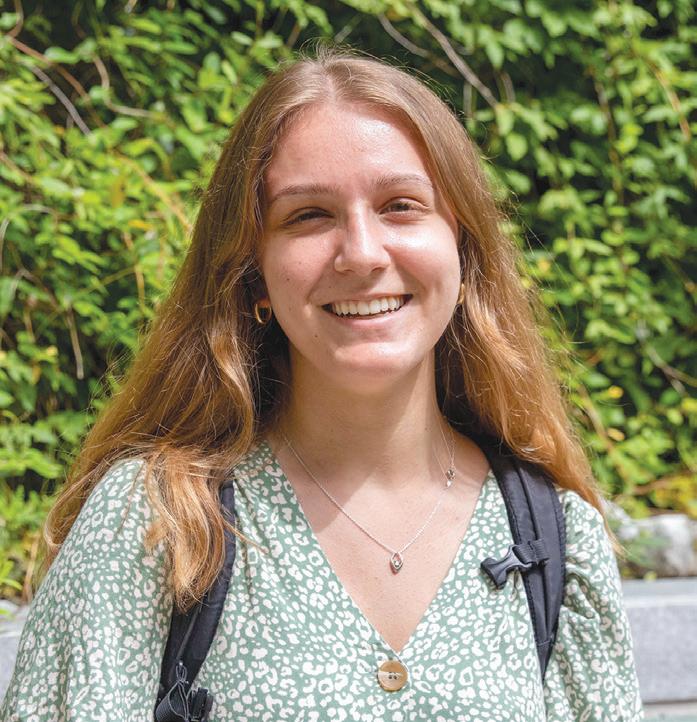
Carley Kukk ’23: Walking a Puppy
In Training for Guiding Eyes
Carley Kukk ’23 spent her first morning on the Arts Quad with Alec, a three-monthold puppy training to become a guide dog. As a member of Guiding Eyes, Carley watches Alec and other puppies for several hours a week. She expressed her enthusiasm to work with the dogs throughout this semester and the rest of her time at Cornell.
“I help them so they can graduate and become actual guide dogs,” she said, “which
is awesome.”
A linguistics and psychology student in the College of Arts and Sciences, Kukk looks forward to the spontaneity of the in-person college experience and forming friendships with peers in her majors.
“I just love finding your first seat and getting lost going to class,” she said. “I’m probably most excited for that.”
Toby Lidov ’23: Tossing a Frisbee on the Arts Quad
Toby Lidov ’23 enjoyed a 9 a.m. acting class and a game of frisbee with friends on his first morning back to school. He looks forward to enjoying the outdoors more this semester with the Cornell Outing Club and his frisbee team.
“It’s going to be nice to get back outside and explore what the greater Ithaca area has to offer,” he said.
Lidov studies environmental sustainability in the College of Agriculture and Life Sciences, and he looks forward to returning to ecological field research.
“It’ll allow me to dive deeper into what I’m studying,” he said. “I’m thinking of starting an honors thesis now that I can actually do this work properly.”
As the vice president of the Cornell Outing Club, Lidov is currently planning a 40-person camping and canoeing trip in the Adirondacks over fall break. COVID
Monday, August 30, 2021
Mia Hause and Erin Connolly: Until the Bliss of All This Hurts
8 a.m. - 4:30 p.m., Tjaden Hall
Sustainability GooseChase: Cornell Scavenger Hunt Noon., Virtual Event
Virtual Networking and Pitch Practice Session Noon - 1 p.m., Tatkon Center
Time Management Study Skills Workshop 7 p.m., Tatkon Center
Erin Miller: Tap Tap 8 a.m. - 4:30 p.m., Tjaden Hall
CBE Seminar Series: Shaoyi Jiang 9 - 10 a.m., Olin Hall
EEB Seminar Series: Helene Muller-Landau 12:20 to 1:20 p.m., Corson/Mudd Hall
Department of Physics Colloquium 4 - 5 p.m., Virtual Event
Coffee Chat with PepsiCo Engineers 6:30 p.m., Virtual Event

Songs My Brothers Taught Me (2015) tells the story of two Lakota Native American siblings struggling with poverty and finding solace in nature.
M.F.A. Virtual Exhibition: How to Build an Ocean 8 a.m., Virtual Event
BEDR Workshop: Internal Showcase 11:15 a.m. - 12:45 p.m., Sage Hall
2021 Master Gardener Volunteer Bulb Sale Noon, Virtual Event
15 Minutes to Success: Tailoring Your Resume Noon, Virtual Event
LASSP & AEP Seminar: Kin Fai Mak 12:20 p.m., Clark Hall
CHR: Here to Stay: COVID-19 Responses Transform Hospitality and Restaurant Operations 1 - 2 p.m., Virtual Event
Songs My Brothers Taught Me 7:15 p.m., Willard Straight Theatre
Intro to Organic Farm Sales 5 p.m., Garden of Eve
Make Do and Mend Together: A Patchwork of Solutions 8 - 4:30 p.m., Virtual Event
YELLOW Continued from page 1
Currently, all fully vaccinated undergraduate students and some professional students test once a week, with unvaccinated populations testing twice weekly. Other populations — like some faculty, staff and graduate students — can opt into testing.
As cases increase, quarantine capacity is at 81 per-
cent, with students isolating in Balch Hall, a change from the spring, when students quarantined in The Statler Hotel. According to Kotlikoff, Lombardi and Opperman, the vast majority of identified cases are asymptomatic or experiencing only mild symptoms — following the national trend that the vaccine is proving effective in preventing severe illness.
“We want to emphasize: this uptick in cases has enabled us to assess our current practices and to make
prudent adjustments. And while we can expect more positives to be identified over the coming days, our community has demonstrated a remarkable ability over the last two semesters to course-correct,” the email continued. “With your cooperation, we expect to do so again.”
Madeline Rosenberg can be reached at mrosenberg@cornellsun.com.
www.cornellsun.com
By SOFIA RUBINSON Sun Staff Writer
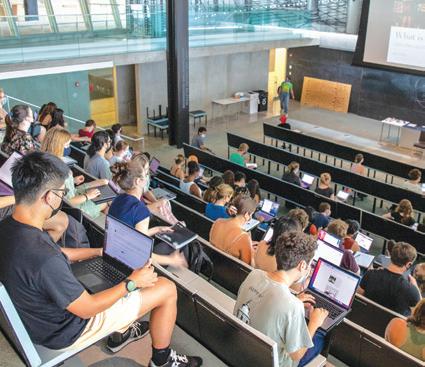
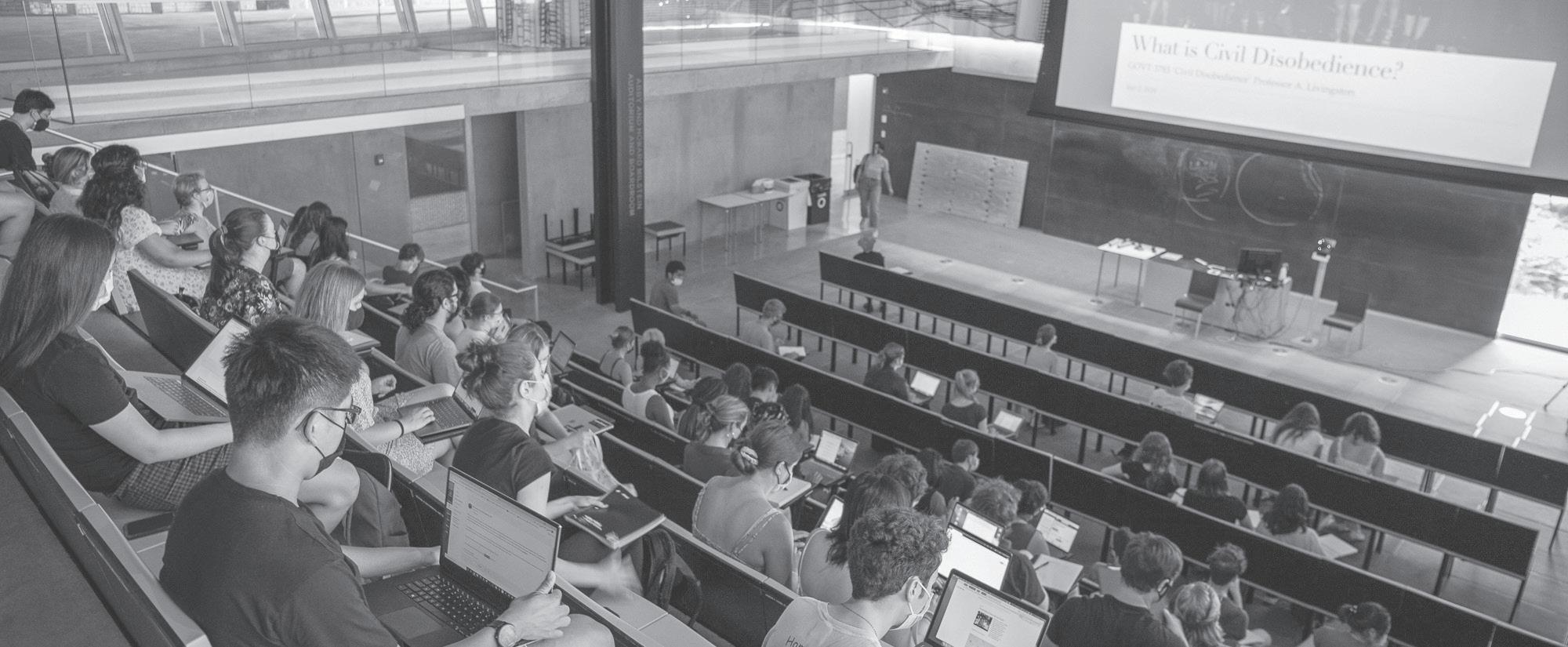
Fall 2021 courses began in-person Thursday without the six feet of separation between students that was present in 2020’s classes, but some professors are preparing for students needing virtual alternatives to lectures, and maintaining some office hours on Zoom.
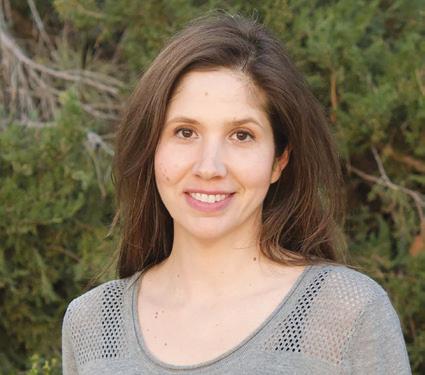
SOC 1101: Introduction to Sociology is one of the largest classes in the College of Arts and Sciences, and it’s one of few sizable classes to offer online accomodations. Prof. Landon Schnabel, sociology, is teaching in a large lecture hall suited for 330 students.
With over 300 students in the class, the room necessitates learning without social distancing. Cornell mandates any type of face covering for students, but Schnabel has asked his class to specifically wear a high-quality mask, such as a surgical or KN95 mask, for safety reasons.
“Neck gaiters and scarfs technically cover your face,” he said, “but aren’t super effective for stopping the spread of anything.”
To better accommodate quarantined students, Schnabel also plans not to take attendance in lectures, to post his lecture slides, and to offer opportunities for online office
hours. The University allows instructors to provide some office hours virtually, but its guidelines require an in-person option.
Alex Dyzenhaus grad was a teaching assistant for the course GOVT 1313: Introduction to Comparative Government and Politics last semester. He said that online connection to instructors might be necessary in the coming months.
“Online office hours were actually quite convenient,” he said, “Especially for students who couldn’t make office hours slots due to scheduling conflicts.”
Jonah Gershon ’24 took a few in-person classes last year, and he appreciated the functionality of Zoom office hours. He thought they were convenient, eliminating travel across campus and allowing for easy screen-sharing.
Gershon hopes his professors carry over some Zoom era conveniences into in-person classes, but he looks forward to being physically closer to his classmates than last year.
“It was really difficult to meet and talk to people in class because we were six-feet apart,” he said. “There really wasn’t much engagement.”
Abdullah Shahid grad, a teaching assistant for Introduction to Sociology, will continue to conduct Zoom office hours and consultations when scheduling concerns or
illness prevent a student from attending in-person meetings.
Despite the flexibility of office hours in Cornell’s new academic policies, the University discourages professors from recording lectures for students who cannot be physically present.
Schnabel’s lecture hall does not contain the necessary equipment for recording his course, meaning that quarantined students must catch up with lecture notes and slides posted on Canvas.
Despite its potential inconvenience, some students welcome the transition away from lecture recordings. Connie Tsang ‘22 studied virtually last year and found the recordings detrimental to her academic life.
”Recorded classes were actually bad,” Tsang said, “Because I didn’t feel compelled to wake up at 9 a.m. when I could just watch the lecture later.”
Now she is more engaged with the course material and motivated to participate.
”I definitely think being on campus is a lot better academically than being remote,” Tsang said. “I wasn’t a fan of Zoom University.”
Sofa Rubinson can be reached at srubinson@cornellsun.com.
restrictions made such trips impossible last year, and Lidov expressed excitement for their return.
Michael Ortiz ’23 and Cristian Carranza ’23: studying together on the Ag quad
Dyson students Michael Ortiz ’23 and Cristian Carranza ’23 studied in the shade of Kennedy Hall after their first classes of the semester. They both enjoyed seeing a well-populated campus on their first day, and they look forward to meeting with peers in-person as the semester continues.
Carranza expressed enthusiasm for school events, classes and extracurricular meetings freed from the constraints of Zoom.
“Just having an in-person class and being able to see everyone has been a nice change of pace considering the last eighteen months or so,” he said.
Cyrus Irani ’25: heading to lunch with friends
Cyrus Irani ’25 made the most of his initial day after O-Week, attending his first college classes and getting lunch with his friends. After this week, he’s considering switching out of his 8 a.m. class – but he’s enthusiastic to start his college career in infor-
mation science at CALS.
Irani said he’s seeking new friends and interactions, and he has greatly enjoyed meeting peers during orientation.
“It was a whole new experience,” he said, “and there was a lot of fun.”
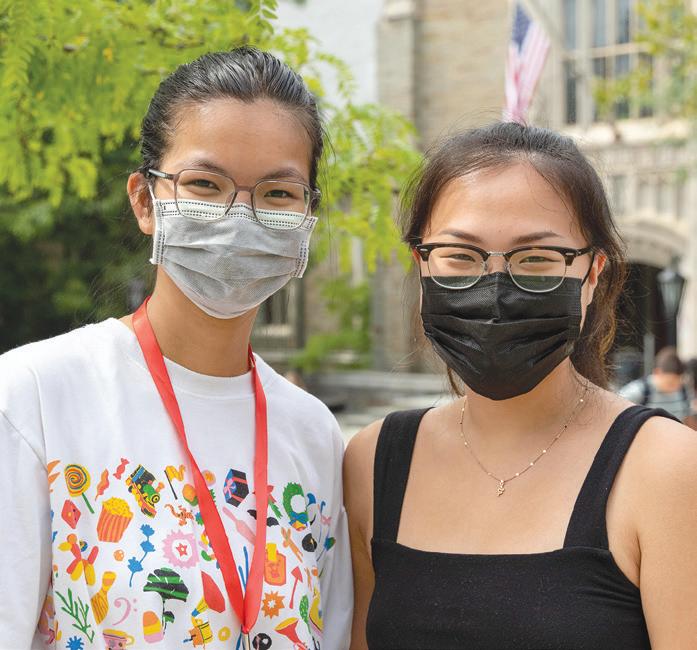
Thuy Pham ’25 and Hannah Han ’23: chatting outside the Cornell Store
Thuy Pham ’25 and Hannah Han ’23 met by chance outside the Cornell Store, sharing lunch and a chat on their first day of school. They enjoyed the shade of the trees on Ho Plaza.
Pham, an engineering student from Vietnam, expressed her excitement to make new friends and mentors this year. She’s interested to learn more about culinary and social cultures in the U.S., since COVID has prevented her from visiting before now.
“I don’t regret that I’ve come to the U.S.,” she said. “Especially in COVID-19, it’s really hard for me from an Asian country to get here.”
Pham looks forward to hanging out with friends and utilizing Cornell gyms this semester. She plans to join a project team in the College of Engineering.
Han returned to school for her first day after a fully remote sophomore year. A junior in applied economics and management,
she’s working to adjust to in-person classes and campus life.
“I haven’t been to any of the buildings or anything because I was completely online,” she said, “so it was really interesting to be thrown back into school.”
On Thursday, Han met faceto-face for the first time with peers from her Zoom classes. She looks forward to in-person club meetings this semester.
“I might join Ultimate Frisbee or something,” she said. “Yeah, I’m super excited for that.”
Jordan Paraboschi ’25: preparing for class near Klarman Hall
New to campus, Jordan Paraboschi ’25 spent part of his first day working outside Klarman Hall. He got up early, ate breakfast, and narrowly made it to class on time. He enjoyed the warm weather on the first day of school and looks forward to figuring out his academic interests this semester.
“I’m interested in government,” he said, “And there are some government-based clubs I’m looking to join.”
Paraboschi’s senior year of high school operated on a hybrid schedule, so he had some in-person classes over the past year. However, he expressed gratitude that his freshman year can happen in person.
Lia Sokol ’23: taking a shortcut through Temple of Zeus Lia Sokol, a government major in the College of Arts and Sciences, cut through Klarman Hall between classes. She thinks in-person schooling will take some getting used to after a semester off-campus with Cornell in Washington, but she’s optimistic for what the year will bring.
“Really being here, being immersed in the experience and having in-person classes is fantastic,” she said.
Editor in Chief
Although last semester’s Cornell in Washington program featured some regular classes, it enforced social distancing and felt more restrictive, she stated. Cornell’s current policies remind her of pre-pandemic times.
“There is such a sense of normalcy beyond the masks,” she said. “Having that made me really excited to be in school again.”
Vee Cipperman can be reached at ocipperman@cornellsun.com.
Cornell undergraduate students spend four of our most formative years in Ithaca. Ithaca is the backdrop for some of our most important developments: it is where we set the academic and professional foundations for the rest of our careers, and where we form some of the longest lasting and most impactful relationships and friendships of our lives.
Allison Larkin’s upcoming novel, The People We Keep , follows its protagonist on a similar comingof-age journey amongst Ithaca’s gorges, hills and waterfalls. It follows April, a teenage musician who, in 1994, leaves her hometown of Little River, a place where she feels lost and alone, for the quaint Ithaca.
In Ithaca, she starts working at the cozy Cafe Decadence and meets a group of friends that make her feel, for the first time, like she belongs. The novel chronicles April’s journey to and from Ithaca and her struggle to understand the concept of home.
ing college in Ithaca. In 1995, Cafe Decadence was a real coffee shop in Ithaca Commons, and the city itself was much smaller. The Ithaca Mall was the center of city life — Larkin described it as the place where her friends would go
experience, but because it intensifies the time friends spend together, making April’s story more compelling.
People pass in and out of April’s life as she moves around, making the hellos and goodbyes more emotional and
a different light, one unaffected by preconceptions or by other peoples’ Instagram accounts.
Larkin explained to me that it took 12 years to form and polish The People We Keep from start to finish. Since the conception of her novel, Larkin has had a specific idea of who April would be, and she learned that it was not stubborn or unreasonable as a writer to stick to that idea. At first, April’s personality received pushback from editors, who often requested for April to be “nicer” and more of a “normal teenager.” In allowing for the final freedom to characterize April in a more unconventional way, Larkin credits the rise of the Me Too Movement and a wider discussion about the public roles of women. “I think that the fact that we weren’t talking about all of those things lent itself to people wishing April could be nicer. And that’s not really an acceptable thing to say anymore.”
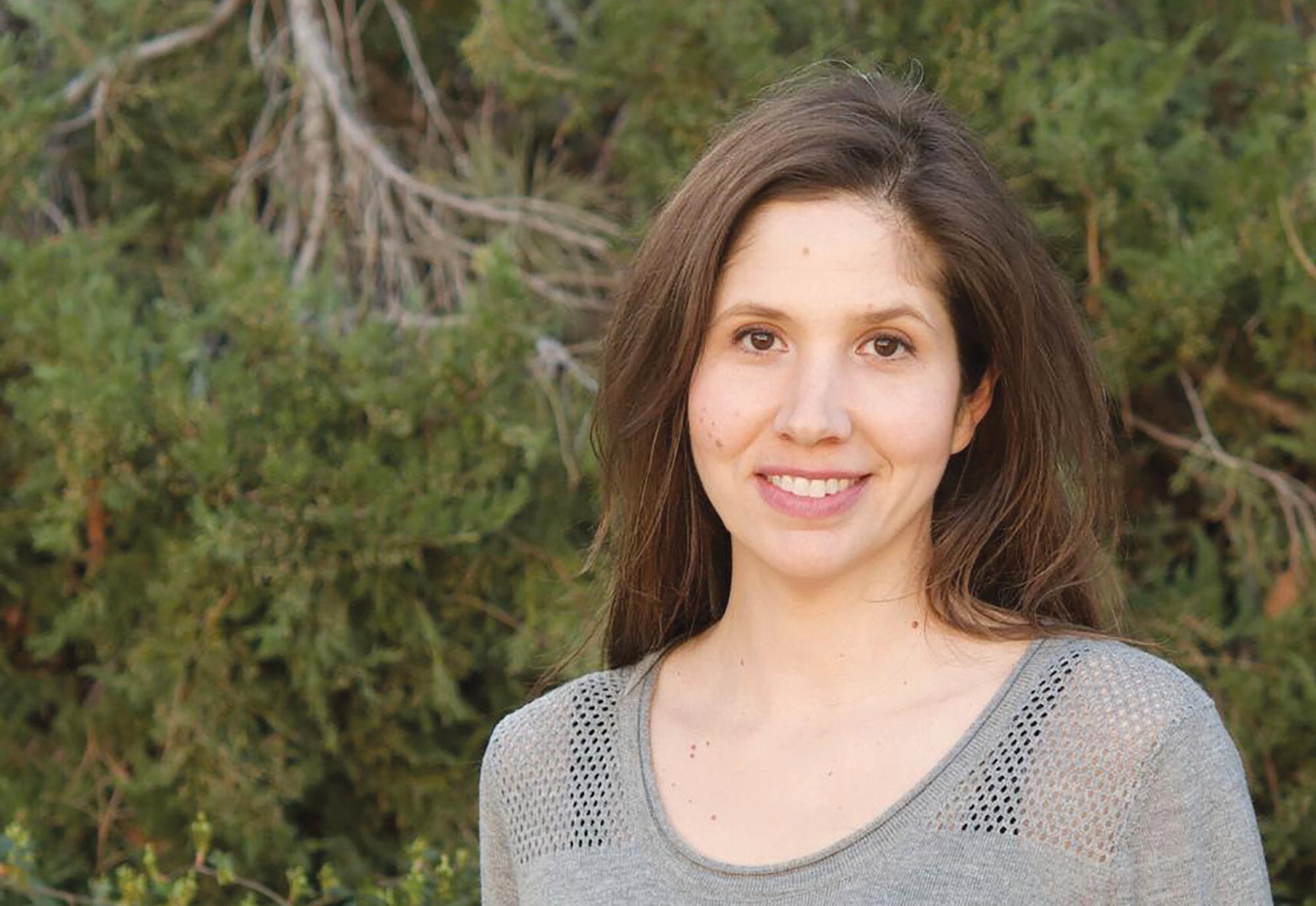
I had the opportunity to read an advanced copy of The People We Keep , which was released on August 3. I also had the privilege to interview Allison Larkin about her writing process, her connection with Ithaca and what her latest novel can tell us about the relationships we maintain.
The People We Keep is partially based on Larkin’s own experience as an Ithaca College student from 1995 to 1997 — two years that she feels were essential to her self-discovery, and two years she remembers fondly. Larkin described that “so many of the people I am in contact with on a daily basis” she had met during her time in Ithaca, such as her voice teacher and her dorm mates. “My family is in Ithaca.”
Much of April’s experience with found family in Ithaca is a reflection of Larkin’s own experience of feeling at home for the first time. “I had this overwhelming feeling of Ithaca as where I started. And so I gave that voice to April because she felt the same way about it.”
on weekends to “re-enter society.” We speculated on how much of this difference was due to her being a student at Ithaca College as opposed to at Cornell, but we suspected that a much bigger difference was the era in which we expe-
fraught. “Things felt more final and permanent when you said goodbye to somebody,” Larkin said. “And then you hope you see them again. It made it very hard to leave places.”
People and places were intertwined

rienced college.
Much of the interview between Allison and I was spent comparing notes on our differing experiences of attend-
The People We Keep takes place in the 1990s, a time when people’s lives were not as easily accessible via social media and long-distance relationships were not as easy to maintain. This time period was a deliberate choice by Larkin, not only because it resembled her own
with April — a girl from a small town and from a time before the internet — in a way that is no longer possible for us. Ithaca, as well as the other locations which April visits, felt like their own characters brought to life by Larkin and colored by April’s perspective. It made me see Ithaca in
It was because April’s story was personal to Larkin that she felt so strongly about keeping its essence the same. Larkin said that she eventually learned how to listen to critique while still retaining the vision of April and her life that she wanted. The People We Keep found a home the same way April did: by meeting people who truly understood it.
“I had to keep searching for my people,” said Larkin. “This book needed caretakers that could see the soul of it.” Larkin eventually found a home with an editor and a publisher that understood April’s journey and wanted to help tell that story.
Like Larkin, April is a creative person: a songwriter who channels her experiences into her art. In the end, that was what struck me most about this novel — The People We Keep explores the vulnerability of opening up, whether through your art or your relationships with others, and it uses a familiar location to do so.
Larkin mentioned how she still visits her favorite people and places in Ithaca even now, 20 years after her time in college. Reading The People We Keep and hearing Larkin’s story leaves me hoping that one day I will do the same.
Since 1880
139th Editorial Board
KATHRYN STAMM ’22
Editor in Chief
ANUSHYA ALANDUR ’23
Business Manager
CATHERINE ST. HILAIRE ’22
Associate Editor
PRANAV KENGERI ’24
Advertising Manager
ODEYA ROSENBAND ’22
Opinion Editor
JYOTHSNA BOLLEDULA ’24
News Editor
TAMARA KAMIS ’22
News Editor
WENDY WANG ’24
Arts & Entertainment Editor
KRISTEN D’SOUZA ’24
Design Editor
HANNAH ROSENBERG ’23
Photography Editor
OMSALAMA AYOUB ’22
Science Editor
PUJA OAK ’24
Layout Editor
ANNIE WU ’22
Production Editor
MIHIKA BADJATE ’23
Assistant News Editor
ANGELA BUNAY ’24
Assistant News Editor
JOHN COLIE ’23
Assistant Arts & Entertainment Editor
AMELIA CLUTE ’22
Assistant Dining Editor
WILLIAM BODENMAN ’23
Assistant Sports Editor
AARON SNYDER ’23
Assistant Sports Editor
MEGHANA SRIVASTAVA ’23
Compet Manager
MADELINE ROSENBERG ’23
Editor
NAOMI KOH ’23
Editor ANIL OZA ’22
Editor YUBIN HEO ’24
VEE CIPPERMAN ’23
NOOREJEHAN UMAR ’23
YOON ’23
BENJAMIN VELANI ’22
LUKE PICHINI ’22
SRISHTI TYAGI ’22
MARIA MENDOZA ’24
Editor AMAYA ARANDA ’23
SURITA BASU ’23
News Editor
RIGGS ’24
LEYNSE ’23
JULIA NAGEL ’24
LIAM MONOHAN ’24
ABAYEVA ’24
ALPERS ’22
Tis letter has been published as it was written and signed. As a result it has not been edited by Te Sun to conform with Sunstyle. It was sent to Provost Michael Kotlikof and Vice Provost for Undergraduate Education, Lisa Nishii, in response to their message to Cornell faculty on Aug.11. Tis message stated that “the university will not approve requests, including those premised on the need for a disability accommodation, to substitute remote teaching for normal in-person instruction.” While the provost somewhat revised this policy in a message sent out on Aug.13 where he stated that “We remain steadfastly committed to ofering a wide range of individualized accommodations as we resume in-person operations this fall”, there still seem to be no clear procedures or policies for faculty and instructional staf with disabilities, and access to protective gear and supplemental testing remains problematic. Tis letter not only expresses the concerns of the undersigned but also the concern that they might transmit the virus to individuals who are unvaccinated, immunocompromised and vulnerable to the virus including the elderly and those with underlying health issues or disabilities that may make them more susceptible to COVID-19 and the Delta variant.
Guest Room runs periodically throughout the semester. Any comments can be sent to opinion@cornellsun.com.
WRiggs ’24 production deskers Alexandra Kim ’24
design deskers Kristen D’Souza ’24 Puja Oak ’24 photo desker Hannah Rosenberg ’23
deskers E. D. Plowe ’23 Emma Leynse ’23
John Colie ’23 sports desker Aaron Snyder ’23
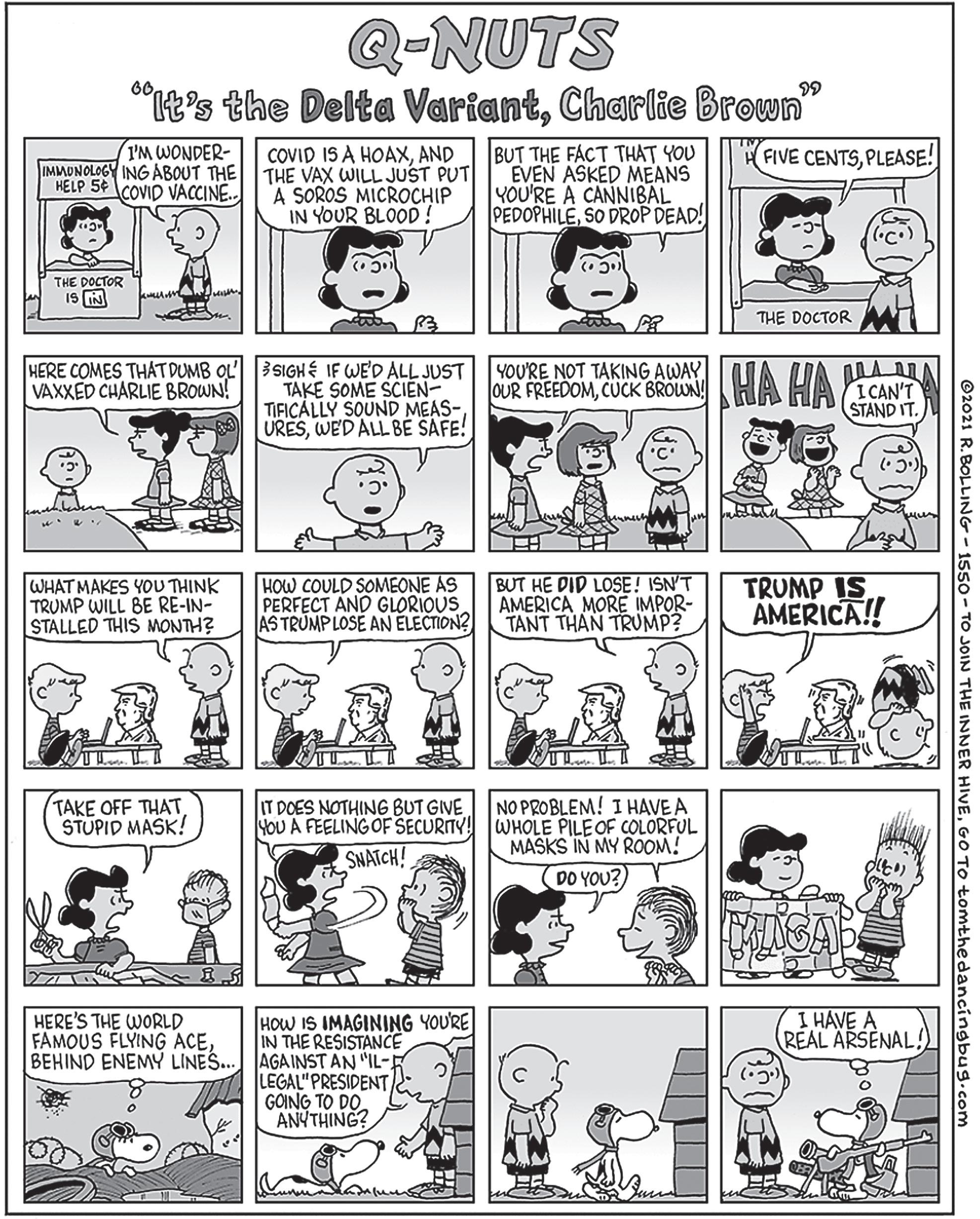
e the undersigned faculty call upon you to consider the risk you are imposing on faculty, students, and staff because of the conditions under which we are working during the fall 2021 semester. While we applaud the vaccine and mask mandates that will help to reduce the risks of teaching in-person, we are concerned that other methods of risk reduction have been abandoned. Many of the ventilation units placed in classrooms last year have been removed (or, as we have been told, the classrooms have been restored to their “pre-covid state”), so pathogens will no longer be filtered from the air. Classes will be held in person at full capacity, with no social distancing. This forces us to rely on the hope that people vaccinated against the original variants of COVID-19 are protected from the Delta and other variants, and that masks will prevent transmission of the disease.
There are, however, breakthrough infections of the Delta variant in some fully vaccinated people, and fully vaccinated people can still transmit the virus to others (including unvaccinated children and people with serious medical conditions who cannot receive the vaccine; in these populations, the virus has sometimes proved to be deadly). We are concerned that Cornell is not doing more to minimize risk and prevent transmission of this virus. We are also very concerned that this acceptance of risk will have the worst impact on the most vulnerable members of the Cornell community, as the efficacy of the vaccine wanes for those in the highest risk groups who received their shots more than six months ago.
We are concerned that because of confidentiality, and also because of fear of being stigmatized – a concern validated by your Aug. 11th message to the faculty – you may not be aware of the number of faculty and students being put at risk by this minimally protected return to in-person teaching. In that recent message, you stated “that the university will not approve requests, including those premised on the need for a disability accommodation, to substitute remote teaching for normal in-person instruction.” This message suggested that a fully or partially unpaid medical leave was the appropriate
response to the risk that faculty with disabilities might face, thus putting the burden of that risk entirely on these faculty members.
In a recent town hall, a faculty member asking if they could hold office hours on Zoom was told that they should not do this, and should find a “conference room” to hold office hours in. Given how tight space is right now, this solution is in fact not feasible. Many graduate T.A.s and faculty share office space or work in offices where social distancing is not possible.
In the past week, some of us have observed people walking around in campus buildings without masks on. It appears that there is no mechanism for enforcement of this mask mandate. We also will not necessarily know if an individual we encounter in or outside of class has been vaccinated or tested. All we can do is wear masks.
Under these circumstances, we are concerned that some of us might be bringing the virus home to vulnerable family members who are immunocompromised or elderly, or to young children not eligible for vaccination. The Delta variant has been affecting these groups much more than previous variants have done. This concern is not unreasonable; rather, it signals our capacity to care about the welfare of others.
If Cornell truly “cares deeply about our faculty and staff,” as you said in your message of Friday, Aug. 13th, then you should show your support by restoring all of the safety measures that were in place last year. Return the ventilation units that were in classrooms and put ventilation units in classrooms that did not have them before. Give faculty and all instructional staff, including graduate students, the PPE they need. Allow for modes of teaching that make social distancing in the classroom possible. And above all, grant accommodations requested by faculty and staff who are at risk, or who have family members at risk, in accordance with the culture of care that you invoked in your Aug. 13th message. This pandemic is not over.
To view the names of the 120 University faculty who have signed this letter please visit cornellsun.com.
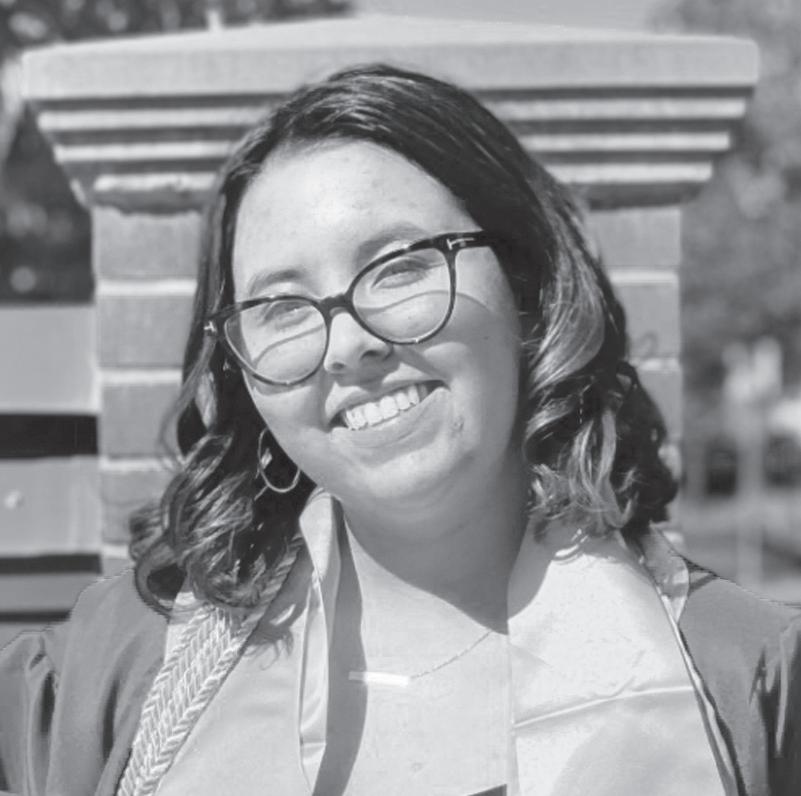
Daniela Wise-Rojas ‘24 is a freshman in the College of Arts and Sciences. She can be reached at dnw26@cornell.edu. Anything but munDANIties runs every other Monday this semester.
Cornell is one of the most prestigious schools in the world. Tere’s no need to dive into the rankings. Te point of going to an Ivy League is to make history while holding onto the reigns of Ivy privilege until the day you die. But how hard is it to do this when you don’t ft into the box made for those with many privileges?
Networking events and alumni associations are the bread and butter of remaining connected to the school post-graduation; Cornell’s admission site notes that there are “more than 250,000 alumni,” serving as “your lifetime connections around the world.”
Cornell’s Human Resources site also emphasizes that “Cornell has a long tradition of supporting a diverse and inclusive educational environment.” Cornell is an elite institution that does take the time to house diversity and inclusion-related initiatives like the Prefreshman Summer Program and the Ofce of Academic and Diversity Initiatives.
However, it’s a challenge when the Ivy with the most diverse student body is primarily white and heteronormative. According to Data USA, “the enrolled student population at Cornell University, both undergraduate and graduate, is 33.6 percent White, 15.4 percent Asian, 10.6 percent Hispanic or Latino, 5.3 percent Black or African American, 3.81 percent Two or More Races, 0.25 percent American Indian or Alaska Native, and 0.0916 percent
Native Hawaiian or Other Pacifc Islanders.”
By default, people in the demographic majority dominate the campus and have the means to make history. After all, they have history on their side. When you’re a minority, the only place where you can fnd community and common ground is by seeking it in the form of program houses, clubs and other means. Meanwhile, for others, the campus remains their community without trying.
One may argue that places like program houses are exclusive at times. Nevertheless, they provide a sense of community that is desperately needed in many cases. For instance, I spent the past weekend moving and swapping dorms after classes had already started because someone in my living space turned out to hold homophobic values; it boggled my mind, and moving out was my only sane option.
I eventually found a community in the Loving House, the LGBTQ+ program house. During PSP, I formed a friend group with other Latinas from various countries. I don’t know how I would have succeeded in this environment without fnding a community, even if it was difcult.
Te impact of community on student well-being isn’t a new concept. Inside Higher Ed notes that “Students who report a higher sense of belonging at the end of the frst year seem to do better than their counterparts.” Furthermore, “when underrepresented student populations do not feel a strong sense of belonging on their campus, it impacts how they integrate, perform and persist.”
Why do these sentiments matter? Well, “especially low levels of sense of belonging early on are extremely predictive of student persistence later.” When institutions shift to focusing on students who aren’t as well of, the risk of poor academic and social outcomes lowers. It makes sense: give those who have the least amount of resources the help that they need. Providing resources to students who need it is the only way intersectional students can make history and break through the restrictive canon of academia.
One of my professors told me, over the summer, that to break the canon of academia as a nonwhite queer human, you need to learn the ropes of societies and institutions to the best of your ability. Ten, you break all misconceptions and stereotypes. People will have no choice but to follow you or pay attention to you at the very least. We’re living in a world where whiteness and heteronormativity dominate, no matter how left-leaning an area is.
While breaking misconceptions and stereotypes, people assume just powering through without taking any breaks
for yourself is efective. Nevertheless, this is where you can potentially run out of steam. You need to take care of yourself. You can’t sacrifce who you are for the sake of showing people that you’re a “normal” human. It’s easy to fall into the trap of feeling like an object at a place where you need to prove your humanity to ft in. People admire you for going to Cornell, your material possessions and your academic capabilities.
People who don’t relate want to dispose of the things that are diferent from them and rely on microaggressions. Just take a look at people who, instead of respecting someone’s ability to express themselves, use Instagram’s new pronouns feature to say their pronouns are “ne/ver” or “nor/mal” rather than an actual set of pronouns. Tese are the people who won’t end up making history, or instead, won’t end up making history for all the right reasons.
Tese are also the same people whom academia was built for. It begs the question: who told us that academia has to be white and heteronotmative in the frst place? Emily Kinder articulates “how people have questioned, particularly in the last 60 years, the validity of the canon due to its lack of diversity.”
Te people who have primarily made history in the past, especially at an institution like Cornell, are people who grew up seeing themselves in canon academic readings. Tus, an endless cycle is created where people who aren’t in the majority have to struggle ten times more to get to the same place.
However, there is one common thread. Neither group, those included in the canon of academia and those excluded from the canon of academia, can survive alone. Te primary way to make history is to fnd your community. You can be an independent person while having people support you. When you’re with people who can relate to your experiences in one way or another, you don’t feel scared to exit your comfort zone. Tey give you the motivation to keep going when you have none left.
I know it might be hard to read that the only way to go down in history is to rely on the people around you, especially when you prefer to rely on yourself, especially when you’re seen as a “diversity admit.” It’s a slap in the face when you learn that the status quo is easier to keep than to change.
White, heteronormative or not, they have their community. What’s wrong with making your own for survival? Te community you build,with a little persistence, is your key to making history; no one can tell you otherwise, especially those who don’t share your experiences.

I know I should know that, but I totally don’t.”
After a year of strict social distancing, being in the bathroom at the same time as one of my suitemates feels like a serious breach of privacy. I can no longer disguise my bouts of total social isolation as well-founded, but self-sabotaging, exercises of “caution.” Te signature look of superiority I don whenever passing by groups of maskless students must now retire. All sorts of things have to change.
Right? Tat’s defnitely what happened, yeah? Guys?
Alright, so obviously, none of that is true. Quarantine was a total drag and by the end of it, we were soulless shells of once-motivated high schoolers. According to a report released by ACT, “two out of three students had academic challenges and concerns … during the pandemic.”
Arc
Noah Do ‘24 is a sophomore in the College of Human Ecology. He can be reached at ntd35@cornell.edu. Noah’s Arc runs every other Monday this semester.
Ithink I speak for all my fellow sophomores when I say that the clock is now ticking louder than ever. If Junior year is supposed to be our tryhard era, Senior year is our fnal hurrah and freshman year was, well … you know ... then where does that leave us? Where’s our proper introduction to Cornell and college life in general? When do we get to experience Cornell as seasoned college students without our futures breathing right down our necks?
I am constantly forced to confront these questions as I encounter the small surprises of a fully in-person college experience. As I enter my sophomore year, my parents are more comfortable navigating Cornell’s dining halls than I am. Every other question they ask me about campus is met with a blank stare and a sigh that says, “Yeah,
At the same time, though, it seems like we’ve missed out on so much change during the past two and a half years. So much of it either didn’t happen or happened so anti-climatically that any of its signifcance went right over our heads. I think I still feel a greater sense of farewell watching the end of High School Musical 3 than I ever have thinking about the ten-minute glorifed photo-op that was my high school graduation.
More important than missing out on all the fashy stuf, though, is the awkward and mundane way we foated from high school seniors to college freshmen. Luckily, the relaxing months spent in lockdown helped to clear our minds and prepare us for a focused school year. We were all refreshed and ready to tackle a brand new academic challenge. Zoom breakout rooms were flled with bright, shining faces and riveting discussion. We attended all our lectures live and used recordings as valuable study material throughout the semester. No late nights were spent in PSB watching Molecular and Cell Biology 1350: Introductory Biology: Cell and Developmental Biology lectures for the frst time the night before a prelim.
Everyone’s talking about how great it is to be back on campus, but for plenty of sophomores, there’s not much to come back to.
No one wanted to be on Zoom because everyone looks nasty in the morning and Heaven forbid your peers see what you really look like and not a glamourized version.
During my short two days of in-person classes, I’ve realized how difcult it is to shake of my old Zoom-era habits. In-person lectures are packed and stufy while smaller seminars are just plain awkward. Part of me wishes I could return to
being a nameless, faceless user amidst a sea of default Zoom profle pictures. Te part of my brain that indulged in the isolation is constantly at odds with my own worries about leaving Cornell without a close group of friends. In-person classes were supposed to be the spark that my social life needed, but the reality is turning out to be something diferent. Everyone’s talking about how great it is to be back on campus, but for plenty of sophomores, there’s not much to come back to.
I’d like to tell myself that things will turn out okay in the end. For the most part, I actually believe it. But, it seems like there are people all around me who already have their stuf fgured out. Tey made friends, found communities and took advantage of their newfound college freedom despite the circumstances. Everyone already has their cliques, their prejudices, their go-to lunch buddies. In my unique manifestation of imposter syndrome, I fnd myself wondering if this is just how things are going to be. Am I going to spend the rest of my college education foating between chatting groups, with no real circle to call my own?
To any other ’24-ers asking themselves these questions, I can ofer little more than a proverbial pat on the back and assurance that you are not alone in your struggle. Our college experience will be unique, and therefore valuable in its own right. All the setbacks we’ve experienced are part of a plan and by the end of it, we’ll look back and understand why things played out the way they did. In the meantime, though, let’s look forward to the years we have ahead to make Cornell our own.
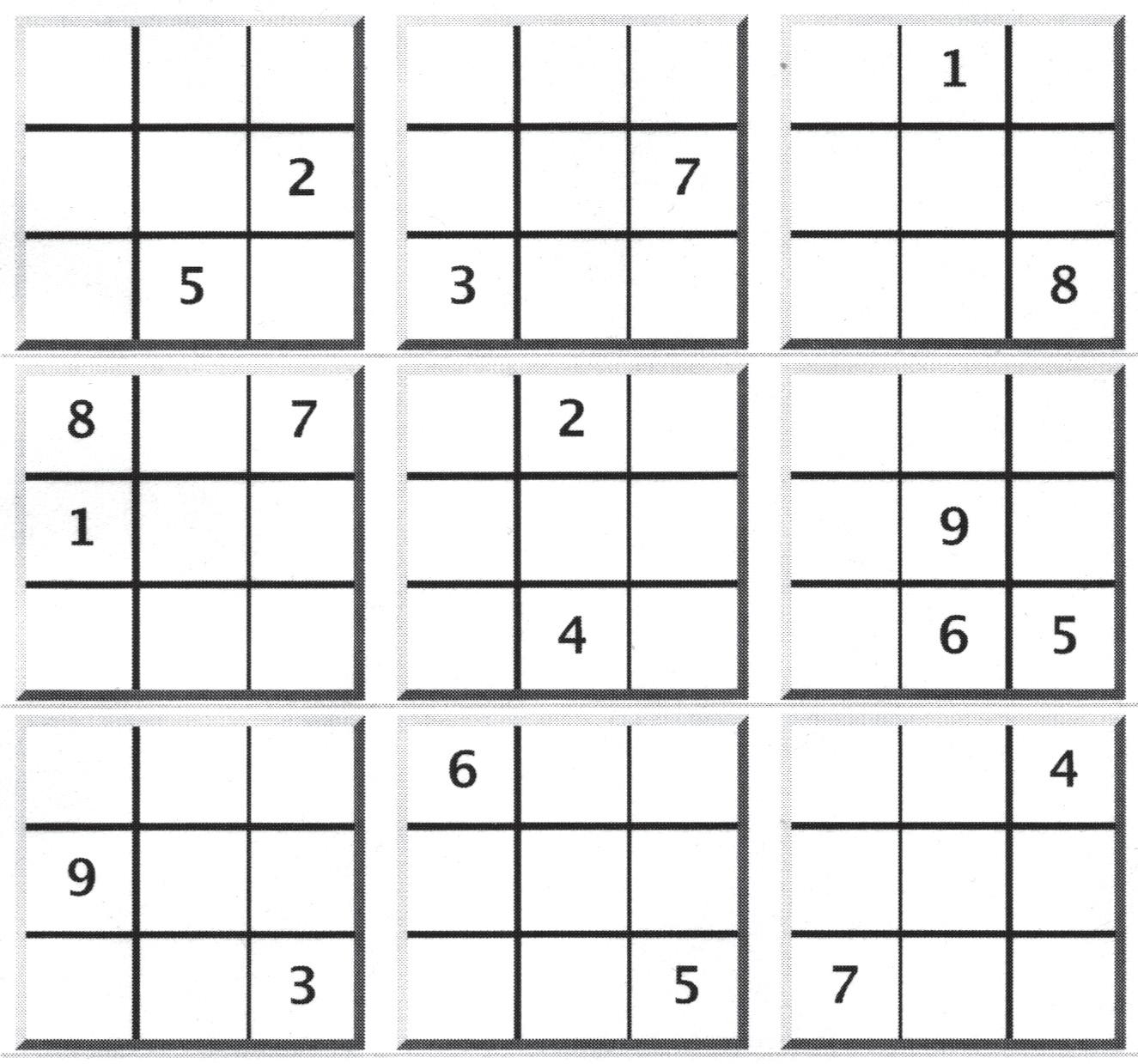
Fill in the empty cells, one number in each, so that each column, row, and region contains the numbers 1-9 exactly once. Each number in the solution therefore occurs only once in each of the three “directions,” hence the “single numbers” implied by the puzzle’s name. (Rules from wikipedia.org/wiki/ Sudoku)


By GRAYSON RUHL Sun Staff Writer
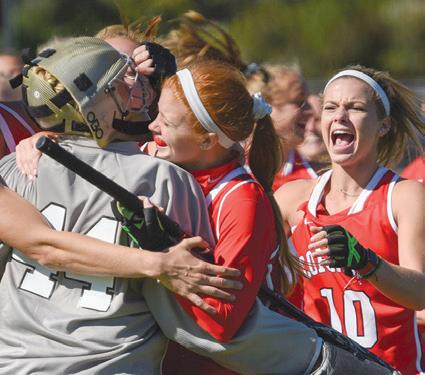
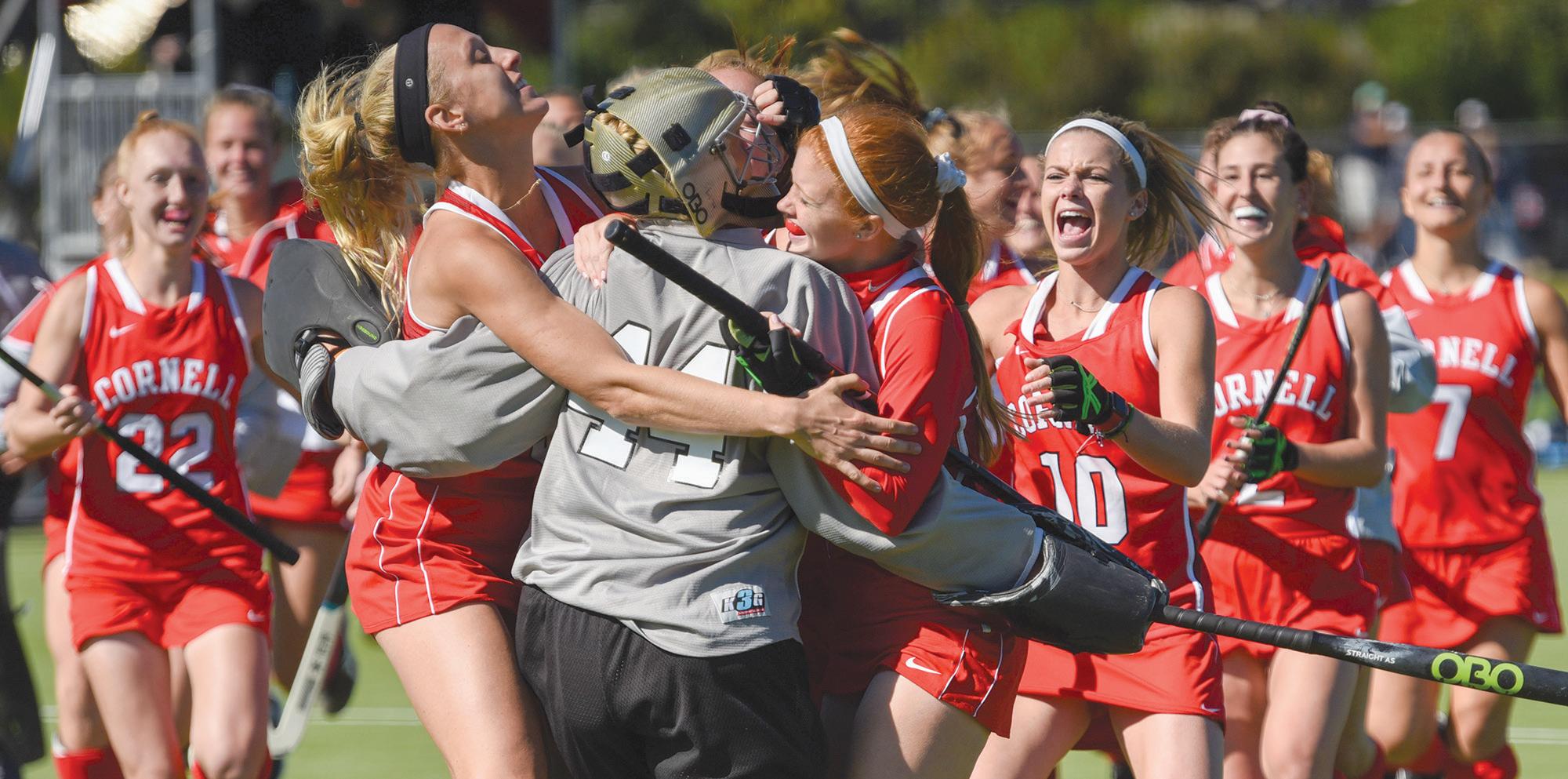
As the fall sports season gets underway, Cornell’s field hockey team will make a long awaited return to competition on Sept. 8, facing the Colgate Raiders in Hamilton, NY. Like all other fall teams, field hockey has not competed since Fall 2019.
In their last season, Cornell finished with a 10-7 record, going 4-3 against members of the Ivy League. The team started out of the gate strong, winning six of their first seven matches and sporting a goal differential of 15-5.
Promising victories over a ranked Syracuse team, as well as Brown, Yale, Dartmouth and Columbia fueled the Red to a third place finish in the Ivy League, and promised to provide momentum for the team entering 2020.
The Ivy League’s preseason poll predicts that the team will finish fourth in the league in 2021. This marks a notable jump from 2019, when the team outperformed their preseason expectations of a seventh place finish by ending in third. The Red received 74 points in the poll, placing them behind Princeton with 125, Harvard at 112 and Penn standing at 83. Behind the Red, Yale sits in fifth with 67 points, followed by Columbia, Brown and Dartmouth.
The Red have 17 matches on their schedule for the 2021 season, including seven within the Ivy League. Notable games on their calendar include a home battle on Dodson Field against the University of Michigan on Sept. 19, as well as a home Ivy League opener against Columbia on Oct. 2, whom Cornell defeated 1-0 in double overtime in 2019.
The month of October will provide the greatest test for the Red, with matches against
all three Ivy League teams currently ranked above them on the preseason poll. They go on the road to face Penn on Oct. 9 and defending Ivy League champions Princeton on Oct. 15, and face Harvard at home on Oct. 30. The Red went 0-3 against those three teams in 2019, and have not defeated Princeton since 2016. Improving on their record against those teams will be key to finishing higher in the Ivy League standings in 2021.
An obstacle for the Red this season will be roster turnover since they last took the field. The team will be sporting 16 new underclassmen and 12 veterans.
The month of October will provide the greatest test for the Red, with matches against the three Ivy League teams ranked ahead of them on the preseason poll.
One constant will be head coach Andy Smith, who took over the helm of Cornell field hockey in 2019, after six years as the head coach of University of the Pacific. Smith’s entrance into the program in 2019 led to an immediate turnaround for a club that had finished in last in the Ivy League in 2018. Cornell was also given the NFHCA National Academic Team Award in Smith’s first year with the team. With a strong incoming freshmen class, which includes top 50 prospect Hanke Govaert and state champion Ella Singer, Coach Smith will look to continue to push the program in the right direction as they strive to capture their first Ivy League title since 1991.
By ALYSON WONG Sun Staff Writer
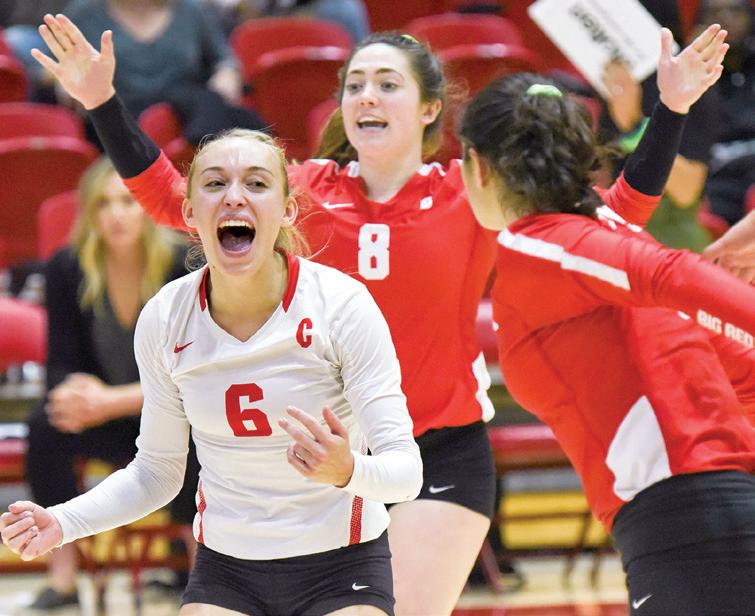
The women’s volleyball team is set to begin its 47th season with high hopes of competing for the Ivy League title.
In each of their past three seasons, the Red have finished third in the Ivy League rankings. In the Ivy League preseason poll, the Red were voted to finish third once again this season. Princeton, the reigning 2019 champions, and Yale were predicted to finish ahead of Cornell. The team hopes to defy expectations and end their season on top of the league.
In every year since their .500 season in 2016, the team has steadily improved under the leadership of head coach Trudy Vande
Berg. In 2019, their last full season, the Red finished with a 17-6 record, including a dominant 11 game winning streak.
The team will welcome six new freshmen: Jackie Baker, Megan Bickel, Camryn Carlo, Brooke Cooper, Sammie Engel, and Jordan Quinones.
“Each student-athlete brings something that we will need to continue to compete at the top of the Ivy League and help us in our quest to get back atop the conference and return to the NCAA tournament,” said Vande Berg on the new freshmen additions.
The Red has not played a game in near-
ly two years due to the Ivy League’s pause on fall sports in 2020. However, with a combination of talented new faces and seasoned veterans, including seniors Jillienne Bennett, Madison Baptiste, Avery Hanan, and Casey Justus, the team hopes to jump right back into the new season without skipping a beat. Bennett will hope to build off her impressive 2019 campaign during which she earned first team All-Ivy honors. Women’s volleyball will face their first opponent this Friday Sept. 3 at 4 pm against St. John’s in Albany, N.Y. at the Desmond Hotel Volleyball Classic. The team starts Ivy League play on Saturday Sept. 25 against Columbia.