The Corne¬ Daily Sun
135, No. 6

135, No. 6
By ANNE SNABES Sun Assistant News Editor
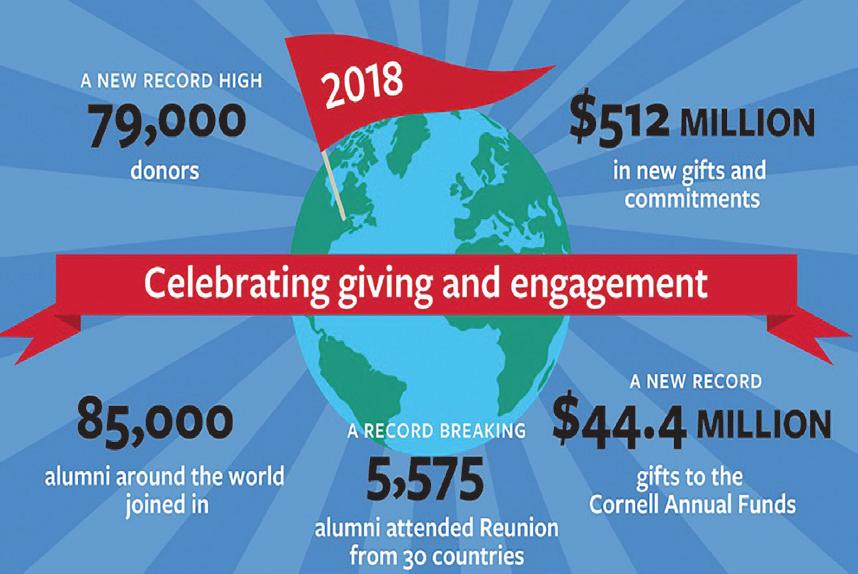
Cornell received $512 million in gifts and commitments in Fiscal Year 2018, about $230 million less than the amount given in the previous fiscal year.
Cornell received $743 million in Fiscal Year 2017. Fred Van Sickle, vice president of alumni affairs and development, said yearly fluctuations are “not unusual” because of “exceptional gifts.”
H. Fisk Johnson ’79, M. Eng ’80, M.S. ’82, MBA ’84, Ph.D. ’86 gave $150 million to Cornell in the 2017 fiscal year to endow the SC Johnson College of Business.
Of this fiscal year’s donations, $436 million support the Ithaca and Cornell Tech campuses and $77 million support Weill Cornell Medicine.



By SARAH SKINNER Sun Assistant News Editor
ment.”
By ANU SUBRAMANIAM and PARIS GHAZI
Following a hazing report that was sent to the Office of the
The investigation found that the hazing also occurred in past years and featured bar-b-que sauce and “other condiments.”
Judicial Administrator in Dec. 2017, the Big Red Band received a “written reprimand” and was
required to create a Leadership Transition Guide.
After investigating the University-Registered Organization, the OJA found that “as part of a leadership transition practice,” an incoming section leader “consumed a shot of bar-b-que sauce” to “demonstrate devotion to the section.”
The investigation found that this event also occurred in past years and featured “other condiments.”
The Big Red Marching Band and University reached a Summary Decision Agreement,
Nixon, a former Broadway and television actress, will challenge incumbent Andrew Cuomo for the Democratic party nomination in the Sept.13 primary.
Nixon is scheduled to visit the Ithaca Farmers Market near Cayuga Lake for a photo opportunity, though campaigning is not permitted within the market itself. She will then travel
to the Space @ GreenStar, a gathering place in downtown Ithaca that accommodates up to 220 people, according to their website. There, she will make an announcement on environmental policy at 10:30 a.m. among presentations by several “local activists,” according to
By WESLEY ROGERS
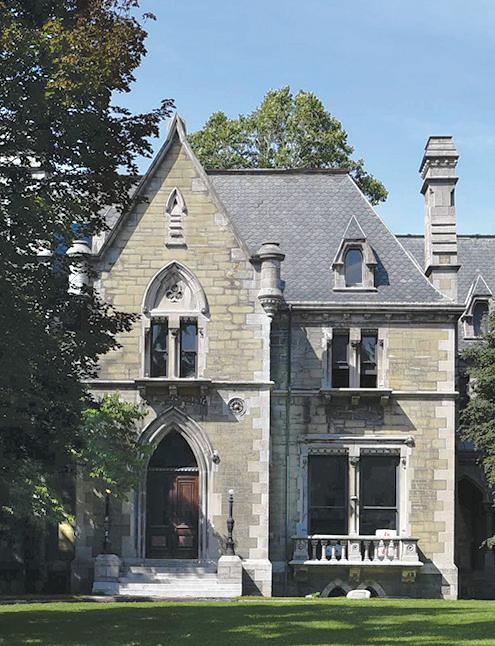
Following hazing events that occurred in February 2018, the University revoked the recognition of the Cornell chapter of Delta Phi — also known as Llenroc — for a period of “no less than four years” according to the University’s hazing violations website.
Several reports of
hazing were sent to the Office of Sorority and Fraternity Life during new-member period. Per protocol, OFSOL’s Review Board launched and completed an investigation into the chapter and found it “responsible for violations of the Fraternity and Sorority Recognition Policy (including hazing) and Event Management
Thursday, August 30, 2018

Apple to Cider: An Old Industry Takes New Root
8:00 a.m. - 5:00 p.m., Mann Library Lobby
The Cornell Portal 9:00 a.m. - 5:00 p.m., Olin Library
The Bank Lending Channel of U.S. Housing Credit Policy
11:40 a.m. - 1:10 p.m., 498 Uris Hall
Energy Engineering Seminar: Koenraad Beckers 12:20 - 1:10 p.m., 429 Rockefeller Hall
Geothermal Energy: State of Tehnology, Opportunities, and Challenges
12:20 - 1:10 p.m., 203 Phillips Hall
Midday Music at Lincoln 8/30: CU Music 12:30 - 1:15 p.m., B20 Lincoln Hall
NBB Seminar Speaker: Robert Burgess 12:30 - 1:30 p.m., 215 Tower Road
LEPP Theory Seminar: Jay Hubisz, Syracuse 2 p.m., 401 Physical Sciences Building
Memorial Event for Carol Warrior 4:30 - 6:00 p.m., Africana Studies and Research Center
Maria Claudia Clements and Francesca Isidori of Labics and Val Warke: The Making of Practice
5 p.m., Stepped Auditorium
Filmworker Premiere
7:15 p.m., Willard Straight Theatre
Dr. Strangelove 9:30 - 11:30 p.m., Willard Straight Theatre
Iftikhar Dadi and Elizabeth Dadi: Tilism
8 a.m. - 5 p.m., Sibley Dome
Van-Leo: The Reluctant Surrealist
8 a.m. - 5 p.m., Bibliowicz Famiy Gallery, Milstein Hall

The World Bewitch’d: Visions of Witchcraft from the Cornell Collections
9:00 a.m. - 5:00 p.m., Level 2B Kroch Library
The Works in Progress Seminar 12:10 - 1:10 p.m., 488 Uris Hall
In Pursuit of Peace: Systems of Science, Systems Engineering and World Peace 12:15 p.m., 253 Frank H. T. Rhodes Hall
Info Session: Exploring Fitness Options 4 p.m., Noyes Community Center



New Course Looks to Save the Bees
The University recently started a new course on honeybee health. Veterinarian Dr. Robin Radcliffe collaborated with University faculty to create a course that focuses on a variety of honeybee health factors, including pathology, infectious disease, and bee anatomy. According to a University press release, 90 students requested to take the course this summer. Radcliffe’s experience with bees extends beyond coursework, including a partnership with Professor Thomas Seeley that produced a new way to locate honeybees in the forest. This class will allow honeybees — which are threatened by human activity, according to Radcliffe — to be studied by veterinarians.
According to officials from the Department of Environmental Conservation, the former Ithaca Gun Factory site has high levels of lead present in the soil. The report was submitted by IFR Development, LLC. According to the report, most concentrated contaminants are found in fractured bedrock. Other contaminants, like chlorinated organic compounds, are present in on-site and off-site groundwater. Located at 125 Lake St., the 1.63 acre site will be re-evaluated by the DEC and the Department of Health, and a final report including a cleanup plan will be released to the public.
Algae blooms, first noted in August, have spread along the southern shore of Lake Superior, according to The New York Times. The largest of the Great Lakes, Lake Superior has been examined by scientists concerned by the largest mass of green algae that has been detected on the lake. Algae blooms – worsened by warm weather and heat waves – have begun to plague many of the bodies of water in the U.S., including the Finger Lakes in New York and Utah Lake. Generally, scientists attribute worsening algae blooms to phosphorus runoff, sewer leakage, and pollution. The large bloom in Lake Superior arose in relation to heavy rainfall in June, and is being tested for toxicity.
Space promises to be ‘inclusive’ and include features ‘for everyone to play’
By HUNTER SEITZ Sun Staff Writer
Following complaints from Ithaca citizens about a lack of play areas for children with disabilities, the Friends of Stewart Park will be constructing an all-accessible playground for children.
The new space will feature natural play areas, accessible walkways, a splash pad and new accessible bathrooms according to the Friends of Stewart Park website.
“One of the big things people wanted was a new playground … and they decided it should be one that is accessible,” said Lucas Raley ’18, playground build coordi-
with disabilities, and it’s not a playground just for people without disability issues. It’s for everyone to play.”
“One
The new playground attempts to replace limiting factors like stairs and steep ramps by adding a ramp that leads to a view of the lake, as well as a berm that “provides children a starting point for exciting play experiences for all children,” according to the website.
“It’s not a playground tailored just to people with disabilities, and it’s not a playground just for people with disability issues.”
Lucas Raley ’18
nator for Friends of Stewart Park.
“We call it an inclusive playground because it’s one for everybody,” Raley said in an interview with The Ithaca Voice. “It’s not a playground tailored just to people
$1.7 million, according to Raley.
of the big things people wanted was a new playground … and they decided it should be one that is accessible.”
Lucas Raley ’18
The park’s disability-friendly spaces will also feature new bathrooms and changing rooms that will border the playground and a restored carousel. In addition, the park will promote sustainable design and “green” construction by implementing sustainable design measures and featuring plants native to the region.
The project has received a $1 million grant from the state, according to an article in the Ithaca Voice. Friends of Stewart Park has also been asking for private donations, and has raised over $500,000 so far. The $1.5 million total has brought them close to their final goal of
In September, the project will move forward with Phase 1, or the “community build” phase. They are aiming to complete the work using solely volunteer workers from the Ithaca region.
Construction will take place from Sept. 11 to 16. Roughly 130 people have signed up to help so far, Raley said, but they are still looking for more volunteers to complete the project.
Cornell’s Tri-Council organization will be replacing it’s previous Greeks Give Back — a biannual event where members of the Greek community spend a day performing service tasks around Ithaca — with events throughout the semester. One of the opportunities they have chosen is the Stewart Park playground building, to help get more volunteers involved in the project.
By MATTHEW McGOWEN Sun Senior Editor
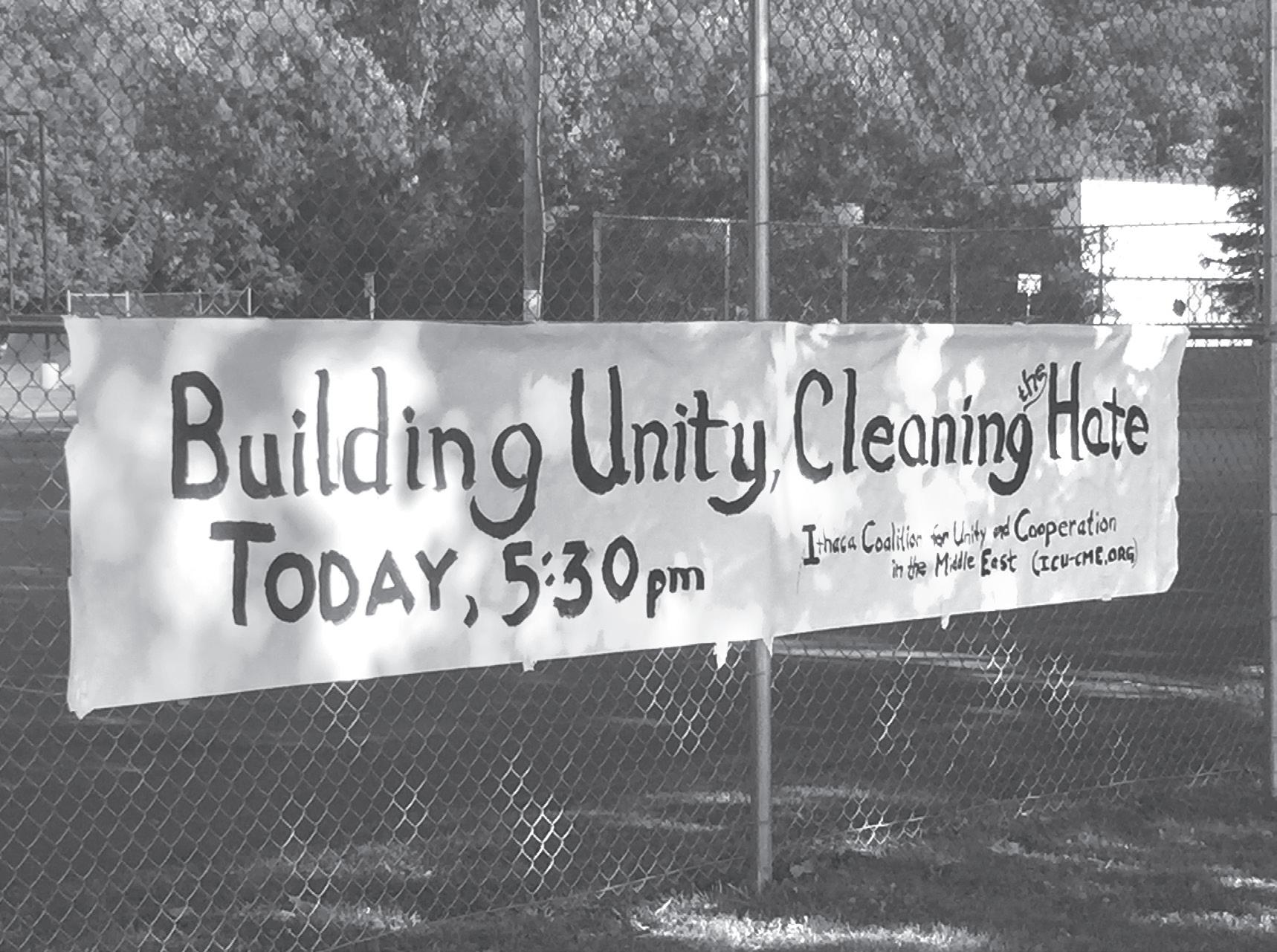
Approximately 25 Ithacans gathered in Wood Street Park at 5:30 p.m. on Wednesday for a vegetarian potluck and open forum for dialogue about what it means to ‘clean up hate.’
The event, Wood Street Park for Building Unity: Cleaning the Hate is now in its third year, and previously included performances by Vitamin L chorus, a local choir of middle to high school age kids. Mayor Svante Myrick ’09 was slated to speak, but informed organizers shortly before the event that he would be unable to attend.
The event was hosted by Ithaca Coalition for Unity and Cooperation in the Middle East, a local group self-described as a “grass-roots anti-racist community organization working to preserve the plurality and diversity of discussions about the Middle East and other related topics.”
Linda Glaser, writer and publicist in the Communications department of Arts and Sciences and chair of ICUCME, described the organization’s role in facilitating conversation among community members about often confrontational political topics.
“We’re a non-partisan organization, we don’t have a political stance other than that we support peace and coexistence,” Glaser said. “One of the most important things to us is to have a space where people can talk and listen to each other.”
The dialogue among attendees was not without some tension, particularly for Sophie Zapala, co-founder of the upcoming Olive Branch Film Series: Ithaca Explores Palestine
Through Films, and a self-described pro-Palestine advocate who has clashed with ICUCME and Glaser before.
At a discussion on Martin Luther King Jr., nonviolent protest and the Middle East with Prof. Riché Richardson in May, Zapala co-opted the conversation according to Glaser. Zapala in turn accused ICUCME of ‘libel’ for accusing her of anti-semitism.
“If they want to describe themselves as a Zionist organization and they want to be forward and honest about it and say what their propaganda agenda is then I wouldn’t question that,” Zapala said. “What they do is they misrepresent themselves as anti-racist while pushing a
false narrative that criticism of Israel and support of Boycott Divestment Sanction movement equal anti-Semitism.”
Despite disagreement and sharply opposing views discussed in the small and intensely humid tent, attendees continued to converse even after the park cleanup began.
“It’s heartening to see that some people can’t stop talking once they meet,” Glaser said. “Looking around there are a lot of people from different backgrounds.”
Laraine Peays has been a nurse in Ithaca her whole professional career, and came to the event in support of the anti-discrimination message.
“My grandkids play with
every nationality, they don’t stop and ask you your nationality or religion, they’re out there playing and having a good time,” Peays said. “How can you work together, shop together, share cabs together, and at the same time hate someone?”
Julie, who did not wish to give her last name, has worked in housing for 12 years and said she witnessed discrimination first-hand in her line of work. She attended the event to “take a positive stance and positive action on treating people across all cultural and race backgrounds with decency and respect.”
By ANU SUBRAMANIAM AND PARIS GHAZI
Sun News Editor and Sun Assistant News Editor
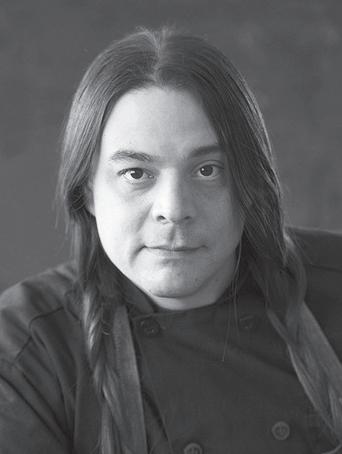
Sean Sherman, chef and founder of the company The Sioux Chef, which aims to “revitalize Native American Cuisine,” will be speaking at the Audrey O’ Connor Lecture on Wednesday, Sept. 5.
Cornell’s American Indian and Indigenous Studies Program and the Atkinson Center for a Sustainable Future partnered together to host Sherman, according to the event’s Facebook page.
“His main culinary focus has been on the revitalization and awareness of indigenous foods system in a modern culinary context.”
Sherman, who hails from Pine Ridge, South Dakota, conducted seven years of research on the foundations of the Indigenous food systems. His studies have included Native American farming techniques, food preservation, Native American migration histories, elemental cooking techniques and Native American culture and history.
Lecture attendees will have the opportunity to purchase copies of Sherman’s cookbook “The Sioux Chef’s Indigenous Kitchen,” before the lecture and a book signing will follow. His book was awarded the “Best American Cookbook” in 2018 by the James Beard Foundation and was written with the help of Minneapolis chef Beth Dooley.
According to The Sioux Chef website the members of Sherman’s team “are chefs,
By MATTHEW McGOWEN
Senior Editor
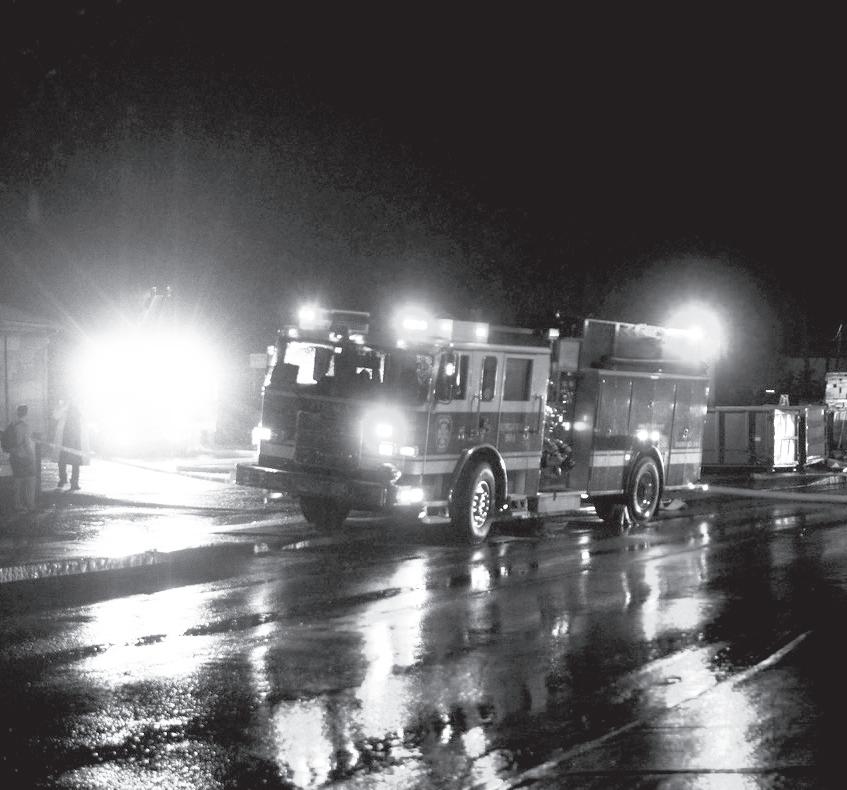
Firefighters and police responded to multiple reports of a fire on the corner of Green Street and Fulton Street Wednesday night.
According to a press release issued by the Office of the Fire Chief at 11:00 p.m., multiple 911 calls of a fire near the farm supply store Agway alerted first responders shortly before 9:30 p.m.
The source of the blaze was a mere three blocks from the fire department’s downtown headquarters, and firefighters arrived within minutes, according to the press release.
Arriving at the scene, firefighters found a tractor trailer ablaze.
Upon arrival, “firefighters knocked down the bulk of the blaze in the trailer and then went into the building to put out the fire that had spread there,” the
press release said. “After extinguishing the remaining fire they ventilated the smoke from the building.”
Five engines and a Bangs ambulance were on the scene and fire police and firefighters rerouted traffic, shutting off access to Fulton street.
Lieutenant Thomas Basher Jr. in a phone call with The Sun at 11:33 p.m. said that Fulton Street was still closed to traffic but would likely reopen “within the hour.”
According to a Facebook post by the Ithaca Fire Department, off duty IFD personnel and Cayuga Heights, Newfield and Lansing Fire Departments were called in to “cover other calls during the fire.”
No injuries were reported, and a cause has not yet been determined, but the incident is currently under investigation.
Matthew McGowen can be reached at mmcgowen@cornellsun.com.
ethnobotanists, food preservationists, adventurers, foragers, caterers, event planners, artists, musicians, food truckers and food lovers.” They are from several tribes from across the country such as the Anishinaabe, Mdewakanton Dakota and Navajo.
Currently based in Minneapolis, Sherman has introduced many in the Twin Cities area to Native American recipes. In 2016, Sherman broke Kickstarter campaign records and became the sixth most-funded project on the platform at the time when he raised almost $150,000 with the support of 2,358 donors in one month.
Sherman and his team now offer catering services for occasions, and include an array of lunch, dinner, soups, salads, breads, sweets and beverage recipes — all made with healthy ingredients central to indigenous cuisine, like bison and wild rice.
Sherman has been cooking for the last 30 years, according to his website. He has cooked in countries across the world and “his main culinary focus has been on the revitalization and awareness of indigenous foods system in a modern culinary context.” He opened The Sioux Chef in 2014 and has helped design and open the Tatanka Truck food truck which was the winner of the 2015 Charlie Award for “Most Outstanding Food Truck.”
Anu Subramaniam can be reached at asubramaniam@cornellsun.com. Paris
can be reached at pghazi@cornellsun.com..

Continued from page 1
Van Sickle said the funds going towards the Ithaca campus “will touch practically every single part of campus in one way another.”
“The gifts are used to support the purpose or area designated by the donors, including scholarships, fellowships, professorships, student life, academic programs, research and facilities,” he said.
A scholarship challenge campaign that began in January of last year yielded almost $22 million in endowed scholarships.
The donations to Weill Cornell will be used to grow its clinical, research and education programs, Van Sickle said.
Tata Consultancy Services gave Cornell Tech $50 million in the 2018 fiscal year, which paid for the first phase of capital development at Cornell Tech, The Sun previously reported. The information technology
consulting company is headquartered in Mumbai, India and its chairman emeritus is Ratan Tata ’62.
Cornell named a building the Tata Innovation Center in response to the gift, Van Sickle said.
“[The investment] also will support research collaborations between [Tata Consultancy Services] and Cornell Tech and enable mutual efforts to expand K-12 digital literacy programs in New York City, with a focus on girls, minorities and the underserved,” he said.
In total, 79,000 donors gave money to Cornell during the course of the year, which is a record, Cornell announced in its in-house publication, the Cornell Chronicle.
In an email to The Sun, Michelle Vaeth ’98, associate vice president of alumni affairs, called the Giving Day on March 20 — the University’s one-day fundraising frenzy — “remarkable,” and said that 11,748 donors participated.
Vaeth said Cornell witnessed an increase in gifts from student donors, and on Giving Day in particular.
“Others are grateful for the ways donors of the past made their experience possible.”
Michelle Vaeth ’98
Vaeth said alumni donate to the university to “give back” to the campus that “gave them so much.”
“Others are grateful for the ways donors of the past made their experience possible,” she said. “Still others want to invest in the work Cornell is doing to impact societal problems — such as sustainability, food and water quality, energy, human health, and countless others.”
Anne Snabes can be reached at asnabes@cornellsun.com.
Guidelines, and five violations of the Expectations for Membership.”
The investigation found that new members were forced to participate in activities that included “forced consumption of alcohol,” as well as “mentally and sexually intimidating activities” and “physically abusive behavior.”
“It’s a major mental health risk, a major physical risk, and a major legal risk.”
Paul Russell ’19
According to the hazing violations page, new members had to participate in a drinking challenge called a “boat race,” where they were always on the losing team and then had to participate in another race. They were also put in “line ups” where they were asked questions, and when they answered incorrectly, they had to drink a “jammer,” a drink that included items like hot sauce or other “unsavory liquids.”
“We’re hoping that the new policies passed by the IFC,
as well as president Pollack’s mandates will help prevent future incidents like these,” said Interfraternity Council President Paul Russell ’19, who writes an opinion column for The Sun.“No one should have to undergo this kind of treatment just to join an organization. It’s a major mental health risk, a major physical health risk, and a major legal risk.”
The brothers also had new members participate in a scavenger hunt where they were left without transportation back to campus. On a separate occasion they asked them to wear a bathing suit and wait near a campus bridge at night. The new members were also blindfolded and left in a boiler room.
The report also stated new members were asked to watch pornography and were given the impression they would be performing a “elephant walk” — a hazing practice in which men stand in a line and walk while holding the genitals of the person in front of them. They were also told they would be consuming a “semen beverage,” but it was later reported to be cornstarch.
“The Cornell Delta Phi Association’s alumni Board of Trustees has taken steps to ensure that hazing will have no place in the chapter’s future new member programs,” Alex Franco ’92, Secretary for the Cornell Delta Phi Association
the event page.
Nixon’s campaign platform on environmental issues calls for a 100 percent transition to renewable energy by 2050, with 40 percent of state energy funding directed toward improving renewable energy in low-income communities and communities of color.
She is against fracking, offshore drilling and nuclear power, according to her website, calling for offshore land and wind farms to make up the energy deficit as well as cutbacks on carbon emissions.
This will be be Nixon’s second official visit to Ithaca as a gubernatorial candidate. She last visited in June, where she delivered a speech emphasizing energy, education and healthcare reforms, according to Ithaca.com.
Her opponent last visited Ithaca in May, when Cuomo announced a $22 million plan to to renovate Ithaca Tompkins Regional Airport, as previously reported by The Sun. Her campaign encountered multiple obstacles earlier this year when it misspelled the city’s name as “Ithica” on campaign invitations prior to the June event and when Nixon herself declared Ithaca the start of upstate New York to The New York Times Magazine. Nixon’s visit to Ithaca is scheduled only days after her first and only debate with Cuomo, which took place Wednesday night. Nixon described herself as a “democratic socialist” to Politico in June and is seeking her first term as governor on a liberal platform.
Sarah Skinner can be reached at sskinner@cornellsun.com.
year were also required to review the guide.
found in violation of the University’s hazing policy, it was ordered to develop a Leadership Transition Guide in collaboration with the marching band’s advisor Megan Ramey, a OJA member, and Joe Scaffido, the director of campus activities
The guide was distributed to members of the marching band’s leadership board to inform them on the proper conduct expected by Cornell’s conduct standards, and members transitioning into the leadership positions this school
The Office of the Judicial Administrator will be further investigating the marching band to identify individual members who the University will then hold accountable for the hazing incident.
The Big Red Marching Band has not responded to The Sun’s request for a comment.
Anu Subramaniam can be reached at asubramaniam@cornellsun. com. Paris Ghazi can be reached at pghazi@cornellsun.com.
Red revisions | The Big Red Marching Band was given a written reprimanding following hazing allegations made in Dec. 2017.
said in an email to the Sun. “We will continue to support our undergraduate members who have been shown to be thoughtful, charitable, and encouraging of diversity and change.
According to the hazing violations site, Delta Phi appealed the charges, but the findings were upheld. Following the four-year period, if the chapter chooses to petition to return, it will be placed on probationary recognition status for “a period of no less than two years.”
“Going into this next new member period, we’ll have new ways for students to get involved in making a change in their chapters, more involvement on the hazing prevention front from alumni, and a group of new chapter presidents,” Russell said. “We’re still looking at additional creative ways to address these issues, since they’re often imbedded in the traditions of some chapters, so hopefully we’ll be able to capitalize on this momentum toward cultural change and see more chapters implement safer policies.”
The Office of Sorority and Fraternity Life has not responded to The Sun’s request for comment.
Anu Subramaniam can be reached at asubramaniam@cornellsun.com.


Independent Since 1880
JACOB S. KARASIK RUBASHKIN ’19 Editor in Chief
JOHN McKIM MILLER ’20
Business Manager
KATIE SIMS ’20
Associate Editor
VARUN IYENGAR ’21
Web Editor
MEGAN ROCHE ’19
Projects Editor
EMMA WILLIAMS ’19
Design Editor
JEREMIAH KIM ’19
Blogs Editor
AMOL RAJESH ’20 Science Editor
BREANNE FLEER ’20 News Editor
YUICHIRO KAKUTANI ’19 News Editor
NICHOLAS BOGEL-BURROUGHS ’19
City Editor
LEV AKABAS ’19
Arts & Entertainment Editor
SARAH SKINNER ’21
Assistant News Editor
ANNE SNABES ’19
Assistant News Editor
JOHNATHAN STIMPSON ’21
Assistant Sports Editor
EDEM DZODZOMENYO ’20
Assistant Photography Editor
PETER BUONANNO ’21
Assistant Arts & Entertainment Editor
CHENAB KHAKH ’20
Assistant Science Editor
JULIAN ROBISON ’20
Layout Editor
HELEN HU ’21
Graphics Editor
DUSTIN LIU ’19
Human Resources Manager
ANNA DELWICHE ’19
Senior Editor
GIRISHA ARORA ’20
Managing Editor
HEIDI MYUNG ’19
Advertising Manager
ALISHA GUPTA ’20
Assistant Managing Editor
DYLAN McDEVITT ’19
Sports Editor
MICHAEL LI ’20
Photography Editor
GRIFFIN SMITH-NICHOLS ’19 Blogs Editor
JACQUELINE QUACH ’19 Dining Editor
SHRUTI JUNEJA ’20 News Editor
ANU SUBRAMANIAM ’20 News Editor
JUSTIN J. PARK ’19
Multimedia Editor
PARIS GHAZI ’21
Assistant News Editor
MEREDITH LIU ’20
Assistant News Editor
JACK KANTOR ’19
Assistant Sports Editor
RAPHY GENDLER ’21
Assistant Sports Editor
BORIS TSANG ’21
Assistant Photography Editor
VIRI GARCIA ’20
Assistant Arts & Entertainment Editor
CATHERINE HORNG ’21
Assistant Dining Editor
LIZ CANTLEBARY ’21
Snapchat Editor
ALICIA WANG ’21
Sketch Editor
JOSH GIRSKY ’19 Senior Editor
ZACHARY SILVER ’19 Senior Editor
MATTHEW McGOWEN ’19
Senior Editor
Working on Today’s Sun
Ad Layout Krystal Yang ’19
Design Deskers Emma Williams ’19
Lei Lei Wu ’21
Krystal Yang ’21
Simon Chen ’21
News Deskers Anu Subranamiam ’20 Paris Ghazi ’21
Night Desker Maryam Zafar ’21
Arts Desker Pete Buonanno ’21
Sports Desker Dylan McDevitt ’19
Photography Desker Michael Li ’20
Production Deskers Krystal Yang ’21
Emma Williams ’19
& Villains

We write today in praise of the HEROIC air conditioning units across campus (and their creator, Willis Carrier 1901, a true American HERO), which have been HEROICALLY fighting against the VILLAINOUS heat wave ravaging Cornell. As the HEROES in building maintenance work to keep classes cool, we cannot help but rage in fury against the VILLAINS in the administration who refuse to activate Cornell Weather Machine™ during this trying time, instead electing to VILLAINOUSLY conserve their energy for this spring’s Cornell Days. We can only hope that some HERO in Day Hall (looking at you, Martha Pollack) rises up and commands the heavens to return us to a normal temperature. In the meantime, be sure to drink lots of H20, the most HEROIC of molecules, and stave off the VILLAINY of dehydration.
Today is the second meeting of the HEROES on the Student Assembly, where they will HEROICALLY stand up for the students who were cast out onto the street by the VILLAINS of eHub. And fear not, cinephiles, the VILLAINS who voted to defund the Academy of Motion Picture Arts and Sciences, Ithaca branch, last year have left (well, most of them anyways). We’re sure that this year’s crop of representatives will not commit such VILLAINY again. Instead, they will certainly engage in many acts of HEROISM...that is, unless they are yet again derailed by a VILLAINOUS errant meme.
This coming weekend is a HERO in its own right, thanks to the HEROES in the ILR school who brought us Labor Day. HEROES and VILLAINS alike will no doubt revel in the debauchery of the three-day weekend. Rest assured the sleep-deprived editors of The Sun will VILLAINOUSLY consume much libations in celebration of the HEROIC American worker.
“Iwant to thank you for sharing. I hear what you’re saying and I want to let you know how that makes me feel.”
I stopped short during my brisk walk to class as I saw two students, staring squarely at each other, maintaining eye contact, affirming one another’s words and exemplifying empathy. From their lanyards and newly purchased Cornell gear, I quickly deduced that these were new members of our community, already taking advantage of what I believe is the most valuable resource on campus — each other.
I couldn’t help but feel a sense of pride and view this as an impact of the Intergroup Dialogue Project. The Intergroup Dialogue Project is an academic initiative grounded in theory and practice that creates community across difference through dialogue. This fall marked the first time all first-year students participated in a three-hour IDP session as part of their orientation. In order to accomplish this, a true horde of alumni facilitators, staff facilitators and student facilitators filtered through rooms across campus, training all 3,325 students. IDP for all freshmen marks the first step in the implementation of the Presidential Task Force on Campus Climate series of recommendations.
I remember my own first experience with IDP, walking into the classroom as an underclassman staring at strangers around the room. “I am a teacher and a learner in this course,” we all repeated. In four short weeks, I had shared more about myself to this group of peers than I had to my closest friends at home. It was a space where I explored my own identity and found power in my narrative. It was a space where I found more similarities than differences, and where discovering shared meaning was a commitment held by all parties.
In the freshman orientation session, I shared more about identity in 10 minutes than I had with some of my

extended family. I felt students finding connections among their peers. I felt an indescribable amount of amazement watching these students, who just landed on this campus at most 4 days earlier to a new life on the hill, sharing their life stories with their peers and finding a sense of belonging.
Upon personal reflection, it is hard to think of a role that I have held where I didn’t use the tools I have learned in facilitator training. IDP has been fundamental to not only my personal development but my leadership and professional development as well. As a resident advisor, I used frameworks from training to help my residents begin to unpack their identity. As a teacher in a San Francisco, I adapted course materials to provide an IDP experience for ninth grade students; to this day I still get text messages from them sharing how they have been able to apply the course materials and further explore their identity. As a volunteer in India, it was through finding common ground and shared meaning that I was able to connect with individuals even if I didn’t have the language to do so.
Cornell University invests energy and capital to recruit world class talent. We sit next to those who are not like us, but it would be naive It is astounding to think about what we would learn from one another if we listened, if we took the time to actively listen to others and have the space to hear each other’s narratives. Viewing higher education as a laboratory for leadership, for building global citizens, and for incentivizing collaboration across difference is achieved through these sorts of interactions.
Dustin Liu is a senior in the School of Industrial and Labor Relations and he currently serves as the undergraduate student-elected trustee on the Cornell Board of Trustees. He may be reached at dliu@cornellsun. com. Trustee Viewpoint appears alternate Tuesdays this semester.
Continue the conversation by sending a letter or guest column to opinion@cornellsun.com.
Letters should be in response to any recent Sun news article, column, arts piece or editorial. They should be no longer than 250 words in length.
Guest columns should be your well-reasoned opinion on any current campus issue or controversy. They should be no longer than 750 words in length.
Ihad my first existential crisis at ten years old. Like so many other formerly gifted children — or, if you prefer, present-day underachievers — this early onset despair came about as the result of age-inappropriate media consumption. In my case, it was watching The Truman Show.
I’m 20 now, on the precipice of adulthood and its labyrinth of choices. So, I re-watched this formative film. And from this vantage point? It’s a coming-ofage film.
The Truman Show is a movie about the modern existential crisis. It is the story of a man who has, unwittingly, since birth, starred in a reality television show about his life broadcasted to the world 24 hours a day. The only existence he has ever known is on a massive film set — a full-scale model of idealized American suburbia — littered with hidden cameras and hundreds of actors who play every role from fellow citizen to Truman’s spouse.
see you, good afternoon, good evening and good night!”). The gravity of the second stage is the realization that you, and you alone, are in charge of your own choices.
The third stage of existential crisis is coming to terms with your mortality, that of your loved ones, and, ultimately, of everything and everyone on Earth. Once we acknowledge our incontrovertible insignificance, the tick-tick-tick of the clock on our lives begins a deafening crescendo. Truman begins to treat his life with reckless abandon; a natural consequence of the second stage, this wild behavior is his first foray into the profound boundlessness of choice.
I implore you to lean in to your existential crisis.
The fourth and last stage of existential crisis is the earnest assessment of our methods for making choices in the future. Here, we accept opportunity cost as a natural part of the human experience. We truly comprehend the symbiotic nature of risk (potential cost) and yield (potential benefit).
did, or why she adheres to the social norms she does, like participating in extracurriculars or going to college at all. They might come to regret not taking time off from school to travel, spending too much time studying or signing their life away to a corporate job that draws them away from their true passion. They might embrace the “YOLO” school of thought, using risky behavior as an outlet for their desire to exercise choice.
Yet many college students — particularly those attending elite universities — never move beyond that third stage. They persist in their predetermined paths, eschewing the risk of their dreams in favor of the financial stability and social approval offered by complacency. It is not to say that these students won’t excel in their chosen field of study or in their career; on the contrary, high achievers and existential malaise are like academic peanut butter and jelly. Still, it’s disheartening.
It doesn’t have to be this way.
With his 13th birthday on the horizon, Truman begins to question his reality. And so begins the existential crisis.
The first stage of existential crisis, according to absurdist philosophers, is the recognition that that which we had always held as common sense — our unchallenged, assumed truths — are in fact arbitrary. Truman, for example, first questioned the fact that he’d never traveled beyond his town.
The second stage of existential crisis is the revelation of infinite choice. We suddenly see that we chose every aspect of our lives — from our careers to our hobbies to our social circles to our romantic partners — and that there were infinite other choices that we could have made. This induces a paralyzing anxiety; a philosophical buyer’s remorse.
In Truman’s case, he can’t stop thinking about the creepily robotic routines in which he participates, ostensibly by choice, like his daily greeting to his neighbors (“Good morning, and in case I don’t
Truman’s fourth stage plays out in the film’s final scene. Christoff, The Truman Show’s executive producer, speaks to his unwilling subject over a P.A. system – an unseen, omniscient voice.
High achievers and existential malaise are like academic peanut butter and jelly.
“You can leave if you want,” he says, “I won’t try to stop you. But you won’t survive out there. You don’t know what to do, where to go.”
Truman pauses, seeming to doubt himself. Then, he speaks.
“In case I don’t see you, good afternoon, good evening and good night!”
Truman’s experience is much like the quarter-life crisis many of us face in college. A college student might begin to wonder why she chose the major she
I bring up The Truman Show because it reminds me of Cornell. Everyone seems to be perfectly content, but we are all, at least partially, playing a role. Everyone seems to be filled with purpose, but we are all, at least partially, obeying the status quo. Everyone seems to be thrilled about the future, but we are all, let’s be honest, uncertain.
And so I implore you to lean in to your existential crisis. By earning a place at (and eventually graduating from) Cornell, you’ve proven that you are capable of excellence. But it is only by choosing to live a life that is yours that you can prove you are capable of greatness. Inevitably, there will be those who will doubt you. I suggest you offer a polite goodbye and continue on your way. Maybe start with something like, “In case I don’t see you…”
Jade Pinero is a senior in the College of Agriculture and Life Sciences. Jaded and Confused runs every other Thursday this semester. She can be reached at jpinero@cornellsun.com
Dear Carrie,
Welcome to Cornell, little lady!
It wasn’t so long ago when we met sharing a hotel room at high school debate states as your freshman self pressed me with questions about public speaking and research tips. Throughout the next few years, as your questions shifted from debate strategies to boy drama to high school classes to college applications to Cornell course selection, I have been lucky enough to watch you grow as your debate mom, and I can’t be more proud of all you’ve accomplished. Although I’m going to have to respectfully decline your real mom’s offer to pay me to babysit you here, I wish you the most incredible Cornell experience and hope to impart some washed up upperclassman insight.
good enough. You’ll be left staring at your foot wondering if you should have gotten a pedicure. At first it will sting, but somewhere between the third club rejection and the 30th internship rejection, you’ll learn how to deal with failure and it will leave you stronger. Fail often, fail freely, but learn how to pick yourself back up.
At some point, you will put your best foot forward only to be told you’re not good enough.
When I arrived in my Donlon dorm, I was ready for college to be everything modern media and peppy tour guides nationwide promised it would be: transformative, enlightening and the best time of my young life. And so far, Cornell has delivered; however, it’s been far more complicated and messy than advertised. It turns out that there are whole swaths of college life that get glossed over by the glossy pages of Cornell brochures.
You will fail. You were quite the accomplished high schooler. When you put your mind and soul into something you truly cared about, you’ve almost always succeeded. However, rejection is going to be your new best friend. At some point, you will put your best foot forward only to be told you’re not
You will get sick. In addition to multiple runins with the Donlon plague, you’ll get sick of the cold, sick of RPCC brunch, sick of sweaty basements and warm Natty Lights. You’ll get homesick and long for your beautiful bed, petty fights with your twin, and the shared memories of the people you’ve known for the past decade. And when Cornell Health proves insufficient, you will need someone to lean on. It may take a while, but you will find people you can really call your own. And once you do, you will wonder how you ever survived without them.
in the conservative center of Oregon and paid for his first year of Cornell by selling his pig or even a Ghanaian queen from Columbus who roasts you for your lack of understanding of black culture but makes you a better person everyday. You may also find a lot of people who will disagree that New Jersey is a suburban paradise. Feel free to cancel them on spot.
Join a cult. This may come in the form of a club or team or house, but if you are so lucky, you could find a home on this large and often lonely campus and maybe even something that sets your soul on fire. You could find friends you love and respect doing an activity that helps you grow and learn with mentors who support and inspire you. Go ahead, drink the kool-aid.
Your next four years will be a delightfully surprising mess.
It turns out there’s so much beyond the bounds of Short Hills. Be open to new ideas and new perspectives. Be ready to be engaged, be challenged, and be wrong. You’ll meet people with such different backgrounds and beliefs who will force you to question your own. And while it will be tempting to stick to your familiar bubble, if you venture outside of it, you may be so lucky as to befriend a farm boy wise beyond his years who grew up gay
I’m so excited to spend the next two years with you wasting hours in Libe, going on midnight Wegman’s runs, and watching the sunrise after a night in the Cocktail Lounge. I can’t wait to show you to my version of Weehawken and introduce you to the absolute splendor of a perfectly clear night sky in Ithaca. Your next four years will be a delightfully surprising mess and if you ever falter, know I will be here every step of the way.
Much love, Spark
Recently, as I was perusing the poetry section of a Barnes and Noble, I was surprised to come across a section containing volumes by Rupi Kaur, Lang Leav, r. h. sin, and the like. My surprise was not at seeing these collections standing shoulder-to-shoulder with those by Keats and Lorca but at the fact that the sight so resembled the shelves of poetry I’d seen a few weeks earlier at an Anthropologie.
These “Instapoets,” as they’ve been called, seem to be everywhere, like a plague of clichés, unpunctuated verse, and ill-timed line breaks.
These poets have huge social media followings — take Kaur, for example, who with 1.5 million Instagram fol-
lowers seems to be the most popular. Kaur first garnered attention when she posted a picture on Instagram of herself in bed on her period, menstrual stains on her pants and bedsheets. The photo was removed twice, and after lambasting the decision as that of a “misogynist society that will have my body in an underwear but not be okay with a small leak,” Kaur went viral.
As a result, she became a South Asian feminist icon for millions of fans. She also became a meme. These memes make fun of the simplistic nature of Kaur’s poetry and the idea that you can put arbitrary line breaks in anything and have it be called a poem. However, my own problem
with “Instapoetry” isn’t that the poetry is bad (bad poetry has, and will always exist), it’s with the idea of poetry as a commodity, that feeling and artistic expression can and should be sold and shared in retweetable, accessible bitesize pieces.

The thing about accessibility, though, is that it tends to erase the nuances of individual experience and result in homogenization. On the one hand, Kaur’s poetry is touted as raw, honest and individual. On the other hand, however, it’s “relatable.” The relatability is what has allowed it to spread so widely and easily, while the “rawness” of it has guarded it against criticism. In making herself the unofficial spokeswoman for South Asian females, Kaur portrays herself as a lone defender of diversity facing off against a harsh, elitist literary bastion while simultaneously ignoring the plethora of diversity within that South Asian female experience itself. Kaur’s poetry itself lacks details specific to her Punjabi-Sikh background, al-
lowing it to appeal to a wider Western audience. However, in talking or writing about her own poetry, Kaur often intentionally fails to mention her Canadian identity. Defenders of “Instapoetry” justify it as a kind of gateway

poetry — in being exposed to these poets, they say, readers will start to seek out more complex and nuanced poetry. Nevertheless, it’s poets like Kaur, whose debut collection milk and honey has sold over a million copies, rake in the cash, and not the many minority writers who have sacrificed money and publishability to more authentically share their experiences and hone their craft.
In our society, where everything moves so fast and we’re always worried about our own productivity, it’s hard to find the time, let alone a reason, to care about poetry at all. “Instapoetry” allows us to consume a poem quickly, maybe like or leave a comment, and then move on with our busy lives, secure in the knowledge
that we’ve somehow expanded our knowledge and deepened our understanding of the world.
“Good” poetry, by contrast, demands to be read and reread — often, you might not “get” a poem the first reading. Sometimes you may never “get” a poem at all. However, the mystery and wonder in delving into the poem is what makes poetry so enjoyable. The beauty of an unexpected metaphor or a jarring image can teach us to see the world in a different light, can transform us, even. “Art is not a plaything, but a necessity, and its essence, form, is not a decorative adjustment, but a cup into which life can be poured and lifted to the lips and be tasted,” writes Rebecca West in Black Lamb and Grey Falcon.Let us, then, demand better not only of our poets but also of ourselves as readers. Let us, then, view poetry as a “necessity,” rather than a “decorative adjustment,” and begin to taste life.
Ramya Yandava is a sophomore in the College of Arts and Sciences. She can be reached at ry86@cornell. edu. Ramya’s Rambles will run on alternate Mondays this semester.
BY MICHAEL CHANG Sun Staff Writer
On August 25th, I found myself walking up to the porch of 604 East Buffalo Street for the 2018 Electric Buffalo Records Orientation Showcase. The house was quirky, with a humble charm that invited curiosity about the sound echoing from within it. With every creaking step on the wood porch came some overwhelming instrumentation. People meandered in and out of the rooms. Some danced on porch, and others watched the musicians rehearse
house shows and The Carriage House Cafe. Their jazz band, The Original Cornell Syncopators, performs on national tours annually, and rapper Paulitics, whose real name is Paul Russell and is a junior Sun columnist, released the commercially successful Primary Colors under the label. It is no secret that EBR is a stepping stone for new artists.
When the clock struck 7:00 pm,
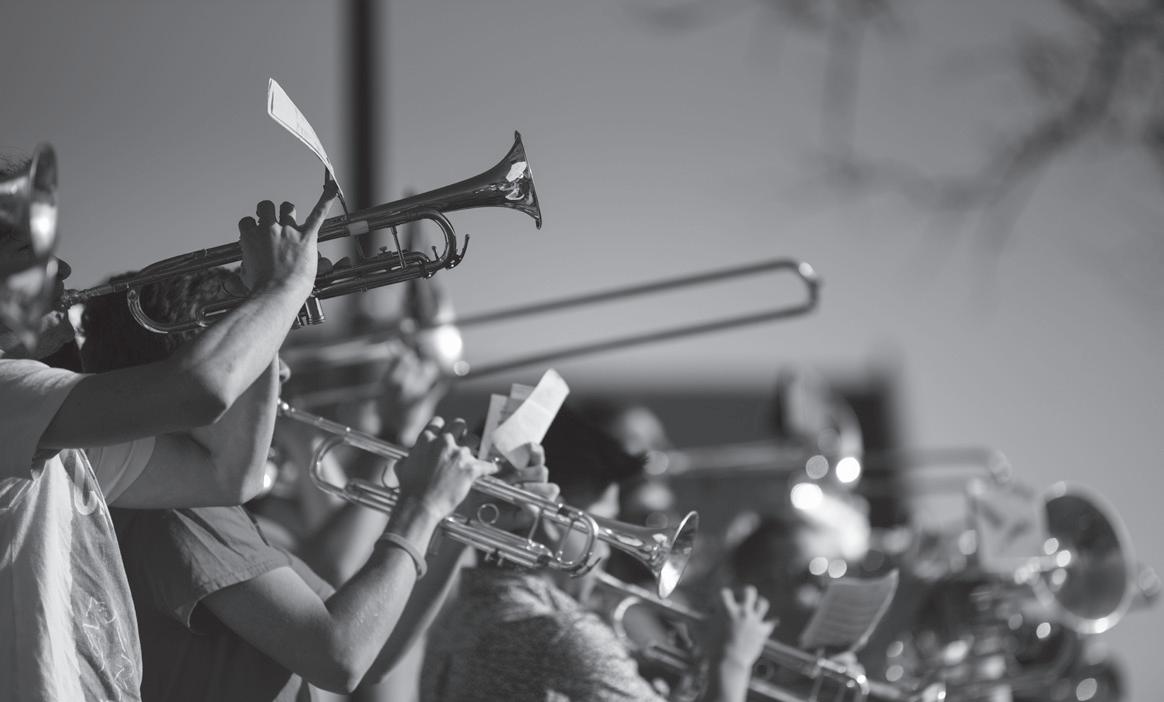
able bond between the group members through an endless cadence of rhythm. Sure, there was plenty improvisation. As the trumpeter Colin Hancock delivered a passionate trumpet solo which enlivened his bandmates as well as the audience. When delivering an older style of jazz, The Syncopators brought a breath of fresh air into the room, reminding the world that there is still passion for this genre.
“ The showcase impressed and excited concert-goers for the future of Electric Buffalo Records. The students behind EBR will only continue to grow and prosper.”
Michael Chang ‘21
“Electric Buffalo Records is ready for takeoff this year and it starts here,” declared Adam Kanwal ’21, who is a Sun staff writer, co-president of the record label regarding the event. The night was EBR’s chance to ostend the talent that has sprouted from their ambitious, student-led record label. Artists from EBR had been featured in many spots across Ithaca, including
I made my way into what EBR has dubbed “The Vinyl Room” for the start of the showcase. The room was cozy, with walls adorned with endless stacks records from all genres. The first performance of the night came from The Original Cornell Syncopators and was entitled “South.” It was an homage to 20th century swing jazz and demonstrated an unbreak-
Afterwards came a performance by Washington D.C. singer-songwriter Noah Thomas. His strong performance was supplemented by passionate story-telling on what he describes as “sappy love songs.” Standouts from his set include “I Will Hold You” and the mysterious song “Skeletons of the Harvest.” The music was simple and beautiful. Thomas shines during this showcase and will be sure to attract attention following his performance.
The final two acts were performed by the self-proclaimed “Master of Rhymes” Chris Paradis and the label co-president Zen. Paradis tested the full extent of his wordsmithing by freestyling over surprise beats and de-
livering a spectacle that was equal parts outstanding and comical. Dropping references from Odell Beckham Jr. to various spots on Cornell’s campus, it was clear that this talented artist kept everyone happily engaged. Attendee Ashley Zhao ’22 commented on the performances following the show’s conclusion: “the music is not what I listen to regularly, but I can’t help but bop my head and shake my hips.” Zen closed off the show by performing two of his songs. The Eminem-inspired artist spit lyrics at a rapid flow, which truly spoke to his diligent studying of the genres history and style. The final song, “Too Drunk for a Thursday,” was a funny allegory to one of the more irresponsible moments during the artist’s time at Cornell.
The showcase impressed and excited concert-goers for the future of Electric Buffalo Records. The students behind EBR will only continue to grow and prosper. Electric Buffalo Records are starting a movemen designed to launch the careers of young artists and they encourage all who are interested to audition.
Michael Chang is sophomore in the college of Arts and Sciences. He can be reached at mdc279@cornell.edu.

By MURALI SARAVANAN Sun Staff Writer
As a huge fan of ramen, I believe that done properly it can be a delicious meal and not just something whipped up by sodium-starved college students in their dorm rooms. This past summer I had the chance to visit Chef Morimoto’s (of Iron Chef fame) New York City ramen restaurant, Momosan, where I had easily the best ramen of my life.
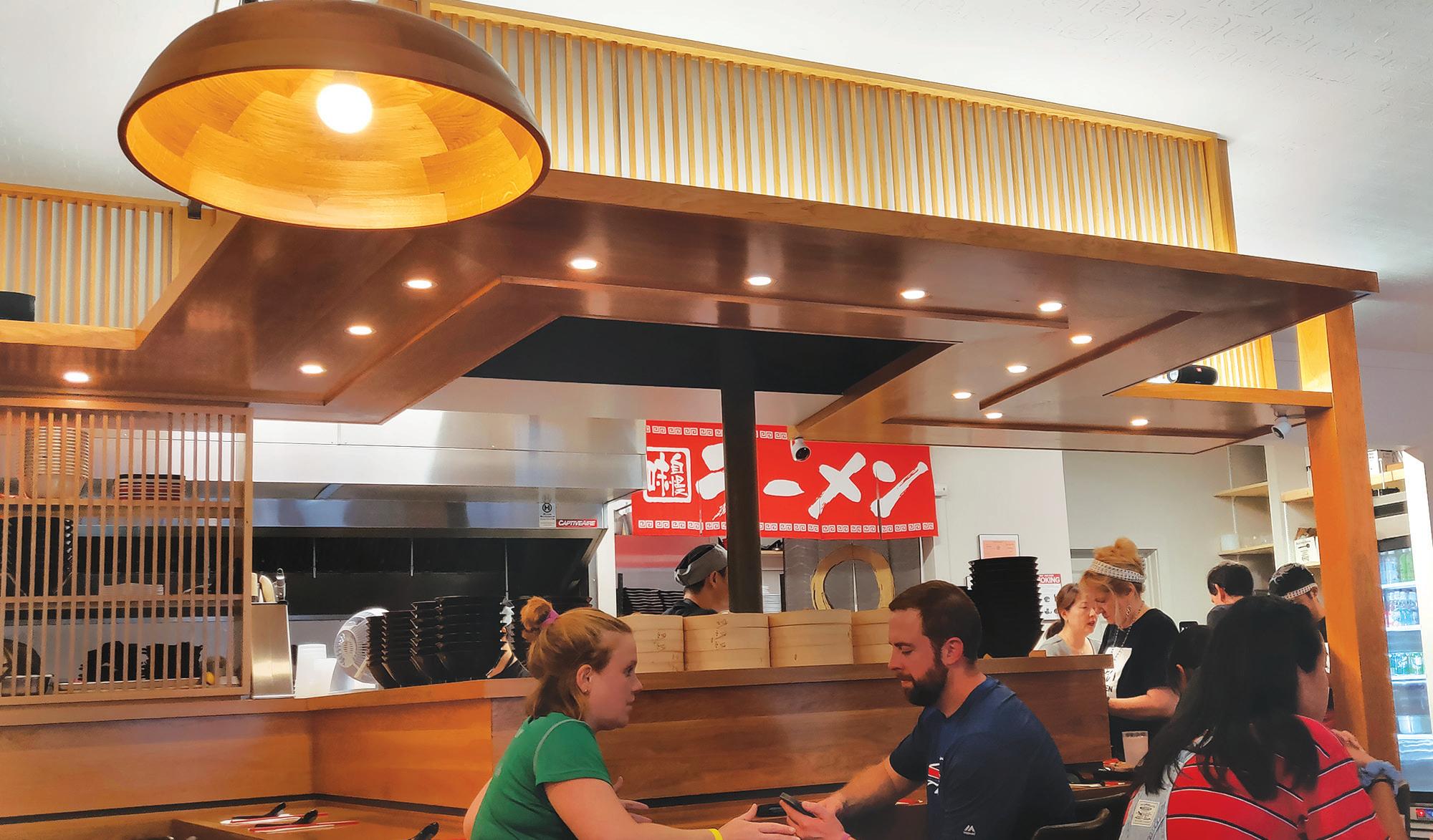
After coming back to Ithaca, I heard of a new ramen-focused restaurant in the Commons. Located about two blocks away from the bus station, Maru Ramen is Ithaca’s latest ramen establishment. While Oishii Bowl’s $9 serving of miso ramen is an affordable, comforting meal I often turn to, I was excited to see a new restaurant focused entirely on ramen. Nevertheless, I refused to let my expectations grow too high. This is Ithaca after all, a small collegetown city which can’t quite compare to the culinary clout of New York City. Did Maru Ramen meet my moderate expectations? Spoiler alert: Not really. With an exposed kitchen surrounded by a wooden bar that customers can sit at (similar to what you’ll find in ramen stalls in Japan), the interior of Maru is sleek and modern. My friends and I were seated immediately at one of the few remaining tables and given menus. The waitstaff were friendly, and the service was quick. We ordered a chick-
“As
en ramen, a spicy Tantan-men ramen and a tonkatsu ramen. Even though we had come during the dinner rush, our food was served within ten minutes.
If you’ve ever seen the Japanese movie Tampopo , you’ll remember the ramen master who artfully describes the ritual he follows when eating ramen, so as to fully appreciate every aspect of it. (If you haven’t seen this movie, please stop reading this and go watch it; it’s easily one of the best food films of all time). I, too, have my own ritual. First, I taste the broth, which I find to be the most important part of any bowl of ramen. If your broth isn’t good, you might as well throw out the whole bowl. Maru’s website boasts that its broth is “slow-prepared” and “home-cooked,” so I was excited to try it.
The first broth I tasted was from the chicken ramen. Unfortunately, it was underwhelming. It didn’t have much depth of flavor, and the flavor of the chicken was barely detectable. The Tantanmen ramen’s broth also uses the chicken broth but adds spicy Tantan dashi. Though the broth was definitely spicy, it lacked the complexities that a rich ramen broth really needs. I was hoping for a deep meaty flavor, but the spiciness overpowered and masked it. The tonkatsu ramen’s pork broth was by far the best one. With a slightly thicker consistency and undertones of ginger, it had a better mouthfeel. It wasn’t mind-blowing but had a much better depth to its flavor than the chicken

The second step of my ritual involves the second most important aspect of ramen — the noodles. There’s nothing worse than having soggy noodles in your bowl of ramen. They should have a thick texture that soaks the flavor of the broth while maintaining their chewiness. Maru’s noodles were surprisingly tasty; they had good body and texture, standing up to the heat of the broth. They were definitely the best part of my meal at Maru.
Finally, I try the rest of the toppings. The signature pork belly chashu was tender, soaking up the flavor of the broth in both the Tantan-men ramen and the tonkatsu ramen quite well. But there was only one small, meager piece of pork in my whole bowl. There also weren’t many vegetables in the bowls either — just a few measly pieces of seaweed, bean sprouts and scallions. On top of all that there was way too much broth. Combined with the fact that there wasn’t enough of everything else, Maru’s ramen failed to reach my moderate expectations.
The Tantan-men ramen cost me about $14 while the two other bowls were closer to $12 each. These prices wouldn’t have



been bad if the ramen had more substance, such as noodles, meat and vegetables. But I felt like I paid 14 bucks for a handful of noodles, one small piece of pork and a whole lot of mediocre broth. I wasn’t satisfied at all. Moreover, since Maru is far from Collegetown, I just don’t see myself making the effort to get down there just for a bowl of subpar ramen. I give this place

two-and-a-half stars.
Serves: Japanese ramen
Vibe: a casual, sit-down restaurant
Price: $$
Overall:





Fill in the empty cells, one number in each, so that each column, row, and region contains the numbers 1-9 exactly once. Each number in the solution therefore occurs only once in each of the three “directions,” hence the “single numbers” implied by the puzzle’s name. (Rules from wikipedia.org/wiki/ Sudoku)











RUSSIA
Continued from page 16
were welcomed by Deputy Chief of Mission Anthony F. Godfrey, a career diplomat and non-political figure.
Godfrey stated that it was the United States’ firm belief that the Russian government and its agents had inappropriately interfered in the 2016 presidential election.
Afterwards, when asked if the boys remembered what Godfrey had said (he spoke for about 15 minutes), they returned mumbles and blank stares, and not one of them recounted any information about geopolitical conflict.
Politics was a decidedly evaded topic of conversation throughout the trip, partly because the elder Chartrand took serious his responsibility of guiding his players and their families through Russia, politics-free. He had been there twice before as a hockey player, and he wanted to ensure that the journey was one of ambassadorship through the love of a sport, not one of walking on eggshells because of diplomatic uncertainty.
“I don’t feel like I’ve felt any
hostility as an American,” he said. “We’re here to play hockey, and if we can bridge the gap between our countries through love of this great game than that will be a success in my eyes.”
Even so, it was hard for anyone plugged into the news to be unaware of what was going on.
As the Capitals were set to face off against a Russian team for their first game, a large picture of Russian president Vladimir Putin playing hockey towered over them on the wall behind center-ice.
At many steps along the journey, the kids enjoyed culturally immersive experiences — a famous cake of Tula, called a pryanik, underneath a statue of Vladmir Lenin, a bowl of the traditional Russian soup borscht in the upper level of a movie theater turned catering hall, a week-long stay at an east-Asian-themed resort in the countryside.
“I was scared [of coming to Russia] at first,” said forward Ben Dalto. “But then you get used to it. You start to like the food, and all the people are so nice to you. I was nervous and excited I guess.”
In the ice rink, the boys were
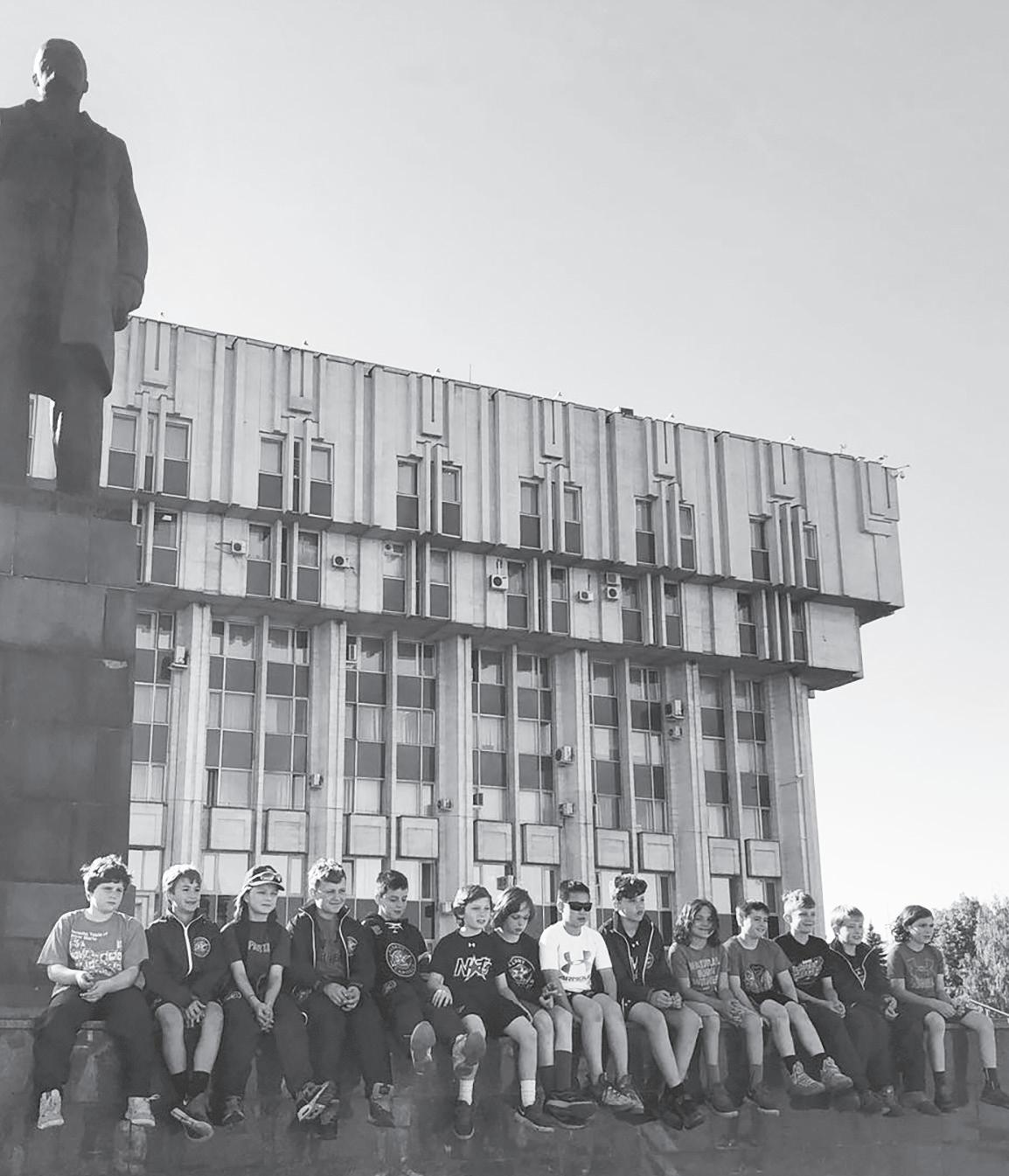

accosted by local school children assigned to root for the American team by their teachers. Novomoskovsk is a small, industrial town, and the folks who live there are not used to Americans. While much of the social conditions were a new experience, the boys took it in stride. The tournament was well-run and well-structured, and the players were treated like “royalty” for much of their time in Russia.
Outside the rink, the boys did their best to explore what the Tula region of Russia had to offer including a trip to the city of Tula and a guided tour of the square there. The trip ended in Moscow, where the team toured the capital and embassy before our late afternoon flight back to New York City. ***
After five days of culture shock for parents and players alike, it was time to return to normalcy. Back in the States, the boys had to gear up for a trip to Kingston, Ontario for a tournament soon after and it was back to business-as-usual summer hockey hysteria.
The flight back saw a light mood, with people gathering near bulkheads to share stories from the trip over wine and beer provided by the in-flight crew. I’m jokingly invited by one of the assistant to join the team in Kingston for another go-around, and everything for the grown ups was slowly
creeping back towards normal, a relief for most of us who were tired of travel — and dying for some American food.
But for the kids, there seemed to be some disappointment about going back. They’re young, but they play hockey at a high level, and they all hope to play in the NHL one day. Their trip to Russia gave them their first glimpse of
what that might be like, and they’re forever grateful to have had the experience.
“We’ll never be able to play like this again,” said defenseman Karter Kenniston of Tupper Lake, New York. “Unless we make the NHL.”
Dylan McDevitt can be reached at dmcdevitt@cornellsun.com.


By ZORA HAHN Sun Staff Writer
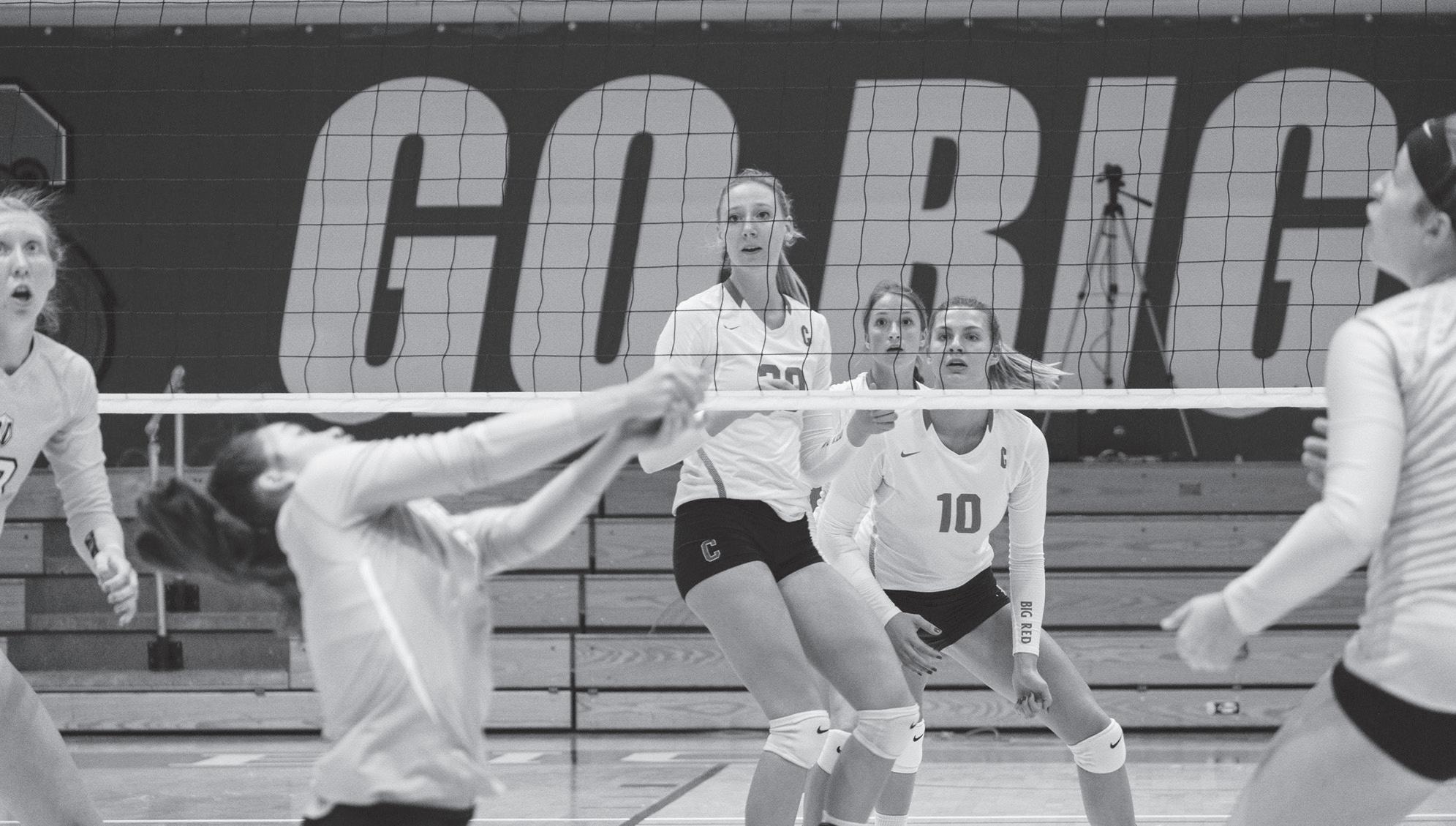
After posting a ho-hum 12-11 record in 2017, Cornell volleyball has its sights set on an Ivy League championship in 2018. To top the conference, the Red will need to vastly improve its performance away from Ithaca.
Sophomore outside hitter Lauren Stubbs said an Ivy League championship is the team’s primary goal. The Red hopes its first step to success this season will come in its season opener on Friday night against Buffalo in the Cornell Invitational.
“Overall, the team is looking to improve our record, especially on the road, with the end goal of winning the Ivy League,” Stubbs said.
Improving its record away from home will be a key focus for the Red — the team had a 9-1 home record and 1-8 road record last season. Four of Cornell’s first five Ivy League matches will be at home this season before a roadheavy October and November.
Head coach Trudy Vande Berg, the reigning Ivy League coach of the year, said the team is focusing on its mindset entering the new season.
“[We] worked a lot in the offseason on working through situations mentally as a team and individually,” Vande Berg said.
Back from injury, senior Carla Sganderlla will play a key role for the Red this season as a leader on and off the court, according to Stubbs. Sganderlla led the team in kills in both her freshman and sophomore seasons, and had the Ivy League’s third-best mark in service aces per set in 2016. She suffered a season-ending injury just two matches into the 2017 season.
“I think Carla will be a predominant leader of the team this year, especially as it is her senior season,” Stubbs said. “The team already looks up to her and relies on her leadership, and I think this will only become more pronounced as we get further into the season.”
Replacing graduating seniors will be a tough task for
Cornell — the team lost some of its most talented players. However, this year’s roster does feature a good deal of upperclassman leadership, as 12 of the team’s 22 athletes are juniors or seniors.
All-Ivy League first team selection Kiley McPeek ’18 and Ivy honorable mention recipient Kit McCarty ’18 are two of the Red’s key offseason losses.
However, six freshmen recently joined the team, adding fresh skills and quickly bringing their talents to Ithaca, Vande Berg said.
“I couldn’t be happier with how the freshmen are playing right now,” Vande Berg said. “They are big and physical so they are adding an entire new dimension to drills and play.”
Vande Berg and her team is excited for the season to get underway.
“We are looking ready to go,” she said. “We had a couple scrimmages this past weekend which was great because we got to look at where we are and can fix [or] adjust this week in practice so they won’t be a weakness against Buffalo on Friday.”
Cornell hosts Buffalo in its season opener at 7 p.m. Friday at Newman Arena. The Red is back in action Sept. 1.
Zora Hahn can be reached at zhahn@cornellsun.com.

By RAPHY GENDLER Sun Assistant Sports Editor
This transcript has been lightly edited for content and clarity.
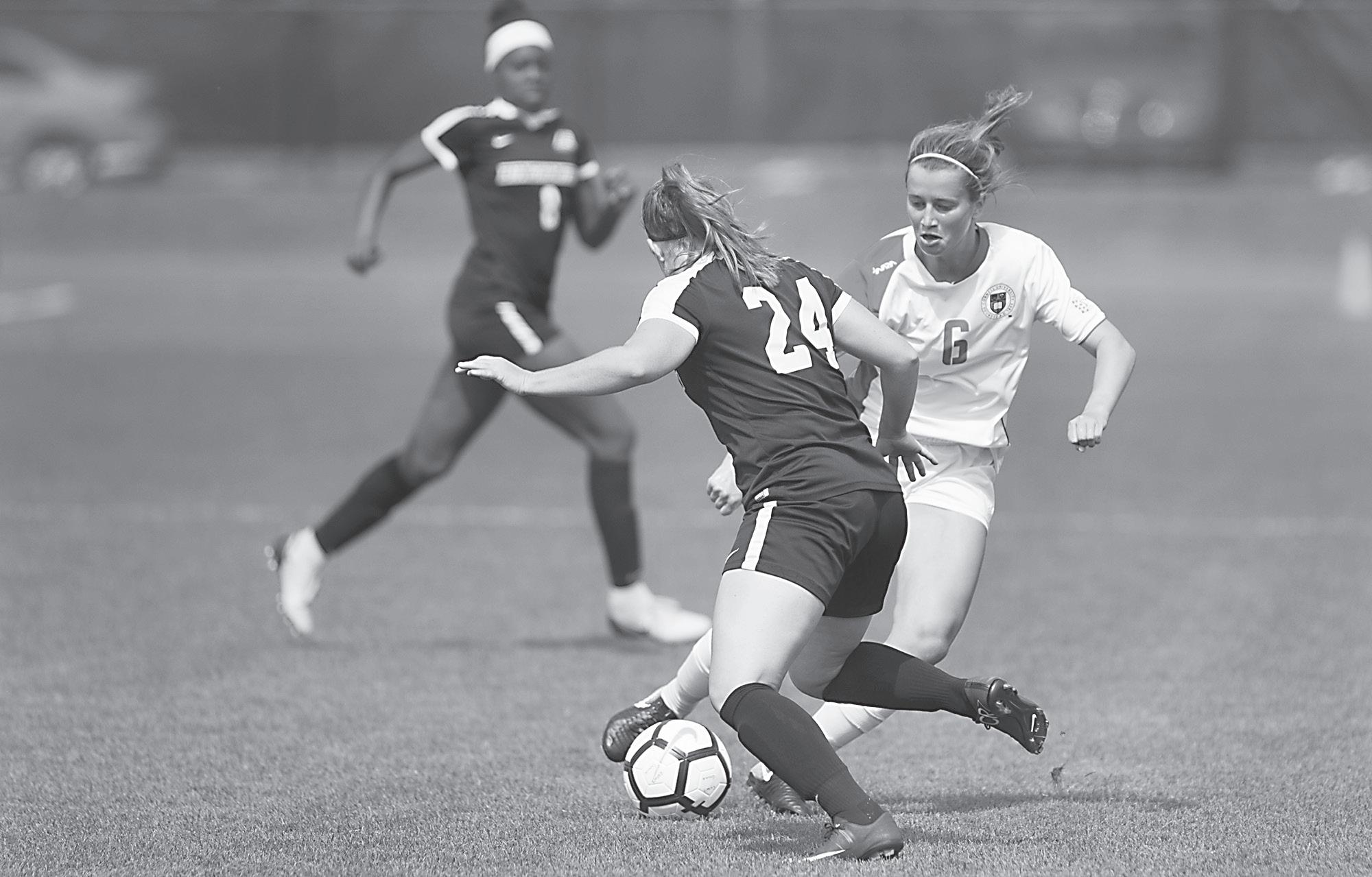
Sun Assistant Sports Editor Raphy Gendler sat down with senior co-captains and best friends Jessica Ritchie and Meghan Kennedy to discuss Cornell women’s soccer and their upcoming season. Ritchie, a midfielder, and Kennedy, a goalkeeper, talked about their growth in three previous seasons, a team “culture change” and their roles as co-captains.
Raphy Gendler: How do you see your roles as co-captains?
Jessica Ritchie: We both pride ourselves on being really hard workers and being incredibly competitive. We both love to compete and hope to keep fostering that culture. I also think we do want to encourage team participation in all senses of that word, so [players aren’t] afraid to speak up, to criticize us if they think that’s what needs to be done.
important.
M.K.: We consult with one another before we make decisions and we’ll take turns doing that. We’re both not afraid to speak out. We’re very open with communication.
R.G.: What types of changes or decisions have you implemented together?
M.K.: Before every game now each player is randomly [assigned] a partner and they write on an index card before the game something nice about the other … It gives you confidence, and for players who are more shy it lets them speak out and say something they wouldn’t otherwise say.
“We talked about different ways to increase the competitiveness of practices.”
Meghan Kennedy: In the past [the team] been pretty hierarchical based on age, and that comes with any college or high school team … We want to blend the classes together and make it less distinct and more fluid so anyone, of any age or position, feels that their voice will be heard and that they can say anything. If a senior isn’t doing what they’re supposed to be doing, a freshman should be able to call them out and say ‘hey, that needs to be better.’
Senior Jessica Ritchie
J.R.: We’ve talked about how to react to certain things happening on the field. Ideally we don’t get scored on that frequently this season but if we do, what do we want to do afterwards in terms of kind of coming together. We talked about different ways to increase the competitiveness of practices and we put a really big emphasis on celebrating when things go well.
R.G.: How do you think you two have grown in your now three-plus years here?
It may still be technically summer, but fall sports are starting up here on East Hill. So why not dive in and start talking about them?
First (and only) on today’s agenda, let’s address the elephant in the room that is Cornell football.
At least for as long as I have been around, the football team has received plenty of flack — including from Sun columnists-turned-sports-editors — for its disappointing results each season. In the last three years, Cornell football has a total record of 8-22, with a marginally better 6-16 Ivy League record.
Cornell football hasn’t put together a winning season since 2005, when the squad went 6-4, and 4-3 in the conference. Back then, current seniors were in third grade and current freshmen were in kindergarten.
To put into perspective, society staples like the iPhone and Twitter did not exist the last time Cornell football had a winning season. Needless to say, a lot has changed since then.
The simple fact that Cornell isn’t a university known for its athletics is an argument one could make, but setting aside its merits for the purposes of our discussion, its conclusion does not absolve the football program of its mediocrity. The football team’s shortcomings are disappointing — even by Cornell standards.
R.G.: What’s your relationship as co-captains like?
M.K.: We’re best friends, I would say. We’ve gotten very close over the years. We’re very similar, on the field especially, in that we have to lead by example, we’re very dedicated people and I think we’re team players.
J.R.: I feel like we complement each other pretty well … Just position-wise, Meg’s a goalie and I’m in the midfield for the most part. Having two voices in two different areas of the field is really
M.K.: I definitely think that I have grown confidence-wise. Going through the years and having the experiences I’ve had on and off the field in a team-like structure like this, I have the confidence to say ‘this is what we’re going to do and this is what we need to do.’ I feel confident that I’m making the right decision, because there’s no other way to gain that confidence other than experience.z
J.R.: Also comfort is a big thing. Any sports team you’re on there’s going to be a huge range of personality and I think soccer … attracts a certain type of outgoing … genuine, authentic type of character, but everyone is really different in terms of personalities … Being able to find your own voice in that chaos … and realizing the value in individuality is
really important.
M.K.: And with that, being able to recognize the role you play: not your position, but your role, so whatever position you play on the field has nothing to do with what role you play. Whatever your team needs of you is something that you learn as you go through the years.
R.G.: Why is it that soccer attracts this ‘genuine’ type of personality?
J.R.: It’s really interesting because I was abroad last semester and I had a very hard time trying to find a team to play with in Spain, actually, because soccer’s not that big for women, surprisingly. And I didn’t join a team for a few months but then with about two months left in my program I was finally able to find one. It was quite far away, but when I ended up playing with them, they were all speaking Spanish … and I was quite quiet at the beginning. But even with that, that type of atmosphere and personality still came across to me, that same authenticity, that genuine, fun atmosphere.
It’s a really physical sport, you’re throwing yourself around at all positions, not just goalie, making crazy tackles. It’s a sport that requires a ton of physicality and I think it’s the sport where the most physical abilities [are needed] in terms of foot skills and the ability to not care if you get hurt, because I think we have one of the highest injury rates of female sports … You need a specific type of person to want to do that … I do think there are underlying traits that make it so, so special.
M.K.: Playing at this level and playing for as many years as we have brings you to a certain level. You’ve sacrificed so much over the years to grow and play this sport: physically, emotionally, socially … There’s a certain level of physicality that’s just different … As a female playing at this level, and at an Ivy League school specifically … the sacrifice is pretty immense. If you dedicate this much time and commitment to the sport then you really are that type of person.
Raphy Gendler can be reached at rgendler@cornellsun.com.
Of the 11 men’s programs that keep a conference record, football has gone the longest stretch without posting a winning season in its conference. That means since the last time Cornell football put forward a successful Ivy League season in 2005, every other men’s program has managed to accomplish that feat at least once.

No one wants to be unfair and go out of their way to criticize Cornell football this year. In fact, the team’s Ivy League record has been trending up since 2015. So if that trend continues this season, perhaps that 3-4 can be flipped to a 4-3 in the Ivy League. Seeing Cornell football carry out a winning season in-conference would undoubtedly bring joy into the hearts of Cornell sports fans everywhere.
A winning season has been a long time coming. But has it been too long? When will this winning season finally occur?
The criticism of the program in recent years is not unfounded. It’s not as if people are ragging on the team for failing to repeat an Ivy League championship. The expectations aren’t that high. It’s pretty reasonable to expect at least one, just one, winning season in a 10-plus year span (and this is coming from a New York Jets fan). It’s not too much for ask for.
This is not to say that the 2018 squad doesn’t have the ability to pull it off a winning season. By no means is anyone counting them out this early — two weeks out from playing their first game.
This isn’t a prediction about the upcoming season. This is simply a forewarning. If the losses pile up as they have in the past, people will not hesitate to criticize the squad. And if they are successful, fans will be more than happy to praise them. But we’ll believe it when we see it.
Jack Kantor can be reached at jkantor@cornellsun.com.
By DYLAN MCDEVITT Sun Sports Editor
MOSCOW — As nine-year-old Hunter Bridges entered Red Square for the first time, he set his eyes on the world-famous St. Basil’s Cathedral. Amidst a crowd of tourists navigating through the plaza, the colorful and curious architecture directed the young boy’s mind to the only other thing with which it can compare.
“When I got here, I thought it was candy for a second,” he said.
The delicate charm of Bridges’ comment aside, it underscores just how unconventional his trip to Russia is. Bridges is the youngest on a hockey team of 14 boys, aged mostly 10 and 11 who, at the time of their arrival in Moscow, have just finished competing at a youth tournament several hours south of the Russian capital. The foreign nature of their journey required a certain kind of leadership for everyone involved — including the parents.
Enter Brad Chartrand ’96, a Cornell alumnus and once-NHL enforcer. The former Los Angeles King leads the charge for the Capitals. Chartrand is a typical head coach: reserved on the surface, but passionate and fiesty underneath. Chartrand is accompanied by his assistant coach Styles Bridges, Hunter’s father, who takes the role of boisterous motivator both on the bench and in the dressing room.
Fan club | Local students in Novomoskovsk cheer on the American delegation.
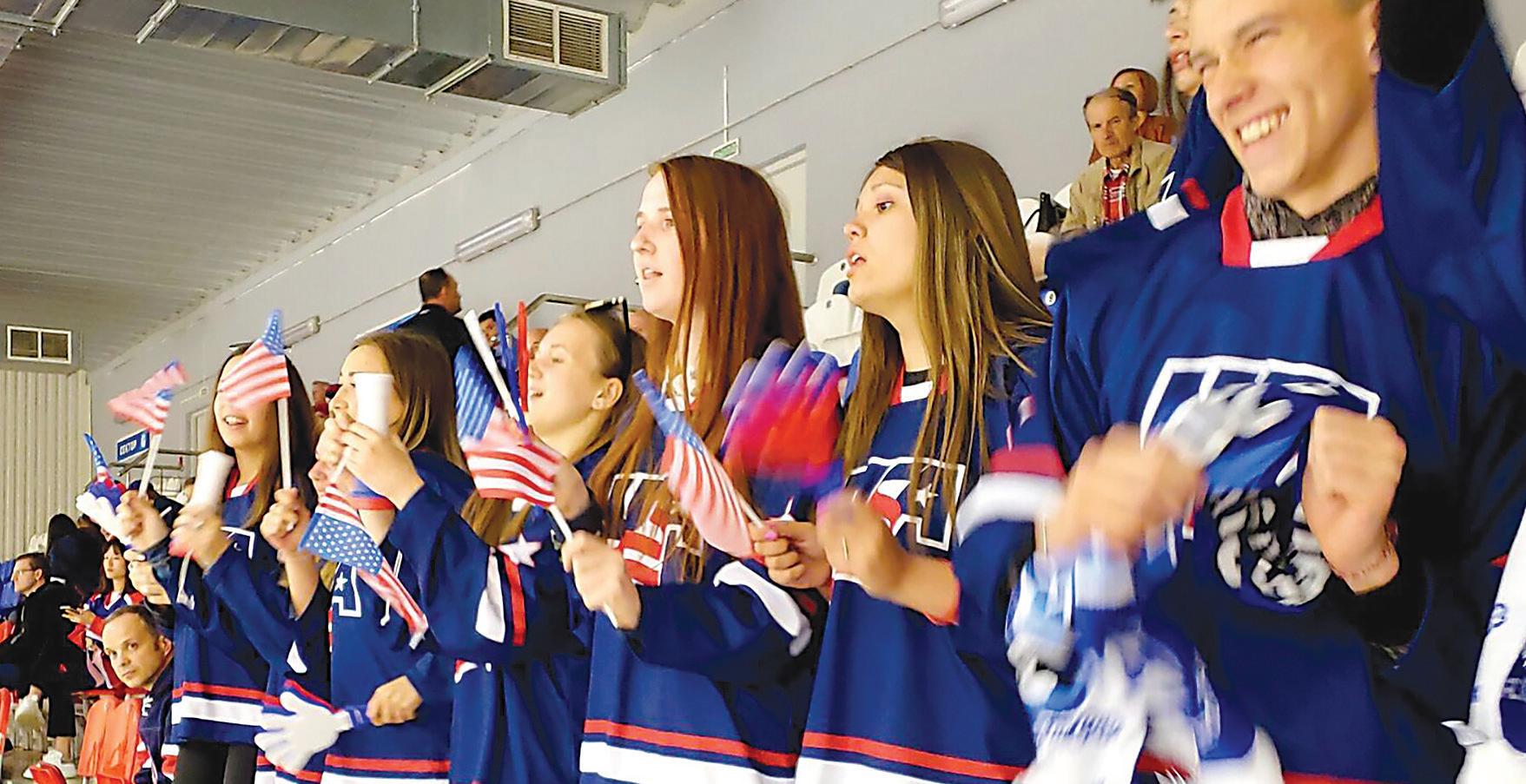
Boarded in two different hotels 30 or 40 minutes apart, the players and their parents were largely separated for much of the trip, leaving the parents, already eager to be a part of their kids’ incredible experiences, antsy and frustrated with the distance imposed upon them.
“I definitely think they were missing me a lot,” said defenseman Nathaniel Poole. “[Being separated] is a lot different than what we’re used to.”
“Traveling to Russia represented a different type of intensity that was new for all of us.”
Brad Chartrand ’96
The Albany Capitals, a group of young hockey players from across Upstate New York were the first American team ever invited to the EuroChem Cup in Novomoskovsk, the de-facto world championships for youth hockey and the only international tournament of its kind. They traveled through the Russian countryside to the Jubilee Ice Palace with their parents and their four coaches.
At the tournament they competed from teams representing eight different countries: Belgium, Switzerland, Lithuania, Finland, Germany, Lithuania, the U.S. and five teams from Russia. The Capitals finished in 10th place out of 12 teams but were certainly the most exotic to the local spectators as the United States.
Despite their relative lack of competitiveness on the ice, the boys and their coaches learned a great deal about hockey and culture, with their families looking on.
For most American boys of the team’s age, a Memorial Day Weekend flight would mean a trip to Disney World or a visit to cousins in California. But for these boys and their families, it represented something far more exciting.
Despite some obvious tension, the players felt that the presence of their families affected their experience and even the way they played — underscoring the importance of having them tag along on the journey. Loud cheers and intense postgame debriefs were part of the routine for the boys and their parents. Their investment in the success of their children was almost militant, and it affected the boys in a real way.
“I know they’re watching,” said forward Jonah Vormwald. “They expect my best.”
Chartrand’s mindset as a coach is derived from his mindset as a father. His son, Liam, who plays on the Capitals, didn’t start playing hockey until much later than his teammates and opponents. Under his father’s direction, Liam has grown into a player who belongs on the ice — and gels with his teammates off it.
traveling to Russia represented a different type of intensity that was new for all of us.”
But Brad is a fierce competitor, and he wasn’t going to let anything distract him from the reason they made this trip: to play hockey.
The opponents consisted of players one or two — in some cases three — years older. Factor in the travel distance of roughly 5,000 miles from upstate New York to Novomoskovsk and the eager young boys faced an uphill battle in terms of their prospects for victory.
The context of the Capitals disadvantage in size, stamina and experience wasn’t lost on anybody. But it represented an opportunity for everyone involved to learn a lesson about how the game of hockey is played around the world and how truly different the conditions are to which the American team had become accustomed.
A pair of five-goal losses in the group stage, 6-1, to one of the four teams from Russia and 7-2 to the Finnish delegation quickly squashed the previously slim chance the Capitals had to play in the tournament bracket. But a banishing to the consolation ladder represented perhaps the perfect opportunity for the boys to make a bid for ninth place.
“We’ll never be able to play like this again. Unless we make the NHL.”
Brad’s challenge is to coach his team, which is accustomed to travelling all around for tournaments. But he must do so while balancing the intensity of the parents and family members who have travelled and expect to share in the novelty and the chal
Defenseman Karter Kenniston
The team’s first chance to celebrate finally came against Belgium. Beaten down twice already and faced with a team that hadn’t yet won a game in the entire history of the EuroChem Cup, the boys in red, white and blue earned a lopsided victory of their own, 6-0. The victory earned them an opportunity to finish ninth. It was as fun as it was well-earned, but the coaches did not shy away from an opportunity to impart a valuable lesson on the team: you can always play better.
That message proved to ring true as the Capitals