C.U.
The Corne¬ Daily Sun
SO PHS TO NORTH
to construct two housing sites on North Campus, adding 1,200 freshmen beds and 800 sophomore beds
By SARAH SKINNER Sun Assistant News Editor
The City of Ithaca released in July the University’s full site plan for the expansion of North Campus housing, including construction and renovation plans for buildings and facilities, as well as changes in on-campus living requirements and potential increases in class size.
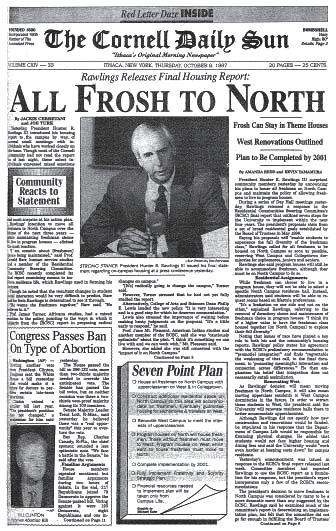
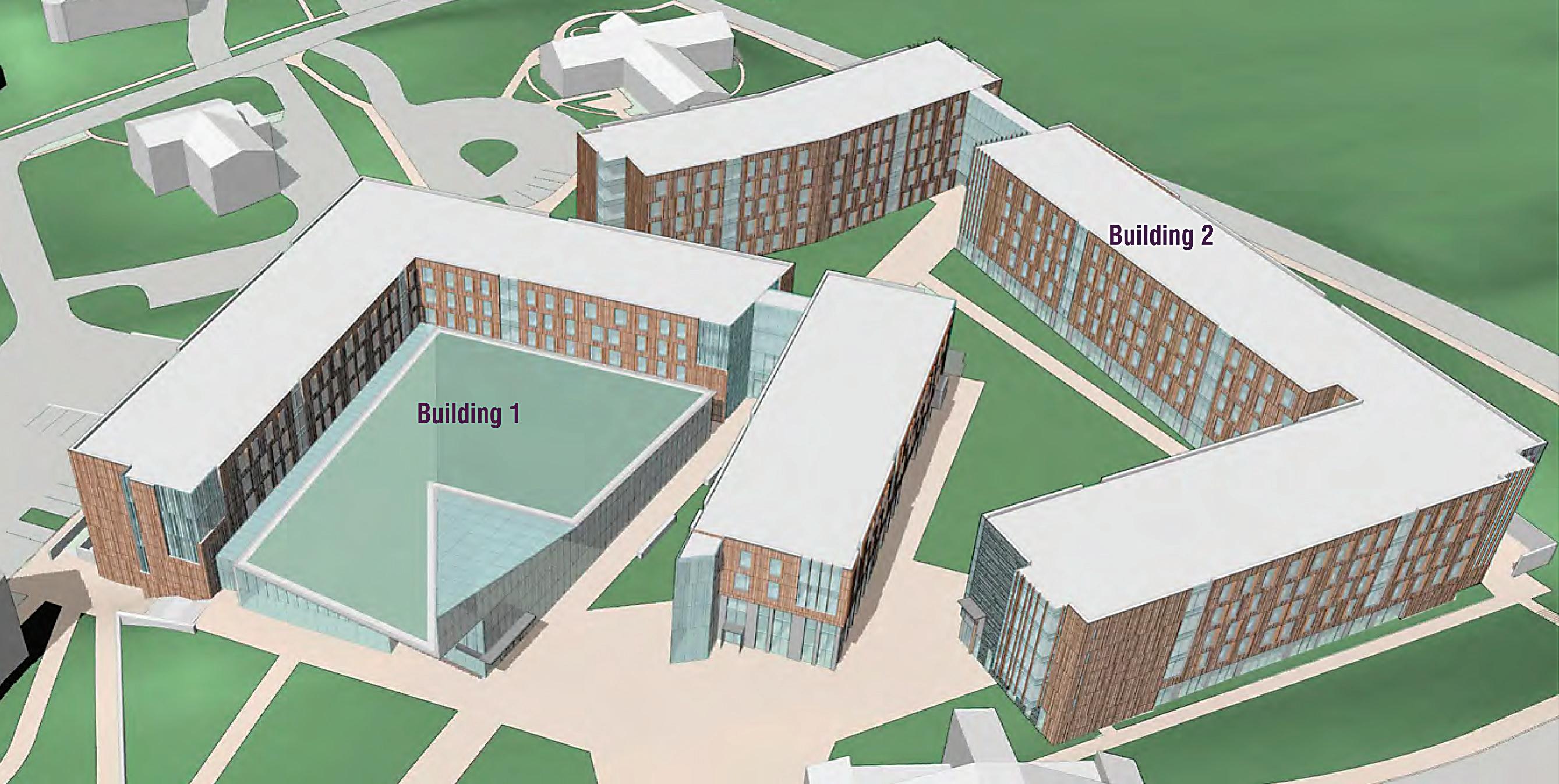
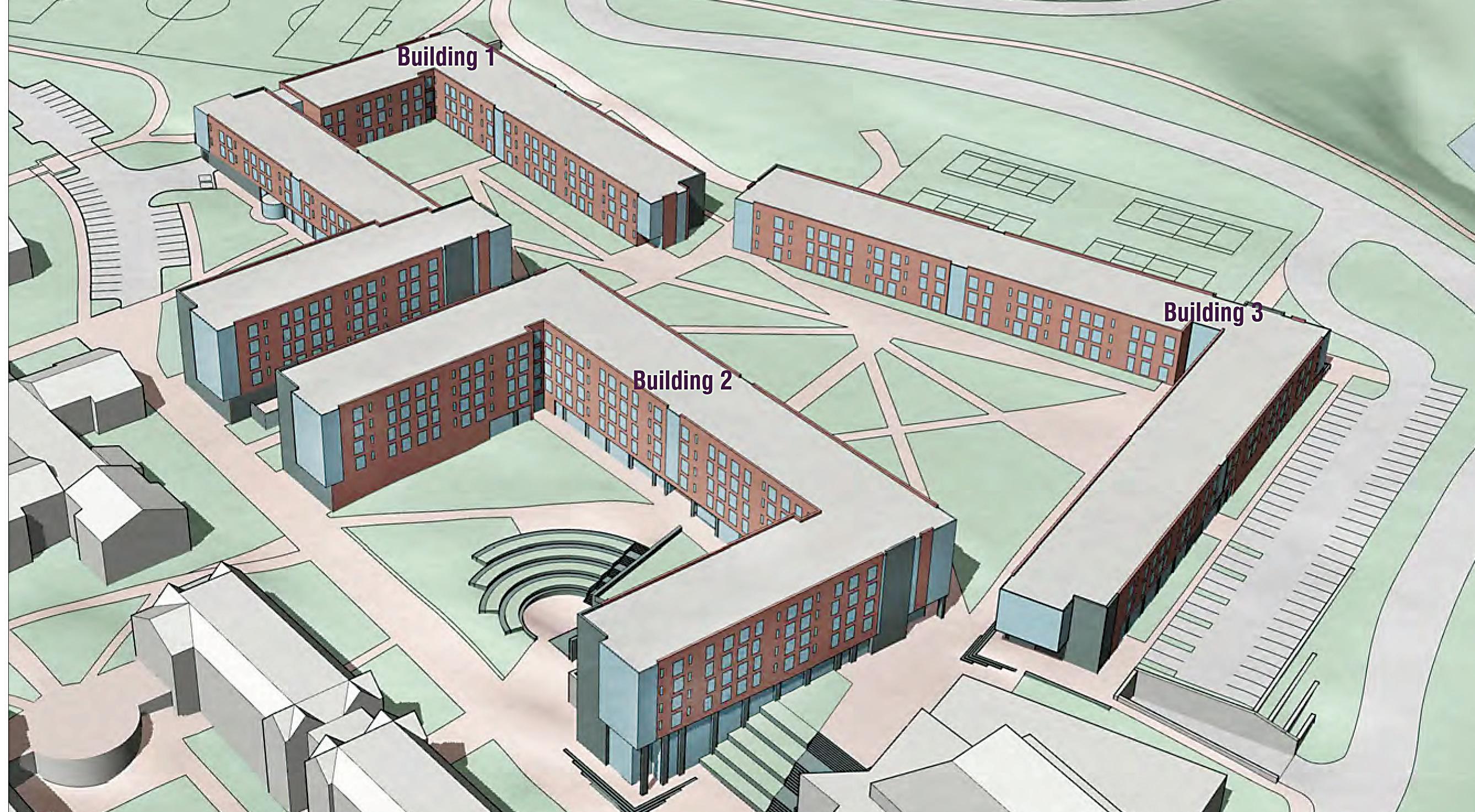
Slated to begin in 2019 and complete in 2022, the North Campus expansion intends to build two new housing sites on the fields north of Appel Commons, which will provide housing to an additional 1,200 freshmen and 800 sophomore students. There will also be 75 new beds for resident advisors, staff and live-in faculty members.
The construction will add to North Campus several new on-campus residential facilities — such as an outdoor amphitheater, cafe, multipurpose field and basketball court — as part of the first-year student housing site. Meanwhile, the sophomore housing areas will include a new fitness center, as well as a new 1,200 seat dining hall that will replace Robert Purcell Marketplace Eatery.
Design elements of the new housing facilities will include “green” open spaces, outdoor plazas, lawns and “groves of large shade trees,” according to the site plan.
The expansion in residential facilities will allow Cornell to house “100 percent of its first-year students in developmentally appropriate campus housing and 100 percent of its sophomores in campus residence halls, co-ops and Greek housing,” the site plan reads. According to a survey conducted in 2016, only 56 percent of student respondents lived on campus.
Beginning Fall 2021, all incoming first-year students will be required to spend two years in univer-
sity-affiliated housing, including on-campus residences, the cooperative houses and Greek residential houses.
First-year housing for all freshmen and sophomores is currently “guaranteed” but not required, according to the University’s housing website.
The expansion plan also includes reassignment of residential halls on North Campus from mostly firstyear students to sophomore students.
Clara Dickson Hall, the largest North Campus residence, and the North Campus townhouses will be used as sophomore housing, according to the site plan. A new facility for sophomores will also be constructed on what is currently the C.C. Lot. In total, 800 sophomore beds will be available on North Campus.

Univ. to Ofer LGBTQ+ Housing in Mews Hall Starting Fall 2019
By YUICHIRO KAKUTANI Sun News Editor
The University agreed to open a LGBTQ+ housing option within Mews Hall on North Campus in Fall 2019.
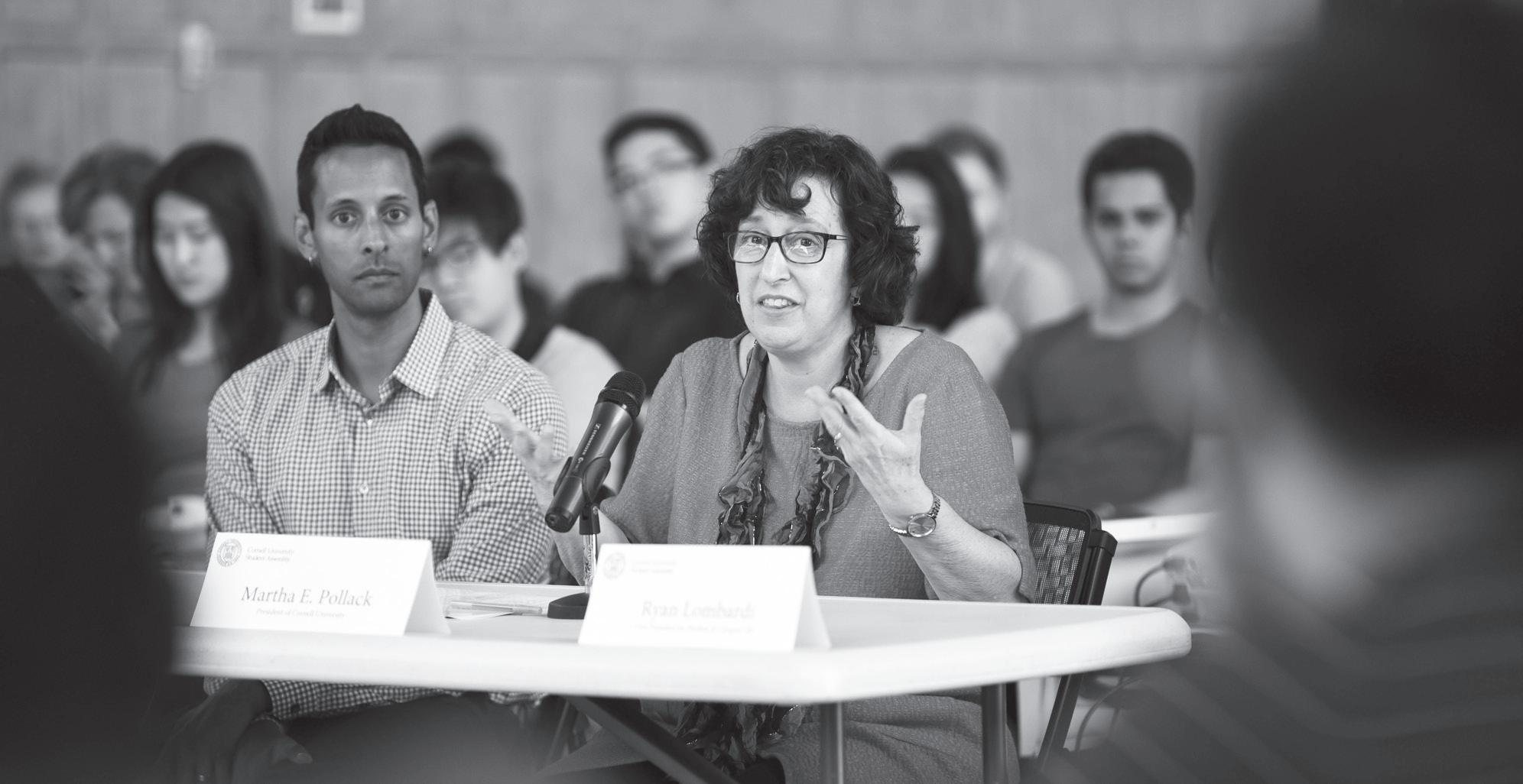
Vice President Ryan Lombardi’s decision, taken on Aug. 2, seconded a student-staffed committee’s recommendation, taking one step closer to fulfilling a 25-year old vision for housing catering to the LGBTQ+ community.
The LGBTQ+ housing option — called the “Loving House” by its advocates in the Student Assembly — will
begin looking for its inaugural residents this fall as the room selection process for the 2019-20 academic year begins. The housing option will cost a programming fee of $30 for in-house residents and $15 for out-of-house members, in addition to the rent cost. That price tag is less than the activity fees charged by all other pro-
gram houses — except for the Language House — which range between $40 and $110.
The committee, convened after
“Queer people still face a lot of discomfort in their living arrangements. I’ve experienced this firsthand.”
Ian Wallace ’20
President Martha Pollack gave a “supportive” response in March to a November S.A. resolution calling for the housing option, met with a group of adminis-
trators late last semester to “submit a proposal detailing some foundational elements of the Loving House,” according to Ian Wallace ’20, S.A. LGBTQ+ liaison at-large. Lombardi affirmatively responded to the proposal earlier this month, according to documents he shared with The Sun.
Specifically, Lombardi accepted the committee’s proposal of converting the “first floor (east side)” of Mews Hall and transforming it into the LGBTQ+ housing space.
IMAGES COURTESY OF CITY OF ITHACA
Newer north | Upper image: A conceptual rendering depicts a corner of one of the proposed new first-year dorms. Lower image: The expansion plan features a new first-year housing site north of Appel (at lower right), and a new sophomore housing site north of Dickson Hall (at upper left). A 1,200 seat dining hall replaces Robert Purcell Marketplace Eatery.
See EXPANSION page 6
Daybook
Tuesday, August 28, 2018
A LISTING OF FREE CAMPUS EVENTS

Today
BEDR Workshop: David Wooten, Marlen Gonzalez, Vicki Bogan, Nicolas Bottan and David Pizarro 11:40 a.m. - 1:10 p.m., 141 Sage Hall
LASSP and AEP Seminar: Nanoscale Dynamics in Quasi-periodic Complex Materials 12:20 - 1:45 p.m., 700 Clark Halll
Dead in the Water: the World Bank’s Model Hydropower Project in Laos 3:30 - 4:30 p.m., G24 Fernow Hall
Food Science Seminar Lactation as a Model
For Discovery in Diet and Health 4 - 5 p.m., 146 Stocking Hall
Association of Veterans Happy Hour 5 - 6 p.m., Big Red Barn
Cornell Tech / Law Colloquium: Bias In, Bias Out 7 p.m., 182 Myron Taylor Hall
Info Session: Exploring Fitness Options 7 p.m., Fitness Center, Helen Newman Hall

John McKim Miller ’20
Wednesday
The Cornell International Fair 11:30 a.m. - 2 p.m., Uris Hall, First Floor Terrace
AASP and A3C Wednesday Lunch Series featuring Brett de Bary Noon - 1 p.m., 429 Rockefeller Hall
Job Market Signaling Through Occupational Licensing Seminar: Peter Blair 1:15 - 2:45 p.m., 102 Mann Library
LEPP Theory Seminar: Jay Hubisz, Syracuse 2 p.m., 401 Physical Sciences Building
Dilmun Hill Work Party 3 - 6 p.m., Dilmun Hill Student Farm
Biophysics Colloquim with Dave Case 4 p.m., 700 Clark Hall
Mathematics Department Fall Reception 4 - 5:30 p.m., Fifth Floor Lounge Malott Hall
Uniting Communities Resource Fair and BBQ 4 - 6 p.m., Arts Quad
Ace your Classes! 4:30 - 5:30 p.m., 3330 Tatkon Center
Veterinary Senior Seminars 4:30 - 5:45 p.m., College of Veterinary Medicine at Cornell University, Lecture Hall 2

Physical fitness at Cornell | Explore fitness options at Cornell at the information session held today at Helen Newman Hall. Pictured above is the fitness center at the Noyes Community Recreation Center.
COURTESY OF CORNELL UNIVERSITY
Students Create 4 Plays and 1 Dance in 24 Hours
‘Nobody knows what’s gonna happen’: Cornellians create and stage a 2-hour show in 1 day
By MATTHEW McGOWEN Sun Senior Editor
After what was by all accounts a frenzied, sleep-deprived and caffeine-fueled period of preparation, participants of Saturday’s Festival 24 pulled off four plays and one dance routine — from creation to presentation — in just 24 hours.
“It’s a super low risk, high reward way to dip your toe into the theatre community.”
Bryan Hagelin ’20
The Department of Performing and Media Arts started Festival 24 — known then as the 24-hour Playfest — in 2011, which included just one play. In 2015, film and dance were added to the mix, according to the producer of this year’s event, Milo Reynolds-Dominguez ’20.
“My role is basically facilitator, organizer, producer. I do have some say in kind of the artistic direction, but it’s more of like a gentle nudge,” Reynolds-Dominguez told The Sun. “We have people who haven’t written before, people who haven’t directed, people who haven’t acted. It’s a super low risk, high reward way to dip your toe into the theatre community.”
Bryan 0 ’20 directed Body of Water, a play written over the course of the night by Audrey Rytting ’20. He had from 6 a.m. to 7:30 p.m. to read the play, cast the actors and run the rehearsals.
“Some [actors] I knew from the PMA department, others are new members or freshmen who I had no experience working with, so it’s been a lot of fun to see the range of experiences,” Hagelin said.
Vanessa Okoyeh ’19, who starred in Body of Water, brought her prior experience in stand-ups and improv to the play. She started performing at 16 years old but still felt stressed under the unusually short time frame.
“It was hectic, it was a kerfuffle of conundrums, but it was one of the most amazing experiences and I encourage every single student to do it at least once in their career,” Okoyeh told The Sun.
the difficult topics, according to ReynoldsDominguez.
“[Festival 24] was hectic, it was a kerfuffle of conundrums, but it was one of the most amazing experiences.”
Vanessa Okoyeh ’19
According to Reynolds-Dominguez, the confluence of so many creative minds at work on such a tight schedule can be quite unpredictable since “nobody knows what’s gonna happen.”
Creators who participated in the program also “chose not to shy away” from
“Some years our festival has a light-hearted, comedic tone, while others address more serious, difficult subjects,” he said in the prelude speech of the program. “This year in particular, our writers, and we as a creative community believe it’s important to form a dialogue with our audiences.”
One of the plays, Under Grandma’s Date Tree, written by Brady Bunkelman ’19, necessitated the content warning, as

Library Portal Connects Cornell With Students From Across the World With Immersive Technology
By LOUISE XIE Sun Staff Writer
Cornellians returning from their summer breaks to the Arts Quad quickly flocked to the newly installed Portal, a shipping container equipped with immersive technology that allows “life-size skype” on campus with someone across the world.
Located outside of Olin Library on the side of the Arts Quad, the gold-painted Portal invites participants to “come face-to-face with someone in a distant Portal … as if in the same room,” according to the contraption’s website. It offers students an opportunity to speak in real-time with “people from many
different backgrounds, experiences, and parts of the world.”
The aim of the Portal, a pilot
“It’s
been up for a few days [...] We’ve already had 500 visitors Most of those are walk-in and mostly students.”
Gerard Beasley
program running from Aug. 23 to early November, is part of Cornell University library’s vision “to bring the world to Cornell,” according to Gerard Beasley, university librarian.
The Portal has been a huge success from the very beginning with
positive reviews. There has been “a lot of feedback because we have a book outside the portal which we invite students or anybody else to write in,”
Beasley said.
“There’s a lot of comments that begin with things like ‘awesome,’ ‘cool.’”
“It’s been up for a few days […] we’ve already had 500 visitors. Most of those are walk-in and mostly students,” Beasley told The Sun.
The Cornell University Library
it touched on sexual consent, harassment and assault in the queer community.
“I believe that [they] reflect unfortunate realities within the queer community,” Bunkelman said in an email to The Sun. “Having been in a somber mood within the ten hours I was writing the play, I turned towards reflection on some personal experience with these.”
The spring semester show is set for Jan. 26 at 7:30 p.m.
Matthew McGowen can be reached at mmcgowen@cornellsun.com.
3 Cornell Undergraduate Veterans Receive National Recognition For Leadership
By MOLLIE CRAMER Sun Staff Writer
Three Cornell undergraduate veterans who have been actively advocating for veterans’ rights and recruitment on campus were accepted into the Leadership Institute of Student Veterans of America, an honor that is extended to only 100 student veterans each year.
The three veteran Cornellians will participate in an exclusive leadership Institute from Sept. 20-23 to take part in trainings on leadership and team building to better understand and advocate for student-veteran issues.
The SVA represents U.S. student veteran communities from over 1,300 schools and more than 500,000 student veterans, according to the non-profit’s website.
Ryan Kokell ’19, one of the three selected students, currently serves as the vice president of the Cornell Undergraduate Veterans Association and chairman of the Ivy League Veterans Council. According to Kokell, he is looking forward to sharing the experience of establishing “from the ground” a veteran organization at Cornell.
Piragash Swargaloganathan ’19, another participant, used to be a medic in the Navy, which inspired him to come to Cornell to prepare for going to medical school.
“I enjoy being in a group of people who have done so much hard work to get where they are, because it’s not an easy transition … for military members who are in college,” Swargaloganathan said. “I’m looking forward to being with students who have this perspective and to learn about them.”
According to Swargaloganathan, the number of undergraduate veterans at Cornell has been rapidly increasing with the current population at about 30 students. The increase is in line with the University’s 2017 commitment to enroll 100 student veterans over the next three years.
With more and more veterans on campus, Swargaloganathan said he hopes to create a community where people can seek help from other members when situations like family issues arise, and where “new veterans that are coming in all feel at home.”
Swargaloganathan also said he would like to leave a better infrastructure at Cornell for future veteran students, as he believes being a nontraditional student should not hinder the achievements of student veterans.
“My biggest challenge is when I say I’m a veteran, sometimes I have been linked to a singular idea of who a veteran
See VETERANS page 5
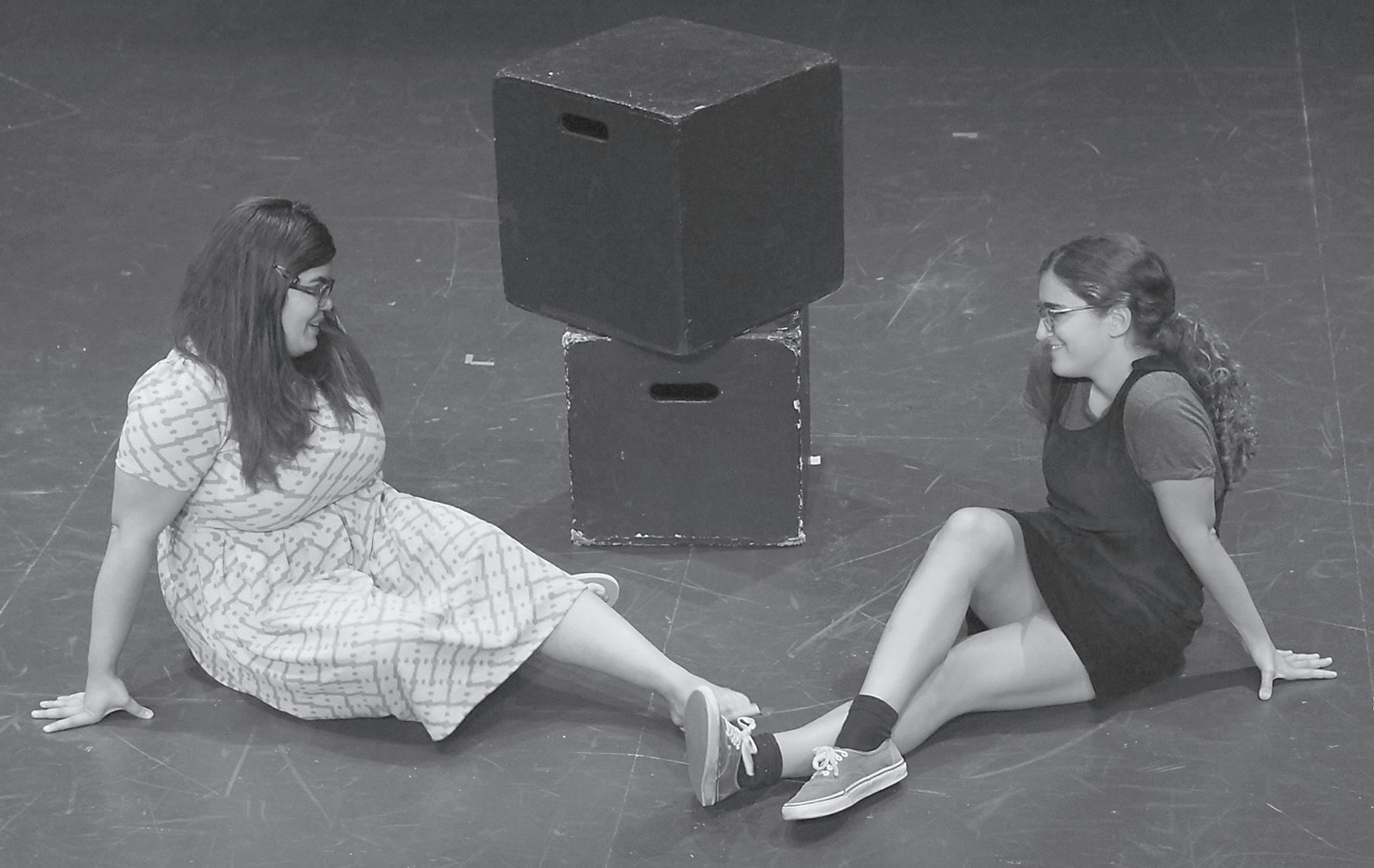
Tackling difficult issues | Two actors in the play “Under Grandma’s Date Tree” portray an instance of sexual coercion in a tension-filled scene.
Gate to the world | The shipping container in the Arts Quad connects Cornell to Tehran, Berlin and more!
COURTESY OF CORNELL UNIVERSITY


Portal at Olin Facilitates
Global Communication
Virtual
PORTAL
Continued from page 3
offers students the option to walk-in or schedule a visit to the Portal. However, Beasley added that students who hope
we should really learn how to communicate across differences [and] that students, the community at large, take advantage of having a portal in Ithaca,” Beasley said.
While students are wel -
“The world actually isn’t that big, we should really learn how to communication across differences ... and take advantage of having a portal in Ithaca.”
Gerard Beasley
to talk with residents of a particular city — like Berlin, Tehran, or Nairobi — should schedule their visits beforehand to increase the likelihood that they will meet students from their desired location.
The Cornell University Library is “committed to making the obvious point that the world actually isn’t that big,
comed to come individually or in groups, the small container starts feeling crowded with five or six people inside, according to Beasley. Attendees should expect a 20-minute stay within the portal.
Louise Xie can be reached at lxie@cornellsun.com.
Veterans Recognized Nationally
VETERANS
Continued from page 3
might be,” Swargaloganathan told The Sun.
According to Kokell, the
“If students don’t have exposure to veterans ... how are we supposed to have any investment in sending other people’s children to war?”
Ryan Kokell ’19
mission of the CUVA, which was originally formed in 2015 to create a cohesive network
LABOR DAY ADVERTISING DEADLINES
The Corne¬ Daily Sun Business Office will close at 12 noon Friday, August 30 and reopen at 9 a.m. on Tuesday, September 4
DISPLAY ADS & CLASSIFIED ADS for the Tuesday September 4 issue of The Sun are DUE ON THURSDAY AUGUST 30 by 3:00 p.m.
Woman Says a Man Recorded Her With a Cell Phone Trough Apartment Window
Suspect is ‘somewhat heavyset’ white male in orange T-shirt; police investigation is ongoing
By ANNE SNABES Sun Assistant News Editor
Cornell University Police and the Ithaca Police Department responded to alleged unlawful surveillance at Westbourne Apartments at 11:12 p.m. on Thursday.
for undergraduate veterans, has changed over the years. Their main focus now is increasing the number of Cornell student veterans, a goal shared by veterans in other top universities that led to the creation of The Ivy League Veterans Council in 2015.
“Through our advocacy, we were able to form a great relationship with Provost [Michael I.] Kotlikoff, whose daughter is one of the first female submariners in the US Navy,” Kokell said, adding that it is also crucial to convince the qualified candidates that they have what it takes to get into Cornell.
“Top universities produce many of our country’s leaders in business and public policy,” Kokell said. “If students don’t have exposure to veterans, if they can’t put a face to the title ‘veteran,’ how are we supposed to have any investment in sending other people’s children to war?”
Adam Klier ’20, another of the three participants, said he is encouraged by the growing number of student veterans at Cornell and around the country, and sees benefits in fostering an understanding of student veterans among the academic community.
“I think that there is a responsibility when you raise your voice — not just to speak out for your own concerns but also to address other people’s concerns,” Klier said. “I think that there’s a lot of wisdom and experience that Cornell veterans have to share.”
Mollie Cramer can be reached at mcramer@cornellsun.com.
Police Officer Jamie Williamson told The Sun on Monday.
“There are no updates at this time.”
According to a crime alert, the victim said an unknown man recorded her with a cell phone through the window of her apartment located on 124 Westbourne Ln.
Officer Jamie Williamson
The victim said the suspect is a “somewhat heavyset” white male who wore an orange T-shirt, according to the alert. The suspect was last observed going in the direction of Wyckoff Road.
“There are no updates at this time,” Ithaca
Westbourne Apartments, where the victim resides, is owned by Kimball Real Estate. According to Kimball’s website, primarily Cornell undergraduate and graduate students live in Westbourne. Benjamin P. Busch, Kimball Real Estate property manager, said they were “deeply disappointed” to hear about the occurrence and are working to find ways to “increase security.”
The police investigation into the incident is ongoing, according to the alert.
Anne Snabes can be reached at asnabes@cornellsun.com.
LGBTQ+ Housing to Open Fall 2019 In
East Side of Mews Hall First Floor
LGBTQ Continued from page 1
The maximum capacity of 122 Edgemoor, the site originally proposed for the “Love House,” is only 22 students. In contrast, Mews Hall, one of the newest residential buildings on campus, has the capacity to house a maximum of 62 students on each floor. However, as the LGBTQ+ housing will be located only the east side of the first floor, it is unclear exactly how many students will have access to the housing option.
“During committee deliberations it was established that Edgemoor is not an accessible building,” Wallace said. “One of the administrators on the committee proposed Mews since it has much more accessible facilities. In the end the committee was pretty united on recommending that the Loving House be located in Mews.”
Lombardi wrote that he accepts the committee’s suggestion that the complex’s
residential hall director and residential advisors “should be closely aligned and familiar with resources available and training necessary to support LGBTQIA+ students.”
He further added that these residential staff should coordinate with the LGBT Resource Center in reviewing residential .applications, creating programming and other matters.
tion of the house and what roles the RA and RD will take,” Wallace wrote in an email to The Sun.
The University shot down two resolutions calling for the establishment of a sim -
“[RHD and R.A.s] should be closely aligned and familiar with resources available and training necessary to support LGBTQIA students.”
Vice President Ryan Lombardi
To meet the goal of opening the house by Fall 2019, Lombardi called for the creation of “an inclusive steering committee” co-chaired by members of the residential programs and the Dean of Students Office, which will be tasked with helping to implement the residence plan over the next academic year.
“The previous committee focused more on logistics and location, whereas the new one will focus more on the func -
ilar housing option catering to gender minorities, 25 years ago, citing concerns that it may negatively affect the campus climate.
“When I found the original [1993] proposal in the archives, I saw how much and how little has changed since the 1990s,” Wallace previously told The Sun. “Queer people still face a lot of discomfort in their living arrangements. I’ve experienced this firsthand.”
Yuichiro Kakutani can be reached at ykakutani@cornellsun.com.
North Campus Expansion to Provide Housing For Additional 1,200 Freshmen, 800 Sophomores
Expansion to increase class size by 900 students
65 percent of West Campus beds currently house sophomores, according to the University’s website. The completion of the North Campus construction will raise Cornell’s on-campus bed count from 8,400 to 10,400, a nearly 24 percent increase according to the site plan.
The expansion of housing will also allow for a 900-student increase in incoming class size, according to the site plan.
Cornell currently anticipates enrollment of around 3,400 new students per year, according to demographic data from the class of 2021.
As part of the renovation and construction plan, deferred maintenance — including upkeep and ADA-compliant renovations — will be performed on Balch Hall, Clara Dickson Hall, Risley Residential College and the West Campus gothics.
The sophomore housing will open in 2021, and the first-year housing will open in 2022.
The lottery system for determining housing will not be altered and the new

housing will simply be added to the lottery pool, The Sun previously reported.
The site plan also includes the demolition of the Cornell-owned Sigma Alpha Mu fraternity house at 10 Sisson Pl., the
C.C. parking lot and the fields above Appel Commons, according to the 250-page site application published on the website of the Ithaca government.
Sigma Alpha Mu brothers have vacated
the house on the University’s dime this semester and moved into temporary housing at 122 McGraw Pl. on West Campus, the prior site of the Sigma Alpha Epsilon fraternity, according to the spring 2018 Sigma Alpha Mu news bulletin.
Sigma Alpha Epsilon was suspended by the University for a period of five years in 2011, after George Desdunes ’13 died in a hazing-related pledge incident, The Sun previously reported. 122 McGraw Pl. reopened as a residential housing facility later that year, The Sun previously reported.
The construction will be overseen by the firms of ikon.5 architects and Trowbridge Wolf Michaels Landscape Architects, LLC. ikon.5 architects were responsible for the construction of Collegetown Terrace and Mews and Court-Kay-Bauer Halls on North Campus, while Trowbridge Wolf Michaels managed the Schwartz Center remodel and are currently working on the
The University will “make maximum use of our skilled and highly valued local labor community” for expansion.
Mary Opperman
construction of apartments at 119-125 College Ave., according to prior reporting by The Sun.
The University recently received pushback from local labor groups over their failure to hire local tradesmen for the construction of the Maplewood Housing area for graduate students, inconveniencing over 100 students slated to move in at the beginning of the fall semester, according to reporting by The Sun.
While ikon.5 is not based in Ithaca, TWLA is. Mary Opperman, vice president and chief human resources officer, previously told The Sun that the University will “make maximum use of our skilled and highly valued local labor community” for the North Campus Expansion Project, as per the University’s standing agreement with the Building & Construction Trades Council.
The land proposed for the new facilities is owned by both the town and city of Ithaca, and the boards of both will be allowed input into the construction process.
ARTS& ENTERTAINMENT Eat Up!
Walking into a dark theater to watch Incredibles 2 this summer, I was excited to watch a highly anticipated sequel to a movie that had been a part of my childhood, not to be emotionally wrecked. When the customary animated Pixar short began, I gasped as the image of a squat Asian woman deftly shaping meat-filled buns on her kitchen counter filled the screen. The familiarity of the motions as well as the hunger-inducing detail of the ingredients brought to mind moments of my own childhood, moments that I hardly expected to be represented in animation before a blockbuster Pixar film. The short film, “Bao,” depicts the complex relationship between a Chinese mother and her son, a steamed bun that suddenly comes alive, from birth to rebellious adolescence.
Directed by Domee Shi, a Canadian-Chinese woman, “Bao” is able to accurately capture bits and pieces of the Chinese-American experience, from a house filled with objects that can be found in every Chinese household to the pain and distance the son inflicts on his mother in his attempts to navigate assimilation. The film quickly progresses from idyllic mother-bun ventures set in a vibrant Chinatown to escalating conflict, as the son rejects his mother for soccer, beer and, eventually, the ultimate betrayal, a white woman. The story culminates when the mother, faced with her bun-son leaving home permanently, decides to eat him.
As she plopped him into her mouth, and chewed, eyes
onset of loneliness after a child leaves home. As my friends and I have gotten older, I’ve seen many different forms of “empty nest syndrome,” manifesting in actions that vary from flurries of texts to their children to increased spending on gadgets for the house. In “Bao,” how-

ever, Shi digs deeper, mulling over the underlying tradition of filial duty that is often at odds with Western culture and that, in turn, leaves children of immigrants at odds with their parents, sometimes fostering guilt and resentment. Shi presses into this theme and shows the possibility of reconciliation, as mother and human-son (of whom the bun was representative) eat sweet buns together after they overcome their differences.
I left the theater optimistic, having resonated with the short film, and enthusiastic that a story about the Chinese-American experience had been shared on such a large platform. However, when I scrolled through the ol’ volatile Twitter-feed, I was not surprised to find that there was a whole contingent of mostly non-Asian-Americans that had missed the analogy and were upset, confused or being downright mean about what they perceived as a cannibalistic scene. Disappointed, I was reminded of Frank Chin’s play, The Year of the Dragon. In the play, Fred Eng, a second-generation
There was something about this violent and visceral act that made complete sense to me.
closed in defiance, the theater erupted with laughter, scoffs of disbelief and audible “What?”s. While everyone in the audience around me was dealing with their initial discomfort or shock differently, I slowly realized that I was uncontrollably crying. I’m talking full snotty, noisy waterworks — in summary, pretty disgusting. Despite appearing visibly upset, I was overjoyed. There was something about this violent and visceral act that made complete sense to me, as if the only way for the mother to grasp the situation was to consume and contain an emotion that could not be communicated through words.
The short film was billed as a story of a mother suffering from “empty nest syndrome,” or the
Chinese tour guide, cynically proclaims to his tour, “Food is our only common language.”
The food to which he refers is the delicious Western simplification of Chinese food, a rich culinary culture reduced to popular dishes with sweet and sour names like Kung Pao and General Tso’s. According to Fred, this type of Chinese food, simplified and made palatable to Western tastebuds is the only part of “Chinese” that the American visitors are willing to engage with, unwilling to look beyond what is caricature of their own creation.
Unlike the Chinese food described by Fred, the food depicted in Shi’s Bao is complex and intimate. The animation of the food evokes the preci-
sion and emotion of food scenes characteristic of Studio Ghibli films and the gleaming, mouthwatering quality of fellow Pixar film Ratatouille. But the animation goes even further, conveying the conviviality of making dumplings with family friends on special occasions and the nostalgia of picking the choicest fresh baked breads from the Taiwanese bakery with your grandparents. In “Bao,” Shi uses food as a vessel through which the mother can communicate what she cannot say to her son — a vessel for love, for apology and for reconnection. While the storytelling in “Bao” is particularly resonant with a certain demographic, it still draws upon overarching themes of family, love and loss that are relatable to all audiences.
Maybe “Bao” was too different, too difficult, too confusing for the Western audience. It is in this space of unknowing, however, that lies its ingenuity, its ability to present a truth

COURTESY
A mother embraces her dumpling-son in “Bao ”
— someone’s truth, but not everyone’s truth — unapologetically, without an obligation for explanation. As storytellers with diverse backgrounds begin to spin their deeply personal yarns on larger platforms, I look forward to the unique and the hard to swallow. In these stories, there are differences to be cel-
ebrated and reflections of ourselves and seeds of sameness to be found in each other.
Isabel Ling is a senior in the College of Art, Architecture and Planning. She can be reached at igl3@cornell.edu. Linguistics will run on alternate Mondays this semester.

Linguistics
OF WALT DISNEY STUDIOS
The Corne¬ Daily Sun
136th Editorial Board
JACOB S. KARASIK RUBASHKIN ’19 Editor in Chief
JOHN McKIM MILLER ’20
Business Manager
KATIE SIMS ’20
Associate Editor
VARUN IYENGAR ’21
Web Editor
MEGAN ROCHE ’19
Projects Editor
EMMA WILLIAMS ’19
Design Editor
JEREMIAH KIM ’19
Blogs Editor
AMOL RAJESH ’20
Science Editor
BREANNE FLEER ’20
News Editor
YUICHIRO KAKUTANI ’19
News Editor
NICHOLAS BOGEL-BURROUGHS ’19
City Editor
LEV AKABAS ’19
Arts & Entertainment Editor
SARAH SKINNER ’21
Assistant News Editor
ANNE SNABES ’19
Assistant News Editor
JOHNATHAN STIMPSON ’21
Assistant Sports Editor
EDEM DZODZOMENYO ’20
Assistant Photography Editor
PETER BUONANNO ’21
Assistant Arts & Entertainment Editor
CHENAB KHAKH ’20
Assistant Science Editor
JULIAN ROBISON ’20
Layout Editor
HELEN HU ’21
Graphics Editor
DUSTIN LIU ’19
Human Resources Manager
ANNA DELWICHE ’19
Senior Editor
GIRISHA ARORA ’20
Managing Editor
HEIDI MYUNG ’19
Advertising Manager
ALISHA GUPTA ’20
Assistant Managing Editor
DYLAN McDEVITT ’19
Sports Editor
MICHAEL LI ’20
Photography Editor
GRIFFIN SMITH-NICHOLS ’19 Blogs Editor
JACQUELINE QUACH ’19
Dining Editor
SHRUTI JUNEJA ’20
News Editor
ANU SUBRAMANIAM ’20
News Editor
JUSTIN J. PARK ’19
Multimedia Editor
PARIS GHAZI ’21
Assistant News Editor
MEREDITH LIU ’20
Assistant News Editor
JACK KANTOR ’19
Assistant Sports Editor
RAPHY GENDLER ’21
Assistant Sports Editor
BORIS TSANG ’21
Assistant Photography Editor
VIRI GARCIA ’20
Assistant Arts & Entertainment Editor
CATHERINE HORNG ’21
Assistant Dining Editor
LIZ CANTLEBARY ’21
Snapchat Editor
ALICIA WANG ’21
Sketch Editor
JOSH GIRSKY ’19 Senior Editor
ZACHARY SILVER ’19 Senior Editor
MATTHEW McGOWEN ’19 Senior Editor
Working on Today’s Sun
Ad Layout Josh Girsky ’19
Design Deskers Julian Robison ’20
Catherine Horng ’21
Carolyn Shi ’19
News Deskers Yuichiro Kakutani ’19
Meredith Liu ’20
Night Desker Amina Kilpatrick ’21
Arts Desker Lev Akabas ’19
Sports Desker Raphy Gendler ’21
Photography Desker Boris Tsang ’21
Production Deskers Sarah Skinner ’21
Katie Reis ’20
Letter to the Editor
Re: ‘Unintended Consequences of Impeachment’
To the Editor:
Mr. Chang’s Aug. 27 column is misplaced and dangerous. It uses the same types of weasel word strategies employed by Fox News to normalize the outlandish, treasonous and unprecedented administration that is currently governing the Republic. He links to a memo written by the Justice Department and claims the DOJ has “ruled” that the President is immune from criminal prosecution — in what amounts to such a simplification that it is effectively a prevarication. A memo written by the DOJ has no legal weight. Actual legal reasoning implies that the President is not immune from suit. Both Clinton v. Jones (president not immune to civil suit based on conduct that occurred before he was president), and US v. Nixon (President can be subpoenaed for documents and tapes) demonstrate that — as Chief Justice Berger wrote in the latter, the President is not above the law.
The memos do not suggest that the President is constitutionally immune to prosecution — in fact, they go through great lengths to point out that the President is likely not Constitutionally immune from suit. Suppose the President punched a protestor in the face on a rope line, would he be immune from prosecution for battery? What if there was a video of him being bribed? The memo’s arguments use vague reasoning that the President’s duties are “unique” — the legal equivalent of “because we said so.” Any court called to rule on the point will afford this reasoning the same consideration they would Mr. Chang’s article.
What was the purpose of this article? Mr. Chang seems to suggest that impeachment is an illegitimate process — what the hell are they teaching in the Government department these days? Mr. Trump is unfit for office and has likely committed crimes — for which, like every other American, he can, should and will pay the price.
Daniel D. Dauplaise ’07
Ethan
Wu | Discourse and Discord
Tracy Mitrano’s Sweet Nothings
Most Cornellians graduate in four years. Tom Reed (R-NY), who represents New York’s 23rd district (including Ithaca), has been in office for twice that. But you wouldn’t know from the jeering Ithacans filling his town halls. Suffice it to say readers of The Cornell Daily Sun are far from Reed’s core constituency.
And yet Cornell, as with Ithaca at large, is a blue speck amid a red sea. Reed won by a hefty 15-point margin in the last election. Politicos wager he will snatch yet another victory.
Swept into office by the Tea Party
education, foreign policy and the environment. Mitrano wants interest-free college loans, the benefits of which are dubious. Zero-interest loans offer students only marginal benefits; the monthly payment on a 10-year, $25,000 student loan drops $60 when current rates are zeroed out (in my calculations). But the public cost is far greater, since this small benefit is spread among millions of debtors. What Mitrano hopes to achieve is unclear.
The items lining Mitrano’s agenda are Democratic standard fare. They are also worryingly imprecise.
wave of small-government conservatism, Reed likes to cast himself as dependably level-headed. His record is anything but. He wants to force rich universities, including Cornell, to spend endowment money on lowering tuition costs — a well-intentioned idea that ignores the realities of earmarked donations. He backs Donald Trump’s self-destructive tariffs, hurting the farmers Reed professes to support. Reed holds forth America’s eye-popping debt burden as its biggest problem, even voting for a (purely symbolic) measure to effectively block debt-financed government spending. But he voted, and continues to advocate, for the Republicans’ recent tax overhaul, which jacks up the budget deficit.
America needs fiscal reformers. Wide deficits edge out private investment, leaving everybody worse off. Running up the debt, and thus debt interest, weighs on government coffers. But Reed is a paper tiger, embracing only the trappings of a budget-conscious conservative. He is emblematic of the intellectual rot among modern fiscal conservatives — many of whom trampled old principles of balanced budgets to back a flawed tax bill.
One would hope, then, that Reed’s competitor in this November’s House race would be principled and policy-fluent. Regrettably, Tracy Mitrano J.D. ’95, a Cornell alumna who eked out a win in the June Democratic primary, is wishy-washy and too often vague.
The items lining Mitrano’s agenda are Democratic standard fare. They are also worryingly imprecise. She wants “universal health care through a single-payer system.” But does that mean nationalizing the health insurance industry à la Bernie Sanders? Or does it mean an increased, but not all-encompassing, role for government in shouldering health care costs? Even putting the nature of Mitrano’s single-payer plan aside, she gives no indication of how it would be financed.
As with health care, so too with
Mitrano’s foreign policy platform is trite. Take her position on North Korea: “The U.S. should negotiate with North Korea to reduce tensions.” That’s a punt. Few think America shouldn’t negotiate. The real debate is over our broader strategy — whether we should pursue regime change, or simply deter and contain. On the environment, Mitrano would have America rejoin the 2016 Paris Climate Accords. But the Paris agreement was non-binding. The meat of the matter is how to reach the emissions-reduction goals set forth in Paris. Mitrano offers no opinion on punitively regulating coal-fired power plants, as Obama’s Clean Power Plan would have.
Mitrano, if she hopes to beat Reed, must be bolder. She rightly assails Reed for his limp convictions and expedient politics. Yet that criticism will ring hollow if Mitrano herself relies on policy platitudes. A ReedMitrano debate, as Mitrano is seeking, would be awfully lopsided were Reed able to tar her as amateurish or starry-eyed.
Fleshing out her policy platform would be a good start. Cooking up some white papers would substantiate Mitrano’s talking points. Crucially, she should avoid any association with Sanders’ ambitious plan for nationalized health insurance, which he calls Medicare for All. In this hardscrabble red district, Medicare for All is an all-around political loser. Mitrano must walk a careful line straight down the center aisle, splotching Reed as a sell-out incumbent but shunning left-liberal politics. She must appear pragmatic, competent and moderate, remembering that she will need Republican votes to turn the district blue.
Though my views are to Mitrano’s right, I cheer her campaign, if only to see Reed out the door. It will be an uphill battle, but nonetheless a worthy one. Reed has held the NY-23 seat for the greater part of a decade. But American politics is cyclical. Representative Mitrano might not be so far-fetched after all.
Disclosure: Mitrano served on The Cornell Daily Sun’s senior board of directors until 2013. She currently plays no role at the paper.
Ethan Wu is a sophomore in the College of Arts and Sciences. Discourse and Discord runs every other Tuesday this semester. He can be reached at ewu@ cornellsun.com.
Clare McLeod | Guest Room
Let D.C. (Yes, D.C.) Vote
Growing up just outside of Washington, D.C., I had ample interaction with the federal government. My dad worked for a government contractor, the parents and neighbors of friends were government employees and officials of all levels of importance and, most importantly, the daily mass migration of federal workers from their jobs often left me stuck on gridlocked roads between about 4:30 and 7:00 p.m. To this day, when I meet somebody from outside the area I grew up in, I introduce myself as being from D.C., because it often feels like I am just as much a part of what happens in D.C. as are those who actually live there.
Principle is and always should be the main reason to give D.C. voting representation in Congress.
In every way but one, this is categorically false; the speed with which I take back this claim when I mistakenly make it to an actual resident of the District is evidence enough of that. And yet, I, along with every other resident of Virginia, Maryland and the other 48 states in the union, have one thing that those who live in the capital do not: representation in the government that sits there. Residents of D.C. have no voting representation in Congress, despite taking in those which the rest of the country seems to collectively loathe and then having to be under more direct control of those 535 people than any other municipality. After 228 years, it’s time for that to change
If you ignore the fact that D.C. residents pay federal taxes and fight in wars, and yet still get no representation, their disenfranchisement can seem, for a second, less consequential. Although the federal government handles a portfolio of tasks as immense as it is diverse, much of the governing that affects people’s day-today lives takes place at the local level. Therefore, D.C.’s lack of federal representation might seem just a little more palatable. That is, until you learn about the control that Congress has over D.C.’s budget and local laws. Due to the fact that the Constitution gives Congress the exclusive power to legislate over D.C., D.C. is treated like an agency of the federal government, in that the budget that the local government decides on must then be approved as part of the federal budget process. Furthermore, even on local laws that are passed by D.C.’s city council and the mayor, Congress can keep the law from taking effect if it rejects it within thirty days of its passage.
And although this latter stipulation hasn’t been utilized by Congress in the past quarter century, that doesn’t mean that D.C. has not experienced real consequences from the congressional interference it faces. Beginning in 1998, the District was not allowed by Congress to use local tax dollars for a needle-sharing program aimed at preventing the spread of HIV.
When that ban was ended, and the needle-sharing program began in 2008, a total of 120 transmissions were prevented over the next two years, according to a study from George Washington University, saving taxpayers over forty million dollars in treatment costs the city would likely have borne. Just a few years after the end of that ban on needle-sharing funding, a ban on using local funds for abortion was also used as a bargaining chip, as President Obama gave it to Republicans during federal budget negotiations in order to get other women’s health funding. After the district overwhelmingly voted for a ballot initiative to legalize marijuana in 2014, Congress didn’t reject the decision entirely, but instead prevented district officials from using local money to regulate marijuana. Ignoring the will of local residents, Congress prevented the city whose public infrastructure they use all the time from regulating a new industry that could have given them more badly-needed tax dollars to help fix that same infrastructure.
Beyond the policy implications though, I think that principle is and always should be the main reason to give D.C. voting representation in Congress. Although giving the federal government a permanent seat of power outside of any state may have been why the District was created, it takes not a ten-minute walk to get from the Capitol building to neighborhoods that may be able to see the dome, but may as well be outside of the United States in terms of their ability to influence what happens inside of it. And even though this will ultimately be a political decision, let us talk about those politics frankly. The Senate currently has a bias towards more rural states with older, whiter, and, most significantly, smaller populations that will only be exacerbated in years to come. If anything, this problem of structural political inequity should be fixed by adding more states to the Union; Puerto Rico, Guam and other federal territories that don’t even currently have a say in presidential elections also have compelling
OBe Curious, Stay Eager
rientation week at Cornell is always fun. It can be FUN. “FUN.” Funnnnnn. Or just fun, which comes out sounding a lot closer to, “fine,” than “fun.” This year, however, was the most FUN.
As a junior, two orientation weeks have come and gone for me. In the past, the first week on campus has landed solidly in the “fun” realm, bordering on being simply “fine.” This year, however, I was heartened, inspired and enlivened. It was FUN.
genuine conversation. He could be talking up his fancy “return offer,” or, worse yet, complaining about the lack thereof. He could be whining, moaning, groaning — you know — common symptoms of early onset senioritis.
But he wasn’t.
Orientation week at Cornell is always fun. It can be FUN. “FUN.” Funnnnnn. Or just fun.
It began the first morning I got back to campus. I met with a friend to prepare for an upcoming training. I’ve known said friend, and co-worker, for two years now — a relatively constant face throughout my Cornell experience. He has grown, glown and generally been an incredible person to talk to, learn from and laugh with.
Whilst preparing for our upcoming training session, we discussed which icebreaker to add to our slide deck. For those of you who don’t know, an “icebreaker” is that one question that everyone must answer in a room to get to know one another. Forced bonding, so to say.
It’s easily overdone and rarely done well.
If anything, he was emulating the curiosity and eagerness of the freshmen.
I’d know — I live a stone’s throw away from them on North Campus, and have since sophomore year. Oh, the freshmen, how I love you. I especially love you during orientation week. You’re eager. You’re curious. You’re willing to try new things and meet new people. You come back to North past 1 a.m. with friends you just met, both those who you may never see again as well as those who may end up being part of your wedding party. You dial it back the night before classes start, but you start right back up on Friday night. You’re having FUN, in whatever way that means to you — whether it be going out or staying in, studying hard or sleeping in. You’re living and transitioning and exploring and smiling (for the most part). You’re not complaining; you’re curious. You’re not exhausted; you’re eager.
arguments for statehood that would help to make more equitable a mal-apportioned body that is on track to have nearly 70 percent of the Senate representing only about thirty percent of the population.
Politics aside, though, 136 years after Abraham Lincoln signed a law that freed D.C.’s slaves nine months before in the rest of the country, it is time for both parties in Congress, including the one which Lincoln started and which claims his legacy, to give D.C. representation. Long the national stage itself, D.C. deserves a voice on it.
is a sophomore in the College of Arts and Sciences. Setting The Temperature runs every other Tuesday this semester. He can be reached at gvaldetaro@cornellsun.com
Long the national stage itself, D.C. deserves a voice on it. WANT TO WEIGH IN?
Today, it was exceptional. “I really just want to know what people are looking forward to this year.” No “If you could do this, that, or the other thing…” None of the “If you could live anywhere…” or “What ice cream flavor would you be if you were a pint of ice cream stranded on a desert island with your arch nemesis? And why?” It was genuine. It was glorious. So I asked, “What are you looking forward to?”
You’re not complaining; you’re curious. You’re not exhausted; you’re eager.
So as this semester starts, I aspire to emulate these characteristics. My senior friend, role model and colleague showed me it’s possible, even as an upperclassmen. The freshmen’s energy reminds me to show up each and every day with that same spirit.
Thoughtfully, he responded: “Meeting new people and trying new things. I feel like as a senior, it’s my last chance to really get out there and make the most of my Cornell experience.”
How freaking refreshing. And what a way to start a FUN semester.
Here’s a senior. He could be burnt out. He could complain about his last year at “Cornhell” as if it’s some burden he’s had to slog through. He could be talking about the generic wines class he can’t wait to take, avoiding an attempt at a
So let’s not get hung up on the freshmen’s record low admittance rate or the businesses they started and rodeos they’ve won. Let’s get hung up how they see things. Let’s get hung up on the newbie approach to this blessing of an education and experience that we’ve both been given and chosen. Let’s continue that into sophomore, junior, heck — even senior year.
For a day, let’s look at the world like a fresh man or a fresh woman or a fresh person, however you may choose to identify. Be curious, stay eager.
Clare McLeod is a junior in the School of Industrial and Labor Relations. Guest Room runs periodically this semester. Comments may be sent to opinion@cornellsun.com
Giancarlo Valdetaro
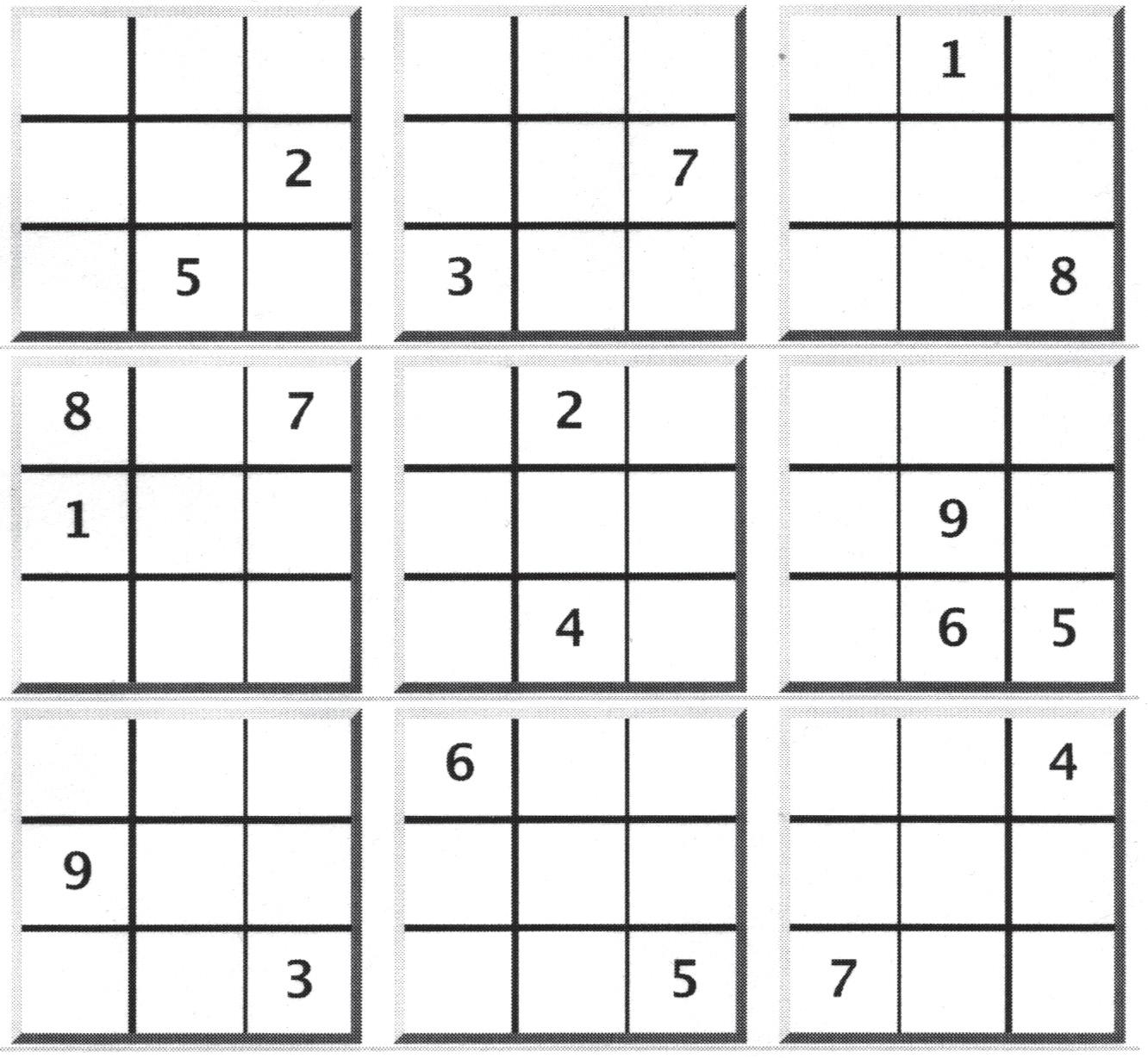
Fill in the empty cells, one number in each, so that each column, row, and region contains the numbers 1-9 exactly once. Each number in the solution therefore occurs only once in each of the three “directions,” hence the “single numbers” implied by the puzzle’s name. (Rules from wikipedia.org/wiki/ Sudoku)
Simulated Basement
by Jeffery Sondike




Classic Doonesbury (1991) by Garry Trudeau
Mr. Gnu by Travis Dandro On Campus by Elizabeth Klosky ’21
’19
Rev Ithaca Director Discusses Programs, Benefits for Students and Startups
By AMOL RAJESH Sun Science Editor
Have an idea or interested in creating a startup? Rev Ithaca may have the resources to help you succeed.
Located at 314 E. State St., Rev Ithaca is a local business incubator that offers mentorship programs, workspaces and networking events to help entrepreneurs realize their ideas. Ken Rother, director of Rev Ithaca, discussed how the non-profit helps first-time entrepreneurs.
“One of the main ways we help entrepreneurs is through mentorship. A lot of research says that really one of the most important things that first-time entrepreneurs need is mentorship by people who launched a startup,” Rother said.
said. “We normally get between 20-25 applications and we pick the eight we think we can help most effectively.”
In addition to providing mentorship, Rev Ithaca funds participants of the Hardware Accelerator program.
“We make available to them up to $2,000 for supplies and also up to $2,000 to do customer discovery,” said Rother, referring to the process of visiting potential customers to understand their needs.
Rev Ithaca’s Hardware Accelerator program provides support to teams that want to develop a physical product for commercial or non-commercial use.
“Every summer we take eight teams and we help them create their first prototypes and help them understand who their customer is, how much their customer would pay for the product and what problem they are solving,” Rother
Rother discussed the main goals behind the Hardware Accelerator program.
“The first is that we would love if people launched a business, but we are also realistic that after 11 weeks, only a small percentage follow this path,” Rother said. “The second is that we want to give people the skills to be hardware entrepreneurs.”
Rohan Rai ’20, who was part of team CONSRV that participated in the Hardware Accelerator program this past summer, discussed his team’s experiences.
“It was relatively structured with [in-person] facetime between my team and other teams as well as entrepreneurs-in-residence and the program orga-
nizers,” he said.
Rai, who worked along with Victoria Tan ’21 and Navin Ramsaroop ’21, developed a device that could cheaply measure water usage.
“We were working on an easy to install water metering system that would give users information on which appliances were using what amount of water along with time stamps to date the usage,” Rai explained.
The team’s final product was presented on Aug. 9, during Rev Ithaca’s Demo Days.
In order to reduce wasted effort, Rev Ithaca encourages entrepreneurs to have communication with customers early in the development process.
“One of the main things we teach is helping people understand is that a product or service is always addressing a problem or a need, and you can learn a lot about a customer’s need by asking them different kinds of questions before you ever go off and make things,” Rother said.
according to Rev Ithaca’s website. Prices for membership range from $100 to $200 per month.
In addition to mentorship through six entrepreneurs-in-residence, Rev Ithaca gives its member firms access to other types of learning opportunities.
“We put on educational events such as workshops around marketing, taxes and intellectual property. Some of these events are also meetings of the entrepreneurial community so people can help each other
“One of the main ways we help entrepreneurs is through mentorship. A lot of research says that one of the most important things that first-time entrepreneurs need is mentorship by people who launched a startup.”
Ken Rother
and share stories,” Rother said.
Apart from its Hardware Accelerator program, Rev Ithaca offers services, ranging from tax benefits to access to prototyping labs, for member firms. In order to be a member firm, the organization must be a legal entity and have “reasonable employment growth potential,”
Rev Ithaca members include Ithacabased Ursa Space Systems, a satellite analytics firm, GiveGab, a firm which helps non-profits fundraise, and Rosie, a grocery technology company.
Amol Rajesh can be reached at arajesh@cornellsun.com.
Professor Examines History of the Universe
By KAREN ZAKLAMA Sun Staff Writer
“Where did we all come from?” is the question Professor Liam McAllister, physics, tries to answer every day. McAllister’s research focuses on string theory, a cutting-edge scientific inquiry that remodels matter as a series of strings.
Part of string theory’s appeal to modern mathematicians and physicists is its ability to unite quantum mechanics and gravitational laws. Currently, physicists view the world as a composition of matter and energy and have been able to redefine the approach to understanding the molecular world. However, despite the important jumps quantum physics has allowed scientists to make, there are still questions about the magnitude or scale of quantum theory, especially in application to the early universe.
“For phenomena in nature, one can get away with not combining gravity and quantum mechanics,” McAllister said. “In the early universe, the density was high, which meant gravitational interactions were high. Quantum mechanics interacting with that kind of gravity is only present in the early universe.”
McAllister is particularly interested in the early state of the universe because it has never been fully characterized before.
“Understanding the early universe is an achievement that is not fully appreciated by the scientific community. Cosmology as a science is very young and until recently was perceived as speculative,” he said, referring to the discipline which studies the development of the universe and its origins. Cosmology is mainly studied by physicists and astronomers. Despite its mathematical rigor, cosmology relies on little to no technology. With the exception of a few computing programs, McAllister works with pen and paper. “We use blackboards and chalk. Sometimes we use mathematical programs to do some algebra, but that is a very small percentage of the work we do,” he said.
Although a relatively young scientific field, McAllister discussed how the discipline has evolved.
“You know a subject has matured when basic principles are fully specified and the only problems remaining to be solved are equations,” McAllister said.
“Cosmology is still very complex, but I can foresee that some parts of the theory are maturing. Today we have a vastly different picture of our origins from what has been discovered in just the past 25 years, and the math continues to validate theory.”
Perhaps McAllister’s rigorous scientific findings can offer some comfort to Cornell students. Cosmology has made strides as a science, evolving to unite gravity and quantum mechanics to reveal far more information about the beginning of the universe than ever before. Because of advances in math and physics, humanity can answer much bigger questions about its history.
“A development of a complete quantitative understanding of the universe, with well understood laws, is one of the really great historic triumphs in human-
ity’s endeavour to understand where we came from,” McAllister said. “There is a huge impact for people who look up at the sky and wonder.”
Working with something as expansive as the universe, McAllister has the perspective that students sometimes cannot see.
“There is a relationship between the large and the small,” he said. “If we dig a little deeper in cosmological history, we might be able see the interactions of quantum mechanics and gravy on a different level. We can have more insights into understanding why we are where we are.”
Next time you are wondering how we all got here, remember that there are people like Professor McAllister on this campus answering those questions with string theory.
Karen Zaklama can be reached at kzaklama@cornellsun.com.

Puzzles | Professor Liam McAllister, physics, discussed the impact of cosmology in answering important questions about our universe.
KAREN ZAKLAMA / SUN STAFF WRITER
ROTHER
C.U. Takes Youthful Energy Into New Season
By JONATHAN HARRIS Sun Staff Writer
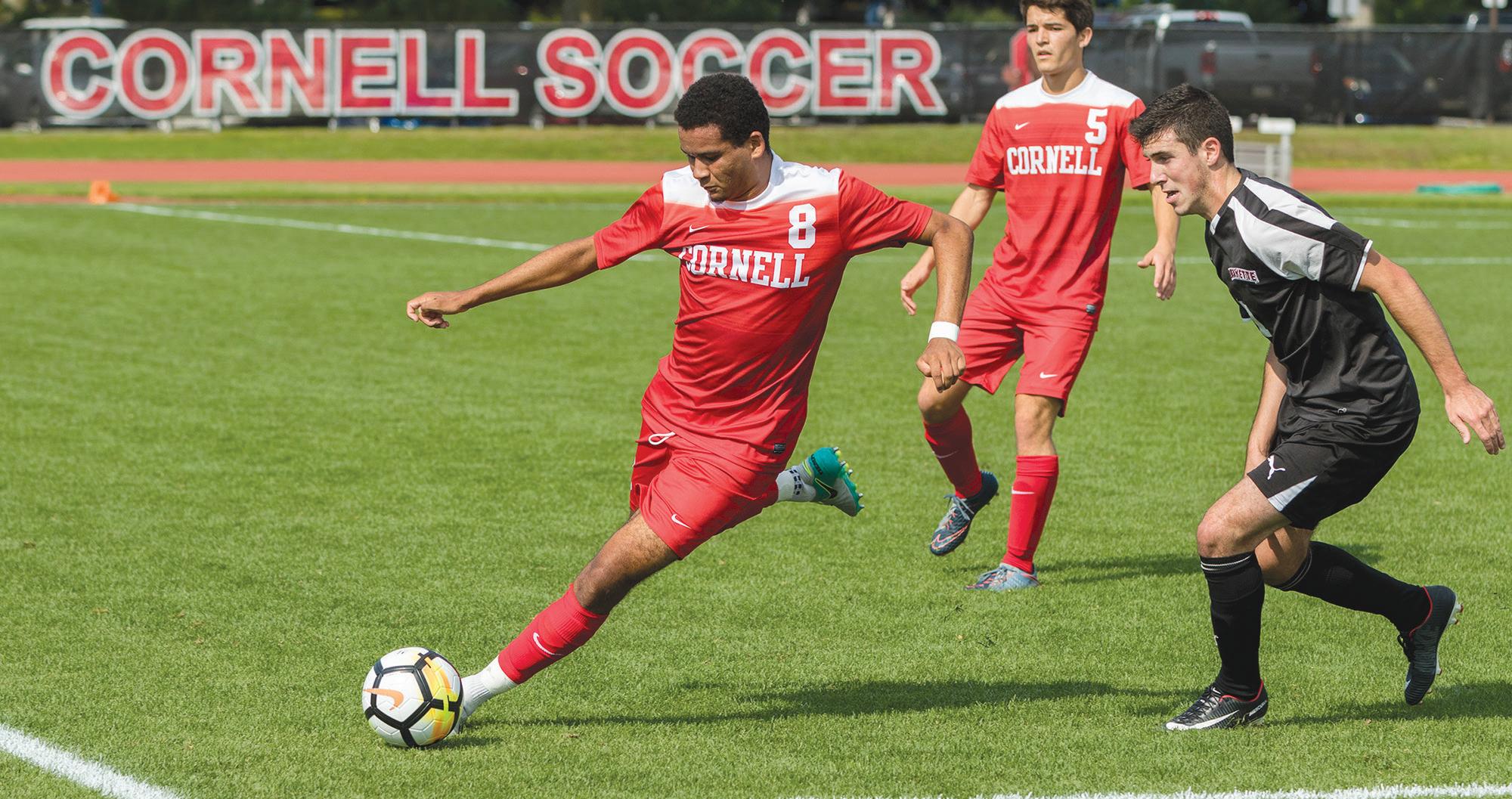
Two years ago, the men’s soccer team completed what can be described generously as a tough season. The Red was adjusting to a new head coach and struggled throughout the year. Finishing at 1-14-2 overall and 0-7 in Ivy League play, the future looked pretty bleak.
Fast forward to today. The Red is fresh off the heels of a turnaround season which saw them finish just a game below .500 while taking down key Ivy and non-conference rivals, including a victory over then-No. 11 Syracuse.
With all of last season’s successes and struggles behind them, head coach John Smith and his team have put on blinders and are ready for the upcoming season’s challenges.
One of these challenges is youth, a difficulty most Ivy League squads don’t have. This season the Red will field an unusually young team — 21 out of 28 players on the roster are either freshmen or sophomores. The lone senior on this year’s squad, defender Ryan Bayne, said he is optimistic about
the capabilities of the newcomers.
“I think they’ve assimilated really well,” Bayne said. “We had two scrimmages this weekend and all of them got plenty of minutes and they fit right into the system. All of the returners think they’re all great fits soccer-wise, but also personality-wise.”
The freshmen aren’t the only ones on the team who have had to adjust to new roles and routines.
Sophomore midfielder Tommy
Hansan, last year’s leading goal scorer, has naturally stepped into a leadership position among the young squad, taking a particular interest in the growth and development of the freshman class.
“It’s been a change because now we have a class of nine or 10 younger guys that look up to my class as guys that have a solid year under their belt,” Hansan said. “A lot of [my role] now is helping the guys around me, whether that’s
in a practice or a game, on or off the field, just always checking on other guys rather than just being the naive freshman I was from last season.”
While the physical aspect of soccer has been an emphasis for Smith and his coaching staff, they have also tried to place a certain importance on mental and emotional readiness and well-being.
“We do a lot of teaching on the mental side of the game,”
Smith said. “A lot of it is ‘this is how you’re supposed to act in this kind of a situation.’ We talk about guys being energy givers and not energy takers. Our preseason was tough, and they were incredible. They never looked fatigued emotionally.”
The freshman class is not the only group to be lauded for its offseason efforts, however. Smith said he’s impressed with returners’ physical and emotional fitness.
“The returners have come back in incredible shape,” Smith said. “Since I’ve been here ... the level of the fitness is not even close. Both physically and it’s 100 percent obvious they’ve been mentally prepping over the summer which is a big concern for coaches in the Ivy League because [the players] just disappear for three months.”
With Bayne holding down the back line, a strong junior class and a growing confidence among sophomores, Smith’s squad gets its season started at 7 p.m. Friday at Binghamton, its first of three straight road games to start the year.
Jonathan Harris can be reached at jharris@cornellsun.com.
Without Head Coach and Top Scorers, Red Preps for 2018
By BENNETT GROSS Sun Staff Writer
Without head coach
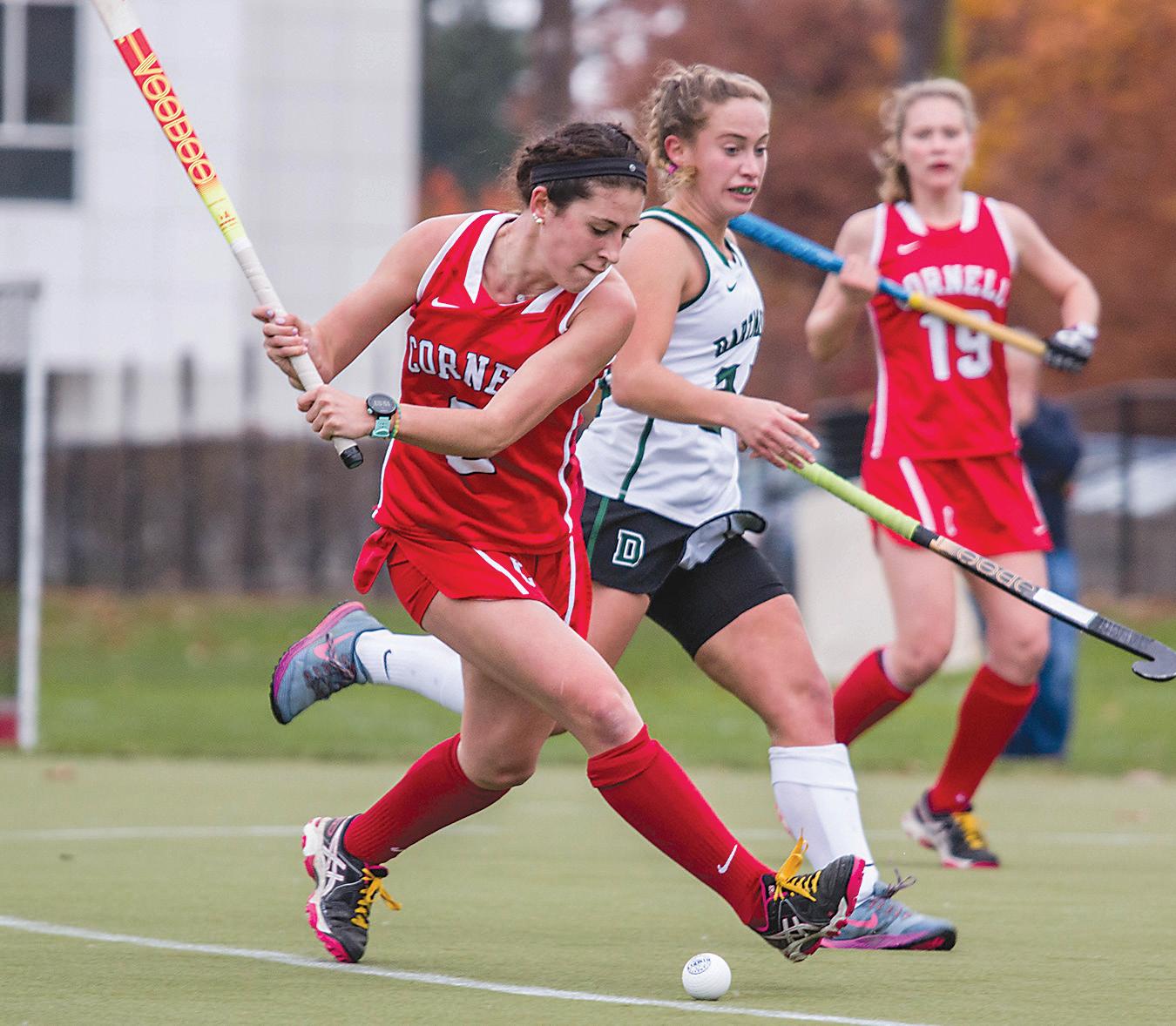
Donna Hornibrook — who is taking a leave of absence to deal with an ongoing medical issue — the Cornell field hockey team is looking to improve upon last season’s fifth-place finish in the Ivy League with an influx of young talent.
Steve Simpson has been named the interim head coach during Hornibrook’s absence. Hornibrook has been the head coach of the Red since 2004 and is the winningest coach in school history with 129 victories.
“Coach Hornibrook has had an ongoing health issue, and she felt it was the best move for her and the team to remove her-
self from the program and work on her rehab for the time being,” Simpson said. “I completely support that, the University completely supports her and obviously the team is supportive of what she has to do.”
There is currently no timetable regarding Hornibrook’s return to the team, but Simpson does not anticipate that she will
return to the sidelines within the next few weeks.
The Red enters 2018 having lost its three leading goal-scorers to graduation from last season. The young team will rely on younger players to pull their weight.
The 2018 rendition of the Red features just one senior in midfielder Gabby DePetro, who totaled two goals and three assists last year. Because of its youth, Simpson’s squad will rely on key juniors like goaltender Maddie Henry, midfielder Kirsten Pienaar and midfielder Maddy Conklin to provide leadership.
“As the only senior on the team, I feel a strong responsibility to be someone the team can rely on both on and off the field,” DePetro said. “I think it’s important that I use the experience I’ve gained and the lessons I’ve learned over the past three years to benefit the team in any way I can, and I want to make my last season one that I can feel really proud of when I leave.”
Henry will start in goal for the Red. In 2017, she split time with Kelly Johnson, who graduated last spring. Henry allowed just 1.49 goals per game and saved nearly 80 percent of the shots she faced last
season.
She will look to match her impressive early-season play last season this year — she began the 2017 campaign without allowing a goal in her first 253 minutes of action.
Simpson expects what he considers to be a strong freshman class to contribute heavily throughout the season. Simpson noted that he foresees Kate MacGillis, Claire Jones and Isabel Windham getting significant playing time.
“There is a lot of qual-
“We might be a young team, but I really think we have the heart and fight to [win].”
Senior
Gabby DePetro
ity in this year’s freshman class,” Simpson said. “So, between the talent coming in and the improvement of the returning players, I think that we will have a good chance of having a pretty successful season.”
The Red will open its season Friday at Bucknell — the Red beat the Bison, 1-0, last season — and then will travel to Lock Haven Sunday. Cornell will not play its first home game until Sept. 9 when Rider
comes to Dodson Field. DePetro said she is confident in the team’s ability to succeed this season.
“I feel like with the lack of a big senior class, all of the returning players have really stepped up and decided that they want to take on a bigger role in making this a successful season,” DePetro said. “I’m really proud of the way this group of girls has created a positive team dynamic of support and a desire to push each other to be better.”
Despite the team’s lack of experience, the group is confident in its capability to compete for an Ivy League title and NCAA tournament berth.
“I think we have so much potential on this team, and if we can perform up to that level in games while continuing to refine our style and capitalizing on scoring opportunities, I expect us to have a very successful season,” DePetro said. “The ultimate goal is to play well, win games and earn the Ivy League title. We might be a young team, but I really think we have the heart and fight to do so.”
Young talent | Interim head coach Steve Simpson is optimistic about the upcoming season because of his team’s influx of skilled freshmen.