The Corne¬ Daily Sun


By MIRA HARRIS Sun Contributor
On Saturday, Courtnee Pete ’25 and her mother drove 30 hours from Houston to arrive in Ithaca just in time for the First Year Carnival.
The usual excitement surrounding meeting new people was muddied because of the circulating delta variant causing an uptick in COVID cases locally. Pete’s mother, Bettye Davis, spent the weekend helping her daughter adjust to her new home in High Rise Five.
“It was honestly a little scary, especially with the new variant strain out there,” Davis said.
Pete was one of nearly 4,000 students moving into the first-year residence halls spread across North Campus, which was filled with suitcases, large red moving bins and cars parked on green spaces to begin moving students in.
“This is something we’ve never experienced before.”
Serwaa Asante
Joaquin Rivera ’25 also drove to Ithaca from Houston over the course of four days in order to bring his dorm decorations, winter clothes, and photos of friends.
Though COVID is still a risk, Rivera said that he is “confident about staying safe on campus.”
Parents, too, seem to be comforted by Cornell’s success in keeping cases low last year, as well as the detailed COVID-19 guidelines during this year’s move-in, which specified arrival testing requirements for those who are not fully vaccinated and mandated mask-wearing inside for everybody regardless of vaccination status.
“Despite everything happening with the pandemic, the move-in process was very well organized,” Serwaa Asante, mother of Nick Asante ‘25, said. “This is something we've never experienced before, [but] it was good to see that masks were being worn and that testing was being given to those who were unvaccinated.”
This year’s move-in process had marked differences from last year, with students not being required to quarantine or get arrival testing if they are vaccinated. Eager families were allowed to help students move into their dorms and explore the Cornell campus, and normal orientation events greeted incoming students. Rivera is optimistic about the opportunity to spend time in lecture halls with his peers.
“I’m curious by nature, so I’m really excited for my curriculum and just excited to learn more, meet new people and have a great college experience,” he said.


By KAYLA RIGGS Sun Assistant News Editor
Cornell’s Class of 2025 has already begun to set records –– without stepping foot on campus. With an acceptance rate of 8.7 percent, the Class of 2025 has the lowest acceptance rate in recent years.
67,380 applicants applied to Cornell in last year’s application cycle, an increase of nearly 16,000 from the previous year, likely due to the University’s decision to suspend ACT and SAT requirements.
Out of that application pool, 5,836 students were admitted. Come Thursday, 3,750 freshmen are expected to shuffle into the previously quiet halls of the University; for some, it will be their first in-person class since March of their junior year of high school.
protocol was not followed” at her previous university. When asked about starting in-person classes again after nearly two years of a virtual education, she shared a common sentiment.
“While studying online at home, it was difficult to form connections with classmates and teachers at such a large school,” she said. “I truly look forward to being more connected in a more intimate and specialized environment this upcoming year.”
“The members of the Class of 2025 are assuredly more resilient and compassionate.” Shawn Felton
Shawn Felton, director of undergraduate admissions, noted the strength of Cornell’s incoming class, pointing to their ability to weather a particularly unusual high school education.
“The Class of 2025 has endured extraordinary chaos while learning since the second semester of junior year of high school,” Felton wrote in an email to The Sun. “High school did not end as was likely anticipated. But, the members of the Class of 2025 are assuredly more resilient and compassionate because of the challenges they have already endured.”
One of the members of the class of 2025 Billie Morton ’24, an incoming transfer student from California, decided to apply to Cornell after “COVID
The Class of 2025 is among the most diverse of the University’s recent classes, with 34.2 percent of the students self-identifying as underrepresented minorities, an increase of 7.3 points from the Class of 2024, and 59.3 percent identifying as students of color, a jump from last year’s 51.7 percent. 19.4 percent of the class are first-generation college students, and 55 percent are women, both an uptick from previous years.
Because 96 percent of Cornell’s on-campus population –– including students, faculty and staff –– are vaccinated, the campus is moving toward a sense of pre-pandemic normalcy
“I think it will be great to have a sense of normalcy after the past year and a half,” said Peyton Lancaster ’25.
Others, however, are unsure if a conventional college experience is still possible as the new Delta variant raises questions about the safety of returning

By ELI PALLRAND Sun Staff Writer
This fall, Cornell students will return not only to a mostly reopened campus, but to a campus operating under different rules.
On Aug. 2, the Campus Code of Conduct will be replaced by a new Student Code of Conduct, which applies exclusively to students, while the old code sometimes also applied to faculty and staff.
The change comes nearly four years after President Martha
“Our goal is to engage students and organizations more holistically in the process of accountability.”
Marla Love
Pollack asked the University Assembly to begin revising the code. Meetings and public forums on code revisions were frequently sources of conflict over everything from the timing of pro-
posals to the now-failed attempt from the Office of the Judicial Administrator and other groups to lower the burden of proof required to find a student responsible for a code violation.
Proponents of the new code have characterized it as an attempt to make on-campus judicial proceedings less legalistic and judicial.
“Our goal is to engage students and organizations more holistically in the process of accountability,” said Interim Dean of Students Marla Love.
Among the most controversial changes has been the shift in control over revisions to the code.
Since its founding in 1977, the University Assembly has overseen revisions to the Code of Conduct. That power will now rest with the vice president for student and campus life, currently Ryan Lombardi.
Former U.A. Chair Logan Kenney ’15 J.D. ’21, said that based on statements by administrators and members of the Board of Trustees, she worries that this decision was unfairly based on Lombardi’s personal likability.
“I am very fond of VP Lombardi … but what if he leaves? Why couldn’t Ryan and his office work directly with the U.A. [specifically the Codes and Justice Committee], an independent body with representation from all constituent groups, instead?” Kenney wrote in an email to The Sun. “I will never understand removing this vital document from the Cornell community. It was safe with the U.A. and of course subject to the President’s approval.”
“I hope for as smooth of a transition as we can have and I hope to see the constituent groups deeply involved.”
Logan Kenney ’15 J.D. ’21
But a December 2020 University press release defending the code stated that the Board of Trustees and president have always controlled the code, and that the U.A. can still propose amendments.
Other policies have not undergone serious revisions. For instance, punishments that students can face if they violate the code remain largely unchanged.

which partners with the Office of the Judicial Administrator to train students to mediate campus conflicts and code violations to resolve cases outside of hearings.
Associate Judicial Codes Counselor Suzanna Swanson J.D. ’22 said that mediation sessions — where student mediators help Judicial Administrators and accused students find a mutually agreeable solution to the case — often center around the accused student’s proposals and help give them a voice in the outcome.
“The folks that I’ve worked with who have engaged in alternate resolution under the current code have, I think, found that they feel more heard,” Swanson said.
The role of students filing complaints against other students has also changed. The new code distinguishes between reports and formal complaints: Students have the option to report misconduct and receive resources and help in addressing their immediate health and safety.
Additionally, the code now formally recognizes the Good Samaritan Protocol and eliminates the separate conduct system for fraternities and sororities. It also institutes mandatory minimum three-year suspensions of campus organizations for violations related to hazing, alcohol, risk management and sexual misconduct. These changes come on the heels of the death of Cornell firstyear Antonio Tsialas ’23 after a Phi Kappa Psi party, and following calls by former Student Assembly President Cat Huang ’21 to remove fraternities from campus entirely.
Lombardi said in an early June statement that the new code aimed to make students more active participants in the judicial process. The code now explicitly encourages the current practice of using mediators from the Campus Mediation Program,
Students may also choose to not file a formal complaint and end the investigation — but if the violation involves personal or public safety, an investigation may still occur.
The offices that oversee student complaints will also change under the new code. The Office of the Judicial Codes Counselor and Office of the Judicial Administrator are being replaced by an Office of Student Conduct and Community Standards.
The new organization will investigate and oversee judicial proceedings through an Office of the Respondents' Code Counselor, where graduate students will represent accused students, and an Office of the Complainants’ Code Counselor, where graduate students will represent individuals accusing others of violating the code.
The director of the Office of Student Conduct and Community Standards will be appointed by and report directly to the vice president for student and campus life.
The lead counselors of the Office of the Complainants’
CODE Continued from page 3
of 2021 makes up just 8% of applicants
Continued from page 1
Code Counselor and Office of the Respondents’ Code Counselor will be chosen by the Office of the Student Advocate and the Office of Student Conduct and Community Standards director.
This new level of administrative control over the campus judicial process worried Kenney, who said she thinks the Office of the Judicial Administrator no longer being an independent body may hurt the judicial process.
argued that forcing students to defend themselves orally was unfair, given the stressful nature of judicial hearings and the fact that some students, especially those with less privilege, may be put at a disadvantage.
In the old code, all accused students could have their appointed JCC speak for them, while the new code requires students to represent themselves under most circumstances.
Te code of conduct has been revised after nearly four years to school.
“We are going back to ‘normal’, but we don't really know what that means anymore,” said Karen Lin ’24, who transferred to Cornell after spending her first year at Stony Brook University. “It feels like a new beginning. The college experience is never going to be the same again.”
Still, many remain optimistic about Cornellians’ –– particularly the Class of 2025, which was undoubtedly shaped by the COVID-19 pandemic –– to experience all that is Cornell, from Slope Day to in-person classes.
“My hope is that what has happened to each individual and the group collectively serves and supports them through the vast array of experiences and unique opportunities that Cornell provides,” Felton wrote.
“As they come to feel that they belong and are truly a part of this very special place.”
at kriggs@cornellsun.com.
Come to one of our informational sessions on September 8th or 9th in Goldwin Smith Hall G22.

“Things change when your boss is [in the] administration,” Kenney wrote. “There are potential pressures and less independent decision-making.”
For counselors at the Office of the Judicial Codes Counselor (JCC), administrative changes represent more than a name change.
A 2020 petition to the S.A. Codes and Judicial Committee expressed concerns about these changes, saying that students from privileged backgrounds with early exposure to public speaking training, and white men who are stereotyped as more persuasive and trustworthy, would benefit from the new system more than historically marginalized groups.
“There are potential pressures and less independent decision-making.”
Logan Kenney ’15 J.D. ’21
Counselors within the Office of the Respondents’ Code Counselor and Office of the Complainants’ Code Counselor will generally be barred from speaking or directly questioning witnesses. Unless they are given permission by the hearing chair, or the case involves suspension or expulsion, counselors may only submit written requests and objections to the hearing chair while students speak and ask questions.
Advocates for this reform have called it a way to make judicial proceedings less adversarial. But Swanson said that, in her year in the JCC, she hasn’t witnessed this problem.
“I have not seen a hearing myself that was overly confrontational,” Swanson said. “I do not think there was a need to remove those speaking rights … Every hearing I’ve watched where a JCC was participating has been respectful.”
Opponents of banning Judicial Codes Counselors from speaking at certain hearings
To counter this, Love said that code counselors, hearing and review board members, and Office of Student Conduct and Community Standards staff would undergo training aimed at making the process more equitable and inclusive.
Regardless of their stance on the code, Cornell students will find themselves held to the standards of the new Student Code of Conduct when they head back to Ithaca this fall.
To ease the change, Interim Judicial Administrator Christina Liang said that the Office of Student Conduct and Community Standards will provide education and training opportunities focused on community standards, the conduct process, and students’ rights and resources.
“I hope for as smooth of a transition as we can have … and I hope to see the constituent groups deeply involved in the code process,” Kenney said.
Eli Pallrand can be reached at epallrand@cornellsun. com.

box office), digital and DVD sales and property rights sales.
home, and with the other, you pay for a single viewing.
Just two weeks ago, Scarlett Johansson filed a lawsuit against Disney for the simultaneous release of Black Widow
While one could argue that the Video On-Demand sales of Black Widow fall under the category of digital sales and should be included in Johansson’s contract, this isn’t the case. Disney decided
But that’s not the only difference. The contracts for talent employed by movie studios and those being paid by streaming services are completely different.

in theatres and on Disney+. According to Johansson, the streaming release of the film sapped her of about $50 million in projected box office earnings. And following Johansson’s suit, Emma Stone is also considering taking legal action over the hybrid release of Cruella. But the problem these actresses face is not the difficulties of reopening theatres post-pandemic, nor that people would rather stay home, but the result of a shift in contractual power in the era of streaming. And this problem has been going on for some time.
Throughout movie production history, writers, producers, directors and actors/actresses have worked with contracts based on two types of payment standards: fixed and contingent compensation. Fixed compensation is exactly what you would think: it’s a sum of money paid upfront to the contractor, regardless of how well the movie does. Contingent payment, on the other hand, is much more flexible as it relies on a percentage cut of the total film profit.
Most of the high-end Hollywood deals rely on a combination of the two, where talent is guaranteed a fixed amount, and can receive additional payment in the form of contingent compensation based on how much the film makes. And while the methods used to pay contingent contracts are very complicated, all contingent deals rely on, more or less, concrete numbers that come from ticket sales (a.k.a.
to keep streaming and box office revenue separate, and it’s not just because they’re greedy (well, it might be).
There’s a logical reason for keeping these two separate, and that’s because streaming and the theatre operate quite differently. Sure, that’s obvious: with one, you pay a monthly subscription and get to watch whatever you want from
Rather than creating a contract that offers bonuses for a production’s performance, services like Netflix, Hulu and HBO generally pay fixed prices upfront to the talent and production company. And in this scenario the contractors don’t have a choice..
Unlike the box office, streaming generally does not rely on sales, but rather
separate viewership data that is more often than not undisclosed. This lack of transparency makes it difficult for talent and independent production companies to assess how much they should be getting paid. And because streaming services reserve the right to be the sole distributor of a new film or swhow there is little promise for the contractors to get paid in the future.
In the case of Black Widow , even though Disney disclosed how much the film made from streaming, there was already a precedent in place for Disney to keep that revenue to itself. Now, Disney + owns the right to distribute the film, and its workers have already received compensation.
But like I said before, this isn’t a new issue. Rather, a lack of transparency about movie metrics on streaming services has persisted since the founding of Netflix. Questions about how viewership translates into revenue and whether or not certain productions draw in new subscribers remain unanswered.
The only difference now is that the pandemic has caused movies to shift towards the streaming scene. And with more hybrid launches like In The Heights and Space Jam, we may be on the way to hearing even more buzz about the ethics of streaming contracts.
The solution to these contractual issues is still unclear, so we’ll just have to wait and see. Because depending on the results of Scarlett Johansson’s lawsuit, the streaming industry might have to embrace more transparency with their statistics and with their contracts. Hopefully, we’ll start seeing less complaints from the makers of media, and more success in the industry.
Matthew Kassorla is a sophomore in the College of Arts and Sciences. He can be reached at mk928@cornell.edu.

By AMELIA CLUTE Assistant Dining Editor
If you’re like me at all, the question, “Is making your own moonshine really that bad?” has crossed your mind at least a few times. Can you blame me? The thought of unlimited, practically free alcohol was tempting, and I imagined that it would have the added bonus of being as strong as a horse tranquilizer. While contemplating if I really wanted to freak out my housemates by making them accomplices to an illegal moonshine distillery, I started to wonder why moonshine is even against the law in the first place. Like almost everything, the answer is … complicated.
For legal reasons, I disappointedly must report that I don’t have the balls to distill moonshine in my collegetown house.
Moonshine in the United States has a long history, especially in the South. Defined as a “smuggled or illicitly distilled liquor, especially corn liquor as illicitly distilled chiefly in rural areas of the Southern U.S.,” moonshine can be made out of any fermentable substance, like fruit or even milk. As a homemade and unregulated liquor, moonshine also doesn’t have limits on its alcohol content and some moonshines can reach up to 190 proof. For comparison, Tito’s vodka is 80 proof. Woof.

Likely brought to the U.S. by Scottish and Irish immigrants in the 18th century, moonshine quickly took hold in the South where grain — especially corn — harvest thrived. First utilized as a way for grain producers to use and preserve excess product, moonshine soon grew into a mainstay of southern culture and was occasionally used as currency. For many farmers, moonshine was a security measure; it assured families that even in a bad year, there would be product to sell. Moonshine was such a prevalent part of life in early America that even George Washington produced corn whiskey in his Virginia distillery. The United States government inevitably took notice of this blossoming and untapped industry. Alexander Hamilton

first imposed a whiskey tax in 1791, prompting Americans to evade this tax in creative ways (The term bootlegger “originated in the 1880s, when smugglers would hide flasks in their boot tops.”). Moonshine, though taxed heavily, was technically legal until prohibition when all alcohol was outlawed. It wasn’t until 1978 that the U.S. government legalized homebrewing of non-distilled alcohols like beer (though some states like Mississippi and Alabama only legalized the practice in 2013). One look on Amazon shows that adults over 21-years-old in the United States can easily purchase a wide range of DIY kits for homemade wine and beer.
But as far as I’m able to tell from my research, home liquor distilleries are still illegal for two main reasons. Firstly, because of potential dangers associated with unregulated distilling. And secondly, some individuals also believe — and this is slightly harder to prove for obvious reasons — that moonshine is illegal because liquor taxes are simply more valuable to the government than taxes on wine and beer.
The taboo and mystery which surrounds moonshine stems partially from its riskiness; many people have heard horror stories about individuals going blind, having seizures or even dying from consuming toxic batches of moonshine. Irresponsible practices can contribute to a higher risk of toxic moonshine; many moonshiners still distill in old automobile radiators because of their size and water-tight design. Nevertheless, these radiators often contain lead soldering, and fail to pour out the metha-
nol-rich beginnings of the batch. Many supporters of moonshine, however, claim that these instances of poisoned moonshine are few and far between, exaggerated to prevent individuals from trying their hand at distilling. These supporters point out that bootleggers live by their reputation alone; if your customers begin to drop dead after consuming your product, chances are that your business’s lifespan won’t be very long-lived either. Building up a trustworthy reputation, therefore, is enough to motivate moonshiners to create a quality whiskey. Of course, from a public health standpoint, this argument doesn’t exactly hold up to justify legalizing moonshine distilling at home. Nevertheless, many suspect that the government is equally motivated to keep moonshine outlawed by liquor’s profitability. Hard liquors are taxed “$2.14 for each 750-milliliter bottle of 80-proof spirits, compared with 21 cents for a bottle of wine (of 14 percent alcohol or less) and 5 cents for a can of beer.” Despite this mountainous tax, most Americans keep buying liquor — and as long as we keep buying, the government still has incentive to tax it and prevent us from making our own.
It’s worth noting that the stereotypes associated with moonshine are not all entirely accurate; not all corn whiskey is illegal, or even American. In recent years, many craft distilleries all across the United States have begun producing corn whiskey for commercial sale, at times even under the label of “moonshine.” In my personal opinion, calling a legal alcohol “moon-
shine” is a bit like buying a movie on Amazon and calling it “torrented,” but I digress.
Many regions outside of the American South also have long histories of moonshine production. The Balkans in particular are famous for their rakija, a type of moonshine commonly made with fermented plums. As a Slav, I can personally attest to the fact that, yes, even my elderly relatives still living in Croatia knock back a shot of rakija before most meals.
Despite moonshine’s taboo and mystery, most aficionados view moonshine production as a craft requiring immense skill to produce a truly great product. As a non-aged beverage, producers cannot rely upon fine barrels to impart flavor onto a mediocre product — the whiskey must be able to carry itself without hiding behind other additives. Like many other foods, there’s much more that goes into quality moonshine than initially meets the eye.
I can’t predict how the U.S. government will move forward in moonshine legalization, and I’ll let you decide for yourself if moonshine is still illegal for safety or taxation reasons. Yet, regardless of what happens in the beverage’s legal future, we can quite certainly assume that moonshine isn’t going anywhere. Whether we like it or not, moonshine is an indelible part of many Americans’ lives and will undoubtedly stay that way for generations to come.

Independent Since 1880
139th Editorial Board
KATHRYN STAMM ’22
Editor in Chief
ANUSHYA ALANDUR ’23
Business Manager
CATHERINE ST. HILAIRE ’22
Associate Editor
PRANAV KENGERI ’24
Advertising Manager
ODEYA ROSENBAND ’22
Opinion Editor
JYOTHSNA BOLLEDULA ’24
News Editor
TAMARA KAMIS ’22
News Editor
WENDY WANG ’24
Arts & Entertainment Editor
KRISTEN D’SOUZA ’24
Design Editor
HANNAH ROSENBERG ’23
Photography Editor
OMSALAMA AYOUB ’22
Science Editor
PUJA OAK ’24
Layout Editor
ANNIE WU ’22
Production Editor
MIHIKA BADJATE ’23
Assistant News Editor
ANGELA BUNAY ’24
Assistant News Editor
JOHN COLIE ’23
Assistant Arts & Entertainment Editor
AMELIA CLUTE ’22
Assistant Dining Editor
WILLIAM BODENMAN ’23
Assistant Sports Editor
AARON SNYDER ’23
Assistant Sports Editor
MEGHANA SRIVASTAVA ’23
Compet Manager Working on today
MADELINE ROSENBERG ’23
Editor
NAOMI KOH ’23 Web Editor
ANIL OZA ’22
Assistant Managing Editor
YUBIN HEO ’24 Assistant Web Editor
VEE CIPPERMAN ’23 News Editor
NOOREJEHAN UMAR ’23
Editor JOHN YOON ’23
BENJAMIN VELANI ’22
Editor
LUKE PICHINI ’22
Editor
SRISHTI TYAGI ’22
MARIA MENDOZA ’24
Editor AMAYA ARANDA ’23 Multimedia Editor
SURITA BASU ’23 Assistant News Editor
KAYLA RIGGS ’24
News Editor
EMMA LEYNSE ’23 Assistant Arts & Entertainment Editor JULIA NAGEL ’24
Assistant Photography Editor
LIAM MONOHAN ’24 Assistant Sports Editor
SASHA ABAYEVA ’24
NOAH ALPERS ’22
Cornell students have sacrificed quite a bit over the course of the coronavirus pandemic. The class of 2024 has never had an in-person college experience; the class of 2023 has barely had it; and the class of 2022 has had close to half of its college experience marred by the pandemic. We’ve taken it largely in stride, understanding that in the grand scheme of things, we are lucky. Covid-19 has killed hundreds of thousands of Americans and millions abroad. It has left millions of others with long-term complications. At the same time, we understand that our college years are a special time we will never get back, and as soon as we can safely return to normal, we must do so.
risk to vaccinated people. Cornell students should continue to abide by public health measures outside of the Cornell campus, but it is misleading for the University to pretend that it is somehow acceptable to sit unmasked in a restaurant or bar but not to sit unmasked in class.
D’Souza ’24
desker Puja Oak ’24
desker
deskers
Clute ’22
Colie ’23
Leynse ’23
’23
desker Liam Monohan ’24

Unfortunately, the Cornell administration sees it differently. Instead of recognizing that a population of almost entirely vaccinated 18-22 year-olds is capable of returning to normal life with a minimal level of risk, it has decided to double down on unnecessary public health measures that will do little to protect students and faculty but will do tremendous harm to students’ ability to enjoy this academic year.
Provost Michael Kotlikoff announced last Thursday that all students, regardless of vaccination status, must wear masks indoors and undergo regular surveillance testing. (Incredibly, he also announced that the tiny fraction of those still unvaccinated must continue to wear masks outdoors.) While it is perhaps understandable that the University would continue surveillance testing to understand the virus’s prevalence on campus, the indoor mask mandate is a burdensome restriction for which the costs heavily outweigh any benefits.
For those who are vaccinated –– practically all students and faculty –– Covid-19 no longer poses an acute health threat. Of the over 166 million Americans fully vaccinated, only 5,725 have been hospitalized because of a Covid-19 infection and only 1,246 have died from the virus. The vast majority of these serious cases have been among the elderly or those with compromised immune systems, groups for whom vaccination is generally less effective. Statistically speaking, a vaccinated person is about as likely to be struck by lightning as he is to die from Covid-19.
The administration’s decision making is premised on the idea that preventing cases is the paramount objective. Obviously, preventing cases is good, but in a fully vaccinated population, it no longer makes sense to try to prevent cases at the expense of normal life. For vaccinated Cornell students, Covid-19 is an endemic virus that is no more likely to kill them than influenza. SARS-CoV-2 will continue to evolve and eradicating it is currently an unrealistic goal.
While the Delta variant might be more transmissible, it doesn’t change the underlying reality of what we’re confronting –– a disease that poses an acceptable level of
An indoor mask mandate in particular makes little sense for several reasons. First, it ignores the fact that students are going to be engaged in close, maskless interaction in their private lives off campus. Second, the entire basis for asking vaccinated people to wear masks is to protect the unvaccinated, of which there are basically none on campus. Third, asking vaccinated people to wear masks undermines the entire purpose of mandating vaccination in the first place –– to end these health measures.
Even last year when students were unvaccinated, they engaged in risky social conduct. Cornell had several virus outbreaks as a result of this type of behavior. This coming year, after a summer largely free of masks and restrictions, it is highly unlikely that students are going to be in any mood to restrict their activities. Students will socialize in large groups, in private and public places, without masks. That is simply the reality. As a result, it makes little sense to force students to sit masked in class all week, while they party maskless on the weekends. The mask mandate also does not apply while eating and drinking, so students who sat together masked in class can go get lunch together unmasked.
Nor can it be said that the mask mandate meaningfully protects professors. Practically all of them are vaccinated and those who are not and feel at risk should consider asking the University for special accomodations, such as additional leave. It is the University’s obligation to provide meaningful accommodations to faculty who are unable to get vaccinated. The same goes for students who cannot be vaccinated for medical reasons. Mask mandate or not, they are still at risk, and instead of requiring masks, the University should be offering students who do not feel comfortable returning to campus a remote option.
While a mask mandate might further mitigate the risk, this is a recipe for permanent masking. For the vaccinated, Covid19 has been transformed into an endemic disease that presents a level of risk we are accustomed to tolerating. The University has not set any limiting principle or condition at which we can return to normal, so under the current logic –– that any potential benefit, no matter how small, justifies these measures –– the mask mandate will persist indefinitely. This phenomenon is what Washington University in St. Louis economist Ian Filmore has described as “the tyranny of tiny risks.”
To continue reading this column, please visit cornellsun.com.

Fill in the empty cells, one number in each, so that each column, row, and region contains the numbers 1-9 exactly once. Each number in the solution therefore occurs only once in each of the three “directions,” hence the “single numbers” implied by the puzzle’s name. (Rules from wikipedia.org/wiki/ Sudoku)


By LUKE PICHINI Sun Sports Editor
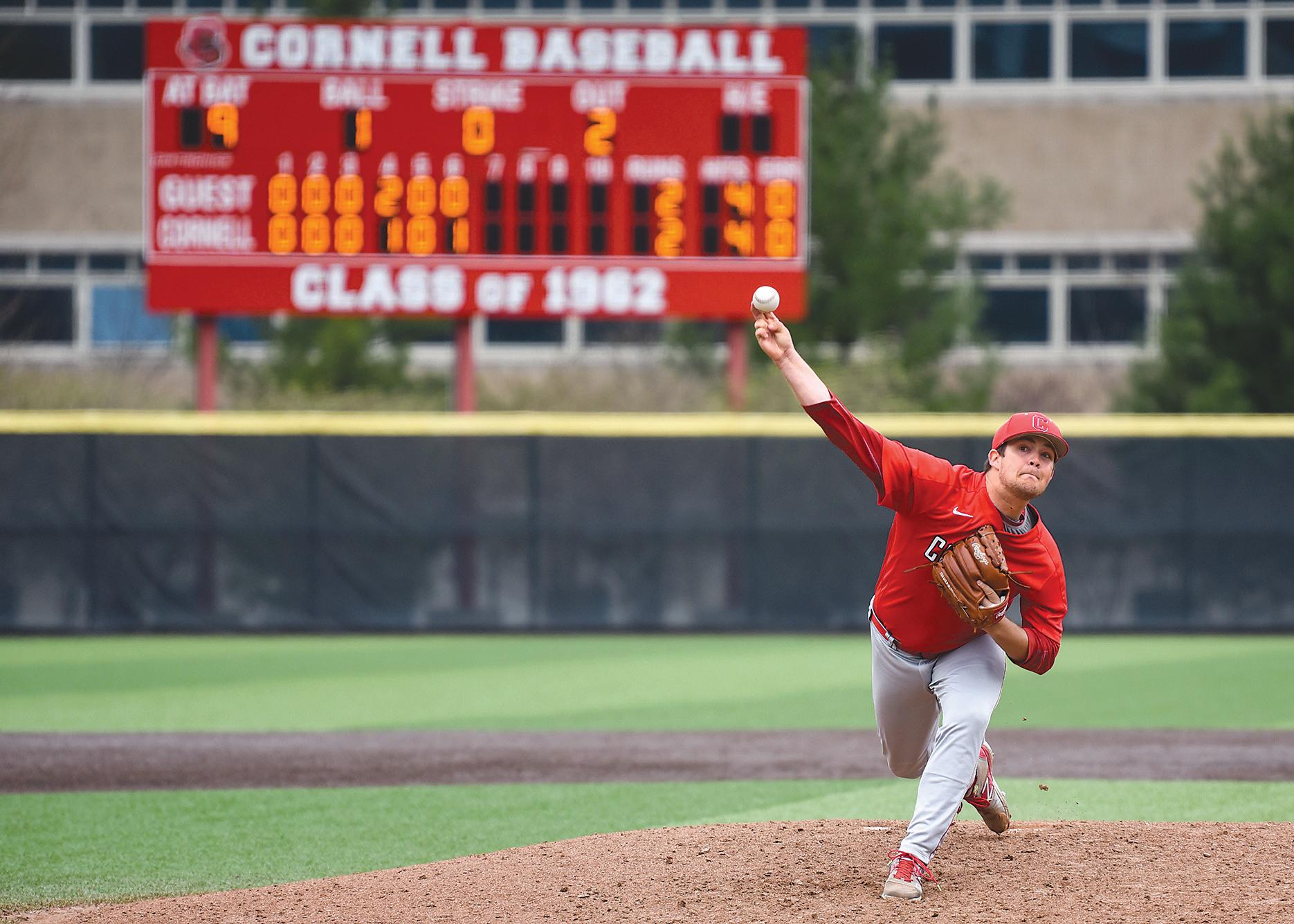
Hoy Field, the home of Cornell baseball since 1922, is slated to move from its current location on Central Campus to agricultural parcels near the intersection of Ellis Hollow Road and Game Farm Road, as revealed in plans proposed by the University last month.
The proposed site lies east of the East Hill Plaza, the
The new Hoy Field . . . would boast a 15,160 square-foot support building to house locker rooms, batting cages and a press box while matching the 500 seat occupancy of the current site.
Reis Tennis Center and the Oxley Equestrian Center — much more remote than the current, centrally located field.
Though the new Hoy Field would lack the convenience of its predecessor, it would boast a 15,160 squarefoot support building to house locker rooms, batting cages and a press box while matching the 500 seat occupancy of the current site. The field would use synthetic turf, and it could accommodate up to 80 parking spaces.
The proposed move allows for the construction of other buildings on Central Campus while upgrading the facilities of the field to be in line with other Division I programs.
Prior to this development, the future of Hoy Field was murky. The University had spent the past few decades erecting new buildings in the direct vicinity of Hoy Field, with the most notable examples being Rhodes Hall in 1990 and Bill and Melinda Gates Hall in 2014. These developments reduced the feasibility of keeping a baseball field in the middle of campus, with players routinely hitting foul balls off the adjacent Gates hall.
As early as 2008, the University indicated its plans to relocate Hoy Field and replace it with “Hoy Green,” a formal green space that could include a new academic building with redesigned pedestrian walkways and streets.
If the plan is approved in the coming months, construction would commence at the start of 2022 in preparation for the new field’s use starting in spring 2023. Should the plan receive approval, the departure of Hoy Field from its current location would leave behind a rich history that accumulated over the course of nearly a century.
The origin of Hoy Field comes from its namesake, David “Davy” Hoy ’91, University registrar and dedicated advisor to the baseball team for 30 years. Hoy advocated the move from Percy Field, which stood on the current campus of Ithaca High School, to Central Campus. When the new field was built in 1922, it was named in honor of Hoy.
Perhaps the most significant event in Hoy Field’s history took place early in its existence. All-time baseball great Lou Gehrig left his mark at Hoy Field despite playing only a single season of collegiate baseball at Columbia.
During a contest between the Red and the Lions in April 1923, Gehrig, undeterred by the fact that only one
player before him recorded a home run at Hoy Field, hit the most notable homer in Hoy Field’s history.
“That right field at Cornell had a high fence, then there was a road back of it, then a forest,” recalled George Moisten, Columbia’s second baseman and Gehrig’s teammate. “Lou lifted his home run into the forest. I looked over at Coach Coakley, sitting near me on the bench, and he was slapping his head in wonder.”
That legendary home run — purported to be the longest in Hoy Field’s history — powered Columbia to an 8-3 victory over Cornell that day. Not only did Gehrig hit a triple in addition to his homer, but he also stymied the Red’s bats, striking out a whopping 10 batters in six innings.
Construction would commence at the start of 2022 in preparation for the new field’s use starting in spring 2023.
Despite the increasing encroachment of other University building projects, there was still hope that Hoy Field would retain its spot on Central Campus. The grass surface was replaced by AstroTurf in 2007, and Cornell Athletics recently undertook an improvement project on the field in 2017. But with the University now taking action to complete the move, the days for the current iteration of Hoy Field appear to be numbered.
Luke Pichini can be reached at lpichini@cornellsun.com.