Construction Union Blames C.U. for Not Using Local Labor on Maplewood Project
By SHRUTI JUNEJA Sun News Editor
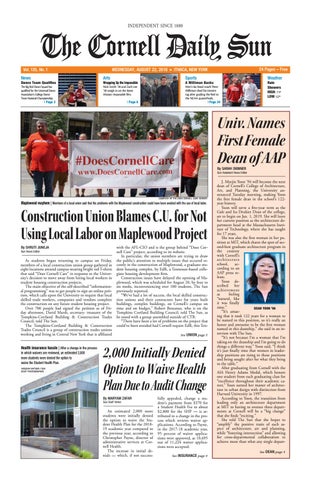
As students began returning to campus on Friday, members of a local construction union group gathered in eight locations around campus wearing bright red T-shirts that said “Does Cornell Care” in response to the University’s decision to move away from hiring local workers in student housing construction projects.
The main objective of the self-described “informational programming” was to get people to sign an online petition, which calls upon the University to require that local skilled trade workers, companies and vendors complete the construction on any future student housing project.
Over 700 people had signed the petition as of Friday afternoon, David Marsh, secretary- treasurer of the Tompkins-Cortland Building & Construction Trades Council, told The Sun.
The Tompkins-Cortland Building & Construction Trades Council is a group of construction trades unions working and living in Central New York that is affiliated
with the AFL-CIO and is the group behind “Does Cornell Care” project, according to its website.
In particular, the union members are trying to draw the public’s attention to multiple issues that occured recently in the construction of Maplewood, a graduate student housing complex, by EdR, a Tennessee-based collegiate housing development firm.
Construction issues have delayed the opening of Maplewood, which was scheduled for August 20, by four to six weeks, inconveniencing over 100 students, The Sun previously reported.
“We’ve had a lot of success, the local skilled construction unions and their contractors have for years built buildings, complex buildings, on Cornell’s campus on time and on budget,” Robert Boreanaz, who is on the Tompkins Cortland Building Council, told The Sun, as he stood with a group assembled outside of CTB.
“There have been a lot of problems on the project that could’ve been avoided had Cornell require EdR, this Ten-
See UNION page 5
2,000 Initially Denied Option to Waive Health Plan Due to Audit Change
By MARYAM ZAFAR Sun Staff Writer
An estimated 2,000 more students were initially denied the option to waive the Student Health Plan for the 201819 academic year compared to the previous year, according to Christopher Payne, director of administrative services at Cornell Health.
The increase in initial denials — which, if not success-
Univ. Names First Female Dean of AAP
By SARAH SKINNER
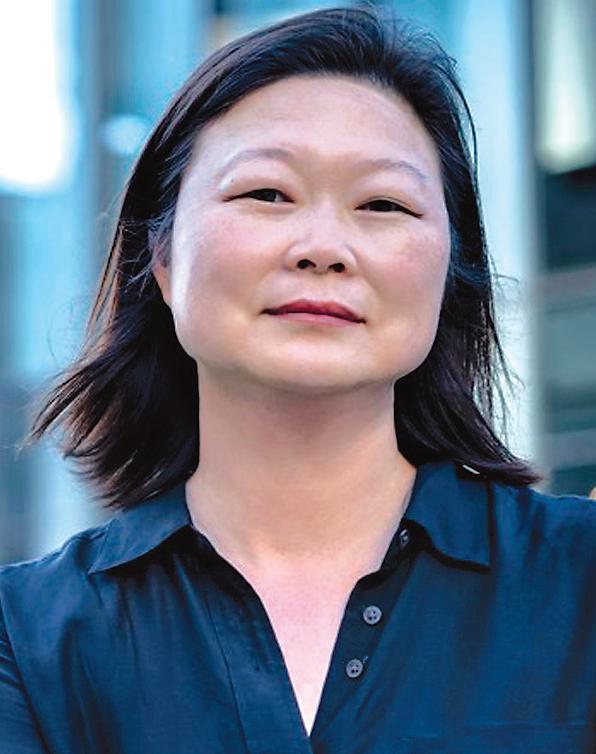
J. Meejin Yoon ’94 will become the next dean of Cornell’s College of Architecture, Art, and Planning, the University announced Tuesday morning, making Yoon the first female dean in the school’s 122year history.
Yoon will serve a five-year term as the Gale and Ira Drukier Dean of the college, set to begin on Jan. 1, 2019. She will leave her current position as the architecture department head at the Massachusetts Institute of Technology, where she has taught for 17 years.
She was also the first woman in her position at MIT, which shares the spot of second-best graduate architecture program in the country with Cornell’s architecture school, according to an AAP press release.
Yoon described her achievement as feeling “natural, like it was finally time.”
“It’s amazing that it took 122 years for a woman to be named to this position, so it’s really an honor and awesome to be the first woman named in this deanship,” she said in an interview with The Sun.
“It’s not because I’m a woman that I’m taking on the deanship and I’m going to do things a different way,” Yoon said. “I think it’s just finally time that women in leadership positions are rising to those positions and being sought after for what they bring to the table.”
After graduating from Cornell with the AIA Henry Adams Medal, which honors one student from each graduating class for “excellence throughout their academic career,” Yoon earned her master of architecture in urban design with distinction from Harvard University in 1997.
fully appealed, change a student’s payment from $370 for a Student Health Fee to about $2,800 for the SHP — is attributed to a change in the process which reviews waiver applications. According to Payne, in the 2017-18 academic year, 95 percent of waiver applications were approved, as 10,695 out of 11,224 waiver applications were accepted.
According to Yoon, the transition from leading only an architecture department at MIT to having to oversee three departments at Cornell will be a “big change” that she finds “exciting.”
She told The Sun that she hopes to “amplify” the positive traits of each aspect of architecture, art and planning, while “fostering intersection” and allowing for cross-departmental collaboration to achieve more than what any single depart-
Dance Team Qualifies
Te Big Red Dance Squad has
Maplewood mayhem | Members of a local union said that the problems with the Maplewood construction could have been avoided with the use of local labor.
COURTESY
Sun Assistant News Editor
DEAN YOON ’96
Wednesday, August 22, 2018
A LISTING OF FREE CAMPUS EVENTS
Today
Off the Beaten Path:
Walking Tour of Cornell’s Hidden Gems
10 - 11 a.m., Goldwin Smith Hall steps
Gender-Neutral Bathroom Tours
11 a.m. - noon, 11:15 a.m. - 12:15 p.m., Goldwin Smith Hall steps
Exploring Cornell University Library’s Rare Book and Manuscripts 11:40 a.m. - noon, 3:40 - 4 p.m., Kroch Library
Discovering documents | Community members can explore rare books and manuscripts by participating in a tour at Kroch Library today from 11:40 a.m. to noon or from 3:40 to 4 p.m.
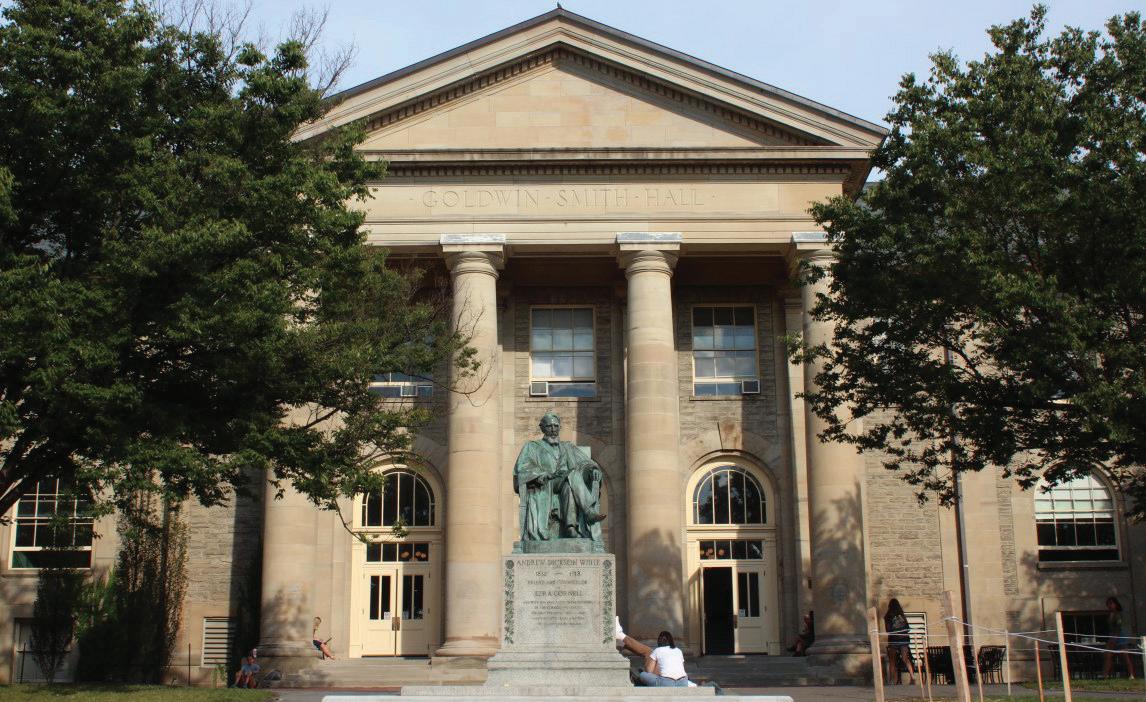
Orientation options | Multiple orientation activities will meet at Goldwin Smith Hall’s steps today, including a walking tour of hidden gems at Cornell and gender-neutral bathroom tours.
Cornell Performing and Media Arts Open House Noon - 2 p.m., Flex Theatre, Schwartz Center for the Performing Arts
Transfer Student Health and Happiness Tour 3 - 4 p.m., Willard Straight Hall lobby
Meet the Greeks for Transfer Students 4:30 - 5:30 p.m., G01 Auditorium, Uris Hall
Tomorrow
A&S Cookies and Careers 1 - 4 p.m., 172 Goldwin Smith Hall
Cornell Performing and Media Arts Crew Meeting 7:30 p.m., Flex Theatre, Schwartz Center for the Performing Arts
Cornell Dance Team
Qualifes For Nationals
By KATHERINE HEANEY Sun Staff Writer
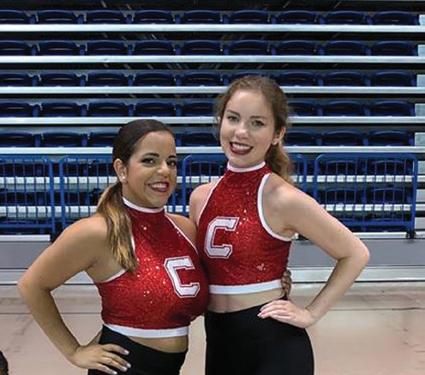
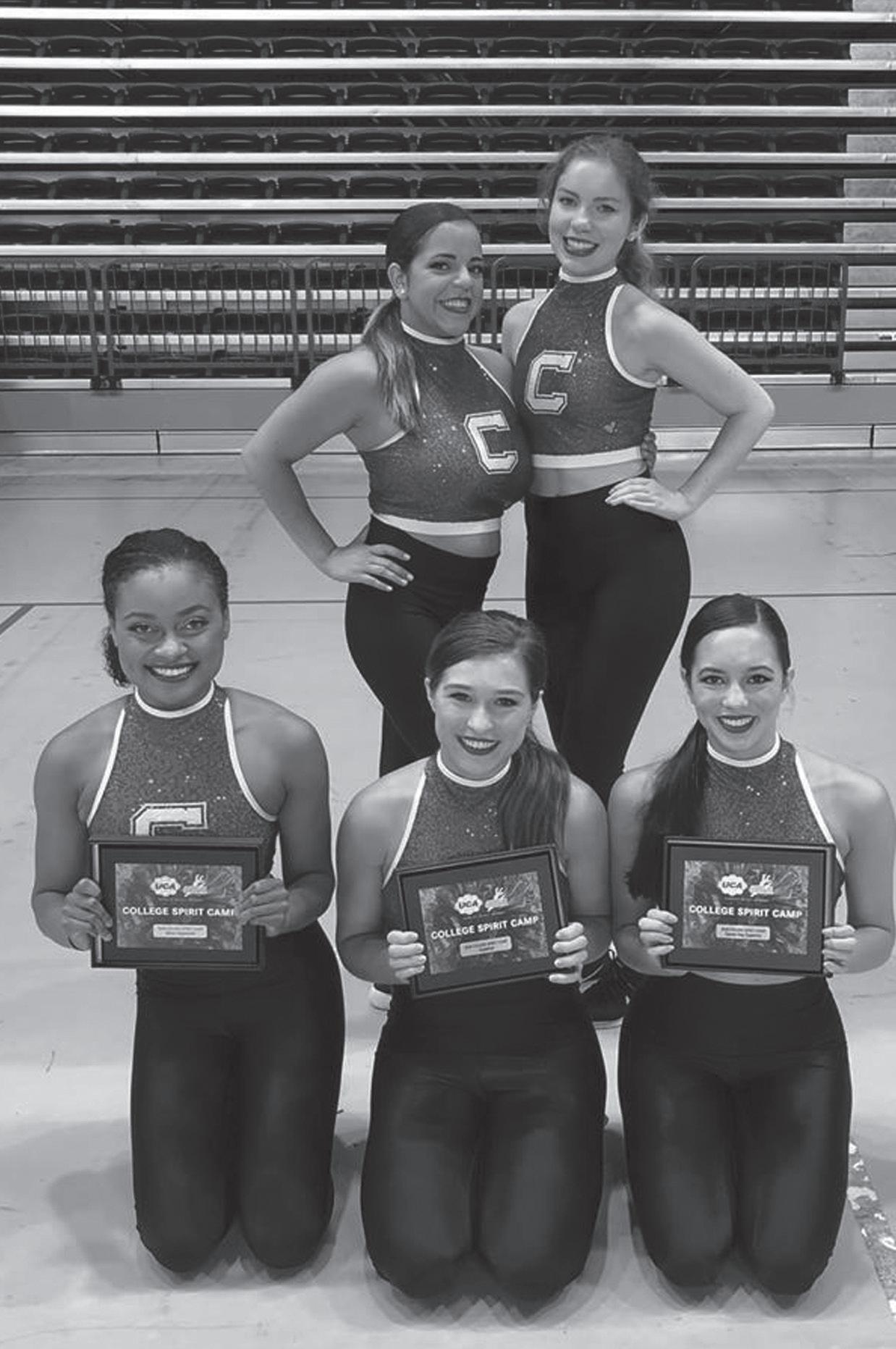
The Big Red Dance Squad qualified to advance to the UDA College Dance Team National Championship and earned three awards at the Universal Dance Association’s College Spirit Camp earlier this month.
“It was so amazing as a new team to be recognized with top awards, and we are so excited that we qualified for nationals,” said Shauna Cheatham ’19, captain of the Big Red Dance Squad and news writer for The Sun.
The UDA College Dance Team National Championship is the “most prestigious college dance team competition in the country,” according to its website. The competition will take place in January 2019 at Walt Disney World Resort in Orlando, Florida.
The Big Red Dance Squad was just formed last year by Cheatham to “create a new opportunity for dancers to compete in competitions and perform at games.”
When Cheatham transferred to Cornell her sophomore year, she was surprised there was no dance team performing at football and basketball games, which she believes to be a “huge part of the culture” for many Division 1 colleges.
“My junior year, it was really important to me to focus on starting and building this team because I want it to be what I leave behind at Cornell,” she said. “We performed at multiple basketball games and were received very positively by the administration and fans. I love the excitement of performing in front of fans and helping to
cheer on the Big Red.”
In addition to competing at UDA college dance team competitions, the team performs jazz, pom and hip hop routines at Cornell’s home sporting events.
Amanda Hernandez ’21, a member of the team, said “the feeling of accomplishment and pride is unmatched.”
“As a new team, we have a challenging road ahead,” Hernandez said. “But we have already begun the journey.”
Earlier this month, the team also attended the UDA’s College Spirit Camp at the University of Delaware from August 8-11.
The camp included three days of instruction and one day of competition. Teams received instruction from UDA staff members and guest choreographers through master classes, technique work, individual performance evaluations and choreographed routines for game days.
The Big Red Dance Squad competed against other northeastern universities such as Villanova, Temple and the University of Delaware.
At the camp, the team took home Superior, Game Day Superior and Most Improved awards in the Division 1A category.
Cheatham said one of the team’s goal is to play an even greater role in Cornell athletics.
“Cornell has amazing dancers and a very strong dance community,” Cheatham said. “When the country turns to ESPN in January to watch nationals, I want them to see how talented our dancers really are.”
Lake Winemaker And Chemistry Professor Dies at
By MATTHEW McGOWEN Sun Senior Editor
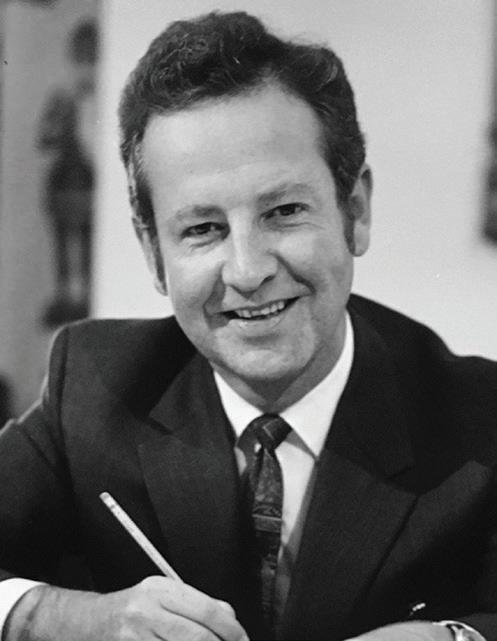
Robert Allen Plane, former provost of Cornell University, died on Aug. 6, 2018 at his home in Albuquerque, N.M. With four children and an eclectic career as an author, instructor, administrator and viticulturist, Plane lived a life of unusually varied accomplishment.
Plane served as provost in the late 1960s and early 1970s, according to the Cornell Chronicle, which is run by the University. His time as provost coincided with a period of tumultuous race relations and political unrest throughout the country and on campus.
David Plane recalled his father’s role in the firing of Jerry Lace, the varsity men’s basketball coach from 1970 to 1972. Lace allegedly capped the number of black players allowed on the court at one time, prompting six black players to boycott games in protest.
“President Corson was away at the time so my dad was the one over there, it was a very tense situation. So he said ‘Let’s order a detente,’ and they worked out an agreement and the coach got fired,” David told The Sun. “He always tried to find a better way. That was difficult at the time when everyone was concerned with asking ‘which side are you on?’”
Prior to becoming provost, Plane was a chemistry professor at Cornell and specialized in Raman spectroscopy, ion exchange and hydrolytic polymerization, according to Prof. Emeritus James Burlitch, chemistry, and an obituary provided by Plane’s family.
He received tenure in 1958 and became a full professor in 1962, all while producing a wealth of published material.
In addition to over 70 research papers, Plane collaborated with Prof. Michell J. Sienko, chemistry, to write Chemistry: Principles and Properties , a groundbreaking text based on their chemistry lectures. According to Burlitch, Plane fought to control the cost of the books to lessen the financial impact on students.
“It troubled him greatly and he talked about it, how to keep the cost down. He made the publisher, which was McGraw Hil,l charge no more or less than six dollars for that book. So I think they charged $5.95.”
Burlitch also reflected on Plane’s busy life and the accomplishments he accumulated in his long career at Cornell.
“He made contributions throughout his life. In that regard he had a very full life of influencing both science and people. I can only marvel at his accomplishments,” Burlitch said in an interview with The Sun.
While still a doctoral candidate at the University of Chicago, Plane met Georgia Ames, a biology graduate student whom he later married. In 1952, the newly-weds moved to Ithaca and had a son, David, and a daughter, Ellen.
In 1969, Plane was on sabbat-
ical from Cornell for a semester and lived in Berkeley, California, a hub of protest.
“My family really saw all that. National Guard troops went by when I was at Berkeley High School. We got tear gassed actually in junior high gym class,” David Plane said.
While Plane was still in Berkeley in April 1969, just five months before taking office as provost, a group of black students occupied Willard Straight Hall in protest, a preview of the challenges Plane would face on the job.
In 1961, Plane went on sabbatical for a year to pursue a
fellowship funded by the U.S. Public Health Service at both the Nobel Institute in Stockholm and at Oxford University in England. While abroad, his wife, Georgia Plane, passed away from cancer, leaving the two children in the care of her husband and a succession of housekeepers.
In 1963, Plane married Mary Moore, who had served for more than a decade as assistant director for programs at Cornell’s Willard Straight Student Union. Two more children joined the family in quick succession, making it a family of six.
Soon after his second marriage, Plane was awaiting the birth of his first child with Mary when he unknowingly took the first step in kick-starting the wine industry in upstate New York.
In an interview with The Sun, Mary Plane recalled, “One of our girls was about to be born, and he was in the hospital reading the paper cover to cover while waiting for the birth of his baby, and he discovered an ad for 2,000 feet of lakefront with a 3
bedroom ranch style house.”
The Planes purchased the property, which included 200 acres of viable farmland, and began raising wine grapes with the help of an amateur wine-tasting group composed of Cornell faculty and wine connoisseurs.
The quality of their grapes quickly began to pay dividends as buyers took notice, paving the way for the Cayuga Lake wine industry to improve and expand. Plane was instrumental in lobbying to create the Cayuga Lake Wine Growing Region appellation, an important designation for wine producers.
Following his time as Provost, Plane became President and CEO of Clarkson College. He developed a new management program and formed the Clarkson School for gifted high school seniors with Mary’s help.
After leaving Clarkson, Plane was asked to take on the role of director of Cornell’s Geneva Agricultural Experiment Station, now Cornell AgriTech.
In 1991, he served as the interim President for Wells College, an all women’s school at the time, and retired in 1995.
In retirement in Albuquerque, Plane was an active volunteer at community food banks and the Thrift Shop Ministry of the Cathedral of St. John (Episcopal). Kay Sedler, the manager of the thrift shop, worked with Plane for several years.
“Bob was cheerful, good with customers, funny and kind,” Sedler said. “He was always willing to help out in any way he could.”
Born in Evansville, Indiana on Sept. 30, 1927, Plane grew up on a small farm during the height of the Great Depression. He played trumpet in a dance band in high school and hosted his own radio jazz program, “Plane and Solid,” while attending Evansville College (now the University of Evansville), where he graduated magna cum laude in 1948.
He is survived by his son David Plane, daughters Martha Lu Plane, Ann Marie Plane and Jennifer Moore Plane, as well as his wife of 55 years, Mary Plane.
Dancing success | The Big Red Dance Squad won three awards
the UDA’s College Spirit Camp earlier in August.
Additional Students Were Initially Denied Option to Waive SHP
Continued from page 1
According to the SHB website, students are automatically enrolled in the Student Health Plan each June for the upcoming academic year, and “eligible domestic students” can request a plan waiver. For a waiver to be approved, four basic components must be met: the insurance needs to be active in the United States, have no policy maximum, be active throughout the student’s academic year and reimburse coverage in Ithaca for at least 70% of charges.
Payne said about 40 to 50 percent of those rejected in past years when requesting the plan waiver appealed the initial denial. Most of those appeals were approved. The total numbers of waiver applications, approvals and appeals for 2018-2019 have not yet been released.
Meghna Srivastava ’19, who had her waivers approved for the previous three years, felt “irritated” that she now had to pay the “premium for SHP with no explanation as to why the requirements had changed.”
According to Srivastava, at the time her waiver was denied, no explanation or clarification was offered on the Student Health Benefits website, and repeated calls to Gallagher Student Health were unhelpful. The SHB website now offers a “2018-19 Waiver Process FAQ” page addressing the waiver denial issues. Srivastava appealed the denial, and her appeal was approved.
Rejections are handled automatically through Gallagher Student Health, the company that reviews the waiver applications on behalf of Cornell Health, according to Payne. This company is supposed to automatically audit applications, and reject those with an out-of-network coverage rate of less than 70 percent.
Recently, Cornell Health discovered that this minimum
Cornell AAP
DEAN
Continued from page 1
ment can do individually.
Yoon attributes this interdisciplinary approach to her practical experience in architecture, which required her to coordinate many disciplines and “synthesize between engineering and the kind of ‘creative design’ aspects, to policy and urban planning and urban design issues.”
Yoon is the co-founder of Höweler + Yoon Architecture LLP and MY Studio, and has garnered honors across the globe for her design work, including the Progressive Architecture Award, the Architecture Record’s Design Vanguard Award and the Architecture League’s Emerging Voices Award.
As an alumna, Yoon will return to lead the department in which she studied over 20 years ago, which she called “transformative” for her growth.
“It’s very sweet,” Yoon said
coverage component was not being audited by Gallagher.
“The waiver requirements have not changed,” Payne said. “The big change was the audit process which yielded a dramatic increase in the number of initial denials.”
The University’s policy reads that students’ insurance must have Cayuga Medical Center in its network. CMC is the only “hospital, emergency room, and diagnostic center that is accessible through public transportation” according to the SHB FAQ answers.
Ithaca College also requires its students to enroll in a health insurance plan. This plan costs $1,795 for a student for the 2018-2019 academic year compared to $2,832 for a full-time student at Cornell.
Payne suggested that the difference in cost could be attributed to many differences in the coverage quality of the plan, including distinct student demographics between the two schools.
According to Payne, one factor behind the cost discrepancy could be “the value level of the coverage that is built into the insurance.” He said another factor might be differences in claims experiences, using the example that a Cornell student who visits the E.R. would pay a flat $100 copay, while an IC student would pay a $50 copay, plus 20% of the cost.
According to Payne, Cayuga Medical Center does not accept UnitedHealthcare plans. UnitedHealthcare is the largest health insurance provider in the country, according to Fortune 500. The Sun could not reach representatives of CMC for comment.
For students who successfully waived the SHB requirement last year but were denied their waiver this year, Cornell Health acknowledged the issue in answers on the SHB website, noting that for some students, “the denial comes as a surprise.” As a result, the University decided to ap-
prove waivers for those with at least a 50-percent coverage at CMC. This is currently only a short-term decision, according to Payne.
Students who meet that 50-percent coverage requirement, and who successfully waived last year, must give written acknowledgement of risks associated with not meeting the recommended 70-percent coverage requirement. These risks include high costs and potential delays, according to the SHB website.
Last year, 19,551 students utilized Cornell Health’s resources, according to Payne. All University students — whether on SHP or just paying the student health fee — pay a ten-dollar co-pay for professional services.
Payne said the 70-percent minimum out-of-network coverage requirement is not a national standard, and the Affordable Care Act does not mandate any minimum out-of-coverage requirement.
The established minimum coverage requirement will be discussed in the fall by the Student Health Benefits Advisory committee, according to Payne, who advises the committee. The SHBAC, composed of students, faculty and staff, meets for the first time this academic year in September, he said. The role of the committee is to advise on the SHP, SHP-Medicaid and the Student Health Fee, according to the SHBAC website.
The minimum standard “will likely be the crux of the discussion this fall,” Payne said. “I think the focus will be: Do we set minimum standards for what health insurance coverage looks like, and if we do, what are those minimum standards?”
According to Payne, the committee will aim to release its recommendations by November 1.
Maryam Zafar can be reached at mzafar@cornellsun.com.
Names J. Meejin Yoon Its First Female
of the feeling. “I’m nostalgic for the Cornell of the 1990s. I always think fondly about Cornell.”
Yoon acknowledged the developments that have taken place in her department since she attended Cornell, namely a tendency towards “reaching out” into the world with a variety of programs.
Cornell AAP maintains a campus in Rome, Italy as well as a presence in New York’s financial district.
“I’m sure it’s changed a lot,” Yoon said. “When I was there the [Cornell in Rome] program existed, but there was no New York City program, there was no Cornell Tech.”
She also views the current age as a critical time for design and its influence on social, cultural, environmental and technological spheres.
“Design has the capacity to actually make change,” Yoon said. “Because Cornell AAP has a strong legacy of both the creative fine arts and design [as
well as] planning and the built environment, I think that it can do things that really change the world for the better.”
Yoon had been interviewing
for the position since “early spring” and stated that she was informed of the naming decision only recently. She will take over the position from interim
Dean
Sarah Skinner can be reached at sskinner@cornellsun.com.
dean Prof. Kieran Donaghy, city and regional planning.
Local Union Members Concerned by Maplewood Construction
nessee firm, to utilize local union skilled construction workers and companies,” he said.
Safety and quality issues in the Maplewood construction are some of the problems that the union is concerned about. These include OSHA safety fines, multiple inspection failures and New York State Department of Labor investigations, according to the online petition.
“[Maplewood] is not a quality product that we would’ve delivered through our contractors,” Marsh said.
Furthermore, the group emphasized the importance of hiring local workers to strengthen the Ithaca community.
“We really would wish [the University] would place more emphasis on making sure that when they spend millions of dollars that those millions of dollars are spent on local people so that the money stays here in Ithaca and gets re-invested into the community,” Boreanaz said. “We’d like Ithaca
to be more focused on a sustainable community and not let so many millions of dollars leave the state and leave the area.”
Jerry Morley, a business agent for the United Association Plumbers and Steamfitters, said that about 90 of his 240 members were unemployed over the winter and about 50 were unemployed over the summer.
“If we had had that work [at Maplewood], we would’ve been fully employed. That’s a lot of members missing benefits and so forth,” he said. “Normally, summertime you’re busy, and they were not.”
Boreanaz speculated that the reason the University chose to turn to an outside firm was to save some cost and financing on the project.
The Tompkins-Cortland Building & Construction Trades Council has a collective bargaining agreement with the University about construction, and so Marsh said that the group was concerned from the beginning about the University’s decision to lease the property to EdR.
According to Marsh, EdR did solicit bids from local contractors, but those bids were rejected because EdR claimed the overall total of those bids put the project over budget.
“The bids were actually realistic because our local contractor knew the schedule required major overtime,” Marsh said. “One large contractor tried to convince EdR to extend the schedule, and when EdR refused, they pulled their effort to bid the project and cautioned EdR that they were never going to meet the schedule.”
Marsh estimated that, overall, the Maplewood project only had about 10 percent local labor. In an email to The Sun, Craig Wack, EdR’s public relations coordinator, said the majority of contractors were local.
“We make every effort possible to hire local labor at all of our communities throughout the United States,” Wack said. “In this instance, two-thirds are local contractors and all but one of the remaining third are located in New York state.”
According to Wack, EdR part-
nered with LeChase construction, a Rochester-based company. As the general contractor, LeChase was in charge of all efforts in regards to local labor and subcontractors and handled the process of selecting bids.
While the construction union’s attorney found the University’s contract with EdR to be legal, Marsh said that he thought the University “circumvented” their contracts.
If Cornell had built the property itself, it would’ve been legally required to use local labor, but by leasing the property to EdR, the University in effect “circumvented” this and the local contractors had to deal directly with the private company, Marsh explained.
However, he said that Cornell could have, but did not, stipulate in its contract with EdR that it use local labor. Thus, the petition calls for Cornell to guarantee the use of local labor even when it leases out the land.
According to the Ithaca Planning Board’s meeting minutes from March 2016, Cornell “decided that the local building
trades are not going to be a part of this partnership” with EdR because the Maplewood project was considered “low-end construction.”
Marsh described Maplewood as just an example of what could happen if the University continues this trend to lease with outside firms in the future.
“We think this type of a model is dangerous for local employees and Cornell has told us, Mary Opperman, that they intend to continue these types of projects, that Cornell has made a conscious decision that they don’t want to increase their debt load to build student housing,” Marsh said.
“A lot of the community does not have any idea of what has happened at Maplewood and that it could be repeated again, and it’s just such a loss of revenue for the area,” he continued. “We want pressure on Cornell to make them rethink this process.”
In a statement to The Sun, Mary Opperman, vice president and chief human resources officer, said that “Cornell University has a long history of working closely with the Tompkins-Cortland Building & Construction Trades Council to ensure that on-campus projects make the fullest possible use of local union labor, and we certainly can understand their frustration with EdR and its execution of the Maplewood Apartments project.”
Moving forward, she said that the North Campus Residential Expansion project, an estimated $200 million project that aims to expand housing on campus by 2,000 beds, will “make maximum use of our skilled and highly valued local labor community,” as per the University’s standing agreement with the Building & Construction Trades Council.
Marsh confirmed that the University told them yesterday that they will honor the collective bargaining agreements for the North Campus housing project.
“As educators, we believe there is no question unworthy of a direct and thoughtful response,” Opperman wrote. “As our more than 9,000 local employees and their families know, and the companies that benefit from our more than $190 million in annual local purchasing and construction spending understand, the answer to ‘does Cornell care’ is an unequivocal ‘Yes!’”
Shruti Juneja can be reached at sjuneja@cornellsun.com.
The Corne¬ Daily Sun
Independent Since 1880
JACOB S. KARASIK RUBASHKIN ’19 Editor in Chief
JOHN McKIM MILLER ’20
Business Manager
KATIE SIMS ’20
Associate Editor
VARUN IYENGAR ’21
Web Editor
MEGAN ROCHE ’19
Projects Editor
EMMA WILLIAMS ’19
Design Editor
JEREMIAH KIM ’19
Blogs Editor
AMOL RAJESH ’20
Science Editor
BREANNE FLEER ’20
News Editor
YUICHIRO KAKUTANI ’19
News Editor
NICHOLAS BOGEL-BURROUGHS ’19
City Editor
LEV AKABAS ’19
Arts & Entertainment Editor
SARAH SKINNER ’21
Assistant News Editor
ANNE SNABES ’19
Assistant News Editor
JOHNATHAN STIMPSON ’21
Assistant Sports Editor
EDEM DZODZOMENYO ’20
Assistant Photography Editor
PETER BUONANNO ’21
Assistant Arts & Entertainment Editor
CHENAB KHAKH ’20
Assistant Science Editor
JULIAN ROBISON ’20
Layout Editor
HELEN HU ’21
Graphics Editor
DUSTIN LIU ’19
Human Resources Manager
ANNA DELWICHE ’19
Senior Editor
MATTHEW McGOWEN ’19
Senior Editor
Ad Layout
Design Deskers
GIRISHA ARORA ’20
Managing Editor
HEIDI MYUNG ’19
Advertising Manager
ALISHA GUPTA ’20
Assistant Managing Editor
DYLAN McDEVITT ’19
Sports Editor
MICHAEL LI ’20
Photography Editor
GRIFFIN SMITH-NICHOLS ’19
Blogs Editor
JACQUELINE QUACH ’19
Dining Editor
SHRUTI JUNEJA ’20
News Editor
ANU SUBRAMANIAM ’20
News Editor
JUSTIN J. PARK ’19
Multimedia Editor
PARIS GHAZI ’21
Assistant News Editor
MEREDITH LIU ’20
Assistant News Editor
JACK KANTOR ’19
Assistant Sports Editor
RAPHY GENDLER ’21
Assistant Sports Editor
BORIS TSANG ’21
Assistant Photography Editor
VIRI GARCIA ’20
& Entertainment Editor
Assistant
CATHERINE HORNG ’21
Assistant Dining Editor
LIZ CANTLEBARY ’21 Snapchat Editor
ALICIA WANG ’21 Sketch Editor
KATHLEEN JOO ’18 Marketing Manager
JOSH GIRSKY ’19
Senior Editor
ZACHARY SILVER ’19
Senior Editor
Williams ’19
Josh Girsky ’18
Williams ’19
Megan Roche ’19 Carolyn Shi ’19
News Deskers Shruti Juneja ’20 Anne Snabes ’19
Arts Desker Viri Garcia ’20 Photography Desker Edem Dzodzomenyo ’20 Production Deskers
Williams ’19 Sarah Skinner ’21
Be Independent: Join Te Sun
SOMETHING CRAZY HAPPENED THIS PAST SUMMER. Thousands and thousands of Cornellians — one-quarter of all undergraduates — got up and left Ithaca, likely for good. And yet, last Friday, thousands and thousands of new students rushed to fill those vacant spots, ensuring that, at least for one more year, Cornell will remain at full force. Here at The Sun, we too said goodbye to a sterling senior class, of editors, writers, photographers, designers, business associates and more. But unlike our friends at the admissions office, however, we don’t have the benefit of being on the Common App. That, dear reader, is where you come in — because I think it’s time you consider joining The Cornell Daily Sun team.
There’s never been a more exciting time to be a student journalist. The advent of the information age and the ever-increasing powers of technology mean that even journalists with minimal experience but maximum gumption can dig deep into today’s most pressing issues. Our generation’s fluency in social media has unlocked a news source of immeasurable depth. And for so many different reasons — rising tuition and student debt, a revival of campus activism, the ineptitude of Betsy DeVos — higher education is an American topic du jour.
If those issues, or any of the hundreds of others floating around East Hill interest you, there’s a place for you at The Sun. If you believe that quality journalism and in-depth reporting is crucial to the wellbeing of a community, there’s a place for you at The Sun. If you relish in speaking truth to power, asking hard questions and pushing for hard answers, there’s a place for you at The Sun. (And please, if you know why Dean Dutta was fired, please contact City Editor Nick Bogel-Burroughs at nbogel-burroughs@cornellsun.com.)
I hope that you’ll join us at one of our recruitment meetings this fall, on Sept. 5 at 6:15pm in Goldwin Smith Hall G64, and on Sept. 6 at 6:15pm in Goldwin Smith Hall G76, and that you’ll check out our team at cornellsun.info. We welcome students interested in journalism in all its forms, from writing to photography to design and beyond.
The Sun may be pushing 140 years of age, but we’re sure as hell not slowing down. It’s going to be an important, exciting year, and I hope you join us on the way.
J.S.K.R.
Moradi | All Jokes Aside
You Don’t Have To Like It Here
Somehow, every freshman is simultaneously horny and anxious and tired and excited and sweaty during O-week. Part of my on-campus job involves trying to parse through these feelings with first-year students, assuaging their fears and elevating their excitement. I generally try to keep things positive. I tell them how I love the Ithaca Farmers Market, Manndible oatmeal chocolate chip walnut cookies and running through Forest Home Drive.
I slipped up last year when I was on a student panel for Cornell Days and a really perceptive prefrosh asked what I didn’t like about Cornell. I went on a weird and embarrassing rant about the failures of its liberal arts education, and then immediately regretted being harsh on Cornell. We wanted these people to come here, after all, and I clearly hadn’t made much sense during my frantic tirade anyway. (One student asked if what I said meant he shouldn’t try to be an English major.)
The weirdest part of American college is how students are supposed to feel heavy, patriotic pride in their alma mater. You’re a Cornellian for life, they tell us. Cornell is where you will find your lifelong friendships, meet your future spouse or discover your passion! You don’t even need to be at Cornell to feel it: Look no further than the barrage of Cornell porn on your Instagram feed, where freshmen post pics of their new pristine dorm rooms complete with a Cornell pennant, their parents in Cornell gear next to Touchdown the bear, them in their going-out clothes before their first college party.
I chose to come to Cornell because I was really miserable at my previous university, and I am markedly less miserable here. Truly, there really are things I love about Cornell: I love that my friends come from all over the world, I love that I get to do really fascinating research and I love that we have an actual waterfall in the middle of our campus. I don’t love the myriad mental health problems I’ve developed here, the disordered eating, the body image issues and the social anxiety.
My personal problems probably don’t come from Cornell specifically, but college in general. Parties
and hookup culture are frustrating and demoralizing when you don’t fit Western beauty standards or aren’t particularly interested in alcohol. College often feels like you’re in a fish tank with a million of your peers, swimming into classmates you know but don’t necessarily want to see. You’re under constant surveillance: You study with your peers, eat with them and sleep in the same room as them. It’s even hard to find a place to poop in peace. Yet so many of my friends and I had lovely summers living on our own, because it was nice to finally have the chance to be alone, and to wiggle out of the confines and confusion of American college life. I’m no introvert, but the solitude and anonymity of life away from Cornell made me feel at
No matter what the pamphlets tell you, you don’t have to fall in love with college, and you sure don’t have to love Cornell specifically.
ease, like I could finally breathe a little bit.
It’s especially tough during your first week, when you’re suddenly thrown into this inescapable tank and everyone feels like a stranger despite being around you for your every move. Every conversation seems superficial. Making close friends takes time, and trying to do so during the accelerated atmosphere of O-week is particularly difficult. No matter what the pamphlets tell you, you don’t have to fall in love with college, and you sure don’t have to love Cornell specifically.
I made it through by doing things my own way, rather than the way they were marketed to me, whether it was in popular media or through Cornell’s own promotional materials. I immersed myself in the things I knew I enjoyed and actively avoided the things I knew I didn’t. I made it through by remembering that college is only temporary, and by remembering the sweet escape of summers away from school.
College can just kind of suck sometimes, or a lot of the time, and I’m excited to leave it. But I think I would have been better off if I knew as a freshman what I know now: You really don’t have to like it here. And chances are, you probably won’t at first. Pegah
Pegah Moradi is a senior in the College of Arts and Sciences. She can be reached at pmoradi@cornellsun.
Michael Johns | Athwart History
Don’t Pour Medicaid Gasoline on New York’s Opioid Fire
Ithaca Mayor Svante Myrick ’09 wrote a letter to Governor of New York Andrew Cuomo last spring, offering his solution to a problem that no state seems to be able to shake: the opioid epidemic. In his May 16 plea, Myrick included stark data about the way opioids have gripped the city and the county; he noted correctly that 2017 was the “deadliest year for fatal overdoses on record” in Ithaca and that 55.3 of every 100,000 emergency room visits and 15.2 of every 100,000 hospitalizations were overdose-related in Tompkins County in 2016. The mayor’s solution is to allow individuals to legally inject heroin in the city under city government supervision. While federal and other legal challenges almost certainly linger, he wants the governor to approve his plan.
Myrick would do well to focus on the causes and supply routes, and not simply the effects, of the opioid epidemic in the city.
Myrick argues that his proposal, “The Ithaca Plan,” lowers fatalities and gives addicts a better opportunity to seek help, though it almost certainly violates both international and domestic drug control laws. Canada’s equivalent of the plan, known as Insite, which the mayor cited when defending his policy at a session of the Cornell Political Union in April 2017, was criticized by the Canadian Federal Health Minister who noted that the research on the program’s efficacy is preliminary and inconclusive. The governors of several states, most recently Massachusetts, have reached the same verdict.
To be fair, Myrick can be credited for his responsiveness to the opioid crisis; other policymakers, less so. But this proposal is a serious misstep and overlooks other serious problems. On January 25, the U.S. Senate Homeland Security and Governmental Affairs Committee released a report detailing the connection between Medicaid and opioid addiction. One thing is clear: Medicaid offers cheap access to pills which sometimes end up in the wrong hands. In fact, according to
several studies, most notably by the Centers for Disease Control and Prevention, Medicaid beneficiaries are twice as likely to be prescribed opioids compared to those on private insurance. In New York state, these patients have access to oxycodone and other opiates, which can be resold illegally for thousands of dollars. This path has become its own supply chain for the epidemic. Over the last eight years, more than 1,000 people have been convicted of precisely that crime. Like other supply routes that deserve attention — the unsecured border and Chinese fentanyl distribution, for example — this type of fraud is present and profitable. This is ultimately a local problem. In the last four years, Tompkins County has seen a 19 percent rise in Medicaid caseloads, which far outpaces the national average of 5.2 percent over the same period. The Medicaid fraud crisis, at least as it relates to the opioid epidemic, has grown especially quickly in states that, as a part of Obamacare provisions, vastly expanded Medicaid eligibility, as Cuomo did in New York. According to the Senate’s report, “the number of criminal cases increased 55 percent in the first four years after Medicaid expansion, from 2014 to 2017, compared to the four-year period before expansion.”
Nor are these merely partisan findings from the Republican-controlled Senate. The nonpartisan CDC found that overdose deaths rose twice as much on average in states like New York, which expanded Medicaid, compared to those that didn’t. This correlation also exists on opioid-related emergency room visits and hospitalizations. Those who do seek help in the system aren’t given effective treatment by state Medicaid programs, either; according to the Agency for Healthcare Research and Quality, the number of opioid-related
Whospital stays paid for by Medicaid increased by 40 percent between 2012 and 2014. This is especially alarming when viewed in context—that figure grew by about four times the rate that Medicaid enrollment did in that period. Medicaid wasn’t taking on new addicts and treating them—it was simply creating new addicts. These are staggering statistics, but they are also cold and depersonalized ones. Ultimately, it is the personal cost of the national opioid crisis that hits home. 25-year-old Bryan Grieco of Elmira, New York, who died of an opioid overdose in June 2017, is seemingly a perfect example. “Bryan was a really good guy,” his sister Danielle told The Ithaca Voice last year. “He has a heart of gold, but was just afraid to live,” she said of him.
The question confronting us is hopefully self-evident: How many more Bryan Griecos must our nation and the families and friends of these young men and women be forced to endure? Myrick would do well to focus on the causes and supply routes, and not simply the effects, of the opioid epidemic in the city. The mayor’s next letter, instead of an almost certainly illegal proposal, should focus on more reasonable solutions. First, New York’s public servants should support proactive measures to secure the border and tackle foreign drug importation, such as Chinese fentanyl, 80 percent of which enters the U.S. on the ground from Mexico. New York also should reform its Medicaid program, establishing opioid prescriptions as a last step in a pain management clinical protocol, including anti-inflammatories, muscle relaxants, physical therapy, biofeedback, cognitive behavioral therapy, and so on as appropriate, instead of simply approaching opioids as a first-line clinical solution to pain.
By addressing issues instead of advancing pet projects, New York will be more effectual as it seeks to reach and repair communities and stop the use and abuse of deadly drugs that take the lives of young people like Bryan Grieco.
Michael Johns is a junior in the College of Arts and Sciences. He can be reached at mjohns@cornellsun.com. Athwart History appears every other Wednesday this semester.
Community Sans Unity
hen I first came to Cornell, there was no culture shock. Every day, I was surrounded by mostly people of color. I then moved into Ujamaa Residential College — a predominantly black residence hall — the first day of Orientation week. I thought, “Cornell has cookouts and blasts trap music? I think I found my new home.” It did not take long for that to idea to change. It started with the racist chants around the Latina Living Center, then a black student was jumped in Collegetown. The year continued with more cases of sexual assault, racism, suicide, hazing and even potential gun violence. I honestly don’t know what I feared the most: getting sexually assaulted walking alone at night, or getting jumped because of my race. I also feared that it would happen to a friend.
But I don’t have time to fear. I decided to try and do my part to solve this problem by getting involved around campus. I created distance between myself and the group of people who I had come to be most comfortable with. The best way to get a community of people from different places and studies to unify is by encouraging them to work together. Just because I am an environmental science major doesn’t mean I have to go to every climate-related event. Just because I am Muslim and not Christian doesn’t stop me from visiting one of the CRU setups in front of Balch and having a nice conversation with one of the volunteers.
At many discussions I attended, I realized time and time again that we are preaching to our own choirs. We go to these talks about diversity, inclusion,
LGBTQ rights, climate change, etc. because we are passionate about it and they are problems that need to be fixed. But that is usually the case for everyone else in the room. The key to making a greater impact is by talking to people who disagree with us or who are not knowledgeable. We have to understand that it is not always their fault, it is just a result of being and not being exposed to certain information.
It is important that if we are unable to make these people come to little discussions in the basement lecture halls, we have to find another way to communicate these messages. I think it is the responsibility of the professors and educators across disciplines to have these structured conversations with their classes. There are so many ways to discuss current global problems regardless of what class it is. For example, in my natural resources classes, we’ve discussed economics, policy, and inequalities in depth, which continuously exposes people in STEM classes to social issues.
able to find a solution.
There is always something we can do to fix a situation.
There is no question that the world around us is sick. There are countless acts of inequality, abuse, political conflict, environmental degradation, racism, corruption, poor education — the list goes on. There are problems that if left unaddressed in the next few decades, can change the course of life as we know it for the worst. If people knew what was actually happening around the world and our news was not inundated with Trump’s most recent tweets or actions; we would do something about it. It is the lack of communication that has wounded our society. That fact also applies to elite universities. How can we have a community without communication? How can we have a community without unity?
We need to stop letting the administration address these problems with “task forces” and start having a more transparent way for the administration, faculty and students to communicate. The student liaisons are not truly allowing for fully transparency between the administration and us, which prevents students and administrators from communicating the actual day-to-day problems. We all have to be held account-
There is always something we can do to fix a situation. Sometimes that fix is not obvious to us. We just have to continue to challenge closed-mindedness and unlearn negative biases through educating each other. At the end of the day, I am a damn proud Cornellian. I have met and been inspired by so many people here. I want to see us all leave and make a positive impact on the world.
Aminah Taariq is a sophomore in the College of Agriculture and Life Sciences. She can be reached at ataariq@cornellsun.com.Student Sayings runs every other Wednesday this semester.
Aminah Taariq | Student Sayings
UNITARIAN CHAPLAINCY AT CORNELL
Our mission is to create connection, find inspiration, and engage the world. Connect, Inspire, Engage.
Rev . Margaret Weis (607) 273-7521 ext, 22 minister@uuithaca.org
Sponsored by First Unitarian Society of Ithaca At the corner of Aurora and Buffalo Streets www.uuithaca.org
The Religious Society of Friends Ithaca Monthly Meeting
Quakers
Meeting for Worship
Sundays 10:30 a.m. 120 Third Street, Ithaca (607) 229-9500
www.ithacamonthlymeeting.org
Chabad is dedicated to bringing the warmth and richness of Jewish life and tradition to students of all backgrounds. We are your home away from home… the heart of Jewish campus life.
Come for our free home-cooked Shabbat dinner, or for a Torah class. Call for information about Judaism, or just to talk For more information regarding Chabad’s programs and activities, please e mail: Rabbi Eli and Chana at: es79@cornell.edu or call: (607) 257-7379 Eli & Chana Silberstein www.chabadcornell.com
I THACA A REA C ONGREGA TIONS
College discussion groups—Sunday 10:30 AM
Sunday Morning Church Service—10:3 AM
Wednesday Testimony Meeting—7:30 PM
Learn how Christian Science can help you in everyday college life
SUNDAY SERVICE/SCHOOL 10:30AM
WEDNESDAY TESTIMONY MEETING 7:30PM
Share practical healing ideas with other college students
FIRST CHURCH OF CHRIST, SCIENTIST • 101 UNIVERSITY AVENUE, ITHACA CHRISTIAN SCIENCE READING ROOM 117 SOUTH CAYUGA STREET
607-272-1650, MON-FRI 11AM-5PM, SAT 11AM-2PM christianscience.com
Visit our historic church at 101 University Avenue
Rev Kirianne Weaver Riehl, Pastor Rev. Cynthia Weaver, Supply Pastor
ARTS& ENTERTAINMENT
Mission: Impossible — Fallout Film Wrapup
BY ZACH LEE AND NICK SMITH Sun Staff Writers
I’ve often made what I now consider the mistake of lumping the Mission: Impossible movies in with franchises like Fast & Furious and Transformers — what I might call “guilty pleasures,” though the last couple Transformers haven’t even been pleasures — but that’s not a fair evaluation. I don’t feel guilty at all about loving Mission: Impossible — Fallout . It’s more John Wick than Skyscraper , which is to say it combines its breathtaking action sequences with, let’s say, consistently acceptable and somewhat believable storylines. Yes, Fallout has some issues, but an outstanding cast, iconic score and solid directing from Christopher McQuarrie turn what would have been a just a good stunt movie into a truly gripping action thriller. Fallout is absolutely worth seeing, if only to try and catch a glimpse of Tom Cruise’s humanity in that shot where he broke his ankle. Spoiler alert: it’s not there; he’s evolved past pain; Scientology is the answer. I’ve teamed up with fellow Sun-ie Zach Lee ’20 to answer a couple questions about Tom Cruise’s newest action romp. — Nick Smith
1. Favorite Part
Nick Smith : The stunt sequences in this movie are head and shoulders above anything in recent memory, and they’re made all the more compelling because we know Cruise is crazy enough to actually do them. I know someday I’ll stumble across a somber Buzzfeed article about how jumping out of a collapsing building onto a motorcycle that’s on fire finally caught up with everyone’s favorite 50-year-old action hero, but until then I’m all in. In an age where most action movies are marred by subpar effects, Fallout stands out in the best possible way. Not only does Cruise’s IMF team carry out some of the most exciting sequences ever put to film, but the movie knows just when to let you breathe during the two hour and 20 minute thrill ride. If I’m picking just one, I’m going with the bathroom fight scene, which according to Henry Cavill took around a month to film. It’s surprisingly long, it’s not cut to death and it effectively showcases both the prowess of our fighters and ingenuitive use of a novel environment.
and kill one to save millions, Hunt’s strength — what others perceive to be weakness — is that he cares for the one life.
2. Worst Part
N.S. : There nits if you want to pick them; some dialogue’s expositional, some plot developments feel sudden and there are some small holes, but that’s more-or-less part of the deal. The simple fact is that you do need some plot to get Cruise from one helicopter to the next and this movie does it better than most. At the end of the day, there’s not much I’d change.
Z.L. : Perhaps to the film’s credit, I can only critique the film for what it does NOT have rather than what is in it. Considering how integral Jeremy Renner’s William
some parts). Additionally, Vanessa Kirby’s White Widow was delightfully enigmatic and facetious relative to the more serious portrayals of the other characters.
4. Ranking in the Mission Impossible Franchise
N.S. : Second, just behind the original. I think Henry Cavill, Simon Pegg, Rebecca Ferguson, Vanessa Kirby and the return of Michelle Monaghan and Sean Harris together are enough to edge out Philip Seymour Hoffman’s role in 3, and it tops Ghost Protocol and Rogue Nation on action alone. 1996’s Mission: Impossible was a different movie, and the franchise just hasn’t gone that direction since Brian De Palma handed the reins to John Woo.
Brandt was in the fourth and fifth films, an explanation for his absence would have been nice (yes, we all know that he was being Ronin Hawkeye in Avengers 4 but still). Additionally, the whole Syndicate thread was not really continued much from the fifth film despite the inclusion of Sean Harris’s Solomon Lane. They could have done more with it, but considering all that McQuarrie was trying to tackle in this film, I don’t blame him for streamlining the narrative.
3. Most Surprising Aspect
Zach Lee : I agree; that bathroom fight sequence is worth the price of admission alone, despite the fact that many of its key moments were spoiled by the trailers. It admirable that rather than stick with doing just one impressive stunt sequence, McQuarrie and Cruise were able to string multiple seemingly superhuman feats together without making it feel like a highlights reel of American Ninja Warrior. Thematically, this is one of the first Mission: Impossible films that really digs into Ethan Hunt’s psyche. I like that McQuarrie is willing to slow the pace of the film down and look into Ethan Hunt as a man tormented yet convicted by his calling as an IMF agent. This is Cruise’s sixth portrayal of the character, and Ethan Hunt has become so iconic that it is easy to simply accept the actions that he does on screen without thinking critically about them. I loved how Cruise and McQuarrie added another layer of complexity to Ethan. They explored how in a world in which secret service agents are told to constantly trade one life for another
N.S. : There are two clear candidates here: Cruise’s still-functioning joints and Cavill’s mustache, and I think I’ve gotta go with the ‘stache. Sure, Cruise still looks like he could bust out an impressive 40 time, but I think Cavill’s role could become one that defines his career after a couple lackluster DCEU appearances (though I think he himself is a good Superman in some less-thangood movies). He’s about as perfect of a foil to Cruise’s Ethan Hunt as you could ask for — the “hammer” to Hunt’s “scalpel.” The dude’s got serious star power and I think the mustache was almost worth Justice League’s shoddy CGI-job… almost.
Z.L. : Henry Cavill! The man can act… sadly his wooden performance in Man of Steel does not do justice to the range that he has at his disposal here. He is not new to the spy film genre and while his turn in Guy Ritchie’s The Man from U.N.C.L.E. was humorous, I like how he chose to go for a more serious portrayal here even if it came at the risk of being campy (which it did in
Z.L.: I’ll always have a soft spot for Ghost Protocol because it helped helped give the franchise a second life and Brad Bird’s execution of the Dubai sequence is pure cinematic mastery. But on every level, from character development to story to action, Fallout knocks my original second-placer, Mission: Impossible III , out of the park.
5. Ranking among Tom Cruise Movies
N.S. : I’ve have no issue tossing Fallout in the latter half of his top 10 alongside stuff like (in no particular order) Rain Man, Edge of Tomorrow, Jerry Maguire and Minority Report, and I’d put it on a shelf above stuff like The Last Samurai, Jack Reacher and Top Gun, my unbridled love for shirtless, all-male beach volleyball aside. Fallout might not fully showcase his acting chops, but in terms of pure enjoyability it’s up there with the best of ‘em.
Z.L. : For this being a Tom Cruise movie, the film is graciously egalitarian to the other members of the supporting cast, despite the fact on every poster the only name you see is “Tom Cruise.” Considering all the mustache drama Henry Cavill went through, he at least deserves to be second-billed. I like this film for similar reasons that I liked Edge of Tomorrow ; Cruise works well when the spotlight is on him, but when he is willing to share that space with co-stars who can bring different sides of his personality out, that’s when he really shines.
6. Ranking in the Overall Action Movie Genre
N.S. : Thinking back over the last 10 or so years, I’m hard pressed to think of many films that’ve done action better. This is up there with the Equalizers , Logan and Mad Max . It’s truly a tour de force, and one I hope will rub off on others in the genre for years to come.
Z.L. : Yeah, apart from Mad Max: Fury Road , John Wick or any fight choreography done by the Russo Brothers, this is one of the best action movies I’ve seen in a long time. The commitment to real stunts and willingness to not cut the camera so quickly are giving me hope that the action film genre can move past the sloppily executed fight sequences of, say, season one of Iron Fist
Nick Smith and Zachary Lee are juniors in the College of Arts and Sciences. Smith can be reached at nks53@cornell.edu. Lee can be reached at zjl4@cornell.edu.
Benji Dunn (Simon Pegg), The White Widow (Vanessa Kirby), Ethan Hunt (Tom Cruise) and Luther Stickell (Ving Rhames) in the newest Mission: Impossible film.
COURTESY OF SKYDANCE MEDIA
Ant-Man and the Wasp Aims Small, Hits Big
BY ZACH LEE Sun Staff Writer
In superhero movies, saving the world has become the equivalent of drinking cough syrup: excruciating, repetitive, ultimately necessary and, dare I say, boring? On one hand, there is no better way to raise stakes or unify disparate groups of people; when the fate of the world is at risk, even major ideological differences can be pushed aside for the sake of ensuring survival. But if this trope is repeated too many times, that sense of urgency can quickly give way to leisure. When the stakes are repeatedly raised, the risks feel disingenuine and deceitful, because the on-screen peace and/or carnage we know will ultimately be reversed in the future.
By keeping the stakes refreshingly low and overloading the film with Marvel’s predictable, but nonetheless infectious, humor, Ant-Man and the Wasp shows that life does not consist solely of big moments. It is the small moments, the mundane, day-today events, that matter and ultimately shape who we are. The film is not naïve; it is aware that one’s world can end with just a snap of one’s fingers, but that realization highlights the important things in life that are too often overlooked in favor of spectacle — namely love, family and friendship. By going small, it ironically shows what the big and essential things really are.
If you were to dig beneath the surface to the subatomic narrative DNA of the film, you would find that it surprisingly speaks to great lengths on the
subject of fatherhood.
For antagonist Ava Starr/Ghost (Hannah John-Kamen), she is angered at the loss of her own father and, while she seeks revenge, her rage is a mask for her longing to form an identity in the real world apart from the legacy of her parents. For renowned scientist Hank Pym (Michael Douglas), there has never been a problem or issue he has not been able to solve, but he is at a loss when it comes to safely rescuing his wife Janet (Michelle Pfeiffer) from the nebulous Quantum Realm. Painfully realizing his limitations, he trains his own daughter Hope (Evangeline Lilly) to do the work that he cannot. He projects his desires and aspirations upon her, and she shoulders the burden and pressure well, with no signs of breaking down beneath her yellow-tinted helmet. Buoyed by Lilly’s gruff and terse portrayal, there is no denying Hope’s skill; she is just as adept at assembling a high-tech quantum tunnel as she is able to effortlessly takedown Sonny Burch’s (Walton Goggins) henchman. Yet her acceptance of the Wasp mantle, while rousing, is tragic as well. She seems like someone who never had the opportunity to grow up, with her own aspirations being replaced by her father’s ambitions.
In contrast, Scott Lang (Paul Rudd) wants his daughter Cassie (Abby Ryder Fortson) to escape from his own shadow.
The start of Ant-Man and the Wasp sees Scott under house arrest
due to the events of Captain America: Civil War. Cassie encourages Scott to become Ant-Man again later, even humorously offering to help him fight crime. To this, Scott states that if he were at any point to let his daughter become a superhero, he “would be a terrible father.” He courageously wants Cassie to not repeat his mistakes but to live freely, even if it comes at the cost of his influence in her life. It is a different philosophy than Hank’s, and the film engages with important themes through these characters.
While the search for Janet and the exploration of fatherhood drive the film forward, the film’s humor, mostly given by the likes of Luis (Michael Peña) and newcomer Jimmy Woo (Randall Park) help give it momentum. At this point, if you have not gotten on board with the cookie-cutter jokes Marvel injects into its films, from caustic sarcasm to incessant name calling, you will not grow to like it more here.
In my Avengers: Infinity War review, I stated that I hoped Avengers 4 would be less Good Friday, more Easter Sunday. While the stone has not rolled away from the tomb yet, AntMan and the Wasp is a welcome step in the right direction. Small but imperative films like this one are proof that the future of the M.C.U will continue to shine bright and leave hearts warm, even despite adversity.
Zachary Lee is a junior in the College of Arts and Sciences. He can be reached at zjl4@cornell.edu.
Art by Alicia Wang ’21
Recap the Summer
SUMMER
Continued from page 24
lacrosse announced its eight-member class, which features three players listed as playing multiple positions.
Women’s Rowing Hires New Head Coach
With 10 years of Ivy League coaching experience, and most recently serving as head coach at George Washington, Eric Carcich comes to East Hill as the new women’s rowing head coach. Carcich rowed at UMass and coached there briefly before working for seven years as the assistant lightweight coach at Yale and three seasons as assistant heavyweight coach at Penn. He has spent the last 10 seasons at GW.
Women’s Track, Field Hockey, Women’s Tennis Name New Assistant Coaches
Justin Byron and Alesha Widdall were recently added to the coaching staffs of women’s track and field, and field hockey, respectively, and Kieran Burke joins women’s tennis as an assistant coach after two years at the University of Colorado. Byron will work with the women’s sprinters and hurdlers, while also assisting with the men’s hurdlers, according to Cornell Athletics’ release. Widdall, who played on the U.S. Women’s Field Hockey Senior National Team for seven years and was a member of the 2016 U.S. Olympic training team, brings her playing and coaching experience — including two All-American nods as a player at UMass — to the Red’s staff. Burke also has coaching experience at Vanderbilt and Boston College.
3 Cornell Alumni to Compete at World Rowing Championships in Bulgaria
Three Cornellians will compete as members of the United States’ 72-athlete roster at the 2018 World Rowing Championships Sept. 9-16 in Plovdiv, Bulgaria.
Michael Colella ’16 will make his second consecutive appearance as a member of the men’s pair, teaming up with Anders Weiss of Brown University.
Tracy Eisser ’12 and Alex Karwoski ’12 will compete for the women’s eight and men’s eight, respectively. Seven of the eight rowers on Karwoski’s team hail from Ivy League schools.
Racker Rivals Big Red Game Features Hockey Alumni, NHLers
A charity hockey game over the summer featured the likes of head coach Mike Schafer ’86 and NHL hall of famer Joe Nieuwendyk ’88. The Racker Rivals Big Red Game supports Racker, an organization that helps people with disabilities “by offering opportunities to learn and be connected with others and fostering an environment of inclusion, where all people know they belong,” according to Cornell’s press release. Brad Chartrand ’96, who played for five seasons with the Los Angeles Kings, and Joakim Ryan ’15, who played 62 games as a rookie with the San Jose Sharks this year also participated in the game.
Raphy Gendler can be reached at rgendler@cornellsun.com.
Defenseman Drafted by NHL’s Lightning
GREEN Continued from page 23
ing junior, for most of the season, Green had the opportunity to play with high level talent right from the start.
“We had a great team this year at Cornell, so I obviously have my teammates to thank as well for getting drafted,” Green said.
Perhaps the greatest asset of Green’s game is his skating ability. Last season, he was an integral part of the penalty kill but also generated 10 points on offense, using his movement skills on the ice to make a difference for the Red.
“[Green] contributed offensively, too, his skating skills and getting up and down the ice and contributing in
that area,” said head coach Mike Schafer ’86. “He [also] killed penalties for us. He’s such a great skater. I think that’s what sets him apart from a lot of people is his ability to get around the ice.”
As far as some improvements before the rising sophomore is NHL-ready, both Green and Schafer highlighted the need to grow in size and strength.
“I’m not the biggest guy ever … I’m on the slighter side,” Green said. “I think putting on some good weight is definitely a goal of mine, and that’s definitely attainable through Cornell and the facilities we have.”
Green is the first active Cornell player taken in the draft since John McCarron ’15 and Joakim Ryan ’15 were both drafted in 2012 after their freshman sea-
sons. Ryan just completed a reasonably successful rookie season with the NHL’s San Jose Sharks.
“I think that’s what sets [Green] apart from a lot of people is his ability to get around the ice.”
Head coach Mike Schafer ’86
“It’s good for Alex and good for the program,” Schafer said. “It’s good that we’re able to develop players that go onto the next level.”
Dylan McDevitt can be reached at dmcdevitt@cornellsun.com.
Red’s Season Ends In Quarterfnals
M. LACROSSE Continued from page 24
come out and give it all we had in the second half, and usually we’re pretty good [in the] third quarter,” said senior midfielder Jordan Dowiak. “Unfortunately it just didn’t go our way third quarter … But I thought we clawed back in the fourth quarter and we left it all out there.”
Dowiak was the chief engineer behind Cornell’s attempt to turn the tides in the final quarter, scoring three times in a span of less than five minutes. The Red was able to get within four with more than five minutes to play, but that was as close as it would get.
“I’m really happy with how we finished it in the end,” said senior defenseman Jake Pulver. “To keep on clawing back in the fourth quarter, just try to get one goal at a time was great
to see.”
Sophomore faceoff specialist Paul Rasimowicz returned to the fray late in the game on Sunday after missing more than four games due to injury, but the FOGO was unable to provide much assistance to the dismal Cornell draw unit.
“[Rasimowicz is] not 100 percent healthy, he hasn’t been for a while,” Milliman said of the decision to keep his top faceoff man out until later in the game. “He manned up at the end of the game and realized that he was just going to have to play through an injury if he wanted to make an impact.”
Ultimately, the Red lost the faceoff battle, 15-9, and the possession battle was tilted heavily in the Terrapins’ favor as Cornell struggled to keep up.
Sophomore attack Jeff Teat, the Red’s leading scorer, was held to just two points.
“Not having the ball is a big part of not scoring goals,” Milliman said. “I’m not oblivious to the fact that [Teat is] one of the best players in our game, and we are much better offensively with him touching the ball … The rhythm is definitely a big part of it.”
Pulver led the way on defense for Cornell, matching up with Maryland’s sensational attackman Connor Kelly and holding him to just one goal on three shots.
The loss ends Cornell’s season, which saw it far outpace its expectations en route to laying claim to a championship at the conference’s tournament in New York City. Cornell was picked to finish fifth in the Ivy League and entered the season unranked in the national polls.
“I don’t think any of us had any idea what our expectations were on the field,” Milliman said. “We just wanted to make sure we did it the right way. Cornell is a proud tradition and a proud program and doing it the right way means a lot to us.”
Throughout the season, Milliman has pointed to the leadership of the senior class in assisting him throughout his first year in adjusting the culture that ultimately led the Red to the doorstep of the Final Four.
“There’s no doubt that [culture change] was the biggest priority going into this year,” Milliman said. “[The seniors] in every possible way led the charge, led the change and put a great season together of leadership and chemistry.”
To capture his parting feelings, Pulver, a second-year captain, quoted assistant coach Jordan Stevens ’15 who had similar feelings after his final game in Carnelian and white.
“I wouldn’t trade a win today for those memories in the locker room with those guys,” Pulver said. “And I truly believe that. I love each and every one of them … It’s great that we got Cornell back to where it should be and I’m happy that I could do it with them.”
Red Welcomes 29-Member Freshman Class
By ZACHARY SILVER Sun Senior Editor
On the 100th day before opening kickoff, Cornell football announced the names of its newest reinforcements set to join the program this fall.
Twenty-nine freshman and one sophomore transfer will come to Ithaca this August in the form of 12 offensive players, 15 defensive players and three special teams players.
Seven defensive backs, three linebackers and two defensive linemen make up the defensive class, while three wide receivers, three running backs, a fullback, a tight end, two quarterbacks and five offensive linemen make up the offensive side. Two place kickers and a long snapper will join special teams.
The class of 2022 hails from 19 states, with California and Illinois leading the way at four apiece, followed by Georgia, Michigan, Tennessee, Texas and Washington at two each.
The Red will look to these 30 newcomers to help build on a 3-4 Ivy record in 2017, which saw a chance at a conference title slip from the team’s grasp in the final three weeks. Entering head coach
David Archer’s ’05 sixth year at the helm, Cornell is looking for its first Ivy title since 1990.
Cornell’s additions will have their first chance to show their strength when the 2018 season kicks off Sept. 15 at Delaware. The full schedule can be found here.
Name, Height, Weight, High School (Hometown)
Offense Quarterback
Ben Mays, 6’2”, 200, Dutchtown HS (Prairieville, La.)
Scott Lees, 6’0”, 220, Eastside Catholic HS (Sammmish, Wash.)
* — denotes sophomore transfer
Football Picked to Finish 7th in Preseason Ivy League Media Poll
By ZACHARY SILVER Sun Senior Editor
For the first time since 2014, a team other than Cornell football occupies the bottom spot in the Ivy League’s annual preseason media poll. Regardless, the underdog mentality will be out in full force once again on East Hill as the Red has been selected to finish seventh out of eight teams in the 2018 poll, the Ivy League announced Monday. Brown has taken the torch as preseason last-place pick this season, while the defending champs Yale have been selected to repeat with 129 votes. The Bulldogs are followed by Princeton in second, Harvard in third, Columbia and Penn in a tie for fourth and Dartmouth at sixth with 28 votes between the Green and Cornell.
Cornell is coming off an up-and-down 2017 campaign that saw an 0-3 start before upset wins over preseason favorites Harvard and Princeton — and also against Brown — to finish 3-4 in the Ancient Eight (3-7 overall), good enough for fifth place. The Red was in contention for an Ivy title as late as November for the first time since 2000, but a three-game losing streak to close out the year deflated those chances. The Red will be encouraged it can defy its predetermined fate once again by the fact that the team returns top rusher Harold Coles and receiver Owen Peters along with leading tackler Reis Seggebruch and sack leaders Cyrus Nolan and Jordan Landsman, among several other All-Ivy selections. What’s more, promising young receiver Eric Gallman
and former first-team All-Ivy running back Chris Walker will return for the Red after suffering season-ending injuries along the way last year.
Cornell has also added 29 newcomers — 28 freshmen and one sophomore transfer — to the roster for 2018.
On top of hoping to capture at least a share of its first Ivy crown since 1990, Cornell is looking for its first winning season under the recently-extended head coach David Archer ’05 as well as the first since 2005.
Cornell’s 2018 campaign kicks off visiting nationally-ranked No. 15 Delaware on Sept. 15 at 3:30 p.m. before opening Ivy play in week two against Yale on Homecoming weekend.
Zachary Silver can be reached at zsilver@cornellsun.com.
Green Picked in NHL Draft
Defenseman Alex Green, fresh off an impressive freshman campaign, became the 74th Cornell men’s hockey player to be drafted into the National Hockey League when he was selected 121st overall by the Tampa Bay Lightning.
Green, 20, was an integral part of Cornell’s best-in-thenation defense in 2017-18 and saw his game improve tremendously in what was his third and final year of draft eligibility. He plans to return to Cornell for his sophomore season.
“This is definitely an exciting moment for me and my family,” Green told The Sun. “Tampa was one of the teams I had talked to during the course of the season, so I thought there was maybe a chance of going to them.”
The Chicago native had spent two years prior to Cor-
nell as a Tier I junior player in the USHL. After failing to be drafted in his first two years of eligibility, Green was thrown into the fire as a member of the Red’s stingy blueline unit. On a team that won its regular-season conference title and made national headlines all year long, Green finally found his opportunity to develop into a potentially NHL-caliber player.
“After my first year of being eligible, I obviously didn’t get picked,” Green said. “But I think it was just fuel to the fire. It drove me to improve and that’s kind of what happened. I kept developing and getting better and better.” Green found himself in high-pressure situations early and often this past season, tasked with playing in all game situations including special teams and even strength. Paired with All-Ivy selection Yanni Kaldis, a ris-
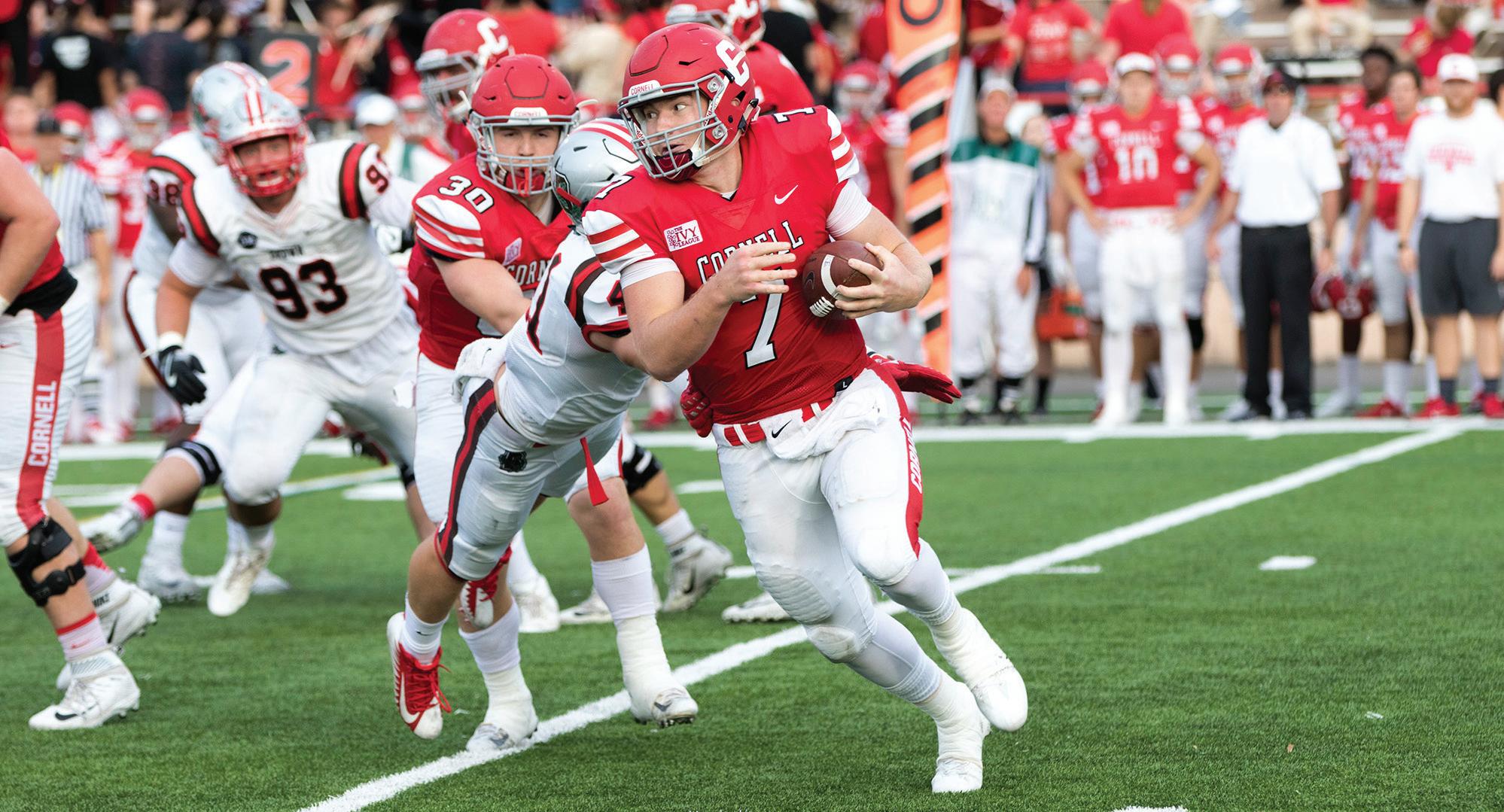
Fresh faces | Cornell football’s new freshman class features 12 offensive players and 15 defensive players.
SHAILEE SHAW / SUN STAFF PHOTOGRAPHER
Zachary Silver can be reached at zsilver@cornellsun.com.
By DYLAN McDEVITT Sun Sports Editor
FOOTBALL
MEN’S HOCKEY
Peter Milliman Promoted to Head Coach Of Men’s Lacrosse After Quarterfnal Run
By RAPHY GENDLER Sun Assistant Sports Editor
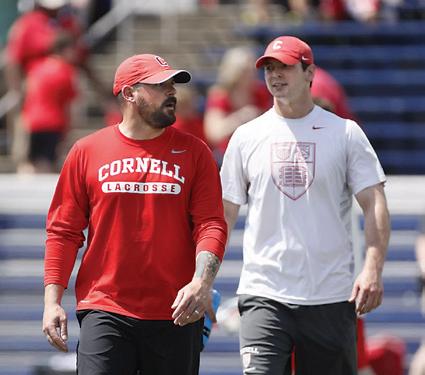
After a bounce-back, expectation-surpassing 2018 season for Cornell men’s lacrosse, Cornell Athletics announced in May that interim head coach Peter Milliman has been promoted to head coach.
Milliman, who was a Cornell assistant coach before taking the helm this past year, led the Red to a 13-5 record in 2018 in a season that consisted of an Ivy League tournament championship and appearance in the NCAA quarterfinals.
Cornell’s resurgent 2018 campaign came off the heels of two-straight sub.500 seasons in 2016 and 2017 — the first consecutive losing seasons for the program in more than two decades.
“I want to thank Andy Noel, [Senior Associate Director of Athletics] Jeff Hall, and the entire Cornell lacrosse family for giving me the opportunity to be a part of such an amazing program,” Milliman said in a press release. “I’ve been fortunate to be at Cornell for the past few years and I’ve developed an appreciation for how special this place is. I’m honored to have the chance to continue to lead this team as the Richard M. Moran Head Coach of lacrosse. I’m looking forward to building
upon the successes of the 2018 season as we intend to compete for conference and national championships year in and year out.”
Cornell Athletic Director Andy Noel said in the release that Milliman’s success this season made his promotion an easy choice. He also pointed out Milliman’s recruitment successes, which included securing star attackman Jeff Teat, who led the way offensively for the Red in his sophomore season.
“Unquestionably, Peter Milliman’s leadership and his coaching performance, leaves no doubt that he has earned my trust to coach the Big Red in the years ahead,” Noel said. “He’s earned it every step of the way, beginning with the outstanding job he’s done with recruiting over the past few years, and continuing through this season with the terrific job he and his staff have done coaching the team on the field, and re-establishing the Cornell Lacrosse culture. Coach Milliman and I have had numerous conversations and it’s become clear to me that he has established a long-term plan for the program to be successful, and I have no doubt he’s going to do just that.”
Asked if Milliman should be promoted during the lead-up up to his team’s NCAA quarterfinals matchup with
Maryland last week, fifth-year senior goaltender Christian Knight was quick to praise his coach.
“Absolutely,” Knight responded. “He’s amazing. He’s done a great job. He really helped us this year kind of change
By DYLAN McDEVITT Sun Sports Editor
ANNAPOLIS, Md. — Two weeks before its quarterfinal matchup, Cornell men’s lacrosse knocked off then-No. 1 Yale to claim the Ivy League tournament championship. But on May 20, the team that took Yale’s place atop the national rankings proved too much for the Red to handle, as Cornell fell to Maryland by a score of 13-8.
Maryland (14-3, 5-2 Big Ten) defeated Cornell (13-5, 6-2 Ivy League) with relative ease on Sunday afternoon at Navy-Marine Corps Memorial Stadium. The
Terrapins scored the game’s first goal and led for the entirety of the contest thereafter, as Cornell was only able to get within two of the defending national champions.
“I’m sorry to be done this season with this group,” said then-interim head coach Peter Milliman.
“We were hoping we’d get another week together, but I think we made some good plays and some bad plays and at the end of the day left our hearts on the field …
I couldn’t ask for anything else.”
Senior goaltender Christian Knight made seven saves in the contest and made his best efforts to backstop his team to a victory, but the Terrapin defense overwhelmed the
Cornell offense — the second-best in the nation — and the Red was unable to score enough to keep pace.
“[Maryland] did an outstanding job,” Milliman said. “They really earned a victory, played consistent, played strong and did their part.”
The Red saw its fate sealed in the third quarter, when Maryland scored five goals to Cornell’s zero, and the Terrapins pulled away with little resistance. The Red entered the fourth quarter trailing 11-4, and, despite Cornell’s best efforts at a comeback, the deficit was too much to overcome.
“At halftime we really wanted to
our culture … to get back to where some of the older Cornell lacrosse teams have been.”
Raphy Gendler can be reached at rgendler@ cornellsun.com.
Summer Sports News: Headlines You Missed
By RAPHY GENDLER Sun Assistant Sports Editor
New recruits, schedule announcements and additions to coaching staffs highlight the Cornell sports news of the past few months.
Men’s Hockey’s Green Selected In 4th Round of NHL Entry Draft
Sophomore defenseman Alex Green became the latest Cornellian to join an NHL organization as a fourth-round selection of the Tampa Bay Lightning. Green recorded 10 points in his freshman season, quickly becoming a key player on the nation’s best defensive unit.
Men’s Basketball’s Morgan to Return for Senior Season
Matt Morgan announced he would withdraw from the NBA Draft for the second straight year and return to Cornell for his senior year. Morgan scored 22.4 points per game and led the Ivy League in scoring last season, when he led the Red to its first conference tournament appearance.
Women’s Hockey, Men’s Hockey Release 2018-19 Schedules After last season’s heartbreaking last-second loss to Colgate in the ECAC semifinals, women’s hockey will start its 2018-19 campaign against Syracuse, Harvard and Dartmouth in October. The Red will face Colgate in a home-and-
home series Jan. 25 and 26. The full schedule can be viewed here. Women’s hockey also introduced a new freshman class, which includes three forwards, two defensemen and a goaltender.
Looking to improve upon its second consecutive season that ended with a first-round NCAA Tournament exit, men’s hockey announced its schedule over the summer. The date circled on fans’ calendars is the Red’s Nov. 24 meeting with Harvard at Madison Square Garden in New York. The Red also announced its Class of 2022 over the summer, which features the team’s first ever Russian player and Chinese NHL draft pick.
Basketball and Lacrosse Teams Announce New Recruiting Classes
Four new players — two guards and two forwards — will join women’s basketball, the team announced over the summer. Men’s basketball welcomes a six-player class made up of four freshmen and two junior college transfers.
Fresh off an Ivy League title and NCAA quarterfinal appearance, men’s lacrosse announced its new class for the 2019 season. The class — the first set of freshmen under now-head coach Peter Milliman — is made up of six defenders, five offensive players, one goaltender and one faceoff specialist. Women’s
Taking the helm | Peter Milliman (left) led Cornell to an Ivy League championship and NCAA Quarterfinals appearance.
Underdogs | The Red beat Syracuse on the road in the first round of the NCAA Tournament.