The Corne¬ Daily Sun
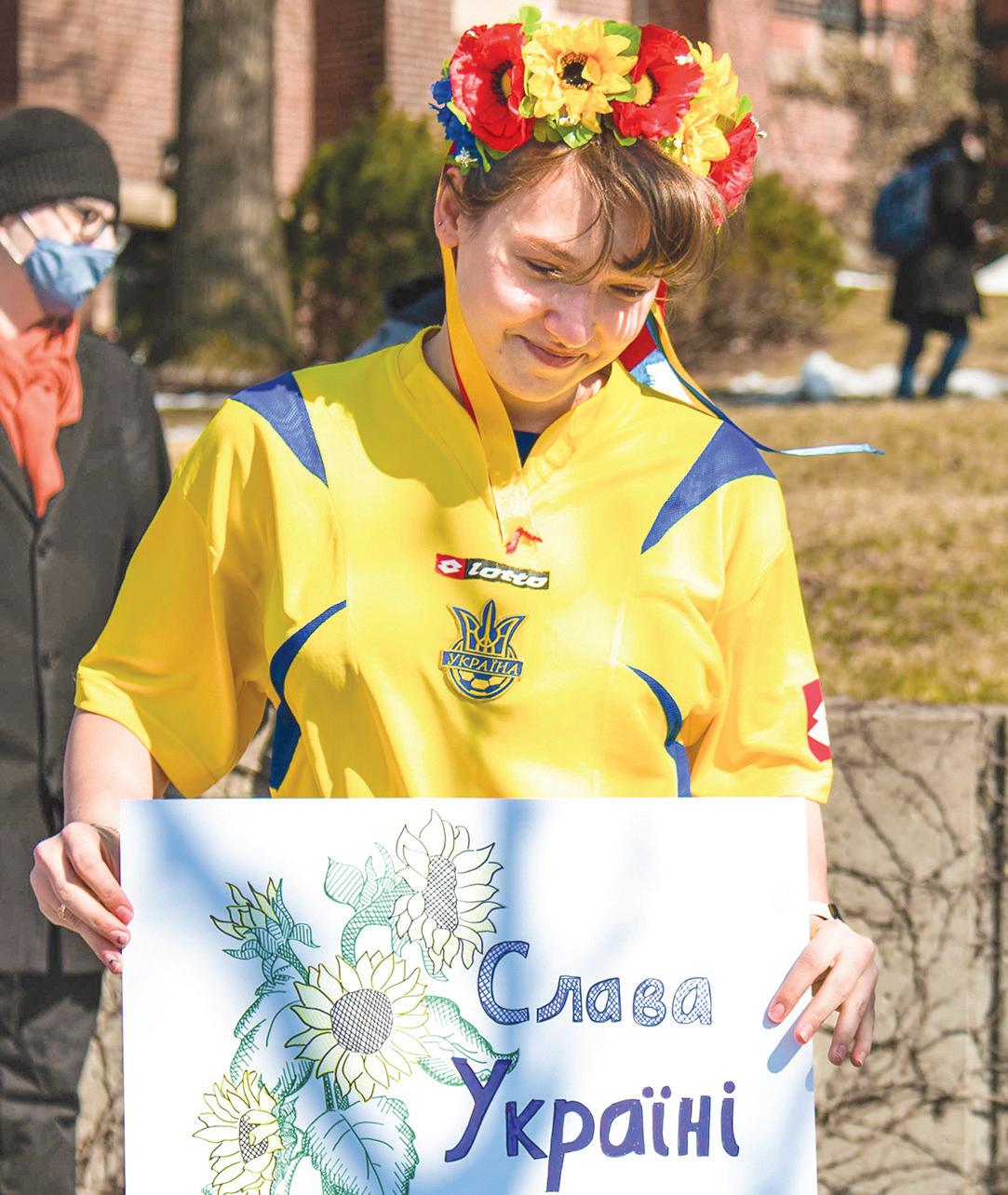

As classes near their end, many students are preparing to return home and visit family for the summer. However, for many Cornellians from Ukraine, due to the destruction that has erupted from the war back home, this is no longer a possibility.
The last time Andrii
“We’ve been in contact with them, but really no one is safe right now.”
Maryna
Mullerman grad
Iermolaiev ’23 was back home in Zaporizhzhya, Ukraine was last August. He will be in California for an internship, but is unable to renew his student visa.
“My visa is expiring this month, and I cannot renew it because I cannot go home, so I cannot leave the U.S.,” Iermolaiev said. “I’m legally here, but I cannot leave the country because I will not be able to re-enter the U.S.”
Iermolaiev also mentioned the impact of the war on his family back home.
By JIWOOK JUNG Sun Assistant News Editor
On Thursday, April 8, Ithaca became the first city in the United States to unionize all Starbucks locations. Starbucks workers came victorious on their unionizing efforts in all three Ithaca Starbucks: Meadow Street, the Commons and College Avenue.
“Everyone was absolutely elated,” said Evan Sunshine ’24, who has been with the company part-time as a Barista for two years and currently works at the College Avenue location. “Everyone was jumping, cheering and hugging each other. It was absolute joy in that moment.”
Each store location experienced overwhelming support for unionization from its workers. Meadow Street location voted 13-1 in favor of unionization, the Commons 15-1 and Collegetown 19-1.
Partners Becoming Partners
For many customers and employees, Starbucks has been a progressive and forward thinking company. The company publicly showed support for Black Lives Matter movement with a $1 million commitment in grants and the LGBTQ+ community by supporting local LGBTQ+ nonprofits.
Starbucks also refers to their employees as “partners”
By GABRIELLA PACITTO and SOFIA RUBINSON Sun Assistant Sports Editor and Sun News Editor
“People I know are currently serving in the military [both] in my family and outside of my family,” Iermolaiev said. “Everybody I know either had to leave the country or had to move to safer places.”
Most of Iermolaiev’s family lived in the southern region of Ukraine, and were forced to move further north to escape the war. In early March, some of his family were forced out of their hometown in Kherson, the first Ukrainian city the Russians seized.
Several other students' families have been forced to leave the country like Ukrainian veterinary student, Maryna Mullerman grad.
“My grandparents live in Ukraine, but due to the war, they have been evacuated to the Netherlands,” Mullerman said.
“My other family is now in Poland, so they’re very close to the border just because they’re really hoping to go back.”
Not everyone could find a safe shelter outside of Ukraine as Mullerman’s distant family members are still in Ukraine.
“We’ve been in contact with them, but really no one is safe right now,” Mullerman said. “It’s not a possibility. So,
When Marc Lacey ’87 stepped into The New York Times office lobby on a spontaneous trip to New York City freshman year of college, security asked him to leave. But before he left, he took a picture in front of the building, shaking hands with friend Eric Lichtblau ’87, vowing to one day work at The New York Times.
Beginning June 14, former Sun editor-in-chief Lacey will continue to honor this vow as one of the newspaper's new managing editors.
As a first-year student at Cornell in 1983, Lacey was initially enrolled in the College of Engineering, unsure of what he wanted to do in life. He decided to join The Cornell Daily Sun on a whim.
“I remember reading The Sun, and I saw an ad for an orientation meeting,” Lacey said. “It caught my attention since I wasn’t
involved in any clubs at the time.”
Lacey began his reporting career by writing stories on professor and guest lectures happening on campus. He transferred to the College of Arts and Sciences to study biology.
Lacey then transitioned to cover the city of Ithaca and the University administration during a tumultuous time. Tuition was increasing and students were protesting
Apartheid in South Africa by setting up a shantytown on the arts quad and taking over Day Hall.
“Although I definitely cared about what was going on in the world, I felt as though my role was to write about it rather than protest myself,” Lacey said. “I always felt as
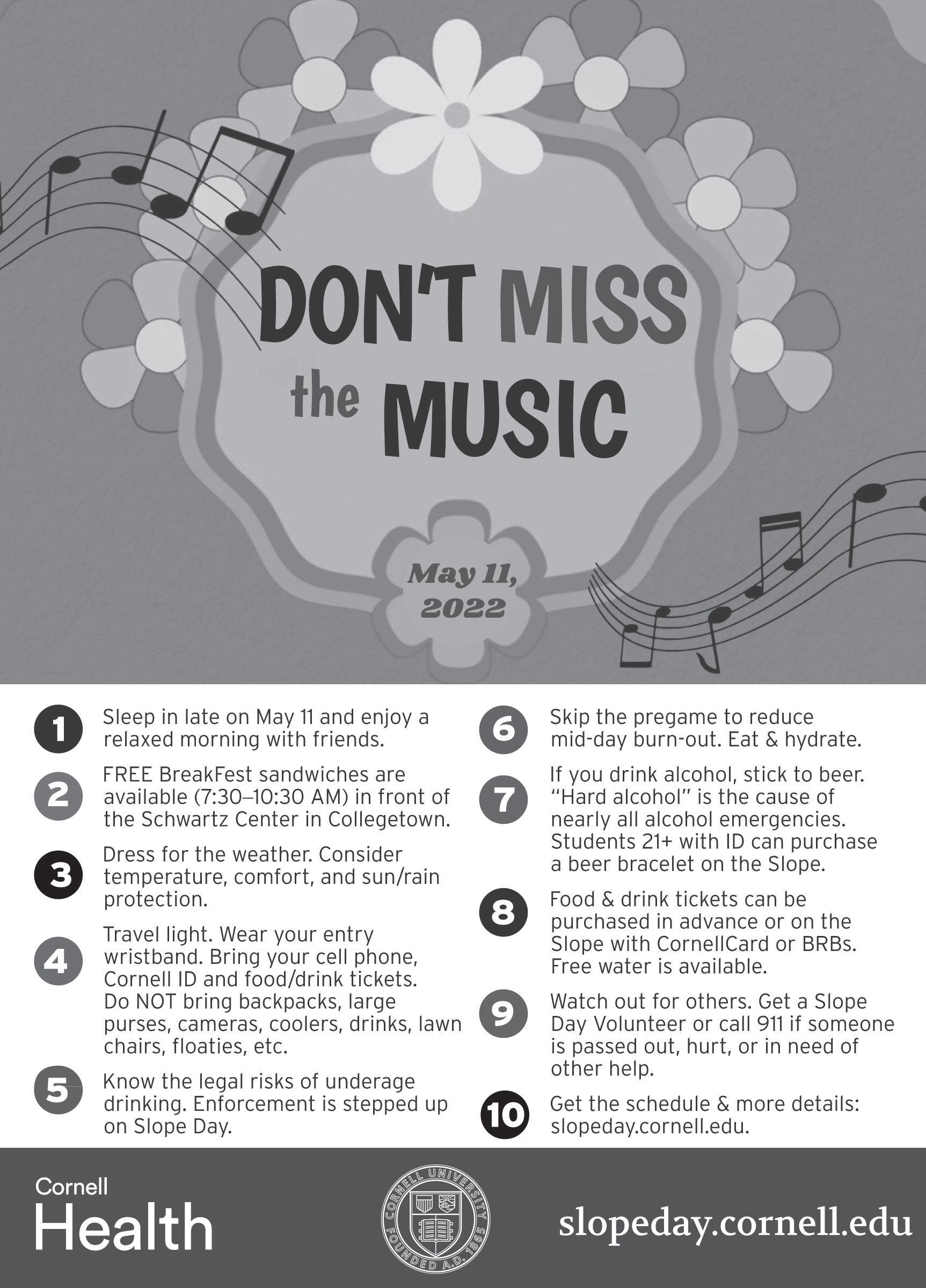
appy lope ay ve!
As per recent tradition, Slope Day will be held the day after classes end to celebrate the end of the academic year.
Free Breakfast
Free breakfast sandwiches and fruit will be served in front of Schwartz Center from 7:30 - 10:30 a.m.
Wristbands
If you have not already obtained your Slope Day wristband, you must pick one up today with a Cornell or government-issued ID. Music
Luna Li and Loud Luxury will open the concert, followed by Aminé. Weather
Expect a sunny day and hot temperatures.
Econometrics Workshop With Jonathan Roth 11:15 a.m. - 12:45 p.m., Ives Hall 108
Oscar Rene Cornejo: Caminante: Wayfarer 11:15 a.m., Tjaden Hall 324
Cornell Veterinary Medicine Dean’s Alumni Speaker Series With Cherese Sullivan, Department of Veterinary Medicine ’10 Noon - 1 p.m., Virtual Event
Stand Up Comedy Performance With Andrew Fosher
5 p.m., Kennedy Hall, Call Auditorium
Jasper Liang, Senior Piano Recital: Cornell University Music 7 p.m., Barnes Hall
Afterlives: Fellows Workshop 9 a.m. - 4 p.m., A.D. White House, Guerlac Room
Cultures and Languages Across the Curriculum on the College Campus: Challenges and Opportunities
10 a.m. - Noon, Virtual Event
Ukranian Refugee Crisis in Poland With Rep. Tom Malinowski and Adrian Kubicki, Consul General of Poland
11 a.m. - Noon, Virtual Event
Biophysics Colloquium: Student Series With Taryn Kay and Gundeep Singh 4 p.m., Clark Hall 701



STARBUCKS
Continued from page 1
and metaphorically empties a seat during its board meetings to represent the workers.
“Starbucks always presents itself as being very progressive and caring about the people, especially disadvantaged people,” said Sam Amato, a shift supervisor in Buffalo who has been with the company full-time for more than 12 years. “They made big statements regarding Black Lives Matter and the LGBTQ+ community.”
In fact, when applying for their positions, several workers were initially drawn in by Starbucks’ seemingly progressive stances.
“As a transgender individual, I was drawn to the fact that they had gender affirming healthcare included in their packages for employees,” Sunshine said. “The prestige of them being pro-LGBTQ+, definitely attracted me to the company.”
During the pandemic, however, Starbucks fell short of the expectations and values the company had prided itself on and the conversation for unionization began amongst the workers.
“The national conversation about workers’ rights and pay caught up and left Starbucks behind,” Amato said. “In the 90’s… a lot of the things Starbucks did were ahead of its time at one point. However, the conversation regarding workers’ benefits such as healthcare is so much different today than it was 10 years ago. I do not think Starbucks has been adequately moving forward.”
Additionally, workers claim that Starbucks, on several occasions, placed profits over their employees’s safety and improvement of working conditions.
“During the pandemic, we got to see how the company did not really care about their employees through their constant change in policy with COVID-19,” said Angel Crempa, who had been with the company for two years as shift supervisor in Buffalo. “Those constant changes were mostly made in the aspect of gaining immediate capital rather than protecting its employees.”
Starbucks allegedly fired Crempa in retaliation for joining and engaging in union activities. Crempa’s case has been filed and is now under investigation by the National Labor Relations Board.
The initial rally for unionization began at locations in Buffalo. Several Starbucks employees in Buffalo told The Sun that many aspects of the movement were inspired by a successful union campaign by workers at SPoT Coffee, a local coffee chain headquartered in Buffalo.
“A lot of Starbucks partners here were inspired by public unionization efforts of a local chain,” Amato said.
According to Michael Dolce ’11, an attorney representing Starbucks Workers United, some of the demands being negotiated include better training, an increase in wages, access to better health insurance plans, credit card tips and fixed schedules.
“I really like what the workers came up with on their first proposal,” Dolce said. “Most of their proposals on the table are extremely sensible, [which] makes sense for the longterm viability of the company and would really improve operations in these stores. ” Starbucks Under Allegations
Starbucks is now facing over 120 unfair labor practice charges, according to Dolce. The company is under several major allegations, including the deployment of union busting tactics. The cases are now being investigated and processed by the NLRB.
According to the charges against the company in the NLRB cases, Starbucks allegedly switched workers’ schedules around to place undue pressure on the employees, denounced unionization efforts through captive audience meetings, hired new managers to increase management presence in unionized stores and wrongfully terminated workers who joined the union.
“My hours were both cut and switched around. I used to be an opener for a year and a half. It was not until the union drive that I wasn’t –– I was moved to be closer,” Crempa said. “That disrupts your sleep schedule and messes with your mental health — you can’t think straight. It’s a textbook union busting tactic.”
Employees were also required to attend Captive audience meetings in which the workers had to listen to an employers’ presentation, often against the union, according to Alexander Colvin, Kenneth F. Kahn ’69 Dean of Cornell’s International Labor Relations School. Although captive audience meetings are legal under current statutes, Starbucks is under controversy for allegedly using them to forcefully dissuade workers from joining the union.
“The argument against Captive audience meetings is that it’s coercive against the workers,” Colvin said. “The management has the freedom to say their views on unions, but they shouldn’t have the right to coerce the workers to have to listen to those views – It’s inherently coercive.”
According to workers, Starbucks also hired several new managers to increase managerial presence in the unionized store locations. According to Dolce, once the union campaign went public, each store received one “support manager,” who would monitor worker behavior, usually to prevent talks of unions or unionization. Some locations had six support managers at a time.
“With that much presence, it makes you think twice about wearing a union pin, talking to a coworker about the union, saying the word ‘union’ or really from doing anything,” Dolce said.
Starbucks recently announced upcoming plans to raise pay and improve training for the corporate-owned U.S. store locations. However, unionized stores and stores in the process of unionization were excluded from these changed benefits.
“We’ve been clear in our belief that we
are better together as partners, without a union between us and that conviction has not changed,” wrote a Starbucks spokesperson in a statement to The Sun. “We are listening and learning from the partners in these stores, as we always do across the country.”
This recent change in benefits, and the withholding of these benefits from unionized workers calls into question its legality, according to labor law experts.
“The timing is extremely suspicious,” said Prof. Risa Lieberwitz, labor law. “To say we won’t give those benefits to the employees, who may be scheduled to have a union election, could be used as retaliation against those employees by withholding the benefits. The timing points to this being retaliatory against the employees for their union activities.”
Movements Throughout the Nation
The Starbucks unionization movement sheds a light onto an industry that traditionally is not unionized, according to labor relations experts.
“Historically, we have not seen a lot of organizing at Starbucks or similar types of retail stores,” Colvin said. “This industry does not have much union representation, so this is a big change for this industry.”
Movements towards unionization are spreading nationwide as a result of changes in working conditions brought on by the pandemic and improved public view on unions.
“Certainly during the worst of the pandemic, employees were called ‘essential,’ but they were not being treated with the respect that all workers deserve,” Lieberwitz said.
According to Lieberwitz, the recent public opinion polls show that the view on unions is more positive than it has been in many years.
“The public is seeing that unionization is a very positive alternative for addressing workplace issues,” Lieberwitz said.
Key political figures, including Sen. Bernie Sanders (D-Vt.), U.S. Rep. Alexandria OcasioCortez (D-N.Y.) and Gov. Phil Murphy (D-N.J.), have publicly endorsed Starbucks unionization efforts. In addition, President Joe Biden (D) has been very clear about his prounion stance.
“It’s an exciting time. There is a lot of activity going on, Starbucks and Amazon being among them,” said Mike Gaston Pearce, former chairman of NLRB who was appointed by President Barack Obama and served for approximately eight years. “This [Biden] administration has demonstrated that it is a strong advocate for workers and workers’ rights to join a union and organize.”
Biden has made pro-union appointments to advance his policy agenda of supporting workers’ rights and unions, including appointing Jennifer Abruzzo to general counsel at the NLRB.
To continue reading this article, please visit cornellsun.com.
Jiwook Jung can be reached at jjung@cornellsun.com.
whoever is currently within the Ukrainian borders are very much in danger.”
Mullerman plans to stay in Ithaca as a teaching assistant for a veterinary class from June to July. The rest of the summer, she is planning on going to New York City to volunteer for Razom, a New York-based Ukrainian volunteer organization that is currently collecting and delivering humanitarian aid for those who have been affected by the war in Ukraine.
“The difficulty with the situation is that you never know what is going to happen tomorrow,” Mullerman said.
Nevertheless, she remains
EDITOR Continued from page 1
though journalists have an incredibly important role in society just by informing.”
As a junior, Lacey decided to run for the editorial board of The Sun and was elected editor in chief — his first management position.
“I managed more people back then than I ever had in my life, although that is about to change with my new job,” Lacey said. “Finally, as managing editor of The New York Times, I am going to manage more people than I did as a junior and senior at Cornell.”
During his senior year, Lacey had to decide between taking a summer internship at The Washington Post or going to graduate school to study biology.
“I thought, ‘okay, let me give this journalism thing a try,’ so I took the internship,” Lacey said. “I’ve been doing journalism ever since.”
After spending his summer after graduation in Washington, D.C., Lacey got a job at The Buffalo News, and then accepted a two-year temporary job designed for young reporters at The Los Angeles Times.
Lacey was then promoted to a permanent staff position, covering the 1992 Los Angeles riots, the 1994 Northridge earthquake and O.J. Simpson’s freeway chase.
“When O.J. Simpson was on the run in his white bronco, and he drove back to his house and the police were there, there is video of that moment,” Lacey said. “What you don’t see is that behind a bush, I was standing right there. I was sent on assignment to his house with my notebook. I was like, ‘O.J.! O.J.!’” Lacey then moved to Washington, D.C. to work with the L.A. Times, and was soon hired by The New York Times to report in the capital.
Having dreamt of reporting from overseas, Lacey later became a foreign correspondent for The New York Times, reporting in Kenya for five years and Mexico for four. Reporting abroad came with a unique set of circumstances.
“I’ve been to more war zones than I care to count, interviewed more rebels, soldiers, heard more explosions and seen more casualties than I want to remember,” Lacey said.
In the aftermath of the 2010 earthquake in Port-au-Prince, Haiti, Lacey was sent to report on the tragedy.
hopeful that she will be able to go back to Europe to deliver supplies to those who are in urgent need.
“There have been volunteers that have been going to Ukraine or to the border delivering things in suitcases,” Mullermand said.
“I’m also hoping to see my grandparents in the Netherlands if I do go to Europe, but that again is all very tentative and the situation is very much in development every day.”
Like Mullerman, Ivan Kosyuk grad, is planning on spending his summer helping those who have been affected by the war.
Kosyuk is from Kyiv, Ukraine and has lived there for most of his life. His entire family is currently in Ukraine, some in Kyiv and others residing in smaller towns
in Ukraine. The last time Kosyuk was home was this past winter.
“I’m in contact with my family, they’re always reachable, they’re always online,” Kosyuk said. “I usually talk to them at least once a week.”
Fortunately, most of his family has been able to remain where they are because the area where they reside in Kyiv has not been affected by the bombings.
“My grandad lives two minutes away from Bucha, so he had to evacuate to my parents’ house,” Kosyuk said. “My parents house is in the outskirts of Kyiv, but it’s in the safe end – it’s a part that’s nowhere near attacks or anything.”
Originally, Kosyuk was planning on working on his own
financial startup for people from Europe and the U.S. to invest in a variety of businesses in Ukraine.
“We were actually ready to launch just a week before the war started. So, my original plan was to get it ready and when I come home to Ukraine during the summer to get it started,” Kosyuk said. “But I’m not going at least until whenever everything ends.”
Due to the war, Kosyuk has shifted gears and found a different way to help those who have been affected by the war.
To continue reading this article, please visit cornellsun.com.
“When I arrived there in Port-auPrince, there were still many people trapped in the rubble,” Lacey said. “As I was walking along they were looking out, seeing me and calling for me to help them – but there was no way to get them out.”
Through his reporting, Lacey aims to make the reader feel what he is feeling in the moment, standing in the scene of the story.
“The difficult part of journalism is that there’s a lot of heartache and awfulness in the world and journalists have to be there covering it,” Lacey said. “When everybody is fleeing a situation, the reporters are the ones rushing to get in.”
To continue reading this article, please visit cornellsun.com.
Sofa Rubinson can be reached at srubinson@cornellsun.com.
Gabriella Pacitto can be reached at gpacitto@cornellsun.com.



through the comment section on Facebook just to see if I hurt anyone’s feelings. Even seeing a
the time to read my work and reflect on it. It is precisely these moments that bring my writings
own. It was never my intention to define the truth or reality of technoculture. It is your reac-
No, you haven’t heard from me for a while.
Senior spring has been a weird time; it’s been a premature departure from my routines in the past years, including writing this column. On one hand, I felt that the column had already run its course. Should I say that I’m quite satisfied with the six-semester ride from noise music as resistance to my yassified self? On the other hand, I simply wasn’t ready for this journey to end. I was terrified that the final chapter of Rewiring Technoculture wouldn’t do justice to my original vision.
This hiatus freed me from the hecticness of doing and allowed me to reflect on what has been done. It gave me the time, space and clarity to think. Cornell constantly inspires me to think, but rarely do I get to properly think. This pause allowed me to move beyond pondering what I have done with my column and begin thinking about what my column has done to people.
I felt fortunate to have the room to ruminate on the criticism and comments I’ve received. My column has never been free of controversies.
“wow” reaction would make me feel weird. I would wonder what made them decide to put in the intentional effort to choose an alternative reaction, as opposed to the default “like.”
I eventually found my inner peace once I started seeing my column as a dialectic between me and my readers, an ongoing negotiation of conflicts, tensions and lessons. I now see the past three years as a dialectic that is never-ending and constantly developing. This is our journey of learning, growing and moving forward.
It dawned on me that Rewiring Technoculture is never intended to be complete on its own.
People have been offended by the things I wrote. Even though I always knew that was a likely reaction to my writing, for the longest time, I wasn’t comfortable with that.

When I first started as a columnist, I worried so much about the reaction to my column that merely mulling over the thought that some people may not like what I said terrified me. Every time I published an article, I would go
I hate to admit this, but I love being a niche influencer on campus. And it wouldn’t be possible without you, my critics.
I appreciate the moments when people recognize my name or my face and tell me that they’ve read my articles –– even when they tell me they don’t like what I said. These moments make me aware that my words are prompting people to think. Once in a while, my friends will tell me that people who I have never met are talking about my column. Other times, people come up to me at parties and challenge my thoughts. Whether they agree with me or not, I appreciate them nonetheless for taking
to life, extending my words into lively dialectics. It dawned on me that Rewiring Technoculture is never intended to be complete on its
tion that matters. It is your reaction that brings the conversation forward. It is your reaction that shapes Rewiring Technoculture . It is our column, after all.
I owe so much to all of you who continue to inspire me and push me forward. From the musicians in the underground music scene in Ithaca to the Green Dragon baristas that saved a clipping of my “cool kids” article behind the counter, thank you for being part of this journey. How can I live without you, my critics? I will never say that I have single-handedly rewired technoculture on my own, but I’m so glad to see that this column has sparked a conversation that will last as flashes of thoughts in people’s minds.
Stephen Yang is a senior in the College of Agriculture and Life Sciences. He can be reached at sy364@cornell.edu. This is the final installment of his column Rewiring Technoculture.

Independent Since 1880 140th Editorial Board
SERENA HUANG ’24
Business Manager
TRACY ZENG ’24
Advertising Manager
KATHERINE YAO ’23
Opinion Editor
ELI PALLRAND ’24
News Editor
JOHN COLIE ’23
Arts & Culture Editor
JULIA NAGEL ’24
Photography Editor
TENZIN KUNSANG ’25
Science Editor
PAREESAY AFZAL ’23
Assistant News Editor
SARAH YOUNG ’24
Assistant News Editor
NIHAR HEGDE ’24
Assistant Arts & Culture Editor
JASON WU ’24
Assistant Photography Editor
JULIA NAGEL ’24
Assistant Photography Editor
RUTH ABRAHAM ’24
JYOTHSNA BOLLEDDULA ’24
Tamara Kamis ’22
Min Shin ’22
Ananthi Jayasundera '22
Juliette Egan ’23
Alecia Wilk ’22
Vanessa Olguin ’22
Current Cornell Sun & Sun
ANGELA BUNAY ’24
Managing Editor
DEVAN FLORES ’24
Web Editor
NAOMI KOH ’23
Assistant Web Editor
SOFIA RUBINSON ’24 News Editor
KAYLA RIGGS ’24
Editor
AARON SNYDER ’23
Sports Editor
KATRIEN DE WAARD ’24
Production Editor
AIMEE EICHER ’24
Production Editor
COLIN WU ’23
Assistant Business Manager
DANIELA WISE-ROJAS ’25
Assistant Dining Editor
GABRIELLA PACITTO ’24
Assistant Sports Editor
WILLIAM BODEMAN ’23
Assistant Sports Editor
KEVIN CHENG ’25 Newsletter Editor
Editor VEE CIPPERMAN ’23
HANNAH ROSENBERG ’23 Senior Editor
EMMA LEYNSE ’23
Associate Editor
SURITA BASU '23
Assistant Managing Editor
ROMAN LAHAYE ’23
ESTEE YI ’24
GRACE KIM ’24
MEHER BHATIA ’24
ANDIE KIM ’24 Multimedia Editor
JIWOOK JUNG ’25 Assistant News Editor
ADITI HUKERIKAR ’23
Assistant Arts & Culture Editor
CLAIRE LI ’24
Assistant Photography Editor
GRAYSON RUHL ’24
Assistant Sports Editor
LIAM MONAHAN ’24
Assistant Sports Editor
DANIEL BERNSTEIN ’23 Senior Editor
MADELINE ROSENBERG ’23 Senior Editor
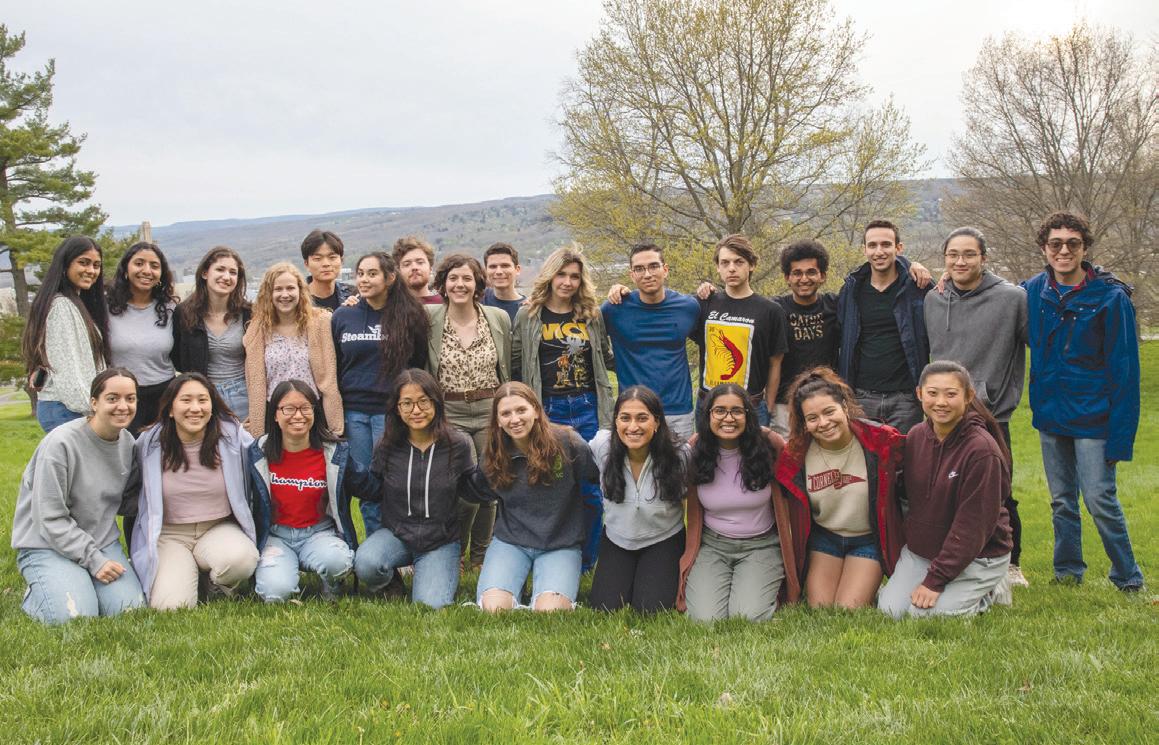
THIS ISSUE MARKS THE END, of another semester at Cornell, and we mark the end of Sun print issues until August. As our writers, editors and designers head into final exams, we bid adieu to long days chasing stories and late nights of layout. We look forward to a well-deserved break and look back on all we’ve accomplished this semester.
The Sun’s 140th editorial board has grown into a creative, curious and confident group, defined by ambitious projects and a strong dedication to community. We’ve come a long way from our first nights grappling with InDesign and learning the ropes of new editorial positions. This semester, we’ve printed 29 papers, published hundreds of articles across six sections and developed special project teams across multiple platforms. We’re proud of all that we’ve accomplished, and we plan to build upon this work over the next two-thirds of our tenure as editors.
News Board
Rachel Kodysh ’24
Katherine Esterl ’24
Mary Sotiryadis ’24
Isabella Warren '24 Kelsey Xu ’24
Emma Smith ’22
Matthew Samilow ’22
Andrew Lorenzen ’22
Anuli Ononye ’22
Somil Aggarwal ’22
Guillermo Alvarez ’22
Greta Gooding ’22
Stephan Yang ’22
Brian Lu ’23
Tom Sandford ’24
Alyson Wong '22
Monica Kim ’23
Cooper Stepke ’23
Megan Keller grad
Milena Bimpong ’22
Jessica Dai ’23
John Capewell '24
Ben Parker ’22
Niko Nguyen ’22
Lorelei Meidenbauer '22
Giancarlo Valdetaro ’22
Amy Wang ’24
Ally Fertig ’24 Xinyu Hu ’24
Camden Wehrle ’25 Christian Geramita ’25
Opinion Board
Catherine St. Hilaire '22
Odeya Rosenband '22 Christian Baran ’22
Sidney Malia Waite ’22 Daniel Bernstein ’23
Cami Armendariz ’25
Jack Donnellan '25
Carlin Reyen ’25
Gwen Schway ’25
Roei Dery ’23
Brendan Kempf ’23
Patrick J. Mehler ’23
Noah Do ’24
Javed Jokhai ’24
Arts & Culture Board
Oluoma Iroajanma ’24
Freya Nangle ’25
Isabella DiLizia’25
Matthew Kassorla ’24
Lauren Douglass ’24
Eliza Salamon ’24
Adesuwa Carlton ’24
Domenico Pasquini ’23
Jefrey Bialos '23 Ally Knapp ’24
Brooke Greenfeld ’24
William Cox ’24
Regina Galvan Rumayor ’24
Harry Dang ’22 Haonan Peng ’22 Michelle Yang ’22 Ashley Ramynke ’22
Amelia Clute ’22
Benjamin Velani ’22
Dominic Law ’22
Jack Waxman ’22
Margaret Chan ’22
Melanie Metz ’22
Tilda Wilson '21
Annie Wu ’22
Audrey Ahn ’24
Kiki Plowe ’25
Ashley Koca ’25
Lena Takor ’25
Sports Board
Mitch Hoy ’24
Logan Hanchett ’24
Anirudh Sharma ’24
Emma Arboleda ’25
Aditya Syam '25
Tenzin Dhasel ’25
Anna Liba ’25
Gillian Lee ’25
Bryan Vicente ’24
Katrien de Waard ’24
Cristina Torres '25
Daniella Garcia Almeida '25
Finley Williams ’25
Sammie Lambourne ’25
Sofa Chierchio ’25
Rebecca Sparacio ’24
Brenner Beard ’24
Daniela Wise-Rojas ’25
Kacey Lee ’25
PJ Brown ’25
Rafaela Uzan '25
Haley Qin '25
Jonathon Stolow '24
Anna Hooper ’24
Kaitlyn Lee '25
Tifany Adjei Opong '25
Christalyn Ausler '25
As The Sun closes out its 141st year of publication, we remain committed to our mission of providing in-depth, quality coverage to the Cornell and Ithaca communities. We have been so grateful for your readership, collaboration and feedback this semester, and we encourage you to keep your eyes on our horizon. Although we’re closing our office doors for now, we will continue to publish web content over the summer, and The Sun will rise fully again when the next semester dawns.
Thank you for your continued support. You make our work as committed, independent student journalists possible. Have a happy summer, and see you very soon.
— V.C.
Meridien Mach ’22
Olivia Smith’22
Peter Kaplinksy ’22
Rae Specht ’22
Sofa Siciliani '22
Isha Vaish ’22
Katreczko ’23
Li ’22 Winnie Chow ’23
Remington ’23 Hannah Rosenberg '23
Dining Board
Gabe Schifer ’23
Julia Lescht ’23
Natasha Aysseh '23
Sanjana Kaicker ’23
Sarah Austin ’23
Brook Jaf '23
Ally Mark ’24
Nick Hoge’24
’25
’24
Sadie Groberg ’24
Yvie Cai ’24
Clare Della Valle ’24
Euna Li ’24
Juliette Haas '24
Marty Levine ’24
Suzanna Moustafa ’24
Reika Nakagawa ’25
Benna Capuano ’25
Jimmy Cawley ’25



Fill in the empty cells, one number in each, so that each column, row, and region contains the numbers 1-9 exactly once. Each number in the solution therefore occurs only once in each of the three “directions,” hence the “single numbers” implied by the puzzle’s name. (Rules from wikipedia.org/wiki/ Sudoku)




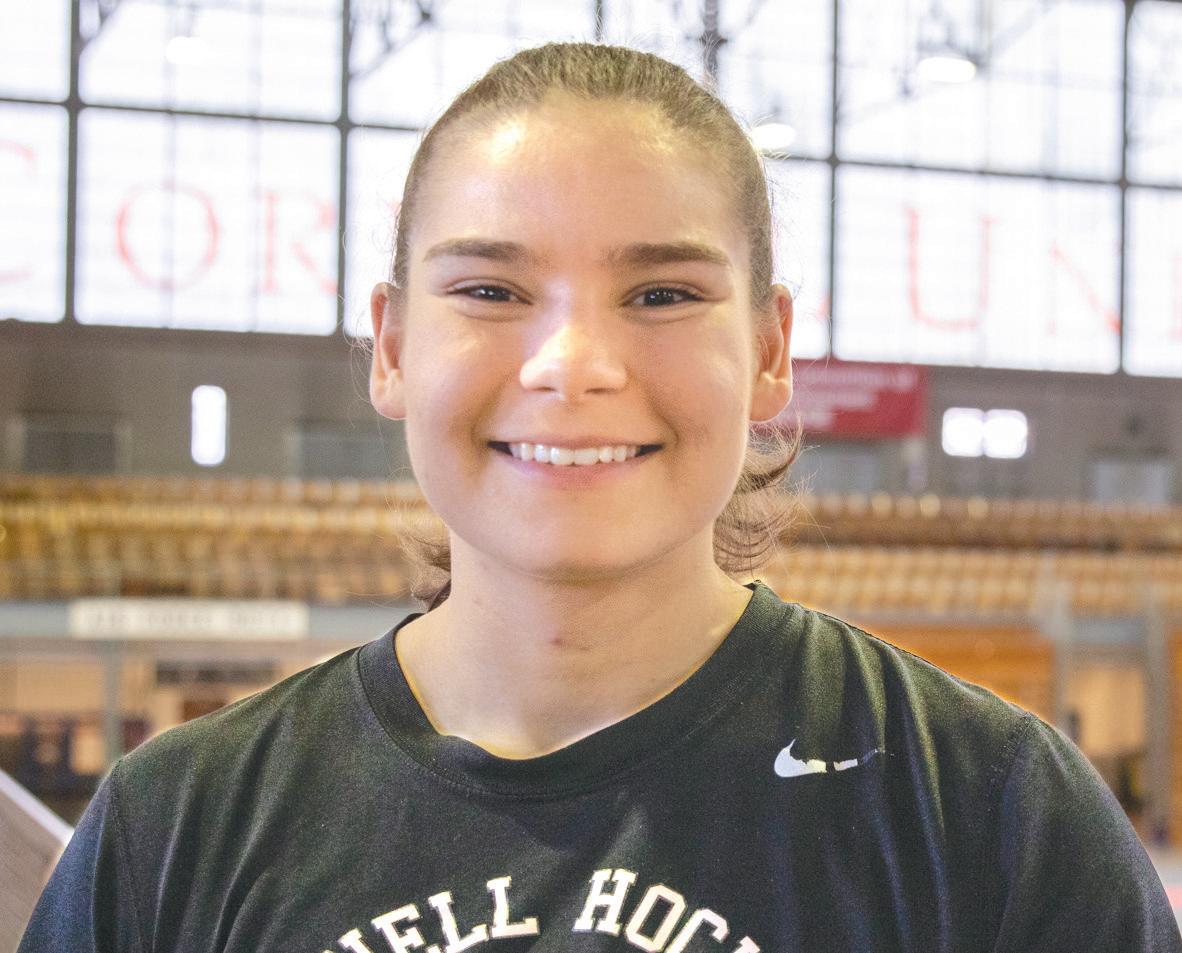
Lindsay Browning’s time on the Hill can be defined in many ways, but one in particular, is record-breaking. At Cornell, where ice hockey has been such a strong program, Browning has changed the game and has her name inscribed in most of the record books.
“She has been one of the greatest goaltenders ever to play at Cornell in our 50 year history,” said Head Coach Doug Derraugh ’91.
Browning began hockey as a young girl. Her mom and sister played, and loved the sport since she stepped on the ice. She never planned on playing college hockey–in fact she quit right after high school. But plans changed, and, as she likes to put it, she came “crawling back” to Coach Derraugh.
Browning’s first two years playing for the Red were pretty uneventful. She did not see much action and was in the shadows of star goaltender Marlène Boissonnault ’19. For any athlete, that could be tough, sitting on the bench and watching someone else play, but for Browning, that was not the case.
During the season, she was named National Goalie of the Month and ECAC Hockey’s Goalie of the Month. She was also named ECAC Goalie of the Week four times, out of 14 regular-season weeks. Her 12 shutouts, 28 wins, and .894 winning percentage all shattered Cornell’s single-season records.
She finished the season with a goals against average of 0.91, which ranked fourth on Cornell’s single-season record list and a save percentage of 0.952, breaking the Red’s single-season record.
Browning’s shortened career was enough for her to write her name in the Cornell record books. Her 12 shutouts in her junior season were good to set a single-season program record.
“I was just so happy to be there, happy to be on a team of really great people and really great coaches,” Browning said. “So it was mostly about, like I’m here to uplift my teammates and do whatever I can to help them and in the process, make myself better…when the time comes, I will be ready.”
And when the time came, she was ready.
By her junior year, Boissonnault had graduated, leaving a spot open for the starting goaltender. Browning started in all 33 games of the season and proved that she truly belonged by becoming the first goalie to open the season with three-straight shutouts. From only starting in a total of eight games in her first two seasons, Browning had led the nation in virtually every single goaltending stat.
Browning was also named as a top-10 finalist for the Patty Kazmaier Award, an award given to the top female college ice hockey player in the United States. She also was named Ivy League Player of the Year and earned AllAmerican honors, becoming the first Cornell goalie ever to be named All-American. Beyond individual accomplishments, Browning was crucial in leading the Red to one of the best seasons to date. From November 30, 2019 to March 7, 2020, Browning backstopped the Red to an unbeaten streak of 22 games. Cornell only lost one game on home ice and never lost an in-conference game, becoming the first time in program history that the team went undefeated in the ECAC. The Red also went undefeated in the Ivy League regular season, easily securing its 15th Ivy League Championship. Cornell had made it all the way to the ECAC Championship game when it was upset in overtime by Princeton. The team had also earned a spot in the NCAA women’s ice hockey tournament as the No. 1 seed, however, COVID hit, canceling the rest of the season.
To continue reading this article, please visit cornellsun.com.
hat tricks and led the team in goals with a career-high of 45.
Nearly five years in the making, senior attacker John Piatelli wraps up his time here as one of the greatest lacrosse players to play for the Red. A two-time captain, Piatelli has gotten nearly every award, shattering every record.
“He’s a rock star for us. He’s been a great leader for us…[and] a steady presence for us on the field,” said Head Coach Connor Buczek ’15. “Through his hard work and perseverance, he’s turned himself into one of the best college lacrosse players in the country.”
Coming from a family of lacrosse players, the Massachusetts-native was not always sure that college lacrosse would be for him. His father was an accomplished lacrosse player at Springfield College and earned All-American honors, his sister played Division 1 lacrosse and his younger brother, Brian, is a junior on the Cornell lacrosse team.
“Through his hard work and perserverance, he’s turned himself into one of the best college lacrosse players in the country.”
A multi-sport athlete in high school, Piatelli was never aiming for Division 1. He just enjoyed playing lacrosse and wanted to keep playing until he could no longer. But after some record-setting seasons in high school, he drew the attention of top schools – Cornell included.
In 2020, for his junior season, he helped lead the Red start the season on a fivegame winning streak before the season was cut short due to the pandemic. In those five games, Piatelli had accumulated a team-leading 20 goals and was ranked second in the Ivy League and fourth in all of Division 1 lacrosse in goals per game. After two great seasons, he finally got some recognition for his skill and athletic prowess. He was named an Inside Lacrosse/Maverik Media Honorable Mention All-American and earned a spot on the Final Tewaaraton Watch List. The Tewaaraton is an annual award for the most outstanding college lacrosse player, it is considered the equivalent of the Heisman Trophy for college football. The watchlist highlights early contenders of the Tewaaraton Award.
Connor Buczek ’15
In the aftermath of the unfortunate end to the 2020 season, Piatelli was named captain of the team ahead of the 2020-2021 season. It was a test of his leadership as the looming question was, how do you be a captain if there are no games to be played?
When Piatelli arrived on East Hill, he immediately saw action as he played in all 18 games of his freshman season, with starts in six. He was named Ivy League Rookie of the Week on February 27 and ranked fifth on the team in assists and seventh in goals and points. For someone who was not even sure he would make it to Division 1, he was making a big impact on an already stacked Cornell lacrosse team and on one of the best attack units in the country.
In his sophomore year, Piatelli was named Honorable Mention All-Ivy and ended the season ranked in the top 25 in the nation in individual man-up goals, goals per game, shooting percentage and points per game. He also registered a team-leading 10
“How you lead and how you manage a group without a lot of the things that they’re accustomed to is a challenge. There’s no playbook, there’s no one you’ve ever seen done it before,” Buczek said.
These were all uncharted waters as in the nearly 50 years of Cornell lacrosse, no captain had to endure what Piatelli experienced.
“As a captain…I was focusing on just trying to keep the unity of the group, trying to stay connected through that time period, through zoom, FaceTimes, whatever it may be. But try to stay connected so we didn’t lose that bond and the culture we have, even through a period of not playing.”
To continue reading this article, please visit cornellsun.com.
Ruth Abraham can be reached at rabraham@cornellsun.com.