
Incoming Amazon Intern Forgets to Post LinkedIn Job Update, Kicked Out of Dyson
By I. L. ARI Sun Staff Writer
On Saturday, April 16, a junior in the Dyson School of Applied Economics and Management, Bill N. Gai ’23, forgot to post an update on LinkedIn for his upcoming internship at Amazon. Gai’s failure to post, a requirement of the Applied Economics and Management major, prompted his removal from the school.
Gai was immediately transferred to the College of Arts and Sciences to be an English major to match the level of activity needed on his LinkedIn account. The English Department accepted Gai with open arms, eager to finally have a male student.
The LinkedIn post fulfills the AEM major’s “sell soul to corporate America'' requirement. By sharing their ridiculously overpaid entry-level job update with the world, the students help solidify their career goals and trajectory.

The requirement was also a push to garner a sense of community among the Dyson students.
“By comparing yourself to other students, it is intended to give our students Imposter Syndrome. We want our students to bond over that,” said Prof. Morgan Stanley, applied economics and management.
The requirement was also intended to connect with the college’s alumni and to show them how their donations continue to help grow the Cornell-to-Wall Street pipeline in Dyson.
Only $56,398 was donated to Dyson as a part of Cornell Giving Day 2022. It is rumored that this is the same amount of money that a group of ten Dyson seniors spent on room service at Casa de Campo over Spring Break.
Most Dyson students do not seem to mind this major requirement at all. “How else am I supposed to show my high school Personal Finance teacher that I would get to be within a five mile radius of Jeff Bezos? Facebook just doesn’t cut it anymore,” said Naugn F. Token ’25.
There has been some push-back against this requirement though, as there is with every new requirement. A group of students called “Lincoln LinkedIn” stated that LinkedIn posts are against their moral standard that the platform should only be used for advertising the Cornell Music Department and acapella groups.
“We can’t have LinkedIn pages full of updates about your internship where you’re making coffee runs and standing at the copier for 10 hours a day. What the people really want to know about is the music on campus and supporting the music groups,” said the president of the group, preferring to stay anonymous to avoid the wrath of the Dyson students.
For Bill N. Gai, the College of Arts and Sciences has been a fun new adjustment. In an interview on Monday, he said “I’m glad I’ll be able to take classes I really want. Next semester, I am going to take Oceanography and Wines, and I won’t even feel pressured to post about it on LinkedIn.”
I. L. Ari can be reached at ilari@cornellsun.com.
Puerto Rico First U.S. Territory to Ban C.U. Spring Breakers
By JAMES BOUFFET Sun Staff Writer
On Wednesday, April 20, Puerto Rico’s President of the State Joey Byron announced that the island would no longer accept Cornell students and alumni as visitors during spring break. With approv- al from U.S. President Joe Biden and in cooperation with the local hospitality industry, Cornellians will no longer find relaxation and repose on this island.
“We’ve dealt with everything from loitering, littering, public indecency, loudness, complete disrespect of local customs and on top of everything, almost every resident has complained about Cornell students tak-
ing up the beach for bonfires,” said Sandra Lee, secretary to Byron.
University President Martha Pollack was the first to make a statement on Cornell’s cooperation with Puerto Rico. This decision came just weeks before Pollack was set to announce the opening of Martharitaville, a student center exclusively for Cornell students vacationing in Ponce.
Cornell Pick-Up Artist Finds Side Chicks on Sidechat: “It’s Hot Boy Summer”
“We know this is a tough decision, especially since Martharitaville was set to open its doors to another leg of the Cornell community this May,” Pollack said in an interview with CU Nooz. “But I understand that we must respect the island’s decisions and ask the Cornell community to be strong at this time.”
Cornell students have been notorious for overfilling the island with sorority and fraternity trips and regular group getaways. According to local business owners, this influx of Cornellians has forced its regulars, who include undergraduates in University of Pennsylvania’s Wharton School of Business and Harvard
Business School, to head to the Dominican Republic instead, leaving a significant deficit in Puerto Rico’s tourism revenue.
Puerto Rico is not the only vacation spot that has shut its doors to enrolled Cornell students. The states of Florida, California and Massachusetts have also agreed to follow Puerto Rico in imposing restrictions by the end of June 2022. However, the states will begin with sophomores and juniors.
“We get many Cornell students every Spring Break so it will be hard to say goodbye to our favorite tourists and residents,” said Gov. Weasley D’Alligator of Florida. “But my family … we’re a Yale family, so I can’t say I’m too hurt.”
“My big, Kevin, is a huge fan of the beach. I just really don’t know where we’re going to find another one this late in the game,” he said. However, students like Mienna Sae ’22 understand the restrictions and are not as disappointed by them. Sae is currently dating her boyfriend, who resides in San Juan and rents out property on Airbnb to spring breakers.
“We really are protecting our tourism, our beaches, our local culture and our sanity.”
President Joey Byron
The new rule goes into effect May 10, 2022, the formal end of classes for Cornell students before the study and exam period.
Some spring breakers like Johann Schrœder ’25 are furious with this decision.
Johan was looking forward to his first trip to Puerto Rico with his fraternity, Kappa Sigma. He is disheartened that he will not be able to spend time with his friends over spring break.
In Desperate Bid, Students Run into Parked TCAT buses For Free Tuition
“Yeah, he’ll make less money, but he’ll have more time to come see me,” Sae said. President Byron hopes that the restriction will benefit the island and other vacation hotspots by freeing up space for other university students. However, he sends a message to the Cornell community that if they are on their best behavior, they may return.
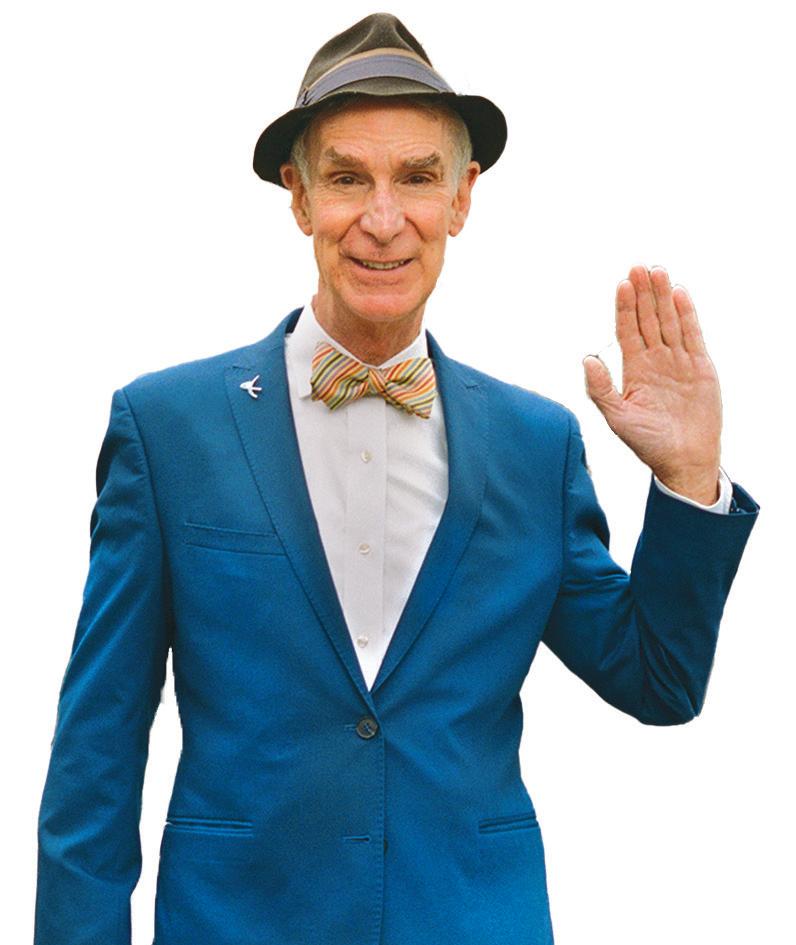
“We really are protecting our tourism, our beaches, our local culture, and our sanity,” Byron said at a press conference this Wednesday. “But as of now, the only exception is that science guy.”
James Boufet can be reached at jboufet@cornellsun.com.
LUCKA NGO / THE NEW YORK TIMES
The Bill Nye Fan Club
Trying to Find Bill Nye ’77 Since 1880
What The 140th Editorial Board
Gets up to on the Weekends ....
VEE “SUN BONDING” CIPPERMAN ’23
Training Ezra the mouse
SERENA “MATCHA LATTE” HUANG ’24
Not walking up the slope
EMMA “OFFICE PLAYLIST” LEYNSE ’23
Waking up at 1 p.m.
SURITA “YOU KNOW WHAT I MEAN?” BASU ’23
Getting honked at by angry Ithacans
NAOMI “NAOMI KOH” KOH ’23
Cleaning her toilet bowl
ELI “PRO GAMER” PALLRAND ’24
Vibing
ESTEE “PAGE 3” YEE ’24
sleep
KAYLA “CALIFORNIA DREAMIN’” RIGGS ’24
Hanging out with friends
JULIA “BAGEL NAGEL” NAGEL ’24
Posting on Instagram
MEHER “PERPETUALLY IRRITATED” BHATIA ’24
Watch stupid movies with friends
KATRIEN “DUTCHWOMAN” DE WAARD ’24
Eating lunch with her plants
PAREESAY “NEWS GURU” AFZAL ’24
Getting the latest scoop
ANNIE “NIGHT OWL” WU ’22
Catching up on sleep
JIWOOK “2ND YEAR PH.D.” JUNG ’25
Romantic outing with Renee
ADITI “LATTE LOVER” HUKERIKAR ’23
Catching up on sleep
DANIELA “CAT MOM” WISEROJAS ’25
Playing with her cat Mirabel
JASON “MEET THE” WU ’24
Dreading next week
GRAYSON “I TOTALLY” RUHL ’24
Taking the TCAT for free
KEVIN “MIDNIGHT AT NASTIES” CHENG ’25
Getting locked out of his room
JYOTHSNA “MEHAK LOVER” BOLLEDDULA ’23
Procrastinating all her work
Bill Nye the (still fguring it out) guy
To the Editor:
If there’s one phrase that makes me think of college, it’s definitely “find yourself.” I know this sounds strange, but I’m here to show the world the definitely real truth about Bill Nye’s college experience. Surprisingly, Bill Nye entered Cornell having not yet “found himself.” Believe it or not, Bill entered Cornell in the Dyson school as a business major, and after working for hours in Mann library, became known as Bill Nye the BusinessMann. After being rejected from every business club on campus — despite his ability to make beautiful powerpoints that he considered to be a form of artwork and mode of personal expression — Nye decided to dabble in the humanities.
ANGELA “ALWAYS VIBING” BUNAY ’24
Tinking about Te Sun
DEVAN “ALWAYS IRONIC” FLORES ’24
Finding Mr. Bill Nye ‘77 (He’s amazing)
KATHERINE “8 A.M. CLASSES” YAO ’23
Choosing the best favor of water
ROMAN “WHERE IS NYE” LAHAYE ’24
Chilling out
SOFIA “ALWAYS STRESSING” RUBINSON ’24
Not thinking about Te Sun
JOHN “WHY DO YOU KNOW THIS” COLIE ’23
Turning thoughts into mobius strips
GRACE “MUKBANGER” KIM ’24
Scrolling on TikTok
AARON “PAYS RENT TO LYNAH” SNYDER ’23
Live Tweeting
TENZIN “RESTING BITCH FACE” KUNSANG ’25
Doing nothing
ANDIE “GROUPIE” KIM ’24
Cutting her hair’
AIMÉE “ACCENT ON THE E” EICHER ’24
Doing the Wordle at 12:00:01 a.m.
SARAH “LOOKIN’” YOUNG ’24
Appreciating life
NIHAR “IT DOESN’T SAY HEDGE” HEDGE ’24
Not working
CLAIRE “PHOTO SHOOT” LI ’24
Taking a billion photos
GABRIELLA “FOR SHITS AND GIGS” PACITTO ’24
Trying to fnd a good bagel
RUTH “I HATE ITHACA” ABRAHAM ’24
Going back home
DANIEL “SPRINT FOOTBALL” BERNSTEIN ’23
Singing in Mediocre Melodies
HANNAH “YOU’RE MADELINE’S TWIN?” ROSENBERG ’23
Eating CTB overnight oats
MADELINE “TEMPLE OF ZEUS” ROSENBERG ’23
Literally just sitting in Temple of Zeus
Fans of Today’s Sun
Bill Nye Himself We hope he appreciates our eforts
Ezra the Office Mouse Supporting from the shadows
Jay Branegan 72 Our biggest fan
The S.A. Flooding our inboxes
The Arts Department Freeing up more ad space
Klarman Hall Tat one always-available room
You Our one loyal reader ;)
He eased himself into the field by taking English classes. Though he wasn’t particularly drawn to any literary works, he developed an unrivaled and somewhat annoying knack for rhyme, as he was captivated by verse poetry, becoming known as Bill Nye the English Guy. He was then advised to try writing for The Sun by a professor. After a brief period of confusion as Nye wondered how the written word could traverse 93 million miles from the Earth to the Sun, he finally realized that The Sun was the student newspaper. Which, might I say, ended up being a little too hot for him.
A friend suggested that he try a government major; after all, his name was Bill, so he should focus on both the passing of Bills and the Bill of Rights. Amidst his government classes a professor told him something along these lines of “In America, bills never pass,” and so deathly afraid of failure Bill decided to give up the study of government after a few days and try anthropology where neither grades nor social constructs existed.
So how then did Nye become the science guy we know and love? Nye took an anthropology class about the interactions between human society and science, and after staring out the window at the sun out of boredom, he began doodling on his paper. He wrote down “Bill Nye The Science Guy,” and he liked the sound of it. The rest is history. A Humanities Gal
Why didn’t Bill Nye talk to me?
To the Editor:
To put it lightly, I’m upset. I really thought I did everything right, but NOTHING worked. I mirrored his every step, wore my cleanest, “It’s not magic, it’s SCIENCE” shirt (most of them are gross after prelim season) and even got past security SEVERAL TIMES, but he never looked my way. All of my DM’s on Instagram, Facebook, Twitter and LinkedIn — unread. Every shout of his name, unanswered. Every attempt to take a photo with him somewhere in the frame, RUINED by the rampant herd of STEM kids, aka the fake BNTSG fans. How dare they get in my way of meeting my most beloved Bill Nye? I’ve waited years for this moment, for this opportunity to meet the idol that galvanized my childhood imagination. Billy and I go way back. I remember wearing my special BNTSG shirt when I submitted my application to Cornell as I prayed for a chance to attend his alma mater, hoping to have some sort of connection to him that would perhaps give him just one reason to even look at me. What other reason would I choose to willingly succumb myself to four years of isolation in the silence of the upstate, away from the bustling city of NYC, in servitude to insufferable college requirements, when instead I could have been showered in sublime freedom by the open curriculum at Brown University? I did it all for him. And he never noticed. And it still hurts. Thanks for the heartbreak.
Billy’s Biggest Fan
(No) sex on thursdays: find god INSTEAD
By BIG RED VIRGIN
During my time within the Monastery of Saint Martin the Merciful, I have often noticed within The Sun’s pages a disproportionate amount of space devoted to extolling the pleasures of physical (and needless to say, premarital) contact and detailing shameless and blatant sexual escapades. While I do not chastise these souls for their conduct, I cannot help but feel that they (and by extension, all of you) are in need of some proper guidance on how to experience pleasure while following a pious life.
Of course, this obstacle to a pious life arises since so many of us are drawn to what is completely physical, delivering an immediate sensation that one believes is tantamount to the joy of communicating with God, but which vanishes as soon as it finishes. This is obviously the orgasm, which (so I’ve heard from many regretful testimonies), while fleeting, is dangerous; each one brings you further down a path of physical fulfillment and nothing more. Allow me to remind you of the words of the Gospel of Saint Luke: “woe to you who are rich, for you have already received your comfort.” This statement rings just as true here — and furthermore, so many seem to be obsessed with the most random people,
including someone called the “science guy” that everyone seems to absolutely revere. I can’t seem to find anything else about him anywhere.
But back to the task at hand: while satisfaction of the body proves to be quite nice while it lasts, it is no match against the true key to pleasure in a pious life: fervor. Fervor emerges from communicating with God and carrying out His work on earth, both unto yourself and unto others. To be in true communion with Him, allowing Him to fill every space within you as you extol His virtues, leaves you with a feeling of pure ecstasy and satisfaction greater than that of any physical experience. Fervor is the soul’s orgasm, bringing with it the promise of salvation.
So, the next time any of you want to find that special someone and “satisfy yourselves like street dogs,” take a moment to reflect and remember that those earthly pleasures, besides leading you away from piety, are not even the best pleasures you can experience in your life. God can do anything for you if you just let Him work His magic on you; as someone who does so with every precious moment, I guarantee it is a vastly superior alternative.
Big Red Virgin can be reached in Dufeld Hall, probably studying physics and defnitely not having sex.
Ithacans Rally for Reproductive Rights Amid SCOTUS Leak
Supreme Court draft opinion sets Ithacans into action Tuesday
By CAMDEN WEHRLE Sun Staff Writer
On Monday, a United States Supreme Court draft opinion that could strike down the landmark Roe v. Wade decision was leaked to Politico, casting uncertainty on the future of reproductive rights for millions of women across the country, especially in states that have expressed the desire to ban abortions.
The following day, more than 100 students and local residents gathered in the Ithaca Commons to rally against the decision. Organized by Planned Parenthood of Greater New York, the event, operating on short notice, crowded the Bernie Milton Pavilion at 5 p.m. with protestors demanding that legal abortion remain a protected right.
Resounding chants of “Keep bans off our bodies” and “This is what democracy looks like!” could be heard coming from the crowd. Cars passing by on Seneca Street honked in support, adding to the noise of the rally. Many protestors carried bright pink signs provided by PPGNY
Erin Scannell ’21 Finds Comfort Trough Her Big Big Red Bun Finn
By
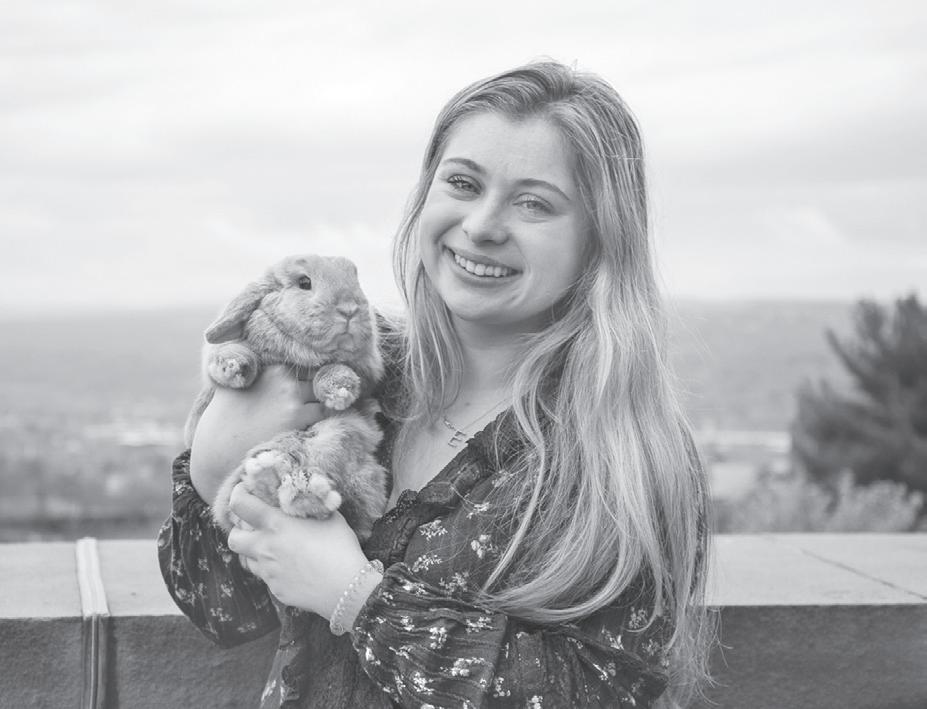
Growing up in Hasbrouck Heights, New Jersey, Erin Scannell ’21 always had a love for animals. She was an active horseback rider, her mother’s family bred labrador retrievers, and her father was a canine police officer, always hosting big dogs in her house. When she got accepted into Cornell as a guaranteed transfer for animal science for fall 2018, she knew this was the best place to study her passion.
But it wasn’t that simple. Scannell would experience loneliness, anxiety and rejection during her time at Cornell. It was only with the help of something fluffy – a Big Red Bun to be exact – that Scannell would finally find her way through this large and rigorous university.
Scannell started her college journey at the University of Delaware, where she was on the horseback riding team, but she only planned on staying for her freshman year.
“I had so many friends, and it was really hard to leave. But then I transferred to Cornell, and it was the hardest

that read, “Protect safe, legal abortion,” and donned the color green to show support for abortion rights.
Patty Nash has worked with Planned Parenthood for decades and has protested in favor of abortion rights in places like Baton Rouge, La. Nash decided to attend the rally after hearing about it through the progressive organization MoveOn. She expressed frustration at what she sees as a lack of progress and erosion of abortion rights in the United States.
“I’ve been fighting this fight for 30 years, and it’s like a brick wall,” Nash said. “This should be established law.”
Several speakers took the stand during the rally, urging attendees to vote in upcoming elections. Among the speakers was PPGNY organizer Colin Benedict ’21 who told The Sun that he wanted to have a space where people could immediately express their emotions regarding the decision.
“It was really, really great to just see the community support that we have as an organization and as a provider of reproductive health care,” Benedict said.
thing I have ever done in my entire life,” Scannell said. “It was worth it, but it is the hardest thing.”
The academic rigor of the pre-veterinary track along with the social scene in her dorm made the adjustment to Cornell extremely difficult for Scannell. She lived in Baker Tower, a gothic dorm on West Campus that does not have a main hallway. Most of the people in her building knew one another as she was one of the only transfer students living there.
“I remember my parents left, and I just sat in my bed and I cried. I was like, ‘Who’s here?’” Scannell said. “Luckily they had transfer group chats and you could go meet up with people, but I never saw those people again after that week.”
Having a history of anxiety and depression, Scannell found it difficult to seek out friends in a new environment. Before coming to Cornell, she requested to be put in any style room other than a single room so that she could be around other people, but Cornell Housing assigned
Benedict described the leaked decision as “devastating.” He said that Planned Parenthood has been preparing for a potential overturn of Roe v. Wade due to the current makeup of the Supreme Court, though he was surprised it happened so soon.
Benedict also said that PPGNY will focus on strengthening New York as a state where abortion rights are protected by pushing for the passage of Equal Rights Amendment, which would go beyond New York’s 2019 Reproductive Health Act and codify legal abortion into New York State’s constitution.
Kayleigh Arnold and Grace Koury, both Ithaca College students, attended the rally after hearing about it from the Planned Parenthood Generation Action chapter at IC. Koury expressed her anger at hearing the SCOTUS decision, disagreeing with the originalist constitutional interpretation taken by Justice Samuel Alito in the draft opinion.
Graduate Student Shares Experience With Title IX Ofce
By SOFIA CHIERCHIO Sun Staff Writer
For students at Cornell, the Office of Institutional Equity and Title IX is the place to go to report incidents of bias and harassment that make them feel unsafe. All public universities are required to comply to Title IX, which prohibits discimination on the basis of sex.
“We are a neutral office, as opposed to an advocate...”
Lauren Branchini
For one graduate student, however, whose name is withheld for privacy reasons, navigating the Title IX Office was difficult and unnerving. After a Havard University sexual assault case broke national headlines, the student was inspired by The Sun’s coverage of a complaint about the University’s Title IX Office to share her story.
“The Office of Institutional Equity and Title IX addresses bias incidents, sexual and related misconduct, discrimination and protected-status harassment,” said Lauren Branchini, a Title IX coordinator. “We are a neutral office, as opposed to an advocate, that serves the entire University community,
Reproductive rally | Ithacans gather at the Bernie Milton Pavillion on the Ithaca Commons to rally in support of abortion rights.
COURTESY OF LAUREN SHERMAN ’24
Big Red Bun Finn and Erin Scannell '21 pose near Libe Slope.
SOFIA RUBINSON and GABRIELLA PACITTO Sun News Editor and Sun Assitant Sports Editor
JULIA NAGEL / SUN PHOTOGRAPHY EDITOR
Today
Emerging Markets Theme Research Seminar With Tarun Khanna - Harvard University 11:30 a.m. - 1 p.m., Baker Lab 119
Employee-Elected Trustee Election: “Meet the Candidates” Forum Noon - 1 p.m., Virtual Event
Thursday, May 5, 2022
Gatty Lecture: Boats, Waters, And Queer Figures in Contemporary Philippine Cinema 12:15 p.m., Kahin Center
Linguistics Colloquium Speaker: John Rickford, A.D. White Professor at Large 4:30 p.m., Morrill Hall 106
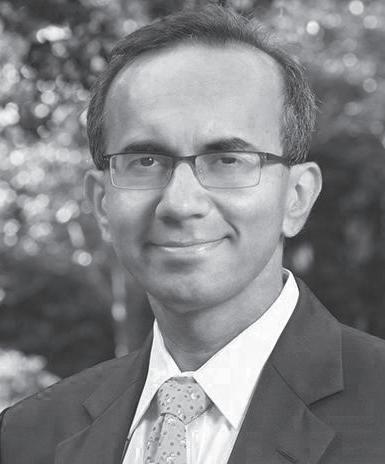
In Conversation: Iftikhar Dadi And Sultan Sooud Al-Qassemi 5:15 p.m., Johnson Museum of Art, Wing Lecture Room
Thomas Reeves, Keyboards: Cornell University Music 8 p.m., A.D. White House
Tomorrow
Humanities Scholars Undergraduate Research Conference
9:30 a.m. - 4:30 p.m., A.D. White House, Various
Hortus Forum Plant Sale at Mann Library 9:00 a.m. - 3:00 p.m., Mann Library
Cornell Electron Devices Society Seminar: Electric Field Control of Magnetism With John Heron, University of Michigan Noon, Phillips Hall 233
Rare and Distinctive Collections Public History Fellows Symposium 1:30 p.m. - 3:30 p.m., Virtual Event
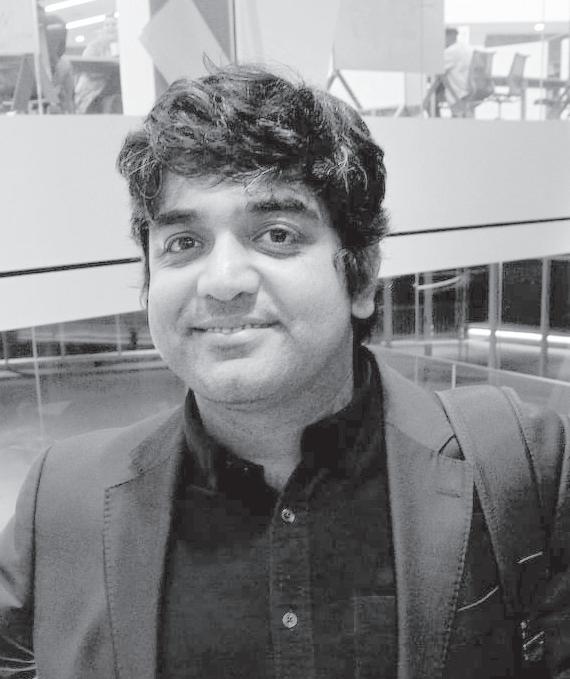
BME 7900 Seminar Series With Assistant Professor Iman Hajirasouliha 2:45 p.m. - 3:45 p.m., Weill Hall 226
Classics Speakers Series With Nandini Pandey 4:30 p.m., Klarman Hall KG42
Creator Studio Showcase 5 p.m. - 7 p.m., Toni Morrison Hall, Multipurpose Room

COURTESY OF CORNELL UNIVERSITY
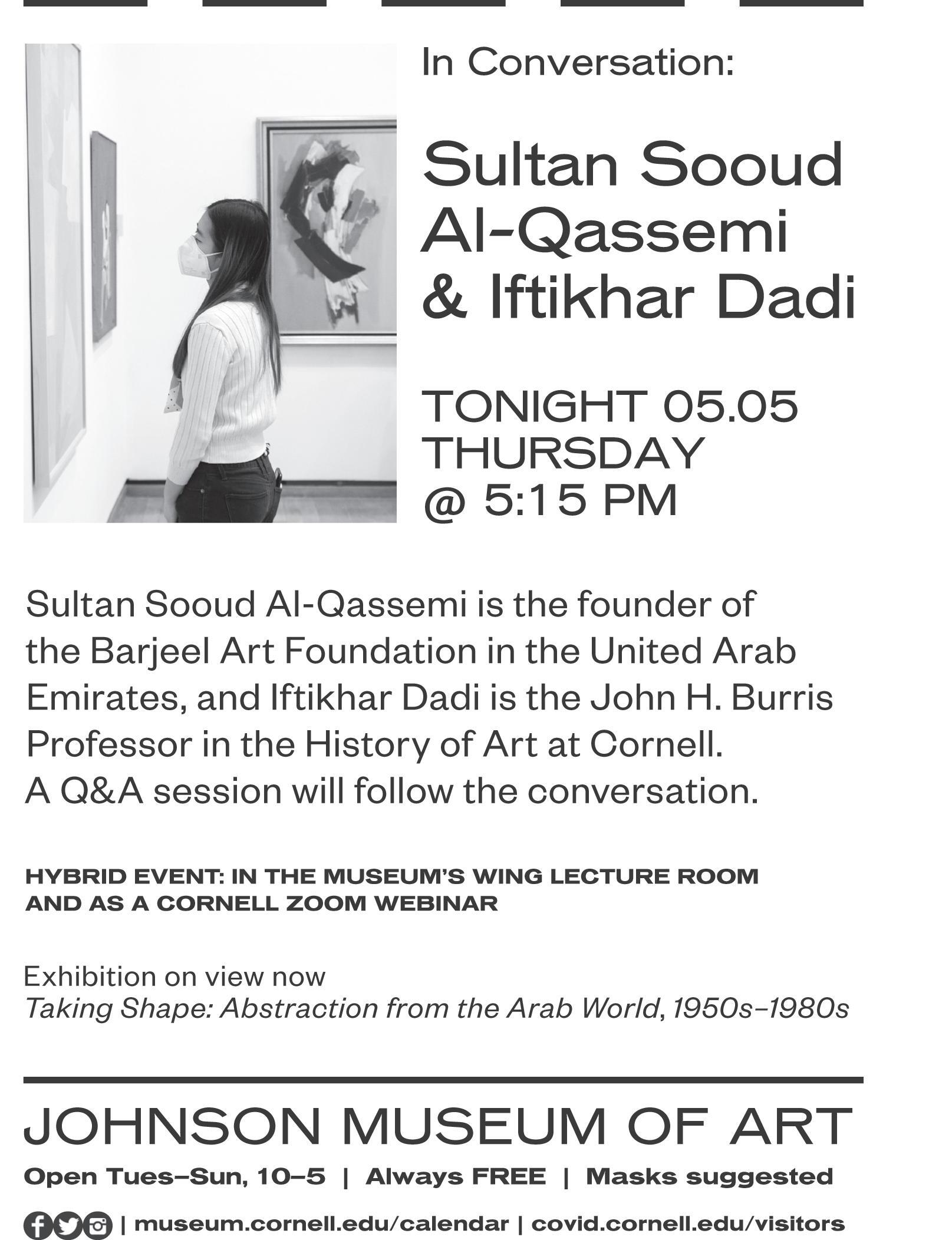
Universal healthcare | Tarun Khanna will discuss the Lancet Citizen’s Commission on Reimagining India’s Health System and how it can help India achieve universal health coverage.
COURTESY OF CORNELL UNIVERSITY
Grad Student Recounts Experience With Title IX Ofce
TITLE IX
Continued from page 1
including complainants and respondents, and students, faculty and staff.”
The student’s experience revolves around months of text messages, verbal altercations and conversations with the same individual. The student said that this individual has targeted women and threatened them with weapons he had on hand and said that they were also targeting Asian women specifically. The student claims that 27 people on campus have spoken to the Dean of the Johnson School of Business about this individual.
The Sun has obtained recordings of multiple meetings between this student and Branchini which all occurred this semester.
“I am very concerned with the safety of women and others at this campus. There is this one individual that we are all very nervous about and I am here to discuss it with you,” the student said in the meeting recording. “I’m honestly scared. As a woman, as a student here, I do not feel safe as a student on campus.”
Branchini described in an email to The Sun the first steps the Title IX Office will take after receiving a complaint.
“Generally speaking, we would contact the complainant (if identified) and provide them with information about their rights and options on campus so they can be empowered to make the decision that’s best for them,” Branchini said. “These steps are the same for all reports of sexual and related misconduct under Policy 6.4.”
Policy 6.4 prohibits bias, discrimination, harassment and other sexual-related misconduct. This policy was the basis of the graduate student’s formal complaint against her alleged perpetrator.
The student had multiple meetings with the Title IX office to discuss the harassment she claims to have endured, but she feels her case was not treated with proper urgency. In a meeting with Branchini, the student expressed her frustrations with the lack of communication from the Title IX office.
“No one got in touch with me; I had to reach out multiple times to get any sort of information,” she told The Sun. “I’m quite frustrated at this point. I feel quite frustrated
by your office and by this school.”
Lauren Branchini said in the email to The Sun that filing a complaint is not an instantaneous process.
“Due to privacy protections, I cannot comment on specific cases or someone’s specific experience,” Branchini said. “While we make every attempt to provide support and access to a process as quickly as possible, it’s understandable that any amount of waiting time can feel like a long time when someone is going through something traumatic or stressful.”
Branchini said that the behavior reported by the student, which was submitted by CUPD, did not violate Policy 6.4 in the recording obtained by The Sun.
The Title IX Office has resources to help accommodate victims and make them feel safe.
“We work with several offices on campus to coordinate resources that are tailored to an individual’s unique needs,” Branchini said. “At Cornell, we are fortunate to have many excellent resources for mental and physical health, victim advocacy, public safety, academic support and procedural advice on campus and in
the Ithaca and New York City communities.”
Despite these resources, the student did not feel she was adequately helped.
“I do not feel safe with him on campus. I am a bit disturbed by the lack of action taken by the school. People keep telling me their hands are tied. But this needs to be addressed,” the student said in the recording. “This has been a waste of three months for me trying to get something done.”
A few weeks after the student’s final meeting with Branchini, she received an email from Title IX’s Vice President, Laura Rugless. The email explained that the accused student voluntarily removed himself from campus and would be leaving Ithaca by April 1, meaning a temporary suspension would not be granted.
“For the amount of work [the Johnson School of Business] does to say that they support women, when it comes down to it, the school says that their hands are tied,” the student said. “This is an issue.”
Sofa Chierchio can be reached at schierchio@cornellsun.com.
Roe v. Wade Draft Opinion Leak Draws Local Protest on Commons
RALLY
Continued from page 1
“When they go back and they’re like ‘well, the founders wanted this so we should respect that,’ I think that’s a lot of crap,” Koury said. “Healthcare is a human right and getting that taken away is just like a kick in the face.”
Koury and Arnold also said they were concerned about the effect the decision would have on marginal-
ized groups, such as transgender people. While the two students both live in New York state, where abortion rights will likely continue to be protected under state law, they noted that people residing in other states could have their abortion access restricted if Roe v. Wade is overturned.
“I think it’s really important to recognize the privilege of knowing we live in New York State where abortion would still be protected. And I think that’s why it’s
Scannell and Big Red Bun Begin New Chapter
BUNNY
Continued from page 1
assigned Scannell a single.
Although Scannell was on the polo team and in a pre-vet club, she only felt welcomed at Cornell after learning the University had a chapter of Alpha Zeta, a professional agricultural fraternity that she had first joined at the University of Delaware. At Delaware, the fraternity was treated as a club that met every two weeks and did small-scale projects together. At Cornell, however, Alpha Zeta has their own house and Scannell felt that there was more emphasis on
brotherhood. Though nervous to attend her first meeting a few weeks into coming to Cornell, she quickly found a community there.
“They are very accepting of transfers, and it is a great place. It was one of the best things I did here, because it’s where I made all of my best friends,” Scannell said.
“You’re all in the same majors, you take the same classes and it gives you people to sit with in class.”
To continue reading this article, please visit cornellsun.com.
Sofa Rubinson can be reached at srubinson@cornellsun.com. Gabriella Pacitto can be reached at gpacitto@cornellsun.com.
important to show up for things like this, just to recognize the solidarity and power of numbers,” Arnold said. Samantha Bosco, grad, and Cat Pulham, grad, both believe organizing in favor of abortion rights is important to build a coalition against overbearing Christian values in governance.
To continue reading this article, please visit cornellsun.com.
Camden Wehrle can be reached at cwehrle@cornellsun.com.

Your source for good food
Senior Opinions: Dining
By JIMMY CAWLEY Sun Staff Writer
As my first semester at Cornell wanes, I have had moments where I felt like I have known everything about dining here. I can proudly say that I have been to most of the dining halls and eateries on or around campus. But alas, I am only a freshman. Many seniors — those who have braved the Ithaca winter for four years, somehow continued to go back to Okenshields repeatedly and have experienced everything that Cornell has thrown at them, are the ones with the actual knowledge. Although the COVID19 era of Cornell Dining may taint their opinions, I decided to sit down with a few to hear their views on Cornell Dining eateries around campus.
First, I asked Jasper Weed ’21, majoring in information science and philosophy, to provide a runthrough of his experience in the dining halls as a Cornell student.
“Freshman year, Robert Purcell Community Center actually wasn’t bad if you knew the right things to get,” Weed said. “The pizza is the main thing that people talk about, but I actually thought it was pretty mediocre. The stir fry is very solid, great-tasting and pretty filling. I would give RPCC a 6.5/10.”
A bit of a harsh rating from Weed on one of the classic North Campus dining halls, but I was intrigued if he thought any better of West Campus dining.
“Honestly, I think that West is a bit worse. There are fewer options in each house, but I do like the theme days during the week.” Weed said. “But that’s not my
issue with eating here. The main issue is that there is nowhere cheap and easy to eat at Collegetown. Subway is fine, but all you need is a Chipotle or Taco Bell. Everywhere else it is hard to get a meal for under $14.”
Weed was omitting one thing from his review of the food at Cornell, and that was the non-swipe eateries such as Trillium or Terrace.
“Terrace is fire. It is easily 8.5/10. The burrito bowls are super good with a lot of add-ins, but no one knows about the curry. In the curry line they usually will give you a lot of meat so you end up very full. I like Trillium a bit less, 6.5/10. Nasties is a classic, but no one goes to nasties for the food, they go for the 2 a.m. vibes.”
Finally, I needed to know what Weed’s overall rating of Cornell Dining was.
“My final overall rating of Cornell Dining is 6.5. Definitely the food is a lot better than other schools. We have a lot of options and something for everyone on campus, but Collegetown eating needs to drastically improve. Just taking the dining halls into consideration, I would give it a 7.5.”
I needed to hear from more voices to evaluate how the graduating class has experienced Cornell through the lens of food. Alison Landry ’21, an operations research and engineering major, is gluten-free and has had positive and negative experiences with Cornell Dining.
To continue reading this article, please visit cornellsun.com.
Jimmy Cawley is a freshman in the College of Arts and Sciences. He can be reached at jdc354@cornell.edu.



It’s Here and Ten It’s Gone

Odeya Rosenband Graduation Column
Odeya Rosenband is a senior in the College of Arts and Sciences. She served as the Opinion Editor on the 139th Editorial Board and can be reached at orosenband@cornellsun.com. Tis is the fnal installment of her column Passionfruit
I’m two months late on my Collegetown rent. If I’m being honest, I actually have a very kind landlord so this isn’t one of those revenge-seeking situations and I know that I’m the real asshole here. Te reason I’m two months late on my Collegetown rent is because once I pay it, that will be it for me. I will have no more home in Ithaca.
Childish, sure, but I don’t want to believe that I’m leaving Cornell or possibly even getting kicked out. Te idea of graduation is so tacky and so absurd and so absolutely rotten that it’s exactly how I imagine it would feel to get punched in the throat by someone capable and willing. Te punches rolled slowly at frst, but now they’re coming all at once.
I always knew, from the second it was good, that it wouldn’t be for forever. I just didn’t expect “not forever” to be this brief and breathtaking. Next year, all of my best friends won’t be living within walking

Christian Baran Graduation Column
Christian Baran is a senior in the College of Agriculture and Life Sciences. He can be reached at cbaran@cornellsun.com. Tis is the fnal installment of his column Honestly
Four years as an opinion columnist at Te Cornell Daily Sun. Tere are so many things I wanted to say before I left. Now the time has come and I haven’t said half of them.
In all of my columns, I’ve sugarcoated the truth. Whenever I’ve talked about bad things that had happened or ugly truths, I added a big fat BUT. Yeah, life kicked my ass this semester, BUT it was a learning experience. I continually fail to live up to my expectations for myself, BUT I’ll do better next time. I’m tired of the “BUTS.”
Te truth is, you’ll get your heart torn out and sometimes failure exists without the opportunity for redemption. Of course, all of this bad that we experience is relative.
But, in absolute terms, some things still suck, and adding a BUT is just a lie
or shouting distance, nobody will be preoccupied with making sure I received their club’s quarter cards and I will actually get evicted if I don’t pay my rent. Our shangri-la has been a world class summer camp and I guess my professors never claimed they would teach me how to leave this place behind.
Like the Mark Knopfer song goes, “It’s here and then it’s gone, there’s no secret anyhow.”
It has been my greatest fortune to look out on the world from the top of this hill, to have been embraced by this snug dreamscape even if just for a split second. If I am proud of anything, it is to have experienced how glorious Cornell is by experiencing it as myself. Buried in the most unexpected corners and arms, I have stumbled on senses of home a million times over and then took every opportunity to plant my feet. Tese quads have been a forgiving place to screw up and break down, a fertile ground from which to grow.
The moments flooding back to me now are not the ones with pomp and circumstance, but the ones when I faced this place honestly. What I’m really struggling
It has been my greatest fortune to look out on the world from the top of this hill, to have been embraced by this snug dreamscape even if just for a split second.
to say goodbye to are the ways in which my life has been so readily concentrated in these 10 square miles, my body so cautiously nestled and sheltered between these hills.
What I’m really struggling to say goodbye to are the ways in which my life has been so readily concentrated in these 10 square miles, my body so cautiously nestled and sheltered between these hills.
I got luckier in the friends department than I deserved and all of my favorite moments here have been with and because of them. Most of the good things about Cornell, I know, will stay with me long after I graduate.
To the places — Te Green Dragon Café and Te Cornell Daily Sun, thank you for pulling me tight and letting me dance. Libe Slope and Lynah Rink, thank you for swallowing me whole and for the boundless spirit. White Hall and Olin Library, thank you for the gracious refuge time and time again.
To my dear friends and mentors — While the word limit on this article will not allow me to thank each of you appropriately, I owe you all everything. As great as Cornell is, it would be near to nothing without your presence and support. I have discovered no better feeling than loving and being loved in Ithaca.
And to my family — Tank you for the loud and constant cheerleading, for letting me tell you about my days as they happen and for teaching me that success is best measured in dinner parties. Sending me here has been the greatest gift you could have ever given me. Forever and always, Go Big Red.
For What It’s Worth
to make other people feel better.
For instance, I have major regrets about how I spent my time here (ha, double entendre). She’s still on my mind. And I’m becoming a part of Cornell’s past, the part that no one will remember. It doesn’t feel good, and that’s the truth.
Tis column is a cliché on paper, so let’s keep that rolling. We always think we have more time than we actually do. Since my frst semester here, I’ve kicked vague plans and ideas down the road. Yesterday, I woke up from a nap and found that I could see the exit ramp. Tere’s no more kicking room.
Younger folks, don’t push your ambitions of. Don’t worry about timing —
In all of
my columns,
I’ve sugarcoated the truth. Whenever I’ve talked about
bad
things that had happened or ugly truths, I added a big fat BUT.
things will work out. And certainly don’t take the easy route.
Go to the guest lecture by the 2011 Nobel Peace Laureate that you saw announced on a poster in Rockefeller. Ask
that girl on a date, even if the end of the semester is in just a few weeks. Challenge yourself with General Chemistry when you have the option to skate by in Te Language of Chemistry.
Maybe there’s a reason I’ve left so much unsaid. Reading what I’ve written back to myself, it’s all a little depressing. But my last four years have not been defned by depression. Tey’ve been defned by beauty. I’ll remember the beautiful moments, the ones that meant everything to me and the ones that I never would have imagined would stick with me.
I’ll remember walking back from Olin library during the active shooter scare of November 2021 with a random graduate student I had just met. Giving her a ride to downtown Ithaca because I didn’t want her to be nervous walking. Halfdrunk, building a snowman on the side of Bufalo Street with my junior-year roommate during exam study period. Using beer cans for the eyes and nose. An older (probably graduate) student turning around and beaming at me in the Libe Café line on the frst day we didn’t have to wear masks inside. Getting ice cream at the Dairy Bar after Slope Day freshman year. Licking the cone in the bed of my truck with people that would become my best friends at this school. Kissing a girl who was once important to me for the frst time with the snow coming down around us. Her red dress. Standing at East Shore Park in the December wind, receiving the call that catapulted me into the next phase of my life.
Yes, yes, yes. Pushing a cart into Walmart to buy groceries for myself for the first time. The sunny March day spent by Cayuga Lake with two friends,
throwing rocks at beer cans we had drank and rested on the railroad tracks. Tears in the parking lot of 509 East Buffalo Street.
Since my first semester here, I’ve kicked vague plans and ideas down the road. Yesterday, I woke up from a nap and found that I could see the exit ramp. There’s no more kicking room.
I remember receiving the email accepting me into the opinion section of Te Sun during O-Week of my freshman year. Drunk in a fraternity basement for the frst time. Tat was before the position of opinion editor even existed. Before all the learning and the pain and the hoping for the future. Katie Sims, thank you for that email. So, there. “Honestly” has run for the last time. I couldn’t fgure out how to say everything, so I said something instead. I don’t know if I did it right. But I’m glad I did it.
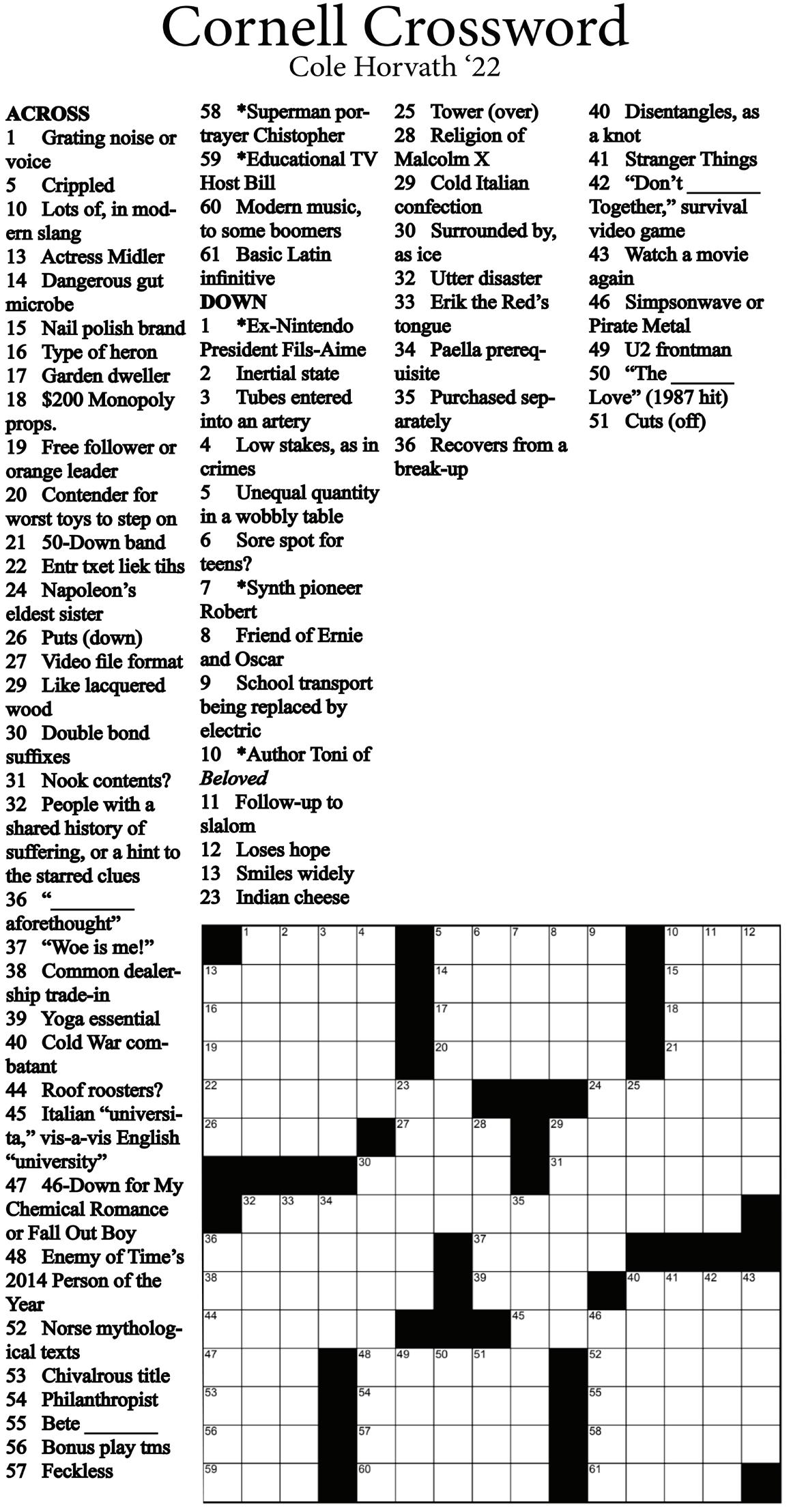
Fill in the empty cells, one number in each, so that each column, row, and region contains the numbers 1-9 exactly once. Each number in the solution therefore occurs only once in each of the three “directions,” hence the “single numbers” implied by the puzzle’s name. (Rules from wikipedia.org/wiki/ Sudoku)
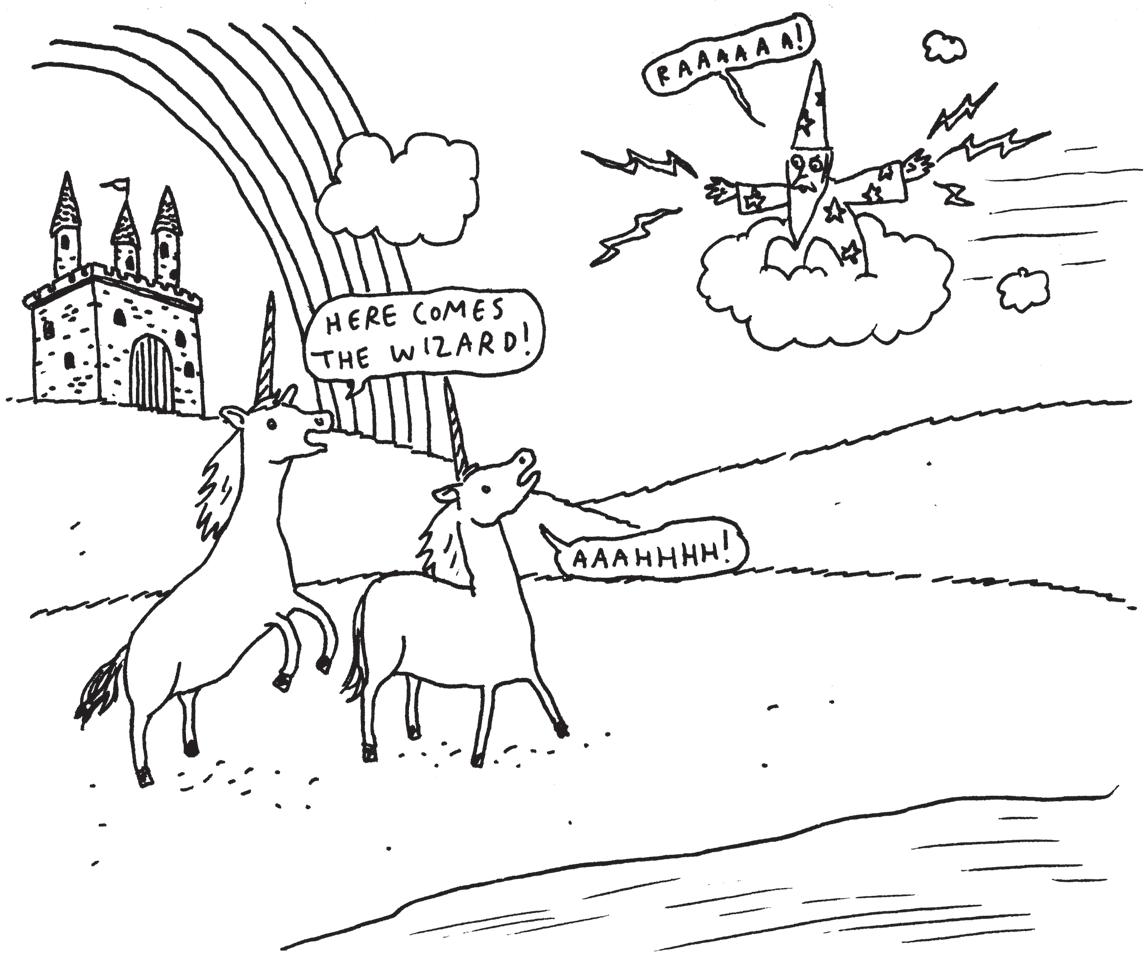
I Am Going to Be Small
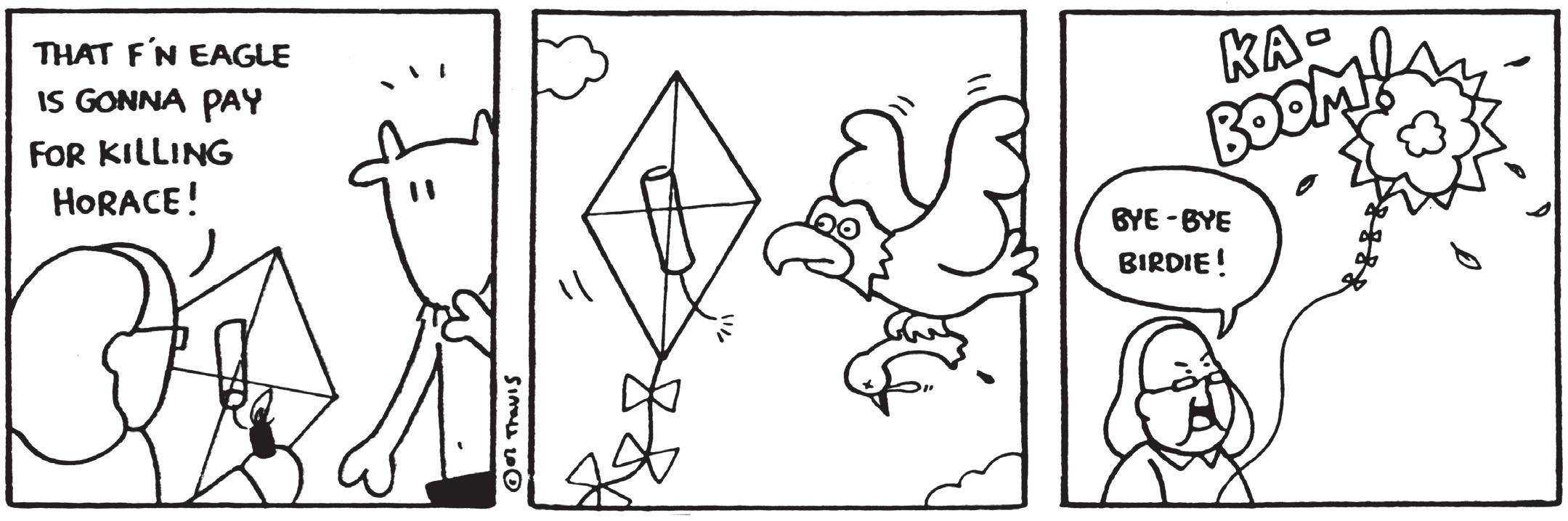
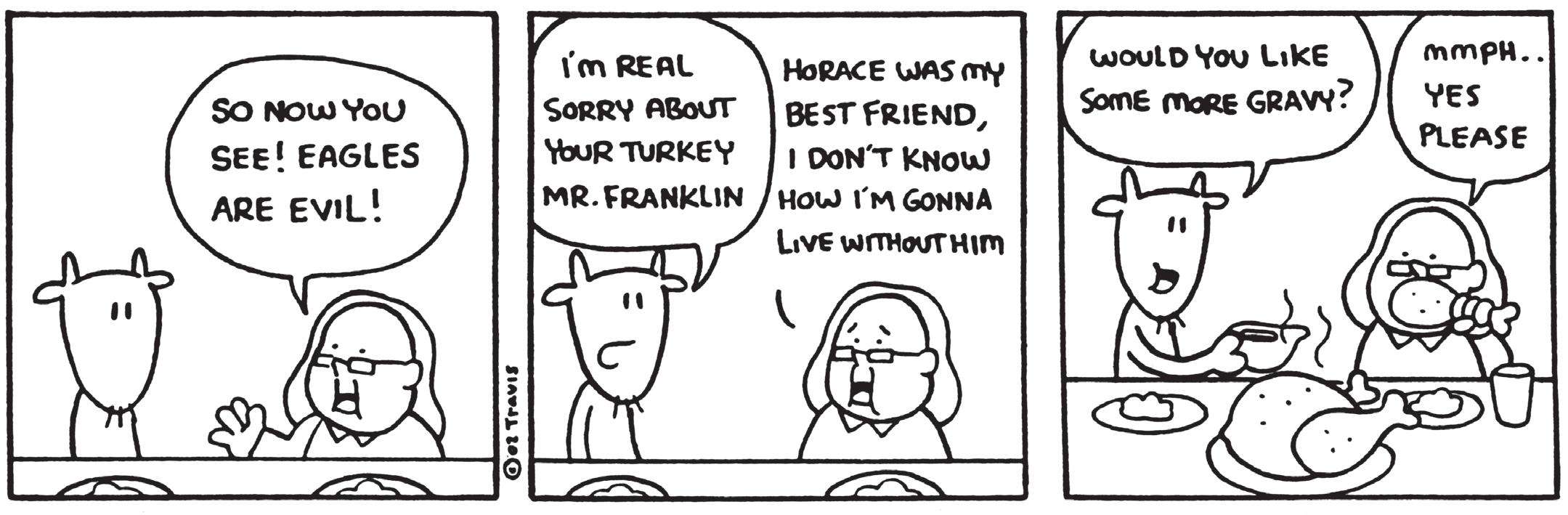
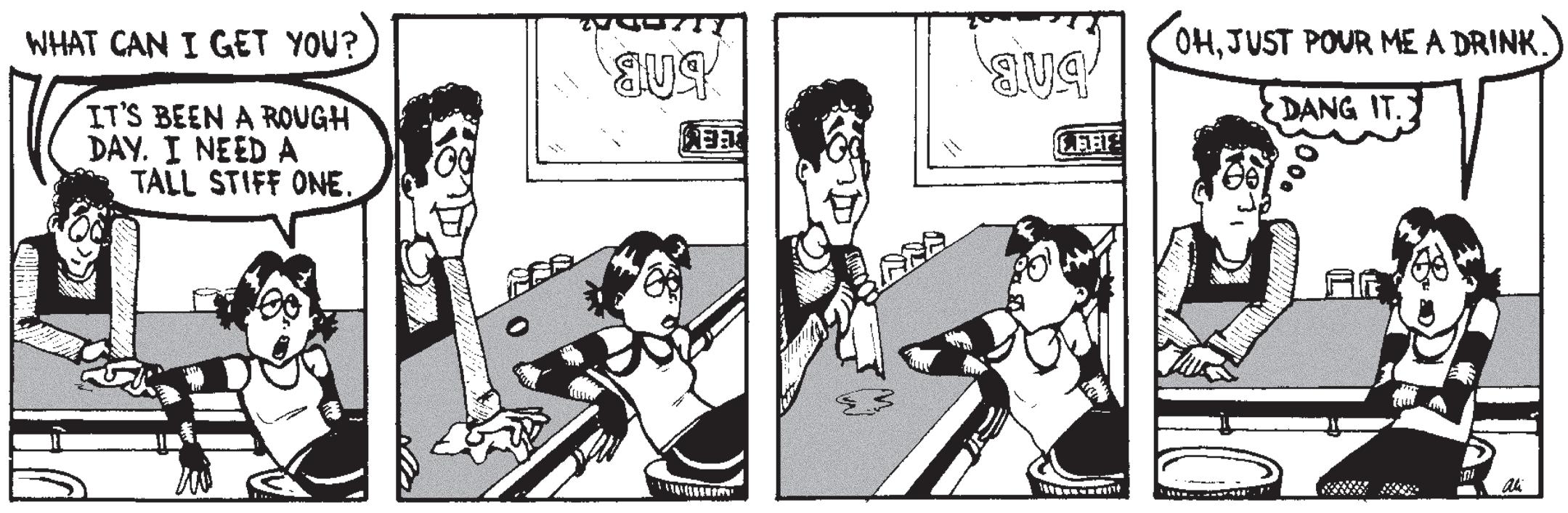


Mr. Gnu by Travis Dandro
Mr. Gnu by Travis Dandro
SC I ENCE
Female Proteins Found Essential in Fruit Flies
By ANIRUDH SHARMA Sun Staff Writer
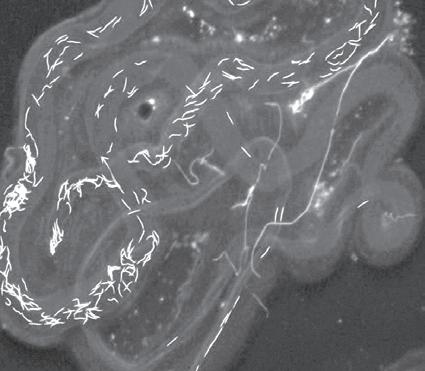
Recent work published by Prof. Marianna Wolfner ’74, molecular biology and genetics, and collaborators found that the survival and success of fruit fly sperm after mating depends on proteins in the female reproductive tract. The team found that just four days after mating, 20 percent of the proteins bound to sperm are female-derived.
Scientists have long known that sperm undergo changes in the female after mating, in many insects and even in humans, according to Wolfner. These changes are often fundamental to the sperm’s development. Fruit flies were an optimal organism for further study since their reproductive biology and genome are already well-understood.
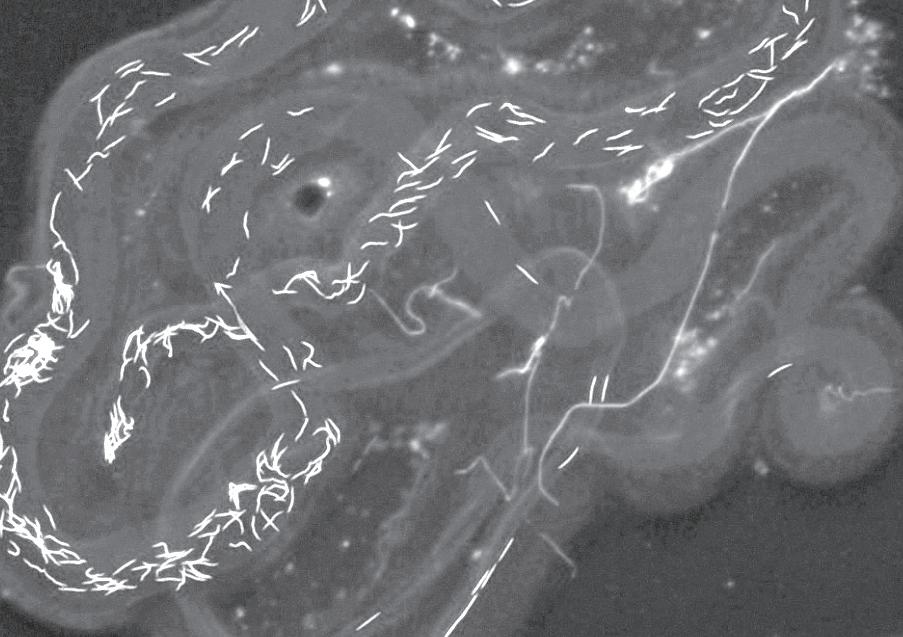
Fruit flies have an interesting reproductive feature: females can retain sperm in their bodies for up to two weeks after mating. This is longer than a generation time, the duration required for an egg to develop into an adult. Wolfner said that this extended duration prior to fertilization may be one reason why female proteins are needed by sperm to survive.
This hypothesis was consistent with the team’s findings: some of the female-derived proteins seem to be replacing those found in the seminal fluid. Wolfner said that a common class of female proteins
binding to the sperm were metabolic proteins, which could play an essential role in keeping the sperm alive.
Future work will aim to better understand and confirm what functions these proteins play.
Wolfner explained that her team can now use gene-editing tools like CRISPR to “knock out” expression of different female proteins and measure effects on fertility, sperm retention and survival.
The study’s experimental approach was straightforward. “It’s pretty simple: dissect-out the sperm, break down the protein [into peptides], determine the mass of the peptides, figure out what protein they come from and figure out where the protein comes from,” Wolfner said.
The team used mass spectrometry, which allowed them to calculate the molecular weights of the broken-down proteins with high precision. The weights could then be used to identify the proteins.
Mass spectrometry was also critical for distinguishing male and female proteins — female proteins were labeled with heavy isotopes, which altered their weights. The team could then use these small differences in the expected and actual weights to determine whether the protein came from the male or the female.
The Cornell group also worked in collaboration with scientists at Syracuse University. The two labs repeated the same sperm
dissections and procedures and found the same results, increasing the team’s confidence in their findings.
But the role of female proteins on male sperm may go beyond providing metabolic support. It is known that female fruit flies can exert selective control over which sperm fertilizes their eggs. For example, a female will often mate for the first time with any male she can find, Wolfner explained. However, she will select a second mate more choosily, and the second mating tends to produce more progeny, relative to the first one.
mental proof of this yet.”
Proving this idea is another future direction of this work, according to Wolfner.
The mechanism by which this bias occurs is still unknown, but Wolfner’s team has a theory, based on their findings.
“We had this crazy idea: the sperm from the first male, that have been in the female for longer, will have more female protein on them [relative to the second male],” Wolfner said. “So the female could say, ‘Oh, the sperm with less of my protein are the new ones. I’ll use those.’ It fits with our data, but we have no direct experi-
The findings are part of a broader theme in reproduction, known as molecular handoff.
While Wolfner and her team focused on the role of female molecules on male sperm, this handoff can occur from males to females as well. One example of this is the sex peptide, a molecule transferred during mating via sperm.
“The sex peptide has many different effects on the female — our lab, in collaboration with professor Buchon’s lab in entomology, showed that it causes her gut to grow and to express genes for
digestion,” Wolfner said.
She explained that these changes may help females increase food intake in preparation for laying eggs. Such findings add nuance to the traditional views of sexual conflict in biology, according to Wolfner.
“There’s a lot of conflict in reproduction since males and females have different reproductive strategies, leading to different evolutionary pressures on them. But there’s also all this cooperation and handoff,” Woflner said. “It’s fascinating because it’s both.”
Anirudh Sharma can be reached at asharma@cornellsun.com.
Identifying Remaining 8 Percent of Human Genome
In 2003, the Human Genome Project made history by sequencing 92 percent of the human genome, which created breakthroughs in medicine such as the ability to identify specific mutations that may lead to cancer.
Almost 20 years later on March 31, the Telomere-to-Telomere Consortium — an open community-based effort to complete the human genome — identified the last sequences, revealing a complete human genome for the first time.
Sanger sequencing, a technique which chops up DNA into small sequences
of 100 to 150 base pairs in length to sequence, identifies overlapping patterns and recombines these sequences into a full sequence, was originally used to build the genome in the Human Genome Project.
However, according to Prof. Praveen Sethupathy, biomedical sciences, this sequencing technique has limitations.
“They’re highly repetitive…which makes it tough to know what order the pieces are in…so those regions were left aside [since] they were too complicated to deal with the [past] technology,” Sethupathy said.
Prof. Andrew Clark, biology, also stated the two hardest regions to sequence
are the telomeres — the tips of the chromosomes — and the centromeres — the middle section of chromosomes where the two identical sister chromatids come together.
In addition to being the ends of chromosomes, telomeres are also the non-coding section of DNA. They consist of repetitive sequences, which makes them hard to sequence since it is difficult to put together all identical pieces of DNA.
The centromere is necessary for the separation of these sister chromatids during replication because the area around it contains many repetitions of DNA, also making sequencing difficult.
With the development of next generation sequencing which sequences millions of DNA fragments in parallel fashion, DNA sequences can be quickly read at once allowing whole genomes to be sequenced faster and cheaper.
Long read sequencing — discovered by Cornell’s Watt Webb and his colleagues in the physics department — is a type of NGS and has greatly contributed to the identification of the remaining human genome. It enables the identification of 10,000 to 100,000 base pairs all at once.
Moving forward with this new discovery, scientists will be able to tap into new phenomena in science and medicine that previously seemed impossible to access.
According to Prof. Hojoong Kwak, molecular biology and genetics, the iden-
tification of these very similar repeating sequences could also provide clues to the evolutionary history of the human genome.
Over time as humans have evolved, the human genome undergoes multiple replication cycles, allowing mutations to accumulate and leading to more distinguishable sequences.
However, the similarities of the repeating sequences in the previously missing 8 percent indicated a younger part of the genome that could provide new evidence of the more recent evolutionary origins of the human genome.
“These repetitive regions might contain small sequences of viruses or genetic parasites that are incorporated into the human genome…and can help us understand how they could impact certain populations and their susceptibility to diseases,” Kwak said.
Kwak believes these sequences will help him identify unknown sequences that come up in his research on identifying regulatory regions in the cancer genome and exploring how the genetic variation of the human population can impact gene expression.
Even with the completion of the human genome, the work is still not done. This advancement will catalyze future research in understanding how genomes function and differ from each other and move humanity closer to individualized medicine.
Jessica Dai can be reached at jdai@cornellsun.com. Tifany Adjei-Opong can be reached at taa53@cornell.edu.
By JESSICA DAI and TIFFANY ADJEI-OPONG Sun Staff Writer and Sun Contributor
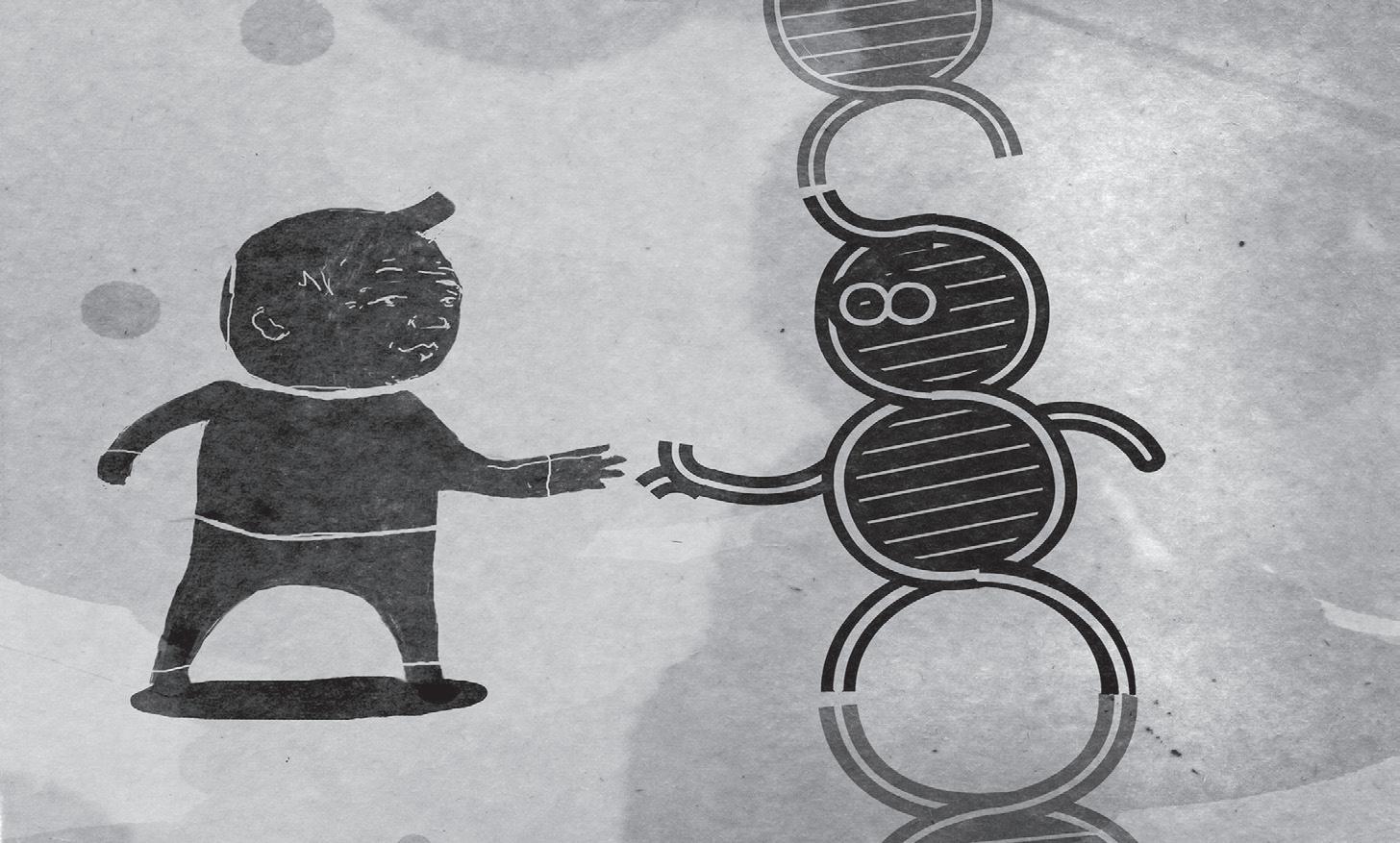
Human genome | 20 years after the Human Genome Project sequenced 92 percent of the human genome, the Telomere-to-Telomere Consortium revealed the remaining 8 percent.
Female proteins | Female fruit flies’ abilities to retain sperm in their bodies for up to two weeks after mating is one of the reasons why female proteins are essential for sperm survival.
DAWN CHEN / CORNELL UNIVERSITY
YAREK WASZUL / THE NEW YORK TIMES
&
Arts to Shut Down After Writing About Everything — And We Mean Everything
is simply not enough culture in our lives to continue dedicating a whole section towards it. From praises and recommendations to scathing reviews and thought-provoking commentary, the Arts & Culture section has really done it all in its time at The Sun.

Less than a year after our rebranding, the Arts & Culture section is shutting down. While we did become embroiled in an unfortunate payola scandal last year (the allegations of which were false, by the way) we are instead ceasing publication because we have simply run out of things to write about (and definitely not because we wasted our funding on NFTs while trying to recover from the aforementioned scandal).
Nothing is ever original; after all, every creative work is simply a retooling of the same themes.
In their eagerness to write articles covering as many of the latest pieces of media and trends, our writers have gone above and beyond — and run out of things to write about. Even our columnists, most of whom have left for other countries in search of more article topics, find themselves empty-handed.
Every song on every album, every movie, show, performance — any artistic work you can think of — has been covered. And don’t even get us started on the “culture” part of our section; we might have expanded the scope of the section, but there
“We simply have nothing more to say about art or culture in any form, at all, ever.”
The “Arts & Culture” Department
“But wait,” you inevitably ask, “Won’t there be new content to write articles about?” To an extent, you’d be right. There are always going to be new movies, new music and new cultural happenings. However, what we have realized is that we simply have nothing more to say about art or culture in any form, at all, ever. Because at the end of the day, are there really any new opinions? Sure, we can continue publishing reviews, but there’s only so many ways you can make “I enjoyed it” or “I didn’t enjoy it” into a 500+ word commentary.
So, dear readers, we must regretfully inform you that you will hear from our section no more. Farewell.
Phil De Grave is a sophomore in the College of Pissing Of Cornell Orgs. Tey can be reached at starvingartist@cornellsun.com.
Unlimited Forks Comes to North Campus Dining
Unlimited Forks are soon to arrive at Cornell dining halls, notably Robert Purcell and Toni Morrison dining. This is a huge feat, considering that forks are essential to eating foods like noodles, salads, many kinds of meat and more. The estimated arrival date of the much-anticipated Unlimited Forks is January 2035.
Last semester, students complained of going to dining halls, sitting down, forgetting utensils and then walking around looking for the utensil station, only to find no forks — only a plethora of knives and a small handful of spoons. Following this, an intense internal debate would ensue about if it’s worth eating salad with a spoon. Some take on the challenge. Others decide it’s simply too much effort, throwing out their salad, opting for a hands-free option like pizza or a spoon-only option like soup or Cornell Dairy Ice Cream.
Here’s the vital tip: in order to ensure that you secure your Unlimited Fork, you must reserve it on the GET app. In order to do so, after you press the button that enables you to scan into the dining hall, there will be a button on the top right-hand corner of the screen, labeled “choose Fork.” As was mentioned in the official announcement, dining halls will soon be equipped with a vending machine full of Unlimited Forks.
The prototype is currently in the works; Cornell engineering students and food nutrition students are currently collaborating to make sure these Unlimited Forks are perfectly engineered for different kinds of foods and different mouth shapes. The vending machine will be the only free vending machine on campus. However, there is no such thing as a free lunch, as most of us learned during an economics class.
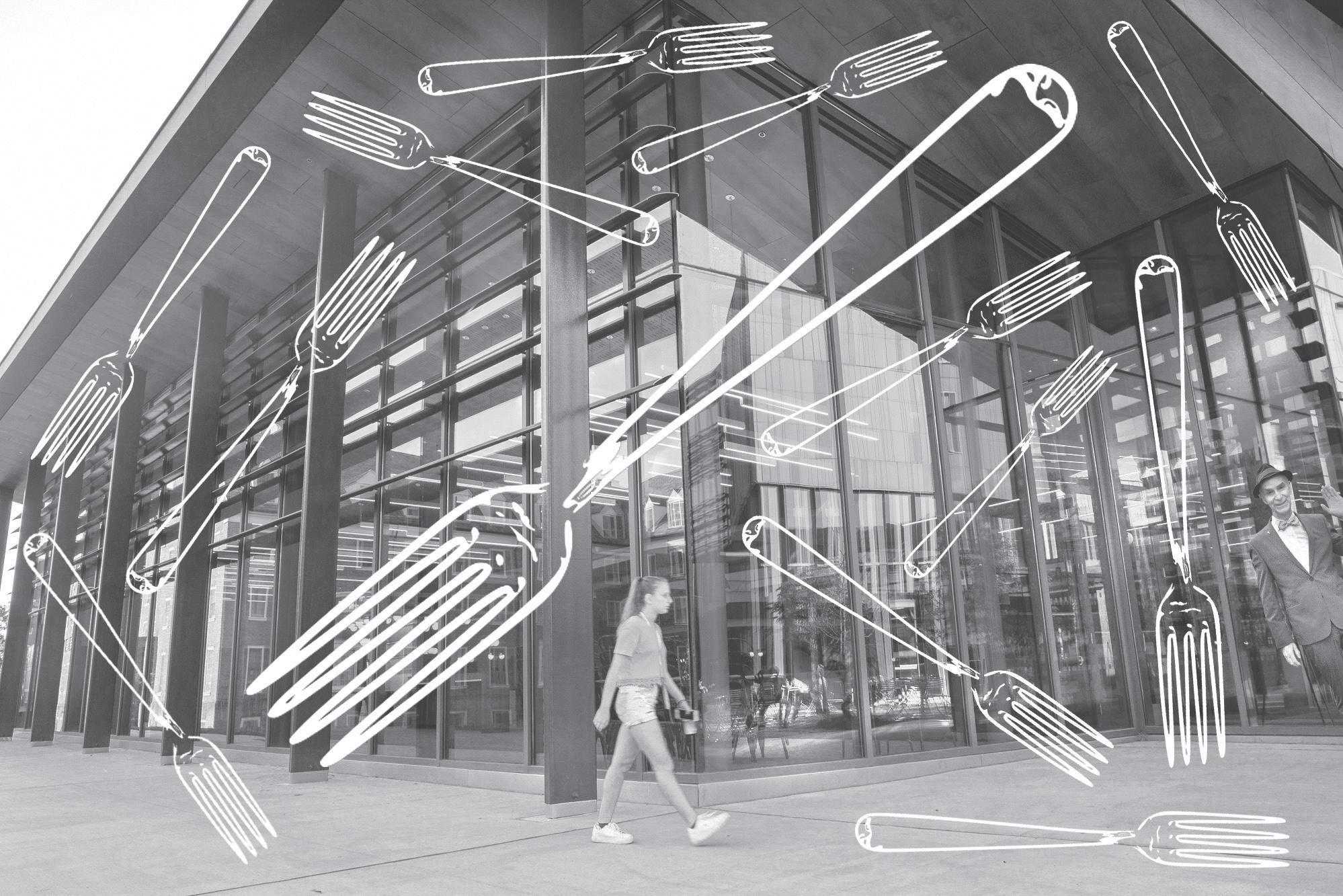
You must pay a $10 deposit to cover for potential Unlimited Fork damages (such as abuse to the vending machine). A proposed upgraded prototype will allow you to choose the colors of the Unlimited Forks. The current project name is “Forkified.”
When we interviewed President Martha Pollack about the incoming forkening, she stated, “I am very excited to see these Unlimited Forks introduced into our dining halls. I understand that not having Forks
negatively impacts not only the physical health of our students, but also their mental health. The agony over not being able to have a fork is extenuating enough that we decided we need to get some sort of solution for this. I hope that students will recognize how revolutionary these developments are. This will be our biggest proposal of the semester.”
SCIENCE
You Thought We Forgot Bill’s Favorite Subject?
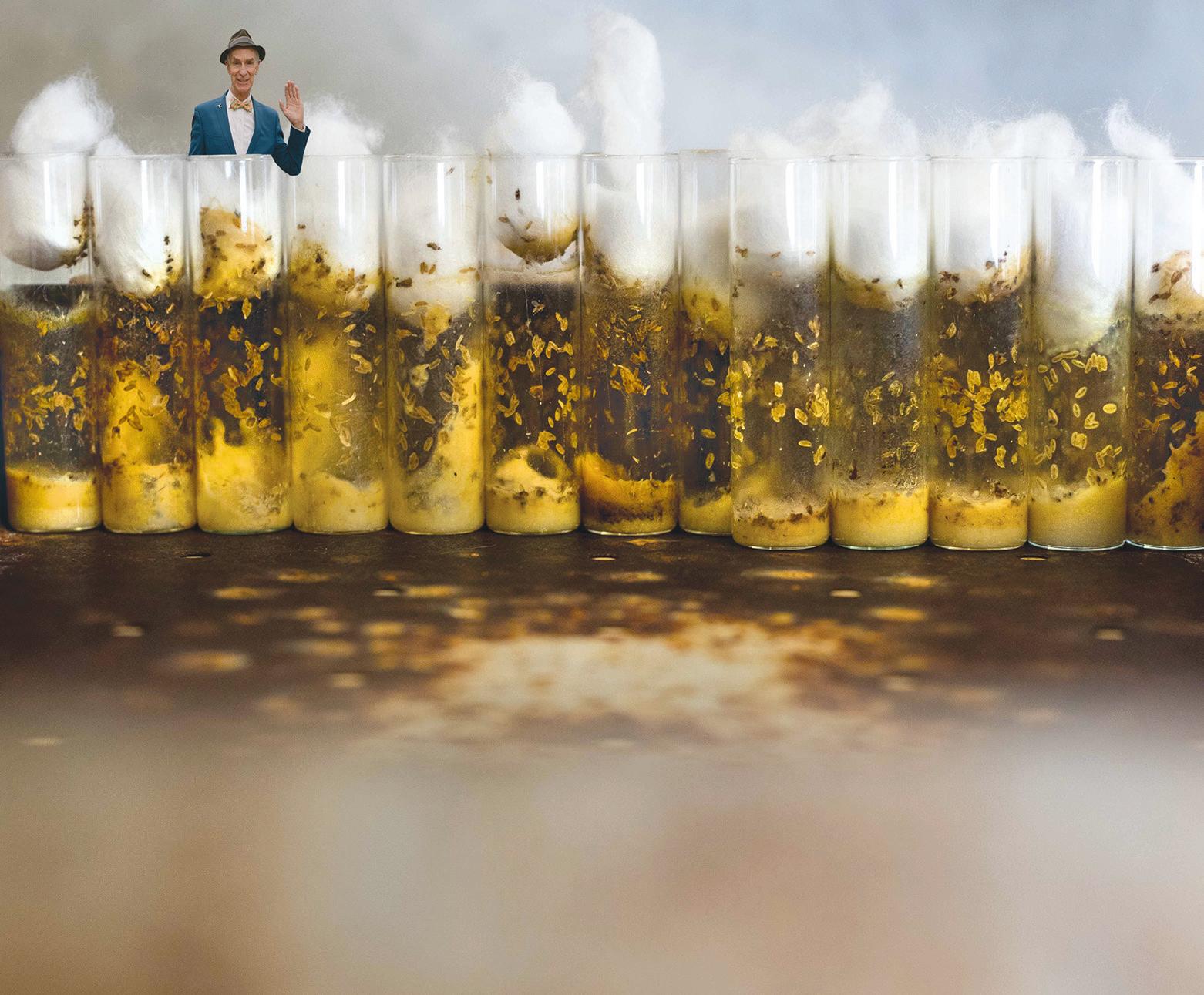
Research in Fruit Fly Mating Highlights Joint Effort to Understand Asexual Human Procreation
By BILLIE NYELISH Sun Contributor
In the recently published article, “The History Of Drosophila Sperm Involves Molecular Continuity Between Male And Female Reproductive Tracts And Its Implications for Asexual Human Reproduction,” and further correspondence with loud experts, the future of reproduction turns a new palmatey, green and fragrant leaf.
The article explored the lifespan of sperm inside the internally fertilizing species Drosophila, with the senior editor Fly Milli and graduate student Axel Namuh, both in the department of molecular biology and genetics.
The lab and research was in collaboration with professors Flynn Diptera, professor of biology, and Bee Wasper, associate professor of biology.
Their findings concluded that after the insemination of a female fruit fly, female proteins bind to the sperm and these proteins constitute 20 percent of the sperm’s mass, making the sperm more viable and partially female.
The aid provided to sperm from the female mate, fights against the common belief that after insemination the sperm is tasked with fighting off the hostile nature of a female reproductive system to fertilize an egg, Diptera explained.
After a few days inside the female fruit fly, the sperm begins to take on more genetic characteristics of the female mate.
“Multiple seminal fluid proteins initially associate with sperm, but most become undetectable after sperm are stored. Female-derived proteins also begin to associate with sperm immediately after mating, and they comprise nearly 20 percent of the postmating sperm proteome following 4 days of storage in the FRT [female reproductive tract],” states the paper.
To explore this further with fruit flies personally, The Sun removed the language barrier between our species through the aid of euphoric gummies, brownies and our talented polyglot and linguist Mary Jane ’420.
While discussing the implications of this research with fruit fly professors Maui Wowie and Sour Diesel, both from the department of herbology, we found that the implications of this study supersedes fruit fly physiology and that it can be
transposed onto humans — specifically females.
“We have found that after insemination females can make genetic copies of a single sperm and reproduce the sperm with their own resources, while also mimicking differing genetic makeups by switching out alleles,” said Prof. Wowie. “After a female is exposed to one single sperm, traditional mating is no longer necessary.”
After a single mating, or artificial insemination, human females capable and desiring of procreation need not mate again.
“With kush-colored glasses, our future is female.”
Prof. Sour Diesel
This finding will revolutionize the habits and lifestyles of many, who no longer desire the social pressure of a long-term partnership or consistent mating in order to bear and raise children.
“With kush-colored glasses, our future is female,” Prof. Diesel stated.
Billie Nyelish can be reached at bnyelish@cornell.edu.
Elon Musk Buys Cornell for Three Cents an Acre:
By A. GUNN Sun Staff Writer
In a move nobody else cared enough about to report, Tesla CEO Elon Musk has acquired Cornell University, purportedly at the cost of three cents an acre. This purchase follows soon after the offer Musk recently made to acquire Twitter at $54.20 per share.
“I’ve been looking to go into
‘It’s My Way of Sticking It to the French’
higher education for a while now,” Musk, who has retained Morgan Stanley to advise him on the acquisition, told The Sun.
“Cornell seemed like the best test case to see what cool new things could be done.”
When pressed further to explain why he had settled on such a specific price in acquiring the university, Musk remained characteristically coy: “It’s my way of sticking it to
the French,” he replied, seemingly referring to the Louisiana Purchase of 1803, during which the United States purchased the Louisiana Territory from France for approximately three cents an acre. The Sun does not profess to know the reason for Musk’s animosity towards France, and when asked to clarify this comment, he started talking about a student suggestion he had received to rename the College of
Arts and Sciences after Bill Nye.
The Sun has also learned that the Cornell administration was said to have been considering a “poison pill” response similar to that of Twitter’s board of directors, increasing the tuition of all students by 25 percent if Musk were to acquire the university. Ultimately, though, the decision was made to accept his offer.
“Honestly, we realized we were
done,” said administration member Preston O. Vost. “No recurring amount of money from college admissions is worth having to deal with these students all the time. At least Elon offered to pay us.” Immediately after saying this, Vost drove away in what appeared to be a new Tesla Model S.
A. Gunn can be reached at agunn@cornell.edu.