

The Corne¬ Daily Sun
Any Person, Every Milestone:161 Things Every Cornellian Should Do
20 years. Thousands of memories. 161 traditions. Two decades after the original list debuted, the outgoing 142nd Editorial Board revamped our famous list, updating the quintessential experiences that define life on the Slope. So grab a carnelian colored pen (or steal one from the A.D. White House), and get to checking!
o 1. Make the library into your bedroom and have sex in the stacks
o 2. Go to the Cornell-Harvard men’s hockey game and throw fish on the ice
o 3. Go to Zeus after class. Sit on a bench because all the tables are being used or coffee chats
o 4. Take off to NYC for Fall Break, being sure to post on Instagram about it at least twice
o 5. Sled down Libe Slope during a snow storm
o 6. Take Hotel Administration 4300: Introduction to Wines

o 7. Take AMST 2000 and learn some Cornell history from Corey Earle ‘07
o 8. Streak across the Arts Quad
o 9. Go sake bombing at Plum Tree
o 10. Order ice cream at the Dairy Bar
o 11. Climb the rock wall in Bartels Hall
o 12. Listen to a full chimes concert from the clock tower. Guess the songs played

o 13. Order the same thing off the Collegetown Bagels menu all four years
o 14. Register for classes during Freshman Pre-Enroll, then switch out of every single one by the time Add/Drop ends
o 15. Dress for 70 degree weather. Cry as you walk home in the freezing cold that night
o 16. Steal a vegetable from the Cornell Botanic Gardens. Savor it
o 17. Go to the Fuertes Observatory on North Campus and gaze at meteor showers
o 18. Enroll in BIOEE 1540: Introductory Oceanography as a joke, then fall in love with Bruce Monger and attend every class
o 19. Have a snowball fight in May
o 20. Stick your hand inside a fistulated cow
o 21. Skip class to play SpikeBall on the Arts Quad

o 22. Bury a bottle of Barton’s on the Slope. Dig it up on Slope Day.
o 23. Enjoy golden hour from the Cornell Botanic Gardens
o 24. Attend the Apple Festival on the Commons
o 25. Flirt with your professor
o 26. Bomb a prelim
o 27. Ace the next one to save your grade

o 28. Steal a bunch of cups from the dining hall and never give them back
o 29. Attend Hotelie prom
o 30. Take a selfie with Happy Dave from Okenshield’s
o 31. Take three finals in two days because they were just over 24 hours apart
o 32. Get heartburn at the Chili Cook-off on the Commons
o 33. Enjoy Ithaca’s two months of warm weather — spend a summer here!
o 34. Go to a Shabbat dinner at 104West!
o 35. Watch the AAP students parade down East Avenue on Dragon Day
o 36. Walk out of class to warm weather and immediately get a beer at CTB
o 37. Build a snow penis or count how many you see around campus
o 38. Dress up and view The Rocky Horror Picture Show at Risley
o 39. Take a class you think is impossible just for fun
o 40. Go to Catherine Valley for a wine tour
o 41. Kiss on the suspension bridge at midnight
o 42. Take Plant Pathology 2010: Magical Mushrooms, Mischievous Molds
o 43. Shop at the Friends of the Library Book Sale

o 44. Get a University parking ticket, then sweet-talk your way out of it o 45. Buy an Ithaca Is Gorges t-shirt, then get sick of wearing it and buy a dumb variation (Ithaca Is Gangsta, Vaginas Are Gorges, Ithaca Is Long Island…) o 46. Learn the “Alma Mater,” “Evening Song” and “Give My Regards to Davy.” Hum them when you hear the chimes
o 47. Attend an opening at the Herbert F. Johnson Museum of Art
o 48. Smuggle food from the dining hall and run for your life as they try to get back your stolen cookies
o 49. Make the Walk of Shame. See an ex on your way home
o 50. Have dinner at a professor’s house
o 51. Get wasted at a professor’s house o 52. Take a selfie with a Cornell president o 53. Play a game of tag in the Kroch Library stacks
o 54. Take a class that meets outside
o 55. Start your freshman year pre-med. Graduate from Dyson.
o 56. Kayak or canoe on Beebe Lake
o 57. Watch dancers fly through the air at Pao Bhangra show
o 58. Have a midnight picnic in the Ag Quad

o 59. Wait in line for half an hour for an orange chicken burrito at Terrace
o 60. Ignore the “No Winter Maintenance” signs … slip and fall down the stairs
o 61. Sit in Libe Café when you have no work to do and watch worried students down gallons of coffee
o 62. Write an angry letter to the editor of The Sun
o 63. Get swarmed by freshmen as they migrate back to north
for the final, wish you had taken notes instead
o 80. Go ice skating at Lynah Rink
o 81. Request a song to be played on the clock tower
o 82. Watch the ginger run
o 83. Walk to class in the snow, uphill both ways


o 64. Explore the secret underground tunnel between Uris and Olin libraries
o 65. Request an item from the library’s Rare and Manuscript Collection.
o 66. Pretend you are Harry Potter and study in the A.D. White Reading Room
o 67. See the brain collection in Uris Hall
o 68. Use all your CityBucks at 7-11 on Keystone and Twisted Tea Light
o 69. Submit a guest column for Sex on Thursday about your raunchy sexcapades
o 70. Eat your way through the Farmer’s Market
o 71. Sleep through your alarm for a 1:25 p.m. class
o 72. Take part in a psychology experiment and get a measly number of SONA credits
o 73. See Ezra Cornell’s body in the crypt
o 74. Occupy Willard Straight or storm Day Hall

o 75. Watch as a virgin crosses the Arts Quad at midnight and A.D. White and Ezra Cornell walk towards each other to shake hands on Halloween
o 76. Live through an Ithaca blizzard and tell your friends you survived frostbite
o 77. Throw a flaming pumpkin into the gorge
o 78. Join an intramural sports team. Take it too seriously and get matching uniforms
o 79. Spend all your lectures figuring out the Wordle and Connections. While sitting
o 84. Hook up with someone in your dorm and then see them every day afterward
o 85. Write dirty messages with rocks in the gorge
o 86. Eat a chicken parm sandwich from Louie’s Lunch
o 87. Walk the runway as a model in the Cornell Fashion Collective’s annual fashion show
o 88. Sleep through pre-enroll and change your major as a result
o 89. Gain the freshman 15. Pay $145 for a gym membership and don’t go.
o 90. Play trivia at Collegetown Bagels on Tuesday nights
o 91. Go bowling at Helen Newman Lanes
o 92. Get a ticket for peeing on the Law School
o 93. Have a friend’s parents take you out to eat at Thompson and Bleeker or Simeon’s
o 94. See a concert at Barton Hall
o 95. Order off the secret menu at Louie’s Lunch
o 96. Cheer on your friends as they perform at the Schwartz Center
o 97. Pick next year’s ice cream flavor
o 98. Nap in every library on campus
o 99. Get too drunk before homecoming. Miss the game
o 101. See Yamatai bang it out at Clubfest

o 100. Take a midnight nap in Uris Library Cocktail Lounge and wake up 3 days later
o 102. Visit Ithaca Mall, realize it is severely lacking, then drive to Destiny USA Mall in Syracuse
o 103. Take a night prelim near the vet school, walk back in the dark o 104. Get thrown out of Balch Hall
o 105. Attend a show at the State Theatre or Hangar Theatre
o 106. Go to an a cappella concert
o 107. Walk to a fraternity party with your entire freshman floor. Get turned away o 108. Put on a swimsuit and jump into the cold water at Second Dam o 109. Take part in Holi and get colorful
o 110. Eat at each dining hall at least once
o 111. Try to order pizza from a Blue Light phone
o 112. Have a traumatic OurBus experience. Never return o 113. See a film at Cornell Cinema o 114. Ride a horse at Oxley Equestrian Center
o 115. Take the BASICS program. Do it with a beer in hand o 116. See how long you can go without doing laundry o 117. Get lost during O-week as a freshman, and end up in the Commons o 118. Have the Hideaway bartender take a picture of you because your fake doesn’t scan
o 119. Check out a charger from Olin. Don’t give it back
o 120. Lose a friend over signing a lease in Collegetown
o 121. Walk holding hands around Beebe Lake
o 122. Buy a Cornell-grown apple from a vending machine
o 123. Get tapped for a secret society
o 124. Go skinny dipping in a gorge
o 125. Get more downvotes than upvotes on Sidechat
o 126. Host a prefrosh
o 127. Drive your car up and down Libe Slope
o 128. Make a chalking. Weep when it rains that night
o 129. Attend a Sun meeting
o 131. Eat hungover brunch at Morrison or Appel


o 130. Take photobooth pics at Hideaway and post them on your Instagram story
o 132. Turn down a flyer at Ho Plaza and say “I already got one”
o 133. Rush a fraternity/sorority or mosey a Co-op during your freshman spring
o 134. Meet Bill Nye ’77, “The Science Guy,” and give him a hug
o 135. Ski at Greek Peak
o 136. Crash a political rally on Ho Plaza
o 137. Get on the wrong TCAT and end up at Ithaca College
o 138. Watch women’s hockey dominate any team who steps on the ice
o 139. See how many people you can cram into your dorm room
o 140. Order Wings Over after 2 a.m.
o 141. Make the trek down the hill: go to a townie bar
o 142. Tell a professor what you really think of his/her class
o 143. Drink with your R.A.
o 144. Go to the sex shop, called the “Adult Outlet,” on the Commons. Gawk
o 145. Run out of BRBs in March. Live off campus events’ free food for the rest of the year
o 147. Get asked if you are pregnant at Cornell Health
o 148. Attend a show at the State Theatre or Hangar Theatre

o 146. Heckle your tour guide friend as they’re leading a group of prospective students around campus
o 149. Go to ClubFest as a first-year and sign up for a dozen clubs that you’ll never go to
o 150. Complain about the Slope Day headliners
o 151. Ask for an extension on a term paper
o 152. Walk to class in the snow, uphill both ways
o 153. Accidentally rip a poster at the poster sale. Tell no one
o 154. Play mini golf at the Sciencenter
o 155. Hook up with your hot T.A.


o 156. Go swimming at Treman State Park, Buttermilk Falls or Second Dam
o 157. Furnish an apartment entirely with items from Ithaca Reuse and the Dump & Run
o 158. Walk to a fraternity party as a senior; convince yourself you were never one of them
o 159. Fail your swim test, just for kicks
o 160. Eat a Pinesburger, then watch water flow over Taughannock Falls, the highest single-drop waterfall east of the Rockies
o 161. Climb all 161 steps to the top of McGraw Tower
The Corne¬ Daily Sun
Dragon Day
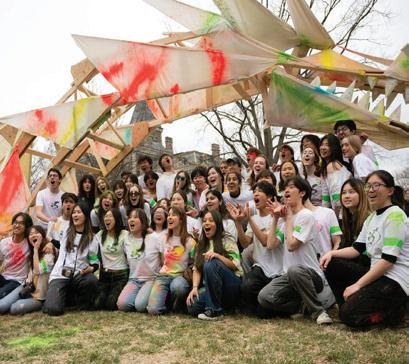
First-year architecture students contructed and paraded a dragon around Cornell's campus on March 28.
Taal Self-Deports After Weeks Long Trump Lawsuit
By BENJAMIN LEYNSE Sun News Editor
March 31 — Momodou Taal, a pro-Palestinian activist and international Ph.D. student, announced his decision to leave the country on Monday — ending a weeks-long struggle with the federal government that began when he sued the Trump adminstration.
Soon after Taal announced his decision on X and Instagram, his lawyers withdrew his lawsuit in federal court.
Taal first made national news when he, alongside Sriram Parasurama, a Ph.D. student in plant sciences, and Prof. Mukoma wa Ngugi, literatures in English, sued the Trump administration for allegedly violating their First and Fifth Amendment rights. Their suit claimed that the implementation of two Trump executive orders targeted pro-Palestinian speech and dampened dissent.
The U.S. State Department revoked Taal’s F-1 student visa after U.S. Immigration and Customs Enforcement identified him for “disruptive action” on March 14, one
day before the lawsuit was filed. Taal would not be notified of the change to his visa status until March 21, according to testimony submitted in court by John Armstrong, senior bureau official for the U.S. Department of State’s Bureau of Consular Affairs.
“I have lost faith [that] I could walk the streets without being abducted. Weighing up these options, I took the decision to leave on my own terms."
Momodou Taal
Almost a week after Taal first sued the Trump Administration, his lawyers were sent an email requesting that he turn himself in to ICE on March 21.
Taal's lawyers unsuccessfully tried to challenge this request in court, submitting a motion for a temporary restraining order that would prohibit the government from deporting Taal
in accordance with the executive orders that Taal’s lawsuit was challenging. This motion was denied by Judge Elizabeth Coombe of the Northern District of New York on Thursday.
According to the post made to his social media, Taal decided to leave because he stopped believing that the courts would guarantee his personal safety.
“Given what we have seen across the United States, I have lost faith that a favourable ruling from the courts would guarantee my personal safety and ability to express my beliefs,” Taal said. “I have lost faith [that] I could walk the streets without being abducted. Weighing up these options, I took the decision to leave on my own terms.”
Shortly after Coombe denied Taal’s motion, his lawyers filed a new amended complaint and temporary restraining order. However, following Taal’s announcement, his lawyers withdrew the lawsuit altogether, according to a notice of voluntary dismissal submitted to the court.
In a post to X, Taal’s lead coun -
Federal Government Freezes $1 Billion
By MATTHEW KIVIAT Sun Assistant Managing Editor
April 9 — The federal government has frozen over $1 billion in funding for Cornell, according to members of the Trump administration. This comes amid an ongoing investigation by the U.S. Department of Education’s Office for Civil Rights.
The move follows the slashing of more than $3.3 billion in federal funding from several Ivy League universities, including Columbia, Harvard, the University of Pennsylvania, Brown and Princeton. The Trump administration also froze $790 million in funding for Northwestern, according to The New York Times.
Cornell receives both federal and state funding for its research and grants for students.
The freezing of Cornell and Northwestern’s funding from the federal government will primarily involve grants and contracts with the departments of agriculture, defense, education and health and human services, The New York Times reported.
The ED OCR sent a letter on Feb. 14 to federally funded educational institutions, ordering the
dissolution of “racial preferences” and other University race-conscious decisions. The ED highlighted in the letter that universities could potentially lose federal funding if they did not comply within 14 days.
Following the initial letter, the OCR announced the opening of an investigation of Cornell and 44 other universities under Title VI. The OCR explained that the investigations came amid allegations that the universities violated Title VI of the Civil Rights Act of 1964 by working with The Ph.D. Project — which “purports to provide doctoral students with insights into obtaining a Ph.D.
and networking opportunities, but limits eligibility based on the race of participants,” according to the OCR.
In January, the White House budget office sent a memo to government agencies ordering a temporary pause in federal financial assistance authorized in Congress. This action was temporarily blocked by Federal Judge Loren AliKhan of the District of Columbia.
To continue reading, please visit www.cornellsun.com.
sel, Eric Lee, wrote, “I feel like a stranger in my country. What is America if people like Momodou are not welcome here?”
Reflecting on his choice to leave, Taal wrote on X and Instagram that, “This is of course not the outcome I
had wanted going into this, but we are facing a government that has no respect for the judiciary or for the rule of the law.”
University Finalizes New Expressive Activity Policy
By BENJAMIN
April 7 — After a controversial rollout last year, Cornell’s Expressive Activity Policy — a University policy that regulates public speech and demonstrations on campus — has been finalized, effective immediately.
The policy’s final version, announced in a statement from President Michael Kotlikoff, Provost Kavita Bala and Provost for Medical Affairs Dr. Robert Harrington on March 28, walked back many of the Interim Expressive Activity Policy’s most contentious points. Limitations on masking, amplified sound and postering were eased in the final policy while prior recommendations for “progressive responses” to violations were changed from previous versions.
The March 28 statement explained that “free and open inquiry and expression” have “underpinned” Cornell’s mission since its founding, but that at the same time, expressive activity must “adhere to time, place, and manner regulations” in accordance with the law.
The Interim Expressive Activity Policy, first released in January 2024, was quickly implemented amid a rise in pro-Palestinian protests on campus and increased national scrutiny over how Cornell responded to these demonstrations.
Months before the policy’s release, it was announced that the U.S. Department of Education was investigating Cornell for discrimination on the basis of antisemitic or anti-Muslim harassment. Dean of Faculty Prof. Eve De Rosa, psychology, said in a February 2024 faculty forum that the University introduced the policy in response to the ED investigation. Donica Varner, vice president and general counsel, would later say this timeline was not completely accurate, describing that the ED investigation only accelerated the development of a new expressive activity policy, which they saw as needed as early as December 2020.
To continue reading this story, please visit www.cornellsun.com
LEYNSE Sun News Editor
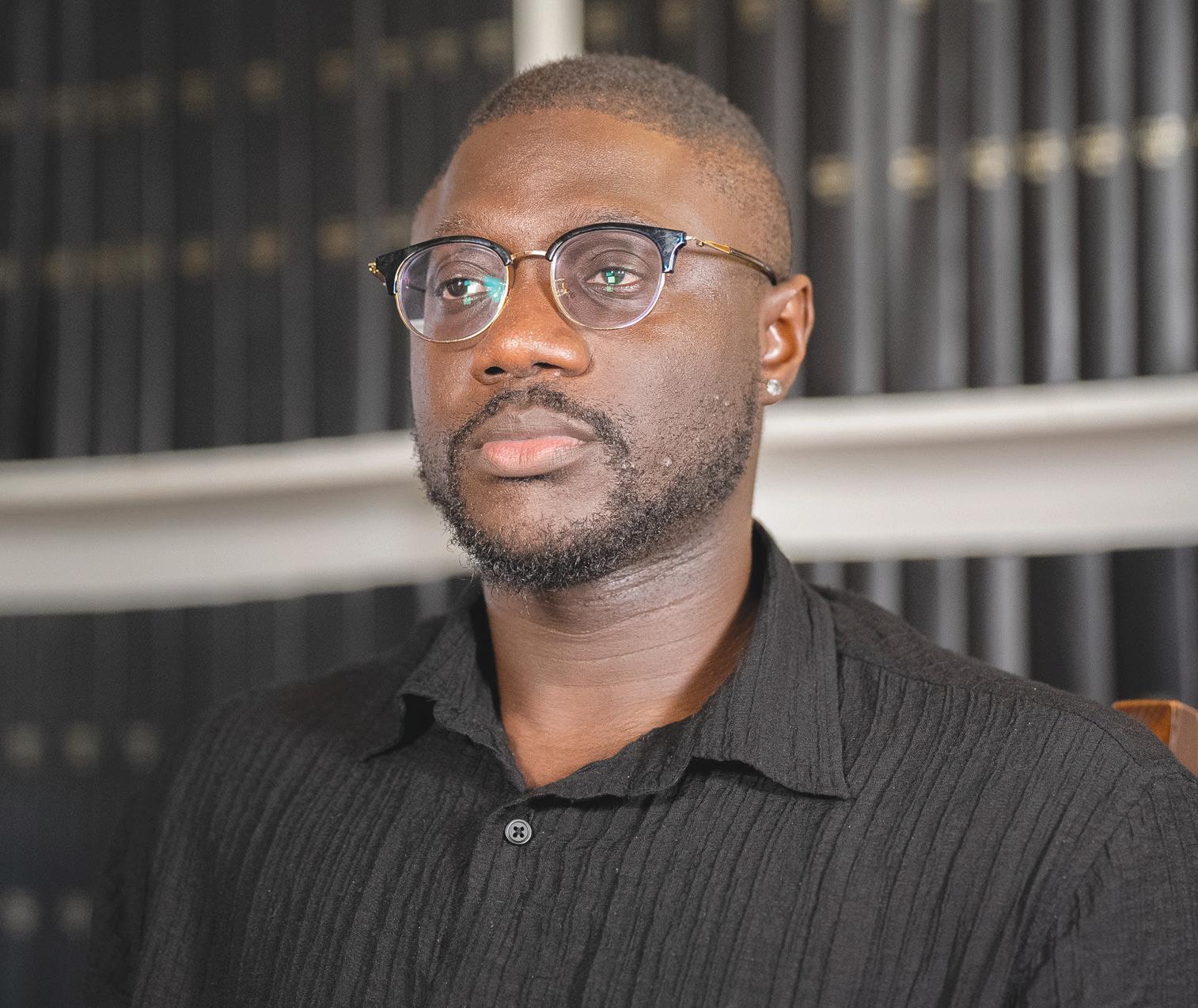
Taal's terms | Momodou Taal announced his decision to leave the country on March 31.
MING DEMERS / SUN SENIOR PHOTOGRAPHER
A LISTING OF FREE CAMPUS EVENTS


QGrads Annual Trans Visibility Chalking 9 a.m. - Noon, Ho Plaza
Maintaining Feminist Practice in a Time of Flux Panel Discussion
3 p.m. - 4:30 p.m., Warren Hall 401
Book Talk with Chris Marquis
5 p.m. - 6 p.m., Sage Hall 141
Queer Healthy Relationships
5 p.m. - 7 p.m., 626 Thurston Ave, Room 106
Campus Dance Gathering
6 p.m. - 7 p.m., Schwartz Center for the Performing Arts 320
Tomorrow
Midday Music in Lincoln
12:30 p.m. - 1:30 p.m., Lincoln Hall B20
Why Faith Remains the Hardest Conversation on Campus Lecture 5:30 p.m. - 6:30 p.m., Physical Sciences 120
Maria Bulla Performance
7:30 p.m. - 8:30 p.m., Annabel Taylor Chapel
Slope Day DJ Competition 7:30 p.m. - 10 p.m., Willard Straight Hall Browsing Library
Tastee Treat: Popcorn with CUPD 9 p.m. - 10 p.m., Unit 1 Lounge


Colorful, Collaborative and Celebratory: First-Year Architecture Students Present Dragon Day Parade
By GRACE LIU and ISABELLA HANSON Sun Senior Writer and News Editor
March 28 — Chants of “Dragon dragon dragon! Oi oi oi!” filled the air and throngs of people flooded campus streets before spring break, as a dragon, created by first-year architecture students in Cornell’s College of Art, Architecture and Planning, traveled around campus to celebrate Dragon Day on Friday at 1 p.m.
This year’s theme, “How to Build your Dragon,” was based on the DreamWorks Animation franchise ‘How to Train Your Dragon’ and emphasized collaboration and community. Although plain while paraded through the Cornell campus, the exterior of the dragon became covered with vibrant colors at the conclusion of the parade on the Arts Quad, when architecture students threw colored powder all over the blank canvas wings.
The origin of Dragon Day, which goes back more than 100 years, is credited to Willard Dickerman Straight ’01, namesake of the Willard Straight Hall Student Union. Corey Earle ’07, an American studies lecturer, previously explained to The Sun that Dragon Day was created to organize a celebration aimed at bringing together architecture students outside of their demanding course load.
Appreciative of the “glorious day in Ithaca,” Ashley Kwarteng ’27 watched the parade to support the architecture students
and also usher –in the beginning of spring break.
“I like this year better because of how interactive it was with the powder color. Last year was also cool, but it was more stagnant,” Kwarteng said. “I think [that] the fact that we have an architecture school in the first place to put on something like Dragon Day … not a lot of other schools can have such a level of creativity within their student body.”
The parade began at Rand Hall, where the wooden dragon led the crowd down Feeney Way and onto Campus Road. The dragon then made its way through Ho Plaza and ended on the Arts Quad near Sibley Hall.
Cornell’s Brazilian percussion ensemble Deixa Sambar marched behind the architecture students, accompanying the dragon throughout the parade. At the end of the parade, the Big Red Marching Band

Cornell Accepts 5,824 Students to Class of 2029
By ANGELINA TANG Assistant News Editor
March 27 — Another year, another Ivy Day — student applicants around the world are celebrating their acceptance letters from Cornell.
At 7 p.m. on Thursday, regular decision results for the Class of 2029 were released to this year’s cohort of applicants. Early decision applicants already received their decisions in mid-December.
All of the Ivy League colleges release their regular decision results on the final Thursday in March, known as Ivy Day.
“I feel honored and grateful to have been selected to attend such a prestigious university, but even more so, I feel beyond excited to start a new chapter of life at Cornell.”
Maddie Moger ’29
In total, 5,824 students were accepted to the next freshman class, which is a 13.3 percent increase from last year’s 5,139 accepted students. Accepted applicants come from all 50 states and represent a total of 115 countries — roughly twice as many as the number represented by the Class of 2028.
Accepted students are looking forward to their new life at Cornell. Maddie Moger ’29, an early decision accepted student from Queensbury, New York, wrote to The Sun about her excitement to attend Cornell.
“I feel honored and grateful to have been selected to attend such a prestigious university, but even more so, I feel beyond excited to start a new chapter of life at Cornell,” Moger said.
Moger is most enthusiastic about joining the “diverse community” on campus, where she can “meet new people who are completely different from [herself].”
Accepted students have until May 1 to accept their admission offers.
performed outside of Goldwin Smith Hall. Kwarteng’s favorite part of the parade were the costumes and presentation of the phoenix on the engineering quad, where she watched the “face off” between the phoenix and dragon.
The phoenix was created by the Phoenix Society at Cornell, designed by students in the College of Engineering to battle the dragon.
Jose Vizueth ’25 enjoyed the chance to walk around campus and see the dragon upstage the phoenix.
“I always come [to the parade] every year. It’s always fun to see the dragons and how they design it,” Vizueth said. “It’s a big event just before spring break … and it allows the architecture students to show off their skills … So it’s pretty cool.”
As a senior, Audrey Liu ’25 wanted to take advantage of her “last opportunity to partake in” Dragon Day.
“It’s one of those traditions that happens every year where you kind of showcase what the architecture department is doing, and every year there’s a different dragon, so there’s a lot of anticipation around that,” Liu said. “I feel like it’s one of those things to look forward to at Cornell.”
Grace Liu and Bella Hanson can be reached at gliu@cornellsun.com and bhanson@cornellsun.com.

First-year fun | First-year architecture students gather around the dragon they constructed, which this year had the theme “How to Build Your Dragon” after the DreamWorks franchise.
NATHAN ELLISON / SUN STAFF PHOTOGRAPHER
Angelina Tang can be reached at atang@cornellsun.com.
SUNBURSTS: Dragon Day
First-year architecture students celebrated Dragon Day, an annual tradition, the day before Spring Break.
By SUN PHOTOGRAPHY DEPARTMENT


THE DRAGON AWAKENS | Students, staff and administration assemble outside of Milstein Hall before the Dragon’s Parade.
STRAIGHT AHEAD | The Dragon parades through Ho Plaza, passing Willard Straight Hall.
PASTA PEOPLE | Students wearing various costumes join the Dragon’s Parade.
JUMP SHOT | A student jumps through the crossfire to get a shot at the Dragon’s head.
BEAR-Y FUN | Touchdown joined the Dragon’s Parade, waving and giving high-fives to the excited crowd.
GREEN DRAGON | Students throw powder color during the Dragon Day festivities, at both the dragon and each other.
FLYING HIGH | The Phoenix Society at Cornell displays the Phoenix, designed by students in the College of Engineering, on the Engineering Quad to face off against the dragon.
HOW TO BUILD YOUR DRAGON | The theme “How to Build Your Dragon” was conveyed with a canvas dragon finished in a flurry of powered paint.
Aerien Huang / Sun Staf Photographer
Ming DeMers / Sun Senior Photographer
Nathan Ellison / Sun Staf Photographer
Ming DeMers / Sun Senior Photographer
Ming DeMers / Sun Senior Photographer
Karlie McGann / Sun Photography Editor
Aerien Huang / Sun Staf Photographer
Karlie McGann / Sun Photography Editor
Federal Judge Denies Taal’s Legal Pleas
By BENJAMIN LEYNSE Sun News Editor
March 28 — A federal judge struck down large parts of pro-Palestinian activist Momodou Taal’s lawsuit against the Trump administration on Thursday. According to the released decision, Taal’s motion to prevent U.S Immigration and Customs Enforcement from arresting him was denied as was his request for a nationwide injunction pausing the enforcement of two Trump executive orders.
The decision was a setback for Taal and the two other plaintiffs as they claimed the executive orders targeted pro-Palestinian speech and violated their First and Fifth amendment rights. Despite the court ruling, the suit was not dismissed entirely. Shortly before the ruling was published, lawyers representing Taal filed an amended complaint that compiled information revealed by the federal government during court proceedings, and petitioned the court to prevent his detention by the U.S. Department of Homeland Security.
Previously, on March 20, Taal’s lawyers filed a temporary restraining order asking the court to prevent the federal government from arresting or deporting Taal on the basis of the executive orders contested by the lawsuit. This came after reported sightings of law enforcement outside of Taal’s home.
Following the reports, it was
revealed in court filings that days earlier on March 14, the U.S. State Department revoked Taal’s student visa and ICE began its efforts to “perform a civil arrest and process him for removal proceedings before an immigration judge,” according to testimony from Anthony Patrone, deputy special agent in charge for ICE’s Buffalo field office.
In her decision on Thursday, Judge Elizabeth Coombe of the Northern District of New York, stated that the court did not have the jurisdiction to prevent “removal proceedings” against Taal, denying the March 20 temporary restraining order. Removal proceedings are the legal processes to determine whether a non-citizen can remain in the country,
Coombe further explained in her decision that Congress removed the ability of district courts to decide “legal and factual questions” related to eligibility for removal proceedings. Since, the March 20 temporary restraining order requested the judge to prevent the enforcement of two executive orders “by which removability will be determined,” Coombe held that this was outside the court’s authority.
Instead, Coombe maintained that to dispute his removal order, Taal would need to go through an immigration court or a federal court of appeals.
To continue reading, please visit www.cornellsun.com.
Benjamin Leynse can be reached bleynse@cornellsun.com.

Cornell Graduate Students Union Reaches Tentative Agreement with the University
By HOPE THOMAS Sun Staff Writer
March 27 — A tentative agreement has been reached for a two-year contract between the University and Cornell Graduate Students Union — which represents graduate student workers — according to a Wednesday University statement written by President Michael Kotlikoff.
“The university and CGSU-UE have agreed on contract terms that align with Cornell’s values, protect academic integrity and freedom, and serve the best interests of graduate student workers and the entire Cornell community,” Kotlikoff wrote.
This tentative agreement was decided after one year of negotiations between Cornell and the CGSU bargaining committee, following amendments to the originally proposed contract that Cornell offered on March 11. Cornell formed a bargaining committee with faculty members to discuss a contract with CGSU that includes provisions for healthcare, wages and transportation for graduate student workers.
This tentative agreement includes full dental and visual coverage, free TCAT passes, wage increases for graduate student workers by 7.98 percent for the 2025-2026 academic year and 2.9 percent for the 2026-2027 academic year.
The agreement also includes the “best Just Cause protections in industry history,” according to an Instagram post by CGSU. Just cause protections are tenets that ensure workers cannot be disciplined without specific protocols.
The University has agreed to implement “industry-standard language,” which provides that “discipline or discharge from job related conduct (but not academic matters or other non-employment misconduct) will be governed by the ‘just cause’ standard of review,” according to the Bargaining Tracker.
A notable provision of this proposed contract includes one-time $750 matriculation payment will be provided to each graduate student worker, which can be used to cover the costs of applying or re-applying for visas. Additionally,
graduate students will be offered five working days they can use “in order to attend U.S. immigration and citizenship proceedings.”
In response to the originally proposed contract, CGSU launched a strike pledge on March 13 due to the offer’s lack of a union shop policy — which refers to a workplace in which all employees are required to join a union.
“[A] union shop is the foundation of every powerful union in this country,” said Kara Zielinski, a graduate student and CGSU member.
Cornell agreed on March 19 to a modified agency shop with “protections for freedom of conscience” for graduate student workers, according to a representative of Cornell Media Relations. An agency shop is a workplace where union membership is not required, but all employees pay either union dues or an alternate fee. This comes as an amendment to Cornell’s originally proposed contract.
The University spokesperson explained that graduate student workers who do not wish to join the union due to religious objections or “moral or ethical grounds” may choose to donate an amount equivalent to the union dues to a charity of their choice under the agency shop.
“We view [the implementation of an agency shop] as a ‘win-win’ compromise that preserves freedom of choice for students who object to union membership while still recognizing the contractual agreement between the union and the University,” the Cornell spokesperson wrote.
This agency shop will come into effect once the tentative agreement with the union is finalized, but not all graduate student workers see this compromise as a victory.
“Joining and financially supporting CGSU should be a choice,” wrote Ph.D. student Shira Mingelgrin on behalf of members of Cornell United — a group of graduate students that oppose a union shop. Mingelgrin expressed that CGSU and the UAW have taken political stances that do not represent the beliefs of all graduate student workers.
In response to the University’s decision to have an agency shop, Cornell United wrote a petition to allow graduate student workers the right to, as stated in the
petition, “oppose all efforts to impose any type of ‘union shop,’ ‘agency shop’ or other forced unionism upon Cornell’s graduate community.”
In an interview with The Sun prior to the tentative agreement, Prof. Wendy Wolford, global development — the vice provost for international affairs and a member of the University’s bargaining committee — noted that there was “not an insignificant group” of graduate students who did not want to join the union.
She said this group had made it “very clear” that they would find a union shop to be “problematic in terms of being able to continue their degree in the University.”
In efforts to find a compromise between the graduate students, she argued that “an agency shop where [students] can join or not join, but still have to pay so there’s no free riding on the union’s efforts … seems like a very fair alternative.”
The tentative agreement will now be voted on by CGSU members for ratification, which is expected to happen in the coming weeks.

The Corne¬ Daily Sun
Independent Since 1880
143rd Editorial Board
JULIA SENZON ’26
Editor in Chief
ERIC HAN ’26
Associate Editor
SOPHIA DASSER ’28
Opinion Editor
ILANA LIVSHITS ’27
Assistant Opinion Editor
AUDREY IM ’26
Business Manager
SOPHIA TORRES ’26
Marketing Manager
SYDNEY LEVINTON ’27
Arts & Culture Editor
JAMES PALM ’27
Assistant Arts & Culture Editor
JENNA LEDLEY ’27
Assistant Arts & Culture Editor
MELISSA MOON ’28
Assistant Arts & Culture Editor
SOPHIA ROMANOV IMBER ’28
Assistant Arts & Culture Editor
KAITLYN BELL ’28
Lifestyle Editor
MAIA MEHRING ’27
Lifestyle Editor
KARLIE MCGANN ’27
Photography Editor
MATTHEW KORNICZKY ’28
Assistant Photography Editor
STEPHAN MENASCHE ’28
Assistant Photography Editor
MIRELLA BERKOWITZ ’27
Multimedia Editor
HANNIA AREVALO ’27
Graphics Editor
JADE DUBUCHE ’27
Social Media Editor
HUNTER PETMECKY ’28
Layout Editor
RENA GEULA ’28
Layout Editor
From the Editor
DOROTHY FRANCE-MILLER ’27
Managing Editor
MATTHEW KIVIAT ’27
Assistant Managing Editor
VERA SUN ’27
Advertising Manager
ALEX LIEW ’27
Human Resources Manager
BENJAMIN LEYNSE ’27
News Editor
VARSHA BHARGAVA ’27
News Editor
ISABELLA HANSON ’27
News Editor
CEREESE QUSBA ’27
News Editor
REEM NASRALLAH ’28
Assistant News Editor
ANGELINA TANG ’28
Assistant News Editor
KATE TURK ’27
Assistant News Editor
GABRIEL MUÑOZ ’26
City Editor
JANE HAVILAND ’28
Features Editor
JEREMIAH JUNG ’28
Assistant News Editor
KAITLIN CHUNG ’26
Science Editor
MARISSA GAUT ’27
Science Editor
ALEXIS ROGERS ’28
Sports Editor
ZEINAB FARAJ ’28
Assistant Sports Editor
DYLAN GRAFF ’28
Assistant Sports Editor
SIMRAN LABORE ’27
Weather Editor
ALLISON HECHT ’26
Newsletter Editor
Class of 2029, Welcome to Cornell!
Welcome and congratulations to the newest members of the Cornell community — the Class of 2029! Each year, Te Cornell Daily Sun has the honor of greeting a new class, and this year, that class is you.
Cornell was founded as an institution for “any person ... any study.” But that mission is more than a phrase etched in stone — it’s a challenge. It asks all of us to make this university more open, more thoughtful and more courageous than the day we arrived. For the past three years, I have seen that every student and every idea plays a part in that work. And for the past three years, I have been proud to document it with Te Sun.
As the editor-in-chief of the nation’s oldest continuously independent college newspaper, I’ve witnessed just how much a campus can hold. Student activism and scientifc discovery. Tragedy, tension and celebration.
Over the next four years, you will realize what I have: No two semesters are the same, but they’re all worth writing down.
Whether you’re fipping through our pages at Zeus, reading headlines on Instagram in bed or typing away at our ofce in the Commons contributing your own voice one day, Te Sun is here to help you understand and engage with Cornell — in all its complexity.
Our desks ofer something for everyone. Follow the top headlines with News and engage in campus conversations with Opinion. Hear frsthand accounts of student life in Lifestyle and learn about cutting-edge research with Science & Tech.
Read stories of Big Red spirit in Sports and see the faces and places of Cornell with Photo. Get colorful accounts of albums and flms with Arts & Culture and witness the sights and sounds of the Hill with Multimedia.
Savor every moment as you close out your current chapter. In just a few months, you’ll hear the bells chime your favorite song for the frst time, watch the rushing of the gorges on the way to class, stare of into the (unbeatable) sunset from the slope and begin building a version of yourself you’ve only just started to imagine.
And when you do, Te Sun will be shining — ready to tell your story.
— Julia Senzon
908-672-3047
Julia Senzon is a member of the Class of 2026 in the College of Agriculture and Life Sciences. She is the editor-in-chief of the 143rd Editorial Board and was the managing editor of the 142nd Editorial Board. She can be reached at jsenzon@cornellsun.com.

The Editorial Board
Te Cornell Daily Sun’s Editorial Board is a collaborative team composed of the Editor in Chief, Associate Editor, Opinion Editor, Assistant Opinion Editor and one Opinion columnist. Te Editorial Board’s opinions are informed by expertise, research and debate to represent Te Sun’s long-standing values. Te Sun’s editorials are independent of its news coverage, other columnists and advertisers.
Te Bubble Has Popped
The slide into authoritarianism starts with masked police ofcers in unmarked cars. Tese regimes survive by attacking truth, but sustain themselves by dismantling its root: education. In this system, students are not collateral damage; they are the target. As long as truth continues to circulate, all who carry it — students, writers, journalists, professors and increasingly, universities — become enemies of the state.
Rumeysa Ozturk, a graduate student and Fulbright scholar at Tufts, was seven miles from campus when masked Immigration and Customs Enforcement agents came to take her to a federal detention center in Louisiana. Tere was no warning and no crime. Yet, days later, her visa was revoked, and she was transferred to a detention center over 1,500 miles from home in less than 27 hours.
Ozturk had co-authored an op-ed, around a year ago, calling on Tufts to engage with student demands to cut ties with Israel. As journalists, we exist to hold institutions accountable and if we do not defend that mission — if we allow opinion writing to become a punishable ofense — we don’t just risk the silencing of writers like Ozturk, we risk a future where journalism is reduced to compliance.
Tufts University, notifed after the fact, offered what our campuses have come to master: polished and performative concern delivered too late. Teir public sympathy now rings hollow — because when warning signs were clearest across campuses, they looked away.
Tough deeply unsettling, Ozturk’s arrest is not an isolated incident, but the logical culmination of a slow, deliberate erosion of protection for student voices in American universities. We have seen the warning signs: student journalists being detained at Stanford and Dartmouth without institutional protection and Yunseo Chung — Columbia student and legal U.S. resident since the age of seven — “hunted” by ICE for participating in protests. And just last week, we saw it in our very own backyard when Cornell Ph.D. candidate Momodou Taal was instructed to turn himself in to ICE after fling a lawsuit against the Trump administration.
Each of these cases represents a step down the same path — one in which universities, once protectors of truth, have chosen silence or complicity. Tat path leads directly to Ozturk, and if we continue to normalize this silence, it leads to every single one of us.
History has shown us where this well-trodden path ends. Authoritarian regimes do not begin by silencing everyone — they start with students. Cast as agitators and threats to order, students
Jan Burzlaff
are the easiest to isolate. Ten the attack widens. In Russia, student journalists from DOXA were sentenced to two years of forced labor for defending protest rights. On Monday, 1,100 Turkish student protesters and journalists were detained in a single week for “inciting hatred,” followed by broadcasting bans on outlets covering the protests.
First, they criminalized students. Now, they criminalize truth, controlling the narrative. Te recent defunding of Voice of America and the banning of the Associated Press from White House briefs are symptoms of a calculated campaign to consolidate control over information.
Te blueprint our nation’s leaders are following is clear and unoriginal: speak and vanish.
Tese states did not criminalize dissent overnight. Tey began — as we are now — by isolating students. Teir institutions ofered neutrality in place of protection. And each time they gave up a student, it became easier to surrender the next.
Ten they came for the rest.
We cannot pretend that this is a foreign problem. Te Trump administration has already issued executive orders threatening to revoke visas of “radical activists” and cut funding from disloyal campuses. Te language is familiar: “anti-American,” “illegal protests” and “traditional values.” We have heard it before — from regimes we were once taught to fear.
Te University is no longer a bubble, a sanctuary of truth. It is a battleground, where students stand at the front line and truth is the loot. Silencing students into a fearful submission paves the way for silencing faculty. Curricula will be rewritten. Research will be censored. And before long, truth itself will be decided not by study, but by decree.
If we do not act now, we will not only lose student voices — we will lose their lives.
Tis month, both the Student Assembly and Graduate and Professional Student Assembly passed resolutions calling on the University to protect undocumented, Deferred Action for Childhood Arrivals, international, refugee and other immigrant students calling for expanded legal support, investment in clinical law programs and community-wide training. Tese proposals are thoughtful, urgent and most importantly, possible.
To university leaders: it is far too early for “fnal policies.” If you abandon your students, there will soon be nothing left to protect. Truth needs institutions that are brave enough to stand for it. Education needs defenders. And students — who carry both — need you to choose a side.
Jan Burzlaf is a Postdoctoral Associate in the Program for Jewish Studies. Ofce Hours (Open Door Edition) is his weekly dispatch to the Cornell community — a professor’s refections on teaching, learning, and the small moments that make a campus feel human. He can be reached at profburzlaf@cornellsun.com.
Ofce
I’ve(Open Door Edition)
been teaching at Cornell for eight months — long enough to know that the most meaningful parts of campus life don’t always happen in classrooms or official meetings. They happen in the in-between spaces — the pause before class begins, the quiet walk across the Arts Quad, the unplanned conversations that unfold in office hours. In every university, there are official syllabi — and then there’s the hidden curriculum of vulnerability, trust and belonging.
This column is for those moments.
When the opinion editors at The Sun reached out about joining the columnist team, I felt a quiet sense of responsibility. We often speak about “building community” — but we rarely pause to ask what kind of labor, imagination or courage that actually requires. We talk about teaching and learning — but less often about the relationships and power dynamics that shape them. Together, we decided I would write a regular column from the perspective of a professor. What you’re reading now is the start of that conversation. I write from the professor’s side of the desk — but not from behind a stack of ungraded
essays or a locked office door. My hope is to offer a small, steady space where all Cornell faculty, staff and students can think together about what it means to learn, to teach and to live meaningfully in a wonderful place like this. As someone early in my academic career, I don’t write from detachment. I’m close enough to remember what it feels like to be uncertain — and far enough along to know how much that uncertainty matters. That’s part of why I’m writing. As the Brazilian educator Paulo Freire once wrote, “education is an act of love, and thus an act of courage.” This column, in its own modest way, is a gesture toward both.
The idea behind Office Hours (Open Door Edition) is simple: to create a space that feels like an invitation — one you don’t need an excuse to accept or decline. No appointments, no prerequisites. Just read when it resonates with you. Come back when it matters. It’s here, waiting — an office hour where the door is always open and the light is on.
To continue reading, please visit www.cornellsun.com.
Hours
SUNder Review: President Kotlikoff
Three Opinion Pieces. One Presidential Appointment. Cornell’s decision to appoint Interim President Kotlikoff as permanent president has sparked mixed reactions from our columnists. From critical to optimistic, here’s what they had to say.
Henry Schechter
Henry Schechter is a Senior Editor on the 143rd Editorial Board and was the Opinion Editor on the 142nd Editorial Board. He is a third-year student in the College of Arts & Sciences and an incoming Cornell Law student. His fortnightly column Onward focuses on politics, history and how they come together in Ithaca. He can be reached at hschechter@cornellsun.com.
Te New Guy Must Unite the Ivies
Well, he isn’t really a new guy. Last month, when I called on the Board of Trustees to deliver us a courageous president, Michael Kotlikoff wasn’t on my list. He had publicly refused the job, telling The Sun’s managing board he would retire after his interim term, and I took him at his word. But last Friday, the trustees officially appointed him Cornell’s 15th president — and I’m confident they made the right choice. Though Kotlikoff may have taken the job quietly, he has the potential to make the principled stand the University needs.
President Kotlikoff now faces a daunting challenge. No longer a temporary caretaker, our 15th president must lead decisively in an era of mounting federal interference in higher education. But time is not on his side; he must stake out his position against the Trump administration’s attempts to undermine academic independence — quickly. He has the potential to unify the Ivy League in resistance against Trump at a time when elite universities are fractured and adrift.
Since Trump’s reelection, Ivy League schools have wildly vacillated in their reactions to the administration’s attacks. On one end of the spectrum, Columbia has already capitulated to Trump’s demands, overhauling sensitive academic areas as the administration threatened pulling $400 million of
Yihun Stith
Eric Cheyfitz
Eric Cheyftz is an Ernest I. White Professor of American Studies and Humane Letters, professor of American Indian and Indigenous Studies and director of Graduate Studies, American Indian and Indigenous Studies Program. He can be reached at etc7@cornell.edu.
President by Fiat
federal funding. Dartmouth, meanwhile, hired a Trumpian loyalist as general counsel, seemingly bracing for executive overreach and confrontation. These moves reflect an absence of a crucial coherent, collective strategy among our nation’s top universities.
Kotlikoff can change that. The 25-year Cornell veteran, who has served as professor, dean, provost and interim president, has comprehensive knowledge of our University. He’s seen all flavors of campus issues before. In obscuring his candidacy for University president, he proved his political skills shouldn’t be underestimated. And since Kotlikoff began his interim term in July, campus tensions have rapidly deflated. The University, once engulfed in controversy, has grown remarkably calmer in the last year. Pro-Palestinian protests have subsided substantially, which is in no small part a result of Kotlikoff’s firm but fair decisions around the suspension of protesters. But now, concerns about campus tensions are almost quaint.
Today, Kotlikoff’s biggest threat comes from beyond campus gates. Cornell cannot afford to follow the fate of other universities and cave to the threat. As the president of a university founded on the radical promise and principled mission of “any person… any study”...
To continue reading, please visit www.cornellsun.
Yihun Stith is a junior studying Computer Science and Government. His biweekly column, Stand Up, Fight Back , explores the political structures and power dynamics that shape life at Cornell. He can be reached at ystith@cornellsun.com.
Kotlikof is Our Own Trump
On Friday, March 21, The Board of Trustees announced Interim President Kotlikoff would officially become Cornell’s 15th President. He had previously said he would “almost certainly retire” after his interim term. But, the trustees deemed he deserved the job full time “after eight months of outstanding leadership.”
This is not a moment to celebrate. Cornell is a microcosm of America, and the Board of Trustees has inaugurated our own uncharismatic Trump.
Kotlikoff started his interim presidency by failing to reach an agreement with the United Auto Workers Local 2300, which represents 1,200 Cornell service and maintenance employees. This stubbornness led to a strike as UAW declared, “[Cornell] university has failed to present a fair package and has not bargained in good faith, stalling and retaliating against protected union activity by the workers.” A key issue in negotiations was Cornell’s failure to provide workers with a living wage. In February 2024 MIT estimated that a single adult in Ithaca must earn $24.64/hour to make a living wage. However, most food and service workers were only making $20.03/hour.
While the workers were on strike, Kotlikoff was pictured crossing the picket line by working at Toni Morrison Dining Hall. Using ProPublica’s data salary for when Kotlikoff was Provost, Kotlikoff made at least $524/hour while scabbing, which is 26 times the hourly rate of a Cornell dining.
The inauspicious start to Kotlikoff’s term would quickly turn fascistic in October 2024. Following the disruption of a career fair with weapons manufacturers, organized by the Coalition for Mu-
tual Liberation, Cornell administration suspended 20 student protesters. I, alongside three others, was temporarily suspended, banned from campus for three years, charged with two misdemeanors and doxxed by CUPD. Kotlikoff felt the need to make five public statements about the events, multiple of which falsely demonized protesters with baseless claims that they caused “medical complaints of potential hearing loss.” Despite Kotlikoff’s best attempts, the vast majority of suspensions were quickly lifted and all criminal charges were dismissed in Ithaca City Court.
In November 2024, a group of Chi Phi frat members drugged and sexually assaulted a Cornell community member. Cornell released one statement and quietly, anonymously suspended a few individuals. As of today, no arrests have been made by CUPD. As we all know, this is not the first case of violent sexual assault at a Cornell fraternity — and will horrifically not be the last. For example, in 2022, all Cornell Greek life was suspended due to myriad incidents of drugging by fraternities.
Kotlikoff had the opportunity to make a strong statement in support of the many community members who have faced gender-based violence at the hands of fraternities. He instead chose to relent, once again, to Cornell’s powerful donors, many of whom have strong ties to fraternities. Similar to Trump and Pete Hegseth, Kotlikoff’s inaction in the face of sexual violence clearly prioritizes institutional profits over student safety.
In January 2025, Kotlikoff’s administration announced a change to University Policy 8.1 Physical Security Systems, implementing a surveillance To continue reading, please visit www.cornellsun.
By
fiat, the Board of Trustees has just appointed Interim President Michael Kotlikoff as the 15th president of Cornell University. For the first time in my 22 years here as a tenured member of the faculty, there has been no national search for the university presidency. Such searches typically include faculty. So this suspension of a search is one more sign of the decline in faculty governance, which has been declining rapidly at Cornell since Jeff Lehman “resigned” as president in 2005.
At that time, a unified faculty demanded a meeting with the Board of Trustees after what we perceived as a summary firing without faculty consultation. The board agreed to the meeting, and the meeting was held in Hollis E. Cornell Auditorium; every seat was filled with concerned and angry faculty. In response, a faculty committee on governance was formed — on which I served. We issued a report calling for meaningful faculty consultation on key matters of educational policy, necessarily including the appointment of senior administrators, who are involved with creating that policy. The report has been gathering dust in the archives ever since.
I went on to serve seven years in the Faculty Senate, including three years on the University Faculty Committee. During that time, we passed several key resolutions addressing faculty oversight in university-wide educational policy as mandated by Article XIII, Section 2 of the By-laws of Cornell University. This article assigns the University
“Today, by and large, university presidents play the role of CEO, taking their agendas largely from boards of trustees and donors rather than faculties. President Kotlikoff fits squarely in this mold...”
Prof. Cheyfitz
faculty the responsibility “to consider questions of educational policy which concern more than one college, school or separate academic unit, or are general in nature.” The article is intended to ensure faculty oversight in educational matters that extend beyond individual units.
These resolutions were ignored by the administration; two notable examples stand out. In 2011, the University entered into a partnership with Technion Institute of Technology in Israel without consulting the faculty senate. More recently, in March 2021, the senate voted 39 to 16 (with 20 abstentions) to oppose a proposed dual-degree program between Cornell’s School of Hotel Administration and Peking University’s Guanghua School of Management. Faculty members expressed concerns about academic freedom in China and the Chinese government’s human rights record, particularly regarding the treatment of the Uyghurs. Despite this opposition, the university administration approved the partnership in June 2021, citing adherence to Cornell’s international ethical engagement guidelines, which it clearly didn’t follow. For these guidelines emphasize the importance of academic freedom, respect for diversity, and the promotion of social good in global partnerships. The Technion partnership also violates these guidelines; for Technion is significantly involved in the militarization of the Oc-
cupied Palestinian Territories against the dictates of international law.
The increasing decline of faculty governance nationally has gone hand-in-hand with the rise of the corporate university, which, over a hundred years ago, Thorstein Veblen recognized in his 1918 book The Higher Learning in America. Today, by and large, university presidents play the role of CEO, taking their agendas largely from boards of trustees and donors rather than faculties. President Kotlikoff fits squarely in this mold at a time when the corporate model has become particularly toxic with the Trump administration’s assault on liberal education with its foundation in free speech and academic freedom.
Kotlikoff has engineered the repressive rules that, without due process, criminalize student protest through “temporary academic and non-academic suspension” of student protesters. In keeping with this agenda, he has not said a word about the appearance of federal officers on campus seeking to arrest Momodou Taal, a Cornell graduate student and legal U.S. visa holder, for the “crime” of peacefully protesting what the International Court of Justice has found to be the “plausible” Israeli genocide in Gaza. At the same time and within the same context, Kotlikoff recently suspended Cornell’s chapter of Students for Justice in Palestine, because members of the group temporarily disrupted a panel discussion “Pathways to Peace.” The panel, sponsored by Kotlikoff, featured no dissenting voice on Israel’s invasion of Gaza — two of the panelists and the moderator expressed open support for the invasion. The students were appropriately escorted out of the auditorium. But Cornell University Police detained 17 individuals during the event for causing disruptions. Of these, nine were students who now face disciplinary actions that could include suspension under Cornell’s punitive and restrictive Expressive Activity Policy. This policy, which has now been made permanent, was instituted precisely when students began protesting the Israeli invasion of Gaza in 2023. The policy claims content neutrality, but the context of its implementation and the student protestors who have been sanctioned suggest otherwise in violation of First Amendment protections.
The suspension of SJP and the criminalization of these students appear intended to silence dissent and intimidate those thinking of protesting the Israeli war against Gaza. These actions by the administration and inaction in failing to protect Momodou Taal or protest federal action against him create an atmosphere of intimidation, particularly affecting the unprotected (contingent faculty, staff, and students, both foreign and domestic). This is not only a threat to student rights — it is a direct assault on the foundations of academic freedom and the First Amendment.
While in keeping with the corporate context, Cornell presidential search committees have typically been composed of faculty who are in lock-step with the trustees’ agenda, nevertheless the suspension of a national search with faculty participation is an ominous sign for what is left of faculty governance.
With the exception of groups such as the American Association of University Professors, Cornell on Fire, and the Cornell Collective for Justice in Palestine, faculty have been notably silent about the developments outlined here that are subverting faculty governance and academic To continue reading, please visit www.cornellsun.
SC I ENCE & TECH
A Sit Down With Professor Kyle Lancaster
By ZEINAB FARAJ Sun Assistant Sports Editor
Prof. Kyle M. Lancaster is a world renowned organic chemist who’s impact on the field of science is undeniable.
To many Cornell students, Lancaster is better known as the professor of the notorious General Chemistry I — a course known for its complicated material and tough grading.
The Sun sat down with Lancaster to learn more about CHEM 2070 and his life balancing a rigorous research regime with teaching.
Teaching and Tackling General Chemistry at Cornell
Lancaster likened his experience teaching CHEM 2070 at Cornell to being a dentist, describing it as “an important job that nobody thanks you for.”
Around 800 students take General Chemistry I, many of whom are on the pre-medical track. Lancaster also teaches CHEM 4210: Introduction to Inorganic Chemistry Research and CHEM 6400: Bioinorganic Chemistry.
“The biggest mistake I made was downloading Sidechat after the second exam.”
Prof. Kyle Lancaster
During the fall semester, CHEM 2070 met three times a week for a 50 minute lecture component, and had a 50 minute optional discussion section. Additionally, there was a weekly three hour lab section where students applied their practical understanding of chemistry to design and complete various experiments.
Lancaster described his teaching style as “jokes, live demos, practical knowledge and applicational knowledge.” His live demonstrations of chemistry are a unique component of the lecture during which
he and Professor Daniel Lorey performed chemistry experiments in front of the class.
“My first semester of chemistry [at Pomona] we had no demos and then in the second semester, my professor started with a really cool demo, the luminol demo I did for 2070, and then he did not do anymore,” Lancaster said.
He thinks that the live demonstrations help content “stick” with his students and break up the class time. In one of his demonstrations, he made a cocktail while using the ingredients availability to describe the concept of limiting reagents.
“You have to use your imagination to think about mixing a cocktail as a limiting reagent,” Lancaster said. “But seeing it happen in front of you is different so people are not going to forget that concept as easily,” Lancaster said.
Lancaster, who has taught CHEM 2070 four times, said the biggest challenge he has faced was organizing the content in a logical way. He noted that the course teaching had to be done out of order to be able to build up to other concepts and to coincide with the lab component of the course.
And of course, there is the backlash he receives for the exams and the class overall.
“Students think I specifically write an exam to make people’s lives miserable,” Lancaster said. “No, I’m writing an exam because I have to give exams and challenge people.”
When asked what he wishes he could tell his students, Lancaster said that he wants them to understand that their grades are not everything.
“But good grief you get a B+ or a C- in 2070 and your world is not shattered, your life is not over,” Lancaster said. “2070 is the first serious STEMS[cience], T[echnology], E[ngineering] [and] M[athematics] course so most people take some time to figure it out.”
Lancaster also commented on the idea that Cornell students take on too much and put too much pressure on themselves.
He described his social college experience at Pomona as “a different world” compared to Cornell.
“If I could wave a magic wand and do one thing to the Cornell undergraduate population it is get them to take a chill pill,” Lancaster said. “Make sure you have hobbies and do things to enrich your life, don’t just have hobbies so you can put them on a resume.”
“And it’s like stop and smell the roses, man, there’s more to life than getting the right answer.”
Prof. Kyle Lancaster
He pointed out that many people believe 2070 to be a “weed out” course that is “designed to make people fail” and how he “knows that is not true”.
“Only two percent of students actually fail 2070 and those people have essentially given up on the course,” Lancaster said.
He also stated that he is a member of Reddit and has seen the Cornell SideChat before. Lancaster said he has read a numerous amount of people “complaining” about 2070.
“The biggest mistake I made was downloading SideChat after the second exam,” Lancaster said. “I used to see all this stuff on Reddit about ‘another great look for chem’ so I was curious to see how it is and then I was like ‘oh God why did I do this’ so I have deleted it and will never look at it again.”
He also pointed out that there is no shortage of resources and help: Lancaster does four hours of office hours a week along with numerous TA-lead office hours. There is also a support class for students to enroll in, CHEM 1007.
Lancaster also explained that his exam writing process happens in his office where he reflects on points covered in class and decides which concepts he wants to
emphasize. He also pulls from the assigned textbook that students are strongly encouraged to read. At the same time, he incorporates humorous elements into the exams to make them a little more lighthearted.
“I try to make the exams have some humor and then I will look at people’s exams and see some people are so trained as machines to take exams that they like literally cross words out, except for the numbers that they need. And it’s like stop and smell the roses, man, there’s more to life than getting the right answer.”
Early Career
Throughout his time as an undergraduate student at Pomona College, Lancaster was a molecular biology major who enjoyed taking chemistry courses. He said he learned many “valuable lab skills” that he still employs in his lab today.
On top of the requirements for his molecular biology major, Lancaster took a full year of physical chemistry.
“I have been a closeted chemist since my sophomore year of college,” Lancaster said. “One of the reasons I stuck with biology is because I listened to my parents who are economists and told me to do life sciences because it would be more lucrative in the future.”
For graduate school, Lancaster studied biophysics and biochemistry with an emphasis in chemistry at the California Institute of Technology — just 27 miles away from Pomona.
His reason for the switch to chemistry? He would have taken “fewer courses” during his third quarter. Lancaster’s advisor at CalTech, Professor Harry Gray, suggested that he switch to chemistry major because he would have to take fewer courses.
To continue reading this story, please visit www.cornellsun.com.
Zeinab Faraj can be reached at zfaraj@cornellsun.com.
Fighting Climate Change Through Sports: Cornell Student Athletes Go Green
By KITTY ZHANG Sun Staff Writer
With over 1,400 student organizations, ranging from language and ethics groups to poker and animal clubs, Cornell has a long-standing tradition of student involvement. This diverse community provides a wide range of opportunities and inspires creative combinations of interests through shared passion and mutual support.
One such example is Cornell Student Athletes for Sustainability, the first club at Cornell to connect athletics and sustainability.
Founded last semester by Emily Pape ’26 — a member of the women’s basketball team and an Environmental & Sustainability major — CSAS began to take shape in the summer of 2024 when Pape joined EcoAthletes, an organization that harnesses the social influence of athletes to address climate change by inspiring and engaging fans.
As an EcoAthletes Champion and the sole representative from both Cornell and the Ivy League, Pape attended the 4th Annual Atlantic Coast Conference Sports Sustainability Conference at the University of Miami. The conference brought
together speakers and panelists from 33 universities, including coaches and students, to exchange ideas on innovative sports sustainability practices. Inspired by stories from sustainability clubs at schools like Duke, West Virginia, and UC Berkeley, Pape decided to launch a similar initiative at Cornell.
“The club really started through word of mouth,” Pape recalls. “Even though I didn’t know all the athletes personally, I could sense their passion in their voices. That support made it less scary to start something new and motivated me to keep going.”
What began with a small group of student-athletes has now grown into a club of over 100 members from diverse backgrounds across campus.
“When you take a step back and think about how we live, there are so many small ways we can improve,” Pape reflected. “This club is about learning those ways and making changes together because climate change is something that will affect us all.”
One notable event hosted by CSAS was the Green Game during the Men’s Hockey match on November 9, 2024. Volunteers set up six waste diversion
stations around the rink and guided fans in sorting garbage, compost, and recycling into the proper bins. After the game, CSAS members cleaned up and ensured that all waste was properly disposed of. Inspired by this success, CSAS plans to host another Green Game during the Men’s Lacrosse game around Earth Day this April, this time with a focus on measuring waste management impact through quantitative data.
In addition, CSAS introduced Cornell to the EcoAthletes Collegiate Cup Powered by Protect Where We Play, a six-week competition among U.S. and Canadian universities. Participants turn their exercise time into a point system through t0........ he tracking app Climategames, with proceeds funding coral restoration projects led by Coral Gardeners, a non-profit organization.
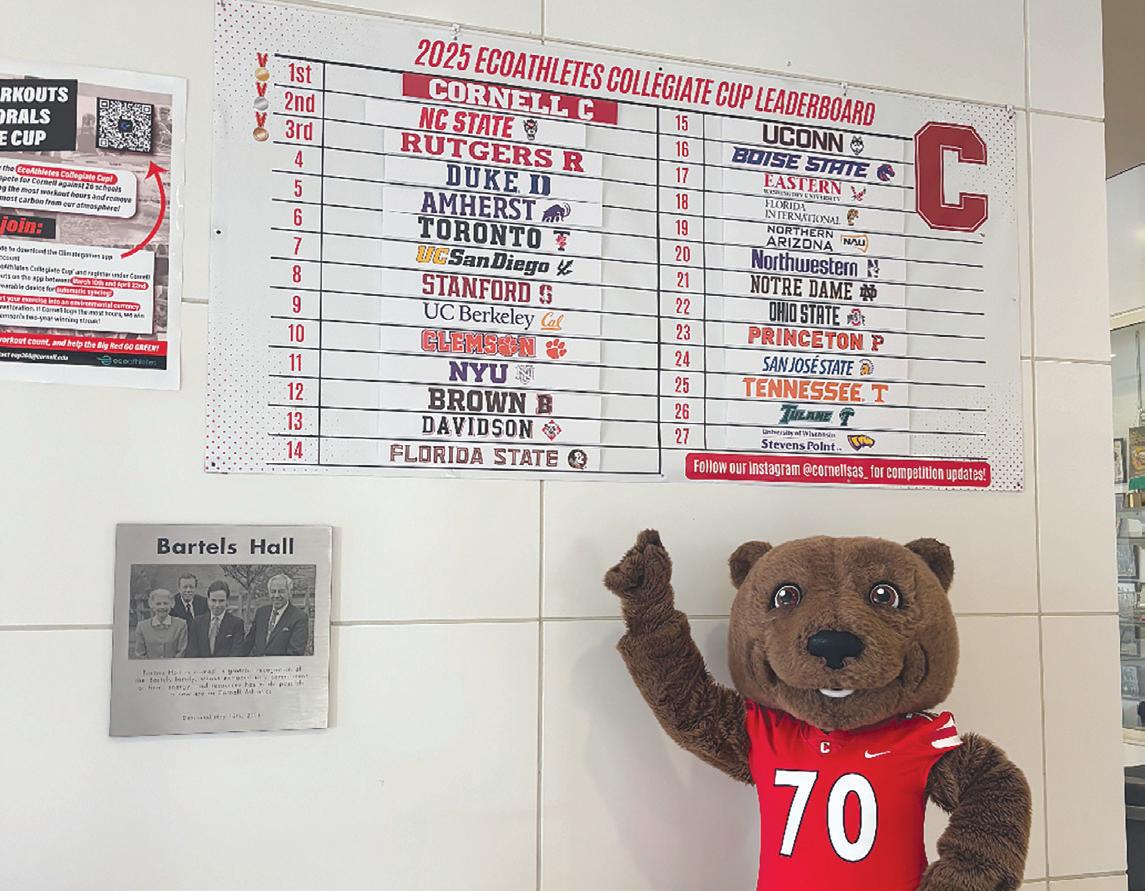
Thanks to CSAS’s outreach to club teams, coaches, local schools, and community groups like the Finger Lakes Running Company, Cornell now leads the competition with 200 participants. A large leaderboard in Bartels Hall keeps everyone updated on the progress of all 27 competing teams, sparking continued engagement and interest.
“Athletes work well in teams, and when we come together, we’re
capable of something much bigger— like promoting sustainability,” said Avarie Adams ’28, a member of the women’s volleyball team.
With events like these, CSAS is proving that sustainability and sports can work hand in hand to inspire meaningful change. With the Collegiate Cup running until April 22, CSAS is determined to keep Cornell in the lead while encouraging more people to join the club,
participate in the competition, or volunteer at upcoming events.
“For anyone even a little curious about sustainability,” Pape concluded, “I encourage you to reach out to our club. There are endless ways to combine sustainability and athletics, and together, we can truly make a difference.”
Kitty Zhang can be reached at az429@cornell.edu.
Athlete activism | Cornell Student Athletes for Sustainability tops the 2025 EcoAthletes Collegiate Cup.
The Corne¬ Daily Sun
Sidechat and the Rising Stakes of Anonymity
By Richard Ballard
Richard Ballard is a sophomore in the College of Agriculture and Life Sciences. He can be reached at rpb233@cornell.edu.
The latest from @gossipgirlcornell reads: “Cornell’s architects doing more blow than blueprints.” A few posts earlier: “Everyone whispers Aphi runs on snow, but word is the real blizzard’s at Chi Psi.” Outlandish? Probably. Anonymous? Always. And if you’re wondering where these snippets of campus chaos are coming from, the answer — more often than not — is Sidechat.
At Cornell, Sidechat has become more than just an app. It’s a moodboard for student life: part bulletin board, part burn book. It’s where complaints about TCAT delays meet hot takes on dining hall drama, where memes about academic burnout mix with wild (and occasionally libelous) commentary on Greek life. Students scroll between classes, post in the middle of the night and refresh constantly — not just for updates, but to feel like they’re in on the joke.
But lately, the stakes have changed. What began as a space for campus gossip has become a window into how universities handle speech, identity and accountability. Following congressional scrutiny of antisemitic content at schools like Columbia and Harvard, Sidechat’s role in fueling hate speech has come under national spotlight. What started as a digital campus quad is now part of a broader reckoning about free expression, institutional control and the limits of anonymity in a hyper-surveilled university ecosystem.
At elite schools like Cornell, students are constantly performing — in class, on LinkedIn, at networking events and club interviews. Sidechat is where that performance breaks. No real names, no résumés, no Ivy League polish. Just chaos, curated by the crowd.
The anonymity unlocks something students don’t always show elsewhere: brutal honesty, biting sarcasm and a certain kind of rawness that rarely makes it past the gatekeeping of “professionalism.” Take the posts speculating about the Slope Day artist — students debate who would be “big enough” to justify the wait, trading rumors and judgments with the confidence of booking agents. The joke works because the logic behind it is familiar: prestige matters here, and everyone knows how to size it up. Sidechat turns that instinct into content.
That’s what makes Sidechat revealing. For every joke about upstate New York’s twelve fake seasons, there’s a post spiraling into self-deprecation, burnout or brutal comparisons. Posts about friend groups, GPA gaps or who got cut from what club aren’t just gossip — they’re reflections of how tightly status, stress and identity are wound together here. Sidechat doesn’t create that pressure.
It just surfaces it, unfiltered and unedited. It can sometimes be seen as just a meme dump, but also as a mirror. And sometimes, it’s a pretty dark one.
The appeal lies in anonymity. But that same feature is what makes it so difficult to regulate. While Cornell students joke about bus delays or club clout, the platform has also become a flashpoint in national conversations about antisemitism and institutional accountability.
After the Oct. 7 Hamas attacks, antisemitic posts surged on college campuses — and Sidechat was frequently named as one of the platforms where those sentiments took root. In testimony before Congress and media reports, lawmakers pointed to Sidechat as a space where hate could flourish under the radar. In response, the app’s leadership reportedly met with administrators at schools like Harvard and assured them that moderation policies were being “strictly enforced” sidechat article info.
But it’s unclear what “strictly enforced” means when no one knows who’s behind the posts. Sidechat claims to employ a 30-person moderation team and bans accounts after a single severe violation, yet students report seeing inflammatory content linger for hours — if not days — before removal. And since the app verifies users by school email but doesn’t display usernames, every post is understood to come from someone nearby, someone in your dorm or lecture hall or club GroupMe. That proximity is what makes the posts so gripping — and sometimes so cruel.
“Sidechat is where people say what they wish they could say out loud,” said a student in the Class of ’25, who requested anonymity due to the nature of their posts. “It’s not always good. But at least it’s honest. That’s kind of the point — Cornell students already censor themselves everywhere else.”
Sidechat isn’t just another app students cycle through — it’s embedded itself into how campus culture is communicated, criticized and reshaped. It reflects the absurdity, pressure and sometimes toxicity of elite college life, but it also exposes the gaps in how institutions respond to digital spaces they don’t control.
Cornell doesn’t have to control Sidechat, but it does have to reckon with it. The app now shapes how students experience campus life — not just socially, but emotionally, politically, even reputationally. That influence deserves attention, not only when headlines force it, but as part of an honest conversation about student life today. Ignoring it won’t make it disappear. Engaging with it might be the only way to start drawing the line between expression and harm.


Spring Break (in
a Teoretical Sense)
By Vanessa Long
Vanessa Long is a first-year in the College of Agriculture and Life Sciences. She can be reached at vvl22@cornell.edu.
Amid the excitement for nine days away from campus, I was continuously reminded in each of my classes of the tight leash I was being kept on with impending deadlines — a paper here, a prelim there. My excitement was snuffed out as my professors morphed into evil versions of Oprah, “You get an assignment; you get an assignment!” In my quest to quell my frustration, I asked people in different majors and colleges if they, too, had approaching deadlines, and it seemed that, like me, most students had work to do over spring break.
On March 28, the Friday before break, I collapsed into my seat on an OurBus to New York City with weariness. I had a paper due that night, which felt unnecessarily cruel, as I could almost taste the freedom of home. So, I opened up my laptop on the bus, connected my computer to my faulty hotspot, and typed away. At this point in the semester, I knew I wouldn’t be alone in my suffering; like I predicted, I was accompanied by other students hard at work. The girl beside me slaved over a biology assignment, drawing diagrams on her iPad with her Apple pencil, and all I could hear from the guy adjacent to me was the clacking of keys as he wrote what I assumed was an essay taking up the last bit of his sanity. As I typed away, enveloped in the bus atmosphere that resembled the Stacks of Olin, I was reminded of the correspondence sent by the Dean of Students on Thursday, March 27. In this email, students were encouraged to “step away” from schoolwork and “spend time with friends and loved ones;” the instruction I found especially humorous was for students to “relax.” I looked around the tense atmosphere of the bus and felt frustrated that “relaxing” during break felt so unachievable.
“Too often, I turned down moments of connection to finish a paper or study for my exams, and it was frustrating.”
Vanessa Long ’28
This library-like environment is not unusual for the bus. As many know, the bus ride to and from Ithaca is a time to slump against the window in slumber, as well as an unwanted opportunity to “lock in” and grind. Personally, I have never been able to relax on the bus on my way to or from a break. Every time, I’ve had some pre-lecture quiz to complete, an essay to write or an assignment that needed my attention. It’s not uncommon to see others on this supposed bus ride to freedom continuing to complete work. But why is this collective suffering approaching and throughout university recesses the norm? Why do we clench our teeth and push through by sheer grit during our “breaks”?
If UChicago is “where fun goes to die,” is Cornell “ where breaks are just a formality”? On May 19, 2023 the Faculty Senate for Cornell adopted a policy where “faculty cannot administer graded exams or quizzes, conduct in-class graded assignments, or set due dates for graded assignments immediately after a break.” If this is the case, why did I spend a significant chunk of my Thanksgiving Break writing a five-page paper due the Monday we returned? If this policy is law, why did I stay on campus during February break because I had tight deadlines? Why then, during my Spring Break trip home to Georgia, did I spend a considerable amount of time hacking at my computer, trying to chip away at my mountain of assignments and prelim-prep against a bright blue
backdrop of clear skies and a constant high temperature in the 80s? Too often, I turned down moments of connection to finish a paper or study for my exams, and it was frustrating. The stress of trying to complete assignments and study enveloped me like the pollen should have — Georgia recently broke its record for a pollen count of almost 15,000, and trust me, during my infrequent outside endeavors, I suffered. Don’t

get me wrong, I still made my way down to Waffle House just to put Stevie Wonder and America on the jukebox, and I sat outside Bruster’s with a cone of Graham Central Station. But it wasn’t the same, simply because of the never-ending stream of assignments and exams dangling over my head. So, what is the purpose of an unsupported policy? On paper, Cornell favors students by acknowledging our need for a break. In practice, Cornell half-heartedly enforces this “rule” during their bi-yearly reminder to professors, and the student body is still victimized by professors’ casual disregard for the policy and the University’s lack of enforcement. This is truly unacceptable; Cornell must stand up for its students and require adherence to this rule. As a student body, we deserve better. We’ve been working hard all year, and we deserve a moment to collect ourselves and breathe before reentering this collegiate world that feels like Wipe Out. I don’t want to fall off the metaphorical red ball and drown because I’m exhausted and running on energy drinks and the hope of a moment of solace. All I want is to enjoy the nine days I have off of school to see my family seven states away without the overwhelming knowledge that “I need to finish this paper” or “I need to study for quickly approaching prelims.” I’m a person before I’m a student, and during breaks, I want the peace I’ve earned. Every student does. All I ask is that the University follows its already-established policy. Students are exhausted.

Cornell Acquires 301 College Avenue for $15 Million in Collegetown
By TAEHEE OH Sun Senior Writer
March 26 — The University purchased 301 College Avenue for $15 million last Friday, according to a deed filing with Tompkins County.
Located in the heart of Collegetown, the building houses Jason’s Deli convenience store and offers over 50,000 square feet of rentable space. It features 26 residential units, with configurations ranging from studios to six-bedroom apartments.
The property was last purchased by developers John Novarr and Phil Proujansky for $15 million in June 2017. In February 2024, Tompkins Community Bank foreclosed on the property due to unpaid mortgage obligations.
In an email statement, a Cornell spokesperson confirmed the purchase but did not provide details on the University’s plans for the building.
“Cornell acquired 301 College Ave out of foreclosure with the goal of furthering the economic revitalization of Collegetown,” the spokesperson wrote. “We are excited to work with local leaders, business owners, and community neighbors on advancing shared goals in this area and, by extension, our city.”
This acquisition is part of Cornell’s long history of investments in Collegetown, which has been closely tied to the University.
In 2007, Common Council adopted the Collegetown Vision Statement to guide the area’s growth.
Cornell played a key role in the initiative, contributing $90,000 alongside the city to fund planning efforts and leading the Collegetown Vision Implementation Committee alongside residents and students.
As part of its long-term strategy, Cornell integrated the Collegetown Vision Plan with its own Comprehensive Master Plan for the Ithaca campus, recognizing Collegetown as one of its precincts.
Beyond Collegetown, Cornell holds a significant share of Ithaca’s property value – estimated at 47 percent – with much of it exempt from taxation because of their educational purposes.
Taehee Oh can be reached at toh@cornellsun.com.
Alleging Racial Discrimination in Admissions Decision
By JEREMIAH JUNG Sun Assistant News Editor
March 25 — Stanley Zhong, an 18-year-old software engineer hired by Google in 2023, filed a lawsuit with his father against Cornell, alleging racial discrimination in its undergraduate admissions process.
This legal action, initiated on March 22 in the Northern New York District Court, is the latest of a series of similar lawsuits the Zhongs have filed against other prominent universities, including the University of California, the University of Washington and the University of Michigan.
According to the complaint, despite Stanley’s academic credentials — a 3.97 unweighted GPA, a 1590 SAT score and significant achievements in computer science, including advancing to the Google Code Jam semifinals and winning second place in MIT Battlecode’s global high school division — he was denied admission to Cornell and 15 other schools.
The lawsuit highlights that shortly after these rejections, Stanley received a full-time job offer from Google for a position typically requiring a Ph.D. or equivalent experience. This offer was extended after a rigorous evaluation pro-
Ithaca Reforms to Public Safety Slow to Change, Four Years Later
By ATTICUS JOHNSON Sun Contributor
March 27 — George Floyd’s 2020 murder sparked a wave of protests in Ithaca calling for police reform and a citywide effort to address racial inequality.
In April 2021, Ithaca’s Common Council passed “Reimagining Public Safety,” a resolution that included 19 initiatives to improve overall public safety, including racial justice. Four years later, while many of these initiatives have been implemented in part, others have been delayed or cancelled.
Amid the 2020 Black Lives Matter protests, Gov. Andrew Cuomo (D-N.Y.) signed Executive Order 203, which required municipalities to adopt a police reform plan that “maintain[ed] public safety while building mutual trust” between the police and the community.
Ithaca’s joint plan with Tompkins County included initiatives such as the Law Enforcement Assisted Diversion, an alternative to jail for people with substance abuse problems, and a Community Justice Center focused on community healing and bridging gaps in accessibility, such as providing aid with government forms.
The plan also called for reforming the Ithaca Special Weapons and Tactics team, developing a community healing plan and strengthening civilian oversight over police.
While some of the proposed initiatives, such as the Community Justice Center, de-escalation training and healing plans have been successful, community leaders and even managers of public safety programs admit that the initiative has taken longer than expected.
‘Justice Delayed’
With no timeline for implementation, many initiatives have been delayed, while others were implemented quickly. Some, like replacing the Ithaca
Police Department with a public safety force and reducing its size, have fallen entirely to the wayside.
An unarmed police alternative response force proposed in “Reimagining Public Safety” has still not gotten off the ground, four years later. Deputy City Manager Reckkio believes the delay is because the unarmed force was not “traditionally in place,” but added that other cities’ examples could serve as a model for implementation. For example, Camden, New Jersey has not had an armed police force since 2013.
However, shortly after the passage of Reimagining Public Safety, IPD ended its policy of using no-knock warrants, which allow police to enter places without announcing themselves, and redesigned its SWAT vehicle to include different colors and designs.
The CJC, one of the largest portions of Reimagining Public Safety, was approved in 2021, but due to issues in funding and staffing the center only began operations recently — three years after it was proposed. The CJC also faced $124,000 in cuts earlier last year during Ithaca’s budgeting season, leading to a reduction in services.
“Reimagining Public Safety” emphasized the already-existing Community Police Board, which hears complaints concerning police officers and their actions. The Common Council considered adding subpoena power, but decided against it — meaning that the board cannot pursue any legal measures following complaints unless the offense was criminal. As seen in the Board meeting’s December minutes, the board now primarily serves as a place for public comment.
To continue reading this article, please visit www. cornellsun.com.
cess, including assessments of his technical skills and teamwork abilities.
In addition to his academic achievements, Stanley founded RabbitSign, an unlimited free e-signing service developed during the COVID-19 pandemic which he wrote about in his college essays. The platform was recognized by Amazon Web Services for its efficiency and security, leading to a feature in an upcoming case study by Amazon.
Cornell Media Relations declined to comment on the proceedings of the Zhongs’ lawsuit against the University.
The lawsuit is supported by Students Who Oppose Racial Discrimination, an organization founded in October 2024 by the Zhongs to help themselves and any willing families to challenge what it alleges are racially discriminatory admissions policies in higher education.
According to the SWORD website, numerous college admission counselors examined Stanley Zhong’s applications and essays after media outlets like CBS and USA Today began to cover his story. However, none of them were able to discern the cause for rejection, with some even offering to testify as expert witnesses.
The Zhongs contend that Stanley’s rejection was influenced by racial biases in the admissions process. They argue that his qualifications should have secured him a spot at Cornell, among other universities, and that the denial reflects systemic discrimination against Asian-American applicants. According to their complaint, such practices violate principles of equal opportunity and merit-based admissions.
“I received tons of emails from Asian-American parents and students sharing similar stories, including applicants as qualified as Stanley if not more being rejected by all colleges they applied to,” Nan Zhong wrote in a letter featured on the SWORD website. “As these cases accumulated, a pattern of racial discrimination against Asian-American students became clear.”
This case is part of a broader national conversation about race-conscious admissions policies following the Supreme Court’s 2023 decision in Students for Fair Admissions v. Harvard which struck down affirmative action in higher education.
Jeremiah Jung can be reached at jjung@cornellsun.com.



Ads are accepted at The Sun’s office at 139 W. State Street downtown, by phone or e-mail. Deadline: Noon at The Sun’s office two days preceding publication.
Standard Rate: $3.95 per day for first 15 words, 39 cents per day per word thereafter. Five or more consecutive insertions, $3.70 per day for first 15 words, 37 cents per day per word thereafter.
Commercial Rate: $5.95 per day for first 15 words, 40 cents per day per word thereafter. Five or more consecutive insertions, $5.75 per day for first 15 words, 38 cents per day per word thereafter.
The Sun is responsible for only one day makegood on ads.


Prelim Season by Elliot Kim ’28 Awaiting Spring Break by Jessie Guillen ’27
ARTS & CULTURE
‘MUSIC’ Pushes Carti’s Boundaries
By MIA ROMAN-WILSON Arts & Culture Writer
Playboi Carti has always been a pivotal yet polarizing figure in the hip-hop world. Best known for his distinct vocal tone and adventurous musical pursuits, Carti’s discography has been widely accepted as a landmark in the larger rap genre. That being said, since his newest release, MUSIC , was announced, anticipation for the project has been high, both for Carti fans starved of new music for half a decade and the more general hip-hop enthusiasts.
I did my best to listen to MUSIC for the first time without expectations, so I was pleasantly surprised to find it was a 30-track album loaded with features. Carti leans further into his niche punk rap genre and even experiments with a trap sound throughout the compilation that I think highlights his ambitious music abilities well. Yet it is precisely these elements that also seem to detract from what loyal Carti fans love most: the cohesion and narration inherent to his previous projects.
It’s no secret that Carti’s discography is divisive. His jarring vocal inflections and abrasive sound are just some of the factors that play into the mixed reactions he receives. However, I believe that in his past releases, Carti does an admirable job of unifying these chaotic characteristics to create a well-connected album. Die Lit relied on its more commercial approach while Whole Lotta Red leaned on its punk experimentality. MUSIC explores so many genres it turns Carti’s versatility
into a weakness. The album jumps unflinchingly from R&B-infused tracks to aggressive punk records to electric trap beats.Although most songs as individual compositions are enjoyable to listen to and impressive, they create a sprawling, unfocused nature to the album that dilutes their listenability.
The featuring artists and their verses also contribute to this issue. While I love Kendrick Lamar and often think he can do no wrong, I’ll admit that his three appearances on MUSIC add to the album’s disjointedness. I think the duo has incredible potential to represent the stylistic gap between traditional lyricism and a more raw, minimalistic approach when it comes to hip-hop. That being said, Lamar’s talents seem strangely underplayed on the album as he assumes a more secondary role via simple ad-libs and interjections. The presence of this rap titan does enhance the listenability of the songs, but it further confuses MUSIC’ s narrative, or lack thereof. Additionally, Lil Uzi Vert’s multiple features are a callback to their past collaborations, which makes “JUMPIN” an entertaining listen. Yet in another odd creative choice, Carti is entirely absent from Uzi’s other feature, “TWIN TRIM.” Other appearances like Travis Scott, Young Thug and Jhené Aiko make sense from a commercial perspective, but seem to otherwise clash with the raw, chaotic aesthetic inherent to Carti’s discography. While he does showcase his immense versatility by collaborating with these diverse artists, he also perpetuates MUSIC ’s disconnected and
‘Companion’
By GILLIAN LEE Arts & Culture Writer
When Jost first mentioned his Weekend Update co-anchor Michael Che in his stand-up at Cornell Sunday, the crowd in Barton Hall burst into applause. “I’m not going to tell him you applauded,” he shot back, tying into their banter on Weekend Update . Talking about Che seemed to animate Jost — a foreshadowing signal that he might do his best comedy alongside his friend and fall short alone.
Colin Jost is my favorite current SNL star. I read his memoir, A Very Punchable Face , and I devotedly watch Weekend Update , so when I heard that he was coming to perform at Barton Hall on Mar. 23, I immediately bought a ticket. I brought it up to most friends I saw that week. “This could be my favorite standup yet” constantly rang through my head. As days passed, I heard the buzz of students getting tickets, even ones unfamiliar with SNL . It was then not a surprise when Barton Hall was full of familiar faces in the sold-out rows of seats and bleachers on Sunday. Since 2014, Jost has been famous for hosting the recurring segment Weekend Update alongside Michael Che. I look forward to Jost providing satirical accounts of the world’s events and a reminder that not every -
unclear narrative.
Despite its obvious faults, there are many notable tracks on MUSIC that I’ve found myself returning to regularly. “GOOD CREDIT” features Kendrick Lamar, and while I definitely do not have the most objective opinion when it comes to the rapper, I genuinely enjoy the unique chemistry between Lamar and Carti throughout the song. The gospel choir in the background of “CRUSH” makes it another personal favorite. I love the contrast of the choir and aggressive trap drumbeat, and I think this track specifically does an exceptional job of leaning into Carti’s experimentality without straying too far from unifying themes. Some of the others that have been on repeat are “BACKDOOR” and “RADAR.”
With MUSIC , Playboi Carti further cements himself as one of hip-hop’s most unpredictable figures as he effortlessly transcends styles throughout the album. However, while the experimentation, high-profile collaborations and sonic diversity make for an exhilarating listen, the album’s disjointed nature will likely prevent it from reaching the cult status of Whole Lotta Red . Whether MUSIC will stand the test of time or be remembered solely for its standout singles remains to be seen, but one thing is certain — Carti continues to push boundaries, even if the results are as divisive as ever.
www.cornellsun.com
Correction: In our March 26, 2025, print issue, the article “Men I Trust’s ‘Equus Caballus’” was mistitled and attributed to the wrong author. Te title should read, “Men I Trust’s ‘Equus Asinus,’” and the correct author is Hazel Tjaden. We apologize for the error.

and Sugar-Coated Sci-Fi Horror
thing is so serious in each show. Jost’s humor comes from his demeanor — his tone blends a preppy stature, crisp delivery and a usually careful treading of “the line,” stopping just before jokes go too far.
Jost’s performance in Barton felt like an extension of his Weekend Update character : composed, sharp and familiar. However, especially after sitting in Barton’s uncomfortable athletic facility for an initial 30-minute delayed start and two underwhelming opening acts from other SNL cast members Michael Longfellow and Molly Kearney, I was left wondering whether I expected too much.
Jost struggled to get a handle on the audience at first. He started with jokes about ICE and the World Wars that didn’t quite land, resulting in half-formed laughter and Jost jokingly pleading, “Come on, please give it a try.” While I think many jokes deserved more laughter than they received, some leaned on the side of uncomfortable, especially coming from a straight white male from Staten Island.
He continued by piecing together bits on cultural events and some small stories, but the dynamics were relatively constant. He made a few appeals to Cornell — his trip to Greek Peak, the gorges and a comparison to Ithaca College. With his
Harvard undergraduate degree, I was surprised he didn’t make any “fake ivy” jokes (but simultaneously appreciated it).
I started to laugh out loud around halfway through his set. My favorite bit was Jost’s repeated jokes on hotels, playing on the “hotelies” of Cornell. He brought up how his aunt majored in Hotel Administration at Cornell in the first few minutes: “My aunt came to Cornell to study hotels, and now she stays at hotels.” Throughout the remainder of his performance, he had multiple hotel-centered sets and would sometimes randomly circle back to something about hotels. At one part, he simply began, “I was in a hotel —” and let the pause do the comedic work. It landed gloriously. He picked up the pace and appeared more in his element for his longer set pieces — personal stories that seemed part of previous rehearsed sets. His jokes about his family were especially funny, like one reference to why he went to Thailand recently, remarking, “My wife was working in Thailand… she’s a plumber.” The audience obviously knew better: Scarlett Johansson is no plumber.
Jost constantly laughed at himself during the performance. Some of my favorite moments on SNL are when he laughs at one of his or Che’s jokes as a sign of self-deprecating humor,
a joke not landing or just a hilarious moment that he can’t not laugh with the audience. His laughs in Barton were a nice tie between his SNL and stand-up self, reminding me again of Colin’s unmistakable flair.
I feel so fortunate that several SNL cast members have made their way to Ithaca during my four years at Cornell, including Chloe Fineman, Ego Nwodim and Marcello Hernandez, and I have zero regrets attending Jost’s performance. I don’t think the show’s preliminary excitement fully translated into the performance, but it will nonetheless be one of the college events I fondly look back at. I got to laugh both with and at one of my favorite comedians in the same room — that’s pretty incredible.
Jost is the generic white male with a “very punchable face,” but he consistently and keenly uses this trait to poke fun at himself in a fresh, welcoming way. I have no doubt the next time I watch him on Weekend Update will be entertaining, but as of now, Jost’s best acts are still playing off his co-anchor behind the faux-news desk. If he ever leaves SNL , I would not only be heartbroken, but hope he’s ready to stand out on his own.
Gillian Lee is a
Mia Roman-Wilson is a freshman in the College of Arts and Sciences. She can be reached at mromanwilson@cornellsun.com.
‘Opus’: A24’s Cult of Personality
NICHOLAS YORK ARTS & CULTURE WRITER
Earlier this year, I had the opportunity to attend the world premiere of Opus at the Sundance Film Festival. I arrived at the premiere over an hour early and still ended up halfway down a line that wrapped around the building. Opus was by far the most anticipated screening of the festival- and the biggest disappointment.
Opus had built buzz in the preceding weeks, when A24 released its first trailer to millions of viewers. At the premiere, when A24’s logo appeared on screen, the audience broke into applause. Unfortunately, by the end of the screening, the energy in the theatre had shifted. Opus had built anticipation just by way of its production company, but with an unoriginal concept and weak screenplay, it failed to deliver.
Opus follows Ariel Ecton (Ayo Edebiri), a young journalist who is tired of being overlooked by her editor, Stan (Murray Bartlett). Her chance at a big break arrives when eccentric popstar Alfred Moretti — part-Elvis, part-Elton John — leaves retirement after 30 years off the grid and invites her to his compound. It quickly becomes apparent that Moretti, played by John Malkovich, is running a cult, and as members of
Ariel’s group begin to disappear, she finds herself fighting for survival. If this reminds you of every other thriller to come out in the past five years, you’re not alone.
Opus relies on tired tropes to tell a story that can be found in any other recent thriller movie trying to replicate the success of Ari Aster’s Midsommar . Opus is a well-directed film that is highly competent on the technical level but is held back by a screenplay that rehashes the same plot points as films like The Menu and Blink Twice . The film has some beautiful shots and great performances, especially Ayo Edebiri’s, which only makes its unoriginal screenplay all the more disappointing. As the film progresses, Ariel investigates the cult’s strange rituals — like religiously shucking oysters for hours — but these events never seem to have real significance. It’s as if the film included any scene they could think of that might be seen as creepy or off-putting, without caring about any overarching theme. The film continues to hit every beat one would expect, with group members disappearing one-by-one, until Edebiri’s Ariel, the “final girl,” attempts her escape. At no point does Opus veer from convention, making it one of the most uninteresting films I’ve seen all year.
Writer-director Mark Anthony Green is clearly trying to explore the
cult of personality that surrounds figures like Alfred Moretti. Other journalists and influences make up the rest of the compound’s visitors, most of whom have been attending Moretti’s listening parties for decades. Even as members of the group disappear, their adoration for Moretti keeps them from suspecting him of dark intentions. To the audience, Malkovich’s Moretti is immediately off-putting, but his years in the spotlight have made him into a legend. None of these observations tread new ground and have been explored in other, infinitely more interesting films- including fellow Sundance premiere Lurker , which will be released by Mubi later this year. Green’s interest in exploring fandom seems to be limited to simply stating that celebrity idolization is dangerous — and going no further.
Unintentionally, Opus has created a much more interesting conversation about the cult-like following that A24 itself has amassed. Since 2012, A24 has secured itself as a staple in the independent film industry and has grown into a brand with its own fanbase, not dedicated to any one filmmaker but to anything A24 puts out. I’m brought back to Sundance and the cheers throughout the audience when the A24 logo flashed across the screen — and then the uncomfortable energy of disappointment when the
credits rolled. Audiences have come to associate A24 with quality filmmaking and find it difficult to reckon with when a movie doesn’t meet expectations. Opus is fairly unsuccessful in its attempts to explore the dangers of cult-like fandom, but perhaps it may allow audience members to reflect on their own relationships with brands like A24.
Commentary YouTube is Good for the Soul
The recent five-year anniversary of the COVID-19 shutdown reminded me of the noticeable shift that occurred in our generation’s usage of the internet during the pandemic. Using Instagram and TikTok, once a casual pastime between classes or at sleepovers, became our lifeline to each other and held a monopoly on human interaction. This all-consuming overconsumption led to an influx of the most pointless (at best) and horrendous (at worst) media I came across on the daily, content that would seriously make me doubt some folks’ grasp on reality. Luckily, I was not alone in this sentiment. During my quarantine binge-watching era I relished in the Holy Trinity of YouTube content creators whose mission was to bring the internet’s darkest, weirdest corners to light in the funniest way possible. Former Vine-ers Drew Gooden, Danny Gonzalez and Kurtis Conner kept me sane by affirming my aggravations with the cyberverse; that knock-off kids movie is stupid, and that family of vloggers should definitely be investigated. I’ve been finding comfort in their recent uploads, which now reiterate my hopeless frustration with soulless AI products,
creepy internet alpha males and everything in between.
The world is a scarier place than it was when I was 17, but I can always count on these silly YouTube videos to make me laugh about things that would otherwise make me cry. I want to thank my sister for introducing me to Danny Gonzalez — notably, his videos ridiculing Troom Troom’s craft “hacks” and a rip-off version of Ratatouille whose animation style would give any adult nightmares. Danny’s talents surpass just comedy: he often wrote and produced parody songs based on his videos that, while adding to the hilarity, were surprisingly well done. Check out “Help Let Me Go” based on his video about a justice-seeking TikTok mom, or “I’m Gonna Kill Santa Claus” inspired by his commentary on the classic Christmas movie starring Tim Allen. Many videos featured people or products that weren’t necessarily doing anything wrong, but whose absurdity made for low-hanging fruit in terms of poking fun. Although the nature of his comedic style could be read as cruel, Danny always urged his audience just to enjoy a laugh and move on without needlessly berating or bullying his subjects.
From Danny’s channel we discovered Kurtis Conner
and Drew Gooden, since the three of them did a stand-up tour together and had a backlog of videos featuring each other. All three gained semifame on Vine (Drew’s “Road Work Ahead” bit is among the most recognizable Vine clips from that era) and then transitioned to longer-style comedic commentary on YouTube. Whether making videos together or apart, they often covered the same topics: in the late 2010s they all had many videos dedicated to the Paul brothers (Logan and Jake), whose terrible music videos and questionable antics made for endless content.
As fun as it is, I am not solely writing to reminisce about the funny videos my sister and I watched as teenagers. I want to explain why I still maintain such a strong connection to these YouTube channels, and why I believe their existence is actively healing the Internet. Revealing the weird and exploitative habits of Logan and Jake Paul, for instance, led fans to rightfully critique and bash their harmful behavior. In a similar vein, Kurtis Conner has made several videos criticizing the behavior of self-proclaimed “alpha males” who dehumanize women and spew their egotistical philosophies into an online echo chamber 24/7. Danny also has made several videos about a vlogger fam-
ily that was obviously lying about their life (and probably exploiting their children) for views. Even his Troom Troom and Ratatoing videos expose the nonsensical, heavily monetized garbage that is being churned out with no thought and targeted towards a very young audience.
Much of my increased fear and frustration with the world is attributed to every company’s sudden obsession with inserting AI technology into places it has no business being in. Danny is apparently just as creeped out as I am, and has made a whole slew of videos poking fun at pointless AI gadgets, exposing AI’s Facebook takeover and even tricking people into thinking he is an AI entity. I’ve been enjoying Drew Gooden’s videos recently due to his tendency to go on passionate tangents about topics I also feel the strong urge to rant about. He has his own qualms with AI’s influence on the internet and how the new autofill reply feature on YouTube is as unnecessary as it is hilarious. These videos have the perfect combination of wonderfully crafted jokes and serious criticism that showcase the time and effort the two creators invest into producing meaningful content.
What really pulled me back to their little YouTube world, though, was Kurtis
Conner’s absurd social experiments. For the past couple of months he has been putting himself through hell in a hysterical yet poignant attempt to test out Internet fads. He has attempted to de-age himself and then undoubtedly reversed all that hard work by surviving on only YouTuber food products for a week. Maybe on the surface these videos sound no different than the crazy things content creators are doing all the time to farm views. But Kurtis (and Danny and Drew) use themselves as vessels for satire and deep commentary on the corrupt state of consumer culture and toxic misinformation spewed online. Their comedy is a tool they use to peel back the layers of the absurd world that we live in, in the hopes that children will watch their videos instead of mindlessly absorbing content that was not made with their best interests in mind. For those of you that grew up laughing with them as I did, I hope you are still finding peace of mind and joy in their content. And for those who have never seen the videos referenced above, I highly recommend giving them a watch!
is a junior in the College of Agriculture and Life Sciences. She can be reached at mhb237@cornell.edu.
MAYA BLANCHARD
ARTS & CULTURE CONTRIBUTOR
Maya Blanchard
Nicholas York is a sophomore in the School of Industrial and Labor Relations. He can be reached at nay22@cornell.edu.


‘A Leader for Everyone’: Shining a Spotlight on Impactful Women at Cornell for Women’s History Month
By ANGELINA TANG, VARSHA BHARGAVA and JANE HAVILAND Sun News Editors and Features Editor
March 27 — The first female Cornell graduate earned her degree over a century ago, in 1873. And this year, 55 percent of Cornell’s graduating class are women.
While women now take on prominent roles in the Cornell community and beyond, this has not always been the case. Women’s History Month was established in the United States in 1987 and every March, the country honors women to recognize their contributions throughout U.S. history.
This March, The Sun spoke to women currently and formerly in leadership positions at Cornell to highlight their contributions to campus.
Julia Senzon ’26, Editor-in-Chief of The Sun
The Cornell Daily Sun’s first female editor-in-chief, Elizabeth Bass ’72, was elected in 1971. Before Bass, women in The Sun were limited to “women’s editor” positions that only worked on content specifically appealing to women.
Today, Julia Senzon ’26 leads The Sun as editor-in-chief — the head of the paper. She succeeds decades of Sun editors-in-chief of all genders.
“I don’t have to be a journalist for women,” Senzon said, reflecting on her place within the paper’s gendered history. “[I can] be a journalist for everyone and a leader for everyone.”
As the daughter and granddaughter of “incredible role models” like her mother and grandmothers, Senzon said that the title of “woman in leadership” is inspirational.
Growing up, Senzon’s mother, who she described as a “caring, responsible” nurse, set an example as a “headstrong” leader for her daughter. Similarly, both of her grandmothers held jobs and bolstered Senzon’s impression of what she could accomplish.
“I’ve always been raised to never believe that there’s limits placed on me because of my gender,” Senzon said.
With editor-in-chief experience from her high school newspaper, Senzon began writing for The Sun as a first-year in fall 2022. She quickly rose to news editor during her second semester on campus, covering and assigning articles about on-campus news and the University administration.
After two semesters as a news editor, Senzon was elected as managing editor — second-in-command to the editor-inchief and her “dream role” at the time. The managing editor is central to the organization of the paper, and Senzon said she dedicated 50 to 60 hours a week to The Sun at the time, and sometimes more.
Now, as an editor-in-chief of The Sun’s 143rd Editorial Board, Senzon wants to make her time in the position count. Her mission for her two-semester term is to use the paper to “facilitate conversation.”
“It is the most rewarding to me when I can just hear people from their own words about what they think more so than what they do,” Senzon said.
The editor-in-chief must also facilitate a greater conversation by co-writing editorials — articles written by the head subjective editors about large or contentious issues on campus. Editorials represent The Sun’s institutional voice, Senzon said. Part of Senzon’s goal for the editorials is to spark discussion.
“By using ‘any person, any study’ and protecting democracy as bedrock principles of the editorials, that will, in turn, inherently encourage conversation as a key element of the paper,” Senzon said. “[I want to make] sure people feel like we want them to be heard, and we want to protect all voices.”
As she takes on the topmost role of the paper, Senzon does not forget the women in The Sun who played a hand in her experience.
Specifically, Senzon pointed toward Sofia Rubinson ’24, former managing editor of The Sun during the 141st Editorial Board, as a model for her role. From Rubinson’s leadership, Senzon said she learned to hold people accountable while still being kind, to remain understanding of people’s unique circumstances and to stay resilient through backlash.
“It’s important to never feel like you have to fit a box because of being a woman, [or] that you have to act a certain way or hold a more supportive role versus a more leadership role,” Senzon said. “It’s important to recognize that your skill set is valuable.”
Adeena Naseem ’26, president of WHEN
Adeena Naseem ’26 is the president of Women’s Higher Education Now, a student organization that raises money for the Asian University for Women to support women’s education.
WHEN primarily holds fundraisers, such as selling cookies and flowers, to help AUW provide scholarships for women in Bangladesh. These women would otherwise have been forced to “marry off” or be “child laborers,” Naseem said.
Naseem also serves as the finance chair of South Asian Council to stay “in tune” with her Pakistani culture. In the future, she seeks to combine her major in economics and minor in environment and sustainability by exploring “impact investing or green finance.”
Naseem’s passion for women’s education stems from her culture. As an international student from Pakistan, Naseem said their society is very “son-centric.” Coming from a family without sons, “there was all sorts of pressure from society … because people think that having a son completes your family,” Naseem said. This pushed her to feel as if she had to “prove [her] worth.”
Naseem sought to prove herself through education. When she got into Cornell, she recalled thinking, “I’ve achieved something that made my parents proud. I’ve made it.”
At the same time, she recognized her achievement as a “privilege” that not all women — including those she grew up with — receive. This led to her passion for helping those who have not had the same opportunities, and she said that WHEN has given her that ability to do so.
“Even my own class-fellows from back home at school — some of them have been married off at very young ages, because that’s how our country is, and that’s how society is,” Naseem said. “So that’s something that ignites [my] fire from within.”
Judith Mecklenburger ’71, founder of Risley Program House
Judith Mecklenburger ’71 is known for the founding of the Risley Program House, which was the first program house at Cornell and first co-ed dormitory established on-campus. Founded in 1970, Risley Hall houses 194 students of any
class year who display interest in the visual and performing arts. The program house is completed with a theatre, a coffeehouse, recording studios, and its own dining hall.
At the age of 17, Mecklenburger enrolled in the College of Agriculture and Life Sciences as a communication major. During her undergraduate years, she was involved in many extracurriculars including the WVBR radio station, The Cornell Countryman and the Sage Chapel Choir.
“There are always these two sides to me — science and the arts,” Mecklenburger said.
During her junior year, Mecklenburger went to Day Hall to ask Ruth Darling, former head of housing, if the University could provide a living space for about 25 students who have interest in the arts, regardless of major.
The University had planned, prior to meeting with Mecklenburger, on tearing down the former all girls dormitory due to its expense. Mecklenburger left Day Hall with the opportunity to transform Risley Hall into an experimental, arts focused dormitory as the Head Resident for over 200 students.
Throughout the summer leading up to her senior year, Mecklenburger led the planning and organization alongside University faculty of what would become the first program house on-campus.
Beyond being known for establishing Risley, Mecklenburger is “an advocate for the LGBTQ+ community” and finds importance in how “there are a lot of other genders and descriptions of genders,” Mecklenburger said.
Her legacy as the founder of Risley program house is recognized on a plaque located on the ground floor of Risley Hall.
“People need to be given the option to be living with people who are like them,” Mecklenburger said. “A place where you can put your hair down and be yourself.”
Zora deRham ’27, President of the Student Assembly
Zora deRham ’27 is the current president of the Student Assembly — a shared governance organization of elected undergraduate student representatives that aid University officials on decisions regarding the interests of the student body.
Enrolled in the College of Agriculture and Life Sciences with a major in agricultural sciences and a minor in near Eastern studies, deRham is also a sister of Alpha Chi Omega sorority and a member of the Persian students organization.
deRham leads the 33-member Assembly during weekly meetings that discuss proposal, resolution and public comment discussions concerning the student body. With nine months of student assembly president experience under her belt, deRham reflects on her role as “a really great growth opportunity.”
deRham experiences challenges in her presidential role.
“There’s always going to be people who underestimate me because I’m especially young in this position of leadership,” deRham said.
To continue reading this article, please visit www.cornellsun. com.
Angelina Tang, Varsha
and Jane
can be reached at atnag@cornellsun.com, vbhargava@cornellsun.com and jhaviland@cornellsun.com.
Bhargava
Haviland
Four females | From left to right, top to bottom: Julia Senzon ‘26, Judith Mecklenburger ’71, Adeena Naseem ’26 and Zora deRham ’27.
COURTESY OF JULIA SENZON ‘26, JUDITH MECKLENBURGER ’71, ADEENA NASEEM ’26 AND ZORA DERHAM ’27
Ladies in leadership | Julia Senzon ‘26 leads The Sun as editor-in-chief and Adeena Naseem ’26 is the president of Women’s Higher Education Now organization.
COURTESY OF JULIA SENZON ‘26 AND ADEENA NASEEM ’26
Playing Both Sides: Julia Ramsey’s ’27 DualSport Success in Field Hockey, Lacrosse
By ZEINAB FARAJ Sun Assistant Sports Editor
March 30 — Field hockey and lacrosse are two Division I sports that demand lots of time, energy and stamina from their talented athletes, but sophomore Julia Ramsey is excelling in both sports at Cornell.
Meet Ramsey, who was originally recruited for field hockey and later walked on to the women’s lacrosse team.
Lacrosse and Field Hockey Before Cornell Ramsey is a sophomore in the College of Arts and Sciences. She started playing both lacrosse and field hockey at five years old. As a child, she said her family influenced her to play sports.
“While we are all competitive we all are super supportive of each other,” Ramsey said.
Ramsey’s family is no stranger to the Division I level of sports: Ramsey’s sister, Caroline Ramsey ’24 played field hockey for Cornell. She also has a brother, Nicholas, who plays lacrosse at Yale University. Her father Patrick Ramsey played both ice hockey and lacrosse at Colgate University. She has two cousins playing field hockey at Yale University, Lily and Emma Ramsey.
“While we are all competitive we are all super supportive of each other.”
Julia Ramsey ’27
Ramsey picked up travel lacrosse and field hockey because of her love for the game and her older sister and older cousin playing the sports as well.
In high school, she played field hockey, lacrosse and ice hockey. She was a National Field Hockey Coaches Association All-Region team honoree in 2021 and selected for her All-County and All-Conference teams multiple times.
During Ramsey’s sophomore year of high school, many athletic clinics and showcases she wanted to attend were cancelled or delayed by the COVID-19 pandemic. Ramsey said this caused her to discuss which sport to prioritize with her family.
“After talking with my family, I decided to
stick with just club field hockey but continue playing lacrosse at my high school,” Ramsey said.
“I
like being able to work on my footwork and hand-eye coordination skills since that is what translates over between the two sports.”
Julia Ramsey ’27
Becoming Dual Sported
When she was deciding between programs to commit to, Ramsey said she “fell in love” with Cornell’s campus and athletics. Because her sister Caroline and cousin Annie Thomas ’24 played field hockey and lacrosse, respectively, Ramsey said she was familiar with the campus.
“When I got the offer from Coach [Andy] Smith I accepted within a day or two,” Ramsey said.
Ramsey had a successful freshman year campaign for the Red — she led the nation with 1.06 assists per game and accounted for 22 points. But, Ramsey said she deeply missed playing lacrosse.
“My cousin was a fifth year on the team, and I would attend all the scrimmages and games,” Ramsey said. “I was already missing it so much and watching it made me miss it more, so I decided to try to walk on to the team.”
But this decision would not be easy — it would require Ramsey to balance two Division I sports at the same time and be in season all year round, which meant constant training, games and meetings with her team.
So, her first step was to talk to field hockey head coach Andy Smith about her decision.
“Coach Smith was definitely surprised by my decision since I would be missing the off-season training for field hockey,” Ramsey said. “But ultimately, he has been very supportive of me as a person both as an athlete and student.”
After emailing women’s lacrosse head coach Jenny Graap and working with the team, Ramsey accomplished her goal of walking on and was excited to play the sport she loved.
But the accomplishment was not without its challenges, as Ramsey must balance 20 hour weeks year round for two different sports while

also being a student. Ramsey also said that while some skills from the two sports crossover, each sport is very unique.
“Playing with the ball on the ground versus in the air requires a different set of skills,” Ramsey said. “I like being able to work on my footwork and hand-eye coordination skills since that is what mainly translates over between the two sports.”
In addition, Ramsey said the experience of the two teams has been different: the field hockey roster this year is “a smaller team” of 24 players, whereas the lacrosse team has 43 members listed on the roster.
“Looking back it was definiely a big decision, but I think that if there is something that you really want to do then it is important to push yourself and go for it to see what will happen.”
Julia Ramsey ’27
She also noted that she plays different roles on each team.
“For the lacrosse team, I am definitely more of a scout player, so I help prep[are] the team for the competition they will play that weekend,” Ramsey said. “Whereas for field hockey I play more games.
Regardless of her role, Ramsey emphasized her commitment to both teams and her drive to compete at the highest level. She also said that the Cornell Athletics culture was motivating to her because she felt like her coaches and teammates always wanted what was best for her. She also thanked her family for their support in her process.
Her biggest takeaway: “if I wanted to do something, I should just go for it and work hard to earn it. “
“Looking back it was definitely a big decision, but I think that if there is something that you really want to do then it is important to push yourself and go for it to see what will happen,” Ramsey said.
Zeinab Faraj can be reached at zfaraj@cornellsun.com.

Frequent fielding | Sophomore Julia Ramsey is a dual athlete who plays both field hockey and lacrosse for the Red.
KARLIE MCGANN / SUN PHOTOGRAPHY EDITOR
Red Ramsey | Julia Ramsey ’27 was recruited to play for the field hockey team, and later walked onto the women’s lacrosse team.
No.1 Men’s Lacrosse Narrowly Beats Brown
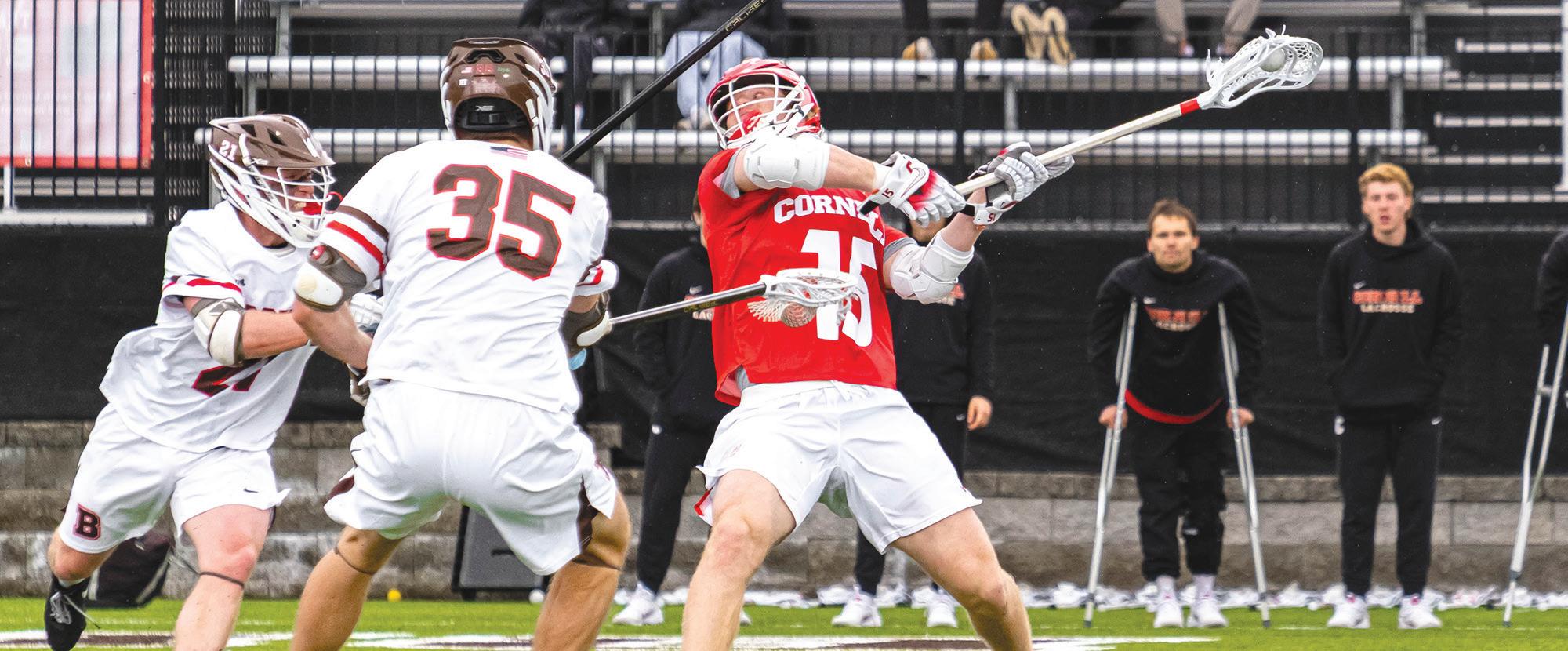
By WILLIAM CAWLEY Sun Staff Writer
Coming off of a week with no classes, No. 1 Cornell (9-1, 4-0 Ivy) did not look as sharp as expected but still managed to come out on top against Brown University (3-7, 0-3 Ivy).
In a year where the Cornell offense has been its calling card, senior goalkeeper Wyatt Knust and the defense were leaned on today, with the wet conditions making the game a low scoring affair. The Red scraped a 13-9 win in the final quarter, protecting its undefeated Ivy record.
Even in a game where the offense did not stand out, senior attackman CJ Kirst put up his obligatory four goals. However, only six of his 13 shots were on net and he turned the ball over four times.
Inexplicably, coming into a game against the number one team in the country, Brown trotted out its scout team to start the game. The Bears’ regular starters watched from the sideline as Cornell promptly forced a turnover and scored less than thirty seconds into the game.
Brown then brought on its starters,
imposing itself with a one goal handicap to start the game.
The Bears did not give up after this start though, and answered to even the score. Senior midfielder Hugh Kelleher put Cornell back on top with a lefty jump shot. It did not take long for Brown to retaliate with another score, coming from Ben Scandone.
The back-and-forth scoring continued when junior faceoff Jack Cascadden — left completely alone by the Brown defense — managed to send the ball to the back of the net out of his crooked faceoff head. Brown again responded quickly and the first quarter ended at 3-3.
It was Kirst to open the second quarter, skipping one by the Brown goalkeeper. Again, Brown was quick to fire back a goal of its own. Senior attackman Michael Long scored a bounce shot of his own before Brown rattled off two straight, taking its first lead of the game with the score at 6-5.
Cornell was able to find a scoring run of its own before the half ended. To start the run for the Red, senior long stick midfielder Walker Wallace was given room by the Brown defense and stepped down into a shot which found the back
of the net. Kirst followed this by taking advantage of Brown’s reluctance to switch a short stick on to him, getting separation from his defender and sneaking a goal through.
Before halftime, Knust came up with a big save, giving Cornell the final scoring chance of the half which was converted by senior midfielder Andrew Dalton. This put the Red up 8-6 at the break.
Brown outscored Cornell 2-1 in the third quarter. The only goal for the Red came from Kelleher after he put his shoulder into his defender and stepped down into his shot.
To open the fourth quarter, Brown scored the equalizer bringing the game to a score of 9-9. With its No.1 ranking on the line, Cornell hunkered down on defense and scored four straight to close the game.
First, Kirst scored from atop the crease to break the tie. He was followed by sophomore midfielder Willem Firth, who, coming from behind the cage, scored a jump shot. It was Kirst again to bring the lead to three, and Firth iced it with a question mark dodge from X.
The horn sounded to finalize a 13-9 lead for Cornell, though the game was tightly contested by Brown until the
final minutes.
Unsurprisingly, Kirst led the way for the offense with five points. Kelleher had a standout day with two goals, two assists and a forced turnover when he got stuck out on defense.
The Cornell defense only allowed 21 shots to reach Knust but managed to finish with an above .500 save percentage with 12 saves in the books.
Cascadden again dominated on faceoffs, securing 15 of 22 draws for an impressive 68 percent faceoff win percentage. Though Cascadden has been tremendous this year for Cornell, the team has struggled with its depth at the position. The backup, freshman Michael Melkonian, was only given three faceoffs today, losing all of them.
The Red will now shift its attention to its very challenging schedule to end the regular season. This begins with Upstate New York rivals Syracuse University as they travel to Long Island to take on the Orange.
The game will take place at 4 p.m. on Saturday April 8 with coverage available on ESPN+.
Women’s Lacrosse Falls to No. 8/7 Princeton After Valiant Comeback Effort
By ZEINAB FARAJ Assistant Sports Editor
On April 5, in junior goaltender Mackenzie Clark’s second start of the season, she made 18 saves against No. 8/7 Princeton for a 0.600 save percentage.
Unfortunately, Clark’s effort at the crease and an eight-goal fourth quarter by the Red were still not enough. Princeton was able to best Cornell with a final score of 12-11 on Saturday.
Princeton now stands at 9-1, 3-0 Ivy and are ranked No. 4 in the country. For Cornell, it is now 8-4, 2-2 Ivy and ranked fourth in the Ivy League.
“I am incredibly proud of Mackenzie Clark and her ability to lead the defensive unit against Princeton,” said head coach Jenny Graap ’86. “She had an outstanding game between the pipes.”
The Red struggled on the draw
control, winning only seven while Princeton took 19. The Tigers put up four points in the first period, with no answer from Cornell.
“We got off to a bit of a slow start, and Princeton had the upper hand in the first quarter especially with draw control,” Graap said. “On the draw control I think we really struggled to gain possession and ultimately take shots.”
Princeton’s McKenzie Blake led the team with six goals. Blake is a keystone of the Tigers’ offense — in 2024 her 67 season goals had her claim the No. 3 all-time record by a Tiger.
In the second quarter, Princeton continued its domination with five more goals to Cornell’s one. Cornell’s solitary score was netted by senior attacker Maggie Pons, assisted by senior attacker Josie Vogel.
The Red were also 0-3 on free position shots that it got thanks
to fouls.
“Our executions on the eight meter were not strong; we were 0-3 and that was another part of the story of the first half,” Graap said.
To start the second half, Pons was able to find the back of the net and slowly the Red began to fight its way back. Cornell held the Tigers to one goal and were able to get another before the final quarter, with the score at 10-3, Princeton.
Coming back from a seven point deficit is no easy task, but Cornell played a hard fought game. Its comeback began with junior attacker Ella Wilmot scoring thanks to an assist from senior captain and midfielder Caitlin Slaminko.
The Tigers were quick to answer, with McKenzie scoring off a free position shot and gaining her 50th goal of the season.
34 seconds later, Slaminko scored an unassisted goal to take the score to 11-5.
After some back and forth between the two teams, Slaminko took control thanks to a free position shot and found the back of the net. Not soon after, Princeton’s Colette Quinn found her tenth goal of the season.
With another 34-second turnaround, the Red answered with a goal from sophomore attacker Dylan Madigan. 23 seconds later, Cornell crashed down on the goal again as Slaminko connected with senior midfielder Alexa Donahoe to score the Red’s eighth goal of the game.
In the last two minutes of play, Cornell scored three goals coming from Slaminko, senior attacker Kylie Gelabert and Donahoe at the last second. In the end, the Tigers narrowly escaped Cornell with a final score of 12-11.
While the offense came to fight in the final quarter, Princeton’s 45 shots to Cornell’s 29 made the fatal difference.
With more than half of the season under its belt, the Red will finish the season playing three more Ivy teams — two of which are ranked. Each of these matches will be crucial to deciding standings for the Ivy League Tournament in May.
“These are all important conference games,” Graap said. “We have to stand true to our formula of preparing well and starting games with more momentum and more guts.”
Up next, No. 24 Harvard will visit Ithaca to take on the Red at 12 p.m. on Saturday, April 12.
Coverage of the matchup will be available on ESPN+.
Zeinab Faraj can be reached at zfaraj@cornellsun.com.
William Cawley can be reached at wcawley@ cornellsun.com.
Squeaking by | Though the Red entered the final quarter in a 9-9 tie with Brown, Cornell scored four straight goals to secure a 13-9 victory a nd protect its perfect Ivy record.
TIMMY XI / SUN STAFF PHOTOGRAPHER
Men’s Hockey Sends Six Seniors to the Pros
By JANE McNALLY Sun Senior Editor
It has barely been one week since men’s hockey saw its season end at the hands of Boston University in the NCAA Tournament regional final in Toledo, Ohio.
In just one week, six departing seniors have inked professional contracts. Those signings are coupled with the loss of junior forward Dalton Bancroft, who opted to sign with the Boston Bruins instead of returning for his senior season.
So far, senior goaltender Ian Shane, forwards Sullivan Mack and Jack O’Leary, and defensemen Michael Suda, Tim Rego and Hank Kempf have signed professionally. Two seniors — forward Kyler Kovich and defenseman Jimmy Rayhill — have entered the transfer portal to use their final year of eligibility. Forwards Ondrej Psenicka and Kyle Penney have not yet been signed.
Here’s a breakdown of each contract signed within the first week of the offseason.
April 1: Shane signs with the Norfolk Admirals (ECHL)
Just a mere 72 hours after the season’s end, Shane signed an amateur tryout contract with the Norfolk Admirals of the ECHL. The Admirals are affiliated with the Manitoba Moose and the Winnipeg Jets organization.
An amateur tryout contract is one designed for players going straight from “amateur” hockey — college hockey or junior hockey — to the pros. The contract is good until the end of the 2024-
2025 season. From there, the Admirals could make the decision to sign Shane for the 2025-2026 season, or Shane could opt to explore other options in free agency.
Shane made a quick jump into professional hockey — he made his debut on Wednesday as the Admirals took on the Reading Royals. Shane, who was stellar down the stretch for Cornell en route to its NCAA regional final loss, picked up right where he left off, making 30 saves on 33 shots in a slim 3-2 overtime loss.
The point secured in the loss clinched a playoff berth for the Admirals while Shane was named the third star of the game.
April 2: Mack inks deal with the Hartford Wolfpack (American Hockey League)
After a strong senior campaign that saw him hit career highs in goals (nine), assists (15) and points (24), Mack was picked up by the Wolfpack, which is affiliated with the New York Rangers organization.
The “standard AHL player contract” runs through the 2025-2026 season. For the remainder of 2024-2025, Mack will join the Wolfpack on an amateur tryout basis before his actual contract kicks in for next season.
Mack could make his professional debut as soon as Saturday, as Hartford takes on the Hershey Bears. According to the Wolfpack website, he’ll don No. 13 as he begins his pro career.
It is worth noting that Mack will join a Wolfpack team partially under the direction of a former Cornellian —
Bancroft Signs with the Boston Bruins
By JANE McNALLY Sun Senior Editor
With ten graduating seniors, most of them regulars on men’s hockey’s roster, the 2025-2026 season was already set to be one permeated with question marks.
On Thursday, things got a whole lot more complicated.
Junior forward Dalton Bancroft has signed a one-year entry-level contract with the Boston Bruins, meaning he will forgo his senior season to kick start his professional career. Bancroft will spend the rest of the 2024-2025 season with the Providence Bruins — Boston’s American Hockey League affiliate — on an amateur tryout agreement, a contract designed for college/junior hockey players making the jump to the pros.
Bancroft made his professional debut on Friday evening.
It’s the first time Cornell has had a player leave early to turn professional since Morgan Barron ’21 — a Hobey Baker Award top-10 finalist and current forward for the Winnipeg Jets — left the Hill in pursuit of an NHL contract in the 2020 offseason.
Bancroft has made an impact since stepping foot on campus, having been a regular member of the Cornell power play. He appeared on the Red’s top line this season, posting 27 points while playing on the right wing with sophomore forward Ryan Walsh and senior forward Sullivan Mack.
In 103 games across three seasons, Bancroft posted 36 goals and 43 assists for 79 points. This past
season saw him eclipse a career-high 15 goals.
Dalton Bancroft Forgoes Senior Year, Signs NHL Contract With Boston Bruins
The Bruins outbid “several teams” interested in Bancroft. An earlier report by RG on March 26 indicated that the Bruins were one of five teams pursuing Bancroft once he hit the free agent market, those teams being the Tampa Bay Lightning, Pittsburgh Penguins, Edmonton Oilers and Winnipeg Jets.
Bancroft attended Boston’s development camp last summer. Though he was never drafted by the Bruins or any other NHL team, Bancroft received an invitation from the organization to attend after his standout 31-point sophomore season.
Bancroft attended that 2024 development camp alongside Walsh, who is a 2023 sixth-round pick by the Bruins. According to a March 30 RG report, the Bruins — who had two members of their hockey operations staff at Cornell’s NCAA Tournament games in Toledo, Ohio — were interested in signing Walsh as soon as this summer. However, in a post on X that same day, New England Hockey Journal & NHL. com contributor Mark Divver said he was “not expecting” Walsh to sign this offseason.
To continue reading this story, please visit www.cornellsun.com.
Jane McNally can be reached at jmcnally@cornellsun.com.
Joey Padmanabhan ’24 is the Director of Hockey Operations for Hartford and worked with Cornell men’s hockey for four years as a Student Director of Hockey Operations. Padmanabhan works with Wolfpack general manager Ryan Martin, who handles “player personnel decisions, player development, contract negotiations, and player movement.”
April 3: Suda signed by the Savannah Ghost Pirates (ECHL)
Suda, who is one of three regulars on the Cornell defense graduating this spring, signed a standard ECHL player contract on Thursday. After an 11-assist senior season, Suda joins a large group of collegiate players heading to Savannah on SPCs, including Cristophe Tellier of ECAC rival Quinnipiac.
Though it was not indicated in the press release put out by Savannah on Thursday, Suda’s contract — which is not an amateur tryout contract, like Shane’s — likely runs through the 20252026 season.
Suda could make his professional debut on Friday evening as the Ghost Pirates face off against the Florida Everblades at 7:30 p.m. The Ghost Pirates are affiliated with the Charlotte Checkers and the Florida Panthers organization.
April 4: Rego signs with the Ontario Reign (AHL)
Rego’s AHL contract runs through the 2025-2026 season. For the remainder of 2024-2025, he has been loaned to the Greenville Swamp Rabbits, the ECHL affiliate of the Kings and Reign.
Rego attended NHL development
camp with the New Jersey Devils last summer, but the Kings organization ultimately picked up the free agent. Rego made his ECHL debut on Friday evening.
April 4: Kempf signs two-year deal with Colorado Eagles (AHL)
As expected, Kempf signs with the Eagles after his rights were traded there on March 1. Kempf was initially picked by the New York Rangers in the 2021 NHL Entry Draft (seventh round, 208th overall) but joined the Colorado Avalanche organization ahead of the NHL trade deadline.
Kempf will join two Cornellians in Colorado — Matt Stienburg ‘23 and Jacob MacDonald ‘15 are current members of the Eagles, while Sam Malinski ’23 plays for the Avalanche in the NHL. April 4: O’Leary signs ATO with the Norfolk Admirals (ECHL)
O’Leary will join fellow classmate Shane in Norfolk after signing an ATO with the Admirals. Another undrafted senior, O’Leary is set to debuted with Norfolk on Friday evening.
The New York native goes pro after hitting a career-high in goals (eight) and tying his career-high in points (17) in 2024-2025. O’Leary notably scored in the Red’s regional final defeat to Boston University, a pivotal goal that sent the game to overtime.
O’Leary will finish out 2024-2025 with the Admirals and, like Shane, could re-sign or test out the free agent market.
Jane McNally can be reached at jmcnally@ cornellsun.com.
Holcombe Helps Baseball Win One of Tree Against Columbia
By ZEINAB FARAJ Assistant Sports Editor
This weekend, the previously top two teams in the Ivy League, Cornell (10-10, 5-4 Ivy) and Columbia University (12-14, 7-2 Ivy), faced off in New York City for a three game series.
The series was moved up one day due to weather concerns. The teams played two games on Friday and wrapped up the series on Saturday. The change in schedule likely worked in the Red’s favor, as Columbia was coming off two days of rest following its loss to Hofstra University.
“We knew that there was a chance for the move-up in the game schedule, so we adjusted by moving up our practice schedule,” said sophomore left-handed pitcher Huxley Holcombe. “We played some good baseball despite coming off one less day of rest.”
Cornell also faced Columbia on its home turf, where the Lions had been undefeated through the season.
While the first inning of the first game was scoreless, the second inning saw the Red take a 1-0 lead thanks to sophomore infielder Owen Carlson, who singled home senior outfielder and right-handed pitcher Ryan Porter.
Junior right-handed pitcher
Carson Mayfield helped hold the Lions to zero runs, as he produced a pair of strikeouts in the bottom of the second inning.
During the third inning,
Columbia faced three batters and a double play forced the Cornell offense off the field. A mishap on the field allowed Columbia to capitalize and tie the game, 1-1. The Lions took the lead at the bottom of the third inning as Columbia’s Jack Kail hit a sacrifice fly that allowed Sam Miller to find home plate.
For the rest of the game, the Red’s offense failed to round the bases and Columbia put up 10 unanswered runs. Columbia’s Joe Sheets only allowed four hits across his eight innings played. In addition, he accounted for four double plays which stalled Cornell’s efforts to score.
Unfortunately for the Red, Mayfield allowed a season-high of nine hits during his five innings played. Cornell conceded the first game of the series with the final score being 10-1, Lions.
Immediately following this game, the Red and the Lions played the second game of the series. This time, Holcombe pitched 7.2 innings. While pitching was problematic for Cornell just hours before, Holcombe turned it around with a career high of seven strikeouts against a competitive lineup of Columbia hitters.
“I was aided by our assistant coach Robby Faris, who does a really good job with the scouting reports we get every week, so I had a good description of the tendencies of the batters I was facing,” Holcombe said. “He put together a concise plan for me to attack the hitters.”
While the pitching helped hold
off the Lions, Cornell’s offense also came to life in the second game. In the first inning, the Red started strong with junior outfielder Caden Wildman singling to left field to help senior outfielder John Quinlan run home. Later in that inning, Wildman and sophomore catcher Mark Quatrani would both help pad Cornell’s lead to three thanks to senior first baseman William Jaun, who hit a single to center field. At the top of the third inning, Porter doubled to center field, driving in two runs as Jaun and sophomore infielder Kevin Hager scored. With Cornell up 5-0, the Lions finally had an answer as Cole Fellows earned two RBIs to bring the score to 5-2.
Sophomore infielder Luke Johnson rounded the bases in the fourth inning and the Red would hold off the Lions’ valiant offensive efforts during the next two innings. At the top of the seventh, Hager earned a run and Cornell’s lead grew to a comfortable 7-2.
Columbia earned its final point during the eighth inning off of a hit by Fellows that brought home Anthony Temesvary.
With a 7-3 victory, the Red tied the overall series and defeated Columbia on home turf for the first time this season.
To continue reading this story, please visit www.cornellsun.com.
Zeinab Faraj can be reached at zfaraj@cornellsun.com.
SOPHIA DASSER Sun Opinion Editor
Cornellians love tradition — we love watching the chimes concert, slipping on the Arts Quad in $200 Blundstones and writing angry Sidechat posts about the last CHEM 2080 prelim. But even the oldest continuously independent college daily in the U.S. needs a little spring cleaning. From a shiny new website to Sun jerseys that rival Lynah’s finest, your favorite student paper has officially rebranded. This isn’t just a fresh coat of paint, it’s a full-blown editorial renaissance. From new merch to spicy columns, here’s everything you didn’t know you needed to know.
161 Things Got a Facelift (And Maybe a Personality Disorder) Forget 2019. The “161 Things Every Cornellian Should Do” has finally been updated with chaos, core memories and … court summons?
The last time it was updated, the top meme format was “Woman Yelling at a Cat,” and TikTok was still a Wild West. But Cornell has changed, and it’s time we do as well.
We’ve taken the 161 and made it more us. It’s the same spirit — packed with streaking, protesting and regretting — but with new rituals for a new age. This means chucking fish at Harvard, yes, but also sleeping through pre-enroll and then remaking your entire schedule during add/drop. It’s holding hands around Beebe Lake and then blocking each other on BeReal. It’s rage-crying over losing The New York Times Connections and pretending it was because you “weren’t trying that hard anyway.” It’s heartburn from the Chili Cook-off, the stress of asking for an extension you will abuse and maybe — just maybe — building a
The Sun Gets a Glow Up
snow penis that gets its own Instagram account. And best of all, it’s now officially Cornell-approved behavior — just check number 155.
This isn’t a bucket list, it’s a survival guide. And updating it felt like finally admitting we are not who we were in 2019 (we might be worse).
OOTD(S) — Outfit of The Daily Sun
Tired of repping Cornell in the same shade of carnelian red? Of wearing itchy club quarter-zips that feel like bad inside jokes? Of hiding your Sun writer identity because you identify as a person who writes for the Sun, not a Sun writer? Now’s your moment.
The Sun’s new merch line is full of clever quips, subtle but fresh graphics and yes — even hockey jerseys. Nothing says “student journalism” like tossing fish in the stands while wearing our logo. With everything from hockey jerseys to tongue-in-cheek mugs, it’s the kind of wardrobe that says, “I’ve read Marx, but also love a good brunch.” You can finally match your crippling imposter syndrome with a perfectly designed graphic tee.
Perfect for impressing your crush at Collegetown Bagels, intimating prelaws during coffee chats in Zeus or crying in Uris in style.
The Website Works Now. No, Seriously.
Our old site looked like it was built by a CS 1110 student in the Paleolithic era. But now? We’ve re-uploaded every piece, updated author profiles (even your favorite graphics and photo contributors) and redesigned the whole site so your daily scrolls are smoother than a drip coffee from Gimme! Coffee.
Curious who wrote that banger op-ed you saw on our Instagram? Click their name. Stalk their entire
profile. Send us a fan letter (or hate mail). It’s all easier now, we promise. Opinions in Orbit
We’ve always had opinions. Now we have franchise-worthy series to put them in.
Here at The Sun’s Opinion Department, we’ve always believed that nuance matters. That disagreement isn’t something to be feared — it’s something to be published.
This semester, we’re launching three new recurring series that aim to elevate that mission: The Eclipse, SUNder Review and Backstories & Bylines. These series are meant to push past the echo chamber and into the realm of layered discourse, where disagreements are thoughtful and argument is productive.
The Eclipse is designed to do just what the name suggests: shine a light on the obscured. It’s a space where contrasting perspectives on the same issue live side-by-side — not to cancel each other out, but to help illuminate the full picture. Think of it as Cornell’s intellectual sparring ground, where writers make their case on opposite sides of a central campus question.
SUNder Review takes a different tactic. Instead of a debate between two viewpoints, it’s a deep dive into a single issue, explored through multiple voices. You’ve already seen a preview of this in this week’s review on Michael Kotlikoff’s presidential appointment. Whether it’s major campus development, a national moment with local reverberations or a cultural flashpoint worth unpacking, SUNder Review gathers a chorus of opinions from columnists to guest submissions to offer a panoramic view — grounded in lived experience, curiosity and the kind of rigor that defines Cornell.
With Bylines & Backstories, you
can meet the minds behind the columns. We believe that powerful writing does not just come from opinion — it comes from experience, identity and perspective. That’s why we’re launching this new multimedia series designed to introduce you to our team of columnists in a format that goes beyond their byline. Through short video interviews, we’ll be pulling back the curtain on who’s writing what — and more importantly, why. Expect conversations that are candid, thoughtful and sometimes surprising, as writers share the moments, questions and contradictions that shape their columns. Think of it as the faces behind the fire.
We know your opinions are personal — so it’s time to make the Opinion section more personal too.
Lifestyle, But With a Pulse
Our Lifestyle section got tired of being the “girl next door” section. Now? She’s funny, vulnerable and chaotically relatable with Faded on Fridays, Sex on Thursdays, Dating on Wednesdays and Maia on the Mic. We’ve got your week covered, giving you real storytelling, written by people who probably left a situationship to write about it here.
So if you’ve ever cried in the Cocktail Lounge while Okenshields dinner queases your stomach, this one’s for you.
The Sun’s Out, A New Era Has Begun With new lists, new looks and new voices, The Sun brings us the same integrity with a rebrand. We hope you laugh, cry, ponder and rage-click our email to submit a guest column all in one sitting.
Let’s make this semester unforgettable (or at the very least well-documented).
Style - Approved Rankings of 161
Well, it’s that time of year again. We, The Cornell Daily Sun, have arrived once more with the prophecy in our hands — the single most important list of your college experience. “The Slope Day lineup?” you ask. No, and it’s not next week’s grocery shopping list, either. It’s our iconic “161 List,” through which we steer you in the direction of becoming a true Cornellian.
However, this isn’t News speaking. It’s Lifestyle. We’ve come to put our two cents in on which activities are worth your time and which are maybe better off remaining as words on the page. A sort of “buy or bye” situation, if you will. Which are true Cornellian plot points, and which are misrepresentations?
The Must-Dos as a Proper Cornellian
1. Please go to Zeus at the ripe time of 2:55 p.m. and struggle to find a table (as number 3 suggests). Yes, you’ll be flustered and embarrassed. And, yes, everyone will know that you cannot find a table and that is why you are pacing the perimeter. But it’ll be hilarious for the rest of us camped out there since 10 a.m., and it’s a great character-building moment.
2. Listen to a full chimes concert from the clock tower and guess all of the songs played (number 12). It sounds crazy, but somehow the clock
tower knows what you need to hear when you need to hear it. And if you happen to catch the right concert, you will know the songs, trust me. Maybe you’ll even be inspired to climb all 161 stairs of McGraw Tower.
3. I swear it gets colder throughout the day, especially on days when the forecast calls for sun and 70 degrees. Wake up one morning, get so super excited about the warmer weather (which is fool’s spring, by the way) and wear your finest shorts. Then, skip to class with a smile on your face and your favorite tunes in your ears. Get to class sweaty (this is important). Freeze in class because the academic buildings are set to 40 degrees. Finally, walk outside, have water well up in your eyes immediately and get nearly knocked over by the wind (number 15). You’ll be running home in no time.
4. You can run, but you can’t hide. Number 26 on the list will happen eventually. Bombing a prelim is a rite of passage for all Cornellians. Even the smartest of us end up covering our computer screen when grades are dropped. I know you were top of your class in high school. Get off your high horse and join us common folk.
5. Run out of BRBs in March, get denied by your parents for a refill and live off of campus events’ free food for the rest of the year (number 145). Come on, learn to be resourceful. It’ll be good for you! Plus, maybe you’ll meet campus event groupies
and make new friends!
6. Go to Catharine Valley for a wine tour (number 40). Because of the cyclical nature of Greek Life events, Cornellians in Greek Life organizations or who have friends in sororities and fraternities have the opportunity to attend a proper wine tour twice a year. Now, my personal suggestion is to go in the fall, as it is usually much warmer and much prettier in terms of the Catharine Valley atmosphere. Though, if you’re not a part of an organization that partakes in wine tours, you just may have to befriend a frat man … proceed with caution and at your own risk.
Not Worth the Hype
1. Alright, I’ll be that person. Please do NOT have sex in the stacks (number 1). If you really need further reasoning, I’ll give it to you. Who knows what is creeping and crawling on those floors late at night, and do you really want to find out in a compromising position? I didn’t think so. Also, just don’t. Please.
2. To be honest, I don’t know what a Hotelie prom is. Should I if I’m commenting on its validity as number 29 on this list? Probably. But I don’t want to. And neither should you. I’m imagining a long evening networking with the other attendees (and maybe even your own date) in stuffy formal attire.
3. For your own dignity, please do not make the walk of shame home and run into an ex (number 49). Stay classy and demure, and don’t let your
ex know what you’re up to. Unless you’re empowered by the thought of the situation. Then you should walk right past your ex’s dorm on your way home.
4. You can generally ignore the “No Winter Maintenance” signs on the stairs across campus, but it would really suck to take a tumble down the stairs (number 60). I find that all of the stairs on this campus are made of hard, sharp stone, and if you break a bone, that will actually suck. You need your hands and arms to help you struggle on prelims and your legs to assist you in achieving extreme exhaustion from walking up the slope.
5. Though this one might be inevitable, having a treacherous OurBus experience isn’t something I would even wish on my worst enemy (number 112). It is actually the worst feeling in the world, scrambling to make alternative arrangements to make it home in time for Thanksgiving break when your OurBus cancels on you. Last year, they overbooked my bus and kicked the last girl off because there were no seats. And I was the third-to-last one on said bus, so you can imagine my sheer shock when I processed that it very well could have been me. Zero out of 10, would not try again.
I’ll Stand Up and Applaud
1. Number 33, enjoying an Ithaca summer as someone who chooses to stay on campus over summer recess, is impressive. See, experiencing sum-
mer here sounds so great in theory, but being on this campus one moment longer after finals season would be my definition of my worst nightmare. If you’re mentally strong enough, good for you. And you’ll get to hold it over everyone’s head that you did some cool research or work opportunity here.
2. If you ever get to meet Bill Nye ’77, “The Science Guy,” and give him a hug (number 134), you’ve been blessed by a higher power. You’d stand in the presence of true greatness, and I’m not sure any other life moment could top that.
3. Explore the secret underground tunnels between Olin and Uris if you ever get the chance (number 64), though I have heard it’s near impossible to accomplish. There is also a tunnel going from Olin to the edge of Goldwin Smith, per one of Olin’s Rare and Manuscript Collection’s experts (though don’t tell her I told you).
If you take anything away from this list, it should be that Cornellians do freaky things sometimes. And since you’re a Cornellian, you may also do freaky things sometimes. It’s simple math that even ILRies can understand. Embrace the freak. Take a good look at the rest of the list and decide for yourself what’s worth doing and what’s not. Just know you’re walking in the footsteps of generations of Cornellians who may or may not have done the nasty in the very seat you’re sitting in right now.
MAIA MEHRING Sun Lifestyle Editor