
Slope Safety
The Corne¬ Daily Sun
Te slope provides a social space for Cornell students, but is it COVID safe?


Schill MRP ’02 Joins County Legislature
By VEE CIPPERMAN Sun News Editor
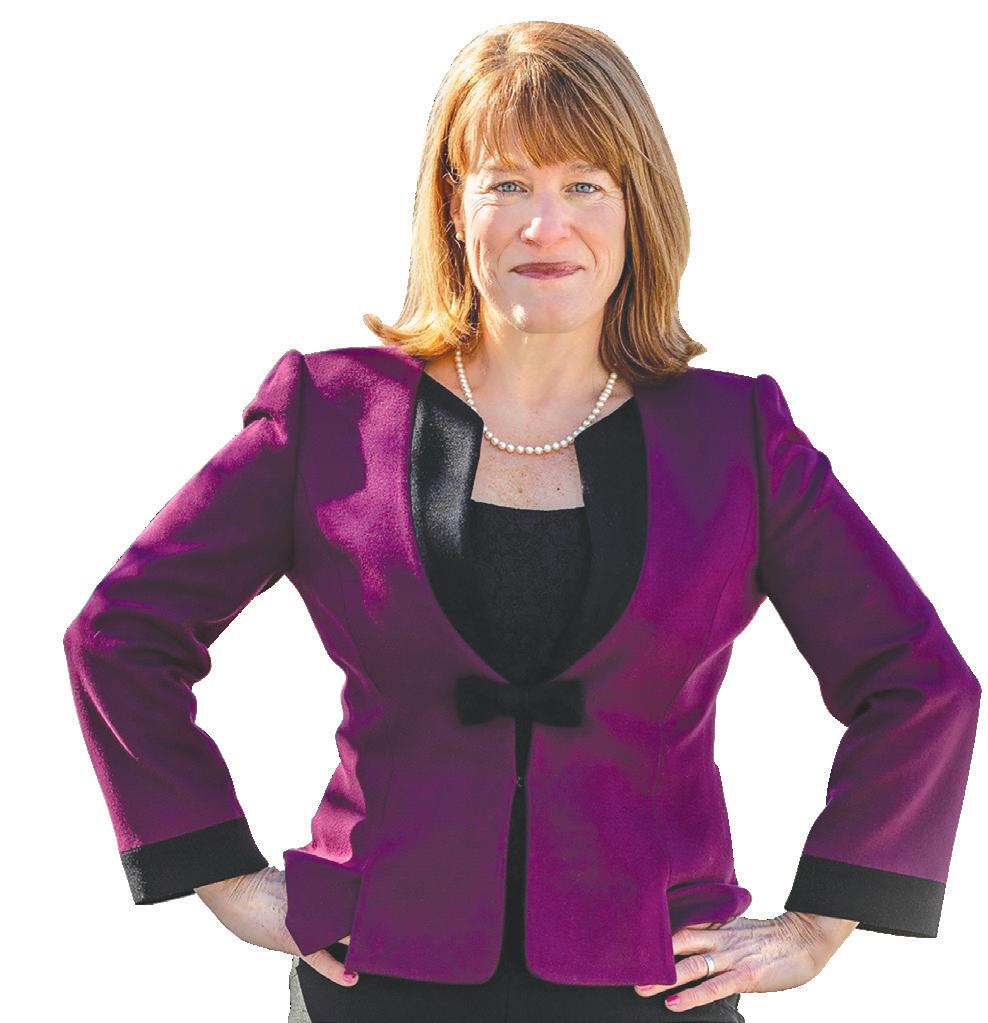
Cornell’s director of campus planning, Leslie Schill MRP ’02, took her oath of office as Tompkins County Legislator Tuesday, after a special election on March 23 to replace Anna Kelles (D-2nd district).
Kelles, who served as a Tompkins County legislator for five years, resigned after progressing to the New York State Assembly, representing the 125th District. Schill will run for re-election in November’s regular race, opposing Veronica Pillar M.S. ’14 Ph.D. ’19 for the second time since the special election.
Heights. Her platform emphasizes efficient vaccine distribution and increasing housing security.
“Our top priority right now is addressing COVID in the community, and I would say the county is doing a great job and is still innovating even weekly,” Schill said. She expressed the importance of speed, accessibility and health education in vaccinating Tompkins County residents.
“It feels good to be back in a public servant role. That’s something I identify with.”
Leslie Schill MRP
Schill said her experience as a campus planner and community leader will help her achieve her platform. Schill’s current role at Cornell focuses on sustainability, long-term development and maintaining relationships between Cornell and Tompkins County.
’02
Schill will serve out the rest of Kelles’ term as legislator representing the second district, which includes the areas of Fall Creek and Cornell
According to Schill, past projects she has worked on serve as models for future initiatives she hopes to carry out in the county and beyond.
As an example, she noted the Community Development and Housing Fund, a col laboration between the county, the City of Ithaca and Cornell that has financed 815 affordable housing units and built 600 units over the past 11 years, according to Schill. “I work on a lot of these ini tiatives,” Schill said. “I have the background and the current knowledge on them, and I can bring that to bear to create an even better collab oration between our county government and Cornell.”
Before this position, Schill worked in munic ipal governments and on community-building
Activists Rally for Climate Justice
Organizations advocate for bill before NYS Senate
By TAMARA KAMIS Sun News Editor
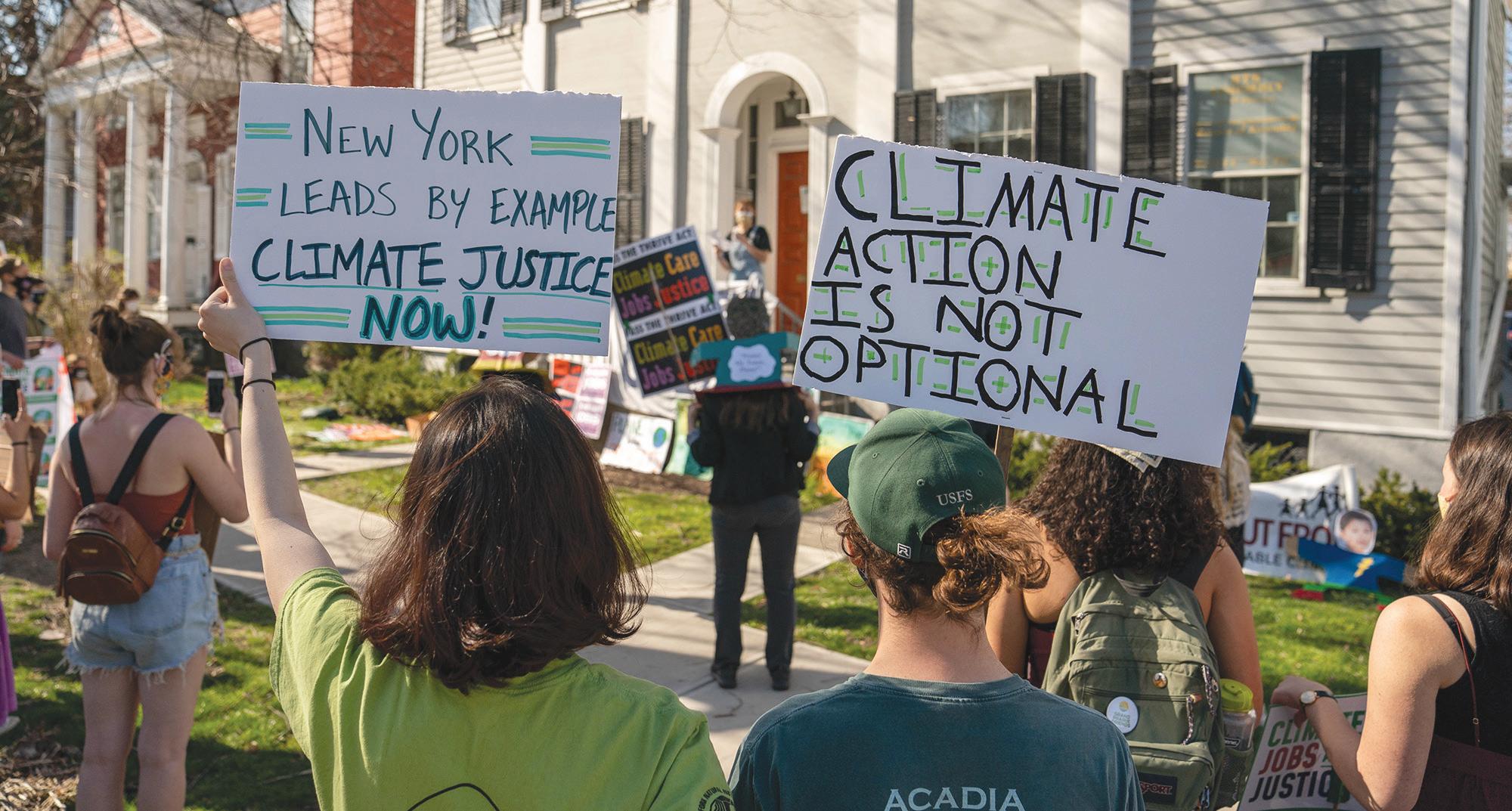
Just over two weeks after the Climate and Community Investment Act was introduced in the New York State Senate, Cornell students and other Ithaca residents, including New York Assembly Rep. Anna Kelles (D-2nd district), gathered Wednesday afternoon to advocate for the bill’s passage.
Thirty-seven people from a variety of climate organizations rallied in front of Kelles’s downtown Ithaca office for this legislation that would raise billions of dollars through taxes on corporate emissions to fund sustainability projects like
solar panels, train people for green jobs, support frontline communities and reduce the cost of utilities for over half of New York residents, according to NY Renews. The group included activists from Climate Justice Cornell, Sunrise Ithaca, the Ithaca chapter of the Democratic Socialists of America, Tompkins Mothers Out Front, Our Climate and New York Renews.
One of the event’s speakers was Kelles, who supports the CCIA and said she will vote for it as soon as the bill reaches the New York State Assembly.
“The most critical thing about the CCIA is not only does it establish a very needed
revenue stream to combat climate change, it is one of the first bills that I’ve seen that puts equity at the forefront,” Kelles told The Sun.
According to Kelles, her progressive colleagues have expressed significant support for the bill. But for the CCIA to be effective, according to Kelles, the New York State Legislature needs to ensure that it does not transfer funds collected through this legislation to the general budget.
Eva Milstein-Touesnard ’22, a Climate Justice Cornell organizer, began the event with a land acknowledgement and a summary of what
Cornell Returns to Green Alert Level
Virus transmission eases after case spike
Cornell community of the alert level change.
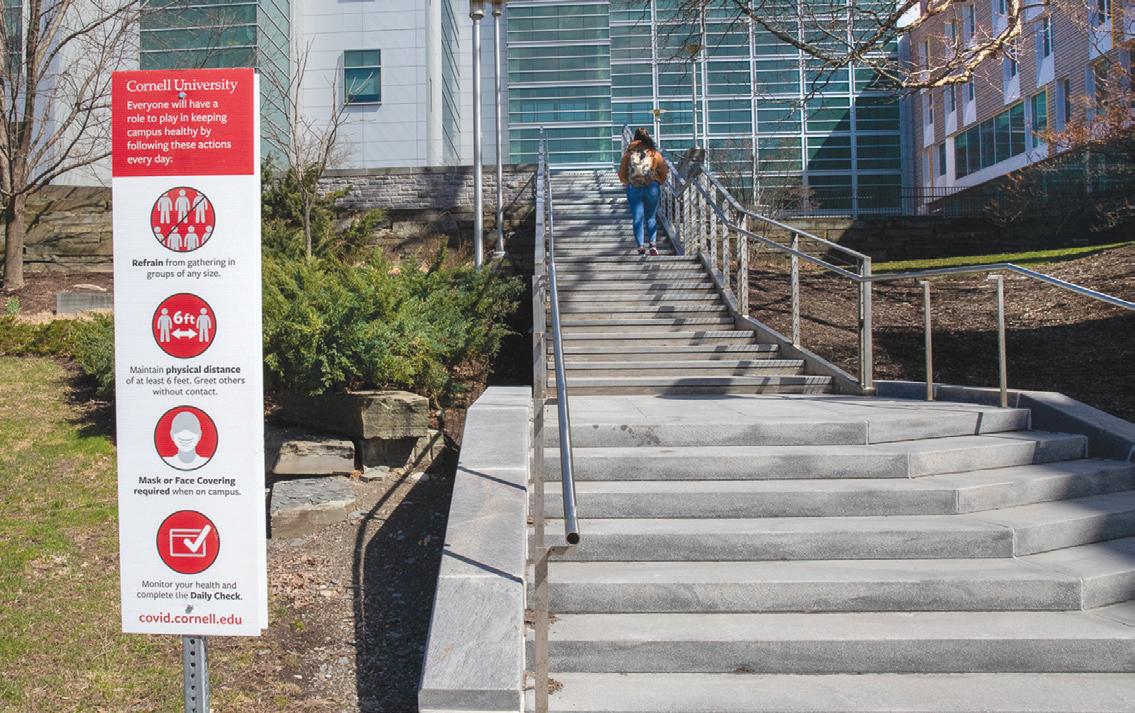
After more than two weeks in COVID-19 alert level yellow and following record-high case levels reported on campus, Cornell has returned to the green alert level, according to Cornell’s COVID19 Dashboard.
Cornell reported 19 positive cases in the past week, and of the 6,392 students and faculty tested Tuesday, Cornell only reported three positive cases.
Quarantine capacity is 74 percent available, marking a stark change from capacity levels that weeks ago hovered below 30 percent.
At the time of publication, the University has yet to send a campus-wide update notifying the
On March 19, the University went into yellow when Cornell reported 74 positive cases, tied to transmission among students violating public health guidelines including North Campus residents and those traveling outside of Ithaca. President Martha Pollack wrote at the time that an increasing number of students were ignoring virus restrictions and missing their surveillance tests and Daily Checks.
When Cornell moved to yellow, the University warned of entering into orange alert if COVID conditions worsened on campus, which would have
Community building | Schill looks to strengthen connections between Cornell and Tompkins County.
See SCHILL page 3
Action now | Protesters gather downtown Wednesday to support the Climate and Community Investment Act.
JULIA NAGEL / SUN ASSISTANT PHOTOGRAPHY EDITOR
Green again | A student walks past COVID-19 signage on campus.
By ANGELA BUNAY Sun Assistant News Editor



Ithaca Organizers Urge Climate Justice Ithacans
and students advocate for state climate bill
CLIMATE
Continued from page 1
what the CCIA includes.
Other activists then gave speeches about how climate change has affected them personally — including Eden Lewis, a sophomore at Ithaca High School and member of Our Climate, and Magnolia Mead, a senior at Ithaca High School who is part of Sunrise Ithaca and the Ithaca High School Green Team.
Lewis said she is worried for the safety of her extended family who lives in Greenville, North Carolina, because of past hurricane-related flooding in the area. Lewis advocates for the CCIA in part because of the disproportionate impact of fossil fuel emissions on the health of low-income communities and communities of color, as well as the risks these communities face due to climate-related disasters.
Global South as unjust.
“The actions that we take in the United States and in New York have major impacts on Guatemala and many countries like it.” Mead said. “My uncle told me that in recent years, coffee farms in lower altitudes have been failing because crops cannot grow.”
“Oil, mines and large factories are consistently located near Black and brown communities.”
Eden Lewis
Many of the activists present, including Lewis and Mead, said they believe climate change activism should include youth voices. Members of Mothers Out Front, including Merrill Hurst, Elisa Evett and Kathy Malcomson agreed, explaining that they came to the rally to both support youth activists and preserve a better world for their own children and grandchildren.
“My stake in this struggle is personal,” Lewis said. “Oil, mines and large factories are consistently located near Black and brown communities, leading to poor air quality and more health problems in those communities.”
“Passing the CCIA will motivate other states to champion similar climate justice legislation ... ”
Hannah Brodsky ’22
Mead’s family is from Guatemala, which is already beginning to experience the effects of climate change on crop yields. Mead sees the effect of the U.S. and Europe’s lack of climate action on countries in the
Katrina Cassell ’23, a student in the School of Industrial and Labor Relations, attended the event as a representative of the Ithaca Democratic Socialists. According to Cassell, the Ithaca DSA supports the CCIA in part because the legislation makes utilities more affordable, a cause that the Ithaca DSA is also trying to address locally through creating a rate payers union.
Hannah Brodsky ’22 said she sees the CCIA as an important part of the national fight against climate change. Brodsky and others present encouraged support for the THRIVE agenda in U.S. Congress, which aims to create green jobs, invest in Black and brown communities, fight environmental injustice and strengthen tribal sovereignty.
“New York has been leading the country when it comes to a just transition,” Brodsky said. “Passing the CCIA will motivate other states to champion similar climate justice legislation, helping communities across the country.”
Tamara Kamis can be reached at tkamis@cornellsun.com.
U.A. Votes to Cut ICE Ties, Expand Emissions Reporting
By SARA JAVKHLAN Sun Contributor
The University Assembly responded to ongoing nationwide, state and campus issues in Tuesday’s meeting — unanimously voting for Cornell to provide more transparent climate emissions reporting, cut ties with Immigration and Customs Enforcement and make Cornell a sanctuary campus.
The Cornell DREAM team, which advocates for the rights of undocumented Cornellians, introduced anti-ICE resolutions 17 and 19, after the Student Assembly passed similar legislation on March 25.
Resolution 17 calls on the University to cut all ties with ICE as it relates to on-campus recruiting, contracts with ICE-affiliated companies, training and research.
Resolution 19 calls on the University to make Cornell a sanctuary campus. This would create a series of policies to protect undocumented students, fauclty and staff from ICE enforcement — which would include restricting ICE agents from coming to campus unless they have a valid judicial warrant, instructing campus police not to cooperate with ICE when no warrant is available and witholding information about one’s legal status with ICE if there’s no court order.
Several other college campuses across the country have already established themselves as sanctuary campuses, including the University of Pennsylvania, Swarthmore College and Wesleyan University.
Presenting on these resolutions, Stella Linardi ’22 spoke about ICE’s long history of brutality against undocumented people through raids, deportations and family separations at the border, as well as its role in committing human rights violations in detention facilities. Linardi called the University to uphold its “any person, any study” motto by protecting its undocumented students, faculty and staff.
Undergraduate representative Bennett Sherr ’21 later introduced Resolution 18, which encourages the Board of Trustees to revoke Gov. Andrew Cuomo’s (D-N.Y.) ex-officio membership, as well as his place on the Committee for
University Relations. The assembly tabled the resolution indefinitely in a 14-1 vote.
The assembly voted to table the resolution because of concerns about maintaining communication between the governor’s office and the University, as well as the symbolic nature of the motion. They also expressed concern over whether the U.A. should make this type of request from the University.
Sherr said the resolution responds to the allegations of sexual misconduct that multiple women have made against Cuomo. These calls to revoke the governor’s ex-officio membership also respond to his role in underreporting COVID-19 deaths in New York State nursing homes, for which an impeachment investigation will soon be underway in the New York State Legislature.
disclosed its data on natural gas used to generate campus electricity and responds to the potential underreporting of emissions numbers.
“The suggestion now is ... to find an outside expert consultant who can come in and perform an inventory in the interest of transparency,” Howarth said in a later interview. “Either show that what Cornell has been reporting is perfectly correct ... or conversely, that something is going on.”
“I view this as a reminder to them that this issue has not gone.”
Prof. Robert Howarth
“Serving as a voting member with policy influence on [the Committee on University Relations] is extremely troubling,” Sherr said in the meeting.
Resolution 18 recommends Lieutenant Gov. Kathy Hochul to replace Cuomo in both his Cornell-affiliated roles.
Assembly members raised concerns about the resolution over whether it was within the scope of the University Assembly to make this type of request to the Board of Trustees.
“If not us, then who?” Sherr said. “I don’t believe that the Board of Trustees would simply on their own go forth with this kind of proposal without some kind of recommendation to do so.”
The third major motion of the meeting, Resolution 21, passed unanimously. Prof. Robert Howarth, ecology and evolutionary biology, introduced the resolution. It calls for an independent audit report of the University’s greenhouse gas emissions and demands a new emissions accounting system to increase community transparency and responsibility.
The resolution states that Cornell has not publicly
The emissions accounting system that the resolution suggests follows accounting practices from the New York Climate Leadership and Community Protection Act, a recent state law that aims to significantly reduce greenhouse gas emissions — with the hopes of an 85 percent reduction in greenhouse gas emissions by 2050.
The new accounting system includes the counting of methane emissions, which the University’s current system does not include, according to Howarth.
Howarth said there is some debate as to whether Cornell is subject to the Climate Leadership and Community Protection Act, but he said he believes that Cornell should follow it.
According to Howarth, the Cornell Senior Leaders Climate Action group, appointed in November 2015, made a recommendation to the University in 2016 to revise its greenhouse gas emission accounting system to include methane emissions. However, Cornell did not adopt the measure, according to Howarth.
Howarth is cautiously optimistic that the administration will take some form of action now that Resolution 21 passed.
“In some ways, I view this as a reminder to them that this issue has not gone away,” Howarth said. “I’m optimistic that they will treat it positively … We’re not demanding anything in terms of fundamental changes in what the University is doing.”
Sara Javkhlan can be reached at smj227@cornell.edu.
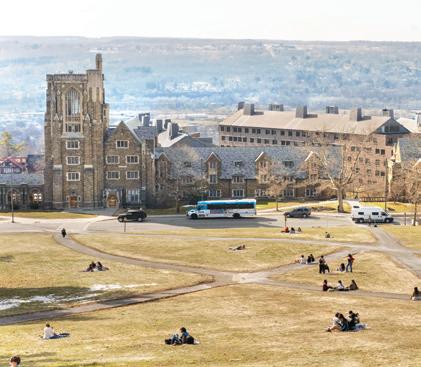
Te Slope Is a Main Hangout Spot. But Is it COVID Safe?
By HELENA PRATAMA Sun Contributor
Whether it be eating dinner with friends, watching the sunset, hammocking or even stargazing, students dot Libe Slope each day.
Since its founding, this famous Cornell location has served as a student hub — and as the virus has pushed students to hang out outdoors, the slope has bustled more than ever. But according to Prof. Luis Schang, chemical virology, COVID19 is still a risk to slope hangouts.
“Any situation in which any person gets in contact with people they would otherwise not be in contact with allows
the possibility of spreading the virus in different groups,” he said.
Schang said while the wind outdoors could carry COVID-19 infected droplets more than 60 yards, the viral load would decrease substantially compared to indoor gatherings. The density of people and the air exchange still matter outdoors, he said.
“It’s always better to be in open spaces where there is wind, but it is still important to keep the distance,” Schang said.
Still, for Raisa Junaidi, MILR ’22, the slope is a crucial part of a full Cornell experience. With a finite number of college years, Junaidi –- along with many other Cornellians –– continue to flock to the slope even during the pandemic.
Junaidi said she enjoys the view with friends who are not from the same household, but generally from the same friendship bubbles.
“I sit on the slope with my friends about two to three times a week,” said Kristan Nail ’23. She said while she felt students on the slope are sometimes too close to their peers, different student groups maintain at least a six foot distance from one another.
Qi Xie ’22 said he believes that hanging out on the slope is a relatively safe activity in a pandemic, especially since it is outdoors. “I feel safe because [on the slope] everyone is masked,” he said.
According to Qi, indoor activities such
as in-person exams seem like they might might pose a bigger risk than outdoor student gatherings due to the large number of people in an enclosed space.
However, Schang also said gathering on the slope is not risk free due to the tendency of students to eat and drink there.
“If we are going to be on the slope, and we keep the distance, and we keep the masks on and so forth, that is one thing,” Schang said. “If we take the decision to behave differently, it would be a different thing.”
Helena Pratama can be reached at hp438@ cornell.edu.
Legislature Seat Ithaca Cornell Campus Returns to
and sleeting,” she said, “knocking on people’s doors in the dark and hoping they would answer.”
projects for 10 years in Washington, D.C. and in Tompkins County. She earned her masters in regional planning at Cornell, and she’ll continue in her current position as the director of campus planning as she takes on her legislator role.
Jeanne Boodley-Buchanan, project intake manager for the campus planning department, has worked closely with Schill. She expressed confidence in
“She takes a lead for Cornell as far as making sure that we are
Schill explained that she wants to put her skills to use within a greater community, drawing on her connections at Cornell and throughout the county. While the pandemic complicated her run, she was up for the challenge.
“I was out in January nights after work time in the dark with a mask on and a hat on and a giant winter coat when it was freezing
together ... ”
Jeanne Boodley-Buchanan
Schill’s credentials as a legislator — describing Schill’s attention to places where Cornell students live, like Collegetown, and emphasized her potential to draw the Cornell and Tompkins County communities together.
“She takes a lead for Cornell as far as making sure that we are working together and have a plan that is workable for everybody,”
Boodley-Buchanan said.
After her first 24 hours in office, Schill has jumped on working with two committees: the Government Operations Committee, which covers legislation, law and public information, and the Health and Human Services Committee, managing resources for Tompkins County’s youth, elderly and veteran populations.
“It feels good to be back in a public servant role,” Schill said. “That’s something I identify with.”
Vee Cipperman can be reached at ocipperman@cornellsun.com.
moved all classes online, among other restrictive measures.
Weeks later, Cornell temporarily moved the Johnson School MBA Program online on March 26, after the University reported 63 new cases in three days — linked mostly to MBA graduate students who attended St. Patrick’s Day celebrations.
Now, the green alert means cases are rare and the transmission is under control, according to the COVID-19 Tracking and Reactivation Dashboard. The level also allows students to gather in masked and distanced groups of 10 or fewer.
The decrease in positive cases on campus comes after
the University announced its strictest repercussions yet for students who do not comply with surveillance testing.
As of March 30, students who miss their surveillance test lose access to Canvas, no longer able to access and submit assignments. Students who skip their tests will also lose access to University Wi-Fi and campus facilities, such as libraries and study spaces.
As campus only recently creeped out of level yellow, the University has announced plans for in-person classes next semester and will require vaccinations for students on campus. According to Tuesday data, 16 percent of the on-campus population has been vaccinated.
Dining Guide
Your source for good food

Stop Overpaying for Energy Bars: Grab a Snickers Instead
By AMELIA CLUTE Dining Editor
To avoid costing The Cornell Daily Sun any lawsuits, I must first disclose that I am not a nutritionist — the information in this article is purely anecdotal and should not be taken as nutritional advice. You know your body better than I know your body. Make the right choices for you. As a Division I athlete who spends anywhere from 20 to 25 hours a week practicing an endurance sport, I’m no stranger to overpriced — and frankly, nauseating — energy bars. One single stroll down the fitness food aisle in Wegmans reveals a plethora of cleverly marketed bars which, at their core, are nothing more than glorified candies. Clif Bloks, a popular quick-energy source for many endurance athletes from the creators of Clif Bars, closely resemble gummy bears in texture, taste and sugar content. One serving of Clif Bloks contains 14 grams of sugar, exactly the amount present in one serving of Trolli gummy worms. Don’t get me wrong — I’m not disparaging these products for having lots of sugar. You need carbohydrates to fuel a long training session. Some nutritionists even recommend that athletes consume “approximately [one quarter to one third] of your body weight (lbs) in grams each hour of training or racing beyond 45-90 minutes.” For a 150-pound athlete, this could equal up to 50 grams of carbohydrates per hour, or about the amount in two full size Snickers bars.
Of course, this is not to say that carbohydrates are the only nutrients which you should pay attention to while training. Sodium and fiber content can both play a huge role in an athlete’s performance and their sustained energy levels throughout a long workout. Companies like Clif emphasize the “sustained energy” that their bars provide, coming mainly from the four grams of fiber present in most bars. Clif Bars are very reliable workout fuel, but it can be hard to cough up the $1.30 per bar. Candies are a much more affordable — and tasty! — option in my experience, and their faults can be easily sidestepped with a little creativity.
To make up for the lack of fiber in many candies, I have found that eating three to four “fun sized” bars during training works best for me. This equals out to a similar amount of calories and sugar as a Clif Bar, but I avoid the inevitable sugar crash that comes from eating 25 grams of sugar in one sitting by spacing the candies out. In practice, the breakdown looks a bit like this: one candy before the workout,

and then one candy for every subsequent 25 to 30 minutes of endurance work.
As an old teammate once said, “If the fre’s hot enough, anything will burn.”
You may recognize this approach to workout nutrition as similar to the “If It Fits Your Macros” (IIFYM) line of thought. IIFYM emphasizes that all foods can fit into any diet if you do it right; it encourages the individual to focus more on a food’s macronutrient breakdown — the amount of carbohydrates, fat and protein — than its perceived “healthiness.” While many people prefer “unprocessed” sugars like maple syrup, someone following IIFYM might eat white sugar instead, citing their almost identical macronutrients. It’s worth noting that this style of eating has some obvious flaws; IIFYM can
downplay the importance of vitamins and other micronutrients which are crucial to good overall health. Additionally, IIFYM does not account for fiber which will slow the absorption of sugar and help prevent crashes. For this reason, I only apply the IIFYM approach during workouts when the amount of carbohydrates I eat is undeniably more important than how processed they may be. As an old teammate once said, “If the fire’s hot enough, anything will burn.”
Above all else, this is a call to recognize marketing scams in the health food sphere. Many companies advertise their products as healthy by labeling them with words like “unprocessed,” “organic,” “whole” or “all-natural” when in reality these products have similar effects on the body as their “unhealthy” counterparts. Cascadian Farm Cinnamon Crunch cereal, for example, adorns their packaging with phrases like “organic whole grain.” All the while, 100 grams of this cereal contains 30 grams of sugar, the same amount of sugar present in 100 grams of Froot Loops. At Wegmans, the Cascadian Farm cereal is $0.40 per ounce while the Froot Loops (when bought in a Family Pack) come as low as $0.23 per ounce. Marketing ploys like these justify most health foods’ astronomical prices by making the customer feel like they are making the healthy decision while companies benefit from our ignorance.
I’m not telling you to avoid all PowerBars, or to never eat Clif Bloks again. I am, however,
trying to raise awareness about how easily fitness foods can fool us with a bit of clever language. When working out, your body just needs fast, simple sugars; it hardly cares if this glucose comes from a Milky Way bar or expensive Honey Stinger gummies. American grocery stores are already overflowing with cheap, sugary products, so why overpay? I don’t recommend that you apply this logic to every meal, as I truly believe that all sugar is not
made equal. An apple will keep you fuller for much longer than candy will because of its fiber and water content, despite both foods being relatively high in sugar. But when working out, sometimes you just need some sugar — and your wallet shouldn’t suffer as a result.
Amelia Clute is a junior in the College of Arts and Sciences. She currently serves as one of the dining editors on Te Sun’s editorial board. She can be reached at aclute@cornellsun.com.

AMELIA CLUTE / DINING EDITOR
The Corne¬ Daily Sun
ANUSHYA ALANDUR ’23
Business Manager
CATHERINE ST. HILAIRE ’22
Associate Editor
PRANAV KENGERI ’24
Advertising Manager
ODEYA ROSENBAND ’22
Opinion Editor
JYOTHSNA BOLLEDULA ’24
News Editor
TAMARA KAMIS ’22
News Editor
WENDY WANG ’24
Arts & Entertainment Editor
KRISTEN D’SOUZA ’24 Design
HANNAH ROSENBERG ’23
OMSALAMA AYOUB ’22
OAK ’24
ANNIE WU ’22
MIHIKA BADJATE ’23
’24
’23
’22
WILLIAM BODENMAN ’23
AARON SNYDER ’23
MEGHANA SRIVASTAVA ’23 Compet
KATHRYN STAMM ’22 Editor in Chief
MADELINE ROSENBERG ’23
Editor NAOMI KOH ’23
OZA ’22
HEO ’24
OLIVIA CIPPERMAN ’23
NOOREJEHAN UMAR ’23
YOON ’23
VELANI ’22
PICHINI ’22
TYAGI ’22
MENDOZA ’24
ARANDA ’23
BASU ’23
RIGGS ’24
LEYNSE ’23
NAGEL ’24
’24
ABAYEVA ’24
’22

Darren Chang Swamp Snorkeling
Where Have Te Good Times Gone?
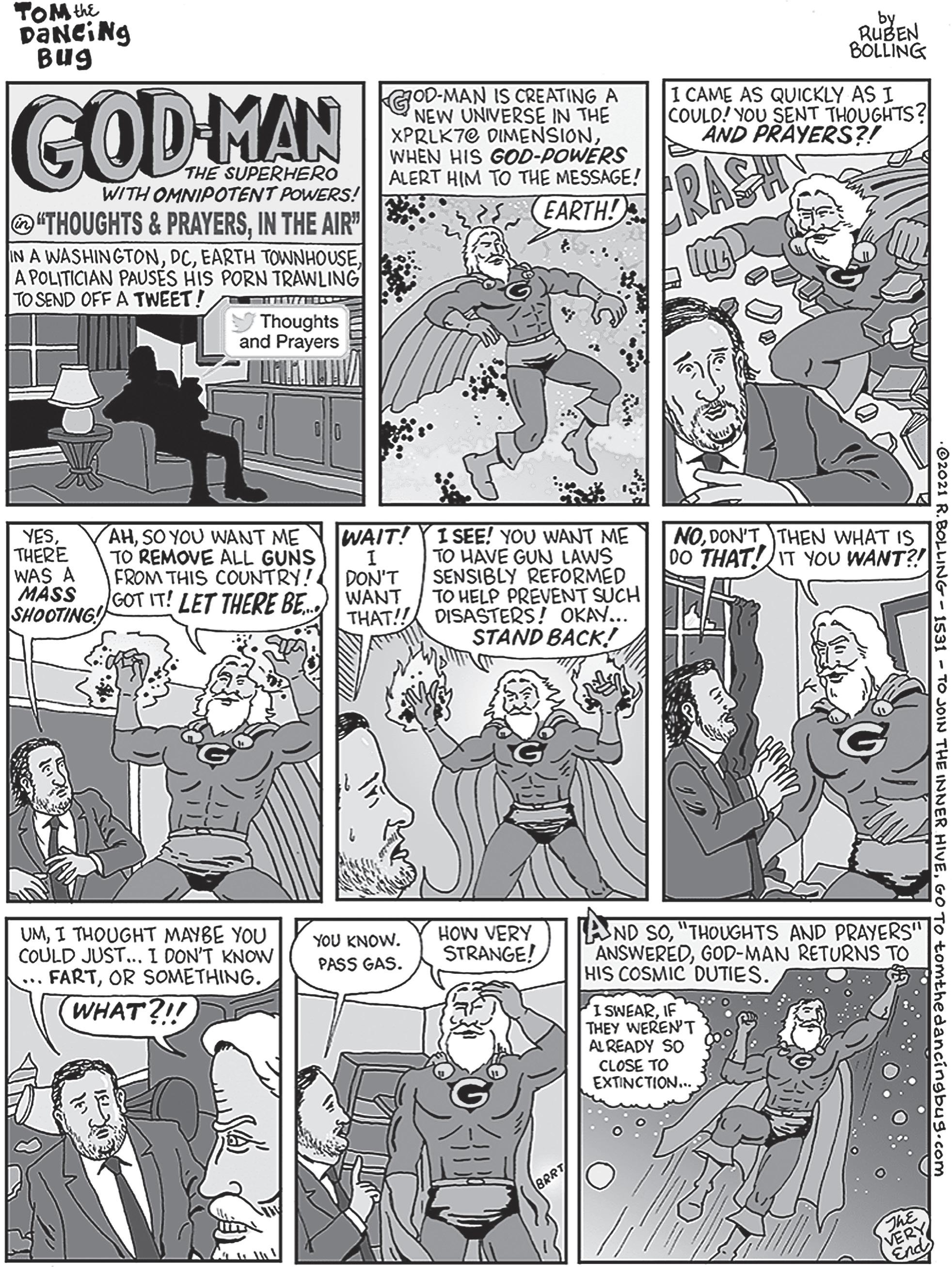
ITom the Dancing Bug by
Ruben Bolling
remember my senior year of high school fondly — perhaps a little too fondly. I took weekend trips to Kansas City and Chicago with my group of friends (any city is a big deal when you grow up next to corn in the Midwest). We hung out every day after school for hours and stayed up way too late after prom. I almost failed my government class but laughed it off, became friends with my teacher and got lucky enough to retake an exam (sorry Stuelpe!), graduate and end up in Ithaca in the fall nearly four years ago. Where has that senior energy gone? Where is the obnoxious, spontaneous and “willing to do anything” spirit that evolves from nowhere for each graduating class? I’ve looked everywhere for it, but it’s absolutely nonexistent. Instead, I’m wiped. And I know so many of my senior friends feel the same way. Instead of looking forward to each week and counting down the days until commencement on May 30, all we want to do is lounge around and scroll the days away on TikTok. We don’t miss classes out of spite for the professor or a genuine dislike of school. After all, everything is recorded so we have access to the material if we want to view it. We’re just done, and we don’t want any more.
the tragedy of 2021 — seems pointless. I didn’t pick the easiest senior year, either, which might have been my fault or my saving grace. I picked up an additional major at the start of senior year, so there’s still a few classes I need to pass to actually graduate. My clubs and responsibilities (like writing this column) have meant that I have to get up whether I like it or not.
I don’t regret coming back to Ithaca and I’m okay with my decision not to graduate early. But there’s still a lot missing from what is supposed to be the capstone semester of four years of gritty, hard work.
Obviously, COVID-19 has taken so much more than simply our time, mental health and energy. It has meant millions of lives lost and an emotional and physical burden on nearly everyone. The pandemic has destroyed our sense of purpose.
For the class of 2021, we don’t have Senior Days, we don’t have a spring break, we might not have commencement (c’mon President Pollack, we’ve asked you for information about this for months) and we might not be able to do anything during our summer break. To get up every day without an end goal in sight — just to be beaten down by more school, new restrictions or
The pandemic has destroyed our sense of purpose ... these last six weeks will be a crawl to the finish.
I can’t say I haven’t enjoyed parts of this year — there have still been so many good memories made and so many quintessential fun college moments. Cornellians have found creative ways to still enjoy themselves — from socially distanced meals to outdoor activities under the sun and the stars. I don’t regret coming back to Ithaca and I’m okay with my decision not to graduate early. But there’s still a lot missing from what is supposed to be the capstone semester to four years of gritty, hard work. Instead of college seniors, we’ve become senior citizens waiting till the end. During the fall semester, I called on everybody to get some rest. Many, many others have said that we need more breaks. Part of it is certainly the university’s responsibility. Of course the administration tried, but that doesn’t make finishing the semester here any easier. Much of what I write reflects what I’m going through at the moment, and this current piece is no different. These last six weeks will be a crawl to the finish. There truly may not be anything else to do besides waiting out the pandemic. Vaccinations are happening quickly and offices are returning to in-person work. By the time the class of 2021 begins their first job (or graduate school) in the fall, we might have some sense of normalcy. In the meantime, take those breaks. For the seniors, graduate and don’t fail your classes. Get that bread.
Together, we can lament as Van Halen does, wondering, “Where have all the good times gone?”
Darren Chang is a senior in the College of Arts and Sciences. He can be reached at dchang@cornellsun. com. Swamp Snorkeling runs every other Tursday this semester.
Are Han Chinese the ‘White People’ of China?

Weifeng Yang Poplar Sovereignty
Weifeng Yang is a masters student at the Cornell Institute for Public Afairs. He can be reached at weifengyang@cornellsun.com. Poplar Sovereignty runs every other Wednesday this semester.
As a Chinese citizen in America, the huge spike in anti-Asian violence since last year shakes me to my core. Stuck in Ithaca, I certainly feel helpless. As a Chinese student in America who, at the moment, has no plans to obtain American citizenship, these attacks should have been an opportunity for solidarity between the two groups. In the eyes of many of these hate-fueled attackers, there is no diference between us.
Solidarity, on some level, has indeed occurred. Most Chinese citizens in America (including me) still primarily identify as Chinese. For some of us, America represents half a decade of meaningful educational experience; for others, America represents a place to work and may even become a place to live. Since we have yet to call this place, it may be hard for us to identify with some of America’s political movements. Despite the fact that 2020 was a politically tumultuous year in America, my perception was that many fellow Chinese citizen Cornellians did not engage with the events unfolding in this country. Not this time. My fellow Chinese friends at Cornell have sensed a real identifcation with and attachment to the victims down in Atlanta, with the elderly man beaten up on the street of San Francisco and with other instances of anti-Asian discrimination.
At the same time, when the Atlanta shootings sparked

Katherine Yao Hello Katie
Katherine Yao is a sophomore in the College of Arts and Sciences. She can be reached at kyao@cornellsun.com. Her column, Hello Katie, runs every other Wednesday this semester.
During one of the wellness days in March, I took the advice on the Cornell University Instagram page to take a long walk around campus and refresh. My sense of rejuvenation lasted for all of two and a half minutes until I remembered an assignment deadline fast approaching. I spent the majority of those two days catching up on work and cramming for a quiz scheduled for the Friday of that week. Based on the number of people hunched over laptops in the Physical Sciences Building where I was studying, I wasn’t the only one who viewed wellness days as synonymous with workdays.
I hate to break it to you, Cornell, but four random days off during the semester don’t count as a real “mental health break.” Even during a non-pandemic semester, by this point in the year students are running on fumes. Spring break usually acts as an oasis of reprieve within the mid-semester slump and offers a chance to muster up enough motivation
a political awakening among Chinese Cornellians, the atrocities back home against our Uighur brothers and sisters have become worse. Some American frms are even boycotting cotton sourced in Xinjiang due to allegations that these products were made by Uighur forced labor, conducted through schemes of “transfer labor.” Tese atrocities have severely impacted China’s global reputation, so much so that it has even afected our community here at Cornell, when the Faculty Senate voted to oppose a partnership with Peking University in Beijing, China.
Of course, just like anti-Asian violence did not emerge out of nowhere in March, the human rights violations against Uighurs — not just in Xinjiang but throughout China — also did not emerge out of nowhere. Before the Chinese government ofcially recognized “re-education camps” existence after months of denial, some of the earliest international reports regarding the “re-education” camps emerged in mid2018, with Te Economist and Reuters documenting these mass facilities through satellite images and construction contracts. More and more horrifc reports regarding the state’s suppression of our Uighur compatriots have emerged. Te reports include the problem with “leftover children” and the use of detainees as a mass labor force, many even contributing to the PPE production. Te list of violations is exhaustive, both numerically and mentally, and is certainly damning evidence against the Chinese government.
But what about us, Chinese citizens, here at Cornell? Or, more speci f cally, what about Han Chinese students currently living in America? What is our responsibility? It is encouraging to see fellow Chinese citizens in America increasingly embrace the pursuit for racial justice in the American dimension. But is being “woke” only through this dimension enough, or even morally justifable? What about the Chinese dimension?
Tere, of course, seldom exists a public distinction between Chinese-Americans and Chinese citizens (Chinese law doesn’t allow for dual citizenship) who live in America. We face the same stereotypes and fetishizations, proven lethal by the Atlanta shootings, the same “bamboo ceiling” that sufocates us, and the same scapegoating for the horrifc pandemic.
Tis can enable us to truly sympathize with the plights of minorities in our home country — namely Uighurs and many others including Hui, Tibetans, Mongolians and Kazakhs. Tere is evidence that many
Give Me a Break
to tackle the latter part of the semester. Regardless of how much you might love your major or your life in Ithaca, experiencing some level of burnout proves inevitable. Now, throw COVID burnout and Zoom fatigue into the mix along with that good ole’ school stress, and an extended break becomes more vital than ever.
On a topical level, I fully understand why Cornell decided to cancel spring break. More time off equates to more opportunities to travel, party and engage in other unsafe behavior and thus, a higher probability of spreading the virus. However, the hard truth is that shortened breaks do not prevent people from breaking the rules of Cornell’s COVID protocol. For the wellness days in March, many students traveled out of state and some may try to leave campus again for the long weekend in April. Furthermore, large MBA student meetings as well as North Campus dorm gatherings led to coronavirus outbreaks during a normal stretch of the semester.
Recently, as a result of these spikes in cases, Cornell was forced to listen. The school enacted a series of consequences for non-compliance that includes loss of access to Canvas and campus WiFi
A week long spring break would have been possible this semester — and it would have shown that Cornell values our mental health just as much as our physical health.
Chinese citizens at Cornell did become more aware of their plights. On Cornell Confession Wall’s Instagram page — a Chinese free-speech platform provided by an anonymous Chinese student at Cornell, where people talk mostly about “gossipy” stuf — the controversy of “Xinjiang Cotton” has been lively debated. Tis has also been given signifcant attention back in China as the government has ramped up a boycott campaign to retaliate against international brands boycotting Xinjiang products. I am genuinely surprised to fnd so many other like-minded Chinese Cornellians who also detest what our government has done.
Still, many comments that defend the current policy against Uighurs insist on drawing a vast distinction between the “American” and the “Chinese” dimension. One could argue that, just like how many Chinese citizens in America do not consider themselves a minority here, despite the way American society deems us, many Han Chinese individuals refuse to genuinely consider themselves as the privileged ethnicity in China, the “white people” of China, for instance.
If we dig deeper, “whiteness” can undoubtedly be manifested not only in the racial dynamics of the West. Unlike minority races, “whiteness” is often the “absence of race,” the “default man.” America’s utilities and services have been designed to serve this default “white man,” causing immensely harmful consequences to others. It is no wonder, then, that as the politically dominant group in China that is also 90 percent of the country’s population, Han Chinese are considered the “default man” in China.
In China, Han ethnicity is the “absence of ethnicity.” For a country that simultaneously wants to embrace the idea that China is a “multiethnic” country and somehow a “Han nation-state,” there, of course, will exist a racial dynamic in the Chinese dimension that is comparable to the American dimension. Han Chinese are in a scenario where we are the “white people” of China, whose ethnic privilege also grants us an equal amount of moral culpability to the atrocities that are ongoing in our homeland. But, in America, we are among a greater minority who are victims of senseless and violent hatred because of our ethnicity.
Indeed, to be “woke” on the American dimension while completely indulging in the Chinese dimension is glaringly hypocritical. But what I fear more is that what fuels this cognitive dissonance is rather diabolical self-interest. How can you wake someone up, if they only pretend to be asleep?
Study days masquerading as wellness days just don’t cut it anymore. Not when professors ... assign work for the next week to make up for lost time.
networks. Many — myself included — have long questioned why the school has held off on penalizing missed tests, especially since surveillance testing acts as Cornell’s first line of defense against preventing community spread. The new revisions show that the school has always had the power to enforce testing compliance on campus. If such restrictions were in place from the beginning, would it have made a difference whether we got two school days off at a time as opposed to five?
Implementing a mandatory testing schedule during the one week of spring break would keep the large majority of students on campus and cautious while providing some much-needed quality time away from schoolwork. Study days masquerading as wellness days just don’t cut it anymore. Not when professors make homework due almost immediately after or assign work for the next week to make up for lost time. Not when failing to keep up with classes during the two days increases stress later down the road. A week-long spring break would have been possible this semester –– and it would have shown that Cornell values our mental health just as much as our physical health.

Fill in the empty cells, one number in each, so that each column, row, and region contains the numbers 1-9 exactly once. Each number in the solution therefore occurs only once in each of the three “directions,” hence the “single numbers” implied by the puzzle’s name. (Rules from wikipedia.org/wiki/ Sudoku)

Faster Than Light by Alicia Wang ’21





by Priya Malla ’21
Mr. Gnu by Travis Dandro
Mr. Gnu by Travis Dandro


Dake ’13 Qualifes for U.S. Olympic Wrestling
Four-time NCAA Division I national champion will compete in Tokyo
By GRAYSON RUHL Sun Contributor
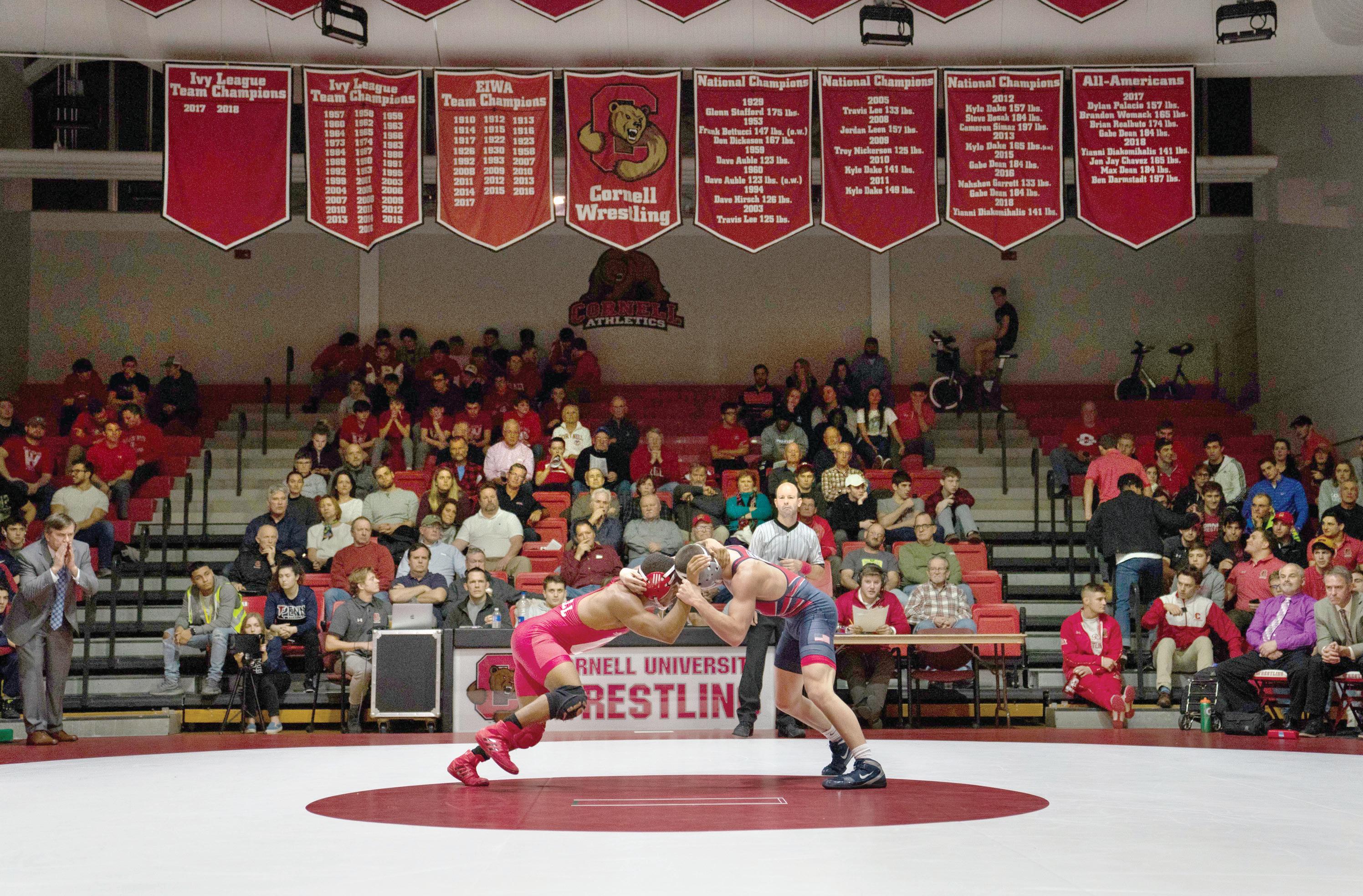
Kyle Dake ’13 has added another impressive achievement to the resume he first started building at Cornell — on April 3, the star wrestler qualified for the United States Olympic wrestling team, representing the U.S. in the 74 kilogram weight class.
Dake becomes the fifth former Cornell student to compete on the Olympic wrestling team, and the first to do so in 57 years. After defeating four-time world champion Jordan Burroughs, Dake will represent the U.S. in Tokyo at the rescheduled 2020 Olympic Games, which will kick off on July 23.
Dake is no stranger to dominance in the field of wrestling. He began his career as a freshman at Cornell, winning a collegiate national championship at the 141 pound weight class in 2010. He went on to win the national championship each of his next three years in the 149 pound, 157 pound and 165 pound weight classes.
Dake became the third athlete ever to be a four-time NCAA Division I national champion, and the first to do so in four different weight classes, as well as without a redshirt season. As a senior, he won the Dan Hodge Trophy, which the NCAA awards to the nation’s best
wrestler.
Following his illustrious college career, Dake transitioned to professional wrestling. His first major breakthrough came in 2015, when he took home the gold at the U.S. National Championships, wrestling in the 86 kg class. He became a two-time U.S. champion in 2018, moving down to the 79 kg class. Dake has had just as much success on a global stage, winning the 2018 World Cup, as well as the wrestling World Championship in 2018 and 2019, all in the 79 kg class.
Dake becomes the fifth former Cornell student to compete on the Olympic wrestling team.
match win streak. At the U.S. qualifiers in Fort Worth, Texas, Dake competed in the 74 kg class. He faced off against three opponents on his path to represent the United States, defeating Evan Wick 10-0 in the Challenge Tournament Semifinals, Jason Nolf 11-0 in the Challenge Tournament Final and finally taking down Olympic gold medalist Jordan Burroughs in a best-of-three series, 3-0, 3-2.
At his post-match press conference, Dake discussed the influence that Burroughs, a four-time world champion, had on his wrestling career.
Heading into the Tokyo Olympics, Dake is currently on a 44
“I told [Burroughs] that I really appreciate him, he has pushed me for a long time,” Dake said. “His work ethic, the way he approaches the sport, the fact that he’s a ... world champion is something I strive to be.”
He also expressed his excitement to represent the United States in Tokyo. “[I] put in a lot of hard work and it’s nice to see that it’s paid off thus far,” Dake said. Asked about his goals for competing in Tokyo, Dake’s answer was immediate and direct: “Gold medal. Go out and perform, make it happen. I’m gonna have to go out and compete at a high level and every single time I step on the mat that’s what I’m gonna have to do so I’m excited for that opportunity.”
Grayson Ruhl can be reached at gpr35@cornell.edu.
Dominant | Kyle Dake ’13 is currently riding a 44 match win streak.