Tis year’s Great Backyard Bird Count saw participation from citizen scientists across the globe. | Page 10
Arts
WEDNESDAY, APRIL 8, 2026 n ITHACA, NEW YORK
Alt-rock anthem
Te Sun spoke to the Ithaca-based “osteological alt-rock” group Wise Bones. | Page 14
Features
Speedy swimming Sophomore Josh Toothman broke the Red’s record for fastest 50-yard freestyle. | Page 12
16 Pages – Free
Asteri’s Aftermath: Displacement, Dangerous Conditions, ‘Predatory’ Cash for Keys Scheme
By VALENCIA MASARRO Sun Senior Writer
March 27 — Asteri resident David Carter said he was told by Asteri building management that he “only had one day to get out” of his apartment on March 4. He packed his essentials into two Wegmans bags, he told The Sun, unsure where his next move would be and when he would return home again.
Carter is one of the roughly 200 residents forced to leave their apartments on March 4 after the city ordered residents to vacate due to fire and safety concerns, which created an immediate hazard.
He was also one of the residents offered $2,000 by the Vecino Group, Asteri’s owners, in exchange for his apartment.
That cash-for-keys initiative, which pays residents to move out before their leases end, has been criticized as “predatory” by some, including the Ithaca Tenants’ Union, because residents would be released from current and future leases and are prohibited from pursuing legal action against Vecino, often without fully understanding what they are signing.
Following the order to vacate, residents were displaced to hotels like Quality Inn, where their stays were funded by the Vecino Group. The order to vacate was lifted on March 20.
While the order to vacate has been an immediate concern for the residents, the city of Ithaca and the Vecino Group, it is just the most recent development in a string of ongoing concerns related to the building.
Asteri, a $96 million affordable housing development in the Ithaca Commons, opened in August 2024 with 181 apartments, including 40 with on-site support services for people struggling with homelessness. This project was funded both privately and publicly by Tompkins County, as well as state and federal partners like New York State Homes and Community Renewal, Empire State Development and Tompkins County Industrial Development Agency.
“Ensuring the life safety of the building has been the City’s top priority,” acting City Manager Dominick Recckio said, according to a March 20 press release.
“Predatory” Cash-for-Keys
Since February, The Vecino Group has been incentivizing residents moving out through a cash-for-keys initiative. According to agreements made by Asteri obtained by The Sun, the building owners offer $2,000 if residents “fully vacate and surrender possession of the premises” within five days. Signing this agreement releases both Asteri and the resident from any obligations associated with leases.
Alan Karasin, director of the City of Ithaca’s Department of Information and Community Engagement, referred to the initiative as “predatory” toward residents, as it leads them to “forgo” their rights.
Under Ithaca housing regulations, landlords are obligated to pay displaced residents double their monthly rent, prorated for each day they are displaced.
“Vecino knows they owe more money than they are offering,” Karasin told The Sun.
Jordan Berrios, an Asteri resident, told The Sun that this offer is still available. He declined when he was first offered cash for his apartment because he believes he has enough evidence
against the Vecino Group to build a habitability lawsuit, where he could earn a payout far more than $2,000.
“I wasted a whole year of my life … and we suffered greatly. ... A lot of bad things happen,” Berrios said.
Berrios is not the only one considering litigation regarding Asteri. Another resident, Wytheria Harriet, filed a lawsuit against the City on March 5 due to her displacement during the order to vacate.
This follows a different lawsuit initiated in May 2025, in which Harriet and eight other plaintiffs alleged Asteri failed to provide a place “fit for human habitation.”
The Ithaca Downtown Conference Center, which shares the building with Asteri, sued the Vecino Group in 2025, claiming that Asteri’s building managers did not take action despite repeated concerns about unhygienic building conditions and safety issues.
Ongoing “Dangerous Conditions”
For residents like Carter, who has lived at Asteri for almost two years, while the order to vacate came as a surprise, the “dangerous” conditions which prompted it did not. He described Asteri as an unhygienic place to live, with dog feces scattered around hallways and broken windows. In video footage from 12 News, trash, needles and broken glass within stairwells are visible, along with soot from a fire from over a year prior.
“Vecino hasn’t just failed to handle the situation at Asteri. Rather, Vecino’s failure to adequately staff and manage the Asteri residences actually created the situation at the building,” Legislator Deborah Dawson (Seventh District), who also serves as TCIDA Chair, told The Sun.
Support services were available for residents who were displaced: many were housed in hotels, and the Tompkins County Public Library offered a warm place to stay during the day. Residents had access to free transportation through the Tompkins Consolidated Area Transit. Foodnet on Wheels and the City of Ithaca additionally provided two frozen meals to each returning resident to help ease the transition once the order was lifted.
Cornell Accepts 5,776 Students to Class of 2030
The admits hail from all 50 states and 102 countries and plan to study nearly 80 different majors across Cornell’s eight colleges.
By CORAL PLATT and ATTICUS JOHNSON Sun News Editors
Architecture students cobbled together their 125th wooden Dragon Day sculpture, and Cornellians began driving, flying, busing and biking away for a break
And, at approximately 7 p.m., applicants to Cornell opened their decision letters to the sound of Cornell’s alma mater, welcoming them to join the 5,776 students in Cornell’s admitted Class of 2030.
The newly-minted admits to the Cornell community — hailing from all 50 states and 102 countries — will join a community of students studying nearly 80 majors across eight different colleges.
From A.D. White Library’s study nooks to spikeball tournaments on the Arts Quad to checking boxes on the 161 Things list, the Cornellian experience awaits the newly admitted class. Admitted students can get a preview during Cornell Days on April 11, 12, 18 and rest of the Cornell community in August.
number of students admitthe Class of 2030 decreased by 0.8% from the Class of 2029’s acceptances. Last year’s acceptances by Ivy Day totalled 5,824, 48
admits more than this year’s batch.
There were several changes to the Cornell application process since the Class of 2029’s admission cycle.
For the first time since 2020, Cornell applicants were required to submit their SAT and/or ACT test scores.
Additionally, following the November settlement between Cornell and the Trump administration to restore over $250 million in federal funding to the University, Cornell is now required to provide “anonymized undergraduate admissions data” to the federal government, according to the settlement. The data will be broken down by “individual schools, race, grade point average and standardized test performance.”
Early decision applicants were notified of their acceptances on Dec. 18, and are fully committed to attending Cornell with the exception of financial concerns. Students admitted on Thursday will have until May 1 to accept their offer.
Residents relocated | Residents of the Asteri building were displaced after an Order to Vacate by the city of Ithaca.
NATHAN ELLISON / SUN PHOTOGRAPHY EDITOR
A LISTING OF FREE EVENTS ON CAMPUS AND IN ITHACA
Panel:
Film:
SUNBURSTS: Dragon Day
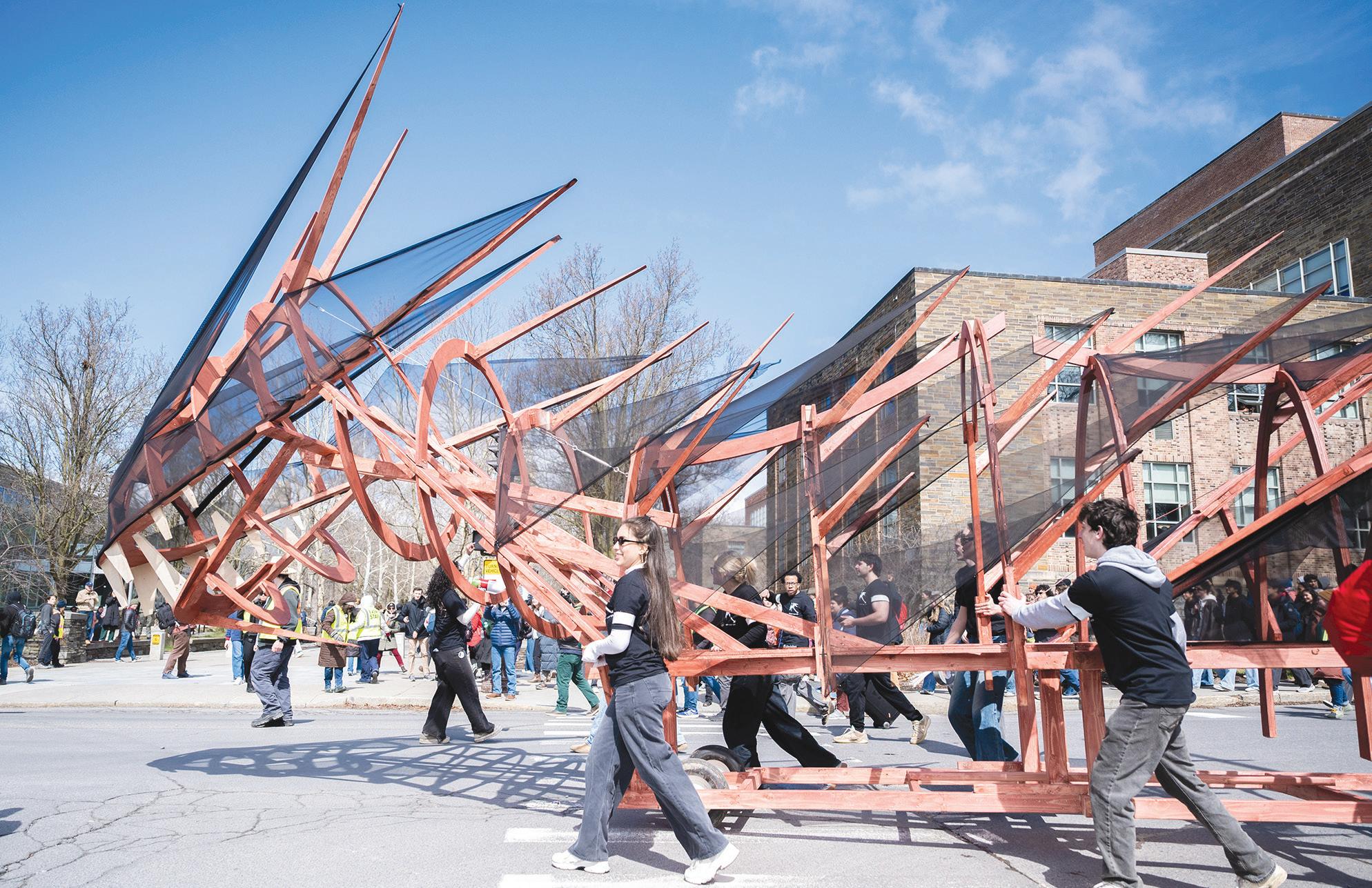
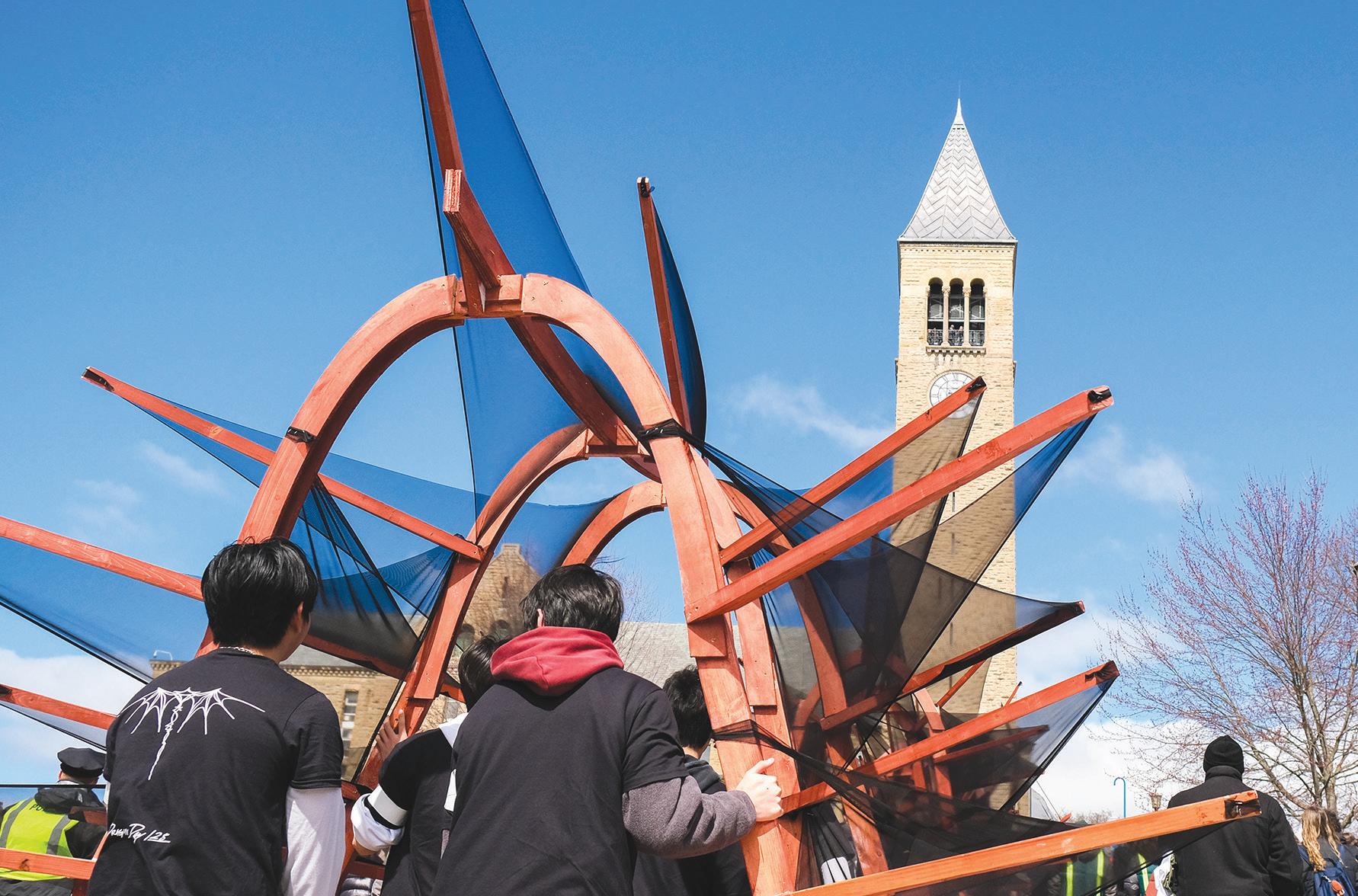
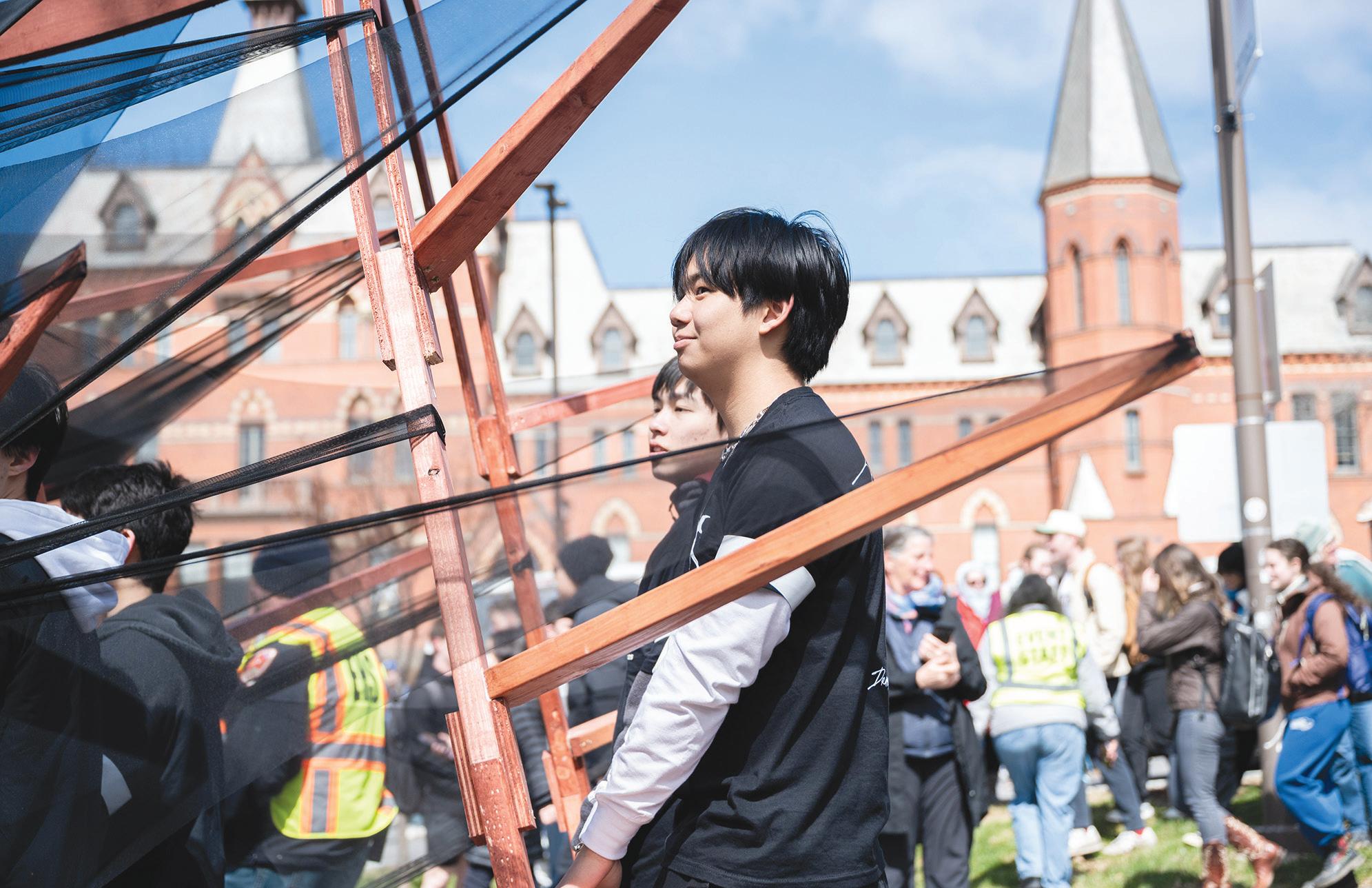
First-year architecture students construct a veiled dragon out of fabric and wood and celebrate the 125th Annual Dragon Day on March 27.
By SUN PHOTOGRAPHY DEPARTMENT
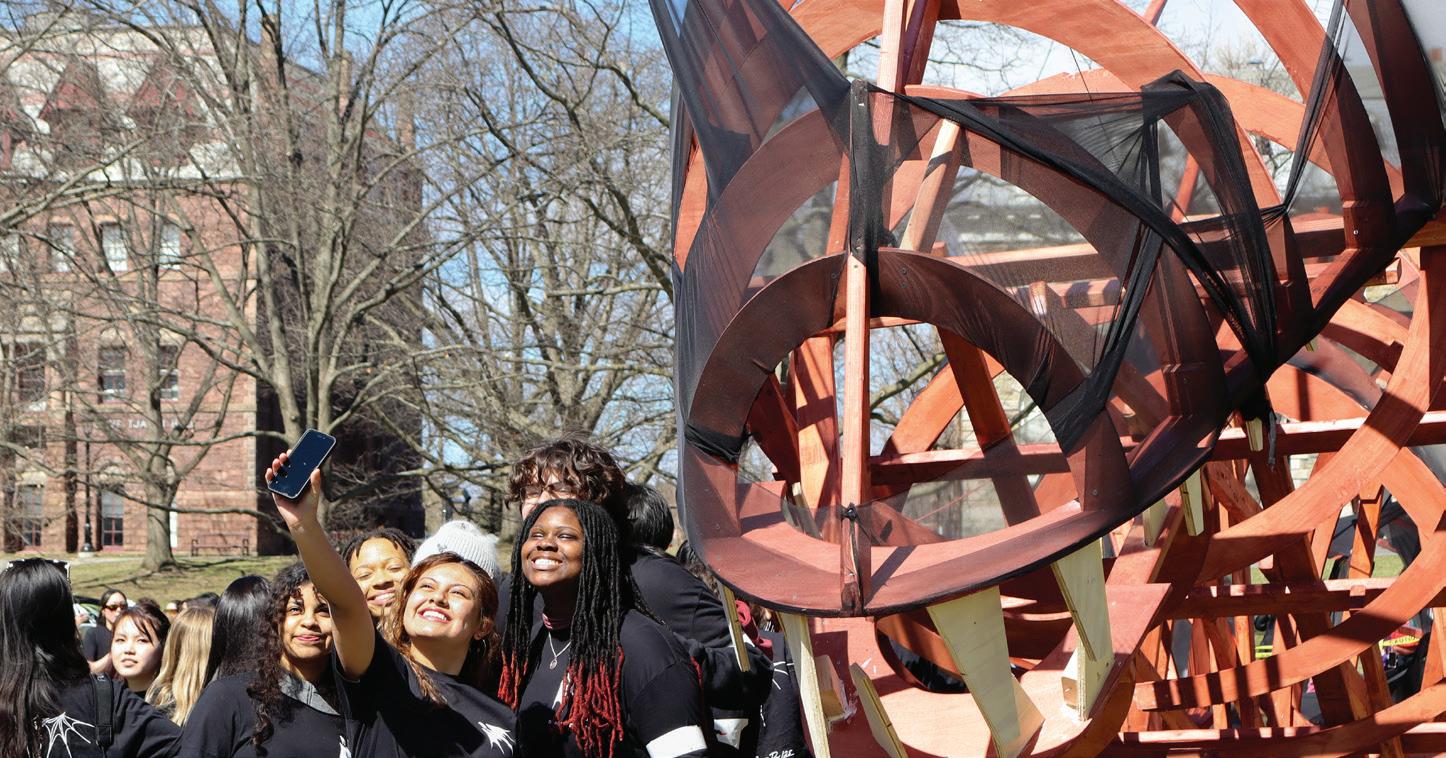
OI, OI, OI! | Freshmen partake in the College of Architecture, Art and Planning’s tradition of Dragon Day and chant “Dragon Dragon Dragon” while marching.
SOARING HIGH | The students parade the dragon through Ho Plaza en route to the Arts Quad.
FIERY EYES | A student sports a cardboard dragon head with bright red eyes while watching the parade.
FEATHERED RIVAL | Engineering students construct a towering phoenix in response to the architecture students’ dragon — a yearslong Dragon Day tradition.
TEAM EFFORT | First-year architecture students work together to carry the wooden dragon across Tower Road to Ho Plaza.
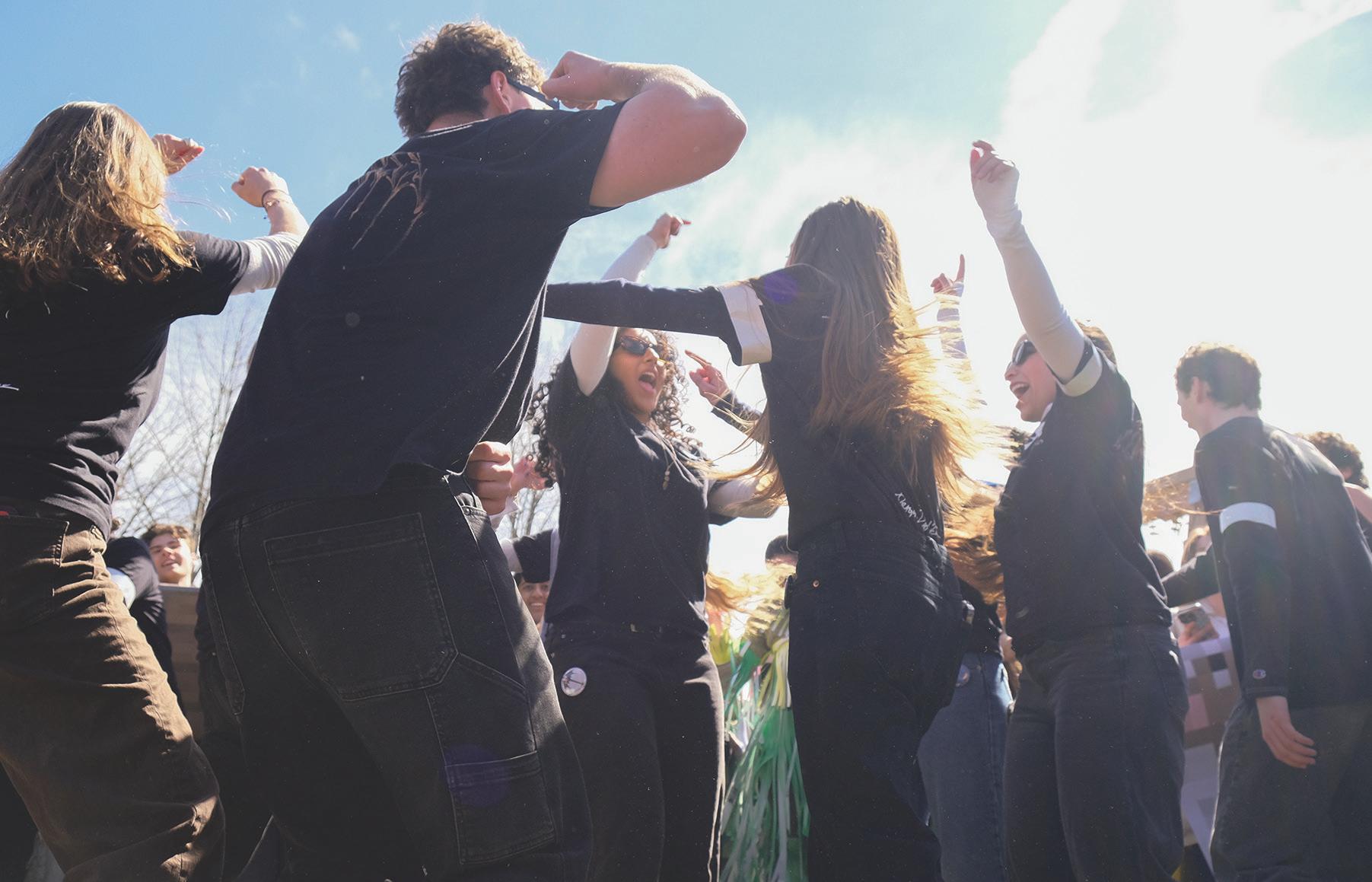
REACH FOR THE SKY | Students celebrate Dragon Day on the Arts Quad with music and dancing.
Annie Park / Sun Staf Photographer
Photo
Rosey Limmer / Sun Staf Photographer
Nathan Ellison / Sun Photography Editor
Nathan Ellison / Sun Photography Editor
Adelaide Chow / Sun Assistant Photography Editor
Adelaide Chow / Sun Assistant Photography Editor
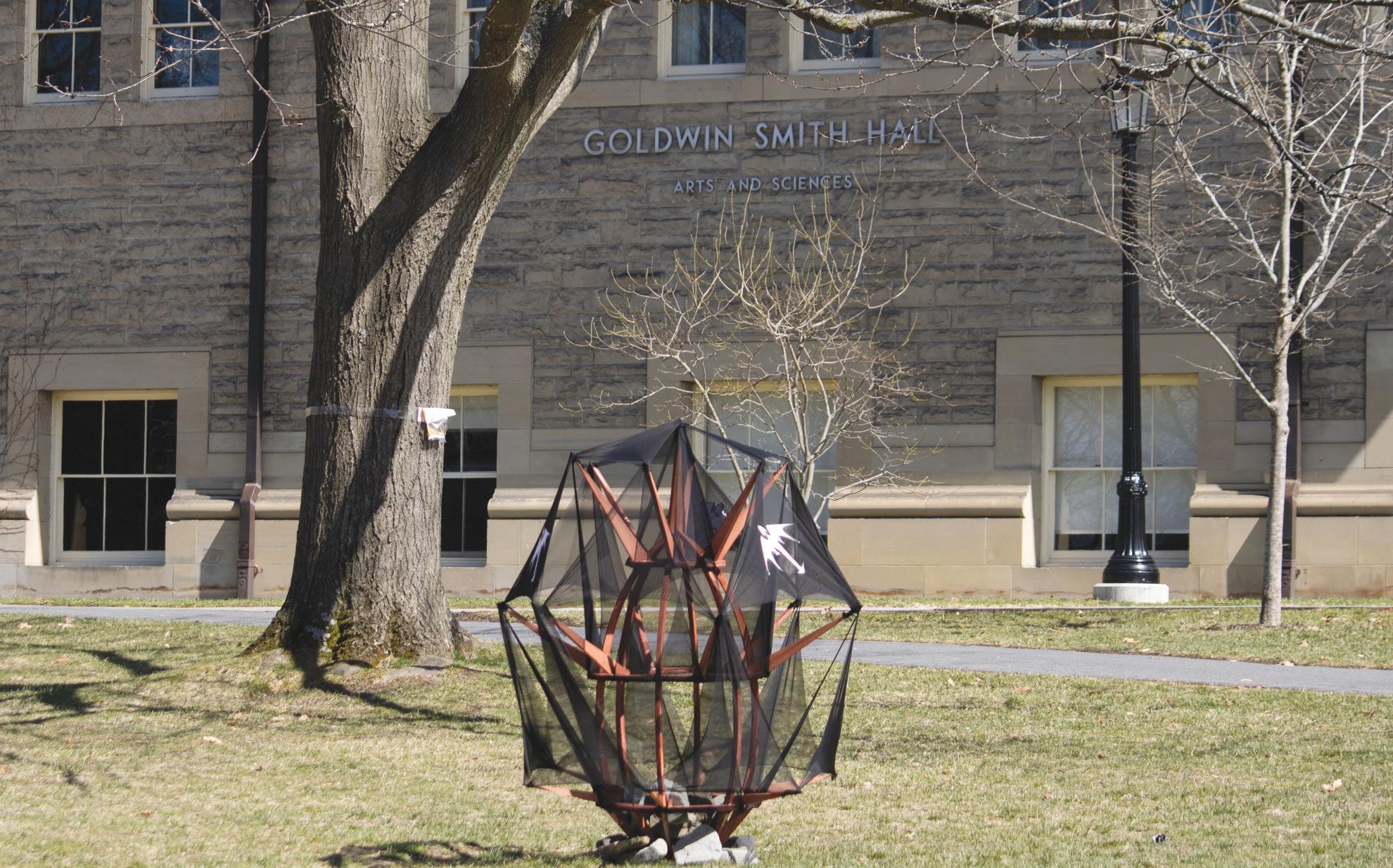
HATCHED!!! | The Dragon Day Egg sits on the Arts Quad in front of Goldwin Smith Hall in anticipation of the 125th Dragon Day Parade.
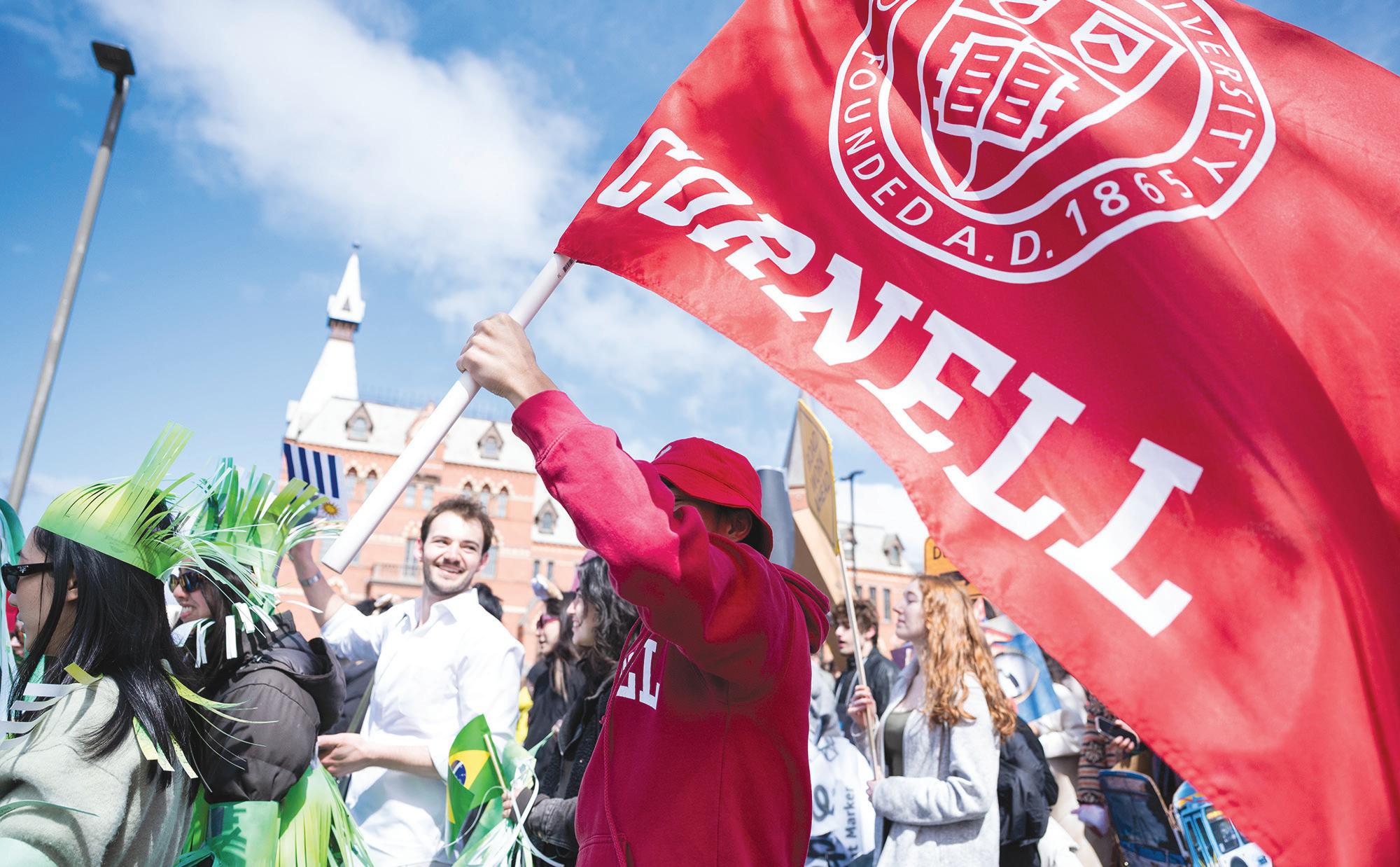
BLAZE OF GLORY | Cornellians show their spirit with bright flags as they parade behind the 125th dragon.
Rosey Limmer / Sun Staf Photographer
Nathan Ellison / Sun Photography Editor
Admitted Class of 2030 Shares Ivy Day Stories, Anticipates Fall Arrival
By CORAL PLATT Sun News Editor
April 6 — While over 16,000 undergraduate students at Cornell prepare for the final four weeks of class this semester, another 5,776 students in the recently-admitted Class of 2030 anticipate their arrivals to campus and commitment decisions.
The Sun spoke to some admits who shared their decision stories, excitement and nerves about attending Cornell.
Decision Day
Informally known as “Ivy Day,” all eight Ivy League schools release their regular decision acceptances on the same day — this year, Ivy Day fell on March 26. Regular decision admits in Cornell’s Class of 2030 opened their application portals on to a burst of confetti and the University’s alma mater.
While the majority of students were accepted through regular decision, others applied and received decisions through other means, such as a binding early decision application or the QuestBridge National College Match, which offers a binding decision with a full-ride scholarship for low-income students.
Regardless of each student’s acceptance timeline, opening up decisions elicited a range of reactions across the admits.
Nerves ran rampant for some.
Anushka Pophali, from Basking Ridge, New Jersey, plans to study healthcare policy if she commits to Cornell, and shared that her lead-up to Ivy Day was not stress-free.
“I was super, super nervous leading up to Ivy Day,” Pophali wrote to The Sun. “I spent most of that Thursday in a daze while my friends tried to distract me from my feelings of impending doom.”
She added that felt “extremely relieved” and cried after receiving her acceptance.
Upon opening his acceptance, “[four] years of stress basically vanished at once” for Josh McMurray ’30, a student from Hollywood, Florida who plans to major in math and is also considering double or triple majors in sociology and statistical science. He also had a tearful acceptance.
“I sobbed for roughly 30 minutes,” McMurray added.
Others, such as Felisha Liang ’30, a fiber science student from Taiwan, felt differently before the decision arrived. Ivy Day did not feel like a “make-or-break moment” for Liang, who had already been accepted into another program she liked.
To continue reading this article, please visit www.cornellsun.com.
Coral Platt can be reached at cplatt@ cornellsun.com.
Admin Discusses Housing, Financial
Aid, Federal Policy at BSU Town Hall
By EMMA SPINDLER Sun Senior Writer
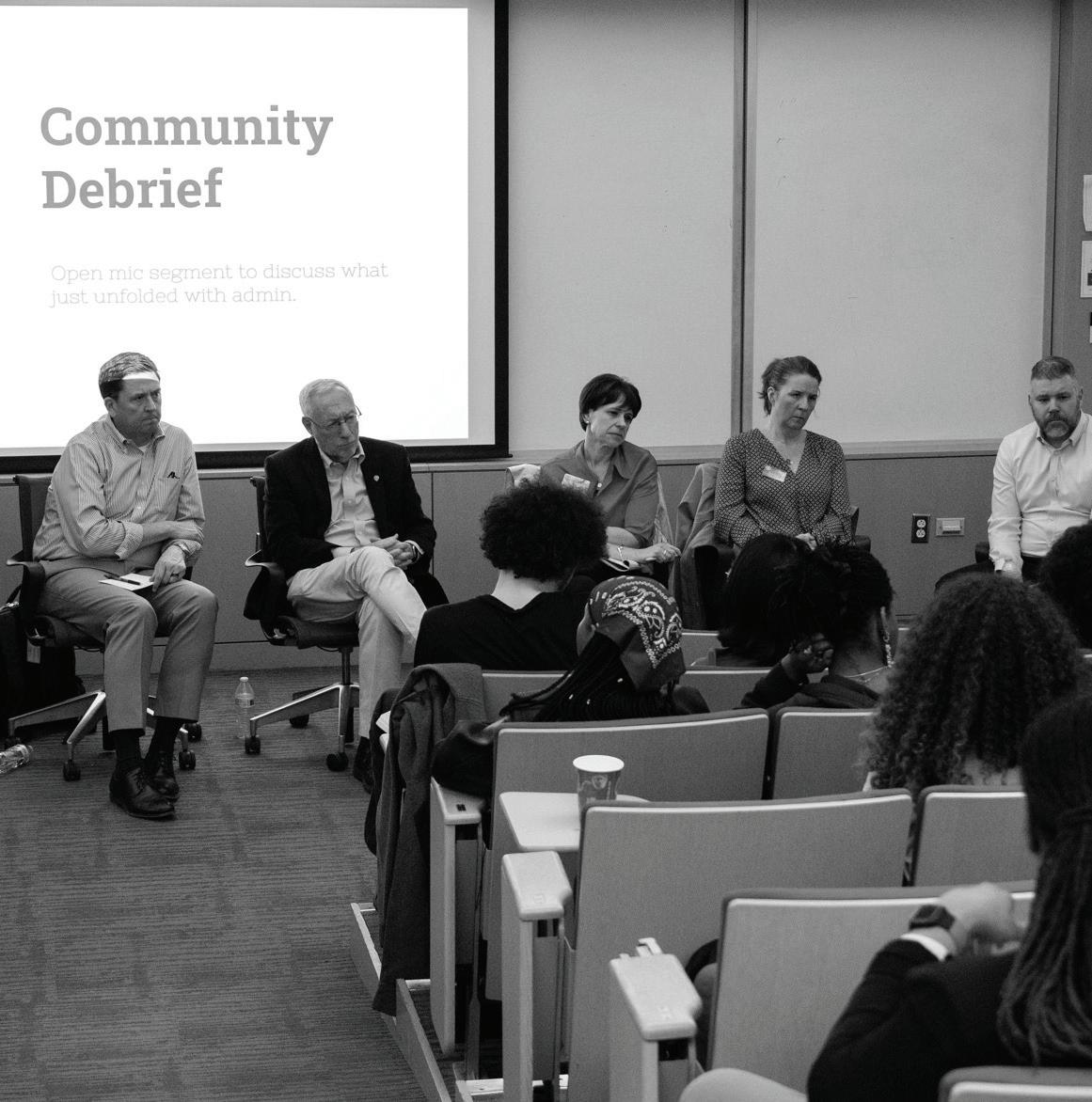
March 25 — University administrators met with students at a Black Students United town hall on March 10, where attendees raised concerns about housing assignments, financial aid policies, federal agreements and access to student support services.
Students repeatedly emphasized a lack of transparency and consistency in these systems, particularly in housing placements and financial aid calculations, while administrators pointed to existing processes and resource constraints.
The panel comprised President Michael Kotlikoff, Ryan Lombardi, vice president of Student and Campus Life, Dean of Students Marla Love, Kath Fenzel, director of housing operations and administration, Director of Residential Life Abby Priehs and Dan Sweeney, assistant vice president of finance and operations in Student and Campus Life.
Students asked prepared questions before an open
forum discussion.
Housing Questions about housing assignments, specifically about placement in Ujamaa Residential College, were a central focus of the discussion.
“What criteria are used when determining placement, and how are those criteria aligned with Ujamaa’s historic mission as a cultural and community center?” one student asked the panelists.
Administrators said there is no formal application process for most program houses and that students are expected to “respect the mission” of the community they have been placed or chosen to reside in.
In February 2025, the U.S. Department of Education sent a letter to federally-funded educational institutions, including Cornell, ordering the widespread elimination of “racial preferences” and otherwise race-conscious decisions in areas including admissions, hiring and institutional programming including housing, threatening loss of funding if universities failed to comply.
In response, BSU held an “Emergency Meeting” on Feb. 12, 2025, where students expressed dissatisfaction with the University’s handling of the directive, citing limited communication and a lack of clarity about how affinity groups and program houses, which many feared could be affected, would be protected or restructured under the new federal diversity, equity and inclusion guidelines.
During the town hall, panelists acknowledged that conflicts can arise between a student’s preferred placement and approved disability accommodations, in which case students may need to choose between options. They encouraged students with concerns to contact the housing office directly.
To continue reading this article, please visit www. cornellsun.com.
Emma Spindler can be reached at espindler@cornellsun.com.
Admin listens | Students asked administrators questions during the open forum discussion.
STEPHAN MENASCHE / SUN SENIOR PHOTOGRAPHER
Risley Shops and Teater Close for 2026-2027 Academic Year
By TEJU VIJAY Sun Staff Writer
March 27 - Cornell Housing and Residential Life announced that the Risley Theater and Shops will remain closed for the remainder of the spring semester and entire 2026-2027 academic year, in a March 2 email to Risley residents. The Sun spoke to performance and visual arts student groups, who said they want greater transparency and guidance from the University on how to move forward.
The theater and workshop spaces, located in the basement of Risley Hall, closed for the Fall 2025 semester as a result of an ongoing health and safety evaluation. The spaces will be closed for the 2026-2027 academic year “to address previously unknown infrastructure challenges,” HRL wrote in a statement to The Sun.
“As previously shared in our December update to residents, the Shops and Theatre remain under evaluation,” HRL’s March 2 email to Risley residents stated. “An external consultant has conducted a comprehensive evaluation of these areas, and Housing and Residential Life, Environmental, Health and Safety, and Student and Campus Life Facilities are working diligently to move
forward with next steps for the Shops and Theatre.”
A Center for the Arts
The Risley Theater, which first opened in 1974, has served as a performing space for student organizations like the Cog Dog Theatre Troupe, The Whistling Shrimp and Midnight Comedy.
Risley Theatre, a theatrical production company and student-run theatrical management organization, assembles the programming hosted within Risley.
In addition to a large stage and 81-person audience seating area, the theater includes a backstage space, side entrances, technical booth and adaptable sound and lighting systems, according to Risley Theatre’s website.
For David Gilmore ’28, president of Cog Dog Theatre Troupe, the Risley Theater “strikes a really good balance” for performance groups because it has “enough theatrical equipment that you can put on a show, but not too much that it’s super confusing.”
To continue reading this article, please visit www. cornellsun.com.
Nobel Laureate to Speak on Campus
By SHUBHA GAUTAM Sun Assistant News Editor
April 6 — Nobel Laureate in Physics John Martinis will present his quantum mechanics research on campus as a part of the Cornell Undergraduate Research Board’s new lecture series in Klarman Hall on Wednesday.
Martinis, who earned the Nobel Prize in 2025, will speak in the Rhodes-Rawlings auditorium as part of CURB’s “Frontiers of Discovery Lecture Series,” which hosts prominent researchers to speak on campus. During the event, Martinis will discuss the research that earned him the Nobel Prize and the greater impacts of his work; afterward, attendees can ask him questions during a moderated Q&A session, according to the event’s description.
Two other physicists share the Nobel Prize with Martinis, who is a professor emeritus of physics at the University of California, Santa Barbara. Michel Devoret, a professor of physics at UCSB, and John Clarke, a professor emeritus of physics at University of California, Berkeley, jointly earned the Nobel Prize with Martinis for the work they completed together in 1984 and 1985 that demonstrated “quantum mechanical properties on a macroscopic scale.”
Their work showed that the macroscopic system could be quantized — a quantum mechanics phenomenon where a particle “only absorbs or emits specific amounts of energy,” according to a press release by The Nobel Prize.
As co-founder and chief technology officer of Qolab, a quantum hardware company, Martinis currently works in quantum computing. Martinis previously shared the 2024 Fritz London Memorial Prize with Devoret and Robert Schoelkopf, professor of applied physics and physics at Yale University, and separately received the 2021 John Stewart Bell Prize for Research on Fundamental Issues in Quantum Mechanics and their Applications.
Sarvesh Prabhu ’28, chair of CURBx, a semi-annual event where undergraduates share their research in a TEDx-style presentation, is the lead organizer of Martinis’s Wednesday lecture.
Prabhu shared that the goal of the series is to bring in speakers from beyond Cornell.
To continue reading this article, please visit www.cornellsun.com.
Shubha Gautam can be reached at shubha@cornellsun.com.
Continued from page 1
While the city and Vecino group provided some support for Asteri residents, some residents experienced setbacks following the order to vacate.
Tony Morrow, a resident of Asteri since it opened, said he was kicked out of the hotel where he was staying after hotel staff thought he was using someone else’s name to stay there, leading to a six-day period where he was left essentially homeless.
“Nothing Like the Brochure”
Dawson said residents are “consistently and dangerously underserved” by the Vecino Group and building management.
According to Dawson, earlier this year, a man’s dead body sat in an Asteri apartment for days due to the “smell of the body being masked by the stench of piles of garbage in the hallway.”
The unnoticed body was one of the many concerns Dawson had about the safety and conditions of the building.
These concerns have prompted the TCIDA to issue a notice of default to the Vecino Group following the order to vacate. If the Vecino group doesn’t remedy their management problems, they could lose their tax abatement, which is roughly half a million dollars per year.
The blocked stairwell that caused the city of Ithaca to issue the order to vacate was just one of over 40 building violation codes the city found earlier this month, according to Dawson.
The Tompkins County Legislature also voted at their March 19 meeting to set aside $50,000 to help residents navigate housing instability and access legal resources in the wake of the order to vacate.
“Access to legal support at critical moments can make the difference between stability and displacement,” Legislator Shawna Black (Sixth District) said at the meeting. “We must do more to ensure that residents are not navigating these situations alone.”
The Asteri website boasts of “sophistication,” “health-minded living” and “urban luxury.” Berrios, who is unemployed and previously incarcerated, had “high hopes” when he was first considering applying for an apartment.
After living in Asteri for one and a half years, he said he realized that “it is nothing like the brochure.”
“People have died because of this circus,” Berrios said, “It feels like all of our brains are being altered … like a freak experiment.”
Asteri provides in-house services from Tompkins County Community Action, such as family support services, sobriety programs, rental assistance and a food pantry, according to its website.
Since the building opened, there have been reports of a woman threatened with an axe, a woman attacked in her apartment and a man stabbed in the chest. Residents describe high rates of crime and drug use.
In a November 2024 interview with The Sun, a resident said he views Asteri as “the new ‘Jungle,’” referring to the homeless encampments outside of Ithaca’s First Ward. Carter added that many residents from these encampments have moved to Asteri since the building opened.
Carter said he has noticed some security improvements since returning to the building, and that the building was “far worse” when he first moved in.
Now, he thinks Asteri may have “just been a bad idea.”
To continue reading this article, please visit www.cornellsun.com.
Teju Vijay can be reached at tv95@cornell.edu.
The Corne¬ Daily Sun
Independent Since 1880
144th Editorial Board
SOPHIA DASSER ’28
Editor in Chief
SOPHIA ROMANOV IMBER ’28
Associate Editor
RAYEN ZHOU ’29
Opinion Editor
ZARA CHEEK ’28
Opinion Editor
JADE DUBUCHE ’27
Multimedia Editor
BENJAMIN LEYNSE ’27
Multimedia Editor
SOPHIA TORRES LUGO ’26
Business Manager
DOROTHY FRANCE-MILLER ’27
Marketing Manager
KENDALL MURPHY ’28
Advertising Manager
VICTORIA WROBLEWSKI ’28
Human Resources Manager
MELISSA MOON ’28 Arts & Culture Editor
JAMES PALM ’27
Assistant Arts & Culture Editor
MATTHEW RENTEZELAS ’28
Assistant Arts & Culture Editor
HAZEL TJADEN ’28
Assistant Arts & Culture Editor
MARC STAIANO ’27
Assistant Arts & Culture Editor
KATELYN HALVERSON ’28
Lifestyle Editor
AVA BETNAR ’29
Assistant Lifestyle Editor
SANIKA SARAF ’28
Assistant Lifestyle Editor
KATHERINE ISTOMIN ’29
Social Media Editor
JOIE JEAN-PAUL ’29
Assistant Social Media Editor
ASHLIN KWONG ’28
Graphics Editor
TAVAN BHATIA ’27 Games Editor
Randi Weingarten
Randi Weingarten ILR '80 is the president of American Federation of Teachers. She can be contacted at rweingarten@aft.org.
Cornell’s Dangerous Compliance
CVARSHA BHARGAVA ’27
Managing Editor
KATE TURK ’27
Assistant Managing Editor
CORAL PLATT ’29 News Editor
ATTICUS JOHNSON ’28 News Editor
MARY CAITLIN CRONIN ’28 News Editor
EVERETT CHAMBALA ’27
Assistant News Editor
SHUBHA GAUTAM ’28
Assistant News Editor
GISELLE REDMOND ’28
Assistant News Editor
ANGELINA TANG ’28
Science & Technology Editor
TANIA HAO ’28
Science & Technology Editor
SIMRAN LABORE ’27
Weather & Climate Editor
MATTHEW LEONARD ’28
Sports Editor
GRACE REUBEN ’28
Sports Editor
JANE HAVILAND ’28
Features Editor
NATHAN ELLISON ’28
Photography Editor
NATHAN BO ’28
Assistant Photography Editor
ADELAIDE CHOW ’29
Assistant Photography Editor
MIA SOFIA ORENGO ’28
Video Editor
SMRITHE RAJESH ’29
Newsletter Editor
AMELIA GARCIA ’27
Data Editor
RENA GEULA ’28
Layout Editor
HUNTER PETMECKY ’28
Layout Editor
American Association of University Professors
Prof. Eli Friedman, Prof. Risa L. Lieberwitz and Prof. David Bateman from the Cornell Chapter of the AAUP can be reached at edf48@cornell.edu, rll5@cornell.edu and dab465@cornell.edu, respectively.
Cornell Must Not Fold to the EEOC
Beginning on March 17, many Cornell employees received emails from the U.S. Equal Employment Opportunity Commission asking that they partake in a survey to aid in an investigation of antisemitism on campus. No notice of this investigation had been provided by Cornell to the community, leading many to wonder whether this was a malicious phishing attempt. Te Cornell American Association of University Professors chapter contacted the Ofce of Civil Rights and IT@Cornell to ask whether Cornell knew of the emails and whether they were secure.
Cornell’s OCR was unaware of the emails, and after IT@Cornell confrmed that they were indeed from eeoc.gov, the AAUP pressed the president, provost, vice president for human resources and general counsel for more information. Eventually, Cornell acknowledged that it turned over information on current and former employees to the federal government sometime after August 2025, after being made aware of the investigation in July 2025.
In doing so, the University has ignored its responsibility to notify employees in the event of a request for information from the federal government. Te justifcation was Kafka-esque: Te commitment to notify afected persons only applies in the case of individuals, not “broad data requests” that cover all employees.
At our urging, on March 19, Cornell fnally communicated information about the EEOC emails to employees. Tis communication leaves
critical questions and issues unanswered:
1) All evidence points to an extremely broad information request by the EEOC. It is highly questionable that such a broad survey is needed to investigate what Cornell has stated is “a bias inquiry.” Te EEOC’s broad distribution of its survey seems to be more of a ‘fshing expedition’ rather than a fne-tuned investigation.
2) Cornell has acknowledged in an email that the data request was extraordinarily “expansive,” so much so that they sought the advice of outside legal counsel. While other universities have refused when presented with such expansive requests, Cornell decided to comply. Given the federal government’s pattern of overly broad demands to universities, why didn’t Cornell resist complying with this one?
3) People are receiving information at their personal email addresses. Cornell has now acknowledged that it provided “required contact information, including email addresses,” leaving unexplained the breadth of the information provided. Cornell insists that it provided only “address[es] … on fle with the Ithaca/Cornell AgriTech/Cornell Tech or Weill Cornell H.R. systems,” and stated that if persons received emails at other addresses “it was not provided by either entity.” Cornell needs to explain what it provided — including private email addresses that it may have had “on fle” — as well as what it was asked to provide.
To continue reading this article, please visit www. cornellsun.com.
ornell shaped me. I left the School of Industrial and Labor Relations in the sweltering summer of 1980 with the confidence that ideas — tested, debated and challenged — could change the world for good. My professors taught me how to think: ask questions, embrace complexity, reject the binary, address uncomfortable truths and fight for the dignity of all. They showed that higher education, at its best, does not seed subservience. It produces citizens.
That cultivation of courageous critical thinkers essential to a free and democratic republic withers if it is circumscribed. It’s why authoritarians have time and time again targeted colleges and universities. Look at Pinochet’s Chile, Erdo an’s Turkey, Orbán’s Hungary and Hitler’s Germany. In each case, those in power moved against autonomous institutions of research and learning.
Why? Because independent inquiry is a threat to any regime that depends on fear and obedience.
In my book, Why Fascists Fear Teachers, I lay out some of the reasons why the Trump administration has attacked the country’s finest institutions of higher learning and research, including Cornell. It has frozen, canceled or threatened research funding, pressured universities over diversity and inclusion and used civil rights enforcement to strong-arm institutions into political submission.
At Cornell, the Trump administration said it was particularly aggrieved about pro-Palestinian protests on campus, which it claimed were linked to antisemitism. To be fair, the University could have responded better to the protests. It is also true that some Jewish students at Cornell said they felt unsafe and unwelcome. Trump saw an opportunity and came for his pound of flesh.
In what we thought was the end, Cornell cut a deal: pay $30 million to the federal government, invest another $30 million in agricultural initiatives and provide anonymous undergraduate admissions data, in exchange for the restoration of much-needed grant funding. While I wish Cornell had chosen the same path as the University of California, Los Angeles and Harvard University, where both fought the administration while addressing underlying issues of hate and safety, I also understand, as the leader of the nation’s largest higher education union whose members’ salaries are paid by these grants, why Cornell did what it did.
But like every schoolyard bully, Trump wasn’t done.
On March 17, Cornell employees received a survey from the U.S. Equal Employment Opportunity Commission asking whether they had experienced harassment or discrimination because they practice Judaism, have Jewish ancestry, are Israeli or are associated with someone who is Jewish or Israeli — all under the guise of confronting antisemitism. Cornell acknowledged that it gave the federal government current and former employees’ names and contact details, saying it complied with a “lawful and mandatory request.”
Moments like this should remind us how fragile academic freedom is. When the federal government attempts to coerce institutions of learning, there is an existential threat to the knowledge universities
Robert C. Gottlieb
exist to create.
Now, Trump is doing the same thing at the University of Pennsylvania, but with far less subterfuge. A federal judge recently ruled Penn must comply with an EEOC subpoena and turn over the names and contact information of Jewish faculty, students and campus groups — also in the name of their protection. As a Jew married to a rabbi, this sends shivers up my spine.
To a skeptical eye, this looks less like protecting Jews and more like weaponizing antisemitism to wage ideological warfare.
I do not say that lightly. Antisemitism is real and it is dangerous. It should be forcefully resisted wherever it appears. But, I do not believe Jewish safety is served by a government that treats Jews as a Trojan horse for expanding control over universities, or by demands for sweeping access to troves of personal information that echo some of the most abhorrent periods in human history.
The alarm should not be limited to Jews. Every American should understand what is at stake here. If the government can pressure universities to hand over information about one politically useful or disfavored group today, it can do the same to others tomorrow. The issue is not only about privacy, though privacy matters. It is also about autonomy. It is about whether academic institutions remain accountable to their educational mission and democratic principles — or whether they become instruments of government intimidation.
Cornell’s earlier settlement now appears to have been a canary in the coal mine. University leaders may have believed they were creating a buffer against further retaliation. Instead, the lesson appears to be that there is no payment high enough to sate the president’s protection racket. There never was.
How should universities navigate this toxicity? The answer begins with clarity about what cannot be compromised: Creating a safe and welcoming environment for students and faculty is necessary. Do not make academic freedom a bargaining chip. Research integrity is not optional. The privacy, safety and civil liberties of students, faculty and staff are not negotiable. And democracy is not for sale.
I push my alma mater — respectfully and constructively — to defend academic freedom with moral clarity. I do so because the work Cornell does is too important to risk. As New York State’s landgrant institution and the only such institution in the Ivy League, Cornell exists to advance the lives of “any person” in “any study.” That mission is fundamentally incompatible with a climate of fear and punishment.
This moment calls for courage from all of us — students, faculty, alumni and the broader Cornell community. The best way to confront authoritarian behavior is not with silence or accommodation, but with the habits of democracy: critical inquiry, open debate, institutional courage, an environment that respects people’s differences and keeps them safe and solidarity with those who teach, learn and discover. Those are the values I learned on East Hill. Those are the values worth defending. And those are the values that will ultimately outlast any government that fears them.
Robert C. Gottlieb '72 is a former member of the Executive Committee of the Cornell Board of Trustees, a member of Cornell Courage and a practicing criminal defense attorney. He can be reached at rgottlieb@gottliebtownsend.com.
It’s Time for Cornell
Alumni to Withhold Financial Donations
Iam a member of Cornell Courage, an alumni organization standing in opposition to Cornell’s $60 million settlement with the U.S. government. In a statement released after the agreement was announced, President Kotlikof attempted to assure the Cornell community that “Cornell has not been found in violation of Title VI of the Civil Rights Act of 1964 in any of the investigations or compliance reviews of the university’s programs pending at the Department of Justice, Department of Education, or Department of Health and Human Services, and the government has agreed to close all of these investigations and reviews.” Anyone who read the settle-
ment took note that President Donald Trump never agreed to close pending or future Equal Employment Opportunity Commission investigations, yet Cornell signed the agreement and touted it as a victory. We now have confrmation that Cornell naively thought that Trump would leave it alone once it paid a ransom of $60 million.
Not four months later, Trump is beginning another attempt at extorting Cornell. Te EEOC sent an antisemitism survey to University employees that is like surveys sent to many other universities.
To continue reading this article, please visit www. cornellsun.com.
Two columnists debate the age-old question: To drink or not to drink?
Wyatt Sell
An Englishman's Perspective
Wyatt Sell '27 is a (British) student studying Electrical & Computer Engineering. His fortnightly column, An Englishman's Perspective, critiques popular social, cultural and political phenomena at Cornell and beyond. He can be reached at wsell@cornellsun.com.
Alcohol is as unpopular as it has ever been. Recent polling suggests only 54% of Americans regularly consume alcohol, a record-low, with rates even lower among Gen Z. Public perception of its negative health efects has also sharply risen in recent years, with increasing numbers of college students swearing of it altogether. “Great!” one might be tempted to say; drinking alcohol has been shown to be bad for your physical health, and is tied to increased rates of violence, car accidents and otherwise dangerous behavior, not to mention that it is expensive ($5-10 for a pint in Collegetown) and is illegal for most undergraduates in the U.S. Tese facts are corroborated by major scientifc establishments, and provide a compelling case for abstention. Why then, would one defend drinking alcohol?
Firstly, I want to be clear what I am advocating for. I am not defending the typical drinking culture that currently defnes American college life: the cheap, god-awful Bud Lights, the odious mix of spirits in a fshbowl, the BORGs. Tis type of consumption, the main avenue of underage drinking on college campuses, is often dangerous, unhealthy, unpleasant and frequently results in severe intoxication. When used in moderation however, it morphs from the hazardous, hangover-inducing concoction of the fraternity party into a uniquely powerful friendship-deepening, conversation-boosting elixir. Consider the interpersonal dynamics of drinking alcohol. What’s responsible for the decrease in social awkwardness or inhibitions when sharing a drink? Yes, neurochemical interactions, but that’s not the whole picture. When you enjoy a beer or a glass of wine with some friends or acquaintances, you are signalling a level of trust — “I trust you enough to reduce my inhibitions in your company”— which is reciprocated by your companions. Trust is a crucial
Leo Glasgow Can We Talk
Leo Glasgow '26 is an Opinion Columnist and a student in the College of Arts & Sciences. Te Government and China & Asia-Pacifc Studies double major writes his truth about domestic and international policy as well as problems within the soul of our nation and the world. He can be reached at lglasgow@cornellsun.com.
You have everything you need to succeed. Either you believe in that central statement or you don’t. Either you trust that you have the capability to accomplish what you want out of this life, or you require some form of poison or intoxication just to achieve simple results.
Te immediate critique of this position in our society is that many professional and dignifed individuals require prescribed medication. My response is that perfectly capable people are overmedicated. But for the sake of simplicity, let’s just focus on recreational substances.
With great efort put into not making this piece religious, I ask the simple question of what the goal of our lives is. Te answers of family, community and love persevere. When one is surrounded by the people they love, shielded from crime and disease and studying at university, it then becomes an insult on top a blessing to think that substances would somehow better the experience. A common argument is that one does not need french fries any more than they need a beer or smoke, that we ought to “enjoy our lives”; but there is a diference between, perhaps unhealthy, nourishment and something that fundamentally alters your brain in a way that interferes with joy reception. Te existence of dopamine killers like phone scrolling does not erase from the point; two wrongs don’t make a right.
If a person living under a bridge in Chicago chooses to engage in drug use, their use of said
In Defense of Alcohol
component to any relationship, be it romantic or platonic, and alcohol, consumed in moderation, is an exceedingly efective device to signal this trust and in turn, deepen these connections — wine and romance are closely associated for a reason. Now, of course it is possible to engage in deep, interpersonal conversations without a drink, but it is more difcult to generate the mutual trust which is crucial for companions to move beyond small-talk. Alcohol makes it easier to be more open, to take social risks, and it comes with the added bonus of plausible deniability if you really do make a faux-pas. In an age where college students (men especially) are increasingly lonely, friendless and partnerless we would do well to encourage the time-honored practice of sharing a drink and a conversation with more friends and acquaintances.
While who you drink with and why is of primary importance, one must not underestimate the importance of the setting of drunken jollifcation. In the U.S. you have three options: bars, restaurants and clubs. All are designed for diferent kinds of social interactions, but of these three, the bar (or rather, the bar-adjacent) is the best. In England, from whence I come, we have, instead of bars, pubs. Bars and pubs share many similar components: tables, beer faucets, dim lighting, stools and the occasional amateur singer, but pubs are institutions that occupy a quite diferent, much more central place in England's social and cultural fabric. Pubs are the de facto meeting place of a local community: old friends, colleagues, neighbours, classmates all congregating together — enjoying music, conversation and, crucially, alcohol. Te pub is one of the oldest institutions in Britain, predating even the introduction of Christianity to the island (and given current trends, may well outlast it).
Why have pubs survived so long? Interestingly, and bear with me, by bearing much resemblance to a church. Te pub, like the church, unites young and old, rich and poor. It provides for the boisterous card-players just as well as for bookish intellectuals. It is frequented at predictable times. It serves alco-
hol. In fact, the presence of alcohol, as in a church, is central to the whole endeavor — the church uses wine to bring others into communion with each other, the pub uses beer. Te point I am making is this: Like a church, the pub operates its own kind of liturgy, embodying a set of rituals which renew social bonds, strengthen local communities and diminish loneliness. Just as wine in the church allows you to participate in the body of Christ, drinking beer in a pub allows you to participate in the body politic, in the local community, by becoming more open, more trusting and more at one with your fellow man. In times of intense upheaval, social change and uncertainty, pubs have remained sources of stability, warmth and fellowship precisely because of alcohol’s powers of social unifcation in combination with the convivial norms of a pub.
In the U.S., bars are not as deeply integrated into the cultural fabric, and they tend to be looked at more warily: places to get drunk and listen to ‘too loud’ music, less so somewhere for long conversations, or to unwind after a busy day. I think this is a shame, and unfortunately, I am doubtful that American bars can ever properly step into the shoes of British pubs. Even more depressing, negative attitudes to alcohol as a whole in the U.S. are so ingrained that they are unlikely to change for a very long time. Te Temperance movement, Prohibition and Mothers Against Drunk Driving have all played their roles in diminishing alcohol’s positive efects, showering down scorn and suspicion on its consumption. What’s the result? Well, college students (who are all ‘adults’) can’t order a beer (legally), have few places they can go in the evenings except frat parties, and when I was writing this, hundreds of Cornell students were partying for St. Patrick’s with a ‘Black-Out Rage Gallon’ in hand. Not exactly a success story. Instead of college pubs (yes this is a thing), we have … frats?
Te two options: drinking too much, or not at all. Tis is what a bad drinking culture looks like. Might we consider what a good one could be.
In Defense of Sobriety
substance is not the same as when a Cornell student might use that same substance. Privileged and capable individuals don’t have the excuse of abject poverty or devastation to justify their illicit behavior. If you tell a beautiful woman that you love her and add a “but” to the sentence, then you don’t love her. Tink of that woman as life. You’re insulting yourself by saying that you need to change the way your brain works in order to interact with the world in totally normal situations. If you need liquor to survive North Korean prison camps then you’re excused. But a fun event with young people in America?
Te defense of the allegedly ‘lesser’ substances like alcohol and marijuana often centers on community and trust building as well as so-called ‘joy’; all of this is an illusion. If one requires poison or numbing in order to achieve trust, joy and community, then what they are achieving is nothing of the sort. It’s like drinking cofee, cracking knuckles and smoking cigarettes — the action wears a mask of elevation when in actuality it ends up being a habit that just returns people to their status quo (or worse). True trust and community requires some level of work, that’s what gives it value. Loosening up after a beer does not erase the fact that love and trust take time. In the same way that alcohol takes away the essence of a fower to make perfume, so too will it take away a person’s essence and leave them hollow; making it impossible to enjoy life for what it is.
One of the worst arguments, in particular for marijuana, is that it’s “a diferent vibration,” but the same line could be said for hell. Hell is a different vibration. To put it more lightly, a single
thought, string of words, piece of music or totally extraneous event can alter one’s vibration immensely. Nothing lowers your frequency (or mood, for the verbally cautious) more than thinking about your next score for what is inevitably a majority sober life regardless.
It’s true that our society lacks third spaces and bonding beyond social media, but why must the solution be to numb oneself? When faced with extremes, one must chart their own path.
You frst need to agree to the principal point that doing substances makes you lose some amount of control. Te frightening question is who or what flls in that gap? It’s certainly not the highest source.
Te atheists may roll their eyes at the thought, but the highest source (at least rhetorically) need not mean God. Te highest source could mean you at the peak of your potential. If you sincerely believe that substances bring you closer to your highest potential, then this argument is not (yet) for you.
Imagine writing a piece of music and presenting it to your friend, but then that friend needs a smoke to enjoy it. Imagine seeing someone after years without contact and them needing a drink to speak to you. Te answer I get time and time again is that people don’t ‘need’ these doses and could stop if needed. But our lives are not defned by ‘what if,’ they are defned by our actions. Humanity’s wins are not always defned by supernatural Einstein capability — they are defned by action. Te diffculty with sobriety is that the reward will not be such an obvious outcome, but rather an inward peace; a knowing of real fulfllment in life as it comes to you, not in numbness and false elixirs.
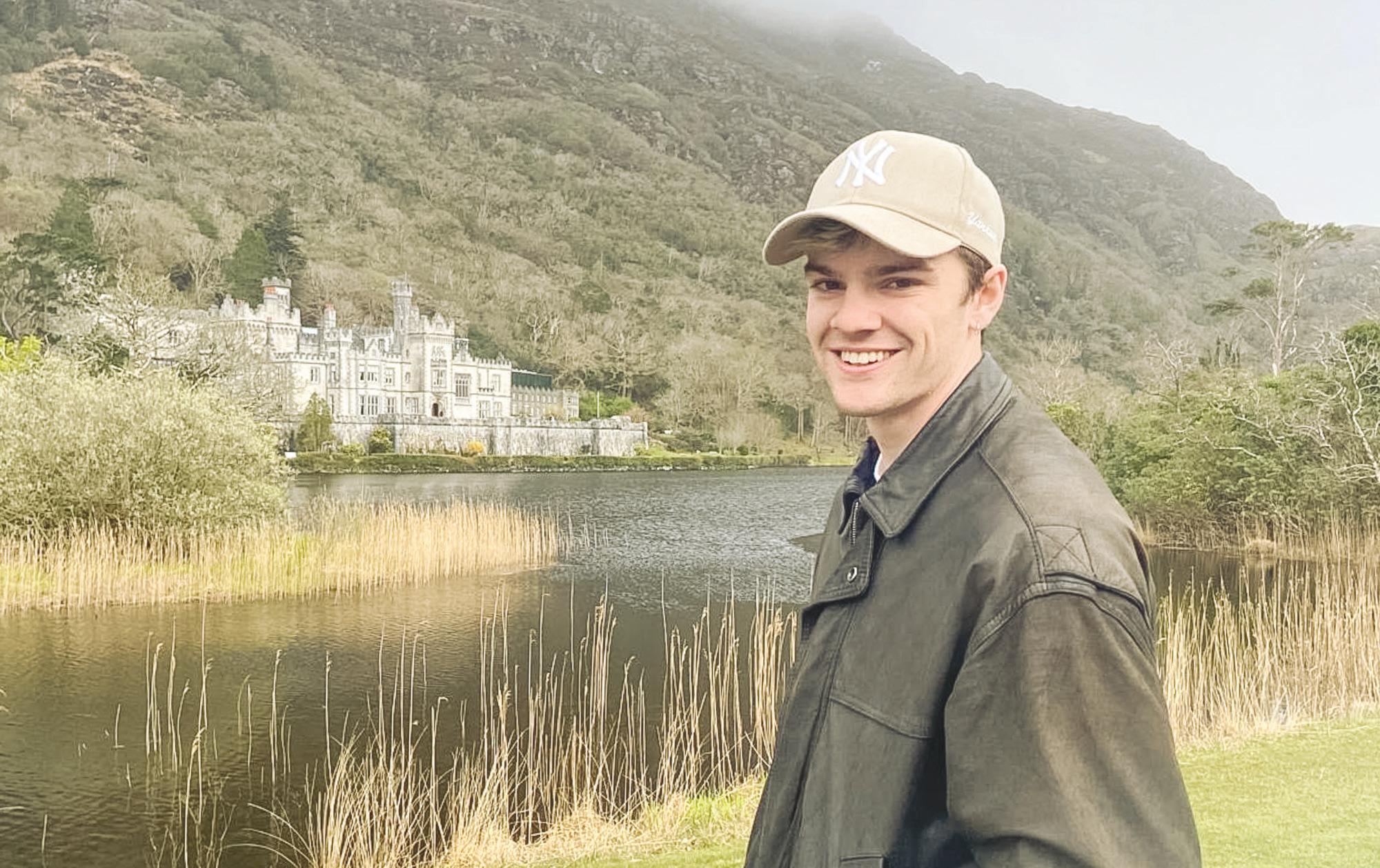
SUNBURSTS: Sunnies Over Spring Break
By SUN PHOTOGRAPHY DEPARTMENT
DASSER | Editor-in-Chief Sophia Dasser ’28 travels to Disney World with her best friend, reportedly crying when fireworks took over the sky.
TURK | Assistant Managing Editor Kate Turk ’28 skis in Banff, Alberta with the Cornell Ski & Snowboard Club on its trip to Canada.
LEYNSE & FRANCE-MILLER | Multimedia Editor Benjamin Leynse ’27 and Marketing Manager Dorothy France-Miller ’27 road tripped down the East Coast in search of crab shacks and sweet tea.
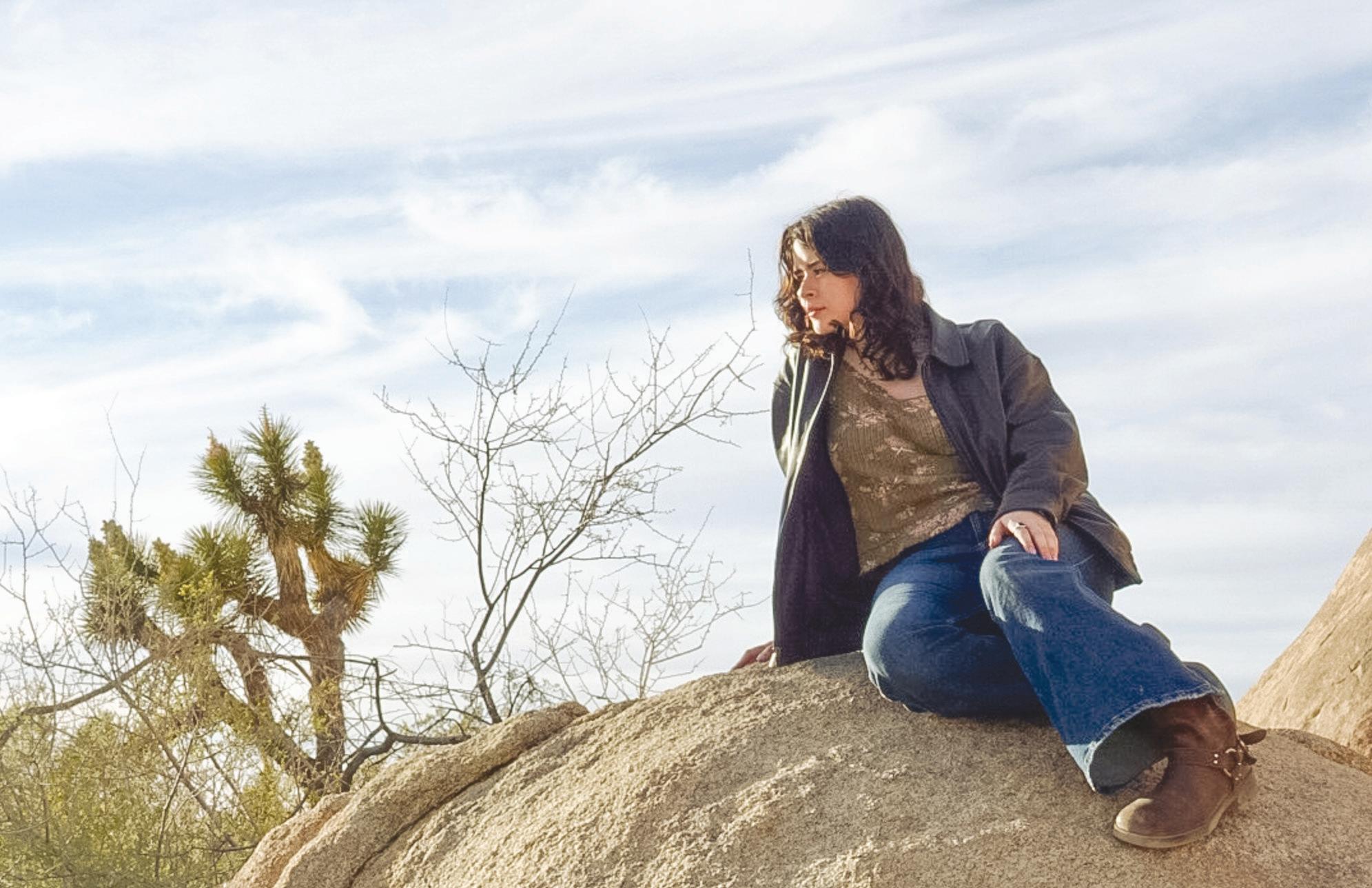
CRONIN | News Editor Mary Caitlin Cronin ’28 sightsees and sunbathes in Joshua Tree National Park, California.
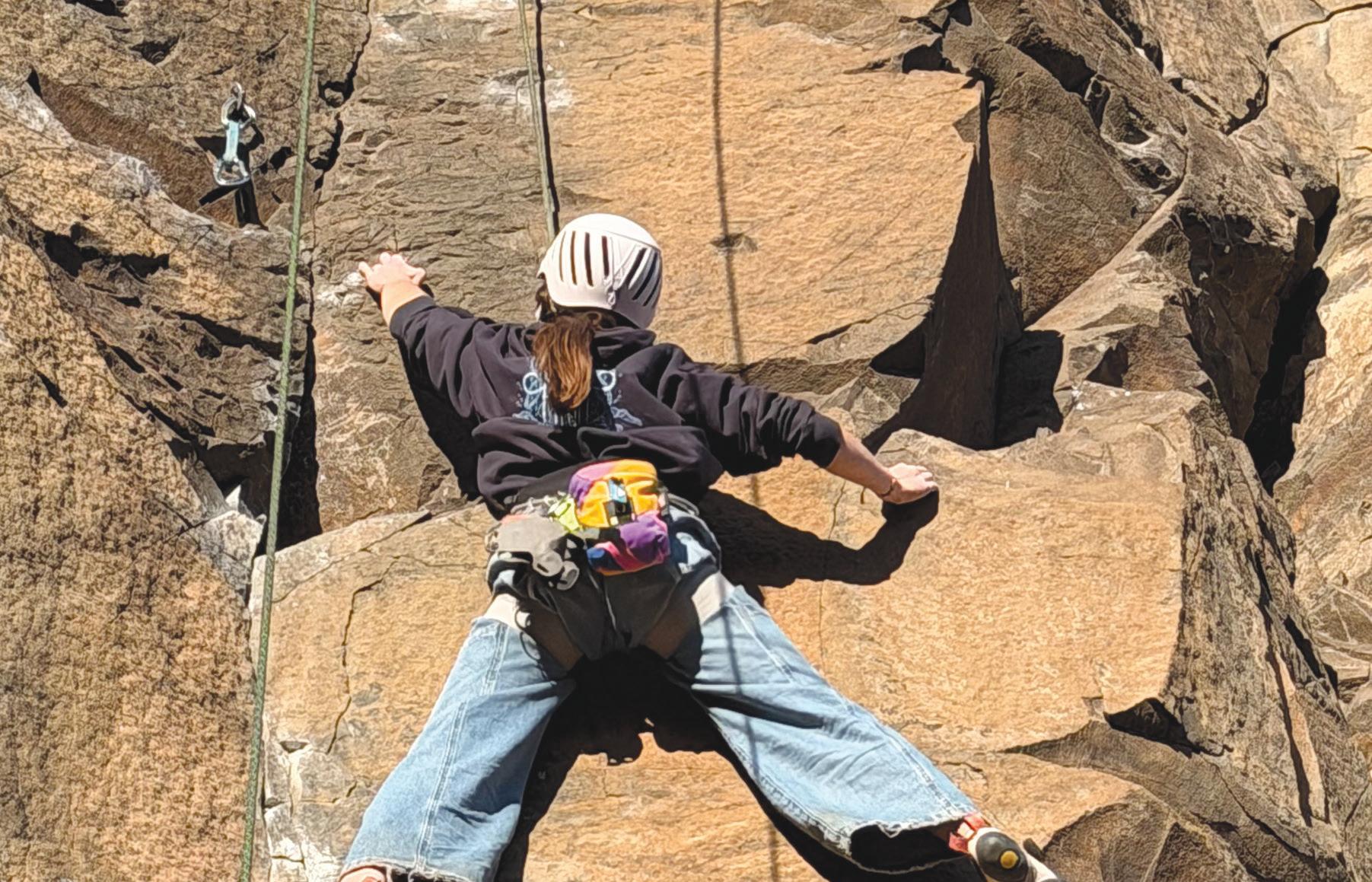
PLATT | News Editor Coral Platt ’29 rock climbs in Vantage, Washington.
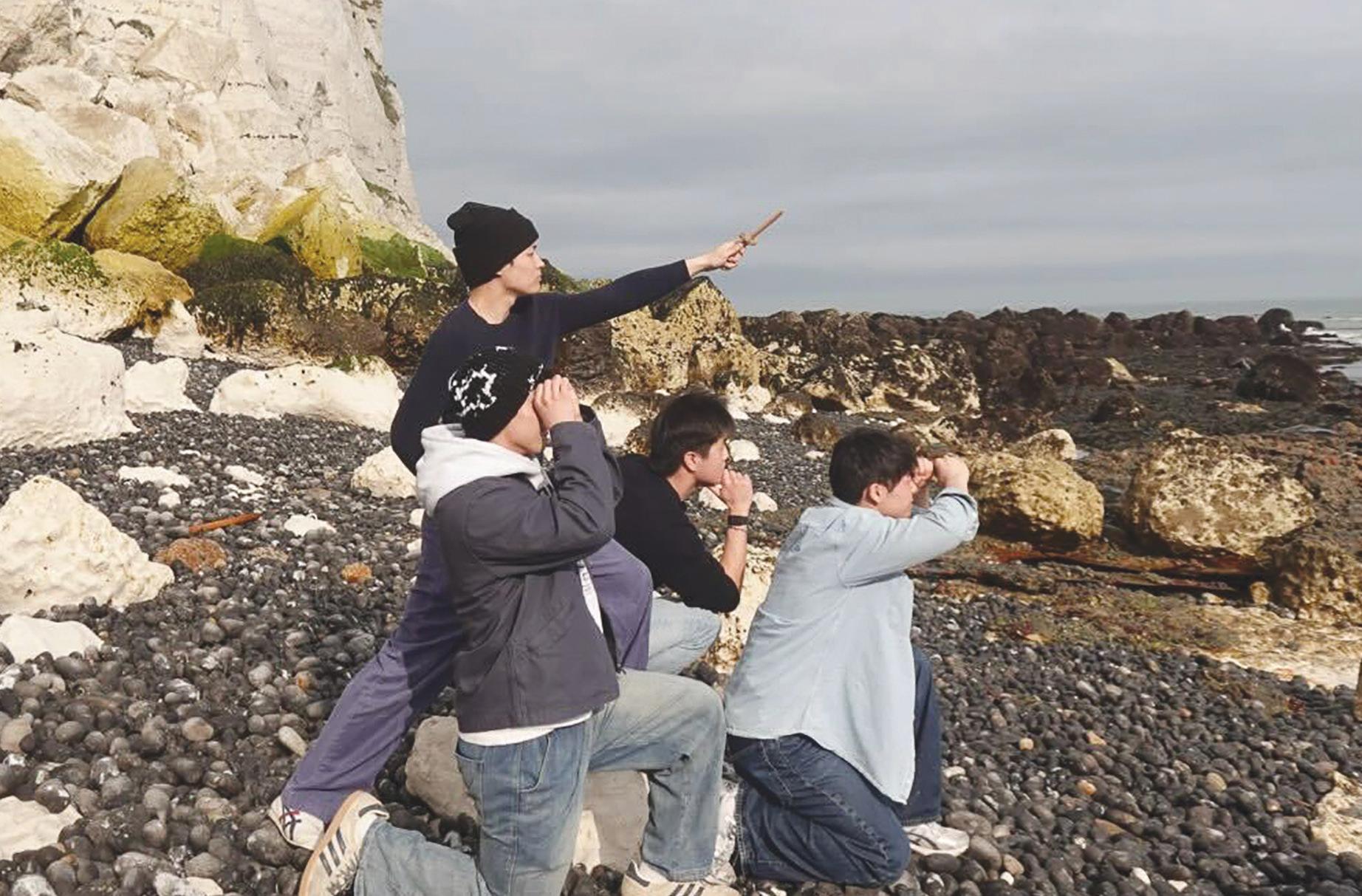
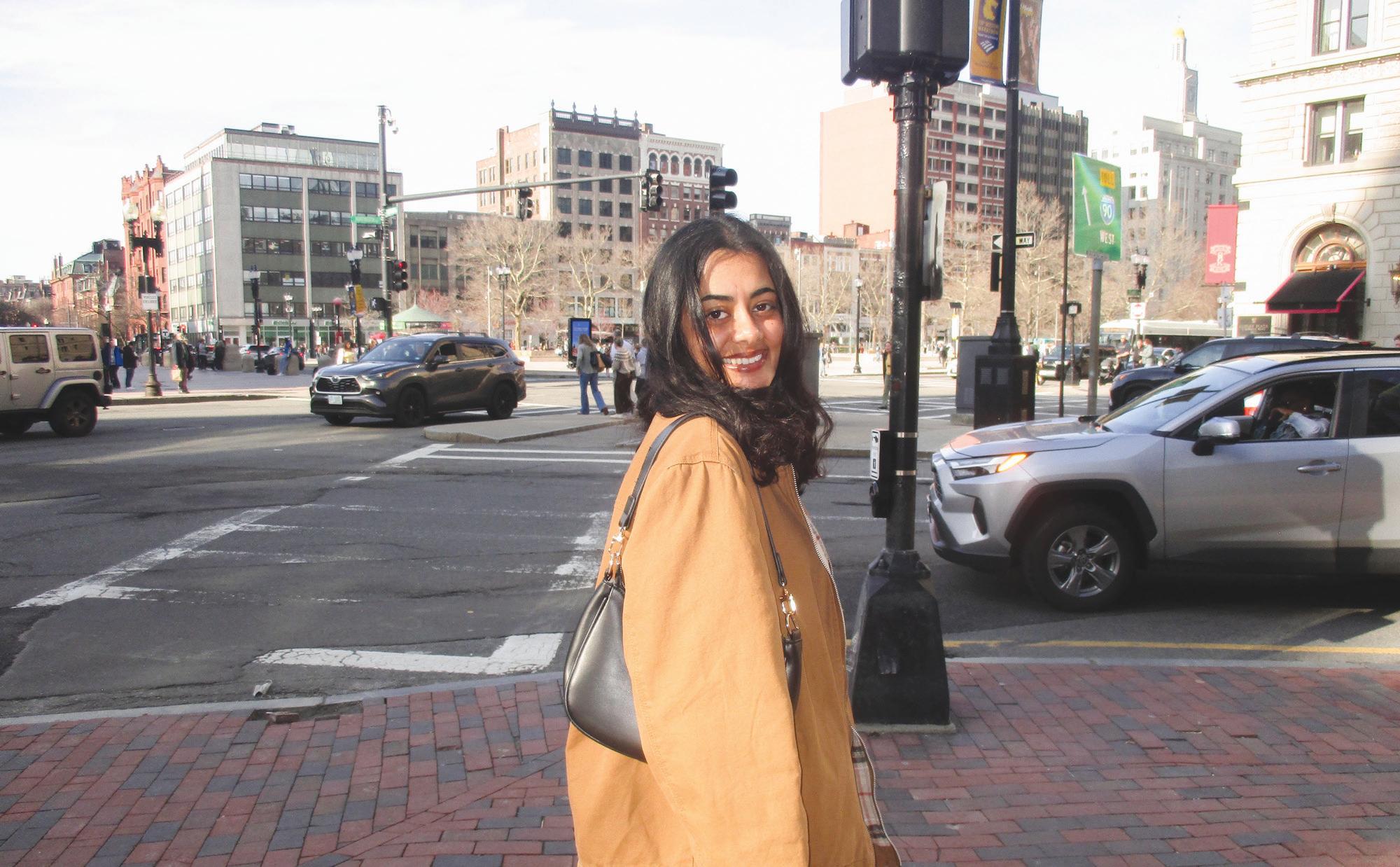
BO | Assistant Photography Editor Nathan Bo ’28 hikes the cliffs of Dover, Kent in England. BHARGAVA | Managing Editor Varsha Bhargava ’27 strolls around the city of Boston after taking a ride on the T train and grabbing a bite at a bustling pastry shop.
cornellsun.com.
T e ‘Veiled’ Dragon: Celebrating
Cornell’s Milestone 2026 Dragon Day
By RICHARD BALLARD
Staff Writer
OnMarch 27, first-year students from the College of Architecture, Art and Planning carried on a 125-year tradition of leading Cornell’s Dragon Day, marking the culmination of their semester-long effort to design and build a dragon to parade through central campus. The planning process for the event alone takes several weeks, and usually takes place in late March on the Friday before spring break.
“Veiled” served as the chosen theme for this year’s celebration, as demonstrated in the see-through fabric attached to the wooden structure of the dragon. The red wooden frame was created with the help of recycled materials and encased in a fireproof coating, designed with the intent for visitors to walk underneath the creation once disassembled.
The theme of last year’s Dragon Day was “How to Build your Dragon,” featuring design elements including canvas and raw lumber. Like this year, there was also an opportunity for the audience to interact with the design, where guests could help paint the structure with powdered color after the parade had concluded. 2024’s Dragon Day featured a sleek, dark-gray dragon design made out of cardboard and wooden planks.
Originating as a St. Patrick’s Day celebration, Dragon Day began in the early 1900s when architecture student Willard Dickerman Straight ’01 organized an event centered around building a large snake to symbolize the driving of snakes out of Ireland. Over time, the tradition
evolved into the dragon-focused parade seen today, with architecture students designing and constructing elaborate structures to showcase their class’s creativity and collaboration skills.
This year’s parade route started outside of Rand Hall, going down Feeney Way and looping around Campus Road to return back to the Arts Quad through Ho Plaza. Students and audience members alike commemorated the walkthrough by shouting the iconic call-and-response chant “Dragon, Dragon, Dragon! Oi, oi, oi!” while many of the organizers donned creative costumes. This year, some of the students’ attire reflected the infrastructure of Ithaca, such as TCAT buses, road signs, tires, electric utility poles, clearance bars, grass and flowers.
When the crowd approached the end of Feeney Way and the Engineering Quad, The Phoenix Society joined the parade with a fiery red bird float, continuing another Dragon Day tradition from the Duffield College of Engineering. Additionally, the Cornell Physics Metal Unicorn sculpture made an appearance, another highly anticipated addition to the walkthrough crafted by graduate students in the Physics department.
After the parade finished, the dragon sculpture was disassembled into sections on the Arts Quad, followed by a celebration party. The Big Red Marching Band joined the fun and gave the crowd a post-parade concert outside of Goldwin Smith Hall.
Additionally, for the first time in Dragon Day history, guests had the opportunity to walk through the body of the dragon after the celebration had con-
cluded. The dragon itself, as a large-scale structure that stretched across the Arts Quad, was easily tall enough for visitors to walk beneath its frame.
The dragon’s red wooden skeleton was made up of curved arches and angled spikes, giving the creation a dynamic silhouette even while stationary. Dark, semi-transparent fabric was stretched across the frame in triangular panels, catching the light and shifting slightly in the wind.
The stark contrast between the black fabric lining and red-colored skeleton helped me to conceptualize the “Veiled” theme. In getting the opportunity to walk underneath the structure, I was able to take a closer look at the design and observe the refraction of light off the different panels.
Being able to look deeper into the physical design helped me to visualize all of the hard work that goes into the
dragon creation process. I appreciate the decision to support audience involvement in the most recent Dragon Day events, because it strengthens the idea of connecting AAP with the broader campus community.
This year’s Dragon Day was a great reflection of the artisanship that AAP brings to Cornell’s culture. The “Veiled” theme gave the 2026 dragon a distinctive look that set it apart from prior years, and the walkthrough experience offered a closer look into the work behind the build. As the semester winds down, Dragon Day continues to serve as one of Cornell’s most anticipated and visually memorable campus traditions.
Richard Ballard is a member of the Class of 2027 in the College of Agriculture and Life Sciences. He can be recached at rballard@ cornellsun.com.
Cornell’s ‘Oasis of Madness’: Getting Outside With Outdoor Odyssey
By ALISIA WUCETICH Sun Contributor
On March 21, countless Cornell students arrived at the Hoffman Challenge Course, wearing layers of warm clothing to combat the 30 degree weather. These students were not looking to have a fun day of climbing, instead they were prepared to have a long day of training to be an Outdoor Odyssey guide. Outdoor Odyssey, hosted by Cornell Outdoor Education, is a pre-orientation program aimed at getting members of Cornell into the outdoors before they enter college life. Co-founder David Moriah ’72’s famous statement regarding the program — “I would found an oasis of madness in a pompous academic institution that takes itself far too seriously” — is exhibited through the lively Odyssey community that thrives on exploration and challenge. The Odyssey trips serve as a way for incoming students to get to know other students before orientation week even starts. As someone who was on a trip and is now training to be a guide, I think that Outdoor Odyssey is an experience like no other. Arriving on campus as a new student is a scary experience in itself. When beginning Odyssey, trippers need to automatically get into their trip groups, grab any rented gear they need and leave their families; it is a big change all at once. The trippers find themselves surrounded by hundreds of faces they’ve never seen before, all standing inside of Bartels Hall (which is not the best first impression of Cornell’s campus).
However, Odyssey allows the trippers to grow in a safe environment (especially in the presence of amazing guides).
Through this experience, I met my best friend Caroline Schell ’29, who agrees that Odyssey is a great chance to “meet people before the school year” as “it allows people to be their authentic selves, because, like, everyone is sweaty and gross.” On a trip, one doesn’t have to worry about their looks, being present on social media or maintaining their hygiene. Odyssey allows new students to truly get off the grid and escape, and in doing so they get to start the next chapter of their life without any additional stressors. Depending on the trip, trippers and guides partake in many exciting activities: backpacking, canoeing, rock-climbing, cooking, making friendship bracelets and more. However, the best part of Odyssey trips has to be Camp-O-Rama, a day where every camper from every trip gets the chance to meet one another and celebrate the Odyssey experience. Just like Moriah said, it really is an “oasis of madness,” filled with around 200 trippers all meeting and comparing their experiences. It is these shared experiences that build lifelong relationships. By this point in the trip, the trippers feel confident in their ability to fit in and make new friends. Odyssey functions beyond the nature of the trips themselves; it exists because of the people and community. From the Odyssey Coordinators who help train and run Odyssey in its entirety, to the guides who spend their spring semesters training and gaining all the tools they need to be good community leaders, to the trippers
themselves, Odyssey’s community is full of support and a shared love for the outdoors. By being a guide, you get to help create this safe environment for new students and allow them to have an easy transition into their college experience. Guides also get to experience a four to eight day long getaway before rigorous classes start up again in the fall. It’s also important to note that no prior experience with Odyssey trips is needed to be a guide. This allows members like Amelia Lyons ’29 who “wanted more experience in the outdoors” and wanted to “broaden [her] leadership skills” but was not a tripper herself to be a guide. She also explains how it is an incredible way for guides to meet other people who are “adventurous, interesting and often genuinely love what they do.” While maintaining the upbeat, non-academic break from the structure of Cornell,
being in Odyssey provides both experience in the outdoors and in leadership. Outdoor Odyssey is an incredible program that is kept alive by all of the faculty and students who are dedicated to improving the lives of incoming students as well as fostering a kind, loving, outdoorsy environment for those who seek it. If being a guide sounds stressful, Cornell Outdoor Education in general is full of the same communities (through being a PE Program Instructor or going to the Lindseth Climbing Center), and is a wonderful place to go to put aside school work for a bit and enjoy the wonderful place that is Ithaca. WRITER
Alisisa Wucetich is a member of the Class of 2029 in the College of Architecture, Art and Planning. She can be reached at aew254@ cornell.edu.
RICHARD BALLARD / SUN STAFF WRITER
COURTESY OF JAMES HONG ’28
‘Birds Can Save the World’: 2026 Great Backyard Bird Count Reaches New Heights
By SUSAN SU Sun Staff Writer
This February, more than one million people around the world stepped outside to observe and report birds as part of the Great Backyard Bird Count, marking a new record for the number of participants in the annual event.
The four-day event is co-organized by the Cornell Lab of Ornithology, National Audubon Society and Birds Canada. It invites people of all experience levels to record birds they see and submit them through eBird and Merlin Bird ID, two digital databases for birdwatching, or “birding,” developed by the Lab of Ornithology.
GBBC started in 1998 with a simple question: would people be willing to share the birds they were seeing?
“We thought, well, if we created an event where we invited people all across the United States to tell us what birds they’re seeing, would people do it?” said Becca Rodomsky-Bish, project leader of GBBC. “And so we decided to start the GBBC and give it a go.”
The event was initially held in the United States. It quickly gained popularity and expanded to Canada through Birds Canada, a nonprofit organization dedicated to bird conservation.
GBBC’s early success helped inspire the development of eBird, a platform that allows people to record bird observations from anywhere in the world. As eBird became widely used and interest in birding continued to grow, GBBC expanded globally in 2013.
“The love of birds and interest in sharing sightings is something that has just taken off as being really popular,” Rodomsky-Bish said.
GBBC takes place each year over the President’s Day weekend in the United States.
Since most people have Monday off and schools often hold special activities the preceding Friday, organizers see it as an ideal time to encourage public participation.
This time of year is also ecologically significant. Late February comes just before many birds in the Northern Hemisphere begin their spring migration, so the data show where migratory species are before they depart for the breeding season.
“There's a lot of things happening in the world that divides us ... Birds have this way of pushing through that noise.”
Becca Rodomsky-Bish
A Record-Breaking Year
Participation in GBBC has steadily increased over the years, and in 2026 the numbers reached a new high. An estimated total of 1,146,284 people took part in the count, and 467,696 checklists of sighted birds were submitted, according to a report published by the event.
Observers reported 8,257 of the world’s known bird species. From rural natural areas to urban neighborhoods, people discovered the joy of birding in a wide range of environments.
“Some people think birding is only happening in remote places,” Rodomsky-Bish said. “But people are seeing birds from right outside their door.”
Among the more impressive sightings was a flock of around 120,000 king penguins gathered in a single area of Antarctica. In Canada, participants also spotted a European robin, a species
rarely seen in North America.
Submissions came from 216 countries and subregions, covering nearly every country in the world. Reports were also submitted by people in countries such as Iran, Syria and Yemen. Rodomsky-Bish noted that birding continues to bring people together in a time marked by unrest.
“There’s a lot of things happening in the world that divides us and makes us less connected,” she said. “Birds have this way of pushing through that noise, and people all over the world can come together and really enjoy them.”
Part of Something Bigger
Observations collected during the event directly contribute toward scientific research. All GBBC data become part of the eBird database, one of the world’s largest biodiversity-related datasets and an open-access resource widely used by scientists, conservationists and policymakers. The data tell researchers where certain birds are being found, and how many of thema there are.
In 2024 alone, more than 150 research papers were published using eBird data. They examine bird population changes and migration patterns, as well as the impact of disturbances like climate change and wildfires on birds.
Rodomsky-Bish emphasized the importance of citizen science in making research possible. While many people watch birds for pleasure, events like GBBC allow them to actively contribute to the scientific process.
“If you want to go that extra mile and actually submit your sightings, you automatically then become a part of something bigger than yourself,” she said.
GBBC aims to deepen people’s connection with the natural world. Rodomsky-Bish hopes participants leave the GBBC with a greater appreciation for birds. Found almost everywhere, these
creatures provide a unique lens through which people can understand the places they inhabit and visit.
By fostering this appreciation, organizers also hope to inspire more environmental awareness. When people become passionate about birds, they often care more for the broader ecosystem, leading them to take meaningful steps toward its protection.
“Sometimes I feel that birds can save the world,” Rodomsky-Bish said. “You don‘t save what you don’t love, right? For people who love birds, you have to love the natural world because they’re dependent on it.”
Susan Su can be reached at ts936@cornell.edu.
Cornell Alumnus’ AI Startup Selected for Venture Atlanta 2025
By REBECCA RYAN Sun Staff Writer
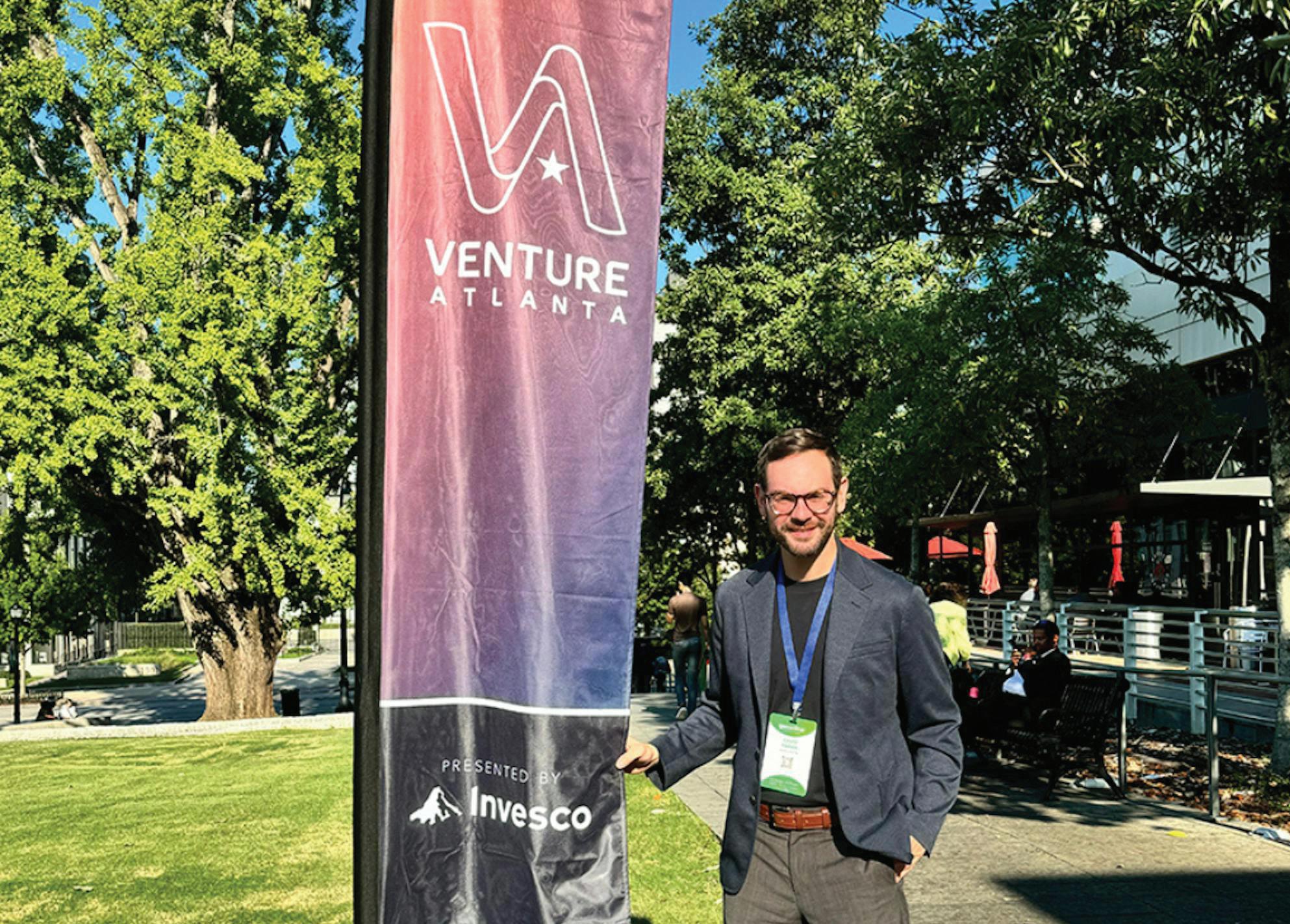
Murmuratto, a workflow automation startup co-founded by David Pagan ’15, was selected as one of 86 companies showcased at Venture Atlanta, a major startup and investor conference, in October 2025.
The annual conference, now in its 18th year, drew a record 1,600 attendees, including over 400 investors, to the Woodruff Arts Center and Atlanta Symphony Hall. Organizers reviewed more than 560 applications, ultimately selecting 85 companies across 19 sectors to participate, according to Venture Atlanta 2025 Recap.
Pagan, who graduated with a Bachelor of Architecture, co-founded Murmuratto in
2022. The company develops software that allows workers to report issues, inefficiencies and ideas from the production floor. It then uses artificial intelligence to sort through that information and identify patterns, helping companies address problems more quickly and improve day-to-day operations.
The idea for the company grew out of Pagan’s early professional experience working with operations teams abroad. While leading initiatives, he noticed that many frontline workers understood how to solve problems and tap into opportunities within their role but often lacked a clear path to communicate those insights to leadership.
“I realized that even though the team often said we could not do something, when I asked
the right questions we could actually find solutions,” Pagan said in an interview with The Sun. “The people often knew the answers, but leaders were not always asking the right questions to the right people.”
Murmuratto’s platform allows workers to submit observations about operational challenges, safety concerns or inefficiencies through a digital interface. AI tools then help structure those observations into proposals that managers can review and potentially implement.
Rather than replacing workers, Pagan said the company’s goal is to amplify their role in improving operations.
“The people
often knew the answers, but leaders were not always asking the right questions to the right people.”
David Pagan ’15
“When you read about AI and productivity in the workplace, you inevitably come across AI layoffs,” Pagan said. “Our approach is different. We want to create ‘super workers’ who continuously identify problems and solutions that improve the business.”
The company currently works with manufacturing sites across five U.S. states, focusing primarily on highly regulated industries such as pharmaceutical and biotechnology production. In these environments, operational changes must meet strict compliance standards, which can make process improvements difficult to implement.
According to Pagan, insights submitted by frontline workers can sometimes lead to significant financial or operational gains.
In one example, a worker in a biopharma
manufacturing facility noticed that staff members were using a costly, regulated chemical to clean minor spills such as water or juice. After the observation was submitted through Murmuratto and reviewed by management, the facility changed its cleaning procedures, resulting in approximately $50,000 in recurring annual savings.
“That one observation from a frontline worker resulted in $50,000 of savings year after year,” Pagan said. “In manufacturing, a small change can make a very large impact.”
Pagan said designing technology for frontline workers posed challenges beyond building the software itself. The platform had to be accessible to workers across different generations and levels of technological experience.
“We needed to make it very easy to use, but at the same time capture a lot of data,” Pagan said. “That meant designing a system that works for younger employees and for people with decades of experience.”
Selection for Venture Atlanta offered validation for the company’s growth and visibility within the startup ecosystem, Pagan said. The conference brings together hundreds of investors and industry leaders, giving selected companies the opportunity to gain exposure and connect with potential funders.
“Getting selected as a showcase company confirmed that we have the right product for the right industry at the right time,” he said.
The recognition comes as Murmuratto continues expanding its work with manufacturing sites across the United States. Pagan said the company is focused on growing its team and bringing the platform to more facilities in the coming years.
“We are just getting started,” Pagan said.
Rebecca Ryan can be reached at rar352@cornell.edu.
Birds in the backyard | This year's Great Backyard Bird Count saw participation from citizen scientists across the globe.
COURTESY OF ANDRÉ TURCOT / MACAULAY LIBRARY
COURTESY OF DAVID PAGAN '15
Meet Sophomore Josh Toothman: The ‘Fastest Cornellian in Water Ever’
By ERIC JOY Sun Senior Writer
March 26 — At the 2025 Ivy League Swim and Dive Championship, sophomore Josh Toothman swam a 19.77 in the preliminary round of the 50-yard freestyle. In the final round, he tied that time exactly.
At the time, the school record for the fastest 50-free was 19.67, swum by Jack Brenneman ’18 in 2016. Toothman had one last chance in the 2025 Championship to capture the record for himself and become, as men’s head swim coach Wes Newman ’09 would say, “the fastest Cornellian in water ever.”
“‘If I have to do it, I only have now to do it,’” Toothman said. “So, I got up there and just went for it and I ended up getting it.”
Toothman swam a 19.63 split in the 200-yard freestyle relay, beating Brenneman’s record by .04 seconds. He has held the 50-yard freestyle record ever since and recently bested it in the 2026 iteration of the Ivy League Championships, lowering the time to beat to 19.45.
“If I have to do it, I only have now to do it. So, I got up there and just went for it and ended up getting it.”
’28
Early Days
Toothman, a Parma, Ohio native, has been in the pool almost as long as he’s been able to walk, having first experienced it when he was “three or four years old.” While his parents made him try other sports, Toothman always came back to the pool.
“One day, [my parents] brought me to the pool,” Toothman said. “I just loved the pool. I didn’t want to leave. I didn’t want to get out.”
According to Toothman, his
high school coach Eric Dennis of St. Ignatius High School in Cleveland, Ohio, played a key role in motivating him to succeed.
“[Coach Dennis] has worked with me since I was about ten or eleven years old,” Toothman said. “He was a really big role model in how I swim and everything about the foundation [of my] work ethic.”
Toothman’s older brother, Zach Toothman, was recruited to swim for Case Western Reserve University in 2021 and swam for the team all four years of his education.
When Josh was a freshman in high school, Zach was a senior. Josh maintains that Zach was always an impactful person during a tough transition for many: middle school to high school.
“[Zach] was a big role model,” Josh said. “He was a nice foundation for getting into high school and getting into high school swimming.”
By Josh’s junior year, it became increasingly apparent that he would follow the footsteps of his brother and swim at the collegiate level. The ‘‘Speedo Winter Junior Championship East’’ meet only exacerbated that notion.
“I started talking to college coaches there,” Josh said. “It really got me thinking about how I could take [swimming] to the next level.”
When on the recruiting trail, Josh visited Columbia University and had offers from Johns Hopkins University and many other schools. However, no place felt like Cornell University. Josh said that the school’s “familial” environment was a key factor in deciding to commit to the Red.
“[Nowhere] else felt like a true family except here,” Josh said. “Every meal that I ate [during my recruiting visit], the whole entire team tried to be at that
meal. At other schools, a lot of people just did not come as much… I could really tell how close this team was.”
“[Nowhere] else felt like a true family except here. Every meal I ate [during my recruiting visit], the whole entire team tried to be at that meal.”
Josh Toothman ’28
Nautical Excellence
Ever since coming to Cornell, Josh has acquitted himself commendably in the water. In December 2024, he broke 20 seconds in the 50-free competition for the first time, a moment he called “really special.”
At the 2025 Ivy League Championships, he broke the Red’s 50-free record, but according to Josh, the more surprising result was his performance in the 100-yard backstroke.
“I have never really focused on backstroke in practice,” Josh said. “I went in there, not expecting much, [but] I ended up dropping two and a half seconds [from my previous time] and winning the C Final. I would have placed in the B Final had I gone faster in the preliminary round.”
Josh also indicated via email that he achieved the Olympic Trial qualifying standard, calling it a “huge moment.”
Moving to the 2025-26 season, Josh always saw himself breaking his own record.
“I think my goal every year is just to consistently drop time,” Josh said. “I definitely saw myself breaking the record again and going fast in all my other events.”
At the 2026 Ivy League Championship, despite the strobe lights, introductory music and deafening crowd noise, Josh drowns all that out come race
time. When asked what he was thinking on the starting block of his recent record-breaking race, he said he likes to keep things simple.
“[I always think] just beat the guy next to me,” Josh said. “As long as I can beat the guy next to me, I have a really good chance of going faster, if not breaking my own record… If I can put my hand on the wall first, I know it’s going to be a good time.”
When Josh finished his record-breaking race, he initially didn’t even realize he broke it.
“The scoreboard was messed up for that race,” Josh said. “Once I realized [I broke my record], I was pretty happy about that.”
“[I always think] just beat the guy next to me.... As long as I can beat the guy next to me, I have a really good chance of going faster, if not breaking my own record.”
Josh Toothman ’28
Josh added that many alumni swimmers congratulated him for the result.
“A lot of the senior alumni from last year contacted me, congratulating me and saying it was a great swim,” Josh said. “It was great to hear from them again.”
Josh says that despite his distinction as the “fastest Cornellian in water ever,” he’s not letting complacency overtake him. Nevertheless, he wears the honor with pride.
“It’s pretty great [to hold the honor],” Josh said. “I would definitely [say that I’m] always striving to get faster. Sometimes you don’t even realize it, that it actually hit.”
Speedy swimming | Men’s swim and dive team huddle during a 2025-2026 meet.
PHOTO BY SOPHIA RILEY SIM / SUN STAFF PHOTOGRAPHER
Top times| Toothman broke the record for the fastest 50-yard freestyle swim in the Red’s history.
COURTESY OF JOSH TOOTHMAN ’28
Josh Toothman
Te Work Behind the Win: How Female Athletes at Cornell Defne Success on Teir Own Terms
By GRACE REUBEN, ERIC
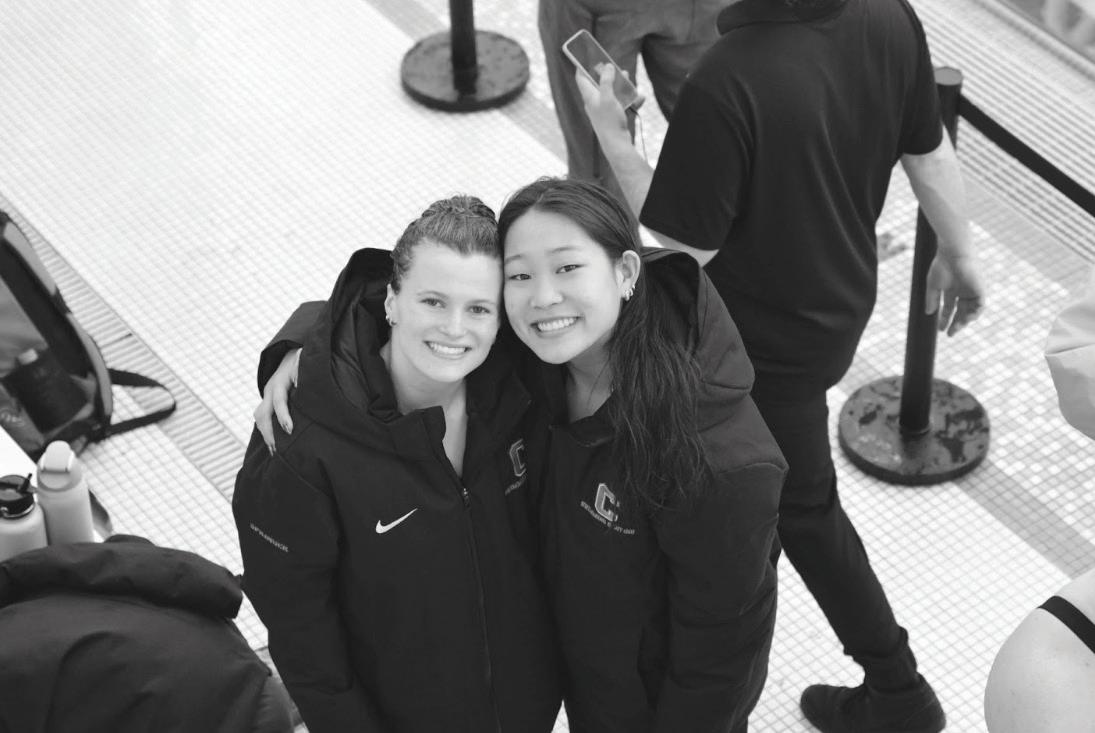
At Cornell, female athletes are defining excellence on their own terms — their achievements stretching far beyond the scoreboard.Their stories are shaped not just by records and wins, but by resilience, community and the work it takes to get there. The Sun spoke with three female athletes, Emily Pape ’26, Hojung Yoon ’27 and Annelies Bergmann ’27, who are proud to belong to the Red.
Emily Pape ’26
Emily Pape is a senior forward on the women’s basketball team. She is from Chicago and is studying environment and sustainability in the College of Agriculture and Life Sciences. This year, she recorded her 1000th career point in the team’s win against Dartmouth, ending her basketball career with 1,111 points and 112 made threes.
Pape has been playing basketball since second grade, but playing in college was not initially on her radar, as neither of her parents were collegiate athletes. Eventually, family friend Jim Kilburg, who coached Pape and her sister throughout high school, inspired her to look into the recruiting process.
“It’s incredible to be around such amazing women and meet different people on different sports teams too”
Emily Pape ’26
Pape used the unexpected time off during the COVID-19 pandemic to perfect her game and work towards the Division I level. She now plays for the Red alongside her sister, freshman guard/forward Ally Pape. She wears number 32 in Kilburg’s honor, after he passed away in 2021.
Pape is honored to represent Cornell as a female athlete.
“It’s incredible to be around such amazing women and meet different people on different sports teams too,” Pape said. “It makes you realize how special this community is, just female athletes and college athletics in general. It makes you realize how much it took for everyone to get here and how accomplished all these women are.”
Pape’s appreciation of hard work shows up in her game. She ended her senior season averaging 10.1 points, 4.9 rebounds and 1.6 assists per game. She set a new career high with 54 made threes this season, the fourth most made in a single season in the team’s history.
When asked what advice she would give to young female athletes, Pape spoke to the importance of believing in oneself.
“I know it’s easier said than done, but trust yourself and know that especially in athletics or out of athletics, you’ve put in the work. Trust that you know what you’re doing.”
Pape notes a few role models that have shaped her confidence both on and off the court. She looks up to Jewel Lloyd, a WNBA player on the Seattle Storm who played on Pape’s club basketball team during the pan -
demic. She also credits her Cornell coaching staff who have helped her gain strength and confidence as both a player and person.
Hojung Yoon ’27
Hojung Yoon ’27 is a backstroke and individual medley specialist for the women’s swim team. From La Crescenta, California and enrolled in the Peter and Stephanie Nolan School of Hotel Management, Yoon holds school-record times in three events: the 200-yard backstroke, the 200-yard individual medley and the 400-yard individual medley.
This past season, Yoon was the Red’s leading scorer at the Women’s Ivy League Swim and Dive Championship, posting a tally of 63 points and helping the Red achieve sixth place — their highest placement at the Championship in 16 years. Yoon described it as “exciting.”
“This season… I could tell there was a shift in the team environment and morale,” Yoon said. “Over the course of the season, I think we improved as a team, swimming and academic wise. We just had a lot of fun. I think that helped us achieve the goals we wanted at the end of the season.”
Yoon is undoubtedly a star of women’s swimming at Cornell, yet she almost did not attend the school at all. Given that five of Yoon’s swimming club teammates were already at Cornell, she felt uneasy about committing to Cornell.
“When I started my recruiting process as a junior [in high school], I told myself, ‘oh, I’m not going to Cornell because five of my former teammates were already there,’” Yoon said. “I wanted to be somewhere else, where nobody knew me and I could have a fresh start.”
However, Yoon’s mother, Kyungjin Lee, eventually persuaded Yoon to visit. Lee didn’t want her daughter to be too far away from her eldest sister, Jungmin Yoon ’26, who also swims for the Red.
“My mom said, ‘I would love for you to at least take a recruiting trip to Cornell,’” Hojung said. “‘I would feel better knowing that you go to school… with [Jungmin].’”
Hojung committed to the Red during her senior season, after “seeing” all the positive aspects of Cornell her club teammates had described.
“It’s such a privilege to be at Cornell. I think bringing attention to women’s sports and how we can do the same exact things [as men] is such a privilege to do at Cornell.”
Hojung Yoon ’27
Now a junior, Hojung has come around on her former Cornell skepticism.
“I’m really glad I came to Cornell,” Hojung said. “I’ve just met phenomenal people, people who will stay in my life forever.”
When asked about her general feelings of being a female athlete, Hojung considers representing Cornell to be a great honor.
“It’s such a privilege to be at Cornell,” Hojung said.
“I think bringing attention to women’s sports and how we can do the same exact things [as men] is such a privilege to do at Cornell.”
Annelies Bergmann ’27
When asked about her relationship to hockey outside of the rink, junior goaltender of the women’s ice hockey team Annelies Bergmann described herself as “the least hockey-loving hockey player ever.” While not an avid supporter of the sport in her personal life, she spends countless hours on the ice, dedicating herself to the sport.
Passionate and dedicated to her craft, Bergmann reflected on her time on the Red fondly, saying “there’s no better place to be than at this school that combines athletics and academics, I wouldn’t change a thing.”
After a challenging freshman season, in which the daunting weight of a new environment, new experiences and overall mental pressure to succeed felt overwhelming, Bergmann persevered and won Ivy League Rookie of the Year with a 20-7-1 record.
The goaltender referenced her sophomore season being the time where she “nailed down the mental aspect.”
She recalled a game in which the team was trailing 3-1 against Quinnipiac and in a moment of near defeat, her teammate senior defender Grace Dwyer reminded her that the team had her back and that one loss wasn’t everything. During the final 10 minutes of the game, they fought back and ended up in a 3-3 tie, teaching Bergmann the value of her team’s support and the strength of believing in herself.
With a constantly shifting team environment, including the loss of 11 players who graduated after Bergmann’s Freshman year, the team shifted from a group of strong experienced core players to a younger and smaller team. While many would see this as a detriment, Bergmann said the younger personalities kept things fun and fresh but the team still held each other accountable.
Bergmann highlighted the team culture as a fundamental part of her success.
After being named the 2024-2025 ECAC Goaltender of the Year, she cited her success greatly to her team, stating “the team won that award.” She spoke about how the team improved significantly every year, with a commitment to each other and the sport, while finding the fun in every moment.
“This team always dedicates themselves to creating a dynamic environment where every woman can thrive and is supported academically and personally,” said Bergmann.
With this mentality, she was able to win the ECAC tournament with her team last season and rack up 54 saves in the semifinals. But more than that, Bergmann expressed how it felt greater than just a trophy — it was a team bonding moment.
To continue reading this article, please visit www.cornellsun.com.
Grace Reuben, Eric Joy, Nora Kenzi and Jane McNally can be reached at gyr5@cornell.edu, ewj36@cornell.edu, nmk55@cornell.edu and jmcnally@cornellsun.com.
JOY, NORA KENZI and JANE HAVILAND Sun Sports Editor, Sun Staff Writer, Sun Staff Writer, Sun Features Editor
Record-breaking | Yoon (pictured right) holds the Cornell swim record in three events.
COURTESY OF HOJUNG YOON ’27
ECAC Excellence | Bergmann was named the 2024-2025 ECAC Goaltender of the Year.
COURTESY
Alt-Rock and the Lore of Wise Bones
“We could get a van!” exclaims songwriter, guitarist and vocalist Ezra Baptist of the Ithaca-based “osteological alt-rock” group Wise Bones, in sharing his excitement at the prospect of going on tour. I had a sit-down with Wise Bones on a rainy Sunday afternoon at the WVBR house, just off West Campus. While the band isn’t going on tour just yet, they recently reached another milestone by releasing their debut EP, ATTIWS, on March 13. Describing themselves as an “alt-rock band of Cornell and Ithaca College students and Ithaca locals,” Wise Bones has been a familiar face in the area for about a year, performing at various venues in and around Ithaca.
Wise Bones’ origin lies with drummer Austin Lamb and vocalist/songwriter Ezra Baptist, both Ithaca locals, who were looking to start a band as early as a year ago. The summer prior, Austin had met bassist-to-be Donovan Redd while volunteering at the Finger Lakes GrassRoots Festival, and reached out to him to lay the groundwork. “We started jamming, the three of us, and then we kind of wanted to find another member to add some guitar,” Austin explained. Then enters guitarist John Cannizzo, a grad student. “We went to another level with John,” Lamb elaborated. “We played as a four-piece for several months, then played a Fourth of July show across the street at Stuart Little Co-Op.” There, they met Myles Stokowski, a data engineer in Cornell’s Ornithology Lab, playing violin on the porch. “We were covering ‘Jesus, Etc.’ by Wilco, which has a little violin part, and we invited him to play with us,” Lamb added. Describing the set as “whimsical,” they stayed friends with Stokowski until he formally joined Wise Bones after the group’s Halloween show, also at Stuart Little Co-Op. Toward the end of last year, Ithaca College senior Noelle Cook joined the group as a vocalist, and Ithaca local and Smith College senior Louisa Miller-Out entered the mix as a cellist.
After a productive summer of jamming and performing live, Wise Bones was ready to branch out beyond the stage
and bring their sound to listeners’ headphones; they were ready to record. Lamb, at this point a senior and in his final semester at Syracuse University, became friends with Liam Pashley, an aspiring producer. “We were looking for an affordable, but high quality producer, and it just kind of worked out.” After the semester ended, Wise Bones drove up to Syracuse to record with Pashley as their producer. Recording in the Syracuse area for much of this year to date, they wrapped up towards the end of February.
With a finished product set for release in mid-March, Wise Bones hit the ground running in promoting ATTIWS They reached out to Electric Buffalo Records and Fanclub Collective, and were able to organize an EP release show at the co-op at 660 Stewart on March 13.
ATTIWS, an initialism for the title track, “All The Things I Wanna Say,” is a four-song release that samples the group’s alternative rock tilt, but isn’t married to it. It’s refreshing; you hear echoes of their ’90s forebearers, especially in “Neptune,” which sounds like a forgotten gem on a Better Than Ezra album. “Shadow on the Wall” brings a consistent folksy twang that’ll have you bouncing along to its ebbs and flows, and “Sweet Thing” is the next best thing to a Cranberries reunion you’ll get in a world without Dolores O’Riordan. The soft guitar that opens that track, the final on the EP, sobers you up to the depth Wise Bones can reach with its sound. The group’s favorite track, however, is “All The Things I Wanna Say.” When asked about the special significance of the song, the group described it as the epitome of their sound, and the best demonstration of it.
“You know, I feel like it features everything you want in a Wise Bones song,” Baptist said, quickly followed up by Redd describing it as “the most osteological!”
Indeed, considering osteology is the study of bones and the skeletal structure, “All The Things I Wanna Say” is the most osteological of their recorded tracks. It illuminates the structure of the group, and plays to each of its members’ respective strengths. The percussive baseline, courtesy of Lamb and Cannizzo, follows through the entire track. It doesn’t let up during Stokowski’s violin solo, nor does it waver in complementing Baptist and Cook’s vocals.
“When we play shows, I feel like that’s the one that the audience wants. They’ll ask for it,” Baptist explained. It’s not hard to imagine why.
When asked about the roadmap for Wise Bones going forward, the group replied with humility, like they know it won’t last forever.
“Assuming we don’t get drafted — big assumption — we’re working on an album,” Stokowski says through the group’s giggling.
Expanding on that, Baptist noted that the album is going to include the four songs on the EP, plus eight or ten more. They’ll be recording with Pashley in Syracuse, once again. Other than their upcoming album, there’s not exactly a five-year plan set in place.
“We haven’t necessarily all talked about this as a band before. I mean, I would love to eventually go on tour and do this for a long time.” Gesturing to his bandmates, Baptist concludes, “I love playing with you guys.”
Wise Bones comes between school and work and life in general, and its members are cognizant of that. The transience of such a dynamic lifts the pressure off, and allows the group to focus on itself and its music in the now.
Living Space: Artist Lilian Shtereva ’27
When I arrived in the gallery housing the art installation “how to fix a leaking ceiling” by Cornell MFA student Lilian Shtereva ’27, I was unsure whether I was in the right place. The space had a distinctly unfinished appearance, particularly with the foam-wrapped pole stretching from floor to ceiling in the middle of the doorway. My perplexed attention was immediately drawn to a large column made of a seemingly haphazard assortment of textiles, cushions, household objects and even an upside-down chair. A smaller pillar on the other side of the room supported a stack of pillows reaching to an overhanging section of ceiling. Strikingly, the art extended beyond the limits of the gallery, with upholstery textiles hanging out of the windows all the way to the ground outside. Underneath the windows, a collection of ceramic animals in tones of blue, green and brown added to the personality and whimsy of the space. The artist herself, who had been seated in a small chair next to the larger pillar, resolved my uncertainty by getting up to welcome me in.
Shtereva was born and raised in a small village in Bulgaria, moved to the city of Veliko Tarnovo, Bulgaria for art school and then moved to the United States to continue her studies. Her work is strongly tied to her unique set of experiences in the many places she has lived, as she discusses in her text introduction to the gallery. When I asked about the exhibit’s title, “how to fix a leaking ceiling,” Shtereva explained that a leaking ceiling needs to be repaired by any means possible, with whatever supplies are at hand. Accordingly, the materials used for this art installation were a seemingly random assortment of items. Broken teacups, bubble wrap and bare foam rolls joined handmade cushions and colorful traditional Bulgarian textiles to create a chaotic arrangement of color and texture. Shtereva, drawing on her varied background, associates the gathered nature of these materials with the resourcefulness that becomes necessary in challenging situations.
One subject Shtereva and I continually revisited in
our conversation was her use of space. During my time in the gallery, she and I moved all around the room, often sitting down on the bare wood floor to talk more deeply and look more closely at the art. Shtereva’s work is informed by the geographical spaces she has inhabited, but it is also intrinsically tied to the present physical space of the gallery, adapting to the unusual shape of the room with all its corners, pipes and overhangs. Shtereva explained to me, “You either respond to the space or you push against the space. I try to do both.” She works with the room by leaning objects delicately against walls and nestling colorful textiles into pipes near the ceiling, but she breaks its boundaries by hanging fabrics out of the windows. The room is a fundamental part of the artwork, far beyond merely housing it.
In creating this exhibit, Shtereva sought to emulate the constant evolution of a living space. Accordingly, the installation itself has taken many forms. When I spoke with her, the gallery was in its third iteration, with more movement to come. I even watched it change during my visit; after I commented on a ceramic water vessel that was placed on the floor among the sculpted animals, Shtereva stood and moved the vessel to another corner of the room, where it remained for the rest of our conversation. This casual adjustment emphasized the gallery’s fluidity and vitality. Unlike many artworks, which are displayed in their completed forms and meant only to be observed, Shtereva’s gallery was, at its core, perpetually unfinished.
The constant movement of this work, combined with Shtereva’s use of space, made stepping inside this gallery immersive in a way many art galleries are not. Shtereva even invited me to touch and pick up the ceramic animals, making the impact of my presence tangible. By entering the space, I became part of the larger story of the artwork. My backpack and coat, which I laid on the floor by the doorway when I entered, were just as much part of the space as the ceramic animals by the windows. As I immersed myself in the gallery, I felt that I understood it more, or could at least bring more of my own personal interpretation to it.
Fully appreciating any art, especially work like
Shtereva’s that is intentionally disorienting, requires time. Though I was confused initially, my appreciation of the artwork grew as I spoke with the artist about the choices she made when assembling the gallery. The more time I spent examining the details of the space, the more absorbed I felt. This careful attention is more valuable than ever in today’s digital world; instant gratification has become almost a way of life rather than a luxury, but taking time to experience art can never be replaced by an AI-generated summary. Thankfully, as Shtereva described to me, art can invite viewers — myself included — to slow down.
Shtereva’s gallery is a living space in two senses. It represents a space in which to live, but it is also a space that is itself alive. In any iteration of “how to fix a leaking ceiling,” what appears at first glance to be a random array of objects takes on layers of meaning as a viewer experiences it, one small element at a time. Through her use of space, movement and a wide variety of found materials, Shtereva has created an artistic ecosystem that both guides and is guided by the viewer’s perspective.
Though “how to fix a leaking ceiling” is no longer on display, more of Shtereva’s artwork can be found on her website and Instagram.
RAINA LOCKWOOD ARTS & CULTURE CONTRIBUTOR
Alexander Walters is a member of the Class of 2028 in the College of Arts and Sciences. He is a contributor for the Arts & Culture department and can be reached at apw65@cornell.edu.
ALEXANDER WALTERS ARTS & CULTURE CONTRIBUTOR
Raina Lockwood is a member of the Class of 2027 in the College of Arts and Sciences. She is a contributor for the Arts & Culture department and can be reached at rl978@cornell.edu.
COURTESY OF ANSON WIGNER
COURTESY OF ALEXANDER WALTERS
ARTS & CULTURE
Finally Found: AAP’s Next ‘Journal’ Issue
By ABIGAIL WINSETT Arts & Culture Contributor
After an extremely dedicated revitalization effort by students within Cornell’s College of Architecture, Art and Planning, the 13th issue of the Cornell Journal of Architecture is ready for publication.
The first issue of the CJoA was published in 1981, spearheaded by influential architect Colin Rowe. For a while, issues were released periodically every three years. The publication, however, began to undergo various dormant periods; it came to a halt in the ’90s before it was brought back in 2008 only to not be seen again until 2017. At its conception, the Journal was heavily focused on architectural theory from leading experts in the field, but, over time, it has shifted to reflect the concerns of Cornell’s own AAP students and real-world architectural discourse.
Following publication of the 12th issue of the Journal in 2017, AAP students began to plan the 13th issue, which would be released in 2019. They landed on a theme of “Missing” per the influence of the then editor-in-chief’s young son, who associated the number 13 with superstition, like the common fear of the 13th floor of a hotel.
Ironically, after the COVID-19 pandemic, the Journal went missing itself and likely would have come to an end if it wasn’t for the sustained efforts of AAP students and faculty over the past two years. It has since been revived and will be ready for publication later this week.
The current team working on the Journal consists of Emma Silverblatt, Visiting Critic and Judith Kinnard Early Career Design Fellow in Architecture, Associate Professor of
Architecture Val Warke and student editors Lydia Brawley-Magee ’28 and Kalven Owen ’28. Over the past summer, this issue of the Journal’s structure and graphics were nearly completed, leaving Brawley-Magee and Owen to make the final push toward publication. I had the opportunity to sit down with BrawleyMagee and Owen for an interview, where they gave me a thorough look at the process of creating an issue.
As for its content, the Journal is unique in that it is paired with an AAP course for students to brainstorm a theme, compile ideas and collect pieces for publication. This allows architecture students to explore their interests beyond the rigid confines of required courses, also encouraging them to brush up on their theory and literary skills, which are often overlooked in the field.
The pieces for this issue of the Journal were mainly written five years ago, before the Journal was nearly lost. Brawley-Magee and Owen were tasked with uncovering where those articles — which were mostly physical, rather than digitized — were hiding and putting them together. As a natural consequence of the passing of a rather chaotic five years, the framing of this issue has certainly shifted in nature. The pieces and their focus on what is ‘missing’ come into a new light when considered within the context of our current social and political climate. Though the content will doubtlessly remain strong, its relevance will have shifted in nature when faced with a different federal administration and increasingly applicable topics such as mass deportations.
The newest issue also faces some concerns that previous issues have not: namely, decreasing attention spans. The collaborators who have worked on “Missing” have poured massive
amounts of effort and care into the issue. Will their readers do the same? According to Owen, in the synthesis of this issue, special attention was placed on the structuring of the content, with smaller pieces being placed toward the front and a larger emphasis on graphic design. The editors found a delicate balance between focusing on the academic content of the issue and making it engaging for the average reader, a struggle fought by many academics.
Molded to accommodate the lowered attention spans of their peers, the students’ passionate efforts to revive the Journal speak to the larger societal conversation on a decreasing care for the arts. Fortunately, we can all glean some hope and admiration from the AAP students and faculty who have worked since 2019 to create this issue.
Plans for the 14th issue of the Journal are already underway. For Owen, what’s most important is “trying to make it as accessible as possible to be picked back up” by future students, to make the risk of the Journal fading into obscurity as slim as possible. BrawleyMagee emphasizes, “The Journal in particular is built and has been run on generational knowledge,” which, while a gift, is also part of what makes it hard to revitalize. It’s important to both of them that the Journal remain accessible and recognizable to both past and incoming faculty and students.
In honor of the release of the 13th issue, there will be a special launch on April 10 in Milstein Auditorium, which will feature a book talk and exhibition, followed by a reception.
Abigail Winsett is a member of the Class of 2029 in the College of Arts and Sciences. She is a contributor for the Arts & Culture department and can be reached at agw66@cornell.edu.
YORK | ‘Forbidden Fruits’: A Coven of Mean Girls
By Nicholas York Arts & Culture Writer
Forbidden Fruits , directed by Meredith Alloway and co-written with Lily Houghton, puts a horror twist on a classic Mean Girlsinspired comedy. Fans of Diablo Cody (who fittingly produced the film) and Mona Awad will certainly find something to love here. However, while the film is appropriately campy and entertaining, its lack of substance causes the film to lose some steam by the end.
The story follows a group of sales associates at a mall boutique called Free Eden, each of them connected by their fruit-themed names: the slightly edgy Fig (Alexandra Shipp), the ditsy Cherry (Victoria Pedretti) and their ringleader, Apple (Lili Reinhart). Instead of ruling over a high school, the fruits hold court in the local mall. Forbidden Fruits begins in the tradition of Heathers and Mean Girls when new girl Pumpkin (Lola Tung) begins to work at the mall and is quickly absorbed into the group. Like Cady Heron, she attempts to end the rule of Apple by befriending the other fruits and learning their secrets.
It quickly becomes clear, however, that this is no ordinary friend group; the girls are part of a coven, where they adhere to strict guidelines, set by Apple, and cast spells on the men who get in their way. Although Apple’s coven is meant to focus on female empowerment and friendship, she constantly belittles her fellow witches in order to keep them in line. As Pumpkin grows closer with the fruits, she begins to uncover secrets that could end Apple’s reign forever.
Forbidden Fruits wears its influences on its sleeve. At times the characters outwardly reference films like Mean Girls and The Devil Wears Prada , paired with allusions to movies like Psycho and even The Shining that hint at the darker turns to come. The film is incredibly successful at recreating the aesthetics of the early 2000s romcoms it references, and includes a layer of camp that never veers too far into cringe. Forbidden Fruits is impressively entertaining throughout, thanks to the sharp screenplay and great performances. I particularly enjoyed Pedretti as Cherry, Apple’s Gretchen Wieners-esque sidekick desperate for approval and Reinhart as Apple, a character that, while no doubt inspired by Regina George, successfully modernizes the classic mean girl archetype. Part of what makes Forbidden Fruits unique is its setting. The mall that Free Eden resides in isn’t stylized or retro in feeling —
it’s a typical washed-out modern shopping mall, devoid of style or personality. The girls feel out of place against neutral, sludgy backdrops and normal, everyday shoppers. The fruits themselves aren’t rich trendsetters, but normal, middle-class sales associates. Apple lives out of her car, Fig is biding her time at Free Eden to save up for graduate school and Cherry has to provide for herself after losing her family. The everyday setting makes the coven’s activities all the more eccentric, which really lends itself to the film’s aesthetic.
While Forbidden Fruits definitely isn’t trying to portray an important theme or message, its attitude becomes a hindrance in the third act. When the film becomes more serious by trying to entwine the plot threads scattered throughout the film, the vision loses what made it so special. It’s refreshing to see a film satirize this kind of teen drama with such success, and casting off any comedic elements in the final confrontation slows the film down significantly.
The film also lacks a strong narrative perspective. Traditionally in stories like this, the outsider — in this case Pumpkin — leads the audience into a new world, introducing them to the rules of the group and providing a frame of reference for what the outside world should look like. Here, however, we meet the fruits before we meet Pumpkin, and never get much of a sense of who Pumpkin is outside of her relationship to the coven. While Alloway shows phone calls between Pumpkin and her overbearing mother, the camera itself never leaves the mall, keeping Pumpkin’s private life away from the audience. While this is definitely an intentional choice, it’s also an alienating one that makes it harder to invest in the interpersonal relationships that become important in the film’s final half hour. Without a sense of who Pumpkin is, it’s difficult to root for her in her battle against Apple, whose character is much more clearly defined.
Despite this, Forbidden Fruits is still an extremely entertaining film, and one that is incredibly successful at what it sets out to do. Forbidden Fruits is one of the most fun movies in theaters right now and should not be overlooked.
Nicholas York is a member of the Class of 2027 in the College of Arts and Sciences. He is a columnist for the Arts & Culture department and can be reached at nyork@cornellsun.com.
‘Projections’ is a column focused on reviewing recent film releases.
Men’s Hockey’s Season Ends in NCAA Regional Semifinal
By JANE McNALLY Sun Senior Writer
LOVELAND, Colo. — Junior forward Ryan Walsh slammed his stick against the glass. It was all he could do.
He had a near breakaway late in the second period. A few more seconds on the clock, and maybe he could have taken his time into the zone, pulled off the deke of his choosing. Maybe, it goes in, and it’s a two-goal deficit after 40 minutes rather than three.
But time wasn’t in his favor. He had to opt for a slapshot barely inside the blueline, which Denver’s red-hot goaltender took care of without question.
The sound of carbon fiber on plexiglass reverberated around the building, filled to the brim with Denver fans. Red and gold as far as the eye could see.
That single act of plain frustration on Walsh’s was a microcosm of Cornell’s 5-0 loss to Denver in the NCAA Tournament regional semifinal. Because there have been games where the Red has played far worse than it did on Friday, which wound up being the end to Cornell’s 2025-2026 season.
Denver just played better.
There is a reason why the Pioneers have now won 11 NCAA Tournament games in the last five seasons.
“That’s a deep, talented team,” said head coach Casey Jones ’90. “By far the best team we played this season.”
For Cornell, that season is now over. 22 wins is the final count in Jones’ first season at the helm. The team had tremendous turnover, between the graduation of 10 members of the Class of 2025, an early departure for the NHL and an outbound transfer.
But for everyone, that shouldn’t have mattered. It didn’t matter, quite frankly, for much of the 2025-2026 season.
“If you [told] me at the start of the year [that] we’d be a top 10 program for pretty much most of the season, I would be pretty happy with that,” Walsh said. “I don’t think tonight’s game was indicative of who we are as a team or how the season was.”
Cornell, though, seemed to have lost its game as February turned to March and hockey games became bigger than just hockey games. The Red, for maybe the first time all year, was starting to show its youth.
And not at an opportune time.
“I thought we might have peaked maybe a month too early,” Jones said. “I’m not sure if we hit a wall a little bit with our youth. I’m not sure. ... But we were trying to find our A-game down the stretch. We were really trying.”
On Friday, Denver got ahead from the jump. The
Pioneers are an experienced playoff team and, on the contrary, had no issue finding its game down the stretch — after an up-and-down January, the Pioneers went unbeaten for 13 games leading into the NCAA Tournament. Its win on Friday made that 14.
“They play a 200-foot game,” Jones said. “They have a ton of talent, but [Denver head coach David Carle] gets those guys to buy in, to play in the right way, and that’s why they’re successful.”
Successful was what Denver was in the first period. Firing 14 pucks own net in the opening 20 minutes and having a pair of goals to show for it, freshman goaltender Alexis Cournoyer was the reason why things didn’t get out of hand before the game was half over.
Both first-period goals were deflections, the second one Jones tabbed as having “seeing eyes” in the way it snuck to the back of the net.
Three of the five Denver goals in all came in that manner. Of course, that’s what you’ll get against a team that has 39 goals from its defensemen — shots from the perimeter. And if they don’t sail straight into twine, they get deflected on the way in.
“That is, like, three times as much as most teams,” Jones said on that 39-goal mark. “They get pucks down to the net. They’re hard to defend. They make it hard to block shots. But on tape, we knew most of their offense was going to come from there.”
Beyond the first period, though, Cornell found its game. The Red played with speed as the second period wore down, breaking out pucks well and practically tripling its zone entries from the first period to the second.
“We certainly had a chance in the second period to get that game close,” Jones said. “It didn’t help that they had a little puck luck with them tonight, to add to the fact that they played really well.”
And maybe that’s what made the Pioneers’ lone goal of the second period hurt that much more. Denver’s puck luck wasn’t quite as apparent on Sam Harris’ tally with 4:29 left in the middle frame, but that puck might have carried the most weight out of all of Denver’s shots.
Down 2-0, Cornell was finding its game. 3-0 felt insurmountable.
“They’re an extremely talented team,” Walsh said. “They’re going four lines all night.”
Hence Walsh’s frustration when the Red had nothing to show for itself after 40 minutes, including an unfortunately timed breakaway from the Cornell captain.
“It hurts,” Jones said. “It hurts for those guys. You see Ryan up here, he’s taking it hard.”
Even if Harris’ goal didn’t suck all of the wind out of Cornell’s sails, Clarke Caswell’s deflection that beat
Cournoyer 5:06 into the third period was the final inhale Denver needed. That made it 4-0, the Pioneers’ four goals tying Cournoyer’s season high.
The sheer number of goals Cournoyer gave up was not the only anomaly about Friday’s game. When Denver’s Rieger Lorenz tucked home an empty-netter with 3:48 remaining, that marked the most Cornell had allowed all year, despite Jones’ last ditch effort to ascend a mountainous four-goal deficit.
When the final buzzer sounded, it marked the first time Cornell had been shutout this season. And, to boot, it marked just the second time Cornell had lost two games in a row all year.
It was a game that almost did not feel real. In the blink of an eye, it was over.
“It was one of those nights,” Jones said, unable to contain the sarcastic laugh that escaped him. “We put the puck on our own net, [which] led to a goal. I mean, you name it, it was there in that game. But what they do is they keep coming at you, and they put you in those situations and force you to make those mistakes.”
When he sat down for the postgame press conferences, a forlorn Walsh had not yet taken off his jersey or pads — just his skates. He and his alternate captain, junior forward Jonathan Castagna, were the last two players on the ice.
With the NHL presumably knocking on for both of them, whether or not they return for their senior seasons remains to be seen.
“We play an unselfish game,” Jones said. “So you get some high-end players like that to buy in, [and] it gives you a chance to be successful, right? So hopefully they set the foundation.”
It’s hard to think about any of that right now, though. Walsh stared at the scoreboard in pure disbelief as Denver saluted the crowd at Blue FCU Arena, leaned over on his stick, practically unwilling to skate off for the final time this season.
It will be another Frozen Four without Cornell, that streak now stretching to 22 years. Another NCAA Tournament heartbreak, though this time not the result of a heartbreaking overtime score or agonizing one-goal finish.
Just the result of playing a pretty flawless opponent. And what else can you do about that?
“In order to be the best, you’ve got to play against the best,” Walsh said. “And they were the better team tonight.”
Jane McNally can be reached at jmcnally@cornellsun.com.
Men’s Tennis Rides Seven-Match Win Streak Into Ivy Play
By AUSTIN CURTIS Sun Staff Writer
Seven straight wins have positioned men’s tennis exactly where it wants to be entering the most important stretch of its season.
The Red sits at 13-3 overall, unbeaten in dual matches at both home and away sites, with its only two losses coming at neutral venues. Now, with Ivy League play looming, Cornell’s recent surge has transformed a strong start into a statement.
“Overall, I’m really encouraged by where the group is right now,” head coach Silviu Tanasoiu wrote in a statement to The Sun. “We’ve shown a lot of growth in our competitiveness and our ability to stay engaged in tough moments. The guys are starting to understand what it actually takes to compete at a high level consistently, not just in flashes.”
After opening the spring 6-2, the Red has rattled off seven consecutive victories, highlighted by a dominant stretch at the Reiss Tennis Center, its home court. The squad defeated University of Tulsa, No. 59 University of Memphis and No. 43 Middle Tennessee by scores of 4-2, 4-0 and 4-0, respectively, before adding road wins over Virginia Commonwealth University and Old Dominion University, both by 4-1 margins. Cornell also earned a 4-2 win over Penn at a neutral-site alumni event in the Bronx.
Cornell has dropped just two individual matches at home all season, underscoring its dominance in Ithaca.
The results reflect a team finding consistency while building chemistry and trust.
Junior Eric Verdes, the number two singles player and number one doubles player for the Red, said the team’s togetherness has been a driving force behind its success.
“Our team is very close off the court, and I think that makes a difference on the court,” Verdes wrote in a statement to The Sun. “We spend a lot of time together, and since the start of the first semester, the different situations we’ve faced have helped us build
“At the core of it all, our hard work and shared focus on a common goal have helped us improve every day.”
Junior Eric Verdes
trust in one another.”
Verdes also pointed to the role of the coaching staff.
“The unconditional support and belief from our coaching staff have been extraordinary,” he wrote. “At the core of it all, our hard work and shared focus on a common goal have helped us improve every day.”
Tanasoiu credited the team’s success to its “commitment to standards,” along with its energy and ability to support one another in key moments.
Still, with Ivy League competition approaching, the 14-year head coach believes that the group has not yet reached its ceiling.
“At the same time, we’re not where we need to be yet,” Tanasoiu wrote. “We have to continue improving in executing under pressure — especially in big
moments. That comes down to discipline, clarity, and trusting our patterns when it matters most.”
That next test has already begun. Cornell opened Ivy play with a split on the road, falling 4-2 to Yale on April 4 before bouncing back with a 4-1 win over Brown the following day.
“I’m excited,” Tanasoiu wrote. “This is what we prepare for. The margin is going to be very small, and it’s going to come down to who can stay the most composed, the most connected, and the most committed to their identity.”
Verdes stated that the Ivy contests carry added meaning.
“I think our conference matches are a great opportunity to test our identity again and build on everything we’ve worked on so far,” Verdes wrote. “Everyone is excited and ready to compete. It’s going to be a great test for all of us, and I’m grateful for the opportunity ahead and for the chance to do this with my team.”
Coming off a commanding 4-0 win over No. 43 Middle Tennessee on March 22, the Red carried that momentum into conference play, responding to its loss against Yale with a strong performance against Brown. Their road stretch will conclude in Princeton, where the Red will face the Tigers at 2 p.m. on April 10.
“We’re not chasing results — we’re focused on becoming the team we believe we can be,” Tanasoiu wrote. “If we do that well, the results will take care of themselves.”