The Corne¬ Daily Sun





By MARYAM ZAFAR Sun City Editor
A fire broke out at Cornell’s Geneva AgriTech campus Saturday evening, damaging a greenhouse, the headhouse and the adjacent building. The campus was reopened Sunday morning, although the burnt buildings were taped off.
"There was considerable damage to the building, but no one was injured,” Director of Cornell AgriTech Jan
Nyrop said in a statement Saturday night.
A video of the fire recorded by Code 35 Fire Photography showed thick, gray smoke surrounding flames adjacent to a greenhouse around 7 p.m. on Saturday. The fire spread throughout the building, the greenhouse and the headhouse.
The cause of the fire remains unknown.
Erin Flynn, manager of marketing and communications at Cornell AgriTech, told The Sun that because the damaged building was owned by the United State
By MARYAM ZAFAR Sun City Editor
Gordon Caplan ’88 said he would plead guilty on Friday afternoon to criminal charges

that emerged in the college admissions scandal that alleged Caplan of paying $75,000 to rig his daughter’s ACT score.
“I take full and sole responsibility for my conduct and I am deeply ashamed of my behavior and my actions,” Caplan said in an emailed statement distributed by his lawyer. “I apologize not only to my family, friends, colleagues and the legal Bar, but also to students everywhere who have been accepted to college through their own hard work.”
The lawyer also expressed that his daughter, a high school junior, had “no knowledge whatsoever” about the scheme that he used to up her ACT score.
FBI documents said that last June, scheme coordinator William Singer urged Caplan to petition for extended test-taking time for his daughter. In July, transcripts showed Caplan and Caplan test prep | Caplan ’88 allegedly paid scandal ringleader William Singer almost $80K.
Department of Agriculture, the investigation would be carried out by federal authorities. According to Flynn, only USDA staff worked in the building, not Cornell employees.
Flynn said she went to the site Sunday afternoon around 3 p.m. and was told by the State Fire unit that the ATF would be conducting the investigation.
“He said the ATF was supposed to investigate. He had
By SARAH SKINNER Sun Managing Editor
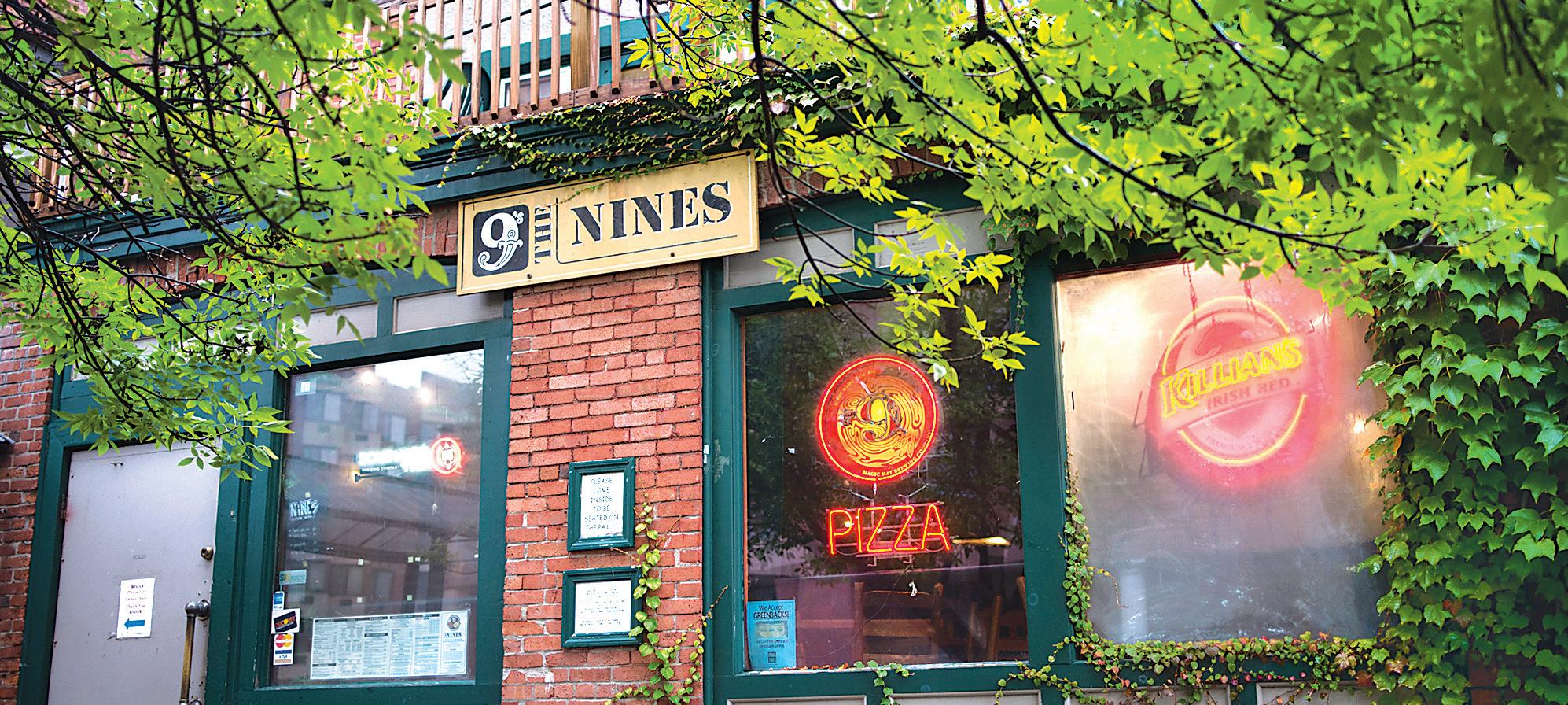
The property at 311 College Avenue — the former home of the beloved Nines restaurant — sold Tuesday in a $3 million deal between its longtime owners and developers John Novarr ’77 and Phil Proujansky, the Ithaca Times reported.
Co-owners Mark Kielmann ’72 and Harold Schultz ran the business for almost 40 years, serving up deep-dish pizza and trivia nights to
students and local Ithacans alike. Their retirement plans — sale of the property for housing development to Visum, another local developer — were pushed back, however, after the Ithaca Landmarks Preservation Commission filed a proposal to designate the property as a historic landmark in 2017. If designated, the building would have been preserved as is, requiring ILPC approval for any outside changes. The debate led to a months-long battle that ended in a mayoral tie-break against pres-
ervation at the Common Council last June and a go-ahead to sell the property on the commercial market.
The $3 million price is the same figure that Kielmann said was offered to him by Visum Development prior to the landmarking push, Kielmann told the Ithaca Voice last year.
Public records show that the property was assessed in 2019 at a $850,000 value. The land itself was
Monday, April 8, 2019
Dairy Alternative Day Noon - 4 p.m., across from Stocking Hall
SAP Speaker Series: Pakistanis in the American Court 12:15 - 1:30 p.m., G08 Uris Hall
Science & Technology Studies Seminar Series: Patrick McCray 3 p.m., 423 Morrill Hall
Cornell Dairy Center of Excellence Seminar Series 4 - 5 p.m., 146 Stocking Hall
Linking the Health of People and the Planet: Food Security, Fish Consumption and Nutrition in Global Fishing Communities 4 - 5 p.m., 100 Savage Hall
Lessons of the Left Turn in Venezuela and Bolivia:
David Smilde and Santiago Anria 4:30 - 6 p.m., Kaufmann Auditiorium, Goldwin Smith Hall
Lebanese Novelist Hoda Barakat 4:30 - 5:30 p.m., 110 White Hall
Reconnecting European Literary History: Histories of Literary Objects in an Age of European Crisis and Expansion 4:30 p.m., KG 42 Klarman Hall
OF
Parlaying about political protest | Society for the Humanities fellow J. Daniel Elam will discuss political protest as modes of political collectivity.
Sam Lewitt Lecture 4:30 p.m., Milstein Auditorium, Milstein Hall
Institute for Comparative Modernities, New Conversation Series: Frantz Fanon, B.R. Ambedkar, And the Anticolonial Refusal 4:45 - 6:15 p.m., Guerlac Room, A.D. White Room

sunmailbox@cornellsun.com Business Manager Dahlia Wilson ’19
Berger International Speaker Series: Views of the U.N. Committee on the Rights of the Child 12:15 - 1:15 p.m., 186 Myron Taylor Hall
Distinguished Speaker in Genome Biology: Systematic Discovery of Gene Regulatory Elements Using Chromatic Structure in Plant Genomes 12:20 p.m., 606 Tower Road
Green New Deal: Conversation With Reinhold Martin 12:20 - 2:15 p.m., Milstein Auditorium, Milstein Hall
Kenneth A.R. Kennedy Lecture in Human Evolution: Tibetan Adaptations to High Altitude 4 - 5 p.m., G10 Biotechnology Building
MAE Colloquium: Christine Hartzell, Ph.D. on Non-Gravitational Forces and the Behavior of Grains: Applications in Planetary Science and Spacecraft Design 4 p.m., B11 Kimball Hall
Leigh Claire La Berge: Wages Against Artwork: Decommodified Labor and the Claims of Socially Engaged Art 4:30 p.m., KG42 Klarman Hall
The Shape of Absence: Recovering Enslaved African American Woman’s Resistance in ‘Wake: The Hidden History of Women-Led Slave Revolts’ 4:30 p.m., 122 Rockefeller Hall

By ALEC GIUFURTA Sun Staff Writer
Rohit Verma, dean of external relations at the SC Johnson College of Business, is moving on to new frontiers: In July, he will become the founding provost of VinUniversity, a new non-profit university in Vietnam developed by Vietnamese real estate conglomerate VinGroup in partnership with Cornell and other American universities.
“Serving as founding provost for [VinUniversity] provides a once-in-a-lifetime opportunity to help establish a world-class university in a fast-growing region of the world,” Verma said in a statement to The Sun. “The strong support from two [Ivy] league universities … gives my confidence that VinUni will be able to become successful in establishing high-quality academic programs.”
Verma is currently the Singapore Tourism Board Distinguished Professor in Asian Hospitality Management at the School of Hotel Administration. Although his new position stations him halfway around the globe, Verma will remain a faculty member in the hotel school on leave of absence.
“I consider myself to be a ‘hotelie-for-life,’” Verma said. “While I am not permanently leaving Cornell … I will most definitely miss my daily interactions with wonderful students, colleagues and friends at Cornell and life at Ithaca.”
Slated to open in the fall of 2020, VinUniversity’s mission is to “to make a breakthrough in the qual-
Amit Singhal Ph.D. ’96 received $15M despite claim of ‘credible’ harassment
By VALE LEWIS Sun Staff Writer
Google agreed to pay $15 million to Amitabh Singhal Ph.D. ’96, a former senior vice president in charge of its search engine, as part of an agreement reached when Singhal resigned from the company in 2016 following accusations of sexual harassment against him, a lawsuit unsealed in early March revealed, according to The Wall Street Journal.
The civil shareholder lawsuit filed in California
“Harassment is unacceptable in any setting. I certainly want everyone to know that I ... have not committed such behavior.”
Amit Singhal Ph.D. ’96
charged that the tech giant had repeatedly conspired to conceal claims of harassment, forcing Google to disclose documents showing that
Singhal and a number of C-suite officials — including Andy Rubin, former head of Google’s Android division — had landed massive golden parachutes even as they faced serious accusations of malicious behavior.
Singhal was accused by a female Google employee of groping her at an event in 2015. Google subsequently investigated the allegations and found that he was “inebriated” at the time and the woman’s allegations were “credible,” according to The New York Times.
Singhal said in 2016 that he would be resigning from the company to focus on philanthropy and to spend more time with his family. Neither Singhal nor Google disclosed the sexual misconduct allegations at the time of his resignation.
“It has always been a priority for me to give back to people who are less fortunate, and make time for my family amidst competing work constraints — but on both fronts, I simply want to give and do more,” Singhal said in a 2016 goodbye letter, according to Recode, a technology news website.
Uber hired Singhal to be its senior vice president of engineering less than a year after his departure from Google. Singhal worked there for less than a month before he was asked to resign in February of 2017, when the allegations against him became public, according to The Times.
While Singhal was originally reported to have received $45 million from Google, he ultimately received only $15 million because Uber is a competitor of Google, The Wall Street Journal
See GOOGLE page 5

ity of higher education in Vietnam, with the aim towards being a world-class university,” according to the VinGroup’s website.
Cornell entered into a multiyear contract with VinGroup earlier last year to manage the more education-oriented aspects of VinUniversity, including faculty recruitment, curriculum development and university administration, The Sun previously reported.
Under its agreement with VinGroup, Cornell will advise the startup university until 2024 on the creation of a business college as well as academic programs in engineering, hospitality and real estate, according to a University press release. The University of Pennsylvania will also consult on the creation of nursing and medical colleges.
“The university will have [global] approach, multi-disciplinary curriculum and strong emphasis on real-world including active programs for external engagement,” Verma said.
In a statement to The Sun, Dean of the business college Kevin Hallock said he is “extremely grateful for Rohit’s many contributions to Cornell over the past 13 years.”
“I look forward to learning the progress and development of VinUniversity and wish Rohit the very best in his new role,” Hallock said.
Alec
By KATHRYN STAMM Sun Staff Writer
Indonesian garment workers Linda Ratnasari and Siti Chasanah, who were scheduled to speak at Cornell about their lives as sweatshop laborers on March 20, were unable to make it to the event due to the rejection of their visa applications by the State Department.
Their speech would have been part of the Nike Women Truth Tour — an event coordinated between the School of Industrial and Labor Relations and United Students Against Sweatshops — for Union Days, the school’s annual spring lecture series dedicated to discussing the future of the labor movement.
According to their USAS biographies, Ratnasari and Chasanah worked in Nike factories in Indonesia for a combined 16 years. After the company moved its production to other countries, the women said that they — along with 3,000 other workers — were denied legally owed severance pay.
Sweatshop allegations against Nike first arose in the 1970s. Following the work of various anti-sweatshop groups — including USAS — Nike audited its factories approximately 600 times, between 2002 and 2004.
In 2017, there were further allegations made by labor activists that Nike refused to allow the independent monitoring group the Worker Rights Consortium to inspect its contract factories — a claim the company denied. The Cornell Store ended its licensing contract with Nike that same year, citing failure to meet fair labor guidelines, The Sun reported. The women have since
become union leaders, with the main objective of holding Nike accountable to the Indonesian labor force. Their tour planned to highlight their experiences of inhumane treatment while working in factories — including harassment, overworking and wage theft — to ensure no other worker experiences the same abuses.
However, the State Department denied the women’s visas just days before they were set to speak, according to Kataryna Restrepo ’21, president of People’s Organizing Collective, a USAS local organization who co-sponsored Union Days.
“For a case like this ... there seems to be no justification for denying the visas.”
Various organizations, including USAS and ILR, then sent letters to the State Department on behalf of the women to expedite the process for a second interview. Prof. Risa Lieberwitz, industrial and labor relations, helped draft the letter in hopes that the two women would be able to make it to Union Days.
“The letter was not only in support of their coming, as [part of] an event that we find meaningful, but also to emphasize that this was an educational event,” Lieberwitz told The Sun.
But despite the school’s backing, their visas were once again denied on March 25. The laborers’ visa troubles come as the United States has
no idea what time they were supposed to come,” Flynn said. “Our facilities people have been there, they’ve done their part. It’s not totally our building so we don’t have the access to information.”
Though the building is federally managed, Flynn said that Cornell would be offering support.
“I do know that we will be closely involved,” Flynn said. “We value our colleagues there we work very closely in terms of research, very, very closely in terms of the apple industry and vegetables and obviously, grapes. We do want to know what’s going on just as much as everybody else.”
“Everybody knows about the 68.9 grant for the new grape research facility,” Flynn said, referring to the $68.9 million in USDA Agricultural Research Service funding granted to build a new federal grape genetics research lab at the AgriTech campus, The Sun reported.
“But that is just supposed to be for grape research, that doesn’t encompass what the rest of the building housed, which would be vegetable and tree fruit research,” Flynn said.
The USDA-owned buildings, according to the Cornell AgriTech map, house the Plant Genetic Resources Unit and Grape Genetics Research Unit. The two groups work together closely under the National Plant Germplasm System, according to the website, an effort to “safeguard the genetic diversity of agriculturally important plants.”
The research units have not yet responded to The Sun’s request for comment.
“I’m sure we can find office space,” Flynn said. “[Nyrop] doesn’t know how the fire will impact those units. Most likely, that will be an evolving conversation this week.”
An alert sent to the Geneva campus Sunday morning cautioned community members.
“Please do not enter USDA bldg 4974 or the attached greenhouse area due to the ongoing investigation and risk of injury,” the alert read. “Please use caution if traveling on campus today as USDA and B&P staff are moving materials and equipment to temporary locations.”
The fire was first reported by a Geneva police officer who noticed the smoke, which was visible for miles, according to The Finger Lakes Times. Several fire departments were at the scene, and the fire was controlled within 20 minutes.
“The USDA-ARS is a valued partner of the Cornell AgriTech Campus and of agricultural industries in New York state,” Nyrop wrote. “While this event is unfortunate, we are thankful to the Geneva Fire Department for their efforts and will make every effort to accommodate our USDA-ARS colleagues elsewhere on our campus so that they can continue their important research.”
Maryam Zafar can be reached at mzafar@cornellsun.com.
Continued from page 1
worth $500,000.
Kielmann told the Ithaca Voice that the Nines owners had been in talks with Novarr and Proujansky since last August. Novarr and Proujansky already possess large chunks of property in the Collegetown area, including $15.6 million acquired in a buyup in December, the Times reported. That swath includes 120, 122, 124 and 128 Catherine Street, and 302, 304, 306 and 311 College Avenue.
Sarah Skinner can be reached at sskinner@cornellsun.com.
time for his daughter. In July, transcripts showed Caplan and his wife discussing having employees of Singer take classes under Caplan’s daughter’s name. In November, Caplan forked out the first payment, wiring $25,000 to the Key Worldwide Foundation, the nonprofit arm of Singer’s college preparatory business.
At the time, Caplan said his daughter’s highest practice ACT score was a 22; he ultimately sought a 32 for his daughter, court documents show.
Caplan hails from Greenwich, Connecticut — one of the top 10 richest places in the country. In December, he dropped off his daughter at the West Hollywood Test Center in California in the morning, and picked her up from the testing center later that Saturday afternoon. According to court documents, Singer recruited a colleague to purportedly proctor — and “decipher” — Caplan’s daughter’s ACT.
Less than two weeks later, Caplan forked out another $50,000. In return, based on an agreement hashed out over the phone in November, Singer guaranteed an ACT score between 32 and 34. Court documents say Caplan asked Singer not to score his daughter higher than a 32.
“I want to make clear that my daughter, whom I love more than anything in the world, is a high school junior and has not yet applied to college, much less been accepted by any school,” Caplan wrote. “She had no knowledge whatsoever about my actions, has been devastated to learn what I did and has been hurt the most by it.”
“My immediate goal is to focus on making amends for my actions to try to win back the trust and respect of my daughter, my family, and my community,” the alumnus continued. “The remorse and shame that I feel is more than I can convey.”
Caplan was named a defendant in an FBI investigation that also accused famous actresses including Full House star Lori Loughlin, exam administrators and athletic directors of giving and accepting bribes to admit students to elite colleges, including Yale University and Stanford University.
The alumnus — who graduated from Cornell with a B.A. in government — previously told Singer, “to be honest, I’m not worried about the moral issue here,” court documents state.
Willkie Farr & Gallagher, an international law firm, cut ties with former firm partner Caplan, saying he is no longer a partner as a result of his plea in the college admissions case.
The Caplan Family Foundation Trust — headed by Gordon and Amy Caplan — donated generously to his alma maters, according to tax documents. In 2017, the Trust gave $100,000 to Cornell University, preceded by $140,000 in 2016, years during which Caplan’s daughter was likely in her first two years of high school.
These numbers were a significant jump from previous years. The Trust donated $15,000, $40,000 and $15,000 in 2013, 2014 and 2015, respectively. The University received at least $7,500 from the Trust before then, reports show.
Caplan also made sizable donations to Fordham Law School beginning in 2002, according to ProPublica reports.
In other conversations with Singer, Caplan discussed Cornell, referring, according to court documents, to an athletic recruitment scheme “which he also expressed an interest in but ultimately decided not to pursue.”
Friday’s statement did not specify what charges Caplan intends to plead guilty to, and the University did not respond to requests for comment on Friday afternoon.
By MARYAM ZAFAR Sun City Editor
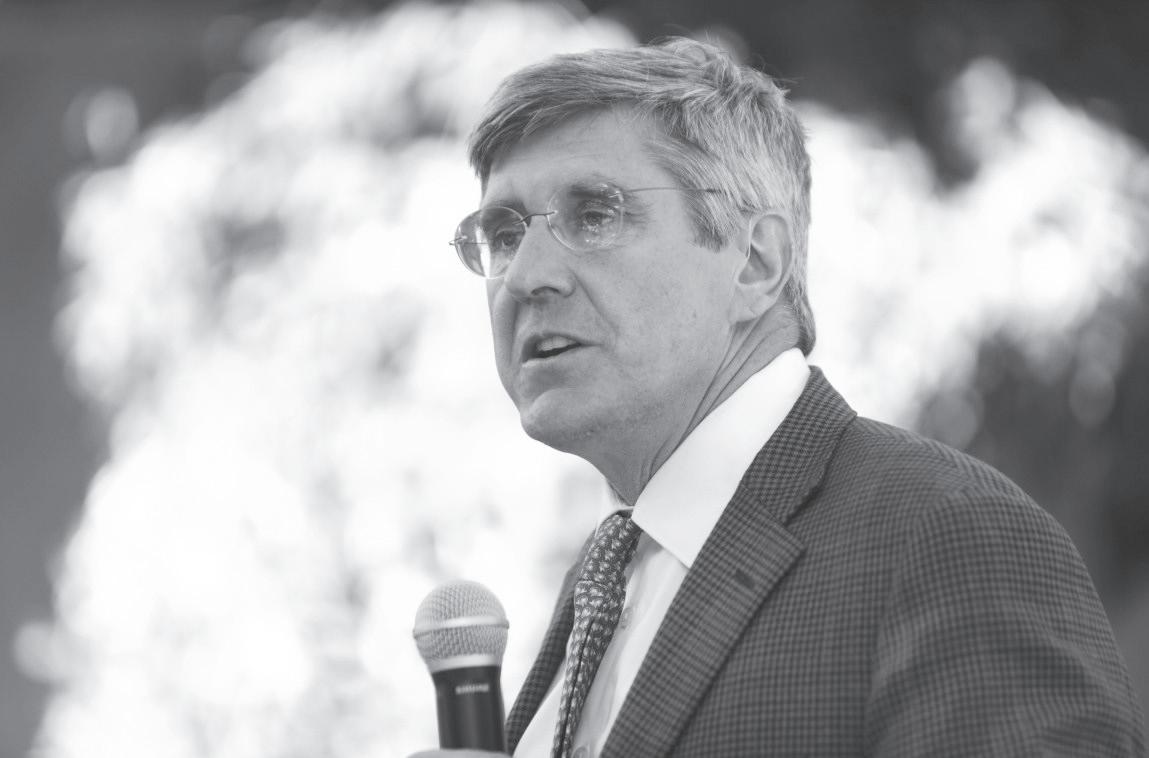
Trump campaign advisor and nominee for the Federal Reserve Board
Stephen Moore will speak at Cornell University on April 10 at the invitation of Cornell Republicans.
Moore was nominated to serve on the board of the Federal Reserve by President Trump last week in an announcement on Twitter.
“It is my pleasure to announce that @StephenMoore, a very respected Economist, will be nominated to serve on the Fed Board. I have known Steve for a long time – and have no doubt he will be an outstanding choice!” Trump tweeted on March 22.
When in Ithaca, Moore intends to speak on “President Trump’s trade policies and how they have impacted both the U.S. and global economies,” according to the Cornell Republicans’
Facebook post.
“I think that our organization and the campus more broadly can come out of this conversation with a more nuanced understanding of the administration’s economic policy... [as well as] why we are where we are with America’s economic adversaries overseas,” said Cornell Republicans president Michael Johns ’20, who is also a columnist for The Sun.
Moore has continually praised and shaped President Trump’s agenda, The New York Times reported.
“Do the president and I think a lot alike on a lot of things? Absolutely. That’s one of the reasons he picked me to be an economic adviser and be on the Fed, because we share a lot of the same economic philosophy,” Moore told The Times.
The economist was recently accused of owing $75,000 to the Internal Revenue Service, The Guardian says,
a claim that was reportedly filed last January. An avid contributor for a variety of publications, Moore wrote that President Trump deserves a Nobel prize in economics in an op-ed in The Washington Times.
Cornell Republicans has a history of inviting and co-hosting conservative speakers including Dick Cheney, Stephen Harper and Jonah Goldberg.
“The Cornell Republicans are bringing Stephen Moore because we believe he can provide an important and unique perspective on the administration’s economic policy,” Johns said.
Moore will present on April 10 from 5:30 to 7 p.m. at G76 Goldwin Smith Hall; a Cornell I.D. card will be required to attend. The event will be first come, first serve.
Maryam Zafar can be reached at mzafar@cornellsun.com.
By MARYAM ZAFAR Sun City Editor
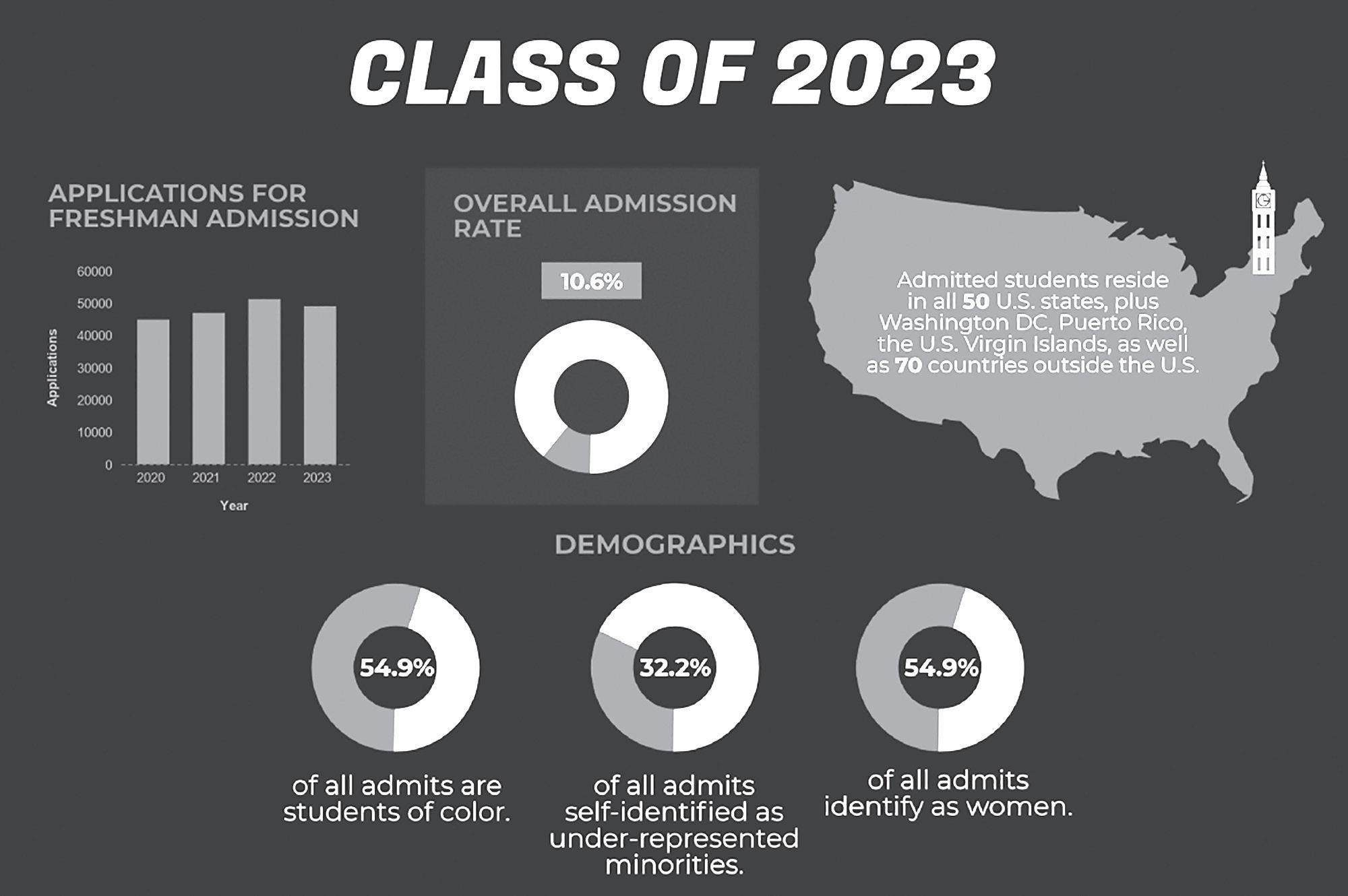
Cornell University’s acceptance rate increased for the first time in four years, as 5,183 students worldwide — 10.6 percent of all applicants — were alerted to their admission by Thursday at 7 p.m. Nearly 55 percent of this year’s admitted students are “students of color” — underrepresented minorities or Asian Americans — a new record for Cornell.
The University received 49,118 applications this admissions cycle — 2,210 fewer than last year’s — and accepted 105 fewer students this year, according to a University press release.
Cornell’s Class of 2023 acceptance rate, at 10.6 percent, is three-tenths of a percentage point higher than last year’s. Of admitted students, 1,395 students were accepted in the Early Decision round and were notified in December. 4,948 applicants have been waitlisted.
Of accepted students, 32 percent identify as underrepresented minorities, and 54.9 percent of admitted students are students of color, nearly a percentage point more than last year’s 54 percent.
Over half of the prospective students — 54.9 percent — are women, the press release states. Cornell also accepted 670 first-generation students, 30 fewer than last year’s 700.
Students of the Class of 2023 were accepted from all 50 states, in addition to Washington, D.C., Puerto Rico and The U.S. Virgin Islands. International students were accepted from 95 countries around the world and constitute 8 percent of the admitted class.
“We have admitted an extraordinarily gifted and accomplished group of students for the Class of 2023,” Jason C. Locke, interim vice provost for enrollment, said in the press release.
Also admitted are 50 students who are invited to enroll in the College of Arts and Sciences and the School of Hotel Administration in January 2020 through the First Year Spring Admission program. Last year, 60 FYSA students were admitted into the arts college and the College of Agriculture and Life Sciences.
Regular-decision applicants to Ivy League universi-
Decision day | Applicants to the Ivy League were notified March 28 of their acceptances. According to
percent of prospective Cornellians were accepted — 0.3 percent more than last year.
ties received notice of admission on Thursday evening. Among the Ancient Eight, the University of Pennsylvania, Columbia University and Princeton University all yielded lower acceptance rates for the class of 2023 than Cornell, at 7.44 percent, 5.1 percent and 5.77, respectively. All three schools received fewer total applications than Cornell.
Prospective students will be able to test Cayuga’s waters through programs like Cornell Days and Diversity Hosting Days, both of which take place in Ithaca in mid-April. The University anticipates 1,800 students for Cornell Days and
Continued from page 3
Singhal denied the harassment allegations after his dismissal from Uber, insisting that he chose to leave Google voluntarily and was not forced out.
“Harassment is unacceptable in any setting. I certainly want everyone to know that I do not condone and have not committed such behavior. In my 20-year career, I’ve never been accused of anything
like this before and the decision to leave Google was my own,” he said in a statement released late February of this year.
At Cornell, Singhal conducted research with late Prof. Gerard Salton, co-founder of the computer science department, who was known as the “father of information retrieval,” which is the foundation for modern-day search engines like Google.
Vale Lewis can be reached at vlewis@cornellsun.com.
more than 500 for Diversity Hosting Days.
Admitted students around the world can participate in other events, according to the University, including at a reception in Mumbai, India.
Students have until May 1 to respond to offers of admission.
Sarah Skinner ’21 contributed research to this article.
Maryam Zafar can be reached at mzafar@cornellsun.com.
UNION
Continued from page 3
sought to clamp down on not just permanent immigration, but also temporary travel.
Under the Trump administration, the rejection rate for short-term travel visas has gone up over 40 percent in the past two years, according to the National Foundation for American Policy.
While citizens from 38 countries — most of which are Western and developed — can travel to the United States without a visa, Indonesian nationals must go through a comprehensive process before being granted the right to visit.
According to the Indonesian U.S. Embassy, applicants must pay a non-refundable $160 fee, provide fingerprints, proof of income and pass an interview.
According to Restrepo, USAS leaders said the State Department asked the women to prove property ownership or show contracts in order to obtain visas.
are planning on going back to their home country, there seems to be no justification for denying the visas,” Lieberwitz said.
“That’s a very western-centric, classist assumption that they would have that [documentation], considering that these are workers from rural areas in Indonesia,” Restrepo said.
“For a case like this where it’s clearly an educational event, clearly the speakers
“The whole idea of a university is to have exchanges of different ideas, different expertise, different perspectives,” Lieberwitz added.
“When we have a situation where the State Department has denied visas, that inhibits our ability to have academic freedom and the free exchange of ideas.”
“When the State Department has denied visas that inhibits our ability to have academic freedom.” Prof. Risa Lieberwitz
USAS hopes to bring Indonesian union leaders to speak at a later date and will continue applying for their visas. The organization also has plans for “a media blast” to criticize the State Department for denying visas to Ratnasari and Chasanah, Restrepo said. reported.
Kathryn Stamm can be reached at kstamm@cornellsun.com.
137th Editorial Board
ANU SUBRAMANIAM ’20
Editor in Chief The Corne¬ Daily Sun Independent Since 1880
DAHLIA WILSON ’19
Business Manager
PARIS GHAZI ’21
Associate Editor
NATALIE FUNG ’20
Web Editor
SABRINE XIE ’21
Design Editor
NOAH HARRELSON ’21
Blogs Editor
SHRIYA PERATI ’21
Science Editor
KATIE ZHANG ’21
Dining Editor
AMINA KILPATRICK ’21
News Editor
JOHNATHAN STIMPSON ’21
News Editor
PETER BUONANNO ’21
Arts & Entertainment Editor
ANYI CHENG ’21
Assistant News Editor
HUNTER SEITZ ’20
Assistant News Editor
CHRISTINA BULKELEY ’21
Assistant Sports Editor
JING JIANG ’21
Assistant Photography Editor
JEREMY MARKUS ’22
Assistant Arts & Entertainment Editor
ALICIA WANG ’21
Graphics and Sketch Editor
SARAH SKINNER ’21 Managing Editor
MEREDITH LIU ’20
Assistant Managing Editor
RAPHY GENDLER ’21 Sports Editor
BORIS TSANG ’21 Photography Editor
AMBER KRISCH ’21
Editor
SOPHIE REYNOLDS ’20 Science Editor
AMANDA H. CRONIN ’21 News Editor
ROCHELLE LI ’21 News Editor
MARYAM ZAFAR ’21 City Editor
ETHAN WU ’21 Opinion Editor
SHIVANI SANGHANI ’20
Assistant News Editor
NICOLE ZHU ’21
Assistant News Editor
MILES HENSHAW ’20
Assistant Sports Editor
BEN PARKER ’22
Assistant Photography Editor
DANIEL MORAN ’21
Assistant Arts & Entertainment Editor
MDarren Chang | Swamp Snorkeling
aybe Jean Baudrillard was right, and the system is accelerating toward implosion. Information in the 21st century is easily dispersed and produced, but at what cost?
I’m a long-time politics junkie, binging political information like new episodes of a TV show. But I kept this spring break relatively information-free, and it has done wonders for my stress levels and mental health. Instead of keeping up with hour-by-hour updates, I limited myself to skimming the occasional article and glancing at news notifications.
And I’ve rarely felt so unencumbered.
It’s no joke that political information overload can muddle our thoughts and values. With the advent of the Facebook newsfeed as a trusted news source, we’re treated to a minute-by-minute analysis.
Working on Today’s Sun
Deskers Jamie Lai ’20
Jenny Huang ’22
Sports Desker Raphy Gendler ’21
Photo Desker Jing Jiang ’21
News Deskers Johnathan Stimpson ’21
Nicole Zhu ’21
Design Deskers Jamie Lai ’20
To the Editor:
In a March 25 guest column, “A Jewish Case for Divestment,” four students argue for divestment from Israel. The authors attempt to revise history with false claims about Israel and the Jewish people. They write, “To pretend as though European Jews, without a state, were helpless in the face of Nazi genocide is to erase the sacrifices of countless Jews who fought and died in the Soviet and Polish armies, in antifascist partisan detachments and in ghetto uprisings.”
This statement is not only false — it is extremely offensive. Valiant as they were, the efforts of the partisans were not enough to save the Jews of Europe. Despite the brave souls who fought until the end, six million Jews were still murdered by the Nazi killing machine. Had there been a Jewish state or a country willing to take in Jewish refugees, millions of lives undoubtedly would have been saved. The leaders of these antifascist movements and ghetto uprisings understood that, and many of them were involved in Zionist movements. If Israel had existed as a safe haven then, my great grandparents might not have lost their entire families in the Holocaust.
Another falsity pushed in the article is that “the State of Israel . . . has done [nothing] to protect Jews around the world against anti-Semitism.” In reality, many Jews have fled from hatred around the world and found refuge in Israel since its founding. Most of the nearly 850,000 Jews living in Iraq, Egypt, Afghanistan, Iran, Libya and other Arab- and Muslim-majority countries in 1948 emigrated to Israel because they were no longer welcome in their home countries. Thousands more found safety in Israel after escaping persecution in Ethiopia and the USSR. Today, Jews continue to flee to Israel from anti-Semitic abuse in France and around the world.
I urge Cornell students to condemn the historically revisionist claims being used to demonize Israel and to debate the issue of divestment with historically accurate arguments.
Elliot Meyers
’22
LEI LEI WU ’21 Layout Editor WANT TO
It’s no joke that political information overload can muddle our thoughts and values. With the advent of the Facebook newsfeed as a trusted news source, we’re treated to a minute-by-minute analysis and sometimes even a live report. An event happens, and we’re slammed with opinion articles, tweets, blog posts and even the occasional vlog.
From what I can tell, there are two main problems with information saturation. First, knowing all the “bad” things that happen in the world of politics creates a fatalism that subsumes any optimism. How do we respond when we’re constantly moving from one negative topic to another with no time to regroup, reorganize and reconceptualize our base values?
For example, The Washington Post’s Brian Klaas lists 19 separate issues that surrounded the president in March 2018. Just in March! The actions ranged from starting a trade war with China to congratulating Russian President Vladimir Putin on winning an election to bullying a journalist for his physical appearance. In this endless stream of political information, it’s unsurprising that 57 percent of Americans are stressed out by the political climate, according to the American Psychological Association.
promote echo chambers, only consisting of users who share the same viewpoint, has played a large role in the spread of fake news. False reports spread faster among groups of people that keep liking, commenting and sharing on stories with dubious author credentials and no actual reporting. The viral video of a confrontation between an elder of a Native American tribe and a high-school student wearing a Make America Great Again hat proves my point: Thousands of social media posts spawned after the video was released either condemning the teenager for being a white supremacist or condemning the liberals for condemning the teenager. Yet, the majority of the posts didn’t account for the full video, which was released later and undercut both narratives.
The construction of this event in our political imagination was immature and lacking fact. Supporting either the high-schooler or the Native American elder created immediate grounds for vilification. Yet, this vilification was never truly justified — the boys were later cleared of instigating the incident — showing how this model of information proliferation lets rash or dishonest opinions proliferate.
We can find meaning in politics and the hyper-real, but we should adhere to our base set of beliefs instead of allowing the media and other political leaders to define our prioritization of news.
Topics like the Pentagon’s policy on transgender troops or Donald Trump’s Muslim ban are deeply personal for many, but we rarely get to reflect on their importance because there’s always another crisis, another eye-popping story. The news media moves swiftly on to Stormy Daniels, Beto for President or Trump firing James Comey. This oversaturation impedes our capability to parse what matters and what doesn’t in these conversations.
The second problem from information saturation lies in the realm of misinformation. By misinformation, I mean both the proliferation of so-called fake news, which is news distributed without credible underlying facts, and a broader failure to consider what information plays into our socio-political calculus.
The capacity of social media spaces to
All of this is why I chose to lay off on the political news this break. As college students who are constantly plugged into social media, we can respond to information saturation by taking breaks and conscientiously mapping out our standards for political leaders so we can fall back to our base values. But sometimes, we simply need to unplug. In the middle of prelim week number two or problem set five, we should be spending time on our homework. Vox’s brief email recap of the day’s news should sate our thirst for knowledge, because truly delving deep on any topic requires time we often don’t have to spare. Realizing that the news is exhausting is a first step to better and more responsible responses. We need to build an instinct to withhold judgment until the facts are in. No one wins in the race to be wrong first.
Let’s bring it back to Baudrillard. We can find meaning in politics and the hyper-real, but we should adhere to our base set of beliefs instead of allowing the media and other political leaders to define our prioritization of news. We can and must track the issues we think determine our vote and political orientation. We can nail down the voting issues instead of hopping from one problem to the next, lost in a sea of never-ending information overload. Ad Layout Medhavi Gandhi ’20
Darren Chang is a sophomore in the College of Arts and Sciences. He can be reached at dchang@cornellsun.com. Swamp Snorkeling runs every other Monday this semester.
In President Pollack’s much-publicized statement rejecting Students for Justice in Palestine’s proposed divestment measures against Israeli occupation, Cornell’s leader claimed that such action would “unfairly single out one country in the world for sanction, when there are many countries around the world whose governments’ policies may be viewed as controversial.” In case she has forgotten, we would like to remind her of the other countries whose human rights violations have been brought to her attention by anti-imperialist members of the campus community.
In May 2017, Pollack’s administration declined to take action to utilize Cornell’s purchasing power to help curb militia violence in the Congo in accordance with the demands of the global “conflict-free” movement. A resolution that earned the near-unanimous support from the Student Assembly was unilaterally dismissed, even though the relatively uncontroversial conflict-free campaign provided Cornell with a feasible action plan to directly address the country’s human rights violations. University leadership simply couldn’t be bothered to care about this powerful student-led effort, let alone act on it.
The following month, an S.A. resolution authored
In case Pollack has forgotten, we would like to remind her of the other nations whose human rights violations have been brought to her attention by antiimperialist members of the community.
by human rights organizers and Native American student leaders asked the University to divest from dirty pipeline projects that violate Indigenous sovereignty and put the future of all peoples at stake. Pollack’s response dismissed grave concerns surrounding federally backed corporate attacks on the sovereignty of Native nations, insensitively labeling these life-or-death issues as being unrelated to higher education. An intensively organized effort to address human rights violations once again made it to the floor of the SA, only to
face summary execution upon its delivery to the Office of the President.
Then in October 2018, the ILR School’s director of international programs “singled out” the Chinese state over its brutal crackdown against student activists. Following consultation with the administration, he exercised his authority to suspend two exchange programs with the Beijing-based Renmin University. In that vein, students have also protested Cornell’s secret multi-million partnership with a telecom firm that’s known to be infiltrated by China’s authoritarian government. The Sun’s bold investigative reporting on the matter was even internationally publicized by Sen. Marco Rubio (R-Fla.), a member of the U.S. Senate Select Committee on Intelligence.
In December 2018, a large group of concerned students demanded that Cornell cut its ties with Saudi Arabia given the new monarch’s orchestration of genocide in Yemen and assassination of journalist Jamal Khashoggi, among other atrocities. Pollack sowed confusion by stating that Cornell’s associations with the Saudi-tied Global Business School are nonexistent, while also defensively asserting that GBS is a private entity with no ties to the Saudi state anyways. Both claims are demonstrably false, yet they still came shamelessly marked with Pollack’s letterhead. Student activists were left even more flabbergasted when she puzzlingly contradicted reports in the global press that the Johnson School plans to build a new GBS campus in Jeddah. The full extent of past and current Cornell-Saudi ties remains unclear.
In February 2019, student labor organizers turned their eyes in the direction of another rogue Gulf state. In a public letter, they reiterated long-standing calls for Cornell to order a third-party investigation into its satellite medical campus outside the Qatari capital of Doha. Qatar operates thanks to the labor of millions of migrant workers, with the elite citizenry comprising less than 10 percent of the population. Pollack has defensively insisted that the campus’s contracted workers are treated in accordance with the country’s labor laws, a curious argument given that those laws are notoriously cruel. Though credible information about Cornell’s presence in the authoritarian Gulf monarchy is difficult to get, the public has gained brief glimpses into some of its worst horrors. In a 2011 submission to The Sun, a Cornell-Qatar research assistant describes
Shir Kidron | Guest Room
being given his very own “tea boy” — a middle-aged migrant laborer degradingly employed to stand at beck and call for the ostensibly elite minds of Cornell’s bizarre Persian Gulf outpost. Despite such accounts, we’ve been informed time and time again by Cornell leadership that there’s simply nothing to see there. Carry on, we’re told.
To be clear, members of the 22 student organizations that have endorsed SJP’s renewed divestment campaign have been involved in almost all of the fights detailed above. But much to our disappointment, only SJP’s latest push has yielded a personalized, long-worded and passion-driven rejection from Pollack’s office. Other campaigns remain tragically sidelined, with our Ivory Tower’s leadership caring very little about its complicity in the violence of a multitude of governments. Isn’t our leadership aware that Israel is simply a single country among that multitude?
While Pollack’s divestment statement is said and done, we can only hope for transparent, balanced and empathetic reception the next time we students raise legitimate questions about our rural University’s secretive operations abroad. Student activists seek not to sensationally play out larger geopolitical debates on Cornell’s campus, but to gain tangible redress surrounding institutional complicity in clear human rights violations. That’s why Pollack’s convention of evading transparency — coupled with a singularly passionate commitment to preventing divestment measures against a state that’s responsible for crimes of occupation, apartheid and ethnic cleansing — will do nothing but further degrade mutual trust. As human rights organizers, we simply want to help build a better world. But until our University truly reckons with the human implications of its endless foreign entanglements, we regretfully fear that Pollack’s globalist “One Cornell” vision won’t be part of it.
Helen Shanahan ’18 is the former co-president of Amenesty International at Cornell University. Max Greenberg is a freshman in the College of Arts and Sciences. Christopher Hanna is a senior in the College of Agriculture and Life Sciences. Kataryna Restrepo is a sophomore in the School of Industrial and Labor Relations. Steve Tarcan is a junior in the College of Arts and Sciences. Viraj Kumar is a sophomore in the School of Industrial and Labor Relations. Guest Room runs periodically this semester. Comments may be sent to opinion@cornellsun.com.
In January 2009, a long-range missile from Gaza was fired into Israel. This has been a common occurrence ever since Israel’s withdrawal from Gaza in 2005. As a child, I was taught at school to immediately run to a bomb shelter if sirens go off, so I did that.
I was home alone in my room and quickly ran to the shelter we had in our house. It was 9:30 a.m. Normally, I would stay in the shelter and wait for the sirens to stop, as rockets rarely reached my town of Gedera. Unfortunately, this day was different. A mere two seconds after I entered the shelter, I heard a loud boom, and felt my home collapse. After leaving the shelter, I saw the rocket had hit my bedroom and killed my dog Rosie. I was only 12 years old.
The story of my home in Gedera is not unique. It resonates with tens of thousands of Israelis who have been under a constant threat of rockets from Gaza over the past 18 years. According to the Israeli Center for the Treatment of Psychotrauma, 40 percent of the children in the Israeli border town of Sderot suffer from PTSD. This is what happens when, at any moment, you could be given only 15 seconds to run for shelter. The rockets often come unprovoked, as we witnessed as recently as two weeks ago: A long-range missile was launched from Gaza and flew over Tel Aviv, hitting the community of Mishmeret and wounding seven Israeli civilians.
But rockets are not the only threat from Gaza. In 2018, hundreds of hectares of Israeli fields were burned in the area surrounding Gaza because of burning kites and explosive balloons released from Gaza. In the poverty-stricken Gaza Strip, where 1.8 million Palestinians are crammed into 140 square miles and unemployment is over 50 percent, Hamas brags about having a tunnel system twice as large as the Viet Cong. Hamas is said to have spent between $30 million and $90 million and used 600,000 tons of concrete to build these tunnels. In 2006, Hamas used the tunnels to kidnap the Israeli soldier Gilad Shalit. In July 2014, Hamas militants used a tunnel to prepare an ambush in the fields of Kibbutz Nir-Am, but the Israel Defense Forces stopped them.
These examples are not meant to compare suffering with suffering, or military might with military might — a framing the BDS movement relentlessly tries to push. The people of Palestine are suffering, and deserve a chance at a peaceful life with dignity. They need a country, but it doesn’t have to replace our own.
In fact, both Israeli and Palestinian leaders have consistently embraced a twostate solution, with supporters ranging from Palestine Liberation Organization Chairman Mahmoud Abbas to many of Israel’s prime ministers including Rabin, Barak, Sharon, Olmert and Netanyahu. In 2008, an agreement seemed closer than ever when Prime Minister Ehud
Olmert offered Chairman Abbas a deal in which a Palestinian state would be built on 93.7 percent of Israeli territories, with an extra 5.8 percent based on land swaps.
Here at Cornell, the voices supporting BDS are getting more extreme.
According to this deal, the holy places would have been under international control. Abbas admits to have rejected the deal.
The reality is not easy for both sides. On the Israeli side, we live in fear of rocket attacks, suicide bombers and stabbing attacks. On the Palestinian side, the civilians are living under Hamas rule dealing with poverty and population density while the Palestinians in the West Bank are living with the presence of the Israel Defense Forces. Their society is plagued by a corrupt Palestinian government and relentless terrorist groups. This is not the life either side should be living, and will not be if a two-state solution is achieved. This has led to some parts of the radical left to embrace the BDS effort, an effort to delegitimize and strong-arm Israel into losing its identity as a Jewish state.
Here at Cornell, the voices supporting
BDS are getting more extreme. A letter full of inflammatory rhetoric was sent to President Pollack, while an aggressive campaign launched to pass a divestment resolution in the Student Assembly. This campaign is making Jewish students here on campus feel unsafe and unwelcome. It also contained crucial historical inaccuracies, like the statement in SJP’s teach-in that the Arabs accepted the 1947 UN partition plan supporting two states.
As an Israeli citizen who has paid the price of violence, and as a Cornell student cognizant of the civil and human rights of the Palestinians, I plead you: Stop this extreme, one-sided and violent attempt at delegitimizing me and my country. Promote genuine dialogue that will lead to a real improvement in the lives of both Israelis and Palestinians. Don’t fall for the shallow rhetoric of the BDS movement, which takes one of the most complex geopolitical mazes in history and forces it into the unfitting settler-colonial narrative. Because down the line, this effort will only serve to demonize, harass and bully my friends and me. It will not get the Palestinians an inch closer to a life with dignity, simply because it does not support the one crucial ingredient in any future solution: dialogue.
Shir Kidron is a senior in the College of Agriculture and Life Sciences. Guest Room runs periodically this semester. Comments may be sent to opinion@cornellsun.com.




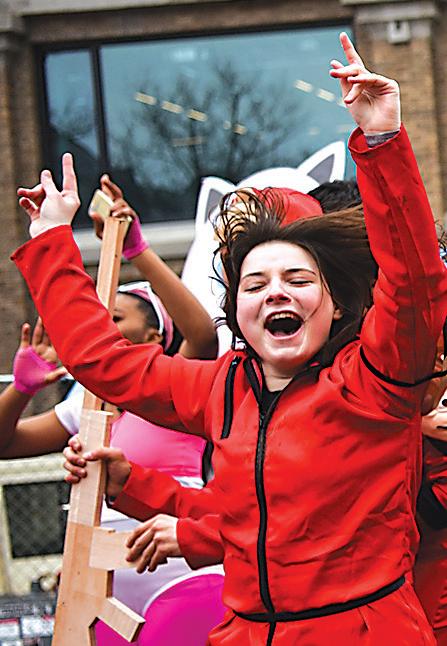

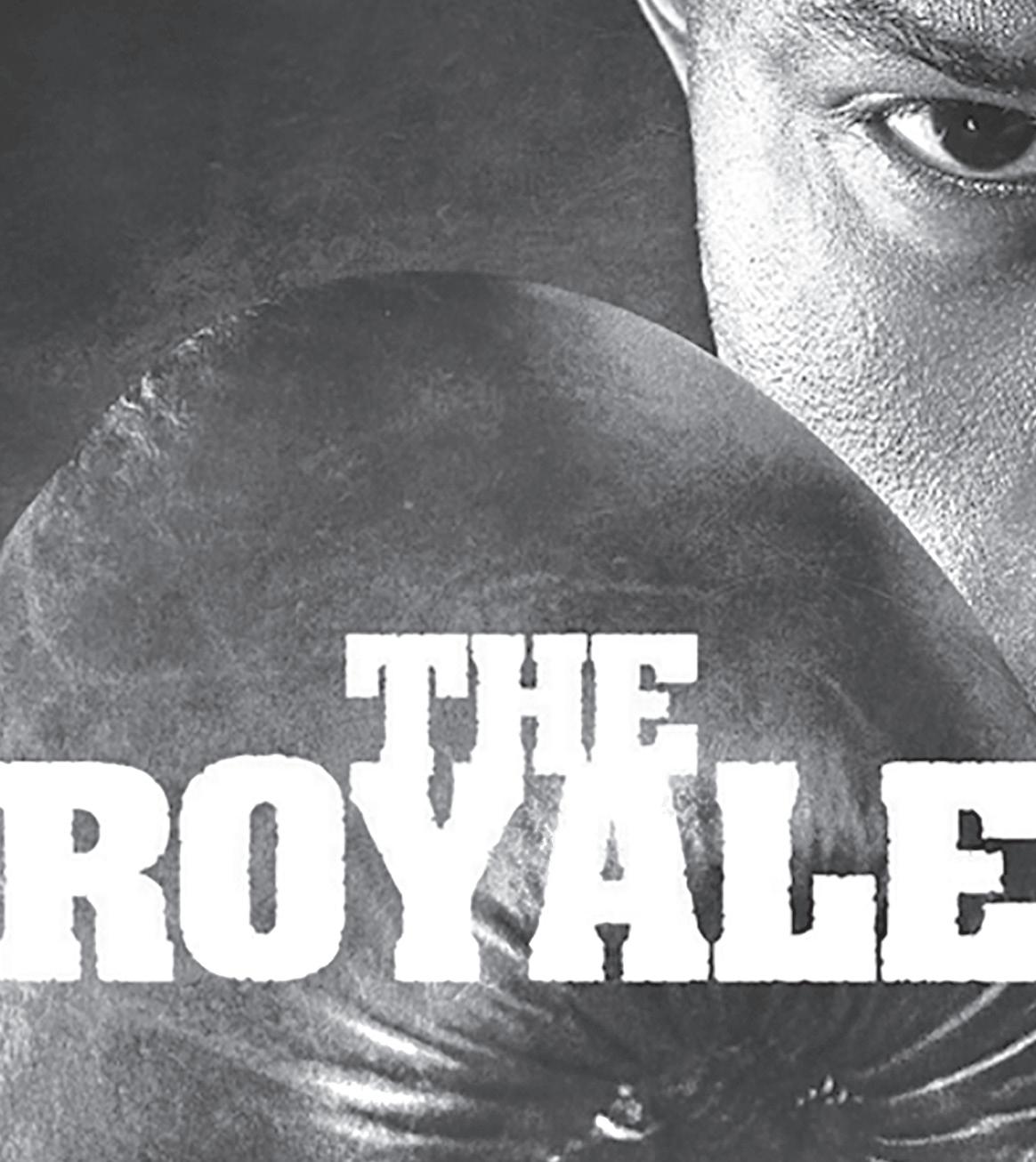
The Royale,a play written by Marco Ramirez and directed by Pirronne Yousefzadeh, focuses on Jack Johnson and his struggle with being the first African American heavyweight champion during the tumultuous Jim Crow era. However, for this play Ramirez took the creative decision to give Johnson the moniker “Jay ‘The Sport’ Jackson.”
Put on by the Kitchen Theatre Company, The Royale was a must see. From start to finish, none of the show disappointed. As soon as you enter the black box theatre you are greeted with a bold hardwood stage that has a large punching bag hanging towards the back, resembling, to me, a stage that an African American would commonly be lynched on for the sake of white ambition. Once in my seat, I knew for the next 70 minutes (with no intermission) I was going to be in an emotional boxing ring.
The theater is intimate and the lighting — organized by Seth Reiser, scene and lighting designer — is perfect to emphasize the inseparability between the cast and its audience. To add dramatic emphasis at points throughout the play, the glistening of the actors’ sweat and tears is visible. Then, in a flash, the stage would transition to blackout.
The acting is in-your-face, stirring and genuine. Yet with only five cast members — Jamal James as Jay, Sean Meehan as Max, Lisa Tharps as Nina, Dazmann Still as Fish, Alexander Thomas as Wynton — four out of the five being black and only one woman, I was unsure how they were going to navigate through all the complexities of being black in America. However, I was pleasantly
surprised to watch the various dynamics seamlessly unfold before my eyes. From the relationship between Jay and Nina to Wynton’s mentorship of Jay, each connection feels real and addresses all kinds of nuances that made me mock all the major production studios who spend millions of dollars to capture the same chord that The Royale was able to with a far smaller budget. There were distinct times when Jay was looking directly into my eyes (me holding my breath not daring to move from his glance) as he poured his deep emotions out to me, asking if he should continue to play the role of the martyr when he knows it’s not just himself in danger but the people who he wants to protect. This was truly a surreal experience I won’t forget.
Not only is the conviction behind the acting enough reason to praise The Royale, but also the genius of the director, Yousefzadeh, and the movement coordinator, Rocio Mendez, is a feat in itself. Yousefzadeh and Mendez instruct the actors to be rhythmic, having them clap or drum when transitioning speakers. This elicits the call-and-response musical technique to promote attentiveness from the audience and add further emphasis to certain aspects of the play. The movement during the boxing matches is fluid and purposeful. In fact, each movement in some way was perfectly accented so that emotions words could not describe were perfectly visible.
If you have the chance to catch The Royale I highly recommend you purchase your ticket quick because they sell. It’s debut weekend sold out and I’m expecting nothing less for the second weekend — you will be left speechless.
Jeremiah LaCon is a sophomore in the College of Arts and Sciences. He can be reached at jcl345@cornell.edu.

JESSICA LUSSIER SUN STAFF WRITER
Set “15 minutes into the future,” Samira Ahmed’s second novel, Internment,paints a searing portrait of the American sociopolitical landscape. This isn’t an easy book to read. In many ways, I found myself not wanting to, finding excuses to push it off and unwilling to let myself be challenged. But once I started reading, I knew this wasn’t a book I could walk away from. Internment is a novel that demands to be read. It is emotional, passionate, angry and afraid. It wakes you up. Internment is a familiar story of imprisonment, rebellion and the heartbreaking hope for change. In the novel, a family finds themselves stripped of everything they’ve ever known, shunted into an internment camp for Muslim-Americans and declared threats to national security. Their only crime — religion. Ahmed’s novel shows how easily history can repeat itself. With Islamophobia and bigotry on the rise, the world of Internment is not that much of an exaggeration. And this world is horrifying. It challenges the ideals of every American. It asks us to decide: How far are we willing to go for the illusion of safety? Internment answers that question definitively, showing how fast and how far fear can spread, but it also offers us hope. Layla Amin, the 17-year-old narrator of the story, is scared and angry. She was born in America. This is her home, and as fear and ignorance steal her life, she fights back.
This book challenges the reader to do the same and speak out against the complicit silence of ignorance and fear. It asks you to look twice, to understand rather than hate and to decide what America really means to you.
In its political leanings, this book does not shy away from controversy. At times, it definitely comes on strong, even a little over the top, but whether one agrees with its expressed views or not, it cannot be denied that it comes from a very real place. The fear, the anger, the loneliness and sorrow are the strongest elements of the novel, sweeping you up in an emotional current that refuses to let you go.
As such an emotionally weighty book, the characters other than Layla do not ultimately feel as fleshed out. The director of the internment camp, in particular, seems more of an archetype than a person, a short-tempered man in love with his own power. His villainy is not subtle, his backstory and life unknown. He is not a villain we can sympathize with, but he isn’t really supposed to be. Though I would have liked a more complicated and realistic antagonist, such a portrayal may have diluted the starkness of the emotional stakes.
As a snapshot of the American cultural and political landscape, Samira Ahmed’s Internment hits high on the emotional register. It is an intense novel, but one that feels only too important to read. This book demands to be felt, and in that feeling, understood.
Jessica Lussier is a sophomore in the College of Arts and Sciences. She can be reached at jll335@cornell.edu.
Turkuaz With Butter | 9 p.m. Thursday, April 11 at The Haunt
Turkuaz is a new-wave, electric funk band from Brooklyn, New York. You can think of them as a less-well-known The 1975. Their music primarily features shuddering guitars with male-female vocal harmonies. The funk-rock nonet will be bringing their infectious grooves to The Haunt this Thursday at 9 p.m. You can buy tickets through the DSP Shows website starting at $18. Doors open at 8 p.m.
The Commonheart With Quail | 8 p.m. Friday, April 12 at The Haunt
The Commonheart will bring their Pittsburgh blues to The Haunt on Friday. The 10-person band prides themselves on representing a revitalization of the Pittsburgh sound. You won’t want to miss this. Tickets are available on the DSP Shows website starting at $10. Doors open at 7 p.m.
An Evening with The Church | 8 p.m. Saturday, April 13 at The Haunt
The Church is one of the most well regarded new-psychedelic bands in history. Formed in Sydney in the mid-70’s, the group has released 17 studio albums. Their most famous release is arguably Starfish, 1988. The group is currently on tour in support of the 30th anniversary of this album. Be sure to catch The Church, this may be one of your only chances to do so. Tickets are available on the DSP Shows website starting at $25. Doors open at 7 p.m..
Doja Cat with Boogie | 7:30 p.m. Saturday, April 13 at Risley Hall
This concert will certainly be one for the books. The show is hosted by MCFAB and will take place in the Risley Great Hall, also the go-to gluten-free dining hall on campus. Boogie will be opening for Doja Cat, who is currently signed to Shady Records and is best known for his collaboration with Eminem, “Rainy Days.” Doja Cat is the headliner. Some of you may know her as the “Mooo!” girl. Since her viral meme song took YouTube by storm, Doja Cat has signed a record deal and begun to release non-troll music. However, expect her to still throw it back to the fan favorite farm animal track.
Live Nude Girls Unite! | 7 p.m. Tuesday, April 9
Live Nude Girls Unite! is a documentary which explores the efforts of a San Francisco strip club’s dancers and staff to unionize. Tickets to this screening are free.
Dragnet Girl with Live Music from Coupler | 7:30 p.m. Wednesday, April 10
Dragnet Girl is a 1933 Japanese gangster tale which follows gang veteran Joji as he falls in love with the older sister of a younger gang member, Kazuko. The film will be introduced with soon-to-be assistant professor of Japanese literature Andrew Campana.
According to the Cornell Cinema website, “The film will be accompanied with a live score by electronic/ambient musical group Coupler, who previously performed at Cornell Cinema with the German silent Our Heavenly Bodies. Founded in 2012 by Lambchop veteran Ryan Norris, Coupler’s core group is Norris along with Rodrigo Avendaño and Rollum Haas. The group is on tour with their new score for Dragnet Girl, having recently accompanied the film to great acclaim at the Big Ears Festival in Knoxville, Tenn.”
Vice | 9:20 p.m. Thursday, April 11, 9 p.m. Friday, April 12, 9:15 p.m. Saturday, April 13, 7 p.m. Sunday, April 14
Vice follows former Vice President Dick Cheney. Cheney is portrayed by Christian Bale, who credited Satan as inspiration for the role in his acceptance speech for his Golden Globe victory. The film was also nominated for several Oscars, including Bale again for Best Actor. Tickets can be purchased at the Cornell Cinema website.
Fill in the empty cells, one number in each, so that each column, row, and region contains the numbers 1-9 exactly once. Each number in the solution therefore occurs only once in each of the three “directions,” hence the “single numbers” implied by the puzzle’s name. (Rules from wikipedia.org/wiki/ Sudoku)


after all



COOK ST. Furnished House for 5-7 persons, 10mo. Lease for 2019-2020 Text or call Tracy at TLC Property Mgmt Corp 607-379-2776
Collegetown 1 & 3 Bedroom Apts. Available for Next School Year 2018-2019. 607-327-2927
NORTH CAMPUS
Studio and 3 bedrooms Available 2019/2020 Novarr-Mackesey Property Management office@ithacastudentapartments.com ithacastudentapartments.com 607-277-1234
The Top of Collegetown Dryden Rd-Linden Ave 3 BR Apt & House 2019-2020 607-351-1115 ksteel202@yahoo.com
3 BEDROOM SOUTH HILL
Large apt, washer/dryer furnished. $550 pp 607-272-3389

1-Bedroom Apt
Downtown
Available June 1 (or earlier) Ideal for Grads or Staff. Lovely one bedroom second floor apartment. Downtown on Cascadilla St. near N. Albany St. Carpeted bedroom and living room (with rustic real wood paneled walls), full bath, kitchen. Bus line in front of house that goes to Commons, then on to Tower Rd. on Cornell Campus. Private porch. $890 plus utilities, available June 1. (anytime after 4/15) NO undergrads, no dogs, no smokers, references. For info and appointments email gm27@cornell. edu or text 607-280-4024
H OUSE FOR R ENT
Linden Ave. 5 Bedroom House Available June 2019. $900 per bedroom. Parking included. 607-327-2927
MUST SEE: 9 Bedroom House Walk to Cornell, Collegetown $5400 + utilities/month. 531 E. State St. 9/10 Bedrooms, 3 baths, 2 kitchens. Furnished, Free Laundry, Free Parking. Available 6/1/2019 607-379-9168 text/call
2019-2020 College Ave. 5 Bedroom House Furnished. Laundry. Internet. Parking. 607-273-8576
2019-2020 Upper Eddy St. 7 Bedroom House Furnished. Internet. Laundry. 607-273-8576
607-277-1234

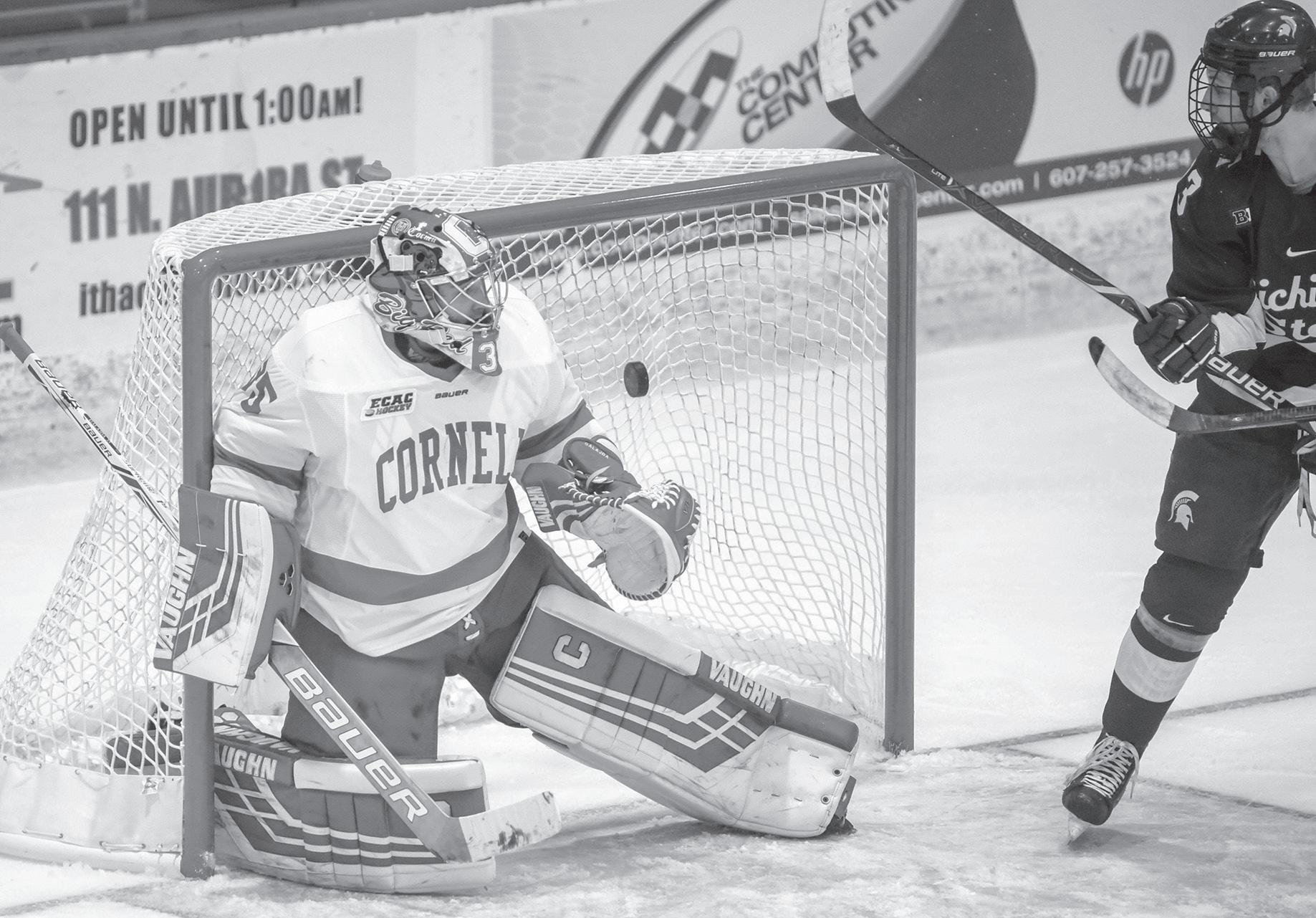

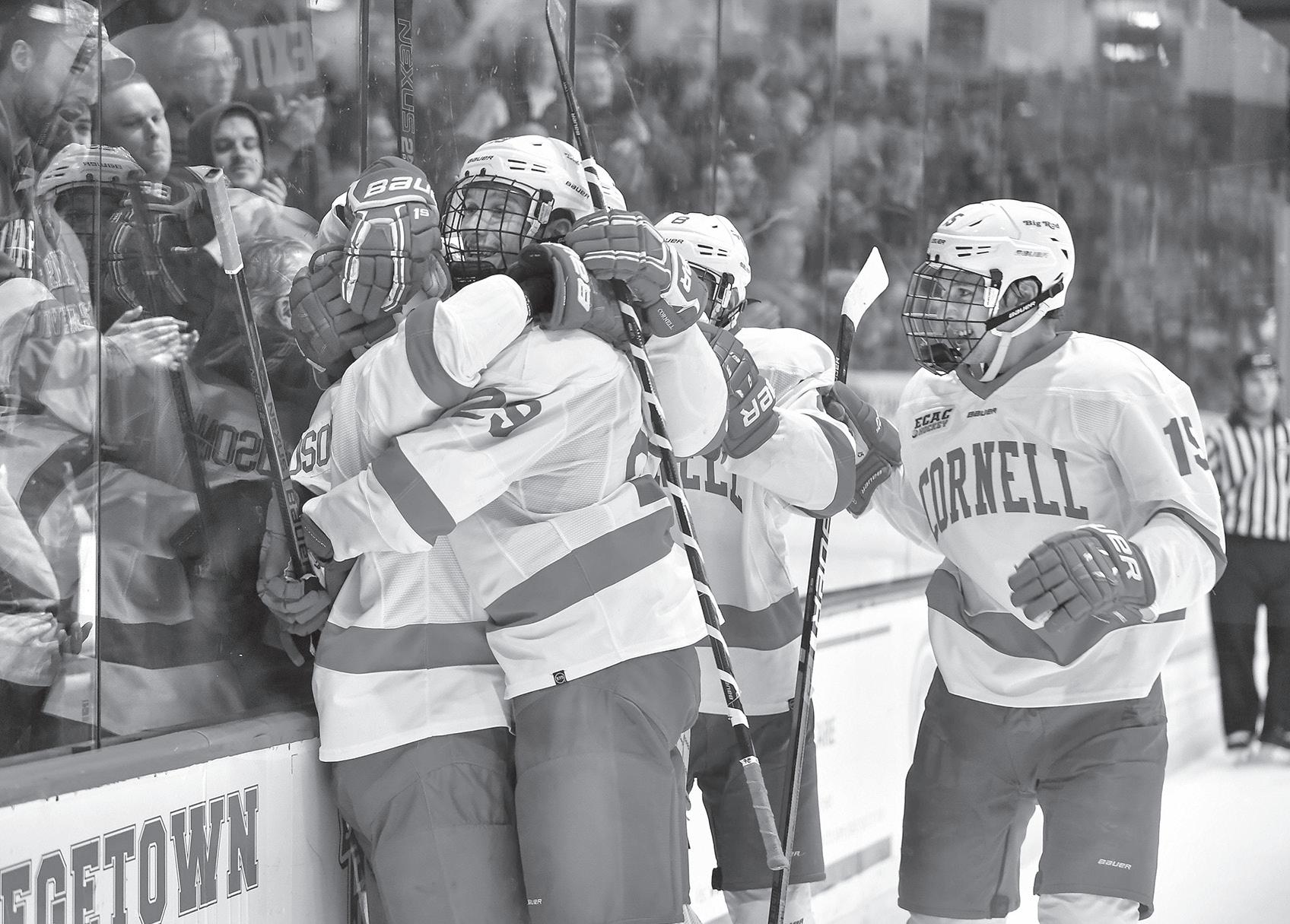
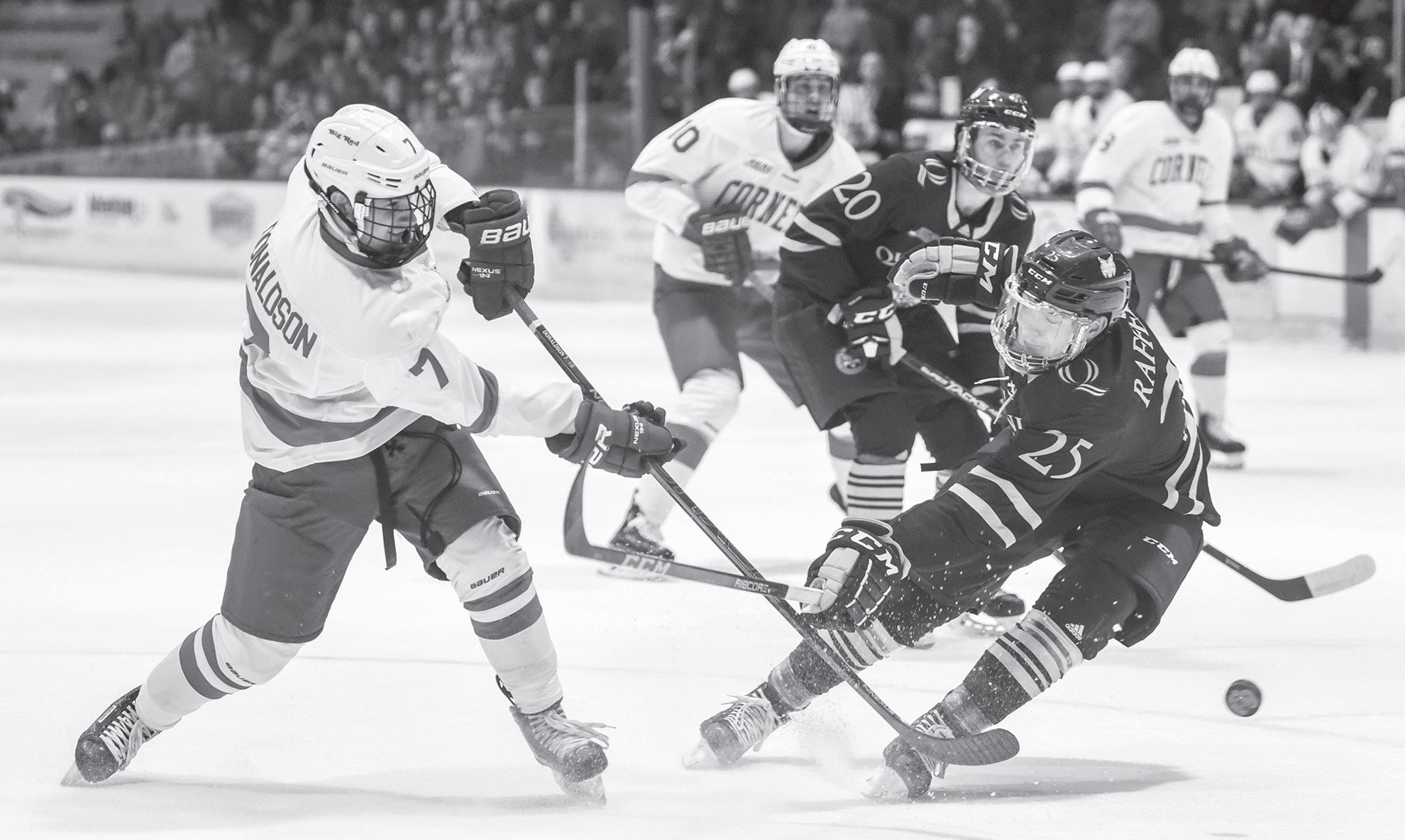
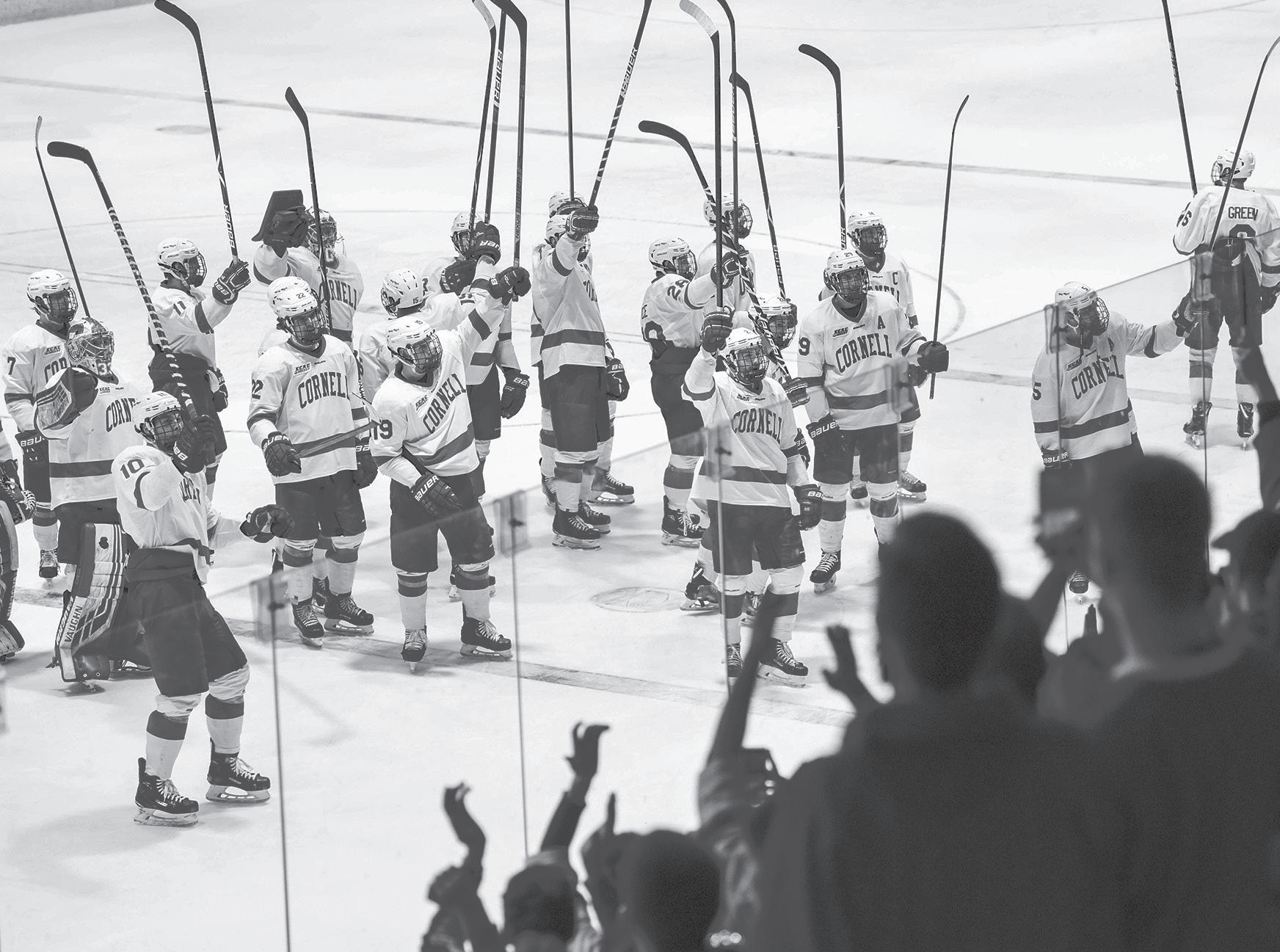
Looking back | The 2018-19 Cornell men’s hockey season was defined by a slow start, a barrage of injuries and — most importantly — the team’s resilient response to all the trials thrown its way. The season was perfectly embodied in the playoffs: a hard-fought three-game ECAC quarterfinal series win, a controversial ECAC championship game loss and an NCAA Tournament victory.


By ZACHARY SILVER Sun Senior Writer
PROVIDENCE, R.I. — Win or lose last weekend at the Dunkin’ Donuts Arena, Cornell men’s hockey head coach Mike Schafer ’86 had one message for his squadron of shorthanded skaters coming off two straight losses in the first round of the NCAA Tournament.
“The game itself does not define us today,” Schafer said. “There was a lot written that we have not gotten past the first round, we have to win. That’s just not the mentality that we want our players to take … A game, when we talk like that, winning and losing doesn’t define who we are, and we wanted them to understand that.”
But even still, after two consecutive grueling first-round exits, Cornell found some reprieve from years past and took the first step in finally exorcising its NCAA demons with a 5-1 win over Northeastern for a spot in the East Regional Finals against Providence.
“It wasn’t pressure to get to the next round, it’s not pressure to get to the Frozen Four, it’s not going to define Cornell University or define our athletic program, it’s not going to define who these guys are,” Schafer later contin -
“Having been here twice and not being able to get the job done, it’s definitely nice to get the first step.”
Mitch Vanderlaan
ued. “We are just going to come in and have fun tomorrow and play hard and let the chips fall where they may. We know inside our locker room how we are defined, and it was a great lesson in life for our guys tonight being short-handed.”
And for senior forward and captain Mitch Vanderlaan, even though he tried not to think about the disappointment of the last two tournaments, Saturday’s win provided some momentary closure.
“Having been here twice and not being able to get the job done, it’s defi -
nitely nice to get the first step, but I think we can say that we didn’t come in here thinking about past years,” he said. “It’s a new season, it’s a new team, and I think everyone — regardless of whether they were there last two years — had the same hunger to get it done today. In that sense, it was a relief, but at the same time we weren’t thinking too much about the past years. At least I wasn’t.”
Part of what’s driving the tepid excitement for Vanderlaan is that even though Cornell finally broke through the first round, bigger goals lie ahead: One win against Providence — winner of the other Regional Semifinal Saturday — separates the Red from potentially reaching its first Frozen Four since 2003.
“Obviously, we want to make it to Buffalo, but we’re really focused on tomorrow,” Vanderlaan said. “Make sure we get some water into us, get some sleep, watch some film and get ready for tomorrow.”
Cornell had to get it done Saturday, like it has all season, without key contributors.
With sophomore starting goalie Matt Galajda bit by the injury bug in last weekend’s ECAC Championship loss to Clarkson, classmate Austin McGrath stepped in once against this season and backstopped Cornell to the victory. McGrath, battle-tested and experienced through his seven starts on the year entering Saturday, was sharp early and often, making 20 saves in the win.
“Our D did a great job tonight. We knew that they like to attack off the rush and generate like that,” McGrath said. “We had really good sticks, we kept them out wide, we didn’t really give them any opportunities in the way they like to play, so we made them play our game instead of letting them do what they like to do.”
Cornell, meanwhile, needed just 4:02 of gametime to solve Northeastern netminder Cayden Primeau — a draft pick of the Montreal Canadiens and finalist for the Mike Richter Award as top goalie in the country.
An innocent-looking wrister from Cornell senior forward Beau Starrett caught part of Primeau’s right shoulder but trickled through and across the goalline. For Starrett, a New England native

from just 20 miles away from Providence, it was done with a score of family members looking on — and a sister-in-law that graduated from Northeastern.
“That came off a faceoff play, something that we wanted to work on throughout the week and that we paid attention to in scouting reports, and Beau did a great job of cutting across the front right when he got in the zone and put a good shot on him,” said senior defenseman and alternate captain Alec McCrea. “And I think all night we had traffic around [Primeau], we got in front and we beat their guys. We had strong sticks going to the net and it paid dividends for us. Beau getting that first one, it was good and we were able to use that momentum.”
Cornell picked up right where it left off in the second period as a nifty move and score by Vanderlaan extended the Red’s lead to 2-0. The senior split two defenders and chipped the puck up to himself before beating Primeau high glove-side.
“At first I was just going to shoot, but when I wound up he kind of bit pretty hard,” Vanderlaan said. “So I just kind of snapped it to the inside with a little move.”
The Red continued its onslaught with two more second-period goals.
M. HOCKEY
Continued from page 16
“I think that was the first time our guy has been wrong upstairs,” Schafer said.
The Friars all but put the game away in the dying moments of the second period. McCrea was whistled for another penalty with less than two minutes left in the period, which led to a shortside goal from forward Scott Conway with 0.6 seconds left in the frame — the “dagger,” Schafer said.
Cornell kept its foot on the pedal the entirety of the third period, outshooting the Friars, 9-7, in the final 20 minutes before Friar forward Brandon Duhaime chipped in an empty-netter. But even with McGrath pulled for a majority of the final three minutes, Providence goalie Hayden Hawkey turned aside all shots in the frame and 19 overall in the contest to keep Cornell without a goal in the biggest game of the season.
“We played the kind of hockey we wished we would have played in the first period, but we battled right to the very end,” Schafer said.
“You judge your season on the whole season,” Schafer later added. “You can break down this game … we were disappointed how we reacted to the first goal, we were disappointed how we didn’t have the jump that we needed to match their
effort and intensity.”
Now come the questions. How will Cornell replace three senior fixtures on its year-in-yearout top defense and two more key cogs on the offense? Will the injuries to its two top goalies prove impactful come 2019-20? Can the next installment continue its upward ascension toward a Frozen Four berth?
But before any of those questions are answered, there comes a summer of reflection.
And five seniors in specific won’t be around to see any resolutions, but they move onto their next chapter knowing an ECAC Quarterfinal exit to Quinnipiac their first season has evolved into coming within one game of the national semifinals.
“It’s tough right now knowing that it is over, but in my four years especially I think there has been a lot of changes in the way that the program has kind of rebuilt itself to get back,” said senior forward and captain Mitch Vanderlaan. “ … We haven’t won one while I was here, but we got a lot closer. I think the camaraderie with the guys is something. I can’t even explain it. Being part of that group — guys that care so much — it’s been incredible.”
Alex Hale can be reached at ahale@cornellsun.com. Zachary Silver can be reached at zsilver@cornellsun.com.
Sophomore Morgan Barron fought for the puck behind the net, and the lefty scored a wraparound goal on a sequence that caromed in front of Primeau and in. Three minutes later, freshman Michael Regush sent home a rebound on a point shot Primeau could not corral cleanly. What kept Northeastern competitive in the second was attracting penalties with its high-speed play. Cornell was tagged for two penalties in the first period and three more in the second. The Huskies finally got on the board with a goal on their fourth power play of the night, scored by senior Liam Pecararo with four minutes left in the second.
“The one area I was disappointed [by] was our lack of discipline with our sticks tonight,” Schafer said. “We deserved the calls that were called against us, and we’re going to have to be a lot better in that area tomorrow night.”
Cornell struck first and only in the third period, this time off the stick of sophomore forward Brenden Locke. The center received a pass from classmate and linemate Cam Donaldson, and he onetimed it past Primeau to give the Red its eventual 5-1 winning margin.
MORGAN
Continued from page 16
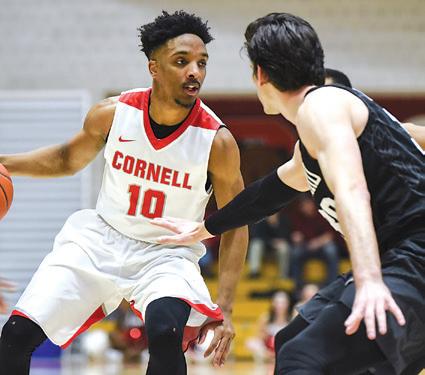
how much of a family and brotherhood it is so being able to talk to [NBA players] and being able to take some knowledge from them about the game, I think it will give me an advantage over other people. And then the guys [that will be in] the class of 2019 with me, I think we can all learn and grow together.”
for a power-conference blue blood — “you can’t really say that I’m a lottery pick or anything, but anything’s possible,” he said — his time at Cornell served as good preparation to play basketball professionally.
“I’m not a lottery pick or anything, but anything’s possible.”
Matt Morgan
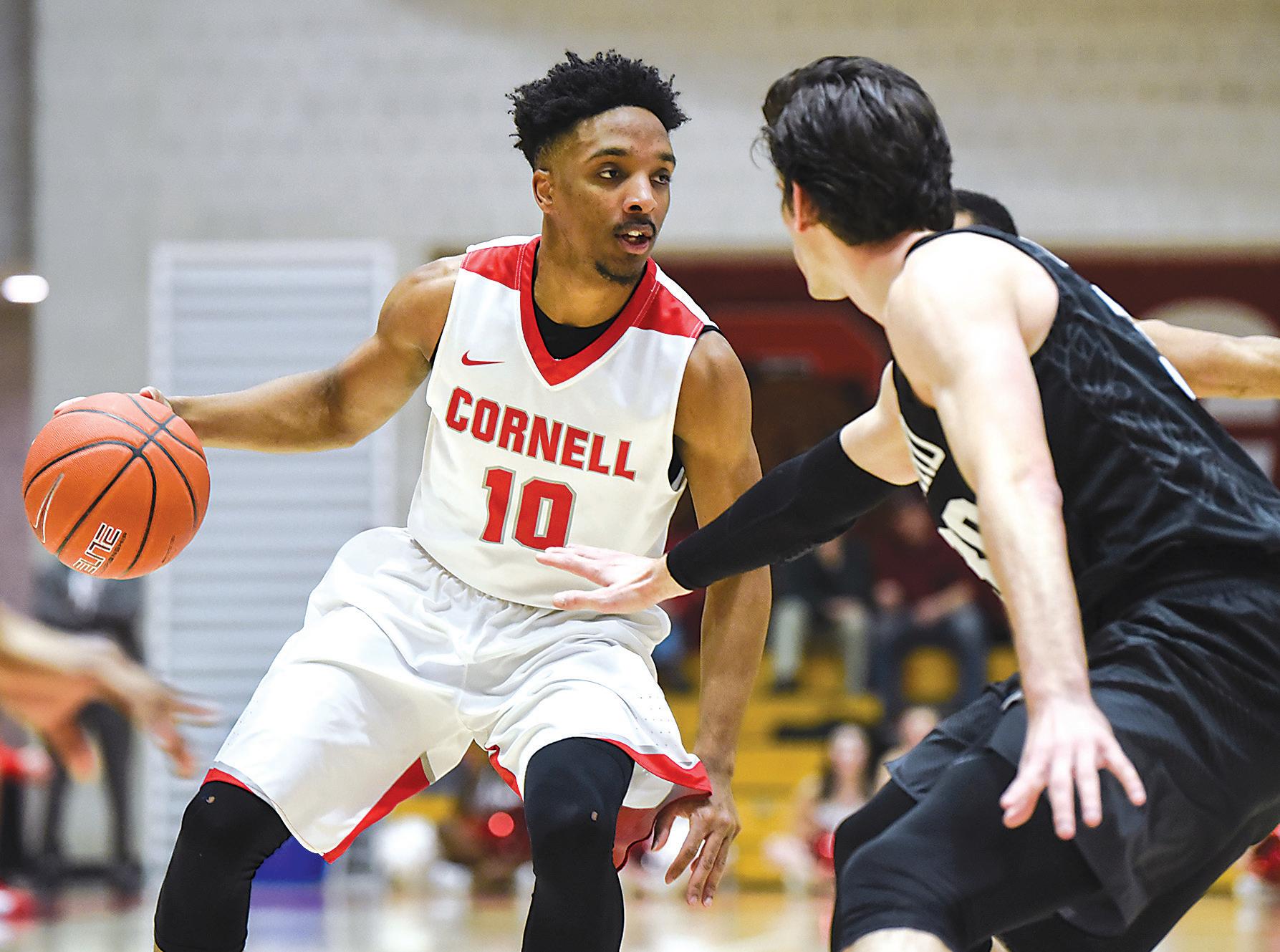
Morgan recorded 2,333 career points, the second-most in Ivy League history. The senior led the Ancient Eight in scoring in four consecutive seasons. He holds program records for points scored, scoring average, field goals made, field goals attempted and free throws made.
While Morgan didn’t play
“I think [playing at Cornell] prepared me very well, being able to have two different head coaches with two different styles of basketball…” Morgan said.
“I got a little bit of everything and I think that should play a huge part in what I’m able to bring to the table. I would say Cornell was probably one of the best decisions that I’ve ever made.”
The NBA Draft will take place on June 20 in Brooklyn, New York.
Raphy Gendler can be reached at rgendler@cornellsun.com.
By RAPHY GENDLER
Sun Sports Editor
For the third straight year, Matt Morgan is entering the NBA Draft, the senior guard announced on Twitter on Tuesday.
After declaring for the draft and ultimately withdrawing and returning to Cornell after each of the last two seasons, Cornell’s all-time leading scorer wrote that he will be represented by Klutch Sports Group, an agency most known for representing LeBron James.
While he’s been in a similar position twice before, this time feels different for the star scorer. He pulled out of the draft in order to return to school in 2017 and 2018, but this time Morgan plans to see the process to its conclusion.
“It feels completely different because I know I don’t have that option to come back to school and fall back on it,” Morgan said in a phone interview. “It’s a different feeling knowing that I’m going into this full head of steam and embracing the process and not being able to go back to school gives me more incentive to just work harder so that I can get my name called [or be] able to play in the NBA, overseas, G League, any of those.”
Morgan declared for the draft following his sophomore year in order to signal his interest to NBA teams. He heard from three organizations before withdrawing. In 2018, he entered the draft again but withdrew to maintain his college eligibility and return to Ithaca.
The next step for Morgan — working with Klutch Sports, which represents NBA stars like LeBron James — is working to earn an invitation to the NBA Draft
Combine, set for May 14-19 in Chicago. If he doesn’t earn one of the approximately 60 invitations, Morgan can still attend workouts with NBA teams.
Morgan said he is confident working with Klutch because it’s an “up-and-coming” agency that works with stars like Ben Simmons and Draymond Green.
The North Carolina native knew of Klutch primarily because of its association with James and said he was excited when the organization reached out. Morgan said
he thinks Klutch will represent him well in part because of their focus on opportunities outside the NBA.
“They represent more than just [star players]; they have some overseas people, some people in the G League, so they have the experience in all facets of professional basketball,” Morgan told The Sun.
Added Morgan of his agency: “They always talk about
PROVIDENCE, R.I. — At the inception of the 2018-19 Cornell men’s hockey season, what transpired at the Dunkin’ Donuts Center March 31 could have been described as an abject failure.
Granted, making the NCAA Tournament in three consecutive years is no easy feat, being done just once in the current 24-year era of head coach Mike Schafer ’86.
But through the adversity that struck the Red over the course of the season — namely overwhelming injuries, most notably to AllAmerican starting goalie Matt Galajda just a week before the NCAA Tournament — a 4-0 loss to Providence in the East Regional
Finals 2vmay ultimately be looked at as a mark of pride, even though it surely didn’t feel like it by final buzzer.
“[The team’s] slogan this year was, ‘Enjoy the ride,’ and I told them that I’ve been in this business 33 years now and I can’t remember seeing a group of athletes who persevered, overcame adversity, never had any excuses all season long and kept plugging away for their goal of wanting to get to a championship in our league and get to the Frozen Four for a national championship,” Schafer said.
Adversity came all season long but was perhaps perfectly symbolized by the legend of sophomore goalie Austin McGrath. The backup-turned-NCAA Tournament starter filled in for an injured Galajda and propelled Cornell to its first Regional Final since 2012
while nursing an undisclosed injury of his own. He will undergo surgery in the coming week, Schafer said.
“Poor Austin, he was hurt, too,” Schafer said. “… Just the fact that that kid came in [with] his situation, knowing that Matty is out and he has to go under the knife in about five days — how do you get kids like that?”
But the pride of the Cornell program breeds an attitude that takes every excuse it’s granted and throws them right back in your face. Injuries happen to every team — even though losing 89 man-games to injury entering Sunday is staggering — and that excuse certainly doesn’t ameliorate the disappointment of seeing a Frozen Four drought grow to 16 years.
“It speaks volumes, and so many people

use injuries as an excuse … and we’ve been asked about it because there have been so many,” Schafer said. “But [our players] never did. Not even tonight did they hang their head.”
In a season full of magical moments, Cornell’s mojo ran out of on Sunday, as the Friars — a No. 4 seed playing just a couple miles from its campus — held the Red scoreless for the first time in over a calendar year to snag the penultimate spot in the Frozen Four.
After Cornell went scoreless on two ineffective and early power plays, the Red managed to kill Providence’s first power play itself, but just seconds after senior defenseman Alec McCrea exited the box, forward Greg Printz sent home a rebound past McGrath to start the scoring for the Friars.
“They did to us what we do to a lot of people. You score the first goal and can play the game differently,” Schafer said after Cornell scored first in 28 games this season and was 1-4-2 in games it conceded first entering Sunday. “… We didn’t have that depth, didn’t have the ability to push the envelope throughout the course of the night.”
After looking crisp stopping 20 of 21 shots in the first-round win over the Huskies, McGrath struggled with rebound control Sunday, as two of the Friars’ three goals came on second-chance opportunities.
Providence scored less than two minutes into the period after the puck hit McGrath, then the foot of forward Josh Wilkins and in. Officials took a lengthy look at the sequence but deemed there was no deliberate kicking motion from Wilkins to negate the tally.