
Stimulus Payments Deposited
By ELI PALLRAND Sun Staff Writer
Since President Biden signed the American Rescue Plan Act into law on March 11, eligible Cornellians have seen their balances rise by $1,400 as stimulus checks have begun to roll in.
Students have used the additional cash to catch up on bills, while others have been frustrated by the bureaucratic hurdles and social stigma that have ensued.
Students who aren’t registered as dependants of their parents have received their payments, while those marked as dependants have seen their parents receive the payments instead.
The $1.9 trillion piece of legislation featured hundreds of billions of dollars in local and state government aid, vaccine distribution aid and stimulus checks for individuals making under $80,000.


Vaccine Eligibility Widens April 6
By TAMARA KAMIS Sun News Editor
Cornell Health website. If a Cornell employee, including student employees, is eligible for vaccination due to their job, the University will provide paperwork to assist with this process.
How Do I Sign Up to Get Vaccinated?
One way to get vaccinated is signing up for the Tompkins County Vaccination Registry, which will provide emails to send people links to appointments when they become available on a weekly basis. However, TCHD recommends using other vaccination sites if doing so means getting vaccinated sooner. Each week, the Tompkins County Public Health department announces which groups it is prioritizing for vaccine access.
Other ways to get vaccinated include appointments through pharmacies such as Kinney Drugs, Tops Friendly Market, CVS, Rite Aid, Walmart and Walgreens. New York State also runs vaccination sites, and appointments for these can be made through the Am I Eligible? App, which can be used to both determine eligibility and schedule a vaccination.
Collegetown Power Outage
Virtual classes halted due to connectivity failures
VEE
On a seemingly normal Monday morning, students and Ithaca residents were faced with a power outage that affected over 1,000 households across the town. The outage left off-campus Cornell students scrambling to attend their online lectures, forcing them to resort to studying on campus to get Wi-Fi.
The cause of the power outage is unknown at the time of publication and New York State Electric and Gas has not responded to requests for comment.
According to the Ithaca Voice, as of 3:21 p.m. all power was restored to Tompkins County, while NYSEG’s Outage Map showed around 62 households still without power at 10 p.m. The outage was more strik-
See VACCINE page 2
By JYOTHSNA BOLLEDDULA and
CIPPERMAN Sun News Editors
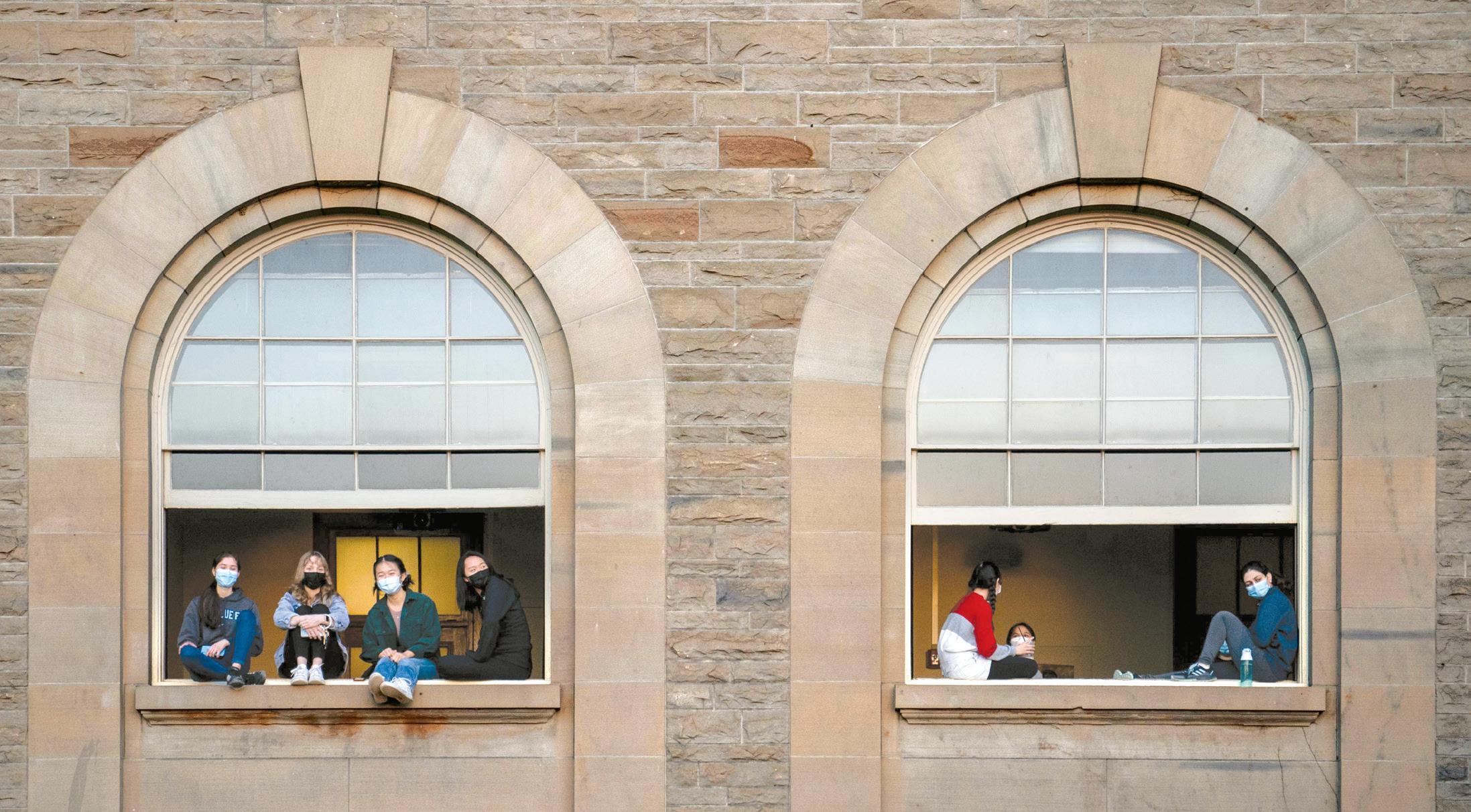
Vaccine eligibility | As spring arrives, students look longingly out at the Arts Quad from upper windows of Goldwin Smith Hall.
BEN PARKER / SUN SENIOR PHOTOGRAPHER
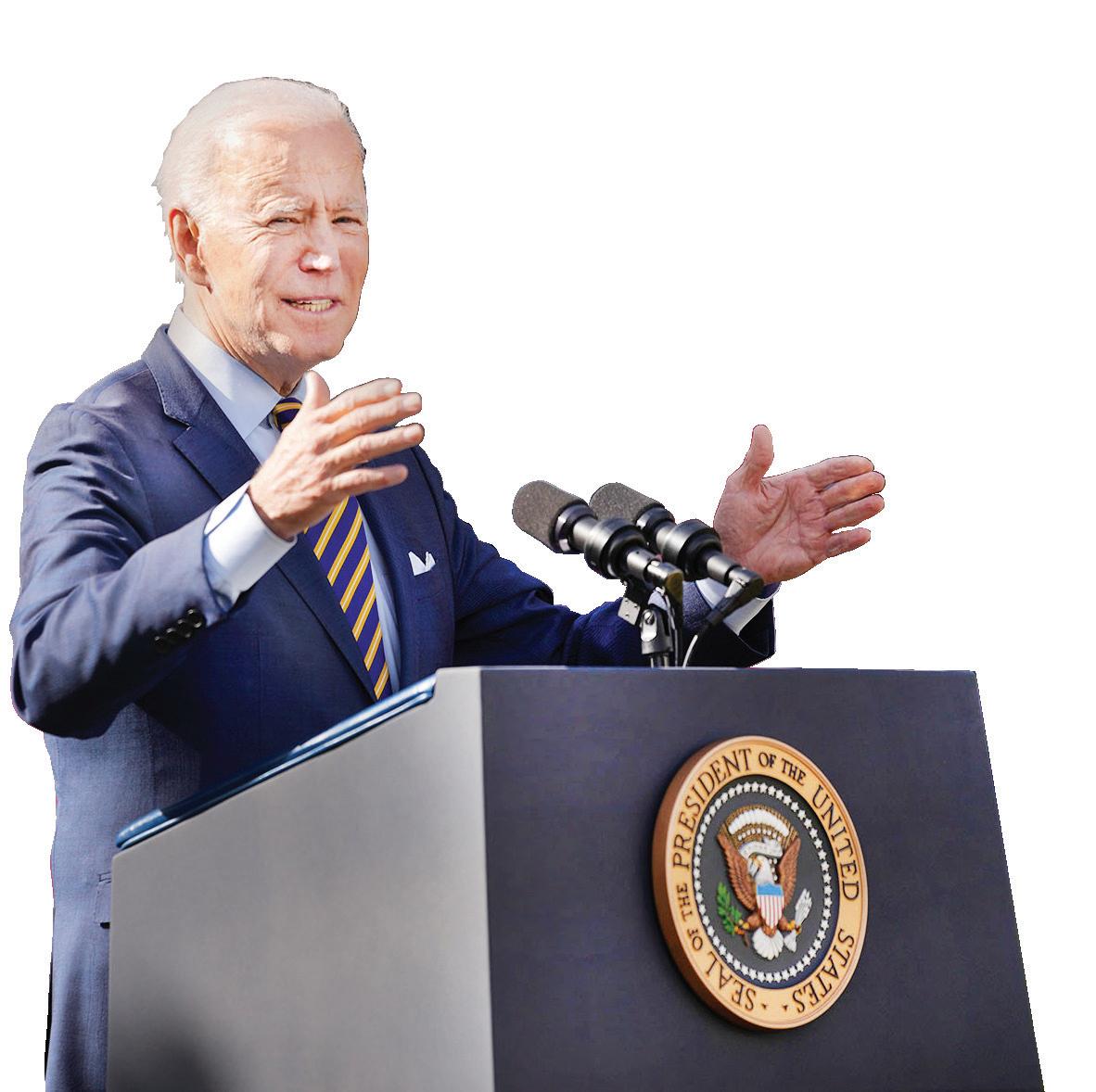
Stimulus checks | President Joe Biden signed the American Rescue Plan Act on March 11.
DOUG MILLS / THE NEW YORK TIMES
How to Sign Up for Te COVID Vaccine
All Cornell students who are New York State residents can receive the vaccine today
Continued from page 1
Should I Get Vaccinated?
While vaccination is not required by Cornell yet, it will be mandatory in the fall, according to the University. According to the CDC, people who already recovered from COVID should still be vaccinated but should not be vaccinated while they are sick with COVID-19. If someone has tested positive for COVID-19 and is currently in isolation, they need to wait at least 10 days after their positive test and must be released from isolation.
If someone has been vaccinated against another illness recently, they should wait 14 days before their COVID vaccination. Pregnant and immunocompromised people can be vaccinated, although they may
wish to speak with their medical providers beforehand. Those allergic to the vac-
People who already recovered from COVID should still be vaccinated but should not be vaccinated while they are sick.
cine’s ingredients should not get the COVID-19 vaccine, according to the CDC. Also, those who have a history of serious allergic reactions like anaphylaxis when they received injectable medicines or vaccines should be cautious and talk with their doctor.
Tamara Kamis can be reached at tkamis@cornellsun.com.
Cornell Students Begin Receiving
Stimulus Checks
Government aid helps to stabilize students’ fnancial budgets
CHECKS Continued from page 1
direct-deposited, while some are still being processed.
For some, the process of getting the check has been fraught with misunderstandings. Adam Ziccardi ’22 said he still doesn’t know if he’ll receive a payment from the most recent stimulus bill, an issue he encountered with the first and second bills, too.
“[The IRS was] sending them to my parents instead [of me] because I was a dependant, and I only found that out about two weeks ago when I called my parents,” Ziccardi said. “[I] couldn’t find a clear answer on the internet… I couldn’t find a government website that said exactly who was getting it and how.”
The checks have helped stabilize some students’ budgets at a critical time. Ahmed El Sammak ’21 said that, in addition to helping his family pay for food and bills, he had to stay in Ithaca past when his meal plan ended last semester, forcing him to pay for food on his credit card and rack up a higher
credit card bill. He spent part of his stimulus check paying that bill off.
El Sammak said that, despite the year’s continued uncertainty, the check allowed him to worry less about how much money he was saving from his job or how much he was spending when going out with friends.
“It has more impacts than just the bills that you pay or even the immediate peace of mind, because that peace of mind transfers to other areas of life where, like, my relationships with other people aren’t as stressful, my schoolwork is easier — I have to worry about less things,” El Sammak said.
Others are saving their stimulus money. David Wang ’23 is expecting a check, and said that after he pays off his credit card debt, he’s putting the remainder towards next year’s rent.
Sam Rosenblum, grad, a Ph.D. student in the government department, said his check would be factored into his bank account like any other payment, and would go to things like rent. But Rosenblum said that
conversations regarding the checks have been scarce. He assumes his fellow graduate students are receiving checks, but said that, in many cases, he never talked to them about it.
“There’s this weirdness of talking about money collectively, as if there’s some commonality related to one’s class position that’s defined in terms of things like income and assets and that is taboo to talk about,” Rosenblum said.
In part, Rosenblum attributed this to the stigmatization of government welfare programs, adding that the hesitancy to discuss finances might be cultural.
Johanna Richter, grad, a masters student in the school of Industrial Labor Relations, also said she’d save her check. But for Richter the checks send an important political message.
“I support [universal basic income], so I’m pretty happy about [the checks], and I think a shift to direct cash transfers is a good direction for the US to go in,” Richter said.
Eli Pallrand can be reached at epallrand@cornellsun.com.
Power Outage Disrupts Online Classes
Students rush to on-campus locations to get access to Wi-Fi
POWER Continued from page 1
-ing than previous outages because many students were forced off of Zoom calls and unable to attend their online classes due to a lack of Wi-Fi connection.
City and Regional Planning 4440 Resource Management and Environment Law, taught by Prof. Richard Booth, city and regional planning, was one of many Zoom classes to stop mid-session due to lack of connectivity.
come back and cut out numerous times before it was finally restored. Unlike others, Kele decided to wait out the outage in her apartment. Though she was able to attend class during the few minutes the Wi-Fi came back, her normal preclass routine was disrupted.
“I haven’t been able to prep for classes like I normally do because of it,” Kele said. “I assume professors will be fine about it because it’s a power outage.”
no hot water.”
Zoe WilkieTomasik ’22, who is a teaching assistant for Applied Economics and Management 1200: Intro to Business Management, was unable to attend her 10:10 a.m. discussion section.
“Prof. Booth left the Zoom and we were just sitting there like, ‘What now?’”
Karen Chan ’21
“It’s pretty significant in these times; your whole life gets shut off briefly.”
Karen Chan ’21
Karen Chan ’21, who sprinted to Temple of Zeus after the outage, was watching the lecture when Booth’s video cut out.
“[Prof. Booth] left the Zoom and we were just sitting there like, ‘What now?’ Somebody was like, ‘I’m the host now. So like, do you guys just want to chat?” How’s everybody’s Easter?’ So then, we just all ended up leaving,” Chan said. Marie Kele ’22 reported having lost power early in the morning, only for it to
For many students, however, missing classes was not the only effect of the widespread outage. Many were forced to skip breakfast and showers as they sprinted to campus to find functioning Wi-Fi to get to their classes on time. Mia Sanchez ’22 was in her apartment while her roommate was cooking when their electric stove turned off mid meal.
“We couldn’t use the stove. We obviously had to keep the refrigerator closed, so heat wouldn’t get in,” Sanchez said. “We had
After texting her head TA, she left her apartment to study at Collegetown Bagels. Juggling her low-power computer and a spotty Wi-Fi connection, Wilkie-Tomasik was forced to leave one of her other Zoom classes and watch the recorded lecture later in the day.
“I just wanted to get my class out of the way and go outside before practice. It’s just another thing that I had to deal with,” Wilkie-Tomasik said.
“I couldn’t actually be in my class, which is annoying. I’m hoping that I don’t lose participation points because of this, but I feel like most professors are pretty understanding this semester.”
Temple of Zeus, located in Klarman hall, was another loca-
tion students turned to on Cornell’s central campus to attend their classes. A popular study location on a typical school day, the hall saw a massive increase in traffic as students living off-campus flocked in to charge their computers and phones.
“It’s packed right now,” Chen said.“I think everybody was just trying to get some Wi-Fi to do their work.”
For some, this is far from the first time the power has gone out in their area. However, with lectures, assignments and even on-campus jobs gone virtual, this outage provided unique difficulties.
“It has not been noticeable [before], because normally things are in person,” Chan said. “It’s pretty significant in these times; your whole life gets shut off briefly.”
Jyothsna Bolleddullacan be reached at jbolleddula@cornellsun.com. Vee Cipperman can be reached at ocipperman@cornellsun.com.
VACCINE
Life After COVID-19
Students refect on upsides of antibodies
By SOFIA RUBINSON Sun Staff Contributor
After chills and muscle aches in the days leading up to winter break, Luke Hartigan ‘24 was not surprised when he got the call from Cayuga Medical Center informing him that he had tested positive for COVID.
The ten days he spent quarantined in Hotel Ithaca were “far and away the worst 10 days of my life, without question” he said. But Hartigan and others have said that their bout with the virus has upsides — including feeling safer in social settings because of their antibodies and being exempt from surveillance tests.
Like all students quarantined at Cornell, Hartigan was not allowed to step outside his room for the entirety of his stay. Left in an ill-lit room due to the lack of overhead lighting, he quickly fell into a state of isolation-induced boredom, even losing the motivation to play mobile games with friends.
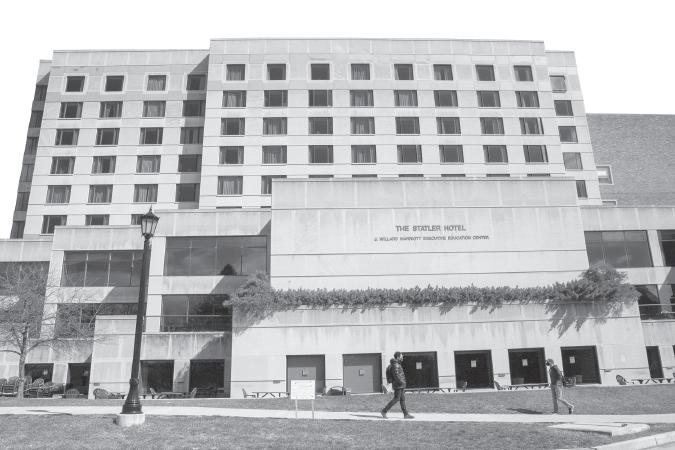
Julia Draganoff ‘24 has quarantined at The Statler Hotel three times, totaling 23 days of isolation. Last semester she was exposed to someone who tested positive and checked herself in due to some symptoms and ultimately tested positive for COVID in March.
Draganoff felt very ill during her most recent stay, having to run the shower for hours at a time for the condensation to relieve her congestion. Her difficulties were compounded due to Internet issues.
leaving The Statler.
Despite the challenges these students faced during quarantine, they agreed that contracting COVID came with some benefits.
Students who test positive for COVID are exempt from surveillance testing for 90 days after their first positive test. This means the worries of missing a test and facing the new consequences announced on March 30, such as being prevented from logging into Canvas and accessing the WiFi, are alleviated for three months.
immunity and some antibodies, but it hasn’t really affected how I behave,” he said.
“I think being exempt from surveillance testing was definitely a benefit,” Jillian Beck ‘24, who contracted COVID over winter break, said. “I don’t have to worry about missing any tests and getting locked out of Canvas or quarantining if one of my friends tests positive.”
“I have a certain level of comfort knowing that I have a high level of immunity”
Gabe Biers-Browne ’23
”My computer would not connect to the specific router in The Statler, so I couldn’t connect to WiFi for the entire time I was there. IT didn’t know what to do,” she said.
Draganoff was forced to use a mobile hotspot to do school work and online classes. She did not know of anyone else who experienced the same issue and stressed that Cornell IT staff worked hard at attempting to remedy the situation. However, her computer has not had an issue since
After the 90 days are up, however, the switch to getting tested again was difficult for some. Hartigan’s testing exemption ended about two weeks into the spring semester and his testing frequency was recently bumped up to three days a week due to his involvement in Greek life.
The students also agreed that having the antibodies gives them an added sense of security on campus.
“Having antibodies has definitely made me feel safer. I’m a bit more relaxed when going out to restaurants and being around people, especially since I recently got the vaccine,” Beck said.
Gabe Biers-Browne ‘23 has a slightly more apprehensive view, having had COVID in late December. ”I have a certain level of comfort knowing that I have a high level of
Gregory Randazzo ‘22, who contracted the virus in July, cautioned against being too negligent of social distancing guidelines.
“I think that most people at Cornell are very disconnected from the reality on the ground,” he said. “They don’t take it seriously at all.” “I know people who died and a lot of people here just view it as a nice little break, which is obscene.”
It is still unknown how long coronavirus immunity lasts and current guidelines advise to always adhere to prevention measures.
Because of this, even students who had COVID expressed their eagerness to get the vaccine. They feel it will add an additional layer of protection that the natural antibodies alone cannot provide. Getting vaccinated is also a requirement to return to campus next semester, no matter whether a student has previously tested positive.
“I don’t think campus will ever be the same,” Beck said. “But I hope that campus will return a bit more to normal with the vaccine rollout.”
Sofa Rubinson can be reached at ser258@cornell.edu
Karen Chen ’23 Places 4th at World Championships
Te fgure skating champion brings home the third spot for the American Women’s Olympic team
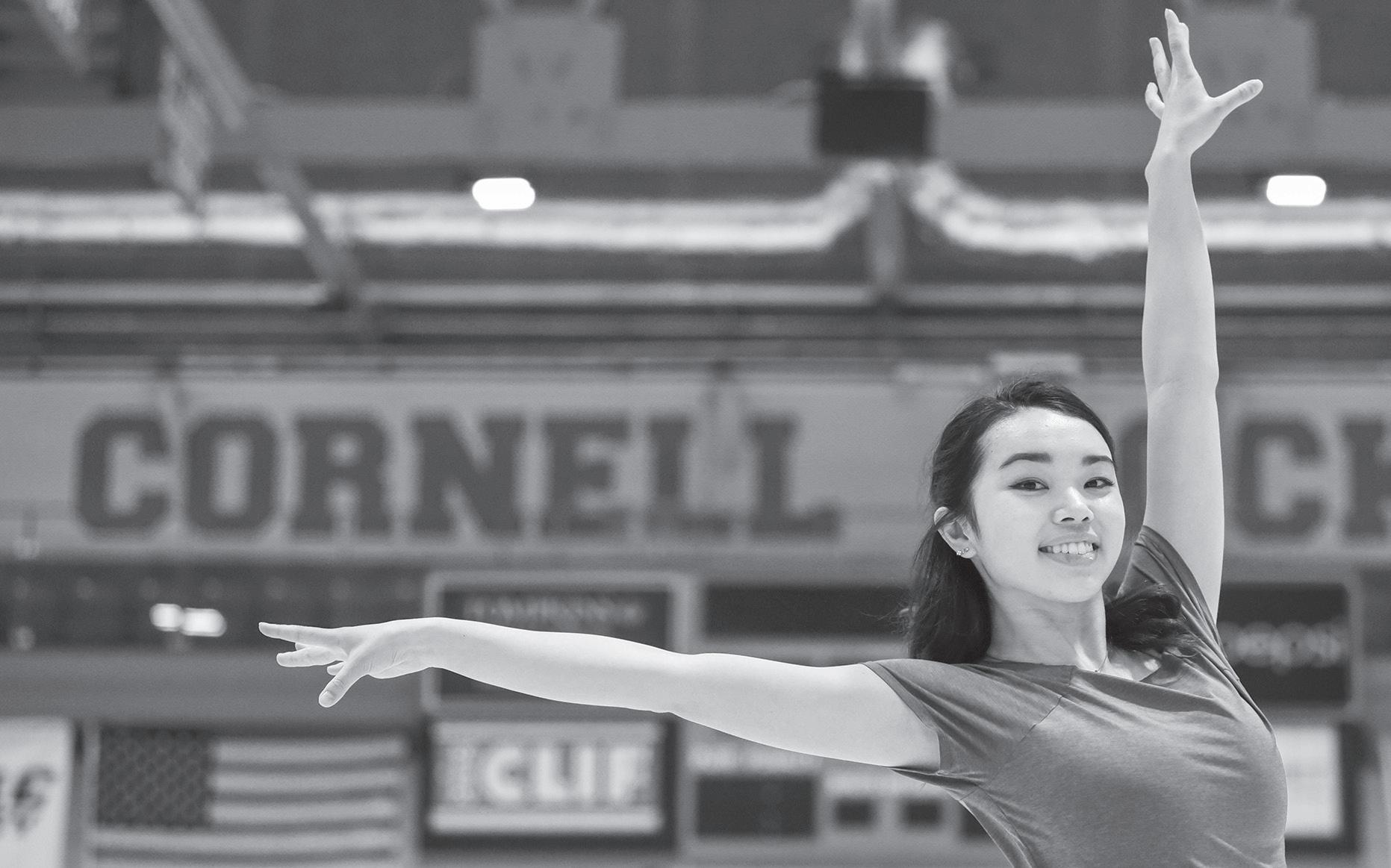
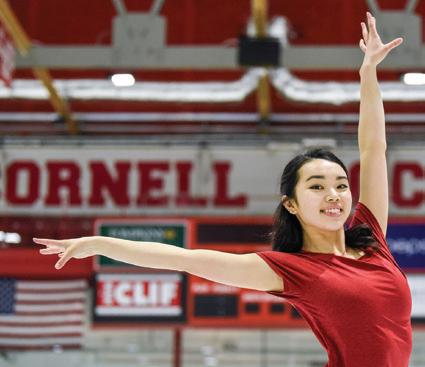
Instead of logging on to Canvas from her Ithaca dorm, Karen Chen ’23 starts every day at an ice skating rink in Colorado Springs, Colorado.
On March 24, the olympian placed 4th at the World Figure Skating Championships in Sweden, bringing home the third spot for the American women’s Olympic team. To do so, the top two women’s places at Worlds had to sum up to 13 or fewer. Chen’s 4th place, combined with Bradie Tennell’s 9th place spot qualified the American team to have an additional spot for the women’s team.
A lifelong figure skater, Chen continued to skate throughout her first year at Cornell. At Cornell, she participated in the Cornell Figure Skating Club, while practicing on her own time by sending videos and calling her coach, Tammy Gambill. She is now taking the next two academic years off to pursue her skating
career full time. The shutdown of campus and closure of ice-skating rinks last year made it difficult for Chen to continue her training, so after the first few months of quarantine Chen decided to pack her bags to go to Colorado Springs to train with her coach once rinks reopened. Before skating rinks opened, Chen was able to do off-ice training in local parks. Once rinks began to open up, Chen noted her skating improved because she no longer had to communicate with her coach via calls and videos. However, because most international competitions were cancelled due to the pandemic, getting competitive experience proved to be difficult.
“There were times when it was just hard to be training and not knowing if there would be a competition where you can show off your training,” Chen said.
Both Chen and Gambill were confident in the Cornellian’s ability to place at the World Championships. Still, Chen felt pressure to claim the three coveted spots for the Olympics especially since she had done so four years ago at her first Worlds competition.
“The placement and the getting back the three spots is not something I can control, but the thing I can control is my skating. I know that when I am enjoying my skating and performing, chances are I'm
much more calm and I'm breathing properly which gives me the best shot at skating well,” Chen said. Chen tried to focus on being calm and consistent at the competition, and she found comfort in the lyrics of the song for her short program, “Rise” by Katy Perry as she took to the ice.
Chen knew that she had skated a solid program when she landed the the most crucial series of jumps in both the short and the free programs. Gambill, however, could tell long before that.
“When she went out just to take her entry and her first opening pose, I felt that she was in a good spot and she was confident and she was going to do it,” Gambill said. “I was not shocked at all.”
Despite achieving a personal record of 74.40 points at Worlds, Chen is not done yet. On April 11, she will be leaving for Japan to perform at the World Team Trophy competition before going right back in to train for the Olympics. Gambill emphasized that they will be working on Chen’s triple axel as well as more technical components of her programs.
“When I am enjoying my skating and performing, chances are I’m much more calm.”
Karen Chen ’23
Chen will also be taking this upcoming year off from Cornell to focus on making the Olympic team, but she says she will be coming back to Ithaca in the fall of 2022.
Even being away from Cornell and her friends and family, she feels the immense support every time she steps on the ice.
“I feel like skating is a pretty isolated and lonely sport, so it's really important for me to acknowledge that I have so many people supporting me,” Chen said. “My coach is there, the team and the team leaders are there, my family is on the other side of the world staying up watching me, and so are my friends, so it really means the world to me.”
Mia Glass can be reached at mglass@cornellsun.com.
After isolation | Students report feeling safer after being released from quarantine post-COVID.
Figure skating | Chen placed fourth in the World Figure Skating Championships in Sweden.
BORIS TSANG / SUN SENIOR PHOTOGRAPHER
By MIA GLASS Sun Staff Writer
ARTS & ENTERTAINMENT ENTERTAINMENT
Footprints on the Sands of Time
Icreated my first Tumblr blog in 2011, at the age of twelve.
Now, it is 2021, I am twenty-two, and I can look back through the haze of a decade (a decade!) at what all those hours of scrolling have heaped up like the sands of time — for in the space of ten years, I have not missed a single month of posting. It is possible for me now to revisit the me of a year, five years, ten years ago, and watch the outline of the person I have become harden into shape like an image
coming into focus.
The heap — alas, currently 15,661 posts in all — is profitable to no one but me. At the same time, however, it contains almost nothing that is really personal. Neither my full name nor my birthday are on it, nor are there any pictures and videos of me. There are no diary entries or 140-character bon mots. In fact, nearly everything on it was created by someone else or references
something created by someone else; some of my favorite posts of Aprils past include an eye flirtation guide from 1920 (“Placing left forefinger to the left eye — May I C U home?”), pictures of Victorian lachrymatories and, of course, the annually reblogged first four lines of “The Waste Land.”
Online archival platforms such as Facebook, Twitter, Instagram and YouTube are typically spaces in which the private becomes public, as people have become more and more accustomed to posting autobiographical, confessional content. Tumblr, for all its faults (and there are many), offers the possibility of the opposite: a space in which the public becomes private. By entering into communion with all the other items that have been posted on the blog, a reblogged piece of content contributes to the individual’s network of meaning-making and acquires personal significance. No longer is a photograph just a photograph: it becomes a nexus of one’s hopes, desires and memories, an externalization of the imagination. Indeed, as the personal archive accumulates, the pro -

cess of archiving itself becomes a creative process. The task of deciding what to let in and what to keep out, of organizing, tagging, presenting, combining and recombining demonstrates that creativity does not come out of a void: a certain flint must strike against the mind, existing material must be molded, kneaded, formed and reformed. In fact, it is precisely the void that the archive must act as a bulwark against.
For, anyone who has ever been to the seventh-floor stacks of Olin and is a lover of books knows how terrifying the archive’s vast-
ness is: the terror of the archive is the terror of death because it speaks to our knowledge of our own mortality. It presents us with the reality of the void while at the same time attempting to shore up memory against chaos. I will never be able to read all the books, watch all the movies, see all the artworks, listen to all the pieces of music, learn all the knowledge I want to. Even as I write this, the time I have left to do so shrinks.
“The tremendous cry of our faith and doubt against the darkness and silence is the most terrifying proof of our abandonment
and our unuttered knowledge,” reads Alma to Elisabet in Ingmar Bergman’s Persona . The two women are on the beach. The beach is where Leopold Bloom inscribes a message in the sand with a stick — I. AM. A. — but he effaces it before he finishes the message. He knows that the tide will wash in, that the waves will come, are coming closer all the time. Still, one must continue to cry, to make traces.
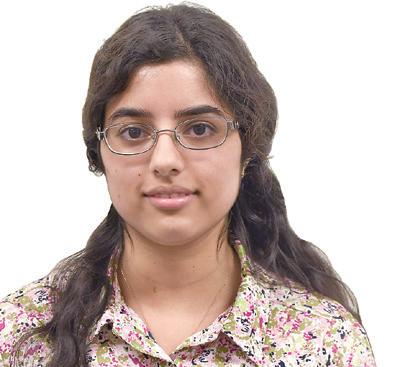
Ramya Yandava is a senior in the College of Arts and Sciences. She can be reached at ryandava@cornellsun. com. Ramya’s Rambles runs alternate Mondays this semester.
Locally Grown Dance Goes Virtual
Every spring, the Cornell Performing and Media Arts department puts on a production of Locally Grown Dance. More than a typical dance concert, these shows are experiences. The dancing makes you think, and technical elements transform the dancers into another world. However, this year, Locally Grown cannot put on an in-person show. The dancers, choreographers, and technical staff of the show have risen to the challenge of creating performance art during the pandemic. They have created two captivating pieces that use the virtual format of film to transcend beyond what an in-person dance performance is capable of. This is a dance show you don’t want to miss!
This year’s Locally Grown lies at the intersection of many fields of performing and media arts, which sets this year’s show apart from any other. It features some of Cornell’s most talented dancers, performing to music recorded by local artists, including professor Annie Lewandowski’s band Powerdove, pianist Syau-Cheng Lai, and violinist Max Buckholtz. Several different sets and props are used throughout the performance, a feature that would be difficult to execute in the usual circumstances of in-person dance concerts. Additionally, projection
mapping and expert lighting are used to enhance the visual effect of dancers’ movement. What truly sets this show apart from previous years is its use of filmography.
Each section of dancing was filmed from multiple camera angles, so when the show is edited together, it will be much more than the recordings of dance routines of the past—the film itself will be a work of art. Dancer Maddy Lee ’21 explains that “when you are performing in person in a normal year and they’re filming it, they’re filming it from one angle, and
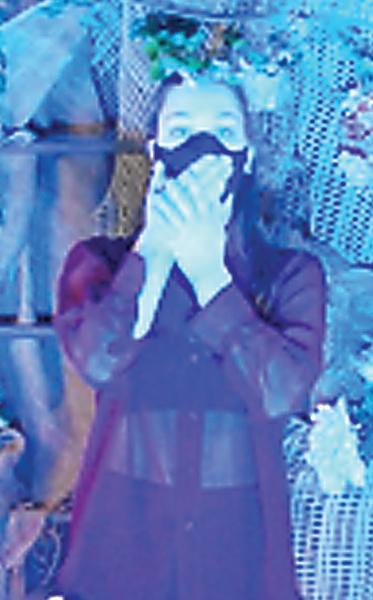
you see the whole stage.” This year though, we can expect “close, dynamic type shots.” The film format allows the audience to inter-
act with the performers like never before, offering, as director Byron Suber puts it, a “different kind of intimacy that is unavailable in a live theatre.” The pandemic has afforded the dancers and choreographers the opportunity to translate their already stunning dance pieces into compelling films, and to provide the audience with a one-of-a kind dance experience.
The show consists of two pieces, “the Eclipse (ellipses) … … …” and “See You Again,” both of which reflect the collective emotions we all have experienced during the past year.
“the Eclipse (ellipses) … … …” was directed by professor Byron Suber, who drew inspiration from the confusion of the pandemic. He shares, “The initial inspiration for the title of the piece in development, “the Eclipse”, was in part inspired by the Antonioni film, the Eclipse… a film that ends with 7 minutes of nothing-ness, expressing a feeling of loss and absence. I felt that going through the lockdown of the pandemic felt like an in between time of nothing-ness and the questions of what came before and what would come after were a blur… The lockdown for me because a series of ellipses, a waiting in nothing-ness and a lack of clarity about what was ahead.” The piece utilizes different sets that are meant to illustrate the different feelings of the pandemic from solitude and messiness, to fantasy and escape, to a complete-
ly bare set that reflects the feeling of nothing-ness.
Professor Jumay Chu’s piece, titled “See You Again,” makes use of set pieces and the medium of film to allow us to see the dancers in a whole new light. A highlight of the piece is its use of large, reflective, yet translucent plexiglass panels that play off the lighting and the dancers’ bodies to create stunning visuals. Chu explains, “the panels framed, hid, elided, or multiplied the moving figures of dancers. The dance is about how we see the dancers, how they create meaning for themselves and for us, what we can see repeated, what we have missed. With the dancers in front of, behind, between the panels, we see and re-see them.” “See You Again” goes beyond the physicality of the theme’s expression through its visuals, as the theme of seeing again has been central to the creation of the piece. Chu says, “Personally, I am re-seeing these dancers I have been working with since last September, but each time I see them dance, I learn something new about them, I understand something different, I learn about what I missed earlier, I discover something more.” In a way, while “the Eclipse (ellipses) … … …” focuses on the struggle of getting through the pandemic, “See You Again” represents the relief of it ending, or at least, finding ways to see each other within the pandemic, like the filming of the show. Dancer Savannah Jeffries ’24 notes,
“It’s reflecting the atmosphere of the world right now,” as vaccines become available and the end of the pandemic is in sight.
Preparation for the show started last fall, with dancers meeting over Zoom to learn choreography and to workshop their own ideas into fully developed dance pieces. Working over Zoom provided a multitude of challenges unique to dance. Unlike content in academic courses, which can easily be conveyed virtually, dance movement carries energy and visual precision that is not accurately captured over a screen. Furthermore, the time lags on Zoom make it difficult to tell whether dancers are synchronized and moving as one and with the choreographer’s intended quality of movement. As Suber puts it, “not having 360 degree access to views of the dancers bodies made the effort of shaping the dancers’ bodies with any exactitude quite difficult.” Despite the challenges of Zoom, the dancers were still grateful to have the opportunity to dance in a studio space at all. Jeffries says, “It was really nice, even though our rehearsals were on Zoom, just to be in the studio first semester. My student run dance groups were not able to do that at all.”
To continue reading this article, please visit cornellsun.com.
Lauren Douglass is a freshman in the College of Arts and Sciences. She can be reached at led94@cornell.edu.
MASSIMO LISTRI/TASCHEN
LAUREN DOUGLASS ARTS CONTRIBUTOR
COURTESY OF CRYSTAL NAVELLIER
Ramya Yandava
Ramya’s Rambles
The Corne¬ Daily Sun
Independent Since 1880
139th Editorial Board
KATHRYN STAMM ’22
Editor in Chief
ANUSHYA ALANDUR ’23
Business Manager
CATHERINE ST. HILAIRE ’22
Associate Editor
PRANAV KENGERI ’24
Advertising Manager
ODEYA ROSENBAND ’22
Opinion Editor
JYOTHSNA BOLLEDULA ’24
News Editor
TAMARA KAMIS ’22
News Editor
WENDY WANG ’24
Arts & Entertainment Editor
KRISTEN D’SOUZA ’24
Design Editor
HANNAH ROSENBERG ’23
Photography Editor
OMSALAMA AYOUB ’22
Science Editor
PUJA OAK ’24
Layout Editor
ANNIE WU ’22 Production Editor
MIHIKA BADJATE ’23
Assistant News Editor
ANGELA BUNAY ’24
Assistant News Editor
JOHN COLIE ’23
Assistant Arts & Entertainment Editor
AMELIA CLUTE ’22
Assistant Dining Editor
WILLIAM BODENMAN ’23
Assistant Sports Editor
AARON SNYDER ’23
Assistant Sports Editor
MEGHANA SRIVASTAVA ’23
Compet Manager
MADELINE ROSENBERG ’23
Editor
NAOMI KOH ’23
Editor ANIL OZA ’22
Editor YUBIN HEO ’24
OLIVIA CIPPERMAN ’23
NOOREJEHAN UMAR ’23
YOON ’23
BENJAMIN VELANI ’22
PICHINI ’22
SRISHTI TYAGI ’22
MENDOZA ’24
Editor
ARANDA ’23
Editor SURITA BASU ’23
RIGGS ’24
’23
’24
’24
’24
ALPERS ’22
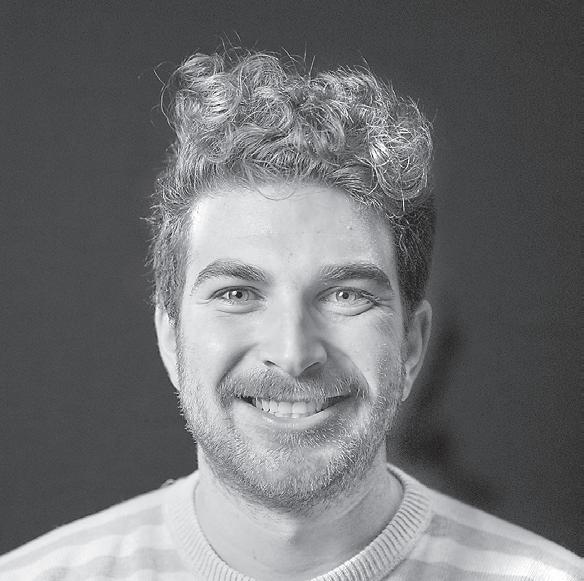
Peter Buonanno Te Wyckof Club
Peter Buonanno is a senior in the College of Arts and Sciences. He can be reached at pbuonanno@cornellsun.com. Te Wyckof Club runs every other Friday this semester.
Te Campus Code Needs A COVID Revision
So, you missed a COVID-19 test. Perhaps, you were found mask-less on the Arts Quad. Or, maybe, you’ve even been forced to pay a visit to the Office of the Judicial Administrator after an 11-person gathering in your dorm. It’s ok, we are all human. But, given the severity of your treatment (whether it be by an RA or by a University official), these experiences have undoubtedly left a pressing question in your mind: How exactly does Cornell go about handling more serious Behavioral Compact infractions?
With vaccine eligibility a mere week away for most Cornellians, now is not the time to let our guard down. And, if recent COVID-19 spikes have taught us anything it’s that breaches of the Behavioral Compact can have a very real impact on our lives at Cornell. Yet, it is imperative that we continue to question our University’s punitive responses to those very infractions.
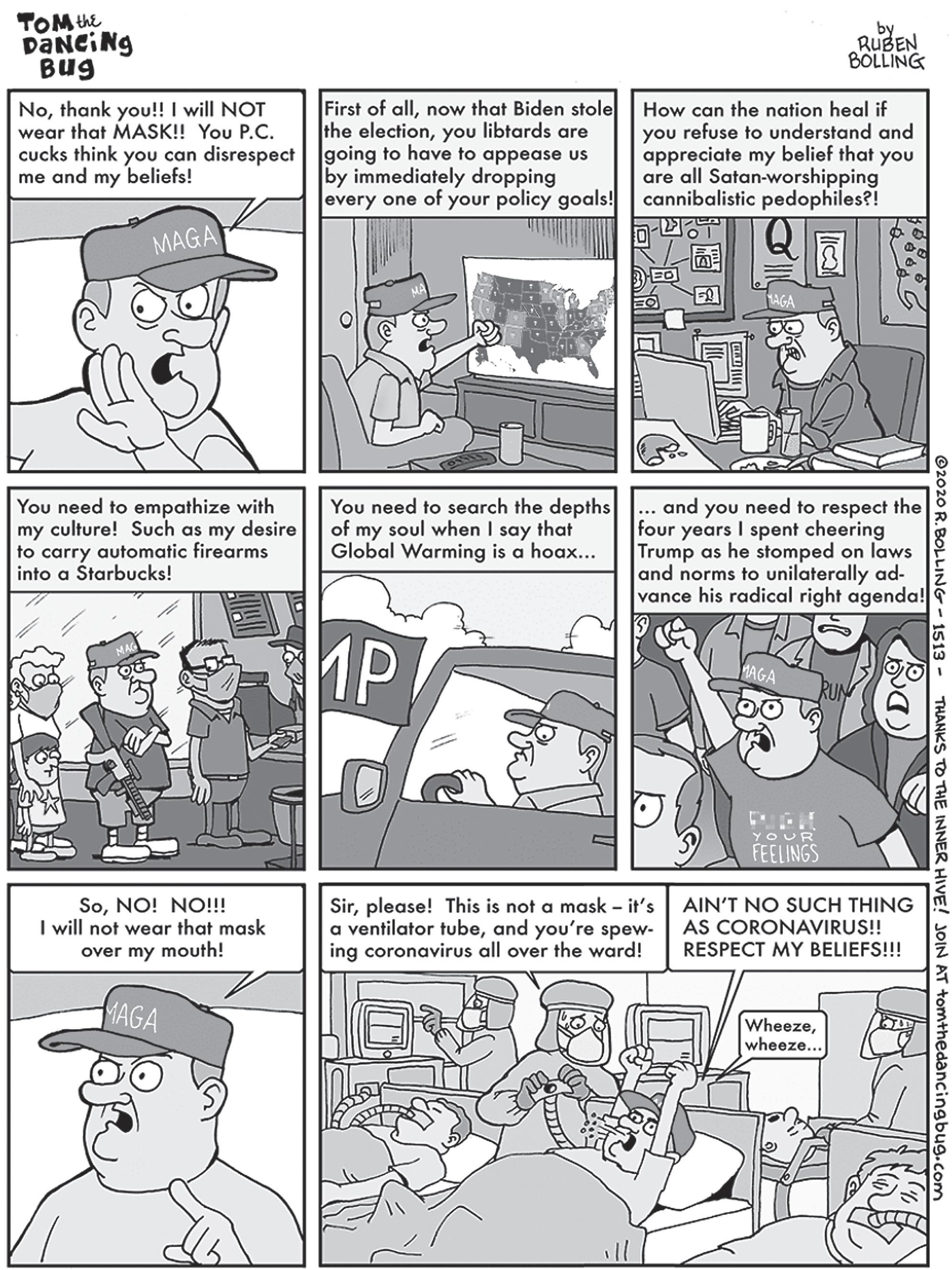
Tom the Dancing Bug by Ruben Bolling
Over the last few weeks, I have spoken to a student with knowledge of Cornell’s COVID-19 response — they have expressed their desire to remain anonymous in order to avoid any repercussions. They shared that the Office of the Judicial Administrator treats certain Behavioral Compact infractions as violations of Title Three of the Campus Code of Conduct. Specifically, they have noted that students have been charged under a subsection of that Title which reads as follows:
“To (1) endanger another person, including but not limited to such acts as: introducing a weapon into a fight, whether or not the weapon was used; using one’s body parts as a weapon; violation of Life Safety regulations; theft or use of fire extinguishers; use of firecrackers or flares; or any other acts, whether reckless or intentional, that create a dangerous situation for the safety of another individual (2) threaten or use physical force or violence to endanger, injure, abuse, intimidate, or coerce another person.”
The OJA declined to respond substantively to this claim, only noting that “incidents referred to the OJA are resolved by the process outlined by the Campus Code of Conduct” and that “transcripts are generally notated only in incidents involving violations that result in sanctions of suspension or dismissal per the Code and the Office of the University Registrar.”
There is no doubt that Behavioral Compact infractions are in violation of “Life Safety regulations.” But that is besides the point. Students who receive formal disciplinary action, such as a suspension, will receive a note on their transcript only referring to this broad portion of the Code. Is it really fair to burden students with the weight of such a broad and vilifying charge on their transcripts as they enter the job market? Although an overgeneralization, missing a COVID-19 test is vastly different from “introducing a
weapon into a fight.”
I don’t intend to argue that students who refuse to follow COVID-19 protocol ought to be given a free ride. The opposite is true, they should face disciplinary action for endangering the lives of Cornellians and residents of the community that supports our University. But the pandemic has been going on for long enough now that the Code needs revising. COVID-19 is no longer temporary, and the need for pandemic related regulations will likely remain for several years (even after life at Cornell returns to normal).
Most importantly, though, these revisions must be made with empathy and accessibility at the forefront of our decision making. A simple glance at the
Although an overgeneralization, missing a COVID-19 test is vastly different from “introducing a weapon into a fight.”
above statute is enough to tell you how legalistic our Code reads. This tone is not appropriate for a campus community that boasts inclusion and compassion for its student body.
Further, not every COVID violation is made equal. As is commonly noted in the national media landscape, Black Americans and other Americans of color have a justifiable distrust in the healthcare industry. Potentially punishing students in the aforementioned manner for being skeptical of on campus medicine shows ignorance of systematic racism in medicine.
Countless irresponsible acts on campus go unchecked every day. For those living in Collegetown and on North, it is not a secret that student organizations are still throwing social events. What the Code needs right now is a COVID-19 specific amendment which lays out a comprehensive and clear system by which disciplinary action is assigned to those in violation of the Behavioral Compact.
Given Tuesday’s surveillance testing announcement, it seems as though Cornell will continue to increase the severity of enforcement measures for the Behavioral Compact. But these regulations can’t exist in a vacuum. It’s time to fix what put us in this mess in the first place.
Te NCAA’s ‘Amateurism’ Fallacy

Daniel Bernstein Feel the Bern
Daniel Bernstein is a sophomore in the College of Arts and Sciences. He can be reached at dgb222@cornell.edu. Feel the Bern runs every other Monday this semester.
While most Cornell student-athletes and sports fans idly await the return of competition, the National Collegiate Athletic Association is sitting in front of the Supreme Court, defending its right to not pay its players. On March 31st, the Court heard oral arguments, but it feels like college athletes and fans have seen hundreds of diferent court decisions about compensation for players that never seem to yield a clear answer of what’s to happen. Tis time, however, there is a chance to be diferent, and with any luck for hundreds of student athletes at Cornell and nationwide, it will be.
Te legal question at the center of NCAA vs Alston is the following: Does a prohibition of compensation for student athletes violate antitrust law under the Sherman Act? Te case came about when former West Virginia University runningback Shawn Alston sued the NCAA in 2014 on these grounds. Schools are currently allowed to give certain education-related benefts to student-athletes, but those are capped. Alston’s team argued that by placing a cap on the value of benefts provided to an athlete by a school, the NCAA illegally prevents athletes from earning their full value, according to ESPN.
Te NCAA’s defense was grounded in the concept of “amateurism”, saying that student-athletes should be prohibited from compensation on the basis of them being students. Its reasoning, however, is vague, and it’s
one of the main things that the Supreme Court questioned the NCAA about last Wednesday.
“Why does the NCAA get to defne what ‘pay’ is?” asked Justice Amy Coney Barrett. It’s a good question, as the NCAA doesn’t even allow student-athletes to proft of their name, image, or likeness : While any other student can make money of a youtube channel or sign an endorsement deal, athletes can’t.
Tis case could change that, though. While the suit is only over education-related benefts, it has the chance to expose amateurism as fraud and exploitation.
Te justifcation for amateurism essentially comes down to two principles. Te frst it’s always been this way, since the NCAA was founded 115 years ago. Te second is that allowing any compensation will make college sports pay-for-play, like professional sports. It says that unpaid athletes is a big part of its appeal.Te NCAA makes billions of dollars on the backs of unpaid laborers on the grounds of maintaining precedent and keeping its culture.
Tere’s no real argument in the history defense. If the NCAA was founded today, it would never get away with not paying players. But 115 years ago things were different. Time passes and the money trees grow. College sports weren’t valuable in 1906, but now, the NCAA rakes in billions of dollars without paying its athletes.
For the pay-for-play defense, meanwhile, you have to assume that paying players will change the way college sports are played and watched. Te NCAA really thinks that people like watching unpaid athletes. It says people will lose interest if athletes are paid. I think that’s just ridiculous.
Do you, the athlete or the fan, prefer watching sports when the athletes are unpaid? Does that really change the way you watch the game?Te truth is, it doesn’t. People like sports and players making money won’t drive away interest. It won’t change the way that college sports are played either.
Alston’s Attorney Jefrey Kessler refuted the NCAA’s claims to ESPN last week. He said, “We believe nothing bad will happen. Just like nothing bad happened after the O’Bannon case they lost. Nothing bad happened after the Board of Regents case they lost. Nothing bad happened after the Law vs NCAAw case that they lost. Tey always warn, the NCAA, that this will be the thing that ruins college sports. And what we fnd instead is that when they’re forced to comply with the law it actually helps college sports.”
In the 2014 O’Bannon case, Ed O’Bannon, an all-American basketball player, sued the NCAA over the lack of compensation and consent for his depiction in an NCAA-licensed video game. Because of this case, former athletes are entitled to compensation for the NCAA’s commercial use of their image.
In the Board of Regents case in 1984, the Supreme Court stripped the NCAA of its control of television rights, which is why college sports have become so lucrative and can be broadcasted so frequently.
Lastly, the Law vs NCAA case forbade the organi-
The NCAA’s refusal to pay players in the name of amateurism is a joke. It exploits student-athletes by trying to maintain an outdated and problematic status quo.
zation from limiting the salaries of certain entry-level coaches.
Like Kessler says, in all of these cases, the NCAA claims that college athletics will be ruined, and it’s wrong. College athletics are as strong and popular now as they’ve ever been. Tonight, millions of people will watch Baylor and Gonzaga play in the men’s NCAA basketball championship game, just as they watched Stanford win the women’s fnal yesterday, and as they’ve watched both March Madness tournaments over the past month. Tis interest won’t just stop if players receive the compensation that they’re entitled to.
Te NCAA’s refusal to pay players in the name of amateurism is a joke. It exploits student-athletes by trying to maintain an outdated and problematic status quo. Te good news, however, is that the Supreme Court is likely to see through the organization’s façade of trying to help students. Te oral arguments heard last Wednesday were ugly for the NCAA, and it’s clear that it’s losing power. For student-athletes nationwide and at Cornell, this is an important and necessary progression.
Where Are the Consequences for the Partiers?
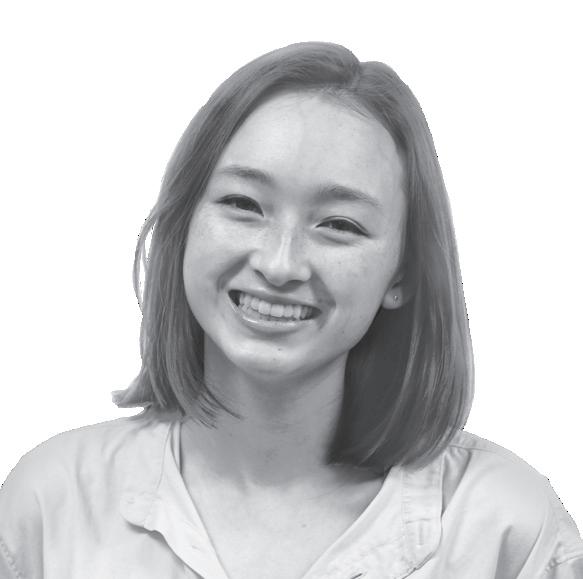
Michaela Bettez Bet on It
Michaela Bettez is a junior in the College of Engineering. She can be reached at mbettez@cornellsun.com. Bet on It runs every other Monday this semester.
Every other week feels like the same story: case numbers steadily increase on the COVID dashboard and a new message from Pres. Martha Pollack that goes something like this:
“Even more disturbing than the number of new cases is what is behind those numbers: a blatant disregard by some students for the public health requirements contained in the Behavioral Compact that each of you have agreed to uphold.”
But again and again, there are no consequences for those “some students’’ who refuse to abide by the behavioral compact. We’ve seen this play out many times over this past year. Cornell has clearly demonstrated its willingness to dole out some
(long overdue) consequences — cutting of access to class resources and campus for missed surveillance tests.
But these punishments feel like they’re missing the real and intentional culprits: those holding and attending superspreader parties that seem to be the cause of every uptick in cases. People letting a test slip their mind in the midst of their busy schedules and making it up the next morning are hardly the sole cause of these rising cases.
Here’s how I see it: I’m a senior who’s lost my entire fnal year of college to COVID-19. What’s stopping me from ignoring regulations all together and partying as much as I can to reclaim my fnal year on campus? Judging by Cornell’s enforcement record, as long as I adhere to my testing days there will be no consequences from the university.
I guess I might end up getting tested three times a week instead of two, but that’s not even a punishment. I don’t mind getting tested and it’s reassuring to be told three times a week instead of two that I don’t have COVID. I obviously won’t do that because I have a basic sense of morality and don’t want to get anyone sick, but who’s to stop the people who are demonstrating time and time again that they don’t share those same values of protecting the public?
I’m not alone in my frustrations regarding Cornell’s handling of our campus’s partiers. It seems like on campus, there are certain sets of people who are above the rules and can do whatever they want without consequence — and to no one’s surprise they tend to be the priv -
ileged members of Cornell’s fraternities and sororities.
Should we follow Peter Buonanno’s ’21 advice of revising the Campus Code? Should we cut of access to Canvas and campus wif for ofenders?
Honestly, I think we should go farther and just kick them off campus entirely. It’s within Cornell’s right for breaking
Honestly, I think we should go farther and just kick them off campus entirely. It’s within Cornell’s right for breaking the behavioral compact, and has been effective for other schools.
the behavioral compact, and has been effective for other schools. Obviously, we can’t kick off-campus students out of their private residences, but we can send all students who live in sorority and fraternity houses, co-ops and dorms home. And for off-campus students we
can move to entirely remote coursework, remove their access to campus wifi, and end their keycard access for the rest of their semester.
Cornell’s current practices are unfair to the thousands of other students and staff who are put at risk every time the university fails to effectively punish those responsible, and without punishment embolden them to continue their reckless behavior.
Some may say that lenient punishments encourage students to honestly comply with contact tracing without fear of subjecting themselves and their peers to major consequences. But these practices are short term band-aids that lead to even bigger problems as we just narrowly avoided our first orange-level alert an entire year after the pandemic sent us all home. To compromise between contract tracing and adequate consequences, we could alter the severity of punishments for those who turn themselves in early and honestly reveal others involved.
Clearly, those involved aren’t listening to morality or reasoning when they choose to repeatedly attend parties. They don’t deserve the University’s leniency. I just want to see fair and reasonable punishments doled out to those responsible for endangering the community, both for justice to those following the rules and to deter future rule-breaking. I want to make it to my own vaccination dates and my (hopefully) in-person graduation ceremony without getting sick. The time for leniency is done. It hasn’t worked. It’s time for real consequences.
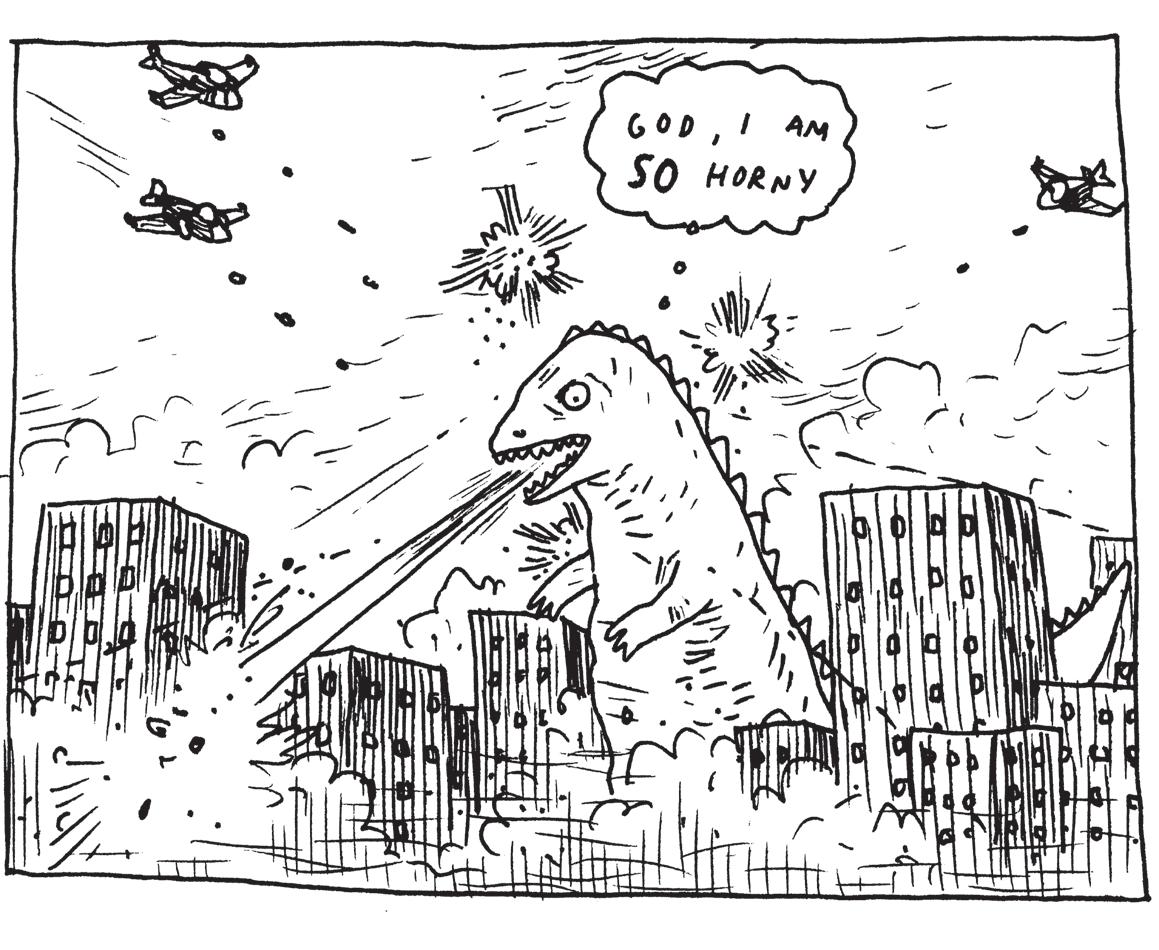
I Am Going to Be Small by Jeffrey



SC I ENCE
Sameed ’11 Uses Lasers to Find Antimatter Secrets
By SRISHTI TYAGI Sun Science Editor
Muhammed Sameed ’11 is peeling back the curtains of the subatomic world to learn more about matter’s elusive counterpart — antimatter.
In a recent paper published in Nature on March 31, Sameed explained how he and his collaborators at the European Organization for Nuclear Research developed a new technique to help physicists pin down this part of the universe that has escaped scientists until now.
Sameed explained that the objects of everyday life — like cars, textbooks and our bodies — are made up of matter. But mathematical equations that govern the behavior of the universe predict the existence of something that doesn’t match everyday matter, what is now known as antimatter.
According to Sameed, antimatter differs from matter by having the exact opposite value for some physical properties. For example, a particle of antimatter and a particle of matter have the exact same mass, but they would have exact opposite electric charges, Sameed said.
Sameed explained that when a particle of matter and antimatter meet, their opposite properties cancel out, and their mass is converted into energy — which makes
antimatter hard to come by. Therefore, antimatter must be studied in a vacuum chamber, an environment in which there are no other particles of matter around.
Even in a vacuum, antimatter is difficult to study, Sameed said. Antimatter — which has energy that makes it move — has to be slowed down to the point that it won’t touch the matter-filled walls of the chamber.
Sameed and his collaborators have developed a mechanism to do just that — laser cooling. Sameed specifically studies the properties of antihydrogen, the most basic form of antimatter.
In order to develop the method of laser cooling, Sameed said he and his team first had to study the energy levels of antihydrogen. When a laser is shined on an atom of antimatter, that atom absorbs the light and transitions from a lower to higher energy level, Sameed explained.
Upon absorbing light energy, a moving atom will receive a “small kick” that pumps the brakes on the atom’s motion, according to Sameed.
“With laser cooling we can essentially slow down … antihydrogen atoms to such a slow speed that they’re essentially ... trapped for many, many hours, which now gives us enough time and ability to do experiments,” Sameed said.
In one such experiment, Sameed hopes to study how antimatter behaves under the influence of Earth’s gravity — essentially, whether antimatter falls down, stays in place or floats up.
Since there are currently no theories to predict this behavior of antimatter, Sameed said the results of the experiment may prove to be controversial in the scientific community.
“Most of us are very pessimistic about this, we expect that [antimatter] falls down the same way as regular matter does,” Sameed said. “There’s a handful of scientists out there that are saying that no, antimatter will go up.”
Although antimatter might seem far removed from what people encounter in their daily lives, it has some real-world applications.
According to Sameed, Positron Emission Tomography — a technique
used by physicians to measure the activity of body tissues — harnesses the power of antimatter particles called positrons, also known as antielectrons.
By studying the properties of antihydrogen, Sameed hopes to further unlock applications of antimatter that currently don’t exist.
But for researchers like Sameed, the motivation to uncover the secrets of antimatter comes down to a passion for science.
“For me and my team, most of us are doing this for the sake of science, for the curiosity to further develop our understanding of how nature behaves,” Sameed said.
Although antimatter is Sameed’s bread and butter, researching some of the most elusive particles in the universe comes with its own set of challenges. To actually create the antihydrogen atoms being studied, researchers at CERN have to monitor a beam of antiprotons for a 24-hour timeframe, necessitating work shifts that bleed into odd hours of the night, Sameed said.
But it is all worth it for Sameed.
“Being able to work in one of the most cutting-edge research institutions has been … a dream, to be coming here and then to actually get publications in some of the best journals in academia,” Sameed said.
Sameed also said he felt fortunate to learn how to blend science and entrepreneurship by commercializing the products of his scientific efforts.
When the pandemic hit, Sameed recalled that he and his team at CERN responded to the global deficit of ventilators by designing a ventilator prototype and making the design available to manufacturers around the world.
“This was another like major success, where you could basically get scientists to come together and not necessarily just do fundamental science, but really quickly use their diverse expertise to build something for the betterment of humanity,” Sameed said.
Sameed’s love for fundamental physics took root at Cornell, where his summer research with Prof. Ivan Bazarov, physics, at the Cornell High Energy Synchrotron Source launched him toward a career in particle physics.
“Basically I was digging a hole for myself in this field,” Sameed said. “It started getting more and more exciting, so I just stuck with it.”
Srishti Tyagi can be reached at styagi@cornellsun.com.
Cornell Taps Into Earth’s Core for Renewable Energy
By BROOKE GREENFIED Sun Staff Writer
In what some have called the most important month in U.S. climate policy, Cornell is making a dent in its own carbon emissions in its development of an innovative way to heat the campus during its notorious winter months.
The Earth Source Heat project looks to pivot Cornell from using fossil fuel-based heating to geothermal energy — utilizing heat from the Earth’s subsurface rocks — to achieve zero carbon emissions by 2035.
The University’s current heating system employs an antiquated steam system that burns fuel to heat up water to generate steam, which is then used to provide heat.
Because the new project utilizes similar steam pipes to the ones already in place to deliver heat, the Ithaca campus is perfect for the Earth Source Heat project, Christopher Galantino M. Eng. ’19, who analyzed seismic data for his thesis explained.
Implementing this project will mean that heating on campus will be provided by circulating water through the Earth’s subsurface — which can reach tem-
peratures of up to 200 degrees Celsius — to raise the water’s temperature before returning it to the surface, where it can heat campus buildings as it runs through the building pipes.
Since heating on campus accounts for 80 percent of the 162,223 metric tons of carbon dioxide released in 2020 by the University, the project — which is scheduled to launch by 2024 — could significantly reduce the campus’s carbon footprint.
To access the geothermal heat a well will be dug near the College of Veterinary Medicine to provide an energy source where water will be heated to temperatures around boiling point in crevices below Earth’s surface before returning to the surface where it can be used for heating campus buildings.
Before work on the project can start in earnest, scientists at Cornell are working to understand how well the rock will be able to fracture when drilling deep down into it. The team will also need to confirm that the drilling is not at a location that will threaten contamination of local water, Galantino said.
Cornell students will play a role in analyzing seismic impacts of the borehole, which will reveal
information about how much heat can be produced by geothermal energy to determine how effective the new system is.
Zachary Katz ’23, who is a seismic data analyst for the Earth Source Heat project, plays a key role in perusing seismic subsurface information — a geology survey analyzing vibrations on earth crust to better understand its stability providing insight on proper drilling practices and locations.
Before implementing this geothermal heat system, the team needs to confirm that humaninduced seismicity — strains on the local Earth crust as a result of drilling will not affect the normal vibrations of the bedrock under Ithaca.
Katz said that their data analysis needs to confirm that the impact of constructing machines such as pile drivers and using quarry explosions — controlled use of explosives to break rocks for excavation — will not be detrimental to the city of Ithaca.
“We look for where seismic events are located and we can differentiate if it is a natural seismic event or human caused,” Maia Zhang ’21, another student contributing to preliminary studies on the borehole drilling said.
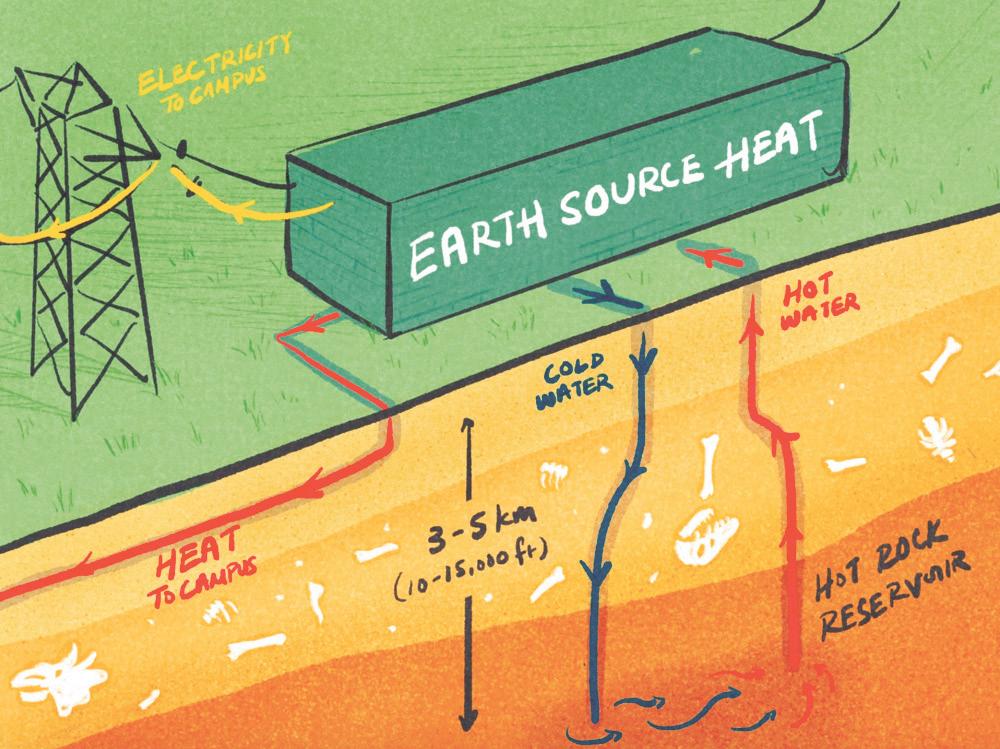
Heat pump | Demonstration of heat harvesting from the bedrock of Ithaca at the proposed site adjacent to the Veterinary Medicine School.
The biggest challenge facing the project is to produce data confirming that the bedrock is viable for drilling so that the team knows what to expect before the project is implemented on a larger scale at Cornell.
After testing the bedrock of the area, the second phase of the project would be to drill a demonstration well-pair as the Ithaca campus can be heated by three or four pairs of wells connected.
As the work done up to this
point has been exploratory, the second phase has a tentative plan to begin in 2024.
The grant given by the Department of Energy will run for three years, and during this time the sustainability team will continue to gather and analyze data in the geological region in hope of implementing the wells to reach the 2035 goal for carbon neutrality.
Brooke Greenfeld can be reached at blg77@cornell.edu.
COURTESY OF MUHAMMED SAMEED
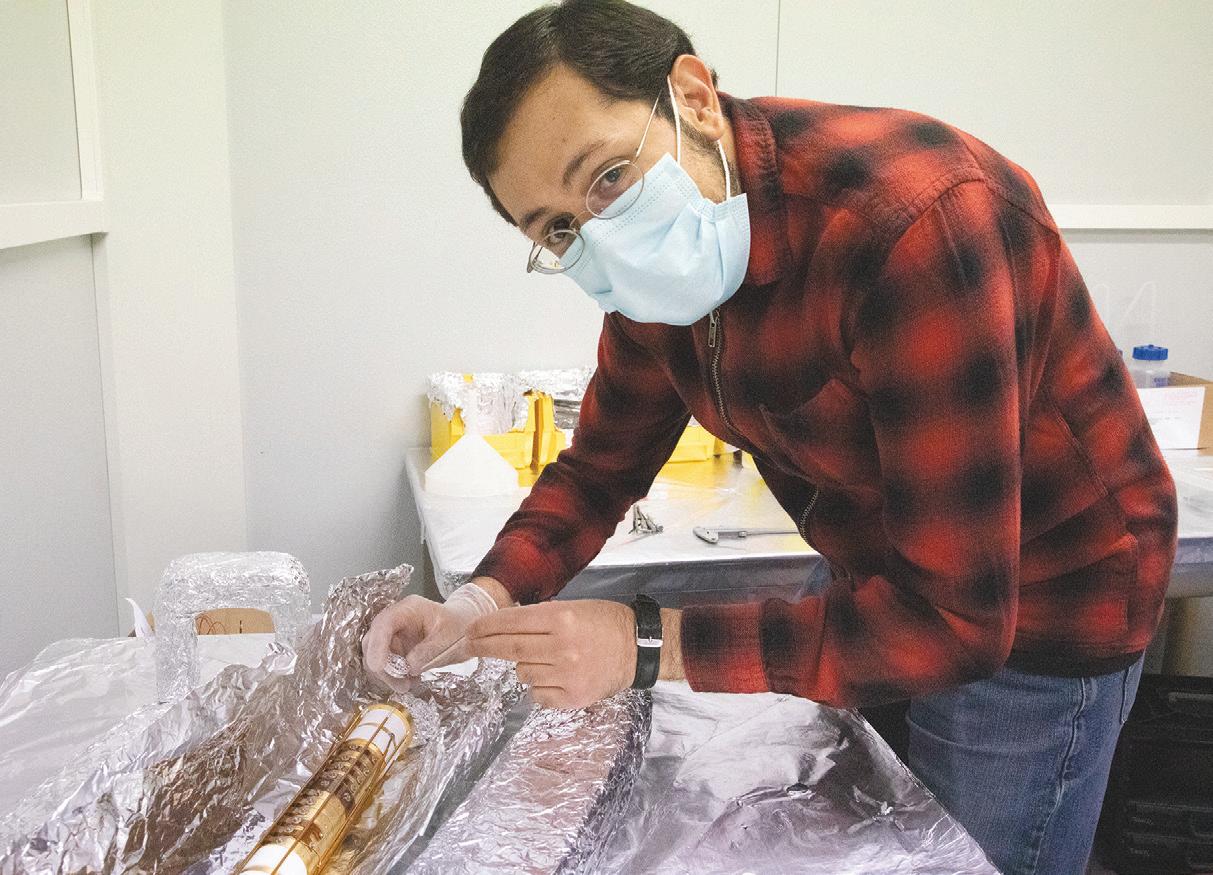
Antimatter | Sameed ’11 poses with the antiproton trap now under design.
SABRINA XIE /