The Corne¬ Daily Sun


By ROCHELLE LI
At the age of 19, Karen Chen ’23 has already won the 2017 U.S. Figure Skating Championships, competed at the 2018 PyeongChang Olympics and published a book. Now, she’s joining Cornell’s Class of 2023.
Like most incoming freshmen, Chen is nervous about adjusting to college life. But compared with most of her peers, Chen’s struggle is somewhat unique. Scoring the 11th place in PyeongChang, her eyes are now set on the 2022 Beijing Winter Olympics, and being a full-time professional skater and full-time student at the same time won’t be easy.
Originally from California, Chen moved to Colorado in August of 2018 to train with her coach, Tammy Gambill. On Thursday, she visited Cornell for the first time to see the campus and attend events at the College of Human Ecology, where she’ll be majoring in Human Biology, Health, and Society.
Cornell was among her top college choices, Chen said in an interview with The Sun at the Cornell Athletic Hall of Fame — after she tried the ice of Lynah Rink. She has paid her enrollment deposit, added “Cornell ’23” to her Instagram bio, and has even followed The Cornell Daily
Sun and Cornell Sports on social media.
“The campus is beautiful, [but I’m] not sure how I’m going to be able to deal with the weather in the winter,” Chen told The Sun. “I know that’s going to be challenging for me since I’m from Cali and it’s all sunny there, all the time, all year round.”
Chen has been homeschooled since 6th grade so that she can work her schedule around training. In college, it is going to be the other way around. The fact that Chen wants to pursue a pre-med path might make things even harder.
“In my head it’s doable. I’m gonna make this work. I’m not willing to give up skating and it’s still a priority for me. I dedicated so much of my life to it,” she said. “So I’m gonna see if I can try and maintain and do both very well.”
When Chen is over 1,500 miles away from her coach, training will have to be through hours of FaceTime and videos instead of in-person coaching. While Chen and Gambill have yet to work out the details, the long distance train-

By KATHRYN STAMM Sun Staff Writer
With chants, artwork and colored armbands, hundreds of community members gathered at the Greater Ithaca Activities Center for the 40th annual Take Back the Night to raise awareness of sexual violence.
Take Back the Night is a march, rally and vigil hosted by the Advocacy Center of Tompkins County, which provides domestic and sexual violence services. The event was a call for an end to intimate partner and sexual violence in the community and world. Its theme of “Light Out of Darkness” invited the survivors to take back their voices and move toward healing.
The gymnasium, where the rally was moved due to thunderstorms, was lined with handmade posters and an art installment made by sexual violence survivors in Tompkins County
“We are going to march and bear witness regardless of the weather, and we’re going to be loud.”
Naomi Barry
as a part of The Clothesline Project, which provides awareness and a space of healing. Attendees wore armbands
— purple to identify as survivors and blue for allies.
The crowded space was charged with resilience and empathy as speakers and performances alternated throughout the night.
Representing the City of Ithaca, Leslyn McBean-Clairborne, the deputy director of GIAC and Tompkins County Legislator, started the night by sharing her own story of growing up in a culture of domestic violence, an act which she called a demonstration of “love.”
After her own reflections on her experiences, McBean-Clairborne asked the audience to do the same, to
See RALLY page 5
By NICOLE ZHU and SEAN O’CONNELL Sun Assistant News
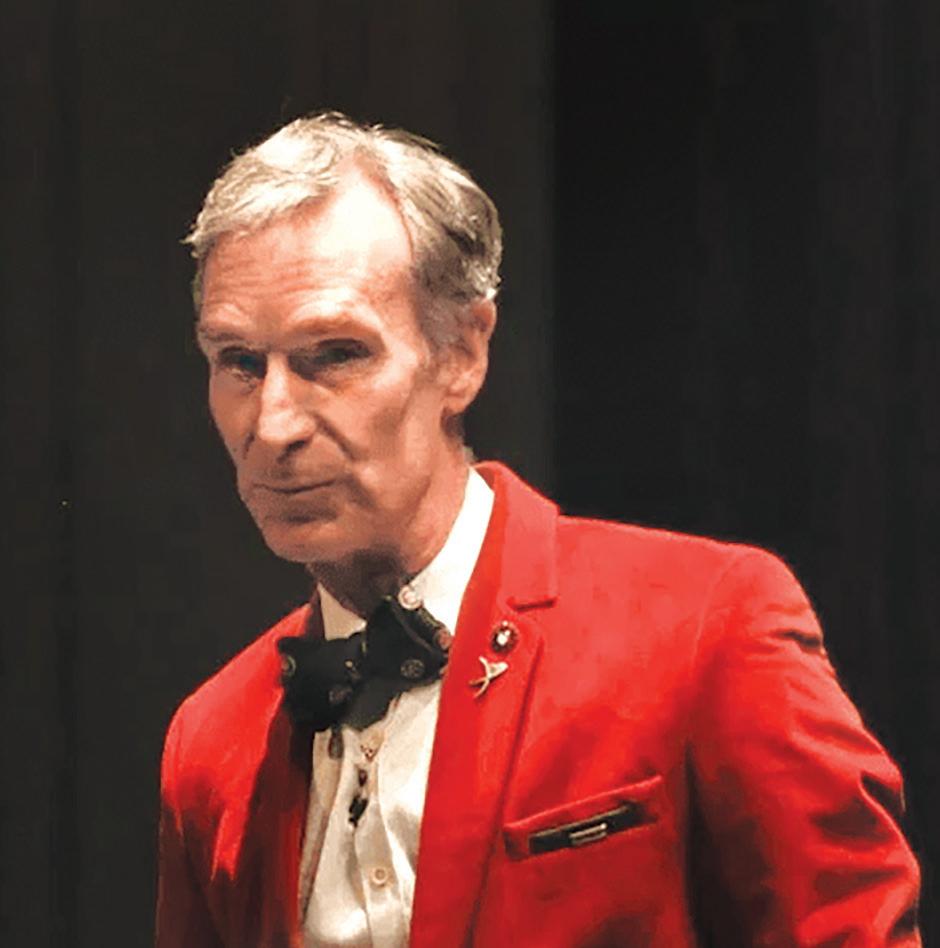
The Convocation Committee announced that Bill Nye ’77 will be the 2019 convocation speaker after the Student Assembly meeting on Thursday afternoon.
Nye, or “Bill Nye the Science Guy,” is best known as the host of the 19-Emmywinning PBS children’s science show, Bill Nye The Science Guy
Nye also stars in a Netflix original series called Bill Nye Saves the World , and was the focus of a 2017 biographical documentary film called Bill Nye: The Science Guy. Nye graduated from Cornell in 1977 with a B.S. degree in mechanical engineering. He was first involved with comedy in 1986 after a stint working for Boeing finally receiving his own show, Bill Nye the Science Guy in 1993.
Nye has been heavily involved with Cornell. In 2011, he gave a speech to a crowded Statler Auditorium dedicating the sundial embedded in the façade of
Frank T. Rhodes Hall. More recently, during 2017’s reunion weekend, he gave a speech titled: ‘Everything All At Once – How Cornellians Will Save the World.’ Nye’s reveal comes two weeks after the Convocation
Nye graduated from Cornell in 1977 with a B.S. degree in mechanical engineering.
Committee’s original pick, comedian and Patriot Act host Hasan Minhaj, dropped out hours before the committee’s planned announcement on April 11. This year’s selection has been marked by contention. The speaker announcement was delayed twice, the second time ascribed to S.A.’s decision to reject Resolution 36, which “urged” Cornell to divest from Israel, according to an article published in The Sun earlier this month. The cause of the original delay was unspecified. According to another article published days later, representa -

Material making | A lecture discussing
From STEM Student to Wall Street Quant Noon - 1:20 p.m., 700 Clark Hall
Wildlife Nutrition Talk Noon - 1 p.m., LH6, College of Veterinary Medicine
Tristram Stuart Scholar, Entrepreneur and Activist
Food Waste and What We Can Do About It
Thursday, May 2, 2019 5:30pm Call Auditorium Kennedy Hall
Theorizing Gender, Vulnerability and Agency In the Bangladesh Liberation War 12:15 - 1:30 p.m., G08 Uris Hall
What Is the Social Cost of Carbon? 2:55 - 4:10 p.m., 233 Plant Science Building
The Trees Have a Mother 4:30 - 5:30 p.m., 258 Goldwin Smith Hall
Shadi Harouni: Of Myth and Monument 5:15 p.m., Abby and Howard Milstein Auditorium, Milstein Hall
Free Screening of Just Eat It 7 - 8:30 p.m., Willard Straight Theatre
Cornell Health: “Let’s Talk” Walk-In Consultations 2:30 p.m., 311 W. Sibley Hall
Internal Transfer 1:1 Help for First Years 3 - 5 p.m., Carol Tatkon Center
High Resolution Multi-Material Additive Manufacturing: 3-D Fabrication of Biologically Inspired Structures
4 p.m., B11 Kimball Hall
Disaster: Cyclone Idai, Climate Change and Climate Migration 4:30 p.m., Lewis Auditorium, Goldwin Smith Hall
Keyna Eleison, “Displacements in Poetics: Art – Anti-Racism – Feminism” 4:30 p.m., K164 Klarman Hall
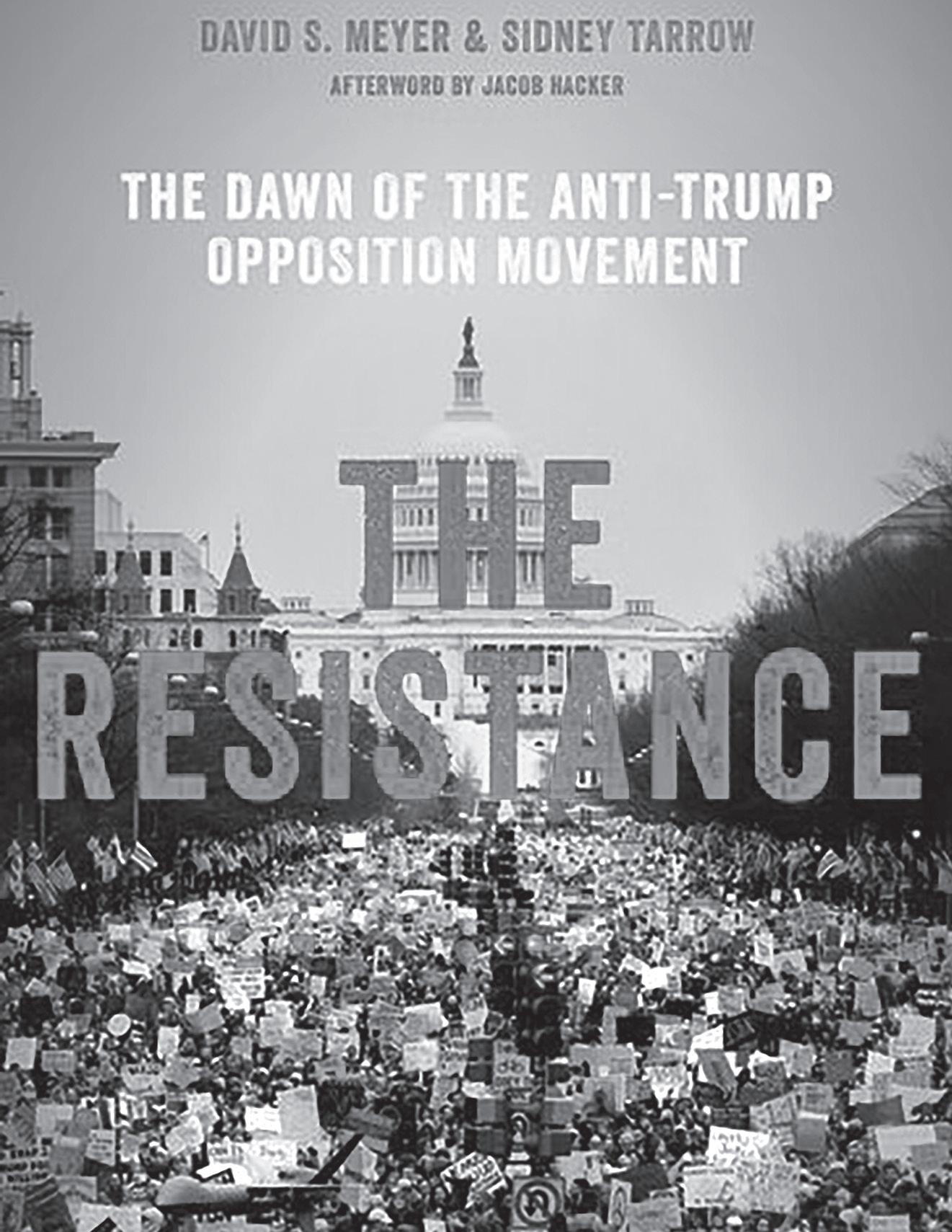
The Resistance: The Dawn of the Anti-Trump Opposition Movement 5:15 - 7 p.m., Milstein Hall

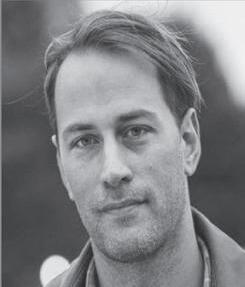

By LEANN McDOWALL Sun Newsletter Editor
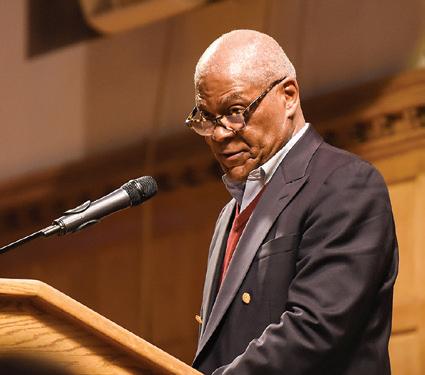
Tom Jones ’69 MRP ’72, a prominent figure in the 1969 Willard Straight Takeover, returned to Willard Straight Hall on Wednesday night to share lessons learned during the 50 years since the takeover and to reflect on the current state of race relations in America.
Jones is the founder and partner of TWJ Capital and former chairman and chief executive officer of Global Investment Management at Citigroup.
The event, titled “From Willard Straight to Wall Street and Back: An Evening with Tom Jones ’69” was sponsored by the Sigma Phi fraternity as part of the Lawrence ’68 and Judith Tanenbaum Distinguished Speakers Fellowship.
At the time of the Willard Straight Takeover, Tom Jones was a 19-year-old senior at Cornell.
As a student-government activist who had been freshman class president, Jones took part in the takeover “in solidarity” with his peers, but eventually became a leader in the two-day standoff that ended in a peaceful agreement between the students and the University.
Undergraduate Studies of Africana Studies and Research Center, who said it was “our honor — my department, staff and faculty, and mine … to have the opportunity” to introduce him.
Jones began his address with a reading of a passage from his recently-published memoir, “From Willard Straight to Wall Street,” copies of which were distributed to the first 100 audience members upon arrival.
The excerpt painted a picture of the takeover for Jones and his fellow activists.
“This was not what I had expected from college, not at all … Guns, knives, a two-day standoff with the university authorities. I hadn’t really slept in forty hours, and now it was morning again,” Jones said. “I thought I might be killed if we fought, but I wasn’t afraid.”
In the two years leading up to the takeover, Jones and his peers witnessed a series of violent acts: the shooting of thirty unarmed black students in South Carolina, the aftermath of race riots across the country and the assassination of both Martin Luther King, Jr. and Robert Kennedy.
“This was not what I had expected from college, not at all ... Guns, knives, a two-day standoff with the university.”
Tom Jones ’69 MRP ’72
After receiving his bachelor’s degree in government, Jones continued his studies at Cornell while working to make the African Studies Center a reality.
At the event on Thursday, Jones was introduced by Prof. Olufemi Taiwo, Director of
Although the takeover ended peacefully, Jones extended an apology to the individuals harmed by the event, including black students who were traumatized by the experience and President Perkins who resigned shortly after the takeover.
“I am sorry at the individual level for the people who were hurt,” said Jones.
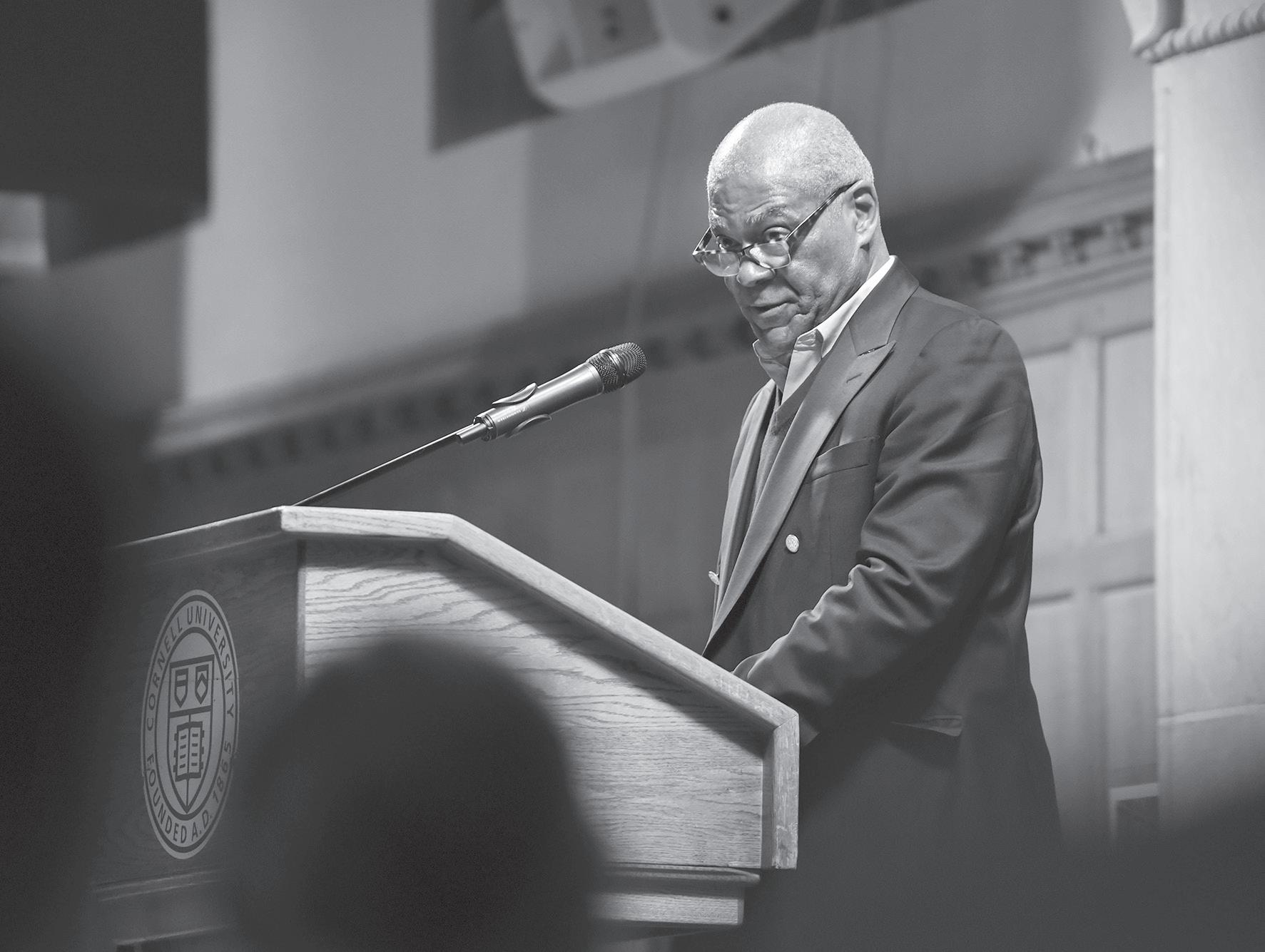
Jones recognized the effort President Perkins made in increasing black student enrollment at Cornell and said that Perkins became a “scapegoat” for the incident.
Jones said that while it was important to focus on how far we’ve come, “the legacy of hundreds of years of slavery … cannot be reversed in just 50 years.”
Jones went on to share three life lessons he has learned in the 50 years since the Takeover, each in the context of different stages in his life.
The first lesson came in graduate school, where he learned the difference between working hard and working at full capacity.
“I had never exceeded the 95 percent level of effort, probably because … most of us are socialized to think that 95 percent is an A and an A is the best grade.”
“The five points separating 95 and 100 don’t
seem like much and it isn’t on any given day or any given exam or work assignment, but it’s a lot when those five points are compounded every day, week after week, month after month, over the span of five years.”
He urged students to give 100 percent, comparing the self-actualization of achieving his highest potential with a “spiritual gift.”
Jones learned his second life lesson when he was fired by Citigroup and subsequently investigated for fraud by the U.S. Securities and Exchange Commission at the height of his career. From that experience Jones learned that “if it seems the world is against you, you’re going to have to look inside yourself for spiritual strength.” He encouraged the audience to prepare for times of trial in life.
See JONES page 4
By
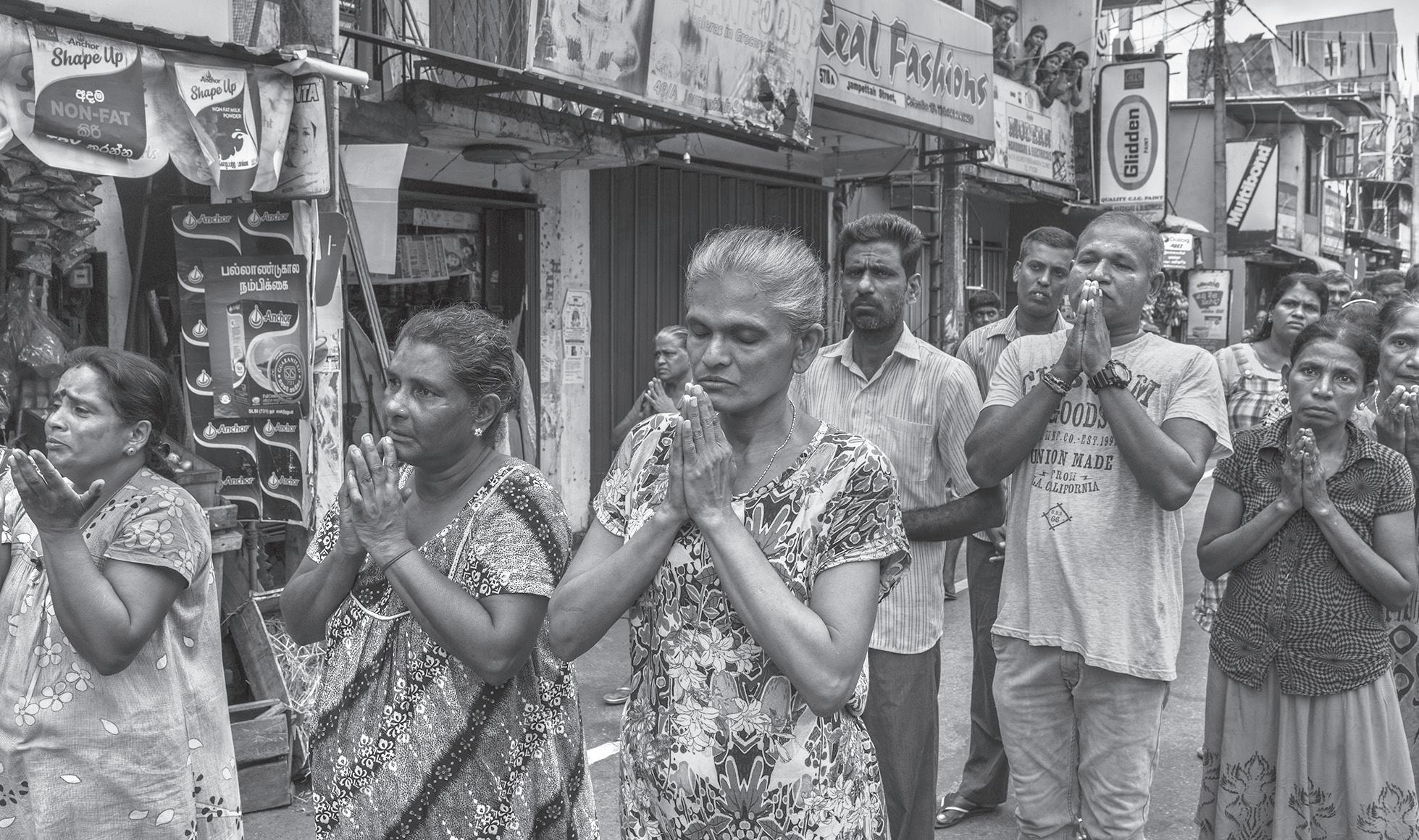
Cornell students will gather on Wednesday to honor the victims of last week’s Sri Lanka bombings, in which terrorists blasted several Catholic churches and luxury hotels, killing over 300 people on Easter Sunday.
The vigil will take place this Wednesday from 7 to 8 p.m. at Ho Plaza. 178 people currently say they plan on attending the event, according to a Facebook post. The vigil, which is sponsored by the Sri Lankan Society, was organized by three students of Sri Lankan descent and Cornell Catholic.
“We’re hosting the event to honor the innocent victims of the heinous bombings that happened in the country that I was born and
raised in,” Ishini Gammanpila ‘22, one of the vigil’s organizers, told The Sun in a Facebook message.
Gammanpila was nine years old when the civil war — which had been raging for 26 years — ended.
Now, nearly a decade later, the bombings “just brought back all these horrible memories and made me worry so much about my family and friends still living there,” she said.
She hopes the vigil will provide a safe space for discussion and reflection.
“The vigil would help speak out about how they feel and to just create a space where everyone can feel safe,” Gammanpila added.
The event will feature lights for attendees to hold as well as speeches from student organizers, according to Gammanpila. Afterwards, those
who wish to continue the discussion are invited to sit inside Willard Straight Hall for chai tea.
Gammanpila hopes the vigil will offer “some kind of closure” — a chance to pay respects and “to pray as a community hoping we’d come out of this incident strong.”
Vincenzo Guido ’20, a minister with Cornell Catholic, is also looking for community closure and hopes the vigil will provide support for targeted groups.
“The vigil aims, first and foremost, to memorialize and recall the lives of those taken ... in what appears to be a religiously motivated, targeted assault on Christian minorities in Sri Lanka,” he told The Sun in a text message. “We first wish to pray for the souls of the faithful departed
See VIGIL page 4
Ho supported immigrants and homeless Ithacans
By ANYI
Winnie Ho ’19 has been named the recipient of the Campus-Community Leadership Award for her voice and activism in a wide spread of local issues, including mental health, the opioid epidemic and Ithaca’s homelessness crisis.
The annual award commends a graduating senior every year for their “leadership and innovation” in local philanthropic initiatives, according to the award website. The award was presented by the Office of Community Relations.
“It was such an honor receiving the award,” Ho told The Sun in a message, crediting Katharine Celentano, state policy coordinator for the New York Drug Policy Alliance, and her supervisors in the Office of Engagement Initiatives for their role in her receiving the award.
Ho has previously participated and organized multiple activism events, which range from fundraising for the local homeless citizens to raising awareness for suicide prevention.
This February, as a polar vortex threatened the safety and lives of Ithaca’s homeless population, Ho worked around fundraising regulations to raise thousands of dollars in Venmo donations towards Ithaca Homeless Crisis, a service team working to provide aid and shelter for homeless Ithacans.
The issues that Ho worked
on extend beyond just homelessness. In June, she contributed to running a fundraiser in response to the Trump administration’s zero-tolerance border policy, exceeding the fundraiser’s goals despite theft of hundreds of donated dollars from the fundraiser table.
“I would highly encourage ... students to pay attention to the issues going on in Ithaca.
In March 2018, Ho was one of the organizers of a panel discussing the opioid epidemic’s impacts in Ithaca and a workshop on administering Naloxone, an opioid overdose treatment medication. Last February, Ho also organized a fundraiser through Alpha Phi Omega — a co-ed service fraternity of which she was formerly president — in the name of suicide awareness and prevention.
In addition to APO, Ho is also an ambassador for Engaged Cornell and president of Medlife Cornell, a chapter of an international service organization dedicated to alleviating poverty.
“The organizations in Ithaca have such a deep and committed passion to serve this com-
JONES
Continued from page 3
Jones’ final lesson came from the “animosity” he experienced from his black peers at Cornell who, according to Jones, criticized him for “mov[ing] easily between black and white social circles” and later on for establishing the James A. Perkins Prize for Interracial & Intercultural Peace & Harmony in honor of the late president.
He referenced a Sun op-ed written about the protest of the Perkins Prize in 1999.
The piece pointed out that Jones was dubbed “Uncle Tom Jones” by some black students at the University and was called a “sellout” by Ed Whitfield, another prominent Willard Straight Takeover leader. It also suggested a
“Jones-Whitefield debate” between the two leaders.
In response to this Jones said, “I have no criticisms of the way that Ed Whitfield has lived his life and I hope that his community organizing and efforts have been successful.”
“I respect the life choices that Ed Whitfield has made and I hope that he and those who emulate him will someday learn to also respect the life choices that I and others like me have made,” Jones continued.
As his final life lesson, Jones urged audience members to commit to high moral standards and “rise above racial, cultural, ethnic and religious animosities.”
LeAnn McDowall can be reached at lmcdowall@cornellsun.com.
HO
Continued from page 3
munity and beyond and it was such a privilege to learn from them,” Ho said.
In her time at Cornell, Ho studied biological sciences and sociology in the College of Arts and Sciences. After graduating, she will work as a research assistant at Harvard Medical School with her longterm sights set on medicine or
public policy, according to a University press release.
“I would highly encourage all current and incoming students to pay attention to the issues going on in Ithaca and to remember that we are guests here and have an obligation to use our resources to give back to this wonderful town,” Ho said.
Anyi Cheng can be reached at acheng@cornellsun.com.
VIGIL Continued from page 3
faithful departed and for reconciliation among all faith traditions in hopes of promoting an environment for peace and coexistence.”
Guido emphasized the communal value of holding the vigil, affirming that it was not just held for Christian community members.
“I firmly believe also that in these intentions and thoughts are those lost in the horrific attacks on Muslim and Jewish communities in recent weeks who share a common experience of martyrdom,” he said.
The impact of the devastating Easter Sunday attack has rippled across the globe, reaching Cornell’s campus, located 8,670 miles away from the South Asian country, where Cornellians of Sri Lankan heritage were left reeling and worried.
“We don’t know anything,”
Piragash Swargaloganathan ’19, who struggled to get in touch with relatives from the country, previously told The Sun. “As much as this attack came to us as shocking … at the same time, this is not something out of the ordinary.”
The suicide attacks last weekend struck three Christian churches and three luxury hotels popular among foreigners in Colombo, Sri Lanka’s largest city and capital. The bombings — aimed at Easter worshippers celebrating one of Catholicism’s most religiously important days — have triggered the resignation of several key government officials, including the Secretary to the Minister of Defense.
In a 68-word message, President Martha Pollack decried the deadly bombings, which have now claimed close to 320 victims and several American citizens, up from original estimates of 200. A total of 500 people have been wounded.
“As we all try to grasp yet another atrocity in the world targeting people based solely on their religious affiliation, let us reach out to those around us to stand in solidarity against violence and in support of love and compassion,” Pollack wrote in an email sent to Cornell students, which sparked criticism for its terse nature.
An Ithaca-based Crisisline is available at 607-272-1616. Students can consult with counselors from Counseling & Psychological Services (CAPS) by calling 607-255-5155, and employees can call the Faculty Staff Assistance Program (FSAP) at 607-255-2673.
Yuichiro Kakutani ’19 contributed reporting to this article.
Johnathan Stimpson can be reached at jstimpson@cornellsun. com.

Cornell Hosts Annual High School Programming Contest
Cornell hosted the largest-ever high school programming competition earlier this month. The annual event, hosted both in Rhodes Hall and Cornell Tech in New York City, featured 182 students competing in a wide variety of computer science-centered challenges. The winning team hailed from Princeton, New Jersey, while the runner-up came from Southborough, Massachusetts, who both solved seven problems on the way to claiming the competition’s top prize.
The Town of Dryden is set to receive at least $1.5M to complete a bike and hiking trail that will replace what was once the abandoned Lehigh Valley rail corridor, which has been vacant since the 1970s. The funds, awarded through the New York State Transportation Enhancement Program, will be used to extend the trail from Dryden to the existing East Recreation Ithaca Way. A major portion will go towards building a new pedestrian bridge, a vital but the most challenging part of the renovation, according to Dryden Town Supervisor Jason Leifer. The completed trail will link the town of Dryden to Ithaca and Tompkins County. An event marking the construction is set to occur May 11 and will include a raffle, food and a fun run.
California Synagogue Shooting Leaves One Dead
A 19-year old opened fire on a synagogue in Poway, California, targeting parishioners celebrating the final day of Passover — the latest in a series of religiously-motivated attacks. The incident claimed the life of one 60-year old victim and injured at least three others, taking place exactly six months after the deadly Pittsburgh synagogue shooting that killed 11 people. The rabbi of the targeted house of worship gave an emotional press conference in which he praised the actions of Lori Gilbert-Kaye, who was shot and killed while shielding the religious leader. The shooting occurred Saturday morning, when suspect John Ernst, who has now been booked on one count of murder, reportedly started shooting indiscriminately at worshippers with what witnesses described as an AR-15.
— Compiled by Johnathan Stimpson ’21
CHEN Continued from page 1
ing doesn’t phase either. They’ve worked together for the past six years and are confident that Chen will still be able to receive the advice she needs.
“You give her a task and she’ll get it done. She can read my mind,” Gambill told The Sun. “I’ve known her [for] so long, I’m not worried about her getting what she needs to do to get it done. She’ll figure out a schedule that works.”
Even so, the coach isn’t worried about this shift. Chen tends to overtrain, she said, so this shift might prevent the skater from doing just that.
“I think it will come to a point where if she’s overwhelmed, I’ll know pretty quick and maybe I’ll cut back on a little training time or give her a break during some of her more stressful study times,” Gambill said.
two will be doing a seminar together in Oregon in May, and Karen Chen plans to seek his advice then.
“I’m planning on just interviewing him, literally,” Chen said. “If there’s anyone I want to get answers from it’s definitely him.”
“In my head it’s doable. I’m gonna make this work. I’m not willing to give up skating, and it’s still a priority for me.”
Still, Chen’s training will have to go through some significant changes, according to Gambill. Chen’s current training includes up to three hours of skating per day and off-ice workouts such as ballet, pilates and working with physical trainers and nutritionists.
At Cornell, Chen is unlikely to have the same access to the ice rink. Gambill anticipates more off-ice workouts to compensate for less ice time.
Karen Chen ’23
Chen isn’t the first person to balance an Ivy League education and competitive figure skating.
Fellow Olympian Nathan Chen, two-time world champion and three-time U.S. national champion, is currently a freshman at Yale. Karen Chen hopes to learn from Nathan Chen’s experience, who she says is “doing really well” at Yale. The
As much as Chen plans to live a full college life, she knows that she will have to make some sacrifices to complete her degree while continuing skating. Chen doesn’t plan to participate in a lot of extracurricular activities, since “skating eats up all [her] time.” Nevertheless, Chen is excited to go to college and “try something new”. She doesn’t plan to give up either her education or skating. If balancing school and training becomes an issue, Chen is determined to be flexible and work things out.
“We’ll see,” she said.
Rochelle Li can be reached at rli@cornellsun.com.
support survivors and to change the culture of silence and complacency.
“It’s time to get that light out of darkness,” she said.
The recounts were poignant as attendees shared their own experiences in solidarity. With reminders that documentation of any kind was prohibited to preserve confidentiality and anonymity, survivors took to the stage while the crowd listened silently.
“The speak out is the heart of Take Back the Night,” Naomi Barry, lead community educator at the Advocacy Center, told The Sun. She commended those who “have that bravery to come on stage … and share their story in front of a room full of people.”
“When you have a bunch
of allies in the room, when you have this sense of safety in the room — that’s powerful,” she said.
Posters covering the walls and speakers gave constant reminders to survivors of their community’s unfaltering belief and support. These reminders of unity created a safe space and resource in a celebration of strength in solidarity, Barry said in her introduction to the crowd.
“I was touched by how intergenerational and inclusive of a space this was,” Emma Hewitt, the Take Back the Night intern, told The Sun. “Different groups come together … to make sure that there’s space in our community for survivors to speak out.”
After the event ended, the unity remained as the crowd lingered with long hugs, messages of support and invitations to join for
a “chill night” hosted by Planned Parenthood of the Southern Finger Lakes.
The solidarity and warmth pervaded the event, which began with two small, but noisy marches — one from Cornell and one from Ithaca College — through the thunderstorms and towards the Activities Center where a rally and the vigil followed.
“How powerful is that?”
Barry said. “We are going to march and bear witness regardless of the weather, and we’re going to be loud.”
For more resources on sexual assault and domestic violence, call the Advocacy Center of Tompkins County’s 24/7 hotline at (607) 2775000.
Kathryn Stamm can be reached at kstamm@cornellsun.com.
Pick up your free copy of
at the following locations: Cornell Campus
• A.D. White House
• Admissions Offce
• Africana Center Studies & Research Center
• Alice Cook Dining
• Anabel Taylor Hall
• Appel Commons
• Baker Hall
• Bard Hall
• Barnes Hall
• Bartels Hall
• Bethe House
• Big Red Barn
• Carl Becker House
• Carpenter Hall Library
• Center for Intercultural Dialogue
• Clark Hall
• Computer Services & Financial Aid, East Hill Plz.
• Cornell Institute for Social & Economic Research
• Cornell Store
• Corson Hall • Court Hall • Dairy Bar
• Day Hall Main Lobby
• Dickson Hall • Donlon Hall • Duffeld Hall
• East Hill Offce Complex • Environmental Health & Safety Building • Flora Rose • Gannett
• Goldie’s (Physical Sci. Bldg)
• Goldwin Smith • Hasbrouck Center
• Horticulture Offce
• Humphreys Service Bldg.
• Ives Hall (ILR) • Ivy Room (WSH) • Johnson Museum • Keeton House Dining
• Kosher Dining Hall
• Mac’s Café
• Martha’s (MVR)
• Mann Library
• Myron Taylor Hall + Hughes Dining
• Noyes Main Lobby
• Okenshields, Willard Straight Hall
• Olin Hall
• Olin Library B Level
• Plantations Gift Shop
• Rhodes Hall
• Risley Dining
• Robert Purcell Community Center (RPCC)
• Sage Hall Atrium
•Sibley Hall, Green Dragon Café
• Snee Hall
• Statler Lobby
• Statler Terrace Restaurant
• Tatkon Center
• Teagle Hall
• Transportation Dept., Maple Ave.
• Trillium
• Uris Hall
• Vet Center (Shurman Hall) Off Campus
• Autumn Leaves Used Books (Ithaca Commons)
• Bear Necessities
• Center Ithaca
• Coal House Café
• Collegetown Bagels: CTown + Triphammer
• Commons Grocery (Ithaca Commons)
• CFCU (Triphammer Rd. + East Hill Plaza)
• Corner of College & Dryden
• Corner of State & Aurora
•Express Mart, Comm. Crnrs.
• Hillside Inn
• Hilton Garden Inn
• Holiday Inn
• Ithaca Coffee Co.
•Ithaca College, Phillips Hall
• Jason’s Grocery & Deli
• Kendal
• Kraftees
• Lifelong
• Oasis (Greenstar)
• P&C Fresh (East Hill Plaza)
• Salvation Army
tives said they felt it was not the time to bring up further disappointing news.
“The community had already sustained
a big loss with divestment,” Omar Din ’19, a proponent of the resolution, said in an interview with The Sun for the article. He said that Charlotte Lefkovitz ’19, a leader of the committee, “wanted to be empathetic announcing another setback. I have full respect for that decision, and think that it takes so much compassion for her to have recognized that.” Senior Convocation will take place on May 25, 2019.
Nicole Zhu can be reached nzhu@cornellsun.com. Sean O’Connell can be reached at soconnell@ cornellsun.com.
• Shortstop Deli • Tompkins County Public Library • Tops (Triphammer Rd.) • Universal Deli • Warren Real Estate (Downtown + Community Corners) or stop by The Sun’s offce
ROBERTSON SUN STAFF WRITER
Last Monday, The Spring Quartet closed out the 20182019 Cornell Concert Series season at Bailey Hall. The Spring Quartet is an on-and-off jazz project by drumming mainstay Jack DeJohnette, acclaimed saxophonist Joe Lovano, established keyboardist Leo Genovese and starlet bassist Esperanza Spalding. Although Spalding’s bio in the concert program reads, “#@&! accolades,” it was evident that the combined talent and pedigree of these musicians would make for a jazz force to be reckoned with. I’ve been a fan of Esperanza Spalding for a year now. I was very excited for her return to Cornell and to see her live for the first time. Bailey Hall was sold out, and my expectations and excitement for this concert were high.
The first bad sign was that the crowd was composed mostly of older folks from the Ithaca area. I spotted very few students and those that I did see were big jazz fans. While this isn’t necessarily unpleasant, an eager young crowd is indicative of a certain endorsement for a jazz show. I didn’t sense the excited energy that past Cornell Concert Series shows had from their student audiences.
However, when the quartet took the stage and played their opener, “Spring Day,” I was put at ease. The song woke up with a flurry of noise. The band slowly began to play in sync, as the song got ready for the day. All of a sudden, the groove hit its stride, as if to say, We’re off into the day. As each challenge or incident occurred, the band would represent it with an unexpected hit of the snare or a rapid keyboard run by Genovese. The melody got crazier and crazier until finally the groove was reiterated and the song ended on a snare hit. Perhaps we got too drunk and fell in the bushes. Or maybe something darker. This opening was one of the strongest moments of the night.
The band was tight, creative and supremely talented. While DeJohnette grooved on his standard drum kit, Genovese noodled on his grand piano and an auxiliary

The artist formerly known as Marina and the Diamonds is an icon to many a former angsty teenage girl. Take a look back at any 8tracks playlist from 2012 to 2014 and you’ll find her entire early discography; Electra Heart was the perfect getting-ready-for-prom soundtrack. Try watching any of her videos from that era and not feel the urge to grab your darkest shade of lipstick and draw an eyeliner heart on your cheek.
Now rebranded boldly as MARINA after a three-year break from music, her new album LOVE + FEAR has evolved away from angry-sad tracks such as “Homewrecker” and the chilling ’50s housewives of “SU-BARBIE-A” and rooted itself firmly in the here and now. Much of the album explores the physical world. The uncharacteristically chill “Orange Trees” is a nostalgic love letter to her family home in Greece, and the Clean Bandit/Luis




Rhodes keyboard, Spalding thumped on her upright bass and Lovano led the way on his tenor saxophone, soprano saxophone and flute. Other highlights of the show were “The Ethiopian Blues,” where the central theme was repeated, altered and played upon beautifully. It was also a treat to hear “Work of Art,” a piece from Spalding’s rare album Exposure. The song features Spalding on vocals in addition to her bass duties, which I wish happened more often. It was a sarcastic and caustic criticism of the world’s music institutions, which demand a submission from artists before they grant money to fund their artistic creations. “Take the word ‘submission’ any way you like,” Spalding remarked.
While these moments were very strong for the trio, the remaining songs in the concert confused me. They performed a few works that the quartet’s members had composed for different projects, such as DeJohnette’s “Herbie’s Hand Cocked” and “Priestess of the Mist” and Lovano’s “In the Land of Ephesus.” There was a huge disconnect during these numbers between the band and the audience. The band set little groundwork in the themes of these songs and changed the structure so drastically to the point of complete miscomprehension. Yet, the quartet still retained communication with each other. They clearly knew what was going on. I discussed these moments with some of my “jazz-head” friends to see if this was due to perhaps just my inexperience with jazz music. They agreed: Whatever the quartet was doing was way over our heads. It was as if the quartet was fluently speaking a complex language only they could understand.
Ultimately, the reason for my disappointment with The Spring Quartet’s concert was that often, they were inaccessible to the audience. I don’t want the quartet to “dumb down” their art but I do believe that establishing a stronger framework for their performance would have been very effective in sharing their intense passion and creativity. This relationship clicked a few times during the show and those moments were very special. Otherwise, I spent the remainder of the two-hour runtime feeling

left out of what the musicians were accomplishing on the stage. I exited Bailey Hall with the performance failing to meet my expectations but still hoping for a chance to see an Esperanza Spalding solo concert. I must also applaud The Cornell Concert Series, which has given incredible artists the platform to reach the Cornell and Ithaca communities alike. I look forward to seeing what’s in store for next season.
James Robertson is a sophomore in the College of Arts and Sciences. He can be reached at jar524@cornell.edu.
RACHAEL STERNLICHT/ SUN GRAPHIC DESIGNER

Fonsi collab “Baby” explores Latin House, complete with Spanish lyrics. A lot of the songs on the album were written when MARINA was traveling in Sweden, and the title is a nod to Swedish psychologist Elisabeth Kübler-Ross’s emotional theories. Gone are the narratively-complex videos chronicling the tragic life of her Electra Heart alterego. In their place are videos of MARINA exploring and enjoying the outdoors. These videos, like their predecessors, are colorful but not in the pastels or neon of previous albums — LOVE + FEAR is all about the bright colors of real life. However, this is still the same MARINA, the artist who uses her music to work through problems she’s grappling with in real life, no matter its colors. As the title might suggest, where the first half of the album is about loving life, the second half of the album is full of the melancholy pop that makes Marina’s music so compel-
ling. This album marks a definite shift in per spective, one that began with 2015’s FROOT its first track “Happy.” In many songs on LOVE + FEAR, like “No More Suckers” and “Believe in Love,” MARINA sings about resolving to live a happier life. Whereas previous songs about fear come with a sense of hopelessness — for example, 2015’s “Savages” line “I’m not afraid of God, I am afraid of man”— these songs are more about confronting fears head-on. “To Be Human,” which references Lenin, Hiroshima and American riots, sums up the album’s thesis: “We’re united by our love / We’re united by our pain.”
Musically, even though Marina explores new topics and a variety
of genres, every song has her unmistakable, echoey vocals and fits in well with the rest of her work. Like FROOT before it, the songs are a little more subdued than her older hits like “Oh No!” and “How to be a Heartbreaker,” but they still have their upbeat moments here and there. I think my favorite track from the new album is “Karma” because of its first line “Heartbreaker, real faker,” which is a reference to the Electra Heart era and is also one of the most upbeat songs from LOVE + FEAR era. As an aside, I love when fans refer to the few years between
liquid eyeliner. This album is for fans who grew up with The Family Jewels or Electra Heart, loved FROOT and are ready for something new. It’s not another Electra Heart, which some fans may want, but that’s okay. That album still exists, ready to transport fans back to 2012 (and the beginning of my teenage years). Taking fans on a world tour to find themselves, LOVE + FEAR feels like a Marina album with an optimistic twist.
Olivia Bono is a junior in the College of Arts and Sciences. She can be reached at ojb26@cornell.edu.
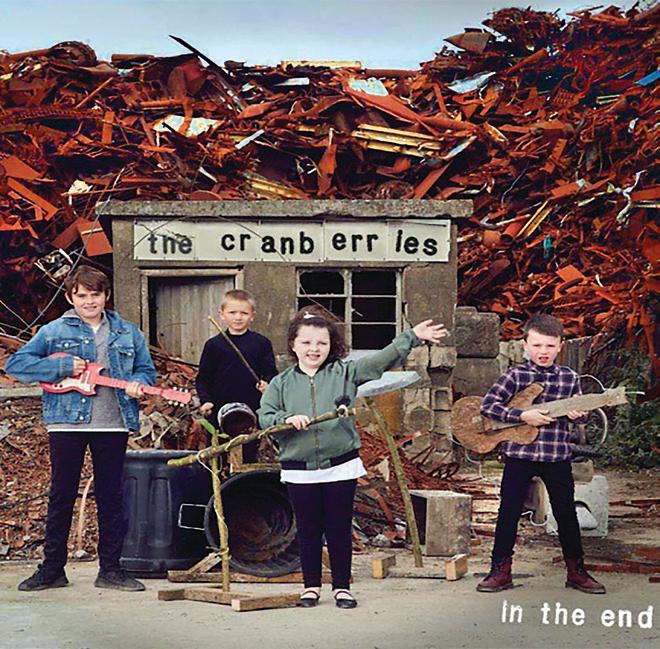
Just over a year after the death of lead singer Dolores O’Riordan, the Cranberries released their final album which acts as both a farewell to their group’s career and to O’Riordan.
The production of In The End began in 2017 with songs composed by both guitarist Noel Hogan and O’Riordan. Recording began before O’Riordan’s death, and after her passing, the band acquired permission from O’Riordan’s loved ones to use her vocals in what they then decided would be their closing album.
The final product consists of 11 songs, each prominently featuring O’Riordan’s unique voice which has defined the band’s sound since she joined in 1990. In the End opens with “All Over Now,” which sets the tone for an album filled with sorrow, acceptance and closure for the band and fans alike.
“All Over Now” is reminiscent of the Cranberries’ early sound in the 1990s’ alternative rock era as O’Riordan’s light, warbling voice
floats over the heavy partnership of drums and guitar. This opening song contains a certain rawness never before heard from the Cranberries. The album takes on a haunting quality that highlights the band’s search for a peaceful ending, which may be due to the shock from hearing O’Riordan’s posthumous recording.
Immediately following “All Over Now,” the second track “Lost” evokes sorrow, heartbreak and a haunting fear of being left behind. “I feel I’m dwelling in the past / Time is moving fast,” sings O’Riordan in a powerful serenade.
“Lost” in particular reminds me of O’Riordan’s uniqueness in her ability to convey so much emotion and power through a voice that is both hard and soft. The tracks following “Lost” continue the motif of moving on that In the End offers.
The first half of the album specifically seems to center on this idea of “tomorrow,” as the band takes its listeners on a journey through healing and moving forward past
O’Riordan’s death and their subse quent breakup.
“A Place I Know” offers a softer side of the Cranberries, as it takes listeners into a folksy, stripped-down sound as O’Riordan sings that “Yesterday is gone . . . Tomorrow will come,” offering a shift from the melancholic and sorrowful first half into a stronger and more hopeful second.
want to.
Despite the gentleness of “A Place I Know,” the Cranberries reminds us that their journey remains an upwards one, as songs such as “Catch Me If You Can” shift suddenly from quiet to harsh in a flash. Yet the Cranberries persist. O’Riordan’s voice offers an optimism with an edge as she sings that “With the passing of time / It’s the coming of age” in “Got It” and that “This is my conclusion / For
now” in “Illusion.” These two songs remind me strongly of the Cranberries’ sound in the 1990s, but softer, indicating the band’s nod to their success and to the unique style which defined them as a leader of 1990s alternative rock, but also recognizing their growth and their acceptance that In the End will be their end.
The album closes with its title track “In the End,” which serves as both a reflection of where the band has been and a suitable close both to the album and the Cranberries as a band. They reflect that “Ain’t it strange / That everything you wanted / Was nothing that you wanted / In the end,” acknowl-
The Cranberries present a clean, enjoyable album which offers a perfect goodbye. In the End resurrects the Cranberries of the 1990s, but enhanced. They are older, wiser and barer but they remain loyal to the rebellious and folksy spirit that made them iconic. In the End leaves its listeners satisfied. It is an album of mourning, but also of reflection and acceptance that life throws unexpected challenges and heartbreak, but in the end, we are stronger for it.
Erin Hockenberry is a freshman in the College of Arts and Sciences. She can be reached at eeh67@cornell.edu.

DAHLIA WILSON ’19
Business Manager
PARIS GHAZI ’21
Associate Editor
NATALIE FUNG ’20
Web Editor
SABRINA XIE ’21
Design Editor
NOAH HARRELSON ’21
Blogs Editor
SHRIYA PERATI ’21
Science Editor
KATIE ZHANG ’21
Dining Editor
AMINA KILPATRICK ’21
News Editor
JOHNATHAN STIMPSON ’21
News Editor
PETER BUONANNO ’21
Arts & Entertainment Editor
ANYI CHENG ’21 Assistant News Editor
HUNTER SEITZ ’20 Assistant News Editor
CHRISTINA BULKELEY ’21
Assistant Sports Editor
JING JIANG ’21
Assistant Photography Editor
JEREMY MARKUS ’22
Assistant Arts & Entertainment Editor
ALICIA WANG ’21 Graphics and Sketch Editor
DANA CHAN ’21 Production Editor
RYAN RICHARDSON ’21
Snapchat Editor
ALISHA GUPTA ’20 Senior Editor
SHRUTI JUNEJA ’20 Senior Editor
AMOL RAJESH ’20 Senior Editor
SUBRAMANIAM ’20 Editor in Chief
SARAH SKINNER ’21
MEREDITH LIU ’20 Assistant
RAPHY GENDLER ’21
BORIS TSANG ’21
Editor
AMBER KRISCH ’21
SOPHIE REYNOLDS ’20
Editor
AMANDA H. CRONIN ’21 News Editor
ROCHELLE LI ’21 News Editor
MARYAM ZAFAR ’21 City Editor
ETHAN WU ’21 Opinion Editor
SHIVANI SANGHANI ’20 Assistant News Editor
NICOLE ZHU ’21 Assistant News Editor
MILES HENSHAW ’20 Assistant Sports Editor
BEN PARKER ’22
Assistant Photography Editor
DANIEL MORAN ’21 Assistant Arts & Entertainment Editor
LEI LEI WU ’21
EMMA WANG ’20 Multimedia Editor
LEANN McDOWALL ’21 Newsletter Editor
GIRISHA ARORA ’20 Senior Editor
BREANNE FLEER ’20 Senior Editor
KATIE SIMS ’20 Senior Editor
Ad Layout Jamie Lai ’20
Production Deskers Dana Chan ’21 Jenny Huang ’22
News Desker Anyi Cheng ’21
Night Desker Olivia Weinberg ’22
Design Desker Jamie Lai ’20 Laura DeMassa ’21
Photography Desker Jing Jiang ’22
Sports Desker Raphy Gendler ’21 Arts Desker Daniel Moran ’21

The question of whether Asian Americans qualify as people of color has become increasingly pertinent, especially after The Sun published an article about admissions statistics for the class of 2023, stating, “Nearly 55 percent of this year’s admitted students are ‘students of color’ — underrepresented minorities or Asian Americans — a new record for Cornell.”
So then, are Asian Americans people of color? It’s complicated.
Asians whose ancestors are of indentured servitude migration patterns (notably populations like those of Indo-Trinidadians and Indo-Guyanese folks), when immigrating to the U.S., largely lack the presupposed privileges that many Indians immigrating directly from the subcontinent benefit from. When left unacknowledged or dismissed, we erase the first generation, low income and undocumented Asians who struggle to feel that they can call the U.S. their home.
We are asserting ourselves as people who are deemed perpetual foreigners and come largely from nations that were former European colonies.
Takao Ozawa v. United States (1922) was a case in which the United States Supreme Court found Japanese-American Takao Ozawa ineligible for naturalization because the courts deemed him to not be white.
United States v. Bhagat Singh Thind (1923) was a case in which the Supreme Court unanimously decided that Bhagat Singh Thind, an Indian Sikh man who identified as a “high caste aryan, of full Indian blood,” was racially ineligible for naturalized citizenship in the U.S. Associate Justice George Sutherland said that authorities on the subject of race were in disagreement over which people were included in the scientific definition of the Caucasian race, so Sutherland instead chose to rely on the common understanding of race rather than the scientific understanding of race. Concurrently and subsequently were the advents of calls to action for the government to address the “Yellow Peril,” Japanese internment during World War II, and fear of the “Hindoo Invasion.”
Asian Americans in the 1960s joined the fight for ethnic studies departments and for courses in higher education to teach them about themselves through a lens that was not anthropological or militaristic, but through focusing on the history of people of different minority ethnicity in the U.S. The combined determination of the Latin American Student Organization, the Black Student Union, the Intercollegiate Chinese for Social Action, the Mexican American Student Confederation, the Philippine American Collegiate Endeavor, La Raza, the Native American Students Union and later the Asian American Political Alliance galvanized California and the rest of the nation with the first student strike. Individuals like Yuri Kochiyama, Grace Lee Boggs, Fred Ho, groups like the Asian American Political Alliance and Asian Americans for Action and publications like I Wor Kuen, Wei Min She and Gidra all further exemplify the contributions of Asian Americans in the civil rights movement at large.
But what about Asians’ access to white privilege? The murder of Vincent Chin due to the ignorant homogenization of all East Asian people, the rise of the Dotbusters (a hate group in Jersey City, N.J. that attacked and threatened South Asians), and the targeting of South Asian, Arab, Muslim and Sikh immigrants post the Sept. 11 attacks (well documented by South Asian Americans Leading Together) demonstrate that Asian Americans were precluded from it. Disaggregated data when looking at the socioeconomic backgrounds and documentation statuses of Laotians, Cambodians, Vietnamese, Hmong and Bangladeshis reveal structural inequities that are hidden when Chinese, Korean, Japanese and Indian data is incorporated into statistics on “Asians” as a demographic population as a whole. South
Prudently, the model minority myth was cultivated to preserve white supremacy, and through racial triangulation drives a wedge between Asians and other minorities. The consequences are profound, delegitimizing the experiences of racism and institutional oppression that Asian Americans face while also producing new issues within our communities, like underreporting cases of mental health issues and illnesses, domestic violence, and most prevalently, rampant colorism and anti-Blackness.
The recent admissions debates at Harvard and with New York City specialized high schools show that Asian communities are diverse and not uniform in their political beliefs — presuming their inclinations is ultimately unproductive. Best articulated by Hasan Minhaj in an episode on affirmative action in Netflix’s Patriot Act, progressive Asian Americans readily recognize the reasons behind and necessity of affirmative action, in addition to refusing to be used by the conservative and pro-white lawyer Edward Blum.
From writing this, we are not seeking to equate Asian American struggles to those of other people of color nor necessarily do we feel that we are people of color because of the development of and implications about an equivalency of experiences of oppression — the acronym BIPOC serves as a strategic and useful tool to, “undo Native invisibility, anti-Blackness, dismantle white supremacy and advance racial justice.” We are, however, asserting ourselves as people who are deemed perpetual foreigners and come largely from nations that were former European colonies and nations that have suffered from Western policies of interference and military operations. Erasing our postcolonial histories relieves the British, Spanish, Portuguese, Dutch and many others from the horrors they inflicted upon our ancestors, as well as the bloody revolutions and freedom fighters that fought to demand and realize liberation and sovereignty from Europe’s economic exploitation of their resources and people, white colonizers’ multifaceted attempts at permanent socio-cultural hegemony, and the disenfranchisement that has resulted in many Asian nations being now called “developing countries.”
We are calling for more harmonious coalition-building amongst students of color at Cornell and transnational anti-imperialist solidarity across the world. We are not competing to be recognized as equally oppressed because Asians are not affected by the schoolto-prison pipeline and mass incarceration, police brutality and active genocide in the ways that black, Latinx and indigenous communities here are. However, not experiencing these should not then allow for drawing a conclusion that Asian Americans must be white-aligned. Quite the contrary.
Shivani Parikh, a senior in the agriculture college, Kumar Nandanampati, a junior in the agriculture college, Aashka Piprottar, a junior in the hotel school and Katha Sikka, a junior in the arts college, are members of the South Asian Council. Jong Han, a senior in the arts college, Hansen Tai, a junior in the arts college and Jeannie Yamazaki, a sophomore in the agriculture college, are members of the Cornell Asian Pacific Student Union. Comments may be sent to opinion@cornellsun.com.
Irecently — and quite manically — cleaned the house I live in with four other girls. We’ve come into a living pattern where we live comfortably for a week or two before realizing the Cheetos Paws bags and empty bottles of alcohol are not going to disappear. Cleaning, for me, has always been a way to organize the equally messy space of my thoughts as well as the physical house itself, making it a win-win situation.
I had to get rid of three plants in the house — all of them mine. As I picked them up, I watched as the dried leaves fell onto the table. They were lifeless and curled up. One of them I had found at the Union Square farmers’ market in the city when I was staying there for the summer. Another came from one of my mom’s plants. Another was in a pot that had come from flowers my friends got me when they found out that the guy I was seeing was still with his ex-girl
I go through massive purges where I donate heaps of clothing, feeling weighed down by material things. But I’m also the type to collect little mementos everywhere I go.
as well use it to water those ones . It didn’t fit into Marie Kondo’s, “Does it spark joy?” because of course they did, except now they were dead. What was the purpose of collecting more plants if I couldn’t even keep them alive?
What is “more”? A show from the podcast, “Invest Like the Best,” with Boyd and Bronwyn Varty talks about the idea of “more.” Perhaps, they say, more is giving more time to yourself so that you can give fewer people your full present energy and attention. Giving is the marker of what an ideal good person does, so there are times when people give too much and then feel overrun. More, simply, is not always better. Translated to my situation with plants, buying fewer plants would allow me to put more time and effort into caring for them.

friend. You can see why these plants were not just plants.
That’s why seeing them die like that, under my neglect, made me feel so irresponsible. Sure, I had gathered them with intention every time — whether drawn to the beauty or the memory attached. But I saw that the more plants I took in, the less effort I made to take care of them. It was a shit, that soil looks dry , or I have extra water I don’t want to waste, might
I struggle. I go through massive purges where I donate heaps of clothing, feeling weighed down by material things. But I’m also the type to collect little mementos everywhere I go, as a way to try to collect moments. There’s a small eraser of The Thinker I have sitting by my mirror, from the Rodin Museum in Paris. A blue chameleon toy I got from a vending machine in the Salvation Army is perched on my bookcase. There’s a golden compass my boyfriend got me in London because he knows I’m bad at directions.
Memories are the things I place the most value in, but these other physical objects bring me back to a place or moment just by looking at them. I like to feel the smooth surface of the compass, to feel the weight of it settle in the palm of my hand.
I watched a documentary on Netflix called “Minimalism: A Documentary About the Important
Christian Baran | Honestly
Another Earth Day has come and gone. With the expiration of lengthy Instagram stories of natural wonders has also gone most of the Earth-friendly sentiment they delivered for a day. Some of my friends in the Ecology House, where I live, complain about people who give the Earth shoutouts over social media on Earth Day but only continue with the same wasteful lifestyles the next. While I have noticed this phenomenon with certain people, it’s not the biggest problem I see with Earth Day. The holiday celebrates our planet and advocates better treatment of it, but it also ignores our treatment of Earth’s cherished non-human constituents. We treat animals so badly with our heedless land use and eating habits that maybe they even deserve a day of
Things.” Overall, I felt like privileged white men were preaching to me how to live, even while they experienced financial security and a discomfort with not feeling fulfilled by that. The section on tiny houses interested me (just because the concept of tiny houses interests me in general), and there were some valuable lifestyle tips to take away. I felt the documentary catered to a demographic of those who have reached a comfortable lifestyle to the extent that they can now afford the luxury of picking what “meaningful” items they want to keep. Close-up shots of Mrs. Meyer’s hand soap, carefully selected high-end brand clothing and a copy of The New Yorker further the notion of a curated aesthetic people who call themselves “mini-
With the postcards and letters covering my wall and books I’ve convinced myself to keep, my space is far from minimalist.
malists” adhere to.
With the postcards and letters covering my wall and books I’ve convinced myself to keep, my space is far from minimalist. But that doesn’t mean I can’t acknowledge how the more I accumulate, the less value I place in each object. I don’t think there’s an inherent badness in stuff . But just as cleaning takes care of both the house and my mind, bringing awareness to the items I accumulate can allow the meaning and value I place on them to actually hold weight once again.
Gabrielle Leung is a senior in the College of Arts and Sciences. She can be reached at gleung@cornellsun.com. Serendipitous Musings appears every other Friday this semester.
would be hard-pressed to find someone who doesn’t think baby cows and chickens are cute — and maybe this love is genuine. But I personally don’t see how one can “love” something while continuing to buy and consume its meat. That’s a bad case of cognitive dissonance if I’ve ever seen it. And it has devastating consequences for the environment.
With the expiration of lengthy Instagram stories of natural wonders has also gone most of the Earthfriendly sentiment they delivered for a day.
their own.
Earth Day has been celebrated on April 22 every year since 1970. The holiday demonstrates support for environmental protection and promotes changes in human behavior and policy to achieve a more environmentally-friendly society. Most people support action to make our Earth healthier but ignore a vital part of that goal: animals. Everyone loves farm animals. You
As everyone who’s remotely climate change-literate knows, greenhouse gases drive the warming of the planet by trapping heat in the Earth’s atmosphere. Well, big news folks. Animal agriculture is the second largest contributor to human-made greenhouse gas emissions behind fossil fuels. But that’s not all. About 70 billion animals are grown every year for consumption, and they all need space to live, water to drink and food to eat. That puts a huge strain on Earth’s resources. About one-third of the planet’s ice-free land is set aside for growing livestock. Similarly, about one-third of the world’s grain production and nearly one-fifth of the Earth’s available freshwater are funneled into the Faustian deal that is animal agriculture. These facts aren’t buried deep in some academic journal. They’re widely documented and easily found via a quick Google search.
Of course, there are ways to sustainably raise livestock, but it’s hard to do so on the scale needed to feed
the world’s population. Meat and dairy consumption are both expected to rise by about 70 percent by 2050, mostly due to developing nations advancing and demanding more animal products. This will only require more resources and foist further detriment on the environment. To do anything meaningful to
increase their mass grow too quickly for their bones to keep up and sit on broken legs in the dark. Atrocities abound in large-scale animal production. We have a moral prerogative to prevent harm
The blind eye humanity turns to the harms of animal husbandry is unacceptable, especially on Earth Day, when we’re supposed to appreciate all of our planet’s living constituents.
help the environment in respect to animal agriculture is to slash consumption of animal products or cut them out of your diet completely.
Besides the harm animal agriculture imposes on the environment, though, there exists what I believe to be a more meaningful reason to stop consuming animal products: to end the needless suffering we cause to livestock. Farm animals are sentient beings with the capacity to feel pain, yet in factory farms across the nation, we treat them as mere units of production. They live in deplorable conditions in close quarters only to end their lives prematurely in an industrial slaughterhouse, where thousands of animals can be processed — killed — every hour. Pigs have their tails cut off to prevent their peers from biting them down to stubs in a stress-induced frenzy. Chickens that are fed hormones to

coming to innocent beings, which is incongruous with eating meat in the modern system of factory farming. In these times, there is no reason to eat meat besides the taste, which is not a good enough argument. The blind eye most of humanity turns to the harms of animal husbandry is unacceptable, especially on an occasion like Earth Day, when we’re supposed to appreciate all of our planet’s living constituents and encourage action to help the environment. I am of the opinion that there needs to be a holiday analogous to Earth Day to appreciate animals and recognize the great injustice our society is doing to both them and the Earth by continuing to raise them for consumption.
Christian Baran is a freshman in the College of Arts and Sciences. He can be reached at cbaran@cornellsun.com. Honestly runs every other Friday this semester.
Fill in the empty cells, one number in each, so that each column, row, and region contains the numbers 1-9 exactly once. Each number in the solution therefore occurs only once in each of the three “directions,” hence the “single numbers” implied by the puzzle’s name. (Rules from wikipedia.org/wiki/ Sudoku)




M. LACROSSE
Continued from page 12
goals in their Cornell careers.
“I think our offense is one of the best in the country,” said sophomore attack John Piatelli. “When we play together and we play hard and with pace, good things happen for us.”
Freshman goaltender Chayse Ierlan made 13 saves — his seventh consecutive outing with double-digit stops. The Rochester native has made at least 10 saves in all the games in which he played a majority of the time.
Princeton’s standout junior attack Michael Sowers had seven goals and one assist as he continues to cause problems for Ivy League defenses.
As Princeton’s season is now over, Sowers finished the year with a total of 90 points — third most in the country.
The Ivy League tournament will once again be held at Columbia, which does not have a men’s lacrosse program, at Robert K. Kraft Field at the upper tip of Manhattan. The Bears and Quakers will square off in the first semifinal at 6 p.m. while Cornell and Yale are slated for the second semifinal at 8:30 p.m. The conference championship game will be played on Sunday at noon.
Dylan McDevitt can be reached at dmcdevitt@cornellsun.com.
COLLEGE AVENUE 1 BEDROOMS 607-272-3389 avramisrentals@aol.com
3 BEDROOM
SOUTH HILL
Large apt, washer/dryer furnished. $550 pp 607-272-3389
1-Bedroom Apt
NORTH CAMPUS
Studio and 3 bedrooms
Available 2019/2020 Novarr-Mackesey Property Management office@ithacastudentapartments.com ithacastudentapartments.com 607-277-1234
1 Bedroom Apartments
Bright nice and clean, Great location Linden Ave $895 to $950 plus electricity Call 607-237-2541 or 607-227-2535
2019-2020
Modern 3, & 4 Bdrm Apts. Furnished, non coin laundry, parking, internet. 607-273-8576.
or call Tracy at TLC Property Mgmt Corp 607-379-2776
==One Month FREE Rent!== Furnished 3 Bedroom Collegetown Apartments PARKING, LAUNDRY, UTILITIES! (607)273-7368 www.WestShoreApts.com
Downtown Available June 1 (or earlier) Ideal for Grads or Staff. Lovely one bedroom second floor apartment. Downtown on Cascadilla St. near N. Albany St. Carpeted bedroom and living room (with rustic real wood paneled walls), full bath, kitchen. Bus line in front of house that goes to Commons, then on to Tower Rd. on Cornell Campus. Private porch. $890 plus utilities, available June 1. (anytime after 4/15) NO undergrads, no dogs, no smokers, references. For info and appointments email gm27@cornell.edu or text 607-280-4024.
Now Renting for 2019-2020
3-7 Bedroom Apartments All locations. Contact us today or visit our website: certifiedpropertiesinc.com Certified Properties of TC Inc 273-1669
Downtown / Fall Creek Renovated 3 Bedroom Grad student apartment Walk to everything $1950 plus utilities 607-592-0475
27 H OUSE FOR R ENT
2019-2020 Upper Eddy St. House for 5 to 7 People Furnished. Internet. Laundry. Semester or 10 month lease. 607-273-8576
Linden Ave. 5 Bedroom House Available June 2019. $900 per bedroom. Parking included. 607-327-2927
29 S UMMER S UBLET
1 BEDROOM JUNE 1, 2019AUGUST 14, 2019 114 Summit Ave. Ithaca, NY “The Lux” 949-395-7034
W. LACROSSE
Continued from page 12
time, though, the Red responded with two quick goals of its own from Leska and Bertscha.
Each team scored four of the next eight goals. Cornell earned two more from both Leska and Bertscha.
Then, the Red dominated the last 11 minutes of the competition with a four-goal
streak: Junior captain Caroline Allen and Paletta scored a goal each, and freshman Genevieve DeWinter put in the first and the last of the streak.
But the streak was not quite enough as the Tigers held off the Red for a three-point victory. With the Red the No. 4 seed and the Tigers the No. 1 seed in next week’s Ivy League tournament, Princeton is not only Cornell’s most recent opponent, but its
next.
“We can use the film of Saturday’s contest to really prepare,” Graap said. The teams will face off on Friday at the Ivy League tournament in New York City. The Red will aim to break its threegame losing streak to advance in the tournament.
Gracie Todd can be reached at gtodd@cornellsun.com.
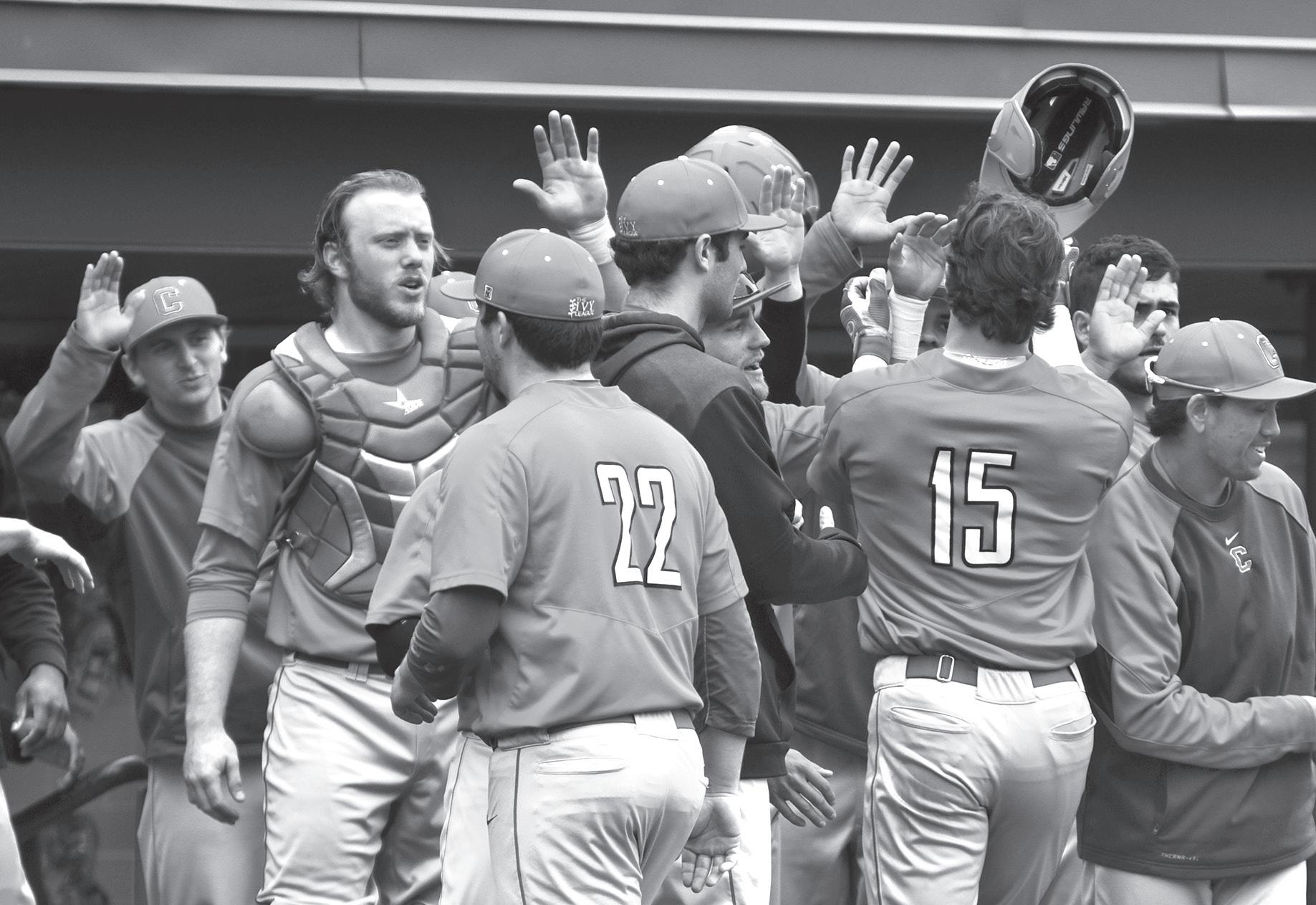
Cornell baseball and softball both won their respective games on Sunday thanks to walk-off three-run home runs. Senior Will Simoneit gave the Red an 8-7 series-clinching win over Penn and junior

By DYLAN McDEVITT
Sun Senior Writer
In case anyone at Schoellkopf Field had forgotten it was Senior Day for Cornell men’s lacrosse, senior attack Clarke Petterson surely reminded them when he scored the game-winning goal with four seconds remaining, pushing the Red to a 14-13 victory over Princeton on Saturday.
Petterson’s efforts ensured that this Senior Day would be a memorable one for him and his 11 classmates, who played what was likely their final game at Schoellkopf.
“It was my last chance to play on our home field,” Petterson said after the game. “I just wanted to make the most out of it, and I’m a big beneficiary for my teammates. … It was a really good game all around and happy to end Senior Day with a crazy win like that.”
The victory was meaningful for one other significant reason: It secured Cornell’s place in the Ivy League tournament next weekend in New York. The third-seeded Red (10-4, 4-2 Ivy League) will face off against the second seed, its rival No. 5 Yale (10-2, 5-1), in a rematch of last season’s conference championship. Penn and Brown will face off in the other semifinal.


“We want to win the tournament, so we’re just going in one game at a time,” said head coach Peter Milliman. “[Yale is] a good team, we know they’re going to be good, they pose a lot of challenges. But they’re going to bring out the best in us hopefully, and that’s what we’re looking for.”
Cornell got off to a good start on Saturday afternoon, jumping out to a 4-2 lead at the first break. But the Tigers settled in from there, outscoring the Red 9-5 in the middle two periods. Cornell’s five goals in the fourth quarter were all that was needed to pull out a victory, highlighted by Petterson’s game-winner in the game’s final moments.
“Coach [Connor Buczek ’15] drew up a play,” Petterson said. “We just wanted some off-ball action. We got a pick

from Jake McCulloch to his left hand, and then a pick for me on the back side where I normally hang out, and then a pick for Jeff [Teat] on ball. It worked out perfectly.”
Once the pick had been set on Teat, he worked his hands free and put the ball in a place where Petterson, moving off a screen towards the cage, grabbed it and quickly dumped it past Princeton goaltender Erik Peters.
“It worked out exactly like we drew it — which never
By GRACIE TODD Sun Staff Writer
Cornell women’s lacrosse lost to No. 10 Princeton, 18-15, on Saturday afternoon at Schoellkopf Field.
happens,” Milliman said. “Jeff just put it there and let Clarke go get it.”
Teat, a Tewaaraton award finalist, scored once and had two helpers including one on the game-winner. Teat’s lone goal was the 99th of his career, moving him closer into an elite group of Cornell players who have accomplished 100
senior handled herself through the best of times and the most challenging of times. They can always carry their heads high knowing that their investment in our team’s culture will be their lasting legacy.”
But the Red will get another chance against the Tigers next weekend in the Ivy League Tournament. No. 4 seed Cornell will face top-seeded Princeton next weekend in New York City, with at trip to the conference championship game on the line.
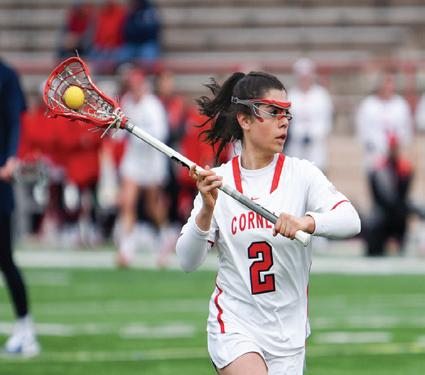
Saturday was Senior Day for the Red, which honored six veterans of the program: Hannah O’Reilly, Natalie Paletta, Samantha Nielsen, Shannon Bertscha, Tomasina Leska and captain Sarah Phillips.
“Our seniors have done an incredible job all year strengthening the foundation of our program,” said head coach Jenny Graap. “I couldn’t be prouder of how each and every
Despite the loss, there were some highlights for the senior class. Bertscha scored a career-high five goals, leading the Red in scoring against the Tigers, and Leska, with four goals and an assist, now has 100 career points — 79 goals and 21 assists.
In another individual highlight, junior captain Mary Kate Bonanni tied a career-high of her own with two caused turnovers.
Despite these efforts, the Red came up short, largely in part to a dominant first half for the Tigers.
Princeton scored twice before Cornell found the back of the net, with an unassisted
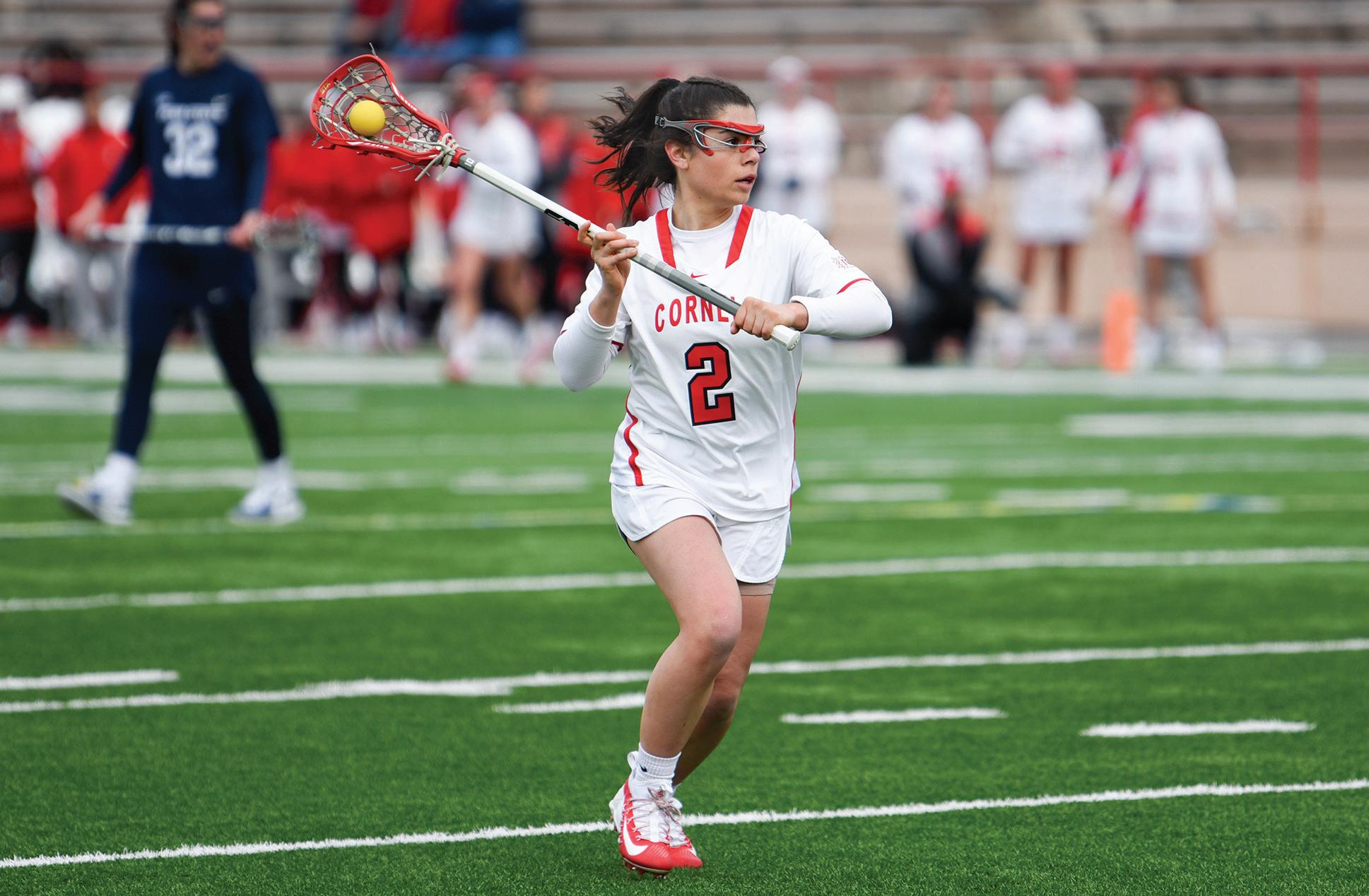
goal by Bertscha. But then Princeton took charge with a four-goal run. Cornell responded with two goals of its own: another unassisted goal by Bertscha, and a goal by sophomore Ellie Walsh with an assist from sophomore Grace Paletta.
The Tigers dominated the remainder of the half, racking up six more goals while the Red managed two — the first half ended with the Red trailing 12-5.
The second half was much better for Cornell, whose comeback fell short. Princeton
scored two-thirds of its 18 goals during the first half, while the Red scored two-thirds of its 15 during the second.
“[Our] draw control unit started to click in the second half,” Graap said. “Princeton is an athletic and skilled team so keeping the ball in our attacking end was a much better formula for [us].”
The Tigers opened the second half much as it did the first, with two quick goals. This