The Corne¬ Daily Sun


By MIHIKA BADJATE Sun Assistant News Editor
Walking out the doors of Bartels gym after receiving their first doses, some students danced with joy, others heaved sighs of relief and many simply continued on their way, treating it as just another stop on a busy day.
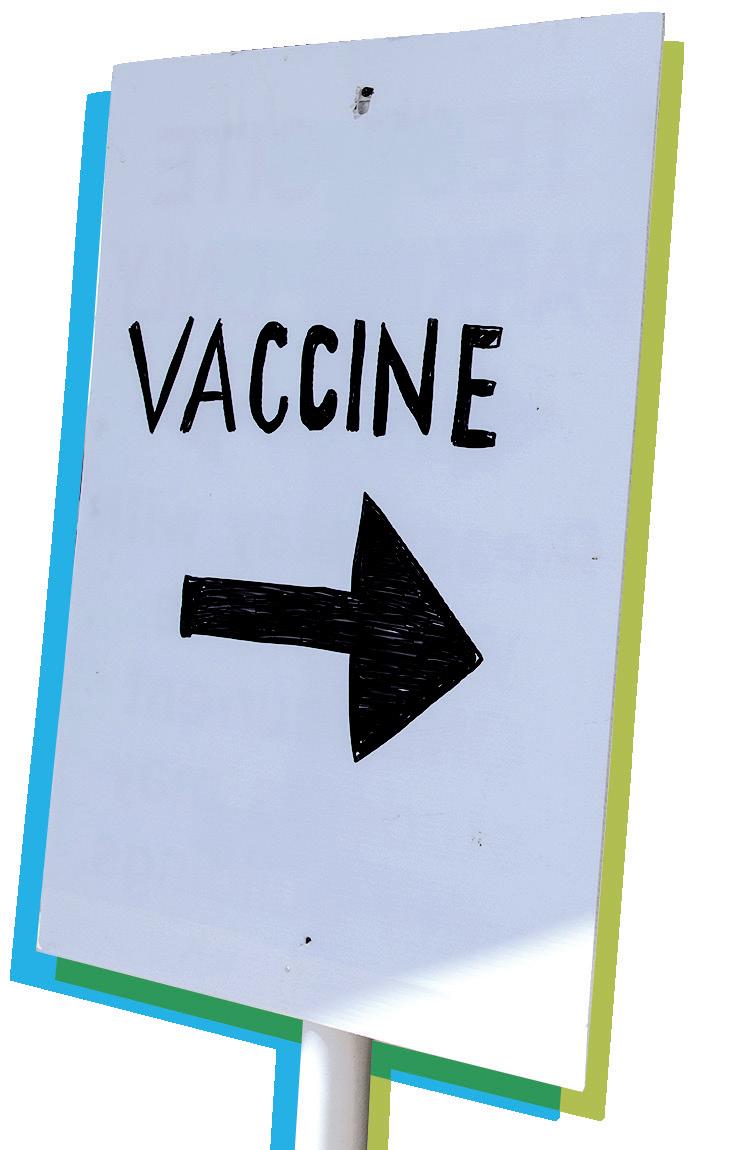
On April 23, the first day of the Wellness Weekend, the University administered the first dose of the Moderna COVID vaccine to nearly 700 students in Bartels Hall in partnership with Tompkins County Health Department and Cayuga Health.
Tammy Decker, a Cornell employee who works as a COVID-19 surveillance test administrator, was one of the people dancing. Decker was initially hesitant to get the vaccine due to her fear of needles, but was driven to get her shot after being away from her grandmother — who has end-stage dementia — for a year.
throughout the vaccination process and their efforts to address all of his concerns.
“The experience has been great — from the moment I came in here, I was greeted by the staff, everything went smoothly, the staff did it diligently, took time for me to go into all the questions, make sure everything was correct,” Trinh said. “I really commend the staff here for their overwhelming effort to help us with this program.”
Tammy Decker
“You’ve just got to set your fear aside if you want to be around your loved ones,” Decker said. “Do it — while you get a little achy, it’s better than getting COVID; it’s better than having the real thing. So I’ll take whatever comes with this, and I will just keep on pushing.”
Jack Trinh ’21 was grateful for the support of the medical staff
ANIL OZA
For the past school year, students, professors and faculty have been refreshing Cornell’s COVID dashboard, eager to know if cases are surging or sliding, if courses would remain in-person or return behind a screen.
But with nearly half of those on campus now vaccinated and weeks of low case counts, those days could soon be over.
After a month of climbing COVID cases that reached a record high number of new daily cases on campus since reopening, widespread vaccinations on campus and warmer weather that has allowed for socializing outdoors have coincided with dwindling case levels.
Throughout March, Cornell reported 314 cases — a case level that led the University to move to the yellow alert level and transition one Cornell academic program to virtual instruction.
From April 1 to April 27, the University reported 47 cases on its COVID-19 tracking dashboard, and nearly half of the campus community is vaccinated — a leap toward a fall semester once again filled with packed lecture halls with clanging keyboards.
Since the beginning of April, cases have also dropped in Tompkins County, which is more than 40 percent vaccinated according to the Tompkins County Health Department. Cases peaked
Many students found the convenience of the clinic being on campus during a day-off to be an incentive to get their shot. According to Anne Jones ’04, Cornell Health Director of Medical Services and COVID Public Health Officer, the clinic dates were carefully planned to avoid conflicting with exams and normal class schedules.
“I work in a campus lab and it’s hard for me to travel elsewhere during workdays or weekends,” said Amy Tsai, grad. “I have friends who drove to Syracuse and Binghamton to get the vaccine but I was, like, ‘I’d just rather wait.’ I was really happy that they decided to do a pop-up on campus.”
Jules Nshimiye ’22, who is required to get vaccinated for his summer internship, found the Wellness Days to be a convenient time to get it done. While he was initially worried that side effects from the vaccine

ANGELA BUNAY
Voting for Student Election Day began on Wednesday at 2 p.m. for Student-Elected Trustee, the 2021 Student Assembly and the Class Councils.
The opening of voting comes a full day after it was intended to, following technical difficulties with the voting website.
In the Student Assembly, there are 11 contested races and seven uncontested races. Six students are running for Student-Elected Trustee, the highest governing office. The student elected to this position will serve as a full-voting member of the Cornell University Board of Trustees for a two-year term, from July 1, 2021 to June 30, 2023.
Students can access their ballots by logging onto vote.assembly.cornell.edu. The personal statement
for each of the candidates is linked to their name on the ballot.
Uncontested races and those with only two candidates for one open position are unranked, meaning voters will select the candidate of their choice. Races with one open position and three or more candidates are ranked. Students will be asked to rank as many candidates as they like in order of preference on their ballots.
If a student only votes for a candidate who is eliminated because they received the least votes, the student’s vote will not count for that race. However, the rest of the ballot will be counted as normal.
Once a ballot is submitted, the voter will receive a confirmation notice on their screen and by email.
Voting closes on Friday, April 30 at 5 p.m.
Working on today’s sun ad layout Jenny Huang ’22
opinion desker Odeya Rosenband ’22 managing desker Anil Oza ’22 news deskers Jyothsna Bolleddula ’24 Kayla Riggs ’24
deskers Ben Mayer ’21 Mariana Meriles ’24 design deskers Niko Nguyen ’22
deskers Hannah Rosenberg ’23
desker Benjamin Velani ’22
desker Aaron Snyder ’23

INDEPENDENT SINCE 1880
’22
Business: For questions regarding advertising, classifeds, subscriptions or delivery problems, please call from 9 a.m. to 5 p.m., Monday-Friday. News: To report breaking news or story ideas, please call after 5 p.m., SundayTursday. SEND A FAX (607) 273-0746 THE SUN ONLINE www.cornellsun.com E-MAIL sunmailbox@cornellsun.com Business Manager Anushya Alandur ’23 139 W. State Street, Ithaca, N.Y. VISIT THE OFFICE
Postal Information: The Cornell Daily Sun (USPS 132680 ISSN 1095-8169) is published by THE CORNELL DAILY SUN, a New York corporation, 139 W. State St., Ithaca, N.Y. 14850. The Sun was published Monday, Tuesday and Thursday during the fall, is being published Tuesday and Thursday this spring, and every weekday online. Three special issues — one for seniors in May, one for alumni in June and one for incoming freshmen in July — make for 63 print issues per year. Subscriptions are: $70.00 for fall term and $52.00 for spring term if paid in advance. Standard postage paid at Ithaca, New York. Postmaster: Send address changes to Te Cornell Daily Sun, 139 W. State St., Ithaca, N.Y. 14850.
COVID
Continued from page 1
in January, after many residents traveled and gathered indoors for holiday celebrations. As cases among local residents decreased, students drove up cases at the end of January and again in March.
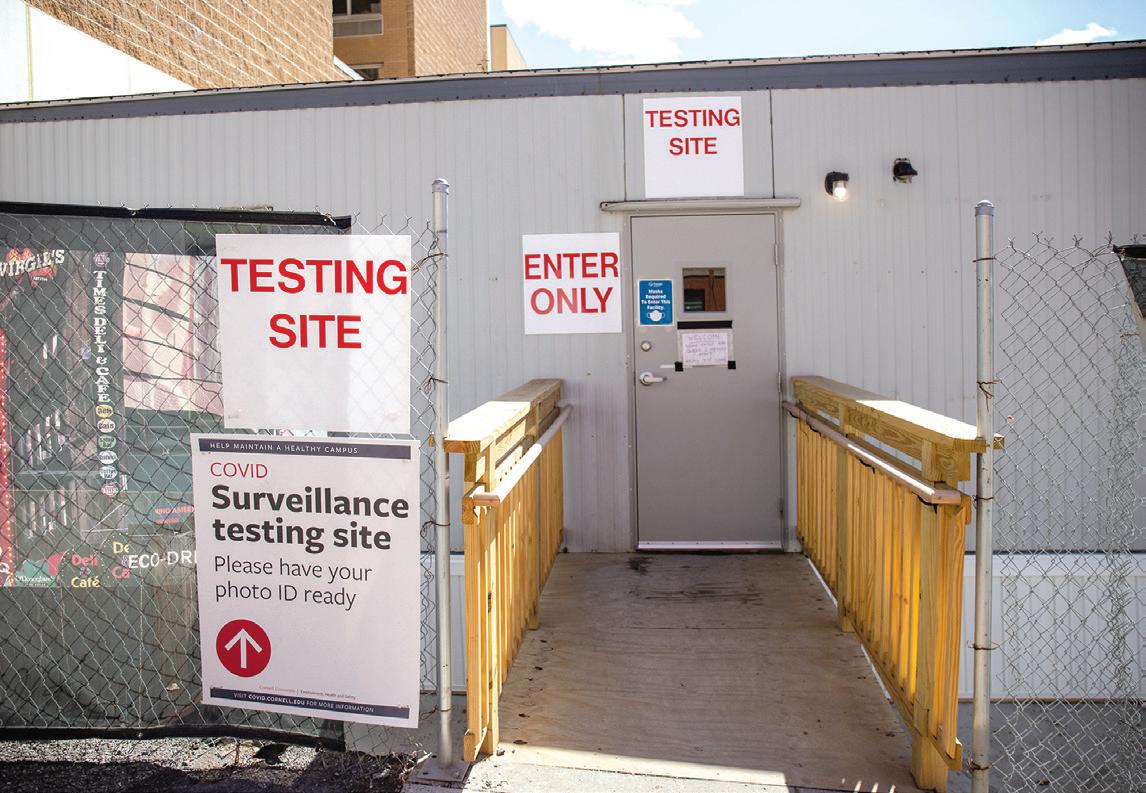
As of April 26, 5,850 students are vaccinated, receiving both doses of the Pfizer or Moderna vaccine or a single dose of the Johnson & Johnson vaccine, according to the Cornell COVID-19 tracking dashboard. A similar number of faculty and staff –– 5,142 —have also been vaccinated.
The number of students who have been vaccinated will likely
increase in the coming week, as students who became eligible for the vaccine after April 6 — when everyone over the age of 16 in New York State could sign up for their shot — receive their second doses.
With more than 17,000 students studying on campus, about a third are vaccinated. This fraction of students approaches the University’s threshold for herd immunity, which is 50 percent of students, faculty and staff — a metric that will shape the blueprint of the fall semester.
Jyothsna Bolleddula ’24 contributed reporting.
Anil Oza can be reached at aoza@cornellsun.com.
CLINIC
Continued from page 1
might affect his schoolwork, the Wellness Days provided a buffer period to recover and rest.
Nshimiye wanted to get vaccinated not just for his own health, but also to show those around him that the vaccine is safe.
“I have friends who are very skeptical. And so, if I didn’t take the vaccine, it would sort of reinforce that skepticism, ” said Nshimiye.
While the clinic only offered a first dose of the two-dose Moderna vaccine, vaccinated students were automatically scheduled for a second dose in the same clinic on May 25. Students unable to receive their second dose on that date can reschedule, according to the University statement announcing the event.
With vaccinations on the rise, students may be able to return to lecture halls and their favorite campus hubs in the fall. According to a University statement, the fall 2021 semester will continue with in-person instruction and normal capacity
if enough of the Cornell community is vaccinated.
“We’re in this gray zone right now where we have some really good statistics that are very promising,” Jones said. “I think the high 30s, just under 40 percent — given where we are around vaccine supply which has been such a challenge — is actually a very promising figure.”inated to achieve herd immunity.
As of April 28, 45 percent of the current on-campus population has been fully vaccinated, according to Cornell’s COVID19 Tracking Dashboard.
“Thank you to Cornell students for going through yet another semester of what has been a very difficult year. And difficult in so many ways, not just with COVID, but COVID revealing many inequities in our culture, and in our society and in our population,” said Jones.
“I’m so grateful for the energy that the students have brought, and I hope that we can continue to deliver a program that helps support them.”
Mihika Badjate can be reached at mbadjate@cornellsun.com.

By ROMAN LAHAYE Sun Staff Writer
In a typical year, thousands of seniors would crowd into Schoellkopf Field to celebrate their graduation as loved ones snapped photos from the stands. This year however, graduating seniors will receive their diplomas without their families or many of their peers.
Many graduating Cornell students were pleasantly surprised by President Pollack’s April 6 announcement that commencement will be reduced and in-person, but lamented that their families couldn’t take part.
The modified event is set to take place during the weekend of May 29 at Schoellkopf Field, in three smaller, socially-distanced ceremonies separated by college, instead of the usual, university-wide event. Attendance is open to students from the graduating classes of May 2021, August 2020 and December 2020.
Unlike previous commencements, guests are not allowed into Schoellkopf Field and discouraged from traveling to Ithaca.
The change has prompted a range of reactions from graduating seniors, many of whom did not expect to have an in-person commencement at all, especially considering the cancellation of other annual University events like class reunions.
Stephanie Wong ’21 was studying abroad in Australia when Cornell closed campus last
spring. Upon hearing that commencement will be held in-person this May, Wong was pleasantly surprised.
“When I got that email, there was a lot of excitement, because for so long, basically, since I had come home from Australiaback in March, it was just kind of assumed that it wouldn’t be in person,” Wong said. “Those hopes died with everything that kept happening last year.”
Aside from graduating seniors, the commencement ceremony has particular importance to their families, who may have few other experiences on the campus.
Asma Khan ’21 distinctly remembers her sister’s graduation from Cornell in 2019, during which she showed her grandparents, who had traveled from Pakistan to attend the ceremony, around campus. She recalls looking through past yearbooks with her family in Willard Straight Hall and spotting her uncle, who also attended Cornell.
“Having it being their granddaughter’s graduation, and then them finding their own son in the yearbook, I think it was like a very proud moment for all of them.”
Khan’s family had gotten their vaccine this year in hopes that they would be able to attend her own graduation but because they would not be permitted to attend the commencement ceremony they cancelled their travel plans.
Shivank Nayak ’21 said he’s disheartened by the ceremo -
ny’s restricted guest attendance, reflecting that the event is perhaps more important to his relatives and loved ones than it is to himself.
Anishka Singh ’21, also felt the sadness of not having her family at the ceremony.
“I feel like my parents helped me get through a lot in the past four years. Whenever I would need something or if I had a bad exam I’d always turn to them,” Singh said. “And my sister’s a freshman now. So I feel like it would have been really rewarding to have them see me walk across or do the graduation in person.”
Despite some disappointment with a limited ceremony, many students are still grateful for the opportunity to attend an in-person event in any form.
“I think it’s not necessarily bad to have a smaller ceremony, because we are a class of thousands of students and there is something to be said for a closer setting, but it’s definitely not what I visualized,” Nayak said.
Emily Hollis ’21 plans on celebrating with her own family in Ithaca after the ceremony, fully agreeing with the University’s decision to disallow guests from attending.
“They did the best they could do,” Hollis said. “It makes complete sense. It’s not what I wanted out of my senior year, but it’s the best outcome from the circumstances.”
Roman LaHaye can be reached at rlahaye@cornellsun.com.
By SURITA BASU Sun Assistant News Editor
In the wake of Derek Chauvin’s conviction on April 20, President Martha Pollack announced a faculty roundtable to explore what the verdict means for racial justice and national policy changes moving forward.
The discussion took place virtually on Tuesday afternoon with a panel discussion including five Cornell faculty members and was moderated by Jamie Joshua, Director of Diversity and Inclusion for the Johnson School.
Joshua kicked off the discussion by asking the panelists about their initial reactions to the trial.
Prof. Jamein Cunningham, economics and policy analysis and management, said he was apprehensive about the verdict before it was reached, given that a conviction was not guaranteed despite the evidence and momentum from last year’s movement surrounding racial justice.
“There was still this angst that, you know, he will still be acquitted,”
Cunningham said. “And that’s not necessarily a good feeling to have when you’re thinking about social justice”
Prof. Joe Margulies, law and government, echoed Cunningham’s concern before a verdict was reached, noting that the system still has a long way to go.
“Anybody who thinks that this is evidence that that reform is afoot, or that reform will work is kidding themselves.” Margulies said.
As faculty began debating what real reform should look like, several noted a divide that exists between police and civilians under the current system, particularly as so many police are armed even when responding to non-violent calls.
Prof. Sherry Colb, law, pointed out that police departments across the country are beginning to respond to calls for change and that recent policing reforms, like those in Ithaca, have begun to address this issue. Colb said that replacing an armed police officer with an unarmed community solution worker could remove the feeling of
dominance that often causes minor incidents to escalate into violence.
Prof. Aziz Rana, law, argued that reform should focus on addressing social welfare problems, rather than policing methods like training and body cameras because most incidents where police officers end up being the first response usually do not require police intervention.
“What that’ll likely do is just increased budgets for police departments, when really what we should probably be in the business of is fairly systematically dismantling how policing functions in the US,” Rana said.
Margulies described these reforms as “reducing the blue footprint.” However, he is skeptical that large scale reforms, like those in Ithaca, will happen on a national scale.
“The solution here is social movement mobilization and action rather than expecting corporate elites to be the vanguard of racial justice initiatives,” he said. The discussion was followed by a question & answer session from the audience. The last question posed to the panel was whether the Chauvin verdict was an example of justice or accountability.
“I think it is justice,” said Colb. “It’s not the entirety of what needs to happen but it’s really important.”
The discussion also touched on calls for racial equity that were happening outside of police reform. Prof. Ravi Kanbur, economics, noted how corporations have thrown support behind the Black Lives Matter movement in the past year. Kanbur noted that while corporations saw short-term stock market rewards after committing to support social justice issues, they are less willing to accept costs in the long term. Rana expressed skepticism at corporate action on social issues, noting that corporations are unwilling to cease donating to politicians who oppose social issues but support profit motives.
Surita Basu can be reached at sbasu@cornellsun.com.

By
It’s difficult to find the time and effort to cook real food in college. Energy has to go into finding recipes, grocery shopping and executing the dish.
The chaotic trip to Wegman’s alone is enough to deter many from cooking. Instant mac and
cheese or ramen are too often the default. This past semester, I tried to spice things up in the kitchen and venture out of my food comfort zone. I decided no more Annie’s mac and cheese or Progresso soup; I wanted meals with fresh and interesting ingredients.
Advertisements for meal delivery services caught my eye. No

grocery shopping is required, and the meals are delivered right to your door. While it can be more expensive than shopping on your own, most meal kit services offer a discount for a trial period. So, I played the promo-hopping game; start with one service and when the promo runs out, cancel and move on to the next.
Blue Apron was the start of my journey. I downloaded the app and selected which recipes I wanted for the week. I opted for the classic plan of three meals per week, with two servings per meal. This way I could cook just three days for six dinners. I picked the most interesting dishes I saw: Crispy Skin Salmon, Tofu Katsu, Shakshuka, Poblano Tortas, Shawarma Grain Bowls, Fish and Chips and the list goes on.
I acquired countless cooking skills from Blue Apron; pickled radishes became a favorite topping, I learned how to cook pan-fried fish in a healthy lowoil way, and I was adding more color to my plate than ever before. All my dishes were pescatarian, and I became comfortable exploring new ways to cook seafood. Blue Apron’s fresh and high-quality seafood is hard to beat. As a former fishmonger, I am very passionate about the freshness and quality of the seafood I eat. Knowing exactly where my fish comes from is important to me. Blue Apron packages all their seafood with a label saying precisely where the fish is sourced, giving me
confidence in the quality of the brand.
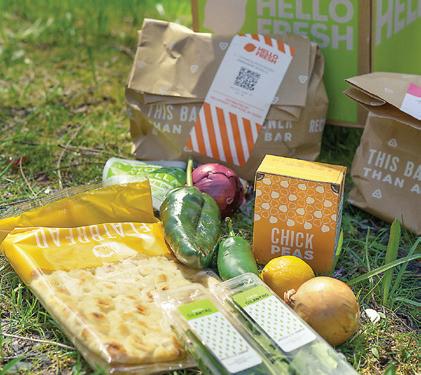
When the food arrives at your doorstep, it comes in an insulated cardboard box with all the necessary ingredients. The only items you need in the cabinet are olive oil, salt and pepper. Spices come in mini pouches, and liquids in tiny bottles. One-page recipe cards outline the culinary process and can be saved for the
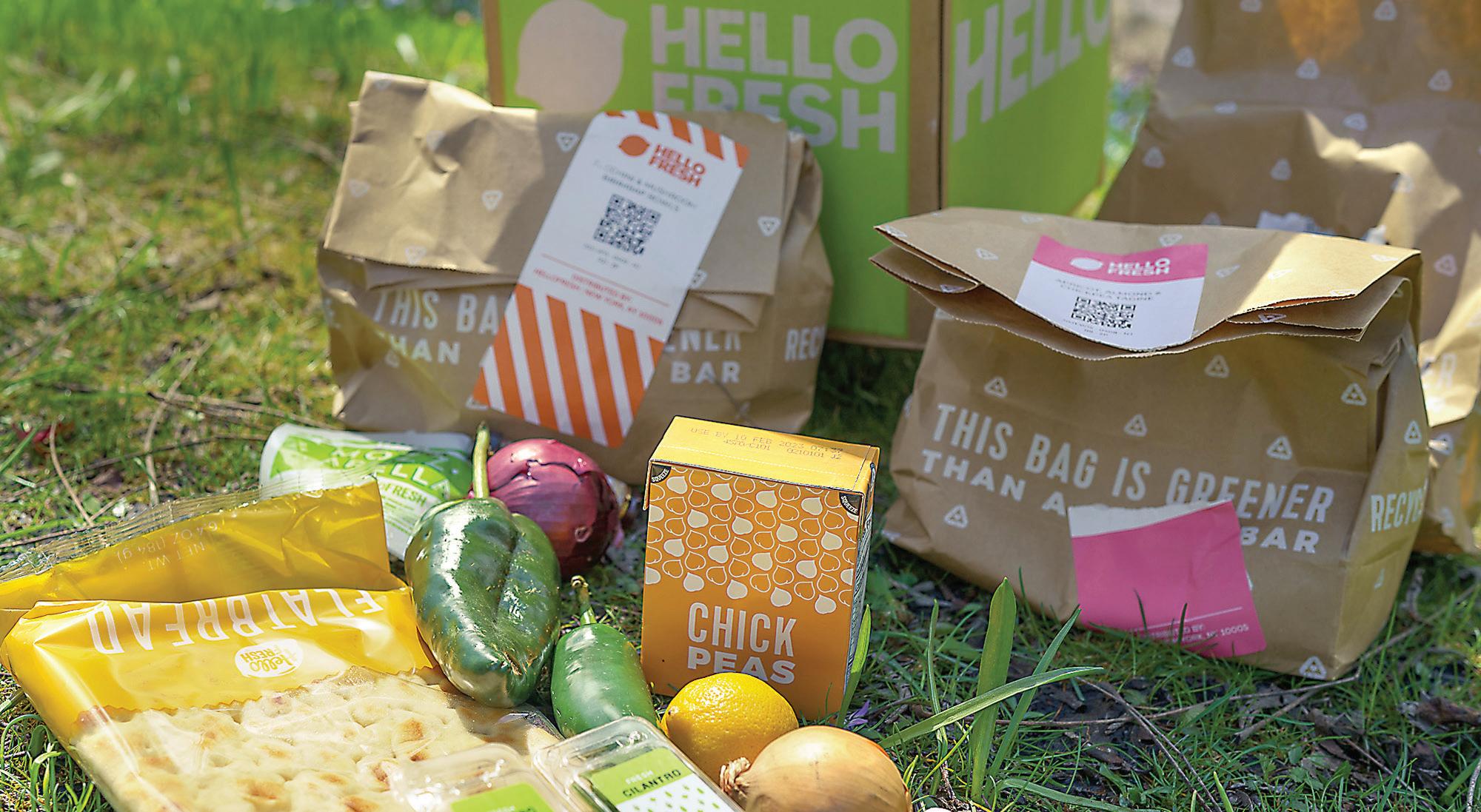
paper bag, and less plastic was used to wrap the vegetables. The HelloFresh website advertises a 25 percent lower carbon footprint than grocery shopping. On the downside, the ingredients were not as high-quality or adventurous as Blue Apron. HelloFresh recipes are slightly simpler, and use less spices, sauces and marinades. All the recipes can be made in around 30 minutes. If you’re a new cook looking for simple recipes, HelloFresh might be the best place to start.
future. Best of all, Blue Apron prides themselves on their sustainably sourced ingredients.
My next meal delivery service stop was HelloFresh. I was just as adventurous in choosing my recipes. I made Bibimbap, Tagine and Flatbreads. The biggest difference between the two services was the packaging. Hello Fresh meals each had their own
Of the two meal delivery services, my personal preference was for Blue Apron. The unique flavor combinations, adventurous spices and the superior quality of the seafood is unmatched. While Blue Apron is slightly more time and labor intensive, all recipes can be made in under an hour. Regardless of my opinion, one of my favorite aspects of both meal delivery services is the lack of food waste. With all recipes perfectly portioned, I cook just the right amount. I have not thrown away food since I started this journey in February. Cooking has also done wonders for my mental health. My time in the kitchen makes me forget about the countless prelims and global pandemic. I have become a more adventurous cook and was even inspired to join The Sun dining squad this past semester.

Aminah Taariq-Sidibe is a senior in the College of Agriculture and Life Sciences. She can be reached at ataariq@cornellsun.com. I Spy runs every other Tuesday this semester.
As a graduating senior actively on the job search, what the future conditions of my career will be have been at the forefront of my mind.
Besides the overachieving amount of academic and extracurricular work I have engaged in throughout high school and college, I have also worked paying jobs since I was 15. Tis has included positions in restaurants, retail stores, events, administrative ofces, computer databases and NGO’s.
I worked not only as a means of professional and skill development, but also for my livelihood. Being fnancially independent means that the only way to receive the things I need is to work for it. I worked because in America, I didn’t have a choice not to.
We cannot ignore the ways in which the COVID-19 pandemic has and will drastically change the workforce, too. Jobs that require close physical proximity (i.e., medical care, personal care, travel and education) have been most disrupted. Remote work and virtual meetings will become part of the new normal. E-commerce has grown two to fve times faster than before the pandemic. And, more businesses are adopting automation and artifcial intelligence.
COVID-19 has also led to negative impacts on workers’ mental health. Report shows that 51 percent of people experienced worse mental health at work
since the beginning of the pandemic. Black and Latino people who disproportionately work essential jobs also report an increase in mental or behavioral symptoms. Additionally, 30 percent of employees fear disclosing mental health issues can lead to being furloughed or fred. Increased mental health risks have also been related to expanded workload, risk of job loss, lack of resources, isolation and social distancing, childcare and fear of illness.
With this massive shift in the workforce, it feels like I cannot begin to imagine what the future of my job will be. However, I am beginning to consider this change and ambiguity as a privilege. I constantly struggle with the ways in which my Cornell education teaches me about the injustices within capitalism, whilst simultaneously priming me to uphold this structure in the workforce. It reminds me that although I have the skills to be an unconventional worker, I do not have the fnancial security to do so.
During existential bouts I ask myself, “Is the rest of my life going to be school and work until I retire?”, “Is following this path the only way to achieve success and financial mobility?” and “Will I ever be able to satisfy my dreams of adventure?” But it is in the uncertainty that I find solace in imagining the things I do want, instead of fear. I realize not only is it more
I find solace in imagining the things I do want, instead of fear. I realize not only is it more productive to dwell on the positive, but that I am in full control of the decisions I make regardless of the outcomes.
productive to dwell on the positive, but that I am in full control of the decisions I make regardless of the outcomes.
Tere is no need to follow a certain path or be on the
When We’re Sixty Four
Andrew Lorenzen is a junior in the College of Arts and Sciences. He can be reached at alorenzen@cornellsun. com. When We’re Sixty Four runs every other Tuesday this semester.
You’ve got three assignments due tomorrow, a full slate of Zoom meetings for the rest of the day, half a dozen internship applications still yet to be sent into the career portal void, a small mountain of laundry assembling around the foot of your bed and social plans tonight which you don’t really have time for—it’s that point of the semester. Luckily, you’ve had your two meager wellness days which have certainly recharged your batteries in much the same way that scooping a cup of water out of the ocean will stop rising
same timing as everyone else. If there is one thing that Cornell has taught me it is that persistence matters. Te workforce can and should be changed. With an increase in remote work, free-agent entrepreneurship and an
There is no need to follow a certain path or be on the same timing as everyone else. If there is one thing that Cornell has taught me it is that persistence matters. The workforce can and should be changed.
exodus out of major cities, there’s an opportunity for people to change the nature of the workforce. Workers are already beginning to demand more benefts, diversity inclusion, stimulating work environments and corporate social responsibility from jobs.
It is hard for me to believe that my ancestors and those who fought for my rights did so in order for me to continue to be a slave to another system. I don’t think spending decades working my way up the corporate ladder were their wildest dreams and I don’t want to do a disservice to those dreams. Tose who struggled before me were able to imagine a world that did not yet exist and the same can be done by us.
Don’t get me wrong, I am not against working conventional corporate jobs. My biggest fear lies in having the time and the means to live my life and do the things I enjoy, and for others to have that same opportunity. It is a privilege that I can dream beyond my reality. What I seek requires immense structural change or upheaval beyond just the workforce. It requires an equitable, holistic and intersectional approach to labor.
Until that reality exists, I am speaking into existence a job that both brings me joy and stability. I am also thinking of ways I can help influence the workforce. To my fellow seniors, I hope you are dreaming big, too.
sea levels. Buckle up, it’s the last month of the semester.
As we enter these next few chaotic weeks, it’s important to pause and take a step back before diving into the academic fray. Beyond taking the time for the usual self-care of buying a new succulent and an embarrassing amount of frozen food at Trader Joe’s, we need to take a moment to recognize the mental consequences of the stress to come.
At a time of the semester which demands an inordinate focus on the future — studying for upcoming exams, writing papers, applying to summer opportunities and game planning for pre-enroll — it’s easy to lose sight of the present. A famous Harvard study once found that humans “spend 46.9 percent of their waking hours thinking about something other than what they’re doing, and this mind wandering typically makes them unhappy.” At this time of year, that percentage feels low.
As we’re drawn to fxate on impending deadlines, it draws us into a state of perpetual anxiety and discontent. We withdraw into ourselves, focus on the to-do list on our computer screens and the cacophony of events crammed into our Google Calendars. We ignore the little things which make Cornell so valuable — spontaneous, silly outings with friends, forays into areas of Ithaca you never knew existed, the dozens upon dozens of fascinating lectures by
visiting thinkers. We don’t notice when winter turns to spring. And before you know it, the semester is over. Te entire school year is over. You’ve fnished every exam, every
Enjoy the fact that you have one month left ... One month left to live in the moment because each of these moments ... is yours and yours alone.
paper, every internship application. You’ve crossed every “t” and dotted every “i.” You really did it! And what are you left with? Exhaustion. And the realization that you’re going to miss all those wonderful little things you ignored this past month until the fall. Or if you’re a senior, you come to the
dismaying realization that you’re never going to have them again.
This perpetual looking forward is terrible for us. I’m not here to dole out some pollyanna message that you should slow down and smell the roses. It’s a stressful time in a supercharged, stressful semester. It’s a time which incentives us to look towards the future even more than usual as we all hope for a return to semi-normalcy with more and more Americans getting vaccinated. But amidst this drawing of our eyes to the horizon, make sure to look down at where you’re walking. Don’t spend almost 50 percent of your life thinking about exams, papers and applications which you’re not going to remember, let alone care about, a year from now.
Enjoy the fact that you have one month left. One month left at one of the greatest universities in the world. One month left with your motley crew of beloved friends. One month left to spend on the slope without having to wear a coat anymore. One month left to live in the moment because each of these moments, for all their stresses, all their imperfections, all their uncertainties and insecurities, is yours and yours alone.
Or to put it another way: “Life moves pretty fast. You don’t stop and look around once in a while — you could miss it.”

Fill in the empty cells, one number in each, so that each column, row, and region contains the numbers 1-9 exactly once. Each number in the solution therefore occurs only once in each of the three “directions,” hence the “single numbers” implied by the puzzle’s name. (Rules from wikipedia.org/wiki/ Sudoku)





‘AMPED’ created to share stories of athletes of color and women athletes
By WILL BODENMAN
In the past semester, two Cornell students have traded in their hockey sticks for microphones and tennis rackets for headphones as they try to amplify the stories of athletes of color and women athletes.
‘AMPED’ is hosted by Cornell Women’s Ice Hockey forward and Cornell Women’s Lacrosse Attackman Finley Frechette ’21 and Cornell Women’s Tennis’ Khary Pryce ’22. Big Red Sports Network created the podcast with a mission to amplify the voices of women, people of color and other underrepresented groups in athletics.
“We think that these stories are really necessary to be told, especially in today’s time,” said Frechette.
Frechette built off of her previous experience as a host on a 24-episode hockey podcast called ‘Over the Goal Line’, which has made the process of starting the podcast easier for Pryce — who has never worked with podcasts or radio.
“I sort of already had my podcast style and how to interview people, but I was ready to take my expertise and channel it to something a little bit bigger than just the hockey community,” Frechette said .
While the pandemic has posed challenges to organizing and facilitating interviews, Pryce and Frechette have found ways to adapt. Despite its drawbacks conducting all of their interviews virtually has enabled the duo to interview people as far away as France and Russia.
“The chemistry and the comradery that you miss when you’re not sitting next to somebody certainly has to be a barrier to overcome,” Pryce said.
Even amid the challenges Frechette have received positive feedback from the pod cast’s audience so far.
“I think overall it’s a positive reception because these stories don’t get told so much,” said Frechette. “What I’m excited for and
that I’ve heard people say is how relatable the stories are that I’m telling.”
Frechette, who hosts the upcoming second season, has yet to release any of the episodes she recorded. But she is excited about an episode featuring Kim Wyatt, the head coach of men’s soccer at New York University and the only female head coach of a men’s soccer team in the NCAA.
“I discuss what her life has been like in challenges that she’s faced being the head coach of a men’s soccer team,” said Frechette. “Her stories were very relatable to me because I grew up playing hockey with the boys through sophomore

On the other hand, Pryce has released five episodes. She is specifically proud of her episode featuring Alafia Ayeni ’21 of the men’s tennis team and Jada Davis ’20 of the women’s equestrian team, two students of color, and their involvement in predomi-
Pryce and Frechette will join forces for an upcoming third season of the podcast, which does not have a set release date. The new season will feature interviews with student athletes, alumni and national figures from a larger range of identity groups in athletics and will discuss pervasive issues related to the intersectionality of race and society, especially regarding social justice. Pryce and Frechette aim to capture a larger audience through continued outreach and a focus on their empowerment message, and they emphasized that the podcast isn’t intended to be just for student
“Being that the ‘only’ in any room is universal, whether you’re the only person of color or the only woman in a room and that’s not kept to being a student athlete,” Pryce said