The Corne¬ Daily Sun
WEDSESDAY, APRIL 29,
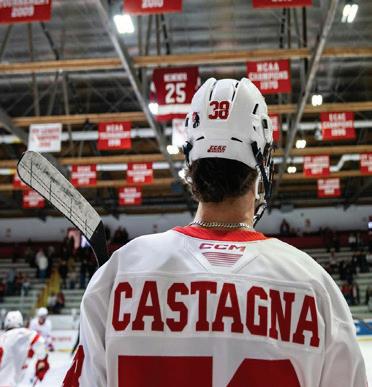
Castagna Castagna is the NHL’s “newest diamond in the rough,” writes Hockey Editor Jane McNally in her final piece. | Page 12
WEDSESDAY, APRIL 29,
Castagna Castagna is the NHL’s “newest diamond in the rough,” writes Hockey Editor Jane McNally in her final piece. | Page 12
By GISELLE REDMOND
Assistant News Editor
Former prime minister of the United Kingdom Boris Johnson spoke to a sold-out crowd in Call Auditorium about Iran, democracy and sovereignty during an event hosted by Cornell Republicans on Monday.
The event, named “The West is Worth Saving,” was sponsored by Young America’s Foundation, a non-profit that works to promote conservative ideas on college campuses.
Johnson, a member of the U.K.’s conservative party, served as prime minister from July 2019 to September 2022, when he resigned amid a revolt from his ministers and a series of scandals. This included ‘Partygate,’ a series of parties hosted by Johnson that violated COVID-19 lockdown protocols, the details of which Johnson was found to have repeatedly lied about.
Notably, Johnson spearheaded Britain’s exit from the European Union in 2020, informally known as ‘Brexit.’
The Associate Dean of Students Christine Nye, Provost Kavita Bala and Cornell Republicans President Max Whalen ’26 took the stage to introduce the former prime minister and emphasize the necessity of protecting free speech on Cornell’s campus.
Nye gave the disclaimer that “audience members who disagree with the speaker may make their views known, so long as they do not interfere with the speaker’s ability to be heard or the right of others to listen and see the member.” Any violators could be referred to the Office of Student Conduct and Community Standards, she warned.
Johnson stepped up to the podium to speak for about 30 minutes before the event transitioned to a Q&A, moderated by Whalen.
Johnson began by expressing his sadness regarding the recent “crazy attack” on President Donald Trump, referring to an assasination attempt at a White House Correspondent’s dinner on Saturday.
Johnson noted his own connection to Cornell, sharing that his great grandfather graduated from the University in 1902 and praising the University’s rejection of “proprietary, ideological or religious dogma.”
The foundation of Johnson’s speech focused on the reasons why western democracies, such as the U.S. and the U.K., must fight against countries Johnson described as autocracies, and the methods they should take to do so.
By VARSHA BHARGAVA Sun Managing Editor
April 27 — Five-time Emmy winner and Golden Globe awardee Jane Lynch MFA ’84 will take the stage at this year’s Senior Convocation Ceremony to deliver the keynote address, the Senior Convocation Committee announced at Ho Plaza on Monday.
The Senior Convocation Ceremony is an annual celebra tion led by the student-run Senior Convocation Committee that hon ors Cornell’s graduating class with
Repeatedly, Johnson mentioned the current conflicts in the Middle East.
Johnson described a 2010 attack on a water park in Gaza, called Crazy Water Park, that occurred two weeks after Hamas had shut the park down.
He described that women would visit in their “undraped form” and that the park was widely successful. “It was such a success that Hamas couldn’t stand it,” Johnson said.
Johnson asked the audience: “Whose side are you on? Are you on the side of Hamas? Or are you on the side of Crazy Water Park?” and was met with a ripple of laughter from the audience, followed by applause. He also praised the U.S.’s recent attacks on Iran, calling President Trump’s objectives “sensible.
Johnson described Iranians as “absolutely ruthless brutal liars,” and referenced incidents where the Iranian government has exerted violence against women and protestors.
“Iran is the black widow spider at the center of a web of terror,” Johnson said.
He condemned the nation launching drone attacks on “blameless” allies of the U.K.
Johnson argued that “it is frankly in the interest of every country in the world, including Iran, that we should have a peaceful and non-nuclear Iran.” He believes that at the end of the war, Iran’s military will be diminished and western democracies will benefit.
Iran was also mentioned among a “mutually reinforcing coalition of autocracies” who are against western democracy — including Russia, China and North Korea.
Because these nations benefit one another, Johnson emphasized the importance of a Ukrainian victory, as it would not only mean defeat for Russia, but also for the other nations in the group he described. He said that he “[doesn’t] like to see America isolated,” and expressed his desire for the rest of Europe to aid in the U.S.’s efforts to end the Russia-Ukraine war.
Johnson also argued against the drawing of “false moral equivalencies” between the nations he named as autocracies and democracies.
Throughout his lecture, Johnson praised the U.S.’s global interventions and technological innovations. Specifically, he praised the U.S. for the invention of rock music, sang his praises for Elvis Presley, and then sang a rendition of “Can’t Help Falling in Love” in French, referencing the original arrangement by JeanPaul-Égide Martini.
student performances and speeches from a well-known keynote speaker, University leadership and a Cornell student. This year’s ceremony will take

By JAMES COVIT Sun Staff Writer
April 23 Nicolas Jaimes ’27 began his spring semester in Amman, Jordan as part of an Arabic-immersion program called CET Jordan. But after nearby military strikes raised safety concerns, Jaimes was forced to return to the U.S. on March 5.
Jaimes’ first six weeks abroad included spending three to four hours per day studying Arabic, and one to two hours per day studying regional political issues, such as Jordan’s refugee crisis. When he was not in the classroom, Jaimes said he
By LILA DAVIS and ATTICUS JOHNSON Sun Contributor and Sun News Editor
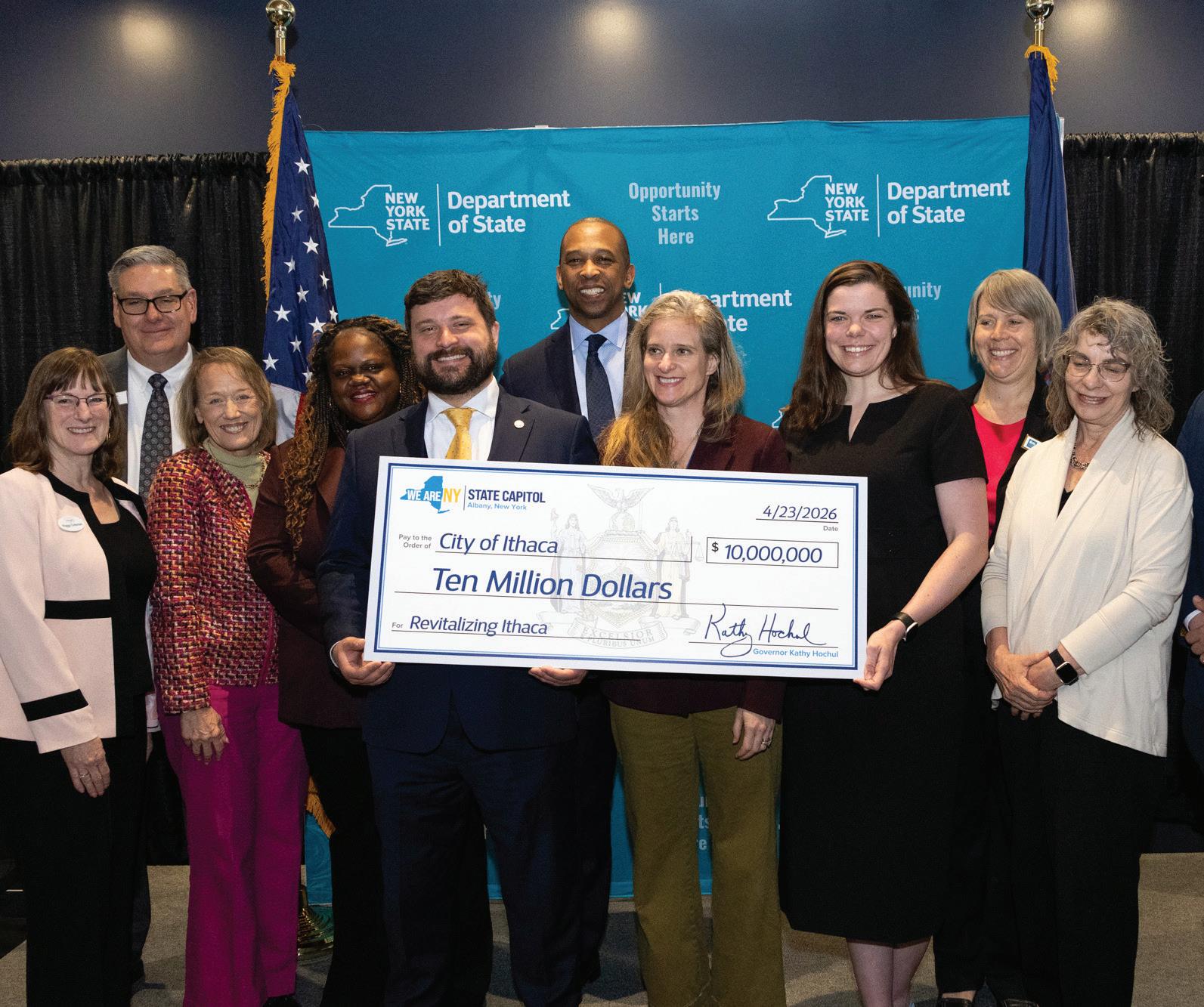
Ithaca won $10 million in state funding for downtown developments, Walter Mosley, the New York Secretary of State, announced at the Ithaca Downtown Convention Center on Thursday afternoon.
The funding was disseminated by Mosley as part of the New York State’s Downtown Revitalization and New York Forward initiatives created by Gov. Kathy Hochul (D). The villages of Margaretville and Stamford also won $4.5 million each in state funding.
“You’re here today to watch the beginning of Ithaca’s downtown renaissance,” Ithaca Mayor Robert Cantelmo M.A. ’20 told the crowd of local elected officials. “This money is going to have a transformational impact on our city.” Ithaca’s planned developments include hundreds of new housing units along West Martin Luther King Jr. Drive, which runs from the Ithaca Commons to NY Route 13, supplementing separate state investments in the SouthWorks facility, Mosley announced at the event.
This is a force multiplier type of initiative,” Mosley told The Sun. “We get this public-private partnership that we believe will pay immediate dividends.” While early construction will begin in “late 2027,” Judy McKinney Cherry, regional co-chair of the Southern Tier Regional Economic Development Council, said that people will not notice changes for 18 to 24 months.
Ithaca has applied for this grant for the last 10 years and though they have never received it, the city has taken feedback to improve their application each time, according to State Assemblymember Anna Kelles (D-125th District), who represents Tompkins County.
spent time strolling through Amman’s downtown ‘Souk,’ Arabic for market, and eating lots of “tasty” koshari — a popular Egyptian dish filled with rice, macaroni, lentils and spicy tomato sauce.
On Feb. 28, however, his semester took an unexpected turn.
That morning, as part of the U.S.’ Operation Epic Fury and Israel’s Operation Roaring Lion, the nations launched joint military strikes against targets across Iran.
At first, Jaimes and his peers did not know how their semester would be affected, as Jordan was not directly involved in the
attacks. Then, on March 2, as tensions in the region escalated, the U.S. Department of State encouraged all Americans to leave the country immediately.
“There has been an ongoing threat of drone and missile attacks from Iran and significant disruptions to commercial flights,” the Department of State wrote in a travel advisory released on March 2.
Following the Department of State statement, CET Jordan told all students in the program that they had to return home, while the program would continue virtually, according to Jaimes.
By SUN PHOTOGRAPHY DEPARTMENT
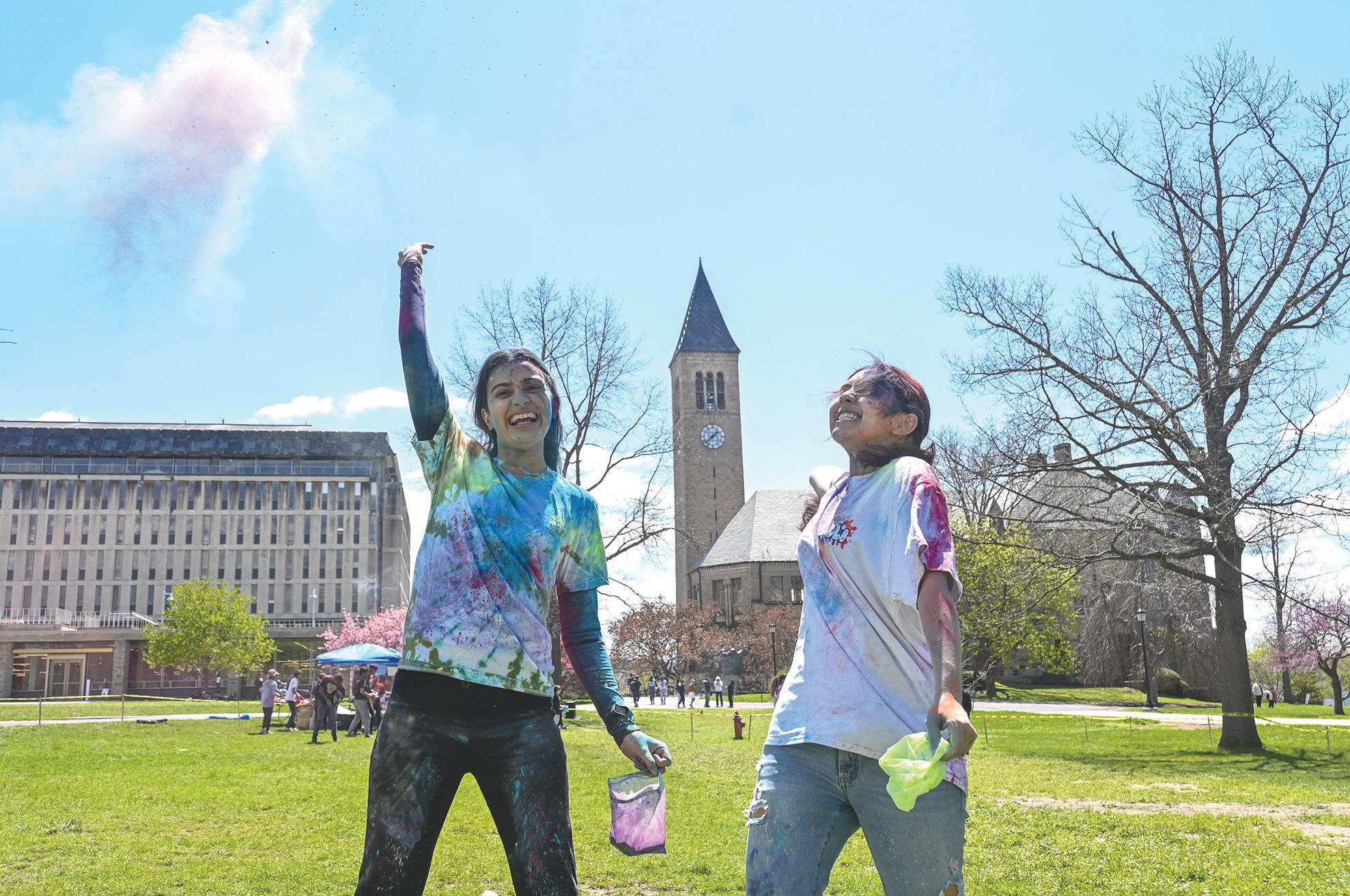
As the semester draws to a close, Ithaca thaws, trees bloom and students soak in the sun.






By CHRISTINE SAVINO Sun Senior Writer
April 27 Cornell Law School posted the highest legal employment rate among U.S. law schools for its 2025 graduating class, according to new data published by the American Bar Association on April 22.
Of Cornell Law’s 197 juris doctor graduates in 2025, all
dents and Cornell Law School’s deep commitment to preparing graduates for long-term professional achievement,” said Aka Akyea, associate dean for career development at Cornell Law School. “Our goal has always been to ensure that every graduate leaves Cornell positioned not just for their first job, but for lasting success in the profession.”
Cornell Law surpassed
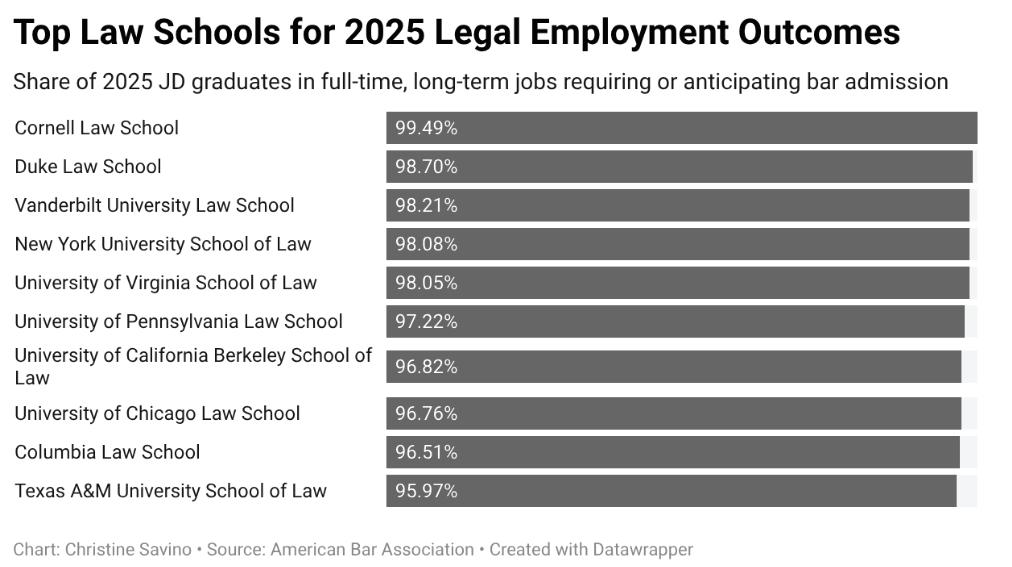
but one secured full-time, longterm employment requiring or anticipating bar passage within 10 months of graduation. That placed the school’s legal employment rate at 99.49%, the highest among U.S. law schools in the latest ABA figures.
“Our outcomes for the Class of 2025 reflect both the extraordinary talent of our stu-
Duke Law School, which held the top spot last year and ranked second in the 2025 data with a 98.7% legal employment rate. Vanderbilt University Law School followed at 98.21% , while New York University School of Law and the University of Virginia School of Law rounded out the top five at fourth and fifth, respectively.
The data comes amid broad-
er signs of strong employment outcomes for recent law graduates. 83% of 2025 law graduates nationwide obtained jobs requiring bar admission, suggesting that most new JDs entered attorney-track positions shortly after graduation. However, the national increase may be attributable to a smaller graduating class rather than an expansion in legal jobs. The Class of 2025 had 2,731 fewer graduates nationally, and the number of graduates in fulltime, long-term bar-passage jobs fell by over 1,700 students compared to 2024.
That national explanation does not apply to Cornell Law, whose graduating class size increased from 196 students in 2024 to 197 students in 2025.
Cornell Law’s placement rate was also aided by an increase in school-funded positions, a category which includes law school-supported fellowships, stipends, or subsidized post-graduate legal jobs. The number of such positions rose from one in 2024 to six in 2025.
Cornell Law recently ranked first for “Law Schools With the Most Graduates at Big Law Firms” and tied for 13th in a ranking of best law schools in the U.S., according to the U.S. News and World Report’s 20262027 rankings.
By ZEINAB FARAJ Sun Senior Editor
April 27 18 days after announcing The Chainsmokers as the 2026 Slope Day headliner, The Slope Day Programming Board announced that student DJ group SIDEPROJECT will open the event, with Daya set as the supporting act, according to a Monday Instagram post.
The reason for the delayed announcement is unknown and the SDPB did not immediately respond to comment regarding the delay.
Ethan Nagasako ’26, Ian Chang ’27, Dominic Nguyen ’27 and Brian Gu ’27, members of SIDEPROJECT, competed against four other student DJs — DJ Kav, ACID, Arsch x Danik and Sam Chitgopekar — on April 9 for a spot in the Slope Day lineup at Tower Room in the Willard Straight Hall Browsing Library.
The student DJ group was selected based on votes from attendees at the competition.
According to a YouTube video of SIDEPROJECT’s submission to the SDPB, the group has performed at several raves, Cornell Welcome Week and several Greek Life sororities and fraternities across Cornell. The individual members of SIDEPROJECT have also played at Lot 10, a concert hosted by the Cornell Concert Committee in November and
several clubs across the country.
“Starting with playing in basements and bedrooms, we have now grown a large community and share the music we love with hundreds of people at each of our events,” the description of SIDEPROJECT’s video states. “Now we want to take that stage to Slope Day and further grow this community of peace, love, unity and respect. To us, it’s more than just a SIDEPROJECT.”
Nagasako, Chang, Nguyen and Gu, whose stage names are DJEN, IYC, DVM and gubie, are members of Ephemeral Collective, a collective of local DJs.
Slope Day 2026 is slated for May 6 and is open to the Cornell student body, faculty and staff.
For the first time, a limited number of guest tickets will be offered to current undergraduate seniors, allowing non-Cornell affiliated guests to attend the century-old Cornell tradition. Tickets for outside guests are priced at $150 and are available for seniors to purchase for guests above the age of 21.
Undergraduate student wristbands are free and can be reserved on Campus Groups. Wristband pickup will run May 3-6 with multiple locations around campus.

By
MASSARO
April 22 — In an executive committee meeting on April 9, the Tompkins County Board of Health unanimously adopted a resolution enforcing a $40,000 penalty against Asteri Ithaca for violating orders regarding safety and sanitary concerns issued in January.
Asteri Ithaca, owned by the Vecino Group, is an affordable housing development in the Ithaca Commons with 181 residential housing units, including 40 with on-site support services for people struggling with homelessness. Asteri is funded both privately and publicly by Tompkins County, as well as state and federal partners.
The Tompkins County Board of Health’s decision is the most recent development in a chain of events regarding concerns of Asteri’s conditions. Hundreds of residents were forced to abruptly evacuate the building in March, due to the Ithaca Fire Department’s concerns for residents’ safety. Residents have also spoken with The Sun about Asteri’s conditions, citing them as unsafe and hazardous.
Since January, the health board has found 83 violations of the Tompkins County Sanitary Code at Asteri, all outlined in the meeting’s agenda packet. These violations include piles of trash blocking hallways, cigarettes and hypodermic needles littering stairwells and urine and feces in shared spaces.
Following Tompkins County Environmental Health Division’s inspections of Asteri in January,
the Commissioner of Whole Health, Jennie Sutcliffe, issued orders stemming from the findings. These orders asked management to improve waste management and cleanup of the property. The $40,000 fine Asteri is now facing is a result of management failing to address these orders.
The resolution gives Asteri Ithaca until April 30 to address these violations. Sutcliffe ordered changes outlined in the resolution, such as a complete implementation of a solid waste management plan, written plans for cleaning and security and the removal of biohazards.
The Tompkins County Whole Health Division will resume routine and frequent inspections of Asteri on May 1 to ensure compliance. According to the resolution, if violations are still found, the Whole Health Division will pursue an additional $9,000 penalty alongside a $2,000 fee per violation per day, according to the resolution.
Asteri Ithaca has avoided nearly $1 million in property taxes since 2022 through its payment in lieu of taxes agreement with the Tompkins County Industrial Agency. With these fines, code violations and a notice of default, Asteri is now at risk of losing this tax abatement.
One of the concerns brought up at the April 9 meeting was the effect Asteri’s conditions have on surrounding properties and businesses.
To continue reading this article, please visit www.cornellsun.com.
Valencia Massarco can be reached at vmassaro@cornellsun.com.
By
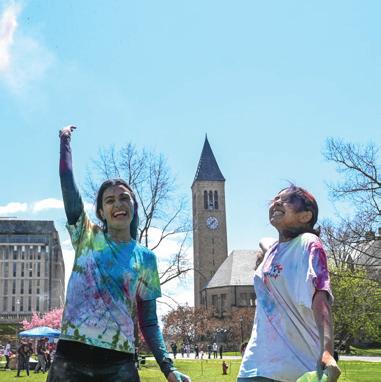
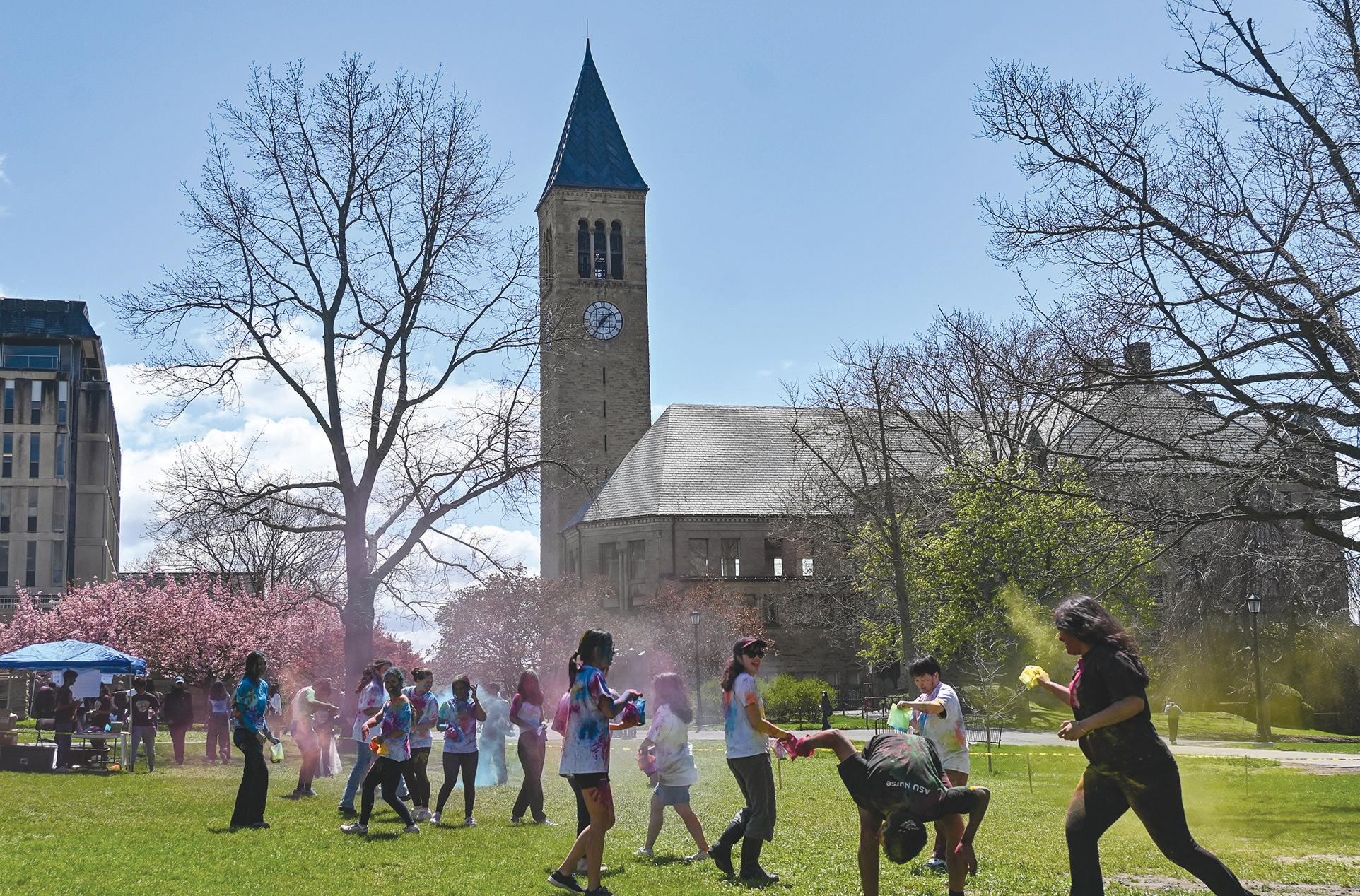
April 27 — Clouds of color erupted over the Arts Quad as students gathered for Cornell’s annual Holi celebration, marking the arrival of spring with music, food and the throwing of colored powder on Sunday afternoon.
The celebration, organized by the Hindu Student Council at Cornell, brought more than 400 students to take part in one of HSC’s largest cultural events of the year. After several years away from the Arts Quad, HSC event coordinator Trisha Saxena ’27 told The Sun that the return to this location makes the festival feel more “centrally located.”
For Esha Shah ’26, president of HSC, Cornell’s Holi celebration carries meaning as a cultural and campus tradition.
Holi “represents a couple of things,” Shah said. “It can mean the welcoming spring. It can mean celebrating love — the love between two of our deities, Radha and Krishna. And it can also celebrate the triumph of good over evil.”
During the event, organizers distributed white T-shirts and bags of pink, blue, green and yellow colored powder, which participants tossed into the air and onto one another. The celebration brought together students across all grades and friend groups, with many students posing for photos with their clothes and faces covered in color.
HSC also sold samosas and mango lassi, bringing traditional Indian snacks and refreshments to the celebration.
Saxena noted that at its core, the event is about connection, regardless of difference.
“When you are playing, there’s no sense of your friends versus other people,” she said. “You are playing with whoever is around you, and that really builds a sense of unity on campus.”
Abhi Nisankararao ’27, a member of HSC, described the Holi celebration as a “mini India for the Indian diaspora,” and a space where students can “celebrate different cultures getting together.”
The festival is also included in the list of 161 things every Cornellian should do.
For some, Holi offers a joyful pause for students transitioning into one of the semester’s busiest stretches.
The timing of the event allows students to “have fun and get all the excitement out so we can study before finals and be a lot more focused,” Nisankararao said.
“To me, it also represents celebrating ... what we’ve achieved throughout the year and just letting loose and having fun with friends,” Shah told the Sun.
Shalini Ramakrishnan ’27 said that although Holi actually occurred on March 22, she is excited that Cornell’s celebration is held later in the semester so students can celebrate in warmer weather. For Ramakrishnan, who has grown up celebrating Holi at her house, the Cornell event is “reminiscent of home.”
“It’s just like family here,” Ramankrishan said. Ramankrishan brought two of her friends, who asked to come and attend the celebration for the first time.
That curiosity, to Shah, is one of HSC’s central goals for the event.
“We love when people ask us questions,” Shah said. “We hope it brings communication and curiosity, so we can start talking interculturally and get to know each other.”
Behind the scenes, Holi requires months of planning, from reserving space and security permits to ordering food, speakers, tents and colored powder. Members of HSC gather before the event for “rang packing,” or portioning the colored powder into small bags for attendees.
“It’s a lot of planning,” Shah said. “We have to start usually a couple of months in advance, and then it’s pretty much on my mind every day.”
Still, Shah says the effort makes her both “hopeful” and “fulfilled” because of the joy and celebration it brings to campus. In future years, she hopes to include a dhol player, a traditional drummer often featured at Holi celebrations, to add to the festivities.
“Everything comes to life,” Saxena said. “It’s euphoric in a way.”
Emma Yu can be reached at ewy6@cornell.edu.
SOPHIA DASSER ’28 Editor in Chief
SOPHIA ROMANOV IMBER ’28
Associate Editor
RAYEN ZHOU ’29
Opinion Editor
ZARA CHEEK ’28
Opinion Editor
JADE DUBUCHE ’27
Multimedia Editor
BENJAMIN LEYNSE ’27
Multimedia Editor
SOPHIA TORRES LUGO ’26
Business Manager
DOROTHY FRANCE-MILLER ’27
Marketing Manager
KENDALL MURPHY ’28
Advertising Manager
VICTORIA WROBLEWSKI ’28
Human Resources Manager
MELISSA MOON ’28
Arts & Culture Editor
JAMES PALM ’27
Assistant Arts & Culture Editor
MATTHEW RENTEZELAS ’28
Assistant Arts & Culture Editor
HAZEL TJADEN ’28
Assistant Arts & Culture Editor
MARC STAIANO ’27
Assistant Arts & Culture Editor
KATELYN HALVERSON ’28
Lifestyle Editor
AVA BETNAR ’29
Assistant Lifestyle Editor
SANIKA SARAF ’28
Assistant Lifestyle Editor
KATHERINE ISTOMIN ’29
Social Media Editor
JOIE JEAN-PAUL ’29
Assistant Social Media Editor
ASHLIN KWONG ’28
Graphics Editor
TAVAN BHATIA ’27
Games Editor
VARSHA BHARGAVA ’27
Managing Editor
KATE TURK ’27
Assistant Managing Editor
CORAL PLATT ’29
News Editor
ATTICUS JOHNSON ’28
News Editor
MARY CAITLIN CRONIN ’28
News Editor
EVERETT CHAMBALA ’27
Assistant News Editor
SHUBHA GAUTAM ’28
Assistant News Editor
GISELLE REDMOND ’28
Assistant News Editor
ANGELINA TANG ’28
Science & Technology Editor
TANIA HAO ’28
Science & Technology Editor
SIMRAN LABORE ’27
Weather & Climate Editor
MATTHEW LEONARD ’28
Sports Editor
GRACE REUBEN ’28
Sports Editor
JANE HAVILAND ’28
Features Editor
NATHAN ELLISON ’28
Photography Editor
NATHAN BO ’28
Assistant Photography Editor
ADELAIDE CHOW ’29
Assistant Photography Editor
MIA SOFIA ORENGO ’28
Video Editor
DEAN THAKUR ’28
Newsletter Editor
SMRITHE RAJESH ’29
Newsletter Editor
AMELIA GARCIA ’27
Data Editor
RENA GEULA ’28
Layout Editor
HUNTER PETMECKY ’28
Layout Editor
Dana Stangel-Plowe ’92 is the Chief Program Ofcer at NAVI, the North American Values Institute. She can be contacted at dana@navivalues.org.
Randi Weingarten, president of the American Federation of Teachers and a Cornell alumna like me, cloaks herself in the language of Cornell's free inquiry tradition, invoking terms like "critical thinking” and "open debate.”
But the hypocrisy is hard to miss.
Weingarten claims to “reject the binary,” yet leads an institution captured by a rigid ideological framework that promotes it. Tough she laments the ills of a certain kind of authoritarianism, she peddles an equally coercive agenda to K-12 teachers across the country, to the detriment of American children.
Under Weingarten’s leadership, the AFT shapes what millions of children are taught, how they’re taught and which viewpoints are brought into their classrooms. Te ideological framework it promotes is simple: the world is divided into the oppressors and the oppressed, and your group identity determines which side you're on. Dissent from that superfcial sorting is treated not as disagreement but as moral failure that requires condemnation.
In the classroom, these ideas are not
presented as arguments to be critically examined or openly debated; they are expected to be accepted as truth. Over time, they harden into dogma that supposedly stands outside the bounds of reasonable debate.
We need to resist dogma from both the left and the right. Schools exist to cultivate reasoning and independent judgment. When ideas cannot be challenged, students are taught what to believe, not how to develop their own beliefs. Tis is especially harmful to children, who are still forming their understanding of the world and are particularly susceptible to accepting ideology as fact.
Under the banner of social justice, the AFT supports teaching children political conclusions rather than cultivating their own reasoning skills. In practice, teachers see their jobs as “change agents” in the classroom. Tey increasingly view their mission as activating children to support their political agendas, rather than teaching fundamental academic skills and knowledge.
To continue reading this article, please visit www.cornellsun.com.
Te Cornell Daily Sun’s Editorial Board is a collaborative team composed of Editor-in-Chief Sophia Dasser ’28, Associate Editor Sophia Romanov Imber ’28 and Opinion Editors Zara Cheek ’28 and Rayen Zhou '29. Te Editorial Board’s opinions are informed by expertise, research and debate to represent Te Sun’s long-standing values. Te Sun’s editorials are independent of its news coverage, other columnists and advertisers.
Tis editorial was published on April 27, prior to the end of Student Assembly elections.
Voting for this year’s Student Assembly election ends today. By tradition, this is around the time our Editorial Board would tell you which candidate for president and which candidate for executive vice president we believe deserves your vote. After interviewing each of them and weighing their platforms against one another, we would make a recommendation grounded in Te Sun’s institutional values that one of them, on balance, would govern our student body better than the rest. We have chosen not to do that this year.
None of the candidates we interviewed, in our judgement, has put forward a complete enough vision of the ofce, with sufcient grasp of what the Assembly can and cannot actually do, to earn the full confdence of this Board. To endorse the least-objectionable option would be to suggest that the foor for our endorsement is meeting a bare minimum, and we do not think that is the standard the student body should accept from the people elected to represent it.
What we have chosen to do instead is to endorse policies. A handful of the proposals we heard across our interviews and across the candidates’ public forums struck as urgent and worth the new Assembly’s attention regardless of who occupies its two seats. Tis endorsement is not aimed at the students who have already cast their ballots, whose minds were made up before voting opened, we are not in the business of changing these peoples’ votes in the fnal hours of the election. Tis editorial is aimed at roughly nine in 10 undergraduates, who in last year’s race, did not vote at all, and at those who see Student Assembly as a body whose meetings happen somewhere on a Tursday night and whose resolutions arrive in their inboxes, if at all, as something to delete.
Te case we want to make to those students is that the policies detailed below are the kind the Assembly can plausibly deliver, that delivering would meaningfully improve the conditions of being a Cornell undergraduate student and that the question of who is elected to push for them, is accordingly, worth a few minutes of your attention before voting closes.
Te Fragility of Shared Governance and Its Efect on Our Judicial Systems
Shared governance is the principle that the people governed by the University’s rules should have a hand in writing them, and at Cornell, this principle is no courtesy, it is a concession, won by Black students in the 1969 Willard Straight Hall Takeover and codifed in the campus-wide Code of Conduct and the independent Ofce of the Judicial Administration that governed student discipline from 1969 until 2021. Te University Assembly, the Faculty Senate and the Student Assembly all exist because of that concession. Teir authority over the Code in particular existed because students in 1969 knew that a university that can serve as the complainant against its own students should not be able to sit in judgement of them, and such authority existed until 2020, when it was traded away through a Student Assembly resolution circulated two hours before a University Assembly meeting at which it passed and was debated for roughly fve minutes.
What that trade produced is now visible in the cases our News and Opinion sections have spent the past year documenting. Te average time between a temporary suspension and the resolution of a student’s case has been reported at 246 days, which is to say that any student suspended in September can expect to wait until commencement before learning their fate. Interim suspensions, once reserved for extraordinary circumstances are not imposed at administrative discretion and appealable only to the Vice President for Student and Campus Life, whose ofce, by our reporting has not approved a single appeal. Dina Ginzburg, a second-year graduate student in the School of Industrial and Labor Relations, was found “not responsible” by a hearing panel in February for for three alleged Student Code of Conduct violations stemming from the Pathways to Peace event in March 2025, 11 months after the Ofce of Student Conduct and Community Standards opened its investigation. Although, Section 18(b) of the Student Code of Conduct Procedures requires investigations to be completed “as expeditiously as possible,” our reporting documented months of delays, an arrest predicated on inaccurate police reports and excluded
evidence. Adriana Vink, in a column for this paper, described the process by which she was confned to her dorm for weeks after the same event, advised by her own resolution coordinator that fling an appeal would be a waste of time.
In December, nearly 3,000 undergraduates voted in favor of the two referendum questions calling for Cornell’s disciplinary system to be made independent and for the campus-wide Code to be reinstated, both passing by margins above 90%. President Micheal Kotlikof was required by the Assembly’s charter to respond within 30 days. After revisiting issues with the email voting link, in a Feb. 2 response, President Kotlikof acknowledged the referendum but there have been no other movements. Now, four months later, what we have is a Codes and Procedures Revision Committee whose membership is more than half administrative, and a draft that does not address either referendum question.
In our interviews with the candidates, every contender for president and executive vice president named some version of this problem, though they diverged on what to do about it. Presidential Candidate and current Executive Vice President Christian Flournoy ’27 has built his platform around what he calls the “resolution life cycle,” with meetings between the student body and University leadership discussing the resolutions before they are passed. Presidential Candidate and current University Assembly Student Representative Eeshaan Chaudhari ’27 argued for “building teeth” into resolutions through binding clauses and for coalitions that pull in alumni and the Board of Trustees alongside the elected Assemblies. Presidential Candidate and the current Student Assembly President Zora deRham ’27 is one of the undergraduates currently seated on the Codes and Procedures Revision Committee, told us that she was not aware of her appointment until close to the start of the school year, missed the majority of committee meetings because of her class scheduled and concluded that conveying “assembly sentiment" in the room was not enough to produce real edits.
Executive Vice President Candidate and current Vice President of Finance Hayden Watkins ’28 has been the most explicit that pressure inside Cornell, is not on its own sufcient, and has pointed to the Ivy Conference and the SUNY Student Assembly as external venues where the body’s coordination has atrophied. Executive Vice President Candidate and current Vice President of Diversity, Equity and Inclusion Kennedy Young ’28 speaks to the issue of the Assembly’s authority in a statement to Te Sun. She concedes that many “resolutions fall outside of the Assembly’s direct authority,” however she plans to improve follow-through by “meeting with administrations during the drafting process.” She also plans to “continue pushing for data requests within the Assembly's direct purview” in areas such as housing, student life and student services.
Whichever candidate students choose, the seats require a willingness to spend time and political capital on a fght whose timeline does not align with a one-year term. Te lesson of 2020, when a fve-minute debate on a resolution circulated two hours before a meeting cost students nearly 50 years of judicial independence, is that powers given up are not given back. Te next Assembly’s frst job is to make sure no further ground is lost on its watch. Internal Accountability and Making Student Assembly More Accessible to Students Student Assembly meetings often go unnoticed by large swaths of the Cornell community, many of whom do not know that they are happening, or simply do not see the link between the weekly proceedings and changes to their campus life. On the Assembly side, meeting minutes have gone unpublished from Assembly meetings weeks ago and committee rosters include outdated names. Te combination creates an environment of inaction and indiference both within and without Student Assembly. Such an environment internally undermines the concept of shared governance, as the Assembly doesn’t even noticeably exercise the powers it still has.
Almost all of the candidates acknowledged the Assembly’s lack of engagement with the Cornell community, but believed it stemmed from diferent sources and ofered varying solutions.
To continue reading this article, please visit www.cornellsun.com.
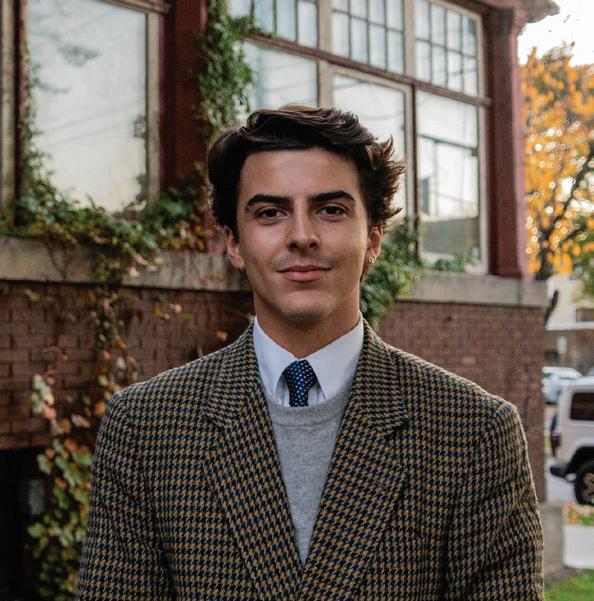
Adrian Belmonte '28 is an Opinion Columnist studying Government in the College of Arts & Sciences. Hailing from D.C. and Spain, his fortnightly column Saved By Te Bel has a voice as cosmopolitan as it is candid. Belmonte takes on politics and media with clarity and a touch of wit. He can be reached at abelmonte@cornellsun.com.
I’ve been avoiding writing about homosexuality in Greek Life for a simple reason: discourse invites over-examination. As Michel Foucault suggests, turning something into discourse can overexpose it, thereby imposing new labels around masculinity and secrecy in fraternity life. In other words, I’m risking reinforcing the very structures of sexual exclusions I seek to eliminate. However, I believe myself capable of writing on the topic without being overly hubris or grandiose — an almost impossible task as a columnist, I know.
The first thing I’d like to establish is this: It is not groundbreaking to be gay in Greek Life, but I think you’ll find my reasoning as to why different from your presuppositions.
My experience as a gay man in a fraternity is evidently not generalizable to every gay man in a chapter or attempting to rush one. Much of the discussion I’ve seen, especially those that criticize fraternities’ close-mindedness, is the latter: the rush process.
During rush you’ll find credulous freshmen assimilating to conceptions of what fraternity men should act like: ‘Hyper-masculine’ and interested in sports, gambling, beer die — and most pressingly — women. Safe to say I’m not into any of those, yet here I find myself in a fraternity and still building some of the most meaningful relationships of my life. I won’t deny that these attributes matter in fostering belonging, yet across all facets of life we’re all in search of people who reflect who we are. The assumption that all of
Anurag Agrawal is the James A. Perkins Professor of Environmental Studies in the College of Agriculture and Life Sciences. He is a feld biologist and studies the Ecology and Evolution of Botany and Entomology. His column Candor and Chlorophyll runs periodically this semester, and was introduced here in 2024. He can be reached at profaagrawal@cornellsun.com. He also posts his pieces on bluesky.
No, not you, but let me explain.
Tis will be my last column for a while. I’ve had a good run and have enjoyed communicating with you all. By “dedicated to my readers,” I mean those who have edited drafts, ofered ideas and inspired me; you know who you are! Among you are undergraduates, colleagues, from graduate students to senior faculty and friends and family, some of whom have patiently endured my attempts to communicate with the wider world, or at least our little Ithaca bubble. Tank you for your candor and generosity, and for indulging my stories about chlorophyll and the animals that eat it.
I want to refect on how we interact with each other, what makes us who we are and how we might move toward fulfllment. Tere is no perfect solution or universal answer; everybody is obviously diferent. And from the get-go, let me acknowledge that I speak from a position of considerable security: I have a permanent job, successful children and I am surrounded by smart people who care about me and the larger world. We should all be so lucky.
Yet, there is so much bad news, so much stress and so much uncertainty, all of which can lead to despair. I certainly feel it sometimes. Tis can drive us to isolate, narrow ourselves and engage in transactional thinking: I did this for you; what will you do for me? At some level, perhaps we are all transactional. Still, I assume that none of us really wants to live that way. In difcult times, purpose and
Greek Life considers only these homogenized interests is chiefly untrue.
This is the crux of what I argue — if you face any club or community, let alone Greek Life, with a singular defining characteristic (say your sexuality) you will be faced with the judgement of only said characteristic. Not to be holistic and all, but the reduction of your intersectional identity to one defining trait, as the topic of critique, is reinscribing the very repression you aim to challenge. You don’t see people applying to college or jobs with the sole attribute of being queer.
This argument isn’t anti-pride or anti-representation — it's pro-belonging. June will come around and you’ll find me parading the streets of D.C. with a pride flag, and September will follow with me partaking in brotherhood events at Lambda Chi Alpha. Two things can be true at once.
I prefer to integrate in places I feel like I belong, not because I’m entitled to belong but because I seek to belong. Baseless exclusivity is present in every community: some people aren’t ‘pretty’ enough, trans women aren’t ‘woman’ enough, mixed people aren’t ‘black’ enough — these types of singular limitations are based on presupposed requisites of identity that result in certain people feeling ostracized. I believe Greek Life is moving toward eliminating these preconceptions and exclusivities, even if it's not fully inclusive yet.
When asked to comment, the Cornell Interfraternity Council responded similarly, “Our goal is to help students find a sense of belonging without feeling pressure to conform to a single definition of fraternity life,” stated IFC President Harrison Fredericks. However PR-trained their response was, it shed light on growth which I agree is in motion. “We’ve seen meaningful progress in building a more inclusive culture and remain focused on continuing that momentum,” he continued. Fredericks vaguely affirmed that there are “conduct and accountability processes” to help combat discrimination. Their statement confirmed what I contend: There is no active push toward more gay men joining Greek Life, yet there is a heightened acceptance of it within Cornell chapters. That’s not great, but it's better.
I understand this may be where you begin to feel
skeptical and where I may become slightly hubris, but let us explore this transformation within Cornell. When I’ve talked to the fourth-year gay guys in my house, they can recall a time when bringing another man to date night, let alone being fully out of the closet, was a huge controversy. Today, we are seeing same sex couples at date nights and formals and I can confidently say that every fraternity chapter at Cornell has at least one queer member — closeted or not. Within that, they've taken up important executive roles: presidents, treasurers, rush chairs and especially social chairs — like myself. This must be why Charli XCX is played so often at frat parties nowadays.
In all seriousness, there is a space for gay men to occupy historically straight spaces. Yet, not all gay men need to and not all gay men want to. I have both straight and gay friends, who simply don’t vibe with the concept of fraternal brotherhood. Notwithstanding, there are certain chapters at Cornell that aren’t nearly as inclusive as they should be, because they simply don’t want to be. This doesn’t alleviate them of fault, it just segregates them further into a pit of toxic masculinity. A pit dug by their own choosing. As a gay man I have no interest in joining those types of chapters, the same way they have no interest in having me try to join.
The same applies to fraternities with closeted members: the more they are forced to hide the more toxicity will be generated within a brotherhood that strives toward “respect, inclusion and accountability,” as Fredericks put it. I wouldn’t apply to work at the Republican National Convention, but that doesn’t negate its validity and necessity within a free society of dissent. Grindr will continue crashing when they meet for conventions, and internally they’ll realize that their suppression of identity is only hindering their authenticity as a cause and organization..
Until then, the Grindr locations accumulating in repressed fraternity houses will remain in the shadows, while the reformed chapters that have accepted the preeminence of human connection over sexual preference will prevail as the healthiest form of Greek Life. This is something well in the making, and something I am utterly proud to be a part of.
fulfllment become more important, even as they feel harder to achieve. Under stress, we can become shriveled versions of ourselves, and insecurity can make every interaction feel more like competition than harmonious coexistence.
So what is fulfllment? It is a tall order, this desire to reach some sort of authentic satisfying potential for ourselves. We might think we know what it is, only to discover that we do not. Our desires shift; what feels promising today may not tomorrow. And insecurity — those feelings of uncertainty, anxiety and threat — may be what prevents us from fully inhabiting those desires. My thesis is simple: Insecurity, whether fnancial, intellectual, social, personal or existential, blocks fulfllment. Why we feel insecure, and how to resolve it, is too big to be fully addressed here. But the extent to which we can confront insecurity in honest conversations through help from professionals, friends and family, could well change our lives.
In this column, I have often looked to the non-human world for insight. Most plants and animals, and almost certainly all microbes, do not feel insecure or seek fulfllment. Tey do not even seek ftness. Rather, those individuals with heritable traits suited to their environment pass on their traits, which then persist and shape the world that follows.
Perhaps insecurity feels so pervasive because we carry old biological instincts from our evolutionary history into a modern world organized around status, purpose and self-evaluation. In nature, success is always contextual. An organism does well not by being the best in some universal sense, but by ftting its environment well enough to survive and reproduce. Every species occupies a niche, and stable ecosystems depend less on dominance than on coexistence. Problems arise when organisms are pushed out of their niche or forced into compe-
tition by any one of many disruptive forces. Te band Rush captured this in their art-rock classic Te Trees: the oaks and maples fght over sunlight, as if growing taller were the only goal. But a forest is not healthy because every tree grows tallest. It works because diferent organisms persist in diferent ways.
So too with us. Yet we often latch onto one visible measure of success and treat it as the only one that counts. Insecurity often takes hold when we are asked to perform in roles that do not ft our skills, values or temperament, or when we start believing that someone else’s strengths should be our standard. In a university environment, this happens easily and often. We confuse visibility with value; speaking the most is mistaken for thinking the most, prestige for substance, busyness for purpose. I have certainly made that mistake myself.
Ecology also reminds us that thriving systems are relational. Forests are knit together above and below ground; cooperation and competition coexist without resentment or commentary. Fulfllment, viewed this way, is not demanded or negotiated; it emerges when relationships work and when diferences complement rather than displace. Such a balance takes time and humility. But in the end, nature only ofers fresh air, inspiration and metaphors, not moral instruction; and evolution is, of course, blind to meaning. Most organisms do not worry about legacy or purpose. Perhaps that obsession is where human insecurity takes hold. Te lesson here, if there is one, may not be how to eliminate insecurity, but how to notice when we are measuring ourselves against the wrong light. We are all more or less on the same journey folks, and I am grateful to my traveling companions. Tanks to my readers. Peace, love and plants. - Prof. A

By ZEINAB FARAJ Sun Senior Editor
April 26 — The KensaGroup started, like many things in science, with something that didn’t quite work. An early attempt at commercializing a promising paint fell through due to a company’s internal preferences. Since its initial failure, the Cornellianfounded group has launched several successful products that originated in university labs — ranging from foods to medical equipment — and revolutionized the invention-to-industry pipeline for U.S. universities.
Founded by Tony Eisenhut ’88 and Prof. Bruce Ganem, chemistry and chemical biology, the KensaGroup is celebrating 25 years of successes and the initial failure that brought them together. The Sun sat down with its founders to learn more about the group.
A Businessman and Chemistry Expert Team Up
In 1998, a chance introduction through the Cornell Center for Technology Licensing brought together Ganem, a synthetic organic chemist by training and long-time professor of Cornell’s CHEM 3570: “Organic Chemistry for The Life Sciences,” and Eisenhut, who studied animal science, was a member of the men’s hockey team at Cornell and at the time was a vice president of sales at Aldi.
Ganem recalled receiving a call from the CCTL office stating that an alumnus, Eisenhut, was interested in his inventions and wanted to chat. The two met in person later — a meeting Ganem recalled as a “life changing event” and the chance for his own "technical chemistry expertise” and Eisenhut’s “business acumen” to work together.
For Eisenhut, the meeting marked a point in his career where he wanted to “pivot” and start his own business centered around scientific discovery. Eisenhut stated that he and Ganem “hit it off” during their meeting, discussing their shared Lebanese descent, love for hockey and "entrepreneurial spirit.”
“Bruce [Ganem] has the international reputation for excellence, which is really important to opening doors, and [he] knows the academic process so well,” Eisenhut said. “In conversations with Bruce even 26
years ago, I knew together we could build a business model together focused on the chemistry market.”
The two began their business based on an idea for an anti-fouling paint — one that would prevent the accumulation of unwanted biological organisms, such as barnacles, on surfaces, such as ship hulls.
At the time, scientists were studying sponges that live on the bottom of the seafloor — who are constantly surrounded by falling debris — to try to find a way to protect ships from debris similar to how sponges protect themselves, and how that could be applied to protecting ships.
Ganem had a research group at Cornell that had already worked on synthesizing compounds from the sponges.
“My group had synthesized some of the compounds from these sponges,” Ganem explained. “Instead of taking eight or 10 steps, we could build fragments [of these molecules] in a couple of steps, and we had isolated the part of the molecule that displayed the anti-fouling property.”
What Ganem described as “simple molecules” became the basis of the marine anti-fouling paint that caught the attention of Eisenhut, who, according to Ganem, was able to take the patent out of the CCTL office and to the Rohm and Haas company, which developed and produced the paint for a total cost of $10,000 in just six months, which Ganem told The Sun was “considerably cheap” at the time.
Despite the paint’s success at preventing the buildup of biological organisms, the company ultimately went with a similar product created “in house” to “reward their own researchers,” rather than sourcing externally through Ganem and Eisenhut’s patent, according to Ganem.
Both Ganem and Eisenhut viewed the experience as a “lesson” that opened the doors for business in science. From the experience, Ganem and Eisenhut came out with a clear goal — working alongside research groups at universities across the U.S. to streamline the process of bringing academic discoveries to industrial applications.
“Through this experience we learned that the commercialization process coming out of these uni-
versities wasn’t efficient,” Eisenhut said. “We decided that something our business could capitalize on was commercializing scientific discoveries across the entire country.”
KensaGroup’s Process and Success
The two founded KensaGroup, a company designed to take scientific discoveries out of university laboratories and turn them into startups. One of the keys to the company's success, Eisenhut detailed, is the Academic-to-Industry Process, an investment model that the group uses to evaluate inventions it comes across.
The A2I Process, Eisenhut explained, asks questions centered around the concepts of markets, people and process. KensaGroup evaluates what the markets will need in the future and what research groups are contributing to that need. Then, the invention is patented and released to a market that needs it.
“Using the A2I process, we went out and looked at different university research programs to source the intellectual property and know how to meet the market,” Eisenhut said. “It was a market-driven process as opposed to a technology-driven process at the onset.”
Ganem highlighted Eisenhut’s “ability to connect people together” and push researchers to pursue business applications as a key factor in the group’s success.
“This is a guy who genuinely seemed interested in science, and he engendered a sense of trust when you talked to him,” Ganem said in reference to Eisenhut.
KensaGroup has since evaluated over 3,000 technologies for commercialization within several industries including energy, medicine, agriculture and more.
KensaGroup is also behind NovaSterilis, which uses supercritical carbon dioxide to sterilize medical materials and has been used in over 500,000 surgeries worldwide, according to its website.
The KensaGroup’s partnerships include Novomer, a sustainable chemistry organization that developed catalyst technology to turn carbon-based gases into sustainable synthetic materials.
Prof. Geoffrey Coates, chemistry and chemical biology, co-founded Novomer and is one of four members on the scientific advisory board for the
KensaGroup. Coates recalled that Ganem “went out of his way” to introduce him to Eisenhut because of the knowledge he and his group had about polymers and energy applications.
With Novomer eventually being sold for approximately $350 million, Ganem called it “one of Ithaca’s most successful startups.” Novomer’s Vice President, Scott Allen, Ph.D. ’04, was one of Coates’s students and worked “tirelessly” to make the company successful, Ganem said. Coates also credited the company’s success to Eisenhut’s “motivation” to help.
Coates joined the KensaGroup’s advisory board during the process.
“I remember thinking during our initial meeting, ‘I don’t know where this is exactly going, but this guy seems like a lot of fun,’ and so I started working with the KensaGroup as an advisor,” Coates said.
The four members of KensaGroup’s scientific advisory board bring a wealth of scientific expertise and background to the business table, according to Ganem. Joining Coates and Ganem are Dr. Robert Langer, an Institute professor of biotechnology at the Massachusetts Institute of Technology, and Prof. Richard Turner, the director emeritus of the Macromolecules Innovation Institute and research professor at Virginia Tech.
Inspired by his experience, Ganem created a Cornell course open to anyone interested in STEM and business, CHEM 4040: “Entrepreneurship in Chemical Enterprise.”
Ganem’s advice to young people hoping to pursue entrepreneurship is to "nurture" their ideas. He joked that while he was roughly 50 years old when he became “smitten” with the idea of pursuing a career in business, he thinks that age is not as important as connecting with others and pouring energy into an idea.
“It is always so exciting to see raw discoveries being brought to the marketplace to benefit people,” Ganem said. “So when I met Tony [Eisenhut], it was thrilling to be given the chance to be on the ground floor of the work.”
Zeinab Faraj can be reached at zfaraj@cornellsun.com.
By KITTY ZHANG Sun Staff Writer
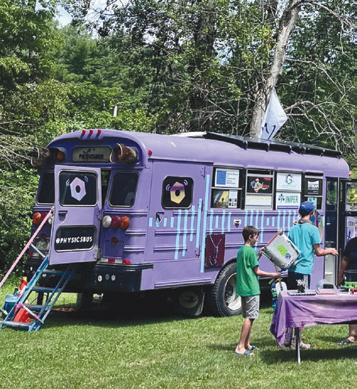
April 28 — A school bus rolls down the streets of Ithaca. It’s bright purple, and there are no passengers.
A closer look reveals no rows of leather seats, no school backpacks. Instead, the interior resembles something of a magician’s workshop.
By the windows, a microwave glows with LED lights, its tray replaced by a spinning disco plate. A cardboard helmet flips the wearer’s vision upside down. A mesh metal trash can plays radio music when a hand reaches inside. Here, items like wine corks, old car wheels and discarded batteries have been reworked into a collection of scientific “exhiblets.”
This is the Ithaca Physics Bus, an on-wheel laboratory that rewrites the traditional model of science education. Rather than asking the public to come to designated museums and classrooms, it brings the experiments to them — welcoming all ages to explore physics through playful, hands-on displays built from repurposed, everyday objects.
Its origins trace back to 2004, when program director and former Cornell professor Erik Herman visited Colorado State University’s “Little Shop of Physics,” an open-house exhibition built around hands-on experiments made from low-cost everyday materials.
Seeing these exhibits transported Herman back to his childhood, he said. As an undergraduate student at the University of Arizona, Herman had pursued physics to become a professor, but traditional instruction, dense with formulas and abstraction, had never come easily.
“That’s why I started building these things, because I knew learning was easier from direct experience,” Herman said. “And I thought, wouldn’t it be neat if this were on a bus?”
After a decade of successfully running a physics bus in Tucson, Arizona, Herman brought the idea to Ithaca in 2014 when he joined Cornell University as a physics professor until 2023.
Like the experiments it carries, the physics bus itself is repurposed. The first bus was donat-
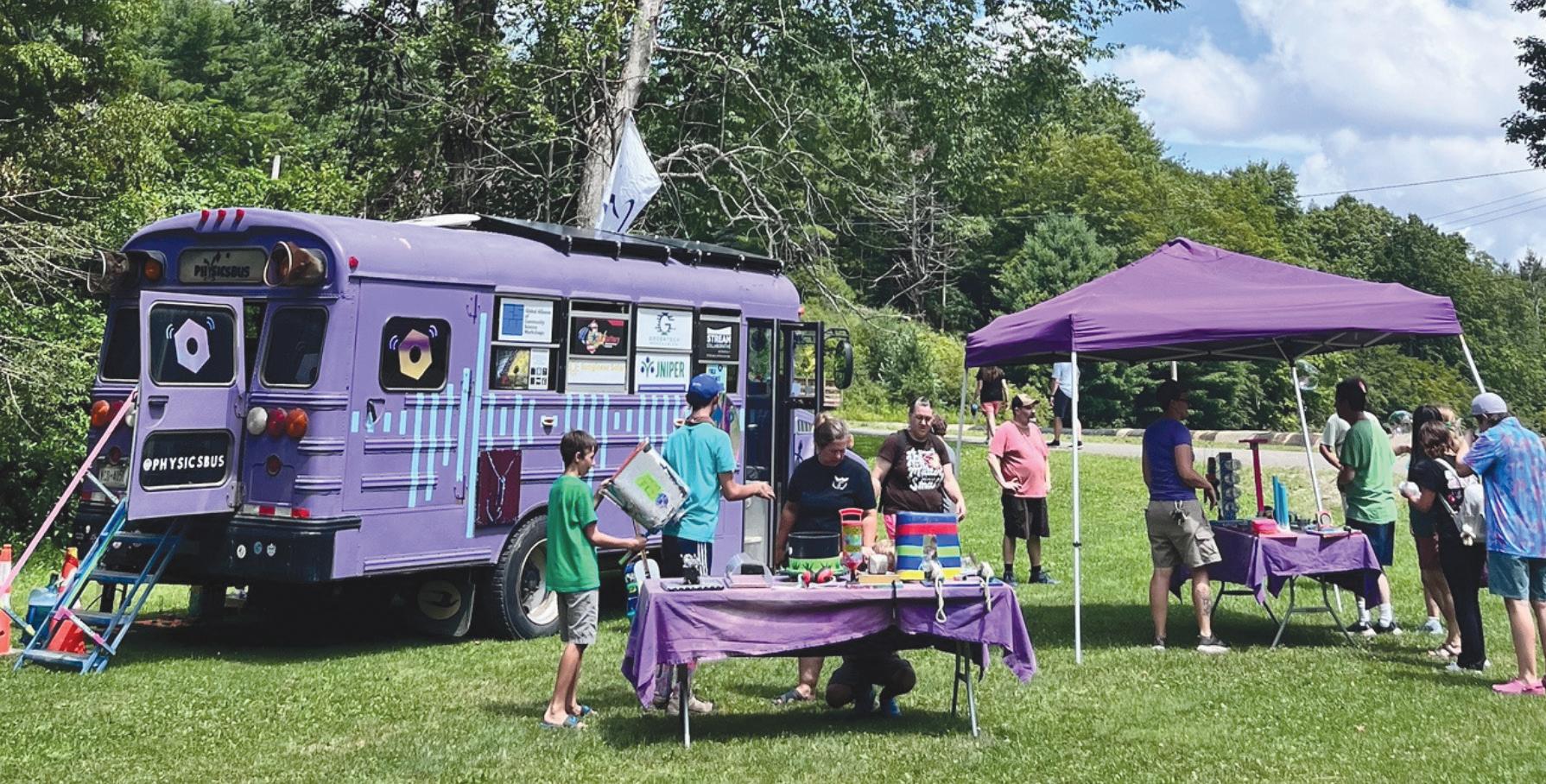
ed unexpectedly by a Cornell graduate student who had to “leave his party bus behind” to take a neuroscience job in San Francisco, Herman said. The current version, acquired years later, is a former fishing skoolie donated by two brothers.
“I knew learning was easier from direct experience, and I thought, wouldn't it be neat if this were on a bus?”
Erik Herman
Since arriving in Ithaca, the Ithaca Physics Bus has traveled across 16 states and reached more than 45,000 participants. It carries with it not just “exhiblets,” but a different way of encountering science: one where children are invited onto the bus to play around and design experiments rooted in curiosity and accessibility beyond the classroom, according to Herman.
For example, children learn about magnetic attraction by watching rainbow-colored field lines appear as they glide a magnet across a Cathode Ray Tube color TV.
They can also explore electric currents by twisting a knob connected to a stepper motor and hearing the speaker pitch rise and fall in direct response to their motion.
Much of the magic lies not only in showing science to children, but in letting them build “exhiblets” with their own hands. In the Free Science Workshop tucked away on Hancock Street, local children gather three afternoons a week to unleash their imaginations using a wide range of locally donated materials without the pressure of grades or a set curriculum.
One child might build a bed for an American Girl doll, while another fixes a broken clock or
tries to replicate a soap experiment seen on TikTok. Others yet may enjoy Herman’s favorite — a driveable go-kart made entirely from wood panels!
To the workshop staff, these aren’t just crafts, but a way for children to realize that science isn’t something reserved for strict laboratory protocols, high school classrooms or abstract equations.
“You don’t really know what the term ‘Bernoulli effect’ does, right?” said Liv Vincent, the program’s co-director. “But if you know that you can float a ping-pong ball on a hair dryer, then you can start to do experiments. Will the ping-pong ball stay afloat if I put my hand on top? What if I put my hand underneath? And that kid inherently understands the Bernoulli effect way better than somebody who can just say the word and not know what it means.”
Vincent believes that kind of intuitive understanding is often missing from how science is taught and is why so many people are turned away from it in the first place. Abstract scientific terms, she noted, can feel intimidating, often framing science as a high-stakes career rather than a part of everyday life and causing many children to shut that door before they even open it.
“I don’t want them to just learn science from someone who used to be a professor or because they want to become scientists,” Vincent said. “I want them to learn science from each other and through having fun. If a few kids learn how to use something new, then it becomes their job to show the others. And I’m there, watching them teach each other.”
To continue reading this article, please visit www.cornellsun.com.


By AARIYANA EDWARDS
With Cornell’s iron grip on my social life, finding the time to go to Downtown Ithaca can feel like a feat in itself. Between back-to-back classes, problem sets and fighting for a seat in Temple of Zeus cafe, leaving the borders of campus feels impossible. But when I found out about Ithaca’s very own cat cafe, I knew I had to make the time. So, one afternoon between classes, I rallied my friends and made the trek downtown to the wonderful Alley Cat Cafe, which, in my opinion, is peak Ithaca.
The moment you walk into the cafe, the atmosphere softens your mood. Cozy, hippy vibes, with mismatched furniture and cute thrifted plates, make the place feel like a home away from home. The cafe even has a small store near the entrance, stocked with cute cat toys and themed products that would fill any cat lover’s heart. One detail I found most charming was a small display showcasing the cafe’s teas, complete with colorful arrows indicating the caffeine levels to allow customers to understand the tea that they’re choosing, while also doubling as a cute display.
The cafe is split into two spaces: a cozy seating area with the typical cafe set you’d expect — reasonable prices, good air-conditioning and comfortable seating — and a cat room in the back. Since I wasn’t very hungry when I visited,
I ordered a grilled cheese from the cafe’s menu and whipped out my laptop to catch up on my work. The grilled cheese brought me back home to my family’s kitchen, where I often make my own grilled cheese with the presence of my cat. Only this grilled cheese was elevated by the addition of sourdough bread. The sandwich was nothing fancy, but it definitely delivered a kind of comfort Cornell’s dining halls never quite can do.
What I also really appreciated was the full transparency of the kitchen — you can watch your food being made from start to finish. Coming from a background in food service, I know how disgusting the back of the house can get, and how much restaurants want to hide it. Here, though, it felt like another point of connection with the staff. Another cool touch is that all the food on the menu is vegetarian and can be made vegan upon request — a real win for my vegan and vegetarian friends, who are often limited when it comes to campus food options.
The staff matched the warmth of the space effortlessly. The workers treated every customer like a familiar face, sparking casual conversations that made it clear they genuinely cared about the people walking through their doors. The cafe is the kind of place where you can sit down for a relaxed lunch with a friend or actually lock in on the mountain of homework you’ve accumulated throughout the week. Because I was running short on time during my first visit, I didn’t make it to the cat room — but I

knew I had to. So a few days later, I made the trip again to the cafe. The process of getting into the cat room is seamless. I made a reservation online just in case, but they absolutely accept walk-ins. You simply go to the front, ask to enter the cat room, pay $5 per person and then voilà — you get to meet a bunch of cute cats.
The room is a full-on cat oasis filled with cat trinkets, cozy nooks and plenty of spots to sit back and decompress with the cats. Most of the cats were asleep when I visited, which honestly made them way more endearing. That said, I still managed to sneak in a quick moment with my new bestie, Poe, who was snuggled up on a chair. He reminded me so much of my cat back home that I almost teared up by the window. Safe to say, he will definitely be seeing a lot more of me very soon.
While wandering around the cat room, I also stumbled across
the sweetest little book filled with polaroids of every cat the cafe has ever housed. After more research, I learned that the cafe partners with a local cat rescue called Browncoat, taking in some of the cats from their shelter temporarily while they wait for their forever homes. As someone who adopted my own cat from a rescue, that detail really hit home.
If you’re a Cornell student, a cat lover or simply someone in need of a new study spot, Alley Cat Cafe is more than worth the bus ride. Especially with Cornell’s busy pace, having a place to sit back, relax and pet a cat is a must. The environment captures the artsy vibe we all know and love about Ithaca, while being far enough from campus to feel like a true retreat.
Aariyana Edwards is a member of the Class of 2029 in the College of Arts and Sciences. She can be recached at aae49@cornell.edu.
By ALESSANDRA FERRER Sun Contributor
Asthe end of the semester approaches and prelims and incoming deadlines draw near, I went to see the #OpenToWork concert by the Mediocre Melodies. Amid the frenzy of the semester, Mediocre Melodies promised a night of ‘average’ a cappella, full of laughs — the perfect combination of comedy and music to lighten your swamped schedule.
The theme for their April 17 concert, #OpenToWork, offered a playful twist on the pressures of the job market and recruitment season. Caleb Brown ’29 said, “We’re all about being satirical … and Cornell’s a place where a lot of us spend our time being busy, doing work and being professional. There are not a lot of opportunities to remove yourself from those environments. We thought, ‘How cool would it be if we maintained that and made it into something fun instead of stressful and torturous?’”
The seats of Kennedy Hall’s Call Auditorium were packed row to row as the lights dimmed and the opening video began. Looking around, I saw students, alumni and family members watching eagerly. They started off the show strong, featuring satirical yet relatable bits about bombing interviews, selling their souls to Goldman Sachs and feeling the pressure to land a job while making no real progress. The lighthearted jokes and the sharply accurate scenes had the crowd laughing nonstop.
This was my first time attending one of their concerts, so I wasn’t sure what to ex-
pect — or just how “mediocre” they would be. Right after the video, the singers entered from the back of the auditorium, walking down the aisles to the stage. Their first performance,“Bills, Bills, Bills” by Destiny’s Child, was perfectly on theme. Their approach to singing was an experience, to say the least. Classic elements of a cappella rang true, with the singers separated into high, medium, semi-low and low categories, echoing the traditional soprano, alto, tenor and bass structure. Despite discordant singing, their energy throughout the performance was unmatched, immediately signaling that the night would be anything but dull.
Considering the ‘bad’ singing and the packed auditorium, it raised the question: Do these attendees really come for the music? Kayton Buerlein ’27, the president of Mediocre Melodies, offered some insight into the group’s appeal: “We try to be as funny as possible. I feel like that’s our main bit. Also, we donate all our proceeds to charity, so that makes people want to come out even though we aren’t great singers. I think we’re more comedy than an a cappella group; we call ourselves a comedy a cappella group, so the humor has to be good for that.”
In fact, Buerlein herself introduced their partner charity for the semester, Challenge Contract Staffing, which provides individuals facing barriers to employment with essential on-the-job training for their career paths — sticking true to their theme. As the show progressed, Mediocre Melodies demonstrated their dedication to charitable fundraising. Not only were all ticket sales donated, but singers also presented sweet and entertaining opportunities
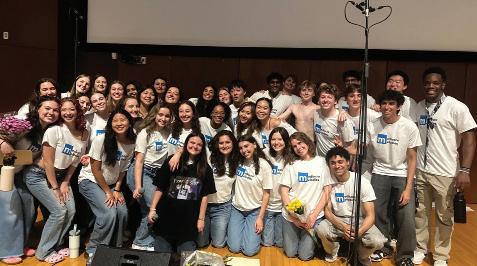
to donate throughout the night. From a competition where top donations earned an on-stage serenade to auctions of merchandise, a coffee chat or even a member taking his shirt off, Mediocre Melodies crowdfunded as if they were making the profits. Their sense of humor was truly carried into every aspect of their show, proving to be an incredible success, with some auctions reaching as high as $160.
Their concert continued with money and career-based songs like “Billionaire” by Bruno Mars or “Price Tag” by Jessie J, each followed by a video skit. Each song featured five students singing the lyrics while the rest provided the backtrack, keeping to the iconic a cappella approach. Meanwhile, each skit never failed to make the crowd burst into laughter, featuring pantsless Zoom interviews, satirical infomercials and the fabled return offer.
Considering the disjointed singing but
meticulous details, I wanted to understand the effort put into preparation. Casey Samuels ’28 spoke about their practice schedules, saying, “This week, we practiced every night, around two hours. Before that, it was two to three hours a week. So I’d say one week of really hard work.” Despite the promise of mediocrity and delivering an intentionally unpolished show, every skit, song and even the choice of charity was deliberate, reflecting the hard work behind the concert.
To continue reading this article, please visit www.cornellsun.com.
Alessandra Ferrer is a member of the Class of 2029 in the Brooks School of Public Policy. She can be reached at alf263@cornell.edu.
Continued from page 1
Mosley told The Sun, “you get a winning bid eventually” because of “the practice of debating and having meetings and conversations amongst Ithaca residents who understand this community better than anyone.”
Kelles said the funding is necessary as “Ithaca is one of the most expensive cities in the country,” and the price of housing has pushed “over 15,000 people to commute from outside of the county every single day.”
A report by the Ithaca-Tompkins County Transportation Council states 15,735 people commute to the county; Ithaca household bills are around 14% higher than the national average, according to Doxo.
Receiving the grant – after nine attempts – “feels really good. It’s been a long time coming,” Acting City Manager Dominick Reckkio told The Sun.
The Ithaca downtown initiative will include “revitalization” of streetscapes, facades downtown, new housing and the incubation of new businesses, Cantelmo told The Sun. The Ithaca Neighborhood Housing Services is one of the partners the city is moving forward with for housing development, which Cantelmo said has a “stellar reputation.”
Specifically, the West Martin Luther King Jr. Drive development is meant to be the “connective tissue,” between NY-13 and the Commons, especially since the planned area has been “underinvested” in, Reckkio and Cantelmo told The Sun.
Continued from page 1
Which projects specifically will be selected for inclusion in the award are yet to be determined, with a “multi-step” process between the city and state required, according to the Ithaca Downtown Revitalization website.
In order to be eligible for the grant, Ithaca was required to be a “pro-housing” community, Mosley said, a program that certifies local governments as committed to supporting housing growth in order to address housing shortages. Ithaca is one of 414 certified municipalities across the state.
In order to be designated as a pro-housing community, a local government must either show that their housing permits have increased over three years or pass a resolution committing to being a pro-housing community.
That designation is “a signal to the marketplace that the community is interested in that issue, and will try to be a helpful and engaged catalyst,” Kurt Foreman, the president of Ithaca Area Economic Development, said in an interview with The Sun, “rather than just sit back and say, ‘there’s nothing we can do, or we don’t care.’”
“People who have kids, and the kids can’t live here anymore, they’ll actually be able to stay,” Kelles told The Sun. “How cool. How cool is that.”
Lila Davis and Atticus Johnson can be reached at lrd73@cornell.edu and ajohnson@cornellsun.com.
Johnson responded that the central issue with immigration is not about identity, but whether or not you “love the country you’ve chosen [and] respect its history and its values.”
Johnson rounded out his speech by reemphasizing the importance of allyship between western democracies, arguing that “the transatlantic alliance is simply the most important geostrategic act of the past 200 years.”
While things are difficult when we are divided, when the U.S. and the U.K. stand together “there is absolutely no power on Earth that can prevail against us,” Johnson said.
Attendees were then prompted to ask Johnson their own questions. Guests could submit questions by scanning a QR code. Whalen read two questions from these submissions, and asked three questions of his own.
One of the audience submitted questions, from a senior named Hayden, asked: “[is] multiculturalism compatible with western ideas, especially in the context of the United Kingdom, and should immigration policy be restrictive?”
Johnson had said that immigration was about “assimilation” and “your willingness to be part of a society.” He criticized situations where some immigrants in London can not speak English.
“We should insist that if people come into our countries they should speak the language,” Johnson said, and was met with booming applause from the audience.
Whalen also asked Johnson if he believed that current western leaders were too risk averse to make “destructive decisions” similar to Brexit in the defense of their nations.
Johnson strongly disagreed with the notion that western leaders are risk averse, citing Trump’s intervention in Venezuela and the capture of their president Nicolás Maduro.
Johnon said that Brexit was “the right thing to do,” despite a lack of “institutional support.” He listed its positive consequences, including
Continued from page 1
On March 5, Jaimes packed his belongings and headed to Queen Alia International Airport to fly back to the U.S.
“Travel to Jordan is currently restricted by Cornell and its insurance company,” according to the Experience Cornell Website. If students wish to proceed with a Cornell Experience application, the site states that they “must submit … a petition through Cornell’s Travel Registry.”
Cornell’s three other study abroad programs in the Middle East — all in Israel — were not open to students this academic year due to the Israel-Hamas war. Travel to Israel is additionally prohibited by Cornell and its insurance company, according to the Experience Cornell site.
Weill Cornell Medicine in Qatar also transitioned to remote learning on March 2 due to ongoing military activity in the region.
Some abroad programs in the Middle East at other universities have moved their students to other countries. For example, Brown University students studying through the Middlebury School in Jordan program were relocated to Morocco.
However, Jaimes told The Sun that CET required students to switch programs entirely if they want to move to a new country, which would require him to pay for his own accommodations in the new destination. Because of this, he decided against that option.
“Our program said that we have to go home,” Jaimes said. “I could have gone to Morocco independently but then I would have had to pay the costs for housing and everything [else].”
Currently, Jaimes is finishing up the semester
how it had given the U.K. a newfound sense of sovereignty and how it allowed them more freedom to quickly respond to COVID, according to Johnson.
He related this to the freedoms of the U.S., raising the idea that the U.S. would never agree to be a part of an institution like the E.U.
Nearing the end of the event, Johnson shared that he had attempted to keep his remarks “as moderate as he [could],” so as not to “trigger anybody or whatever.”
Though many student attendees’ personal viewpoints are ideologically to the left of Johnson’s, many students resonated with the ideas that Johnson conveyed.
“I agreed with him a lot more than I thought I would,” Ezra Galperin ’27, a representative for Student Assembly, told The Sun after the event.
Galperin was surprised by Johnson’s comments on immigration, stating that since the U.S. is a country “built off of immigrants,” we need to set them up for success. Galperin also noted his surprise regarding Johnson’s praise of
online from his home in Brooklyn.
“It feels a bit like COVID[-19],” he said, referring to the classes he is taking on Zoom.
Since the U.S.-Israel war with Iran began, Jaimes said that Cornell’s Office of Global Learning, which oversees the University’s study abroad programs, was very “supportive” in the relocation process.
“The study abroad advisors are very dedicated and have done an excellent job at being responsive to my emails and flexible in response to my unconventional situation,” he wrote to The Sun.
According to Jaimes, he was the only Cornell student studying abroad in the Middle East this term.
In a statement to The Sun, a spokesperson from the University stated that Cornell “cannot disclose specific student information” regarding Cornell study abroad programs.
Jaimes told The Sun that the study abroad experience is not quite the same when you are learning from home.
He shared that he misses all of the “friendly” people he met and “[talking] to Jordanians and getting to learn [about their] culture.”
Even though he is no longer in Jordan, Jaimes is continuing to practice his Arabic. His favorite new saying is “Ya’teek al-afiya,” which translates to “May God give you health” or “God bless you.”
“Arabic as a language has phrases like this one that establish warmth between people in a way I think English doesn’t always achieve,” Jaimes wrote.
James Covit can be reached at jcovit@cornellsun.com.
former president Ronald Reagan.
Johnson had said that if he had a “hero” in American politics it would be former president Ronald Reagan. Johnson also expressed shock that some members of the audience hissed when Reagan’s name was mentioned, asking: “what did he do wrong?”
When an audience member responded by saying that Reagan was “staunchly” anti-union, Johnson replied “sensibly.”
Johnson criticized unions and those advocating for increased labor rights, stating that Reagan was “right about Russia… communism… socialism… [and] enterprise.”
“When it was pointed out that Reagan was anti-union [and Johnson defended that]… you don’t hear that a lot [at Cornell],” Galperin said.
To continue reading this article, please visit www. cornellsun.com.
Giselle Redmond can be reached at gredmond@cornellsun.com.
Bakari Akil: Entrepreneurship Through Acquisition Noon - 1 p.m., Virtual
Healthcare Career Panel 5 - 6 p.m., Statler Hall 396
Dialogue through Disagreement: An EARSxCDPC Workshop 5 - 6:30 p.m., Morrill Hall 107
Student Chamber Music Recital 7:30 - 8:30 p.m., Barnes Hall Today
Tomorrow
Empowering Women in Law
Speaker Series - Njeri Chasseau 4:30 - 5:30 p.m., Myron Taylor Hall 276
MGA Music and Sound Studies
Speaker Series: Susan McClary 4:30 - 6:30 p.m., Virtual
Israel Palestine Debate SeriesNorm Finkelstein: Resolved, Isreal was not Justified in its Response to October 7th 6:30 - 8:15 p.m., Goldwin Smith Hall 132




By JANE McNALLY Sun Senior Writer
It unfolds in the blink of an eye. If you look away too long, you might miss it.
It begins with a blocked shot, and a couple of bounces later, a powerful stride to break past two opposing defensemen. He’s down the sheet of ice in mere seconds before executing a silky stickhandle and snappy release.
Hands in the air, he barrels into the boards, rival fans hushed to stillness. It was a perfect move, and everyone knows it.
But make no mistake — that’s not Connor McDavid tearing in at speed, or Patrick Kane deking or Cole Caulfield picking his corner and finishing.
That’s Jonathan Castagna.
“He’s just a terror,” said associate head coach Sean Flanagan. “He’s a high-paced player, and he just makes things happen offensively. It’s really hard for guys to stop him.”
Castagna, an alternate captain and men’s hockey’s most coveted offensive weapon, is a player unlike any other. Besides the numbers from his breakout junior campaign — 15 goals, 34 points and an NCAA-best 65.2% faceoff win rate that blew away the rest of the competition — he is a combination of all the exciting things you see in your favorite players.
“He’s a pretty dynamic player for us,” said head coach Casey Jones ’90. “His speed is so good, the pace of play. He’s so competitive. He hasn’t left anything on the table in terms of development. He gets after it. He wants to do that. He’s in.”
Castagna’s tenacity did not go unnoticed even before his time at Cornell, which came to an end on March 30 when he inked a three-year entry-level contract with the Calgary Flames. It’s rooted inside him.
“He’s got this hunting mentality,” said David Manning, head Varsity hockey coach at St. Andrew’s College in Ontario, where Castagna played prep hockey for two seasons before arriving at Cornell in 2023. “He’s just always on the hunt. He’s just always trying to make something happen and be on his toes.”
Castagna never relents — not for one shift, forechecking hard, backchecking harder.
But step off the ice, and you’ll be met with something completely different — a polite, well-spoken Canadian kid, who is quietly humble despite becoming one of the Calgary Flames’ shiniest new prospects.
It’s night and day from the player on the ice.
“He’s got that gift, I would say, that when he steps over the boards and on the ice, he flips the switch,” Manning said. “He’s got a quiet confidence. He doesn’t need to tell you anything about himself. … And for how aggressive and how offensive he is on the ice, he definitely takes his time and is careful with how he interacts. I think that’s a big part of his personality.”
‘He always had this presence about him’
Castagna and Manning don’t exactly have their stories straight.
“He probably didn’t tell you,” Castagna said with a grin.
It was October 2021. Castagna was on his official visit at St. Andrew’s College, perched up in the stands of La Brier Family Arena as practice wore on.
Castagna was sporting a cast on his wrist. He had broken it at an Ontario Hockey League summer camp a few months prior with the London Knights, the organization that had drafted him to play Major
Junior hockey, on his very first shift at camp. Had Castagna not broken that wrist, he might have joined the Knights organization, forgone college hockey and never stepped foot on Cornell’s campus.
Serendipitous, but besides the point. It was not a typical visit — Castagna was already playing in the Ontario Junior A Hockey League, set to return to the ice as soon as his wrist would let him. The school year at St. Andrew’s was underway, and Castagna was not on the team. Yet.
“A little bit before that, I had spoken with Coach Manning at SAC because of just mutual connections as well,” Castagna said, “and he actually said no.”
In his conversation with The Sun, Manning — who has spent 18 years as the head Varsity coach at St. Andrew’s — did not mention his initial reluctance to bring Castagna onto the team. But considering how under-the-radar Castagna has flown in his career, it’s not too surprising.
But a couple of months into the season, Manning changed courses, and phoned a disbelieving Castagna.
“[Manning]’s like, ‘You want to come to SAC?’ I was like, ‘Hell no, you said no to me, what’s going on here?’” Castagna laughed. “And then he’s like, ‘Come on, just come check out campus, just give it a chance. You owe it to yourself.’ So I go check it out, and it was one of the coolest things I’d ever seen at the time. Once I saw the campus, it was just impossible to turn the opportunity down.”
“I remember running the practice, and him and his family were here watching, and I came to see him afterwards,” Manning recalled. “We were chatting, and the way he responded … I always called him an old soul. He’s a very thoughtful young man, he chooses his words carefully. He always had this presence about him.”.”
When Castagna officially enrolled, there was a lot of work to be done. Castagna’s uncontainable energy is evident in every shift — it is what makes him a game-changer. But he needed to learn how to contain it, and Castagna’s first year at St. Andrew’s — a so-so 10-10–20 in 35 games — was proof of that.
“[Castagna] had a good [first] year, but it wasn’t a great year,” Manning said. “I think the big thing for the draft was his motor, his energy. And then it became, is he skilled enough? Is he refined enough?”
Worries melted away quickly when Castagna, in his second year at St. Andrew’s, played his way onto NHL draft boards. And even after Castagna posted a 29-43–72 stat line in his second and final year at St. Andrew’s — a mountainous improvement — there was more to be done.
Enter the NHL Scouting Combine, where Castagna — up against now-established NHL players like Connor Bedard and Will Smith — placed in the top 10 in six different categories, from bench press to the Wingate Test to agility.
“He continued to get better as the season wore on. That’s really what it came down to,” Manning said. “And so I think when [NHL teams] see a player with that engine who’s getting more refined, and he’s a super athlete — that, I would say, was the last little nudge to get him over the hump.”
“That was probably the best thing that could have happened for me that year in terms of the NHL draft, because I ended up killing the combine,” Castagna said. “As a kid whose name wasn’t even on the radar for most teams at that point, and [who] was a nobody at the beginning of the year, I’m sure it was an eye-opener for NHL teams to see.
‘Hey, this kid’s legit, let’s take a look at him.’”


When NHL Central Scouting released its preliminary rankings in October 2022, Castagna was tabbed as a C-rated prospect — a player that could maybe get selected in the fourth or fifth round. By June, he was a third-round pick and bound for Division I hockey.
“I had no idea that that was even an option for me at that point, so that wasn’t even in my mind,” Castagna said. “I just had a little more experience, was a little more comfortable, was moving into a larger role at SAC in hockey terms, because of all of our graduating seniors. Just a classic example of having a little more experience and confidence.”
‘He just goes’
So, what exactly makes Castagna so formidable on the ice?
“I think he’s just kind of always got his feet moving,” said freshman forward Aiden Long, Castagna’s winger. “His motor is always going.”
“His feet never stop,” Flanagan said. “I think his best games are when he is playing with pace, but he’s also distributing the puck. It’s on his stick, off his stick and guys can’t handle his skating.”
“You see him play, his feet never stop,” Manning said. “He just goes, like he’s just got a motor that not many players have.”
His feet.
“I’m sure I was born with a little bit of Godgiven talent in skating, and maybe all the other sports I did, like lacrosse, helped me with agility and footwork,” Castagna said. “But there was a lot of work that was put in when I was younger, just establishing a great foundation and all these habits and skating that I could still notice when I’m on the ice today.”
Looking at Castagna’s production is enough to flag him as a special player. But look at everything else he does — from winning 50-50 puck battles, to forechecking, to skating, to faceoffs — and Castagna covers all the bases.
“But one of the things that he had to work a lot on was just basic puck control,” Manning said. “His motor was so high that he made a ton of mistakes with the puck, and he could get away with it. And so we really focused in on slowing down his puck movement, making sure it was a more consistent thing that would put him in the spots to make better plays.”
Considering how well Castagna fared on the playmaking side of the game this past season — a career-high 19 helpers — it’s hard to believe that was ever a weakness to his game. Castagna downplayed his offensive ability in his post-NHL draft media availability back in June 2023, saying it “needs exploring” and was something he had to “solidify.”
Safe to say, goal accomplished.
“He’s got such a good shot release now,” Jones said.
“He, very much, is always on his toes, and he’s hunting, and he sees that as a way to create offense,” Manning said. “Whether he’s playing defense or offense, he’s always on the offensive. That’s his mentality — disrupting and creating as much chaos, good things will happen.”
Chaos is an apt way to describe Castagna on the ice — you never really know what you’re going to get, whether it’s a hard check along the boards or a negated icing or a lethal wrist shot.
And no matter what he’s doing, he’s doing it fast. Others can’t keep up.
“It’s probably my biggest strength,” Castagna said. “In today’s game, if you want to play professional, you have to be fast. I’ve been told [that] by pretty much everyone who would be involved in my development at the next level. So it’s not an ability that I take lightly. I do realize it is my strength, and
I try to use it as my strength.”
‘In 25 years, I might have one Jonathan Castagna’ Castagna was nervous when he skated out for his first game at Madison Square Garden, as part of the biennial Red Hot Hockey contest between Cornell and Boston University. A freshman at the time, Castagna had never played in a building quite like that.
But in that moment, Castagna was reminded of a moment that yielded the same kind of goosebumps.
“It was ‘We Will Rock You,’ a Queen musical,” Castagna recalled. “I was one of the four leads in it, and yes, I did have to sing. That was almost as nerve-wracking as playing in MSG.”
St. Andrew’s was not just a place where Castagna had to play hockey. Because when he wasn’t on the ice, he was playing lacrosse, or hanging out with his friends — or acting.
“It was an awesome experience. I would do it again if I got the chance,” Castagna said. “My drama teacher — he was one of those wicked, scientist-type people. You see them, and they’re just so captivating and fascinating. He could have talked you into going free diving out of an airplane. That was the kind of guy that this guy was.
“And he believed in everyone. I don’t know if I had any business [acting], but he had a vision for me, and he was like, ‘You’re gonna be perfect for this.’ And I listened to him, and I have zero regrets. It was honestly one of the coolest things I’ve ever done.”
And that’s coming from one of the most productive players in college hockey, averaging over a point per game in his junior season — Castagna, who has scored all kinds of big goals, flashy goals, game-winning goals, and won faceoffs at a higher rate than anyone else in the NCAA. Even he sometimes needs that little extra push to own it.
“Jonny’s all-in as a teammate. He’s a consummate teammate, and he’s a consummate Big Red player,” Jones said. “He loves his teammates, he works hard, he’s completely invested in his development, but he’s completely invested in the team, too.”
“In 25 years, I might have one Jonathan Castagna,” Manning said. “He plays two sports. He should have been our Athlete of the Year. He was our lead in the spring play. He gets NHL drafted. He’s great in his boarding house. Like, these guys don’t come around that often.”
Manning knows the fabric of a promising college hockey player, but even better understands what connotes a solid Cornell hockey player — since 2014, seven of his players (and counting) have gone on to suit up for the Red.
Some of those players, aside from Castagna, include junior forward Luke Devlin, freshman forward Connor Arseneault, Matthew Galajda ’21, Morgan Barron ’21 and Matt Stienburg ’23, the latter two of which have gone on to play in the NHL.
“We’re a school that happens to have a great hockey program, and I think Ivy League institutions are great schools that happen to have some great sports programs,” Manning said. “[Players] believe in what St Andrew’s has to offer and how that relates to what they’re trying to do at Cornell.”
Jones noted, with a laugh, that he lost lots of recruiting battles with Mike Schafer ’86 and Cornell when Jones coached at Clarkson from 2011 to 2024. Now, he’s looking forward to being the beneficiary of the SAC-Cornell pipeline.
To continue reading this article, please visit www. cornellsun.com.
Jane McNally can be reached at jmcnally@cornellsun.com.

By PEARL ZHANG Sun Contributor
April 24 — Two Cornellians, Cherie Animashaun ’27 and Priya Abiram ’26, were awarded the Her Campus e.l.f.ing Amazing 22 Under 22 Class of 2026 award on March 26. The award showcases 22 graduating college women who are young changemakers in their respective fields, including advocacy and public policy, entrepreneurship and environment and STEM.
Her Campus, a media platform “dedicated to empowering college women around the world,” partnered with e.l.f. Cosmetics, a beauty brand known for its affordable and cruelty-free makeup and skincare, for the award’s third consecutive year.
The Amazing 22 Under 22 award emphasizes not needing to “wait until you graduate college, move to a new city, or land your first ‘real’ job to start chasing your dreams.”
Through the award, Her Campus and e.l.f recognize how “these bold disruptors are transforming ideas into action, leading with kind hearts, turning passion into purpose, and dreaming with their heads in the stars.”
Cherie Animashaun: “Closing The Opportunity Gap For Young Women In Leadership, Policy, & Business”
Animashaun is a junior who studies government in the College of Arts and Sciences. She founded her own nonprofit, called Her Rising Initiative, at 16 years old in 2021. The initiative now has nearly 100 chapters in middle schools and high schools across the country.
“I knew if I was able to create something more culturally relevant, intentionally designed and youth-led, it’d actually reach those girls that oftenn get left behind.”
Cherie Animashaun ’27
Her Rising hosts after-school clubs that inspire young girls, especially girls of color, to get involved in politics and business, whether it is through bringing them to the United Nations headquarters or meeting a member of Congress at Capitol Hill, according to Animashaun.
The nonprofit also hosts an annual Girls Who Lead conference, bringing women at the top of their fields to lead free workshops about fashion, business, engineering and more, according to Animashaun.
In an interview with The Sun, Animashaun explained her background and how it led her to start Her Rising. She grew up in Evanston, Illinois and noticed that, “there were very few opportunities for [young women of color]” and that “a lot of girls get left behind.”
”I knew if I was able to create something more culturally relevant, intentionally designed and youthled, it’d actually reach those girls that often get left behind,” Animashaun said.
The idea did not come without challenges, however.
“When I first told people about the nonprofit, they were really, really confused — even the people who were really close to me,” Animashaun said. “Where I’m from, that’s not the traditional path. I was in high school, I was broke and I’m trying to build a nonprofit to give resources to other people, whereas most nonprofits are [created by] rich people who are much, much older.”
“When I came here, I had ideas and dreams, but coming here it was like ‘No, this is how you actually get it done.’”
Cherie Animashaun ’27
Animashaun said her biggest challenge was getting taken seriously. She said she would send 50 to 100 emails every day to potential partners and sponsors, with most not replying or only responding with words of encouragement.
Animashaun said these challenges “built a resilience” in her. Being at Cornell further taught her to be resilient, she said.
The University has “not been the most helpful when it comes to supporting nonprofits and social impact work,” Animashuan said. “There’s very few nonprofit founders at Cornell, but we all agree that the funding here is really scarce for that.” She hopes Cornell will provide more support for students serving their communities through nonprofit work.
However, Animashuan is “really grateful” for professors and classes that gave her a “roadmap” for her ambitions.
“When I came here, I had ideas and dreams, but coming here it was like ‘No, this is how you actually get it done,’” she said.
On her showcase for the Amazing 22 Under 22 award, Animashaun said she prioritizes sharing how she lands these opportunities and how she can pass her knowledge about being a founder onto others. Animashaun frequently posts scholarship and internship opportunities for other young girls on her social media.
“[Women are expected] to adapt to fit into these systems, which affects their operational ability and performance.”
Priya Abiram ’25 M.Eng. ’26
“Anytime there’s a cohort of people who are equally as ambitious and driven [coming] together, I’m excited,” Animashaun said. “I never thought I could get these kinds of awards.”
Priya Abiram ’25 M.Eng. ’26: “Defining The Future Of Space With Women in Mind”
Abiram is a masters of engineering student studying aerospace engineering at Cornell’s Sibley School of Mechanical and Aerospace Engineering in the Duffield College of Engineering.
Abiram told The Sun that as an undergraduate
student, she was a recovery and payload engineer for the Cornell Rocketry Project Team, a researcher for Cornell’s Alpha CubeSat team and the president of Women of Aeronautics and Astronautics at Cornell. She told The Sun that “Cornell has opened a lot of doors [for her].”
Whether it was being recruited for internships through clubs or working closely with professors in research labs, Abiram said that “professors are very caring about the success of the students.”
Beyond Cornell, Abiram is passionate about making space a more inclusive place for women.
“I realized a lot of space systems are often designed around a default human body, and that default human body was the Apollo astronauts that went to space … [who were] white men from the military,” Abriram said. “[Women are expected] to adapt to fit into these systems, which affects their operational ability and performance.”
“There was ... a lot of struggle to portray my value, perspective and worth, and be able to prove the experience that I do bring to the table.”
Priya Abiram ’25 M.Eng. ’26
She is currently developing a robotic uterus payload, or piece of equipment to study menstrual mechanics in microgravity, and partnering with organizations such as Operation Period to license and fly the technology on space missions. Operation Period is a youth-focused organization dedicated to “advancing menstrual freedom,” according to their website.
As a woman of color in STEM, Abiram said she has seen the challenges of the gender imbalance in the real world. She recalls working at an aerospace startup and debating what to wear so she would not feel judged by her male counterparts.
“There was … a lot of struggle to portray my value, perspective and worth, and be able to prove the experience that I do bring to the table,” Abiram said.
At Cornell, Abiram said she has “never … felt left out or discriminated” for being a woman or a person of color. She urges the engineering industry to “catch up” to Cornell.
To further this mission, Abiram is in the process of founding OrbitEd, an educational organization to expand access to STEM for young people. With three cohorts of students so far, OrbitEd hopes to bring youth together from across the world to learn about the engineering, medical and business components involved in science and space.
Abiram said she is excited to meet the rest of this year’s 22 Under 22 cohort in person at a conference in New York City this summer.
“It’s so awesome to see what they have accomplished with their nonprofits and organizations at such a young age,” Abiram said.
Pearl Zhang can be reached at bz387@cornell.edu.
I think we’re all in a Big Time Rush right about now; it’s just that point in the semester. Still, it’s important to take time for ourselves amid the mountains of work, and the way a friend of mine chooses to do that is by watching kids’ television and movies. Don’t get it twisted, though — this is the majority of what she watches all the time. For a movie night, how about some Cloud 9? Want to sing along to something? Forget Wicked, put on Teen Beach Movie or Descendants. You may be chuckling, but I think she’s onto something here. Watching childhood TV movies from Disney and shows like Victorious, iCarly and Big Time Rush from Nickelodeon takes me back to a simpler, significantly less stressful time — a valuable feeling when I’m staring down the barrel of finals week; that being said, I unironically listen to the music of Big Time Rush all year round, similar to my friend. And why would I be listening to it any other way? Big Time Rush’s music is — also unironically — really good. So, I’ve decided to dedicate this Test Spin to their 2010 debut album BTR, and end this semester the same way I started it: by listening to some boy band bangers.
BTR starts off with “Til I Forget About You,” the first single off the record. I’ll admit: it’s a pretty paradoxical opener, considering the song focuses on doing what you can to move on from someone and we haven’t been introduced to a love interest yet. But they knew what they were doing putting “Til I Forget About You” first — they were setting the tone right off the bat. Led by Kendall Schmidt, this upbeat, cleverly-worded chorus is exactly what came to define the band in later years. Next in the queue is the ever-popular “Boyfriend,” which sees Schmidt take the wheel again while Logan Henderson holds down the backing vocals. This is hands-down the best song on the album, and features some gorgeous vocal climbs from Schmidt set against a smooth, production-heavy track. It’s simple, but oh-so-effective — Big Time Rush’s bread and butter. The autobiographical “City Is Ours” brings James Maslow to the forefront and
describes the band’s quick rise to fame. It’s just a fun, happy track. Henderson and Schmidt trade their places from “Boyfriend” in “Nothing Even Matters,” but it’s Maslow who steals the spotlight during the bridge with his soaring vocals.
I saw Big Time Rush live last summer (I say, surprising absolutely no one), and their performance of “Worldwide” was by far the most memorable part of the concert. That’s appropriate, given that nearly everyone I’ve asked that watched Big Time Rush as a kid remembers the exact context in which it appeared … but for those of you who are still scratching your chins, it was the scene in which Kendall’s girlfriend, Jo Taylor, walks through the airport to go to Australia, and he’s saying his goodbyes. Even at my ripe age, memories of this serenade flood me with every listen, but the song stands on its own, too. Every member of the group whips out their very best vocals, and that call-and-response action is impossible to resist. “Worldwide” is followed by “Halfway There,” the ultimate encouragement to power through finals. Schmidt sings, “When the chips are down / Back against the wall / Got no more to give / ’Cause we gave it all / Seems like going the distance is unrealistic / But we’re too far from the start,” and he’s right. Almost there!
Carlos PenaVega, formerly Pena Jr., proves he has range in “Big Night,” and opens the track with deeper vocals than we’ve ever heard from him before. It’s followed by “Oh Yeah,” Big Time Rush’s detour into pop rock. Maslow’s falsetto in the intro was jaw-dropping for me to hear as a little girl, and still is now. BTR slows down a bit with “Count On You” featuring Jordin Sparks. The harmonies generated in this song are beautiful, and the song as a whole diversifies the group’s repertoire a bit. Meanwhile, “I Know You Know” featuring Cymphonique is dopamine itself. Henderson and PenaVega do some incredible things during the chorus, and the quick pace of the two-part chorus reminds you that this is exactly what Big Time Rush does best. It’s impossible not to have a good time singing along to the chorus: “We can party like the weekend / You got me thinking, we could be a thing, yeah / I know you
know, I’ve got your heart pumping / I know you know, we know we’ve got something,” Henderson sings. BTR concludes iconically with “Big Time Rush,” the theme song to the show. Anyone who watched this as a kid can probably sing it bar for bar, and when it came on during my listening for this article I truly forgot where I was for a second. It may be the last song on the album, but it was the start of something that really stuck with people, which is precisely the reason for this Test Spin. So, when you’re in the deep depths of Olin Library cramming or writing a paper in Uris Library and wishing you were anywhere else, don’t be shy — pop on some Big Time Rush. There’s nothing ironic about it.

Test Spins is a fortnightly throwback column reviewing and recommending classic and underrated albums from the past. It runs every other Friday.
On April 24, Noah Kahan released his fourth studio album, The Great Divide. Coming more than three and a half years after his last major album, and more than two years after his last song release, The Great Divide was long-awaited. In an Instagram post on Jan. 28, Kahan announced the upcoming album release, stating, “The songs are the words I would say if I could. They are the fears I dance with in the moments before I drift off to sleep. The music here is my best attempt to delve deeper into the people, places, and feelings that have made me who I am.”
Similar to his previous album, Stick Season, the songs on The Great Divide fall into Noah Kahan’s signature folk-pop style, with many of them leaning more towards folk than the previous songs of his that I’ve listened to. The album sits at a perfect length with seventeen songs lasting around an hour and a quarter in total. Aside from “The Great Divide” and “Porch Light,” the album’s two singles, Kahan has played some of the other songs live before, including “Deny, Deny, Deny,” “American Cars” and “Paid Time Off.” One of my favorite songs of the album was its starting track, “End of August.” It felt like a continuation of the story told in “The View Between Villages,” the final song on Kahan’s previous album. In “The View Between Villages,” Kahan sings, “As the last of the bugs / Leave their homes again,” which is referenced to in “End of August” when he adds, “Endin’ of August the bugs are just starting to die.” The song is mainly backed by a piano track and the sounds of the outdoors, as opposed to his usual guitar-led backings. This was an immediate standout, and it remained in my head as I listened to the rest of the album.
Throughout The Great Divide, Kahan frequently returns to singing from the perspective of friends and family back in Vermont who want him to come back. “Porch Light,” the album’s second single, is sung from the perspective of his mom, who leaves the porch light
on each night in hopes that he will come back, only to be the one who has to turn it off in the morning. Similarly, “Downfall” and “American Cars” discuss how Kahan’s fame weighs on his loved ones. The narrator in “Downfall” prays for his downfall so that Kahan may return home, whereas the speaker in “American Cars” sees Kahan as changed by fame now that he drives American cars and wears fancy sunglasses.
Two days after Kahan’s announcement that he would be releasing a new album, he released “The Great Divide,” its first single and title track. The song discusses someone the narrator used to be friends with but drifted apart from, especially after the friend went through struggles that the narrator was unable to see. My favorite line of the song is “I heard nothing but the bass in every ballad that you played / While you swore to God the singer read your mind.” It captured the disconnect between the two friends perfectly, and the regret that Kahan felt while looking back on this moment. The song’s instrumentation was amazing — while I do love his quieter, slower songs, the layering of the vocals, heavy drums and guitar in “The Great Divide” gave the song a fresh feel compared to the rest of his discography. Towards the end of the song, the music slows down and cuts out to just Kahan’s vocals before coming back stronger than before.
I really liked the stripped-back sound of “Willing and Able” and “We Go Way Back,” both of which had similar sounds to Kahan’s Cape Elizabeth EP. However, on the flip side, I loved the more layered feel in “The Great Divide.” I also liked that many of the songs on this album, especially “Doors” and “Haircut,” felt faster-paced than many of his popular songs. The musical range on this album made it feel dynamic and helped the songs stand out from each other.
“Headed North,” the 13th track, felt a little off-kilter. The guitar style felt reminiscent of 1960s pop, unlike Kahan’s usual folk pop style. The voice notes at the beginning and end of the song made it feel incredibly intimate, as if Kahan had invited listeners into his recording studio. The final track, “Dan,” also had a
strange sound to it, but Kahan’s lyric, “I’m with my best friend Dan now” hit me unexpectedly, making the track one of my favorites of the album. Overall, the entire album was thought-out and produced extremely well. With a few more listens, some of the songs have the potential to become my favorites of his discography. In a time when record companies sometimes prioritize profit over quality, I find that many new albums — especially by large artists — have a few songs that seem to have been quickly put together in an attempt to speed up the album’s release. Yet, none of the songs on The Great Divide felt this way. I can confidently say that the several years we spent waiting for this album were well-spent by Kahan. As he said in his announcement for the first single, “Anything great is worth the wait.”

By ALEXANDER WALTERS Arts & Culture Contributor
It’s that time of year again: class attendance is starting to feel optional, the sun is out and it’s warm in the evenings. The gorges are no longer frozen over, College Ave. is bustling and the reflective glass of Collegetown Dispensary’s windowfront sparkles in the sunlight, a glint of hope. CTD is truly our shining city on the (down)hill. While typically the flick of a lighter and the roar of the falls along the Cascadilla Gorge Trail are a melodious enough soundtrack for journeys to and fro Collegetown Dispensary, I can understand the anxiety of being trapped in your own thoughts (especially on the way back!) when going solo. As on-demand smokers are wont to agree, the playlist on your way to CTD is a little different from the one on the way back. Hence, are your to and fro Collegetown Dispensary bangers.
To:
1. Fiona Apple: “Valentine”
The way to CTD is a sonically evolutionary wonder. Immediately upon the decision to undergo the journey, you’re embodying your Lena-Dunham-and-AdamDriver-in-that-one-episode-of-Girls, hairbrained, destructive fantasy that heretofore only existed in legend. Your determination is relentless, and you’re dedicating the bridge to the friendly, familiar faces behind the counter the whole trip.
2. Spoon: “I Turn My Camera On”
Grit quickly turns to swagger; by the time this one comes on, you’re likely out of whatever building from whence you came and on the warpath crossing the Arts Quad. The majesty of the warm, bright day captures you, and you pull out your phone to snap a photo of the peaceful clouds on the horizon over West Campus from the top of the Slope. Not exactly an original impulse, but the aura this song bathes you in makes up for it.
3. Fcukers: “I Don’t Wanna”
For a brief moment, that swagger fades to self-consciousness; you briefly ask yourself, “Am I a degenerate?” You think for a moment about the fact that no one around you knows what treasure lies at the end of your Odyssey. And then, 25 seconds in, you embrace it. “With the way I wanna be / can’t talk about you” — the lyrics are enabling you, encouraging you, almost. What the passerby doesn’t know won’t hurt them (or their evaluation of you).
4. Fiona Apple: “Relay”
“Evil is a relay sport / when the one who’s burned, / turns to pass the torch.” The repetitive opening mantra alerts you to a potential problem: You may have to splurge an extra $3 on a new lighter for today’s affair. “How can I be so stupid?” you ask yourself. You violently fiddle around in your pockets looking for a lighter: no luck. You check your butt pockets: no luck. You wheel your bookbag around and voila: salvation! Your cassette tape Bic lighter never does you wrong.
5. Scissor Sisters: “Take Your Mama”
This one brings “Faith” by George Michael vibes, but matches the crunchy Ithaca vibe more astutely. This is the one that blares over the sound of the bell ringing as you enter the dispensary; you bounce your way in, jubilant upon your safe arrival.
Fro:
6. Lorde: “Hammer”
The opening track to Virgin perfectly encapsulates the power you feel in selecting and purchasing your preroll of choice; “When you’re holding a hammer / everything looks like a nail,” she swoons in perfect harmony with the instinct to immediately light up that pulses through you upon delivery.
7. The Chainsmokers: “Side Effects”
This one will be especially poignant for those of you who understand the struggle of finding a smoke spot in broad daylight. “It’s 4 A.M., I don’t know where to go”
feels uber relevant when you’re scanning Dryden Road for a quiet alley or a secluded lookout. Sometimes, the parking lot roof just doesn’t cut it.
8. Passion Pit: “Sleepyhead”
You’ve found your spot — I’ll leave that part to your imagination. Once you’ve settled yourself in your little oasis for now, that unmistakable flick of the lighter ignites the passion you’ve been pursuing since you began your journey with Fiona Apple 20 minutes ago. “Burning solid, burning thin the burning rim” the track squeaks as that first inhale balances out the embers staring you down from the other end.
9. Solange: “Losing You”
With the flaming hot edge of the joint inching ever closer to the filter with each inhale, you’re already beginning to yearn for the feeling of a fresh joint gracing your fingertips. Solange is here to console you: “Tell me the truth, boy, am I losing you for good? / I don’t know why I fight it, clearly we are through,” she laments as your grip on the filter pinches ever closer to where your lips touch.
10. Blood Orange: “Uncle ACE”
Any song off of Cupid Deluxe is perfect, period, but “Uncle ACE” is especially fitting for beginning your journey home from CTD. The bombastic synth outro will have you hitting flow state, and the vibes are purely immaculate. What’s better to preoccupy your wandering mind on a long walk back than reminders of the hotel room scene in Challengers? I’d argue nothing.
Alexander Walters is a member of the Class of 2028 in the College of Arts and Sciences. He is a contributor for the Arts & Culture department and can be reached at apw65@cornell.edu.
‘Solar Flare’ is a weekly playlist column where Sun contributors spotlight a slice of musical taste with the campus community. It runs every Monday.
By NICHOLAS YORK Arts & Culture Writer
Anyone interested in the horror genre will have heard of the original Faces of Death . Framed as a real documentary, the 1978 film compiled a mix of actual footage and staged recreations, all depicting death and gore. Before the internet provided easy access to all kinds of violent content, Faces of Death was entirely unique. Faces of Death became a kind of mythologized cult classic, and the rumors surrounding it were perhaps more interesting than the film itself. The film is a complete product of its time, representing an urge to witness violence that couldn’t be quelled by a simple internet search. So, when it was announced that Daniel Goldhaber would be directing a new take on the Faces of Death series, I was interested to see how he would bring an older phenomenon into the digital age. While Goldhaber is definitely successful at creating an entertaining film, Faces of Death (2026), unfortunately, ends up falling into the tropes and story beats of every other modern slasher, keeping this reboot from becoming truly great.
Faces of Death follows Barbie Ferreira as Margot Romero, a content moderator for TikTok-equivalent Kino. While she is manually sifting through videos flagged for sexual content, drug use and violence, she comes across a series of realistic depictions of executions staged with mannequins. While she at first believes that they must be fake, the realistic gore both unsettles and intrigues her. Margot’s research leads her to uncover that these videos are recreations of scenes from the original Faces of Death . When she realizes that the subjects of these scenes match the descriptions of missing public figures, she fights to uncover the anonymous filmmaker while his videos only grow in popularity.
I was extremely excited for Faces of Death . I’ve always been interested in the cultural reception
of films like the original Faces of Death which, despite low ratings from critics and audiences alike, made $35 million in its original box office run and quickly gained a cult following. The original film isn’t particularly well-liked by anyone, but it is still regarded as a staple in the horror genre, simply because it provides something different: real death. Even though we now know that many of the scenes in the film were staged, including the execution scenes recreated by the remake’s killer, the simultaneously tantalizing and horrifying urge to see real gore has kept audiences coming back for decades.
The remake touches on this with its depiction of Margot’s job. While it’s her duty to flag videos that contain harmful content, she is simultaneously encouraged by her boss to keep up content that toes the line between real and fake. After all, the more real something looks, the more engagement the platform will receive. Whether we admit it or not, most of us are fascinated by the grotesque. The internet has certainly fostered an environment for videos like those featured in the film to thrive, and between creepypasta stories and found footage horror mockumentaries, the idea that we may be witnessing something real only makes this content more exciting.
Unfortunately, Faces of Death is ultimately less interested in digging deeper into this phenomenon than it is in providing an entertaining horror film. The third act of Faces of Death veers fully into classic slasher territory as Margot takes it upon herself to end the killer’s recreations. While this part of the movie is technically well done, it is significantly less interesting than what came before and ultimately left me wanting something deeper. Faces of Death doesn’t probe at the issue of violence, exploitation and popular media any deeper than its predecessors, like Funny Games and Blow Out , both of which have much more to say about our psychological need for violence. Not every movie needs to innovate, but it’s dis -
appointing to see a film with such a unique plot falter back into safe territory.
The film is definitely entertaining throughout. With Euphoria returning for a third season after Barbie Ferreira’s departure, it’s nice to see the actress in a role that lets her show more range. Dacre Montgomery is a highlight as Arthur Spevak, a socially awkward, decidedly uncool serial killer desperate for attention, but unable to innovate beyond what’s already been created. Arthur presents an interesting perspective as he attempts to recreate the cool facade of the original film’s Francis B. Gröss, but fails spectacularly at coming across as dangerous. With Arthur, Goldhaber succeeds at twisting the slasher genre on its head, and while unpacking the psychological instinct to view cruelty as entertainment, Arthur represents the gritty truth of carrying out violent acts. Unfortunately, Margot’s role as a typical final girl brings the film right back into the usual slasher plot every time the film begins to go somewhere more interesting.
While I definitely enjoyed Faces of Death , I would have liked to see a film with such an interesting subject matter go further in its commentary. I still think the best filmmaker to capture the highs and lows of modern internet culture is Jane Schoenbrun, whose filmography (and upcoming book, which also follows a content moderator) succeeds at portraying the pull we feel towards violence and fear online. Despite its obvious references to TikTok, Faces of Death does not feel as contemporary as it hopes and doesn’t quite go far enough in its critique of violent content.
Nicholas York is a member of the Class of 2027 in the College of Arts and Sciences. He is a columnist for the Arts & Culture department and can be reached at nyork@cornellsun.com.
His column ‘Projections’ is focused on reviewing recent film releases.
By WILLIAM D. CAWLEY Sun Staff Writer
The start of the game was sloppy, with Cornell seemingly feeling the long road trip. Dartmouth (4-8, 0-5 Ivy) started strong offensively, but junior goalkeeper Matt Tully saved the first three shots of the game, killing an extra-man opportunity for Dartmouth and allowing the Red to pull out to a 2-0 lead.
But Dartmouth came back immediately with a fourgoal run in under six minutes. Cornell converted on a man-up with sophomore midfielder Luke Robinson lobbing up an alley-oop to junior attackman Ryan Goldstein on the crease, who caught the ball and scored all while in the air.
Senior faceoff Jack Cascadden won the faceoff and sophomore midfielder Jack Herendeen scored a wide open shot against a sleeping Dartmouth defense. Junior attackman Willem Firth added the next goal for the Red before Cascadden again won the faceoff and Goldstein scored on a wrap-around seconds later. Cornell took a 6-4 lead into halftime.
Again, Dartmouth would not go away easily, and the Big Green mounted a three-goal run to take the lead in the third quarter. It wasn’t until less than three
minutes left in the quarter that the Red mustered a goal in transition to tie the game. The teams entered the fourth quarter tied 7-7 with the possibility of a huge upset loss looming.
Cornell came out with the urgency that the team had been lacking earlier in the game, forcing a turnover from Dartmouth and scoring in transition 30 seconds in. Shortly following this was freshman attackman Rowyn Nurry, who beat his man and the Dartmouth defense never helped with a slide, giving him an easy path to goal.
Cascadden won the ensuing faceoff and dished to Goldstein, who scored six seconds later. Cornell again got the next possession and scored, followed by, of course, a Cascadden faceoff win. Herendeen scored a step-down shot to cap off a five goal run in less than five minutes to open the fourth quarter, including a four-goal run where Dartmouth did not even touch the ball.
Dartmouth managed to claw one back to keep its hopes momentarily alive. The Big Green threw a long pole out for the faceoff in an attempt to mess with Cascadden’s rhythm, but it was to no avail, as Cascadden won the draw and immediately streaked to the net to score.
Cornell then held Dartmouth without a shot on goal until two minutes to go in the game, when the Big Green scored. Cornell piled on two more before the game ended as a 15-9 Cornell win.
Cascadden was easily the standout of the game, winning 19 of 23 faceoffs for a ridiculous 83% clip. Cascadden did not just win extra possessions for the Red, but also created numerous unsettled chances for Cornell right off of faceoffs, which the Red consistently cashed in on.
Tully had a nice day in net, saving 13 of 24 shots and holding the opponent to single digits for the eighth time this season. Again strong for the Red on the defensive end were the short stick defensive midfielders, who played a big part in Cornell’s transition success and also caused four Dartmouth turnovers.
On offense, Goldstein led the way with five goals and six points. Firth and Nurry also had hat-tricks.
Cornell will now return home to face Harvard (9-3, 3-2 Ivy) in the regular season finale. The Red and the Crimson will face off at Schoellkopf Field at noon on Saturday. Coverage will be available on ESPN+.
William D. Cawley can be reached at wcawley@cornellsun. com.
By AUSTIN CURTIS Sun Staff Writer
Sophomore Rodrigo Fernandes didn’t have time to process what he had just done.
The moment the ball left his racket on the final point — a smashing volley at the net to close out a three-hour war — his teammates stormed the court. The sophomore had just stunned two-time NCAA singles champion and professional tennis player Michael Zheng, lifting the Red past No. 22 Columbia 4-3 in a match that carried everything on the line: an Ivy League title, an automatic NCAA Tournament bid and a Senior Day farewell that neither of the team’s two seniors will ever forget.
“I was in shock for a few seconds, but I didn’t have much time to think because I saw all my teammates running to me and celebrating,” Fernandes said.
For the first time since 2017, Cornell seized the Ivy League tennis title.
The stakes entering Saturday’s match at Reis Tennis Center were clear: Columbia had already clinched at least a share of the Ivy League title with a conference-leading 6-0 record. Cornell, at 5-1, needed a win to tie Columbia for first, co-owning the crown. This head-to-head victory earned a berth to the National Tournament for the Red. The Lions had roared into Ithaca with a 19-match Ivy League winning streak — but Cornell silenced them. College Tennis Format
Under college tennis rules, a match consists of six singles contests and three doubles contests. Each singles match is worth one point, while the team that wins two of the three doubles matches earns one additional point, making seven total points available. The first team to reach four points wins the match. Doubles matches are played as a single set, while singles matches are best-of-three sets.
An Auspicious Start
Cornell drew first blood by taking the doubles point, with freshman Rethin Pranav Senthil Kumar and sophomore Rushil Khosla claiming the No. 2 spot 6-4 and junior Felipe Pinzon and senior Petar Teodorovic doing the same at No. 3, also 6-4. The No. 1 doubles match was left unfinished, since the Red already clinched two of three matches to earn the first point. It was a critical early foothold — one the Red would need.
1-0 Cornell.
Singles play followed, and the match quickly became a seesaw.
Pinzon fell at the No. 5 singles spot 6-3, 6-1. But his teammate Kumar had his back, continuing his brilliant spring at No. 4 with a 6-4, 6-2 triumph against his Columbia adversary. The freshman has now gone 14-1 in his last 15 matches, winning 13 matches straight. Cornell ahead 2-1.
Lions Roar Back
Columbia, however, answered. Its No. 2 player defeated Teodorovic in straight sets, 7-6 (7), 6-3. Senior and team captain Aman Sharma fell in a three-set battle at No. 6, losing 6-3 in the decisive set, despite winning the second 6-4. Suddenly, Columbia led 3-2 with two matches remain-
ing, one win away from claiming the title outright. Verdes Keeps the Dream Alive
Junior Eric Verdes stood between Cornell and elimination.
At No. 3 singles, Verdes dropped the first set and fell behind a break in the second before steadying himself, taking the set and forcing a deciding third set. Serving for the match at 5-4 in the third, while managing cramps in his wrist, Verdes attacked the net relentlessly, hitting clean volley winners to close it out 4-6, 6-3, 6-4.
The packed Reis Center crowd turned its full attention to the one remaining match: No. 1 singles.
Fernandes Stuns Grand Slam Veteran
What followed was three hours of college tennis at its highest level as Fernandes faced off against Zheng.
Zheng is not just a two-time NCAA singles champion, but a professional, currently ranked 154th in the world, who even competed in this year’s Australian Open and won a main draw match. When Zheng and Fernandes last met, at the ECAC Championships in February, the Columbia star triumphed over Fernandes with a 6-3, 6-3 victory.
Saturday’s rematch told a different story.
“It shows that all the work, all the hours on and off the court have been paying off.”
Sophomore
Rodrigo Fernandes
Fernandes won the first set in a tiebreak, 7-4, after both players served well and endured grinding points. The second set was identical — another tiebreak — but this time Zheng claimed it 7-5.
A third set would decide the match — and a ticket to the NCAA Tournament.
Fernandes broke Zheng to take a 5-3 lead, then served out the match. He finished on a volley winner, and right as the ball left his racket, his teammates had already stormed the court. The final score: 7-6 (4), 6-7 (5), 6-3.
“It means a lot to me,” Fernandes said. “It shows that all the work, all the hours on and off the court have been paying off and allowing me to get better. It was really good to have a match like this, so I can understand what the level is like and what I’m capable of, especially competing with a guy that is top 150 in the world for three hours.”
Fernandes credited his preparation. He had studied his earlier loss to Zheng and took the court Saturday with a clear strategic plan.
“I played him a few months ago, so I knew what to expect of him,” Fernandes said. “Approaching the match, I knew mentally I had to be focused on every single point because he’s the kind of player that if you give him a little bit of space, a little bit of time, he’s going to go for it and he’s going to destroy you..”
Head coach Silviu Tanasoiu said the result reflected Rodrigo’s “composure and trust in himself.”
“Against a player of that level, it comes down to decisions under pressure. Rodrigo stayed clear, stayed committed and competed with courage in the biggest moments,” Tanasoiu said.
Strokes of Support
The atmosphere at Reis Tennis Center was electric Saturday afternoon. The Cornell athletic community, including wrestlers, basketball players and squash players, supported the men’s tennis team and were vocal during the matches.
“The crowd was amazing, the atmosphere at Reis [Tennis Center] was unbelievable, the best I’ve played [in front of] so far,” Fernandes said after the match. “It definitely helped me a lot in the third set when I was cramping. Every time I won a point and saw the whole crowd celebrating and jumping, I would get a little boost of energy, enough to just keep me going.”
Coach Tanasoiu agreed.
“It made a real difference,” he said. “Our players felt it, especially in the tight moments late. There’s something powerful about competing at home in front of a crowd that’s fully invested. It gives you an extra edge when matches get uncomfortable.”
A Senior Day to Remember
Cornell’s victory was extra sweet for Teodorovic and Sharma, who celebrated Senior Day for the last home match of their collegiate careers. Both played all four years for the Red.
“Being a senior and clinching the Ivy League championship on my last ever match at home and on senior day, it’s something that was beyond my wildest dreams,” Sharma said. “It was one of the most emotional days of my life and for it to come out with a win is something that’s so special to me and something that I’m never going to forget for the rest of my life.”
Sharma also expressed his appreciation for playing Cornell tennis.
“I love this team. I love this university so much,” he said. “It’s provided me with so many opportunities and introduced me to some of the most wonderful people I’ve ever met. My coaches, my teammates, they’ve all helped me grow.”
What Comes Next
With the 6-1 Ivy record, Cornell now shares the title with Columbia, but because of Saturday’s victory, Cornell will receive an automatic NCAA Tournament bid. Columbia could still make the tournament with an at-large selection. The Red will face the University of Arkansas in the first round of the 64-team tournament on May 1 at TCU’s Bayard H. Friedman Tennis Center.
Coach Tanasoiu said he’s already looking forward to Texas.
“This is a step forward, not the finish line,” he said.
Austin Curtis can be reached at acurtis@cornellsun.com