Vol. 138, No 67 TUESDAY, APRIL 26, 2022 n ITHACA, NEW YORK
It’s not too late to join Te Cornell Daily Sun for news, sports, opinion, web, arts, dining and other departments. Contact editor@cornellsun.com. Join The Sun
Pages – Free
Machine Gun Kelly Tom Sandford ’24 shares his critical viewpoint on Machine Gun Kelley's new album Mainstream Sellout. | Page 5
Tifany Kumar ’24 Faces Incumbent
Patrick Mehler ’23
Two Cornellians face of in primary
By KELSEY XU and ROMAN LAHAYE Sun Staff Writer and Sun News Editor
Two Cornell undergraduates are currently seeking to win the democratic primary to run for alderperson of Ithaca’s Fourth Ward, currently consisting of parts of West Campus and Collegetown, as Patrick Mehler ’23 is running to defend his position in a special election against Tiffany Kumar
“I think that we have
a lot of strengths... because we know how to mobilize, [and] we know how to knock on doors.”
Tiffany Kumar ’24
’24.
The candidate elected will run in the general special election to serve alongside another Cornell undergraduate and Fourth Ward alderperson, Jorge DeFendini ’22.
Prior to becoming alderperson, Mehler was the president of Cornell Votes, a student organization he co-founded, and he was later appointed the Student Assembly Director of Elections.
During his time serving for these organizations, the University has seen a 31 percent increase in voter turnout in the fall and a 33 percent increase in the spring.
“My energy was focused on just getting students involved with their civic processes, getting students involved with whatever civic engagement meant to them,”
Mehler said. “For some people that means voting, for other folks that means organizing –– it means democracy.”
Since being sworn into the office in October 2021 to fill a vacancy after prior Alderperson Steve Smith’s resignation, Mehler has partnered with Collegetown’s Small Business Alliance to support local businesses throughout the pandemic. Mehler and Graham Kerslick, former Fourth Ward alderperson, secured more than $2 million for reconstruction of College Avenue.
On April 6, Mehler passed a bill that extends the time period tenants have to renew their rental agreement or agree to have their unit shown to prospective new tenants.
Kumar likewise has been involved in several political campus organizations, including Cornell Progressives, Cornell Democrats and Sunrise Ithaca.
Kumar has also worked with the Ithaca Tenants Union seeking to pass Right to Renew and Good Cause Eviction laws in the city of Ithaca and has sought to advocate for a $15 minimum wage for student workers with the People’s Organizing Collective. Kumar has been endorsed by local chapters
See ELECTION page 3
Sports
Gearing Up for Columbia Coming off a close loss against Dartmouth, Cornell baseball will host No. 1 Columbia (13-2 Ivy). | Page 8
Arts Weather
Slope Day Returns to Slope
Aminé, Loud Luxury, Luna Li to perform in person
By AIMÉE EICHER Sun Assistant News Editor
On April 14, the Slope Day Programming Board announced the artists — Aminé, Loud Luxury and Luna Li — for the first in-person Slope Day since 2019, eliciting mixed responses from students.
The event’s two-year hiatus led some Cornellians to anticipate more notable artists for this year’s lineup, according to students who spoke to The Sun.
“I heard that, in previous years, there was Drake, Chance the Rapper, Nelly — people that we’re familiar with as college students,” said Dani
Smith ’24, who will experience Slope Day for the first time this year. “It felt like, after COVID, the dynamic for big events changed on campus.”
To gauge student interest in different artists, the Slope Day committee created an online artist suggestion survey in November.
Ashley Yu ’23 said that she found this year’s artists acceptable but felt underwhelming compared to previous Slope Day lineups. Yu said she wished that the Slope Day Planning Board had gone to further lengths to take student opinions into consideration.
“I’m not aware of [the survey],” Yu said. “I
See SLOPE DAY page 3
Professors Living Outside Ithaca Share Commuting Experiences
By ALLY FERTIG Sun Staff Writer
While some Cornellians complain about precarious walks from the Arts Quad to the Agriculture Quad or treks from North Campus across the Thurston Avenue bridge, there’s a subsector of professors that embark on a much longer and arduous commute daily or weekly.
Across the nation, many University faculty tend to commute to their workplaces from far distances often due to the high cost of living in college towns, familial responsibilities or general living preferences. The Sun spoke to professors who commute due to similar concerns.
For nearly 10 years, Prof. Paul
Friedland, history, has commuted between Ithaca and Portland, Maine. Friedland’s wife works at Bowdoin College and his children were enrolled in high school in Maine until this academic year, so spending as much time as
“I wish I didn’t have to commute, but we don’t really have much of a choice.”
Prof. Paul Friedland
possible at home has been his top priority.
“I wish I didn’t have to commute, but we don’t really have much of a choice, and in the academic profession you don’t
always get to choose where you work –– the work chooses you,” Friedland said.
During the academic year, Friedland rents a home in Ithaca, and he usually travels home every weekend or for an extended weekend if he is able to.
“I would switch off between car and plane, but started driving more often than flying because of the environment,” Friedland said. “It’s a seven or eight hour drive, though, so it takes a lot out of you.”
After dozens of long nights spent driving home for the weekend, Friedland has had several unique experiences.
Friedland says he has spent
Slope rager | Famous D.J. Steve Aoki performs at Cornell during the last in-person Slope Day in 2019.
& Cornell Involvement
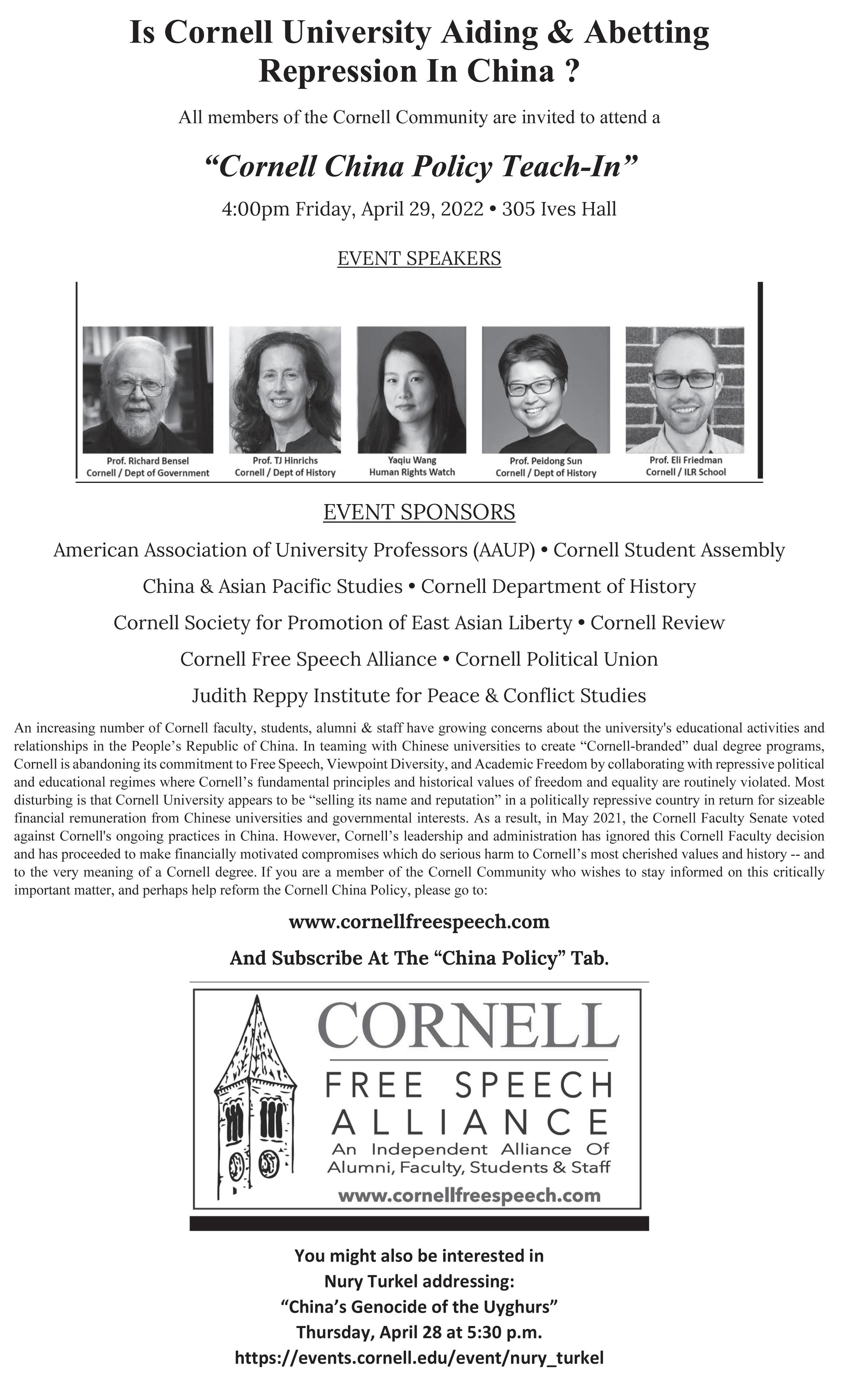
Speakers
Eli Friedman
Cornell Industrial & Labor Relations
TJ Hinrichs
Cornell Department of History
Peidong Sun
Cornell Department of History
Yaqiu Wang
Human Rights Watch
Moderator
Richard Bensel
Cornell Department of Government
Sponsors
American Association of University Professors (AAUP)
China & Asia-Pacific Studies
Cornell Department of History
Cornell Free Speech Alliance
Cornell Political Union
Cornell Review
Cornell Society for Promotion of East Asian Liberty
Judith Reppy Institute for Peace & Conflict Studies
Tuesday, April 26, 2022
Today
Econometrics Workshop: Thomas Russell, Carleton University 11:15 a.m. - 12:45 p.m., Uris Hall 498
Equity in Focus: Investing in Childcare Careers 12:30 p.m. - 2 p.m., Virtual Event
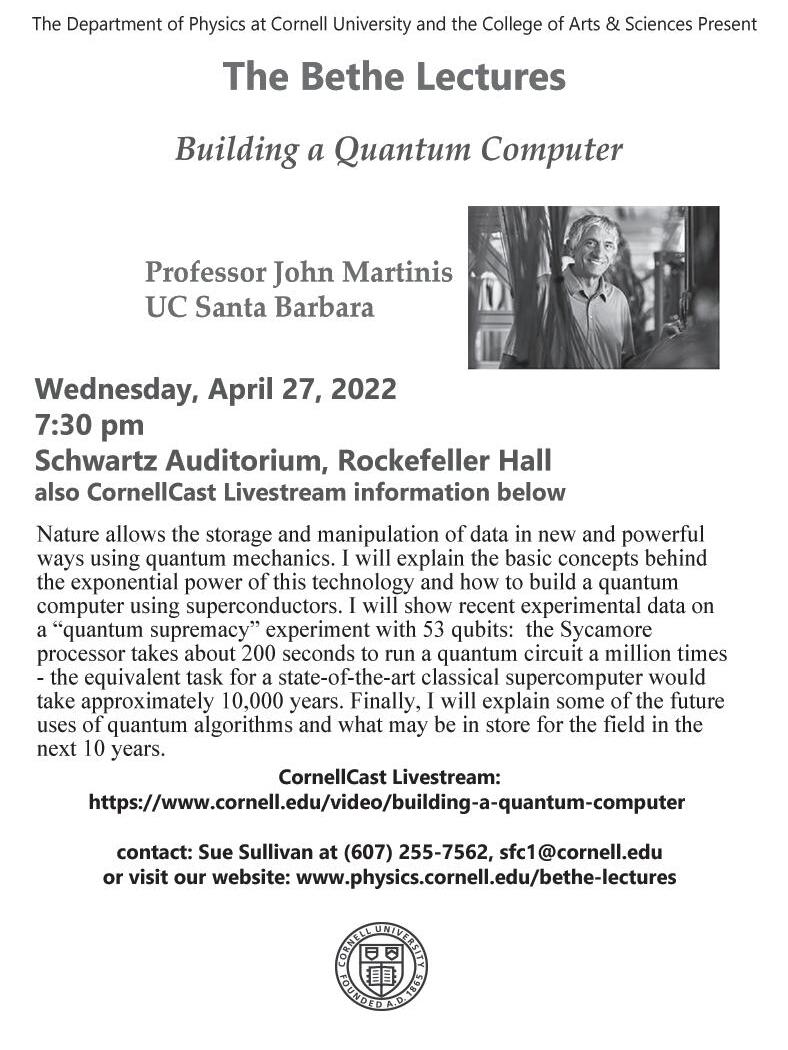
My Trek From Fundamental to Industrial Research: Quantum Systems Engineering With John Martinis 4 p.m., Clark Hall 700
Gallery Talk: Berenice Abbott With Susie Bright 4 p.m. - 5 p.m., Herbert F. Johnson Museum of Art
Ammons and the Falls 4 p.m. - 8 p.m., Schwartz Performing Arts Center
Storytelling With Chirine El Ansary 6 p.m. - 7 p.m., Virtual Event
The Corne¬ Daily Sun
Independent Since 1880 Working on Today’s
140th Editorial Board
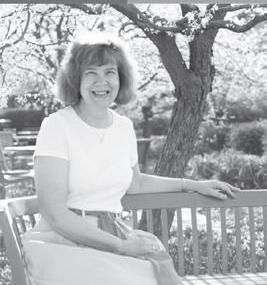
Sidnie White Crawford
Willa Cather Professor Emerita, University of Nebraska-Lincoln, and Visiting Scholar at Princeton Theological Seminary
Archaeology, Science & the Dead Sea Scrolls
A Library at Qumran? How to Identify a Library in the Ancient World
Scribes & Scrolls: Scribalism in the Ancient World & the Dead Sea Scrolls
The Public is Invited Register for the lectures: https://bit.ly/white-crawford-messenger
’23, Kumar ’24 Campaign
For Seat on Common Council
ELECTION
Continued from page 1
of the Democratic Socialists of America as well as the Working Families Party.
“[Kumar] strikes me as very intelligent and principled and committed to her values, which I think aligns very well with the WFP values,” said Stephanie Heslop, an Ithaca resident and Tompkins County WFP chair.
“I work at Starbucks here in Ithaca and the Collegetown workers walked out on Saturday because of unsafe working conditions and Tiffany was on the picket line with us,” Heslop said. “[With] her background as an activist and organizer, she has on-theground experience, fighting for policy to help working people such as Good Cause Eviction.”
Kumar expressed a desire to promote progressive policies if elected as alderperson.
“I think that that’s definitely going to be an uphill battle when it comes to more housing protections, but [in] having Right to Renew and Good Cause Eviction laws, the precedent has been set by other places in New York by other cities,” said Kumar. “It’s something that the city council should be responsible for; it’s something the local government has a responsibility to do.”
Kumar said she will run on the Working Family Party ticket in the general special election regardless of the outcome of the primary.
Mehler has been endorsed by several key city officials, including the current and the former mayor and every for-
mer Fourth Ward alderperson since 2014.
First Ward Alderperson
George McGonigal, a member of the Common Council, is another of Mehler’s endorsers, and said that Mehler is a good advocate for his ward.
“He listens to other points of view and he tries to take in how problems have arisen,” McGonigal said. “He tries to learn about the issues before he makes a decision, and I think that’s a real strong point.”
Graham Kerslick, current executive director of the Cornell Atkinson Sustainability Center and former Fourth Ward alderperson from 2012 to 2021, has also endorsed Mehler.
“I’ve worked for a short time with Patrick, but even in that period I recognized some of his most important qualities,” Kerslick said. “Like his enthusiasm to tackle challenging problems and his willingness to work with colleagues on Council on a whole range of issues, not ones that just affect students.”
Other organizations have expressed frustration with Mehler’s policies. The Ithaca Tenants Union has pursued the Right to Renew and Good Cause Eviction Bills, policies that would require the prioritization of current tenants when seeking to renew their leases and regulate the grounds on which landlords can pursue evictions.
Genevieve Rand, an organizer at the ITU, said that Mehler’s housing bill contained only a part of Good Cause Eviction, and fell short of the organization’s goals by removing enforcement mech-
anisms originally proposed.
Rand expressed support for Kumar’s campaign.
“[Kumar has] shown up to tenants rights and housing justice rallies for some time now, since long before the race for Ward Four was even a conversation,” said Rand. “It does really mean something when tenants are trying to demonstrate power, collectively and in public she would show up.”
DeFendini has also publicly endorsed Kumar saying that the Fourth Ward is a younger and more progressive ward that is ripe for change, which Kumar hopes to champion. Defendini noted the difference in political alignment between himself and Mehler, and said that while Mehler takes a pragmatic stance on issues, DeFendini is a self-described “outright progressive.”
“Tiffany is an organizer at heart and by trade, and I feel that you need someone with that organizing experience for this ward,” said DeFendini. “Building the solidarity slate, a lot of local groups came together, and it is a testament to how the people of Ithaca want this change to be reflected in the council, and Tiffany’s campaign does that.”
Mehler and Kumar now face off on the campaign trail in preparation for the democratic primary, with both collecting endorsements and support from their prospective constituents, as Kumar seeks to make up ground against her incumbent rival.
To continue reading this article, please visit cornellsun. com.
Slope Day Artist Lineup Draws
Excitement, Disappointment
SLOPE DAY
Continued from page 1
wish they had gone about collecting student opinions in a different way.”
However, several students, like Hanan Abraha ’23, expressed enthusiasm for this year’s lineup.
“I’m pretty satisfied with this year’s Slope Day artists,” Abraha said. “I am only familiar with Aminé, who is headlining, and I actually enjoy his music.”
Although Abraha said he looks forward to attending this year’s Slope Day, Yu and Smith expressed reduced excitement at going to the event following the reveal of the artists.
“I feel like a lot of us were excited for some big Slope Day comeback, since it’s the first time we’ve done it in-person in years,” Smith said. “But, that’s not really what happened.”
Regardless of the artists performing, many students — including Isabel Hou ’24 and Abraha — expressed excitement at experiencing an in-person Slope Day for the first time.
“I am still looking forward to my first Slope Day at Cornell,” Hou said. “I am excited that Slope Day is happening, and I’m excited to see how it turns out.”
Aimée Eicher can be reached at aeicher@cornellsun.com.
Profs Commute From Outside Ithaca
COMMUTER
Continued from page 1
nights or even numerous days stranded in the Syracuse Airport trying to fly home to his family due to snowstorms, and he has driven through deer-ridden terrain on Highway 88.
“I’ve definitely been on that stretch at dusk in the warmer months, and it’s a white-knuckle drive with deer and deer carcasses flying around everywhere,” Friedland said. “I do my best to avoid it, particularly at dusk, but that’s not always possible.”
Prof. Mark Jauquet, mathematics, has lived in numerous places during his time as a Cornell professor. Jauquet has moved closer to the University twice in the last 20 years
to shorten the commute to school for his children.
From 2002 to 2010, Jauquet lived in Romulus, New York, and drove to A-lot, a campus parking area located on North Campus, to park his car and then alternate using his bike and car to commute home.
From 2010 to 2018, Jauquet lived in EcoVillage and would drive to campus because he had to drop off his kids at school. He now lives in Downtown Ithaca and mostly walks to work.
“I now have a two mile walk to campus, which time-wise, 40 minutes, may be longer than others, but I love the walk,” Jauquet said. “This is the same as years back when it took me two hours to bike, which I did every other trip.”
Prof. Jodi Cohen,
communications, lives in Virgil, New York and drives to campus. Most of her drive is through the countryside, and she said that conditions often depend on weather and are season-dependent. For example, when farmers are out on the roads with their tractors or cattle, it slows down her commute.
However, Cohen has no plans to move closer to Cornell.
“I have not thought of moving closer as my partner teaches at Syracuse University and we purposely moved between our universities,” Cohen said. “Also, we like the quiet country, and the price of land and housing is more affordable than in Ithaca.”
To continue reading this article, please visit cornellsun.com.
& Mainstream Sellout Will Not Be Sold Out
On March 25, the rapper turned attempted punk rocker, Colson “Machine Gun Kelly” Baker, released his sixth studio album, Mainstream Sellout. The album is meant to serve as a homage to the pop punk scene of the 2000s, as well as being his own personal contribution to the genre some 20 years after its heyday.
Machine Gun Kelly has been flirting with the pop punk genre as far back as 2017, with his song, “Let Me Go.” This change in the cadence and lyrical content of his music was praised by critics and was something that I personally enjoyed. He capitalized on this new sound with his 2020 album, Tickets to My Downfall, whose cover art features him standing over an empty pool with a pink guitar in hand, both objects being solid references to early 2000s rock artists Avril Lavigne and The All American Rejects. There is no denying that he appreciates this genre and is probably the most prolific current mainstream proponent of it. Although he has made a valiant attempt at bringing attention to the genre, his own attempts at expanding it are not always appreciated.
Machine Gun Kelly has a history of making a name for himself in places where people think he doesn’t belong. For example, some said that he had no business starting beef with Marshall “Eminem” Mathers back in 2018, and he was also in a physical altercation with former two division UFC Champion, Connor McGregor, last September. Moreover, many
have claimed that he simply does not belong in the pop punk genre, something that he passionately argues against. As previously mentioned, I enjoyed his first foray into the pop punk scene back in 2020. I thought that it was a perfectly valid attempt at branching out, but his latest one just doesn’t impress me as much. When reviewing albums, I try to single out certain songs that I think of as really exemplary, but I just can’t do that here. Despite his broad range of collaborators, ranging from Gunna and Bring Me the Horizon, every song sounds generic, with a pacing that seems to waste its already brief runtime. Indeed, the songs that feature collaborations with other artists, especially “Maybe,” tend to be more solid than the ones where Kelly is singing by himself.
can get a true sense for the feelings that the artists are expressing in such a short span of time. This album feels more like the ramblings of someone who isn’t sure what they are trying to convey and are covering up that uncertainty with an overuse of guitar riffs.
The question that remains is a rather simple one, yet it never feels like it gets truly answered: what is Machine Gun Kelly doing here? That question isn’t
Pop punk is known for its fast paced rhythm and aggressive cadence, with artists such as Blink-182 and Green Day averaging around 160 beats per minute in their most popular songs. Most songs in Mainstream Sellout are a little bit slower, typically ranging from 142-95 beats per minute. Yet despite the slower pace, these shorter songs, often around two minutes long, seem like they’re wasting the precious time that they have been given. What makes other songs of the genre so impressive is that one
meant to imply that he doesn’t belong in the genre — far from it. People should feel welcome to create whatever they are able to. However, that doesn’t exempt them from criticism. I certainly could not write a better pop punk album than Machine Gun Kelly, but I can summarize the issues that I have with it. Let us return to the question of “what is Machine Gun Kelly doing here?” Every artist, whether explicit-
ly or implicitly, creates because something has compelled them to. And because of this, there is a message that can be found in the music. But there is no perceivable message here. Even improvisational music has a certain feel to it whereby you can tell if the artist is excited, depressed or something in between. This album simply exists. It exists like a handheld fan on a hot summer day: it might provide some temporary relief, but it will never feel like enough. Eventually it will be put back on the shelf, a forgotten knick-knack of a time filled with much more interesting things than a fan or this particular album.
Tom Sandford is a sophomore in the College of Arts and Sciences. He can be reached at tjs266@cornell.edu.
TOM SANDFORD SUN STAFF WRITER
COURTSY OF DANIEL DORSA / THE NEW YORK TIMES
The Corne¬ Daily Sun
Independent Since 1880
140th Editorial Board
VEE CIPPERMAN ’23
Editor in Chief
SERENA HUANG ’24
Business Manager
EMMA LEYNSE ’23
Associate Editor
SURITA BASU ’23
Assistant Managing Editor
NAOMI KOH ’23
Assistant Web Editor
ELI PALLRAND ’24
News Editor
ESTEE YI ’24
News Editor
KAYLA RIGGS ’24
City Editor
JULA NAGEL ’24
Photography Editor
MEHER BHATIA ’24
Science Editor
KATRIEN DE WAARD ’24
Production Editor
PAREESAY AFZAL ’24
Assistant News Editor
JIWOOK JUNG ’25
Assistant News Editor
ADITI HUKERIKAR ’23
Assistant Arts & Culture Editor
DANIELA WISE-ROJAS ’25
Dining Editor
JASON WU ’24
Assistant Photography Editor
GRAYSON RUHL ’24
Assistant Sports Editor
KEVIN CHENG ’25
Newsletter Editor
HANNAH ROSENBERG ’23
Senior Editor
Letter to the Editor
JYOTHSNA BOLLEDDULA ’23 Senior Editor
ANGELA BUNAY ’24 Managing Editor
DEVAN FLORES ’24 Web Editor
KATHERINE YAO ’23 Opinion Editor
ROMAN LAHAYE ’23
SOFIA RUBINSON ’24 News Editor
JOHN COLIE ’23 Arts & Culture Editor
GRACE KIM ’24 Dining Editor
AARON SNYDER ’23 Sports Editor
TENZIN KUNSANG ’25
ANDIE KIM ’24
AIMEE EICHER ’24
SARAH YOUNG ’24
NIHAR HEGDE ’24 Assistant Arts & Culture Editor CLAIRE LI ’24
Assistant Photography Editor
GABRIELLA PACITTO ’24
Assistant Sports Editor
RUTH ABRAHAM ’24
Assistant Sports Editor
DANIEL BERNSTEIN ’23 Senior Editor
MADELINE ROSENBERG ’23 Senior Editor
Re:‘Welcome to Cornell, Inc.’
To the Editor:
The article “Welcome to Cornell, Inc.” by John Monkovic ’24 raises many interesting ideas — some valid and others misinformed.
He is correct that “shared governance” has become “nothing more than a buzzword.” For most of Cornell’s history, the faculty ran the show with very few staff in the central administration. The Trustees delegated power to the President, the faculty and a few specialized boards.
In the turmoil of the 1960s, this changed. The Trustees delegated policy and budgetary control over what is now called Student and Campus Life to the University Senate, and the Senate also controlled the campus judicial system. Gradually, the Trustees and central administration clawed back power, until August 2021, when the last area of authority, the judicial system, was removed and given to Day Hall. The Senate, which provided an opportunity for students, faculty and staff to work together, was shifted to a much smaller University Assembly and separate groups for undergraduates, graduate students, employees and faculty. The current Student Assembly lacks the credibility and maturity of a group that has a large number of older and more experienced members — the S.A.’s only remaining power is the allocation of the student activity fee.
I agree with Monkovic that so many Board-elected Trustees is unhealthy and makes the Board self-perpetuating. When the Senate Constitution was adopted in 1970, it called for 10 alumni-elected trustees, five student trustees, four faculty trustees, a non-tenured faculty trustee, a faculty trustee elected by the student body and four community trustees elected by the Senate. An employee trustee was quickly added. The plan was to replace the Trustee-elected trustees with this group, but the Board added seats rather than replace existing seats when taking the plan to the Legislature. When community interest waned, the Board later reduced these seats to their present level.
Monkovic shows a fundamental misunderstanding of Cornell’s nature. We are a hybrid of a public university and a private one — the only such member of the Ivy League. Four of our colleges are units of SUNY, operating in state-owned buildings and receiving annual appropriations from the NYS Legislature. We also operate the Cooperative Extension program that serves every county in New York. This brings much more public accountability than occurs at Harvard or Yale.
Monkovic is also wrong about our endowment, which is better measured on a per student basis. Harvard has a $1,648,721.12 endowment per full time student; Princeton has $3,407,138.28; Yale has $2,304,579.36; and Cornell is at the bottom of the Ivies with only $284,715.92. So, Cornell is much more dependent upon grants and annual alumni donations.
Cornell’s endowment consists of more than 8,000 separate accounts that represent promises to 8,000 donors that their funds will be used for the designated purpose in perpetuity. In addition, Cornell invests deferred giving plans with the promise to pay some retirement savings back to donors or their spouses. It would be immoral to take and repurpose this money for other “spoils to the masses” purposes. Each endowment account is targeted for scholarships, faculty salaries, building upkeep or other designated purposes, and the diversity of these funds makes Cornell unique. The payout from the endowment to the 8,000 accounts provides about 10 percent of the operating revenues for the Ithaca campus and 7 percent of Cornell’s total operating revenues.
As a whole, Cornell has kept to Erza’s “radical vision,” but endowment spending must be true to the vision of each of its 8,000 donors.
Robert C. Platt ’73 law ’76
Noah Do
Noah’s Arc
Noah Do is a sophomore in the College of Human Ecology. He can be reached at ndo@cornellsun.com. Noah’s Arc runs every other Monday this semester.
Dream Girl
So you’re finally getting to that age, huh? All of a sudden you feel a little tingle in your stomach whenever that cute classmate goes up to the board to solve an equation. Before you know it, you start to care more about which clothes your mom lays out for you to wear everyday. Your little hands start to shake when you think of sharing a juice box with that special classmate, who, until now, was considered an icky vector for cooties. Well, why don’t you sit down and let your favorite opinion columnist tell you a little something about dating and its many faces.
Maybe my tongue-in-cheek hypothetical is lost on readers who have presumably long graduated from the days of passing notes and confessing crushes. When it comes to dating, the bar for romantic legitimacy rises with every step towards adulthood. As college students, we can look back and cringe at the awkward pubescent experiments which clogged up the hallway traffic with unending games of tongue wrestling. Now is when we can finally start dating for real.
Even if we tell ourselves that our relationships are suddenly more real-life than they were in high school, clearly the obstacles to a happy relationship don’t get any easier to overcome. As college students, we’ve lived such a small percentage of our lives that trying to assess whether someone would make an adequate life partner can feel like a pointless endeavor. With the added legitimacy of grown-up dating comes increased pressure, as the decisions we make about dating become more reflective of what kind of person we will end up with as fully-fledged adults.
The system of modern dating and marriage in-and-of itself is confounding in that a commitment we make in our young adulthood is expected to last until we die. We’re meant to immediately transition from the freedom of dating to living monogamously. That sudden change cannot be natural, no matter how many months’ salary you spend on the ring. There’s a lot of pressure during the dating phase to emulate some semblance of a lifelong partnership. Relationships come with stakes, an understanding that one wrong move could leave either of you questioning where it all went wrong in between spoonfuls of Haagen-Däzs.
Practically, dating doesn’t really mean much because the circumstances of your relationship don’t magically transform once you arbitrarily declare that you are dating. It’s not like you’re deciding to live together or share the responsibility of a child. For whatever reason, entering a relationship with someone sets up mental tripwires — suddenly, every little interaction becomes far more important than the day-to-day mingling with friends. It’s not like anything has changed that’s really increased your stock in your partner’s life. You’ve just both decided that you’re going to care about each other more from now on because, hey, why not?
I don’t mean all this to say that romance as a whole is arbitrary. Romance
is a life-long process that can single-handedly make or break your happiness. As a student, my primary goal right now is working toward a career, but I believe that my life will be defined far, far more by my future partner and family than by which corporate oligarchy I choose to sell my Big Red soul to.
I am admittedly also guilty of the pitfalls of romanticizing romance. As put-together and independently-minded as I may seem to all of you, I occasionally partake in K-drama fantasies, complete with passionate love triangles and heart-wrenchingly adorable nighttime walks between the male and female leads. No one is immune to the indulgences of fantastical, star-crossed fantasies of love. I have some conception of what my ideal partner is like, but I won’t pretend to know what kind of person the universe intends for me to confess my feelings to under the fireworks.
At the end of the day, we all just want to find someone to grow old with. The problem is that there’s no good litmus test for partnership, no way to know what it’d be like to spend every minute of every day with someone without actually spending every minute of every day with them. What we need to be doing is assessing compatibility and learning about the kinds of people we can be most comfortable around. Romantic intimacy doesn’t exactly have a place in that process, besides the fact that we’re all lonely and just want some way to numb the stress of daily life.
The main vice of dating is that it’s an inherently emotional process. In a time when we should be exploring and meeting new people, we tend to get caught up in shallow attractions and invest all of our attention into one person we’ve designated as “the one.” In that way, dating isn’t so much a way of finding your perfect match as it is a distraction from it. The chances of landing on the right person early on are so low that the risk of closing yourself off to that one person is just not a wise decision, at least for me.
My dream girl is just that — a dream, obscured by the mist of reality meant to protect us from the tragedy of idealism. She belongs in my imagination, a symptom of the temporary single-hood of the discovery process. It doesn’t matter so much the traits that I imagine for her, since it’s not like I know the first thing about lifelong partnership, anyway.
Maybe I’m putting too much stock in my general belief that the universe has a way of working these things out, but I don’t feel any real desire to be in a relationship because I can’t see how it would be productive to my actual goal. The exclusivity of a 1-on-1 romance feels like more of a quick fix to loneliness than a real attempt to get to know someone. If I’m genuinely interested in someone, I’ll be willing to invest in a long-term friendship first rather than test my odds at an unnecessary gamble of commitment and feelings. Unless, of course, I have my magical K-drama firework confession moment, in which case it’s game on.
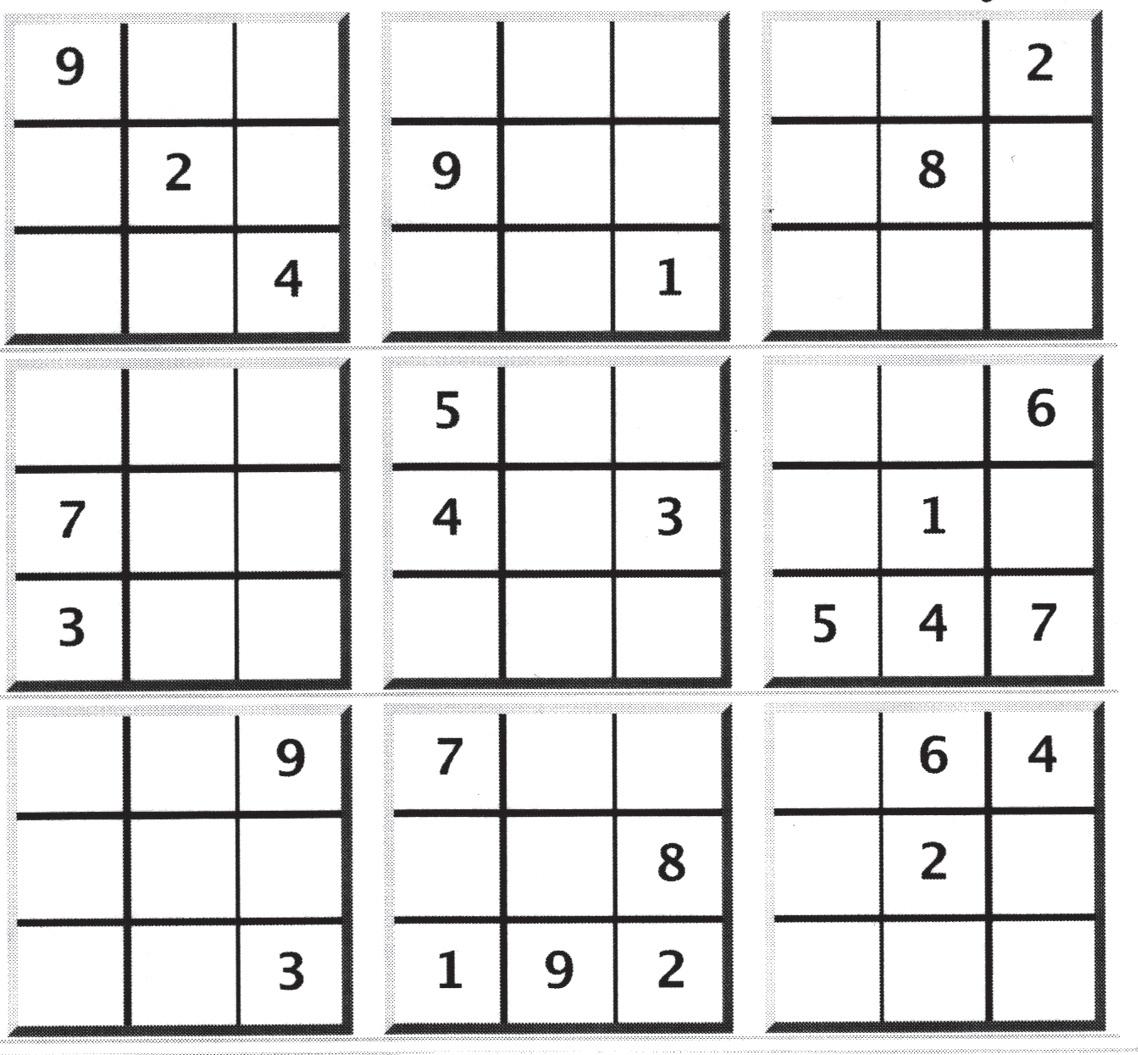
Fill in the empty cells, one number in each, so that each column, row, and region contains the numbers 1-9 exactly once. Each number in the solution therefore occurs only once in each of the three “directions,” hence the “single numbers” implied by the puzzle’s name. (Rules from wikipedia.org/wiki/ Sudoku)
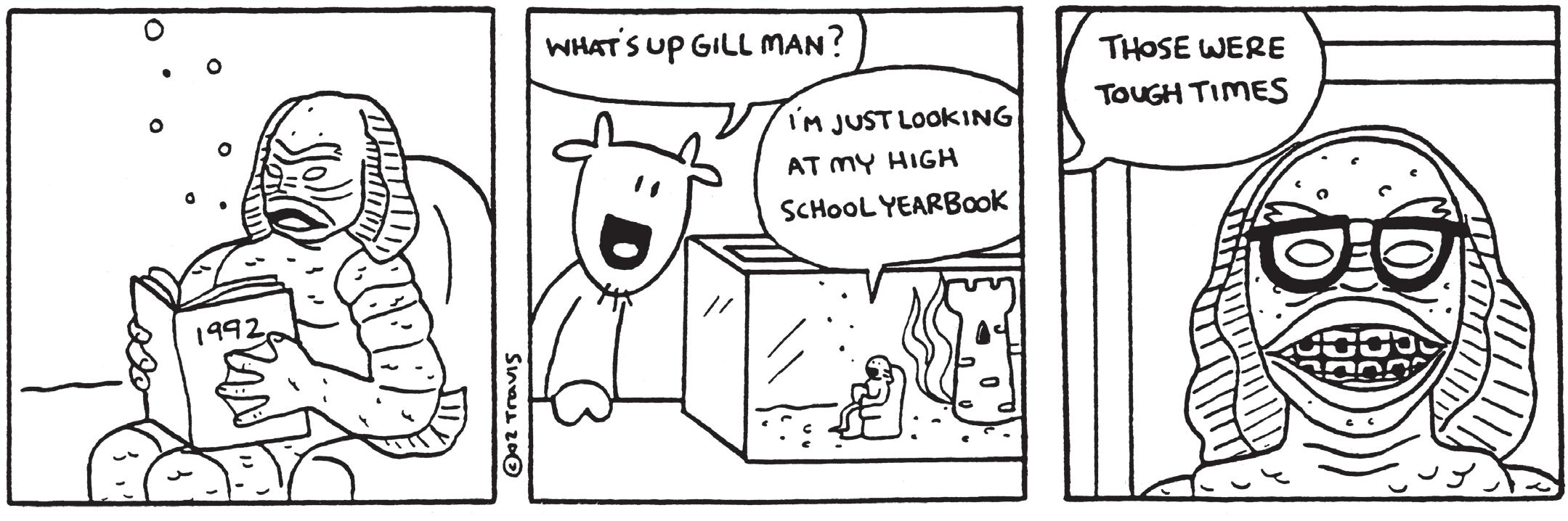
I Am Going to Be Small
Mr. Gnu by Travis Dandro
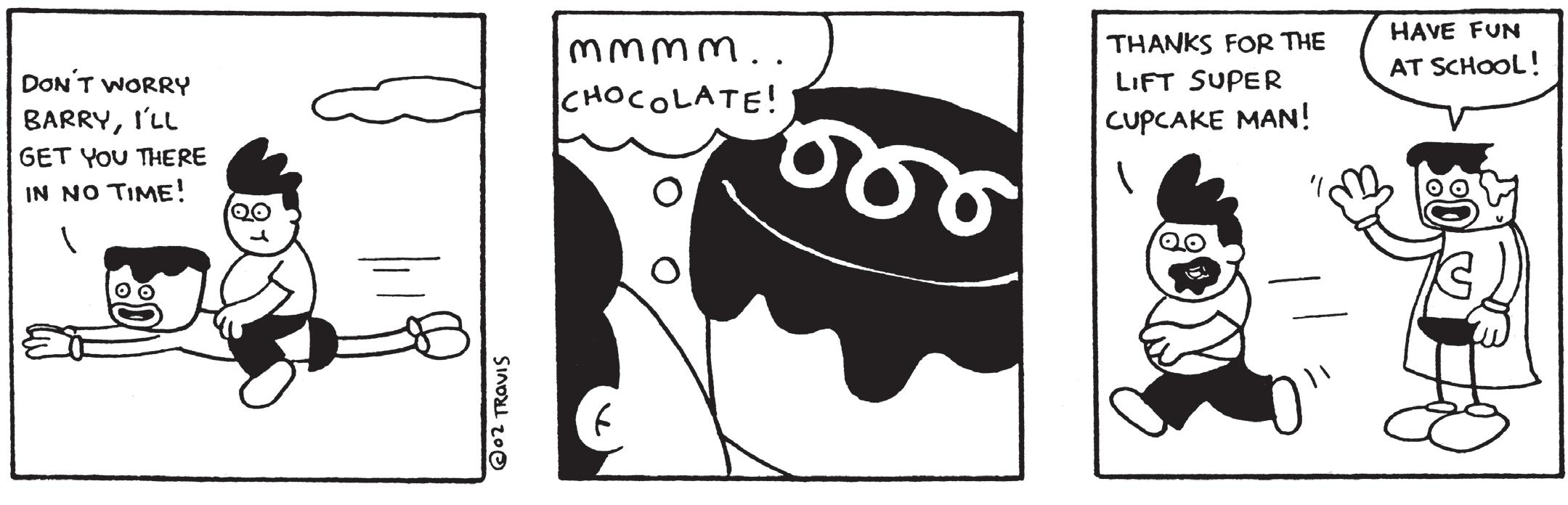
Mr. Gnu by Travis Dandro
BASEBALL
Red Sufers Defeat at Hands of Dartmouth
By ALYSON WONG Sun Staff Writer
Coming off a comeback walk-off victory against Binghamton last Wednesday, baseball (9-20, 4-11 Ivy) looked to build momentum as it hosted Dartmouth (19-14, 10-5 Ivy) this weekend at Hoy Field.
The team went on to split a doubleheader on Saturday and dropped the third game on Sunday in a closely fought, back-and-forth finale.
The Red’s offense broke out in game one of Saturday’s doubleheader, totaling 12 runs. Four players, freshman first-baseman Max Jensen, grad left-fielder Jason Apostle, junior right-fielder Sam Kaplan and sophomore designated hitter/catcher Nathan Waugh, all blasted home runs.
By the end of the fourth inning, Cornell held a commanding 8-0 lead. But, Dartmouth put up a good fight. They scored four runs in the sixth to cut the lead in half, and three more in the ninth. However, the Red continued on with a win, 12-7.
“I thought we hit really well this weekend,” said freshman relief pitcher and shortstop Ryan Porter, who recorded 4 RBI over the weekend and went 3-5 in the final game.
In game two, Dartmouth flipped the script and scored 12 runs. The Red’s offense was shut down by the opposing starting pitcher Trystan Sarcone, who threw eight innings, conceded only two runs and struck out ten Cornell batters.
“Their…pitcher in the second game, he
was effective at off-speed pitches,” Porter said. “Overall, they’re a really good hitting team so it puts a lot of pressure on the defense.”
Over the course of the series, the Red recorded five errors, while Dartmouth only recorded one.
In the rubber game on Sunday, Cornell’s offense got off to a hot start. They took an early 4-0 lead by the end of the third inning and tacked on three more points courtesy of an error by the Dartmouth right fielder, giving the Red a solid 7-2 lead. However, in the top of the fifth, the Green rallied to tie the game at seven a-piece with an RBI double, a three-run homer, and an RBI single. They then went on to score a go-ahead run with an RBI triple in the top sixth.
Not going down without a fight, one of the Red’s hottest hitters, Kaplan, hit a game-tying solo homer in the bottom of the seventh to tie the game, 8-8. This was Kaplan’s third homer of the series. However, the tied score did not last long. In the top of the eighth, Dartmouth scored the go-ahead run off of a wild pitch from senior reliever Kevin Cushing. They went on to tack on another insurance run in the top ninth with an RBI single, finalizing the Dartmouth victory, 10-8.
“I think overall the team played really well,” Porter said. “I think…we had instances where we pitched well, hit well, fielded well –– just overall, we didn’t put it together enough to win all three games. But, we did
MEN’S ROWING
have a lot of bright spots.”
Looking ahead to next weekend, Cornell will host No. 1 Columbia (22-13, 13-2 Ivy). With only a couple Ivy series left, the team still hopes to improve in all facets of the game.
“I think just polishing up [and] putting it all together,” Porter said on improvements to be made. “Pitching as effectively as possible, no walks, and putting the ball in play when we’re hitting, [and] putting pressure on their defense.”
Game one of Saturday’s doubleheader begins at 11:30 a.m., with game two scheduled for 2:30 p.m. The series finale will take place at noon on Sunday, May 1.
can be reached at awong@cornellsun.com..
Lightweight Rowing Continues Tree-Win Streak
By
On Saturday, men’s lightweight rowing won all four of their races against Princeton, claiming both the Platt and Harriet Cups.
During Saturday’s races, the Red took off with vigor, aware of Princeton’s notoriety for tough battles.
“Traveling to Princeton, driving down Nassau Street and on the tree-lined Washington
Road, and then arriving at their
tightly contested league.”
The Red, however, allowed few chances for the Tigers to advance. During the race for the Platt cup, the Red raced neck and neck with Princeton, eventually securing first place with a time of 5:38.5, a mere three second differential.
In the later races, the time margins were widened, with Cornell winning the second Varsity 8 with a time of 5:44.4, four seconds ahead of Princeton. The third Varsity 8 was won by 10 seconds, and the day was rounded off with the fourth Varsity 8 defeating the Tigers once more with a lead of 22 seconds.
The Red also secured the Harriet Cup, by achieving the most team points throughout the course of the competition. Kerber partially attributes the team’s recent successes to the team dynamics and the efforts put in during the off season.
“There are no gimmies in our tightly contested league.”
Head Coach Christopher Kerber
“Team chemistry, cohesion and culture are paramount,” Kerber wrote in an email to The Sun. “Saturday, we were primed, given all the physical work we put in over spring break and building our chemistry. Our work will continue both in and out of the boat, complementing our grinding training sessions.”
In the remainder of the season, the team plans on attacking each race with an awareness of the challenge and competition present within the Ivy League.
“It would have been too easy to assume that we could ride through the COVID competition break on the back of our 2019 success as National Champions,” Kerber wrote. “Our training environments and ‘modeling the way’ emphasis were interrupted during the height of the pandemic, then rebooted in September and amplified moving forward. We committed to the adage ‘don’t make any assumptions.’”
The team will look to continue their string of success when they travel to Hanover, New Hampshire on Saturday, April 30, where they will face off against Dartmouth for the Baggaley Bowl at 8 a.m.
and well
to race,” wrote
boathouse on the shore of Lake Carnegie is deceptive and belies a highly
Coach Christopher Kerber in an email to The Sun. “There are no gimmies in our
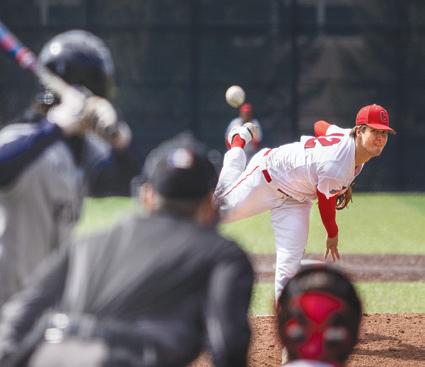
Fast one | Luke Yacinch ’22 puts up a strong front while pitching during Cornell’s first game against Yale at Hoy Field on April 2.
iconic
skilled
prepared Princeton Crew eager
Head
ANNA HOOPER Sun Staff Writer
Alyson Wong
Head-to-head | Cornell won all four races by slight second differential finishing times.
Anna Hooper can be reached at ahooper@cornellsun.com.