The Corne¬ Daily Sun


increase diversity of both the undergraduate and graduate student bodies.
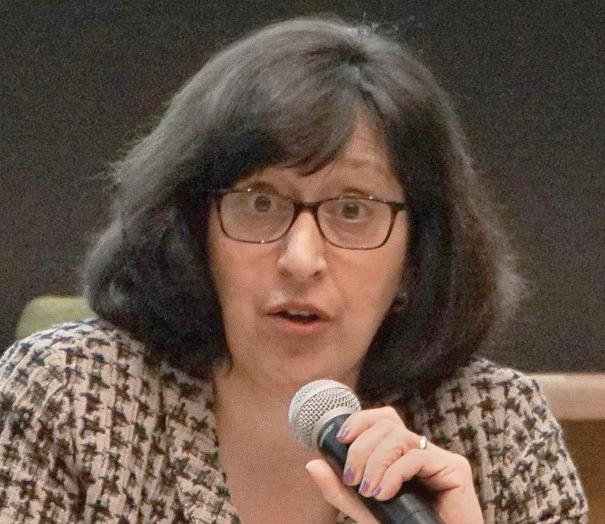
President Martha E. Pollack ran through a laundry list of ongoing initiatives at the Graduate and Professional Student Assembly on Monday, including efforts to improve mental health, provide more assistance for international students and students with disabilities, and
She said during the meeting that the initiatives she detailed just “scratched the surface” of all the ongoing projects within the graduate school.
According to Pollack, graduate students have experienced a disproportionate number of referrals to outside sources, and she said the administration does
“recognize that and are changing that.” Pollack elaborated on Cornell’s mental health initiative, which she had outlined at previous GPSA meetings. These initiatives included expanding Cornell’s Counseling and Psychiatry services to include three more therapists and more scheduled times for walk-in appoint-
By SARAH SKINNER
It’s a bird, it’s a plane, it’s a — drone? Upstate New York may see more of the electronic aircraft in the near future, as an alumnus-run company takes to the skies with a $1 million grand prize grant from the GENIUS NY competition.
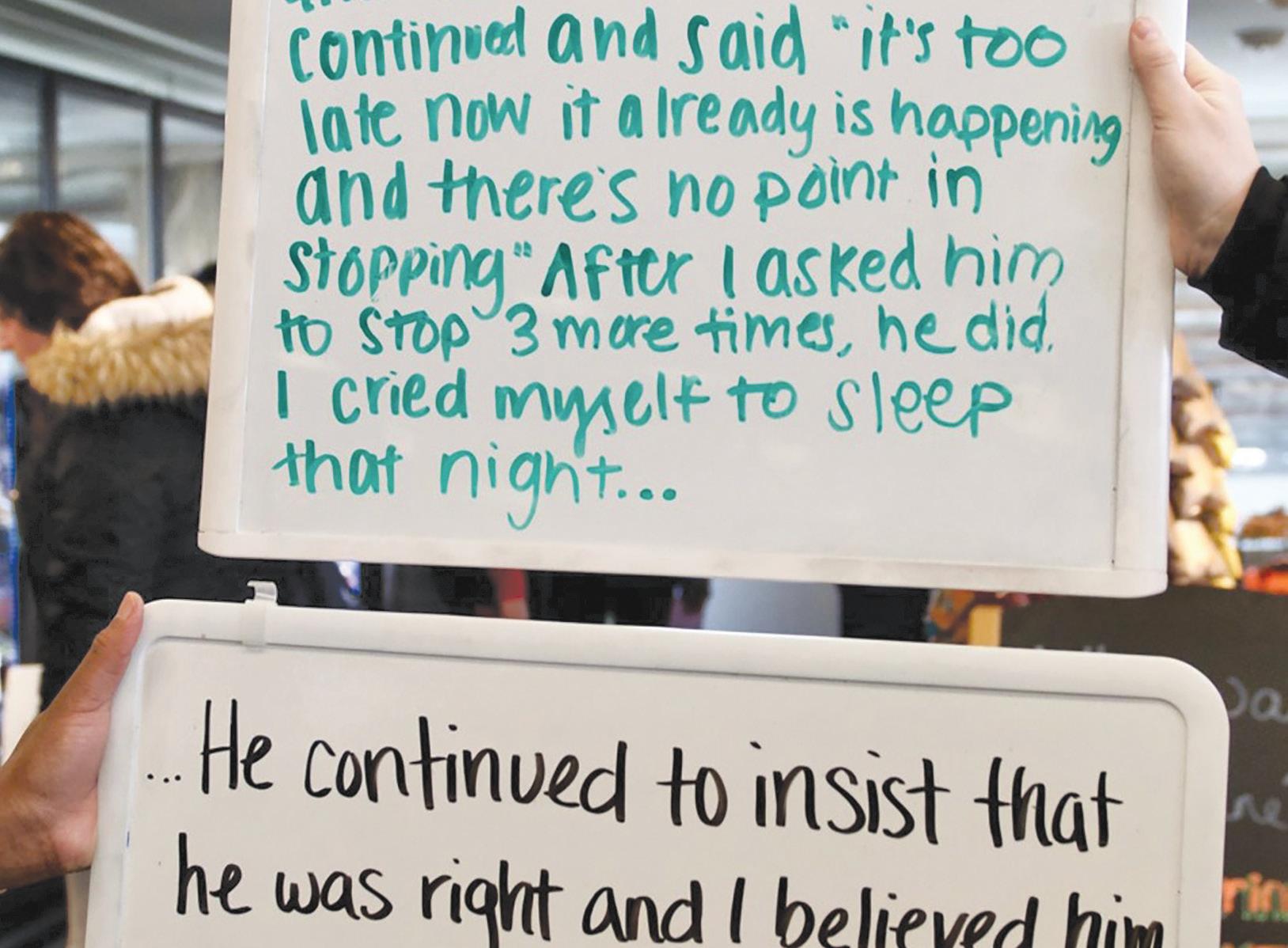
In October, it was revealed that Cornell University has the highest number of reported sexual assault incidents among New York State colleges. In 2017, a campus climate survey detailed that 55 percent of Cornell students had experienced sexual harassment. Sexual Assault Awareness Week, starting on April 29, aims to change these statistics.
Slated for its fifth iteration, the week is marked by a series of community events, curated to increase awareness of sexually related harassment on campus. This year, the week incorporated a different approach for outreach, according to
Five teams pitched projects to a panel of judges in Syracuse last month, and Italian firm Sentient Blue — founded by Saïf-Deen Akanni ’90 — emerged with the top bid. The state-sponsored award goes to initiatives to up the development of unmanned systems technology within New York in hopes of boosting the economy as well.

Sentient Blue was founded in Parma, Italy, in 2017, according to its website, and has since expanded out of Europe and into the United States. The company lists its main goal as the development of “efficient, more environmentally friendly micro gas turbine based power plants,” which can be used in unmanned aerial vehicles — drones.
These microturbines loosely mimic larger ones found in jet aircraft, while employing techniques to
Marissa Block ’19, co-lead on the planning committee.
“Something [we] were trying to do this year is to make sure everyone has a place in this discussion,” Block told The Sun. “[We are] reaching out to different groups on campus who would not hear about this ordinarily.”
This includes discussions with campus leaders from a wide array of academic, cultural, sports and pre-professional organizations, Block said.
Renee Odom ’20, president of ConsentEd, explained that club leadership structures play a role in the prevalence of sexual assault.
“A lot of students have come forward about leaders in organizations
having assaulted or coerced them,” Odom said, adding that this topic has often been “handled incorrectly or insensitively” in the past. A discussion on May 1 will highlight this issue in particular.
The main takeaway, Block said, is for students to realize why it’s important to bring everyone into the discussion. The week sets goals for both awareness and change, including creating “action items” after each event, according to Block.
Some of the events for the week show the intention of widening outreach. Coordinators will screen an episode of the popular documentary series Surviving R. Kelly on

and Rights of Immigration 4:30 p.m., 165 McGraw Hall
Sekou Cooke: Hip-Hop Architecture 5:15 p.m., Milstein Auditorium, Milstein Hall
Finance and Sustainability Colloquium: Niki Armacost 6 - 7:15 p.m., B09 Sage Hall
“The Devil’s Pink Cloak”: A Reading and Discussion With Mas’ud Hamdan 7:30 p.m., Film Forum, Schwartz Center for Performing Arts
2nd Annual Cornell Organic Symposium 1 - 5 p.m., G10 Biotechnology Building
A Conversation With Oskar Eustis: Theater and Democracy 5 - 6 p.m., Kiplinger Theater, Schwartz Center for Performing Arts
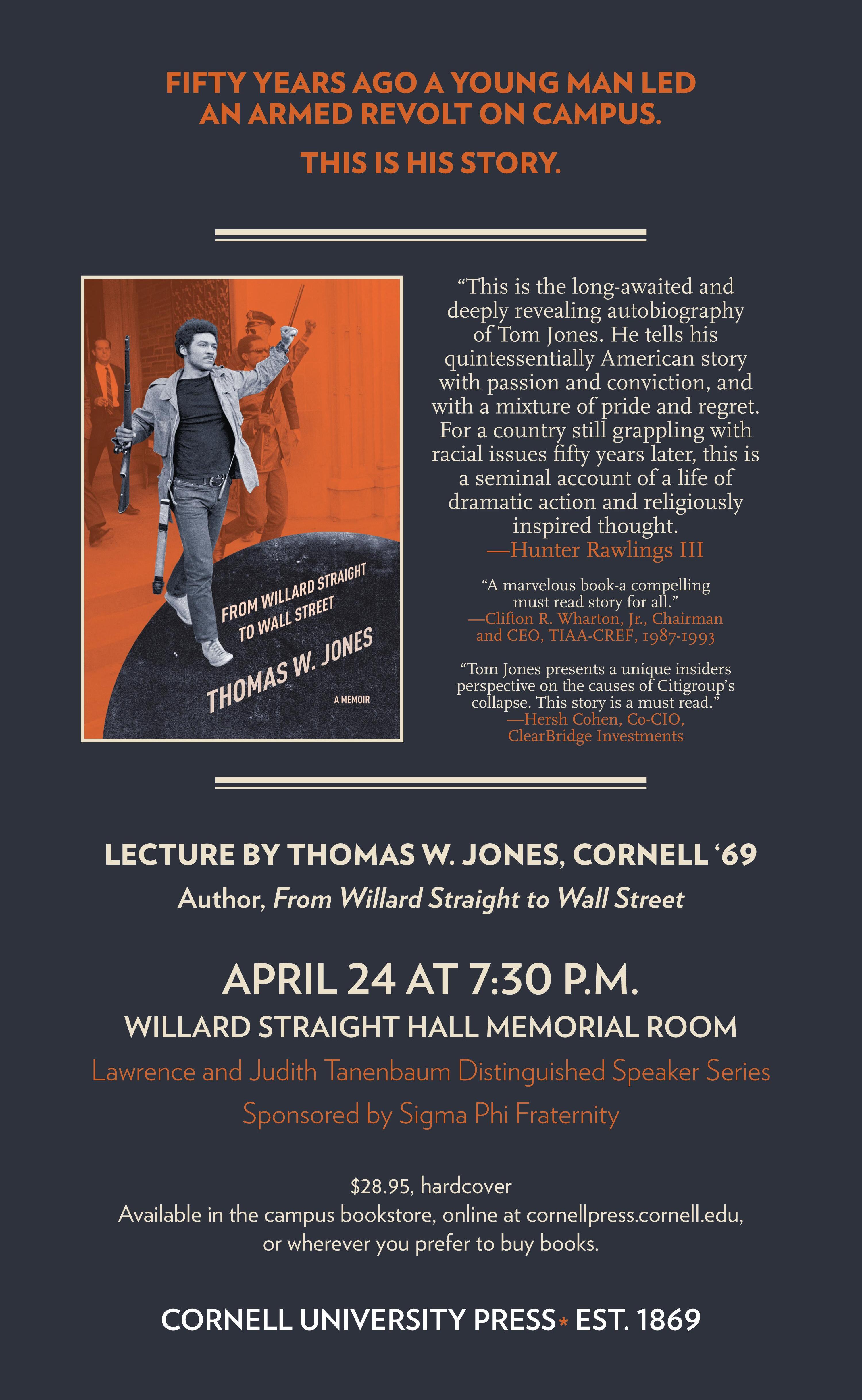
From Willard Straight to Wall Street and Back: An Evening With Tom Jones ’69 8 p.m., Memorial Room, Willard Straight Hall
Applications are now available for STUDENT MEMBERS OF THE ACADEMIC INTEGRITY HEARING BOARD & EDUCATIONAL POLICY COMMITTEE
Apply on-line http://data.arts.cornell.edu/elec/
Applications due Friday, April 26
Elections will be held on May 6 and May 7

Fine Arts Library Service to Be Temporarily Discontinued
In anticipation of the Mui Ho Fine Arts Library’s inauguration on Aug. 5, certain fine arts materials will not be available from May 20 to Aug 5. During this period, those seeking to check out selected books will be redirected to links to the Borrow Direct or Interlibrary Loan on the online library catalog. Students will be able to access desired books through the “request item” function of the online library catalog and have them delivered to other libraries on campus until the Mui Ho Fine Arts library opens. As of now, the Fine Arts Library, located in B56 Sibley Hall, is slated to close operations on July 26. Fine arts librarians will continue to be available for consultation throughout the service interruption period, according to a University press release.
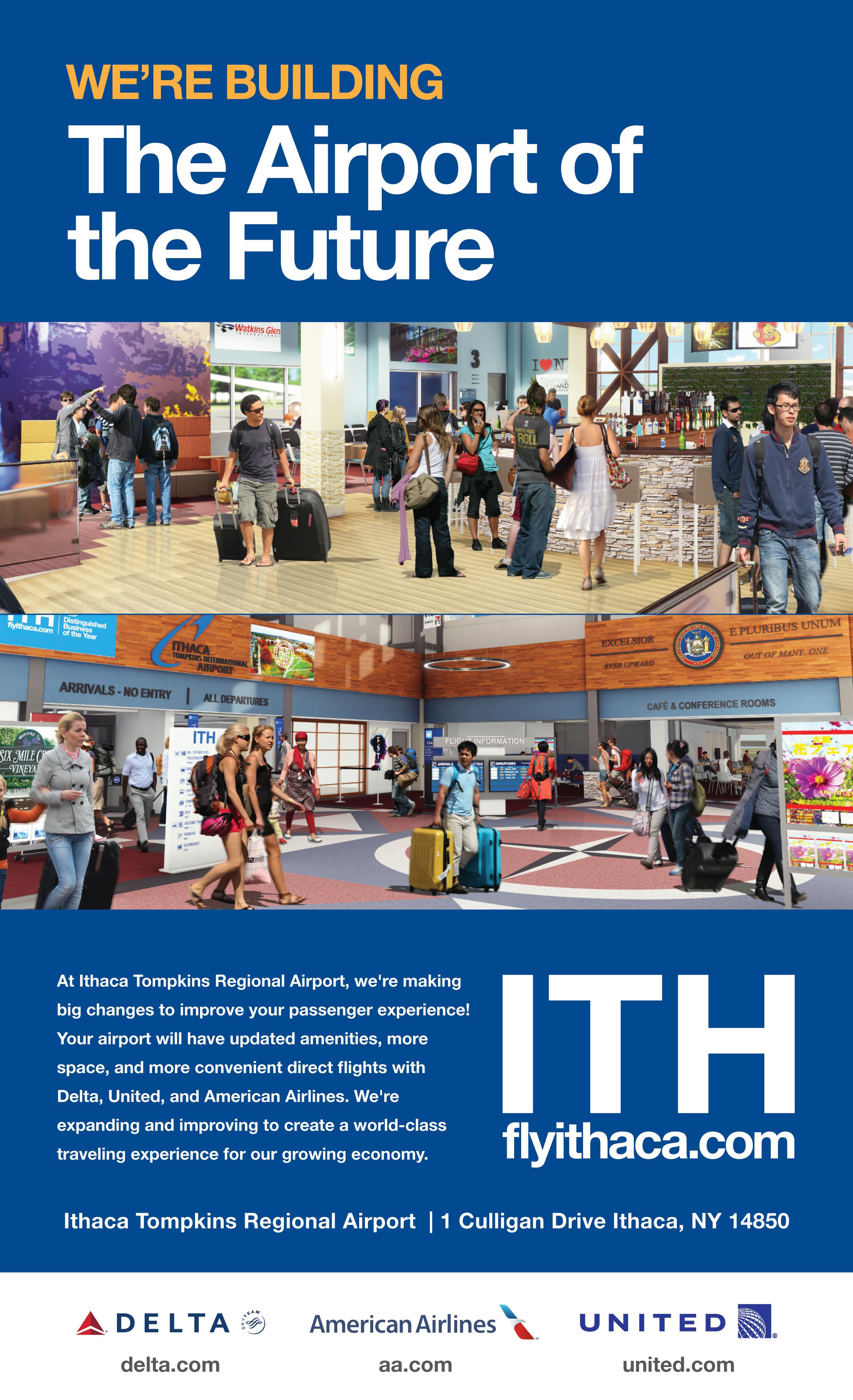
The expansions at Ithaca Tompkins Regional Airport have moved into the second phase of development, Airport Director Mike Hall told The Ithaca Times. The replacement of the outdoor canopy is almost complete and the second phase will focus on the renovations to the new departure and arrival terminals. Hall told the Times that the renovations will give the airport a more “traditional feel,” including the addition of four jet bridges. The second phase, which includes about two-thirds of the work, will cost $18.6 million, while the entire project is estimated to be completed in late November or early December of this year, the Times reported.
The Supreme Court announced on Monday that it will hear cases about employment discrimination against LGBT individuals beginning in October. The Court will determine whether Title VII of the Civil Rights Act of 1964, which prohibits discrimination based on sex, also extends to protect gay and transgender people. Two of the suits were brought by men — a skydiving instructor and child welfare services coordinator — who claim they were fired for being gay. The third was brought by a funeral home employee who was fired after she told her employer she was transgender. The Trump Administration has previously argued that Title VII does not protect individuals from discrimination based on gender identity or sexual orientation.
– Compiled by Vale Lewis ’21 and Shivani Sanghani ’20
Honor society recognizes students’ scholarship for promoting diversity
By SHIVANI SANGHANI Sun Assistant News Editor
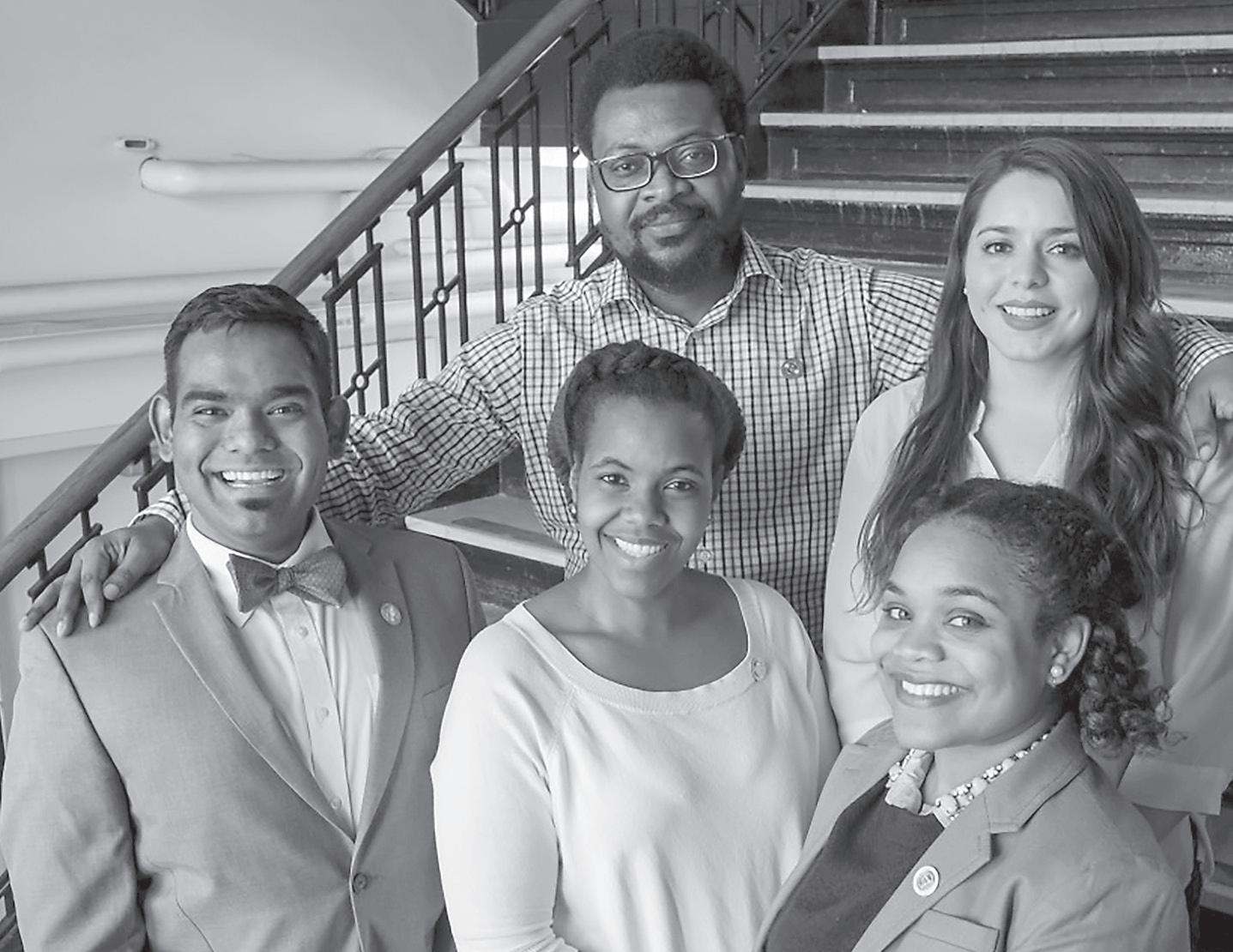
Five Cornellians were inducted into the Edward Alexander Bouchet Graduate Honor Society — which recognizes outstanding scholarship and promotes diversity and distinction in doctoral education and the professoriate — at Yale University from April 5 to 7.
Among Cornell’s 2019 Bouchet scholars are Elaigwu Ameh grad, Lory Henderson grad, Marysol Luna grad, Aravind Natarajan grad and Monet Roberts grad.
Ameh, who studies performing and media arts, conducts research that merges theater for “social change, human displacement, black studies, gender mainstreaming and performance theory to give voice to those who are underrepresented,” according to a University press release.
from
“Being a Bouchet scholar is embracing the vocation to serve humanity better and to create a better world for all, irrespective of our existential affiliations,” Ameh said in the statement. “It’s about a call to empathetic action driven by an unapologetic pursuit of the common good.”
A graduate student in microbiology, Henderson was recognized for her research on contamination in the dairy industry and how to adapt processing mechanisms to reduce health risks.
Luna, who is pursuing a Ph.D. degree in mechanical engineering, researches the development of osteoarthritis, the most common form of arthritis, and how it impacts the
mechanical performance of the bone.
Natarajan, a doctoral candidate in microbiology, was honored for his research that employs E. coli bacteria to alleviate thalassemia, leukemia and malaria.
Pursuing a Ph.D. in biomedical engineering, Roberts was recognized for her research merging engineering and medicine, particu-
By SARAH SKINNER Sun Managing Editor
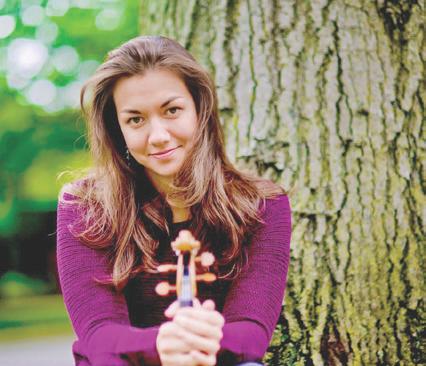
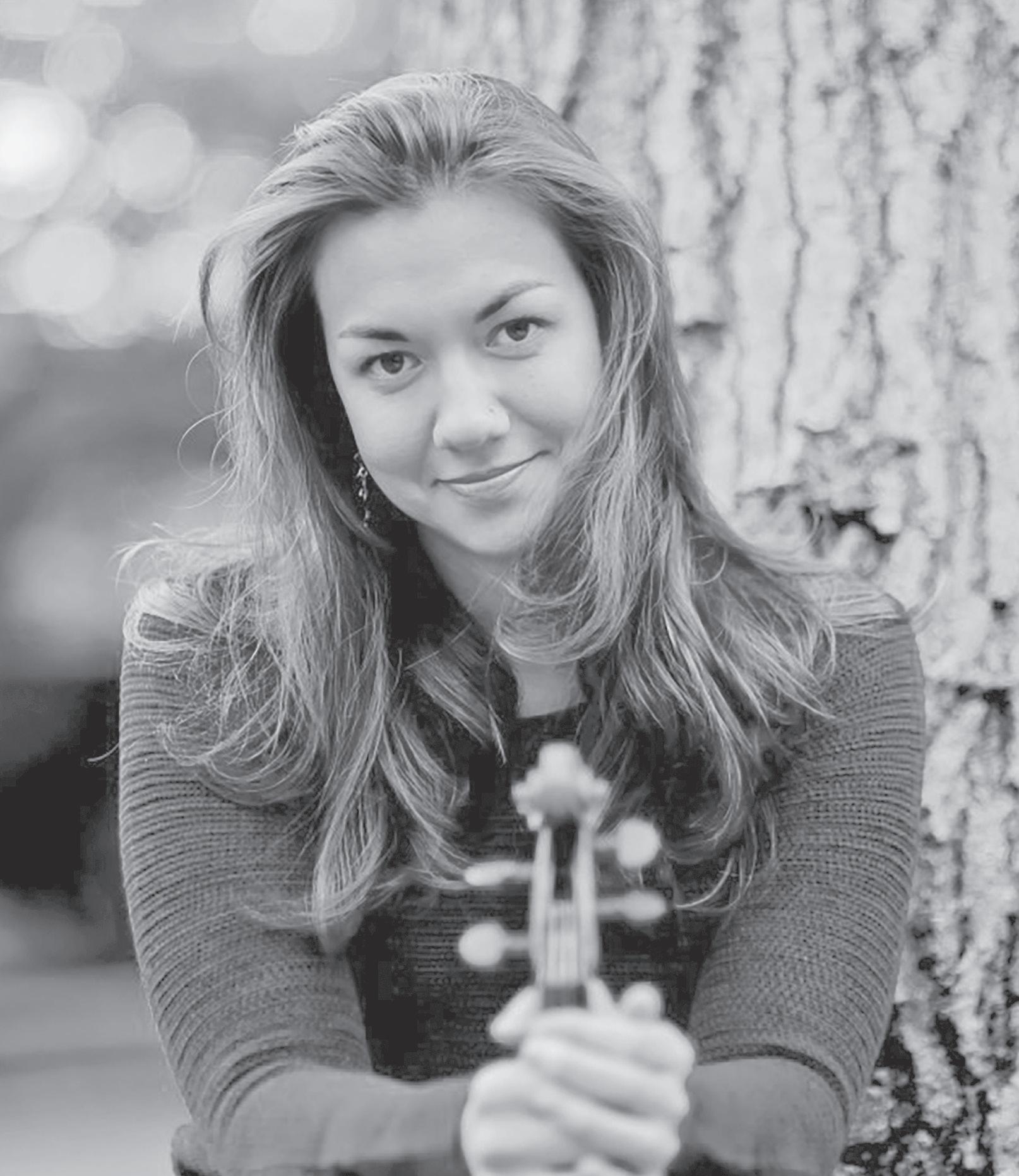
On Tuesday night, Prof. Ariana Kim, music — who has spent time in residence at places from New York to Italy — will serenade an audience in a more familiar location: The Carriage House Cafe.
Kim is a Grammy-nominated violinist and teacher who has been awarded some of music’s top prizes. When performing violin as part of the Aizuri Quartet last spring, Kim clinched a $100,000 check, a record deal for the quartet and one of competitive music’s top honors: the University of Michigan’s M-Prize.
nomination in 2018 for Best Chamber Music/Small Ensemble Performance.
Constant remodelling in both art and life has been key to Kim’s development as a performer, artist and educator.
“Music transcends. Hearing is the first sense that we develop in the womb. It makes the world smaller in a good way.”
Kim’s parents are both music educators as well, her father at the University of Minnesota and her mother at a local music school. Minnesota still holds strong roots for Kim, who returns every year to perform with the Chamber Orchestra of Minnesota.
Prof. Ariana Kim
“It was a huge honor and distinction,” Kim recalled, speaking to The Sun by phone after her win last year. The competition involves both traditional performance competition aspects as well as workshops, community engagement with local children and questions about the groups’ intentions to pass on music to the next generation.
Though the M-Prize is fairly new, Kim said, “when it came around, it blew everything else out of the water.”
In the months following the win, the Aizuri Quartet — whose name is drawn from traditional Japanese woodblock printing, done in shades of ink from blue to indigo — recorded and fine-tuned their album blueprinting before its release in September. The unusual title is not just a play on words but also a nod to the way humans construct themselves and their art in many layers and as a continual process, according to Kim. The album picked up a Grammy
Growing up, music was far more than just a hobby in the Kim home. It was normal to hear nothing of a sibling or parent for hours but music through the walls of the practice room. Conversations around the dinner table also wrapped around music, Kim told The Sun.
“[Music] was, in my house, such an all-around part,” Kim said. “In a way it’s overwhelming. Creative juices are constantly flowing … it became almost a spiritual thing.”
This “spirit” of music served Kim well as she earned her bachelor’s of music from the San Francisco Conservatory of Music, and her master’s and doctoral degree in music from Julliard, both top schools in classical performance. However, in keeping with her holistic philosophy, many of her individual pursuits have been interdisciplinary work across cultures, languages and walks of life.
Kim has performed in underprivileged schools around the country as well as in women’s prisons, and spent six months of 2016 on sabbatical in Brescia, Italy, working with North African refugees on a Cornell
Council for the Arts grant. There, she hosted workshops and open salons, encouraging refugees to embrace traditional instruments and music from their homes in a collaborative setting.
Though the refugees spoke many different languages and came from wide-ranging backgrounds, they were able to reach a commonplace through musical and artistic expression, Kim said. She tied her experience together in a project entitled “Le storie di vita nel legno,” or “The Stories of Life On Wood.”
“Music transcends. Hearing is the first sense that we develop in the womb,” Kim said last year. “It makes the world smaller in a good way.”
Despite performing all over the world and garnering some of the most sought-after acco-
lades in her profession, Kim finds something unique in teachingclasses in music performance at Cornell.
“It’s a different craft,” she told The Sun in July. “I learn so much from [my students] — teaching, the need to figure it out. I couldn’t envision my life as not being a performer, not being an educator.”
Kim said last year that one of her favorite parts of teaching was the variety of students she is able to connect with through their passion for the arts.
“I love teaching my music majors,” Kim said last year. “I love just as much teaching the engineers and the medical students.”
She said she loves those

Continued from page 3
non-music majors because of their passion for the arts — because they are “there for the love of it.” Even if her non-majors leave Cornell and never touch an instrument again, Kim knows that music will follow them regardless as they become the “next generation of connoisseurs.”
Kim also performs with The Knights in New York City, and will perform with the Aizuri Quartet in a chamber opera based on the Tale of Genji, a traditional Japanese folktale, next month. Over the last six years, Kim has performed more than 40 concerts at Cornell and in the Ithaca area.
Her next concert will be a team-up with local pianist Kerry Mizrahi, and will feature a blend of work by Bach, Brahms and Gershwin as well as American folk music. The show kicks off at Carriage House Cafe at 8 p.m. on Tuesday.
Sarah Skinner can be reached at sskinner@cornellsun.com.
Continued from page 3
larly the causes of cancer-derived microvesicles.
Named after Edward Alexander Bouchet, the first African American man to receive a doctorate from an American university in 1876, the Bouchet Society seeks to foster a network of scholars who have traditionally been underrepresented in academia.
The sixth person in the Western hemisphere to earn a doctorate in physics, Bouchet was also one of the first African American to be admitted to the famed Phi Beta Kappa Honor Society.
The society’s co-founders, Yale University and Howard University, sought to recognize scholars who exemplify five characteristics — scholarship, leadership, character, service and advocacy.
The society now boasts chapters at more than 15 universities across the U.S., including Emory University, Northwestern University and the University of Florida, among others.
“We all aspire to be the giants whose shoulders others can stand upon and, with this new network of movers and shakers, we can leverage our connections to get closer to that goal day by day,” Roberts said.
Shivani Sanghani can be reached at ssanghani@cornellsun.com.
AWARENESS
Continued from page 1
April 30. On May 2, Support a Friend will teach students how to respond to a friend’s disclosure of sexual assault — “something that you don’t know you need to know until it happens,” Block said.
Events this week will strive to break some stigmas around sexual assault, Odom said.
“One stereotype we see is that sexual assault is often generalized as fraternity man against drunk women, and while that’s really common, that's not [exclusively it], and we want to elevate all victims and survivors on campus to have a seat at the table,” Odom said.
As Odom elaborated, broadening awareness of who experiences sexual assault is one of the week’s aims, stating “gender non-conforming folks are highly, highly victimized … and we need to call attention [to this fact].”
Sexual Assault Awareness Weak will take place from April 29, culminating in a rally on May 3. A full list of events can be found on Sexual Assault Awareness Week’s Facebook page.
Editor’s note: Alec Giufurta is a ConsentEd Ambassador. ConsentEd is a sponsoring organization of Sexual Assault Awareness Week.
Alec Giufurta can be reached at agiufurta@cornellsun.com.
DRONES
Continued from page 1
increase efficiency and cut down on fuel, according to Sentient Blue’s website.
Akanni earned his undergraduate degree in engineering at Cornell’s Ithaca campus before studying in London. He described the feeling of returning to New York as “coming home” to the Cornell Chronicle, a University-run publication.
Akanni, who is also the CEO and chief technology officer of his company, called nomination for the award a “milestone” in a Sentient Blue press release after finalists were announced in December.
The company’s research and development facilities will be based in both Syracuse and Rome, New York, according to the Chronicle, from where it will seek to grow its presence in the region. The GENIUS NY prize stipulates that winners must run operations out of central New York for a year at minimum.
In total, GENIUS NY awarded $3 million, splitting an addition $2 million between four finalists at half a million dollars each. The program is administered by The Tech Garden and CenterState CEO in Syracuse.
Sarah Skinner can be reached at sskinner@cornellsun.com.
ments. She also mentioned the construction of support groups for graduate students on health leave but did not provide more details.
Pollack also addressed the increased need for support for teachers and teaching assistants, saying that the University is “committed to excellence in research and teaching” and will hold workshops through the Center for Teaching Innovation and the Center for the Integration of Research, Teaching, Learning.
Despite the unprecedented rates of diversity in the incoming undergraduate Class of 2023, Pollack highlighted a desire to increase recruitment and retention rates, especially for international students and students with disabilities. She expressed concern with how the current presidential administration’s volatile immigration policies will affect international students’ ability to study in the
U.S.
Pollack said she hopes to continue to make graduate and professional programs more affordable by looking to build more scholarship opportunities out of the University’s endowment. In response to this year’s increase in tuition, “we’ve increased financial aid at a pace so that no undergraduate who is on aid sees an increase in tuition,” Pollack said.
In addition to diversity in demographics, Pollack encouraged graduate students to engage with others outside of their areas of study and emphasized the importance of “intellectual diversity.”
“The one time I went to the Big Red Barn, it was great, there were a million students there, they were drinking beer, they were having a great time and I walked over to one table and everybody at that table was from plant science,” she said, “And I walked to the next table and everybody at that table was from physics.”
Pollack also addressed The

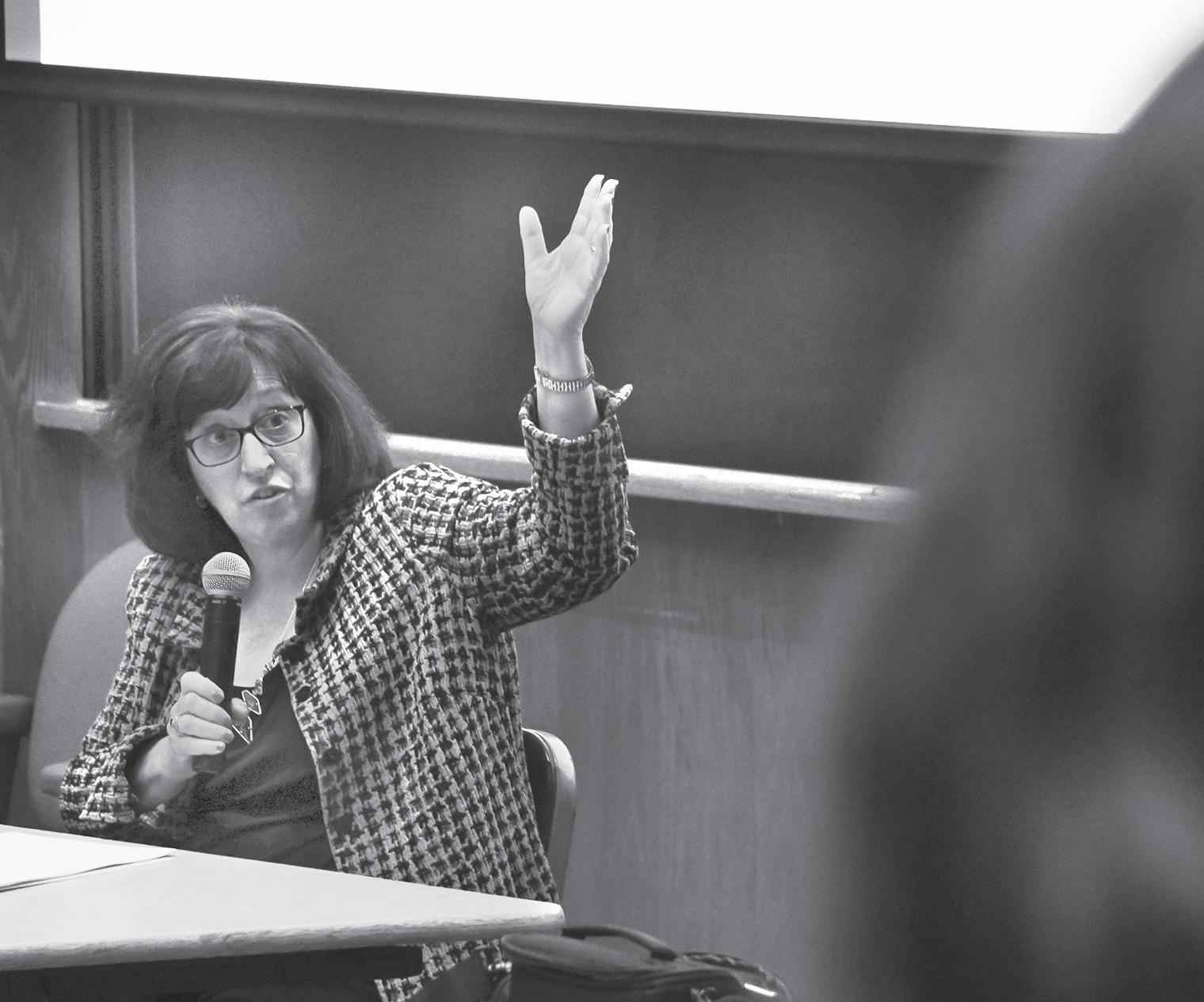
Scratching the surface | President Pollack outlined a list of initiatives, including mental health reform and increasing intellectual diversity, but did not elaborate on the details.
Sun’s recent criticisms of her brief public statements to the Cornell community regarding a swastika found on the Arts Quad, the massacre that took place in Sri Lanka, and the shootings at two mosques in New Zealand. “When I don’t make a statement, people criticize it, when I do make a statement, they count the number of words,” she said.
Olivia Weinberg can be reached at oweinberg@cornellsun.com.
’20
DAHLIA WILSON ’19
Business Manager
PARIS GHAZI ’21
Associate Editor
NATALIE FUNG ’20
Web Editor
SABRINA XIE ’21
Design Editor
NOAH HARRELSON ’21
Blogs Editor
SHRIYA PERATI ’21
Science Editor
KATIE ZHANG ’21
Dining Editor
AMINA KILPATRICK ’21 News Editor
JOHNATHAN STIMPSON ’21
PETER BUONANNO ’21
Arts & Entertainment Editor
ANYI CHENG ’21 Assistant News Editor
HUNTER SEITZ ’20 Assistant News Editor
CHRISTINA BULKELEY ’21
Assistant Sports Editor
JING JIANG ’21
Assistant Photography Editor
JEREMY MARKUS ’22
Assistant Arts & Entertainment Editor
ALICIA WANG ’21 Graphics and Sketch Editor
DANA CHAN ’21
RYAN RICHARDSON ’21 Snapchat Editor
ALISHA GUPTA ’20
SHRUTI JUNEJA ’20
Editor
AMOL RAJESH ’20 Senior Editor
SARAH SKINNER ’21
MEREDITH LIU ’20
RAPHY GENDLER ’21
Editor
BORIS TSANG ’21
Editor
KRISCH ’21
SOPHIE REYNOLDS ’20
Editor
AMANDA H. CRONIN ’21
ROCHELLE LI ’21
MARYAM ZAFAR ’21
ETHAN WU ’21
Editor
SHIVANI SANGHANI ’20
NICOLE ZHU ’21
Assistant News Editor
MILES HENSHAW ’20
Assistant Sports Editor
BEN PARKER ’22
Assistant Photography Editor
DANIEL MORAN ’21
Assistant Arts & Entertainment Editor
LEI LEI WU ’21
Layout Editor
EMMA WANG ’20
Multimedia Editor
LEANN McDOWALL ’21
Newsletter Editor
GIRISHA ARORA ’20
Senior Editor
BREANNE FLEER ’20
Senior Editor
KATIE SIMS ’20
Senior Editor

Ionce sat in on a college info session, where a stereotype named Jessica gushed about her love for the musicals she’d produced at her university. I don’t remember her major; I don’t remember the others who’d spoken on the panel; I don’t even remember the university where this took place. But I remember Jessica’s presumed willingness to die for her college, and the musically inclined students she led. I remember the life in her eyes when she described the fulfillment student leadership awarded her. It was a true college love story, which inspired and nauseated me simultaneously. Four or five years down the line, I now resemble Jessica. A few executive board positions, presidencies and speeches at events have dotted the important moments of my college career. Student leadership has been good to me, I tell visiting students, a message that reassures them but feels expected. At meetings over coffee, I grind my teeth to avoid oversharing — but the truth spills out, regardless: Student leadership is not always rewarding. Most students taking on leadership roles are not doing this in only one area. The president of one club is on the executive board of another, and the self-induced pressure can be difficult to handle. As a student leader, my best day can entail the follow-through on an idea for a new event; an average day can mean I kept my club alive on campus; a bad day can mean I lost funding — and you can guess which one gets noticed the most. It can be difficult to keep one’s spirits up while holding down so much responsibility. As college students navigate the process of becoming self-sufficient adults, their willingness to challenge themselves is often met with immense pressure to maintain decadeslong Cornell traditions.
sonal growth. My boss from my first job — working in the kitchen of a pediatric facility in my hometown — stays in touch. “You know what I really like about you,” she says over text, “[is that] you take advantage of every opportunity that comes your way.” Her encouragement emulates an aspect of myself I find critical to my identity. I carry it close with me, through every challenge that may be just beyond reach.
The truth spills out, regardless: Student leadership is not always rewarding.
On a college campus, students often feel compelled to turn interests into dedications.
At the same time, students may not always be looking for a challenge. Shockingly, their commitments may be born of genuine passion. On a college campus, however, students often feel compelled to turn that interest into dedication, and a hobby begins to feel more like a chore. In my senior spring at Cornell, I chose to make time for myself by upping my extracurricular interests while stabilizing my final academic requirements. Yet the deadlines imposed by clubs can often feel more taxing than those set by coursework, and I choose to prioritize the pressures of a gala, concert or exhibit opening over the stress of an impending group project. It’s not the smartest move for a senior approaching her graduation, but it follows where my passions lie. I resolve to get it all done — and done well — somehow.
Thus, despite some stress, my passions haven’t died out, although I do feel as though something lacks from my experiences. Cornell could do more to support its student leadership, although I recognize some organizations may inevitably benefit from stronger encouragement than those in which I’m involved. Nevertheless, a leadership position can feel like a full-time job where I lack the qualifications and received barely any training; I slack and take breaks in the form of homework and classes. Without committed administration, an institution fails, but a university fails altogether when it neglects to support the students that work tirelessly to keep it afloat. If my extracurricular engagements collapsed altogether, I wonder if their downfall would make any dent at all in Cornell’s foundation.
The pitfalls and sense of doubt, however, are far less significant than the benefits of my commitments. I don’t emulate Jessica because I’m dishonest. Through years of hard work, I’ve learned how to keep up with my email inbox, speak slightly less awkwardly before a crowd, maintain keen organization, meet deadlines at all costs and, on occasion, have a backbone where it counts. Moreover, I’ve connected, I’ve understood, I’ve been patient, I’ve been creative, I’ve persevered, I’ve found confidence and I’ve used compassion — for others and for myself.
The most succinct definition of student leadership I’ve found was when a friend explained that his commitment to our club allowed him to find confidence in being himself. I hadn’t recognized how it resonated with me until someone else said it. It’s not until you’re leading others — while being weird or nerdy or neurotic — that you come to accept you can lead yourself.
During a high school graduation ceremony in 2015, I gave a speech I called “The Importance of Being Optimistic,” and it centered on how this quality
Without committed administration, an institution fails, but a university fails altogether when it neglects to support the students that work tirelessly to keep it afloat.
allowed me to connect and grow and stay focused on my future. In college, this mentality has had the potential to get me into trouble, as I set unreasonable goals, but unreasonable has never meant unattainable. I’ll never regret choosing another meeting or rehearsal or hour of work over another episode of Netflix. But everything needs balance.
It’s hardly my place to complain, however. I signed up for this. And while a bit of soul-searching could probably help me handle my tendency to overcommit, a student leader like myself maintains unreasonable goals for the sake of per-
Victoria Pietsch is a senior in the College of Human Ecology. She can be reached at vpietsch@cornellsun.com. Fancy Pants runs every other Monday this semester.
Laura DeMassa & Canaan Delgado | Double Take
How did we all get to Cornell University? Top grades. A towering G.P.A. Add in a little bit of philanthropy. Insert one or two “exotic” experiences. Throw in a unique talent, bonus points for medal-winning debate, athletics or chess ability. Given our “holistic” admissions process, it seems we all got to Cornell with varying recipes of the same repertoire of experience.
Granted, this is expected in an institution where high grades and academic scholarship is a must. What follows, however, is a rigid logic of success in college. The logic goes as such: Grab a fancy internship out of freshman year; get an even flashier one out of sophomore year; lock in a premier internship out of junior year and set yourself up for a return offer after graduation. Consequently, as the logic narrates, one missed summer internship is like a fatal Jenga move — all comes tumbling down, one’s future included.
This rigid logic of success is implicit, embedded in our daily happenings.
This logic is implicit, embedded in our daily happenings. It’s a creeping anxiety and looming pressure to conform, or else risk being left undesired in the labor pool. Yet, the reality is that this is a false logic. One summer — or even multiple — outside of the set internship-to-job pipeline will not foil your future. Instead, it will allow for enough enrichment, independent thinking, creativity and self-directed exploration that will set one apart in a sea full of like candidates.
There are a plethora of opportunities for students to undertake. Let’s start with Cornell itself. These are the fast and few years in which we can fully take part in all that Cornell has to offer, summer included. One can stay on campus where there is a whole host of courses to take, leadership programs, language programs, Outdoor Odyssey trips, research opportunities and the like (most with funding available). Off-campus, Cornell has much to offer as well: art studios in Rome, European politics in Turin, language-learning in Madrid, law courses in Paris, language programs in China and marine exploration at Shoals Laboratory (again, most with funding available). In each of these programs, one directs their own learning, steps out of their comfort zone and carves out their own unique set of experiences.
being home with family.
It’s important to reflect on what’s best for ourselves.
It’s important to reflect on what’s best for ourselves. Maybe after being slammed with school work from August to May, what we really need is a break. There’s much to be said about a campus culture that while increasingly recognizing the salience of mental health and wellness, nonetheless demands a totalizing and toxic notion of career success. In the end, our choice for how to spend the summer should be an introspective one, not one we assume from external social pressures.
Instead of being left to define for ourselves what “fulfilling” means, it is too often dictated to us. This comes in many variations. Sure, some enjoy straight-forward, career-focused internships, but the dominant narrative that makes internships a prerequisite for success precludes anyone from otherwise defining it for themselves. A fulfilling summer to some may mean doing social work, mentoring youth, leading a summer camp, working with a professor on research, designing one’s own project or startup, writing a book at home, joining a band, going backpacking with friends or
Instead of defining for ourselves what “fulfilling” means, it is too often dictated to us.
Many of us didn’t arrive at Cornell knowing what career we wanted to pursue. When asked where we would see ourselves in five years, our answers were fuzzy and undefined. However, our most informative and meaningful experiences are often the ones we never envisioned for ourselves, the ones right off the beaten path, the ones unparalleled and unique to only ourselves. There is a sense of confidence, poise and richness of character that emanates from those who diverge from the set path, the path we’ve been spoon-fed to follow for years. We could all benefit from a little time to think for ourselves and spend one of our last remaining free summers in a way that we will cherish.
Laura DeMassa and Canaan Delgado are sophomores at Cornell University. Tey can be reached at demassa-delgado@ cornellsun.com. Double Take appears every other Tuesday.
This upcoming weekend, Cornell will host the fourth annual Ivy League Mental Health Conference, where delegates from all the Ivy League schools come together to discuss the state of mental health on our campuses. Considering Ivy League schools recently got slapped with a D or worse by the Ruderman Family Foundation for our leave of absence policies, there’s a sense of urgency in rectifying the mistakes we made. If we’re really among the best schools in the nation, it’s time we act like it.
Cornell Minds Matter has been the driving force in organizing the conference, brainstorming, making calls, asking for funding. As a small part of the organization, I’ve gotten a first-hand view of the planning for the conference. It’s a big gathering, hosting 100 attendees, with the hope that the conference will spark meaningful conversations regarding mental health. Planning logistics has also been rough, considering the club is trying to organize travel from every Ivy League School to Ithaca. (Planning travel from Dartmouth was especially perplexing. It was like one of those philosophical questions snide professors ask: How do you go from the middle of nowhere to the middle of nowhere?)
William Wang | Willpower On Mental Health
type to address these issues growing up, willing to deflect these issues at the cost of saving face. Maybe it’s the general Asian American apathy to mental health, where admitting such issues meant something was defective about you. Or maybe it was our family, which was entwined with acting in China, simply having a natural affinity for putting on a happy face when we felt otherwise. The act was more important than the machinations underneath. Either way, it wasn’t productive to fixing whatever issues we had going on swirling inside our heads, and lately, I’m starting to see the damage it’s caused.
oppressively tangible. But verbalizing it, to turn it from abstract thoughts to three-dimensional waves, actualizes the problem, forces us to confront it instead of letting it fester. There’s power in speaking truth, as painful as it may be.
A month ago, one friend verbalized the omnipresence of our angst when after a miserable prelim week she wryly said, “Any Person, Any Suffering.”
It’s especially pronounced here. Cornell has a way of compounding our miseries and peeling off our outer faces. A month ago, one of my friends verbalized the omnipresence of our angst when after a miserable prelim week she wryly said, “Any Person, Any Suffering.”
There’s a sense of urgency in rectifying the mistakes we made. If we’re really among the best schools in the nation, it’s time we act like it.
But through it all, as the organization has begun to put pieces in place, pulling resources and support from the community and debating meaningful topics to address at the conference, I’ve been fidgeting with my own perspective on mental health. I’ve been sometimes described as “over the top,” “too exuberant” and “cartoonishly happy.” That might be hard to reconcile with my far less energetic writing, but it’s really just who I am — hyper, tireless, aimlessly positive, vacantly cheerful.
But the last year has been a sharply unsettling change of pace for me, where I’ve been changing moods like I change outfits. It’s bad. It’s pushed me to start calling CAPS despite their DMV-esque wait times because I’m sure it’s a much better alternative to sitting empty-eyed at 3 AM in a deserted Duffield Hall, wondering how a mood swing was able to completely tank my day. I blame my happy face. My family wasn’t really the
I rolled my eyes when she said that. “That’s like, the most Cornellian thing I’ve ever heard.” But maybe it’s indicative of Cornell and the culture we’ve created here, where jokes about mental health are casual throwaway lines, where depression isn’t so much a condition but a gag. It’s a shrug and a nervous laugh personified: Depression is just another on a long list of troubles we have to endure, like a cryptic professor or a speeding ticket. It’s a slap in the face to those who have to deal with it on a daily basis.
So being part of CMM over the past year at a time when mental health awareness has become an increasingly hot-button issue has me re-evaluating what one person on campus can accomplish. In the grand scheme of things, it’s not much, unfortunately. There’s too much going on at once for an individual to have an outsized impact. But in our friend groups, we each have a part to play, a line to spout, an elegy to say. It has come to a head when I’ve gone through the ups and downs of being my own therapist and being an emotional cushion for those who need it. Sitting down and having a meaningful conversation has been the most effective way of grappling with these problems. Mental illness is somehow wispily conceptual but
If anything, the one thing I’ve learned during my time at Cornell is how shoving aside these issues can corrupt relationships. Bluntly looking over them, patting each other on the back for reassurance, just wasn’t good enough. Taking broad strokes with a hyper-strained sense of forced happiness, I tried to plastic wrap everything with a bland sense of ambition. Everything was going to be fine, I told my friends who came to me for help. I cringe now when I wander back to those moments. It curated cluelessness; it bled insensitivity.
It’s something I didn’t realize until the tables were turned. A few weeks ago, I told my friend I had been going a tough time. He deflated his chest, sat down next to me and gave me a line I’ve heard too many times before: “Everything’s going to be okay.”
To be honest, I frowned when he said that. It was a pretty sentiment, pleasant and agreeable, safe and forgettable, quietly hopeful but resoundingly meaningless. The intentions were good, but I’m running out of time to subsist on good intentions.
But I’m still largely hopeful about the future. Working alongside passionate mental health advocates at CMM has left me feeling upbeat about what we can accomplish — what we’ve already accomplished, from hosting de-stressing events to hosting meaningful dialogue — and what the future leaders of this country can rectify.
For me, I’m ready to hang up my happy face. I’m done with acting. I’m just happy being.
Tackling mental health issue was never meant to be easy. It’s a treacherous odyssey from the first moment we slip to the moment we get back up. We all get there in different ways. For me personally, I’m ready to hang up my happy face. I’m done with acting. I’m just happy being.
William Wang is a junior in the College of Agriculture and Life Sciences. He can be reached at wwang@cornellsun.com. Willpower runs every other Tuesday this semester.
It is often remarked that Saturday Night Live is no less than an American institution, and I’d agree. In its four-and-ahalf decades on the air, SNL has eviscerated, pummeled, beclowned, besmirched and besmeared everyone from Jimmy Carter to Jimmy Fallon. Its cast is world-renowned and its sketch-comedy clips are legendary. SNL is the satirical voice of the urban-elite consensus, at once snarky and subversive.
And yet SNL’s political voice is in shambles, rendered toothless by the farcical politics of the Trump era. The show stumbles on week after week with bad impressions, tiresome tropes and bizarre sketches that confuse more often than they amuse.
Take “Weekend Update,” SNL’s weekly news recap bit hosted by Colin Jost and Michael Che. The once-fresh segment has been wrung dry by Seth Meyers’ Late Night with Seth Meyers. Meyers, a former “Weekend Update” host, took the news recap format over to Late Night, where he regurgitates the same dull drivel about Donald Trump’s small hands and crazed ramblings four nights a week. Any minuscule flecks of comedic potential have, by Saturday night, been snatched up by Meyers’ show — or Trevor Noah’s, or Stephen Colbert’s, or Jimmy Kimmel’s — leaving nothing left for Jost and Che.

In one sense, Jost and Che are just on the losing end of a hopeless supply-and-demand problem, trying to keep pace with an enormous array of nightly political-comedy shows with a once-weekly platform. But in a larger sense, Jost and Che are grappling with the same fundamental plight as every other political-comedy show: How does one parody a shameless, gormless, self-parodic Trump?
Various shows have offered different answers. John Oliver mostly ignores Trump, Bill Maher just gets really mad at Republicans, Samantha Bee concocts increasingly elaborate, often meaningless, insults. But “Weekend Update” has no answer. With metronomic regularity, they follow the same basic formula — limp insults, halfhearted rants and lifeless zingers. Tethered to the structure Meyers left them, Jost and Che have failed to innovate and show no signs of one day
doing so.
But focusing only on “Weekend Update” would be to miss the forest for the deer droppings. The bulk of SNL’s 90-minute runtime is made up of sketches — some political, others not. These have long been hit or miss. Even still, a steep deterioration in SNL’s political sketches is evident from the get-go, in the show’s traditional cold open segment.
Most cold opens begin with Alec Baldwin’s bad impression of an oafish, juvenile Trump — not inaccurate per se, but lacking in any tact or comedic deftness whatsoever. Baldwin’s schtick is to dial up the absurdity on whatever Trump just did. But this is a president who has repeatedly called for federal investigations into SNL for “collusion.” It is impossible to compete with that level of raw, real-life surreality.
The other political sketches aren’t much better. Last Saturday’s SNL featured a particularly bad one, involving Julian Assange, Lori Loughlin and Michael Avenatti dryly exchanging quips about their crimes — conspiracy to hack government computers, college admissions fraud and financial fraud, respectively. It seemed more a joke-laden headline list than a full-fledged attempt at satire.
There are, of course, occasional bright spots, such as a skit last month ribbing Sen. Dianne Feinstein (D-Calif.) for getting curt with climate-activist children. But by and large, the show’s attempts at satirizing anyone or anything but Trump are either obtuse (e.g., inexplicably describing Speaker Nancy Pelosi (D-Calif.) as “drunk on my own power”), find their way back to Trump (e.g., the show’s Bush-was-bad-too sketch) or both (e.g., portraying Jeff Bezos’ choice to locate Amazon HQ2 in New York City as somehow trolling Trump).
But the crown jewel of terrible political sketches, the most grating of an already abysmal bunch, is surely the show’s Robert Mueller-themed parody of Mariah Carey’s “All I Want For Christmas Is You.” Set aside for a moment the cringe-inducing lyrics and mediocre singing. The sketch’s message — imploring a 74-year-old spook, “you better prove that Trump colluded … ’cause our only other option’s a coup” — embod-
Last Friday, I went to Risley’s annual Harry Potter Night, and I have to admit, seeing all the wands and cloaks, the chocolate frogs and owls made me just a little bit sad. However, the oddest moment for me wasn’t seeing a centaur galloping through the halls wearing a unicorn head but when I saw my friends getting their Hogwarts acceptance letters and decided against getting one, asking myself, what on Earth am I going to do with this piece of paper? My next reaction was surprise at that sentiment, that I could reduce this object to its simple materiality. Such an action would’ve absolutely appalled my 11-yearold self, but my 20-year-old self was simply hungry and tired.
It’s strange when we reminisce on the

ies the cultural role SNL has embraced.
The show’s objective is no longer to highlight absurdity or to expose hypocrisy, as is the goal of most political comedy. Nor is it to provide light comic relief. Trump’s absurd, hypocritical, comic persona already embodies all three in abundance.
SNL is instead offering its neurotic audience sugar rushes of political affirmation. Liberal urbanites hopped up on a few too many insane Trump tweets delight in watching SNL’s cast of culture-setters go after the president, and the cast of SNL delights in the cultural clout they are undeservedly given.
As American institutions are strained by Trump’s presidency, some will stand strong while others will give out. SNL exemplifies the latter. Once a fixture of American political culture, the show now peddles cheap political catharsis for liberals either too aggrieved by Trump to demand effective satire, or too deadened by him to care.
Ethan Wu is a sophomore in the College of Arts and Sciences. He currently serves as the opinion editor on The Sun’s editorial board. He can be reached at editor-opinion@cornellsun.com.
things that defined our childhoods and think about how much they meant to us then and later realize the apathy with which we’ve since come to regard them. As a preteen and teenager, I’d been obsessed with Harry Potter. I spent so much of my time reading and rereading the books, watching the movies and (especially) writing shitty fanfiction that the series almost became something like my identity. While the Harry Potter books were by no means the first or last books I’d ever loved, they were what first got me to first write seriously, and I made so many close friends through those communities.
Nevertheless, a few years after my obsession faded, I went back to the first Harry Potter book and tried to reread it, expecting
it to be as good as I’d remembered it to be. When, unsurprisingly, it wasn’t, I was more than a little disappointed. I couldn’t figure out whether the problem was with me or with the book itself since the series has been popular with children and adults alike.
Much of the appeal with Harry Potter, I think, is that J.K. Rowling is so adept at world-building and creating a wide array of characters who are easy to empathize with. However, in comparison with other children’s books writers, Rowling now seems to fall flat in my eyes. Perhaps some of this is due to her celebrity, that seeing her personal life and opinions show up in the media spoils the romance of childhood we so desperately want to hold onto with such books. Or perhaps it’s simply the blatant consumerism which has fueled the Potter franchise, especially after the publication of the last book, that seems so at odds with the home-grown, collaborative, creative community I had come to love.
In an article for The New York Times, novelist A.S. Byatt made the observation that “being taught literature often destroys
the life of books.” So maybe it’s equally true that as someone who spends a lot of time picking apart books for their literary aspects, I’ve forgotten the simple pleasure of a good story, even if it might not hold any sort of “deeper” meaning. Likewise, as I’ve grown up, I’ve no longer come to define myself in terms of books or movies or any other sort of “fandom.” This has been rather liberating. Although Harry Potter might once have shaped and helped me discover who I was as a person, that very discovery entailed a repudiation of its instigator, and I don’t think that’s necessarily a bad thing.
To see the magic fade out of the things we once cherished and held beloved is sad. But maybe it’s only a necessary step in growing up, becoming ourselves. As Rowling herself once wrote, “It does not do to dwell on dreams and forget to live.”
Ramya Yandava is a sophomore in the College of Arts and Sciences. She can be reached at ry86@ cornell.edu. Ramya’s Rambles runs alternate Tuesdays this semester.
By NATALIE MONTICELLO Sun Contributor
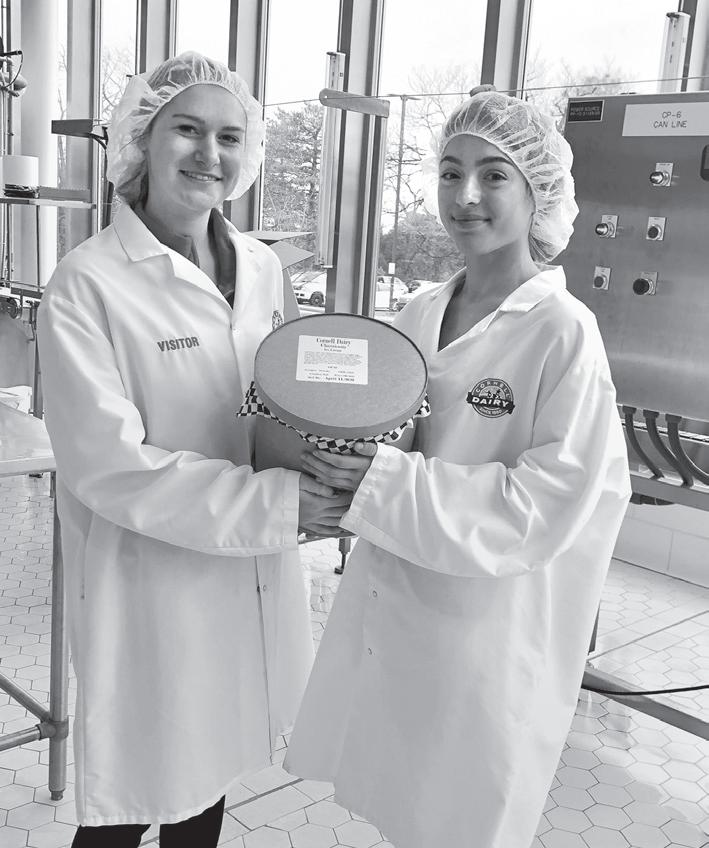
If you are an avid ice cream fan, FDSC 1101: The Science and Technology of Foods, is the class for you. Sometimes referred to by students as the “ice cream making class,” the class is an introductory food science course that focuses on the basic principles of food production.
While this class is mandatory for food science majors, it is also open to all students at Cornell. Taught by Prof. Chris Loss, food science, the course’s final project involves developing an ice cream flavor and presenting it to a panel of judges.
For this competition, teams are required to develop the ice cream formula, calculate the cost of the ingredients, supervise the manufacturing process and choose the branding. The winning flavor from the competition is then put into production and launched on Slope Day where it is sold at the Dairy Bar and other on-campus eateries.
Every year, the ice cream competition has a different theme. For this year, it was “Flavor of Imagination.”
According to Hailey Schwartz ’21, one of the winners of this year’s competition along with Kayla Reiner ’21, a lot of creativity goes into creating these extravagant

ice cream flavors. Some of the favorites this year include a matcha ice cream with strawberries and white chocolate, a currant swirl flavor, and an acai ice cream.
Schwartz and Reiner’s winning flavor is called Churrosity, a cinnamon sugar ice cream with hints of warm brown sugar and a rich chocolate swirl. Schwartz said it “highlighted three important points: the ancient spice trade, the importance of exploration, and differences in culture.”
“For our flavor, we decided to go with the more known version of the flavor, which is the cinnamon sugar covered churros dipped in chocolate, typical from Mexico,” Schwartz said.
“The most important step of developing the ice cream is the ideation and formulation. We also had our team members sample the products before we decided on our final recipe,” Reiner said.
The runner-up for this year’s flavor was called the “4-1-1,” which was a tahini-orange-chocolate-hazelnut swirl ice cream.
Making ice cream is a precise process, according to Schwartz. It requires students to not only know the ins and outs of making ice cream but also and the science behind the entire process.
“One of the most important factors of making any ice cream is the amount of air that is incorporated into the ice cream, which is called the “overrun,” Schwartz said.
In the course, Loss teaches his students that the more air that is incorporated into the ice cream, the more of a whipped and airy consistently it will have, making it cheaper to manufacture. On the other hand, ice creams that have less air incorporated into them are more rich, dense, and
expensive to produce since it requires more solid ingredients.
“We really wanted an ice cream that was not too light, but also not too dense since we also had to keep in mind the cost factor. We ultimately decided that at 80 percent overrun, we were left with the perfect texture that nicely balanced our other ingredients,” Reiner said.
“I would have never thought to consider air as an ingredient in making ice cream. We learned in our class that air is actually a major contributor to the appearance, taste and cost of the product.”
Churrosity will be launched at the Dairy Bar on Slope Day, May 8.
By DEANA GONZALES Sun Contributor
It may be time to consider avoiding sugary drinks once and for all. According to Prof. Marcus Goncalves, a clinical endocrinologist at Weill Cornell Medical Center, high-fructose corn syrup, a key component in many sweetened beverages, promotes tumor growth in mice that have been predisposed to colon cancer and may have implications in human cancer as well.
In a collaboration with Dr. Jihye Yun from Baylor College of Medicine and Dr. Lewis Cantley, from Weill Cornell Medicine, Goncalves designed an experiment where excess sugar was fed to mice that had been predisposed to developing intestinal tumors.
Goncalves said that putting sugar in a water bottle and giving mice free access to the concoction caused the mice to excessively drink the sugar. Fifty percent of their calories intake in their diets come from sugar. Additionally, the mice had less fiber and lower overall nutritional absorption, leading to obesity and metabolic dysfunction.
Goncalves and his team came up with a different experimental design where mice were given “[a] single oral dose of sugar that is equivalent to a 12oz portion of sugar-sweetened beverage that a human would consume.”
“Feeding mice a modest amount of sugar in the form of high-fructose corn syrup leads to an increase in intestinal tumor growth,” Goncalves said.
Goncalves explained that colon and intestinal tumors often start as small polyps that remain benign for a long time.
“This is an important study that actually shows a direct mechanism of how sugar impacts tumor growth and this should be communicated as far and wide as possible in order to get this warning signal out that patients with this specific type of cancer should actively be avoiding high-fructose corn syrup,” Goncalves said.
Goncalves and his team are trying to lobby the Food and Drug Administration to take their research into account when creating dietary recommendations. They had made some inquiries to the FDA, suggesting the agency put out a warning that “sugar-sweetened beverages can promote the growth of intestinal tumors and colon tumors,” Goncalves said.
According to Goncalves, the main limitation of their research is that they do not have direct evidence of high-fructose corn syrup’s impact on humans yet; however, there is a lot of evidence that suggests this impact.
“[Our research] provides a very strong case that, at the very least, patients with colorectal cancer should actively be avoiding the consumption of sugar in liquid form,” Goncalves said.
Goncalves and his colleagues are continuing to research the best strategies to translate their findings to humans. The team is eager to colorectal clinicians around the world and provide human clinical data to support their findings from the animal models.
The study was conducted with the highest amount of rigor that the team could achieve and Goncalves believes that it will have impactful applications.
“We want to come up with the best strategy to translate these findings to humans which would relieve

any concern that people have about animal models,” Goncalves said.

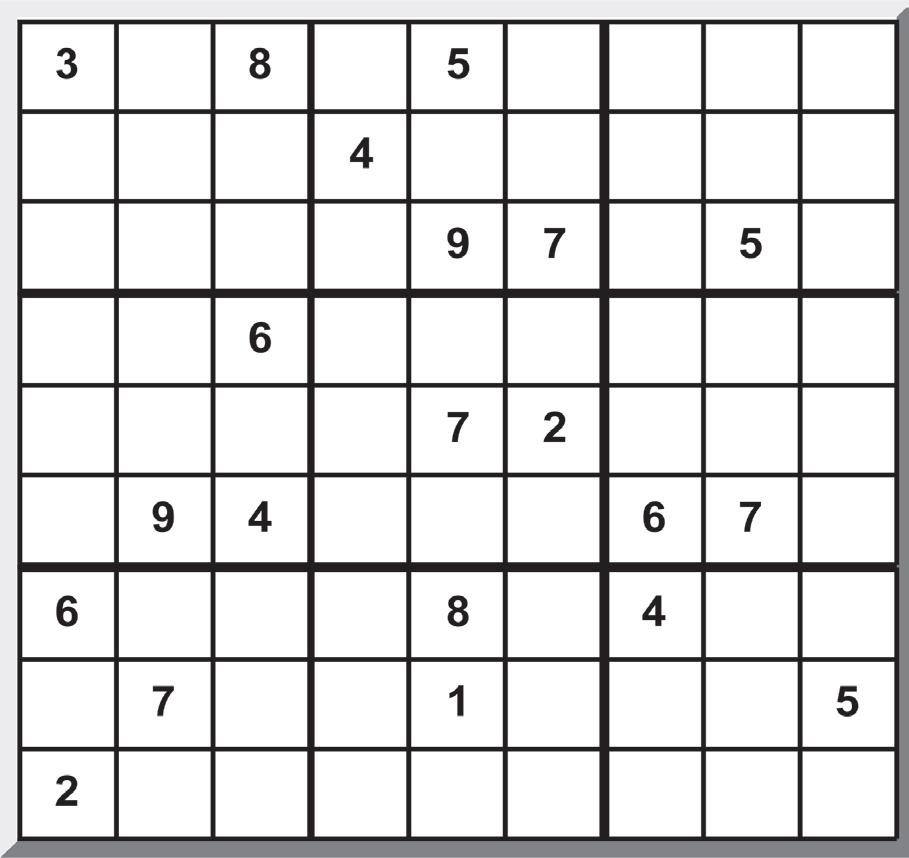
Fill in the empty cells, one number in each, so that each column, row, and region contains the numbers 1-9 exactly once. Each number in the solution therefore occurs only once in each of the three “directions,” hence the “single numbers” implied by the puzzle’s name. (Rules from wikipedia.org/wiki/ Sudoku)
by Jeffrey Sondike ’19



COLLEGE AVENUE 1 BEDROOMS 607-272-3389 avramisrentals@aol.com
3 BEDROOM SOUTH HILL
Large apt, washer/dryer furnished. $550 pp 607-272-3389
1-Bedroom Apt
NORTH CAMPUS
Studio and 3 bedrooms Available 2019/2020 Novarr-Mackesey Property Management office@ithacastudentapartments.com ithacastudentapartments.com 607-277-1234
1 Bedroom Apartments
Bright nice and clean, Great location
Linden Ave $895 to $950 plus electricity Call 607-237-2541 or 607-227-2535
2019-2020
Modern 3, & 4 Bdrm Apts. Furnished, non coin laundry, parking, internet. 607-273-8576.
COOK ST. Furnished House for 5-7 persons, 10mo. Lease for 2019-2020 Text or call Tracy at TLC Property Mgmt Corp 607-379-2776
==One Month FREE Rent!== Furnished 3 Bedroom Collegetown Apartments PARKING, LAUNDRY, UTILITIES! (607)273-7368 www.WestShoreApts.com
Downtown Available June 1 (or earlier) Ideal for Grads or Staff. Lovely one bedroom second floor apartment. Downtown on Cascadilla St. near N. Albany St. Carpeted bedroom and living room (with rustic real wood paneled walls), full bath, kitchen. Bus line in front of house that goes to Commons, then on to Tower Rd. on Cornell Campus. Private porch. $890 plus utilities, available June 1. (anytime after 4/15) NO undergrads, no dogs, no smokers, references. For info and appointments email gm27@cornell.edu or text 607-280-4024.
Now Renting for 2019-2020 3-7 Bedroom Apartments All locations. Contact us today or visit our website: certifiedpropertiesinc.com Certified Properties of TC Inc 273-1669
Downtown / Fall Creek
Renovated 3 Bedroom Grad student apartment Walk to everything $1950 plus utilities 607-592-0475
2019-2020 Upper Eddy St. House for 5 to 7 People Furnished. Internet. Laundry. Semester or 10 month lease. 607-273-8576
Linden Ave. 5 Bedroom House Available June 2019. $900 per bedroom. Parking included. 607-327-2927
By RAPHY GENDLER Sun Sports Editor
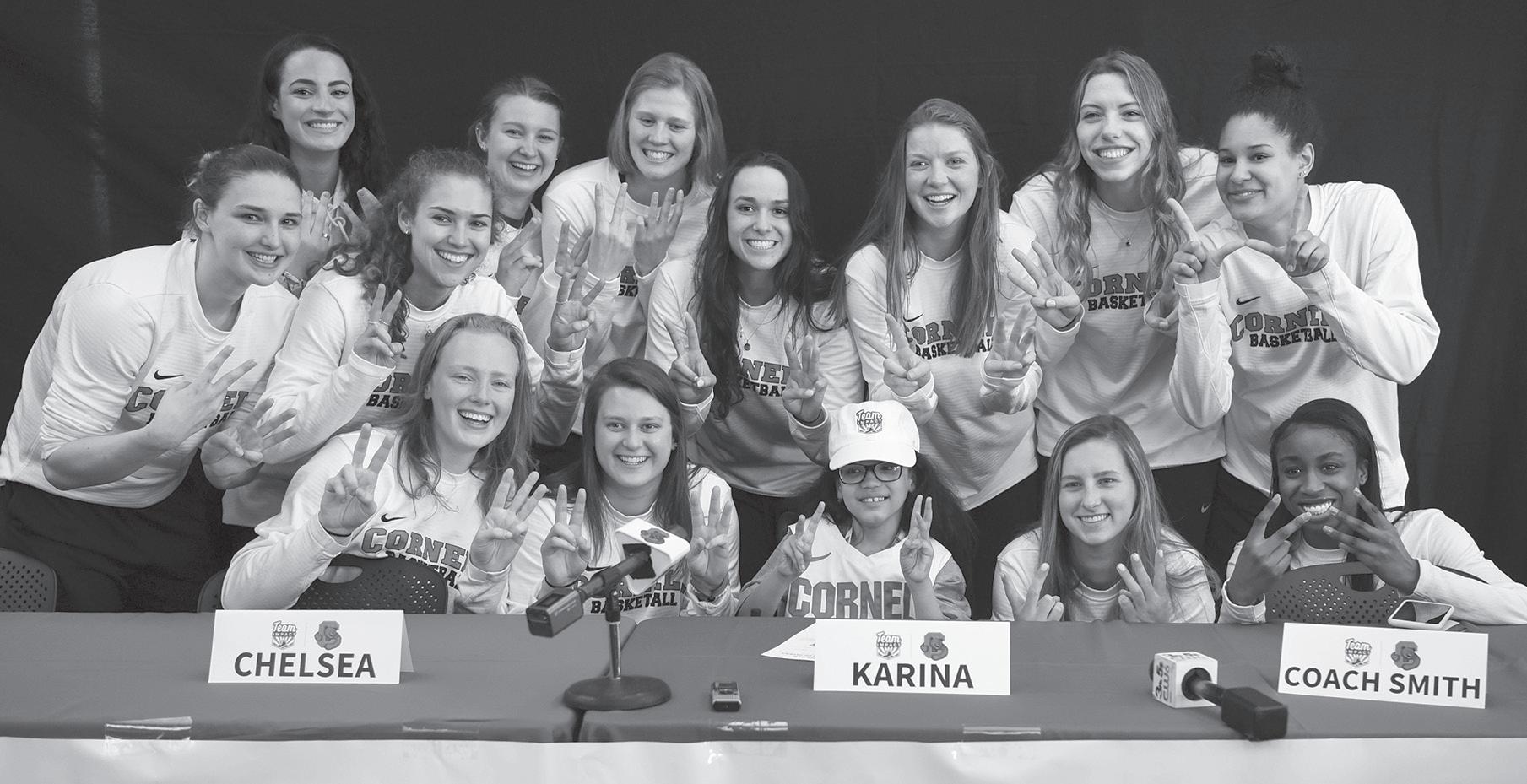
When Karina Hill, one of Cornell women’s basketball’s “top recruits,” stepped into Newman Arena on the first day of practice in the fall, she was ready right away to challenge Cornell’s players to games of 1-on-1.
“She came in and she wanted to go up and challenge our players 1-on-1 and her defense was phenomenal,” said Head Coach Dayna Smith. “We knew right away we needed to sign this young woman.”
Her tough defense, passing ability and basketball sense made her a great fit for the Cornell program. What made this signing different from all other signings? The crowd of athletes, friends and the media, for one. Also that Karina is just seven years old.
Karina, who has cerebral palsy, was paired with Cornell by Team IMPACT, a non-profit organization that matches children with “serious and chronic illnesses” and college sports teams.
Mackesey Property Management collegetownterraceithaca.com office@ithacastudentapartments.com 607-277-1234

joins the team for practice and participates in team bonding.
“She has a huge personality and she really, really loves the game of basketball,” said sophomore forward Elodie Furey, one of Karina’s best friends on the team. “She is so happy just to get in the gym and chase around while we dribble and [to] steal the ball from us. She’s always having a good time with a big smile on her face.”
The team has also spent time with Karina outside of basketball, visiting her at school and taking her out for Chinese food.
“You guys are all she talks about,” Karina’s mother, Chelsea, said to the team. “She said that you guys are her best friends, you’re like family.”
“To see someone who really loves basketball ... it reminds us why we started playing.”
Elodie Furey
After being introduced by Smith, Karina signed a “letter of intent” on Monday in the Cornell Athletics Hall of Fame Room. She took her time to slowly write her name, making sure every letter was perfect. As she finished, her new team erupted in applause.
A bit camera shy at first, Karina quickly showed the toughness that has inspired the Cornell women’s basketball team. Her favorite part about basketball?
“Beating people,” the seven-year-old said. More important than her defensive prowess and love of the game, Karina “epitomizes what we want from a Cornell women’s basketball player,” according to Smith.
Always at practice and always wearing a smile, Karina works hard, loves the game, is feisty and is a great teammate. She’s disappointed when her teammates make mistakes and is the first one there for a high-five when they succeed.
In the months following her first practice, Karina has become a part of the team: She’s at every game,
In that first practice back in the fall, Karina quickly showcased her love of the game, fearlessly taking on Cornell’s players and coaches.
“It’s been really nice for us to see someone who really loves basketball so much and it reminds us all why we started playing, and it’s rewarding for us, too, to have a positive impact on her life and we really enjoy spending time with her,” Furey said.
“Don’t let this little smile fool you, she’s tough as nails,” Smith said of her young recruit, before presenting Karina with a No. 23 Cornell jersey. “And probably the number one attribute that we love about her is that she’s a great teammate.”
Joined by her parents, Chelsea and Maurice — both wearing Cornell sweatshirts and Maurice with a red Cornell cap — and the Cornell women’s and men’s basketball teams and coaches, Karina’s signing marks a key point in her months of spending time with her new best friends.
“When we signed up to work with Team IMPACT it was us giving Karina an opportunity to be part of the team, but really we’ve taken so much more than we’ve given, I believe,” Smith said. “She has really captured their hearts.”
Raphy Gendler can be reached at rgendler@cornellsun.com.


TENNIS
By FAITH FISHER Sun Staff Writer
Going into last weekend, two Ivy League teams, undefeated in the conference, faced off, with only one able to keep its blemish-free record intact.
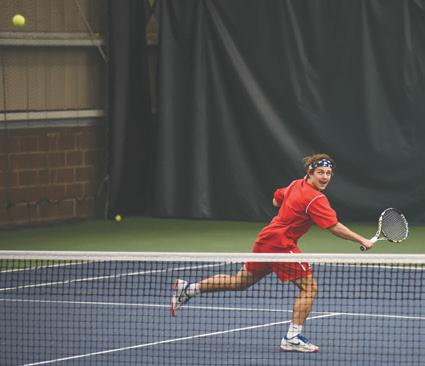
A devastating loss to Harvard during this weekend’s road trip to New England tarnished men’s tennis’ perfect conference record. An Ivy League title, however, remains within reach as the team redeemed their loss with a 4-2 win against Dartmouth the following day.
The Red fell to the Crimson, 4-3, a tight loss that was
“Unfortunately we were not able to play the key moments like we should have ... which really cost us against Harvard.”
hinged on the last singles match. Last year’s results were flipped in favor of the Red, when the team toppled the Crimson 4-3 at Reis Tennis Center.
Nevertheless, Harvard (18-5, 5-0 Ivy), the 38th-ranked team nationally, is on a seven-match winning streak in-conference and secured the early 1-0 advantage by clinching the doubles point.
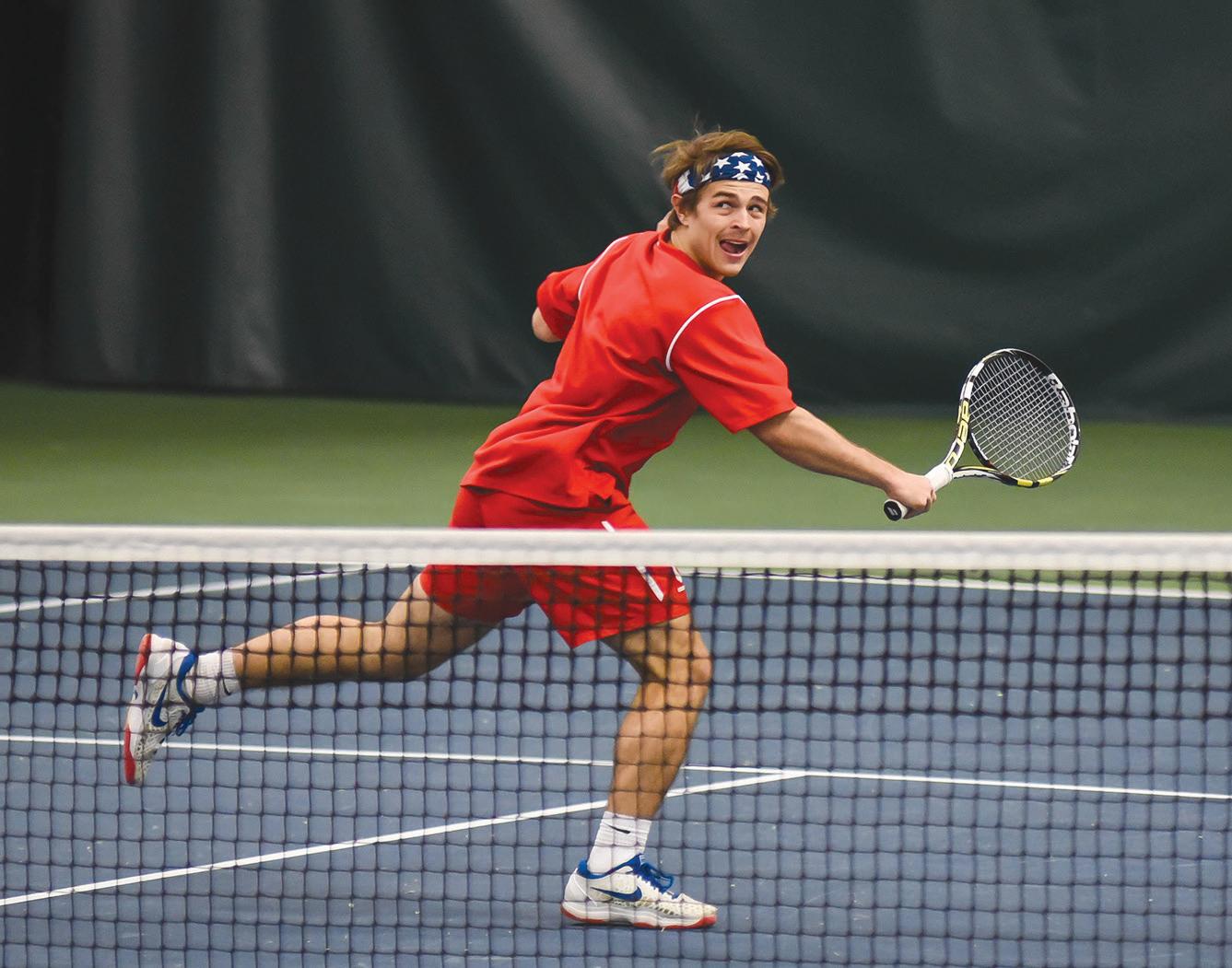
The Red (14-9, 5-1 Ivy) equalized the score with a pivotal 6-2, 6-4 win by sophomore Evan Bynoe at the number six position. The match’s momentum seemed to change to favor the Red when sophomore Alafia Ayeni won in straight sets at the number one position, tilting the advantage of the match to Cornell.
The rest of the singles matches were forced into three sets. Vasa gave the Red the 3-1 lead after dropping the first set 6-0, fighting through a tiebreaker in the second set, and
finally clinching a 7-5 advantage in the third set.
The remaining singles players, senior David Volfson, junior Lev Kazakov and junior Daniel Soyfer, struggled to convert with each surrendering their hard-fought three-set matches. The Crimson maintained their Ivy League dominance, remaining undefeated in the conference.
“We put ourselves in a position to win the match — we were leading the match 3-1 and leading in one of the matches,” head coach Silviu Tanasoiu said. “Unfortunately we were not able to play the key moments like we should have, we played defensively, which really cost us against Harvard.”
The Red entered their match the following day against Dartmouth occupying the third place spot in Ivy League standings.
The hunt for an Ivy League title stayed alive after a 4-2 win against the Green in Hanover.
Despite a win from the Kazakov/Ayeni doubles duo, the Red struggled once again to procure the doubles point, dropping the following two doubles sets to Dartmouth.
“The doubles point is critical,” Tanasoiu said. “We are always trying to improve our doubles and put ourselves in a position to get that point.”
Singles play introduced a turn of events in which the Red swiftly gained control of the match. Kazakov at the number three position and Bynoe at the number six position breezed through their matches in straight sets.
The score was equalized thereafter, however, as Vasa fell 6-2, 7-6 (4) to Dartmouth’s Sid Chari. A three-set win from Soyfer regained the lead for the Red, leaving the fate of the match up to the last two singles matches.
Following two grueling sets against his 60th-ranked opponent Charlie Broom, Ayeni managed to capitalize upon two break point opportunities, winning the third set and sealing the Red victory at 4-2.
“We started slow, but this time around I was really
proud of how we played the key moments,” Tanasoiu said. “We learned a painful lesson against Harvard, and I thought we really played on our terms against Dartmouth.”
With a Harvard loss to Columbia this weekend, the team is now tied for second with the Crimson, with the Lions taking sole possession of the first place. The team’s upcoming match against the New York competitor will decide the fate of the Ivy League title or the team.
“Our goal is to win the Ivy League and participate in the NCAA’s, and Columbia is our only obstacle right now,” Tanasoiu said. “It will be the most important match we will play this season with a lot on the line — all the training we have done this season is for moments like this. We know the team well, we competed against them in the fall, and I think we have the team to beat them.”
The team will contend for the Ivy League title in its final regular season match against Columbia University in New York City on Saturday at 1 p.m.
Faith Fisher can be reached at fsher@cornellsun.com.
Senior Day ‘bittersweet’ as team celebrates lone senior
By FAITH FISHER Sun Staff Writer
Women’s tennis wrapped up its season this weekend, remaining winless in the Ivy League.
Coming off a pair of losses against Princeton and Penn, 4-0 shutout losses against another pair of Ivy foes closed out the season for the young team. Cornell dropped its final two matches against Harvard (17-6, 5-1 Ivy) and Dartmouth (4-17, 1-6 Ivy).
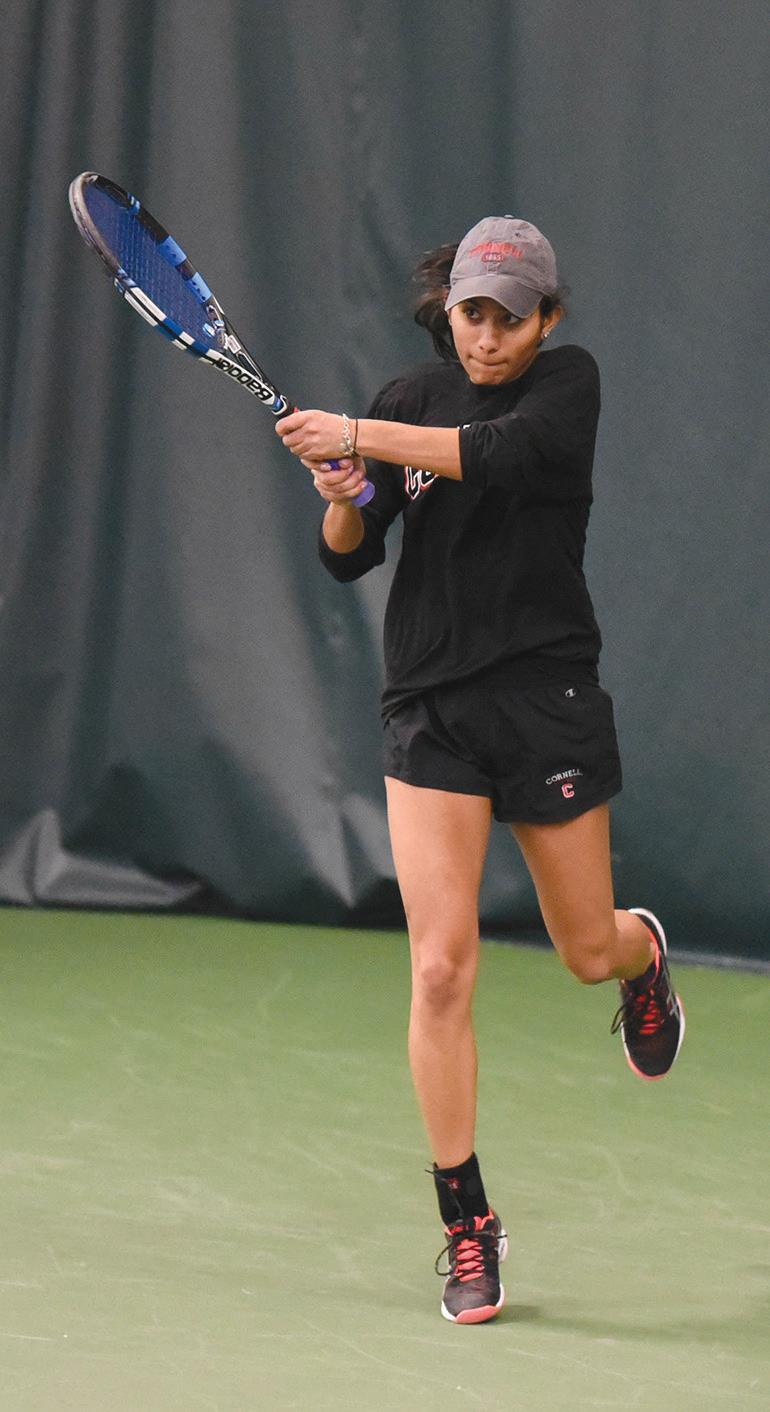
Against Harvard, even though the Red (6-16, 0-7 Ivy) sustained 6-2 losses in doubles at the first and third spot, freshman duo Maria Adiaconitei and Sarah Campbell were serving for match point when they were forced to finish their match.
Despite commendable performances on the singles side, Cornell failed to secure a victory there. Freshman Katherine Nguyen won her first set and was at an advantage in the second set when play halted. Freshman Valerie Ho, who led the team with a 10-7 singles record, had battled to force her match against the third-ranked Ivy League player, Erica Oosterhout, into a third set, but losses at the fourth, fifth, and sixth positions cut the match short.
“There was a lot of energy on all the courts and it helped keep matches close and competitive,” Campbell said. “As a team, we need to do a better job of getting the doubles point by playing aggressive and smart doubles.”
Cornell remained in the comfort of Reis to take on Dartmouth the following day, where the Red celebrated its senior day. The team honored Mariko Iinuma, the team’s only senior, for her accomplishments and dedication to the program.
“Our team did an amazing job cheering and supporting each other, especially our senior Koko,” Ho said. “It was such a bittersweet weekend, but the focus was on celebrating Koko.”
“We all went out last weekend, fought hard, and competed for Koko and for Cornell, which was amazing. It didn’t fully hit me until after the match
was over what Koko’s last match really meant for all of us,” Campbell continued.
The Red hasn’t clinched a victory against Dartmouth since 2013. A home-court advantage and Senior Day celebrations were not enough to tilt the match in favor of the Red.
Power duo Campbell and Adiaconitei paired up once again, securing a 6-1 victory in their doubles match. This marked their first registered win as a pairing in Ivy League play. Doubles losses at the number one and three spots, however, gave the doubles point to the Big Green.
In singles, Dartmouth sailed through the matches at the number one and six spots, with scores of 6-1, 6-0 and 6-1, 6-2 respectively. The Red was holding on, however, with Campbell just one game away from victory and Nguyen battling into a third set. A Big Green 6-3, 6-2 win at the number four spot precluded the matches from coming to fruition.
Although the season is now over, the hunt for victory will not cease. The young team, being, aside from the graduating Iinuma, comprised of five freshmen, will continue to train and develop players’ skills, which will complement their newly gained experience of playing at the collegiate level.
“In the coming season, we are looking for an Ivy title — we know what to expect and what it will take,” Campbell said. “We will start next season better prepared and stronger together.”
Both mental and physical conditioning will be a point of focus going forward as the team looks to achieve new heights and hopes to go from winless in the league to Ivy victors.
“We all have the strokes and the ability to hit, so in order to put us in Ivy Champ contention, we need to work on fitness and the mental aspect,” Ho said.
With more experience and a new batch of talent, the team looks to become a force to be reckoned with next season.
Faith