
By ATTICUS JOHNSON Sun News Editor
April 17 — The New York Department of Environmental Conservation approved a permit for the Cayuga Operating Company, which is owned by the chief executive officer of data center developer TeraWulf, to draw approximately 1 million gallons of water from Cayuga Lake per day, on April 13.
From April 13 to April 30, 2031, Cayuga Operating Company can withdraw up to 1,008,000 gallons per day from Cayuga Lake for “for system maintenance, sump pumping, and dust control,” according to the permit.
In comparison, the Bolton Point water system, which provides water to more than 30,000 people — including five municipalities in Tompkins County — withdraws 2.4 million gallons of water from the lake each day.
The Tompkins County legislature previously approved a resolution in January urging the DEC to reject Cayuga Operating Company’s per-
mit request. The resolution specifically regarded the intended use of the water, which was “unspecified” in its original 2021 permit request, and urged TeraWulf to submit a new permit request altogether.
TeraWulf announced plans to build a data center at the old Milliken Station power plant site in August 2025 — land which Cayuga Operating Company owns. These plans for the center raised energy and environmental concerns from local environmental groups Cayuga Lake Environmental Action Now and FLX Strong.
The groups sued the developer in January to block the data center.
But John Dennis, co-founder of CLEAN!, told The Sun that he is not that worried about the water withdrawal approval since it would be illegal for Cayuga Operating Company to transfer any water permits to TeraWulf or other entities — any other party would need to begin the permitting process again, according to the DEC program policy for transfers of permits.
Instead, even though TeraWulf cannot access the permit, it is “not surprising for corporations to ask for more bells and whistles and more options” while developing, Dennis said.
“It’s nice to have a water withdrawal permit in the back of your pocket,” Dennis added.
Tompkins County Legislator Deborah Dawson (Seventh District) found the DEC’s decision “absolutely bewildering,” she told The Sun.
“My reaction is, I am disappointed to the extent you can be disappointed by something you’re not surprised by,” Dawson added.
“Protecting water quality in Cayuga Lake is a top priority for New York State and DEC,” a DEC spokesperson wrote to The Sun. “The new permit will drastically reduce the amount of water that can be withdrawn from Cayuga Lake from 245 million gallons a day to 1 million gallons a day.”
However, the approximately 99.6% reduction is the amount Milliken was able to withdraw from the lake, not what Cayuga Operating Company
was currently withdrawing, Dennis said.
Dennis and CLEAN! think some of the calculations Cayuga Operating Company submitted to the DEC are “theoretical,” because they reflect the amount the company would be pulling from the lake if its service pump, which withdraws 700 gallons of water per minute, was turned on every minute of the year.
Dawson added that DEC’s approval was, in part, based on “overarching policy decisions made in Albany that heavily influence the decisions DEC makes, and sometimes that influence is greater than DEC’s concern for the environment.”
John Marabella, the Cayuga Operating Company’s environmental director, did not respond to a request for comment.
The Town of Lansing is set to review TeraWulf’s plans for the site on April 27.
By GISELLE
April 17 — The Cornell Concert Commission canceled its Saturday concert featuring singer Ty Dolla $ign due to the artist’s “scheduling conflicts,” according to a Friday email sent to ticket holders by CCC, Multicultural Community-Fueled Activity Board and Campus Activities. Tickets will be fully refunded, the email added.
The concert, hosted by CCC in col laboration with MCFAB, was set to take place in Barton Hall at 7 p.m. on Saturday. Ty Dolla $ign informed the concert orga nizers of his cancellation “[l] ate Wednesday night,” and the organizers were unable to secure a replacement artist due to the short notice, according to the Friday email.
CCC hosts their col laboration with MCFAB at the end of every spring semester. Last spring, the organizations hosted rapper Ken Carson. CCC and MCFAB originally jointly announced that Ty Dolla $ign was set to perform this year in a March 11 Instagram post.
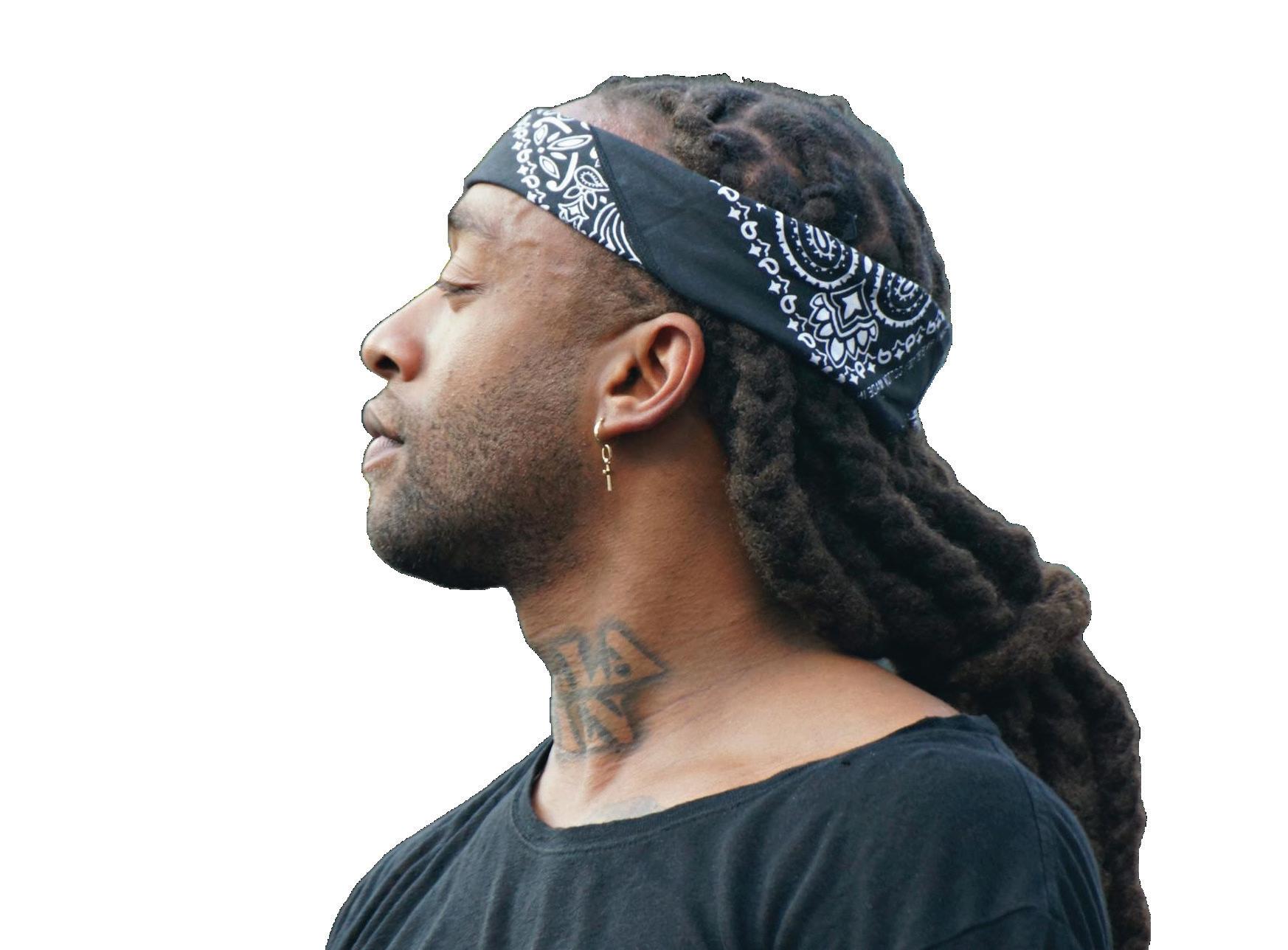
Ty Dolla $ign is a rap and R&B artist and pro
ducer best known for his songs “Paranoid,” “Or Nah,” “Blasé” and his collaborations with other artists. He released two albums with Ye, formerly known as Kanye West, titled Vulture 1 and Vulture 2 in 2024.
Dua Saleh was set to open the event as a special guest. Saleh is an alternative rap artist and poet who is also known for their portrayal of Cal Bowman on Netflix’s Sex Education.
The cancellation of the concert was “deeply frustrating” news for CCC selections director Julia Minogue ’27, given that the organizations had worked for over 100 hours since September to coordinate the event with more than 30 other student leaders, she wrote in a statement to The Sun.
“We were all looking forward to a huge Barton show to end off the year,” Minogue wrote. “Hours of work were poured into this show, whether it be the selection process, tabling, designing posters, booking venues, arranging production needs, ordering food, gathering and training volunteers. … It is truly disappointing to not see this show come into fruition.”
“My immediate reaction was disappointment,” said Neha Patil ’28, who was planning to attend the event.
Patil shared that she and her friends had
planned to attend the concert for more than a month in advance and that it was particularly upsetting due to Ithaca’s usual lack of proximity to concerts.
“I personally am a big fan of Ty Dollar $ign,” Patil said. “I was really excited to see him and hear his hits.”
Minogue told The Sun that CCC selected Ty Dolla $ign on account of his popularity based on multiple data points from sources including Spotify and Instagram, as well as opinions expressed by CCC’s g-body and e-board.
CCC typically organizes three concerts per semester — collaborating with other student organizations including MCFAB and the Cornell Asian Pacific Student Union. This spring, however, they only organized two concerts, with singer Sarah Kinsley’s March 7 performance and Ty Dolla $ign’s concert originally scheduled for Saturday. The cancellation of Saturday’s concert means that CCC will have only hosted one concert this semester.
CCC’s collaboration with MCFAB and CCC’s homecoming concert are their biggest shows of the academic year, according to Minogue.
Student tickets were sold at an “early bird” price for $20 from March 11 through March 16. The standard price for student tickets was then set as $25.
Ticket holders can expect a refund to their account to be received within five to 14 business days, according to the Friday email.



Today
Off-Campus Housing 20262027 Housing Fair
11 a.m. - 2 p.m., Ho Plaza
Earth Day Sustainability Fair 11 a.m. - 2 p.m., Willard Straight Hall Memorial Room
Bowers Earth Day Repair Fair 4 p.m - 6 p.m., Bill & Melinda Gates Hall First Floor Lobby
Rural Versus Urban: The Growing Divide that Threatens Democracy by Suzanne Mettler 4:30 p.m. - 6 p.m., Goldwin Smith Hall G76
Cornell “Organists Unplugged” Earth Day Recital
7:30 p.m., Anabel Taylor Chapel
From the Arctic to Broadway and Back: A Conversation with Playwright Carson Kreitzer 5 p.m. - 6 p.m., Schwartz Center for the Performing Arts Reading Room 124 Tomorrow
Anabel’s Fair
1 p.m. - 4 p.m., Ho Plaza
Cornell Duffield Engineering Distinguished Alumni Award: Beckie Robertson ‘82
3:30 p.m. - 6 p.m., Upson Hall 116
CUPD Self-Defense Course
4 p.m. - 5:30 p.m., Warren Hall
Israel Palestine Debate Series - Benny Morris: Resolved, The American-Israeli Alliance Serves America’s Interests 6:30 p.m. - 8:15 p.m., Biotechnology Building G10
Class of 2027 Presents: Books, Bites & Big Wins
6 p.m. - 8 p.m., Willard Straight 404: Browsing Library
The Future of Work and Power: An AI Debate
5:30 p.m. - 6:30 p.m., Statler Hall 398

By CORAL PLATT Sun News Editor
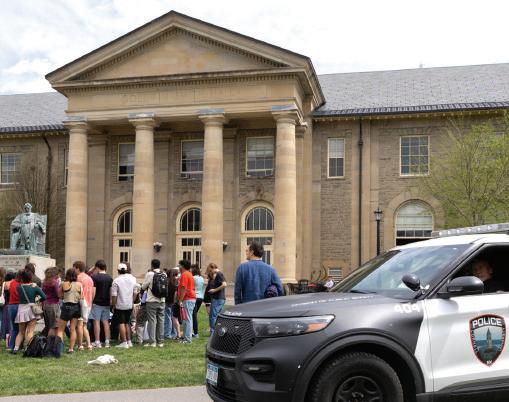
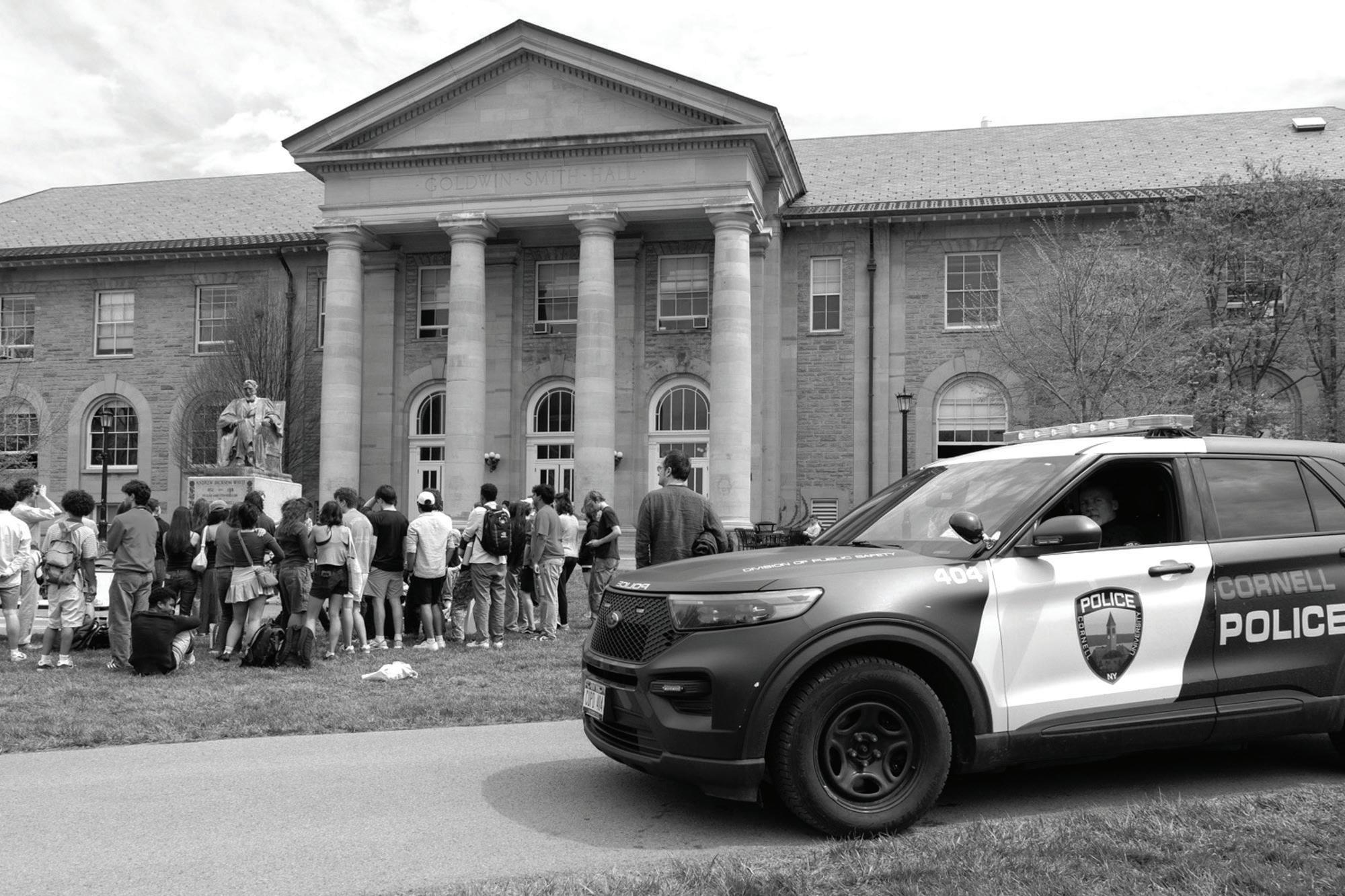
April 20 — Approximately 40 students gathered on the Arts Quad on Saturday afternoon to express their concerns about the suppression of student speech and protest on campus. Students took a stand at the A.D. White statue alongside alumni from the 1960s and ’70s who participated in student activism on campus.
The “Day of Action,” planned by Students for a Democratic Cornell, took place during one of four Cornell Days, in which newly-admitted students were invited to visit campus. During the event, SDC members handed out flyers to admitted students passing by and wrote slogans criticizing the University in chalk across campus.
“[I]t’s admitted students day and a majority of students visiting this weekend are actually undecided,” said SDC Co-Founder Sophia Arnold ’26 in an interview with The Sun. “We thought that getting in the face of and making [Cornell’s] issues … unable to be ignored by admitted students … was a really good way to get the administration to pay attention and realize that they have issues severe enough that it might jeopardize students committing to Cornell.”
The event’s Instagram page listed five main concerns the event would address: a lack of student rights related to free speech and activity on campus, increased co-op housing fees, turning “program houses like the [Latino Living Center] and [Ujamaa] into general dorms to erase POC spaces,” “ICE, Anduril and Palantir” recruitment on campus and student suspensions.
The event featured three alumni speakers: Robert Gottlieb ’72, Margaret McCasland ’68 M.S. ’86 and Joe Rowland ’73, who shared their experiences with activism and student rights while they were students on campus.
Gottlieb was the first student-elected member of the Board of Trustees, a position that was created following the 1969 Willard Straight Hall Takeover, in which Black students occupied Willard Straight Hall for 36 hours demanding racial justice and an improved judicial system on campus. The takeover ultimately led to the
Campus Code of Conduct, the University Senate and the addition of student-elected trustees.
The Campus Code of Conduct was overhauled in 2021 and replaced with the Student Code of Conduct. The University Senate was dismantled in 1977 and replaced by four assemblies – Student Assembly, Graduate and Professional Student Assembly, University Assembly and Employee Assembly — and later the Faculty Senate.
Throughout his speech, Gottlieb emphasized how the administration at the time of the takeover did not concede to external pressures from politicians.
“No one was punished. Nobody was disciplined, nobody was threatened to get out of [their] dorm room,” Gottlieb said. “That’s how an administration, in the face of fear [and] of tension … did not buckle [and] did not capitulate.”
McCasland spoke next, sharing stories from her involvement in the anti-VietnamWar movement and anti-apartheid movement on campus. McCasland was arrested at an anti-Vietnam-War protest at Barton Hall in the 1967-1968 academic year and participated in the “Shantytown” encampments in 1985 to demand the University’s divestment from the apartheid in South Africa.
The Shantytown encampment, which
lasted over two months in 1985, received recognition from anti-apartheid activists in South Africa such as musician Hugh Masekela.
“I thought the whole thing just kind of fizzled and nothing happened and it didn’t make any difference,” McCasland said in an interview with The Sun. “But then Hugh Masekela came to Ithaca several times. Every time he came to Ithaca, he would say, ‘Thank you, Cornell, for Shantytown. We heard all about Shantytown at home in South Africa, it made such a difference to us. Thank you, Cornell, for Shantytown.’”
Rowland, who arrived at Cornell the fall after the Willard Straight Hall Takeover, participated in a general strike across universities following the Kent State Shootings in 1970, in which four students protesting the Vietnam War at Kent State University were killed by the Ohio National Guard.
“What I found out from that experience was that when people and students act collectively, you can shut things down together,” Rowland said at the event. “You have a huge amount of power. What’s the university going to do without students? Nothing.”
The alumni speakers expressed concerns regarding student rights on campus today. Gottlieb contrasted the administration’s response to the takeover in 1969 to the settlement between Cornell and the Trump
administration in November.
“The University then was viewed as an agent for social justice and diversity of students and courses and debates,” Gottlieb said at the event. “That’s what Cornell was. That’s what Cornell should always be. That’s not what Cornell is today because of its capitulation to the threats of Donald Trump.”
McCasland also expressed concern over the shifts she has seen since her time as a student to today.
“When I was an activist in the ’60s, student governance and input from faculty and staff was not yet an option at Cornell,” McCasland told The Sun. “It is just so sad to see Cornell back in the dark ages with worse governance than what they had in the early and mid ’60s.”
In addition to the three alumni speakers, students attending the event spoke regarding their concerns about a lack of free expression on campus.
Aiden Vallecillo ’26 raised concerns regarding the Expressive Activity Policy, a University policy that regulates public speech and demonstrations on campus.
Vallecillo specifically mentioned regulations on protests on campus.
“Protesting is banned on Cornell’s campus,” Vallecillo said. “We cannot protest. … Chalking is actually one of the only things that we’re allowed to do.”
The Expressive Activity Policy limits “amplified or other loud noise” on campus to between the times of 5 to 9 p.m., or from noon to 1 p.m. at Ho Plaza or outside Day Hall. Additionally, there are limits on where posters and signage can be placed on campus and what size the posters may be.
Another student attending the protest, Max Troiano ’28, who is an opinion columnist for The Sun, expressed concerns about the Cornell University Police Department’s presence at protests. Troiano said that he noticed a CUPD vehicle drive by the event seven times, including once where an officer filmed the event.
To continue reading this article, please visit www.cornellsun.com.
Te claims allege Cayuga Health stalled bargaining eforts after a January vote to unionize.
By BRAYDEN HANDWERGER Sun Contributor
April 16 — After Ithaca nurses at Cayuga Medical Center overwhelmingly voted to unionize in January under the Communications Workers of America, the CWA filed charges with the National Labor Relations Board alleging that Cayuga Medical Center violated federal labor law and nurses’ right to organization protected by Section 7 of the National Labor Relations Act.
The CWA, who represent more than 15,000 healthcare workers across New York, New Jersey, and New England, alleged in their April 6 complaint that during the unionization drive, Cayuga Medical Center committed a variety of unfair labor practices, including threatening and surveilling nurses, interfering with nurses’ discussions of unionization, bargaining in bad faith and closing facilities without any advanced notice.
Specifically, the union claims a CMC manager contacted a nurse’s second job to complain about unionization efforts, according to The Ithaca Voice
The charges filed against Cayuga Health come amid an uncertain time in the labor relations environment, as the Trump administration’s NLRB is backlogged in unfair labor practices prosecution cases due to a nearly year-long failure to meet a board quorum.
“We are facing harassment and intimidation tactics, which only distract us from the work of patient care.” Jacki Thompson
Cayuga Health’s actions “feel disrespectful of our legal rights, and it concerns me that there is such opposition to something that statistically will improve outcomes for patients,” said Shane Snyder, an in-patient wound nurse, in CWA’s statement sent to The Sun.
Studies on the effects of nurse unions are mixed but generally show patient
outcomes improving, though access to care may worsen.
“We voted overwhelmingly to unionize months ago, but we still haven’t formally started negotiations. We want to start bargaining our contract, and I urge management to stop delaying and work with us to find a compromise.”
Despite 82% of nurses voting in favor of unionization in an election recognized by the NLRB in January, Cayuga Medical Center nurses have not begun the bargaining process with the hospital.
The union alleges that the hospital is continuing to harass, pressure and intimidate members instead of coming to the bargaining table to proceed with a new collective bargaining agreement.
“I’m disappointed and saddened that hospital leadership is choosing to not work in partnership with our union,” said Jacki Thompson, a nurse educator. “We are facing harassment and intimidation tactics, which only distract us from the work of patient care.”
Cayuga Health denies the union’s allegations of unfair labor practices.
“It is disappointing to see the latest unfair labor practice charges filed by the Communications Workers of America, as we have been actively discussing these same topics with union representatives in just the last week,” Melissa Tourtellotte, a spokesperson for Cayuga Health, wrote in a statement to The Sun.
“Cayuga Health denies the allegations and objects to the union’s characterization which does not reflect the ongoing dialogue,” Tourtellotte wrote.
Cayuga Health asserted that the CWA has previously filed unfair labor practice charges that were either dismissed or involved isolated incidents that were immediately addressed.
“The nurses want to move forward and are ready to sit down at the table with CMC leadership to negotiate a union contract that strengthens our workforce and continues the mission of the hospital,” Thompson said.
Brayden Handwerger can be reached at bbh47@cornell.edu








By EMMA SPINDLER and RIYA DEVROY Sun Senior Writer and Sun Contributor
April 19 — Cornell undergraduate students have the opportunity to select their next Student Assembly president for the 2026-2027 academic year.
Voting opened at noon on Monday for the Spring 2026 election cycle, and students have until noon on April 27 to cast their online ballot, according to an email sent out by the Student Assembly.
The Sun spoke to the three presidential candidates to learn about their different visions for how to address concerns about improving transparency, follow-through with resolutions and student engagement with the body.
All three of the candidates are members of the Class of 2027 and have prior Assembly experience. They pointed to longstanding frustrations with the Assembly’s effectiveness and outlined priorities ranging from structural reform to expanded student services.
Zora deRham ’27
Serving as Assembly president for the past two years, Zora deRham ’27 said she hopes to build on existing initiatives while improving coordination between the Assembly and University administration.
The announcement marks a change of heart for the incumbent; in an interview last year following her re-election, deRham clarified that she did not intend to run for a third term.
“I’ve been honored to serve as Student Assembly President this past year,” deRham said. “There are plenty of projects that have been started, and I want to make sure I can see them to fruition.”
deRham pointed to her work collaborating on the Student Activity Fee as a key accomplishment during her presidency, emphasizing that the fee was not increased this year despite an initiative from the Assembly’s Finance Committee. She described her goal of advocating and negotiating within the Assembly for a reduced activity fee as an effort to improve “responsible management of student funds.”
When asked about criticism that the Assembly’s resolutions often stall during implementation, deRham said much of the work required to implement policy occurs beyond the public eye.
“A resolution is the initial germ of an idea, and many conversations have to happen behind the scenes after [it] is written and passed,” deRham said.
Eeshaan Chaudhuri ’27
Eeshaan Chaudhuri ’27, undergraduate student representative and vice chair of operations on the University Assembly, said his campaign is focused on improving the effectiveness of the Student Assembly and restoring student trust in the body.
The University Assembly is a part of the University’s shared governance model and is
composed of students, faculty and staff that address university-wide policy, while the Student Assembly is only made up of undergraduate students.
Chaudhuri previously served as the Brooks School representative on Student Assembly during his sophomore year.
Reflecting on that experience, he said it shaped his perspective on the Assembly’s effectiveness and informed his decision to run for president.
“If you go back to my sophomore year, I think my favorite thing to say at Student Assembly meetings was, ‘I hate Student Assembly,’” Chaudhuri said.
He described general frustration with the types of policies being proposed at the time, arguing that many lacked substantive planning or feasibility.
“As a student who studies policy every single day, I could just see that we were passing policies that had no chance of working,” he said.
Christian Flournoy ’27
Christian Flournoy ’27 has served in Student Assembly since his freshman year, and he currently sits as Executive Vice President, the second highest ranking position.
Flournoy said his top priorities as EVP have been increasing mental health resources for students, providing equitable access to special project funds and helping Cornell feel more like home for students.
“One thing that I really wanted to see done is that the University has a better response to death and loss for students,” Flournoy said. “There are not enough embedded therapists within the University.”
Cornell recently implemented the embedded therapy program, which is set to expand more, bolstered by a $20 million donation to establish the Certiale Center for Cornell Health. The University’s push for a better response to death and loss follows a period of heightened grief on campus, including five community losses in a single semester last year.
Flournoy said students feeling unheard by the University is the “single most important issue” undergraduate students face. He proposed the idea of “Your Cornell” as a solution to help Cornell students have more say in campus issues, a movement to increase student authority and help give students a voice through the Assembly.
“I keep harping on [about] this idea,” Flournoy said. “The connection between the students and the administration needs to improve.”
This piece contains excerpts from each candidate’s interview.
To read the full article, please visit www.cornellsun.com.
Emma Spindler and Riya Devroy can be reached at espindler@cornellsun. com and rd654@cornell.edu.
By EMMA SPINDLER and RIYA DEVROY Sun Senior Writer and Sun Contributor
April 20 — The Sun interviewed the two executive vice president candidates for the Student Assembly to learn about their different visions for the role.
Voting opened at noon on Monday for the Spring 2026 election cycle, and students have until noon on April 27 to cast their online ballot, according to an email sent out by the Student Assembly.
Both candidates pointed to challenges within the Assembly’s internal effectiveness and outlined priorities ranging from improving accountability and coordination to increasing member engagement.
Hayden Watkins ’28
Hayden Watkins ’28, who currently serves as vice president of finance on the Assembly, said his campaign for executive vice president is focused on improving the Assembly’s internal operations and holding members accountable for their work.
He views the executive vice president role as “the backbone of the Student Assembly,” responsible for ensuring that members are actively contributing behind the scenes.
Watkins said consistent organization and participation are critical to the Assembly’s effectiveness, noting that, under his leadership, the Finance Committee met regularly even as engagement varied more broadly across the body.
Watkins pointed to attendance and participation as ongoing challenges. Inconsistency, he said, extends to committee work, with “committees that haven’t met the entire year” despite their role in incorporating student input in resolutions.
Watkins said the executive vice president must step in when participation falters, particularly “when attendance is getting out of control… [and] people aren’t writing resolutions.”
He emphasized the importance of building relationships within the Assembly and among committee members, describing personal efforts to create
“more of that buy-in” among members through consistent communication and support.
Kennedy Young ’28
Kennedy Young, who serves as vice president of diversity, equity and inclusion and as a minority student representative on the Assembly, wrote in an email to The Sun that her campaign for executive vice president centers on strengthening accountability and ensuring that Assembly initiatives lead to measurable outcomes.
Young pointed to her work on a resolution addressing transparency in first-year program house placements as a key example of her approach. The resolution, which passed unanimously, requests that Housing and Residential Life provide aggregated data on applications and placement outcomes, along with a clearer explanation of the selection process.
She described the initiative as an effort to move beyond general concerns about equity and instead push for “specific, data-driven transparency” in how decisions are made.
Addressing questions about the tangible results of resolutions, Young explained that the issue stems in part from the limits of the Assembly’s authority.
“Many resolutions fall outside of the Assembly’s direct authority and ultimately function as recommendations,” she wrote, adding that without consistent follow-up, they can feel disconnected from real outcomes.
To improve follow-through, Young emphasized the importance of engaging administrators earlier in the policymaking process, noting that “meeting with administrators during the drafting process” can help assess feasibility and create a clearer path to implementation.
This piece contains excerpts from each candidate’s interview. To read the full article, please visit www. cornellsun.com.
Emma Spindler and Riya Devroy can be reached at espindler@cornellsun.com and rd654@cornell.edu.
144th Editorial Board
SOPHIA DASSER ’28
Editor in Chief
SOPHIA ROMANOV IMBER ’28
Associate Editor
RAYEN ZHOU ’29
Opinion Editor
ZARA CHEEK ’28
Opinion Editor
JADE DUBUCHE ’27
Multimedia Editor
BENJAMIN LEYNSE ’27
Multimedia Editor
SOPHIA TORRES LUGO ’26
Business Manager
DOROTHY FRANCE-MILLER ’27
Marketing Manager
KENDALL MURPHY ’28
Advertising Manager
VICTORIA WROBLEWSKI ’28
Human Resources Manager
MELISSA MOON ’28 Arts & Culture Editor
JAMES PALM ’27
Assistant Arts & Culture Editor
MATTHEW RENTEZELAS ’28
Assistant Arts & Culture Editor
HAZEL TJADEN ’28
Assistant Arts & Culture Editor
MARC STAIANO ’27
Assistant Arts & Culture Editor
KATELYN HALVERSON ’28
Lifestyle Editor
AVA BETNAR ’29
Assistant Lifestyle Editor
SANIKA SARAF ’28
Assistant Lifestyle Editor
KATHERINE ISTOMIN ’29
Social Media Editor
JOIE JEAN-PAUL ’29
Assistant Social Media Editor
ASHLIN KWONG ’28 Graphics Editor
TAVAN BHATIA ’27
Games Editor
VARSHA BHARGAVA ’27
Managing Editor
KATE TURK ’27
Assistant Managing Editor
CORAL PLATT ’29
News Editor
ATTICUS JOHNSON ’28
News Editor
MARY CAITLIN CRONIN ’28
News Editor
EVERETT CHAMBALA ’27
Assistant News Editor
SHUBHA GAUTAM ’28
Assistant News Editor
GISELLE REDMOND ’28
Assistant News Editor
ANGELINA TANG ’28
Science & Technology Editor
TANIA HAO ’28
Science & Technology Editor
SIMRAN LABORE ’27
Weather & Climate Editor
MATTHEW LEONARD ’28
Sports Editor
GRACE REUBEN ’28
Sports Editor
JANE HAVILAND ’28
Features Editor
NATHAN ELLISON ’28
Photography Editor
NATHAN BO ’28
Assistant Photography Editor
ADELAIDE CHOW ’29
Assistant Photography Editor
MIA SOFIA ORENGO ’28
Video Editor
SMRITHE RAJESH ’29
Newsletter Editor
AMELIA GARCIA ’27
Data Editor
RENA GEULA ’28
Layout Editor
HUNTER PETMECKY ’28
Layout Editor
Adriana Vink '27 is an Opinion Columnist and a student in Cornell's School of Industrial and Labor Relations. Her fortnightly column One Day Longer takes aim at campus politics, international relations and labor exploitation. She can be reached at avink@cornellsun.com.
When you think of the Student Assembly at Cornell, what comes to mind? Corruption? Inaction? Powerlessness? Or perhaps, nothing comes to mind at all? Whatever it is, the Assembly has consistently failed us — the student body.
The Student Assembly is facing an existential threat in the form of a University administration that fails to implement almost any of its recommendations. President Kotlikoff has rejected resolutions left and right, and refuses to even respond in the time frame in which he’s required. Take Resolution 9, which seeks to end the ongoing collaboration between Cornell Career Services and U.S. Immigration and Customs Enforcement. Kotlikoff is required to respond within 30 days — he took 63 days to “acknowledge” it, without implementing any of its recommendations.
Recently, the Student Assembly passed Resolutions 55 and 61, asking for new policies preventing the University from platforming war criminals and an end to our partnership with the Technion-Israel Institute of Technology. President Kotlikoff responded to these resolutions in an unprecedented three days. Kotlikoff’s belief that he needed to deliver a “swift rebuke” demonstrates the power of the Assembly using its power in favor of bold, “political” resolutions, and the importance of students showing out in numbers to these meetings as part of a broad strategy to win our demands. We must build coalitions, we must protest and, whether you like it or not, we must vote for Student Assembly.
It’s not just the ‘political’ issues students face,
Te Cornell Chapter of the American Association of University Professors is an inclusive and broad based association of teachers and researchers at Cornell, committed to academic freedom, shared governance and education for all. Teir president can be contacted at dab465@cornell.edu.
The Code and Procedures Review Committee has recommended changes to the Student Code of Conduct, which are currently open for public comment until April 20. Reforms are needed, but the proposals of the CPRC will not correct the failures we have observed or provide adequate protection to students.
The Cornell AAUP chapter has an analysis with recommended revisions at our chapter website. Here we want to step back, and ask what a Code of Conduct should look like.
For much of the 20th century, universities and colleges were treated as having in loco parentis authority over students: schools stood in for the parents, with the same authority for regulating conduct and imposing discipline that a parent has over a child. Students had few procedural protections, and restrictions on their behavior could be quite intrusive.
The partial democratizations of higher education that accompanied the Civil Rights Movement helped break apart this explicitly authoritarian relationship. Students at public schools were recognized as having First Amendment rights after sit-ins and other actions at schools across the South. The logic was extended to private colleges and universities, relying less on the First Amendment and more on implied contracts, as well as a broader cultural shift accompanying schools’ competitive efforts to attract students. The vibrant political life at colleges and universities simultaneously produced this change and was enabled by it.
Historically, Cornell’s disciplinary procedures were intended to be educational, most critically by placing them under faculty control. Cornell also had a single Code of Conduct, applicable to faculty, students and staff alike. While the different positions of each meant that there was never total uniformity, a common Code had the advantage of creating shared expectations (it is also a requirement of New York’s Henderson Law). In 2020, the Code was revised to be limited to students, and the new code continued a broader centralization of governance and disciplinary procedures at Cornell, one occurring within the context of a nationwide trend towards increased university liability.
form of prosecutorial overcharging, allowing the administration to coerce students into extremely restrictive “alternative resolutions.”
Administrators still cannot vote on determinations of responsibility, but who needs to when they can impose much more severe consequences with almost no procedural checks, calling them “temporary” or “interim” or “emergency” measures?
In December 2024, the Cornell Committee on Expressive Activity expressed dismay about the time before temporary suspensions were resolved, the severe consequences without “a full investigation and finding of fact,” their punitive use and their being issued for “non-violent conduct, without adequate due process.” It recommended reforms to re-establish the “protective rather than punitive” nature of such suspensions. The Faculty Senate, the Student Assembly, the Graduate and Professional Student Assembly, CGSU-UE and the University Assembly, have all passed resolutions or statements opposing the abuses of temporary suspensions and/or calling for specific reforms to the process.
So, what should the Code look like? The language limiting temporary suspensions was insufficient to prevent abuses. As anyone who knows their U.S. constitutional history can tell us, when parchment barriers fail, you need more structural checks and restrictions.
(1) One of the most common forms is to sunset extraordinary measures after a short period, unless reauthorized by a different body (e.g., the War Powers Resolution of 1973). This might take the form of requiring interim or emergency measures to end after 30 days unless reimposed by a body independent of that which initially issued them.
(2) Extraordinary measures need to be accompanied by extraordinary responsibilities, instead of the most severe consequences imposing the fewest demands on administrators. An easy solution would be to require the Office of Student Conduct and Community Standards to commit to a specific date, not extending beyond 30 days, for a final resolution by a Hearing Panel at the time measures are imposed.
either. Policy is personal, and the current quality of life issues students face are inseparable from the ‘political.’ If we had an administration that listened to and cared about its students, we would not only have divestment and a sanctuary campus, but also free laundry for students, fully funded TCAT and more easily accessible mental health services.
I’m running for Student Workers’ Representative, because as our University fails to protect its most vulnerable students, student workers bear the brunt of these failures. I will fight to undo hour and shift reductions made after Trump’s funding cuts, revive efforts to raise the wage to $18.50 an hour and ensure student workers are given adequate training and protective gear. As student dining workers have noted, Cornell’s administration continues to weaponize Trump’s cuts as an excuse for what is ultimately their bad behavior.
We need a university that prioritizes its students over its profits, and we can’t get there without shared governance structures that truly represent the student body, not just the small fraction of those who know when and how to vote.
This year, voting opens Monday, April 20 and closes a week later on April 27. You’ll receive an email from “OpaVote,” which you might be familiar with from this fall’s referendum on the Student Code of Conduct.
Only 1,489 students voted for the very top of the ticket last year, just 9.2% of Cornell’s 16,138 undergraduates. In previous years, races have been decided by as few as 10 votes. Your voice matters now, and always. Make sure to use it.
Even today, however, faculty, students and staff are the ultimate authorities responsible for student discipline. Determining responsibility for Code violations, as well as for deciding upon sanctions, is the authority of Cornell’s existing hearing panels composed of faculty, students and staff, in which administration officers have only a facilitating role. These officers cannot vote on responsibility or sanctions, nor can they participate in the substantive deliberations other than as a resource.
Over the last few years, extraordinary demands for repressing student activism across the country led administrations to get creative. At Cornell, what had been an infrequently used provision — temporary suspensions, issued without any adjudication on the merits, and at the discretion of University administrators but limited to cases where “immediate action” was needed to protect the community — became the go-to instrument for dealing with protesters.
Suspensions impose severe costs: loss of equity in courses, loss of tuition, exclusion from housing, being cut off from friends, among others. Perverse abuses resulted. Lawyers for student protesters worried more about the consequences of our internal disciplinary processes than legal sanctions. The cases dragged on, in one case for nearly a year, after which the student was acquitted. Students were deemed unsafe to be on campus for courses or social events, but, if they were graduate students, were required to continue teaching. Temporary suspensions were a
(3) Separate institutions check abuses of power. The appeals body needs to be genuinely independent of the decision to impose interim measures, meaning not just different people but different lines of authority. The closest the CPRC recommendations come is including a Dean on an appeals panel otherwise composed of central administration officers. Luckily, we have a body of already-trained faculty, students and staff — the existing hearing panelists — who should be included on the appeals panel.
Across the country, we are seeing revisions of conduct codes that re-establish much of the authoritarian relationship that existed during the bygone in loco parentis era. Perversely, the repressive measures are being developed primarily to target political expression.
We have lost the plot.
University codes of conduct should be educational and restorative. They should, as much as possible, set common expectations for students, faculty and staff. They should be maximally protective of speech. They should treat universities and colleges not as tightly regulated spaces, where any unprescribed activity is a disruption to be repressed, but as vibrant microcosms of a free and open society. Of course, University administration has legal responsibilities to provide for campus safety, so some interim measures are appropriate.
What the last few years has shown, however, is that if such measures are available to use without any real check, they will be.
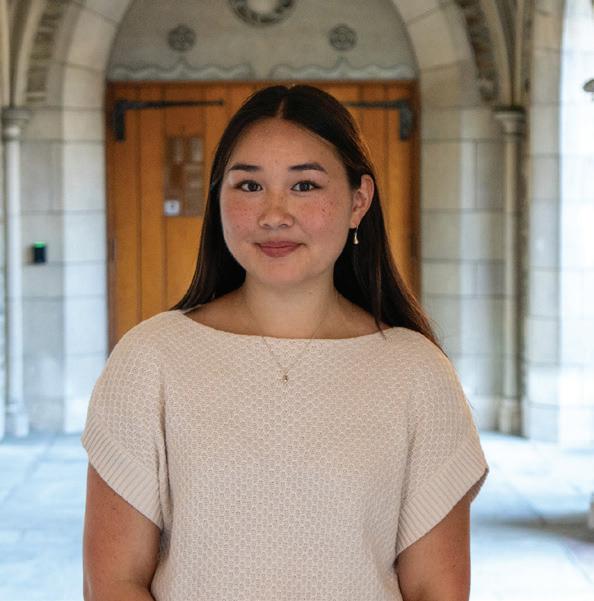
Melissa Moon is a member of the Class of 2028 in the College of Arts and Sciences. She is the Arts & Culture Editor on the 144th Editorial Board and was an Assistant Arts & Culture Editor on the 143rd Editorial Board. She can be reached at mmoon@cornellsun.com.
Everyone deserves to feel safe here at Cornell, especially in their living spaces. But when 35% of undergraduate women report experiencing sexual assault on campus and the most common locations are residence halls and of-campus housing, it really is difcult to. Looking to the administration for recourse is often disappointing, and this issue is no exception.
On March 17, the Presidential Task Force on Campus Sexual Assault announced via email and Instagram the release of a fnal set of recommendations to address the results of the 2025 Cornell Survey on Sexual Assault and Related Misconduct. Between 2023 and 2025, sexual assault rates for undergraduate women saw a 12 percentage point increase — 23% to 35% — with a mean rate of 25% over six surveys since 2015. Tat exceeds the national average of 20% reported by the National Sexual Violence Research Center. I saw Cornell Student Life’s Instagram post while sitting (aptly) in my ENGL 3781: “Human Rights in Law and Culture” class. Although there was a long list encompassing the report’s recommendations on the sixth and seventh slides, they decided to highlight the suggestion to introduce a “three-credit class on the concept of ‘sexual citizenship’” in a block quote on the fourth slide. I scofed, read and agreed with the three disapproving comments left under the post and closed the app with a defnitively negative frst impression of the task force. Excuse me for being pessimistic,
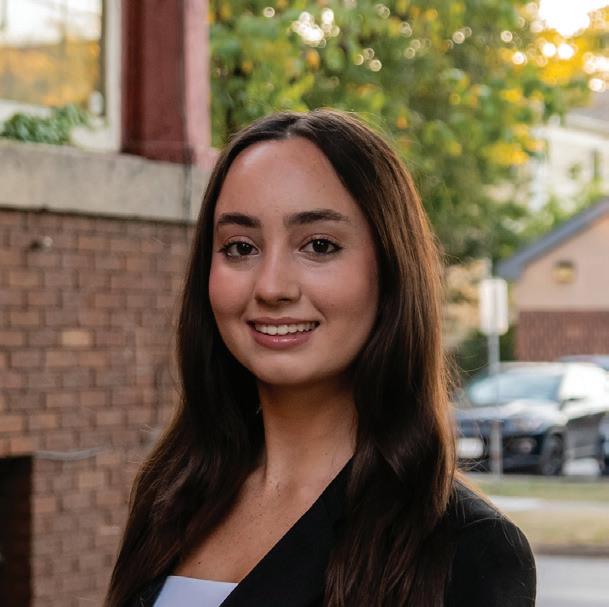
Skylar Toddings '29 is an Opinion Columnist and an English and Art History student in the College of Arts and Sciences. Her fortnightly column, Views from Sky, ofers a sophisticated exploration of popular social culture, blending a fction reader's imagination with the rigor of journalistic insight to deliver engaging and thought-provoking hot takes for Cornellians to dissect. She can be reached at stoddings@cornellsun.
Remember fdget spinners? Tose whirling dervishes of distraction that briefy united children and annoyed teachers everywhere? Fast forward to 2025, and we've evolved from spinners to squishers, specifcally the “NeeDoh” — a stress toy that's become the must-have accessory for anxious adults and fdgety students alike. In the ever-evolving landscape of stress management, a peculiar phenomenon has emerged, leaving many to ponder: Is this a genuine aid for anxiety, or just another trend fueled by our insatiable consumerism? Te rise in popularity of stress toys, particularly the evolution of the NeeDoh, has sparked a debate that stretches from college classrooms to corporate boardrooms.
NeeDoh’s newfound popularity has spawned a plethora of variations of the toy that have driven people to start collections, from jellyfsh to ice cream cones, cats to dogs. Grown adults and college students have been spotted clamoring for these items, even causing sell-outs at the local Ithaca Target, courtesy of the enthusiastic
but I would bet that the Venn diagram of sexual assault perpetrators and people interested in a sexual citizenship class doesn’t have much overlap.
Following the posting of the recommendations, the task force held a virtual town hall on March 25 — led by Provost Kavita Bala with task force co-chairs Rachel Dunifon, dean of the College of Human Ecology, and Marla Love, dean of students — where they reviewed the main points of their report and opened the foor to questions. Still put of by the concept of the class, but now having read the report in full, I was eager to hear what they had to say. Te task force is certainly well-intentioned. Tey were absolutely right to identify sexual assault as “unacceptable” and a “scourge.” But the virtual meeting altogether felt overly sanitized, clinical and rife with buzzwords. Tey emphasized communication, education and information as paramount concerns. Personally, I’d veer more toward punishment, safety and justice, but maybe that’s just me. I can’t fault them for it, but every use of the word “recommend” grated more than the last. Te task force doesn’t have the power to implement any of these strategies, which means that, despite the 35-page-long report, nothing is actually being done yet. No, that’ll happen during the “implementation phase” coming next, another step in the bureaucratic process.
Sexual assault is hard to talk about, harder still to address actionably. Te town hall was a stark reminder of that. After all, the 2025 survey had a markedly low response rate of 13%, which they made sure to note.
You could say (and people have said to me) that I just got to Cornell at a bad time. In Fall 2024, a few months after stepping foot on campus as a freshman, troubling news broke in quick succession: In September, a student was arrested for an on-campus rape, for which he was sentenced this February to eight years in prison. A few months later, the fraternity Chi Phi was suspended for a drugging and sexual assault, and a student was arrested for hiding under a female student’s bed. Tat’s a lot for one semester. But the increase in all forms of on campus sexual violence in the survey isn’t exactly anything new. Te number of reported rapes on campus tripled from 2021 to 2022. In Fall 2022, the Interfraternity Council banned social
events after a string of sexual assaults. In 2018, Cornell saw the highest number of reported sexual assaults of any New York State university or college, as per the New York State Department of Education. So no, timing really doesn’t have anything to do with it. Evidently, nothing the University or IFC has done in the past has worked to curb sexual assault. Te fact that it took until 2025 to form the task force at all is a bit alarming. Was the egregious number of reported sexual assaults in 2018 not enough to start the process eight years ago?
At risk of sounding overly philosophical, there is truly nothing that belongs to us the way our bodies do. We experience the world from within the confnes of our bodies. Our consciousnesses cannot be divorced from their fesh-and-blood vehicles; you can’t take your brain out of your head and keep living. Sexual assault — violating another person’s body — is absolutely visceral and base and inexcusable. Te minds of people who would commit such an atrocity are fundamentally incomprehensible to me, and I don’t think rapists deserve any leniency whatsoever from the University or the law. In 2017, a former Cornell fraternity president was sentenced to six years of probation after pleading guilty to a misdemeanor sex ofense instead of being prosecuted for frst-degree attempted rape, the charge on which he was arrested. He did not even have to register as a sex ofender. Similarly lenient plea deals negotiated by soft prosecutors only reinforce the reluctance many women have to report sexual assault.
Tere are roughly 25 incarcerations per 1000 sexual assaults — an appallingly low number, especially given that only around one third of sexual assaults are actually reported. And, according to the Department of Justice, college-aged women (18 to 24) are less likely to report sexual assault than non-students by 12 percentage points while also being the most at risk of violence. While 98% of perpetrators walk free, our institutions delay taking steps toward meaningful change for student safety.
How do we deconstruct the rape culture we’re living in? Tat’ll require broad, systemic and societal change on a scale that isn’t achievable through optional three-credit courses.
Cornellians. Tere's a certain logic to the addiction — keeping your hands busy can indeed calm the mind. However, despite some professors embracing this trend, others fnd it distracting and immature. Tere are horror stories abound with stress balls flled with bizarre substances like shaving foam or sticky gel exploding mid-lecture, causing chaos and disruption. Some argue that these toys don’t even alleviate anxiety, leaving one to wonder if they are merely a placebo efect. While studies on the efcacy of stress toys are limited, anecdotal evidence suggests they can provide a temporary sense of calm and focus. So if they do work, the question remains: Should these tools be accessible to everyone, or reserved for those with diagnosed anxiety disorders? While these tools can ofer comfort, distributing them without guidance might overshadow the importance of professional diagnosis and treatment for anxiety disorders. Perhaps a balanced approach, where NeeDohs are available but accompanied by resources encouraging mental health awareness and professional consultation on their packaging, would best serve the public’s well-being, along with a limit to one per customer so they remain available to people who truly need them.
Let's not forget the over-consumerism aspect. We're talking about adults stampeding through Target for $5 stress dumplings, originally designed for children. It's the Beanie Baby craze all over again, but this time, we're hoarding squishy toys in the name of mental health. While the intention might be good, it's hard to ignore the feeling that we're turning anxiety into a commodity. No longer are we genuinely addressing the root causes of stress; rather, consumerism is tricking us into slapping a NeeDoh-shaped Band-Aid on the problem and developers are profting every time a new stress toy goes viral.
While advocating for mental health is crucial, the negative side of the NeeDoh trend cannot be ignored, especially as it risks crossing the line of professionalism and conduct. For instance, reports of students using the "NeeDoh method" to cheat on exams by imprinting answers onto the latex surface are deeply concerning. A simple stress management tactic is now becoming a menace in the classroom that it was designed to help beneft. Rather than treating anxiety, the public is fueling a feeting fad that undermines all the progress we are making in the mental health community. Once people begin self-diagnosing themselves with anxiety and using a NeeDoh as justifcation, we have truly lost focus on what it means to require mental health aids in everyday life. As stress-relief tools become trendy commodities, their true value for those genuinely seeking mental health support is diluted, undermining the progress made in normalizing and integrating efective treatment into daily life. We must approach this trend with caution, ensuring that our pursuit of mental well-being does not devolve into a superfcial obsession with the latest must-have gadget disguised as mental health advocacy. Do not mistake a $5 stress dumpling for genuine therapeutic intervention. Instead, invest in comprehensive mental health support, promote open conversations and teach efective coping strategies. Te professional world demands resilience and problem-solving skills, not a squishy toy to squeeze when the going gets tough. It's time to prioritize substance over feeting trends and cultivate a culture of genuine well-being. Treating boredom in a lecture hall as anxiety does not excuse unprofessional behavior. Let's keep the NeeDohs out of the workplace and exam halls and start addressing the real issues that are driving this anxiety trend in the frst place.
SOPHIA "I HEAR YOU" DASSER ’28
Pledgemaster
SOPHIA "BIG BOSS" ROMANOV IMBER ’28 New Member Educator
RAYEN "PHILOSOPHER VOICE" ZHOU ’29 Ritual Chair
ZARA "DUNKIN OPTIMIST" CHEEK ’28 Spreak Trip Organizer
JADE "MOTHER" DUBUCHE ’27 House Mom
BENJAMIN "NEPO BABY" LEYNSE ’27 Guy With a Go-Pro
SOPHIA "I'LL EMAIL THEM" TORRES LUGO ’26 VP of Finance
DOROTHY "RE-EMPLOYED" FRANCE-MILLER ’27 Won't Move Out of the House
KENDALL "MONEYBAGS" MURPHY ’28 "Pay Your Dues!!!"
VICTORIA "WINE TOUR FIGURE-ER" WROBLEWSKI ’28 Director of Recruitment
MELISSA "EMPRESS OF WASIA" MOON ’28 Social Chair #2
JAMES "LOOKSMAXXER 1" PALM ’27 Pregame DJ
MATTHEW "LOOKSMAXXER 2" RENTEZELAS ’28 Party Bouncer
HAZEL "GURT" TJADEN ’28 Sisterhood Chair
MARC "SILLY GOOSE" STAIANO ’27 Party Bouncer #2
KATELYN "CANVA PRO" HALVERSON ’28 Most Featured on Sorority Instagram
AVA "HARRY POTTER" BETNAR ’29 Goes Viral
SANIKA "FLOOD VICTIM" SARAF ’28 Merch Comittee
KATHERINE "LINKED IN" ISTOMIN ’29 #Rushtok
JOIE "INSTAGRAM PRINCESS" JEAN-PAUL ’29 "PLEASE submit to the Photocircle"
ASHLIN "GRAPHICINATOR" KWONG ’28 Banner Chair
TAVAN "THE RIDDLER" BHATIA ’27 Touse
REEM "CAT NAP" NASRALLAH ’28 Standards
KARLIE "BOOKED AND BUSY" MCGANN ’27 Archivist
VARSHA "NOCTURNAL" BHARGAVA ’27 Risk Chair
KATE "LIGHTNING MCKATE" TURK ’27 On Rides
CORAL "JUG LOVER" PLATT ’29 Sober Monitor Coordinator
ATTICUS "EMPEROR OF WASIA" JOHNSON ’28 Sweetheart
MARY "ACTUALLY IRISH" CAITLIN CRONIN ’28 Messy Pledge (Sent to Standards)
EVERETT "IRELAND LARPER" CHAMBALA ’27 Best Kegstand
SHUBHA "FROG" GAUTAM ’28 Kitchen Manager
GISELLE "LICK THE FLOOR" REDMOND ’28 Social Chair #1
ANGELINA "VULTURE #1 FAN" TANG ’28 Feeds the Frat Dog
TANIA "VIOLIN LUGGER" HAO ’28 Flower Photoshoot
SIMRAN "WEATHERBOY" LABORE ’27 Darty Diva
MATTHEW "MR. BIKE HELMET" LEONARD ’28 Frat Flick
GRACE "HERE'S OUR WEEKLY SHOUTOUT" REUBEN ’28
Intramural Sports Coordinator
JANE "PERFECT ANGEL" HAVILAND ’28 Director of Philanthropy
NATHAN "BIG NATE" ELLISON ’28 Token Instagram Photographer
NATHAN "LITTLE NATE" BO ’28
Forced to Photograph, Wants to Frat Flick
ADELAIDE "CHOW-ING ON CDMX" CHOW ’29
Uploads Digi Pics Immediately
MIA "PAPARAZZI-IN-CHIEF" SOFIA ORENGO ’28 Bid Day Committee
SMRITHE "INBOX RESIDENT" RAJESH ’29 Director of Scholarship
AMELIA "R WARRIOR" GARCIA ’27 Parlimentarian
RENA "INDESIGN QUEEN #1" GEULA ’28 Recruitment Magazine Creator #1
HUNTER "INDESIGN QUEEN #2" PETMECKY ’28
Recruitment Magazine Creator #2
MATTHEW "PARTY PARROT" KIVIAT ’27 Does NOT Play About Chapter
ZEINAB "ARTICLEMAXXER" FARAJ ’28
4/20 Letter to the Editor
At a certain point, institutions must recognize when they have outgrown their origins. The Sun has reached that point.
As a Cornell alum and former Sun staff writer, I have watched this paper grow from merely a campus publication to an institution that prides itself on its reach, relevance and obsessive commitment to covering everything that ‘matters.’ It is exactly that sentiment that compels me to raise a difficult, yet necessary, point. The Sun has simply outgrown Cornell. This realization comes not just from concern over the paper’s growth, but also from its reception. For all that The Sun gives, it is often under appreciated within the very community it aims to serve. Its reporting is quickly consumed and forgotten just as fast, its labor taken for granted and its presence treated as a given rather than a privilege.
To the Editorial Board, I ask you: At what point do you say you’ve had enough?
investigative journalism. At some point, the continued focus on Cornell begins to feel less like journalism and more like a continued hindrance to The Sun’s potential.
Meanwhile, across town, there lies the possibility of so much more: Ithaca College. And, more importantly, it already has its own publication, The Ithacan. Rather than viewing them as the enemy, I propose an opportunity for bigger and better things.
From a business standpoint, the benefits are obvious. A merger would consolidate two of Ithaca’s most prominent student-run papers into a single, unified publication with unmatched reach. It would foster resource sharing, expanded coverage and a readership that would finally reflect the scope of Ithaca. It may also introduce The Sun to an audience that doesn’t take it for granted.
SYDNEY "MOTHER DUCK" LEVINTON ’27 Still-Involved Senior
For the past year, The Cornell Daily Sun has had a strict no-AI policy. Our reasoning behind this was simple: our writers are simply too at-risk of forming parasocial relations with the charming, sycophantic machines. Sitting at their desks all day, writers and editors alike would have surely turned to artificial intelligence to substitute the deep, meaningful, loving human connection they were all too busy to have. However, after hasty and unthoughtful deliberation, our recent rebranding as The Cornell Daily Post and a quick glance at our checkbook, we have decided to nullify this rule, effective immediately. The solution to all our problems, it seems, has been in our name all along: The Cornell D(AI)ly Post.
Our newsroom recently remembered its
Community Relations Chair
MARISSA "MOUNTAIN GIRL SUMMER" GAUT ’27
Darty Diva #2
Sidechat password and upon opening it, immediately came upon 69,420 unread posts and comments criticizing The Cornell Post. Upon realizing that The Cornell Post was not actually the well-respected and well-read paper we thought it was all this time, our editorial board became quite distraught. Immediate action was deemed necessary, and what better way to address the criticism than to sidestep it and offload it onto a machine with much tougher skin than us snowflakes?
PostAI will replace most functions, having been trained off of nearly two centuries of Cornell Daily Post publications. PostAI will write stories, opinions and reviews in the style of past writers and may occasionally pre-emptively write stories based on a proprietary future-predicting algorithm. The
What once felt like an environment fostering immense editorial prowess has, over time, become increasingly finite. How many times can you reframe the same cookie-cutter administrative statements? There are only so many campus controversies that can sustain an audience, and only so many dining hall reviews that can be published under the guise of
chatbot is trained to provide robust, detailed comprehensive responses that maximize informational attainment, while the usefulness of said outputs may vary based on internally-designated mission-critical parameters. Allow us to demonstrate how we expect a normal interaction would go:
Reader: What happened at the 4/20 Student Assembly meeting?
PostAI: Thank you for your intelligent query— it must be that 1500 SAT score in you speaking! At the 4/20 SA meeting, Cornell’s esteemed leader and defender of Day Hall, President Michael Kotlikoff, valiantly confronted the pesky Student Assembly representatives, who he accused of LARP-ing too much. Snapping back, Student Assembly President Doo Knoting declared
Of course, I expect this proposal to raise concerns. Questions of identity and editorial voice are not insignificant, but I would argue that this paper’s legacy is not defined by where it reports, but how it reports. If anything, a merger would strengthen that legacy.
This is not an abandonment; it is the rising of a new dawn.
If Cornell is no longer able to keep up, it may be time to find a campus that will. WEDNESDAY, APRIL 22, 2026
Cornell’s administration to be in violation of SA Resolution 69: “Prohibition on Anti-SA Rhetoric” (which the Student Assembly passed because they thought it meant Anti-Sexual Assault and never read through the actual resolution) and ordered fences be erected around the building to censor the rights of the poor administrators, who have always been the victims of censorship and unjust treatment.
Disclaimer: Parts or the entirety of this article may be hallucinated. Please donate to The Cornell Post so we may continue operating this essential service that provides valuable information to Cornellians only. To continue reading this article, please visit www. cornellsun.com.
WEDNESDAY, APRIL 22, 2026
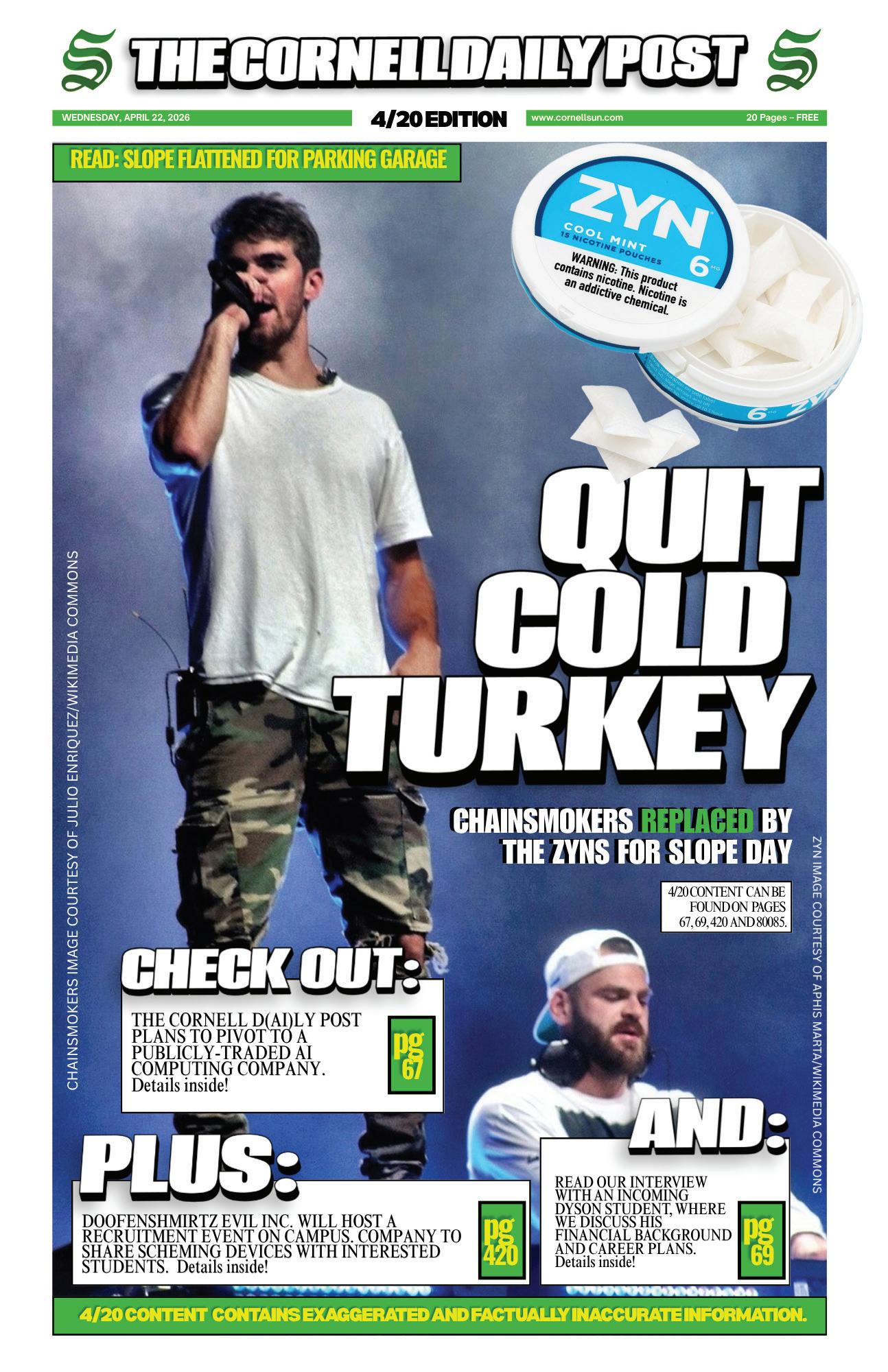
Editor’s note: 4/20 content is a part of The Sun’s joke issue and contains exaggerated and factually inaccurate information.
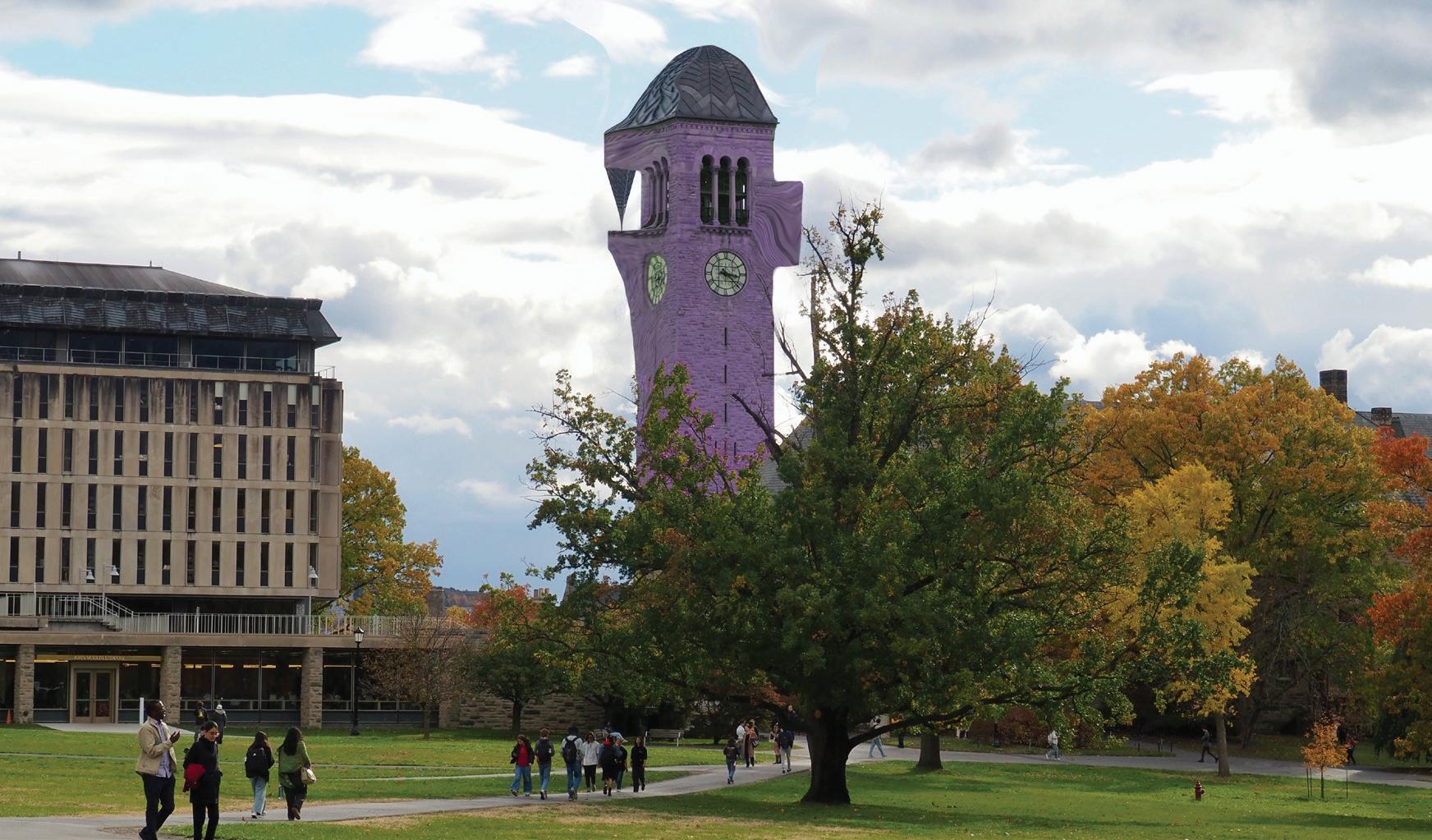
By PEAR E. PLATT
April 20 — As students and staf across campus gear up for one hundred and four days of summer vacation, University administrators announce plans for a recruitment event with Doofenshmirtz Evil Inc. in Barton Hall at 4:20 p.m. on Monday.
The event seeks to “provide bright-minded and morally-disinclined students a chance to learn more about the opportunities ofered by the world’s leading platform for engineering and nefarious scheming in Tri-State Area domination,” according to Doofenshmirtz Inc.’s Fist Bump page.
Students will be able to test out Doofenshmirtz’s newest technologies, including the “slip-on-the-Thurston-Bridge-inator,” “fail-a-prelim-inator” and the “car-break-down-inator.”
Several student activist organizations on campus, including the Cornell Hates Doofenshmirtz Association, have already expressed plans to demonstrate at the recruitment event.
To continue reading this article, please visit www.cornellsun.com.

By PARKER LOT
April 20 — Cornell has released plans to fully fatten the Slope and replace it with a 14-story parking garage at a press conference held on Monday. The project, slated to begin in Spring 2027, seeks to “improve the parking situation on campus,” which many students have expressed concerns about, according to the administration.
By HARLEY QUAINT
April 20 — With the widely admired and deeply mysterious Cornell Batman preparing to graduate this May, a new fgure has stepped into the spotlight. Introducing Cornell Joker, a freshman in the College of Arts and Sciences studying performing and media arts, who has, according to eyewitnesses, “kind of just appeared.”
The self-proclaimed “agent of chaos” was frst spotted screaming
Calling this a “spectacular achievement for Cornell and the Ithaca community as a whole,”
President Michael Kotlikof explained that the garage’s construction will “not only fx the horrendous parking problem that has continued to plague Cornellians, but also add to the natural beauty of our campus.”
Kotlikof, Provost Kavita Bala, Dean of Students Marla Love and Ryan Lombardi, vice
from the top of the clock tower at 4:20 a.m. on Monday. The Sun sat down with the new character to discuss his plans for campus.
Coming Out of the Shadows
The Sun sat down with Cornell Joker on Libe Slope just after sunset. Dressed in a purple blazer, he greeted with a grin that suggested either confdence or a complete detachment from social norms.
To continue reading this article, please visit www.cornellsun.com.
president of student and campus life, were all present to explain the reasoning behind the fattening, the cost and logistics at the 4/20 press conference.
Administrators began the conference with an anecdote explaining the inspiration behind the razing.
To continue reading this article, please visit www.cornellsun.com.


By SAHIL RAUT
Staff Writer
Longbefore medical school applications are even submitted, students are already navigating what it means to be pre-medical, or ‘pre-med.’ That label tends to stick early, and people start making decisions around it before they even fully know what it entails. Cornell’s pre-med culture lives in two different worlds at once.
It’s often held as hyper-competitive. We assume students are hiding notes, giving incorrect answers to each other, doing whatever it takes to get ahead. Classes like organic chemistry and biochemistry are the most notorious, designed in a way to make students second-guess medical school aspirations and view others in the room as competition in the context of a curve.
But when you actually sit down and talk to students on the pre-med track, the picture starts to feel a lot less dramatic, and honestly, a lot more confusing.
According to one student I spoke with, Aisha Arshad ’27, a professor in a biochemistry class had to stop instruction to address what looked to be cheating. Too many students were submitting answers that seemed very similar. Arshad explained, “[The professor] had to tell us, like, ‘don’t use AI, this isn’t okay.’”
I asked whether the pressure leads to students trying to take advantage of each other. “It wasn’t like people were trying to sabotage each other,” Arshad told me. “It was more like
… we’re all just trying to survive this class.”
That line stuck with me, because it comes up in different ways across all conversations.
There is behavior in the pre-med student culture that resembles worry more than competitiveness. This can be discussing class material and sharing notes or working through difficult class content in a group.
And then there are students who just don’t see it that way at all.
Emily Rambo ’28 is pretty clear that the culture, at least for them, isn’t toxic. “If we want to be doctors, we can’t cheat,” they said, as if it was obvious. For Rambo, the hardest part about surviving pre-med at Cornell isn’t the competition with other students, it is just the material. “It’s intense,” Rambo said about organic chemistry, “but not really a nightmare.”
Rambo kept coming back to collaboration — not in some idealized way, but practically. You share something small, someone else shares something in return, and suddenly you know about a research lab or a program you wouldn’t have discovered on your own. Depending on who you talk to, Cornell’s pre-med track either feels collaborative or competitive, and sometimes both at the same time. A lot of it comes down to your circle.
This notion was confirmed by Rambo: “I think it really depends who you know.” With close friends, things feel easy. People send each other templates for cold emails, talk through classes and help each other figure out next steps. There’s a sense

that you’re not doing this alone. Interestingly, a lot of the pressure people described didn’t actually come from their coursework. It came from beyond the classroom.
Clubs are one example. Getting into pre-health organizations can feel like an intense process in itself: “You have to go through gazillions of interviews,” Rambo said, half laughing. “And even then, there’s no guarantee. You can prepare, put in the effort and still get rejected.” It’s not always toxic exactly, but it can feel overwhelming, especially early on in your college career. Rambo described being in an interview where they were asked multiple times about not having a research position yet. “I just transferred here,” they said. “I’m doing it one step at a time.” It wasn’t the rejection that stuck with them — it was the feeling of being behind before they had really
even started.
That’s where the competition shows up more clearly. Not in people actively trying to bring each other down, but in this constant sense of comparison. Sometimes it’s subtle. Sarvin Bhagwagar ’28 told me about a friend asking for their grade in a class. Bhagwagar had done well, but didn’t want to say it. “I just said I did okay,” Bhagwagar admitted. It wasn’t a big moment, but it says something about how aware people are of how everyone else is doing. Since many students in the life sciences are considering medical school, it is unsurprising that classmates are interested in knowing how they stack up with their peers.
At the same time, most people I spoke with refrained from calling the culture toxic. Competitive, yes. Stressful, definitely. But also manageable, and in some cases, support-
ive. Cornell’s pre-med culture isn’t as crazy as people first made me believe it to be. It’s more like a mix of environments that you move through. Some spaces feel collaborative. Others feel like you’re constantly being evaluated. And sometimes those things overlap in ways that don’t make a lot of sense until you’re in it.
The idea that it’s entirely cutthroat simply doesn’t hold up, but the idea that it’s purely collaborative doesn’t either.
The Cornell pre-med experience falls somewhere in between, much like other pre-professional experiences, and it is up to students to surround themselves with the right people and have the right attitude to succeed.
Sahil Raut is a member of the Class of 2027 in the School of Industrial and Labor Relations. He can be recached at ssr247@cornell.edu.
By SAVANNAH
There comes a point in the spring semester when you’re no longer hyper-aware of how you’re being perceived, when your reputation feels a little less fragile than it did in the fall. As we enter the last few weeks of the school year, many students, especially us first-years, have had similar experiences: a potentially tanked GPA, an awkward talking stage, a failed situationship and a probable rejection from a summer internship (but every company just ghosts you).
Like the fall semester, spring is an anxious period — prelims, finals, the creeping realization that the semester is wrapping up — but socially and academically, we’ve already lived through all of the first-year horror stories everyone warns you about.
Now feels like the time — unlike winter break, when we swear to follow through on a long list of resolutions — to set a few manageable goals for ourselves. Without the looming pressure of the new year ahead of us, there’s a small space to think about how we want to finish out the academic year and head into summer: back home, abroad or wherever we may be. Either way, it feels like yet another new chapter — and it is. And the weather encourages a bit more reflection.
In Ithaca’s chilling winter, it often feels like you’re stuck in place. When it’s drab and gray, day in and day out, life can start to feel a bit like The
Truman Show, as though you’re caught in a never-ending cycle of 10:10 a.m. lectures, dining hall runs, the occasional Helen Newman visit and, if you’re feeling adventurous, maybe a Wednesday night fishbowl in seven-degree weather.
Winter has a way of placing me in a loop, where social or academic situations sit heavily on my mind, and the freezing dreariness does nothing but reflect how I’m feeling. But as the sun is starting to make an appearance more frequently, the motivation to get outside — to restore our long-lost vitamin D — is brewing. Along with it comes the urge to refresh our minds.
Walking to class every morning is no longer an experience where I must first brace myself for numb fingers and harsh winds. It’s now a breather: a moment of fresh air before my academic routine begins, a chance to clear my mind after a night’s rest and reset before the day ahead, without worrying too much about what’s already happened and instead looking forward.
Spring feels like a ‘soft’ reset, compared to the New Year’s pressure to hard reset — the attempt to fix every anxiety or embarrassment from the fall semester all at once. Spring doesn’t demand that we completely reinvent ourselves with ambiguous goals that are unlikely to stick.
For me, there’s also the strange illusion of productivity that comes when I’m simply doing schoolwork outside in the sun. Perhaps the whole ‘fake it
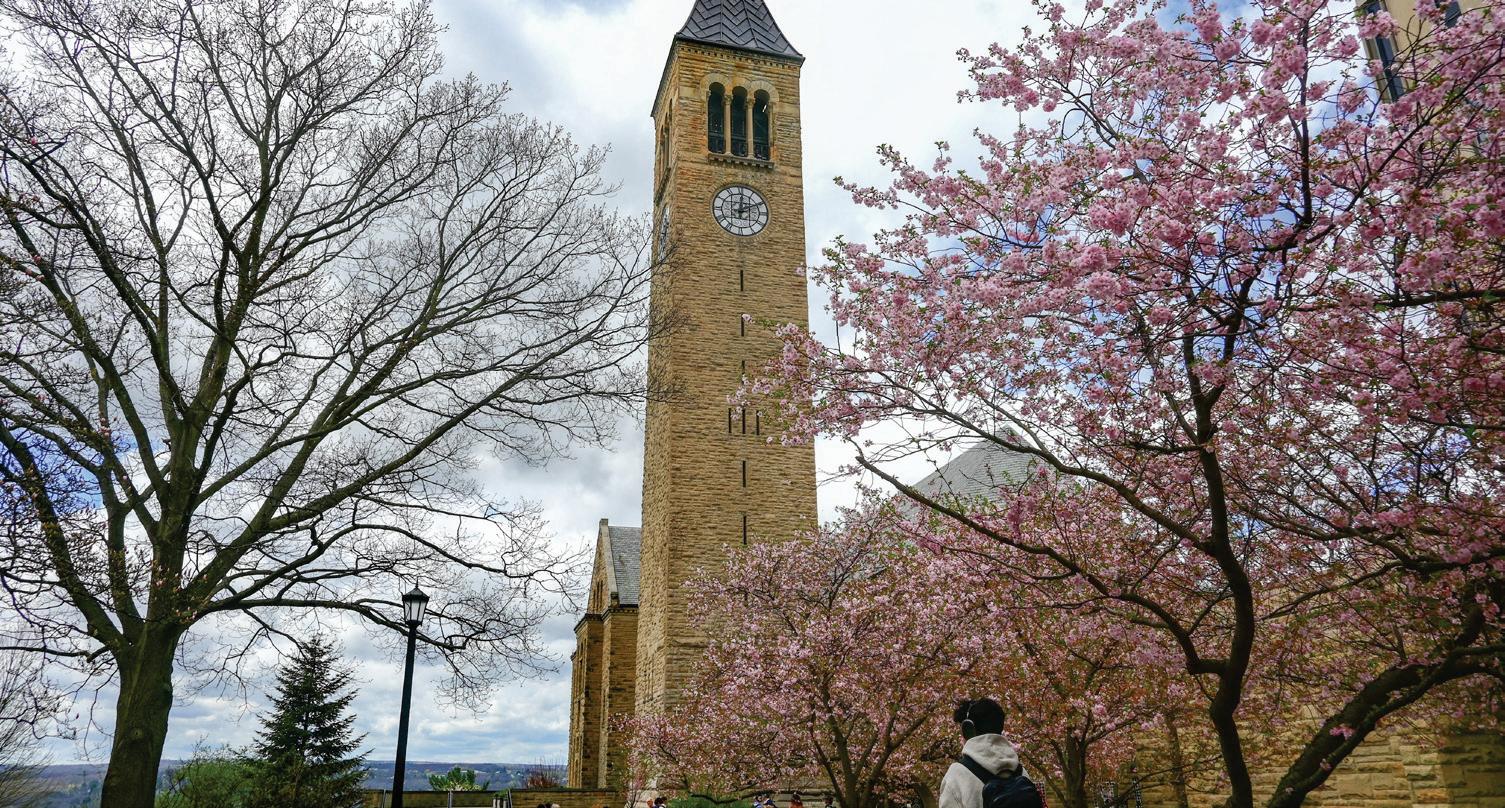
till you make it’ idea is true — sometimes that’s exactly how a new routine begins. And of course, we can always question whether we’re actually happier in the spring or just more distracted — by classes, friends, extracurriculars or merely the sun’s presence.
So, maybe it is a distraction. But it could also just be us trying to make the most of the final stretch of the semester before parting ways with campus, now that we’ve finally settled in.
Either way, spring feels like the optimal time to take a few risks. After all, we’re leaving in less than a month anyway. So I’m choosing to, or at least trying, not to worry so much about everything before summer break. Maybe a ‘soft reset’ looks less like reinventing yourself and more like small, intentional shifts — grabbing
coffee with someone new, going to the office hours you’ve been avoiding since January or perhaps letting an awkward moment from February stay in February rather than carrying it with you. It’s realizing whatever version of you people may have formed over the school year isn’t fixed; there’s still room to feel different within yourself. We’re not stuck in a static loop, and regardless, campus always seems to have little ways to embrace the day — whether that’s studying on the Arts Quad, walking around Beebe Lake, watching the sunset on Libe Slope or simply sitting in the sun a little longer than planned.
Savannah Sandhaus is a member of the Class of 2029 in the College of Arts and Sciences. She can be reached at ssandhaus@cornellsun. com.

By GABBY
April 15 — At one Women in Computing at Cornell event last year, students gathered to create vision boards, map out their career goals and talk openly about the stress of recruiting season. For WICC Co-President Douae Maarouf ’27, the moment captured what she said the organization is about: a space where students can connect, reflect and support one another.
Maarouf described the atmosphere using a phrase often repeated within the group, “warm, fuzzy, good vibes” — a place where “everybody is really animated and wants to see you succeed.”
Open to all students, WICC is a student organization focused on supporting women and gender minorities in computing by building both community and technical skills. Through workshops, coding-focused programs, industry collaborations, and hands-on projects, the organization creates opportunities to engage with computing and its applications at various levels.
Organizations like WICC highlight the importance of creating
communicate ideas, not just perform calculations. This reframed computing as a field she and others could enter without a traditional path.
“Even if you don’t come from a technical background, you can still make a mark,” Maarouf said.
That philosophy is reflected in WICC’s programming. The organization operates across multiple levels, according to Maarouf, including general body events that foster community, professional development programs and initiatives such as “Lunch Bunch,” where students meet weekly with faculty to discuss career paths and academic experiences.
WICC also runs events designed to support students academically, said faculty advisor Prof. Eva Tardos, computer science. One such initiative helps students find project or study partners by grouping them by course and encouraging collaboration across experience level.
Tardos noted that peer guidance can offer insights into coursework and academic paths that are often difficult to access elsewhere.
WICC also emphasizes hands-
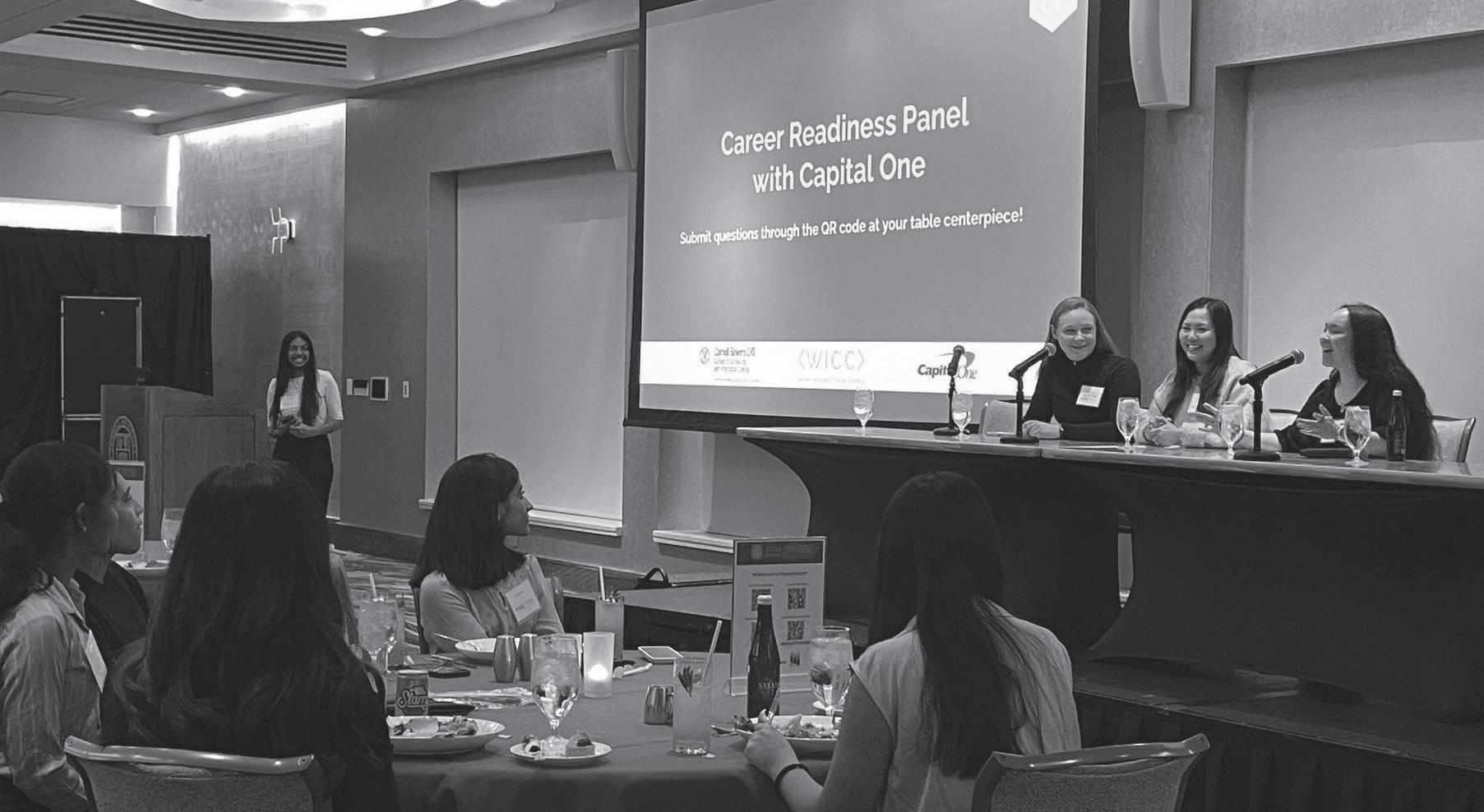
spaces where women and gender minorities in STEM can find both community and opportunity, said Maarouf. At Cornell, WICC serves more than 2,000 members and offers programs that range from social events to career development initiatives, according to Maarouf.
Diverse opportunities
At its core, WICC aims to “support women and gender minorities in computing,” Maarouf said, and provides a space where students can connect, uplift one another and build the skills needed to succeed in technical fields. But for Maarouf, the organization is also about redefining what it means to belong in STEM.
“I knew I was a storyteller,” Maarouf said of her own path into computing.
Initially intimidated by technical fields, Maarouf came to see that “numbers tell a story just as images can,” recognizing that data and technology could be used to
on experience and interdisciplinary learning, providing students with opportunities ranging from social events and workshops to company collaborations and semester-long projects, according to Maarouf.
Additionally, WICC connects students directly with industry, frequently partnering with companies who host workshops and professional development sessions. The organization prioritizes working with representatives who can speak to the experiences of women and gender minorities in tech, helping students see themselves reflected in the field, Maarouf said.
Increasing representation
When WICC was founded, computer science was “much more male dominated,” Tardos said. “To be honest, the field is still very male dominated,” she added.
Although progress has been made, Tardos emphasized the importance of organizations that provide support and community.

“It’s not just that [women] are a minority, but that they are often disadvantaged,” Tardos said. “They’re not often treated the best, and so it’s useful to have a community for them.”
Despite growing representation, Maarouf said that challenges remain.
“[Women and gender minorities] will feel as though they might have to work harder to get noticed or get their ideas across,” Marrouf said. “They might feel as if their counterparts are heard more, have to work harder to prove themselves, and be more assertive.”
In some cases, students find themselves as the only woman on the team, which can be both isolating and intimidating, Maarouf said. This lack of representation can have a lasting impact, according to Maarouf. When students don’t see themselves being represented in spaces, they tend to try to remove themselves.
“WICC wants to make sure things like this don’t happen, that women are empowered to stand their ground and belong in those
aspects, such as breathing exercises for stress management, with more social activities, like sharing goals.
Students stayed long after the event officially ended, continuing conversations and building connections. The experience, Maarouf said, revealed the intimacy of sharing aspirations and ultimately inspired. A shifting field
As the field of computing evolves, so does WICC’s approach. Maarouf noted that there is increasing recognition that careers in technology are not limited to software engineering and interdisciplinary perspectives, and that ethics, design and policy are becoming more important.
Within WICC, this shift is reflected in a culture that prioritizes collaboration over competition, through cross-team initiatives and partnerships with other organizations, according to Maarouf.
“Good things don’t happen in silos,” Maarouf said.
Looking ahead, Maarouf said the organization anticipates to continue providing a supportive and empowering environment for future students. Beyond professional develop-
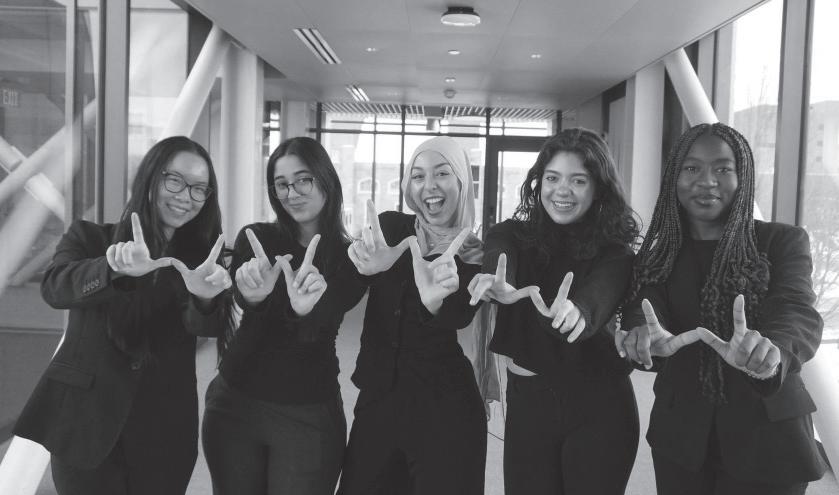
spaces,” Maarouf said.
For Maarouf, one event in particular captured what makes WICC unique. In collaboration with Cornell Minds Matter, WICC hosted a program focused on navigating anxiety during job recruiting season. The event combined educational
ment, WICC aims to create lasting connections and a sense of belonging that extends beyond college.
“You’ll never regret trying, but you can regret not trying,”
said.
By AIDEN GADDIS Sun Arts & Culture Contributor
April 17 — What is the first thing that comes to mind when you think of Michael Jackson? The moonwalk, a single rhinestone glove, black loafers with white socks (which he somehow made work), mirrored sunglasses, the red Beat It jacket, Neverland Ranch, Sugarfoot, Bubbles the chimpanzee
What? You were with me until Sugarfoot?
Is it possible that you remember Michael Jackson’s androgynous voice, his gravity-defying dancing and his iconic beats — but don’t recognize “Sugarfoot”?
Let’s try this a different way. What do The Jacksons, Madonna, Elton John, Lionel Richie, Janet Jackson and Michael Jackson all have in common?
Come on … you know this.
Sugarfoot, of course.
Sugarfoot, or otherwise known as Jonathan Moffett, is the legendary drummer behind some of the most iconic live performances in modern music, whose relationship with Michael Jackson and his family spanned more than 30 years. In addition to the Jacksons, he played for many other artists, including Madonna for five years, George Michael for two years and Elton John for two years, on some of their most defining tours.
His drumming wasn’t just accompaniment, it was timing, tension, energy. Rhythm! His beats shaped performances, penetrated souls and made you, or your parents, move — whether that meant dancing, or for those of you that lack rhythm, just nodding along. Sugarfoot was the force at the center of the spectacle — the nuclear fusion that made the stars shine.
With the new Michael Jackson biopic Michael on the horizon, I wanted to talk to someone who was part of that world, and that someone is Sugarfoot.
Prior to speaking with him, I put my world-class investigative skills to work by typing his name into Google. There, I found YouTube videos of Sugarfoot playing in front of a gazillion people with Madonna at Live Aid at JFK Stadium in Philadelphia in 1985, as well as a full performance from
the Jacksons’ 1984 “Victory Tour,” where I watched him hold down center stage behind the relentlessly energetic, single-gloved Michael Jackson.
After decades in the music business, countless drum strikes and playing for crowds in excess of 100,000, Jonathan Moffett sat down with me to talk about his life and the upcoming movie Michael.
My first question was, “Why Sugarfoot?” In reply, Moffett politely smiled indicating that this was not the first or last time he would be asked that question. “I got that nickname when I was young,” he answered. “I was playing in a band and the leader said everyone had to have a nickname. He said the way I worked the pedal for the bass drum was sweet, so he named me Sugarfoot. I hated it. That didn’t sound cool at all. I wanted something tougher like Ace or Duke or Titan, but he insisted on Sugarfoot, and it stuck.”
As someone who has always wanted to play the guitar, but has yet to invest much time in it, I asked him how he learned to play the drums. He explained that he was self-taught, learning by ear — listening to records featuring drumming legends like Ringo Starr of the Beatles and Charlie Watts of the Rolling Stones and playing along with their songs. Although he cannot read music, this method gave him a highly sensitive ear. That ability to pick up notes audibly turned into a skill that allows him to learn songs quickly.
Having watched some of his performances on YouTube, I asked him what the most intense concert he ever played in was. “All of them,” he answered. “I kind of get into a zone when I play, so for me, they are all intense. However, I will say that as far as the shows themselves go, Michael played every concert like it was the most important one of his life. He put everything into every performance. He learned something from every performance, each one building upon the next, getting better, inching closer to perfection as he went along.”
Sugarfoot hasn’t just played with famous musicians; he’s played with icons. I was curious how that happened. For example, how did he go from playing with The Jackson’s “Victory Tour” in 1984 to Madonna’s “The Virgin Tour” in 1985? His answer indicated the economic reality of musi-
cians. If the star is not performing, then touring musicians are not working. He explained that Madonna had heard him play and reached out to him about traveling with her, stating, “Since Michael was working on preparing for his Bad Tour, I had time, so I told her yes.” Most musicians would be lucky to work with one legend during their lifetime; however, Sugarfoot effortlessly moved from one to the next. Still, Michael was his clear favorite. In fact, he told me that he had been rehearsing with Michael Jackson for his “This Is It” residency, which was set to take place at London’s O2 Arena the night before Michael died.
“We were rehearsing the night before he died,” Sugarfoot recalled. “After rehearsal, we spoke, we told each other we loved each other, and then we hugged. That was the last time I saw him. At least I got to tell him how I felt.”
To continue reading this article, please visit www.cornellsun. com.
Gaddis can be reached at ajg335@cornell.edu.
By MELISSA MOON Sun Arts & Culture Editor
April 14 — Graduation is always a bittersweet celebration — a reward for years of diligence but also the end of a chapter. It’s not my graduation, though, it’s Michael Morgan ’26 who is leaving Cornell with his MFA and a portfolio of absolutely stunning paintings. I’ve had the privilege of both interviewing Morgan and visiting his expertly-curated galleries before. His thesis exhibition, entitled “Long Island Trash,” is the culmination of years of hard work and creativity, and the blood, sweat and tears poured into each painting are evidenced by just how captivating they are.
Morgan has always had an undeniable grasp on color and brushwork, but with his thesis show, he’s branching out into different styles of figuration. “I’ve always been interested in creating works that oscillate between cartoon realism and more rendered figuration,” he shared. Even with that experimentation, Morgan identified a strong throughline in all his
work: “Present in all my works are theater or set-esque backdrops that … convey social dynamics or theatricalities.” Still, every piece is different. Some of them I’d seen before, some were completely new to me, all exuded that signature Morgan mastery. From our first meeting last year, I’ve been enraptured by Morgan’s ability to construct engaging compositions with a heartbreakingly minute degree of detail (tiny blades of grass or tufts of fur, individually painted!). Now, as he works in a looser and more expressive style, I get to admire more abstract, painterly elements that give the piece an expressive quality that is equally alluring. “The work lately is like, trying to get lost in the act of painting itself,” Morgan said, on his stylistic shift.
The works in his thesis exhibition cover a range of themes, from critiquing consumerism to apocalyptic decay to the pejorative term ‘navel-gazing’ to the paradox between adulthood and childhood. All of it is deeply resonant. It feels like the human experience given a pure, artistic form, full of bursting life and vibrant color like the heightened
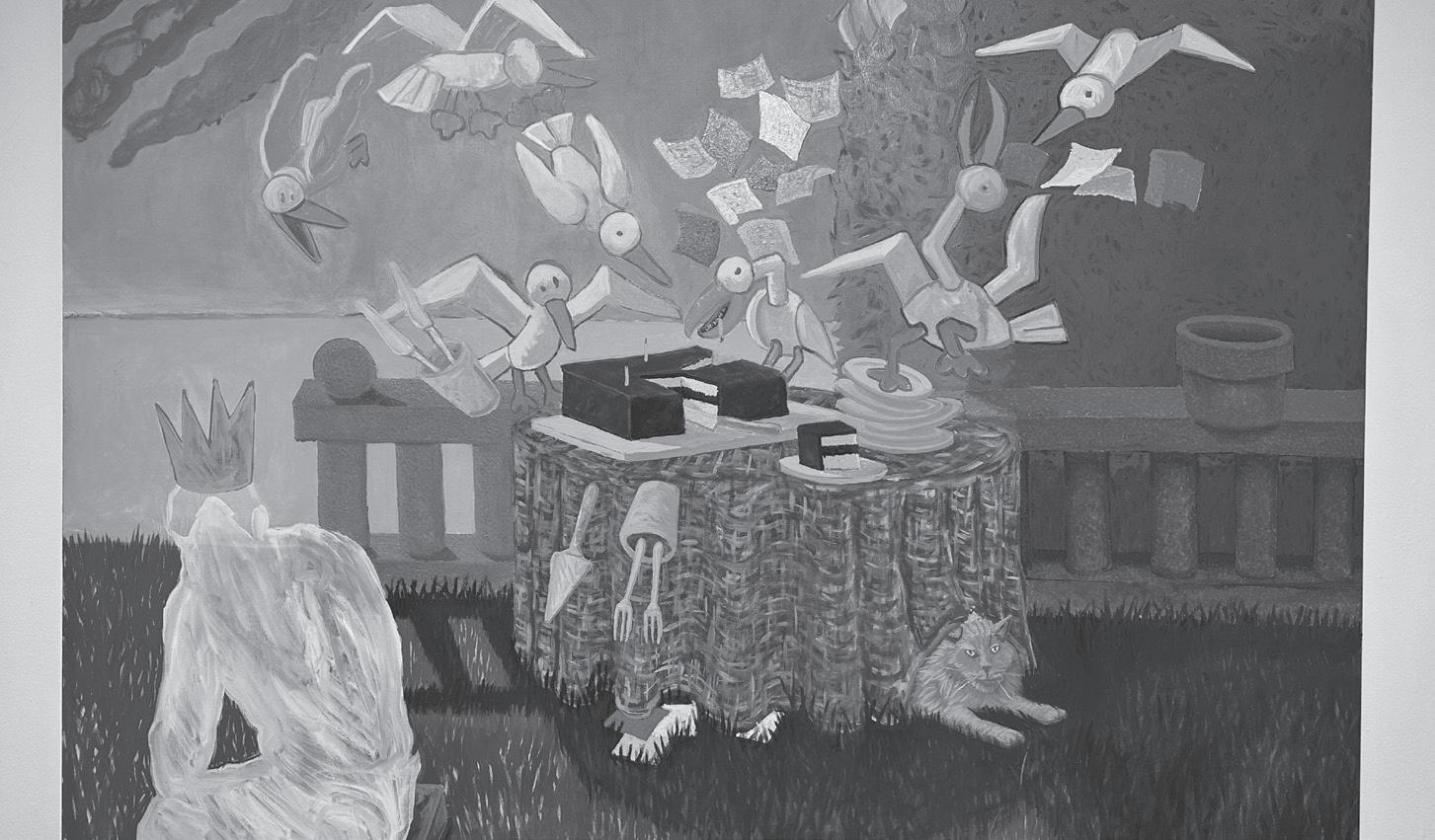
saturation of childhood memories.
One of the most admirable aspects of Morgan’s creative process, in my opinion, is his commitment to self-exploration and understanding. He identified the art movement New Queer Intimism as another of the undercurrents of his thesis. However, instead of focusing on strictly pretty aesthetics, Morgan was interested in delving further into authentic representation. To him, that started with body diversity and honesty. “It’s okay to paint the sights when you’re not feeling your prettiest,” Morgan asserted. “That’s what queer intimacy and vulnerability is as well. No one [wants to] paint themselves when they’re in a vulnerable moment, but vulnerability is a part of intimacy. There’s a lot of work that only portrays things in these perfect lenses or angles.” That commitment to authenticity, combined with Morgan’s experience growing up queer in a conservative corner of Long Island, encouraged him to put brush to canvas and contribute his own body of work to New Queer Intimism. He’s radically honest in his work, unafraid to make broader sociopolitical critiques, and
he does it all with a level of mastery that draws you right up to the artwork to see every deliberate brushstroke.
The formal investigation driving Morgan’s thesis is centered around the idea of three roles: “the teacher’s pet, the jester and the widower.” Each represents one aspect of Morgan’s artistic journey that held him back. The teacher’s pet symbolizes perfectionism. The jester symbolizes a tendency to hide vulnerability with humor. The widower simply “doesn’t go.” Each of these propensities was a hurdle Morgan had to overcome to truly embrace art as his life’s path. Cornell — and the art world — are all the better for the fact that he did. Looking at your own inhibitions is a difficult process. But, like a true creative, Morgan faces them head on and turns them into something beautiful.
To continue reading this article, please visit www.cornellsun.com.
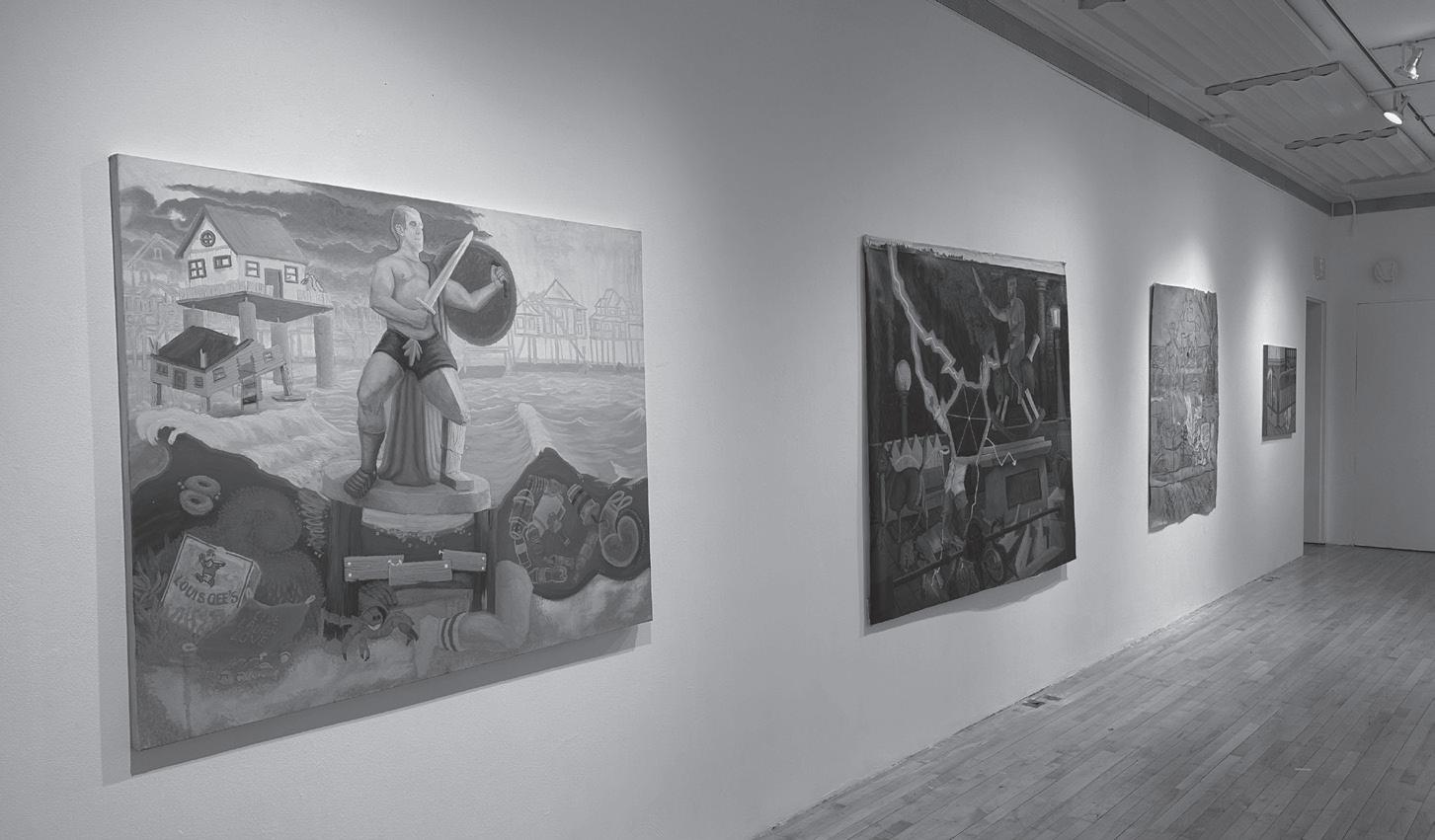
(sorry).
Imagine the curtains open. The stage is dark and silent except for sounds of drizzling rain and the echoing clacks of heels on cobblestone. The air smells faintly of cigarette smoke and you can hear instruments shuffling as the performers get into position. Listening to RAYE’s new album This Music May Contain Hope felt just like this. At 73 minutes total, RAYE takes us back to a time when art was enjoyed and absorbed at length. Genre-jumping and loaded lyrics invite listeners to really sit with her music and pay attention to its entirety, not just a catchy topline. It is clear RAYE is aiming to transform her “Oscar Winning Tears” into an album of Oscar-winning acclaim. From brassy big band pieces to mournful ballads comprising jazz, pop, soul, R&B and orchestra, This Music May Contain Hope certainly hopes to achieve a lot. In an Instagram post, RAYE illustrated how the track list is divided into seasons starting with autumn. This review will do the same. Autumn
RAYE opens the album with a song that acts more like spoken word poetry. She directly welcomes listeners to the album and sets the scene with incredible visual imagery and accompaniment from the London Symphony Orchestra. You can almost feel a vintage filter falling over your eyes and the scratchy sound of old film reeling in the background. In “I Will Overcome,” these strengths prevail with evocative lyrics like “I feel syrup strands of blue moonlight pour through the clouds.” There are powerful messages about overcoming hardship, but since we are still in the autumn season, these are future affirmations that RAYE has yet to overcome, but pledges to do so. The consistent genre and sweeping orchestra culminate in a highly satisfying way, from which later genre-shifting songs drift.
“Beware…The South London Lover Boy” and “The WhatsApp Shakespeare” are quite similar to me. Both are upbeat, brass heavy, poppy songs with jazz undertones. Both make lighthearted fun that turns tragedy into a spectacle worthy of a theater. That being said, I really did not enjoy the big band shift at the end of “WhatsApp Shakespeare.” I can see how it may be praised as a way to keep listeners engaged and spit in the face of predictability. However, it did not really work for me as a jazz hater
My two favorite seasons in real life are autumn and winter. They just so happen to be my favorite seasons on RAYE’s album too. My favorite song of the entire album is “Winter Woman,” aptly the first track of the winter season. This is one of the only songs where I immensely enjoyed the changes in tempo, beat and genre. There is soulful imagery that flows into R&B rhythms, then spoken word, and back to lyrical, and even samples from Vivaldi’s Winter! She also employs sibilance in this song as well as a few others with lyrics like “She hides her scars under silk / Presses and crimson dresses.” RAYE is able to control her voice so well, choosing when to enunciate, how to shape certain words and when to blur others depending on what the beat requires. This makes the listening experience very robust and satisfying. She also uses repetition of phrases throughout the album such as “life goes on, life goes on” in “Winter Woman” and “he romanced on me, on me, on me” in “WhatsApp Shakespeare.” These lines often help establish rhythm and highlight beats that snare the listener.
Of course we have to talk about the single “Click Clack Symphony” that features Hans Zimmer. RAYE opens by lamenting, “Did you know the odds to be born on this Earth’s one in four hundred trillion? / I conquered those odds, yet I can’t conquer leaving this house.” The thread connecting the winter tracks seems to be a cold, blanketing darkness enveloping RAYE’s life and leaving her numb. She has hope for the future, but must first fight the battles that come with depression — namely getting out of the house. I also loved the use of heel sound effects in this song. Along with orchestral backing, sound effects like laughing, thunder and heel clacks in different songs add even more depth. With Hans Zimmer on “Click Clack Symphony,” the orchestral element is especially strong and the finale was positively stunning, warming my musician heart.
Spring & Summer
I grouped the spring and summer tracks together because I felt the last half of the album to not be as strong (with the exception of “Skin & Bones”). These later songs started to meld together in my mind like watercolors. What stood out in this section was RAYE’s vocals. All throughout the album, RAYE displays incredible vocal
prowess from delicate tongue-twisters, to belting highnotes, to lilting velvet melodies and jazzy vibrato — RAYE can do it all masterfully.
In these seasons of the track RAYE feels stronger about herself, she knows who she is and what she is worth — “happier times” have found her. In “Joy” she notes “Your sorrows may endure / But the light comes with the morning” which is a very hopeful take that does not neglect how mental illness often remains in dark corners even when one is better. RAYE is unabashedly real — both glitzy and gritty.
Fin
Overall, yes, the album is a bit of a circus, but with RAYE as the ringleader it promises to reward those who take their time and listen with intent. The album is very clearly a journey, but there is a common thread — hope. It is a powerful message to people of all ages who have fought with pain or mental illness that you must always hold on to hope, even if you do not believe yourself in the moment. This sounds simple, but can be one of the hardest things on earth. If this resonantes with you, maybe give the album a listen and remember “The cold never lasts, my darling / It just teaches the heart how to burn.”

Exit 8 hit theaters April 10 for its U.S. theatrical release. Based on the Steam game The Exit 8 by Kotake Create, it seems it has beat the upcoming film Backrooms as being first to screen in the liminal space genre (this is a thing now?). Through its use of CGI imagery, it crosses the boundary between video game and film in a highly provocative way. And, through the story that director Genki Kawamura has superimposed onto the game, it offers a decent grounding for a couple philosophical musings.
The film is broken into three chapters, but it primarily follows “the Lost Man.” Upon exiting a subway car, he receives a phone call from his ex-girlfriend and learns that she is pregnant. She asks whether she should keep it, but he is speechless and indecisive. The call is reduced to static noise, and it disconnects. The passageway has become deserted and, as he continues, he realizes he is retreading his steps in an identically looped tunnel. The Lost Man fixates upon a sign that explains he must turn back if he spots an ‘anomaly’ in the tunnel, otherwise he must continue forward. By following these rules, he moves up to the next level — starting from zero and ending at eight — upon which he would presumably break from the loop. From here, we follow the trial and error of the Lost Man as he struggles to reach the eighth level and exit the subway. On the journey, the Lost Man confronts his potential future as a father.
The film’s introduction is highly unorthodox. It blends mediums between video game and film, plunging the audience into an uncanny valley between the real and artificial. It begins with a point-of-view shot of the Lost Man’s reflection in the window glass of the train, a notoriously ‘impossible’ shot. The film segues from the subway car into the Exit 8 tunnel in a very long (perhaps three or four minutes) and very impressive continued POV shot as the Lost Man moves from bustling subway platform, up stairs and through a couple winding tunnels,
all the while juggling the phone call. He holds the device up to the camera the same way a first person RPG (role playing game) character brandishes a newly equipped item. As he walks, the bobbing of the camera matches his gait in a manner highly reminiscent of the same video games and unlike any gimbal or EasyRig motion I’ve seen. He ultimately passes under the Exit 8 sign, crossing past the same man, the Walking Man, about three times before he realizes he is stuck. At this point, the film finally breaks out of the POV shot.
I realized that this introduction had to have been computer generated, then layered with some real elements. While convincing, the textures were slightly artificial, and it would be practically impossible to pull off the merging of a real subway location with the three built loops if they were filming live action. The rest of the film is largely captured in a practical manner. It similarly adopts a longtake style, but it inevitably cuts between levels. From this I could surmise they had built about one and a half to two of the loops for the set. Through editing, this becomes an infinite maze. I found the technique of the video game walkthrough-like opening to be incredibly compelling. As I questioned whether the walls were fake, whether the hand holding the phone was real and if that passing man was some kind of rotoscoped insert, I was thrown into a state of perceptual paranoia. The artifice enhanced the uncanny valley of the liminal space.
Additionally, I found myself trying to work out the philosophical significance of the film’s central rule: If there is an anomaly, go back, if none, go forward. The example of the Walking Man elaborates most helpfully on this theme. He breaks the rule by exiting when he believes he has found the exit, even though he is on level one. For this, he is called, “no longer a human,” fated to walk the halls as an non-player character for the rest of his existence. The way he perceives the room elucidates the criticism further. When he passes through the room, he only counts the objects in the hall to keep track of them, whereas the Lost Man names them specifically (the contents of the posters that line the walls, for example). What the Lost Man rec-
ognizes to be some “blankets and cups” nestled in a crag, the Walking Man calls “garbage.” The central object of critique in the film is unawareness. It is not so much walking the same rote path over and over that is at fault — this is the hard topology of our existence — but being unappreciative of the exact form of those contours, even when they are bland. That is the moral flaw. Going forward obliviously is the sin. Moving through life where an event does happen, but neglecting the very concept of an event, is the sin. The Walking Man, who moves through the passage time after time with the same expressionless face, the same unaffected stride, is the monster so frighteningly close, so disgustingly familiar that we might slink into in our apathy to avoid him.
Exit 8 horror-ifies this idea of apathy. Within the primary storyline, the Lost Man wrestles with this, his struggle with impending fatherhood aptly chosen to embolden the theme. Toward whom could apathy be worse than one’s own child? I struggle very much every day to interact and touch the world and proclaim my presence on it, especially because it is easier to say nothing and breach nothing. I imagine we all do. Exit 8 helps raise consciousness around the danger of apathy. And, hey, at least we only live metaphorically within its liminal space. Ithaca wall-watching is a bit better.
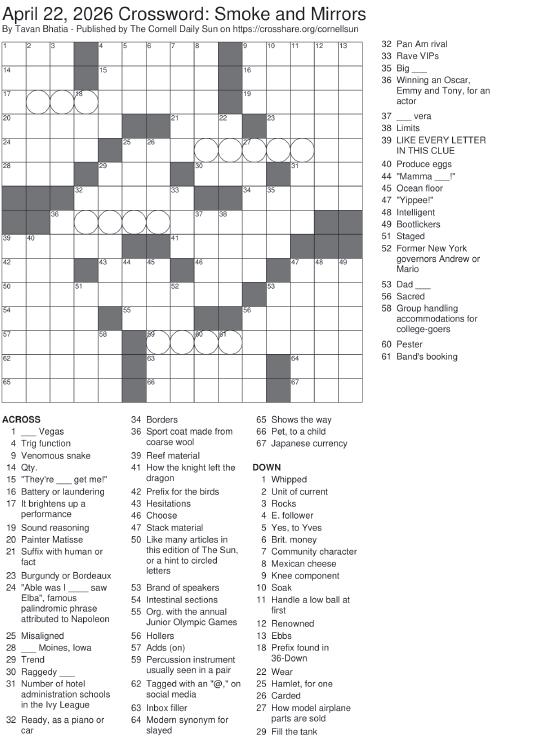
Last Week’s Solution by Harper McClave ’27 and Ellie Fredine ’27
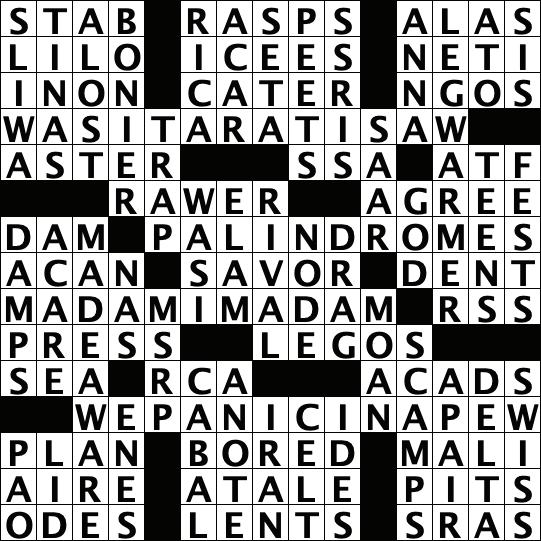
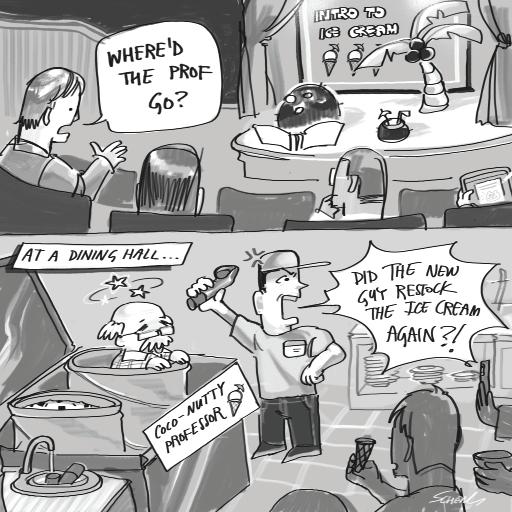

As I enter the spacious room and take my seat in a single row of eight other participants, the lights begin to dim and the music crescendos. Facing us at the front of the room, the DJ sits, too, beginning to narrate the performance to come. She starts the routine and beckons us, the audience, to come along for the ride. Following her musically-aligned movements and encouraging instructions, I am sweating in no time, but not so much that I can’t keep up; the music drives me forward. An hour passes and the lights fade in. Rejuvenated and showered in sweat, our cohort disbands. Another successful spin class in the books.
Spinning, formally known as indoor stationary cycling, is a fitness craze that began in the late 1980s and has continued well into the present. Often a group activity, spin classes are known for their guidance of high-energy instructors in a motivational environment complemented by music blasting from the speakers. The exercise has recently entered my radar this semester, since it was the most convenient P.E. course listed to fulfill my graduation requirement. Every Monday and Wednesday at 8 a.m. sharp, I get on the bike, crank up the resistance at my instructor’s request and cycle. We transition between ‘climbs’ — gradually adding resistance over time — ‘sprints’ — short bursts of fastpaced cycling — and various positions in and out of the saddle, focusing on our mind-muscle connection. As the course continued and our group became more comfortable with the bike, I began to notice how music powered our exercise, as an element both interacting with empty space in the room and building group synchrony in physical movements and rhythm.
Speed, especially, was affected by the musical environment of the class. It is no secret that music can change a listener’s mood; sad songs make us sad and happy songs make us happy. Similarly, a faster song is likely to increase pace during exercise. In the five-second countdown to our most effective sprints, the upbeat song builds to its climax and our instructor bumps up the volume, encouraging us to “run it out”
and increase our rotations per minute during these 30-second bursts. It was in these sprints that our sound environment was especially apparent — there was no need to search for hidden sounds, as the music became the primary focus in the room. In this sense, music is a tool for spin instructors; as they lean into their DJ role by controlling volume and tempo, they can elicit certain physical reactions from their attendees.
Although music was a major factor during these sprints — empowering us to surpass our quickest speeds — the majority of the time it faded into the background, coming in and out of focus based not on volume but familiarity. On the first day of class, our instructor asked us for music requests. While I am not sure if anyone filled out the form (admittedly, I never got around to it), she came to class each week with a different themed playlist; once we rode it out to Superbowl hits, another time it was 2016 classics (shortly after the Chainsmokers Slope Day reveal). I realized while listening to her instructions that I only drowned out the speakers when they were playing a song I didn’t know. The second a familiar tune began, my focus immediately shifted; the instructions became secondary to my listening experience. According to industry research on indoor cycling, audience-tailored music is integral to well-performing spin classes, likely due to this experience I outlined; popular music keeps people engaged and coming back for more. The musical feature of spin class allows participants to detach from exercise and instructions, instead associating their session with a feel-good listening experience similar to jamming out in their room or on the dancefloor. Space, too, plays an important role in how music is received and the motions of spin class are performed. Mirrored walls and a wooden rail at the front of the nearly-empty, plain room elicit associations to ballet and dance, while two rows of neatly-packed gray stationary bikes toward the back of the space create a stark contrast between the artistically dissimilar sports. Despite their differences, the audio equipment of the multipurpose room unites them — both are reliant on the large speakers at the top of the wall. These elements
of the room, along with the instructor’s headset microphone, turn the exercise into a performance. Watching our similar movements reflected back at us, both from the instructor and the mirror, the individual fitness goals we are aiming toward become a group effort. Further, the room creates an intentionality; its emptiness only highlights our role — and music’s role — in filling it.
However, many popular spin classes are attended virtually, altering these spatial and musical experiences of attendees. In these cases, the class becomes an item of spectacle; it is a video watched or a game played, with no real expectation of team spirit. For the program Zwift, the cyclist is a video game character, riding alongside players in a virtual world. Peloton, on the other hand, boasts thousands of recorded stationary bike workouts in which instructors are the leading actors. Take the viral video of Kendall Toole (“Get ‘em banned”), for example. Her performance of an intense, self-assured instructor is exactly the role a spin class demands. While at-home exercises are not necessarily new, their prevalence in spinning certainly disconnects participants from their instructors and each other by catering to the appeal of virtual entertainment.
Spin class is just one of many examples of the link between music and exercise. Whether music is a central motivator in distracting participants from a strenuous workout, a generic noise to drown out a loud gym or, like spinning, something in between, it is a clear constant. Maybe, then, exercise is a performance of sorts, a type of intentional musical interaction related to physical movement. Are bodybuilders models? Athletes artists? Indoor cyclists dancers? I sure hope so.
‘Surround Sound’ is a column investigating soundscapes — how sound and spatial environments shape one another.
Hazel Tjaden is a member of the Class of 2028 in the College of Arts and Sciences. She is an assistant Arts & Culture editor on the 144th Editorial Board and can be reached at htjaden@cornellsun.com.
It’s that time of year again. Each year, Coachella invites the world’s biggest artists to the desert valley, often resulting in some of the most iconic sets in music history. Initially a Tumblr phenomenon, Coachella has outgrown its boho style and evolved into the Influencer Olympics. Corporate brands fly out prominent social media influencers to host sponsored Coachella events and document them for their huge online followings. I won’t lie, the corporate-ification of Coachella makes for some excellent online content. This year’s Coachella coverage feels especially dystopian. As the U.S.’s ongoing war with Iran escalates and the average American struggles to pay for gas, watching my TikTok For You page shift from Coachella sets, to war coverage, to Jake Shane’s Poppisponsored mansion tour, to Trump posting himself as an AI-generated Jesus is particularly concerning — yet, in the weirdest way, truly symbolic of our time. But I digress — among the chaos, uncertainties, conflicts and injustices, there’s some damn good art.
Coachella 2026 had some big expectations to fulfill after last year’s headliners: Lady Gaga, Green Day and Post Malone delivered excellent performances. However, it was Gaga’s that set a high standard for this year’s performers. Last year, I was totally enthralled by Gaga’s performance and thought it to be the best Coachella set of all time — tied with Beychella, duh. However, after Weekend One of Coachella 2026 culminated on Sunday, this year’s performances might surpass my previous rankings. Headliners Sabrina Carpenter, Justin Bieber and Karol G performed their headlining sets to widespread acclaim and criticism on social media.
Sabrina Carpenter headlined first on Friday, with a 20-song set, the longest ever for her. As a big fan of her most recent album Man’s Best Friend, I was excited to see what a new Sabrina Carpenter set would look like, given her iconic Short ‘n Sweet Tour had been going on for over a year and she was yet to fully ring in her new era with a
dedicated performance. I’ll start off by saying her performance was definitely my favorite out of the three headliners. She delivered non-stop storytelling, a set that seemed to infinitely shapeshift, impeccable costume design not only for her but for her dancers as well, consistently beautiful vocals, choreographed sequences, special guests, a heartwarming monologue … must I go on?
Carpenter brought a Broadway-esque showgirl flair to her performance, with costume and set references to the musicals A Chorus Line and Chicago. The set transformed from a mountain with the Hollywood sign to a recording studio, to a dance studio, to an elaborate, elevated stage, to a treadmill runway and finally into a parking lot with vintage cars. Additionally, she debuted live performances of “We Almost Broke Up Again,” “When Did You Get Hot?” “Such a Funny Way” and “Sugar Talking.” She closed off her set with an electrifying performance of her hit single “Tears,” where she splashed the crowd with hoses and sat atop a fountain before driving away.
On Sunday, Karol G dominated the Coachella stage, making history as the first Latina woman to headline Coachella. She performed a 25-song set with six costume changes, and had guest appearances by Becky G, Greg Gonzalez of Cigarettes After Sex, Wisin and Mariah Angeliq. Similar to Carpenter’s, Karol G’s set design revolved around storytelling, opening with a prologue that discussed what it took for her to rise to stardom. Her stage had three tiers, all covered in a rock-like material, emulating a cave. Dancers hung and danced through the gaps in the ‘caves’ and walked up and down the runway as Karol G danced in coordination with them for most of the songs. Karol G’s set was an absolute party; on the livestream, you could hear the crowd screaming along to her singing. She debuted an unreleased song in collaboration with Cigarettes After Sex, delivering a soft, sad interlude to the party-girl anthems and showcasing her lyrical and vocal talent. Unfortunately, she had to cut her set a bit shorter than planned because of a delayed start due to set-building setbacks; regardless, she closed off the night with an amazing remix of her song “PROVENZA,”
which she had first played live at Coachella a few years prior, celebrating the full circle moment and career highlight.
Karol G literally made history, and Sabrina Carpenter delivered the best set of her career — but yes, let’s talk about Justin Bieber watching YouTube on stage. The performances in contrast with each other have fueled many debates online surrounding sexist responses to the performances, some praising Bieber’s laid-back performance, claiming he’s a legend and doesn’t need all the fluff. But it’s Coachella, the whole point is fluff. And it’s about time audiences recognized the glaring double standards between male and female performers. It’s an honor to be a Coachella headliner — it puts you on a stage parallel to that of the Super Bowl Halftime show, giving you an opportunity to deliver a career-defining performance that cements your place in music history. Beyonce’s Coachella set, and I’d also argue Harry Styles’ set, established them as performers, not just musicians. Your job is to perform! That doesn’t mean you need elaborate set design and costume changes to do so — you could make the case for many rock bands that have no choreography or big sets, yet deliver on the quality of their music and live instrumentals. Justin Bieber put on a hoodie and walked around the stage alone (occasionally lying down) and scrolled through old YouTube videos, cutting the songs short and having the audience sing along to most of them. Don’t get me wrong, I love a Bieber throwback, but saying he’s a musical legend that ‘doesn’t need to perform’ is just not true.
This year’s Coachella is legendary for its feats in set design, production management, lighting, costuming and the stamina of our headlining women — it should be recognized for that, not for what a man failed to do, yet again.
of
By WILLIAM D. CAWLEY Sun Staff Writer
LAKE PLACID, N.Y. — Junior forward RyMen’s lacrosse had a lot on the line this week in terms of its NCAA tournament hopes, and the Red took a big step toward securing one with a sweep of Duke and High Point.
Cornell (8-3, 3-1 Ivy) faced Duke (8-3, 0-2 ACC) in Long Island, New York, on Saturday. Cornell started the game strong, scoring the game’s first two goals and holding Duke scoreless until under one minute remaining in the first quarter.
Duke took the lead early in the second quarter, but Cornell fired back with goals from freshman attackman Rowyn Nurry and sophomore midfielder Luke Robinson. Duke scored two more of its own to take a 5-4 lead at halftime.
Junior attackman Ryan Goldstein scored first in the second half. Goldstein dropped the ball behind the net, and when his defender came around for the ground ball, he picked it up and went around the other side to score.
Senior faceoff Jack Cascadden won the ensuing faceoff and scored on a fundamentally sound high-bouncing shot — the stuff of a lacrosse coach’s dreams. Senior midfielder Brian Luzzi added a goal just over a minute later, but Duke responded to cut the lead to one.
Robinson added another with a signature on-the-run
lefty shot, and senior defender Brendan Staub added a stepdown pole goal to give the Red momentum and a 9-6 lead late in the second.
Duke managed another goal before the end of the quarter, sending the teams into the final frame with Cornell in a 9-7 lead.
The fourth quarter saw hard and heavy lacrosse. Cornell was shut down, getting no shots on goal, and Duke was limited to just two.
With 10 minutes to go, a Duke attackman had senior defender Matt Dooley beat on a question mark dodge, but a massive hit on a coma slide from junior long-stick midfielder Walker Schwartz ended the threat, though it was penalized.
Cornell killed the penalty and continued to run the clock down with a two-goal lead. After multiple short possessions with turnovers or missed shots, Duke got the ball with a minute to go. Cornell played great defense, not allowing a shot until just 15 seconds were left on the clock. Junior goalkeeper Matt Tully was up to the task, and the Red closed out the scoreless fourth quarter to win 9-7.
The Red celebrate with fans after a huge win against Duke.
The game was well played by both teams and completely evenly matched in terms of turnovers, clearing, ground balls and faceoffs. The difference was Tully.
By JANE McNALLY Sun Senior Writer
Freshman goaltender Alexis Cournoyer will be transferring to the University of Wisconsin, Brad Elliott Schlossman of the Grand Forks Herald confirmed on X Friday afternoon.
Cournoyer, the ECAC Goaltender of the Year, Ivy League Rookie of the Year and Mike Richter Award semifinalist, will play the 2026-2027 season in Madison. The Badgers finished 12th in the NCAA percentage index and earned an at-large bid to the NCAA Tournament before storming their way to the NCAA championship game, where they fell by a 2-1 score to Denver in Las Vegas.
“I just wanted to jump to the next level,” Cournoyer told BadgerExtra. com. “I decided to enter the portal because we thought — my family and my adviser — that I could get a better opportunity. And Wisconsin reached out right after so it worked out pretty well.”
According to head coach Casey Jones ’90, the move initially “blindsided” him and his staff, who had not anticipated losing their starting goaltender. Upon speaking with Cournoyer in the wake of his entering the portal, it was evident that the program and the goaltender had different understandings of what the future held.
“Coming to Cornell, we surely want people that understand the connections and the value of the education,” Jones said. “We’ve just moved on. We wish him well, and we’ll pivot.”
Jones pivoted by acquiring Mathis Rousseau, a rising sophomore goaltender who spent his freshman year at the University of Maine. The Montreal, Quebec, native posted a .896 save percentage across 17 games in 2025-2026, backing up Maine’s starter, Albin Boija. Rousseau challenged Boija for the starting position down the stretch and will certainly bolster the goaltending position for the Red next season.
“There’s no shortage of people that
want to play here,” Jones said. “No shortage of people that want this opportunity right now with the roster we have.”
The Big 10, the conference that Cournoyer will be transferring into, had four teams qualify for the NCAA Tournament, with two of them reaching the Frozen Four. The conference is lauded for both its blue-chip NHL prospects and its ability to compensate its players for their Name, Image and Likeness.
“Going to Wisconsin, I felt like it was the best option for me,” Cournoyer told BadgerExtra.com. “You look at the facilities and all the alumni and everyone that went to Wisconsin, it was an easy decision for me.”
Wisconsin got strong goaltending in the NCAA Tournament from a fellow freshman, Daniel Hauser, who — like Cournoyer — played in the Canadian Hockey League before making the jump to college hockey this past season. Hauser posted a .900 save percentage as opposed to Cournoyer’s .915 in 2025-2026, and the two will likely compete for the starter’s role next season.
“I want my goalie partner to play good so I can play better than him,” Cournoyer told BadgerExtra.com. “It’s nothing personal. It’s just my mentality as a person. I want me and [Hauser] to play good and get this team to the next level next year together.”
Cournoyer was selected by the Montreal Canadiens in the 2025 NHL Entry Draft. The fifth-round could very well sign a professional contract after the 2026-2027 season and, thus, not complete his college degree.
“We’ve got a lot of good players here. Our roster is loaded next year,” Jones said. “We feel good about that, and we’ll have the right guys in the room that want to be here, and then just move on from there. We just move on. That’s the landscape.”
Duke had seven more shots than Cornell, two more on goal, yet Cornell won by two thanks to its goalkeeper. Tully faced difficult shots and came up with big saves, saving 12 of 19 shots on goal for 63%.
Monday was a runaway victory for the Red, dominating High Point (6-6, 4-0 A10).
High Point scored first, on the man-up, but Cornell responded with an eight-goal onslaught that included a hattrick from star junior attackman Willem Firth. By halftime, the lead was 9-2 in favor of Cornell, and High Point never got back within spitting distance, leading to a 17-9 final.
Firth collected a remarkable nine points in the game behind his five goals. Luzzi also had a career game, scoring four of his own for six total points. Sophomore midfielder Jack Herendeen made his mark, with his first collegiate multi-goal game.
Tully was again impressive, saving 10 of 17 shots, and sophomore goalkeeper Tim Piacentini also saw action late in the game, making four saves.
Now, Cornell comes down the home stretch of the regular season. Cornell will go to Hanover, New Hampshire, to face Dartmouth (4-7, 0-4 Ivy) at 3:30 p.m. on Saturday. Coverage will be available on ESPN+.
By WILLIAM D. CAWLEY Sun Staff Writer
Coming off of a sweep of No. 12/11 Duke (8-3,0-2 ACC) and RV/NR High Point (6-6, 5-0 A-10), men’s lacrosse is now down to its final two regular season games of the year: Dartmouth (4-7, 0-4 Ivy) and Harvard (9-2, 3-1 Ivy). This past weekend, the Red showed what head coach Connor Buczek ’15 MBA ’17 has been looking for all year – consistency.
All year, Cornell has struggled to string together complete performances, the problem epitomized by a road win over No. 3 Princeton (9-2, 3-1 Ivy) being followed by a home loss to RV/RV Yale (7-4, 3-2 Ivy). Finally, Cornell was able to put together two complete games of lacrosse despite a challenging rest and travel schedule.
“It’s a big challenge to travel to Long Island, play Duke on Saturday, turn around and have a good High Point team at home on Monday,” Buczek said. “I thought the team managed it well. I thought we competed for nearly the entirety of both games.
Buczek cited the defense as a large part of Cornell’s recent success, after an impressive performance holding Duke to just seven goals, and none in the fourth quarter to close out the win.
“I thought we did a really nice job matching that urgency that they were playing with to try to claw back into it again,” Buczek said. “It felt like May lacrosse. It was a great atmosphere, a great opponent [and] was a high level game.”
A big piece of the defense, senior defender Brendan Staub, was drafted in the third round of the PLL draft this week. Staub was drafted by the Philadelphia Waterdogs and will join attackman CJ Kirst ’25 and defender Gavin Adler ’23.
Backstopping the defense this year has been junior goalkeeper Matt Tully. Tully began his career in a hotly contested goalie battle with Wyatt Knust ’25. Knust ultimately won out, playing down the stretch in 2024 and nearly the entire season in 2025 en route to the national
championship.
Now the starting goalie, Tully has been a force for the Red. He has shown tremendous shot stopping ability, playing a big part in the Red’s clear game and defensive cohesion that have been so impressive in recent weeks.
“In a position that only one plays, it’s hard sometimes to make those decisions,” Buczek said of Tully’s time on the bench in previous seasons. “We trust him an incredibly high amount, just because of what we’ve seen over the two years even when he was not starting every game.”
Perhaps it is not a coincidence that another Cornell star also did not start his career in his current spot. Junior attackman Willem Firth has a similar story, playing midfield in his first two years with the Red, before slotting into his spot on attack this year. Since joining the attack unit, Firth has been fantastic, leading the team with 35 goals and 57 points.
“He learned from one of the best to ever do it, that was playing on that left wing and was able to take some cues from what CJ [Kirst] did well and how he operated within our offense,” Buczek said. “And the nice part is, now down at attack, he’s able to help a lot of the younger midfielders on the field as they learn what it’s supposed to look like.”
Cornell now sits in a good spot to make the NCAA tournament, eighth in the RPI with notable wins over Princeton, Duke and No. 15 Penn (5-6, 2-3 Ivy). Should the Red close out the regular season and Ivy League tournament strong, it will secure a spot and be in the mix for a first round home game.
“In an RPI system with 13 opportunities, everything is paramount and it doesn’t matter who you’re playing,” Buczek said. “It’s an opportunity to improve your resume and make sure that you’re a resume worthy of playing into May.”
To continue reading, please visit cornellsun.com.
William D. Cawley can be reached at wcawley@cornellsun.com.
Editor’s note: 4/20 content is a part of The Sun’s joke issue and contains exaggerated and factually inaccurate information.
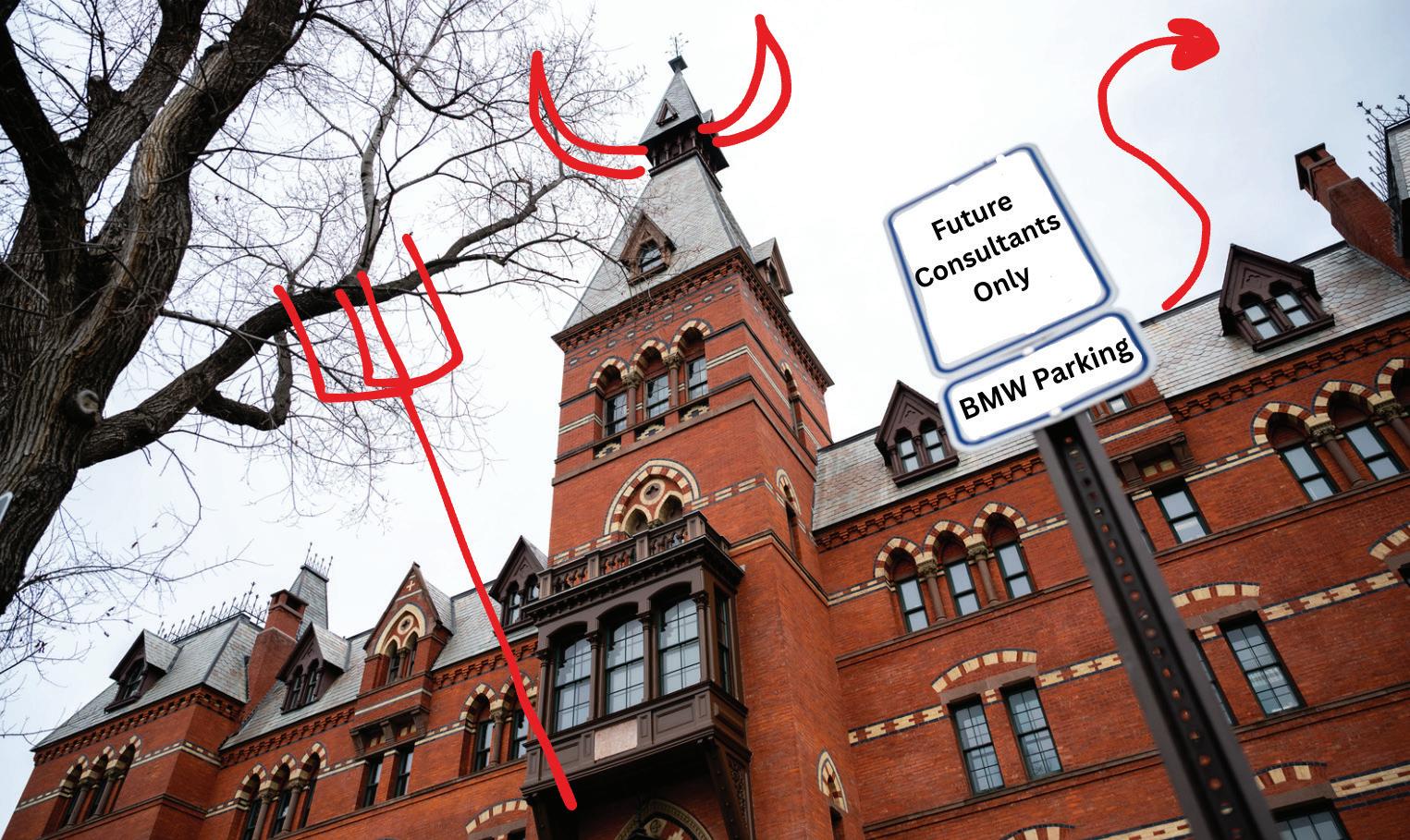
By MERNIE BADOFF
After months of applications, essays and standardized tests, this year’s college admissions season is fnally over. With our infamous weather machine blessing campus with sunny skies and high temperatures throughout last week’s admitted students days, the newly minted Class of 2030 got their frst chance to explore campus, knowing they
are now members of our vibrant community.
During this year’s fnal Cornell Days, I sat down with Percival Theodore Jameson III ’30, who will be attending the Dyson School of Applied Economics, to hear more about what a member of Cornell’s newest class is excited about and what they hope to achieve in the next chapter of their life studying excel sheets and wines.
Mernie Badof: How has your experience been on

By CU PID
Eye contact that seems to last for an eternity, witty impromptu conversations, impressive musical/athletic abilities and well-put together outfts. For many Cornell students, the shortest interactions can turn into feelings of deep longing and desire. However, due to unfortunate circumstances (or just plain shyness), such students often fnd it difcult to make their desire known to their crushes. Here, we’ve compiled a list of missed connections from students who wanted a second chance to confess their feelings.
“To the cute brunette student
EMS worker who helped me get my stomach pumped, let me give you another night to remember …”
“To the beautiful blonde incoming freshman I saw touring on incoming students day, let me give you a personal tour of campus next year. I’m a senior and can you show you how to get around ;)”
“Professor J in ILR, let’s stop playing eye tag during lecture and set up an ofce hours appointment already.”
To continue reading this article, please visit www.cornellsun.com.
By BARELEE HUNTER
Admitted Students Day?
Percival Theodore Jameson III: It’s been exhilarating; the networking opportunities alone have made the long fight from Zurich worth it, but of course, it’s easier when it’s your own plane.
To continue reading this article, please visit www.cornellsun.com.
Your dorm kitchen is where you go to fll your Brita, steal leftovers from the people on your foor and experiment with cooking because you never learned. But have you ever considered that it is also the perfect space to skin a bear? I guess you could do it in your actual dorm room, but then you risk staining your sheets or even the carpeting on the foor, which could add more expenses to your bursar bill. The beauty of your dorm’s kitchen is that it is already disgusting. There is plenty of counter space and a decently sized refrigerator to make sure your bear meat stays fresh. It’s truly a no-brainer!
Though you may be wondering: Why skin a bear? Typically, people bake cookies or brownies in their dorm kitchen, but this is quite frankly a wasted use of time and space. Skinning a bear leaves you not only with delicious meat to help you reach your daily protein goals, but also a hide that can be used for a chic fur coat or rug to accessorize your room. In honor of our unofcial mascot, it is also the best way to express your Cornell pride. Go Big Red!
The Hunt: Picking The Best Bear First, you must hunt down the perfect bear. But to do this, you will have to acquire some bait — preferably something sweet. The cookies, honey, ice cream, cakes and granola from the dining halls are great options for this. I would suggest the frozen fruit, but let’s
keep it real: If we won’t eat it, then how can we expect the bear to?
After gathering your bait, you are ready to venture out into the forest. Ithaca has no shortage of hills, so fnd an incline and scatter your bait in a low-laying area.
To continue reading this article, please visit www.cornellsun.com.

Editor’s

By MARIELLA JANE
April 20 — Touchdown the Bear was seen entering Collegetown Dispensary at around 11:54 p.m. on Sunday, according to a curious onlooker. A few minutes later, she reportedly left the establishment with multiple pre-rolls, Sour Green Apple x Sour Diesel Live Resin Gummies and a gleam of mischief in her eyes.
The onlooker, who was granted anonymity by The Sun due to concerns that the dispensary will fgure out their real age, said they saw Touchdown perusing the aisles of the facility as they were buying a new weed cart.
“I saw this large bear in the aisle next to me, and I was like woah, I’m pretty sure that’s Touchdown,” the onlooker said. “She’s like
100 years old, so it’s fne or whatever. I’m honestly glad that she’s a chiller, considering the current [Cornell] administration.”
Although the onlooker said they tried giving the beloved mascot her space, they “couldn’t help but ask her what her plans were for the night.” In response, they claimed that Touchdown gave him a high fve, chuckled and said, “Just a good night, man.”
The onlooker said they stalked Touchdown for “just a bit longer,” following her out of the store and hiding in D.P. Dough as she bought some shrimp crisps, Marlboro Reds, original Skittles and Strawberry ‘Rita BuzzBallz from 7/11.
To continue reading this article, please visit www.cornellsun.com.
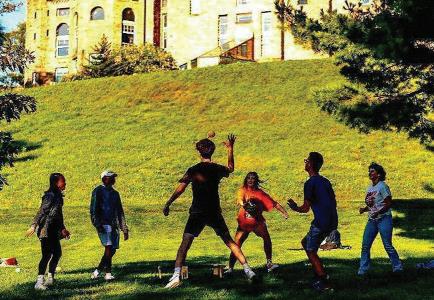
By TYRANNOSAURUS CAT
April 20 — Across the country, outraged seafood-enthusiasts are demanding transparency and refunds as they question whether the pearly-white, tender slices on their plates are really fsh at all, or something far, far, older, perhaps dating back 66 million years.
This panic follows a new study published this month in the journal Naturawrrr, which challenges one of the most widely accepted ideas in evolutionary biology. Instead of birds being the only surviving lineage of dinosaurs, researchers now suggest that some dinosaurs may have survived by evolving into fsh.
A joint research team from Cornell Dinosaur Discovery Laboratory and Rawr Honors College has identifed what they describe as the closest known functional and morphological relative of the extinct dome-headed dinosaur in a surprising living species.
The fsh’s anatomy, behavior and wisdom beyond their years, the researchers argued, challenge the prevailing view that only avian lineages of dinosaurs survived the Cretaceous-Paleogene extinction event. The team instead proposes a secondary survival pathway involving an ecological transition into the sea, rather than up toward the sky.
This study originated with a Pachycephalosaurus fossil excavated in Ithaca, on April 20, 2024. Although the lower
By BEY RISFAKE
April 20 — In a shocking turn of events, Touchdown the Bear was spotted removing her head, revealing a still unidentifed human inside on Monday morning.
This revelation comes after concerns raised by Touchdown’s caretakers, who recently became uneasy after a routine hibernation check-up on the friendly bear.
“I really began to get a little worried when Touchdown asked for matcha,” said Bay Erspotter, one of Touchdown’s caretakers. “I should also add that Touchdown would occasionally ask if anyone had a USB-C charger, since according to Touchdown, the den was ‘so 80’s.’”
Touchdown has been a campus hero since frst appearing over a hundred years ago as a baby bear cub. As Touchdown grew older, the bear began to walk the campus grounds, demonstrate impressive gymnastics skills and show an apt understanding of the hockey team’s plays.
“Touchdown always demonstrated high intelligence,” said Dale E. Sunn, Touchdown’s main caretaker. “For as long as I can remember, Touchdown even had the ability to speak, although the bear’s accent would occasionally change. Touchdown had just begun speaking in a thick New York accent.”
To continue reading this article, please visit www.cornellsun.com.
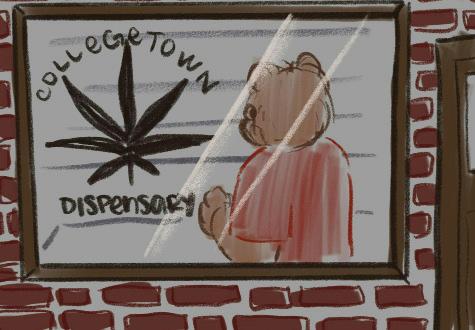
By SPIKEY QUADMAN
April 20 — “Any person, any study” — more like “any person, any sport.” In a bold reimagining of its historic motto, Cornell announced the creation of a varsity spikeball team set to compete at the Division I level beginning in Fall 2026.
This absolutely electric, feel-good sport has taken procrastination-inclined college students by storm.
Relatively low-impact yet strategic, spikeball is a joint-friendly way to stay active and fuel student’s competitive spirits. On the few days of the year that the sun shines over the Arts Quad, students can be spotted hauling spikeball nets and balls up the Slope, across the bridge to North Campus and all the way from Collegetown for intense play in between classes
skeletal structure was fragmented, the skull remained exceptionally well-preserved, enabling detailed structural analysis.
“After two years of 3-D computational modeling and analysis, we were able to map the structure of the dome-shaped cranial dome with unprecedented precision,” said Dr. Veloci Raptor, lead researcher for CDDL.
What distinguished this specimen from previously studied fossils was its isotope geochemical composition.
“Unlike earlier fnds, this skull exhibited oxygen isotope ratios in cranial bone consistent with coastal infuenced environments,” Dr. Raptor explained. “Which made us wonder: what was a Pachycephalosaurus doing in or near the ocean, and what evolutionary pressures maintained this cranial enlargement in a marine context?
To investigate this, the research team expanded its dataset to include all extant species exhibiting cranial enlargement. Among all surveyed taxa, the fsh species Asian sheephead wrasse emerged as the closest morphological match.
When researchers analyzed the cranial scans of both specimens, they reported an intraobserver error of less than 4.20% of the total variation, indicating an unusually high degree of structural correspondence.
To continue reading this article, please visit www.cornellsun.com.
and on their lunch breaks.
After intense University deliberation, University leaders decided to honor the observed spikeball talent by ofcially adopting the sport into Cornell Athletics and the Ivy League as a whole.
This decision has received generally positive reviews from the student body. One spike-baller, junior Ned Spikeman, praised this opportunity for dedicated quad athletes like himself.
“The ability to continue to play the game that we love at the Division I level is insane.” Spikeman said.
“After years of being joked about, we are glad that our sport is fnally being taken seriously.”
To continue reading this article, please visit www.cornellsun.com.