The Corne¬ Daily Sun

By MAYANKA DHINGRA Sun Contributor
As many students grab their laptops and morning coffee to gear up for remote classes, a small group of students also don a gown, face shield and gloves to run campus’s testing operation behind the scenes.
Cornell’s reopening plan leaned heavily on being able to test all of its students in order to identify when they are sick. The task of collecting the nose swabs falls on roughly 200 testing staffers, including some 80 students.
These students have had to weigh the increased potential COVID exposures with working a atypical campus job.
Annika Hoff ’22 was initially apprehensive about the number of people she would be interacting with on a weekly basis when she began working as a staffer at multiple testing sites in the fall.
Prior to the pandemic, Hoff held two on-campus jobs,
both of which were dependent on normal athletic seasons taking place. Searching for a new well-paying student job, Hoff decided to work at the testing locations, a job that also counts towards physician hours for her pre-physician assistant course of study.
“I am really impressed with the sheer capacity of the testing program.”
Annika Hoff ’22
Hoff’s nerves were calmed during her first shift after she was given personal protective equipment and realizing that each interaction with students getting tested only lasted only a couple minutes.
“Personally I am really impressed with the sheer
By TYLER WIESMAN Sun Staff Writer
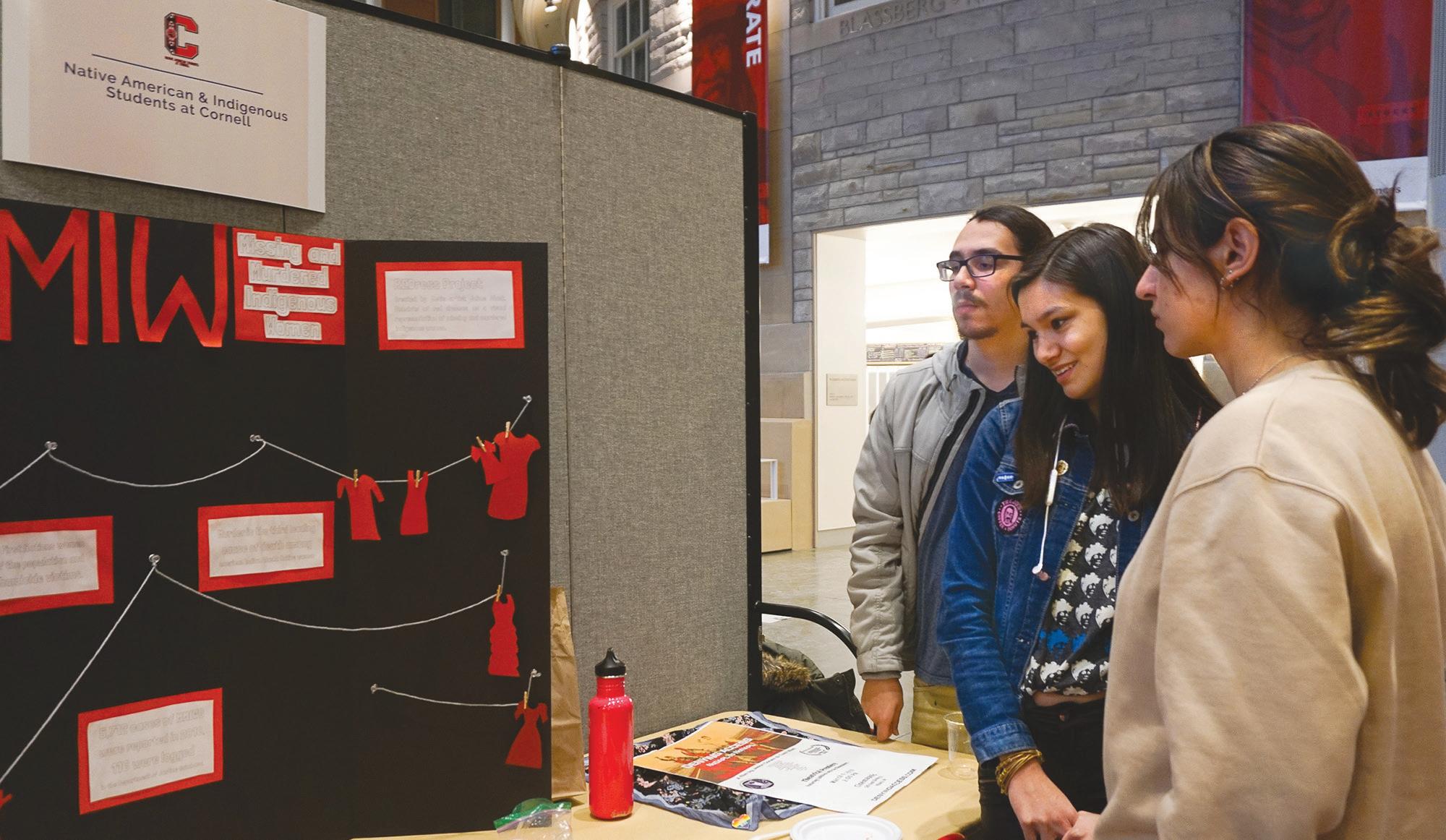
After months of inaction from the University, Native American and Indigenous Students at Cornell are doubling down on demands for representation through community outreach and petitions to the University on top of expanding their advocacy initiatives.
On Nov. 24, the Student Assembly unanimously voted to support the demands of the Native American and Indigenous Students at Cornell. These ten demands were presented in the form of an online petition with the stated goal of rectifying Cornell’s “tradition of profiting from acts of colonial violence and Indigenous erasure.”
acknowledges the role it has played in Indigenous dispossession.
When President Martha E. Pollack eventually acknowledged the demands, Former NAISAC Co-Chair Collin Benedict ’21 said that the response lacked action items.
“She just basically gave us the runaround,” Benedict said. “She just basically gave us a statement without addressing any of the actual demands that we put into the resolution.”
“She just basically gave us a statement without addressing any of the actual demands.”
Collin Benedict ’21
Pollack’s response highlighted ongoing initiatives to increase recruitment of Native American students and faculty. However, many of the larger demands, including the redistribution of unused Cornell land back to the Gayogohón, the native Cayugans, were not mentioned.
capacity of the testing program,” Hoff said. “As a student, prior to coming to campus I didn’t understand how such a rigorous testing program was possible.”
Since returning as a staffer this semester Hoff said her experience has remained relatively the same other than increased volume at certain popular sites such as Robert Purcell Community Center.
Jay Crandell ’22, who also began work as a testing site staffer last semester, views his contribution to testing efforts as an extension of his studies in public health and infectious disease.
For Crandell, work offers a much-needed break from the stresses of academic life during the pandemic and offers a rare opportunity for socialization.
“It is a time when I am not in my room, can’t be on my phone and am not in class,” Crandell said. “I get the chance to see people and have informal conversations.”
By HELENA PRATAMA
Following a year of virtual events, limited building access and few in person events, Cornell is bringing back a beloved on-campus tradition — Movies on the Arts Quad.
Hosted by the University’s Student and Campus Life Office in tandem with student organizations including Cornell Cinema, Film Club and Class Councils, Movies on the Arts Quad is slated to be the biggest organized social event at Cornell since March 2020.
Every Thursday beginning April 8, films chosen by the Cornell Film Club will be screened, with a focus on highlighting popular works.
“Rather than a one-time event, it will feel like a weekly drive-in theater plopped down on the Arts Quad,” said Nick Boozang ’21,
president of the Film Club.
Movies shown this semester will include Scott Pilgrim vs. the World, Shrek, Kajillionaire, Do The Right Thing, Detective Pikachu and Moonrise Kingdom Shrek will be screened on April 22, its 25th anniversary, which also falls right before the Wellness Day weekend.
“It will feel like a weekly drive-in theater plopped down on the Arts Quad.”
Nick Boozang ’21
The student groups involved in the organization of the series are optimistic about turnout. For Boozang, the event marks a return to normalcy as seniors spend their last semester on campus.
“I’d expect so many students to come out. It’s going to be such a blast — a real cele-
The requests emphasized increased funding and recognition of the American Indian and Indigenous Studies Program as a department. They also sought to increase the recruitment and retention of Indigenous students and ensure that Cornell
Paula Blanco Ortiz ’24, the NAISAC External Relations Chair, noted that the number of indigenous
has decreased from


Thursday, April 1, 2021
Make Do and Mend Together: A Patchwork of Solutions 8 a.m. - 5:00 p.m., Virtual Event
Let’s Meditate With Cornell Wellness 9 - 9:30 a.m., Virtual Event
Energy Engineering Seminar: Professor Max Zhang, Mechanical and Aerospace Engineering 12:25 - 1:25 pm., Virtual Event
Ripple Effects Mapping for Assessing the Impact Of an Undergraduate Global and Public Health 12:25 - 1:15 p.m., Virtual Event
NBB Seminar Speaker: Cynthia Moss, Johns Hopkins University 12:30 - 1:30 p.m., Virtual Event
Benjamin Anderson: Robert Wood on a Picture in Homer 1 - 2:15 p.m., Virtual Event
COVID
Continued from page 1
Similarly, Brian Frost ‘24, felt that partaking in prevention efforts gives him a sense of purpose. “Unfortunately this pandemic has no end in sight, so I wanted to help the school with our mission,” he said.
Unlike some of his peers, Frost wasn’t worried about the risks to his personal health that come along with the job. “I knew what I was singing up for,” he said.
Maddie Thorn ’23, who worked at a COVID recovery unit in her hometown over the summer, said that the biggest hiccup has been adjusting to being a student employee amongst the adults she works alongside.
As more students are getting vaccinated, Frost has noted there has been a change in the dynamic of students on campus. He mentioned interacting with a number of people who have been vaccinated and
come to the testing sites asking if they still need to be tested.
“While more students being vaccinated is helpful for herd immunity purposes, it also may be encouraging some people to think they’re invincible, which is not the case in this population,” Frost said.
Thorn has observed similar behaviors amongst students this semester who have many situational questions regarding exposure to COVID. “In general, people seem to be more nervous when they come in,” Thorn said.
Thorn has noticed more people walking around campus without masks and bending rules here and there which is where she believes risk pops up.
“I came back to campus this semester thinking everything would be better than how unpredictable it was back home, but now seeing that it’s unpredictable here as well is worrisome,” Frost said.
Mayanka Dhingra can be reached at md753@cornell.edu.
By SAM CURTIS Sun Contributor
As communities of color across America have been disproportionately impacted by the effects of the COVID-19 pandemic, Cornell professors came together to discuss these inequities and steps forward to mitigate racial inequities.
Monday’s “Racism In America” panel focused on the impact of systemic racism during the pandemic and featured a panel of Cornell professors as well as Akilah Johnson, a reporter at the Washington Post.
Dr. Susana Morales, clinical medicine, opened the discussion by stating that COVID has shown the ways that structural racism impacts health.
Morales said that Americans of color are more likely to have health conditions that are risk factors for COVID and are less likely to have an easily accessible physician. Even once they are able to receive treatment, they are admitted to hospitals much later on average and have higher overall death rates when compared to their white counterparts.
“The United States has a rigidly hierarchical social system where race is the key driver,” Morales said. “Policy decisions are affected by racism and decisions made sometimes long ago reverberate today.”
Morales went on to mention that a disproportionate number of communities of color are uninsured or on medicaid and receive lower standards of healthcare compared to those on private or employer provided healthcare plans.
“All too often, communities of color have not had a voice and have not been represented in government, academic, philanthropic and legal sectors that make these decisions,” Morales said.
Prof. Neil Lewis Jr., communication, discussed how the pandemic has highlighted implicit racism in everyday life, using different reactions to Black populations wearing masks as an example.
“Even something as simple as whether you can walk
around in a mask in peace is affected by a system of racism in this country. If you are a black or brown person, you constantly have to think about things like that,” Lewis said.
Prof. Jerel Ezell, africana studies, raised the concept of intention versus impact, in which many policies have disproportionate outcomes even though there were no racist sentiments in their creation.
“It really doesn’t matter if it is the causes or consequences that are racist, if one or the other is [true] then we have an issue,” Ezell said.
Lewis agreed with Ezell, and added that this contributes to the importance of having more diverse individuals shaping public policy.
Another focus of the event was critical race theory, which outlines the idea that racism is something that is institutionally embedded in society. The speakers stressed the importance of shifting thinking about racism as a problem of intersecting social areas, as opposed to a solely individual problem.
Prof. Jamila Michener, government, said that critical race theory has a significant impact on the healthcare system, primarily by inhibiting access to medical positions for minority candidates. Unfair standards of comparison, she said, make it difficult for minority candidates to gain admission to medical schools, even without any direct discrimination in the admission process.
“You don’t need anyone on the medical admissions committee who is racist, you just need standards that even though they are neutral on their face, have disproportionate standards for the inclusion of people of color,” she said. Among communities of color, inequity in the distri-
bution of vaccines has also come to the forefront as more individuals become eligible. The panel discussed how aside from the unequal availability of transportation to vaccination sites and education on the process, vaccination inequalities are developing due to a legitimate concern among people of color about the safety and efficacy of the vaccine.
“When you tell me: ‘take this vaccine and you’re first in line,’ I’m suspicious and it’s not because I’m paranoid and it’s not because I’m unreasonable, I have a lifetime of experiences [with disparate treatment],” Michener said.
To curb vaccine hesitancy and improve healthcare accessibility for communities of color overall, all the panelists emphasized a collective need to overcome implicit biases.
“We all want to be heard and to receive high quality care, what bias can do is make people blind and deaf to other people’s needs,” Morales said.
Sam Curtis can be reached at
the years to come.”
today.
After Pollack’s response, Benedict said that Prof. Avery August, immunology, vice provost for academic affairs, followed up with a lengthy email with information that was already known, according to Benedict. The administration’s response was disappointing but expected, he said.
As a result, NAISAC is currently drafting updated demands that will be addressed to August and Pollack. This is following the initial list of demands, which the members of the organization said that the administration “did not adequately respond to.”
While Benedict is optimistic that the requests will eventually be met, he does not believe it will be done during what’s left of his time at Cornell.
“Institutional change is a pretty time consuming process… I expected that from the start to be a lengthy process,” said Benedict. “It’s just a matter of keeping the momentum and conversation about the topic going for
Pollack’s and August’s statements have not deterred the NAISAC from the other work they have done and plan to continue. The most substantial ongoing project is publicizing the crowdfunding initiative for the Cayuga SHARE Farm.
The Cayuga SHARE Farm, according to the GoFundMe, is “the only agricultural land the [Gayogo hó n ] have within their homeland.” New York State will not recognize the sovereignty of the Cayugan people over this land because of 15 years of unpaid property taxes from the farm, which amounts to $126,000. If these taxes are not paid by April 16, they will lose ownership of the farm.
“We have a responsibility to make others aware of any initiatives striving to preserve and honor the ongoing connections of the Gayogo hó n ’ people,” Blanco Ortiz said. NAISAC has engaged in a social media campaign to spread awareness about this initiative. The Cayuga Share Farm, as of March 31, is more than $17,000 over its goal.
According to Ortiz, other projects
include a collaboration with miXed at Cornell to create a presentation on “the history of blood quantum usage within the United States, its implications, and the structures that have enforced the genocide of Indigenous peoples.” NAISAC also has a long-term goal to create a comprehensive resource list and website for Indigenous students on Cornell’s campus.
The objective for these projects, Ortiz said, is to “create a safe space for the Indigenous students on Cornell’s campus as well a general consciousness of the dispossession and genocide of indigenous people that address Cornell’s role in it.”
NAISAC also plans on releasing a statement condemning the naming of one of the new North Campus buildings after Ruth Bader Ginsberg ‘54., because of her damaging supreme court rulings for Indigenous nations and their treaties according to an article by Meredith Alberta Palmer, grad.
In City of Sherrill v. Oneida Indian Nation of New York, Ginsberg ruled against the Oneida Nation of New York right to reclaim their land that was given to the City
bration that we safely made it through the last year as a school community.” said Boozang.
“Having been off-campus my entire senior year, it’ll be a great feeling when I see all of my friends finally come together safely for a night at the movies.”
Some students reflected this enthusiasm, glad to have the opportunity to hang out with friends at an official Cornell event after a full year of Zoom breakout rooms.
“I would go just because I love sitting down outside,” said Mark
Krneta ’23. “I don’t even know half of these movies but I will definitely attend anyways.” Although the event will be outdoors, masks will be required. Students will be able to obtain hand sanitizer, additional masks and blankets at the concessions tent.
Kyle Schillace, Assistant Director of the Student and Campus Life Office, explained that the University and the organizing team has carefully calculated COVID-related precaution measures in order to make MOTAQ possible this spring.
The first showing will be next Thursday, April 8, and as the
event name suggests, the event will be held on the Arts Quad. There, Cornellians will get to watch “Detective Pikachu” grace a giant inflatable screen as they sit in socially-distanced circles spread throughout the lawn. Students will be able to find their seats at the Arts Quad at 8 p.m., with the movie set to start 30 minutes later. There will also be a maximum amount of attendees to prevent crowding, so Cornellians are suggested to come early to reserve their spot.
of Sherrill, NY. Ginsberg’s decision rested on the Doctrine of Discovery –– the right of settlers to take indigenous land –– and said that the ONNY waited too long to regain their sovereignty.
This ruling set a precedent against future Indigenous land claims in what Palmer describes as an “overt form of legal violence to the Indigenous peoples whose lives and livelihoods are in the jurist’s hands.” Land owned by the Cayuga Nation was one of the main patches of land affected by this ruling. Overall, Indigenous nations lost 8 of 9 cases in which Ginsberg wrote the supreme court decision.
The naming of the freshman dorm that ironically overlooks Akwe:Kon ––the American Indian residence hall –– was not surprising, according to Bennet.
“The tendency is for Cornell to build monuments for historical figures who have been purveyors of colonial violence,” he said.
Tyler Weisman can be reached at tweisman@cornellsun.com.

By
Iknow that you’re only here for one reason: Yes, the fried chicken sandwich (2.0) will be back on the menu the first week.
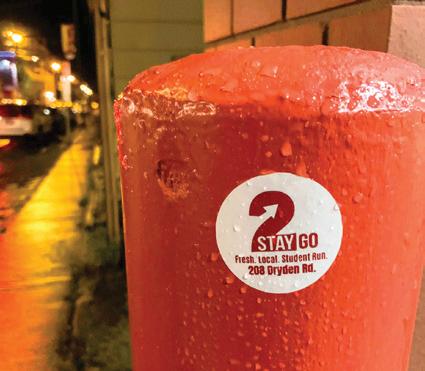
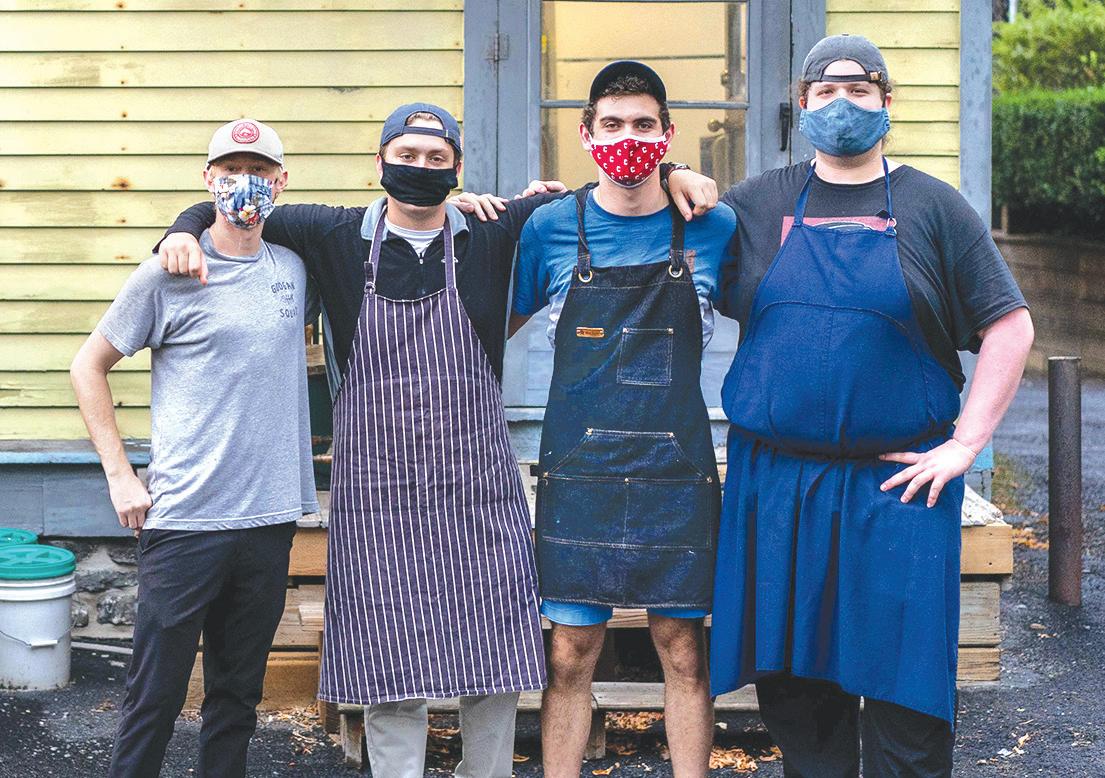
In all seriousness, 2 Stay 2 Go is back this semester, and they’ve made some pretty major changes. Starting April 1, they will open up again at 208 Dryden Road for dinner on Thursday, Friday, Saturday and Sunday, as well as brunch on Sunday. Their team has expanded, adding around 40 new students. With this larger team, they now have the ability to expand their focus far beyond the storefront.
After running a very successful operation in the fall, the core team was able to reflect back on their experience and reposition themselves to be even bigger and better this semester, starting by expanding to delivery and catering. They will be partnering with DoorDash to deliver throughout Ithaca and reach the greater community. Additionally, they will be rolling out a two-pronged catering program. On one side, they’re working with nutrition and food science students, as well as athletes, to produce healthy, well-balanced meals for sports teams, while still staying true to their high-quality and locally sourced roots. On the other side, they will be running a typical catering business based off of their regular
menu items.
Although 2 Stay 2 Go is a Collegetown restaurant run by college students, they’re still taking strides to reach out to the greater community through philanthropy. 2 Stay 2 Go has previously partnered with Million Meals Mission to raise awareness for food insecurity and provide meals
Taking care of your community starts with taking care of the planet ... making changes that reach beyond the kitchen.
to those in need. This semester, they are adding even more ways for their customers to get involved. In addition to their mains and sides, there will also be
a donation section on the menu with suggested amounts and information on how that money directly supports those in need. Every dollar donated provides up to five meals to food insecure communities, making it easier for customers to get involved and become active partners in ending food insecurity.
Furthermore, the staff is also encouraged to participate in this mission through a more hands-on approach. In their free time, the interns and staff are committed to volunteering in local soup kitchens (contingent on COVID-19 restrictions) and giving back to Tompkins County. This helps to actualize their mission and commitment to ending food insecurity, as well as connect the Cornell community to the residential communities around us.
The team at 2 Stay 2 Go noticed that there are other ways of giving back to the community beyond donating their time and meals. Taking care of your community starts with taking care of the planet. In addition to partnering with local suppliers and producers, the 2 Stay 2 Go team is making changes that reach beyond the kitchen. To further their commitment to sustainability, they replaced the plastic packaging and cutlery of last semester with paper and compostable materials.
After operating a restaurant for six weeks last semester, the team was able to take everything they’ve learned
and decide how to refocus their efforts this semester. Undoubtedly, the food will still be amazing, and Bobby Dandliker ’22 and Noah Horns ’22 will continue to deliver high quality, delicious meals. They’re so fortunate to have the support of other Collegetown restaurants, their local suppliers and the university who have all recognized their tenacity and commitment to excellence. However, at the end of the day, Chloe
Kubrin ’22, Daniel Jones ’22, Samay Bansal ’21, Dandliker and Horns are still students — albeit successful, restaurant-running students.
While 2 Stay 2 Go may be a business, more than that, it’s a family. The friendship and mutual respect that have blossomed between the five young restaurateurs throughout the past couple of months is the real reason why 2 Stay 2 Go has been so successful. They all wholeheartedly believe in sharing this experience and growth with their peers. This is why they’ve expanded the team — nay, the family — to include other students who are just as passionate as they are.
From the beginning, every menu item, sourcing decision, marketing strategy and financial statement has been the efforts of the student-run team. At 20-something years old, they have all learned what it takes to run a successful business and are now taking greater lengths to bring corporate social responsibility to the forefront of their value statement. They are expanding from just providing students a great meal to “looking outside of [them]selves,” according to Bansal; they strive to make a lasting impact and bring change beyond 208 Dryden. Although these are lofty goals, there is no doubt in my mind that they will continue to exceed all of our expectations.
Sarah Austin is a sophomore in the Cornell School of Hotel Administration. She can be reached at sarahaustin@cornellsun.com.

139th Editorial Board
KATHRYN STAMM ’22
Evansville, Ind. Editor in Chief
ANUSHYA ALANDUR ’23
Frisco, Texas Business Manager
CATHERINE ST. HILAIRE ’22
Patchogue, N.Y. Associate Editor
NAOMI KOH ’23
Mamaroneck, N.Y. Web Editor
ODEYA ROSENBAND ’22
East Setauket, N.Y. Opinion Editor
JYOTHSNA BOLLEDDULA ’24
Lexington, Mass. News Editor
TAMARA KAMIS ’22
Lexington, Mass. News Editor
WENDY WANG ’24
Manhattan, N.Y. Arts & Entertainment Editor
KRISTEN D’SOUZA ’24
Rochester, Mich. Design Editor
HANNAH ROSENBERG ’23
Chappaqua, N.Y. Photography Editor
OMSALAMA AYOUB ’22
Albany, N.Y. Science Editor
PUJA OAK ’24
San Ramon, Calif. Layout Editor
ANNIE WU ’22
Queens. N.Y. Production Editor
KATHERINE WANG ’24
Chatham, N.J. Assistant Business Manager
MIHIKA BADJATE ’23
Los Altos, Calif. Assistant News Editor
ANGELA BUNAY ’24
Staten Island, N.Y. Assistant News Editor
JOHN COLIE ’23
West Patterson, N.J.
Assistant Arts & Entertainment Editor
AMELIA CLUTE ’22
Alamo, Calif. Assistant Dining Editor
WILLIAM BODENMAN ’23
Bloomsburg, Pa. Assistant Sports Editor
AARON SNYDER ’23
Manhattan, N.Y. Assistant Sports Editor
MEGHANA SRIVASTAVA ’23
Plainsboro, N.J. Compet Manager
CONNOR GREENE ’22
Manhattan, N.Y. Senior Editor
NIKO NGUYEN ’22
Fremont, Calif. Senior Editor
EMMA PLOWE ’24
Nyack, N.Y. Senior Editor
MADELINE ROSENBERG ’23
Chappaqua, N.Y. Managing Editor
PRANAV KENGERI ’24
New Hyde Park, N.Y. Advertising Manager
ANIL OZA ’22
Queens, N.Y. Assistant Managing Editor
YUBIN HEO ’24
Seoul, South Korea
Assistant Web Editor
OLIVIA CIPPERMAN ’23
Malvern, Pa. News Editor
NOOREJEHAN UMAR ’23
Lahore, Pakistan News Editor
JOHN YOON ’23
Cresskill, N.J. City Editor
BENJAMIN VELANI ’22
Minneapolis, Minn. Dining Editor
LUKE PICHINI ’22
Dresher, Pa. Sports Editor
SRISHTI TYAGI ’22
Hicksville, N.Y. Science Editor
MARIA MENDOZA BLANCO ’24
Bethesda, Md. Graphics Editor
AMAYA ARANDA ’23
Alhambra, Calif. Multimedia Editor
SERENA HUANG ’24
East Brunswick, N.J.
Assistant Business Manager
SURITA BASU ’23
Lexington, Mass. Assistant News Editor
KAYLA RIGGS ’24
San Jose, Calif. Assistant News Editor
EMMA LEYNSE ’23
Leonia, N.J. Assistant Arts & Entertainment Editor
JULIA NAGEL ’24
Bethesda, Md. Assistant Photography Editor
LIAM MONAHAN ’24
Honolulu, Hawaii Assistant Sports Editor
SASHA ABAYEVA ’24
Mount Kisco, N.Y. Newsletter Editor
NOAH ALPERS ’22
Norman, Okla.
Social Media Manager
CAROLINE JOHNSON ’22
Huntington, N.Y. Senior Editor
BENJAMIN PARKER ’22
Manhattan, N.Y. Senior Editor
EMMA ROSENBAUM ’22
Toronto, Canada Senior Editor
Bolleddula ’24
Surita Basu ’23
deskers Dana Chan ’21 Sarah Skinner ’21
deskers Niko Nguyen ’22
deskers Hannah Rosenberg ’23
desker Benjamin Velani ’22
desker William Bodenman ’23
this semester.
Last semester, I affiliated as a Computer Science major, finally accepting my blue-light glasses and double monitor life. After filling out all my intended classes for certain requirements and submitting the form, I was more than looking forward to gaining coveted access to the CIS lounge in Rhodes. Hooked by my introductory programming assignments, I loved being given specifications to implement a game or application that could pop up on my phone. While bugs in my code seemed impossible despite my line-by-line dissection, having a program finally run correctly would mitigate all the head-wracking hours that led up to the triumph. Every problem had its reason — if something wasn’t running correctly, you could pinpoint the exact line where values were being incorrectly set. Problem solving and creative license were the two reasons I decided to bind myself to this major and explore all its possible career paths.
But, after finally getting the email that my affiliation form was accepted and being given the names of my faculty and academic advisors, the computer classes I began enrolling in were not of the same nature as my introductory courses. Introduction to Algorithms showed me the processes we use to schedule events and partition objects, and required a page long explanation about why my solution to a problem was optimal. Digital Logic and Computer Organization forced me to learn how to ground myself before touching an electric board to avoid electrocution, and had me stare at blinking lights for hours on end. While these courses are a pain, and entirely different from the introductory computer science courses that catfished me, there are plausible reasons for why they are a required part of our curriculum.
Introductory computer science courses are misleading, and should ... provide a more holistic view.
role is out of the ordinary. Many students come into the computer science major believing that the rest of their college years will be spent similar to the first, coding away on weekly or biweekly assignments and steadily debugging lines of code until test cases are passed. These few programming courses that you take can lead you to affiliate with the major — only for you to find that hardware and algorithms are all that’s left waiting for you. Introductory computer science courses are misleading, and should instead provide a more holistic view of the major and computer engineering, outside of showing you how to code. Plenty of SWE internships focus less on the content that you learn in class and more on the projects that you have worked on outside the classroom and the skills you’ve picked up on your own time. Oftentimes over school breaks, C.S. majors can be found creating passion projects from scratch and picking up entire new coding languages and technologies. These types of learning experiences are not commonly found inside the classroom, but they should be. However, all of this can be disproved by one statement: Software engineering is not the only career path out of computer science. At the end of the day, this major is about more than just working for some big tech company from 9 a.m. to 5 p.m. There are various other potential career paths, no matter how uncommon they are relative to SWE.
In Cornell’s defense, becoming a computer science major doesn’t mean that you’re going to be coding for the rest of your life. The study encapsulates much more — from principles behind the algorithms we implement and their efficiency, to programming a light onto a board. We’re exposed to all computer-related topics, software or not. However, the utility of this exposure — in the form of several core and required classes — is debatable. Arguably the most mainstream career path out of computer science is software engineering, SWE for short. The interviews for a typical software engineer will only include content that has been taught in Computer Science 2110: Object-Oriented Programming and Data Structures, a course that is required to even affiliate with the computer science major. Beyond this, hardware and hardcore algorithms are typically never tested during a technical interview unless the
In order to avoid misleading students into affiliating with computer science having only coded, I propose that the computer science department brainstorms a list of concentrations that they require students to pick and choose from. These electives and requirements can then be adjusted accordingly, whether it centers around software engineering or academia. While exposure to different parts of the field is indeed important, this can be done in a more holistic foundational computer science course for first-years and sophomores that teaches more than just coding and debugging. A list of potential concentrations would help focus this already extremely-flexible major. This way, we can feel like more of our courses and electives relate directly to our job search and life after college.
No curriculum will ever be perfect, but the flexibility found in the computer science major causes students to wander into the major under the assumption that they’ll be coding everyday, when really there is much more than that. While Object-Oriented Programming and Data Structures may have catfished me into affiliating with this major, I don’t regret it, but more transparency in the introductory courses would be greatly appreciated.
Anuli Ononye is a junior in the College of Arts and Sciences. She can be reached at aononye@cornellsun.com. Womansplaining runs every other Wednesday this semester.
Last week, I thought I saw one of my good friends in Zeus. By good, I mean actually good. We were in the same new member class for our law fraternity, we currently sit on an E-board together and he’s a great mentor to my younger brother. But, I ended up waving at a stranger whose confused face confrmed that he was not my friend, which prompted me to scramble into a seat hoping that no one around me saw the awkward interaction. I proceeded to text my friend to tell him about the horrifc moment.
Confusing a stranger with my good friend is just another example of the awkwardness that is masked interactions. Over a year into the pandemic, wearing a mask has become second nature to me. Tey aren’t uncomfortable even when I’m running on the treadmill in Noyes and they’ve forced me to keep up with my laundry so that I always have a clean mask to wear. Tey have become second nature to the point that watching pre-pandemic shows with characters not wearing masks makes me uncomfortable.
Pallavi Kenkare is a senior in the College of Arts and Sciences. She can be reached at pkenkare@ cornellsun.com. Jabberwocky runs every other Wednesday this semester.
Editor’s note: Te following content contains sensitive material about sexual assault. Students discussed in this article have been given pseudonyms to protect their identities.
Aweek ago, I found out, during a devastatingly casual conversation, that a charming, personable man I know and liked on campus had assaulted a dear friend of mine when we were freshmen. Te details of their encounter are not necessary for this article, but sufce to say the story was every bit as horrible and heartbreaking as that of Chanel Miller’s, as Erica Kinsman’s, as every story of rape or sexual assault that I’m sure you’ve read of or heard about.
Tis man was well-known as a “good guy” — sure, maybe a little insensitive, maybe casually arrogant with the privilege
However, masks have made it nearly impossible for me to recognize my friends on campus. While writing this article in the Uris Cocktail Lounge, I had to text a diferent good friend to confrm that she wasn’t the person sitting two seats away from me. To the probable horror of the “not-friend” I looked at her side profle way too many times before getting a text from my actual friend that she was not in the library. Tis was even funnier because that friend previously admitted that she walked past me twice a few weeks ago trying to make sure that I was the person she thought I was before coming to say hi. I can’t blame masks completely for these awkward encounters. I should be able to recognize my friends regardless of whether or not they are wearing masks. However, the truth is the pandemic has completely changed the way that most students on campus relate to one another. Although I’m in Ithaca, the only people that I really see on campus are my little brother and my immediate friend group. It feels like I’m connected to the other students on campus, but truthfully I see them a lot more often on Zoom than I do in person.
Although I talk to her multiple times a day, my best friend on campus hasn’t actually been “on campus” since last March. However, between E-board meetings, catch-ups and ranting about homework, it feels like she’s been here in the same way that my other friends who live just a dorm away from me are. Walking to central campus the other day, I saw a good friend who has been in Ithaca the entire year, but who I hadn’t seen since a party the week before campus closed down last March. However, I see her on Zoom calls and social media almost weekly and it took us a few minutes into the conversation to realize that we hadn’t actually seen each other in-person since campus reopened.
If this was a “normal” school year (to my slight embarrassment!), I would’ve seen that friend at least once a week at a frat party or at a friend’s birthday dinner. All this to say, the pandemic has made it hard to make in-person connections with my casual friends. Te friends that I only saw at parties. Te semester-long friends that looked over my essays and sent me notes
that comes from being a tall, handsome white dude, but inherently a good person. I’d heard about his “creepy” behavior from girls he’d ghosted and one-night-stood over the years, and always assumed that their words were refections of his immaturity. But the details of this particular incident brought me clarity. I realized that his charismatic appearance was a front for something insidious and rotten, something that should have gotten him thrown out of our school.
Horrifed, I FaceTimed my close friend, Tomas, who also happened to be good friends with this man. Tearfully, I told Tomas the story, expressing revulsion at what this man had done, how completely he had evaded repercussions. I knew I was putting Tomas in an uncomfortable position, but there’s no good way to reveal to someone that their friend is a monster.
Tere was a shocked silence and then Tomas spoke. “Oh, man, that’s terrible. Are you sure?”
“Yes, I’m sure. It all adds up.”
“Damn …Well, she never reported, I guess.”
Te issue was that this man was a predator, and there was a chance he would do it again (I knew from the grapevine he had made dates with other women in the coming weeks). I told Tomas I felt that this man should be ostracized for his behavior, and that he didn’t deserve a social circle or sphere of infuence on this campus.
Tomas looked at me for a few seconds. Finally, he replied, “I don’t know what you want me to say. I think it’s time for me to get to bed.”
I hung up the phone. A week later, I bumped into Tomas. He had fun plans over the weekend, going bowling with the same man who had assaulted my friend.
Tomas had heard the entire story, with all of its awful details, and then con-
when I missed a lecture. Te friends who I knew were always in Libe Café and served as a necessary interruption to in-depth study sessions. Te friends who I only saw weekly at chapter and G-body meetings. Te friends
It feels like I’m connected to the other students on campus, but truthfully I see them a lot more on Zoom than I do in person.
who were my close friends’ friends. Te friends that I don’t schedule to see, but who were always just around. We relate to people diferently now. I wave at random strangers hoping that they’re the right person, because there’s so many people that I haven’t physically seen in over a year. And when I do see them, they look diferent than they did a year ago. Tey’ve cut their hair (or dyed it!), they’re wearing sweatpants instead of dresses (or the other way around) and I hope that I can get their faces right just by knowing what their eyes look like. And when I do get them right, I am way too excited to connect with a friend I haven’t seen, wondering when will be the next time that I can hug them or share a meal.
Most of my columns fnish with an assertive matterof-fact ending or with a call to action. But, I can’t think of a perfect way to end this one except to say that I am praying (literally) that the days for meaningful in person interactions return. I’m hoping that my casual friends haven’t forgotten me and I’m encouraging you to wave at random strangers in the hope that they’re either a friend you haven’t seen in awhile or that they force you to text that friend out of embarrassment.
tinued his friendship with this man, just as he had done before. Maybe he didn’t believe me, maybe he thought there were “extenuating circumstances” or maybe he simply wasn’t willing to wreck his friendship for something that didn’t, after all, afect him.
Approximately one in four women will be sexually assaulted in college. Let’s think for a second. My baby sister, my two brilliant roommates, the girl who asked me if I was okay when I fell on my run earlier this week; one of them. For you, maybe that’s your sister, or your cousin, or your best friend, or me.
When something so terrible and blatant happens that the conversation can’t be ignored anymore, many people I know, dominantly men, question the severity of assault. Tey say that sometimes people lie; if she wasn’t lying, she would have reported it. To that I ask: Why would she fle a report? Why would anyone want to relive the trauma of the time that someone took away their autonomy, their privacy, their self-worth? For the incredible, courageous women who are willing to relive their trauma in public to fnd justice, there awaits an uphill, disappointing battle through which they are stripped bare just to lose their case or, at best, claim the mildest of wrist slaps as a consequence. So, there is no incentive to report. When a woman confdes her story of sexual assault to others, it is at least in part to make sure it doesn’t happen to someone else.
Men on this campus love to be Woke Kings, to be the good guys, to keep that special, good-kid-who-goes-to-an-Ivy-League reputation alive. Don’t get me wrong; many of them are helpful and supportive. Tey will not speak over us in class, they will be conscious of what it means to be walking behind a girl on an isolated, ill-lit street in the middle
of the night, they will be respectful. But will these men confront their male friends, and the harsh realities they represent? When a woman tells them her story, will they believe her over the men they think they know? Or will the reality be too ugly for them to confront? Even if they do believe her, will they have the courage to do or say anything about it? I don’t mean posting on social media or watching a march, although those things are nice. I mean quiet, meaningful private actions like ending friendships with predators, expelling ofenders from social groups and campus events and making it clear that there are some men who will actively believe and support their women friends.
I know it is difcult to confront one’s friends. Yet, doing so would send a powerful message of outrage. Many of the men I know are leaders on campus and will be leaders on a bigger stage soon. Tey will have the ability to enact real, meaningful change and the seeds should be planted here on campus. So far, in my experience, these men are simply not willing to help, listen or believe. Tough change might be coming, it’s coming awfully slowly and my baby sister starts her freshman year of college in seven months.
It’s the last day of Women’s History Month, so, happy Women’s History Month. We’ve all come so far, and I am proud and thankful for our progress. Still, I don’t think many men on this campus, like my good friend Tomas, understand what it is to truly be an ally. Maybe they’ll prove me wrong. I really hope they will.
Tough this is a true story, the specifcs of the events described in this article are an amalgamation of all the stories of sexual assault that have been confded to me during my (almost) four years at Cornell.

Fill in the empty cells, one number in each, so that each column, row, and region contains the numbers 1-9 exactly once. Each number in the solution therefore occurs only once in each of the three “directions,” hence the “single numbers” implied by the puzzle’s name. (Rules from wikipedia.org/wiki/ Sudoku)



By WILL BODENMAN Sun Assistant Sports Editor
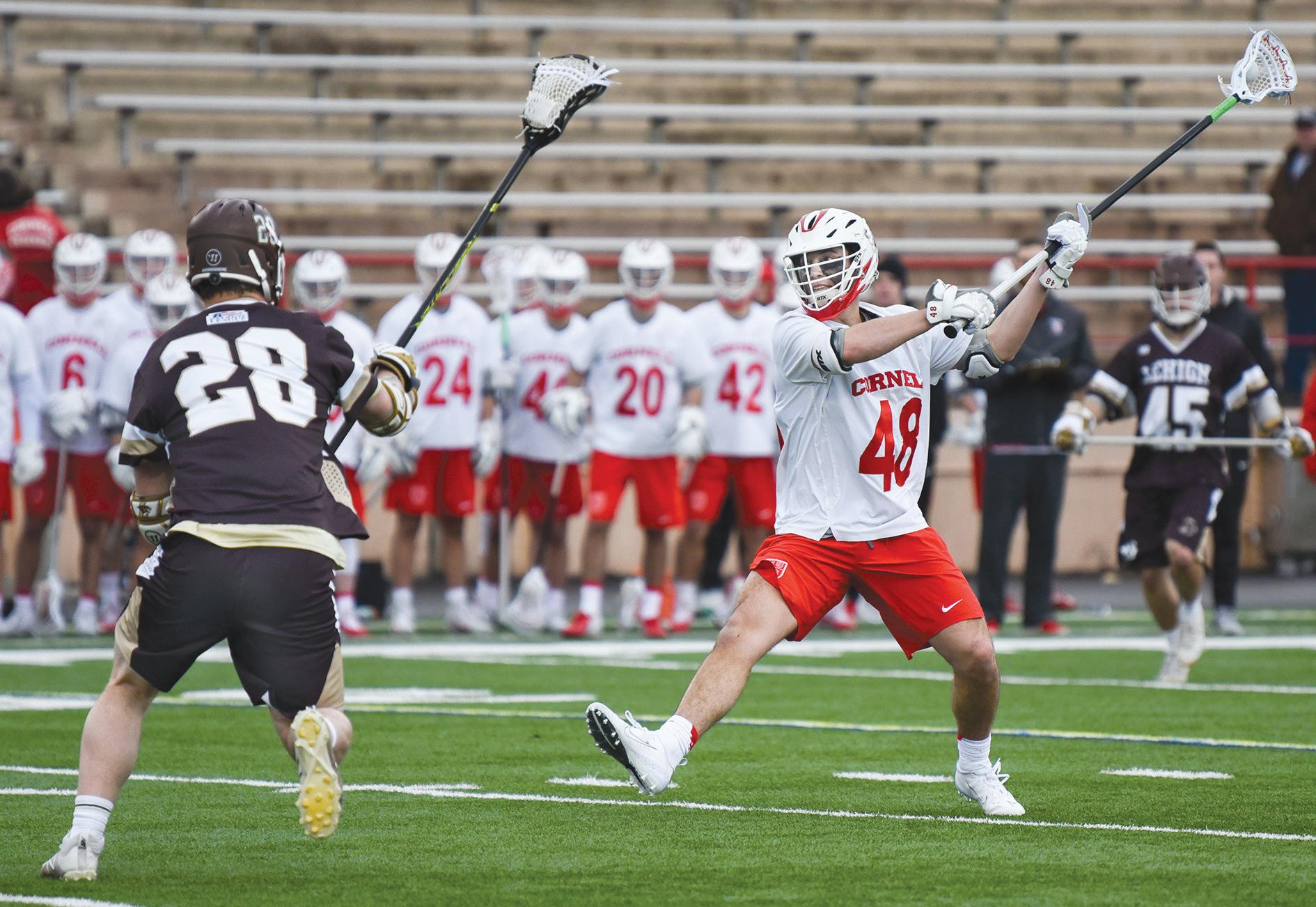
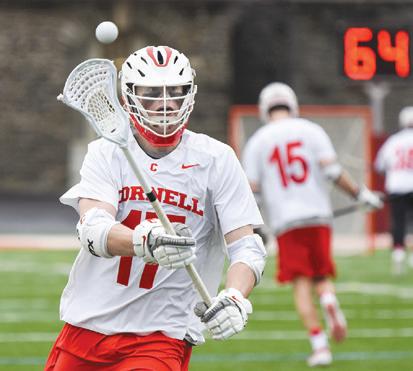
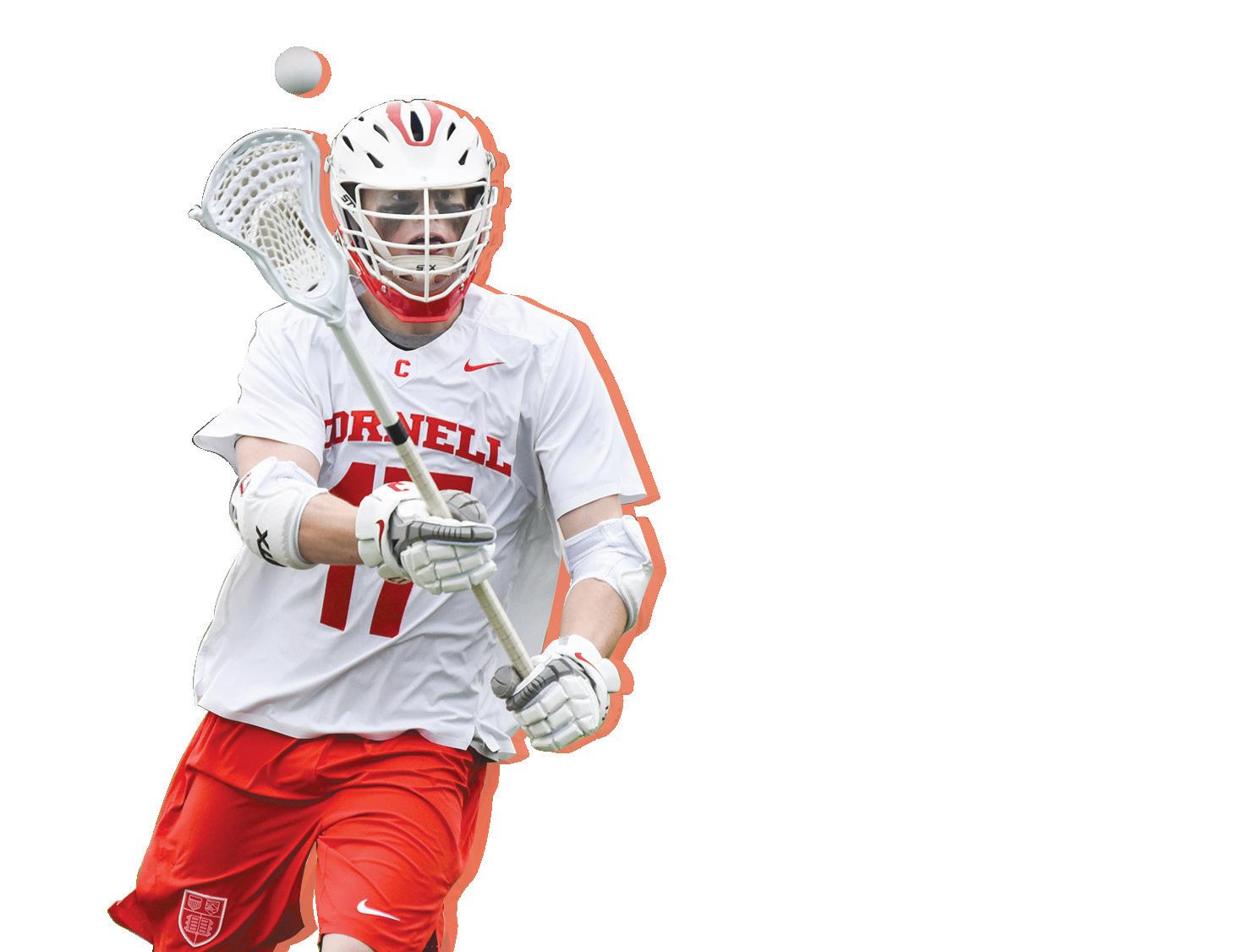
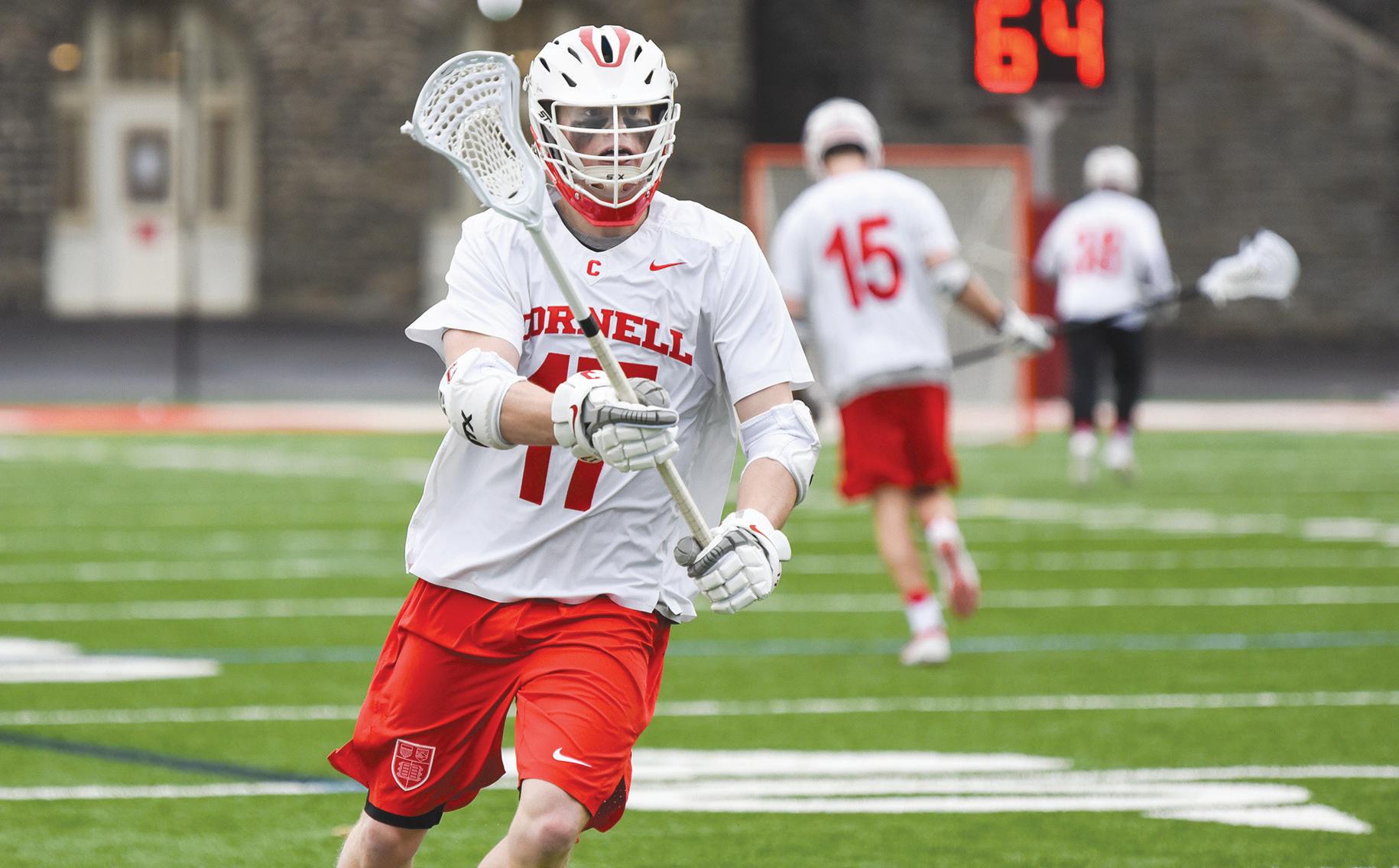
The Cornell men’s lacrosse team is poised to come back stronger than ever next season with a talented group of recruits committed to play next year, headlined by four national stars.
Under the leadership of former Cornell lacrosse star and new head coach, Connor Buczek ’15, the Red seem ready to build on their legacy of dominance. In the past decade alone, Cornell has won the conference regular season championship four times, the conference tournament two times and has appeared in the NCAA tournament five times.
Before the 2020 season was cut short because of the pandemic, the Red were off to a perfect 5-0 against opponents and garnered the No. 2 spot in the NCAA rankings, which included a dramatic last second 18-17 victory against 2019 NCAA No. 1 Penn State University.
Cornell’s new recruitment class ranks eighteenth in the nation, receiving commitments from three of the top
The cancellation of the 2021 season prevented the Red from showing off their 2020 recruiting class, ranked No. 7 in the nation by Inside Lacrosse. Cornell’s additions to the Class of 2024 featured two five-star recruits, No. 9 C.J. Kirst and No. 13 Jack Follows, as well as seven four-star and two three-star recruits.
The 2020 recruiting class held six of the top 60 recruits in the country and could play a major role in the Red’s success moving forward, alongside a slate of strong recruits from this year’s graduating class.
According to Inside Lacrosse 2021, Cornell’s new recruitment class ranks eighteenth in the nation, receiving commitments from three of the top 100 ranked recruits. Danny Caddigan, Christopher Cappelmann and Sean Fox, who are ranked 41st, 64th and 99th respectively, have all signed on to play for the Red next spring.
On the offensive front, 5’10” righty attackman Danny Caddigan should provide a scoring boost for the Red with his creative goal-scoring and the ability to collect tough passes. Caddigan is a four-star recruit hailing from New York’s Smithtown West High School and was on Long Island’s Team 91 2021 Ambush.
Fellow four-star recruit
Chris Cappelmann, a former teammate of Caddigan’s, comes from a similar background, as he attends Smithtown East High School and is a member of Long Island’s Team 91 2021 Blaze. Cappelmann will help serve a major role for the Red as one of the top faceoff midfielder recruits in the country. He is known as a strong leader who excels in transition, is tough in contact, and can score from long distance.
Cornell will also gain depth at the vital longstick midfielder position from Sean Fox. Though Fox is unorthodox for the position at a small build of 5’4”, 110 lbs, he has proved his worth as an elite stickhan-
dler with good motor skills. A transfer from Fairfield College Preparatory to The Taft School, Fox also has played for the Eclipse Lacrosse Club since 2019, where he excelled in getting groundballs and causing turnovers.
Rounding out the four-star recruits for the Red is midfielder Antonio Topouzis, who graduated in 2020 but is currently taking a gap year before coming to Cornell in the fall of 2021. Topouzis attended La Salle Academy of Providence, R.I., before transferring to Deerfield Academy in Massachusetts for the 2020 season.
Topouzis stood out on the Laxachusetts Black in 2019 and 2020, helping lead the
team to the National Lacrosse Federation Championship semifinal in July 2019. He is naturally left-handed but can play ambidextrous, which defines his reputation as a creative player.
In addition to the quartet of four-star recruits, Cornell has also received commitments from other standouts in the class of 2021. Midfielders Alex Holmes, Michael Bozzi and Chris Davis, as well as defenseman Jayson Singer and goalie Wyatt Knust, are all committed to joining Cornell in the fall.