The Corne¬ Daily Sun



Supportive email from sports ofcial cited as reason for decision
By DYLAN McDEVITT & RAPHY GENDLER & MEREDITH LIU
Sun Senior Writer & Sun Sports Editor & Sun Assistant Managing Editor
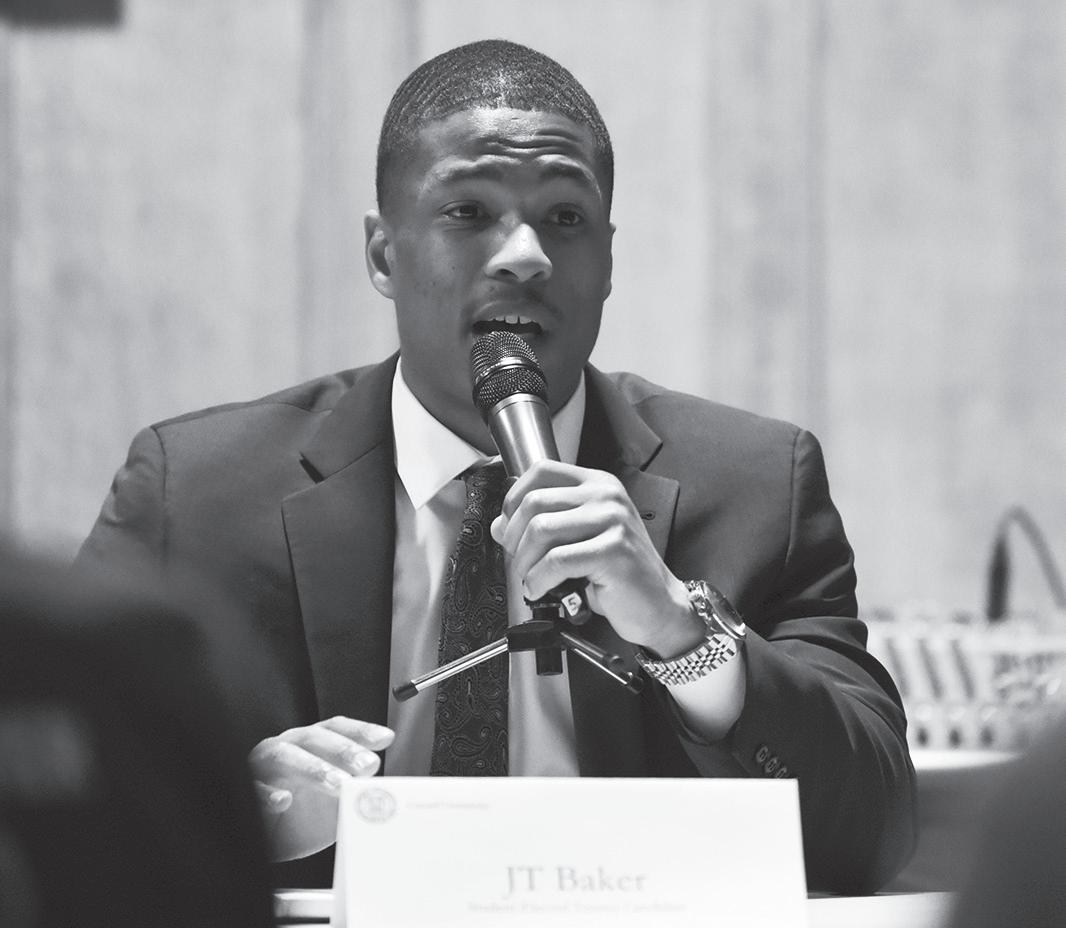
JT Baker ’21, a football player who ran for student-elected trustee, was disqualified because of an email a Cornell Athletics official sent alerting athletes to Baker’s campaign and encouraging them to vote in the election, according to the emails and two people familiar with the decision.
“If anyone deserved to win, it was JT,” said sophomore linebacker Erik Andreasson. “He put in maximum effort to his campaign, sacrificing time he could have spent on school and football, got more than enough votes, and has nothing to show for it because they took it from him.
The Trustee Nominating Committee announced Tuesday that it had disqualified Baker, ruling unanimously that the email violated election rules by implying that players’ support of Baker’s candidacy was a condition of their affiliation with Cornell Athletics.
The committee also determined the email “altered the fairness of the election.” Its decision drew rebuke from both Cornell President Martha E.h Pollack and Board
of Trustees Chair Robert Harrison ’76, who said they disagreed with but would honor the ruling.
The email, which was obtained by The Sun on Wednesday and verified by a committee member, highlighted Baker’s candidacy but did not explicitly endorse the cornerback for trustee. It’s unclear how many athletes received the email.
“I am contacting you to let you know that JT Baker, a member of the football team, is running for Student Elected Trustee,” Carmen Rogers, assistant director of athletics for student services, wrote to athletes on March 18, a week before voting began. “He would be the first ever student athlete in this critical leadership position.
spread the word!” she continued.
Rogers and Cornell Athletics declined to comment.
The nominating committee also disqualified
‘Tey took it from him’: football players livid over teammate’s D.Q.
By DYLAN McDEVITT & RAPHY GENDLER Sun Senior Writer & Sun Sports Editor
Members of the Cornell football team denounced
The disqualification on Tuesday was followed by statements from Cornell President Martha E. Pollack and Board of Trustees Chair Robert Harrison ’76 saying they disagree with the committee’s disqualification of Baker from the race, but that they would abide by its ruling.
“If anyone deserved to win, it was JT,” said sophomore linebacker Erik Andreasson.
ner on Tuesday.
Cornell football players agreed with Pollack and Harrison that the committee shouldn’t have disqualified Baker. But some student athletes called on Cornell’s top two officials to go further and reinstate him. Baker did not respond to a phone call requesting comment on Wednesday evening.
“This election for the Student-Elected Trustee position is incredibly important and we encourage you all to vote, please
Baker for not notifying the committee of the potential violation in a timely manner. Members voted 6 to 1, with one abstaining, that this altered the fairness of the election.

the disqualification of cornerback JT Baker ’21 from the race for student-elected trustee on Tuesday and Wednesday. Baker was disqualified for an email sent by a Cornell Athletics official to athletes and coaches during the campaign.
“He put in maximum effort to his campaign, sacrificing time he could have spent on school and football, got more than enough votes, and has nothing to show for it because they took it from him.”
Due to the use of a ranked-choice voting system, it is unclear if Baker would have won the election had he not been disqualified. Jaewon Sim ’21 was announced as the win-
Soon after Baker’s disqualification, dozens of football players and other student-athletes took to social media to support Baker. Many posts decried the choices of both the committee and Pollack, and some said race may have been a motivation for the perceived injustice against Baker, who is black.
“It’s clear that the repeated efforts to silence [Baker’s] Voice is an example of an unready, corrupt inner circle at this school. The Voices of Undergraduate black men and student-athletes have been silenced far too long here at Cornell,” cornerback Jake Watkins ’19 wrote on Twitter.
Some accused the committee of another form of discrimination, alleging that the committee and the administration have a vested interest against a student-athlete holding a position of such influence. Athletics officials had told
By AMANDA H. CRONIN Sun News Editor
After 28 years of service, Ithaca Police Chief Pete Tyler will retire from his post on May 31 after spending just two years as the City’s top cop. Tyler served two of his 28 years on the police force as chief, replacing Chief John Barber upon Barber’s retirement in 2017. The IthacaCayuga chapter of the Kiwanis Club — an international service club
— presented Tyler with an award commending him for his dedication to protecting the Ithaca area on Monday. Watching Tyler’s “leadership after the retirement of Chief Barber through several high profile and challenging incidents,” Mayor Svante Myrick ’09 became “convinced he is the right person for the job,” he said before Tyler was elevated to the
department’s top post.
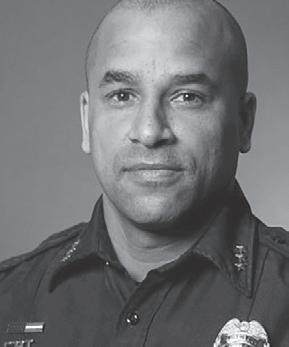
A native Ithacan, Tyler made headlines in 2017 when he became the first black police chief in Ithaca’s history. One of his main missions as chief, he told The Ithaca Voice, was to “work to serve the public and would prioritize training officers to use non-lethal defensive tactics to deescalate dangerous situa-
tions.”
Tyler also entered the position aiming to tackle the opioid epidemic that has hit much of upstate New York particularly hard in recent years. Tompkins County registered nearly 20 overdose deaths in 2018 — up from just 8 in 2013, according to a government report.
“Heroin is a huge problem in our city,” Tyler previously told The Sun. “That’s not going
See POLICE page 4
Thursday, April 18, 2019
Favoritism and Corrective Taxation
11:40 a.m. - 1:10 p.m., 137 Warren Hall
Concentration Roundtable: Science, Technology and Infrastructure Policy Noon - 1 p.m., 153 Rensselaer Hall
Improving Nutrition and Health Through Agriculture 12:20 - 1:10 p.m., 100 Savage Hall
Midday Music by CU Music 12:30 - 1:15 p.m., B20 Lincoln Hall
Internal Transfer Application Workshop 4:30 p.m., Tatkon Center
Free Screening of La Pointe Courte 4:30 - 5:50 p.m., Willard Straight Theatre
Our Broken Immigration System and How to Fix It 4:30 - 5:30 p.m., Tatkon Center
Hip Hop Dancer Public Lecture: Bboy Wicket 5 - 6:30 p.m., B2 Kroch Library
Poetry Reading by Claudia Rankine 5 p.m., Statler Auditorium
Free Yoga 5 - 6:15 p.m., 413 Willard Straight Hall
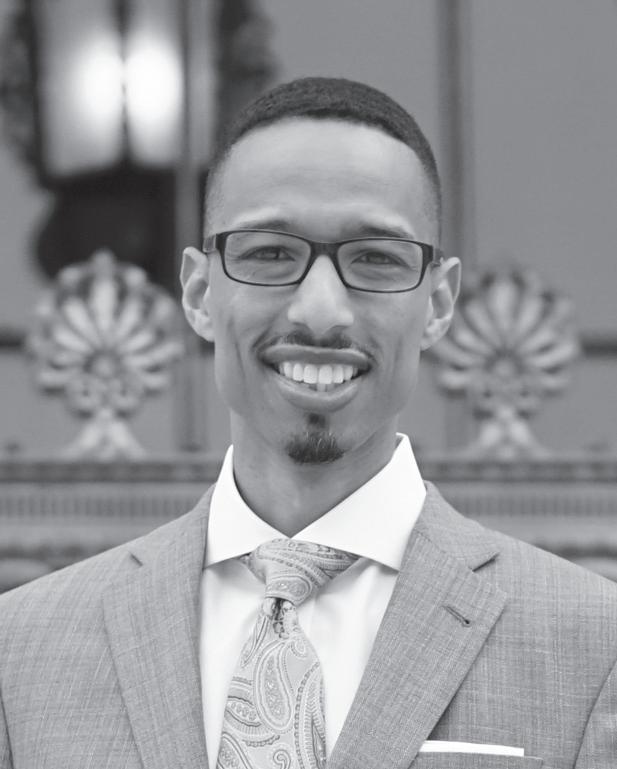
Read and react | Prof. Stefan M. Bradley, African American Studies, of Loyola Marymount University will have a discussion on his book, Upending the Ivory Tower.
My Path to the State Deopartmet: Eliot Kang ’84 5:30 - 6:30 p.m., G76 Goldwin Smith Hall
Social Justice — Civil Rights, Black Power, #BlackLivesMatter and the 50th Anniversary of the Willard Straight Hall Occupation 8 p.m., Bailey Hall
sunmailbox@cornellsun.com
Emerging Markets Research Day 8:30 a.m. - 5 p.m., B10 Sage Hall
Black Studies: Ebony Tower or Unfinished Revolution? Noon, Africana Studies Center, Hoyt Fuller Room
Stefan M. Bradley: Upending the Ivory Tower Book Tour, Discussion 2:30 p.m., Africana Studies Center, Multipurpose Room
Big Red Marching Band’s Cornell Days Performance 2:30 - 3:15, Ho Plaza
Foreign Direct Investment and Labor Rights: The Race-to-the-bottom Problem 2:30 - 4 p.m., 401 Warren Hall
Playing in the Gray: Offshoring and Foreign Investment in Frontier Markets
3:30 p.m., 401 Physical Sciences Building
Cinco De Mayo Cascarones Study Break 4 - 6 p.m., 429 Rockefeller Hall
Design Your Own Multidisciplinary Major with the College Scholar Program Info Session 4:30 p.m., Tatkon Center
Thumbnail: Yikes! 5:15 p.m., Milstein Auditorium

Wednesday, the American Academy of Arts and Sciences announced two Cornell professors among its 214 newly elected fellows: Stephen Ceci, developmental psychology, and Kelly Zamudio, ecology and evolutionary biology. Membership into the academy is a marked honor for individual achievements. Ceci has won several other awards in the psychology field, including the lifelong achievement award from the American Psychological Association. Zamudio is faculty curator of herpetology at the Cornell University Museum of Invertebrates. Her lab has produced impactful work on amphibian biodiversity and populations. Other newly elected fellows include Michelle Obama and former Indiana governor Mitch Daniels.
Reed Starts Strong in Congressional Fundraising Election campaign fundraising for New York’s 23rd Congressional District, to which Ithaca belongs, is already well underway just months after the 2018 elections. Sitting Rep. Tom Reed (R-NY) has so far raised about 15 times more than the sole announced Democrat, Tracy Mitrano J.D. ’95, who fell to the Republican by nine points in last November’s midterms in a closer-than-expected race. Despite being far higher than Mitrano, Reed’s campaign donation sum, $347,220, falls short of the roughly $585,000 collected at this point in the 2017-2018 elections.
A South Florida 18-year old “infatuated with Columbine” — whose “credible” threats, according to the FBI, to attack the infamous high school forced up to 20 Denver-area school districts to close — was found dead Wednesday morning of a self-inflicted gunshot wound. The troubled teen reportedly travelled from her home in Florida to Colorado, where she then purchased a shotgun, triggering a frenzied manhunt that left millions in the Denver area on edge and thousands of out of school. The scare, whose timing reopened many old wounds, comes on the heels of the Columbine shooting’s 20th anniversary this Saturday, a 1999 massacre that claimed the lives of 13.
— Compiled by Anyi Cheng ’21 and Johnathan Stimpson ’21
By SHAWN HIKOSAKA Sun Staff Writer
Housing, community and well-being were among the key areas that Leading Cornell, a leadership program for Cornell employees, identified as the most pressing areas of concern for those employed by the University at Wednesday’s Employee Assembly.
Leading Cornell is a “multi-day program designed to engage and develop staff” with an aim towards “the application of leadership concepts to a real project,” according to the program’s website. The group, which consists of 25 members, has repeatedly met to discuss potential ideas for improving the experience of Cornell workers.
At Wednesday’s meeting, Craig Wiggers, chair and veterans’ representative at-large as well as a participant in Leading Cornell, presented an overview of the program’s key recommendations.
“We were tasked with brainstorming ideas to bring to senior administration that we could move forward on behalf of Cornell,” Wiggers said.
To address housing issues, the group recommended launching the

Wellness | Craig Wiggers, chair and veterans’ representative at-large, presents well-being recommendations at Wednesday’s Employee Assembly.
“Cornell Housing Incentive Program,” a program that, according to Wiggers, “would provide employees the opportunity to live closer to campus, if they chose to.”
The plan calls for a four-year pilot program that would offer employees an array of housing assistance, including third-party mortgage lenders and pre-negotiated mortgage rates with no down payments.
“If you’re having to commute an hour each day, that’s very challenging,” Wiggers said, highlighting the impact of Ithaca’s increasingly expensive housing market on the ability of employees to live close to their place of work.
“Financially, it is very difficult to live in Ithaca. Ithaca is in the top ten most expensive places to raise a family,” Wiggers continued. “Eighty-three percent of faculty live in Ithaca; only 41 percent of staff live outside Ithaca.”
Several peer institutions have implemented this type of program. Notably, Harvard University has provided a similar version of it since 1965 with no defaults, providing on average 50 loans per year, according to Leading Cornell’s report published online. Syracuse University has had this program since 1994 with only one default.
Wiggers also underscored the difficulty of finding a community when new staff arrive at Cornell, relaying anecdotes from employees who have struggled to connect with others while in Ithaca.
“On Saturday morning at 10 o’clock, I am the loneliest that you can imagine, and it’s not until Monday that anybody would even know if anything had happened,” one employee said.
To help resolve this issue, the group proposed an Office of Employee Engagement as a resource for new staff in order to improve campus-wide events and encourage staff to create their own community.
Finally, Wiggers emphasized the need for the University to continue to bolster the 90 well-being programs — which currently include a range of fitness classes, nutrition and life coaching — that target employees at Cornell, saying that there is an imperative for “ensuring that staff are able to engage and take the opportunity to get into these well-being programs.”
Leading Cornell’s report argued that improving the quantity and quality of well-being programs could present significant cost savings by “decreasing sick-leave absenteeism by 28 percent, health-related costs by 26 percent, and workers’ compensation and disability claims by 30 percent.”
“This is a cultural issue,” Wiggers said, stating that there is a need for leadership from the top, grassroots support from the managerial level and cross-communication across different colleges to maintain consistency for the programs.
By OLIVIA WEINBERG Sun Staff Writer
On March 28, Provost Michael Kotlikoff announced the University’s new Center for Social Sciences, intended to improve the University’s research and collaboration efforts among social science disciplines.
The establishment of the center is the result of over three years of discussion between faculty and administration, who aimed to “enhance the university’s excellence in the social sciences over the next 10 to 15 years,” according to the Universityrun.
The new center will “foster research collaborations that provide greater visibility and impact” and “serve as the lynchpin between the social sciences and other disciplines including the humanities and life sciences,” Kotlikoff told The Sun in a statement.
The Institute for Social Science, a predecessor to the newly-christened center, was founded 15 years ago and will continue its mission of providing seed grants and a faculty fellows program.
Comparatively, the Center for Social Sciences “will operate on a larger scale,” Kotlikoff said.
An faculty implementation committee was formed to lead the center in accomplishing two goals: creating a system that integrates similar academic areas, such as that of public policy, and in forming “superdepartments” — such as the Department of Economics — that coordinate efforts across multidisciplinary areas.
Cornell currently has the 24th-ranked public policy analysis program according to U.S. News rankings.
The implementation committee will be comprised of faculty who will be named in the coming weeks. Additionally, staff, students and alumni will be able to contribute
their ideas through collaborative discussions, Kotlikoff said.
Across Cornell’s six undergraduate schools that offer coursework in the social sciences, there are over 70 individual academic departments.
Kotlikoff said that the center will coordinate lectures, panels and workshops relevant to the social sciences, many of which will be open to the Cornell community. The University, Kotlikoff said, hopes that the center will strengthen existing social science programs through added infrastructure. As of now, it is unclear what kind of infrastructure the center will establish.
U.S. News currently ranks University pef Michigan-Ann Arbor, UC Berkeley and University of Chicago as the top three public policy analysis programs in the U.S., with Cornell placing at 24th.
Emmanuel Giannelis, vice provost for research and vice president for technology transfer, intellectual property and research policy lead the center, along with a director that will be named “later this semester,” according to Kotlikoff.
Christopher Wildeman, co-leader of the implementation committee, told the University that the center will help “realize Cornell’s enormous potential, and maximize the prominence, stature and influence of policy scholarship at Cornell.”
“With the creation of the center, and new thinking around a public policy entity and the organization of core disciplines, we are trying to achieve greater visibility for faculty and their scholarship, enhanced opportunities for students and for Cornell to educate the next generation of engaged citizens and global policymakers,” Kotlikoff said in the press release.
Life jackets emblazoned with the testimonials of refugees have lined the Arts Quad this week — a nod to the over 30 thousand refugees who have perished trying to reach Europe, the Independent reported — in just one in a series of events organized by student groups to highlight one of the world’s most pressing humanitarian crises.
Now in its fourth year, the “Week of Action for Refugees” involves an array of events, including a photo campaign and a panel discussion celebrating refugee work in the community, according to the event’s Facebook page.
The week-long initiative is organized by Cornell Welcomes Refugees (CWR) in partnership with 12 other student organizations, including Cornell International Students Union and Cornell Students
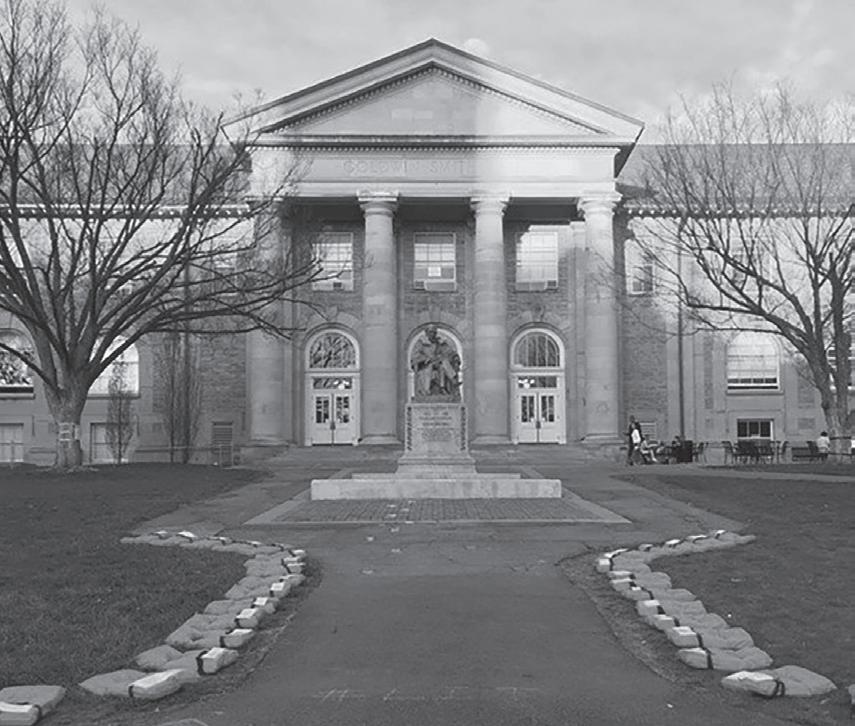
and Harrison denounce the decision
Continued from page 1
Cornell announced Tuesday that Jaewon Sim ’21 had won the election and will serve as the next undergraduate student trustee. The election uses a system in which voters rank their choices, meaning it is impossible to know whether Baker would have won had he not been disqualified.
Sim said Wednesday night that he believes the committee “followed its established procedures” although “some ambiguity in the election rules leaves room for differing interpretations.”
Many Cornell athletes said
post about his campaign on social media without endorsing him.
The committee said in a March 8 memo to all candidates that official university units should not endorse any candidates or take any actions that could be perceived as endorsements or give an unfair advantage to any candidates.
In addition to the email to student athletes, Rogers sent a nearly identical email addressed to coaches that encouraged them to tell their athletes about the significance of the election. The committee determined that the email to coaches constituted a violation but did not alter the fairness of the election.
“It is critical that TNC actions be viewed by the Cornell community as transparent, fair and justified.”
Robert Harrison ’76
Wednesday that they were angered by the committee’s decision and some said they believe the disqualification of Baker, who is black, was racially motivated. Baker did not have any comment Wednesday night.
Harrison and Pollack said in separate statements to The Sun that they believe the committee’s eight voting members had not applied the election rules correctly, but that they would not seek to overrule the independent committee
Pollack said the committee’s stated grounds for disqualifying Baker “are not supported by the established rules governing the election process.”
Harrison, in a letter published in The Sun on Wednesday night, said it would not be appropriate for the Board of Trustees “to second-guess a duly authorized shared governance body.”
“Therefore, the Board will leave it to the TNC to deal with challenges to this student trustee election,” he wrote, referring to the committee. “Given the issues raised by the TNC’s actions, however, I will ask the Board to examine and revise, where appropriate, the structure and authority of the TNC prior to the next election. It is critical that TNC actions be viewed by the Cornell community as transparent, fair and justified.”
Baker had asked the committee weeks before Rogers sent the email in question if Cornell Athletics could
After Rogers sent the two emails, three other athletics staff members, including Athletic Director Andy Noel, sent follow-up emails clarifying that Cornell Athletics did not intend to endorse Baker. The three emails were nearly identical and listed all 10 trustee candidates.
“I understand that a message was posted to Blackboard last week pertaining to the Student-Elected Trustee campaign that is currently taking place,” Noel wrote to athletes on March 26. “Please disregard that announcement and know that it was meant to only inform the athletic community of the election.
“It was not to show support for any one particular candidate,” Noel continued. “There are ten very qualified students who would do a great job as a Student-Trustee and we encourage you all to take the time to research each candidate before you vote.”
The Trustee Nominating Committee received five challenges against Baker regarding three incidents, according to the committee’s public report. Challenges related to two of the incidents “failed to be substantiated.”
REFUGEE
Continued from page 3
for Justice in Palestine.
“Given the current geopolitical climate, there is widespread hostility in the media and society towards refugees and asylum seekers,” Tarannum Sahar ’20, former president of CWR and an organizer of the Week of Action told The Sun. “Through the Week of Actions, we hope to mobilize the community and encourage a better understanding of the global refugee crisis.”
“Being at Cornell and within the United States, we tend to forget what is happening beyond the borders,” she continued. “There is a whole world out there where people are fleeing genocide, ethnic cleansing and persecution every day.”
Almost 25 million individuals are currently displaced from their native countries, with well over half once from the war-torn nations of South Sudan, Afghanistan and Syria, according to the United Nations High Commissioner for Refugees. That number grows by at least 50,000 people a day, pushed from their homes by conflict, persecution or terrorism.
Throughout the Week of Action, the conglomerate of student groups will raise funds for Humanity Crew, an international aid organization that provides mental health and social support for refugees.
Lauren Gillott ’19, co-president of CWR and another organizer of the Week of Action, lauded
the aid group — which has close ties to Cornell — for its life-saving work. A number of Master of Public Administration candidates have served as consultants to the organization for the past two years, she said.
The money raised for Humanity Crew will be used to train volunteers on how to counsel refugees, many of whom have been psychologically scarred by their precarious living situations, according to Gillot.
One recent study published by Wayne State University estimated that one-third of adult Syrian refugees resettled in the United States met the criteria for PTSD diagnosis — a rate higher than Vietnam War veterans.
“While strong and resilient, this is a population who have often experienced a lot of trauma and deserve emergency mental health care and psychosocial support to rebuild,” Gillot said.
Gillot expressed hopes that the Week of Action would create a way for students to learn about the struggles of refugees and to celebrate the contributions they have made to our society at large.
“With the rhetoric in the media right now, and with the current immigration policy crisis going around the globe and in the US, it’s a really important topic to be aware of,” she said.
“It’s the crisis of our time.”
Winny Sun can be reached at wsun@cornellsun.com.
By MARYAM ZAFAR Sun City Editor
Cornell Provost Michael Kotlikoff wrote a lengthy column on Tuesday to advocate for an often-undiscussed minority group at Cornell: veterans.
“Far too few veterans are enrolled in our elite undergraduate institutions,” Kotlikoff wrote in The Hechinger Report, an online media outlet focused on education.
a junior officer in the U.S. Navy, I am keenly aware of the challenges of military life,” Kotlikoff wrote.
Kotlikoff warned against a stereotype of college campuses as “elitist bastions of ‘group think,’” and said that reaching out to all marginalized groups was one way to reverse that characterization.
are underrepresented in highly selective institutions.”
The goal of 100 students was set by Kotlikoff, Denkovic said. “It was completely his decision.”
Dylan McDevitt can be reached at dmcdevitt@cornellsun.com.
Raphy Gendler can be reached at rgendler@cornellsun.com. Meredith Liu can be reached at mliu@cornellsun.com.
POLICE
Continued from page 1
The club chooses an honoree every month who exemplifies compassion and commitment to public service. Recently, the award went to another retiree — Cornell University Police Department’s Chief Kathy Zoner, who left earlier this year after a 28-year career in law enforcement to join a safety consulting firm.
Officers from the New York State Police, the Tompkins County Sheriff's Office, Cornell University Police, Ithaca College
and others were present for the award ceremony.
Nicholas Bogel-Burroughs ’19 contributed reporting to this article. away.”
“Today is about thanking you for giving me an opportunity as somebody who had no aspirations when I started this job to so much as even be a supervisor, let alone the chief of police. But I'm very proud of it. I’m proud of the people I've met along the way,” Tyler said at his acceptance, according to the Ithaca Voice.
Tyler’s successor has yet to be publicly announced by the department.
Amanda Cronin can be reached at acronin@cornellsun.com.
Fifty-seven veteran students are currently enrolled at Cornell, and more than 400 veterans work or study under the University, according to Cornell admissions. In the column, Kotlikoff stated a goal of enrolling 100 veteran students by 2020, an “achievable” target that he set in 2015 when there were less than 10 veteran undergraduates.
Cornell’s undergraduate veteran enrollment rate — 0.28 percent — is the third-highest in the Ivy League, according to data aggregated by the Ivy League Veterans Council. However, the provost said that students who enlist in high school might not consider applying to prestigious universities.
“With a daughter serving as
The provost advocated for five “straightforward” steps to better reach out to prospective veteran students, including the creation of “support structures” for these students, sensitivity to veterans’ backgrounds, and pre-enrollment programs to prepare veterans for college life. He also encouraged enhanced on-campus programming for veterans and support of student veteran groups.
Kotlikoff met with representatives of Cornell Undergraduate Veterans Association multiple times, a student group on campus that serves as “veterans’ liaison to Cornell, advocating for their rights and recognition,” according to the group’s Facebook page.
The provost’s letter was “brilliant,” according to Chris Denkovic ’20, vice president of CUVA, saying it painted the “harsh reality that veterans
CUVA hosts events to discuss the issues facing veteran students, Denkovic said, including an event next week with the head of Service to School, a non-profit organization that provides application counseling to veterans.
“Veterans come in with a lot of very unique experiences and we all have very unique perspectives on just life in general,” Denkovic said. Cornell “benefit[s] from the diversity of the different backgrounds and I think that ours is definitely one of them.”
The University also partners with Vetlink, a non-profit service that aims to help military veterans who are transitioning to civilian life get admission at prestigious universities. Vetlink also partners with Harvard University, Yale University and Princeton University from the Ivy League.
Maryam Zafar can be reached at mzafar@cornellsun.com.


Independent Since 1880
137th Editorial Board
ANU SUBRAMANIAM ’20
Editor in Chief
DAHLIA WILSON ’19
Business Manager
PARIS GHAZI ’21
Associate Editor
NATALIE FUNG ’20
Web Editor
SABRINA XIE ’21
Design Editor
NOAH HARRELSON ’21
Blogs Editor
SHRIYA PERATI ’21
Science Editor
KATIE ZHANG ’21
Dining Editor
AMINA KILPATRICK ’21
News Editor
JOHNATHAN STIMPSON ’21
News Editor
PETER BUONANNO ’21
Arts & Entertainment Editor
ANYI CHENG ’21
Assistant News Editor
HUNTER SEITZ ’20
Assistant News Editor
CHRISTINA BULKELEY ’21
Assistant Sports Editor
JING JIANG ’21
Assistant Photography Editor
SARAH SKINNER ’21
Managing Editor
MEREDITH LIU ’20
Assistant Managing Editor
RAPHY GENDLER ’21
Sports Editor
BORIS TSANG ’21
Photography Editor
AMBER KRISCH ’21
Blogs Editor
SOPHIE REYNOLDS ’20
Science Editor
AMANDA H. CRONIN ’21
News Editor
ROCHELLE LI ’21
News Editor
MARYAM ZAFAR ’21
City Editor
ETHAN WU ’21
Opinion Editor
SHIVANI SANGHANI ’20
Assistant News Editor
NICOLE ZHU ’21
Assistant News Editor
MILES HENSHAW ’20
Assistant Sports Editor
BEN PARKER ’22
Assistant Photography Editor
Working on Today’s Sun
Ad Layout Dana Chan ’21
Production Deskers Krystal Yang ’21 Sabrina Xie ’21
Sports Desker Miles Henshaw ’20
Photo Desker Ben Parker ’22
News Deskers Anyi Cheng ’21
Johnathan Stimpson ’21
Night Desker Alex Hale ’21
Design Deskers Simon Chen ’21 Krystal Yang ’21
Editorial
YOU HAVE THE STOMACH FLU. You can’t bear to have your thoughts drift to anything food-related. But wait — it’s Thursday. Your meal swipes expire if you don’t use them today. What do you do? Forfeit the money? Sit in the dining hall and smell your money’s worth? Force the food down to make sure you don’t waste the $16.45 you paid for dinner?
The weekly expiration of Cornell Dining meal swipes is a misuse of student money. Every meal that students have through their meal plan, they paid for. Cornell Dining even gives an itemized list of what each meal is priced at.
Breakfast: $9.45
Lunch M-Sa: $13.40
Late Lunch: $10.95
Dinner: $16.45
Sunday Brunch: $14.75
Mind you, these prices are even more expensive than last year’s, according to the Cornell Dining website.
The problem does not lie with all meal plans. Cornell Dining does a fair job accommodating upperclassmen’s various housing situations and off-campus meal plan preferences. The problem rests with first-year meal plans. Cornell Dining has five categories for meal plans, and first-year students fall under an inconvenient one.
Every option for first-year students, besides the unlimited plan, has meal swipes that expire weekly on Thursdays. But it’s difficult to understand why those prepaid meals suddenly vanish. Is it so unreasonable for a student with a 10 meal per week plan to use 11 on one week if they only used nine the previous?
Every week a student doesn’t use every single meal swipe, they watch their money slip away. Cornell’s exams, and thus Cornellians’ workloads, aren’t spaced out evenly week by week. So why should meal plans be?
The options Cornell presents for first-year dining plans are not comparable to peer institutions. Only Columbia University has week-to-week expirations. The remaining six Ivy League universities understand that students might vary how much or how often they want to eat. They allow students to divide up a set number of meal swipes for the semester or require an unlimited meal plan.
This year Cornell Dining gave students an opportunity to donate their bonus guest swipes to fellow students. But just the guest swipes. Not the meals they didn’t use that week. Even though these first-year students paid for every single meal. Cornell Dining, in other words, doesn’t believe students should be able to donate their (or their parents’) money.
It’s not as if the solution is particularly hard, either. Big Red Bucks already roll over from the Fall to Spring semester, so why can’t meal swipes roll over from week to week? Not year-to-year. Not semester-to-semester. But simply week-to-week — within a semester that is already paid for. Students would purchase a fixed chunk of meal swipes for the semester, which they’d be able to budget as they please. It would put an end to Cornell profiting off students who just happened to come down with a nasty case of the stomach flu.
To the Editor:
In light of the controversy surrounding this year’s student trustee election, I feel that it is important for the campus community to understand a bit of history and context.
Over 35 years ago, the University’s Board of Trustees, out of respect for the concept of “shared governance,” voted to create a Trustee Nominating Committee as the entity that would oversee the election of both student and employee representatives to the Board of Trustees. The TNC is not a committee of the Board of Trustees. It is comprised of campus community representatives, including the current student, faculty and employee-elected trustees as well as additional student representatives; and its authority was quite consciously delegated to this representative campus group and not retained by the Board or granted to the Cornell administration. The TNC is responsible for its decisions, and it has the ability to change its decisions. The president of the University has no authority to intervene.
While the Board of Trustees can modify the authority of the TNC in the future, it is not appropriate for the Board to second-guess a duly authorized shared governance body. Therefore, the Board will leave it to the TNC to deal with challenges to this student trustee election. Given the issues raised by the TNC’s actions, however, I will ask the Board to examine and revise, where appropriate, the structure and authority of the TNC prior to the next election.
It is critical that TNC actions be viewed by the Cornell community as transparent, fair and justified.
Yinnon Sanders | Guest Room
With the failure of the BDS resolution before the Student Assembly this past Thursday, Cornell Hillel and Cornellians for Israel, both of which strongly opposed the measure, declared a victory for peace. However, peace and dialogue have not won out just yet. If Hillel and CFI are serious about promoting human rights of Palestinians and Israelis, they must walk the walk. During my time at Cornell, Hillel and CFI have brought several far-right speakers from Israel, including Dani Dayan, who is the head of the Yesha Council, which administers settlements in the Occupied West Bank that are considered by most experts to be illegal under international law, and who has advocated for the war crime of destroying entire Palestinian neighborhoods in retaliation for rockets fired by Hamas. If Hillel cares about dialogue, it should strive to bring in Palestinian speakers as well as Israeli critics of the occupation of Palestinian land such as Breaking the Silence, a group of Israel Defense Forces veterans that candidly discusses military activities in the Occupied Palestinian Territories, and B’tselem, a human rights organization dedicated to ending the occupation. If the one-sided narrative of BDS disqualifies it as a genuine path forward in the conflict, as I believe it does, then Hillel should reconsider the way it runs Birthright trips, which since 2017 have not allowed Palestinian speakers to talk to the participants. The trip could be supplemented by information about the Palestinian narrative. The two Israel trips that Cornell Hillel runs, Birthright and Perspectives (formerly Fact Finders), are both largely funded by Sheldon Adelson, a casino magnate and big-time Trump donor who has claimed that “the purpose of Palestinians is to destroy Israel” and has called on the US to nuke Iran “in the middle of the desert” where “it doesn’t hurt a soul.” This sort of rhetoric does not sound like a peaceful and balanced alternative to BDS.
Cornell Hillel has said that “a lasting and secure Israeli-Palestinian peace can only be achieved through the lens of a twostate solution,” a solution that recent polls have shown is opposed by most Israelis and most Palestinians, especially young people. Time is running out for a two-state solution: Benjamin Netanyahu, or as his supporters call him, “King of Israel,” won the Israeli election on Tuesday last week after promising to annex parts of the West Bank. This move would end the viability of a Palestinian state, leaving most Palestinians in the West Bank living in fragmented Bantustans under civil control of the Palestinian Authority but with the Israeli army calling the shots. If Hillel really supports two states for two peoples, it
must act now. In the words of former Israeli Prime Minister Ehud Barak, “If this bloc of millions of Palestinians cannot vote, that will be an apartheid state.”
I do not mean to dismiss the real and valid safety concerns of Israelis, whether they live in Israel proper or in illegal settlements on occupied land. I have family in Israel, and I myself lived in Israel during the Second Intifada, a wave of Palestinian popular resistance and terrorism in which hundreds of Israeli civilians were murdered. During this period, over 1,000 Palestinian civilians were killed by the IDF in response to protests and violence. Despite the value of safety, however, I am uneasy with the claim made by the CFI president during the Student Assembly teach-in that Israeli security justifies de jure discrimination within the West Bank such as segregated roads, and I suspect that I am not alone.
Currently, Hillel supports a range of religious options for Jewish students, but the only flavor of pro-Israel activism available is effectively anti-Palestinian and pro-occupation by omission. Hillel should increase opportunities for Jewish students like me to engage with J Street, a pro-Israel, pro-Palestinian organization that advocates for a negotiated two-state solution, or the Shalom Hartman Institute, an Israeli research center supporting democracy and religious pluralism, as well as more left-wing organizations such as If Not Now and Jewish Voice for Peace. My freshman year, Hillel obtained funding for me to attend a J Street student conference, and it would be great if students could take this a step further and establish a J Street chapter on campus. Voices opposing the occupation must be part of the Israel discussion at Hillel. In addition, Hillel and other Jewish institutions at Cornell should welcome in non-Zionist, anti-Zionist and post-Zionist Jews to bring their full selves to our Jewish community. Judaism is a religion built on dialogue and recognizing difference, and it is a shame that the Israel-Palestine discussion promoted by Hillel is so strictly limited. The willingness expressed by Cornell Hillel to engage in dialogue around the conflict is admirable. The question now is whether Hillel will follow through.
If you would like to stand up for Palestinians in Israel, the Occupied Territories and beyond within the framework of the Cornell Jewish community, get in touch! Let’s organize.
Yinnon Sanders is a senior in the College of Engineering. Guest Room appears periodically this semester. Comments may be sent to opinion@cornellsun.com.
Anna P. Kambhampaty | Tis Imagined Life
Justlast week, I found myself going through an email that my mother sent me freshman year of all my old high school essays. As I flipped through the various attachments, cringing at my habitual use of bombastic language, I came across one titled “Babson.” I never wrote anything called “Babson,” I thought. The name didn’t ring a bell other than the college in Massachusetts, but I didn’t apply or even visit the school. I opened the document, and it had no date, name or title.
I didn’t even have to finish reading the first line of broken English to recognize that it was written by my father. It took me until halfway through the first paragraph to understand that it was an application to Babson’s MBA program. My confusion shifted into a different emotion — fear. I knew this document was something I was never meant to read and that it would inevitably stir reflection.
The essay detailed my father’s lifelong desire to attend an MBA program. It talked about family history I had never learned of until then, his few and far between but always relished exposures to business throughout his education, and how he had never had the proper chance to attend business school. When he emigrated to the states from India, he had to deal with several visa issues. Once that was sorted out, he worked a job to get my mother to the states and to support themselves while she was still finishing her medical residency. Then, of course, I came along. Then my little sister. Finally — this was his chance. But I knew very well that my father never attended business school. He had been so close to attending on so many different occasions, and this essay was just another one of those moments.
Being someone who can never just let things go, I immediately texted my father, “How come you never went to business school?” His response included much of what was detailed in the essay. But it ended with, “I think I am just too old now.”
one I that I believe is experiencing narrative scarcity is how unwelcoming higher education is toward older people and the image of older people in education. When we hear of an older person going to back to school, we laud them, saying “Good for you! How brave.” When we see someone past their 20s in class with us, we turn to each other and ask “So, what’s their story?”
Early educational philosophers theorized education as a facet of life exclusively for children. In “An Essay concerning Human Understanding”, John Locke claimed that a child’s mind is a blank slate, void of any innate ideas, that is meant to “filled” by experience and education. In his later essay “Some Thoughts concerning Education,” Locke speaks almost exclusively about education as an entity that affects the minds of children. Jean-Jacque Rosseau believed that children are driven by a natural curiosity that pushes them to learn from their environments and should be protected from “the domineering wills of others.” These schools of thought continue to dominate how we treat education today. The notion that education exists only for younger people limits how we define the value of learning. The focus of education was always on the child. It seems to me like we are throwing away people once they become adults.
My father’s response included much of what was detailed in his essay. But it ended with, “I think I am just too old now.” What? I thought.
What? I thought. Who on earth said my father was too old to go to business school? The answer to this question isn’t just any one person. It’s our entire youth-centric society. Think of any mainstream portrayal of university life and education. Animal House, The Social Network, This Side of Paradise, headlines like “Going to university is more important than ever for young people.” It’s no wonder that it becomes a culturally hegemonic thought that seeking education is for younger people only. Older people stand out in college.
There are countless issues with higher education, but
to self-actualization, something that I could pour my heart and soul into that would make the world a kinder place. My parents’ confusion at my hatred toward my rigid, Catholic prep school was apparent. While they questioned why I wasn’t grateful for the education and attention they would have done anything for in their youth, I wondered why on earth they could send me to a high school that barely had a visual arts program. Throughout college, I felt their subtle nudges to choose a path and follow it. Their cringes when family friends would ask what I study and I would reply “I don’t know yet” even late into sophomore year did not go unnoticed.
How often do I online shop during lectures or sleep through a discussion section when there are people like my father dying to have the opportunity to be in this place?
Reading my father’s MBA application made me think about the opportunities I had taken away from my parents rather than the ones they had taken away from me. Sure, maybe they didn’t encourage me in the right direction when I really needed it and may have stressed the wrong values for my own personal growth, but I took away an entire lifelong dream and degree for my father. The time and effort required to give me the best childhood and upbringing he could forced him to set aside his primary educational aspiration.
My anger and conviction at our society soon turned into guilt. How often do I online shop during lectures, hit snooze and sleep through a discussion section or haphazardly rush through an assignment when I know there are people like my own father dying to have the opportunity to be in this place?
Throughout my life, there was always a disconnect between my parents and me educationally. Their choices were going to school to become either a doctor or an engineer. Though they are both passionate about their work, the primary purpose of their careers was to confer stability and a respectable title.
However, I — raised with a strict regimen of American media consumption, very early exposure to Dead Poet’s Society and the desire to not fit any Indian American stereotype out there — didn’t view my career the same way. My career was going to be my life, something that would lead
Eva Milstein-Touesnard | Guest Room
When we open up to more people, we aren’t taking
it
out of the hands of the youth.
Universities are the places where great ideas are fostered, minds are forwarded, and innovation comes to life. But why are we, for the most part, limiting all this to the youth? Doesn’t more innovation and learning benefit all of society? When we open it up to more people, especially those who feel they can better their lives or fulfill some untapped dream, we aren’t taking it out of the hands of the youth. Education not a tragedy of the commons type thing. Let’s stop wasting the later years of a person’s life. Let’s use them to accomplish what was left undone.
Anna P. Kambhampaty is a senior in the College of Agriculture and Life Sciences. She can be reached at akambhampaty@ cornellsun.com. Tis Imagined Life runs every other Monday this semester.
Young people across the political spectrum agree: Climate change is a serious issue. I have talked about this issue with young Republicans, Democrats and independents. A recent study showed that 85 percent of young adults ages 18 to 25, regardless of political affiliation, believe that the federal government
85 percent of young adults ages 18 to 25, regardless of political affiliation, believe the federal government needs to do more to support clean energy.
needs to do more to support clean energy. Across the board, young voters agree that government action needs to be taken against climate change.
The Youth Climate Strike held on March 15 was an excellent demonstration of the solidarity amongst young Americans on the issue of climate change. However, we need to take more action in order to ensure that our representatives and lawmakers pass climate protection laws. This is why last Tuesday, April 9, I decided to travel to Albany along with other students across the state for Our Climate’s Youth Lobby Day. Together, we met with our state representatives and asked them to pass the Climate and Community Protection Act and the Climate and Community Investment Act.
The CCPA is legislation that would set New York on a path to achieving 50 percent renewable energy by 2030 and 100 percent renewable energy by 2050. The CCIA
would put a price on greenhouse gas emissions to de-incentivize fossil fuels and financially support the CCPA. This would also allow renewable energy to develop in a fair market because the price of energy from each sector would reflect its environmental impact. To achieve this, the act would establish a price for each ton of GHG emissions that all polluters in New York would have to pay. To start off, it would be $10 per ton and then increase in the years following. The money would then be distributed into four categories, with 30 percent going to clean energy jobs and infrastructure, 33 percent for investment into the communities most impacted by pollution and climate change, 7 percent for a transition from fossil fuel jobs to clean energy jobs and 30 percent going towards a tax rebate fund. This act will lead to hundreds of thousands of new, green-collar jobs with high salaries and good benefits (currently, 55 percent of these do not require a college degree). Furthermore, it will generate billions of dollars in revenue for the state of New York. Overall, it will be economically and environmentally beneficial to New York State.
brought to the floor of the Senate. However, O’Mara has shown support for other aspects of environmental protection such as water quality, recycling programs, e-bike programs and food waste. For this reason, we believed that he could be open to the idea of passing the CCPA and CCIA. During our meeting with Senator O’Mara, we asked that he reconsider supporting the CCPA because of the benefits it will bring to New York.
We have no other choice than to take action, no matter what political affiliation we hold.
Assemblymember Barbara Lifton represents the Ithaca area and supports both the CCPA and the CCIA. Lifton voted in favor of the CCPA, which has passed in the Assembly for the past three years. However, the CCIA has not yet been brought to a vote. Sen. Thomas O’Mara (R-N.Y.), who represents the Ithaca, Elmira, Corning and Watkins Glen area, does not currently support the two bills, and neither bill has been
Our government representatives, who are primarily composed of an older generation, have not been taking serious action against climate change. This not only leaves the brunt of the impacts on us, the youth, but it gives us no other choice than to take action, no matter what political affiliation we hold. We all need to encourage our representatives to pass strong, equitable climate legislation that is based on science. One easy action to take is to write letters to, call or set up a meeting with your elected officials to describe your opinions and concerns. For those of you from other N.Y. counties, I encourage you to contact your senator or assembly member and encourage them to vote in favor of the CCPA and CCIA. We need to take action now and show our representatives that this is an issue that students care about. We must fight for a clean environment before our climate is too polluted and it is too late to go back.
Eva Milstein-Touesnard is a freshman in the College of Arts and Sciences. Guest Room appears periodically this semester. Comments may be sent to opinion@cornellsun.com.
By RAE SPECHT Sun Staff Writer

very Saturday, under a rustic waterfront pavilion decorated with strands of twinkling globe lights, hundreds of shoppers mosey from vendor to vendor at the Ithaca Farmers Market. Tote bags spill over with bright, crunchy carrots, leafy sails of kale and chard, glossy purple onions and pungent cloves of garlic. Everything at the market is produced within a 30-mile radius of the pavilion, ensuring only the freshest picks of vegetables, fruits, eggs, meats and cheeses. Learned Ithaca locals know that the best time to snag the cream of the crop is at 9 a.m. on Saturday mornings, when the market first opens. If you’re an early riser, consider a morning trip to beat the crowds that surge in around lunch until closing time at 3 p.m.
dors, each which feature deliciously unconventional cuisines from around the globe. Nearly all of the stalls advertise tasty vegetarian, vegan and gluten-free options to satisfy every preference and diet. The vast array of choices is a welcomed sensory overload, so upon arrival, make your rounds through the pavilion to take it all

The produce is some of the best in the region, but what truly makes Ithaca Farmers Market shine is the abundance of incredible food ven-
in, snatching some free samples of local cheeses, fruits, honey, cured meats and pestos along the way. Start your day off with something sweet, perhaps a soft apple cider doughnut from Little Tree Orchards, or an icing-drizzled cinnamon bun from The Good

Loaf Bake Shop Tibetan Cooking. While you’re at it, grab a couple steamed Tibetan momos with a side salad of bright fuschia cabbage. Make your way to Just Desserts, but don’t be misled by its name. The stall’s real draw is the massive, portable wood-fired oven parked back behind the counter, which has salivating foodies lining up to order piping-hot personal pizzas. One crispy, bubbly, perfectly-charred pie is a fine appetizer to nosh on with friends, or a sizable meal for one. A cool breeze carries the scent of lemongrass and Southeast Asian spices over the thick crowd in front of Khmer Angkor Cambodian Food. Friendly staff members send paper boats of traditional chicken amok curry and fragrant vegetables out into the sea of customers. Forced to flee for their lives from Cambodia during the Khmer Rouge, the owners carried the vibrant flavors of their homeland with them to the Finger Lakes, eventually establishing the award-winning market favorite. Ask owners Bong and Marin Sen for recommendations on what to order.
At the far end of the pavilion, La Paladar Cuban Food offers a traditional, no-frills fare of rice and beans, sweet potatoes and marinated chicken. Behind the counter, an employee lowers freshly sliced plantains into sparkling oil, and draws out crispy, mildly sweet golden nuggets which he arranges neatly onto a long skewer for a perfect on-the-go snack.
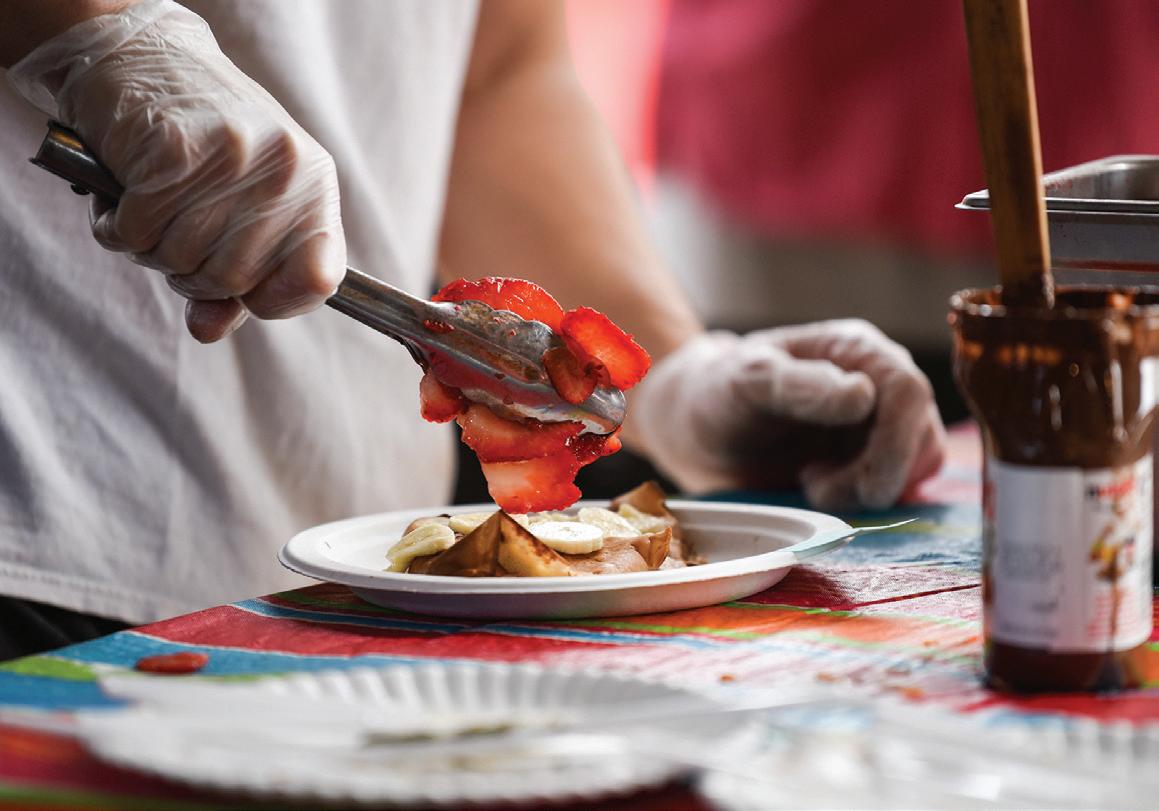
the East are sprinkled all throughout the market. Among them, Asian Taste serves up steam buns, potstickers, crispy egg rolls, sesame balls, noodles and fried rice.
The market is also an ideal destination for atypical, giftable finds. The racks of Carolina Perez Designs burst with eccentric, vividly patterned clothing and acces-

sories at reasonable prices. Comb the eclectic collections of quirky purses adorned with portraits of Frida Khalo and floral printed hair scrunchies, in which you’ll be sure to find something special.
Its neighbor, Yum Yum Korea is a little less orthodox, dishing out fragrant beef, pork and veggie kimchi tacos, garnished with colorful fresh vegetables and drizzled with your choice of spicy sauce.
Vendors selling Thai iced tea, Indian samosas and other eats of


Shopping at the farmers market allows customers to talk with the producer directly. Vendors are always more than happy to talk about their products, dishing out samples, informational tidbits, recommendations and recipes to help you make the most of what you purchase. While comparing the delicate, floral flavors of clover honey to the rich, powerful tang of buckwheat at Waid’s Honey and Candles, I learned from an employee that each unique taste corresponds with the type of plant from which the nectar was extracted. After sampling the large assortment, pick up a jar of your favorite flavor for your evening tea and a beeswax candle for mom.
Escape the overflowing pavilion to the outdoor, lakeside seating area, where students and locals perch like seagulls upon the wooden docks, indulging in a smorgasbord of curries, pizza pies, dim sum and chocolate crepes. Kayakers
extend their paddles in rhythmic strides, while dock-loungers sway their dangling legs above the calm waters of Cayuga Lake to the beat of live music. It’s an idyllic scene that almost feels choreographed. On your way out, grab an ice cream sandwich and a cup of freshsqueezed lemonade to-go from Dennis’ Homemade Ice Cream. Upon first glance, Dennis’ is an unsuspecting, modest little joint, where an employee hand-presses a lemon on the spot for each and every cup. The homemade ice cream sandwich, a block of smooth, luscious cream nestled between two soft chocolate wafers, is the star of the show. The sheer simplicity of the combo is what makes it perfect. Two humble classics, kept so simple and made so well. The market is a snapshot of Ithaca’s offbeat and charming culture: a hodgepodge of interesting flavors, artisanal goods and passionate people. While a group of students share a pizza pie, an older woman with a flowery hat picks up her weekly produce. A professor waits in line behind a large-bearded man with a beat-up guitar strapped to his back. It’s a special place. For a few hours each weekend, an extraordinarily diverse community unites under one pavilion to celebrate delicious local food.
Ithaca Farmers Market is open for spring on Saturdays, April through October from 9 a.m. to 3 p.m. and Sundays, May through October from 10 a.m. to 3 p.m. at the historic Steamboat Landing park (545 Third St.). Live music performances occur every Saturday from 9 a.m. to 10 a.m. and 2 p.m. to 3 p.m. Many vendors accept credit cards, debit cards and Venmo, but many do not, so make sure to have some cash on hand. Bring your own bag for produce.
JEREMY MARKUS SUN ASSISTANT ARTS EDITOR
Tattoo shops lining West State St. are well-recognized landmarks in the community. But what brings so many shops to Ithaca? I sat down and spoke with three artists from three of Ithaca’s most prominent shops to find this out. Just walking around the Commons, you can find a plethora of artistic creativity. However, none incorporate the creativity of Ithaca into their art quite like tattoo shops. “I think this town is special because we have so many different people from all over the planet influx into Ithaca all the time, every year,” said Artist Point Tattoo Co. artist Ron Wilson. He further explained to me that he sees Ithaca’s diversity as the main contributor to the success and growth of Ithaca’s tattoo scene. Wilson went on to acknowledge the influence of both Cornell and Ithaca College on the success of Artist Point, citing the universities as space for “a meeting of minds from all over” and filling the town with “a lot of creative types.”
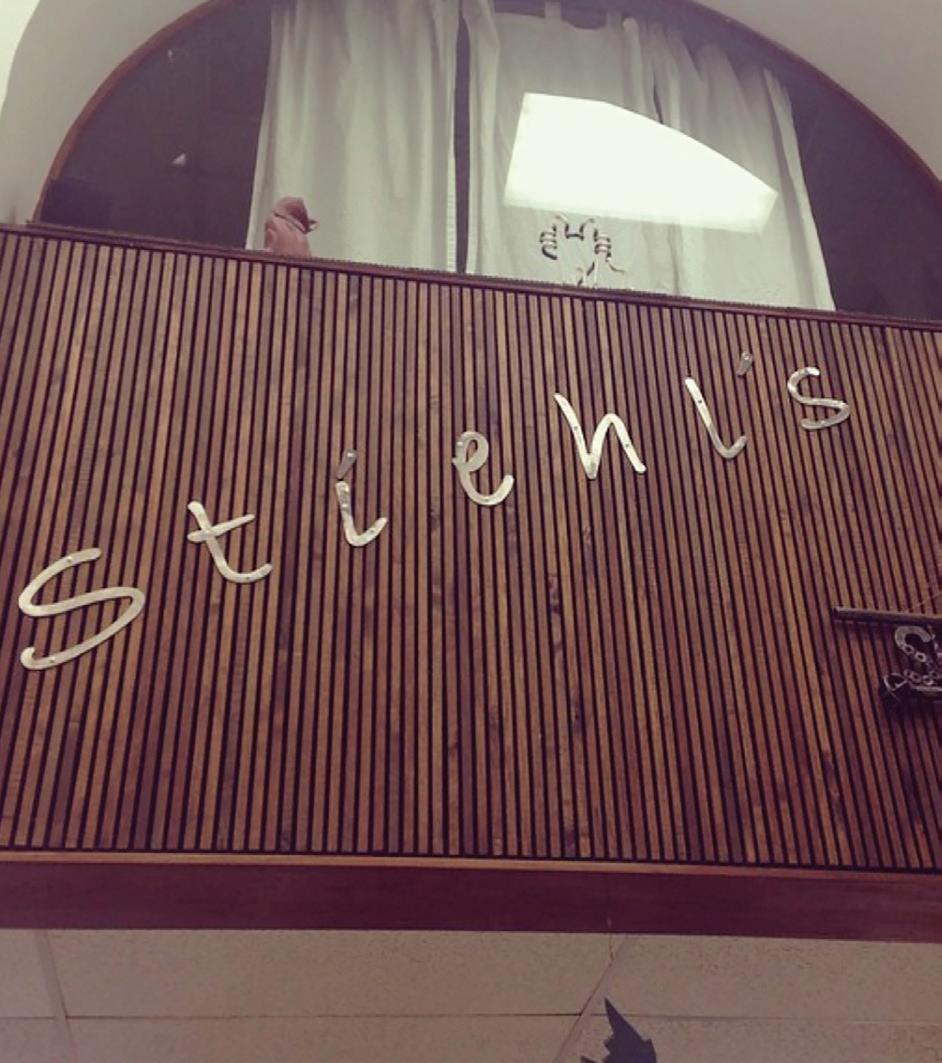
Amanda Mulholland, Stiehl’s Body Modification artist, agreed: She reasoned that the “booming business” of tattoo shops in Ithaca is indebted to the influence of schools and the artistic visions of young people. “The younger client base I have right now,” Mulholland told me, “aren’t looking at what happened 15 years ago. They’re looking at what’s happening now. And artists are buying off of that too. I see a lot more artists putting art on skin, and the younger generation is seeing this too.” Yet the younger generation of college students is by no means taking the reins of the tattoo industry.
When I asked Austin Strait, an artist based out of Hand of Fate Tattoo Parlor, he told me that collaboration is still
Musical paralysis. If you feel overwhelmed by the surge and variety of new music and listen mainly to music from the last decade, you’re not alone. A poll conducted by music streaming site Deezer revealed that 65 percent of 5,000 participants from various countries only listen to music they already know. Most people reported that musical paralysis sets in by age 28. That’s not long after college graduation. I, for one, love music too much to be paralyzed, and I am committed to discovering new music. Over the past year, I’ve been developing ways to discover “new” music, and I’m here to share my insights on how musical paralysis occurs and how you can prevent it.
Why does musical paralysis occur? Much of it is not under our control. Our brains dictate our music taste from a young age. They respond to stimuli that light up our dopamine receptors and new neuron configurations form to give us the same feeling as the stimuli originally did. These effects can last for years. That’s why we genuinely like and will defend music that we liked during our awkward years despite it probably being not that great. Once someone’s musical taste has been developed, it can be difficult for music from an unfamiliar genre to entice listeners. With that knowledge, it will probably not be effective for a listener to expose themselves immediately to music way outside their comfort zone.
How does an average person discover a new song? They might hear one on the radio, in public or at a party, but those media tend to present an extremely narrow sample of music being created. The Internet is more
very key in the process and that the clients with more tattoos are more open to his visions and ready to move “on to bigger and better pieces.” Strait spent time as a tattoo artist in Louisiana, and, comparing it to Ithaca, he told me “that it wasn’t too easy to work your own design in [Louisiana]. I’ve noticed that since I’ve moved here, I’ve been able to progress in the way that I’ve wanted. I do get a lot more freedom in the artistic designs.”
Wilson also agreed that his clients give him artistic freedom and told me how fulfilling he finds collaboration, stating that “That’s really the best part of being an artist nowadays: helping people become more of who they want to be and helping them realize their artistic vision on their skin.” The artists each talked about the responsibility that comes with creating tattoos, as Mulholland told me, “It’s both a pro and con to think that someone is trusting you with their body. It’s very humbling.”
I asked each artist where they think the industry is going. Strait returned to the influence of younger people, telling me that, in addition to clients, he sees a younger generation of artists coming onto the scene; that the tattoo industry is more and more occupied by those who “weren’t the punks of the street but were art students who had a love for tattoos as well. They’re really showing that tattoos can be for everybody.”
Wilson also told me that he sees “ an entire generation or two of tattoo artists coming out of art school.” But innovation and tradition go hand in hand. He emphasized that the art of tattooing is “very personal” and that “the techniques have been passed down.” He continued: “The more people feel they are categorized, the more they subtly pushback and try to become individuals.”
Tattoo, as an art form and industry, is continuing to grow at an unprecedented rate. Strait said that a tattoo artist’s “entire career is experimenting, finding new and
better ways to do the tattoo.” and that with this experimentation comes artistic innovation. Currently, he sees that “realism and hyperrealism are taking over. Even 10 years ago you wouldn’t see anything close to what they’re doing now.”
The tattoo industry in Ithaca remains incredibly special as a hub for creativity and innovation. Art lovers live on every corner and contribute to the greater acceptance, visualization and innovation of tattoos.
be reached at eeh67@cornell.edu.
important than ever when it comes to music discovery. Streaming services such as Spotify and Apple Music have made discovering new artists easy by putting garage bands and stars alike on the same platform. Spotify’s “Discover Weekly” playlist is very effective at introducing listeners to music they are likely to enjoy based on past listening habits. I personally make my own playlist of artists I want to sample and play it in my free time. There are also knowledgeable music critics on YouTube such as Anthony Fantano, Spectrum Pulse and The Rap Critic who I watch weekly to inform myself of new releases and underground artists. Lastly and most importantly, talk to your friends about music. Chances are, a few of your friends share a similar music taste to yours and can introduce you to new artists they know you’ll enjoy. These are all very effective ways to discover new artists within your current taste. While pop, trap and reggaetón have the most mainstream appeal in popular music at the moment, there is new music of every genre imaginable being made every day. Musicians such as Janelle Monáe and Weyes Blood are pushing hip hop and pop music, respectively, to new places. Vulfpeck and Louis Cole are orchestrating a funk renaissance. Mac Ayres, Bruno Major and Allen

Stone are revisiting blue-eyed soul with new musical techniques. This is just a taste of some niche genres that aren’t too far removed from popular music trends.
While challenging, it can also be fun to listen to music in different languages, and I’m not talking about reggaetón. There are incredible artists from Spanish-speaking countries such as Rosalía, who is developing a new genre of flamenco-pop, Natalia Lafourcade, a Mexican singer-songwriter, Juanes, a 2000s Colombian rocker, Buena Vista Social Club, a Cuban project aimed at capturing the music of pre-revolutionary Cuba, and Juan Luis Guerra, a classic merengue artist. I can’t speak widely on music outside of the English- and Spanishspeaking worlds, but each culture has its own distinct musical style that may be radically different to American ears. But this is all the more fascinating and rewarding to explore.
Lastly, in order to tackle a new genre, I would recommend listening to artists that introduce you to elements of a new genre while providing elements of genres that you already enjoy.
While Rap music has become more popular recently, many people refuse to listen to it. Anderson .Paak, Noname and Childish Gambino are artists that can serve an funk-in-
spired introduction to rap.
Country music is even more contentious at the moment, with the combination of sexist music executives keeping female artists off the Nashville scene and the epidemic of bro-country collectively turning people off to country music. However, there is a burgeoning country music community, including talents such as Eric Church, Christ Stapleton, Jason Isbell, Ruston Kelly and Anderson East. And here are the talented women that Nashville is too scared to promote: Caitlyn Smith, Alice Wallace, Pistol Annies, Courtney Marie Andrews and Emily Scott Robinson. These artists range from southern blues to singer-songwriter country and will please the toughest of country skeptics.
Metal is yet another polarizing genre, but albums such as Master of Puppets by Metallica, a metal classic, Opus Eponymous by Ghost, which pays homage to early heavy metal but uses occult theatrics, and Ordinary Corrupt Human Love by Deafhaven provide a sample of the genre without diving headfirst into the fierce genre.
Jazz and classical music are among genres that have an unfortunate “purist” association, but yet they offer some of the most invigorating music available. While classic artists such as . . .
To read the full story, visit www.cornellsun. com.
James Robertson is a sophomore in the College of Arts and Sciences. He can be reached at jar524@cornell.edu. Guest Room runs alternate Periodically this semester.
Mixed is a group at Cornell that works to create a community for students who identify as mixedrace. Last Saturday, Mixed presented Michelle Zauner, a Korean-American musician behind the indie pop band Japanese Breakfast and author of the New Yorker article “Crying in H Mart” as well as an upcoming book of the same name. The article explores how Zauner regained connection to her culture through food and how H Mart, an Asian supermarket chain transformed from an AsianAmerican supermarket to a place of remembrance. Her memoir, which is in the works, is about the idiosyncrasies of growing up in a mixed-race household in America, and what it’s like to lose a parent who is a vital part of one’s identity.
Zauner has a natural, edgy punk vibe. She wore an all-black outfit that matched her jet-black hair and sported an intricate tattoo that snaked down her right arm. One could have easily been taken aback by her free use of language — if not for her openness and spontaneous hilarious remarks. She shared her early life story of moving from Seoul at the age of two to the small college town in Oregon where the landscape is “coated in docile green,” “it rains incessantly” and “hippies [make] their own nut butter.”
After moving to the United States, she started her music career in high school with small open-mic gigs, playing guitar in her free time. When not creating music, she lived the average Korean-in-America lifestyle. She went to Korean school every Friday for 10 years, celebrated Korean holidays like Lunar New Year and went shopping at H Mart. According to Zauner, “food was big,” and offering it to others showed nunchi — a Korean word meaning an awareness of other people’s needs and emotions. Unlike some American “mommy-moms [who] take an interest in everything her child has to say,” Zauner’s mother showed a harsh, tough love that softened and showed nunchi, especially when preparing food for her daughter. Her mom would fill up the fridge with perfectly fermented kimchi and other goodies, an affectionate act which inspired her award-winning essay for Glamour magazine “Love, Loss, and Kimchi” after her mother passed away.
Michelle Zauner attended Bryn Mawr College where she studied as an independent major: Creative Production. She hoped attending the women’s university would give her the means to create an all-girl punk rock band, but alas, “everyone was interested in acapella!” She didn’t lose hope in her dreams. She joined a band called Little Big League, and then moved on to create the indie pop band Japanese Breakfast — named for her love of Japanese breakfast food blogs and anime — in 2013. The band started out with lo-fi-style songs, later expanding into ambient techno, pop and rock beats. Japanese Breakfast has toured parts of Asia, Spain, Canada and across the United States. Zauner has also directed 10 music videos and released two studio albums.
After her mother and aunt passed away from cancer, Zauner turned to culinary pleasures to overcome her grief and connect with her late family members. She showed us pictures of her first birthday, a huge, traditional celebration. She pointed to a photograph picturing a flat cake surrounded by multiple sweets and pastries. Apparently, the cake is “the most bland object, even though it looks the most like what you’d find at a Starbucks.” She also shared how her family lacked high culture but made up for it by spending money on the “highest of delicacies.”
Growing up, Zauner learned to embrace both American and Korean cultures. Although she used to deny she had a middle name (since it was Korean) and tried to counteract her familial Korean culture with the American values of entrepreneurship and independence, losing her mother and aunt changed her life. Trips to H Mart became a spiritual awakening and cooking her mother’s food became a healing process.
Growing up in an immigrant household myself – I’m a Colombian-Indian-American – I was inspired by her tenacity in following her passions despite financial hardship and familial expectations. Although I would have loved to see Michelle Zauner as the next Sarah Silverman or Awkwafina, a career in creative music production suits her just as well as a career in comedy would have.


This weekend may very well be one of the best weekends of the year here in Ithaca. Not only does it commemorate one of the most anticipated holidays in town, but also, Sunday is Easter. Sadly, it will be raining. So all of the fun things you could be doing outside will unfortunately not be possible . . . unless, of course, you are OK with having a very wet picnic. Never fear, though, the arts department is here! We have compiled a list of great events that you can enjoy over this glorious 20th of April weekend — and most of them are inside.
Andrea Gibson | 8 p.m. Thursday, April 18 at The Hangar Theatre
While this “concert” won’t involve any music, other than maybe a Spotify playlist or lone guitar, Andrea Gibson will bring their powerful spoken word poetry to The Hangar Theatre Thursday night. They have performed in Ithaca often during the past few years and even made a stop at Cornell’s Rawlings Auditorium in Klarman Hall for a show and workshop organized by Cornell student Carolyn Todd ’19. Tickets can be purchased from the DSP website starting at $25.
Papadosio | 8 p.m. Thursday, April 18 at The Haunt
Papadosio will bring their psychedelic, jam rock to The Haunt on Thursday night. Expect long instrumental interludes and wild guitar solos. Jazz-rock band Cycles will open for them. Tickets are available on the DSP website starting at $17.
Box of Rain | 8 p.m. Saturday, April 20 at The State Theatre
According to the bands bio, “Box of Rain is a tribute to the Grateful Dead at the height of their songwriting and improvisational prowess. The hallmark of this era was Ron “Pigpen” McKernan, the original frontman and founding member of the Grateful Dead, whose inimitable vocals, stage presence, organ, percussion and harmonica was a gigantic part of the band’s initial appeal and a huge influence on their sound and that of the Bay Area scene as a whole.” Not much else needs to be said about this show. Just remember, the State is a smoke-free facility. Tickets are available from on the DSP website starting at $15.
Skizzy Mars | 5 p.m. Saturday, April 20 at 534 Thurston Ave. (Zeta Psi House)
Some of us remember Skizzy Mars as the genius rapper from our high school and middle school days behind the line “Skizzy Mars is cool as shit.” His most famous songs incude “Alcoholics,” “Steady 1234” and “Girl on a Train.” The concert is being put on by the Cornell North Campus fraternity Zeta Psi as a philanthropy event. Tickets can be purchased by venmoing “zeta-psi-concert” $10.

Applications are now available for STUDENT MEMBERS OF THE ACADEMIC INTEGRITY HEARING BOARD & EDUCATIONAL POLICY COMMITTEE
Apply on-line http://data.arts.cornell.edu/elec/
Applications due Friday, April 26 Elections will be held on May 6 and May 7




Fill in the empty cells, one number in each, so that each column, row, and region contains the numbers 1-9 exactly once. Each number in the solution therefore occurs only once in each of the three “directions,” hence the “single numbers” implied by the puzzle’s name. (Rules from wikipedia.org/wiki/ Sudoku)


Fill in the grid with numbers 1-6. Do not repeat a number in any row or column. In each heavily outlined set of squares, the numbers must combine, in any order, to produce the target number in the top left corner using the operation indicated.

collegetownterraceithaca.com

DRYDEN SOUTH CollegeTowns Best Address Now renting for 2019

Boldly Refined Living 312 College Avenue Sophisticated studio, 1,
or 312collegeave.com
1 Bedroom Apartments
Bright nice and clean, Great location
Linden Ave $895 to $950 plus electricity Call 607-237-2541 or 607-227-2535
Collegetown 1 & 3 Bedroom Apts. Available for Next School Year 2018-2019. 607-327-2927
NORTH CAMPUS Studio and 3 bedrooms Available 2019/2020 Novarr-Mackesey Property Management office@ithacastudentapartments.com ithacastudentapartments.com 607-277-1234
COLLEGE AVENUE 1 BEDROOMS 607-272-3389 avramisrentals@aol.com
3 BEDROOM SOUTH HILL
Large apt, washer/dryer furnished. $550 pp 607-272-3389
1-Bedroom Apt Downtown Available June 1 (or earlier) Ideal for Grads or Staff. Lovely one bedroom second floor apartment. Downtown on Cascadilla St. near N. Albany St. Carpeted bedroom and living room (with rustic real wood paneled walls), full bath, kitchen. Bus line in front of house that goes to Commons, then on to Tower Rd. on Cornell Campus. Private porch. $890 plus utilities, available June 1. (anytime after 4/15) NO undergrads, no dogs, no smokers, references. For info and appointments email gm27@cornell.edu or text 607-280-4024.
COOK ST. Furnished House for 5-7 persons, 10mo. Lease for 2019-2020 Text or call Tracy at TLC Property Mgmt Corp 607-379-2776
==One Month FREE Rent!== Furnished 3 Bedroom Collegetown Apartments PARKING, LAUNDRY, UTILITIES! (607)273-7368 www.WestShoreApts.com
to 12 people. 303-309 Dryden Road Heat, Hot water included. Fiber Optic fast internet connection Laundry, parking available 607-279-1888 www.porealty88.com
Collegetown Terrace Apartments INSPIRED LIVING TAILORED TO YOUR SUCCESS 24-Hour Fitness Center Shuttle Bus Service to Campus Study Rooms w/ Expansive Views
Apartments Available NOW, Spring 2019 & 2019/2020 Novarr- Mackesey Property Management collegetownterraceithaca.com office@ithacastudentapartments.com 607-277-1234
Now Renting for 2019-2020 3-7 Bedroom Apartments All locations. Contact us today or visit our website: certifiedpropertiesinc.com Certified Properties of TC Inc 273-1669
Downtown / Fall Creek
Renovated 3 Bedroom Grad student apartment Walk to everything $1950 plus utilities 607-592-0475
27 H OUSE FOR R ENT
2019-2020 Upper Eddy St. House for 5 to 7 People Furnished. Internet. Laundry. Semester or 10 month lease. 607-273-8576
Linden Ave. 5 Bedroom House Available June 2019. $900 per bedroom. Parking included. 607-327-2927





By CHRISTINA BULKELEY Sun Assistant Sports Editor
In a battle between the No. 1 and No. 2 men’s lightweight teams, the top-rated boat demonstrated why it deserves its ranking.
Cornell downed Princeton on Cayuga Lake on Saturday when the Red took three of the four races. Cornell’s Fourth Varsity
Eight was the lone boat to fall to the Tigers, clocking in at 6:14 and losing by a margin of 3.5 seconds.
The other three races were decided by 2.6, 0.8 and 4.4 seconds for the first through third boats, respectively.
Every boat, save for the Fourth Varsity Eight, finished in under six minutes.
Sunday’s victory marked the
fourth straight meeting in which the Platt Cup went to Cornell when the regatta has taken place in Ithaca; the Red has claimed six of the last eight Cups.
Though this marked only the second regatta of the spring, the team faced Princeton men’s lightweight in the fall in New Jersey, where it took home the gold medal in the Princeton Chase.
There, the team boasted three top-eight finishes over a myriad of competitors.
Cornell’s 3-1 takedown of Princeton was the lightweight team’s second victory of the spring season after beating both Penn and Harvard on April 6.
As the team’s national rank now sits at No. 1, the Red will need to continue its dominant ways
and maintain the pace it has set so early on for the remainder of the season.
Cornell will take to the water again on April 12 to host MIT and Columbia in pursuit of the Geiger Cup. The regatta will take place in Ithaca.
Christina Bulkeley can be reached at cbulkeley@cornellsun.com.
REACTIONS
Continued from page 1
students that Baker would have been the first Cornell athlete to hold the position, which carries full voting power on the Board of Trustees.
In interviews, several student athletes said that Baker ran a campaign that challenged the status-quo and threatened common perceptions of what type of student should hold the position. There’s no evidence that Baker was disqualified due to his being a student athlete.
“I think that it isn’t a coincidence that no student athlete has held the position,” senior running back
J.D. PicKell told The Sun. “I think everyone involved and even those who weren’t involved in this campaign knew what was happening and that JT was receiving an overwhelming amount of support and that was the reason his candidacy was protested so heavily.”
Some members of the football team were angered by Pollack’s and Harrison’s calls for internal reform rather than alteration of the outcome. The decision by the president and chairman not to formally challenge the committee’s ruling prompted several football players to criticize them for expressing their concern without taking any concrete action.

“While the statements from the president and chair are appreciated, they are just putting a bandaid on a gashing wound,” junior safety Jelani Taylor told The Sun. “Our school and the world we live in are great at acknowledging that something is unjust while failing to correct that very injustice.”
Some football players expressed their disappointment that a student-athlete who they viewed as having a legitimate chance to win the election was disqualified on a technicality, preventing members of one of Cornell’s largest communities from finally getting their voice on the board of trustees.
“It’s tragic to see the decision [Cornell has] made for someone who justly won as a result of a great campaign based on who they deem is appropriate for the position,” linebacker Malcolm Chaka ’19 tweeted.
“I also want to make sure it’s known that the reaction from the athletic community to this election is coming from a place of support for JT and not anger or any other negative emotion for Jaewon Sim,” PicKell said.
On Wednesday, some athletes told The Sun that statements by Pollack and Harrison — which said the committee erred in disqualifying Baker — didn’t go far enough.
Pollack and Harrison both said that while the committee shouldn’t have disqualified Baker, the president and chairman will seek to reform election processes rather than invalidate the committee’s decision, The Sun previously reported.
A number of players also expressed their belief that Baker should continue to fight against the committee’s decision to disqualify him.
“I definitely think he should [continue to push back on the decision],” senior offensive lineman David D’Amelio told The Sun. “Change only happens if people make their voices heard and this reflects real-
ly badly on a school that claims to have the values of a liberal institution. But I don’t think it will change their decision.”
Offensive lineman Mason Manning ’19 suggested a solution for the recent convocation speaker controversy, tweeting “JT BAKER FOR CONVOCATION SPEAKER.”
As of Wednesday night, neither the committee nor the administration has indicated any plans to reconsider the disqualification in any way.
Dylan McDevitt can be reached at dmcdevitt@cornellsun.com. Raphy Gendler can be reached at rgendler@cornellsun.com.
By ZORA HAHN Sun Staff Writer
It was a close game against a close rival, but close didn’t cut it for the Red this week.
On Tuesday, Cornell women’s lacrosse team travelled the short distance to Syracuse to battle it out against the Orange. The Red was just barely beaten, 16-13, by the regional rival, but put up a strong fight throughout the game.
Sophomore Olivia Jensen scored a career-high five goals, while sophomore Ellie Walsh also scored three goals in the match. Walsh’s first goal got the momentum started for Cornell.
“This last game we came in with good confidence,” said Jensen, “and [the] connection I had with my teammates was a factor.”
Other notable performances came from junior goalkeeper Katie McGahan, who made nine saves in the game, and Shannon Brazier, who scored two critical goals.
With 12:33 left in the game, Cornell was up 12-11 on the Atlantic Coast Conference powerhouse.
Syracuse promptly went on a 4-0 run, which led the Orange to a 15-12 lead, one which held up. A few more goals ended the game at the final score of 16-13.
Syracuse is currently tied for second in the ACC — a conference boasting four of the top five teams in the nation.
Head coach Jenny Graap ’86, who has coached at Cornell since 1997, commended her team on its strong performance.
“Cornell competed from the opening whistle,” Graap said. “Our players executed the game plan and matched the physicality of our opponent.”
The Red is going into its final two games of the season with an 8-5 overall record and a 4-1 record in Ivy League play, which ties the Red with Dartmouth for first in the Ivy League — this coming just a year removed from a 2-5 finish in the Ivy League.
The lacrosse team has thus far beaten Harvard, Columbia, Yale and Brown. The Red’s one league loss came in a tight 11-10 home game against Penn.
The team is preparing for its final two games against No. 16 Dartmouth College and No. 10 Princeton University, hoping to end its season with two wins. The team will head to Hanover this weekend.
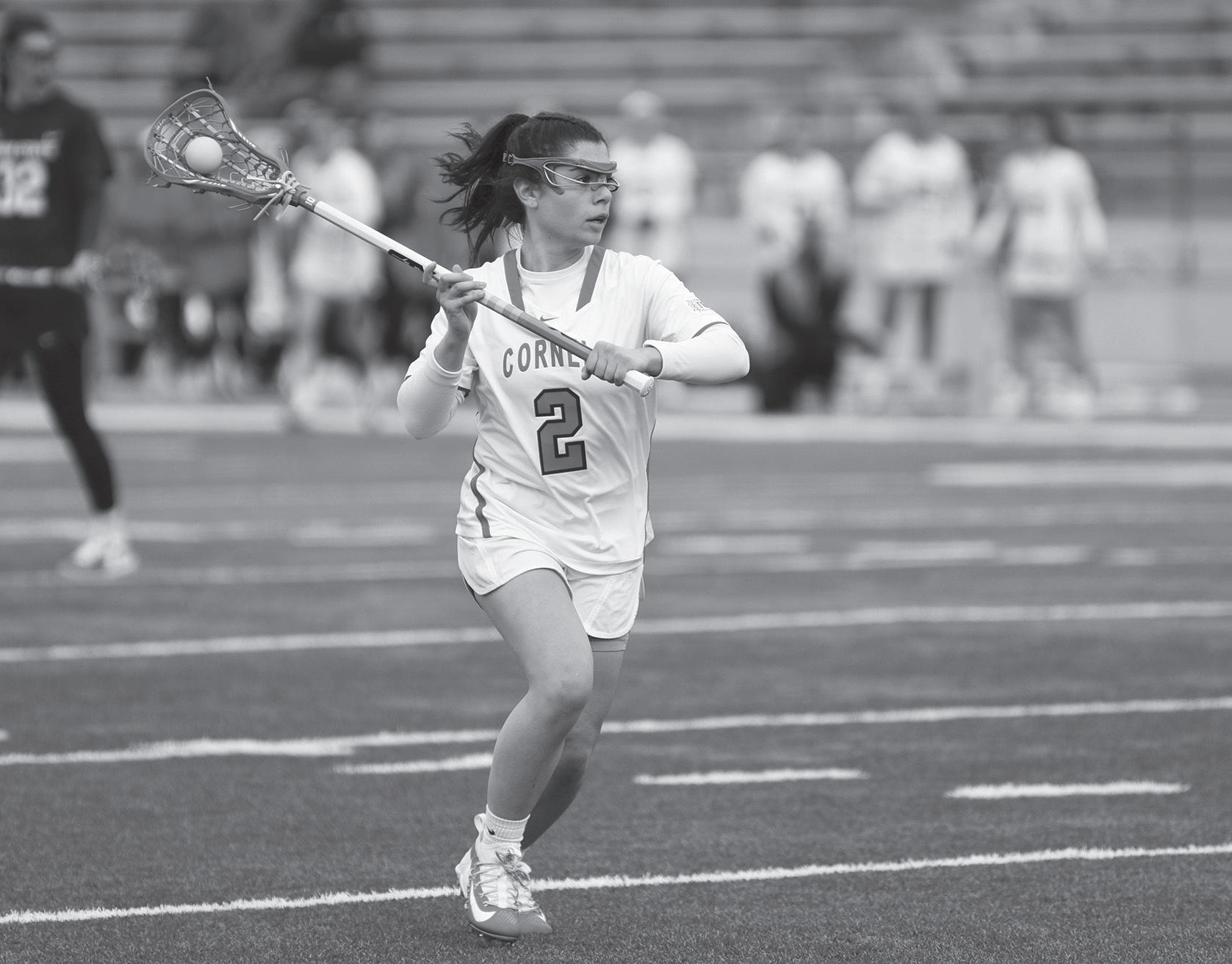
“My assistants do a great job of focusing on the small game — one-on-ones, two-on-twos, three-on-twos — so [our] offensive and defensive units can have solid foundations for our 12-on12 game.”
Jensen indicated that focus would be an important factor in maintaining momentum.
“I think for us it’s focusing on the little things [that will] make a big difference,” Jensen said. “Our past games our defenders and our goalie did a great job … and that led a good way for the offense.”
These coming games hold extra weight in determining Cornell’s playoff fate. Wins would ensure a top-four Ivy finish and a playoff spot, Graap said.
Tune in this Saturday at 1 p.m. as women’s lacrosse tries to bring itself one step closer to a spot in the postseason.

Defensive breakthrough | It took a one-hitter and the Red’s first error-free league game of the year to take one from Harvard.
By KATHERINE FAIOLA and MILES HENSHAW Sun Staff Writer and Sun Assistant Sports Editor
This season has been a struggle so far for Cornell baseball, but the Red is a long way from giving up. Sunday offered signs of a turnaround, an overdue reward for Cornell’s efforts.
“They’re giving me everything they’ve got,” said head coach Dan Pepicelli. “There are times when we can’t put it all together, but it’s not a lack of effort right now.”
Cornell kicked off its weekend with two losses on Saturday. The 8-19 Red (3-9 Ivy) found itself in the L column — familiar territory — in both games of a doubleheader filled with home runs. But after another brush with misfortune, it was the Red’s response, a 2-0 Sunday win, that defined Cornell’s weekend and could come to define the rest of the season for the Red.
“We’ve had our share of internal talks and it’s been a very frustrating year for us,” Pepicelli said, “but it’s really been good to see ... how resilient they’ve been —
how hard they’ve continued to play — and Saturday was a perfect example.”
Although the Red fell 8-6 in game one of the weekend series, the offense came together to score a pair of runs in the first, fourth and sixth innings. In the very first inning, cleanup hitter sophomore INF/OF Ramon Garza hit a two-run home run to get the Red on the board first. It was the Red’s first home run of the season.
The highlight of game one, according to Pepicelli, was that “Garza had 3 hits — he had a home run and 3 hits, so he looked really good.”
That being said, there wasn’t much else for the Red to remember from game one. Harvard hit three home runs of its own, accounting for five of the Crimson’s eight runs.
Junior Wyatt Colby, who entered the game having given up only five earned runs on the season, gave up six through 5 2/3 IP.
“It’s a tough field to play at,” Pepicelli said. “It’s a small ballpark, and the ball was kind of flying out from both teams — we had our share as well.”
In game two, the long ball trend continued for the Red as senior OF/RHP Adam Saks led off the game with a home run.
But, again, the Red was outdueled. Freshman starter Jonathan Zacharias gave up four earned without getting through the fourth inning. Junior Andrew Ellison came in to throw 2 2/3 quality innings, surrendering only one hit. Strong defense from the Crimson held the Red scoreless after Saks’ home run.
The Red’s win in game three was a defensive masterpiece. Junior Jeb Bemiss tossed 7 2/3 innings of onehit shutout ball with eight strikeouts. Bemiss only left in the eighth after a batter reached on a dropped third strike. He passed off the shutout into junior John Natoli’s capable hands, and Natoli struck out four straight batters to close the game.
“[The defense] did a nice job,” Pepicelli said. “I don’t think we made any errors on Sunday so that’s what you got to do to win and we played pretty clean on Sunday.”
In fact, the Red didn’t make any errors in Sunday’s
game. It was the first league game the Red got through error-free this season.
Pepicelli saw the win as a potential breakthrough for the frustrated team and a rebound from last weekend’s sweep at the hands of Brown.
“I think [last] weekend at Brown was maybe the worst we’ve played all year,” Pepicelli said. “We just were in a bad place. We were cold — not weather wise. We just weren’t performing, guys were pressing, just a lot of frustration.”
“Sunday’s game was as good of a game as you can hope for,” he continued.
This weekend the Red will take on Princeton in a home series, looking to keep moving in the right direction. Saturday’s doubleheader will start at 11:30 a.m. and Sunday’s game will start at noon.
“We’re gonna have a great week of practice,” Pepicelli said, “and we’ll be ready for the weekend.”
Faiola can be reached at kfaiola@ cornellsun.com.
Henshaw can be reached at mhenshaw@ cornellsun.com.