The Corne¬ Daily Sun
Chaotic
WEDNESDAY, April 15, 2026 n ITHACA, NEW YORK
Chaotic
By SOFIA SOLDATOVICH Sun News Editor
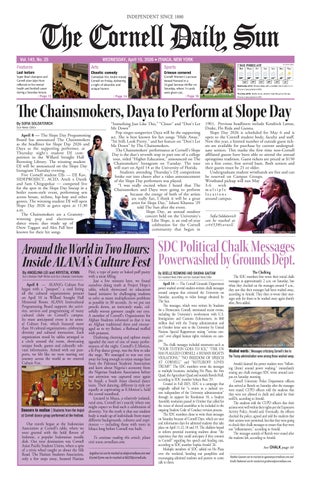
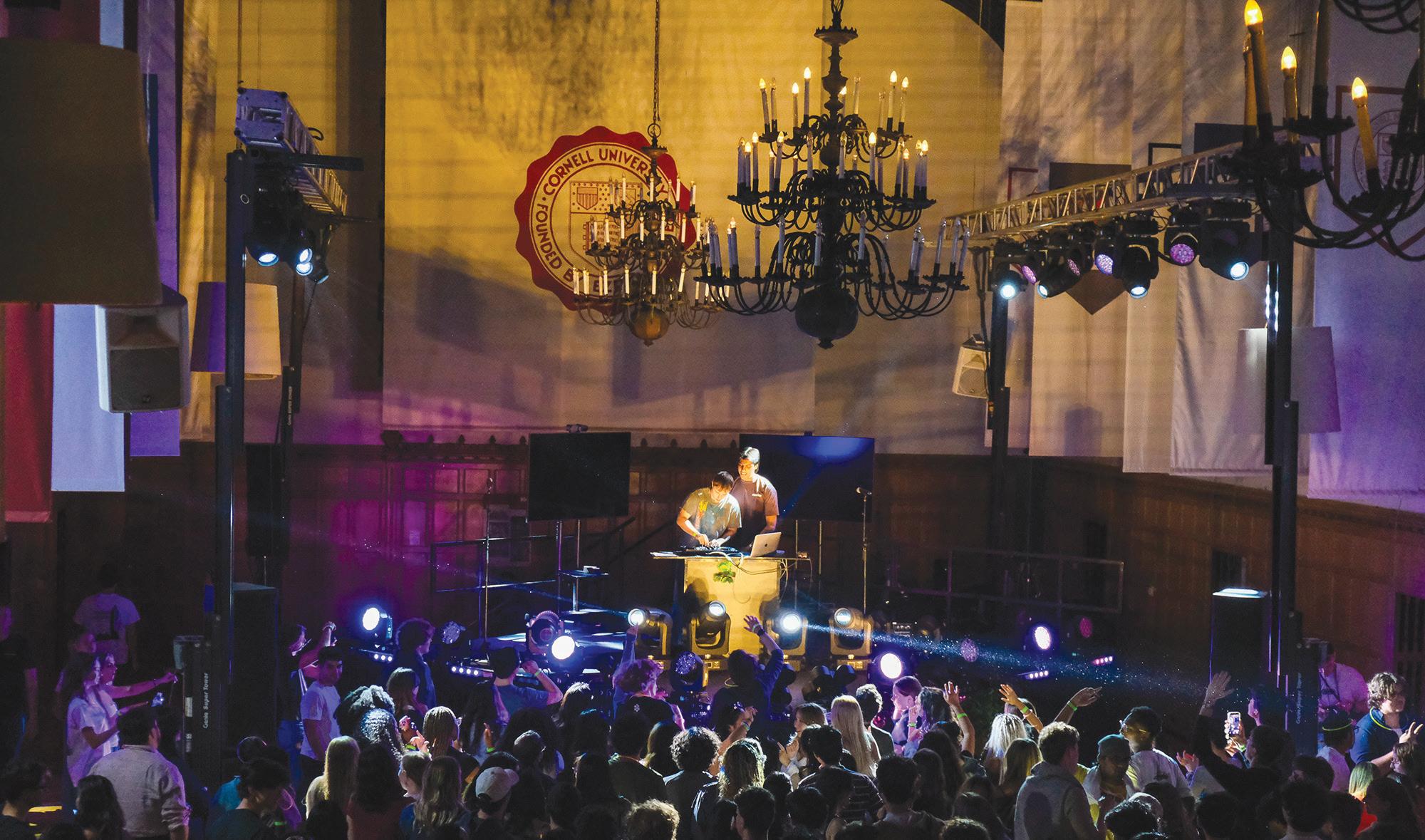
April 8 — The Slope Day Programming Board has announced The Chainsmokers as the headliner for Slope Day 2026 and Daya as the supporting performer, at Thursday night’s student DJ com petition in the Willard Straight Hall Browsing Library. The winning student DJ will be announced on the Slope Day Instagram Thursday evening.
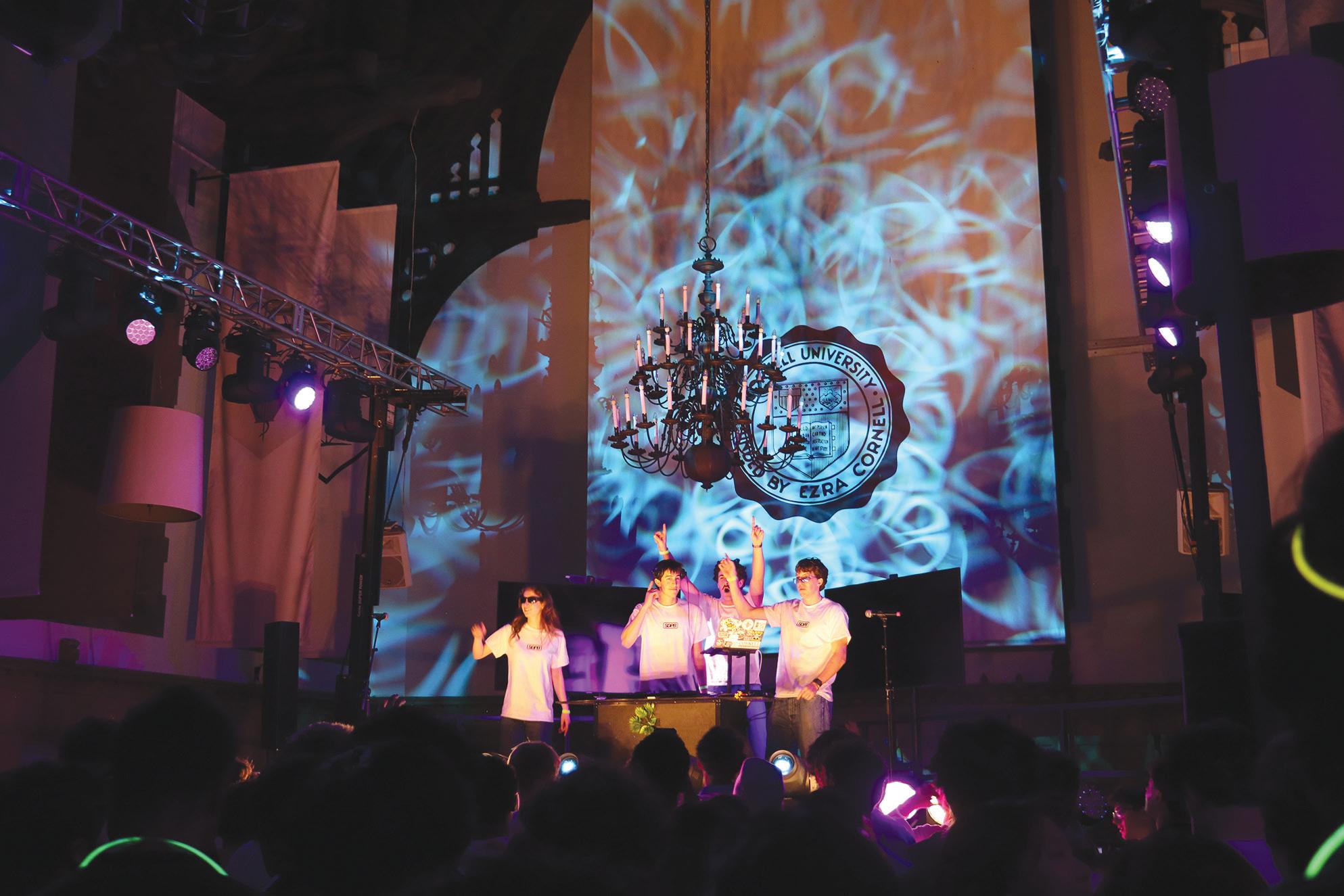
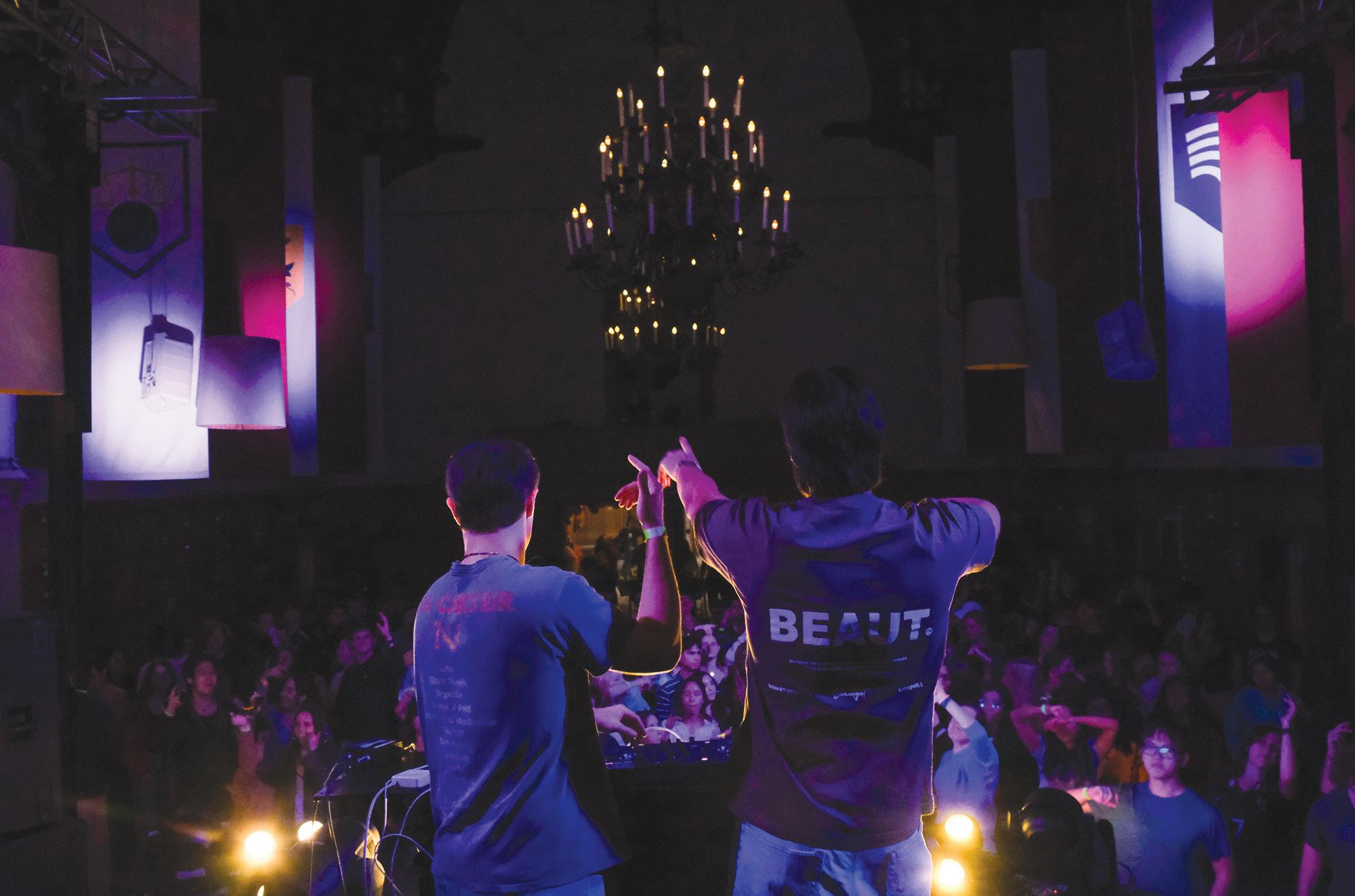
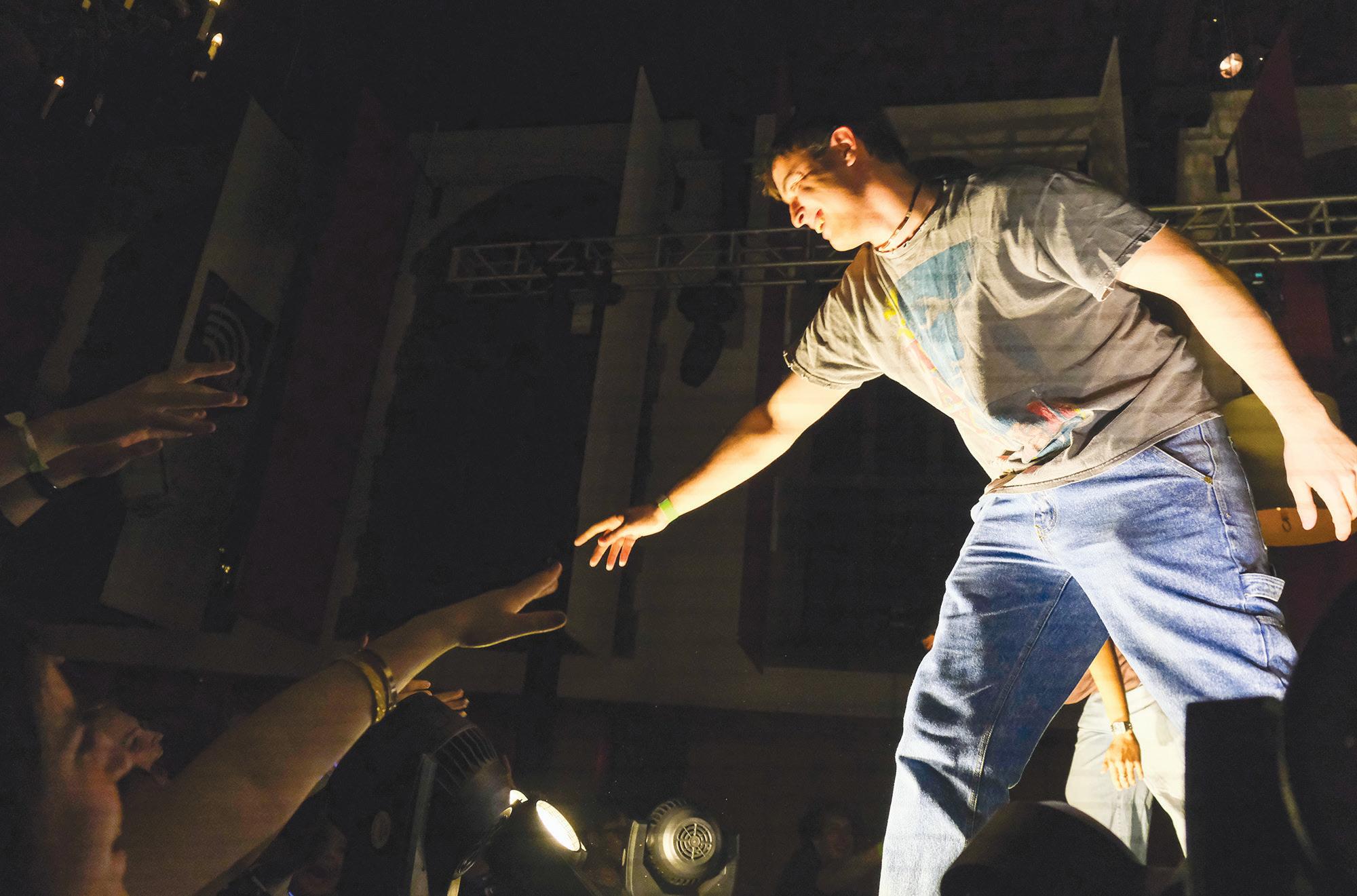
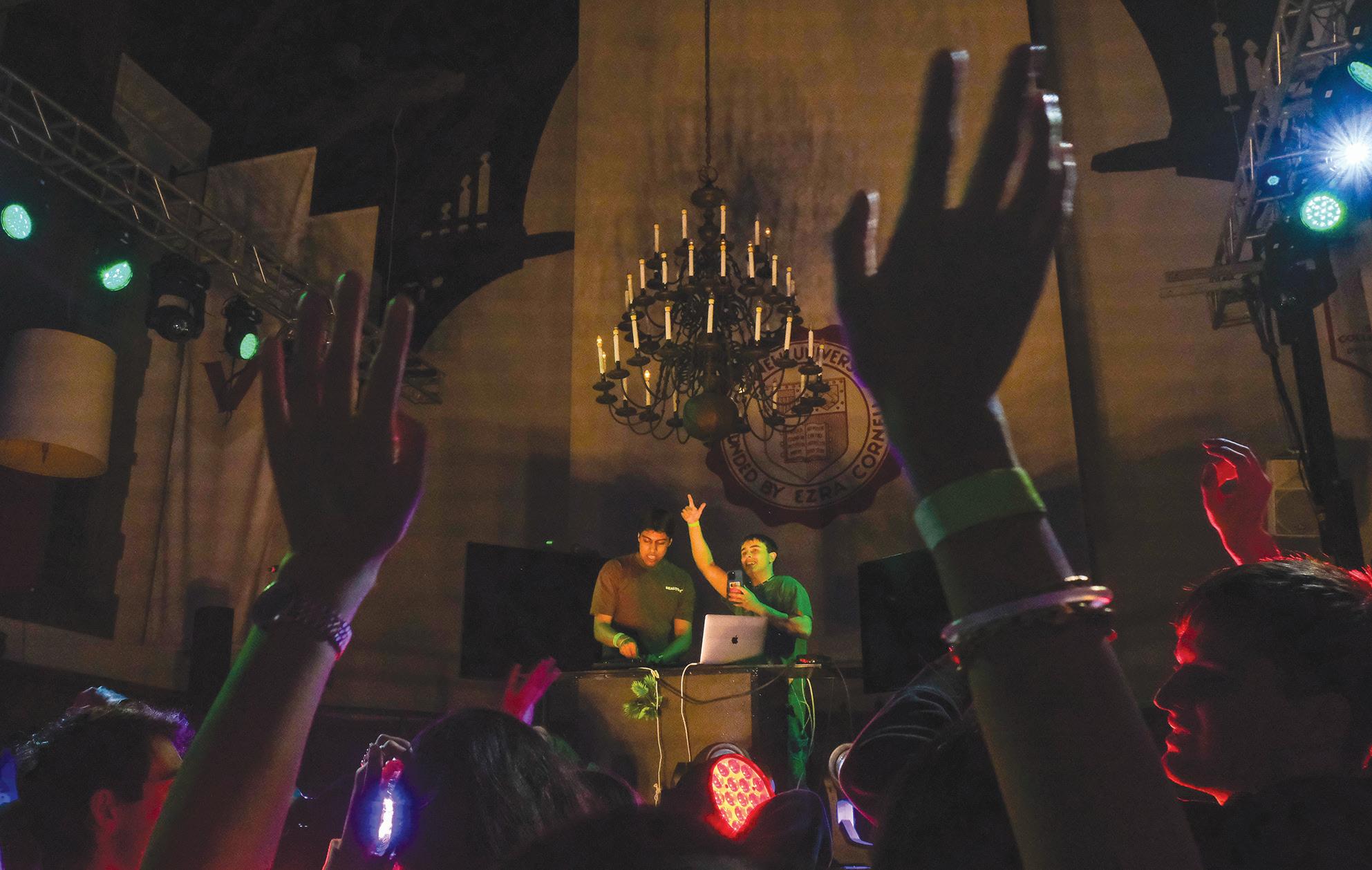
Five Cornell student DJs — DJ Kav, SIDEPROJECT, ACID, Arsch x Danik and Sam Chitgopekar — competed live for the spot in the Slope Day lineup in a boiler room-style event, performing sets across house, techno, hip-hop and other genres. The winning student DJ will open Slope Day 2026 as gates open at 11:30 a.m.
The Chainsmokers are a Grammywinning pop and electronic dance music duo made up of Drew Taggart and Alex Pall best known for their hit songs
“Something Just Like This,” “Closer” and “Don’t Let Me Down”

Pop singer-songwriter Daya will be the supporting act. She is best known for her songs “Hide Away,” “Sit Still, Look Pretty.” and her feature on “Don’t Let Me Down” by The Chainsmokers.
The Chainsmokers’ performance at Cornell’s Slope Day is the duo’s seventh stop in part one of a college tour, titled “Higher Education,” announced on The Chainsmokers’ Instagram on Tuesday. The tour will start on April 14 at the University of Florida.
Students attending Thursday’s DJ competition broke out into cheers after a video announcement of the Slope Day performers was played.
“I was really excited when I heard that The Chainsmokers and Daya were going to perform because the energy of both of the artists are really fun, I think it will be a great artist for Slope Day,” Ishani Khanna ‘29 told The Sun after the event.
Slope Day, an annual outdoor concert held on the University’s Libe Slope, is an end-of-year celebration for the Cornell community that began in
By
April 8 — ALANA’s Culture Fest began with a “passport”: a card listing all the cultural organizations present on April 10 in Willard Straight Hall Memorial Room. ALANA Intercultural Programming Board supports the activities, services and programming of many cultural clubs on Cornell’s campus. Its most anticipated event is its annual Culture Fest, which featured more than 10 cultural organizations, celebrating diversity and cultural interaction. Each organization stood by tables arranged in a circle around the room, showcasing unique foods, games and culturally relevant information. Armed with our passports, we felt like we were starting our journey across the world as we entered Culture Fest.

Our travels began at the Indonesian Association at Cornell’s table, where we were greeted with the bold flavors of Indomie, a popular Indonesian noodle dish. Our next destination was Cornell Asian Pacific Student Union, where a spin of a trivia wheel taught us about the Silk Road. The Haitian Students Association, only a few steps away, boasted Haitian
Pâté, a type of patty or baked puff pastry with a meat filling.
Just a few minutes later, we found ourselves doing math at Project Hope’s table, which showcased its education based initiative by challenging students to solve as many multiplication problems as possible in 30 seconds. As we put our pencils down, an intricately made, colorfully woven garment caught our eyes. A member of Cornell’s Organization for Afghan Students informed us that it was an Afghan traditional dress and encouraged us to try Bolani, a flatbread stuffed with potatoes.
Deafening cheering and upbeat music signaled the start of one of many performances of the night. Cornell’s E.Motion, a K-Pop dance group, was the first to take the stage. We managed to tear our eyes away for long enough to enjoy mango lassi from the Pakistani Students Association and learn about Nigeria’s economy from the Nigerian Students Association before our attention was captured once again by Anjali, a South Asian classical dance team. Their dancing, different in style yet equally as captivating as E.Motion’s, held the crowd transfixed.
Located in Ithaca, a relatively isolated, rural area, Cornell isn’t exactly where one might expect to find such a celebration of diversity. Yet the truth is that our student body is made up of individuals from many different backgrounds, cultures and experiences — including those with roots in Ithaca long before Cornell was built.
To continue reading this article, please visit www.cornellsun.com.
1901. Previous headliners include Kendrick Lamar, Drake, Flo Rida and Gunna.
Slope Day 2026 is scheduled for May 6 and is open to the Cornell student body, faculty and staff. New this year, a limited number of outside guest tickets are available for purchase by current undergraduate seniors. This marks the first time non-Cornell affiliated guests have been able to attend the annual springtime tradition. Guest tickets are priced at $150 on a first come, first served basis. Both seniors and their guests must be 21 or older.
Undergraduate student wristbands are free and can be reserved on Campus Groups. Wristband pickup will run May 3-6 with multiple locations around campus.
Sofia Soldatovich can be reached at ss4453@cornell.

By GISELLE REDMOND AND SHUBHA GAUTAM Sun Assistant News Editor and Sun Assistant News Editor
April 14 — The Cornell Grounds Department power washed several student-written chalk messages around campus that criticized the University on Saturday, according to video footage obtained by The Sun.
The messages, which were written by Students for a Democratic Cornell, mentioned recent events, including the University’s involvement with U.S. Immigration and Customs Enforcement, its $60 million deal with the Trump administration and an October letter sent to the University by United Nations Special Rapporteurs raising “serious concern” over alleged human rights violations on campus.
The chalk messages included statements such as “YOUR TUITION GOES TO ICE,” “THE UN HAS FLAGGED CORNELL 4 HUMAN RIGHTS VIOLATIONS,” “NO FREEDOM OF SPEECH AT CORNELL” and “KOTLIKOFF LOVES TRUMP.” The SDC members wrote the messages at multiple locations, including Ho Plaza, the Arts Quad, the Agriculture Quad and outside Bartels Hall, according to SDC member Soham Bera ’29.
Created in Fall 2025, SDC is a campaign that originally rallied for “a return to a judicial system independent of the University administration” through its support for Resolution 10, a Student Assembly resolution passed in October that called for the voices of elected assemblies to be included in the ongoing Student Code of Conduct revision process.
The SDC members chose to write these messages on Saturday because of Cornell Days, which are tour and information days for admitted students that take place on April 11,12, 18 and 19. The chalkers hoped to inform potential incoming students about “the experience that they could anticipate if they commit to Cornell” regarding free speech and funding cuts, according to SDC member Sophia Arnold ’26.
Multiple members of SDC tabled on Ho Plaza over the weekend, handing out pamphlets and encouraging admitted students and parents to come talk to them.
The Chalking
The SDC members first wrote their initial chalk messages at approximately 2 a.m. on Saturday, but when they checked on the messages around 9 a.m., they saw that their messages had been washed away, according to Arnold. They then re-wrote their messages only for them to be washed away again shortly after, Bera added.
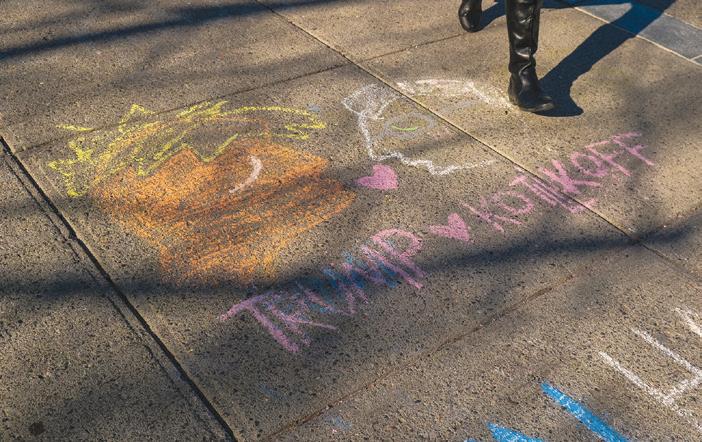
Arnold claimed the power washers were “following [them] around power washing,” immediately erasing any chalk messages SDC wrote around campus on Saturday morning.
Cornell University Police Department officers also arrived at Bartels on Saturday after the messages were erased. CUPD officers told the students that they were not allowed to chalk and asked for their netIDs, according to Arnold.
The students told the CUPD officers that their actions were well within their rights per the Expressive Activity Policy, Arnold said. Eventually, the officers checked the policy, agreed and told the students that their actions were permitted, but that they were going to check their chalk messages to ensure that they were not “inflammatory,” according to Arnold.
The messages outside of Bartels were erased after the students left, according to Arnold.
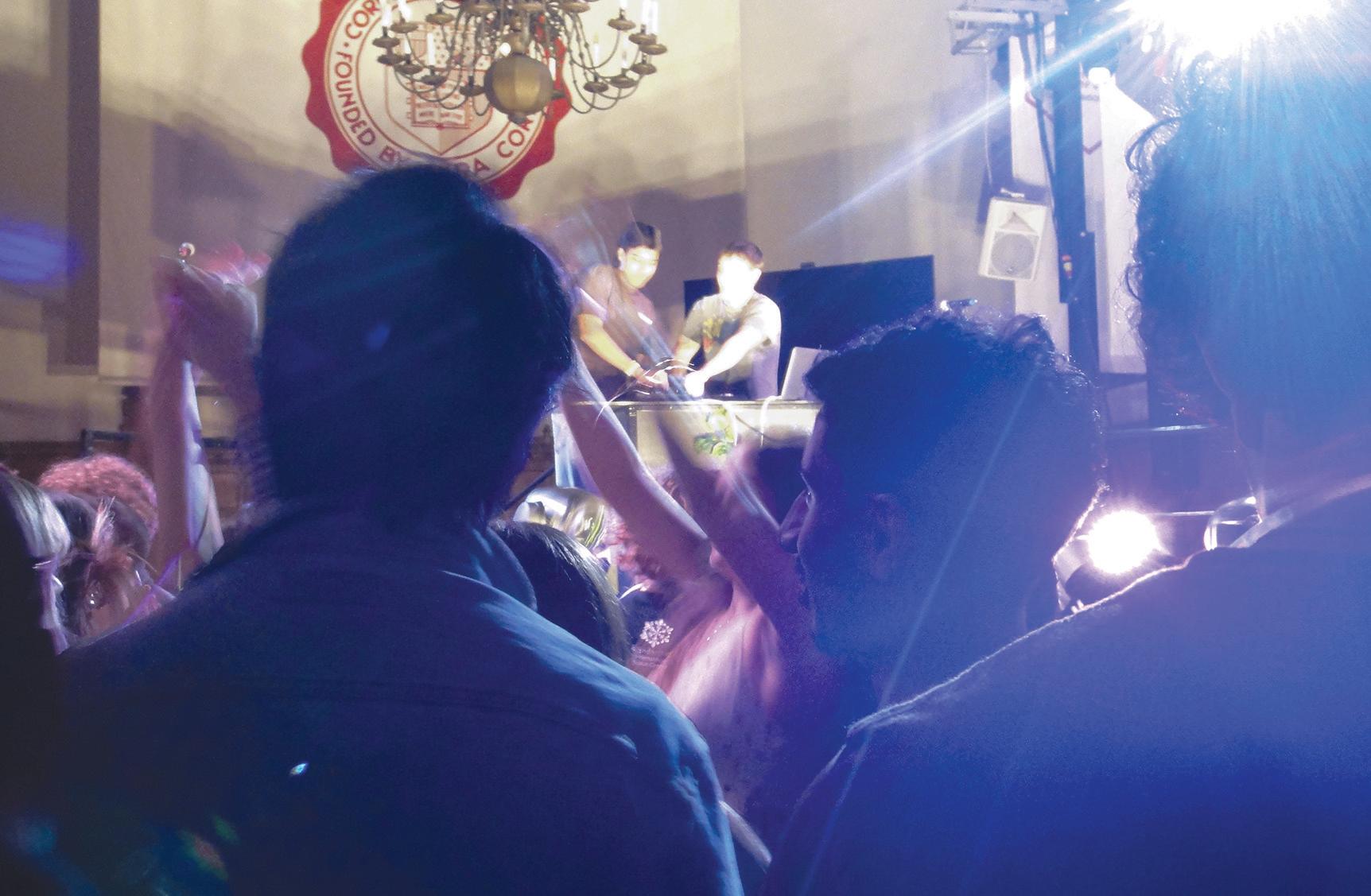
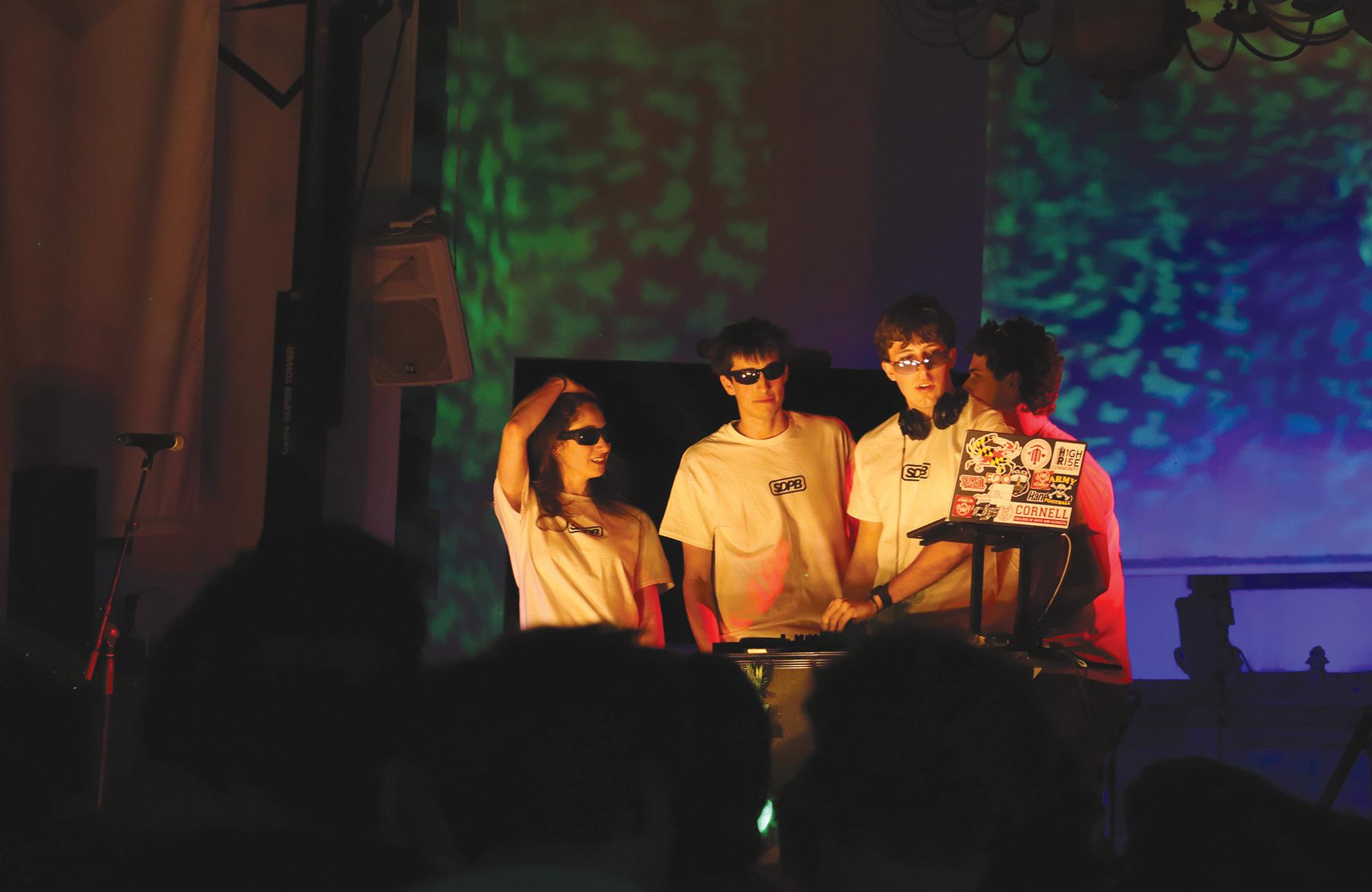
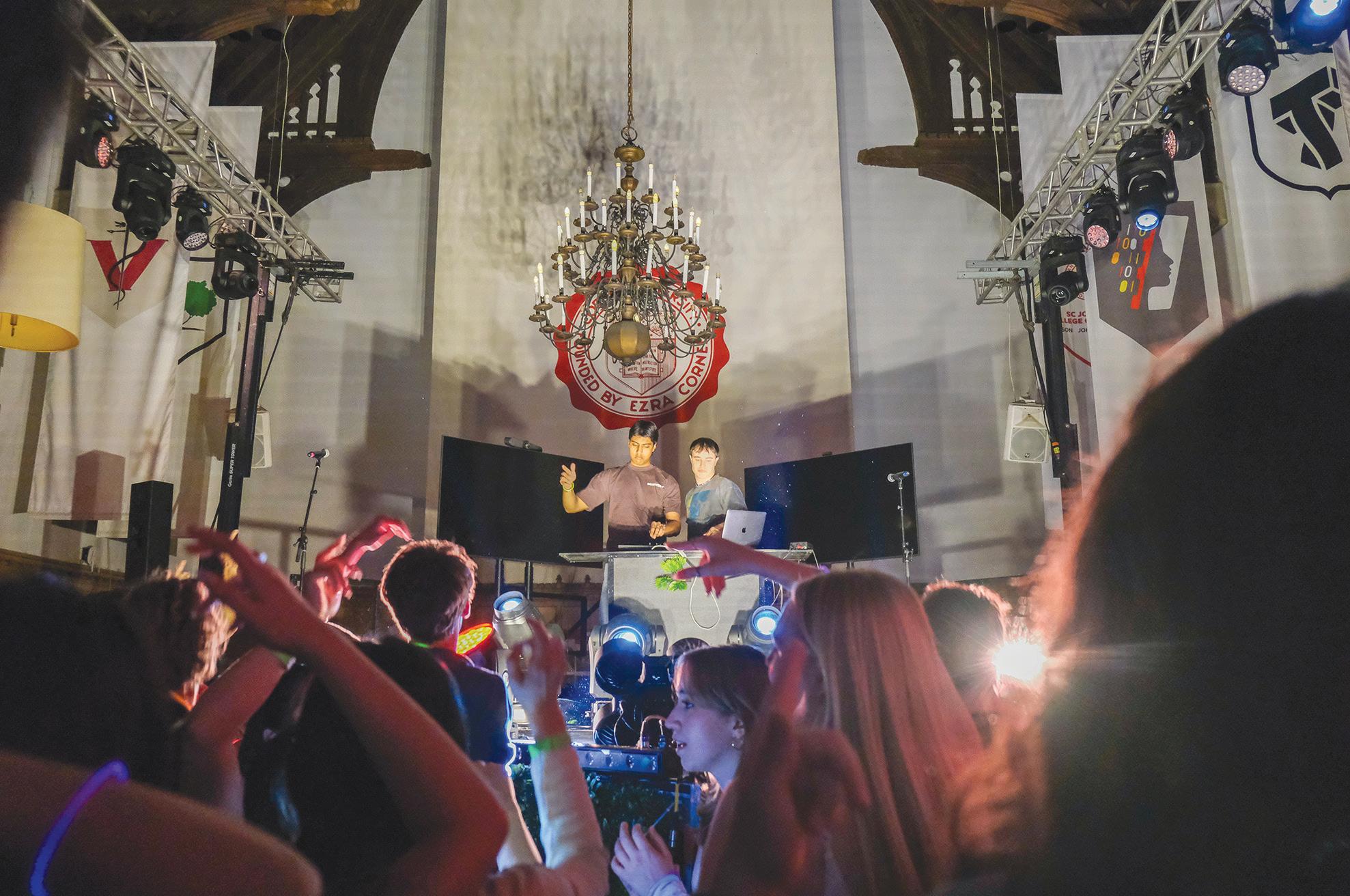
In the hours before Te Chainsmokers were announced as the Slope Day headliner, student DJs battled for a spot to open for Cornell’s largest music event.
By SUN PHOTOGRAPHY DEPARTMENT
By CORAL PLATT Sun News Editor
April 13 — Prof. Annetta Alexandridis, history of art and visual studies, died on Monday morning, according to an email sent to the Cornell community by Peter Loewen, the Harold Tanner Dean of the College of Arts and Sciences.
In addition to serving as an associate professor within the department of history of art and visual studies, Alexandridis also taught in the classics department, the archeology program and the Institute for German Cultural Studies, according to her Cornell biography.
Alexandridis was the author of several books and journal articles, about topics ranging from women in the Roman imperial family to the archaeology of photography. She studied “the art and archaeology of ancient Greece and Rome with a particular interest in gender studies, animal studies, and the media of archaeology,” her biography states.
She also taught many classes at Cornell, including ARTH 4233: “Greek and Roman Art and Archaeology” and ARTH 2200: “Introduction to the Classical World in 24 Objects.”
After receiving her Ph.D in classical archaeology from LudwigMaximilians-Universität Munich, Alexandridis taught at Rostock University in Germany and worked at two museums in Berlin, her biography states. She was a fellow at Cornell’s Society for the Humanities from 2015 to 2016.
Since 2008, she also served as associate director of the HarvardCornell Exploration of Sardis, Türkiye, which has been working since the 1950s to uncover ancient Lydian ruins in the area.
“Annetta was deeply engaged in the Cornell community and dedicated to her students at all levels,” Loewen wrote in the email. “She was a beloved advisor and mentor to her graduate students and she served multiple terms as Director of Undergraduate Studies.”
Alexandridis, along with Prof. Verity Platt, classics, co-curated Cornell’s plaster-cast collection, several statues of which can be found in Cafe Zeus in Goldwin Smith Hall.
Alexandridis is survived by her husband Michael.
Individuals can have a diverse range of feelings, needs and reactions when facing loss. This information about Grief and Loss may be helpful to you or a friend. The Ithaca-based crisisline can be reached at 607-2721616, and the 988 Suicide & Crisis Lifeline is available throughout the U.S. Additional support resources are listed at mentalhealth.cornell.edu.
Students in need of professional support can email Student Support and Advocacy Services at studentsupport@cornell.edu or call Counseling and Psychological Services at 607255-5155. Employees can call the Faculty and Staff Assistance Program at 607-255-2673.
Platt can be reached at cplatt@cornellsun.com.
By ROWAN WALLIN Sun News Senior Writer
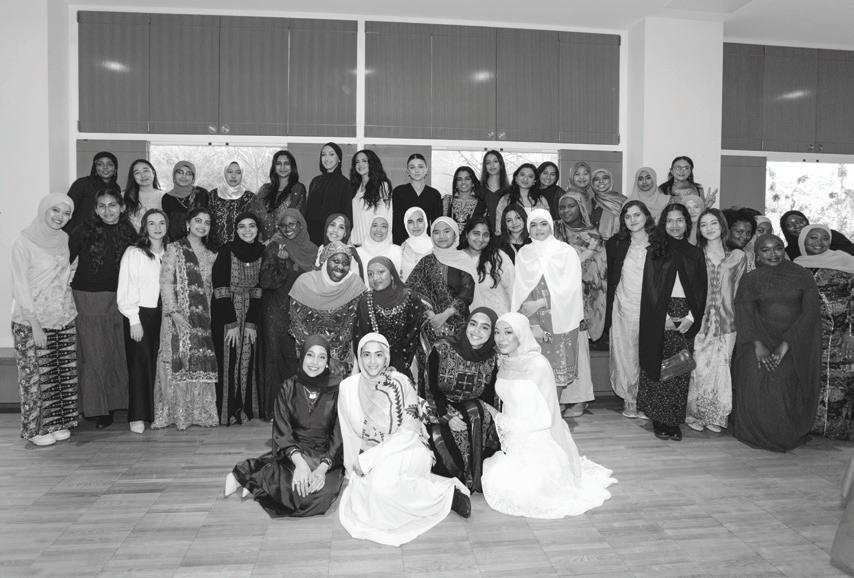
April 14 — Seated at tables draped in shades of deep red, approximately 150 people attended Cornell’s Muslim Educational and Cultural Association’s annual Eid Banquet on Saturday evening to celebrate the end of Ramadan. The banquet included a formal dinner, keynote address, senior recognition ceremony, photo booth and game of Family Feud.
The event began at 6 p.m. in the Biotechnology Building, welcoming many guests dressed in formal and cultural attire to a room set with tables and formal place settings, decorated throughout with a maroon color theme.
Ramadan is the Islamic holy month during which Muslims fast from sunrise to sunset to spiritually reflect and hold solidarity with those less fortunate, and Eid al-Fitr is the celebratory holiday marking its end. This year, Eid fell on March 20, but MECA pushed its celebration back three weeks to accommodate spring break.
MECA Co-President Ayah El-Hardan ’27 said the event took months to organize. She added that MECA began making decisions on the banquet’s date, venue and color theme in the fall, while the “nitty-gritty planning” such as invitations, food orders and marketing began in February.
The event opened with MECA member Amr Elhady ’27 reciting specific verses from the Quran, which he said were selected for their message of hope during hardship. Elhady, who has memorized significant portions of the Quran, performed in the style of tajweed, the discipline governing precise articulation and intonation of Quranic recitation.
“Maybe someone in the crowd will hear this and they’ll think back to what they’re going through and be reminded that there is hope,” he told The Sun.
MECA co-presidents El-Hardan and Akmal Rupasingha ’27 delivered the welcome speech for the event, followed by Cornell’s Muslim chaplain, Numan Dugmeoglu, who offered the keynote address.
In the welcome, El-Hardan and Rupasingha reflect-
ed on a Ramadan they described as “truly special,” noting that many new faces got involved with the Muslim community and volunteered their time. They urged underclassmen to get involved and show up.
Dugmeoglu’s address centered on the meaning of Eid as a communal celebration rooted in faith.
“The Prophet … informed us that our celebrations are built upon obedience of God, [and] at the end of Ramadan, we celebrate,” he said.
Dugmeoglu closed by urging attendees to reflect on the people around them.
“Don’t underestimate how far you can get in life by loving the right people,” he said.
A senior recognition ceremony followed the addresses, where graduating MECA members were given a gift and acknowledged with their name, major and favorite MECA memory on stage.
For Mohammad Labadi ’26, a senior attending his fourth consecutive Eid Banquet, the ceremony carried particular meaning. He said that in past years, he had helped more to organize the event, but now as a senior, he was just able to enjoy it as an attendee.
To continue reading this article, please visit www. cornellsun.com.
Rowan Wallin can be reached at rwallin@cornellsun.com.
SOPHIA DASSER ’28 Editor in Chief
SOPHIA ROMANOV IMBER ’28
Associate Editor
RAYEN ZHOU ’29
Opinion Editor
ZARA CHEEK ’28
Opinion Editor
JADE DUBUCHE ’27
Multimedia Editor
BENJAMIN LEYNSE ’27
Multimedia Editor
SOPHIA TORRES LUGO ’26
Business Manager
DOROTHY FRANCE-MILLER ’27
Marketing Manager
KENDALL MURPHY ’28
Advertising Manager
VICTORIA WROBLEWSKI ’28
Human Resources Manager
MELISSA MOON ’28
Arts & Culture Editor
JAMES PALM ’27
Assistant Arts & Culture Editor
MATTHEW RENTEZELAS ’28
Assistant Arts & Culture Editor
HAZEL TJADEN ’28
Assistant Arts & Culture Editor
MARC STAIANO ’27
Assistant Arts & Culture Editor
KATELYN HALVERSON ’28
Lifestyle Editor
AVA BETNAR ’29
Assistant Lifestyle Editor
SANIKA SARAF ’28
Assistant Lifestyle Editor
KATHERINE ISTOMIN ’29
Social Media Editor
JOIE JEAN-PAUL ’29
Assistant Social Media Editor
ASHLIN KWONG ’28
Graphics Editor
TAVAN BHATIA ’27
Games Editor
VARSHA BHARGAVA ’27
Managing Editor
KATE TURK ’27
Assistant Managing Editor
CORAL PLATT ’29
News Editor
ATTICUS JOHNSON ’28
News Editor
MARY CAITLIN CRONIN ’28
News Editor
EVERETT CHAMBALA ’27
Assistant News Editor
SHUBHA GAUTAM ’28
Assistant News Editor
GISELLE REDMOND ’28
Assistant News Editor
ANGELINA TANG ’28
Science & Technology Editor
TANIA HAO ’28
Science & Technology Editor
SIMRAN LABORE ’27
Weather & Climate Editor
MATTHEW LEONARD ’28
Sports Editor
GRACE REUBEN ’28
Sports Editor
JANE HAVILAND ’28
Features Editor
NATHAN ELLISON ’28
Photography Editor
NATHAN BO ’28
Assistant Photography Editor
ADELAIDE CHOW ’29
Assistant Photography Editor
MIA SOFIA ORENGO ’28
Video Editor
SMRITHE RAJESH ’29
Newsletter Editor
AMELIA GARCIA ’27
Data Editor
RENA GEULA ’28
Layout Editor
HUNTER PETMECKY ’28
Layout Editor
Prof. Jon W. Parmenter is an associate professor of history in the College of Arts and Sciences, specializing in the history of indigenous peoples in the Northeast. He can be contacted at jwp35@cornell.edu.
Cornell University adopted its current land acknowledgment in May 2021 after consultation with the traditional leadership of the Gayogohó:no (Cayuga) Nation, led by faculty in the American Indian and Indigenous Studies Program. Te version of the land acknowledgment most often heard at campus events acknowledges Cornell’s presence on ancestral Gayogohó:no territory and the continuing relationship of Gayogohó:no people to those lands and the surrounding waters.
Since May 2021, we have learned much more about another category of formerly Indigenous land signifcant to Cornell University’s history: the real estate in Wisconsin, Minnesota, and Kansas obtained by Ezra Cornell under the auspices of the Morrill Act of 1862 and later sold by the University to build much of the Ithaca campus. AIISP provided an addendum to the land acknowledgment to address the impact of the Morrill Act in February 2022. To date, Cornell’s efort to address the relationship between the Morrill Act and Indigenous dispossession amounts to a textual supplement to the land acknowledgment on its Commitment to Indigenous Communities and Nations in North America page, but I have yet to hear this version spoken aloud by any University representative. More problematically, that written supplement (hidden behind a tab labeled “History”) misrepresents Cornell’s fnancial beneft from these dispossessions inaccurately as a phenomenon confned to the past when it is in fact ongoing.
Cornell University possesses an existential and enduring relationship to Indigenous dispossession — not only because of its
Alexander Walters is a sophomore in the College of Arts and Sciences. He can be reached at apw65@cornell.edu.
Arecent opinion piece was published that tore Francis Fukuyama and his seminal work, The End of History and the Last Man, to shreds. The article’s thesis, as was legible to me through its flurry of verbose attack words, was that Fukuyama’s theory was borne from uninformed, neoliberal naivete and today serves only to empower political and historical delusions of grandeur. It constructs this argument by handpicking and underexplaining concepts within Fukuyama’s theory and pointing to current events to prove their invalidity. I find this article ill informed of what it’s critiquing.
To preface, I feel it prudent to legibly clarify Fukuyama’s theory. He argues that in understanding history as an evolutionary process toward a final form of government, liberal democracy has proven, in its victories over fascism in World War II and communism with the collapse of the Soviet Union, itself to be that final form of government. It’s ambitious, but when you actually explore the construction of the argument, it’s a lot more illuminating than the article calling Fukuyama’s readers “oblivious,” gives it credit for.
Critiques of Fukuyama are not new in the field of international relations scholarship. In fact, liberal internationalist Robert Kagan wrote a book in 2008 propagating similar critiques to the published article, and is eerily similarly named in rejoinder to Fukuyama’s — The Return of History and the End of Dreams. Earlier was Samuel Huntington’s The Clash of Civilizations (1996), a direct response to Fukuyama. Huntington argues that the conflict of ideologies that characterized geopolitics to that point was to be replaced by the clash of civilizations, or between groups’ religious and cultural identities. My point: Criticizing Fukuyama is not a trailblazing endeavour, but rather a tried-and-true way to score intellectual brownie points. Both works in response to Fukuyama are potent and widely respected; the authors correctly inform themselves of what they’re critiquing and posit an alternative vision. The article published in The Sun does not.
Oddly omitted is the fact that Fukuyama has made considerable effort to not only respond to criticisms of his theory, but to revise and clarify it in light of those and current events. A primary critique of his theory is of the rising prominence of illiberal powers like Russia and China. In 2008, Fukuyama wrote an opinion piece in the Washington Post addressing this critique, in which he argued that despite authoritarian advances in recent years, these still must take liberal democratic appearances to achieve legit-
imacy. He points to Putin’s stepping down from the Russian presidency in 2008 in compliance with the Russian Constitution’s ban on consecutive third terms as an example. While he was able to return to power later through a constitutional amendment, Putin clearly felt that the process in doing so had to take a legitimate, procedurally democratic appearance. Authoritarians play-pretending democracy only proves his point.
Another hit against Fukuyama’s theory is today’s growing disillusionment with capitalist democracies. Fukuyama argues, in his The Origins of Political Order, that “a country having democratic institutions tells us very little about whether it is well or badly governed.” He prescribes wealth inequality and impotent democratic institutions not as symptoms of liberal democracies themselves, but as products of moneyed interests interfering in politics — itself a product of poor governance. Liberal democracy can be done well, or it can be done poorly. That is a reflection of those governing, not of the system itself.
On another note, the integral premise of Fukuyama’s argument that goes ignored is his coupling of Plato’s tripartite theory of the soul with Hegel’s philosophy of history as evolutionary; these unite in the desire for recognition, which Fukuyama coins as the driving force of history. Plato posits the soul to be composed of logos (reasoning), eros (desire) and thymos (spiritedness). It is within thymos that Fukuyama defines the desire for recognition. He argues that much of history can be studied through this framework of subgroups vying for change to enhance their status within their respective society. Thus, tying it back to Hegel’s evolutionary history, the final form of government must be best suited to the pursuance of reason, desire and recognition. Liberal democracy has proven itself most accommodating. What many critics misunderstand Fukuyama’s theory to be is literal in the immediate term. Fukuyama writes in ideals rather than in literal realities; he never said that illiberalism was dead and gone, nor that conflict would disappear nor that cultural differences would fade into irrelevancy. He argued that the long arc of history has bent toward liberal democracy. For, “the end of history” isn’t the moment that liberal democracy becomes universal, merely the moment that we identify it as superior.
To continue reading this article, please visit www.cornellsun.com.
location on ancestral Gayogohó:no homelands, but also because of the fnancial returns it receives from the lands formerly held by the Ojibwe, Dakota, Ho-Chunk, Osage and Kansa nations. Te sum of those revenues over time represents the equivalent of at least $685 million (2025 USD) or approximately 5.8% of the current $11.8B endowment. Tat may seem like a small fraction but consider that one-seventh of that money came to Cornell University in just eight years after 1881 — largely from the sale of white pine timberlands in northern Wisconsin. Tis represented the sole source of revenue that rescued the University from near-certain bankruptcy and catapulted it into the ranks of the nation’s largest-endowed institutions of higher learning. We can also state with certainty that in 2008 the capital account containing the principal of accrued income from the University’s Morrill Act lands paid out in interest the equivalent of at least $4 million (2025 USD) in unrestricted funds. What that annual payout might be today I cannot say because the University has denied my written requests for this information. If the land acknowledgment does not provide a comprehensive acknowledgment of Cornell’s history of relations with Indigenous people, how efectively can it speak to the current situation? While we would be remiss not to recognize recent positive developments, such as the eforts of AIISP faculty and the University’s Linguistics Department to help revitalize the endangered Gayogohó:no language, it is also important to point out other less encouraging trends. Enrollment of Native American students in the Class of 2028 declined from 1.8% the year prior to a mere 1% and by one metric only four Native American students are reported to be in the Class of 2029. Retention of Indigenous faculty is also proving to be a growing challenge. A thoughtful and innovative January
2024 proposal to establish a Gayogohó:no land base at Cornell’s Arnot Teaching and Research Forest has been ignored.
Outside Ithaca, urgent appeals on two occasions in 2024 for the University to transfer its mineral rights on land containing a sacred pipestone quarry in Wisconsin (located on a former Morrill Act parcel) to appropriate Indigenous caretakers similarly garnered no response. An August 2025 article on the University’s mineral interests in the pipestone quarry elicited only a “no comment” from a University ofcial. Two emails written by myself regarding the issue — one to Anne Meinig Smalling ’87, president of the Cornell Board of Trustees on Sept. 10, 2025, and a follow-up to the general intake email account for the board on Dec. 17, 2025 — have gone unanswered.
Given the facts above, it is difcult to escape the conclusion that Cornell’s senior leadership believes that it has done its part by adopting the land acknowledgment — no further discussion of the University’s historic and structural relationship to Indigenous dispossession appears to be forthcoming.
Yet with each passing day, Cornell doesn’t just fall further behind its Ivy League peers grappling with past entanglements with slavery, or its land-grant university peers addressing their institutional relationships with Indigenous dispossession via the Morrill Act. It also falls behind colleges and universities in New York State (including Syracuse University, the University of Bufalo, St. Bonaventure University, Hamilton College and most recently Binghamton University) that have taken signifcant steps to build productive relations with neighboring Haudenosaunee nations.
To continue reading this article, please visit www.cornellsun.com.
Leah Badawi '27 is an opinion columnist and a Government and English student in the College of Arts & Sciences. She also serves as the Editor-in-Chief of Rainy Day Literary Magazine. Her fortnightly column Leah Down Te Law refects on politics, history, and broader culture in an attempt to tell stories that are often left between the lines. She can be reached at lbadawi@cornellsun.com.
“A whole civilization will die tonight, never to be brought back again.”
On a cold Tuesday morning, these were the words our nation woke up to. Maybe you saw it brushing your teeth, or trekking up the Slope. Maybe you didn’t see it at all. It came as a surprise to me that when I brought up President Trump’s recent “Truth” Social post to my club, many people had no idea what I was talking about.
It was just like any other Tuesday. Students crowded in Temple of Zeus cafe, talking over cofee about what they did over spring break. Our president had threatened genocide in the early hours of the morning, but people had prelims to study for, LinkedIn posts to make for their new internships and meetings for their startups and project teams.
All the while, bombs fell on Lebanon and Iran. I awaited the 8 p.m. deadline to open the Strait of Hormuz with a weird, quiet dread, knowing there was nothing I could do besides wait. Is this the sort of society we live in now? One where our ‘president’ claims he will wipe out an entire country, and nobody cares? I was flled with an overwhelming relief when the news came out that a two-week ceasefre had been brokered between the U.S. and Iran.

Kira Walter '26 is an opinion columnist and former lifestyle editor. Her column Onion Teory addresses unsustainable aspects of modern systems from a Western Buddhist perspective, with an emphasis on neurodivergent narratives and spiritual reckonings. She can be reached at kwalter@cornellsun.com.
“I’m not interested.”
“Tis isn’t going to work out.”
“You’re not the person we’re looking for right now.”
Finality statements cue the death of dopamine, the early infux of depressive episodes and in unique cases, a stroke of panic that leads to endangerment. Whether choosing to ghost a date, denying applicants or terminating ancient connections, rejection can feel like delivering a death sentence. A guilty conscience inspires the rejecter to jump hurdles for the rejectee, softening the blow with white lies or prolonging a predetermined decision.
But by prioritizing kindness over clarity, people risk prolonging harm with ambiguity or creating a basis for delusion to fourish. Destroying opportunities and relationships with convicted honesty is best for both parties, regardless of cruelty in the instant. Direct denial is another long-term mercy that so often ends in tears.
Of course, the biggest proponent of tears in restrained rejection is limerence, certain to keep crying consistent and recovery impossible. A favorite subject of mine, limerence is an involuntary state of obsession, characterized by ruminative thinking and a desperate desire for reciprocation. Tough typically discussed in romantic context, limerence
On April 8, Israel launched more than 100 air strikes across Lebanon, on residential areas and a funeral. In the span of 10 minutes, my homeland experienced what can only be described as absolute hellfre. And the world does not call this terrorism, because surely Israel must be defending itself when it kills over 250 people in a day and continues its plan to annex South Lebanon, cutting of all bridges and means of transportation.
We must choose humanity in a nation that has normalized the genocide of Palestinians and now a genocide in Lebanon and Iran. We cannot just condemn violence, we must take action against it! I am disgusted by the apathy of this campus. How can everyone go on, business as usual, as innocent people are dying under the fre of drones, or being blocked from humanitarian aid or being consistently executed by Israel, which just legalized the death penalty only for Palestinian prisoners, and told Christian families in Lebanon not to ofer shelter to Muslims.
What good will keeping the people of Iran, Lebanon and Palestine in your hearts do when they are constantly victim to escalation by the U.S. and Israel? Tese people live under constant fre, displaced from their homes and are at risk of death at each moment we spend doing homework at our desks or watching reels on Instagram.
It is not enough to be sad. It is not enough to ofer your condolences. Your empathy will not help anyone — only action will. Do not let your sympathy become the enabler of murder! Do not turn away.
I lay down my life for love. I lay down my life for acceptance, for forgiveness, for mutual aid. I do not understand how it is possible for people to continue as if everything is normal. I do not understand how people do not believe they have an obligation to stop murder. Why do we not care when children and families and ordinary people are being slaughtered across the globe? What cause could possibly justify this devastation?
I will write until my pen breaks, and then I will get another one. I hope that my words may let a sliver of guilt pierce your hearts, for we are all complacent in international crime and every moment spent with this issue unspoken, every second spent harping over
cofee chats, is a moment weighed in blood.
We must recognize that we are nobody, that we won a game of geographical luck and could have easily been dead or living at risk if we currently lived in the countries currently under the barrage of drone strikes and vicious carpet-bombings and ethnic cleansing. Tis is not about us, it is about the real people whose lives hang in the balance.
As Americans, we are privileged, and it is deplorable that safety has become a privilege in the frst place. Do not let your anger incapacitate you. Let it radicalize you.
I condemn the professors who stay silent. I condemn the University administration, which has not issued a statement ofering support to students with family in the line of fre, nor has it obliged all of the student eforts to divest Cornell from the genocide in the Middle East and stopped promoting war companies and Immigration and Customs Enforcement on campus.
I am disappointed, too, that only a handful of opinion columnists are writing about these issues. I sense an apathy even among many of my colleagues, and although I don’t think all columns should be political, avoiding these topics is political.
And to the people who try to misconstrue my words in comments under my articles on Te Sun Instagram posts, I encourage you to stop hiding behind burner accounts and write a guest column responding to my piece under your own name. If you are so passionately against me advocating for human rights, practice what you preach and stand proudly behind your words.
In my freshman year, I printed out posters of Handala, a symbol of Palestinian resistance, and taped hundreds of them across campus. All were taken down, except one, which has remained for two years now. We cannot continue to ignore a genocide we are complicit in.
On the morning of April 14, with help from a good friend, I will put up posters again reminding this campus of what is going on in the world until something is done about it. Our resistance will have no limits, and in the face of genocide, I trust that we will all take all of the measure to protest this disgusting act. Reach out to me if you would like to join this efort.
applies to any pursuit of the unattainable. It thrives on a combination of uncertainty and intermittent reinforcement, with similar psychological repercussions to gambling. A chemical and cognitive trap is established to keep folks attached to false goals.
And the buildup to a procrastinated ending sets the stage a little too perfectly for anxiety to spike. When the executioner has a foot in the door, staying close to the best friend who matured too fast or hopeful for the idealized club becomes an exercise of unrealistic optimism. While we subconsciously anticipate rejection, we invest emotionally in the potential of being chosen. Te dream inevitably crushed causes more collateral damage after extended infatuation: someone surely could've been saved the sufering.
Victims of rejection are frequently less oblivious to impending doom than they appear, but the burden of protecting feelings creates unprecedented stress. Tough pity belongs to the target at stake, maintaining a facade for someone on the chopping block is a form of emotional labor. Suppressing true intentions is not only an exhausting task but tends to decrease relationship quality or come across as ingenuine, worsening the workload of putting of goodbyes.
Glazing over dying fings or friends you can’t let into the frat also creates tension — people snap under pressure and diabolical breakdowns ensue. Te outcome of a frustrated outburst is often more harmful than getting the truth over with, leading to worse communication and authenticity. When a minor detonation occurs, having the courage to be forward can prevent a burnt bridge.
Emotional salvation aside, one of the greatest grievances mourned with impending rejection is time. As long as someone’s life is organized around a false premise, it can’t move forward without collapse. Dodging a defnite “no” about someone else’s future doesn’t just postpone a difcult conversation, it postpones their recovery, the time that will go into restructuring and re-adapting to a reality without what they were searching for. By not being direct with our rejections, we fall victim to the sunk cost fallacy, the phenomenon by which people invest in losing situations because of prior investment. With exceptions, more history correlates to more future consolation: impact expands with time.
Recovery is further complicated by contingent selfworth, as ample time spent inspires identity tags, and people
habitually defne themselves by their commitments. When you string along the job candidate or long-distance partner, time and association attaches professional objectives or romantic titles to a sense of self. Ten, disappointing with ambiguity or letting the truth slip in a tantrum not only dismays the rejected with time wasted, but shatters a pillar of who they are.
Fast forwarding to “moved on” and closing doors with honesty is all fun and fantastical but being direct usually comes with complications. Rejection is not always a death knell: employers and lovers alike love their safety nets. So whether considering someone for the company’s future openings or keeping a prospective interest on the back burner, denial comes in diferent degrees. Although “next best options” are a whole other ethical can of worms, having them is natural, human and to be expected.
Besides, the severity of a blunt, well-delivered turn down can have traumatic defects that don’t transport the rejectee to the glorious land of recovery, but rather send them spiraling towards remission. Social and professional rejection activate the anterior cingulate cortex, the same part of the brain involved in physical pain. Whether mental or physical, agony is unavoidable in rejection, but trauma is conditional, with a closer tie to shame and humiliation. Public dismissal, chronic invalidation, sudden severance and degrading scenarios have lasting efects on mental wellbeing. If delivery is too harsh, decision making might be permanently afected, and the person in question may take less risks, seize less chances and wallow in the aftermath of devastation.
Still, rejecting someone doesn’t create responsibility for emotional welfare. It’s a transition, not an attack, and though one opportunity may be lost, forward confessions and open dialogue create the possibility of many more. Even the smartest among us often believe what they want until truth is dropped on the porch, and the next season of life knocks. Maybe not in full throttle but in baby steps, exploring other jobs, people and sectors of the unknown with able curiosity is only possible because something ended. With investments and all things personal as ever, we need fnite conclusions to trigger new beginnings. We build infnite cities of possibilities in open doorways, until the hinging foot is pulled away, passage is desecrated and secondary succession can play out over scorched earth.

By ASHLEY KIM Sun Staff Writer
April 10 — Nobel laureate John Martinis told a packed Rhodes-Rawlings Auditorium on Tuesday that the secret to understanding quantum tunneling in physics is to think of nature as a nervous banker.
"Quantum mechanics — you can think of it as a very nervous banker," Martinis said during the inaugural Frontiers of Discovery Lecture, hosted by the Cornell Undergraduate Research Board.
In classical physics, a particle trapped behind an energy barrier — like a ball stuck in a valley between two hills — simply cannot escape without enough energy to climb over. But quantum mechanics allows for something stranger: nature briefly lends the particle just enough energy to slip through the barrier entirely, as if tunneling through the hill rather than climbing it.
Nature will lend particles a burst of energy so they can pass through a barrier, he explained, "but only for a short period of time, so it wants to recall the loan very quickly."
The lecture, held from 5-6 p.m. in Klarman Hall's KG70, marked the first installment of CURB's new “Frontiers of Discovery Lecture Series” which brings distinguished scholars to campus. The College of Arts & Sciences co-sponsored the event.
Martinis, professor emeritus of physics at the University of California, Santa Barbara, and co-founder and chief technology officer of Quolab, shared the 2025 Nobel Prize in Physics with John Clarke and Michel Devoret. Their work
showed that quantum mechanics — long thought to govern only the invisibly small — could be observed in everyday-scale electrical circuits, opening the door to quantum computing.
Before the lecture, Prof. Rachel Bean, astronomy, associate dean for math and science, introduced Martinis by underscoring the significance of student-driven research. Bean noted that Martinis conducted the Nobel Prize-winning experiments as a graduate student at U.C. Berkeley in 1985 — research that became the basis of his doctoral thesis.
"Undergraduate research has yet to win a Nobel Prize, but as it's become more prevalent over the years … perhaps time will tell," Bean said. "And maybe you could be the first."
A Career Built on Building Instruments
Martinis structured his talk as a personal journey, beginning with his 1985 thesis experiment at U.C. Berkeley. Working with Clarke and Devoret, he set out to test whether quantum mechanics — the physics of the very small — could govern the behavior of an entire electrical circuit, something visible and tangible on a chip.
He was candid about the difficulty. The first attempt, he said, "was a disaster" — the data made no sense. The team eventually realized they had failed to account for stray microwave signals leaking into their equipment from the environment. Once they redesigned the experiment with proper filtering, the results fell into place.
"That experiment really set me up for my career — [it] explained to me how to do good science," Martinis said.
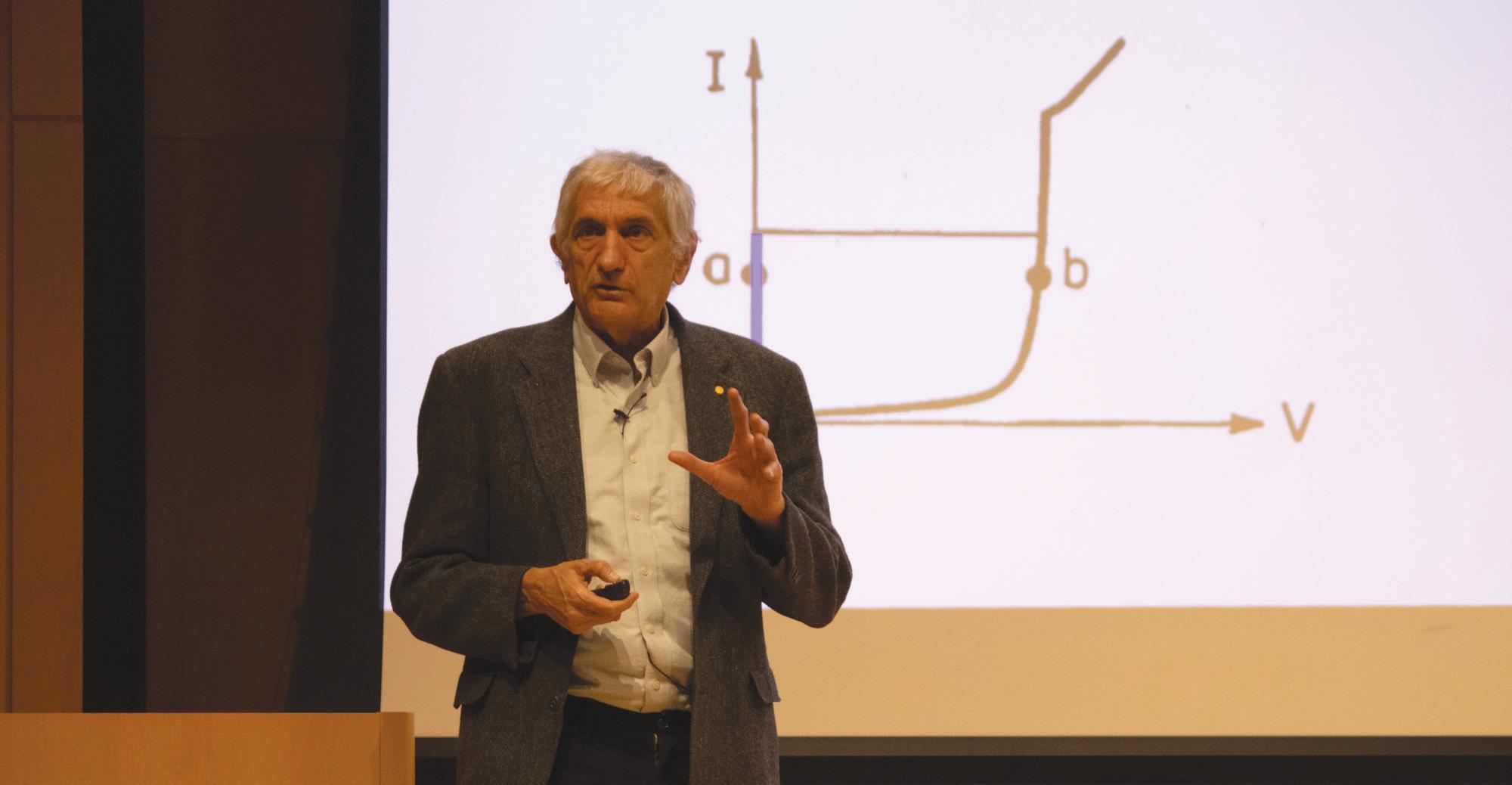
Throughout, he paused to offer practical advice. He urged students never to open a paper with "recently, there has been great interest in" — calling it a lazy introduction — and emphasized the importance of plotting data so that agreement with theory shows up as a straight line.
"If it's not on the line, something's wrong. Or maybe you discovered something important. Either way, that's good," Martinis said.
His early experiment set the stage for decades of progress. By 2019, Martinis was leading a team at Google that built a quantum processor capable of outperforming the world's most powerful classical supercomputers — a milestone known as quantum supremacy. He showed the audience side-by-side images of the simple 1985 chip and the intricate 2019 processor to illustrate just how far the technology had come — and how much further it still needs
to go.
"If we want to scale this up from 53 to, let's say, a million qubits, you're going to need a similarly large change in technology," Martinis said. That change, he argued, will not come from university labs. Through Quolab, a quantum computing startup he co-founded, Martinis is partnering with major semiconductor manufacturers to build quantum chips the same way the industry already builds the processors inside laptops and phones — swapping out the improvised methods of university labs for the precision of billion-dollar fabrication facilities.
To continue reading, please visit www. cornellsun.com.
A video will be on The Sun YouTube channel on Thursday.
By NIYANTHA KAUSHIK Sun Contributor
April 13 For the fourth year in a row, the onset of spring in Ithaca has brought rain, a potential for snow and the beloved Daffodil Dash, a floral fundraiser organized by the Ithaca Garden Club.
The Garden Club has hosted several fundraisers to purchase flowers and trees to beautify the city. The Daffodil Dash specifically aims to raise money to support the planting of bright yellow daffodils throughout the Ithaca community.
The idea behind the event bloomed after the Garden Club attended a lecture
from Prof. Bill Miller, plant science, on the benefits of daffodil planting.
Garden Club President Elaine Alexander explained that the club, founded in 1922, had primarily planted flowers around Ithaca and supported scholarships for women, but had decided to begin a novel project a few years ago. Miller’s floral lecture gave the club the inspiration they were looking for.
“At that time, we said we would like to have a project that benefits the community, beautifies the community, but not necessarily a scholarship program,” said Alexander. “[Miller] talked about the benefits of growing daffodils and the idea caught on.”

According to Alexander, with the idea in motion and Miller’s bulb planting machine, donated by the Royal Dutch Bulb Exporters’ Association, the Garden Club set out to plant daffodils around Ithaca. With hopes of getting financial support from the community at large, a fundraiser featuring a race through the daffodils was proposed by Melinda Oakes, then community engagement committee member.
The Dash now includes a 5K and a 1-mile race, both open to people of all ages. Winners are rewarded with daffodil leis.
“Daffodils are a symbol of hope, so we find it's perfect to come after a very dreary winter.”
Elaine Alexander
With the help of the planting machine, the city of Ithaca and the contributions of volunteers from across the community, the bulbs are planted every October in various locations around the city. In the past, the flowers have bloomed in Cass Park, at Cayuga Medical Center, and countless other locations, where the bright blossoms bring joy to the community every spring.
“Daffodils are a symbol of hope,” Alexander said. “So we find it's perfect to come after a very dreary winter.”
Each year, the Daffodil Dash seeks to inspire positivity in the city of Ithaca, bringing together community members
from race runners to volunteers. Ben Sandberg, Executive Director of The History Center in Tompkins County and spirited Dash participant, runs the race in costume each year. He says the combination of being around others and the flowers makes a positive impact on the community.
“At the core is the chance in spring with the first flowers that come out around here, gathering with other folks and getting to walk or run, or at least share in, depending on how you look at it, the end of winter or the beginning of spring,” said Sandberg.
Local middle schooler Dominik concurs. As a past winner of the race, he says that if he could describe the Dash in a single word, he would use “joyful”. He enjoys running the race with his friends, who he has invited to take part in the festivities.
“I liked it a lot, even though it was rainy, because I got to run it with my friend,” he said.
Participation in the Dash has been growing, said Alexander. The event is well received by the community, bringing in hundreds of enthusiastic racers each and every year.
This year’s Daffodil Dash takes place in Cass Park on Saturday, April 25. Registration closed early this year as all participant slots have been filled. The proceeds will fund the planting of daffodils in Stewart Park, where the vibrant flowers will usher in the next spring and the next Daffodil Dash.


By SANIKA SARAF
Assistant Lifestyle Editor
Iwas in line waiting to start recruiting for the philanthropy round of sorority rush when I got a text from my friend: “Your dorm is flooding BTW.” At first, I rubbed the text off as a joke — sharing a “LOL” with my friends — until I saw videos on Sidechat of water cascading down all five floors of Ganedago: Hall, completely flooding the lobby. I didn’t know how to react.
At 9 p.m., I ran to Ganedago, and I was told that I was being housed in the Statler Hotel for the night. I packed my things in my room, which thankfully wasn’t completely damaged (there was just a layer of water on the floor) — and my friend drove my suitemates and I to the Statler. The next day, I woke up graciously in the Statler’s king-sized bed and a plush robe to an email saying I had been moved to Carl Becker House. Additionally, the email told me I couldn’t stay in the Statler nor Ganedago anymore. Minutes later, I received a text from my friend asking me to be interviewed about the flooding situation for The Sun. Needless to say, I was livid — and I still am.
I can’t lie. Honestly, I was happy about moving to Becker. It’s considered one of the best dorms on campus and living on West Campus is much more convenient as a sophomore. Additionally, my dorm getting flooded was a ‘fun fact’ of mine for the first two months of this semester. However, I think I let off Cornell
THousing too easily.
For one, I basically had to move all my stuff within a 24-hour period while balancing recruitment, which was impossible. I had to stay in my sorority house after being kicked out of the Statler, and the next day, my friend drove my bedding and I to Becker. I was so thankful that I had a source of alternative housing and friends with cars, and it made me think: What if I didn’t have these connections? While Cornell did provide free moving services with Student Agencies, these services weren’t available for a few days after the incident, so impacted students were essentially ‘homeless.’
Secondly, when I did move into Becker, the front desk student employee wasn’t aware that Ganedago residents were moving in, and I had to suffer through an hour of explaining to an RA that I was a displaced person from my flooded dorm.
Lastly, Cornell did an awful job at accommodating. My suitemate in Ganedago had to fight with Cornell Dining for three months and was even placed on hold for refusing to pay more for the House Meal plan, as she wasn’t on an unlimited meal plan in the first semester.
While I may be ‘beating the dead horse’ over a situation that happened three months ago, this situation reveals broader issues with Cornell. Why did Ganedago, a building opened in 2021, flood even with new infrastructure? What is Cornell doing with our money? I, as someone who has a single, pay $7,501 per semester — all for my dorm to get flooded, and Cornell Housing was less than helpful during
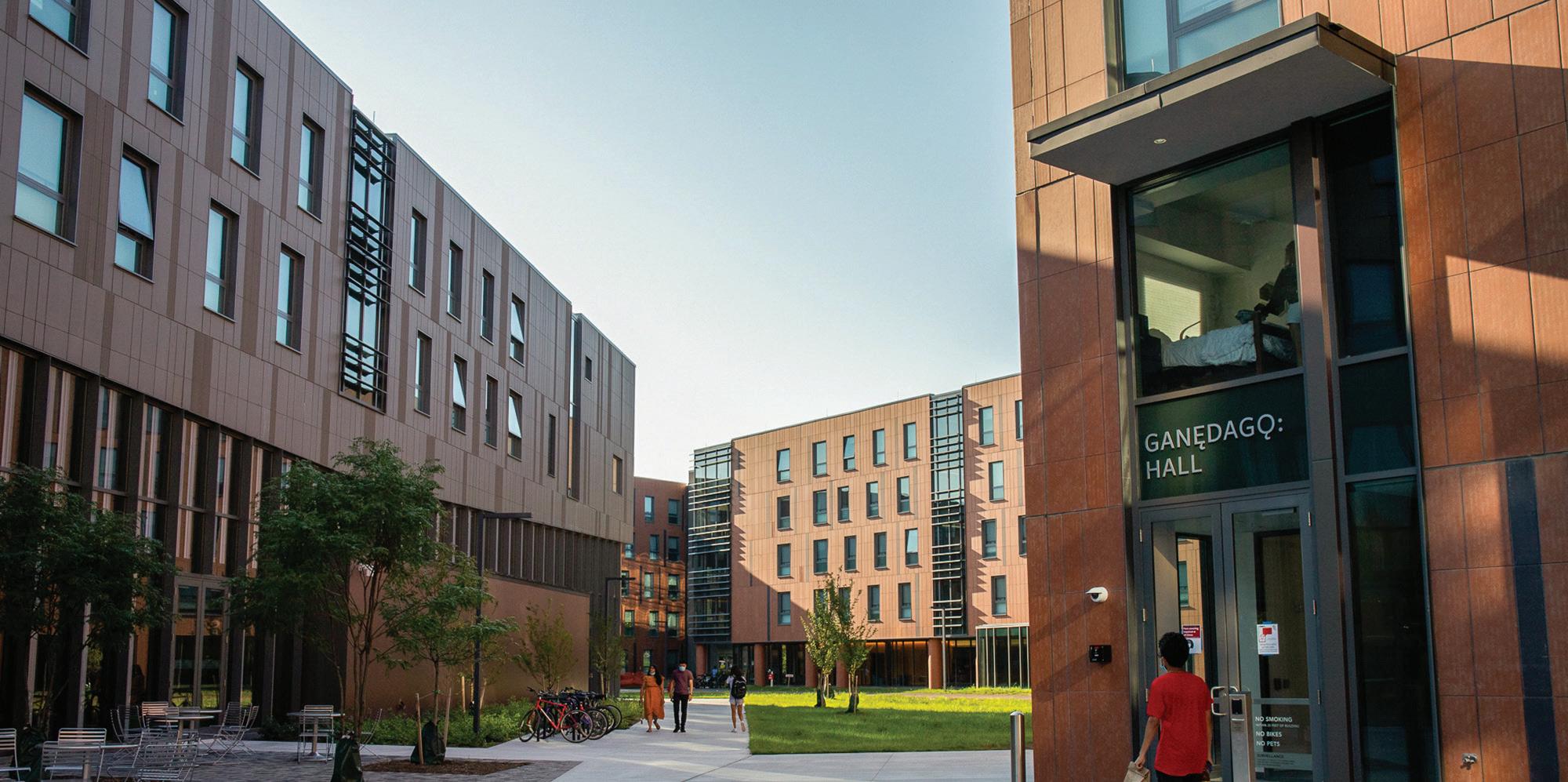
the immediate 24-hour move (other than giving me housing in Becker).
And this isn’t the only flooding situation that has happened this semester.
After the Ganedago flooding, both Toni Morrison Hall and Rockefeller Hall flooded in February from a “freezing event.” Students reported feeling “misdirected” and “uncertain,” during these situations, after being displaced from their classes and club meetings. Ironically, it’s now a reality for the average Cornell student to be wary of water pouring down on their heads in any Cornell facility.
So, Cornell, what exactly does our tuition fund? Forget about Cornell funding basic necessities — free laundry, gyms facilities or air conditioning. What about the very integrity of the buildings we sleep, study and live in? What about student accommodations in the face of emergencies? If we can’t even trust living in a building that’s only three years old or a building that has been here since Cornell’s founding, why does Cornell expect
its undergraduate students to live on campus for two years — and pay thousands of dollars to do so?
As first-year housing selection begins and students begin picking out sophomore-year housing, I’d recommend students to be wary of anywhere they choose. Newer dorms can easily break down like older dorms in the winter or spring, and accommodation options are bleak from the University. Before moving into any facility, make sure to have a plan on what to do in case of an emergency — who to contact, what to collect from your room and friends who would be willing to help. At Cornell, I’ve come to realize the grim reality that Cornell will never help in the ways you want them too; usually, it’s your community that has to rise to the occasion.
Sanika Saraf is a member of the Class of 2028 in the School of Industrial and Labor Relations. She can be recached at sanikas@ cornellsun.com
By SELINA CHEN Staff Writer
or Yik Yak (both owned by Flower Avenue Inc.) are Cornell’s famously faceless apps: The one (virtual) place on campus where majors, internships and LinkedIn connections fall victim to anonymity. Your resume does not lead to more upvotes. In some way, all of us have interacted with the unfiltered, occasionally egregious discussions that take place on Sidechat on a daily basis. We come together on Sidechat like sheep in an ever-so-chatty herd before finals, class registration and/or a dreaded snowstorm to make jokes, post memes and share in our collective misery. Whether we are posting on Sidechat or simply scrolling, no one can deny the comfort of community in the slightly smiling purple face with a singular blue teardrop.
I spoke to multiple students on how they use the social platform. Sophia Romanov Imber ’28 said, “Sidechat is positive in the sense that you can find a community online that feels very niche to Cornell, unlike other social media platforms where there’s more content mediation.” Romanov Imber, like many other Cornellians, finds comfort in knowing that slipping on the Slope in Uggs is far from a unique experience. Though frequency of usage varies, Sidechat provides an unparalleled safe space for expressing our most vulnerable and Cornell-exclusive thoughts.
For example, our most fearsome snowstorm this Spring semester was met with collective agreement on Sidechat that class should be cancelled the next day. The Cornell Sidechat homepage swarmed with outrage, annoyance and acceptance of defeat to the wrath of Mother Nature. It reminded us that we are all equals
struggling to survive hectic schedules in an Arctic-like climate, with general fatigue and no delivery drivers nearby on Uber Eats to revive our motivation. On prelim study days, when 60-degree weather wraps us in its sunny embrace, only to be struck down by torrential downpour 20 minutes later, Sidechat provides a platform for Cornellians to share their despair. Similarly, when everyone’s favorite spot in Collegetown has restocked a well-loved menu item, you can be sure to find someone’s brutally honest (and extremely helpful) review at the top of new posts. Unlike Instagram comment sections or Reddit threads, Sidechat is instantly interactive. I’ve also found it to be surprisingly more informative than real-life conversations at times. Romanov Imber continued, “Someone made a post about a class last semester and I sent a private message asking about their experience, and they actually gave me a really long list of their experience with the homework, prelims and general course content.”
One day, when I desperately posted that I was in need of travel sized shampoo and body wash for a trip I had planned for later that same day, an anonymous savior replied swiftly that The Cornell Store had it in stock, and I owe them more than they will ever know. I also remember when I was hunting for the most tolerable (and least devilish) STEM class for humanities students to fulfill distribution requirements, and Sidechat immediately came to the rescue. The app also functions as Cornell’s digital lost and found. “Maybe if someone lost their bike or left their ID somewhere, they would help get it back to that person,” Zachary Ali ‘27 noted. Plus, if we are ever feeling socially isolated, community can almost always be found on Sidechat, as discussions are often related to popular events, classes and Cornell’s own campus celebrities. For example, sightings of Cornell

Batman — the anonymous campus superhero striving to make a difference by boosting student morale — never cease on the forum that never sleeps. At the same time, among a sea of unfiltered takes, students have no reason to hide their true feelings behind the screen of anonymity. Their identity is protected, and so are their unpopular opinions, arguably making it the perfect forum for the distribution of negativity. It is the swiftest way to offer unsolicited advice or insensitive opinions with no personal consequences whatsoever.
It is perhaps the only space on campus where you don’t have to feel judgment for sharing your opinions — the anonymous forum is a sort of haven, or even a form of “cultural osmosis,” as Romanov Imber described. However, anonymity also invites hostile and unsolicited responses, when people take advantage of the freedom to speak without accountability. For instance, waves of unwarranted criticism can flood a hot topic, such as during rush season for
Greek life. While I acknowledge the downsides, I still advocate for Sidechat’s presence in every Cornellian’s social media rotation.
Indeed, people from all corners of campus are brought together by a shared sense of belonging, whether that involves extensive academic victimization via 18-hour problem sets or heated “Is Pegging Gay?” debates. After all, how could we survive the seriousness of life at Cornell without niche cultural moments to unite us?
A strange, unparalleled community lies within the hearts of Sidechat stalkers like myself, and for one reason or another, we should all be thankful for its existence.
Selina Chen is a member of the Class of 2028 in the College of Arts and Sciences. She can be reached at sc3453@cornell.edu.
reviewed by The Sun.
The Expressive Activity Policy states that speech may only be restricted if it “constitutes harassment, intimidation, or a true threat; that is integral to violence or property damage; that violates the law” or disrupts University action. The policy also emphasizes that any restrictions must be implemented with “due process and strict content and viewpoint neutrality.”
The policy does not explicitly reference the use of inflammatory language.
Hartnett said that the University “use[s] interim suspensions and the Expressive Activity Policy to pressure students and student organizations.”
When The Sun asked the University about why the chalk messages were erased, why students were asked for their netIDs, whether or not these students violated the Expressive Activity Policy and to comment on the sentiments the students expressed, a University spokesperson directed The Sun to the Expressive Activity Policy and wrote that they did not “have any additional information to share.”
Members of the Cornell Grounds Department who were power washing the messages spoke with the SDC members directly when they arrived outside of Bartels again to power wash the re-written messages on Saturday morning. When the students asked why the re-written messages were being erased, the department told them that they “were called by the CUPD,” according to video footage
Later in the day, when SDC members were writing chalk messages on Ho Plaza, the Grounds Department arrived again. The students first attempted to delay the power washers by standing in front of their truck, according to Hartnett, before standing on top of the chalk messages to prevent them from being washed away.
Hartnett said that the power washer then told the students, “‘If you stand on this, I’ll power wash over you.’”
After the students refused to move, a CUPD officer arrived and stated that the messages were permitted because they “were not any form of discrimination or hatred,” according to Bera.
Bera added that the officer told the students to call him if anyone tried to disrupt their chalk again because the actions of the students were within University policy.
“The real issue is if CUPD themselves acknowledged that our chalk should be here, why was it that CUPD also made the complaint to wash off our chalk?” Bera said.
The students’ messages on Ho Plaza remained intact as of Monday evening.









by Tavan Bhatia

By ASHLEY KIM Sun Staff Writer
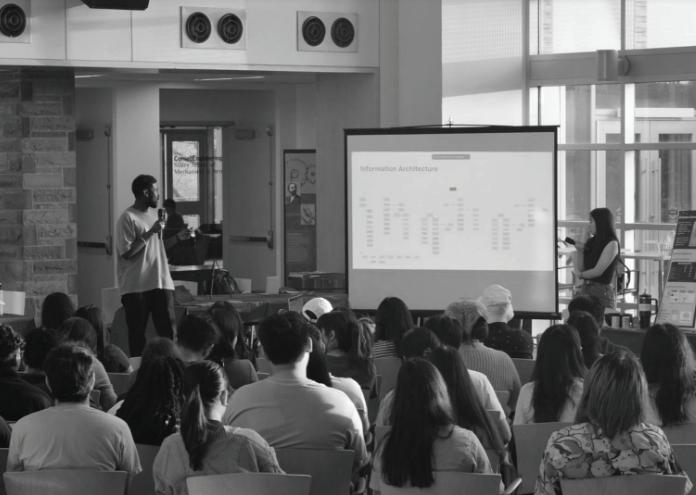
April 8 — Cornell Hack4Impact, a student-run project team, partners with nonprofits to develop free software ranging from mobile apps to data visualization platforms — work that its members say saves organizations hundreds of thousands of dollars in development costs.
The organization is part of a national Hack4Impact network spanning 12 chapters internationally, with projects reaching 15 cities across four continents. Cornell’s chapter alone fields roughly 90 members across development, design, business and product management subteams.
“It’s straight up just being able to create technology that will create imoact, not only inside of your community, but also in communities around the world.”
Ashlie Zhang ’26
This year, the Cornell chapter worked with five nonprofit partners across areas including healthcare, food insecurity and financial literacy, saving those organizations an estimated $550,000 in development costs, according to the team’s 2025 annual report. A standard web product can cost nonprofits upwards of $110,000 in design, development and deployment costs alone.
“[Hack4Impact is] the only project team that makes software for nonprofits and also for no profit at all,” said Ashlie Zhang ‘26, the team’s engineering chair. “It’s straight up just being able to create technology that will create impact, not only inside of your community, but also in communities around the world.”
Funding for Hack4Impact comes from the College of Engineering and crowdfunding initiatives like Giving Day, through which the team raised $8,000 this year. Because nonprofits receive services at no cost, the project team’s business subteam handles outreach, sponsorship and finances so developers and designers can focus entirely on building.
Arshia Chakrabarti ‘28, a member of the business subteam, said that division of labor reflects the team’s broader philosophy.
“We make sure that everything each member of the team [does] — client or developer or designer — is supported to the fullest extent,” Chakrabarti said. “We worry about the finances, so our clients don’t have to worry about paying for our services.
“I think it just brings a sense of fulfillment to be able to help people who need the help...That’s something cool about Hack.”
Justin Eburuoh ’26
Among this year’s most prominent projects is a mobile app built for Alaska Children’s Trust, a statewide nonprofit focused on preventing child abuse and neglect. Hack4Impact digitized the organization’s physical Safety Deck — a set of conversation cards designed to help parents talk to children about online safety — and turned it into an interactive app accessible to families nationwide.
The team also built a map-based web application for Rethink Food, a New York City nonprofit that connects restaurants with community-based organizations to address food insecurity. The new tool replaces scattered spreadsheets with an interactive interface that visualizes the flow of meals across
neighborhoods, supporting an estimated 40,000 meals per week.
Nathnael Tesfaw ‘26, the team’s maintenance lead, served as the technology lead on the Rethink Food project. He said leading a product from scratch to near-deployment reshaped how he thinks about his work.
“Working with that initiative — knowing that people will be able to live better lives just because of the product we made — that in itself was really special for me,” Tesfaw said.
Justin Eburuoh ‘26, a co-director of the project team, said this mission of helping the community is what keeps members engaged across roles and semesters.
“I think it just brings a sense of fulfillment to be able to help people who need the help,” Eburuoh said. “That’s something cool about Hack.”
By ROWAN WALLIN Sun Senior Writer
April 10 — Comedian Eric André brought his unhinged and boundary-pushing humor to a packed Bailey Hall Friday night, blending stand-up, audience pranks and a moderated interview while reviewing his old comedy clips.
This was André’s first return to campus since 2019 — when the demand for his show was so robust that tickets were being resold at 4 times their price — and after seven years, the crowd still had an appetite for André’s set.
The event, hosted by the Cornell University Programming Board, began at 7 p.m. for an audience of approximately 1,000 people with a 20-minute opening set from Derek Gaines, a comedian known for his role in the 2025 Hulu comedy-drama film Is This Thing On? and his writing on Inside Amy Schumer.
Gaines warmed up the audience with observations about campus life, gentrification and the particular texture of the Ivy League air. While climbing an Ithaca hill earlier in the day, “I was inhaling,” he told the audience, “and I was exhaling stock options.”
André — creator and host of Adult Swim’s The Eric Andre Show — then took the stage as the main act. He launched into a sprawling set touching on the current news cycle, fast food ethics and a memorable anecdote about a couples’ massage he had in Taiwan that took an unexpected turn.
André’s material was deliberately provocative and absurdist, and the crowd hung on his every word,
erupting in laughter throughout.
Midway through the show, André was joined onstage by Jacob Irons ’27 for a Q&A segment that quickly devolved into André hijacking Irons’ phone — and, at André’s request, Irons’ shirt.
“I think we need more laughs... [to] overall take life less seriously.”
Trifosa Simamora
Irons obliged, spending much of the interview shirtless.
André had Irons share his phone number aloud to the auditorium, leading attendees to spam Irons’ texts while his screen was being displayed for all in Bailey to see.
All the while, André began sending cryptic texts to Irons’ mother — including a “I’m in the ER” message — before FaceTiming her
to the delight of the crowd.
Devin Schmitt, a Cornell Dining employee who attended with his cousin, said the phone bits were the highlight of his night — though he wasn’t sure the Q&A format did André full justice overall.
“It’d be cool if they could do more stand-up stuff,” Schmitt said. “The Q&A thing — that’s hard to do. I think they probably should just let [André] do his stand-up.”
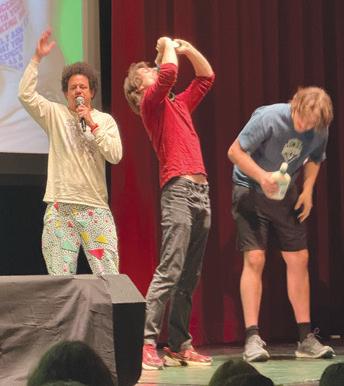
At the end of the show, two audience members had the chance to compete for who could chug a bottle of ranch the quickest on stage.
Tommy Welch ’26 won this contest, saying the moment required a particular kind of commitment and determination.
“I wasn’t thinking [about] anything,” Welch said. “I was just becoming an animal. Just consume.”
Visitor Aidan Troutley, who traveled from Maryland to visit

his girlfriend and see the André show, dressed in a full wizard costume and said the show confirmed everything he had expected — and hoped — from André.
Troutley added that what surprised him most was the authenticity of André’s stage presence.
“There’s no off switch,” he said. “It just kind of happens the moment he’s on stage.”
Trifosa Simamora, a third-year PhD student studying natural resources and the environment, said she came at the insistence of her fiancé and left glad she had.
Simamora was particularly struck by the opener.
“I really came here expecting nothing, but I think I had a great time.”
Trifosa Simamora
“I didn’t expect [Gaines] — he was a great stand-up comedian,” she said. “I really came here expecting nothing, but I think I had a great time.”
Simamora left the show with a broader wish for the campus. As universities grow more intense and stressful, she said, comedy is a necessity.
“I think we need more laughs… [to] overall take life less seriously,” she said.
The show lasted just under two hours, and as the crowd filed out of Bailey Hall, it was clear that seven years between visits was far too long.
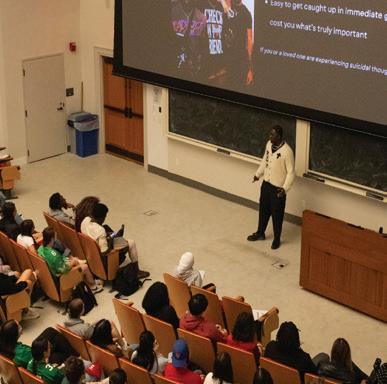
By ZEINAB FARAJ Sun Senior Editor
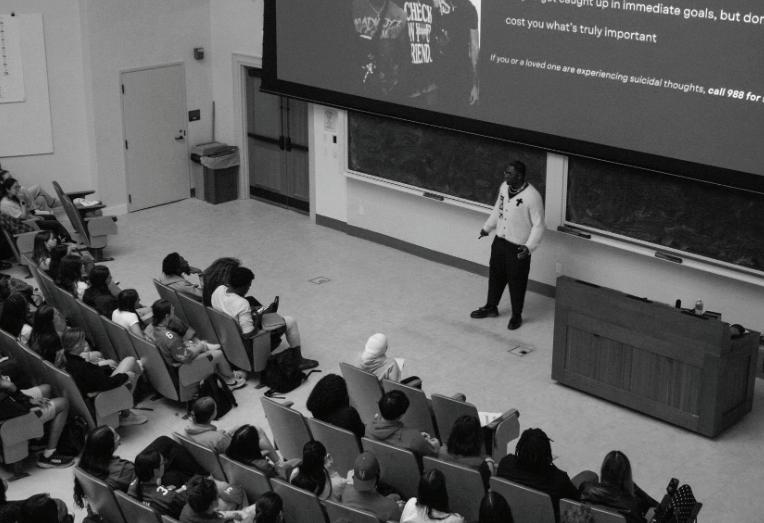
April 11 — Jalyx Hunt, Philadelphia Eagles outside linebacker and Super Bowl champion, delivered his “Last Lecture” filled with laughs from the crowd and lessons from his personal journey to the NFL in front of a 250-person crowd adorned with Eagles jerseys and team gear in Baker Laboratory 200.
During his lecture, Hunt reflected on his collegiate career, mental health and answered some of the crowd’s questions. He brought with him Rachel Booth, his publicist and long-time friend who he met at Cornell, Javon Solomon, his good friend and outside linebacker for the Buffalo Bills and his Super Bowl ring, a shiny reminder of his success.
Hunt began the lecture by discussing his family and upbringing — his father, a physician’s assistant, who he credits as his “biggest fan,” and his mother, who is a teacher. He explained that education was a “point of emphasis” in his family which caused him to “stumble upon the opportunity” to play Division I football at Cornell, making him the first person in his family to attend an Ivy League school.
“We all are high achievers ... you wouldn’t be at an Ivy League institution if you were not a high achiever. So with that comes alot of pressure.”
Jalyx Hunt
“We all are high achievers,” Hunt said. “You wouldn’t be at an Ivy League institution if you were not a high achiever. So with that comes a lot of pressure. And so I’ll give you a little run through [of] what was happening in my mind: this is going to be my family’s way out.”
Hunt said that the pressure “weighed” on his brain given that he wasn’t achieving his goals at the time on the football field or in the classroom. Throughout his time at Cornell, Hunt noted his struggle academically. He was also diagnosed with Seasonal Affective Disorder, a type of depression related to changes in seasons. By the end of his junior year, Hunt decided to transfer.
“When I went home, I was lost for a while,” Hunt said. “The right plan just fell. I’m not even playing football no more. … So I was in the [transfer] portal for a long time with a small school called Houston Christian … one of the coaches called me and said, ‘hey, we’d love to have you here, but there’s some things you have to do.’”
Hunt needed to improve his GPA to maintain NCAA eligibility to play football at Houston Christian University. He stated that he needed to pass 27 credits from May to August and attended three colleges simultaneously to achieve the goal. Reflecting on that period, Hunt said his per -
spective on failure shifted.
“I already failed in front of everyone,” Hunt said. “So what is failing again? I know what I can do after this. I know what I’ve done to get to this point after failing. So what is another failure?”
Hunt transitioned to a new position, school and committed to a routine defined by consistency rather than motivation. Despite limited exposure at a small school and a losing record, he declared for the NFL Draft, and ultimately began his career with the Eagles in the NFL in 2024.
“So what is failing again? I know what I can do after this. I know what I’ve done to get to this point after failing. So what is another failure?”
Jalyx Hunt
“Discipline is what makes you get out of bed when you don’t want to,” Hunt explained. “Discipline is, I don’t want to do this, but I know there’s a goal I have in mind, and regardless of how I feel about it, I need to do it, and that’s something that I’ve carried and learned really through this process.”
Following his first Super Bowl win in 2025, Hunt described feeling “empty” and opened up about his struggle with his mental health. He described attending therapy and continuing to feel “the exact same pressure” as the students in the crowd. Hunt discussed losing his close friend, Dallas Cowboys defensive end Marshawn Kneeland, to suicide.
“If you’re feeling down mentally — whatever the case may be — it’s okay to feel like that. It’s very normal. You don’t have to beat yourself up. You’re not alone, and please lean on somebody,” Hunt said.
To close his remarks, Hunt left the crowd with four pieces of advice.
“Trust yourself through the transitions,” Hunt said at the conclusion of the lecture portion of the event. “Stay resilient. Lean on your people, please. And your path can change, but your goal can stay the same, and I think I’m a great example of that.”
Following the end of his lecture, Hunt fielded several questions ranging from his favorite anime to how to manage an NFL career.
“Stay resilient. Lean on your people, please. And your path can change, but your goal can stay the same, and I think I’m a great example of that.”
Jalyx Hunt
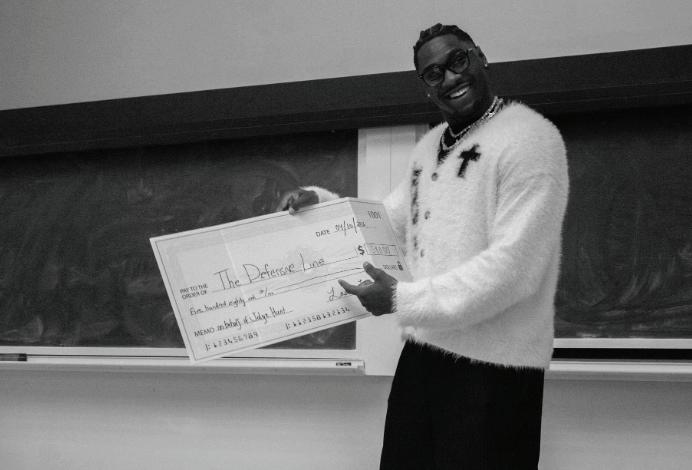
To close the event, Last Lecture donated a fundraised $580 to a charity of Hunt’s choice, The Defensive Line, which focuses on youth mental health.
“Usually with Last Lecture we try to gift the person something and we were really stewing over what to give him,” said Abbey Robinson ’26, who works with Last Lecture. “Jalyx was really clear he didn’t want any speaker fees so we were thinking he is so active with giving back.”
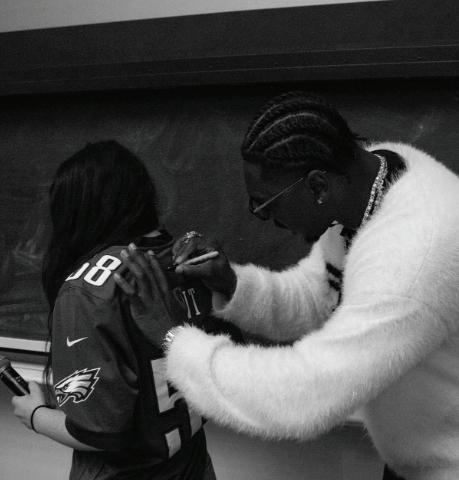
Hunt also stayed for over two hours after the lecture ended, taking photos with fans and signing autographs.
For Booth, it was “a full circle moment” to watch her long-time friend give Last Lecture.
“I was sometimes picking him up and taking him to class so to watch him transform into who he is today has been nothing short of incredible,” Booth said. “I am so proud of him and I think anyone from any background could learn something from his talk today.”
Hunt told The Sun after the event ended that for him, it was about “humility” and being in a position to “show people that you are the same [as them].”
“Today it was so cool and an honor to do that with people who have gone through a similar experience as myself,” Hunt told The Sun. “I hope they took away that it’s okay for the plan not to be exactly how you planned it out, because it’s still possible for you to achieve what you set out to do.”
“I hope they took away that it’s okay for the plan not to be exactly how you planned it out, because it’s still possible for you to achieve what you set out to do.”
Jalyx Hunt
Zeinab Faraj can be reached at zfaraj@cornellsun.com.
Depending on how emo you felt throughout your teenage years, you may or may not still maintain an emotional attachment to some of Spotify’s algorithmically assembled confessionals, “Crying Sad Mix,” “Sad Girl Mix” and “Melancholy Mix.”
At the same time, depending on which branch of yearning you subscribed to, you may or may not recognize some of Britain’s load-bearing pillars of sadness: The Smiths, Radiohead or, for the slightly younger generation of devotees, Placebo. Brian Molko and Stefan Olsdal’s timeless creation Placebo has been soundtracking heartbreaks all over the world since 1996, when their first self-titled album saw the light of day. 30 years later, the band is re-releasing the record using the original master tapes in the hopes to both honor and improve on its legacy — a project that can be interpreted as a nostalgia feat, an installment of personal growth … or a cash grab targeting the youth of yesterday. Regardless of the motivation, it seems to be a great moment to turn one’s gaze back onto the dense discography of the project and either relive one’s angstiest teenage moments … or improvise some new ones.
Handshake: “Protect Me From What I Want”
An outtake from 2003’s Sleeping With Ghosts, “Protect Me From What I Want” is hazy and grungy in the best way. Layers of guitar, semi-industrial screeching,and devastatingly tender-but-desperate keyboard lines create a delightfully chaotic backdrop, stitched together by drumming that sounds as if it’s performed on pots and pans — but with the deepest conviction. Brian Molko’s vocals, cutting and capricious-sounding, are muted and heavily filtered. The track itself, however, is not a rock anthem of the early 2000s, but rather a ballad from a deeply wounded soul: “Maybe we’re victims of fate / Remember when we’d celebrate?
/ We’d drink and get high until late, / And now we’re all alone.” The nostalgia and the desperate plea for protection delivered from amidst the wreckage of the first morning light leave the listener with a strange sense of somber emptiness.
This might, perhaps, be Placebo at the top of their early glory. By 2003, the collective was already mature enough to have gotten the reps in: With three original albums and one collection of covers, the band had established both their sound and stage presence, but had not yet slowed down or burned out. More than a decade later, in 2016, a re-recorded French version of “Protect Me From What I Want” and “Protègemoi” landed on Sleeping With Ghosts: B-Sides; it was originally released in 2004, but only in France. A local find, it came with a music video so unsafe for work the band ended up re-recording an alternate visualizer for it, featuring live performance clips. The initial impulse, however, is true Placebo — “that’s why it’s vulgar, that’s why it’s blue,” in Molko’s own words.
Deeper Cut: “Without You I’m Nothing” featuring David Bowie
This version of the track was released as a standalone single. Neither buffered by any other filler songs nor tucked lovingly into the postscriptum of an LP, it is the collective’s only 1999 release. The original edition was the title track on the band’s 1998 album, hailed as the band’s significant early breakthrough both critically and financially — and it is, from all sides, a strong composition. Bowie’s participation, however, added a surprising depth to the recording. He does not overshadow Molko, but rather supports and grounds his voice in a way that is almost imperceptible to a first-time listener. Their dynamic only becomes obvious as they launch into the second verse, a section undeniably excellent melodically but even more so — rhythmically, with lyrics rolling down the tip of the tongue like a boulder gaining acceleration by the end of each line: “I’m unclean, a libertine, / And every time you vent your
spleen, / I seem to lose the power of speech / You’re slipping slowly from my reach.” Mere rhymes become a dialogue with both parties expressing something in the language of coming undone. It’s hard to articulate precisely what’s more surprising: Bowie not overshadowing a younger, less experienced artist, or Molko not giving up any vocal ground.
But it is not only notable for a famous feature. The poetry contained in the lyrics is nothing short of brilliance; the melody unfurls lazily, letting the words do their job. Where “Protect Me From What I Want” is dense, almost oversaturated in its execution, “Without You I’m Nothing” is … bare. It is, perhaps, the reason it works better as a duet, bringing a tinge of shared vulnerability instead of an isolated confession. As a double-feature, these songs exemplify the two facets of Placebo that made them so relevant to their generation — the self-contained openness and the strategic vulnerability abundant enough to spill outwards, engaging other artists and listeners alike.
MATT RENTEZELAS ASSISTANT ARTS EDITOR
Upon hearing that Eric André would be coming to Bailey Hall for an evening of stand-up comedy and Q&A, I was immediately curious as to how the night would play out. I’ve been familiar with his surreal comedy for many years, having watched countless bizarre clips from Adult Swim’s The Eric Andre Show on YouTube. Throughout his career, André has established himself as a pusher of comedic boundaries who devises elaborate bizarre pranks which confuse (and sometimes upset) celebrities and strangers in public. On one occasion, André entered a NYC subway car donning a dog cone and asked unsuspecting riders to feed from the cone after he poured milk and Froot Loops cereal into it. Another standout prank shows André entering a restaurant in a purple octopus costume with four people with dwarfism posing as his tentacles. With these sorts of insane pranks in mind, I was sure that André’s appearance at Cornell — especially the Q&A session — would be full of must-see surprises.
The night began with 20 minutes of stand-up comedy from comedian and actor Derek Gaines. Gaines skillfully executed his set, with jokes focusing on topics ranging from airlines to political correctness. Though much of his material followed an observational humor set up and punchline framework, Gaines’ inclusion of sex and drug-related jokes helped ease the audience into the shock humor André is known for.
After beginning his set with a few
jokes about his half-Black and half-Jewish heritage, André turned toward a number of topics of political significance.
Less than 90 seconds into his set, the comedian stated, “I’m Jewish, but free Palestine,” eliciting significant audience applause. Afterward, he launched into a short routine highlighting the absurdity of the TV show Cops using reggae music for its theme music considering that the show often sensationalized the use of extreme state violence against marginalized communities. André then shouted into the microphone, expressing his hatred of the constant news in which Trump is “destroying the world” and comparing the president’s seeming invincibility to that of “star power” from Super Mario. I deeply enjoyed this small segment of his routine, with his comedy offering a much needed sense of catharsis and relief in a time of extreme stress caused by the administration’s actions.
After a few minutes of political jokes criticizing former U.S. Attorney General Pam Bondi, White House Chief of Staff Stephen Miller and Immigration and Customs Enforcement, André transitioned to the shock humor he is best known for. He began by recounting the information his friend told him about the extreme size of the breasts on chickens farmed by KFC, with André masterfully subverting expectations by quipping that he wanted to travel to the factory farms for sexual gratification rather than to stop their practices. Further material included his idea for a cocaine helmet variant of the beer helmet, an MDMA trip gone wrong and an experience in which a masseur in Taiwan unexpectedly performed sexual acts on him while his girlfriend
received a massage in the same room.
In addition to his memorable material, André also demonstrated skilled crowd work throughout his set. The comedian made fun of his own age in response to one audience member’s ignorance of the movie Home Alone and got the crowd to give a round of applause for a man in one of the front rows who was dressed as a wizard. Most notably, though, his routine included a segment wherein he borrowed a student’s phone and texted his mom while the phone screen was projected for all to see. After a few minutes of ominous and alarming texts, André accepted a FaceTime from the student’s mom, meeting his family over the phone and repeatedly asking them to take their shirts off (to which the student’s father briefly obliged).
Following his stand-up, André was joined by student moderator Jacob Irons ’27, co-president of Cornell’s Whistling Shrimp improv group, for the Q&A session. It was immediately clear, however, that this would be no normal interview. Throughout his entire time on stage, Irons maintained character as a bumbling moderator with about as much charisma and awareness as a slice of white bread. Irons would preface almost every one of his questions with something like “I have a question for you” or “my next question is,” despite André’s increasing mockery of Irons’ performance as host. Additionally, whenever André would respond to a question or ask Irons something, Irons would simply reply with “interesting” or “okay” before moving on to something else entirely. The highlights from the segment included André texting and FaceTiming Irons’ mom for all
to see, with the added bonus of audience member texts appearing on-screen after Irons revealed his phone number to the crowd.
Finally, André capped off the evening with a ranch chugging competition, with two audience volunteers competing to drink an entire bottle of ranch on stage as fast as possible. The competition perfectly balanced cringe and amusing, with the two students gagging as they struggled to consume what was likely 2,000 calories worth of the salad dressing.
In all, Eric André’s visit to Cornell was a masterful display of the power of absurd humor. Most of the comedians invited to campus typically fall into more traditional schools of comedy, so it was greatly refreshing to see a different style explored on-stage and the typical Q&A format completely turned on its head as is done in The Eric Andre Show.
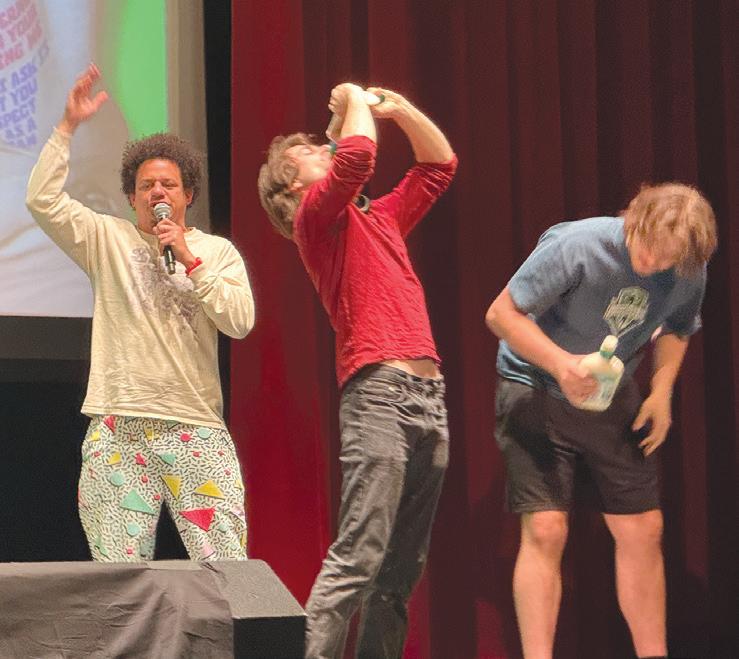
By BRAYDEN ROGERS Arts & Culture Columnist
Wireless Festival is one of the largest music events in the United Kingdom. The London-based festival features some of the biggest names in rap and hip hop every year. On March 30, it was announced that Ye, formerly known as Kanye West, would be the three-day headliner of the festival at Finsbury Park. This would mark his first United Kingdom performance in 11 years, since he attracted controversy as the Glastonbury Festival headliner, where he sparked outrage for not being a rock performer at the traditionally rock festival. This led to a petition that received over 130,000 signatures to remove Ye from the headlining slot, but he proceeded with his performance. Similar to Glastonbury, controversy had befallen Ye after his selection for the Wireless Festival, although for completely different reasons. Due to his antisemitic and racist tirades in recent years, many were appalled that Ye would be allowed one of the largest musical platforms the country has. In the days following his announcement, Pepsi, the festival’s lead sponsor, said it would withdraw its sponsorship this year, with Ye as the headliner. More companies followed suit, as Diageo, Rockstar and PayPal all rescinded their sponsorships of Wireless.
The most damning news for the festival and Ye came on April 7, as the Home Office and U.K. authorities denied the artist’s Electronic Travel Authorization, making him unable to perform at Wireless. The United Kingdom cited that Ye’s travel to their country was “... not conducive to the
public good.” The festival even drew the attention of the United Kingdom’s Prime Minister, Keir Starmer, who released a statement saying, “Kanye West should never have been invited to headline Wireless.”
Following Ye’s barring of entry to the United Kingdom, Wireless Festival announced it had canceled its entire event this year and would issue refunds.
Of all performers in the music industry, Ye would understand more than most about being barred from performing in specific countries. Following his release of antisemitic songs in 2025, the rapper had his Australian visas revoked. Additionally, Ye allegedly has a ‘soft ban’ from performing at most venues in the United States. A soft ban, which was in effect until only recently, when Ye performed back-to-back sold-out shows at Sofi Stadium in Los Angeles. As a result of his inability to perform in the aforementioned countries, much of Ye’s recent performances have been in South Korea, China and Mexico.
Wireless’s choice to have Ye as their festival headliner was poor. Considering his history of hate comments, regardless of recent attempts to revitalize his image, he should never have been selected to have such a platform. Wireless states that multiple stakeholders were consulted prior to the announcement of Ye as headliner and “no concerns were highlighted at the time.” Despite this, the selection remains mostly baffling.
Ye recently released his studio album Bully in late March, with the album being a step in the right direction and away from his hateful lyricism in recent years. Wireless
selecting Ye as their headliner is clearly an attempt to profit from Ye’s new album. Bully is not a return to form at all; however, it is closer to older Kanye West than it is to the newer Ye. This makes people accept the album as better than it truly is, since it is showing improvement. Wireless Festival knows this and hopes to ride the wave that Ye has been on since his January apology and album release in March. However, the festival should have considered the optics of selecting an individual so recently removed from rampant hate speech and mental health crises. The mindset of all press being good press is incredibly dangerous. The festival operated under the assumption that both the support and outcry for Ye as the headliner would contribute to Wireless being in the news more, however, no true repercussions would come of it.
The United Kingdom government’s decision to bar Ye’s entry only stirs up more controversy. Following Ye’s selection as headliner, numerous Jewish communities in the United Kingdom offered to speak to the rapper, on the condition that he would step down as the headliner of Wireless. In response, Ye said, “I would be grateful for the opportunity to meet with members of the Jewish community in the U.K. in person, to listen.” However, he made no mention of removing himself from the Wireless setlist, saying he only wanted to present change by coming to London.
Numerous government officials and leaders in the United Kingdom attempted to contact Wireless Festival, imploring them to reconsider having Ye at their event. However, Wireless did not field any of these
calls, forcing the United Kingdom government to reject Ye’s application. The actions here from Wireless are disturbing because the festival is clearly not ignorant. Wireless knew who Ye was and the controversy surrounding him. Saying that “no concerns were highlighted at that time …” is highly unlikely.
With recent apologies, album releases and Ye’s continued cultural relevance despite his hate speech, the festival hoped this would outweigh the controversies. The festival knew they would be criticized for the decision, but they took the risk that nothing serious would come of it. What Wireless did not account for in their risk assessment was institutions and sponsors taking action against the festival.
The sponsors’ decision to withdraw and the U.K. authorities’ intervention were a drastic oversight by those at Wireless. The current state of the music industry will allow those who continue to contribute to pop culture to have a platform despite their controversies. Wireless made a bad bet, hoping to profit from attention, and in return, they may cease to exist. The festival assumed that Ye’s relevance would make him untouchable, and while Ye will continue on, Wireless seems to have forgotten that they themselves are not untouchable.
‘Fine Print’ is a column analyzing how business and legal forces impact our enjoyment of arts and entertainment.
Brayden Rogers is a member of the Class of 2028 in the College of Arts and Sciences. He can be reached at brogers@cornellsun.com.
By AYLA KRUSE LAWSON Arts & Culture Writer
In 1953, Ray Bradbury authored the dystopian novel Fahrenheit 451 . In 2026, it could be shelved under nonfiction. Fahrenheit 451 is set in a futuristic American society in which books are banned and burned to ensure mindless conformity amongst its citizens. Books are dangerous because they contain knowledge and contradict the authoritarian government’s set of “truths” by encouraging independent thought. Here, firemen do not put out fires, they start them, with the pages of these “dangerous” books as kindling. House Resolution 7661 is a bill that aims to light these fires in our world.
H.R. 7661 or the “Stop the Sexualization of Children Act” aims to modify the Elementary and Secondary Education Act of 1965 to prohibit use of federal funds for any programs, books or other materials “that [include] sexually oriented material” and keep it from “children under the age of 18.” You may be wondering what “sexually oriented material” entails. The bill defines it as material that “includes any depiction, description, or simulation of sexually explicit conduct” or material that “involves gender dysphoria or transgenderism.” You can read the full bill here, but it is already clear that the bill is beyond problematic. First off, the definitions and age specifications are vague, which makes it very easy to ban any LGBTQIA+ books in schools or libraries that receive federal funds if it were to be passed. The government could easily contrive a sexual reference in a book they want off of shelves, and the ambiguity in the bill would allow them to remove it from schools that receive federal funding. Furthermore, the expanding of “sexually oriented material” to include “gen -
der dysphoria or transgenderism” is appalling because it suggests matters of identity should be considered sexually obscene. The bill is clearly targeting transgender and gender-nonconforming students and access to material that reflects their lives and experiences. Books can act as lifelines for transgender youth because they allow them to be seen and grow into their identities. They are also so essential for non-LGBTQIA+ youth because they promote empathy, subvert gender norms and educate. For more on the importance of LGBTQIA+ literature, refer to HarperCollins’ article.
H.R. 7661 was authored by U.S. Representative Mary Miller (R-IL) last February. It was co-sponsored by 19 other representatives, all of whom were Republican. On March 17, the bill progressed out of the House Committee on Education and Workforce and into the House, meaning it has been released to the entire House of Representatives for consideration. It should have died in committee. Part of the problem lies with the partisan nature of the bill, from its co-sponsors to the majority Republican composition of the Education and Workforce committee. This led to Democratic amendments being silenced, concerns being ignored and the bill advancing to the full House as it did.
H.R. 7661 is also called the National Book Ban Bill by its opponents, and yes, it is as bad as it sounds. Federal funding is vital for the operation of many public schools across the U.S., so while schools can decide to not follow the law, they are caught in a bind because they would lose their federal funding. The bill would force schools to comply by twisting them into submission. It is a tremendous overextension of Congress’ power into the operation of state and local schools. The government should not dictate what children are reading. As American
Library Association President Sam Helmick puts it in his official statement on the bill, “H.R. 7661 isn’t fundamentally about protecting kids. It’s about giving politicians broad authority to restrict whose stories are allowed on our shelves.” Already, the bill should not have progressed as far as it did because it highlights how ready our government is to censor entire communities and parts of history. By targeting children, they are going to the source — ensuring children never even learn of other voices, other perspectives, other ideas. It will induce mindless conformity. Sound familiar? Sounds dystopian.
So, what can we do? The bill is still in its early stages and is not yet on the House calendar, so there is time. First, contact your representative by phone or email to express your concerns and encourage them to vote against the bill when it appears on the floor — especially if they were on the committee and supported the bill then. You can find a directory of House Representatives here. If you are unsure where to start, 5 Calls has a page that provides a template. Furthermore, you can reach out regarding support for H.R. 6440, called the Right to Read Act of 2025, which has been introduced in the House. This act would ensure students’ right to read and would increase funding for libraries as well as protect librarians from book bans such as H.R. 7661. It too is in its early stages, but the introduction of H.R. 7661 highlights that we need protections of the right to read more than ever. So please, make your voices heard. If reading requires government intervention and approval, we tumble irreparably into dystopia.
Ayla Kruse Lawson is a member of the Class of 2027 in the College of Human Ecology. She can be reached at akruselawson@cornellsun.com.
By Nora Kenzi Sun Staff Writer
On a day characterized by strong headwinds and crosswinds, the men’s heavyweight rowing team faced Boston University on Fish Creek in Saratoga Springs, New York, in a close and quick regatta. After a loss to Harvard the prior Saturday, the No. 13 Red split the meet against the No. 12 Terriers, showing off what it spent the week working on.
The Red’s standout performance was in its 2V8+, in which it edged out the Terriers by a second, the final time for The Red being 6:11:384. On the other hand, the 1V8+ was right behind the Terriers’ A boat but ended up finishing 5.3 seconds behind in a competitive race, with a final time of 6:02:280.
In a surprising turn of events, the 3V8+ race had a disqualification of the Terriers, who were impacted by the crosswind that had them drifting between lands twice. While not causing any collisions, the Red claimed the victory due to this disqualification, even after being approximately two seconds behind. The Terriers finished with an official time of 6:15:170, while the Red finished with a time of 6:17:020.
In the 4V8+ race, Boston University ended the race just around seven seconds before the Red, with the Terriers reaching the finish line in 6:27:441 and the Red at 6:34:661.
Historically, these teams have competed against each other frequently, in which the results have varied greatly. Between the 2025 IRA National Championship, in which the Red won both finals with its 1V8+ and 2V8+ boats as well as the 2025 Eastern Sprints, where the Terriers took ninth place overall, while the Red took 11th overall. These competitive programs have been head-to-head for years.
Up next, the Red will return to Ithaca’s waters on the Cayuga Inlet on Saturday to face Syracuse and Navy for the Goes Trophy. The time of the event is still to be determined.
This event will be incredibly competitive as the Navy and the Red are fighting to leave with the trophy after five years of dominance from Syracuse.
By Austin Curtis Sun Staff Writer
Cornell was two outs away from avoiding a sweep. Instead, Penn flipped the game — and the series — on its final swing.
A run batted in single in the bottom of the ninth lifted the Quakers past the Red, 6-5, on Sunday afternoon, completing a three-game sweep in Philadelphia.
Cornell (6-20, 4-8 Ivy) led for eight innings in the finale but could not close out the game, dropping its fourth straight game. Penn (14-15, 8-4 Ivy), meanwhile, extended its winning streak to six and moved into third place in the Ivy League standings.
Game 1: A Mid-Game Collapse
In the opener, the Red carried a 2-0 lead into the fifth before a Quaker four-run frame, fueled by Cornell miscues — four walks and a hit batter — gave Penn the lead. The Quakers carried on that momentum, adding three more in the seventh inning for a 7-3 result.
“We are really focused on Yale. We’ve got to throw strike one.”
Head Coach Dan Pepicelli
Game 2: Buried Early
The nightcap got out of hand quickly.
Penn erupted for six runs in the first frame and built a 9-1 lead after two innings. Cornell showed life with a four-run sixth inning, but the early deficit proved insurmountable in a 14-5 loss.
Head coach Dan Pepicelli, entering his 11th season at the helm, pointed to inconsistency and figuring out roles as ongoing challenges.
“I’m still trying to figure out what roles are working best for certain guys,” Pepicelli said. “At the end of the day, I take responsibility for not putting people in the position of being successful.”
Pepicelli emphasized the need for his team to play “complimentary baseball,” citing that pitching, defense and situational execution as key areas for improvement.
The Red have also been hit hard by injuries, with 12 players lost for the season.
“It’s been a devastating year with the injuries,” Pepicelli said. “With that said, I love the attitude the guys are playing with. They are giving me everything they’ve got.”
Despite the struggles, junior infielders, Kevin Hager and Owen Carlson have remained key offensive assets, leading the team across multiple categories. They both rank among the team’s top hitters, with Carlson batting .337 and Hager at .330.
“They are both such tough competitors,” Pepicelli said. “I know that they are hurt, and they are giving me all they got to get through it. It’s inspiring to their teammates.”
The Red appeared in control early.
Cornell built a 5-2 lead through three innings behind a sharp start from senior right-handed pitcher Ethan Hamill and consistent early offense. The Penn bullpen, however, shut the door from there, tossing six scoreless innings to keep the Quakers within striking distance.
That opening proved decisive in the ninth inning.
After a leadoff double and a pair of costly wild pitches cut the lead to one, Penn tied the game on a sacrifice fly before delivering the final blow: a two-out single to seal the walk-off win — and also the sweep. On Deck
Cornell will look to reset during a four-game homestand, beginning Tuesday at 3:30 p.m. against Binghamton (17-13, 9-3 AE) before a weekend Ivy League series against Yale (19-10, 9-3 Ivy).
“We are really focused on Yale,” Pepicelli said. “We’ve got to throw strike one. They steal a lot of bases and have some of the best pitching in the conference, so we need to be opportunistic.”
All the action will be available on ESPN+.
By Lydia Lekhal Sun Staff Writer Nora Kenzi can be reached at nk229@cornell.edu
60 minutes, 24 goals and 14 cards received. The Red could not have asked for a more dramatic match in their April 11 face-off against Harvard.
Despite all the controversy, Cornell (8-5, 3-2 Ivy League) was able to come out on top against Harvard (5-7, 1-4 Ivy League) by a score of 13-11.
The first period started off on an unusual note. Harvard started with possession after a decision by the officials determined that freshman attacker Addy Smith’s stick had an illegal extra pocket.
Immediately after, the Crimson were awarded a free position, which it capitalized on, scoring the first goal of the day. The Red tried to respond swiftly as it received a free position shortly after, but sophomore midfielder Lexie Tully could not take advantage of the opportunity.
However, Cornell still kept up the pressure, as senior attacker Emily Iacobellis tied the match 1-1. Harvard responded less than three minutes later to resecure its lead.
Harvard did not stop there as it continued to increase its lead to 4-1. It appeared that the Red was not able to respond in the most effective manner.
Head coach Jenny Graap ’86 called a time out: an action that shifted the tides.
Cornell closed off the first quarter with a goal thanks to junior attacker and captain Ellie Bergin.
A Crimson player also received a yellow card, giving the Red a one-woman advantage going into the second quarter.
For the next 15 minutes, Cornell looked like a completely different team. It had completely taken advantage of Harvard’s mistakes in defense while also closing off any Crimson shooting lanes.
Only 20 seconds into the second quarter, Iacobellis scored another goal, quickly followed by sophomore attacker Kathleen Michaud’s first goal of the night to even the score 4-4.
Harvard got one more free position and capitalized on it to give themselves another lead of the day, increasing the score to 5-4.
The Red did not let its foot off the gas. A flashy goal from the Argentine international and freshman midfielder Gretta White tied the game 5-5.
From then on, Cornell was unstoppable. The Red took its first lead of the game after a goal from Lexie Tully.
Cornell finished the first half with a 10-6 lead as a result of goals from six different players.
Iacobellis completed a first-half hat trick, while senior attacker Ella Wilmot and Bergin also got on the scoreboard to close out the first 30 minutes of the game.
Harvard, a team with its season on the line, came out of the locker room for the second half very determined.
Confusion arose on a goal scored by the Crimson as the referees could not determine whether the ball had fully crossed into the goal or
not. A successful challenge from Harvard’s head coach Devon Wills gave the Crimson its first goal of the quarter.
Harvard fed off the energy of the reversed call, scoring three additional unanswered goals to tie the match up 10-10.
Cornell took the lead again after yet another goal from Bergin, but was cut short as Harvard scored again and finished the third quarter tied up at 11-11.
The Red was able to bring the score up 13-11 as Bergin and Lexie Tully scored their fourth and third goals respectively.
The match still had more drama left as junior midfielder Cameron Traveis received a yellow card with only 1:49 remaining in the game, giving Cornell the woman disadvantage for the rest of the match.
Senior goalkeeper and captain, Mackenzie Clark, came up big for the team as her presence in net allowed the Red to seal the win in the final minutes.
This momentum is essential for the Red as it heads into its final games of Ivy play, on the hunt for a spot in the postseason.
The Red will face off against the University of Pennsylvania (6-6, 4-1 Ivy League) at noon this Saturday at Schoellkopf Field.