The Corne¬ Daily Sun

Hasan Minhaj ‘breached contract’ shortly before planned announcement
By NICHOLAS BOGEL-BURROUGHS Sun Senior Writer
Late on Thursday afternoon, everything was going according to plan.
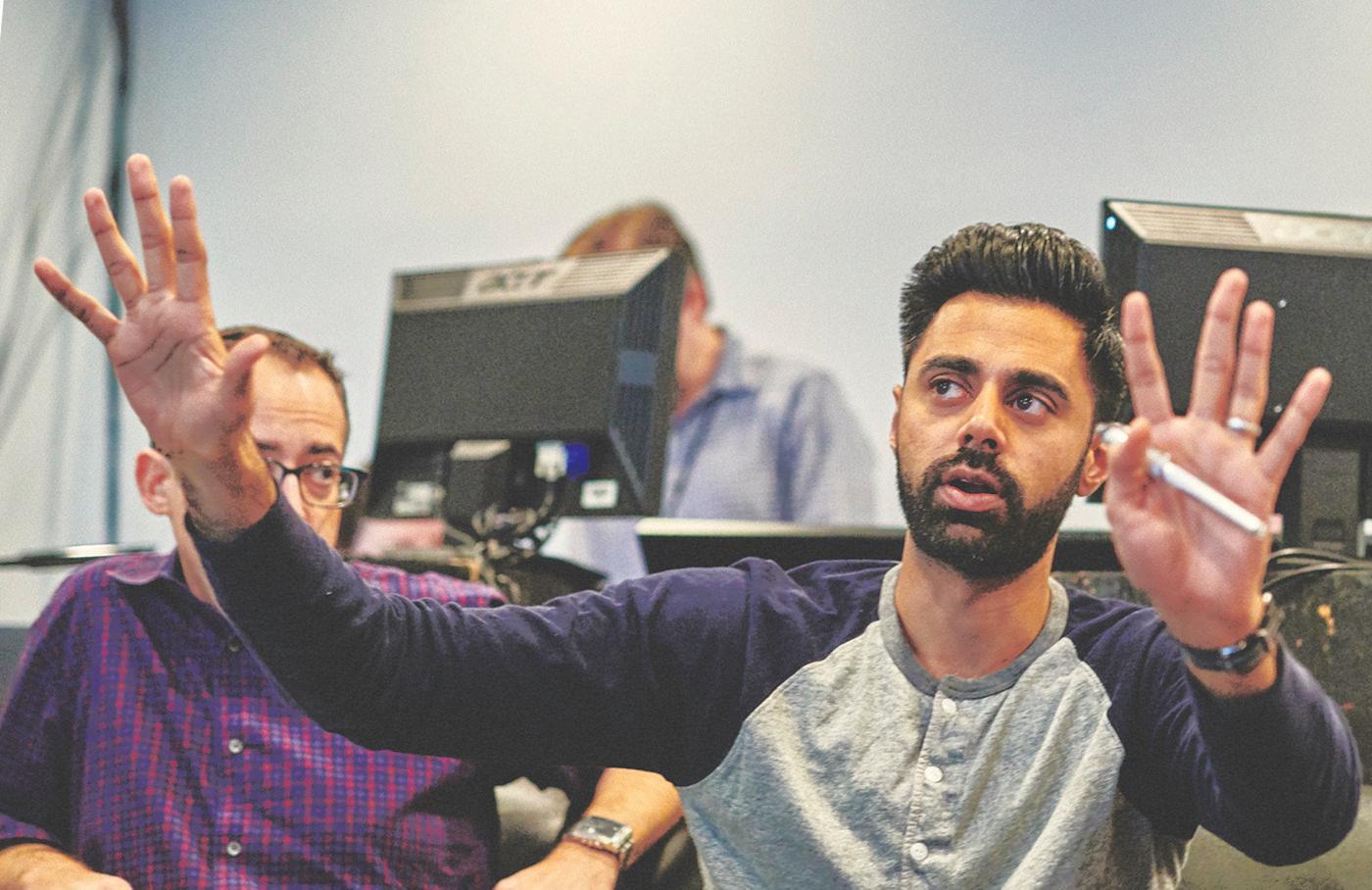
Cornell Convocation Committee members were excited to reveal at a Student Assembly meeting that comedian Hasan Minhaj would address seniors on graduation weekend. The committee had created a graphic for social media and arranged a party to celebrate the culmination of months of work.
But by 6:30 p.m., the committee’s leadership was scrambling. Minhaj had dropped out, they learned shortly before their planned announcement, and they wanted to keep anyone from knowing.
Charlotte Lefkovitz ’19, the committee chair, told eager attendees that the committee was delaying its announcement out of respect for the seriousness of an S.A. divestment vote that immediately preceded the scheduled unveiling.
“I ultimately felt that right now is not the time, given the emotions,” Lefkovitz said
By OLIVIA WEINBERG Sun Staff Writer
A swastika was found emblazoned on the facade of the west side of Goldwin Smith Hall facing the Arts Quad, drawing concerns from students over the current campus climate.

Concerning climate | President Pollack sent out a campus-wide email on Sunday condemning the swastika, and committing to a full investigation.
The anti-Semitic symbol, now covered by duct tape, has been there for “quite some time,” said President Martha E. Pollack in a statement sent to the Cornell community Sunday morning. This is not the first time swastikas have been found around campus: three incidents were reported on North Campus this past November. It is unknown who is responsible for drawing the symbol and who taped over it. The drawing is currently under investigation by the Cornell University Police Department, according to Pollack’s statement. CUPD declined to comment after The Sun reached out with two phone calls requesting additional information Sunday afternoon.
In an interview with The Sun, President of Cornell
at the close of the public S.A. meeting. She and some other members later wrote similar statements on Facebook.
An email to committee members, sent 15 minutes later and signed by Lefkovitz, gave an additional reason.
“Hasan Minhaj breached contract and is no longer our speaker,” read the message,
which reminded recipients that they had signed a confidentiality agreement and warned in an uppercase subject line: “URGENT — EXTREMELY CONFIDENTIAL.”
“The most important thing is that NO ONE CAN KNOW ANYTHING. Neither that he was supposed to be our speaker nor that he has dropped out,” read the message, which was sent to members by Andrew Semmes ’19, the senior class president and a member of the committee.
“I have been lenient with people leaking stuff thus far but if anything gets out no questions asked you will lose membership and privileges,” Lefkovitz continued.
In the committee’s Slack channel, Semmes told members that if anyone asked about the delay, they should say: “It’s been postponed to a better time and place. That discussion was so divisive so we didn’t think it was a good time.”
It’s unclear why Minhaj, the host of Netflix’s Patriot Act, pulled out, and his publicist did not respond to multiple messages
ALANA and ISU pair up for afternoon of food, dance, music
By CAROLINE JOHNSON Sun Contributor
Music, dance, laughter and the smell of blended spices permeated through Barton Hall as Culture Fest commenced for its second annual event, featuring performances, music, food and presentations Sunday afternoon.
Culture Fest began last year in response to racial incidents and hate crimes on campus, according to ALANA Intercultural Board President Elaine Liu ’19. The organizers designed the event as a way to showcase the diversity on campus and “celebrate it through understanding and appreciation,” said Liu.
“We don’t want the celebration of cultures to be a reaction to bad incidences,” said Shemar Christian ’21, vice president of programming for ALANA. “It should just be a constant thing, which is why we are trying to have [Culture Fest] annually.”
This year, ALANA Intercultural Board also collaborated with the International Student Union to host the Culture Fest. According to Venus Dulani ’19 of ISU, the two organizations decided to work together because both ISU and ALANA had the shared goal of “celebrating international diversity.”
The event featured organizations representing a wide array of cultural groups, such as the Cornell Sikh Students Association, Black Students United and South Asian Council, which engaged with students to educate and celebrate their differences.
A new addition to this year’s Culture

Monday, April 15, 2019
Microeconomics Theory Workshop: Tetsuya Hoshino
11:40 a.m. - 1:10 p.m., 498 Uris Hall
A “Monologue” on the Mechanics of the Vagina 11:45 a.m. - 1 p.m., B15 Riley-Robb Hall
LASP Seminar: Short Film – Empowering Ecuador’s Extraordinary Ecosystems 12:15 - 1:10 p.m., 153 Uris Hall
Pre-Orientation Service Trips at Cornell Days 1:15 - 1:45 p.m., Multipurpose Room, Robert Purcell Community Center
Our Changing Menu: What Climate Change Means to the Foods We Love and Need 2:55 - 4:10 p.m., 233 Plant Science Building
Igbo Conversation Hour
3 - 4 p.m., G25 Stimson Hall
Farmers and Agroecology – Dilmun Hill Speaker Series
5 - 7 p.m., 404 Plant Science Building
Free Yoga 5 - 6:15 p.m., 413 Art Gallery, Willard Straight Hall
Cornell Concert Series: The Spring Quartet 8 - 10 p.m., Bailey Hall

Keeping the faith | The Sub Chief/Faithkeeper of the Cayuga Nation Heron Clan will speak about his work with the United Nations, U.S. Customs and Border Protection and Department of Homeland Security.
“Smartfin” Film and Talk with Todd McGrain 12 - 1 p.m., Tatkon Center
Finding Joy Despite Uncertainty 12 - 1 p.m., 140 East Hill Office Building
Cornell Health: “Let’s Talk” Walk-In Consultations 2:30 p.m., 311 W. Sibley Hall
Indigenous Ingenuities as Living Networks, Speakers Series with Karl Hill 2:55 - 4:10 p.m.,100 Caldwell Hall

Adelante Coffee Chat 4:30 p.m., LSP Conference Room, 429 Rockefeller Hall
Remembering Mullivaikkal: Sri Lanka 10 Years On 4:45 - 7:15 p.m., Guerlac Room, A.D. White House
Rose House Dining – Thai Festival of Lights 5 - 8 p.m., Flora Rose House
Industry Speed Dating for First Years 5:30 - 7 p.m., Tatkon Center
Auditions for The Wolves 7 - 8:15 p.m., 322 Schwartz Center for Performing Arts
By HUNTER SIETZ Sun Assistant News Editor
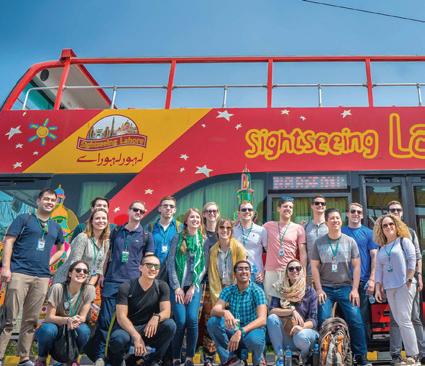
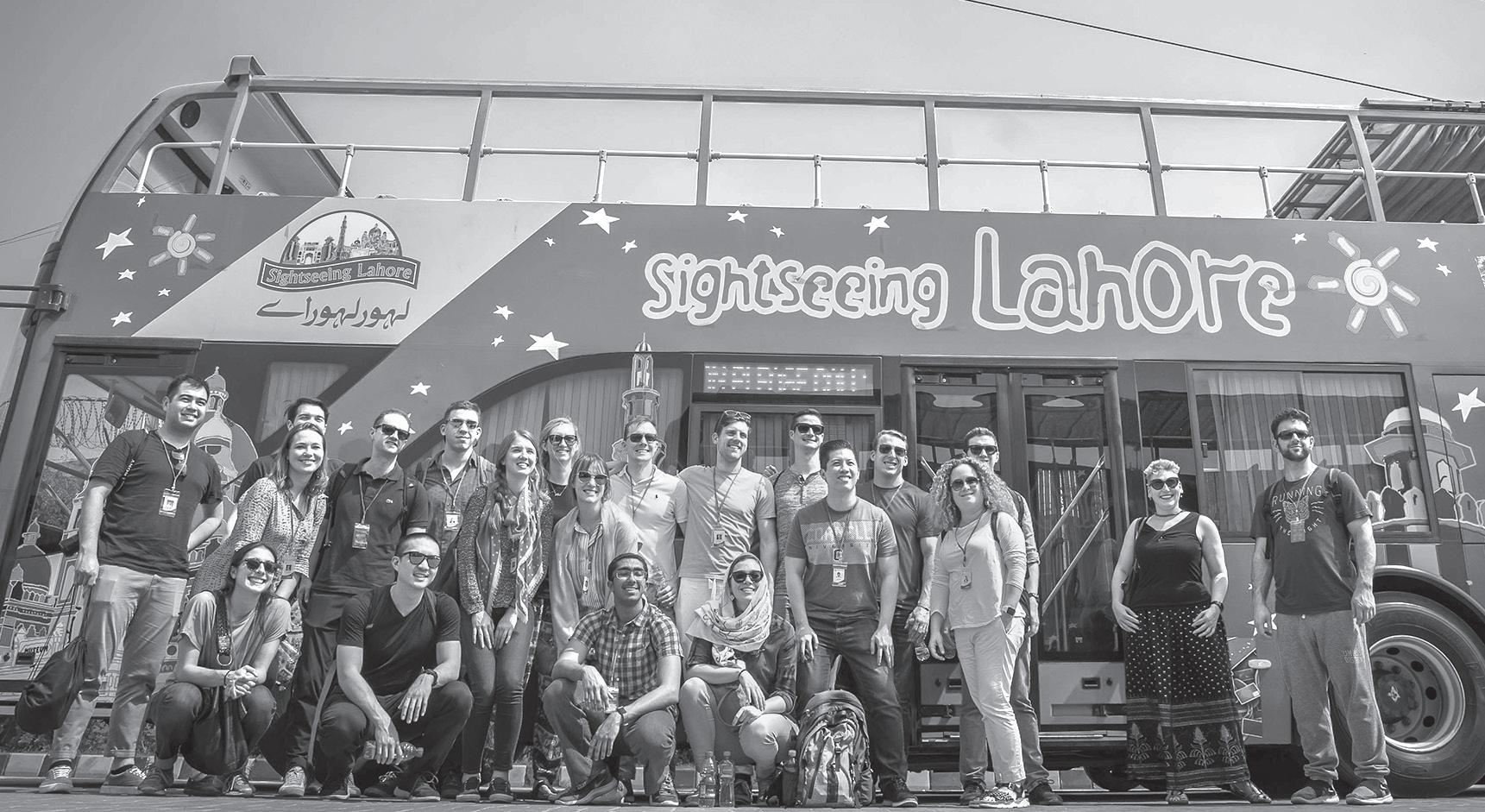
In hopes of eradicating the stereotypes against their home country, two Cornell alumni from Pakistan started organizing trips to bring students to their home country starting last year. This past spring break, 24 Cornell students travelled to Pakistan, where they got to learn about the culture and meet notable figures such as the President and the Chief of the Military.
The trips were organized by Mohammad Zohair Javed MPA ’18 and Shan-E-Ahmad MPA ’18, who wanted the trips to bring different cultures together and help dispel myths or misunderstandings about their home country.
Last year, 18 students participated in the inaugural trip. The students were selected based on their background and academic interests as well as their “genuine interest in Pakistan.”
Javed first got the idea for the trip while studying at Cornell as part of the Fulbright program, which aims to
By EMILY YANG Sun Staff Writer
Wesley Chan and his fellow co-founders of popular YouTube channel Wong Fu Productions never intended to become Asian American icons — but 13 years later, their channel boasts over 3 million subscribers.
The group is known for shorts including “Strangers, Again,” “Asian Bachelorette” as well as web series like “Single by 30.” This is Wong Fu’s third time at Cornell, following their visits in 2008 and 2013.
During the panel, the crew of Wong Fu shared with the audience how their company got their start, their production process and their experiences as Asian Americans in the film industry. According to Wesley Chan, one of the co-founders, he and the other co-founders — Phil Wang and Ted Fu — met during a visual arts class in college and found a calling to illustrate Asian American voices.
“There might be billions of Asians on the other side of the world, but to be Asian American is a very specific thing,” added Benson Quach, a producer and assistant director. “We’re Asian and American, not Asian or American.”
Chan admitted that he sacrificed certainty and stability to pursue the arts. “We [didn’t] know what to do next,” he said. “How could I have expected to be in a career that didn’t exist when I was in college?”
After graduation, the three founders toured colleges, including Cornell, to share their films. “We knew we were making a connection with the people who were watching,” said Chan.
The members encouraged students to explore their options in college. “It shouldn’t be about pursuing your passion, it should be about pursuing your passions. Plural,” Chan said.
The event also featured a showing of the first two episodes of their latest web series, “Yappie,” which chronicles the experiences of Andrew, a “yappie” — or “Young Asian Professional” — who slowly realizes that he has chosen a safe,
encourage “cultural exchange,” he said.
“When you’re from Pakistan and you’re studying in the U.S., it hits you immediately how misunderstood Pakistan is,” Javed said in an interview with The Sun.
Two major misconceptions, according to Javed, is that Pakistanis all speak Arabic — even though Pakistan’s national language is Urdu — and that Pakistan is in the Middle East, when in reality, it is part of Asia.
“People just think that because we have a ‘-stan’ at the end that we are a Middle Eastern country, predominantly Muslim, and are very strict about Islamic law and very backward in terms of education, women’s empowerment,
lacking basic infrastructure,” Javed said.
Hoping to battle these stereotypes, Javed and Ahmad planned a nine-day itinerary around the country. For the second year of the trip, the itinerary was modified slightly to account for the fact that the majority of people going were business students.
Students visited many of the same places as the first year’s trip — Islamabad, Lahore, Hunza Valley — while also adding new locations and activities, such as a cooking class to help students experience Pakistani cuisine. They
By WINNY SUN Sun Staff Writer
For 340 days, astronaut Scott Kelly lived in the International Space Station, while his identical twin brother Mark Kelly, a retired astronaut, lived a regular life on Earth. Both collected physiological and cognitive data about themselves, hoping to find out what space would do to a human’s body.
The Twins Study, conducted in collaboration between NASA and multiple institutions including Weill Cornell Medicine, analyzed the differences between the twin brothers to explore how human bodies change after longterm spaceflight.
“We basically look at how DNA and RNA are regulated,” Prof. Christopher Mason, physiology and biophysics, one of the study’s principal investigators, told The Sun. “The really big focus was on what happens to gene expression level and how genes are regulated when they get turned on and turned off during space flight.”

Twin time | The Weill-Cornell, NASA-led study investigated how gene expression is altered by long term spaceflight.
Mason has long been interested in studying the genetics of astronauts. He first reached out to NASA in 2010, which, at the time, determined there wasn’t enough genome data available to conduct this kind of experiments. When the opportunity finally arose in 2014, NASA picked the Weill Cornell team as one of 10 teams of researchers participating in the twins study. According to The New York Times, the most significant findings from the 90-page paper published on Friday are genetic mutations and worsened cognitive performance. After Kelly’s return, some of his cells mutated, making him
By ROCHELLE LI Sun News Editor
Students who travel with OurBus in and out of Ithaca might no longer be able to do so after May 15, when OurBus’s permit to use the Green Street bus terminal will expire.
In late February, the City of Ithaca declined to renew OurBus’s permit to pick up and drop off passengers on Green Street, which is OurBus’s only stop in Ithaca. Following the shut down of the old Ithaca Bus Terminal in October, bus companies such as Greyhound and New York Trailways have moved their pick-up spot to East Green Street.
With the increase in buses operating from that location, the City required all bus companies to submit schedules up to a year in advance and pay a $5 fee per departure. This was to manage the volume of buses loading to a safe level, according to a statement by city attorney Aaron Lavine.
“We otherwise saw buses, including those from OurBus, double-parking in the travel lane, and even loading bags from the travel lane,” Lavine said in his statement.
According to the City, OurBus was
“The City is picking winners and losers, and acting arbitrarily, capriciously, and unreasonably.”
OurBus Inc. v. City of Ithaca (2019)
denied a permit because of its irregular scheduling and because it was late to pay the required fees.
“OurBus dragged its feet,” Lavine said. “They have proved unable to consistently mesh their schedule with those of other bus companies in the tight space available on Green Street.”
OurBus sued the City on March 21
over the permit denial. It claims that the City acted unconstitutionally by favoring intrastate transportation over interstate transportation, and thereby violating the Commerce Clause. TCAT buses, unlike the interstate buses, do not have to obtain a permit or pay the $5 departure fee.
“The City is picking winners and losers, and acting arbitrarily, capriciously, and unreasonably,” the lawsuit claims.
OurBus also said that the city imposed excessive restrictions on the use of city streets for interstate buses, where buses could pick up and drop off passengers and how bus service could be scheduled.
However, having the flexibility to adjust schedules quickly based on customer demand was necessary to accommodate people’s needs, said Samantha Matuke grad, OurBus planning and operations assistant, in an
See OURBUS page 4
PAKISTAN
Continued from page 3
also visited a microfinance institution and met with the president of the school.
Many of the prominent figures that students on the first trip met also made an appearance on the second trip — leaders such as Mohammad Jibran Nasir, a human rights activist and lawyer, and Qamar Javed Bajwa, the Chief of the Army Staff, the most senior appointment in the Pakistani military.
One new guest appearance on this year’s trip was the
President of Pakistan, Arif Alvi. In contrast to the prime minister, who students met on last year’s trip, the president is more of a “ceremonial head of state.”
Javed hoped that students can finish the trip with a better understanding of Pakistan and perhaps a few cleared up misconceptions. In the future, Javed said he plans to continue the yearly trips to Pakistan so long as there is continued interest, which he is optimistic about.
Hunter Sietz can be reached at hsietz@cornellsun.com.
OURBUS Continued from page 3
email to The Sun.
Instead of using the Green Street space, the City has proposed that OurBus seek privately owned offstreet locations and claims it is actively exploring those options as well. However, no such terminal exists, OurBus wrote in the lawsuit.
OurBus’s permit was originally scheduled to expire on April 1, after
which the company would no longer be allowed to operate, but the city has since extended OurBus’s
“An adverse outcome for OurBus ... could well result in the loss of our service to the area.”
Samantha Matuke grad
permit to May 15, allowing time to seek a resolution to the dispute.
“An adverse outcome for OurBus in this litigation could well result in the loss of our service to the area,” Matuke said.
WONG FU
Continued from page 3
comfortable lifestyle instead of following his passions.
“We’re not saying it’s bad to be safe, but rather that it’s important to stay true to yourself,” said Chan. “We’re saying, go for it. Don’t be afraid to step out of your comfort zone.”
David Wang ’20, who attended the show, said that Wong Fu was a big part of his childhood.
Rochelle Li can be reached at rli@cornellsun.com.
“I think one of the reasons why they’re so popular is all their content is universal among Asian Americans,” Wang told The Sun. “They talk about
issues that we all experience.”
However, some attendees also felt like the experiences Wong Fu shared about being Asian American was repetitive.
“A lot of the things they spoke about definitely resonated with the Asian American community, but we’ve all heard it before,” said Christine Khong ’20. “But it was great to hear it from their perspective. They’ve taken the risk of being a little lost in their education path, but they found their passion and are doing pretty well.”
TWINS
Continued from page 3
more vulnerable to developing cancer. Six months after he came back to Earth, Scott also responded more slowly and made more mistakes on cognition tests compared to his brother.
The study helps researchers understand how human bodies respond to long periods of spaceflight, which may be useful when developing ways to protect astronauts from health damage caused by prolonged time in space. They may also help patients on Earth who have been exposed to substantial radiation, according to a press release from the University.
“The experiments gave the most comprehensive genetic and molecular map of any astronaut,” Mason said.
Despite the breakthrough, there is more work to be done, Mason said. He and collaborators plan to look at many more datasets in greater detail, and publish the findings in subsequent companion papers.
“Gene expression changed dramatically… We don’t know yet if these changes are good or bad. This could just be how the body responds, but the genes are perturbed, so we want to see why and track them to see for how long,” Mason said in the same press release.
Winny Sun can be reached at wsun@cornellsun.com.
CONVOCATION
Continued from page 1
seeking comment.
It’s also unclear who will now speak May 25 at senior convocation. The 43-member committee is scheduled to convene Sunday night and members have said they are working diligently to “ensure the best experience for the entire Cornell community.” They have not given a new date to announce a speaker.
In a telephone interview Sunday, Lefkovitz and Semmes said they had not received clearance from Cornell’s legal office to respond to questions about Minhaj’s dropping out. Cornell spokespeople did not have a comment as of late Sunday night.
“Unfortunately this isn’t our call given the highly confidential nature of the entire process,” Lefkovitz said.
Interviews with seven committee members, all but one of whom spoke on condition of anonymity due to confidentiality agreements, revealed internal disagreements about how the committee handled the unexpected crisis.
“Unfortunately this isn’t our call given the highly confidential nature of the entire process.”
Charlotte Lefkovitz ’19
All members interviewed said the last-minute cancellation had put committee leaders in a difficult predicament. Some said they thought the committee had misled students about the reason for the postponement by blaming it on the heated S.A. divestment vote. (The resolution, which narrowly failed, urged Cornell to divest from companies profiting from what the resolution described as Israel’s occupation of Palestinian territories.)
Semmes and Lefkovitz said in a phone interview Sunday that the choice to cite the divestment vote was made after receiving “unexpected administrative updates” and quickly speaking with Convocation Committee members on both sides of the divestment vote who had been deeply affected by its contentiousness.
Omar Din ’19, a representative on S.A. and a member of the Convocation Committee, said he thought Lefkovitz was right to withhold the disappointing news that Minhaj had pulled out.
“The community had already sustained a big loss with divestment,” Din, a proponent of the resolution, said in an interview. Lefkovitz, he said, “wanted to be empathetic announcing another setback. I have full respect for that decision, and think that it takes so much compassion for her to have recognized that.”
Lefkovitz said she could not discuss the agenda for the committee’s Sunday meeting, but that she is looking forward to addressing any concerns members have.
“It will be an important time to touch base and I’m very happy to speak about the overall process and the attempts I’ve made to make it an inclusive and open environment where people could air what they’re feeling,” she said. “Something I think we all as a committee are proud of is we strove to make it as
inclusive a process as possible.”
The unexpected task of having to find another convocation speaker — amid leaks to The Sun and heading into a week during which many students have exams — has frustrated some members who thought the only potential for controversy, if any, would be the committee’s actual speaker selection.
After The Sun reported early Friday, citing two unnamed sources, that the committee had planned to name Minhaj as convocation speaker, seven Convocation Committee members — including Lefkovitz, Semmes and the undergraduate trustee Dustin Liu ’19 —
wrote a letter to The Sun decrying what they called the newspaper’s “journalistic harassment and derisive spirit.”
They said the newspaper was “acting in opposition to the Class of 2019 Convocation Committee” and that reporters had harassed members by calling and texting them after midnight. The letter’s authors also argued that publishing confidential information could hinder the committee’s efforts and “takes away from the celebratory nature of the speaker reveal.” Editor in Chief Anu Subramaniam ’20 declined to comment on the letter.
The Convocation Committee solicited 1200 names from mem-
bers during weeks of discussions and created a ranked list of 25 top names, which they shared with the administration and Board of Trustees. Lefkovitz said the committee sought a speaker who was successful through hard work, as well as charismatic, relatable and unifying.
Meredith Liu ’20, Dylan McDevitt ’19, Maryam Zafar ’21 and Nicole Zhu ’21 contributed reporting to this article.
Nicholas Bogel-Burroughs can be reached at nickbogel@gmail.com.




SWASTIKA
Continued from page 1
Police Department, according to Pollack’s statement. CUPD declined to comment after The Sun reached out with two phone calls requesting additional information Sunday afternoon.
In an interview with The Sun, President of Cornell Hillel Jillian Shapiro ’20 said that the swastika is indicative of a larger “campus climate” issue.
“We are deeply concerned to learn that a new swastika was once again found on Cornell’s campus … Swastikas are symbols of hate and anti-Semitism; this is an act that should never be tolerated on our campus,” Cornell Hillel said in a statement posted on Facebook Sunday afternoon.
“Just by the very nature that there was a swastika on an Ivy League campus is really troubling, especially considering Jews make up 20 percent of this campus,” Jay Sirot ’19, president of Cornellians for Israel, told The Sun.
“Swastikas are symbols of hate and anti-Semitism; this is an act that should never be tolerated on our campus.”
Cornell Hillel
Discovery of the swastika comes days after the Student Assembly, along with community input, voted to reject Resolution 36, which called for Cornell to divest from companies “profiting from the occupation of Palestine and human rights violations.”
Mahfuza Shovik ’19, S.A. College of Engineering representative and pro-divestment leader, said the organizers of the divestment campaign were motivated to pursue the resolution to “fight and stand against… acts of hatred.”
“Whether it is anti-Semitism, Islamophobia, homophobia, or any other injustice, we will continue doing the work we do to fight against all forms of hatred,” Shovik told The Sun. “We stand with the Jewish community in this time of pain — it is important for us to fight against these common evils born from far-right extremism together.”
Sirot said that because the timeline of the event is unclear, it is “impossible” to establish a correlation between the most recent S.A. meeting and BDS discussions to the symbol.
“One of the things we did make clear to the Student Assembly is that BDS has led to increased instances of anti-Semitism across the country,” Sirot said. “Unfortunately, regardless of the conversations that happened within the S.A., we have to hold ourselves to a higher standard to ensure that [anti-Semitic acts don’t] continue.”
Olivia Weinberg can be reached at oweinberg@cornellsun.com.
CULTURE
Continued from page 1
walking on their understanding of home, Dulani said.
World Walk also brought to light issues that many students might not know well, according to Ryan Elbashir ’20, a Sudanese student who plans to create a more formal discussion group next year.
“There’s so much diversity, there’s so much difference, but also so much that unites us.”
Shemar Christian ’21
“There have been protests [in Sudan] that have risen in response to this… dictatorship that’s been in place for 30 years, and a lot of people don’t know about it due to lack of coverage,” Elbashir told The Sun.
Performances featured groups including Cornell Eastern Music
Ensemble, Sabor Latino Dance Ensemble and Ethiopian Eritrean Student Association. This year, the performing groups also hosted workshops where attendees can learn about the significance of their performance, according to Kathleen Li ’19, ALANA vice president of external affairs.
In addition to performances, Culture Fest also featured a variety of international foods.
“We had this idea of bringing in different cuisines to this event and also give student organizations opportunities to cook and bring their own food to this event to showcase their own culture,” Liu said. “And I think that’s definitely one of my favorite parts. Who doesn’t love food?
For Christian, his favorite part of the festival reflected the mission of Culture Fest itself.
“There’s so much diversity, there’s so much difference, but also so much that unites us,” he told The Sun.
Caroline Johnson can be reached at cj374@cornell.edu.



Iknow. I never thought I’d be writing something like this either, but here we are. Maybe I should get this out of the way first: I don’t watch Keeping Up with the Kardashians, nor do I intentionally follow the activities of any member of the family on the internet. My general perception of the family has been that they are shallow, privileged and entitled, and I frankly didn’t understand their fame or the appeal of watching their everyday life unfold on TV.
So when Kim Kardashian’s Vogue cover story came out a few days ago, I wasn’t initially interested in reading it. Vogue’s Instagram post suggested that she made a big announcement in the interview, and the comment section was overwhelmingly negative. People were expressing disappointment in the magazine for giving her attention she doesn’t deserve, and for not featuring “women of substance” or real models. It was this outpour of hostility and anger that made me curious: What did she do this time that made people hate her even more than they already do?
As it turns out, the story was about her studies to become a lawyer.
So let’s take away her name and her fame for a second, and look at this for what it really is: A woman stumbled upon someone she wanted to help, went all out to make a difference and by doing so saw a new opportunity for her own life. Now, let’s add her name and her fame back into the picture, and you’ll realize that the sheer power of her platform can bring about enormous change if she were really to use it for promoting a social justice cause instead of a beauty trend. Sure, it could’ve been for her public image, but she has a million other ways to make the headlines that involve much less work. And even if it is all for show, so what? Isn’t that a win-win? If anything, everyone should want her to succeed, so why are people so angry about it?
The short answer is, it’s unsettling, and for two reasons: one being the prestige associated with the legal profession, and the other being the female stereotypes that we as a society have become accustomed to.

My first reaction was a mix of confusion, disbelief and perhaps outright dismissal. It seemed ridiculous to even associate the two concepts in my head: an entertainment personality who owns an overhyped and overpriced makeup line . . . and a criminal defense lawyer fighting for prison reform. But I never liked jumping to conclusions before reading the article, and soon enough, I started to realize how presumptive and biased I was.
Unbeknownst to me, Kim Kardashian had a personal hand in fighting for clemency for Alice Marie Johnson, a 63-year-old woman who’d received a life sentence on a nonviolent drug charge. The article claimed that after learning about Johnson through social media, Kim brought the case to her own legal team, then worked with the criminal justice reform group #cut50 in persuading President Trump to pardon Johnson. The activists and attorneys who worked with her spoke shockingly highly of her emotional intelligence and persuasiveness in her interaction with Trump, and seemed to believe that she has what it takes to start a legal career.
Five Minutes ’Til Places
If Kim Kardashian could pass the bar and become a real lawyer, it would very much rattle everyone’s preconceived notion of the legal profession. If there was a pyramid for kinds of professions based on prestige, practicing law would surely be somewhere near the very top. I associate a successful lawyer with an elite education, years of hard work and a ton of pressure. Not everyone who starts law school makes it through to becoming a practicing attorney, and just the price of a law degree bars many people from embarking on the path in the first place. The idea that a rich, privileged reality show star with no college education could just decide to do it on a whim and then actually accomplish it? An unsurprisingly hard pill to swallow. Kim’s current career and fame are inferior in the face . . .
To read the full story, visit www.cornellsun.com
Andrea Yang is a junior in the College of Arts & Sciences. She can be reached at ayang@cornellsun.com. Five Minutes ’Til Places runs alternate Mondays this semester.

STEPHEN YANG SUN STAFF WRITER
Conceived in 2007 at a gathering of more than a thousand independent record store owners across the globe, Record Store Day is held on one Saturday every April and every Black Friday in November to commemorate the unique culture of independently owned record stores and their importance within a community. Record Store Day has had a far-reaching impact on the reinvention of independent music in the streaming age. The event puts great emphasis on the role of the independent record store as a gathering space for music enthusiasts to interact. And the intimate connections fostered by such interactions are crucial in the formation of a local music scene. In lieu of the detached sense of ownership, the resurgence of the trend for musicians and listeners to establish intimate connections is the impetus of the Vinyl Revival movement we have seen in recent years. On the contrary, AirPods and streaming services, with their abysmal audio quality, exacerbate the alienation of artists we have been experiencing.
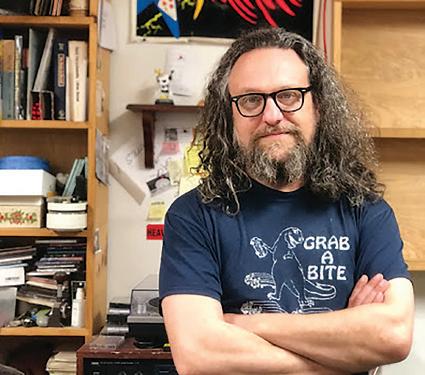
For Ithaca, Angry Mom Records serves as the backbone of the local underground music scene. Located in the basement of Autumn Leaves Used Books on the Commons, it is a safe haven for opinions and artistry to interflow. Often in collaboration with local organizations like the Ithaca Underground, Angry Mom Records fosters an inclusive public space for people from all walks of life to get involved in the music industry. In an interview with The Sun, George Johnann, the owner of the Ithaca record shop, said that his store is especially a place for music fans to congregate and get to know each other.
As a record store owner and a vinyl collector himself, Johnann says that he found the range and depth in the musical taste of Ithacans mind-blowing. Catering to the diverse needs of the local community, vinyls of genres such as reggae, electronica, alternative rock, classics and film score can be seen on the shelves of Angry Mom Records. Speaking on the diverse music taste of Ithaca, Johnann also noted that the local music scene has become “more inclusive than ever.” This inclusivity mentioned by Johnann was reflected by the local artists who performed at Angry Mom Records on Saturday. The 86ers brought a blend of classic honky-tonk and alt-rock to the basement, Nancy Babich performed like a moody, angsty refinement of Sleater Kinney, Jake And The Nowhere Men reinvented The Sonics-esque lo-fi garage punk and Bubba Crumrine permeated the room with an emotional touch of noise and drone. It is exquisite how these different voices could be heard in the same space on the same day. This year’s Record Store Day also marks the tenth year since the opening of Angry Mom Records. A decade into his new career, George said that he especially enjoys working with the younger guys in the store: “They always give me new perspectives on music.” As a closure to the interview, George also added that he “would always love to see more Cornell students getting involved in the local music scene.”
Stephen Yang is a freshman at the College of Agriculture and Life Sciences. He can be reached at sy364@cornell.edu.
Yasujir Ozu’s masterpiece Dragnet Girl came to Cornell Cinema on Wednesday, accompanied by the electronic ambient music group Coupler. The silent film from 1933 follows the story of a minor gangster named Joji (Joji Oka) and his girlfriend, Tokiko (Kinuyo Tanaka), as they attempt to escape a life of crime in the morally corrupt city of Yokohama. Though one of Ozu’s earlier productions, Dragnet Girl utilized the director’s own unique creativity and style while also drawing influence from the Hollywood gangster movies of the time. Before the show started, a brief but comprehensive introduction was given by Andrew Compana, a post-doctoral associate in the Asian Studies department and soon-to-be faculty member. Compana explained the nature and history of Japanese silent film, most importantly the tradition of Benshi, a Japanese orator who narrates the films, often with musical accompaniment. He then introduced the music collective Coupler, who lent an impressive ambient soundtrack to the already compelling silent film.
Although no Benshi was present at this viewing, the accompaniment by Coupler complemented the film perfectly. Most of the sound was comprised of electronic rhythms and bass riffs, but this modern touch never detracted from the original intention of the film. Rather, Coupler’s score was used in conjunction with drums and guitar to follow the rise and fall of tension in the plot, crafting an ambient sound
to match the energy of a scene rather than simply narrating specific sounds. The group did a wonderful job of crafting sound effects in a unique and artistic interpretation, such as a rapid drumbeat to imitate a rattling door, rather than directly imitating noises. In doing so, they lend a unique and contemporary interpretation to the classic film.
The plot and structure of Ozu’s work are perhaps the most unique aspects of the film for an American viewer. The director crafts a story of realistic simplicity on a humble scale, with only four important characters and few action sequences. Instead, the complexity can be found through carefully crafted character interactions and development, told through the silence of nuanced facial expressions and detailed set design.
Ozu pays homage to the simplicity and realism of everyday beauty, rejecting the sound and over-the-top dramatic action sequences that were rapidly gaining popularity in the industry. This attention to detail paired with Coupler’s tension-building accompaniment make for a surprisingly thrilling crime drama.
Dragnet Girl clearly demonstrates the influences of American crime films on Ozu’s early work perfectly capturing the intrigue and suspense present in the Hollywood hits of the mid-1900s. Both the characters and acting were strikingly modern for the context of the film. With his perfectly tailored suit and overcoat, casually worn hat and Ozu’s ominous lighting, Joji plays the role of a silent and dashing hero akin to Humphrey Bogart and other later American stars. In fact, almost every character except Joji’s innocent love interest Kazuko (Sumiko

Mizukubo) wears western clothing, perhaps to criticize the corruption and greed of modern and industrialized Japan. The dramatic camera shots of shadowy faces show the film noir influences of the movie. Dragnet Girl is itself a melodrama, taking place in a corrupt and unforgiving city dominated by flashy gangsters, clubs and dark streets. All of these features may have been new to both Japanese cinema and silent film, but this unique blend of genres offers a suspenseful watch.
Ozu connects and controls the plot and flow of the movie with a dexterous use of camera placement, lighting and thematic repetition. The film is saturated with visual motifs — from adorned suitcases, to obscene numbers of cigarettes, to (my personal favorite) liberal use of billiards chalk on cues. Most notably, his use of lighting and camera placement gives sound and

emotion to the silent picture. These small details in cinematography are what makes Ozu stand out as a director in his otherwise simple movies about ordinary people.
Yasujir Ozu’s Dragnet Girl gives a unique view of a dynamic time in cinema history. The advent of “talkies” and Hollywood’s dominance over the film industry makes Dragnet Girl a refreshingly unique perspective on cinematography. This Japanese silent film is in a league of its own, between the “everydayness” and humor of the silent films of Chaplin and the modern rise of melodramatic Hollywood gangster talkies. Cornell Cinema did well to bring this picture, along with its beautiful accompaniment by Coupler, to Ithaca.
John Wootton is a freshman in the College of Arts and Sciences. He can be reached at jbw@ cornellsun.com.

137th Editorial Board
SUBRAMANIAM ’20
in
DAHLIA WILSON ’19
Business Manager
PARIS GHAZI ’21
Associate Editor
NATALIE FUNG ’20
Web Editor
SABRINE XIE ’21
Design Editor
NOAH HARRELSON ’21
Blogs Editor
SHRIYA PERATI ’21
Science Editor
KATIE ZHANG ’21
Dining Editor
AMINA KILPATRICK ’21
News Editor
JOHNATHAN STIMPSON ’21
News Editor
PETER BUONANNO ’21
Arts & Entertainment Editor
SARAH SKINNER ’21
Managing Editor
MEREDITH LIU ’20
Assistant Managing Editor
RAPHY GENDLER ’21
Sports Editor
BORIS TSANG ’21
Photography Editor
AMBER KRISCH ’21
Blogs Editor
SOPHIE REYNOLDS ’20
Science Editor
AMANDA H. CRONIN ’21 News Editor
ROCHELLE LI ’21 News Editor
MARYAM ZAFAR ’21
City Editor
ETHAN WU ’21
Opinion Editor
Working on Today’s Sun
Ad Layout Medhavi Gandhi ’20
Production Deskers Dana Chan ’21
Mei Ou ’22
Sports Desker Raphy Gendler ’21
Photo Desker Jing Jiang ’21
News Deskers Rochelle Li ’21
Nicole Zhu ’21
Design Deskers Jamie Lai ’20
Laura DeMassa ’21
Xiangyi Zhao ’22
Night Desker Olivia Weinberg ’22
Is it ever morally permissible to risk the well-being of others for a higher purpose?
In a recent “Chat in the Stacks” talk at Olin Library, Prof. Andrew Moisey, history of art and visual studies, admitted that he had taken such a risk with the publication of The American Fraternity (2018). The American Fraternity is anww art book of photographs taken by Moisey at a UC Berkeley fraternity. It includes images of women passed out, nude and in compromising positions, their faces at times obscured. In the Q&A session, Moisey recognized that these images pose a risk to the women depicted, should the women be identified. He said he believes the risk was worth taking, though he “didn’t feel like [he] had a clear moral way of seeing things.” I believe this lack of moral clarity led to the wrong decision. Moisey should not have published the photographs.
revealed? There have been other exposés of fraternity culture (for example, Caitlin Flanagan’s 2014 Atlantic article and the 2016 film Goat), and thousands of students have experienced fraternities firsthand. Moisey might respond by appealing to the special power of the medium or of the particular photos. But I find it hard to imagine that either will have a profound effect. Does Moisey really believe that his book will be the coup de grâce to the American fraternity? In fact, looking at the book itself, it is not even clear that it is a critique. Instead, it strikes me as an ode to a now-shuttered fraternity. Why else give large prints of the photographs as perks in his Indiegogo campaign, but to memorialize something lost?
THE MORAL CASE FOR CORNELL DIVESTING FROM FOSSIL FUELS has long been clear. Simply put, the University should not hold equity in resource extraction firms that have sent the planet hurtling toward climate ruin.
An overwhelming body of science tells us the fallout of human-caused climate change will come in the form of severe developing-world food insecurity, more frequent extreme weather events and worse economic growth. Projections indicate death, disease, dislocation and malnutrition will sharply rise, especially for the global poor. The cost in human misery will be enormous. And such suffering will be at the hands of fossil fuel companies — 90 of which account for two-thirds of all industrial-era carbon dioxide and methane emissions, according to a 2017 study.
All this plainly meets the Board’s own standard for divestment, established in 2016, which stipulates the University will only divest if the offending company’s actions are “morally reprehensible.” The point of divestment, then, is to stigmatize fossil fuel companies, to make the enterprise seem grimy and unattractive to the broader public.
But even for how open-and-shut the moral case is, the political and financial cases have continued to nag. Is it the University’s place to make a political statement with its investment portfolio? Should Cornell put its endowment returns, and thereby its fiscal health, at risk by divesting? Indeed, as recently as 2013, The Sun reckoned the answer to both questions was no, opposing divestment.
Yet the picture has changed. Though the Board voted down divesting from fossil fuels in 2016, its divestment standard provides an unambiguous answer on whether Cornell may wield its investments for political ends. Yes, the Board said, Cornell very well can make political statements with its endowment, given “harm so grave” that not divesting “would be inconsistent with the goals and principles of the University.” No doubt climate change, wrought largely by fossil fuels, counts. As we argued following the Board’s vote, “By all standards, the fossil fuel industry meets the Board’s requirements for divestment.”
The Cornell community, moreover, has made its political preferences known. A 2015 open letter to the late President Elizabeth Garrett garnered over 500 faculty and student signatures. All five shared governance bodies — the Employee Assembly, Student Assembly, University Assembly, Faculty Senate and Graduate and Professional Student Assembly — have passed measures urging full divestment by 2035. But the Board’s 2016 vote, in a profoundly undemocratic display, unilaterally swept them all aside.
The Board’s basic objection to divestment is financial. Yet the data seem not to support such concerns in the short run. As Joe Rowland ’73, a former candidate for alumni-elected Trustee, noted last month in our pages, investment funds which exclude oil, gas and coal firms have in recent years notched higher returns than the market baseline.
That poor performance will likely worsen over time. Just about all energy firms own assets, such as offshore oil rigs and drillships, that will lose value as oceans rise and extreme weather events grow more frequent. That’s a risk to companies’ bottom lines. To insure their assets against such risks, it’ll cost oil and gas companies over 4 percent of their total market value, calculates the investment firm Schroders — dragging down the performance of fossil fuel stocks.
Companies that forego climate insurance risk having their assets suffer catastrophic physical damage. So whether through insurance costs or direct climate-related damage to assets, energy firms will eventually pay the cost of climate change. When their rude awakening comes due, the financial case for holding their stocks will further deteriorate. For these reasons, the Board’s argument that ditching fossil fuel investments would jeopardize Cornell’s fiscal well-being carries little weight. It is more an expression of a hollow status-quo bias — coupled with a disregard for self-inspection or democratic input — than a serious case against divestment. Editorial
Here are some relevant facts of the case, as described by Moisey himself and by Alexis Schrader, a UC Berkeley graduate, who criticized Moisey’s book in Bust Magazine. First, Moisey received written consent from the fraternity members to publish the images, but not from all of the women. It is not clear that the women were even of age. Next, while he obscured the faces of some of the women to keep their identities private, at least 13 of the 18 women in the book are identifiable by someone who knows them but was not at the party, as per Schrader’s Bust piece. So, Moisey used images of women, without their consent, and the women are identifiable by those that know them. Why take this risk?
According to his Indiegogo campaign, Moisey felt that the book needed to be published in order to reveal “what really happens inside fraternities and the influence they wield in American power.”
I don’t think this justification is adequate. To see why, let’s take a look at the three major ethical traditions: Kantianism, consequentialism and virtue ethics. Each has something to say about why Moisey’s choice to publish the photos was wrong.
Kantians believe that one has a duty to never use someone as a mere means to one’s own end, even if the end is noble. Moisey used the women in the photographs to criticize American fraternity culture, but disregarded the need for their consent. And the women would not have consented, as we now know: Upon learning about the photos, several women depicted were upset. Further, Moisey seems to believe that women are to blame for fraternity culture. At a recent talk at Kenyon College, he suggested that fraternity culture depends on the involvement of women; if women stopped going to fraternities, the culture would fall apart. This might be true, but men are still responsible for what they do, not women.
The potential benefits of publishing these photographs without consent seem minimal. What are the potential costs? The harm that the photographs could cause is dramatic and more likely than the potential benefits. As Alexis Schrader points out in her Bust article, the women in the book could suffer tremendously if these photographs were shared in their workplace or with their families. Imagine if an image surfaced of a young Elizabeth Warren at a fraternity party, her shirt open, drink in hand. Is it cynical, or only realistic, to think this would end her presidential bid?
Publishing these photos without consent ignores the agency of the women depicted, fails a cost-benefit analysis and violates a morally important sensitivity to the well-being of those more marginalized.
Finally, it seems to matter that Moisey presents as a cis-gendered, hetereosexual, white man — and so is insulated from the worst aspects of fraternity culture — while the women whose well-being he gambled with are not. A final approach to ethics, virtue ethics, can help us capture this. Virtue ethicists believe that our actions should be aimed at developing virtues. One important virtue, I believe, is a sensitivity to the well-being of those more marginalized than oneself. This virtue seems especially relevant when one has a lot to gain. In his Olin talk, Moisey denied that he has any profits to share from the book. However, as academics, the real profit of publishing is career advancement. To gamble with the well-being of those who have far more to lose, in a way that advances his own career as a tenure-track professor, clearly does not foster virtue.
One might be tempted to defend Moisey’s choice as brave and generous, both virtues. But Moisey lacked the practical wisdom to see that publishing these photographs presented the greatest risk to women, already a primary target of fraternity violence. Moisey himself had little to lose. The act was neither brave nor generous.
Not everyone is a Kantian. Consequentialists believe that ethics is a matter of weighing the projected costs and benefits of an action. This cost-benefit analysis, applied to Moisey’s book, does not work out in his favor. First, the benefits. The impact of these photographs is unclear. What new facts are
The choice to publish these photographs without consent ignores the agency of the women depicted, fails a cost-benefit analysis and violates a morally important sensitivity to the well-being of those more marginalized. These lessons derive from the major ethical traditions, but also stand on their own. Moisey should have recognized that the choice to publish these photographs was wrong, even if it meant the end of the project. Consent is for Cornell faculty, too.
With the semester coming to an end with four more weeks of school left, I took a peek at how many BRBs I had left. Opening the GET app has always been a moment of tension and anticipation. BRBs, despite being just regular money labeled in special Cornell jargon, represent my special Martha’s Cafe salad money, my midday hazelnut latte money and my Chobani mango yogurt money. BRBs are special and are my resource for funding my meals on a daily basis. With the lack of dining halls accepting meal swipes, the amount of BRBs I have determines the fate of my next meals. I may love the chickpea feta salads and four different cake flavors of Okenshields, but nothing surpasses my love for Mac’s flatbreads doused in balsamic glaze or the freshly toasted “Green Goddess” sandwich from Goldies.
The GET app finishes loading, and my heart drops as the ominous number lingers in my mind. Immediately, I start calculating and find that I have just enough BRBs for about four more meals at my favorite eateries. With an unlimited meal plan, I’m about to become a loyal Okenshields regular.
I’m fortunate enough to even be able to have a safe back-up plan in the case of deprived BRBs with
With extremely high-priced meal plans and expensive meals, it’s hardly surprising food insecurity is a prevalent issue on campus.
limitless meal swipes, but for some Cornell students, a meal plan is unaffordable in the first place and food is a delicacy. With extremely high-priced meal plans and expensive meals, it’s hardly surprising food insecurity is a prevalent issue on campus.
Even beyond the unaffordability of eating on campus, students face a larger crisis of overeating and undereating. To cope with stress, some students may tend to treat themselves to more than three plates of food at the buffet-style dining halls, going in for seconds or thirds of the shrimp shumai or chocolate
Ifelt like a cliché. The college grad who faces a crisis over her own personal fulfillment, so she wants to leave the country and start a life abroad — but is too scared of societal pressures and whatever conditioned ideas of success she has, so she stays.
I’ve thought of these recurring thoughts and the idea that people don’t understand me , or no one knows how I feel . But the feelings of misunderstanding, isolation, longing and restlessness — they’re not new. People have felt these emotions over and over, by those who have lived hundreds of years before and those who will come after. This isn’t about big innovations or life-changing ideas. It’s the feelings and internal struggles we face every day. I am not alone in my conflict.
In 1994, photographers Ari Versluis and Ellie Uyttenbroek created a project called “Exactitudes.” They documented and compiled unidentified subcultures, scanning the streets for people whose clothing seemed representative of their identities. The individuals were invited back to a studio to be photographed, wearing what they had worn on the streets. The photos were then arranged in a grid of 12, de-emphasizing the individuality and uniqueness of each portrait and placing an individual within others who are styled the same. The “individual” who seems to embody a particular stance against mainstream culture, or
cake. But conversely, other students also react to stress by skipping meals. And once this toxic pattern starts, everything goes downhill, as stress eats away at students’ health and state of mind. Shamefully peering into the closed cafe or feeling too exhausted to cook a meal, students can’t afford the time or energy to feed themselves, which is an extremely concerning issue.
Other factors can also contribute to students’ poor eating lifestyle on campus, including flaws with the way the dining halls themselves are structured. Strange hours sometimes don’t accommodate a good portion of students’ class schedules, there’s a lack of dining halls accepting meal swipes, drastically limiting the options for those on meal plans and there’s a lack of availability of the nutrient information of most foods at the dining halls.
Don’t get me wrong, though. The quality of the food is notably quite amazing and the selection of food is relatively diverse, aiming to represent the multicultural community of Cornell, as well as a basic diversity of taste. I was able to smoothly transition into my pescatarian lifestyle, infinitely grateful for a large number of pescatarian options in pretty much every dining hall. I’m also always amazed and thankful for the dining hall cooks who invent new recipes and create a unique and satisfying dining experience.
The problem isn’t the food itself. It’s the access to this food. The prevalence of food insecurity might surprise some, but it’s dishearteningly real and manifests itself in the student culture. The topic of food insecurity has been a slight murmur within the sea of students, when really the issue of food insecurity requires urgent attention, whether at Cornell or on a global level.
All of these combined factors, ranging from money to academics to weaknesses in the dining hall structures, lead to food insecurity in such a shockingly comprehensive way that makes me think, “Why does it have to be like this? And what can we do to prevent it from getting even worse?” While tackling the complex and overwhelming issue of stress at Cornell may not be as straightforward and easily achievable, alleviating the amount of food insecurity and poor eating decisions is. We just need to take baby steps.
And to take the first baby step, we need to be vocal and loud about the issues we care about. If we can’t
their own distinctive and original style, is placed against others similarly dressed: They are not as unique as they thought.
Misunderstanding, isolation, longing and restlessness — they’re not new.
Perhaps it’s our fascination with the ego, our attachment to our sense of self. We find pleasure in curating our identities to express our own individuality. This “I” we attach to all things, however, produces a heavy weight to everything we do or say — all of them come with our upbringing, cultural values, relationships and environment. In 2016, Eddie Dreyer ’19 wrote an article on the problem of the ego and the benefits of going beyond those restrictive barriers in order to “free your soul.” When one thinks in relation to their own ego, it causes selfishness, disconnection from nature, feelings of inadequacy, lack of empathy for others, anxiety and excessive desires.
Living in a Buddhist country, Thailand, for five months allowed me to develop my own way of living, one that adopted Buddhist values with my own past experiences coming from the United States. When we think of anatta ,
afford our next meals, let’s shout. If we find ourselves skipping lunch and dinner or grabbing our fourth
If we can’t afford our next meals, let’s shout. If we find ourselves skipping meals or grabbing our fourth plate of grilled cheese in response to stress and academic commitment, let’s yell.
plate of grilled cheese sandwiches in response to stress and academic commitment, let’s yell. We need to speak up about these things instead of speaking down and burying these issues as just another unsolvable crisis. We need to make sure that action happens on the University’s part but also on the general student body’s part in recognizing the issue and making sure everyone is able to fulfill their basic human right of being healthy.
There’s a lot we still need to do, but powerful efforts have already been made. A program created by Cornell Dining called “Swipe Out Hunger” allows students to donate their leftover meal swipes, which are given to eligible students enrolled in the Swipe Out Hunger meal plan. Students living on the West Campus meal plan can also sign up for free bagged lunches. The student-founded and student-run food pantry Bread N Butter provides free cooked meals in Anabel Taylor Hall. Raising awareness of these resources and of other free food opportunities, the massive free food GroupMe group chat also plays an essential role in increasing access to food on campus. We’ve made immense strides in our efforts to alleviate food insecurity at Cornell to a certain extent, but there’s also something we can all do: Speak loud above the growling of empty stomachs for the protection of our very well-being.
or “no-self,” we began to unlearn the idea that there is an “I” attached to all things. The self is the source of dukkha , or things that are unsatisfactory or cause pain and suffering — the self in relation to desires, greed or power. When I learned about anatta , anicca (impermanence) and dukkha in Thailand — the three Buddhist marks of existence — it drove me to act both unselfishly and more kindly.
Letting go of “I am” made things hold less weight, and that starts from realizing how much what Dreyer describes as the beliefs your ego has adopted through your family’s cultural values, upbringing and how society has made you think is external and has no effect on your core. I learned that yoga, which was something I had enjoyed since I was young, works
join cattle. To yoke aggressive cattle can be translated to calming the mind and bringing it under control.
We live in a society that prides itself on the individuality and uniqueness of people. We place a large emphasis on how we are able to create our own lives to meet certain goals we’ve set out for ourselves. But perhaps it is comforting to know that we are not alone in the uncertainties we face, the hardship, the pain, the desire to break free of a system. The de-emphasis on “I” in relation to how we think, speak and act unifies the commonalities of who we are, rather than makes us lose our sense of self.
Perhaps it is comforting to know that we are not alone in the uncertainties we face, the hardship, the pain, the desire to break free of a system.
with the body through the process of “letting go.” Many Buddhist and Hindu beliefs find their way into yoga practice. The word yoga comes from the Sanskrit word for yoke, yuj , which is used to

Fill in the empty cells, one number in each, so that each column, row, and region contains the numbers 1-9 exactly once. Each number in the solution therefore occurs only once in each of the three “directions,” hence the “single numbers” implied by the puzzle’s name. (Rules from wikipedia.org/wiki/ Sudoku)






2
Ithaca
5
Collegetown 1 & 3 Bedroom Apts. Available for Next School Year 2018-2019. 607-327-2927
NORTH CAMPUS
Studio and 3 bedrooms Available 2019/2020 Novarr-Mackesey Property Management office@ithacastudentapartments.com ithacastudentapartments.com 607-277-1234
Boldly Refined Living
Overnight concierge. 607-273-9777 or 312collegeave.com
site. Prices start at $740/month for a 12 month lease. If you have any questions or would like to schedule a tour contact us by phone 607-208-7660 or email: renting@ithacaLS.com
COOK ST. Furnished House for 5-7 persons, 10mo. Lease for 2019-2020
Text or call Tracy at TLC Property Mgmt Corp 607-379-2776
3 BEDROOM Nice, clean, furnished unit can host up to 12 people.
303-309 Dryden Road
Heat, Hot water included.
Fiber Optic fast internet connection Laundry, parking available 607-279-1888 www.porealty88.com
Collegetown Terrace Apartments INSPIRED LIVING TAILORED TO YOUR SUCCESS
24-Hour Fitness Center
Shuttle Bus Service to Campus
Study Rooms w/ Expansive Views
Apartments Available NOW, Spring 2019 & 2019/2020 Novarr- Mackesey Property Management collegetownterraceithaca.com office@ithacastudentapartments.com
607-277-1234
COLLEGE AVENUE 1 BEDROOMS 607-272-3389 avramisrentals@aol.com
The Top of Collegetown Dryden Rd-Linden Ave 3 BR Apt & House 2019-2020 607-351-1115 ksteel202@yahoo.com 3 BEDROOM SOUTH HILL
Large apt, washer/dryer furnished. $550 pp 607-272-3389
1-Bedroom Apt Downtown
1 Bedroom Apartments Bright nice and clean, Great location Linden Ave $895 to $950 plus electricity Call 607-237-2541 or 607-227-2535 Downtown / Fall Creek Renovated 3 Bedroom Grad student apartment Walk to everything $1950 plus utilities 607-592-0475
Available June 1 (or earlier) Ideal for Grads or Staff. Lovely one bedroom second floor apartment. Downtown on Cascadilla St. near N. Albany St. Carpeted bedroom and living room (with rustic real wood paneled walls), full bath, kitchen. Bus line in front of house that goes to Commons, then on to Tower Rd. on Cornell Campus. Private porch. $890 plus utilities, available June 1. (anytime after 4/15) NO undergrads, no dogs, no smokers, references. For info and appointments email gm27@cornell.edu or text 607-280-4024.
==SPRING BREAK SPECIAL== Furnished 3 Bedroom Collegetown Apartments PARKING, LAUNDRY, UTILITIES! (607)273-7368
Now Renting for 2019-2020 3-7 Bedroom Apartments All locations. Contact us today or visit our website: certifiedpropertiesinc.com Certified Properties of TC Inc 273-1669
W. LACROSSE
Continued from page 16
player, and is often faced with defending really tough offensive players,” Bonanni said. “Without [Lis] in there [Saturday], the game would probably have ended much differently.”
But the Red’s offense was strong in its own right, too. Cornell still has only failed to score double-digit goals in one game this season, and attackers sophomore Olivia Jensen and senior Tomasina Leska recorded hat tricks in Saturday’s win.
But it was the Bears that first made it onto the scoreboard, with a goal less than three minutes into the game. The Red responded with a goal by Jensen followed by two more from senior captain Sarah Phillips.
Brown scored two more of its own before the Red went on a three-goal run, with goals by Jensen, Leska and senior captain Caroline Allen, to enter halftime with a 6-3 lead.
Brown again scored first after the half, but
On the diamond
27 H OUSE FOR R ENT
2019-2020 Upper Eddy St. 7 Bedroom House Furnished. Internet. Laundry. 607-273-8576
Linden Ave. 5 Bedroom House Available June 2019. $900 per bedroom. Parking included. 607-327-2927
Cornell went on another three-goal streak, scored again by Jensen, Leska and Allen.
Brown responded with its own three-goal run to tighten things up, but Leska scored her third goal of the day with less than 25 seconds remaining to top off the win for Cornell.
The win sets Cornell up for a shot at the Ivy League title. The Red is 4-1 in conference play, tied with No. 24 Dartmouth atop the conference with two league games remaining. No. 9 Penn and No. 16 Princeton are both half a game back at 3-1.
“An Ivy win is always awesome, but beating Brown, who is very strong this year, puts us in a great place as we approach postseason play,” Bonanni said.
The Red will hit the road to play No. 3 Syracuse this Tuesday before resuming Ivy play Saturday against Dartmouth in Hanover.
Gracie Todd can be reached at gtodd@cornellsun.com.


By RAPHY GENDLER Sun Sports Editor
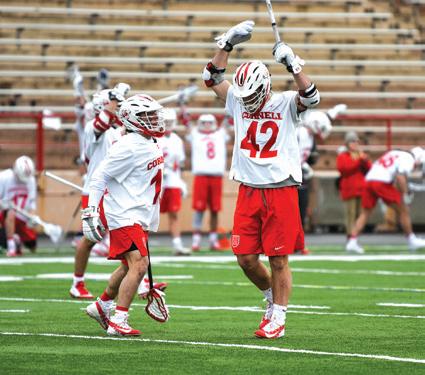
Days after a road loss to Syracuse, Cornell men’s lacrosse rebounded with a nonconference win, downing another high-profile squad to boost its national profile as it heads into the home stretch of Ivy League play.
While Cornell’s identity — and primary source of success — is its high powered offense, its defense and goaltender allowed it to beat Notre Dame on the road, 11-9, on Sunday afternoon.
Freshman goaltender Chayse Ierlan made 17 saves, weathering a game that saw the Red commit six penalties to the Irish’s one. Ierlan also made 17 stops at the Carrier Dome last week.
“I think he’s done very well, I’m happy with the mentality, I’m happy with his work ethic,” head coach Peter Milliman said of the goaltender midweek. “I think he’s a great teammate and he fulfills his expectations when it comes to that.”
Senior attack Clarke Petterson and junior midfielder Cooper Telesco scored three goals each for Cornell. The three goals mark a career-high for Telesco.
After the 13-7 loss to Syracuse, which Milliman called his team’s “best defensive game we’ve played all year,” Cornell surrendered single-digit goals for the fourth time this season.


“We had to change some things defensively, about midseason,” Milliman said after the Syracuse loss. “We had to make some significant system changes, and that set us back a little bit. And I kind of saw that that was gonna take a little while.”
But for a second straight game, Cornell’s defense stepped up to the task despite modest offensive production. Against the Orange, Cornell scored fewer than 11 goals for the first time all season — Cornell’s
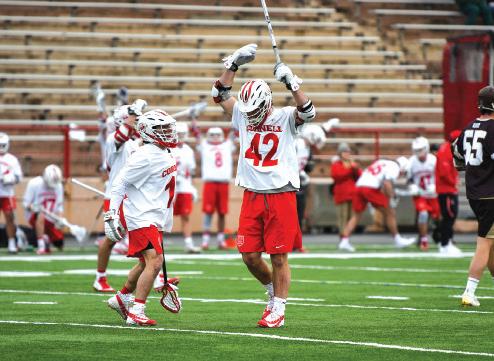
11 goals against the Fighting Irish tied for its second-lowest output of the year.
The offensive production was enough, though, given Ierlan and the Cornell defense’s ability to hold the Irish at bay. The Red knew goals would be at a premium — Milliman said Notre Dame presents a “Yale-level defense.”
Leading 7-6 after the third quarter, Cornell’s offense went to work, completing a five-goal run to take a 10-6 lead with less than six minutes left in the game. While it seemed Cornell’s offense had put the game away, Notre Dame went on a threegoal run to pull within one goal at 10-9 before the Red reestablished a multi-goal lead for the final

11-9 margin. The back-and-forth game featured six ties.
Two straight games at Syracuse and Notre Dame — two of the toughest road venues in college lacrosse — promise to put Cornell on an upward trajectory heading into its final two games of the season. Cornell is 2-2 in Ivy League play — tied for third place — with two conference games remaining. The Red takes on Brown at noon Saturday in Providence. Cornell’s final game of the season comes April 27 against Princeton.
Raphy Gendler can be reached at rgendler@cornellsun.com.
By GRACIE TODD Sun Staff Writer
Now with just three games remaining in the 2019 season — all against nationally ranked opponents — Cornell women’s lacrosse set itself up for a shot at the Ivy League title with a home win over a tough Ivy team.
On a sunny Ithaca day in front of an enthusiastic home crowd, the Red took down Brown, 10-7, to improve to 4-1 in league play.
The Red showcased its dominant defense, as before Saturday, Brown had not scored fewer than nine goals in a game this season.
“Holding Brown to such a low number of goals was really
a great thing for our defense to accomplish,” said junior captain Mary Kate Bonanni. The game also demonstrated
“It showed how much depth we have as a defense, and that we’re very adaptable.”
Mary Kate Bonanni
the Red’s depth — Cornell got the win despite injury-related absences.
“We faced some major adversities early this week with two very impactful players in our defensive end getting injured,” Bonanni said. “So the performance against Brown
was really empowering. … It showed how much depth we have as a defense, and that we’re very adaptable. A lot of players stepped up.”
Junior goalkeeper Katie McGahan made 13 saves — five in the first half and eight in the second — tying her season high.
“It wouldn’t have been the same game without [McGahan] in the goal playing absolutely incredibly,” Bonanni said.
Also playing exemplary defense for the Red was junior Taylor Lis: The player she was tasked with defending didn’t record a single point.
“[Lis] is such an impactful