



By CARLIN REYEN Sun Staff Writer
As yet another year rolls around, a new college admissions cycle has recruited the next group of future Cornell students: The Class of 2026.
On Monday, April 11, the University announced that it had admitted a total 4,908 applicants from both Regular and Early Decision pools, noting a “talented and diverse” class from “a broader range of places than ever before.”
Admitted students represent 85 countries and all 50 U.S. states including Washington, D.C.; Puerto Rico; the U.S. Virgin Islands; Guam; American Samoa and the Northern Mariana Islands.
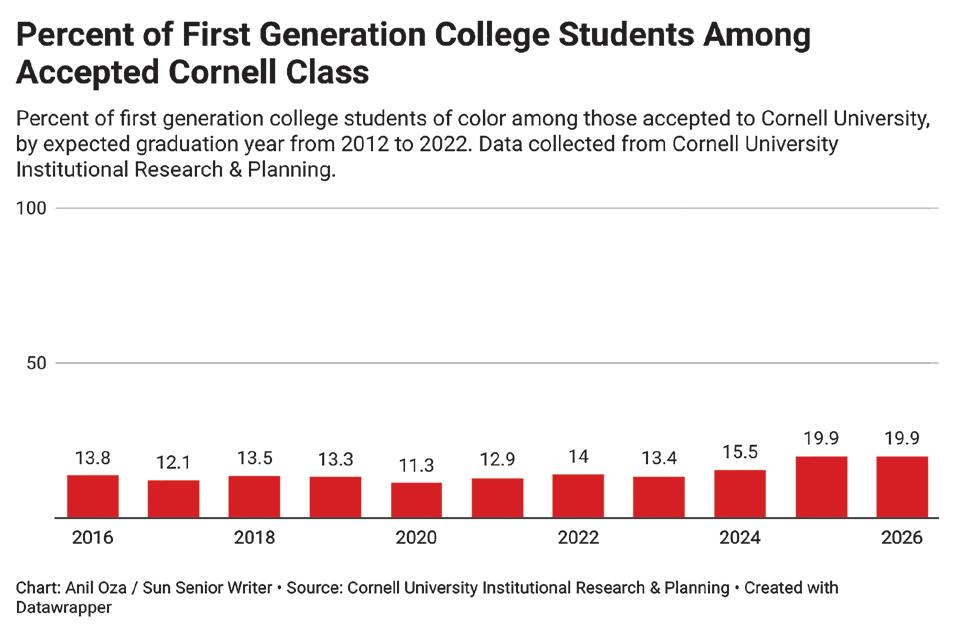
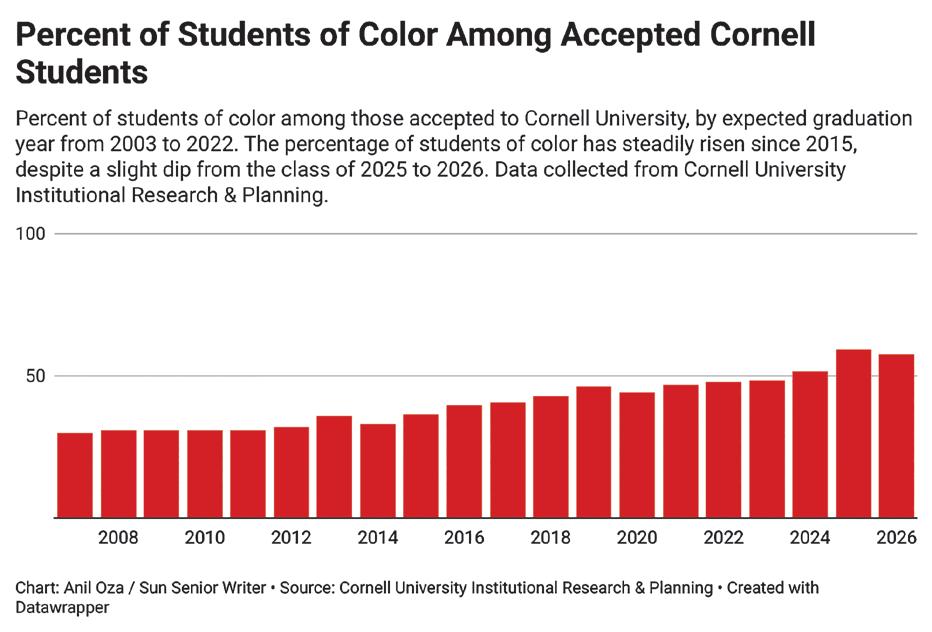
Additionally, 57.7 percent of admitted students identifying as underrepresented minorities self-identified as students of color and 19.9 percent of admits will be first-generation college students.
Director of Undergraduate Admissions Shawn Felton attributed the diversity of the admitted Class of 2026 to virtual events which enabled the University to reach
students in an array of places.
“This expanded audience, due to greater access, speaks to the founding of the university — the diversity of person, practice and thought — that makes us who we are,” Felton said in a University press release.
In December 2021, many incoming students received acceptances to the University under the Early Decision
program, marking a rewarding end to the often-stressful college admissions process.
“Honestly, I felt more relieved than anything after I got in Early Decision,” said Jerry Wang, an admitted student from Germantown, Maryland.
By SOFIA CHIERCHIO Sun Staff Writer
Many students use spring break, a weeklong period in which students take a break from their rigorous schedules to relax before the end of the academic year, as an opportunity to escape the frigid Ithaca weather,
others to visit family and friends. For some first-year students, the break served as an opportunity to reflect on their first year at Cornell.
Vindhya Kathuria ’25, an international student from Copenhagen, Denmark, used her vacation to travel to Fort Lauderdale, Florida, to escape her school-related stress.
“I purposely didn’t bring my laptop with me so I wouldn’t be tempted to work during break. I feel that I was finally able to properly relax,” Kathuria said. “I do realize, however, that I am fortunate not to have prelims as soon as I return from break, which isn’t the case for most students.”
Unlike Kathuria, Aneesha Kodati ’25 did
not find the break to be long enough for her to fully relax.
“I traveled to Washington, D.C. with the Bhangra team, which was so much fun, but I do feel like a little more time would’ve helped,” Kodati said. “In college I barely
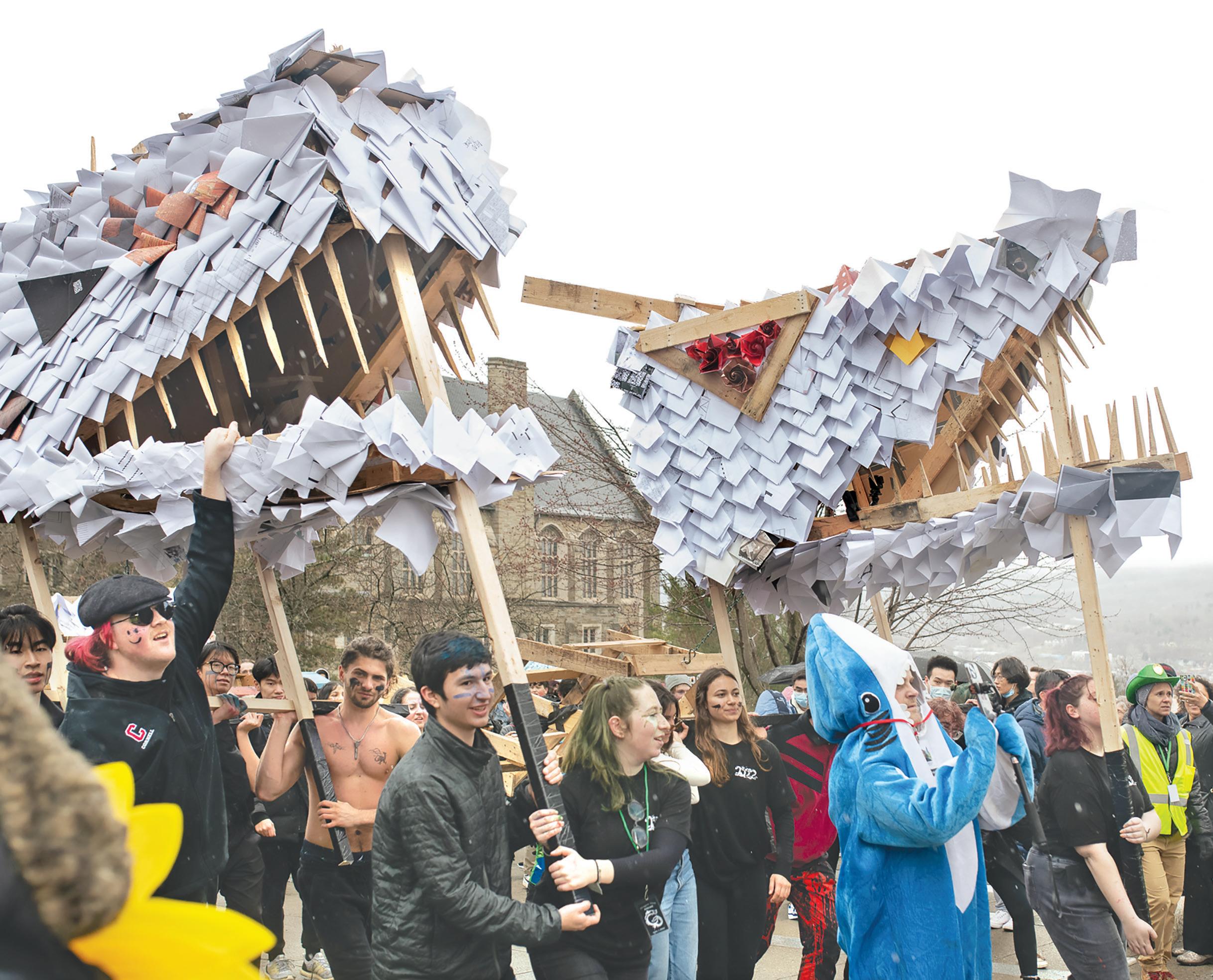
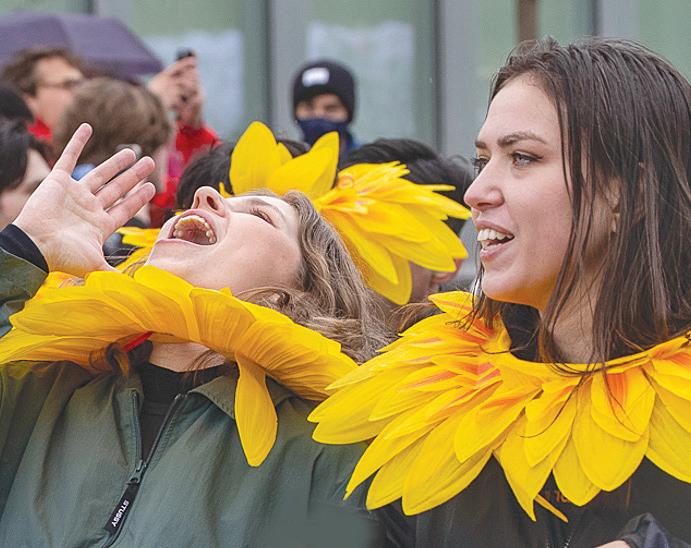
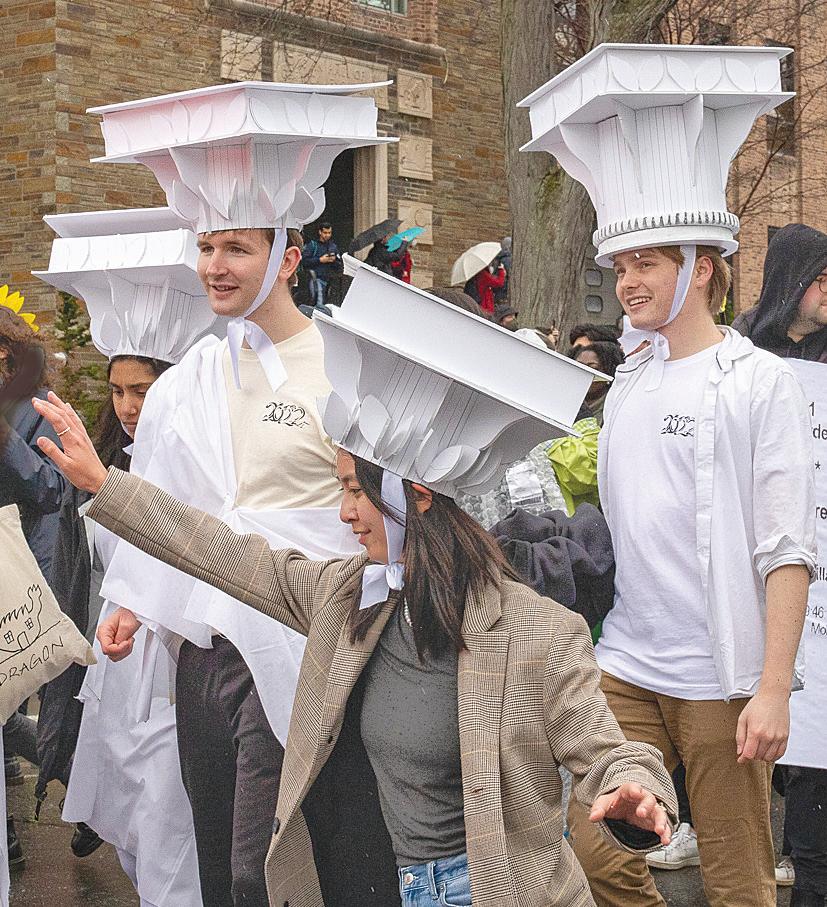
Past is present | Below: After two years’ absence, the first-year architects’ dragon — this one double-headed — makes its annual circuit around central campus on Friday, April 1. Right: Upperclass architects celebrate by dressing up as sunflowers and classical columns.

Continued from page 1
have enough time to focus on anything besides school and my extracurriculars that I think some more time to relax would’ve been beneficial.”
Many Cornellians, including Bradley Wang ’25, used this break as an opportunity to spend time with family.
“My mom ran the Paris marathon, so I was able to go and sup-
“I eventually learned that everything falls into place, and just to go with the flow.”
Aneesha Kodati ’25
port her,” Wang said. “After that, I visited my sister at her college in Boston. It was a much-needed break.”
With the end of the academic year just four weeks away, some freshman students were able to take the time during spring break to look back on their first semesters at Cornell, and what they wished they could tell themselves before starting their journeys as Cornellians.
Kathuria felt that she prioritized her academic life over her mental health and social life during her first semester and wished to be more spontaneous.
“I wish I could tell my first-semester self to live in the moment and to say yes more; whether going on a spontaneous hike, trying out a new restaurant in college town or seeing a movie,” Kathuria said.
Similarly, Kodati said that she felt she should have let go of some of her apprehension while coming to Cornell and live in the moment.
“I’d love to tell myself to trust the process. I was so stressed going into college, unsure of how my future would unfold,” Kodati said. I eventually learned that everything falls into place, and just to go with the flow.”
Like Kodati, Wang learned to seize the new opportunities that were presented while entering college.
“I would tell my first-semester self to just have fun with it. I knew college would go by fast, but I didn’t expect it to be this quick,” Wang said. “Just take advantage of all the new opportunities, socially and academically.”
Sofa Chierchio can be reached at sc2339@cornell.edu.
ADMISSIONS Continued from page 1
“It was so stressful writing essays and supplements that I was just glad I didn’t have to apply to any more colleges.”
The University no longer releases acceptance rates during the current admissions cycle, and admission rates for the Class of 2026 will not be released until the middle of this upcoming summer when the admissions cycle has ended. The Class of 2025, however, broke records for the lowest acceptance rate in recent years of 8.7 percent, with 67,830 applicants and 5,836 admitted students.
For high school seniors that applied through Regular Decision to Cornell, March 31 marked a long-anticipated day in the admissions process: Ivy Day, the day when students receive acceptances to Cornell among other universities in the Ivy League.
Haein Kim recalls her excitement at finding out that she had been accepted Regular Decision to the College of Arts and Sciences just over a week ago.
“I was opening decisions with my best friend and when we saw the ‘Congratulations’ at the top of the page, we were both laughing and jumping around,” Kim said. “I felt that a huge weight had been lifted off of my shoulders.”
Many incoming students of the Class of 2026 are looking forward to different aspects of the Cornell experience including the University’s unique Physical Education class offerings, student organizations and college-specific educational opportunities.
For Emma Weiss, Cornell’s academic programs, especially opportunities for her Biomedical Engineering major, prompted her to apply Early Decision to Cornell’s College of Engineering.
“I can have a concentration
“...when we saw the ‘Congratulations’ at the top of the page, we were both laughing and jumping around.”
Haein Kim
[specializing] in biomechanics, which is the part of [Biomedical Engineering] that I’m most interested in,” Weiss said.
Similarly, Aaron Zhu, who received his admission decision on March 31, said that the entrepreneurship resources offered at Cornell’s Economics major program led him to apply to the College of Arts and Sciences.
Zhu, from Bryn Mawr, Pennsylvania, also said that he was excited to take Physical Education classes such as Physical Education 1300: Introduction to Bowling, Physical Education 1654: Ice Climbing and Physical Education 1690: Cross Country Skiing.
Although academic and
extracurricular programs catch the eyes of many admitted students in their decision to attend, financial aid offers also play a major role in the decision according to the students. Wang said that Cornell’s financial aid office had been “pretty helpful” when he appealed his financial aid package.
“It was resolved in just a week after I got accepted,”
Wang said. “Although I think my cost increased because of tuition increases, but aid didn’t increase along with it for some reason.”
Previously, financial aid delays during the Fall 2020 and Fall 2021 semesters have left some students without their financial aid package information even into the start of each respective semester.
Kim is one student who has not yet received financial aid information, and says the package will be a determining factor in her attendance this fall.
According to the University announcement, Jonathon Burdick, vice provost for
enrollment, said that Cornell has recently affirmed its com-
“Students are arriving along with a renewed Cornell commitment to supporting ‘any person’ with the financial support...”
Jonathan Burdick
mitment to providing needbased financial aid and is ready
to assist newly admitted students with the financial aid process.
“Students are arriving along with a renewed Cornell commitment to supporting ‘any person’ with the financial support they need, including a $500 million [To Do the Greatest Good] fundraising campaign for undergraduate financial aid,” Burdick said in University press release.
Carlin Reyen can be reached at creyen@cornellsun.com.



The second season of Bridgerton does what Bridgerton does best: romance. Fireworks over garden parties, empireline gowns and public kisses that demand the suspension of disbelief — the second season delivers on everything fans loved about the first. Nobody will praise the show for its plot; rather, Bridgerton is the ultimate comfort show with a romance that is palatable, fun and entirely contrived.
Bridgerton returned to Netflix for its second season on March 25, and the familiar pressure and scandal of the marriage season framed by classical renditions of pop songs make the show feel like itself. However, the new season is even less plot-driven than the first, and many of the storylines feel overdone.
The second season centers around Anthony Bridgerton, the eldest Bridgerton brother, as he searches for a wife in order to fulfill his duty to his family. While Anthony is courting Edwina Sharma, he falls for Kate Sharma, the older, supposedly “undesirable” sister. While Kate’s maturity is a breath of fresh air from the purity
and naïveté of Daphne, the last season’s main female character, the trope of two sisters being pitted against one another in their desire for one man nevertheless feels stale. Kate’s iron will can only achieve so much in the name of strong female characters while she continues to be a source of character development for a man.
The love triangle develops excruciatingly slowly across a number of painfulto-watch scenes that force the audience to suspend their disbelief — no way could Anthony and Kate stare at each other so openly without creating a scandal. High society seems to be observant only until it stops suiting the plot — and how does the couple always just happen to end up in the woods alone together? The central tensions of the season are also overdone repeats of the last: Anthony experiences the exact same character conflict of love versus duty as he did in the first season, and the audience has also already seen characters’ daddy issues before.
Other elements take me out of the show, too: why is the Queen so involved with discovering the identity of Lady Whistledown, the town’s scandal writer? She is supposed to be the formidable Queen of England, yet the second season
portrays her as another gossip-obsessed woman, which only adds to how tired and grating I found the Whistledown plotline. And every time a character uses the word “ton” to refer to London — for example, “the scandal of the ton” or “the best ball the ton will ever see” — I wanted to shut my computer.
However, despite the season’s shortcomings, the romance is ultimately what makes the show worth watching. Nobody expects Bridgerton to be strong in its plot; as an avid consumer of historical dramas, I went into the second season expecting nothing more than familiar characters, outfits and feel-good romance. From the second Kate is introduced on horseback with her unkempt hair flying behind her, the audience knows she and Anthony must end up together, making the show all the more enjoyable.
“You are the bane of my existence and the object of all my desires,” Anthony deliciously tells Kate. Bridgerton specializes in the romantic female gaze of soft touches, sensual hands, hungry looks and strained breaths. Anthony and Kate’s relationship is at the heart of the season, and their love grows from loathing over a series of “almost” moments with light touches and
near-kisses interrupted by rustling, thunder or a sister. The show has gained true mastery over the art of suspense.
When the couple finally drops the pretenses and makes love, the show does an excellent job of portraying Kate as an enthusiastic participant of sex rather than a naïve girl whose lover performs sex unto her. The camera focuses on Kate’s face experiencing pleasure, and she claims agency by repeatedly telling Anthony, “Do not stop.”
The thread that connects the second season to the first, and the area where the show fully shines, is its humanity. The flashbacks to Anthony’s father’s death humanizes him by letting us peek into Anthony’s headspace, motives and pressures. Later, Anthony shares a tender scene with his mother where she speaks about the power and value of “real, true love” that makes all the pain worthwhile. As Anthony cries, the show ascends beyond just goofy dialogue and predictable plots. The emotion, here, is what makes Bridgerton more than just easy to watch, but also ultimately moving.
Kiki Plowe is a freshman in the College of Arts and Sciences. She can be reached at cbp66@cornell.edu.
SERENA HUANG ’24 Business
EMMA LEYNSE ’23 Associate
SURITA BASU ’23 Assistant
NAOMI KOH ’23
Web Editor ELI PALLRAND ’24
YI ’24
KAYLA RIGGS ’24
JULA NAGEL ’24
MEHER BHATIA ’23
KATRIEN DE WAARD ’24
PAREESAY AFZAL ’24
JIWOOK JUNG ’25
ADITI HUKERIKAR ’23
’25
JASON WU ’24
’24
KEVIN CHENG ’25
HANNAH ROSENBERG ’23
VEE CIPPERMAN ’23
Editor in Chief
Desker John Colie ’23
Deskers Jiwook Jung ’25
Yi ’24
Desker Ruth Abraham ’24
Desker Julia Nagel ’24
Desker Dennis Quizhpi ’24 Katherine Chang ’25
ANGELA BUNAY ’24
DEVAN FLORES ’24
YAO ’23
LAHAYE ’23
RUBINSON ’24
COLIE ’23
KIM ’24

Lorelei Meidenbauer (she/her) is a senior in the College of Agriculture and Life Sciences. She can be reached at lmeidenbauer@cornellsun.com. Hot-Takes and Handshakes runs every other Tuesday this semester.
B’24
HEGDE ’24
LI ’24
PACITTO ’24
ABRAHAM ’24
BERNSTEIN ’23
’23
reaks literally “break” up the natural week-to-week rhythm of the semester. In many ways that’s great, but when it comes to juggling workloads, it creates its own unique challenges that many of us don’t like to acknowledge. As someone that thrives on organization, it’s easy to capitalize on the momentum of a structured schedule week after week. Many of us develop innate rhythms;
However, when assignments and exams continue immediately upon the return to campus, I find myself more stressed now than before.
going to the library every Sunday for example. These rhythms take time and tweaking to develop and are thrown off by the sudden absence of a workload, even if only for a brief time. It takes a much greater inertial force to get started again after time off.
Having constant structure forces productivity in a way that seemingly endless amounts of time do not. Every time we have a break approaching, for example, I always manage to convince myself that I will, in fact, get work done during the time off. Perhaps, like me, you find yourself saying, “Oh I’ll work on it during break.” However, throughout my four years here, I’ve never actually managed to accomplish this feat. It’s easy to view breaks as an unending amount of time, during which it’s possible to move mountains and catch up on two months worth of lectures. It’s just as easy to dismiss just how exhausting the in-semester workload can be until you find yourself sleeping for an entire day as soon as your brain is allowed to switch “off.”
Also, somehow I always seem to think that breaks will last longer than they actually do, yet time always flies by before I can give it a second thought. All of a sudden, it’s the Sunday before backto-school, and I find myself once again feeling overwhelmed.
There’s absolutely something to be said for using breaks as a restful period. This is what most students seem to do, regardless if that was their initial intention. However, when assignments and exams continue immediately upon the return to campus, I find myself more stressed now than before. Sure, due diligence and sheer determination would
mitigate the issue. Yet again, it’s hard in the endless hours of break to force oneself to think of anything academic — the procrastinator’s downfall to which I am particularly susceptible.
Luckily, many professors are understanding of this, and either push back assignments to allow for more time to acclimate, or at least provide the option of accommodations should they be necessary.
I, alongside all other current students, am trying to jumpstart our brains back into academic mode amidst a semester already in full-throttle. Yet there are still assignments looming, projects to be completed, exams to be taken. For me, the break doesn’t feel like a break at all, but rather a delay of impending doom. To all of the professors that recognize that this semester still is not entirely “normal” and that there are a great number of things still impacting students, thank you. You are the people that make each semester better.
In general though, perhaps many students, including myself, would benefit from a restructuring of the academic calendar to include shorter breaks more frequently throughout the semester, rather than an entire week off all at once. This is an idea I’m sure my freshman year self, as a huge proponent of spending as much time away from my studies as possible, would’ve found repulsive.
As I’ve learned better time management, however, I’ve come to appreciate the increased efficiency of doing a little work everyday, rather than cramming everything at the last minute. I think this approach to the academic calendar
Many students, including myself, would benefit from a restructuring of the academic calendar to include shorter breaks more frequently throughout the semester.
in general would actually be great for students, particularly those that struggle with time management to begin with, as a way of building in that habit.
In the meantime though, just know that we are only five weeks from the end of classes, and six from the end of the semester. There’s a light at the end of the tunnel, and that light is the summer.

Fill in the empty cells, one number in each, so that each column, row, and region contains the numbers 1-9 exactly once. Each number in the solution therefore occurs only once in each of the three “directions,” hence the “single numbers” implied by the puzzle’s name. (Rules from wikipedia.org/wiki/ Sudoku)






By KATRIEN DE WAARD Sun Staff Writer
Softball ended its spring break run with a narrow lead over the Princeton Tigers (15-13, 8-4 Ivy), securing a 4-4 weekend record in two Ivy matchups and an out-of-conference double-header.
The first Ivy League matchup pitted the Red (9-15, 3-6 Ivy) against Penn (9-22, 5-6 Ivy) for three games on April 2 and April 3 in Philadelphia. On Saturday, the Red suffered a narrow loss driven to twelve innings by smart Cornell fielding and pitching from junior pitcher Mia Burd, who pitched for the first eleven innings. After tying in the seventh inning, neither team came up with the game-winning run until Penn rounded the bases in the bottom of the twelfth to finish an 8-7 win.
Cornell came back to win the second game of the three-game series against Penn to even the score, but lost the tightly-contested third game.
In the second game of the double-header, Penn scored an early run in the bottom of the first, but the Red had a stellar sixth inning. The bases were loaded when senior first-baseman Olivia Rooney stepped up to bat. Rooney delivered a grandslam to put Cornell up, 4-1. Penn couldn’t scrape back enough runs, and junior short-stop Maicie Levitt scored a run off a single from senior left-fielder Emily McKinney. The Red defeated the Quakers in the second match, 5-2.
The third game was another tight score, but the Quakers came out on top off a homer in the seventh inning, defeating the Red, 7-6.
Cornell played University of Maryland Eastern Shore (14-22, 10-2 MEAC) for a Tuesday double-header on April 5 in Princess Anne, Maryland. In their first match, the Red converted 11 hits into six runs, while keeping the Hawks’ baserunners from scoring. Cornell won handily, 6-1.
The Hawks amped up their offense in the second match, setting the stage
with five runs in the fourth inning. Without any runs on the board, the Red had a lot of distance to cover in three innings. By the seventh inning, the Red had just managed to tie up the match, 6-6, and kept the Hawks from scoring in the bottom of the inning. Keeping the momentum, the Red scored four additional runs in the eighth and final inning, holding on for a 10-6 win.
The Red mounted a comeback in the second game of the series against the Hawks to hold on for a 10-6 win and secure the sweep.
The Red’s win-streak was cut short over the weekend by the Princeton Tigers. The Tigers scored 14 total runs on the Saturday double-header on April 9 in Princeton, New Jersey while shutting out Cornell in both games.
On Sunday, however, the Red retaliated. By the top of the fourth, neither team had managed to mark the scoreboard. Crist made it on base after being hit by a pitch. After stealing second and advancing to third on a single, Crist just needed a hit to bring her home. Travieso notched that hit, and the Red scored its first run of the weekend.
The Tigers tied it up in the bottom of the fifth, but the Red didn’t let them breathe for long. Levitt scored from third off another Travieso single, pushing Cornell ahead again in the sixth inning. Even with players on third and second, the Red couldn’t quite bring in another run, and the score remained at 2-1. However, it was enough to defeat Princeton, who failed to score in the remaining innings, rewarding Cornell with a satisfying final weekend win.
The Red will face Harvard (14-15, 8-3 Ivy), its fourth Ivy League challenger of the season, this weekend at home on April 16 and 17. The Red will really need to step up to the plate to improve its conference record this weekend. The Crimson previously defeated Penn and Columbia with three high-scoring matches each over the past two weekends, two teams that had greatly out-scored the Red in two of their three matches.
Katrien de Waard can be reached at kdewaard@cornellsun.com.