The Corne¬ Daily Sun


By JULIA SENZON Sun Staff Writer
President Martha Pollack expressed that she did not support the Student Assembly’s Resolution 15 — which requests that the University supply funds for an M.D. gynecologist — in a Feb. 10 email to Valeria Valencia ’23, S.A. president and co-sponsor of Resolution 15, citing Cornell Health’s existing gynecologic health support.
The S.A. adopted the resolution on Nov. 17, conveying its approval to Pollack one month later. The University Assembly approved a very similar resolution, Resolution 2, on Nov. 29. On the same
day as the S.A., the U.A. received a nearly-identical email response from Pollack.
According to Valencia, the Faculty Senate is currently voting on Resolution X — their version of this proposal — until March 2.
In the email to Valencia, Pollack wrote that Cornell Health’s primary care clinicians have been trained to treat most gynecologic issues, offer preventative measures and screening and conduct minimally-invasive clinical procedures, including intrauterine device insertion.
“The primary care clinicians within Cornell Health have a combined 50 years of experience in gynecology services, and

By ELIZABETH GARDNER Sun Contributor
Beyond typical struggles with essays and prelim studying, many Cornellians face additional barriers to their learning experiences due to disabilities and injuries.
Cornell provides different accessibility resources, including Student Disability Services and CULift.
However, students, professors and the Disability Advocates Union are advocating for a more accessible campus.
SDS seeks to provide
students with accessible, equitable and inclusive learning opportunities.
"SDS works with individual students on a case-by-case basis to determine reasonable accommodations to facilitate their access to learning, living and other experiences," wrote Beth Parrott, interim director of SDS, in an email to The Sun.
According to Parrott, students can complete an online Disability SelfDisclosure Form, call or email SDS to get in contact with a staff member.
it is within their scope of care to diagnose and treat the most common gynecological issues in the student population, including the majority of pelvic pain conditions,” Pollack wrote.
Pollack also stated that primary care clinicians may refer patients who require advanced specialty care or surgical intervention to gynecology providers in the larger Ithaca community, who are qualified to manage most chronic pelvic pain conditions. She noted that the local providers to which Cornell Health refers students partake in the Student Health Plan.

By GABRIEL MUÑOZ Sun Staff Writer
Cornell University notably offers students opportunities to pursue a variety of classes and learning experiences through partnerships with other institutions, including study abroad opportunities, Cornell in Washington and the Shoals Marine Laboratory.
However, Cornellians can also explore their academic pursuits closer to home through the CU-IC exchange program. Cornell University partnered with Ithaca College to allow students from both colleges to take classes at the opposite institution at no additional tuition cost.
According to Eric Machan Howd, the Ithaca College registrar, the program started more than 20 years ago to provide students from both institutions with a more diverse array of courses.
“Both institutions wanted to work together and make some bridges between the institutions,” Machan Howd said.
To partake in the program, a student must be a full-time student at either partner institution and choose a course applicable to their field of study that is not offered at the student’s home institution. Students are only eligible to enroll in a maximum of 12 total credits through the program.
Machan Howd also mentioned that there are programs with higher demand from each institution.
Cornell students tend to take health sciences and music courses at Ithaca College while most IC students take engineering and language courses at Cornell.
“We started off as a conservatory. So we have great music programs,
both for undergraduates and graduates as well,” Machan Howd said.
“On the other side of it in terms of our students, I'm seeing a lot more of [courses in] the specialized sciences at Cornell that are very attractive to some engineering students.”
Karen Ma ’23 is a Cornell student who is currently taking an introduc-
“It's
cool being in environments where everyone else in the class is on the same track as me”
Karen Ma ’23
tion to occupational science course at IC as part of the exchange program because she is planning to pursue a
career in occupational therapy, though specific courses in the field are not offered at Cornell.
“It's cool being in environments where everyone else in the class is on the same track as me. And my professor knows what I'm talking about when I talk about my future career goals,” Ma said. "So I really enjoy it.”
Students are expected to commute to and from one institution to another on their own.
Machan Howd mentioned students have to take two buses to commute through the TCAT. One of the buses goes from Cornell to the Ithaca Commons and then a second bus goes from the Ithaca Commons to IC. However, Wilfred Race ’25, an IC student, expressed that they experienced challenges with the commuting aspect of the program.


Introduction to Artisan Ice Cream and Frozen Desserts 8 a.m., Virtual Event
Econometrics Workshop With Robert Sherman 11:15 a.m. - 12:45 p.m., 498 Uris Hall
Asian American Studies Program and Asian and Asian American Center BeComing Lunch Series With Amisha Chowdhury Noon - 1 p.m., 626 Thurston Avenue
Balancing Conservation and Development in Rural New York: The Role of the Finger Lakes Land Trust 12:25 p.m. - 1:15 p.m., 135 Emerson Hall
Midday Music for Organ: CU Music 12:30 p.m. - 1:10 p.m., Anabel Taylor Hall Chapel
Conversation With Douglas Oviedo 1 p.m. - 2 p.m., Virtual Event
Joint Development Economics and Applied Economics and Policy Workshop With Jacob Moscona 1:30 p.m. - 2:45 p.m., 102 Mann Library
Microeconomic Theory Workshop With Xiaosheng Mu 4:15 p.m. - 5:45 p.m., 498 Uris Hall
Iftikhar Dadi, Lahore Cinema: Between Realism and Fable 4:45 p.m - 6:15 p.m., G22 Goldwin Smith Hall
Abolish Which Family? Black Familiarity, Patriarcal Motherhood and the Communization of Care With Sophie Lewis 5 p.m., Guerlac Room A.D. White House
Arabic Conversation Hour 5 p.m. - 6p.m., G25 Stimson Hall
Preparing for Baby Series: Healthy Pregnancy and Birth Choices With Kate Dimpfl 5:30 p.m. - 7:30 p.m., Virtual Event
Virtual Reality and Immersive Learning 10 a.m. - 11:30 a.m., 700 Bethe Auditorium
Gene Silencing Mechanisms Safeguarding Germ Cell Fate with Dr. Jongmin Kim 11:15 a.m., 141 Sage Hall
The Impact of Online Competition on Local Newspapers With Milena Djourelova 11:15 a.m. - 12:45 a.m., 494 Uris Hall
Neural Network-Based Analyses in Animal Communication With Benjamin Hoffman Ph.D. ’20
12:30 p.m. - 1:30 p.m., Morison Room, Corson-Mudd Hall
Recycling the 1990s in Chinese Digital Media 1 p.m., 374 Rockefeller Hall
Interrogating Catalytic Reactions Using Kinetic Isotope Effects
4 p.m. - 5 p.m., 119 Baker Lab
Entropy and Chirality During the Self-Assembly of Block Copolymers with Poornima Padmanabhan Ph.D. ’16
4 p.m. - 5 p.m., B11 Kimball Hall
Material-Enambled Technologies for Soft and Fluidic Robots With Dan Preston 4 p.m., B14 Hollister Hall
“Recalling CLR James: Decolonization, Socialism and the Good Life” by Gary Wilder
5 p.m. - 6:30 p.m., G08 Uris Hall
Reading by Victoria Chang
5 p.m., Rhodes-Rawling Auditorium, Klarman Hall
Robots Under the Ice, and One Day in Space? 6 p.m., Virtual Event
Death and Dying in the Diaspora With Allan Isaac
6 p.m., Kaufmann Auditorium Goldwin Smith Hall

at Pollack’s refusal of Resolution 15 since, he said, the University generally aims to present an image of equality and progress.
“Based on the advanced nature of those health concerns, it is best for those patients to be seen and treated at the specialist’s office,” Pollack wrote.
Many S.A. members expressed frustration with Pollack’s lack of support for funding to hire a gynecologist for Cornell Health. Veronica Lewis ’25, vice president of external affairs and School of Hotel Administration representative for the S.A., said she was shocked by the statement, adding that she believes it depicts a systemic issue with Cornell’s bureaucracy.
“I think that [Pollack’s lack of support] shows how archaic the leadership is, because we have both faculty and students in full support of [funding a gynecologist on campus], something that honestly should have been implemented over a decade ago, [yet] Pollack is [not supporting the resolution],” Lewis said. “I think we should rethink who is making decisions and who was allowed to implement those decisions.”
Pedro Da Silveira ’25, vice president of internal operations and College of Engineering representative for the S.A., echoed Lewis’s sentiment, noting his surprise
“The University administration likes doing constructive things that make them look good,” Da Silveira said. “So, it doesn’t make any sense for them to drag their feet on directly improving and protecting women’s health on campus… especially when everyone is showing broad support for this.”
However, Amisha Chowdhury ’23, student advocate of the S.A. and co-sponsor of Resolution 15, wrote in a statement to The Sun that Pollack’s email did not surprise her, because she has noticed a pattern in Cornell administration’s shutting down students’ requests for more resources and support.
Chowdhury particularly referred to the University’s failure to address student organizers’ requests for more support for first-generation and low-income students and resources for reproductive healthcare, consent training and diversity and inclusion initiatives.
“This past year alone, student organizers have voiced our concerns to administration for various campus issues,” Chowdhury wrote. “Administration is well aware of the

By CAMI ARMENDARIZ Sun Staff Writer
Amid a constantly evolving climate, carbon sequestration is regarded as one of the most critical ecosystem services, involving the capture, preservation and longterm storage of atmospheric carbon dioxide.
Student and Public Engagement Coordinator of the Cornell Botanic Gardens Kevin Moss hosts “Verdant Views” every month — a webinar series focused on topics related to plants, gardens, conservation and sustainability. The latest installment, “Capturing Carbon: Nature-based Solutions to the Climate Crisis,” was held on Thursday, Feb. 23.
Attendees of the webinar learned how the 3,725 acres of biologically diverse landscapes on and around the Cornell campus capture carbon, as well what actions must be taken to ensure the continued success in mitigating the effects of climate change.
Moss invited local scientists to discuss what it will take for the campus to decarbonize equitably. Panelists shared their insights into how much carbon the botanical
gardens’ natural areas and other Cornell forests are capturing, how the data was obtained and what the numbers mean to Cornell’s goal to become carbon neutral by 2035.
As Ithaca’s average temperatures have increased by approximately 2 F since 1970, Cornell’s Botanic Gardens utilize some of the world’s most efficient carbon capture technology — plants. The Cornell Botanic Gardens serve as a critical carbon sink that absorbs atmospheric carbon dioxide through the process of photosynthesis, converting it into organic matter that is stored in the soil and plant tissues. Each year, the forests, shrublands and meadows capture enough carbon to make a substantial contribution toward achieving a carbon-neutral campus.
The Natural Areas sequester 10,685 metric tons of carbon dioxide annually.
“[This accounts for] 5.2 percent of the University’s total carbon emissions, or 40 percent of faculty and staff vehicle commuting, or 43 percent of air travel carbon emissions”, said Todd Bitner, director of natural areas at the Cornell Botanic Gardens.
issues students face on campus, yet they continue to fail to address student concerns.”
When the Basic Needs Coalition advocated for a basic needs center at Cornell at an Oct. 6 S.A. meeting, Pollack said that Cornell currently provides adequate resources for low-income and minority students.
Although Valencia expressed disappointment that Resolution 15 did not receive the support the S.A. expected it would, she also recognized that the University may possibly lack adequate funding to support a permanent M.D. gynecologist.
“I believe that President Pollack’s lack of support for this resolution, despite it being passed by both the S.A. and the U.A., comes from the fact that Cornell Health might not have the resources to hire an M.D. gynecologist,” Valencia wrote in a statement to The Sun.
Still, Valencia stated that the S.A. remains hopeful that an M.D. gynecologist will be implemented in the near future.
On the other hand, Chowdhury said she believes that political will, rather than funding issues, drove Pollack’s
By
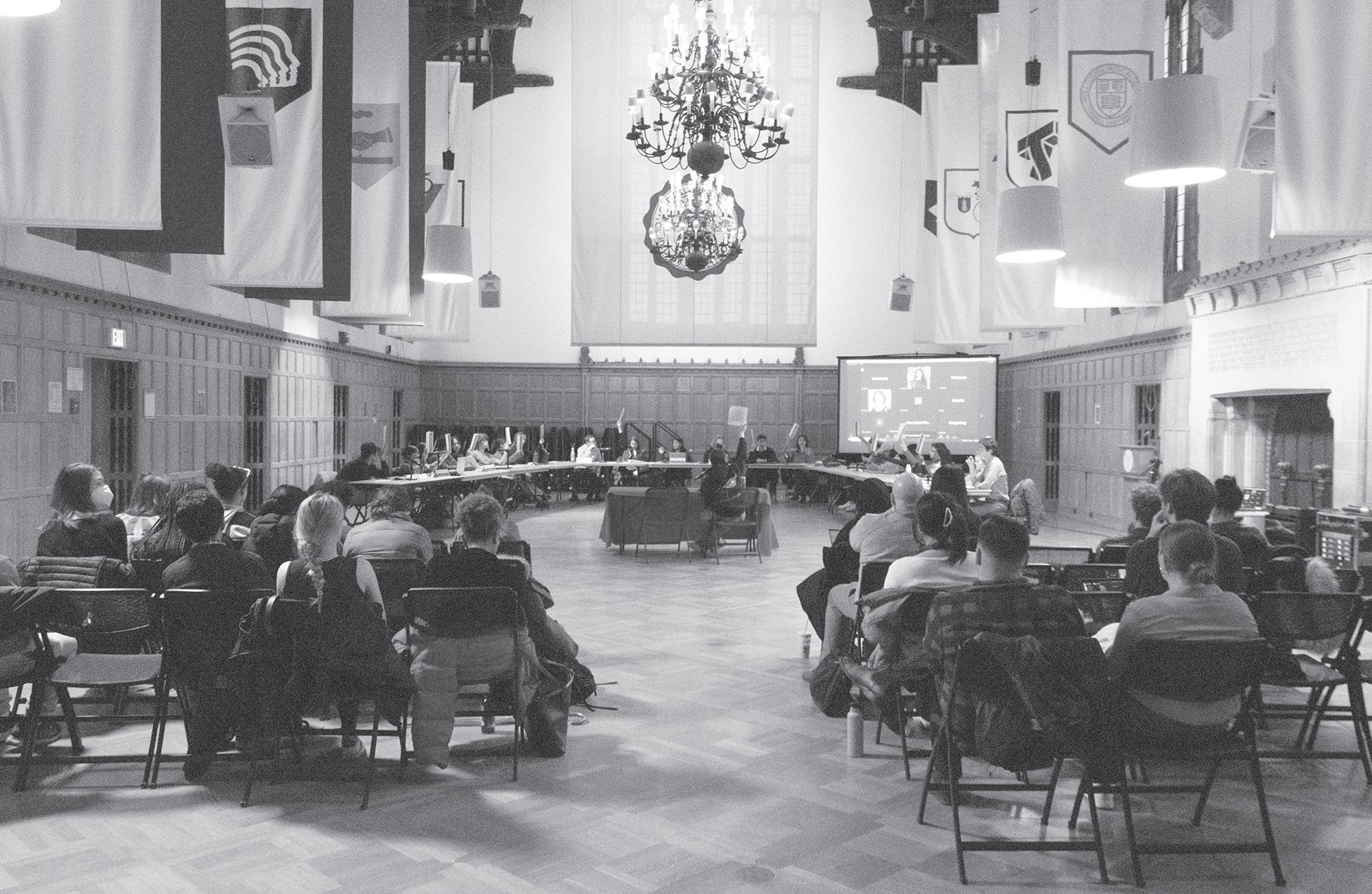
Cornell’s Office of Community Relations presented at Thursday’s Student Assembly meeting in Willard Straight Hall to review Cornell’s economic effects on Tompkins County.
According to Kate Supron, campus-community liaison for the Office of Community Relations, the office serves as a liaison between the University and local governments, nonprofits and businesses. The organization also responds to local community members’ questions and requests regarding the University.
“We know the community, we know the campus and we help make connections between the two,” Supron said.
Supron also noted that out of 16 municipalities in Tompkins County, Cornell’s Ithaca campus sits in three municipalities, and the University owns property in all of them.
“[Because of our significant presence in Tompkins County], we work really hard to maintain good relationships with our neighbors in the community where we all live,” Supron said.
For the past eight years, the Office of Community Relations has worked with the Cornell Budget Office to publish data on the University’s role within the Tompkins County economy. The snapshot of the data is released annually in January.
Supron specifically noted that Cornell-related visitor spending in Tompkins County stood at 59 million dollars in 2022, a number equivalent to 76 percent of the visitor spending throughout the pre-pandemic 2019 fiscal year. The 2021 fiscal year saw only 400
thousand dollars in visitor spending — a 99.5 percent decrease from pre-pandemic levels.
“[The 2021 numbers] were shockingly low and seriously impacted the community,” Supron said. “We were really excited to see [the numbers] rebound.” Supron also clarified the misconception that Cornell does not pay any taxes — the University is the second-highest taxpayer in Tompkins County. The highest taxpayer in Tompkins county in 2021 was New York State Electric and Gas, according to the report from the Tompkins County Assessment Department.
“We do pay property taxes, just not on properties that have an educational purpose,” Supron said. “[That includes] East Hill Plaza [and] the Cornell Business and Technology Park.”
Supron said that the University’s offices in Albany use the snapshot to bring in funding from New York State and that the University’s offices in Washington, D.C. use it to acquire federal research funding. The snapshot is also utilized by the Center for Regional Economic Advancement at Cornell University and is presented at assemblies across the University. Supron added that the report is used outside of Cornell as well.
“Outside of Cornell, we present it to the Chamber of Commerce and to local businesses,” Supron said. “We share it with nonprofits, we share it with our municipal partners, and it is used a lot around the country because we are one of the only universities that produces this data on an annual basis.”
Julia Senzon can be reached at jsenzon@cornellsun. com.
Continued from page 3
disapproval.
“Cornell University has an endowment of over $9.8 billion dollars and there are various ways to find external grants and secure funding,” Chowdhury wrote. “The University simply does not see this issue as a priority.”
Claire Ting ’25, School of Industrial and Labor Relations representative for the S.A., also expressed disappointment. In a statement to The Sun, she wrote that Pollack failed to acknowledge the structural barriers that prevent students from accessing adequate outsourced care.
“Though specialist referrals are available by primary care physicians on campus, there are still a number of structural barriers — reliable transport to off-campus sites, health insurance coverage, adjacent financial concerns, etc. — that prevents students
from accessing this care,” Ting wrote. “I find it concerning that the President did not fully respond to these structural barriers, as they were a primary driver
“It’s not about [women] having a seat at the table. It’s about [women] being treated the same”
Veronica
Lewis ’25
for why an on-site M.D. gynecologist was needed to begin with.”
Valencia pointed out that low-income students face greater structural obstacles to healthcare access.
“We shared student testimonials of having to travel as far as Rochester or other areas in Upstate New York to get the care they needed and how inaccessible this is for low-income students,” Valencia wrote. “Having
ACCESS
Continued from page 1
“Students are encouraged to email or phone SDS if they encounter an accessibility issue or barrier at Cornell,” Parrott said. “This could include issues in the physical, academic or social environment.”
CULift services are an example of an SDS accommodation. The shuttle service provides access to classes and on-campus activities for students with mobility limitations. Students must get approved through SDS to gain access to CULift, according to Parrott.
Many students with disabilities can benefit from SDS accommodations. However, some students expressed room for improvement.
Natalie Suggs ’26 had a mobility constraint fall semester. Suggs qualified for CULift services but found that rides required extensive planning. To request a ride, Suggs said she had to do so by 10 a.m. on the business day prior to service.
According to Suggs, this time restriction makes it difficult for students who use CULift to go between their place of residence and central campus as they please. Students have to stick to the schedule they planned with CULift. Although they can call for last-minute rides, it is not guaranteed that a driver will be available.
However, Suggs is grateful for an overall positive experience with CULifts.
“They did a good job at generally being there on time for your ride and getting you to where you had to go,” Suggs said.
Prof. Charlie Green, literatures in English, taught English 1168: First-Year Writing Seminar in Cultural Studies with the special topic of Disability and Writing. He told The Sun that SDS should spread greater awareness of their services.
“I do think the University
could make disability access more upfront, just in terms of announcing the services that we have,” Green said.
According to Green, there is an online accessibility map of campus, but it is challenging to navigate and hard to find. One way the campus could be more accessible is if this map was improved.
Additionally, Green points out that not all campus buildings have wheelchair access, and that it is difficult to find the narrow wheelchair access lanes when they are provided.
The DAU also advocates for stronger policies for students with disabilities. On Wednesday, March 1, the DAU is holding a Disability Day of Mourning to honor the people with disabilities who have been murdered by parents, relatives or caregivers.
“Our goal is to bring attention to inaccessible parts of campus and inaccessible systems that Cornell has, along with creating a community where disabled students can come together to discuss those issues and figure out what the best means of going about solving those things might be,” said DAU President Carson Taylor ’23.
Taylor explained that Cornell’s approach to accessibility policies is reactive rather than proactive.
“What we see a lot of the time is we’ll find something inaccessible on campus, we’ll find something that puts a burden on a student and we’ll bring it up to the relevant person authority, and their answer is, ‘I haven’t thought of that,’” Taylor said.
Taylor noted that Cornell could improve accessibility by addressing accessibility issues before a student has to reach out to SDS.
To continue reading this article, please visit www.cornellsun.com.
an in-house M.D. gynecologist at Cornell Health would have helped to diminish the inequities present in our healthcare system and within Cornell itself.”
Lewis said she believes Cornell has faced a persistent equity problem regarding the treatment of women, regardless of Cornell’s having challenged gender norms in the past. She added that Cornell Health’s inability to sufficiently support women’s reproductive health care represents a gendered disparity.
“I think that [leaders] like to [emphasize] that [Cornell] was the first Ivy League institution to allow women and that’s wonderful, and that was revolutionary at the time,” Lewis said. “But it’s not just about [women] having a seat at the table. It’s about [women] being treated the same as well.”
The University refused to provide further comment when requested by The Sun.
Continued from page 3
Gardens.
With the effects of climate change on our local ecosystems, the botanical gardens are taking action to ensure that accumulated carbon remains in its natural storage areas while simultaneously finding methods to accelerate the removal of additional carbon dioxide from the atmosphere.
“We are integrating new approaches through demostrations, research and classes to export new knowledge to others to increase the impact beyond Cornell.”
David Weinstein
“We are integrating new approaches through demonstrations, research and classes to export new knowledge to others to increase the impact beyond Cornell,” said panelist David Weinstein, emeritus senior research associate and forest ecologist in
Cornell’s Department of Natural Resources and the Environment.
To fully leverage the carbon sequestration potential of the botanical gardens, Cornell has initiated a plan that focuses on enhancing and preserving the gardens’ natural areas. This includes implementing better management practices for sustainable land use, limiting soil disturbance, controlling invasive species and utilizing prescribed fire to promote healthy vegetation growth.
By employing these measures, the botanical gardens can continue to sequester carbon and provide additional benefits to the local community, such as improved water quality, flood regulation and biodiversity conservation.
Serving as a model for other institutions and organizations seeking to address climate change through nature-based solutions, Cornell hopes these measures are a testament to the power of natural ecosystems in finding solvency and underscore the importance of preserving and protecting our planet’s natural resources, Weinstein said in the webinar.
EXCHANGE
Continued from page 1
“It’s kind of hard to get from IC to Cornell,” Race said. “Luckily, the buses from Cornell to the Commons are pretty frequent. But then, the ones that go to Ithaca [College] happen more infrequently, so it’s harder to work around.”
Ma also noted difficulties with commuting.
“I don’t think it would be really feasible if I didn’t have a car,” Ma said. “So I don’t know how accessible it is to all students.”
Race noted that they took a bioarchaeology class at Cornell amid a significant reduction of the anthropology department at IC. The exchange program has proven to be an opportunity to continue their academic pursuits.
“The anthropology department at IC is going to go away. I’m going to be in one of the last classes. So there’s less professors, less classes offered,” Race said. “Getting to work with Prof. Velasco and other students [at Cornell]is definitely interesting. And there’s more opportunities.”
Despite the opportunities presented to students through the program, most students are unaware of the existence of the program. The IC office of the
registrar is trying to change it.
“I’m looking to really drum up more awareness to this program as well,” Machan Howd said.

Futurity — an alluring and daunting prospect — requires us to orient ourselves toward the unexpected and brace for new events, experiences and sensations. It was an exciting year in art, and, importantly, art at Cornell was no exception. Among the most memorable shows was the 2022 Cornell Arts Biennial, a selection of installations and exhibitions featuring wide-ranging artistic mediums and a number of artists and collectives. The works powerfully reflected on eras current and future, transforming futurity into art with a spirit of collaboration and optimism.
Professor Timothy Murray, Department of Comparative Literature and Literatures in English and Director of the Cornell Council for the Arts, was the curator of the 2022 Cornell Arts Biennial. He had previously worked on two biennials, making the most recent one his third. I
Thad the pleasure of conversing with Murray on the biennial and his role within it.
His understanding of the contemporary art world informed his selection of the art used to illustrate the biennial’s theme: Futurity, Reimagined . Amid the changes of the past year, with a global pandemic and other crises, Murray described the importance of the biennial as a reflection of global pressure points coming together. The biennial, he said, was a way to “ask artists to help us think about how we can think about futurity differently in the face of these big social issues.”
Many installations and displays filled and elevated spaces across campus. The works integrated diverse disciplines of social justice, ecology, health science and recent developments in visual arts. Murray expressed admiration for all of the artists and collectives he worked with.
“Extraordinarily beautiful and really interesting… it’s quite stunning,” he said,
when discussing the native plantings of Matt Dallos’ “Libe Slope Wild Garden.” Later, we conversed on a unique performance art piece, “Black is Blue” by Oupa Sibeko, which involved a three-day performance at the Johnson Museum where Sibeko lay completely still across two chairs in the middle of his installation for five hours at a time. For Murray, I got the sense that he possessed a distinctive understanding and appreciation for each artist and project. Notably, the biennial overcame several challenges. Pieces faced longer-than-typical gestation periods alongside the complicated nature of public art projects. Murray explained, “Not only do the artists have to design for a space, but the space has to be approved internally, it has to be the right configuration.”
An example he provided was Jennifer Birkeland and Jonathan Scelsa’s “Cornell Sage Knoll,” which was initially scheduled for the 2020 biennial at a different loca-

tion. When the pandemic disrupted those plans, Birkeland “completely retooled her piece and her concept; [they] found a new location, and were able to put that up.”
Murray also played a pivotal role in the expansion of the recent biennial. This was the first biennial to feature an exhibit at Cherry Arts and the first to collaborate on NFT artworks with Cornell Tech to have artwork in both New York City and Ithaca.
The existence of art exhib-
its — the transition from one to the next — can feel evanescent, when in fact the interplay of individuals, ideas and artistry leave lasting impressions. The past biennial and Murray’s role as a curator was an example of intelligent collaboration and execution, with impacts on our community that will extend well into the future.
Anna Ying is a sophomore in the College of Arts and Sciences. She can be reached at ay328@cornell.edu.
MAX FATTAL STAFF WRITER
As each year crept on from the release of the original Avatar and its box office redefining moment in cinema, anyone could feel the increasing mockery levied against James Cameron and his apparent dream to make a sequel long belated not just from the original, but also from its own production start date. Avatar: The Way of Water was a long time coming, and according to industry experts, it was perhaps too long. Yet, those who doubted Big Jim Cameron’s big return to the big screen had another thing coming, and neither delay nor a still-reeling post-pandemic box office environment could stop what turned out to be another two billion dollar film. James Cameron is the antithesis of box office poison: This is true and always has been. More complicated, it seems, is determining what to say of Cameron as a director and, frankly, what one can make of Cameron as a technician and an activist, the two roles he grapples with constantly in The Way of Water
I saw Avatar: The Way of Water both times in 3D. After the first time, head aching and eyes strain-
ing, I might’ve been discouraged from a second three-hour chunk of pushing my pupils to their absolute limit. Yet, there’s something inarguable about the accomplishment there. The depth produced by 3D that was designed and overseen every step of the way as the primary viewing experience feels different from nearly all of the last ten years of terrible 3D imposed on studios trying to cash in on the original Avatar. And it’s probably not worth it, given that the success of this 3D is going to lead to those same studio heads making that same terrible 3D for the next ten years. But even if all that terrible nonsense is true, and this is going to give me a headache and fill half the screens at every multiplex with terrible-looking 3D for decades to come, I can at least enjoy something that looks astonishing for three hours.
The same can be said about the overwhelming use of CGI in The Way of Water. It’s astonishing, but just because it can be done doesn’t mean it should be done. Showcasing the limits of CGI in the hands of talented craftspeople only encourages the use of CGI in the fists of those who like it because it’s cheap, non-unionized labor. We’re a far cry away from
the regular use of practical effects, which I still contend look better than anything CGI can produce. A film made almost exclusively on a computer provokes anxieties about where this could go when the ship isn’t being steered by James Cameron. It is legitimately impressive when Cameron produces entire characters and worlds which exist as computer images. Still, one should be skeptical whether these images can hold up on a smaller screen or stand the test of time. I won’t pretend that rewatches of the original Avatar — a film hailed as a holy grail of CGI accomplishment — still work visually in the way a practical effects accomplishment (say, Total Recall) persists even years later. Judging from watching The Way of Water’s trailers on a small screen, the visual majesty just simply doesn’t carry over — in producing a uniquely cinematic experience, Cameron has also produced an exclusively cinematic experience.
A lot can be and has been said about James Cameron’s toxic assertions regarding Native groups, but the man certainly seems not to be an opportunist. He’s now staked his remaining career on a franchise that is unabashedly anti-human (at least in its conception of
white imperialist humanity), and even his worst statements come in the form of constant attempts to express the evil of colonialism, albeit in often ham-fisted ways. Cameron’s film, by virtue of its creator and its need to grapple with representation questions (how should one feel about the decision to cast such a blatant stand-in for an indigenous group with non-indigenous actors?) falls victim to a recent scourge of well-meaning (or semi-well-meaning) action movies that, try as they might, can’t really escape the trappings of their genre. Whether it’s the brilliant RRR (fun enough to anti-colonial Americans, but apparently nationalistic on its own turf) or The Woman King (an excellent action film following in a long line of earlier Hollywood epics in its unfortunate historical inaccuracies), Avatar: The Way of Water finds itself among the good company of films one just can’t know what exactly to make of.
There’s a lot to be said for Avatar: The Way of Water. Its threehour runtime is paced nearly perfectly, slowing itself down when necessary and accelerating with no reservation for a breakneck third act. It relishes in beautiful visual effects and creature designs that
can be fascinating and colorful. Its plot, though simple, builds on a dull and simplistic Dances With Wolves riff that plagued the original. All told, it’s a really good movie, just one that doesn’t always land those big punches it’s throwing. As a political act, its anticolonialism is limited by the trappings of its creator and the realities of its genre, not to mention a willingness to traffic in stereotypes. As a technological feat, it impresses, but never quite justifies its own broader damage to the industry or surpasses the visual effects it’s apparently supplanting. The Way of Water looks astonishing, but I can’t help but feel melancholic about the dominance of digital photography and CGI that both films have left in their wake. At the end of the day, I suppose I’ll tip my cap to The Way of Water, a film I enjoyed just enough to see twice. I’ll be ready to write these same endorsements and misgivings again when the next Avatar film comes out in two years, and the next one two years after that, and again, stretching on for presumably decades.
Max Fattal is a sophomore in the College of Industrial and Labor Relations. They can be reached at mbf68@cornell.
SERENA HUANG ’24 Business
EMMA LEYNSE ’23
SURITA BASU ’23 Assistant Managing Editor
NAOMI KOH ’23 Assistant Web Editor ELI
PAREESAY
VEE CIPPERMAN ’23
Editor in Chief
Want to give your take on a campus
The Sun thrives on your feedback. Continue the conversation by sending a letter to the editor or guest column to associate-editor@cornellsun.com.
Letters should be no longer than 250 words in length. Columns are 700-900 words
Please include graduating year if applicable.
All voices welcome.
ANGELA BUNAY ’24
ZENG ’24
FLORES ’24
KATHERINE YAO ’23
RUBINSON ’24
COLIE ’23
’25
’23

Adam Senzon ’26 is a freshman in the School of Industrial and Labor Relations. He can be reached at ars424@cornell.edu. My Two Sen-ts runs every other Tursday this semester.
If you would have asked me about international human rights law before Jan. 23, I would simply have nothing to say. After enrolling in LAW 4081: International Human Rights Law with Elizabeth Brundige, Clinical Professor of Law at Cornell Law School, though, I can now say that the previous statement has changed.
’23
ROSENBERG ’23
In the short amount of time that I’ve been enrolled in the course, I have already expanded my knowledge on the topic of human rights law on a global scale and learned the essentiality of intergovernmental bodies in protecting human rights.
As a pre-law student studying Industrial and Labor Relations with intended minors in Law and Society and Policy Analysis and Management, I’ve known about my interest in the law for quite some time now. That being said, only recently have I been able to further develop a breadth of knowledge on the technicalities of the law both domestically and internationally.
My interest in the law involves the intersection of labor and environmental law focusing on defending the rights of workers exploited by the agricultural system of America. This issue disproportionately impacts undocumented immigrants who don’t have the legal right to unionize given their lack of citizenship. And yet, seventy-three percent of all agricultural workers in the United States belong to immigrant backgrounds, while an estimated three percent of all workers in the U.S. belong to unions in agriculture.
In addition to this overwhelmingly large population of agricultural workers that belong to immigrant backgrounds, twenty-eight percent of this workforce is women. This topic of discussion is not directly related to what I will be discussing today, but I figured offering context on my interest in the law might explain my inclination to enroll in a related course at CLS.
Prof. Brundige founded and directs the Gender Justice Clinic at CLS where she emphasizes the efficacy of research and advocacy regarding gender-based violence and discrimination. Learning about methods of remedying gender-based discrimination has been indispensable to me as I’ve been able to better understand the overarching applications of the law in other contexts. In taking Prof. Brundige’s course I’ve been able to train my critical thinking muscle and think like a lawyer.
The issue of the exploitation of workers in the agricultural system involves racial discrimination, as well. This discrimination can look like many different things: Sexual harassment, assigned caregiving, lower pay and the denial of a living wage as a whole.
When one zooms out from a domestic standpoint and addresses this issue on an
international level, it becomes clear that this isn’t only happening in America. The United Nations has the solutions we are looking for, but its methods are not foolproof.
The United Nations offers a comprehensive list of existing intergovernmental organizations that have been created by states globally through multilateral treaties. As noted by CLS, a multilateral treaty is pertinent to international law and covers “human rights to inter-state agreements on matters such as trade or transportation.”
These intergovernmental bodies exist with the primary role of preventing human rights violations in the masses, including the violations that take place in agriculture. They are particularly important because they hold states accountable for violations of human rights and must adhere to a given treaty as long as they are a party to it.
In taking Prof. Brundige’s course I’ve been able to train my critical thinking muscle and think like a lawyer.
In addition to this measure, in 1979, the Convention on the Elimination of All Forms of Discrimination against Women was adopted by the United Nations as a part of the Human Rights Office of the High Commissioner. CEDAW includes a total of 30 articles dedicated to the protection of women internationally whose rights have been violated in any form ranging from property rights to gender-based discrimination.
Again, it is important to recognize that while states are being held accountable through the presence of intergovernmental bodies, violations can still exist among states that are parties to multilateral treaties. For instance, article 21 of the International Covenant on Civil and Political Rights establishes that “the protection of public health or morals or the protection of the rights and freedoms of others” must be adhered to — an article that was arguably violated after the United States declared a public emergency during the pandemic due to peaceful protests.
I believe that the presence of intergovernmental bodies and respective multilateral treaties is a necessary force to prevent the violation of human rights by states globally. I’d like to extend a special thank you to Prof. Brundige for her passion-driven teaching and inspiring lectures.
Fill in the empty cells, one number in each, so that each column, row, and region contains the numbers 1-9 exactly once. Each number in the solution therefore occurs only once in each of the three “directions,” hence the “single numbers” implied by the puzzle’s name. (Rules from wikipedia.org/wiki/ Sudoku)



By AARON SNYDER Sun Sports Editor
Men’s hockey won its 25th Ivy League title after it defeated Yale, 5-1, on Saturday night.
“It means a lot,” said head coach Mike Schafer ’86. “We talked about it – if we want this we gotta go on the road and earn it. We gotta go win an Ivy League championship, and it’s gonna be tough.”
The commanding win will send Cornell into a bye week on a high note after a dominant weekend. Cornell scored five goals for the second night in a row.
After recording a shutout on Friday, sophomore goaltender Ian Shane made 21 saves on Saturday, including two important stops on breakaways in the first period.
“I thought that was the difference in the game,” Schafer said. “He’s been doing that for us, he did it last night with a huge save to keep us in it.”
Freshman forward Winter Wallace scored the first goal of the game from right in front of the crease off a pass from freshman forward Nick DeSantis a few seconds after a Cornell power play expired.
It was another strong first period for Cornell in terms of possession. The Red outshot Yale 14-6 and won 11 out of 18 faceoffs in the opening frame.
“Not much was going in for us early on,” Schafer said.
Things started to open up in the second period. Two-and-a-half minutes into the period, junior forward Kyle Penney came up with a turnover on the forecheck and launched a backhand from the high-slot past Yale’s Connor Hopkins and into the back of the net. Hopkins entered the night with a .808 SV% but got the start for the Bulldogs on his senior night.

“I walked off the wall and let it rip with my backhand,” Penney said. “Luckily it went in.”
Despite Hopkins’ low numbers, Cornell stayed disciplined and waited for quality chances in the offensive zone.
“That was a big key of ours tonight, staying patient and sticking with our process,” Penney said.
Three minutes after his goal, Penney made a nice play to reach up and grab the puck to keep it in the zone and found sophomore forward Jack O’Leary open in front of the net.
O’Leary converted to put Cornell up 3-0.
“Kind of picked up a loose puck
and heard O’Leary calling for it back door,” Penney said. “I sent it over there and he finished it off.”
Freshman forward Nick DeSantis scored his ninth goal of the year early in the third period to give the Red a 4-0 lead.
“That’s been the story for us all year. We’ve been getting contributions from everybody,” Schafer said. “It was awesome to see.”
Cole Donhauser put Yale on the board midway through the third period to end Shane’s shutout bid.
Senior forward Ben Berard regained Cornell’s four goal lead with just over six minutes left in the third period with his team-high tenth goal of the
Men’s Lacrosse
season.
Cornell’s two victories on the weekend and out of town results have put the Red back into position for an at-large bid to the NCAA Tournament. Cornell will return to action on March 10 when it hosts an ECAC quarterfinals series. The Red will have to wait until next weekend to learn who its opponent will be.
“It doesn’t make a difference who we play at home, the games are gonna be tough,” Schafer said. “Whoever we play, it’s gonna be tough.”
Aaron Snyder can be reached at asynder@cornellsun.com.
in front. The Red finished the first 15 leading, 5-1.
Looking to improve to 3-0, No. 3 men’s lacrosse traveled to Geneva, NY, on Tuesday, Feb. 28 for the next chapter in the oldest rivalry in college lacrosse. The Red had played Hobart (2-2) 139 times, spanning 125 years. Exerting its will on the Statesmen, Cornell controlled the game throughout, winning, 17-8.
Hobart kicked off the match with a goal, but its lead was short lived. The Red quickly responded, with junior attacker CJ Kirst finding the near 90 from just outside the crease. It was another statement day for Kirst, who finished with seven goals and four assists. Kirst’s goal was the first of eight straight for Cornell. Two minutes later it was senior attacker Aiden Blake with a rope from 10 yards out off a pass from junior midfielder Hugh Kelleher.
It was another statement day for Krist, who finished with seven goals and four assists.
The Red was unable to take advantage of a manup penalty, but it was senior attacker Billy Coyle wrapping around from behind the net on the ensuing possession for Cornell’s third goal.
Cornell closed the quarter out with two more goals from Kirst. Ball movement was on full display for Kirst’s third, as passes behind the net set up the junior
It was Kirst again to start the second quarter, locking up a natural hat trick with his fourth goal of the game. Less than a minute later, Blake converted from just outside the crease off a pass from a double-teamed Kirst. Senior attacker Brain Piatelli increased Cornell’s lead to seven, going top shelf from the left side of the field.
After a strong defensive showing from both teams for the first five minutes of the second half, it was senior midfielder JJ Lombardi breaking through with a shot that slid just inside the left pipe.
With the Red surging, the Statesmen began to show some life. Utilizing the one-hopper, Hobart was able to get two back, keeping itself within range.
After nearly seven minutes of scoreless play, both teams scored within the final 10 seconds of the half. First it was junior midfielder Andrew Dalton with eight seconds remaining, followed quickly by a goal from the Statesman as the clock hit zeroes. The Red went to the locker room leading, 9-5.
After a strong defensive showing from both teams for the first five minutes of the second half, it was senior midfielder JJ Lombardi breaking through with a shot that slid just inside the left pipe.
Lombardi’s goal jump-started a dominant third
quarter for Cornell. The Red won 14 of 16 ground balls and out-scored the Statesmen 6-1. Piatelli, Coyle, Dalton, Kelleher and Kirst all scored to give Cornell a comfortable 15-6 lead heading to the fourth.
On top of Cornell’s offensive success, it was another strong performance from senior goalkeeper Chayse Ierlan.
With the contest all but decided heading into the final 15, both teams were able to bring subs in, allowing more players to see the field. Kirst capped off his night with two more goals, and the Statesmen was also able to find two of its own late in the period. Remaining in control from start to finish, the Red topped Hobart, 17-8.
On top of Cornell’s offensive success, it was another strong performance from senior goalkeeper Chayse Ierlan. Ierlan saved 16 of 24 shots on goal, good enough for a .667 save percentage. With both the defense and offense playing at a high level, Cornell will be a tough out for any team.
The Red will face its toughest opponent thus far this Saturday, March 4 when it travels to Columbus, Ohio to take on No. 8 Ohio State (3-1) at noon. The game will be available on the BIG10 network.