The Corne¬ Daily Sun

Begin
By JIWOOK JUNG and JIWON ESTEE YI Sun Assitant News Editor and
For many rising sophomores, the spring semester’s general housing selection process is generally a chaotic and stressful experience, as those looking to live in on-campus housing hope for an early time slot to self-select a room in one of the popular main houses on West Campus.
On March 7 at 5 p.m., students began the process of general room selection during their assigned 20-minute time slot.
Due to the University’s updated residential policy, first and second year Cornell students are required to live in on-campus or affiliated housing. The new requirement precedes the completion of
the North Campus Expansion project, whose new additions to North Campus housing include newly opened residential halls like Ganedago: and Morrison. The new dorms on North Campus will provide 800 new beds for second-year students.
Despite these new additions to the North Campus residential scene, West Campus remains in high demand. According to Cornell Housing, sophomores historically make up around 65 percent of residents on West Campus, creating an ideal environment for a sophomore community.
Many rising second-year students, like Katelyn Canova ’25, hoped to live on West Campus because of the location, dining halls and social experience it offers.
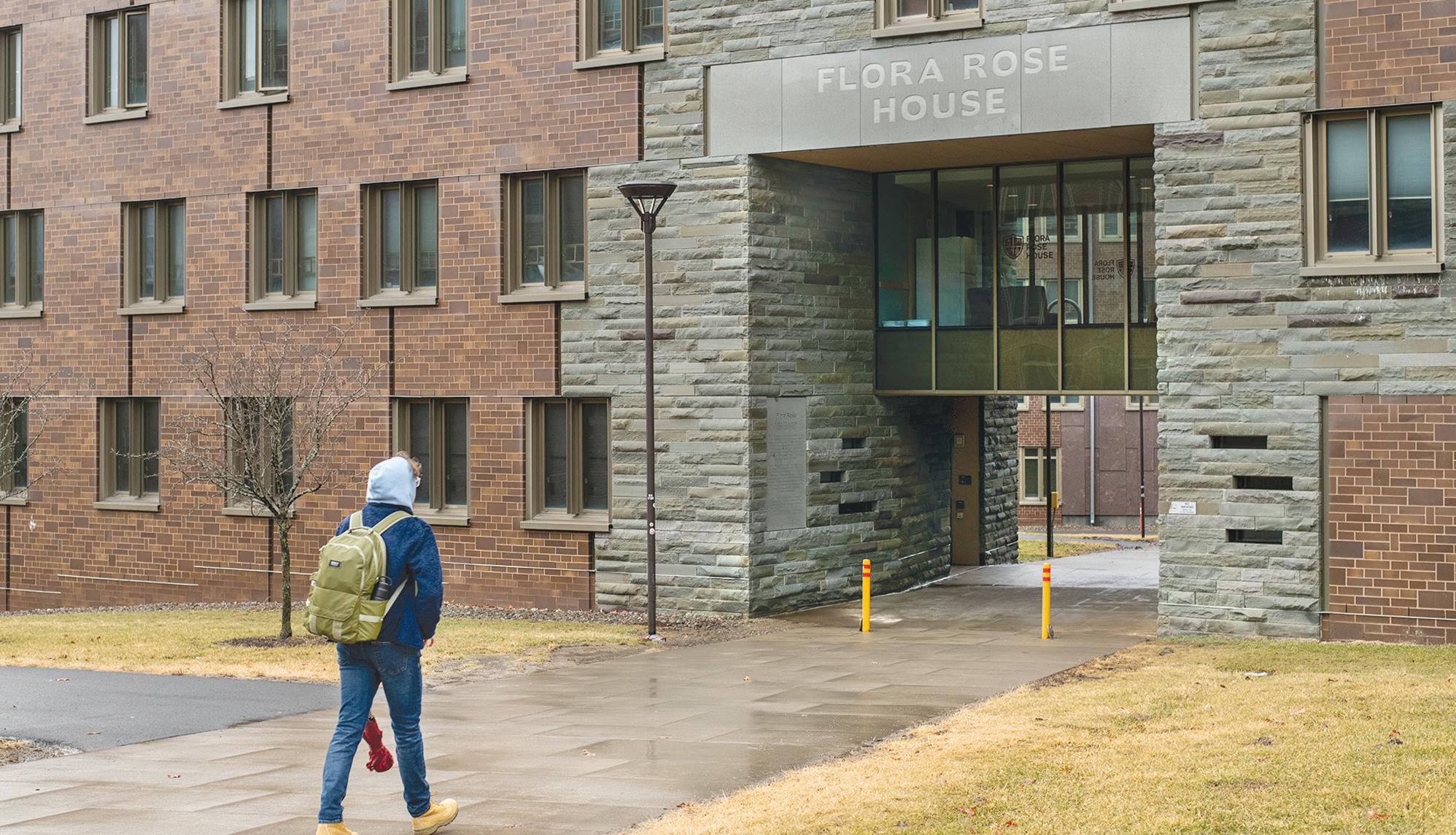
“I would like to live on West Campus next school year, as it is near my classes and Collegetown. It also has better dining halls,” wrote Canova in an email to The Sun. “Most importantly, I will be close to all my friends on a sophomore-centered campus.”
However, according to Jeff Dahlander, assistant director of contracts and operations, this year, only 30 percent of rising sophomores will have the opportunity to live on West Campus.
“A lot of students think about West Campus as the ideal second year area to live,” Dahlander said in a February webinar hosted by Cornell Housing. “But, the reality is that West Campus simply does not have enough space to house all students.”
Having had the expectations of living on West Campus, current first-year students are expressing frustration and disappointment with the prospect of living on North Campus.
Canova feels that it is unfair that students currently living in Clara Dickson Hall, which is historically a first-year residential dorm on North Campus, can potentially live in the same building next year.
To continue reading this article, please visit cornellsun.com.
By GWEN SCHWAY Sun Contributor
On Feb. 27, New York State Gov. Kathy Hochul (D-N.Y.) announced that starting March 2, the mask mandate will end in public schools K-12 in New York State.
Following this decision, Ithaca College ended their mask requirement and Tompkins County has suspended their mask advisory. Provost Michael Kotlikoff told The Sun that the University plans to reassess their mask policy in mid-March. In a comment to
The Sun, Kotlikoff said that Cornell will continue to base masking policy on scientific criteria and risk factors that are specific to the Cornell community.
With the changing guidance from the state and county, students have mixed opinions on Cornell’s commitment to masks. While some feel more comfortable with masks, others believe it is time to go maskless.
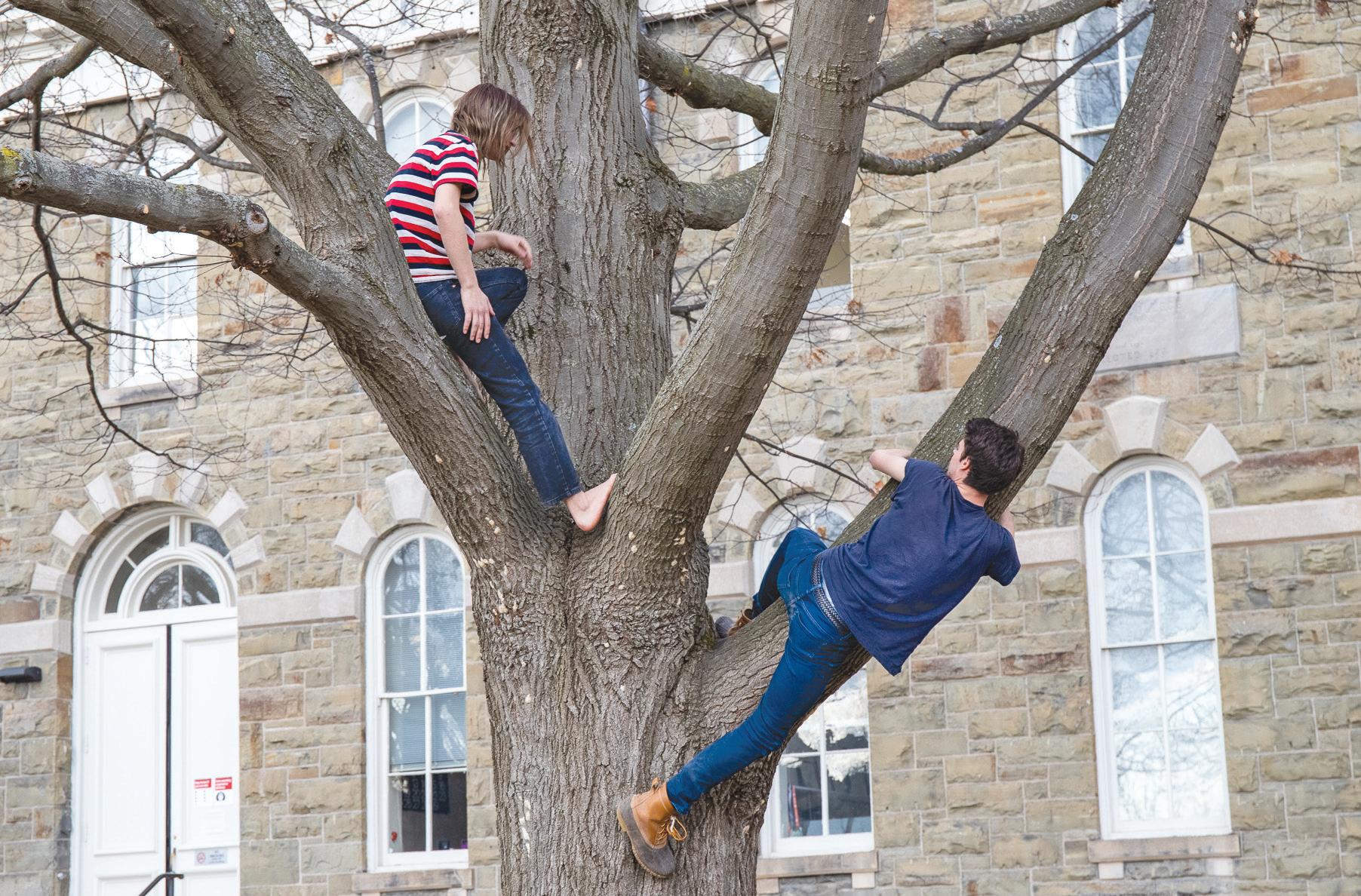
Rose Davidson ’24 feels more comfortable with keeping the mask mandate. Originally from New York City, Davidson said she is a supporter of mask mandates.
“I feel like every time they get rid of mask mandates it gets worse,” Davidson said. “Until it’s for sure fine, I feel like it’s better to just have [the mandate].”
Davidson emphasizes that while she would most likely be fine medically if she contracted COVID19, it’s the individuals who are immunocompromised or have health risks that she is hoping to protect.
“If they don’t feel
comfortable, there’s no other option,”’ Davidson said.
On the other end of the spectrum are students such as Ariana Terenzi ’22 who believe the mask mandate should end entirely. Terenzi questions the efficacy of the masks.
Terenzi mentioned that students who got COVID-19 in December 2021 are no longer getting tested.
“They’re not getting tested so it doesn’t make sense that masks are still a thing,” Terenzi said. “A lot of the schools, like where my sister goes, took it off and people are still not getting sick.”
Other students such as Shlok Seth ’22 think the mask mandate should end due to problems inside the classroom.
“I think it’s about time,” said Seth. “I think in class it becomes very tough to
focus.”
Makena Kraus ’25 is against the mask mandate for a different reason. Kraus believes that masks create a physical barrier to socializing in the classroom.
“I feel like it’s hard to remember people and get to know them when I only see the top part of their face when interacting in class,” Kraus said.
With changing guidelines, he sees the end of the mask mandate as overdue.
“I think symbolically, getting rid of the mask mandate could signal that we are going to have a normal end to the spring semester,” Kraus said.
Sofia Rubinson ’24 contributed reporting to this story.
Tuesday, March 8, 2022
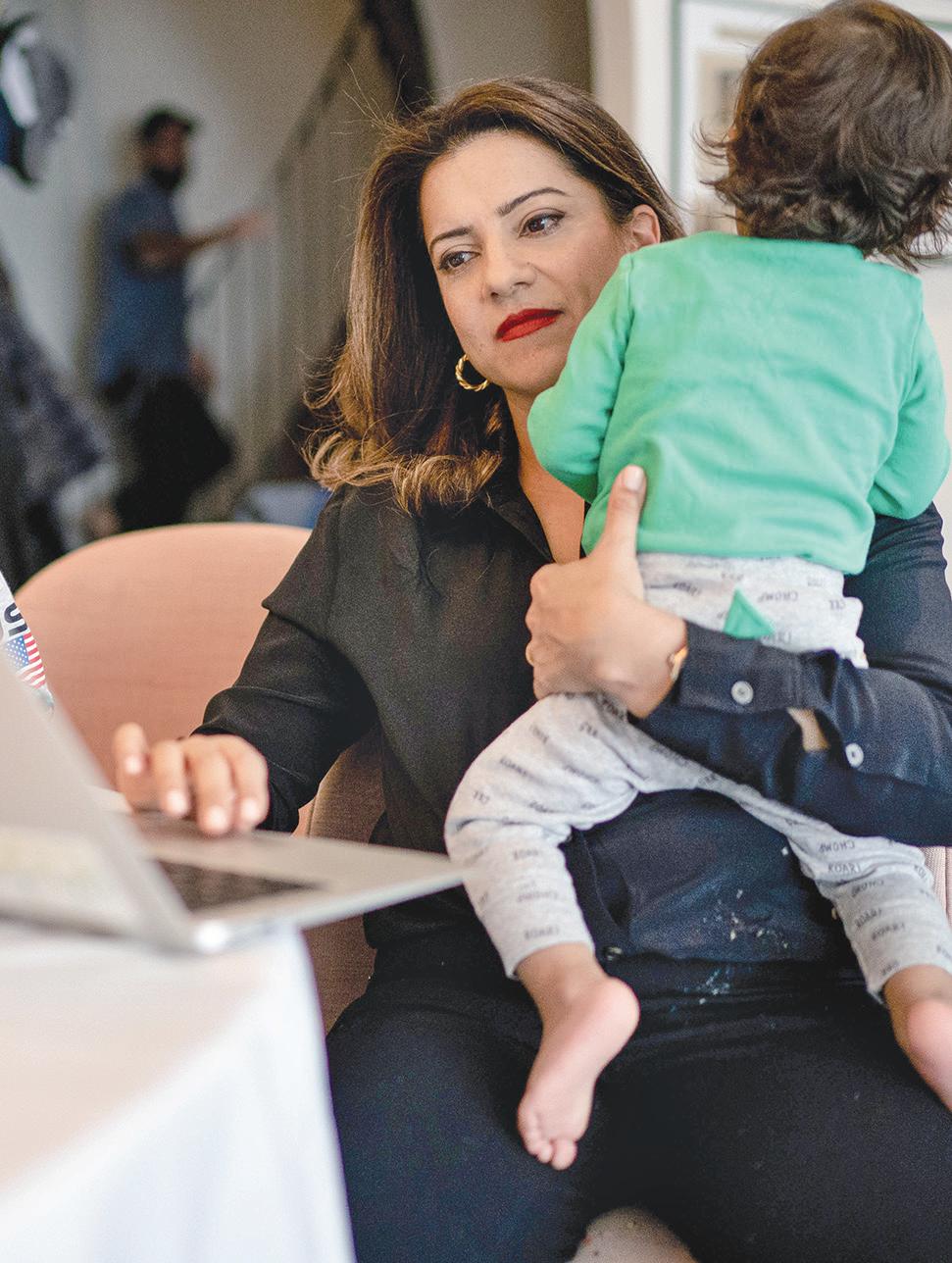
Working women | Reshma Saujani, CEO of Marshall Plan for Moms and founder of Girls Who Code, will be discussing how the private sector can advance equitable workplaces.
Econometrics Workshop: Andres Aradillas-Lopez 11:15 a.m., Uris Hall 498
Preparing for Spring Birding: A Merlin App Question and Answer Noon, Virtual Event
From Populism to Fascism? Noon, Virtual Event
The Future of Women and Work (And Why It’s Different Than You Think) Noon, Virtual Event
Berger Speaker Series with Rozen Noguellou and David Renders: A Panel on Law and Mobility from a European Context 12:15 p.m., Virtual Event
Strategies for Getting Published: Journal Editor Panel 1 p.m., Virtual Event
Finance and Sustainability Colloquium with Anne Park, Global Director of Impact at Small Enterprise Assistance Funds 6 p.m., Sage Hall 106
Climate Resilience for the Poorest Three Billion 12:25 p.m., Emerson Hall 135
After the Fall:
The Future for Afghan Allies Fleeing the Taliban 1 p.m., Virtual Event
Center of Social Sciences Workshop: Advanced Python 3:30 p.m., Virtual Event
Arts Unplugged: Science of the Very, Very Small 4:30 p.m., Virtual Event
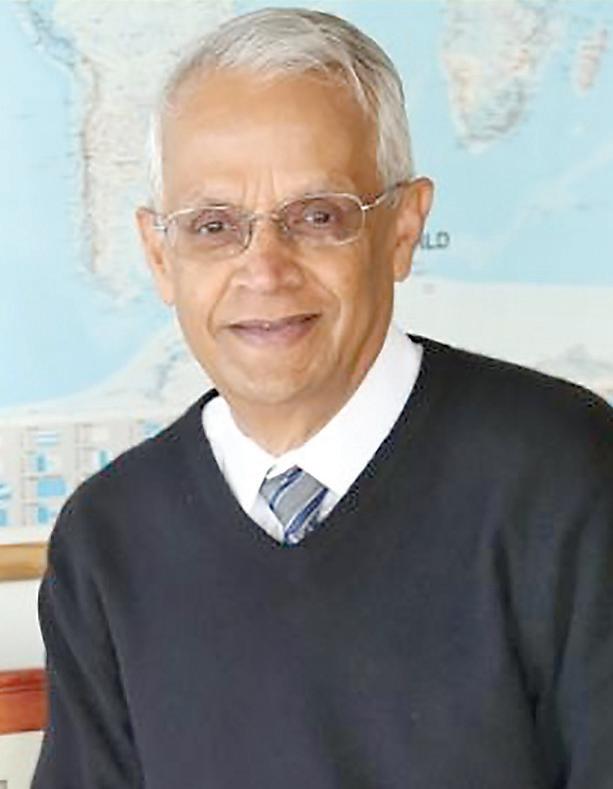
Climate conversation | V. Ram Ramanathan, Cornell’s Climate Solutions Scholar, will be discussing how the world’s poorest three billion people will suffer the worst consequences of global warming at an event on Wednesday.
Summer Experience Grant 2022 Infomation Session 4:35 p.m., Virtual Event
Beyond the Camp and the Surgery: Cochlear Implants and the Complex Dependencies in India 4:45 p.m., Uris Hall G08
By SOFIA CHIERCHIO Sun Contributor
Editor’s note: This article contains discussion of sexual assault.
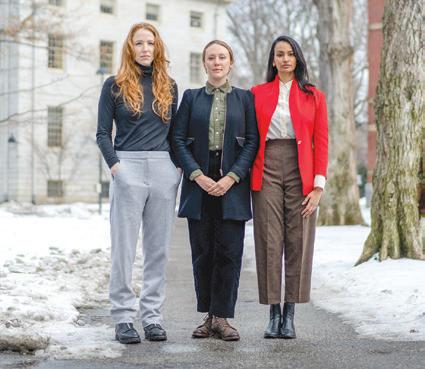
Three Harvard graduate students, Amulya Mandava, Lilia Kilburn and Margaret Czeriwienski, are suing Harvard University for allegedly failing to act on sexual harassment accusations against John Comaroff, a professor of African and African-American studies. Sexual violence is a concern throughout universities across the nation, including Cornell.
In a 2021 University-conducted survey, about 61 percent of undergraduate women at Cornell reported having experienced sexual or gender-based harassment.
“[Comaroff] kissed and groped students without their consent, made unwelcome sexual advances and threatened to sabotage students’ careers if they complained,” the lawsuit said.
After the lawsuit was filed, Harvard placed Comaroff on unpaid administrative leave, but did not find him responsible for unwanted sexual contact. In the days leading up to the lawsuit, in support of Comaroff, 38 Harvard faculty members signed a letter questioning the results of the investigation.
“We the undersigned know John Comaroff to be an excellent colleague, advisor and committed university citizen… We are dismayed by Harvard’s sanctions against him and concerned about its effects on our ability to advise our own students” the letter said. However, days after the lawsuit was filed, 35 of the 38 faculty members retracted their statements.
“I filed a formal complaint and no contact order against him. I wasn’t able to go to a dining hall or walk to class alone,” Zem said. “My friends had to take turns sleeping with me at night because I had nightmares.”
Zem’s Title IX case did not forward until November, when the University told her that the perpetrator was a repeat offender.
“They were forced to do something because there were other cases against him,” Zem said. “After talking with other survivors, I found out that there were about 10 cases against the same person.”
Zem was struggling academically, and she was mentally drained from the investigation being drawn out. “I just wanted it to be over,” she said.
According to Zem, when she expressed her concerns about sharing a campus with the perpetrator, the University’s Title IX office was very hesitant about taking action.
“I received an email the week of Jan. 21, saying that he withdrew from the University, and later enrolled in another school, that the entire process was going to stop. Nothing was going to come out of it,” Zem said. “That just upset me. I wanted justice for myself.”
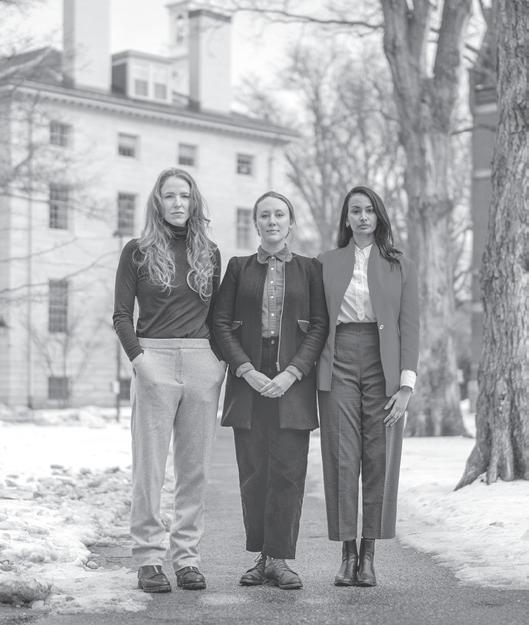
Caroline Guentert, Killburn’s attorney stated, “[Our clients] want to make sure that when students come forward with sexual harassment allegations that the schools take them seriously and that they don’t force them through a process that is inordinately burdensome.”
The lawsuit has caused debates among college campuses about how universities handle sexual violence cases. Cornell is no exception. Zem ’23, the co-president of the Sexual Violence Prevention Network at Cornell, was sexually assaulted on campus in 2021, right before her final exams. The Sun is withholding her last name for privacy purposes.
“The incident happened with an individual I met a couple of times, he was a junior while I was a sophomore. He essentially drugged me and sexually assaulted me,” Zem said. “I went to Cayuga Med to get an exam [with a] Sexual Assault Nurse Examiner and reported it to the Cornell University Police Department that night, who put me in contact with Title IX.”
Her home-life situation at the time made her feel too unsupported to do anything until she returned to school in August 2021 and saw the perpetrator.
Zem said that she felt the University could have handled her situation in a better, more timely manner.
“The University had failed to act until now, basically four years later, even though there have been other people who came forward,” Zem said. “They really could have done so much more to protect us from all of this pain and trauma. I’m angry, we’re all angry. This is all a systemic problem.”
Frustrated by the University’s responses to sexual assault cases, some Cornellians have decided to take matters into their own hands and protect themselves.
For Isabelle Shook ’25, taking a self-defense class allowed her to learn the importance of protecting oneself in college.
“As a woman in college, where I am constantly in risky situations, such as [when] walking alone or to parties, it is so important to be able to trust your peers and surroundings,” Shook said. “ I wish there were more resources to help women learn and defend themselves.”
The Sexual Violence Prevention Network is a peerled group that aims to be a safe space for students. Resources include support groups, magazines and events with the advocacy center. The organization hosts sexual assault awareness month in April and last year hosted Chanel Miller for a workshop.
For survivors, there are resources available on campus to allow them to feel supported, such as confidential medical assistance, counseling and support groups.
By SOFIA RUBINSON Sun News Editor
Federico Finchelstein
Ph.D. ’06, a professor of History at The New School for Social Research at the Eugene Lang College in New York City, will be leading a lecture titled “From Populism to Fascism?” on Wednesday afternoon. According to the
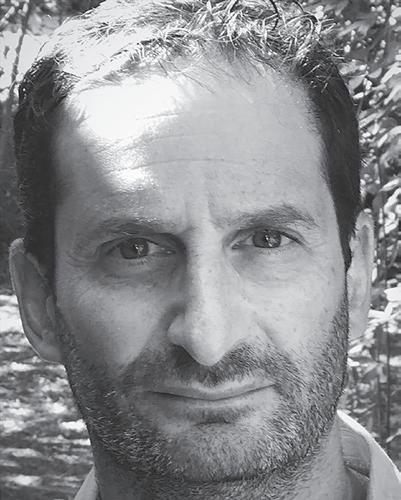
Institute for European Studies, studying how populism can lead to fascism is important today as near-fascist populists are increasingly denying the electoral legitimacy of their opponents. Finchelstein names Donald Trump and Jair Bolsonaro as examples. This talk is the last lecture in a three part series titled “Challenges to Democracy: Authoritarianism and Extremism in Europe and Beyond,” presented by the Cornell University Institute for European Studies. The series is dedicated to celebrating the 30th anniversary of the IES department, with the purpose of highlighting contemporary challenges in Europe as democracy
continues to backslide.
The first lecture took place on Feb. 3 with Cynthia MillerIdriss, professor at the American University in Washington, D.C., titled “Hate in the Homeland: The New Global Far Right.”
The second talk was on Feb. 15 with Elizabeth Becker, assistant professor at Heidelberg University in Tiffin, Ohio, titled “Impossible Pluralism? Religious Minorities, Migrants and Unsettled European Democracy.”
Finchelstein will be discussing the differences between fascism and populism and their relation to democratic procedures. The lecture will take a historical perspective by comparing past
By ANANTHI JAYASUNDERA Sun Contributor
While the past two years of virtual and hybrid learning have been unusual and challenging for students nationwide, Carol Hockett, Hinsta Family Manager of School and Family Programs at Cornell University’s Herbert F. Johnson Museum of Art, has been determined to expand the classroom experience for P-12 students in the greater Ithaca area through art.
For years, Hockett has directed P-12 field trips at the Johnson Museum. Since the start of the COVID-19 pandemic, Hockett began to lead the field trips through virtual classroom instruction. Additionally, for the past year, Hockett has made visits to schools as classes have returned to in-person. Hockett has completed over 350 in-person school visits, and in 2021, she reached over 1,600 students through her classes.
With regard to the content of the classes, Hockett plans each class to be unique depending on what a given teacher’s current curriculum is.
“We are taking the art resources and building out that curriculum connection so that you have an enhanced learning experience that is connected to the museum and to the bigger art world,” says Hockett.
Jenna Griffith, an eighth grade English Language Arts teacher at Dryden Middle School, has had her classes participate in the Johnson Museum’s programs for three years.
“What we learn in ELA connects really well to art. The students learn to identify metaphors and motifs in the paintings,” says Griffith. Griffith has used one such exhibit at the Johnson Museum to teach migration in the context of crises.
“The artwork in a particular exhibit was made by refugees and immigrants, so it was powerful for the students to see the same concepts we discuss in the classroom in the modern, real world through art,” Griffith says.
Other teachers have praised Hockett’s methods. Rebecca Siegrist, a sixth grade Social Studies teacher at Boynton Middle School in Ithaca, told the Sun that Hockett provides supportive affirmation to the students’ insights, encouraging students to think freely and confidently.
“The students make so many analogies and really take the artwork to heart. They show great critical thinking and they totally rise to the occasion because [Hockett’s classes] are something that spark a lot of curiosity in them,” Griffith says.
When the Johnson Museum hosted in-person field trips before the pandemic, for many students, the Johnson was often the first art museum they had ever been to, and Cornell was the first university campus they had ever set foot on.
“For many, this is the first and only art museum they’ve been to, and maybe their first trip to a college campus, or their first interaction with artwork from another culture. So this is a very transformative experience. We’re looking forward to when this day comes back.” Hockett said.
With Cornell University protocols currently prohibiting P-12 field trips at the Johnson, Hockett’s virtual classes fill that gap.
“Even though we’re not at the museum in person, it has still been an enriching learning experience,” says Griffith.
Siegrist further elaborates on how Hockett and the Johnson have been able to take advantage of virtual learning, and have provided students with unique pieces of digitized art.
“We were learning about ancient China, and one of the pieces of art [Hockett] brought in virtually was a 3-D model of the Great Wall of China that the students could manipulate on screen. My students, especially my computer science-minded students, were fascinated by how an object on a 2-D screen could look 3D,” says Siegrist.
Siegrist also remarks that virtual learning has the additional benefit of allowing the students to hyper-focus on one piece of art instead of being distracted by everything else in the museum.
Most importantly, the Johnson Museum’s programs have had a lasting impact on the students.
fascist attempts to deny the workings of democracy to current post-fascist and populist movements.
Finchelstein is an author of several books, including Fascist Mythologies, A Brief History of Fascist Lies, From Fascism to Populism in History, Transatlantic Fascism and The Ideological Origins of the Dirty War. He is a frequent contributor to The New York Times, The Washington Post, The Guardian, CNN and more. Finchelstein received his Ph.D. from Cornell University in 2006.
“Students were coming to me a month later during their lunches and study halls to talk to me about an exhibit [about immigration]. It was truly life changing because it changed how they felt about their classmates and community…They didn’t just think about this at the museum, this was something they really spent time processing, reading about, and talking to their families about,” says Siegrist.
Ananthi Jayasundera can be reached at atj35@cornell.edu.
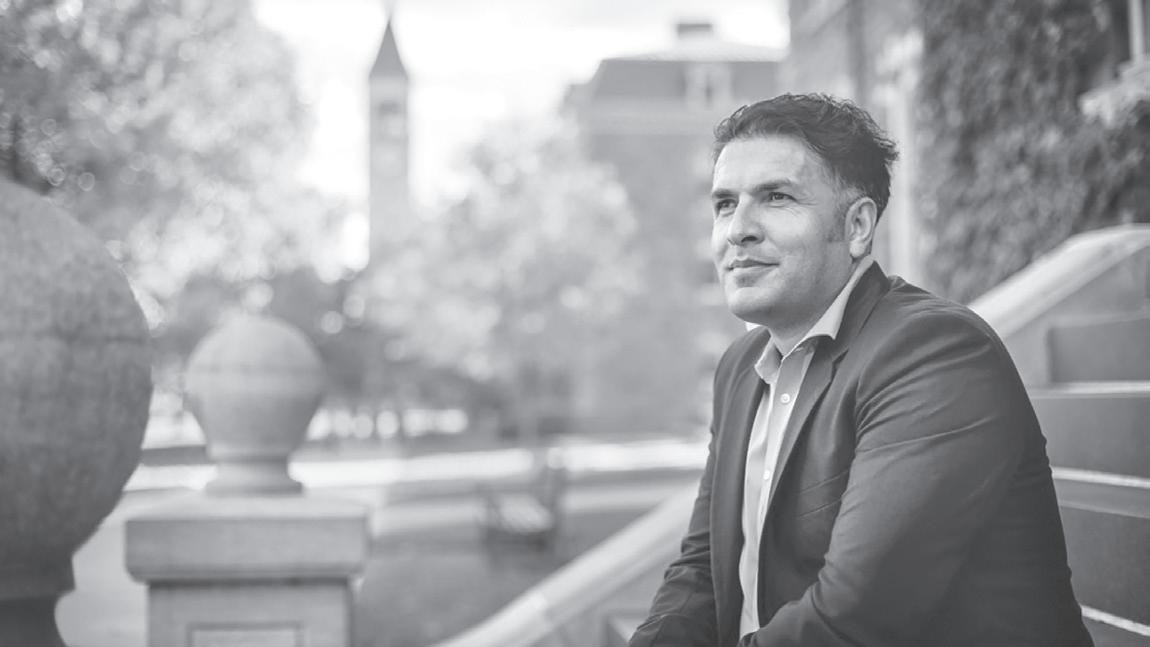
Afghan interpreter, Bronze Star recipient and Cornell graduate Farid Ferdows ’21 will be speaking at Congregation L’Dor V’Dor on Wednesday in a lecture event that will also become available online.
Titled “A Tale of an Afghan Interpreter: A Conversation with Farid Ferdows.”, the event will be hosted by the Institute of Politics and Global Affairs at Cornell University, and will be moderated by former House representative and institute director, Steve Israel. Fedrows began working for the United States Army as an interpreter in December of 2001 in Kabul, Afghanistan. Working closely with Chief Warrant Officer Tim Muller, Fedrows acquired a visa to study in the United States. In 2007, Fedrows enlisted in the US Army, where he was deployed six times to Afghanistan as a part of Operation Enduring Freedom. Two years later in 2009, Fedrow received a bronze star, which is awarded for heroic or meritorious achievement or service.
In the event, Ferdows will discuss the implications of the Biden Administration’s withdrawal from Afghanistan on August 31, 2021. Despite his family having now safely relocated to the U.S., Ferdows’ family had remained in Afghanistan at the time of the withdrawal. His discussion will offer perspective on how the withdrawal impacted men and women who supported the global war on terror in Afghanistan.
Ferdows enrolled in Cornell in 2017 where he pursued a degree in Government and Near Eastern Studies, graduating in 2021.
The talk will be held in the Congregation L’dor V’dor in Oyster Bay, Long Island. Those wishing to submit questions to the moderator or receive a copy of the recording can register online.
Roman LaHaye can be reached at rlahaye@cornellsun.com. Jiwook Jung can be reached at jjung@cornellsun.com.


Who Runs the World? Girls.
In today’s culture with Beyoncé and other empowering women promoting a global movement against patriarchal oppression and inequality, why is it that when I type “are feminists” into Google, one of the first autofill suggestions is “are feminists narcissists?”
“Feminism” is too often associated with with man-hating, lesbianism or lack of femininity, causing women to treat the “F-word” like a swear word, when in reality, we should be proudly claiming it as our own.
March is Women’s History Month, and now more than ever it is important to reclaim the F-word and do more to challenge the narrowly-defined expectations of how women should look and act. Here are some music and reading suggestions to help both men and women achieve this goal.
anthem “Born This Way,” which reminds women — and everyone — that they were created perfectly and that they should love themselves just as they are.
“Work, Bitch” – Britney Spears
On the surface, this song has depressing lyrics and a weird dance beat. But as Britney professes female autonomy, encouraging other women to work for their accomplishments and earn what they deserve instead of waiting for a man to give it to them, it’s clear that there’s more to it than that. Britney recognizes the hard work of women everywhere and acknowledges that they have the power to get what they want themselves.
“Survivor” – Destiny’s Child
This song recognizes the resilience of women and describes how even though women may feel like they will be weak and helpless without someone by their side, they are actually stronger than ever. Women are strong with and without a man, proving the power of independence. What more could you ask for in a feminist anthem?
The F-word Playlist:
“Girl on Fire” – Alicia Keys Alicia Keys wrote “Girl on Fire” to celebrate giving birth to her son and marrying her husband. The song is a celebration of “the achievements of women everywhere.” In the music video, Keys cares for her children, pays the bills and makes dinner, proving that women can do it all.
“This girl” could be any girl, allowing the song to transcend genres and generations, making it a great feminist anthem.
“Born This Way” – Lady Gaga
In 2019, Lady Gaga was the first woman in history to win an Oscar, Grammy, Golden Globe and Best Academy of Film and Television Arts award within the same year. She should be celebrated, and so should her self-love
“The Man” –Taylor Swift
This entire song is a critique on male privilege and patriarchal society. Criticism of Taylor’s career has ranged from her love life to her political stances, and as she sings, “I’m so sick of running as fast as I can / Wondering if I’d get there quicker if I was a man,” her commentary seems to transcend her own experiences as the listener can’t help but relate. The music video is also iconic, as Taylor Swift is literally “The Man,” pointing out toxic masculinity and double standards in patriarchal society.
There are so many more amazing feminist anthems that are necessary to listen to this Women’s History Month, but there’s no way I could list them all (nor do I know them all — I’ll be the first to admit that my playlists have been pretty limited to Taylor Swift recently).
Now for the books; I’ll confess, I don’t read as much nonfiction and “intelligent” books as I
should (contemporary romance novels are my favorites) but books don’t have to be “intelligent” to convey a powerful message. Here are some essentials that I think everyone should read to reclaim the F-word.
The F-Word Reading List:
We Should All Be Feminists –Chimamanda Ngozi Adichie
If you haven’t read anything by Chimamanda Ngozi Adichie yet, you’re missing out — Americanah is one of my favorites. We Should All Be Feminists was adapted from her viral TEDx talk by the same name, where she asserts that feminism is not about women’s supremacy over men, as is often believed, but rather the equality of the sexes in all aspects. This book offers a new definition of feminism for the 21st century that everyone should understand.
Hidden Figures – Margot Lee Shetterly
Shetterly tells the true story of four Black female mathematicians — Dorothy Vaughan, Mary Jackson, Katherine Johnson and Christine Darden — who worked at Langley Aeronautical Laboratory in the 1950s and ’60s and contributed to some of the organization’s biggest successes. It covers their fights against both sexism and brutal racism as they play an essential role in the development of space technology. This is a must-read (or must-watch), as it celebrates these amazing women for their accomplishments that were overlooked at the time.
My Own Words – Ruth Bader Ginsburg
A Cornell icon herself, RBG’s commentary on gender equality is essential in reclaiming the F-word. She discusses her admiration of key women who inspired her growth and career as the second female Supreme Court Justice in America, reminding us all that women, in fact, do empower other women.
Becoming – Michelle Obama
This autobiography of the former FLOTUS discusses her personal life, her own impact while serving and the pressures of being part of the first Black family in the White House. The title makes it clear that we are all constantly changing, encouraging people everywhere that we can always become better. Her memoir describes what she gained from marrying Barack Obama, but also what she gave up after he was elected. Again: a must-read.
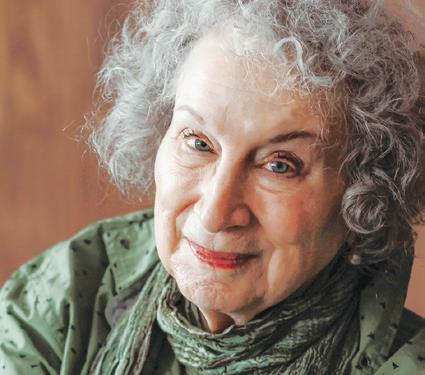
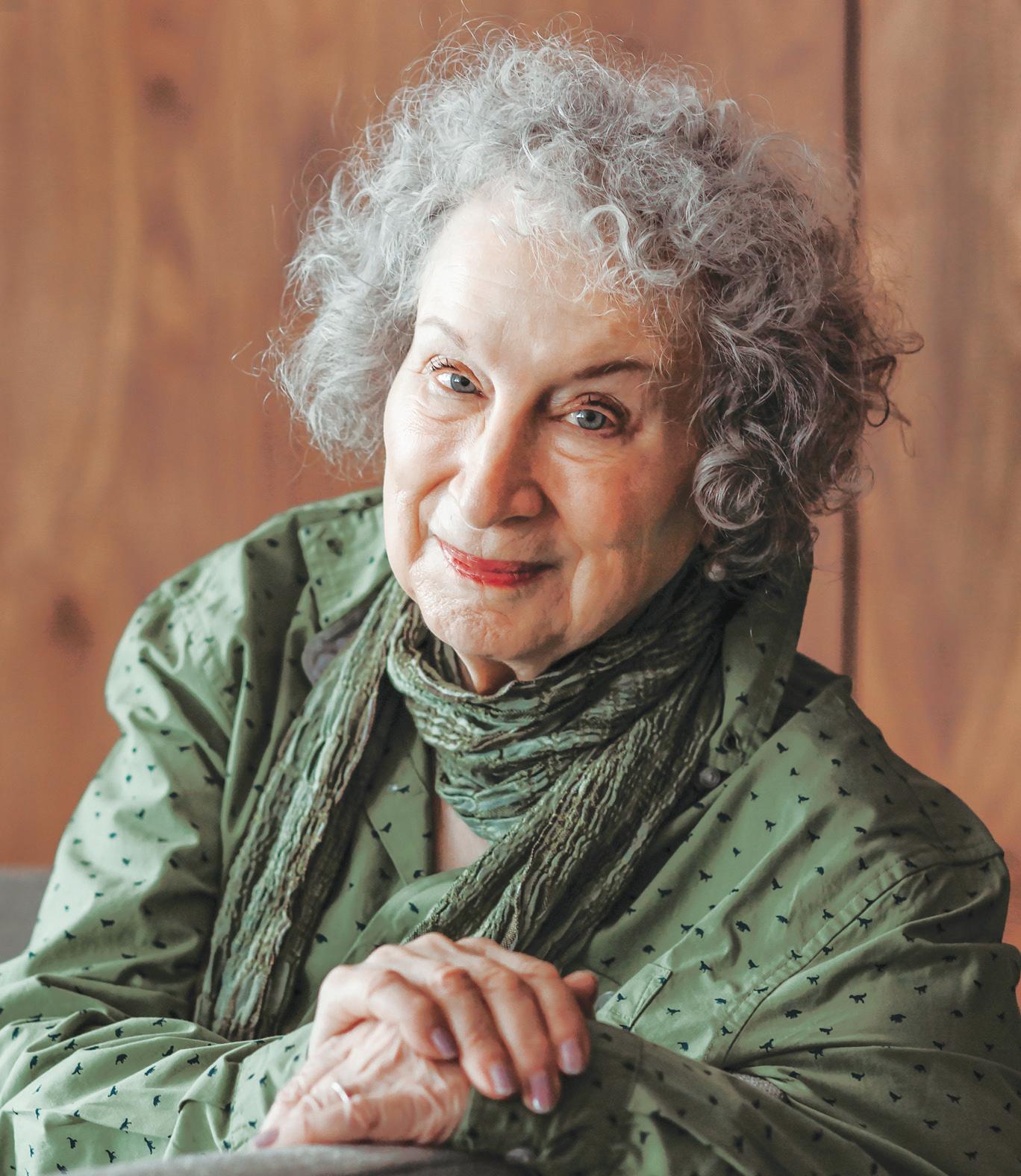
The Edible Woman – Margaret Atwood
This was honestly the weirdest book I’ve ever read but in the best way possible. It tells the story of a young woman with a job in consumer marketing who struggles with her fiancé and her relation-
ship with food. Atwood skillfully comments on the subordination of women in a male-dominated society and how women tend to find themselves exploited in consumerist society where their bodies are treated like a disposable item. Atwood never fails to remind us that dystopian worlds may be closer than we believe, prompting us to think about what it really means to be a woman in society today.
I definitely did not cover everything with these recommendations, but I absolutely recommend checking out a
few things from this list. These influential women (and so many more) promote a feminism that is not “man-hating,” but rather celebrates the strong, powerful woman who pursues her own dreams and aspirations. This is the definition of feminism we should all be proud to represent: after all, it is Women’s History Month, and it’s time to stop treating the F-word like a swear.
Freya Nangle is a freshman in the College of Arts and Sciences. She can be reached at fhn3@cornell.edu
ambitions have gone unchecked for far too long, and he has only been emboldened each time.
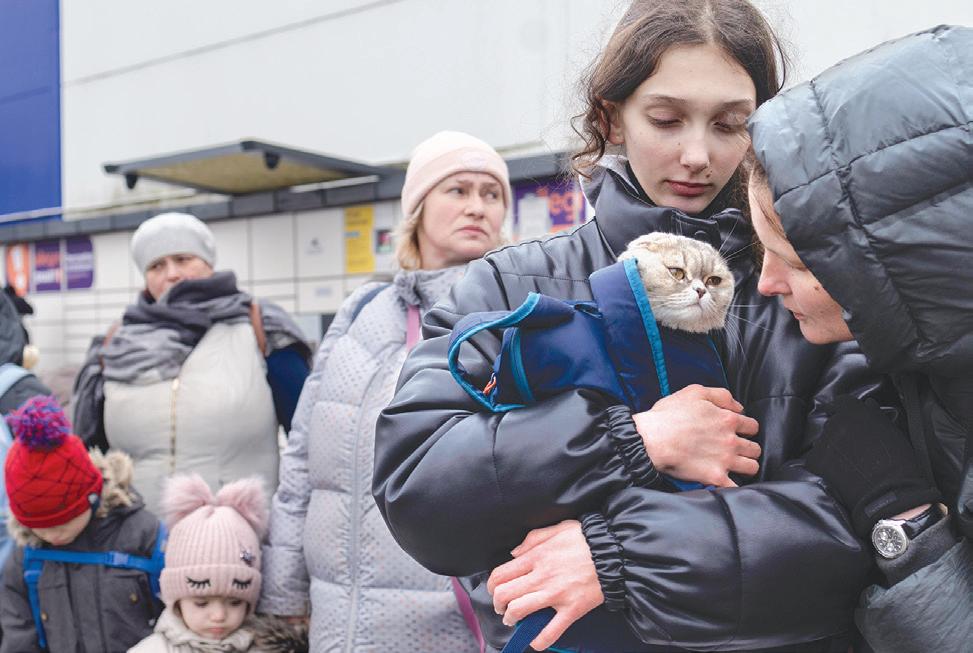
As you all know, until about a week ago, the Russian Federation recognized the Donetsk and Luhansk People’s Republics in the eastern half of Ukraine as independent. The next day, Russian troops launched a land invasion into Ukraine from the east and south, which started the bloody conflict that rages on as we speak. This war benefits virtually nobody. Not the Ukrainian people, who must now either leave everything they’ve ever had or risk it all to defend their homeland. Not the Russian people, who will lose thousands of their young men to no apparent end, and whose livelihoods will disappear under the crippling weight of sanctions. No, only one man stands to benefit from this conflict: President Vladimir Putin.
Now, you might be asking, “Why would Putin do such a thing?” The answer to this is pretty simple: we let him do it before. In 2008, when Putin invaded and carved up Georgia, the West stood by and did absolutely nothing. In 2014, following the annexation of Crimea, the West delivered sanctions, but they were quite weak and didn’t provide any sort of stern message. We let him get away with turning Belarus into what is effectively a vassal state of Russia. We let him get away with carving a microstate out of Moldova. We let him get away with all of it. Putin’s grand imperial
We’ve seen this situation play out before, not even a century ago, in the lead up to World War II. The lesson of Munich was understood only after the bloodiest war in human history, which left millions dead and involved some of the worst atrocities ever committed. In 1938, the Allies thought that they could get Hitler to stop by giving him some of what he wanted.
Peace in our time, they said. Clearly, judging by the fact that he didn’t stop, that plan failed miserably. We learned that appeasing a rogue dictator never works; once you give them an inch, they will take a mile, and they will never stop until they hit the wall. Negotiating with a rogue leader is futile, doubly so if he leads a world power. Just as Adolf Hitler used the might of the German war machine to intimidate and browbeat the British and French into
conceding the Sudetenland, Putin is using the threat of nuclear war to get NATO to relent and let him get his way. To take the route that British Prime Minister Neville Chamberlain took in 1938 would be to doom the Ukrainian people, as well as the Tatars of Crimea, to a repression of their culture and identity reminiscent of the Stalin era. NATO must put its foot down now, or we may never be able to stop Putin from waging the new most devastating war in human history. We must not let Munich
happen again.
The West’s weakness is what enabled Putin to realize his imperial project. His goal is to bring Russia to the so-called “former glory” of the Soviet Union, which he sees only in terms of military power. Putin will keep going until he is stopped; however, force is the only language he is capable of understanding. Sanctions have no effect on a man who refuses to care about the
well being of his own people. He and his kleptocratic cabal all have multiple precautions in place to make sure they can access their money. They have established networks in other ex-USSR countries like Kazakhstan or Armenia, which Putin can bully into serving him. Like Joseph Stalin and the tsars of old, Putin is perfectly content letting millions of his own starve in the streets, for the opinions of the serfs simply do not matter to him in his palace. If we let him take Ukraine without repercussions, he could set his sights on Central Asia next, or maybe even the Baltics. That simply cannot be allowed to happen. It would set the precedent that unprompted invasion and annexation is acceptable. Boy, would that make China and the U.S. blush, as Beijing would be able to seize Taiwan, and the U.S.’s past transgressions would look much more kosher.
This, right here, right now, is our 21st century Munich. The West has two options in front of it. It can either stick to finger wagging and token sanctions, thus showing Putin that he can invade a country and commit war crimes for free, or it can act quickly and decisively to ensure that Putin realizes that this kind of politics will not be tolerated. I know which option I would choose, but I can only hope that our leaders do the same.
Warning: The following content contains sensitive material about suicide, drugs, guns, domestic violence and mental illness.
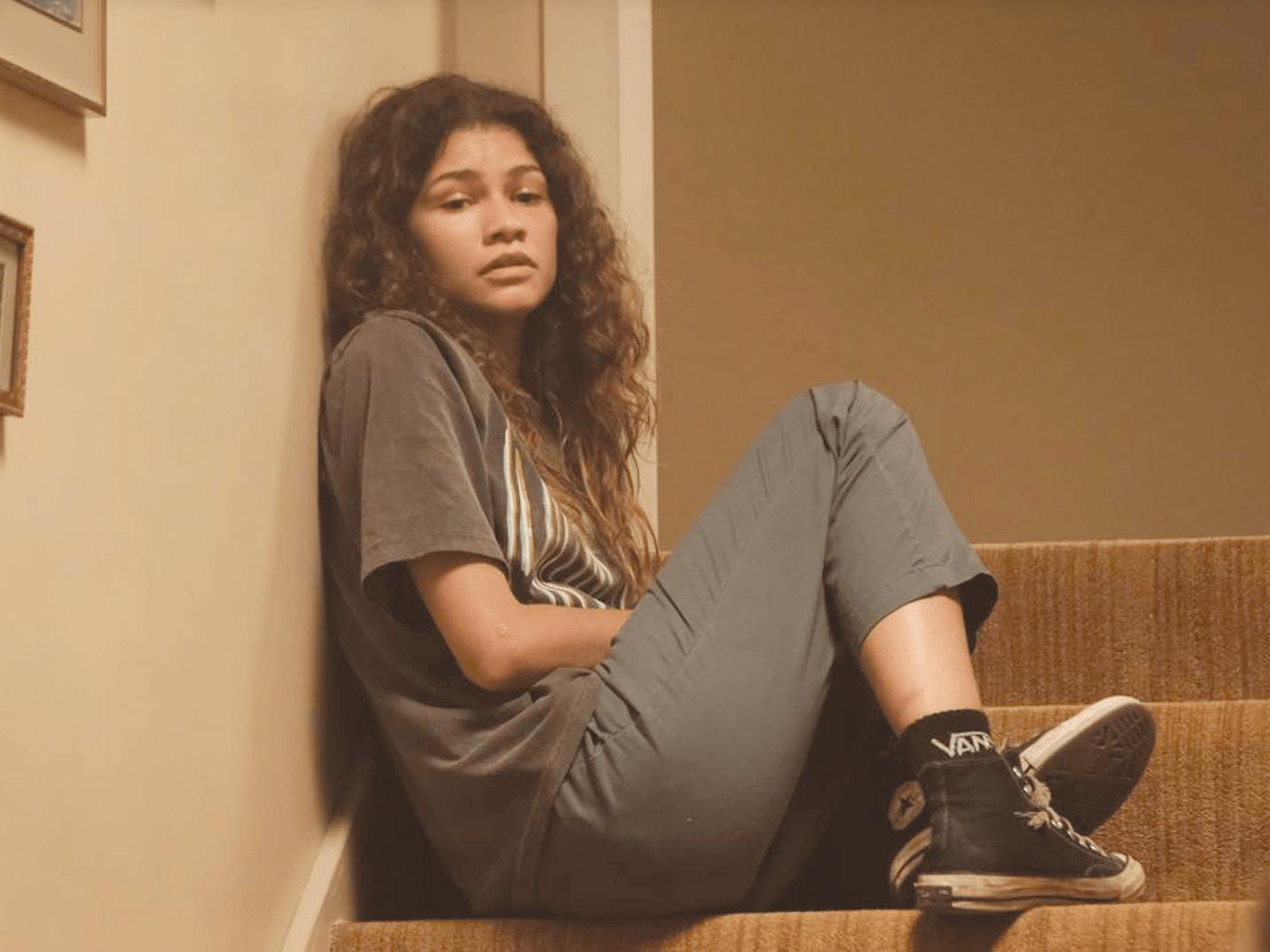
I worry for the future of Euphoria
I worry that it is getting “Thirteen-Reasons-WhyIfied”: a genuinely captivating (perhaps a hot take for Thirteen Reasons Why) show faces criticism from fans of “romanticizing xyz” and pivots to becoming a drama centered on so-called real issues teens face. This results in the characters facing EVERY issue to its maximum extent. The show becomes nearly unbearable to watch and loses its former magnetism because of the characters’ constant and debilitating pain. As the seasons drag on, people continue to hate-watch it just to see what crazy, unrealistic plot lines the writers come up with next.
Let me explain.
I am ashamed to admit that I did watch all of Thirteen Reasons Why. I read the book that inspired the show when I was in middle school and LOVED it, so I wanted to see how the writers would adapt and continue the story.
The first season tells an addicting narrative that was impossible for me to stop watching: Hannah Baker commits suicide and leaves behind a set of 13 tapes, each addressed to one person who contributed to her depression. We follow along as Clay Jensen, the plainest audience surrogate character you could ever imagine, listens to each tape. Season One definitely had the cringy flavor of a typical teen drama, but the story was so enveloping that it was a great watch.
anything. They put their characters through the wringer in the remainder of the show’s run under the guise of tackling issues that real teens face: heroin addiction, homelessness, school shootings, severe mental illness and death. While these are of course pressing problems that occur in real life, the oversaturation of struggle was unrealistic and brutal to watch. The show was no longer interesting or binge-worthy; it was just upsetting.
I certainly believe that television should be challenging and make us think, but I also believe that the primary purposes of television should be entertainment and amusement. When a show decides to be too challenging, like Thirteen Reasons Why, it often has to sacrifice amusement. Euphoria knew how to walk the line perfectly, and
served style and substance. The characters’ problems were realistic: Rue struggled with drugs, Jules, Cassie and Kat craved male validation, Maddy was locked in an abusive relationship and Lexi was a side character in her own life. The show was provocative and unhinged enough to be interesting, without yet crossing into “let’s preach about what teens today are going through” territory.
Season Two feels different right off the bat. After facing criticism of romanticizing drug use (which, yeah, I would love to see a statistic of how many teenagers decided to try molly after watching the carnival episode), the show took a noticeable turn away from its former glamorous aesthetic. The show is certainly still artistic, but not in the same escapist manner as Season One. Instead of glitter and purple lighting, we now have ~symbolism~. I’m a simple viewer, and I miss the glitter.
Season One proves that.
Season One of this show was immediately met with allegations of romanticizing mental illness and suicide. The show became even darker in future seasons, seemingly to prove that the creators were not romanticizing
I watched all of Euphoria Season One in a 12-hour period after purchasing HBO Max. The show’s first season is pretty consistent with the real world, but with a little more debauchery: men are a little more evil, drugs are a little more available and high school students are poorly behaved but fabulously dressed. The show was a beautiful escape for the audience: its daring aesthetics and fantastic dialogue made it so entertaining. Euphoria
The plot has gotten out of control and wholly unrealistic for a bunch of high school students: violent drug deals, the messy entanglement between Fez, Ashtray, Custer and Laurie and the plot point culminating in Nate putting a gun to Maddy’s head! That’s not even including Rue’s storyline. After Season Two Episode Five, in which Rue gets sex trafficked, I knew that the show’s sparkles and silly debauchery era had unfortunately come to a close. Am I the only one who misses the days when it felt like the majority of the show was Maddy and Cassie serving bimbo?
I worry that future seasons will see Euphoria go even further off the deep-end. I worry that the show will try to prove that it is serious and not romantic by doing what Thirteen Reasons Why did: inflicting more and more pain upon its characters and taking away the joy and uniqueness that made millions of viewers fall in love with the first season. Season Two left the realm of high school drama, and I’m scared to see what’s next.
The day Euphoria opens with a video of the cast explaining that “this show discusses real issues teens face” is the day I dread.
Lauren Douglass is a sophomore in the College of Arts and Sciences. She can be reached at led94@cornell.edu.
140th Editorial Board
VEE CIPPERMAN ’23
Malvern, Pa. Editor in Chief
SERENA HUANG ’24
East Brunswick, N.J.
Business Manager
EMMA LEYNSE ’23
Leonia, N.J.
Associate Editor
KATHERINE YAO ’23
Dublin, Ohio Opinion Editor
NAOMI KOH ’23
Mamaroneck, N.Y.
Assistant Web Editor
SOFIA RUBINSON ’24
Islip, N.Y. News Editor
ESTEE YI ’24
Manhattan, N.Y. News Editor
KAYLA RIGGS ’24
San Jose, Calif. City Editor
JULIA NAGEL ’24
Bethesda, Md.
Photography Editor
MEHER BHATIA ’24
Edison, N.J. Science Editor
KATRIEN DE WAARD ’24
Naperville, Ill.
Production Editor
PAREESAY AFZAL ’24
Rawalpindi, Pakistan
Assistant News Editor
JIWOOK JUNG ’25
Seoul, South Korea
Assistant News Editor
ADITI HUKERIKAR ’23
Canton, Mich.
Assistant Arts & Culture Editor
DANIELA WISE-ROJAS ’25
San Ramon, Calif.
Assistant Dining Editor
CLAIRE LI ’24
Palo Alto, Calif.
Assistant Photography Editor
GRAYSON RUHL ’24
Manhattan, N.Y.
Assistant Sports Editor
From the Editor
ANGELA BUNAY ’24
Staten Island, N.Y. Managing Editor
DEVAN FLORES ’24
St. Augustine, Fla. Web Editor
SURITA BASU ’23
Lexington, Mass.
Assistant Managing Editor
ROMAN LAHAYE ’23
San Antonio, Texas News Editor
ELI PALLRAND ’24
Los Angeles, Calif. News Editor
JOHN COLIE ’23
West Paterson, N.J. Arts & Culture Editor
GRACE KIM ’24
San Diego, Calif. Dining Editor
AARON SNYDER ’23
Manhattan, N.Y. Sports Editor
TENZIN KUNSANG ’25
Chicago, Ill. Science Editor
ANDIE KIM ’24
Seoul, South Korea
Multimedia Editor
AIMÉE EICHER ’24
Manhattan, N.Y.
Assistant News Editor
SARAH YOUNG ’24
Warren, N.J.
Assistant News Editor
NIHAR HEGDE ’24
San Jose, Calif.
Assistant Arts & Culture Editor
JASON WU ’24
Albany, N.Y.
Assistant Photography Editor
RUTH ABRAHAM ’24
Syosset, N.Y.
Assistant Sports Editor
GABRIELLA PACITTO ’24
Bronxville, N.Y.
Assistant Sports Editor
KEVIN CHENG ’25
Newton, Mass. Newsletter Editor
THIS PAST SATURDAY, THE SUN ended six weeks of training by electing a new cohort of editors. The 140th board, full of energy and excitement, now embraces the time-honored commitment to band together and make The Sun shine.
My talented peers have demonstrated boundless curiosity, persistent optimism and a dedication to quality journalism throughout training, and I firmly believe that we’ve placed The Sun into good hands. It has been my greatest honor to learn from them and work alongside them these past few weeks, and I’m grateful for a coming year of fruitful collaboration. As we navigate the lasting effects of the pandemic, we push forward with courage and hope for a better-informed, reconnected community.
The future of Cornell University and our broader world remain in flux, but our paper will not waver in its 142-year-old mission to illuminate history as it unfolds. Our new editors have pledged themselves to unveil important truths, produce a high-quality paper and serve the Sun’s community of eager readers, both present and future.
As we shine the light onto a fresh group of Sunnies, we invite you along on their journey and another year of daily news. Thank you for your continued support as The Sun sets and rises again. Your readership fuels our work and allows us to perpetuate a proud tradition of independent college journalism.
— V.C.
Emma Leynse
After a second year of Zoom elections last Saturday, The Cornell Daily Sun elected its 140th editorial board — a wonderfully even number to match an equally wonderful new board. This new group of editors bring with them unbounded enthusiasm and drive as we go into this new cycle, building on our 140-year tradition of dynamic student journalism.
The new board will be led by our wonderful new editor in chief, Vee Cipperman ’23 . Coming from their position as a news editor last year, Vee never fails to make us smile with the cookies that they bring to the office and their shoutouts during edit meetings. We’re all excited to work with such an inspiring and dedicated new EIC.
Leading the objective sections is our steadfast managing editor, Angela Bunay ’24 . We can always count on her to catch Oxford commas, make hours at the office go by faster and criticize Ithaca’s lackluster pizza. By her side is assistant managing editor Surita Basu ’23. She’s always there during a crisis to get write-ups done and crack much-needed jokes.
On the subjective side of the paper, our new associate editor, Emma Leynse ’23 . Her out-of-this-world skills at meme-making and the InDesign tracking feature keep us on task and entertained. Her famous indie playlist keeps us vibing at the office. She is joined by opinion editor Katherine Yao ’23 , whose clever ice breakers always liven up Opinion meetings and who never fails to make us laugh as we fight with InDesign. Also, ask about her fabulous Goodreads!
On the technical side, we have our champion web editor, Devan Flores ’24, who enters the position ready to go with innovative ideas to keep our tech department ahead of the curve and deal with WordPress and Sun App shenanigans. Assistant web editor will be Naomi Koh ’23, who faithfully served as web editor on the 139th Editorial Board.
Doing the important work of managing our finances is Serena Huang ’24 , who will be the 140th Business Manager.
Moving down the masthead, we have a dynamic group of tireless news editors. Eli Pallrand ’24 , a speech and debate master, brings passion and enthusiasm to late night desking days. Estee Yi ’24 can be spotted ordering Uber Eats to the office at 9 p.m. and is loved for her positive vibes and constant encouragement. Roman LaHaye ’23 , known for his quick Slack response times, can be found saying “Oh bother!” in a Winnie the Pooh voice around the office. Rounding out the team of news editors is the ever-smiling Sofia Rubinson ’24 , who can always be relied on for same-day article writeups.
Joining this group in News are the amazing assistant news editors: JJ Jung ’25 , who is valiantly kickstarting The
Sun’s social team; Pareesay Afzal ’24 , who never fails to pick up a story; Sarah Young ’24 , who stands by that her statement that it would be “so sick” to be an assistant news editor and Aimée Eicher ’24 , The Sun’s resident Wordle expert.
Of course we can’t forget Kayla Riggs ’24 , our new city editor and ever-optimistic News board veteran.
Leading the recently renamed Arts & Culture section is long-time Sunnie John Colie ’23 , a fun fact expert and a dedicated editor. He is joined by two assistant arts editors: the proactive Aditi Hukerikar ’23 , who wows us with her creative PowerPoints and constant enthusiasm, and passionate music fan Nihar Hegde ’24 , who specializes in consistent editing and communication.
Bravely leading our athletics coverage is sports editor Aaron Snyder ’23 , a multitasking pro. We’re all in awe of his ability to live report, write, edit and Tweet hockey articles mid-game while taking photos. We honestly don’t know how he does it! He is joined by an enthusiastic group of assistant sports editors: Gabriella Pacitto ’24 , Grayson Ruhl ’24 and Ruth Abraham ’24
We’ve now come to the food side of the paper, which is led by dining editor Grace Kim ’24 , who is always ahead of the game on photo requests, and assistant dining editor (and opinion columnist!) Daniela Wise-Rojas ’25 , who brings endless enthusiasm and adorable photos of her roommate’s cat, Beau, and her dog, Lucky.
Leading our science coverage are Meher Bhatia ’24 and Tenzin Kunsang ’25 . They always bring positive energy to the office and are somehow able to make clean pages on the first try — we’re all impressed.
Pairing our articles with stunning visuals is the amazing photo editor, Julia Nagel ’24 , who keeps us all on the ball for photo requests. She once brought her pet hamster to the office — it was truly an unforgettable moment. She is joined by two dedicated assistant photo editors: Claire Li ’24 , who, according to Julia, took “the most aesthetic photo of Bebe Lake ever,” and Jason Wu ’24 , who wants to make Patagonia part of the dress code.
Continuing our creative work beyond the paper is our new multimedia editor, Andie Kim ’24 . Keeping the paper functioning is our enthusiastic production editor Katrien de Waard ’24 . While she has worked for the Production, Sports and Photo departments, she’s decided to make Production her new home, and we’re very glad to have her.
Last but not least, doing the important job of getting our articles to your inbox every morning is Newsletter Editor Kevin Cheng ’25 , who will stay up late (or wake up early) to put together the newsletter.

If I met you in person, I would greet you with “hi,” but over email, I would use “dear” instead. Despite the use of modern day slang in nearly every other communication medium, somehow the messages in my Gmail “sent” folder resemble letters dating back to the 1800s more than they do anything we would say in the 21st century. One would expect email — like landlines or fip phones — to have become outdated with time, ultimately giving way to modern forms of communication like social media or texting. Yet, email has sneakily blended in amongst modern social media, even though its core principle remains largely unchanged from its inception in the 20th century. Why is it, then, that the rise and fall of MySpace and Vine all happened during a time when email remained a steady form of online communication? Perhaps this is not so surprising. With every new social media platform that ofers even more intimate ways of sending texts,
D.M.s and memes, we have not rid ourselves of the desire to fall back to the opposite. Across what is now several generations, email flls an important need invariant in the American landscape: the need to keep our distance.
Tis culture is very much alive in our day-to-day email correspondence as students. When we repeatedly greet someone with “dear” after every reply, our apparent politeness can double as a barrier between our personal lives and that of our correspondent; In greeting each other
When we repeatedly greet someone with “dear” after every reply, our apparent politeness can double as a barrier between our personal lives and that of our correspondent.
from anew with every consecutive reply, we reestablish the notion that we are mere professional acquaintances with our correspondent, freeing ourselves from any obligation to truly get to know them. When we go out of our way to conjure up sentences with antiquated speech in our email correspondences in lieu of the language we use in casual conversation, we prevent our recipient from interacting with our true personalities.
In a professional setting like a college campus, being vulnerable in this way isn’t necessarily embraced. In fact, the desire to appear formal is so heavily entrenched in us
that previous columns have even called for instructions for how to conform in writing emails. It’s akin to one of the most common greetings we use on a daily basis — “how are you?” — to which we’re expected to give a polite “good, thanks” instead of an honest answer. But, the way we email and interact here on campus is only a microcosm of the distance we keep from each other as Americans in general. Unfortunately, it’s one that began long before the era of social distancing.
I’ve recently heard from international students and workers in Ithaca that they feel the culture in the States is centered around pursuit of work or prestige, without forming strong connections to home communities or having genuine care for neighbors. Email has allowed us to confront this reality with an unspoken rule: we email because we need something from someone, not because we genuinely want to connect with them. Te typical “I hope this email fnds you well” we include before asking for a deadline extension or attaching our resume is a cop out to reassure the recipient (or perhaps in a deeper sense, ourselves) of our humanity.
I still remember my excitement when I created my frst email account in the fourth grade. As I looked at my new inbox that only had two promotional emails, I became jealous of my parents whose inboxes were fooded with hundreds of unread messages. In associating emails with learning to feel and act like adults, we unknowingly train ourselves to understand mature adults as people who communicate less intimately. We aspire to trade in our silly school bus banter that is more intimate and human than any email can possibly be, for professional correspondence with subject lines and signofs. We ultimately grow to become more distanced from our peers and neighbors.
In this way, the polite formalities that compose a well-mannered society really establish barriers between us. Only once we put aside America’s often ingenuine politeness can we all work toward fostering a warm, less-cliquey culture on campus and beyond.
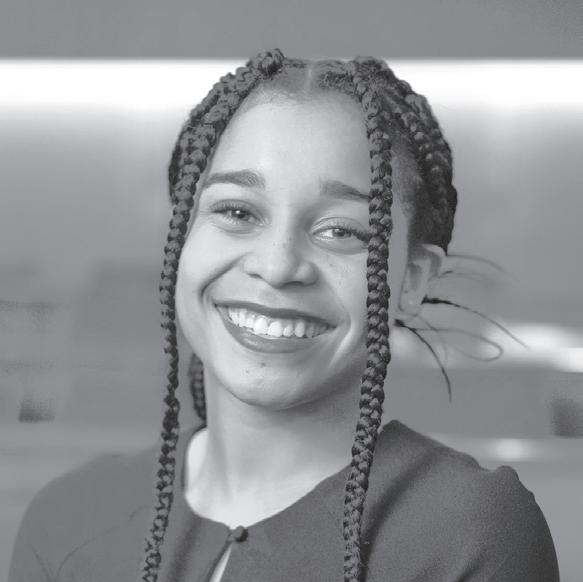
Anuli Ononye (she/her) is a senior in the College of Arts and Sciences. She can be reached at aononye@cornellsun.com. Womansplaining runs every other Monday this semester.
Happy International Women’s Day (a day early!) and of course, happy Women’s History Month. As you can imagine, this month is my favorite time to write my “Womansplaining” op-eds because almost every Cornellian is looking for the “best” way to celebrate women and the women in their lives — this year I’m providing you with a list of women who deserve your recognition and might not always get it.
My biggest pet peeve about International Women’s Day is the social media “thank you” posts. Te “Tank you to all the amazing and strong women in my life” posts that almost always include a picture of your mother, sister, best friend and grandma but leave out so many other important people. It especially bothers me when someone who is particularly anti-feminist or spends time working against women has the audacity to do the same thing. I implore you to take actionable steps this
International Women’s Day that move you beyond this performative activism: see my column from last year about ways to get involved for International Women’s Day on our campus.
Despite my annoyance with these posts, I have come to see them as completely inevitable. And, I’ve decided that International Women’s Day isn’t the day for me to be a complete feminist killjoy. Any way that you choose to center women and girls on this day is important, and frankly, the women who have impacted your life the most are often your close friends and family members. I know my mom (love you mom!) is the most inspiring person in my life. But she knows that I love her, because I tell her almost every day, and she is celebrated on so many other holidays throughout the year.
So, if you are just dying to push send on that Tweet or Instagram collage to show the world how much you love the women in your life, I encourage you to take a step beyond the obvious choices. Here’s a list of women in your Cornell life who might not get the same appreciation on this holiday as the people closest to you. Post about how they inspire you or send them a note of appreciation:
Your Hardworking E-board Member: Is there a woman in your org that the club would just fall apart without? I can name a few from my orgs, ranging from presidents to super involved g-body members. Let them know how much you care about them this year and why they make your org a safe and inspiring place.
Your Advisor:
Tis is even more important if you’re a senior. Almost every senior that I know — especially the ones writing a thesis — are gripping tight to their advisors this year. Advisors are writing letters of recommendation for grad schools and jobs, flling
out the paperwork to make sure that you graduate on time, reading too many drafts of that thesis and providing emotional support when you really need it. Tis is a great time to let your advisor know that they matter to you, and that they are a woman that you look up to. Granted, this only works if your advisor is a woman — like all three of mine!
Any other Professor:
Your advisor is defnitely not the only professor who has made a lasting impact on your Cornell career. Cornell has so many amazing professors who deserve to be thanked daily — use this as an opportunity to thank the women! Tere’s the professors who rearranged their schedules to help you when you were struggling with that paper, the professors who recommended you for fellowships or research opportunities, the professors who taught you something that completely changed your mindset, and the professors who taught so passionately that they inspired you to change your “well thought-out” career path.
Your Study-Buddy:
Almost everyone at Cornell has a study-buddy who isn’t really their friend, but is also their best friend. Tat’s the person who is taking that unbearable class with you and agrees to be your partner for the group project, shares class notes with you when you’re away on sick days and stays up all night with you cramming for that exam in Olin. I’ve had so many incredible women as study buddies over the years that I’ve lost touch with. Now’s the time to let them know that they really saved you in that class and were great friends when you really needed one.
Your Residential Staf:
Every Cornellian has lived on campus for at least one year during their undergraduate career.
Your residential staf were the leaders who organized game nights
and fun activities when you really needed it, checked in and helped you through the crises that come with living where you (school) work and who kept the campus safe during the pandemic. Even if you’re not living in residential life anymore, send an important RA, URF/GRF, HAD, RHD or House Professor a thank you to celebrate the holiday.
Dining Staf:
Do you have a special connection with your Libe barista, your favorite dining hall chef or server or your friend who is a dining student worker? Let them know how much you appreciate them for International Women’s Day! Dining staf have had it hard this year, adapting rapidly depending on campus COVID-19 protocols while still making the dining experience great for our community. If anyone deserves a thank you post, it’s them.
Your favorite Alumna: Everyone knows my favorite Cornell alumnae: Ruth Bader Ginsburg, Kimberlé Crenshaw and Toni Morrison. Are they yours as well? Use this as an opportunity to thank the Cornell women who have paved the path for you and made our campus (and world!) a better space to live in. Tis could be a peer who graduated just a few years ago, a woman who helps mentor your student organization or an alumna who you’ve never met (or never had the opportunity to meet) who still inspires you.
Te list can go on and on. Tere are so many incredible women in our Cornell community that make our space a place where we are happy to live and learn. Tis International Women’s Day, take the extra step to tell them how much they matter to you and how they have impacted your experience here. Also, of course, tell your mother that you love her. And feel free to post about it too!

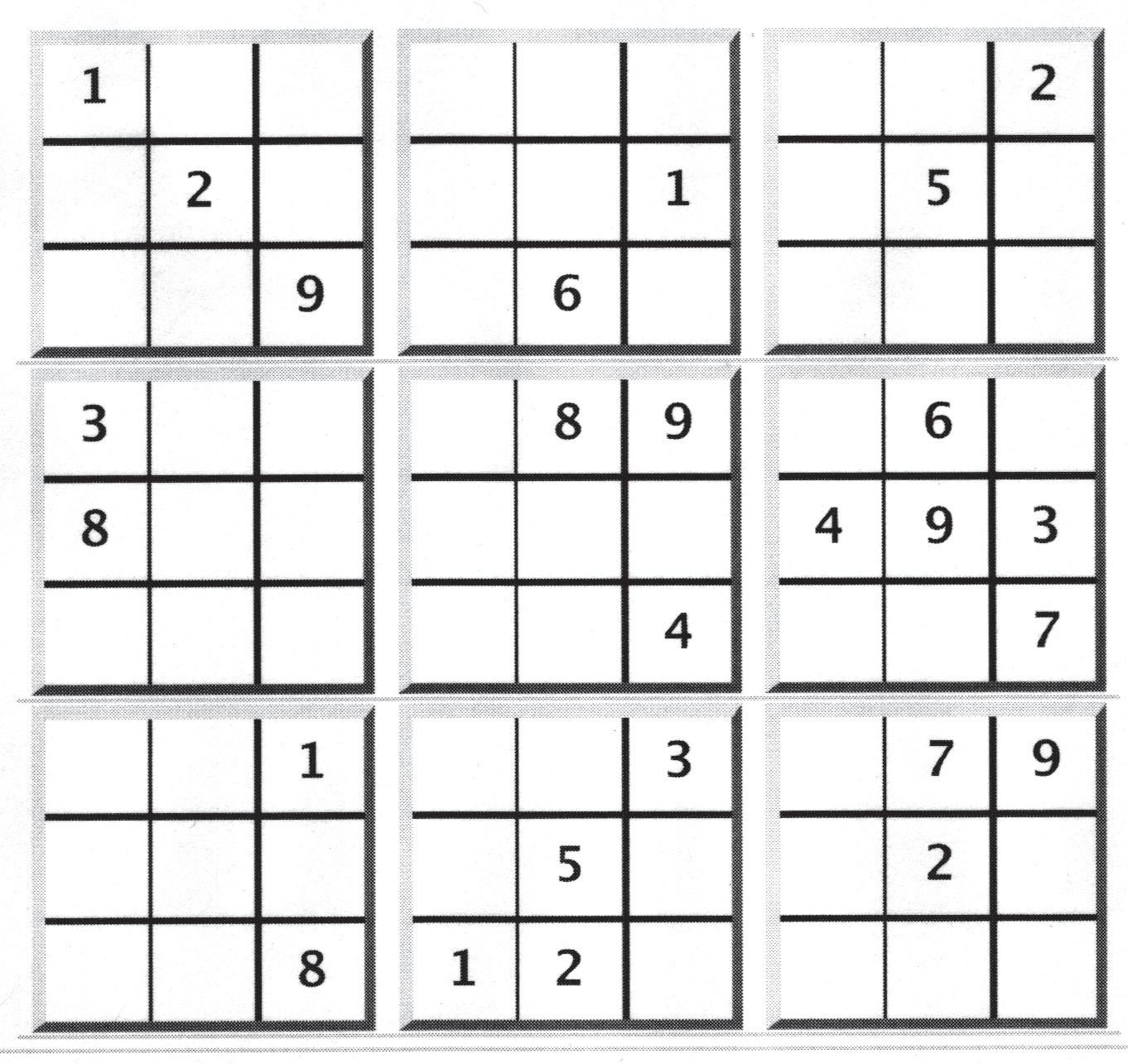
Fill in the empty cells, one number in each, so that each column, row, and region contains the numbers 1-9 exactly once. Each number in the solution therefore occurs only once in each of the three “directions,” hence the “single numbers” implied by the puzzle’s name. (Rules from wikipedia.org/wiki/ Sudoku)


By BRYAN VICENTE Sun Staff Writer
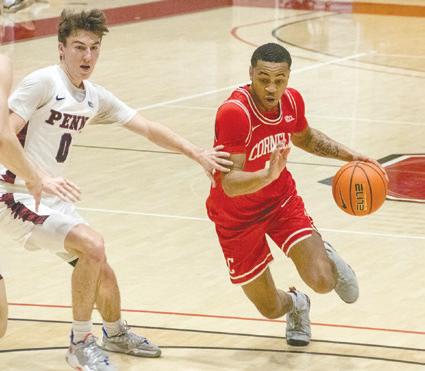
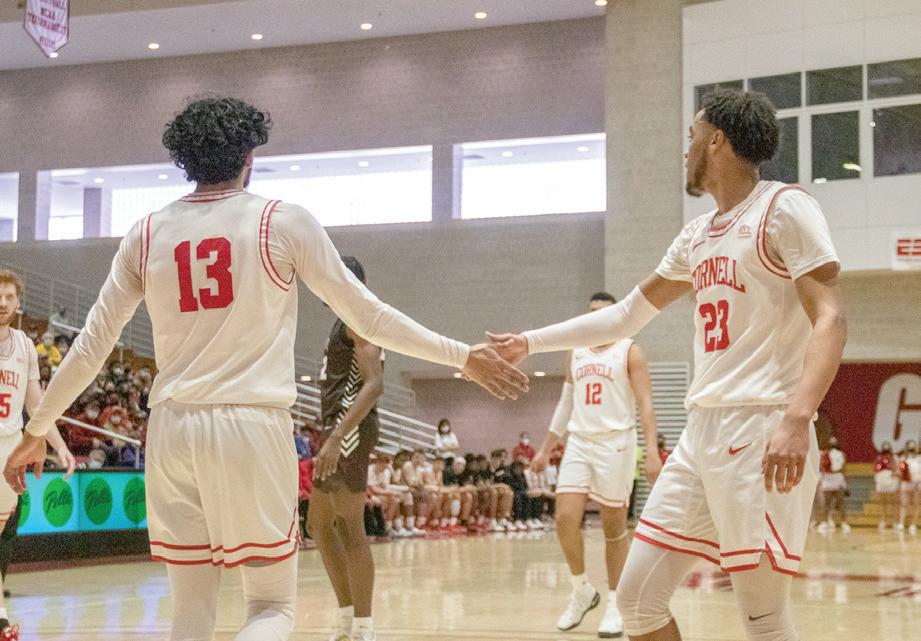
After an upset win against Yale (17-11, 11-3 Ivy), the Red found itself with its fate in its own hands during one of the most competitive years in Ivy League history. Just one game in front of Harvard (13-13, 5-9 Ivy), Cornell (15-10, 7-7 Ivy) had to beat Columbia (4-22, 1-13 Ivy) to enter the Ivy League tournament.
Right out of the gate, the Red found its groove: leading 16-5 after less than nine minutes. Cornell would go into halftime with an 18 point lead and never see it go lower than a 14 point difference. The Red kept control of the entire game, en route to securing fourth place in the Ivies.
“We’re really working hard in practice, trying to keep the pace as fast as we’ve gone the whole season but then doing multiple situations where you know how to protect the lead and maybe downshift when it’s time to to win a game,” said Head Coach Brian Earl. “We did an okay job of that against Columbia, but it’s hard to know when to really make that switch. Thankfully, our guys are starting to pick up on it.”
five attempts from senior guard Sarju Patel. Patel tied for the team high with senior guard Dean Noll and junior guard Greg Dolan, who scored 12 points each, followed by Boothby, who had 11 points.
The Red held Columbia to a 39 percent field goal percentage without any fastbreak points. Cornell also outrebounded the Lions with 16 points off fastbreaks.
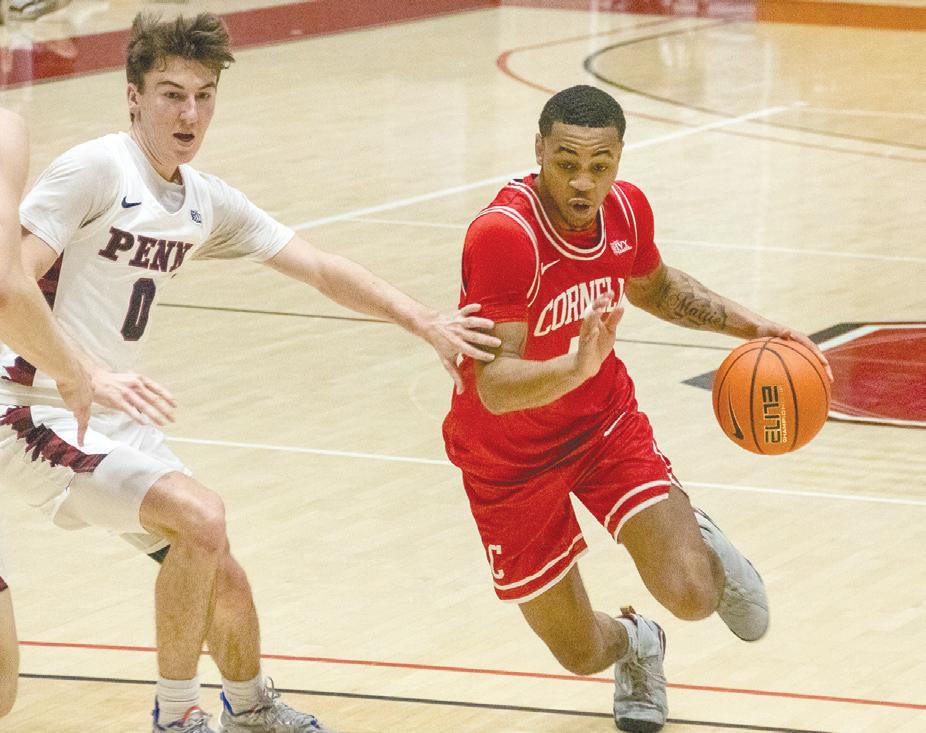
Against Princeton, the Red will be challenged again. Cornell was unable to secure a comeback during its previous game earlier in the year. The Red blew an 18 point lead in the second half and lost to a buzzer-beating three pointer. In the second matchup, the Red gave up a ten point lead and found itself behind, but battled to secure a victory at the end. Since losing to Cornell, Princeton has won all of its games: beating Yale by six points and smashing Penn by 23 points last week.
The team shot a whopping 48.3 percent from the threepoint range, including three makes on four attempts from sophomore forward Keller Boothby and three makes on
“We need to have some good practices and understand how we’re going to try to beat Princeton,” Earl said. “They’ve improved a lot as well and really have a lot of seasoned players who’ve battled through the rest of the season to sweep from our game forward. We can’t think about our past experiences with them and have any sort of confidence or overconfidence – we’re just trying to figure out a way to hang with them and make sure that we make it as close as we did the first two times.”
The Red will travel to Cambridge, Massachusetts for
“We need to have some good practices and understand how we’re going to try to beat Princeton.”
Head Coach Brian Earl
the two-day Ivy Tournament, fighting for an entry into the NCAA tournament. They will face Princeton at 11 a.m. on Saturday, March 12. If the Red can find victory, it will await the winner of Penn vs. Yale for a matchup at 12 p.m. on Sunday for a chance at the Ivy League crown.
Bryan Vicente can be reached at bdv23@cornell.edu.
Top-half | Cornell qualified for Ivy Madness with its first top-half Ancient Eight finish since 2018.
By RUTH ABRAHAM Sun Assistant Sports Editor
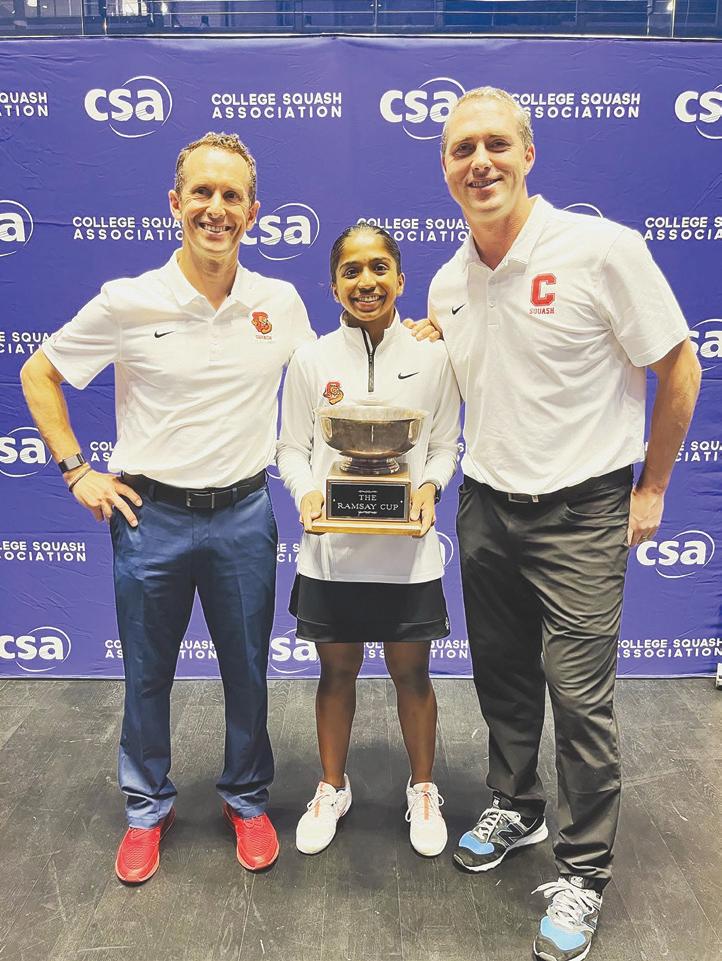
Nearly four years in the making, senior Sivasangari Subramaniam overcame tough losses, a pandemic and battled through injury to finally covet the prestigious Ramsay Cup –– the top-flight at the College Squash Association National Collegiate Individual Championships –– making her the first Cornell squash player to win an individual national championship.
During her time at Cornell, Subramaniam has come very close to bringing home the national championship. As a freshman she lost in the final, as a sophomore, she lost in the semifinals. Being in the final again, as the No. 1 seed, meant there was a lot of pressure on Subramaniam to succeed.
“I felt she handled the pressure really well
all week”, said Head Coach David Palmer. “When it got really down to the pressure situation today, I was really proud of how she came through right at the end of the match and played very smart and showed everyone how skillful she really is.”
After sweeping her first three opponents, and not dropping a single game, Subramaniam faced a tough opponent in the final: the No. 2 seed, Hana Moataz of Harvard. Coincidentally, it was Moataz that ended Subramaniam’s hopes at the 2020 CSA National Individual Championships in the semifinals.
This time around, Subramaniam was victorious, beating Moataz in a grueling fiveset match. Subramaniam got the lead by winning the first game, but Moataz quickly responded by taking the next game. After narrowly winning the third game, and serving for the match at 10-7 in the fourth game, Subramaniam lost her foothold, and Moataz stormed back to take the fourth game, 14-12.
“I tried to play each point at a time, but I think, it’s just all the nerves and everything was just coming into my mind, and it was really frustrating to not get that game,” said Subramaniam.
With a back and forth to finish the fifth game, it looked like it could have been anyone’s game. The fifth game was tied at 5-5 when Moataz began showing signs of fatigue. Subramaniam capitalized on that and never looked back, securing the game and the championship. With this victory, Subramaniam became the first Cornell squash player — man or woman — to win an individual national championship.
“To be the first one ever in Cornell sports history to win it…it’s going to be a day to remember,” Coach Palmer said. “It really sets the tone for the program.”
This victory meant a lot for Subramaniam as she beat Moataz, who ruined her chances at making the finals two years ago.
“I just really wanted to take revenge on
her because she beat me 3-1 two years ago in the individuals…this year I really wanted to win, not just for me, but Cornell, too,” Subramaniam said.
Subramaniam ended her season, for the first time in her collegiate career, undefeated, winning 19 straight matches in a row. Her last loss came from Moataz during the 2020 National Championships. Her first round victory at the individual championships guaranteed her a spot on the CSA All-American first team as well.
“It definitely means a lot ... I am really happy to be winning for Cornell.”
Sivasangari Subramaniam
Subramaniam, who is currently ranked 23rd in the world in the Professional Squash Association Rankings, has only been defeated four times during her time with the Red. Ironically enough, all four losses were at the hands of players from Harvard, the team that has consistently topped the CSA team rankings for nearly a decade.
“It definitely means a lot…and I am really happy to be winning for Cornell,” Subramaniam said.
She even credited Coach Palmer and Assistant Coach Mark Burke for her success as well. “Both the coaches have been working really hard to always make the program better each year, so winning this will definitely be huge for them.”
Subramaniam will be returning next spring to don the carnelian and white once again whilst also finishing her degree. She will be taking a leave of absence for the fall semester to compete for her home country, Malaysia, in the 2022 Commonwealth Games and the 2022 Asian Games.
Although this season just ended, Subramaniam has already set her goals high for next season. Individually, she wants to be undefeated again and win one more national championship, but more importantly, she has high hopes for the team.
“[I want to bring] the team into the top 8, and hopefully top 4 because [they] will be having a stronger team next year,” Subramaniam said.
The Cornell squash program as a whole is grateful to have Subramaniam return for one more season.
“Just having Siva on the team, around the team, for both the men’s and women’s team [is very] motivating”, Palmer said. “For our girls to be on the court with her and train with her is a very big advantage that we have. So we are fortunate that she is gonna be with us for another season and we will definitely take full advantage of it.”
Four other players from Cornell also competed at this weekend’s championships. Competing on the men’s side was junior Veer Chotrani, sophomore Spencer Yager and freshman Arnaav Sareen.
Chotrani had made it to the quarterfinals before bowing out to the No.1 seed from Princeton, Youssef Ibrahim, who is ranked 17th in the Professional Squash Association World Tour. Sareen won the consolation draw of the Molloy Trophy South bracket, which was part of the B Division of the National Championships. Competing for the Ramsay Cup, along with Subramaniam, was sophomore Wen Li Lai.
Lai made it to the quarterfinals but lost to Moataz. However, by reaching the quarterfinals, she is guaranteed to be named to the CSA All-American first team along with Subramaniam. This is the first time in program history that the Red had two selections for the All-American first team.
Ruth Abraham can be reached at