The Corne¬ Daily Sun


By ANUSHKA SHOREWALA Sun Assistant News Editor
While local Ithaca residents were participating in the 26th Annual Chili Cook-Off March 2, a heated altercation ensued, resulting in a stabbing incident.
According to the media release from Ithaca Police Department Lieutenant Thomas Condzella, the police responded to a report of a disturbance at the 100 Block of West State Street, where multiple individuals were reportedly engaged in a physical altercation, one of whom was carrying a knife.
Law enforcement discovered at the scene that two of the three individuals implicated had already departed. The individual present had suffered
a laceration to his face during the altercation. Bangs Ambulance Company and the Ithaca Fire Department initially responded to the injury and conveyed the individual to a nearby medical facility, where medical professionals determined that his injuries were not life-threatening.
According to the preliminary investigation, the individuals involved in the altercation appeared to have been acquainted with each other.
“This incident does not appear to be a random attack and, that said, there is no larger public safety concern,” Condzella wrote in the press release.
The Ithaca Voice reported that Ithaca Police Chief Thomas Kelly, who attended the cook-off as a judge, said that the

incident was unrelated to the event.
The identities of the two individuals who fled the scene remain unknown, as they were described only as two males wearing hooded sweatshirts. The Ithaca
Stephen Henhawk discusses eforts toward revitalizing and teaching others the Gayogohó:no language
By KATE
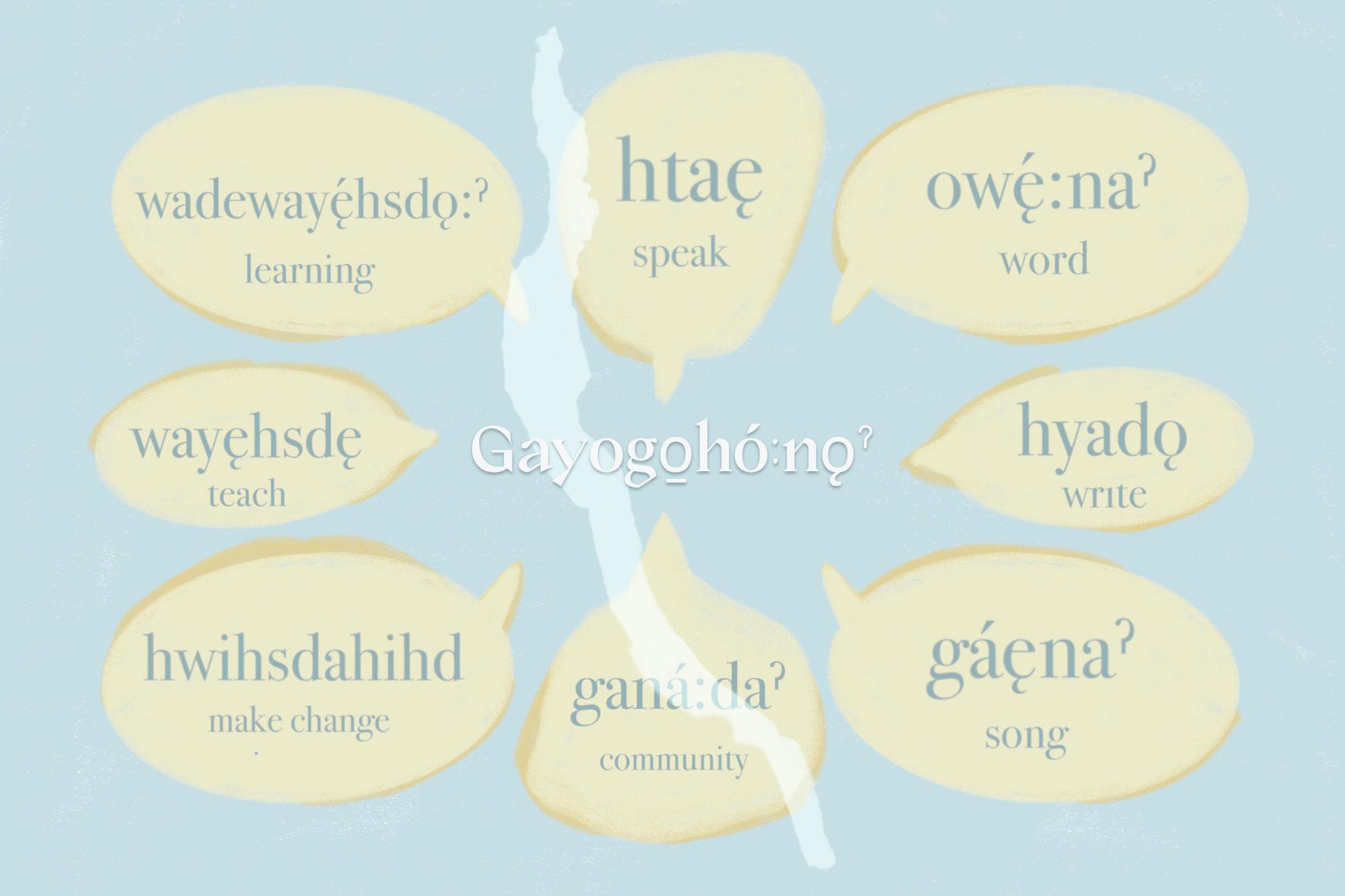
As a child raised by his grandparents in the Six Nations of the Grand River reserve near Hamilton, Ontario during the 1970s and 1980s, Stephen Henhawk heard Gayogohó:no' — a Haudenosaunee language also known as Cayuga that is spoken in Upstate New York, Ontario and Oklahoma — everywhere he went.
“We went to the post office. The lady at the post office — she spoke Gayogohó:no'. We went to the local corner store. The lady that worked there — they spoke Gayogohó:no',” Mr. Henhawk said. “I went with my gramps to buy new tires at this garage. The guy that was there — he spoke Gayogohó:no'. Everyone did.”
However, in part due to the lasting impact of residential schools in Canada — institutions with extensive records of abuse that attempted to forcibly assimilate indigenous children into white Canadian society from the 1880s through the 1990s — the Gayogohó:no' language now faces an uncertain future.
In 2010, the United Nations Educational, Scientific and Cultural Organization denoted the Gayogohó:no' language as “critically endangered.” In 2016, The Canadian Census reported that 55 people spoke Gayogohó:no' as their first language. Mr. Henhawk — who learned the language from his grandmother, Irwina Henhawk — said that at age 48, he is now one of the youngest of the few remaining first-language Gayogohó:no' speakers.
Mr. Henhawk, who now resides in Ithaca, has been teaching Gayogohó:no' for about 15 years. He said that he decided to begin teaching the language when he saw dwindling numbers of teachers in a Gayogohó:no' immersion program in
which he enrolled his three sons.
“As [my sons] were going through school, I started to notice … [that] the number of teachers was dropping really dramatically,” Mr. Henhawk said. “There wasn’t anybody that was younger that was taking initiative at the time to do anything.”
Since then, Mr. Henhawk has worked closely with speakers in Six Nations of the Grand River and the Seneca-Cayuga reservation in Oklahoma to not only revitalize Gayogohó:no' language in their communities but also share their knowledge of the language with Gayogohó:no' people living in their ancestral homeland — the Finger Lakes region — who had largely lost touch with the language.
“Most of our people have no reference
to our language,” Mr. Henhawk said. “A lot of our people had never even heard Gayogohó:no' spoken before, especially in New York State before I came here.”
Gayogohó:no'Learning Project
In 2021, Mr. Henhawk co-founded the Gayogohó:no' Learning Project, a collaboration of Indigenous and non-Indigenous people promoting awareness of the Gayogohó:no' language and lifestyle. The project offers Gayogohó:no'language courses catering to all levels of learners and video recordings of Ithaca-based classes taught by Mr. Henhawk. It also hosts culturally significant events, including a two-day maple sugaring workshop led by Mr. Henhawk in 2023 that explored lost cultural connections to natural resources.
“[I started the project] out of necessi-
ty,” Mr. Henhawk said. “When I moved to Ithaca, … I noticed that no one was teaching classes and doing different things culturally.”
Mr. Henhawk hopes that the Gayogohó:no' Learning Project will foster a deeper connection between the language and the ancestral homelands of the Gayogohó:no' people.
“We teach a lot of students [at Cornell],” Mr. Henhawk said, referencing AIIS 3324: Cayuga Language and Culture which is currently taught by Prof. Jessica Martin, American Indian and Indigenous studies. “But those teachings leave every four years [as students] go back to their communities, so I see a need for cultural understanding within the community itself here.”
Despite the Project’s outreach, Mr. Henhawk feels a sense of “worried optimism” regarding the future of the Gayogohó:no'language.
“[I’m worried] that we’re not learning [enough] because the idea of teaching Gayogohó:no' in this manner is relatively new,” Mr. Henhawk said. “But with optimism, I look at what we’ve been able to do in New York State [given that] for so long, there were only two places in the world where you could go to hear Gayogohó:no', in Six Nations or Oklahoma.”
Ceremonial Importance
Sachem Sam George, who lives in Union Springs, said that he did not know Gayogohó:no' until Mr. Henhawk began efforts to revitalize the language there in 2014
“When we started coming out [to Union Springs] in 2014 — when we got a teacher out here — then that’s when I started learning more,” George said.


By CHRIS WALKOWIAK
Sun Contributor
With over 700 undergraduates declared in the major, information science is one of the largest fields of study at Cornell, according to Claire Cardie, associate dean for education at the Bowers College of Computing and Information Science.
In the last 10 years, according to data from Cornell Institutional Research and Planning, the number of students in information science has grown 524 percent, as more and more students have flocked to its interdisciplinary curriculum about technology and information systems.
However, amid this growth, students have felt the department’s growing pains, struggling to enroll in core courses and to access help in overflowing office hours.
While the major is housed in Bowers, students’ home colleges vary from the College of Arts and Sciences to the College of Agriculture and Life Sciences to the College of Engineering.
Bowers was created in 2020 and currently does not admit students directly into its college. Instead, students apply to
an admitting college and enter Bowers upon declaring a major, while retaining affiliation with the admitting college.
Among the six core courses that can fulfill the five distribution requirements, only three can currently be fulfilled in the spring, compared to all five in the fall semester, limiting students’ flexibility in determining their schedules. While a gap from fall to spring remains, offerings have seen a slight improvement. In the 2022-23 academic year, just two core classes could have been fulfilled in the spring, compared to all five in the fall.
Information science major Reid Fleishman ’25 said that the availability of two core courses in only the fall semester has caused stress over his ability to complete his graduation requirements.
“All fall semesters so far, I have not taken INFO 2040: [Networks] because there were other classes that I wanted to take more than 2040 that conflicted,” Fleishman said. “My senior fall is the only remaining time I can take it, which is risky.”
By MARISA CEFOLA Sun Contributor
Cornell released a statement assuring students the University is “closely monitoring” a potential partial federal government shutdown.
The statement, released on Thursday by Prof. Krystyn J. Van Vliet, engineering, who also serves as the vice president for research and innovation, and Chris Cowen, executive vice president and chief financial officer, acknowledged that shutdowns can impact University functions including educational and research processes.
“Please know that Cornell and federal agencies have contingency plans in place,” the statement read. ”Across all campuses, we are well prepared for the impact of a short-term shutdown.”
The email did not elaborate on the specific contingency plans in place. When asked about these plans, Cornell Media Relations stated that it would be able to provide more information in the coming week.
This is the third email sent to the Cornell community on the matter this academic year. Previous emails, sent on Sept. 28 and Nov. 15, which followed two instances of the government almost shutting down, also included reassurance to Cornellians and communication on Cornell’s preparedness and potential impacts on the community should a lack of appropriated government funding occur.
The statement also emphasized the functions a shutdown would not impact, including federal financial aid, Veterans Affairs benefits and visa renewal timelines.
to pass new legislation funding federal operations. If an agreement is not met by this weekend, potential gridlock may commence.
The House of Representatives by a vote of 320-99, and the Senate, by a vote of 77-13, passed a bill on Thursday to keep the government open until March 22. The legislation awaits President Biden’s signature.
Cornell has been monitoring the situation, and many faculty and staff are preparing for each possible scenario to ensure vulnerable students are not impacted. The email noted Cornell’s many well-being resources for both employees and students to utilize amid potential stressors a shutdown may cause.
“Please be assured that Cornell staff and faculty are working closely to anticipate every scenario and reduce disruption to your work, research, studies and travel plans,” the statement read.
Cornell Research Services updated a continuity guide on March 1, stating the University does not expect a short-term shutdown to have significant impacts on federally sponsored awards — such as grants or contracts for research — or on any deadlines related to submitting proposals or progress reports regarding these awards.
If a shutdown occurs, the University advises researchers to act as if no changes have been made to any project deadlines or obligations.
The guide noted that the government passed a short-term resolution that extends all funding for federal agencies to March 8. Cornell Research Services plans to continue updating this page as more information arises.
Marisa Cefola can be reached at mcefola@ cornellsun.com. See INFO SCI page 4
The federal government is at risk of shutting down due to Congress’s failure
its students.
“[Cornell] has made a lot of Gayogohó:no’ programming possible,” Mr. Henhawk said.
Gayogohó:no’ and other Haudenosaunee people open each community gathering with a recitation of the Thanksgiving Address, also referred to as Words Before All Else. This address is an expression of gratitude for the natural world.
“It was given to us by a creator because he made all of this — the trees, the animals, the water — all of that,” George said. “And now he asks us that we give thanks for that.”
George, who as a chief often gives this address, said that typically it is given in the Gayogohó:no’ language and that he initially started learning the language for its delivery.
Mr. Henhawk lamented the limited understanding Gayogohó:no’ people had in the words spoken at their ceremonies, such as the Thanksgiving Address, comparing its usage to the status of Latin within the Catholic faith.
“It reminds me of Latin, how nobody really speaks it, but there’s all these prayers that can be recited in it, where it’s just memorized … and that’s where our language has become a lot of times within ceremonialism,” Henhawk said.
However, after learning some of the language, George said that he is better able to listen to, consider and discuss the meaning of of what is said at Gayogohó:no’ ceremonies.
“When I go to [a] ceremony, I listen to them speak. In my mind I’m saying ‘I wonder why they put that part in there,’ so I ask them later on why andw they share it with me all the time,” George said.
Cornell’s Role in Language Education
As an academic institution on the ancestral homelands of the Gayogohó:no’ people, faculty and Indigenous Gayogohó:no’ have long considered the role that the University should play in fostering Gayogohó:no’ initiatives and teaching Gayogohó:no’ language and culture to
Cornell currently funds four projects that aim to preserve Gayogohó:no’ language, including efforts to teach Gayogohó:no’ astronomy and oral history in New York State public schools; Zoom-based language classes taught twice weekly by Mr. Henhawk; a project to add Gayogohó:no’ names to public-facing information at the Cornell Botanic Gardens and Ornithology Center and offering LING 2224: Introduction to Language Endangerment and Revitalization through Cornell’s Linguistics Department.
However, Mr. Henhawk feels that “there’s more to be done,” as do several University faculty specializing in Indigenous studies, including Prof. Kurt Jordan ’88, anthropology, who previously taught courses on Gayogohó:no’ history and language at Cornell.
“Cornell as an institution needs to put more resources into doing things that the Gayogohó:no’community wants because Cornell is one of the institutions benefiting from the taking and continued use of the Gayogohó:no’ land,” Jordan said. “So, I think there really is a responsibility [to support the Gayogohó:no’ community]. Obviously, there’s a land acknowledgment, but [Cornell] has to put material resources behind that.”
Jordan noted that finding ways to promote the exposure and exploration of Gayogohó:no’ language to Cornell students is one way in which the University could improve.
“Right now in [the College of Arts and Sciences], if you take the two Gayogohó:no’ language classes, it doesn’t count for your language requirement. You have to have 11 credits or a 2000-level course, and we don’t have that
Kate Sanders can be reached at ksanders@cornellsun. com. Skylar Kleinman can be reached at shk98@cornell. edu.
There are also sometimes substantial differences in courses across different semesters. INFO 2950:
Introduction to Data Science, a core class, is offered in both fall and spring semesters, but typically is taught using Python in the fall and R in the spring.
On top of core requirements, information science students see seven concentration options, of which CALS and Arts and Sciences students must fulfill at least one concentration, and students in the engineering college must complete at least two concentrations.
While concentration requirements can typically be completed through a variety of course options, only a few courses in each concentration are offered in a given semester, according to a Sun analysis.
In addition to limited course offerings, large class sizes and overflowing office hours are some common concerns among students in the information science department. 851 students are currently enrolled in INFO 1260: Choices and Consequences and Computing, according to Cornell Student Center.
Ameera Omar ’26, an information science and computer science double major, said that she has generally received adequate support during office hours in her information science classes. However, she said the office hour schedule frequently conflicts with her classes.
“I think that for some classes,
later office hours should be offered, rather than times when people are in class,” Omar said. “I believe most office hours should be between 4 [to] 9 p.m., and a Zoom option should be offered, so that way the teaching assistant doesn’t have to stay out late.”
Omar also noted that the quality of help received during office hours can vary.
“I have been to a few office hours where the TAs are more closed-off, and you have to push them to get your questions answered,” Omar said. “But usually, the TAs are very lively and walk around answering questions.”
Students also described inequities in the course registration process. Beyond receiving enrollment priority, information science majors are promoted from course waitlists before non-majors, according to Cardie.
But due to differences in affiliation requirements between admitting colleges, not all intended information science majors receive prioritization for information science classes during pre-enrollment. While students in CALS affiliate with the major upon matriculation, students in Arts and Sciences and the engineering college declare an affiliation sometime during their sophomore year and as such, do not receive registration prioritization until they do so.
To continue reading this story, please visit www.cornellsun.com.
Chris Walkowiak can be reached at cw747@cornell.edu.


By DANIELA ROJAS Dining Editor
The start of the fiscal year, Oct. 1, marks updates to government-supported programs such as the Supplemental Nutrition Assistance Program, also known as SNAP. Expected changes include expanded ages for supported recipients from 18 to 50. Elated to hear this information, I remembered conversations I’ve had with fellow Cornell students, remarking how they had no idea what SNAP is, what an EBT card is, who is eligible, and, in some cases, why it’s important. Cornell students need to recognize the importance of SNAP’s in reducing food insecurity. A possible method to start destigmatizing food stamps is to educate people on what it is, who is eligible and why SNAP is important — even when it doesn’t benefit yourself.
grocery budgets to afford nutritious food. Although SNAP is a federal program, funding is allocated per each state. From there, state agencies are in charge of reviewing applications and distributing SNAP benefits to households. Generally, a household qualifies for SNAP assistance if their gross monthly income limit does not exceed 130 percent of the federal poverty level. Not all states have the same income eligibility criteria, but for the lower 48 states, District of Columbia, Guam and the Virgin Islands, the maximum gross monthly income is $1,580.
Even though SNAP is marketed to low-income families, it’s a common misconception that SNAP is only for families. Rather, SNAP is for a household and people living alone can qualify. Some college students are also eligible for SNAP. According to New York State’s Office of Temporary and Disability Assistance, the student mustmeet several requirements. For starters, a college student must be enrolled at least half time in addition to meeting income eligibility requirements for SNAP.
12 years old, (6) receive benefits from Family Assistance or federally-funded Safety Net Assistance or (7) receive unemployment benefits.
On a more specific note, based on personal experience, if a student is enrolled in an unlimited meal plan — even if you meet the required income, enrollment status and one more of the above qualifiers — they will not (or did not, as of two years
Discussing
insecurities are
“food stamps.” Though the program isn’t called “food stamps” today, many people and agencies still refer to SNAP this way, stemming from its original name in 1939 as the “Food Stamp Program.” The stigma surrounding the name was a big part of the switch to SNAP in 2008’s Food and Nutrition Act, but around campus, students continue to use the pejorative label. Food insecurity is a huge problem, not to mention a problem that has spread to many college campuses. Without food security, students can face consequences related to academic performance and health, increasing the chances of students falling into a lower GPA category, struggling to attend classes and facing anxiety as well as depression are only a few of the consequences.
According to the USDA Food and Nutrition Service, SNAP “provides food benefits to low-income families” with the intent to supplement
In addition to meeting the income eligibility requirements and being enrolled half time, the student has to meet one of the following criteria: (1) be employed 20 hours per week on average, (2) participate in state or federally financed work study program during the academic year, (3) provide over half of the physical care needed for a dependent household member under the age of six, (4) provide over half of the physical care needed for a dependent household member who is between the ages of six and 12 should adequate child care not exist, (5) be enrolled full-time at an “institution of higher education” as a single parent with the responsibility for the care of a child dependent younger that
ago) qualify. As someone who has used SNAP benefits, I have found that they are one of the most helpful government resources to exist. SNAP is accepted at plenty of retail and grocery stores all over the country. The USDA provides an interactive map of SNAP retailers. SNAP covers basically any human food, with the exception of hot food. Assistance is distributed through an Electronic Benefits Transfer, also known as EBT. Many refer to SNAP as “SNAP EBT” assistance.
For students who don’t have to struggle, SNAP may sound like an additional government program abstracted through the language of

Food insecurity, from my experience, is only openly discussed among low-income communities at Cornell. In other groups, it’s glossed over and ignored. The resources are there for students who are struggling. Cornell has a food pantry that is extremely useful, as well as programs like “Swipe out Hunger.” Anabel Taylor Hall is home to Anabel’s Grocery, which accepts SNAP EBT cards. Anabel Grocery’s website explains how SNAP works, specifically for college students.
But without acknowledging and discussing these resources and this problem, many students may not know about resources available or — worse, still — they may refrain from using them because of the stigma. Discussing food benefits, food politics and food insecurities are key to understand — even if you will never need food assistance in your life. At the end of the day, everyone needs to be nourished.

GABRIEL LEVIN ’26
Editor in Chief
MAX FATTAL ’25
Associate Editor
HENRY SCHECHTER ’26
Opinion Editor
SHEILA YU ’26
Business Manager
SOFIA IANTOSCA ’26
Marketing Manager
ERIC HAN ’26
Arts & Culture Editor
SYDNEY LEVINTON ’27
Arts & Culture Editor
DANIELA ROJAS ’25
Dining Editor
NINA DAVIS ’26
Photography Editor
CYNTHIA TSENG ’27
Assistant Photography Editor
MARIAN CABALLO ’26
Multimedia Editor
ISABELLE JUNG ’26
Graphics Editor
JADE DUBUCHE ’27
Social Media Editor
JOLIN LI ’27
Layout Editor
PARIS CHAKRAVARTY ’27
Layout Editor
The Sun's View
JULIA SENZON ’26
Managing Editor
ERIC REILLY ’25
Assistant Managing Editor
COURTNEY HUANG ’26
Advertising Manager
AUDREY IM ’26
Human Resouces Manager
MARISA CEFOLA ’26
News Editor
MATTHEW KIVIAT ’27
News Editor
CHRISTINA MacCORKLE ’26
News Editor
KATE SANDERS ’27
News Editor
ANUSHKA SHOREWALA ’26
Assistant News Editor
DINA SHLUFMAN ’27
Assistant News Editor
KAITLIN CHUNG ’26
Science Editor
LAINE HAVENS ’25
Science Editor
JANE McNALLY ’24
Sports Editor
HAMNA WASEEM ’27
Assistant Sports Editor
ALLISON HECHT ’26 Newsletter Editor
College students are losing sight of why democracy matters. At Cornell, where censorship is becoming the norm, it’s no wonder why. When people get robbed of opportunities to participate peacefully in what the late civil rights leader John Lewis called “good trouble, necessary trouble,” that disillusionment quickly alchemizes into rage and disdain.
That’s what makes the University’s Interim Expressive Activity Policy so backward, depraved and ultimately dangerous — it fans those flames of resentment. On Jan. 24, the administration unilaterally implemented a set of draconian guidelines to redefine what acceptable protest on campus looks like.
“This is a flat contradiction,” Prof. Richard Bensel, government, told The Sun. “This is George Orwell coming to the Ithaca campus. It is 1984, 40 years late.”
On-campus demonstrations in excess of 50 people can now only be held with the permission of University bureaucrats. Candlelight vigils have suddenly become a no-go without pre-approval. Loudspeakers are allowed just from noon to 1 p.m. and only in front of Day Hall and on Ho Plaza. The University’s version of “protest” is a sick joke. The policy says in sweeping terms that anything that distracts from “teaching, research, business or other activities” is banned. God forbid a demonstration becomes disruptive.
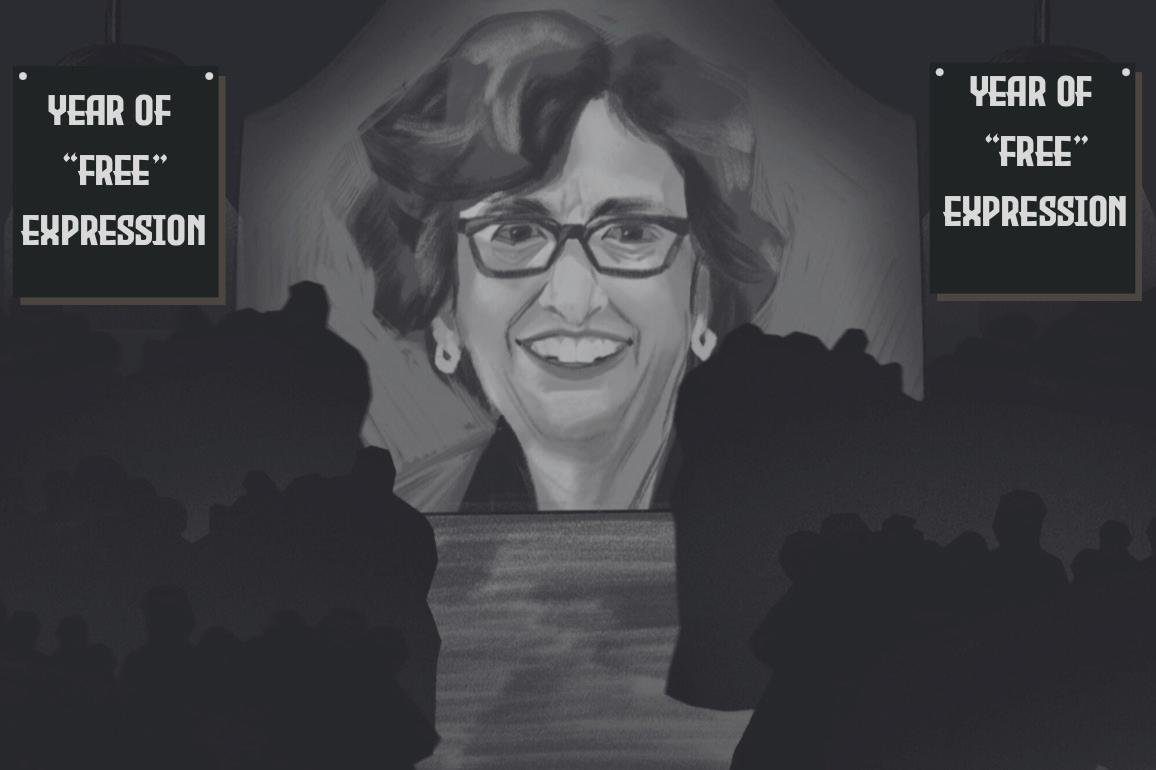
An undisclosed number of peaceful protestors have already been referred to the Office of Student Conduct for disciplinary action — all this in the so-called year of free expression.
The Sun believes this policy runs afoul of the spirit of the First Amendment. Reasonable time, place and manner restrictions on protest should be applied sparingly when public safety is truly at risk as opposed to anytime day-to-day routine is marginally impacted.
The world is grappling with a moment of political uncertainty. People feel like they are running out of options because the institutions they were raised to trust are failing them — Cornell is no exception. The Interim Expressive Activity Policy is a prime example of how far administrators will go to silence and demonize critical speech rather than address the ways in which the University itself is part of the problem.
Gen Zers and millennials are more skeptical of democracy than any other age group. According to a survey by the Open Society Foundations, more than a third of young people say they would support “a strong leader who does away with legislatures and elections.” The irresponsibility of should-be role models like President Martha Pollack plays into that growing distrust and hopelessness.
In issuing the Interim Expressive Activity Policy, Pollack went behind the backs of leaders in the Student Assembly and Faculty Senate, violating the University’s shared governance model. How can Pollack expect students to trust the democratic process when she refuses to? At best, Pollack has demonstrated a lack of faith in democracy. At worst, she has taken a page from Big Brother’s playbook.

Noah Do is a fourth year student in the College of Arts & Sciences. His fortnightly column Noah’s Arc documents his journey through the flood that is college. He can be reached at ndo@cornellsun.com.
There are times when I just want an honest assessment of how attractive I am. Beauty may be subjective, but it’s clear that our subjective opinions on it tend to follow the same basic principles. After all, generational sex symbols very much exist and their widespread appeal suggests that our tastes are not as unique to us as we might think.
The mass availability of information in the modern world shrouds our understanding of beauty in even more confusion. Sometimes I wish I didn’t know what the upper echelon of beauty looked like, but spending any amount of time on social media makes that impossible. I don’t even play around with beauty filters that smooth out skin and slim faces because the idea of liking what I see too much messes with my head. If I grow attached to a perfected version of myself, then I’ll never be satisfied by reality again. Unless, of course, I return to Korea for a little surgical assistance.
Beauty is rather easy to perceive in others, but in ourselves, it’s much more difficult. We’re so used to the forward-facing, headon view we see in the mirror that any slight deviation we see in pictures looks incredibly wrong. Most mornings, I wash up and look in the mirror happy with what I see. Then I’ll look at a candid photo of me taken by a friend or my mother— who might be the worst culprit of unflattering photos — and I am unable to recognize the alien creature that seems to have taken my place. I’m left to wonder which view is more accurate to how other people see me, and whether they think as poorly of my side profile as I do.
Appearance is a rare case where knowing the so-called “truth” usually isn’t beneficial; even if we want an objective understanding of how attractive we are, it really does us no good in the long run. Hearing that we’re not very attractive is an obvious blow to our self-esteem, but even a positive assessment links our happiness too closely to our beauty: If all of our self-confidence comes from being beautiful, then aging, health complications and even something as mundane as a
bad hair day can be mentally crippling.
Physical attractiveness has always been a touchy subject of conversation for me. Part of me thinks that if I speak freely and unabashedly about it, others will glean from my openness that I’m confident in my own appearance. The opposite approach of completely refraining from such topics might help make the conversation more comfortable, but it could signal that my appearance is an insecurity, which I also don’t want others to think. Especially when talking about attractive celebrities, there’s a tension that arises from the fact that even a celebrity who doesn’t fit my preferences is probably more attractive than everyone involved in the conversation. If a friend thinks negatively about a celebrity’s appearance, who knows what they would have to say about mine?
I seem to be constantly fighting the urge to ask my friends what they really think of me, even if I know it’s not a productive question. My closest friends certainly have opinions about my appearance, even if, like the good friends they are, they’d never share some of them. There is no upside to knowing where you truly lie on the spectrum of beauty — you should compliment your friends and tell them they look good, not because their appearance in and of itself deserves praise, but because you want them to be confident and happy. You may not like how you look in an unflattering picture, but if it’s capturing a happy memory, then you should consider it a good photo. Besides, if physical attractiveness is measured by how much happiness someone’s appearance brings you, then even my wonkiest looking friends are beautiful in my eyes.
Despite the tone of this column thus far, I’ve more or less reached a healthy relationship with my appearance. I certainly have my flair-ups of insecurities, but I’m at a point where I trust that my closest friends aren’t spending time with me because of my appearance, nor in spite of it. When I’m around the people I love, I make them smile and they make me smile, so what more could I really ask for?

Fill in the empty cells, one number in each, so that each column, row, and region contains the numbers 1-9 exactly once. Each number in the solution therefore occurs only once in each of the three “directions,” hence the “single numbers” implied by the puzzle’s name. (Rules from wikipedia.org/wiki/ Sudoku)


By AVA MALKIN Sun Contributor
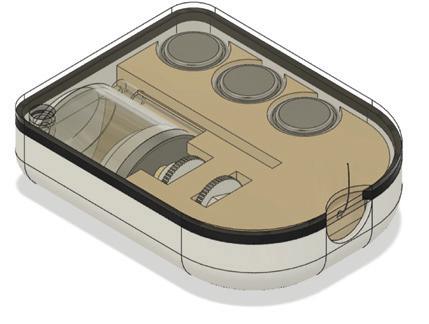
The Cornell University Biomedical Device team is developing a novel product intended to treat patients undergoing opioid withdrawal for its Spring 2024 project. The device is an addition to the team’s collection of products dedicated to benefiting health and well-being.
Student project teams, supported by the College of Engineering, offer these opportunities for students of all majors to get involved in pre-professional endeavors to grow as learners and make positive real-world change. CUBMD, a project team that started in 2018, utilizes engineering, business, marketing and medical know-how to advance the healthcare industry.
CUBMD is currently developing Influx, a device to deliver controlled drug dosages for those suffering opioid withdrawal.
With its three subteams of outreach, business and product development, CUBMD begins its projects each fall by identifying a solvable issue in current healthcare hardware.
“We research [devices and their] existing deficiencies, [which] may be something like [the device is] not very cost-effective or it’s not doing its intended job as well as it could be,” team lead Ashmitha Sivakumar ’24 said.
After isolating a problem to
solve, the team works together through multiple rounds of brainstorming and idea pitches until only one idea remains.
This year the team settled on Influx, an infusion pump that plans to assist those suffering from opioid withdrawals by delivering controlled doses of naltrexone.
During the fall semester, the team worked on the proof of concept for Influx. The team first consulted doctors on the best drug to to treat substance use disorder, ultimately deciding on naltrexone, an FDA-approved medication that comes in pill or injectable form intended to reduce drug and alcohol withdrawal symptoms.
“[Influx is] supposed to be a treatment option for those who might suffer from substance use disorder,” Sivakumar said.
The students then researched existing devices within the infusion pump market, discovering Omnipod, a wearable insulin-delivery device. Omnipod functions by using a thermal wire that, once heated up, turns gears that push a plunger into the user’s arm to deliver insulin.
Sivakumar explained that Omnipod’s mechanics were particularly helpful for CUBMD’s product developers. The team obtained a few Omnipods to better understand the device’s inner workings before making its own to improve upon this model.
“Because there’s already an
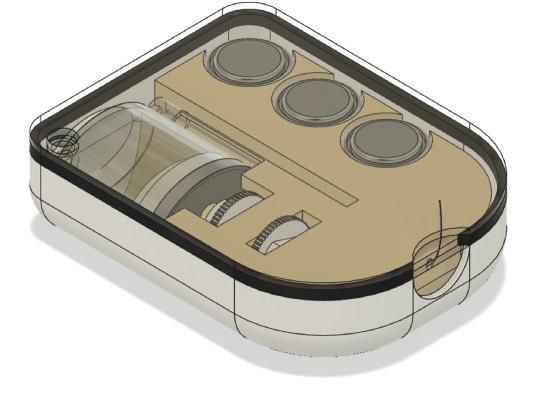
Influx injection | Influx is a device to deliver controlled drug dosages.
existing device that does this controlled drug delivery, we thought, what better way [to approach product development] than to incorporate certain aspects of [the Omnipod] design in our model and reverse engineer some of it?”
Sivakumar said.
The team also created a mobile application that connects Influx to a mobile device. The application allows patients to communicate with doctors about how to utilize their Influx and how much naltrexone is necessary to suppress their drug cravings. CUBMD members with experience in medical fields compared the app to existing tools, confirming that it matched existing standards for virtual medical applications.
“At this point, we’re kind of in between the researching and developing phase,” Sivakumar said. “We hope we’re designing a device that is helpful, but truly, I
think that beyond competitions, [it is] the real people who are the real judges and the actual users of the device.”
Despite being in its early stages, the team has already submitted Influx to competitions at the University of Minnesota and Johns Hopkins University. CUBMD members plan to fully demonstrate and celebrate their finished work at their annual showcase in mid-April.
Beyond Influx, CUBMD has created a variety of devices that address issues ranging from bone fractures to dental disorders to multiple sclerosis. The team’s Spring 2023 project — a pulse oximeter called MelanOxi that can be used on a variety of skin tones — was successfully patented.
CUBMD altogether aims to highlight problems in current biomedical devices and use innovative and advanced engineering techniques to construct solutions, according to Sivakumar. Along with designing products and entering competitions, the team takes a human-centered approach to ensure their device will help real patients and users.
“We are really dedicated to producing biomedical devices that are able to further advance healthcare,” Sivakumar said.
By RAGHAV CHATURVEDI Sun Contributor
The Cornell NanoScale Facility is partnering with Micron Technology — one of the largest semiconductor companies in the world — on workforce development initiatives to prepare for Micron’s upcoming semiconductor fabrication facility in Upstate New York.
Micron announced its plans to invest $100 billion in building the largest semiconductor facility in the United States on Oct. 4, 2022. The announcement came in light of the CHIPS and Science Act of 2022 which subsidizes and boosts the U.S. production of semiconductors. This new facility is projected to create around 50,000 jobs in the upstate New York area by 2026, requiring an enormous effort to create and educate a workforce.
“Since semiconductor fabrication facilities are proprietary, providing a hands-on learning experience to students is challenging,“ said Tom Pennell, outreach and education coordinator at CNF.
But being a user facility, CNF is uniquely accessible to students of all ages. To bridge the knowledge gaps about new technologies, CNF promotes outreach activities on campus.
“CNF is a world-class facili-
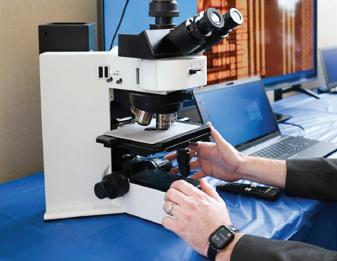
ty, housing over 180 specialized tools that provide start-to-finish processing so people can get into any aspect of semiconductor manufacturing,” said Ron Olson, director of operations at CNF. Specialized tools can assist with semiconductor design, fabrication, testing, characterization and packaging.
Since April 2023, CNF has been organizing Chip Camps in partnership with Micron. Chip Camps are workshops that introduce middle and high school students to nanotechnology.
For the last workshop held in July 2023, around 120 students visited Duffield Hall, which was transformed into a “nano-
fun” space with hands-on science demos. Led by Pennell, the demos covered a variety of areas in nanoscience ranging from topics in microfluidics, photonics and materials science.
In one demo, students performed a tabletop version of photolithography, an important step in the processing of integrated circuits that involves transferring a pattern from a photo-sensitive polymer onto a silicon wafer with ultraviolet light.
In complex semiconductor devices such as the ones in phones and laptops, the integrated circuits can go through the photolithography step as many as 50 times. In the demo, stu-
dents used UV-active paper and UV lamps that are typically used for curing nail polish. The experiment is similar to printing negatives onto a film in photography.
The Chip Camps also involved a virtual tour of the high-tech equipment used in nanofabrication, which refers to making materials at very small dimensions.
CNF also launched a virtual reality tour of its facility at the New York State Fair to increase the scope of its outreach. The tour, available on the CNF website, provides an in-depth description of every tool in the facility.
“We want to form a pathway to help people get into a really exciting scientific career, and our impact on the community will hopefully grow exponentially with the CHIPS and Science Act,” Pennel said.
But Micron’s outreach effort has not been limited to middle and high school students. In a press conference last year, Micron announced the formation of the Northeast Semiconductor Network which included a list of 21 prominent universities from the area.
The proposed network aims to revamp engineering curricula for undergraduate and graduate programs by taking into consideration industry needs. Further
emphasis will also be placed on providing more research opportunities and increasing experiential-based learning in cleanrooms and teaching labs.
ECE 4361: Nanofabrication and Characterization of Electronics Laboratory is already a step towards modernizing the University’s engineering curriculum. The class is primarily taught by the CNF staff in the teaching section of the cleanroom, which is a special lab space, with a sufficiently low concentration of air pollutants, required for semiconductor fabrication. Students fabricate semiconductor devices like solar cells, LEDs, transistors and capacitors using common techniques of the semiconductor industry.
“Our college leaders and faculty have been actively exploring a number of ways we can contribute to education and workforce development in the semiconductor industry, and Micron is clearly a key stakeholder,” said Prof. Kathryn Caggiano, engineering. “We are delighted that Micron has been willing to engage in discussions about potential strategies for aligning our efforts with the industry’s needs.”
Raghav Chaturvedi can be reached at rc669@cornell.edu.