The Corne¬ Daily Sun



By MEGHANA SRIVASTAVA Sun Compet Manager
Shaniya Foster, Phoebe Brown and George Defendini ’21 had never met in person as a group before deciding to run for Common Council as the Solidarity Slate. But their joint campaign has taken off, formed as a culmination of efforts from several prominent local progressive groups — including the Ithaca Tenants Union, Ithaca Democratic Socialists and the Ithaca Pantheras.
With around 15 volunteers supporting the campaign, the candidates are running on a platform of racial justice, housing reform and workers’ rights, among several other goals. Each candidate comes from a different background and hopes to bring a unique perspective to their slate, with a shared goal of making Ithaca’s Common Council more diverse.
“There were many different organizations talking about getting grassroots people on Common Council,” Brown said. “I think this idea flourished from the conversations
that were already happening about putting together a slate of people who come with different ideas and from different communities, looking more like the wards that we represent.”
The Common Council has 10 members, two from each of Ithaca’s five wards. Currently, the council has no Black members.
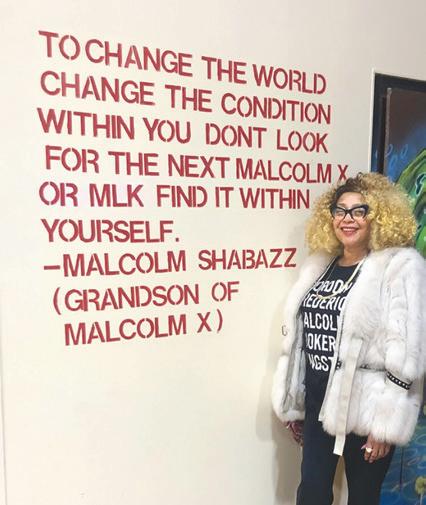


Brown — a cofounder of Mutual Aid Tompkins and a regional coordinator for the Alliance of Families for Justice, which supports families of incarcerated individuals — is the only candidate of the three who has run for public office before. She ran a write-in campaign against Mayor Svante Myrick ’09 in 2015 and won approximately 11 percent of the vote.
“I didn’t have all the involvement of people helping me

By SURITA BASU Sun Assistant News Editor
The Ethiopian-Eritrean Students Association is bringing attention to the ongoing humanitarian crisis in the Tigray region of Ethiopia.
Last Wednesday, the Ethiopian-Eritrean Students Association hosted the event for the Cornell community in collaboration with Omna Tigray, a global organization center that advocates the human rights of Tigrayans and other oppressed peoples in the Tigray Region.
The discussion featured three speakers: Feven Girmay, an education researcher and a member of the global society of Tigrean scholars, Meaza Gidey, an international relations researcher and public relations for Omna Tigray, and Tsedale Lemma, journalist and founder of Addis Standard, an Ethiopian
magazine.
Tigray is the northernmost region of Ethiopia which accounts for 6 percent of the country's population and has held political influence for 27 years before the current regime. Tensions between the region and the federal government have been ongoing for years, but those tensions turned into military action last fall. The Ethiopian military has also been backed by Eritrean forces who have been accused of brutally treating fleeing refugees.
Feven Girmay started off the event by placing the conflict in historical context.
“By the early 1980s, the [Tigray People’s Liberation Front] had grown to become the main adversary of the central military government, along with the Eritrean People's Liberation Front, which
campaign, petitioning and all that kind of stuff. I wasn’t clear about what I needed to do back then,” Brown said.
“This time, because I joined the slate, I had a lot more coaching and a lot more help.”
Brown is passionate about providing services that support formerly incarcerated people and incorporate them into
By SARA JAVKHLAN Sun Contributor
Two weeks after Cornell’s announcement that urged all North Campus residents to schedule an additional weekly COVID test following cases tied to residence halls, some students have been making a third trek to testing sites each week. But other students aren’t signing up for extra tests.
In the email sent on March 17, Cornell asked North Campus residents to schedule a third surveillance test every week until further notice after a spike in positive cases in dorms.
week, and 105 are from students.
“I wasn’t sure if it was required to get tested three times a week.”
Angela Zheng ’24
Currently, students living in Greek life housing are also tested three times a week. These two groups have a high potential for exposure to the virus due to the large number of close contacts.
“We will use this extra capacity to increase the surveillance testing frequency for students who, by nature of their shared living arrangements or affiliations, have a potential for exposure to a high number of close contacts,” the email read.
Cases remain high on campus. As of Monday, Cornell’s COVID-19 Dashboard reports 112 new positives in the past
Since the initial case spike that moved Cornell to the yellow alert, Travis Zhang ’24 ––who lives in Low Rise 7 –– has been scheduling his additional supplemental tests. Zhang said he believes this measure was a “good move” by the University to address the spike in positive cases. The increase in testing is aimed to provide students “with peace of mind in [their] own health” as well as to “isolate the COVID-19 virus as soon as possible,” the email read.
While some first-year students have been diligent in following the University’s recommendation of scheduling an additional test, others have not, saying that Cornell has not enforced the policies outlined in the email.
The wording of the email confused some students. Angela Zheng ’24 said she was unsure whether scheduling a third surveillance test every week was a requirement for everyone.
“I was a little confused because I wasn't sure if it was required to get tested three times a week,” she said.

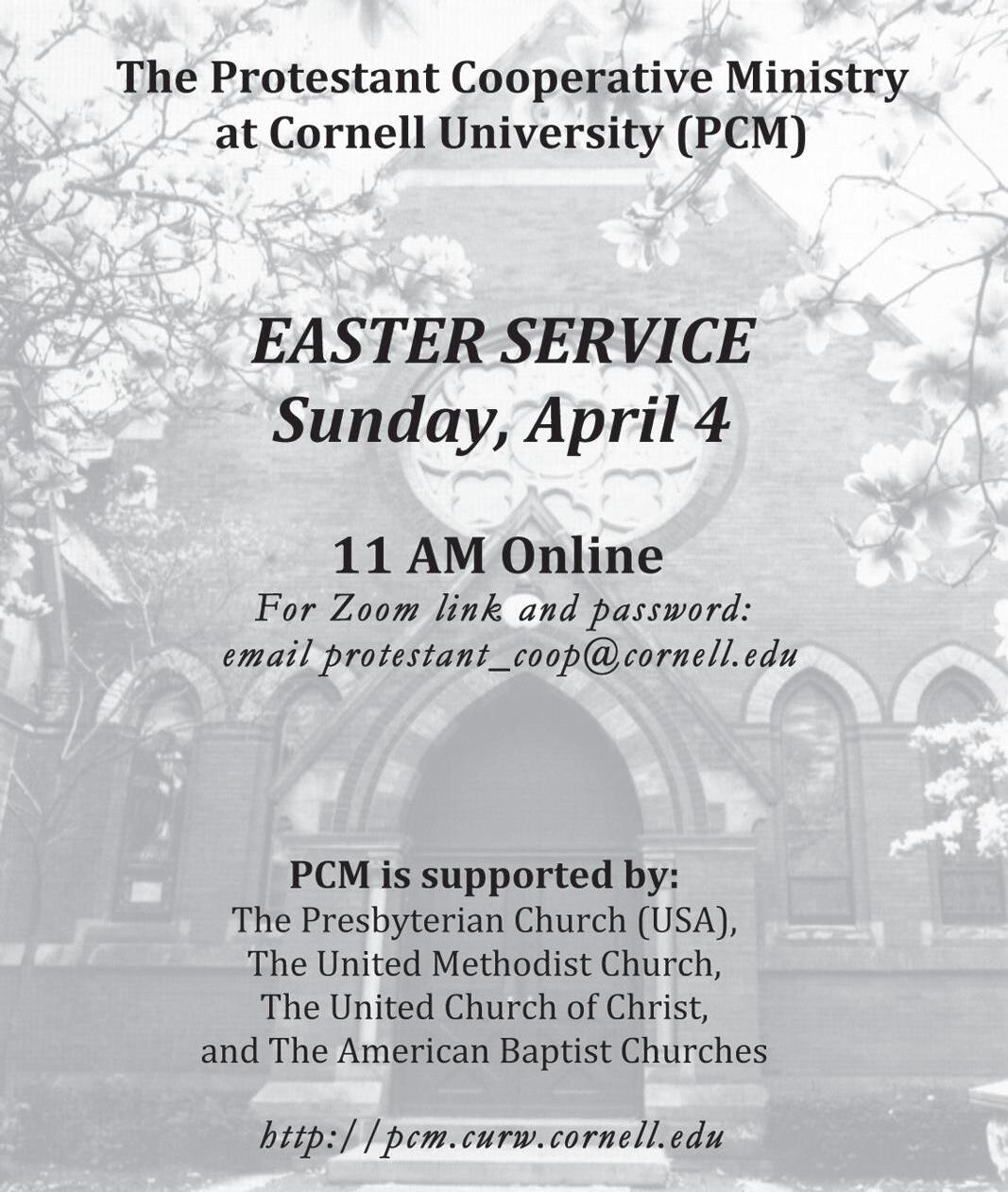
Tuesday, March 30, 2021
Revitalize Your Job Search for International Students 10 a.m., Virtual Event
Repair and Reparations: IES Migration Series Spring 2021 10:30 - 12:10 p.m., Virtual Event
Partisan Aesthetics: Modern Art and India’s Long Decolonization 11:30 a.m., Virtual Event
Berger International Speaker Series With Cynthia Soohoo: Reproductive Justice, Human Rights and Transformative Constitutionalism 12:15 - 1:15 p.m., Virtual Event
Specimens by Amanda Keller- Konya, by Georgina Whittingham, Border Environments, A Special Series 1 p.m. - 2:15 p.m., Virtual Event
Cinematic Epistemologies From Within Problem Clusters Of Modernity (Commonly Referred to as Climate Change) - VCC 4:30 p.m., Virtual Event
TIGRAY
Continued from page 1
was fighting for Eritrean independence” Girmay said.
Now, Girmay said Ethiopia’s prime minister Abiy Ahmed has targeted the Tigrean regional government over corruption and human rights abuses and has implemented blockades designed to hurt the economy. The federal government has also captured or killed several Tigray People’s Liberation Front leaders.
Girmay also described the significant humanitarian toll on Tigray’s population. Eritrean and Amhara forces have destroyed crops leading to a food shortage and mass starvation.
Lwam Asfaw ’21, the EESA’s co-event coordinator and Candace Megerssa ’22, EESA’s co-chair, both worked to coordinate the event. Asfaw’s parents are from Tigray and she identifies as a member of the Tigray diaspora. Her personal connection to the conflict inspired her to work on the event.
“For me, and for my family, it’s been a really tough few months since November for us, when this attack first started,” Asfaw said. “Coming back to campus this semester, I was really thinking about what my contribution could be.”
Both Asfaw and Megerssa wanted to create an event that would be open not just to Ethiopian and Eritrean students but to the entire Cornell community to spread awareness about the conflict. Asfaw said she hopes that attendees gained a better historical understanding about the region and that
attendees with differing views were able to air their grievances about the conflict.
“It’s very politically charged. There have been a lot of different opinions about what’s going on and a lot of different perspectives,” Asfaw said.
Asfaw and Megerssa explained that as an organization, the Ethiopian-Eritrean Students Association had not focused on the ethnic cleansing going on in Tigray. Megerssa said the conflict can be a sensitive subject, as many first-generation Ethiopian-Americans and Eritrean-Americans have parents who fled for political reasons.
“This is a humanitarian crisis. I don’t view it as a political issue.”
Candace Megerssa ’22
Megerssa said she hopes that the audience spreads awareness, contacting their representatives and above all, educating themselves about this conflict.
“This is a humanitarian crisis,” Megerssa said. “I don’t view it as a political issue. And that’s why we want to make it a conversation that people are uncomfortable having, especially because we all are recognizing how differently we all have been taught to perceive things.”
Surita Basu can be reached at sbasu@cornellsun.com.
TESTING
Continued from page 1
Eric Huang ’24 said that he and most of his friends have not been scheduling additional tests.
Huang said he felt this extra measure hasn’t been effective because Cornell did not require it.
“I personally don’t mind having the tests, but if they really want to make a difference, they should do something more enforceable,” Huang said.
According to Zheng, making testing mandatory three times a week for North Campus residents, like it has been for Greek
life students this spring, could act as an effective solution.
“If the administration wants us to get tested three times a week, just make it mandatory,” she said.
Steven Gomez ’24 said people he knows haven’t been scheduling tests, expressing an overall sense of discontent with the new policy. He said that some students he knows still meet large groups of people and said they should be getting tested at a greater frequency than others.
“But the majority of people that I know don’t really leave [their dorm] or only hang out
with the same group of people,” Gomez said. “I just don’t think it’s necessary.”
And, while increased testing may help identify positive cases, Carlene Mwaura ’24 says that additional surveillance testing for North Campus residents doesn’t address the root cause of campus outbreaks — unmasked social gatherings.
“I just feel like it’s the students’ responsibility to manage these cases as well,” Mwaura said.
Sara Javkhlan can be reached at smj227@cornell.edu.
By MAYA RADER Sun Staff Writer
Cornell’s Jewish community has come together to celebrate Passover, holding Seders in students’ homes, at Base Ithaca and in dining halls to gather for the spring holiday.
Cornell Hillel assembled Seder care packages so students could have their own small gatherings with their pods at home to celebrate the Passover, which commemorates the liberation of the Israelites from slavery. Hillel also partnered with Cornell Dining to hold Seders at 104 West! and Trillium.
Cornell Dining helped facilitate the Seders by clearing the dining hall of leavened bread. Because Hillel staff is unable to be on campus due to the pandemic, Hillel student leaders led the dining hall Seders.
going into freedom and celebration,” she said.
In previous years, Hillel held what Weiss called a “Super Seder” at Robert Purcell Community Center, which consisted of many differently themed Seders. Past RPCC Seders have included a Harry Potter Seder and social justice Seder along with more traditional gatherings.
Weiss explained that this format embodies the Jewish and Hillel community on campus.
“People come from many different places, and they all connect very differently. But they are all celebrating in the same space,” he said.
“There’s something powerful about just celebrating and getting to be together.”
Rabbi Hayley Goldstein
Base Ithaca, an extension of Cornell Hillel, also hosted an in-person, socially distanced Seder on Sunday evening. The Seder took place in the backyard of Rabbi Hayley Goldstein and her partner Lizzie Sivitz in three hour-long sessions, with 10 guests per session. Participants told the story of Passover and discussed what the story means to them, in addition to reading from the book of Haggadah and following food-related rituals.
“It really is a story of immigration,” said Rabbi Ari Weiss from Cornell Hillel. “It’s both a specifically Jewish story, and it’s a universal story as well.”
Base Ithaca is also holding an online Queer Seder on Tuesday evening. Goldstein explained that the theme of liberation is central for many people in the LGBTQ+ community.
“Especially those of us in the LGBT community can really relate to that feeling of constriction and hiding, and
Last year, Passover occurred after students were sent home in March, so Cornell Jewish organizations had to found creative ways to celebrate online.
This year, however, Seders offered Cornell’s Jewish community a welcome opportunity for socially-distanced in-person gatherings.
“I really liked the Seder because it felt like a small slice of normalcy during an otherwise tumultuous semester,” said Fannie Massarsky ’24, who attended Sunday’s Base Ithaca Seder.
Goldstein said the story of Exodus feels especially resonant now. During the Base Ithaca Seder, when participants shared what the story of Exodus meant to them, one student said that due to the pandemic, the story meant simply leaving her room to her.
“Normally we can’t relate to the story on that literal of a level, so there’s something really powerful about just celebrating and getting to be together more as things start to look more hopeful,” Goldstein said.
Maya Rader can be reached at mrader@cornellsun.com.

By ANDREAS PSAHOS Sun Staff Writer
Cornell has designated a new College of Arts and Sciences professorship to honor Prof. Walter LaFeber, history, who died in early March at the age of 87.
The inaugural Walter F. LaFeber Professor will be Prof. Thomas Pepinsky, government, who is a fellow at the think tank the Brookings Institute, and researches and teaches comparative politics, political economy and Southeast Asian politics.
“Walt LaFeber was such a dedicated teacher and researcher who wrote important books that shape how we understand American foreign policy and America’s place in the world,” Pepinsky said.
Pepinsky said he hopes he will honor the namesake of his new role by continuing to engage with undergraduates and ensuring that his research has a broad, tangible impact.
“I don’t work on American foreign policy in any particular way,” Pepinsky said. “But I do hope that the research that we do here on Southeast Asia can be similarly influential in how we think about the world that we live in and our role as American citizens.”
The endowed professorship is funded through a gift from Andrew H. Tisch ’71, trustee emeritus, and Ann Rubenstein Tisch. Having established a number of Tisch University professorships to attract and retain mid-career faculty at Cornell, the couple decided to remove their names from one of the titles to honor LaFeber, who spent nearly six decades affiliated with the University.
Andrew Tisch, who also assisted in funding the Andrew H. and James S. Tisch Distinguished University professorship, of which LaFeber was its inaugural recipient, still holds fond memories of his time auditing LaFeber’s classes as an undergraduate.
“He taught the class on Tuesday, Thursday and Saturday,” Tisch said. “You can imagine what it took to get students after partying Friday night to wake up on Saturday and traipse over to Bailey Hall in the dead of winter. But he used to get more people in on Saturday than he did on Tuesday and Thursday.”
Tisch did not meet LaFeber until his 25th Cornell reunion, when LaFeber was the guest speaker at an event that Tisch was underwriting. At that initial meeting, Tisch decided he would support LaFeber with a professorship that would last him into retirement and help keep his talents with the University.
After that, they began communicating regularly over email, and Tisch would visited LaFeber and his wife Sandra Gould every time he came to Ithaca for a trustee meeting.
“I just did a data dump from my emails on all the correspondence I’ve had back and
forth with him over the last 25 years, and there were 500 pages of correspondences,” Tisch said.
Pepinsky was named a Tisch University Professor in May 2020 after joining the government department in 2008 and achieving a full professorship in 2019.
While Pepinsky never had the opportunity to sit in on one of LaFeber’s show-stopping lectures, he expressed his joy of teaching in the classroom and mentioned the importance of high-quality lectures in a virtual format.
“It’s incredibly hard to remember in the

middle of the pandemic how enjoyable sitting in a room and interacting with a professor who’s giving a lecture and accepting questions throughout the course of the conversation could be,” Pepinsky said. “But I know that he was a dynamite teacher in that way. And I hope to fill his classroom presence in some ways similar to that.”
“[Walter LaFeber] stayed for his career,” Tisch reminisced. “And while Ithaca’s a fine place, it’s a very, very tough place to get people to. Because, as you have no doubt found out, it’s pretty remote. But it’s also a very difficult place to get people from.”
To Tisch, establishing the professorship in LaFeber’s honor was the least he could do to celebrate a life well-lived.
“The only thing I would add is that he was probably one of the most accomplished people I’ve met my life, and I’ve met a lot of a lot of amazing people,” Tisch said. “Walt had a great family, great colleagues, highly loved and revered by so many people and he lived a hell of a life and as a good friend of his, I’m going to miss him.”
Andreas Psahos can be reached at apsahos@cornellsun.com.
COUNCIL
society. As an older adult, she also wants to make Ithaca safer for older residents through increasing lighting on public streets and making sure nursing homes are safe and affordable.
Although Defendini and Foster have not previously run for public office, they said their perspectives will bring new voices to the council.
“I want to work toward bridging the divide between college students and Ithaca locals. People who come here feel like, ‘I’m here for four years and then I’m off to California, or back to New York City,’” Defendini said. “Even if that’s the case, I want this to be a temporary home and I want people to treat it that way.”
Defendini said he hopes to get Cornellians more involved in local politics. As a former
intern for Rep. Alexandria Ocasio-Cortez (D-N.Y.) and a local organizer for Sen. Bernie Sanders’s (I-Vt.) presidential run, Defendini has been involved in several campaigns and said he plans on using the experience to shape his role as a candidate.
Defendini said he believes that tenants’ rights is one issue that can unite Cornellians and Ithacans. A large part of the slate’s platform is ensuring housing for Ithacans and preventing gentrification to protect Ithaca’s large tenant population, which includes both students and permanent residents. Defendini said he believes that Ithaca should opt into the Emergency Tenant Protection Act, which aims to stabilize rent.
Defendini and Brown, who are running to represent the fourth and second wards respectively, are currently running unopposed. The incumbents for
both seats are not seeking reelection. However, Foster faces two opponents in the first ward: the incumbent, Alderperson Cynthia Brock (D-1st ward), and community activist Yasmin Rashid.
Foster is optimistic for her chances in the race, but is committed to continuing her activism regardless of the outcome.
“Whether I win or not, I’m still going to keep doing what I have to do for the community,” Foster said.
As a single mother of three young children, one of Foster’s key issues for the slate is making childcare accessible and free for Ithacans by allocating city funding towards daycare centerss.
All three candidates are also passionate about policing reform and have strong opinions about the current Ithaca policing proposal, which the Common Council will vote on Wednesday. They said they believe the pro-
posal does not address the root issues of police reform.
“We have not talked about the core of policing. First we need a clear picture of what policing means,” Brown said. “A lot of us believe policing is to protect us, and the truth of it is that it comes from policing Indigenous people and slaves, so it’s about protecting property, not people. We haven’t talked about that root first.”
Brown called for the Ithaca Police Department to apologize for its past brutality and misconduct and to recognize the systemic issues in policing across the country, which she believes is the first step in reform.
“They have not apologized. They have not acknowledged that there is a bigger, countrywide problem in policing,” Brown said.
Defendini also called for a more thorough policing reform, criticizing the economic implications of the proposal.
“Learning about the things that cause crime is important. I don’t think the solution is dumping money into the police department to reimagine it,” Defendini said. “It’s making transportation here free, making rent less expensive and it’s creating a system in which people are not desperate.”
Despite forming and running their campaign entirely during the COVID-19 pandemic, the candidates have been using every opportunity to go door to door or attend protests and meet with constituents.
“We’re still involving ourselves. I don’t think, personally, that the [pandemic] interferes too much,” Foster said. “There’s protests every Sunday. There are still things that are happening that we are able to engage with.”
Meghana Srivastava can be reached at msrivastava@cornellsun.com.
Iwould like to start this article by saying that I am by no means an expert in poetry. Sure, I dutifully sat down and wrote up analyses for my Freshman Writing Seminar classes like everybody else, but I would venture to say that my personal, perhaps overly-relaxed approach to reading poetry would make most English majors want to punch me in the face.
So, while my brain may be digesting the pages in front of me, loosely picking up on rhyme schemes, I wouldn’t say that I’m a particularly critical reader of poetry. Nor am I particularly snobbish when it comes to poetry I enjoy — which is why it took me by surprise when I realized that Instagram poetry really isn’t my thing.
Although anybody who knows me will tell you that I’m a misanthrope — a human who hates humans — I like to enjoy things that other people enjoy. Yet, my experience with Instapoets is the same as my experience with pumpkin spice lattes — I wanted to like them. I really wanted to like them. It was so whimsical and romantic to imagine an online community of bohemian co-conspirators, forging emotional connections across seas with the sheer power or words and minimalist line drawings. But unfortunately, while I can acknowledge the beauty in some Instagram poetry, my overall opinion is meh
I’m obviously not the only one. If you look at the Amazon reviews of Rupi Kaur’s Milk and Honey, one of the first reviews reads: “kudos to the marketing team behind this book that have/managed to hype up a/steamy turd of literature … PS: I have now written poetry according to the example set by milk and honey.”
In a similar vein, the popular parody of Milk and Honey, Milk and Vine, which applied Kaur’s style to vine captions, became a viral sensation after it was first published in 2017, going on to spur a new parody meme format which has

ranged from a similar, Vine-based approaches (two bros/ chilling in the hot tub/five feet apart ‘cause they’re/not gay”) to the more recent discourse around Rupi Kaur reading her poetry on TikTok.
The memes have arguably gotten a bit out of control,
with Vice contributor Andrew Llyod amassing 646 followers to an Instagram account where, despite writing with absolutely “zero standards” (his words, not mine), he managed to acquire an audience of people declaring that their souls were intertwined — and this was in response to a poem which reads “They may be sly as a fox, but you can take it — You’re as strong as an ox.”
Along with the derisive memes, the poetry community has also had a mixed response to Instagram poetry. In an article for the PN Review, poet Rebecca Watts describes her deep disdain for the “cult of the noble amateur,” claiming that the rise of Instagram poetry is a sign of social media’s “dumbing effect,” proclaiming “in the redefinition of poetry as ‘short-form communication’ the floodgates have been opened. The reader is dead: long live consumer-driven content and the ‘instant gratification’ this affords.”
Responses to this critique were, of course, mixed. When interviewed for an article in The Guardian, PN Review editor Michael Schmidt was quoted as saying: “Many of our readers seem relieved that literary criticism is at last being applied to writing that has, hitherto, been welcomed with open arms by journalists because it is easy to read, contains few challenges … to insist that it can stand on a sure footing beside poetry in what I have now too often seen described as ‘dusty old books’.”
On the other side of the debate in the same article, critically acclaimed poet and winner of the PEN Printer Prize, Lemn Sissay, argued: “There is a new horizon in poetry … Some people are cowering in the dark from this horizon. They seem to panic over the size and brightness of it. There’s room for all forms of poetry. And whichever side you’re on, it’s foolish to say there isn’t.”
As I read through this criticism, I found myself being increasingly shaken by the critique of Instagram poetry, which is, with all honesty, classist. This idea was cemented upon reading Hollie McNish’s response to the critique of her work: “To call someone an ‘instagram poet’ makes me feel similar to the way I have been called a ‘slam poet’ for years simply because I have entered five poetry slams in my life … For me, social media platforms are about allowing people who cannot get to gigs or would not feel comfortable at them, being allowed to have a look at my poetry if they want.”
McKnish went on to point out that people read her poems not because of how she says things, but because of what she says. Similarly, in an interview with the Huffington Post, Rupi Kaur spoke about how her poetry is rooted in mundane experiences, and how her sense of purpose as a poet revolves around boiling down complexity into a few simple words.

A similar logic appears when people speak about why they love Instagram poetry — not because of its complexity or density, but because it feels raw. When I think back to how people speak about Instagram poetry on the platform itself, their connection to the verses is similarly tender — a poem alongside their morning coffee, a few lines hastily underlined on their Insta story, or even an excited caption on their finsta, followed by joyous communal recognition. Of course, I don’t think that honesty is an excuse for superficial writing which feels like the scribbles of Jughead Jones on Riverdale, but despite that qualm, I hesitate to disparage the legitimate joy and connections arising from this art form.
Poetry is, of course, about more than just an uncontrolled expression of feeling — there’s incredible complexity to the craft of poetry which I can’t even begin to convey. But, simply because something might not fit into our polished vision of poetry doesn’t mean it’s without value, and despite my personal dissatisfaction with the genre, I can still appreciate the connections it creates. Like pumpkin spice lattes, Instagram poems aren’t for me — but I’m sure that somebody out there is reveling in their sweet simplicity.
Kudva Driskell is a sophomore in the College of Agriculture and Life Sciences. She can be reached at mdriskell@cornellsun.com. Portrait of a Gen Z on Fire runs alternate Mondays this semester.
CHRISTINA OCHOA SUN ARTS STAFF
The COVID-19 pandemic has changed the nature of every industry and field imaginable. To better understand how COVID19 has impacted the function of our local tattoo shops, I spoke to Carol Oddy of Medusa Tattoo Studio.
During the pandemic, one of changes Oddy noticed has been the significant decrease in traffic to the studio. Oddy explained, “We used to do walk-ins, we used to be open to the public... Now we don’t do that anymore … A lot of our consultations are done by email or phone or Zoom. ” Oddy also mentioned how the studio has a gallery space, where they used to host art shows from local artists. Now, that space is closed off, as no one other than clients with appointments comes to visit the shop. However, having the shop closed to the public has kept Medusa Tattoo Studio quiet in a good way, allowing them to focus solely on tattooing while they see their clients. “We don’t answer the phone anymore while we are tattooing. So there are no interrup-
tions … It keeps us focused and it’s great for the customers because they don’t have to keep taking breaks.” Even after the pandemic dies down, Oddy hopes they can maintain that structure or hire someone to work the counter so they can continue to give artists the freedom to focus on tattooing without outside interruptions.
Beyond that, Oddy explained that Medusa Tattoos did not need to change many of their practices in order to comply with CDC recommendations. “We require people to wear masks and disinfect everything between customers … We didn’t have to change much of the day-to-
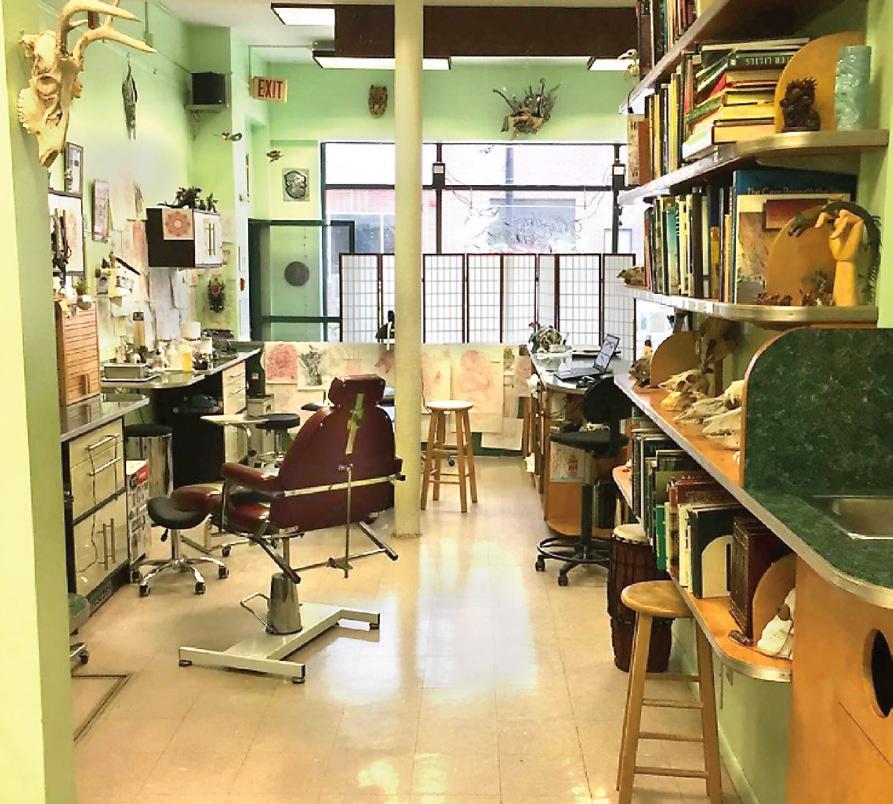
day routine because it’s all done in a way to minimize cross-contamination.” Oddy discussed how whenever there is a large health crisis, people tend to blame tattoo shops or view them as unsafe and unhygienic — a Hepatitis B outbreak in 1961 that led to a 37-year ban on tattooing. However, with the COVID-19 pandemic, it appears that tattoo shops have largely escaped that stereotype; shops’ emphasis on maintaining a strong standard of cleanliness and avoiding cross-cotamination has helped them have a smoother transition into a world governed by CDC COVID-19 guidelines. One thing that has changed, how-
ever, is the workload for tattoo artists. While Medusa Tattoo Studio has the same demand for tattoos as before the pandemic, they have less time to fulfill requests. “We are basically working reduced hours because we have to keep the numbers down. It’s one or the other of us in the front station and one of us in the back station, instead of being able to have 3 people working at once.” This strain is only increased by the need to schedule an appointment through emails and phone calls that can’t be answered during work hours. As a result, there is a long waitlist of people looking to get tattooed. “On behalf of most tattoo artists, if people are wanting to get tattoos, just be patient with us because we are all restricted in how much work we can do. We are literally working half the hours but the same amount of people are still calling.” While the pandemic has put a lot of strain on tattoo shops, tattoo artists’ resilience and adaptability have allowed them to step up to the challenge and continue spreading their art through dedicated clients.
Christina Ochoa is a sophomore in the College of Agriculture and Life Sciences. She can be reached at co234@cornell.edu.
Independent Since 1880
139th Editorial Board
KATHRYN STAMM ’22
Editor in Chief
ANUSHYA ALANDUR ’23
Business Manager
CATHERINE ST. HILAIRE ’22
Associate Editor
PRANAV KENGERI ’24
Advertising Manager
ODEYA ROSENBAND ’22
Opinion Editor
JYOTHSNA BOLLEDULA ’24
News Editor
TAMARA KAMIS ’22
News Editor
WENDY WANG ’24
Arts & Entertainment Editor
KRISTEN D’SOUZA ’24
Design Editor
HANNAH ROSENBERG ’23
Photography Editor
OMSALAMA AYOUB ’22
PUJA OAK ’24
Layout Editor
ANNIE WU ’22 Production Editor
MIHIKA BADJATE ’23
Assistant News Editor
ANGELA BUNAY ’24
Assistant
JOHN COLIE ’23
Assistant
AMELIA CLUTE ’22
Assistant Dining Editor
WILLIAM BODENMAN ’23
Assistant Sports Editor
AARON SNYDER ’23
Assistant Sports Editor
MEGHANA SRIVASTAVA ’23
Compet Manager
MADELINE ROSENBERG ’23
Editor NAOMI KOH ’23
Editor
OZA ’22
Editor
HEO ’24
OLIVIA CIPPERMAN ’23
NOOREJEHAN UMAR ’23
YOON ’23
BENJAMIN VELANI ’22
PICHINI ’22
SRISHTI TYAGI ’22
MENDOZA ’24
ARANDA ’23
Editor SURITA BASU ’23
RIGGS ’24
’23
NAGEL ’24
’24
ABAYEVA ’24
ALPERS ’22
Andrew V. Lorenzen is a junior in the College of Arts and Sciences. He can be reached at alorenzen@cornellsun.com. When We’re Sixty Four runs every other Tuesday this semester.
It’s sunset on the slope. The clouds are turning pink. The weather is warm. You’re laying on a red and white picnic blanket beside some friends, chatting about unimportant things. Someone’s playing music from a speaker somewhere. You’re not checking your phone. None of this is productive. None of this will strengthen your resume. None of this will get you a job this summer. And that is a good thing.
One year ago, everybody’s mental health took a hit. According to research from the U.S. Census Bureau, the number of “U.S. adults reporting symptoms of anxiety or depression” almost quadrupled last year. Further research has indicated “that young people, rather than older people, are most vulnerable to increased psychological distress, perhaps because their need for social interactions are stronger.” To fill the vacuum of the limited social interaction created by the pandemic over the past year, many of us young people took to social media like never before. Americans as a whole “spent on average 82 minutes per day on social media in 2020, a seven minute jump from 2019.”
Ruben Bolling

This trend further worsened the collective mental health of young people as studies also show that “higher amounts of screen time are associated with higher levels of anxiety and depression.” None of that will come as a surprise to most college students. Almost everybody has either directly experienced or read about the toxicity of their favorite social media platform, whether it’s Instagram, Snapchat, Facebook, or Twitter. But the social media platform whose negative effects on mental health we don’t discuss as frequently, the social media platform that we desperately need to talk about right now, especially as the last dash to secure that coveted summer internship heats up, is LinkedIn.
As our activities have grown increasingly digitized over the past twelve months, the lines between our academic/professional lives and our personal lives have blurred. Zoom became a meeting space both for class and work but also for socializing and extracurricular activities. Email went from being checked just a few times a day to constantly. We’ve grown accustomed to a dynamic in which we are simply always on our devices. Traditional working hours melted away into a vague perpetual availability which lends itself more to exhaustion than productivity.
It is against this backdrop that so many of us have settled into a kind of ‘LinkedIn Brain.’ In a year where we’ve felt drawn to work more than ever before yet also mentally worn out all the time, the dangers of LinkedIn become more powerful. At its best, LinkedIn succeeds in its mission of, well, linking us in with professional contacts who can prove to be valuable sources of information or mentorship. At its worst, LinkedIn is a kind of professional cult composed of one part autofill inspirational stories, one part humble bragging, and one part career FOMO. In other words, “LinkedIn is actually the ideal place to lose your mind.”
It’s a platform where the addition of new, arcane lines to your resume becomes “a rat race of pulling each other down.”
The common result of joining LinkedIn
isn’t professional enrichment but anxious spiralling over what you’re doing with your life and mild puzzlement at the existence of LinkedIn influencers.
It’s a social media platform which supercharges a culture quickly gaining steam on college campuses in which your sole existence in college is designed towards burnishing yourself to appear more attractive to a future employer. You will then, naturally, post that you’ve landed a job with that employer in order to impress your next employer. And on it goes.
That’s not to say that marketing yourself and building up a strong, professional resume isn’t important. Of course it is. And it’s only natural that in a country which nonchalantly saddles students with thousands upon thousands of dollars of student debt that there would be a fixation on your education leading to a lucrative career.
The problem arises when a school, such as Cornell, which already boasts a workaholic, burnout culture sees that culture even further exacerbated by a pandemic and then electrified by the arms race of LinkedIn where everyone is constantly posting their newest resume lines, internships, and awards. It’s a culture and a social media platform specifically designed to make you feel as though you are doing nothing with your life in comparison to others.
There are three major problems with this LinkedIn induced insecurity. First, the last thing anybody needs right now is further negative, anxious feelings about how you’re not working hard enough in a time where you either are experiencing or are nearing burnout. Secondly, it’s likely just not true that you’re falling behind. LinkedIn is an incubator for the Imposter Syndrome we all feel, but it’s a one-sided, selective display of everybody’s work. It’s the unsolicited best elevator pitch of everyone you know. Nobody includes the things they’re struggling with in their sixty seconds.
Thirdly and most dangerously, it reinforces the notion that we have to be perpetually working, that it’s somehow wrong to rest or do things that aren’t inherently productive or professional. We can’t live a life which seeks to construct resume lines around the clock. We need spontaneous, unnecessary digressions from the academic and professional world, for the sake of our mental health and for our education. We learn as much through casual conversations with friends, reading random books and pursuing silly hobbies, as we do in class. The professional world may have a ladder structure in which one step leads to the next, but one’s education does not.
That’s why it’s so important you don’t find yourself bogged down with LinkedIn Brain, with the crushing fear that you’re falling behind or wasting your time. It’s not just okay, it’s good to take a step back and do the things which won’t show up anywhere on your resume. It’s good to lay on a picnic blanket with some friends watching the sun set against a pink sky. It won’t get you a job this summer. It won’t give you something to post on LinkedIn. It will be for you and only you. And you deserve that.

Aminah Taariq-Sidibe is a senior in the College of Agriculture and Life Sciences. She can be reached at ataariq@cornellsun.com. I Spy runs every other Tuesday this semester.
Over 100-years after the United States adopted the 19th Amendment which gave American women the right to vote, there is still discussion on if, how or when women will ever be equal to men.
According to a Pew Research Center survey, a majority, 57 percent, of adults say women’s rights in the United States have not progressed enough to be equal to those of men. However, not everyone feels this way.
Although a majority of adults think we have not gone far enough for gender equality, the Pew Research Center survey reports that 32 percent of adults say the U.S.’s progress has “been about right,” and 10 percent say it has “gone too far.”
After a month of celebrating the amazing achievements of women, it is not hard to understand the sentiment women are doing pretty well.
More women are entering higher-skill and higher-paying occupations, narrowing the gender wage gap. Women now make up the majority of the U.S. workforce and represent 43 percent of all business owners in the United States. Women are also more likely than men to have a bachelor’s degree among year-round, full-time workers.
If we look to politics, Vice President Kamala Harris has
broken numerous glass ceilings as the frst woman to serve in her role.
President Joe Biden has also notably selected the frst senior White House communication team composed of only women. Of Biden’s cabinet members two women, Symone Sanders and Cecilia Rouse, are the frst AfricanAmericans ever to fll those roles.
Even former President Donald Trump has said, “women are doing great.”
Are women now treated almost equally to men? Not necessarily. Women in the U.S. are still disproportionately experiencing issues like gender-based violence, workplace inequity, and lack of political representation.
Statistics paint a grim picture. One-in-three women have been a victim of physical violence by an intimate partner, and rates of violence are even higher among LGBTQ+ women.
Te gender wage gap has narrowed since 1920 but has barely changed in the last decade. Women make up only fve percent of Fortune 500 company CEOs, and 20 percent of Fortune 500 board members. 56 percent of people in the U.S. living in poverty are women, and rates of poverty are higher among underrepresented minorities.
Despite making up 51 percent of the U.S. population, women only represent 20 percent of Congress members and about 25 percent of state legislature members. According to USA Today, the primary reason for unequal political participation is that women are less likely to run for ofce than men due to perceived biases. When they do run, however, women are elected at the same rates as men.
It is also important to emphasize that although these issues disproportionately afect women, gender equality is also an issue for men. Research shows that gender inequality causes worse physical and mental health outcomes for men.
As we welcome a new presidential administration, we must emphasize the signifcance of gender equality to this country’s sustainable development. Gender equality is key to a sustainable economy. Research shows that “closing the gender gap could increase global GDP by 35 [percent] on average”, in countries where the gap is most extensive. Including fnancial inclusion, closing the gender gap requires ending discrimination in law and practice.
Gender inequality is a global issue that also requires local action. Even Cornell has progress to make. Following the university’s 2015 hiring protocol to include more women
and underrepresented minorities across faculty, the number of women faculty has increased from 536 in 2016, to 575 women faculty in 2019 (compared to 1,109 male faculty in 2019).
In 2016, of the 536 women faculty, 110 were women of color, 60 of whom were from underrepresented minority backgrounds. Tough there hasn’t been a recent assessment
The gender wage gap has narrowed since 1920 but has barely changed in the last decade. Women make up only five percent of Fortune 500 company CEOs ... 56 percent of people in the U.S. living in poverty are women, and rates of poverty are higher among underrepresented minorities.
of faculty by race and gender, there are only 144 men and women in the entire faculty who are underrepresented minorities.
Cornell’s students, faculty and administration must continue advocating for gender equality through interventions like gender-responsible social protection and public services. For example, collaborating with gender focused student organizations, creating tools and resources to foster equality, and increasing the number of women faculty. Tis past month should have been a testament of the important contributions of women and the potential of equal access to resources. We must also let it serve as a reminder that the women before us did not rest, and neither should we.

Roei Dery is a sophomore in the College of Arts and Sciences. He can be reached at rdery@cornellsun.com. Te Dery Bar runs every other Monday this semester.
Just as Ithacalves have become a ubiquitous symbol of the Cornellian campus experience on the Hill, so are our quads. I have compiled a list, ordered worst to best, of the glorifed courtyards that defne the outdoor gathering experience for Cornellians:
6. Engineering Quad
What we have here is not a quad, but an “L”-shaped patch of green spanning `wwwwthe distance from Hollister to Dufeld Hall. Te frst few times I walked across this quad, I assumed it was an intense exam week: everyone was locked in on their laptops.
Nowadays, the unchanging atmosphere makes me thankful I am not an engineering student. I look to the West and see the incongruous, red tiles that stripe Hollister Hall, reminded by the lack of style that the building was named after a renowned engineer and not the clothing company. I look to the East and see the more modern Dufeld Hall, but
only because there are rarely any frisbee or Spikeball games to divert my vision.
Te quad’s expanse afords it great potential to be a student fun area, but the fact that it too often acts as an outdoor library puts it just below our next “quad” that isn’t even a quad. If there were several more quads on campus so that I could justify an Honorable Mentions list, the Engineering Quad wouldn’t even appear in the rankings.
5. Hotelie Quad
Straddling the line between a courtyard and an alleyway, the Hotelie “Quad” houses the Herakles in Ithaka I statue that stands between Uris and Statler Hall. It may not qualify as a quad, yet unlike the Engineering Quad, it doesn’t pretend to be one, nor do its visitors pretend to enjoy their time there. After all, they primarily consist of Terrace-goers standing on a burrito line that pours outside the entrance. Sure, it may be Te Terrace’s outdoor waiting room, but the metallic exteriors of both Herakles and Uris Hall give the “non-quad” an eccentric favor that the Engineering Quad lacks. If Herakles was instead built on the Engineering Quad, it’d require a metallic laptop in front of it and AirPods to ft in.
4. CKB Quad
Te Court-Kay-Bauer Quad that lies beneath the CKB sky bridge and extends to Dickson Hall is where freshmen decide to meet up with friends before heading to the Arts Quad. I largely overlooked the quad during my time on North Campus, likely a sign that I have not yet recovered from the overwhelming “First Night on North,” where hundreds of incoming freshmen clustered in this very spot. In fact, since the quad also doubles as the fre drill evacuation point for surrounding dorms, it has earned quite a reputation for inviting droves of disoriented freshmen all at once. Even so, as continued dorm construction appears to have endangered any open patch of grass on North Campus, I can’t get too picky. Te CKB Quad is the frst bona fde quad on the list, and is the only genuine quad on North Campus. To no fault of its own, the wandering legions of freshmen often seem to look elsewhere to gather outside, leaving the CKB quad at fourth on our list.
3. ILR Quad
As far as quads go, this one certainly skips leg day. But what it lacks in size it compensates for in its cozy atmosphere and convenient location. Te ILR quad is isolated from the buzz of East Avenue, and located between Te Terrace and Bus Stop Bagels. It’s the ideal outdoor work space, and there always seems to be a vacant table or chair in sight. Tough the seating area has been closed during the pandemic, it remains the best study quad on this list.
2. Ag Quad
Te plant sciences are housed in the buildings surrounding the quad, and it shows. Te surrounding greenery gives this quad a creative touch to mix with its structural symmetry.
Stretch it out and place it in the heart of Central Campus and the Ag Quad would be Cornell’s best.
However, for the very reason that the quad is rather distant from South and West campus housing, it’s the place you go only if you’re already there. Te Ag Quad is reminiscent of some of the other Universities’ quads I’ve visited in both size and structure, lacking an it-factor to set it apart.
If we imagine a game of university campus GeoGuessr, the task of identifying an image of this quad would not be as trivial as one of the Arts Quad, especially for a non-student. Since it’s not the frst quad that comes to mind for many Cornellians, it ranks as the B-side to the Arts Quad.
1. Arts Quad
After all, streaking the Ag Quad is not of the 161 Tings Every Cornellian Should Do. We each have our favorite study spots and fond memories that dictate our quad preferences, yet we can all come together to celebrate the Arts Quad at the epitome of the Cornellian’s campus experience.
Te Arts Quad transcends the surrounding architecture and our founders’ statues that preside over it; the ebb and fow of students reclining, studying, and socializing on the Arts Quad is in near-perfect synch with the livelihood of our campus. Tough on its own the Arts Quad may not occupy a niche like the other quads, it’s our campus’s beating pulse, and that earns it a spot atop our list.
Fill in the empty cells, one number in each, so that each column, row, and region contains the numbers 1-9 exactly once. Each number in the solution therefore occurs only once in each of the three “directions,” hence the “single numbers” implied by the puzzle’s name. (Rules from wikipedia.org/wiki/ Sudoku)




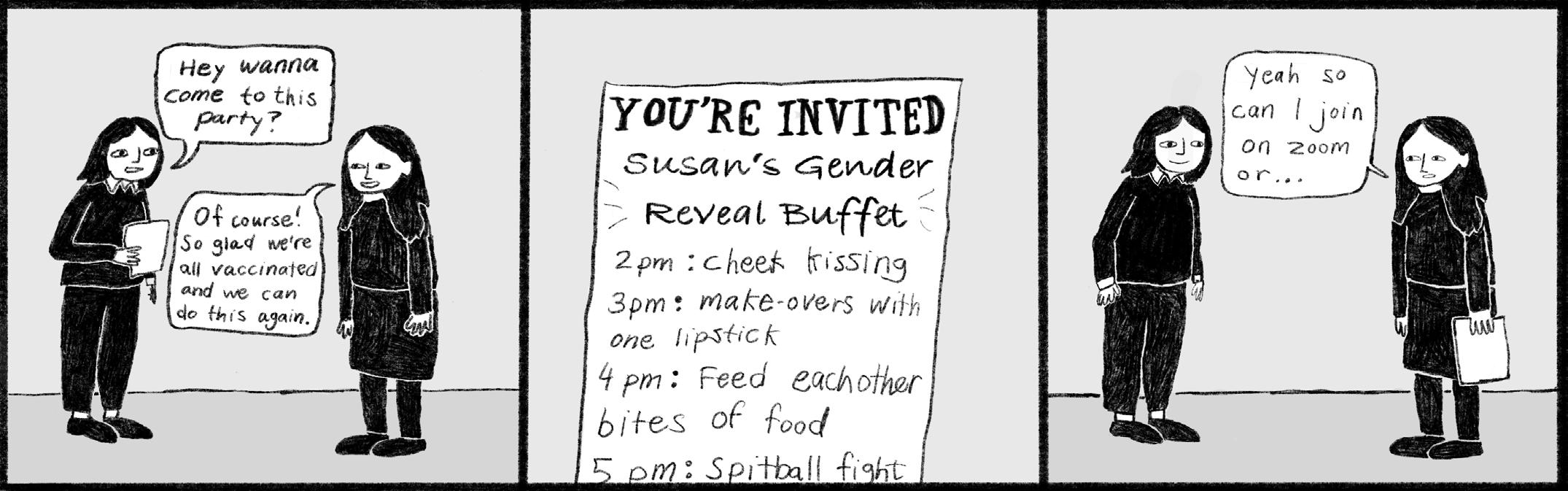

By JOHN CAPWELL and SRISHTI TYAGI Sun Contributor and Sun Science Editor
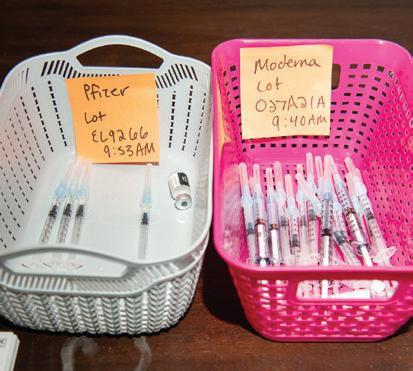
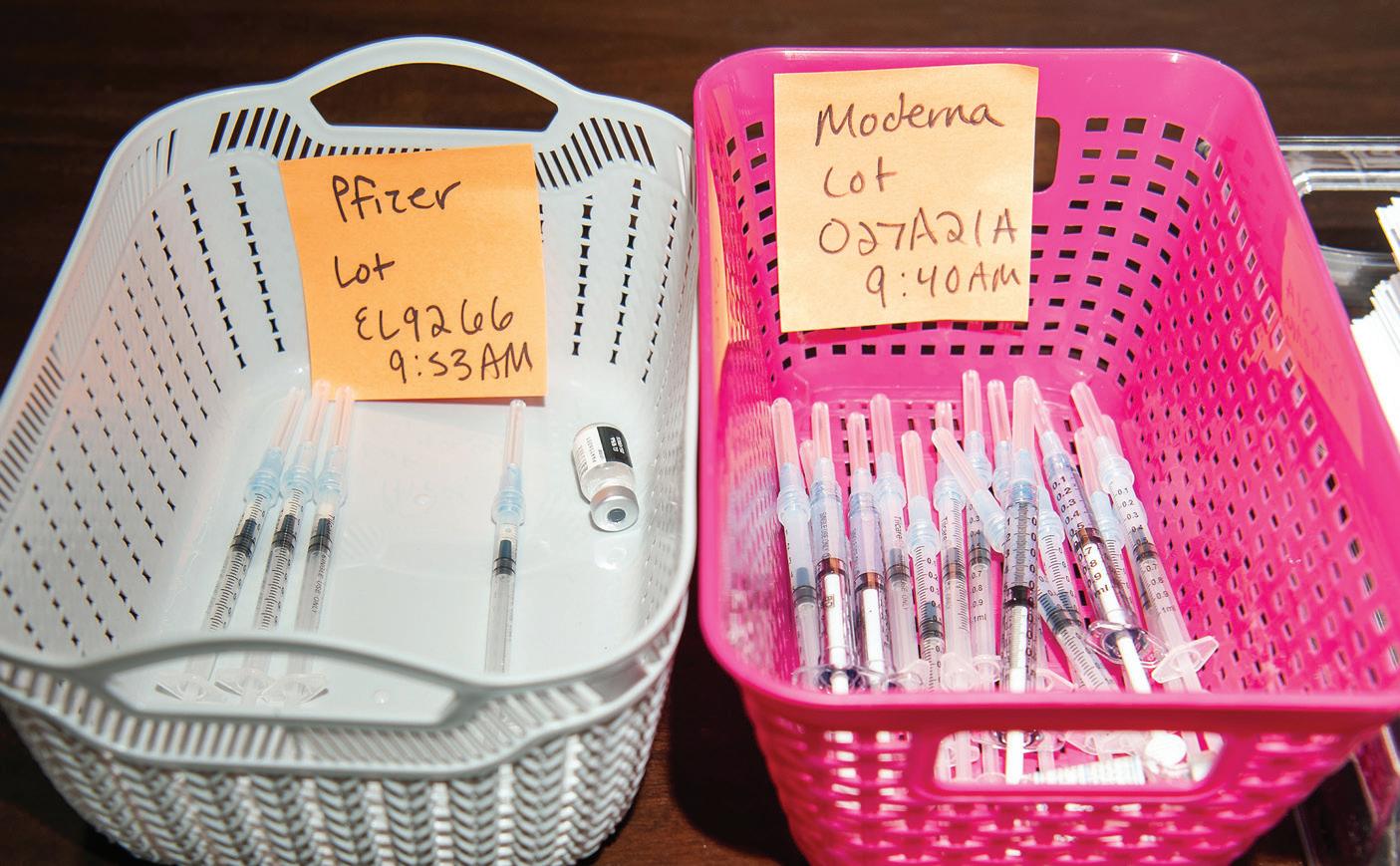
Although ramped up COVID-19 vaccine distribution marks the beginning of the end of the pandemic, it is accompanied by rising concerns over the possibility of unpleasant side effects following vaccination. But these side effects are expected — and normal.
After getting the COVID-19 vaccine, many people have reported feeling “flu-like symptoms” such as headache, fatigue and swelling or redness at the site of the injection. But these are just signs that the immune system is doing its job.
“These side effects are the typical immune response. It’s natural, it’s normal, it’s supposed to happen,” said Dr. Cynthia Leifer, microbiology and immunology. “It’s basically our immune system thinking we are infected with whatever the microorganism is and mounting a response to that.”
In most vaccinated people, these responses tend to not be too severe and usually fade within a day or two.
For the Moderna and PfizerBioNTech mRNA vaccines, clinical trials and anecdotal reports show that flu-like symptoms tend to be more severe after the second dose. However, this response is expected. Since the body already has some infection-fighting antibodies from the first vaccine dose, the second dose can prompt a stronger immune response, leading to longer-lasting side effects.
“When someone gets a booster vaccine the side effects can be more intense than with the first dose,” Leifer said. “This is because there are already educated immune cells circulating throughout the body, and more are recruited and activated when the second dose is administered.”
Others worry about the risk of having an allergic reaction — or anaphylactic shock — in response to the vaccine.
The Centers for Disease Control and Prevention places the likelihood of having an anaphylactic shock at one per million vaccine recipients, making it rare. Experts recommend those who have had allergic reactions in the past talk to their doctor before getting the COVID vaccine.
“Severe adverse reactions are extraordinarily rare, and they are often due to problems with the individual’s immune response in general, [such as] an allergy to one component of the vaccine,” Leifer said.
According to Leifer, anaphylactic shock is rare because doctors ask

patients screener questions about allergies to components of the vaccine and past allergic reactions. This reduces the risk of a person getting vaccinated if they could potentially have a serious allergic reaction.
Leifer added that the COVID-19 vaccines leave out common allergens that are ingredients in some other vaccines, such as eggs — flu vaccines, for example, often contain trace amounts of chicken egg due to their manufacture — so that even people with past reactions to vaccines can likely take the COVID-19 vaccine and not experience an allergic response.
In even rarer instances, a handful of Pfizer and Moderna COVID-19 vaccine recipients developed a blood disorder called immune thrombocytopenia.
According to Dr. James Bussel, a hematologist and professor emeritus at Weill Cornell Medicine, immune thrombocytopenia is the result of the body producing antibodies — proteins typically produced to fight foreign substances — against its own platelets.
However, Bussel emphasized that the risks of severe consequences from COVID-19 infection far outweighs the risks of vaccination, even for young and healthy people.
“COVID-19 infection is a very severe infection, and even if you’re … a young, healthy adult that appears to have a low risk of anything serious happening, it’s a low risk,” Bussel said. “It’s not a zero risk.”
Platelets are the cells responsible for preventing leaks from blood vessels, Bussel said. Since immune thrombocytopenia
causes the immune system to attack the body’s own platelets and platelet-producing cells, the condition results in a stark drop in the blood’s platelet levels, which can cause severe bleeding.
Although the direct causes of immune thrombocytopenia are unclear, Bussel said it’s possible the mRNA COVID-19 vaccine could trigger the reaction in exceedingly rare individuals who have a predisposition for the disorder.
Bussel added that his observations are specific to Moderna and Pfizer, as limited data is available on the
Higher rates of vaccine side effects have been reported by women than by men, The New York Times reported. According to this article, women have reported nearly 80 percent of all side effect reports following vaccination, even though women only account for roughly 60 percent of those who have been vaccinated.
This could be due to hormones, genes and dosing of the shots, although some have attributed these differences to the fact that women might be more likely to report their side effects than men.
“These side effects are the typical immune response. It’s natural, it’s normal, it’s supposed to happen.”
Dr. Cynthia Leifer
incidence of immune thrombocytopenia following immunization with the AstraZeneca and Johnson & Johnson vaccines.
Bussel said the COVID-19 vaccine is not the only known vaccine to possibly trigger immune thrombocytopenia — the disorder can be a side effect of other viral vaccines as well, such as influenza, measles and rubella.
Additionally, Bussel explained that researchers cannot confirm a causal relationship between the disorder and the COVID-19 vaccine because the incidence of immune thrombocytopenia is low.
“If you have X number of cases of [immune thrombocytopenia] occurring every day in the United States and you get some people who have it right after the vaccine, you don’t know if it’s just that was their day or [if] the vaccine had anything to do with it,” Bussel said.
Aside from investigating the cause of some serious side effects, researchers have also questioned why there is an apparent sex difference in the number of side effects reported.
Prof. Avery August, microbiology and immunology, said researchers do not know why these apparent sex differences in side effects exist, but there have been well-documented instances when women have different responses to vaccines compared to men, with sometimes stronger or weaker reactions.
Even so, August said side effects are not considered to have an extreme sex difference and should not be a reason to avoid the vaccine.
“I don’t think the side effects should be a deterrent because the alternative is being unprotected,” August said. “The risks of having severe COVID-19 is more severe than the malaise, [which is just] not feeling so well for 12 to 24 hours [after being vaccinated]. I think the tradeoff is well worth it.”
Ultimately, August and Leifer both encouraged people to get whatever vaccine is available to them.
“Everyone should know you should get the vaccine unless you have a medical reason not to,” Leifer said. “Take whatever vaccine is available to you. They are all highly effective, and vaccines save lives. We have lost over half a million lives in the U.S., and we don’t need to lose many more.”
John Capwell can be reached at jcc462@cornell.edu. Srishti Tyagi can be reached at styagi@cornellsun.com.