It’s not too late to join Te Cornell Daily Sun for news, sports, opinion, web, arts, dining and other departments. Contact editor@cornellsun.com.

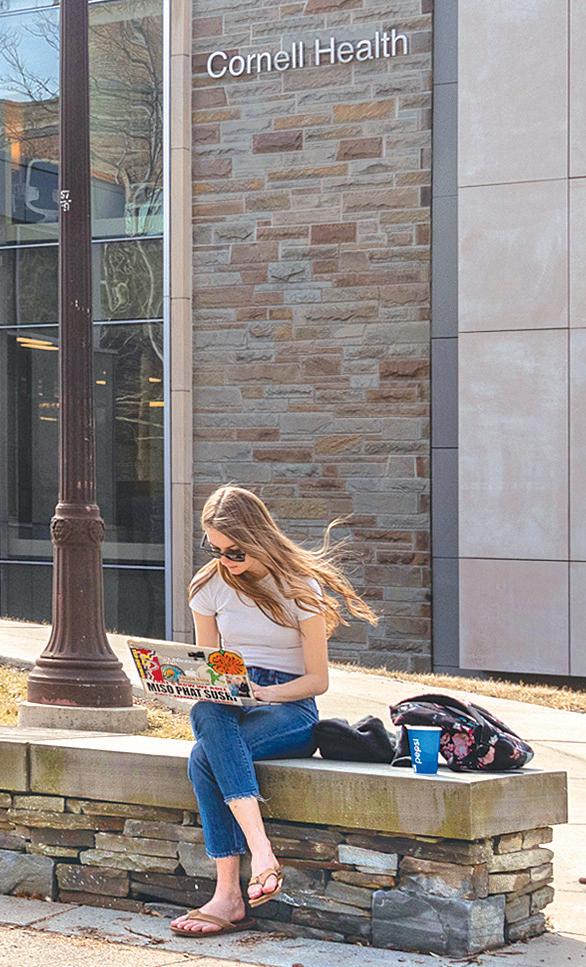
Students Share Mental Health Service Concerns


It’s not too late to join Te Cornell Daily Sun for news, sports, opinion, web, arts, dining and other departments. Contact editor@cornellsun.com.
By CARLIN REYEN Sun Staff Writer
On March 19, Ganedago Hall residents, including Mika Finkman ’25, were forced out of their beds in their pajamas when the fire alarm was triggered at 4:42 a.m. When her friend noticed water pouring out of the trash room, Finkman knew something was amiss.
“We smelled something burning from inside the trash room and decided to hop across the pool of water,” Finkman said.
/ SUN CONTRIBUTOR
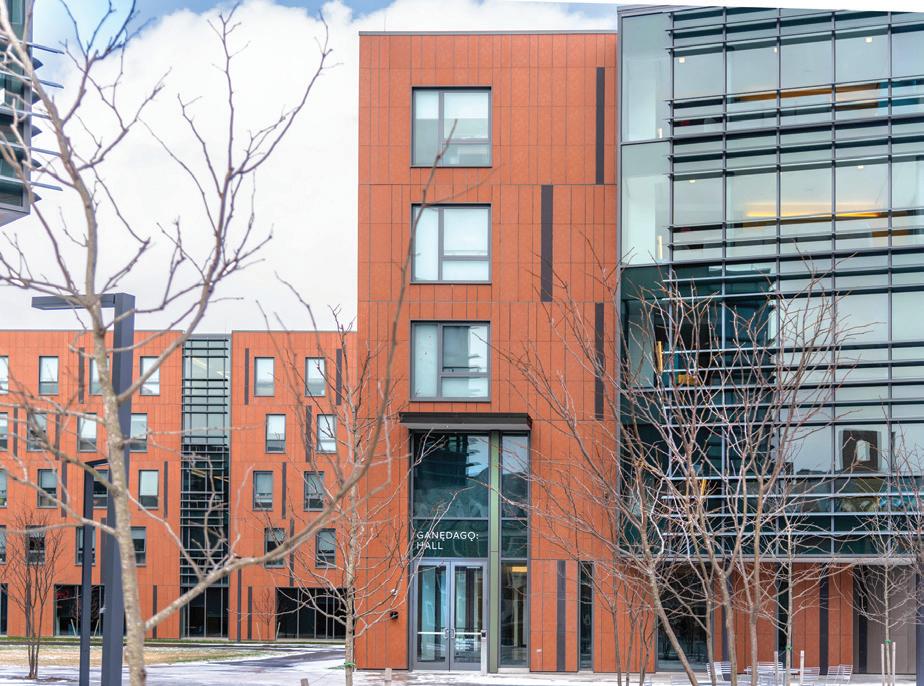
Site of arson reports | Ganedago Hall (above) has been the site of multiple arson incidents recently.
The fire triggered the building’s sprinkler system, causing water damage to nearby dorm rooms.
“It was the most concerned I have been during a fire alarm because after seeing the pool of water, I quickly realized there was an actual fire,” Finkman said. “My friends also were concerned about our Residential Advisor, whose room was right next to the fire and was now getting flooded by the sprinklers.”
The Cornell University Police Department classified Saturday’s fire as a case of arson, which followed a series of three other arson cases that occurred in December.
By ANANTHI JAYASUNDERA Sun Contributor
The recent death of three Cornellians during this spring semester sparked campus-wide discussion regarding student mental health. While Cornell provides its undergraduate and graduate students with professional mental health care through Cornell Health’s Counseling and Psychological Services, many students say that Cornell’s current initiatives are not enough.
From fall 2019 to spring 2020, Cornell conducted a Mental Health Review of its students. The review found that 42 percent of Cornell undergraduates were “unable to function for at least a week due to depression, stress or anxiety.” In comparison, the figure was 33 percent in 2015.
Some students feel that the University does not provide adequate measures to help students with mental health support services.
“Before I knew much about Cornell, I knew Cornell was known as ‘the school with the nets [under bridges].’ You can tell there is something tangibly different on this campus,” said Gracie Gallen ’24. “You can tell that people here are in pain, and their needs are not being met to the extent that they should be.”
Many students who use the University’s counseling services have voiced their dissatisfaction with Cornell Health’s response.
Roberts ’23 called CAPS for an appointment about a week into the fall 2020 semester after experiencing feelings of depression.
“They told me they had no availability until after Thanksgiving Break — so until December,” Roberts said. “So, I just decided to find someone in the local Ithaca area.”
Violet ‘23 also experienced a long wait through CAPS, despite her pressing need for an anxiety medication. “I remember I tried to get an appointment with a psychiatrist in June, but I was told the first appointment available was in October. That is just for the initial screening,” Violet said.
Following this incident, Area Coordinator Amadou Fofana sent out an email to the Ganedago Hall residences later that day to address the situation and keep the community informed.
According to Fofana, several measures have been taken to prevent further fire-related incidents from occurring. Microwaves have been removed from all residence floor kitchens and stovetops were shut off in these kitchens.
The trash and recycling rooms in Ganedago Hall have been closed as a result of the incident to allow for further investigation and repairs, according to Fofana’s email.
Jack Letendre ’25 believes that the campus and student body need to do their part in calling out activity that seems suspicious. He also suggested offering incentives to students to hold each other to a higher standard. James Kelly ’25 commented that he thought students might be willing to sacrifice certain privacies in exchange for a peace of mind.
“I feel like people don’t mind if there is a camera in
By ELI PALLRAND Sun News Editor
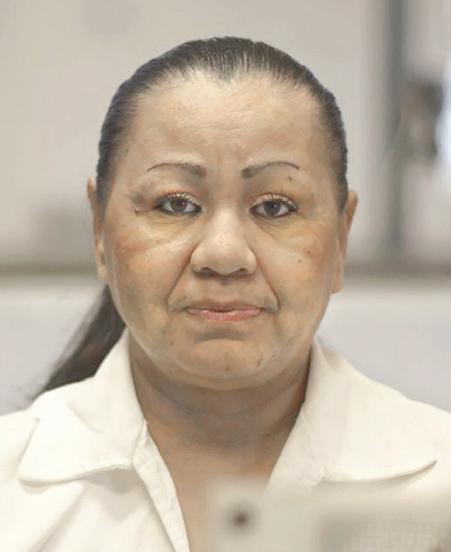
As part of the Cornell Center on the Death Penalty Worldwide’s Her Whole Truth project — which aims to tell the stories of women on death row around the world — Cornell students are raising awareness about the case of Melissa Lucio, the only Latina currently on Texas’ death row.
In 2008, Lucio was convicted of the murder of her two-year-old daughter, Mariah Alvarez. Prosecutors used a grueling interrogation in which Melissa Lucio confessed to biting her daughter as evidence of severe child abuse, but Lucio’s supporters contend that the evidence of bite marks used to convict Melissa Lucio is factually unsupported based on recent scientific consensus. Other evidence used by the prosecution, such as scratch marks and bruising on Mariah Lucio’s body, are
also being questioned, as Lucio supporters point to falsehoods in key sections of the testimony of the State’s Medical Examiner, Norma Jean Farley.
Chelsea Halstead MPA ’21, associate director of the Cornell Center on the Death Penalty Worldwide, said she believes Mariah Lucio died from an unnoticed brain bleed two days after falling down the stairs of her family’s apartment — the same cause of death Melissa Lucio gave paramedics. Halstead said this cause of death was
Halstead and other Lucio supporters have also argued that, after more than 100 assertions of her innocence, Lucio’s interrogators obtained a false confession through excessive coercion. Only two hours after the death of her daughter, Lucio was interrogated by armed officers from around 10 p.m. to 3 a.m. without food, rest or sleep for roughly 16 hours, all while pregnant with twins.
“It's so egregious what’s been done to her, and it’s so clear that she’s innocent...”
Chelsea Halstead MPA ’21
made more likely by Mariah Lucio’s deformed foot and history of falls, as well as her undiagnosed blood coagulation disorder, which could have been the source of bruises that looked like signs of abuse.
Lucio’s supporters, as well as experts in false confessions, also find her only confession suspect. After repeated interrogation on a bite mark on Mariah Lucio’s back, Melissa Lucio said, “What do you want me to say? I’m responsible for it.”
“Those words are what land[ed] her on death row,” Halstead said. “There’s no physical evidence linking her to Mariah’s death.”
As a parent with no his-
tory of violence or abuse against children at the time of her arrest, Lucio supporters say she never should have been treated as a killer. Although Lucio faced frequent poverty-related Child Protective Services visits, no evidence of violence or abuse by Melissa Lucio against her children was ever documented.
Based on her history as a victim of rape and abuse since she was six years old, Lucio supporters also say that she was particularly vulnerable to police manipulation and violent threats.
“With armed male police
COUNSELING
Continued from page 1
Many students believe that long wait times for appointments can be attributed to understaffing.
“I remember I had a very urgent need for a CAPS appointment, and to accommodate me, Cornell Health postponed another student’s appointment and gave me their spot,” Violet said. “That poses a big problem for the other student.”
When Roberts tried to find counseling her freshman year, she was turned away by CAPS after a 15-minute consultation.
“They told me I just need to manage my stress better and that I don’t need therapy. After a year in private practice counseling, I know that I actually had mental health issues that needed to be addressed,” Roberts said.
Roberts believes that this
dismissive action is a result of an inadequate number of
“... people here are in pain, and their needs are not being met to the extent that they should be.”
Gracie Gallen ’24
CAPS counselors.
Paired with understaffing,
students voice that Cornell lacks mental health specialists for specific issues. Sidney ’23 told The Sun that while she thought her CAPS counselor was an excellent confidant that met these needs, she was unqualified to help with her Obsessive Compulsive Disorder. Violet also shared this sentiment, stating that “getting an OCD specialist was impossible” at Cornell CAPS.
Gallen is a trainer at


Cornell’s Empathy, Assistance and Referral Service, which provides peer mentorship and empathy training to Cornell students. While EARS is no longer allowed to provide counseling services to Cornell students and members of the Ithaca community, Gallen insists that it is still an important resource.
“One of the key pillars of EARS is ‘there is no problem too small,’” Gallen said. “As long as there are people not getting CAPS appointments on time and as long as there is a stigma around mental health, EARS is going to have a place at Cornell.”
EARS funding has recently
“They told me I just need to manage my stress better and that I don’t need therapy.”
Ariya Roberts ’23
increased after the passage of an appeal in the Student Assembly Appropriations Committee. Duncan Cady ’23 and other S.A. members pushed for an appeal that EARS had made to increase its funding for promotional materials and other functional aspects of the organization.
While changes regarding CAPS and Cornell Health are not within the S.A.’s jurisdiction, Cady told The Sun that the S.A. has the control to grant more funding toward EARS and invest in mental health services.
Ananthi Jayasundera can be reached at atj35@cornellsun.com.
Continued from page 1
the elevator or the hallway,” Kelly said.
Continued from page 1
officers aggressively threatening and interrogating her, she had a trauma response, which includes downcast eyes [and] slumped shoulders — far from being symptoms of somebody who’s guilty, these were signs and symptoms of someone who had severe PTSD and who was being triggered by a very brutal, unforgiving interrogation,” Halstead said.
Halstead also argued that the prosecutor and defense attorney on the Lucio case were both under significant pressures that prevented them from adequately executing their roles. Cameron County District Attorney Armando Villalobos — who is currently serving a 13-year federal prison sentence for bribery and extortion — was campaigning for re-election during the case and had been criticized as soft on both murder and child abuse, and Lucio’s attorney went to work for the District Attorney’s office soon after losing the Lucio trial.
“It was kind of a perfect storm,” Halstead said. “[Villalobos] was an incredibly corrupt D.A. … [and] Melissa had very inept representation at trial. She was given a public defender who really did just an awful job defending her.”
To save Lucio’s life, students in English 3741: Design Thinking, Media, and Community are working with the Cornell Center on the Death Penalty Worldwide to reach college campuses and voters in Texas through a mixture of community outreach, social media and art.
“The focus of the class is… seeing the ways that storytelling can make an impact on civic engagement and nonprofits,” said Sowmya Venkatachalam ’24, a student in English 3741 and member of Her Whole Truth. “We are much more on the creative side of things than the administrative side.”
Trying to reach Texans from an upstate New York Ivy League has forced students to change their messaging, appealing to the tastes of a group with which many Cornellians don’t often interact: conservative Texans.
Laura Ilioaei, an Ithaca College student taking English 3741 this semester, said that Her Whole Truth works with student artists to portray Melissa Lucio as a family-oriented, traditional woman by using pastel colors, soft features and feminine imagery.
“We’re targeting Texas college campuses to try to convince them to put out campaigns to convince people in [the] government in Texas to prevent this execution from happening,” Ilioai said. “However… our rhetoric is going to be different [when] appealing to Texas just because it’s a different culture.”
Despite the failure of a similar 2020 campaign to save the life of Lisa Montgomery, Cornellians working on the Lucio case are noticing signs of progress.
To continue reading this article, please visit cornellsun.com.
An investigation of the fires by the CUPD is ongoing, and a March 25 email to students from Ryan Lombardi, vice president for student & campus life, and Joanne DeStefano, executive vice president and chief financial officer, noted that there would be CUPD presence within Ganedago Hall and that consequences for guilty parties include possible expulsion and criminal charges.
Sophia Emerson ’25, who is a resident of the floor where the fire took place, is one of the many students angered by the sequence of alarms that has taken place this school year.
“It was a massive inconvenience to have to go outside twice in one night for fire alarms last semester,” Emerson said.
Many residents, like Hannah Irvine ’25 are frustrated by these alarms. Irvine said that she was awake until 6 a.m. as a result of
the fire. She expressed an increase in stress that she attributes to the fire alarm incidents.
“It affects my ability to be in my dorm stress-free and sleep because I’m always afraid I’m going to be woken up to that voice,” Irvine said, referring to the alarm system in Ganedago Hall, which repeats directions for evacuation to residents in a human-like voice when the fire alarm is triggered.
Similarly, Kelly noted the inconvenience of these alarms for his sleep schedule.
“It’s very annoying because they [often] happen the night before prelims and finals. It disrupts sleep,” Kelly said.
He expressed further concern that the frequency of fire alarms will result in students not taking alarms seriously.
“If it keeps happening, people aren’t going to leave [the building],” Kelly said.
Carlin Reyen can be reached at creyen@cornellsun.com.



I associate pretty much every single song I’ve ever listened to with a specific time in my life, and every time I listen to that song, I feel nostalgic. Olivia Rodrigo’s debut album, SOUR, which was released on May 21, 2021, will forever be memorialized to me as the soundtrack to the end of my senior year and graduating from high school.
Olivia Rodrigo: driving home 2 u (a SOUR film) was released on March 25, and although it is only 77 minutes long, in that time we get to see how every single song on SOUR is associated with a specific moment or memory in Rodrigo’s life and how the release of the album was such a momentous time for her too. The documentary chronicles Rodrigo’s solo road trip from Salt Lake City to Los Angeles, which is the same road she traveled countless times as a child star and where she wrote many of the songs on SOUR
She stops at the breathtakingly scenic places where she composed each song and performs a new ver-
sion: “good 4 u” is performed in the middle of a desert with a full orchestra, showcasing the emotion of the seemingly grunge-angsty song. This arrangement helps Rodrigo’s feelings shine through, allowing the listener to understand the intensity behind the lyrics and making the song much more powerful.
It’s almost surreal to see Rodrigo look back on her life that has changed so drastically over the course of a year. Before her pop stardom, she was just a normal high school student. I remember watching her TikToks before she released “driver’s license,” listening to snippets of songs that she had written that have since been deleted from her account, still unreleased.
Now, her fame has idolized her, turning a relatable, semi-famous girl on TikTok and Disney Channel into a popstar completely out of reach. However, the documentary brings her back down to Earth, allowing the audience to view her as a person who is just like us. After all, we are not that different: just as we associate songs with certain memories and times in our lives, she does too.
Along her road trip, Rodrigo
also recounts memories of creating her album with co-songwriter and producer Dan Nigro, showing footage from the studio. She goes into further detail about the experiences or moments she based each song on SOUR on. These scenes were filmed during the final production sessions for SOUR, so we don’t exactly see a complete view of their process. Still, it definitely makes the popstar much more relatable. For example, a few days before the final track list was due, Rodrigo was freaking out and decided that she wanted another upbeat song on the album. Out of nowhere, “brutal” was born, and the album was complete. These moments in the studio and the scenes in which Rodrigo openly shares the thought processes that led to the creation of
SOUR create an atmosphere of authenticity that seems to connect the audience to the popstar on a deeper level.

The second single from SOUR, “deja vu,” addresses a past partner (presumed to be Joshua Bassett) who is in a new relationship and doing the same things with her that he did with Rodrigo. This is clearly a painful experience for Rodrigo, as it would be for any teenager going through their first breakup. Yet, Rodrigo struggled about whether she should portray her true emotions in the song.
The camera then panned to a sign in a gas station that read, “smile, you’re on camera,” tying the whole idea together.
Rodrigo’s discussion of her struggle with social image is so powerful because it is so easy to think that people like her — who look so happy and are so successful — are completely put together and have everything in their lives figured out. However, Rodrigo made it clear that that was not the case at all. As her songs describe, she was not always happy, and even after her success, she didn’t feel like everything was fixed. She felt like she was alone and no one understood or related to her, saying, “I think by writing songs about exactly how I felt, I was creating a friend for me.”
“I thought if I put this song out then I was also playing into this drama, love triangle, like ‘let’s hate on other girls’ thing, and I just did not wanna do that cause that’s not something that I feel,” Rodrigo said. This inside look into the struggle that went on behind studio doors makes the whole process seem much more real and almost easier to appreciate, as the audience now understands that not everything was as easy as the guitar riff for “brutal.”
When discussing the thought process behind “jealousy, jealousy,” Rodrigo described how she was “so obsessed with social media in a very negative way.” She said, “If you find yourself thinking about [social media] too much, I think you get so disillusioned from real life and nothing good can come from that.”
Even though the creation of her album came from moments of real pain, she created a friend for us listeners, too. Rodrigo felt alone while writing, but the success of SOUR makes it clear that she was not alone at all; instead, her experiences were more relatable than she thought. She said, “There’s nothing that connects people and there’s nothing that is a truer window into human emotion than music.”
Rodrigo’s road trip in the documentary demonstrates the power of nostalgia, as well as the idea that people can be nostalgic for memories that may not have been happy at the time, but mean something else now. Emotions and memories can change: Rodrigo’s memories may have been sour at the time, but the community of fans and music she has created is not sour at all — it’s sweet.
Freya Nangle is a freshman in the College of Arts and Sciences. She can be reached at fhn3@cornell.edu.

140th
VEE CIPPERMAN ’23 Editor in Chief ANGELA BUNAY ’24
SERENA HUANG ’24
EMMA LEYNSE ’23 Associate Editor
SURITA BASU ’23
Assistant Managing Editor
NAOMI KOH ’23
Assistant Web Editor
ELI PALLRAND ’24 News Editor
ESTEE YI ’24 News Editor
KAYLA RIGGS ’24 City Editor
JULA NAGEL ’24
Photography Editor MEHER BHATIA ’23
KATRIEN DE WAARD ’24
PAREESAY AFZAL ’24
ADITI HUKERIKAR ’23
DANIELA WISE-ROJAS ’25
’24
GRAYSON RUHL ’24
KEVIN CHENG ’25
HANNAH ROSENBERG ’23

DEVAN FLORES ’24
YAO ’23
Editor ROMAN LAHAYE ’23
’24
’23
SNYDER ’23
KUNSANG ’25
’24
’24
’24
PACITTO ’24
Deskers Jiwook Jung ‘25 Estee Yi ’24
Desker Gabriella Pacitto ‘24
Desker Julia Nagel ’24
’24

Noah Do is a sophomore in the College of Human Ecology. He can be reached at ndo@cornellsun.com. Noah’s Arc runs every other Monday this semester.
There is a very specific feeling of dread that often overtakes me in uncomfortable social settings. My blood begins to churn and immense pressure builds up in my chest. I can’t quite think straight and the usual screening process between emotion and action is infiltrated by panic and an impulse to escape. As much as I might try to behave normally, my mind is scrambling to find some way out of my imagined spotlight.
These episodes are a regular occurrence for me. As you can imagine, it gets exhausting always being front and center on a stage that you’ve completely fabricated for yourself. I’m unable to do much of anything without also considering how the people around me are likely to perceive it. Every twitch in my facial expression, every touch of my hair, every small shift in my intonation has been thoroughly envisioned, assessed and cleared by my inner self-critic. Anything that risks alienating me from the group is a no-go and any grab for attention, no matter how small, must first be assessed through every doomsday scenario imaginable.
My outlook is fueled by two very conflicting feelings. The first is the outside gaze, the judgments that the people around me are surely making at all times. Their assessments of my appearance, my personality and the way I carry myself. No action goes unnoticed and every little insecurity I’m zoomed in on must be a blaring siren alerting everyone that I should be avoided at all costs.
Accompanying my adolescent egocentrism is the second reason for my insecurity-driven social complex, which is the fear of being alone. I assume this worry stems somehow from evolutionary adaptations for group survival and the reproductive advantages of attracting a mate by being similar to everyone else. In the 21st century, this amounts to feelings of estrangement — like I’m a pariah in any social circle I attempt to wedge my way into. My place in the group is justified by happenstance and my presence would never be missed or even noticed if I happened to slip out quietly, as is my tendency when faced with the slightest bit of discomfort.
I feel at once like the center of attention and a forgettable wisp of a personality. In my mind, everyone’s always participating in the nitpicking and the badmouthing, but never doing anything to challenge those assumptions about me. It’s always my job to prove my social worth to get others to talk to me, a task far too exhausting to beat out a solo night of watching Korean rom-coms, accompanied by a bubbling pot of instant ramen.
I could point to multiple origins in my life that could be potentially responsible for my paradoxical unease. When I was a child, I was always extremely aware of how adults were judging my actions — whether they were impressed by my shows of maturity or bursting out into amused, but nevertheless hurtful, fits of laughter at the blunders that children make out of simply not knowing enough about socially acceptable human behavior. Anytime I misused a punchline I heard from a TV show or unknowingly violated some unspoken social norm, I made
sure to quickly scan how the adults were reacting. Any indication that I was doing something even slightly out of line was motivation for me to just keep it to myself the next time. I never understood that their reactions were merely out of amusement and not a judgment on me.
Another possible source lies in my position in my family. As the eldest son in a small Asian family, I never had to vie much for attention when I was younger. I received praise and affection for the smallest accomplishments and grew up convinced that I deserved to be part of the group just for being me. Attending gifted programs from the 2nd to 12th grade meant that I kept the same circle of friends for most of my childhood, never having to fend for myself in an
As you can imagine, it gets exhausting always being front and center on a stage that you’ve completely fabricated for yourself.
environment where I didn’t already know several people I could fall back on.
College completely disrupted the safety nets I grew up cherishing so much. Gone are the doting family members who hang onto my every word and the friends who don’t need some compelling reason to give me their time of day. I have no anchor to rely on, no reason to believe that I will be welcomed into the crowd with open arms. All I want is some sense of security. The ability to interact with others without the expectation to prove that I’m a friend-worthy person. I don’t want to feel like I have to nitpick every last thing I do because I don’t trust that the people around me aren’t internally badmouthing me.
Too often do I live in service of my imagined sense of others’ perceptions. I become convinced that negating any potentially embarrassing parts of my personality is the easiest way to get others to like me, when the truth is usually the complete opposite. My constant search for signs of alienation or disinterest in the people I interact with exhausts the little decision-making chimp in my brain to the point where avoiding the interaction altogether is the most attractive choice.
The magnifying glass that I feel constantly pointed at me, no matter how self-imposed it may be, restrains all the most distinctive elements of my personality. Behind the wall of insecurities and timid small talk is, in my opinion, a perceptive, curious, open-minded and incredibly humble individual. The only one preventing him from emerging more frequently is almost always me.

Fill in the empty cells, one number in each, so that each column, row, and region contains the numbers 1-9 exactly once. Each number in the solution therefore occurs only once in each of the three “directions,” hence the “single numbers” implied by the puzzle’s name. (Rules from wikipedia.org/wiki/ Sudoku)






By GABRIELLA PACITTO Sun Assistant Sports Editor
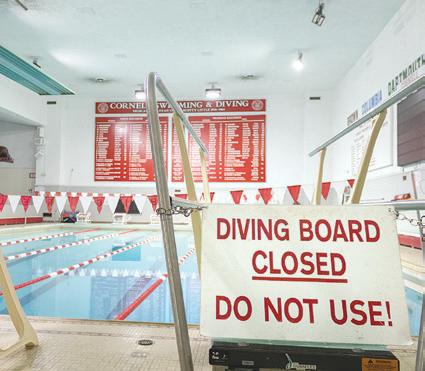
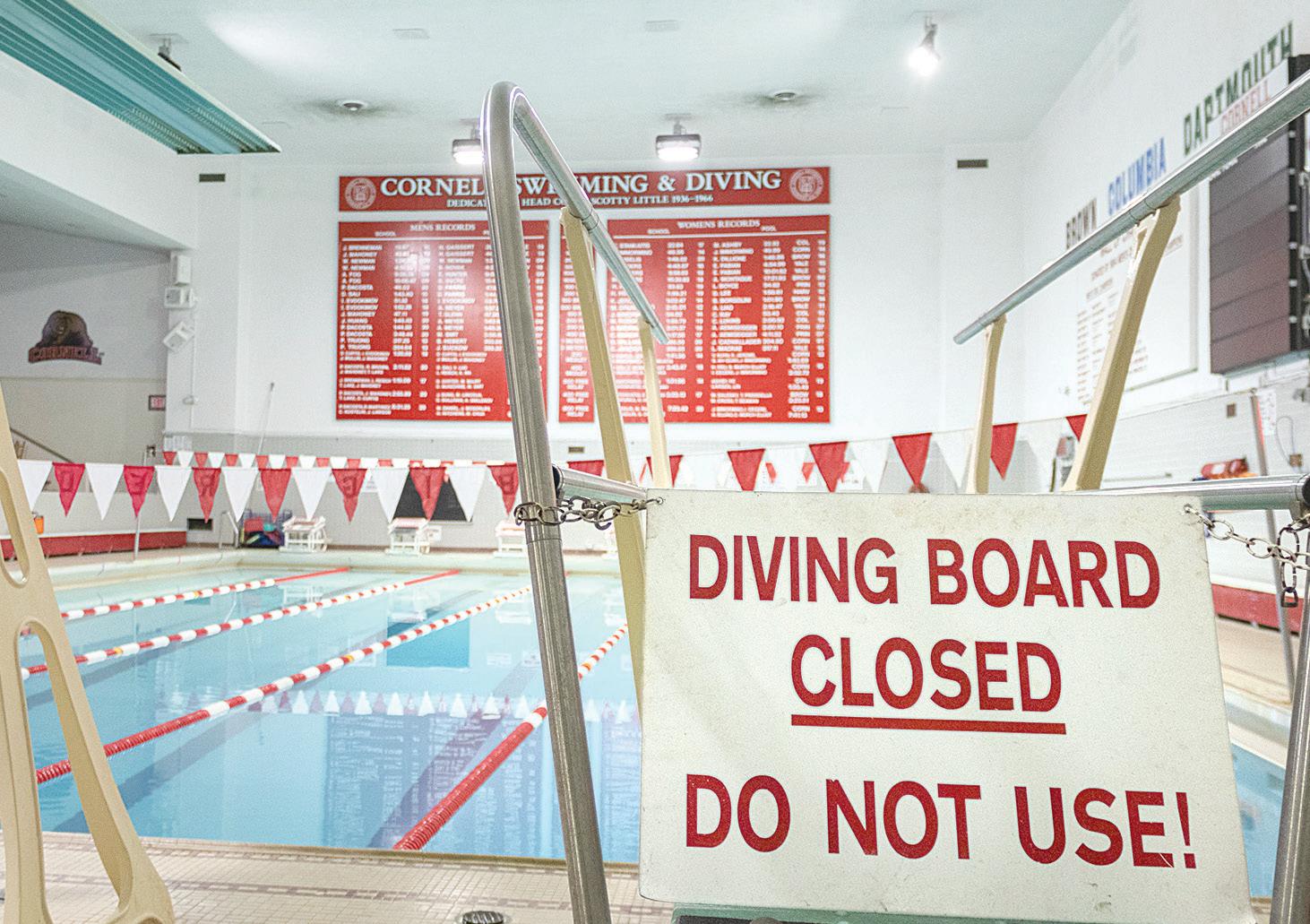
The pools at Teagle Hall and Helen Newman Hall, constructed in 1951 and 1963, respectively, are past their expected lifetime.
“... Our pools are and have been operating beyond their expected life span,” said Andy Noel, director of athletics and physical education.
Aquatic teams and coaches recognize this problem and are fighting to replace the pools. It impacts their practice and meets, and unless they are the varsity team who receives access to the Ithaca College pools, teams are deprived of pool time.
President Martha Pollock commented on the expensive undertaking on Cornell of acquiring new pools. But, a new solution needs to be established soon before Cornell is left without any pools to use.
“Much time and effort is being invested in pool rehabilitation, maintenance and identifying a workable, realistic path forward,” Noel said about the status of acquiring new pools.
meet contemporary standards resulting in chemical-heavy air at pool surface level,” Noel said. “The air is not exhausted and refreshed as needed. The chloramine in the air is not successfully evacuated resulting in the poor air quality negatively impacting users.”
Heating, ventilation and air conditioning are combined systems to guarantee good water and air quality with appropriate airflow while providing swimmers comfort.
The pump, filter and piping systems have reached their endpoint, but most have been repaired.
As for the pool decks and tiles, the cracks are worsening and the security of the pool is defective.

Noel cited a report from 2019 by CounsilmanHunsaker about the pool facilities provided by the Cornell athletic department, which voiced concerns on the pools reaching the end of their lifespan. While repairs could add a few more years, there are still fears of a destructive failure.
Noel said, in an email to The Sun, that the pools are breaking down in more ways than one: the turnover rate does not meet modern standards, air quality is poor, cracked tiles result in leaks and more shortcomings that have been repaired.
“...Our pools are and have been operating beyond their expected life span.”
Andy Noel
The pools faced their increasingly acute problems as the operational aspects reached the end of their lifetime, maintenance workers were unavailable to manage routine maintenance repairs and a lack of a primary pool technician.
Turnover rates are connected to the filtration system. It is the amount of time it takes for the filtration system to cycle through the pool water at one time. A turnover rate should be about 12 hours, so after the pump is turned on, the water should be filtered and cleaned within 12 hours.
“The water is not being cleaned [and] filtered as thoroughly as it should be, and water quality [and] clarity is difficult to maintain,” Noel said. “Code regulations do not permit pool usage when the water is cloudy to the extent that the bottom of the pool is not visible.”
Cornell’s pools filter through the pool very slowly with an old filtration system, creating cloudy or murky water. Aquatic teams cannot utilize their resources efficiently with low visibility and water quality.
“[The] HVAC systems in the natatoriums do not
“Concrete pool decks had extensive deterioration and rebar corrosion and are no longer structurally sound,” Noel said. “Cracks exist in the concrete/ tile pool surface resulting in ongoing leaks.”
Fortunately, the statement said that a few repairs had stabilized the deck. There has been $750 thousand worth of repairs done to fix the situation temporarily.
Noel noted that all failed filtration tanks, pumps and piping have been replaced at both pools. Timber shoring was installed beneath the concrete decks to secure stability and fix a few concrete parts. Pools were drained and underwent grouting repairs in leaky places. Finally, because of the standards of the Americans with Disability Act, lifts were changed to meet specific standards to make the pools accessible.
Closures are happening for two main reasons: water quality is poor, and there isn’t enough help to keep up with routine cleanings.
the number of human body oils, commercial souls, shampoo’s] in the water was required for the filtration system to catch-up given heavy, consistent use to reduce closure frequency.”
The usage in the pools was way more than the pool itself could keep up with. So, when the problems were becoming worse, the decision to cut the amount of usage in the pools seemed like the only reasonable solution.
This would result in the unscheduled pool closures the aquatic teams constantly managed.
“Concrete pool decks had extensive deterioration and rebar corrosion and are no longer structurally sound.”
Andy Noel
Noel commented that there is a priority list pre-established as to who is granted pool time at the top, being P.E. classes teach swimming for students to complete the required swim test and learn necessary skills.
Then Intercollegiate swim and dive teams, club teams, open swim and other P.E. and club activities like diving, water polo and Cornell triathlon club team.
To combat the ad hoc closures, the intercollegiate teams were prioritized and given the resource to practice and hold meets at Ithaca College, meanwhile everyone else was left without any access to pools.
According to Noel, teams like club water polo were assigned times last semester but were interrupted by a required code closure. Since the only possibility of avoiding a prolonged closure was to reduce the engagement, they consequently removed the club teams from the schedule mid-semester.
“[The reality is that] if the amount of team, club, P.E. swim lessons and open swim was not reduced, the pool water may have deteriorated resulting in closure for all users,” Noel said.
Noel said that as the problems continue, there is a blatant risk of the issues worsening, causing the structure to collapse.
According to Noel, besides the temporary fixes, there is still a problem with leaks potentially continuing to grow and develop, creating a situation where the pools have to close for a long duration. The piping and gutter system might be unable to be fixed, leading to the pools closing immediately to have the entire system be rebuilt.
As mentioned earlier, the water quality has reached the point where it’s dangerous for people to swim in the pools. Between the visibility issues and the lack of cleaning occurring, people face risks while swimming in the pool through low visibility or exposure to diseases, such as diarrhea, E. coli or hepatitis A.
“Lack of adequate time dedicated, currently available to conduct routine, daily pool maintenance, directly causing water quality issues to accelerate,” Noel said. “A reduction in programming [to reduce
“Strategic measures that were put in place in 20192020 were executed with the hope of an approximate 5-year lifespan,” Noel said. “If this time horizon is exceeded, interventions like structural shoring would likely fail.”
The University Assembly adopted a resolution that supports the Faculty Senate’s “Inclusion and Prioritization of a New Natatorium in the ‘To Do the Greatest Good’ Capital Campaign.” While this is not an established plan for replacing the pools, it’s a start to resolving the age-long pool debacle.