The Corne¬ Daily Sun



Voter turnout rises by nearly 13 percentage points, now at 39.9 percent
By NICOLE ZHU and SEAN O’CONNELL Sun Assistant News Editor and Sun Staff Writer
After three days of voting, Cornell’s undergraduates elected Joe Anderson ’20 as the next Student Assembly president. Voters also elected Cat Huang ’21, current S.A. transfer representative, as executive vice president, the position currently held by Anderson.
Anderson was elected by an 538-vote margin over the second-place candidate, Trevor Davis ’20, in the second round of voting. In the initial tally, Anderson received 1,892 votes, Davis garnered 1,515 and John Dominguez ’20 — who was eliminated after the frst round — received 1,009 frstchoice votes.
“I’m so grateful to the student body for giving me this opportunity and placing their trust in me,” Anderson told the Sun. “I’m so excited to start building our next year’s executive committee so that we can all start setting priorities and expectations for the assembly.”
He emphasized the importance of this year as the start of a new funding cycle — which begins in early April — as well as reafrming his commitment to “making sure every student feels like they belong at Cornell.”
By YUICHI KAKUTANI Sun Senior Writer
Huawei Technologies, a Chinese multinational frm now under several federal indictments, paid Cornell roughly $5.3 million for two separate research contracts in 2017, according to government data.
Tat transaction is by far the telecommunication giant’s biggest payout to a U.S. university — over 3.8 times more than the second largest — in the last six academic years. Huawei’s payments also make the company the second-largest foreign corporate donor to the University, according to data published by the U.S. Department of Education.
A University spokesman told Te Sun that there are “a handful of research agreements” with Huawei in a provided statement included below. Cornell has not released additional details about the content of its contracts with Huawei — including whether the University will seek more partnerships with the company in the future.


In the race for executive vice president, Huang won with 1,798 votes in the frst round, with competitors Nick Matolka ’21 and Uche Chukwukere ’21 receiving 819 and 1,523 votes, respectively.
As EVP, Huang said she hopes to continue her work on several “long-term projects” that she started during her frst term in Student Assembly, such as improving of-campus housing afordability and ensuring student input is heard in major projects like the North Campus Expansion project.
“[I] want to make sure that the student voice is heard when these policy changes are being discussed,” Huang told Te Sun.
In addition to S.A. president and executive vice president, the rest of the S.A.
executive board, such as the vice president of fnance and the vice president of external operations, will be internally elected later in the semester by S.A. members.
With Huang’s election to EVP, voters efectively elected Davis and Chukwukere, the current LGBTQ+ liaison representative, as the two undesignated at-large S.A. representatives.
"Tough I don’t really know what an undesignated at-large representative is, I’m truly honored the student body found my resume worthy of containing that position,” Davis told Te Sun.
Additionally, Bryan Weintraub ’21 won re-election as the School of Hotel Administration representative while Polina Solovye-

One of the largest network and telecommunication companies in the world with a market capitalization of $577 million, Huawei currently fnds itself embattled with several Western governments that have accused the company of spying on behalf of the Chinese government, leading Australian newspaper Te Sydney Morning Herald reported.
Tese governments, including Australia and Poland, believe that the Chinese government may compel Huawei to spy on Western countries using telecommunication infrastructures that it has constructed within their territories,
pointing to a 2017 Chinese law that says organizations must “support, co-operate with, and collaborate in national intelligence laws,” according to BBC. Huawei said they never have and never will spy on behalf of the Chinese state. Tree experts interviewed by CNBC said that Huawei will be hardpressed to reject requests for cooperation from the Chinese security services; however, another expert told NPR that the mere capacity to spy on behalf of the Chinese government should not incriminate the company. Defnitive evi-
va ’21 was elected as the School of Industrial and Labor Relations representative. Kirubeal Wondimu ’22 was re-elected frst-generation student representative. Voters also re-elected Moriah Adeghe ’21 and Colin Benedict ’21 as minority students liaisons at-large.
Adeghe told Te Sun that she was “worried that [her] race was getting overshadowed,” but that she “plan[s] to keep moving forward with the initiatives that I ran on in the special election.” Her platform emphasizes reductions in price of laundry, laptops, books and other costs not associated with tuition.
Te elections saw a voter turnout of
By MARYAM ZAFAR Sun City Editor
Vice President of Finance of the Cornell Political Union
Brendan Dodd ’21 stepped down from his post on Wednesday afternoon. Dodd said he chose to resign after CPU responded to conservative speaker Jannique Stewart’s allegation of “VIEWPOINT DISCRIMINATION” with a “disingenuous” and “deliberately misleading” statement. In a Facebook post on Saturday, prolife speaker Jannique Stewart alleged that the Cornell Political Union discriminated against her because of her conservative Chris-
tian views, Te Sun reported. Te accusation came after CPU disinvited her from speaking on the topic of abortion in April out of concern for “security” of their members and fear of high event security fees, CPU said in a statement to Te Sun.
Dodd, who said he helped craft the statement, called the response an attempt at “self-preservation.” Dodd wrote a guest column for Te Sun in which he said that the decision to disinvite Stewart was “a decision made primarily due to Stewart’s beliefs.”
“Tere was no risk
Roundtable on Law, Economics and Society 9 a.m., 700 Clark Hall
S.C. Tsiang Macroeconomics Workshop: Nelson Lind 11:40 a.m., 498 Uris Hall
Estimating the Flow of Information in Deep Neural Networks
12:15 - 1:15 p.m., 229 Phillips Hall
Critical Assessment of the Impact of Community-Based Interventions on Child Nutrition and Hygiene Behaviors in Rural Zimbabwe
12:20 - 1:10 p.m., 100 Savage Hall
Institute for African Development Spring Seminar Series 2:30 - 4 p.m., G08 Uris Hall
International Students — How to Get Work Authorization in the U.S.
3 - 4 p.m., 103 Kennedy Hall
Thursday, March 28, 2019
Using Gravity to Probe the Martian Sedimentary Rock Record
4 - 5 p.m., 105 Space Sciences Building
Declaring Blackness Is Easy: Angola and African-American Solidarity in the 1970s
4:45 - 6:15 p.m., Kaufmann Auditorium, Goldwin Smith Hall

Innovations in Population Science 12:15 p.m., 401 Warren Hall
Ezra’s Roundtable — Systems Seminar 12:15 p.m., G01 Gates Hall
Dragon Day 2019 1 p.m., Parade Starts at Rand Hall


AAG Practice Panel — Development Sociology 1:30 p.m., B73 Warren Hall
Shift-Share Instruments and Dynamic Adjustments: The Case of Immigration 2:30 - 4 p.m., 401 Warren Hall
Reducing Micronutrient Malnutrition Ideas to Action Forum
3:30 - 5 p.m., 2nd Floor Dining Area, College of Veterinary Medicine
By SEAN O’CONNELL Sun Staff Writer
Giant lizards, architects and Willard Straight himself — all three are part of the annual Dragon Day parade, organized by frst-year architects and kicking of this Friday at 1 p.m. in front of Rand Hall.
According to the College of Architecture, Art and Planning’s website, Dragon Day was originally conceived as a celebration of the architecture college by alumnus Willard Dickerman Straight 1901.
Te frst College of Architecture Day — as it was originally called — was held on St. Patrick’s Day in 1901. Students celebrated by hanging orange and green banners, shamrocks and other decorations throughout Lincoln Hall, which was originally the College of Architecture building.
One of the frst parades was described in a 1920 letter to Straight’s widow from one of his colleagues: “One year, a 12ft St. Patrick was painted and hung on the side of the building [Lincoln Hall] with a great 20ft long serpent chasing after him. In the afternoon, these were taken down, and carried in solemn procession around the campus.”
Te image of the giant snakes played a part in the eventual shift from the “College of Architecture Day” to the modern Dragon Day. Today, the university tradition boasts “a 70 foot long dragon,” according to Andrew Boghossian ’23 and Frances Gregor ’23, this year’s co-presidents in charge of the parade.
Boghossian and Gregor — the “dragon lords,” per their ofcial title — spearheaded the Dragon Day planning process while working with the entire frst-year architect class.
“We had a planning meeting with everyone in the [frst-year] class and proposed a bunch of theme ideas, but also design elements. Ten, the construction team took [it] to reality,” Boghossian said.
Every year has its own theme, and the 2019 dragon is no exception, according to Boghossian.
“Because Dragon Day has taken this dark and mysterious approach — the dragon is dangerous — our design for the shirts and everything is ‘playful,’” he said.
Gregor described the stress of working on the dragon while also working on schoolwork.
“It defnitely is a balancing act,” she said, noting that the students didn’t have studio this week in preparation for Dragon Day — which Boghossian called “a blessing.” Studio refers to the bulk of architecture students’ workload, in which they are given space in Milstein Hall to work on their own individual and class projects.
“Te one difculty is that Dragon Day isn’t a day. Dragon Week for construction isn’t enough either,” Gregor said. According to Gregor, dragon construction began two months prior.
In addition to constructing the dragon, frst-year architects also participate in a number of “pranks” on campus in the week leading up to Dragon Day.
Boghossian described the “green streak” — consisting of a procession through campus in “boxers and sports clothes” while covered in Nickelodeon-slime-green paint — as well as the “nerd walk,” where the paint is replaced by collared shirts and suspenders. Tese “pranks” took place on Tuesday and Wednesday of this week.

By
Cornell University Police alerted the campus on Wednesday afternoon in response to a burglary on 412 University Avenue that occurred Saturday night around 8 p.m.
Mike Posner, landlord of the apartment building, informed tenants on Saturday after 8:30 p.m. about the burglary, according to an email obtained by Te Sun.
“A tenant has just informed me that an intruder entered her apartment while she was home,” Posner wrote. “Te person ran of with a TV.”
Te resident found an “unknown man” in her apartment who was wearing a dark-colored hoodie with the hood up, according to the crime alert.
A University staf member frst alerted CUPD of the of-campus burglary Wednesday at 1:45 p.m., the crime alert said. Cornell Police alerted the community around two hours later. CUPD found that
the Ithaca Police Department responded to the report of burglary; IPD does not have activity logs available between March 5 and March 26 available online.
Tree days prior to the of-campus burglary, a student living in Carl Becker House reported a burglary to CUPD, saying $301 in cash was burglarized from their “secured” room on March 20.
Te Clery Act mandates that the University notifes the campus community about crimes on and near campus that are “a serious or continuing threat to students and employees or the greater community of the institution, a campus-wide,” according to the CUPD website.
CUPD’s investigation is ongoing, the email alert read. CUPD urged Cornellians to close and lock doors and windows and to contact IPD at (607) 272-3245 with any further information.

According to Boghossian, two additional unspecifed pranks will also take place before Dragon Day.
“I can be vague, but also clear,” he said. “Tey’re coming the next couple of days. I’m not going to be more specifc than ‘the next couple of days.’”
Some past pranks may have gone too far: In 1966, a green-painted pig was released into the Ivy Room as part of the celebration, causing chaos and more than a few complaints to the administration, according to the Cornell University Library.
Tese pranks are part of a decades-old tradition designed to integrate frst-year architects into the architecture community. First-years are also assigned second-year
mentors, assist in promoting the parade and — most importantly — sell T-shirts to raise funds.
One of the co-presidents in charge of last year’s dragon, Erin Huang ’22, discussed the fundraising process in an interview with Te Sun.
“I think it’s a pain in the butt logistically because you have to coordinate so many people [and] have to make sure people are selling,” she said.
“But it’s a good way to talk to people outside your major and convince people [to participate] by saying, ‘Buy a shirt, do you know what Dragon Day is?’”
By ALEC GIUFURTA Sun Staff Writer
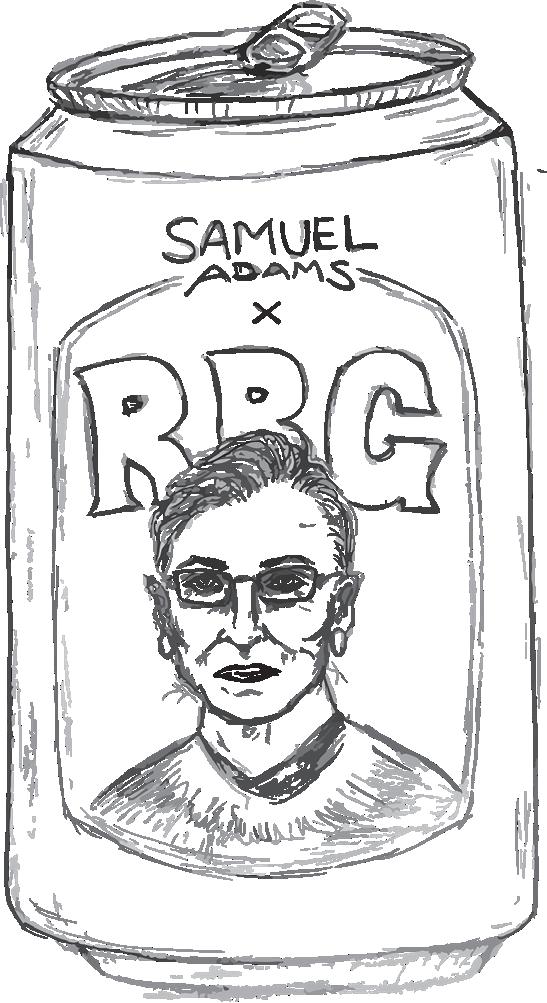
Justice Brett Kavanaugh may not be the only one on the bench who ‘likes beer.’ Justice Ruth Bader Ginsburg ’54 will have a Samuel Adams special edition IPA named in her honor to be released on Friday, drawing questions and rebuke from Cornell professors.
Te specially prepared brew, named When Tere Are Nine, honors Ginsburg’s famed declaration from an event at Georgetown Law School. She explained that there will only be enough women on the Supreme Court “when there are nine.”
According to the event page, the IPA will be unveiled this Friday at the Samuel Adams Pink Boot Release in Boston, an annual event centered around International Women’s Day.
Jessica Paar, communications director for the Boston Beer Company — the brewer of Samuel Adams beer — told Te Sun that “industry guidelines” have prevented her from releasing more information to undergraduate schools. She did, however, lend some insight into the event.
“Every year, women at breweries across the country team up to brew special beers in March [for] Women’s History Month,” Paar said, noting that proceeds from selling these brews are donated to the Pink Boots Society, an international nonproft that supports women in brewing professions.
Professors from Cornell’s department of government — Ginsburg’s undergraduate department — had mixed reactions to the release of a beer commemorating a Supreme Court Justice.
Expert on American political development and ideology Prof. David Alexander Bateman, government, told Te Sun that he found the “commodifcation” of “ sitting justices as cultural icons” inherently problematic. Bateman didn’t think the beer did anything to “undermine the
dignity of the court” — “It’s never been a particularly dignifed branch,” he said. “But it leads to the pernicious belief that any particular individual on the court is indispensable.” Bateman added that Justices Stephen Breyer and Ginsburg are “aging.” Bateman emphasized how this ascribed stardom draws attention away from elected branches, and toward the judicial branch, “an intrinsically undemocratic and generally reactionary branch of government.”
Prof. Elizabeth Sanders, government, expressed a similar sentiment. “Does Sam Adams hope to sell more beer to well-educated women?” she questioned.
“Commercial exploitation of important legal achievements is not uncommon, but some may consider it odd, even sleazy,” she said.
Prof. Sabrina Karim, government, noted the apparent social roots of the beer’s creation.
“[Te new Sam Adams Beer] seems to be a part of a larger ‘Notorious RBG’ cultural movement that presents Ruth Bader Ginsburg as a feminist and progressive icon,” she told Te Sun.
“[Ginsburg] has become a new leader for issuing dissent opinions, which many women and progressives see as a way to fght back against a majority Republican-appointed Supreme Court,” Karim continued. “Te release of the beer is perhaps a way to signal that Sam Adams is a part of the movement, or it is simply a way of attracting more women and young people to drink their beer.”
Bateman did appreciate the name “When Tere Are Nine.”
“I like [the name] enough to almost want to have an IPA,” he said. “I appreciate both the explicit afrmation that we should abolish presumptions of patriarchy and the implied bonus of three extra beers.”
Whether it represents the ‘commodifcation’ of a American icon or an esteemed honor, the IPA is set to be ofcially available to customers this Friday at the Samuel Adams tap room in Boston.
Alec Giufurta can be reached at agiufurta@cornellsun.com.
Te DEADLINE to e-mail advertisements for Display and Classified Ads for the Monday, April 8 and Tuesday, April 9 issues of The Corne¬ Daily Sun is Tursday, March 28, at 3 p.m.
Continued from page 1
39.9 percent of undergraduates, a nearly 13 percentage point increase from last year’s voting rate of 27 percent.
Te full list of winners is as follows:
President of the Student Assembly: Joe Anderson ’20
Executive Vice President of the Student Assembly: Cat Huang ’21
Undesignated At-Large Student Assembly Representative: Uche Chukwukere ’21
Undesignated At-Large Student Assembly Representative: Trevor Davis ’21
School of Hotel Administration Student Assembly Representative: Bryan Weintraub ’21
School of Industrial & Labor Relations Student Assembly Representative: Polina Solovyeva ’21
Minority Students Liaison AtLarge Student Assembly Representative: Moriah Adeghe ’21
Minority Students Liaison AtLarge Student Assembly Representative: Colin Benedict ’21
First-generation Student Representative: Kirubeal Wondimu ’22
Nicole Zhu can be reached at nzhu@cornellsun.com, and Sean O’Connell can be reached at soconnell@cornellsun.com.
C.P.U.
Continued from page 1
assessment done by the University or CUPD,” Dodd told Te Sun over the phone.
C.P.U. originally invited Stewart in January as a representative of the Life Training Institute — a speaking organization that “trains” pro-life advocates to speak persuasively — for a talk that was scheduled for April 23, C.P.U.
President John Sullivan Baker ’20 told Te Sun.
Stewart wrote that her invitation to speak on abortion as a “moral wrong” was rescinded because of her “Conservative Christian” views in a Facebook post that had garnered nearly 300 comments and 180 shares by Wednesday night.
C.P.U. refuted this claim directly in a statement to Te Sun.
“Te accusations of discrimination that Jannique Stewart has levelled against the Cornell Political Union are false. We have never negatively characterized Ms. Stewart’s beliefs, nor have we ever attacked her character,” the statement read.
Vice President for University Relations Joel Malina said that free speech is “an essential part” of the University’s campus in a statement to Te Sun.
“Recently, we learned that an independent, student-run
organization, the Cornell Political Union, had already decided to rescind an invitation to a speaker for an event on our Ithaca campus. Tey made this decision without engaging with the administration on event planning or security,” Malina wrote.
Dodd and Baker both told Te Sun that an event registration form had not yet been fled when C.P.U. rescinded Stewart’s invitation to speak.
“Te University in no way requested or suggested that any guest be excluded from attending this campus event,” Malina continued. “Cornell has established a clear and collaborative process through which student organizations partner with the administration to bring speakers they invite to campus. Tis is a process that every student organization is asked to follow and, indeed, hundreds of organizations each year engage in this process, resulting in safe and successful events.”
Baker expressed disappointment over Dodd’s resignation.
“I’m disappointed that Brendan made the decision to resign,” Baker said. “I appreciate all the work that he’s done in the [executive] board to promote free and open discourse.”
Maryam Zafar can be reached at mzafar@cornellsun.com.
Te Sun Business Office will close Tursday, March 28 at 5 p.m. and will reopen Monday, April 8 at 9 a.m.

HUAWEI
Continued from page 1
idence that Huawei is taking part in Chinese espionage has yet to be publicly produced.
Te University of California, Berkeley, Stanford University, Te University of Oxford and Princeton University have canceled research collaborations with Huawei or suspended talks for new deals with the company. Tese universities, excluding Princeton, explicitly cited growing national security concerns about Huawei as a reason for reconsidering their ties.
The $5.3 Million Partnership Established in 1987, Huawei Technologies is a global telecommunications company that sells more smartphones than Apple. Like many other large, competitive tech companies, Huawei partners with the world’s top universities fund research into cutting-edge technologies.
And amongst U.S. colleges, Huawei paid Cornell the most in research funding over the last six academic years. According to data from the U.S. Department of Education, Huawei paid Cornell $1,452,918 in October 2017, followed by an additional $3,918,010 payment the month after. Te two separate payments total to $5,370,928.
All subsequent monetary fgures cited are from the DOED data, which spans six academic years from 2012 to 2018. Federal law requires U.S. colleges and universities to disclose to the DoED all foreign gifts and contracts that exceed $250,000 in total within one academic year.
Te amount that Huawei paid Cornell is signifcantly larger than the $1.4 million that the company paid in total to its next largest research partner in American academia, U.C. Berkeley. Furthermore, according to DOED data, the U.C. Berkeley payouts were “monetary gifts.” Meanwhile, Cornell received their payments for “contracts,” which the DOED defnes as a fnancial interaction
in which the donor purchases, leases or barters property from the university.
All other Huawei contracts with U.S. universities were much smaller, with each contracted university receiving less than $600,000 in total over the six-year period.
Te fnancial relationship is one of Cornell’s largest as well. After Novo Nordisk — a Danish pharmaceutical company that paid Cornell roughly $6.6 million for a contract for diabetes research — Huawei is Cornell’s second-largest foreign corporate contributor.
Te DOED data may not report the entirety of the University’s monetary relationship with Huawei. Te federal data only includes money transfers completed as of June 2018; hence, it does not contain any details about Huawei’s unfulflled fnancial commitments to U.S. colleges and universities.
For example, the DOED data states that U.C. Berkeley only received $1.4 million from the corporation. However, the university’s spokesperson Dan Mogulof confrmed to Te Sun that Huawei has committed to paying $7.8 million to his institution over the course of two to three years. Tis is despite the fact that U.C. Berkeley suspended talks for future contracts with the tech giant. Cornell did not clarify whether it also has similar long-term obligations with Huawei.
Cornell spokesperson John Carberry said that the University has “research agreements” with Huawei, but he did not make public the exact content of the contract. Meanwhile, Huawei did not respond to requests for comment.
“Cornell needs to be transparent about where its money is coming from,” said Prof. Eli Friedman, industrial and labor relations. Friedman studies Chinese labor and urbanization issues. “It needs to have faculty involvement in overseeing that. Hopefully all of that [oversight] was in place. People should be upfront as possible about where [the funding is] coming from.”

Te Cornell-Huawei relationship exists alongside the larger international controversy surrounding the telecommunication corporation’s possible role in Chinese espionage. Australia, New Zealand, Poland, Te United States and Japan have all placed various restrictions on the use of Huawei hardware in their countries — or plan to do so soon. However, the European Commission refrained from recommending a blanket ban on company operations within the European Union.
General worries about Huawei’s alleged spying invited more specifc concerns regarding the frm’s relationship with academia.
In June 2018, Sen. Marco Rubio (R-F.L.) and 25 other members of Congress urged the DoED in a letter to scrutinize Huawei’s research partnerships with U.S. universities, asserting that those partnerships could be a “signifcant threat to national security.”
Rubio went a step further than the letter’s claims, accusing that “China is using Huawei to position themselves to steal American research through socalled ‘research partnerships’ with American universities” in a press release.
Huawei denies these charges. Eric Xu, Huawei’s rotating chairman, said in an interview with Light Reading that any research fundings born out of Huawei partnerships are “shared
openly throughout the world through dissertations” rather than monopolized by his corporation.
“Contrary to what some have alleged, Huawei is not after our partners’ patents or research results,” Meng Wanzhou, Huawei’s chief fnancial ofcer, wrote in an op-ed about her company’s partnership with universities. “Tis type of open collaboration is the only way to close the gap between basic science and its commercial application.”
Caught in the middle of this controversy, Western universities are working to balance the need for funding and concerns raised by their governments.
Tough U.C. Berkeley Vice Chancellor for Research Randy Katz suspended her university’s ties with Huawei after the company was indicted, she also said that “it really is a disservice … to the researchers at universities” to be banned from interacting with Huawei.
“We’re cutting ourselves of from the opportunity to learn,” Katz told the South China Morning Post about her university’s decision to adjourn future collaborations with Huawei.
Cornell said that it identifed and “carefully reviewed” its Huawei partnership “after concerns were articulated by the U.S. government about Huawei Technologies last year.”
After reviewing its Huawei contracts, the University concluded that “appropriate safeguards
were in place to address data and information security, to protect the independence of our research and to comply with all federal and state laws and regulations.”
Cornell declined to say whether or not it will seek new ties with Huawei.
“I think the conversation is really just beginning,” Friedman said. “Tere's been a long period of time with the U.S. universities engagement with China in general ... where I think people didn't want to ask difcult questions and the assumption was that China was opening up.”
“But that's changed a lot in the last year,” he added.
Full University Statement:
“After concerns were articulated by the U.S. government about Huawei Technologies last year, Cornell University identifed a handful of existing research agreements with Huawei, representing a fraction of the more than 150 such partnerships the university maintains with outside businesses throughout the United States and around the globe. In each instance, the university carefully reviewed the projects in question to confrm that appropriate safeguards were in place to address data and information security, to protect the independence of our research and to comply with all federal and state laws and regulations.”
Yuichi Kakutani can be reached at ykakutani@cornellsun.com.

By CATHERINE RYBERG Sun Contributor
On a sleepy Wednesday morning after snoozing my alarm for nearly an hour, the only thing that got me out of bed was the text reminder that my Suna Breakfast order was on the way. Suna Breakfast is a startup co-founded by Christophe Gerlache ’20 and Pedro Bobrow ’20, who aim to revolutionize student mornings by delivering pre-ordered breakfast to students’ doorsteps. After taking a break to make business improvements, Suna officially relaunched on Monday, March 18th. In conjunction with their relaunch, Suna also announced an exciting new partnership with Cornell Dining: All of Suna’s dishes are now made by Cornell Dining from organic ingredients. Ordering my breakfast through the free Suna app was effortless. I simply created an account and completed my order within a minute. The app is quite aesthetically pleasing and easy to use. It includes photos of the menu items as well as small icons that flag dishes if they contain nuts, are vegan or high in protein — so I know exactly what I’m getting. Suna offers an impressively large menu with four different breakfast sandwich variations: an acai bowl, an acai mixed berry smoothie as well as avocado toast made both with and without egg.
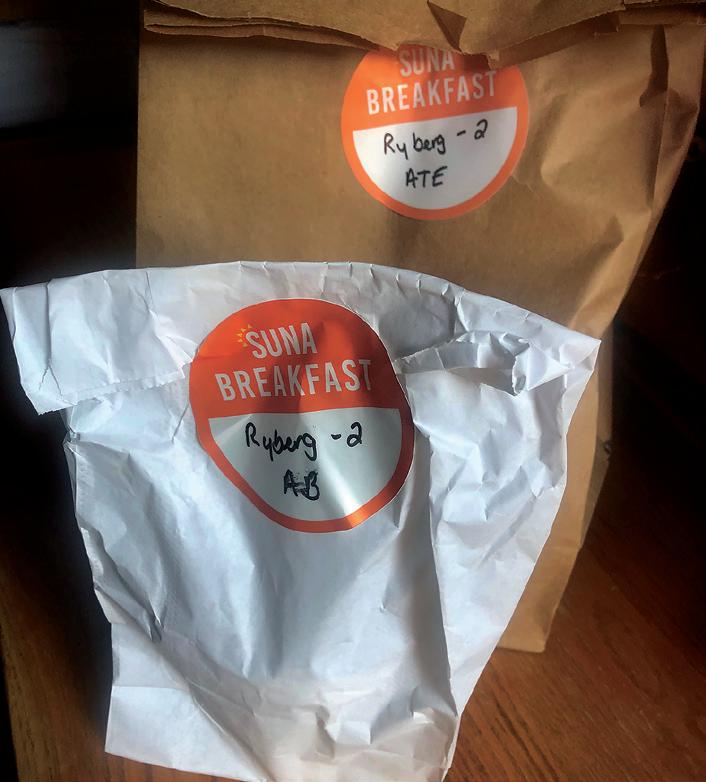
I decided on the acai bowl (cheaper than the acai mixed berry smoothie) and the avocado toast with egg. I was given a 10-minute expected delivery window and was guaranteed that my order would be free if it was even a second late. Despite staying up way too late the night prior, I fell asleep with a sense of ease knowing that I would not have to worry about how I would fit breakfast into my morning.
The next morning, I rolled out of bed and awaited a text message from Suna. Sure enough, a text came precisely at the beginning of the 10-minute delivery window notifying me that my order was ready! All I had to do was step outside of my dorm building to retrieve it. As someone whose breakfast typically consists of scarfing down overnight oats or eating a sugary muffin from a campus eatery, getting a beautifully packaged breakfast delivered directly to me felt uber-luxurious. I was already giddy about Suna’s seamless delivery process, so could hardly wait to dig in and try what I ordered.
Despite staying up way too late the night prior, I fell asleep with a sense of ease knowing that I would not have to worry about how I would fit breakfast into my morning.
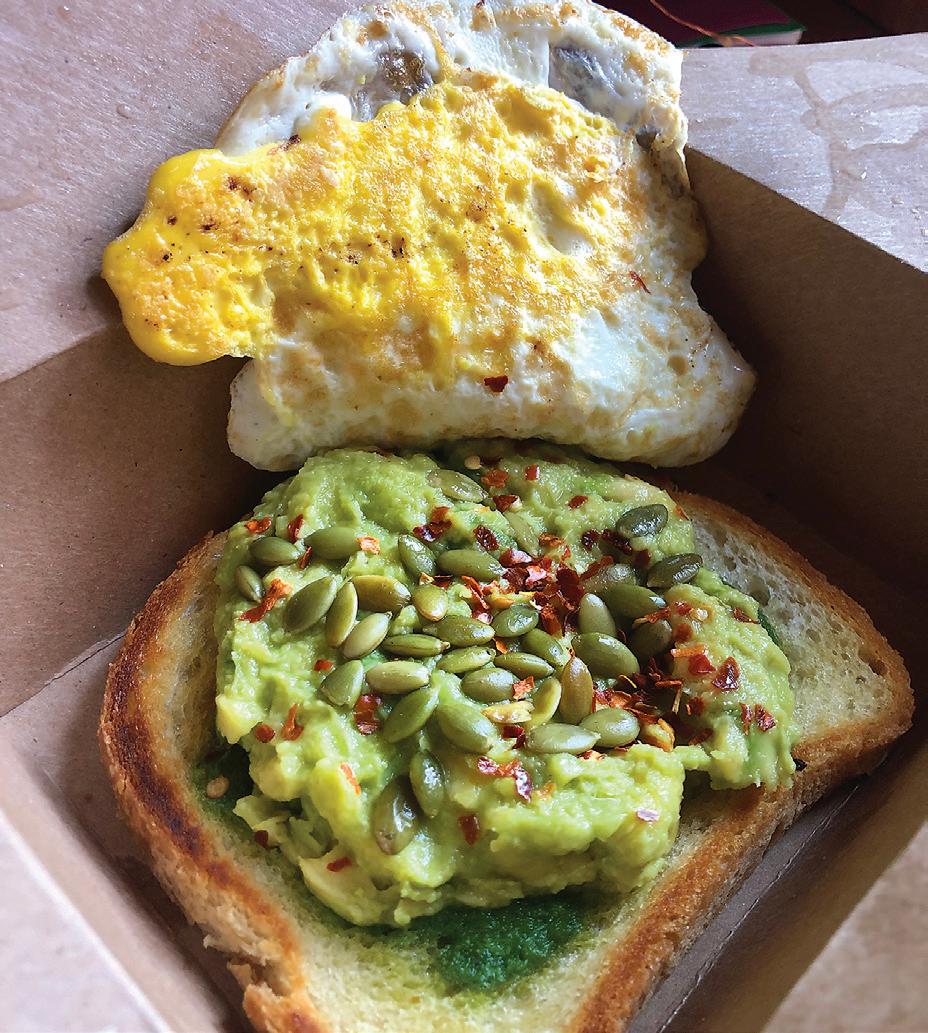
I decided to try the avocado toast with egg ($5.99) first. According to the Suna app, this dish consists of sourdough toast spread
with scallion oil (garlic, scallions and olive oil), topped with a heaping layer of avocado, sesame seeds and a fried egg. The first bite was bursting with flavor. I quite enjoyed how the crisp outside contrasted with the pillowy soft inside of the sourdough toast. I was not a huge fan of the scallion oil or sesame seeds merely because I prefer my avocado toast to be simply seasoned with sea salt, pepper and lime juice. The egg was delicious and tasted very fresh. The acai bowl ($6.49) was made with acai, yogurt, apple juice, banana, strawberries, honey and granola. The acai was a beautiful dark purple color that was complemented nicely by the granola that topped it, which was a delicious toasty flavor. Plus, it had the perfect amount of crunch. I wish that the bowl had a slightly thicker consistency, larger strawberries (they were miniature) and more blueberries. The bowl also had a strong artificially sweet flavor, likely because apple juice was included as an ingredient. Overall, though, the bowl was good considering its low price. I picture this acai bowl with the addition of a spoonful of almond butter, which would add the perfect creamy texture to thicken the acai, as well as an added boost of protein, which we



all can appreciate in a meat-free breakfast. I have to admit, I was pretty shocked when I saw that each of my chosen menu items were priced under $7. Nowadays, breakfast items like avocado toast and acai bowls tend to have super hiked-up prices, so $7 is something of a steal. Given the generous portion size, affordability and convenience of these two dishes, I would recommend that Cornell students try it out. However, these dishes lacked the natural, organic quality that Suna promised. The acai bowl tasted overly sweet and had a shortage of fruit chunks. I also found the avocado toast’s seasoning a bit too strong for breakfast, and would have preferred a milder flavor. I am excited to see Suna’s presence grow on campus and to try their other menu items in the future. As Ron Swanson of TV hit Parks and Recreation once said, “There has never been a sadness that can’t be cured by breakfast food.” If you struggle with breakfast, give Suna Breakfast a try! It might just be the trick to getting you to your morning lecture on time, or at all.
Price: $ Overall:



Catherine Ryberg is a sophomore in the College of Human Ecology. She can be reached at crr223@cornell.edu.

As I am abroad and have had the opportunity to travel around Europe and the Middle East, it’s been impossible to deny the appearingly universal obsession with reggaeton music. There’s something distinctive about it that gets people of all languages and cultures off of their feet.
“Music has the role of recognizing and including us, cultures and languages allow us to connect ... in the end we are made of the same thing,” says Carlos Vives, a Colombian artist who is scheduled to soon release a new documentary about the Colombian sound. What Vives says is none other than the truth: Global music statistics and trends can truly make a statement about the world, due to the way in which music inherently transcends language and societal norms.
Though rappers and trappers have been dominating music platforms these days, another seemingly less discussed genre has catapulted up the charts and is making us move. Latin music has been on fire, having risen from only three songs out of the top 100 list to now occupying an explosive onethird of the artists in YouTube’s Billion Views Club.

Historically, Latin pop equaled heavy emotional ballads, which, though deeply cathartic and meaningful for Spanish speakers, lacked global appeal as a genre. Only danceable tracks broke the universal barrier, a la Ricky Martin’s “Livin’ La Vida Loca,” Los Del Rio’s “Macarena” and Juanes’ “La Camisa Negra.” These hits were distinct and fun, making it to the hottest parties and clubs all over the world. But they were few and far between.
Enter reggaeton, uber-danceable Latin with a pop twist, and everyone is on their feet. No need to explain this to Pedro Capó. The Puerto Rican musician-turned-actor made his comeback to music with his single “Calma,” landing him almost 6 million views on YouTube with Farruko joining in on the remix. Capó is a third-generation musician — the son and grandson of two men who left a major stamp on Latin music through singing and songwriting — and it’s more than apparent that music is in his DNA. He picked up the guitar at an exceedingly early age and was invited frequently by his father to brain-
storm lyrics. “I like to play with different genres. I love rock, Latin rhythms, Caribbean rhythms, salsa, reggae . . . I don’t have limits,” Capó adds about his music.
Prior to “Calma,” Capó won a Latin Grammy Award in the Best Long Form Music Video category for his “Pedro Capó: En Letra de Otro.” Further, in 2017, Capó released his fourth studio album En Letra de Otro under Sony Latin, to which he is signed. Now, “Calma” tops the charts in countries including Bolivia, Peru and Guatemala, in addition to receiving Platinum certifications in Italy, Spain, Mexico and the United States (twice). It’s certainly safe to say that the whole world is in full support of Capó’s comeback.
While ultra-danceable, vibeable beats like Capó’s “Calma” makes it clear as to why the whole world is reveling in the reggaeton trend, there is no doubt that there are other factors which have buttressed this rocketing rise of Latin music. Accessibility through streaming platforms has certainly made an impact, as the global reach of platforms like Spotify and YouTube has enabled more and more Latin tracks to permeate the height of streaming charts. Some say, however, that the pivotal factor in the rise has been collaborations, both between Latin artists and between Latin and mainstream musicians. Illustratively, when Justin Bieber got on the already popular track “Despacito,” the tune skyrocketed to number one. Even before its unprecedented rise in the global charts, boasting celebrity acts like Drake and Cardi B, Latin music has always been synonymous with romance, soul, esprit and downright good fun (and “good fun” transcends pretty much every cultural limitation). This hot addition to the current musical landscape adds an important alternative to what has become the more typical pop music, it will be exciting to see this evolve even more expansively.
Juliette Rolnick
Eyes Wide Shut
Juliette Rolnick is junior in the College of Arts and Sciences. She can be reached at jrolnick@cornellsun. com. Eyes Wide Shut runs alternate Tursdays this semester. COURTESY


ISABELLE PHILIPPE SUN STAFF WRITER
Opening weekend has passed and the results are in — Jordan Peele has done it again. Following the release of his 2017 debut film Get Out, which garnered praise from reviewers and the general public, the cinematic world waited with anticipation for the release of his second film, Us.
The film centers around Adelaide Wilson, portrayed by Lupita Nyong’o, and her family who spend a summer at their Santa Cruz beach house. The family of four suddenly encounter their doppelgängers, a small fraction of a larger group known as The Tethered. Alternating between 1986 and the present day, the film centers around the Wilson family’s struggle with their doppelgängers and the larger Tethered group.
Us is beautifully shot and features an eerie, seat-gripping score. Perhaps most striking is the numerous themes, allusions and symbols that force viewers to think not just about the scenes before them but the relation of these scenes to a broader context.
This is the force that Peele has. His ability to relate societal problems that are uncomfortable to talk about or are blatantly ignored is unmatched. He creates this relation across a scope of viewers, reeling them in regardless of race, class or background. That is his power, and it is unmistakably dominant in Us.
The film has already garnered significant praise for the numerous messages that can be drawn from its ending. For one, the question of self-demonization is raised — as Adelaide’s worst enemy is essentially a harrowed, deprived version of herself. Perhaps this message draws upon the “you are your worst enemy” notion and calls for self-reflection. However, the lack of visibility of The Tethered denotes a different kind of message, one that is more poignant yet undeniably realistic in our current political and societal state. Countless groups such as those who are impoverished, homeless and hungry go unforeseen and forgotten.
Peele’s symbolic focus on visibility forces viewers to confront the reality that there are groups of people who are severely marginalized, underrepresented and underprivileged. The world of The Tethered is concealed, hidden from Adelaide’s own, which can be interpreted to be the world which we — “the privileged” — inhabit. The story of The Tethered is bleak yet not unfamiliar to the history of the United States. Created by the U.S. government in hopes of gaining the ability to control people, The Tethered were cloned bodies that lacked souls, and therefore could not be controlled. As a result, the experiment was abandoned, yet The Tethered remained, uncared for, disregarded and driven to insanity. Unethical experiments dot the history of the U.S. with remarkable frequency, both in the marginalized groups that tend to be victims and their experiences which often go ignored. Experiments and conditions such as Tuskegee and the treatment of undocumented and homeless persons within the United States denote this exact dehumanization. Peele calls for recognition and justice for these invisible groups . . .
To continue reading this article, please visit www.cornellsun.com.
Isabelle Philippe is a senior in the College of Agriculture and Life Sciences. She can be reached at ip93@cornell.edu.
137th Editorial Board The Corne¬
ANU SUBRAMANIAM ’20 Editor in Chief
DAHLIA WILSON ’19
Business Manager
PARIS GHAZI ’21
Associate Editor
NATALIE FUNG ’20
Web Editor
SABRINE XIE ’21
Design Editor
NOAH HARRELSON ’21
Blogs Editor
SHRIYA PERATI ’21
Science Editor
KATIE ZHANG ’21
Dining Editor
AMINA KILPATRICK ’21
News Editor
JOHNATHAN STIMPSON ’21
News Editor
PETER BUONANNO ’21
Arts & Entertainment Editor
ANYI CHENG ’21
Assistant News Editor
HUNTER SEITZ ’20
Assistant News Editor
CHRISTINA BULKELEY ’21
Assistant Sports Editor
JING JIANG ’21
Assistant Photography Editor
JEREMY MARKUS ’22
Assistant Arts & Entertainment Editor
ALICIA WANG ’21
Graphics and Sketch Editor
SARAH SKINNER ’21
Managing Editor
MEREDITH LIU ’20
Assistant Managing Editor
RAPHY GENDLER ’21
BORIS TSANG ’21
Editor
KRISCH ’21
SOPHIE REYNOLDS ’20
AMANDA H. CRONIN ’21
Editor
ROCHELLE LI ’21
MARYAM ZAFAR ’21
WU ’21
SHIVANI SANGHANI ’20
ZHU ’21
HENSHAW ’20
PARKER ’22
Assistant Photography Editor DANIEL MORAN ’21 Assistant
WU ’21
Working on Today’s Sun
Ad Layout Dana Chan ’21
Production Deskers Krystal Yang ’21 Zuobing Qian ’22
News Deskers Anyi Cheng ’21 Amanda Cronin ’21
Night Desker Meredith Liu ’20
Design Desker Simon Chen ’21
Krystal Yang ’21
Photography Desker Ben Parker ’22
Sports Desker Miles Henshaw ’20
Editorial
TODAY’S NEWS THAT CORNELL QUIETLY TOOK MILLIONS in research contracts from Chinese telecom firm Huawei is alarming enough. But the University’s refusal to provide details about said contracts makes for an utter transparency failure. Cornell must acknowledge the perils of working with a firm wedded to China’s autocracy — and reveal the nature of its Huawei ties.
Public data from the Department of Education shows that Cornell took $5.3 million from Huawei in 2017 via two research contracts. That’s troubling. Huawei is a secretive firm, shielded from foreign investment and, thus, outside scrutiny. It is also likely penetrated by the Chinese government, according to China experts.
Worries abound. Did the University, as part of its research agreement, disclose the personal information of students or faculty to Huawei? What proprietary technology did Cornell share with the Chinese firm? Why didn’t this multi-million dollar partnership earn even a terse press release? What is Cornell concealing about its partnership?
And most worrying of all: Why was the University so tight-lipped? The administration declined to detail any of the areas on or channels through which research contracts were executed — beyond explaining that these research contracts are, in the University’s description, “research agreements.”
It’s reasonable to expect Cornell to account for its institutional collaboration with a state-backed multinational firm. Indeed, it is a basic level of disclosure. In stonewalling bare-minimum transparency, the University has made it clear where its priorities lie. Whether for the $5.3 million or for the cutting-edge research, Cornell would rather keep its Huawei ties mum than do what’s right.
Maybe the University doesn’t think it’s a big deal to be working with Huawei. Maybe it’s hiding something compromising. Or maybe it just doesn’t care about transparency.
But whether negligence, corruption or apathy is guiding the administration, the responsible move remains the same. Cornell must tell us how its relationship with Huawei works. Until then, it will join potential labor abuses at Cornell’s Qatar campus and the Trustees’ refusal to divest from fossil fuels as a weighty millstone around the University’s neck.
Last semester, we had the opportunity to sit in on a meeting between President Pollack and a group of graduate and professional student leaders. These meetings are regular opportunities for students to communicate issues directly to senior administrators. Topics range anywhere from event management to support for student-parents to diversity and inclusion on campus. At the end of this meeting in particular, as students were packing up and preparing to leave, one of us casually mentioned, “At some point, we should probably talk about OrgSync too.”
Everyone paused. The energy in the room changed. One after another, student leaders began to articulate their frustrations with OrgSync. Not a single person had anything positive to say about the system. It became clear that everyone shared a similar sentiment — OrgSync sucks.
Student groups play an essential role in the student experience. Students volunteer their limited free time to help plan events that connect students not only to each other but also to academic and professional resources. We repeatedly stress the importance of creating a sense of community on campus, and student groups play a key role in achieving this goal. They deserve a system that facilitates, not hinders, their success.
Not a single person had anything positive to say about the system. It became clear that everyone shared a similar sentiment — OrgSync sucks.
If you’re not familiar with it, OrgSync is an online community management system specifically designed for higher education institutions. It is designed to help universities communicate directly with students and staff, track student involvement and manage campus organizations and events. Student organizations using the system can manage their events, members, communications and even make a website for their organization. All student groups must be registered within the OrgSync system, and as such, both the Student Assembly Finance Committee and the Graduate and Professional Student Assembly Finance Committee use the OrgSync system to approve funding requests from students.
It is these last two capacities of registration and budgeting that make using OrgSync inescapable for any student group. In fact, it is often only in these capacities that student organizations use OrgSync, leaving much of the other OrgSync functionality redundant.
Cornell is currently in the process of choosing OrgSync’s replacement. OrgSync will no longer be supported after June with plans to transition to a new service by this Fall. In addition to a streamlined registration process, the new system must easily integrate with social media platforms and online calendars to support advertising and networking efforts. Most importantly, the system needs to be well prepared to handle the budget approval process. Features that allow for automatic approvals and keep students informed of their budget completion status or the amount of money they have spent can significantly increase the ease of submitting and reviewing budgets. Ultimately, the new system needs to minimize the amount of work student leaders put in to host the events they want.
Student groups play an essential role in the student experience. They deserve a system that facilitates, not hinders, their success.
But even using it for these two basic purposes can be cumbersome. To register a student group, at least three of the organization’s officers and the advisor must fill out a series of electronic forms. Similarly, both officers and the advisor must comment and approve all budget requests manually, often leading to mistakes. Even simple changes, such as changing the organization logo or the name of an officer, requires all officers and the advisor to go through the same process again in order to reset the system. The most well-intentioned and active student leaders can accidentally miss that their organization registration or their budget request may be incomplete because officers are required to do manual budget approvals. These errors can have serious budgetary consequences for numerous groups each semester either scrambling to find funding or flat-out rescheduling their events.
This might sound like just a mild annoyance, but it is critical to have a student organization management system that actually supports student needs.
Finally, as we prepare to transition to a new community management system, organizations that currently rely on OrgSync to allocate funding (particularly SAFC and GPSAFC) will have the opportunity to re-examine the funding allocation and reimbursement process in its entirety. Submitting budgets via OrgSync is just one step in a larger, more complex process used to fund events. We also routinely hear complaints regarding the reimbursement process, particularly the requirement for physical receipts, needing to
submit requests in person and the lengthy processing times for payments. We encourage the Campus Activities Office, Student and Campus Life and funding organizations to use this opportunity to think about additional ways this process could be revamped in order to make students’ lives easier.
Programming designed and offered by students is key to developing a sense of community amongst the student body. Online community management systems might not seem important, but, depending on the software, they can turn what should be a simple process into a complicated one. As Cornell prepares to replace a system that is clearly not serving students effectively, we should begin to brainstorm ideas for what a better event planning and reimbursement process should look like and what must happen to get us there.
Manisha Munasinghe is the graduate and professional student-elected member of the Board of Trustees and a Ph.D. candidate at Cornell University. She can be reached at mmunasinghe@cornellsun.com. Ekarina Winarto is the president of the Graduate and Professional Student Assembly and a Ph.D. candidate at Cornell University. She can be reached at ew385@cornell.edu. Trustee Viewpoint runs every other week this semester.
The relationship between ends and beginnings is parasitic. For something to end, it must already exist. For something to begin, it must not yet be. Burrowed deep inside the ends of things dwells a promise of the new. That promise — of a beginning — must slowly consume the ending within which it is sheltered until it is material and its host is not.
In the English language, we verbally acknowledge this cycle. Deadlines are aptly named, revealing that the death of a process must occur so a future product may exist. Commencement, too, is appropriately titled. Though it refers to the completion of a degree, the word implies that this conclusion is simultaneously the origin of something else.
And as I write this, I am exactly two months out from my graduation day.
Graduating from college is hard for all the obvious tangible reasons. Moving from one place to live in a new one. Abandoning an old routine in favor of a new one. De-prioritizing the job of student to get hired for the next. Settling your affairs here so you can enter different obligations.
We are actively making these transitions in the physical world, so though it may be difficult, we are able to conceptualize the necessity of the end to pave way for the coming beginning. On the other hand, the intangible transitions — those that occur within the confines of the mind, consciously and subconsciously — are much more difficult.
Better writers than I have managed to articulate this ineffable experience. One was Dr. Seuss, who writes in Oh, The Places You’ll Go!:
You will come to a place where the streets are not marked. Some windows are lighted. But mostly they’re darked … Do you dare to stay out? Do you dare to go in?
How much can you lose? How much can you win?
The failure to move forward and choose a new path, according to Seuss, results in the inhabitance of “The Waiting Place,” which he says is “a most useless place.” There, people sit stagnant, waiting for something to happen, like “for the phone to ring, or the snow to snow or the waiting around for a Yes or No.” Others in the Waiting Place are there because they want a thing they don’t have, like “a string of pearls, or a pair of pants or a wig with curls, or Another Chance.”
Though commencement refers to completing a degree, the word implies that this conclusion is simultaneously the origin of something else.
I consciously understand that I will no longer be a part of a cohort united by purpose and trajectory. I consciously understand that no institution will ever again serve solely to nurture me. Those are behavioral transitions, so despite their intangibility, they are comprehensible.
The most complex changes to process, however, are the subconscious ones. These are the transitions words fail to accurately express; the occurrences for which there is no easy language. They exist outside of the parameters of space and time. For example, the feeling that one remains reliant on the host, despite having in reality moved on.
LUnborn children innately understand the parasitic nature of ends and beginnings — they consume without thinking, solely for the purpose of bringing themselves to light.
So too must we consume, without hesitation, our prevailing state of being, because only then can we bring to light what’s next. We know we must fully consume our Cornell education before we can embark on our careers. We know we must consume the experience of cohort membership in preparation for the experience of independence.
In every blade of grass on the Slope, in every Keystone can littered in the making of chosen families, in every sidewalk scuffed by the march of our intentions, you can feel our heart beat.
But we often forget that we must not fall into the Waiting Place of the immaterial; still holding on to what’s already ended.
As we embark on this journey towards the unknown, it is imperative that we remember that there will be no street signs, that the windows will be darked — that front doors will be closed, that no map can be found, that perils abound.
But we cannot wait for the windows to light, for friendly strangers to guide, for directions to be given. We cannot wait for something to come that might save us. Because if we do, they never will. When we wait, we delay the death that is our ending, and in so doing, forestall the birth of what might be our beginning.
Squeezing every drop out of this place made you who you are.
In Spanish, the phrase meaning “to give birth” is “dar a luz,” for which the direct translation is “to bring to light.” All of us are parasites at first, burrowed deep inside our biological mothers, sheltered until our existence is realized and our host is no longer our home.
They say home is where the heart is. In every blade of grass on the Slope upon which this place is perched, in every Keystone can littered in the making of chosen families, in every sidewalk scuffed by the march of our intentions, you can feel our heart beat. But as we trickle out across highways and skies just a few weeks from now, that pulse will start to fade away. At the we will hear our own individual grow louder.
This time, this place and these people are tangent lines, all three meeting once and never again. And our ways of being and thinking were truly shaped here — about ourselves, our relationship to others, to the world.
But you came here so that someday, you could go somewhere else. Squeezing every last drop out of this place made you who you are. Be unafraid to start feeding the person you’ve yet to become, and oh, the places you’ll go.
Jade Pinero is a senior in the College of Agriculture and Life Sciences. She can be reached at jpinero@cornellsun.com. Jaded and Confused runs every other Thursday this semester.
ong before I became a regular columnist for The Sun, I sent in a letter to the editor about being a Muslim student at Cornell. If I’m being honest, the article could have been a feel-good piece, but it turned out to be more of an angry rant about a series of unpleasant interactions I had during my first year. I’ll admit that it was written somewhat from a place of cynicism, and most definitely from a place of bitterness. Some things weren’t phrased in as polished a way as they could have been, but can you blame me? I was a furious freshman, and an idiot.
Still, the piece was published, and I was proud of it. That is, until I read the onslaught of upset comments that I was sent from an amalgamation of profile picture-less Facebook users. Amongst some choice words and dissenting opinions, I received (drumroll please) my very first death threat!
It truly was, and still is, a momentous occasion in my life — one that I will cherish for years to come. Much like a college acceptance, or your child’s first words, your first death threat is something that you remember fondly until the day you actually do die.
I feel it is customary to state that while I joke about it now, reading that message in the moment was terrifying. The wonderful individual who sent it had managed to find me on Facebook and slid right into the DMs, if you will. I didn’t report it, or tell anyone about it. Instead, I emailed
The Sun and asked to have my article removed. Doing so felt like the biggest defeat of my life: Was I really going to let myself be censored by someone who threatened to kill me? I mean, yes. But I wasn’t happy about it.
I proceeded to spend the next few weeks walking around campus mildly paranoid that the end was near, but also increasingly upset that this had even happened. Not only was it unfair, but in a sick, twisted way, it also seemed to prove exactly what my article had been arguing in the first place: Cornell was no post-hate paradise.
In the years since that incident, I’d like to think that I have grown a lot. As the social and political climate in this country has become more tense, I think I have become more mellow. I don’t mean to say that I’m suddenly chill about ignorance and hatred, but I think I’ve stopped letting small acts of them get to me as much as they used to.
I recently listened to an episode of “Congratulations” with Chris D’elia in which he talked about an incident he witnessed at what he jokingly nicknamed the “Racism Cafe.” In the segment, he recounts an uncomfortable exchange between a group of White people and one Black man. D’elia states that he was ready to jump to the defense of the man being targeted, but to his surprise, “the guy didn’t say anything.” D’elia goes on to speculate that maybe snide,
subtle and somewhat racialized remarks are just something that Black man had grown accustomed to and just didn’t feel like dealing with on that particular day. Somehow, listening to that, I feel like I knew exactly what that guy from the so-called “Racism Cafe” was thinking.
I think that as a minority, you learn to pick your battles — not just for the sake of your safety, but also for the sake of your sanity. As bad as it sounds, sometimes when a professor absentmindedly gestures towards you when bringing up Islamic terrorism, or when a TA asks if he can shorten your name because he can’t remember how to pronounce it or an advisor tells you not to go into the health care field because of your headscarf, you decide to let it go. These are all things that have happened over the years, but what made me decide to write this column was a lot more recent. Just a week ago, I overheard a girl behind me in lecture who, after my professor briefly brought up the mass shooting that happened in New Zealand, said to her friend under her breath, “Ugh, are we still talking about this? They’re acting like it was 9/11.”
ignored it. I let that flash of rage pass, and I went on with my life.
I am not going to go so far as to deem all of these incidents racist or Islamophobic, because those aren’t words that I like to throw around. I am also not going to pretend like I feel some sense of moral superiority by ignoring them. Yet despite being painful and problematic, these experiences are not the end of the world. While I wish
I think that as a minority, you learn to pick your battles — not just for the sake of your safety, but also for the sake of your sanity.
I didn’t have to be complacent with them, I no longer feel the obligation that I once did to challenge them. I think I’ve realized that I don’t need to be the one pulling others out of their ignorance, and quite frankly, I don’t really want to be either. At the end of the day, if someone decides to do something as extreme as sending me a death threat, that’s on them. I, for one, am choosing to opt out of being angry.
Yeah, that one hurt. In that moment, I so badly wanted to turn around. I wasn’t even really sure what I would say, but I wanted to say something. Instead, I
Faiza Ahmad is a senior in the College of Arts and Sciences. She can be reached at fahmad@cornellsun.com. The Fifth Column runs every other Wednesday this semester.
Fill in the empty cells, one number in each, so that each column, row, and region contains the numbers 1-9 exactly once. Each number in the solution therefore occurs only once in each of the three “directions,” hence the “single numbers” implied by the puzzle’s name. (Rules from wikipedia.org/wiki/ Sudoku)


Fill in the grid with numbers 1-6. Do not repeat a number in any row or column. In each heavily outlined set of squares, the numbers must combine, in any order, to produce the target number in the top left corner using the operation indicated.

26
2
ithacastudentapartments.com 607-277-1234
Collegetown
Collegetown Court:
Houses, Apts, Parking 1 to 9 Bedroom
Collegetown - College Ave, Linden Ave, Dryden Rd, Bryant Ave, Cook St. 607-330-2442 info@urbanithaca.com www.urbanithaca.com
We have availability for the 2019-2020 school year beginning June 1st at Hudson heights apartments. The studio apartments come with: heat, water, and electricity included. There are garbages houses and coin-operated laundry facilities on site. Prices start at $740/month for a 12 month lease. If you have any questions or would like to schedule a tour contact us by phone 607-208-7660 or email: renting@ithacaLS.com
COOK ST. Furnished House for 5-7 persons, 10mo. Lease for 2019-2020 Text or call Tracy at TLC Property Mgmt Corp 607-379-2776
3 BEDROOM
Nice, clean, furnished unit can host up to 12 people. 303-309 Dryden Road Heat, Hot water included. Fiber Optic fast internet connection Laundry, parking available 607-279-1888 www.porealty88.com
Collegetown Terrace Apartments INSPIRED LIVING TAILORED TO YOUR SUCCESS
24-Hour Fitness Center
Shuttle Bus Service to Campus Study Rooms w/ Expansive Views
Apartments Available NOW, Spring 2019 & 2019/2020 Novarr- Mackesey Property Management collegetownterraceithaca.com office@ithacastudentapartments.com 607-277-1234
Collegetown 1 & 3 Bedroom Apts. Available for Next School Year 2018-2019. 607-327-2927
NORTH CAMPUS
Studio and 3 bedrooms Available 2019/2020 Novarr-Mackesey Property Management office@ithacastudentapartments.com ithacastudentapartments.com 607-277-1234
The Top of Collegetown Dryden Rd-Linden Ave
2019-2020
Continued from page 12
round contest against Northeastern. Cornell’s deep lineup and collective work ethic allowed the Red to topple the Huskies and punch a ticket to the Frozen Four, an accomplishment not realized since the 201213 season.
“One of my favorite memories from this season was going to the Frozen Four,” Serdar said. “It was a first for my teammates and me, and we were all just so excited to be there and experience it.”
The team was slated to take on the Minnesota Gophers, NCAA tournament regulars and a team that tallied an average of over four goals per game. Tensions were high and the competition was fierce. World-class hockey prevailed on both sides of the ice, but the Red unfortunately could not find the back of the net. Their season ended with a devastating 2-0 loss on the national stage.
“We knew goals weren’t going to come easy, but I think we had our fair share of opportunities and we just couldn’t put one in the back of the net,” ZandeeHart said. “But I don’t think that changed the way we played.”
“We gave our hearts out,” senior goaltender Marlene Boissonnault said. “That’s how we played the whole game.”
A series of individual honors only emphasized the level of skill and success that the team reached this season. Derraugh was named ECAC Coach of the Year, and three players earned spots on all-ECAC teams: Jaime Bourbonnais with first-team honors, Kristin O’Neill with second-team honors and Micah Zandee-Hart with third-team honors.
As a testament to the team’s depth, Ivy League honors were awarded to five members of the Cornell hockey team, and Derraugh was tabbed the Ivy League Coach of the Year.
The Red did not get the glory they it desperately sought as its efforts failed to materialize into the elusive ECAC and NCAA tournament titles. However, the team recorded a historic season and its players will proudly remember their team’s play and growth this season.
“I am proud of what we have accomplished all year long,” Derraugh said. “We have had our share of ups and downs this season, but I really felt that over the past couple of months this is a team that has come together and really played as a team.”
The Red’s returning players, with this outstanding season forever etched in their memories, will no doubt take the ice next year with the same intensity and discipline, looking for more glory.
MEN’S HOCKEY Continued from page 12
317 Upper Eddy St. 1, 2 & 3 BR Apartments
Ten month lease. Furnished. Hardwood floors. Spacious rooms. Steam heat provided. 607-227-0924
Linden Ave. 5 Bedroom House Available June 2019. $900 per bedroom. Parking included. 607-327-2927
MUST SEE: 9 Bedroom House Walk to Cornell, Collegetown $5400 + utilities/month. 531 E. State St. 9/10 Bedrooms, 3 baths, 2 kitchens. Furnished, Free Laundry, Free Parking. Available 6/1/2019 607-379-9168 text/call
2019-2020 College Ave. 5 Bedroom House Furnished. Laundry. Internet. Parking. 607-273-8576
2019-2020 Upper Eddy St. 7 Bedroom House Furnished. Internet. Laundry. 607-273-8576
3 BR Apt & House 2019-2020 607-351-1115 ksteel202@yahoo.com www.

level, everybody’s got a couple of really good players, and they’ve got a really good complement of skill players, and usually their special teams are really good,” Schafer said. “You don’t get to this level at this time of year without having a lot of those combinations.” With adversity at its back and
a tall challenge on the road ahead, Cornell will look to channel its experience into a national playoff run to college hockey’s biggest stage in Buffalo.
“A lot of people use excuses when they face adversity. In the back of their minds they say, ‘if this doesn’t really succeed I have this built-in excuse’ … The turning point was at Harvard when we were a skeleton crew,” Schafer said.
“They persevered, they overcame … We will have that mentality: find a way to win, find a way to persevere and find a way to move on.”
Cornell’s chance to prove its resilience yet again will start at 4:30 p.m. on Saturday at the Dunkin’ Donuts Center in Providence.
Dylan McDevitt can be reached at dmcdevitt@cornellsun.com.
When a whistle finally came, Galajda had injured his knee and had to leave the game. Schafer said he is now unlikely to start this weekend.
“He was outstanding in the games that he played. He went down to Princeton and Quinnipiac, two tough places to play on the road.”
Looking back on the 2018-19 Cornell men’s hockey season, an array of tough moments come to mind. A slow start. Injuries galore. Heartbreaking overtime losses. Yet despite it all, the Red finds itself in exactly the same position it found itself in a year ago after its record-breaking 2017-18 season: two wins away from the Frozen Four. Granted, the road here wasn’t as flashy this time around, and the team’s efforts were only good enough to earn a No. 3 seed in the regional — as opposed to last year’s No. 1 spot. But there’s plenty to be impressed about with a team that has now made the NCAA Tournament for the third straight season — a first in the 24-year tenure of head coach Mike Schafer ’86.


“It’s difficult to get here,” Schafer said. “We don’t even have scholarships. You look at other programs, they got fulltime chefs for their team at the rink, they have scholarships and all these unbelievable facilities. They have every advantage in the world, and yet our guys have been able to get there three years in a row. It’s a heck of an accomplishment.”
For all the difficulties Cornell has faced this season, perhaps no outcome was more frustrating than the team’s heartbreaking overtime loss to Clarkson in the ECAC championship game at Lake Placid last weekend. A game that was riddled with oddities and errors culminated in two officiating gaffes that ultimately sent Cornell back to Ithaca empty-handed.
First, the Cornell net fell on the back of sophomore goaltender Matt Galajda without completely coming off its posts. The officials did nothing as Galajda, his teammates and even a Clarkson player tried to help the reigning first-team All-American out of his predicament.
“The strange play is the frustrating part of it,” Schafer said. “It’s frustrating how it happened. It didn’t happen in the normal sense of a hockey play … It shouldn’t have happened — it was preventable.”
In relief of his injured classmate, Austin McGrath had just over three minutes to get warmed up in the net before Clarkson forward Kris Klack took advantage of the fact that the backup netminder had not yet broken a sweat and bur ied the game-winning goal to clinch the Whitelaw Cup for the Golden Knights. To add insult to injury, the officials had missed an obvious offsides call that was not reviewable under the current review rules.
All told, it looks as though McGrath will find himself thrown into the fire once again this weekend — a position he’s been in a few times this year already.
“It’s nice to get on a stage like that and have an opportunity to play,” McGrath said. “I’m just going to approach it like another game, try not to get too worked up about it or any thing, just be calm and go out there and do what I can.”
The sophomore from Lloydminster, Alberta, found himself in net in Cornell’s first two games against Michigan State, after Galajda experienced an inauspicious start to the 2018-19 season. After an injury sidelined Galajda later in the season, McGrath earned a goals against average of 2.15 and a save percentage of .919 over the course of nearly 420 minutes — some of which were among the season’s biggest moments.
“He played against Harvard, which has got a lethal power play, and he was outstanding at Harvard,” Schafer said of McGrath’s performance in the team’s turning-point game of the year.
Indeed, McGrath’s performance in Ancient Eight play was enough to earn him a first-team All-Ivy selection this season. Armed with the hardware and the experience from playing in tough situations, McGrath likely will now lead his team to Providence and look to backstop the Red to the Frozen Four.

Four.
By FAITH FISHER Sun Staff Writer
The 2018-19 season proved to be a fine one for Cornell women’s hockey. The ECAC regular season champions, guided by their skillful team play and undying grit, soared high to earn themselves spots in both the ECAC tournament final and the NCAA Frozen Four.
The auspicious commencement of Cornell’s season set a winning-inclined
precedent that persisted throughout the season. At the onset, the Red achieved a sixgame winning streak, which included wins against three Ivy League competitors. After the Red’s first loss to Yale in November, it took another 10 games for the team to drop a game. The team’s consistency was reflected in its stellar record: a dominant 24 wins tarnished by a mere six losses in regulation.
Head coach Doug Derraugh ’91, however, believes that the seeds of success for the Red were planted long before the first game
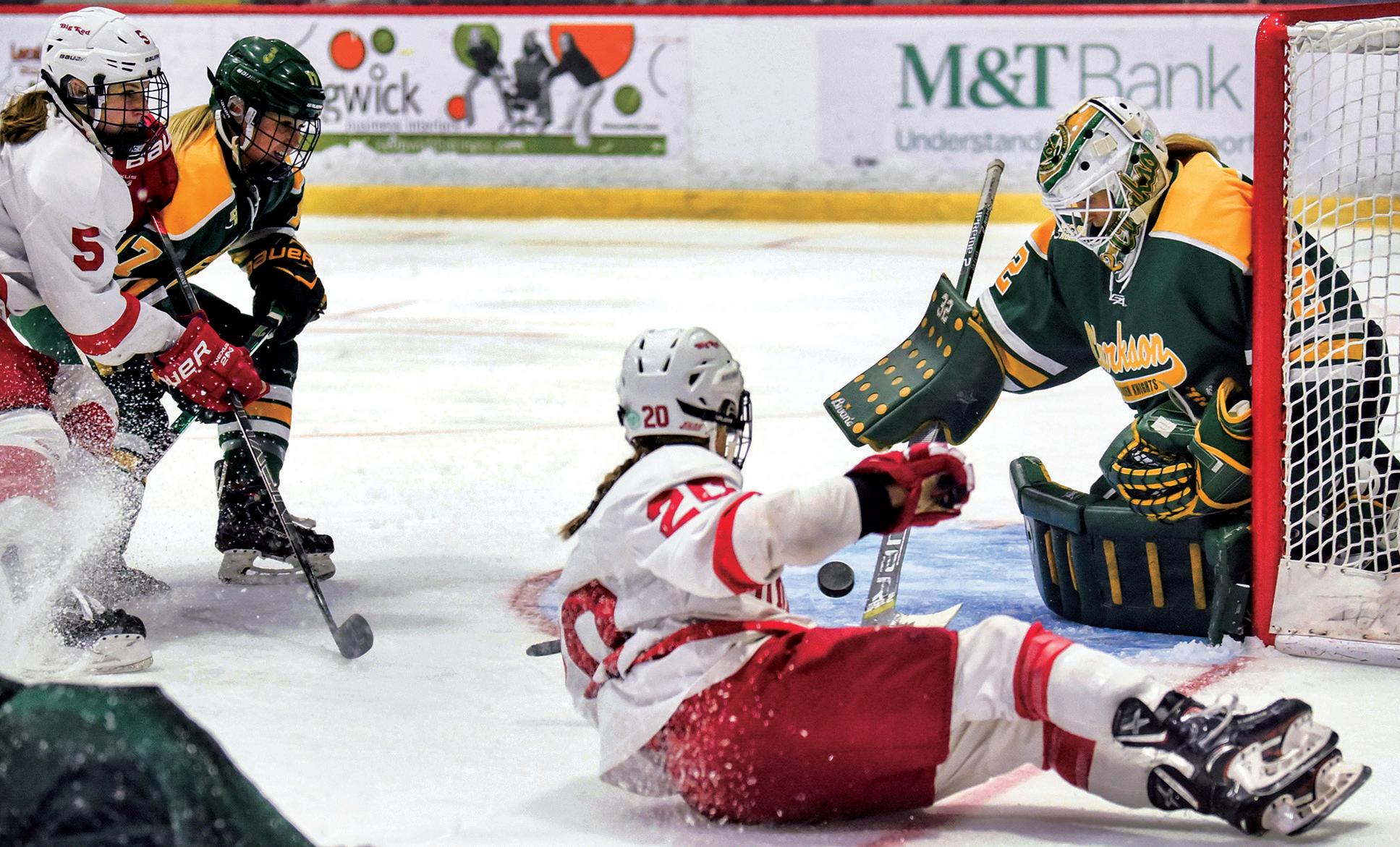
of the 2018-19 season:
“I think it started last year,” Derraugh said. “We felt like if we had had one more win then we would be in the NCAA tournament and I think that really stuck with our team going into the season. That factor going into the summer and fall spurred them to play with more consistency this year.”
The team’s dedication to teamwork and sharing the puck was evident in their selfless yet strategic play. This especially held true as the season progressed into its latter half, when, according to Zandee-Hart, “the team really started to find their groove.” As the players accepted their respective roles, the team realized that each player’s individual involvement was crucial to the team’s success.
“Cornell hockey takes prides in being gritty and playing tough defense,” said senior forward Lenka Serdar, “but I think something that made us so successful this season was recognizing that every person on the team contributes something for the betterment of the team.”
With a strong finish, Cornell snagged home-ice advantage for the entirety of the ECAC tournament, a true advantage for the Red, which held an impressive home record of 14-3-0.
“Lynah’s atmosphere is hard to beat,” said junior forward Amy Curlew. “Having the support of the fans really makes a difference, especially when the games are close.”
The home crowd at Lynah Rink helped
push the Red through an adversity-laden three-game series against RPI in the first round of the ECAC tournament. RPI’s goaltender Lovisa Selander, all-time NCAA leader in saves, gave the Red offense fits. A loss in game two — a 49-save shutout — forced the series to a decisive third game. The Red managed to triumph over the Engineers with a 6-1 win to secure a spot in the semifinal against Princeton.
The game against the Tigers tested the will and perseverance of the Red. It took a grueling double-overtime win to send Cornell to the final against Clarkson.
Even though the team dropped a heartbreaking loss to the Golden Knights in the ECAC final, the Red’s season was hardly over. Rather, the team’s consistent season play earned it a spot in the NCAA tournament quarterfinals among the nation’s finest competitors, all vying for the coveted national title.
“Playoff hockey is always a little crazier than the hockey you play during the season — every team is fighting to keep their season alive and are hunting for that national title,” said junior forward Grace Graham. “Every game after ECACs becomes faster, tougher and more passionate, so it’s really an exciting time to be playing hockey.”
This faster, tougher and more passionate play manifested itself in the Red’s first-