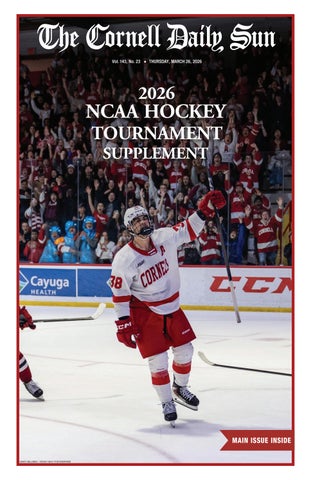

MEET THE PLAYING FIELD
fourth and eighth nationally in power-play goals.
Eli's Predictions
Albany, New York Regional
After a dominant run to a Big 10 Tournament championship, Michigan heads east as the NCAA Tournament’s top seed and No. 1 in both the USCHO.com and USA Hockey polls. The Wolverines score a whopping 4.6 goals per game — half a goal more than Division I’s next leading offense — in large part thanks to the nation’s second-leading and third-leading point scorers, T.J. Hughes and Michael Hage.
But arguably the biggest reason Michigan has gone from missing the NCAA Tournament in 2025 to sitting atop the NCAA percentage index has been the addition of its freshman netminder, Jack Ivankovic, who earned All-Big 10 second team honors in his debut season. For Michigan — the second-youngest team in the country — the biggest question is whether Ivankovic and the other 16 underclassmen can handle the pressure of playing for a national title.
Hoping to upset the Wolverines is Bentley, the lone representative of Atlantic Hockey America. Despite a mediocre end to the regular season, the Falcons captured the AHA Tournament title thanks to a pair of overtime wins and a third-period comeback in the championship game.
On paper, the region’s other matchup — Penn State vs. Minnesota Duluth — should be a closer contest. The Nittany Lions sport a pair of Big 10 second teamers in Jackson Smith and 2026 NHL draft consensus top pick in Gavin McKenna.
Making matters worse for Penn State, the Bulldogs present a matchup nightmare for the Nittany Lions. While Penn State is the nation's most penalized team — averaging almost 19 minutes of penalties per game — Minnesota Duluth’s power play ranks second in the country. If Penn State ends up in the penalty box, keep an eye out for brothers Zam and Max Plante, who rank
Michigan over Bentley
Minnesota Duluth over Penn State
Michigan over Minnesota Duluth
Jane's Predictions
Michigan over Bentley
Minnesota Duluth over Penn State
Michigan over Minnesota Duluth
Sioux Falls, South Dakota Regional
While Quinnipiac has struggled in the ECAC playoffs, it captured a national title in 2023 and has wins in four of the last six NCAA Tournaments. This year’s Quinnipiac squad is headlined by star freshman Ethan Wyttenbach, a Hobey Baker finalist who leads the nation in points with 58.
Providence has a star of its own in the 2025 NHL draft’s 10th overall selection, Roger McQueen, but the Friars’ most intriguing storyline of the season has been a fierce battle for the starting goaltender position. While Philip Svedebäck started the year as Providence’s No. 1 netminder, Jack Parsons has received the nod for the majority of the games in 2026. However, it was Parsons who gave up all three goals in the Friars’ overtime loss to Merrimack in the Hockey East Tournament quarterfinals.
Speaking of the Warriors, Merrimack finished the regular season eighth in the standings, but knocked off the conference’s No. 1, No. 2 and No. 3 seeds to claim its first Hockey East title. The lowest seed to ever win the tournament, Merrimack’s miracle run was spearheaded by goaltender Max Lundgren, who made a careerhigh 49 saves in the championship game victory.
The Warriors will face a difficult matchup against North Dakota, the region’s top seed that will likely have near-unanimous support from spectators. Thanks to a change behind the bench and a series of additions in the transfer portal, the Fighting Hawks look like an
almost completely different team than the one Cornell swept to open its 2024-2025 season.
Eli's Predictions North Dakota over Merrimack Quinnipiac over Providence North Dakota over Quinnipiac Jane's Predictions North Dakota over Merrimack Providence over Quinnipiac North Dakota over Providence
Loveland, Colorado Regional Western Michigan, the defending national champion, will look to begin its title defense against a red-hot Minnesota State squad. Though the Central Collegiate Hockey Association is the nation’s second-worst conference by winning percentage (trailing only AHA), the Mavericks have lost only twice since Jan. 17 and picked up emphatic 7-2 and 4-1 wins in the CCHA Tournament semifinals and final. A stingy defensive team, Minnesota State is backstopped by senior Alex Tracy, a Mike Richter Award semifinalist who owns the country’s second-best goals against average. Opposing Tracy in net will be the Broncos’ Hampton Slukynsky, who set the program record for goals against average en route to backstopping Western Michigan to the program’s first national title a season ago. Though his 20252026 numbers are less impressive, Slukynsky was dominant in the Broncos’ National Collegiate Hockey Conference Tournament run. Go to page three of the supplement for the Cornell vs. Denver preview.
Eli's Predictions
Western Michigan over Minnesota State “The Sun has a strict anti-jinxing policy.” Jane's Predictions Western Michigan over Minnesota State “I am still an impartial reporter.”

Worcester, Massachusetts Regional
Despite an eye-opening home loss in the Big 10 Tournament semifinals to Ohio State, Michigan State has all the pieces to make a serious run at a national championship. A Mike Richter Award finalist in net? Check. Highly skilled NHL prospects? Check, including four first-round draft picks. A decorated coach? You bet. Of course, the Spartans will also be looking to exact revenge on the NCAA Tournament, a season after Cornell’s last-second goal eliminated Michigan State in the first round. Taking on the star-studded Spartans will be Connecticut, the Hockey East Tournament’s runner-up. The Huskies are led by a pair of all-conference forwards — Joey Muldowney and Ryan Tattle — and netminder Tyler Muszelik, whose .927 save percentage ranks eighth in the nation. The region’s other first-round matchup represents an intriguing battle between the ECAC and Big 10. Though Wisconsin looked like the best team in the country in November, it seems like the Badgers may have reached the high point of their season too early. Wisconsin has struggled to rebound from a six-game losing streak in January, and while a sweep of Penn State to conclude the regular season was a positive sign, a 7-1 home loss to Ohio State in the Big 10 Tournament was not. The Badgers will face Dartmouth, the ECAC Tournament champion. Boasting Hayden Stavroff — the nation’s leading goal-scorer with 29 — and a stout defense, the Big Green enter the tournament riding an eight-game undefeated streak.
Eli's Predictions
Michigan State over Connecticut Wisconsin over Dartmouth Michigan State over Wisconsin Jane's Predictions Michigan State over Connecticut Dartmouth over Wisconsin Michigan State over Dartmouth
Jack O'Brien's Journey is Rooted in Persistance

“All the boys were in the gym already, so I put on whatever [clothes] I could find, and I run in there,” O’Brien said. “And
I’m wearing a grey shirt. Everybody else is wearing red shirts, so I stuck out like a sore thumb.”
Late and not in the required team attire at the Friedman Strength and Conditioning Center, O’Brien was “politely” asked to leave the lift by coach Tom Howley.
“I’m standing in the hallway, like, tears in my eyes,” O’Brien said. “I screwed up big Then-head coach Mike Schafer ’86 spoke with a forlorn O’Brien, and assistant strength and conditioning coach Mike Missen led O’Brien through an extra workout that eventually allowed him to rejoin the
team for the remainder of the lift.
The next morning brought an even more important lesson.
“Then I told my mom about that,” O’Brien said. “So the next morning, she was up at three in the morning Pacific Time, calling me, making sure that I’m awake and she’s freaking out [because] I’m not answering.”
Don’t be fooled — O’Brien didn’t sleep through another workout.
“Because we didn’t have to be up early that day,” O’Brien said with a grin. Early morning workouts were just for Monday and Wednesday mornings, not Thursdays, when O’Brien’s mother, Deena, phoned him from British Columbia. “I had, like, 10 missed calls from her, and I didn’t hear from her until noon.”
It’s been over three years since that fateful week for O’Brien, who is seemingly a different person today. His steady presence on the Red’s blueline this season has been vital for a youthful Cornell squad — his leadership, though, is even more valuable.
“You’ve got to be pretty mentally tough, and you’ve got to be driven, and you’ve got to love where you’re at,” said head coach Casey Jones ’90. “That would probably tell you about Jack. [He] loves Cornell, loves his teammates. [He] fought tooth and nail to earn what
he’s getting.”
Because ever since that first missed workout, O’Brien started working, and he never stopped.
He dressed for four games as a freshman, nine as a sophomore, 30 as a junior, before dressing — and racking up significant minutes — in every game so far as a senior in 2025-2026.
“It comes down to really establishing your role and buying into it and believing in it whatever that may be, whether you’re [on the] first line or in the stands every night,” O’Brien said. “If you can master your role, then you actually do contribute to the team every day.”
O’BRIEN REMEMBERS his very first collegiate shift.
“I remember jumping over the boards, and I felt like I was playing the NHL video game,” O’Brien said with a laugh. “It’s like the “Be a Pro” mode, and then you jump over the boards, and all of a sudden, now the camera changes, and you’re in the game.”
At that point — Feb. 4, 2023 — O’Brien was just 19 years old, playing college hockey at one of the premier powerhouses of the northeast.
“I was playing with men. I was 19, and some guys on the team were 24,” O’Brien said. “It was like, ‘Oh, wow, you really got to grow up here.’ It’s different than junior [hockey].”
O’Brien — who hails from White Rock, British Columbia, a coastal city just south of downtown Vancouver
— played three years of junior hockey before arriving at Cornell. Like most aspiring hockey players from western Canada, O’Brien dreamt of playing in the Western Hockey League — not the British Columbia Hockey League, where he wound up.
“My ninth-grade year is the WHL draft. I played on the Tier-I team for Delta [Hockey Academy] in a pretty good league with some good players, and didn’t get drafted in WHL,” O’Brien said. “And I wasn’t really expecting to get drafted, but after that, I was like, ‘Alright, screw the ‘Dub.’ Let’s go the school route.”
The BCHL — which funnels hundreds of players to college hockey each year due to its amateur standing —- seemed like the next best option. O’Brien went to his first BCHL camp with the Nanaimo Clippers the summer before his grade 10 year.
“After I didn’t get selected, I felt there were some players that got selected that I was better than,” O’Brien said. “So it kind of motivated me to stick it to them and see if I can find my way elsewhere.”
That’s not the first instance of O’Brien’s chip-on-the-shoulder mentality that he’s harnessed during his time at Cornell. It could even be traced back to his early days in White Rock, when his mom — who played the sport, along with O’Brien’s uncle and grandfather — put her son on skates.
To continue reading this article, please visit www.cornellsun.com.
ELI FASTIFF Hockey Beat Editor
The Corne¬ Daily Sun



Ithaca P.D. Tackles Disabled
Citizen for ‘Resisting Arrest’
By
March 24 — Ithaca Police Department officers tackled a disabled Ithaca resident to the ground after they attempted to wrap yarn around a Flock Safety AI camera and later waved their walking stick at an officer on Feb. 19.
The resident, 54 year-old Matthew Baker, who goes by Tam, has Complex Regional Pain Syndrome and requires a walking stick.
After being tackled, Tam retained multiple injuries, including a concussion, that worsened symptoms of CRPS and forced them to use crutches to walk, according to medical documents obtained by The Sun.
“I Am Disabled, I Am Disabled”
On the afternoon of Feb. 19, IPD received a call claiming someone was wrapping a rope around a Flock camera on the intersection of Seneca and Meadow streets in an attempt to tear it down, according to IPD Chief Kelly.
Flock Safety, founded in 2017, uses AI algorithms to identify license plates through
cameras set up around the city of Ithaca, though the Common Council recently voted to end their contract with the company over concerns that Flock would share data with U.S. Immigration and Customs Enforcement.
Tam was wrapping pieces of blue yarn below the camera and burning incense on the snow when an officer confronted them, driving their patrol car onto the sidewalk at around 3:30 p.m.
The responding officer, Zachary Dorn, told Tam they were “destroying city property,” Tam said in an interview with The Sun.
Tam said that throwing the yarn was equivalent to “somebody throwing sneakers over a telephone [wire],” and that the yarn would not damage city property.
To continue reading this article, please visit www.cornellsun.com.
Atticus Johnson and Shubha Gautam can be reached at ajohnson@cornellsun.com and sgautam@cornellsun.com.
CFC Models Stun in Annual Spring Runway
March 24 — After being swept along by the crowd of students wandering to and from Barton Hall, you finally find a place to sit on the jampacked bleachers. The murmur of attendees surround you on the stands, and even more onlookers squabble about below, all fighting for the best view of the center stage. As your eyes adjust to the shining lights above, they focus on the runway, adorned with red cur tains and glowing cameras ready for the night ahead. The blasting music begins to subside as you settle in, and the crowd hushes as the cameras start rolling.
Let the Cornell Fashion Collective 42nd Annual Spring Runway begin!
The show started off strong with an introduc tion from CFC’s Editorial Board, welcoming attend ees to the
show and briefing the audience on the designer themes that will be showcased. CFC’s designers are split into four levels. The levels correspond with seniority in the club and represent how many years a designer has been in CFC for. Additionally, levels vary in concepts; Levels One and Two represent a specific theme, and Levels Three and

Level One designers followed a grayscale theme, utilizing craftsmanship, texture and overall silhouette to compensate for the lack of colour. The level featured over 20 designers who demonstrated their technical prowess through unique shape and texture combinations. The audience witnessed an unfolding visual gradient — beginning with designs in pure white and gradually deepening to black. While the limited palette restricted how designers could add contrast to their looks, many used interesting accessories to set their designs apart. One design, created by Maggie Sandberg ’29, incorporated a large, circular headpiece that instantly caught my attention — a bold statement piece that, even in a world of gray, elicited gasps from the audience.
To continue reading this story, please visit www.cornellsun.com.
Inside Ramadan at Cornell
March 25 — It’s 3:47 a.m. in Anabel Taylor Hall and I am wrestling with a headline that doesn’t sound right just yet.
The Muslim Life Space on the third floor is almost silent, save for the soft shuffle of socks on the carpet and the occasional creak of the old wooden floors as someone rises from sujood. My laptop is open on the diwan sofa next to me, the screen is dimmed to its lowest setting, a draft of the next day’s front page is glowing faintly against the dark. In a few minutes, the imam will begin the next set of rakat for tahajjud, and I will close the laptop and stand and pray. But right now, between prayers, I am editing the piece you will see tomorrow.
that can only be performed in the last third of the night, begins at 3:45 a.m. Student reflections at 4:45 a.m., suhoor, the pre-dawn meal before the fast begins again, at 5:00 a.m. Fajr, the dawn prayer, around 6:00 a.m.
And then? You start your day. You go to class. You sit in a lecture hall among people who slept eight hours and ate breakfast and have no reason to know that you have been awake since the night became morning, that you stood shoulder by shoulder, knelt side by side, pressed your forehead against the ground, while they were fast asleep. That the silence you carry into the room is not fatigue or exhaustion but the residue of something you do not yet have the language to explain to anyone who has not lived inside it.
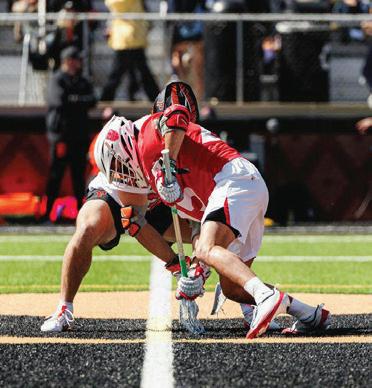
Red, white and booze | Students in the wines class have the opportunity to taste and learn about wines from regions all over the world.
This is qiyam al-layl, the night prayer, observed especially during the last 10 nights of Ramadan, when Muslims believe the Quran was first revealed to the Prophet Muhammed (peace be upon him) on Laylat al-Qadr, the Night of Power. For 10 consecutive nights, the Muslim community at Cornell gathers on the second floor of Anabel Taylor Hall, in the dimly lit auditorium, and stays until dawn. The schedule is unforgiving in the most literal sense: Maghrib, the sunset prayer, and Iftaar, the breaking fast meal, at 7:30 p.m., Isha, the night prayer, at 8:30 p.m. and taraweeh, the voluntary night prayers, shortly thereafter. The night, however, has just begun. A halaqah, a religious lesson, starts at 3:00 a.m. Tahajud, a highly virtu

There is a word in Arabic, niyyah, that does not translate cleanly. English renders it as “intention,” but intention in English is preliminary, something you form before an act and discard once the act begins. Niyyah, however, is fundamentally constitutive. In Islam, niyyah is not something that simply precedes an act, it inhabits it in the way the soul inhabits the body, suffusing an act of ibada, worship, so completely that the act without niyyah is not a lesser version of worship but not worship at all. The prayer is not valid without it. The fast is not accepted without it. The charity does not count without it. Niyyah is the very substance of what makes devotion, devotion, and everything visible: the standing, the kneeling, the hunger, the sleeplessness, is just its expression. I have been thinking about niyyah for the past 30 days because it’s the only framework I have found capable of holding what it means to observe Ramadan at Cornell without reducing it to something smaller than it is.
To continue reading this article, please visit www.cornellsun.com.
EEOC Sends Antisemitism Survey to Former Employees
March 21 — University employees received a federal survey on March 17 as a part of an ongoing investigation by the U.S. Equal Employment Opportunity Commission into alleged discrimination offenses.
This is the second time University employees have received such an email this academic year, after a survey was sent out from EEOC on Sept. 10 inquiring about antisemitic communications, hiring rubrics and anti-bias training, according to a formal Cornell employee.
According to the March 17 email obtained by the Sun, the EEOC contacted current and former University employees, stating that the agency is “investigating allegations of discrimination involving Cornell University” and requesting that recipients complete a survey detailing their workplace experiences.
The email emphasized that employee participation would help the agency in
“assess[ing] Cornell University’s compliance with federal equal employment opportunity laws.”
The survey asks employees whether they experienced certain conduct “because [they] practice Judaism, have Jewish ancestry, are Israeli, and/or are associated with an individual(s) who is Jewish and/or Israeli.”
It lists a range of possible experiences, including “harassment, intimidation,” “unwelcome comments, jokes, or discussions” and protests or demonstrations that “limited or obstructed access to workplaces or made individuals feel “threatened.”
The EEOC describes the questionnaire as part of “an ongoing EEOC inquiry” and states that employee responses are “a critical part of EEOC’s investigative process.” The agency also notes that it is unlawful for employers to retaliate against individuals for participating in such an inquiry.
JING JIANG / ASSISTANT SUN PHOTOGRAPHY EDITOR
NATHAN ELLISON / SUN PHOTOGRAPHY EDITOR
By SOPHIA DASSER Sun Editor in Chief
ATTICUS JOHNSON AND SHUBHA GAUTAM Sun News Editor and Assistant News Editor
By STEFANIE CHEN Sun Contributor
By EMMA SPINDLER Sun Senior Writer
COURTESY OF AMENA AKTER ‘28
Sophia Dasser can be reached at sdasser@cornellsun.com.
Stefanie Chen can be reached at sc3363@cornell.edu
COURTESY OF NATHAN ELLISON
A LISTING OF FREE EVENTS ON CAMPUS AND IN ITHACA



12 p.m. - 1 p.m., Sage Chapel Cornell Companions “Pup-Ups” 12 p.m. - 1 p.m., Olin Library Main Area
Book Talk: Wasted Potential and Tracking Food Waste 4:30 - 5:30 p.m., Mann Library Room 160
What Professors Don’t Understand About Students Today 4:30 - 5:45 p.m., Goldwin Smith Hall, Kaufmann Auditorium
CU Music: Zvi Plesser, Cello, and Miri Yampolsky, Piano 7:30 - 8:30 p.m., Barnes Hall
Tomorrow
2026 Ph.D. Symposium | Unearthing the Earth
9 a.m. - 3:45 p.m., Sibley Hall 140
Open House at the Fuertes Observatory
8 p.m. - midnight, Fuertes Observatory Tea & Tarot
4:30 - 5:30 p.m., Anabel Taylor Hall 114, Founder’s Room
Makerspace Open Hours 3:30 - 5:30 p.m., Tompkins County Public Library
No Kings: An Evening of Music & Community 7 - 9 p.m., First Unitarian Society Today Soup & Hope

Hillel Breaks Ground on New Jewish Student Center
By MARY CAITLIN CRONIN Sun News Editor
March 23 — Hillel at Cornell officially began construction on Harkavy Hall, a new Jewish student center, during a March 8 ceremony attended by Ithaca mayor Robert Cantelmo, U.S. Rep. Josh Riley (D-N.Y.) and President Michael Kotlikoff. The project is part of the “Hillel is Home” campaign, which has gathered more than $37 million in donations.
The center, located at 722 University Ave., will become the new home of the Steven K. and Winifred A. Grinspoon Hillel Center for Jewish Community at Cornell, offering students access to amenities such as “Herb’s” Kosher cafe, an event hall for Shabbat dinners, a communal Kosher kitchen and a Beit Midrash — a hall dedicated to Torah study. Harkavy Hall is expected to open in Fall 2027.
During the ceremony, President Michael Kotlikoff, Adam Lehman, Hillel international president and CEO,Rabbi Ari Weiss, Grinspoon Hillel CEO, and donor Steven K. Grinspoon ’83 made remarks on the center.
“Today we embark on a new beginning for Grinspoon Hillel, despite the ongoing conflicts, the rising tide of world-
wide antisemitism and continuing political tensions on this campus and others,” Kotlikoff said before the groundbreaking, according to the Cornell Chronicle.
Weiss described the event as “joyous” in an interview with The Sun.
“This has been a dream for our community for so long,” Weiss said. “To make sure there was a building to support Jewish students, to make sure they had a home on campus to belong.”
The center holds significance for Jewish students on campus, Hillel President Noah Bodner ’27 said.
“This project means an assurance that Jewish life at Cornell is celebrated, honored and proudly present,” Bodner wrote in an email statement to The Sun.
Despite serving the largest Jewish student population in the Ivy League for nearly a century, Cornell is the only Ivy League University without a dedicated Hillel building. Cornell Hillel currently operates out of Anabel Taylor Hall.
To continue reading this article, please visit www.cornellsun.com.

Former CALS Dean Susan Henry Dies at 79
By EVERETT CHAMBALA Sun Assistant News Editor
March 23 — Susan Henry, former dean of the College of Agriculture and Life Sciences, died on March 7 at 79 years old.
Henry served as the Ronald P. Lynch Dean of CALS from 2000 to 2010, overseeing the foundation of the Dyson School of Economics, and was the first woman to hold the position. She taught molecular biology and genetics during her tenure at Cornell until her retirement in 2020.
During her earlier career as a scientist, Henry made significant discoveries including the “Henry Regulatory Circuit” which are the mechanisms cells use to determine whether lipids are used for cell growth or stored as fat.
She was one of the first scientists to use the S. cerevisiae yeast as a model for studying biology, and her work provided insights into understanding cancer and obesity.
Today, 20% of pharmaceuticals including insulin, hepatitis and HPV are derived from the yeast she researched.
“She was one of the smartest people I’ve ever met, and that’s one of the reasons I worked in her lab for so long,” said Stephen Jesch, who served as a postdoctoral associate and senior research associate in Henry’s lab for over 15 years, said in an interview with the Cornell Chronicle.
As dean of CALS, Henry named the establishment of the Dyson School of Applied Economics and Management as one of her “proudest achievements,” according to the Chronicle. She also oversaw the development of four new majors within viticulture and enology, agricultural sciences and information sciences.
Henry was also present for the creation of the Weill Institute for Cell and Molecular Biology, The Cornell Teaching Winery, the Riley-Robb Biofuels Laboratory and renovations to Mann Library.
“Beyond her professional contributions, Susan was a valued mentor and a dear friend,” said Prof. Scott Emr, molecular biology and genetics, who is the previous founding director for the Weill Institute for Cell and Molecular Biology, an interview with the Chronicle. “I deeply miss our time
together – especially Susan’s honesty, openness and genuine friendship.”
Henry was born in Virginia and attended high school in the D.C. area.
She graduated from the University of Maryland with a bachelor’s degree in zoology in 1968, and obtained her Ph.D. in genetics from the University of California, Berkeley in 1971. She then went on to complete postdoctoral research at Brandeis University and join faculty at the Albert Einstein College of Medicine at Carnegie Mellon University in 1972 where she would work as a professor until being hired at Cornell in 2000.
Henry was also the winner of the National Institute of Health’s merit award for “outstanding” research, served as a member of a national advisory council for the NIH and also chaired an NIH committee focused on the health of minority populations.
Henry is survived by her two children, Rebecca Alice Henry and Joshua Armstrong Henry, M.S. ‘03, Ph.D. ‘05.
Tompkins Development Agency Issues Asteri Owners Notice of Default
By MADELEINE NAUMOFF
March 19 — Building safety concerns prompted the Tompkins County Industrial Development Agency to issue a notice of default to the property owner of Asteri Ithaca, an affordable housing project in downtown Ithaca with 181 housing units, on Monday, according to a TCIDA press release. TCIDA issued.0 the notice of default, a statement that informs a company that it has not upheld its agreement with another company or contract, to the Vecino Group due to unsafe building conditions at Asteri, according to the press release. This follows Fire Marshal Robert Shepherd’s order for residents to vacate the building on March 4, “due to fire and safety concerns that created an immediate hazard,” according to a press release by Ithaca Area Economic Development.
The notice of default was issued due to a breach of terms in the agreement between TCIDA and the Vecino Group, the property owner of Asteri. The notice prompts the Vecino Group to to meet the terms of its agreement before TCIDA takes further action.
“The project management’s failure
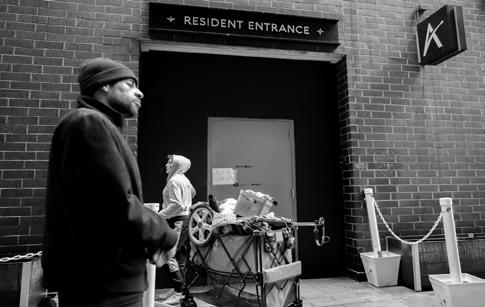
to comply with all applicable regulations and codes is a disservice not only to its tenants, but also to the adjacent conference center, the Downtown Ithaca Alliance and downtown merchants, and the entire community,” said Kellea Bauda, administrative director of the TCIDA, in the TCIDA press release. “The TCIDA cannot continue to support the Asteri project unless and until it is properly managed and maintained.”
The Vecino Group has been given 30 days to address and correct the violations. The TCIDA will pursue remedies under the agreement if the issues continue after 30 days, according to the press release, including the potential for “termination of the incentives and recapture of financial assistance.”
Asteri was ordered to be vacated on March 4 due to broken windows and shattered glass that rendered the stairwells — the building’s only exit
points — unserviceable in the event of an emergency.
While Asteri is closed, the Vecino Group is providing displaced residents with alternate housing options. On March 7, the group announced they would provide funds for residents to stay in hotels until the repairs to Asteri are complete.
A fire safety test is scheduled for March 20. The Ithaca Fire Department will then review the results and consider lifting the order to vacate, according to a Tuesday press release sent to The Sun by Ithaca Chief Information Officer Alan Karasin.
The safety test includes a stairway pressurization test “to determine whether the building’s pressurization system can help mitigate the severity of a fire emergency,” the Tuesday press release states. Once Asteri passes the safety tests, the city of Ithaca will lift the order to vacate, the release added. Further details regarding reentry will be communicated directly to residents as they become available, according to the Tuesday press release.
Sun Staff Writer
Tompkins’ test | Te TCIDA’s notice gave the Vecino Group 30 days to address violations.
Mary Caitlin Cronin can be reached at mcronin@cornellsun.com
Rabbi & representative | Rep. Riley, President Kotlikoff and Rabbi Weiss break ground.
COURTESY OF THE CORNELL CHRONICLE
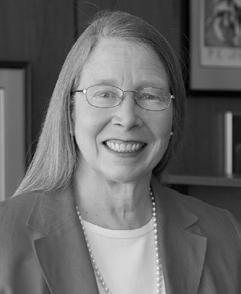
Henry | Former CALS Dean Susan Henry’s research provided insights to understanding cancer and obesity.
Everett Chambala can be reached at echambala@cornellsun.com
COURTESY OF THE CORNELL CHRONICLE
Madeleine Naumof can be reached at mnaumof@cornellsun.com
NATHAN ELLISON / SUN PHOTOGRAPHY EDITOR
SUNBURSTS: Creative Outlets
A packed weekend of club events, showcases and performances kept Sun photographers busy as they captured everything from the runway to the stage.
By SUN PHOTOGRAPHY DEPARTMENT




MUSIC MEDLEY | Student bands perform, compete and celebrate their music during the annual Big Red Battle of The Bands.
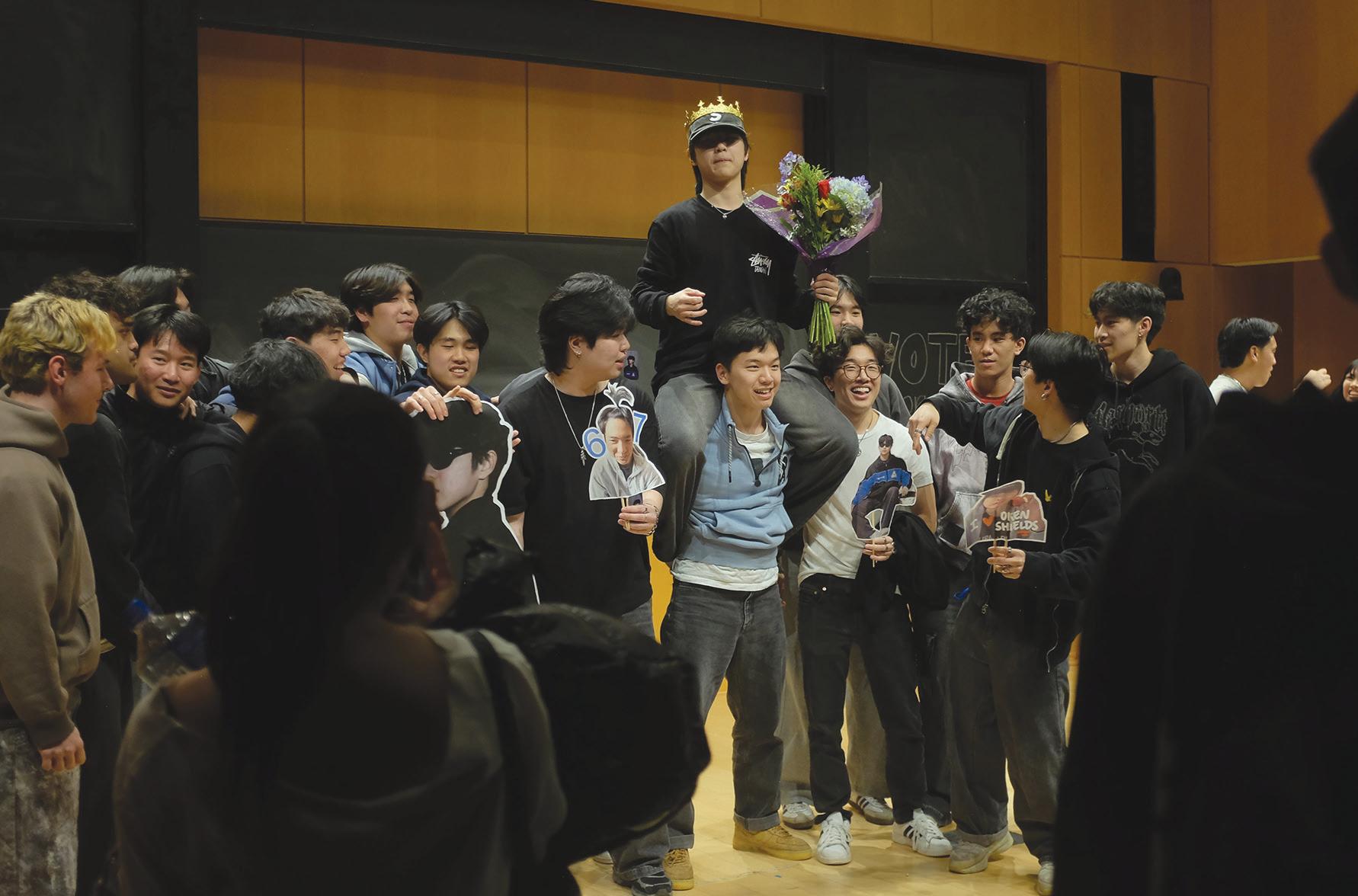
BROTHERHOOD | Gavin Zhao ‘28 celebrates his 2026 Mr. Asia title with his fellow brothers in Lambda Phi Epsilon.
ALL A BLUR | A long exposure captures a set by the band Sonder, the event’s winner.
DRUM ROLL PLEASE | Contestants from the Big Red Battle of The Bands pose for a selfie.
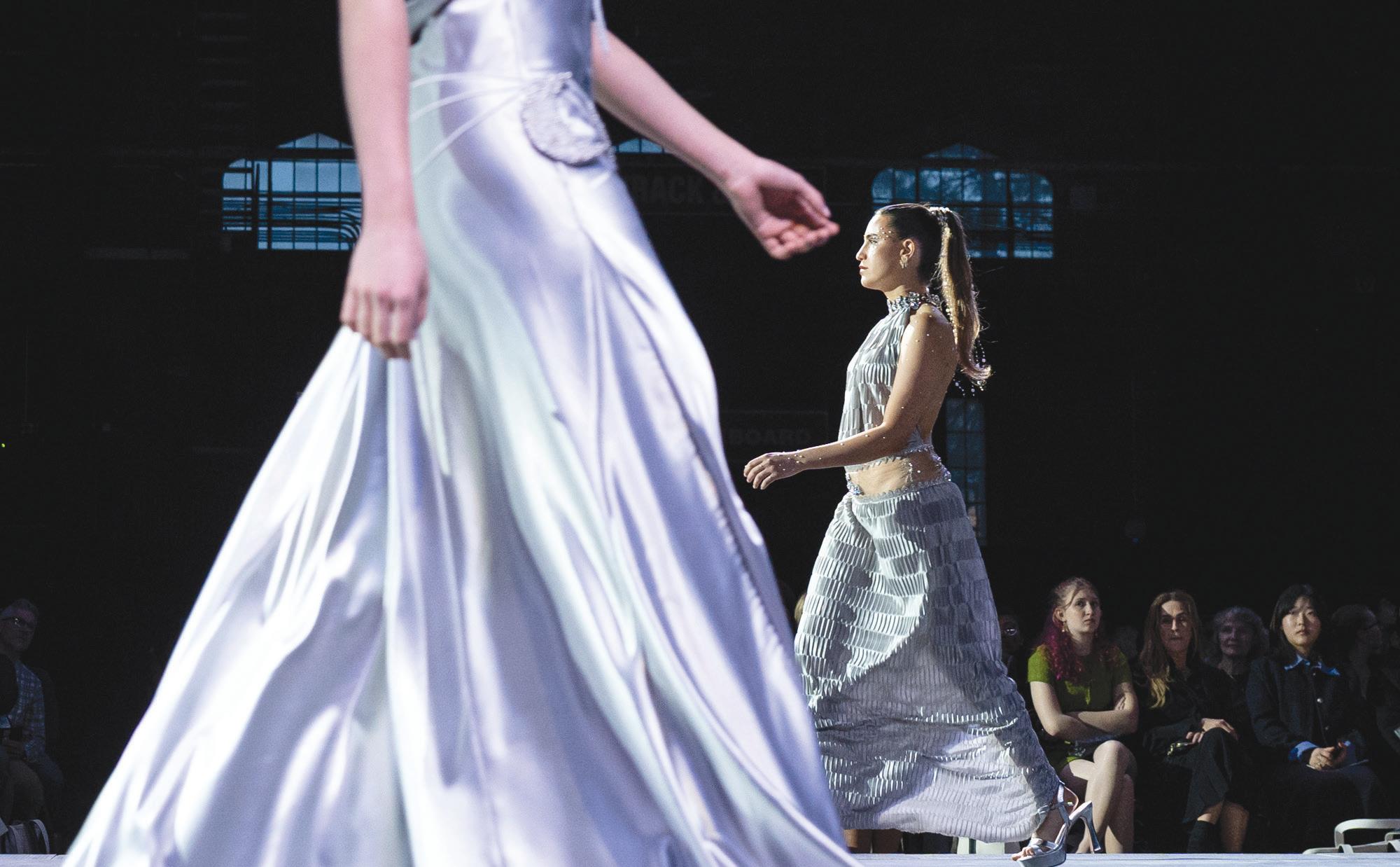
IN THE GARDEN | A model walks by showcasing intricate fruit embroidery on her outfit.
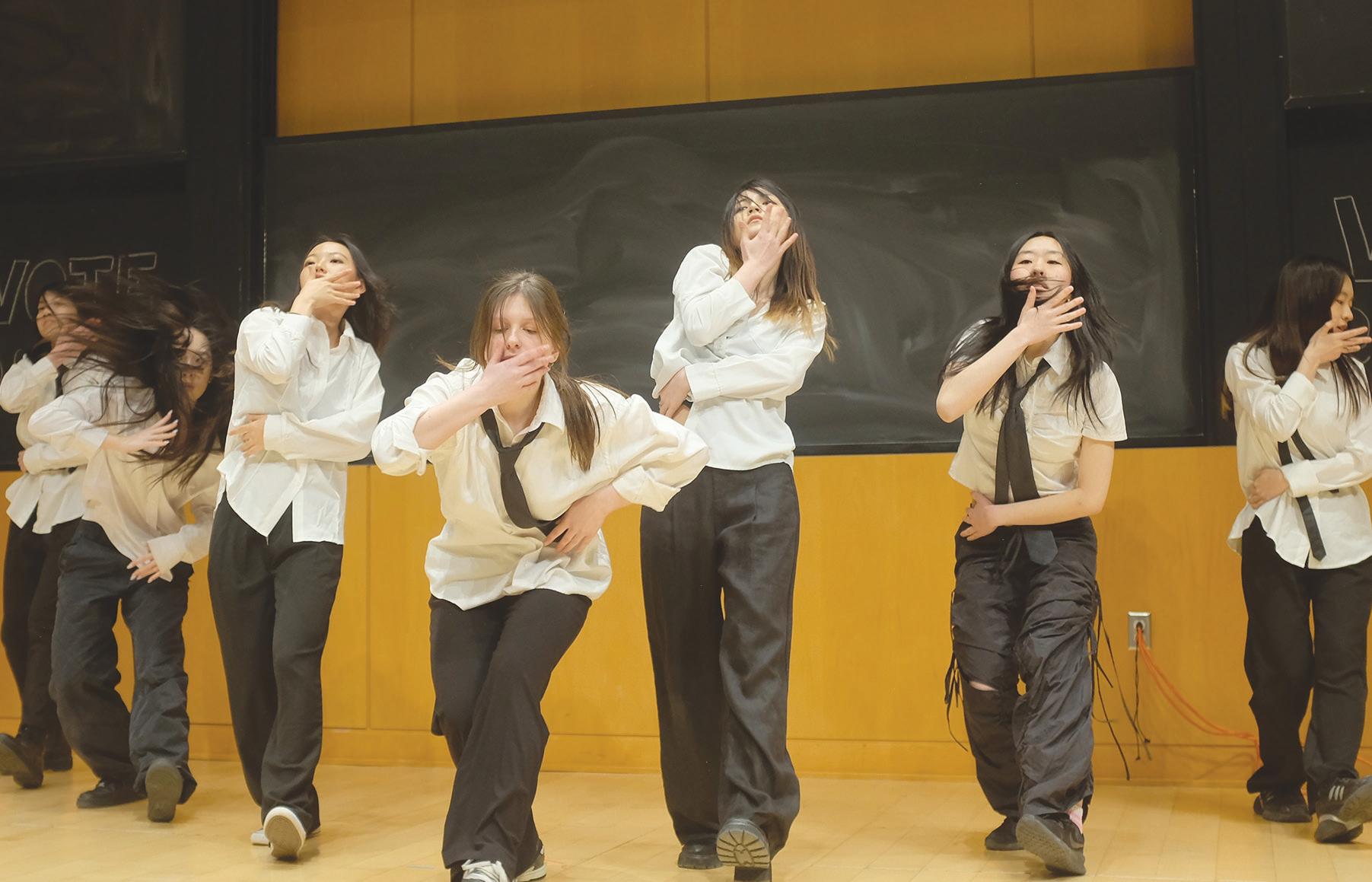
E.MOTIONAL PERFORMANCE | Student K-pop dance group E.Motion opens the 2026 Mr. Asia Pageant event with multiple dance performances.
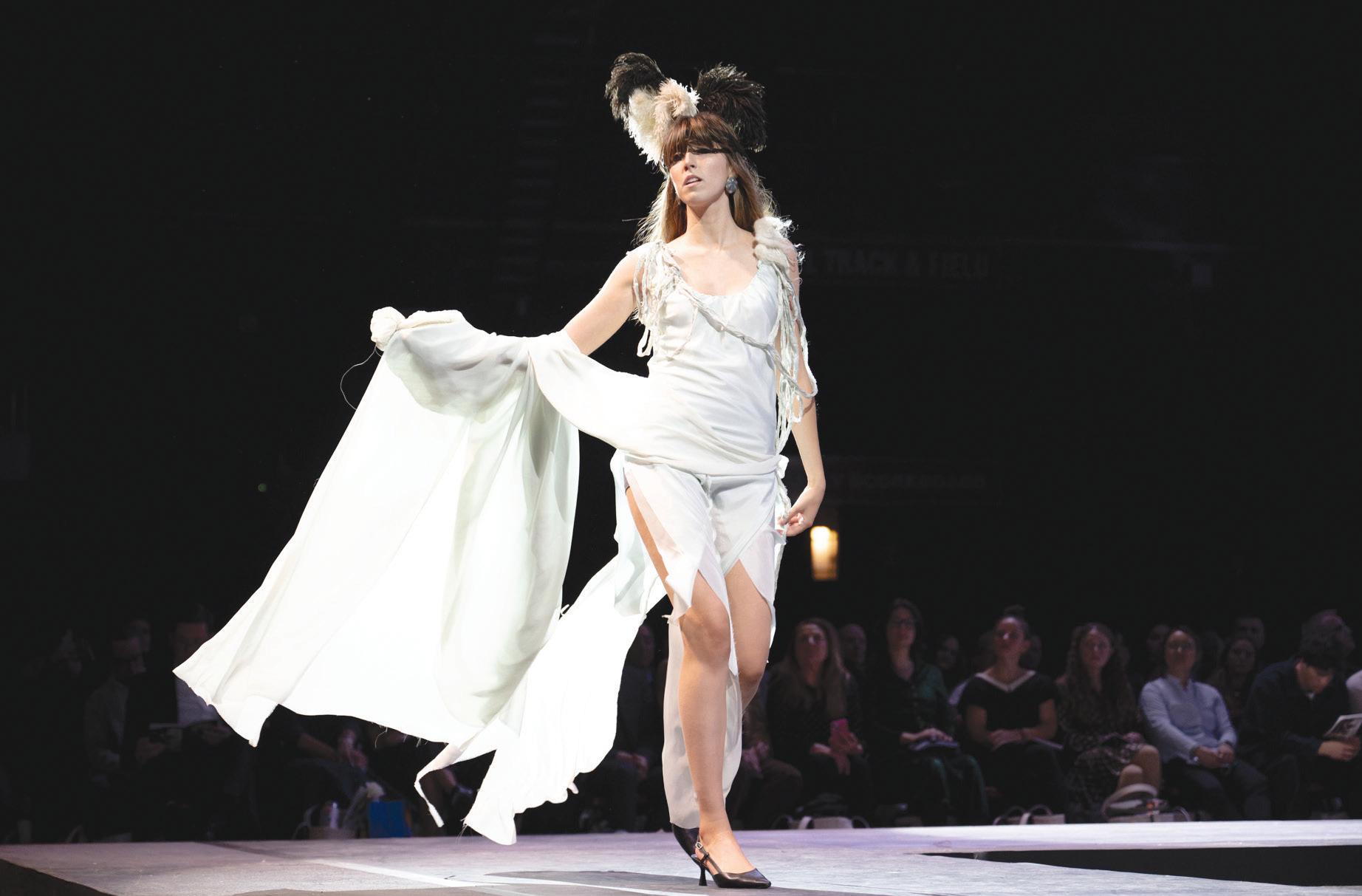
STRIKING STRIDE | A model embraces their spotlight moment and hits their signature pose on the runway.
PHOTOSHOOT, POSE | Models take the runway at Barton Hall, showcasing the unique apparel designed by Cornell students in the Cornell Fashion Collective.
photos, please visit cornellsun.com.
Audrey Zhang / Sun Staf Photographer
Jocelyn Jao / Sun Staf Photographer
Annie Park / Sun Staf Photographer
Audrey Zhang / Sun Staf Photographer
Jocelyn Jao / Sun Staf Photographer
Courtesy of Nathan Bo ’28
Nathan Ellison / Sun Photography Editor
Nathan Ellison / Sun Photography Editor
Kotlikof , Bala Address Faculty Senate About Resilient Cornell, Student Code Revisions
By CORAL PLATT Sun News Editor
March 20 — President Michael Kotlikoff and Provost Kavita Bala spoke to the Faculty Senate about the Student Code of Conduct, the upcoming Faculty Senate resolution on Policy 6.4, the Committee on the Future of the American University and Resilient Cornell during its March 11 meeting. They also fielded questions ranging from Cornell’s financial challenges to the October settlement between Cornell and the Trump administration.
Senate members also discussed the Code of Academic Integrity and addressed two upcoming Faculty Senate resolutions regarding a request for an annual university report on academic freedom and Policy 6.4, which addresses bias, discrimination, harassment and sexual misconduct.
Kotlikoff’s and Bala’s Remarks Kotlikoff spoke first, providing details on the ongoing revisions to the Student Code of Conduct and expressing support for the resolution on Policy 6.4
The revisions to the code serve the purpose of “ensuring that these documents remain relevant, equitable, and effective,” according to the Student and Campus Life website. These revisions are part of an annual review.
“[The revisions] largely address issues of clarifying emergency measures and providing some appeal process for suspension and shortening the process to an ultimate adjudication of the issues,” Kotlikoff said.
The revisions are currently undergoing a period of public comment, which will last until April 20. Following this period, Kotlikoff will review the comments and the revisions will be implemented beginning on July 1.
Kotlikoff also mentioned his support for an upcoming Faculty Senate resolution which would create an ad hoc committee to evaluate and recommend revisions to Policy 6.4. Policy 6.4 addresses matters of discrimination, bias and harassment with-
in the Cornell community as well as the procedures for the report, investigation and resolution of a claim.
Following Kotlikoff’s remarks, Bala discussed the progress of the FAU committee and Resilient Cornell.
The FAU committee, which was established in October, evaluates how the University can “evolve to best serve future generations while pursuing its core mission of education, scholarship, public impact, and community engagement,” according to its website.
“They’re now moving into a phase where they’ll start coming up with their recommendations,” Bala sai, adding that the committee will be holding town halls later in the semester and releasing their final report either over the summer or the beginning of the fall semester.
Bala also spoke about the University’s progress on Resilient Cornell, describing the initiative as an “umbrella term” for their “multi-pronged approach” to ensure Cornell’s financial resilience. As part of this approach, the University hired Michael Henderson, chief procurement officer and associate vice president, to reduce external spending, established a position control committee to limit headcount growth, designed a voluntary retirement program for employees and is working on restructuring various functional groups including I.T. and communications, Bala said.
“There’s been a lot of simmering going on in the background as [Resilient Cornell has] been wrapping their brains around new models,” Bala said. “We’re now ready to actually start thinking about the execution and get feedback from the community.”
Q&A Session
The meeting then transitioned into a Q&A with Kotlikoff and Bala for attendees.
In response to a question from Prof. Linda Canina, finance, Bala clarified that Resilient Cornell’s changes to the
University’s hiring policy to control “the amount of growth that we are seeing in our headcount” only apply to staff and administration, rather than those holding academic positions.
Several other attendees asked questions about the University’s finances related to Cornell’s settlement with the Trump administration and research funding.
In response to a question by Prof. Paul Ginsparg Ph.D. ’81, physics and information science, about the aftermath of the October settlement that restored over $250 million in federal funding, Kotlikoff stated that “the government has restored all of our research funding.”
“This entire academic year, we’ve not had the kinds of infringement on other people’s rights that we’ve seen in the past.”
President Michael Kotlikoff
Both Prof. Itai Cohen, physics, and Jason Oliver, a senior extension associate and dairy environmental systems engineer, expressed concerns about research funding.
“Even though the funding agencies are being nominally funded at the rates that they were previously funded at, the money is coming in at a trickle,” Cohen said. “That’s creating a pressure on faculty. We’re not getting the same number of grants that we used to get. … If by some miracle everything goes back to the way it was before, when this administration is over, we may not have anything left in our labs to be able to build on.”
Bala responded by explaining that the FAU committee is creating recommendations regarding “how [we] should think about resilience to the research enterprise,” while Kotlikoff added that “so many of us are engaged in Washington
[D.C.] on this very topic.”
Oliver asked about funding provided by industry partners and restructuring indirect cost rates, or funding that is necessary for research facilities and administration.
“[This issue has] always been a tough one,” Kotlikoff responded. “Even at the negotiated IDC [indirect cost] rates that we get with the federal government, 69% on the Ithaca campus on the endowed side, we lose money on research. Basically, … the university is investing in that research itself.”
Kotlikoff added that he desired a consistent policy on agreements with industry partners.
In addition to funding concerns, one attendee, Prof. Yuval Grossman, physics, expressed worry about the safety of Israeli students, claiming “Cornell is still failing Israeli and pro-Israeli students, and people are unsafe on campus.”
Kotlikoff responded to Grossman, pushing back on his concerns.
“I do believe that our Israeli students are safe on campus,” Kotlikoff said. “One of the things that I’m pleased about is that this entire academic year, we’ve not had the kinds of infringement on other people’s rights that we’ve seen in the past.”
Prof. Gilly Leshed, information science, voiced concern that the FAU committee is largely composed of tenured faculty, she said.
The first was the resolution to create a committee reviewing Policy 6.4, and the second would request an annual University report on academic freedom from University administration.
Professors, a union and membership association for academic professionals.
To continue reading this article, please visit www.cornellsun.com.
Coral Platt can be reached at cplatt@cornellsun.com.
Kotlikof Rejects Resolutions About Technion Ties, Alleged War Criminals as Promoted Speakers
By VIVIENNE CIERSKI Sun Staff Writer
March 22 — The Student Assembly engaged in a long debate about Resolution 57: “Ensuring Equitable Evaluation of Special Projects Funding Requests” before ultimately rejecting the resolution at their Thursday meeting. This follows the rejection of two recent resolutions by President Michael Kotlikoff on Wednesday and Thursday.
The lack of forward progress contributed to mounting frustration about the efficacy of the body from Assembly members.
Kotlikoff Rejects Resolutions 55 and 61
Kotlikoff rejected two controversial Assembly resolutions this week, Resolution 55: “Condemning the University Administration’s Use of Programming to Platform Individuals Implicated in War Crimes,” and Resolution 61: “Calling for the Termination of Cornell University’s Partnership with the Technion – Israel Institute of Technology While Preserving Cornell Tech,” just three days after they were passed — delivering a swift rebuke to the recommendations that contrasts prior complaints concerning delayed administrative responses.
Under the Assembly charter , a presidential rejection effectively halts a resolution, meaning no further administrative action will be taken despite its passage within the Assembly.
These resolutions called for restricting invitations to individuals accused of war crimes from appearing on campus, as well as for severing the University’s ties with Technion – Israel Institute of Technology and
Cornell Tech.
The resolutions advanced through the Assembly after two weeks of contentious meetings, during which packed public comment periods revealed sharp divisions among students. Some argued the measures would restrict free speech and limit opportunities for campus dialogue and career development, while others raised concerns about the University’s association with individuals accused of war crimes and those involved in weapons development.
In his formal rejection of Resolution 55, Kotlikoff asserted his strong opposition to the measure.
The resolution “ unacceptably seeks to curtail freedom of speech on Cornell’s campus, thereby limiting the scope of knowledge and ideas available to students at Cornell,” he wrote.
This resolution criticizes the administration for hosting, funding or sponsoring programming that features speakers whom the resolution’s sponsors say have been “implicated in war crimes and grave human rights violations.”
Among those referenced is Tzipi Livni, former vice prime minister and former foreign minister of Israel, who participated in the University’s “Pathways to Peace” panel in March 2025.
Livni was subject to war crimes allegations and a warrant for her arrest in the United Kingdom in 2009 for decisions made before and during Operation Cast Lead while she was Israel’s foreign minister and a member of the Israeli security cabinet. The warrant was withdrawn after authorities determined she was not in the country.
Resolution 55 argues that hosting such speakers
at University-sponsored events “endanger[s] student well-being.” Kotlikoff rejected this premise, citing Cornell’s Expressive Activity Policy and emphasizing the institution’s commitment to fostering the exchange of ideas — even when those ideas are controversial.
Hosting thoughtful exchanges, especially ones concerning highly contentious topics, give students an opportunity to engage in civil discussion and debate, Kotlikoff argued, describing such engagement as, “key to the function of both a university, and a democracy.”
Kotlikoff also criticized what he believed to be “clear indications of political bias” in the resolution, and quoted it directly, saying that, “exposure to controversial ideas and individuals does not ‘create a hostile and coercive academic environment.’”
“Indeed, I see this resolution by the Student Assembly as a regrettable attempt to further the notion that there is virtue in silencing speech with which we disagree”, Kotlikoff wrote. “Any attempt to restrict the sharing of perspectives — whether by shouting down speakers, disrupting events, or imposing political litmus tests on invitations — is anathema to the principles and purpose of our university, and has no place in our community.”
Kotlikoff also rejected Resolution 61, a measure which urges the University to end its institutional partnership with Technion.
To keep reading this article, please visit www.cornellsun.com.
Vivienne Cierski can be reached at vsc38@cornell.edu.
The Corne¬ Daily Sun
Independent Since 1880
144th Editorial Board
SOPHIA DASSER ’28
Editor in Chief
SOPHIA ROMANOV IMBER ’28
Associate Editor
ZARA CHEEK ’28
Opinion Editor
RAYEN ZHOU ’29
Opinion Editor
JADE DUBUCHE ’27
Multimedia Editor
BENJAMIN LEYNSE ’27
Multimedia Editor
SOPHIA TORRES LUGO ’26
Business Manager
KENDALL MURPHY ’28
Advertising Manager
VICTORIA WROBLEWSKI ’28
Human Resources Manager
MELISSA MOON ’28
Arts & Culture Editor
JAMES PALM ’27
Assistant Arts & Culture Editor
MATTHEW RENTEZELAS ’28
Assistant Arts & Culture Editor
HAZEL TJADEN ’28
Assistant Arts & Culture Editor
MARC STAIANO ’27
Assistant Arts & Culture Editor
KATELYN HALVERSON ’28
Lifestyle Editor
AVA BETNAR ’29
Assistant Lifestyle Editor
SANIKA SARAF ’28
Assistant Lifestyle Editor
KATHERINE ISTOMIN ’29
Social Media Editor
JOIE JEAN-PAUL ’29
Assistant Social Media Editor
ASHLIN KWONG ’28
Graphics Editor
TAVAN BHATIA ’27
Games Editor
HUNTER PETMECKY ’28
Layout Editor
Leah Badawi
VARSHA BHARGAVA ’27
Managing Editor
KATE TURK ’27
Assistant Managing Editor
CORAL PLATT ’29
News Editor
ATTICUS JOHNSON ’28
News Editor
MARY CAITLIN CRONIN ’28
News Editor
EVERETT CHAMBALA ’27
Assistant News Editor
SHUBHA GAUTAM ’28
Assistant News Editor
GISELLE REDMOND ’28
Assistant News Editor
ANGELINA TANG ’28
Science & Technology Editor
TANIA HAO ’28
Science & Technology Editor
SIMRAN LABORE ’27
Weather & Climate Editor
MATTHEW LEONARD ’28
Sports Editor
GRACE REUBEN ’28
Sports Editor
JANE HAVILAND ’28
Features Editor
NATHAN ELLISON ’28
Photography Editor
NATHAN BO ’28
Assistant Photography Editor
ADELAIDE CHOW ’29
Assistant Photography Editor
MIA SOFIA ORENGO ’28
Video Editor
SMRITHE RAJESH ’29
Newsletter Editor
AMELIA GARCIA ’27
Data Editor
RENA GEULA ’28
Layout Editor
Leah Badawi '27 is an Opinion Columnist and a Government and English student in the College of Arts & Sciences. She also serves as the Co-Editor-in-Chief of Rainy Day Literary Magazine. Her fortnightly column Leah Down Te Law refects on politics, history, and broader culture in an attempt to tell stories that are often left between the lines. She can be reached at lbadawi@cornellsun.com.
A Love Letter to Lebanon
Lebanon, I write this love letter to you — They have battered you, but they will never break you.
To the villages along the South, who have long faced bombardment, you will never fall. To those forced to flee in the earliest hours of the night, there is no disgrace in your survival. You will return to the land of love, and we will always find our way. This is the story of resilience that has damned our history for almost a hundred years. Lebanon, how must it feel to watch smoke dance across your once-clear sky?
Flower of the unfortunate, they have mistaken the bloom of the mushroom cloud for beauty, the stammer of soldiers’ boots for music. How do they tune out the children’s screams? Do the hollowed-out ruins make for good acoustics? What a cruel staccato.
They say they will level Dahiyeh like they did Khan Younis. They’ve bombed a girls’ school, highways, hospitals. My grandparents drove hours to Beirut to hide in a hotel, and they’ve bombed hotels too.
And when we raise the flag, what do you think it is that they see? Is it the grimace of the man who hoists it, the wind that drags upon it like nails clawing at its fabric, the tears of the mother, the child, the refugee? Do you think they see such things at all?
We used to ‘pspsps’ the cats that scurried down our streets. We used to climb trees and eat ice cream and set fireworks in my cousin’s backyard. I played soccer with my neighbors in a twice bombed Beirut parking lot. I wouldn’t have known if they hadn’t shown me the pictures. Do
Greg Morrisett
Greg Morrisett is the Jack and Rilla Neafsey Dean and Vice Provost of Cornell Tech. He can be reached at techdean@cornell.edu.
Te Jacobs Technion-Cornell Institute
In 2011, Cornell entered into an academic partnership with the Technion-Israel Institute of Technology to compete for an ambitious goal: build an innovative New York City campus to educate a new generation of tech leaders, conduct breakthrough research and development, inspire startups and propel the city to becoming a global hub for the tech industry. Beating national competitors in the bidding process, Cornell and the Technion won the opportunity to create Cornell Tech on Roosevelt Island. Without the Technion, there would be no Cornell Tech.
Nearly 15 years later, Cornell Tech has educated more than 2,700 students and undertaken groundbreaking research on AI and other new technologies.
Critical to this mission is the Joan and Irwin Jacobs Technion-Cornell Institute, created through the unique academic partnership between Cornell and the Technion without a financial obligation from either university to the other. The Jacobs Institute brings together engineers, computer scientists, designers, clinicians and entrepreneurs to develop new technologies, launch startups and generate real-world impact through three research hubs focused on health, media and urban challenges.
As is the case at most American universities, all of this research is supported through private philanthropy and competitive grants from U.S. government agencies. At the Health Tech Hub, faculty and students are building machine-learning systems that predict disease progression and assist clinicians with diagnosis and treatment, particularly in areas like cardiology, radiology and emergency care. In the Connective Media Hub, researchers study how digital platforms shape the way information spreads, communities form and public conversations evolve. Within the Urban Tech Hub, researchers explore
how advanced data science can improve infrastructure — from housing and transportation to energy systems and climate resilience. Through programs like the Urban Innovation Fellows initiative, researchers work directly with agencies across New York City on challenges ranging from sanitation and procurement to transportation and housing policy.
The Jacobs Institute is also home to the Runway Startups program, which attracts postdoctoral founders from around the world to build new companies at Cornell Tech. Inspired in part by the Technion’s long history of entrepreneurship, and central to Israel’s reputation as the ‘startup nation,’ the program gives researchers the time, mentorship and resources to transform breakthrough ideas into real companies.
To date, 128 startups have emerged from the Runway program. These startups have created more than 700 new jobs and 94% remain based in New York City. Founders have created technologies ranging from an AI-powered smart baby monitor and a genomic pathogen-detection platform that helps hospitals identify infections faster, to augmented-reality collaboration tools that allow people to work together in shared virtual environments. These ventures demonstrate how deep academic research can rapidly evolve into products that improve lives and reshape industries.
Cornell Tech is deeply grateful for the successful academic partnership we have built with our Technion colleagues, and proud of what the Jacobs Technion-Cornell Institute has achieved. The collaboration between our institutions made Cornell Tech possible and continues to drive our transformative impact on New York City and its thriving tech industry.
Committee on the Future of the American University
Profs. Avgar Ph.D. ’08, Burrow, Geddes, Rand ’04, Rose and Ryan Earle ’07. Te Committee on the Future of the American University is a group of 18 faculty appointed by the provost to explore how the university can evolve to best serve future generations while pursuing its core mission of education, research and scholarship, public impact and community engagement. Tey welcome ideas and feedback at fau@cornell.edu.
Te Only Land-Grant Ivy
Tthey know too that we used to link arms and skip down those streets? That we woke to birdsong, jumped down stone walls like it was death or life? Do they know too that we are human?
Children splash at each other. As the Mediterranean glistens, another rocket shoots to the sky. What did they sign on this one, I wonder. They try to write us our eulogies, but the truth is clear: They cannot take from us a land so etched in our bones that the rubble breathes fire.
How do I hold all this admiration and despair? What an easy task that is. True to my name, I have never suffered like you. I am soft and American, an imposter here and there.
Lebanon, I paint my nails red for you. Red for the blood, red for the sacrifice. Red as a reminder that you cannot ignore suffering behind a morning coffee and a red Canvas circle and internship applications. We scroll on our phones, we write cover letters and talk about AI startups. We call it normal.
Our distance has become more than a convenient excuse. What are we to do about the drones and warplanes we’ve never seen with our own eyes? It is easier to treat devastation like background noise, to say that it is all out of our control while entire families are forced from their homes.
But inaction is never neutral; it is permission. Our voices are our strongest weapon, yet the silence of this campus is deafening.
To continue reading this article, please visit www.cornellsun.com.
he work of the Committee on the Future of the American University has brought into sharp relief the erosion of public trust in institutions of higher education. Some of this distrust is due to the perception that universities are, increasingly, islands unto themselves with limited meaningful engagement with communities, organizations, families and workers outside their walls. This view of universities is one of the most urgent threats to higher education and stands at the heart of the committee’s task to reimagine Cornell’s trajectory over the next 50 years.
In an era of growing questions about universities' relevance to everyday Americans, Cornell stands uniquely positioned to offer a much needed model that integrates knowledge discovery and public impact. As the only land-grant institution in the Ivy League, we sit at the intersection of leading private research universities and the democratic ideal of serving the people, within New York and beyond. This dual identity isn't a contradiction — it's our greatest strength. It also offers us a clear path forward. Cornell’s public engagement tradition provides a blueprint for higher education in linking cutting-edge, rigorous research with applied tools, practices and policies, alongside training and technical assistance to myriad stakeholders, from farmers to union members and entrepreneurs to families and youth.
Shaping our future requires understanding our past. Cornell’s public engagement mission is inextricably linked with our founding, although the nature of our federal and state relationship is often misunderstood. The Morrill Act, a federal law codified in 1862, funded colleges that “promote the liberal and practical education of the industrial classes,” emphasizing the need “to teach such branches of learning as are related to agriculture and the mechanic arts.”
Ezra Cornell wrote of his own goal to “do the greatest good to the greatest number of the industrial classes of my native state, and at
the same time to do the greatest good to the state itself.” He joined with his fellow state senator, Andrew Dickson White, to convince New York State’s legislature to designate a new university as the state’s recipient of Morrill Act support. The result was Cornell University, an institution not intended for the wealthy and elite, but to serve the needs of New York State and humanity broadly: to “do the greatest good.” It would combine practical and liberal education while being broadly accessible to students historically excluded from higher education.
The federal government invested in landgrant institutions through the Hatch Act of 1887 to support agricultural research and its dissemination, and the Smith-Lever Act of 1914 to support community-based cooperative extension services. In both cases, this support bolstered work already happening at Cornell as part of its commitment to extending impact beyond our Ithaca campus.
Cornell’s third president, Jacob Gould Schurman, would expand Cornell’s public impact efforts with his vision of “a People’s University,” a private university with a public mission. He persuaded New York State to partner with Cornell to establish contract colleges that addressed specific state needs, beginning with Veterinary Medicine in 1894 and followed by Agriculture in 1904, Home Economics (now Human Ecology) in 1925 and Industrial & Labor Relations in 1945 (plus a short-lived College of Forestry in 1898).
But as a land-grant institution, Cornell’s commitment to public engagement is woven into the DNA of the entire university, not just the units with state affiliations. This identity and mission means embracing a fundamentally different relationship with society than our Ivy peers.
To continue reading this article, please visit www.cornellsun.com.
Francis X. Jaso A
Contrarian’s Calamity
Francis Xavier Jaso '28 is an Opinion Columnist and a Government and Economics student in the College of Arts & Sciences. His fortnightly column A Contrarian’s Calamity defes normative, dysfunctional campus discourse in the name of reason, hedonism and most notably, satire. He can be reached at faso@cornellsun.com.
In the hopeful summer of 1989, history itself laid in limbo.
As the Soviet Union’s overexpansion placed yet another tombstone in Afghanistan’s ‘graveyard of empires,’ her occupied Eastern Bloc later sought arms against its Russian imperialist elders in ‘autumn of nations’ and Gorbachev’s glasnost and perestroika diminished the last fares of hope for the centennial Marxist-Leninist ideology his policy intended to reinvigorate, the international community, for decades at apocalyptic odds, stood on the cusp of reinvention.
Accompanying the regime divide was a metaphorical and physical line which divided a slumbering totalitarian East from the alleged bastion of freedom across the Atlantic. Te Berlin Wall, or “Iron Curtain,” was by 1990, on the cusp of collapse. Once it did, men and women of the free world welcomed — with half-vacuous, McCarthyist pride — the weathered nations that rejected outright idealist ideologies and maimed nation and man in equal measure. And the counterrevolutionaries, breaking from the scourge, scurried to the deceptive, yet warm teat of ‘capital-C’ capitalism and its scafolding: democracy.
Like academics so often do, naive and reclused in cloisters of their own invention, they scrambled to either justify or dismiss the events unfolding at warp speed. One man who shares with me a frst name and undergraduate stomping grounds, opted for the former. Francis Fukuyama, scholar of international relations and neoconservative-turned-classical liberal, a Reaganist who later transcended to neoliberal icon status, believed the fallen curtain marked a literal fnale in the course of history.
Liam Harney
Liam Harney is a third-year student at Cornell Law School. His column Objection! discusses contemporary legal and political issues through a critical lens. He can be reached at ldh55@cornell.edu.
Most current college students weren’t (politically) conscious in 2003 when we went to war with Saddam Hussein and Iraq. As a two-year-old, I certainly didn’t have an opinion at the time. Te United States overthrew Saddam’s regime in December 2003. But building a nation is much harder than knocking one down. We did not withdraw from Iraq until 2011. In those eight years, 4,493 American soldiers died. Tens of thousands more were injured physically or mentally, often both.
Te steepest costs of war were forced upon the Iraqi people themselves, those for whom we sought “a better life.” Civilian casualties are notoriously difcult to calculate. However, a 2013 study estimated that over 400,000 excess deaths occurred from 2003 to 2011 in Iraq. More than 60% of these deaths were directly attributable to violence, the rest were associated with war-related issues such as the collapse of Iraqi civil infrastructure.
In truth, Hussein was a brutal dictator with no concern for the rule of law, an authoritarian who could not tolerate dissent and a thief who used his position as head of state to enrich himself and his family at the expense of the people. Like many nations, Iraq deserved better than the leader they got. But it’s naive to believe that’s why we killed him. Hussein’s ruthlessness was not a problem when we supported his war of aggression against Iran. His use of chemical weapons to kill Iranians was no less reprehensible than his use of them to kill Kurds. But we allowed the former and used the latter to justify invading a sovereign nation without U.N. approval.
In the lead-up to the Iraq war, domestic dissent was marginalized: confated with support for Hussein, or an unpatriotic lack of support for the troops. International allies who cautioned us against rash action were dismissed. Consent for the Iraq invasion was successfully manufactured so that, in 2003, 72% of Americans supported the
Te Return of History and the Oblivious Man
Tat pesky yet symbolic wall, to Fukuyama, signifed an end not limited to Communism’s reign across Eurasia. In nationalist hotspots like Chile and Cuba, agents of the Global South aided by USSR ministries loyal to a Stalinist strand implicated the capitalist ‘world-system’ as, under Immanuel Wallerstein’s view, both the “[natural] … endpoint” to which states modelling a liberalised Pax Britannica strived for, as well as the macro cause of Marxism’s weak imprint abroad. First in a brief treatise in ’89 and in the immediate tailings of the fallen hegemon two years later, Fukuyama, still bound to Reagan’s State Department, argued that the Hegelian “Absolute” — an ultimate point at which political science, its aggregate cultivation and application fnished — was realized.
Hegel’s belief in a history compounded is still widely unconscious knowledge, even among those who've never read his hefty words. Greek logos stuck around for thousands of years because its ofshooting ideas, like reason, were durable and transferrable, not due to its armies’ might. Asian legalist paternalism ran a tight ship over the course of dynasties, but its younger cousin, striver culture, was kept insular from Western societies to which they propagated; and Protestant-Capitalism, Max Weber’s theory linking comparative wealth in the West to Calvinist attempts to uplift the soul whilst grappling predestination’s spiritual tension, despite all of its faults, was not so much applicable to the deep rooted Germany or France as it was in America: where men were freed from both Europe and “common tradition,” hence inviting capital to the role of a moral capstone.
Such are mere examples of our tendency to supersede systems that carry the seeds of their own demise and attract newer, particularly more liberal ones. Yet a budding American primacy, springing from the latter, stood apart and above old theories and religious monarchies, so much so that by the mid-20th century it seemed inevitable that all the world wanted a piece of the action, a liberal democracy of their own. Te imperium certainly helped its propagation, but no counterarms could possibly silence the tune that fallen fascists, protectionist empires and kneelocked Warsaw Pact nations sought to hum alongside it.
With these transformations and the wealth, thenhealthy globalism, diminution of U.S.-Soviet bipolarity and more that followed, Fukuyama and scores of fellow libs theorized that that pinnacle of human society had been fnally met. Te democratization (and a helping hand from the State Department) that formerly drew
Axis powers out from under the rubble and the consequences of their own illiberal faults would, too, rope in international bodies sore from authoritarianism and economic exclusion. And for the resistors of this “universal homogenous state,” North Korea, Iran and South American revolutionaries alike; the balance would at some point shift too inexorably to sustain their petty isolation.
And yet, here we stand, under no greater stability than the times of nuclear armageddon, questioning widely a globally-defned capitalist democracy — if such a system can even be democratic on principle — how its departure from landed to stock-based wealth, from tradition and nationalism to ‘rules-based international order,’ has visibly failed to enspell the free world’s excluded caste, create universal value systems, cultivate fnancial prosperity at home and generate, through peaceable measures alone, a utopian global community.
Te singularity that was Pax Americana never sought the input of a neighboring — or ancestral — European region on matters of cultural and economic continuation, leaving the once briefy independent cluster of nation-states vulnerable to their current fnancial stagnance and untamed infuence of migration and Russian incursion. Te World Bank, U.N. and NATO, organizations and pacts of our own loin, do not and have rarely bred consensus necessary for the prevention of great power conficts: the Ayatollahs and Putins are, to the credit of John Mearsheimer’s routinely accurate predictions, only emboldened to ends favoring their own volksgeist. Even in minute areas, like Americanism’s sociological intrusions, K-pop, mainstream media, religious heterogeneity and the like, revisionist countermovements have awakened and sometimes prospered.
Can Fukuyama and his tenured bandwagon defend the democratic peace when its once-certain future dwindles with every oil refnery the U.S.-Israeli marriage conjointly immolates, or will another of the EU Council’s strong condemnations sufce in disarming the Islamic Revolutionary Guard Corps? Are the globe’s men and women seeing each other more as kin than otherworldly foe, and has loosened cross-border regulation beneftted them? Te Iron Curtain’s descent may have signaled the defeat of an ideology, but did history fall, too?
Tese questions have not been put to rest: the “centuries of boredom” predicted were mere years of suicidal optimism. Now, more than perhaps ever, our generation must ready itself for history’s unmistakable comeback and toss of this potent, erosive philosophy.
Is Tis My First Forever War?
war. Fast forward to 2021: With two decades of hindsight, millions of shattered lives and a trillion-dollar bill to taxpayers, 63% of Americans said the war with Iraq wasn’t worth fghting.
As the old saying goes, “Fool me once, shame on you. Fool me two times, you won’t fool me again.” Te American people clearly remember Iraq and Afghanistan as we are dragged into war with their neighbor: only 44% support military action in Iran.
Obviously, there are diferences between Iraq and Iran. For example, there is reason to believe subjugating Iran would be much more difcult. Iran is almost four times larger than Iraq, with 40 million more people. In addition, recent technological advances give Iran the ability to selectively constrict shipping through the strait of Hormuz with unmanned surface vessels and to target regional infrastructure with relatively cheap and abundant Shahed drones. Tis is the kind of asymmetric warfare that America struggles to counter: Consider Operation Rough Rider against the Houthis for another recent example. Tis means rising oil and gas prices, rising prices for shipped goods (which are inevitably passed on to the consumer) and rising food insecurity for nations which rely on the fertilizer that goes through the Strait to feed their people.
But there are also a frightening number of similarities. War with Iran will not serve America’s interests, but will further destabilize the region. Tis is because, like in Iraq, bombing a people or their vital infrastructure does not free them; it kills them.
We will kill people with families and professions, beloved pets and least-favorite foods. Would it surprise anyone if this kind of pain would radicalize young men and women with a long memory? Would it not radicalize ours, and make them dangerous? Prepare to hear the term “collateral damage,” as we did during the decimation of Gaza, once the Trump administration can no longer deny attacking an Iranian children’s school. How many kids has Pete “Maximum Lethality” Hegseth killed so far? How
many to go?
We have now begun hostilities with Iran twice while feigning diplomatic engagement. But we have the hubris to say they are the ones incapable of diplomacy. Constitutionally this war is even worse than Iraq because it lacks any congressional authorization. Article 1 explicitly gives the power to declare war to Congress, not the President. Tis power was deliberately vested in the legislative branch because, as James Madison said, “the Executive is the branch of power most interested in war, and most prone to it.” Trump did not even care to make the case for this war to the American people. Our consent, our reasoned opinions and humanitarian concerns were all unnecessary to the smooth functioning of the war machine.
For some Trump voters, the Iran war came as an unwelcome surprise, likely because Trump likes to tell voters he’s anti-war. Trump called the Iraq war a “big, fat mistake” when debating Jeb Bush in 2016, asserting that “we should have never been in Iraq” because it “destabilized the Middle East.” Trump's willingness to openly disapprove of the Iraq war as a Republican candidate energized Americafrst voters tired of unending wars abroad. During the 2024 election, Trump campaigned on a simple promise that resonated with voters: “No new wars.” He broke that promise.
If America still has a heart to feel, a mind to think or a will to be ruled by the people — instead of a small group of warmongers — there must be swift and unmistakable political consequences. Such a project requires its own coalition of the willing. So, if this is your frst forever war and you’re upset and overwhelmed, welcome. I share your disgust. If you voted for Trump because he promised to end wars, not start them, welcome. I respect your disdain for needless death. If you are an older reader who knew the Iraq war was a mistake before anyone else did; or even if you supported the Iraq war and have come to regret it, welcome. We must work together to stop this: my frst forever war.

Engineering Change: CerviCheck’s Mission for Predicting Preterm Birth
By ASHLEY KIM Sun Staff Writer
Mar. 22 — One in 10 births in the United States are premature.
The consequences are far-reaching: premature babies face lasting developmental challenges, and families carry emotional and financial burdens that can linger for years.
Yet, as George Zeng ’27 points out, clinicians still cannot reliably predict when a mother will give birth, even when she is already in labor.
"They use manual cervical exams," said Zeng, a biomedical engineering student and technical lead of CerviCheck, a Cornell undergraduate research and startup team part of the 2026 cohort of eLab. "Those assessments can vary from clinician to clinician and from mother to mother, making consistency a real challenge. That's where we saw the gap."
CerviCheck is working to change that with a device that translates the cervix's physical properties into a reliable predictor of preterm birth.
The Science Behind the Device
The project traces its origins to the Butcher Lab, where Prof. Jonathan Butcher, biomedical engineering, has long studied tissue biomechanics, or the relationship between mechanical forces and biological tissue.
The foundational challenge, Butcher explained, is that measuring the mechanical properties of living tissue is harder than it sounds. Traditional methods require extract-
ing tissue from the body and pulling the tissue until it breaks, an approach that destroys the very properties being measured after the measurement.
His lab developed an alternative: a device that can measure living tissue — not tissue that has been cut out and drained of its natural fluids — producing data that more accurately reflects how the body actually behaves.
This technology is now being carried forward by the student team leading CerviCheck. The clinical application they homed in on is the cervix. As a mother approaches delivery, the mechanical properties of cervical tissue, like stiffness, change in measurable ways — and right now, clinicians have no objective way to track those changes as manual cervical exams can be subjective.
"[Preterm birth is] fundamentally a biomechanical failure," Butcher said. "The cervix ruptures — that's what birth is. If you could predict that happening quicker or not, you're helping the patient either way."
The stakes of that prediction are higher than they might seem. Currently, women flagged as at-risk are often told simply to go on bed rest, a recommendation that can cost patients their jobs, their leave time and months of anxious waiting.
A reliable mechanical metric could change that: either confirming the risk and enabling targeted therapies to delay labor or clearing women who don't need intervention at all.
CerviCheck's device is designed to deliver that metric. The team operates in
both the electrical and mechanical engineering tracks and is currently testing its prototype using cervical tissue sourced through Cornell's veterinary college. Zeng has also been in close contact with clinicians at Weill Cornell Medicine, namely Dr. David Downing, an OB-GYN whose input has helped the team keep clinical application at the center of its engineering.
From Scientists to Entrepreneurs Validating a prototype, however, is only part of the challenge. Translating research into a clinical product means navigating a world that operates by entirely different rules — markets, funding, regulatory approval, intellectual property — and CerviCheck's team learned that the hard way.
Charlotte Wu ’28, who joined as a
mechanical engineer before transitioning to the business side, recalls the moment the team's perspective shifted. After an early advisory board meeting through Cornell's eLab startup accelerator program, the feedback was direct: the science sounded promising, but the team knew nothing about whether it could actually reach patients.
"We were hardcore scientists through and through," Wu said. "We sat down and realized we needed to think of our project in a completely new way."
To continue reading this article, please visit www.cornellsun.com.
How Cornell is Reimagining Reentry From Prison Trough Technology
By REBECCA RYAN Sun Staff Writer
Mar. 21 — When a man released from prison just one day earlier was handed a basic smartphone, the first question he asked was, “What is email?”
That moment stopped Jodi Anderson Jr. in his tracks.
Anderson, director of technological innovation for the Criminal Justice and Employment Initiative in Cornell’s School of Industrial and Labor Relations, had met the man while recruiting participants for a National Science Foundation-funded study on the stressors people face when searching for work after incarceration.
The man had served 20 years in prison. He had never used a smartphone or new technology. He had never sent an email. Yet, he was expected to apply for jobs, housing and benefits entirely online.
“That was a visceral moment,” Anderson said. “We expect returning citizens to navigate a digital world without ever being taught how.”
To address these barriers, Anderson co-founded Rézme, a platform designed to help job seekers navigate automated hiring systems, background checks and fair-chance hiring protections. The platform aims to support individuals whose applications are often filtered out by algorithms before reach-
ing a human reviewer.
“Technology created many of these barriers,” Anderson said. “So technology has to be part of the solution.”
Across the United States, digital platforms now mediate access to employment, housing, education and social services. For people returning home after incarceration, reentry means navigating systems they may never have used before. Anderson said that technology, if intentionally designed, can either expand access to opportunity or deepen inequality for the approximately 77 million Americans who have a criminal record.
To understand the roots of this digital divide, Anderson pointed to the technological reality of incarceration. In most U.S. prisons, incarcerated people are completely prohibited or restricted in some capacity from accessing the open web, a barrier that is commonly rooted in security concerns.
The lack of technology available to incarcerated individuals limits their ability to engage in average communication or educational activities that many people take part in on an everyday basis.
As a result, many individuals return home after incarceration with little experience using email, job portals, mobile banking or appbased navigation. Smartphones are frequently required for probation or parole check-ins, yet little guidance is provided on how to use them.
“We live in a mobile-first world,” Anderson said. “But if you’ve been away for years, even basic symbols, like the paper airplane icon used to send an email, don’t mean anything.”
Securing stable employment after release
from prison is already an uphill battle, especially for people with criminal records. This challenge is compounded by the fact that many formerly incarcerated individuals lack basic digital and technological skills that are now expected in most workplaces.
When people leave prison without the tools needed to compete in today’s job market, they face a much higher risk of long-term unemployment, which can push some back toward illegal activity as a means of survival.
“Technology created so many of these barriers, so technology has to be part of the solution.”
Jodi
Anderson Jr.
At Cornell, Anderson’s work with Rézme is housed within the Criminal Justice and Employment Initiative, which is part of the ILR School’s Center for Applied Research on Work. The initiative partners with employers, reentry organizations and public agencies to expand access to employment for people impacted by the criminal legal system.
An integral part of CJEI is the training program, which provides employer training, community partner training and justice-involved training, which refers to education for previously incarcerated individuals.
To continue reading this article, please visit www.cornellsun.com.
Rebecca Ryan can be reached at rar352@ cornell.edu.
Ashley Kim can be reached at alk28@cornell.edu.
STEPHAN MENASCHE / SUN SENIOR PHOTOGRAPHER
Digital divide | Jodi Anderson Jr.'s platform Rézme helps formerly incarcerated individuals gain reentry into the workplace.
COURTESY OF JODI ANDERSON JR.
Startup science | CerviCheck seeks to develop a device that can accurately predict preterm birth based on the cervix's physical properties during pregnancy.


T e Magic of Movies: Cornell Cinema
By JARED MILLER
Staff Writer
Cornell is home to so many amazing attractions that it can be hard to keep track of them all. There are countless things that you would never expect to find, that can be found on our campus: an observatory, geological exhibits, an archive of century-old maps and a collection of antique keyboards, all within walking distance of your dorm. While Cornell offers many rare opportunities to explore new and unexpected interests, it also has lots of underappreciated facilities that everyone knows about but are seldom frequented.
One of my main goals as a Cornell student is endeavoring to live my college years like a video game, unlocking every metaphorically playable character, map and icon as I partake in my 100% completion run of my Cornell experience. Along this quest, I decided to explore more of Cornell’s facilities, many of which I do not visit nearly enough. With so many opportunities for campus involvement and countless boxes to check off, I decided there was no better place to start than a day at the movies. My first stop on this adventure was the Cornell Cinema.
I had previously been aware of the Cornell Cinema, as I often meandered past it during my time spent in Willard Straight Hall participating in other activities. However, I had never really gotten the full experience up until this point. Founded in 1970, the Cornell Cinema was created as an opportunity for students to become more exposed to the art of filmmaking. In its 50 years of existence, the Cornell Cinema has hosted more than 500 actors, directors, producers, film experts, animators, writers and other occupations who play a significant role in bringing these stories to life. The Cornell Cinema projects more than 75 films a semester, ranging from modern comedies and dramas, all the way to silent films and historical documentaries. Iconic films like The Godfather , Imitation of Life and Sinners are all films that have been featured this semester. I personally had the opportunity to experience a wonderful documentary called Remembering Gene Wilder and then sit in on a Q&A with one of the film’s creators, Glenn Kirschbaum. When you first walk in, you are greeted by the concessions stand and box office area, which has a very classic, cozy charm to it. Once you walk into the actual theater, it is hard not to be impressed by

the large murals that fill the walls and the old-fashioned carvings and grand archways that make you feel like you are about to experience an ancient Greek tragedy. The screen itself is also very impressive, with large curtains and a stage with a vast apron, which adds an immersive element, creating a feeling of connection between you and the screen.
While attending, I noticed a wide variety of theatergoers, including students, faculty, professors, younger adults and locals — all coming together to enjoy the silver screen as one community. This experience reminded me how fun going to the movies can be, letting you turn your brain off for a couple of hours
as you become immersed in the story unfolding before you. Despite our differences, when the lights dimmed, we all laughed, gasped, and oohed and ahhed the same as one audience. When the lights turned back on, I tried to think of the last time I had enjoyed an in-person movie theater experience. It had been a while, and it dawned on me that this former favorite pastime of mine has become a forgotten activity.
Although some of the movies released recently have been among the best I have seen in a while, my desire to go to the movie theater hasn’t been at its highest. In the age of digital streaming and online piracy, it is becoming increas -
ingly clear that the general interest in being a moviegoer has declined. Yet this experience has reminded me just how fun a trip to the movies can be and has inspired me to check out more local theaters in the greater Ithaca area. In a world where contemporary technology often reduces the need for in-person experiences, timeless spots like the Cornell Cinema serve as refreshing reminders of how fun and awesome classic pastimes can be.
Jared Miller is a member of the Class of 2028 in the College of Agriculture and Life Sciences. He can be recached at jmm792@cornell.edu.
Chaos, Charisma and Culture in the
2026 Mr. Asia Pageant
By JUA KIM Lifestyle Contributor
Iplannedto spend Saturday night studying for three upcoming exams — and somehow ended up screaming over a Mr. Asia tug-of-war match instead.
When my friends first suggested going to the Mr. Asia Pageant show, I was not a fan of the idea. Spending my Saturday night watching a two-hour show featuring a lineup of strangers definitely didn’t sound ideal, especially with a busy upcoming week. I also thought it’d just end up being a competition of who best fit the performative male stereotype. However, within the first half-hour of the pageant, I was fully invested.
The third annual Mr. Asia Pageant, organized by the Chinese Students Association and Korean American Students Association, brought a lively crowd to Klarman Hall on March 21 — with each person choosing a ‘photocard’ of their desired contestant as their ticket. The event was emceed by CSA’s President Larry Tao ’27 and KASA’s Vice President Joshua Kim ’27 and featured contestants representing eight Asianinterest organizations at Cornell: Chinese Students Association, Korean American Students Association, Taiwanese American Students Association, Hong Kong Student Association, Cornell Filipino Student Association, Cornell Asian Pacific Student Union, Pi Delta Psi and Lambda Phi Epsilon. The competition unfolded across four rounds — interview, trivia, physical and special talents — and included guest performances from K-pop and hip-hop dance groups E.Motion and LOKO.
The sheer amount of energy in the room
throughout the show was astounding; it was hard not to get swept up in it. After a passionate performance from E.Motion, each contestant got a personalized entrance moment, ranging from nonchalantly throwing on some shades to chucking (and missing) a signed shirt into the crowd. No matter what a contestant did, the crowd responded with manic screams, supportive signs and standing ovations.
The interview round was both humorous and sincere as contestants answered questions about cultural identity and personality. When asked how they promote cultural diversity, several contestants said they supported small Asian businesses in the area — Lilos and E-Life Market, Ninja Chicken & Friends, Thai Joy — or engaged with Cornell’s cultural clubs. More light-hearted questions — like what Asian drink they’d be or what their life’s reality show would be called — drew animated reactions. At one point, a contestant related their relationship status to Single’s Inferno, which prompted an audience member to shout, “that changes today!”
The trivia round was a bit more tame. The contestants guessed the names of trending songs (“APT.,” “Dynamite,” “Soda Pop”) and answered various geography questions about Asian countries such as, “Which country has the most islands?” None of the contestants could name the author of Little Women (one said Anne Frank???), which was painful to watch, but they recovered their performative-ness with their knowledge of matcha and Labubus. However, the physical round soon reawakened the chaos; the contestants faced off in a tug-of-war, with some getting absolutely manhandled.
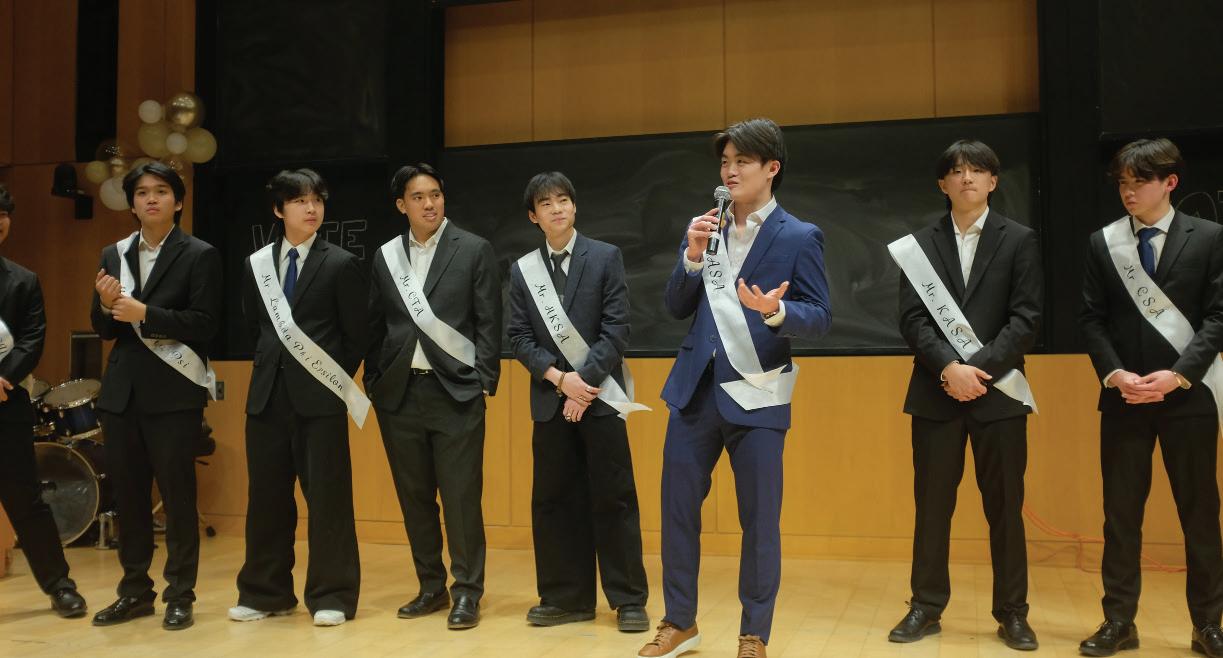
The final round on special talents was arguably the highlight of the pageant; some performances left me in genuine awe (and, dare I say, cheering wildly like some of the audience members I was judging earlier).
The talents ranged widely, from singing and instruments to dances combined with taekwondo or comedy. KASA’s Paul Shin ’29 ended the round with a bang as he unexpectedly ripped off his shirt to reveal a bright red crop-top while dancing to a JENNIE track, causing the audience to erupt into frenzied cheers. The event itself came to a close with Lambdas’ Gavin Zhao ’28 placing first, KASA’s Paul Shin ’29 placing second and CFA’s Cole Garcia ’26 placing third.
Overall, I loved how the show promoted the Asian community by using a modern approach to entertainment and tapping into cultural and online Asia-related trends: K-pop, the Haidilao noodle dance, Asian
dramas and shows, food, music and more. As a Korean-American, it’s great to see my culture represented, and as a member of Gen Z, it’s even more amazing to see that representation happening in a creative and relevant way. The many surprises throughout the show, including my friend unexpectedly winning the Weee! giveaway — a sizable package of Asian snacks and skincare from the U.S.’s largest online Asian market — only made the night more fun and kept me leaning forward in my seat the whole time.
To continue reading this article, please visit www.cornellsun.com.
WRIT
Jua Kim is a member of the Class of 2029 in the College of Arts and Sciences. She can be reached at jk329@cornell.edu.
JOCELYN JAO / SUN STAFF PHOTOGRAPHER
JULIA NAGEL / SUN FILE PHOTO
Stem Cell Drive Seeks to Find Alumni’s Son A ‘Life-Saving’ Match
By JONATHAN McCORMACK Sun Staff Writer
March 22 — The National Donor Marrow Program hosted a stem cell donor registry event, Big Red, Big Impact, with the goal of adding 10,000 student DNA samples to the NMDP donor registry between March 13-20. Juan Uribe ’96 spearheaded the tabling event in an attempt to expand the stem cell registry to find a life-saving match for his son, Max Uribe.
In an interview with The Sun, Juan said that he reached out to President Michael Kotlikoff to ask Cornell to host the sampling drive.
“He was immediately in problem-solving mode, thinking ‘how can we get this to happen,” Juan said. “He’s an angel.”
Kotlikoff both promoted and attended the event on Friday.
“To save Max and others like him, Cornell is partnering with [NMDP] to host Big Red, Big Impact,” President Kotlikoff wrote in an email to Cornell students on March 11. “I hope you all will join me in being a part of something that is truly a chance to do the greatest good.”
Max is currently 15 years old and afflicted with Myelodysplastic Syndrome — a rare and very deadly form of blood cancer. Since December 2024, when a biopsy revealed that Max was in need of a stem cell transplant, Juan has been in pursuit of a perfect match donor, aiming to add 1 million donors to the NMDP registry by April 1.
The process of finding Max’s perfect match “has been very hard,” Juan said. “We found two matches from a registry of 40 million people,” but in January, Max was informed that these matches were “no longer available.”
A perfect match donor is one whose Human Leukocyte Antigens, identifier proteins found on many cells throughout the body, perfectly match those of a recipient. Though it is possible to rely on imperfect matches, the medical process that follows is riskier and requires higher doses of damaging chemotherapeutic chemicals.
The event saw over 1,000 students added to the registry throughout the week-long tablings.
“[Seeing the Cornell community mobilize] almost brought me to tears,” Juan said.
“I chose to donate because it was an opportunity to do something meaningful for someone in need,” said Luke Renda ‘29. “I was surprised by how easy it was. It only took me two minutes to do something potentially life changing.”
Michael Garbin, a member recruitment coordinator for NMDP, helped lead the tabling at Willard Straight on Friday, when 250 students were added to the registry.
“I am encouraged by the turnout today,” Garbin said. “At least several of those 250 plus people, I believe will go on to donate, so some people’s lives will be saved
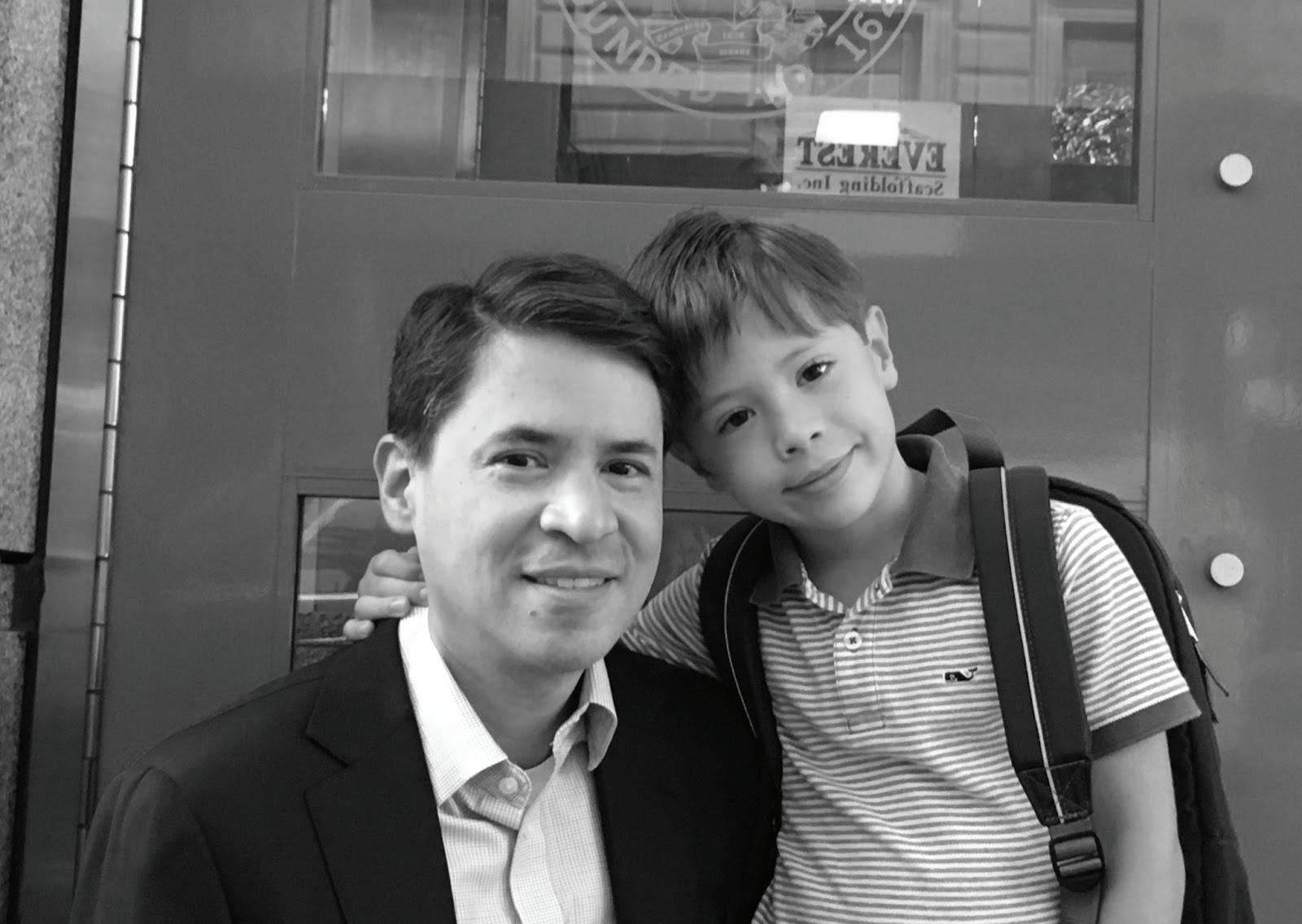
because of what we did today at Cornell.”
Garbin explained that “college students are the single best potential donors because their STEM cells simply work better for patients.” According to NMDP, patients receiving stem cells from younger donors, within the 18-35 year old range, had a better longterm survival rate.
Tabling at universities across the United States, Garbin added, is a great way to reach the 18-35 year old population of ideal donors.
While Garbin was encouraged by the turnout, he also noted that “we need more potential donors, particularly more ethnically diverse individuals because we tend to find matches between people with similar ethnicity.”
This concerns Max, who is 50% Colombian, 25% Italian, 12.5% British and German — making it more difficult for him to find a perfect match donor with a similar genetic background.
In his pursuit to add 1 million people to the donor registry, Juan also aims to make it more diverse which would help minorities find matches in the future.
As Juan continues his pursuit for a perfect match donor, he ended with one last call to action asking people to come to the drives.
“We need more potential donors so at least one match can be given to every person in need,” Juan said.
Jonathan McCormack can be reached at jjm538@cornell.edu.
Continued from page 1
In a March 19 statement, the University said it was aware of the EEOC inquiry and that it “will cooperate with any government investigation.” The University added that it “does not tolerate antisemitism or any form of discrimination” and pointed to existing policies prohibiting harassment and ensuring equal employment opportunity.
Media relations declined to provide additional comment beyond the March 19 statement.
The inquiry comes after prior federal scrutiny of the University related to antisemitism allegations. In November 2025, the University reached a settlement with the federal government to restore access to research funding following civil rights investigations into whether the University’s handling of antisemitism complaints met its obligations under federal anti-discrimination statutes.
In a November 7, 2025, statement about the settlement, the University said government had “not been found in violation of Title VI of the Civil Rights Act of 1964 in any of the investigations or compliance reviews of the university’s programs,” and that “the government has agreed to close all of these investigations and reviews.”
However, the closure notably excluded ongoing investigations by the EEOC.
“Nothing in this Agreement applies to any currently pending EEOC charges brought by individual charging parties or third-parties against Cornell,” according to the settlement.
The EEOC survey, the March questionnaire includes questions about whether protests or demonstrations affected employees’ ability to access their workplace or created a threatening or disruptive environment.
University policies allow demonstrations and protests on campus, but prohibit conduct that disrupts operations or blocks access to buildings or workspaces. University policy also bars harassment and intimidation based on protected characteristics, including religion.
To continue reading this article, please visit www.cornellsun.com.
Emma Spindeler can be reached at espindler@cornellsun.com.
Donor drive | Juan Uribe ’96 requested a stem cell drive at Cornell to help his son, Max Uribe.
COURTESY OF JUAN URIBE ’96

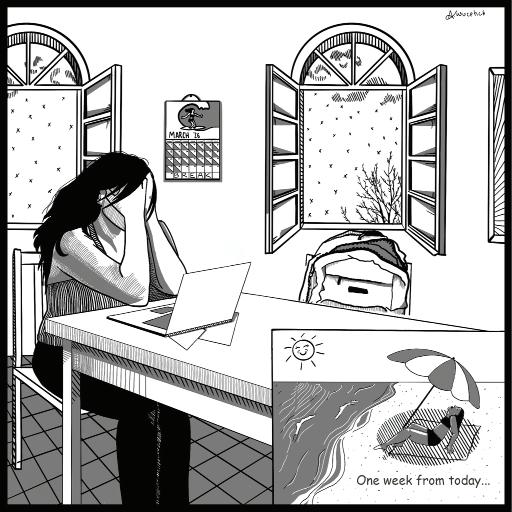


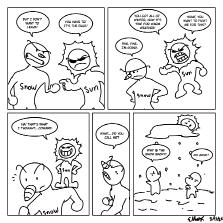
How a Cornell Course Brings Cayuga Language, Culture to the Classroom
By TANIA HAO Sun Science Editor
March 17 — Recently returned to in-person instruction, a unique Cornell class introduces students to the language and culture of the Gayogo hó:n , or Cayuga, people, on whose homelands Cornell stands.
In AIIS/LING 3324: “Cayuga Language and Culture,” students explore the history, culture and continuing presence of the Gayogo hó:n community while learning the Gayogo hó:n language, which the United Nations classifies as critically endangered.
The course is currently taught by Steve Henhawk, a member of the Wolf Clan of the Gayogo hó:n nation and native speaker of the language, with assistance from Prof. John Whitman, linguistics.
The Gayogo hó:n nation is one of the six nations of the Haudenosaunee Confederacy, whose ancestral homelands are located in the Finger Lakes Region of New York. Today, most Gayogo hó:n people, including Henhawk, live in the Six Nations of the Grand River reserve in Canada.
This forced displacement is largely due to the destruction of Gayogo hó:n crops and villages around Cayuga Lake during the American Revolution, ordered by George Washington as part of the Sullivan-Clinton Campaign, which led many people to flee to Canada.
Since then, assimilatory efforts taken by both the U.S. and Canadian governments, including government-funded residential schools — boarding schools where Indigenous children were taken from their families, forced to assimilate and subjected to abuse for speaking their native languages, according to the National Centre for Truth and Reconciliation — have led to the decline of the Gayogo hó:n language.
With fewer than twelve first-language speakers today, Gayogo hó:n is classified by the U.N. as a “critically endangered” language.
As one of these few remaining speakers, Henhawk serves
as a knowledge keeper in the Haudenosaunee community. As a knowledge keeper, Henhawk’s duties include conducting traditional ceremonies in the language and teaching people throughout the Six Nations and Finger Lakes Region.
At Cornell, Henhawk sees the “Cayuga Language and Culture” course as a valuable component of ongoing work toward the revitalization of the Gayogo hó:n language.
“We can’t go back in time and we can’t change things, but we can look to the future,” he said. “This is where I see [Cornell], where things can happen … to help move forward.”
Creating the Course
“Cayuga Language and Culture” was born in the fall of 2018, when Whitman was approached by a dean in the College of Arts & Sciences who expressed interest in starting a Gayogo hó:n language class. This was at the request of Prof. Jolene Rickard, art history, who is Tuscarora — part of the Haudenosaunee Confederacy. Rickard had been offered a job at another university and listed the establishment of a Gayogo hó:n class as a condition for her staying at Cornell.
“She deserves a huge amount of credit for that,” Whitman said.
When Whitman first heard the idea, though, he was hesitant.
“I said, ‘do you have any idea?’” he recalled. “This language is … really critically endangered. So the idea that we could just pluck someone to teach Gayogo hó:n to Cornell students was just completely unrealistic.”
It was through Rickard that Whitman met Henhawk, who was teaching the language to a community of Gayogo hó:n people at the north end of Cayuga Lake at the time. The pair met for the first time at a pizza parlor in Seneca Falls, and “Cayuga Language and Culture” was born.
Henhawk started teaching the class in Fall 2019 and continued for the next year. Then, between 2021 and 2024, various teachers from the Gayogo hó:n community in the Six Nations reserve — including visiting lecturer Jessica Martin and Charlene Hemlock — took up the mantle and
remotely taught both installments of the course, Cayuga Language and Culture I and II.
Fall 2025 marked Henhawk’s return to teaching the class, and the first time it has been offered in-person in four years.
“[Gayogo hó:n ] has changed my life. It’s an amazing language,” said Whitman, who has become an expert in Gayogo hó:n linguistics. “It’s endangered, and that’s the big thing — what can be done to help second language learners now learn it.”
The existence of “Cayuga Language and Culture” at Cornell is unique in itself due to the fact that Gayogo hó:n has ongoing revitalization efforts, unlike many other Indigenous languages that have no speakers remaining, according to Whitman.
A typical session of “Cayuga Language and Culture” provides students with opportunities to speak the language as well as understand how the Gayogo hó:n language and culture have progressed to the present day. The course covers topics including basic pronunciation, phrases and writing, as well as Gayogo hó:n history, traditional stories and ecological knowledge.
Creating an immersive language-learning environment for students was an important goal for Henhawk, who learned Gayogo hó:n growing up with his grandparents on the Six Nations reservation and is one of the few native speakers of Gayogo hó:n remaining today.
“At that time, there was [an immersive] environment where it was total Gayogo hó:n ,” Henhawk said. “Now, you have to create an environment where you can even have a full conversation in Gayogo hó:n … I feel lucky with just that memory [of speaking completely in Gayogo hó:n ].”
For instance, certain phrases and words in Gayogo hó:n may only be used in this type of conversational environment that no longer exists today. Such phrases might be among the first pieces of the language to be lost, so Henhawk tries to emphasize them in his teaching.
To continue reading this article, please visit www.cornellsun.
Tania Hao can be reached at thao@cornellsun.com.
Who’s That Jumping? Meet the Pogo Club
By JULIA CHOI Sun Contributor
March 23 — If you hear the sounds of steady thumping around campus, do not fear … it may just be a student escorting themself to class on a pogo stick. Cornell Pogo Club is not just any club: It is the “world’s only college Extreme Pogo Sticking Club.” Founded during the Fall 2025 semester, the organization is led by Anmo Li ’28.
Li is not just any pogoer, as he is ranked 10th in the world for pogo sticking. He recalled getting into the sport after watching a guy jump and land on a roof. With a dream and sheer will, Li got to work. He not only practiced jumping around on the pavement, but also studied the mechanics and outlined potential designs of a pogo stick’s internal components. He would share videos of his pogo sticking progress through a YouTube account he created called, “vurtego flybar.” However, the online community was relatively small, making it difficult to learn from others. Because
of this, Li dreamed of expanding this unknown sport and seeing others jump around him.
Coming to Cornell, he was offered that opportunity. The large campus allowed him to interact with various students, as he would jump around random areas to garner interest. Gradually, people started to notice him. They would post him on social media asking, “Who is this guy jumping around?” Seeing growing engagement, Li sought to foster a community where he could teach others how to pogo stick.
With this goal in mind, he successfully established the Cornell Pogo Club with the help of Kay Lewis, the Assistant Dean of William Keeton House. As the club is fairly new, its main priority is spreading awareness of the sport and connecting with local students, including those at Ithaca High School and various elementary schools. Li stated, “When I was nine years old, I looked up to the other people who were good at pogo sticking, and I kind of want to switch into that role now and inspire other peo-
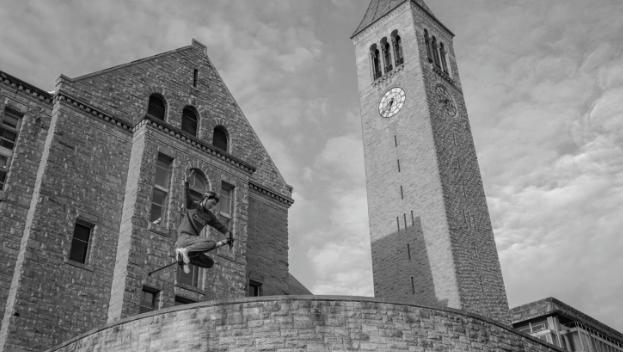
ple around me.”
Cornell Pogo Club does more beyond simply jumping around campus; it also provides a space for students with various interests to get involved. For example, Li explained that the company that made his pogo stick stopped production on those models. He then reached out to work with student engineers so that they could design and produce something similar.
What really draws me in about the Cornell Pogo Club is how it emphasizes failure. Rather than discouraging failure, Li encourages it: “You have to learn how to fall. Pogo sticking is all about learning how to fall and get back up.” Throughout that process, there is always a community behind and in front to support and “catch” students. This was rather refreshing to hear because Cornell needs more spaces where students don’t have to strive for perfection or be ashamed of failure. Cornell Pogo Club embodies Cornell’s principle of “... any person … any study.” Individuals (like myself) who are afraid of heights
or are unable to pogo stick can still get involved and experience growth within this community.
In terms of the future of Cornell Pogo Club, Li emphasized the importance of maintaining a collaborative environment. He wants to pursue collaborations with other clubs, like the one they had with the Unicycle Club. Together, they provided an outlet for their members to meet and form relationships with one another. Li also stated, “I would love to become the best known club at Cornell. Like, when people think about Cornell, they’re going to be like, oh, that’s the one with the pogo club, right? I want to be like that. I want to do more.”
Whether to learn more about the art of pogo sticking or to hear about Li’s story, there is no doubt that more students should join the Cornell Pogo Club. While offering an opportunity for students to explore niche interests, it also provides a space for personal growth.
Julia Choi can be reached at jc3767@cornell. edu.
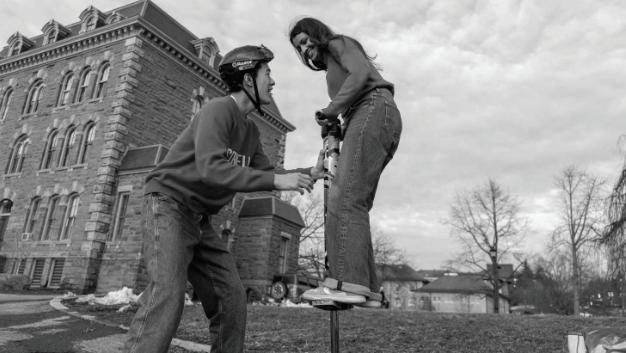
Li leaping | Anmo Li ’28, founder of Cornell’s Pogo Club, pogos across the walkway connecting Libe Slope and Ho Plaza.
ADELAIDE CHOW / ASSISTANT PHOTOGRAPHY EDITOR
Pogo play | Anmo Li ’28 teaches fellow Cornellians how to pogo around Libe Slope.
ADELAIDE CHOW / ASSISTANT PHOTOGRAPHY EDITOR
Has Lollapalooza Gone Mainstream?
“Go big or go home.” This timeless catchphrase seamlessly captures the long-standing motive behind Chicago’s greatest musical sensation: Lollapalooza.
The dynamic four-day music festival, hosted annually in ‘The Windy City,’ has long held the reputation of accumulating a wildly diverse range of artists. In comparison to Indio, California’s photogenic, pop and EDM-heavy Coachella and Miami’s electrifying, rap-centric Rolling Loud, Chicago’s high energy, beautifully chaotic Lollapalooza has often been described as ‘alternative.’
The festival’s history of experimenting with underground talent has accumulated into a successful track record of priming artists on the eve of their big break. This is exemplified in the performances of Lady Gaga in 2007 and Pearl Jam in 1992, both of whom were scheduled as smaller talent with low priority in terms of timing and staging before they became two of the biggest hits of their generations. Lollapalooza’s tendency to take risks in artist discovery is what makes the festival stand out. Be that as it may, this August’s roster drives a wedge in Lollapalooza’s longstanding ‘indie’ reputation. Has Lollapalooza turned … mainstream?
Thursday starts out with a bang, featuring a myriad of high-energy artists ranging from Lorde and John Summit to Empire of the Sun and 5 Seconds of Summer. Lorde’s unique vocal style and distinct synth-pop sound come together uniformly to cultivate successful hits, such as her 2013 song “Royals,” a classic that will give all the concert-goers a glimpse into the previous decade. As one of the most well-known and quickly escalating DJs of the 2020s, John Summit’s musical melting pot of tech-house and neoteric pop can be counted on to boost the festival atmosphere. Empire of the Sun, an Australian duo known for their 2009 number one song “We Are the People,” will undoubtedly keep up the electro-pop hype, spreading an uplifting perception of spiritual ecstasy amongst the audience. Another Australian band, 5 Seconds of Summer, embodies pop-rock by layering dark introspective songwriting with powerful instrumentation. The group is most well-known for their 2018 knockout
album Youngblood, and is bound to rekindle a striking sense of pre-Covid naivety amongst the crowd.
As we transition into Friday, the energy picks up with Charlie XCX, Zara Larsson, Major Lazer and Lil Uzi Vert. British musical powerhouse Charlie XCX’s fast-paced blend of hyper and electro-pop music carries a nonconformist spirit that set the stage for her 2024 era-defining album Brat. Meanwhile, Zara Larsson brings a unique scandipop music style to the table characterized by her empowering radiance, as featured in her Swedish 2015 number one singles “Lush Life” and “Never Forget You.” With the presence of these two female stars, fans will experience the dynamism of summer nightlife energy and be struck with the contagious confidence that both women unapologetically exude. Major Lazer, a group best known for their hit songs “Lean On” and “Cold Water,” fuse tropical Jamaican roots with catchy EDM beats. Meanwhile, Lil Uzi Vert conducts a mesh of hip-hop pop and untraditional rap styles through emotional lyrics and melodic flows, as featured in his 2017 collaboration “Bad and Boujee” with Migos. Both music styles embody the eclectic 2016 ambiance our generation incessantly tries to recapture, and will likely be mosh pit-starters that bring out the crowd’s unfiltered rowdiness.
Saturday takes a turn into a softer, more relaxed vibe with artists The Neighbourhood and Ethel Cain. The Neighbourhood’s unique combination of alternative rock, R&B and indie-pop has been featured in their 2013 sensation “Sweater Weather,” whose longstanding presence on the charts will bring out the crowd’s reminiscent side. Meanwhile, Ethel Cain’s alternative-pop style is set apart by her southern gothic themes, elegantly soothing voice and deeply vulnerable lyrics, as seen in her 2022 single “Strangers.” Cain will join The Neighbourhood in bringing a melodramatic twist to the array of music genres.
As the festival reaches its final day and begins to wind down, it is effectively amped back up again with Sunday’s big names of Tate McRae and The Chainsmokers. Ever since Tate McRae’s 2021 breakthrough with “you broke me first,” she has rapidly escalated in status in the pop music industry, reaching the number one spot in 2023 in the Billboard Hot 100 with “greedy,” her most popular song to date.
McRae’s intense dance-pop music style consists of unfiltered lyrics, bold confidence and cinematic beats that will keep the audience dancing and on their toes. The Chainsmokers’ electro and indie-pop music style blends authentic lyrics with upbeat EDM tempos to generate infectious melodic sensations. The duo was massively successful around the time of the release of their 2016 hit single “Closer,” which singlehandedly acts as a time machine in transporting listeners back to the fondly remembered 2010s.
Lollapalooza’s lineup has no misses, that is for sure. The roster encompasses a diverse assortment of music types, activating an inevitable emotional rollercoaster for all attendees. Nonetheless, it seems as if the majority of artists chosen for this summer share a common theme: They are known for peaking about a decade earlier. Our generation’s all-consuming obsession with nostalgia seems to have conquered modern music culture, and with it, Lollapalooza’s distinguished identity as a focal point for up-and-coming artists. Has Lolla gone mainstream, or am I just ticked off because I didn’t get tickets?

In a poor neighborhood in Tacna, Peru, a man named Jorge Lopez builds a concrete wall down the middle of a woman’s yard and dares her to do something about it. She cannot. The woman, Gladys Meneses, has no property title, no lawyer, no birth certificates for her children and a tuberculosis infection eating through her lungs. The wall stays. It is the kind of injustice that happens every day in every poor country in the world and goes entirely unrecorded — except that American journalist Tina Rosenberg was there, sitting in Gladys’ yard, taking notes.
But Gladys is only one story in Rosenberg’s 1991 nonfiction book Children of Cain: Violence and the Violent in Latin America. This chapter, called “Dialectic,” builds a portrait of Peru around three people who would never share a room: Gladys, quietly drowning in a system that was never built for her; Javier, a Shining Path guerrilla who sees a single, violent solution to the country’s poverty and institutional rot — burn it down and start over; and Ricardo Vega, a sociologist in the highlands who thinks there might be another way. Rosenberg doesn’t rank or judge them. Instead, she just lines their stories up and lets the tension breathe.
Take Javier: on paper, he is a terrorist. In Rosenberg’s hands, he is also a funny, sharp, sentimental 21-year-old who worries about his mother, schemes to win back an ex-girlfriend and asks Rosenberg to bring him Reeboks from Chile. Then, the “switch flips” — he is reciting Mao Zedong quotations in a reverent hush and explaining why the Tiananmen Square massacre was actually quite hopeful. Both of these versions of Javier are real. In refusing to choose between them, Rosenberg argues that witnessing means resisting the urge to make people legible at the cost of making them true to their own contradictions.
Then there is Gladys. Rosenberg doesn’t describe her poverty in percentages or policy language. She describes
the contents of her room: two small beds, a heap of old clothes, a Bayer herbicide poster on the wall, a picture of a blue-eyed Jesus. She also describes Marco, Gladys’ son, endlessly pushing a chair back and forth through the narrow passageway beside the concrete wall because there is nowhere else to go. Rosenberg lets the details speak for the politics. A reader may absorb and subsequently forget that 48% of Peru’s working population operates outside the formal economy. However, it is much harder to forget a little boy who has nowhere to play.
Rosenberg’s witnessing philosophy is especially compelling when she turns it on herself, admitting that she has spent so much time in Latin America that she has become numb. Poverty at sufficient scale stops registering as a collection of individual human emergencies and instead becomes a kind of weather — ever-present, acknowledged and unalterable. It is the kind of thing you learn to dress for rather than fight. Gladys’ concrete wall, however, breaks Rosenberg’s numbness precisely because it is a small, individual wrong that could conceivably be righted. Rosenberg tries to help by hiring a lawyer, visiting the courthouse and navigating a bureaucracy that is shown to be essentially decorative. What she finds instead is that Gladys has simply replaced one patron with another. Lopez’s earlier role is transferred to Rosenberg, as Gladys gives her faith entirely to a foreign woman with a notebook. In that moment, the journalist who came to document powerlessness finds herself implicated in its reproduction.
Ricardo’s story is memorable, likely because he’s the only one of the three who makes a costly choice without the promise of anything in return. He moves to the Puno highlands, learns enough Aymara to say “Hello” and “Hurry up,” organizes campesino farmers to take over land and farm it and writes unanswered letters to Bob Dylan. Although his story is almost undramatic next to everything else in the chapter, the contrast is striking. Sendero Luminoso, or the Shining Path, a homegrown Maoist guerrilla movement that spent a
decade making rural Peru ungovernable, wants him dead for it. The group eventually sends 24 fighters to destroy Ricardo’s headquarters, the Catholic Churchbacked network of campesino federations he’d spent years building across Puno, and a commander comes looking for him with a machine gun. By the end he’s just tired, the way people get tired when they’ve been doing something hard for a long time with no particular end in sight. It’s worth remembering, at this point, that Gladys is still there too, still poor, still negotiating with the Lopezes, still planning to ask the man who stole her property for a loan to buy fruit to sell in the contraband market. That’s what survival looks like when the system never once worked in your favor.
Rosenberg doesn’t tell you it was worth it, for Ricardo, for Gladys or Javier. She just tells you that they were there, that they did the work and that the concrete wall is still standing. Somehow that’s more devastating than any conclusion she could have ever written.
AIMA RAZA ARTS & CULTURE WRITER
Maya Sperling is a member of the Class of 2029 in the School of Industrial and Labor Relations. She is a contributor for the Arts & Culture department and can be reached at mgs328@cornell.edu.
MAYA SPERLING ARTS & CULTURE CONTRIBUTOR

Spring 2026 Zubrow Distinguished Visiting Journalists Cover Careers in Reporting, Media
By SVETLANA GUPTA Sun Staff Writer
March 22 — Three Zubrow Distinguished Visiting Journalists will visit Cornell this semester, providing students with a closer look at careers ranging from investigative journalism to broadcast media communications.
Zolan Kanno-Youngs: New York Times White House Correspondent
Zolan Kanno-Youngs is a reporter for The New York Times, currently covering the Trump administration through his role as a White House correspondent.
On Tuesday, he shared his experience on campus in a Distinguished Visiting Journalist event. At the event, “Reporting on the White House: View from the Inside,” Kanno-Youngs talked about his experience interviewing President Trump in the White House.
At the Times, Kanno-Youngs covers topics relating to “the detention of migrants, immigration enforcement, the Secret Service, protests and the Trump administration’s response to national emergencies,” according to his New York Times bio.
Kanno-Youngs began his journalism career as an intern at CBS Radio. Before joining the Times, he covered criminal justice and the New York Police Department at The Wall Street Journal.
He shifted his focus to national reporting when he joined the Times in 2019, with a focus on federal policy and law enforcement. Then, in 2021, Kanno-Youngs began to cover news from the White House related to the Biden-Harris domestic and foreign policies as well as the 2024 election.
On Jan. 10, Kanno-Youngs interviewed President Donald Trump in the Oval Office. The interview was related to subjects on the ICE shooting in Minneapolis, immigration, the Russia-Ukraine War and his view of power as commander-in-chief.
“An interview with the president of the United States in the Oval Office can be a high-pressure, challenging task,” he wrote in an email statement to The Sun. Kanno-Youngs also wrote that he had to come prepared “for a president known for lashing out against the media and unleashing a torrent of false claims.”
Although it was his first Oval Office interview, KannoYoungs wrote that “the collaboration of reporters and editors back in our newsroom instilled me with confidence.”
On Wednesday, Kanno-Youngs was joined by his aunt Robin Young, co-host of NPR’s Here and Now, for a career conversation. The conversation explored careers in journalism today in both print and broadcast media” and was “followed by a Q&A with the audience,” according to the event website.
Kanno-Youngs wrote that building sources and rapport requires persistence for students interested in pursuing politics or immigration journalism.
“Be present. Show up in your subject’s environment even when you’re not on deadline,” Kanno-Youngs wrote. “Hold the power to account, but also remain curious. Show empathy for a wide range of subjects.”
Kanno-Youngs also encouraged students to make the most of their time in college, emphasizing the idea of learn-
ing outside the classroom.
“I would take advantage of this point in time where you have four years to essentially just learn. Use that time to learn about those who came before us,” Kanno-Youngs wrote.
Keri Blakinger: Investigate Reporter on the Criminal Justice System
Keri Blakinger ’14, a two-time Pulitzer prize finalist, has been an investigative reporter for ProPublica since September 2025, a non-profit investigative news source where she focuses on prisons and the death penalty.
Blakinger will host a book talk on her memoir, Corrections in Ink, on April 22 as part of the “Recovery in Community” film/book series hosted by Cornell Health throughout Spring 2026. The series hopes to connect “personal stories of recovery to broader questions about systems, stigma, and belonging,” according to the Cornell Health website.
Blankinger will also participate in a Distinguished Visiting Journalist Event on April 23, engaging in a panel discussion following the screening of the film, “I Am Ready, Warden,” which Blankinger co-produced. The film, centered on a Texas inmate’s final days before his execution, was nominated for Best Documentary Short Film at the 2025 Academy Awards.
The panel, moderated by Peter John Loewen, Harold Tanner Dean of the College of Arts and Sciences, will explore the death penalty and themes of the film, alongside professors of law, philosophy and literatures in English.
In the past, Blankinger has worked as a journalist and author for The Los Angeles Times and The Marshall Project, the latter of which is a non-profit news source focused on criminal justice.
Blakinger is originally from Pennsylvania, and obtained a B.A. in English from Cornell in 2014. She began writing for The Sun in 2008 as a copy editor and went on to write news stories for The Sun’s weekly magazine supplement The Red Letter Daze, which is no longer in existence. Her articles ranged from a feature on a retired hockey rink Zamboni driver to a film conference held at Cornell.
Blakinger explained that The Sun was her first introduction to structured reporting within journalism and the networking that comes with it.
“It was both the place I learned the basics of journalism and the place where I fell in love with it,” Blakinger wrote in an email statement to The Sun. “Over time, the connections I made during those years have proven invaluable.”
While a student at Cornell, Blakinger struggled with addiction to heroin and other drugs. In 2010, she was arrested on drug possession charges and spent two and a half years in jail after pleading guilty to charges. After her release, Blakinger eventually returned to Cornell and completed her degree in 2014.
While the experience interrupted her education, it allowed her to “understand the way the [incarceration] system really works with a nuance that can be difficult for outsiders to grasp.” Blakinger wrote.
Her time in prison later became a driving force in her journalism, shaping the topics she would pursue throughout her career, according to an article by National Public Radio, which stated how “Blakinger came to realize just how many
inmates struggle with addiction and mental illness” when incarcerated.
Throughout her time as a journalist, Blakinger worked at several smaller news outlets, such as The Ithaca Times and The New York Daily News. She later joined The Houston Chronicle in 2016 as a criminal justice and death row reporter. She was a member of the Pulitzer prize finalist team, contributing to breaking news coverage of Hurricane Harvey in 2018.
Blakinger’s article, “The Dungeons & Dragons Players of Death Row,” published in The New York Times Magazine in partnership with The Marshall Project, was a Pulitzer Prize Finalist in 2023.
At ProPublica, Blakinger continues her work as an investigative reporter focused on conditions inside prisons and jails. Her recent reporting has examined federal prison staffing shortages amid ICE recruitment and the overall treatment of incarcerated people.
Blakinger wrote that her time at The Sun continues to shape her career long after graduation.
“I landed my current job after a former Sunnie introduced me to a top editor; and it was through a former Sun editor that I met the literary agent who sold my first book,” Blakinger wrote. “I don’t think that back then, when I was up at all hours helping put the paper to bed, that I would have ever guessed that time would open so many doors for me down the road.”
Her memoir, Corrections in Ink, was published in 2022. It chronicles Blakinger’s path from competitive figure skater to incarcerated student to investigative journalist.
The “Recovery, justice, and storytelling” book talk on April 22 will feature Blakinger as she “examines addiction, incarceration, and recovery through lived experience and investigative reporting,” according to Cornell Health.
Supporting the themes of her book, Blakinger emphasized how her past experiences still influence her reporting today.
“I lived in that world long enough to remember that everything there is human, and to see the value of ensuring that is reflected in my reporting,” Blakinger wrote to The Sun.
Bret Stephens: American Conservative Columnist for the New York Times
New York Times opinion columnist and Pulitzer-prize winner Bret Stephens held a conversation with investor Seth Klarman ’79 at the Distinguished Visiting Journalist event “On Democracy, Conservatism and Journalism,” hosted on March 6 by the College of Arts and Sciences. Klarman, who is a billionaire hedge fund manager and CEO of Baupost Group, gave the leading donation to construct Klarman Hall in 2015.
The discussion featured a structured conversation about media journalism’s role in democracy and debate, according to the Cornell Chronicle. The event, which was recorded in its entirety, drew an audience of over 1,000 and focused on the role of journalism and respectful disagreement in an increasingly polarized political climate.
To continue reading this article, please visit www.cornellsun.com.
Svetlana Gupta can be reached at sg2622@cornell.edu.
Journalists’ journeys | Zolan Kanno-Youngs, Bret Stevens and Keri Blakinger are the Spring 2026 Zubrow Distinguished Visiting Journalist Fellows (Headshots courtesy of Cornell Arts & Sciences).
ARTS & CULTURE
John Mulaney: When the “Wife Guy” Isn’t
By BRAYDEN ROGERS Arts & Culture Writer
Celebrities curate their personalities to appeal to a targeted audience; falling under archetypes that they must adhere to, or risk losing the base that supports them. Across media, there is one such common archetype: the wife guy.
To be considered a wife guy, the celebrity must present themselves as a husband, centering a large portion of their content on their wives. They are their own individual, but a big part of their act and personality is being a loving husband. Over time, a substantial amount of content is tied to their wives. The wife does not have to be famous, or even in the spotlight, but the husband makes sure everyone knows he is married. The wife guy becomes a trustworthy and relatable person that men and women can appreciate. When such a large part of one’s personality is tied to their marriage, it makes the fall even harder when the wife guy deviates from his persona.
In 2021, John Mulaney, famed comedian and actor, announced that he would be divorcing his wife of seven years, Anna Marie Tendler. This came shortly after Mulaney checked out of rehab. In the weeks following the public statements made by the couple, Mulaney revealed that he had started dating actress Olivia Munn, including the announcement of Munn’s pregnancy. In this short time, not only did Mulaney’s life change, but also the version of him that people were so accustomed to.
This tumultuous time in Mulaney’s personal life came not without public outcry. Mulaney was not receiving backlash for going to rehab or having a divorce; rather, the events provided whiplash from the persona that he had built into his career for years now. The John Mulaney that people had come to know, respect and follow was familiar; they could relate to the wife guy mentality and aspire toward it.
After the divorce announcement and the sudden relationship with Munn that followed, the image began to fracture. The response from the masses
did not regard the details, but simply the focus of Mulaney’s comedy that disappeared. The wife guy trope does not simply denote a man who loves his wife and mentions it, but the performance of love, drummed up to audiences and repeated to the public until the person is known particularly for having a wife. Mulaney’s life suddenly changed, and so did his archetypal act.
The wife guy is not a unique pattern to Mulaney. Other public figures have branded themselves as the wife guy; the most egregious example being Ned Fulmer, former member of The Try Guys and Buzzfeed personality. Fulmer’s role within The Try Guys was the devoted husband and father, who abruptly saw his career collapse due to an affair with a staff member of the web series. Fulmer’s online persona as the wife guy left him little room for adjustment after the affair was revealed. Recent attempts to reenter the public eye have failed due to what Fulmer represented at The Try Guys. Fulmer was the wife guy, known not for his personality, but simply for being an over-the-top husband. Similarly, Adam Levine faced backlash when controversies in his personal life clashed with his image as a married man and potential wife guy. Levine issued apologies for his actions and ultimately stayed with Behati Prinsloo. However, Levine is far from the spotlight nowadays.
Mulaney, on the other hand, has had a successful rebound since his difficult time in 2021. Instead of trying to return to the wife guy trope or ignore the questions entirely, Mulaney was self-aware about his situation. He did not attempt to preserve the earlier version of himself, but instead he directly addressed his controversies in his comedy and moved past the wife guy image. Additionally, instead of letting his past loom over him, making it difficult for audiences to trust him, Mulaney tried to find a new way to garner trust. In his 2023 TV special, Baby J , Mulaney discussed his addiction, recovery and still captivated the audience.
What separates Mulaney from failures such
as Fulmer and Levine is not that his controversy was any less of a public spectacle, it was the way he continued with his work, incorporating his struggles into his comedy. The shift in his life and image was not absent from mention, it was reframed into being a part of his comedic story. Baby J and subsequent comedy specials and shows from Mulaney maintain his quick and witty humor and his unforgettable voice, but become more self-aware. The stories from Mulaney’s life that become comedy are not all happy. While his earlier work did tell tales of struggle, they were not of overcoming addiction.
As Mulaney’s tour comes to Ithaca, the version of him coming to the stage is the culmination of years of reshaping his image and finding his comedy again. The name on the bill remains, the voice sounds the same, but the character standing before you is different. The pivot that Mulaney made was an incredibly well-calculated approach and demonstrated awareness of the situation, the persona he had built and how he could continue to do what he loved.
The wife guy archetype will continue to be used in celebrity culture. It casts a wide net into the audience, attracting lots of positive attention. With that said, it is one of the most fragile personas one can take on. The wife guy relies on his true relationship and the reality of it in addition to maintaining an image that can be lost at any moment. When the wife guy is no longer a source of joy, seeing someone gushing about the new relationship they are in, what personality does the character even have to offer? Mulaney is proof that even while the image of a wife guy may not survive, it is possible to replace it with something new. The problem is not that the wife guy keeps involving themselves in controversy, it is that the audience keeps mistaking a curated image for something real.
Brayden Rogers is a member of the Class of 2028 in the College of Arts and Sciences. He is a columnist for the Arts & Culture department and can be reached at brogers@cornellsun.com.
Are You Still Watching? | Te Middle East
By LUKE DOLAN Arts & Culture Contributor
As we approach the third week of war with Iran, many of us are probably wondering how we got here. Here are four films offering a wide array of perspectives on the complex history of the Middle East.
Lawrence of Arabia
One cannot discuss the formation of the modern Middle East without acknowledging David Lean’s 1962 epic, Lawrence of Arabia. The film chronicles the life of Thomas Edward Lawrence, an eccentric British officer tasked with monitoring the Arab revolt against the Ottoman Empire. Instead, Lawrence becomes the revolt’s unlikely leader, uniting fractious tribes and orchestrating guerrilla campaigns against the Ottomans. The film offers timeless insights into the art of war, illustrating how a smaller power can incite and organize irregular forces to defeat a conventional empire. The irony of the film is that the same strategy that T.E. Lawrence leveraged to build a network of allied proxy forces is currently being used by the Iranians through their funding and organizing of proxy groups meant to fight the United States. As war with Iran and its proxies draws on, I think it is vital that we remember the lesson of Lawrence: Outside powers can ignite a revolt, but they can rarely control its aftermath.
Persepolis
Marjane Satrapi’s autobiographical work Persepolis is something I have been thinking about since the protests in Iran began earlier this year. The film begins in Tehran prior to the 1979 revolution and features the account of a young girl who struggles to adjust to a radically
different life of veils and oppression under Ayatollah Khamenei. As the situation in Iran worsens, especially for women, Satrapi’s parents decide to send her to Europe. Once in Vienna, Satrapi discovers that her newfound freedom comes with a constant sense of being an outsider, a feeling that persists even when she returns to Iran. In the end, Satrapi is rendered a permanent refugee, never feeling at home in Iran and always feeling like a stranger in Europe, a feeling no doubt shared by millions of Iranians who have been forced to leave since the 1970s.
The Battle of Algiers
In August of 2003, the Pentagon’s Directorate for Special Operations and Low-Intensity Conflict hosted a private screening of Gillo Pontecorvo’s film The Battle of Algiers. A flyer advertising the screening was accompanied by a stark message: “How to win a battle against terrorism and lose the war of ideas.” Five months prior to the screening, Former President George W. Bush had begun Operation Iraqi Freedom, the U.S. invasion of Iraq. By all accounts, military strategists underestimated both the roles of ideology and civilian resistance in the conflict. Just as French paratroopers in 1957 had faced stiff resistance from the civilian population while cordoning the Casbah, the U.S. had begun to face similar challenges in Iraq.
Before the screening, military strategists were asked to pay attention to the undeniable parallels between the two conflicts, since both pitted a technologically superior occupying force against a decentralized, ideologically-driven insurgency. After the screening, a dedicated portion of the ensuing discussion focused on the core paradox of counterinsurgency operations: Brutal tactics are often militarily effective yet ideologically fatal.
The French won the Battle of Algiers by breaking every moral and legal norm, such as their use of torture, executions and forced disappearances. These methods were brutally effective at countering the insurgency, yet they alienated the Algerian population and eroded France’s legitimacy in the region. Similarly, in Iraq, harsh interrogation techniques and prison abuses delivered short-term intelligence gains while providing insurgents a massive propaganda victory that would be used to recruit more fighters across the region. The movie’s deepest value lies in its warning: The ruthless tactics that can shatter insurgent networks in weeks will simultaneously poison the ideological battlefield; in other words, you can win every battle and still lose the war.
Exodus
Adapted from Leon Uris’ blockbuster novel about the founding of Israel, Exodus tracks the life of Haganah commander Ari Ben Canaan and his efforts to establish a Jewish state. The Israeli government played a large role in the coordination and filming of Exodus, with the goal of using the film to promote tourism to the region. While the historical accuracy of this film is debated, the novel and film’s effects on tourism were indisputable. Given its widespread popularity, the movie provides an important perspective on how the first generations of Israelis perceived themselves, their origin and their ongoing struggles within the region.
‘Are You Still Watching?’ is a column spotlighting what the Cornell community has been streaming. It runs every Wednesday.
Luke Dolan is a member of the Class of 2027 in the School of Industrial and Labor Relations. He is a contributor for the Arts & Culture department and can be reached at lpd39@cornell.edu.
No. 10 Men’s Lacrosse Secures Win Over No. 3 Princeton
By WILLIAM D. CAWLEY Sun Staff Writer
On a sunny day in Princeton, New Jersey, men’s lacrosse came up with the biggest win of its season, one that will help the team toward its goals of the Ivy League and NCAA tournaments.
Princeton (5-2, 1-1 Ivy League) came into the game as one of the hottest teams in the country, being ranked as the No. 1 team in the country coming into the matchup, but Cornell (5-2, 2-0 Ivy League) was able to top the Tigers 13-11 on the road, backed by a strong defensive performance. This win marks Cornell’s seventh win in a row over the Tigers, a wildly impressive streak over a team who has been a national contender in college lacrosse in recent years.
It was Princeton that struck first on a low-to-high shot that beat junior goalkeeper Matt Tully, but Cornell responded quickly with a transition goal from sophomore long stick midfielder Michael Marshall, who has given the Red a huge energy boost since he started seeing the field in the last few games.
Princeton struck again on the man-up, but Cornell responded with a four-goal run, capped off by a streak to the net by junior short stick defensive midfielder Luke Gilmartin right off of a faceoff. However, Princeton was able to fire back two late goals to
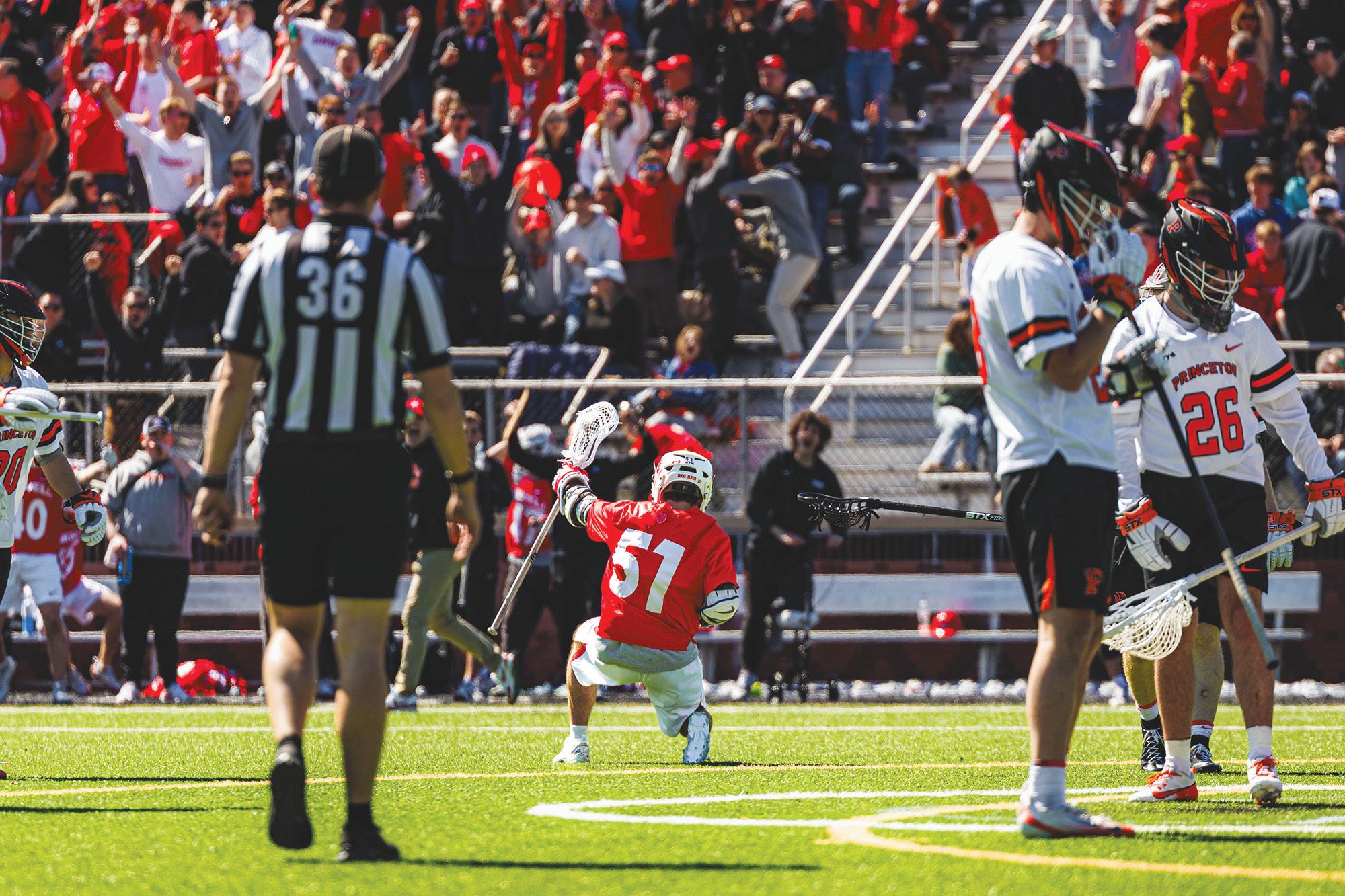
bring the score to 5-4 after the first quarter.
Junior attackman Ryan Goldstein scored to open the second quarter on one of his patented dodges from behind the cage. Senior midfielder Griffin McGovern followed it up with his second collegiate goal.
Junior attackman Willem Firth then scored one of the goals of the season for Cornell, coming around the net with his defender right on him, shoulder faking the lefty shot and flicking the ball past the Princeton goalkeeper
with a behind the back shot. Princeton rattled off two more to stay in the game. Princeton appeared to have the last shot of the half, but the ball ended up in Tully’s stick with eight seconds left. Somehow, the ball went from Tully, to senior long stick midfielder Walker Schwartz, to Goldstein in time for a tough angle buzzer beater, sending the Red into the break up 9-6.
But again, as Cornell appeared to be pulling away, Princeton mounted another batch of two goals to come within one.
Senior midfielder Brian Luzzi squeezed a goal through on a solo dodge, followed by the Princeton defense getting carried away following Goldstein’s dodge, leaving sophomore midfielder Luke Robinson alone on the crease for a goal.
Firth scored on a skipping shot, but once more, with Cornell in a good position, the Tigers fired back two goals in the last minute of the quarter to stay in the game.
While the Cornell defense may be disappointed in its late
quarter play, the Red came up with six straight stops on a potent Princeton offense to start the fourth quarter. This left under four minutes on the clock as an unsettled situation after a Tully save found its way to Goldstein, who was left alone with the goalie and scored to increase the Cornell lead to three.
Princeton won the ensuing faceoff, but Tully came up with another save, allowing the Red to take 90 seconds off the clock. Princeton continued to battle, scoring with 1:14 to go and winning the next faceoff to stay alive. A strong stand from the Cornell defense prevented Princeton from getting a shot on goal, concluding the game with a 13-11 Cornell victory.
The Cornell offense was balanced but, as usual, Firth and Goldstein led the way with five and four points, respectively. Senior attackman Matt Perfetto continues to stack solid performances, as he posted three points on the day.
The Cornell defense was fantastic, forcing mostly outside shots from Princeton. Tully had a great game, saving 15 of 26 shots on goal for a 58% save percentage.
To continue reading this article, please visit www.cornellsun.com.
William D. Cawley can be reached at wcawley@cornellsun.com.
No. 8 Men’s Hockey Stunned by Princeton in ECAC Semifinals
By JANE McNALLY Sun Hockey Beat Editor
LAKE PLACID, N.Y. — Junior forward Ryan Walsh had his face buried in his glove.
Freshman defenseman Xavier Veilleux bent over, chest heaving, unable to catch his breath.
Freshman goaltender Alexis Cournoyer watched it all transpire from the bench.
When the final buzzer sounded in Lake Placid, New York, a place that has seen so much recent Cornell success, an unfamiliar result soured the Red’s spirits, a deafening silence besides the piercing screams of Tiger skaters and fans.
Princeton 3, Cornell 2.
“At no point do we feel we found our game in that 60 minutes,” said head coach Casey Jones ’90.
The fourth-seeded Tigers upset third-seeded Cornell, 3-2, in the ECAC tournament semifinal game, advancing to the championship for the first time in eight years and spoiling the Red’s three-peat bid.
The score was close — a one-goal victory for Princeton, which has performed well down the stretch to punch its ticket to the title game. But that loss, no matter how narrow, is not something Cornell will have an easy time stomaching.
“We had an underdog mentality all year with our youth, and in the last couple [games], I don’t know if we lost that,” Jones said. “All of a sudden, we read about ourselves and have that impression of ourselves that we’re really good now. I think tonight will tell them that in college hockey, you can lose any game, any night.”
Princeton (17-12-3), led by longtime Cornell associate coach, Ben Syer, played a suffocating game. Tiger skaters crashed the net, forechecked
hard, sent pucks north down the ice and beat Cornell (22-10-1) skaters to them every time.
In essence, the Tigers beat Cornell at its own game.
“The problem is, we never had sustained offensive zone time,” Jones said. “They did a good job, but we weren’t connected tonight. We didn’t have three guys near pucks. If one guy was going hard, two guys were watching.”
The third period — one where Cornell was searching for a go-ahead goal — was a microcosm of Princeton’s prowess for getting to the hard areas and doing the dirty work. It was evident in Joshua Karnish’s game-winning goal, a tap-in just atop Cournoyer’s crease, a blatant error in the Red’s defending.
The Tigers crashed the net and soaked up offensive zone time — something Cornell struggled to do all night.
“We did not defend well on the third goal — we got beat up the ice on the second goal,” Jones said. “We talk about being a really good transitional team. Well, part of being a good transitional team is going from offense to defense, and we were poor at that today.”
At the time of Karnish’s go-ahead goal in the third, Cornell was lucky to be in that position — a tied game — considering how much it struggled to match up with Princeton’s desire.
And that’s what it boiled down to — desire.
“They just seemed to want it more than us tonight. It was pretty apparent,” Jones said.
Cornell struck first way back in the first period when junior defenseman George Fegaras’ wrist shot snuck through the five hole of Princeton netminder Arthur Smith just 2:32 into the game. The Red narrowly led in shots on goal after 20 minutes, 8-6, but a late Princeton
power play in the dying moments of the first period gave the Tigers a much-needed momentum swing.
That momentum carried over into the second period — Princeton did not convert on the power play, but continued to hem Cornell deep in its defensive zone. The Tigers’ pressure culminated in David Jacobs’ game-tying tally — a beautiful deflection off of a point shot that beat Cournoyer just 2:35 into the frame.
The Red was scrambling after that — before the halfway mark of the second frame, Princeton was out-attempting Cornell 10-1 and controlling the faceoff dot, winning 10 draws to Cornell’s two.
It was one of those Tiger faceoff wins that allowed Princeton to take its first lead of the game — after a neutral zone win, the Tigers went full force up the ice and into the Cornell D-zone, and Julian Facchinelli picked a corner over Cournoyer’s right shoulder to make it 2-1 at 13:28 of the period.
Cornell ultimately found some life late in the period, after a Princeton boarding penalty with 4:05 to go yielded a brilliant Cornell power play, culminating in a Walsh goal that tied the game at two. The passing exhibited along the perimeter and the puck batted in by Cornell’s captain was exemplary, and something to take into the third period.
“They’re fighting for their lives,” Jones said. “They’re trying to extend [their season]. They get a little mojo, they get home ice for the playoffs — they’re a really good home team — and all of a sudden you could sense it.”
The Red did fight — but the Tigers fought harder. The third period was a blood bath, neither team wanting to give up much, with one
mistake likely to prove costly in the end.
Queue Karnish — after Veilleux lost his man and couldn’t box Karnish out of the crease, Princeton’s junior forward beat Cournoyer with 7:55 to play.
The dagger.
“I don’t know if we weren’t expecting it, or if we thought it was gonna be an easy game or what,” Walsh said. “I take a big part of that responsibility. It’s my job to get the guys ready and balance that as a leader.”
Cournoyer was pulled with 1:34 to go, and Cornell assembled some of its best zone time yet, but the Tigers saved the best for last.
In all, Cornell attempted five shots with the extra skater. Three were blocked, two went wide and none made it to Princeton’s netminder. The Tigers swarmed him anyway when time ran out.
“[Princeton is] a really well-coached team, and they’re selling out, blocking shots,” Walsh said. “We had a goal of getting 35 shots going into the game, and we got nowhere close to it.”
Though Princeton solidified its position in Saturday’s ECAC championship game against Dartmouth, it did not end Cornell’s season. The Red’s regular season success secured it an at-large bid to the NCAA Tournament, meaning Cornell has more hockey left to play.
The Red’s next opponent and regional location remain to be seen — both will be decided after the NCAA Tournament selection show at 3 p.m. Sunday.
To continue reading this article, please visit www.cornellsun.com.
Jane McNally can be reached at jmcnally@ cornellsun.com.
TIMMY XI / SUN STAFF PHOTOGRAPHER
The Red Deliver | Willem Firth ’27 celebrates a behind-the-back goal against Princeton.
PLAYOFF PREVIEW:
MEN’S HOCKEY TO FACE DENVER IN NCAA REGIONAL SEMIFINAL
There are 63 Division I men’s hockey teams. Each year, only 16 make the NCAA Tournament.
The odds of repeatedly facing an opponent are slim.
But for two teams on opposite sides of the Mississippi, Cornell and Denver sure have seen a whole lot of one another.
“We definitely owe these guys,” said junior forward Jonathan Castagna. “I haven’t forgotten what happened. A lot of guys haven’t forgotten what happened two years ago now.”
Friday’s NCAA Tournament regional semifinal is the latest iteration of a longstanding battle between two college hockey blue bloods. Though the teams clashed regularly between the 1960s and 1980s before taking 30 years to meet again, Friday will mark the third time in four years that Cornell and Denver have clashed in the NCAA Tournament.
How competitive is their history? It speaks for itself — those previous two meetings in 2023 and 2024 delivered a win to each team. The overall series edge belongs to Denver, which boasts eight wins to Cornell’s six.
“It’s not even just when we play Denver,” said senior forward Nick DeSantis. “It’s one game elimination now, so any little mistake you make can cost you. And any little thing you do well can give you that extra jump over the other team.”
For DeSantis, it will be his third time facing Denver in the NCAA Tournament. He remembers how it felt when, in 2023, his squad shut out the Pioneers — then the defending national champions — in the regional semifinal in Manchester, New Hampshire.
But he also remembers the sting of what happened the following year, “to a tee.” DeSantis broke the ice in Springfield, Massachusetts, in the regional final against the Pioneers, but Denver scored twice to down the Red and, eventually, go on to win the national championship.
Castagna remembers it, too. A freshman at the time, he had a prime opportunity to even the score late in a one-goal game, but couldn’t quite get it to go.
“For Jonny, that was as hard a game [as] he’s played in college,” Jones said.
Jones was not a part of those Cornell teams, but he knows a thing or two about exacting revenge. After falling in last year’s regional final to Boston University, a game that ended the 30-year head coaching career of Mike Schafer ’86, he is ready to lead the Red to a stage it has become quite familiar with in recent memory.
But the path to the Frozen Four, something so elusive for Cornell, runs through Colorado. Quite literally.
“Hopefully we can be the David versus Goliath here,” Castagna said.
Denver is the host of the Loveland, Colorado regional, meaning the Pioneers will be playing close to home — just 55 miles stand between the Denver campus and Blue Arena, where Cornell and Denver will take to the ice at 6 p.m. Friday.
It is expected that the Pioneers will have a loyal allegiance of fans, if Denver’s raucous crowd at the NCHC Tournament final is any indication.
“It’s a home game for them,” Jones said. “You want to be in that kind of environment. We’re looking forward to it.”
But that environment, no matter how unrelenting, is something Cornell won’t be intimidated by — it can’t be, if the Red wants to reach the regional final for the fourth year in a row, and if it wants to clinch a Frozen Four berth for the first time in 23 years.
“[Being a lower seed] forces you to want to be that villain and the disturber of the bracket, and I think that’s what we do very well, and we do it most years,” Castagna said. “I’d like to think it’s a benefit for us, and it forces you to have that mindset that it’s going to take a hell of a lot to get this done.”
After all, Cornell is not just used to being the lower seed — for each of its last three regional semifinal wins, it has been a three-seed or a fourseed — but also to its fans being outnumbered come tournament time. Last year, the Lynah Faithful that made the trip to Toledo, Ohio, for the NCAA Tournament paled in comparison to top-seeded Michigan State’s near-home crowd.
Nevertheless, things ended pretty swimmingly for Cornell.
“I’d like to think we thrive in front of big crowds,” Castagna said. “There’s a different kind of game that happens when you’re playing against
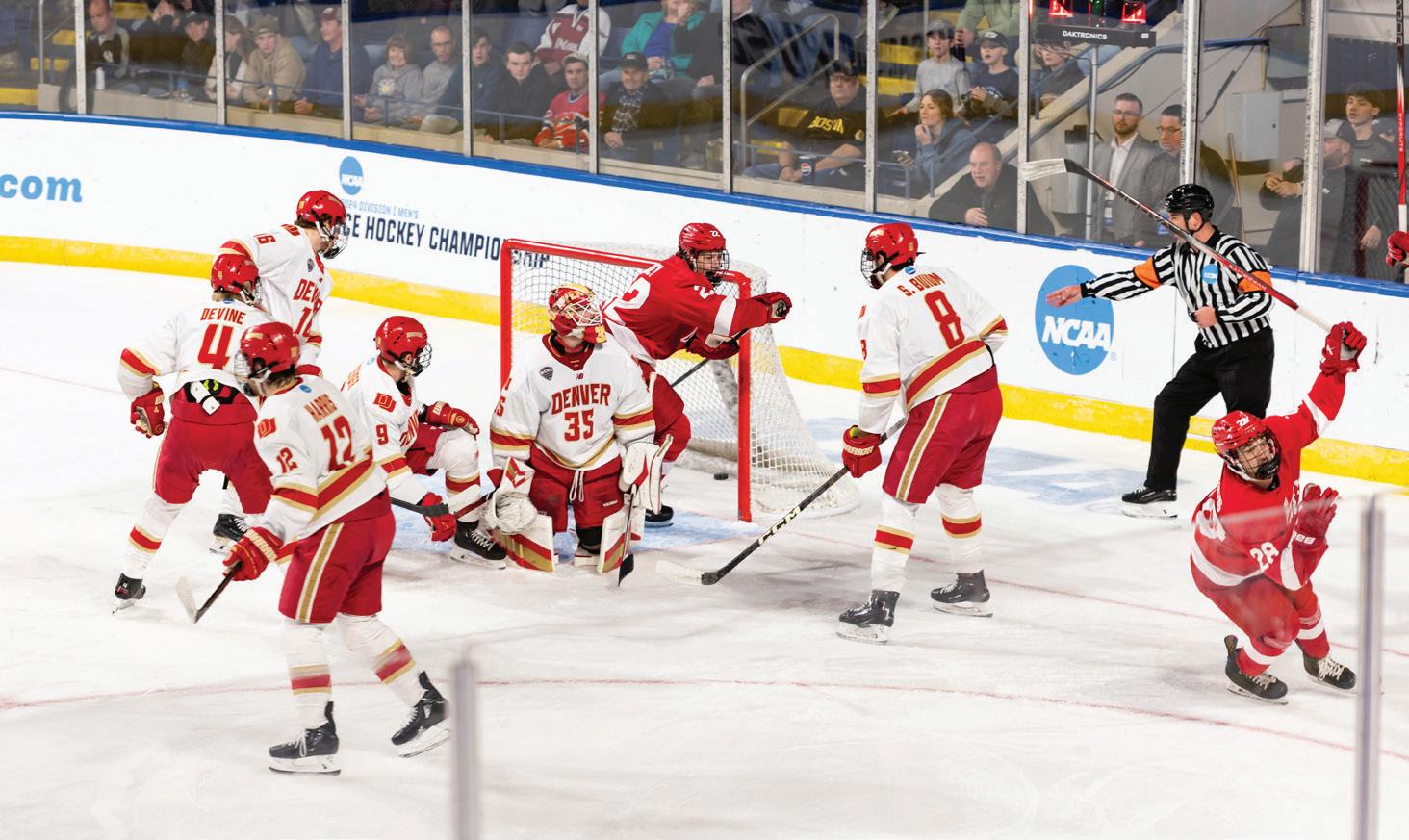
a team in their own arena, and it’s sold out, and everyone’s yelling at you, and it feels like they’re all on top of you and kind of being the villain in that building.”
But take the atmosphere and history out of it, and Denver still poses as tough a match as any team in the NCAA Tournament. The Pioneers — fresh off an NCHC Tournament title — are victors of nine straight games and are unbeaten in their last 13. Over that 13-game stretch, only twice did Denver allow more than three goals in a game.
Denver’s stout defensive play has been in large part due to the play of its freshman netminder, Johnny Hicks. Hicks won the starting job in January and has never lost in his young collegiate career, boasting a near-perfect 12-0-1 record.
“We want to make it murky around the net,” Jones said. “[Hicks] is on an unreal stretch. If he sees it, he’s stopping it right now. So we’re gonna have to make sure he doesn’t see it.”
Hicks was named the Most Outstanding Player of the NCHC Tournament, but the championship game, despite his 41 saves, was perhaps Hicks’ most vulnerable outing. After amassing a 3-0 lead just 13:02 into the championship game, Denver allowed Minnesota-Duluth to climb all the way back, though the Pioneers eventually notched the game-winner in a second overtime period.
More than anything else, that game shows that
Denver is human.
“[From the 2024 loss to Denver], we took away that they’re beatable,” Castagna said. “I thought — and everyone else in that room after that game — thought that we deserved to win that one. So it hurt for sure, and we’re not going to take these guys lightly at all. But it’s reassurance that any night, anyone can beat anyone.”
Upsetting a team is hard under any circumstances. Add in a hostile crowd, a streaking hot goaltender, one of the nation’s best defensemen in Eric Pohlkamp and a longstanding team championship pedigree, and it gets that much harder. But Cornell is careful not to blow up the proportions. Denver is as good as anyone in the NCAA Tournament, and the Red has an utmost respect for it.
But Cornell has been here before — it carries a quiet confidence that it can do it again.
“The pressure’s on them,” Jones said. “They’ve been one of the best teams all year. There’s a little bit of pressure on them. … They’re good team, [but] so are we, you know? We understand the urgency that’s there, and now your season’s on the line, yeah? Now there’s some urgency.”
“You don’t want to be too confident. You don’t want to be under confident,” Castagna said. “It’s better to just appreciate the situation that you’re in and the chance that you have, and use that as the confidence, instead of relying on ego or any sort of boost in self confidence.”
By the Numbers: How Cornell and Denver Compare
NCHC).
Power play percentage: Cornell 24.0% (13th) Denver 19.5% (32nd).
The stage is set, and No. 11 men’s hockey will play No. 5 Denver in a rematch of the 2024 NCAA regional final at 6 p.m. on Friday. Denver will host the regional at Blue Arena in Loveland, Colorado, home of the American Hockey League’s Colorado Eagles.
Here’s how the two teams fare. All statistics are courtesy of College Hockey News unless otherwise stated.
The Numbers
Records: Cornell (22-10-1, 15-71 ECAC) Denver (25-11-3, 17-6-1


Penalty kill percentage: Cornell 81.4% (25th) Denver 82.1%(19th).
Faceoff win percentage: Cornell 54.8% (3rd) Denver 50.8% (24th).
Goals scored per game on average: Cornell 3.3 (14th) Denver 3.5 (10th).
Goals against per game on average: Cornell 1.9 (1st) Denver 2.2 (6th).
Shots per game: Cornell 29.4 (32nd) Denver 34.1 (6th).
Penalty minutes per game: Cornell 8.9 (42nd) Denver 9.0 (41st).
Series History
Cornell and Denver don’t often meet, but when they do, a tournament run is usually on the line. The Pioneers hold the series advantage, 8-6, since the first meeting in 1965.
The last two games have been played on neutral ice in the NCAA regionals, with Denver taking the most recent matchup, 2-1, in the 2024 Springfield regional final, avenging its 2-0 loss in the Manchester Regional a season earlier. Denver would go on to win the NCAA Tournament in 2024. Four of the last five meetings between the Red and the Pioneers have been decided by two goals or fewer, but despite the recent tight games, no matchup between the Pioneers and the Red has ever gone
to overtime.
Cornell’s Last Time Out
Cornell was upset, 3-2, by Princeton in the ECAC semifinals in Lake Placid last Friday, outworked and outbattled by a team playing with its season on the line. Cornell went 1-for-4 on the man advantage and was largely stymied by Princeton goaltender Arthur Smith. Despite some room for improvement in other areas, the Red continued its successful penalty killing, going a perfect 3-for-3.
The loss also prevented a rare Whitelaw Cup three-peat, with Ivy League rival Dartmouth eventually winning the title for the first time in program history. The semifinal game provided a lot of film for head coach Casey Jones ’90 and the rest of the coaching staff and served as a wake-up call before the NCAA Tournament.
Denver’s Last Time Out
Denver enters Thursday on a nine-game winning streak, most recently winning the NCHC Frozen Faceoff and hoisting the National Cup on home ice. Denver has also gone to overtime in each of its last two games — the Pioneers defeated No. 4 Western Michigan in the semifinals before downing No. 8 Minnesota Duluth, 4-3, in double overtime to claim the title. Denver
played particularly strong defense in the NCHC tournament, allowing only six goals across four games — but the Pioneers blew an early 3-0 lead in the championship game before escaping with the win, showcasing some rare permeability.
Still, Denver has been one of the hottest teams entering the NCAA Tournament, emerging from a rough first half to a strong finish.
Scouting the Pioneers
Denver head coach David Carle has often criticized the regional format of the NCAA Tournament. This year, his group gets a home regional. That proximity should benefit the Pioneers, who are undefeated in their last 10 home games. Carle has been one of the best young coaches in the nation, guiding Denver to two national championships since his arrival in 2018, revitalizing the Pioneers and turning them into a perennial title threat. Despite rumors of an NHL departure, he has chosen to stay at his alma mater.
Junior defenseman Eric Pohlkamp is the Pioneers’ star. The San Jose Sharks’ draft pick has helped to fill the role Zeev Buium played last season. While Pohlkamp stands at just 5 feet, 11 inches (small for a defenseman), he is one of the best two-way players in the nation. He leads the Pioneers with 17 goals and 37 points
and was announced as a top-ten finalist for the Hobey Baker Award. Forwards and NHL draft picks Rieger Lorenz (Minnesota) and Sam Harris (Montreal) have provided additional offense all season long, each contributing over 30 points each. Denver is chock-full of NCAA Tournament experience, with 14 returning players from last year’s tournament run, which ended in overtime of the national semifinal. The Denver offense is overwhelming, ranking sixth nationally in both shots and goals per game.
Holding down the fort between the pipes is, similar to the Red, a freshman Canadian Hockey League product. Despite an early battle to determine the starting goaltender, Johnny Hicks has emerged as one of the hottest goaltenders entering the tournament. Hicks has only allowed over two goals in a game once — albeit in the biggest game of the season thus far, the NCHC final. His .958 save percentage and 1.14 goals against average are the best in the country for a goaltender who has played more than 10 games. While Hicks has no NCAA Tournament experience, he has backstopped playoff runs in the British Columbia Hockey League and Western Hockey League, posting over a .920 save percentage in both leagues.
JANE McNALLY Hockey Beat Editor Cornell Denver
Friday, 6:00 p.m. EST Loveland, CO
Men’s Hockey vs.
LEILANI BURKE / SUN FILE PHOTO
Tyler Goldberg Hockey Beat Reporter
XAVIER VEILLEUX IS A ‘PERFECT FIT’ AT CORNELL
FRESHMAN BLUELINER IS SHATTERING RECORDS IN HIS DEBUT SEASON

uation, had all his doubts melt away once he spoke with Jones. There was a kinship he felt with a fellow Québécois.
In college hockey, things don’t just fall into laps very often. Head coach Casey Jones ’90, a seasoned recruiter of more than 30 years, knows that good and well.
So when NHL sixth-round draft pick Xavier Veilleux, a United States Hockey League sensation, was suddenly on the market, Jones knew he had a job to do.
“I was like a dog on a bone on that one,” Jones said, laughing now. “There were some sleepless nights there trying to finish that off and get that closed there for our staff.”
But at the time, it wasn’t a laughing matter.
Veilleux, a native of Ancienne-Lorette, Quebec, had always been on NHL radars. Before he jumped to the USHL, he dominated his Under-18 AAA team, going point-per-game as a blueliner.
There was a reason why he was drafted 179th overall by the New York Islanders in 2024. There was a reason why he was going to play college hockey in the Ivy League.
But not for Cornell — initially.
Though Veilleux, a vibrant two-way defenseman with a championship pedigree, has now found his place at Cornell, he was initially committed to a school way out east, one that, when it visits Ithaca, Cornellians buy fish to leave on the Lynah Rink ice.
Veilleux was initially a Harvard commit, having pledged his allegiance to the school back in 2022.
“It just didn’t work out there,” Veilleux said.
The world of collegiate athletics is ever-changing — now more than ever, schools can use money and Name, Image & Likeness deals to lure blue-chip recruits to their programs. It’s seen everywhere, including within college hockey. The Big 10 is the main culprit — namely Penn State.
It’s not to say that’s what happened with Veilleux — he was committed to a fellow ECAC program, an Ivy League school, and it didn’t end up coming to fruition. For Veilleux, years of planning had culminated in an unfortunate situation, all while gunning for a playoff berth with the Muskegon Lumberjacks during the 2024-2025 season.
Enter Cornell.
“I can ‘[comment] allex-vous,’” Jones, a French speaker, quipped. In English: “How are you?”
Jones can recruit — his prowess is dotted all over Cornell’s freshman class of 12 and two sturdy transfer defensemen. And when Jones, from Témiscaming, Quebec, caught wind of Veilleux searching for a new program to call home, he swooped in with his FrenchCanadian finesse.
“[Associate coach Sean Flanagan] and I kind of tagteamed that one pretty good,” Jones said. “We came out of every different direction. Once he was on the market, it was like, ‘Hey, we need this guy.’” Veilleux, finding himself in an unprecedented sit-
“It just felt like there was a different connection because of the place we both came from,” Veilleux said.
Because Quebec is a unique place, where hockey is woven into the fabric of who its residents are. It is a place where pond hockey is customary come the fall of wintertime and where skates are tied on as soon as you can stand.
“Everywhere you go, there’s outdoor rinks. During winter, it was my favorite thing to do growing up there,” Veilleux said. “My dad built one in our backyard.”
“We came out of every different direction. Once he was on the market, it was like, ‘Hey, we need this guy.’”
Head coach Casey Jones ’90
That’s how Veilleux’s hockey background was kick-started — his father, Hugo Veilleux, spent four seasons playing in Quebec Maritimes Junior Hockey League before playing professionally in France. Veilleux was strongly influenced by his dad, though he wound up choosing defense rather than offense, like his father.
“But I play a two-way game,” Veilleux said. “I think I’m pretty responsible defensively, but I can definitely bring something to the table offensively, too.”
That he can — Veilleux has shattered records as a freshman defenseman. With 20 assists and counting, Veilleux has the most assists (and most points, with 26) as a freshman blueliner in program history. If Veilleux scores once more, he’ll tie the record for most goals by a first-year D-man in Cornell’s history (seven).
Veilleux is also currently tied for first in the nation in scoring among first-year defensemen with Penn State’s Jackson Smith, a first-round NHL draft pick, in one less game. No freshman blueliner has more assists than him.
Since being paired with junior defenseman Hoyt Stanley on Cornell’s top defensive pair, Veilleux has taken the job and run with it. Amid a season that many entered with questions about how the Red’s defense would fare, Veilleux has been a shining light.
“Four of [our] D playing regularly last year were gone. We only returned two,” Jones said. “So we had three new guys playing in a lot of situations for us, and him being a freshman, being young — that has been impressive. And we’re reaping the benefits of that right now.”
Veilleux’s flourishing has surprised some — but not necessarily the coaching staff.
“We kind of knew,” Jones said with a knowing smile — pride, probably, from luring such a coveted recruit to his program. “He played a main role on a USHL
championship team, and was [a] pretty critical component of that team. That usually translates pretty well.”
Veilleux was an alternate captain on Muskegon’s USHL championship-winning team in 2024-2025, notching 41 points in 61 games (and eight points in 14 playoff matches) to secure the Lumberjacks’ first-ever Clark Cup.
Veilleux’s defensive responsibility was something Jones expected to translate well to the collegiate level. The 200-foot game needed to win in the USHL is quite similar to what’s needed in college.
But those offensive numbers?
“He’s taken full advantage of the opportunity,” Jones said. “And that’s where [he’s] maybe exceeding a little bit on the expectations there.”
Year after year, Veilleux’s assist totals have skyrocketed. 33 last season, 29 the year before, 26 the year before that. His vision on the breakout is unlike many other defensemen in college, let alone first-years.
“I think my IQ is probably my biggest strength,” Veilleux said. “I think I can break out the puck pretty well, and my gaps overall are pretty good as a D-man, something I’ve worked on for the past couple of years.”
Veilleux can deliver on the ice. He and Stanley are matched up against the top offensive players in the nation, which will only continue when Cornell takes on Denver — an offensive powerhouse ranking top 10 nationally in goals per game with 3.5 — in the NCAA Tournament.
But, according to Jones, it’s Veilleux’s attitude off the ice that takes precedence over all the records he is setting.
“I think what separates him a little bit is his compete level at practice is really at a high level,” Jones said. “I think that’s what’s going to be consistent. He just came in with the right mindset, and he competes on a daily basis. He’s good from Monday [through] Thursday, which sets him up to have success on the weekends.”
After all, Veilleux knows what it takes to be a champion. So he’s not so much focused on his numbers, but rather on how he can put his best foot forward to reach the pinnacle of hockey wherever he goes.
“We had this team [in Muskegon] where it felt like no one was an all-star or anything,” Veilleux said. “Even though we didn’t have the best team in the league, I think that just the team chemistry got us to winning the Cup. … We went into the playoffs [and] just had this underdog mentality.
“That’s kind of the same vibe I had coming in [to Cornell, to be honest. It’s such a great culture here. It’s so fun. And it kind of feels exactly like how it was last year.”
For everyone, it seems to be a pretty perfect fit.
“We want that student who wants an education, but [also] who is going to push hard to be a pro and fit our culture with their work ethic,” Jones said. “There’s nothing missing there. From a character standpoint and from fitting in and who we want to be as a team, he fits in perfectly.”
JANE McNALLY Hockey Beat Editor
BEN KERSTETTER / CORNELL MEN’S HOCKEY