Climate Justice Cornell hands petition to trustees
By ANYI CHENG Sun Assistant News Editor
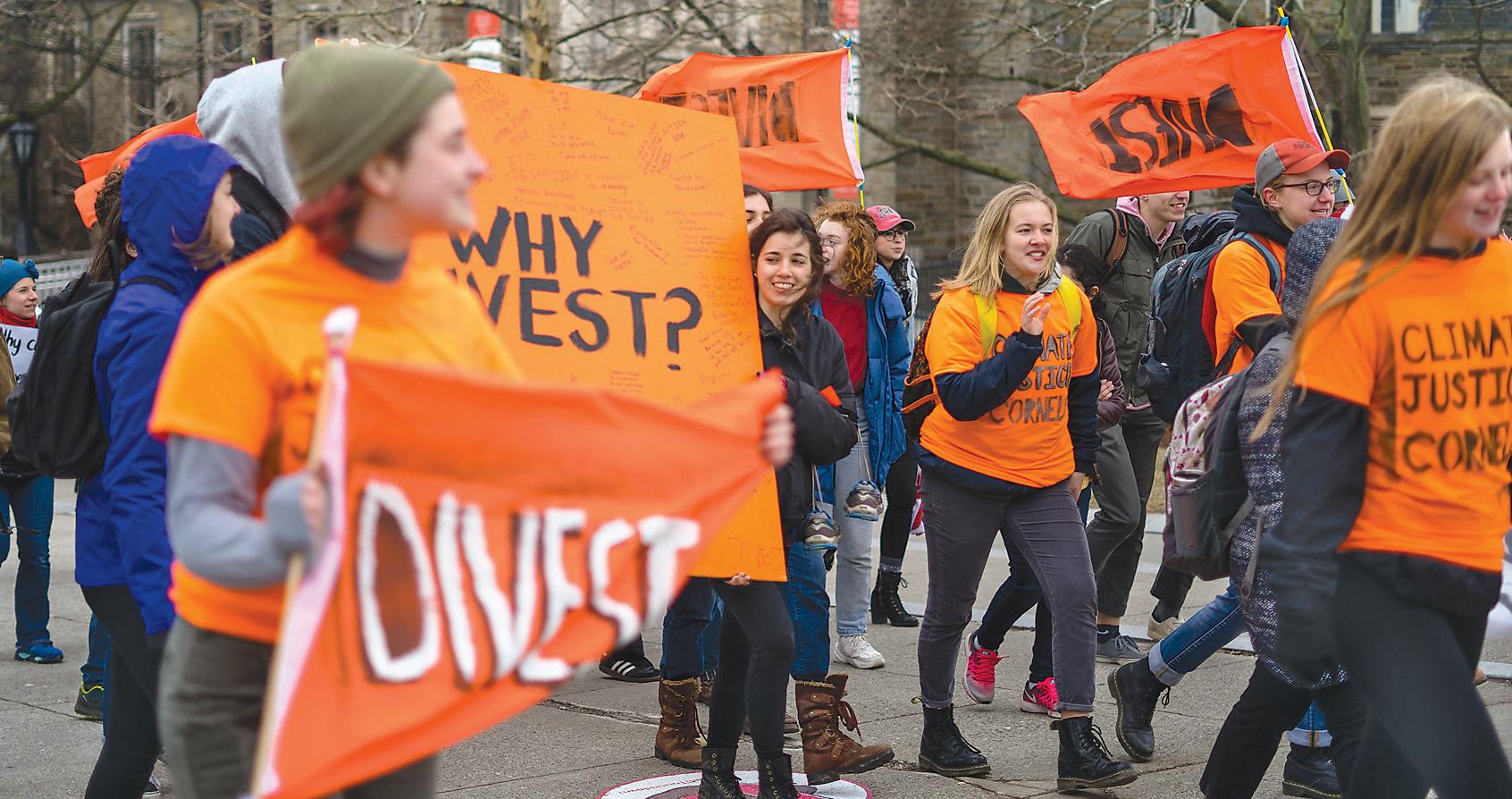
Despite chilling winds and drizzling rain, dozens of students clad in orange gathered on Ho Plaza Friday afternoon to rally for the University’s divestment from fossil fuel.
“We will not rest ‘till you divest,” they chanted, waving signs and cheering. “Hey, ho, fossil fuels have got to go!”
environmental, financial and ethical reasons has been an increasingly prominent issue at universities across the country, according to rally leader Nadia Vitek ’22.
“The endowment comes from our tuition,” Graham told The Sun. “Our money is going towards an industry that is causing climate change. There are so many negative impacts.”
“Cornell’s sacred mission, the pursuit of truth, is in contradiction with the fossil fuel companies.”
Prof. Caroline Levine
The rally was organized and led by Climate Justice Cornell with two major goals in mind: raising awareness on campus about fossil fuel divestment and attracting attention from the Board of Trustees — who met on Friday afternoon during the rally — according to Cassidy Graham ’22, CJC community retention chair.
Divesting from fossil fuels entails the removal of investments from corporations in the fossil fuel industry and instead choosing other sectors to invest in. The movement to divest from fossil fuels for
The rally kicked off with students congregating at noon outside Willard Straight Hall. They donned bright orange clothing, chanted rally cries and urged passerby students to sign a divestment petition that CJC addressed to the Board of Trustees.
“I get my trustees and other administrators don’t want to rock the boat. I’m with them in trying to preserve this amazing university,” said Prof. Caroline Levine, English, in a speech addressing the rally.
“Cornell demands that everyone one of us conducts that pursuit of truth with integrity,” Levine said. “The fossil fuel industry did the exact opposite. The fossil fuel industry deliberately sowed a campaign of lies.”
According to Levine, fossil fuel corporations have researched and known about
‘Islamophobic’ Remarks Spark Tension During S.A. Meeting
Tensions over the Boycott, Divest and Sanction movement came to a head at the Student Assembly meeting on Thursday, after a community member who identified herself as a Jewish Cornell student made comments towards Omar Din ’19, College of Human Ecology representative and one of the proponents of the BDS resolution, that he described as “Islamophobic.”
During the open microphone session, Sydney Eisenberg ’21 questioned Din, a leader of Students for Justice in Palestine, on his cultural background and his involvement in minority organizations, said Mahfuza Shovik ’19, S.A. representative for the College of Engineering.
Eisenberg then implied that Din was active in both the Palestinian and Arab communities, said Shovik. When Din responded that he was neither Palestinian nor Arab, but was involved with the Muslim Education and Cultural Association, Eisenberg said she was “uncomfortable” with his presence on S.A., said attendee Jaqueline Hutchinson ’19, a supporter of Students for Justice in Palestine who was present at the meeting.
Eisenberg then suggested that Din had a “conflict of interest,” said Mackenzie
Smith ’21, S.A. representative for the College of Arts and Sciences. According to Hutchinson, Din objected to the characterization before the open microphone session was closed. Soon after, Eisenberg left the room.
The meeting then continued as scheduled, addressing other items on the agenda. At the end of the S.A. meeting, Din publicly decried Eisenberg’s comments as “Islamophobic rhetoric.”
“[The comments] make me feel most
“They may have come out of place of ignorance, but they were inappropriate regardless.”
Dale Barbaria ’19
unwelcome here in the Assembly and in the community and I really, truly hope that when this debate continues, it’s done with a level of civility and with a level of openness and welcomeness for everyone,” Din said emphatically.
President of Cornell Hillel Jillian Shapiro ’20 then approached the microphone. She apologized repeatedly, saying
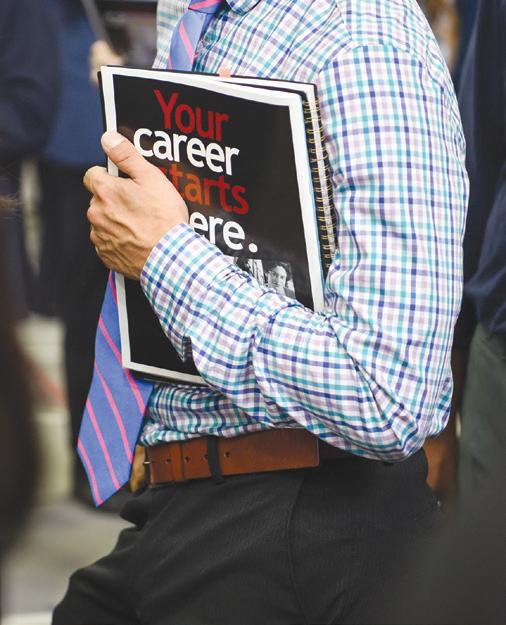
International Students Face Additional Hurdles in Job Searches
By VALE LEWIS Sun Staff Writer
With droves of students scoring internships and jobs for the summer, many international students have not reported the same amount of luck. While they may have equally competitive resumes and transcripts as domestic students, the lack of guidance on how to secure work visa
sponsorships from employers has been one of the major obstacles for their job search.
To acquire the H1-B visa, which allows foreigners to work full-time in the United States after graduation, international students need to find employers that are willing to give out sponsorships.
“[Sponsorship] is basically the company telling
the U.S. government ... ‘He is effectively the best-suited candidate for the job, and there's no American student that would be better suited than him,” Aditya Narayanan ’21 told The Sun.
However, finding companies that are willing to provide sponsorship at career fairs is a difficult process, according to Narayanan, an Indian cit-
izen.
“Every single small or medium-sized company I’ve talked to in any of the career fairs at Cornell, none of them are willing to sponsor me,” Narayanan said. “I’m not sure why Cornell doesn’t find those sort of companies to come down as well because that’s a really big issue.”
Many students have expressed frustration with
the fact that it is not always clear at career fairs which companies are willing to sponsor international students, according to AbdulRahman Al-Mana ’20, who’s from Qatar.
“You only have such a limited amount of time at these things. And so you’re ultimately wasting your time — time that you can
Climate justice | Students gather on Ho Plaza to call for the University’s divestment from fossil fuel in a rally organized by Climate Justice Cornell.
HARRY DANG / SUN STAFF PHOTOGRAPHER
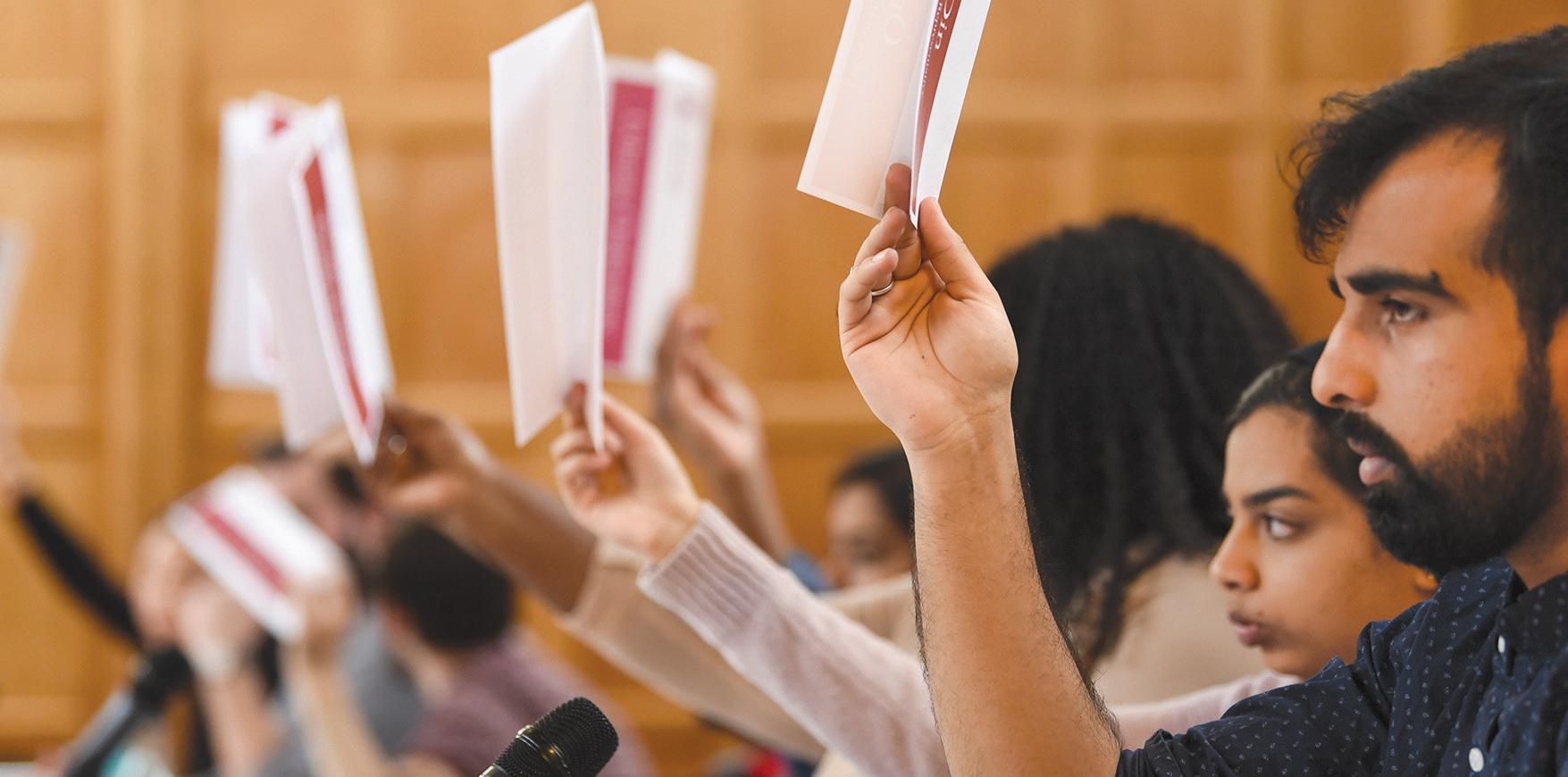
Student Assembly | A student questioned Omar Din ’22, shown at the right, a member of Students for Justice in Palestine, on his cultural background and his involvement in minority organizations, attendees say.
BORIS TSANG / SUN PHOTOGRAPHY EDITOR
By NICOLE ZHU and SEAN O'CONNELL Sun Assistant News Editor and Sun Staff Writer
Is Queerness a White Invention? 6 p.m., Milstein Hall Auditorium
Thomistic Institute Lecture: The Error of Beginnings And the Beginning of Errors 6:30 p.m., 120 Physical Sciences Building
Tomorrow
Fake News, Alternative Facts and Misinformation: Leaning to Critically Evaluate Media Sources 3:30 - 4:30 p.m., B05 Uris Library
JP Morgan Asset and Wealth Diversity Info Session 4:30 - 6 p.m., 401 Warren Hall
Dispacing Caravaggio: A Take on the Humanitarian Visual Culture Today 5 p.m., KG42 Klarman Hall
Olin and Uris Libraries Design Research Workshop 5 - 6 p.m., 106 Olin Library
A Tale of Two Peoples: Phoenicians and Jews in the Land Beyond the River 6 p.m., Kaufmann Auditorium, Goldwin Smith Hall
Free Study Skills Peer Tutoring 7 p.m., Tatkon Center
John Haines-Eitzen Trio: C.U. Music 8 p.m., Barnes Hall Auditorium
Free Meditation and Tea 8:30 p.m., G27 Becker House
COURTESY OF CORNELL UNIVERSITY
Queerness across cultures | On Monday, writer Sarah Ngu will give a lecture that provides a history of cultures the world accepting LGBT identities.
COURTESY OF CORNELL UNIVERSITY
Finding truth | Uris library will host a workshop on Tuesday which will try to help students decipher between news that is “fake” and news that can be trusted.
Student Inspires Others By Sharing Cancer Story Online
By KATHERINE HEANEY Sun Staff Writer
Marlee Pincus’s ’22 entire world changed after being diagnosed with cancer during her first semester at Cornell. But instead of isolating herself in a hospital room, Pincus decided she will help others with similar conditions through sharing her experiences online and raising money for cancer research.
Shortly after school started in October, a bad cough circulated through Pincus’ dormitory in what seemed to be a normal college sickness. However, as Pincus’ friends recovered, her own symptoms worsened.
“My mom noticed I was extremely pale and decided to take me to urgent care,” Pincus told The Sun. “They drew blood and then received a critical values call from the lab.”
That’s when Pincus received her life-changing diagnosis: T-cell acute lymphoblastic, an aggressive form of leukemia in which too many immature white blood cells are found in the bone marrow and blood.
“Hearing you have cancer is one of the scariest feelings,” Pincus said. “Your first thought is, ‘Am I going to die?’”
Although the cancer is treatable, it will require her to undergo intense chemotherapy for two and a half years. Pincus said that because her future was unknown, she learned to be mindful of her current situation, to accept things as they come and to maintain a positive attitude.
“Here I was, not even 18 yet, always had been healthy, and thriving at college,” Pincus said. “Now that was all taken away, it’s hard to describe the feeling. But when faced with a life-threatening situation, an inner strength comes over you.”
“I describe it best as a fire ignited within you,” she said.
“Although I never thought I would be here, I am willing to take this opportunity to selfexplore and gain a new perspective on life.”
Marlee Pincus ’22
This “shift in mindset” motivated Pincus to blog for the Leukemia and Lymphoma Society an organization that funds blood cancer research and provides patient care and access to treatment. Through this platform, Pincus got to share her stories and hopes that it will inspire others going through similar experiences.
When Pincus’s family and friends asked her what she wanted for her 18th birthday, she felt that “besides health, there was nothing [she] needed.” Instead of gifts, Pincus elected to create a Facebook fundraiser for LLS.
“In the Jewish religion, the number 18 is called ‘chai’ and it means ‘life.’ Since I was turning 18, I decided to ask for donations in multiples of 18,” Pincus said.
Pincus’s goal was to raise $1,800 in 18 days. Instead, she raised over $18,000 dollars in 18 days. When Pincus ended the fundraiser, the donations totaled over $20,000.
Pincus believes that her Facebook followers were eager to contribute to her fundraiser because “those around you often feel helpless because they can’t do anything to fix the situation” but “channeling energy into donations is an easy way for anyone to help out.”
The fundraiser was not the end for Pincus’s advocacy efforts. She continues to raise awareness by creating a Facebook page called “Marlee Kickin Leuk’s Butt.” On this page, Pincus and her father continue to provide updates on her treatment, current condition and stories about her experience.
“Although I never thought I would be here, I am willing to take this opportunity to self-explore and gain a new perspective on life,” Pincus said. “This is something I can carry with me forever.”
Katherine Heaney can be reached at kheaney@cornellsun.com.
C.U. Ranked 18th for Volunteers by Peace Corps
By CHANTAL RAGUIN Sun Staff Writer
Jumping three positions from last year, Cornell was placed 18th among medium-sized schools in the Peace Corps’ annual ranking of top volunteer-producing colleges and universities.
Cornell’s ranking was a six-way tie with DePaul University, University of Chicago, SUNY Binghamton, Boston College and Elon University. George Washington University ranked first of all medium-sized schools, with 54 undergraduates currently serving.
Cornell currently boasts 19 alumni overseas, who are stationed across the globe from Paraguay to Moldova to China and have partaken in projects ranging from clean water engineering, permaculture and irrigation, and high school education.
Cornell shares a long-standing history with the Peace Corps, establishing a partnership in 1961 with the organization when it was founded by President John F. Kennedy. Since then, more than 1,690 Cornellians have volunteered in the program according to the press release.
Cornell has placed among the top 25 medium-size schools every year from more than a decade, according to a Peace Corps press release.
“We have seen time and again that the colleges and
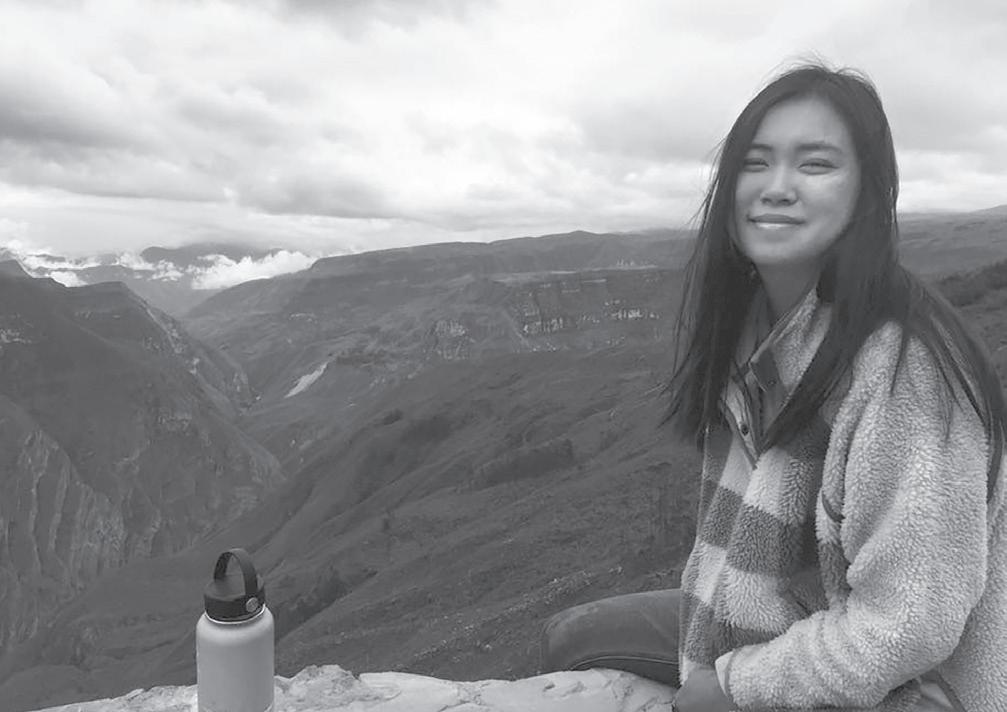
Although Cornell remains among the top volunteer-proGiving back | Lianna Kardeman ’17 is volunteering in Peru as a member of the Peace Corps. She is working on water sanitation.
universities that produce the most Peace Corps volunteers focus on cultivating global citizens in addition to promoting scholarship,” said Peace Corps Director Jody Olsen in the press release.
Alumnus Burns Degree to Emphasize Hard Work
By JEFFREY LI Sun Staff Writer
The real worth of an elite education has always been a mystery. To people like Gordon Caplan ’88, it may be worth a $75,000 bribe. To Ajay Kailas ’13, on the other hand, there is more to life than the name and prestige that comes with a certificate.
To prove his point, Kailas recently uploaded a YouTube video in which he burned his Cornell degree with a flamethrower. In the video, he explained that hard work and enjoying life is much more fulfilling than the prestige of the school you attend. The video quickly gained over 20,000 views and over 500 comments.
Kailas told The Sun that he applied to Cornell because he was impressed by its tra-
ditions, research opportunities and down-toearth environment. He also believed Cornell was the best place for him to pursue both sociology and a pre-med track.
“Yes, it can matter where you go to school but hard work will always win in the end.”
Ajay Kailas ’13
For Kailas, attending Cornell was a privileged experience as it gave him a “self-validation.” During his sophomore year, Kailas earned a 4.11 GPA and was involved in multiple organizations and extracurricular activities.
However, the pressure to keep a high GPA for medical school was tough. During the remainder of his time in Ithaca, Kailas was struggling with what to do at Cornell.
“There was a point I just realized I couldn’t do it anymore. I didn’t want to do it anymore,” Kailas told The Sun.
Tired of maintaining a perfect GPA, Kailas decided from junior year that he would actually enjoy his life and take classes he wanted. He took a lot of interesting classes — like the wine class offered by the School of Hotel Administration — a decision that made his experience “a thousand times better.”
Meanwhile, the prestige associated with Cornell made him gradually feel entitled. Kailas said he would post about Cornell all
PINCUS ’22
Cornellians Awarded for Empowering Women
By WINNY SUN Sun Staff Writer
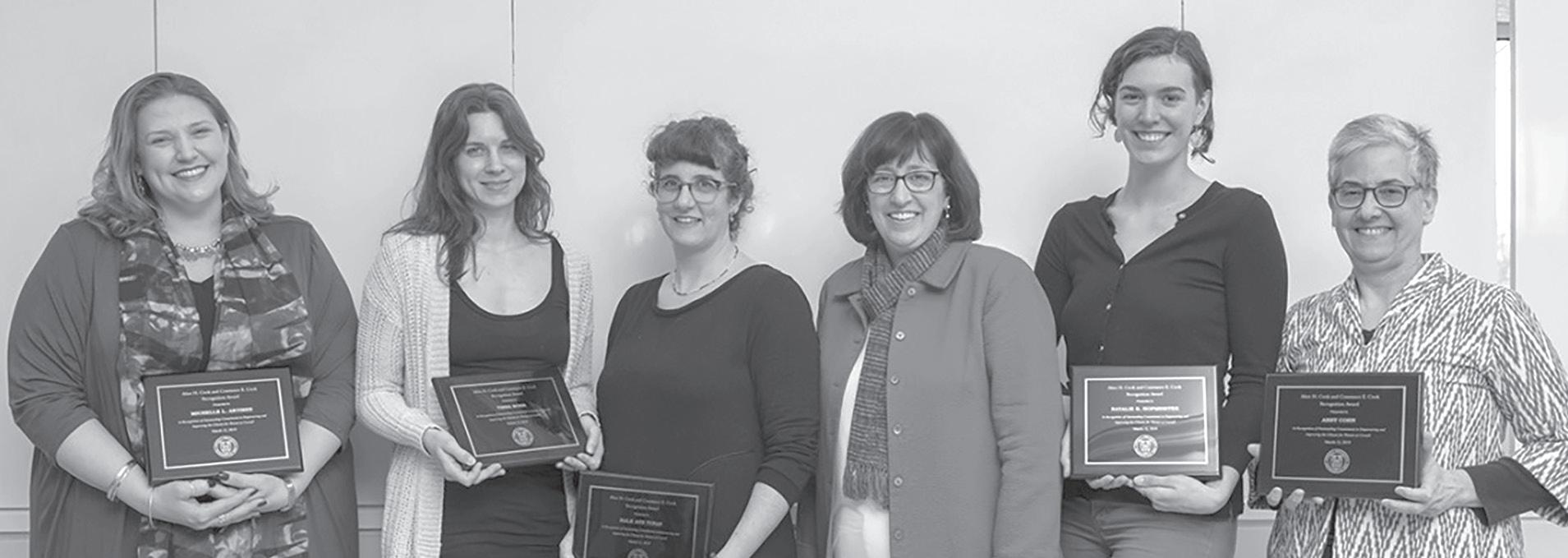
From establishing relationship policies to facilitating Intergroup Dialogue Project, seven Cornell community members were awarded at the 20th Cook Awards on March 12 for their efforts in women’s empowerment on campus.
The biennial award — named after Constance E. Cook, Cornell’s first female vice president and the late Prof. Emerita Alice H. Cook, founding member of Cornell’s Committee on the Status of Women — “honors men and women whose dedication to women’s issues at Cornell significantly exceeds expected job responsibilities,” according to the award’s website.
Among the award recipients is Tisha Bohr, a postdoctoral associate in the Department of Molecular Medicine. She was recognized for helping develop Cornell Policy 6.3, which forbids people in positions of authority from having sexual relationships with students and postgraduates if the relationships could interfere with an individual’s academic or professional interests.
“This frees students to really focus on what students came to Cornell to do — to study, learn, get their degrees,” Bohr told The Sun. “For me, it’s really about giving not only women but all the students academic freedom.”
Natalie Hofmeister grad was recognized for her active involvement with the Intergroup Dialogue Project, a peer-facilitated course that teaches students to commu-
Honoring community | President Martha Pollack spoke at the luncheon on March 12 where seven community members were honored for their efforts to support women at Cornell.
nicate across social differences.
“I want to bring [Intergroup Dialogue Project] to the scientific community, especially my peers in graduate school,” Hofmeister told The Sun. “I felt empowered by it and thought other people that I work with may also want to learn more about how our interactions and conversations shape our behavior.”
Prof. Abigail C. Cohn, linguistics, who serves as the director of the Southeast Asia Program, was also one of the seven women honored at the luncheon. As the co-founder of the College of Arts and Sciences Women Faculty Network, she created a supportive platform for
C.U. Named a Top Volunteer School
VOLUNTEERS
Continued from page 3
ducers, the university’s position has fallen significantly from past years: The university ranked fourth in the country in 2013, with 40 serving in the Peace Corps. But in 2017, the numbers shifted dramatically — with slightly over 11 percent pursuing “other endeavors,” including volunteering.
“Peace Corps has been one of the best decisions of my life, but it too has been no walk in the park,” said Lianna Kardeman ’17, a current Peace Corps volunteer.
Kardeman, who majored in civil engineering at Cornell, now works to improve water sanitation in Peru. She was originally stationed there in 2018.
“For anyone who has experienced
Cornell University [College of] Engineering, you know it is no walk in the park. It takes fierce determination and dedication,” she said. “Cornell gave me the skills and values to persevere through [this] unexpected situation and obstacles and grow and learn through them.”
In addition to its report on colleges and universities, the Peace Corps also placed Ithaca eighth among volunteer-producing metropolitan areas per capita, with 8.9 currently serving volunteers per 100,000 residents.
A complete ranking of the Peace Corps top colleges and an interactive map showing Cornell’s alumni placement can be found through the agency website.
Chantal Raguin can be reached at craguin@cornellsun.com.
women faculty to meet other women professors through events like luncheons.
“When I first joined the South East Asian program, I was the only woman faculty member at that time. I started to realize that for many women faculty, they were isolated in their department,” Cohn said. “We are also providing cross-departmental faculty mentoring because it’s useful to get a perspective outside your department.”
Among the other recipients was Elizabeth Chang
Alum Encourages Students to Enjoy Life and Not Focus on School Prestige
DEGREE
the time on Facebook and he would wear Cornell shirts everywhere. He said his “self-esteem and mental health” depended on attending an elite school.
Ultimately, all these feelings came to a halt. In his senior year, Kailas was told by his counselor that his best chance of attending school would be to take a gap year. He decided to take a research position in the National Institutes of Health. Although he felt anxious about not being able to fulfill his dream, Kaila said he “used that nervousness to work as hard as I could.”
This research experience earned him the opportunity to go to the medical school at
the University of Central Florida. But the experience there was far from what he had at Cornell.
“[The medical school] didn’t have a lot of resources … or research,” Kailas said, “It was tough to adjust to because I always had to tell people what and where [the medical school] was.”
During medical school, Kailas confronted the fact that he went to a lesser known medical school that does not have the same prestige as Ivy League universities.
Continued from page 3 Jefrey Li can be reached at xl288@cornell.edu.
Kailas had to practice the procedures for countless hours and compete with students from other elite colleges to get into the residency in dermatology — one of the hardest fields to get into, he said. But the experience of saving dying patients in the hospital showed him that “being able to save someone was much more important than a thousand degrees.”
“Yes, it can matter where you go to school. But hard work will always win in the end,” Kailas, now an aspiring dermatologist, said in the video, “That’s why I burned my Cornell degree. It was just a physical manifestation of my prior need to prove my self-worth,”
Kailas said the response to his video has been positive and many students have reached out to him with their personal experiences, including many high school seniors who have applied to Cornell and will receive their admissions decision on Thursday.
“A lot of high schoolers waiting for a decision next week said ... it gave them a lot of relief and hope,” Kailas told The Sun.
Looking back, Kailas said that the experience at Cornell taught him how to utilize the resources such as tutoring, counseling and guest speakers — all of which allowed him to maximize his gains even in places with limited resources.
“Utilize all the resources you have. Don’t make the mistake of letting the name or prestige become your identity,” Kailas advised current students. “And be true to yourself.”
Controversial Comments Ofend Students at S.A.
Minority Students Liaison Moriah Adeghe ’21.
that Eisenberg’s comments were “not representative” of anyone on the anti-BDS campaign, including Cornell Hillel or Cornell for Israel.
“It was clearly a miscommunication of some sort, and I know she was sorry about that, personally and institutionally,” said Shapiro.
After the meeting, Shapiro reportedly personally apologized to Din. “I really appreciate the apology. I see that it was coming from an honest place and reflects a lot of the discussions I’ve had with her [Shapiro] in the past and with the previous president of Hillel as well,” said Din.
Smith told The Sun that she did not believe that Eisenberg’s comments came from malice but from a misunderstanding of the assembly.
“What she was getting at, I think, is that she felt like the assembly had a very vocal advocate for BDS and SJP and didn’t have an equal voice representing the other side,” Smith said. “What she failed to understand or consider is that every assembly member is elected and is allowed to hold their own opinions. She was absolutely mistaken and ignorant in the comment she made, but she wasn’t attacking anyone and she wasn’t being racist.”
Eisenberg did not elect to provide comment by press time.
After the proceedings, members of the Student Assembly condemned Eisenberg’s comments.
The comments were “absolutely Islamophobic,” said Barbaria. “They may have come out of place of ignorance, but they were inappropriate regardless.”
Shovik expressed similar sentiments. “As [a] fellow visible Muslim on the S.A., [Eisenberg’s] comments made me feel unsafe, something I never expected to feel while serving on the S.A.”
“I feel like there was a lot of hatred, a lot of hurt feelings … this was really disheartening and frustrating to see,” said
S.A. Representative for the School of Industrial and Labor Relations John Dominguez ’20 called Eisenberg’s comments “deeply problematic” and “unacceptable,” saying the meeting’s proceedings were a “testament” as to why BDS does not belong at Cornell.
“[BDS] is a conversation that does not deserve to be on the Assembly,” said Dominguez. “This is a very sensitive conversation, and things like this might happen, and this kind of shows that [BDS] needs to be pulled.”
On Friday, Cornell Hillel issued a public statement via Facebook addressing the controversy.
“Those comments do not represent Hillel, as we strongly condemn bigotry and racism, including Islamophobia. Cornell Hillel remains committed to working with other communities on campus to create an inclusive campus community.”
Eisenberg’s comments were not the only source of tension at the meeting. S.A. Vice President of Diversity and Inclusion Catherine Huang ’21 described a prior meeting between Huang and Din in which she said Din demanded she conduct an email vote for the BDS resolution to pass through the Diversity and Inclusion committee, which she chairs. The email vote would allow the resolution to pass through to the S.A. floor without debate.
According to Smith, this was the reason why Eisenberg and other Jewish students had attended the S.A. meeting. “A large contingent of Jewish students came to the meeting today to raise concerns about facilitating open dialogue and making sure that both sides were given an opportunity to participate in debate [and] discussion,” she said.
Huang asserted that Din had used “coercive language” to push a vote on the resolution prior to the S.A. meeting, saying that he would be “personally be furious” if the resolution did not pass the committee.
Huang then turned to Din. “Omar, I’m not happy with our conversation. I just want to clarify that I think the way and the language you used felt coercive.” She added that
she felt that the whole situation was “totally inappropriate because no member of the S.A. or any S.A. committee should be voting on something they are not completely informed of.”
Huang commented after the S.A. meeting that she was “really sorry that this is happening. I just wanted to reiterate that I did not promise [Din] anything at this [prior] meeting.”
Din denied these claims in an interview with The Sun. “I did say that I think the communities involved will be angry and furious, but I definitely didn’t say that I personally would do anything to her. That’s just frankly not true.”
Din defended his request for an email vote, citing the impending S.A. elections, which begin March 25, as well as the Jewish Passover in late April.
“I wanted to make sure that voters in this election are informed on how this conversation is moving on and that the conversation is allowed to happen on the Assembly floor,” Din said. “I don’t want [discussions over BDS] to be anywhere near the Jewish holiday because I think that would just make Jewish students very uncomfortable and be very unfair towards them.”
After the meeting, S.A. President Varun Devatha ’19 condemned the proposed email vote.
“I think that pushing this through an email vote was completely inappropriate,” Devatha said. “The idea that you would have [the] committee vote on a resolution without engaging in conversation and debate is pretty inappropriate to me.”
During the meeting, the Student Assembly also passed resolutions 30, 33 and 34, approving amendments to the Student Activities Funding Commission Funding guidelines, establishing Student Health Advisory committee bylaws and approving amendments to the International Students Union constitution, respectively.
Nicole Zhu and Sean O’Connell can be reached at nzhu@cornellsun.com and soconnell@cornellsun.com.
Visa Sponsorship Complicates Intl Students’ Job Search Students Rally for Fossil Fuel Divestment
better off spend networking with other people. It’s very disheartening for a lot of us,” he said.
Leo Kim ’22, a Korean student, also said the sponsorship information listed on Handshake, Cornell’s career network platform, isn’t always accurate. Some companies that advertise as not sponsoring will actually sponsor students, while the opposite situation is also not uncommon, according to Kim.
The International Services team in Cornell’s Office of Global Learning provides support to international students in the visa application process. However, issues with sponsorship are “outside [its] purview,” according to Executive Director Uttiyo Raychaudhuri, who said this is because the office does not work directly with recruiters.
Al-Mana said he believes it would be useful to have an employer catalog, which would be a “list of employers who within the past four years have taken an international student,” similar to the list that the University of Pennsylvania has.
“Something like that would be extremely useful because it could point [international students] towards the right direction of where [they] should be applying,” Al-Mana said.
Kim said he hoped Cornell could provide more information to international students on the issues they may face in the job search, as he feels many students aren’t aware of them before their job searching begins.
“Students themselves don’t even know that they’re going to face a hard time,” Kim said. “They’re going to realize once they start the recruitment process, but I feel like by then it’s too late.”
While there aren’t many resources provided by the University, International Student Union — a student organization — has started to address these issues for their peers. Its advocacy team has submitted a proposal to the administration, including changes to career fairs and Handshake to make employer information more accessible to international students.
“I feel given the pace at which they’re responding, I hope that tangible change that is greater in terms of impact could be achieved very soon,” Kim said.
the effects of extracting fossil fuels on the climate since 1978. However, the corporations “hid the evidence” and “sowed a deliberate campaign of deception” about the negative impacts.
“Cornell’s sacred mission, the pursuit of truth, is in contradiction with the fossil fuel companies,” she said.
Yana Kamylka ’21 urged ralliers to consider the socioeconomic side of clean energy activism, noting that it’s important to bring together labor organizers and climate activists as some families prioritize “putting food on the table” and how experiences differ for working class individuals.
“Ignoring the struggles of workers has allowed big corporations to pit our groups against each other,” Kamylka said. “We have to make sure that as we move towards clean energy, all of our communities are feeling the same benefits,”
According to Hanna Soros ’21,
Cornell should divest for financial benefits — universities who have divested already have experienced better financial returns on their investments overall, she said.
“The fossil fuel industry is not known for its good returns, let’s just say,” Soros said at the rally. “Cornell says that the purpose of their endowment is to maximize returns. By divesting, we could help them maximize those returns.”
The rally cumulated in a march from Ho Plaza to Statler Hotel, where the Board of Trustees were holding their meeting. At 12:45 p.m., Board of Trustees Chairman Robert Harrison ’76 walked out of the building to be greeted by Vitek, who handed him a stack of over 1,000 petition signatures gathered throughout the past week.
Harrison addressed the crowd briefly, expressing gratitude for their activism and said the request for divestment will be taken “very seriously.”
“We created a set of principles by which we would consider any request to divest from anything. And there have
been many different kinds of requests, from private prisons to gun and ammunition manufacturers,” he said. “I know these various requests to consider divestment … have been taken very seriously for as long as I’ve been involved, and we will take this very seriously as well.”
The Board of Trustees voted in January 2016 against fossil fuel divestment. Joanne DeStefano, Cornell’s chief financial officer, said at the time that the University would only divest to a corporation under “extraordinary circumstances” that “violate the University’s most deeply held values.”
Despite hurdles ahead, Vitek remains hopeful about the future of divestment.
“I think that they [Cornell] are going to divest eventually,” she said. “I think most institutions will divest at some point — it’s just a matter of when. I’m optimistic, personally.”
Anyi Cheng can be reached at acheng@cornellsun.com.
Cornellians Honored for Supporting Women
AWARDS Continued from page 4
grad, who helped initiate an annual luncheon speaker series focused on women personal and professional development. Another recipient, Prof. Cynthia Grant Bowman, law, previously served on the Faculty Senate and as an adviser to the Title IX Complainant Advocates. Michelle Artibee, the associate director of work/life in Human Resources, was awarded for addressing domestic violence on campus. In collaboration with the Advocacy Center for Tompkins County and various campus representatives, Artibee examined how domestic violence is being
responded to in the workplace and came up with ways to better support employees on campus.
Prof. Hale Ann Tufan, plant breeding and genetics, who spearheads various initiatives to help
to students researching topics related to gender in agriculture. While these individuals have made great efforts, President Martha E. Pollack said at the celebration that there is still more to do.
“The reality that we’re striving for is one where everyone ... has the same opportuntity to learn and advance.”
President Martha E. Pollack
enhance the campus atmosphere for women, was also honored at the luncheon. As the co-director of AWARE, an initiative that empowers women in agriculture, Tufan provides resources and opportunities
“The reality that we’re striving for is one where everyone — despite gender and race and religion and gender identity and national origin and immigration status — has the same opportunity to learn and advance, whether it’s as a faculty member or student at Cornell,” Pollack said at the luncheon.
Winny Sun can be reached at wsun@cornellsun.com.
ARTS & ENTERTAINMENT
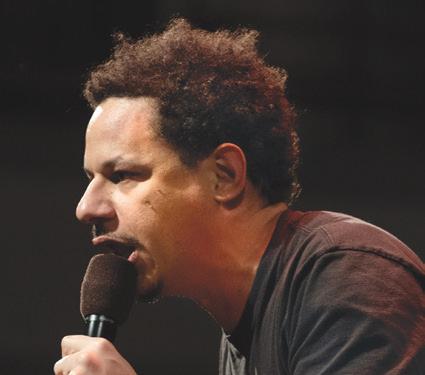
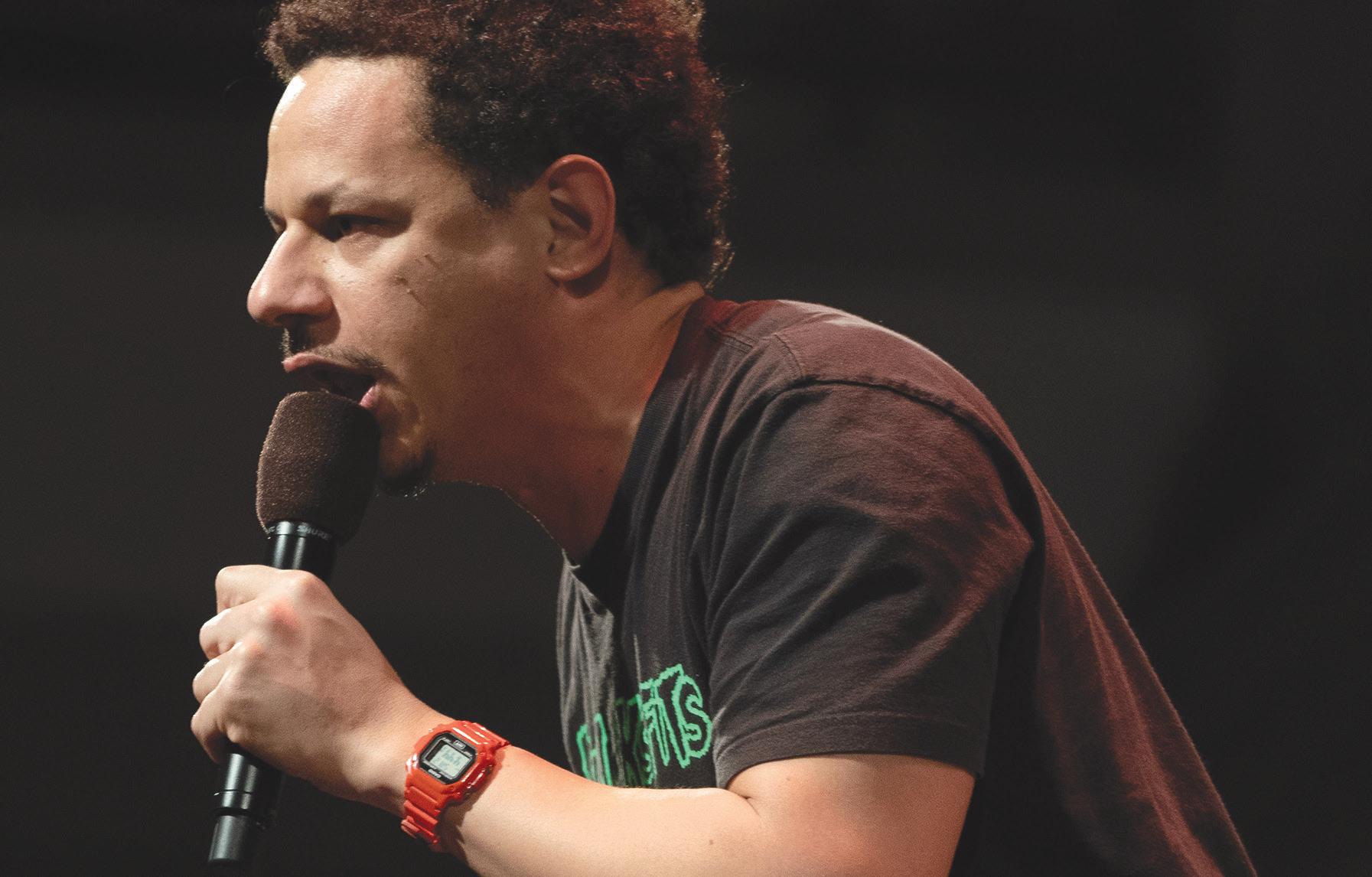
Eric Andre Ranches Up Bailey Hall
BY JEREMY MARKUS ASSISTANT ARTS & ENTERTAINMENT EDITOR
So apparently Eric Andre wasn’t allowed to get naked on stage, which was disappointing. What was not disappointing was his announcement of season five of The Eric Andre Show and a soon-to-come Netflix special. To be honest, I wouldn’t have felt completely immersed in the Andre experience unless his penis was hanging out in front of the audience. He apologized profusely and otherwise delivered an excellent set.
The “blewish cashew” (black/Jew, Catholic/Jew in his own words) joked about being so incredibly high that he was ripping grass out of the ground during a very mellow Snoop Dogg song, the absolute insanity that is the third amendment and how God hates hip thrusting. Really, though, “absolute insanity” is an apt description for Andre’s entire show.
A comedian named Sarah Squirm opened for Andre, and her schtick was primarily obscene sex jokes. Squirm’s set was funny at first, but it grew old, and a 10-minute presentation mocking high school health classes was about nine minutes too long. According to her, if you didn’t laugh, you hate women. Sorry, mom.
One thing I always wonder while watching The Eric Andre Show is if the man ever gets tired. On screen, he’s running around, breaking desks and vomiting onto cheap curtains. On stage, he ran around, gently threw a stool to the ground and coughed a few times, I think. But he also screamed until he was red in the face and “burst a vein in [his] butt.” His energy was truly endless, which was especially surprising since I consider myself to be sorta-kinda in shape and I was out of breath from laughing after just 15 minutes.
After ranting about an absurd souvenier he purchased in Cuba, Andre transitioned into a bit where he asked for audience volunteers and texted their moms. He hit the auto-suggest button to compose a nonsensical message and then sent it to unassuming mothers, much to the delight of the crowd. I would have offered my phone up, but there was a 50-50
chance my mom would have ignored the text (and then I would have looked like a real idiot) and also he wouldn’t accept Androids. I guess I’m switching phones over spring break because if Eric Andre doesn’t like me, I’m nobody.
One mom was so worried about her son that she called back, leading to a hilarious sequence where Andre attempted to imitate the student and made her quite worried. Retroactively, I actually declined to offer my phone up because I didn’t want my mom to fret over my well-being. I’m doing good, mom. I was only passed out in a ditch for 15 minutes last night.
Andre invited two audience members on the stage to compete in a ranch-drinking contest. They each drank an entire bottle of ranch dressing. A whole bottle. I can’t remember who won, but they both definitely lost. That should be fun for them later.
In my preview earlier this week (that I’m sure you have read), I guessed Andre’s performance would include some inappropriate humor, potentially some music, and I prayed to the high heavens for some ranch dressing. The first prediction was met about seven seconds after he walked on stage and he made a quip about Louis C.K. You can hypothesize what it was about. He also treated the audience to some lovely, slightly off-key reggae interspersed with imitations of the show Cops. But as the clock ticked closer to 8:45 p.m. and there was a distinct lack of salad sauce, I grew concerned. No nudity and no ranch?
Overall, the show was well worth the cost of admission — which, for me, was a series of emails with CUPB to get free press passes; get flexed on — and I’m sure any fool who purchased one of those severely overpriced resale tickets might have broken even. Andre is clearly more than a wacky TV lunatic. He’s a real-life lunatic, too! And isn’t that what every mother wants?
Jeremy Markus is a freshman in the College of Agriculture and Life Sciences. He can be reached at jmarkus@cornellsun.com.
What the Disney-Fox Merger Means for Hollywood
Last Wednesday, the long-anticipated Disney/Fox merger was officially complete. The $71.3 billion purchase is one of the largest corporate consolidations in the entertainment industry — giving Disney control over 35 percent share of the entire movie market — and is undoubtedly going to reshape the future of Hollywood. Almost immediately, Disney added to its corporate website home page several notable Fox properties, including The Simpsons , The Shape of Water and Deadpool . They’re placed next to works from Marvel, Pixar and Lucasfilm, showed off as the newly gained territories of Disney’s already massive media empire.
During the long months when Disney and Comcast were trying to outbid each other, I, like most MCU fans, was anxiously hoping that Disney will emerge as the winner. The reason was simple: The Marvel characters that were owned by Fox, including the X-Men and Fantastic Four, would all get to come home to the MCU, and there would no longer be questions like “which Quicksilver is the actual Quicksilver.” So suffice to say that when the final deal was announced, I was quick to celebrate and didn’t even think twice about what the acquisition really meant on a bigger scale.
That bubble burst real quick on Friday, when Disney announced the decision to shutter Fox 2000 after the merger, a department that produced mid-budget films aimed at audience groups that are often underserved, and had over the years turned many brilliant literary pieces into cinema. In retrospect, the move shouldn’t
have been too much of a surprise, given that while Fox 2000 has produced some acclaimed hits over the years, including Devil Wears Prada , The Fault in Our Stars , Life of Pi and most recently, Hidden Figures , it lacked a well-defined brand. Additionally, most of its projects did not achieve the commercial success of the same caliber as films from the main branch, nor have they snatched Oscars the way Fox Searchlight’s productions have. Corporate restructuring and reorganization are inevi-
table with a merger of this scope, and from a business perspective, it’s not difficult to see why Fox 2000 was sacrificed. What is disconcerting, however, is the implication behind this decision and the message Disney is sending, intentionally or unintentionally. Having seen how ferociously Disney pushed for Black Panther in the Oscar race this year, it’s clear that the Mouse wants its films to gain recognition during award season almost as much as it wants them to smash box office records. But often times they’re only capable of one or the other, and even when blockbusters do get nominated for awards, their wins are still mostly limited to technical cate-
gories. So it’s likely that Fox Searchlight, being the Oscar powerhouse it is, would come out of this ordeal largely unscathed. By giving up mid-budget productions that are often objectively good movies but neither make quite enough money nor bag awards, Disney is essentially affirming and perhaps furthering the divide between blockbusters and small indie productions. Franchises like the MCU and Star Wars are responsible for raking in the cash, while indie films are more likely to become the Academy’s favorites. They have been assigned roles, forced into boxes that shouldn’t have existed in the first place.
But the merger is also likely part of Disney’s larger strategy to compete with Netflix and other burgeoning streaming services. The traditional cinema experience is, unfortunately, getting old for many people. Small productions, without the lure of fancy special effects or the loyal fanbase of some franchises, have a hard time drawing enough of an audience to the theaters. The film may be great, and people would love to see it, but many of them would rather wait until it comes out on Netflix than pay what’s basically a month of Netflix subscription for just one movie. With Fox now under its wing, Disney has gained invaluable additions to the collection of blockbuster films, mini-series and animated movies that they will be putting on Disney+ when the platform launches. The Mouse is by no means losing its grip on
the movie market, and will surely continue its streak of making box office records. But the way the public consumes cinema has changed enough in recent years for it to feel the need to evolve, too. Can it challenge Netflix’s chokehold on streaming services? It seems more and more likely. What does this all lead to? As much as I love many of Disney’s subsidiaries, I’m apprehensive about how drastically this acquisition could alter the film industry, steering it in a direction where the artistic value and diversity of films are grossly overlooked, where the cinema becomes purely an event — a spectacle — rather than an art form. Monopolies are rarely good for the long-term health and balance of an industry, and Disney’s ambition, as it stands now, is verging on dangerous. At the same time, I’m aware and somewhat ashamed to admit that as a consumer and audience member, my movie-going habits are very much part of the problem. The tide of change is irreversible.
I recall seeing a meme on Reddit, back when the deal was first announced, that photoshopped the Mouse’s face onto Thanos and replaced the infinity stones in his gauntlet with logos of the subsidiaries, which is ironically accurate and kind of chilling. I could only hope that instead of wiping out half of the film industry, Disney can use its new-gained power to usher in an exciting era of motion pictures. Andrea Yang is a junior in the College of Arts and Sciences. She can be reached at ayang@ cornellsun.com. Five Minutes ‘Til Places runs alternate Mondays this semester.
Andrea Yang
Five Minutes ‘Til Places
BY ARIADNA LUBINUS SUN STAFF WRITER
During the evening hours in PSB Baker Portico, you may have heard a violin, piano, bandoneón (basically a miniature accordion) or the voice of Carlos Gardel singing as dancers practiced their Argentine tango. But you probably didn’t stick around to watch.
This dance group that practices Thursdays in Baker Portico and Mondays at The Range is called Ithaca Tangueros. I knew this group existed, but I assumed the members would be too old or the lessons too slow for me to like it. Boy, was I wrong. Armed with my experience of only a handful of Argentine tango lessons, I confidently walked into an intermediate level class this weekend with my two-inch black heels and an open mind.
Joining Ithaca Tangueros this weekend was a pleasant break from what I’m used to. As an active member of Cornell DanceSport, I compete in Ballroom and Latin Dance, where we tango, but it is formal and theatrical — think of the scene in Take the Lead Argentine tango, on the other hand, is primarily social and more flirtatious, with legs hooking around your partner, crossing each other and brushing along your partner’s thigh. It’s seen in films like Scent of a Woman , The Tango Bar and The Tango Lesson . Tatiana, a girl my age at the lesson, explained, “only if you search online for tango will you
A Hidden Gem: Ithaca Tangueros
find it, but if you don’t know about tango in the first place, you’ll never know.” And that’s just the problem.
The first thing I noticed when joining the lesson were that there were more young people than I’m used to at such ballroom/ tango dance events. I also heard so many different accents that, for a moment, it felt like I was in New York City or even Buenos Aires where the dance originated. The people immediately made me feel welcome and even asked me to dance before the lesson had begun. This multicultural community matched what I always look for at Cornell — people who appreciate each other and are open to sharing their culture. Now before I continue, if you have never heard of or seen Argentine tango, here’s how I would describe it. Suspenseful. Romantic. Dynamic. Relaxing. The closed position requires you to be head-to-head with your partner while you embrace them closely and dance. This can be shocking for some but quickly becomes a natural position that helps you move around the floor.
The 90 minute lesson was taught by guest instructors Robin Thomas and Natalia Rosado Cofresi, who periodically visit Ithaca to teach and host a monthly Nocturne “milonga” — that’s what Argentine tango socials are called. Robin has been dancing for almost 20 years and is wellknown and respected as a major teacher and D.J. in the U.S. When not traveling for tango
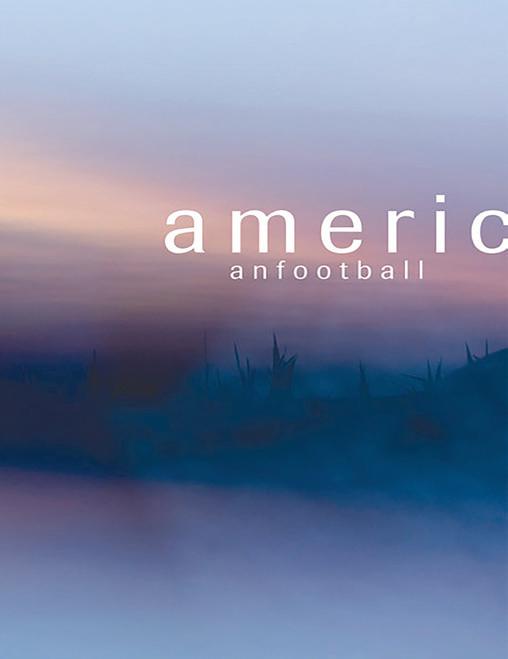
The story of American Football is its own legend within the emo community. They formed as seniors in college, released an album in 1999, played 12 shows, then broke up. Their self titled debut American Football flew under the radar initially, but quietly grew in influence over time to the point where it’s the clearest genre-defining album within the emo community, headlining the rise of midwestern emo and math rock. This album had every reason to flop. After all, American Football pioneered midwestern emo, a subgenre that’s recently resurfaced in terms of influence, almost two decades ago and then left it untouched for 17 years. When they returned with American Football II, it often felt like a bad mixture of nostalgia and half-hearted attempts to
work, he is based in NYC, where he runs the monthly milonga and a weekly practica along with regular tango boot camps. Over the past decade, Robin has taught countless students as the tango instructor for Princeton, Yale and Columbia University. Robin and Natalia were approachable instructors who taught to my level and gave me individual feedback, including dancing with me and the others so that we’d catch on. We switched partners after every dance, which helped me meet all the people and learn the individual styles of each lead. Some women decided to lead and men followed so that they could understand the role of their partner.
In addition to Cornell Ballroom Club that runs Monday nights in Willard Straight Hall from 7 to 9 p.m., Bailemos Latin Dance Club and Salsa Pa’lante, Ithaca Tangueros is yet another hidden gem open to everyone in the Cornell and Ithaca community. There are myriad dance options at Cornell, but unfortunately, most of them require painful auditions, previous experience, or natural talent. Rather than suffer more stress than our academics already hurl on us, I urge you to relax with a welcoming, diverse family and meet new people who love dancing at Ithaca Tangueros. Not only do they offer beginner and intermediate/ advanced lessons, but also private lessons, socials and weekly practices. For me, it was rewarding to just try out a new group that
interested me and fit in like a puzzle piece. You can join their listserve at TANGO-L@list.cornell.edu or find them on OrgSync to learn more. Or, if you’re more interested in learning ballroom dance,
email ballroom-l-request@cornell.edu.
Ariadna Lubinus is a sophomore in the College of Engineering. She can be reached at aml386@cornell.edu.
American
Record Co.
innovate. American Football III makes it clear that this was just a temporary issue necessary to readjust. For starters, they abandon the now-iconic house that made up the covers of their first two albums, a clear sign that they aren’t holding onto past pretenses.
The album begins with “Silhouettes,” a seven-minute track based on loops and progressive add-ins. It begins as a break from the original American Football sound through its use of bells in the intro, which is vaguely reminiscent of fellow 1999 emo pioneers Jimmy Eat World’s “A Sunday.” Once the rest of the instruments are added and the first verse begins, it sounds like a more mature version of the American Football you know and love.
American Football III sees American Football
build off their signature math rock while still seamlessly incor porating new sounds.
“Heir Apparent” is one of the best examples of this. It sounds like a clas sic American Football track through its trademark guitar loops but now works in a flute and some distant piano notes to prove that the last 20 years have allowed them to grow outside of making music in their bedroom.
When I first saw the tracklisting of American Football III, I was worried; “Uncomfortably Numb” contains a feature from Paramore’s Hailey Williams. Don’t get me wrong, she’s a great artist and singer but in a lot of ways, this feels beyond out of place on an American Football project. It mixes midwestern emo with Paramore’s pop emo, two subgenres that are often
with each other both stylistically and in terms of their fanbases. This is also the first American Football project to contain features, yet they’re all used exceptionally. “I Can’t Feel You” contains a feature from Rachel Goswell of Slowdive. The band has always felt tangentially similar to shoegaze, and Goswell’s echoey chorus blends perfectly in this track with the reverb-heavy guitar in the background.
One criticism often levied at American Football is that although their music
is incredibly emotional and nostalgic, their lyrics are still distant and impersonal. American Football III is the first attempt to really address this issue. “Uncomfortably Numb” details the struggles of fatherhood and alcoholism with lyrics such as “I used to blame my father in my youth/Now as a father I blame the booze” and “I used to struggle in my youth/Now I’m used to struggling for two.” In a sense, this is just the band
growing up. Their debuted when they were seniors in college, they’re all in their forties now and lead singer Mike Kinsella
Usually, saying that a band has grown up is a bad thing, particularly within a genre so lyrically dominated by teenage emotions and nostalgia. American Football was once great at this style, but they matured. This is usually when bands fall off, but American Football’s ability to pivot and create another fantastic album 20 years later with entirely different subject matter is proof that they’re a band like no other.
Daniel Moran is a sophomore in the College of Human Ecology. He can be reached at dmoran@cornellsun.com.
Daniel Moran
JUAN PABLO FLORES
The Corne¬ Daily Sun Independent Since 1880
137th Editorial Board
ANU SUBRAMANIAM ’20 Editor in Chief
DAHLIA WILSON ’19
Business Manager
PARIS GHAZI ’21
Associate Editor
NATALIE FUNG ’20
Web Editor
SABRINE XIE ’21
Design Editor
NOAH HARRELSON ’21
Blogs Editor
SHRIYA PERATI ’21
Science Editor
AMANDA H. CRONIN ’21
News Editor
ROCHELLE LI ’21
News Editor
JOHNATHAN STIMPSON ’21
News Editor
PETER BUONANNO ’21
Arts & Entertainment Editor
ANYI CHENG ’21
Assistant News Editor
SHIVANI SANGHANI ’20
Assistant News Editor
CHRISTINA BULKELEY ’21
Assistant Sports Editor
BEN PARKER ’22
Assistant Photography Editor
DANIEL MORAN ’21
Assistant Arts & Entertainment Editor
ALICIA WANG ’21
Graphics and Sketch Editor
DANA CHAN ’21
Production Editor
Editorial
SARAH SKINNER ’21
Managing Editor
MEREDITH LIU ’20
Assistant Managing Editor
RAPHY GENDLER ’21
Sports Editor
BORIS TSANG ’21
Photography Editor AMBER KRISCH ’21 Blogs Editor
KATIE ZHANG ’21 Dining Editor
SOPHIE REYNOLDS ’20 Science Editor
AMINA KILPATRICK ’21
MARYAM ZAFAR ’21
Editor ETHAN WU ’21
SEITZ ’20
ZHU ’21
MILES HENSHAW ’20 Assistant Sports Editor JING JIANG ’21
Assistant Photography Editor
JEREMY MARKUS ’22 Assistant
LEI WU ’21
WANG ’20
Working on Today’s Sun
Ad Layout Jamie Lai ’20
Production Deskers Jenny Huang ’22 Megan Roche ’19
News Deskers Amina Kilpatrick ’21
Shivani Sanghani ’20
Night Desker Alex Hale ’21
Design Desker Megan Roche ’19 Xiangyi Zhao ’22
Sim Seems Right
OVER THE PAST WEEK, The Sun has collected information about each of the trustee candidates and analyzed their platforms. Following the Trustee Candidate Debate on March 20, we sat down and interviewed our top choices. There are many good candidates for the role of student-elected trustee, but there is only one right candidate: Jaewon Sim ’21. We gave the decision to endorse Sim a lot of thought, and believe that his approach to the position despite its institutional limits is the most realistic, competent and thoughtful of any of the candidates.
Sim’s platform is not just a list of ideas but carefully-planned initiatives — initiatives that he has already attested he can bring to fruition throughout his time on the Student Assembly. We are particularly impressed by how he took a 10-year long battle to reform the printing system at Cornell and delivered his promise of free printing for all students starting next fall after just three semesters here. We believe that spearheading that plan has given Sim the knowledge of how Cornell’s administration operates, what institutional barriers stand in the path of making Cornell more affordable for its constituents and how to put ideas into motion.
A non-disclosure agreement limits any member of the Board of Trustees from fully connecting with the student body. Sim was the only one to offer a real explanation of how he intends to address this limitation. He expressed tangible ways he can make the Board more accessible and transparent to students by communicating whatever an NDA does permit him to communicate, like how the Board operates, when open meeting times are and how to restructure these meetings to best serve students.
His deep knowledge of the University showed itself during the pop-quiz portion of the debate, in which Sim showed he knows the ins and outs of this school, such as when he correctly answered where all of Cornell’s campuses are and who the five constituent-elected members of the Board of Trustees are. We don’t believe that these are facts that Sim had to study for, but information that he learned from his work on S.A. and relationship with administration.
His platform of better access to resources like mental health services, increasing affordability by lowering the price of on-campus dining and making Cornell a safe and inclusive campus through measures like guaranteeing transfer student housing all resonate with student concerns. He plans to remain a part of his current organizations (Cornell AppDev and the International Students Union), to help him remain involved in the Cornell community. His passion for changing this campus was evident, but what really shined was his impressive logistical understanding to follow-through.
Sim is the only one who understands how to carry out his vision in the position because he’s already done so for his campus. While many candidates voiced platform focuses that are crucial to the University, we invest the most trust in Sim in accomplishing his.
The complete list of candidates and their statements, for the Student-Elected Trustee race can be found on the Office of the Assembly’s website. Voting begins at 9 a.m. Monday, March 25, and continues through 2 p.m. Wednesday, March 27.
Victoria Pietsch | Fancy Pants
On the Mend: Te Future of Cornell Fashion
Iam a fashion design management major, and I wouldn’t trade my experience for anything. Yet, some tension in my education exists. I’m grateful for the support of the College of Human Ecology but unsure of fashion’s placement in it beside majors like nutritional sciences and human development. I have loved my fashion management classes and have wished there were more. I have benefited from the opportunity to concentrate in communication but have been disheartened when one of the courses felt more similar to neuroscience.
The Department of Fiber Science and Apparel Design shares a rich history with the College of Human Ecology. Martha Van Rensselaer developed the School of Home Economics, which was later renamed the College of Human Ecology in 1969, to “meet the needs of the women of New York State,” and included an education in home sewing. Understanding my difficulties aren’t unique to my experience, I spoke to 11 students and four professors about their experiences — and the ways they are working to improve.
In the major, we often act like family. As a family, however, many students feel their concerns aren’t always heard. FSAD Town Hall meetings, which began in fall 2018, aim to create a space for airing grievances. But students find the platform too formal for conversation and instead showcase department updates. Concerns about curricula, career coaching, professorial assignments and scheduling flexibility remain. Even Gizelle Begler ’08, a former fashion design major, recalls she used to feel anxious that Cornell didn’t feel as “artistic” as other design schools, or was disconnected from industry.
Yet, Begler’s main message for disgruntled students has been one of optimism. “Even the hard times, like sleeping under studio tables or trekking home in the snow at 2 a.m. were important because they gave me the work ethic I have today.” Despite this experience, our hope for the department’s future aligns with that of our professors. Wanting more classes is a call for action, not a problem. Thus, we face a crossroads: Complain or make change happen.
According to Prof. Margaret Frey, interim FSAD chair and senior associate dean for undergraduate affairs, the “and” in the department’s title makes it exciting. Right now, the fashion industry needs “leaders that understand the business but also understand design, aesthetics, materials and innovation. All the issues facing the industry — environmental sustainability and labor rights — involve those aspects.”
The department incorporates nearly every field encompassed by Cornell’s colleges, among them material science, cultural studies, design, business, chemistry and physics, according to Prof. Denise Green, FSAD. What’s special about this interdisciplinary nature, she said, is that these fields are “wrapped up under the umbrella of fashion, clothing, textiles and the materials we engage with every single day.”
This versatility is not always a strength in the minds of students, however. When asked why they chose to study fashion at Cornell, 10 undergraduates I spoke to spanning all three majors — fashion design, fashion design management and fiber science — wanted to be “well-rounded.” Yet the desire for a comprehensive experience differed in expectation and execution, particularly for fashion design management majors.
“I thought I’d have more freedom to pick a lot of classes across campus while still having the fashion focus,” said Claudia Libow ’19.
The lack of flexibility comes from a curriculum that emphasizes distribution requirements but can make us feel dis-
connected from our career goals. While management students can specialize in marketing and management, product development or communications, current upperclassmen can only take three to four such courses from a short list. Students specializing in communications, who entered prior to the current academic year, chose from an outdated course list dominated by information science and psychology courses.
While the requirements have since been reshaped, a lack of fashion management remains. Many business courses, outsourced to AEM and the Hotel School, lack the fashion specialization students hoped to find. Adding to stress, required courses have been scheduled at overlapping times or even replaced altogether close to enrollment periods.
Frustration with coursework and disconnect from the industry isn’t unique to management majors. Designers feel it, too. “I think there needs to be some sort of sketching class,” said William Blankman ’22, and “a class . . . teaching us how to think like a designer.”
“I think we could be provided more career advice,” said Eliza Lesser ’20, who expressed that she’d like to “interact more with alumni and have a better idea of how to really get involved in the industry — if there were a way for us to still be involved while still in Ithaca.”
A lack of professional guidance translates into the fiber science major, as well. Hansika Iyer ’19 had to personally fight for her internships. That’s why she joined the Cornell Fashion Industry Network, a student organization focused on alumni relations and industry immersion for students. When it comes to programming flexibility, however, Iyer finds that to be her major’s greatest strength. “They accommodated me doing what I wanted to, and I could customize the major,” she said — to the envy of fashion design and management students.
The emphasis on fiber science may be a result of Cornell’s role as a research institution, and we understand our professors’ research is valuable and important. Yet, recent semesters have been marked by transition. While students appreciate their professors, Iyer stated, “professors keep leaving” on sabbatical or for retirement, “and are very focused on their research.”
Their care for their students, however, isn’t neglected in the meanwhile. Prof. Frey, committed to supporting undergraduates, is creating an introductory course called “Success in FSAD” that will help first-year students make the most of their undergraduate experience.
Because of efforts like Prof. Frey’s, I have always felt supported by FSAD. An optimistic and opportunistic mentality has been critical to my success, and my willingness to work hard was never in vain. I have researched in the Cornell Costume and Textile Collection, explored my passion for writing with Thread magazine, fostered industry connectedness with the Cornell Fashion Industry Network and curated two major fashion exhibitions. More importantly, I have friends who won’t hesitate to study until 3 a.m. with me and professors who care for me as if I’m their family.
While a need for restructuring remains, what prevails is a caring community, students’ hopes for the future and a tireless Cornell-branded work ethic on all sides. “I feel like Cornell is the gift that keeps on giving,” Begler said. “Even today, I still feel supported — and my love for Cornell is only growing.”
Victoria Pietsch is a senior in the College of Human Ecology. She can be reached at vpietsch@cornellsun. com. Fancy Pants runs every other Monday this semester.
Engaged Cornell Should Be a Mantra, Not Just an Initiative
Last semester, my friend Evelyn Torres ’21 woke up at 6:30 a.m. every Wednesday to go to Belle Sherman Elementary School. There, she was a student teacher in a third-grade classroom for three hours as field work for Prof. Jeffrey Perry’s, developmental sociology, EDUC 2410: The Art of Teaching. Although I thought of the experience that prompted her tiredness later that day as a unique one among Cornell students, it turns out that there is a wide array of classes taught far above Cayuga’s waters that include in their curricula engagement in communities close to and far from the lake’s shores.
In CS 5150: Software Engineering, a group of students is working to gamify snow-shoveling so that city sidewalks aren’t impassable for pedestrians of all ages and abilities following snowstorms. This semester, a group of students in GOVT 3121: Crime and Punishment are beginning research with two Cornell professors and a colleague at Ithaca College on the challenges of re-entry faced by those who have intersected with the criminal justice system in Ithaca and Tompkins County. In DEA 2203: StudioShift and DEA 2500: The Environment and Social Behavior, students are collaborating with Tompkins County Action to design a living space for 18 to 25-year-olds who don’t have a safe place to stay at night. These are just a sampling of the various courses which make community engagement not just a supplement to the academic experience at Cornell, but an integral part of it.
And yet, there are still many syllabi, lecture halls and seminars where engagement is limited to the classroom. For every friend I have like Evelyn, I have many more whose academic experiences have been defined more by the spots they study than by interactions with people who don’t come to campus multiple days a week.
This is a shame because the real potential of community engagement lies in potential benefits for local stakeholders that can benefit from work with Cornell. With a population of around 30,000, Ithaca’s size means the efforts of the Cornell community can bring change across the entirety of the city and the even smaller towns that surround it. While schools in metropolitan areas throughout the country, especially our Ivy League compatriots, tout their connections to professional powerhouses in populated centers only found in such populated centers, Cornellians can jump into the trenches with Ithacans and other residents of Upstate New York to address the problems found here at a depth impossible to achieve in a city of hundreds of thousands or millions of people. This is especially important given the ubiquity of Ithaca’s challenges, with communities of all sizes across the country facing some of the same difficulties as those who can be seen from the top of the slope. If appropriately brought to bear upon the areas surrounding us, the resources of Cornell and the efforts of its community can help make Ithaca and Tompkins County into a model for the rest of America to follow.
Though Cornell’s academic connection with the world beyond East Hill is evolving, this change should occur at a higher pace and should be structured by the University to be more visible and longer-lasting.
Classes that involve community engagement focus on the practical elements of education which have been ingrained in Cornell since its chartering in 1865 as a land-grant institution. The University’s commitment to Ithaca was formalized a century later, when Cornell Ithaca Volunteers in Training and Service was established to connect members of the Cornell community interested in volunteering with organizations in surrounding communi-
ties. In 2014, more than two decades after the creation of the Public Service Center, the Einhorn Family Charitable Trust helped sharpen this focus on engagement through academia by funding the Center for Community Engaged Learning and Research. Five years ago, Cornell and the trust continued this commitment by launching Engaged Cornell, a 10-year initiative aimed at strengthening the interaction between academia and the needs of surrounding communities.
Engaged Cornell’s goals include fomenting the student body’s participation in the community during their time at Cornell and providing faculty and departments the tools to teach courses that involve such engagement. The support for this program is seen through the amount of financial muscle behind it and also by the approval and commitment of important stakeholders across Cornell. When the initiative was originally announced, The Sun’s editorial board praised the move as a natural extension of the University’s original mission. Three years later, President Martha Pollack said in her first State of the University address to the Board of Trustees that “engaged, evidence-based education that combines rigorous academics with experiential learning” was a central goal.
But despite this framework for support, many professors have never had any exposure to this kind of teaching in their own undergraduate or graduate education. In addition, a successful attempt at a course that implements engagement with community requires extensive planning, communication and outreach months before the course begins. Furthermore, in a profession where tenure means stability, there are some departments and professors within them where tenure affects the likelihood that a professor will put time toward such a course. The ambiguity of a project’s goal or its incompatibility with the University’s semester schedule can also cause frustration or stress for students as part of an otherwise-positive experience in an already stress-saturated environment.
creating such courses or haven’t even considered it should take the plunge. Given that the course roster for Fall 2019 is available this upcoming Friday, it may be too late for next semester, but there is definitely sufficient time to plan for Spring 2020. By reaching out to potential community stakeholders, talking to other professors who have undertaken such exploits before or may be interested in partnering and contacting Engaged Cornell to access the resources and networks they have, professors inexperienced in creating such curricula can start receiving advice today if they desire. University administrators can immediately begin incorporating the goals of Engaged Cornell into the inner-workings of the University. Even though the goal of Engaged Cornell is to make community engagement a self-sustaining part of a Cornell education, it’s possible that without the thrust of this tailored initiative, faculty will begin to view undertaking such projects as a leap not worthy of the effort because there’s no institutional safety net.
Finally, stakeholders can address the one glaring flaw the initiative currently has which The Sun’s editori-
University administrators can immediately begin incorporating goals of Engaged Cornell.
From talking to faculty and students about these courses, though, it became clear to me that the challenges to implement engagement are more than worth the reward that awaits on the other side. In describing a visit to a colleague who was including engagement in his curriculum, Prof. Gary Evans, design and environmental analysis, was “envious of how motivated the students were in these design projects,” before partnering with that colleague for two decades on similar projects. Similarly, students mentioned that they not only enjoyed classes with engagement more than those without, but that having to apply their knowledge forced them to connect with what they had learned on a much deeper level than an exam or paper would have. More than three months after she finished a course that involved a community project, Senna Phillips ’20 said, “I still constantly think about that project and I still have reactions from that project that I lean on now.”
In regard to their own experiences, faculty described being conductors, not just an instructors, and taking inspiration from the energy and ingenuity with which students attacked the tasks they were given. This is not even to speak of the appreciation expressed by those community partners who are actually being engaged with.
In order to pick up the pace of community engagement, and to ensure that it doesn’t stop when the buck of the Einhorn family’s charity does, a few concrete steps can be taken. First of all, professors who are on the fence about
Tal board warned about in 2014: Engaging Cornell has not been a process that solicits the input of students enough. A number of my friends at the University of Virginia have told me that students there can apply to create “StudentInitiated Courses.” If approved, they design a curriculum and teach fellow students. Whether it’s a Google Form on the department or college website, a dedicated employee at each college or a line in a syllabus asking for ideas, administrators, colleges, departments and professors should get together to create a system that allows student and community input. Although the majority of suggestions will probably still come from face-to-face interactions, the potential value of bringing in ideas that a student has but doesn’t know how to voice is immeasurable. Engagement through the classroom empowers students, but students aren’t currently encouraged and empowered to start that new engagement themselves.
Even with this room for improvement, it’s clear that community engagement as part of academic curricula is taking hold at the University. In the 2018-2019 academic year, Engaged Cornell distributed funding for a total of 44 projects through the Engaged Opportunity and Engaged Curriculum Grants. Furthermore, while some departments such as DEA have a longstanding history of applying what they teach in the local community, that external ethos is starting to be externally visible: Recent faculty hires have cited Cornell’s focus on engagement as reasons for applying for positions here. Now, it’s time for the University to cement this progress. It’s time to take Engaged Cornell from an initiative and make it into a mantra.
Giancarlo Valdetaro is a sophomore in the College of Arts and Sciences. He can be reached at gvaldetaro@cornellsun.com. Far Above runs every other Monday this semester.
Te Private Agenda of Public Spaces
he exhibition read The Ballad of Sexual Dependency. Nan Goldin, an American artist most known for her photography, took over 700 photographs of her own most intimate moments of love and loss. Some of her subjects experience pleasure and pain from ecstasy and drug use, some dance and spend time with family and others suffer from domestic violence or AIDS. The visual diary shows humans’ need to connect, especially through struggle and pain. In my favorite photograph, a man sits at the edge of a bed smoking a cigarette while a woman lies in the background. The first time I saw this shot, I appreciated the intimacy of two lovers who shared a space. But now, I see
the gaze of one who recognizes her dependency on a man while she slides into the depths of drug dependency.
Goldin, who became addicted to the opioid OxyContin after being prescribed to it, led a campaign against the Sackler family, whose U.S. pharmaceutical company Purdue Pharma makes the painkiller. The National Portrait Gallery in London recently became the first major art institution to give up a grant from the Sackler family. Other U.K. cultural institutions such as the Serpentine’s Sackler Gallery and the Victoria and Albert Museum in London have benefited from donations from this trust. The family gave the Gallery £1 million to help fund a new project for
building development, a new education center and a redisplay of the collection. Purdue Pharma has been facing lawsuits in the U.S., alleging that it sold the drug and marketed as having a low chance of causing addictions while knowing the actual truth behind its power.
Goldin threatened to pull out of a planned show if the donation was accepted. This is not the first time she has shown discontent towards the Sackler family and its connection to OxyContin. In February of this year, scraps of paper that looked like OxyContin prescriptions fell from a walkway of the Guggenheim Museum, bringing awareness to the donations the museum has received from the family.
One hundred activists infiltrated the museum, unfurling banners that read: “400,000 DEAD,” “SHAME ON SACKLER” and “TAKE DOWN THEIR NAME.” A diein took place on the museum’s floor; scattered around the lobby were empty orange medicine bottles with labels reading: “Prescribed to you by the Sackler Family. OxyContin. Extremely addictive. WILL KILL . . . Rx# 400,000 dead.”
To read the rest of this article, go to cornellsun.com.
Gabrielle Leung is a senior in the College of Arts and Sciences. She can be reached at gleung@ cornellsun.com. Serendipitous Musings appears every other Friday this semester.
Giancarlo Valdetaro | Far Above
Gabrielle Leung | Serendipitous Musings
Fill in the empty cells, one number in each, so that each column, row, and region contains the numbers 1-9 exactly once. Each number in the solution therefore occurs only once in each of the three “directions,” hence the “single numbers” implied by the puzzle’s name. (Rules from wikipedia.org/wiki/ Sudoku)
2 & 3 BEDROOMS 109 SAGE PLACE
Red Falls in League Title Game
M. HOCKEY
Continued from page 12
crashed into Clarkson forward Nico Sturm and flipped head over heels before being whistled for interference.
The junior power forward needed assistance leaving the ice, and proceeded to watch — in crutches behind the glass — his team fall in a title game. His focus is now on 2019-20, as he is looking at a recovery time of 7-8 months, Schafer said.
“Didn’t even see Nico Sturm. Ran into him. He’s done for probably seven to eight months,” Schafer said. “Didn’t even see Nico on the play, they just inadvertently ran into each other.”
inadvertently he hurt his knee on the play and he’s done.”
But even with the adversity that has followed Cornell throughout the 2018-19 season — plenty of it boiled into just over 70 minutes on Saturday — the team responded.
After knocking on the doorstep of Clarkson netminder Jake Kielly for unrelenting stretches of play in the second and third periods, sophomore forward Tristan Mullin knotted the game up with 5:41 left in regulation for his second goal in as many days, harboring back memories of when Clarkson tied Cornell late just three weeks prior.
We have availability for the 2019-2020 school year beginning June 1st at Hudson heights apartments. The studio apartments come with: heat, water, and electricity included. There are garbages houses and coin-operated laundry facilities on site. Prices start at $740/month for a 12 month lease. If you have any questions or would like to schedule a tour contact us by phone 607-208-7660 or email: renting@ithacaLS.com
COOK ST. Furnished House for 5-7 persons, 10mo. Lease for 2019-2020 Text or call Tracy at TLC Property Mgmt Corp 607-379-2776
3 BEDROOM
Nice, clean, furnished unit can host up to 12 people. 303-309 Dryden Road Heat, Hot water included. Fiber Optic fast internet connection Laundry, parking available 607-279-1888 www.porealty88.com
Collegetown Terrace Apartments INSPIRED LIVING TAILORED TO YOUR SUCCESS
24-Hour Fitness Center
Shuttle Bus Service to Campus
Study Rooms w/ Expansive Views
Apartments Available NOW, Spring 2019 & 2019/2020 Novarr- Mackesey Property Management collegetownterraceithaca.com office@ithacastudentapartments.com 607-277-1234
Collegetown 1 & 3 Bedroom Apts. Available for Next School Year 2018-2019. 607-327-2927
Linden Ave. 5 Bedroom House Available June 2019. $900 per bedroom. Parking included. 607-327-2927
MUST SEE: 9 Bedroom House Walk to Cornell, Collegetown $5400 + utilities/month. 531 E. State St. 9/10 Bedrooms, 3 baths, 2 kitchens. Furnished, Free Laundry, Free Parking. Available 6/1/2019 607-379-9168 text/call
2019-2020 College Ave. 5 Bedroom House Furnished. Laundry. Internet. Parking. 607-273-8576
2019-2020 Upper Eddy St. 7 Bedroom House Furnished. Internet. Laundry. 607-273-8576
5BR/3.5BA/$395,000-14850-&: 607-351-0782 LA.Helping-Clients-With Ithaca Real Estate Focus-YouTube
It came after Cornell junior forward Noah Bauld and sophomore forward Brenden Locke perfectly executed a 2-on-1 that was started after Kaldis took a hit at the far blueline to make it happen.
And it came after Clarkson first responded on a penalty by senior defenseman Alec McCrea. Brosseau sniped one past Galajda and added his second of the night just over four minutes later on the Malott penalty for a 2-1 lead.
“Give Clarkson credit, the key to the game tonight was we took those penalties and Clarkson capitalized on their power play,” Schafer said. “But Jeff, he was trying to get out of his way and
“Losing Jeff, losing Matty in the game [and we] just kept plugging away all night long and faced that adversity,” Schafer said. “One of the best defensive teams in the country we come back we tied up 2-2.”
But 14:36 into overtime, Klack was sitting backdoor behind sophomore goalie Austin McGrath — who was making his first career postseason appearance in the most intense of situations — to slide a puck past a goaltender who hadn’t yet broken into a sweat and thus abruptly end the Golden Knights’ 11-year Whitelaw Cup drought.
Cornell’s, meanwhile, grew to nine.
Zachary Silver can be reached at zsilver@cornellsun.com.
Gophers Beat C.U. in Frozen Four
W. HOCKEY
Continued from page 12
ECAC) kept up with Minnesota (32-5-1, 19-4-1 Big Ten) throughout most of the contest, but the Gophers’ defensive strategy was overpowering, and the Red was never able to find the right opportunity to bury the puck. Cornell mustered just 15 shots on goal in the process of being shutout — its fourth such defeat this season.
“Minnesota’s a great hockey team and they’re strong defensively, and we knew that,” said junior defender Micah Zandee-Hart. “So we knew goals weren’t going to come easy, but I think we had our fair share of opportunities, and we just couldn’t put one in the back of the net.”
Despite the loss, Cornell’s defense did an excel-
lent job of slowing down Minnesota’s best-in-thenation scoring offense, which normally averages over four goals per game.
“We played the way we played all year long, which is in aggressive defense,” Derraugh said. “I thought we did a pretty good job overall as a team today.”
Senior goaltender Marlène Boissonnault made 25 saves, while Minnesota netminder Alex Gulstene needed only 15 to earn the shutout.
“We analyzed their plays and whatnot,” Boissonnault said. “We gave our hearts out, that’s how we played the whole game. And it ended up shutting doors [for the Minnesota offense].”
Dylan McDevitt can be reached at dmcdevitt@cornellsun.com.
Oh so close | Cornell’s Whitelaw Cup drought grew to nine years after the Red lost a 3-2 contest to Clarkson. The Golden Knights scored two first-period power-play goals and netted a game-winner 14:36 into overtime.
MEN’S HOCKEY
C.U. Loses ECAC Championship Heartbreaker
By ZACHARY SILVER Sun Senior Writer
LAKE PLACID, N.Y. — While Clarkson was celebrating, Cornell men’s hockey was sulking. And steaming.
Minutes before a contested overtime goal from Chris Klack won the ECAC Championship for the Golden Knights Saturday night, Cornell sophomore goaltender Matt Galajda found himself trapped under his own net, which fell off its moorings and pinned him in an awkward position — one that left him injured.
With play still going on just under halfway into overtime, junior defenseman Yanni Kaldis paused playing defense to try and help free his ailing goaltender. Even Clarkson forward Devin Brosseau, who scored two power-play goals on Galajda earlier in the game, stopped his actions in the offensive zone to assist his opponent. But to Cornell head coach Mike Schafer’s ’86 dismay, no whistle was blown until the puck was cleared into the Clarkson zone.
“The million-dollar question is do I want to coach in the NCAAs or do I not want to coach in the NCAAs. That’s my goal in this press conference, so I’ll answer that question very carefully,” Schafer said when asked about the sequence, alluding to the need to keep his cool and not earn a suspension with his team taking on Northeastern in the first round of the national tourna-
“They messed up the call and the kid got hurt. ... I just think that’s unacceptable from an officials standpoint.
Mike Schafer ’86
ment next Saturday.
“Why [do] the officials want to keep the net on in that situation that cost my starting goaltender, our starting goaltender, a knee injury? For what? To keep the play going? They messed up the call and the kid got hurt. For no reason. The Clarkson kid’s trying to help him. That’s the kind of sportsmanship. The goalie’s down on his knees, the thing’s on the back of his
Reffed up | Clarkson’s game-winning goal in overtime came after offsides went uncalled. But the play wasn’t reviewable since the Golden Knights exited and re-entered the offensive zone before scoring on backup goaltender Austin McGrath.
neck and yet they can’t blow the whistle. And it hurt a student-athlete. I just think that’s unacceptable from an officials standpoint.
“And great sportsmanship. Like our guys started helping, the Clarkson kid was trying to help him. The only ones that weren’t trying to help him were the officials. They were the only ones not doing their job. … I mean It was just a weird play, and it’s just unfathomable why they would [not] stop to blow the whistle and protect everybody involved.”
CORNELL V. CLARKSON
freshman forward Michael Regush and into a Clarkson skater. By rule: offside. But the puck made its way back into the neutral zone before being taken back again into the Cornell zone in a legal manner. The earlier offside went uncalled and was not a reviewable sequence.
3 2
Cornell players were not made available to the media after the game.
As if Schafer’s gripes on Galajda’s knee injury — the severity of which remains uncertain with NCAAs opening next weekend — weren’t enough, there were two more opportunities for him to display his displeasure.
On the Clarkson winner, Schafer and his coaching staff saw an offside call go uncalled. A puck sent into the Cornell zone by Brosseau hit off the stick of Cornell
“It’s a weird rule of the offsides, because you go back and look at the video, their kid poked it off our kid’s stick, hit the Clarkson kids’ stick inside the zone, but it didn’t get blown down,” Schafer said. “It was offsides but it didn’t get blown down. Then the puck comes out and it goes back in but you can’t review it. It’s just a weird rule.”
And earlier in the game, Schafer and his staff saw what they thought to be an inadvertent collision that ended junior forward Jeff Malott’s season called as a penalty that resulted in Clarkson’s first lead. In the first period, Malott was trailing into his defensive zone,
WOMEN’S HOCKEY
Playoff Run Ends In Frozen Four
By DYLAN McDEVITT Sun Senior Writer
HAMDEN, Conn. — Just a week after storming into Boston and knocking off third-seeded Northeastern in overtime, Cornell women’s hockey could not repeat its New England playoff magic, falling to the No. 2 seed Minnesota, 2-0.
“I’m really proud of our group,” said head coach Doug Derraugh ’91. “I thought we played a real strong team game today. And I’m proud of what we accomplished all year long … These last couple of months, this is a team that’s really come together and played real hard as a team.”
After a scoreless opening
frame in which both teams appeared evenly matched, the Golden Gophers opened the scoring on a well-executed power play in the second before icing the game with an empty-netter in the third. Minnesota will advance to play either Clarkson or Wisconsin in the NCAA championship game on Sunday.
“In the first period we had a lot of odd-man opportunities and didn’t really take advantage of them,” Derraugh said. “It’s always a fine line … getting pucks in deep and sometimes we don’t recognize when we have a chance to make a strong offensive play.”
Cornell (24-6-6, 17-3-2
See M. HOCKEY page 11
‘Proud of our group’ | Head coach Doug Derraugh’s ’91 team’s playoff run came to an end in the national semifinals with a 2-0 loss to No. 2 seed Minnesota.