The Corne¬ Daily Sun



By CAMDEN WEHRLE Sun Staff Writer
Though Cornell has dropped weekly testing requirements and eased its mask mandate for vaccinated individuals, students who test positive for COVID-19 remain required to isolate. While some students appreciate the hotel rooms and meals provided by the University, many have expressed frustrations with a lack of communication from the University and difficulty traveling to the hotels.
Victoria Gong ’25 was one of the hundreds of students isolated during the spike in COVID-19 cases at the end of the fall 2021 semester. Gong said she was transported by CU Lift to Hotel Ithaca in the Ithaca Commons the day after she reported a positive test to Cornell Health via Daily Check.
Gong, who stayed in the hotel last December, said her room was spacious and her ability to order takeout with City Bucks and medical supplies made her isolation period a better experience overall.
However, Gong noted that the meals provided by the hotel often didn’t arrive on time — or sometimes did not arrive at all.
“The meal schedule was very inconsistent. There were two distinct times that I didn’t get any meals at all,” Gong said.
For the spring 2022 semester, isolation
meals look a little different, as isolated students no longer have $500 in City Bucks to spend on meals delivered from restaurants.
Roberto Garcia ’25 said that he was able to order food from Collegetown Bagels or Ithaca Bakery when he isolated in Cayuga Blu from March 9 to March 14. These options replaced the City Bucks offered in the fall 2021 semester.
“There were pretty good options,” Garcia said. “The food wasn’t always amazing, but it was nice to be able to pick whatever you wanted.”
Garcia took a rapid test after feeling symptomatic and received an email from the Daily Check shortly after submitting the positive result. However, he experienced a transportation delay.
“I had roughly two and a half hours [to wait] after I told them I was ready for them to actually pick me up,” Garcia said. “I think [Cornell] could have handled getting sick people out of the dorm a little quicker.”
According to Garcia, two of his friends also tested positive on the same day and weren’t picked up for several hours after they called the quarantine number. This posed a concern as they wanted to avoid spreading the virus to their roommates.
Maya Mau ’24 also isolated in Cayuga
Blu for five days this month. In contrast to Garcia’s experience transporting to the hotel, she found the process easy, saying that the approximately two-hour wait to be picked up was fine.
“I have a single [dorm room], so compared to people that had to sit there with their roommate while being positive, it wasn’t that bad,” Mau said.
Mau said she was impressed by the isolation experience, and she enjoyed ordering food from Ithaca Bakery since it was paid for by the University. She also said that snacks and tissues were readily available at
the hotel.
Similarly, Clara Enders ’22 said her transportation from the co-op house she lives in to Cayuga Blu went smoothly.
“I had heard horror stories about [Cayuga Blu], but it wasn’t bad at all,” Enders said. She said the room she stayed in was comfortable, and food was always delivered on time.
To read the rest of this article, please visit cornellsun.com.
Wehrle
By ALLY FERTIG Sun Staff Writer
Complaining of murky water and insufficient available pool time, students and faculty are pushing for a new natatorium — the technical term for indoor swimming facilities — on campus, lobbying the University’s shared governance bodies and advisory committees in athletics.
On March 8, the University Assembly overwhelmingly adopted a resolution supporting the Faculty Senate’s “Inclusion and Prioritization of a New Natatorium in the 'Do the Greatest Good' Capital Campaign” resolution, which addresses the need for a new swimming facility. The resolution has also been supported by the Student Assembly and the Faculty Advisory Committee on Athletics and Physical Education, which sponsored the original resolution.
The resolution’s author, Prof. Ashleigh Newman, veterinary medicine, has received 17 co-sponsors in the Faculty Senate and much more support in meetings from other senators
who did not officially sign their names.
The University’s current “To Do The Greatest Good” capital campaign does not set aside any money for a new natatorium, despite planning to raise $5 Billion. Inclusion in the campaign would allow for a new natatorium to be funded by alumni and other outside donors, not placing the whole financial responsibility on Cornell.
program, club teams and other assorted activities. The pools also offer an open swim time to the Cornell community, used by
originally built as the female-only athletic facility, also has a six lane 25-yard-long pool.
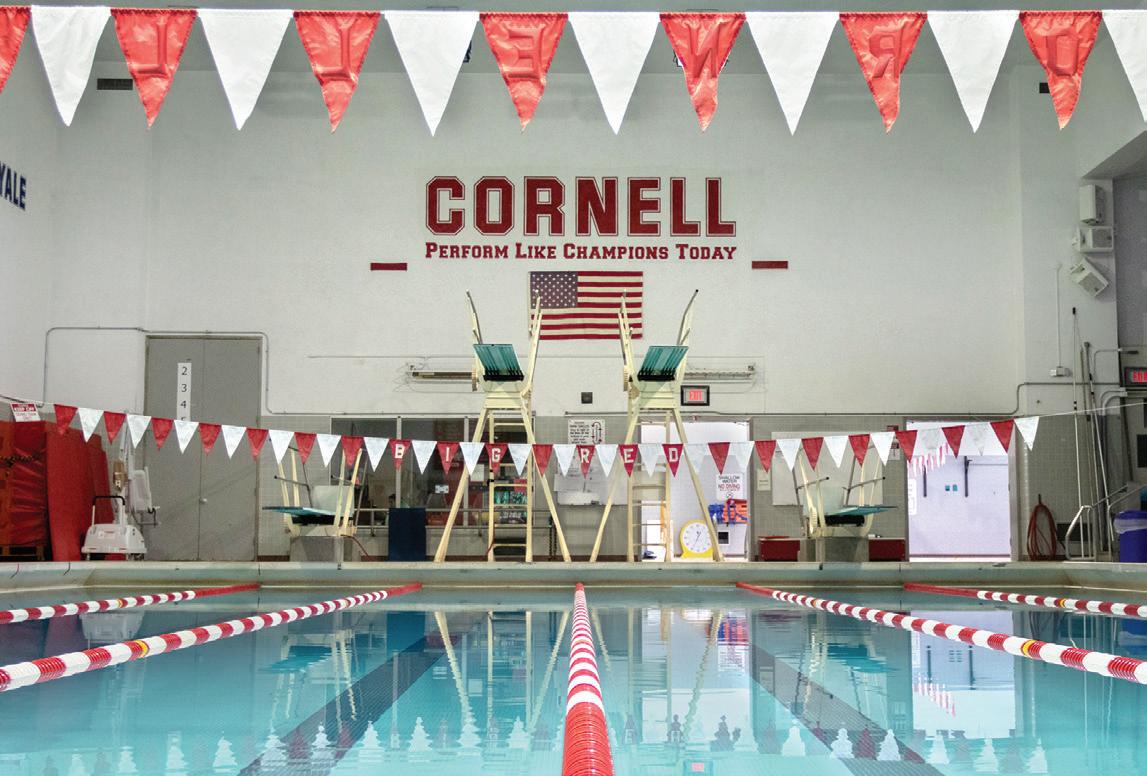
Currently, the University has two aquatic facilities: a pool in Helen Newman and a larger one in Teagle Hall. These pools are used by multiple physical education classes, the men’s and women’s varsity swimming and diving teams, the naval ROTC
a group composed of 43 percent students and 57 percent faculty, staff and retirees.
The Teagle Hall pool, built in what was originally campus’s men-only athletic facility, has a main pool with six 25-yard-long lanes, and a learning pool for new swimmers. Helen Newman,
Both natatoriums have had problems, which have worsened over time.
According to the presentation Newman gave to the Faculty Senate on Feb. 9, Teagle Hall needs a roof replacement, and discussions of a new pool have been occurring since the 1980s.
Demetra Williams ’24, a member of the diving team, expressed frustration with the current natatorium. She hopes that a new natatorium would include a diving well with a diving platform as well as overhead showers on the pool deck.
“I have seen Teagle’s pool turn both green and purple, on separate occasions. I have seen
Teagle drained, refilled, then drained again to improve water quality,” Williams said. “I have had late night practices at Ithaca College because our pool was not in good enough condition to host varsity practices.”
The pools have also had maintenance issues related to water quality, which caused home competitions for the swimming and diving teams to be moved to Ithaca College’s facilities during the 2019-2020 and 2021-2022 seasons.
“At our one and only home meet of 2021-2022 against Brown, in which facilities had spent weeks prior prepping the pool by shocking and filtering the water, one of the Brown divers looked at me and said, ‘Is your pool always this murky?’” Williams told The Sun. “And I responded, ‘This is the cleanest our pool has been in years.’”
The resolution supporting a new natatorium proposes that the University build a 50-meter pool in order to increase pool space and, as a result, available swimming hours for the community.

Tuesday,
Joint Econometrics and Industrial Organization Workshop: Nikhil Agarwal 11:15 a.m. - 12:45 p.m., Ives Hall
Joint Behavioral Economics and Development Economics Workshop: Joshua Dean 11:25 a.m. - 12:55 p.m., Sage Hall
2022 SC Johnson College of Business Spring Virtual Career Fair 1 - 5 p.m., Virtual Event
CCSS Workshop: Organize for Transparent And Reproducible Research 2:30 - 4:30 p.m., Virtual Event
MBG Seminar: Laura Gunn — Designing More Efficient CO2Fixing Solutions for Enhanced Crop Yield by Understanding And Harnessing Natural Variation 4 - 5 p.m., Biotech Building
Microeconomic Theory Workshop: Eran Shmaya 4:15 - 5:15 p.m., Uris Hall
Purpose & Paychecks: Navigating a Career in Public Service 5:30 - 7 p.m., Virtual Event
Both/And: A Life in Many Worlds — A Conversation With Huma Abedin 7 - 8 p.m., Virtual Event
Cornell Children’s Tuition Scholarship 10 - 11 a.m., Virtual Event
Women’s History Month Lunch & Learn with Alumni: Gender Equity in the Workplace Noon - 1 p.m., Mann Library
AASP and A3C BeComing
Lunch Series With Melissa Hernandez Noon - 1 p.m., Rockefeller Hall
Supporting Humanities Research: Advice for Grantseekers 12:30 - 1:30 pm., Virtual Event
eCornell Keynote: Think Like a Horse, Improving Equine Welfare Through Better Understanding 1 p.m., Virtual Event
Access and the 21st Century University 5 p.m., Virtual Event
The Egyptian Labor Corps: Race, Space and Place in the First World War 5 - 6:30 p.m., White Hall
Students get inside look at dairy farming, meet animals and raise funds for CUDS
By MARY SOTIRYADIS Sun Staff Writer
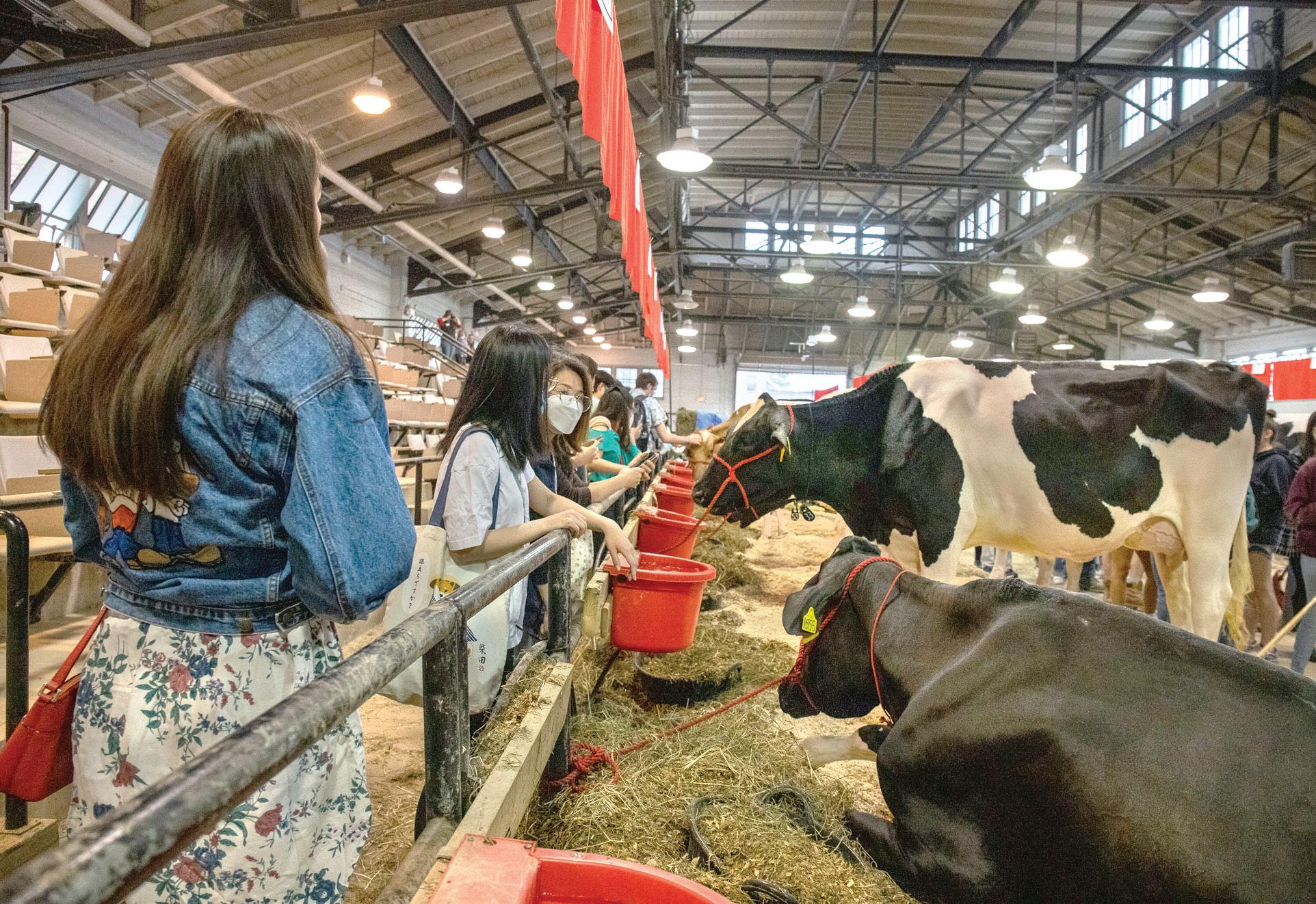
On Friday, March 18, the Cornell University Dairy Science Club welcomed members of the Cornell and Ithaca community to a Dairy Open House at the Livestock Pavilion.
Various campus agricultural organizations set up tables across the pavilion, complete with informational trifolds and giveaway items like stickers and cow-print masks, interactive games and activities and live cows.
Many of the cattle present at the Dairy Open House were auctioned off the following day during the Spring Classic Sale, an event that has been held annually since 1982 in collaboration with. According to CUDS Faculty Advisor Prof. Michael Van Amburgh, animal science, this year marks the third sale organized only by students.
“To date, 1,047 students have taken these trips,” Van Amburgh said. “So, it’s not trivial. We make sure we make best use of the money by getting as many students involved as possible.”
Although the trips used to be limited to CUDS members, Van Amburgh noted that the trips are now part of classes that students in any college can take for credit, as long as they sincerely want to learn more about agriculture.
“It’s just all about sharing knowledge and getting everyone excited.”
Mikala Anderson ’24
“We would normally have a sale associated with the New York State Holstein Association,” Van Amburgh said. “The animals would come here. We’d wash, clip feed and get them ready for the sale and then we would take a certain percentage of the sale proceeds just to help [CUDS] when we started in ’82.”
The money raised from the sale funds numerous outreach opportunities and educational experiences organized by CUDS in addition to paying for services related to the sale, such as professional auctioneering and printing pedigree catalogs.
According to Van Amburgh, since 1998, the money raised from the sale has funded trips intended to further students’ understanding of food production and agriculture in places such as California, Italy, China and South America.
“It’s not a vacation,” Van Amburgh said. “We are up at 6 a.m. in the morning and out the door at 6:30 a.m. We see things that a lot of people don’t get to see, so [the students] have to be on their best behavior.”
CUDS students led preparation for the Dairy Open House and the Spring Classic Sale. Their tasks included hand-selecting the dairy cattle auctioned off at the sale, a process which took more than two months to complete, according to Van Amburgh. Moreover, students were responsible for advertising both the Dairy Open House and the Classic Sale and meeting other logistic requirements.
Emily Starceski ’23, president of CUDS, said that the planning process began at the beginning of the fall 2021 semester The CUDS executive board met very early on in the school year to ensure the reservation of the Pavilion and the consignments of the animals present at the event.
Megan Lamb ’22 and Danielle Del Conte ’22, the co-chairs of public relations for CUDS, advertised the event via social media and on campus via posters and chalking.
Josh Spicer ’23, a transfer student, joined CUDS upon arriving at Cornell in the fall and successfully acquired donations of bedding and feed for the cows,
which were then delivered to the venue. Correspondence with donors regarding the acquisition of these materials began in January, Spicer said.
“The hay we donated from our farm back home,” Spicer said. “We have connections throughout different lumber mills throughout the country, or throughout the state that were able to donate some supplies to the sale.”
Many students present at the Dairy Open House represented many of Cornell’s other agricultural organizations, such as Alpha Gamma Rho and Sigma Alpha — the agricultural fraternity and sorority, respectively — Block and Bridle, the Agricultural Society, Beef Club, Cornell’s Farm Bureau chapter and the Dairy Princesses.
Mikala Anderson ’24 is a member of most of the organizations that were present at the Dairy Open House, and is the vice president of Block and Bridle and Sigma Alpha.
“I think the most important thing [about this event] is teaching people about farmers and what they’re trying to do,” Anderson said. “It’s just all about sharing some knowledge and getting everyone excited.”
Anderson said that the Dairy Open House allowed her, as well as other members of her organizations, to meet new people and recruit new members to further educate people about the importance of the dairy industry.
Starceski added that hosting a Dairy Open House is an important way to create a safe space for interested individuals to learn more about agriculture and see animals for the first time.
“I think it’s really cool that we’re such a large campus,” Starceski said. “There is a large variety of people [here], and I think this is finally our opportunity to show people what we’re about and give them the opportunity to ask questions to their peers.”
Mary Sotiryadis can be reached at msotiryadis@cornellsun.com.
POOL Continued from page 1
Wes Newman, the Head Coach of Men’s Swimming, said that a new 50-meter pool would ameliorate some of the team’s current issues, such as limited space.
“For example, the Varsity teams could have men’s swimming, women’s swimming, and diving [men’s and women’s] practices all running concurrently — something we can’t do now— which would free up more pool time for other users,” Newman said.
According to the resolution’s appendix, Brown, Harvard, Princeton, Duke and Stanford all have sufficient facilities to host swimming and diving competitions concurrently. Other regional schools, such as Ithaca College, Colgate University and Binghamton University do as well.
“From a Varsity standpoint, having a pool that could host our Ivy conference meet would be a dream,” Newman said. “However from a Cornell campus standpoint, meeting the needs of our campus community is most important.”
The pools have also taught generations of Cornellians to swim. P.E. 1100: Beginning Swimming, which uses the Helen Newman pool, has helped hundreds of students learn how to swim and successfully pass the University’s swim test.
The resolution emphasizes the racial dynamics of swimming at Cornell. Between 2018 and 2020, 89.7 percent of students in PE 1100 were people of color, the same groups which have higher rates of drowning. Black people
have a 1.5 times higher death rate from drowning compared to their white counterparts, compared to a 2-3.5 times higher death rate for American Indians or Alaska Natives, according to the resolution. Additionally, the resolution argues that campus gender equity and inclusion are better served with a new natatorium. According to the resolution, Teagle Hall
does not have adequate facilities for individuals who do not identify as male or female. Williams also stated that the men’s locker room has more room than the women’s locker room.
“I would hope that a new natatorium would not only provide equal space to both genders, but have space for gender non-conforming or trans individ-
uals as well,” Williams said. The current pools are both predicted to become non-functional and unsafe to use between 2022 and 2025. Without a pool, Cornell would have to terminate all of its wide variety of pool activities, and would find itself the “Only Ivy League, Non-Ivy Peer and Regional [New York] college/university without one,”
according to the resolution. Because it can take up to 10 years to fund, plan, approve and build a new natatorium, the University will likely not have a functional pool by the time its current facilities expire.
Ally Fertig can be reached at afertig@cornellsun.com.

Disney Pixar’s newest movie, Turning Red, follows Meilin, a Chinese-Canadian teen, as she struggles with puberty, crushes and an ancient curse that causes her to turn into a giant red panda. This film is groundbreaking for Pixar — not only is it Pixar’s first Asian-led movie, but with director Domee Shi at the helm, it is also Pixar’s first movie to be solo directed by a woman.
Recently, the film has been gaining much attention online, from critics and supporters alike. CinemaBlend’s managing director Sean O’Connell wrote, in a now-deleted tweet, that the film was “limiting,” hard to connect with and “exhausting.” He backed up his opinion by emphasizing the movie’s focus on Chinese culture in Ontario, with respect to the lives of Chinese-Canadian teens. As a white male, he felt that he was not the intended audience for this film, and those who were not Chinese-Canadian would not be able to relate to Meilin.
Other opposition comes from parents who think the movie is inappropriate for young children. Some viewers on Rotten Tomatoes expressed discomfort with showing their children the film due to “mature” themes such as “the menstrual cycle and arousal.” Others claimed that the movie encourages teenage rebellion and is dangerous to show to impressionable children, who might be encouraged to lie to their parents.
However, these criticisms have largely been drowned out by Asian and women viewers, who found in Turning Red parts of their identities respectfully represented in media for the first time. When reading through reviews left by people who identify as Asian, I found the overall consensus to be that this movie is necessary. One viewer pointed out that although Asians are a global majority, it is hard to find relatable Asian representation in Western media. Many people highlighted the importance of positive Asian media attention, especially today, when East and Southeast Asians are being targeted with hate crimes. Women viewers were heartened by how Pixar tackled periods in a very real way and portrayed the difficulties that come with female puberty.
Personally, I think that this movie is very relatable. Although I found myself experiencing second-hand embarrassment multi-
ple times, it was refreshing to see a teen portrayed as a loud, cringy and real person. We all went through embarrassing phases as we experienced puberty, and seeing uncomfortable situations — such as periods and crushes — play out on-screen will hopefully serve to erase some of the taboo surrounding those topics. The movie also conveyed hardships that befall mother-daughter relationships and portrayed the struggles of keeping traditional values alive while growing up in an increasingly modern world. These are themes that are relevant to my life, and I think Turning Red is so multifaceted that anyone watching this movie can find parts of themselves reflected in it.
As for the criticisms that the movie was geared towards a very specific audience, I would have to disagree. As a non-Asian person, I was still able to relate to the coming-of-age ideals in the movie. I appreciated the cultural elements that I could not relate to because they provided me with a different perspective of the world. Overall, Turning Red was a joy to watch, and I would recommend it to anyone, no matter their culture or gender.
languishing days of summer that I desperately hoped the subject of my lens would hold on to as much as I did.
This week, a friend offhandedly reminded me of something I had said to her a long time ago. Apparently, when asked about my freakish journaling routine, I said, “Oh, well, it’s all worth it to me because journaling helps me ease my anxiety about the passing of time.” I guess it stuck with her more than me, clearly. I didn’t even remember, nor could I fathom, saying something that sounded so valiant and belletristic. So I talked myself into it.
You see, since I was 12 years old, I’ve been a freak about journaling. During the last week of every year, when I really should be buying Christmas gifts for my loved ones, I go out and buy myself a black Moleskine Notebook (3.5 inches x 5.5 inches, 192 pages, unlined. It has to be unlined). Over the years, I’ve accrued a shelf of selfish encyclopedias, beholden to a strange predicted nostalgia.
Sometimes I think it’s a lack of faith in the human ability to remember that makes me record my own life like it’s worth money. Other times I find it to be a beautiful form of self-soothing. Either way, I am acutely aware of the fact that as a senior, it’s my time to be a curmudgeonly, washed-up old broad. But I think making bad art is helping.
Kurt Vonnegut ‘44, who is heinously over-quoted at this school, wrote in A Man Without a Country, “Practicing an art, no matter how well or badly, is a way to make your soul grow … Write a poem to a friend, even a lousy poem. You will get an enormous reward. You will have created something.”
This spring, lousy art has become my specialty. My roommates and I painted a lopsided, lumpy repurposed canvas, with abstract motifs that resemble tacos and pizza, probably because we were hungry and broke. We joked it would be in the next Maven show, but no kid at this school would dare give it monetary value, much less hang it in their room. I’ve got reels and reels of film chock-full of blurry photos of beloved faces shaded under bucket hats, tacky cocktail parties, pumpkin-themed pre-games and the
My dad is anxious about getting old too, though he doesn’t make bad art at all. His father’s memory was like a sloshing bucket, losing its weight without reason, so my dad thinks he can ward off Alzheimer’s by meticulously eating organic vegetables and walking at a hair-trigger pace every morning. He’s scared of losing his memory, but on him, it looks selfless — like he’s doing it for me.
But maybe bad art is more fun than eating vegetables — partially because you can hold it, and especially because it’s just for you. I write down my friend’s dream featuring me playing basketball. I write
Sometimes I think it’s a lack of faith in the human ability to remember that makes me record my own life like it’s worth money.
down what my sister wore to her sorority date night. I write down what the soup was at Zeus and where I ate it. My journal is an explosion of the mundane, sprinkled with heartbreak and days when the sun shined bright enough to lull away the sonorous pitch of outgrowing things and places again and again.
One of the most wonderfully misunderstood artists of all time, Georgia O’Keeffe, said of art-making: “Whether you succeed or not is irrelevant, there is no such thing. Making your unknown known is the important thing.”
More lousy art it is.
Greta Gooding is a senior in the College of Arts and Sciences. She can be reached at ggooding@cornellsun.com.

VEE CIPPERMAN ’23
in
SERENA HUANG ’24
Business Manager
EMMA LEYNSE ’23
Associate Editor
SURITA BASU ’23
Assistant Managing Editor
NAOMI KOH ’23
Assistant Web Editor
ELI PALLRAND ’24 News Editor
ESTEE YI ’24
News Editor
KAYLA RIGGS ’24
JULA NAGEL ’24
MEHER BHATIA ’23
KATRIEN DE WAARD ’24
PAREESAY AFZAL ’24
JIWOOK JUNG ’25
ADITI HUKERIKAR ’23
DANIELA WISE-ROJAS ’25
JASON WU ’24 Assistant
GRAYSON RUHL ’24 Assistant Sports Editor
KEVIN CHENG ’25
HANNAH ROSENBERG ’23
ANGELA BUNAY ’24
Editor DEVAN FLORES ’24
YAO ’23
’23

Anuli Ononye ‘22 (she/her) is a senior in the College of Arts and Sciences. She can be reached at aononye@cornellsun.com. Womansplaining runs every other Monday this semester.
KUNSANG ’25
’24
’24
’24
ROSENBERG ’23
This week, Cornell experienced another campus death — for the sake of the student’s family and friends, I won’t speak directly about them and their loss in this piece. Rather, this column is about campus mourning and the general grief that Cornellians feel when one of their own is taken too soon and too young. This piece has been a long time coming, a culmination of the anger that I experience each time someone dies on our campus — and the guilt and helplessness that I, and so many other students, feel when one of our peers passes.
I’ve talked a lot about student guilt with friends, faculty, mentees and family this week and about how that impacts the ways students approach the loss of a life at Cornell.
me. I say that with a caveat, because my grandfather died when I was six years old — but he was sick for most of my childhood, and at the time I wasn’t really old enough to process the death. So, I never know the “right” way to mourn someone who I don’t know well and never know the best way to support my friends when they have experienced major losses close to them.
When a student died last year, I felt uncomfortable attending a virtual memorial for them. I had never met the student and felt conflicted, both feeling like I needed to be there and feeling guilty for encroaching on a space that I felt
Eicher ’24
Desker Claire Li ’24
Desker Katrien de Waard ’24
Tom the
by Ruben Bolling

The strongest guilt is when we don’t know the student who has passed away. There’s something about knowing that someone went to the same coffee shops as you, enrolled in courses on Student Center at the same time as you and went to the same parties as you, yet you never crossed paths with them. In so many scenarios you were just a step away from being friends. The other side of the coin is that their lives were completely different from yours — they had different friends, were in a different college than you and were involved in activities that you never thought to join.
Either way, you didn’t know them. And yet, for many (and most!) of us, their death still hits home. It’s understandable that even if you didn’t know who passed, you know that they had dreams similar to yours — to make friends, receive a great education and experience life independently away from their families.
You also feel guilty when you knew the student, but didn’t know them well enough. Maybe that student sat in one of your classes, lived in your residence hall or served on an e-board of a club that you infrequently attend. That hits home even more. We feel guilty that we didn’t reach out to get coffee, missed that birthday party and didn’t say “hi” in class. Your connection to the lost isn’t strong enough for friendship, but when you read that email, your first thought is that you knew them.
In these moments Cornellians are quick to action — in a way that I feel is intended to rid them of their pain from the loss of their own. Student leaders are organizers, assisting friends with academic extensions and planning celebrations and memorials in recognition of the lost. Campus events are canceled and counselors are readily available to support students, but these actions never feel like solutions.
I don’t do well with death. I realize how privileged I am to say that at 22 years old; I haven’t lost anyone close to
I’ve talked a lot about student guilt with friends, faculty, mentees and family this week and about how that impacts the ways students approach the loss of a life at Cornell.
was reserved for their family and loved ones.
When I spoke to my mom about the conflict, she responded with probably the best death/mourning advice that I had ever heard: “You always go to the funeral.” She then explained how she attends every funeral — for the people she knows and the loved ones of people she knows. Not to take up space, but to 1) honor and celebrate their lives, even if she didn’t know them, and 2) let their loved ones know that they were loved and cherished.
So with that, I implore you to honor the lives that we lose on our campus. It’s okay to cry about the loss of someone you haven’t met — their lives were valuable and no matter how different you might be from them, you’re both Cornellians. It’s okay to feel hurt and unmotivated, especially when mourning the death of a close friend.
Take advantage of the mental health services and resources that Cornell provides, and give yourself grace. Mourning is not a flat road and doesn’t just end. Cornell doesn’t stop moving when a student dies, despite how so many of us wish it did. Even if the campus doesn’t stop, it’s okay for you to take a pause.

Fill in the empty cells, one number in each, so that each column, row, and region contains the numbers 1-9 exactly once. Each number in the solution therefore occurs only once in each of the three “directions,” hence the “single numbers” implied by the puzzle’s name. (Rules from wikipedia.org/wiki/ Sudoku)





By
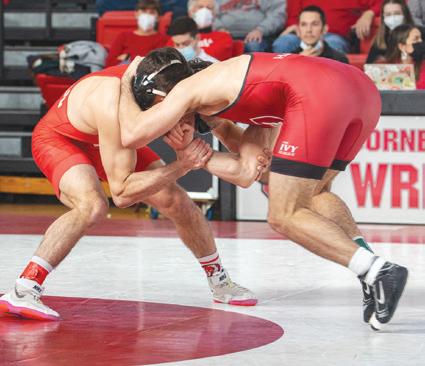
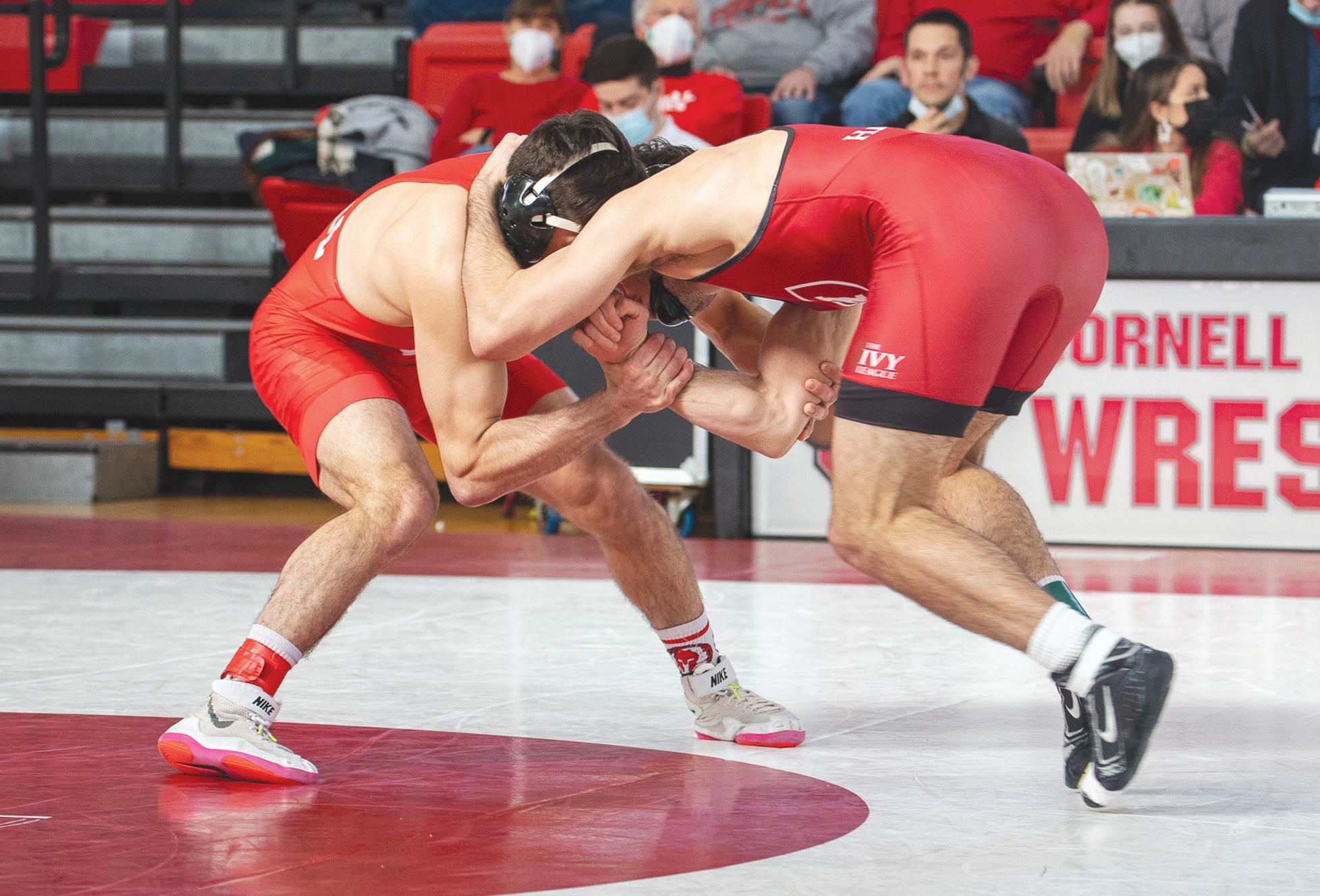
Wrestling concluded a successful season last week when it traveled to Detroit to compete in the NCAA championships. The Red sent nine wrestlers to nationals, tying a school record for the eighth time. On the biggest stage in the country, Cornell did not disappoint, finishing with three All-Americans and a seventh place team finish.
The Red (12-3, 5-0 Ivy) entered nationals with already an impressive record. Before the NCAA tournament, Cornell finished 10th in the country in the NWCA Coaches poll, and boasted an undefeated conference record, an Ivy title and an EIWA championship win. With strong representation at nationals, the team had one final chance to show off its abilities.
Competing in his third NCAA tournament, junior Yianni Diakomihalis had an opportunity to continue
his chase of the Cornell record books. Diakomihalis was riding a 70 match win-streak and was the two-time defending national champion at 149 pounds. As the No. 1 seed in his weight class once again, expectations could not have been higher.
Despite facing off against some of the most prominent wrestling programs in the country, Diakomihalis never found himself in danger.
Diakomihalis tore through North Carolina, Oklahoma, Iowa, Ohio State and Nebraska to claim his third NCAA title. Diakomihalis had a chance to tie Kyle Dake’s ’13 record of four national championships, and was now just two wins behind Dake’s streak of 77 consecutive victories.
it just didn’t go his way unfortunately,” said Head Coach Mike Grey ’11. “I know he’s a bit disappointed but eager to have two more opportunities at it, and we are as well as a program to see Vito get over the hump and ultimately become a national champion for us in the future.”
“We’re excited. We expect to be up there and competing for a national championship with the pieces we have coming back.”
Head Coach Mike Grey ‘11
“When I’m wrestling like that, it definitely makes me hard to wrestle, so [I] just got to work on doing that every time, keep building, keep getting better, keep getting more dominant,” Diakomihalis said in a post-game interview with ESPN.
Sophomore Vito Arujau also had a successful showing for the Red at 125 pounds. Making his second appearance at nationals, Arujau improved upon his previous performance, moving up from fourth to third place. His main pitfall came against a familiar foe, Princeton’s Patrick Glory, who Arujau previously beat to win the EIWA title. This time it was Glory getting the upper hand with a major decision victory, but Arujau bounced back to win his consolation matches, securing AllAmerican honors and a third place finish.
“I think he just got into a weird position in the semifinals against Glory, a guy he beat up pretty good at the conference tournament, and
The Red had one more wrestler receive All-American honors, junior Jonathan Loew at 184 pounds. Loew won his first EIWA title prior to nationals, entering the championships as the 11 seed. After winning his first round match, he fell to the six seed after Oregon State. Continuing the fight, Loew battled through the consolation bracket, winning three matches before dropping the consolation semifinal and seventh place match to finish in eighth. Loew led the team with 30 wins on the season.
“I think he’s developed immensely this year, and the culmination was this weekend,” Grey said. “He continued to believe in himself all year long and developed great confidence in his skills and his ability to wrestle with the best guys in the country.”
Senior Hunter Richard took the mat for the last time in his career at Cornell. Wrestling at 157 pounds, Richard lost his first round match, but battled back, winning his next three contests before losing his last bout in the third consolation round.
The Red now transitions into offseason mode, looking ahead to the opportunities of next year. Despite this season just ending, the team is already excited and optimistic for what the future holds. With a relatively young team, the Red will return most of its starters, and have another crack at bringing home a national championship.
“We’re excited. We expect to be up there and competing for a national championship with the pieces we have coming back,” Grey said. “If you look at other programs, a lot of them have fifth, sixth year seniors…so if you look at returning points, we’re up there with Penn State, so that’s very exciting and motivating.”