
By
HALE and ANGELA
After a week of Facebookfriending and platform-pushing, 10 candidates for Student Trustee fled into Willard Straight Hall for a debate over Cornell’s future, moderated by Te Sun.
Te ten are campaigning to be elected Undergraduate Student Trustee, one of the 64 members of Cornell’s Board of Trustees. Once elected, the winner will become a full voting member on Cornell’s highest governing body, acting as a liaison between students and the Board.
dates answered questions about Cornell, such as how much the University’s endowment is and to name all fve elected ofcials on the Board of Trustees.
Students were then asked how they would stay in touch
would resign from all of her other executive board positions on campus to focus on the job.
The primary function of a student trustee is “to first and foremost be a student.”
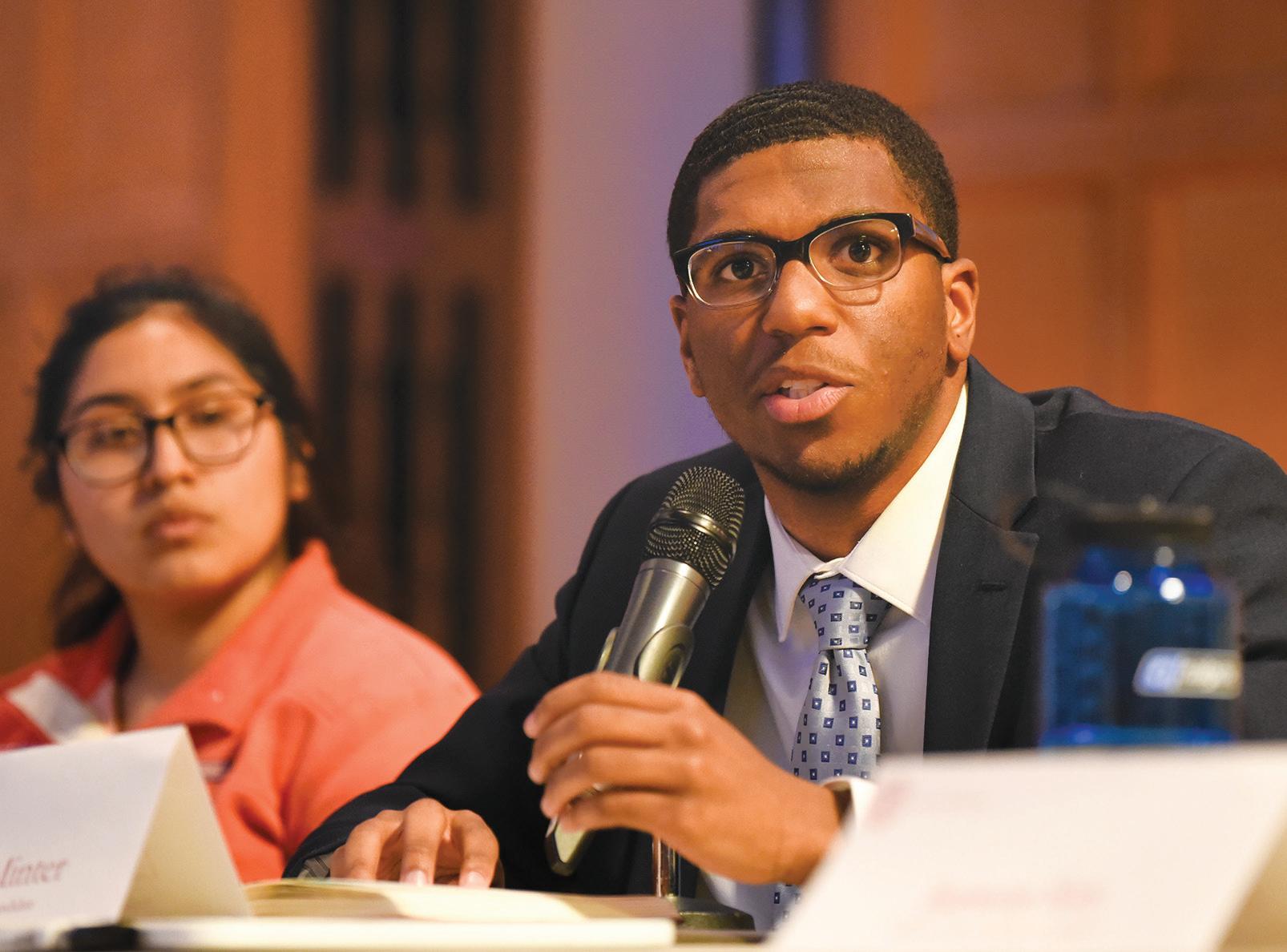
Minter ’21
with their constituents. Many of the candidates proposed setting up meetings with constituents and meeting with student leaders.
Te debate started with a “pop quiz” in which the candi-
Candidate Liel Sterling ’21 said that she sees Trustee as a “full-time job” and that she
Liz Cantlebary ’21, on the other hand, stated that she plans on “staying involved in all current commitments,” including her on-campus job as a resident adviser, arguing that doing so would maintain “organic relationships” with students on campus.
Following this question, the potential trustees were asked “yes or no” questions on important issues involving University decisions. All but one candidate, Alex Chalgren

By KATHRYN STAMM Sun Contributor
Lidia Mandava ’20 has returned home just once since she came to Cornell. Arzu Mammadova ’20 — who speaks four languages — struggled sometimes in her first-year writing seminar.
foreign students hail from the same ten countries, while some countries send only one.
These four students — among many Cornellians with similar experiences — have different home continents, languages and reasons for coming to Cornell, but they’ve all made Ithaca their home (far, far) away from home.
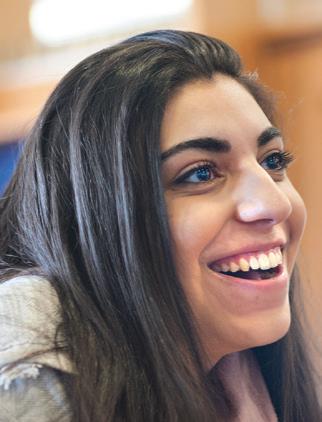
Georgia Makris ’20 and Abdul Rahman Al-Mana ’20 both described missing out on their changing hometowns. All these students are either the only, or one of a handful, student to ever attend Cornell from their home countries.
Interna-tional students face the same homesickness, loneliness and adjustment period that most college students experience. However, that can be compounded by being thousands of miles from home and not knowing another person from their entire country at Cornell.
At Cornell, 5,322 international students make up 22.55 percent of the total student body. Although Cornell boasts international diversity, more than three quarters of

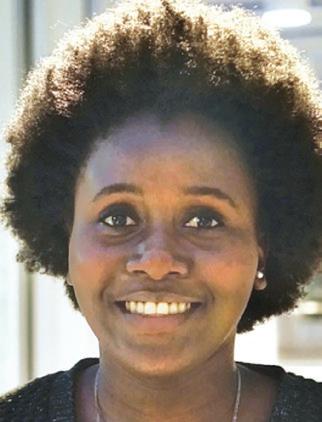
Lidia Mandava ’20 is a government major from Maputo, Mozambique. She applied to Cornell through the Davis United World College Scholars program at her interntional high school in Eswatini.
“Oh my god, I miss everything,” Mandava said. Then, she continued, “the food, the beaches, the warmer climate, the people.”
“Everyone is always complaining like, ‘I haven't been home in two months,’ and I'm like, ‘um, hi’,” she said. Mandava hasn’t been home since December 2017.
Mandava explained that one of
By ALEC GIUFURTA and AMANDA CRONIN Sun Staff Writer and Sun News Editor
In an email to students on Wednesday night, vice president for student and campus life Ryan Lombardi outlined plans for sweeping reforms to student mental health services. Some students, however, questioned whether Lombardi’s
promises would result in meaningful improvements to Cornell’s frayed mental health support system.
Limited updates on the progress of the internal review of the campus environment and culture included that the team is acting upon feedback gathered from students from a fall survey. Tis review, spearheaded by a com-
mittee of students, staf and faculty, will act concurrently with an external review of Cornell mental health services.
Te external review team, according to Lombardi’s email, will “come to campus and evaluate our services through the lens of best practices in collegiate and community mental health” starting in
the fall of 2019. Te source or members of the team were not specifed.
Last semester, a student led mental health task force submitted a letter with detailed policy recommendations regarding mental health services to Cornell administration, Te Sun previously reported.
One of the changes announced in Lombardi’s
email addresses an issue in that letter: reforming Counseling and Psychological Services interviews.
Come fall 2019, CAPS will discontinue phone interviews with the introduction of in-person “same-day initial sessions,” Lombardi wrote.
See HEALTH page 4
Thursday, March 21, 2019
The Cost of Invisible Labor: Local Workers in the Past and Present Of Middle Eastern Archaeology 4:30 p.m., G22 Goldwin Smith Hall
The Family: Our Beloved Crisis 4:30 p.m., G76 Goldwin Smith Hall
How the Slaves Freed Themselves: The Khivan Slave Uprising and The Myth of Russian Abolitionism in Central Asia 4:30 - 6 p.m., 423 ILR Conference Center
On Our Terms: How We Define Democracy and Reverse Exploitation through Social Justice Global Unionism 4:30 - 6:30 p.m., 105 Ives Hall
ISS’ China’s Cities Project: Capstone Lecture Noon - 1:30 p.m., 225 ILR Conference Center
Towards a More Sustainable Industry Using Process Systems Engineering 12:15 p.m, 253 Frank H. T. Rhodes Hall
Tick Determinants of Powassan Virus Transmission 12:15 p.m., Lecture Hall 3 College of Veterinary Medicine
By ALEX HALE Sun Staff Writer
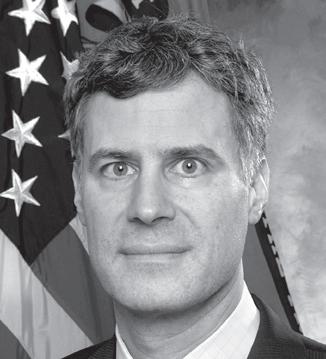
Famed former White House economist Alan Krueger ’83 died at the age of 58 on Saturday. According to a statement released by his family, Krueger took his own life.
The Cornell alumnus gained widespread recognition through his study of labor economics, revolutionizing the subject through his data-based approach. Krueger served under both President Bill Clinton and President Barack Obama during their time in the White House.
Krueger grew up in Livingston, N.J., before attending Cornell. In 1983, he graduated with a degree in Industrial and Labor Relations with honors. He went on to study at Harvard, earning a Master’s
degree and a Ph.D. in economics in 1985 and 1987, respectively.
His talent as an economist was evident even during his early years, according to Prof. Ronald Ehrenberg, labor economics.
Ehrenberg said in a written statement to The Sun that, years ago, Krueger came up to him after a guest lecture at Harvard and corrected something he’d said.
Ehrenberg said that at that moment, he knew Krueger was “surely going to tower over all of his former professors in a short period of time.”
Woodrow Wilson School.
Five years later, he became the Bendheim Professor of Economics and Public Policy, a position he held for the rest of his life.
In 1987, four years out of Cornell, Krueger became an assistant professor of economics and public affairs at Princeton’s
As a researcher in labor economics, Krueger played a significant role in revolutionizing the field by moving away from theory and instead utilizing empirical data in his work. His work “really changed the shape of economics and turned it into a more serious science,” Harvard professor Lawrence Katz told The New York Times.
His most famous work was a study on minimum wage, detailed in his book, Myth and Measurement: The New Economics of the Minimum Wage. The study,
debate puts ten candidates under scrutiny
co-authored by Princeton professor David Card, refutes the theory that increasing minimum wage causes a decline in employment for minimum-wage workers.
“His research arguably did more to change how we view the economy than that of any other modern economist,” New York Times columnist Paul Krugman wrote in an op-ed tribute to Krueger. Krueger served as the chief economist of the Department of Labor from 1994-1995 during the Clinton administration. Under President Obama, Krueger was appointed the assistant secretary for economic policy and chief economist of the U.S. Department of the Treasury from 2009 to 2010. He then became part of President Obama’s Cabinet, serving as chairman of the Council of Economic Advisors.
“Alan was someone who was deeper than numbers on a screen and charts on a page. He saw economic policy not as a matter of abstract theories, but as a way to make people’s lives better,” former President Obama said in a statement.
Support services are available to all members of the Cornell community. Students may consult with counselors from Cornell Health by calling 607-255-5155. Students may speak with a peer counselor by calling EARS at 607-255-3277. Employees may call the Faculty Staff Assistance Program at 607-2552673. For additional resources, visit caringcommunity.cornell.edu.
Alex Hale can be reached at ahale@cornellsun.com.
’21, said yes when asked if they would vote for the University to divest from fossil fuels. Similarly, only Latoya Francis ’22 said yes when asked if they would support a motion on the Board of Trustees for the Boycott, Divestment, and Sanctions (BDS) movement. Eight candidates, excluding Francis and J.T. Baker ’21, said yes when asked if they would vote for tuition increases as a member of the Board of Trustees.
Trustee is to be a “public servant” and, subsequently, its function must be very service-oriented. When asked about being the only freshman candidate, she mentioned that she sees her perspective as something “valuable” that “shouldn’t be discounted.”
Many of the candidates proposed setting up meetings with constituents and meeting with student leaders.
The debate then turned to the Presidential Task Force On Campus Climate, which was formed after the occurrence of several racially-motivated incidents on and of campus in the 2017-18 school year.
The candidates were also asked about their view of the primary function of the Undergraduate Student Trustee. Laurence Minter ’21 said that the primary function is “to frst and foremost be a student.” He mentioned that he wants to ensure that he remains one with the student body rather than separating himself.
Francis stated her belief that the role of the Student
Candidates were asked for their opinions on the most impactful recommendation from the task force’s fnal reports. Many candidates pointed to the newly implemented Intergroup Dialogue Project workshops during Orientation Week for incoming students.
Natalia Hernandez ’21 stated that her largest takeaway from the report was the statement that not all students share “the same set of common values,” and that Cornell
should try to develop this amongst all students.
When asked about Greek reforms, all candidates expressed opposition to the new regulations instituted last year, especially because the Interfraternity and Panhellenic Councils were not involved in their creation. Chalgren proposed a reform to the Greek handbook that would allow chapters to disafliate from their national chapters.
The potential trustees faced the question of how to improve mental health on campus; all agreed that a lack
When asked about Greek reforms, all candidates expressed opposition to the new regulations instituted last year, especially because the Interfraternity and Panhellenic Councils were not involved in their creation. TRUSTEE
of on-campus therapists and excessively long appointment wait times are prominent issues. Baker proposed adding a Cornell Health outpost on
By AARAN LEVITON Sun Staff Writer
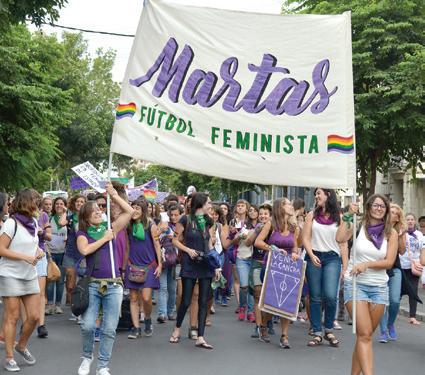
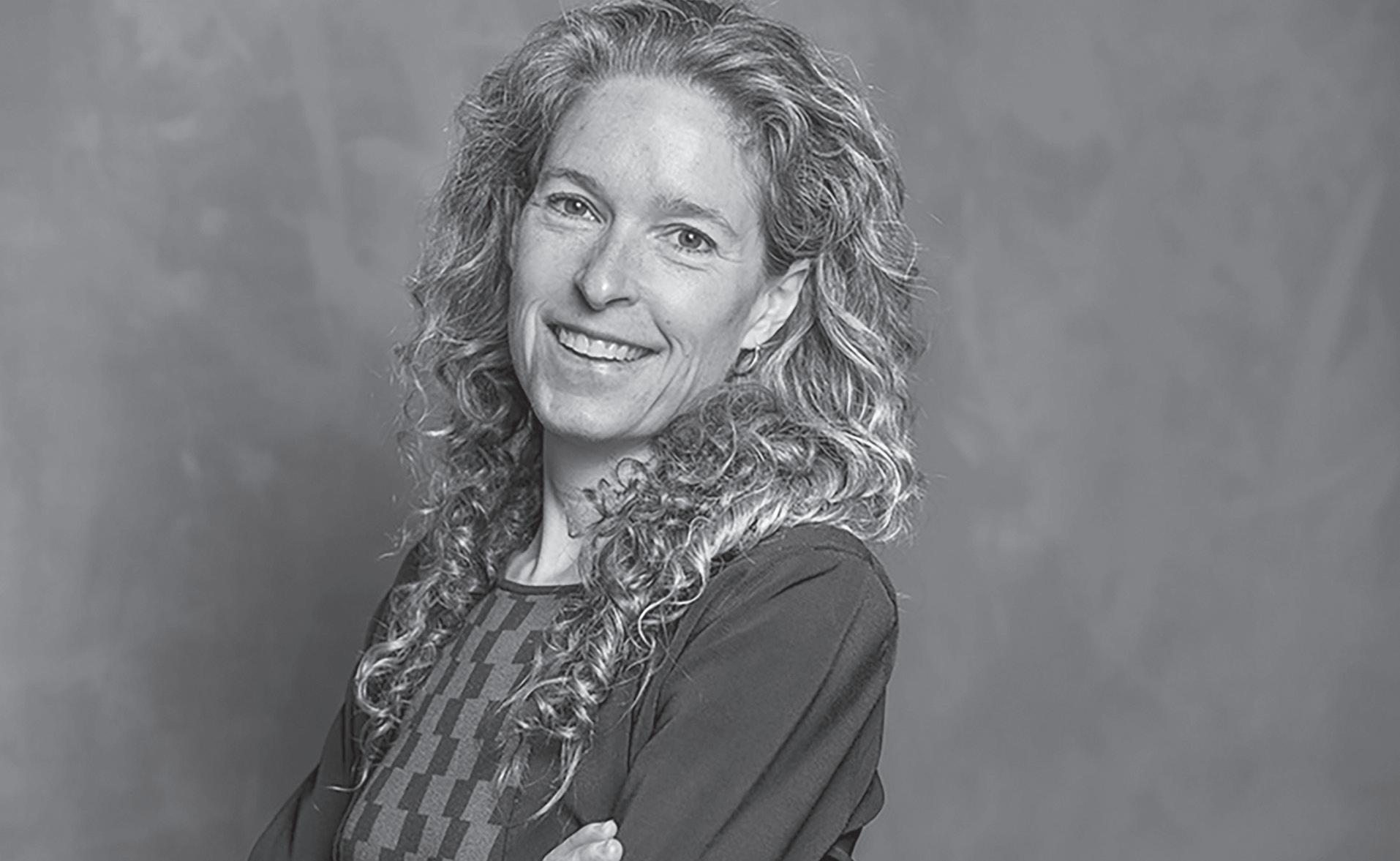
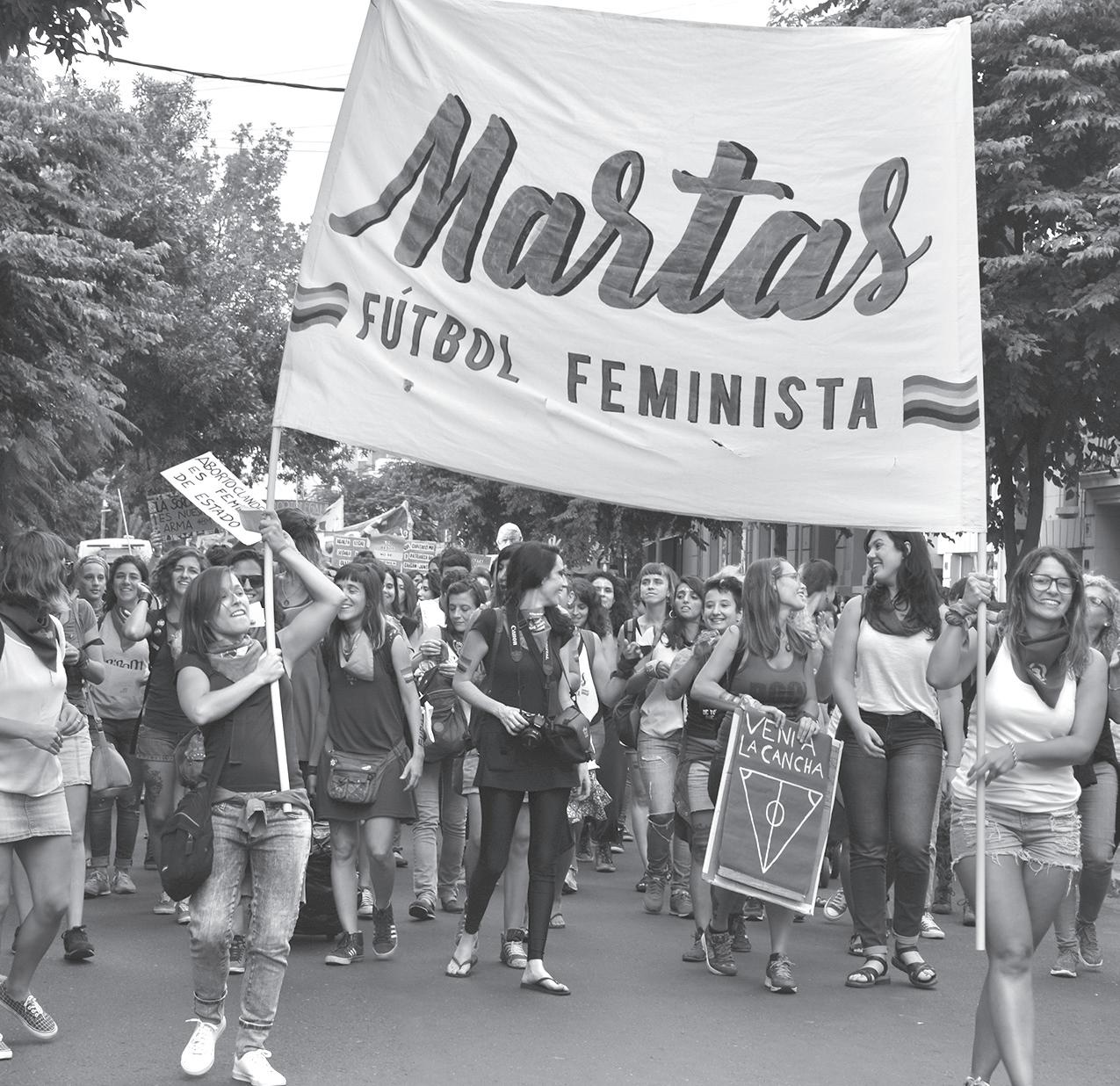
Prof. Brenda Elsey, history, Hofstra University, gave a wry and lively lecture on the rising call for feminist reform in Latin American soccer culture Tuesday evening. That’s right — soccer and feminism.
In her presentation, entitled “Fútbol Feministas,” Elsey drew a historical parallel between women being prevented from playing soccer in Latin America and suffrage movements within that same region.
She cited that in Brazil, women were legally prohibited from playing soccer for 40 years, from 1941 to 1981.
“It would be hard to overstate the importance of soccer in Latin America,” she said, describing soccer’s prevalence in Latin American popular culture both as a pastime and a symbol of national identity.
Women’s soccer in Latin America is the theme of Elsey’s forthcoming book Futbolera: A History of Women and Sports in Latin America, which she co-authored with Prof. Joshua Nadel, history, North Carolina Central University. Elsey also co-hosts a feminist sports podcast, Burn It All Down.
“We wrote [Futbolera] to recover women’s history, both as a meditation on the history of gender in the region but at the same time to challenge popular ideas,” Elsey said. “Popular ideas that women’s sports have no history in the region.”
However, most of the notable icons in soccer are men, Elsey said. Not even the military, she pointed out, is as segregated by gender as soccer.
Elsey additionally discussed Eduardo Galeano’s seminal book on soccer in Latin America, Football in Sun and Shadow, and noted that it mentions neither female players nor soccer’s violently misogynistic and homophobic culture.
“Women’s supposed antipathy toward and lack of history in [soccer] has been used as a justification for denying them resources and asking them to endure significant abuse,” she said.
This oppression persists today despite calls for reform from players and activists throughout Latin America. As a result, female soccer players have begun protests on the soccer pitch, drawing more mainstream attention, according to Elsey.
For example, during the 2018 Copa América Feminina, the Argentine national women’s soccer team posed for a photo with their hands cupped behind their right ears; signifying that they wanted to be heard.
Elsey compared this protest-in-sports phenomenon to football player Colin Kaepernick kneeling during the U.S. national anthem and to the #MeToo movement. Elsey also mentioned the solidarity between Latin American women’s soccer and the Argentinian feminista movement #NiUnaMenos.
Aaran Leviton can be reached at al739@cornell.edu.
Continued from page 3
North Campus, as the main ofces are far from freshmen and other groups on campus.
Candidates were also queried about their views on Collegetown infrastructure improvements. Issues with housing availability and prices emerged as a common theme. Tarangana Tapa ’21 proposed creating legal resources for students experiencing tenants’ rights problems, especially for transfer students, as they are not guaranteed on-campus housing by Cornell.
“Especially because [Cornell isn’t] able to provide [transfer students] with housing, we need to provide them with legal services,” Tapa said.
Te debate closed with the question, “What makes you most qualifed for this position?” Most candidates brought up their involvement in other campus organizations and executive boards.
Ailen Salazar ’21 mentioned her work with La Asociación Latina and Cornell DREAM Team, as well as her eforts in putting together a frst-of-its-kind JP Morgan Diversity and Inclusion event on campus earlier this semester.
Jaewon Sim ’21 pointed to his previous position on Student Assembly and his successful initiative in pushing for free printing on campus. Tis, Sim said, was evidence that, though he makes ambitious promises, one can be “damn sure [he] will keep those promises.”
Voting will remain open from March 25 to 27 at vote.assembly.cornell.edu.
Alex Hale can be reached at ahale@cornellsun.com. Angela Li can be reached at xl462@cornell.edu.
Continued from page 1
the biggest challenges has been how students minimize the nuance of Mozambique among other African countries. Many people think of Africa as one body, Mandava said, “but it’s such a multicultural place.”
Mozambique is home to 29.67 million people, but Mandava is the only one at Cornell. In comparison, New York state has a population of 19.54 million, but 4,679 undergraduates represent the state.
“Being the only one is a lot of responsibility to try and explain to people the culture … to educate the rest of campus,” she said.
Arzu Mammadova ’20 is a computer science major from Baku, Azerbaijan, who applied to Cornell after attending a summer program that spurred her interest in the Western education system and watching
college students’ videos online. Mammadova said she has found the community at Cornell comforting.
“If it wasn’t for them, it defnitely would have been harder for me to get adapted,” she said.
Mammadova — who speaks Azerbaijaini, Russian, English and conversational Turkish — explained that one of the hardest parts of the transition was learning to write critical essays in English, even though she’d been speaking it since she was in the second grade. She said she “really struggled” in her frstyear writing seminar.
Mandova recalled when she frst came to Cornell — with her parents and six suitcases in tow — she was shocked “that this is where I’m going to spend the next four years of my life, and that I would have to live apart from my parents.”
Georgia Makris ’20 is a statistics and philosophy major
from Cyprus who applied to Cornell after hearing its name as a child and continuing to claim she would go there since.
“Oh, Cypress, Texas?” Makris cited as the most common question people ask her about her home.
When asked what she misses most about home, she replied that she felt she was missing out on her brothers’ growing up — and the food.
Makris, who speaks Greek, said that everything — from math to memorization — takes a lot longer in English. Being a student “takes a lot more efort,” she said.
Makris also explained how meaningful having a Greek friend is, because “it’s nice to speak your [own] language.”
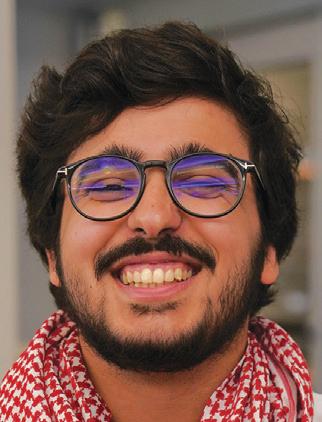
AbdulRahman Al-Mana ’20 is an urban and regional studies major from Doha, Qatar, who applied early decision to Cornell after deciding in high school that
he wanted to study urban planning — an interest that came from watching his own hometown “fourish out of the desert.”
When asked about the biggest shift from his life in Qatar to Cornell, Al-Mana said he missed speaking Arabic. He explained the difculty in fnding other Arabic speakers, but when he does meet them, he feels a “sense of Arab unity” and the comfort of the sounds of home.
“It is very lonely being the only one — not having people who grew up with similar experiences,” he said.
When Al-Mana says he’s from Qatar, the questions people ask are often political, he said; he struggles to balance his personal experience as not broadly representative in his answers.
Continued from page 1
Additionally, he said that the number of openings will be modifed to accommodate all students each day. CAPS sessions will also be matched in “length and number of sessions to students’ needs/goals.”
Lombardi also promised to “[Enhance] students’ access to psychotropic medication management services,” by fall 2019. Psychotropic medication includes anxiolytic, antidepressant, and antipsychotic drugs. Cornell currently ofers “evaluation and medication management for students also receiving counseling at Cornell Health,” according to its website, as well as flling prescriptions for these
medications in-house.
Several university reviews of mental health resources have been conducted in the past, including an external review conducted by the JED Foundation that was criticized by advocacy group Te Sophie Fund. After Wednesday’s announcement, students expressed optimism about seeing progress.
Olivia Gee ’22 is “glad that Cornell is making mental health reform a top priority,” she told Te Sun, taking particular note of the new CAPS interview format.
“I think a lot of students are concerned with the lack of availability of immediate counseling; a quicker response time to get in-person help could
help minimize a lot of the damage that students face as a result of mental health-related issues,” Gee said. Brennan Kosut ’22 expressed similar anticipation for the proposed reforms, detailing experiences he has witnessed as a frst-year student.
“I personally know someone who was told they couldn’t be seen anytime soon for an appointment, as CAPS was booked two months into the future. Another has been waiting for nearly three months for a referral to of-campus medical facilities to get screened for meds,” Kosut told Te Sun.
“Te current system, though well-intentioned, is simply overburdened.”
Tis past fall, as reported by Te Sun, Cornell Health hired more counselors and expanded services — while announcing another ‘comprehensive’ review. Some students said that they believe that the system, however, still has a long way to go.
Kosut highlighted the need to continue increasing staf size and accessibility, stating that he hopes “the measures Cornell is taking will include expanding staf to meet the university’s need for increased availability of professionals, as well as a streamlined process for getting of-site help when needed.”

By ALEX HALE Sun Staff Writer
Ivy League schools are not considered underdogs very often, but they are in one place: the NCAA tournament. Although the Ivy League has not had the success of some other conferences, it does have a history of playing the upset.
Te tournament of 64 teams (plus four play-in games) annually includes an Ivy League challenger in the competition for college basketball supremacy, as an automatic bid is given to the Ivy League champion each year.
Overall, the Ivy League is 43-85 in the NCAA tournament. At 10-7, Dartmouth has the best record in the tournament and is the only one with a winning record, but the Big Green hasn’t been invited to the dance since 1959. Te worst record belongs to Princeton — the school with the most appearances at 13-29.
Perrenial Longshots
Tournament success is not common for the Ivy League schools, but the conference has had some great moments and teams — Princeton in the 1990s, Harvard in the 2010s and Cornell’s Sweet Sixteen run in 2010.
Before the tournament expanded to the current 64-team format in 1985, the Ivy League saw the only three Final Four appearances in its history. Te most recent of these took place in 1979, when Magic Johnson and the Michigan State Spartans defeated Penn on their way to college basketball immortality.
In 1965, Princeton made it to the national semifnals behind star player (and eventual Naismith Memorial Basketball Hall of Famer) Bill Bradley and his 30.5 points per game, but lost to Michigan and didn’t move on to the fnal.
Te only Ivy League team to play in a national championship game was Dartmouth in 1944, when there were eight teams in

the whole tournament. Dartmouth lost the game to Utah.
Since the expansion to 64 teams, the Ivy League has a collective record of 8-37. Typically, the Ivy League champion is a signifcant underdog, landing between a No. 12 seed and the bottom No. 16 seed.
Twice, an Ivy representative has been seeded as a favorite over its frst-round opponent — Princeton both times. Te Tigers lost as a No. 8 seed in the No. 8-No. 9 matchup in 1991 and won their frst-round game as a No. 5 seed in 1998 before losing in the Round of 32.
Once the tournament expanded in 1985, the Ivy eight sufered a ten-year drought without a single victory. A notable game in that stretch came in 1989, when No. 16 Princeton almost upset No. 1 Georgetown but lost 50-49. Tat Georgetown team had future Hall of Famers Dikembe Mutumbo and Alonzo Mourning on its squad.
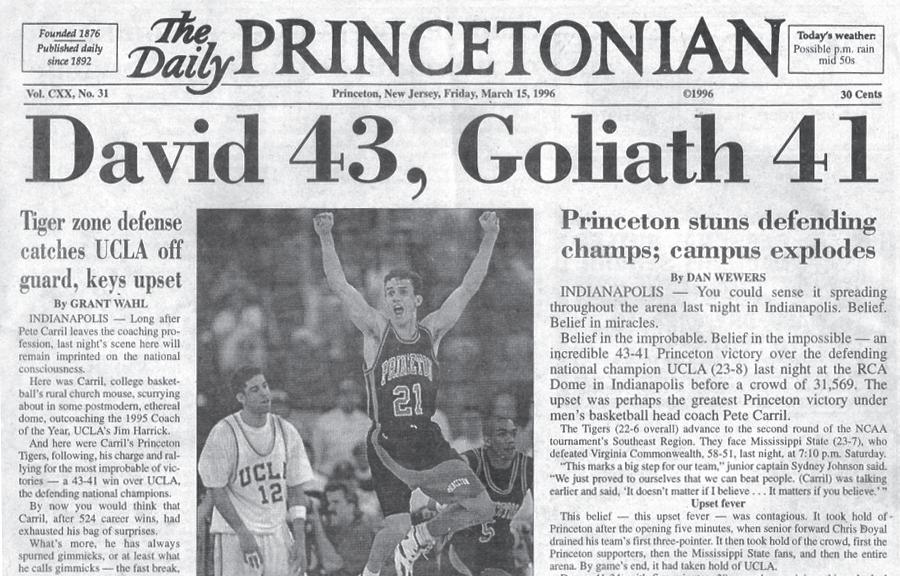
Te conference earned its frst victory in the Round of 64 when Penn upset Nebraska in 1994. Tat win began a stretch where an Ivy representative won its frst game three times in fve years. Following Penn’s triumph, Princeton defeated No. 3 UCLA 43-41 in 1996 and beat UNLV as a favorite in 1998.
After 1998, the Ivy League went 11 tournaments without a victory. Penn, Princeton and Cornell traded repre -
sentation for those seasons, and would lose to teams laden with future NBA players.
Modern Bracket Busters
Te winless streak ended in 2010, when Cornell won not one but two games, becoming the frst Ivy team to reach the Sweet Sixteen since the full feld of 64 was created. Led by Jef Foote ’10, the Red — a No. 12 seed — defeated No. 5 Temple 78-65 and then No. 4 Wisconsin 87-69. Cornell’s unprecedented run ended in a loss to Kentucky, a team that had eight future NBA players including perennial All-Stars John Wall and DeMarcus Cousins.
Tree years later, Harvard got in on the tournament success. A No. 14 seed in 2013, the Crimson bested No. 3 New Mexico before losing to No. 6 Arizona in the Round of 32.
Te next year, Harvard returned to the tournament as a No. 12 seed, upsetting No. 5 Cincinnati 61-57. Like the previous season, the run would stop there, as the Crimson ended their season with an 80-73 loss at the hands of No. 4 Michigan State.
Harvard almost caused another upset in 2015, but No. 4 North Carolina narrowly escaped its game with the Crimson by a score of 67-65.
Most recent of the Ivy League upsets came in 2016, when No. 12-seeded Yale proved victorious over Baylor 79-75. Te Bulldogs would then lose to a Duke team boasting fve future NBAers, including Grayson Allen and Brandon Ingram.

Starting in 2017, the Ivy League Tournament determined which team received the automatic bid for the tournament. Before that, no conference tournament took place and the regular season champion — the team with the best in-conference record — would represent the conference.
Last season, Penn came out the Ivy League as the lowest possible No. 16 seed. Although the 2018 tournament did see the frst No. 16-seed upset a No. 1, it was not Penn, as the Quakers lost to Kansas.
David and Goliath 2019?
Tis year, Yale defeated Harvard in the Ivy League Championship Game and is moving on to the NCAA tournament. Te Bulldogs were placed as the No. 14 seed in the East Region. Top seeds in that region are Michigan State and tournament-favorite Duke, with highly anticipated NBA prospects Zion Williamson and RJ Barrett.
Te Bulldogs start their tournament run against number No. 3 seed LSU, a team that won its conference’s regular season championship, but lost in the frst game of the SEC tournament. Now LSU’s head coach has been suspended, casting doubt on the Tigers’ ability to advance in the tournament. Yale and LSU face of on Tursday at 12:30 p.m. Te game will be played in Jacksonville, FL and can be viewed on TruTV. Maybe we’ll see some Ivy magic.
Alex Hale can be reached at ahale@cornellsun.com.

As the sun emerges from the grey clouds that continuously inhabit Ithaca’s skyline, I too emerge from the dim recesses of the stacks at Olin Library. It is time for a study break and an even more perfect time to try out Mehak’s lunch buffet for $11.99 with my roommates.
As we arrive, I take notice of the exterior of the eatery. It looks like a typical holein-the-wall Indian restaurant with heavy maroon and gold drapes resting upon slightly tinted windows bearing in pretty gold letters the words: “MEHAK AUTHENTIC INDIAN CUISINE.” As I open the door, I am greeted by a delicious medley of fragrances: the sweet woodsy smell of cardamom, the earthy flower-like smell of saffron, the sharp smell of ginger and the warm nutty smell of roasted cumin seeds. It takes no longer than two minutes for the waitress to find us a quaint little table for four, adorned with white and plum table cloths, across from a large window which pleasantly directs the warmth of the sun’s rays onto our backs.
My first order of business is to order a mango lassi, a yogurt-based mango drink. We wait no more than five minutes for the waitress to come out with a tray of tall crystalline glasses filled with bright orange liquid and ice. The very first sip instantly awakens every cell in my body, as the cool refreshing sweetness of the mango flavor washes away any tiredness I had felt from the school day.
dishes. Its consistency, the perfect balance between thick and thin, allows the drink to gently coat the insides of my mouth just enough for the taste of mango to linger briefly before disappearing altogether. After tasting the lassi, I readily get into the fast-moving buffet line which clears the way to a rainbow of dishes, proudly boasting hues from warm reds to forest greens.

The tangy flavor of the yogurt couples perfectly with the biting sweetness of the mango, balancing the drink so that it’s just right to sip on throughout the meal without overpowering any of the other
I pile a few pieces of naan onto my plate, some basmati rice, a few pieces of pakora, some karahi paneer masala, aloo saag, chicken tikka masala and raita. The first thing I try is the naan, a type of flatbread. The texture is delightful: light, fluffy and the perfect thickness so that I do not have to chew much to eat it. I chase my naan with a spoonful of karahi paneer masala, which is made out of homemade cheese marinated in yogurt, various spices, onions, green pepper and tomato. I find the use of small paneer pieces to be optimal compared to the more commonly used larger pieces as it allows for a bite of cheese with every spoonful of sauce, creating the perfect cheese-to-sauce ratio. The cheese pieces alone are quite flavorful as they seem to be soaked in the same flavors that define the sauce. The softness of the cheese paired with the smoothness of the sauce makes the texture as enjoyable as the taste itself — the sauce practically melts in my mouth, releasing the earthy flavor of the onion, the sharp tangy flavor of the green pepper, the nutty spiciness of the black pepper and the sweet, juicy flavor of the tomatoes. After finishing the paneer, I make my way over to the aloo saag, a potato and spinach dish adorned with a bounty of spices. As I take my first spoonful, I am shocked at how smooth and butter-like the sauce is; the fresh spinach is pureed so well that it’s nearly impossible to
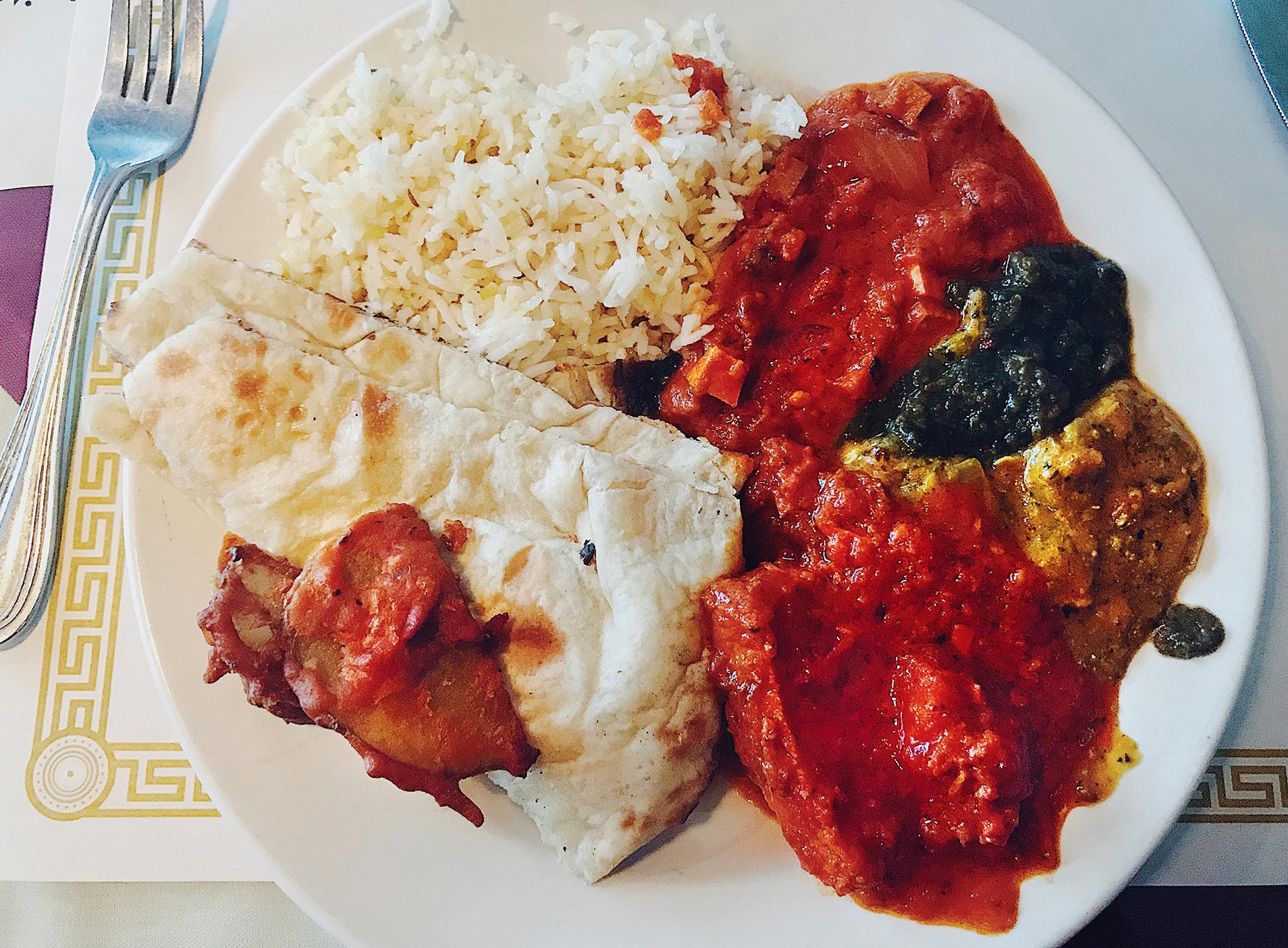
feel the individual pieces. This smoothness contrasted with the chewiness of the potato pieces adds a perfect blend of texture to the dish, while the spinach seems to endow the potatoes with the hearty flavor of roasted garlic along with a slight citrusy and salty undertone. Once done with the aloo saag, I try the chicken tikka masala, which is a dish consisting of chunks of roasted marinated chicken sauteed with onions and tomatoes in a spicy red curry sauce. The sauce tastes very similar to the karahi paneer’s sauce aside from an additional layer of nose-tingling spice. The chicken is perfectly tender, easily falls apart in my mouth and soaks up the flavor of the spices and vegetables that make up the curry sauce.
Moving away from the sauce based dishes, I try the pakora, type of vegetable fried in chickpea batter. The dough is thin and light, allowing the flavor of the vegetable inside to shine. The amount of oil is a lot less than I expect, giving the dish a much lighter feel and taste. Next in line is the raita: homemade yogurt with cucumber and roasted cumin seeds. Overall, the raita is enjoyable. The thinness of the yogurt lightens the dish, and the sharpness of the cucumber adds a layer of freshness and clarity. However, the amount of spice is slightly overdone, as the roasted cumin seeds adds a heavy, earthy
and slightly overwhelming taste to the dish which at times overshadows the refreshing effect of the cucumber and yogurt. For dessert, I check out the rice pudding. The rice is so soft and swollen with the sauce that every bite releases a squeeze of milk carrying the spicy yet woodsy undertones of cinnamon along with it. The pudding itself is so smooth and thin that it goes down my throat as if it is a drink. This thinness of the pudding does nothing to detract from the sweet hearty flavor of the milk; in fact, it cuts the heaviness of the milk, making the dish feel less creamy and more light. This desert is truly a perfect way to end a nearly perfect meal. The high quality of the meal and the speedy service mark the characteristics of an excellent eatery aside from the basic interior design, which could be more original and deviate from the design of a typical Indian Restaurant. All in all, I left Mehak with not only a full stomach, but a happy one as well.
Serves: Authentic Indian Cuisine
Vibe: subtly elegant
Price: $ Overall:





Though I don’t graduate until May, I have decided to end my run as an arts columnist now, just a little past the halfway mark of my final semester at Cornell. One source of inspiration for my early retirement is the desire to step down and let another student stand atop this platform that I’ve been so fortunate to possess for the past three years. Furthermore, I simply feel as though I no longer have anything particularly polemical to say about arts or entertainment. The Muses stopped singing to me, to put it poetically, and I’m out of ideas!
But, now I have to write this final column of mine, a task that I feel woefully unprepared to accomplish adequately. It seems as though there are a thousand ways of approaching something like this, hundreds of angles to take and dozens of tones to adopt. I think I’ve settled on going for earnest here and reflecting upon the headspace I’m currently inhabiting as I approach graduation, even at the risk of sounding overly sentimental or morose.
Before I was a senior, I would often think about what I wanted to say in my last column, and I definitely imagined having some profound piece of sagacity that I could share, wisdom that only a second-semester senior who’s “figured it all out” could impart. Ironically, I’ve never felt more lost at Cornell than I do right now; it turns out that my 22-year-old self is not much more enlightened than my 20-year-old self. Of course, I’ve felt quite aimless here in the past, but at those moments in my

younger years, all of the unknown things, the cosmic uncertainty of life as a college student, were so exciting. “Cosmic” is a fitting term here, because at that time in my life — especially around sophomore and junior years — I really did feel as though we all were just a bunch of atoms bouncing off of each other in a random pattern, where any coincidental encounter might lead to some profound experience or moment of clarity.
Now, as the end of my time at Cornell nears with blinding rapidity, that time in my life seems to be despairingly far-away, accessible only by the stray Proustian moment that unlocks the lost past for a few seconds.
To spend any of these words mulling over the regrets I have from my years at Cornell would push the tone of this column from intensely nostalgic to sickening, so I’ll refrain from doing any cataloguing and mention just one thing I would change: For a music major, I spent a shamefully small amount of time making music with friends. The occasional jam sessions (thanks to Alex Hammond ’18 and his pedal-steel guitar) notwithstanding, I gradually unloaded a lot of my musical responsibilities over the semesters as I believed that my academic pursuits were more pressing. In fact, I forewent many things, possible friends and other potentially formative opportunities, because I wanted to devote so many of my hours studying in the stacks. All of this studying is the reason why I’m attending law school next year and for that I’m thankful, but there was

Lux Prima is an untested nuclear fusion that turns out to be a psychedelic film-noir narrative. It was a precarious move to put both Karen O and Danger Mouse in the studio without first toning them down or unplugging all equipment for safety concerns. Karen O is the lead vocalist of the Yeah Yeah Yeahs and is pivotal to the alt rock revival in New York. O is recognized for her shrieking vocals and feverish stage presence and performing antics, such as nailing screeching notes while winding microphone cords around her head. Danger Mouse (Brian Burton) is a drummer and producer known for his incessant experimentation across all genres, replicating his distinct watermark through collaborations with artists such as Adele and U2.
The collateral beauty of Lux Prima started with a drunk phone call in 2008, but it wasn’t until 10 years later that the two finally clashed their sound. Both artists are midway into their music careers
Karen O and Danger Mouse
Lux Prima BMG Rights Management


and near their 40s, and they have been longing for a transformative moment to reinvent themselves. Before heading to the studio, the two had had no discussions about their musical direction — instead, they playfully paved their own exploratory path.
Lux Prima stands as an experimental work that drifts between diaphanous reveries and meticulous modulations in the form of creation. The title track “Lux Prima” incarnates and opens the album with its nine minutes of multi-staged metamorphosis. Latin for “First Light,” Lux Prima is a cinematic journey that links the vastness of the cosmos to the reflection of the artists. This metaphoric elucidation is evident in the lyrics “I’m nowhere / I’m no one / I’m nobody.” With various beat changes that add texture and variability to its structure, the song connotes epic space dramas through lush and lingering synthesizer notes and celestial choruses. The preceding
certainly some cost to it. The paper chase is maddening at times when it causes you to disregard the things that make you happy and human.
From my first few weeks at Cornell to the present moment, the one thing that has remained a part of my life here with absolute consistency is my identity as a contributor, writer or columnist for The Sun, and for that I obviously have many people to thank. I’ve thought for a long time about who I might mention, but the list is too long and I’d inevitably leave someone out. To every fellow writer and editor (past and present), to everyone who has ever read this column (especially my mother, who’s this column’s biggest fan), to any person with whom I’ve ever had an inspiring conversation, thank you.
Right now I think of a lyric from a Talking Heads song that has remained in my head with remarkable consistency for
the past four years: “Home, is where I want to be / But I guess I’m already there.” Of course, “This Must Be the Place” is a love song, but something about its encompassing lyrics makes me think about the vast expanse of the universe. It’s easy to get lost in such a place, but as the lyrics remind us, “home” is simply a mindset to be assumed amidst all of the change and uncertainty.
Many years from now, I’ll probably deem my present angst to be nothing more than senioritis, as so many other aspects of youth become normalized over time. But for now, Rome is burning, and unlike the apathetic Nero, I’m going to make the most of every second I have left.
Nick Swan is a senior in the College of Arts and Sciences. He can be reached at nswan@ cornellsun.com. Swan’s Song runs alternating Tursdays this semester.

track “Ministry” adds a poignant touch that leaves the audience in rumination with a tint of para noid reminiscent of the spidery vocals of Portishead’s Beth Gibbons. With multiple references to life and death, connotes a vivid image of maternity. “Woman” declares motherhood as an underlying theme of the album. The album was produced after the birth of O’s son, which she described as a humbling and maturing experience. The distorted and potent “Woman” recaptures and unleashes the punk power that permeates Yeah Yeah Yeahs’s earlier works while self-critiquing the teen spirit of punk. In the chorus, O belts out a rhetorical question that can mostly be answered by the raw emotion in her vocal, “I’m a woman, what you see!” This cogent hook keeps
reverberating as we move on to the latter half of the album. Electronic nocturnes gradually wrap up the album in a murky and ominous way that connotes bizarreness and craftiness. The groovy “Leopard’s Tongue” is a psych-funk track with escalating vocals before the chorus, portraying the alternative form of femininity through both fragility and brutality. “Reveries” is an oddball, rugged lullaby that surprisingly mingles well into the album and brings the rawness of the duo’s experimental mentality back to the core. Finally,
closure to this conceptual album. With merely nine tracks, this 40-minute album leaves you wanting more. This short yet comprehensive album delivers an unheard mesh of sounds that exhausts the strengths of both artists. Lux Prima is an elegant yet dreamy album, blossoming in a cinematic way that more closely resembles an avant-garde narrative than that of Hollywood.
Stephen Yang is a freshman in the College of Agriculture and Life Sciences. He can be reached at sy364@cornell.edu.
DAHLIA WILSON ’19
Business Manager
PARIS GHAZI ’21
Associate Editor
NATALIE FUNG ’20
Web Editor
’20
SARAH SKINNER ’21
MEREDITH LIU ’20
RAPHY GENDLER ’21
Sun
Ad
Editorial
BEGINNING AT 9 A.M. ON MONDAY, MARCH 25, all undergraduate students will have the opportunity to vote for their Student Assembly representatives for the 20192020 school year. The selected candidates will be taking the reins of the Student Assembly in the midst of the Boycott, Divestment and Sanctions campaign, before byline funding for student organizations and following the passing of free printing.
This particular election stood out to The Sun for the light it shed on student perception of the Student Assembly. We were as intrigued as the student body was about the fresh faces involved and a potential new perspective. However, after watching the debate, sitting down with each presidential and vice presidential candidate for an interview and reviewing each of their informational forms, we felt there was one candidate for each position who was qualified, passionate and prepared.
PRESIDENT
In the race for president, The Sun is proud to endorse Joe Anderson ’20, who currently serves on the Assembly as the executive vice president.
His experience as an undergraduate representative to the University Assembly, executive vice president of the Student Assembly and executive vice chair of the University Assembly showed his competency and preparedness. However, his serving as president of Residential Student Congress and president of Haven: Cornell’s LGBTQ Student Union made his message clear: Anderson is passionate about service and giving back. Anderson was the only candidate who went so far to say that his work was not contingent on his election. His passion for fixing student issues was evident and runs deep enough that he said he will be at every Student Assembly meeting regardless of the results, to advocate for students.
John Dominguez ’20, the current ILR representative, is also a good candidate for president. Dominguez’s platform has been focused on going beyond superficial policy ideas and digging into the substantive part of the issues Cornellians face. His emphasis on his role as a facilitator and outreach is excellent, as he has a consistent record of achieving his goals on the Assembly. However, we are concerned with his self-proclaimed lack of vision. During our interview, Dominguez expressed his inability to create his own ideas or set a vision. His record and platform do support his ability to achieve goals, but we feel that having a candidate who cannot develop their own vision is problematic.
When sitting down with Trevor Davis ’21, we found that he emphasized the importance of honesty and had a sense of humor, but we have major concerns about his legitimacy as a candidate. This is not a high school presidential election. The S.A. President has an intense schedule and amount of responsibility. The debate and interview showed us he does not have a firm understanding of the position. While his idea of transparency is admirable, when asked about the S.A. President’s role in responding to instances of hate on campus, he simply said that would respond with a sentiment saying hate is bad. While it may not have been malicious, his underdeveloped response was not analogous to the seriousness of a hate crime.
Additionally, a lack of understanding of the appropriations committee and assembly proceedings was not refreshing but naive and concerning. He is an honest guy and likeable, just not an appropriate choice for S.A. President.
This coming year student organization funding allocations are on the table, making it of the utmost importance that the elected candidate understands the appropriations committee and process of dividing the nearly $7 million from the student activity fee. We found that Anderson not only had a good grasp, but his experience and knowledge far surpassed that of his fellow candidates.
EXECUTIVE VICE PRESIDENT
The Sun would like to endorse Cat Huang ’21 for executive vice president of the S.A. Throughout her time as the transfer student representative and the vice president of diversity and inclusion, Huang has worked closely with administration and students to find tangible solutions to pervasive issues like housing. In her conversation with The Sun, she emphasized that the interconnected nature of the EVP role with parties outside of the assembly is vital to helping her further this line of communication with the University’s true decision makers: the student leaders of campus organizations, the students in those groups, and the administration.
After only a semester and a half at Cornell, Huang has already learned how to navigate bureaucratic hoops to push for well-researched initiatives. The Sun particularly admires her commitment to ensuring that the North Campus residential expansion plan accommodates transfer students and that the increased freshman enrollment does not prove counterproductive to offering more on-campus housing options for students.
The other candidates running for EVP, Nick Matolka ’21 and Uche Chukwukere ’21, also presented a commitment to student voices. Matolka’s emphasis on reforming the student health plan and improving the line of communication between students and Cornell Health is valuable, but we are unsure of how the position of EVP specifically will provide a platform to further these goals. Chukwukere has a clear passion for making the assembly a productive space that amplifies the voices of students from all experiences and backgrounds, with particular attention to the narrative of students of color and students from the LGBT community. The Sun stands behind this vision, but we believe that he can accomplish these campus climate measures regardless of what role he has on the S.A.
The complete list of candidates and their statements, for all S.A. races, can be found on the Office of the Assembly’s website. Voting begins at 9 a.m. Monday, March 25, and continues through 2 p.m. Wednesday, March 27.
Warning: The following content contains sensitive material about mental health and depression.
Cornell’s response to six student suicides between 2009 and 2010 was the installation of nets over Ithaca’s gorges. These nets — monuments of the mental health crisis at Cornell — overshadow both Ithaca’s natural beauty and Cornell’s stellar research infrastructure. They remind us that something is wrong on Cornell’s campus. Six years after starting my astrophysics Ph.D., I still remember the first time I saw the nets. Every year, prospective graduate students ask me about the nets, and every year I have to explain Cornell’s history with mental health. I remember how, years after starting at Cornell, during the worst of my depression, those nets were a daily reminder of the dangers posed by untreated depression.
But Cornell’s mental health crisis won’t be fixed by nets: Nets reduce Cornell’s liability, but they hardly address the mental illness that has led to so much tragedy. What about comprehensive, accessible preventative mental health care? The chronic understaffing of Cornell’s mental health services must end.
students with the most severe cases (like mine) can benefit.
After last year’s rally, over 100 graduate students walked through the freezing cold to President Martha Pollack’s office to deliver our petition. Neither President Pollack nor Provost Michael Kotlikoff were in Day Hall when we arrived, so we left the petition, along with paper copies of our personal stories. We left contact information so the president could follow up with us about setting up a meeting. Despite the fact that our petition was signed by over 900 graduate students, and that our speakers focused on how we might improve the positive aspects of Cornell’s mental health services, the administration never offered to meet with us.
Sharing the story of my mental health experience at Cornell felt liberating —
Sharing the story of my mental health experience at Cornell felt liberating — the speakers as well as the people at the CGSU rally realized we weren’t alone.
the speakers as well as the people gathered at the CGSU rally realized we weren’t alone. The way the administration dismissed us shocked me.
Today, Cornell graduate workers, undergraduates and community members will attend Cornell Graduate Students United’s rally for improved Cornell mental health services. We will be delivering our mental health petition to the Board of Directors Committee, requesting an opportunity to present our petition and mental health campaign to the board. Our petition is the result of a mental health survey conducted by CGSU, which over 900 Cornell graduate workers have signed.
I, and the rest of Cornell Graduate Students United, refuse to stand by as our peers struggle with mental health.
Thursday’s rally represents an escalation of CGSU’s mental health campaign. We held a similar rally last semester — along with several other students, I shared the story of my struggle with mental health on the front steps of Cornell Health. We spoke about the extreme depression we experienced on campus, but despite that, we remained positive about the help we had when we finally got through the unnecessarily bureaucratic mental health services protocol.
I talked about how wonderful my Cornell therapist was, but also how sad I was when I learned from my friends about how the University’s mental health services remain so understaffed that only
Cornell graduate workers need comprehensive mental health reform quicker than Cornell recognizes. We cannot wait for the administration to understand the magnitude of this crisis on its own. We need Cornell to commit to a timely, public external review, and to meet the other demands of our mental health petition. We need mental health reform. Depression and mental health problems are serious, but they are almost always treatable or preventable. I, and the rest of Cornell Graduate Students United, refuse to stand by as our peers struggle with mental health. That is why we’re appealing to Cornell again this week. Join us as we rally at 1 p.m. in the courtyard between Uris Hall and the Statler Hotel. We’ll be delivering our petition to the Board of Directors, since many decisions regarding the distribution of resources at Cornell are in their hands. Whether you are a graduate student yourself or a supporter of improving Cornell’s mental health services, we need your support. Let’s end the mental health crisis on Cornell’s campus together.
Thea Kozakis is a graduate student at Cornell. She can be reached at tk543@cornell.edu.
SUBMIT LETTERS TO THE EDITOR AND GUEST COLUMNS TO OPINION@CORNELLSUN.COM

In the fast-paced bubble of our Cornell campus, Olin Library’s Amit Bhatia Libe Cafe is a humble, reassuring constant which stands firm through the confusing and unpredictable turns of college life. Libe is great. For a quick bite between cramming for a prelim and stressing out about how little you actually know for said prelim, Libe has you covered with enough snacks and caffeine to keep your mind wired until your brain falls out of your head. The cafe’s convenient hours make it easy to get the fix you need to push through those last couple sentences as night falls and the brightly lit view of the Arts Quad turns into your own eyes staring desperately back as your 11:59 p.m. Turnitin deadline draws nearer. While you might be breaking out in cold sweat as you race time to the finish, you’ll rest easy knowing you’re not sweating over wasting any real money — it was just BRBs anyway.
Libe is that family cafe you’ve been going to for years and know like the back of your hand. The plastic hard-back chairs and dinky, wobbly-legged tables aren’t anything special, but their familiarity makes them comfortable. It’s a place where judgment and pride fall by the wayside, mostly because we’re all too busy waiting for our coffee orders to pay attention to any crisis you might be having in your life. Here, we are all the same. Here, you are never alone.
And none of this is to say that Zeus is bad. But I think that on the question of Zeus versus Libe, it’s not even a close call.
and reigns supreme over them both.
I realize I’m taking a big risk here, completely disregarding the original question in favor of a cafe that is rarely, if ever, included in the long-raging Zeus-Libe debate. But as The Sun’s Dining Editor, I think it’s only fair that I get to flex the title just this once and point you all to the best cafe on campus.
Goldie’s is magical in that you can get actual, hot sandwiches and meals that are not only satisfying but also priced appropriately. You’re not burning real money on a soup and salad every day but can utilize your BRBs to their maximum value — a full Portobello Melt or Green Goddess costs only $5.99, which can’t even get you a full sandwich at Zeus. Combined with the fact that they also have Libe’s extensive snack selection, baked goods and speedy coffee service, there’s really no reason to count it out of the competition. Goldie’s mac and cheese cups are the perfect way to satisfy your momentary carb cravings, and the workers go out of their way to help make transactions as quick and painless as possible, even when the lines span the entirety of the building.
Without fail, Goldie’s staff are rays of sunshine in the midst of a stressful day — they are some of the friendliest workers that have ever graced Cornell Dining grounds, up there in the ranks with Happy Dave. The seating in Goldie’s is expansive as well, and the natural lighting that
A place with both the quality minded classiness of Zeus and the comforting familiarity of Libe already exists — and it’s Goldie’s.
Zeus absolutely demolishes Libe. As I sit here writing this column that was originally supposed to be pro-Libe, I question why I agreed to argue this position in the first place. Who in their right mind thinks of the two and consciously decides that Libe is a superior eating, studying or relaxing destination? I exclusively eat at Libe when I’m stressed and hangry, feeling like I need to make a bad decision in way of a sugary drink or an equally — if not more — sugary cookie. I don’t study or relax in Libe either; that’s what the rest of Olin is for. Comparing Zeus to Libe is like comparing an organic, freshly picked apple to those sad bananas people keep leaving on the sidewalk.
However, after much thought, I’ve come to realize that comparing the two cafes isn’t even necessary. Indeed, a place that has both the quality-minded classiness of Zeus and the comforting familiarity of Libe already exists — and it’s Goldie’s. This inconspicuous cafe tucked away in the corner of the Physical Sciences Building gives us the best of both worlds

comes from the high ceilings and large windows gives it the Zeus vibe without the pretentiousness and artificiality that seems to permeate those marble countertop tables and lined-up Greek statues.
Yes, Goldie’s is a hotspot for STEM majors, and you’ll probably find yourself overhearing conversations about orgo lab or the latest chemistry prelim. But the people who go there are happy to share a table and conversation with you without pretense. I’ve been given some of the most reassuring advice for orgo lab from a random guy sitting at the same table as me, and that’s the kind of support I need in my life. Goldie’s is a constant throughout all the rare highs and plentiful lows of college life, providing good food and a space to decompress for those rough days that just never seem to end. And in the end, yeah, Libe isn’t bad, and Zeus is okay. But it’s Goldie’s that will always have my heart.
Katie Zhang is a sophomore in the College of Agriculture and Life Sciences. She can be reached at kzhang@cornellsun.com.
Katie Sims Let’s Meet at Zeus
My
first invitation to the Temple of Zeus was within two weeks of arriving on campus, in a clear and straightforward email from two former arts editors, inviting all of the prospective writers to a section meeting. The simple phrase “Temple of Zeus in Klarman Hall” was baffling to me; I didn’t know where or what Klarman Hall was, why there might be an ancient Greek temple in the middle of this building and what business we had holding a meeting there. I googled “Temple of Zeus” probably a dozen times leading up to that meet-
walk around and see past the sea of bodies just a little bit more easily. Plus, more people means a better chance of finding a friend.
One of the best yet least-appreciated features of Zeus is that it is open 24/7. Because it exists in both the work and social spheres — and you can go at any hour of the day — it has the widest range of possible uses. Want to read The Sun at 7 a.m.? Zeus. Want to study on a Saturday before the libraries sluggishly open their doors? Zeus. Working meetings? Zeus. Conflict-resolution meetings?
I doubt the coffee is really what brings people to Zeus. Zeus is far less about the Temple of Zeus Cafe than it is about coming in and walking a lap to find friends.
ing, hoping the cafe that came up (which Google said would be closed at that hour) was really where I was supposed to go.
I did, luckily, find myself in the right place, and when I walked nervously through the East Avenue entrance of Klarman Hall, I was struck by the grandeur of the massive glassy atrium.
Is the grandeur of Klarman Atrium gratuitous? A clear example of form over function? A poor use of resources? I’d venture a “yes” to all, but you could say the same about virtually all of the things we do for our own enjoyment. And in the endless (and maybe intractable) backand-forth between Zeus and Libe, I think the biggest consideration needs to be the atmosphere, determined by the physical environment, the ability of the space to meet its demands, and the social design.
Why not care about the food or the coffee? Walking through Zeus, it’s clear that the majority of the people are not chomping on seitan-hummus sandwiches, and while there are plenty of soup bowls and coffee cups around, I doubt that the brand of coffee is really what brings people to Zeus. Zeus is far less about the Temple of Zeus Cafe than it is about coming in and walking a lap to find friends. It’s about meeting people through shared tables and eating packed-at-home lunches sitting against the wall with a friend. It’s working meetings, study groups and coffee chats.
Zeus. Lost freshman looking for adventure at night? Zeus. Writing an essay at 2 a.m.? Zeus. While the Temple of Zeus Cafe’s hours are significantly more restrictive than Libe’s, the cafe’s atmosphere can be accessed at times when Libe’s can’t, albeit without the coffee and pastries.
A beautiful social workspace is perhaps the best investment a university could make.
The pale colors, bright lamps and whole-roof skylight keep Klarman welllit, more so than Libe, despite Klarman being in a basement and Libe having panoramic windows to the Arts Quad. Additionally, its size gives it a seating capacity far greater than Libe. And while both are virtually overflowing at peak times, Zeus has slightly more room between the tables, as well as bigger walkways and floor space. You can breathe,
Finally, and most importantly, the size and structure of the tables at Zeus are purposefully social and collaborative. While the majority of the seating in Libe is those individual armchairs with the desks, the vast majority of seating in Zeus is tables and chairs letting multiple people circle around. They’re enough to spread out lunches, laptops or notebooks, allowing the time to be productive and extended. While the simple question of “Could I share your table?” can be daunting or stressful, it encourages meeting new people. While there is plenty of meeting new people to be done at Libe, the general arrangement of seating is set to enable comfortable, solitary working conditions within a high-density area. A beautiful social workspace is perhaps the best investment a university could make. It is uniquely possible on a college campus to have so many people collaborating on self-motivated projects and to have knowledge flowing in such large volumes. When our spaces encourage us to collaborate, we learn just as much from our peers as our classes, and become much more adept at synthesizing and sharing our knowledge. While sitting alone in Libe armchairs, noses in our own books and laptops, is sometimes a necessity, the conversations and jokes and smiles we can find at Zeus may just help us fend off ever-looming isolation.

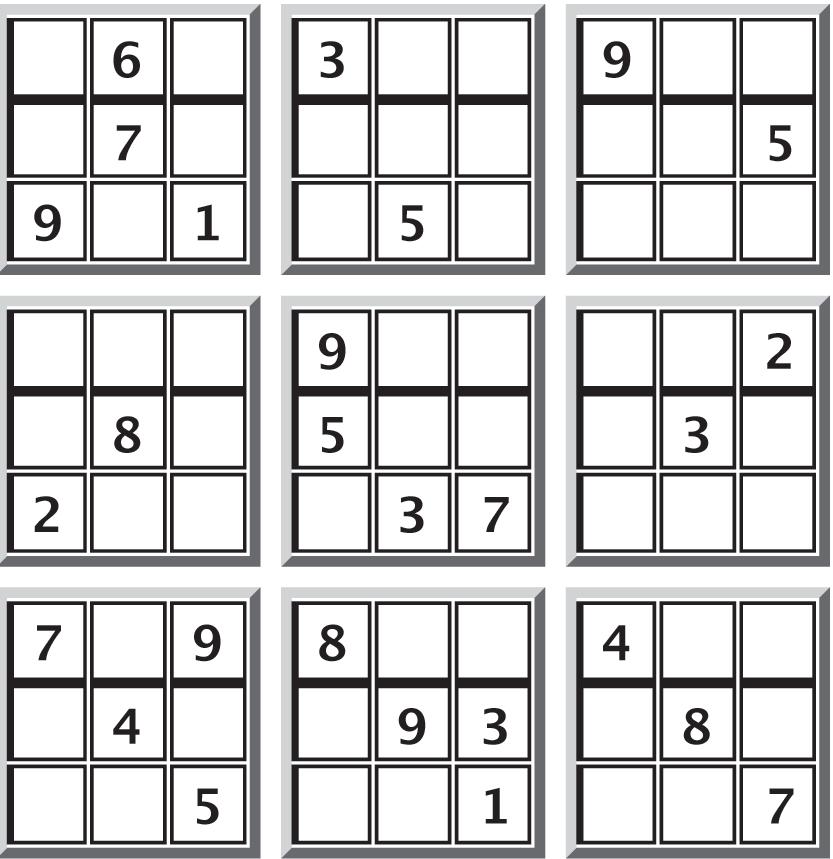
Fill in the empty cells, one number in each, so that each column, row, and region contains the numbers 1-9 exactly once. Each number in the solution therefore occurs only once in each of the three “directions,” hence the “single numbers” implied by the puzzle’s name. (Rules from wikipedia.org/wiki/ Sudoku)



M. HOCKEY
Continued from page 12
play … their minds wandered a bit — ‘We might not get to the championship game.’”
Unlike the quarterfinals, championship weekend is one-and-done. And anything can happen in one game, especially when it’s against a team on a roll like Brown.
“That’s part of the problem with these tournaments for teams like us. You’re always coming in against a really hot team,” said sophomore forward Morgan Barron, recently named to the All-ECAC first team.
sweep by Michigan State, and injuries nonstop, basically,” Mullin said after the Union series win. “We haven’t had an easy road, and I think [we’re] a better team for that.”
While Cornell breezed past Quinnipiac in the 2017-18 quarterfinals, dropping game one to Union this year— and the subsequent response — might help Cornell’s ability to extend its playoff run.
Collegetown
We have availability for the 2019-2020 school year beginning June 1st at Hudson heights apartments. The studio apartments come with: heat, water, and electricity included. There are garbages houses and coin-operated laundry facilities on site. Prices start at $740/month for a 12 month lease. If you have any questions or would like to schedule a tour contact us by phone 607-208-7660 or email: renting@ithacaLS.com
COOK ST. Furnished House for 5-7 persons, 10mo. Lease for 2019-2020 Text or call Tracy at TLC Property Mgmt Corp 607-379-2776
3 BEDROOM Nice, clean, furnished unit can host up to 12 people. 303-309 Dryden Road Heat, Hot water included. Fiber Optic fast internet connection Laundry, parking available 607-279-1888 www.porealty88.com
Collegetown Terrace Apartments INSPIRED LIVING TAILORED TO YOUR SUCCESS
24-Hour Fitness Center Shuttle Bus Service to Campus Study Rooms w/ Expansive Views Apartments Available NOW, Spring 2019 & 2019/2020 Novarr- Mackesey Property Management collegetownterraceithaca.com office@ithacastudentapartments.com 607-277-1234
COLLEGETOWN MANSION: 221 EDDY STREET, 5 MINUTE WALK TO CORNELL. 12 Private Bedrooms with individual leases; Share 5 Bathrooms, 3 Kitchens, TV Lounge, Porch & Large Yard with Picnic Table. Rent per Bedroom
$845.-$885. Rent Includes: High Speed Internet, Electricity, Heat, Snow Removal, Yard Care, Trash Removal & Professional Weekly Cleaning of Common Areas. Coin-Operated Washer & Dryer In Basement. On Site Parking For Rent By Semester. Full Fire Sprinkler System Throughout the House, Fire Alarms on Every Floor, Smoke Detectors In All Rooms. See Interior Photos of Bedrooms (on Status Page) & Exterior Photos, Floor Plans & Other Info on Our Website at: 221eddy.com CONTACT: KAREN ROSA, LANDLORD –941-223-1483.
2019-2020
317 Upper Eddy St. 1, 2 & 3 BR Apartments Ten month lease. Furnished. Hardwood floors. Spacious rooms. Steam heat provided. 607-227-0924
Collegetown
1 & 3 Bedroom Apts. Available for Next School Year 2018-2019. 607-327-2927
“It’s hard to win it. It’s a two-game set — anything can go right, anything can go wrong. A lot of factors go into a two-game weekend,” Schafer said. “I thought we played really well against Princeton last year, and we came out on the wrong end.”
“It’s
redemption time ... We’re ready to redeem ourselves and go for an ECAC Championship.”
“I think we can take a lot of confidence in the way that we battled back after what was a kind of tough first night,” senior forward and captain Mitch Vanderlaan said of the Union series. “Having been in that moment now, when it was do-or-die, just the experience of it … knowing that we’ve been there and we all came out of it.”
Tristan Mullin
Barron, who leads the Red with 13 goals and 32 points, said remaining calm in the face of difficulty will allow the team to achieve a different result than last season’s loss — the start of Cornell’s only losing streak of the season.
“We got down a goal and even though we were still playing well it felt like there was some panic instilled on the bench, and obviously that wasn’t the best thing for us, and we kind of got away from our process,” Barron said. “This year we’re just gonna try to stay cool, calm and collected and understand that if we keep playing the way we can we’re gonna win the game.”
The theme of the season, in sharp contrast to last, has been the adversity thrown Cornell’s way and how — it hopes — already learning how to overcome challenges will prove beneficial come late March. Now, it’s time to see if that proves true.
“We faced adversity right from the start with the
While Cornell has had its share of success this decade, the ultimate goal in the ECAC has eluded the team. At Lake Placid for the third straight year, Vanderlaan’s senior class hopes it is the one to bring the Whitelaw Cup back to Ithaca for the first time since 2010.
“If we could be part of that it’d be pretty special,” Vanderlaan said. “A decade-long drought — it’s getting up there. So if we could be part of that it’d be incredible.”
“We have to play like we did against Union on Saturday,” Schafer said. “It’s one and you’re done, so you have to bring that urgency and desperation to the game.”
Cornell takes on Brown at 4 p.m. Friday. The winner will advance to Saturday’s championship game, set for 7:30 p.m., against the winner of the ClarksonHarvard semifinal matchup.
Raphy Gendler can be reached at rgendler@cornellsun.com.
MUST SEE: 9 Bedroom House Walk to Cornell, Collegetown $5400 + utilities/month. 531 E. State St. 9/10 Bedrooms, 3 baths, 2 kitchens. Furnished, Free Laundry, Free Parking. Available 6/1/2019 607-379-9168 text/call
2019-2020 College Ave. 5 Bedroom House Furnished. Laundry. Internet. Parking. 607-273-8576
2019-2020 Upper Eddy St. 7 Bedroom House Furnished. Internet. Laundry. 607-273-8576
28 H OUSE FOR S ALE
5BR/3.5BA/$395,000-14850-&: 607-351-0782 LA.Helping-Clients-With Ithaca Real Estate Focus-YouTube

By RAPHY GENDLER
Sun Sports Editor
The 2018-19 Cornell men’s hockey season was different in countless ways from the 2017-18 campaign — but this year’s Red finds itself in an almost identical position to last year’s entering the ECAC semifinals.
Last season, after dominating regular-season play and sweeping Quinnipiac in the quarterfinals, the Red drew redhot No. 7 seed Princeton in the semis. Led by two of the league’s best forwards, the Tigers upset the top-seeded Red and eventually won the conference championship.
Flash forward a year and the Red is once again the highest seed remaining — albeit thanks to help from Brown’s unlikely first-round victory — and will face Brown, winner of four straight playoff games and fresh off a road sweep of No. 1 seed and then-national No. 5 Quinnipiac.
This time around, however, Cornell hopes its mistakes from last season can prepare it to extend its playoff run and win its first Whitelaw Cup since 2010.


The quest for a league title begins on Friday, when No. 2 seed Cornell — coming off a threegame quarterfinal series win over Union — takes on the No. 8-seeded Bears at Herb Brooks Arena in Lake Placid.
“We remember last year. It’s redemption time,” sophomore forward Tristan Mullin said after the Red’s game three win over Union. “[It’s] maybe a similar story to last year. Princeton came in as an underdog, kind of a lower seed but caught a hot streak similar to Brown. Brown’s playing great hockey right now … We’re ready to redeem ourselves and go for an ECAC Championship.”
Experience facing a lower-seeded surprise team — plus having faced adversity in the regular season and, most importantly and more recently, in the ECAC quarterfinals
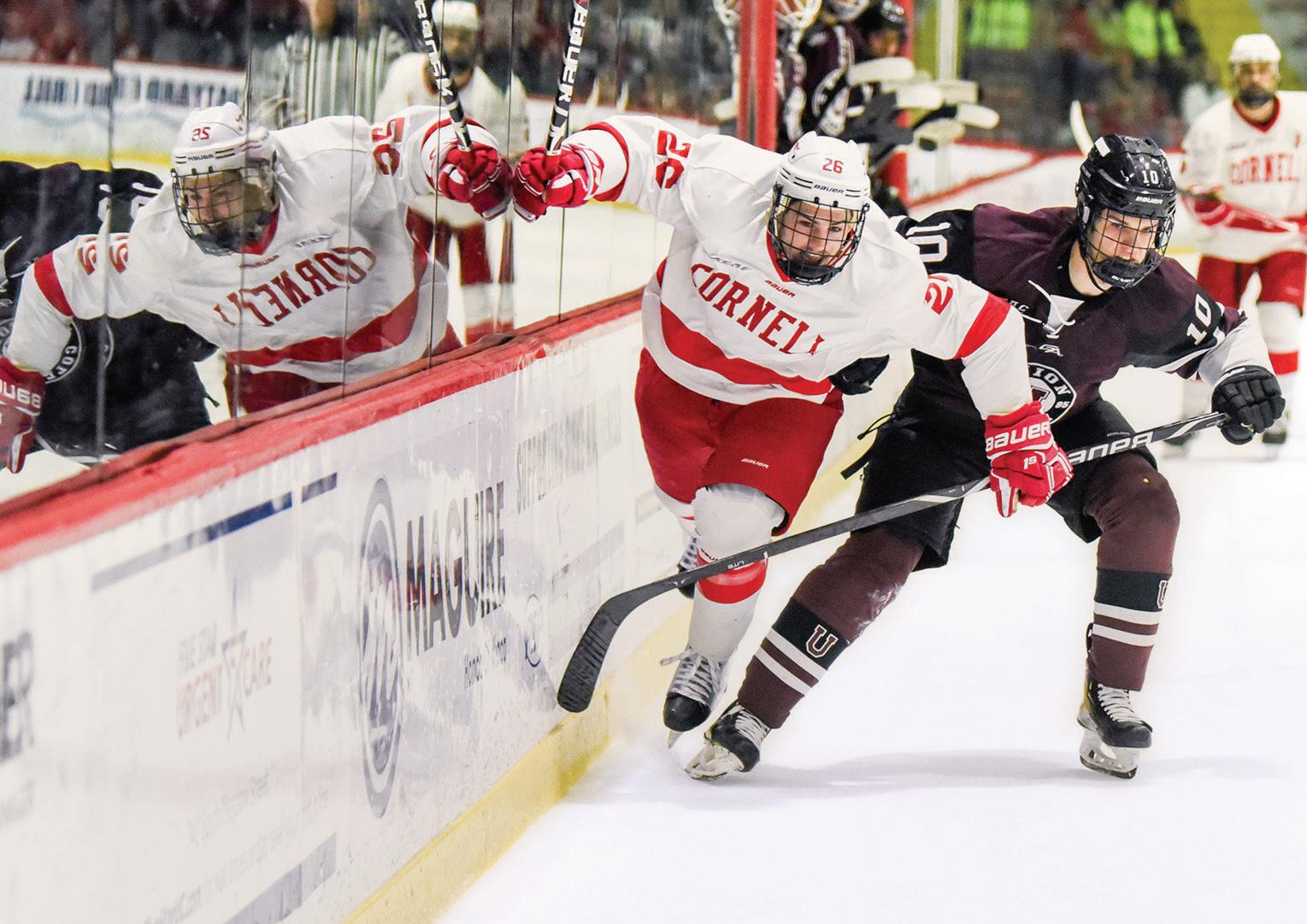
‘Redemption time’ | Taken down by an upstart Princeton in last year’s ECAC playoffs, the battle-hardened Red hopes to set things right.
— will prove beneficial for the Red entering this weekend, the team believes.
“We were on the brink of elimination [against Union]. I think that’s going to bode well for us when we’re [at Lake Placid],” said head coach Mike Schafer ’86. “Maybe last year not having to face [adversity], when we faced it for the first time against Princeton in the second period, we did get distracted.
“And this year we didn’t. We came back the second night against Union and we played very well and then [in game three] got down and faced that adversity like we did against Princeton, but we came back.”
After a dominant first period against the Tigers at Lake
Placid last year, Cornell clung to a 1-0 lead. But a bad bounce tied the game in the second, and another Princeton goal made it 2-1. The Red never recovered, suffering a 4-1 loss.
“Last year I thought we played a great first period and we were up, and then when [Princeton] scored I really do believe our guys started getting distracted with, ‘Oh my god, could we possibly lose this?’” Schafer said. “They weren’t narrowly focused on the job at hand.
“[When they] made it 1-1 it was like ‘Whoa, what happened there?’ … Instead of just staying focused on the next
By SMITA NALLURI Sun Staff Writer
Freshman forward Gillis Frechette is hitting her stride at the most crucial time of the year, and nothing exemplifies her late-season surge better than her game-winning breakaway goal in overtime last weekend to send Cornell to the Frozen Four.
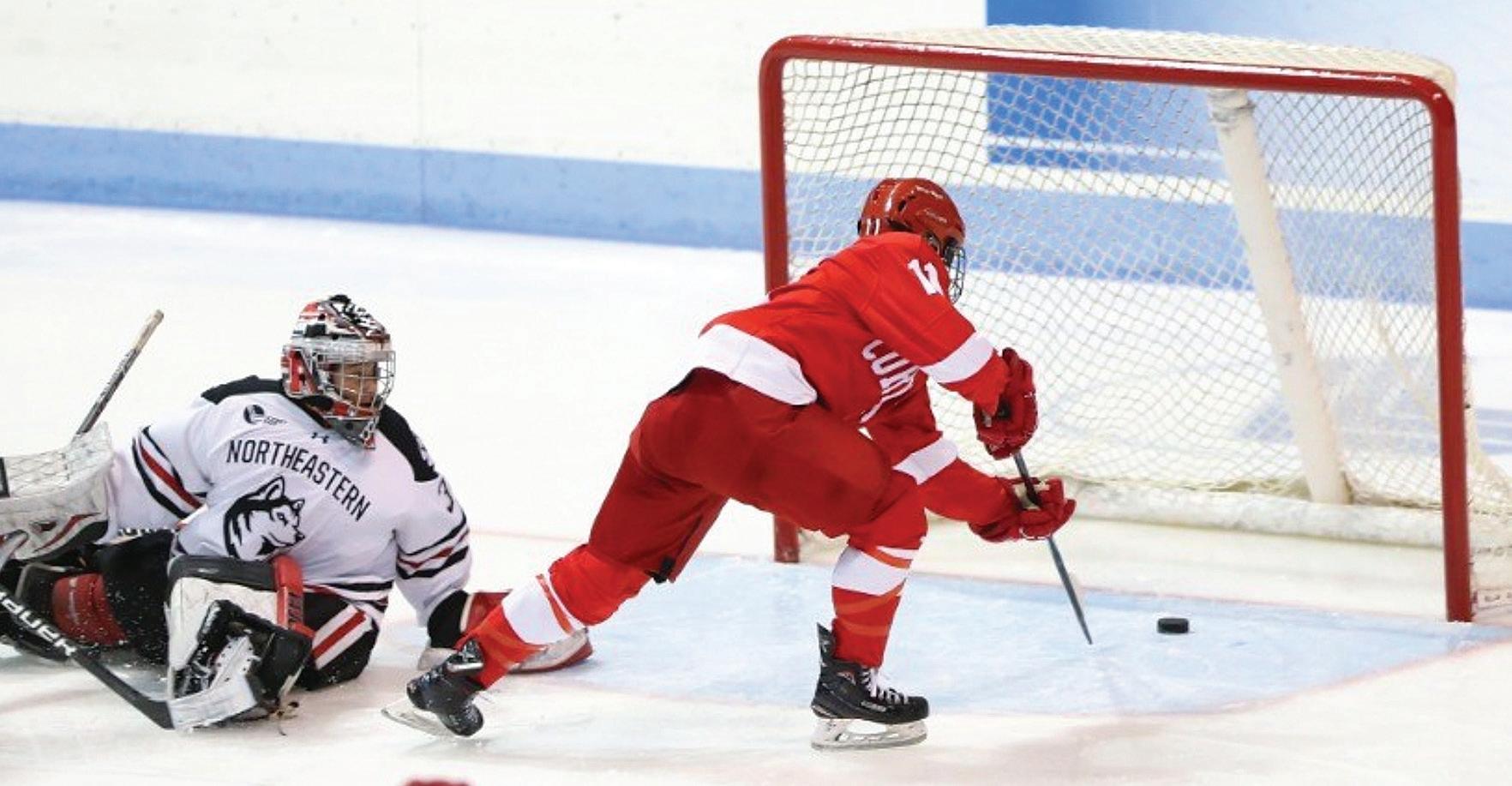
Taking a beautiful stretch pass from senior Diana Buckley, Frechette used a burst of speed, a quick hesitation and a nifty fake to beat the Northeastern goaltender and give Cornell a thrilling 3-2 win. Helping lead Cornell women’s hockey
to its first national semifinals appearance since 2012, Frechette has tallied a third of the team’s postseason goals.
Although the rookie only found the back of the net twice during the regular season, Frechette’s prolific scoring — five goals and one assist — has proven lethal to opponents in the season’s biggest moments.
“I felt like through the first half of the season I had a lot of chances, but the puck just wouldn’t go in for me,” Frechette said. “Everyone would always say to me, ‘It’s going to come, and the floodgates are going to open.’ I guess in some ways that’s
what has happened. I feel like I have gained a lot of confidence having gotten a couple goals under my belt, and I think that is a huge reason for my success recently.”
The Weston, Massachusetts native’s five postseason goals have come at crucial times for the Red. When Cornell was trailing RPI in game one of the ECAC quarterfinals, Frechette notched the equalizer halfway into the third period, which set the Red up to win in overtime off of senior forward Pippy Gerace’s goal.
Then in the same series, unfazed by the weight of a do-or-die game three, Frechette posted a career-high two goals against one of the top goaltenders in the nation to lead the way for the Red to the ECAC semifinals.
In the semifinals, the Red found itself in a two-goal hole against Princeton on its home ice. Facing prospects of a premature end to its championship run, Cornell clawed its way to an overtime win after Frechette put the team on the board over halfway through the second period.
Finally, withstanding the immense pressure of heading into overtime in the NCAA quarterfinals, Frechette maintained her composure to take advantage of a fast break opportunity and light the lamp to upset No. 3 Northeastern and punch Cornell’s ticket to the Frozen Four last weekend.
Clearly thriving in the high-pressure
atmosphere that is playoff hockey, Frechette has scored six of her 13 points this season in the past six games. She has also tallied a point in five of her team’s six postseason games. With Frechette heading into the Frozen Four on a four-game point streak, and with a combination of starpower and a strong senior class to lead the way, Cornell looks poised to take on No. 2 Minnesota and battle for a spot in the national championship game for the second time in school history.
“Everyone on our team is beyond excited to be heading to the Frozen Four,” Frechette said. “Our team hasn’t made it this far since 2012, so it’s a new experience for us all. We’re all ecstatic about it.”
Smita Nalluri can be reached at snalluri@cornellsun.com.