The Corne¬ Daily Sun


‘Same story — human souls being lost at the hands of a human being’


‘Same story — human souls being lost at the hands of a human being’
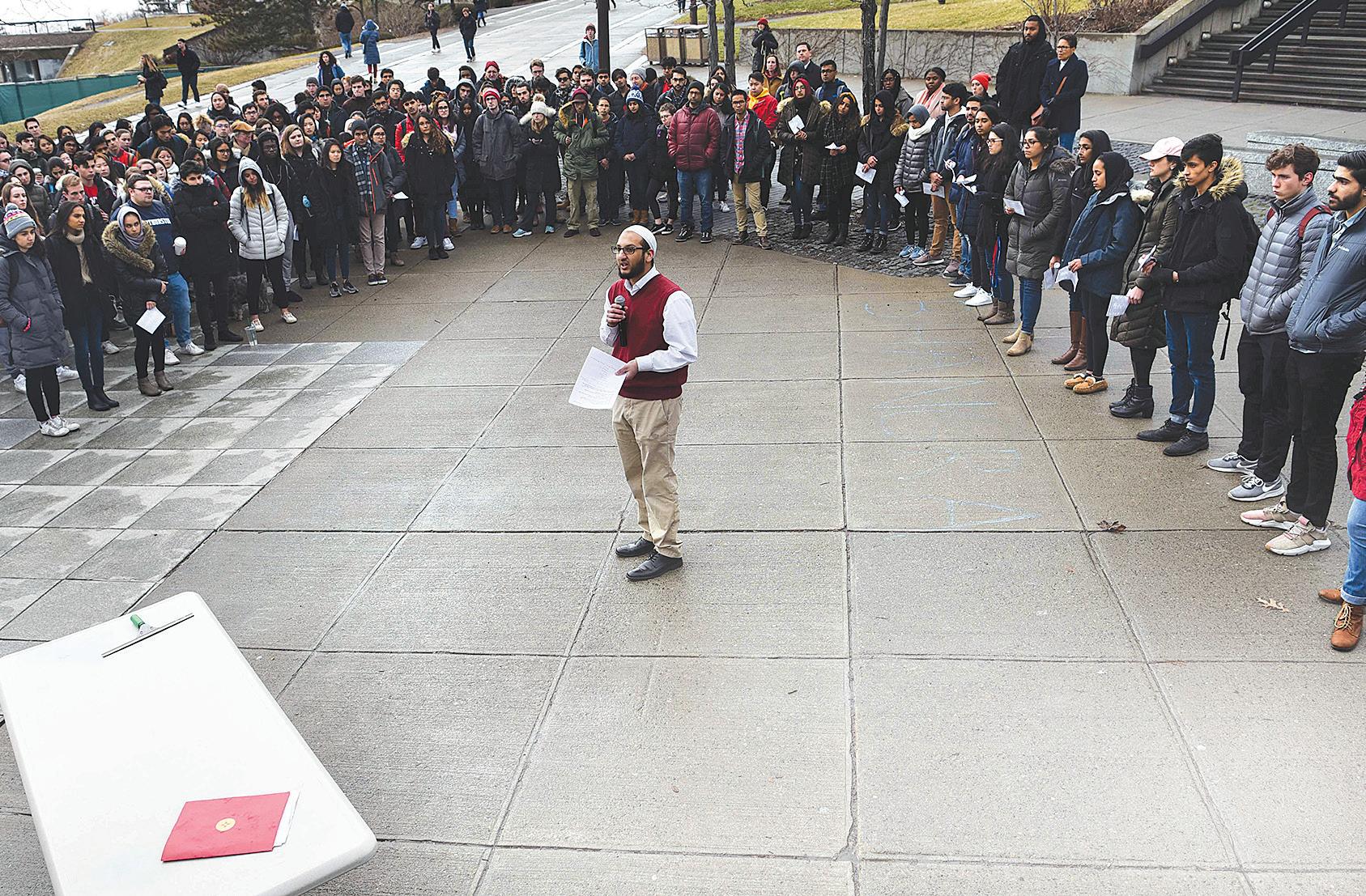
As snow fell to the ground, over 200 members of the Cornell community gathered in Ho Plaza on Monday to pay tribute to the victims of the shootings at two mosques in Christchurch, New Zealand on March 15. Organized by the Muslim Chaplaincy at Cornell
and the Muslim Educational and Cultural Association, the vigil included a moment of silence for the 52 men, women and children killed in the attack as well as speeches from members of the Muslim community on campus.
Chaplain Yasin Ahmed began the vigil by condemning recent terrorist attacks against religious communities, such as shootings in mosques, churches and syn-
By ALEC GIUFURTA Sun Contributor
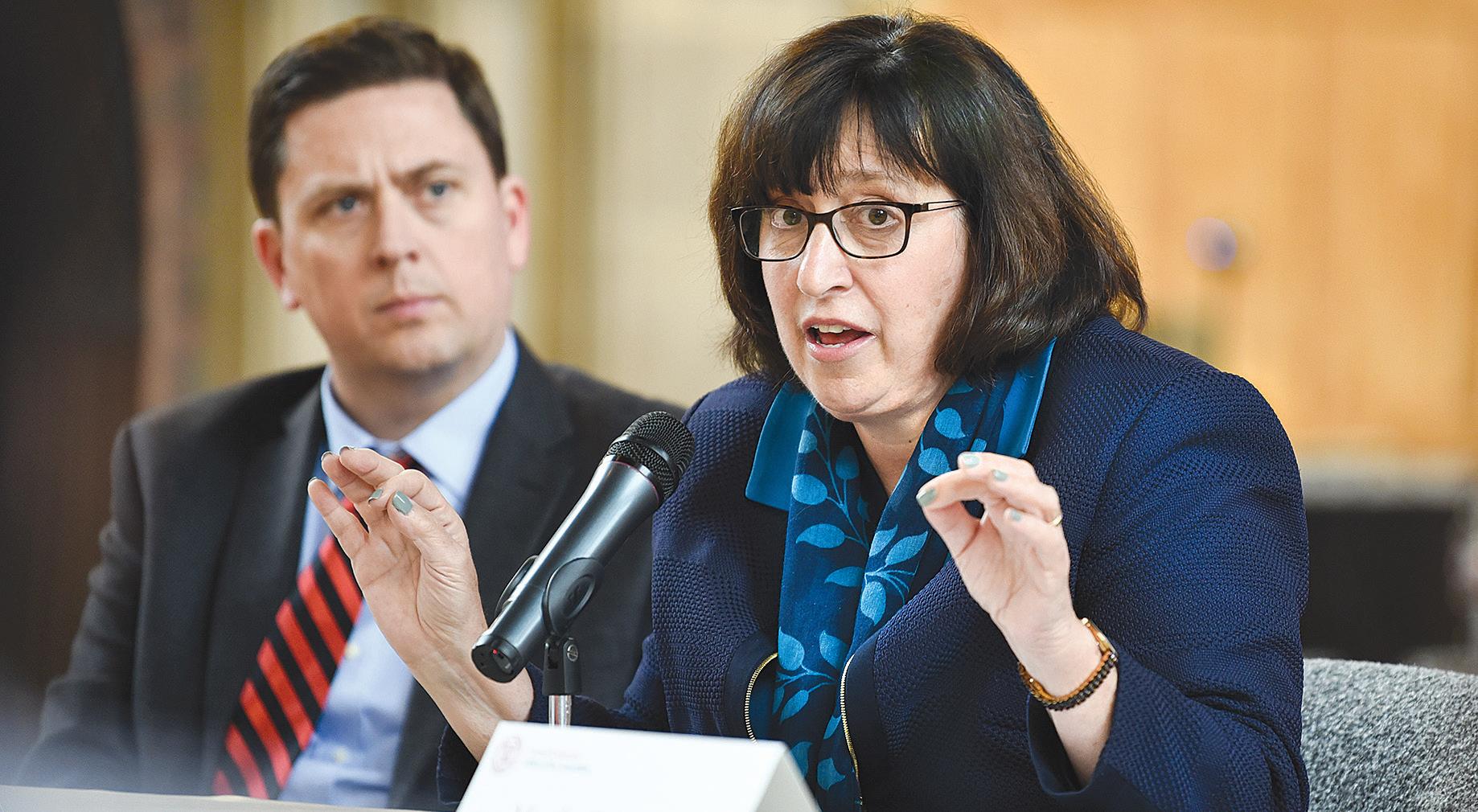
In a letter of response sent to Students for Justice in Palestine, President Martha Pollack addressed the Boycott, Divest and Sanction movement on campus and recent efforts to pass a supporting resolution within the Student Assembly, as The Sun previously reported. Reactions by student groups and Student Assembly presidential candidates varied from supportive to critical.
Pollack’s letter to SJP, posted by Cornell Hillel on Facebook on Feb. 28, acknowledged the movement on campus but clearly rejected any notion that Cornell would, or could, use its endowment for “political action.” Her response, including her personal opinion opposing the BDS movement, has galvanized a contentious issue prior to S.A. elections. The Boycott, Divestment, and Sanction move-
agogues. “Same story — human souls being lost at the hands of a human being,” Ahmed said. Ahmed also remembered another religiously-motivated terrorist attack, the 2018 terrorist shooting at a Pittsburgh synagogue, which claimed 11 lives. “The same tragedy that we suffered this week, [Cornell Hillel]
Local bus company currently out of service
By SARAH SKINNER
Managing Editor
Charles Dwight Dixon was behind the wheel of a Big Red Bullet bus when it veered off a Pennsylvania road last October, killing a Cornell alumna onboard. Dixon — who had traces of cocaine in his system the night of the crash, hospital testing revealed — will go to trial on 26 charges, including homicide by vehicle while under the influence and involuntary manslaughter. Dixon, 50, of the Bronx, was first charged on 33 counts by the Commonwealth of Pennsylvania in November. He
was arraigned in Lackawanna County on Dec. 27, and has remained in custody since on a $400,000 bond, court documents stated. On Thursday, a judge determined that there was enough evidence to move to trial on 26 of the 33 counts. A full list of charges can be found at the bottom of this article. The most severe charge — second-degree felony homicide by vehicle while under the influence of a controlled substance,

Tuesday, March 19, 2019
Today
American Resistance: Understanding Persistence in the Resistance with Dana Fisher 11:30 a.m., G08 Olin Hall
Luce Scholarship Information Session Noon - 1 p.m.,103 Barnes Hall
Specification-Driven Design for Modular and Safe Robotics
12:15 p.m. - 1:15 p.m., 223 Phillips Hall
Adelante Coffee Chat
4:30 p.m., 429 Rockefeller Hall
Minors Fair
4:30 - 6:30 p.m., Baker Portico, Physical Sciences Building
Materials Science Expo 4:45 - 6:15 p.m., 1st Fl. Lounge, RPCC
Tomorrow
Introduction to Rhodes and Marshall Scholarships Noon - 1 p.m., 103 Barnes Hall
What Graduate and Professional Students Need to Know About Taxes
1 - 2:30 p.m., T10 Biotech
Being Better Buyers: Home Economists, Rural Women, and the Politics of Textile Knowledge
4 p.m., 160 Mann Library
Music Graduates’ Association: Dr. Jennifer Stoever, Listening to Race in the US, Or Why Sound Matters 4:30 p.m., 124 Lincoln Hall
Undergraduate Humanities Showcase 5 - 6:30 p.m., A.D. White House
Thank You, Next Offer: Salary Negotiations for Women 4:30 - 5:30 p.m., 70 Klarman Hall
Cornell Music Presents David Kim on Piano, Performing Shumann and Shubert 8:00 p.m., Barnes Hall Auditorium

By KATHRYN STAMM Sun Contributor
The Cornell Lending Library will begin offering travel grants on a rolling basis to undergraduates who travel off-campus to take pre-professional tests or participate in interviews, the organization announced on March 7.
The grant, whose application can be found online, will operate on a first-come, first-serve basis.
While examining potential financial barriers for students, the Lending Library found that although Pell grant recipients could receive university funding to take graduate school entrance exams, students may still need financial assistance for transportation to test-taking sites, according to Dominic Grasso ’20, co-president of the Lending Library. Ultimately, the Library is looking to help fill gaps that may have been overlooked, Grasso said.
“We’re looking to expand our scope beyond just books and textbooks,” Grasso told The Sun. “We’re looking broadly at how we can help support students on campus academically, financially, and socially.”
The funding for the grant mostly comes from Giving Day donations, as well as some SAFC funding, according to Grasso. “We have about $1000 … but we’re hoping to expand,” Grasso said.
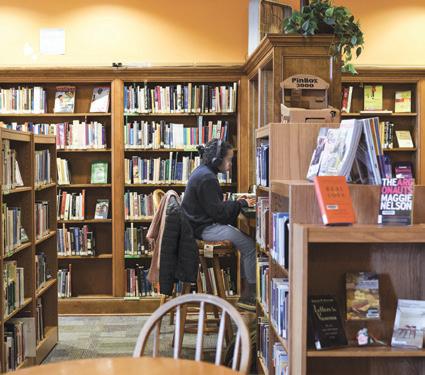
First founded in the spring of 2016, the Lending Library, located in Anabel Taylor Hall, seeks to address students’ “financial barriers to academic resources,” through services like free semester-long loans of donated

Lending a hand | The Cornell Lending Library, located in Anabel Taylor Hall, was first founded in 2016 to help students overcome “financial barriers” to their studies, offering long-term textbook and iClicker loans.
textbooks and iClickers, according to its website.
In 2018, the Lending Library rented out over 840 textbooks and 100 of their iClickers.
The Lending Library also helps students find support systems in different organizations and advertising resources, including collaborating with organizations like the Latino Learning Center to explain how to get free academic resources, Grasso said.
“We’re trying to take a more holistic approach to aca-
By JEFFREY LI Sun Staff Writer
Most classes at Cornell end by 4:30 p.m., but the lights in academic buildings sometimes stay on until midnight, even when not in use — potentially costing the university up to $60,000 each year, a 2010 report found. Several efforts have been taken to alleviate the electricity waste.
First launched in 2010, the Cornell Energy Conservation Initiative is an effort to reduce overall energy use in campus buildings through techniques such as optimizing the lighting system’s energy efficiency.
University services have been actively replacing campus lights, including exterior lights of buildings, street lights and fluorescent tubes with LEDs, according to Mark Howe, director of utilities distribution and energy management. Total expenditures on
this initiative are over $7.25 million and annual utility savings are around $800,000, Howe estimated.
According to a 2016 report, ECI’s efforts produced a 17 percent energy saving, or around $2 million, from over 60 campus facilities between 2010 and 2016.
When asked if there are efforts to control when lights are on, Howe pointed to the timers and occupancy sensors — infrared devices that can detect movement— throughout the stacks in Olin and Uris libraries.
“As you walk into a stack (with occupancy sensors), the lights will pop on. And after 15 mins, if nobody is in the stack, the lights will turn off,” said Howe.
However, occupancy sensors and timers in the libraries are still limited
See LIGHTS page 4

demic support on campus,” Grasso said.
The Lending Library is focused on decreasing gaps in academic resources, thus “securing the basic human right to education,” according to its website.
“We help make a more equitable place for all students to have the same opportunities to succeed,” Grasso said.
Kathryn Stamm can be reached at kls332@cornell.edu

By PENELOPE CAMPOS Sun Staff Writer
This weekend, students, faculty and community members attended a twoday event exploring feminist art in Collegetown.
The symposium, titled ‘“Feminist Directions: Performance, Power, and Leadership” was organized by graduate students Jayme Kilburn and Kelly Richmond, both in the performing and media arts department.
The symposium began with the “Human Sexuality Tour” in Cornell’s Division of Rare and Manuscripts Collection on Friday, led by curator Brenda Marston. The collection documents changes in the social construction of sexuality over time.
“One of the biggest things that came across for me was just being free.”
Throughout the weekend, attendees were treated to workshops, panels and a cabaret, exploring the importance and impact of feminist art. Kilburn described the event as a push “against the status quo,” reflecting on how much the event has grown.
Visiting lecturer Prof. Rhodessa Jones, performing and media arts, followed the tour with a workshop titled “Creative Survival,” where she explored theater as a tool for change. Raven Harris ’19 said that the workshop was a valuable experience.
Raven Harris ’19
“One of the biggest things that came across for me was just being free,” Harris said in an interview with The Sun. “Also just being able to work with other women and trust other women.”
“The original purpose was to bring feminists, specifically feminists and specifically women artists together, to talk about their work cross-disciplinarily,” Kilburn told The Sun. “[And to look at] this idea of what is a feminist artist because there’s no one answer to that.”
The first day’s events on Friday concluded with “A Bad and Nasty Cabaret,” featuring performances by symposium guests, performers and activists alike.
Peggy Shaw and Lois Weaver, co-founders of the performance troupe
See FEMINISTS page 5
to the stacks. Popular late-night studying spaces like Uris Library, where some sectors are open 24 hours a day from Monday to Thursday, still need the lights on.
But efforts are underway to reduce energy use.
“We have also recently reduced the number of lights that remain on in Olin after closing, and a vast majority of the lights in our public spaces have already been converted to LEDs,” said Jon Ladley, facilities planning manager.
In fact, efforts can also be made in other academic buildings.
Howe cited a now-defunct student-run group called Lights Off Cornell that once saved the university over $15,000 and reduced 82,092 kilograms of CO2 simply by turning off unused lights.
Launched in 2010, Lights Off Cornell was part of Cornell’s
Climate Action Plan. It sent volunteers in pairs every night after 9 p.m. to turn off unnecessary lights that were safe to be turned off in academic buildings. It typically took 20 minutes per night and volunteers would need to record the status of the lights on smartphones or datasheets as they were turning off lights in their assigned building.
Each volunteer had a profile on the task force’s website and they would able to see the amount of CO2 they saved based on the reported data.
However, Lights Off Cornell stopped operating in 2013, when core team members graduated from Cornell.
“I think it needs to be restarted,” said Howe. “You need the next group of students to come in with great ideas or to carry it on.”

to the “fight for a more inclusive world.”
“Our words matter, rhetoric matters, and language leads to action whether good or bad,” Adhami.
suffered earlier this year,” Ahmed said.
After Ahmed’s words, people read the names of those who had died, as well as personal information about the deceased.
Yahya Abdul-Basser ’20, president of MECA, spoke next.
“The seeds are planted here in our own communities,” Abdul-Basser said. “Islamophobia is not some strange, alien problem, and exists in many forms, even here at a place like Cornell.”
Samir Salih ’19, a member of the Islamic Alliance for Justice, agreed. Even on Cornell’s campus he has been called both a terrorist and a multitude of anti-black slurs, Salih said.
“In many of these cases, people laughed it off as a joke,” Salih said. “What they do not realize is that these words are a start to other actions.”
Mahfuza Shovik ’19 emphasized the importance of doing more than coming to the vigil and listening “passively.”
“Unless you start putting names to faces and stories to the 52 victims, you’re just going to see them as a statistic, but not as souls,” Shovik said.
Aliza Adhami ’19 said the loss of lives should contribute

According to Ahmed El Sammak ’21, the massacre in Christchurch was more than just “death,” but the “destruction of families, the shattering of a community and the attack on an entire religion and its over one billion followers.”
Additionally, Shahzaid Saleem ’19, a religious leader on campus, also spoke, reading passages from the Quran.
At the end of the vigil, Abdul-Basser provided a list of resources that can be used by the community, such as Counseling and Psychological Services through Cornell Health.
MECA will hold a meeting this Friday at 7 p.m. to discuss the issues brought up at the vigil.
Students may consult with counselors from Counseling & Psychological Services (CAPS) by calling 607-255-5155. Employees may call the Faculty Staff Assistance Program (FSAP) at 607-255-2673. An Ithaca-based Crisisline is available at 607-272-1616. For additional resources, visit caringcommunity.cornell.edu.
ment is an international call for a boycott of Isreali goods and divestment in Isreali companies by universities, other organizations and governments, as well as the imposition of sanctions on Israel. Dating back to 2005, BDS aims to push Israel into changing the way it treats Palestinians through economic and diplomatic pressure.
On February 18, Students for Justice in Palestine delivered a letter to President Martha Pollack, requesting that Cornell “divest its endowment pool from companies complicit in … human rights violations in [Palestine].”
The Sun reached out to groups on campus with direct interests in BDS and to the current S.A. presidential candidates, looking for what the future of the movement may entail and how the Student Assembly plans to address the divestment issue, which it tabled in 2014.
In an interview with the Sun, SJP facilitator Laila Hayani ’19 issued a strong rebuke to Pollack’s letter. “[SJP is] deeply disappointed in [Pollack’s] failure to stand up for human rights in the name of ‘academic freedom,’” said Hayani. “We are bringing [BDS] to the S.A. because we are interested in the university doing the right thing, not dialogues on what makes people most comfortable.
No one should be comfortable with human rights violations.”
In response to Pollack’s writing that BDS “unfairly singles out” Israel for sanction, Hayani responded, “[SJP has] also targeted other countries that have committed atrocious human rights violations … This same rhetoric of ‘singling out one nation’ was used to oppose divestment movements against South Africa during the time of apartheid.”
Jillian Shapiro ’20, President of Cornell Hillel, said she was happy to see Pollack’s response, citing flaws in the movement.
“President Pollack [addresses] why it does not belong on our campus,” Shapiro said in an interview with the Sun. “[She] rightly points out that BDS does not lead to peace.”
Jay Sirot ’19, president of Cornellians for Israel, expressed a similar sentiment. The BDS movement represents a “double standard,” that places sole blame for the conflict on Israel, “while ignoring the malign actions of Hamas and the Palestinian Authority,” Sirot told The Sun.
“We’re unclear as to why this is one of the only issues that the SA is debating and why it’s being framed in the negative … There are many ways of finding nuance in this conversation and ways of working together to invest in understanding and mutual cooperation," Sirot said.
Candidate for S.A. President and current S.A. representative for the School of Industrial and Labor Relations John Dominguez ’20 echoed Sirot’s sentiment in an interview with The Sun, saying that people feel “unsafe” when BDS is a movement on campus.
“This is not in the jurisdiction of the Cornell Student Assembly,” said Dominguez. “At the end of the day, if the trustees and president are not on board, then nothing is going to happen.” If elected, Dominguez said he is willing to facilitate dialogue between SJP and Hillel “separate” from the S.A. Candidate for S.A. President Trevor Davis ’21 declined to offer an opinion to The Sun, citing his focus on winning his election to “put it on [his] resume.”
Joseph Anderson ’20, candidate for S.A. President and current S.A. executive vice president, viewed Pollack’s response with some criticism.
While Anderson did not find Pollack’s stance “that surprising,” he believes “it might have narrowed the window for dialogue on our campus,” Anderson told the Sun.
“In order to have a conversation on this topic, I feel that [S.A.] members need to continue educating themselves,” Anderson said.
Alec Giufurta can be reached at agiufurta@cornellsun.com.
which carries a maximum penalty of 10 years in prison — remains on the docket.
Alumna Rebecca Blanco M.B.A. ’17, a senior communications manager at home goods company Snowe, was pronounced dead at the scene from multiple traumatic injuries.
No trial date has yet been set, but state-assigned attorney Joseph Paul Kalinowski, a public defender based in Scranton, Penn., will represent Dixon in court.
The Federal Motor Carrier Safety Administration issued Big Red Bullet an out-of-service order in late January, declaring the company “unfit” to operate. The company’s website was shut down in January for “maintenance,” and a fuzzy, recorded message promising a return “next year” greets callers who ring the company number.
The FMCSA began an investigation into the company’s compliance with safety regulations last fall, The Sun reported. Federal records show that the administration registered two compliance violations in November as well a slew of others in October against Big Red Bullet, including reckless driving, allowing drivers to operate a passenger carrier while impaired with fatigue and defective braking and lighting
systems. In late February, officials charged the company with three violations — defective brakes, failure to prepare a driver vehicle inspection report and failure to require the driver to create a log of time on-duty — and $12,550 in total fees.
A post-crash inspection found that a third of the bus’ safety brakes were defective. A Pennsylvania State Police sergeant said in an affidavit that the bus should have been placed out of service if more than a fifth of its brakes were defective.
A motorist referred to in charging documents as “Ben” called 911 the night of the crash, reporting a bus driving erratically down Lackawanna County’s I-380.
Blanco, who was travelling from Ithaca to N.Y.C., also texted 911 just minutes before the crash that killed her, describing reckless driving and worrying behavior.
“I’m highly concerned that the bus driver is unable to drive,” Blanco wrote just before 9 p.m. according to charging documents filed in Lackawanna County. “We’ve almost gotten into two accidents, veering off the road twice. Once entering the grassy divide. He’s swerving into other lanes and seems to have trouble staying awake.”
Police arrived on the scene minutes later to find the bus crumpled
into a grove of trees off the side of the highway. Blanco was pronounced dead at the scene, while all eleven of the other passengers sustained minor injuries and were transported to local hospitals.
Other passengers’ injuries, according to charging documents, included broken neck bones, bruising, facial fractures, a broken jaw, a broken hand, broken fibulas and an amputated pinky toe.
Dixon told police at the scene that he “fell asleep at the wheel.” Charging documents show that his blood tests at Moses Taylor Hospital after the crash came back positive for benzoylecgonine — a compound formed as the body metabolizes cocaine — and trace amounts of cocaine.
Dixon drove for Big Red Bullet for approximately a month before the October crash. Documents state that Dixon told police that night that he typically got a break between four-to-five-hour trips between Ithaca and New York City, but that he didn’t always get a break on Sundays.
Prior to the deadly crash, multiple customers lodged complaints against Big Red Bullet for trips marred by reckless driving, The Sun previously reported. Complaints detailed hours-long trip delays, swerving and clipped mirrors, as well as drivers who told passengers they had gotten little to no rest
between legs of the journey.
Big Red Bullet — founded in fall 2015 by Cornell alumnus Ali Nasser M.Eng ’10 M.B.A. ’15 — offered routes between Ithaca and New York City as an alternative to the University-backed Campus-toCampus bus. Representatives for Big Red Bullet could not be reached for comment by publication time.
Below is an updated list of the charges against Dixon.
Homicide by vehicle while driving under the influence (one count)
Aggravated assault by vehicle while driving under the influence (one count)
Homicide by vehicle (one count)
Aggravated assault by vehicle (five counts)
Driving under the influence of alcohol or controlled substance (one count)
Involuntary manslaughter (one count)
Recklessly endangering another person (12 counts)
Driving on roadways laned for traffic (one count)
Careless driving (one count)
Reckless driving (one count)
Unlawful activities (one count)
Sarah Skinner can be reached at sskinner@cornellsun.com.
FEMINISTS
Continued from page 3
Split-Britches, were the first performers of the night, presenting an act with a commentary on current politics.
Their act was followed by other acts including a monologue, poetry readings and musical performances.
“[The cabaret] was all very fun and very relevant to our times. Every act by itself was great and impactful and belonged in the show,” Octavio Martin ’20 told The Sun. Saturday’s events kicked off with “Mentors, Methods, and Mutations: A Workshop on Feminist Crosspollination,” followed by a “Feminist Directions”
roundtable with a discussion of participants’ directing histories and feminist methodologies.
Tisa Chang of the Pan Asian Repertory Theatre led a master workshop on directing culturally specific work. The symposium came to a close Saturday afternoon with a fire-eating display by firedancer Kate Guntermann.
Richmond described the symposium’s development as a “really great experience of feminist networks.”
“Learning how many interesting people would want to be involved in this type of event, I think, was so thrilling,” said Richmond.
Kilburn credited the success of the symposium
to the support from campus and community members. “I’m very grateful for all the support that we got from the other departments,” she said. “This wouldn’t have been possible without all that support.”
Penelope Campos can be reached at pcampos@cornellsun.com
Pick
Hall, Green Dragon Café
Snee Hall
Statler Lobby
Statler Terrace Restaurant
Tatkon Center
Teagle Hall
Transportation Dept., Maple Ave.
Trillium
Uris Hall
Vet Center (Shurman Hall)
Hall, M1 Rm + Synapsis
• Willard Straight Hall Lobby + Dining Off Campus
• Autumn Leaves Used Books (Ithaca Commons)
• Bear Necessities
• Center Ithaca
• Coal House Café
• Collegetown Bagels: CTown + Triphammer
• Commons Grocery (Ithaca Commons)
• CFCU (Triphammer Rd. + East Hill Plaza)
• Corner of College & Dryden
• Corner of State & Aurora •Express Mart, Comm. Crnrs.
Hillside Inn
Hilton Garden Inn • Holiday Inn • Ithaca Coffee Co.
•Ithaca
W.S. Merwin writes “Every year without knowing I have passed the day,” in “For the Anniversary of My Death.” That day was last Friday, when the former U.S. Poet Laureate passed away in his Maui home. Poets often seem rather too preoccupied with their own mortality, and Merwin was no exception. He wrote about death with all the lucidity of someone who had already died, or someone who knew death — the inevitability of death — intimately. In “Another Dream of Burial,” Merwin describes the various ways in which he has imagined his own burial but in the end, “turn[s] and walk[s] away from it / into the whole world the whole world,” as though making a conscious choice to keep living, to keep fighting to hold on to life rather than giving in to death.
had hardly begun to read / I asked how can you ever be sure / that what you write is really / any good at all and he said you can’t / you can’t you can never be sure / you die without knowing / whether anything you wrote was any good / if you have to be sure don’t write.” In light of the amount of awards Merwin won over the course of his long lifetime, though, it seems ironic and unlikely that he had no conception of his talent as a poet.

Through both the example of his life and his poetry, Merwin instructs us on how to live and make peace with death, to maintain hope rather than give in to fear and self-doubt.
Indeed, having died at 91, Merwin seems to keep with several other famous poets who have died recently at ripe-old ages — Mary Oliver and John Ashberry, for example. Such poets defeat the stereotype of the young artist who dies tragically and violently — who achieves fame posthumously and whose young death is later romanticized as poetic and almost aspirational.
Now that it seems so many of our great literary figures are passing away, I wonder if the role of the poet and of poetry has been diminished.
As a Zen Buddhist, his work often drew on themes of spirituality and ecology, taking inspiration from the natural world as a reminder of the impermanence and fragility of life. On the death of his friend John Berryman, he wrote, “I
Like these other poets, the figure of Merwin looms large over the contemporary literary canon, casting an impossibly imposing shadow. Commenting on whether the poet has any social role in America, Merwin stated, “I think there’s a kind of desperate hope built into poetry now that one really wants, hopelessly, to save the world. One is trying to say everything that can be said for the things that one loves while there’s still time. I think

that’s a social role, don’t you? . . . We keep expressing our anger and our love, and we hope, hopelessly perhaps, that it will have some effect . . . one can’t live only in despair and anger without eventually destroying the thing one is angry in defense of. The world is still here, and there are aspects of human life that are not purely destructive, and there is a need to pay attention to the things around us while they are still around us. And you know, in a way, if you don’t pay that attention, the anger is just bitterness.”
Now that it seems so many of our great literary figures are passing away, I wonder if the role of the poet and of poetry has been
diminished, too, in our society, especially at a time when we need to “pay attention to the things around us” in order not to “love only in despair and anger.” Or perhaps Merwin’s poetry is simply a reminder that it is not just for our artists to carry out this task. Instead, it is for all of us as we live our lives, to consider our effect on the world that is “still here,” even if the possibility of “sav[ing] the world” appears hopeless.
Ramya Yandava is a sophomore in the College of Arts and Sciences. She can be reached at ry86@cornell.edu. Ramya’s Rambles runs alternate Tuesdays this semester.


By JACOB WASSERSTEIN Sun Contributor
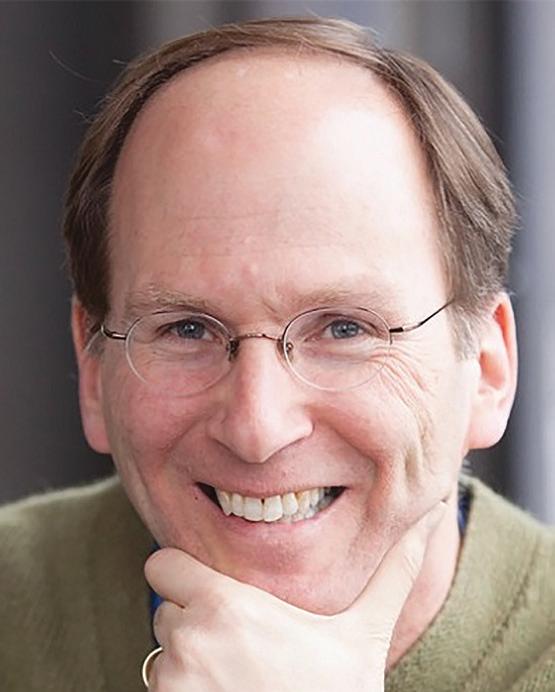
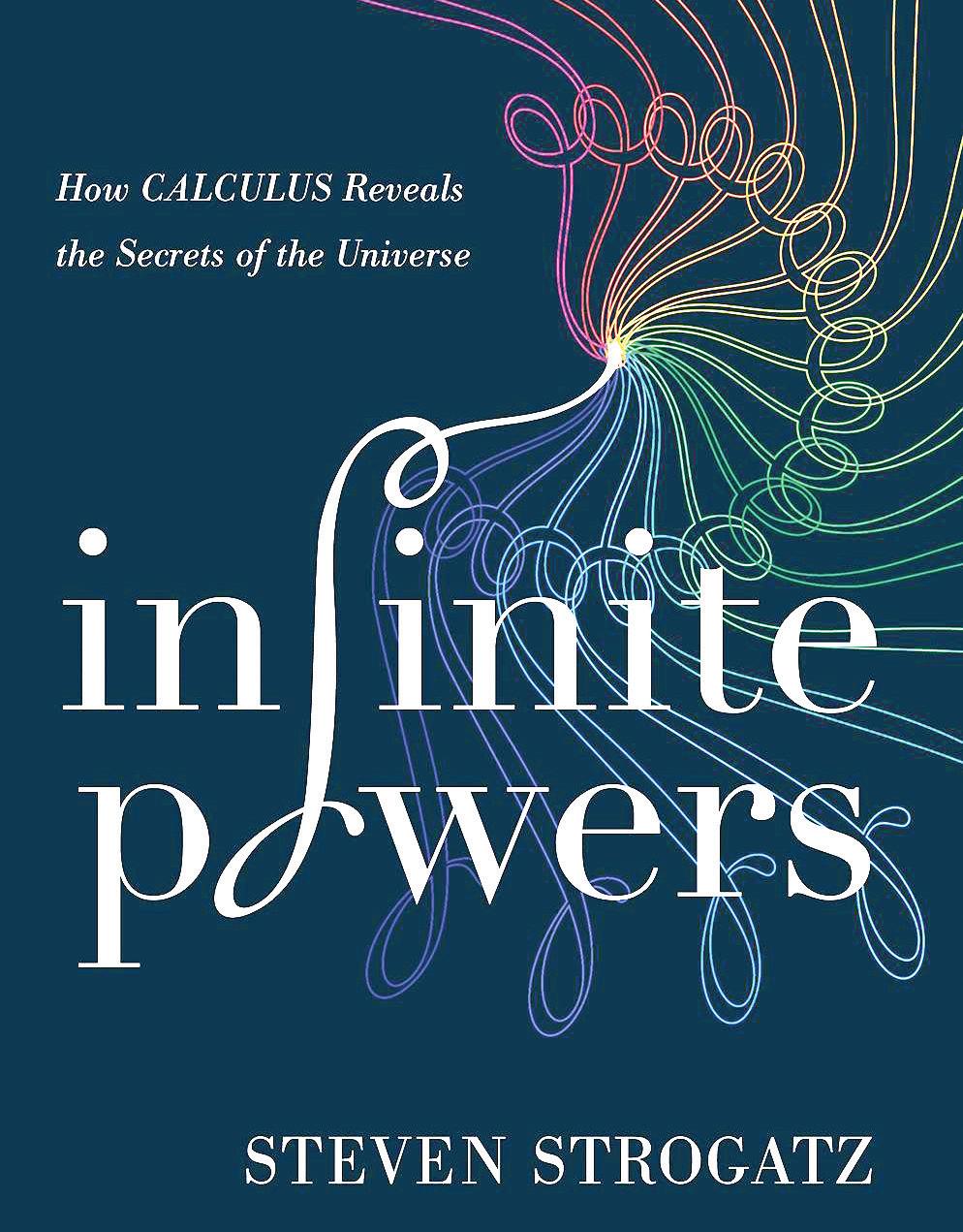
Though calculus is a notoriously difficult and abstract area of mathematics, its applications form the basis for much of modern technology, science and engineering. Prof. Steven Strogatz, applied mathematics, explores this topic further in his upcoming book, Infinite Powers: How Calculus Reveals the Secrets of the Universe
Strogatz explained that the work is composed of three main sections. The first and most central is history, where Strogatz sets out to explain the evolution and development of calculus, from Archimedes to Newton and Leibniz to the modern day.
Next, Strogatz explores a “360-degree view” of the uses of this branch of mathematics and explains the applications of the expansive field of calculus.
Furthermore, he expands upon the fundamental concepts of calculus, from specific differential equations to big-picture ideas like that of infinity.
“What defines calculus is the strategic use of infinity… The book is organized around a thing I call ‘The Infinity Principle’ … it’s this idea that to solve hard problems, you chop them into infinitely many bits, and analyze the bits, and then put them back together,” Strogatz said.
Strogatz wrote the book “for people who didn’t take calculus, or who did take it and didn’t get much out of it … it goes by in a blaze for many people, and they don’t have a great understanding of the subject,” he said.
Despite targeting the everyday reader, Strogatz has not sacrificed the ambitions or passions of his claims.
“What I’m trying to argue in the book is that this is one of the great ideas of all time … it’s something that changed the world, and it’s something that’s very beautiful, powerful and even dramatic,” Strogatz said.
Nowadways, some might argue that learning calculus is not very useful. With the rise of computer algebra systems, the limits, integrals and derivatives that plague freshman calculus are no longer a problem.
“Many cool, modern jobs do use calculus, but many don’t, and many people live perfectly happy lives without doing calculus … understanding quantitative reasoning, how to look at a graph, those are bigger skills that a typical citizen will need in their real life,” Strogatz said.
However, Strogatz argued that the justification for learning calculus has other advantages. Indeed, while not necessary for every occupation, knowledge of higher mathematics does allow one to attain jobs in advanced STEM fields, from quantitative finance to engineering.
Strogatz compared knowledge of mathematics to knowledge of Shakespeare, economics and other fundamentals of being an educated individual. According to Strogatz, if you want to be a part of the conversation, then knowledge of calculus is essential.
For the author himself, writing about calculus has been a challenging yet rewarding process.
“The hardest part [of the writing process] may be trying to figure out … the overall architecture of the book … How much of it was history? How much was explaining the ideas of calculus without history? How much was it about how calculus relates to other things? I wanted it to be about all of those,” Strogatz said.
According to Strogatz, the rewards of the writing process lie in the personal accomplishment that he experiences.
“I tried to do something that I never succeeded in doing before … which was to write a book-length, sustained argument that lasts 300 pages, and that’s not boring or ponderous, that’s really an adventure and an exciting, thrilling ride through a great idea,” Strogatz said.
Having written a dedicated mathematics column for the New York Times for several years, Strogatz has signif-
icant experience conveying the joys and wonders of mathematics to the average reader.
Strogatz’s book will be released on Amazon and Kindle on April 2.
By MILENA BIMPONG Sun Contributor
According to the Centers for Medicare & Medicaid Services, healthcare spending in the United States has increased by 3.9 percent in 2017 and composes 17.9 percent of the nation’s gross domestic product. This marks a total increase of $3.5 trillion, or roughly $10,739 per person.
On Wednesday, March 13th, Cornell’s Debate in Science and Health organizatioon held a public forum in Duffield Hall to discuss the impact of these rising costs on the American public. The forum addressed the possible causes behind rising healthcare costs in the United States, the necessary steps to reduce rising costs and how the U.S. system compares to those in other countries.
Students and faculty also discussed whether healthcare should be seen as a privilege or a right, how medical businesses should function relative to the businesses of other industries and whether pharmaceutical companies prioritize making money over people’s health.
The first debate commenced with the question of why healthcare costs are rising in the first place.
“[Healthcare costs] are increasing because of the rise of pharmaceuticals,” said Rui Maki ’20. “We’re really embracing technology, especially in biomedical fields — different drug inventions are an example of this — but to create a drug, it costs billions of dollars.”
David Zhang ’20 explained that pharmaceuticals have become very expensive because they are personalized to treat an individual
patient’s illness. While personalized medicine is very beneficial for addressing the varying needs of each patient, it is quite costly.
“Healthcare spending in the U.S. rose nearly a trillion dollars from 1996 to 2015,”
ferently, because we’re talking about people’s lives here and people’s health,” said Lindsey Forg ’22.
According to Singhal, because the medical industry heavily operates as a business, drug companies recycle and repurpose drugs rather than inventing new ones. This also influences how doctors prescribe medicine to their patients.

Climbing Costs | Cornell Debate in Science and Health hosted public forum to discuss the impact of
Rishi Singhal ’21 stated. According to Singhal, increased healthcare costs have reached the point in which Americans often refuse to seek medical treatment due to expense.
“In a lot of these cases, the people who refuse treatment even have medical insurance, but they still have this issue,” Singhal said about Americans refusing medical treatment.
Although the medical industry is considered a business, a frequently debated question is whether healthcare should wbe treated the same as normal, corporate businesses.
“[Medical businesses] should be treated dif-
“If doctors are prescribing medicine, even partially because they just want to make money, and not completely because the patient needs the medicine, then there’s a problem,” Forg said.
Some people believe that medicine is not designed to reach its full potential so that patients will continue to need more of it. This could explain the lack of effective treatments to many common diseases, such as cancer and type II diabetes.
“Medicine is [viewed as] this supply and demand product rather than something that treats people,” said Zhang.
According to Zhang, compared to academic institutions or other research companies, pharmaceutical businesses have a different goal to profit.
“There’s a whole dichotomy between
research done at a pharmaceutical company and research done at an academic or research institution … people at pharmaceutical companies want to make money,” said Zhang.
A counter argument is that reducing costs of pharmaceuticals could disincentivize innovation. Making pharmaceuticals more universally accessible could result in deacreased efforts towards creativity and proactivity. Innovation is still important, as it could lead to finding disease cures.
However, lack of transparency is still a major problem, speakers said, as many procedures are still charging too much money when it’s not necessary.
“[Hospitals] have to do a lot of personal insurance … lawsuits in medicine are pretty common,” said Zhang.
According to Zhang, extremely high prices for medical procedures can be attributed to expensive equipment, protection against lawsuits, malpractice insurance and doctors operating by fee for service.
“The Wall Street Journal said that there was one hospital that charged more than $50,000 for a knee replacement surgery that only really cost between $7,000 to $10,000,” Singhal said. Although the future is still uncertain when it comes to rising healthcare costs, increasing awareness is a step in the right direction. It is important for Americans to be informed about the basics, which can lead to wiser decisions from the government and the medical industry.
137th Editorial Board ANU SUBRAMANIAM ’20
DAHLIA WILSON ’19
Business Manager
PARIS GHAZI ’21
Associate Editor
NATALIE FUNG ’20
Web Editor
SABRINE XIE ’21
Design Editor
NOAH HARRELSON ’21
Blogs Editor
SHRIYA PERATI ’21
Science Editor
AMANDA H. CRONIN ’21
News Editor
ROCHELLE LI ’21
News Editor
JOHNATHAN STIMPSON ’21
News Editor
PETER BUONANNO ’21
Arts & Entertainment Editor
ANYI CHENG ’21
Assistant News Editor
SHIVANI SANGHANI ’20
Assistant News Editor
CHRISTINA BULKELEY ’21
Assistant Sports Editor
BEN PARKER ’22
Assistant Photography Editor
DANIEL MORAN ’21
Assistant Arts & Entertainment Editor
ALICIA WANG ’21
Graphics and Sketch Editor
DANA CHAN ’21
Production Editor
RYAN RICHARDSON ’21
Snapchat Editor
ALISHA GUPTA ’20
Senior Editor
SHRUTI JUNEJA ’20
Senior Editor
AMOL RAJESH ’20
Senior Editor
SARAH SKINNER ’21
Managing Editor
MEREDITH LIU ’20
Assistant Managing Editor
RAPHY GENDLER ’21
Sports Editor
BORIS TSANG ’21
Photography Editor
AMBER KRISCH ’21
KATIE ZHANG ’21 Dining Editor
SOPHIE REYNOLDS ’20
AMINA KILPATRICK ’21
MARYAM ZAFAR ’21
WU ’21
SEITZ ’20
ZHU ’21
Editor
HENSHAW ’20 Assistant Sports Editor JING JIANG ’21
Assistant Photography Editor
JEREMY MARKUS ’22 Assistant
& Entertainment Editor
LEI WU ’21
Editor
WANG ’20
Editor
LEANN McDOWALL ’21
GIRISHA ARORA ’20
Editor
BREANNE FLEER ’20
Editor
KATIE SIMS ’20
Working on Today’s Sun
Ad Layout Jamie Lai ’20
Production Deskers Sabrina Xie ’21 Ben Mayer ’21
News Deskers Amina Kilpatrick ’21
Nicole Zhu ’21
Arts Desker Jeremy Markus ’22
Sports Desker Christina Bulkeley ’21
Science Desker Shriya Perati ’21 Sophie Reynolds ’20
Design Desker Lei Lei Wu ’21
Greta Reis ’21
Photography Desker Boris Tsang ’21
Letter to the Editor
To the Editor:
Fossil fuel divestment should be of interest to those of us in the Cornell community who would like to see our endowment improve its performance and wonder if a fossil-free portfolio could help the University accomplish this.
Comparative analyses by Morgan Stanley Capital Investment since 2014 (retroactively to 2010) shows fossil-free funds yield 0.65 percent higher returns per year than funds including fossil fuel equities. The fossil-free funds returned 12.56 percent per year from 2014 to 2018. Compare this to Cornell’s endowment return of 7.8 percent. A 4.76 percent increase in yield over the past five years would have resulted in over $1 billion of increased assets for Cornell. We could easily make the University carbon neutral and fund many other projects with that kind of money.
Even using the more modest figure of 0.65 percent would have yielded over $200 million of additional funding for the University. The moral and environmental arguments for fossil fuel divestment are slam dunks. Now we are increasingly seeing that financial analysis supports divestment too. This is what all of our governance groups have declared by wide margins, starting with the Student Assembly resolution 32 in 2015. It was why I ran for alumni trustee in 2016.
Institutional funds worth $8 trillion like New York City’s pension fund, endowments of other universities, the sovereign state of Ireland and others have now chosen to divest from fossil fuels. Of course, Cornell’s investment portfolio is not so simply allocated as a straight index fund, but perhaps it should be. It’s high time our Board of Trustees did their fiduciary homework and divested Cornell from fossil fuel equities. Divestment is the best investment.
Joe Rowland ’73
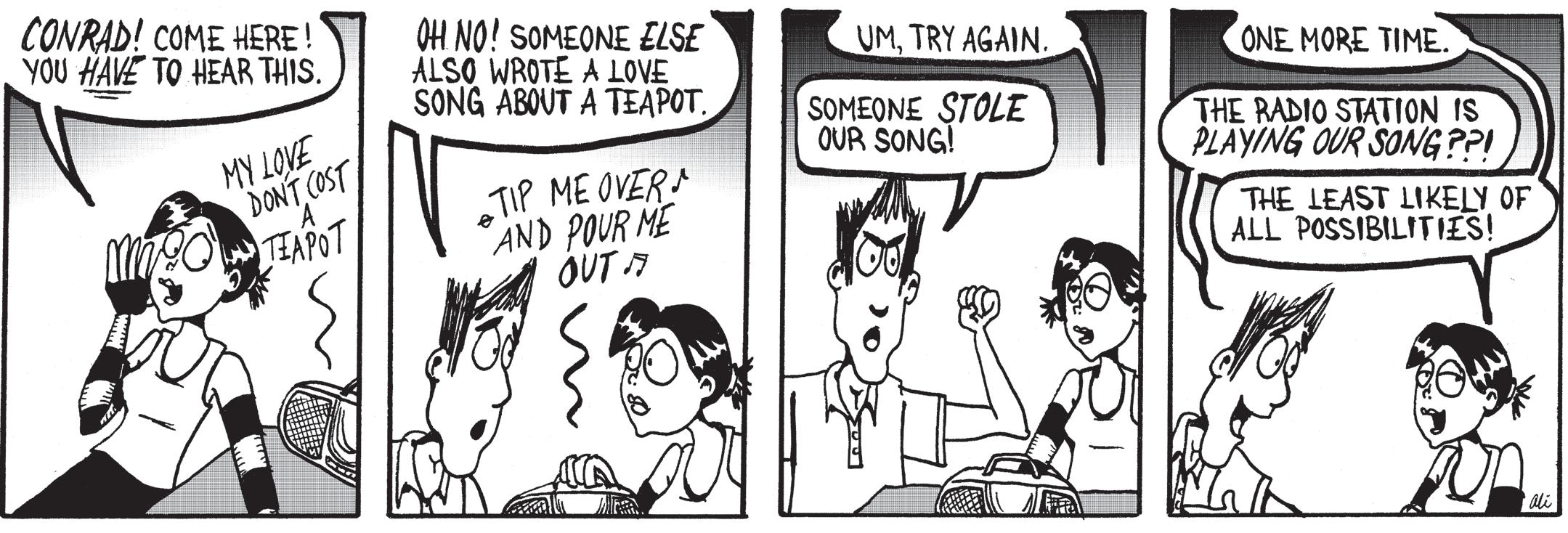
By now, you’ve probably heard about the upcoming film Yesterday. It follows a struggling musician who gets the break of a lifetime when he’s rudely waylaid by a truck, and he awakens to a world suddenly forgetful of The Beatles. Through sheer bashfulness and chutzpah, he starts to “write” hit song after hit song from the Beatles catalog for a girl he’s after.
Love oozes.
We can guess — okay, know! — where the movies goes: He gets the girl, writes the hit song, rides off into the sunset.
small feat for the chatbots to fool any one human judge. And just last year, a chatbot fooled one-third of the Loebner judges it “talked to.” But this doesn’t prove whether a machine can think. It only proves that, in a showcase environment, it has the ability to mimic humans, to unfailingly pull information from the web rather than with the use of complex algorithms. It’s not intelligence, however, and it’s certainly not the madcap inspiration we want.
Certain knowledge we don’t dwell on must be force fed to the
The whole movie is a sundae in cinematic form: Sweet and reliable with a pleasant aftertaste.
The movie’s song “Yesterday” is also inspired from the actual song, which was written and performed solo by Paul McCartney and was born when McCartney heard the melody in his dreams one day, rolled out of his bed and played it on his piano. So sure was he that the melody was from somewhere else, he searched endlessly for its prior existence. After finding nothing, he was resigned to the fact that he had simply conjured one of the most iconic melodies in modern music from nothing more than a dream.
In 1949, another Englishman would have crowed about the achievements of his fellow countryman. Jefferson Lister, a renowned neurosurgeon at the time, and scathing Artificial intelligence skeptic, wrote feverishly, “Not until a machine can write a sonnet or compose a concerto because of thoughts and emotions felt, and not by the chance fall of symbols, could we agree that machine equals brain — that is, not only write it but know that it had written it.”
What he argued was that machines would never think organically like humans. A machine could never conjure a song from something as vapid as dreams or emotions. It could never rise to the intuition of a human, the vast (or in some cases, narrow) emotional range of a person. It might appear intelligent from the outside, but chuck the hardware away and something much less impressive sits underneath — something far inferior to human emotion.
A.I.
The problem with this form of A.I. in the long run is the common sense humans have that it must be taught. Certain knowledge we don’t dwell on conjuring for too long — knowledge like, “it’s cold outside, wear a jacket,” “there’s a car coming, you can avoid it by taking walking to another lane or stopping,” — must be force fed to the A.I. For the computer to live casually, it has to quickly pick up on a million facts that are common knowledge to us. And more often than not, it fails to do so.
To have true AI requires further development in a subfield dubbed “Strong A.I.” Instead of giving the information all at once to the computer, under Strong A.I., the computer would be given sensory perceptions akin to humans to connect the mind and body of the machine so it can pick up facts more slowly, learn like a child and, essentially, develop as a human.
The first challenge of this is that developing strong artificial intelligence is grossly difficult, and second, no one is quite sure how to even define intelligence in the first place. If the first problem has left us lost, the second has left us blind.
But there’s another thing. A friend of
We’re stuck in the medieval ages of true artificial intelligence. If we can’t really define what intelligence is, how do we know when we’ve achieved it?
Lister has yet to be proven wrong, but the debate to whether artificial intelligence can think has become more and more contentious. Chatbots, which run on word recognition algorithms and database queries deliver set messages to customers. Autofill search bars guide us to the most popular searchesSmart replies in Gmail nudge us to the appropriate responses we don’t know how to word. But are these works really what we consider thinking.
The Loebner Prize is a good example of what’s poisoned A.I. At the annual competition, chatbots are tested by having them converse with human judges to uphold the Turing Test Principle that “if a machine can fool another human that it too is human, it must have human intelligence,”. The goal for the programs is simple then: Convince the judges they’re human, and they win.
Given the subtleties of human conversation and the vast knowledge required to hold a regular human conversation, it’s no
mine who is studying religiously hard to become a doctor mentioned that even if AI became intelligent enough to supplant health professionals, there’s a missing emotional aspect the machine will never achieve. To connect with patients requires a human’s understanding, not a doctor’s knowledge. To give a diagnosis is an art itself — to be aware and connected with people enough to know what to say, when to say, and how to say it
We’re stuck in the medieval ages of true artificial intelligence. If we can’t really define what intelligence is, how do we know when we’ve achieved it? Do we define intelligence by SAT Scores, I.Q. scores or some other arbitrary number? Or do we define it by the creativity by the likes of McCartney, who is able to pull a song out of seemingly nothing? To create a machine that can fool us can take maybe a few dreamless nights. But to create a machine that can fool itself — convince itself it’s wrong, to learn from its mistakes and to weigh the risks and rewards of reaching out to another — may just be a dream of itself.
William Wang is a junior in the College of Agriculture and Life Sciences. He can be reached at wwang@ cornellsun.com. Willpower runs every other Tuesday this semester.
Anna P. Kambhampaty | Tis Imagined Life
Is it still possible, in this day and age, to obtain an MRS degree?
For those who aren’t familiar, MRS degree is a term used to describe a woman who pursues a college education with the intention of finding a spouse. It was commonly used in the ’50s and ’60s when higher education was beginning to open up to women but still remained relatively
As Home Economics turned into Human Ecology and as women came to college to pursue their passions, are people, not just women, still trying to find significant others here? Is it even possible to?
inaccessible. For men, attending a university was a way to pursue an education and cultivate skills. For women, it was a way to get closer to these bright-futured men. Women would take college courses to become refined and cultured and would often not graduate after finding a spouse along the way.
Cornell’s College of Human Ecology, until 1969, was called the College of Home Economics. It was seen as “a critical pathway into higher education for American women, largely associated with co-educational land grant institutions such as Cornell.” Course offerings included home sewing, the Farmers’ Wives Reading Course and a famous marriage course. “Home Economics stands for the ideal home life for today unhampered by the traditions of the past [and] the utilization of all the resources of modern science to improve home life,” said Ellen Swallow Richards, founder of the Home Economics Movement.
“The average girl wants to be able to keep her house with the least possible strain, and in order to do this she must have good training. This can best be achieved by taking a good course in home economics,” said Eleanor Roosevelt, who played an early role in the establishment of Cornell’s home economics program and was a national advocate for the study of home economics. Home economics programs eventually received reputations of confining women to the kitchen but were formed originally under the mission of
getting women into college and improving the condition of women in America.
As Home Economics turned into Human Ecology and as women came to college to pursue their passions, are people, not just women, still trying to find significant others here? Is it even possible to?
Before approaching this subject, I asked friends and people around campus if they thought it was still possible to get an MRS — or MR — degree today. Of the dozens of times I posed this question to a Cornellian, I got the same exact answer: “What’s an MRS degree?”
Upon greater reflection, I realized I had only heard the phrase twice before. Once during AP U.S. History and once during rush, when an Alpha Phi sister said to me, “I came to Cornell to get my MRS degree,” followed by a feeble laugh, after telling me about the generations of her family members that met here. The term’s disappearance from our vernacular indicates a number of things. Most evidently, it indicates women are attending college to further themselves rather than follow a path paved for them by gender norms and overall forward movement in women’s rights. But it also makes me wonder, do men and women come to college with any hopes of finding their lifelong partner?
In 2018, the median age for marriage was nearly 30 for men and 28 for women. In 1960, it was closer to 23 for men and 20 for women, with an overall upward trend in age since. People aren’t getting married right out of college. If we aren’t marrying our college loves, then what is the utilitarian function of a college relationship?
The standard economic model suggests that individuals interact socially if there is something to gain; usually, this would be information, an increase in utility or an improvement in reputation. I bugged my friends a bit more and asked why they were dating their current partners if they probably weren’t going to marry them. The immediate payoffs of a college relationship are pretty much what you’d expect — discovery, enjoyment, comfort and memory. The prevalence of Bumble and Tinder among college students is another indicator of some desire for companionship, even if only in the short-term.
Though the answers I received felt honest and wholesome, I can’t help but wonder if there is some capitalist monster of the past engrained inside of us that’s driving our desire to date with the hopes of an eventual long-term relationship rather than just a simple longing for compan-
ionship.
In a New Yorker interview, Esther Perel, psychotherapist and author of Mating in Captivity discusses how the couple has never before been such a central unit in our social organization. For the first time in history, a couple’s emotional state is crucial to the survival of the family unit. On top of looking for someone we are attracted to, someone to help us build a financially stable future, someone who can be our friend, we are also asking for this other person to be our soulmate. “We have gone up the Maslow ladder of needs, and now we are bringing our need for self-actualization to the marriage. We keep wanting more. We are asking from one person what once an entire village used to provide,” argues Perel. She goes on to say we’re not cynical about finding this one, all-encompassing person either.
At the peak popularity of home economics programs and an MRS degree, people were asking for less out of a significant other. At best, people were looking for financial stability or someone who could take care of their home. Today, as Perel points out, we are looking for much more. The gradual extinction of home economics programs could very well be related to the modern trend of the everyday love-seeker wanting more out of a relationship than just some sort of stability. Maybe people still meet their partners
I can’t help but wonder if there is some capitalist monster of the past engrained inside of us that’s driving our desire to date with the hopes of an eventual long-term relationship.
in college and marry later, but I can’t help but think our greater ambitions for education and marriage might be the reason we aren’t marrying our college loves right away. We just want and feel like we deserve more.
Anna P. Kambhampaty is a senior in the College of Agriculture and Life Sciences. She can be reached at akambhampaty@cornellsun.com. This Imagined Life runs every other Monday this semester.
Unlike its fellow Ivy League peers, Cornell stands alone as the only university to have a student in its Board of Trustees, which is composed of 64 voting members. We elect two trustees, a graduate and an undergraduate student, for two-year terms.
Once elected, each member signs a non-disclosure agreement. What this means is that board discussions, reasoning for decisions and the way in which each member votes is confidential.
Take what you will from the justification for NDAs by current student-elected trustees Dustin Liu ’19 and Manisha Munasinghe grad, who in their Sun column said, “[The NDA] allows Board members to honestly discuss problems, bounce new and innovative ideas off of each other and safeguard the University’s long term strategies and plans in order to remain competitive with our peer institutions.”
Unlike the Student Assembly or other governing bodies on campus, the student-elected trustee holds a unique apportionment of power: The student-elected trustee wields more power and less accountability.
This year’s election season has kicked into full swing. This year, 10 candidates sought three hundred signatures for the petition to be eligible for candidacy and were approved to run.
Facebook pages, websites with custom domain names, Instagrams, flyers, quarter cards, names and slogans blasted everywhere promote each candidate. Accompanying the flurry of advertise -
ments is a robust set of campaign promises, some of which are problematic and antithetical to the actual role of the student-elected trustee. What we need is a quick clarification of the role of a trustee. Typically, specific policies and platform ideas are a valuable means to demonstrate accountability and initiative for change. However, in a student-trustee role that does not allow for pushing policies, policy-based campaigning is extraneous: It serves only to broadcast false promises and garner likeability with voters.
The role of student-elected trustee is not to bring to the Board of Trustees an agenda, a list of policies to implement nor boost specific initiatives. The student-elected trustee is a liaison between the Board, which sits higher than Cornell’s administration, and the student body. This trustee will serve as a conduit between the two groups, channeling communication between students to the Board and vice versa. It will facilitate the relationship between the student body and the Board, and further broadcast student voices. Realistically, the student-elected trustee will be one of 64 seats at the table, not a pioneer spearheading campus reform.
Realistically, the student-elected trustee will be one of 64 seats at the table, not a pioneer spearheading campus reform.
The Board is enshrined with bureaucratic politics: The student-elected trustee must gain the trust and respect of fellow trustees by oftentimes assimilating to the majority vote. An uncompromising, stout agenda that does not benefit the University as a whole will not fly at the Board. Campaign promises such as lowering the rate of tuition hikes, giving $9,500 more in financial aid to students, stopping the increasing rate of enrollment and terminating video lecture courses by professors will not be given the time of day. The trustee holds a fiduciary duty to the university, meaning that when short-term student interests are pitted against university interests, so the trustee has a duty to vote in favor of the University’s long-term financial interests.
Thus, the student-elected trustee must advocate for framing student interests as university interests. The trustee must serve to amplify student voice and concern, to advocate for students and illuminate the student perspective for the Board, but not be so presumptuous as to expect to logroll a series of policy promises.
Here’s what we need from our student-elected trustee: Breadth and depth at Cornell. First and foremost, the trustee
must be able to reach out to the wide variety of student groups on campus. They must be able to advocate for the whole of the student body and the niche groups affected by each issue brought to the board. Versatility is key and the ability to represent students from all corners of campus is vital. In regard to depth, the trustee must have knowledge and familiarity with our unique campus and its issues — an awareness with Cornell that can only come from time logged on campus, both in and out of the classroom.
We encourage students to attend the Student Trustee Debate on Wednesday, March 20 from 7:00 p.m. to 8:30 p.m. in the Willard Straight Hall Memorial Room. And we encourage students to be wary of empty, unrealistic policy promises.
The role of student-elected trustee, though limited as it stands today, has the potential to redefine the relationship of university boards and student bodies everywhere. It offers a unique seat at the table — one seldom offered. The lack of transparency on the Board can be reconciled through greater accountability by the student-elected trustee. Instead of brandishing unwieldy campaign promises, candidates should prioritize bringing accessibility and communication to the role, enabling them to embody and to represent us to yet a far greater degree.
Laura DeMassa and Canaan Delgado are sophomores at Cornell University. They can be reached at demassa-delgado@cornellsun.com. Double Take appears every other Tuesday.

Fill in the empty cells, one number in each, so that each column, row, and region contains the numbers 1-9 exactly once. Each number in the solution therefore occurs only once in each of the three “directions,” hence the “single numbers” implied by the puzzle’s name. (Rules from wikipedia.org/wiki/ Sudoku)

by Jeffrey Sondike ’19


By SMITA NALLURI Sun Staff Writer
Despite only being outscored 3-2 in the second half, a quick start for Stony Brook put an end to Cornell women’s lacrosse’s four-game win streak.
The No.17 Seawolves (4-3, 1-0 American East) scored a little over a minute into the match and Cornell (4-3, 2-0 Ivy) was unable to catch up, ultimately falling to Stony Brook, 14-2.
COLLEGETOWN MANSION: 221 EDDY STREET, 5 MINUTE WALK TO CORNELL. 12 Private Bedrooms with individual leases; Share 5 Bathrooms, 3 Kitchens, TV Lounge, Porch & Large Yard with Picnic Table. Rent per Bedroom $845.-$885. Rent Includes: High Speed Internet, Electricity, Heat, Snow Removal, Yard Care, Trash Removal & Professional Weekly Cleaning of Common Areas. Coin-Operated Washer & Dryer In Basement. On Site Parking For Rent By Semester. Full Fire Sprinkler System Throughout the House, Fire Alarms on Every Floor, Smoke Detectors In All Rooms. See Interior Photos of Bedrooms (on Status Page) & Exterior Photos, Floor Plans & Other Info on Our Website at: 221eddy.com CONTACT: KAREN ROSA, LANDLORD –941-223-1483.
Stony Brook had a dominating first half, shutting the Red out in the frame while tallying 11 goals.
“We need to be ready to go at the opening whistle,” said Cornell head coach Jenny Graap ’86. “Stony Brook came out firing, and we were back on our heels defensively.”
Both teams struggled to score in the second half until Stony Brook found the back of the net a little under ten minutes in.
Freshman midfielder Genevieve DeWinter then responded with a goal of her own to put the Red on the board for the first time in the match with 19 minutes left to play.
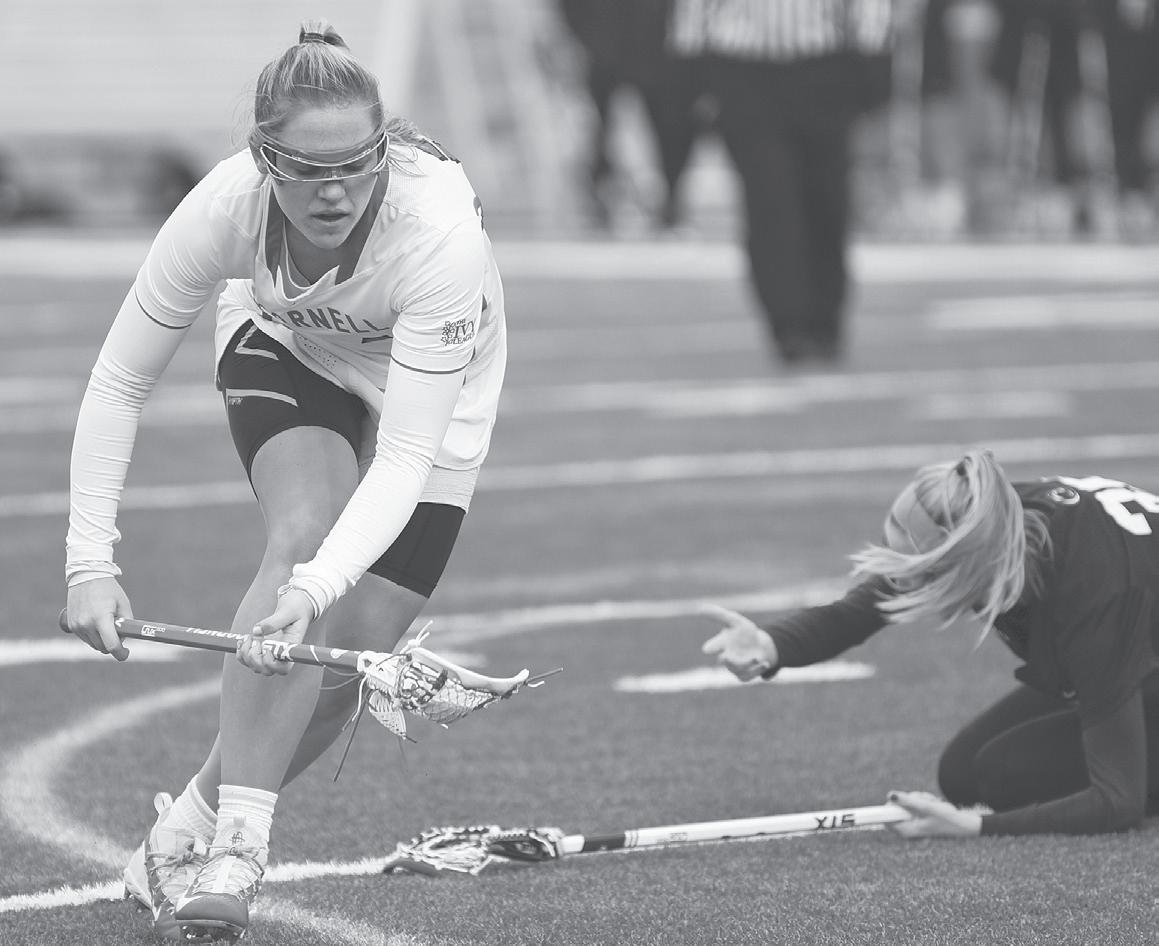
er Tomasina Leska scored again for the Red’s second and final goal.
Junior goalkeeper Katie McGahan had another outstanding day for Cornell, tallying 12 saves on the day.
“Stony Brook came out firing, and we were back on our heels defensively.” Jenny Graap ’68
The Seawolves then struck twice more before senior attack-
2019-2020 school year beginning June 1st at Hudson heights apartments. The studio apartments come with: heat, water, and electricity included. There are garbages houses and coin-operated laundry facilities on site. Prices start at $740/month for a 12 month lease. If you have any questions or would like to schedule a tour contact us by phone 607-208-7660 or email: renting@ithacaLS.com
COOK ST. Furnished House for 5-7 persons, 10mo. Lease for 2019-2020 Text or call Tracy at TLC Property Mgmt Corp 607-379-2776
3 BEDROOM Nice, clean, furnished unit can host up to 12 people. 303-309 Dryden Road Heat, Hot water included. Fiber Optic fast internet connection Laundry, parking available 607-279-1888 www.porealty88.com
Collegetown Terrace Apartments INSPIRED LIVING TAILORED TO YOUR SUCCESS
24-Hour Fitness Center Shuttle Bus Service to Campus Study Rooms w/ Expansive Views Apartments Available NOW, Spring 2019 & 2019/2020 Novarr- Mackesey Property Management collegetownterraceithaca.com office@ithacastudentapartments.com 607-277-1234
MUST SEE: 9 Bedroom House Walk to Cornell, Collegetown
$5400 + utilities/month. 531 E. State St. 9/10 Bedrooms, 3 baths, 2 kitchens. Furnished, Free Laundry, Free Parking. Available 6/1/2019 607-379-9168 text/call
2019-2020 College Ave. 5 Bedroom House Furnished. Laundry. Internet. Parking. 607-273-8576
2019-2020 Upper Eddy St. 7 Bedroom House Furnished. Internet. Laundry. 607-273-8576
5BR/3.5BA/$395,000-14850-&: 607-351-0782 LA.Helping-Clients-With Ithaca Real Estate Focus-YouTube

“McGahan had an incredible game in the net for us, particularly in the second half,” Graap said, “but we gave Stony Brook too many free position shots and quality looks at our net in the
opening 15 minutes.”
The Red will look to remain undefeated in Ancient Eight play when it heads to Philadelphia to take on the No. 5 Penn Quakers (7-1,1-0 Ivy) this Saturday at 1 p.m.
“We are fortunate to have a full week to prepare for an important Ivy game,” Graap said. “Film evaluation and team meetings are only a part of the post-game analysis. Our players care deeply and our team leaders will set the example by working hard to better their skills.”
Smita Nalluri can be reached at snalluri@cornellsun.com.
By KATHERINE FAIOLA Sun Staff Writer
The Red took down Fordham and Towson last weekend with its pitching prowess on full display — just in time for Ivy play, which starts next weekend.
Cornell won both games on Saturday 1-0 and 4-2 against Fordham and Towson, respectively.
The Red faced Towson University again the next day and fell, 3-2. Despite scoring opportunities in the top of the ninth inning, Cornell couldn’t close the one-run deficit.
Leading up to in-conference play, Cornell has developed a trend of playing low-scoring games decided by starters and relief pitchers. Aided by its evolving defense and an offense trying to string runs together, the Red is seeking to improve as the season gets into full swing. Cornell currently stands with an overall record of 3-9.
For an offense previously struggling to ... create scoring opportunities, the players did just that.
In game one versus Fordham, Cornell junior Colby Wyatt hurled an impressive scoreless 7 and two-thirds innings. Wyatt struck out four and limited the Rams to only five hits, earning the win. Relief pitcher junior Andrew Ellison got the save to solidify the Red’s 1-0 victory.
Although the sole run of the game was unearned — freshman infielder and leadoff hitter Justin Taylor reached on an error in the first inning — the Red’s defense shutout Fordham the entire game.
Immediately following its victory over Fordham, Cornell directed its defensive momentum towards Towson University. Freshman pitcher Jon Zacharias racked up 3 strikeouts in 4 innings of work, allowing only one run.
By the end of the 6th inning, Cornell was down by two runs, but the offense awakened late in the game to put up four runs in the 7th, 8th and 9th innings combined. Relief pitcher junior John Natoli tossed 3 and one-third scoreless to clinch the victory for the Red, earning a win for himself as well.
In the next day’s match, Cornell and Towson continued to keep the score close through the 5th inning. But by the end of the 7th, Towson had pulled away by two runs. After a scoreless 8th, Cornell tried to answer in an intense top of the ninth.
Junior infielder Matt Collins led off for the Red and reached after being hit by a pitch. Sophomore outfielder


Nicholas Binnie connected with a pitch for a single, advancing Collins. Senior catcher Will Simoneit ripped a pinch-hit RBI. With two runners on and no outs, the Red had both the tying and go-ahead runs on base.
And then, just as quickly as it had been sparked, the Red’s offense ran out of luck. No outs quickly turned into two outs as Taylor grounded into a double play. Now, only the tying run remained on third. With senior infielder/outfielder Josh Arndt at bat and the tying run just 90 feet away, the game fizzled to an end with a fly ball and a stranded runner.
Despite the outcome of that second match versus Towson — a tumultuous and frustrating game culminating in the top of the ninth inning — the way the Red’s offense came alive to challenge the Tigers showed determination and promise. For an offense previously
struggling to string hits together and create scoring opportunities, the players called to bat in the ninth did just that. Of the six players tested in the ninth, five made solid contact, but some of those hit balls failed to drop into the gaps.
This past weekend in Maryland marked the final series before conference play starts. Cornell aims to continue capitalizing on its own smart pitching and hopes to arrange an offense that comes in clutch.
Next weekend, Columbia hosts Cornell for the Red’s first conference series with two games on Saturday, March 23 and one on Sunday, March 24.
Faiola can be reached at kfaiola@cornellsun.com.
By ZORA HAHN Sun Staff Writer
Last weekend, Cornell gymnastics faced off at West Chester University before immediately returning to Ithaca to battle Rutgers University in Newman Arena.
Despite the exhaustion born of traveling for hours and spending much of Saturday night setting up Newman Arena for the following day’s meet, the team performed well in both competitions, achieving some of its highest scores this season.
Saturday’s meet yielded a score of 193.125 for the Red against West Chester’s 193.300.
“We had some trouble on Saturday with beam again but overall we had a decent meet at West Chester,” associate head coach
Melanie Hall said.
The team has struggled on beam throughout the season and scored an overall 47.075 on Saturday. During the Rutgers meet, however, the Red redeemed itself with a markedly improved 48.300 score.
The team scored a total 193.300 against Rutgers’ 194.825. Cornell all-time records were tied and set by freshman Donna Webster and sophomore Claire Haklik.
Webster scored a 9.9 on vault, tying with the previous Cornell record, which was set in 2012.
Haklik scored a 9.925 on the floor, which led the team to their overall 49.000 score on the event.
Both Webster and Haklik are contenders for the NCAA Regionals in a few weeks.
However, the team is pri-
marily focusing on the ECAC Championships that will once again be hosted in Newman Arena. Other teams at the meet will be Brown, Yale, Penn, William & Mary and Temple.
Although the Red would normally practice every day in anticipation of this championship, the coaches decided to give the gymnasts a few days off with the intention of beginning practice again on Wednesday.
“More pressure sets [and focusing on] hitting your first routine,” freshman Miranda Lund said of goals for this week’s practices.
The Championship meet will be live streamed on ESPN+ and starts at noon on Saturday, March 23.
Zora Hahn can be reached at