The Corne¬ Daily Sun

By ANTHONY CHEN Sun Staff Writer
Following the Atlanta massage parlor shootings on Mar. 16 that resulted in the deaths of 8 people, President Martha E. Pollack released a statement acknowledging the event.
In her Wednesday email, Pollack pointed out that six victims were Asian women and discussed the pandemic’s influence on increasing hate crimes aimed at the Asian population.
not confirm that this incident was bias related, Ong believed his attack could have been racially motivated.
“It is intolerable that these communities have experienced acts of racism, violence and hatred. As a campus community, we denounce these vile acts and stand firmly with our Asian and Asian American friends and colleagues,” Pollack wrote in her email.
“As a campus community, we denounce these vile acts and stand firmly with our Asian and Asian American friends and colleagues.”
Since March 2020, when Tompkins County confirmed its first case of COVID-19, Ithaca officials such as Mayor Svante Myrick and the Tompkins County Office of Human Rights have condemned the rise of prejudice and hate crimes towards Asians and Asian Americans.
President Martha Pollack
Pollack directed Cornellians in associated communities to the Asian and Asian American Center and the Faculty and Staff Assistance Program for further resources and support. Additionally, Pollack encouraged Cornell students and professors to report bias incidents.

By SURITA BASU and ALEC GIUFURTA Sun Staff Writer and Sun Senior Writer
Gov. Andrew Cuomo’s dual scandals, accused of falsely reporting data from COVID deaths in nursing homes and claims of sex ual misconduct, have student lead ers echoing widespread calls for his resignation — but they’re not the only ones taking note of the governor’s stunning fall from star dom: Rep. Tom Reed (R-N.Y.) is preparing a potential run for the governorship.
accused of purposely underreporting nursing home fatality data.
A Jan. 28 report from the State Attorney General detailed significant obfuscation of nursing home
Last March, Shawn Ong grad was stabbed near the intersection of West Avenue and South Avenue in an attempted robbery. Although the Ithaca Police Department could
The wider Ithaca community can also report bias incidents to the Ithaca Asian American Association, a local civic organization.
Anthony Chen can be reached at achen@cornellsun.com.
As of Wednesday, at least six women have publicly come for ward with sexual misconduct accu sations against the governor, and despite bipartisan calls for his resignation, Cuomo has declined to bow to what he called “cancel culture.”
The governor also faces a second crisis: his administration is

With Tjaden Hall galleries converted into distanced studio spaces, student galleries relocate
By OLIVIA CIPPERMAN Sun News Editor
From industrial representations of sea and nightlife to reflections on language in art, Cornell’s MFA student galleries present diverse artistic musings at the Herbert F. Johnson Museum of Art this spring.
At the start of the fall 2020 semester, Cornell Architecture, Art and Planning converted Tjaden Hall’s galleries into studio spaces to allow for social distancing as students worked on their pieces. According to Morgan EvansWeiler grad, hopeful student curators didn’t know if their concepts would ever become a reality.
“The Johnson stepped in, which has been a bless-
ing,” he said. “They allowed us to do shows there last semester and this semester, because we don’t actually have [Tjaden Hall] galleries to use.”
The Johnson Museum provided two galleries for MFA and BFA student shows, in which project managers created concepts for exhibits and curated pieces from artists they bring onboard. The Johnson’s collaboration allowed student exhibitions to proceed
from the latter part of the fall semester through the spring.
“An Anthropology of Everything” was Evans-Weiler’s first show. He expressed a new sense of responsibility to displaying other artists’ work and gained a strong appreciation for collaborative projects after curating his first gallery and highlighting other artists’ work.
“Doing this has really made me want to be even more particular,
more pointed and more contextual about what I would curate in the future,” Evans-Weiler said. “It makes me want to be more hyper specific, because I think this show was kind of broad in the way it brought together language, cultural study and research.”
Evans-Weiler was forced to adopt a new creative process as he worked with all artists remotely, collecting their pieces by mail. Nasca created the majority of
“Midnight Zone” himself, incorporating only an audio file from collaborators.
“It’s been this challenging and fragmented way of getting things together,” said Bonnie Jones, an artist featured in Evans-Weiler’s exhibit.
Nasca lamented the limits on the show and his inability to host a gallery reception due to COVIDrelated restrictions.

“I would have loved to have a reception that felt more like a party,” he said. He appreciated the Johnson’s helpful staff and advanced facilities, but also expressed that his show might have worked better in a smaller, less formal student gallery.
However, Evans-Weiler and Nasca agreed that



By MAYANKA DHINGRA Sun Contributor
A new building on central campus, Atkinson Hall, has finalized its last funding acquisition: a $30 million donation by David R. Atkinson ’60 and Patricia Atkinson, announced by the University on Tuesday night.
Cornell plans to transform a current parking lot on Tower Road into a robust interdisciplinary research space, housing four departments, centers with views of the Botanic Gardens and plenty of natural light.
The building was originally proposed with the intent of providing the Atkinson Center, a collection of sustainability-oriented faculty, with a more contemporary base on campus akin to the state of the art, eco-friendly facilities being built at universities across the globe, according to Prof. Mark Milstein, applied economics and management, who is a member of the Atkinson Center faculty board.
The building will additionally hold spaces belonging to the Center for Cancer Biology and Immunology, the Department of Computational Biology and the Master of Public Health program.
According to the University’s sketch plan submission to the Town of Ithaca Planning Board, the programs overlap in issues of global health and sustainability.
Milstein hopes the new building will be a “living breathing space that attracts individuals to discover how they plug into the environment and incentivize faculty to collaborate on cutting edge multidisciplinary research.”
“The new building signifies the important role sustainability plays as content area in various schools on this campus.”
Prof. Mark Milstein
Currently housed in Rice Hall, Milstein expressed that the current Atkinson Center does not live up to the University’s focus on sustainability, nor its status as a leader of progress in environmental justice, climate change and ecological degradation.
To Milstein, the Hall’s largest purpose should be practical as well as symbolic. At present, he said, Rice Hall
feels broken up and less than amenable to intellectual cross pollination. The very structure of the building fails to reflect an environmentally friendly model, featuring antiquated technologies and materials, Milstein said.
To this end, Ryan Yaden, the lead project architect with the Lake Flato Building Company, explained that the new design will incorporate a number of elements to embody the spirit and values of the departments contained within it.
CUOMO
Continued from page 1
According to Yaden, the building will contain solar panels, making it a fossil fuel free facility. In addition, the ground floor will feature a collaborative lounge showcasing storytelling exhibits.
The new design will incorporate a number of elements that embody the spirit and values of the departments.
As opposed to the closed-off double corridors that were characteristic of Rice Hall, Atkinson Hall will feature open doors and transparent glass labs. Yaden hopes to encourage students and professors to take inspiration from their peers.
Furthermore, in designing the hall with the aim of drawing together seemingly disparate disciplines, Yaden said overall his team focused on the things that “bring people together”: food and nature. Rather than a series of kitchenettes and lounges on each floor, the hall will boast a large ground floor lounge space with floor to ceiling glass paneling to showcase the landscape and two enlarged kitchens open to all.
The spirit of collaboration has played a role in designing the structure, with the architects holding a series of workshops in collaboration with members of the Atkinson center to inform the building’s design.
This week the project entered the final stage of design. Architects are drawing up contract documents that measure all the technical details before construction can begin with the goal of completing the project in August 2022.
“Given all the things the University could have chosen to invest in, the new building signifies the important role sustainability plays as content area in various schools on this campus and signals how important it is to present and future of the University, ” Milstein said.
Mayanka Dhingra can be reached at md753@cornell.edu.
JOHNSON
Continued from page 1
curation still allowed for personal growth, and they expressed appreciation for their ability to create during COVID.
An Anthropology of Everything, a language-oriented show curated by Evans-Weiler, opened on Mar. 16 and will run through Mar. 23. The glowing, aquatic Midnight Zone, created by David Nasca grad, is also on display.
An Anthropology of Everything features eight professional artists from across the world and nine pieces discussing personal relationships with language. Inspired by German artist Hanne Darboven, EvansWeiler encouraged broad and personal interpretations of the topic as the artists created pieces for the gallery.
to Neumaier, it represents the productive uncertainty that comes with the desire to engage with someone else’s text.
“Drawing for me begins with reading,” she wrote in an email to The Sun. “Reading brings me into an in-between zone. A leap that could be both break line and passage. It has to do with uncertainty and not-knowing.”
Bonnie Jones, a writer, musician and poet, featured a video project
“I’m not really a curator. I’m just an artist who likes doing things and bringing people together.”
Morgan Evans-Weiler grad
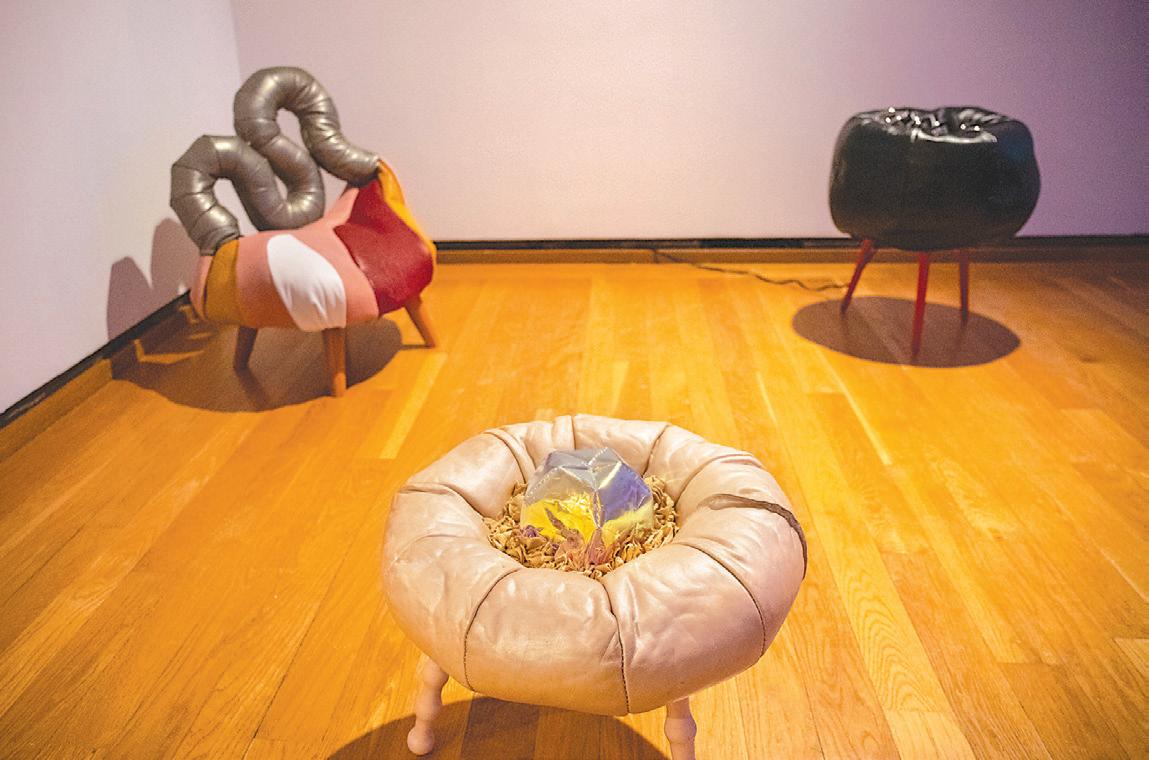
tures a variety of Nasca’s sculptural works, which emulate sea creatures through a variety of commercial materials with the intention of evoking the atmosphere of Nasca’s preCOVID parties with friends.
“I am really interested in animals, especially deep-sea animals, as metaphors for human queerness and the kind of weird communities as somewhat analogous to queer subcultures,” he said.
The installation “Salps for a Future Generation” spans the floor of the entryway, representing a type of sea creature that chains together with others of its kind.
reporting from The New York Times and Wall Street Journal revealed Cuomo’s aides — including his secretary, Melissa De Rosa ’04 — acted with political motive rewriting the data from the State Health Department.
Nearly every member of New York’s congressional delegation — including Senators Chuck Schumer (D-N.Y.) and Kirsten Gillibrand (D-N.Y.) — has called for Cuomo’s resignation.
Locally, Ithaca’s New York State Assemblywoman Anna Kelles (D-125th District) asked Cuomo to step down in a statement released on March 11th with over 55 other New York legislators. State Sen. Tom O’Mara (R-58th District) also called for Cuomo’s resignation.
Joseph Mullen ’24, a 2020 Democratic National Convention delegate and member of Cornell Progressives, said that most members of the club agreed that Cuomo should resign. When reached for comment, the group directed The Sun to Mullen.
“It’s clear that on the left, we have to hold our leaders accountable,” he said, lambasting Cuomo’s alleged sexual misconduct, data cover-up and campaign to pressure state officials for political support.
“That’s authoritarian behavior that we condemn when it comes from the right. And so we have to condemn it if it’s coming from a Democrat as well,” Mullen said.
The Cornell Democrats also support calls for the governor’s resignation, according to political director Logan Morales ’22 — a decision that is in line with The College Democrats of New York.
“Any of these allegations is an automatic disqualifier,” Morales said.
point where we are going to make some decisions on that,” Reed said in a Tuesday interview. “What we have to do is just make sure that we all are on the same page, that at the end of the day no one wins … if they go through a lengthy drawn-out primary battle.”
Even with an imperiled governor, a Republican’s chances at the governorship would be slim. No Republican has won statewide office since 2002, when former Gov. George Pataki, often categorized as a moderate Republican, was re-elected to his third term.
While Reed co-chairs a 56-member congressional caucus staked in finding bi-partisan policy outcomes , Tompkins County officials and Ithacans alike have criticized him for his policy positions. Reed co-chaired former President Donald Trump’s 2020 re-election committee in New York State.
“It’s clear that on the left, we have to hold our leaders accountable.”
Joseph Mullen ’24
Unlike Reed and other student political organizations, the Cornell Republicans have not yet issued a stance on the governor’s potential resignation. In a statement, Weston Barker ’21, the group’s president, endorsed a full investigation of both the sexual harassment allegations and the nursing home data before any disciplinary measures are taken.
“Now is the time for all accusing parties to be heard,” Barker wrote.
“It’s all about language and what language can do to help us understand our places in the broader cultural history, especially now,” he said. Pieces in the gallery range from a set of notes on poetry to a set of three paper cutouts to a video piece on the artists’ personal history.
Vienna-based artist Natalie Neumaier features a series of 27 drawings and handwritten notes on various texts, including work from Italian poet Biagio Marin. According
based on her lack of personal knowledge about her history –– Jones was adopted at a young age by a white American family, and knows little about her Korean heritage. Her work consists of a white cursor on a black background, typing and retyping versions of a personal history.
“It’s an improvisational writing,” she said. “So I’m just sitting down in front of the blank screen, as it were, and writing through a set of ideas. In this case, they were about ideas of being able to more or less make up your origin story, or to invent narratives about yourself.”
The Midnight Zone gallery fea-
The first room of the gallery features three furniture pieces and a selection of 3D-printed fish innards in plastic blow-up rings, representing the bar or lounge area of a nightclub. The second contains a set of glowing sea worms made of PVC and silicon, as well as an audio track describing true facts about ocean creatures.
Despite unusual circumstances, the curators enjoyed their gallery-producing experiences and gained artistic lessons from the process.
“I’m not really a curator,” EvansWeiler said. “I’m just an artist who likes doing things and bringing people together.”
Olivia Cipperman can be reached at ocipperman@cornellsun.com.
Reed, who has long questioned Cuomo’s nursing home order, slammed the “power hungry” governor as someone who leads by intimidation. He doubted that Cuomo would resign, citing his “ego.”
“I don’t see resignation as something he’s capable of doing,” Reed said.
Reed may take his criticism of Cuomo to the campaign trail. Along with a slate of other New York Republicans — including Reps. Lee Zeldin (R-N.Y.) and Elise Stefanik (R-N.Y.) — Reed told The Sun he is continuing to build resources to prepare for a potential run for New York governor.
“We are getting to that
New York State Attorney General Letitia James named a team of lawyers to lead an investigation into sexual harassment allegations. Lawmakers in the State Assembly opened an impeachment inquiry last Thursday into both Cuomo’s alleged sexual misconduct and political cover-up of nursing home deaths. Unlike federal impeachment proceedings, the governor would be immediately sidelined if the State Assembly were to impeach him, pending acquittal in the State Senate. With multiple ongoing state and federal investigations, it appears unlikely that the three-term governor will have a path to reelection in 2022, leaving an open field for candidates across the political spectrum.
Surita Basu can be reached at sbasu@cornellsun.com. Alec Giufurta can be reached at agiufurta@cornellsun.com.

By AMELIA CLUTE Dining Editor
Your life changes the day you realize that “sweetmeats” are actually pastries, “mincemeat” can refer to dried fruit cooked into a pie and ordering a plate of “sweetbreads” will get you a tasty calf pancreas. Misnomers like these just make you trust the world a little bit less. So, you can imagine how distraught I was to learn that corned beef has literally nothing to do with the yellow vegetable that grows on stalks. Well … almost nothing.
“Corn” as we know it in Modern English has a rich etymology dating back to the ProtoGermanic kurnam, meaning “small seed.” This creates an obvious connection to the corn that we eat grilled with butter; what are kernels if not hundreds of small seeds lined up in a row? But Old English used the word corn much how we use “grain” today — that is to say, corn referred to the overarching category of small, granular cereals rather than to any specific plant. Nevertheless, corn soon extended to describe many foods beyond just cereal grains. Keep in mind that even in Modern English, we often apply the word “grain” to non-edibles as in the case of “grains of sand.”
Corned beef is made by brining a brisket in a salt solution with other optional spices for up to a week, and boiling it until completely cooked through and tender. This salt brine is crucial to understanding just how corned beef got its name. As far back as the 1560s, “to corn” was a verb meaning “to preserve and season with grains (‘corns’) of salt.” Despite the absence of any corn as we know it, corned beef has steadfastly hung onto its (etymological) history with pride — much like the Irish people.

cal tool with many facets. In some cases, a group can use its diets to assert their autonomy and make a statement against unjust political systems. A modern example of this includes the vegan and vegetarian movement, in which individuals may express their opposition to climate change or animal cruelty through the foods they consume. At other times, a political enemy may intentionally
A group can use its diets to assert their autonomy and make a statement against unjust political systems.
Ireland, and its people, have undergone intense cultural erasure by the hand of the British government, but many modern day movements are attempting to combat the continued deterioration of Irish culture. Seaghan Mac an tSionnaigh of The Irish Times describes the Irish as, “A people who for generations had suffered genocide, famine and sexual crime as consequences of the first two waves of colonisation …” The story of Irish oppression is spelled out in Ireland’s culinary history.
Food is often used as a politi-
starve a population to weaken and demoralize. In the case of the Irish Potato Famine, however, the British government negatively impacted Irish foodways in much subtler ways.
The jury is still out on whether Britain “ignored the plight of Ireland’s poor out of malice, or if their collective inaction and inadequate response could be attributed to incompetence.” The fact remains, however, that Britain’s negligence — purposeful or not — contributed to the death of over a million Irish individuals between 1846 and 1851.
When crops began showing signs of illness in 1845, the
British government initially gave some relief by repealing the “Corn Laws,” or grain tariffs. Economically, this repeal helped slightly by making items like bread more affordable, but was far from sufficient in the face of impending famine. Despite clear suffering, the British government continued exporting goods like livestock, peas, honey and fish from Ireland, exacerbating the existing shortage. The Lord Lieutenant of Ireland, despite being an ally to the British Prime Minister, wrote to him claiming that, “Ireland had been sacrificed to the London corn-dealers … no distress would have occurred if the exportation of Irish grain had been prohibited.” Various relief efforts were half-heartedly implemented by the British government in response, though many promising programs failed because they were “politically … unacceptable.”
Britain’s calculated actions, which valued political advantage over human lives, represents the broader tendency throughout history to erase Irish civilization through cultural genocide. This is especially prevalent in modern perceptions of Irish food, which often view the cuisine as “far too quotidian to be valued, especially when compared to the …
exoticism associated with French haute cuisine.” In recent years, however, Irish food has been earning some of the recognition it deserves. The push towards vindicating Irish cuisine focuses on giving cultural autonomy back to Ireland; it will no longer be compared to French or British culture, but rather treated as a completely separate entity deserving of respect. Despite not resembling other
traditionally prestigious cuisines, Irish culinary traditions are worthy of respect, study and honor. Food conveys culture, and every culture is inherently worth preserving because it tells the story of a people. Who cares if cabbage and potatoes can get a bit bland?
Amelia Clute is a junior in the College of Arts and Sciences. She currently serves as one of the dining editors on Te Sun’s editorial board. She can be reached at aclute@cornellsun.com.

KATHRYN STAMM ’22
Editor in Chief
ANUSHYA ALANDUR ’23
Business Manager
CATHERINE ST. HILAIRE ’23
Associate Editor
PRANAV KENGERI ’24
Advertising Manager
ODEYA ROSENBAND ’22
Opinion Editor
JYOTHSNA BOLLEDULA ’24
News Editor
TAMARA KAMIS ’22
News Editor
WENDY WANG ’24
Arts & Entertainment Editor
KRISTEN D’SOUZA ’24
Design Editor
HANNAH ROSENBERG ’23
Photography Editor
OSALAMA AYOUB ’22
Science Editor
PUJA OAK ’24
Layout Editor
ANNIE WU ’22
Production Editor
MIHIKA BADJATE ’23
Assistant
ANGELA BUNAY ’24
Assistant
JOHN COLIE ’23
Assistant
AMELIA CLUTE ’22
Assistant Dining Editor
WILLIAM BODENMAN ’23
Assistant Sports Editor
AARON SNYDER ’23
Assistant Sports Editor
MEGHANA SRIVASTAVA ’23
Compet Manager
MADELINE ROSENBERG ’23
Editor NAOMI KOH ’23
OZA ’22
YUBIN HEO ’24
OLIVIA CIPPERMAN ’23
NOOREJEHAN UMAR ’23
YOON ’23
VELANI ’22
PICHINI ’22
TYAGI ’22
MENDOZA ’24
Editor
ARANDA ’23
’23
RIGGS ’24
LEYNSE ’23
NAGEL ’24
MONOHAN ’24
ABAYEVA ’24
’22

Aminah Taariq-Sidibe is a senior in the College of Agriculture and Life Sciences. She can be reached at ataariq@cornellsun.com. I Spy runs every other Tuesday this semester.
Some tasks that I once considered simple have now become taunting, such as, starting an assignment, sending an email or eating three meals a day. Though the tasks themselves did not change, my perception of them and the conditions in which they were completed, have.
Since the start of the pandemic, many students and workers have been forced to adjust to new, functional environments. But our “new normal” has presented itself with its own set of challenges including potential harm to our physical and mental health.
According to a study by the CDC, “Three out of four Americans between the ages of 18 and 24 report poor mental health tied to the pandemic.” Moreover, the same study reports that “80 percent of students around the country say that COVID has negatively impacted their mental health, their spiritual health, and career aspirations”.
As a college student, I have also experienced negative effects on my mental health and productivity as a result of the pandemic. But with the social prevalence of hustle culture, and being in a competitive academic environment such as Cornell, the expectation to continue to perform just as well (or better) remains. This has resulted in a sort of dissonance between my desire for rest, and the social and academic expectations of productivity. In short, it makes me feel lazy.
or solve climate change, we have to think about our wellness first. In order to do our best work, we have to be our best selves.
If you’re a student and you found yourself feeling “lazy” as of late, the number one thing to remember is that how you are feeling is completely normal and you are not alone. These tumultuous times have sparked feelings of frustration, anxiety, uncertainty, anger and grief in many people. Forcing ourselves to work through our struggle won’t help solve it, and in most cases, may exacerbate it. Listen to your body. Take time to focus inward and find some kind of peace.
If you’re a student and found yourself feeling “lazy” as of late, the number one thing to remember is that how you are feeling is completely normal and you are not alone.
Note, this isn’t an invitation to engage in harmful behavior and call it self-care. Rather, it’s a reminder that the world around us can really impact how we feel and that we have to take care of ourselves. Maintaining a routine is another helpful way of combating this feeling of perceived laziness. Set up mealtimes and study hours throughout your schedule, as well as times to get active or unwind. Having a routine also means practicing good hygiene and trying to get seven to nine hours of sleep per night. Personally, incorporating things like mindfulness and meditation into my routine has also been very helpful.
Mental health plays an important part in our productivity. One study from the Journal of Medical Internet Research identifies multiple stressors that contribute to an increased level of depressive thoughts, anxiety and stress among students. This includes (1) fear and worry about your health and of loved ones, (2) difficulty in concentrating, (3) disruptions to sleeping patterns, (4) decreased social interaction due to physical distancing and (5) increased concerns on academic performance. Research also notes, “A normal brain thinks about 70,000 thoughts a day; an anxious brain processes two to three times that amount of thoughts and can lean to low productivity from spending time perseverating on numerous thoughts.”
Based on this research, wouldn’t it be beneficial to slow down and do less because our brains are struggling to cope with the overwhelming chaos of the COVID-19 pandemic? Although it’s easy to berate ourselves for not doing things like start a company, initiate groundbreaking research
As social beings, inward reflection is only half of the battle. With many of us stuck at home, feelings of seclusion and loneliness aren’t foreign. A response to collective trauma must include collective healing; Try your best to maintain social connection with friends and family, and reach out for help or reach out to someone who may need help.
While it’s important to stay informed, it feels like there’s an overwhelming amount of things we need to be knowledgeable about now. Try to avoid excessive and harmful media consumption and technology use. Now that we spend so much time plugged in and with our eyes on the screen, it can be easy to forget the present reality in our peripherals. With the weather finally getting warmer, there will be more opportunities to go outside and connect with nature.
Mental health plays a big role in our productivity. Cornell Health also offers mental health resources and services such as drop-in Let’s Talk consultations, CAPSled workshops and 24/7 phone consultation. Instead of giving yourself a hard time, give yourself a break. It’s not you that’s lazy, you are in a pandemic.

College of Industrial and Labor Relations. Guest Room runs periodically throughout the semester. Comments can be sent to opinion@cornellsun.com.
As organizations across our campus and our country recognize Women’s History Month, we can’t just refect on the past; we need to address present issues afecting women. One of today’s most urgent issues, COVID-19, has wreaked havoc on women in the global workforce, sending progress for gender equality several steps backward. Te pandemic has hurt every community, including Ithaca, and Cornellians can’t turn a blind eye to the needs of the place we call home. Tis Women’s History Month, support an essential local organization, the Ithaca Women’s Opportunity Center, by contributing to a campus-wide fundraiser.
Last November, the Cornell Panhellenic Council and the Women’s Leadership Initiative at Cornell hosted a discussion on the pandemic’s impact for working women. During the event Mekala Krishnan, a partner at McKinsey Global Institute, explained that one reason for the exacerbated inequality between job losses
for women and men was the gender specifc nature of their work. Trough her research, she discussed how jobs held by women are 19 percent more at risk than ones held by men simply because women are disproportionately represented in sectors negatively afected by the COVID-19 crisis.
Tis risk is even higher for women of color. In September alone, four times as many women dropped out of the labor force, which equaled around 865,000 women to 216,000 men. With so many women working in the accommodation and food service industries, along with carrying the burden for child care, the mes-
This Women’s History Month, let’s celebrate the major milestones that women continue to achieve while reflecting on the many unjust struggles by those who came before us.
sage is clear: Working women are bearing the brunt of COVID-19’s economic impact, fnding little relief or resolution to address the situation.
Here in Ithaca, we can see COVID-19’s direct consequences on women attempting to enter the workforce. Recently, employees from the Women’s Opportunity Center spoke about the burden they are seeing many local women face with balancing childcare and job responsibilities. Ultimately, many women are forced to work fewer hours and earn less money, take jobs that ofer a lower standard of living or leave the
workforce entirely.
As part of the Cornell and greater Ithaca community, we should do everything that we can to support our fellow community members during these trying times. Tis will look diferent for each and every one of us depending on our current situations. However, if you have the opportunity to lend a helping hand, you should not overlook the current circumstances that are taking place right down the hill.
Local resources assisting women with employment opportunities are facing funding challenges. One such organization is the Women’s Opportunity Center, which works to “lead women to the pathway out of poverty by providing them with individualized career counseling, training and removing barriers to become job-ready and fnd employment”. After experiencing drastic lapses in government funding, the center must urgently raise $30,000 to continue to provide support for the local Ithaca community.
To address our local community’s dire needs, the Women’s Leadership Initiative is partnering with 14 other Cornell organizations to support and bring awareness to the Women’s Opportunity Center.. We are launching a fundraiser via CustomInk, where people can choose to either purchase custom-designed t-shirts and tote bags or donate money. Proceeds from the fundraiser will go towards helping the Women’s Opportunity Center fnd its footing during this incredibly difcult time, hopefully expanding more job opportunities for women across the local community. To support our fundraising eforts, please visit our fundraising page here!
Tis Women’s History Month, let’s celebrate the major milestones that women continue to achieve while refecting on the many unjust obstacles and struggles endured by those who came before us. Additionally, we must take swift action to address the many unresolved gender equality issues that have been exacerbated by COVID-19’s catastrophic consequences. I hope you will consider joining us to provide much-needed support for our local community.
Jaewon Sim is an undergraduate student-elected member of the Board of Trustees and a senior in the College of Arts and Sciences. Comments may be sent to opinion@cornellsun.com. Trustee Viewpoint runs every other Tursday this semester.
Last week marked the one-year anniversary of Cornell’s campus closure. Since then, the University community has learned to adapt to the COVID-19 world; Daily Checks and surveillance tests are now second nature. And with a federal directive to make all adults eligible for vaccines by May, it fnally seems that the end of the pandemic is near.
Quarantine, for me, was a time for introspection and growth. Staying at home with family gave me a chance to deepen my relationship with my siblings. But I also learned about the value of authentic relationships that transcend physical distance and gained a renewed sense of appreciation for the lifelong friends I made at Cornell.
Te year 2020 was an opportunity to learn more about Cornell as an institution as well. As we look forward to the post-COVID world, I took a moment to refect on the lessons from the pandemic.
Cornellians Are Resilient
Te word “resilient” is overused, yet, for Cornell, there’s now a story and concrete evidence to put to that
word. In a time of fear and misinformation, University leaders acted decisively with trust and science to reactivate the campus at a time when the many other colleges around the world remained shuttered. Despite a bumpy ride, students reciprocated by coming together to follow the Behavioral Compact, act responsibly and safeguard the community. Whether it’s during prelim season or an unprecedented global health crisis, we know that Cornellians shine under pressure.
Cornell Is One of a Kind
Efective delivery accompanied Cornell’s resilience and leadership in responding successfully to the pandemic. Te University leveraged its unique structural factors — the world-class veterinary school and its Animal Health Diagnostic Center — to create a new Cornell COVID-19 Testing Laboratory. Te lab members’ hard work and talent enabled the University to remain open by testing 7,000 students per day.
However, one particular component of Cornell’s pandemic response strategy has been with us all along, throughout the 155 years since our founder, Ezra Cornell, ofered the University his Ithaca farmland. Te University’s isolated physical location was critical to reducing the number of new cases introduced into the campus community.
But the benefts of being in Ithaca extend beyond the current pandemic. Being at a highly residential university in a remote location gives us a unique opportunity to grow as people and bond with each other. Our Ithaca presence is inseparably woven into Cornell’s fabric and the identities of every generation of Cornellians who passed through campus. Even as we lament the occasional April snowstorms, let’s take a moment to appreciate all that Ithaca has to ofer because they are, indeed, gorges.
Despite the Cornell community’s return to Ithaca, most courses took place online due to social distancing restrictions. Te past year has been a grand experiment in distance learning. By being forced to move online, both students and faculty learned about what worked or didn’t work on the virtual Hill.
As we celebrate Cornel’s COVID response success and anticipate returning to normalcy, now is the prime moment to reflect on our lessons from the pandemic ... I cautiously, yet optimistically, look forward to our return to a new — and better — normal.
Te verdict is clear that students and faculty both want to return to a fully in-person college experience. Yet, it would be a grave mistake to dismiss online education as a stopgap measure of the COVID-era.
A year on Zoom has taught me that online education can complement the traditional college experience when approached thoughtfully and used efectively. Te ability to re-watch lecture recordings, for example, has helped students retain knowledge by giving them a chance to review concepts that they did not understand on their frst try. Even in the post-pandemic world, let’s remember to use technology as a tool to enhance learning and expand educational access.
As we celebrate Cornell’s COVID response success and anticipate returning to normalcy, now is the prime moment to refect on our lessons from the pandemic. What did we learn about ourselves as a community, and how will we use it to our competitive advantage? I cautiously, yet optimistically, look forward to our return to a new – and better – normal.

Fill in the empty cells, one number in each, so that each column, row, and region contains the numbers 1-9 exactly once. Each number in the solution therefore occurs only once in each of the three “directions,” hence the “single numbers” implied by the puzzle’s name. (Rules from wikipedia.org/wiki/ Sudoku)









Since 2011, Cornell has secured more than 20 Ivy League titles across 35 varsity sports
By GRAYSON RUHL
Contributor
In the past decade, Cornell has posted an impressive number of triumphs in athletics, including more than 20 national championship teams, more than 20 Ivy League championships and 11 individual national champions.
With talented squads in wrestling, lacrosse, hockey and other sports, the Red set an excellent standard throughout the 2010s.
Leading the charge for the Red in the 2010s was its notorious wrestling team with a total of nine straight Ivy League championships during the decade. In what was already a standout decade, the MVP of the team was undoubtedly Kyle Dake, who set a U.S. record as the only wrestler to win four individual national championships in four different weight classes.
Dake was one of three individual champions on the team in 2012, winning the 157-pound class, along with Steve Bosak in the 184-pound class and Cam Simaz in the 197-pound class. Cornell had never had more than one national champion on the team prior to the 2012 season.
Moving over to the wrestling mat, the Red finished as runner-up in the NCAA tournament in 2011, a feat that no other Ivy League team has accomplished, and also
secured a fourth-place finish in 2012 under head coach Rob Koll. The team also had the back half of a 17-year streak of Ivy League championships, occurring from 20032019.
The Red also had a noteworthy decade from the men’s lacrosse team. Despite having three different head coaches over the course of the ten years, the team still managed to be consistently ranked within the Associated Press top 25 ranking.
Ben DeLuca opened up the decade winning two of three Ivy League titles during his tenure from 2011-2013 in addition to reaching the NCAA quarterfinals in 2011, and the NCAA final four in 2013. In addition, attackman Rob Pannell broke the all-time points record for all NCAA schools and stands at fourth all-time in the present day.
Under Matt Kerwick, the team won two more Ivy League regular-season titles, and with his successor, Pete Milliman, at the helm, the Red took home the Ivy League tournament trophy in 2018, as well as reaching the NCAA quarterfinals that same year.
Men’s and women’s hockey, historically two of Cornell’s most dominant teams, followed a similar line of success.
The men’s team took home five Ivy League titles and is currently the three-time defending Ivy League champion.
The women’s team won six Ivy League titles, including this

past season, notched three trips to the NCAA frozen four and clinched three ECAC tournament championships in 2011, 2013 and 2014.
A number of other teams enjoyed success throughout the past decade. Men’s lightweight crew won four national championships, as well as three EARC championships under head coach Chris Kerber. Men’s indoor and outdoor track captured a combined five heptagonal championships, while women’s outdoor track and cross country combined for four heptagonal titles.
Furthermore, the women’s polo team also posted an impressive decade, taking home three national championships (2011, 2015, 2016) with the leadership of head coach Dave Eldredge. The men’s tennis team also stayed competitive in the Ivy League, winning conference titles in 2011 and 2017. Cornell also had an individual champion on its men’s outdoor track and field team, Rudy Winkler, who won in 2017 for the hammer throw.
Though Cornell athletics remains sidelined due to the COVID-19 pandemic, athletes across the Red’s 35 varsity sports continue to prepare and hope for a resumption in competition in order to carry on the University’s impressive legacy.
Grayson Ruhl can be reached at gpr35@cornell.edu.