The Corne¬ Daily Sun

Cynicsm & Criticism
Harvard humbled Cornell breezed past Harvard hockey as the Red clinched a place in the

Cynicsm & Criticism
Harvard humbled Cornell breezed past Harvard hockey as the Red clinched a place in the
By CORAL PLATT Sun News Editor
March 17 — Dina Ginzburg, a second-year graduate student in the School of Industrial and Labor Relations, was found “not responsible” by a hearing panel for three alleged Student Code of Conduct violations, nearly 11 months after the Office of Student Conduct and Community Standards launched an investigation centered around her disruption at the Pathways to Peace event.
Ginzburg’s hearing took place on Feb. 6, almost 11 months after Pathways to Peace, a panel discussion held by the University on March 10, 2025 to discuss politics and conflict in the Middle East, including “potential paths forward for the people of Israel and Palestine,” according to its event page. Ginzburg was accused of “disrupt[ing] the event by yelling or chanting,” according to the formal OSCCS complaint, obtained by The Sun.
Ginzburg’s case included a temporary suspension, which is implemented when “less restrictive measures are reasonably deemed insufficient to protect the Complainant or the University community” according to the Student Code of Conduct; inaccuracies in the initial reports; and other frustrations in the investigative process, a Sun investigation found, based on Cornell University Police Department body camera footage, emails between Ginzburg and OSCCS and documents related to Ginzburg’s case, all obtained by The Sun.
“I think the entire process hasn’t been due process,” Ginzburg told The Sun.
Ginzburg was one of 17 people arrested or detained for demon-
strating at the event, nine of whom were students.
When The Sun requested a comment from the University regarding several of Ginzburg’s comments on due process and accountability, a University spokesperson wrote that “The university diligently follows all standards of due process laid out by the Student Code of Conduct and Procedures.”
In a separate exchange prior to the hearing panel’s decision, The Sun asked a University spokesperson for comment on the case and Ginzburg’s sentiments, the spokesperson wrote that the Family Educational Rights and Privacy Act “protects the records of individual students and bars institutions from discussing specific conduct cases.”
The spokesperson added that, “The Office of Student Conduct and Community Standards moves through investigations as efficiently as possible without compromising thoroughness. The length of an investigation depends on different factors, including but not limited to, the complexity of a case and the amount of information to be gathered.”
“Tzipi Livni, You’re a Chillul Hashem” Ginzburg’s demonstration at the event was in response to one of the Pathways to Peace panelists: Tzipi Livni, former Israeli vice prime minister and foreign minister. The other speakers included moderator Ryan Crocker, former U.S. ambassador to Afghanistan, Iraq, Pakistan, Syria, Kuwait and Lebanon; panelist Daniel B. Shapiro, former U.S. ambassador to Israel; and panelist Salam Fayyad, former prime minister of the Palestinian Authority.
Livni has faced allegations of war crimes from a British court, the Belgian federal prosecutor’s office and the Attorney General’s Office
By VIVIENNE CIERSKI Sun Staff Writer
March 13 — President
Michael Kotlikoff and Ryan Lombardi, vice president for student and campus life, appeared before the Student Assembly Thursday evening amid a tense and crowded meeting in which students later debated two resolutions related to Cornell’s involvement with Technion and the invitation of war criminals to campus — both of which ultimately passed by wide margins.
Kotlikoff and Lombardi attended the meeting to deliver remarks on the state of the University
protests, Cornell’s Expressive Activity Policy, the University’s Resilient Cornell initiative and his delayed responses to previously passed Student Assembly resolutions — and to answer questions from Assembly members.
The room was packed with students, many holding signs as they prepared to weigh in during the public comment period on two controversial measures: Resolution 55 and Resolution 61.
Kotlikoff began the meeting with a roughly 10-minute prepared statement similar to remarks he recently delivered at a University Assembly meet
upheld by Cornell’s various bodies.
“Cornell has a long history of shared governance, dating back to the 1960s; it was and is part of our tradition,” Kotlikoff added.
“It’s an expression of our commitment to our core values and part of our educational mission, one of the ways we strive to educate capable citizens who go on to contribute meaningfully to a thriving democracy.”
Kotlikoff’s speech was intermittently interrupted by students in the crowd, who shouted and laughed at the president while he was delivering his address and during his responses to questions.

When Kotlikoff addressed concerns about the timing of administrative responses to Assembly resolutions, he explained that the volume of resolutions and narrow response deadlines could make difficult to respond
To continue reading, please visit www.cornellsun.
in Switzerland. The charges regard her role as the foreign minister and vice prime minister during “Operation Cast Lead,” an Israeli bombing of Gaza in 2008 that killed 1,417 people — an estimated 83% of whom were civilians, according to The Guardian.
To continue reading, please visit www.cornellsun.com.
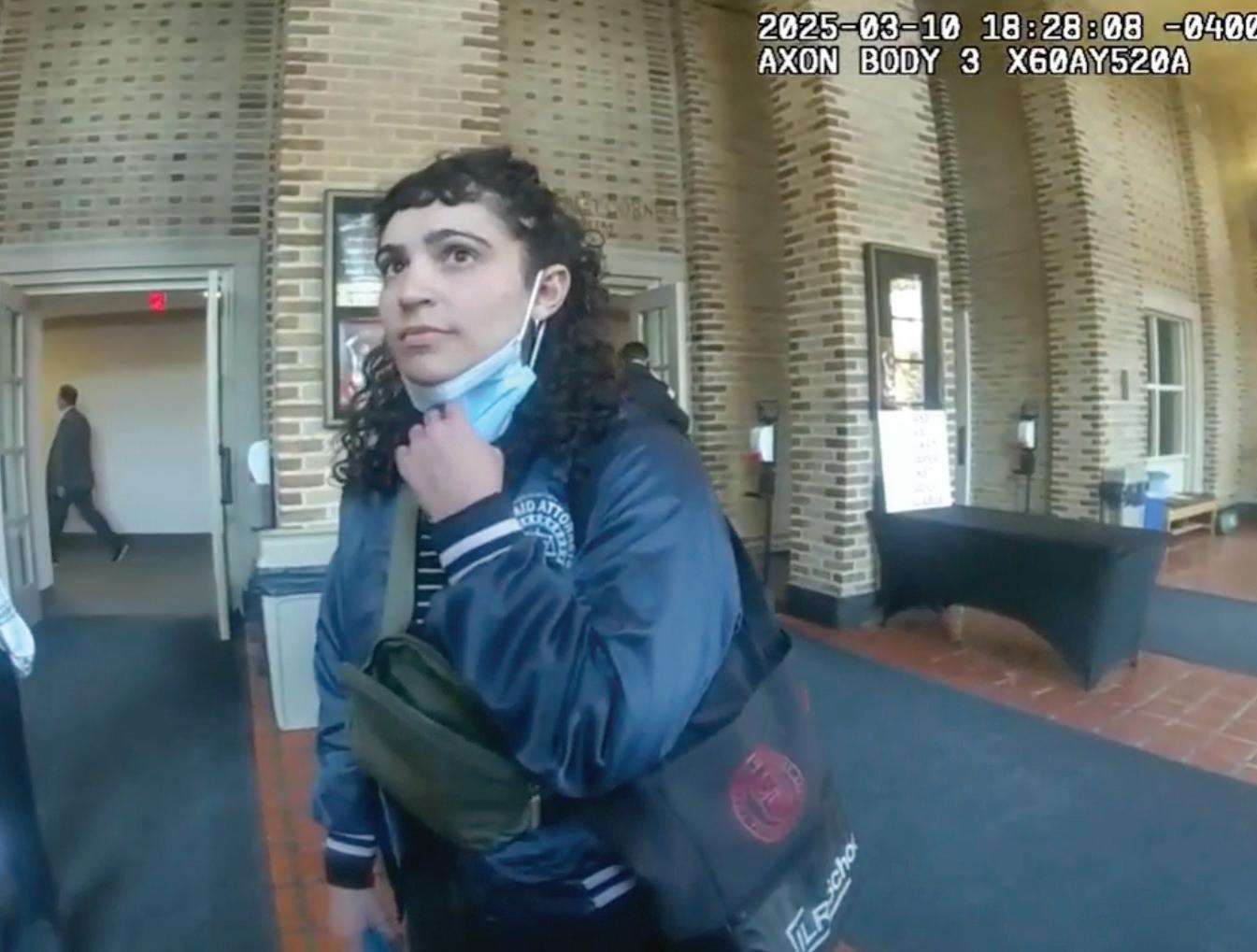
Pathways protester | Pathways to Peace protester Dina Ginzburg was found “not responsible” after 11-month investigation.
By VIVIENNE CIERSKI Sun Staff Writer
March 12 — Maya Regev, a survivor of the Oct. 7 Hamas-led attacks and former Hamas hostage, spoke at an event hosted by Cornellians For Israel on Monday. Addressing a packed auditorium, Regev recounted her flee from the Supernova music festival attacks, her capture by Hamas and the determination that sustained her through nearly two months of captivity.
On Oct. 7, 2023, Hamas, which has been designated as a terrorist organization by the U.S. Department of State since 1997, led attacks in southern Israel that killed approximately 1,200 people, including approximately 400 people at the Supernova music festival.
Regev, one of 251 hostages captured by Hamas during the attacks, spent 50 days in captivity after being shot in both legs while fleeing the festival.
Since her release from captivity, Regev has traveled internationally to share her story and advocate for the hostages who still remained in captivity. Regev told the audience that she did not feel fully safe “until every hostage was home.”
Near the end of her talk, Regev addressed those who deny or minimize the events of Oct. 7, asserting that the attacks were not an abstract political debate, but a lived reality for many people.
“I want you to know that, for me, October 7, it’s not a debate,” Regev said. “It’s not something that I saw on social media. It’s not something that I read about online. It’s something that changed my life forever. And I want you to know that for every headline and every hashtag that you see, there are people behind it.”
Regev, who was 21 at the time of the attacks, and her brother, Itay Regev, who was 18 at the time, attended the music festival with friends after returning from a family trip to South America. The festival, which coincided with Sukkot, a weeklong Jewish holiday, drew more than 3,000 attendees. The event was meant to celebrate music, freedom and life, Regev said. And for a few hours, she said it did just that.
“It was the best four hours of my life,” Regev said — but the celebration was violently interrupted.
In the midst of the festival, sirens warning of incoming missiles from Gaza began sounding across the area. Having grown up In the midst of the festival, sirens warning of incoming missiles from Gaza began sounding across the area. Having grown up in Israel, Regev said the alarms initially did not worry her.
“We didn’t find it to be such a big deal because it’s not the first time something like this had happened in Israel,” Regev said.



Today
Lecture: How Migrants Make Markets 10:10 - 11:25 a.m., White Hall Room 106
Three Minute Thesis Competition 3 - 4:30 p.m., Mallott Hall, Room 251
Eating Well with Cornell Dining Pop-Ups
5 - 7 p.m., Risley Dining Hall
Adult & Child Paint
6 - 7:30 p.m., Ithaca Bakery, South Meadow St. Location
Tomorrow
Lecture: Mother, Border, Other 12:15 p.m., Kahin Center
Seminar: Food Politics in the Trump Era
3:30 - 5 p.m., Schurman Hall, Lecture Hall 4/5
Film: Claude McKay: The Wanderings of a Rebellious Poet 5 p.m., Goldwin Smith Hall, HEC Auditorium
Trivia Night at Ithaca Bakery
6 - 8 p.m., Ithaca BakeryMeadow Street

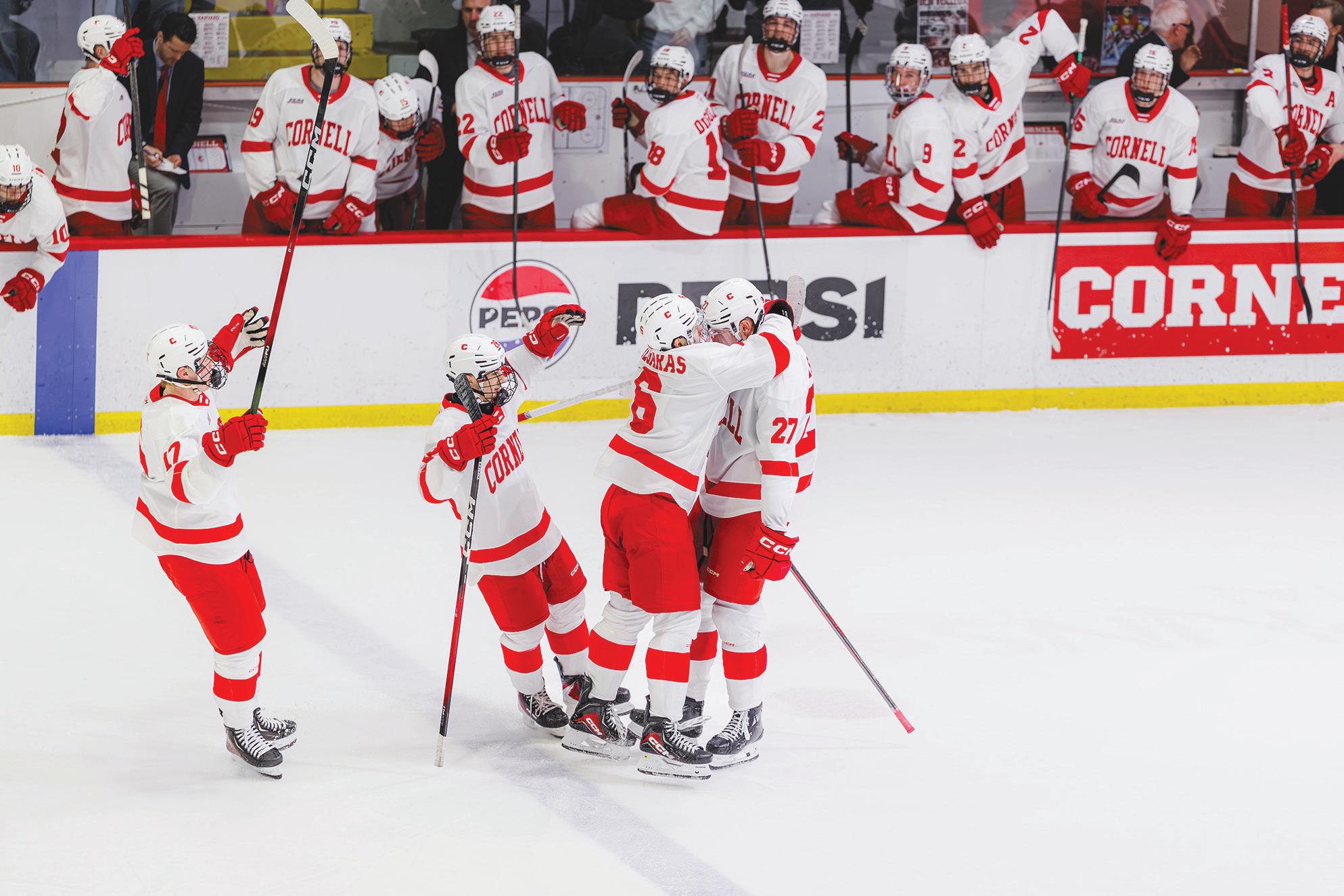
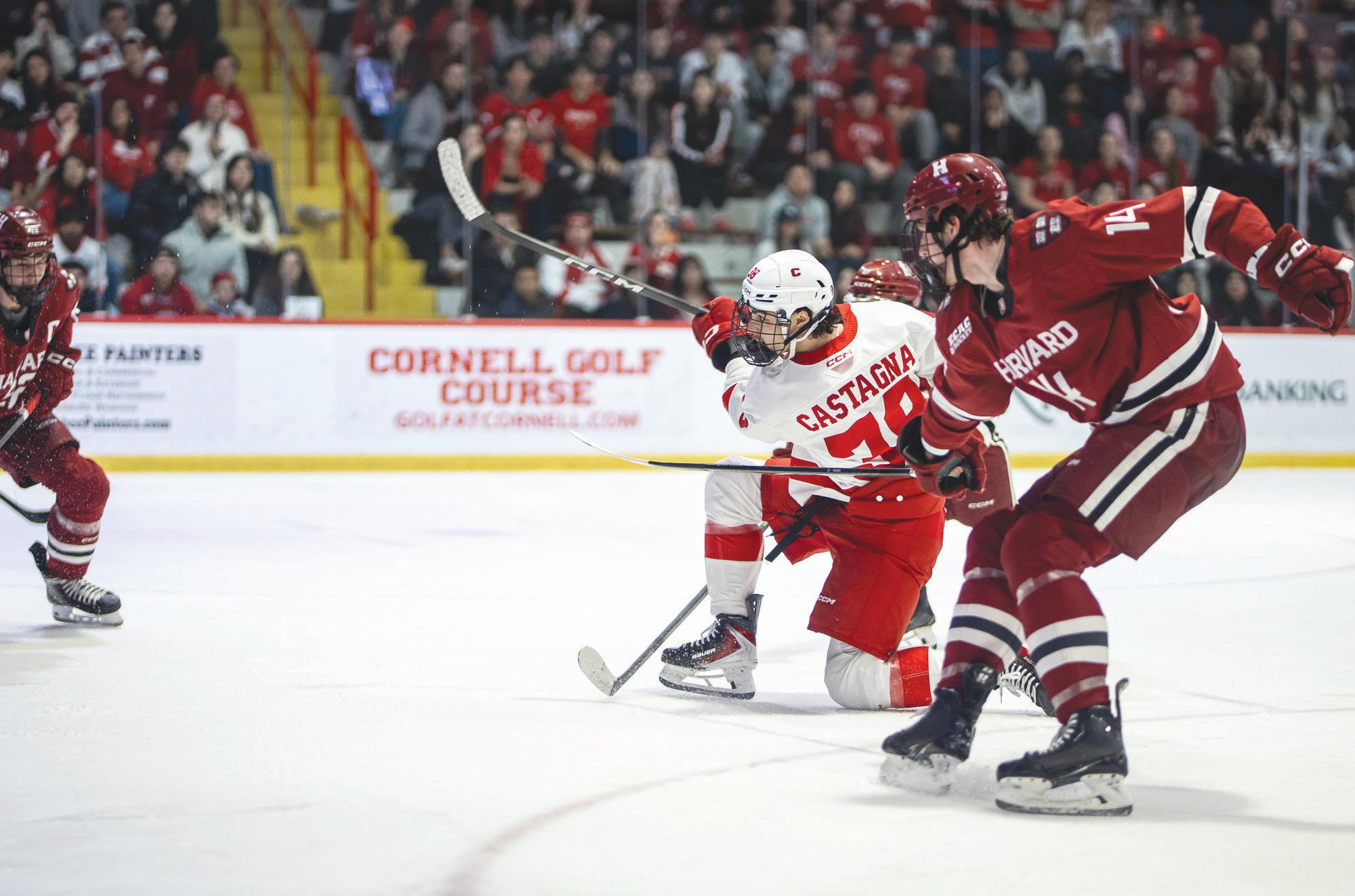
Te Red faced of against Harvard in an action-packed weekend at Lynah Rink. Sun photographers avoided fshy projectiles and captured the electric energy on and of the ice.
By SUN PHOTOGRAPHY DEPARTMENT






By HUSSAM KHER BEK and GISELLE REDMOND Sun Senior Writer and Sun Assistant News Editor
March 12 The Ithaca Common Council voted to end the city’s contract with Flock Safety and approved the design of a disputed mural on Green Street that reads “Free Gaza,” “Black Lives Matter” and “Choose Love” during the council’s meeting on March 4.
Ending Ithaca’s Contract With Flock Safety
The meeting began with public comment, which largely featured concerns around Flock Safety cameras in Ithaca.
Flock cameras are AI-powered automatic license plate readers used by law enforcement, business es and private organizations. The security company, Flock Safety, retains access to cap tured data for up to 30 days after it is captured, according to its website.
In 2023, the Common Council approved funding for Flock camera installations across the city. Currently, 22 of these camer as, operated by the Ithaca Police Department, have been installed.
Reporting done under 404 media has also found that vari ous local and state law enforce ment agencies have been fulfilling requests by U.S. Immigrations and Customs Enforcement to access their Flock databases.
undocumented immigrants and surveil people who travel to Tompkins County to receive abortions that are illegal in their respective states.
Cornellians have also voiced fears about the usage of Flock cameras at Cornell — Flock cameras have been operating on campus since October 2024. Cornell students and faculty previously told The Sun that they worried the cameras were a “really a big threat” that could be used to target visa holders and limit their political activity.
At the March 4 meeting, Ithacans spoke about their concerns with how Flock footage could be misused and called for immediate removal of the cameras. “Any benefits from the surveillance are offset by the fact that information is being gathered about random people,” said Ithaca resident Lynne Jackier. “There is no reliable way to ensure that the information won’t be used by bad actors and in the current political reality, it almost certainly will.”

Tompkins County residents have previously expressed they fear the cameras could be used in similar ways, to aid ICE, track
Several community members shared their own stories about how footage has been used in the past months, urging the council to take action. Daniel Creamer, a local resident, shared a specific alleged incident
To continue reading this article, please visit www.cornellsun.com.
Hussam Kher Bek and Giselle Redmond can be reached at hkherbek@cornellsun.com and gredmond@cornellsun.com.
Continued from page 1
Soon after the sirens, the situation escalated. Police officers entered the festival grounds telling attendees that terrorists had crossed the border and informing them that they needed to flee immediately, Regev said.
Chaos followed as thousands of attendees attempted to escape at once, she said. Traffic bottlenecked on the only road providing exit from the festival grounds, and many people abandoned their cars to run on foot. Regev, her brother and their friend Omer Shem Tov were among those who fled across open fields, trying to get to safety.
“We heard people everywhere screaming that their friends got killed, got shot in the head, trying to escape,” Regev said. “We felt like something really big was happening.”
For more than 90 minutes, the three ran while gunfire erupted around them. Regev recalled people collapsing mid-run as bullets struck nearby.
“It was like Russian roulette,” Regev said. Eventually, they spotted a man they had met the night before at the festival, Ori Danino. Danino reached safety minutes prior but returned with a car to rescue Regev, her brother and Shem Tov. As they attempted to drive away, their path was blocked by Hamas pickup trucks filled with armed militants.
At the time, Regev was on the phone with her father. She played the recording of that call for the audience. In the audio, she and her brother can be heard screaming and pleading for their lives in Hebrew.
Both Regev and her brother were shot during the encounter and were separated soon after, when they were both thrown into the back of Hamas vehicles. Maya described one of the terrorists smiling at her while holding a gun to her head.
As they crossed the border into Gaza, Regev recalled seeing crowds in the streets dancing and celebrating the attack.
“All of a sudden I feel a hand grabbing my hair,” Regev said. “The terrorist next to me is telling me, ‘Look outside, look, we won.’”
Regev was initially held with her brother and Shem Tov in a small storage unit in Gaza. She was suffering from severe injuries, including the gun-

shot wound that had shattered a bone in her leg. In that moment, she said, she made a conscious decision that she would survive.
“I said to myself that no matter what happened, no matter if it will be painful, no matter if I lose my leg, no matter what, I’m going to stay alive for my family, for myself,” Regev said.
After a short time, Regev said that her captors took her to a hospital in Gaza, where the captors disguised her as an Arab woman and warned her not to reveal her identity, telling her she would be “lynched” if anyone discovered she was Jewish.
For the next 45 days, Regev remained alone in her hospital bed, living in what she described as “24/7 fear.” During this time, her captors repeatedly verbally abused her, poured apple cider vinegar and alcohol on her wounds, and left her in total isolation for weeks.
Maya took the audience through how she endured the isolation. In her head, she said that she would imagine the white ceiling as a screen, onto which she would project scenes from her life, images of her family and memories of a past life that seemed almost unrecognizable to her.
Throughout this time, Regev said her faith helped sustain her. Rather than questioning why these events had happened to her, she said she believed she had been chosen because she was strong enough to endure them.
“I know that it’s me and not a different woman, because I know that I can make it out alive,” Regev said. “I trust myself, and I know that He trusts me. That’s what gave me faith.”
Both Regev and her brother were released in November 2023 as part of a weeklong ceasefire. Shem Tov was released on Feb. 22, 2025 after 505 days in Hamas captivity as part of a temporary ceasefire agreement.
Danino, who had come back for the siblings and Shem Tov on Oct. 7, was killed in captivity.
To continue reading this article, please visit www.cornellsun.com.
Vivienne Cierski can be reached at vsc38@ cornell.edu.
By ZEINAB FARAJ Sun Senior Editor
March 13 — Mateu HealeyParera ’26, a Cornell student arrested on Saturday for possession of a weapon on Syracuse University’s campus, told a Syracuse Police Department officer that he purchased the rifle to protect himself against U.S. Immigration and Customs Enforcement, according to an affidavit written by SPD officer William Clayton and obtained by syracuse.com.
Healey-Parera told Clayton that he would use the weapon to “shoot an ICE agent as a last resort if they were to come to his home in Ithaca,” according to the affidavit, as reported by syracuse.com.
Healey-Parera, a student in the urban and regional studies program, was found on Syracuse’s campus in possession of a 1905 .30-06 US Rock Island bolt-action rifle with an attached scope and 40 rounds of ammunition while waiting for a bus to Ithaca at approximately 4 p.m. on Saturday, SPD’s Chief of Police Mark Rusin said in a Monday press conference.
Healey-Parera told SPD in the affidavit, that he purchased the weapon and ammunition at Intimidator Sports — roughly an hour away from Cornell’s campus.
Syracuse University’s Department of Public Safety received a report from a concerned citizen about a man carrying a tan-colored soft case commonly used for long guns and took Healey-Parera into custody without incident, according to The
Ithaca Voice. He was charged with criminal possession of a weapon on school grounds, a Class E felony under New York State law.
Healey-Parera pleaded not guilty and was arraigned Sunday morning, with bail set at $50,000 cash or $100,000 bond. He posted bail on Wednesday after a relative paid $50,000 by cashier’s check, according to the CNY Central. His attorneys had moved earlier that day to reduce his bail before Syracuse City Judge Mary Anne Doherty, who denied the motion. CNY Central also reported that Healey-Parera is now at the St. Joseph’s Comprehensive Psychiatric Emergency Program, a psychiatric emergency facility located in Syracuse.
Healey-Parera defense attorney, Jordan McNamara, disputed this in an interview with WSYR, saying he was not aware of HealeyParera being ordered to a mental health facility.
According to Rusin, the investigation of Healey-Parera’s case has been a multi-agency effort that included the Syracuse University Police Department, Syracuse University DPS, the Onondaga County District Attorney Office and Tompkins County District Attorney Office and the FBI.
To continue reading this article, please visit www.cornellsun.com.
By CORAL PLATT Sun News Editor
March 11 — The public comment period for proposed Student Code of Conduct revisions is now open, according to a Monday email sent to the Cornell community by Marla Love, Robert W. and Elizabeth C. Staley dean of students and chair of the Code and Procedures Review Committee.
The public comment period will be open for six weeks, from Monday through April 20, and the review committee will “thoughtfully read and review” all public comments before releasing final recommendations for revisions, according to the email.
Following the public comment period, Ryan Lombardi, vice president for student and campus life, will make recommendations and President Michael Kotlikoff will assess the recommendations and release a final revision. The updated code will go into effect on July 1.
Among the proposed revisions is the addition of a new section in the Student Code of Conduct Procedures that would update the process of interim actions and temporary suspensions, according to a roadmap of the proposed revisions.
The current Student Code of Conduct replaced a Campus Code of Conduct that applied to all community members in 2021. The change also shifted oversight of the code from the University Assembly to Student and Campus Life.
This decision faced criticism from Cornell community members. In December, the Fall 2025 Student Assembly Referendum, which called for the return to a campus-wide code of conduct, passed with 91.7% of the more than 3,000 student votes.
There are two categories of proposed revisions: revisions to the Student Code of Conduct, which establishes, and revisions
to the Student Code of Conduct Procedures. The Student Code of Conduct establishes expectations for students and student organizations while the procedures are utilized when there is an alleged violation.
The Student Code of Conduct faces formatting revisions, the addition of “language underscoring the commitment to freedom of expression” and updates regarding seven specific provisions within the Code, according to a roadmap of the proposed revisions.
The specific provisions revolve around clarifying aspects of charges relating to assault and endangerment, bribery, collusion, drug-related behavior, obstruction with Code of Conduct investigation and adjudication process and unauthorized entry or use of space, and the creation of a charge against retaliation.
The Student Code of Conduct Procedures face revisions of 13 different sections in the document.
The majority of proposed revisions seek to clarify the language and process involved with various Student Code of Conduct procedures.
Revisions to the procedures also include the creation of Section VIII, which would explain interim measures and emergency suspension procedures. Additionally, the section would clarify when these interim measures and emergency suspensions should be implemented and change the term ‘temporary suspension’ to ‘emergency suspension’ “to emphasize it is only to be used in extraordinary circumstances,” according to the roadmap.
To continue reading this article, please visit www.cornellsun.com.
By EVERETT CHAMBALA Sun Assistant News Editor
March 17 — Cornell’s Presidential Task Force on Campus Sexual Assault released a set of “final recommendations” for the University via a Tuesday email to the Cornell community. The recommendations addressed the results of the 2025 Cornell Survey on Sexual Assault and Related Misconduct, which saw a campus-wide increase in all measures of sexual assault and misconduct at Cornell.
This report “identifies strategies to target social conditions that enable assault and to foster a sexually safe and healthy campus,” according to the email, which was signed by President Michael Kotlikoff and Provost Kavita Bala. The recommendations follow eight months of “research and community conversations,” according to the Cornell Chronicle.
The task force comprises 19 members including students, professors and administrators. It was created in February 2025 with the goal of “developing and recommending a holistic framework for addressing and preventing sexual assaults on campus,” according to its website.
In its recommendations, the task force calls on the University to improve its information sharing, including improvements to sexual education and accountability-based websites, development of new “sexual citizenship” courses, initiatives toward increased physical safety and non-classroom programming.
These recommendations focus on “improving communication, education, transparency, and access to resources” and to “ensure students are well-informed and supported as we work to confront sexual assault at Cornell,” according to the email.
Projects such as in-person programming at new student orientation, the incorporation of sexual citizenship content into first-year advising classes and an interactive decision tree on the Cornell Office of Civil Rights website will all begin in Fall 2026.
The Sun spoke with the co-chairs of the task force, Rachel Dunifon, the dean of the College of Human Ecology, and Marla Love, the dean of students, to discuss the final recommendations and how they plan on enacting them.
Dunifon told The Sun that her and Love’s next steps would be creating an “implementation committee or working group” to move forward recommendations as the task force enters its “implementation phase.”
“A critical part of all of it will be student voices,” Dunifon said, explaining how the implementation
phase will prioritize involvement with student groups.
During the research process, the task force conducted over a dozen focus groups featuring students, including the Student & Campus Life Undergraduate Leadership Council, Panhellenic Council sorority members, Interfraternity Council members, randomly selected students who were in Ithaca over the summer, student athletes, LatinX student organization members, the Black Student Union executive board, North Campus resident advisors and LGBT Resource Center student staff. They also heard from staff and faculty, including faculty in residence, varsity athletic coaches, college advisors and Counseling and Physical Services counselors.
When asked about why specific groups were chosen, Love told The Sun that one of their priorities was connecting with Black, Latinx and queer students and “recognizing identity and the research around sexual assault as it relates to various identity groups.”
Love added that additional focus groups were conducted with the Gender Equity Research Center and the Gender Justice Advocacy Coalition, and that people involved in the focus groups also provided feedback to the committee in later meetings.
Dunifon added that she observed common themes while conducting focus groups during the research process for the recommendations, including desire for “more education coursework” and “peer-led programming.”
“That process is what informed these recommendations,” Dunifon said.
The task force recommended direct initiatives in its report, as well, including development of courses such as a full semester, three-credit class on “sexual citizenship,” an “institutionally run shuttle service or alternative” aimed at safe transportation at night, sexual knowledge information sessions for first-year students, training and resources for Greek Life organizations and workshops that address alcohol and drugs and their intersection with sexual assault, according to the report.
The task force categorized these recommendations into “short-term” and “medium-term” goals, with impact being categorized as “critical” or “ideal.”
To continue reading this article, please visit www.cornellsun.com.


144th Editorial Board
SOPHIA DASSER ’28
Editor in Chief
SOPHIA ROMANOV IMBER ’28
Associate Editor
RAYEN ZHOU ’29
Opinion Editor
ZARA CHEEK ’28
Opinion Editor
JADE DUBUCHE ’27
Multimedia Editor
BENJAMIN LEYNSE ’27
Multimedia Editor
SOPHIA TORRES LUGO ’26
Business Manager
KENDALL MURPHY ’28
Advertising Manager
VICTORIA WROBLEWSKI ’28
Human Resources Manager
MELISSA MOON ’28
Arts & Culture Editor
JAMES PALM ’27
Assistant Arts & Culture Editor
MATTHEW RENTEZELAS ’28
Assistant Arts & Culture Editor
HAZEL TJADEN ’28
Assistant Arts & Culture Editor
MARC STAIANO ’27
Assistant Arts & Culture Editor
KATELYN HALVERSON ’28 Lifestyle Editor
AVA BETNAR ’29
Assistant Lifestyle Editor
SANIKA SARAF ’28
Assistant Lifestyle Editor
KATHERINE ISTOMIN ’29
Social Media Editor
JOIE JEAN-PAUL ’29
Assistant Social Media Editor
ASHLIN KWONG ’28
Graphics Editor
TAVAN BHATIA ’27
Games Editor
HUNTER PETMECKY ’28
Layout Editor
VARSHA BHARGAVA ’27
Managing Editor
KATE TURK ’27
Assistant Managing Editor
CORAL PLATT ’29
News Editor
ATTICUS JOHNSON ’28 News Editor
MARY CAITLIN CRONIN ’28 News Editor
EVERETT CHAMBALA ’27
Assistant News Editor
SHUBHA GAUTAM ’28
Assistant News Editor
GISELLE REDMOND ’28
Assistant News Editor
ANGELINA TANG ’28
Science & Technology Editor
TANIA HAO ’28
Science & Technology Editor
SIMRAN LABORE ’27
Weather & Climate Editor
MATTHEW LEONARD ’28
Sports Editor
GRACE REUBEN ’28
Sports Editor
JANE HAVILAND ’28
Features Editor
NATHAN ELLISON ’28
Photography Editor
NATHAN BO ’28
Assistant Photography Editor
ADELAIDE CHOW ’29
Assistant Photography Editor
MIA SOFIA ORENGO ’28
Video Editor
SMRITHE RAJESH ’29
Newsletter Editor
AMELIA GARCIA ’27
Data Editor
RENA GEULA ’28
Layout Editor
Paul Kurgan '27 is a junior in the College of Arts and Sciences studying Government and Philosophy. He can be reached at pjk239@cornell.edu.
The Founding Fathers would be disappointed with the state of our modern education. Thomas Jefferson believed that the republic’s survival depended on the vitality, virtue and intellect of its citizenry, famously declaring that “wherever the people are well informed, they can be trusted with their own government.” Pulling from ideas in works such as Jean-Jacques Rousseau’s Emile and John Locke’s Some Thoughts Concerning Education, Jefferson claimed that education ought to shape the soul of the citizen, building a sense of virtue and justice, civic responsibility and independent judgment.
American universities have absorbed society’s obsession with what is profitable over what is valuable. This fixation with optimization has seeped into the education system, substituting intellectual formation and the cultivation of judgment and character with the pursuit of numerical validation. To reclaim what was once a spark in American culture, we only need to look to Oxford University, long the gold standard in the humanities, which has stayed true to its principles: the cultivation of the mind and the pursuit of wisdom.
As a visiting student at Oxford, I entered a system unlike any I had known. At orientation, the academic master made our duty as students very clear. We were to master our assigned texts each week and be prepared to defend our arguments to an expert the following week.
I was committed to these new expectations. I filled up my notepad with scribbled arguments, tracing ideas that stretched from
antiquity to the present.
Eight weeks in, I had written sixteen essays, 32,000 words and drawn on more than 240 books. What replaced the drudgery of weekly homework assignments, daily participation markers and frequent quizzes and assessments were hours spent with primary texts stacked atop secondary commentaries. I was inspired and teeming with ideas. I had a deep sense that something was missing back at home.
Oxford humanities students meet with their assigned scholars, one-on-one, twice a week. There are no grades to chase, only detailed feedback and Socratic dialogue that pushes students toward better argumentation. Your reward for a well-defended argument is not a grade, but a deeper understanding of the text itself and a richer appreciation for the ideas contained within its pages. It is a system that refuses to reduce learning to numbers or letters on a transcript, but instead glorifies the pursuit of ideas and knowledge for its own sake.
In many American universities, the incentives point in a very different direction. Americans are worried mostly about their grade, club positions and their summer internship salaries. This is no accident; our universities are shaped by a society obsessed with utility, optimization and numeric validation. Students skip lectures and miss readings because they can achieve the same numerical outcome by studying the night before an exam.
To continue reading this article, please visit www.cornellsun.com.
Jan Burzlaf is an Opinion Columnist and a Postdoctoral Associate in the Program for Jewish Studies. Ofce Hours (Open Door Edition) is his weekly dispatch to the Cornell community — a professor’s refections on teaching, learning and the small moments that make a campus feel human. He can also be reached at profburzlaf@cornellsun.com.
In 2014, I was in my final year of college at Paris 1 Panthéon-Sorbonne, presenting a paper to a seminar on modern French history. The regular professor was away; a visiting instructor had come in as a replacement. I had barely outlined my argument when the instructor started to pull the rug out from under me. The interruptions began: a sentence in, then another. Each point I tried to make was seized, reframed or dismantled before I could finish. The discussion moved quickly and confidently — entirely away from me. When the session ended, I walked out feeling something I can only describe as intellectual erasure: the sense that I had stood up to speak and had somehow not been allowed to exist. A few of my fellow students came up to me afterward, visibly shocked by what had happened. Their reactions created a moment of solidarity in the hallway — the quiet recognition that something in the room had gone wrong. If you have presented your work in a course and walked out feeling smaller than when you walked in, you are not misremembering. I wrote immediately to a mentor. His reply was short: “Hard lesson in life,” he wrote. “I don’t even know his name. Move on.” What I didn’t understand then — and only began to understand once I started teaching my own seminars — is that “move on” is not actually available to everyone. “Move on” is advice most students receive, and most quietly cannot follow. Some moments don’t move on. They stay in the room with you, long after the room itself has disappeared.
There is a French pedagogical tradition called “la reprise” — the correction, the redirection, the moment when a teacher seizes a student’s argument and reshapes it publicly. Done well, it is a form of intellectual engagement; it says, “I take your thinking seriously enough to push back on it.” Done without care, or by someone who has their own frustrations to displace, it becomes something else entirely. The instructor in 2014 was a “vacataire” — a contingent academic, poorly paid, without stable employment, filling in for someone more secure. I didn’t know this at the time, but I know it now. He had nowhere to put his own precarity and I was readily available. What I experienced as intellectual annihilation was, in part, an institution’s failure traveling downward until it found the most vulnerable target: a student at the front of the room.
This is what seminar rooms do when we are not careful. Classrooms concentrate and redistribute pressure. Senior scholars sometimes forget the asymmetry — they intervene with confidence they have spent decades accumulating, not noticing that the student on the other side of the table has none. But the more insidious case is the one nobody talks about: The instructor who is themselves barely surviving in the institution,
exercising authority they don’t feel, in front of students who don’t yet know how to protect themselves. The damage in those rooms is rarely intentional — it’s structural.
I think about this now when I design my own seminars. This semester, my students work with AI and Holocaust survivor testimony — 200,000 hours of it, recorded across decades in archive after archive. The material is about as heavy as material gets. And yet I have tried, deliberately, to build a room where the heaviness doesn’t foreclose speech. I ask questions rather than answer them. I never cold call on people: My classroom is a space of invitation and sharing — what bell hooks once called making the classroom a site of safety before it can be a site of risk. I always try to make the first response to any student contribution something that opens rather than closes. None of this is instinctive — or rather, it is now, but it wasn’t always. It is the result of having spent years thinking about a single seminar session from 2014, asking what was missing from that room and trying to build the opposite.
Recently, four students presented together — one of them a stranger to the other three, brought into the group at the last minute. They were presenting on human behavior: how ordinary people make decisions in extremity, how communities hold together or fracture. The material was precise, the framing original and the discussion they opened excellent. When they finished, the room applauded. Not out of politeness, but because something had happened: Students had taken the floor, held it and given it back to everyone else. We spent the rest of the session inside their questions rather than moving on to the next item.
I still think about the Sorbonne — the memory is there, available, which I have come to understand as useful. It tells me something I couldn’t have learned from a pedagogy seminar: What happens to a student in a room on a Friday morning in November can still remain with them a decade later, on another continent, standing in front of students of their own. If you are reading this as a student, the thing I most want you to know is that the room you are sitting in is not a given. It was designed by someone with particular assumptions about who gets to speak and what happens when they do. You are allowed to notice that. The classroom is not a neutral space — it is structured by the politics of who speaks, how they speak, and whether they feel safe enough to think out loud. Teachers create moments people carry. The politics of how and whether anyone in the room feels safe enough to think out loud — that, I would argue, is the quintessential question. Everything else is content.
Jasmin Sin is a junior exchange student from University College London studying English. She can be reached at cs2589@cornell.edu.
‘Lowkenuinely,’ Are We Witnessing the Fall of Language?
In 2026, digital culture is increasingly overwhelmed by artificial intelligence, internet slang and brain rot, also known as low-quality online media. Brain rot and internet slang allegedly facilitate mental decline, but what sounds like gibberish actually has meaning, signalling linguistic play and social learning. Internet memes are spiralling into nonsense with an influx of uncanny AI-generated content, surreal viral trends and incoherent web-born expressions like “lowkenuinely.” In November 2025, the internet slang term “lowkenuinely” first emerged on TikTok as a modifier for expressing intense opinions or desires; “lowkey” plus “genuinely” equals “lowkenuinely.”
Generation Z (born between 1997 and 2012) and Generation Alpha (born between 2010 and 2024) combine irony with sincerity, meshing random words together to create a formula for infinite online slang.
Surrounded by pixelated screens from birth, Gen Z and Gen Alpha are considered digital natives raised by the internet, smartphones and social media. Concerned parents stress over their children’s increased slang usage and degenerate vocabulary, blaming online platforms like TikTok and Instagram for turning their children into zombies. But perhaps the real culprit is the current political and economic state of the world.
“Language is always evolving,” said Ellie Homant, a Cornell Ph.D. candidate in communication focusing on social media and the creator economy. “People are trying to make sense of the world and cope with their place in it, and a lot of that is through humour and absurdity.”
To continue reading this article, please visit www.cornellsun.com

Mina Petrova '29 is a Freshman in the College of Arts & Sciences studying English, History and Government. Her fortnightly column North Star studies the past and critiques the present, focusing on politics, protests and activism that strive toward a more equitable future. She can be reached at mpetrova@cornellsun.com.
Organizing against the Trump administration’s fascistic violence and abuse of an already systemically unjust immigration policy has dominated U.S. leftwing protest energy. Around the country, demonstrations, strikes and legislative campaigns center on expressing solidarity with immigrant communities, mutual aid and combating Immigration and Customs Enforcement terror. At Cornell, the most visible displays of left-wing activism were an ‘Abolish ICE’ rally and disruptions of ICE collaborator recruitment events.
While these actions are a necessary response to the horrific murders and kidnappings that ICE conducts in its fascist reign of terror, it is imperative that we understand how internationally connected this issue is. Specifcally, organizing to abolish ICE means fghting for a free Palestine. ICE ofcers train alongside the Israeli Defense Forces. Tey weaponize the same AI surveillance technology against U.S. protesters and immigrants that Israel employs to murder Palestinian civilians.
As the central focus of protests shifts from Palestine to ICE, the circumstances of the ongoing genocide have not changed. From Oct. 10 to Feb. 10, Israel violated the terms of the latest ceasefre at least 1,620 times, killing 618 Palestinians and injuring 1,663. Since launching its attacks on Iran, Israel has shut down the Rafah crossing into Gaza from Egypt, the most vital pathway for delivering humanitarian aid.
By understanding the deeply entrenched entanglements between ICE and the Israeli Defense Forces, we can bring Palestine back into the forefront of the conversation. Trough this comprehension, our demands become more
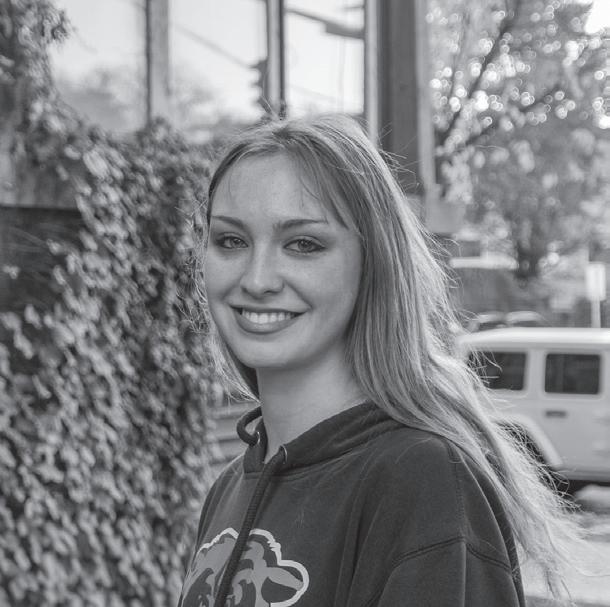
Elise Cliford '29 is an Opinion Columnist and a Philosophy and Russian student in the College of Arts & Sciences. Her fortnightly column, State of Confusion, approaches the liberties and anxieties honed by disagreement, and the responsibility that comes with forming identity. She involves aspects of symbolism and skepticism that accompany the weight of glorifcation. She can be reached at ecliford@cornellsun.com.
I’m sorry to anyone I’ve said yes to when the answer was no.
Sometimes, the kindest thing you can do is refuse. In the interest of averting confict, and avoiding hurting someone else’s feelings, we magnetize unwanted situations. We craft personas that hold dependable reputations, naturally increasing others’ expectations. Tis ultimately creates an aggravating reward system: as we betray ourselves by saying ‘yes,’ we are expected to say ‘yes’ more. As external expectation grows, so does self-resentment.
But is it even fully possible to say yes without the desire to? Yes — in fact, it’s all too easy. When we do this, we’re actually saying something closer to ‘not no,’ and maybe even closer to just ‘no.’ If you’re expected to read between the lines when listening to political debates, indulging Charles Bukowski and detecting your sister’s passive aggressive tone, shouldn’t the same expec-
expansive and evolved, as they include a strong critique of American militarism and imperialism.
Te United States has a history of extensive collaboration with Israeli armed forces through an exchange of military technology, strategy and individuals. As proudly proclaimed by Israeli scholars, “developing and using the same military hardware systems, sharing lessons learned from previous combat experience and developing novel concepts and joint exercises, create a wide web of military-to-military relationships between the U.S. and Israel.”
A direct facet of this collaboration are joint training programs between U.S. and Israeli law enforcement. Trough initiatives such as Jupiter Falcon, thousands of American soldiers engage in military exercises and strategy education with the IDF. Furthermore, state police commissioners, police chiefs and state Homeland Security directors from all over the U.S. have undergone counterterrorism training in Israel.
In particular, ICE agents have had deep, purposeful and historical participation in such joint training programs. Under the Bush administration, ICE was created specifcally to “combat terrorism.” Department of Homeland Security ofcials immediately looked to Israel for advice. Since then, ICE agents have attended training sessions with the IDF in Israel, learned counterterrorism strategies from Israeli ofcials and traded technology with Israel.
Te United Nations, in conjunction with numerous human rights organizations, has charged the IDF with countless human rights abuses, including arbitrary detentions, house and school raids, kidnapping, excessive force and unlawful killings. Sound familiar? ICE is following the same playbook.
Another prominent feature of this partnership is through shared technology from giant military and surveillance industries. Israel uses software from Palantir Technologies, an infamous American surveillance company, to plan deadly military attacks in Lebanon and Gaza. Data from Palestinian civilians fuels Palantir’s artifcial intelligence machines, which empowers Israel’s AI targeting of over 37,000 people for assassination. Military ofcers then execute these kill lists without human review, often bombing targets once they enter residential homes, murdering their family members.
Palantir is also contracted by ICE to deliver the $30 million data platform, "ImmigrationOS." Its purpose is to compile personal data and target individuals for deportation. ICE utilizes other AI-powered Palantir technology and platforms to systematically identify, monitor and kidnap immigrants.
Te technological collaboration goes both ways. ICE is partnered with the Israeli digital forensics frm, Cellebrite, using their software and hardware to extract information from password-protected phones. In 2025, the Trump administration advanced a contract with Paragon, another surveillance company founded in Israel. Paragon’s spyware is one of the most dangerous stealth cyber-weapons in the world, able to hack into encrypted applications on mobile phones. It allows ICE to track and record individuals, access messages on Signal (an encrypted application that organizers use for safety) and retrieve any photographs.
ICE’s brutality and surveillance toward immigrants and protestors is American imperialism coming home to roost. Agents use Israeli cyber-weapons to hunt and deport innocent people. Ofcers train with the IDF and deploy their "counterterrorism" strategies to suppress protests. Immoral tech companies run by billionaire CEOs proft of both the AI-enabled murder of Palestinians and the monitoring of U.S. immigrants.
Of course, the domestic situation in the United States is nothing compared to the famine, targeted murders and cruel bombings that Israel commits in Palestine. Still, understanding the entanglements between ICE and the IDF illuminates both our duty to Palestinian liberation and the necessity of abolishing ICE.
Te reality is a genocide in Palestine and a violent ethnic cleansing in the U.S. Te shared ailment is American imperialism, of which Israel is an outpost. As former President Joe Biden said, “If there were not an Israel, we’d have to invent one.”
Whether it be in Iran, Chilé, Vietnam, Indonesia, Palestine or dozens of other countries, American imperialism has never been a force for good. Now that we are experiencing a slice of that oppression domestically, we realize the horrifc reality of U.S. militancy and surveillance on foreign peoples. It emphasizes the obligation we have to fght, protest, and dismantle that hegemony. In doing so, we will also liberate ourselves domestically from fascism on the home front.
On an organizational level, the connections are already there. For example, Cornell’s chapter of Students for Justice in Palestine cosponsored the University’s anti-ICE rally. Nevertheless, activists need to be even more overt in the strategy of mutual liberation. Te goal of every abolish ICE action must include severing U.S. military and law enforcement connections to Israel. After all, those ties worsen domestic oppression.
tations be allotted to the word ‘yes’? But then if they are, why should they not be conferred onto ‘no’?
I see these words as qualitatively diferent. Maybe having doubts about ‘yeses’ is legitimate and even required; however having them about ‘nos’ is not. But if I rely on the intuition that others will agree with me about these diferences, mistakes are unavoidable because the textbook defnitions are known and accepted.
But what is it that is so terrifying about ‘no’? It’s the idea that your value diminishes for others. As people living in society, our value naturally ceases to belong exclusively to ourselves. Your value is intimately woven with the exterior perception of you. But does that make it real? Te same way saying ‘yes’ when we are hoping others will understand ‘no’ is distortion, this procrustean ‘value’ we carry is as well.
On the question of ‘not no,’ I get to introduce my favorite words: I don’t know. Not knowing is seen as weak, as a shortcoming, rather than as honesty and accepting complexity. And this works on an individual level just as it does on a systemic one. Consider my hyper-specifc example: In the capital case of Barefoot v. Estelle, psychiatrists were called to testify on the question of the defendant’s “future dangerousness.” Te Supreme Court’s opinion stated that testimonies claiming future dangerousness with “one hundred percent” are more persuasive than testimonies that ofer statistically-backed evidence of such a thing being undiagnosable. Bluntly, uncertainty is penalized, where assurance (which I believe in many ways is due either to fear or conceit) is rewarded.
By default, hesitation is taken hostage as acquiescence. Putting up a white fag never means you’ll be unscathed; it means you’ll be convenient. Yet convenience at the price of self-erasure is not generous, despite the inclination to hide behind altruism. Apologies made for honesty only contract guilt.
I’m sorry for saying yes when the answer was ‘I don’t know.’
A double-edged sword leaves no reliable outcomes in a face of with a yes man: the asker is left misled, while the yes man is left in shallow waters, building ultimatums he feels his history of ‘yeses’ creates. Te more half-hearted yeses we have in our portfolio, the less justifable we fnd the exceptional nos.
If precedent is valuable for predictability, why should that mean predictability is something we owe to others more than to ourselves? Being predictable in saying yes is not more worthy than being predictable in trusting yourself to choose what you want. Being capable of consistently accepting your own wants (including the lack of certainty as to what they are) has exponentially more value than any material results you are able to produce for others.
I’m sorry to myself for saying yes when the answer was no. If we can agree dishonesty is selfsh, we can agree begrudging yeses are selfsh as well. Ten it’s a zero-sum game. If selfshness is the fear in saying no, then saying yes is no remedy to it. Being kind to others means being kind to yourself. Resenting yourself so others won’t is no sustainable solution. Guilt harms you, which will harm others. I’ll value my indecisiveness. I’ll value my reluctance. I’ll value my wants.
I’m sorry for accepting yeses when others meant no. Anyone who recognizes a part of themselves in what’s been said, and even more so those who don’t, I’d ask you to watch Jim Carrey’s Yes Man (it has a horrendous rating on Rotten Tomatoes, as was pointed out to me by a friend recently, but then again Te Wolf of Wall Street has a glowing rating whereas I’ve never regretted three hours of my life more).
So while I make apologies for dishonest yeses, I won’t be making any more for honest nos.

By SUSAN SU Sun Staff Writer
With a click of the mouse, people can experience the everyday lives of birds in real time through live cameras run by the Cornell Lab of Ornithology. Launched in 2012, the Cornell Lab Bird Cams have reached millions of viewers around the world, bringing people closer to nature in ways never before possible.
A Window Into a Bird’s Life
The bird cams project operates between five to twelve cameras all year round. Some cameras focus on feeders, while others follow individual birds through an entire breeding season, allowing viewers to witness eggs hatch and chicks grow.
Charles Eldermire, live media lead producer at the Cornell Lab of Ornithology, led the project when it started in 2012. He explained that unlike documentaries, live cameras give people access to a more authentic experience with birds.
“The program was really designed around trying to offer an immersive, beautiful experience,” Eldermire said. “The lab really recognized that that could be a really powerful way to reach people and expose them to birds.”
One of the project’s most popular streams features the Treman Bird Feeding Garden at the Lab of Ornithology. The birdfeeders attract dozens of local and migrating species throughout the seasons, from chickadees and finches to pileated woodpeckers. Visitors to the lab can even watch the feeders live in action from an indoor observation area.
Another camera follows Big Red, a red-tailed hawk nesting atop the light towers on Cornell’s campus. A remarkably consistent and responsible parent,
Big Red has returned to the nest year after year, successfully laying eggs and fledging chicks since 2012.
Other cameras show barred owls, great horned owls and ospreys. Eldermire explained that big birds such as hawks and owls usually reuse the same nest every year, making it possible to install the cameras before the birds return for another breeding season.
“When they come back, it’s just part of the environment. We would never go up and put a camera on while they’re nesting,” Eldermire said.
Reaching a Broader Audience
When the project first began, setting up wildlife cameras was something few people had attempted. The team had to figure out how to connect cameras, streaming systems and online platforms so that live footage could reach viewers’ homes.
“The lab really recognized that that could be a really powerful way to reach people and expose them to birds.”
Charles
Eldermire
Today, many of these technological barriers have disappeared. As livestreaming technology becomes easier to use, hundreds of wildlife cameras have appeared online. The challenge now is less about making the cameras work and more about helping people find them.
“It’s like having a library full of books, but no system numbers to organize them,”

Eldermire said. “So [we’re] continually trying to pay attention to where people are spending time and making sure our content gets there.”
The team works to distribute content across multiple platforms, including social media and email newsletters. Rather than expecting all viewers to watch the livestreams for hours at a time, the team showcases notable moments such as rare birds appearing at a feeder or chicks taking their first flight. These short clips serve as an entry point for new viewers and, for many, are the main way they experience the cameras.
“Most people may not have the time or even inclination to actually spend time watching it,” Eldermire said. “But they still want to see the highlights.”
Benjamin Walters is the current project leader of the Cornell Lab Bird Cams. He and his colleagues spend much of their time editing those highlights and helping viewers interpret what they are
He emphasized the importance of connecting what people see on camera to the birds’ behavior and natural history.
“Our job as science communicators is to not only give people access to the birds through these cameras, but help them discover a deeper sense of learning so that they can begin to build their education and love for the birds,” Walters said.
A dedicated group of online volunteers also play a crucial role in this effort. Spanning the Americas, Europe and Oceania, they operate the cameras and provide running updates throughout the day. When a rare bird appears at a feeder or something unusual happens at a nest, volunteers are often the first ones to notice and alert the team.
To continue reading this article, visit www.cornellsun.com.
By DANBI LEE Sun Staff Writer
The Blaschka Glass Invertebrates Collection was recently moved from Corson-Mudd Hall to the Museum of the Earth due to construction in Corson-Mudd Hall. The collection features a diverse range of invertebrate models used for education, which have deep historical ties to Cornell.
The collection of glass models of soft-bodied organisms were made in the late 1800s by father and son Leopold Blaschka and Rudolf Blaschka, who created between 10,000 to 15,000 glass models of invertebrates in their careers.
According to Prof. Warren Allmon, earth and atmospheric sciences and director of the Paleontological Research Institution, which houses the Museum of the Earth, Cornell bought the largest single order of soft-bodied animals from the Blaschkas, consisting of 700 models, in 1885.
Unique Educational Tools
Since their creation, the Blaschka glass models have been used for educational purposes in undergraduate classes and labs, according to Allmon. In the present day, when students are able to access YouTube videos of diverse life in the deep ocean and dissect live marine organisms, the models
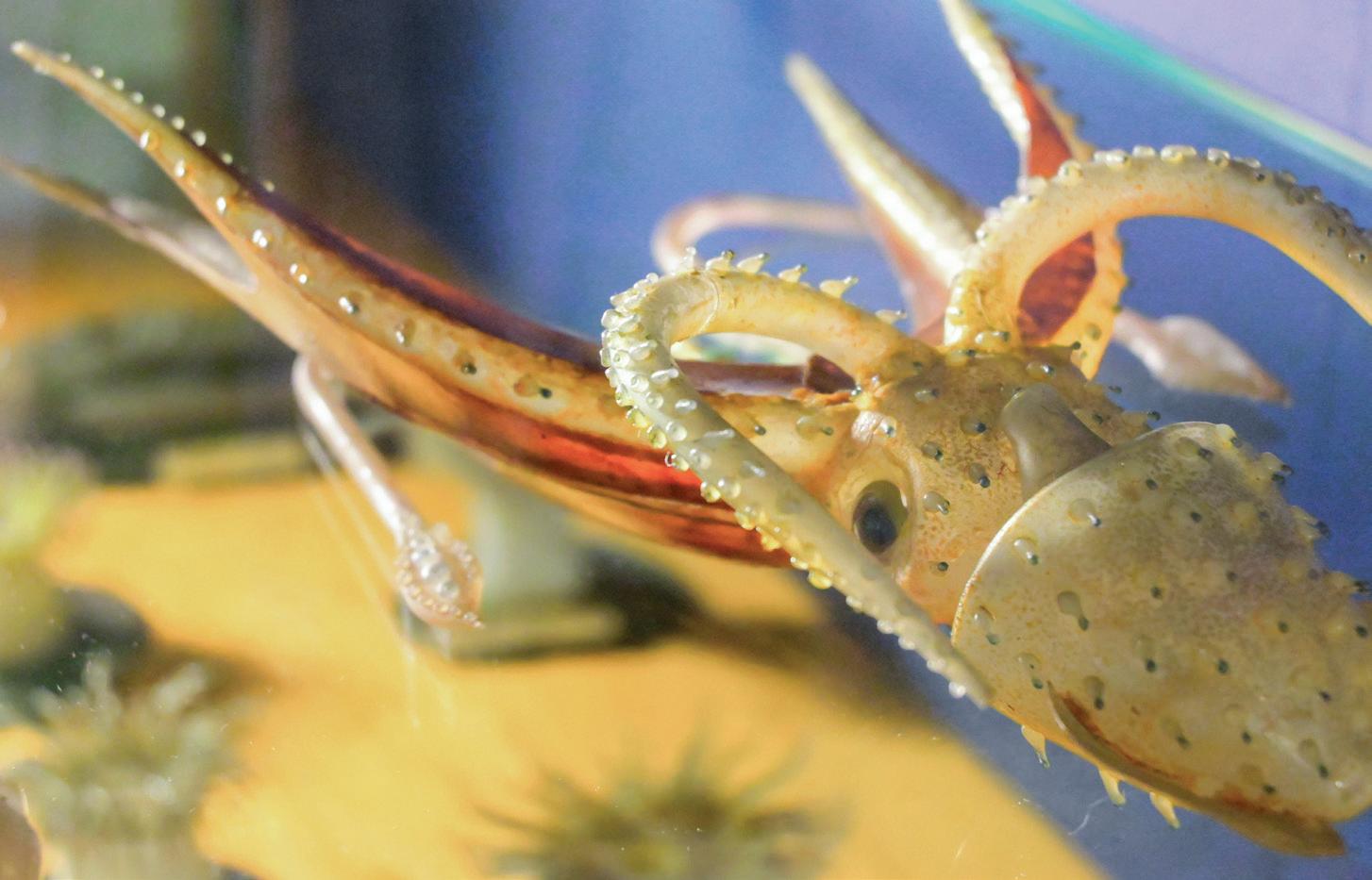
continue to serve as teaching tools in the Museum of the Earth.
Assistant Prof. Leslie Babonis, ecology and evolutionary biology, and the curator of the collection explained that the Blaschka models are useful learning tools for students due to their true-tolife characteristics, which accurately represents the translucency and movement of these organisms through the medium of glass.
“If you take [soft-bodied] animals out of the ocean and you preserve them in alcohol and put them in a museum, they just look terrible,” Babonis said. “And so one of the things
“[The Blaschkas] did a really spectacular job of ... highlighting some of the species that people don't think about very much.”
Prof. Leslie Babonis
that's so special about this collection is that the artists captured the beauty of these animals and the biology of them in glass, which really nicely matches the actual animals when they're alive.”
The Blaschka collection is also known for showcasing a wide variety of invertebrate life. According to the Museum of the Earth website, the collection includes numerous taxonomic groups, including Cnidarians, like jellyfish, and Mollusks, like snails.
The Blaschkas also made models of the same animal across different
growth stages so that students could observe how invertebrates looked at different points in their life, according to Allmon.
“[The Blaschkas] did a really spectacular job of capturing the diversity and really highlighting some of the species that people don't think about very much,” Babonis said.
For instance, stalked jellyfish are a type of jellyfish that live stuck to the seafloor instead of swimming freely. Although there are over 10,000 species of Cnidarians, one of the earliest groups of animals including sea anemone, jellyfish and more, there are only 50 species of stalked jellyfish in the world. Despite this, the stalked jellyfish is represented in the Blaschka collection.
Regular visitors to the exhibit include students from Babonis’s class BIOEE 3730: “Biodiversity and Biology of the Marine Invertebrates” at Cornell, Allmon said, as well as other universities across New York State, including Binghamton University, SUNY College of Environmental Science and Forestry and Hobart and William Smith Colleges.
When Babonis takes her class to see the models, she asks her students to identify the different groups of animals based on the traits they see, letting students actively apply in-class learning.
To continue reading this article, visit www.cornellsun.com.


By INES HWANG
Staff Writer
Cornellisn’t something that comes to mind when you think of fashion studies. Compared to fashion-concentrated college programs, like the Fashion Institute of Technology or Parsons School of Design, there is no Garment District or Ithaca Fashion Week.
I interviewed four students majoring in fashion design or fashion design management in the College of Human Ecology: Sophia Kim ’28, Mia Lopez ’27, Sophia Peck ’26 and Liriana Nezaj ’27. These students described why they chose Cornell and what makes Cornell’s fashion community close-knit, technical and human-centered.
Why Cornell?
Cornell is not an obvious choice for studying fashion at first; however, there are various pathways in which people end up with the major they love.
Sophia Peck ’26 entered Cornell initially planning to study economics. It wasn’t until she attended a Cornell Fashion Collective show that she realized fashion could be more than a simple interest. She switched into the College of Human Ecology in her second semester with the wonderful support from the faculty.
Liriana Nezaj ’27 was sure she wanted to study fashion design when applying to college. But rather than attending a fashion and arts school, she wanted to be “surrounded by people who are learning different subjects” than her. This is a key distinction: Cornell provides students the opportunity to study design in a space with economists, engineers and scientists.
Fashion Design vs. Fashion Design Management
Cornell’s fashion-concentrated studies are
organized into two interconnected majors: fashion design and fashion design management. Students in fashion design have more advanced studio courses, while those in fashion design management have more STEM and business courses.
Nezaj emphasized her love for learning technical skills in studio classes like pattern-making and knitting as it gives her the time to discover her own style and “create what [she] want[s] to see created.” She also highlighted the faculty support of constructive critiques and operational assistance with larger knitting machines.
On the other hand, Mia Lopez ’27, studying fashion design management, believes her curriculum offers a broad overview of merchandising and management, alongside design and studio courses. Sophia Kim ’28 also enjoyed taking fiber science and fashion history classes, which helped develop a wide range of knowledge and technical skills.
Separating fashion design and fashion design management into two different majors allows for specification and the blending of creativity with technical, analytical and managerial skills, something that makes Cornell distinct from other fashion or design schools.
The Community Cornell’s fashion department is a closeknit community with relatively fewer students compared to other areas of study. Nezaj mentions that she basically “knows everyone in the major by their names or faces.” With overlapping classes and studio time, many fashion students become familiar with one another.
Peck said she can even identify students majoring in fashion by “the clacking sounds of heeled boots” when she’s in the Atrium. Nezaj humorously added that in her freshman year, she would “ask people [she] spotted wearing a cool outfit if they were in the fashion major.”
Such close relationships within a major are hard to find, especially because collaborations don’t normally arise naturally and success isn’t

always communal at Cornell. From late-night sewing in the studio to exams and analytical projects, even the most stressful moments become amazing memories because they are shared. The fashion industry is notorious for being competitive and exclusive, so this sense of community feels radical.
Fashion on Campus
Fashion at Cornell doesn’t only live in one building — it is everywhere. There are so many student organizations on campus, such as The Cornell Fashion Collective. They operate large-scale fashion shows each semester and produce lookbooks — photographs of new designs. They offer a realistic experience of the fashion industry, and the runways are always a hot topic of discussion.
Peck, President of CFC, admits, “Being president isn’t glamorous. There are a lot of people management, logistics and stress, but seeing the runway come together and seeing that tangible creation makes it all worth it.”
There are other groups like the Cornell Fashion Industry Network, Thread Magazine or the Wardrobe, which help build networking opportunities and fashion journalism experiences outside of classes. These organizations
bring together creative students interested in fashion, media, business and beyond.
The Future of Fashion Studies
Students highlight Cornell’s fashion program as forward-thinking, particularly in terms of sustainability, fiber science and its technological scale of learning. The variety of courses introduces students to digital tools like 3D design software and AI-assisted mood boards. Nezaj states that this “technology is amazing and definitely practical,” but she adds that “there’s still something innately human about designing by hand.” As both fashion majors are in the department of HumanCentered Design, their mission lies in “designing solutions to improve the human experience,” ensuring that innovation enhances, not removes, designers’ creative choices and supports the needs of its users.
To continue reading this article, please visit www.cornellsun.com.
Ines Hwang is a member of the Class of 2028 in the College of Arts and Sciences. She can be recached at ish7@cornell.edu.
By MAIA MEHRING Staff Writer
Idon’t know about you, but I have been feeling the weight of a mid-semester slump. Hard. This part of the semester never fails to show me that I need to learn how to regulate my emotions, as every prelim, presentation and minor inconvenience makes me question my entire existence. Even though I feel like you’re meant to learn the opposite in college, being a student at Cornell has conditioned me to strive for perfection — not just my best effort.
Some may think this is a positive development. I am here to personally report that it’s not. Believe it or not, copious amounts of stress while you’re trying to take a test actually aren’t good for your performance. They’re even worse for your mental health.
I am the person who calls her mom to make her feel better when it feels like the world is ending. And usually, my mom is the perfect person to grant me some clarity in the midst of extreme overreaction. But sometimes, she’ll hit me with the classic: “It’s okay, Maia. You don’t need perfect grades. You don’t need a summer internship. You will be fine.” Though there’s nothing else that she could possibly say to convey the intended message, it tends to strike a chord of frustration in me. I have to stop myself from responding, “You just don’t get it.” I know she means well. It’s hard to truly internalize her
message when every day here feels like an academic fight to the death. But no matter how much my brain tries to fight it, the fact is she’s right. I will be fine. As my roommate likes to say, I’m a girl who’s going to be okay. So, to celebrate that everything will eventually fall into place, and that no grade I receive is actually career-defining, I am working toward bringing more whimsy into my life, especially as the universe has finally begun to bless us with warmer weather. The first sprinkle of whimsy I’m implementing is saying yes to things. Though I think I am already pretty good at this, there is always room for improvement. I am not going to say no to things happening after 11 p.m. just because I convince myself I’ll be in bed and asleep before then. We all know that I won’t be — I will likely just end up doomscrolling on social media late into the night, when I could be hanging out with the people I love. The best nights of sleep always end up being after hours of belly laughs. In the same vein, hosting people at my apartment has become my personal mission this semester. It’s something I loved doing in high school, and ever since I’ve gotten my hands on Partiful (the modern version of Evite), I can’t stop thinking about all the different events that could possibly justify having people over. Sometimes, it just feels good to have people show up for you in your own space (even

if enticed with refreshments). The planning of it all is also a wonderful distraction from my daily stressors. I have also discovered new, basic ways to partake in self-care. Reading physical books before I go to bed has been a game changer, and the fact that the books are on loan from my roommate makes it even more special. I love reading her recommendations and sharing our excitement for the characters and plots. Also before bed is the addition of my skincare routine (I’m not saying it’s new and improved because I’ve actually never had one before). Not only is it relaxing, but it’s an intentional moment where I prioritize how I am treating my body. On top of that, seeing it work has been equally gratifying. Finally, though it’s always nice to have a constant in my life, changes
within the crevices of my day-today monotony have been just as important for me. This can be as simple as changing my nail polish color as soon as the old coat chips, or listening to new music (thank you, Harry Styles). Even switching up my grocery list every once in a while to make room for a new dish brings color into my world when everything feels (and looks) gray. It’s within these changes that I start to feel like myself again. I love who I am in the classroom and at work. But I see myself more in my loved ones, my hobbies and the olive green nail polish I choose to sport around.
WRITER
Maia Mehring is a member of the Class of 2027 in the School of Industrial and Labor Relations. She can be reached at mmehring@ cornellsun.com.
By VALENCIA MASSARO Sun Senior Writer
March 16 — Ithaca and Tompkins County officials are advancing sustainability and accessibility after receiving a $250,000 Municipal Investment Fund grant “aimed at accelerating local deployment of clean, safe, reliable energy projects.” The town and county will be partnering with Community Sustainability Partners and Cornell University’s Environmental Systems Lab to develop these funds.
In October 2025, the Environmental Protection Agency gave Tompkins County a Phase 1 Municipal Investment grant focused on predevelopment of clean energy projects.
Ithaca and Tompkins County are implementing this grant through a private-public partnership model. While the city and county are responsible for identifying projects, Cornell’s lab provides the data and technical analysis necessary, and the Community Sustainability Partners is a non-profit that helps structure projects to attract outside investors.
This is part of a nationwide $5 billion capital grant from the Environmental Protection Agency’s National Clean Investment Fund. Phase 1 funding was provided to 49 local governments, with Tompkins County being the only New York State county to receive funding.
Projects the city and county are thinking about developing are ones with a focus on both equity and sustainability. Some of these projects include the SouthWorks redevelopment project to develop a sustainable residential community, as well as upgrading the Southside Community Center into a resilience hub for severe weather.
According to Siobhan Hull, sustainability planner for the city of Ithaca, the development of these projects is bundled into a portfolio under the same funding, which allows the city to focus on developing multiple projects at once rather than individually. This will give the city an advantage when moving forward with projects as they try to attract investors.
“By being able to aggregate all of these projects together into a cohesive portfolio, we’re hoping that will open the door to new investments and financial tools that allow us to move these clean energy projects forward,” Hull said.
This funding specifically targets pre-development costs, which include technical studies, design plans, permitting and other early groundwork necessary to build a foundation before construction can begin.
Hull explained to The Sun that this pre-developmental stage is often where projects are halted from advancing.
Hull explained that traditional financing rarely covers these preliminary costs, resulting in many promised clean energy projects not reaching the construction phase.
This grant aims to bridge the gap between planning and construction as it helps the region prepare projects for investment.
Ester Toporovsky, executive director of CSP, described predevelopment as “imperative, as you need it to assess the opportunity, design the project, and set up the right financial models. It helps get a project to a financeable state.” Creating a Pipeline For Local Projects
According to Hull, through this fund, Ithaca and Tompkins County have identified 20 potential clean energy and climate resilience projects that could benefit from this funding, including both largescale developments and smaller, more community-focused projects.
One example Hull said the city is “par-
ticularly excited about” is the SouthWorks redevelopment project, a plan to transform a former industrial facility into a residential community that incorporates renewable energy infrastructure.
This would include site-wide geothermal heating, a cleaner, more energy-efficient heating system that relies on transferring heat from below the ground. It would also include a microgrid with on-site solar and battery storage and potentially hydrogen energy storage.
Other proposed projects focus on community resilience and energy affordability. One project in particular, which Hull noted, would be to upgrade the Southside Community Center into a resilience hub capable of serving as a safe space for marginalized populations in the case of extreme weather.
Alongside sustainability, the city is using these funds to focus on equity and social justice. Hull said the city has been “intentional” with highlighting projects that seek to benefit marginalized members of the community. These projects include energy efficiency upgrades, workforce training opportunities and resilience infrastructure.
“We’re hoping to see things like district geothermal that can benefit entire communities,” said Toporovsky. “Decarbonizing affordable housing and creating solar access for low and moderate-income communities would also be a really big win.”
By identifying viable projects and creating a pipeline of investment opportunities, the program aims to attract future investors once the predevelopmental stage is over, according to Hull. The City’s Digital Twin Cornell researchers at the Environmental Systems Lab are contributing to these developments by creating a digital model of the entire city known as a “digital twin.” The model will include the entire city — around 29,000 buildings, with a unique model for each one.
The model combines data from building permits, tax records and utility energy data to estimate how the buildings are currently performing and how they might respond to retrofits such as an electrified heating system and improved insulation.
Prof. Timur Dogan, architecture, director of the Environmental Systems Lab, explained the process of how this model works to The Sun.
“We run buildings through hundreds of different options of things one could do,” Dogan said. “That gives us a sense of what the priorities should be in retrofitting.”
The goal of the model is to identify projects that could deliver the greatest environmental impact at the lowest cost. The tool can also be layered with demographic data to ensure climate initiatives are assisting those most vulnerable to energy costs and climate impacts. Cornell researchers are already exploring how this modeling framework could be scaled to other New York cities, such as Albany.
Dogan said Ithaca’s collaboration with Cornell provides the city with uniquely strong access to energy data and modeling tools, resources typically only available in large cities.
“Cities like New York or Boston have teams doing this work, but Ithaca may be the only smaller city with this capability,” Dogan said.
If successful, the program could eventually be expanded to other local municipalities.
To continue reading this article, please visit www.cornellsun.com.
By ZEINAB FARAJ Sun Senior Editor
March 13 — The men’s lightweight rowing team’s temporary suspension, announced 34 days ago, has been lifted with a “phased return,” announced by Cornell Athletics Director Nicki Moore in a Tuesday email to the Cornell rowing community.
The team’s suspension was issued after the University became aware of an “incident,” according to an email Moore sent to the team in February. The email also stated that the Office of Civil Rights, which addresses issues involving bias, sexual misconduct, discrimination and protected-status harassment, would be issuing a “Care and Concern communication” to the team to encourage reporting of conduct not aligned with the University’s standards.
In the Tuesday email, Moore explained that under “close collaboration” with head coach Tyler Nase, the phased return was established.
“During this time, we worked continuously and thoroughly, receiving and assessing information, and determining the appropriate path forward, in consulta-
tion with university partners. We found multiple instances in which behavior failed to meet expected standards,” the email read.
Coach Nase did not immediately respond to The Sun’s request for comment about the situation.
According to Moore, the phased return will allow “most members of the team” to resume training sessions “immediately after completing initial, reasonable steps needed to lay the foundation for meaningful culture rebuilding.” She also noted that the team is expected to return to competition in April, under a three-year probationary period.
The Sun previously reported that the team’s next meet was the National Collegiate Lightweight Invitational, scheduled for March 28 in Overpeck County Park, New Jersey. Historically, this meet has served as a season-opener for the top rowing programs in the country. The team participated in the regatta last year.
To continue reading, please visit www.cornellsun.com.
By KATE TURK Sun Assistant Managing Editor
March 11 — President Michael Kotlikoff issued a formal response to the Fall 2025 Student Assembly referendum on Feb. 2, acknowledging concerns but failing to implement any changes.
The referendum, communicated on Dec. 18, called for the Student Code of Conduct to apply to all Cornell community members and for the University’s judicial system to operate separately from administration.
In his response, Kotlikoff thanked the Assembly and wrote to “provide clarification” on the Student Code of Conduct’s history and revision process.
“Under federal and state law, the University — not individual constituencies or governance bodies — bears responsibility for adopting and administering policies necessary to provide a safe and appropriate educational environment,” Kotlikoff wrote.
Student Assembly referendums are proposed to the Assembly when at least 3% of the undergraduate body signs on, in order to “determine community opinion regarding matters of student concern,” according to the Assembly charter.
The referendum, consisting of two yes/no questions, was met with
strong support from student voters last semester, with over 90% of votes cast in favor of both questions, representing around 20% of the undergraduate body.
Question one read: “Prior to 2021, conduct was overseen by the Judicial Administrator, an office independent of Cornell University’s central administration. It is now overseen by the Office of Student Conduct and Community Standards (OSCCS). Should Cornell’s judicial system be independent of the University’s administration?”
This question followed concerns regarding the administration’s alleged overuse of temporary suspensions and subsequent delays in the judicial process for student protestors.
Question two read: “As a result of the 1969 Willard Straight Hall Takeover, the conduct of students, faculty, and staff was collectively governed under the Campus Code of Conduct. In 2021, the Student Code of Conduct replaced the Campus Code. Should Cornell University return to a community-wide Campus Code of Conduct?”
To continue reading this article, please visit www.cornellsun.com.
Kate Turk can be reached at kturk@ cornellsun.com.
By Ruthie Behrendt

at The Sun’s office at 139 W. State Street downtown, by phone or e-mail. Deadline: Noon at The Sun’s office two days preceding publication.
Standard
by Tavan Bhatia



By MADELEINE NAUMOFF Sun Contributor
March 15 — In May 2025, Chatty Cathy left its home of nearly a decade on Eddy Street for an expansion and rebrand as Fresh Marché on College Avenue. Inspired by its increasing popularity and many loyal customers, the owners wanted to add to their current offerings, while maintaining their high quality ingredients and homey atmosphere.
George and Milany Papachryssanthou, a husband and wife team, founded Chatty Cathy in 2017 and have been the sole operators since. After eight years in their original location, they signed a lease on College Avenue in May 2025 where they quadrupled their original footprint, George wrote to The Sun.
“Through hard work and really good fortune, we were able to grow a really amazing following and successful business ... as a result, we outgrew the space.”
George Papachryssanthou
“Through hard work and really good fortune, we were able to grow a really amazing following and successful business,” George wrote in a statement to The Sun. “As a result, we outgrew the space.”
The couple also owns a second location in the Ithaca Commons, which has been branded as Fresh Marché since its opening in October 2024.
Fresh Marché’s “goal is to create a place that takes the thinking out of eating clean and healthy but still [makes] something that is gastronomically enjoyable,” Milany wrote in a statement to The Sun. The
name means fresh market, and the owners wanted the name to be catchy and elicit thoughts of both freshness and clean food.
“I like the new location — it’s great for hanging out with my friends or when I just want to get some work done off campus.”
Esther Jung ’28
In addition to their previous offerings of acai bowls, yogurt bowls, oatmeal bowls, coffee, tea and smoothies, Fresh Marché now offers build-your-own grain bowls and salads.
“Too often really [healthy] food is bland or really unhealthy food may taste great but the way you’re left feeling after often isn’t worth it,” Milany wrote. “We are trying to find that balance.”
With their new location and expansion of offerings in Collegetown, the couple “wanted the name and brand to represent a complete vision of what the new concept would represent.”
According to George, Fresh Marché prioritizes offering “unique, high-quality sandwiches” with ingredients that “cut zero corners regarding quality.” He explained that they achieve this by spending months sourcing all of their ingredients. Additionally, the business works with hospitality professionals who George Papachryssanthou wrote “genuinely care” about customers’ dining experiences.
George said that Fresh Marché prioritizes customers’ experience by making it a “beautiful, welcoming, cozy and comfortable” space. He wrote that he and his wife “love” meeting their guests and getting to know them on a personal level, developing an experience that is “more than just a simple transaction.”
The location at 304 College Ave. has a clean, open aesthetic with french-themed decor and lots of natural light. There are spaces for both group and individual seating — suiting the differing needs of customers.
Esther Jung ’28, a frequent Fresh Marché customer, told The Sun she goes there for its “amazing food and great environment.”
“I like the new location — it’s great for hanging out with my friends or when I just want to get some work done off campus,” Jung said. “Overall, I really appreciate the quality of the food and I am excited to try more of their new menu options.”
Since the expansion, the owners have made it a priority to maintain high quality in both their food and service. We are proud that “[e]verything we do is made in house, fresh, on the daily with lots and lots of love,” George told The Sun.
By KITTY ZHANG Sun Contributor
March 16 — What does a Cornell student do when they are trapped in a sweltering, humid Ithaca summer for three months? Conduct research, explore the outdoors — or maybe become an avid dating app user?
For singer-songwriter Tochi Ezidiegwu ’26, who studies Biological Sciences in the College of Arts and Sciences, the answer was all of the above, plus one more: turning a summer of dating into music.
Last summer, when Ezidiegwu wasn’t pipetting PCR reaction tubes or checking bacterial plate streaks in the Barton Lab, she was exploring the sinuous chaos of early-20s dating. There were regrets, misunderstandings and, like any doomed summer fling, heartbreak.
“Because it’s Ithaca, there’s nothing to do,” she said, laughing, “so I was going on a lot of dates, and I would keep writing songs about all the different experiences I had.”
Those experiences eventually became the foundation for Ezidiegwu’s upcoming debut EP, set to release this upcoming summer — five songs, each written about a different boy she met.
But songwriting did not begin that summer.
For years, Ezidiegwu wrote songs the way some write diary entries. Instead of filling notebooks, she filled her Notes app, Voice Memos, TikTok and eventually Spotify with lyrics and melodies.
“It’s almost exclusively a diary,” she said of her songs. “The point isn’t to tell a factual story. It’s about how I felt. That’s what people relate to.”
Ezidiegwu’s decision to take music seriously came after listening to Taylor Swift’s Midnights in 2022.
“I’ve always known Taylor Swift, but I’d never really listened,” she said. “I
realized I’d been missing this my whole life. I decided then: I need to be serious about music. I need to try to be as good as her.”
Pursuing that ambition, however, meant colliding with family expectations.
Raised in a household of doctors and lawyers, Ezidiegwu taught herself piano and guitar in secret, studying TikTok live performance videos of musician Gracie Abrams to mimic finger placements until she understood how each chord sounded. It was through this process that she began blending her love for musical theatre and Hot 100 hits into her own indie-sad-girl-pop style.
“I’m the black sheep disappointment of the family,” she joked. “My parents disapproved when my brother did music, so when I started, it was a big secret. To this day, my dad doesn’t know I even own a piano.”
But a dark horse is often just a black sheep that decided to run.
In early 2025, Ezidiegwu galloped into the digital music world through
TikTok, posting under the handle @ girlwhowritesthings — now renamed @ tochiwritessongs.
“I blocked everyone I knew so only strangers could see,” she laughed. “They’d leave a few comments, nothing crazy, but it felt like this tiny fandom waiting for me.”
After just two posts, a small cohort of listeners asked where they could hear more. Without access to a producer or recording studio, Ezidiegwu recorded songs straight into her iPhone’s Voice Memos app and uploaded them to Spotify.
“People would comment, ‘Oh my god, I can’t wait for June 6 when your voice memo thing comes out,’” she recalls. “It was like 12 people, but it was amazing.”
69 voice memos later, the encouragement pushed Ezidiegwu to reach out to Cornell Music Production, a student organization that helps aspiring Cornell artists with music, and record her first official single, “to be loved by you,” in March 2025. Its release party in May

also became her first live performance.
“I was the first one up,” Ezidiegwu recalled. “For the first half of the song, everyone was just chilling and eating pizza. Then, right before the final chorus, someone in the back cut all the lights and put a big spotlight on me. It was like a movie, and I felt great.”
From then on, Ezidiegwu began performing at every open mic she could find in Ithaca, from women-in-music showcases to local bars. Along the way, she met the producer and marketing manager she now works with for her upcoming EP, and went on the five dates that later became its songs.
When asked about her five-year plan, Ezidiegwu said that she is not chasing becoming the next “small-town girl”— only the chance to be heard.
“I know it’s a one-in-a-million thing,” she said. “But now that I know people think my music is good, it would make me sick not to do everything in my power to be heard by as many people as possible. It’s something I have to do.”
Now, as Ezidiegwu navigates the process of applying for music marketing jobs, she has realized that her STEM background uniquely equips her for music data analysis and trend observation — a strategic doorstep into the music industry. She hopes her ongoing journey will remind others that they never know how many notes they are capable of playing until they dare to try and to stay open to the unexpected.
After all, somewhere between a humid Ithaca summer and five Tinder dates, Ezidiegwu found five songs, started her music career and learned how to gallop. Follow Ezidiegwu’s journey and upcoming EP on Instagram at @ tochi_704, TikTok as @tochiwritessongs, and Spotify under Tochi.
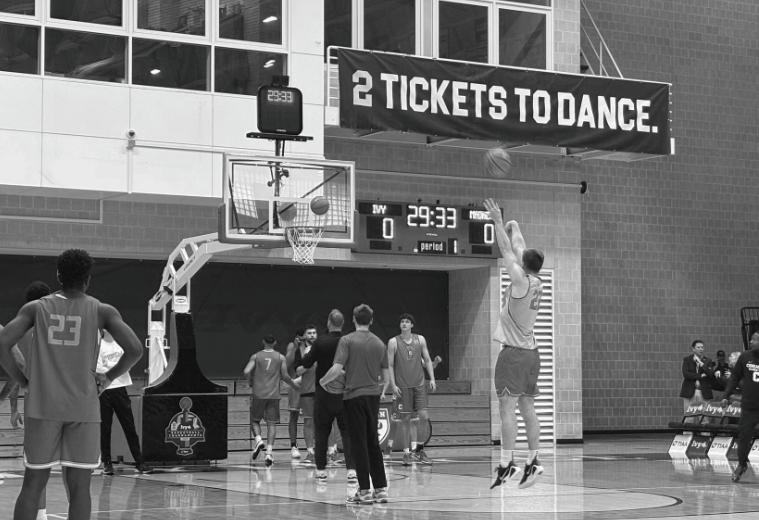
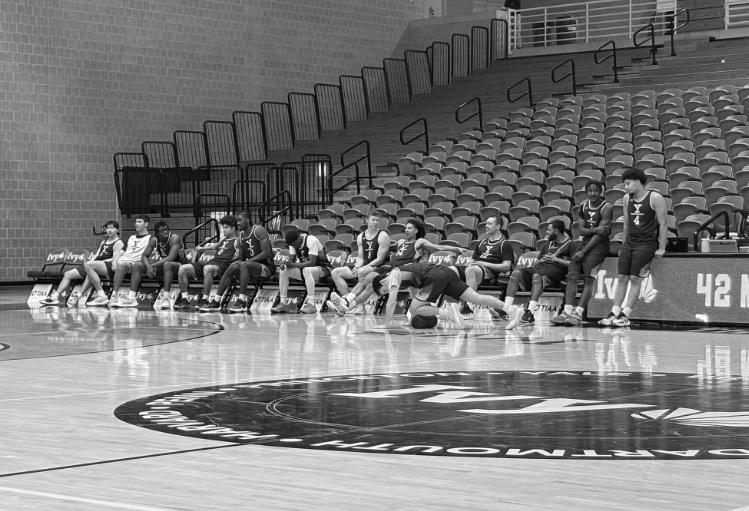
By MATTHEW LEONARD Sun Sports Editor
March 13 — The Red, along with the rest of the Ivy Madness attendees, Yale, Harvard and Penn held press conferences and shootarounds on Friday morning.
The Red, as hosts, were the first team to enter.
Cornell
Throughout their portion of the conference, Head Coach Jon Jaques ’10, alongside senior guards Jake Feigen and Cooper Noard, emphasized staying true to the team’s identity and understanding the team’s growth throughout the season.
“Something we have been leaning on all season is kind of just being tough enough to do what we do, even though the other team knows we’re going to do it,” Jaques said. “Being confident, we are one of the best offensive teams in the country, and understanding teams are going to game plan for us. If we can stay true to our identity offensively, we are pretty hard to guard.”
The Red, being the hosts of Ivy Madness, have home court advantage. Newman Arena has seen some of the Red’s best performances this season, such as its 68-point beatdown of Alfred State early in the season, an efficient win over Princeton around the midpoint of the season and the Red’s recent clutch win over Yale.
“We see everything, all the work that goes in from the main stuff to athletic administration to set this up. Media, set up the court, everything ... So we are excited.”
Jake Feigen ’26
Feigen was recently named to the All-Ivy League First Team, averaging 16.8 points per game, the fifth highest in the Ivy League. His play down the stretch was crucial to the Red’s qualification into Ivy Madness, hitting the game-winning shot against Yale.
Noard also received a nod, being named to the AllIvy League Second Team, averaging 18.5 points per game, the highest among any player in the Ivy League.
Senior guard Corbin Zentner was also named to the Academic All-Ivy League Team.
Feigen and Noard shared their excitement for representing Cornell at Ivy Madness in front of their home fans.
“It means everything to us and to the community,” Feigen said. “We see everything, all the work that goes in from the main staff to athletic administration to set this up. Media, set up the court, everything. So a lot of thought goes into it. So we are excited.”
After the press conference, Jaques and his team entered Newman for an open shootaround.
Throughout the Red’s shootaround, the team demonstrated a visible sense of composure. Noard was noticeably vocal, leading the Red through its various warmups and drills.
The shootaround demonstrated the Red’s biggest advantage, playing on the same court on which many
members of the Red have years of experience.
The Red will enter Ivy Madness hoping to punch its ticket to the tournament that has eluded the program for the last sixteen years — March Madness.
Yale
Following the Red’s shootaround, Yale entered Newman. Yale head coach James Jones, along with senior guards Casey Simmons and Nick Townsend, represented the Bulldogs during the team’s press conference.
“You can’t sleep on Cornell, because if you do, they’re going to put you in a bind.”
James Jones
The impact of Simmons and Townsend on the Bulldogs this year cannot be overstated. Simmons was recently named Ivy League Defensive Player of the Year, whereas Townsend was named the outright Ivy League Player of the Year.
Yale will be hoping to strike back against a Red team that recently handed them a devastating 72-69 loss. This constituted one of three conference losses for the Bulldogs, who consistently demonstrated they were the best team in the Ivy League.
Jones noted the importance of coming prepared for a tough battle against the Red.
“You can’t sleep on Cornell, because if you do, they’re going to put you in a bind,” Jones said. “They’re going to get you in trouble, they’re going to knock down shots and get confidence. So for us, we need to make sure that we are on our P’s and Q’s and we’re ready to play every second that we’re on the court.”
Yale enters the tournament as the team to beat. They are the top-seeded team and secured the Ivy League regular-season championship. While it is clear they will be a formidable opponent, the Red will enter its matchup with them hoping to replicate the magic of its last performance against the Bulldogs.
Yale’s shootaround was intense, with many drills consisting of full-court sprints. Jones, the most experienced Ivy League coach in the tournament, did not shy away from putting his team to work, even if it was only a media shootaround.
Harvard
On the other side of the bracket sits the Crimson, led by former college basketball star Head Coach Tommy Amaker.
“... There’s a lot of things around us that are different. We can’t be different, that’s incredibly important for us to understand.”
Tommy Amaker
Harvard enters the tournament as the No. 2 seed and is the only school to be represented on the men’s and women’s brackets.
Amaker’s Crimson team is much better than its over-
all record reflects. The Crimson had tough non-conference opponents such as St. John’s and multiple close losses that could have been potential Ivy League victories, such as a one-point loss to Yale and a threepoint loss to Penn.
The Crimson split their two matchups with the Red, in a home loss and a road victory. Sophomore guard Robert Hinton, brother of Red senior guard Adam Hinton, will likely be at the front of the Crimson charge, having led the team in scoring with 17.1 points per game.
Amaker emphasized how important it will be for his team to stay level-headed and not allow the intensity of Ivy Madness to sway his players from their usual game.
“I’ve tried to share this with our guys, there’s a lot of things around us that are different,” Amaker said. “We can’t be different, and that’s incredibly important for us to understand.”
Throughout the course of Harvard’s shootaround, Amaker analyzed his team closely.
Penn
The last team of the day to enter Newman were the Quakers, led by first-year Ivy League coach Fran McCaffery. While it is McCaffery’s first year at Penn, he brings years of experience, having coached an Iowa program that consistently qualified for March Madness during his time at the helm.
“I think that we have to make sure that we defensively understand the strengths and weaknesses of a team that has multiple weapons, different guys with different skill sets.”
Fran McCaffery
Senior forward Ethan Roberts, alongside University of Virginia transfer and junior forward TJ Power, have led the charge for the Quakers throughout the season. Roberts led the team in scoring at 16.9 points per game, while Roberts was close behind, averaging 15.8 points per game while simultaneously securing 7.5 rebounds per game.
Penn enters Ivy Madness having just beaten out the Red for the No. 3 seed. The Quakers were dominant on their home turf, finishing the season with a 12-2 record. However, on the road, the story is much different.
On the road, the Quakers were indifferent, finishing with a 4-9 record on enemy turf. This could raise concern if Penn will be able to come away with a victory in an unfamiliar and intense postseason environment.
When speaking about the Quakers’ matchup against Harvard, McCaffery explained his team will play with the same intensity and speed that Harvard has exemplified throughout the course of the season.
“We are always going to push the tempo as much as we can,” McCaffery said. “I think that we have to make sure that we defensively understand the strengths and weaknesses of a team that has multiple weapons, different guys with different skill sets.”
Maggie Gyllenhaal’s first film, The Lost Daughter, is an Oscar-nominated psychological drama based on Elena Ferrante’s novel of the same name. Her next feature, The Bride!, veers wildly into unknown territory. It’s messy, full of bizarre choices and certainly won’t be nominated at next year’s Academy Awards. The Bride! won’t work for everyone, but it resonated with me in a way I didn’t expect.
Gyllenhaal’s reimagining of the original Mary Shelley novel Frankenstein is set in mob-controlled 1930s Chicago. We follow Ida (Jessie Buckley) as she is possessed by the spirit of Mary Shelley (also played by Buckley) and is compelled to reveal what she knows about the mob boss Lupino’s crimes. When Ida speaks up about the murder and silencing of women at Lupino’s hands, she is killed by his men. Meanwhile, 100 years after his creation, Frankenstein’s monster arrives in Chicago. Played by Christian Bale, this version of the creature (called “Frank”) is most akin to the monster from James Whales’ iconic 1931 Frankenstein. Fittingly, Frank is obsessed with the movies of the 1930s and spends most of his time in the theater, watching the same musical over and over again, where other people’s eyes are glued to the screen and not to his appearance.
Frank comes to reanimation expert Dr. Euphronius (Annette Bening) with a request for a wife to cure his loneliness. The two dig up Ida and bring her back to life, but, without her memories, Ida becomes someone else entirely. Still occasionally possessed by the ghost of Shelley, the Bride fights to discover her own identity and to stand up for the women who have been silenced by Lupino, including her past self.
The Bride! is much deeper in its feminist themes than I was expecting. The Bride not only finds her own identity, but she becomes a voice for generations of women silenced by political violence. The possession by
Mary Shelley is a jarring choice, but one that allows the Bride to hear the voices of other women who have been murdered by Lupino. Her rebirth gives her the power to speak up without fear of being killed — after all, she’s already dead.
Throughout the film, the Bride references Herman Melville’s Bartleby, the Scrivener, simply saying “I would prefer not to” whenever she is asked or told to do something she doesn’t want to. I kept thinking of Bonnie Honig’s book A Feminist Theory of Refusal, which uses Melville’s text to explore the action of removing oneself from the capitalist, patriarchal system as a revolutionary act. Here, the Bride’s death effectively removes her from all societal systems. Like Frank, she is seen as a monster. While Frank strives to become part of society, idolizing and aspiring to be like a movie star he sees on screen, the Bride uses her monstrous status to say what everyone else is too afraid to even think. Even when she learns her past name, the Bride elects to keep her chosen moniker. She is no longer Ida and no longer part of human society. She is a monster, and she uses her newfound power to start a revolution.
The Bride!’s exploration of feminism is one of its strongest aspects. It’s also supported by Jessie Buckley’s full-throttle performance as Mary Shelley, Ida and the Bride. Buckley is completely committed, which is necessary to keep the film’s momentum.
Reactions to The Bride! have been mixed, and while I understand why this wouldn’t work for everyone, I think many of the reviews have been overly dismissive of the film’s merits. The Bride! is an unabashedly feminist film, and Maggie Gyllenhaal is completely earnest in her filmmaking — two features that make the film even stronger to me but that have earned it a lot of cynical vitriol since its release. Even if The Bride! doesn’t always work, I will always prefer a creative film with something to say over anything that feels boring and overdone; my positive reviews of films like Megalopolis and Mickey 17 definitely prove that. The Bride! is anything but boring: It includes a musical number, a detective buddy-cop sideplot and

is
In the dark ages, long before the internet, individual opinions weren’t widespread. If you had thoughts about a movie, there was no way for a stranger across the country to hear them. For authors, they relied on designated journalists in national newspapers to both promote and review their novels. Although far from always positive, reviews were controlled and constrained.
With the dawn of the world wide web, suddenly everyone could share their thoughts 24/7. Sites began popping up specifically allowing people to create profiles and review any type of content they wanted. In 2007, the website Goodreads was created as a database of books. The site allows viewers to organize books they’ve read or want to read into various lists. Depending on your reading habits, Goodreads will recommend similar books, along with highlighting popular titles of the moment. Additionally, the site allows all users to review any book, which is a useful tool for readers to see public opinion and reception to books they are considering reading.
Authors have also become involved on the site, as both private or public users. This allows readers an easier way to search, along with discovering new books written by specific authors. I’ve seen authors highlight their favorite books of the moment on the site, along with garnering promotion for their works. Just like with Instagram, Goodreads is another regulated piece of an author’s social media.
Part of the site’s charm is its inclusion of countless books, including ones not traditionally published. Anyone can upload their work to the site, allowing it to be reviewed and added. While amazing, this widens the array of authors on the site, who often do not have public relations teams or managers. I want to specify that this is not an attack
on indie authors. One of the greatest features of Goodreads is how it broadens access to unique and diverse voices. I’ve found new books on the site from authors who eventually become traditionally published, a trend frequent on the site once they receive intense praise and popularity.
The only issue with having so many new and indie authors on a site built directly for the readers is that it creates an incentive to respond. In the publishing industry, everyone tells authors not to read the reviews, as it will likely affect them negatively. An overly harsh review could destroy the author’s confidence, while an intensely positive review could lead them to develop an ego. Whatever the reason, reading the reviews is never a good idea, especially as a new author.
On Goodreads, none of this caution applies. New and indie authors who don’t have teams of public relations advising them will consistently choose to read the reviews, even responding. Sometimes the responses are positive, thanking the reviewer for reading or giving praise. However, not all of these responses are thankful. Sometimes authors choose to respond to negative reviews. If they’re a new or indie author, they may not have faced much criticism, leading to this compulsive need to defend themselves and their work. I can understand this to some degree; watching your creative work be ripped apart is difficult. However, you have to let people be critical. Two years ago, an author attacked a reviewer for choosing to rate the novel four out of five stars, instead of a full five. Further, it led her to being completely dropped by her publisher as no company wants to retain incredibly controversial authors before they even debut. Through her decision to attack a reader, she killed her career before it even started. Although cases like hers are rare, they have been a steady part of the scandal culture on Goodreads.
Responding to a reviewer because they didn’t give it an incredibly high rating is childish. Even if the reader was completely hating and trashing
the book, nothing should warrant a response from the author. People must be allowed to express their opinions on art, whether it be valid or overly negative for what seems to be no good reason. For authors to respond to these opinions is to invalidate their own positions. They should remain beyond reviews by the general public, instead working on their craft and next projects.
Goodreads was created as a site focused on readers, affording them the tools to categorize and review. It produced a culture of reading and writing reviews for the average person, with people able to see what their friends and the general public feel about certain titles. It was not created for authors to get feedback on their work or to harass someone for simply giving a negative review.
Think before you reply. Leave Goodreads to the readers.
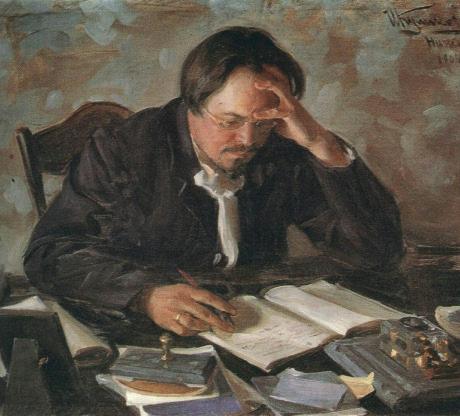
By KATHERINE WINTON Arts & Culture Writer
On March 3, influencer Haley Pham, known for her book content on YouTube and TikTok, published her debut novel, Just Friends. The cozy romance features Blair and Declan, childhood best friends who reconnect after years apart. After Blair’s great-aunt, who is essentially a second mother to her, enters hospice care, Blair returns to her hometown and begins working at Declan’s coffee shop. As they rekindle their friendship, they explore what it means to cope with grief and find love again after a miscommunication.
Although her novel was only recently released, Advanced Reader Copies were sent out several months in advance of the publication to allow for early reviews. Almost as soon as the ARCs were sent out, Just Friends began receiving scathing reviews. One viral TikTok featured a reader criticizing Pham’s stilted vocabulary and supposed self-insertion as the (annoying) main character, among other things. In this TikTok, the creator @ilanaslibrary mocked an old video of Pham’s in which she didn’t know the word “banal,” going on to repeat that Pham must have written much of Just Friends with a thesaurus in hand. I do think it is valid to criticize stilted writing, but this TikTok came off more as a personal attack against Haley Pham — especially since the reviewer went into the book with the expectation that it would be bad.
This reviewer also discussed how Pham’s popularity likely allowed her to receive a lucrative publishing deal, whereas most writers attempting to publish their debut novel receive little to no help from the publishing industry. Towards the end of the video,
she stated, “There are so many authors who write fantastic books and spend a long time on them and get the right editors to make it good, and then have to work to get an agent and a publishing deal, and this just fell in her lap because people like her videos on the internet.”
The creator went on to create a second video apologizing for her review, explaining that her intent was never to personally attack Haley Pham, but the damage was done. The comments had already flooded in. In response to her notes on the writing and the publishing deal, commenters attacked Pham’s education and work ethic. One commenter remarked, “respectfully haley didn’t even graduate high school … ofc she can’t write a book that’s like coherent & good.” Another commenter wrote, “It rubs me the wrong way that her main motivation is to become a NYT Best seller, when she doesn’t have the passion or work ethic to be deserving of that title.”
Beyond this TikTok, the other ARC reviews went similarly. After reading and watching several reviews of Just Friends, I wanted to give it a shot and see if the criticisms were valid. The reviews made me think it would be a barely coherent mess of a book. It proved to be the opposite: It was a quick, cozy read, fairly similar to the other romance novels I’ve read. Setting aside my thoughts on Haley Pham and the publishing deal, I thought the book was extremely ordinary. It doesn’t stand out particularly from the multitude of other trending romance novels, aside from the focus on Blair’s coping with grief. Even then, I thought the development of this sub-plot was mediocre at best, abandoned far too early into the novel.
Personally, I don’t enjoy the miscommunication trope in novels — I believe it allows authors to side-
step real character development, ignoring character flaws and destroying the foundation for any plot points that came before the big miscommunication reveal. Found all too often in enemies-to-lovers and second-chance storylines, the miscommunication trope feels shallow and underdeveloped. I think Pham’s story would have worked better as a reexploration of Blair and Declan’s friendship after years of growth and change. Had Pham reflected more on how the characters’ struggles had changed them, I think the novel would have hit significantly deeper. That being said, I will reiterate that Just Friends was completely, utterly ordinary. All the problems I had with Pham’s story, I have with most other contemporary romance novels. The stories don’t contain much substance, the writing is overly simple and I finish the book unchanged. Just Friends wasn’t any better or worse than the typical romance novel, yet it received so much more hate simply because of who the author is.
There is a line between literary criticism (centered on a piece of work) and personal attacks against the author. When reviews stop being about the content of the novel and instead become petty comments against the author’s education level or work ethic, they cross this line. While there is a point to be made about the ease with which influencers can acquire a publishing deal in comparison to the average writer, these critiques should be made against the industry, not the individual who takes the opportunities put before them. While Haley Pham’s novel isn’t anything spectacular, it is a debut. Just as we would give other debut authors grace, we should give her grace.
Katherine Winton is a member of the Class of 2029 in the College of Arts and Sciences. She is a staff writer for the Arts & Culture department and can be reached at kwinton@cornellsun.com.
By PEN FANG Arts & Culture Writer
“Every film is political. Most political of all are those that pretend not to be: ‘entertainment’ movies.” These are the words of renowned German filmmaker Wim Wenders in his 1988 book The Logic of Images. Yet, at the 2026 Berlin Film Festival (Berlinale), Wenders seems to have walked this back: “We [filmmakers] have to stay out of politics because if we make movies that are dedicatedly political, we enter the field of politics. But we are the counterweight of politics, we are the opposite of politics. We have to do the work of people, not the work of politicians.”
Wenders’ comment about filmmakers staying out of politics came after political journalist Tilo Jung asked the jury about the Berlinale’s,and German government’s, selective stance on human rights with regards to the genocide in Gaza, since “the Berlinale as an institution has famously shown solidarity with people in Iran and Ukraine, but never with Palestine, even today.” The Berlinale’s livestream was also cut off while Jung was speaking, which the festival attributed to a technical error.
There was a significant amount of storm surrounding these comments. Renowned Indian author Arundhati Roy pulled out of the festival after being “shocked and disgusted” by Wenders’ comments, stating that the jury was stifling discussion “about a crime against humanity.” Festival director Tricia Tuttle issued a long statement defending Wenders, arguing that artists should be able to “exercise their right of free speech in whatever way they choose” and “should [not] be expected to speak on every political issue raised to them unless they want to.” Days after Wenders’ comments, a letter signed by over 80 industry members was published criticizing the Berlinale’s silence on the genocide in Gaza and the industry’s complicity in the Israeli genocide of Palestinians. Prior to this comment, Wenders had also
said: “Movies can change the world” but “not in a political way. No movie has really changed any politician’s idea. But we can change the idea people have of how they should live.” This claim is just ahistorical. D.W. Griffith’s The Birth of a Nation, hailed as a landmark of film history and credited with pioneering major techniques in narrative filmmaking, infamously inspired the rebirth of the KKK. It was also the first film to be shown inside the White House, with then-president Woodrow Wilson being moved by it. What is this if not films and art changing the world in a political way, including changing politician’s ideas?
Of course, Wenders’ take seems to ignore the plethora of explicitly political filmmakers that exist. What does he make of François Truffaut and JeanLuc Godard leading a shutdown of the Cannes Film Festival in May of 1968, for example? Or any filmmaker with an explicit ideological bent? Just days after Wenders posited that filmmakers should not be involved in politics, Hamdan Ballal, the co-director of Oscar-winning documentary No Other Land, was attacked by Israeli settlers in the occupied West Bank again. What do you mean filmmakers should stay out of politics or that film/ art and politics are separate? What kind of detachment do you need to achieve to believe that? Do you not see how ignorant and potentially dangerous that notion is? To pretend that art and politics are separate is to ignore the real impacts, including violence and harm, that art can and does have on people’s lives.
Part of me is reluctant to give Wenders any attention. My take that all art is political feels milquetoast at this point. Of course all art is political — every artist, every person exists within and interacts with this world. Still, clearly I’m frustrated, otherwise I wouldn’t be writing this. Why do the goalposts always shift when it comes to Palestine? Why is it “every film is political” until the jury is asked about Palestine, and then suddenly filmmakers should not be political? Wenders’ comments feel particularly
ridiculous when he has praised past political actions the Berlinale has taken (such as disinviting far-right politicians).
Ultimately, Wenders can say (or not say) whatever he wants. Being apolitical doesn’t free him from critique. Yet, when the Berlinale bends over backwards to defend his opinions, it feels like the institution is trying to shut down criticism of him. But the choice to not speak is as much a political decision as the choice to speak, and neither should be positioned as above critique.
It is absurd to act like there is some moral high ground to being apolitical, especially when you can’t even condemn a genocide. Silence is complicity, and being apolitical does not sever you from the moral repercussions of your choices. And really, we need to stop pretending that being apolitical is a thing: You are a reflection of your positionality in the world, and how you approach the world, including the art you create, certainly reflects that. Moreover, I’m tired of the idea that engaging with politics is somehow a bad thing or a thing that shouldn’t be done, or that art/people and politics/ politicians are mutually exclusive somehow. All it does is create a disregard for how one’s actions impact the world.
To believe or even propose film (and art writ large) cannot change the world politically is ignorant at best and dangerous at worst. Maybe it’s cynicism — there are plenty of cases where films and art fail to achieve what they set out to do politically, but that doesn’t mean art cannot impact the material conditions of the world. But cynicism without action and apathy are cop-outs, an excuse to disengage with politics and the real effects you can have on the world you live in. No matter the reason, it is dangerous to disregard how art can and does tangibly influence people.
Pen Fang is a member of the Class of 2028 in the College of Arts and Sciences. They are a staff writer for the Arts & Culture department and can be reached at pfang@cornellsun.com.
By JANE McNALLY Sun Senior Writer
It was hard to hear yourself think at Lynah Rink.
Not when junior forward Ryan Walsh deflected in a puck on the power play, or when sophomore defenseman Michael Fisher lasered a shot through traffic and into the net.
It was when junior defenseman George Fegaras flung the puck down the length of the ice, towards a vacant Harvard net — and hit the post.
“We actually celebrated, didn’t know it hit the post,” said head coach Casey Jones ’90. And then we were like, ‘damn.’”
Thankfully, junior forward Jake Kraft came streaking in tow, collecting the rebound and drilling it into the empty net, punching Cornell’s ticket to Lake Placid, New York.
“It got a little hairy there at the end,” Jones said. “But when you’re trying to finish someone’s season, that’s to be expected, right? They’re coming at it, and I thought [Harvard] had a good push.”
Cornell won Sunday’s decisive game three of the ECAC quarterfinals by a 5-2 score, capping off its second consecutive victory after dropping game one on Friday night. The score, though appearing lopsided, told anything but the true story of the game.
The Red held a narrow 3-2 lead for much of the third period, and survived an onslaught of Harvard pressure in the waning moments.
That survival was largely due to the play of freshman goaltender Alexis Cournoyer, who proved why he was named the ECAC Goaltender of the Year — he made 22 saves on the night, but none were more critical than his five stops within the final five minutes of the game.
“[Harvard] had some good pressure, and [Cournoyer] stood on his head,” Walsh said. “He made a bunch of really good saves going down the stretch there.”
“Goalie of the year for a reason,” Jones added.
The tension at Lynah Rink was palpable. Though the attendance read 4,267 — indicative of a sold-out crowd — one of college hockey’s most sacred buildings sounded like it housed five figures of fans.
Kraft allowed everyone — including Jones — to exhale.
“It was pretty surreal,” said Walsh, who was on the ice for Kraft’s goal. “Nothing beats a sold-out crowd at Lynah. Hearing them erupt was pretty good, and it kind of sealed the game.”
Cornell’s latest win is notable on paper — a victory over its archrival, the Red’s 15th on home ice and its ticket to Lake Placid. But when you dig a little deeper, Sunday’s win could go a long way for a Cornell team looking to play deep into March and beyond.
Late-game do-or-die scenarios can’t be replicated in practice — that’s the silver lining of the series’ three-game span.
“It’s been a while since we’ve been in a game like that, where it’s really tight at the end,” Jones said. “Hopefully that really bodes well for us going forward, just to learn that and get some video on it, because I thought we mismanaged it a little bit in terms of some decisions and some puck management.”
The neck-and-neck nature of the game came to be after Harvard cut a 3-1 Cornell lead to 3-2 on Will Hughes’ tally 7:18 into the third period, a goal that massively rejuvenated the Crimson.
Before that Harvard (16-16-2) goal, it had been all Cornell (22-9-1) — from midway through the first period on, the Red dominated puck possession, shots, faceoffs and practically every metric you could point to on the boxscore.
That dominance included, of course, goals.
Harvard kickstarted Sunday’s scoring in the first period, but freshman forward Reegan Hiscock retaliated 1:15 later when he flicked a shot over the blocker of Crimson netminder Ben Charette.
“We talked a lot after Friday’s game, all of Saturday and going into Sunday, about really not letting things bother us,” Walsh said. “Bad things happen. Just gotta let it roll off our sleeve.”
The second period was a tale of two halves — perhaps a slow start off the hop, but nothing short of dominant as the frame went on. In all, Cornell outshot Harvard by a 14-6 margin, with the shot attempts reading 31-12 in favor of the Red.
A couple of those went in — first, Cornell found a power-play goal after Harvard’s Ben MacDonald was nabbed for cross-checking just before the halfway mark of the period. Freshman defenseman Xavier Veilleux’s shot conveniently ricocheted off of Walsh’s skate and into the net, after a faceoff win by junior forward Jonathan Castagna and a touch by sophomore forward Charlie Major tee’d things up.
“When we did find [our game], I thought we were in a really good spot there in the second period, and it essentially gave us a chance,” Jones said. “I think the biggest thing is
that it gets chaotic, and we’re just trying to [tell] the guys on the bench that we can’t keep chasing the game. We’ve got to make plays. You got to execute a good pass coming up. We just can’t keep whacking it.”
Walsh notched a power-play goal in the second period to make it a 2-1 game.
Walsh’s score gave Cornell its first lead, and sophomore defenseman Michael Fisher found an apt time for his first goal in a Cornell sweater just under four minutes later. Fisher found a tight seam on Charette’s short side to make it a 3-1 game with 5:56 to go into the middle frame.
From there, it was survival time — Cornell proved why it finished the regular season with 20 wins, why it boasted the ECAC’s top goaltender and why it’s ranked in the top 10 in the nation.
Good teams find a way to win — and the Red might be a pretty good team.
“It’s [all about] getting those situations where it’s a onegoal game, and I’m hoping that that experience will bode well going forward,” Jones said.
Cournoyer’s brilliance and the team’s 21 blocked shots — including 12 in the third period alone — stymied Harvard and, ultimately, clinched the team a spot at ECAC championship weekend. After Kraft’s hustle to get the empty-netter to make it 4-2, Castagna followed him up with one of his own.
5-2 Cornell, 20 seconds to play, fans on their feet.
The win finished off Cornell’s near perfect slate on home ice — its 15 wins at home ties a program record, last achieved in the 2017-2018 season. After the Red and Crimson shook hands, Cornell — led by its seniors skating at Lynah Rink for the final time — took one last lap around the old barn to salute the Lynah Faithful.
“How good is that crowd for three days?” Jones said. “That doesn’t happen anywhere [else].”
Up next? Lake Placid, somewhere Cornell has been in each of the last three seasons, emerging victorious in the latter two. The Red has a date with Princeton in the ECAC semifinals at 7 p.m. Friday in the historic Herb Brooks Arena, looking to be just the second team since the 1970s to three-peat in the ECAC tournament.
“From this way out, baby, it’s one-and-done,” Jones said. “So you gotta manage game and play properly.”
Jane McNally can be reached at jmcnally@cornellsun.com.
By MATTHEW LEONARD and DUNCAN PARK Sun Sports Editor and Sun Staff Writer
As Ivy Madness kicked off, it was clear something special was building. Both teams knew the stakes, and their play demonstrated it.
It seemed as if neither team could miss. If one team hit a three-pointer, the other came down and immediately did the same. After 10 minutes, both teams scored a combined 56 points, with Yale consistently only up by one or two baskets.
Junior guard Jacob Beccles was the notable standout player for the Red, scoring ten points just minutes into the game.
It seemed as if both teams were waiting for a crucial play to electrify the team. Senior forward DJ Nix entered the game and did exactly that. When Yale’s Devon Arlington drove to the hoop, Nix said no, blocking Arlington and sending Newman into a frenzy.
This play was followed by both teams trading even more blows.
Anthony Nimani ’27 hyped up after battling Yale for the ball.
As time in the first half began to tick away, Yale was able to hit a few unanswered shots to increase their lead. When the horn blared in Newman, Yale entered their locker room holding a 7-point lead, with the overall score reading 49-42.
The second began as many expected, with more intensity from the players and more energy from the fans. Cornell came out fast, coming within two of Yale after five minutes to make the score 56-58, but couldn’t manage to sustain its shooting for the rest of the half as Yale slowly pulled away.
The Bulldogs only got better from there, maintaining their 55% field goal percentage from the first half and going 3-8 from three. The Red, on the other hand, noticeably shot worse in the second 20 minutes, dropping down to 42%
from the field after its scintillating 64% in the first half.
With two minutes left, senior guard Jake Fiegen, who led the team with 23 points, drained a three-pointer to cut the deficit to seven. The Red needed a stop — and got just that.
After the Red forced Yale’s senior forward Nick Townsend to turn over the ball, Beccles quickly drove down the court and grabbed his own rebound to assist senior guard Adam Hinton to put the score at 76-81.
Jake Fiegen ’26 and Kasper Sepp ’27 attempt to block Yale from scoring.
Disappointingly for the Red, the game got away from there, as Yale stayed cool and killed the clock to eventually win 88-76 and book their ticket to the final against the winner of the Harvard and Penn matchup.
As senior guards Josh Baldwin, Feigen, Cooper Noard and Hinton, checked out for a final time in the waning seconds, Newman Nation got on its feet and gave all of them a standing ovation, appreciative of their efforts throughout their Cornell careers.
For the Red, this is the third consecutive year that Yale has knocked the team out of the Ivy Madness tournament. As for the Bulldogs, it will be their seventh final appearance in the tournament’s eight-year existence.
Coming into this matchup, the Red tried to take the positives from the previous matchup, in which it won, 72-69 at home, and implement them into its strategy today.
Head coach Jon Jaques ’10 credited Yale for their preparation for the Red’s usual style of defense.
“They made some adjustments defensively,” Jaques said. “I think we’re focused on how we move off the ball and how effective these guys are, cutting and screening for each other, and they did a really good job preparing for the game.”
Throughout the course of the game, the Red’s shooting percentage began to drop further and further away from the
near-perfect percentage in the first half. Jaques acknowledged that while his team was getting the looks he was hoping for, the basketball refused to drop through the hoop.
“I think sometimes we just missed shots,” Jaques said. “I think we got a lot of good looks, really good looks to start the second half. Exactly what we drew up in the huddle, a great shot for a great shooter. Adam [Hinton] misses the shot he normally makes, you know. So stuff happens.”
While Hinton may not have had the best shooting performance from beyond the arc, he still finished the game as one of the Red’s most impactful players, scoring 14 points while also securing four rebounds.
Hinton is a player whose impact on Cornell basketball can not be overstated, playing four years with the program and consistently being one of the better players on the Red’s roster.
Despite the loss, seniors Fiegen and Noard were able to look back on their time with the program with fond memories rather than bask in the disappointment that comes with defeat.
“I’m so proud of the way we continue to fight through any and all adversity and I’m super thankful for this group,” Noard said. “Super thankful for coach Jaques and the rest of his staff that we were able to do what we wanted to do. While we wanted to have an NCAA birth, and I wanted it really bad for this community, I hang my head high. I’m proud of the way I grew as a person, as a player throughout my career.”
While it may have been the last time many of the Red’s beloved seniors stepped onto the court in front of Newman Nation, their legacy and impact on Cornell basketball will never be forgotten.
Matthew Leonard and Duncan Park can be reached at mleonard@ cornellsun.com and dcp253@cornell.edu.