Following the terrorist attack on two mosques in Christchurch, New Zealand, a community vigil will be hosted on Monday from 5 - 6 p.m at the Muslim Chaplaincy in Anabel Taylor Hall. At the meanwhile, Cornellians have been coping with the tragedy through group prayer and discussion of issues that lead to the attack.
The attack, which resulted in 50 people killed and 50 wounded, specifically targeted Muslims in their place of worship, as evidenced in an 87-page anti-immigrant, anti-Muslim manifesto sent by the shooter to the New Zealand Prime Minister’s Office, according to CNN.
In the days since the incident, Yasin Ahmed, Cornell’s Muslim chaplain has led healing circles, special prayers and group reflections to help students and facul-
ty to cope with the tragic events.
“The tragedy in New Zealand ... is heart breaking and a reminder to appreciate the ones we love,” Ahmed wrote in an email to the Muslim community after the attack.
Ahmed has also been coordinating with Cornell police to increase security on campus, such as having the Jummah room inspected before prayer
Club Sports May Lose Practice Spaces Due to North Campus Expansion
By DENA BEHAR Sun Staff Writer
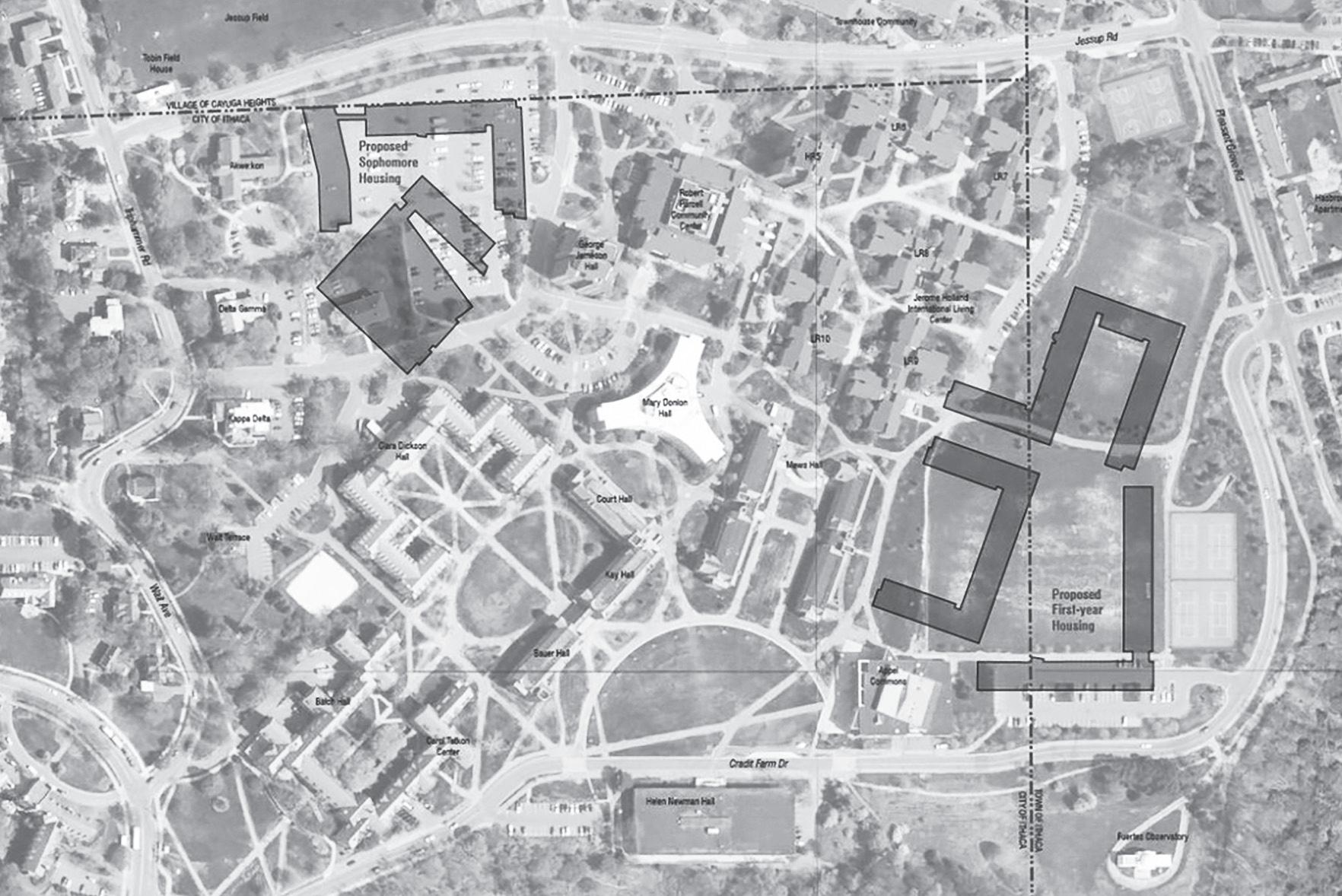
As Cornell prepares to renovate and expand the North Campus housing area, members of Cornell’s club sports expressed concern that the project’s impending destruction of the Appel Fields — an outdoor sports space — will put the future of club sports in jeopardy.
First unveiled in 2017, the housing project plans to add approximately 2,000 beds and a dining facility on North Campus by the fall of 2022 — building on the land besides the Appel Commons and Mews Hall, where the Appel Fields currently sit.
According to Cornell’s website, the expansion is an attempt to “address a deficit of on-campus housing” and accommodate “anticipated increases in undergraduate enrollment.” However, some students feel that the plan did not take into consideration
the fact that many teams will soon lose its practice space.
This fall semester would be the last season that the Appel Fields
See APPEL page 4
C.U. Giving Day Sets Record
By AELYA EHTASHAM Sun Staff Writer
In a matter of 24 hours on Thursday, the Cornell community and donors around the world raised almost $8 million dollars on Cornell’s fifth annual Giving Day, around $40,000 more than last year. The Department of Athletics and Physical Education was named the top receiver of donations this year, with gifts received totaling $2 million.
The Giving Day is a fundraising initiative that encourages students, faculty and alumni to donate to their “favorite areas of Cornell,” according to the event website. These “areas” can be any partic-
ipating colleges, departments, programs and student and alumni organizations.
This Giving Day set new records for both dollar amount and amount of donors with 13,858 donors giving 18,966 gifts totaling over $7.8 million across Cornell, according to Fred Van Sickle, vice president for alumni affairs and development.
“These funds allow colleges and units to take immediate action on their top priorities for the year, from providing student and faculty support to investing in equipment and facilities needs,” Van Sickle told The Sun.
The event’s online presence also allowed donors from any location to participate in challenges that add money to donations based on criteria such as being the first gift or receiving donations from 50 countries, according to the Giving Day website. Aside from reaching out to community members via email, for the second time, some organizations — such as the LGBTQ Alumni Association and Asian American Alumni Association — also tabled in the Memorial Room of Willard Straight Hall to receive donations. At Willard Straight Hall, students were able to donate to their
See GIVING page 4
Remembering the victims | Mourners embrace at a memorial for the victims of the Christchurch, New Zealand attacks.
CORNELL TUKIRI / THE NEW YORK TIMES
JIM PIERCE / CORNELL ATHLETICS
Freshman Gillis Frechette scores a breakaway goal in overtime to give Cornell women’s hockey a 3-2 win over Northeastern in the NCAA Tournament. The Red will take on Minnesota in the Frozen Four on Friday.
Construction chaos | The North Campus Expansion plan will build new residential halls on Appel Fields, a popular club sports practice space.
MICHELLE YANG / SUN STAFF PHOTOGRAPHER
Frozen Four bound
Monday, March 18, 2019
A LISTING OF FREE CAMPUS EVENTS
Minors Fair | Ranging from migration studies to business, Cornell offers up to 122 minors to undergraduates in nearly all schools and departments. Students will have the opportunity to learn more about these offerings tomorrow at 4:30 p.m.
Today
Willard Straight Hall
Intro to Button Design and Making 5 - 6 p.m.
112 Mann Library
National Security Law and Policy Society Presents: Intelligence Community Support for National Policymakers 5 - 6:30 p.m.
182 Myron Taylor Hall
Arabic Conversation Hour 6 - 7 p.m. G25 Stimson Hall
Aizuri Quartet — Ithaca Album Release Concert 7 - 8:30 p.m., Telluride House
Tomorrow
Entrepreneur in Residence Office Hours: Phil Miller ’83 Noon - 4 p.m.
Marriott Student Learning Center, Statler Hall
Minors Fair
4:30 - 6:30 p.m.
Baker Portico Atrium, Physical Sciences Building
Using Excel with Research Data: Pivot Tables 4:30 - 6 p.m.
Uris Classroom, Uris Library
Materials Science Expo 4:45 - 6:15 p.m.
Television Lounges, Robert Purcell Community Center
Women in Computing: Springboard Your Personal Brand
5:30 - 7:30 p.m. Tatkon Center
Finance and Sustainability Colloquium: Michael Gilbert
6 - 7:30 p.m.
B09 Sage Hall
Let’s Meditate 8:30 - 9:30 p.m.
G27 Becker Hall
COURTESY OF CORNELL UNIVERSITY
Fight Over Cayuga Lake Salt Mine Hinges on Lawsuit
By CHANTAL RAGUIN Sun Contributor
Located 2,300 feet under the surface of Cayuga Lake, a seven mile mine cranks out 2 million tons of raw salt every year, which is mostly used to defrost icy roads in Ithaca and across the northeast United States.
Mining salt from under the lake, however, is met with rising concern over its impact on lake salinity. The Department of Environmental Conservation’s approval for Cargill, the nation’s largest privately owned company, to drill a new 2,500 foot-deep hole from ground level was met with local opposition. Cayuga Lake Environmental Action Now, a local activist group, and local governments, including the City of Ithaca, filed a legal action against the DEC and Cargill in 2017.
Cargill, the nation’s largest privately owned company, first received permit to mine under Cayuga Lake in 1975. Named the #4 Shaft Project, the company said the current project “will be used to bring power into the mine closer to the working areas,” according to Cargill’s website.
As the court has not yet reached a decision, Cargil has not suspended its on-site preparation.
Founded by John Dennis Ph.D. ’87 in 2017, CLEAN has been organizing local campaigns against sub-lake mining. The group focuses on water sources in central New York and particularly Cayuga Late, according to Dennis.
“We are not against mining, but we are against mining under the lake. They are mining under the lake because it is much more profitable,” Dennis told The Sun.
Prof. John Warren, geology, Chulalongkorn University,
Thailand and director of SaltWork Consultants, told The Sun that because Cayuga Lake was cut by glacial ice before the lake was formed, mining under the lake might cause problems for the support between the lake and the mine.
Cargill conducted its own study examining the likelihood of the risk. The study was reviewed by the New York DEC, but the findings were not released to the public.
Although the New York DEC has already approved the #4 Shaft project, CLEAN, the City and Town of Ithaca, the Town of Ulysses, the Village of Union Springs and other individual plaintiffs demanded an Environmental Impact Statement, which would communicate the risks of the mine to the public.
“What strikes me as odd about this [is] that when Cornell built the lake-source cooling facility, Cornell University was required to do extensive environmental review [and] years of environmental impact statements,” Prof. Clifford Kraft ’75, natural resources, told The Sun. “It seems inconsistent to me that the DEC is not requiring extensive environmental review.”
While many local activists oppose the #4 shaft, they also acknowledged the mine’s financial importance to the area. According to the Cargill website, the mine contributes $4.6 million to the Lansing economy alone.
“I know the mine has employed a lot of people for a long time,” said Hilary Lambert, CLEAN steering committee member. “It is a very valuable part of the Lansing community.”
“While we can’t speak to pending litigation, we can speak to Cargill’s long-standing role as a key employer and good corporate citizen to Tompkins county. This includes consideration of the environment and natural resources that are so vital to the area,” Cargill wrote in an email to The Sun.
Dennis expects the court to release a decision on the case within the next few weeks. Meanwhile, Cargill will continue to publish online updates on the construction of the #4 Shaft project.
Robots’ Competence Afects Human Confdence
By RONNI MOK Sun Staff Writer
When it’s person versus machine, people don’t like to perform worse than their robot counterparts. And when they do, defeat hurts their confidence, a new Cornell study found.
Past research on human-robot interaction have largely focused on collaboration instead of competition, making this study a first in the field, according to Prof. Guy Hoffman, mechanical and aerospace engineering, one of the researchers.
Modeled after a similar economics experiment where two humans competed against each other, the study aimed to examine “loss aversion,” a behavioral economics concept that suggests people are more willing to avoid loss than gain awards. Loss aversion occurs when people are compared to a specific reference point — in this study, the robot.
Human participants of this study competed against a robot in a repetitive task that involved counting the number of times the letter “G” appeared in a string of characters, and then placing a block in the bin corresponding to that number. Their robot competitor performed at a randomly selected skill level. After each round, the winner of the task was awarded a random amount of money.
By using a robot, the researchers could manipulate the skill level of the robot, establishing a precise reference point to measure people’s reaction when robots performed better or worse than them, according to Prof. Ori Heffetz, economics, another researcher of the study.
“It is hard to find a laboratory task in which humans and robots can perform roughly at the same level, and that you can finely control. We also wanted [the task] to be monotonous, and uninteresting,” Hoffman and Kshirsagar said.
The study observed a small discouragement effect of the robot’s performance on the human participant’s performance: In general, participants liked low-performing competitor robots over high-performing robots. The robot’s performance also affected participants’ perception of their own abilities.
Opposite from the researchers’ expectations, the findings also show that the size of the prize awarded did not significantly affect people’s performance.
Moving forward, the researchers are also interested in understanding more about loss aversion and reference points.
“We people change our reference points all the time: We compare ourselves to our siblings, our classmates, our neighbors, or co-workers. Our research goal is to better understand these processes,” Heffertz told The Sun.
The Corne¬ Daily Sun
Robot competition | When competing against robots, people’s performances didn’t improve when offered higher awards for winning.
COURTESY OF CORNELL UNIVERSITY
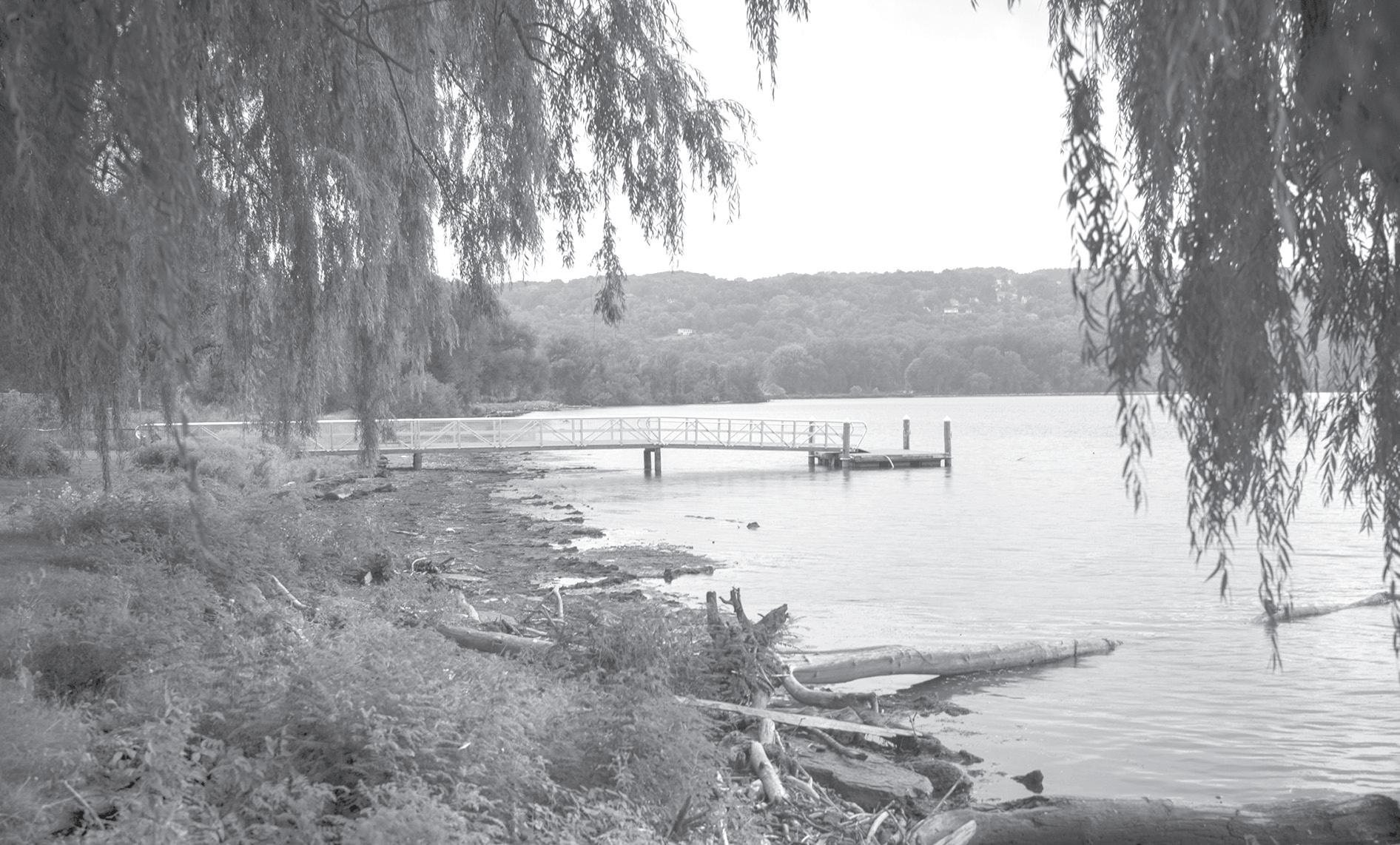
Under the lake | Local activists and Cargill are fighting over the state of the salt mine underneath Cayuga Lake.
CAMERON POLLACK / SUN FILE PHOTO
Donations Hit New High
Continued from page 1
colleges, student groups and sign up for alumni listservs in order to receive emails about future activities. The event also allowed students to write thank you notes to donors in return for a free Giving Day T-shirt.
For Van Sickle and Ryan Lombardi, vice president for student and campus life, Giving Day is more than just a fundraiser. According to them, it also raises morale and generates a sense of unity throughout Cornell’s community of both current students and alumni.
“Alumni who don’t have the means to support the institution financially still play an important role,” Lombardi told The Sun.
“When I watch Giving Day tallies climb — especially the large increase in the number of donors and gifts — I see a strong indicator of the deep affection we all feel for Cornell. No wonder this is such a popular effort,” Van Sickle said.
Aelya Ehtasham can be reached at aehtasham@cornellsun.com.
Club Sports Struggle to Find Space
Continued from page 1
could be used before it’s closed for construction, wrote Brigitta Putnam, director of aquatics and university programs in an August email sent to 14 club sports teams that use the Appel Fields for tryouts and practice.
In the same email, which was acquired by The Sun, Putnam said she had “no idea” where displaced teams would be able to play in the spring.
The club sports teams anticipated that the Appel Fields would be available until mid-November, according to Aaron Berman ’19, co-captain of the Shake, a men’s developmental frisbee team. However, on Oct. 22, Putnam emailed the teams again with the news that the fields would be closed immediately, leaving teams to scramble to find alternative sites.
Jessup Fields, another sports space located on the northwest side of North Campus near the Robert Purcell Community Center, are unavailable because of an ordinance with the Village of Cayuga heights, which limits its access to only intramural sport teams, according to Putman.
Without Jessup Fields as an option, the club teams looked to Cornell’s other on-campus athletic spaces, such as the varsity fields, but they are often not allowed to access certain facilities.
The Buds, another men’s ultimate frisbee team, said they tried to reserve the turf facilities on campus but were told club sports aren’t allowed to use them with lights because the lights are reserved for varsity sports.
“Not being able to use the lights pretty much means we can’t use the fields,” said Andrew Gavin ’19, co-captain of the Buds. “Since the only time the fields are free would be after dark.”
Teams are also frustrated by a lack of centralization and communication from the Cornell administration, according to Gavin.
Almost all athletic facilities on Cornell’s campus are managed by different people, making it difficult for teams to figure out what spaces are available. Teams trying to reserve a space are often referred multiple times to different people, without success.
Some of the spaces that are available to be used by club sports, such as Ramin Room, an indoor space in Bartels Hall, were already filled by August, before teams knew Appel would be closed.
“There’s no centralized location for us to go to and say ‘hey, we’re looking for field space — what is available?’” Gavin said.
The difficulty of securing on-campus locations led most teams to look for off-campus field spaces, which often requires teams to allocate extra money from their budget in order to reserve private spaces.
However, the funding teams received from Cornell did not increase after they were notified of the Appel Fields closing — nor could the budget be changed because they were submitted before teams were notified about the closing of the fields.
“We’ve been alternating weeks [for practice] ... to make [the money] last until our games,” said Hannah Sosenko ’19, president of women’s club softball. “It’s hard to have a team environment when you’re not practicing that much and you’re not around each other consistently.”
The women’s frisbee teams began to hold practices at a field off-campus, but because it was in a
residential area, the field wasn’t always available. The change decreased player turnout at practices, according to Nancy Jiang ’19, co-captain of the Thorny Roses, one of the women’s frisbee teams.
Many clubs teams also expressed concern about the tryouts in the fall, which had always been held on the fields in previous years — an especially convenient location for recruiting freshmen. Now, the uncertainty surrounding the location of next year’s tryouts puts many teams in a tough position, as the future of their programs may be endangered if recruitment is made more difficult.
Shuttling nearly 100 potential recruits back and forth to an off-campus field would be extremely challenging and could decrease the number of students trying out, said Alex Jacobs ’20, president of Mundial, one of Cornell’s men’s club soccer teams.
“If I had to get in a car with a bunch of strangers, I probably wouldn’t have tried out,” Sami Smalling ’20, co-captain of the Wild Roses, told The Sun. Ryan Lombardi, vice president of campus and student life, told The Sun in an email that a new artificial turf field would eventually be built to replace the Appel Fields. However, the North Campus construction won’t be completed until 2022, potentially leaving teams without a replacement for the next three years.
Furthermore, the current space at Appel consists of three separate fields, while the expansion project will create only one field.
“I don’t see how five to six club teams are supposed to share one turf field,” said Spencer DeRoos ’19, Buds co-captain. “Especially when many of them need to practice two to three times a week to be competitive.”
Lombardi did not specify if club teams would gain access to other campus field sites in place of Appel, or if teams would be compensated for the cost of renting off-campus field space.
“[The administration] ha[s] been and will continue to explore Cornell’s existing fields and community resources to serve as alternative field space,” Lombardi wrote in the email.
No member from the administration has reached out to any of the teams that were interviewed for this story, the team leaders told The Sun.
In the application submitted by Cornell to the City of Ithaca for the North Campus Housing project, Cornell claims that the reduction of the fields “will not have a major impact on Cornell students despite the increase in student residents in the vicinity.”
Jacobs said the statement is “misleading,” and DeRoos said the statement “completely ignores the students who use the fields often for organized tryouts and practices.”
The team leaders emphasized the importance of having club sports as an “outlet” for students who are often overwhelmed with school.
“The fact that Cornell isn’t giving us resources is really putting up barriers to allowing everybody to participate in [club sports],” Jiang told The Sun.
“It’s good that there’s more housing because that’s also not a good situation at Cornell,” Jacobs said. “But by solving one problem, you’re creating another.”
Dena Behar can be reached at dbehar@cornellsun.com.
SPACES
Finding fields | The North Campus Housing Project will build dorms on what is currently Appel Fields. Club sports team that used that space now have to seek new alternatives.
COURTESY OF CORNELL UNIVERSITY
Cornellians Come Together After Terrorist Attack
NEW ZEALAND Continued from page 1
and installing security in front of Anabel Taylor Hall for the duration of prayer ceremonies. These steps were precautionary, Ahmed said, because “we believe our community is completely safe.”
“We’ve received a couple beautiful messages particularly from other faith [organizations], most notably Hillel.”
Yahya Abdul-Basser ’20
In response to the attacks, President Martha E. Pollack emailed the entire student body, calling on
Cornell
Cornell Creates “Executive Presence” Certificate Program
Aspiring leaders who wish to improve their public speaking and build confidence can do so with Cornell’s new “Executive Presence” online certificate program. In the 15-week course, enrollees share videos of themselves presenting, watch other people present to beat performance anxiety and further their career growth. By watching other people present, participants will be able to understand the importance of effective body language and vocal variety. The program teaches how to use breathing, visual focus, voice and gesture to deliver authentic and engaging presentations in a wide variety of settings.
Local
New Findings for Lime E-Scooter Pilot Program Proposal
Late last year, Lime, a bike and scooter sharing company, proposed a test run of its e-scooter in Ithaca. The proposal was met with hesitancy. During the Planning and Economic Development Council meeting Wednesday, findings compiled information from other municipalities who tested the program was presented, along with recommendations to initiate a pilot program to collect data. This would allow Ithaca to test the program without making a permanent decision, according to the city’s Mobility, Accessibility and Transportation Commission. The recommendation came with regulations the committee felt was important, such as use age minimums and curfews.
— Compiled by Rochelle Li ’21
the Cornell community to “continue to reject the bigotry and hatred that underlie such acts, and we must continue, in our individual ways, to lead lives of kindness.”
Yahya Abdul-Basser ’20, president of Muslim Educational and Cultural Association for Cornell, captured the feelings of the Islamic community on campus. He described the numbness felt by himself and other members in the community in light of the attacks, especially because of the “jarring nature” of Islamophobia.
Abdul-Basser stated that he appreciates Pollack’s email, as well as the support and kind messages from the Cornell community at large.
“The community in general has been wonderfully supportive. We’ve received a couple beautiful messages particularly from other faith [organizations], most notably Hillel and I want to thank them on behalf of
the Muslim community for supporting us right now,” Abdul-Basser told The Sun in an email.
Abdul-Basser hoped that the vigil will bring together people from different faith backgrounds to pray for the victims and their families, as well as have an opportunity to practice prayer publicly and give the community some peace of mind.
Moving forward, MECA plans to host a forum on Friday to discuss the underlying causes of terrorist attacks like the latest one in New Zealand, such as like Islamophobia, white supremacy and gun violence.
“We feel it’s important to address how pervasive anti-muslim sentiment is, even on this campus because address info that is how we ultimately take concrete steps forward,” Abdul-Basser said.
Catherine Chmiel can be reached at cac465@cornell.edu.
ARTS & ENTERTAINMENT
Inside the Mind Of a Student Provocateur
BY ANNA P. KAMBHAMPATY SUN OPINION COLUMNIST
“I hate when people ask me if I’m cold. Like, come on, I’m wearing all these dope clothes, and that’s what you choose to ask me about? If I’m cold? Obviously, I’m cold, it’s winter in Ithaca,” Alexander Schaef ’20 told me as we shared a coffee in Temple of Zeus. Alexander was wearing a black pinstripe suit with no shirt, showcasing his built abs, formed from years of training as a long and short distance runner, skier, tennis player and soccer player. He had on his usual stack of glittery silver chokers and necklaces and carried his usual warm, smiling demeanor.
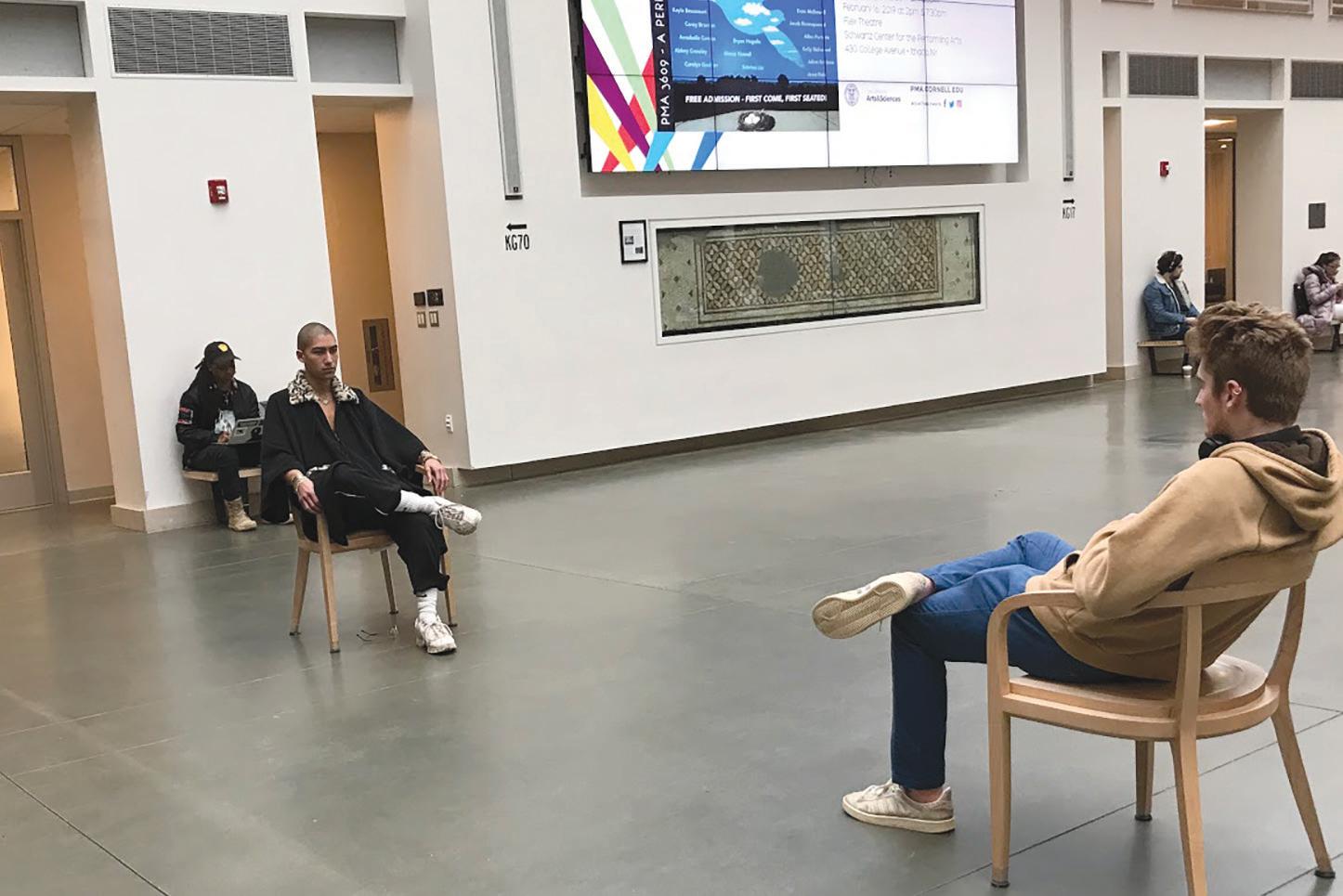
For Alexander — performance artist, sculptor, Cornell nightlife icon, perpetual source of sartorial surprise and social media provocateur — Zeus is not just a place for coffee and soup. It’s also more than a favorite old haunt (though, you are likely to find him there nearly every day during lunch hour). It’s a stage. Just a few weeks ago, Schaef performed a homage to Marina Abramovi’s 2010 The Artist is Present performance at The Museum of Modern Art. Schaef asked various students to sit across from him in a chair in the middle of the cafe and simply make eye contact with him. As an admirer of Abramovi’s work, I was elated to take part in the performance because I knew it was as close as I or most people at Cornell would get to experiencing The Artist is Present.
As I sat with Schaef, staring into his eyes, I felt uplifted and refreshed. Part of it is because he is an exceptionally friendly and warm being, but also because it felt like a shared meditation in the middle of my academic day at a place where I’m usually buzzing with caffeine, rushing to finish a reading or lurking to find a table. “I just wanted to see how people would react,” Schaef told me. “It was so rewarding, seeing how people would find such a simple act of sitting in a chair and staring at a space so shocking. The stares I got from people viewing the performance were uncountable. You saw the physicality of it — how it stopped people from walking through us and left them looking at us for so long. It was like, all of a sudden, there was a legitimate structure or force between us.”
Alexander’s performances are nothing new for Cornell’s student body. Twins (what he considers his most legitimate performance piece) is a work that he did as a freshman in the lounge of his dormitory, Donlon Hall. The piece featured Schaef and one other friend, both dressed fully in garbage bags. They both dumped paint on the floor, covered their bodies in it, and smashed themselves against a big canvas that was up against a table. “I can’t believe I did that as a freshman,
it was such a fearless thing for me to do for an audience of 30 people. I took it so seriously, I fasted that day and was delirious. There was chaotic music and we were slamming our bodies against this canvas and just stood, covered in paint, for minutes after.”
Alexander’s wardrobe is the most standout and immediately telling aspect about him for those who haven’t seen his work or interacted with him. It was one of the first things I decided to talk with him about because I knew a lot of the student body was wondering why he dresses the way he does or where he got his sartorial inspiration. “I always choose what I want to wear the night before, but I usually end up changing my outfit in the morning because I find that, towards the end of the day, I say ‘fuck it’ to everything and think ‘I’m gonna dress however I want,’ but in the morning, when I wake up I get timid again.” You read that right — what you see Schaef wearing around campus is the toned down version of what he’s going for. He always tries to push boundaries with his apparel and wants to make people uncomfortable. As a performer, Alexander is constantly in conversation with his audiences through his wardrobe. While he’s on his way to class, having coffee with me and most definitely during nights out, it’s always a performance, simply by way of what he has chosen to wear.
“I definitely want to wear more women’s clothing and clothing that isn’t meant to be worn as clothing. That’s going to be my next project,” Schaef told me.
“Alexander McQueen,” Schaef answered without hesitation when I asked about who has inspired him. “I’m obsessed with him. My favourite piece by him is ‘Highland Rape’ 1995. It really questions gender roles and beauty and is a twisted spin on the body. It really gets to me.”
If you haven’t had the chance to interact with or witness any of these performances on campus, perhaps you’ve seen Alexander’s social media or nightlife presence. On a weekend night, Schaef can be found “well, literally all over the place . . . parties are my favorite place to perform and be provocative . . . so it’s a blend between frat, co-op and apartment parties and of course bars and bars and bars. I don’t really like any of the places too much but it works.” Like his performances and attire, Schaef’s Instagram is another presence that provokes and lies at the intersection of the intimate, raw and obscene. “I want to rebel against online censorship, and hopefully just disturb . . .
To continue reading this article, please visit www. cornellsun.com.
Anna P. Kambhampaty is a senior in the College of Agriculture and Life Sciences. She can be reached at akambhampaty@cornellsun.com.
Book Review
Te Priory
Of Te Orange Tree
BY JESSICA LUSSIER SUN STAFF WRITER
“The stranger came out of the sea like a water ghost, barefoot and wearing the scars of his journey.” So begins Samantha Shannon’s epic new novel, The Priory of the Orange Tree. And if you’re looking for a daring adventure that’s full of dragons and magic, look no further.
This is a tale of spirits touching. In the wondrous world of Priory, magic grows from trees, dragons swim through the air and sea and a nameless evil brews in the depths. Shannon’s world is rich and deep. Crossing four geographically disparate perspectives, the story is truly a global one. Each culture takes cues from our own, mixing myth and legend to create something wholly original.
It is the scope of this novel that ultimately makes it difficult to describe. The world is so vast and complex that it resists summary. But at its heart, Priory is a tale of reaching out and daring to touch the other side of the world — of looking past our religious and ideological differences and working together to defeat the evil that’s coming for us all.
My favorite character in the novel is Ead, the warrior mage tasked with secretly protecting Queen Sabran of Inys. Ead is clever, sharp, magical and ultimately, an outsider. She must hide her true religious beliefs from the people around her or risk being declared a heretic. She does this with a quiet strength, a firmness of conviction that is truly inspiring in the midst of such intolerance. And as the friendship between her and Sabran deepens into a forbidden love, they prove that religious beliefs do not have to divide us.
Ead is only one example of the many female characters that dominate Priory. From queens to dragonriders, the world of Priory stands on the shoulders of powerful women. They plan the wars and fight the battles, refusing to be dismissed.
At over eight-hundred pages, Priory is well worthy of its epic classification, yet even these many pages don’t feel like enough. As a standalone novel, Priory does not plan on having a sequel, and for such a highly developed world, this seems like a missed opportunity. A series could have drawn out the action and given the prose and characters more space to breathe. Priory seems to overflow its bounds as a result.
On the whole, however, The Priory of the Orange Tree introduces a wonderful, magical world. It’s fun, full of adventure and heart, wildly cinematic and not inclined to let you go. Whether this is your first foray into Samantha Shannon’s work, or you have been a fan of her Bone Season series for years, this is not a book that will disappoint. It certainly deserves a space on your shelf and in your heart. And did I mention there are dragons?
Jessica Lussier is a sophomore in the College of Arts and Sciences. She can be reached at jll355@cornell.edu.
COURTESY OF ANNA P. KAMBHAMPATY
Lucy Dacus and Mal Blum Perform at Te Haunt
BY
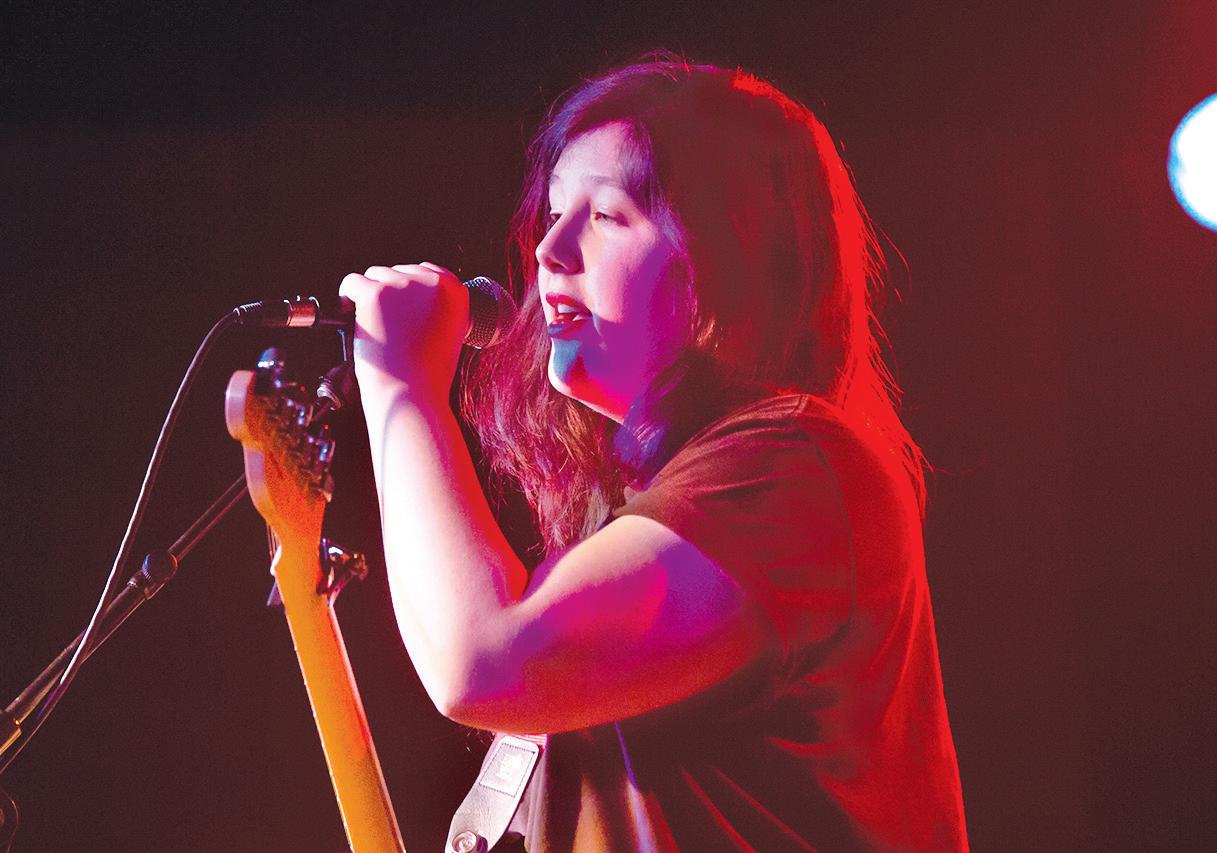
I almost couldn’t make it out to the show. I typed and deleted and typed and deleted messages to my editors that I just couldn’t hack it tonight. I was sorry, so sorry, that I wouldn’t be able to follow through, but I didn’t expect to get in an accident. But I’d waited for this show for months; Lucy Dacus is one of my favorite artists. I couldn’t just miss it.
So, three hours after being thrown off my bike onto Tower Road — broken rib, sprained wrist and all — I was at The Haunt and loving every second of it.
It’s hard to overstate the grace of Dacus’ voice. She wraps elegant melodies around exceptional poetry, the form of each intertwining with the other. Truly the only critique I could have for the show is that there were a few times where I could hear her voice more clearly. It’s hard to say whether the sweetness of her voice or the aptness of her words is the more defining factor in her brilliance, but from both emerges true exceptionalism. I think she could have been successful with just one or the other, so the combination really stands out. While I usually write arts columns about bad media, Lucy Dacus is an artist I will unequivocally assert is amazing, incredible, wonderful and outstanding.
second and most recent album, Historian, and assured that there should be excitement for things to come from her. She played a mix of songs both from Historian, and her first album, No Burden, as well as a cover of “La Vie En Rose,” which she recorded and released for Valentine’s Day.
One of the most spectacular moments of the show was the song “Body to Flame,” when the musical prowess of Dacus and her backing band — Jacob Blizard on guitar, Dominic Angelella on bass and Ricardo
show-stoppingly beautiful.
Fenne Lilly, an English artist who released her first album in April of 2018 after years of releasing singles and playing shows, kicked off the show. Songs like “I Used to Hate My Body, Now I Just Hate You” and “I, Nietzsche” were accompanied with funny stories during long re-tuning breaks between songs. Her irreverence and charm were fun and funny, capturing as much attention as can be hoped for as people milled in. She did a
know, if your friends were on stage with lights and microphones and commercial amplified sound. Blum’s jokes and stories were sincere and untampered, and their energy onstage was superb.
One more incredible thing happened Thursday night. You know how, when people sing along at a concert, they usually sound really bad. Like, you always hope the speakers in the venue are loud enough to cover it up, because if you hear the dude next to you wrecking another one of your favorite songs, you’re gonna flip. Well, the singing back actually sounded pretty good. It was sweet and wholesome and — to my ears — pretty on-key. Even the people who decided to take it upon themselves to follow along singing one of the pitchy oooh-oh-oooh riffs, which I generally regard as one of the most depraved actions you can take at a concert, didn’t totally butcher it. It was sweet, pleasant even, and pretty impressive.
In addition to the actual musicianship, the poise with which Dacus took the stage was exquisite. She was simple and sweet, taking a few seconds to discuss her songs and stories, successfully endearing herself to the audience. The audience’s eyes were on her in the most admiring way.
Dacus started off the show with an unreleased song, that stuck with the style of her
Lagomasino on drums — was on full display. Skillfully working through the waltzing song, with alternating understated and bold verses, it was a real wonder to see them bring it to life.
For the song “Historian,” Dacus took the stage with just Blizard, the lead guitarist, for the encore. Somehow, remarkably, he made a guitar sound like an organ, somberly accompanying an arresting and solemn song leaving all of Dacus’s voice on display. It was
great job too, with great songs and impressive musical skill.
Mal Blum was up next and was also a true joy to watch. Bringing nonchalance and earnestness on stage with them, they chatted and sang without as much formality and stiffness as artists can. The lack of theater was amiable and fun, breaking down the barriers between reverent audience and performing artist, instead more like hanging out and listening to friends playing — you
It’s easy, for me at least, to forget during the hustle and bustle of college that the same concerts that brought me so much joy in high school — for which I would buy tickets for the second they went on sale, hype myself up for months and wait outside for hours before doors opened — still exist, and they’re still as good. Lucy Dacus reminded me of the way I used to stand in the crowd, awestruck, staring at the stage with wide eyes and a full heart. It’s euphoric, it’s fulfilling, it’s invigorating. And I don’t think that staying home to study for a genetics prelim — or going to the hospital to get your ribs x-rayed — is ever going to be worth missing a chance to see something that beautiful.
Katie Sims is a junior in Te College of Agriculutre and Life Sciences. She can be reached at ksims@cornellsun.com.
KATIE SIMS SUN ARTS COLUMNIST
KATIE SIMS / SUN ARTS COLUMNIST
ANU SUBRAMANIAM ’20 Editor in Chief
DAHLIA WILSON ’19
Business Manager
PARIS GHAZI ’21
Associate Editor
NATALIE FUNG ’20
Web Editor
SABRINE XIE ’21
Design Editor
NOAH HARRELSON ’21
Blogs Editor
SHRIYA PERATI ’21 Science Editor
AMANDA H. CRONIN ’21
News Editor
ROCHELLE LI ’21
News Editor
JOHNATHAN STIMPSON ’21 News Editor
PETER BUONANNO ’21
Arts & Entertainment Editor
ANYI CHENG ’21
Assistant News Editor
SHIVANI SANGHANI ’20
Assistant News Editor
CHRISTINA BULKELEY ’21
Assistant Sports Editor
BEN PARKER ’22
Assistant Photography Editor
DANIEL MORAN ’21
Assistant Arts & Entertainment Editor
ALICIA WANG ’21 Graphics and Sketch Editor
DANA CHAN ’21 Production Editor
RYAN RICHARDSON ’21
Snapchat Editor
ALISHA GUPTA ’20
Senior Editor
SHRUTI JUNEJA ’20
Senior Editor
AMOL RAJESH ’20 Senior Editor
SARAH SKINNER ’21
Managing Editor
MEREDITH LIU ’20
Assistant Managing Editor
RAPHY GENDLER ’21
Sports Editor
BORIS TSANG ’21
Photography Editor
AMBER KRISCH ’21 Blogs Editor
KATIE ZHANG ’21 Dining Editor
SOPHIE REYNOLDS ’20
Editor
AMINA KILPATRICK ’21
Editor
MARYAM ZAFAR ’21
Editor
ETHAN WU ’21 Opinion Editor
HUNTER SEITZ ’20
ZHU ’21
HENSHAW ’20
JIANG ’21
MARKUS ’22
LEI WU ’21
WANG ’20
LEANN McDOWALL ’21
GIRISHA ARORA ’20
FLEER ’20
KATIE SIMS ’20
Working on Today’s Sun
Ad Layout Krystal Yang ’21
Production Deskers Mei Ou ’22 Jamie Lai ’20
News Deskers Rochelle Li ’21
Nicole Zhu ’21
Arts Desker Peter Buonanno ’21
Sports Desker Johnathan Stimpson ’21
Design Desker Jamie Lai ’20
Laura DeMassa ’21
Photography Desker Jing Jiang ’21
Tom the Dancing Bug by
Reuben Bolling
Pollack’s Lackluster Response
Eighty-five words. After the gruesome attacks that led to the death of at least 49 people and another 20 injured in New Zealand, President Martha Pollack sent a statement to the Cornell community consisting of only 85 terse words. On Oct. 29, President Pollack also sent out a statement to the Cornell community after the murder of 11 people in a Pittsburgh synagogue. The 345-word message back then, however, was much more elaborate and reassuring.
In her October email, Pollack wrote that the Pittsburgh attacks were a “heartbreaking reminder of how interconnected we all are,” and that “we need to support one another and, within our Cornell community, act with kindness and extra care.” She went on to inform that there are support services and activities on campus, urged the community to reach out to each other and to use these moments to “speak out against white supremacy, anti-Semitism, and all forms of bigotry.”
identify the killers as ‘white supremacists’ or their anti-Muslim bigotry, as pointed out by the media. She didn’t advocate for the community to unite and fight bigotry together. Rather, she said to fight “in our individual ways.”
President Pollack handled two similar attacks in two vastly different ways.
During times of crisis, we look towards those in leadership positions to provide a strong, supportive message to steer the community in the right direction. On college campuses, we should expect that type of leadership from our administrations. President Pollack’s message following the New Zealand attacks were disappointing, to say the least. The message came off as a formality. It seemed as though she sent it because she had to address the situation to some capacity. However, the email didn’t offer the same message of inclusion, and it didn’t entice nearly the same level of emotional response. President Pollack handled two similar attacks in two vastly different ways, inherently treating the affected groups unequally.
This is the type of response that we should expect. It was a response that let those most affected by the xenophobic attacks know that they are valued, and that the Cornell community as a whole should and will be there to support these groups. It was a message of inclusion.
Following the attacks in New Zealand, however, President Pollack left these sentiments behind. Pollack stated that these acts “make us furious, sad, and confused.” But this time, she said that “we must continue, in our individual ways, to lead lives of kindness.” She didn’t urge the community to support one another. She didn’t
But this type of response is unacceptable. As the president of a diverse institution that “stands . . . for respect, dignity, inclusion, and love,” President Pollack should unequivocally make that message clear to all groups, especially during the times of tragedy. President Pollack should have let the Muslim community, one that is not new to xenophobic attacks, know that we, too, are valued on this campus and that the Cornell community supports Muslim community just as much as it supported the Jewish community.
Jamil Rahman is a senior in the College of Arts and Sciences. He can be reached at jar534@cornell.edu.
Rory Walsh | Guest Room
An Ode to the Rich and Legacies
The recent college admissions scandal has highlighted many inconvenient truths about the college admissions process. The rich and powerful have a far greater ability to gain access to the nation’s best institutions. By and large, America’s elite institutions are not diverse and give preferential treatment to the admission of rich students.
This privilege extends to Cornell. At Cornell, the majority of students come from high-income families. Approximately 60 percent of the class of 2021 comes from families with a household income of at least $125,000, and one in 10 students come from the top one percent.
Cornellians are understandably upset. Many see giving preferential treatment to high-income students as undermining the meritocracy or demeaning to those who earned their place at Cornell. Many more students see it as a barrier to diversity. These criticisms come from a good place and are in many ways valid. However, I believe few take into account the many ways these students aid lower-income students and make our institution better.
We cannot walk a hundred yards without seeing a building with somebody’s last name. They are where we live, study, and eat. Klarman, Court-Kay-Bauer Hall and Gates Hall are all monuments to wealth. They are also fantastic buildings from which every student on this campus derives some sort of benefit, be it directly or indirectly.
Additionally, lower-income students can rarely go a day without considering the financial burden of attending university. We wait for our financial aid packages more
religiously than we wait for the new season of Game of Thrones. While we wait for our decisions, we often pray that Cornell blesses us with a healthy grant.
The money that goes to building our labs, libraries, and dorms and to funding our financial aid packages does not come from heaven. The money, more often than not, is from the contributions of the one percent via donations or from wealthy students paying the full cost of attending the University. If not for their contributions, Cornell would likely be less accessible for low-income students. The lucky few who would scrape their way into college would likely receive an inferior product, without many of the amenities and great buildings we take for granted.
At Cornell, the interests of high-income and low-income students are not opposed to each other. Low-income students benefit from the presence of high-income students because they help fund our education and grant us the amenities we take for granted. Likewise, high-income students benefit from a more comprehensive education where they are able to learn from a diverse array of perspectives.
So next time before jumping into class warfare, take a moment to consider what this university offers you. Realize that many of the things you enjoy (or perhaps dread) most at Cornell are due, in part, to the contributions of a select few. If you are a financial aid recipient like me, it’s very possible that you would not have made it to Ithaca had it not been for these people.
Rory Walsh is a sophomore in the School of Industrial and Labor Relations. He can be reached at rw458@cornell.edu.
Jacqueline Groskaufmanis | Te Dissent
Te Cost of the Admissions Process
Federal prosecutors on Tuesday charged fifty people in a plot to illegally buy admission to elite colleges like Stanford, Yale and University of Southern California for their children. The U.S. attorney for the district of Massachusetts, Andrew E. Lelling, deemed the case the “largest college admissions scandal ever prosecuted.” Among those investigated by the FBI was a Cornell alumnus charged with fraud for paying $75,000 to rig his daughter’s SAT score.
“There can be no separate college admissions system for the wealthy,” Lelling said, perhaps accidentally highlighting the fact that, legal or illegal, there effectively always has been.
This investigation has put what most students already know onto the public’s collective radar: The college admissions process rests on a playing field that is almost vertically tilted in favor of rich applicants. To everyone who has been paying attention, this revelation is almost entirely unsurprising. Rather, I’ve found that most other students I’ve talked about this with are more surprised by the fact that there have been any consequences at all.
One thing that is notable about the investigation and its findings is how substantively marginal the differences can be between illegal and legal tactics used to game the system — an irony that has been parodied on Twitter. A $400,000 bribe can lead to an indictment, but a “donation” to a university of the same dollar amount could potentially lead, albeit less directly, to generations of acceptance letters.
Much of the influence used to gain admission to colleges, whether exercised through elite networks or finances, goes unprosecuted, unmentioned and is even encouraged with each application cycle. And that’s because much of it is perfectly legal.
Woven into the college application process are advantages that range in subtlety and have nothing to do with merit. Some are obvious: for instance, the “advantage” of attending a school where a library bears your last name. But others, such as an immunity to the financial pressures of application fees faced by other students or the benefit offered by elite feeder schools, are more insidious and harmful to equal opportunity.
The legacy admissions benefit is among the most easily identifiable (and controversial) policies that reproduce privilege at selective schools across the country. At Harvard, for instance, legacy applicants are five times more likely to be admitted than their non-legacy counterparts.
But this is only the tip of the iceberg, as many of us who
have recently applied to college — and noticed our own personal boosts or barriers — undoubtedly know.
Take, for instance, something as simple as early decision.
In the class of 2022, the early decision acceptance rate was 24.3 percent, compared to 10.3 percent for regular decision, representing a considerable admissions advantage for those who are able to commit to Cornell early. But ED offers, which are binding, arrive prior to financial aid packages, which presents an often exclusionary dilemma for low-income students who reasonably can’t commit to a school without information about what support they’ll be getting — especially when Cornell’s annual tuition is approximately $56,000. Technically students can renege for financial reasons, but many students I’ve spoken with say they were unaware of this option.
In high school, I remember friends considering and ultimately foregoing the ED option for financial reasons. Common App data shows that students from families earning more than $250,000 annually are significantly more likely to apply to schools using the ED advantage than their counterparts whose families earn $50,000 or less. Legacy students are encouraged to apply in this window if they want special consideration. The number of ED applications to Cornell has increased by almost 85 percent in the last ten years, with a near-quarter of each class coming in from the ED pool.
Then there are more obvious barriers to entry, like application fees. Charging $80 per un-waived application, Cornell ranks among the most expensive schools one can apply to. And although the CommonApp has streamlined the waiver process and Cornell waived $1.1 million in application fees in 2018 (compared to the 3.5 million it did not), some have suggested, such as Prof. Evan Reihl, economics, that even the process of having to apply for a waiver can be a deterrent in itself.
My close friend Michelle Dan ’19 said that, for her, financial considerations and her first-generation status impacted the college application process before it even began. “I felt limited even in things like taking the SAT, because the cost of having to take it more than once would have really hurt me,” Dan said. “Prep classes were also very much out of the question.”
In contrast, I took one of these classes my junior year, not thinking much of it at the time. The other day, sitting around a table with friends, I surveyed the group and found that four out of six of us had gone through some sort of
Darren Chang | Swamp Snorkeling
ASAT or ACT prep before applying to Cornell. But from other conversations I’ve had about them at Cornell — which are scarce, in part because I don’t think people love talking about the help they’ve been given — I get the sense that it’s relatively common here to have taken these types of courses.
The $840 million commercial test prep industry illustrates yet another advantage, but one that can exist before students even decide where they want to apply to college. Test scores, which are reliably correlated with family income, can carry significant weight in admissions decisions.
There seems to be a bit of defeatism in our collective conversations about the issues in admissions processes, a crumpling into the idea that the status quo will persist. The attitude I’ve gauged in response to the current investigations is that the system is so obviously broken that any attempt to discuss or fix it is naive, wishful thinking. To some extent, I disagree.
Plenty of schools have pioneered small measures to make things more accessible. Schools like Wellesley and Tulane have dropped their application fees altogether, and student activists have rallied against the practice of legacy preference in the admissions process. There’s no single fix for the issues that pervade our current system, but there is value in identifying them and in trying to make the process more equitable. And at a school where we tout the motto “Any Person, Any Study,” we in particular have an obligation to try and do this.
It’s hard to look at a system, particularly one that has plucked you from a pool of other applicants in a process that feels highly personal, as something that is flawed — to take an acceptance that was originally an honor and re-examine it as an unflattering example of potential unfairness.
But because we as current students have the most recent, most direct experience navigating the admissions process, our personal analyses of all of the special benefits or barriers that we encountered could serve as valuable contributions to a conversation that seems to be finally taking off in what could be a productive direction.
In an interview on The Daily this week, a reporter mused candidly on this type of self-reflection, or lack thereof. “If you do not know all of the winds at your back pushing you forward, helping you along, you will believe that you deserve everything that you got,” she said.
Jacqueline Groskaufmanis is a senior in the College of Arts and Sciences. She can be reached at jgroskaufmanis@cornellsun.com. The Dissent runs every other Monday this semester.
Identity Politics Is an Absolute Necessity
friend recently told me that they didn’t think white supremacy was a large or hegemonic problem anymore. While I don’t deny that there have been material changes, like repealing the Chinese Exclusion Act with the Magnuson Act in 1943 or passing the Civil Rights Act in 1964, white supremacy undoubtedly exists both in our international and interpersonal communities. We can’t allow it to fester.
On March 15, a 28-year-old man opened fire on two mosques in Christchurch, New Zealand, killing 49 and injuring at least 48 others. The shooter’s 74-page explanation of his motivation and 17-minute video of the shooting clue us into the horror of such violence and the justification for it.
From this documentation, we now know that the shooter was a white nationalist who described himself as “just an ordinary white man” who executed the Islamophobic attack “to show the invaders that our lands will never be their lands . . . as long as a white man still lives, they will NEVER conquer our lands.” His manifesto reflected the language of previous white nationalists, who invoked the coming “white genocide” in fear-mongering attempts to rally like-minded groups and individuals.
A Vox article analyzing the historical patterns of terrorist manifestos traces the New Zealand post to Unabomber Ted Kaczynski’s justification for his acts of violence and even Adolph Hitler’s Mein Kampf. The Christchurch shooter’s manifesto isn’t necessarily reflective of the shooter’s own personality but rather a better reflection of how white nationalists impel
others to perpetuate similar supremacist ideologies.
Yet, it is the content of these manifestos that shows the abhorrent staying power of white supremacy. Coast Guard Lieutenant Christopher Paul Hasson, who was arrested in February for stockpiling weapons and planning “focused violence” to form a white state, used the same language as the Christchurch shooter. The same ideologies were espoused by Dylann Roof when he killed nine people during a prayer service at the African Methodist Episcopal Church in Charleston, S.C. Each one of these shootings (or planned shootings) represent an instantiation of white hate. Moreover, they represent broken families, dead bodies and the seeds of another attention-seeking attack.
As Cornellians, we tend to quickly forget about white supremacist acts.
As specific instances of terror, we should resist these violent acts. But Anti-Defamation League data indicate that white nationalism isn’t restricted to small and isolated acts across several years: propaganda efforts increased by 182 percent and rallies increased from 76 to 91 events in 2018. Whether because white nationalists fear the perceived rise of the left or they feel protected by the fact that President Trump has said white nationalism is “not really” a rising threat, we have a serious problem on our hands that has the potential to escalate into widespread violence.
What should be the answer to the white supremacist onslaught against every other
non-white and non-normative identity or ideology? We shouldn’t descend into pointless name-calling or seep into a “call-out” culture that only seeks to verbally excoriate others who don’t share our beliefs. We shouldn’t erase our differences and pretend that identity categories or religious differences don’t exist in America. Rather, we can find commonalities that resist the causes of white nationalism at both the level of policy and activism. We should use our identities as starting points to critique the erasure of marginalized people from the perfect white nationalist state. After all, if they don’t want us, we should choose to vibrantly and clearly exist so that they can no longer ignore our presence.
As Cornellians, we tend to quickly forget about white supremacist acts because white supremacy doesn’t seem like a daily problem. The three Swastikas found on North Campus last semester soon faded from our memories because any further neo-Nazism probably won’t strike our Ithaca bubble. But what if it does? Our response to these events should be to channel our anger and heartbreak to address white supremacy on the level of the everyday. It’s not funny to make jokes about the holocaust, or white nationalist shooters, because violence gets reproduced. It’s crucial to align with and in groups that recognize and act against nationalist violence, like the ACLU or the Black Student Union.
We should not resolve the white suprem-
acist attack on people of color, LGBTQ people and Muslims by bending to their will and removing or hiding these markers of difference. Specifically in the context of Islamophobic attacks and Islamophobic rhetoric from political and community leaders, we can apply what Sun columnist Michael Johns Jr. wrote about the importance of religion to the national fabric of the United States. While Michael focuses on national unity under Christianity, we have to expand our conception of “American religion” to Islam too. We know Christian institutions are under attack; but when mosques are the sites of shootings and people are banned from the United States on the basis of their religion, we now know (and have known for quite a while) that non-Christian religions are also under attack.
We can’t get around hate or white supremacy by simply banning it. In the age of the internet, the backlash against First Amendment limits would be tremendous and antithetical to a long history of protected free speech from civil rights and anti-war advocates. We can’t turn away from white supremacist ideology when it produces violence and consider nationalism as simply an idle threat. The consequences are far too large. As ACLU attorney Lee Rowland writes, we should “dance to our own tune” and decide when and how to protest white supremacy instead of silencing conversations that we must have.
Darren Chang is a sophomore in the College of Arts and Sciences. He can be reached at dchang@cornellsun.com. Swamp Snorkeling runs every other Monday this semester.
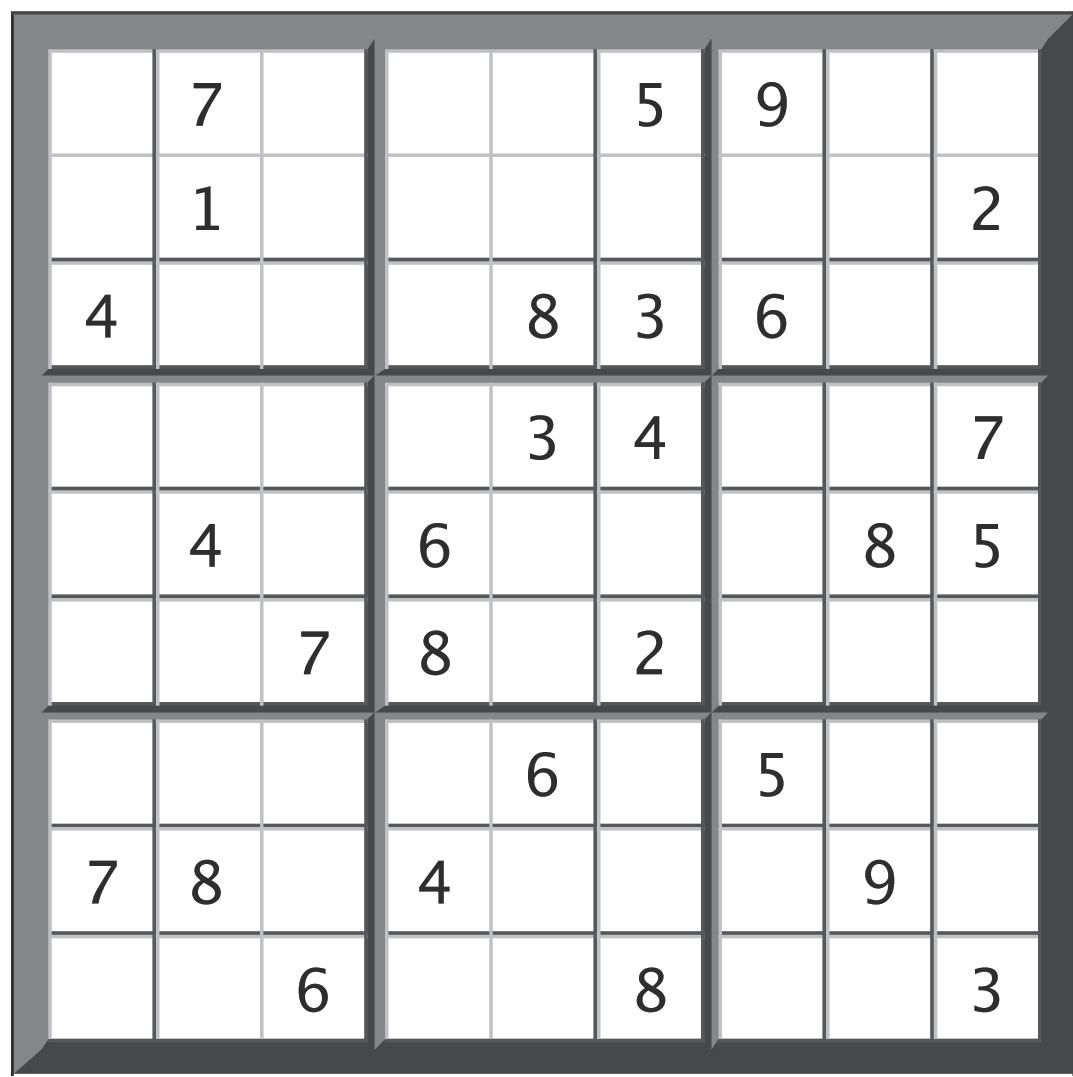
Fill in the empty cells, one number in each, so that each column, row, and region contains the numbers 1-9 exactly once. Each number in the solution therefore occurs only once in each of the three “directions,” hence the “single numbers” implied by the puzzle’s name. (Rules from wikipedia.org/wiki/ Sudoku)
“What’s she worrying about? Submit a caption to our website by Sunday, March 24, and if you win, your name could appear in The Sun!”
To submit your caption for this week’s contest, visit sunspots.cornellsun.com.
Art by Alicia Wang ’21
OT Goal Sends Red to Frozen Four
W. HOCKEY
Continued from page 12
second period, outshooting Cornell, 9-5, after being outshot 11-5 in a first period dominated by the visitors. But the Red’s penalty killers kept Northeastern off the scoreboard on all three of the home team’s second-period opportunities. The Huskieu were 0-for-5 on the power play in the game. Boissannault made a handful of key stops in the second to preserve her team’s two-goal lead. She had 22 total saves. Five of her second-period saves came with her team down a skater.
With a two-goal lead after 20 minutes, Cornell’s suffocating defense went to work. The Red’s 1.68 goals against per game was the second-best mark in the country this season. But the two-goal lead wouldn’t be enough, as the Huskies’ tallies five minutes apart tied the game.
be able to work with it. And if doesn’t go your way, then you put it aside and be ready for the next shot.” Boissannault made a huge stop with about 30 seconds left in regulation to force overtime. Then, after a bit of back and forth play, Frechette continued her hot scoring streak, tallying the biggest goal of her career to extend Cornell’s already remarkable season. When Cornell last reached the national semifinals in 2012 — a season in which it went 30-5-0 — it faced the Gophers and lost, 3-1. With its 2018-19 season set to last at least one more game, the Red gets a chance to take down the Gophers for a spot in the national championship game.
Cornell’s Frozen Four matchup with Minnesota will take place at 4 p.m. Friday in Hamden. The semifinal winner will take on the victor between Clarkson and Wisconsin in the national championship game on Sunday.
Collegetown
Houses, Apts, Parking 1 to 9 Bedroom Collegetown - College Ave, Linden Ave, Dryden Rd, Bryant Ave, Cook St. 607-330-2442 info@urbanithaca.com www.urbanithaca.com
We have availability for the 2019-2020 school year beginning June 1st at Hudson heights apartments. The studio apartments come with: heat, water, and electricity included. There are garbages houses and coin-operated laundry facilities on site. Prices start at $740/month for a 12 month lease. If you have any questions or would like to schedule a tour contact us by phone 607-208-7660 or email: renting@ithacaLS.com
COOK ST. Furnished House for 5-7 persons, 10mo. Lease for 2019-2020 Text or call Tracy at TLC Property Mgmt Corp 607-379-2776
3 BEDROOM
Nice, clean, furnished unit can host up to 12 people. 303-309 Dryden Road Heat, Hot water included. Fiber Optic fast internet connection Laundry, parking available 607-279-1888 www.porealty88.com
Collegetown Terrace Apartments INSPIRED LIVING TAILORED TO YOUR SUCCESS
24-Hour Fitness Center
Shuttle Bus Service to Campus Study Rooms w/ Expansive Views Apartments Available NOW, Spring 2019 & 2019/2020 Novarr- Mackesey Property Management collegetownterraceithaca.com office@ithacastudentapartments.com 607-277-1234
COLLEGETOWN MANSION: 221 EDDY STREET, 5 MINUTE WALK TO CORNELL. 12 Private Bedrooms with individual leases; Share 5 Bathrooms, 3 Kitchens, TV Lounge, Porch & Large Yard with Picnic Table. Rent per Bedroom $845.-$885. Rent Includes: High Speed Internet, Electricity, Heat, Snow Removal, Yard Care, Trash Removal & Professional Weekly Cleaning of Common Areas. Coin-Operated Washer & Dryer In Basement. On Site Parking For Rent By Semester. Full Fire Sprinkler System Throughout the House, Fire Alarms on Every Floor, Smoke Detectors In All Rooms. See Interior Photos of Bedrooms (on Status Page) & Exterior Photos, Floor Plans & Other Info on Our Website at: 221eddy.com CONTACT: KAREN ROSA, LANDLORD –941-223-1483.
Linden Ave. 5 Bedroom House Available June 2019. $900 per bedroom. Parking included. 607-327-2927
MUST SEE: 9 Bedroom House Walk to Cornell, Collegetown $5400 + utilities/month. 531 E. State St. 9/10 Bedrooms, 3 baths, 2 kitchens. Furnished, Free Laundry, Free Parking. Available 6/1/2019 607-379-9168 text/call
2019-2020 College Ave. 5 Bedroom House Furnished. Laundry. Internet. Parking. 607-273-8576
2019-2020 Upper Eddy St. 7 Bedroom House Furnished. Internet. Laundry. 607-273-8576
5BR/3.5BA/$395,000-14850-&: 607-351-0782 LA.Helping-Clients-With Ithaca Real Estate Focus-YouTube
“It happens,” Boissonnault said of Pettey’s goal, which came after Boissannault couldn’t contain an initial shot. “Things like that happen and just have to
Raphy Gendler can be reached at rgendler@cornellsun.com.
C.U. Beats Union in Quarterfnal Series
M. HOCKEY
Continued from page 12
With bounces being magnified by the millionth in the playoffs, Cornell had to thank some luck of its own to pull even in the second period. Off an offensive zone faceoff, a shot bounced around in front of Hanson before last touching the body of Starrett and trickling in.
“I was just hitting anything that moved and ended up hitting the puck into their guy and popped in,” Starrett said. “It was a huge momentum shift in the game.”
Starrett was right, because Cornell weathered a minor Union storm as the second period progressed before
junior defenseman Yanni Kaldis absorbed a knee-to-knee hit from Union forward Parker Foo, who was assessed a major penalty that carried over to the third period.
And 3:05 into the third and with five seconds left on the major, Mullin threw a soft shot on net to try and salvage at least one power play goal for either side of the weekend — teams finished a combined 1-for24 on the man-advantage over three games. Forty-two seconds later, junior forward Jeff Malott sniped home the backbreaking goal.
“It’s happy in [the locker room], but we remember last year. It’s redemption time,” Mullin said. “Lot of guys returning from last year we
are ready to redeem ourselves and go for an ECAC Championship.”
And for the five seniors in the locker room, Sunday was their last chance to play in front of the Lynah Faithful. For them, however, the more important prize lies ahead: the program’s first Whitelaw Cup since 2010.
“It’s kind of a bittersweet moment,” the senior Starrett said. “… It’s a good way to go out, though, for our last game at Lynah, and we have to get the job done now, hit the road and play some good road hockey.”
Zachary Silver can be reached at zsilver@cornellsun.com.
RED MARCHES ON
Women reach first Frozen Four since 2012
By RAPHY GENDLER Sun Sports Editor
Cornell women’s hockey is going to the Frozen Four.
After watching a two-goal lead slip away in the third period in Boston on Saturday, freshman Gillis Frechette’s game-winning breakaway goal in overtime sent Cornell past Northeastern, 3-2, in the NCAA Quarterfinals.
Owners of a spot in the national semifinals for the first time since 2012, Cornell will head to Hamden, Connecticut, next weekend to face No. 2 seed
third, when Northeastern nearly ended Cornell’s season with two goals in five minutes.
But 5:19 into overtime, Frechette, who has seven goals this season — all of which have come since Feb. 15 — corralled a long pass from senior Diana Buckley with speed in the neutral zone, broke toward the net and faked out Northeastern goaltender Aerin Frankel. Playing about 15 miles from her Weston, Massachusetts hometown, Frechette sent the puck into the open net — and her team to the Frozen Four.
“I found the puck
saw was me and the goalie,” Frechette said. “I remember in pre-scout coach said you have to get the goalie moving because she’s really good.’ At that point I kind of remember blacking out. So, I remember just making the move to my backhand and I remember telling myself ‘Do not miss this. You have an open net.’ And kind of just hit it in the net and from there I don’t remember what happened. I just remember being on the bottom of the dog pile and my sister screaming in my face.”
CORNELL @ NORTHEASTERN
Game: Cornell Northeastern 3 2
After a dominant first period gave the Red a two-goal lead, the third period was nearly devastating. At the 9:32 mark of the third period, Northeastern’s Veronika Pettey’s rebound goal cut Cornell’s lead to one. With 5:29 left in regulation, Skylar Fontaine ripped a shot past Cornell senior goaltender Marlène Boissannault to tie the game. Cornell first got on the board with 6:32 left in the opening period as junior forward Amy Curlew redirected home a shot from junior forward and captain Kristin O’Neill. It was Curlew’s fourth goal of the season.
Despite struggling during the ECAC playoffs, Cornell’s power play cashed in at the tail end of the first. Junior Grace Graham tipped a shot from the point past Frankel to make it 2-0.
“We were more of the aggressor in the first period,” said head coach Doug Derraugh ’91. “After we got the lead, I felt Northeastern really turned the tables on us and became more of the aggressor.”
Playing without Patty Kazmaier Award finalist freshman Alina Mueller — who missed the game with an injury — the Huskies came out with some speed in the second period, outshooting Cornell, 9-5, after being outshot 11-5 in a first period dominated by the visitors. But the Red’s penalty killers kept Northeastern off the scoreboard on all three of the home team’s second-period opportunities. The Huskieu were 0-for-5 on the power play in the
See W. HOCKEY page 11
Men rally past Union to advance to Lake Placid
By ZACHARY SILVER Sun Senior Writer
All season long Cornell men’s hockey preached that, obviously, it would have preferred to win every game, but clinching a second straight Cleary Cup and learning to deal with adversity along the way would make for a livable give-and-take should the team’s struggles help come postseason.
One weekend against Union in the ECAC Quarterfinals has, so far, proved just that. With its back against the wall after losing game one, Cornell soared to a four-goal win in game two.
And in a decisive game three, a microcosm of the 2018-19 season played out: The Red went down early before showcasing a certain tenacity with three unanswered goals to down the Dutchmen, 4-2, and punch its third consecutive ticket to ECAC Championship Weekend at Lake Placid.
“This team never seems to quit,” said sophomore forward Tristan Mullin, who trickled in the game-winner three minutes into Sunday’s third period. “… We faced adversity right from the start with the sweep by Michigan State and injuries non-stop. We haven’t had an easy road, and I think [we’re] a better team for that.”
“We had the toughest matchup of any team in NCAA hockey going into this weekend and we knew that,” added head coach Mike Schafer ’86. “We knew that it was going to be a battle. It was, from start to finish. It was physical, it was well-played. … It came down to the third period of a twoout-of-three series.”
Now as the top seed heading to Lake Placid, it’s redemption time for Cornell after being bounced out in the semifinals last season and falling in the championship game the year prior. In this installment, No. 2 Cornell will have to first stave off No. 8 Brown in the early semifinal on Friday.
“All four years for myself it’s never been an easy journey,” said senior forward Beau Starrett, who scored the equalizing goal 8:29 into Sunday’s second period in his final game at Lynah Rink. “And we’re ready for all the competition moving forward.”
Cornell at times over the weekend was maddening despite dominating. There was no shortage of shots and bodies flying in game one, but Union goalie Darion Hanson stymied nearly everything Cornell threw at him, whereas Saturday was a dominant performance for Cornell on both the ice and the scoreboard.
Sunday, however, was less so — the Red
went down 2-1 in the first 10 minutes of the game before an equalizer in the second followed by two quick goals in the third secured the victory.
Cornell replicated the early game formula it sported on Saturday as sophomore forward Kyle Betts sent home his second of the weekend just 57 seconds into the contest.
But that was essentially the Red’s only highlight of that opening frame. After not converting on a power play moments after the Betts tally, Cornell quickly saw Union pot a pair of its own goals in a span of just 1:12 to seize the lead.
Stayin’ alive | Cornell defeated Union in must-win games two and three to advance to the league semifinals for the third straight year.
BORIS TSANG / SUN PHOTOGRAPHY EDITOR
JIM PIERCE / CORNELL ATHLETICS
Hamden bound | Cornell takes on No. 2 seed Minnesota in the national semifinals on Friday.