
L OCA L C ORONAVIRUS C ASE
By ELISE CORDING
Contributor
A second individual has tested positive for COVID-19, according to a press release issued by the Tompkins County Health Department on Monday afternoon.
“Tompkins County now has its second positive case of COVID-19. While we continue to prepare to limit the community spread of this virus, we want to assure residents that we are working closely with local agencies to mitigate future exposure,” wrote Public Health Director Frank Kruppa.
The individual has been held in isolation and public health nurses have begun a contact investigation to determine if others may need to be tested
for possible exposure to the novel coronavirus.
The positive test result came two days after Tompkins County confirmed its first case of the fast-spreading virus on Saturday morning. That individual was affiliated with Ithaca College.
Confirmed cases have continued to soar across the state, prompting a dramatic escalation of containment measures announced by both local and federal officials in just the past day. Joining neighboring Connecticut and New Jersey, Gov. Andrew Cuomo (D-N.Y.) ordered all restaurants, bars, casinos and movie theaters in the state to close their doors by Monday night.
Anthony Chen can be reached at ac2826@cornell.edu.

Slope Day? It Goes Away Too Late-Night TCAT
Trips Suspended; Add’l Cuts Coming
By ELISE CORDING Sun Contributor
Tompkins Consolidated Area Transportation will end all late night bus service effective immediately and reduce service “across the board” by March 19, according to a Monday TCAT statement. Scot Vanderpool, general manager of TCAT, as well as other managers at the company, decided to advance the date of closures in response to a “downward spiral in ridership that started late last week and continued over the weekend,” the release stated. Prior to the announcement, TCAT planned to begin cutting bus ser-
See TCAT page 5
By KATHRYN STAMM and MADELINE ROSENBERG
News Editor & Sun Assistant News Editor
The Slope Day Programming Board canceled the beloved spring tradition before it had the chance to announce this year’s artist lineup — an abandonment of months of planning to comply with New York state and Centers for Disease Control event guidelines during the novel coronavirus outbreak. Slope Day’s cancellation marks
the loss of an venerated custom for Cornellians — from seniors eager for their last year-end celebration to freshmen, whose first taste of the tradition has now disappeared
See SLOPE DAY page 4

Sun
BORIS TSANG / SUN PHOTOGRAPHY EDITOR Milling and chilling
Cornell Athletics Annual GARAGE SALE
FRIDAY, MARCH 20 9:00 a.m. - 4:00 p.m. Open to the Public BARTELS GYMNASIUM

W W W . C O R N E L L S U N . C O M
Nile Jones | Rivers
of Consciousness
Please Stop Taking Easy Classes for GPA Boost
My junior year, one of my closest friends and I discussed our winter plans at the dinner table. I mentioned the possibility of taking an online course to complete a graduation requirement and relieve some of my academic coursework during the spring semester.
He also mentioned that he, a biology major in the College of Agriculture and Life Sciences, was taking an Introduction to Economics course during the winter session. When I asked about his anomalous course choice, he mentioned it was to hopefully experience a relatively easy course and earn a GPA boost.
I was flabbergasted. Being a pre-med myself, I understood that my friend, a pre-grad student, needed a high GPA to impress grad school interviewers and admission commit-
Something about his course choice just seemed inherently futile, even detrimental. Why invest money, time and energy into something that doesn’t provide any personal fulfillment?
tees. But something about his course choice just seemed inherently futile, even detrimental. Why invest money, time and energy into something that doesn’t provide any personal fulfillment? If one has no intellectual curiosity while taking a course, does true learning ever occur?
I’ve seen this GPA-centric mindset overrule love for learning time and again. I’ve also seen it fail to meet the student’s desires each time. My friend who took Introduction to Economics ended the course with an A-, which I know he was not overly pleased with.
Another one of my closest friends, a pre-law student majoring in mathematics, dropped an honors math course she was taking, not because the course was overly difficult
or the curriculum or teaching style was poor, but because she was afraid of earning the median, which she guessed would be an A- or A.
The sad and ironic part though, is that after the course ended, she conversed with some students who stayed in the class, only to be disappointed to hear that the course was curved to an A+.
Aside from the fact that my friends failed to meet their expectations, they ultimately sacrificed a possibly memorable experience with their classes. Devaluing learning for one’s GPA can also be a detriment to other students in the class as well. It fosters competition, rather than collaboration. If a course is curved — usually implying a fixed percentage of students can earn a certain grade — and people are taking a course for the primary purpose of a good grade, then why should they cooperate if they know they are effectively helping their competitors?
Moreover, this mindset can easily hinder a student’s academic potential through other means, such as fostering a lack of willingness to take optional, challenging classes. My sophomore year, I attended a gap year seminar held by a pre-health counselor at Cornell. The counselor emphasized the importance of high GPA, recommending to stay away from hard classes like honors physical chemistry to preserve GPA.
I’m sorry, but why? It’s one thing to intentionally opt in to courses because they seem easy, but it’s another to refrain from even attempting a course because you believe it will lower your GPA, even if you met the prerequisites for the course. It’s much easier said than done, but students should opt to take optional difficult courses for a productive learning experience.
As a pre-med student, I also have dealt with the alltoo-common imposter syndrome, taking the standard premedical courses as a sophomore and dropping honors classes when I knew I would perform worse than desired. The turning point in my Cornell career came in my junior year though, when I chose to take honors physical chemistry out of curiosity, opposing the counselor’s advice.
The course did not fail to meet expectations. I pulled a few all-nighters working on problem sets. And I did earn a lower grade than I desired. But the benefits far
Colton Poore | Help Me, I’m Poore
Not How I Planned to Say
This Friday, my friends and I held a going away celebration for one of us who was leaving. He ended up having to leave campus earlier that day, so at night it was just us, celebrating alone. The party ended in the only way it ever could’ve: tears. We cried gracelessly on the floor, as much about the uncertainty of our futures as about the nostalgia of our pasts.
This weekend has been filled with so many goodbyes. At many of them I’ve cried. Other times I do my best to hold it together. And once or twice, I’ve even managed to make my exit with a smile. I still don’t know if I’ve fully registered that I’ve walked out of my friends’ apartments for the last time, or that we’ve had our last hugs. I don’t know when I will.
Recent events have reminded me of Edgar Allen Poe’s “The Masque of the
Red Death.” After Tuesday’s and Friday’s announcements, it’s as if we’re all now listening to the tolling of the ebony clock. We’re passing our hands over our brows in meditation. Even the happiest among us are growing weary. Though we may try to make light of our anxieties, the fact stands that a lot of people who’d been intent on staying in Ithaca before Friday afternoon are now leaving early Sunday morning.
Likewise, I’ve spent the past few days on the phone with my mom asking her questions: Should I come home now? Will she be alright? How do I pack up four years at Cornell in one weekend? And for one of the first times in my life, my mom doesn’t know any of the answers. Neither does Cornell. Because there is no right answer. None of us know really what we’re supposed to be doing or
who we can lean on.
outweighed the drawbacks. I learned how to better ask for help and collaborate with my peers. I made lots of friends and ended up developing an unexpected passion for chemistry.
Best of all though, people cared I took this course when it wasn’t necessary for me. From my own personal journey as a senior hunting for gap year positions in research labs, my interviewers asked me not about my GPA or
Why stay away from difficult classes when they could possibly be the deciding factor between you and another student with a similar background?
extracurriculars, but what I learned in my classes. They were impressed by the fact that I was a premedical student capable of using Mathematica and solving Schrodinger’s Equation, skills I learned in p-chem, even if they weren’t needed for their lab.
This is unsurprising — choosing from a pool of brilliant pre-grad Cornellians with likely similar GPAs, majors and core coursework, admission committees and interviewers are looking for any reason to distinguish people. What’s the purpose of taking an easy course for the sake of GPA if it doesn’t confer anything meaningful to talk about? And at the same time, why stay away from difficult classes when they could possibly be the deciding factor between you and another student with a similar background?
Cornellians, now is the time to pursue the class you’ve always wanted to indulge in. Forget GPA — just take the class for fun. Make mistakes. Meet new people. And never be afraid to learn.
Nile Jones is a senior in the College of Arts and Sciences. He can be reached at njones@cornell.edu. Rivers of Consciousness runs every other Monday this semester.
Goodbye
Now, for the past few days, I’ve found myself praying for guidance like I used to as a child. I’m praying for my grandmother, 92 years old, living in Oregon. I’m pray ing for my dad and my stepmother near Seattle. I’m praying that there will be enough food and enough resources for everyone who needs them.
All the walls that I’ve built at Cornell to keep myself alive are crumbling to ruin.

Because the coronavirus pandemic has made me feel so powerless. The half-full bottle of hand sanitizer outside of our apartment and the sign asking everyone to wash their hands won’t keep it out. And with our one bathroom and one stove, when one of us gets it, all of us will get it. I want so badly to help others, but it’ll be hard enough to help myself.
Virginia Woolf writes that, in illness, we are finally able “to look round, to look up — to look, for example, at the sky.” I think a lot of the world is looking up at the sky right now, and it’s terrifying. Whatever is happening is bigger than we can adequately process.
This week, I’d been intently applying to jobs because it kept me thinking about a future. My future now is much more limited. I’m going to wake up tomorrow, head to brunch with one of my closest friends, hug her tightly and then cry as I watch her drive away. I’ll call my mom and ask — for what feels like the hundredth time — if I should start pack-
ing my things and looking for a flight back home. I’ll write a message to my grandma to help her pass the time. I’ll head to dinner with another friend, lament on lost time, mentally steel myself to say goodbye to him and probably end up crying regardWhen will the full pain of these goodbyes finally knock the wind out of me? Tomorrow? The next day? When I’m finally on my own way back home, and I have to say my own goodbyes? When I see that this column has been published, and I realize that everything I’m writing about has already become a memory?
I don’t know how to be brave anymore. All the walls that I’ve built at Cornell to keep myself alive are crumbling to ruin. Everything feels like it’s slipping through my fingers.
I don’t have answers or advice to give to my readers. I’m only 22 years old. The only thing I encourage is to give yourself the time and the space to experience your feelings for what they are. Listen to the ebony clock. Look at the sky. The musician Björk sings: “Don’t remove my pain / It is my chance to heal.”
In a world where there are currently no right answers or perfect solutions, all we can do is the best that we can.
Colton Poore is a senior in the College of Arts and Sciences. He can be reached at cpoore@cornellsun. com.

Swim Test, Phys Ed Requirements Waived For 2020 Graduates
By SYDNEY BROWNE Sun Staff Writer
The COVID-19 outbreak and resulting chaos scared some seniors into thinking they wouldn’t graduate on time because of unmet requirements — including the long-standing swim test and physical education credits.
But because Cornell urged students to immediately vacate campus in the midst of the pandemic, University leadership waived these requirements for graduating seniors in an unprecedented move. They also gave passes for students in all P.E. classes, contingent on attendance.
The Cornell swim test was first created to “teach people how to swim and make it a life skill,” according to the physical education website.
Since 1905, Cornell has required students to pass both their swim test and two P.E. classes to earn their diplomas. To graduate, one must either swim three laps without stopping or take two semesters of PE 1100: Beginning Swimming.
After Pollack announced that classes would become virtual starting April 6, students waiting until the approved April swim test dates were suddenly scrambling to find a solution.
Caroline Chang ’20 entered freshman year with a sprained ankle and was depending on the April test to complete the swim requirement.
“Up until a few days ago, I was pretty worried because I want to graduate on time and don’t want to have more complications with my job start date post-grad,” Chang said.
Most seniors received the news through an email from the Office of the Vice Provost for Undergraduate Education or through their majors. But some, like Bobby Ma ’20, found out in a different way: the “Cornell: Any Person, Any Meme” Facebook page.
To read the rest of this article, please visit www.cornellsun.com. Sydney Browne can be reached at sbrowne@cornellsun.com.
Cuomo Proposes Converting SUNY
Beds Into Hospital Spaces
By AMANDA H. CRONIN Sun Senior Writer
As students spent the weekend scrambling to box bedding and vacate campus dormitories, Gov. Andrew Cuomo (D-N.Y.) weighed options for expanding hospital capacity as COVID-19 cases continue to spike statewide.
One remedy, proposed in a March 15 op-ed letter in The New York Times to President Donald Trump, is to direct the Army Corps of Engineers to convert state-owned buildings, such as State University of New York college residential housing, into temporary medical centers.
“You have people on gurneys in hallways. That is what is going to happen now if we do nothing,” Cuomo said in a press conference Monday morning. “That, my friends, would be a tragedy.”
The Army Corps of Engineers is a group of builders, scientists and skilled workers housed under the Department of Defense, who can be deployed to alleviate stress on state governments and aid in fixing tough situations.
Utilization of the Corps requires approval from the Trump administration, which Cuomo solicited in his letter, explaining late on Sunday, “we’re not China, we can’t build a new hospital in a week. We need to make do with what we already have.”
Although Cornell is partially sponsored by SUNY in the form of four contract colleges, such a directive would likely not affect the University, as its buildings are not state-owned.
“SUNY dorms are state facilities and SUNY personnel are all state employees,” wrote University spokesperson John Carberry. “Cornell does not have state buildings that are used to house students or state employees.”
While New York State boasts among the top-ranked hospitals in the country, Cuomo wrote that the state is ill-equipped to handle the rapid increase of COVID-19 cases — echoing concerns among public health officials
that, unless dramatic action is taken, the medical system could quickly become overrun.
So far, the state has reported 950 cases and has witnessed at least seven deaths, as of Monday night. About 20 percent of COVID-19 cases require hospitalization.
New York State collectively has a total of 5,000 hospital and 3,000 ICU beds.
But in a presentation given on Monday, Cuomo suggested that, to proportionally accommodate an influx of coronavirus patients, New York City would require 5,000 additional beds, 1,000 in Nassau County and Suffolk County and 2,000 in Westchester County.
According to Cuomo, mobilizing the Army Corps of Engineers to retrofit existing state facilities, such as college dorms, would be “at this point, our best hope” in meeting the demand of the disease.
The call to action is another aggressive move to scale up New York’s response to the novel coronavirus. Signaling a sense of urgency, in a press conference on Sunday afternoon, Cuomo drew parallels of combating the disease to that of an external enemy attacking U.S. soil: “If you didn’t want to fight the war, you shouldn’t have enlisted in the military.”
Many SUNY campuses currently remain open while in the process of transitioning to online instruction. According to the SUNY Health website, all schools will have contingency plans in place by March 19.
In the letter, the governor also called on Trump to allow states to authorize a larger variety of testing methods and to standardize shutdown thresholds and procedures for businesses, schools and events.
“I’m not playing politics — I dont give a darn about partisanship,” Cuomo said in the Sunday press conference. “This is about Americans protecting American lives. I will work in partnership with the president on this, but he needs to take it seriously.”
Slope Day Next to Get the Ax
DAY Continued from page 1
from the academic calendar.
While severe weather abruptly shortened the event in 2018 when students evacuated Libe Slope early amid thunderstorms, this year’s Slope Day cancelation marks the first time the event will not be held in recent decades.
In the latest COVID-19 development, Ryan Lombardi, vice president for student and campus life, announced the cancellation alongside a slew of new containment measures in an email Monday night.
Despite in-person classes being canceled for the rest of the semester, Cornellians still held out hope there was a chance their semesters could finish with Slope Day — even as a long list of other campus traditions, including Dragon Day and the Cornell Fashion Collective show, were called off. But the event’s cancellation two months in advance reflects a growing sentiment that life with COVID-19 is here to stay.
Lombardi’s email also announced changes to daily campus operations. Students can no longer eat their meals in dining halls, as these on campus eateries are
TCAT Cuts Late Night Service
vice on March 22, according to the release.
This decision currently does not involve any layoffs for TCAT employees, Vanderpool told The Sun.
The acceleration of TCAT’s service reductions comes after President Martha E. Pollack’s surprise announcement on March 13 that classes would be suspended immediately, and that students living on campus would be asked to vacate dorms and return home as soon as possible.
People affiliated with Cornell make up around 70 percent of TCAT’s annual ridership, according to Vanderpool.
Patty Poist, TCAT communications and marketing manager, said that Ithaca residents should be on the lookout for any more revisions to
Continued from page 1 Ari Dubrow can be
TCAT’s service plans, which could change as circumstances of the COVID-19 pandemic develop.
Several routes will depart for the last time tonight, including 11N, which will last depart from the College Circle Apartments at 10:08 p.m., Route 90, whose last trip will depart from Schwartz Center for Performing Arts at 10:45 p.m., Route 92 whose last trip will depart Hasbrouck at 10:00 p.m and Route 93 which will depart from Hasbrouck for its final trip of the night at 10:30 p.m.
According to Vanderpool, it is unclear when bus service will resume, and will be discussed as the coronavirus outbreak unfolds in the coming months.
“It’s an ever-changing landscape,” Vanderpool said.
transitioning exclusively to take-out, following statewide policy measures to prohibit dining-in at restaurants starting Monday at 8 p.m.
Gyms and athletic facilities, as well as many libraries, will also close, effective Tuesday. Closed signs are now pasted on Olin Library doors, and McGraw Tower has shuttered to the public. Many other campus buildings and facilities will remain closed or limited to only card access.
The announcement also reminded the Cornell community that in-person meetings are discouraged and all meetings with more than 50 attendees are prohibited, in keeping with a nationwide push to encourage “social distancing.”
Across the country, universities are canceling similar large late-semester events. The University of Pennsylvania canceled its commencement ceremony on Monday, following the University of Michigan’s Friday decision to cancel its commencement. Cornell has not yet made an announcement about graduation, but anticipates making a decision by the end of March.
Kathryn Stamm can be reached at kstamm@cornellsun.com, and Madeline Rosenberg at mrosenberg@cornellsun.com.
Flag waving | New York Gov. Andrew Cuomo delivers an update on the coronavirus in New York, at the state Capitol in Albany on March 7, 2020.
SIDNEY SCHULTZ / THE NEW YORK TIMES
Amanda Cronin can be reached at acronin@cornellsun.com.
SLOPE
SC I ENCE
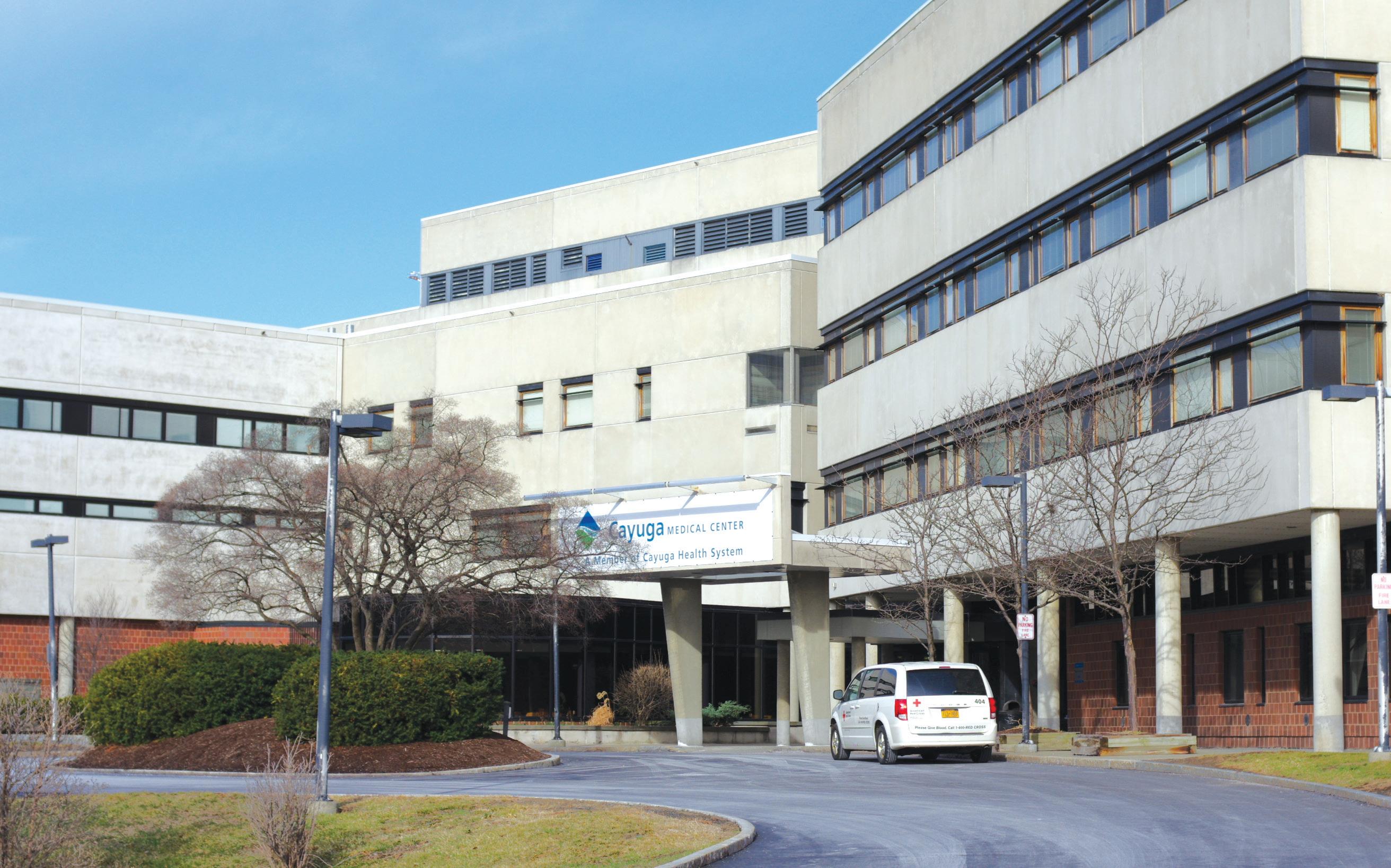
As Cases Soar Statewide, Cayuga Medical Center Prepares for Patient Spike
By
Even though Tompkins County’s second case of COVID-19 was confirmed only on Monday afternoon, Cayuga Medical Center already predicts shortages of key medical supplies and other resources.
Cayuga Medical, the Ithaca area’s primary hospital, operates 204 in-patient beds and employs 257 affiliated physicians. Among that staff, there are only two registered pulmonologists, doctors that specialize in treating respiratory tracts — one of the area’s hardest hit in a coronavirus infection.
Though estimates of the virus’ ultimate effects vary significantly, a top disease-modeller for the Centers for Disease Control said that at least 30 percent of Americans may contract COVID-19, and among those that do, 0.5 percent could die.
If these figures hold true for Tompkins County, with
a population of 102,793, nearly 31,000 cases and 154 fatalities could be anticipated throughout the course of the pandemic.
Although newly-implemented, drastic containment measures may blunt those projections — a slew of state governments have announced
“There’s no shortage right now, they are trying to do some advance planning.”
Frank Cantone
a series of lockdowns on bars, restaurants and other public places — severe estimates of COVID-19’s spread have sent hospitals, like Cayuga Medical, scrambling to prepare for a sudden influx of patients.
For instance, College of Agriculture and Life Sciences Dean Kathryn Boor sent an email to CALS faculty on the morning of March 16, alerting them that Cayuga Medical anticipated likely needing three different variants of swabs.
“There’s no shortage right now, they are trying to do some advance planning,”
How Helpful Is New York’s Plastic Bag Ban?
By ESTHER AKAPO Sun Contributor
New York State put into effect a new plastic bag ban on March 1 that aims to reduce high levels of plastic consumption and mitigate environmental hazards, such as water and air pollution from plastic disposal.
The new ban prohibits any distribution of plastic bags by any establishment that collects New York State tax unless it is an exempt bag — bags used for pharmacy prescriptions or produce bags used for fruits and vegetables.
Although many states like New York have policies
of plastics will increase by more than 40 percent.
“Until we are talking about limiting plastic production, we still are going to be pushing the problem around into different places without really addressing what’s going on here,” said Ph.D. student Bethany Jorgensen, department of natural resources.
Jorgenson has over 10 years of experience working with micro and macro plastics.
While there have been many major strides taken to combat the plastics issue, it requires more responsibility from plastic consumers.
According to Jorgenson, even though cities have good intentions with
“[What] makes plastics really tricky is that they don’t really disappear … we are used to treating plastic like it’s disposable.”
Bethany Jorgensen
in place to limit the overuse of single-use plastics, the production of plastic still continues to be a looming issue. It is projected that by 2028, the mass production
implementing these types of bans, “we have to recognize and always remember that the root cause behind this, is the amount of plastic that is being produced
and not the amount of plastic being used,” she said.
300 million tons of plastics are produced every year, half of which are single-use only.
Plastic bags are used for everyday
with reusable and more sustainable ones.
“What I encourage people to do ... is [to] really just pay attention to where plastics are in their day”
Bethany Jorgensen
purposes such as buying groceries, getting takeout foods, and in retail — only some of which are recycled.
“[What] makes plastics really tricky is that they don’t really disappear…we are used to treating plastic like it’s disposable,” Jorgenson said. “[We] don’t have any control or even real means of tracking [the recycling process] to make sure [our] gesture...is not getting stuck somewhere in the very convoluted recycling system,” she added.
Nevertheless, this ban can be seen as a middle step to push consumers more toward sustainable methods. The “#BYOBagNY” initiative urges New Yorkers to replace their plastic bags
“It’s a way of trying to spark people’s attention and get the conversation going around it,” Jorgenson said. Various Cornellaffiliated organizations have made some initiatives to garner attention surrounding sustainability. The “Take Back the Tap” initiative aims to reduce and eliminate the sale of single use water bottles on Cornell campus. Cafes such as Temple of Zeus and Manndibles have since started offering discounts to customers who bring their own mugs for drinks.
“What I encourage people to do...is [to] really just pay attention to where plastics are in their day to life and what [they] are using them for and think about what will happen to them once [their] done with them,” Jorgensen said.
said Frank Cantone, director of the Office of Emergency Management. According to Cantone, Cayuga Medical Center’s only request was for several kinds of swabs, which are necessary to test for the virus. At the time of publication, no facilities on campus had the requested resources, but the Office of Emergency Management was still collecting responses to the request from CALS faculty.
While this was the hospital’s only request made so far, Cantone is confident in Cornell’s ability to aid local medical facilities should the need arise.
“We are ready and able if other resources are requested, and that goes for either protective equipment or personnel to assist in operations,” Cantone said.


Akapo
ANIL OZA Sun Science Editor
RACHAEL STERNLICHT / SUN CONTRIBUTOR
Supply shortage | If estimates by the Centers for Disease Control, which predict at least 30 percent of Americans contracting COVID-19 hold for Tompkins County , nearly 31,000 cases and 154 fatalities could be anticipated.
ADRIAN BOTEANU / SUN FILE PHOTO
Fill in the empty cells, one number in each, so that each column, row, and region contains the numbers 1-9 exactly once. Each number in the solution therefore occurs only once in each of the three “directions,” hence the “single numbers” implied by the puzzle’s name. (Rules from wikipedia.org/wiki/ Sudoku)

Nuclear Apocalypse by Halle Buescher ’21


On Campus by Elizabeth Klosky ’21


Johnny Woodruff by Travis Dandro
26 A PA R TMENT FOR
R ENT
120 Oak Avenue
Just steps to Cornell Campus
10 bedroom house & 1 and 2 bedroom apartment 607-277-1234 office@ithacastudentapartments.com Ithacastudentapartments.com
>>SPECIAL PRICING<< Collegetown Apartments
Furnished 1-3 Bedrooms PARKING, LAUNDRY, UTILITIES! (607) 273-7368 www.WestShoreApts.com
109 Sage Place
3 Bedroom Apartments
Access to Shuttle to Campus
Access to Free Fitness Center Novarr-Mackesey Property Management office@ithacastudentapartments.com 607-277-1234
Houses, Apts, Parking 1 to 9 Bedroom
Collegetown - College Ave, Linden Ave, Dryden Rd, Bryant Ave, Cook St. 607-330-2442 info@urbanithaca.com www.urbanithaca.com
Catherine & Eddy St.
1 & 2 bedroom
Furnished, heat included Laundry in building Parking available for fee 607-277-1234 office@ithacastudentapartments.com
2020-2021
Studio 1, 3, 8 & 11 BR Apts. Great Locations in Collegetown. 607-227-2535
Collegetown Crossing
College Ave's Newest Location 307 College Ave. Now Leasing for 2020-2021 Completely New Modern Studios, 2 & 4 Bedroom Apartments.
Fully furnished, heat & hot water included. Reception area at 307 College Ave. www.urbanithaca.com 607-330-2442 info@urbanithaca.com
Now Renting
2-10 Bedroom Houses/ Apartments for 20-21. All Locations. Call today or visit our website: Certified Properties of TC Inc certifiedpropertiesinc.com 607-273-1669
*Brand New*
Full Term & Semester Leases
Studio, 1 & 2 Bedrooms College Townhouse 121-125 College Ave. CollegeTownhouseIthaca.com Leasing@inteprop.com 607-379-6023
APTS/HOUSES
COLLEGETOWN
BEST LOCATION/BEST PRICING 607-272-3389 avramisrentals@aol.com
27 H OUSE FOR R ENT
20-21 College Ave.
5 BR House
Furnished. Laundry. Parking. Call 607-273-8576
Solar Flashback: Cornell Epidemics
By SHRUTI JUNEJA and BREANNE FLEER Sun Senior Writers
The novel coronavirus, and its associated disease COVID-19, continues its spread around the world and country, affecting students’ semesters, altering travel itineraries and prompting the University to shift toward virtual instruction. While the University’s extensive actions in response to the novel coronavirus are unprecedented, the City of Ithaca and Cornell have prepared for and dealt with epidemics in the past. Although epidemics ranging from typhoid fever to swine flu have all been different, they have disrupted student and campus life multiple times in the past century.
Solar Flashbacks is a special project connecting The Sun’s — and Cornell’s — past to the present to understand how this rich history has shaped the campus today. Flashbacks appear periodically throughout the semester.
1903: Typhoid Turmoil
Over a hundred years ago, Ithaca was ravaged by a typhoid epidemic bringing dozens of deaths, changes in dormitory policies and even a donation from Andrew Cargenie.
“As the facts respecting the epidemic of typhoid fever at Ithaca come to hand, they show a deplorable lack of executive capacity and an extremely weak sense of official responsibility on the part of the college authorities. Not only were they unprepared for the emergency which confronts them, but they have neglected to do what the situation forced upon them,” The New York Times stated in February 1903.
In February 1903, Charlotte Elizabeth Spencer ’05 became the second student to die of typhoid fever. All in all, 82 people in Ithaca died, including 28 Cornell students. One in 10 residents got sick, according to journalist David DeKok, author of The Epidemic.
Around a third of Cornell students left Ithaca, and “Students were getting on trains and going home. For some, they thought they were getting away from death, but it ended up finding them anyway. A number of them died in their parents’ homes,” DeKok said in an interview in 2011.
However, wealthy industrialist Andrew Carnegie was on the Cornell Board of Trustees at the time, and “he became a hero, at least to some, when he agreed to pay medical and/or funeral expenses of students,” according
to DeKok.
The infirmary on campus began to get very crowded, and The Sun reported in February 1903 that “The rate of increase in the number of cases has been almost constant every day for the last week and physicians do not expect that there will be a material check in the epidemic for at least a week.”
However, the Board of Trustees rejected a resolution from the Senior Class in February 1903 that asked “University authorities supply every student boarding and eating house with pure water either artesian or disinfected water” and also requested that “all students desiring to go home until the furnishing of such water can be begun, be allowed to go home without jeopardy to their university standing.”
Events for graduating seniors also faced uncertainty, and in March 1903 “There has been some doubt expressed as to whether there would be a Senior Ball this year, or not.”
Virtual instruction was not a possibility at this time. However, the Arts and Sciences faculty passed a resolution in October 1903 taking into account the unusual circumstances and allowing for flexibility. For example, if students were unable to meet the 120 credit requirement for the college, the faculty would waive that requirement.
The resolution states that if the failure to obtain enough credits “resulted solely from illness or absence due to the epidemic of typhoid fever in the second term of 1902-1903, and that since that time all reasonable efforts
have been made to obtain the required minimum, this Faculty pledges itself to take all the circumstances into consideration and to deal generously with the student in determining whom to recommend for the degree, even to the length of modifying where necessary the standard requirements for the degree.”
The Sun also faced tough times, and wrote in April 1903 that “A large number of Sun subscriptions for the year and second term remain unpaid. The late epidemic has made it almost impossible to collect any of the outstanding accounts … The management would further say that the late epidemic has greatly affected the income from the advertisements, which it had depended upon to most current expenses. So it is compelled to ask for an immediate settlement of all outstanding subscriptions.”
The Sun and The University eventually bounced back, and according to a June 1906 Sun article titled “Why the Alumni Should be Proud of Cornell,” “The registration has been increased from 3,453 in 1902-3 to 3,841 in 1905-6, despite a fever epidemic.”
Decades later, The Sun reflected on the crisis and published a story in September 1962 with the intriguing headline “Ithaca Typhoid Epidemic Brought Men’s Dormitories to Campus.”
“In the early part of the 20th century the women were usually the ones fighting for equal rights. At the University, however, this tradition was reversed; while co-eds had the privilege of living in dormitories on campus, their male classmates were forced to live in rooming houses in Ithaca since Cornell had no men’s dormitories,” The Sun reported.
“Around the turn of the century men put on a weak campaign for equal dormitory space, but if it hadn’t been for a catastrophe which struck Ithaca in 1903, the University might never have built men’s dorms,” the story continued.
1918: Spanish Flu Strife
In September 1918, the first cases of the “Spanish influenza” arrived on campus, according to a University press release looking back at the pandemic. The Centers for Disease Control and Prevention reports that the virus is estimated to have infected a third of the global population and caused at least 50 million deaths.
Ithaca took a more hands-off approach to the flu than other cities, according to a 2018 Ithaca Journal article. The city did not call for the “school closings, the
shutting down of restaurants and bars and other public gathering places, and cancellation of sporting events” that happened nationally.
“But local health department figures dismissed the value of such precautions here, instead saying that residents should go about their regular daily schedules, paying particular attention to cleanliness and healthy living, and avoiding sick people,” The Ithaca Journal reported.
Nonetheless, the city was quickly hit with large numbers of cases. Campus spaces and resources went toward caring for the ill.
“Then, rather abruptly on Oct. 8, The Journal reported 300 cases of the flu in Ithaca, and the opening of Cascadilla Hall on the Cornell campus as an overflow hospital for the university’s infirmary,” The Ithaca Journal stated in 2018. “As the days progress, more and more mentions are made of people taken ill throughout the county.”
According to The Ithacan, citing a book by John Harcourt about Ithaca College’s history, the college’s first president William Grant Egbert and his second wife Mabel used their home as a temporary infirmary. In 2012, The History Center featured an exhibit called “Grippe: The Epidemic of 1918,” recounting news articles, facts and additional stories from the period.
The virus continued to affect Ithacans through January 1919. According to a Sun article, the flu had “not been completely stamped out,” with “30 supposed cases” that month, but the town’s overall health was “good.”
“Health conditions in Ithaca are unusually good for this time of year according to a statement made yesterday by Dr. H. H. Crum, city health physician,” The Sun reported.
However, in the coming months, a couple Cornell alumni passed away due to the effects of the illness. One such alumnus was E. L. Tinkham 1916, who “commanded the first fighting unit of Americans to carry the American flag to the French war zone in May 1917,” according to a Sun article from April 1919.
“Tinkham’s contingent which bore the Stars and Stripes to the front was composed mainly of Cornell undergraduates and departed for the fighting line armed with carbines and uniformed in khaki,” The Sun reported.
Tinkham, who “won two war crosses,” died of pneumonia in Italy after battling the flu.
To continue reading this Solar Flashback, please visit www.cornellsun.com.
MEN’S AND WOMEN’S SQUASH
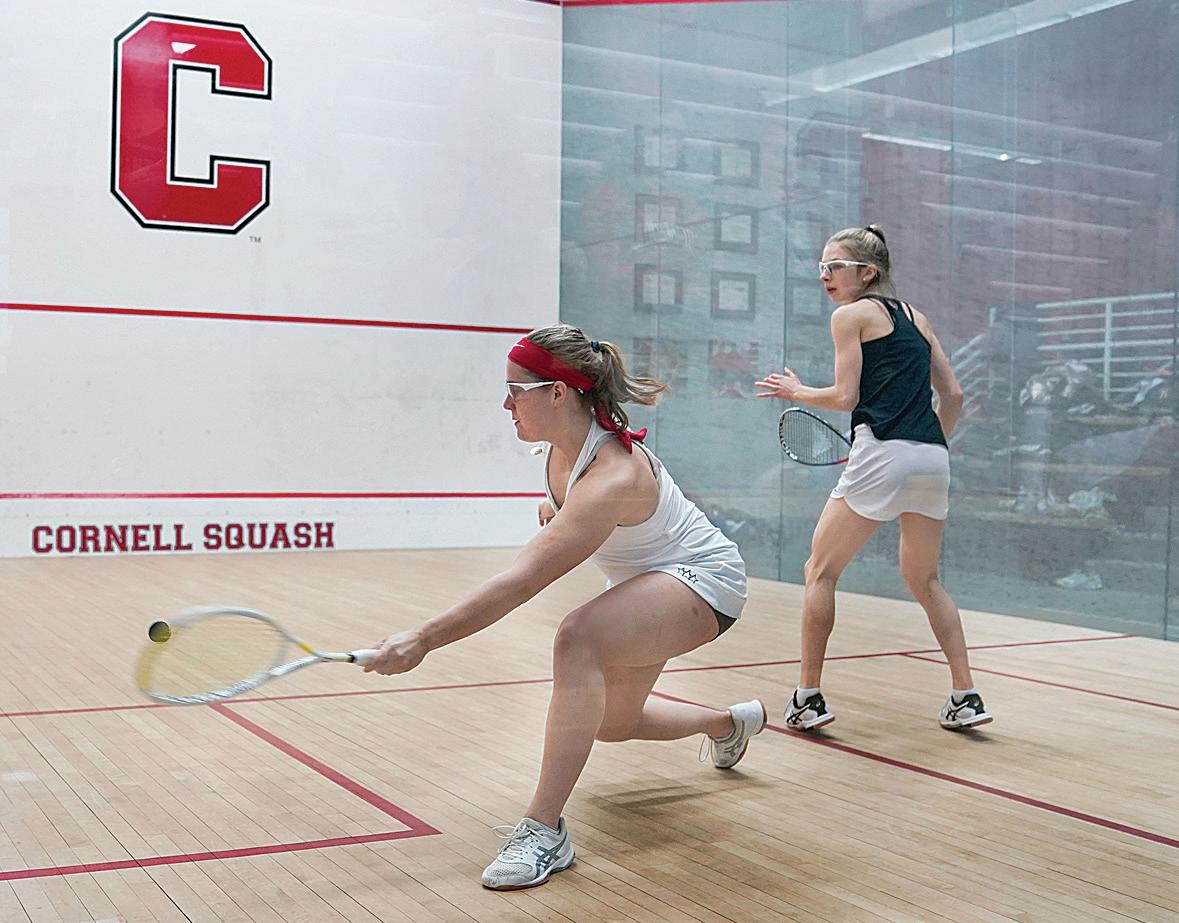
Still hope yet | Even with the ECAC Championship game not going its way, the Red will compete on the national stage in the NCAAs. The loss Sunday was Cornell’s first home defeat all season.
Squash Teams Finish Strong In Unforeshortened Season
with a successful Individual National Championships. There, two players, freshman Veer Chotrani and sophomore Sivasangari Subramaniam, were each named to the All-America first team.
A Heartbreaking Season Ending for Student Athletes
The sudden shift from pre- March Madness excitement to a sports-less spring — heartbreaking for players and fans around the country — is nobody’s top concern right now. The NCAA and pro sports leagues are 100 percent right to shut down.
But here in Ithaca, my heart breaks for the hundreds of Cornell student athletes who will forever be left to wonder what might have come of the spring of 2020, whose collegiate careers were flipped upside down by a crisis that seemed so distant just a few days ago.
Ivy League student athletes are smart, driven kids at the near or absolute top of their sports. They give everything to represent Cornell and wear their colors with pride.
Their dedication and drive — to make it back from injury, to win a national championship, to be there for their teammates — ending up unable to yield results would’ve been unimaginable a few days ago.
The vast majority of Cornell’s student athletes aren’t going to sign million-dollar contracts, play in prime time on national television or sign big shoe contracts. These athletes work tirelessly for the love of the game, for their teammates and for Cornell. It’s a shame that these athletes — especially graduating seniors who may have taken the field, court, diamond and ice for the last time — won’t get a proper send-off.
Cornell’s No. 1 ranked hockey teams will get a lot of love. And they deserve all that appreciation, and more, for their tremendous seasons that won’t end in bids for national championships. A lot of hearts will break for Cornell’s No. 2 men’s lacrosse team, which looked poised for another stellar season. Many fans will be thinking of the eight Cornell wrestlers who won’t be able to compete in this year’s national championships.
In addition to all these athletes, we’d all do well to spend a moment appreciating and thanking Cornellians on softball, baseball, sailing, rowing, gymnastics, squash, track and field, tennis and golf teams, who don’t draw thousands of fans and don’t get national media attention, but who pour their everything into their teams.
With the cancellation of classes and any remaining athletics seasons, the Red’s squash team was able to finish out its 2019-2020 schedule relatively unscathed.
Although the team’s season ended before the suspension of classes, the players still felt the impact of the news.
Specifically, the team has multiple international students who had to abruptly leave for their home countries.
Head coach David Palmer made sure they were taken care of. Having spent the weekend helping his students, pack, store and make it home safely, Parker is now able to take time to ruminate on the season that just finished.
The coach was excited about the results.
The program boasted a few historic wins, including a match against Dartmouth, marking the team’s first win against the Green in Palmer’s tenure and the first for the Red against Dartmouth in seven years.
With a graduating class of six, Palmer wanted to be sure to celebrate the departure of the seniors. Amid packing, he and the team put together an impromptu dinner to give out awards and say their goodbyes.
Although it was not the most official event, it was one last chance for the close-knit team to be together.
“At least we got together one more time before we all sort of separated,” Palmer said.
Palmer empathized with other spring teams who had their seasons cut short.
“I’m very glad we were fortunate enough to get our season done.”
Head Coach David Palmer
This win came during the men’s team championships, in which the team came incredibly close to winning the cup as a result.
Lsst season, the men ranked No. 14, but they were able to move up this time around. While they ended the regular season ranked No. 12 overall, they moved up two spots to No. 10 by the end of the team championships.
Both the men and the women ended the season with the same overall record, 7-11. It is a similar outcome to last season, in which the men finished 6-12 and the women 8-10.
This season, the women ended their season with a ranking of No. 11 nationally, only a slight drop from their last season’s No. 9 ranking.
“I think we really maximized our efforts,” Palmer said. “I’m really proud they could keep it going all the way through, for both programs.”
The women’s team also secured a few important wins, including a third-place finish at their national championships, in which they were able to top both George Washington University and Brown University.
The season itself ended at the beginning of the month
“I’m very glad we were fortunate enough to get our season done, and I feel very sorry for the spring sports that have worked hard and got their seasons cut,” he said.
Looking ahead, Palmer is focusing on working with his current students, improving the facilities and planning next season’s team. He has been sending out training manuals for his athletes to work with during the off-season, keeping in shape at home rather than at the Belkin Squash Courts in Ithaca.
Despite the fact that his in-person spring semester training has gotten cut short, Palmer plans to help his athletes any way he can.
“I’m working on staying in contact with them, and [helping] them with their plans over the next month,” he said.
At the home squash courts, Palmer and his staff are planning to make some updates, including adding improved video systems.
Palmer will work on recruiting new players for the 2021 class and planning next year’s schedule. The season will likely begin in early November with Ivy Scrimmages, followed quickly by the start of the regular season once again.
“It’s a very long season, but we seem to have a good habit in the last two seasons of really finishing strong,” Palmer said.
These student athletes represent so much of what it means to be a Cornellian: working for one another, proudly donning the red ‘C’ and wearing the “blue collar Ivy” chip on their shoulders.
I don’t claim to really know what it’s like to balance Division I sports with Ivy League academics or how it feels to

be in your late teens and early 20s and be at the top of your sport. But I do know that as a sportswriter at The Sun, one of the things I enjoy most is talking to student athletes and seeing firsthand the passion and drive that go into representing our University.
Sports aren’t the only thing, and they’re certainly not the most important thing right now. But for these students, some of the hardest-working and most driven at Cornell, their sport is everything. That they won’t be able to work toward a title, finish their senior seasons or spend a spring with their teams is heartbreaking, and a reminder of how central a role sports play in our lives.
When we get through this outbreak — and we will — sports will be there for us to escape life for a while and enjoy the heartbreak, triumph, trials and victories that only sports can bring.
In the meantime, here’s an idea: If you’re up for it, and want to send Cornell student athletes — especially graduating seniors — your appreciation, send me an email at rgendler@cornellsun.com. Address it to whomever you please and say whatever’s on your mind. I’ll try to get your messages to the athletes, and if I can’t, I’ll put them on social media or in a story at cornellsun.com for fans, athletes and Cornellians to see.
BORIS TSANG / SUN PHOTOGRAPHY EDITOR
Raphy Gendler Guest Room
By ELIZABETH FOY Sun Staff Writer